1. Introduction
Sugar beet (
Beta vulgaris L., subsp.
vulgaris var.
altissima; family
Amaranthaceae) is a biennial crop of major agronomic and industrial relevance and is the second most important sugar crop globally after sugarcane [
1]. It grows mainly in temperate regions between 30° and 60° N latitude, covering approximately 4.65 million hectares worldwide [
2]. Europe is the leading producing area, accounting for about 3.14 million hectares, yet cultivation has declined over time in parts of southern Europe. This decline is due to structural challenges, including reduced processing capacity in some regions, competition from lower-cost alternatives, and the need for climate-adapted varieties within unstable supply chains [
3,
4]. Agronomic strategies that shift crop phenology away from peak heat and drought periods are receiving renewed attention, including adjusted sowing dates, improved irrigation management, and adoption of climate-resilient varieties [
5].
Cercospora leaf spot, caused by
Cercospora beticola, is among the most damaging foliar diseases of sugar beet worldwide [
6,
7]. Alongside drought and heat stress, disease pressure reinforces the need for locally validated, climate-adaptive agronomic strategies that include sowing-date adjustments to improve yield stability and quality [
5].
In Italy, autumn sowing has historically been practiced mainly in southern areas with mild winters, where the recommended sowing window is from mid-October to mid-November. In northern latitudes, spring sowing remains the standard practice because autumn sowing increases the risk of winter mortality and pre-flowering (bolting), with negative effects on crop growth, and root yield and technological quality [
8,
9]. Following autumn sowing, sugar beet can undergo vernalization at temperatures of around 8–10 °C, triggering the transition from vegetative to reproductive development [
10]. This reproductive shift diverts assimilates from taproot storage to aerial biomass production at the expense of sucrose accumulation [
11] and increases molassigenic substances that reduce the root’s suitability for sugar extraction [
12,
13]. It may also increase lignin content in root tissues [
14].
Bolting is initiated by rapid stem elongation following vernalization and long-day exposure, mediated by
Bolting Time Control 1 (
BTC1), a pseudo-response regulator (PRR)-like transcriptional factor involved in the photoperiod pathway. Dominant B alleles confer an annual growth habit by promoting bolting under long-day conditions without a vernalization requirement, whereas recessive btc1 (bb) alleles result in a biennial habit requiring both vernalization and long-day conditions [
15,
16,
17]. Vernalization also enables gibberellin-dependent stem elongation, contributing to the quantitative variation in bolting tolerance observed among varieties [
18]. From an agronomic standpoint, bolting risk can be predicted using cumulative vernalization intensity, defined as the number of hours between sowing and summer that fall within the bolting-effective temperature range [
10,
19].
The main advantage of autumn sowing is an extended growing season and earlier spring canopy development, helping the crop to avoid the hottest and driest summer period. Because yield is linked to intercepted photosynthetically active radiation (PAR), an earlier established spring canopy can increase yield potential, provided winter survival is adequate, and bolting remains limited [
20,
21].
Based on the broader literature, autumn sowing has been reported to offer yield and resource-use advantages over spring sowing under favorable conditions. Several authors report that autumn sowing can increase sugar beet production by 26–34% compared to traditional spring sowing. This benefit is mainly attributed to a longer growing season, earlier canopy closure, and improved cumulative interception of solar radiation [
20,
22,
23,
24]. Autumn sowing can also improve water-use efficiency, although the magnitude and stability of this advantage depend on weather conditions and soil water availability [
23]. Very large differences in biomass production have been reported between autumn- and spring-sown crops [
25], but the realized benefit can be partly offset by bolting. Biomass accumulation is closely linked to thermal time: leaf formation is slow in spring under low temperatures, and dry matter accumulation is closely related to accumulated degree days [
26,
27]. Autumn-sown beets continue to accumulate dry matter beyond the plateau reached by spring-sown crops at approximately 1600 °Cd [
12,
28]. After autumn sowing, growth resumes rapidly with rising temperatures in April, and by June, total dry matter can reach 4 to 10 t ha
−1, depending on the sowing date [
24]. Delaying sowing within the autumn window can reduce yield potential and alter biomass partitioning, including crown and taproot development [
11]. In southern Italy, Rinaldi and Vonella (2006) [
29] reported 40% higher root and sucrose production for autumn sowing (October–December) under optimal water conditions, along with improved water-use efficiency and a 26% reduction in irrigation water use.
Beyond bolting, frost-induced winter mortality is another major constraint for autumn-sown sugar beet [
30]. The minimum winter temperature is a key determinant of mortality risk, but it is strongly modulated by genotype, plant developmental stage at the onset of winter, and seasonal climate patterns [
31,
32]. Cold acclimation is a key factor of frost tolerance, improving plant resistance to freezing injury through reduced ice nucleation, controlled extracellular ice formation, membrane stabilization, osmotic adjustment, and accumulation of cryoprotective solutes [
33,
34,
35]. At the crop level, variation in these responses among genotypes contributes to differences in overwinter survival under field conditions [
36,
37,
38].
In sugar beet, winter hardiness is associated with biochemical and physiological adjustments. These include the accumulation of cryoprotective solutes such as sucrose (acting as an osmoprotectant under cold conditions) and raffinose, particularly in taproot pith tissue [
34,
39,
40]. Frost tolerance varies among phenotypes and genotypes. Higher tolerance is associated with plants at intermediate developmental stages with taproot diameters of 1.0–2.5 cm [
41], and the survival rates range from near zero to more than 87%, depending on variety and environment. These variations make varietal selection a critical determinant of autumn sowing success at northern latitudes, where frost risk is variable and often site-specific [
31,
32,
39]. However, some of the compounds involved in osmotic protection may also be associated with quality constraints when molassigenic substances remain high at harvest [
39,
42]. Identifying the sowing window and selecting appropriate varieties to jointly minimize bolting risk and ensure winter survival is therefore central to the agronomic feasibility of autumn sugar beet, particularly at latitudes where winter cold events remain possible.
Despite substantial research on autumn-sown sugar beet in Mediterranean and temperate environments, field evidence for north-eastern Italy remains limited. In particular, regarding how sowing date within the September–November window and variety influence overwinter survival, bolting, and productivity under local conditions. Sowing date is a primary determinant of the trade-off between bolting risk and frost damage, reinforcing the need for location-specific field validation [
30]. This lack of location-specific evidence limits agronomic recommendations for the regional adoption of autumn sowing, as new varieties continue to be released in the market.
Within this framework, the present study was conducted over two growing seasons (2021–2022 and 2022–2023) in north-eastern Italy, to evaluate the agronomic feasibility of autumn-sown sugar beet under field conditions. Specifically, the study aimed to (i) quantify the effects of autumn sowing date and variety choice on overwinter survival, expressed as plant winter mortality; (ii) characterize bolting expression across sowing dates and varieties in terms of reproductive stem development; and (iii) assess the effects of sowing date, variety, and harvest timing on taproot yield, above-ground biomass production, and root juice soluble solids (°Brix).
2. Materials and Methods
2.1. Field Trial Setup
The experiment was conducted over two growing seasons (2021–2022 and 2022–2023) at the Lucio Toniolo Experimental Farm of the University of Padua, Legnaro (Padua; NE Italy; 45°21′ N 11°58′ E; 8 m a.s.l.). The experimental site was located on a silty-loam soil (arable layer: 19% clay, 65% silt, and 16% sand) representative of the lower Po Plain. According to the World Reference Base for Soil Resources (WRB), the soil was classified as a Fulvi-Calcaric Cambisol, corresponding broadly to an Inceptisol in the USDA Soil Taxonomy. At the onset of the trial, the soil had 1.65% organic matter, 0.10% total nitrogen, a cation exchange capacity of 11.4 cmol(+) kg−1, and a soil pH of 7.75.
Meteorological data, including daily air temperature at 2 m height and precipitation, were obtained from the nearby ARPAV (Regional Agency for Environmental Protection of Veneto) weather station at Legnaro, Veneto, Italy (station code: 111). All derived variables, including monthly temperature averages and cumulative growing degree days (GDD), were calculated from the corresponding daily records.
2.2. Experimental Design
Nine sugar beet varieties (
Beta vulgaris L., subsp.
vulgaris var.
altissima) were evaluated over two growing seasons. The experimental material was supplied by three seed companies, SESVanderHave (Cesena, Italy), KWS (Forlì, Italy), and Aurora (Termini Imerese, Italy), and comprised a mixture of commercially available varieties and breeder-designated entries. Variety codes, commercial names, supplier country, and supplier-reported
Cercospora tolerance are reported in
Table S1. The varietal set was identified on the basis of their marketed tolerance to bolting and overwinter stress, as well as for its commercial relevance in the northern Italian market. All varieties were grown under a common cultivation protocol representative of northern Mediterranean conditions, with the aim of capturing a broad and representative range of agronomic and genetic responses to autumn sowing across a large sowing window.
The varieties investigated differed between the two growing seasons because the second-year experimental set was refined on the basis of first-year performance, retaining the better-performing varieties and integrating newly released breeding lines. Hence, some of those evaluated in 2021–2022 were not carried forward. Three varieties (BM03A, BM04A, and BM05A) were present in both seasons and served as cross-year reference varieties.
In 2021, four sowing dates were tested within the time period of late September (SL21), early October (OE21), late October (OL21), and early November (NE21). In 2022, two sowing periods were tested, i.e., late September and late October (SL22 and OL22) (
Table 1).
In 2021–2022, SL21 and OE21 included only BM01G and BM02G, whereas OL21 and NE21 included six varieties. In 2022–2023, both SL22 and OL22 comprised the same six varieties. Within each sowing treatment, varieties were arranged in a randomized complete block design with four replicates (n = 4). Each plot covered an area of 33 m2 (3 × 11 m, width × length) and consisted of six rows spaced 0.5 m apart.
2.3. Crop Management
In both seasons, primary tillage consisted of ploughing to 0.35 m depth in September, followed by one pass of rotary harrowing to prepare the seedbed.
Pre-sowing fertilization comprised 200 kg ha−1 of potassium chloride at 60% of K2O (i.e., 120 kg ha−1 K2O) and 160 kg ha−1 of triple superphosphate at 37.5% of P2O5 (i.e., 70 kg ha−1 P2O5). In February, 200 kg ha−1 of ammonium nitrate (26.5% N; corresponding to 53 kg ha−1 N) was applied as top dressing by broadcasting and subsequently incorporated into the soil by mechanical hoeing. The application was uniform across all sowing dates except in NE21. In NE21, top-dress nitrogen was not applied because poor seedling establishment and severe winter mortality had drastically reduced plant stand density, making the treatment agronomically unjustifiable.
Sowing was performed with a precision single-row seed drill at 3 cm depth and 8.2 cm within-row spacing, resulting in a seeding density of 24 seeds m−2. Following emergence, a manual post-emergence thinning to 50% of emerged seedlings was carried out to achieve a target final stand density of approximately 12 plants m−2.
No irrigation was applied in either growing season. Pre-emergence weed control was carried out by applying 3 L ha
−1 of Gold Beet Super (Adama Agan Ltd., Ashdod, Israel, a.i. Metamitron 350 g L
−1 + Ethofumesate 150 g L
−1) and 0.5 kg ha
−1 of Venzar (FMC Agro Italia S.r.l., Bergamo, Italy, a.i. Lenacil 800 g kg
−1), sprayed through 400 L ha
−1 of water. Fungicide and insecticide treatments were not administered, and the crop was therefore subjected to the prevailing natural pressure of
Cercospora beticola during the last part of the growing period from late June to July. No formal disease incidence or severity assessment was conducted in this study. Natural infection pressure is therefore described qualitatively and used only as a contextual background for interpreting late-season canopy decline, not as a measured experimental variable. Accordingly, the
Cercospora tolerance information reported in
Supplementary Table S1 is provided only as supplier-reported background information on varietal profile and was not treated as an experimental variable in the present study.
In order to prevent seed set in bolting plants, a topping operation, consisting of the removal of bolting stems and inflorescences, was performed during both seasons. In 2022, topping was performed on 25 May for all varieties using a hedge trimmer operated to simulate a conventional tractor-mounted mowing bar. In 2023, topping was performed on 14 June only on the less bolt-prone varieties BM03A, BM04A, BM05A, and BM12A in order to delay grubbing-up and extend the harvest period until August; fully bolted varieties were not subjected to topping.
2.4. Measurements and Sampling
2.4.1. Winter Mortality
Winter mortality was quantified by counting the plant population before and after winter along the same 20 m length of contiguous rows per plot (10 m2 per plot, n = 4).
In both years, 15 April was taken as the reference date for the end of the cold period, as the daily minimum air temperature (T
min) consistently exceeded 3 °C from that date onward. Winter mortality was calculated as follows:
where
and
are the number of plants recorded before and after winter, respectively.
Growing Degree Days (GDD, °Cd) were calculated from sowing date using a base temperature of 3 °C, as follows:
where
is the daily mean air temperature and
= 3 °C. Days with
<
T base contributed 0 °Cd in the calculation.
2.4.2. Bolting Incidence
Bolting was assessed along one full row of plants per plot (11 m contiguous). Two categories were distinguished and recorded: (a) bolted plants, defined as those showing any visible flower scape initiation (including scapes of only a few centimeters in height); and (b) plants with developed floral structures, defined as those bearing fully developed reproductive organs, with flowering shoots and/or inflorescences extending above the horizontal plane of the basal leaves.
Assessments were performed on 25 May 2022 and 31 May 2023, roughly coinciding with the topping intervention.
In the second growing season (2022–2023), the core varietal set used for winter mortality, yield, and soluble solids determinations comprised BM03A, BM04A, BM05A, BM11R, BM12A, and BM13G. For the specific purpose of assessing bolting incidence, BM01G, BM02G, and BM06R were additionally retained, allowing their reproductive response to be compared with that of the second-year varietal set under the same field conditions.
Bolting incidence was expressed as the percentage of plants showing visible floral scapes (a), as follows:
The proportion of plants with developed floral structures (b) (and therefore potentially subject to topping) was calculated as:
2.4.3. Taproot and Above-Ground Biomass Yield
Destructive harvests for fresh taproot yield and above-ground biomass were carried out on multiple dates (
Table 1), depending on sowing date and crop phenology.
On each harvest date, one row (11 linear m, 5.5 m2) per plot was sampled (n = 4). Plants were cut manually at the collar (hypocotyl); taproots of all shapes and sizes were included and manually cleaned of soil residues.
Above-ground biomass (leaves, collars, stems, floral scapes, and heads) was weighed separately. All biomass components were weighed fresh on a precision balance (RADWAG PS 10100.R2.M, RADWAG Wagi Elektroniczne, Radom, Poland), with a readability of 0.01 g; yields are reported as fresh weight on a hectare basis (t ha−1).
2.4.4. Soluble Solids Content
Soluble solids content was estimated as Brix degree (°Brix) using a handheld optical refractometer (MR200ATC, TECNOVA HT s.r.l.—Milan, Italy). Measurements were carried out on predefined sampling dates, which did not always coincide with destructive harvest dates.
For each sample (n = 4), one root was randomly selected, washed under running water, and sectioned at one-third and two-thirds along its length. Each section was grated to extract a juice-rich pulp, which was pressed manually through a non-woven fabric to obtain a liquid extract. The extract was immediately placed on the refractometer prism, and the °Brix value was recorded. As °Brix measures total soluble solids, it should not be interpreted as polarimetric sucrose concentration; it was used here as a field-level indicator of soluble solids accumulation in the root juice.
2.5. Statistical Analysis
Data were analyzed by analysis of variance (ANOVA) using CoStat (Cohort Software, Manugistics, Rockville, MD, USA; version 6.204). The trial had a partially unbalanced structure, because variety sets differed across sowing dates and between the two growing seasons, and harvest dates were not identical among sowing-date groups (
Table 1). For these reasons, statistical analyses were performed separately within each growing season and sowing date. Winter mortality and bolting incidence were analyzed for each sowing date, considering variety as the treatment factor within the randomized complete block design (
n = 4). For taproot yield, above-ground biomass, total biomass, and Brix degree, analyses were performed separately for each harvest or sampling date within each sowing date, considering variety as the fixed factor and block (replicate) as the random factor.
When the F-test was significant at p ≤ 0.05, means were separated using the Student–Newman–Keuls (SNK) test. Results are reported as mean ± standard error (n = 4).
Because the varietal sets and the harvest dates were not fully consistent across sowing dates and growing seasons (
Table 1), formal statistical inference was therefore restricted to varietal comparisons within each sowing-date × harvest-date combination. Year-level and sowing-date-level effects could not be tested formally by ANOVA without violating the assumptions of a balanced design. Cross-year consistency of the main findings was therefore evaluated and interpreted on a descriptive basis. Where the same varieties (BM03A, BM04A, BM05A) and comparable sowing dates (OL21 in 2021–2022 and OL22 in 2022–2023) were available, their agronomic rankings were compared qualitatively across seasons to assess the reproducibility of variety-specific effects. These three varieties served as a cross-year reference for this purpose. This approach was adopted to preserve the biological meaning of each experimental subset and to avoid over-interpreting comparisons across non-equivalent treatments.
3. Results
3.1. Seasonal Temperature and Precipitation Patterns
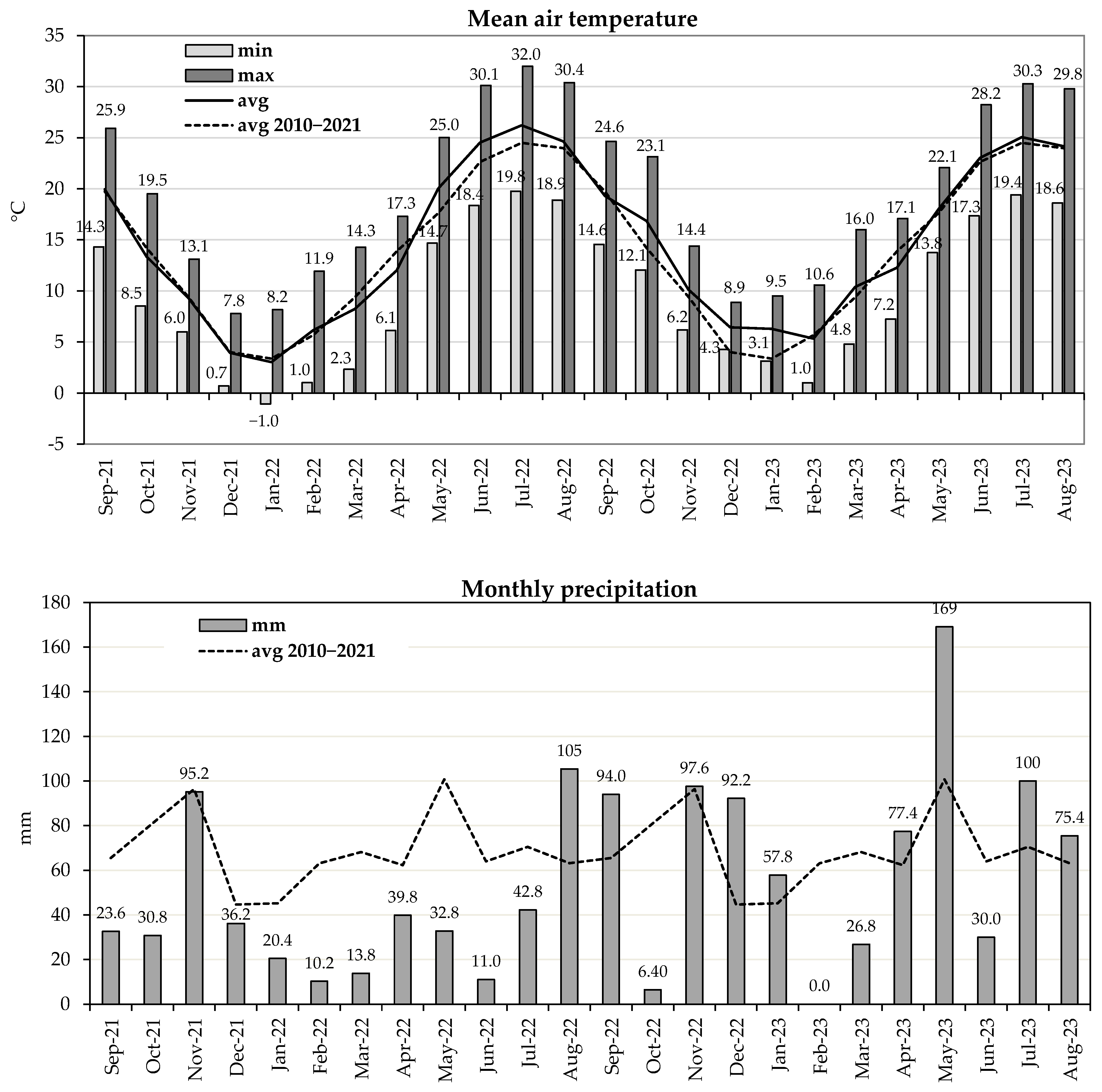
During autumn 2021, air temperature declined gradually, with monthly mean temperatures approaching the crop’s base temperature (i.e., 3 °C) by December, when the monthly average minimum reached 0.7 °C and the average maximum 7.8 °C (
Figure 1, top panel). The absolute minimum air temperature recorded over the 2021–2022 growing season was −3.6 °C, on 9 March 2022. Monthly mean temperature remained above 0 °C throughout winter, and the monthly average minimum fell to −1.0 °C in January 2022 (
Figure 1), indicating recurring sub-zero daily minima during that period.
Winter precipitation was markedly below the long-term reference, with monthly totals of 20.4 mm in January, 10.2 mm in February, and 13.8 mm in March 2022 (
Figure 1, bottom panel).
In spring 2022, air temperatures rose sharply during May (average maximum: 25.0 °C) and precipitation remained well below the long-term reference, with only 32.8 mm recorded in May and 11.0 mm in June. Visible symptoms of water stress were observed in the crop from late spring onward and persisted through the summer months.
In the 2022–2023 season, air temperatures declined progressively through autumn. Daily minimum temperatures first reached 0 °C on 21 November 2022 and continued to decrease over winter, reaching a seasonal absolute minimum of −6.3 °C on 10 February 2023, when the monthly average minimum was 1.0 °C. Monthly mean temperatures remained above 0 °C throughout the season, closely tracking the 2010–2021 reference from February 2023 onward. Between September 2022 and January 2023, monthly means were consistently above the long-term seasonal average. The deviation was most pronounced in October 2022, when the monthly average minimum, maximum, and mean were 12.1, 23.1, and 17.6 °C, respectively, compared to the reference mean of approximately 14.0 °C.
In contrast to 2021–2022, autumn 2022 received substantially higher precipitation, with 94.0 mm in September, 97.6 mm in November, and 92.2 mm in December 2022. They were all at or above the long-term reference, although October 2022 was anomalously dry at 6.4 mm (
Figure 1). Spring 2023 was markedly wet, with May recording 169 mm, the highest monthly total across the entire study period and well above the 2010–2021 reference of approximately 100 mm (
Figure 1).
3.2. Autumn Thermal Accumulation and Beet Winter Survival
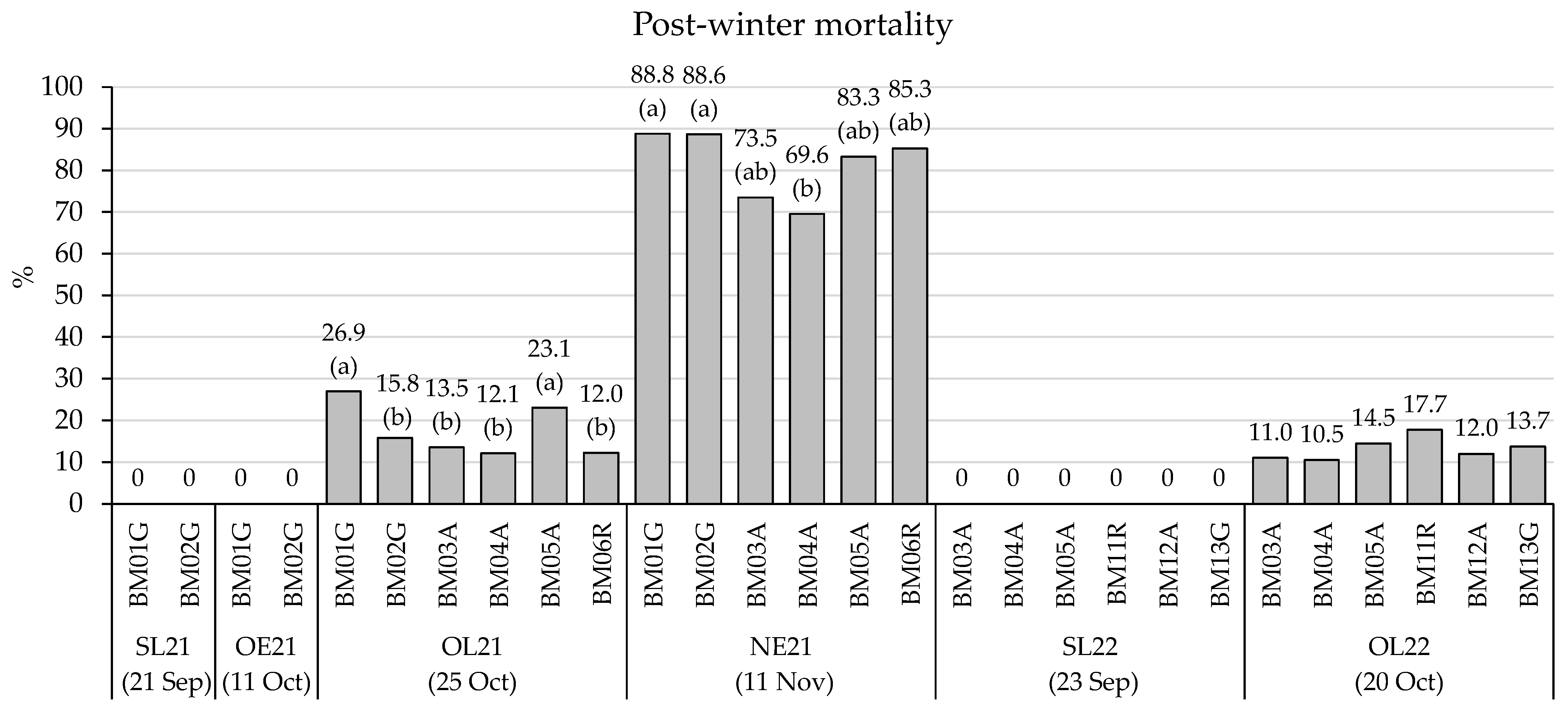
In the 2021–2022 season, post-winter mortality was negligible for the earliest sowing dates. For both the late September (SL21) and early October (OE21) sowings, varieties BM01G and BM02G recorded zero mortality (
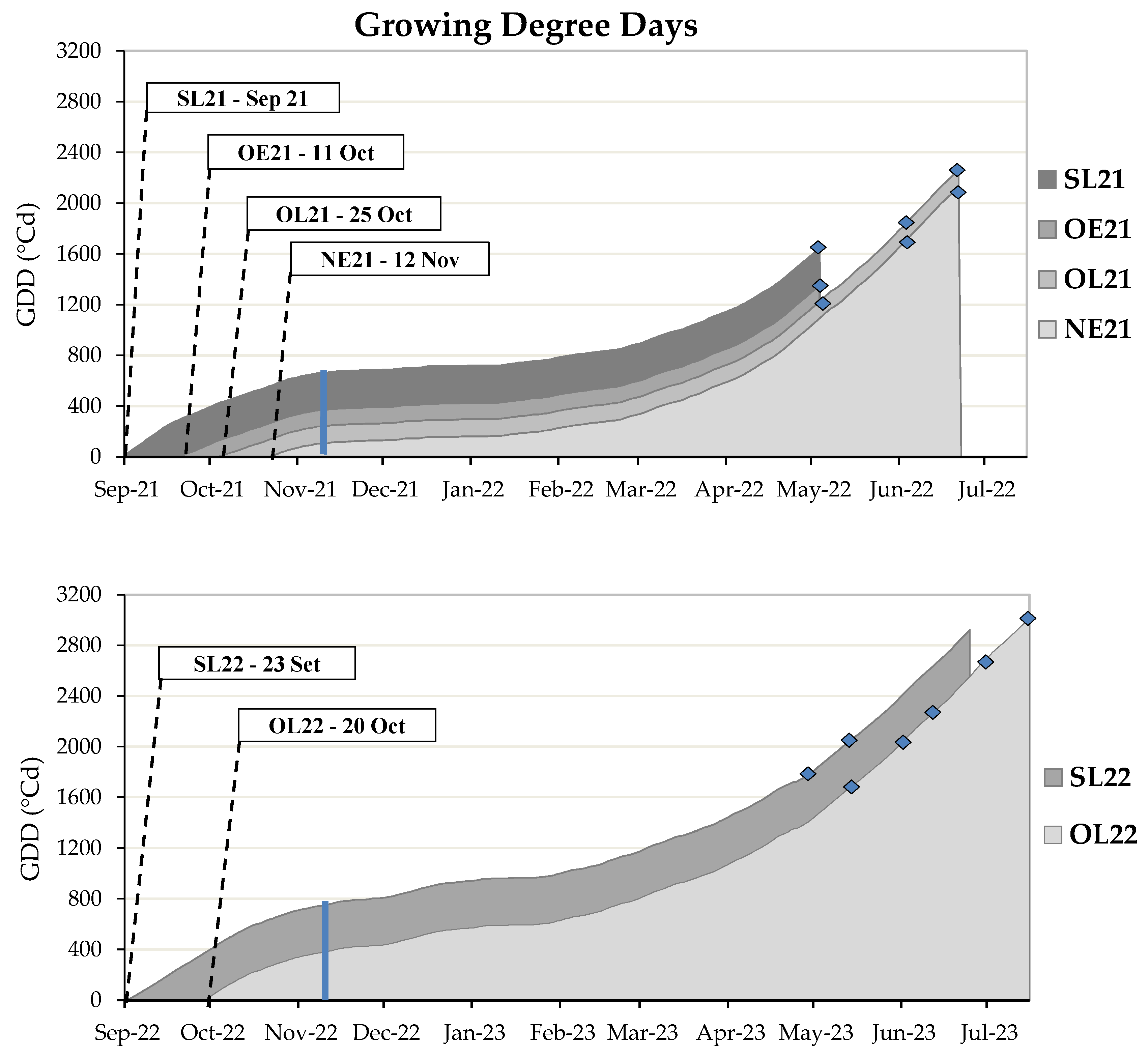
Figure 2). By the reference date of 30 November 2021, at the beginning of the cold season, plants in SL21 had reached growth stage BBCH 17, with 7 leaves unfolded. Their thermal accumulation was 662 °Cd. In contrast, plants in OE21 had reached BBCH 12, with 2 leaves unfolded, and accumulated 372 °Cd (
Figure 3). Comparable survival was recorded in the SL22 sowing of the 2022–2023 season, where post-winter mortality was zero across all varieties; by 30 November, these plants had attained a more advanced stage (BBCH 34, leaves covering 40% of the ground), supported by a greater thermal accumulation (749 °Cd).
At the third sowing date of the first season, OL21, post-winter mortality averaged 17.3%, and significant varietal effects emerged (
p ≤ 0.05;
Figure 2). By 30 November 2021, these plants had only reached BBCH 11 (first pair of leaves visible, not yet unfolded), with a thermal accumulation of 241 °Cd (
Figure 3, top panel). The highest mortality was recorded in BM01G (26.9%) and BM05A (23.1%), which did not differ significantly from one another. In contrast, the remaining varieties (BM02G, BM03A, BM04A, and BM06R) formed a statistically homogeneous group with significantly lower mortality rates, ranging from 12.1% to 15.8%.
At the last sowing date in 2021 (beginning of November, NE21), mean post-winter mortality increased dramatically to 81.5%. This severe winter loss was associated with delayed phenological development (only BBCH 10, first leaf visible with pinhead-size leaves and cotyledons horizontally unfolded) and a very low thermal accumulation of just 105 °Cd by 30 November, approximately six-fold lower than that of the SL21 sowing (
Figure 3). For NE21 significant varietal differences were again observed (
p ≤ 0.05;
Figure 2): BM01G and BM02G exhibited the highest mortality (~88.7%), contrastingly, BM04A showed the significantly lowest mortality (69.6%); BM03A, BM05A, and BM06R displayed intermediate mortality (ranging from 73.5% to 85.3%) and did not differ significantly from either the highly susceptible or the least susceptible varieties, indicating an overlapping statistical response under cold stress conditions.
For the later sowing date of the 2022–2023 season, OL22 (20 October 2022), measurable mortality was observed, averaging 13.2% (
Figure 3, bottom panel), which was similar to the average value of late October sowing of the first year (OL21). By 30 November 2022, these plants had reached BBCH 12 (first pair of leaves unfolded) compared with BBCH11 of the first year, with a corresponding higher thermal accumulation of 378 °Cd (
Figure 3). Mortality ranged from 10.5% (BM04A) to 17.7% (BM11R); analysis of variance revealed no significant varietal differences at this sowing date (
Figure 2). For the three varieties evaluated across both seasons (BM03A, BM04A, BM05A), winter mortality under late-October sowing was low and broadly consistent. No variety showed contrasting mortality responses between the two seasons.
3.3. Bolting Incidence
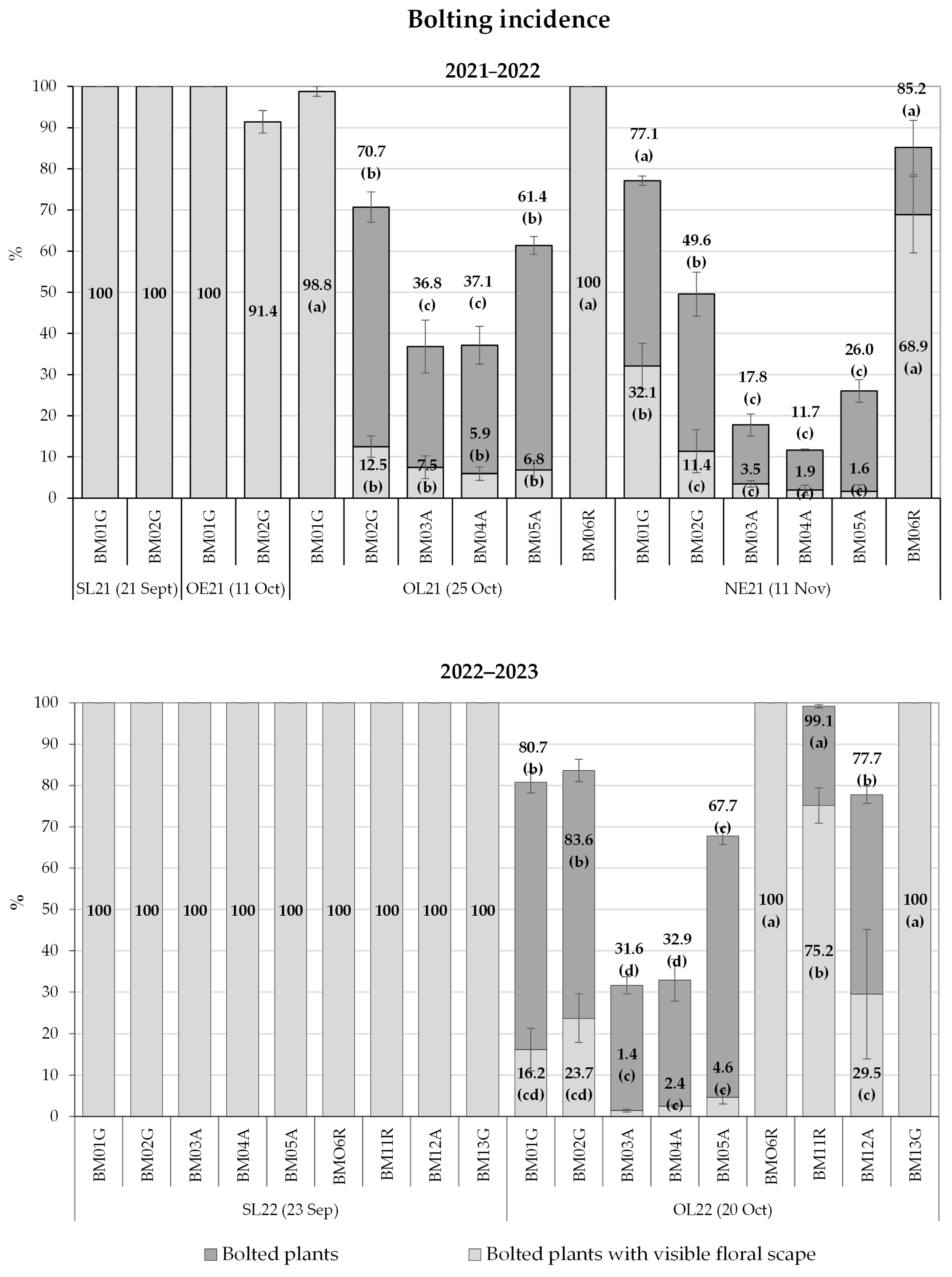
Bolting incidence and the subsequent progression to advanced reproductive stages were strongly affected by sowing date and variety across both seasons (
Figure 4).
In the 2021–2022 season, incidence was highest at the earliest sowing dates (SL21 and OE21), where BM01G and BM02G reached near-complete incidence (~100%), with no varietal separation. Clear varietal differences emerged at the third sowing date, OL21 (
p ≤ 0.05;
Figure 4, top panel).
BM06R and BM01G were the most susceptible, reaching near-complete bolting (>98%) and did not differ significantly from each other, but both were significantly higher than all other varieties. BM02G and BM05A formed an intermediate group (61–71% bolting); they did not differ significantly from one another, but showed significantly higher bolting incidence than BM03A and BM04A, which exhibited the significantly lowest bolting incidence (∼37%).
A similar statistical pattern was observed when considering the progression from incidence to developed floral structures: BM06R and BM01G again reached the most advanced stages and differed significantly from the other varieties; BM02G, BM03A, BM04A, and BM05A remained significantly lower (<13%) and did not differ significantly from one another.
At the last sowing date (NE21), total bolting incidence declined overall, but the varieties hierarchy persisted. BM06R and BM01G again exhibited the highest bolting incidence (85.2% and 77.1%, respectively) and did not differ significantly from each other. BM02G maintained an intermediate response (49.6%), separating significantly from both the highly susceptible varieties and the least susceptible group (BM05A, BM03A, and BM04A). The varieties in this lowest group did not differ significantly from one another, ranging from 11.7% to 26%.
For developed structures at NE21, BM06R showed the highest value (68.9%) and differed significantly from all others. BM01G (32.1%) was significantly lower than BM06R but higher than the others, while the remaining varieties formed a single low-incidence group (≤11.4%) with no significant differences among them.
In the 2022–2023 season, similarly to 2021–2022, the first sowing date (SL22) resulted in 100% bolting incidence across all nine varieties investigated (
Figure 4, bottom panel). Varietal differences in bolting incidence at the second sowing date, OL22, were significant (
p ≤ 0.05). A highly susceptible group with BM06R, BM13G, and BM11R reached near-complete incidence (≥99.1%) and did not differ from one another. This group showed significantly higher incidence than an intermediate group comprising BM01G, BM02G, and BM12A, whose incidence ranged from 77.7% to 83.6% and which likewise did not differ among themselves. BM05A exhibited an intermediate-low incidence (67.7%), significantly lower than the intermediate group but significantly higher than BM03A and BM04A, which had the lowest incidence (31.6% and 32.9%, respectively), as in 2021–2022, and did not differ from each other.
When progression to developed floral structures (visible floral organs extending above the leaf canopy) was considered for OL22, BM06R and BM13G attained 100% developed structures and did not differ significantly. BM11R exhibited 75.2% developed structures and differed significantly from both the 100% group and the lower groups. BM12A, BM02G, and BM01G formed an intermediate class for developed structures (≈16.2–29.5%) with overlapping significance. BM03A, BM04A, and BM05A consistently exhibited the lowest proportions of developed structures (1.4–4.6%) and did not differ significantly from one another, though they were significantly lower than the intermediate group.
3.4. Taproot Yield and Above-Ground Biomass Production
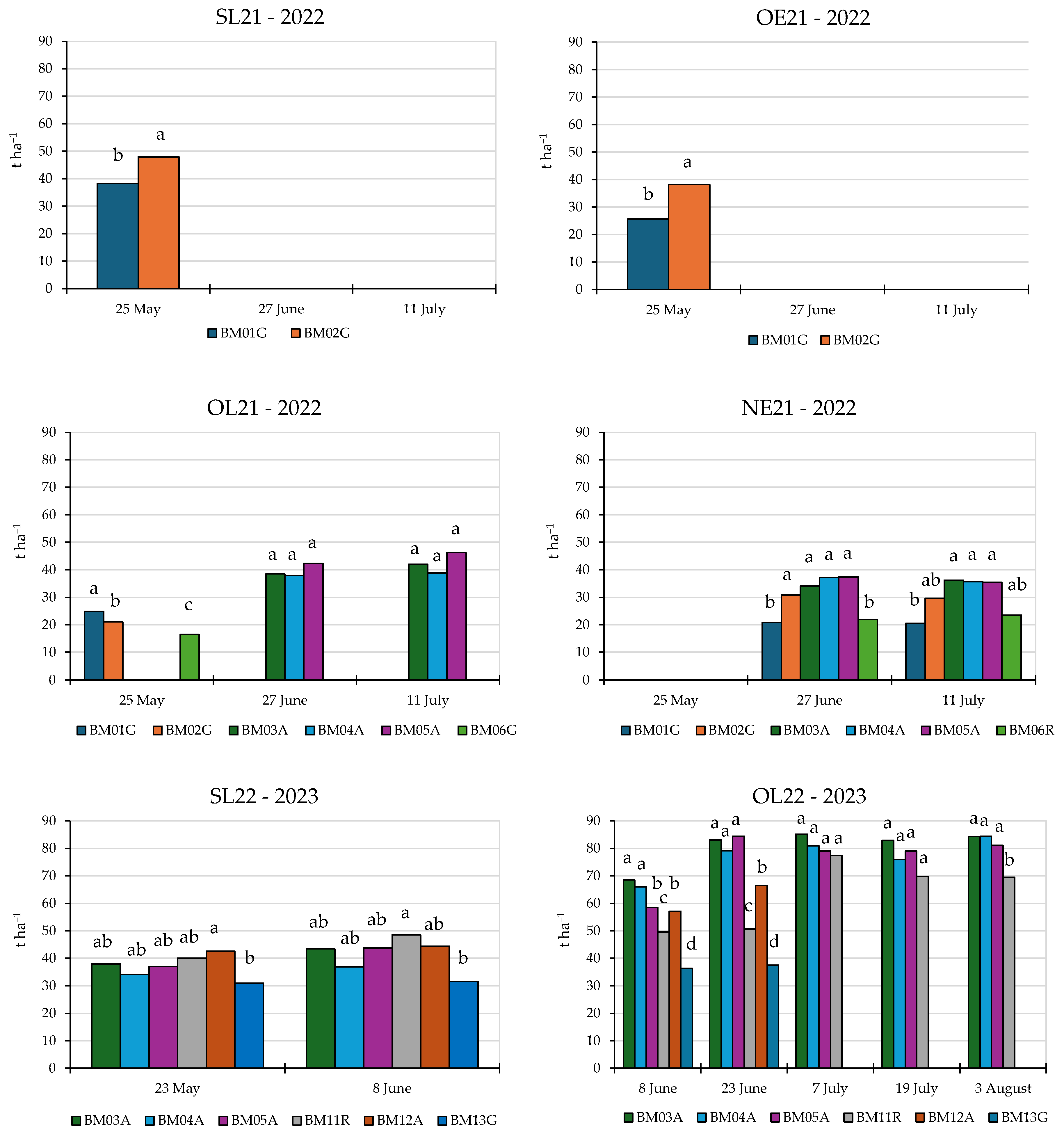
The earliest sowings of 2021 (SL21 and OE21) were harvested on 25 May 2022 before topping. In SL21 sowing, BM02G achieved a significantly higher fresh root yield than BM01G (47.9 vs. 38.3 t ha
−1) (
Figure 5;
Table S2). Aerial and total biomass did not differ significantly between the two varieties, with total biomass (roots + shoots) averaging approximately 159 t FW ha
−1. These results were consistent in the OE21 sowing, where both varieties exhibited slightly reduced overall productivity but maintained the same statistical hierarchy for root yield, again showing no significant differences in aerial or total biomass.
At the third sowing date in 2021 (OL21), early harvesting (25 May) revealed that BM01G produced a significantly higher root yield than BM02G and BM06R (24.8 vs. 21.02 and 16.5 t ha
−1, respectively), whereas aerial and total biomass showed no significant differences. At the subsequent OL21 harvests, BM03A, BM04A, and BM05A showed numerically higher root yields on 11 July than on 27 June, about +2% (BM04A) to +9% (BM03A, BM05A), while aerial biomass was lower by about 46–56% (
Table S2), suggesting rapid leaf senescence. No statistical comparison between harvest dates is reported here, so these differences should be interpreted as numerical trends.
For the last sowing date in 2021 (NE21), harvested on 27 June, BM02G, BM03A, BM04A, and BM05A formed the highest-yielding homogeneous group for root production (ranging from 30.8 to 37.4 t ha−1), significantly outperforming BM01G (20.8 t ha−1) and BM06R (21.9 t ha−1). Conversely, the highly bolted BM06R produced significantly greater aerial biomass (27.51 t ha−1) than the other varieties. Total biomass on this date was significantly lower for BM01G (36.7 t ha−1) compared to other varieties, while all other varieties formed a higher-yielding statistical group (48.7–61.7 t ha−1) with overlapping significance. By the 11 July harvest of NE21 sowing, BM03A, BM04A, and BM05A formed the highest statistical group for root yields (35.4–36.2 t ha−1), significantly outperforming BM01G (20.5 t ha−1); BM02G and BM06R formed an intermediate group. Meanwhile, aerial biomass decreased substantially across all varieties; only BM06R maintained significantly higher aerial biomass (19.0 t ha−1); all other varieties formed a statistically homogeneous group with lower values (9.9–11.5 t ha−1). Due to these opposing trends, total biomass did not differ significantly among any variety at this final harvest for NE21 sowing.
In the 2022–2023 season, the early sowing date (SL22, late September) was evaluated across two harvest dates. On 23 May 2023, significant varietal differences were observed across all biomass components. BM12A achieved the significantly highest root yield (42.6 t FW ha−1), outperforming BM13G, which recorded the lowest (31.0 t FW ha−1); the remaining varieties showed intermediate, overlapping values. For aerial and total biomass on this date, BM03A produced the significantly highest yields (128.4 and 166.4 t FW ha−1, respectively), whereas BM11R and BM13G ranked in the lowest statistical classes.
By the subsequent 8 June harvest in SL22 sowing, BM11R reached the significantly highest root yield (48.5 t FW ha−1), again outperforming BM13G (31.6 t FW ha−1). However, at this later date, aerial and total biomass did not differ significantly among any of the varieties, with total yields (root + shoots) ranging from 127.7 to 180.2 t ha−1.
In the later sowing of late October 2022 (OL22), harvested across five dates from 8 June to 3 August, clear statistical groupings emerged. During the 8 June harvest, BM03A and BM04A formed the highest-yielding homogeneous group for both root and total biomass. By the 23 June harvest, BM05A joined BM03A and BM04A, with the three forming a single top-yielding statistical group for root and total biomass, significantly outperforming the other varieties. In contrast, BM13G consistently recorded the significantly lowest root yield during these early summer harvests, similarly to the first sowing date in September 2022. Aerial biomass did not differ significantly among the varieties on either of these two dates.
Across the subsequent mid-to-late summer harvests (July through early August), which focused on four varieties (BM03A, BM04A, BM05A, and BM12A), a clear temporal divergence occurred between plant components. Root yields remained elevated and relatively stable; differences temporarily dissipated on 7 July, when BM03A peaked at 85.2 t root FW ha−1, but significant differences re-emerged by the final harvest on 3 August. On this final date, BM03A, BM04A, and BM05A maintained significantly higher root yields (81.1–84.4 t FW ha−1) compared to BM12A (69.5 t FW ha−1).
Conversely, aerial biomass exhibited a progressive reduction across all varieties following the maximum values recorded in early summer. Although BM03A and BM04A retained significantly higher aerial and total biomass compared to BM05A and BM12A on 7 July, by the final harvest on 3 August 2023, aerial biomass had declined markedly to a range of 25.8–32.4 t ha−1, with no significant differences detected among the varieties. Ultimately, reflecting their sustained root biomass accumulation, BM03A, BM04A, and BM05A (109.6–116.8 t ha−1) significantly outperformed BM12A (95.3 t ha−1) in final total biomass at the end of the season.
Across the three varieties evaluated in both seasons (BM03A, BM04A, BM05A), root yield rankings under late-October sowing were broadly consistent, as was the qualitative pattern of aerial biomass, which declined progressively after early summer in all varieties. BM03A and BM04A maintained consistently low bolting incidence across both seasons, whereas BM05A showed greater between-season variability in both bolting and yield performance.
3.5. Root Soluble Solids Accumulation
In the 2021–2022 season, during the initial spring evaluations (3 May and 18 May 2022), soluble solids content (°Brix) remained generally low across all sowing periods (
Table S3), with earlier sowings exhibiting slightly more advanced accumulation than later ones. On 3 May, values for the earliest sowings (SL21 and OE21) ranged between 12.1 and 13.7 °B, with no significant differences among varieties. By 18 May, these early sowings had increased to 13.5–15.4 °B, again with no significant varietal differences.
Significant varietal differentiation during this early period was observed only in the OL21 sowing on 18 May harvesting date. At this date, BM01G and BM05A achieved significantly higher soluble solids (14.2 and 14.0 °B, respectively) compared to BM06R, which recorded the lowest value (12.5 °B), while the remaining varieties exhibited intermediate, overlapping values.
In the early November sowing of the first year (NE21) evaluated on the same date, values remained the lowest overall (10.6–12.6 °B), with no significant differences detected among the varieties.
By the late-season harvest on 20 June 2022, soluble solids accumulation had increased substantially across all evaluated late sowings (OE21, OL21, and NE21), surpassing 20 °B in the majority of variety-sowing date combinations evaluated. Values on this date ranged from 19.0 °B (BM02G in NE21) to 21.6 °B (BM01G in NE21). No statistically significant differences among any of the varieties within their respective sowing dates at this advanced stage of accumulation were observed.
Soluble solids accumulation in 2022–2023 was notably lower than in 2021–2022. Since no formal year-effect test was conducted (
Section 2.5), this contrast is interpreted descriptively from the observed data patterns. During the early summer evaluations of 2023, no significant differences were observed among varieties. On 23 May, values for the September sowing (SL22) ranged from 12.3 to 16.0 °B. By 8 June, both the SL22 and OL22 sowings exhibited statistically homogeneous performance, with overall averages remaining low (~14.5 and 14.9 °B, respectively).
Significant varietal differentiation in the OL22 sowing briefly emerged during the 23 June harvest. BM03A achieved the significantly highest value (17.4 °B), followed by BM13G (16.5 °B), which formed an intermediate-high statistical group. BM11R recorded the significantly lowest value (15.1 °B), while BM04A, BM05A, and BM12A grouped together with low-intermediate values.
Across the subsequent mid-to-late summer harvests of the OL22 sowing (7 July, 19 July, and 3 August), all varietal differences dissipated. Peak values for the season were recorded around early July (ranging from 16.0 to 16.6 °B), after which a slight, progressive decline occurred across all remaining varieties, stabilizing between 15.2 and 15.5 °B by the final harvest on 3 August, with no significant differences detected among them.
4. Discussion
This study evaluated the agronomic feasibility of autumn sowing of sugar beet in the Po Valley (NE Italy) over two growing seasons, using up to four sowing dates per season and nine varieties to assess overwinter survival, bolting incidence, biomass production, and root juice soluble solids. The results provide a field-based foundation for assessing autumn sowing under local conditions and for informing future comparisons with conventional spring-sowing practice.
The two seasons differed markedly in their post-winter climate, allowing the response of sugar beet to be assessed under contrasting climatic conditions. The 2021–2022 season was characterized by pronounced spring–summer water deficit (32.8 mm in May and 11.0 mm in June 2022), whereas 2022–2023 experienced substantially wetter conditions (169 mm in May 2023), favoring vegetative growth and delaying drought stress.
An essential condition for the feasibility of autumn-sown sugar beet is the pattern of minimum temperatures across winter, which may or may not ensure plant survival across winter. The lowest temperature reached at our trial site was −3.6 °C in 2021–2022 and −6.3 °C in 2022–2023, but the effects on crop survival depended strongly on the developmental stage attained before winter rather than on absolute temperature alone. This interpretation is consistent with previous work showing that winter damage in autumn-sown sugar beet is governed not only by the severity of cold events, but also by pre-winter growth stage and the extent of cold acclimation achieved before freezing conditions occur [
30,
31].
Autumn sowing shifts crop development into a different climatic window and modifies the balance among pre-winter establishment, vernalization exposure, and summer stress. The two contrasting seasons, therefore, provided a useful framework for evaluating the physiological trade-offs of autumn sowing under northern Mediterranean conditions, although generalizations based on two years should be made with caution. Historical meteorological records from the experimental site in Legnaro indicate that the most extreme annual minimum temperatures were −9 °C in 2010, −8 °C in 2017, and −7.4 °C in 2012.
4.1. Thermal Accumulation, Phenological Development, and Overwinter Survival
Overwinter survival in autumn-sown sugar beet was primarily determined by pre-winter thermal accumulation and consequently the phenological stage attained before the onset of freezing conditions, rather than by minimum air temperature alone [
41]. This interpretation agrees with previous studies showing that autumn-sown beet requires sufficient pre-winter development to combine adequate structural establishment with the cold-acclimation processes underlying winter hardiness [
24,
31].
The present results fit this framework closely. The early November sowing (NE21), which accumulated only 105 °Cd by late November and entered winter at BBCH 10, suffered severe winter mortality exceeding 70%. By contrast, the October sowings showed much lower mortality: plants in OE21 reached BBCH 12 with 372 °Cd, those in OL21 reached BBCH 11 with 241 °Cd, and those in OL22 reached BBCH 12 with 378 °Cd.
Complete survival in the September sowings further indicates that advanced pre-winter development strongly improved stand persistence, although this advantage must be considered together with the much greater bolting risk associated with early sowing. This pattern is broadly consistent with studies suggesting that autumn-sown sugar beet should accumulate approximately 300–400 °Cd and reach the 4- to 6-leaf stage before the cold period to ensure safer overwintering. Partial survival below this thermal threshold is nonetheless possible under relatively favorable conditions, as also noted by Mohammadian et al. [
30].
Where pre-winter establishment was insufficient, varietal differences in survival became more evident. In OL21, varietal differences in winter mortality were statistically significant when plants reached winter at BBCH 11. In NE21, they remained significant, but with much higher mortality under stronger stress when establishment before winter was clearly inadequate. By contrast, no significant varietal differences were detected in OL22, suggesting that once plants had reached BBCH 12 and accumulated at least about 360–370 °Cd before winter, the stress was insufficient to differentiate varieties clearly for cold tolerance.
The severity of winter damage at early developmental stages is consistent with the physiological basis of cold acclimation in sugar beet. Very young seedlings are especially vulnerable to freezing because they have limited taproot biomass, poorly developed crown tissues, and a reduced capacity to buffer freeze–thaw injury [
40]. Loel and Hoffmann [
31] found that young plants at the optimal stage (4–5 leaves) and with a tap root diameter of 10–25 mm can survive air temperatures down to −7 °C and root tissue temperatures down to −4.5 °C. Winter hardiness in sugar beet is also associated with physiological osmotic adjustment and the accumulation of compatible solutes such as sucrose, proline, and raffinose, which contribute to membrane stabilization and protection of cellular structures under low temperatures [
39,
42]. The high mortality observed in the NE21 sowing is therefore consistent with plants entering winter with insufficient structural development and likely an incomplete acclimation capacity.
Overall, these findings indicate that autumn establishment at these northern latitudes depends on achieving an adequate developmental stage before winter, and balancing this requirement against the bolting risk intensified by excessively early sowing.
4.2. Vernalization Intensity, Intraspecific Variation, and Bolting Incidence
Temperatures below 0 °C can potentially damage sugar beet. However, initiation of the shift from vegetative to reproductive growth requires prolonged exposure to temperatures below 15 °C, for example, 17 days at 7 °C. The most effective vernalization temperature range is 0–13 °C [
10].
With autumn sowing, the vernalization requirements were clearly met in our study. Bolting incidence was strongly regulated by sowing date, with the earliest sowings showing the highest incidence (100%). Later sowings showed reduced incidence and allowed expression of varietal differences in bolting tolerance. This pattern is consistent with previous studies showing that earlier autumn sowing increases cumulative exposure to effective vernalizing temperatures and therefore raises bolting risk, whereas delayed sowing reduces the intensity of reproductive induction [
10,
12]. It also indicates that more advanced growth stages in sugar beet are more sensitive to vernalizing conditions. The vernalization-intensity framework proposed by Milford et al. [
10], which interprets bolting response through genotype-specific vernalization requirements and sensitivities, provides a coherent basis for interpreting the present results. Recent multi-environment validation further supports this interpretation by showing that autumn performance depends strongly on the interaction between cumulative winter cold and genotype-specific reproductive thresholds [
19].
In the earliest sowings (SL21, OE21, and SL22), reproductive development was sufficiently strong to largely saturate varietal differences, whereas the later sowings (OL21, NE21, and OL22) revealed clearer and more repeatable varietal contrasts in bolting tolerance.
Across these later sowings, varieties BM03A and BM04A consistently showed the lowest incidence and the lowest proportions of developed floral structures (<37% in late October sowing). By contrast, BM05A showed a relatively high progression to developed floral structures (>60% in late October sowing). Conversely, BM06R and, depending on the environmental conditions, BM01G, BM02G, BM11R, and BM13G exhibited greater susceptibility both to bolting and to progression toward developed structures. These patterns indicate that delaying sowing did not eliminate the vernalization signal, but reduced its intensity sufficiently to reveal underlying genetic differences in bolting response [
43,
44], leading to bolting rates that were agronomically acceptable.
Importantly, bolting incidence and progression to advanced reproductive structures were not fully equivalent. At the OL22 sowing time, BM03A, BM04A, and BM05A not only showed lower incidence but also formed the lowest statistical group for developed structures. This indicates that their relative tolerance was expressed both at the initiation and the subsequent stem elongation phase. This distinction is physiologically relevant because the agronomic penalty associated with bolting depends not only on floral commitment at the meristem. It also depends on the extent to which that commitment progresses into visible and well-developed reproductive structures, which consume sucrose from the storage root [
16]. The low proportion of visible or developed scapes in the more tolerant varieties suggests a quantitatively restricted transition from a vernalized vegetative state to observable reproductive development under field conditions.
At the molecular level, these phenotypic differences are consistent with current models of flowering control in
Beta vulgaris, in which the BTC1/B2 pathway and the antagonistic regulators BvFT1/BvFT2 govern vernalization-dependent reproductive competence [
18,
45,
46].
An additional epigenetic component may also contribute to the quantitative variation observed among varieties. Studies on sugar beet shoot apices have shown that DNA methylation dynamics during vernalization differ between bolting-sensitive and bolting-tolerant varieties. They also indicate that broader remodeling of flowering-related gene networks is associated with variation in bolting tolerance [
47,
48]. Although molecular pathways were not measured in the present study, they could provide plausible mechanistic explanations for the stable tolerance observed in BM03A and BM04A across the later sowings and across both seasons investigated. This regulatory framework would also explain why later autumn sowings still allowed clear varietal differentiation. Although all plants were exposed to winter cold, only a subset effectively translated this exposure into a strong reproductive response. Across both seasons, BM03A and BM04A showed the most consistent bolting resistance under late-October sowing, whereas BM05A remained productive but showed greater between-season variability in bolting response. This is consistent with recent evidence showing substantial genotype × environment effects on sugar beet productivity and quality traits across contrasting environments [
49].
The physiological importance of bolting tolerance extends beyond flowering itself, because reproductive development redirects assimilate partitioning away from root storage and towards shoot/scape growth. Vernalization-induced reproductive transition in sugar beet reverses source-sink relations, with the taproot shifting from a storage sink to a source that supports shoot elongation and floral development [
50]. This mechanism helps to explain why bolting is agronomically undesirable even when overwinter survival is high. In the present study, the highly bolted variety BM06R (across all sowing dates) produced greater aerial biomass but lower root yield even in the NE21 sowing. This pattern is fully consistent with a bolting-associated source–sink reversal. A bolting rate of approximately 15–20% may still be compatible with acceptable root yield in sugar beet under certain agronomic conditions [
10,
14]. However, this threshold depends on variety, harvest date, and the extent to which bolting individuals progress to developed reproductive structures. Extensive shoot/scape growth may also justify a topping operation or support consideration of sugar beet as a biomass crop for other uses (e.g., energy/biogas production).
4.3. Yield Formation and Biomass Accumulation
The sequential harvest data, particularly the five-harvest series of OL22 in 2022–2023, reveal a progressive divergence between root and above-ground biomass during summer. Root yield stabilized or peaked in late June to early July, whereas aerial biomass declined progressively thereafter. In the earliest sowing dates (SL21 and SL22), total biomass production (storage root + shoot) before topping was markedly higher than in later sowings. This response is consistent with previous studies showing that earlier sowing extends the vegetative growth period and promotes earlier canopy development. It also increases cumulative dry matter production through greater interception of solar radiation and longer periods of active photosynthesis [
24]. Nevertheless, these sowings were characterized by near-complete bolting incidence across all varieties. The elevated total biomass, therefore, reflected extensive diversion of assimilates to stem elongation and reproductive growth rather than to root storage [
50]. This pattern is consistent with the source–sink reversal mechanism described above (
Section 4.2).
At the other end of the sowing window, in early November (NE21), taproot yields were constrained not by bolting but by the drastically reduced plant population density caused by overwinter mortality (>70%). Reduced stand density limits canopy closure and total biomass accumulation, thereby constraining yield potential regardless of individual plant vigor [
51,
52]. In addition, top-dress nitrogen was not applied to NE21 because of poor stand establishment (
Section 2.3). Therefore, yield comparisons between NE21 and the other sowing dates should be interpreted with caution, as differences may reflect both sowing-date effects and this N fertilization management difference.
The most informative treatment for evaluating productive performance and harvest timing was OL22 sowing. It combined acceptable overwinter mortality (varietal mean of 13.2%), substantially reduced bolting relative to late September sowing, and five sequential harvests from June to August. On 8 June, BM03A and BM04A formed the highest statistical group for root and total biomass. By 23 June, BM05A joined them, and these three varieties significantly outperformed the other tested varieties. Root yields of BM03A, BM04A, and BM05A remained at a consistently high level through the final harvest on 3 August (81–84 t ha−1). Aerial biomass declined sharply over the same period, falling to 26–32 t ha−1, with no significant varietal differences remaining.
These results are consistent with the current understanding of sugar beet yield formation. After canopy closure, crop productivity becomes increasingly limited by sink capacity because the ability of the storage root to accumulate sucrose constrains further biomass accumulation. Once the storage root reaches an advanced developmental stage, the potential for additional increases in root biomass becomes relatively limited compared with earlier growth stages [
53].
These results indicate that root yield had largely reached its seasonal maximum by late June to early July. Published data for spring-sown sugar beet at comparable latitudes suggests that this timing may be earlier than the conventional harvest period by approximately one to two months [
23]. However, no direct comparison with spring sowing was possible within the present trial. Prolonged field presence beyond this point was associated with progressive canopy decline but limited further root yield gain.
The progressive decline in aerial biomass observed after early July likely reflects the combined effects of seasonal canopy senescence and sustained biotic pressure during the summer period in the absence of any fungicide application. At this latitude,
Cercospora beticola is a well-recognized contributor to foliar deterioration [
6,
7]. However, disease incidence and severity were not systematically quantified within the formal trial. The relative contribution of cercospora leaf spot to the observed aerial biomass decline remains a plausible interpretation rather than a directly measured outcome. Varietal-specific responses to disease pressure cannot be clearly separated from the concurrent effects of seasonal aging and heat stress on the basis of the present data.
Under severe
Cercospora pressure, progressive defoliation can reduce photosynthetic capacity and trigger compensatory leaf regrowth from the crown. This process mobilizes stored assimilates from the taproot and may partially deplete recoverable sugar even when root fresh mass remains relatively stable [
53,
54,
55]. This physiological response explains why the impact of late-season canopy deterioration is often expressed more strongly in sugar yield than in root yield in crops affected by
Cercospora [
53]. These mechanisms highlight that harvest timing should be considered not only in terms of root biomass accumulation, but also in relation to canopy integrity, and °Brix of the root juices to avoid remobilization of stored reserves during late summer.
These considerations highlight that delayed harvest into July–August extends the cropping period into a phase of greater vulnerability to canopy loss. For practical implementation, integrated disease management or deployment of
Cercospora-tolerant varieties should therefore be considered a prerequisite for harvest scheduling beyond early July. This is consistent with established guidelines for fungicide-based
Cercospora management in conventional sugar beet production [
6].
For reference, among the better-performing varieties, BM04A carries a supplier-reported
Cercospora tolerance of ‘Good’, BM03A and BM05A ‘Medium’, compared with ‘Medium-low’ for BM06R and BM11R (
Table S1). However, because disease was not formally quantified in this trial, no causal link between tolerance classification and aerial biomass performance can be established from the present data.
The sequential harvest data therefore indicate a practical optimal harvest window for autumn-sown sugar beet in the northern Italian latitudes, specifically the Po valley. This window appears to extend approximately from mid-June to early July. Within this interval, the best-performing varieties had already achieved high root yields, and the canopy remained sufficiently functional, without the pronounced decline observed later in July and August. Because the statistical analyses were conducted within each ‘sowing-date × harvest-date’ combination (
Section 2.5), this harvest-window interpretation is based on the descriptive pattern across harvest dates rather than on formal inferential comparisons among dates.
More broadly, autumn sowing may be viewed as a phenological escape strategy. By advancing the main phase of root yield formation to an earlier part of the growing season, it may reduce the dependence of final crop performance on late-summer canopy survival disease pressure, and possibly drought stress [
56]. The three varieties evaluated across both seasons (BM03A, BM04A, BM05A) showed consistently high root yields under late-October sowing. BM03A and BM04A also displayed more stable bolting resistance than BM05A, which remained high-yielding but showed slightly greater bolting in OL21. Despite differences in variety sets and harvest structures, these cross-year patterns suggest that their agronomic rankings were broadly reproducible under the conditions tested.
4.4. Root Juice Soluble Solids Accumulation
The notable difference in root juice soluble solids (°Brix) between the two experimental seasons illustrates how contrasting precipitation regimes modulate the concentration of soluble compounds in the storage-root juice of autumn-sown sugar beet.
In 2022, late-season °Brix values exceeded 20 °Brix in most of the varieties and sowing dates evaluated on 20 June 2022; in 2023, values remained below 17.5 °Brix throughout the measurement period, while overall biomass production was higher than in 2022. Because statistical analyses were restricted to variety comparisons within each sowing date × sampling date combination (
Section 2.5), this inter-annual contrast is interpreted descriptively from the observed data pattern rather than from a formal test of year-effects.
The very dry spring–summer of 2022, which affected much of Europe, created conditions favoring drought-driven concentration of soluble solids in the storage root. Rainfall totaled only 32.8 mm in May and 11.0 mm in June, creating conditions favoring a drought-driven concentration of soluble solids in the storage root of sugar beet. Restricted water availability constrains root fresh-weight gain, concentrating the existing solute pool within a smaller tissue volume. It may also have promoted osmotic adjustment involving non-sucrose compounds [
56,
57,
58]. As a result, elevated °Brix values may reflect both a physical concentration effect in less hydrated and smaller root tissues and increased accumulation of non-sucrose osmolytes. These include betaine, raffinose, amino acids, and inorganic ions, whose synthesis is promoted under drought or osmotic stress conditions [
58,
59,
60]. °Brix, measured refractometrically, provides a practical field-level indicator of root soluble-solute status across contrasting seasonal environments. It reflects total soluble solids rather than sucrose alone and should therefore not be interpreted as equivalent to polarimetric sucrose content. that was not measured in this study (
Section 2.4.4).
By contrast, the 2022–2023 season was markedly wetter. Autumn precipitation was high, and May 2023 recorded 169 mm of rainfall, the highest monthly total observed during the study. Ample water availability promoted vigorous vegetative growth, reflected in the high aerial biomass production during the season. Under such conditions, lower °Brix values can arise through two complementary mechanisms. First, sustained root growth and cell expansion increase fresh-weight accumulation and dilute the soluble solute pool within a larger tissue volume/weight. This process is frequently reported in crops in which rapid biomass production outpaces sugar concentration increases [
58]. Second, strong vegetative growth maintains substantial assimilate demand in the shoots. This can delay the transition from growth-dominated carbon allocation to storage-dominated sucrose accumulation in the taproot, a shift that typically occurs during later developmental stages of sugar beet when storage metabolism becomes dominant [
28,
61,
62].
Environmental conditions that stimulate rapid vegetative growth can therefore favor biomass accumulation while temporarily limiting sucrose concentration in the storage root, reflecting the well-known trade-off between root yield and sugar concentration [
60,
63]. The relatively low °Brix values observed in 2023 (second year), together with high overall biomass production, are therefore consistent with a typical dilution effect under favorable moisture conditions.
Varietal effects on °Brix were transient and largely environment-dependent. In 2021–2022, a brief differentiation in OL21 sowing on the 18 May 2022 harvesting date, with BM01G and BM05A the highest and BM06R the lowest. However, by 20 June, no significant varietal differences remained. In 2022–2023, the only significant differentiation occurred on the 23 June harvesting of the OL22 sowing, when BM03A recorded the highest value (17.4 °B) and BM11R the lowest (15.1 °B). The higher °Brix of BM03A is consistent with its low bolting tendency (
Section 3.3) and may suggest lower assimilate diversion to reproductive growth, although this remains an indirect inference.
In OL22, peak °Brix values were reached between late June and early July, after which a slight decline occurred, stabilizing at approximately 15.2–15.5 °B by 3 August with no significant varietal differences. Such late-season declines are consistent with the combined effects of continued root expansion under favorable moisture and the possible remobilization of stored assimilates to support compensatory leaf regrowth following canopy damage by ageing and cercospora leaf spot [
53].
Overall, these transient differences indicate that varietal effects on °Brix were modest and strongly dependent on developmental stage and seasonal environment in this dataset [
27,
28].
4.5. Practical Implications and Agronomic Constraints of Autumn Sowing
The present two-year trial indicates that autumn sowing of sugar beet is agronomically feasible in the Po Valley at similar latitudes under specific conditions of sowing date and variety. Although the evidence base remains limited and further validation is needed across years, the present study suggests that the feasible sowing window was narrow and centered on mid-to-late October. Earlier sowings (September and early October) maximized total biomass (root + shoot) but produced near-complete bolting, severely limiting the conversion of biomass into harvestable root yield. November sowing resulted in severe winter mortality because plants entered winter insufficiently developed. The mid-to-late October sowings (OL21 and OL22) provided the most favorable compromise between overwinter survival, reduced bolting rate, and high root productivity.
Varietal choice was equally critical. Across both seasons, BM03A, BM04A, and BM05A showed the most favorable combination of winter survival, limited reproductive development, and high root yield. Under OL22 sowing, root yields reached 80 t ha
−1 in late June to early July. These yields are broadly comparable to those reported in the literature for autumn-sown sugar beet under favorable conditions, as well as to typical ranges reported for conventional spring-sown sugar beet [
24,
29]. However, the lack of a spring-sown control in the present trial prevents any direct within-study comparison.
Nevertheless, autumn sowing carries identifiable risks. The larger and earlier canopy can increase spring water demand in dry years. In addition, summer exposure to
Cercospora beticola makes integrated disease management important, and even the best-performing varieties were not fully bolt-proof under all conditions. Practical adoption would therefore likely require fungicide applications and/or good
Cercospora-tolerant germplasm. These components were deliberately excluded from the present trial to evaluate crop response under unprotected conditions. Additionally, the availability of fully bolting-resistant commercial varieties remains a constraint. Although BM03A, BM04A, and BM05A performed well under the conditions tested, their bolting resistance may not suffice under more prolonged or severe winter cold. Continued breeding efforts should prioritize the combination of frost hardiness, high vernalization thresholds, and bolting resistance [
19,
64].
From a broader perspective, simulation studies and field evidence from other regions suggest that autumn sowing may become increasingly feasible as winter temperatures rise under climate change [
21,
57].
A further practical consideration is that harvest in June–July may leave time for a following crop or cover crop, improving rotation flexibility. The substantial above-ground biomass removed during topping may also represent a usable resource for anaerobic digestion. Sugar beet leaves and related by-products have been shown to be suitable substrates for silage-based preservation and biomethane production [
65,
66]. Although neither double cropping nor biomass valorization was directly evaluated here, these points should be considered promising opportunities rather than demonstrated outcomes of the present study.
5. Conclusions
This two-year field study indicates that autumn-sown sugar beet can be agronomically feasible in the Po Valley and similar northern Mediterranean environments when sowing date and variety are appropriately matched. Under the autumn sowing window evaluated, the most favorable balance among overwinter survival, bolting incidence, and root yield was obtained with late-October sowing. Earlier September sowings promoted excessive/complete bolting, whereas November sowing exposed the crop to severe winter mortality because plants entered the cold period at an insufficiently developed stage.
Varietal screening also proved critical, particularly for the late-October sowing window, where substantial differences among varieties in both bolting incidence and root yield were observed. Varieties BM03A (MORINGA, SESVanderHave) and BM04A (RHINOCEROS, SESVanderHave) showed the most consistent combination of low bolting incidence and high root yield under late-October sowing conditions. BM05A (OCTOPUS, SESVanderHave) also maintained high root productivity but exhibited somewhat greater variability in bolting response between seasons.
These results provide an initial field-based evaluation that can inform the further development and validation of autumn sowing in northern Italy. Nonetheless, the evidence is limited to two seasons at a single site and to autumn sowing only. Accordingly, the present findings do not address comparative performance relative to conventional spring-sown sugar beet in terms of yield or technological quality. In addition, root soluble solids were assessed as °Brix, which is a useful field indicator but does not replace the full technological quality analyses required for industrial evaluation. A complete assessment of technological quality would require polarimetric sucrose determination and measurement of the principal molasses-forming substances (α-amino nitrogen), potassium, and sodium, which were not included in the present study. This is recognized as a limitation of the quality-related findings reported here.
Future studies should include spring sown controls, multi-site trials, and the full analytical framework needed for technological quality evaluation. Standardized scoring of Cercospora beticola should also be included to better distinguish disease effects from seasonal canopy ageing and environmental stress. For broader application under climate-change scenarios characterized by warmer winters, survival should be evaluated across progressively lower temperatures as a function of crop developmental stage before the onset of freezing conditions.




 ,
,