1. Introduction
One of the most important challenges of the ongoing ecological transition is reducing dependence on fossil fuels. This objective is pursued through the promotion of the circular economy, which favors the reuse of natural resources through eco-friendly processes. To achieve this goal, agricultural bioresources play a key role in mitigating climate change and promoting biodiversity conservation. In particular, they supply raw materials for the production of renewable bioenergy [
1,
2,
3,
4,
5]. In recent years, energy crops have gained increasing attention as alternative resources. They consist of plant species mainly cultivated for biomass to generate thermal or electrical energy or to obtain bioenergy through biodiesel, bioethanol, biogas, or bioliquids not intended for transportation [
2,
3]. Although energy crops and biomass appear to be relatively recent concepts, biomass such as firewood is the first source of energy used by humankind. Nowadays, biomass shows enormous potential to transform our energy model into a long-term renewable and sustainable system. It represents one of the most promising alternatives to fossil fuels, contributes to the reduction of greenhouse gas (GHG) emissions, and supports the transition towards decarbonization [
2,
3]. Energy crops also represent an important driver for the agricultural sector. They create new business and employment opportunities, which are especially valuable in rural areas that undergo abandonment or have already been abandoned [
3,
6].
Energy crops play a significant role in agroecosystems. They contribute to local energy supply and rural economies. In the current critical context of climate change, biodiversity loss, environmental pollution, and reduced agricultural profitability, their potential contribution to land-use strategies has gained renewed scientific attention [
5]. Despite persistent concerns regarding competition with food and feed production, energy crops represent a valuable option when cultivated in appropriate contexts. In particular, they are suitable for marginal, abandoned, or degraded agricultural lands. At the same time, land abandonment and ecosystem degradation facilitate the spread of invasive alien plant species (IAPS). This phenomenon is particularly evident in Mediterranean regions, where socio-economic changes and landscape fragmentation profoundly alter traditional land-use patterns [
6,
7,
8,
9].
The IAPS
Robinia pseudoacacia L., belonging to the
Fabaceae (legumes) family and commonly known as black locust or false acacia, exemplifies both the opportunities and the challenges associated with woody energy crops worldwide [
10,
11]. Fabaceae are characterized by the ability to symbiotically fix atmospheric nitrogen (N
2). This process occurs through mutualistic associations with bacteria of the genus
Rhizobium (rhizobia) in specialized root nodules, where they convert N
2 into ammonia (NH
3) that can be used by plants. As a result, plants receive essential nutrients, and soil fertility is enhanced [
12,
13,
14,
15]. Leguminous plants are, therefore, less dependent on soil nitrogen availability. This nutritional self-sufficiency allows them to grow successfully even in poor soils. After harvesting, nitrogen fixed in root nodules is released into the soil. This process improves soil fertility for subsequent crops (soil enrichment, crop rotation) [
14]. In addition, the root systems of woody species contribute to soil stabilization by reducing erosion. This function is particularly important in areas prone to landslides or on slopes vulnerable to erosion. Overall, these agronomic characteristics make Fabaceae crucial for reducing dependence on chemical nitrogen fertilizers and contribute to more sustainable agricultural practices.
Owing to its rapid growth, high wood calorific value, and tolerance to poor soils and drought, Robinia is widely promoted for bioenergy production and land reclamation [
11]. However, it is recognized as an alien and potentially invasive species in many regions. In these areas, it may alter soil nutrient dynamics, outcompete native vegetation, and reduce habitat-specific biodiversity [
10,
16]. This dual nature makes
R. pseudoacacia a particularly informative model species for evaluating the sustainability of energy crops. It also allows assessment beyond simplified productivity indicators and raises the broader question of whether IAPS should be regarded as management problems or multifunctional bioresources [
10,
11].
This review examines the trade-offs between ecological risks and potential benefits associated with the use of IAPS
R. pseudoacacia for bioenergy production. Focusing on Italy as a model territory, we synthesize current knowledge on the distribution, ecological impacts and management strategies of
R. pseudoacacia, with particular attention to marginal landscapes where alternative land-use options are limited [
10,
11]. By integrating ecological, agronomic, and socio-economic evidence, this review aims to identify the conditions under which the use of this IAPS is compatible with biodiversity conservation goals and where it may instead exacerbate ecological degradation.
The review methodology is based on an international and national literature survey focusing on agronomic aspects, management practices, and environmental impacts of black locust. Relevant studies were retrieved from the repository of Scopus (Elsevier NV, Amsterdam, The Netherlands), the platform Web of Science (Clarivate Analytics, London, UK), and by using the search engine of Google Scholar (Google LLC, Mountain View, CA, USA). Searches were conducted by topics combining keywords related to agroforestry, biodiversity, bioenergy, biomass, bioresources, black locust, ecosystem services, invasive alien plant species, IAPS, Nature-based Solutions, NbS, nitrogen fixation, and Robinia pseudoacacia. In total, 127 sources were analyzed, including scientific articles, books, and institutional websites. The literature review revealed a strong international research focus on this species. However, a relatively limited number of high-quality studies are found for Italy, particularly concerning renewable bioenergy production from Robinia biomass and environmental risks related to its high invasiveness and rapid growth rate.
3. Taxonomic and Agro-Ecological Framework of R. pseudoacacia
The species
R. pseudoacacia is formally described by Linnaeus in Species Plantarum (1753). It represents the most widespread and ecologically relevant taxon within the genus Robinia L. The genus includes a limited number of species, approximately 4–10 depending on taxonomic treatment, all native to North America [
28]. Taxonomically,
R. pseudoacacia is characterized by pinnate and deciduous leaves. It has papilionaceous white flowers arranged in pendulous racemes. The fruits are legume-type pods. Paired stipular spines are frequently present, particularly during juvenile stages.
DNA variations enable the development of molecular tools for the identification, exploitation, and protection of plant species and varieties of agroforestry interest [
29,
30]. Only recently, molecular studies on the genetic diversity of
R. pseudoacacia have entered a phase of rapid expansion [
31]. This diploid species (2
n = 22) shows limited intraspecific variability compared to other woody Fabaceae. Nevertheless, several cultivars and morphotypes are selected for ornamental and agroforestry purposes [
32]. In recent years, an increasing number of molecular markers from nuclear and plastid genomes has been isolated from
R. pseudoacacia populations. These markers successfully identified polymorphic loci in populations from different and distant continents of the World (America, Europe, and Asia) [
33,
34,
35,
36,
37,
38].
China has maintained more than one hundred clones and varieties since the 1970s. However, only recently have DNA markers allowed the genetic distinction of 110 out of 123 varieties [
33]. These results provide genetic information useful for agroforestry and ecological studies of
R. pseudoacacia [
33,
39]. A comparative study of chloroplast genomes of black locust varieties from China was conducted to explore their evolutionary relationships [
40]. These genetic data allow the determination of the taxonomic position of black locust within leguminous plants. The
Robinia cluster shows the greatest genetic distance from
Acacia ligulata, while its distance from
Lotus japonicus is smaller.
Unlike North America, the genetic structure of European black locust populations results primarily from artificial selection and breeding following introduction [
41]. Genetic improvement likely enhances wood quality, biomass yield, drought tolerance, and overall tree viability [
39,
42]. Nevertheless, European populations show higher clonality and lower allelic richness than North American populations. These patterns are attributed to a genetic bottleneck and inbreeding [
42,
43]. However, this species also shows genetic variation among and within populations in Europe [
39,
43].
Overall, molecular genetic analysis demonstrates that these approaches are feasible and reveal the clustering of different plant populations into subgroups based on their genetic similarity values. The level of genetic diversity among populations suggests that gene flow between them is low and that the gene exchange is relatively recent.
R. pseudoacacia stands can originate from seeds through different introduction events. After establishment, however,
R. pseudoacacia primarily spreads vegetatively. As a result, it forms groups of genetically identical individuals (clones). This process leads to erosion and loss of genetic variability, which can increase the risk of population decline up to species extinction. It also contributes to the disintegration of the ecosystems of which the species is a part [
4,
5]. In this context, inter- and intra-species genetic diversity provides the capacity to adapt and survive environmental challenges, such as diseases and climatic events [
4,
5]. Higher genetic diversity corresponds to greater survival probability by increasing resistance and resilience to adverse conditions.
Taken together, these studies help to clarify the genetic diversity of
R. pseudoacacia populations. Their results allow improved prediction of potential risks of population contraction and expansion in the medium and long term, which result from a vulnerable genetic structure and high susceptibility to environmental pressures. Moreover, understanding invasion dynamics appears essential to plan more effective management strategies for this potentially useful IAPS [
44,
45]. Most importantly, the described studies are potentially applicable in the context of bioenergy production from
R. pseudoacacia biomass [
31,
32]. In particular, this knowledge supports the planning of selection or breeding strategies for elite cultivars suited to agroforestry systems. These cultivars combine reduced invasiveness with increased production of high-quality biomass or other desirable traits.
From an agro-ecological perspective,
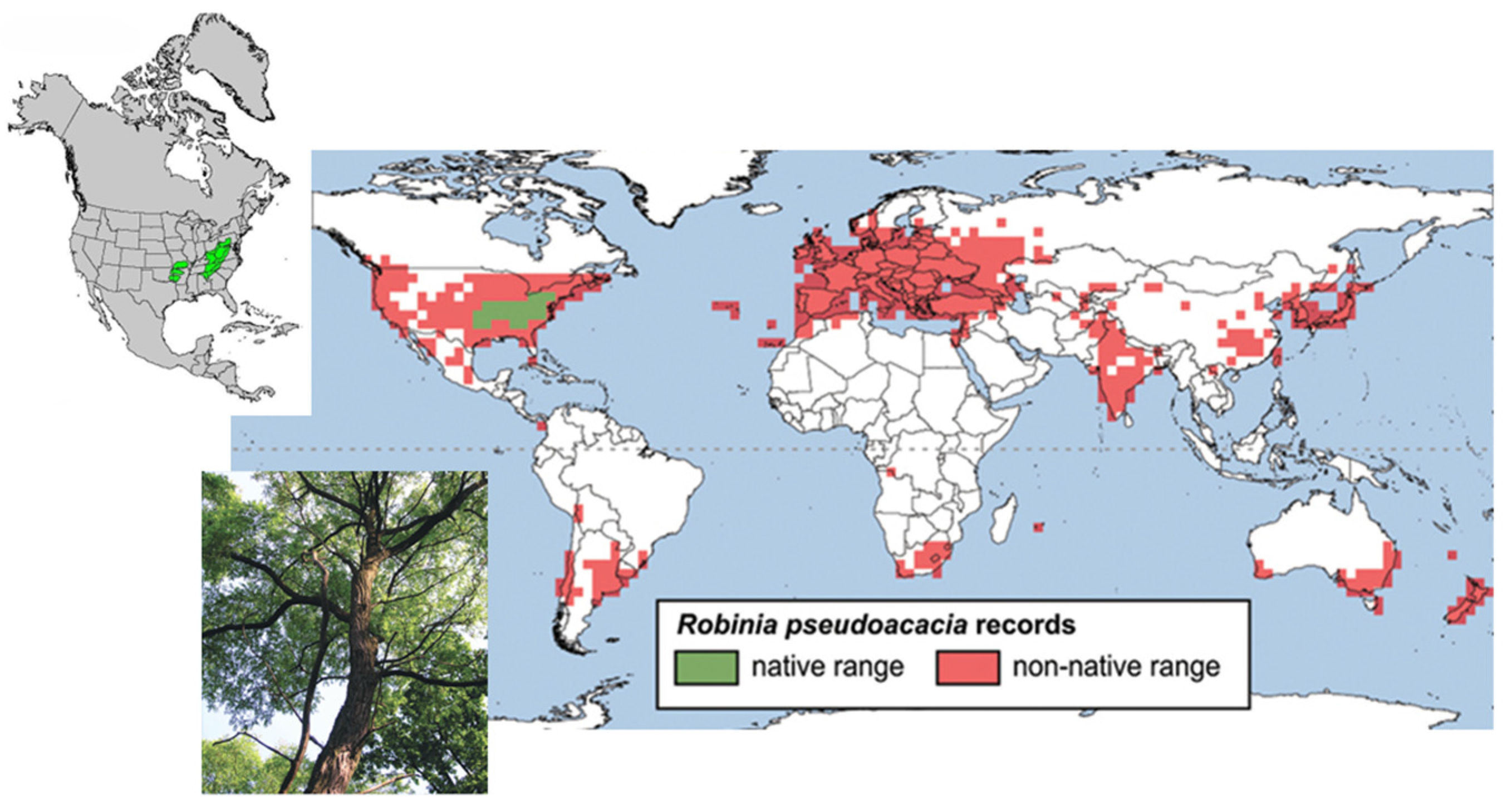
R. pseudoacacia is a fast-growing, light-demanding pioneer tree species that is well adapted to disturbed and early-successional environments. In its native range in eastern North America (
Figure 1), it typically colonizes forest gaps, landslides, riverbanks, and post-disturbance sites such as burned or logged areas [
10]. Outside its native distribution area, it frequently establishes in anthropogenic habitats, including abandoned agricultural lands, road embankments, quarries, urban wastelands, and afforestation sites [
19,
25].
R. pseudoacacia exhibits traits typical of ruderal–competitive strategists, such as rapid juvenile growth, early reproductive maturity, high resprouting capacity, and efficient resource acquisition [
46]. These traits confer a strong advantage in environments subject to recurrent disturbance [
47].
Black locust commonly occurs in stands of the thermo and meso-Mediterranean belts. It coexists with
Quercus cerris,
Q. pubescens,
Carpinus betulus,
Castanea sativa,
Fraxinus ornus, and
Ostrya carpinifolia in hilly areas. Along the river margins in riparian woodlands, it is associated with
Alnus glutinosa,
Populus alba,
P. nigra,
Q. robur,
Salix alba,
S. purpurea, and
Sambucus nigra [
48]. The ability of
R. pseudoacacia to reproduce both sexually and asexually [
19], together with its high phenotypic plasticity [
49], has enabled it to colonise a wide range of environmental conditions, from dry grasslands to riparian zones [
25]. Sexual reproduction ensures long-distance dispersal and genetic exchange, while vegetative propagation leads to the formation of high-density clonal stands with long-term persistence [
44]. Seeds are relatively long-lived and form persistent soil seed banks, further enhancing colonization potential. This dual reproductive strategy contributes to the species’ high resilience and facilitates rapid recolonization after mechanical disturbance or control measures.
A key agro-ecological feature of
R. pseudoacacia is its ability to form symbiotic associations with nitrogen-fixing bacteria, mainly
Rhizobium spp. This association results in the formation of root nodules and active biological nitrogen fixation [
50]. Consequently, the species thrives on nutrient-poor substrates and alters soil chemical properties, particularly nitrogen availability, largely through leaf litter inputs [
51]. In invaded ecosystems, increased soil nitrogen content associated with
R. pseudoacacia stands is well documented and represents one of the main drivers of its ecological impact. This process promotes nitrophilous species and adversely affects native flora adapted to low-nitrogen conditions [
10,
52].
Carbon allocation and biological nitrogen fixation remain partially balanced under low irrigation conditions [
53], allowing the species to cope with reduced water availability [
54].
R. pseudoacacia demonstrates high ecological plasticity and grows under a wide range of climatic conditions, from temperate to arid environments. It also occupies many soil types, including dry, poor soils and substrates with diverse chemical compositions [
10]. As a heliophilous pioneer species,
R. pseudoacacia shows limited regeneration under closed forest canopies. It fails to establish effectively in prolonged shade, which restricts its presence in undisturbed native forests [
55]. Black locust plantations are characterized by low quantities of deadwood (approximately 16.7 m
3 ha
−1) and an almost complete absence of native regeneration, due to the strong regenerative capacity of the species [
56]. Conversely, the presence of deadwood across different components and decay classes has a positive effect on saproxylic species and acts as a reserve of both carbon and biodiversity [
56]. Finally, the species prefers well-drained soils and does not tolerate waterlogging. Compact, clayey, or excessively moist soils limit growth and survival [
57]. This pattern indicates a limited adaptability to stagnant water conditions, which constrains its establishment in humid or poorly aerated ecosystems [
57].
4. Ecological Impact and Economic Value of R. pseudoacacia
In many regions outside its native distribution range, particularly in Europe and parts of Asia,
R. pseudoacacia is classified as an IAPS. Its invasion is associated with reduced plant species richness. It also causes shifts in community composition, alteration of successional trajectories, and long-term changes in soil functioning and ecosystem processes [
16,
21]. When invasive species arrive in new ecological niches, they modify soil chemical properties, alter light conditions, and promote environmental conditions that facilitate the establishment of other alien species [
58,
59,
60]. Over the long term, these processes increase negative effects on biodiversity and ecosystem services [
17].
The invasive success of
R. pseudoacacia is linked to profound ecological impacts on native ecosystems. Outside its native range, the species acts as an invasive taxon and induces changes in soil chemistry and light regimes. It also displaces native vegetation [
45]. The ecological impact of IAPS is not only species-specific, but it also depends on propagule quantity and local abundance. In this context,
R. pseudoacacia shows context-dependent effects on forest regeneration [
17]. Through rapid canopy closure, extensive clonal growth, and allelopathic effects, the species suppresses native plant communities and alters successional dynamics [
19,
61]. Moreover, its nitrogen-fixing capability significantly modifies soil nutrient cycles. This process often leads to increased nitrogen and phosphorus availability [
62]. It also drives changes in microbial communities and causes long-lasting alterations in soil chemistry that favour nitrophilous species over native specialists [
16,
63].
In mixed deciduous forests and semi-natural habitats, dominance of
R. pseudoacacia is associated with changes in undergrowth and pollinator community composition. These shifts favour nitrophilous and ruderal species compared to stands dominated by native trees [
10]. The invasion of black locust also has a significant impact on soil microarthropod communities, resulting in reduced abundance and species richness [
16]. These biodiversity impacts are closely related to soil-mediated processes. As a nitrogen-fixing species,
R. pseudoacacia substantially alters soil nutrient availability through symbiotic N
2 fixation. This process often results in increased total and mineral nitrogen pools compared with adjacent native stands. The magnitude of these increases varies with stand age, soil properties, and site conditions [
64]. Such changes are often persistent and generate soil effects. These legacies hinder the re-establishment of native plant communities even after partial removal of Robinia. Its impacts are particularly critical in ecosystems adapted to low-nutrient conditions, such as dry grasslands and open habitats of high conservation value. In these systems, Robinia invasion is associated with marked declines in plant species richness and functional diversity [
65]. Consequently,
R. pseudoacacia appears on several national and regional IAPS lists, and its management focuses primarily on containment or eradication strategies (
Table 1).
Paradoxically, many traits that underpin the invasive behaviour of
R. pseudoacacia also explain its high economic and productive value. Black locust has considerable economic importance in both North America and Europe [
45,
55]. Its durable wood is resistant to fungi, decay, and insect damage. These properties make it suitable for fence posts, flooring, firewood, shipbuilding, and outdoor furniture. Owing to its high growth rate, the species is suitable for biomass production. It is also used for erosion control, land reclamation, and ornamental planting.
In several regions, eradication and control strategies of black locust generate large amounts of residual biomass. This material includes branches, tops, and bark that are suitable for thermochemical conversion. Residual biomass represents a heterogeneous but functionally significant fraction of total productivity. It encompasses harvesting residues, industrial by-products such as sawdust, and belowground inputs including roots and litter. These residual fractions are increasingly recognized as valuable resources within bioenergy and circular economy frameworks. This recognition derives from their relatively high calorific value and favorable physical properties for densification into pellets or chips [
70]. However, their utilization presents both advantages and constraints. The high nitrogen of this nitrogen-fixing species can lead to increased NO
x emissions during combustion. At the same time, removal of harvesting residues may disrupt nutrient cycling and reduce soil fertility over time. Conversely, retention and decomposition of belowground biomass and litter contribute positively to soil organic carbon accumulation and microbial activity [
71,
72]. These processes may also alter native plant communities through nutrient enrichment. Recent studies indicate that biomass allocation in
R. pseudoacacia systems includes a substantial belowground component, accounting for approximately 30% of total biomass. This finding highlights the ecological relevance of root-derived residual biomass for carbon storage and soil processes [
73].
R. pseudoacacia produces high-density wood (750–850 kg m
−3) with a high calorific value, which makes it particularly suitable for bioenergy production [
74,
75]. Biomass yields from a
R. pseudoacacia plantation generally range from 3–7 to 10–12 Mg ha
−1 DM per year depending on planting density and stand age. These values are lower than those reported for poplar (
Populus spp.), which reach 12–18 Mg ha
−1 DM per year. The calorific yield of
R. pseudoacacia corresponds to approximately 79 GJ ha
−1 DM per year for wood and 40 GJ ha
−1 DM per year for bark. While poplar can grow incredibly fast, producing high biomass yields in a short time window, black locust excels in terms of environmental quality for several reasons. Poplar requires chemical fertilization to maintain high yields, which can lead to nitrogen runoff into waterways. Black locust, fertilizing itself and the soil, makes it ideal for reclaiming marginal or degraded land where poplar would not survive: this is the biggest biological advantage [
52,
53,
74,
75,
76,
77]. In addition, poplar has a low density, while black locust has one of the highest-density woods [
78]. Therefore, while energy per kilogram of Robinia is similar to poplar, its energy per volume is much higher. Finally, black locust is naturally resistant to rot and insects for years without chemical treatment, while poplar rots quickly if exposed to moisture. Some studies in central Europe selected
R. pseudoacacia clonal plants, but they are not adapted to the climate conditions of the Mediterranean basin and are not yet available on the market [
78]. Consequently, this species requires selection and genetic improvement programs for the high growth variability shown in trial plots established up to now. Although Robinia is a candidate with excellent references, comparative studies as an energy crop are still limited and further efforts are needed, above all to identify and characterize the more suitable varieties for the bioenergy sector with the least possible invasiveness. For all these reasons, however, it seems quite clear that it would be preferable to use biomass of the invasive plant black locust as a resource for bioenergy, especially in degraded lands [
69,
78].
Under short rotation coppice (SRC) systems, black locust achieves high biomass yields with relatively low inputs. This pattern is particularly evident on marginal or degraded soils where conventional crops are not profitable [
76]. In Europe, Robinia, therefore, is increasingly considered a potential energy crop. It contributes to renewable energy targets while providing an economic use for abandoned agricultural land [
77]. With its Mediterranean climate and long-standing agricultural tradition, Italy offers favorable conditions for their cultivation. Among the most widely known energy crops for biomass, fast-growing woody species are principally used, such as willow (
Salix spp.) and poplar harvested in SRC cycles of three to five years [
76,
77]. Today, the main systems that allow us to exploit the current market trend are short/medium rotation coppice, also known as SRC/MRC. These plantations are based on the vegetative regeneration capacity of species with a high growth rate after pruning or coppicing. SRC achieves high biomass yields because shoots are cut before mutual shading limits their growth, allowing for extremely dense planting patterns. The SRC system is a form of intensive agriculture and, as such, depletes the soil’s nutrients, increasing costs due to the need for fertilization, depending on the location. Soils rich in organic matter can support SRC cultivation for extremely long times, while other soils are depleted in just a few years. It is, therefore, clear that the profitability of the SRC system will depend not only on the amount of biomass obtained, but also on fertilization costs, decreased productivity due to depletion, uprooting of exhausted stumps, and planting of new cuttings. MRC is a less intensive system, where the planting density is lower than in SRC stands with greater spacing between trees, with rotations lasting between five and six years. The MRC can remain productive for longer than the SRC stands because long coppicing cycles do not weaken trees.
This dual role as both an IAPS and a bioenergy resource places
R. pseudoacacia at the centre of an ongoing debate among ecologists, land managers, and policymakers. In Italy, a growing number of studies focuses on biomass quantification in forest stands, including those dominated or invaded by alien tree species [
79,
80]. These studies provide robust tools for estimating above- and belowground biomass at the stand scale. Such estimates derive from the development of species-specific allometric relationships [
81]. These approaches improve assessments of forest productivity and structural attributes under different management and disturbance regimes [
82]. Accurate biomass quantification is particularly relevant in invaded forests, where it supports evaluation of ecological impacts and management outcomes. Species-specific allometric models enable application across diverse management scenarios, supporting both IAPS control strategies and assessments of woody biomass availability for energy production. In this framework, biomass quantification represents a key interface between ecological objectives and economic considerations [
78].
From a broader management perspective, economic analyses play a critical role in informing invasive species policies. The review by Cororaton et al. (2009) [
83] highlights that decisions regarding prevention, control, or potential eradication of IAPS require quantitative, case-specific evaluations. Consistently, Epanchin-Niell (2017) [
84] emphasizes that effective management depends on explicit consideration of trade-offs between costs and benefits associated with prevention, monitoring, and long-term control strategies rather than universal eradication. Bioeconomic modelling demonstrates that optimal management intensity is highly context-dependent. It varies with ecological conditions, invasion dynamics, and socio-economic constraints. Evidence-poor decisions risk producing inefficient or disproportionately costly outcomes. The absence of a universally optimal policy reinforces the need for adaptive, evidence-based management frameworks that integrate ecological effectiveness with economic feasibility and long-term sustainability.
5. State of the Art on R. pseudoacacia in Italy
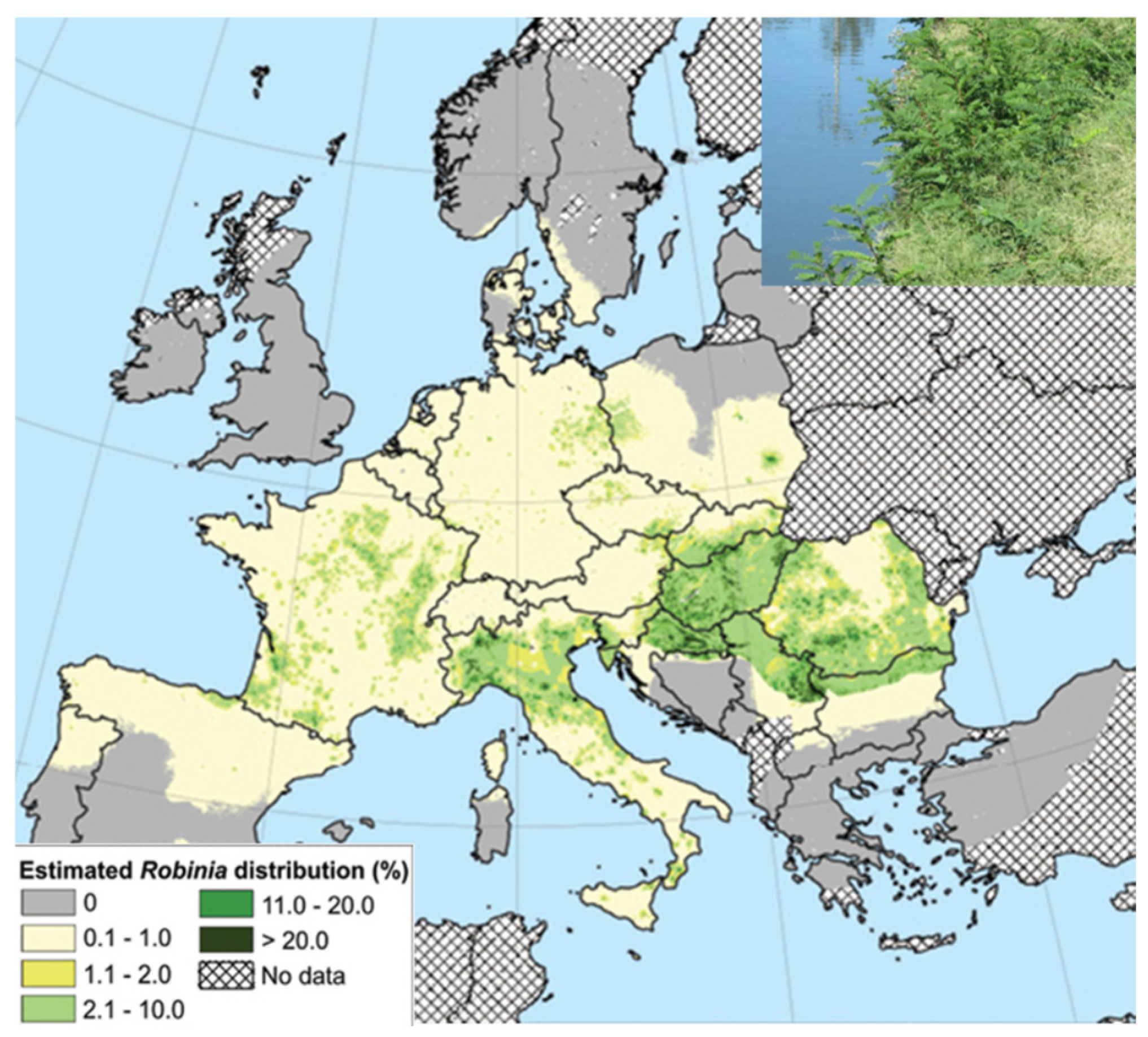
In the Italian peninsula, the most widespread non-native tree species is
R. pseudoacacia, introduced more than 360 years ago. This species accounts for 92.7% of the total number of trees of IAPS and 92.9% of the total basal area of the same species [
85]. Italy represents a paradigmatic case of long-term introduction and secondary expansion of
R. pseudoacacia. The first record in the botanical gardens of Padua dates back to 1660 [
48]. The species has progressively naturalised and spread across most Italian regions. Today, it is distributed in lowland and hilly areas, which are characterised by agricultural abandonment and landscape fragmentation [
16]. It occurs especially in semi-natural grasslands, forest edges, and river corridors. In this habitat, the species form dense and monospecific stands. Over the last two decades,
R. pseudoacacia has become one of the most extensively studied alien tree species in Italy. This interest derives from its wide distribution and its pronounced ecological and productive effects. Black locust, together with
Ailanthus altissima (Mill.) Swingle, covers an area of approximately 233.500 ha in Italy, representing 2.22% of the total forest area [
86]. The rapid expansion of the species causes a progressive decline of native forests. This process leads to a loss of species richness and diversity. It also drives a shift in species composition toward nitrophilous plants, particularly in central regions [
87].
Field studies conducted in Central and Northern Italy consistently report significant reductions in undergrowth plant diversity associated with increasing black locust dominance. Similar reductions in functional and compositional diversity are documented in Natura 2000 sites, where black locust invasion leads to vegetation homogenisation and loss of habitat-specific species [
88]. Disturbance regimes further amplify invasion dynamics. Studies in Mediterranean Italy indicate that wildfire events can increase black locust regeneration density by 2- to 4-fold. This effect occurs particularly in abandoned
Castanea sativa Mill. coppices, accelerating post-disturbance dominance [
89].
In contrast to its documented ecological impacts,
R. pseudoacacia exhibits high biomass productivity under Italian conditions. Biomass equations and field measurements from Northern Italy indicate that biomass production from black locust plantations reaches approximately 10 Mg ha
−1 DM per year, in SRC systems on suitable sites [
75]. Biomass analyses show a superior quality for the black locust feedstock [
90]. Low levels of moisture, ash, and alkali metal with a high heating value (18.98 MJ kg
−1) are characteristic of Robinia, comparable to those of
Populus and
Eucalyptus. However, from an environmental perspective, the relatively high N (12.3 g kg
−1) and S (0.7 g kg
−1) contents increase the potential for pollutant emissions during combustion [
91]. Among the investigated species, eucalyptus and poplar exhibit the highest moisture contents in stems (54% and 48%, respectively) and branches (48% and 51%). In contrast, black locust produces drier biomass both for stems and branches with moisture values around 39%. Moreover, both eucalyptus and poplar show the highest ash contents in stems (2.7% and 3.1%) and branches (5.5% and 5.4%). By comparison, black locust displays the lowest ash contents both in stems (2.1%) and branches (4.8%). Ash is a key chemical parameter in biomass quality assessment. It determines whether a biomass source can represent a potential renewable energy resource or a management constraint. High ash content reduces energy density because it does not combust. Moreover, its chemical composition, particularly alkali metal concentration, influences the operational lifespan of biomass conversion systems.
From an agronomic perspective, SRC systems aim to optimise biomass production primarily through adjustments in plant density and cutting intervals. However, biomass removal also entails the extraction of soil nutrients. For this reason, the environmental sustainability of SRC systems requires the restoration of soil fertility and overall soil quality. This objective is achieved through mineral and/or organic fertilization practices. Recent investigations confirm the agronomic and environmental sustainability of the black locust SRC system [
91].
Given the relevance of heavy metal bioaccumulation in Robinia and considering that available data for Italy are currently limited, evidence from other European regions is reported, as these contexts are considered comparable. Bioaccumulation in the
R. pseudoacacia leaves is also utilized for biomonitoring heavy-metal pollution in industrial zones of Poland [
92]. The study is conducted in 25-year-old plantations located in close proximity to an industrial zone. This area is characterised by high contamination originating from cement factories, nitrogen fertilizer production, and polyvinylchloride (PVC) manufacturing plants. Concentration of nutrients and heavy metals in leaves from contaminated sites is compared with that from control plants. In polluted trees, the levels of major nutrients decrease relative to controls. Nitrogen, phosphorus, potassium, and magnesium decline by 6%, 11%, 36%, and 3%, respectively, highlighting impacts on plant physiology status. Pb and Zn concentration in leaves reach 30.7 ppm and 19.0 ppm, respectively, corresponding to values approximately 1.38 times higher than in controls. Copper bioaccumulation in leaves from polluted sites increases to 17.2 ppm, representing a 2.15-fold increase compared to controls. The high contents of Pb, Zn and Cu in the contaminated soils amounted to 38.2, 77.4, and 101.3 ppm, respectively. Leaf concentrations of Pb, Zn, and Cu increase in relationship with the presence of their increase in the soil. Therefore,
R. pseudoacacia may be considered an effective species for biomonitoring soil contamination in industrial environments, particularly for Cu, followed by Pb and Zn.
A more recent study conducted in Bulgaria compares the heavy metal composition of different black locust tissues (leaves, branches, and seeds) with that of moderately and highly contaminated soils under plantations [
93]. The results show higher concentrations of critical heavy metals, namely Zn, Pb, and Cr, in order of abundance. For all elements, concentrations are higher in soils than in plant tissues. The highest soil concentrations are observed for Zn (23.77–103.90 ppm) and Pb (0.52–16.35 ppm). Zn accumulates in all examined black locust tissues. Higher Zn contents occur in leaves (30.33–103.37 ppm) and branches (27.60–103.90 ppm), whereas seeds show comparatively lower concentrations (23.77–60.09 ppm). The highest Zn values are recorded in urban park areas and landfills, while the lowest values are found in agricultural sites. Pb concentrations in soils remain high (78.17–157.99 ppm) across all investigated areas. In contrast, Pb levels in plant tissues are significantly lower (0.52–16.35 ppm). Other trace metals, including Cu, Ni, and Cr, are detected in both soils and plant parts. In all cases, soils contain higher concentrations than plant tissues, with Cu and Ni contents in black locust showing similar ranges (3.93–10.60 ppm for Cu and 0.30–6.20 ppm for Ni). Cr content in black locust tissues remains relatively constant, ranging from 1.16 to 1.76 ppm. As and Co are mainly present in soils at low concentrations (As 4.23–11.77 ppm; Co 3.10–11.57 ppm), while their contents in black locust tissues do not exceed 0.30 ppm. In addition, Li and V concentrations are detected only in soils at low levels (Li 3.47–16.27 ppm; V 10.00–31.67 ppm), and they are not detected in plant tissues. In general, this study indicates that
R. pseudoacacia leaves represent the primary carrier of potentially toxic elements. Therefore,
R. pseudoacacia is able to grow across a wide range of environmental conditions and may be exploited for greening urban areas and agro-ecosystems affected by industrial disturbance and contamination.
These data show that heavy metal concentrations are generally low. Scalar levels are observed primarily in leaves, followed by bark and wood. In any case, soil and plant compartments require careful monitoring. When very high levels are found, biomass should be excluded from energy and agricultural cycles to prevent accumulation in ash and post-use soil. In general, owing to the low values of the bioaccumulation factor, R. pseudoacacia does not accumulate contaminants at levels that pose a risk for its practical use.
According to the literature, the expected black locust dendromass volume shows considerable variation, depending upon site, cultivars, initial spacing and length of rotation cycle [
94]. The species produces a high-density bark with a calorific value of approximately 19.5 MJ kg
−1. This feature confirms its suitability for solid biofuel production [
95]. Increasing quantitative evidence suggests that neither blanket eradication nor uncritical promotion of bioenergy is ecologically or socio-economically justified [
96]. Instead, recent studies converge on the conclusion that the sustainability of black locust-based systems is strongly context-dependent. It varies with habitat type, disturbance history, management intensity, and landscape configuration (
Table 1) [
96,
97]. This shift towards a site-specific, evidence-based assessment framework represents the current state of the art. It underpins the need for integrated approaches that balance invasion risks with potential benefits related to climate change mitigation and rural development.
Similarly, analyses of abandoned short rotation forestry (SRF) systems in the Region Emilia-Romagna highlight important levels of accumulated carbon. In these systems,
R. pseudoacacia shows a high average annual rate of carbon sequestration [
56]. Recent studies underscore the potential of
R. pseudoacacia as a valuable species for both bioenergy production and carbon sequestration [
74,
79,
98]. Evidence from a study conducted in North-Western Italy between 2006 and 2012 indicated that black locust wood chip plantations are energetically efficient. These systems exhibit an output/input ratio exceeding 20, although production costs remain relatively high [
75]. Furthermore,
R. pseudoacacia demonstrates promising performance as a solid biofuel. Wood pellets produced from this species show combustion efficiency and emission profiles comparable to commercially available products. They comply with current regulatory standards and are suitable for residential use [
99]. Beyond energy production,
R. pseudoacacia also plays a significant role in carbon storage. Higher carbon stocks in black locust SRF plantations are attributed to sustained growth and low mortality rates throughout the rotation period. For instance, a study in the Region Lazio estimates the total carbon stock of a 15-year-old SRF plantation at 39.21 MgC/ha, distributed across five carbon pools [
79]. Finally, the potential contribution of SRF systems and perennial grass plantations to biofuel production appears substantial. Estimates suggest that between 462,265 and 2,811,064 ha of marginal land can yield 3.1–27.4 billion litres of cellulosic ethanol per year. This production could satisfy approximately 7.8–69.1% of Italy’s current biofuel demand for transportation [
100].
All these findings highlight the dual role of
R. pseudoacacia. The species supports renewable energy production and contributes to climate change mitigation through carbon sequestration. In Italy, IAPS are formally recognised as a major threat to biodiversity, ecosystem functioning, and landscape integrity. Their management is framed within a regulatory system aligned with European Union (EU) policies. EU Regulation No. 1143/2014 [
101] on the prevention and management of the introduction and spread of IAPS is transposed into national level through Legislative Decree No. 230/2017 [
102]. This decree defines institutional responsibilities for surveillance, monitoring, and control actions at national and regional levels. IAPS included in the EU list of species of Union concern are subject to mandatory eradication or containment measures. On the contrary, several widely naturalised IAPS not included in the EU list, such as
R. pseudoacacia, are recognised in the Italian scientific literature and regional management plans as having significant invasive potential under specific ecological conditions. As a result, their monitoring and control are largely delegated to site-specific and regionally coordinated strategies, particularly in protected habitats of high conservation interest (
Table 1). At the same time, Italy adopts ambitious climate and energy policies that promote the expansion of renewable energy sources, including bioenergy derived from biomass.
The National Integrated Energy and Climate Plan (PNIEC) [
103] identifies solid biomass, biogas, and other bio-based energy carriers as key components to produce national renewable energy, especially in rural and marginal areas. The transposition of the Renewable Energy Directive (EU) 2018/2001 (RED II) [
104] through Legislative Decree No. 199/2021 [
105], together with recent updates to the national sustainability certification system for biofuels and bio-combustibles, introduces strict criteria on emission reductions of GHG, land-use impacts, and traceability along the energy supply chain. These measures aim to guarantee that bioenergy does not compromise environmental protection goals, including biodiversity conservation. As a result, this dual regulatory framework places species such as
R. pseudoacacia at the intersection of partly conflicting policy objectives. On the one hand, IAPS regulations emphasise prevention, containment, and mitigation of ecological impacts; on the other hand, energy policies encourage the use of low-input, high-yield biomass resources to support renewable energy targets. In light of this regulatory context, the utilisation of black locust for bioenergy production raises critical questions regarding the balance between bioenergy promotion and environmental risk management [
86,
87,
88,
89,
90,
91,
92,
93,
94,
95,
96,
97,
98,
99,
100].
The use of
R. pseudoacacia is currently governed by a push-and-pull dynamic between its reputation as a high-quality timber species and its status as an invasive plant. As a result, it remains in a legal “gray area” when compared with strictly prohibited species. There is no general legal ban on its sale, transport, planting, or cultivation across the EU. Nevertheless, although Robinia is often cultivated in Europe, it falls under the scope of the EU Deforestation Regulation (EUDR) 2023/1115 [
106]. Under this regulation, suppliers must provide precise geolocation coordinates of the land on which the wood is produced. This requirement serves to demonstrate that production does not contribute to deforestation or forest degradation. In addition, local municipal ordinances need to be consulted before new plantings are established. In many regions, while the species is not banned at the national level, its use is restricted in forest restoration projects, public green spaces, and areas close to protected habitats and nature reserves. These restrictions are motivated by the high risk of competition with native biodiversity. Caution is also recommended in gardening and landscaping contexts. Practical guidelines suggest the use of cultivars with reduced or sporadic flowering to limit seed production and invasive spread (e.g.,
R. pseudoacacia var. ‘Umbraculifera’). Conversely, for construction purposes,
R. pseudoacacia is advisable for its excellent eco-friendly and highly durable outdoor timber, reducing the need to utilize tropical plants. However,
R. pseudoacacia is currently under “proactive monitoring,” and individual member states (like Italy) can have local restrictions and management plans. Italian policy calls for site-specific assessments that balance invasion risks with potential socio-economic and climate benefits. This approach reinforces the need for integrated and evidence-based decision-making in the management of IAPS used as bioresources.
6. Future Challenges for R. pseudoacacia as an Energy Crop
The rapid expansion of IAPS underlines the need for an urgent and critical assessment of existing studies, particularly in quantifying ecological and economic damages. It also involves the evaluation of the cost-benefit ratios associated with different management strategies [
107]. Evidence indicates substantial variability in the estimated economic costs associated with IAPS, highlighting the importance of balancing ecological with socio-economic effectiveness, rather than pursuing blanket eradication measures [
107]. A more analytically robust approach requires moving beyond descriptive cost accounting towards the explicit identification of decision-relevant criteria: (i) ecological impact severity and reversibility; (ii) socio-economic dependency of local communities on the species; (iii) management cost-effectiveness across different intervention typologies; and (iv) feasibility under site-specific land use and governance conditions. Only through such a multi-criteria perspective can management recommendations be transformed from generic prescriptions into concrete and contextualized strategies.
With specific reference to
R. pseudoacacia, several studies illustrate the coexistence of contrasting socio-economic and ecological impacts of this species. While it can provide economic benefits through biomass production, timber, and honey, it can simultaneously cause environmental disturbances in natural habitats (
Table 1). Vítková et al. (2017) [
25] also emphasise that stratified management approaches, allowing tolerance in certain areas while implementing targeted restrictions or eradication in ecologically sensitive regions, are more appropriate than uniform, unilateral policies. To operationalise this principle, management decisions should be guided by a set of explicit sustainability indicators, including: species richness trends in adjacent habitats, soil nitrogen accumulation rates, biomass yield stability over successive rotations, and economic return per unit of management input. These indicators allow practitioners to evaluate trade-offs systematically rather than relying on qualitative judgment alone.
It is particularly interesting to note that the use of residual biomass (leaves, stems, roots) from Robinia, where it grows as an invasive species rather than in rational cultivations, can represent an added value, given that otherwise this residual biomass is considered a typically unexploited waste. Nowadays, plant waste and high-value by-products are considered valuable resources for obtaining biomass and natural products, in line with the ecological transition to a circular economy. Therefore, it is essential that more in-depth research be conducted on all parts of the Robinia plant in the future. For many countries, the management and valorization of residual biomass from
R. pseudoacacia can represent a relevant future resource. This approach should rely on context-dependent strategies that consider both energetic potential and ecological implications [
70,
71,
72,
73].
More recent international assessments, such as those by the Intergovernmental Science-Policy Platform on Biodiversity and Ecosystem Services (IPBES) [
108], further support the need for integrative management frameworks that account for trade-offs between control, eradication, and the socio-economic use of IAPS (
Table 1). In such contexts, multiple objectives are pursued, including biodiversity conservation, human well-being, ecosystem service provision, and management costs, in contrast to simplistic strategies based solely on species removal or introduction. Indeed, emerging evidence points to the ecological and socio-economic risks associated with the increasing demand for biomass. The analytical challenge consists precisely in making these trade-offs explicit: under what conditions does bioenergy production from
R. pseudoacacia deliver net positive outcomes across ecological, economic, and social dimensions simultaneously? Addressing this question requires moving beyond the binary framing of the species as either beneficial or harmful, and instead adopting a framework that explicitly accounts for objective specificity, spatial context, and temporal horizon.
The promotion of bioenergy should be carefully evaluated within a sustainability framework that explicitly distinguishes among three operational dimensions: environmental sustainability (soil integrity, GHG balance, biodiversity impacts), economic sustainability (profitability without subsidies, market stability, long-term yield maintenance), and social sustainability (rural employment, energy security, cultural landscape values) [
109]. Despite growing interest in SRC systems as a renewable energy source, their role within the Italian bioenergy framework remains controversial [
79]. SRC plantations based on fast-growing species, such as
R. pseudoacacia, are often promoted for their high biomass productivity and favourable biofuel properties [
75,
94]. However, critical assessments reveal substantial ecological, technical, and socio-economic constraints that prevent them from constituting an unconditionally sustainable energy solution [
110]. A systematic evaluation of these constraints, rather than their mere enumeration, is essential for guiding policy decisions. SRC biomass can indeed provide high-quality feedstock, characterized by low moisture and ash content with high heating values [
80,
91]. These advantages, however, have to be weighed against combustion-derived pollutants. Elevated sulphur and nitrogen concentrations in SRC biomass, especially in nitrogen-fixing
R. pseudoacacia, are associated with increased emissions of SO
2 and NO
x [
91,
111], raising concerns regard to local air quality and compliance with stringent emission standards. In the Italian context, characterised by widespread and often poorly regulated residential and small-scale combustion systems, these emissions represent a non-negligible environmental cost that undermines the presumed climate and health benefits of bioenergy. From a decision-making standpoint, the net climate benefit of
R. pseudoacacia-based SRC can only be assessed through a full life-cycle analysis accounting for upstream land-use change, combustion emissions, and soil carbon dynamics, none of which are systematically included in current Italian policy frameworks.
Furthermore, the environmental sustainability of SRC systems in Italy is strongly constrained by site-specific soil and landscape characteristics. Mediterranean soils are often shallow, heterogeneous, and vulnerable to chemical alterations. Evidence of increased sulphur accumulation under SRC raises concerns about long-term soil degradation, whose cumulative effects on fertility and biogeochemical cycles are rarely incorporated into cost-benefit analyses prioritising carbon balance. In addition, the use of highly competitive IAPS within SRC systems introduces further ecological risks, particularly in countries characterized by habitat fragmentation and a dense network of protected areas. Small-average farm sizes, fragmented landownership, and limited availability of contiguous marginal lands further constrain the feasibility of SRC development in Italy [
112]. As a result, many SRC initiatives remain dependent on subsidies and policy incentives, a dependency that itself constitutes a sustainability indicator, signalling that current conditions could not yet support autonomous market viability.
All this highlights a critical gap between productivity estimates and implementation under real conditions. The inclusion of SRC biomass within renewable energy strategies complicated the bioenergy debate. Treating SRC systems as intrinsically sustainable, thus, neglects the necessary balance among bioenergy production, biodiversity conservation, soil protection, and rural development [
110]. Renewable bioenergy strategies based on SRC require spatial planning and governance frameworks that, in the Italian context with multifunctional ecosystems at high conservation value, remain in the process of being applied or largely under development.
In effect, energy is considered sustainable when it comes from sources that meet present needs without compromising the ability of future generations to meet theirs, primarily through renewable resources. Organic matter, such as plant biomass, can be efficiently converted into bioenergy and, unlike fossil fuels, comes from living material that regenerates through natural cycles. Therefore, while biomass is renewable, its sustainability depends on how it is sourced and used. As we can see from this review, a sustainability evaluation of black locust biomass is complex because it is intrinsically multicomponent. Indeed, it is necessary to carry out quantification by mainly combining life-cycle, energy, environmental, and economic indicators.
More in detail, a methodological framework typically uses Life Cycle Assessment (LCA) for environmental impact, energy balance for efficiency, and economic analysis for feasibility. LCA evaluates the environmental profile from cultivation, harvesting, processing, end use, including GHG emissions, energy use, transport and inputs (fertilizers, machinery). An LCA study on bioethanol from black locust lignocellulosic matter shows reductions in global warming potential, acidification, and fossil fuel use compared to conventional gasoline [
113]. The black locust cultivation following a low-input production regime of the agricultural phases, without agrochemicals and supplemental irrigation, is the main reason for the observed environmental improvement. SRF/SRC under low-input regimes show environmental benefits for the future of second-generation bioethanol production in Europe.
Similarly, focusing on energy efficiency, Energy Return on Investment (EROI), i.e., the ratio of energy delivered with respect to the energy required to deliver it, of black locust SRC can reach output/input ratios of EROI > 20, indicating strong energetic performance, when a sustainable biomass should have an EROI > 1 [
75]. The techno-economic assessment allows us to evaluate economic sustainability by calculating profitability thresholds, i.e., production costs vs. biomass price. However, woodchip production from black locust SRC should require ≥ 103 € per Mg (dry matter) to be economically sustainable; it is not possible without economic support [
75].
To get a further quantitative picture, the Key Sustainability Indicators (KSI) consider GHG emissions, C-sequestration, soil impact, and water-use efficiency. Black locust is an interesting option for biomass production because the species combines water-use efficiency and a biomass yield largely superior to that of poplars, especially under water stress [
114]. However, black locust SRC is sensitive to harvesting, causing high tree mortality (nearly 60%) with a reduced yield during the second rotation cycle. Longer rotations (MRC) could be more adapted to this species, but it remains an optimal candidate for marginal and water-limited lands [
53,
54,
114].
This species often shows good performance in energy and environmental terms, but economic and ecological trade-offs must be specifically quantified to reach balanced sustainable use. Because Robinia is often considered an invasive species in Europe, sustainability metrics must necessarily include the invasiveness impact score, i.e., a quantitative scale assessing the displacement of native species versus the economic benefit of the biomass. Despite current knowledge, literature highlights limited long-term LCA data for different soil and climate conditions, a need for biodiversity-inclusive metrics, uncertainty in land-use change effects, and a lack of standardized composite sustainability indices [
53,
54,
99,
100,
113,
114].
In Italy, a key aspect of this debate is to contribute in the nearest future transforming the IAPS
R. pseudoacacia from its nature as a spontaneous-invasive plant to an agroforestry cultivation, as already naturalized for a long time in other European countries [
68], such in Romania [
57], Hungary [
74], and Bulgaria [
93] where it is mainly utilized for the production of fine wood, fodder, biomass, and honey. In Romania, for example, in addition to its economic benefits deriving from environmental adaptability on degraded lands, fast growth, and high biomass yields,
R. pseudacacia offered an important range of ecosystem services such as C-sequestration, landscape reclamation, and fuel wood. Here, in fact, black locust stands out as a proven solution for reclaiming degraded lands when native species are not an alternative [
57]. This comparative evidence provides a useful analytical reference for evaluating whether analogous institutional and agronomic transitions could be pursued in Italy, provided that site-specific ecological constraints and land governance conditions are explicitly taken into account.
Despite their high biomass potential, SRC pure stands exhibit well-documented long-term limitations: progressive soil nutrient depletion, increasing reliance on fertilizers, declining yields across successive rotations, high water demand, and substantial costs of stand destruction and replanting, factors that cumulatively erode profitability. One structural response to these constraints is the possible transition towards silvo-arable alley cropping systems (ACS) [
115,
116]. These agroforestry systems can simultaneously deliver biomass and food production, while providing ecosystem services including soil erosion reduction, improved nutrient cycling, habitat diversity, water management, and climate change mitigation. These extremely innovative SRC-based ACS combine rows of fast-growing trees into conventional arable systems, but little is still known about interactions combining them in an intercropping system. In Italy, many farmers are not interested in developing agroforestry systems because of the possible economic losses. On the other hand, farmers are not yet much attracted by bioenergy plantations with fast-growing tree species such as
Populus spp.,
Salix spp. and
R. pseudoacacia, because of the scarce financial returns in short times. Despite that, with war conflicts protracted and uncertainties on both the supply and price of fossil fuels, the overall trend in Europe is a steady increase in the consumption of agroforestry biomass for energy purposes. This political conjuncture could lead to a renewed interest in innovative systems for energy crops. Only recently they were most investigated also in Mediterranean environments [
115,
116]. However, the first results were not optimal from an ecological point of view. The initial conversion from a SRC poplar stand to a sorghum-poplar ACS led to a loss of carbon in the agroecosystem [
116]. In this first stage of transition, results showed that the higher respiration rate of the ACS was the component more impacting. Indeed, respiration may have counteracted the beneficial effects of the trees due to tillage of the organic carbon-enriched soil during the transition from SRC to ACS. However, the adoption of these systems remains very limited, especially in Italy, due to economic uncertainties and poor knowledge of species interactions within intercropping systems. Therefore, further in-depth research is needed in order to better exploit these new and interesting agroecosystems after clarifying the key interactions between the main components involved.
Another innovative approach to produce biomass is to utilize a certain amount of species mixing that can complement each other within SRC/MRC and to provide greater resilience against adversities (climate change and diseases) and higher productivity than monocultures [
78]. Indeed, Robinia, allowing the introduction of nitrogen fertilization to soil, could represent an innovation in the short and medium rotations, above all if mixed with a complementary energy crop. The use of species mixtures may increase biomass yield in plantations under SRC/MRC systems. However, this mixed system of cultivation is not yet widespread in Italy. Recent and independent investigations in Spain and Germany show
R. pseudoacacia benefited from mixed cropping with a higher presence of
Populus, while poplars had no advantageous performance [
117,
118]. The dominance and competitiveness depend on the used combinations and reciprocal location: within-row mixing was more important than row-by-row. Therefore, two species can complement each other under rotation and can be more productive than monocultures [
117,
118]. In contrast to expectations, poplars had no advantages from the black locust’s nitrogen enrichment of the soil. Instead, the dominance and competitiveness of black locust resulted in poor performance for poplar [
117,
118]. In conclusion, integrating species mixtures within SRC/MRC systems represents a promising strategy to enhance resilience and productivity compared to monocultures. The inclusion of
R. pseudoacacia could offer potential benefits when combined with complementary species. However, evidence suggests that careful selection of species combinations and planting design is essential to realize the advantages of mixed-species systems highly dependent on competitive dynamics.
The use of nature and natural processes can address diverse socio-environmental issues. The integration of nature-based Solutions (NbS), i.e., sustainable solutions inspired and supported by natural processes and ecosystems, simultaneously provides environmental, social, and economic benefits [
119], offering a complementary framework for IAPS management. NbS contribute directly to achieving sustainable development by enhancing biodiversity, improving water quality, reducing pollution, combating desertification, and restoring degraded land and soil, and ultimately ensuring a sustainable balance between nature and humans. The integration of NbS into ecosystem conservation provides a potential tool to manage IAPS, improve soil cover, increase the diversity of native plants, and ensure ecosystem sustainability. IAPS management by synthetic herbicides is prohibited in protected areas and should be generally avoided to reduce environmental impact. NbS approaches (e.g., cover crops, competitive species, allelopathy, biocontrol) can be used as a valuable alternative to controlling invasives in complex landscapes [
120]. A more in-depth understanding of the species involved and adaptive practices will provide an opportunity for better managing IAPS.
On the other hand, emerging technologies such as precision agriculture, genetic technologies, and remote sensing can offer promising solutions to optimize resource use, enhance crop resilience and real-time monitoring, supporting circular and sustainable agricultural practices. Within the growing policy and scientific framework of NbS,
R. pseudoacacia represents a controversial, but instructive case, highlighting the trade-offs that may arise when ecosystem service functionality, climate mitigation and biodiversity conservation objectives are simultaneously pursued [
121,
122].
From a climate-oriented NbS perspective, this species’ high biomass accumulation rates under SRC systems contribute to carbon sequestration and renewable energy supply, potentially supporting mitigation strategies in landscapes, where conventional agroforestry and agriculture are economically or ecologically unviable [
94,
123]. In these contexts,
R. pseudoacacia may function as a non-native solution to deliver specific ecosystem services over short to medium time horizons [
79].
However, when NbS objectives explicitly include biodiversity conservation and the restoration of native ecosystems, the suitability of
R. pseudoacacia is strongly limited. Several studies document its capacity to alter soil nutrient cycles, particularly through nitrogen enrichment, leading to shifts in communities’ composition and reductions in native species richness [
16,
19,
25,
61,
87]. Such impacts directly conflict with NbS principles that emphasise the enhancement of ecological integrity, native biodiversity, and long-term ecosystem resilience [
124]. These contrasting effects suggest that
R. pseudoacacia should not be considered itself as a universal NbS, but rather a potential context-dependent solution. Its use may be justified in novel or highly degraded ecosystems, when the original conditions are no longer reachable, and a rapid restoration of ecosystem services is required [
125,
126]. In the context of the NbS approach,
R. pseudoacacia is not advisable for ecological conservation and restoration in most semi-natural habitats or protected areas, and its presence should be controlled considering the adjacent habitat types and agronomic practices in order to select for native species (
Table 1) [
25,
124,
127].
Overall, the case of
R. pseudoacacia highlights the need for a renewed interpretation of NbS, because nature-based interventions can deliver ecological outcomes that are not perfectly aligned with their objectives. A clear definition of NbS, spatial and temporal confinement, and adaptive management are essential prerequisites if
R. pseudoacacia is to be introduced, cautiously and temporarily, without threatening biodiversity and ecosystem sustainability [
122].
Despite the extensive body of literature addressing the ecological and productive performance of
R. pseudoacacia, a major limitation remains the lack of a structured and decision-oriented framework to evaluate its sustainability across environmental and management contexts. In this regard, sustainability should not be interpreted as an intrinsic attribute of the species, but rather as an emergent property of the interaction between ecological processes, land-use objectives, and socio-economic constraints [
1,
4]. In these studies, sustainability is operationally defined as the capacity of a system to simultaneously maintain (i) biomass productivity, (ii) biodiversity integrity, (iii) soil functionality, and (iv) socio-economic viability over time. The synthesis reported in
Table 1 clearly demonstrates that
R. pseudoacacia rarely fulfils all these dimensions concurrently, thus highlighting the existence of structural trade-offs rather than context-independent outcomes [
25,
68].
Specifically,
Table 1 shows that
R. pseudoacacia performs consistently well in terms of biomass production and carbon sequestration, supporting its inclusion in SRC and bioenergy systems [
70,
75]. It is also associated with recurrent negative impacts on native biodiversity and ecosystem functioning, particularly in semi-natural and protected habitats [
8,
16,
87]. These impacts are largely driven by its capacity to modify soil nutrient dynamics through symbiotic nitrogen fixation [
12,
13], leading to shifts in species composition and long-term alterations of ecological trajectories [
61,
64]. At the same time, it highlights that socio-economic benefits, such as biomass valorisation and rural income diversification [
23,
69], are often counterbalanced by management costs, invasion risks, and policy dependency, especially under fragmented land-use conditions such as those characterising Mediterranean landscapes [
6,
100].
A critical gap emerging from the literature is the absence of integrative and comparable metrics capable of quantifying these trade-offs across studies. Current approaches tend to evaluate individual dimensions (e.g., productivity or biodiversity) in isolation, thereby limiting the possibility of deriving consistent and transferable conclusions [
3,
109]. This limitation is particularly evident in the context of bioenergy transitions, where optimistic narratives about renewable energy expansion [
2] are not always supported by site-specific ecological evidence. To address this gap, a decision-oriented framework is proposed based on three interconnected dimensions: (i) ecological cost, including indicators such as species richness decline and soil biogeochemical alteration; (ii) bioenergy benefit, including biomass yield and carbon storage potential; and (iii) management feasibility, including economic costs, controllability, and invasion risk. As illustrated in
Table 1, the balance among these dimensions varies substantially depending on site conditions and management objectives, reinforcing the need for context-specific assessments.
This framework also helps reconcile apparent contradictions in the literature, which often arise from scale mismatches. Global or policy-oriented studies tend to emphasize climate mitigation benefits and bioenergy potential [
1,
108], whereas local-scale ecological studies consistently document biodiversity loss and ecosystem degradation [
87,
89].
Table 1 provides a structured synthesis of these scale-dependent outcomes, demonstrating that the perceived sustainability of
R. pseudoacacia is strongly influenced by the spatial and temporal scale of analysis.
From a decision-making perspective, these findings support a shift from species-based evaluations towards context-based governance. Rather than asking whether
R. pseudoacacia is sustainable per se, the relevant questions become under which conditions and for which objectives its use can be justified. In this sense,
Table 1 can be interpreted as a decision-support tool, indicating that
R. pseudoacacia may be considered conditionally suitable in controlled agroforestry or bioenergy systems on degraded or marginal lands [
57,
94], while its use should be avoided or strictly regulated in high-value conservation areas [
7,
8]. This perspective aligns with recent integrative approaches emphasizing trade-off management rather than trade-off elimination [
109,
120], and provides a more transparent and operational basis for guiding agroforestry planning, bioenergy strategies, and invasive species management.
To enhance the decision relevance, a conceptual framework model integrating site conditions, management objectives, and trade-off evaluation is proposed. The framework explicitly links ecological, productive, and socio-economic dimensions through a structured decision, highlighting how different combinations of these factors lead to alternative management outcomes. The final decision is not binary, but distributed along a gradient ranging from avoidance to conditional or context-dependent use. Importantly, the framework also should incorporate adaptive feedback, recognizing that the impacts of R. pseudoacacia may change over time due to new ecological and disturbance conditions. This dynamic perspective is essential in Mediterranean and highly fragmented landscapes, where static assessments often fail to capture real-world system behavior.