Article

Effects of Row Spacing and Nozzle Type on Spray Penetration Inside Soybean Canopy Under Various Wind Velocities


1
Department of Food, Agricultural and Biological Engineering, The Ohio State University, Wooster, OH 44691, USA
2
Application Technology Research Unit, United States Department of Agriculture, Agricultural Research Service, Wooster, OH 44691, USA
3
Department of Food, Agricultural and Biological Engineering, The Ohio State University, Columbus, OH 43210, USA
*
Author to whom correspondence should be addressed.
Agronomy 2026, 16(10), 997; https://doi.org/10.3390/agronomy16100997 (registering DOI)
Submission received: 22 April 2026 / Revised: 12 May 2026 / Accepted: 14 May 2026 / Published: 19 May 2026
(This article belongs to the Section Farming Sustainability)

Abstract

Adequate spray deposition and penetration of pesticides into the lower part of the soybean canopy can increase the chances of successfully protecting plants from diseases and insects. Only a small number of comprehensive studies have examined how spray application parameters (nozzle types, travel speed, droplet size, application rate, application equipment) affect droplet penetration into the inner and lower parts of the soybean canopy. However, the data obtained from replicated plots in these field experiments showed significant variability due to uneven soybean canopy characteristics and unpredictable wind speed and direction. To minimize variability in field studies, this study used a new methodology: conducting the experiment under controlled conditions in a wind tunnel. This research was conducted to evaluate the effect of increasing the distance between soybean rows on the spray coverage and deposition of different droplet size classes from various nozzles, delivering spray to the lower canopy in a wind tunnel. Four commercially available spray nozzles with droplet size classification from medium to extremely coarse were mounted on a spray boom with a spray controller to spray an application rate of 150 L ha−1 under laminar wind speeds of 0, 2.4, and 5.1 m s−1. Rectangular pots containing fully grown soybeans were placed in the test section of the tunnel at center-to-center distances of 0.38 and 0.76 m to replicate narrow and wide row spacings, respectively, commonly used by soybean growers. Eight points in each soybean row were selected to collect spray deposition and coverage with water-sensitive papers (WSPs) and acrylic plates (APs), respectively, at the top, middle, and lower layers of the canopy. Results showed that the top of the soybean canopy consistently received the highest amount of spray, regardless of application conditions, as expected, while the middle and lower layers of the canopy did not receive much spray. Nozzle types and wind speeds were not significant factors in increasing spray penetration into the middle to lower layers of soybean plants. Although wider row spacing improved the spray deposition in the lower part of the canopy, this improvement was not statistically significant. The main conclusions derived from this study indicate that even using wider row spacing configurations, spray penetration into the lower parts of the soybean canopy was limited due to denser canopy conditions and the effects of high wind speeds. Therefore, other advanced spray techniques, such as air-assisted spraying or using other mechanisms to expose lower parts of the canopy to the nozzles, may be needed to effectively overcome these limitations.

1. Introduction

The main challenge in controlling insects and diseases in soybean crops is ensuring that spray droplets penetrate the upper canopy and reach the middle and lower canopy, resulting in uniform and effective pesticide deposition and coverage throughout the canopy. Soybean plants are characterized by dense crop canopies, owing to their complex three-dimensional foliage, which can intercept and block spray droplets, making it difficult to reach the lower parts [1,2]. Therefore, understanding the growth stages of soybeans is essential for optimizing agricultural practices, managing insect and disease control, and making timely crop yield predictions [3,4]. For example, the reproductive period has been measured from the appearance of the first flower in the lower part of the canopy (R1), when they have high density and begin closing the row with matured soybean canopy, to maturity, when 95% of the pods have reached their mature state (R8) [5,6,7]. During this period, the lower part of the soybean canopy creates a favorable microclimate (high temperatures and humidity) for disease development and proliferation of insects [8,9,10].
Also, external factors such as prolonged periods of high relative humidity, minimal differentiation in temperatures, and frequent rainfall increase this potential [11,12,13,14]. A potential soybean production loss of 4.8% due to disease, suggesting the potential yield losses of 880 and 580 tons by the Sclerotinia Stem Rot (white mold) and Sudden Death Syndrome, respectively [15]. Furthermore, studies have shown that Asian Soybean Rust (Phakopsora pachyrhizi) can reduce yields by 22–79% [16,17,18,19]. Substantial loss of soybean yield is also possible with insect attacks [20,21]. For example, stink bugs are estimated to reduce yield by 343 tons [22]. In this way, modifying plant population and row spacing, and enhancing spray techniques to transport more active ingredients into the canopy can be helpful and more effective in controlling diseases and insects [23,24].
The soybean row spacing influences grain yield and canopy development [25,26]. For example, reducing spacing can result in higher plant populations and leaf densities, which requires attention to pest and disease control [27,28]. Also, increasing the soybean plant row spacing to 0.75 m compared to 0.60, 0.45, and 0.35 m effectively reduced the occurrence and severity of Sclerotinia sclerotiorum during the reproductive growth stage but significantly lowered soybean yield [29].
A series of studies was conducted under field conditions to enhance spray techniques to improve spray deposition and coverage quality within crop canopies with narrow and wide row spacing. Deposition and coverage of droplets sprayed on soybean crops in two row spacings (0.45 and 0.76 m), using two different spray nozzles (JA-A 8002 and Magno BD 11002), and three spray volumes (120 L ha−1, 200 L ha−1, and 280 L ha−1) were evaluated [30]. The results showed that wider row spacing, combined with the Magno 11002 BD nozzle and 280 L ha−1 volume, improved the coverage percentage in the middle and the deposition density (droplets cm−2) at the lower part of the canopy. TT11002 nozzle with a spray volume of 180 L ha−1 was used to analyze spray deposition at the R2 growth stage (soybean plants at 0.70 m height) across different row spacings (0.30, 0.40, 0.50, 0.60, and 0.70 m), including a 0.50 m spacing with cross-line planting [31]. A row spacing of 0.70 m and cross-line planting improved spray deposition by 59% and 79%, respectively, compared to the 0.30 m row spacing. Narrower rows (17.8–25.4 cm) led to reduced droplet deposition and insecticide efficacy compared to wider rows (96.5–101.1 cm), particularly in the middle canopy [32]. Thus, the use of wider row spacing is better for penetrating fungicide in the lower parts of the soybean canopy and creating unfavorable conditions for some diseases [33,34,35].
To address the limitations in droplet penetration due to the dense canopy of mature soybean plants, application parameter adjustments—such as utilizing air-assisted spray booms or other mechanisms to open the canopy for improved droplet penetration into the lower sections, and varying nozzle types along with droplet sizes—have been recommended to enhance pesticide spray efficacy [36,37,38,39,40,41]. For example, a steel bar was mounted on the spray boom 30 cm below and in front of the nozzles to open the top portions of the soybean canopies forward during spraying [42]. This method improved spray deposition and coverage in the middle and lower sections of the soybean canopy at R5 growth stage without any physical damage to the soybean plants. A study evaluated a canopy opener equipped with a rotor above the spray boom (0.3 m distance between the nozzle and the rotor wind module), which produced wind speeds of 2, 4, and 6 m s−1 [43]. The results demonstrated that a rotor wind speed of 6 m s−1 enhanced coverage uniformity by 82.3% compared to the conventional boom-spraying technique without the air assistance. To increase deposition and leaf coverage, Ref. [44] investigated the impact of air-assisted boom sprayer systems (Vortex®, application volume of 130 L ha−1; Dropleg®, application volume of 65 L ha−1; and Chain curtain, application volume of 130 L ha−1) with the LU11002 nozzle on spray deposition and coverage at the top, middle, and lower layers of the soybean canopy (R5 growth stage). The Dropleg system provided better spray uniformity, coverage, and deposition on the lower third of the plant canopy.
In addition, various strategies for depositing pesticides in soybean canopies with narrow row spacing (0.18 m) were evaluated during the R4–R5 reproductive growth stage [45]. They evaluated flat-fan, hollow-cone, twin pattern, and pre-orifice nozzles, with droplet sizes ranging from fine to coarse. Their conclusion was that medium droplet size could increase spray deposition inside the soybean canopy compared to fine droplets. Similarly, nozzles were tested featuring deflected flat-fan, double-deflected flat-fan, hollow-cone, extended flat-fan spray patterns, and air induction with a double-fan spray pattern, with droplet sizes ranging from fine to very coarse to assess their impacts on spray penetrations in soybean canopies [46]. The tests were conducted at the V6, R1, and R4 growth stages, and trefoils from the upper, middle, and lower thirds were collected after spray application to evaluate spray deposition (μL cm−2). They found that, regardless of growth stage, all nozzle types and droplet sizes provided adequate spray deposition and coverage to control Asian rust in soybeans. The efficacy of angled flat-fan nozzles compared to a standard flat-fan in managing Asian soybean rust and crop yield was examined [47]. The evaluation utilized a narrow row spacing of 0.45 m, a density of 280,000 seeds ha−1, and growth stages of V9 and the beginning of R2. Regardless of nozzle type, the highest deposition levels were observed in the upper part of the canopy, presenting 37% higher deposition in the upper compared to the lower parts of the canopy. The authors reported that none of the tested spray nozzles improved spray deposition or coverage after the soybean canopy row closure.
To minimize the effects of unpredictable weather conditions, particularly wind speed during the experiments, researchers conducted experiments using potted soybean plants in a wind tunnel [48]. Water-sensitive papers were placed at the top, middle, and lower layers of the soybean plants to assess the spray penetration of nozzles with droplet sizes ranging from medium to extremely coarse. The soybean pots in the wind tunnel were arranged in three rows to simulate 0.38 m row spacing, and the experiments were conducted under a laminar airflow of 2 m s−1. They concluded that medium and coarse droplet sizes were the most effective for increasing spray coverage at the top of the canopy. In contrast, a significant reduction in spray coverage was observed in the middle and lower layers of the canopy. The previous studies have reported the challenges of achieving adequate spray penetration within the lower parts of the soybean canopy for effective insect and disease control. Thus, a hypothesis arises that spray penetration could be improved by increasing plant row spacing to reduce foliage structural barriers to spray droplet movement within the canopy. In addition to the structural barriers and canopy density created by overlapping foliage, field applications are subject to variable wind speeds and directions during spraying. In this way, an investigation under a controlled environment is necessary to understand how different row spacings and wind speeds during spray application affect droplet movement and penetration within the canopy. The objective of this research was to evaluate the effect of row spacings of 0.38 m and 0.76 m on the spray coverage and deposition of various spray nozzles within the soybean canopy under controlled wind conditions of 0, 2.4, and 5.1 m s−1.

2. Materials and Methods

2.1. Wind Tunnel and Spray Boom

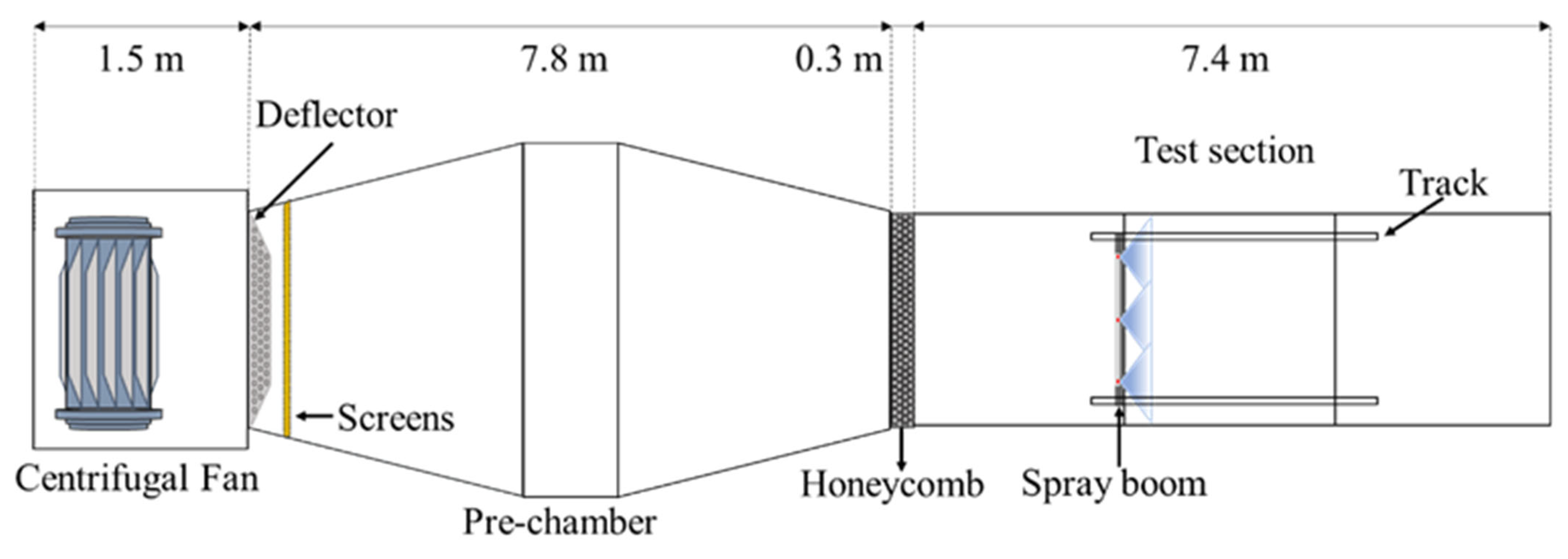
An indoor open-circuit wind tunnel (Figure 1) located in the Wooster campus of the Ohio State University was used to minimize the impact of unpredictable weather on the test results. The 16.7 m long wind tunnel utilized a centrifugal fan to produce laminar airflows [49] up to 10 m s−1 in the test Section (2 m width × 2 m height × 7.4 m length). Prior to conducting the experiments in the wind tunnel, airflow measurements were taken at various locations to make sure the airflow in the test section is laminar and uniform over 0 to 10 m s−1.
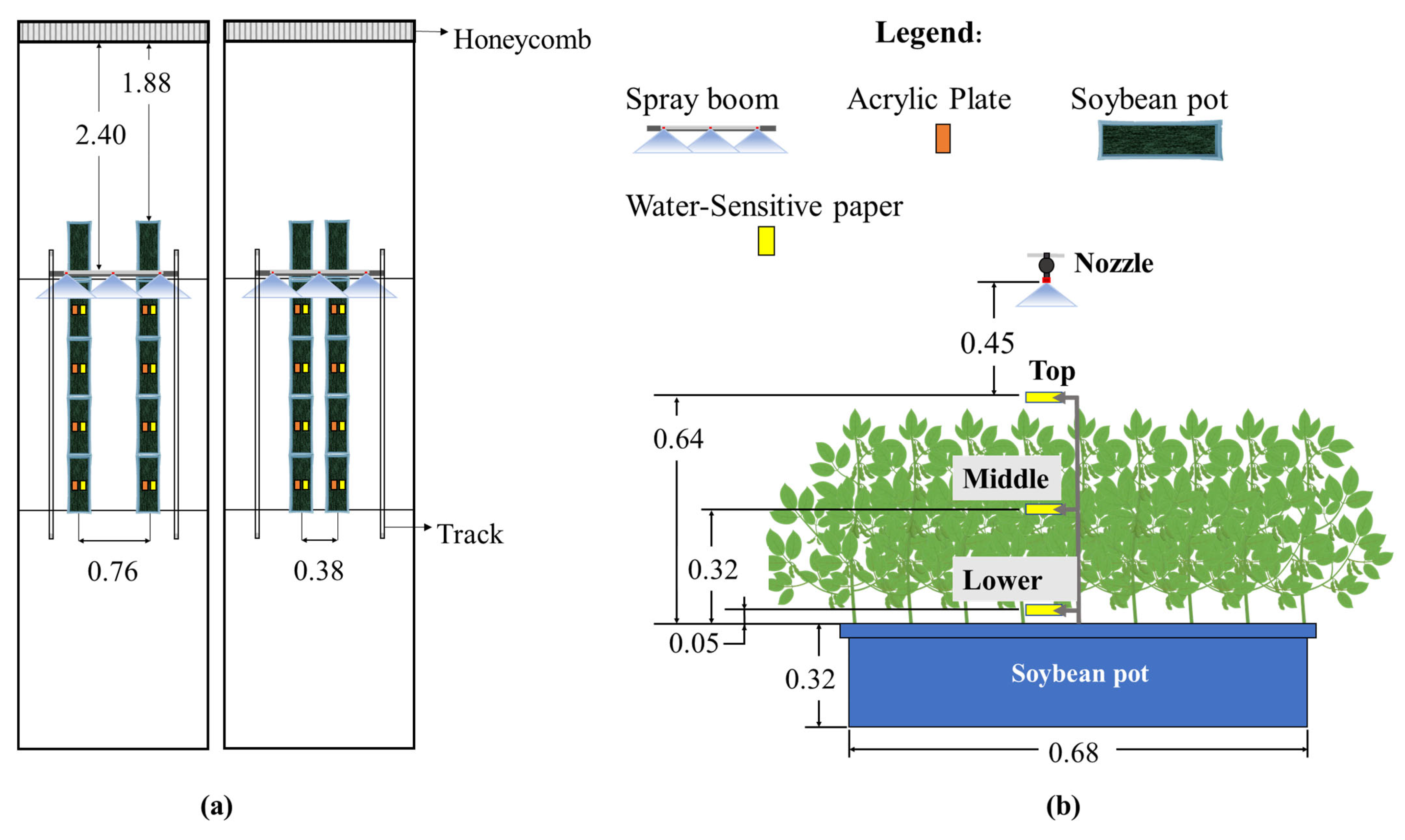
A spray boom, positioned 2.4 m from the honeycomb, was mounted on a vertical post and attached to a 3.05 m long track located on the ceiling of the wind tunnel test section. The spray boom moved along the track using a 5-phase geared stepping motor (A140K-M599 (W)-G5, Autonics, Mundelein, IL, USA) at a constant linear speed of 0.9 m s−1. The spray boom height was set at 0.5 m above the top of the soybean canopy.
To determine the impact of row spacing, wind speed, and droplet size spectra on the deposition and coverage within the soybean canopy, four flat-fan spray nozzles (Table 1; manufactured by TeeJet Technologies, Glendale Heights, IL, USA) and three air speeds (0, 2.4, and 5.1 m s−1) were used for experiments. Three identical nozzle bodies (0.5 m apart) were mounted on the spray boom and equipped with pulse width modulation (PWM) E-Chemsaver solenoid valves (55295-1-12, TeeJet Technologies, Glendale Heights, IL, USA). The EVO spray controller (Capstan Ag Systems Inc, Topeka, KS, USA) was used to achieve the desired flow rate of 0.405 L min−1 for the application rate of 150 L ha−1 by adjusting the duty cycle of the PWM valves to 19%.

2.2. Soybean Plants

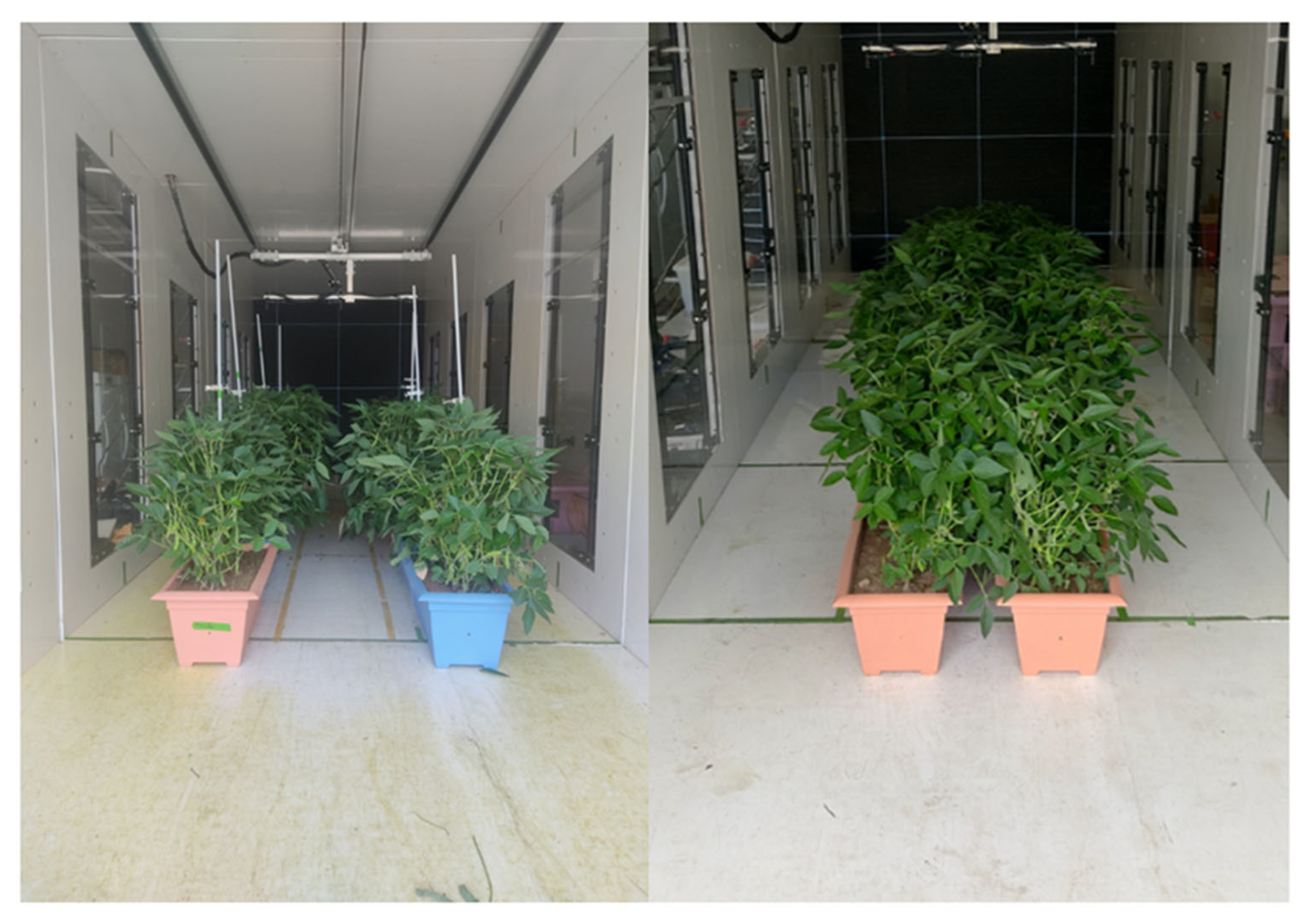
Soybean plants (variety 4371E Xitavo XO MS Technologies, West Point, IA, USA) were grown in rectangular plastic pots measuring 0.68 m (length) × 0.30 m (width) × 0.24 m (height). A total of 12 soybean seeds were planted in a row at the center of each pot, and subsequently germinated soybean plants were trimmed to achieve plant densities of 300,000 and 155,000 plants ha−1. To replicate row spacings of 0.38 and 0.76 m, soybean plants were arranged in two rows of five pots each (Figure 2), spaced center-to-center according to the respective row spacing. The soybean plants were placed and cultivated outdoors at The Ohio State University, College of Food, Agricultural, and Environmental Sciences in Wooster, OH, USA. This study evaluated the effects of row spacings and droplet size classes on the spray coverage and deposition in soybeans at the reproductive growth stage of R5 to R6.

2.3. Spray Deposition and Coverage Test

For the experiments, eight collection points (Figure 3a) were selected along the soybean rows to assess spray deposition and coverage at the top, middle, and lower layers of the canopy. To facilitate the placement of spray deposition and coverage targets, 1.22 m stakes were placed in the horizontal center of the soybean pots at each of the eight collection points. Twin clip holders were installed at three predefined heights above the soil surface: lower (0.05 m), middle (0.32 m), and top (0.64 m) (Figure 3b). Water-sensitive papers (WSPs; 76 mm height × 26 mm width, Spraying Systems Co., Glendale Heights, IL, USA) and white acrylic plates (APs; 76 mm height × 26 mm width) were attached to the twin clip holders to collect spray coverage and spray deposition, respectively. The WSPs and APs were placed horizontally and faced upward to the spray boom and toward the honeycomb. This configuration was maintained throughout all experiments.
Prior to starting the tests, a spray tank mixture was prepared with deionized water and a Brilliant Sulfoflavine fluorescent tracer (BSF) (BSF, MP Biochemicals, Inc., Aurora, OH, USA) at a concentration of 2 g L−1.

2.4. Sample Analysis

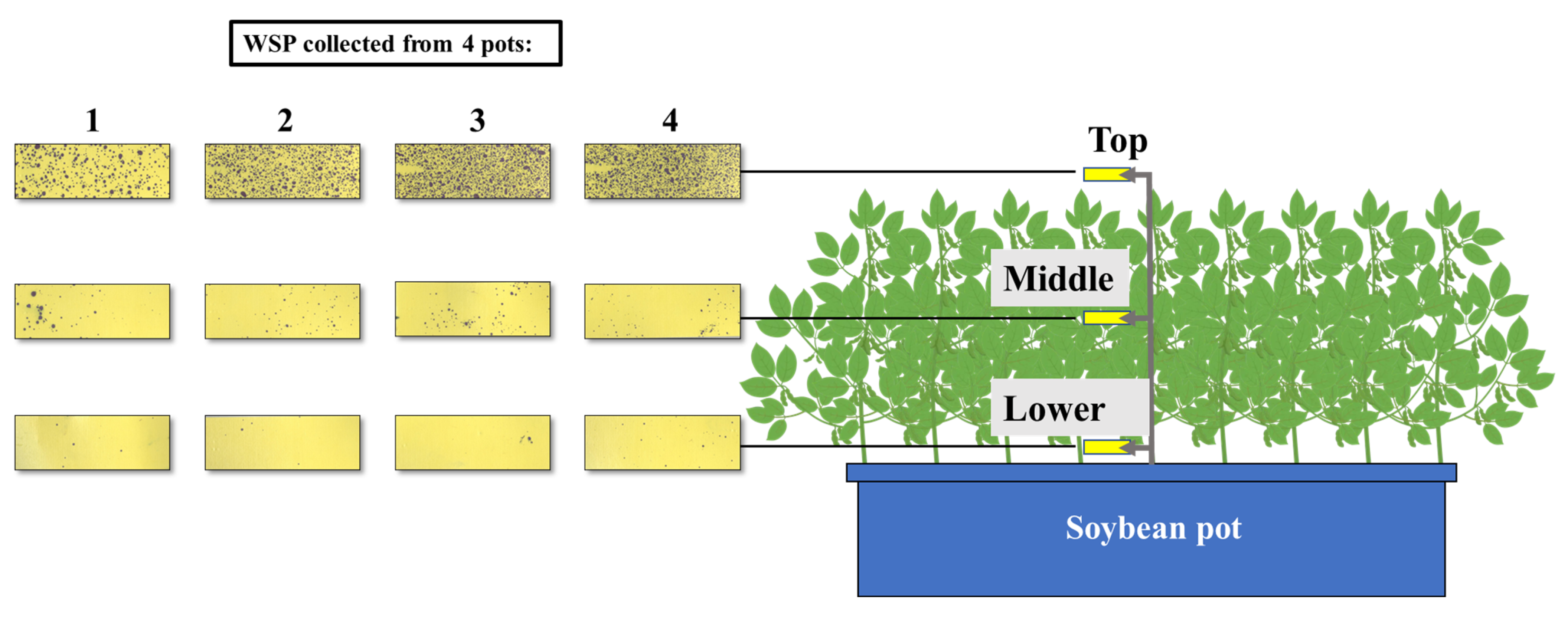
After each spray application, a five-minute waiting period was required to ensure that the targets were completely dry and ready for collection. As an example, Figure 4 shows the actual 12 WSPs collected from soybeans in only one of the two rows of 4 pots in an experiment conducted with XR 11004 nozzles, at a wind speed of 5.1 m s−1 and a row spacing of 0.76 m. After removing the WSPs from their sampling locations, they were placed in a labeled template, scanned, and stored in a paper envelope to protect them from potential effects of humidity and light. The WSPs were collected, placed in a labeled template, scanned, and stored in a paper envelope to protect them from potential effects of humidity and light. The templates were scanned at 600 dpi, and each WSP was analyzed to determine the spray coverage (%) using DepositScan, v.2 [50].
The APs were collected and placed in labeled, wide-mouth, clear glass jars (110 mL), then stored in a dark box at controlled temperature conditions. For deposition (µL cm−2) analyses [51], the BSF was extracted from the APs using deionized water. The jars containing APs from the top canopy position were filled with 40 mL of deionized water, while APs collected from the middle and lower positions were filled with 20 mL of deionized water. Agitation was performed using an orbital shaker (Solaris 2000, Thermo Fisher Scientific Inc., Waltham, MA, USA) at 200 rpm for 2 min. This procedure was implemented to ensure complete removal of all BSF from the samples and to facilitate subsequent homogenization with deionized water. After the agitation, the homogenized solution was removed from the jars using a disposable pipet and placed in a polystyrene disposable cuvette (4.5 mL) (Fisherbrand Thermo Fisher Scientific Inc., Pittsburgh, PA, USA) for measuring fluorescence in raw fluorescence units (RFU) using a Trilogy fluorometer (Turner Designs, San Jose, CA, USA) with a custom-made BSF module (BSF 460/500, 7200-4XX).
A calibration curve was generated using 15 samples with BSF concentrations ranging from 0.002 to 40.14 mg L−1 to develop a regression equation relating the BSF concentration (mg L−1) to fluorescence units (RFU). This equation achieved a coefficient of determination (R2) of 0.9998.
BSF concentration = (2.8482 × RFU ˗ 1021.1176) × 10−4

2.5. Data Analysis

Data obtained for spray deposit and coverage measurements were analyzed using the statistical program JMP Pro v.17 (SAS Institute Inc., Cary, NC, USA). Means were compared among four nozzles, three target positions, and three wind speeds using the Tukey test at the 95% significance level. A one-way analysis of variance (ANOVA) was utilized for the analysis after the data were transformed to meet the normal distribution (Shapiro–Wilk test) and the equal variance (Levene’s test).

3. Results and Discussion

3.1. Spray Coverage and Deposition

Regardless of the row spacing (0.38 and 0.76 m) and wind speed (0, 2.4, and 5.1 m s−1), applications of all nozzles consistently showed the highest spray coverage values at the top of the soybean canopy, which ranged from 15.6% to 37.2% (Table 2). This is because the top of the canopy lacks structural barriers, such as overlapping leaves, stems, or pods, which typically obstruct droplet penetration. However, lower values were observed in the middle and lower canopy positions. For example, spray coverage in the middle and lower canopy ranged from 0.6% to 2.8%, and 0.1% to 0.6%, respectively.
The spray coverage at the top of the canopy was influenced by row spacing at all wind speeds. Under no-wind conditions (0 m s−1), all the nozzles had significantly higher spray coverage at the narrower 0.38 m spacing (p < 0.05). This can be attributed to the closer plant arrangement, which improves droplet interception and retention at the top. However, as wind speed increased to 2.4 and 5.1 m s−1, the wider row spacing (0.76 m) resulted in significantly higher coverage for all nozzles, especially for the XR nozzle. The increase in row spacing may have enhanced droplet distribution at the top of the canopy by enhancing air movement between rows. In contrast, narrower spacing can create a shielding effect, in which the denser canopy structure deflects airflow upward, causing spray droplets to drift away from the soybean plants.
At the middle canopy position, differences in spray coverage between row spacings became more pronounced as wind speed increased. At 2.4 m s−1, the AIXR and XR nozzles showed significantly higher spray coverage at wider row spacing (0.76 m), increasing from 1.4% to 2.8% for AIXR and from 0.9% to 2.5% for XR. This trend was not observed for AIXR at the 5.1 m s−1 wind speed, as the wider row spacing resulted in a significant reduction in spray coverage (0.8%) compared to the narrower spacing (1.4%). However, for the XR, AITTJ60, and TTJ60 nozzles, no significant difference was noted when the row spacing increased from 0.38 to 0.76 m.
At the lower canopy position, spray coverage remained consistently low across all wind speeds, nozzles, and row spacings. Wider row spacing significantly increased spray coverage for the AIXR and TTJ60 nozzles. As wind speed increased to 2.4 and 5.1 m s−1, wider row spacing did not significantly enhance the spray coverage at the lower canopy for any of the nozzles, remaining below 0.3%. These findings suggest that despite increased row spacing and improved airflow between rows, droplets produced by all nozzles tested were unable to reach the lower canopy layers. This limitation was likely due to the high leaf density associated with the near-mature stage of soybean plants (R5.6), which created physical barriers to droplet penetration. These results confirmed the challenge of achieving uniform and effective spray coverage throughout the entire soybean plants when they have dense canopies. Furthermore, higher wind speeds during application may have led to increased drift, resulting in reduced spray coverage.
Among the evaluated nozzles, the XR nozzle had significantly higher spray coverage at the top canopy position across all wind speeds and row spacings. For instance, at a wind speed of 2.4 m s−1 and a row spacing of 0.76 m, the XR nozzle achieved 37.2% spray coverage, in contrast to 26.7% for the AITTJ60 nozzle. A similar trend was observed at the 0.38 m spacing, with XR reaching 21.9% and AITTJ60 at 16.6%. Nozzles that produce medium droplet sizes, such as the XR, generally generate a higher number of droplets per unit area (cm2), enhancing the spray coverage compared to the larger droplets produced by air-induction nozzles. At the middle and lower canopy positions, spray coverage values across all nozzles showed no significant differences between wind speeds of 2.4 and 5.1 m s−1, except for the XR at 0.38 m row spacing and 2.4 m s−1 wind speed. Therefore, the XR nozzle is the most suitable option for spray applications where achieving high spray coverage is critical, particularly for effectively controlling diseases and insect pests in the upper part of the soybean canopy.
Mean spray depositions of all experiment conditions are tabulated in Table 3. Mean spray deposition varied from 0.87 to 1.34 µL cm−2, and 0.00 to 0.18 µL cm−2 for the top and middle of the soybean canopy, respectively, while deposition on the lower part of the canopy fell below the detection limit. For the deposition at the top of the canopy, significant differences between the two row spacings were observed only in specific nozzle and wind speed combinations. For example, the XR nozzle showed significantly higher deposition with the row spacing of 0.76 m, while no significant differences were found for AIXR, AITTJ60, and TTJ60. At 2.4 m s−1, only the AITTJ60 nozzle showed a significant reduction in deposition with wider row spacing. At 5.1 m s−1, no significant differences in spray deposition were observed between the 0.38 m and 0.76 m row spacings for all evaluated nozzles. The results suggest that increasing row spacing did not improve droplet deposition at the top of the canopy, particularly at higher wind speeds, where the effects of wind may have reduced the potential benefits of wider row configurations.
At the middle canopy position, only the XR nozzle significantly increased spray depositions from 0.04 to 0.12 µL cm−2 under no-wind conditions when the row spacing was increased from 0.38 to 0.76 m. For the other nozzles, no significant differences between row spacings were noted. As the wind speed increased, wider row spacing proved ineffective in improving depositions, with values not exceeding 0.06 µL cm−2. This suggests that the potential benefit of wider row spacing diminishes under higher wind conditions and dense foliage. Under all tested conditions, no spray deposition was found at the lower canopy position across both row spacings, wind speeds, and nozzle types.
Among the evaluated nozzles, the effect of droplet size varied based on wind speed and row spacing. At the top canopy position and under 0 m s−1 at 0.38 m spacing, AITTJ60 (1.34 µL cm−2) and TTJ60 (1.32 µL cm−2) nozzles provided significantly higher spray deposits than the XR nozzle, which had the lowest deposition value (1.07 µL cm−2). However, no significant differences were observed among the nozzles at 0.76 m spacing under the same wind conditions. As wind speed increased to 2.4 m s−1, regardless of the row spacing, nozzles that produced ultra-coarse and very coarse droplet sizes, such as AITTJ60, AIXR, and TTJ60, tended to maintain significantly higher spray deposition compared to the medium droplet size (XR). At a wind speed of 5.1 m s−1 and a row spacing of 0.38 m, the AIXR nozzle produced significantly higher spray deposits than the XR, while no significant differences were found among the TTJ60, XR, and AITTJ60 nozzles, as well as between the AITTJ60 and AIXR nozzles. For the 0.76 m row spacing, the AITTJ60 and AIXR produced significantly higher spray deposits than the XR and TTJ60.
No significant differences were found among the nozzles for wider row spacing in the middle canopy position. However, for the narrow row spacing, the AITTJ60 produced significantly higher deposits than the XR, while no differences were observed between the AIXR, TTJ60, and XR. At 2.4 m s−1, regardless of row spacing, no significant differences were found between the nozzles. When wind speed increased to 5.1 m s−1, at 0.38 m of row spacing, the AIXR was more effective in delivering spray deposits than the other nozzles. For 0.76 m, the AIXR nozzle showed significantly higher deposits than the XR.
These results showed that nozzles producing larger droplets achieved greater deposition than those producing medium droplets, even under the highest wind speed. This can be explained by the fact that larger droplets are less susceptible to drift. Additionally, coarser droplets contain a higher volume of spray solution per cm2, and the interception of even a few drops in the canopy can lead to greater values. At the lower position, spray deposits were not detectable, indicating no significant differences among the nozzle types and wind speeds at the evaluated row spacings.

3.2. Row Spacing Effect

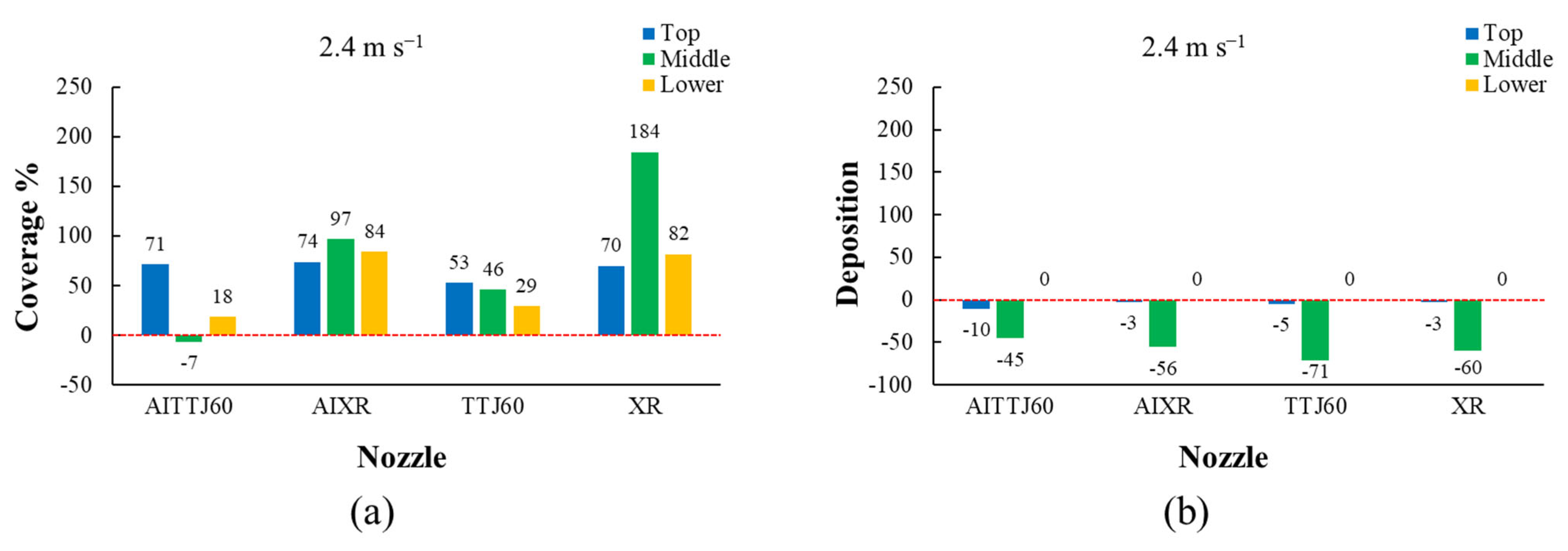
Figure 5 illustrates the percentage increases in spray coverage and deposition as the row spacing increases from 0.38 to 0.76 m for each nozzle (XR11004, AIXR11004, TTJ6011004, and AITTJ6011004), and canopy positions (top, middle, and lower) at 2.4 m s−1 wind speed. Increasing the row spacing improved spray coverage at the top for all the evaluated nozzles (Figure 5a). The XR nozzle exhibited the greatest improvement, with results of 70%, 184%, and 82% at the top, middle, and lower of the canopy, respectively, indicating that this nozzle (medium droplet size) responded more favorably to wider row spacing under moderate airflow. Despite producing ultra-coarse droplets, the AIXR nozzle also demonstrated increased spray coverage across all canopy positions, with the highest coverage observed at the middle (97%) and lower (84%). The AITTJ60 nozzle increased spray deposition at the top (71%) and lower (18%) canopy positions; however, a 7% reduction was observed at the middle canopy layer. In this way, at a wind speed of 2.4 m s−1, the nozzle spray pattern played a more important role than droplet size, as single-fan nozzles (XR and AIXR) showed a considerable increase in spray coverage across all canopy positions when compared to double-fan nozzles (AITTJ60 and TTJ60). The effect of increasing row spacing from 0.38 m to 0.76 m (Figure 5b) on spray deposition showed no improvement at any canopy position, regardless of the spray nozzle used.
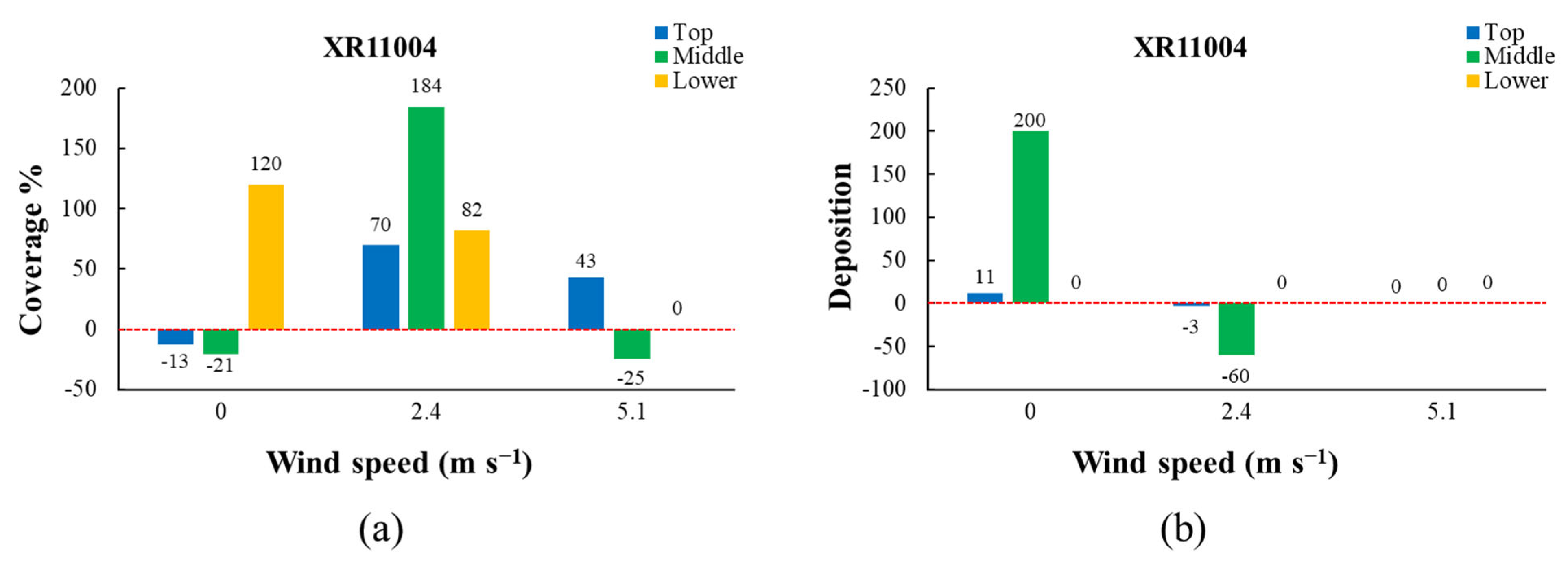
Figure 6 illustrates the effect of wind speed (0 m s−1, 2.4 m s−1, and 5.1 m s−1) on the percent increases in spray coverage and spray deposition for the row spacing from 0.38 m to 0.76 m for the XR11004 nozzle at the top, middle, and lower canopy positions. Under no-wind conditions, coverage improvements (Figure 6a) were observed at the lower part of the canopy (120%), while reductions occurred at the top (−13%) and middle (−21%). At 2.4 m s−1, XR11004 was observed with an increase in spray coverage across all canopy positions, particularly at the middle (184%), followed by the lower (82%) and top (70%). However, when wind speed increased to 5.1 m s−1, coverage increases were restricted to the top of the canopy (43%), where reductions were observed at the middle (−25%), and no improvement was detected at the lower. The results showed that an intermediate wind speed (2.4 m s−1) increased spray coverage for wider row spacing (0.76 m), improving droplet carriage and redistribution within the canopy; however, as wind speed increased, this effect was affected by droplet drift and reduced retention within the canopy.
Spray deposition (Figure 6b) did not follow a similar trend, with an increase at the middle canopy under no-wind conditions (200%) and at the top (11%). As wind speed increased to 2.4 m s−1, deposition at the middle canopy was reduced (−60%), and no deposition gains were observed at any canopy position under the highest wind speed (5.1 m s−1). These findings suggest that increasing row spacing and using different spray nozzle models are strategies that soybean growers can adopt to improve spray coverage during spray applications. However, its effectiveness can be diminished by high wind speeds and the dense foliage typical of advanced soybean growth stages.

3.3. Spray Penetration

Table 4 illustrates the spray deposition penetration (%) of XR, AIXR, TTJ60, and AITTJ60 nozzles at the middle and lower canopy positions compared to the top, across two row spacings (0.38 m and 0.76 m) and three wind speeds (0, 2.4, and 5.1 m s−1). Generally, spray penetration to the middle part of the canopy did not exceed 15.1% for any treatment relative to the top canopy position. At the lower position, no measurable spray penetration was detected, with values consistently remaining at 0% across all conditions. When the wind speed was 0 m s−1, increasing the row spacing to 0.76 m enhanced spray penetration for all nozzles, most notably for the XR nozzle, which demonstrated an increase of about 2.7 times compared to the 0.38 m spacing. This effect diminished as wind speed increased, causing spray penetration at the middle canopy position to decline for all nozzles with wider row spacing. For instance, at a wind speed of 2.4 m s−1, increasing the row spacing from 0.38 m to 0.76 m reduced spray penetration by 3.3 times for the TTJ60 and 2.4 times for the XR nozzle. A similar trend continued at 5.1 m s−1, where spray penetration with the TTJ60 nozzle decreased by approximately 0.5 times and became undetectable with the XR nozzle.
This result shows that, although wider row spacing should allow better airflow between rows and improve spray penetration, the potential benefit was reduced as the wind speed increased. At higher wind velocities, droplet trajectories become more unstable, increasing drift losses and reducing downward movement of spray droplets to reach the middle and lower canopy layers. In addition, spray nozzles played a crucial role in ensuring that spray droplets penetrated the lower parts of the soybean canopy. This is essential for effective insect management, particularly for diseases that typically originate in the lower canopy and progress upward.

4. Conclusions

The overall goal of this study was to provide practical recommendations for soybean growers on applying pesticides efficiently and effectively to control insects and diseases. This study addressed two key questions often asked by soybean producers: (1) Are row spacing and plant population important factors concerning adequate spray deposits into the inner and lower parts of the canopy where most diseases and some insect infestations first start? (2) How spray droplet penetration into the inner and lower parts of the canopy may be affected by the selection of nozzles and the wind speed.
Regardless of any changes in row spacings, nozzle types, and wind speeds, in all tests conducted in the wind tunnel to assess spray coverage and deposition, the top of the soybean canopy consistently received the highest amount of spray as expected. Spray coverage at the top of the canopy varied from 15.6% to 37.2%, with deposits ranging from 0.87 to 1.34 µL cm−2. This was followed by the middle of the canopy, which showed the coverage ranging from 0.6% to 2.8% and deposits from 0.00 to 0.18 µL cm−2. The lower part of the canopy received minimal spray, with coverage ranging from 0.09% to 0.57% and undetectable deposits. The XR, TTJ60, AITTJ60, and AIXR nozzles did not achieve an acceptable level of spray deposition at the middle and lower parts of the soybean canopy, regardless of the row spacing and wind speed changes.
However, spray penetration at the middle canopy position tended to increase with the wider row spacing (0.76 m) without air flow compared to the narrow spacing (0.38 m), although penetration with wider row spacing decreased as the wind speed increased to 2.4 and 5.1 m s−1. Therefore, while wider row spacing configurations can enhance spray penetration into the lower parts of the soybean canopy, their effectiveness may be limited during late-season applications due to denser canopy conditions and variable wind speeds. These factors reduce the hydraulic nozzles’ ability to achieve adequate spray penetration and deposition in the middle and lower parts of the canopy. Further experiments should be conducted to evaluate additional nozzles with different spray patterns, fan angles, and soybean growth stages to assess spray coverage, spray deposit, and spray drift under the same wind speeds and row spacings used in this study.

Author Contributions

All authors contributed to the conceptualization, methodology, visualization, and experimental design of this study. All authors participated in the experiments. J.T. collated the data and wrote the first draft of the paper. E.O., H.Z., and H.J. reviewed the draft and provided input to J.T., who prepared the final version of the manuscript. E.O., H.Z., and H.J. were involved in funding acquisition. E.O. handled project administration. All authors have read and agreed to the published version of the manuscript.

Funding

This research was funded by the USDA-NIFA (Award No. AWD-113971) and the Ohio Soybean Council (Award No. AWD-120058).

Data Availability Statement

All data generated or analyzed in this study are included in the article.

Acknowledgments

The authors thank Adam Clark, Barry Nudd, Andy Doklovic, and Joshua Wright for their technical assistance; and Matthew Herkins, Rone Batista de Oliveira, João Paulo Arantes Rodrigues da Cunha, and Gabriel de Souza Lemes for their contributions to conducting the experiments.

Conflicts of Interest

The authors declare no conflicts of interest.

Abbreviations

The following abbreviations are used in this manuscript:
XRExtended Range
TTJ60Turbo TwinJet
AITTJ60Air Induction Turbo TwinJet
AIXRAir Induction Extended Range
WSPWater-sensitive paper
APAcrylic plates
BSFBrilliant Sulfoflavine fluorescent tracer

References

  1. Wang, F.; Ma, X.; Liu, M.; Wei, B. Three-Dimensional Reconstruction of Soybean Canopy Based on Multivision Technology for Calculation of Phenotypic Traits. Agronomy 2022, 12, 692. [Google Scholar] [CrossRef]
  2. Liu, X.; Liu, X.; Li, Y.; Yuan, J.; Li, H. Predicting spray deposit distribution within a cotton plant canopy based on canopy stratification porosity and Gaussian process models. Biosyst. Eng. 2021, 204, 1–14. [Google Scholar] [CrossRef]
  3. Gao, F.; Zhang, X. Mapping crop phenology in near real-time using satellite remote sensing: Challenges and opportunities. J. Remote Sens. 2021, 2021, 8379391. [Google Scholar] [CrossRef]
  4. Lou, Z.; Wang, F.; Peng, D.; Zhang, X.; Xu, J.; Zhu, X.; Wang, Y.; Shi, Z.; Yu, L.; Liu, G.; et al. Combining shape and crop models to detect soybean growth stages. Remote Sens. Environ. 2023, 298, 113827. [Google Scholar] [CrossRef]
  5. Fehr, W.; Caviness, C. Stages of Soybean Development; Iowa State University: Ames, IA, USA, 1977. [Google Scholar]
  6. Cheng, L.; Wang, Y.; Zhang, C.; Wu, C.; Xu, J.; Zhu, H.; Leng, J.; Bai, Y.; Guan, R.; Hou, W.; et al. Genetic analysis and QTL detection of reproductive period and post-flowering photoperiod responses in soybean. Theor. Appl. Genet. 2011, 123, 421–429. [Google Scholar] [CrossRef]
  7. Virdi, K.S.; Sreekanta, S.; Dobbels, A.; Haaning, A.; Jarquin, D.; Stupar, R.M.; Lorenz, A.J.; Muehlbauer, G.J. Branch angle and leaflet shape are associated with canopy coverage in soybean. Plant Genome 2023, 16, e20304. [Google Scholar] [CrossRef]
  8. Ito, M.F. Principais doenças da cultura da soja e manejo integrado. Nucl. Edição Espec. 2013, 10, 83–102. [Google Scholar] [CrossRef]
  9. Perillo, A.C.; Kucharik, C.J.; Meehan, T.D.; Serbin, S.P.; Singh, A.; Townsend, P.A.; Whitney, K.S.; Gratton, C. Use of insect exclusion cages in soybean creates an altered microclimate and differential crop response. Agric. For. Meteorol. 2015, 208, 50–61. [Google Scholar] [CrossRef]
  10. Khambhati, V.H.; Chen, Z.-Y. Integrated Pest Management of Sclerotinia Stem Rot in Soybean: Current Strategies and Future Prospects. J. Fungi. 2025, 11, 823. [Google Scholar] [CrossRef]
  11. Bowers, G.R.; Russin, J.S. Soybean disease management. In Soybean Production in the Midsouth; Heatherly, L.G., Hodges, H.F., Eds.; CRC Press: Boca Raton, FL, USA, 1999; pp. 231–271. [Google Scholar]
  12. Hatfield, J.L.; Boote, K.J.; Kimball, B.A.; Ziska, L.H.; Izaurralde, R.C.; Ort, D.; Thomson, A.M.; Wolfe, D. Climate Impacts on Agriculture: Implications for Crop Production. Agron. J. 2011, 103, 351–370. [Google Scholar] [CrossRef]
  13. Surbhi, K.; Singh, K.P. Influence of weather factors on severity of aerial blight of soybean. Indian Phytopath 2020, 73, 493–497. [Google Scholar] [CrossRef]
  14. Floyd, C.A.; Irby, J.T.; Allen, T.W.; Catchot, A.L.; Dodds, D.M.; Sarver, J.M.; Maples, W.E.; Scholtes, A.B.; Carver, S.M. Evaluation of fungicide application timing on soybean yield, quality, and economic return. Crop. Forage Turfgrass Manag. 2021, 7, e20102. [Google Scholar] [CrossRef]
  15. Sikora, E.; Faske, T.; Spurlock, T.; Koehler, A.; Grabau, Z.; Small, I.; Kemerait, B.; Mideros, S.; Bond, J.; Telenko, D.; et al. Soybean Disease Loss Estimates from the United States and Ontario, Canada—2023. Crop Prot. Network. 2024, CPN-1018-24. [Google Scholar] [CrossRef]
  16. Godoy, C.V.; Seixas, C.D.S.; Soares, R.M.; Marcelino-Guimarães, F.C.; Meyer, M.C.; Costamilan, L.M. Asian soybean rust in Brazil: Past, present, and future. Pesq. Agropec. Bras. 2016, 51, 407–421. [Google Scholar] [CrossRef]
  17. Viegas Neto, A.L.; de Souza, C.M.A.; Degrande, P.E.; Lima Júnior, I.d.S. Deposition of sprayed drops in soybean in function of sowing spacing. Sci. Agrar. Parana. 2021, 20, 32–37. [Google Scholar] [CrossRef]
  18. Doreto, R.B.S.; Stefanello, F.F.; Gavassoni, W.L.; Marchetti, M.E.; Bacchi, L.M.A.; Da Silva, E.F. Ferrugem asiática e produtividade da soja sob doses de potássio e fungicida, na safra 2007/08. Cienc. Agrar. 2012, 33, 941–951. [Google Scholar] [CrossRef]
  19. Alves, K.S.; Barro, J.P.; Del Ponte, E.M. Quantifying ENSO-Mediated Shifts in Soybean Rust Impact: Yield Loss Dynamics and Management Implications in Brazil. Plant Pathol. 2025, 74, 2980–2988. [Google Scholar] [CrossRef]
  20. Oliveira, C.M.; Auad, A.M.; Mendes, S.M.; Frizzas, M.R. Crop losses and the economic impact of insect pests on Brazilian agriculture. Crop Prot. 2014, 56, 50–54. [Google Scholar] [CrossRef]
  21. Pereira, P.S.; Santos, A.A.; Noleto, L.R.; dos Santos, J.L.; Picanço, M.M.; Guedes, A.G.; dos Santos, G.R.; Picanço, M.C.; Sarmento, R.A. Seasonal Analysis of Yield and Loss Factors in Bt Soybean Crops in North Brazil. Sustainability 2024, 16, 1036. [Google Scholar] [CrossRef]
  22. Sisson, A.; Musser, F.; Crow, W.; Bick, E.; Brown, S.; Davis, J.A.; DiFonzo, C.; Floyd, C.; Graham, S.H.; Greene, J.K.; et al. Soybean Invertebrate Loss Estimates from the United States—2023. Crop Prot. Netw. 2024, CPN-1029-23. [Google Scholar] [CrossRef]
  23. Tormen, N.R.; da Silva, F.D.L.; Debortoli, M.P.; Uebel, J.D.; Favera, D.D.; Balardin, R.S. Deposição de gotas no dossel e controle químico de Phakopsora pachyrhizi na soja. Rev. Bras. Eng. Agric. Ambient. 2012, 16, 802–808. [Google Scholar] [CrossRef]
  24. Roth, M.G.; Webster, R.W.; Mueller, D.S.; Chilvers, M.I.; Faske, T.R.; Mathew, F.M.; Bradley, C.A.; Damicone, J.P.; Kabbage, M.; Smith, D.L.; et al. Integrated management of important soybean pathogens of the United States in changing climate. J. Integr. Pest Manag. 2020, 11, 17. [Google Scholar] [CrossRef]
  25. Hanna, S.O.; Conley, S.P.; Shaner, G.E.; Santini, J.B. Fungicide application timing and row spacing effect on soybean canopy penetration and grain yield. Agron. J. 2008, 100, 1488–1492. [Google Scholar] [CrossRef]
  26. Li, R.; Xu, C.; Wu, Z.; Xu, Y.; Sun, S.; Song, W.; Wu, C. Optimizing canopy-spacing configuration increases soybean yield under high planting density. Crop J. 2025, 13, 233–245. [Google Scholar] [CrossRef]
  27. Buchanan, A.L.; Zobel, E.; Hinds, J.; Rosario-Lebron, A.; Hooks, C.R.R. Can Row Spacing Influence Arthropod Communities in Soybean? Implications for Early and Late Planting. Environ. Entomol. 2015, 44, 557–561. [Google Scholar] [CrossRef]
  28. Khan, B.A.; Ali, A.; Nadeem, M.A.; Elahi, A.; Adnan, M.; Amin, M.M.; Javed, M.S. Impact of planting date and row spacing on growth, yield and quality of soybean: A Review. J. Biodivers. Environ. Sci. 2020, 17, 121–129. [Google Scholar]
  29. de Souza Jaccoud-Filho, D.; Sartori, F.F.; Manosso-Neto, M.; Vrisman, C.M.; da Cunha Pierre, M.L.; Berger-Neto, A.; Tullio, H.E.; Justino, A.; da Fonseca, A.F.; Zanon, S. Influence of row spacing and plant population density on management of “white mold” in soybean in southern Brazil. Aust. J. Crop Sci. 2016, 10, 161–168. [Google Scholar]
  30. Neto, D.D.; Dario, G.J.A.; Martin, T.N.; Bonnecarrère, R.A.G.; Manfron, P.A.; Júnior, P.A.V. Controle químico da ferrugem asiática na cultura da soja em condições de campo. Rev. Fac. Zootec. Vet. Agron. 2007, 14, 69–80. [Google Scholar]
  31. Holtz, V.; Couto, R.F.; De Oliveira, D.G.; Dos Reis, E.F. Deposição de calda de pulverização e produtividade da soja cultivada em diferentes arranjos espaciais. Cienc. Rural 2014, 44, 1371–1376. [Google Scholar] [CrossRef][Green Version]
  32. Hutchins, S.H.; Pitre, H.N. Effects of soybean row spacing on spray penetration and efficacy of insecticides applied with aerial and ground equipment. Environ. Entomol. 1984, 13, 948–953. [Google Scholar] [CrossRef]
  33. Madalosso, M.G.; Domingues, L.d.S.; Debortoli, M.P.; Lenz, G.; Balardin, R.S. Cultivares, espaçamento entrelinhas e programas de aplicação de fungicidas no controle de Phakopsora pachyrhizi Sidow em soja. Cienc. Rural 2010, 40, 2256–2261. [Google Scholar] [CrossRef]
  34. Roese, A.D.; de Melo, C.L.P.; Goulart, A.C.P. Espaçamento entre linhas e severidade da ferrugem-asiática da soja. Summa Phytopathol. 2012, 38, 300–305. [Google Scholar] [CrossRef]
  35. Tormen, N.R.; Blum, L.E.B. Row spacing, cultivar and fungicide application affect the incidence of soybean stem blight. Biosci. J. 2020, 36, 1557–1563. [Google Scholar] [CrossRef]
  36. Ozkan, H.E.; Zhu, H.; Derksen, R.C.; Guler, H.; Krause, C.R. Evaluation of various spraying equipment for effective application of fungicides to control Asian soybean rust. Asp. Appl. Biol. 2006, 77, 423–431. [Google Scholar]
  37. Derksen, R.C.; Ozkan, H.E.; Paul, P.; Zhu, H. Plant canopy characteristics effect on spray deposition. Asp. Appl. Biol. 2014, 122, 227–235. [Google Scholar]
  38. Ferguson, J.C.; Chechetto, R.G.; Hewitt, A.J.; Chauhan, B.S.; Adkins, S.W.; Kruger, G.R.; O’Donnell, C.C. Assessing the deposition and canopy penetration of nozzles with different spray qualities in an oat (Avena sativa L.) canopy. Crop Prot. 2016, 81, 14–19. [Google Scholar] [CrossRef]
  39. Wu, S.; Liu, J.; Zhen, J.; Lei, X.; Chen, Y. Resistance characteristics of broad-leaf crop canopy in air-assisted spray field and their effects on droplet deposition. Front. Plant Sci. 2022, 13, 924749. [Google Scholar] [CrossRef] [PubMed]
  40. Bueno, M.R.; Sousa Alves, G.; Silva, S.M.; Hachiya, T.S.S.; Guimarães, H.T.S.; Costa, G.A.; Gonçalves, F.S.; Oliveira, M.A.V.G. Air Assistance and Electrostatic Spraying in Soybean Crops. Agrochemicals 2024, 3, 107–117. [Google Scholar] [CrossRef]
  41. Guo, Y.; Wang, H.; Sun, W.; Sun, Y.; Xing, R.; Zhang, K.; Fang, X.; Sui, B.; Xu, J. The Effect of Airflow-Assisted Parameters on Droplet Deposition on Soybean Leaves at the V7 Growth Stage. Agronomy 2025, 15, 141. [Google Scholar] [CrossRef]
  42. Zhu, H.; Brazee, R.D.; Fox, R.D.; Derksen, R.C.; Ozkan, H.E. Development of a Canopy Opener to Improve Spray Deposition and Coverage Inside Soybean Canopies: Part 1. Mathematical Models to Assist Opener Development. Trans. ASABE 2008, 51, 1905–1912. [Google Scholar] [CrossRef]
  43. Yu, S.; Cui, L.; Cui, H.; Liu, X.; Liu, J.; Xin, Z.; Yuan, J.; Wang, D. Spray performance of flexible shield canopy opener and rotor wind integrated boom-sprayer application in soybean: Effects on droplet deposition distribution. Pest Manag. Sci. 2024, 80, 3334–3348. [Google Scholar] [CrossRef]
  44. Hoffmann, L.L.; Roehrig, R.; Boller, W.; Forcelini, C.A. Deposition and coverage of soybean leaf surfaces by sprays applied using different assisted boom sprayer systems. Eng. Agric. 2019, 39, 198–207. [Google Scholar] [CrossRef]
  45. Derksen, R.C.; Zhu, H.; Ozkan, H.E.; Hammond, R.B.; Dorrance, A.E.; Spongberg, A.L. Determining the influence of spray quality, nozzle type, spray volume, and air-assisted application strategies on deposition of pesticides in soybean canopy. Trans. ASABE 2008, 51, 1529–1537. [Google Scholar] [CrossRef]
  46. Nascimento, R.S.M.; Ferreira, L.R.; Zambolim, L.; Parreira, D.F.; Oliveira, P.L.S.; Moraes, R.G.S. Influence of spraying tips on the efficiency of chemical control of soybean rust. Crop Prot. 2022, 160, 106031. [Google Scholar] [CrossRef]
  47. Negrisoli, M.M.; Raetano, C.G.; de Souza, D.M.; Souza, F.M.S.; Bernardes, L.M.; Del Bem Junior, L.; Rodrigues, D.M.; Sartori, M.M.P. Performance of new flat fan nozzle design in spray deposition, penetration and control of soybean rust. Eur. J. Plant Pathol. 2019, 155, 755–767. [Google Scholar] [CrossRef]
  48. Theodoro, J.G.C.; Ozkan, E.; Zhu, H.; Jeon, H.; Campos, J.; Womac, A.R. Wind tunnel evaluation of spray nozzle and droplet size effects on spray penetration inside soybean plants. J. ASABE 2025, 68, 71–79. [Google Scholar] [CrossRef]
  49. Zhu, H.; Ozkan, E.; Castilho Theodoro, J.G.; Jeon, H.; Zhao, L. Modification of an open-circuit, push-through, low-speed wind tunnel to assist pesticide spray application advancements. J. ASABE 2025, 68, 1029–1039. [Google Scholar] [CrossRef]
  50. Zhu, H.; Salyani, M.; Fox, R.D. A portable scanning system for evaluation of spray deposit distribution. Comput. Electron. Agric. 2011, 76, 38–43. [Google Scholar] [CrossRef]
  51. Roman, C.; Jeon, H.; Zhu, H.; Campos, J.; Ozkan, E. Stereo Vision Controlled Variable Rate Sprayer for Specialty Crops: Part II. Sprayer Development and Performance Evaluation. J. ASABE 2023, 66, 1005–1017. [Google Scholar] [CrossRef]
Figure 1. Schematic of the wind tunnel used in the study (top view). The drawing is not to scale.
Agronomy 16 00997 g001
Figure 2. Arrangement of the soybean plants in the wind tunnel test section with a center-to-center spacing of 0.76 m (left) and 0.38 m (right) between the rows to replicate field conditions.
Agronomy 16 00997 g002
Figure 3. Schematic representation of the wind tunnel test section featuring (a) spray deposition (Acrylic plates) and spray coverage (Water-sensitive paper), and (b) stake position with twin clip holders at three predefined heights above the soil level in the pots. (Dimensions are in meters and not to scale).
Agronomy 16 00997 g003
Figure 4. Schematic locations of water-sensitive papers (WSP) collected from sampling points on top, middle and lower parts of the canopy, and examples of actual WSP images collected from the soybean plants in each of the 4 pots placed along the long axis of the wind tunnel test section.
Agronomy 16 00997 g004
Figure 5. Effect of changing the row spacing from 0.38 m to 0.76 m in spray coverage (a) and spray deposition (b) for each nozzle (XR11004, AIXR11004, TTJ6011004, and AITTJ6011004), and canopy positions (top, middle, and lower) under the wind speed of 2.4 m s−1.
Agronomy 16 00997 g005
Figure 6. Effect of changing the row spacing from 0.38 m to 0.76 m on spray coverage (a) and spray deposition (b) for the XR11004 nozzle at the top, middle, and lower canopy positions under various wind speeds (0 m s−1, 2.4 m s−1, and 5.1 m s−1).
Agronomy 16 00997 g006
Table 1. Droplet size classifications and nozzle operating conditions for the tests.
Nozzle TypeNominal SizeSpray Angle
(Degree)
Application
Rate (ha−1)
Droplet Size
Classification
Pressure
(kPa)
Measured Flowrate at 19% Duty Cycle (L min−1)
Extended Range (XR)4110150Medium2750.405
Turbo TwinJet (TTJ60)4110150Very Coarse2750.405
Air Induction Turbo TwinJet (AITTJ60)4110150Ultra-Coarse2750.405
Air Induction Extended Range (AIXR)4110150Ultra-Coarse2750.405
Table 2. Mean spray coverage (%) of 8 collection points at the top, middle, and lower layers of soybean canopies under 0.38 and 0.76 m of row spacing produced from AIXR, AITTJ60, TTJ60, and XR nozzles, in the wind tunnel with 0 m s−1, 2.4 m s−1, and 5.1 m s−1 of wind speed.
Wind Speed (m s−1)NozzleTopMiddleLower
0.38 m0.76 m0.38 m0.76 m0.38 m0.76 m
0 AITTJ6024.3 (16) # [A] * c &20 (14) [B] d1.9 (62) [A] a2.6 (107) [A] a0.2 (131) [A] a0.4 (117) [A] a
AIXR23.0 (11) [A] c21.8 (4) [B] c2.1 (80) [A] a2 (74) [A] a0.2 (77) [B] ab0.5 (114) [A] a
TTJ6031.2 (10) [A] b27.9 (10) [B] b1.8 (58) [A] a1.7 (75) [A] a0.1 (108) [B] ab0.4 (88) [A] a
XR36 (10) [A] a31.4 (7) [B] a1.6 (17) [A] a1.2 (21) [A] a0.1 (100) [A] b0.2 (140) [A] a
2.4AITTJ6015.6 (15) [B] b26.7 (21) [A] b1.7 A (74) [A] a1.6 (70) [A] a0.2 (100) [A] a0.2 (100) [A] a
AIXR16.3 (9) [B] b28.4 (14) [A] b1.4 B (83) [B] ab2.8 (93) [A] a0.1 (131) [A] a0.3 (142) [A] a
TTJ6019.9 (20) [B] a30.5 (18) [A] b1.0 A (77) [A] ab1.4 (92) [A] a0.1 (129) [A] a0.2 (122) [A] a
XR21.9 (33) [B] a37.2 (15) [A] a0.9 B (85) [B] b2.5 (101) [A] a0.1 (72) [A] a0.2 (95) [A] a
5.1AITTJ6017.7 (16) [B] b22.7 (29) [A] b0.9 (51) [A] a0.8 (67) [A] a0.1 (136) [A] a0.1 (93) [A] a
AIXR17.5 (14) [B] b28.4 (21) [A] a1.4 (65) [A] a0.8 (65) [B] a0.2 (157) [A] a0.1 (127) [A] a
TTJ6017.5 (27) [B] b28 (32) [A] ab0.9 (56) [A] a0.6 (92) [A] a0.0 (111) [A] a0.0 (88) [A] a
XR22.6 (24) [B] a32.3 (19) [A] a1.0 (68) [A] a0.7 (90) [A] a0.1 (118) [A] a0.1 (127) [A] a
[#] Coefficient of variations for means is presented in parentheses. [*] Means followed by the different uppercase letters in the same row within each canopy position (top, middle, lower) and row spacing (0.38 m or 0.76 m) are significantly different, respectively (p < 0.05). [&] Means followed by the different lowercase letters in the same column are significantly different, respectively (p < 0.05).
Table 3. Mean spray deposition (µL cm−2) of 8 collection points at the top, middle, and lower layers of soybean canopies under 0.38 and 0.76 m of row spacing produced from AIXR, AITTJ60, TTJ60, and XR nozzles, in the wind tunnel with 0 m s−1, 2.4 ms−1 and 5.1 ms−1 of wind speed.
Wind Speed (m s−1)NozzleTopMiddleLower
0.38 m0.76 m0.38 m0.76 m0.38 m0.76 m
0 AITTJ601.34 (23) # [A] & a *1.19 (33) [A] a0.15 (86) [A] a0.18 (72) [A] a0.00 (0) [A] a0.00 (0) [A] a
AIXR1.17 (12) [A] bc1.12 (15) [A] a0.11 (100) [A] ab0.13 (69) [A] a0.00 (0) [A] a0.00 (0) [A] a
TTJ601.32 (20) [A] ab1.20 (30) [A] a0.13 (107) [A] ab0.13 (92) [A] a0.00 (0) [A] a0.00 (0) [A] a
XR1.07 (7) [B] c1.19 (19) [A] a0.04 (175) [B] b0.12 (75) [A] a0.00 (0) [A] a0.00 (0) [A] a
2.4AITTJ601.16 (15) [A] a1.04 (12) [B] a0.11 (100) [A] a0.06 (116) [A] a0.00 (0) [A] a0.00 (0) [A] a
AIXR1.08 (12) [A] a1.05 (13) [A] a0.09 (111) [A] a0.04 (175) [B] a0.00 (0) [A] a0.00 (0) [A] a
TTJ601.18 (19) [A] a1.12 (10) [A] a0.07 (85) [A] a0.02 (150) [B] a0.00 (0) [A] a0.00 (0) [A] a
XR0.96 (16) [A] b0.93 (23) [A] b0.05 (120) [A] a0.02 (150) [A] a0.00 (0) [A] a0.00 (0) [A] a
5.1AITTJ600.98 (19) [A] ab1.07 (15) [A] a0.02 (100) [A] b0.01 (200) [A] ab0.00 (0) [A] a0.00 (0) [A] a
AIXR1.06 (16) [A] a1.08 (19) [A] a0.10 (100) [A] a0.02 (200) [B] a0.00 (0) [A] a0.00 (0) [A] a
TTJ600.89 (24) [A] b0.89 (24) [A] b0.02 (150) [A] b0.01 (100) [A] ab0.00 (0) [A] a0.00 (0) [A] a
XR0.87 (18) [A] b0.87 (25) [A] b0.04 (100) [A] b0.00 (0) [B] b0.00 (0) [A] a0.00 (0) [A] a
[#] Coefficient of variations for means is presented in parentheses. [*] Means followed by the different uppercase letters in the same row within each canopy position (top, middle, lower) and row spacing (0.38 m or 0.76 m) are significantly different, respectively (p < 0.05). [&] Means followed by the different lowercase letters in the same column are significantly different, respectively (p < 0.05).
Table 4. Spray deposition penetration (%) of XR, AIXR, TTJ60, and AITTJ60 nozzles at middle and lower canopy positions relative to the top, under two row spacings (0.38 m and 0.76 m) and three wind speeds (0, 2.4, and 5.1 m s−1).
NozzleTarget Position0 m s−12.4 m s−15.1 m s−1
0.38 m0.76 m0.38 m0.76 m0.38 m0.76 m
AITTJ60Middle11.115.19.45.72.00.9
Lower0.00.00.00.00.00.0
AIXRMiddle9.411.68.33.89.41.8
Lower0.00.00.00.00.00.00
TTJ60Middle9.810.85.91.72.21.0
Lower0.00.00.00.00.00.00
XRMiddle3.710.05.22.14.60.0
Lower0.00.00.00.00.00.0
Disclaimer/Publisher’s Note: The statements, opinions and data contained in all publications are solely those of the individual author(s) and contributor(s) and not of MDPI and/or the editor(s). MDPI and/or the editor(s) disclaim responsibility for any injury to people or property resulting from any ideas, methods, instructions or products referred to in the content.