1. Introduction
Maintaining the long-term production capacity of soil is essential for increasing crop yields to meet global food demand [
1], which has motivated global interest in sustainable soil management systems such as no-till [
2,
3] and agropastoral systems. These systems enhance soil quality and, in turn, crop yields by improving the chemical, physical and biological attributes of soil [
4] and conserving biodiversity [
5]. However, in many areas of the world, increases in crop yields are limited by soil acidity (pH CaCl
2 values below 4.4) [
6,
7].
In Brazil, most agropastoral systems are located in the Cerrado biome (the Brazilian savanna), where soil acidity is the result of leaching of basic ions promoted by high rainfall over many years. This high degree of weathering produces soils with low calcium (Ca), magnesium (Mg), potassium (K), and phosphorus (P) contents [
8]; low cation exchange capacity (CEC); low base saturation (BS) [
9]; and high levels of elements that are toxic to plants, such as exchangeable aluminum (Al
3+) and manganese (Mn) [
10,
11,
12]. The toxicity caused by high Al
3+ content, P deficiency and low BS hinders root growth, reduces the absorption of water and nutrients by plants [
13], and consequently limits crop yields [
14], particularly in dry periods [
15]. In addition, low Ca
2+ content in deeper soil layers may confine root exploration to the surface layer.
Applying limestone (LS), i.e., liming, efficiently increases soil pH and BS, supplies Ca
2+ and Mg
2+, and decreases exchangeable Al
3+ and Mn [
10,
16]. However, the mobility of the products of LS dissolution is low and depends on the leaching of organic and/or inorganic salts throughout the soil profile; consequently, LS reactivity is restricted to the site of soil application [
16,
17]. This is problematic in systems without soil tillage, such as agropastoral systems of the Cerrado, where soil acidity correction is usually carried out by applying LS on the surface without incorporation into the soil [
18]. Studies have confirmed that surface-applied LS has low mobility [
7,
19] and that liming without incorporation corrects acidity only in the 0–0.1 m layer [
20].
Soil amendments like phosphogypsum (PG, CaSO
4) can increase the efficiency of LS application [
10,
12]. PG is more soluble than LS (2.5 g L
−1) [
21] and leaches to subsurface layers [
22]. As it moves down the soil profile, PG increases the supply of Ca
2+ and sulfate-S (S-SO
42−) and reduces Al
3+ activity [
15,
23]. Once in the soil solution, Ca
2+ adsorbs to the soil-exchange complex and displaces Al
3+, K
+ and Mg
2+ into the soil solution. These cations react with SO
42− to form AlSO
4+ (which is less toxic to plants than Al
3+) and the neutral ion pairs K
2SO
40 and MgSO
40, which, along with CaSO
40, have high mobility in the soil profile [
24]. During soil acidity correction, the carbonate of LS is consumed and is no longer available to accompany Ca
2+ to deeper soil layers, whereas the sulfate of PG remains available [
25]. By improving the soil profile, PG application promotes the development of the crop root system [
23,
26,
27,
28] to explore water and nutrients [
29], reducing the adverse effects of drought [
21], improving crop tolerance to water stress [
30], and increasing crop yields [
10], especially in the Cerrado biome.
Another input for improving soil fertility is hydrated lime (HL) [
18]. HL (Ca(OH)
2) is a fine powder produced by the hydration of virgin lime by an industrial process and comprising Ca(OH)
2 and Mg(OH)
2 [
31,
32]. The primary difference in reaction kinetics between hydrated lime and limestone is that HL reacts almost instantly and has high solubility, providing immediate pH elevation, whereas LS has low solubility and slow reaction kinetics, making it a long-term, slow-release amendment [
33]. However, there is little information on application methodologies and the long-term effects of HL application, particularly in agropastoral systems.
Among soil conservation tillage techniques that reduce soil disturbance [
34], improve the physical attributes of soil, and increase root-system development and crop yields is no-till [
34,
35]. This system is considered an important management practice for sustainable cropping intensification due the maintenance of high surface-soil coverage, which significantly influences the soil attributes, especially in the surface layer [
36,
37].
Another type of soil conservation tillage, which combines agricultural, livestock, and forestry activities within the same area, includes the integrated production systems [
38]. Among these systems are agropastoral systems. However, in agropastoral systems using no-till shallow soil compaction (high bulk density and low porosity) can happen, due to absence of soil mechanical disturbance [
39,
40,
41]. It is highlighted that excessive soil compaction in untilled surface layers can cause crop yield decrease, notably in dry years [
42,
43].
By contrast, there are alternative methodologies for mitigating soil compaction and soil acidity in agropastoral systems under no-till, simultaneously. Minimum tillage is another soil conservation tillage technique [
44] that can help rebuild soil structure and have lower fuel consumption [
45] compared to conventional tillage (harrow and plows).
Therefore, methodologies that provide long-term amelioration of surface and subsurface acidity and improvements in soil chemical fertility are necessary to decrease production costs and increase the crop yields of farmers in the Cerrado. Refs. [
18,
46] evaluated different methodologies for applying LS, PG, and HL in a Typic Hapludalf in an agropastoral system in Brazil on soil chemical attributes, soybean (
Glycine max (L.) Merr.) and maize (
Zea mays L.) grain yields, and the dry matter yield of palisade grass (
Urochloa brizantha syn.
Brachiaria brizantha cultivar Marandu). Ref. [
18] found that after three seasons, all methodologies corrected surface acidity (0.0–0.2 m) by increasing pH and BS and reducing total acidity. However, only subsurface application of HL combined with both surface application of PG in the first year and surface application of HL in subsequent years increased pH and BS in the subsurface layer (0.4–0.8 m). Ref. [
18] also determined that applying LS or HL plus PG increased S-SO
42− content throughout the soil profile (0.0–0.8 m); in the 0.0–0.2 m layer, applying LS plus PG increased Ca
2+ content and Ca
2+/CEC, while applying HL plus PG increased Mg
2+ content and Mg
2+/CEC. However, the long-term effects of these methodologies in agropastoral systems are unclear. To ameliorate acidity in the surface and subsurface layers and improve soil chemical fertility in the long term, different application methodologies (surface, incorporation by soil tillage, or subsurface) for calcium Ca compounds (limestone, phosphogypsum, and hydrated lime) were evaluated in an agropastoral system. This study tested the following hypotheses: (a) the improvements in soil chemical fertility by increasing pH and BS and reducing total acidity in the 0.0–0.2 m layer produced by different methodologies for applying limestone, phosphogypsum, and hydrated lime, and by increasing pH and BS in the subsurface (0.4–0.8 m layer) by subsurface application of HL plus surface application of PG in the first year and surface application of HL in subsequent two years, observed by Refs. [
18,
46], persist after two seasons and (b) further changes in soil chemical attributes by different methodologies for applying limestone, phosphogypsum, and hydrated lime can occur after two seasons.
4. Discussion
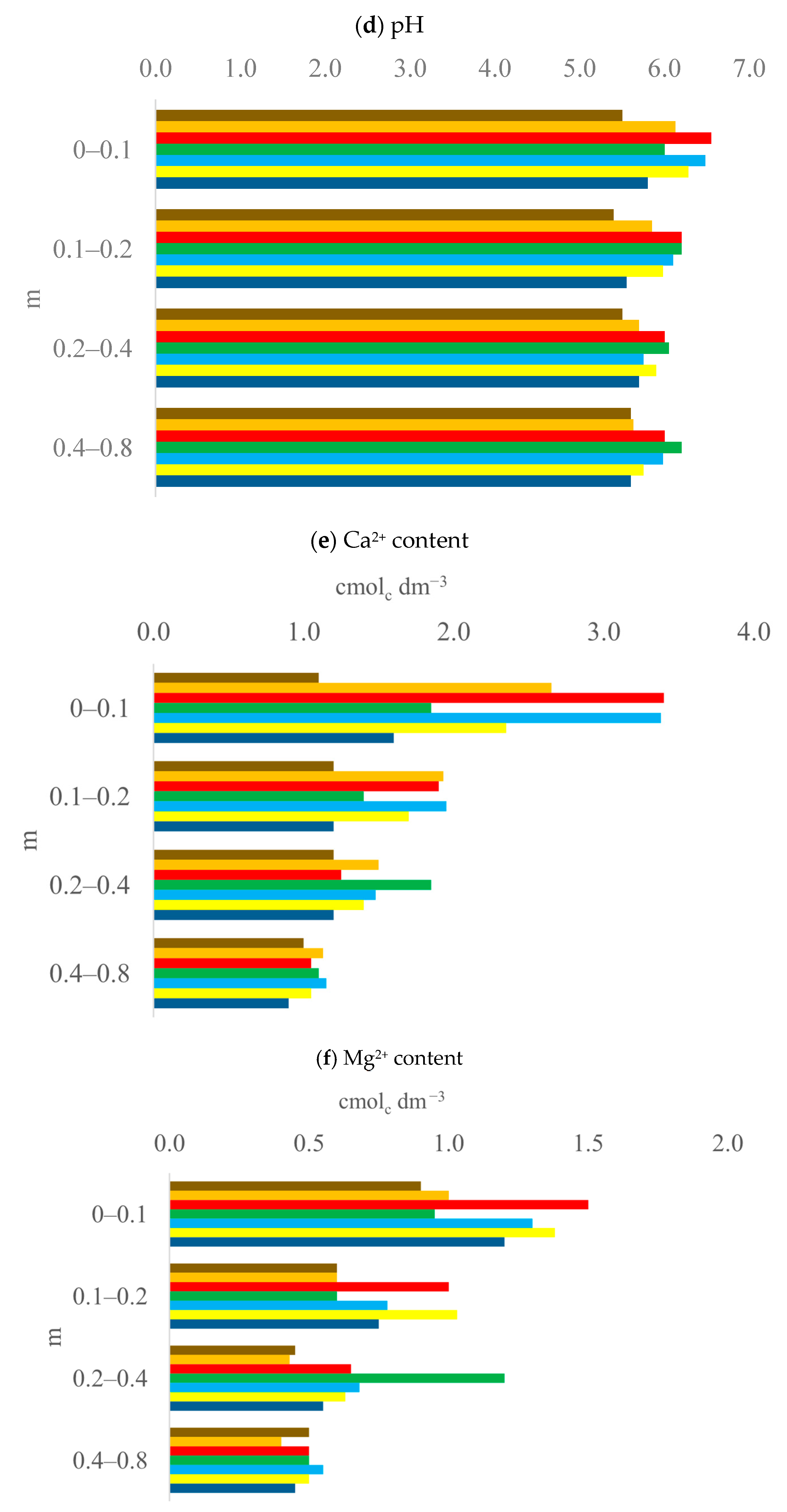
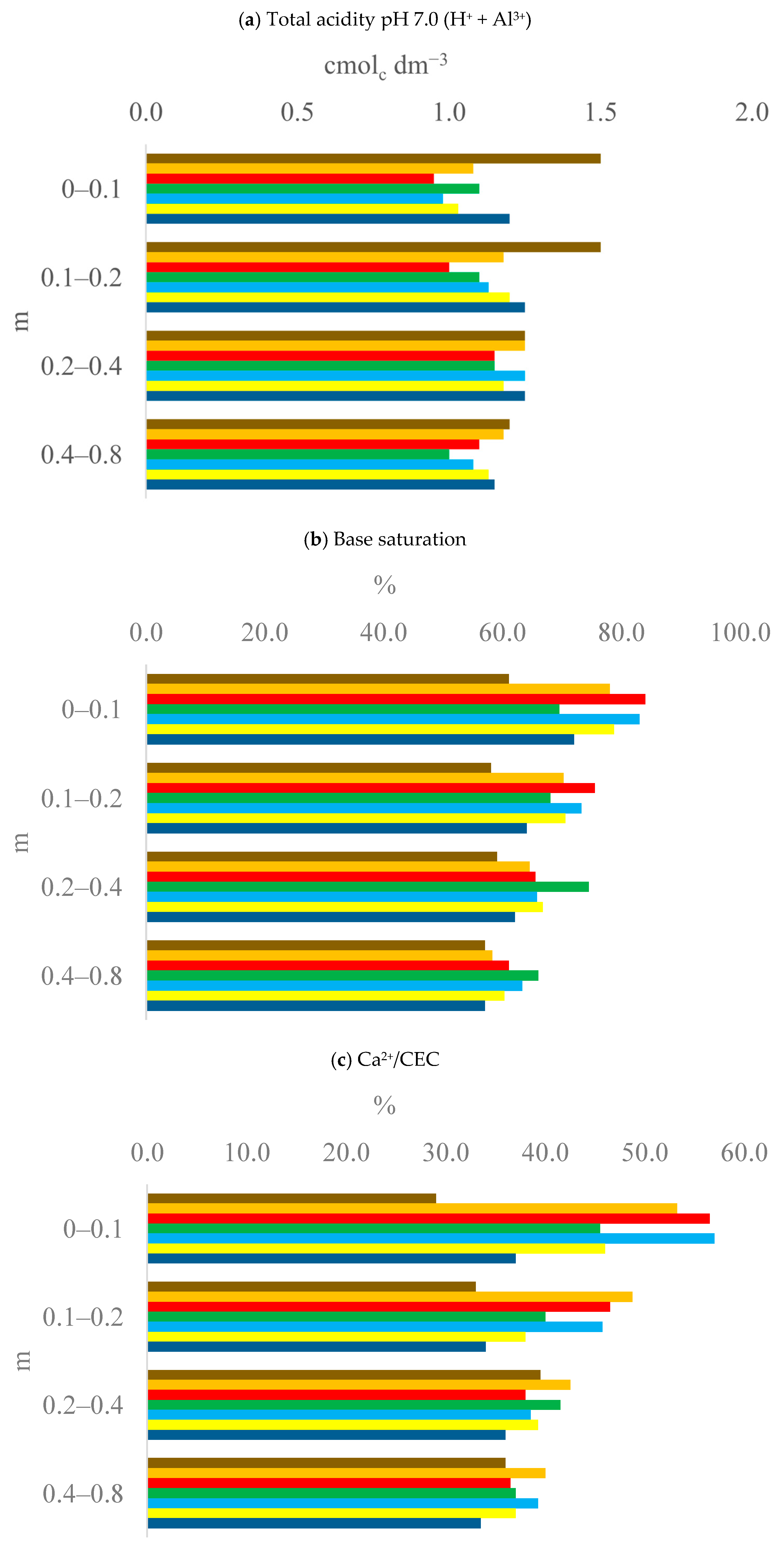
This study confirms that treatments T2, T3, T5 and T6 (methodologies for applying Ca compounds for surface and subsurface acidity correction) had residual effects on surface acidity at depths of 0.0 to 0.2 m in this agropastoral system by increasing pH and BS and reducing total acidity. These findings are consistent with those of Ref. [
54], in a tropical soil (sandy clay loam kaolinitic and thermic Typic Haplorthox) with a no-till maize and Congo grass intercropping system, which reported long-term positive effects of LS and PG amendment on P content; Ref. [
55], in a tropical soil (medium texture Haplustox) with liming carried out four months before planting the an orchard of mango cultivar Palmer, observed residual effects of liming, including increased P content and reduced total acidity, and Ref. [
56], in a tropical soil (Red Oxisol) with a no-till maize-soybean rotation, left fallow in the fall/winter, determined that total acidity in the 0.0–0.3 m layer was reduced two years after liming. By contrast, residual effects of subsurface application of HL combined with both surface application of PG in the first year and surface application of HL in subsequent years (T6 and T7) were not observed; these treatments had initially increased pH and BS in the subsurface layer (0.4–0.8 m).
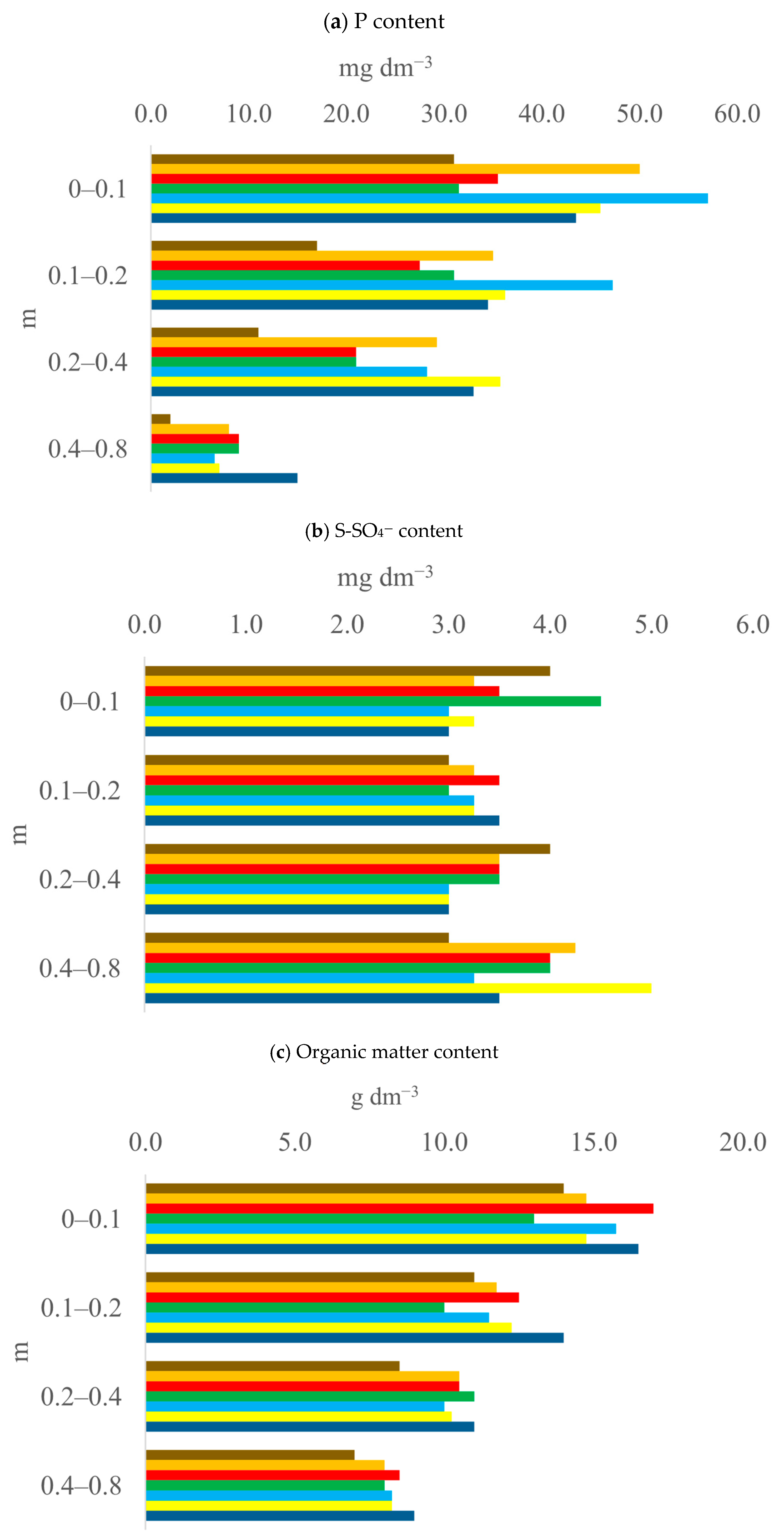
The positive effects of applying LS or HL plus PG on S-SO
42− content throughout the soil profile (0.0–0.8 m) were not maintained. This reflects the high forage dry matter biomass production in the palisade grass pasture (ranging from 11,272 to 18,084 kg ha
−1 on 12 February 2020) [
46], which increased S absorption [
57], which ranged from 1.09 to 1.82 g kg
−1 [
46].
By contrast, after two seasons, Ca-compound application had residual positive effects on P content in the 0.1–0.8 m layer and OM content in the 0.2–0.8 m layer that were not previously observed. Similar to the present study, Ref. [
58], in a tropical soil (clay texture typical dystrophic Red Oxisol) with the succession of wheat and soybean crops, and with residual effect of PG evaluated 33 months after its application, along with the effects of P doses, observed residual positive effects of PG application on P content and attributed these effects to the presence of P residues in the PG itself. The higher OM content in the subsurface layer in T2–T7 was due to the residual positive effects of Ca compounds on fertility throughout the soil profile, which included increases in P and K
+ contents, BS, and K
+/CEC. These improvements were reflected in the dry matter yield of palisade grass forage, consistent with previous studies reporting positive effects of PG on soil chemical properties and root-dry-mass density of sugarcane Ref. [
59], in a tropical soil (dystrophic Red Latosol) in an area kept under spontaneous vegetation with a predominance of grasses (
U. decumbens syn.
B. decumbens and Andropogon gayanus), with PG applied on the soil surface after sugarcane planting, and on black oat (
Avena strigosa) biomass, Ref. [
60], in a tropical soil (very clayey Typic Hapludox) with PG and N rates on black oat regrowth and on succeeding soybean under no-till, with PG application, even up to 44 and 55 months earlier.
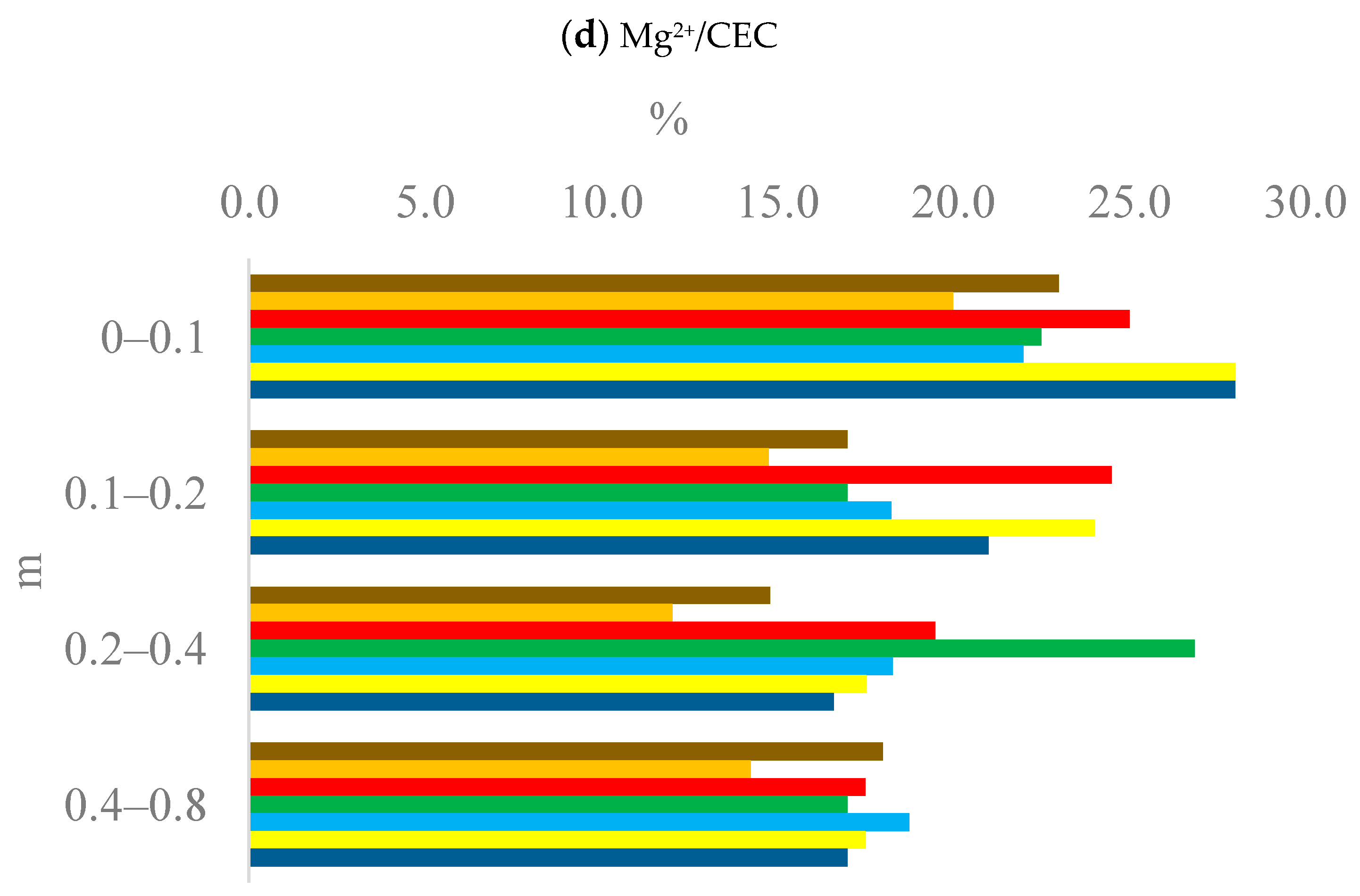
The higher Mg
2+ content, CEC, and Mg
2+/CEC in the 0.2–0.4 m layer and K
+ content and K
+/CEC in the 0.4–0.8 m layer in T4 compared with the other treatments were due to the slow effect of LS. Ref. [
61] observed effects of LS only at approximately 18 months after application, and Ref. [
62], in a soil belonging to the Dystrudepts group in Mexico, with maize used as an indicator crop in an area of variable fertility and scarce organic matter, observed increased Mg
2+ content two years after the application of LS without PG. The factors that influence the reaction time and residual effect of LS in the soil include soil buffer power, degree of homogenization during LS incorporation [
63], and LS particle size Ref. [
55]. LS acts most quickly the bigger its total relative neutralizing power, a crucial index in agriculture that indicates the efficiency of a soil amendment in neutralizing soil acidity, and when incorporated into soils with low buffer capacity, whereas its effect is slowest when applied as coarse particles on the surface of highly buffered soils without incorporation. Total relative neutralizing power, often measured as relative neutralizing value or effective Ca carbonate equivalent, is a metric for LS quality that combines chemical purity and particle size (fineness); it calculates how effectively a material can raise soil pH compared to pure Ca carbonate Ref. [
64]. By contrast, in the surface layer, T4 provided lower Ca
2+ and Mg
2+ contents and lower BS compared with the other methodologies for applying Ca compounds for surface and subsurface acidity correction. Notably, PG was not used in this treatment. Although PG does not directly affect soil pH, it increases Ca
2+ content and CEC [
54], and BS and CEC are related (BS = 100 (Ca
2+ + Mg
2+ + K
+/CEC pH 7.0)).
4.1. Effects of the Treatments on pH and Total Acidity
Consistent with the results of this study, Refs. [
56,
65], in a tropical soil (sandy loam Oxisol) under no-till using the following crops over a period of 72 months, black oat, maize, wheat and soybean, observed residual effects of the surface application of LS and PG under NT on pH, with increases in the 0.0–0.1 and 0.1–0.2 m layers. The combined application of LS and/or HL with PG provided better conditions for LS and/or HL to act on the soil solution and increase pH. Increased pH is the result of (1) physical downward movement of fine LS particles through the continuous porosity in the soil profile formed after the decomposition of dead roots or by soil organisms; (2) the formation of ionic pairs between NO
3− or SO
42− (released from fertilizer or mineralized OM) and Ca
2+ and Mg
2+ from the amendment; or (3) the formation of water-soluble CaL
0 or CaL-type complexes between plant residues on the soil surface (carboxylic and phenolic radicals) and Ca
2+ or Mg
2+, which involves the incorporation of hydrophilic groups, such as sulfonated or charged substituents, onto the ligand (L) and subsequent metal ion coordination Refs. [
56,
66]. In addition, PG can indirectly increase soil pH in deeper layers as the S-SO
42− from the PG displaces OH
− from soil colloid surfaces into the soil solution Ref. [
14]. In agropastoral systems under no-till, low-molecular-weight organic acids released during the decomposition of animal waste, mainly feces, or exuded by pasture residues Ref. [
67] can increase the effects of surface application of LS and/or HL at greater depths by favoring the downward movement of Ca
2+ and Mg
2+ in the soil profile.
Residual effects of T3, T4, T6 and T7 on pH and total acidity were not observed, indicating that repeated application may be necessary when these management practices are used. One reason for the lack of a decrease in total acidity (H
+ + Al
3+) in the 0.2–0.4 and 0.4–0.8 m layers in T2–T7 was due the use of 10-10-10 fertilizer in topdressing fertilization of palisade grass, which contained urea as the N source. Urea contains N-NH
3 Ref. [
20], which rapidly oxidizes to nitrate in the soil, releasing H
+ Ref. [
68]. Another reason is that the decomposition of organic residues originating from soybean, maize and palisade grass acidified the soil, decreasing pH and increasing total acidity Ref. [
69].
In T2, residual effects were not observed in the 0.4–0.8 m layer, corroborating previous findings by Ref. [
66], in a tropical soil (Rhodic Paleudult) followed by no-till soil cultivation, without LS incorporation, and under conventional tillage, with incorporation into the soil, that verified that positive effects of surface liming are most pronounced in the surface layers of the soil. Basic anions from the dissolution of LS (OH
− and HCO
3−) move by mass flow to the deeper layers of the soil, where they react with acidic cations (H
+, Fe
2+, Al
3+, and Mn
2+), preventing further alkalization reactions Ref. [
70]. In addition, the reaction of LS is generally limited to the site of soil application, and it does not reduce subsoil acidity quickly [
16]. Moreover, when LS is applied to the surface, the low mobility of its products of dissolution restricts the efficiency of this soil conditioner in reducing acidity in subsurface layers of the soil with variable loads, which depends on the leaching of organic and/or inorganic salts throughout the soil profile Ref. [
17]. Ref. [
23] reported that Ca
2+ and Mg
2+ concentrations in the acidic subsoil of an Oxisol were related to the downward movement of S-SO
42−.
4.2. Effects of the Treatments on Base Saturation
T2–T7 had residual positive effects on BS in the 0.0–0.1, 0.1–0.2, and 0.2–0.4 m layers. Reaction of Ca
2+ in the soil solution with the soil-exchange complex displaces K
+ and Mg
2+ into the soil solution, where these cations react with SO
42− to form the neutral ionic pairs K
2SO
40 and MgSO
40, which, along with CaSO
40, have great mobility in the soil profile Ref. [
24]. Ca
2+, K
+, and Mg
2+ compete for some of the same adsorption sites in the soil Ref. [
71]. Therefore, increasing Ca
2+, K
+, and Mg
2+ contents in the soil profile also increases BS.
4.3. Effects of the Treatments on P Content
The residual effects on P content can be attributed to the formation of compounds between Ca and P due to the dissociation of compounds containing Ca and S in the presence of water, which releases Ca
2+ and SO
42− ions. Ca
2+ subsequently reacts with P, reducing the latter’s solubility according to Refs. [
14,
72], in a tropical soil (dystrophic Clay Rhodic Hapludox) with surface application and incorporated into the soil of LS, using soybean cultivation in the summer and barley (
Hordeum distichum L.)/wheat cultivation in the winter, and Ref. [
10], in a tropical soil (clayey, kaolinitic, thermic Rhodic Hapludox) with maize and soybean cultivation and LS applied to the soil surface or incorporated into the topsoil, and PG applied to the surface, also observed increases in P content in the surface layer after the application of high doses of PG. As expected, P content in the 0.0–0.1 and 0.1–0.2 m layers was higher under NT (T5 and T2) than under conventional soil tillage (T3 and T4). This occurred because a lack of soil turnover promotes nutrient accumulation in the surface layers Ref. [
14] and because of the immobility of P in soil, Refs. [
73,
74], in a tropical soil (Typic Hapludox) using three cover crop residues: pearl millet (
Pennisetum glaucum L.), oats (
A. sativa L.) and Gigantic guinea sorghum (
Guinea sorghum), interacting with doses of P, applied over straw mulch, observed similar results and concluded that P adsorption capacity decreases as the soil concentration of P increases. By contrast, under no-till, the constant supply of organic material increased organic P in deeper layers, which increased the fertility of the soil after mineralization. Ref. [
75], in a tropical soil (Red-Yellow Cambic Argisol) with soil being cultivated with annual crops and submitted to six tillage systems (no-till, disc plow, moldboard plow, heavy disc harrow, and heavy disc harrow + moldboard plow), showed that a few years after the establishment of no-till, the chemical, physical and biological properties of the surface layer differed from those in an intensive tillage system that included regular moldboard plowing with secondary tillage.
4.4. Effects of the Treatments on K+ Content
The higher dry matter yield of palisade grass forage in T2 than in T1 in the 2019–2020 season (as shown in Ref. [
46]) explains the higher K
+ content in the 0.2–0.4 m layer in T2 compared with T1 two years later. K is the most abundant cation in plant tissues due to its extensive absorption by roots as K
+ ions from the soil solution Ref. [
76]. In addition, K is required in large quantities by crops, equaling the amount of N required, and accumulates in residues at levels three or four times higher than P Ref. [
77]. Forage grasses such as palisade grass have very extensive and constantly renewed root systems, which, when combined with their high dry matter production potential, enable rapid changes in soil OM and nutrient levels [
78]. In addition, by absorbing nutrients from subsurface layers of the soil and subsequently releasing them to the surface layer upon decomposition of its residues, palisade grass can restore considerable amounts of nutrients to crops. Refs. [
79,
80], in two tropical soils (Oxisols) with soybean and maize in rotation with cover crops (grain sorghum—
Sorghum bicolor, pearl millet, Sudan grass—
S. sudanense, grain sorghum × Sudan grass hybrid, and Congo grass), observed an average increase in K
+ content of 0.23 cmol
c dm
−3 two seasons after planting Congo grass, another forage grass of the genus
Urochloa.
In T2–T7, the application of Ca compounds for three seasons resulted in downward movement of K
+ from the surface layer to the 0.2–0.4 and 0.4–0.8 m layers, corroborating the results of Ref. [
56]. In addition, due to the thermodynamics of ion exchange and the properties of Ca
2+, PG can potentially increase leaching losses of Mg
2+ and K
+ to deep layers Ref. [
22]. The CaSO
4 in PG reduces Al
3+ activity, decreasing subsurface acidity effects and redistributing basic cations such as Mg
2+ and K
+ from the surface to subsurface layers Refs. [
26,
60].
4.5. Effects of the Treatments on Ca2+ Content and Ca2+/CEC
The residual positive effects of Ca compounds on Ca
2+ content and Ca
2+/CEC were restricted to the surface layer due to the lower mobility of Ca
2+ in the soil profile Ref. [
16], as Ca
2+ is retained by negatively charged clays and OM Ref. [
81]. Ca
2+ was also consumed by the increase in palisade grass forage yield, as Ca
2+ is important for root growth Ref. [
15] and cell division Ref. [
82].
4.6. Effects of the Treatments on Mg2+ Content and Mg2+/CEC
The increases in Mg
2+ content and Mg
2+/CEC in the 0.1–0.2 m layer in T6 were due to the movement of Mg
2+ in the soil profile. The supply of Ca
2+ by PG solubilization promotes the substitution of Mg
2+ from the exchange complex to the soil solution and the formation of the ionic pair MgSO
40. This ionic pair is more easily leached in the soil by water infiltration, promoting the movement of Mg
2+ in the soil profile Refs. [
3,
21,
22]. A high concentration of Ca
2+ in the soil favors the displacement of Mg
2+ from exchange sites. The displaced Mg
2+ can form an ion pair with SO
42− or be leached in the form of Mg
2+ ions, which is the preferred form of displacement in the profile Ref. [
83]. In addition, Mg
2+ mobility was promoted by the formation of complexes with soluble organic compounds released by the decomposition of crop biomass deposited on the soil surface (carboxylic and phenolic radicals) and by the release of low-molecular-weight organic acids from root exudates under the influence of grazing and from the decomposition of animal waste, mainly feces Refs. [
67,
83]. Mg
2+ was also consumed by palisade grass forage yield because Mg is a component of chlorophyll and participates in the transfer of energy for the process of photosynthesis Ref. [
84].
4.7. Effects of the Treatments on Organic Matter Content
The oldest stems and stalks of palisade grass forage have high C/N ratios and high levels of lignin and polyphenols, which results in slow decomposition Ref. [
85] and favors increases in OM throughout the soil profile Ref. [
86]. In the soil solution, CaSO
4 (Ca sulfate) is hydrolyzed to Ca
2+ + SO
42− + CaSO
40 Ref. [
58]. The Ca
2+ ions react with the soil-exchange complex and displace Al
3+, K
+ and Mg
2+ to the soil solution, where they react with sulfate (SO
42−) to form AlSO
4+ (a form of Al that is less toxic to plants) and the neutral ionic pairs K
2SO
40, MgSO
40 and CaSO
40, which have high mobility Ref. [
87]. These ionic pairs move to deeper layers, improving the soil profile, crop root-system development, water absorption through plant roots Refs. [
27,
53], and, ultimately, crop yields Ref. [
88]. Residual effects of LS and PG on soil fertility, including increases in OM content and BS and decreases in total acidity, and on aboveground and root biomass and maize and soybean yields, also were observed by Refs. [
10,
54,
55,
56,
65].
4.8. Considerations
Several studies have reported limitations of surface application of LS in systems without soil tillage (no-till): Ref. [
16]—maize response to LS and PG applications at the installation of no-till in a tropical soil (Clay Rhodic Hapludox); Ref. [
17]—surface and incorporated application of LS in a tropical soil (clayey, kaolinitic, thermic Rhodic Hapludox) with cropping sequence: soybean, barley, soybean, wheat, soybean, maize, and soybean; and Ref. [
18]. The low mobility of the products of LS dissolution restricts the efficiency of this soil-liming agent in reducing acidity in subsurface layers of the soil and results in variable loads, also known as pH-dependent loads. This variability is characteristic of the highly weathered soils common in tropical regions such as Brazil and results in leaching of organic and/or inorganic ion pairs deeper into the soil Ref. [
17]. To contribute to methods for ameliorating surface and subsurface acidity and improving soil chemical fertility in agropastoral systems under no-till, we established this study of the residual effects of different application methodologies (surface, incorporation by soil tillage, or subsurface) for Ca compounds (LS, PG, and HL) that were implemented during the 2017–2020 seasons. In contrast to our expectations, the improvements in soil chemical attributes throughout the soil profile (0.0–0.8 m) after the incorporation of LS and subsurface application of HL in the 2017–2018 season did not persist in subsequent seasons. The surface application of LS and HL reduces energy (fuel) costs compared with application under tillage Ref. [
89]. Because the positive effects of applying LS plus PG and applying HL plus PG on soil fertility in the 0.0–0.2 m layer were maintained, T2 and T5 are good options for correcting soil acidity in agropastoral system. These two treatments also increased P content in the 0.1–0.8 m layer and OM content in the 0.2–0.8 m layer, which may promote crop root-system development and plant water and nutrient absorption, thereby reducing the adverse effects of drought, improving crop tolerance to water stress, and increasing crop yields, especially in the Cerrado biome.
In relation to initial soil total acidity in 2017 (
Table S5), the combined application of LS and/or HL with PG provided a reduction in total acidity throughout the soil profile in 2022. This reduction ranged from 0.6 to 0.85, 0.65 to 0.9, 0.35 to 0.45, and 0.32 to 0.5 cmol
c dm
−3 in the 0.0–0.1, 0.1–0.2, 0.2–0.4, and 0.4–0.8 m layers, respectively. This occurred due to the complete neutralization of the acidic cations (H
+, Fe
2+, Al
3+, and Mn
2+), which occurs at a pH above 5.6 Ref. [
65]. In T2–T7, the pH ranged from 5.8 to 6.7, 5.6 to 6.2, 5.7 to 6.1, and 5.6 to 6.2 in the 0.0–0.1, 0.1–0.2, 0.2–0.4, and 0.4–0.8 m layers, respectively. This shows that there was no loss of subsurface acidity correction over time, corroborating the results of Ref. [
90], in tropical soil (sandy loam kaolinitic, thermic Typic Haplorthox) under no-till and with the following crop rotations: rice in the summer and black oat in the fall; bean in the summer and black oat in the fall; peanut in the summer and oat in the fall; and maize intercropped with Congo grass, which reported that reductions in surface and subsurface soil acidity due to superficial liming with or without PG under no-till were maintained 5 years after application.
In addition, Ref. [
91], in a Goldsboro loamy sand (fine-loamy, siliceous, thermic, Aquic Kandiudult), with growing soybean double cropped with wheat for 3 years and after 3 years of continuous maize, observed a vertical stratification of plant nutrients in the soil profile under conservation tillage, especially no-till, in contrast to an accumulation of P, Ca
2+, K
+, and Mg
2+ near the surface under conventional tillage. However, we observed this stratification under all three soil tillage practices (no-till, conventional tillage, and minimum tillage). In addition, in T2–T7, P and K
+ contents in the 0.0–0.1, 0.1–0.2, and 0.2–0.4 m layers were average according to Ref. [
50]. By contrast, in T1, P and K
+ contents in the 0.2–0.4 m layer were low according to Ref. [
50].
5. Conclusions
The present study evaluated the residual effects of different methodologies for applying Ca compounds in an agropastoral system in an Ultisol with sandy texture two seasons after the last application.
Some of the improvements in surface acidity and surface and subsurface soil chemical fertility produced by the different methodologies for applying LS, PG, and HL persisted after two seasons. In the 0.0–0.2 m layer, the correction of surface acidity via increased pH and BS and reduced total acidity was maintained. Moreover, the improvements in Ca2+ content and Ca2+/CEC after applying LS plus PG and Mg2+ content and Mg2+/CEC after applying HL plus PG were preserved in the surface layer. Finally, Ca-compound application had residual positive effects on P content in the 0.1–0.8 m layer and OM content in the 0.2–0.8 m layer. By contrast, the improvement in acidity in the 0.4–0.8 m layer previously observed after the incorporation of LS and subsurface application of HL in the 2017–2018 season was not maintained. In addition, the positive effects of these amendments on S-SO42− content throughout the soil profile (0.0–0.8 m) disappeared. However, the combined application of LS and/or HL with PG provided a reduction in total acidity throughout the soil profile in relation to the initial soil total acidity observed five years earlier, before applying the treatments.
Because increasing the soil contents of Ca and P enables greater root exploration in deeper layers, the present findings have implications for the adoption of practices that minimize surface and subsurface acidity and increase crop productivity.
Thus, due to maintenance in Ca2+ and Mg2+ contents and in Ca2+/CEC and Mg2+/CEC after applying LS or HL plus PG in the surface layer, and reduction in total acidity throughout the soil profile, these methodologies for applying Ca compounds in agropastoral systems with soil sandy texture are the most recommended.
Evaluations of the long-term effects of different methodologies for mitigating soil acidity are therefore encouraged.




 ,
,