Population-Based Threshold Models for Predicting Weed Emergence: A Synthesis as a Conceptual Framework for the Development of Tools for Site-Specific Management


Abstract
1. Introduction
2. Literature Search and Selection
3. Seed Dormancy in Weed Species
4. Environmental Factors Regulating Changes in Seed Dormancy
5. Seed Dormancy Terminating Factors
6. Population-Based Threshold Models Framework
7. Models to Predict Germination
8. Models to Predict Seed Dormancy and Germination
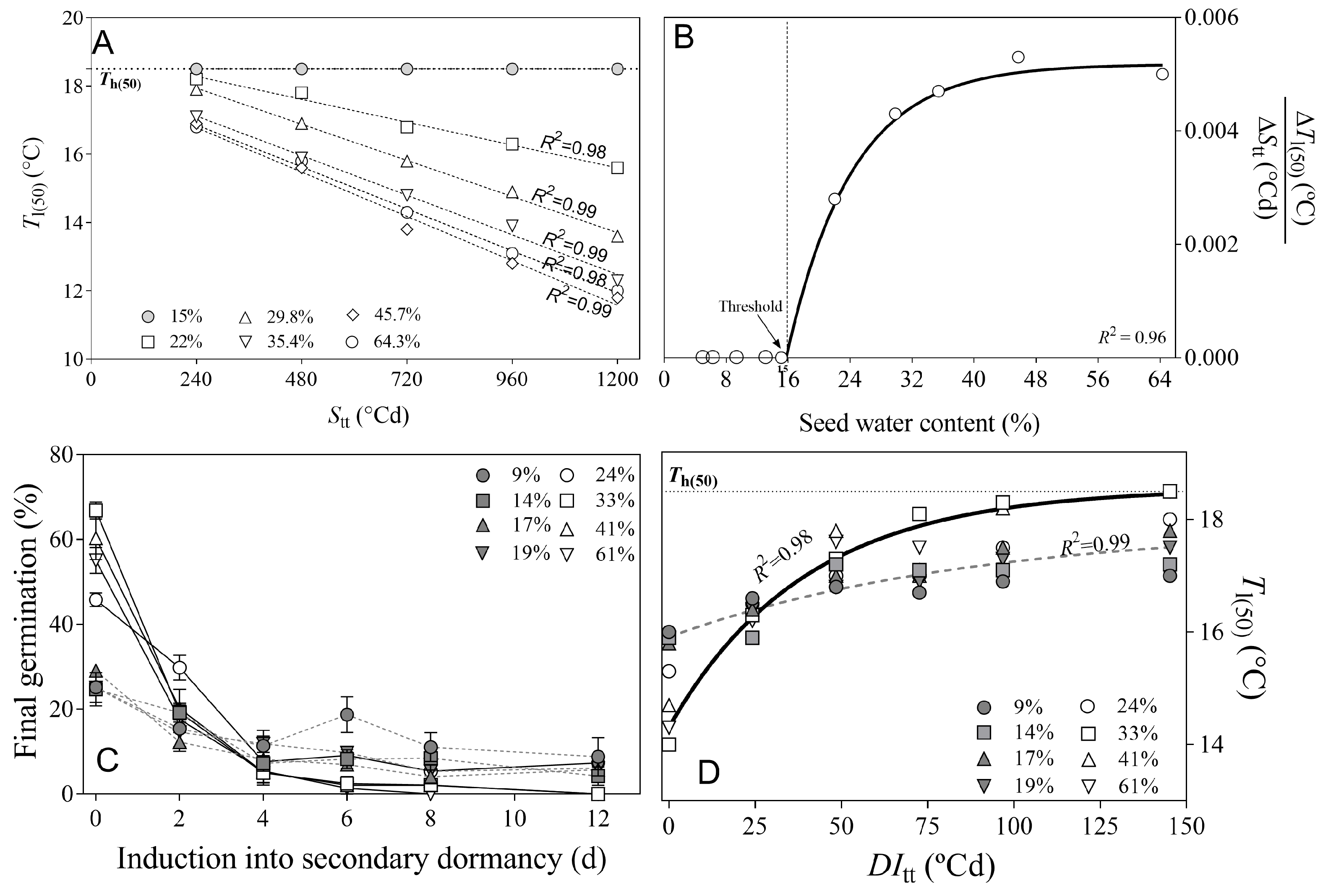
8.1. Stratification Thermal-Time and Dormancy Induction Thermal-Time
8.2. After-Ripening Thermal-Time Models
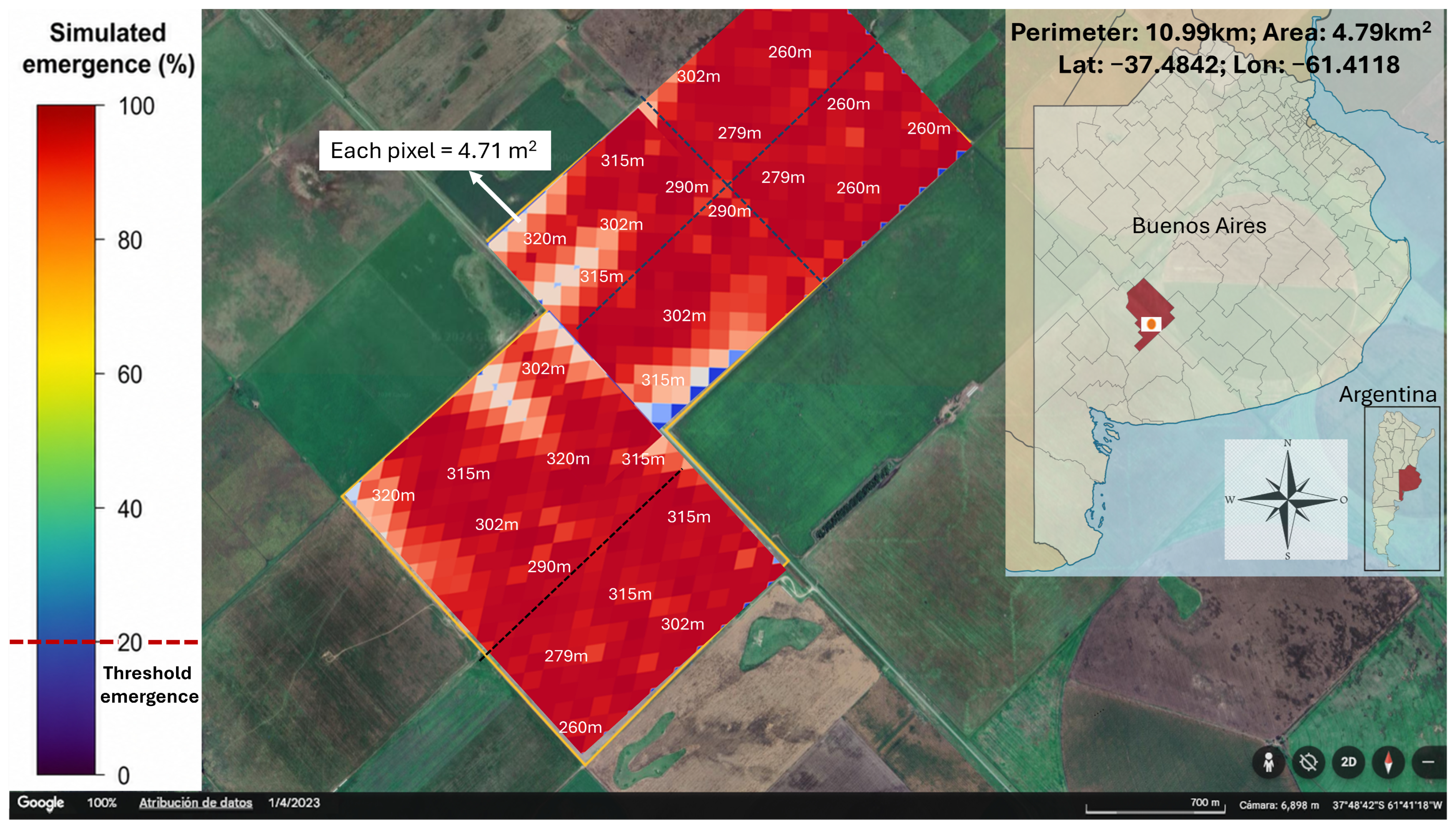
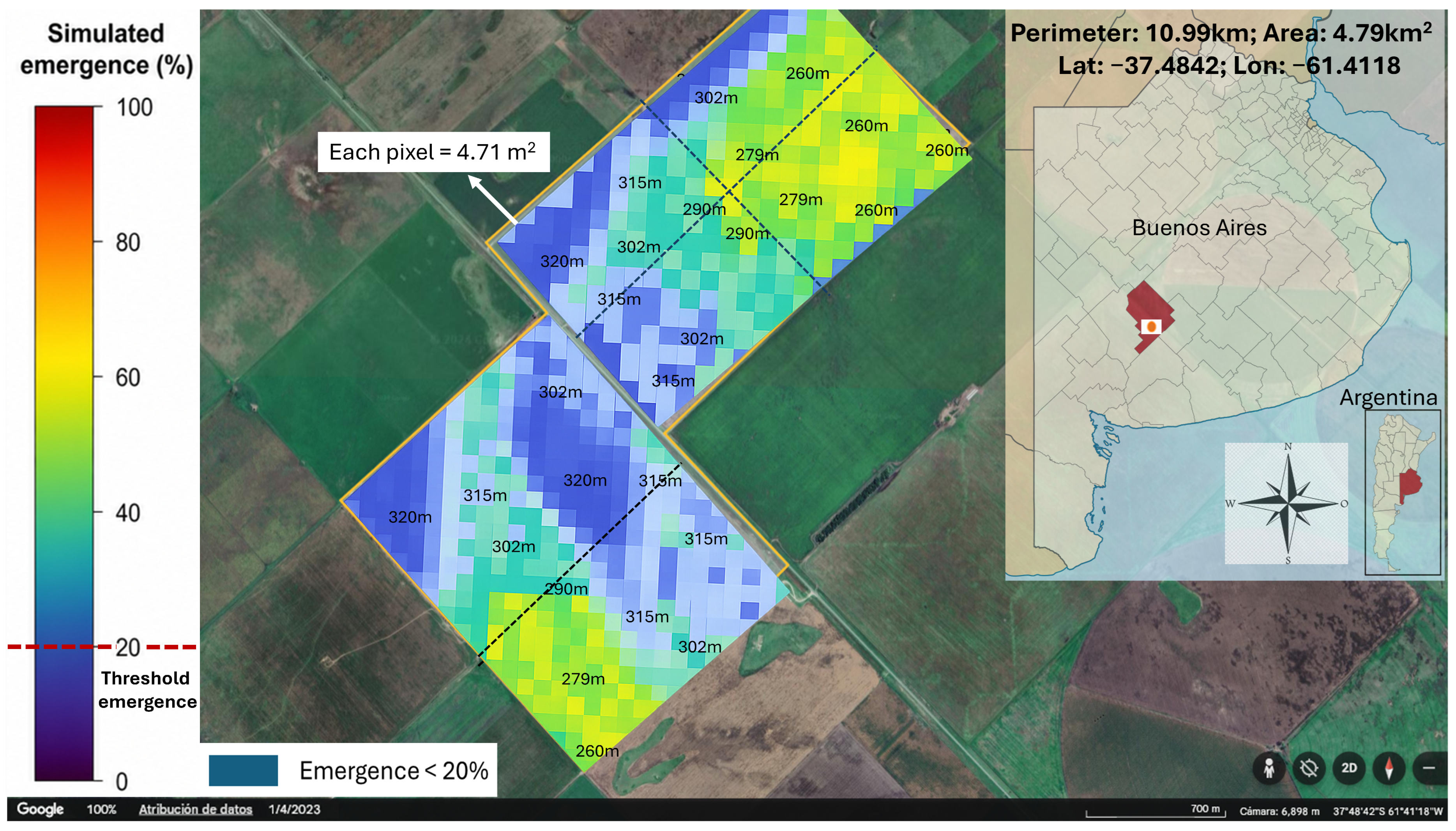
9. Conceptual Application of PBTMs in Site-Specific Weed Management
10. Current Limitations and Implementation Challenges
11. Conclusions
Supplementary Materials
Author Contributions
Funding
Data Availability Statement
Conflicts of Interest
Abbreviations
| AR | After-ripening |
| AUC | Area Under the Curve |
| DItt | Dormancy Induction thermal-time |
| DSS | Decision Support Systems |
| GR | Germination rate |
| HT | Hydro-time model |
| HTT | Hydrothermal-time |
| loT | Internet of Things |
| PBTMs | Population-Based threshold models |
| RMSE | Root Mean Square Error |
| ROC | Receiver Operating Characteristics |
| Stt | Stratification Thermal-time |
| SWC | Seed water content |
| Tb | Base temperature |
| Tg | Time to germination |
| Th | Upper limit for Germination |
| Tl | Lower limit temperature for Germination |
| Tl(ds) | Initial Tl of the population (i.e., 18 °C) |
| Tl(ld) | Initial Tl of the seed population (i.e., 7.9 °C) |
| Tm | Maximum temperature |
| To | optimum temperature |
| TT | Thermal-time units (°Cd) |
| θ | Thermal-time constant |
| θH | Hydro-time constant |
| Ψ | Water potential |
| Ψb | Base water potential |
References
- Labrada, R.; Parker, C. El control de malezas en el contexto del manejo integrado de plagas. In Estudio FAO: Produccion y Proteccion Vegetal (FAO); FAO: Rome, Italy, 1996; p. 120. [Google Scholar]
- Karssen, C.M. Patterns of change in dormancy during burial of seeds in soil. Isr. J. Plant Sci. 1980, 29, 65–73. [Google Scholar]
- Benech-Arnold, R.L.; Sánchez, R.A.; Forcella, F.; Kruk, B.C.; Ghersa, C.M. Environmental control of dormancy in weed seed banks in soil. Field Crops Res. 2000, 67, 105–122. [Google Scholar] [CrossRef]
- Forcella, F.; Benech-Arnold, R.L.; Sánchez, R.A.; Ghersa, C.M. Modeling seedling emergence. Field Crops Res. 2000, 67, 123–139. [Google Scholar] [CrossRef]
- Gibson, K.D.; Fischer, A.J.; Foin, T.C.; Hill, J.E. Crop traits related to weed suppression in water-seeded rice (Oryza sativa L.). Weed Sci. 2003, 51, 87–93. [Google Scholar] [CrossRef]
- Norris, R.F.; Kogan, M. Ecology of interactions between weeds and arthropods. Annu. Rev. Entomol. 2005, 50, 479–503. [Google Scholar] [CrossRef]
- Owen, M.D.K.; Beckie, H.J.; Leeson, J.Y.; Norsworthy, J.K.; Steckel, L.E. Integrated pest management and weed management in the United States and Canada. Pest Manag. Sci. 2015, 71, 357–376. [Google Scholar] [CrossRef]
- Dinelli, G.; Marotti, I.; Bonetti, A.; Catizone, P.; Urbano, J.M.; Barnes, J. Taxonomic evaluation of Italian populations of Lolium spp. resistant and susceptible to diclofop-methyl. Weed Res. 2002, 42, 165–174. [Google Scholar] [CrossRef]
- Agostinetto, D.; Tarouco, C.P.; Langaro, A.C.; Gomes, J.; Vargas, L. Competition between wheat and ryegrass under different levels of nitrogen fertilization. Planta Daninha 2017, 35, e017165037. [Google Scholar] [CrossRef][Green Version]
- Scursoni, J.A.; Satorre, E.H. Glyphosate management strategies, weed diversity and soybean yield in Argentina. Crop Prot. 2010, 29, 957–962. [Google Scholar] [CrossRef]
- Sartorato, I.; Berti, A.; Zanin, G.; Dunan, C.M. Modeling of glyphosate application timing in glyphosate-resistant soybean. Weed Sci. 2011, 59, 390–397. [Google Scholar] [CrossRef]
- Duke, S.O.; Carvalho, L.B. Unintended Effects of the Intended Herbicides on Transgenic Herbicide-Resistant Crops. Agronomy 2025, 15, 2448. [Google Scholar] [CrossRef]
- Finch-Savage, W.E.; Footitt, S. Seed dormancy cycling and the regulation of dormancy mechanisms to time germination in variable field environments. J. Exp. Bot. 2017, 68, 843–856. [Google Scholar] [CrossRef]
- Chauhan, B.S. Grand challenges in weed management. Front. Agron. 2020, 1, 3. [Google Scholar] [CrossRef]
- Grundy, A.C. Predicting weed emergence: A review of approaches and future challenges. Weed Res. 2003, 43, 1–11. [Google Scholar] [CrossRef]
- Brown, B.; Gallandt, E.R.; DiTommaso, A.; Salon, P.; Smith, R.G.; Ryan, M.R.; Cordeau, S. Improving weed management based on the timing of emergence peaks: A case study of problematic weeds in Northeast United States. Front. Agron. 2022, 4, 888664. [Google Scholar] [CrossRef]
- Fenner, M.; Thompson, K. The Ecology of Seeds; Cambridge University Press: Cambridge, UK, 2005. [Google Scholar]
- Marschner, C.A.; Westbrook, A.S.; Brunharo, C.A.C.G.; DiTommaso, A.; Mesgaran, M.B. Modeling weed seedling emergence for time-specific weed management: A systematic review. Weed Sci. 2024, 72, 313–329. [Google Scholar] [CrossRef]
- Cabrera-Pérez, C.; Recasens, J.; Baraibar, B.; Royo-Esnal, A. Emergence modelling of 18 species susceptible to be used as cover crops in Mediterranean semiarid vineyards. Eur. J. Agron. 2022, 132, 126413. [Google Scholar] [CrossRef]
- Hegarty, T.W. The physiology of seed hydration and dehydration, and the relation between water stress and the control of germination: A review. Plant Cell Environ. 1978, 1, 101–119. [Google Scholar] [CrossRef]
- Johnson, B.J. Reduced herbicide rates for large crabgrass (Digitaria sanguinalis) and goosegrass (Eleusine indica) control in bermudagrass (Cynodon dactylon). Weed Sci. 1997, 45, 283–287. [Google Scholar] [CrossRef]
- Malavert, C.; Batlla, D.; Benech-Arnold, R.L. The role of seed water content for the perception of temperature signals that drive dormancy changes in Polygonum aviculare buried seeds. Funct. Plant Biol. 2020, 48, 28–39. [Google Scholar] [CrossRef]
- Steadman, K.J.; Bignell, G.P.; Ellery, A.J. Field assessment of thermal after-ripening time for dormancy release prediction in Lolium rigidum seeds. Weed Res. 2003, 43, 458–465. [Google Scholar] [CrossRef]
- Malavert, C.; Batlla, D.; Benech-Arnold, R.L. Temperature-dependent regulation of induction into secondary dormancy of Polygonum aviculare L. seeds: A quantitative analysis. Ecol. Model. 2017, 352, 128–138. [Google Scholar] [CrossRef]
- Malavert, C.; Batlla, D. Thermal regulation of dormancy in Echinochloa crus-galli (L.) P. Beauv. seeds: Development of a model to predict the temporal ‘window’ of emergence in the field. Weed Res. 2024, 64, 158–170. [Google Scholar] [CrossRef]
- Masin, R.; Loddo, D.; Benvenuti, S.; Zuin, M.C.; Macchia, M.; Zanin, G. Temperature and water potential as parameters for modeling weed emergence in central-northern Italy. Weed Sci. 2010, 58, 216–222. [Google Scholar] [CrossRef]
- Kucera, B.; Cohn, M.A.; Leubner-Metzger, G. Plant hormone interactions during seed dormancy release and germination. Seed Sci. Res. 2005, 15, 281–307. [Google Scholar] [CrossRef]
- Nakabayashi, K.; Leubner-Metzger, G. Seed dormancy and weed emergence: From simulating environmental change to understanding trait plasticity, adaptive evolution, and population fitness. J. Exp. Bot. 2021, 72, 4181–4185. [Google Scholar] [CrossRef] [PubMed]
- Footitt, S.; Huang, Z.; Clay, H.A.; Mead, A.; Finch-Savage, W.E. Temperature, light and nitrate sensing coordinate Arabidopsis seed dormancy cycling and germination. Plant J. 2011, 74, 785–797. [Google Scholar] [CrossRef]
- Backlund, S.; Stankowski, S.; Soler, R. Seeds as space-time travelers: How does evolution balance the joint benefits and trade-offs of dormancy and dispersal? Am. J. Bot. 2026, 113, e70175. [Google Scholar] [CrossRef]
- Finch-Savage, W.E.; Leubner-Metzger, G. Seed dormancy and the control of germination. New Phytol. 2006, 171, 501–523. [Google Scholar] [CrossRef]
- Penfield, S. Adaptation of seeds to climate change is promoted by the mother plant. J. Exp. Bot. 2025, 76, 6573–6575. [Google Scholar] [CrossRef] [PubMed]
- Amen, R.D. A model of seed dormancy. Bot. Rev. 1968, 34, 1–31. [Google Scholar] [CrossRef]
- Egley, G.H. Stimulation of weed seed germination in soil. Rev. Weed Sci. 1986, 2, 67–89. [Google Scholar]
- Murdoch, A. Seed dormancy. In Seeds: The Ecology of Regeneration in Plant Communities; Gallagher, R.S., Ed.; CABI: Wallingford, UK, 2014; pp. 151–177. [Google Scholar] [CrossRef]
- Karssen, C.M. Seasonal patterns of dormancy in weed seeds. In The Physiology and Biochemistry of Dormancy and Germination of Seeds; Khan, A., Ed.; Elsevier: Amsterdam, The Netherlands, 1982; pp. 243–270. [Google Scholar]
- Bewley, J.D.; Black, M. Seeds—Physiology of Development and Germination, 2nd ed.; Plenum Press: New York, NY, USA, 1994. [Google Scholar]
- Vleeshouwers, L.M.; Bouwmeester, H.J.; Karssen, C.M. Redefining seed dormancy: An attempt to integrate physiology and ecology. J. Ecol. 1995, 83, 1031–1037. [Google Scholar] [CrossRef]
- Hilhorst, H.W.M. A critical update on seed dormancy. I. Primary dormancy. Seed Sci. Res. 1995, 5, 61–73. [Google Scholar] [CrossRef]
- Hilhorst, H.W.M. The regulation of secondary dormancy. The membrane hypothesis revisite. Seed Sci. Res. 1998, 8, 77–90. [Google Scholar] [CrossRef]
- Dyer, W.E. Exploiting weed seed dormancy and germination requirements through agronomic practices. Weed Sci. 1995, 43, 498–503. [Google Scholar] [CrossRef]
- Benvenuti, S. Role of weed emergence time for the relative seed production in maize. Ital. J. Agron. 2007, 1, 23–30. [Google Scholar] [CrossRef]
- Brändel, M.; Jensen, K. Effect of temperature on dormancy and germination of Eupatorium cannabinum L. achenes. Seed Sci. Res. 2005, 15, 143–151. [Google Scholar] [CrossRef]
- Ooi, M.K.J. Seed bank persistence and climate change. Seed Sci. Res. 2012, 22, S53–S60. [Google Scholar] [CrossRef]
- Baskin, C.C.; Baskin, J.M. Germination ecophysiology of herbaceous plant species in a temperate region. Am. J. Bot. 1988, 75, 286–305. [Google Scholar] [CrossRef]
- Iwasaki, M.; Penfield, S.; Lopez-Molina, L. Parental and environmental control of seed dormancy in Arabidopsis thaliana. Annu. Rev. Plant Biol. 2022, 73, 355–378. [Google Scholar] [CrossRef]
- Batlla, D.; Benech-Arnold, R.L. A framework for the interpretation of temperature effects on dormancy and germination in seed populations showing dormancy. Seed Sci. Res. 2015, 25, 147–158. [Google Scholar] [CrossRef]
- Scherner, A.; Melander, B.; Jensen, P.K.; Kudsk, P.; Avila, L.A. Germination of winter annual grass weeds under a range of temperatures and water potentials. Weed Sci. 2017, 65, 468–478. [Google Scholar] [CrossRef]
- Soppe, W.J.; Bentsink, L. Dormancy in plants. In Encyclopedia of Life Science; John Wiley & Sons, Ltd.: Chichester, UK, 2016; pp. 1–7. [Google Scholar]
- Walck, J.L.; Hidayati, S.N.; Dixon, K.W.; Thompson, K.; Poschlod, P. Climate change and plant regeneration from seed. Glob. Change Biol. 2011, 17, 2145–2161. [Google Scholar] [CrossRef]
- Bewley, J.D. Seed germination and dormancy. Plant Cell. 1997, 9, 1055–1066. [Google Scholar] [CrossRef]
- Bair, N.B.; Susan, E.M.; Phil, S.A. A hydrothermal after-ripening time model for seed dormancy loss in Bromus tectorum L. Seed Sci. Res. 2006, 16, 17–28. [Google Scholar] [CrossRef]
- Baskin, J.M.; Baskin, C.C. Germination responses of buried seeds of Capsella bursa-pastoris exposed to seasonal temperature changes. Weed Res. 1989, 29, 205–212. [Google Scholar] [CrossRef]
- Baskin, C.C.; Baskin, J.M. Seeds—Ecology, Biogeography, and Evolution of Dormancy and Germination; Academic Press: San Diego, CA, USA, 1998. [Google Scholar]
- Christensen, M.; Meyer, S.; Allen, P.S. A hydrothermal time model of seed after-ripening in Bromus tectorum L. Seed Sci. Res. 1996, 6, 147–153. [Google Scholar] [CrossRef]
- Chantre, G.R.; Sabbatini, M.R.; Orioli, G.A. An after-ripening thermal-time model for Lithospermum arvense seeds based on changes in population hydrotime parameters. Weed Res. 2010, 50, 218–227. [Google Scholar] [CrossRef]
- Batlla, D.; Benech-Arnold, R.L. A quantitative analysis of dormancy loss dynamics in Polygonum aviculare L. seeds: Development of a thermal time model based on changes in seed population thermal parameters. Seed Sci. Res. 2003, 13, 55–68. [Google Scholar] [CrossRef]
- Bouwmeester, H.J. The Effect of Environmental Conditions on the Seasonal Dormancy Pattern and Germination of Weed Seeds. Ph.D. Thesis, Agricultural University, Wageningen, The Netherlands, 1990; p. 157. [Google Scholar]
- Baskin, J.M.; Baskin, C.C. Ecophysiology of secondary dormancy in seeds of Ambrosia artemisiifolia. Ecology 1980, 61, 475–480. [Google Scholar] [CrossRef]
- Chandra, R.J.; Masilamani, P.; Suthakar, B.; Rajkumar, P.; Sivakumar, S.D.; Manonmani, V. Seed dormancy and after-ripening mechanisms in seed germination: A comprehensive review. Int. J. Plant Soil Sci. 2024, 36, 68–92. [Google Scholar] [CrossRef]
- Lamont, B.B.; Pausas, J.G. Seed dormancy revisited: Dormancy-release pathways and environmental interactions. Funct. Ecol. 2023, 37, 1106–1125. [Google Scholar] [CrossRef]
- Batlla, D.; Benech-Arnold, R.L. The role of fluctuations in soil water content on the regulation of dormancy changes in buried seeds of Polygonum aviculare L. Seed Sci. Res. 2006, 16, 47–59. [Google Scholar] [CrossRef]
- Wang, W.Q.; Song, S.Q.; Li, S.H.; Gan, Y.Y.; Wu, J.H.; Cheng, H.Y. Quantitative description of the effect of stratification on dormancy release of grape seeds in response to various temperatures and water contents. J. Exp. Bot. 2009, 60, 3397–3406. [Google Scholar] [CrossRef]
- Vegis, A. Dormancy in higher plants. Annu. Rev. Plant Physiol. 1964, 15, 185–224. [Google Scholar] [CrossRef]
- Washitani, I. A convenient screening test system and a model for thermal germination responses of wild plant seeds: Behaviour of model and real seeds in the system. Plant Cell Environ. 1987, 10, 587–598. [Google Scholar] [CrossRef]
- Vleeshouwers, L.M.; Bouwmeester, H.J. A simulation model for seasonal changes in dormancy and germination of weed seeds. Seed Sci. Res. 2001, 11, 77–92. [Google Scholar] [CrossRef]
- Liu, K.; Baskin, J.M.; Baskin, C.C.; Bu, H.; Du, G.; Ma, M. Effect of diurnal fluctuating versus constant temperatures on germination of 445 species from the eastern Tibet Plateau. PLoS ONE 2013, 8, e69364. [Google Scholar] [CrossRef]
- Qaderi, M.M. Environmental regulation of weed seed dormancy and germination. Seeds 2023, 2, 259–277. [Google Scholar] [CrossRef]
- Nautiyal, P.C.; Sivasubramaniam, K.; Dadlani, M. Seed dormancy and regulation of germination. In Seed Science and Technology; Dadlani, M., Yadava, D.K., Eds.; Springer: Singapore, 2023; pp. 41–66. [Google Scholar] [CrossRef]
- Probert, R.J. The role of temperature in germination ecophysiology. In Seeds: The Ecology of Regeneration in Plant Communities; Fenner, M., Ed.; CAB International: Wallingford, UK, 1992; pp. 285–325. [Google Scholar]
- Scopel, A.L.; Ballaré, C.L.; Sánchez, R.A. Induction of extreme light sensitivity in buried weed seeds and its role in the perception of soil cultivation. Plant Cell Environ. 1991, 14, 501–508. [Google Scholar] [CrossRef]
- Batlla, D.; Verges, V.; Benech-Arnold, R.L. A quantitative analysis of seed responses to cycle-doses of fluctuating temperatures in relation to dormancy level. Development of a thermal-time model for Polygonum aviculare L. seeds. Seed Sci. Res. 2003, 13, 197–207. [Google Scholar] [CrossRef]
- Batlla, D.; Benech-Arnold, R.L. Changes in the light sensitivity of buried Polygonum aviculare seeds in relation to cold-induced dormancy loss: Development of a predictive model. New Phytol. 2004, 165, 445–452. [Google Scholar] [CrossRef] [PubMed]
- Malavert, C.; Batlla, D.; Benech-Arnold, R.L. Light sensitivity changes during dormancy induction in Polygonum aviculare L. seeds: Development of a predictive model of annual changes in seed-bank light sensitivity in relation to soil temperature. Weed Res. 2021, 61, 115–125. [Google Scholar] [CrossRef]
- Malavert, C.; Batlla, D.; Benech-Arnold, R.L. Modelling changing sensitivity to alternating temperatures during induction of secondary dormancy in buried Polygonum aviculare L. seeds to aid in managing seedbank behaviour. Weed Res. 2022, 62, 249–261. [Google Scholar] [CrossRef]
- Gurjar, B.; Sapkota, B.; Torres, U.; Ceperkovic, I.; Kutugata, M.; Kumar, V.; Zhou, X.-G.; Martin, D.; Bagavathiannan, M. Site-Specific Treatment of Late-Season Weed Escapes in Rice Utilizing a Remotely Piloted Aerial Application System. Weed Technol. 2025, 39, e74. [Google Scholar] [CrossRef]
- Bliss, D.; Smith, H. Penetration of light into soil and its role in the control of seed germination. Plant Cell Environ. 1985, 8, 475–483. [Google Scholar] [CrossRef]
- Pons, T.L. Seed responses to light. In Seeds: The Ecology of Regeneration in Plant Communities; Fenner, M., Ed.; CAB Publishing: Wallingford, UK, 2000; pp. 237–259. [Google Scholar] [CrossRef]
- Tester, M.; Morris, C. The penetration of light through soil. Plant Cell Environ. 1987, 10, 281–286. [Google Scholar] [CrossRef]
- Benech-Arnold, R.L.; Ghersa, C.M.; Sanchez, R.A.; Insausti, P. Temperature effects on dormancy release and germination rate in Sorghum halepense (L.) Pers. seeds: A quantitative analysis. Weed Res. 1990, 30, 81–89. [Google Scholar] [CrossRef]
- Grundy, A.C.; Mead, A. Modelling weed emergence as a function of meteorological records. Weed Sci. 2000, 48, 594–603. [Google Scholar] [CrossRef]
- Bradford, K.J. Population-based models describing seed dormancy behaviour: Implications for experimental design and interpretation. In Plant Dormancy: Physiology, Biochemistry and Molecular Biology; Lang, G.A., Ed.; CAB International: Wallingford, UK, 1996; pp. 313–339. [Google Scholar]
- Finch-Savage, W.E. The use of population-based threshold models to describe and predict the effects of seedbed environment on germination and seedling emergence of crops. In Handbook of Seed Physiology: Applications to Agriculture; Benech-Arnold, R.L., Sánchez, R.A., Eds.; Haworth Press: New York, NY, USA, 2004; pp. 51–96. [Google Scholar]
- Bradford, K.J.; Bello, P. Population-based threshold models describing seed dormancy behaviour: Implications for experimental design and interpretation. In Seed Dormancy; Buitink, J., Leprince, O., Eds.; Academic Press: London, UK, 2022; pp. 115–142. [Google Scholar] [CrossRef]
- Royo-Esnal, A.; Torra, J.; Chantre, G.R. Weed Emergence Models. In Decision Support Systems for Weed Management; Chantre, G., González-Andújar, J., Eds.; Springer: Cham, Switzerland, 2020; pp. 83–110. [Google Scholar] [CrossRef]
- Coble, H.D.; Mortensen, D.A. The threshold concept and its application to weed science. Weed Technol. 1992, 6, 191–195. [Google Scholar] [CrossRef]
- Cousens, R. Theory and reality of weed control thresholds. Plant Prot. Q. 1987, 2, 13–20. [Google Scholar]
- Swanton, C.J.; Nkoa, R.; Blackshaw, R.E. Experimental methods for crop–weed competition studies. Weed Sci. 2015, 63, 2–11. [Google Scholar] [CrossRef]
- Oriade, C.A. A Bioeconomic Analysis of Site-Specific Management and Delayed Planting Strategies for Weed Control. Ph.D. Thesis, University of Minnesota, Minneapolis, MN, USA, 1995. [Google Scholar] [CrossRef]
- López-Granados, F. Weed detection for site-specific weed management: Mapping and real-time approaches. Weed Res. 2011, 51, 1–11. [Google Scholar] [CrossRef]
- Johnson, G.A.; Cardina, J.; Mortensen, D.A. Site-specific weed management: Current and future directions. In The State of Site-Specific Management for Agriculture; Pierce, F.J., Sadler, E.J., Eds.; ASA-CSSA-SSSA: Madison, WI, USA, 1997; pp. 131–147. [Google Scholar]
- Batlla, D.; Malavert, C.; Farnocchia, R.B.F.; Benech-Arnold, R.L. Modelling weed seedbank dormancy and germination. In Decision Support Systems for Weed Management; Chantre, G.-R., González-Andújar, J.L., Eds.; Springer International Publishing: Cham, Switzerland, 2020; pp. 61–83. [Google Scholar] [CrossRef]
- Gerhards, R.; Andújar-Sánchez, D.; Hamouz, P.; Peteinatos, G.G.; Christensen, S.; Fernández-Quintanilla, C. Advances in site-specific weed management in agriculture—A review. Weed Res. 2022, 62, 123–133. [Google Scholar] [CrossRef]
- Zhao, G.; Akhter, M.J.; Kromminga, H.H.; Hoffmann, H. Simulation of weed emergence and leaf development in rice fields: An integrated machine learning and phyllochron approach. Eur. J. Agron. 2026, 172, 127846. [Google Scholar] [CrossRef]
- Bradford, K.J. Applications of hydrothermal time to quantifying and modeling seed germination and dormancy. Weed Sci. 2002, 50, 248–260. [Google Scholar] [CrossRef]
- Boddy, L.G.; Bradford, K.J.; Fischer, A.J. Population-based threshold models describe weed germination and emergence patterns across varying temperature, moisture and oxygen conditions. J. Appl. Ecol. 2012, 49, 1225–1236. [Google Scholar] [CrossRef]
- Mollaee, M.; Darbandi, E.I.; Aval, M.B.; Chauhan, B.S. Germination response of three Setaria species (S. viridis, S. verticillata, and S. glauca) to water potential and temperature using non-linear regression and hydrothermal time models. Acta Physiol. Plant. 2020, 42, 149. [Google Scholar] [CrossRef]
- Bradford, K.J. The hydrotime concept in seed germination and dormancy. In Basic and Applied Aspects of Seed Biology: Proceedings of the Fifth International Workshop on Seeds, Reading, 1995; Springer: Dordrecht, The Netherlands, 1997. [Google Scholar]
- Huarte, R. Hydrotime analysis of the effect of fluctuating temperatures on seed germination in several non-cultivated species. Seed Sci. Technol. 2006, 34, 533–547. [Google Scholar] [CrossRef]
- Tao, Q.; Chen, D.; Bai, M.; Zhang, Y.; Zhang, R.; Chen, X.; Sun, X.; Niu, T.; Nie, Y.; Zhong, S. Hydrotime Model Parameters Estimate Seed Vigor and Predict Seedling Emergence Performance of Astragalus sinicus under Various Environmental Conditions. Plants 2023, 12, 1876. [Google Scholar] [CrossRef]
- Mesgaran, M.B.; Onofri, A.; Mashhadi, H.R.; Cousens, R.D. Water availability shifts the optimal temperatures for seed germination: A modelling approach. Ecol. Model. 2017, 351, 87–95. [Google Scholar] [CrossRef]
- Footitt, S.; Nallidere, A.; Finch-Savage, W.E. Modelling seed dormancy cycling and seedling emergence of Thlaspi arvense in field soils and a global warming scenario. Plant Biol. 2026, 28, 141–150. [Google Scholar] [CrossRef]
- Yang, J.; Luo, Y.; Liu, L.; Tao, J.; Tang, S.; Chen, H.; Zhang, K. Seasonally synchronised dormancy cycling enables dual germination windows in a facultative winter annual weed. Eur. J. Agron. 2026, 172, 127826. [Google Scholar] [CrossRef]
- Batlla, D.; Malavert, C.; Farnocchia, R.B.F.; Footitt, S.; Benech-Arnold, R.L.; Finch-Savage, W.E. A quantitative analysis of temperature-dependent seasonal dormancy cycling in buried Arabidopsis thaliana seeds can predict seedling emergence in a global warming scenario. J. Exp. Bot. 2022, 73, 2454–2468. [Google Scholar] [CrossRef]
- Nosratti, I.; Sabeti, P.; Chaghamirzaee, G.; Heidari, H. Weed problems, challenges, and opportunities in Iran. Crop Prot. 2020, 134, 104371. [Google Scholar] [CrossRef]
- Gerhards, R.; Christensen, S. Real-time weed detection, decision making and patch spraying in maize, sugarbeet, winter wheat and winter barley. Weed Res. 2003, 43, 385–392. [Google Scholar] [CrossRef]
- Rasmussen, J.; Nørremark, M.; Bibby, B.M. Assessment of leaf cover and crop soil cover in weed harrowing research using digital images. Weed Res. 2007, 47, 299–310. [Google Scholar] [CrossRef]
- Vijayakumar, S.; Gurjar, B.; Bagavathiannan, M.; Kumar, V. The Role of Unmanned Aerial Vehicles and Sensor Technology in Site-Specific Weed Management. In Recent Advances in Weed Science; Chauhan, B.S., Mahajan, G., Eds.; Springer: Cham, Switzerland, 2025; pp. 71–92. [Google Scholar] [CrossRef]
- Wang, C.; Chen, Z.; Sun, D.; He, J.; Hou, P.; Wang, Y.; Xu, Z.; Guo, Z.; Quan, L. Deep learning-driven intelligent weed mapping system: Optimizing site-specific weed management. Crop Prot. 2025, 196, 107284. [Google Scholar] [CrossRef]
- Rozenberg, G.; Carmel, Y.; Eshel, G.; Blank, L. Short-term responses in weed spatial patterns during early adoption of conservation agriculture practices. Pest Manag. Sci. 2026, 82, 2627–2638. [Google Scholar] [CrossRef]
- Loewen, S.; Maxwell, B.D. Site-specific weed management on organic grain farms using variable rate seeding and data driven simulation. Weed Res. 2025, 65, e12669. [Google Scholar] [CrossRef]
- Choudhary, V. Integrated Weed Management Strategies in Major Field Crops. Agrifrontline 2025, 1, 76–82. [Google Scholar]
- Chandra, R.J.; Masilamani, P.; Suthakar, B.; Rajkumar, P.; Sivakumar, S.D.; Manonmani, V. Understanding the role of light in seed germination: A comprehensive review. J. Exp. Agric. Int. 2024, 46, 895–909. [Google Scholar] [CrossRef]



| Model Family | Key Drivers | Required Inputs | Outputs | Spatial/Temporal Scale | Typical Application |
|---|---|---|---|---|---|
| TT | Temperature | Daily T | Emergence timing | Temporal | Phenology |
| HT | Water potential | Ψ | Germination fraction | Temporal | Drought |
| HTT | T + Ψ | T + SWC | Emergence curves | Temporal | Field prediction |
| Stt/DItt | T + time | Soil T | Dormancy cycling | Seasonal | Seedbank |
| AR | Dry storage T | Soil T | Dormancy release | Seasonal | Winter annuals |
| Spatial models | Variable | GIS layers | Risk maps | Spatial | Precision agriculture |
| Density models | Population size | Counts | Thresholds | Field | Economic decisions |
| Hybrid | T + Ψ + space | Multi-source | Emergence maps | Spatio-temporal | SSWM |
Disclaimer/Publisher’s Note: The statements, opinions and data contained in all publications are solely those of the individual author(s) and contributor(s) and not of MDPI and/or the editor(s). MDPI and/or the editor(s) disclaim responsibility for any injury to people or property resulting from any ideas, methods, instructions or products referred to in the content. |
© 2026 by the authors. Licensee MDPI, Basel, Switzerland. This article is an open access article distributed under the terms and conditions of the Creative Commons Attribution (CC BY) license.
Share and Cite
Malavert, C.; Batlla, D.; Benech-Arnold, R.L. Population-Based Threshold Models for Predicting Weed Emergence: A Synthesis as a Conceptual Framework for the Development of Tools for Site-Specific Management. Agronomy 2026, 16, 948. https://doi.org/10.3390/agronomy16100948
Malavert C, Batlla D, Benech-Arnold RL. Population-Based Threshold Models for Predicting Weed Emergence: A Synthesis as a Conceptual Framework for the Development of Tools for Site-Specific Management. Agronomy. 2026; 16(10):948. https://doi.org/10.3390/agronomy16100948
Chicago/Turabian StyleMalavert, Cristian, Diego Batlla, and Roberto L. Benech-Arnold. 2026. "Population-Based Threshold Models for Predicting Weed Emergence: A Synthesis as a Conceptual Framework for the Development of Tools for Site-Specific Management" Agronomy 16, no. 10: 948. https://doi.org/10.3390/agronomy16100948
APA StyleMalavert, C., Batlla, D., & Benech-Arnold, R. L. (2026). Population-Based Threshold Models for Predicting Weed Emergence: A Synthesis as a Conceptual Framework for the Development of Tools for Site-Specific Management. Agronomy, 16(10), 948. https://doi.org/10.3390/agronomy16100948