Article

Predicting Greenhouse Gas Emissions in Agriculture: Production Dynamics, Labor Productivity, and Implications for Climate-Neutral Farming Systems


by
Anca Antoaneta Vărzaru
Department of Economics, Accounting and International Business, University of Craiova, 200585 Craiova, Romania
Agronomy 2026, 16(10), 1020; https://doi.org/10.3390/agronomy16101020
Submission received: 3 April 2026 / Revised: 14 May 2026 / Accepted: 16 May 2026 / Published: 21 May 2026

Abstract

This study explicitly assesses how crop and livestock production, along with real labor productivity, affect greenhouse gas emissions in agriculture across the European Union (EU), considering both per capita and total emissions. Using annual Eurostat data for EU Member States from 2008 to 2024, the research applies multiple regression models and a multivariate General Linear Model (GLM) to evaluate structural relationships, complemented by Holt exponential smoothing and ARIMA models to analyze temporal dynamics and generate forecasts. The empirical results indicate that crop and livestock production have a statistically significant positive effect on emissions, while real labor productivity has a significant negative impact. The models explain over 92% of the variation in total emissions and over 95% of the variation in per capita emissions, confirming strong explanatory power. Forecasts show continued growth in agricultural output but a declining trend in per capita emissions, primarily driven by productivity improvements. These findings demonstrate that improvements in labor efficiency and technological progress can partially offset the environmental pressures associated with increased agricultural production. The study concludes that achieving climate-neutral agriculture in the EU is feasible through sustained productivity gains and innovation-driven transformation.

1. Introduction

Agriculture plays a crucial and increasingly complex role in debates on climate change, food security, and sustainable development. As a sector closely tied to natural systems, it supports human populations while contributing substantially to global greenhouse gas (GHG) emissions through biological processes such as enteric fermentation, manure management, and soil nutrient cycles. Unlike emissions from energy or industry, agricultural emissions are directly linked to ecological processes, making mitigation more complex and context-specific. In the European Union, agriculture remains a relatively stable source of emissions despite technological progress and policy interventions, reflecting persistent structural characteristics in production systems and resource use [1,2,3].
A substantial body of literature shows that the scale and structure of agricultural production significantly influence emission outcomes. Both crop and livestock production are key drivers of greenhouse gas emissions, with livestock activities contributing disproportionately due to methane and nitrous oxide emissions [4,5,6,7]. At the same time, research shows that productivity improvements, particularly labor productivity driven by mechanization, technological innovation, and organizational efficiency, can reduce emissions intensity by lowering emissions per unit of output or per capita [8,9]. However, existing studies often focus on isolated components of the agricultural system, lacking an integrated perspective that considers production structure, labor productivity, and multiple emission indicators simultaneously.
Several research gaps emerge from the literature. First, few studies jointly analyze crop output, animal output, and labor productivity within a unified empirical framework, despite their combined impact on emissions. Second, most research emphasizes either absolute emissions or relative indicators, without systematically comparing insights derived from both approaches. Third, although the dynamic nature of agricultural systems is widely acknowledged, predictive models that link production and productivity trends to future emission pathways are underused, particularly in the European Union context.
This study aims to analyze the impact of crop production, animal production, and real labor productivity on greenhouse gas emissions in European Union agriculture, considering both per capita and total emissions. It contributes to the literature by providing an integrated empirical and predictive framework that links structural and dynamic factors and offers insights into the potential for decoupling agricultural growth from environmental impact.
The remainder of the article is organized as follows: Section 2 starts with a review of relevant literature and the formulation of research hypotheses. Next, Section 3 describes the materials and methods used in the empirical analysis. The Section 4 presents the econometric and forecasting outcomes with explanations. Section 5 connects these results to existing research and presents their policy implications. Section 6 summarizes the key contributions and suggests directions for future research.

2. Literature Review and Hypothesis Development

2.1. Structure of Agricultural Production, Labor Productivity, and Greenhouse Gas Emissions

Agriculture is often described in the current literature as one of the most complex economic sectors in relation to climate change. It is a major source of greenhouse gases while also playing a vital role in food security and rural development. Unlike emissions from the energy and industrial sectors, agricultural emissions mainly result from biological processes, with methane and nitrous oxide as the dominant contributors. This limits the use of conventional technological mitigation strategies and calls for solutions tailored to specific agroecological contexts [1,9,10,11]. In the European Union, although agriculture’s share of total emissions is lower than in other regions, its absolute emissions have remained relatively stable despite technological advancements and strengthened climate and agricultural policies [2,3,12].
A significant body of research examines the relationship between agricultural output and greenhouse gas emissions, revealing a generally positive association between higher production and greater greenhouse gas emissions [13,14,15]. Livestock farming is the main source of agricultural emissions, mainly through enteric fermentation and manure handling. Many studies underscore the crucial impact of expanding animal herds on both total and per capita emissions [4,5,6,16,17]. Comparative studies at European and global scales indicate that regions with highly developed livestock industries often have worse climate profiles, even when they are economically efficient [18,19,20].
The literature simultaneously examines crop production within an ambivalent framework, linking it to both emission sources and potential mitigation strategies. Practices such as intensive nitrogen fertilizer use, mechanization, and land-use changes increase nitrous oxide emissions and deplete soil carbon [21,22]. However, it also emphasizes the potential of crop production to promote carbon sequestration through agroecological practices, conservation agriculture, and agroforestry systems, thereby positively impacting the climate balance over the medium and long term [23,24,25,26]. These benefits, however, depend heavily on pedoclimatic conditions, the institutional framework, and available economic incentives, thereby limiting their widespread adoption [3,27,28].
A specific analytical focus is on actual labor productivity in agriculture, considered a synthetic measure of technological progress and efficient resource utilization. Gains in labor productivity are linked to mechanization, digitalization, and workforce restructuring, activities that can lower emissions per unit of output or per capita, even as overall production grows [29,30]. Research using panel data from the European Union and other wealthy economies reveals a notable negative link between labor productivity and agricultural emission intensity, indicating a process of relative decoupling between economic growth and climate impact [9,31,32,33,34].
This perspective aligns with the literature on the Environmental Kuznets Curve, which holds that, beyond a threshold, economic development and technological progress can reduce environmental degradation. However, scholars debate the applicability of this framework to agriculture, given biological constraints, production-system inertia, and pressures from global food demand [35,36,37,38,39]. In this context, the recent literature emphasizes the need for integrated empirical analyses that capture the effects of crop, livestock, and labor productivity on agricultural emissions, using both relative and absolute indicators [40,41,42,43,44,45].
Methodologically, researchers often use multiple regression models and multivariate frameworks to analyze how these factors interact, thereby identifying structural relationships and determining the extent to which each factor contributes to emission variability [18,19,20]. Scholars also see the combined use of per capita and absolute emission measures as essential for a thorough evaluation of agriculture’s climate impact, helping to prevent partial or misleading conclusions.
Building on these theoretical and empirical contributions, the literature suggests that the organization of agricultural production and workforce efficiency are crucial factors influencing greenhouse gas emissions in farming. Therefore, this study proposes one primary hypothesis along with three subsidiary hypotheses.
Hypothesis H1.
Crop output, animal output, and real labor productivity per person in agriculture have a statistically significant effect on greenhouse gas emissions from agriculture, measured both per capita and in absolute terms (tons).
The main hypothesis is operationalized through the following sub-hypotheses:
Hypothesis H1a.
Increases in crop output and animal output lead to higher greenhouse gas emissions from agriculture.
Hypothesis H1b.
Increases in real labor productivity in agriculture contribute to reductions in agricultural greenhouse gas emissions.
Hypothesis H1c.
The combined influence of the three explanatory factors is statistically significant for both emission measures (per capita and total tons).

2.2. Temporal Dynamics of Agricultural Production, Labor Productivity, and the Trajectory of per Capita Emissions

Recent research increasingly highlights the importance of considering the temporal aspect of the relationship between agriculture and greenhouse gas emissions, beyond the static relationships identified earlier. These connections are dynamic and nonlinear, influenced by technological, economic, and institutional changes. Economic cycles, market volatility, and gradual policy adjustments significantly impact agricultural activity, with sector emissions reflecting these changes often with a delay and varying regionally [12,19,43,46]. International studies using time-series and panel data indicate that agricultural emissions do not directly follow production trends; instead, they result from the interplay among production levels, sectoral structure, and the efficiency with which producers utilize inputs [20,31,34].
A notable aspect of the literature is its use of forecasting methods and time-series models to analyze medium- and long-term trends in agricultural production and greenhouse gas emissions. Researchers often use ARIMA (Autoregressive Integrated Moving Average) models in combination with Holt-type exponential smoothing to identify consistent trends and forecast future environmental impacts of agricultural intensification [41,47,48]. These studies show that crop and livestock production generally exhibit long-term growth across most regions, driven by rising global food demand, changes in dietary habits, and technological advancements [28,39,49]. Without structural changes, these upward trends place additional pressure on greenhouse gas emissions, especially in absolute terms [5,6].
In contrast, the literature indicates that real labor productivity in agriculture generally grows faster than output, driven by mechanization, digitalization, and workforce restructuring. These advances lower emission intensity per unit of output and, consequently, reduce per capita emissions, even amid rising total production levels [8,9,30]. Recent dynamic models suggest that productivity improvements can serve as a compensatory mechanism, counteracting increases in emissions from crop and livestock intensification and leading to declining per capita emissions [3,39,50,51].
Research literature investigating the long-term links between agricultural productivity and greenhouse gas emissions highlights cointegration and asymmetric responses of emissions to technological or economic shocks. According to studies employing advanced econometric models, productivity improvements do not lead to immediate reductions or increases in emissions; instead, their impacts develop gradually, influenced by the chosen technologies and institutional frameworks [31,34,52,53]. In emerging economies, these relationships tend to be more variable. At the same time, within the European Union, there is a noticeable trend toward a relative decoupling of agricultural growth from per capita emissions, indicating progress in reducing emissions despite economic expansion [18,19,41].
In the context of European climate-neutrality policies, the literature emphasizes the need to integrate emission-reduction objectives into agricultural and food strategies to avoid trade-offs between food security and environmental sustainability [1,2,54]. Prospective models and transition scenarios indicate that a relative decoupling between agricultural production growth and per capita emissions is achievable, particularly when gains in labor productivity are driven by technological innovation, digitalization, and coherent public policies [3,28,46].
Overall, the literature indicates that changes in per capita agricultural greenhouse gas emissions over time result from two contrasting forces: increased crop and livestock production, which raise emissions, and improvements in real labor productivity, which help reduce them. These opposing effects influence the expected trends in emissions over time. Building on these insights, the study proposes the second hypothesis:
Hypothesis H2.
The temporal evolution of per capita greenhouse gas emissions from agriculture (GHGApc) is significantly influenced by the dynamics of crop production (CROPO), animal production (ANIMO), and real labor productivity per person in agriculture (RLPPP). Specifically, increases in crop and animal production exert upward pressure on GHGApc, whereas increases in real labor productivity per person in agriculture reduce GHGApc over time.

3. Materials and Methods

3.1. Research Design

The research design aims to analyze the structural relationships between agricultural production and greenhouse gas emissions, and their evolution over time, within a unified analytical framework at the European Union level. The study adopts a quantitative, explanatory, and predictive approach that combines cross-sectional econometric analysis with time-series modeling, using harmonized data from EU Member States.
Initially, the analysis examines how crop and livestock production, and real labor productivity, influence greenhouse gas emissions, both per capita and in total. This stage employs multiple regression models and a Multivariate General Linear Model (GLM) to assess the individual and combined effects of these variables on emissions, ensuring a comprehensive evaluation of structural relationships.
Moving beyond static analysis, the research incorporates a predictive component to explore future trends in agricultural production, labor productivity, and their implications for emission pathways. Time-series forecasting techniques, including Holt exponential smoothing and ARIMA models, are applied to capture both short-term dynamics and long-term trends.
This two-stage methodological framework enables the integration of structural and dynamic perspectives, allowing the study to test whether increases in agricultural productivity can offset the environmental pressures associated with production growth. Overall, the approach provides a comprehensive understanding of how European agriculture can transition to more efficient, climate-neutral systems.

3.2. Selected Data

The empirical analysis uses an annual dataset from 2008 to 2024 for all EU Member States, providing a consistent, policy-relevant framework for studying the relationship between agriculture and greenhouse gas emissions at the regional level. The data come from official sources, mainly Eurostat databases, which researchers widely use to track the EU’s economic, social, and environmental performance. These sources also help in evaluating progress towards sustainable development and climate goals. Using this data ensures methodological consistency, international comparability, and the reliability of the indicators used in the analysis.
The dataset contains variables representing both the economic aspects of agriculture and its environmental impacts. Crop and livestock outputs are measured in millions of purchasing power standards (PPS), eliminating cross-country price differences to allow for meaningful comparisons across Member States. This method is crucial in the European context, which features diverse agricultural structures and notable economic disparities among nations.
The analysis measures real labor productivity in agriculture using an index with 2015 as the base year (2015 = 100). This indicator reflects changes in labor efficiency in the agricultural sector and captures the effects of technological modernization, mechanization, and improvements in workforce skills. The study treats this variable as a key factor in examining the decoupling of agricultural production growth from climate impacts.
To capture environmental impacts, the analysis uses two complementary measures of greenhouse gas emissions from agriculture, forestry, and fishing. Emissions per capita enable the assessment of the agricultural sector’s relative climate pressure. Conversely, emissions in tonnes offer insight into the total volume of emissions, which is important for understanding agriculture’s absolute contribution to climate change.
Table 1 summarizes the variables included in the analysis, their corresponding codes, and their units of measurement.
By combining these indicators, the dataset allows for a comprehensive analysis of how agricultural production structures, labor efficiency, and climate impacts are interconnected in European agriculture. This integrated approach offers a strong foundation for testing hypotheses and investigating mechanisms that can help transition to more resilient, climate-neutral agricultural systems.

3.3. Methods

This study’s methodology aims to analyze the structural links between agricultural production and greenhouse gas emissions, and how these relationships change over time, within a comprehensive analytical framework. It integrates traditional econometric methods with time-series analysis to evaluate both explanatory factors and future trends, aligning with the research goals.
In the initial stage, the analysis explores the links among the agricultural production structure, labor productivity, and greenhouse gas emissions, using a multiple regression model estimated separately for per capita and total emissions. The model’s general form is shown in Equation (1):
G H G i t = α + β 1 C R O P O i t + β 2 A N I M O i t + β 3 R L P P P i t + ε i
G H G i t —Dependent variable;
C R O P O i t , A N I M O i t , R L P P P i t   —Independent variables;
α —Intercept;
β 1 ,   β 2 ,   β 3 —Regression coefficients;
ε i —Error.
The analysis assesses the statistical significance of the coefficients using t-tests and, along with diagnostic indicators such as multicollinearity checks among the explanatory variables, evaluates the overall validity of the models [58].
To analyze both dimensions of greenhouse gas emissions simultaneously and to identify the shared effects of the explanatory variables, this study uses a Multivariate General Linear Model (GLM). The model is represented in matrix form as follows:
Y = X B + E
Y —Matrix of dependent variables ( G H G A p c and G H G A t t ) ;
X —Matrix of explanatory variables ( C R O P O , A N I M O , a n d   R L P P P );
B —Matrix of estimated coefficients;
E —Matrix of residuals.
The analysis measures the importance of multivariate effects with Pillai’s Trace, Wilks’ Lambda, Hotelling’s Trace, and Roy’s Largest Root statistics, while effect size is evaluated using Partial Eta Squared [59].
During the predictive phase, the study forecasts crop and livestock output, as well as real labor productivity, using Holt-type exponential smoothing, which is well-suited to time series with trend components [60]. The Holt model is characterized by the recursive Equations (3)–(5):
y ^ t + h t = l t + h b t
l t = α y t + ( 1 α ) ( l t 1 + b t 1 )
b t = β ( l t l t 1 ) + ( 1 β ) b t 1
y ^ t —The observed value at time t ;
l t —An estimate of the level of the series at time t;
b t —An estimate of the trend (slope) of the series at time t;
h —Forecast horizon;
α—The smoothing parameter for the level (0 < α < 1);
β—The smoothing parameter for the trend (0 < β < 1).
The analysis examines the evolution of per capita greenhouse gas emissions using ARIMA models in both univariate and exogenous-variable forms. The general specification of an ARIMA model is given in Equation (6):
1 i = 1 p φ i L i ( 1 L ) d X t = 1 + i = 1 q θ i L i ε t
X t —Data series;
L —Lag operator;
φ i —Parameters of the autoregressive part of the model;
θ i —Parameters of the moving average part;
p , d , q —The autoregressive, differencing, and moving average orders, respectively;
ε t —Error term.
In models that include exogenous variables, the specification is extended by incorporating relevant predictors such as CROPO, ANIMO, or RLPPP.
The study selects and evaluates predictive models using common statistical performance metrics, such as the coefficient of determination, RMSE (Root Mean Squared Error), MAPE (Mean Absolute Percentage Error), and normalized BIC (normalized Bayesian Information Criterion) [61,62]. The generated forecasts help compare scenarios of greenhouse gas emissions and test the hypothesis that agricultural growth can be decoupled from climate effects.
The selection of ARIMA model parameters (p, d, q) was based on standard time-series identification procedures, including the analysis of autocorrelation (ACF) and partial autocorrelation (PACF) functions, as well as information criteria such as the Bayesian Information Criterion (BIC). Stationarity of the series was assessed through differencing procedures.
For the Holt exponential smoothing models, the smoothing parameters (α and β) were automatically optimized using the SPSS algorithm to minimize forecast errors.
Model diagnostics were performed to ensure robustness, including residual analysis, autocorrelation checks, and evaluation of forecast accuracy using RMSE, MAE, and MAPE indicators.
By integrating these approaches, the study offers a robust analytical framework for interpreting current economic–environmental relationships and predicting future emission trends. This framework enhances understanding of how European agriculture can evolve into more efficient and resilient systems that better meet climate-neutrality goals.

4. Results

4.1. Multiple Regression Analysis of per Capita Agricultural GHG Emissions

To evaluate the general Hypothesis H1, the study employs a multiple regression model with per capita greenhouse gas emissions from agriculture (GHGApc) as the dependent variable. The model includes crop output, animal output, and real labor productivity per person in agriculture as explanatory variables across European Union countries.
The overall results demonstrate the model’s very high explanatory power. Table 2 presents the regression coefficients, illustrating the direction and magnitude of each explanatory variable’s effect on per capita agricultural GHG emissions.
The coefficient of determination indicates that the independent variables explain 95.2% of the variation in per capita agricultural GHG emissions. A correlation coefficient (R = 0.976) indicates a very strong link between the explanatory variables and agricultural GHG emissions. Additionally, the adjusted R2 (0.941) indicates that the model remains stable and is not significantly influenced by sample size.
The F-test indicates that the model is statistically significant overall at the 99% confidence level (F = 86.652; p < 0.001). Additionally, the Durbin–Watson statistic (1.512) is within the acceptable range, suggesting no residual autocorrelation and confirming that the classical linear regression assumptions are valid.
The findings support the operational Hypothesis H1a, evidenced by significant positive coefficients in both crop and animal production. Higher crop yields correlate with increased per capita GHG emissions, indicating greater use of agricultural inputs, mechanization, and energy. Among these, animal production has the greatest impact (β = 0.830), underscoring the livestock sector’s key contribution to agricultural emissions, particularly methane and nitrous oxide.
The findings also support Hypothesis H1b, showing a significant negative relationship between real labor productivity in agriculture and per capita GHG emissions. The strong, negative standardized coefficient (β = −1.828) indicates that increasing labor efficiency significantly reduces emissions by improving process optimization, adopting technological upgrades, and using resources more effectively.
Tolerance values and variance inflation factors (VIF), both below the critical threshold of 5, indicate that multicollinearity is not significantly affecting the coefficient estimates. While high condition indices indicate some correlations among the explanatory variables, the distribution of variance proportions suggests that these relationships do not hinder the interpretation of the findings.
Overall, the multiple regression results support the Hypotheses H1, H1a, and H1b, showing that agricultural production structure and labor productivity significantly affect per capita greenhouse gas emissions from agriculture. These findings provide a solid empirical foundation for extending the analysis to total emissions and evaluating combined effects within the multivariate GLM framework.

4.2. Multiple Regression Analysis of Total Agricultural GHG Emissions (in Tonnes)

To supplement the analysis of how agricultural production and labor productivity impact greenhouse gas emissions, the study estimates a second multiple regression model. In this model, total agricultural GHG emissions (GHGTtt) are the dependent variable. The set of explanatory variables remains the same, including crop output, animal output, and real labor productivity per person in agriculture across European Union countries.
This model’s overall results demonstrate a very high level of explanatory power. The coefficient of determination indicates that the three independent variables account for 92.1% of the variation in total agricultural GHG emissions, and the adjusted R2 (90.3%) further confirms the model’s robustness. Additionally, the high correlation coefficient (R = 0.960) signifies a strong relationship among the agricultural production structure, labor productivity, and total emissions.
The F-test indicates that the model is statistically significant overall, showing a meaningful relationship between the explanatory variables and total GHG emissions at the 99% confidence level (F = 50.816; p < 0.001). Furthermore, the Durbin–Watson statistic (2.106) indicates no residual autocorrelation, confirming that the linear regression model’s assumptions are valid.
Table 3 presents the regression coefficients and highlights notable differences relative to the model estimated for per capita emissions.
The results show that animal production has a positive and statistically significant impact on overall agricultural GHG emissions (β = 0.379; p < 0.05). This supports the operational Hypothesis H1a and highlights the livestock sector’s key role in determining total emissions. This finding is consistent with existing research, which regularly points to livestock as a main contributor to agricultural emissions.
In contrast, crop production has a positive but statistically insignificant coefficient (p = 0.358), suggesting that its effect on total emissions is weaker or more indirect than on per capita emissions. This suggests that the influence of crop production might be partly offset by the agricultural sector’s overall size or other structural features of the agricultural economy.
Concerning real labor productivity in agriculture, the findings consistently indicate a significant negative impact on total GHG emissions (β = −1.363; p < 0.001). Higher labor productivity is associated with notable reductions in overall emissions, supporting Hypothesis H1b and emphasizing the importance of economic efficiency and technological advancement in reducing agriculture’s climate footprint.
Tolerance values and variance inflation factors (VIF), as in the previous model, remain below critical levels, indicating that multicollinearity does not significantly affect the stability of the estimates. Despite somewhat high condition indices, the variance-proportion distribution indicates that the correlations among explanatory variables do not hinder the interpretation of the coefficients.
Overall, the regression results for total GHG emissions provide partial support for hypothesis H1a and strong support for Hypothesis H1b. They demonstrate that livestock production and labor productivity represent the main determinants of the absolute volume of agricultural emissions. In contrast, crop production plays a more limited role in this model specification. These findings reinforce conclusions on per capita emissions and lay the analytical framework for assessing simultaneous effects using the multivariate GLM.

4.3. The Multivariate GLM—An Integrated Analysis of per Capita and Total GHG Emissions

The study evaluates how crop production, animal husbandry, and real labor productivity collectively impact agricultural greenhouse gas emissions. It uses a GLM to analyze GHGApc and GHGAtt across EU countries. This method provides a comprehensive view of how these factors influence different aspects of climate pressure from agriculture.
The multivariate test results indicate that all three explanatory variables significantly affect both dependent variables, regardless of the statistical measure used (Pillai’s Trace, Wilks’ Lambda, Hotelling’s Trace, or Roy’s Largest Root) (Table 4). Very high effect sizes (Partial Eta Squared > 0.69 for each variable) and power values near 1 reinforce the model’s robustness and its strong ability to explain variations in agricultural GHG emissions.
To provide a clearer understanding of how each explanatory variable influences each dependent variable, the analysis reviews the univariate test results in Table 5.
In particular, RLPPP stands out as the most influential determinant, accounting for nearly all of the shared variation in per capita and total emissions (Partial Eta Squared = 0.928). This result suggests that improving labor-use efficiency is crucial for decreasing the climate pressure from agriculture, with a steady effect on both emission metrics.
The results indicate that crop production (CROPO) significantly impacts both per capita GHG emissions (F = 20.843; p = 0.001) and total emissions (F = 14.841; p = 0.002), though its effect size is smaller than those of other variables. ANIMO demonstrates stronger effects, with high F-statistics and Partial Eta Squared values surpassing 0.76, confirming the livestock sector’s major contribution to agricultural emissions.
Simultaneously, actual labor productivity in agriculture shows a highly significant and consistent negative impact on both emission indicators, with F-statistics of 249.143 for GHGApc and 168.133 for GHGAtt. These findings support Hypothesis H1b and indicate that increasing labor efficiency is crucial for lowering emissions, whether measured relative to other factors or in absolute terms.
Table 6 presents the parameter estimates for each dependent variable, including details about the effects’ direction, size, and statistical significance.
The estimated coefficients validate the consistency of the results from the separate regression analyses. Both crop and animal production have positive, statistically significant coefficients, reflecting a direct association with GHG emissions. Conversely, real labor productivity exhibits strong negative coefficients with narrow confidence intervals, confirming its stable and robust role in reducing emissions.
Overall, the multivariate GLM results support Hypothesis H1c, indicating that crop production, animal production, and labor productivity collectively significantly affect agricultural greenhouse gas emissions, both per person and in total. These outcomes strengthen the univariate findings and offer a comprehensive view of how agricultural structure and efficiency influence the sector’s climate footprint.

4.4. Predictive Analysis of Temporal Dynamics

To examine Hypothesis H2, the study performs a predictive analysis using time-series models to understand the temporal dynamics of the explanatory variables and compare them with projected changes in per capita GHG emissions.

4.4.1. Integrated Analysis of Forecasts for CROPO, ANIMO, and RLPPP Based on Exponential Smoothing (Holt) Models

To evaluate temporal changes in the key drivers of agricultural greenhouse gas emissions, the analysis uses trend-based Exponential Smoothing (Holt) forecasting models for CROPO, ANIMO, and RLPPP. Table 7 presents the model fit statistics for these three Holt models.
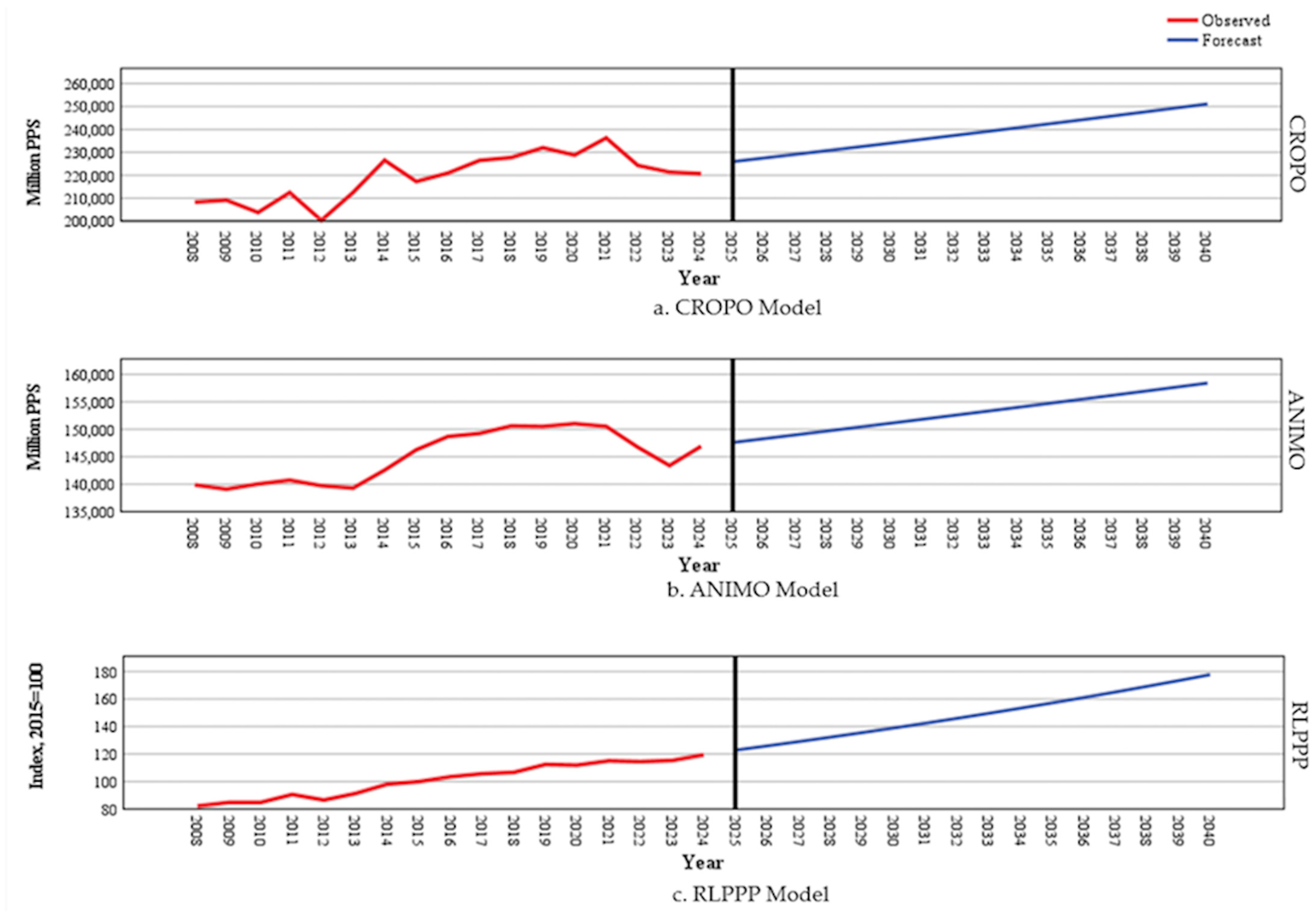
The projected developments are shown in a composite figure with three panels (Figure 1a: CROPO Model, Figure 1b: ANIMO Model, and Figure 1c: RLPPP Model), which help compare their evolutionary paths.
The models’ performance metrics show a generally good fit and acceptable predictive ability. The coefficients of determination are notably high, with an average R2 of about 0.75, indicating that the Holt models account for a substantial portion of the series’ variation. The Stationary R-squared confirms the models’ effectiveness in capturing the series dynamics after trend removal. Additionally, the low forecast errors, with an average MAPE below 2%, demonstrate precise estimation. The normalized Bayesian Information Criterion indicates a well-specified model with no unnecessary parameters.
A comparative analysis of forecasted trajectories shows upward trends in all three variables, each carrying unique economic and environmental implications. Crop production (Figure 1a) demonstrates consistent growth from 2025 to 2040, with predicted values indicating a gradual increase in output. The confidence intervals remain relatively stable, suggesting moderate uncertainty and a dependable forecast. This trend reflects ongoing agricultural modernization and yield improvements, but, ecologically, it suggests increased pressure on GHG emissions from more intensive use of agricultural inputs.
Animal production (Figure 1b) also shows a clear upward trend, with a steadier growth rate but still significant in its structural importance. Projections suggest the livestock sector will continue to expand, and the prediction intervals indicate stable behavior with little fluctuation. Because livestock are a well-known source of methane and nitrous oxide emissions, this trend underscores that ANIMO remains a significant contributor to agricultural emissions, despite overall gains in sectoral efficiency.
Unlike these production variables, real labor productivity in agriculture (RLPPP), shown in Figure 1c, shows a steady, more substantial increase throughout the forecast period. The data suggests ongoing improvements in labor efficiency driven by mechanization, digitalization, and the adoption of modern technologies. While RLPPP also trends upward, its impact on GHG emissions is fundamentally different: increased labor productivity reduces emission intensity through more efficient resource use and streamlined production methods.

4.4.2. Forecasting Model for per Capita GHG Emissions Based on Their Past Temporal Evolution

To understand the underlying patterns of per capita greenhouse gas emissions from agriculture, the study employs an ARIMA (0, 0, 0) time-series model. In this model, the change in GHGApc is based solely on its past values and the observation year. This method helps identify the independent trend in emissions without explicitly accounting for fluctuations in agricultural output or labor productivity.
The model’s performance indicators indicate a satisfactory fit. The R2 value of 0.547 suggests that about 55% of the variation in per capita agricultural GHG emissions is explained by the series’s time pattern. The same value for the Stationary R-squared confirms the series’s stability and the appropriateness of the chosen ARIMA model. Forecast errors are relatively low, with a mean MAPE of 1.468%, indicating strong predictive accuracy. RMSE and MAE reflect moderate deviations, consistent with the magnitude of the variable being analyzed. The normalized Bayesian Information Criterion (BIC = 6.131) supports the model’s simplicity (Table 8).
The estimated parameters reveal a positive, highly significant constant term (Constant = 8790.502; p < 0.001), indicating the average emission level over the study period (Table 9).
Concurrently, the “Year” variable shows a negative, statistically significant coefficient (−3.827; t = −4.259; p = 0.001), indicating a consistent decline in per capita agricultural GHG emissions over time. This result indicates that, in the medium- to long-term, per capita emissions tend to decrease gradually, even without explicitly accounting for other explanatory factors.
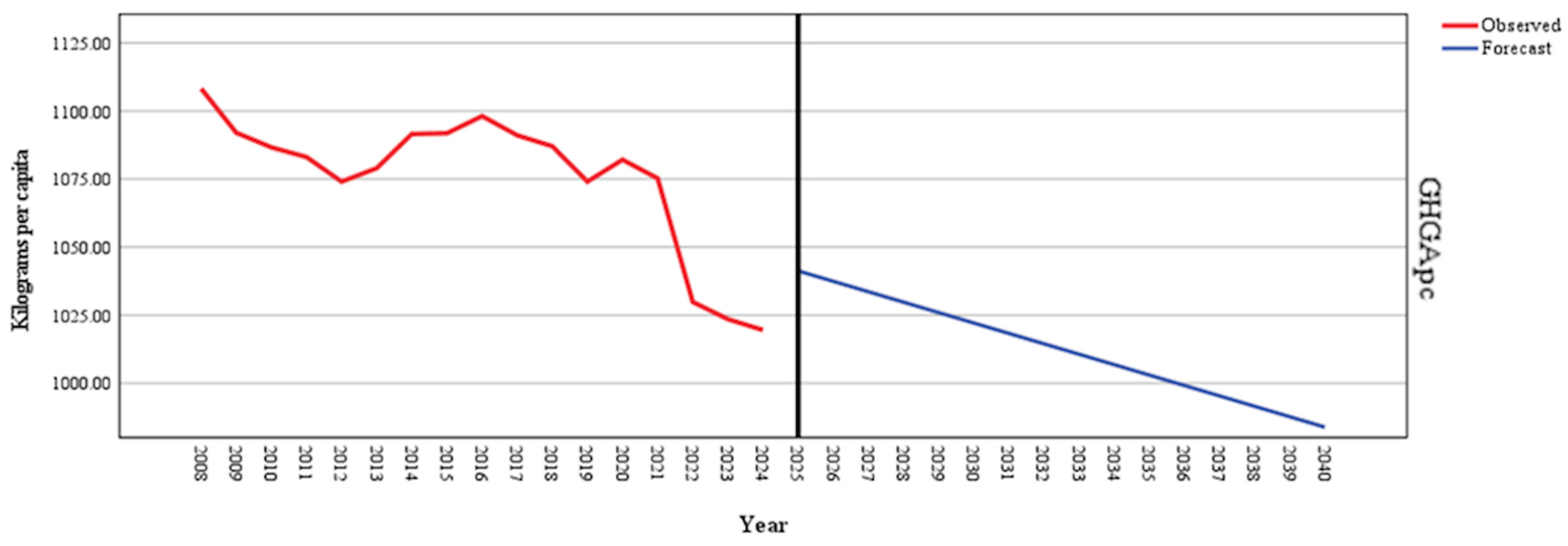
The forecast results verify this downward trend. Projected values for 2025–2040 show a steady decline in GHGApc, from around 1041 units in 2025 to roughly 984 units in 2040. The confidence intervals remain narrow and parallel, suggesting a stable, coherent estimate. Both bounds of the prediction intervals confirm that the decline is strong and only slightly affected by estimation uncertainty.
Figure 2 illustrates the forecasted evolution of per capita agricultural GHG emissions, while Table A1 in Appendix A reports the detailed forecast values, along with the lower and upper confidence interval bounds.

4.4.3. Forecasting Model for per Capita GHG Emissions Based on the Evolution of Crop and Animal Production

To evaluate how crop and animal production dynamics influence the change in per capita greenhouse gas emissions from agriculture, the study employs an ARIMA model with exogenous variables, explicitly incorporating CROPO and ANIMO as concurrent predictors of GHGApc. This approach enables examination of whether the two agricultural production components can independently predict variations in emissions, independent of the temporal effects already accounted for in the earlier model.
The model’s performance indicators show limited explanatory power, with an R2 of 0.040, indicating that only about 4% of the variation in per capita GHG emissions is explained by current changes in crop and animal production (Table 10).
The same Stationary R-squared value confirms that adding these predictors does not significantly improve the model fit compared to a purely autoregressive model. Additionally, the forecast errors (RMSE = 27.365; MAE = 19.020) and the normalized BIC (7.119) suggest that its predictive accuracy is worse than a model that only considers the temporal trend of GHGApc.
The parameter estimates indicate a positive, statistically significant constant term (Constant = 1131.492; p < 0.001), representing the average per capita agricultural GHG emissions over the period analyzed (Table 11).
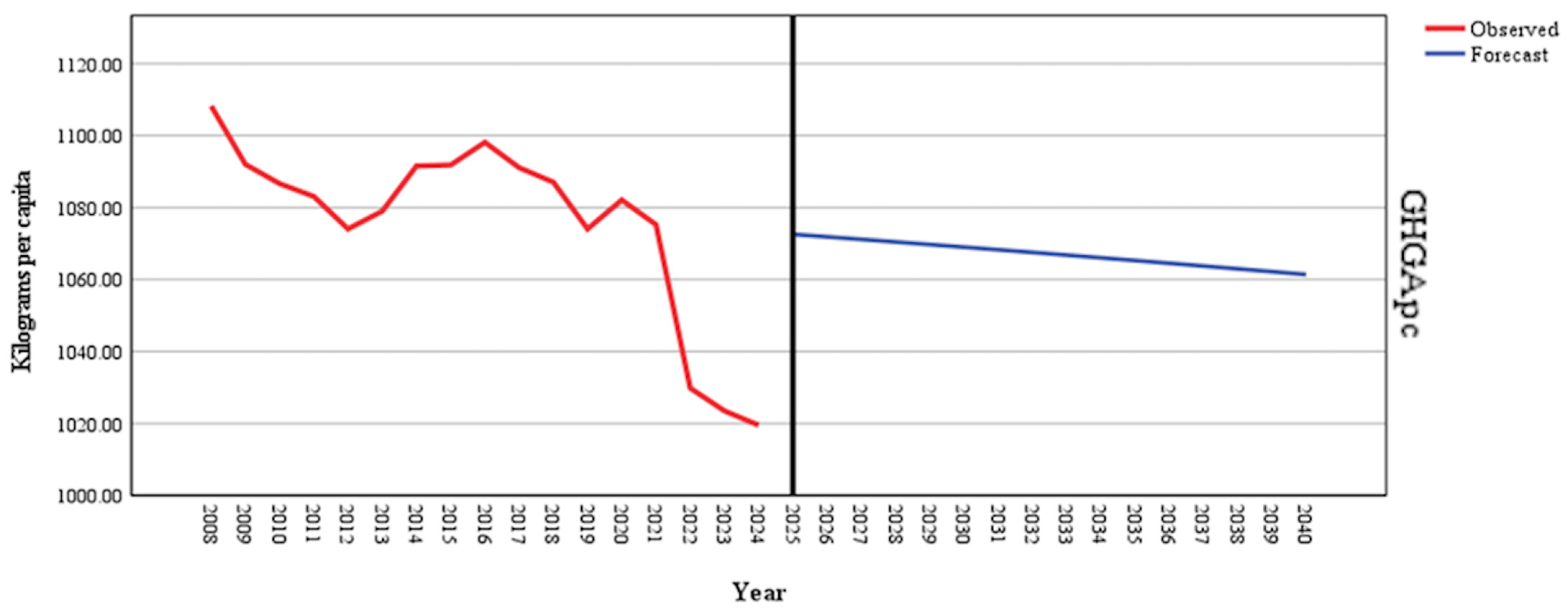
This model’s forecasts show a gradual, nearly linear decrease in GHGApc, from about 1073 units at the start to roughly 1061 units by the end of the forecast period. The confidence intervals stay wide and almost parallel throughout, reflecting considerable uncertainty and suggesting that the predictions are not highly sensitive to future CROPO and ANIMO values (see Figure 3 and Table A1 in Appendix A).
This model indicates that the impact of agricultural production on per capita GHG emissions is neither immediate nor linear. This aligns with the results from the regression and GLM analyses, which demonstrated that the effects of crop and animal production become significant when accounting for labor productivity and within more intricate structural relationships.

4.4.4. Forecasting Model for per Capita GHG Emissions Based on the Evolution of Real Labor Productivity in Agriculture

To analyze how real labor productivity influences the fluctuations in per capita greenhouse gas (GHG) emissions from agriculture, the study employs an ARIMA (0, 1, 0) time-series model. This model examines the link between consecutive changes in GHG per capita (GHGpc) and the progression of labor productivity. The selection of this model is based on the necessity to differ the series for stationarity and to emphasize long-term structural shifts.
The model’s performance metrics suggest a good fit. With an R2 of 0.737, the model explains about 74% of the variation in per capita GHG emissions, with labor productivity dynamics accounting for the remaining 26%. Although the Stationary R-squared is near zero, this aligns with the series’ differenced nature and does not affect the model’s predictive ability. The low forecast errors (RMSE = 13.111; MAE = 8.130) and the very low MAPE (0.762%) demonstrate high forecast accuracy, outperforming models based solely on production data or temporal trends.
The estimated parameters reveal a negative, statistically significant constant term (−5.544; p = 0.011). The negative value of this constant indicates a consistent downward trend in per capita GHG emissions, linked to increasing labor productivity and better agricultural process efficiency. Furthermore, the first-order differencing component indicates that emission fluctuations are driven primarily by temporal changes rather than by fixed levels.
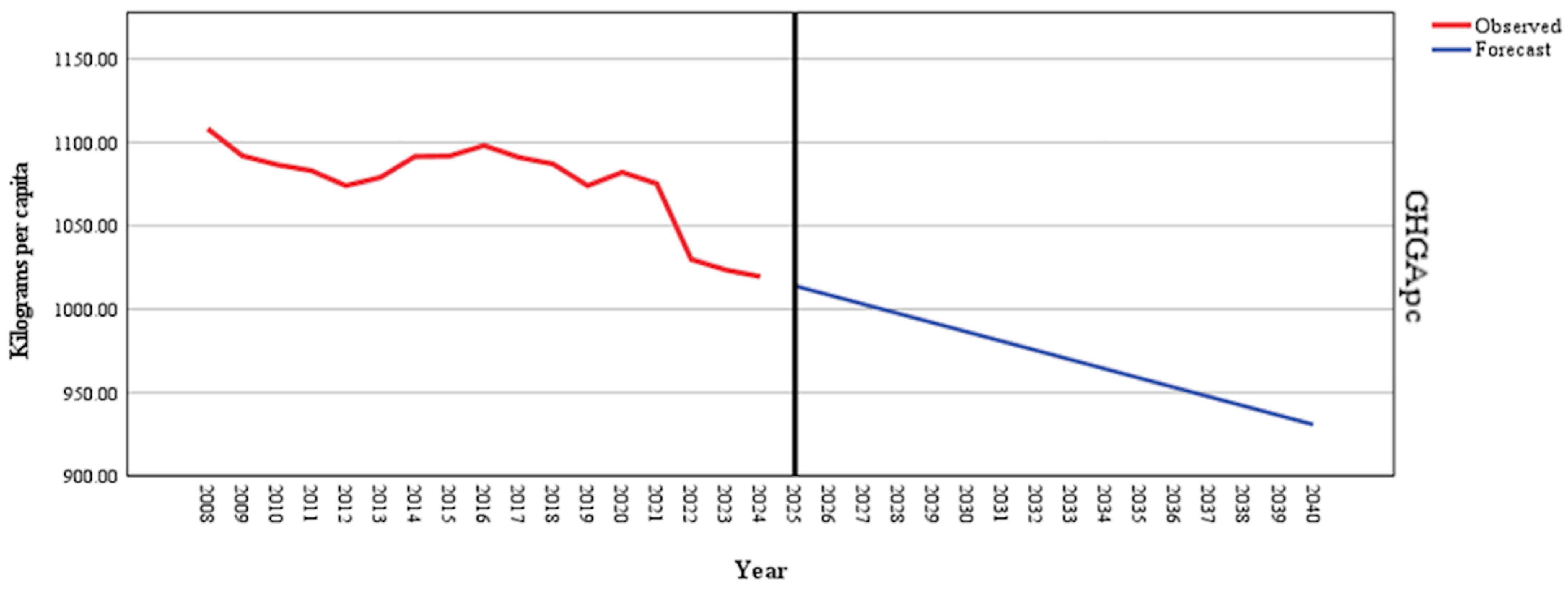
The forecast results indicate a pronounced and persistent decline in GHGApc throughout the entire forecast period; the estimated values decline from about 1014 units at the start to roughly 931 units by the end. This finding indicates a significant medium-term decrease in per capita agricultural GHG emissions (see Figure 4 and Table A1 in Appendix A).
Although the confidence intervals widen progressively, the central forecast trajectory remains clearly downward, indicating a high degree of robustness in the estimated trend.
Compared to a crop-and-animal production-based forecasting model, this approach offers significantly greater explanatory and predictive capabilities. It emphasizes real labor productivity as a key factor in reducing per capita GHG emissions. This finding aligns with the results of the multiple regression analyses and the GLM, both of which showed a strong negative impact of RLPPP on agricultural emissions. Overall, the ARIMA (0, 1, 0) model for GHGApc, accounting for RLPPP, supports the view that improvements in labor efficiency and technological progress are the primary means of decoupling agricultural growth from climate impacts. Comparing the three GHGApc forecasting scenarios (see Table A1 in the Appendix A) is crucial for validating Hypothesis H2. The trend-only forecast predicts a slow decline in GHGApc, from 1041 to 984 units. Meanwhile, the forecast based on CROPO and ANIMO remains relatively stable, around 1070–1060 units, indicating pressure from production growth. The forecast using RLPPP shows the largest decline, from about 1014 to 931 units.
These findings support Hypothesis H2 by showing that although expanding agricultural production generally raises emissions, increases in labor productivity serve as a crucial counterbalance. This process leads to lower per capita GHG emissions and promotes the shift towards more efficient agricultural systems aligned with climate-neutrality goals.
The results highlight a clear distinction between per capita and total emissions. While total emissions tend to increase with agricultural expansion, per capita emissions decline, mainly due to improvements in labor productivity. This finding indicates a process of relative decoupling, where efficiency gains partially offset the environmental impact of increased production.

5. Discussion

This study’s findings align with a broader analytical framework influenced by recent research on the links between agriculture, productivity, and climate change. They provide important empirical evidence supporting the two hypotheses. The analysis shows that greenhouse gas emissions from agriculture result from intricate interactions among production structures, factor-use efficiency, and the sector’s temporal dynamics and patterns, as repeatedly emphasized in earlier studies on European and global agriculture [4,5,20].
A key contribution of this study is the distinction between per capita and total greenhouse gas emissions. While total emissions reflect the overall environmental pressure of agricultural activity, per capita emissions capture efficiency improvements and structural transformation. The results show that although agricultural output continues to grow, improvements in labor productivity reduce per capita emissions. This divergence highlights the importance of using both indicators simultaneously: relying solely on total emissions may underestimate efficiency gains, while focusing solely on per capita emissions may overlook absolute environmental impact.
Regarding Hypothesis H1, the results from the multiple regression analyses and the Multivariate General Linear Model confirm that crop production, animal production, and real labor productivity have statistically significant effects on greenhouse gas emissions, both per capita and in total. However, the interpretation of these effects differs depending on the emission indicator considered. While increases in crop and animal production contribute positively to both per capita and total emissions, their impact is more pronounced in absolute terms, reflecting the expansion of agricultural activity. In contrast, real labor productivity exhibits a strong negative effect, particularly on per capita emissions, indicating that efficiency gains reduce emissions relative to population or output levels.
The positive influence of animal production is consistent with existing research identifying the livestock sector as a major source of agricultural emissions, primarily through methane from enteric fermentation and nitrous oxide from manure management [6,16]. Similarly, the positive relationship between crop production and emissions aligns with studies that highlight the roles of nitrogen fertilization, mechanization, and land-use practices in increasing N2O emissions and reducing soil carbon stocks [21,22]. At the same time, the strong negative effect of real labor productivity supports hypothesis H1b. It reinforces the argument that technological progress and improved efficiency can mitigate environmental pressures, even as production expands. This finding is consistent with the literature on relative decoupling in developed economies, where productivity gains help lower emissions intensity despite continued economic growth [8,9,31,32].
The validation of hypothesis H1c through the multivariate GLM analysis further emphasizes the importance of considering these factors jointly. The significant combined effects of crop production, animal production, and labor productivity on both emission indicators confirm that the interaction between production scale and efficiency shapes agricultural emissions. This integrated perspective supports previous research advocating multidimensional approaches to evaluating agricultural sustainability. It is particularly relevant to European policy frameworks that seek to balance emissions reduction, food security, and competitiveness [1,2,18,19,41].
The predictive analysis provides additional support for Hypothesis H2 by highlighting the dynamic nature of these relationships. Forecasts indicate a continued increase in crop and animal production, driven by structural trends and rising food demand, which exerts upward pressure on total emissions. This finding is consistent with existing studies emphasizing the environmental risks associated with agricultural intensification in the absence of mitigation strategies [5,6,28,49].
In contrast, projections based on real labor productivity reveal a consistent decline in per capita emissions, suggesting that efficiency improvements act as a counterbalancing force. This divergence between total and per capita emissions is a central finding of the study. While total emissions reflect the overall scale of agricultural activity and tend to increase with production growth, per capita emissions capture improvements in efficiency and technological progress. As a result, it is possible to observe a simultaneous increase in total emissions and a decrease in per capita emissions, indicating a process of relative decoupling. This finding is supported by studies that highlight the delayed yet significant impact of technological change and productivity growth on emission dynamics [34,39,50,51].
From a policy perspective, this distinction has important implications. Relying solely on total emissions may underestimate the progress achieved through efficiency improvements, while focusing exclusively on per capita emissions may overlook the continued environmental pressure associated with increasing production levels. Therefore, both indicators must be considered simultaneously to provide a balanced and accurate assessment of agricultural sustainability and climate performance [3,43].
Overall, the findings reinforce existing literature while offering a more nuanced interpretation of the relationship between agricultural production, labor productivity, and greenhouse gas emissions. They suggest that the transition toward climate-neutral agricultural systems depends not only on controlling production levels but, more importantly, on enhancing productivity and integrating technological innovation. Consequently, strategies focused solely on reducing output are insufficient; instead, policies should prioritize efficiency gains, technological advancement, and structural transformation to achieve long-term sustainability goals [1,2,28].

5.1. Theoretical Implications

This study’s empirical findings make a significant contribution to the environmental and agricultural economics literature by clarifying the interrelationships among agricultural production structure, labor productivity, and greenhouse gas emissions. Theoretically, the analysis emphasizes that climate models should not treat agriculture as a uniform sector; instead, they should adopt a nuanced approach that distinguishes between crop and animal farming and accounts for efficiency factors. Confirming that production increases emissions while higher labor productivity reduces them supports the idea of a relative decoupling of economic growth from environmental harm, tailored to agriculture’s specific biological and technological context.
Furthermore, the study broadens the application of the Environmental Kuznets Curve to agriculture by outlining conditions under which technological advancement and structural shifts can lower climate impact without sacrificing output. Using both per capita and total-emission measures enhances the sustainability framework, showing that climate performance can differ markedly across metrics. Combining static and dynamic analyses offers a fuller understanding of how economic activities influence environmental outcomes. It warns that ignoring temporal aspects might underestimate the importance of productivity and technological improvements. Overall, the research advocates a comprehensive view in which agricultural emissions result from complex interactions among production scale, efficiency, and long-term development pathways.

5.2. Practical Implications

In practical terms, the study’s findings offer clear guidance for shaping agricultural and climate policies, especially in the European Union. The validated importance of real labor productivity in reducing per capita emissions indicates that policies aimed solely at restricting production could backfire unless they also encourage efficiency and innovation. Consequently, investments in smart mechanization, digitalization, vocational training, and technology transfer are essential tools for achieving climate-neutrality goals.
Simultaneously, the beneficial effects of both crop and animal production on emissions underscore the need for targeted, subsector-specific policies that recognize the unique traits of livestock systems and the importance of fertilization in crop growth. The predictive analysis suggests that without efficiency-focused measures, increased production will continue to raise total emissions, even as per capita emissions decline. This finding highlights to policymakers the importance of using both relative and absolute indicators together for effective climate progress monitoring.
The study’s findings at the farm level support adopting practices that boost labor productivity and lower emission intensity while maintaining economic viability. Ultimately, the practical implications suggest that moving toward more sustainable agricultural systems is feasible through integrated policy frameworks that address competitiveness, food security, and environmental protection.

5.3. Limitations and Directions for Future Research

While the study provides strong results, it also has limitations that suggest directions for future research. Aggregated data at the European Union level do not account for differences among Member States, where variations in agricultural systems, climate conditions, and policies can lead to unique emission patterns. Future studies might analyze data at the national or regional level using more detailed panel data, enabling the identification of context-specific effects.
Furthermore, the modeling framework focuses on a limited set of explanatory variables, leaving out other important factors, such as dietary habits, subsidy programs, or technology-specific innovations. Including institutional and behavioral variables could enhance the models’ ability to explain emissions and offer more detailed insight into their underlying drivers.
Methodologically, time-series models effectively capture long-term trends but fall short of capturing structural breaks caused by major shocks, such as energy crises or sudden policy shifts. Future research might consider nonlinear models or scenario-based methods to achieve a more accurate assessment of climate transition pathways. Additionally, combining agricultural emissions with those from the entire food supply chain could provide a more comprehensive understanding of the environmental impact of agri-food systems.

6. Conclusions

The structure of production and labor productivity strongly shape the link between agriculture and greenhouse gas emissions. Clarifying these connections is crucial for developing effective climate policies. Empirical data indicate that increasing crop and livestock output tends to raise emissions significantly. In contrast, improvements in real labor productivity tend to lower emissions, particularly when emissions are measured per capita. The analysis shows that, despite ongoing growth in agricultural output, per-person emissions can decline as technological advances and labor efficiency improve. This trend suggests that achieving climate neutrality in agriculture does not necessarily require reducing production volumes; rather, it requires a deep transformation in how the sector organizes and functions.
By combining static and dynamic methods, the analysis provides a clear view of how agriculture can support climate goals without jeopardizing food security. The findings emphasize the importance of efficiency-focused, innovation-driven, and modernization policies as sustainable alternatives to restrictive measures. Overall, this study suggests that resilient agricultural systems aligned with climate neutrality will rely heavily on improving labor productivity and integrating technological advances within a sustainable development framework.

Funding

This research received no external funding.

Institutional Review Board Statement

Not applicable.

Informed Consent Statement

Not applicable.

Data Availability Statement

Conflicts of Interest

The author declares no conflict of interest.

Abbreviations

The following abbreviations are used in this manuscript:
EUEuropean Union
GHGGreenhouse gases
CROPOCrop output
ANIMOAnimal output
RLPPPReal labor productivity per person
GHGApcGreenhouse gases—Agriculture, forestry and fishing—per capita
GHGAttGreenhouse gases—Agriculture, forestry and fishing—tonnes
PPSPurchasing power standards
RMSERoot Mean Squared Error
MAPEMean Absolute Percentage Error
BICBayesian Information Criterion

Appendix A

Table A1. Historical data and forecasts.
YearCROPOANIMORLPPPGHGTpcGHGTpcGHGTpc
Historical data2008208,308.78139,896.4482.2551108.241108.241108.24
2009209,159.53139,118.4184.8701092.021092.021092.02
2010203,826.72140,065.5884.8801086.661086.661086.66
2011212,488.43140,761.9290.6481083.101083.101083.10
2012200,376.91139,751.4886.6291074.071074.071074.07
2013212,496.19139,313.8991.3991079.011079.011079.01
2014226,563.46142,590.8098.1361091.561091.561091.56
2015217,316.99146,278.40100.0001091.841091.841091.84
2016220,989.60148,696.30103.5851098.141098.141098.14
2017226,516.94149,248.19105.7501091.101091.101091.10
2018227,758.97150,618.05106.7401087.071087.071087.07
2019232,049.35150,523.80112.4821074.091074.091074.09
2020228,852.60151,030.00111.9971082.121082.121082.12
2021236,305.02150,533.32115.1191075.261075.261075.26
2022224,329.84146,742.97114.5641029.861029.861029.86
2023221,412.75143,421.17115.3801023.531023.531023.53
2024220,705.74146,917.13119.5001019.541019.541019.54
ModelCROPO, depending on the yearANIMO, depending on the yearRLPPP, depending on the yearGHGApc depending on the yearGHGApc depending on CROPO and ANIMOGHGApc depending on RLPPP
Forecasts2025225,986.8147,609.6122.891041.281072.581013.99
2026227,583.3148,305.5125.961037.451071.881008.45
2027229,191.1149,004.6129.091033.621071.181002.91
2028230,810.3149,707132.311029.81070.47997.36
2029232,440.9150,412.8135.611025.971069.75991.82
2030234,083151,122138.991022.141069.02986.27
2031235,736.7151,834.5142.451018.321068.29980.73
2032237,402.1152,550.51461014.491067.56975.19
2033239,079.2153,269.8149.641010.661066.81969.64
2034240,768.2153,992.5153.371006.841066.06964.1
2035242,469.2154,718.7157.191003.011065.3958.55
2036244,182.1155,448.4161.1999.181064.54953.01
2037245,907.2156,181.5165.12995.361063.77947.47
2038247,644.4156,918.1169.23991.531062.99941.92
2039249,393.9157,658.2173.45987.71062.21936.38
2040251,155.8158,401.8177.77983.881061.42930.83
Source: author’s design with SPSS v.27.0 (SPSS Inc., Chicago, IL, USA).

References

  1. IPCC. Climate Change 2021: The Physical Science Basis. Available online: https://www.ipcc.ch/report/ar6/wg1/downloads/report/IPCC_AR6_WGI_FullReport.pdf (accessed on 16 January 2026).
  2. OECD. The Climate Action Monitor 2022. Helping Countries Advance Towards Net Zero; OECD Publishing: Paris, France, 2022. [Google Scholar] [CrossRef]
  3. Reijnders, L. Climate-Neutral Agriculture? Environments 2023, 10, 72. [Google Scholar] [CrossRef]
  4. Gerber, P.J.; Steinfeld, H.; Henderson, B.; Mottet, A.; Opio, C.; Dijkman, J.; Falcucci, A.; Tempio, G. Tackling Climate Change Through Livestock. A Global Assessment of Emissions and Mitigation Opportunities; FAO: Rome, Italy, 2013; pp. 1–115. [Google Scholar]
  5. Leip, A.; Weiss, F.; Wassenaar, T.; Perez, I.; Fellmann, T.; Loudjani, P.; Tubiello, F.; Grandgirard, D.; Monni, S.; Biala, K. Evaluation of the Livestock Sector’s Contribution to the EU Greenhouse Gas Emissions (GGELS). Available online: https://agriculture.ec.europa.eu/system/files/2020-02/ext-study-livestock-gas-exec-sum_2010_en_0.pdf (accessed on 17 January 2026).
  6. Clark, M.A.; Domingo, N.G.G.; Colgan, K.; Thakrar, S.K.; Tilman, D.; Lynch, J.; Azevedo, I.; Hill, J.D. Global food system emissions could preclude achieving the 1.5° and 2 °C climate change targets. Science 2020, 370, 705–708. [Google Scholar] [CrossRef]
  7. Augustowski, Ł.; Kułyk, P.; Michałowska, M. Spatial Diversity of The Growth of Organic Farming in Poland, 2020. In Proceedings of the 35th International Business Information Management Association Conference (IBIMA): VISION 2025: Education Excellence and Management of Innovations through Sustainable Economic Competitive Advantage, Madrid, Spain, 1–2 April 2020; International Business Information Management Association (IBIMA): Norristown, PA, USA; pp. 14632–14640. [Google Scholar]
  8. Fuglie, K. Is agricultural productivity slowing? Glob. Food Secur. 2018, 17, 73–83. [Google Scholar] [CrossRef]
  9. Liobikienė, G.; Butkus, M. Determinants of greenhouse gas emissions: A new multiplicative approach analyzing the impact of energy efficiency, renewable energy, and sector mix. J. Clean. Prod. 2021, 309, 127233. [Google Scholar] [CrossRef]
  10. Intergovernmental Panel on Climate Change (IPCC). Agriculture, Forestry and Other Land Use (AFOLU). In Climate Change 2014: Mitigation of Climate Change; Cambridge University Press: Cambridge, UK, 2015; pp. 811–922. [Google Scholar] [CrossRef]
  11. Lynch, J.; Cain, M.; Frame, D.; Pierrehumbert, R. Agriculture’s Contribution to Climate Change and Role in Mitigation Is Distinct from Predominantly Fossil CO2-Emitting Sectors. Front. Sustain. Food Syst. 2020, 4, 518039. [Google Scholar] [CrossRef]
  12. European Environment Agency (EEA). EEA Greenhouse Gases—Data Viewer. Available online: https://www.eea.europa.eu/en/analysis/maps-and-charts/greenhouse-gases-viewer-data-viewers (accessed on 24 January 2026).
  13. Leahy, S.; Clark, H.; Reisinger, A. Challenges and prospects for agricultural greenhouse gas mitigation pathways consistent with the Paris Agreement. Front. Sustain. Food Syst. 2020, 4, 69. [Google Scholar] [CrossRef]
  14. Kabato, W.; Getnet, G.T.; Sinore, T.; Nemeth, A.; Molnar, Z. Towards climate-smart agriculture: Strategies for sustainable agricultural production, food security, and greenhouse gas reduction. Agronomy 2025, 15, 565. [Google Scholar] [CrossRef]
  15. Yu, B.; Liu, X.; Bi, X.; Sun, H.; Buysse, J. Agricultural resource management strategies for greenhouse gas mitigation: The land-energy-food-waste nexus based on system dynamics model. Environ. Impact Assess. Rev. 2025, 110, 107647. [Google Scholar] [CrossRef]
  16. Black, J.L.; Davison, T.M.; Box, I. Methane Emissions from Ruminants in Australia: Mitigation Potential and Applicability of Mitigation Strategies. Animals 2021, 11, 951. [Google Scholar] [CrossRef]
  17. Cai, Y.; Zhang, F.; Deng, X. Recoupled crop-livestock system can potentially reduce agricultural greenhouse gas emissions by over 40% in China. Environ. Impact Assess. Rev. 2025, 112, 107756. [Google Scholar] [CrossRef]
  18. Rokicki, T.; Koszela, G.; Ochnio, L.; Golonko, M.; Zak, A.; Szczepaniuk, E.K.; Szczepaniuk, H.; Perkowska, A. Greenhouse Gas Emissions by Agriculture in EU Countries. 2020. Available online: https://ros.edu.pl/images/roczniki/2020/057_ROS_V22_R2020.pdf (accessed on 12 January 2026).
  19. Czyżewski, A.; Michałowska, M. The Impact of Agriculture on Greenhouse Gas Emissions in the Visegrad Group Countries after the World Economic Crisis of 2008. Comparative Study of the Researched Countries. Energies 2022, 15, 2268. [Google Scholar] [CrossRef]
  20. Sokal, K.; Kachel, M. Impact of Agriculture on Greenhouse Gas Emissions—A Review. Energies 2025, 18, 2272. [Google Scholar] [CrossRef]
  21. Ruser, R.; Schultz, R. Nitrification Inhibitors and N2O Emissions. J. Plant Nutr. Soil Sci. 2015, 178, 171–188. [Google Scholar] [CrossRef]
  22. Gao, Y.; Serrenho, A.C. Reducing Emissions from Nitrogen Fertilizers. Nat. Food 2023, 4, 170–178. [Google Scholar] [CrossRef] [PubMed]
  23. Altieri, M.A.; Nicholls, C.I.; Henao, A.; Lana, M.A. Agroecology and the design of climate change-resilient farming systems. Agron. Sustain. Dev. 2015, 35, 869–890. [Google Scholar] [CrossRef]
  24. Stavi, I.; Lal, R. Agroforestry and Biochar. Agron. Sustain. Dev. 2013, 33, 91–96. [Google Scholar] [CrossRef]
  25. Minasny, B.; Malone, B.P.; McBratney, A.B.; Angers, D.A.; Arrouays, D.; Chambers, A.; Chaplot, V.; Chen, Z.-S.; Cheng, K.; Das, B.S.; et al. Soil Carbon 4 per Mille. Geoderma 2017, 291, 59–80. [Google Scholar] [CrossRef]
  26. Griscom, B.W.; Adams, J.; Ellis, P.W.; Houghton, R.A.; Lomax, G.; Miteva, D.A.; Schlesinger, W.H.; Shoch, D.; Siikamäki, J.V.; Smith, P.; et al. Natural Climate Solutions. Proc. Natl. Acad. Sci. USA 2017, 114, 11645–11650. [Google Scholar] [CrossRef]
  27. Locatelli, B.; Pavageau, C.; Pramova, E.; Di Gregorio, M. Integrating climate change mitigation and adaptation in agriculture and forestry: Opportunities and trade-offs. WIREs Clim. Change 2015, 6, 585–598. [Google Scholar] [CrossRef]
  28. Searchinger, T.; Waite, R.; Hanson, C.; Ranganathan, J. Creating a Sustainable Food Future; World Resources Institute: Washington, DC, USA, 2018; Available online: https://research.wri.org/sites/default/files/2019-07/WRR_Food_Full_Report_0.pdf (accessed on 17 January 2026).
  29. Bocean, C.G. A Cross-Sectional Analysis of the Relationship between Digital Technology Use and Agricultural Productivity in EU Countries. Agriculture 2024, 14, 519. [Google Scholar] [CrossRef]
  30. Radlińska, K. Changes in the Structure of Agriculture in Central and Eastern Europe in the Light of the European Green Deal. Sustainability 2025, 17, 104. [Google Scholar] [CrossRef]
  31. Coderoni, S.; Esposti, R. Is there a long-term relationship between agricultural GHG emissions and productivity growth? Environ. Resour. Econ. 2014, 58, 273–302. [Google Scholar] [CrossRef]
  32. van Vuuren, D.P.; Stehfest, E.; Gernaat, D.E.H.J.; Doelman, J.C.; van den Berg, M.; Harmsen, M.; de Boer, H.S.; Bouwman, L.F.; Daioglou, V.; Edelenbosch, O.Y.; et al. Energy, land-use and GHG emissions trajectories under a green growth paradigm. Glob. Environ. Change 2017, 42, 237–250. [Google Scholar] [CrossRef]
  33. González-Sánchez, M.; Martín-Ortega, J.L. Greenhouse Gas Emissions Growth in Europe: A Comparative Analysis of Determinants. Sustainability 2020, 12, 1012. [Google Scholar] [CrossRef]
  34. Mulusew, A.; Hong, M. A Dynamic Linkage between Greenhouse Gas Emissions and Agricultural Productivity: Evidence from Ethiopia. Humanit. Soc. Sci. Commun. 2024, 11, 52. [Google Scholar] [CrossRef]
  35. Grossman, G.M.; Krueger, A.B. Economic growth and the environment. Q. J. Econ. 1995, 110, 353–377. [Google Scholar] [CrossRef]
  36. Dinda, S. Environmental Kuznets Curve hypothesis: A survey. Ecol. Econ. 2004, 49, 431–455. [Google Scholar] [CrossRef]
  37. Sarkodie, S.A.; Strezov, V. A review on Environmental Kuznets Curve hypothesis using bibliometric analysis. Sci. Total Environ. 2018, 649, 128–145. [Google Scholar] [CrossRef]
  38. Olale, E.; Ochuodho, T.O.; Lantz, V.; El Armali, J. The environmental Kuznets curve model for GHG emissions in Canada. J. Clean. Prod. 2018, 184, 859–868. [Google Scholar] [CrossRef]
  39. Valin, H.; Havlík, P.; Mosnier, A.; Herrero, M.; Schmid, E.; Obersteiner, M. Agricultural Productivity and Greenhouse Gas Emissions: Trade-Offs or Synergies between Mitigation and Food Security? Environ. Res. Lett. 2013, 8, 035019. [Google Scholar] [CrossRef]
  40. Frank, S.; Havlík, P.; Soussana, J.-F.; Levesque, A.; Valin, H.; Wollenberg, E.; Kleinwechter, U.; Fricko, O.; Gusti, M.; Herrero, M. Reducing GHG emissions in agriculture without compromising food security? Environ. Res. Lett. 2017, 12, 105004. [Google Scholar] [CrossRef]
  41. Zafeiriou, E.; Mallidis, I.; Galanopoulos, K.; Arabatzis, G. Greenhouse Gas Emissions and Economic Performance in EU Agriculture: An Empirical Study in a Nonlinear Framework. Sustainability 2018, 10, 3837. [Google Scholar] [CrossRef]
  42. Fellmann, T.; Witzke, P.; Weiss, F.; Van Doorslaer, B.; Drabik, D.; Huck, I.; Salputra, G.; Jansson, T.; Leip, A. Integrating agriculture into climate change mitigation policies. Mitig. Adapt. Strateg. Glob. Change 2018, 23, 451–468. [Google Scholar] [CrossRef]
  43. Perrier, Q.; Guivarch, C.; Boucher, O. Diversity of greenhouse gas emission drivers across European countries since the 2008 crisis. Clim. Policy 2019, 19, 1067–1087. [Google Scholar] [CrossRef]
  44. Alkan, A.; Oğuş-Binatlı, A. Is Production or Consumption the Determiner? Sources of Turkey’s CO2 Emissions Between 1990–2015 and Policy Implications. Acettepe Üniversitesi İktisadi İdari Bilim. Fakültesi Derg. 2021, 39, 359–378. [Google Scholar] [CrossRef]
  45. Sala, D.; Liashenko, O.; Pyzalski, M.; Pavlov, K.; Pavlova, O.; Durczak, K.; Chornyi, R. The Energy Footprint in the EU: How CO2 Emission Reductions Drive Sustainable Development. Energies 2025, 18, 3110. [Google Scholar] [CrossRef]
  46. Porwollik, V.; Rolinski, S.; Heinke, J.; Müller, C. Generating a Rule-Based Global Gridded Tillage Dataset. Earth Syst. Sci. Data 2019, 11, 823–843. [Google Scholar] [CrossRef]
  47. Box, G.E.P.; Jenkins, G.M.; Reinsel, G.C.; Ljung, G.M. Time Series Analysis: Forecasting and Control, 5th ed.; Wiley: Hoboken, NJ, USA, 2015; pp. 1–712. [Google Scholar]
  48. Hyndman, R.J.; Athanasopoulos, G. Forecasting: Principles and Practice, 3rd ed.; OTexts: Melbourne, Australia, 2021; pp. 1–378. [Google Scholar]
  49. Tilman, D.; Balzer, C.; Hill, J.; Befort, B.L. Global food demand and the sustainable intensification of agriculture. Proc. Natl. Acad. Sci. USA 2011, 108, 20260–20264. [Google Scholar] [CrossRef]
  50. Kingwell, R. Making Agriculture Carbon Neutral Amid a Changing Climate: The Case of South-Western Australia. Land 2021, 10, 1259. [Google Scholar] [CrossRef]
  51. Duffy, C.; Prudhomme, R.; Duffy, B.; Gibbons, J.; O’Donoghue, C.; Ryan, M.; Styles, D. GOBLIN version 1.0: A land balance model to identify national agriculture and land use pathways to climate neutrality via backcasting. Geosci. Model Dev. 2022, 15, 2239–2264. [Google Scholar] [CrossRef]
  52. Liu, X.; Zhang, S.; Bae, J. The impact of renewable energy and agriculture on carbon dioxide emissions: Investigating the environmental Kuznets curve in four selected ASEAN countries. J. Clean. Prod. 2017, 164, 1239–1247. [Google Scholar] [CrossRef]
  53. Dzikuć, M.; Wyrobek, J.; Popławski, Ł. Economic Determinants of Low-Carbon Development in the Visegrad Group Countries. Energies 2021, 14, 3823. [Google Scholar] [CrossRef]
  54. Kalfagianni, A.; Kuik, O. Seeking optimality in climate change agri-food policies: Stakeholder perspectives from Western Europe. Clim. Policy 2017, 17, 72–92. [Google Scholar] [CrossRef]
  55. Eurostat. Economic Accounts for Agriculture—Values at Constant Prices. Available online: https://ec.europa.eu/eurostat/databrowser/view/aact_eaa03__custom_19757148/default/table (accessed on 24 January 2026).
  56. Eurostat. Labour Productivity and Unit Labour Costs by Industry. Available online: https://ec.europa.eu/eurostat/databrowser/view/nama_10_lp_a21__custom_17305093/default/table?lang=en (accessed on 24 January 2026).
  57. Eurostat. Air Emissions Accounts by NACE Rev. 2 Activity. Available online: https://ec.europa.eu/eurostat/databrowser/view/env_ac_ainah_r2__custom_19758302/default/table (accessed on 24 January 2026).
  58. Field, A. Discovering Statistics Using IBM SPSS Statistics, 6th ed.; SAGE Publications: New York, NY, USA, 2024. [Google Scholar]
  59. Aldrich, J.O. Using IBM® SPSS® Statistics: An Interactive Hands-On Approach, 3rd ed.; SAGE Publications: New York, NY, USA, 2018. [Google Scholar]
  60. Holt, C.C. Forecasting seasonals and trends by exponentially weighted averages. Int. J. Forecast. 2004, 20, 5–10. [Google Scholar] [CrossRef]
  61. Hamilton, J. Time Series Analysis; Princeton University Press: Princeton, NJ, USA, 1994. [Google Scholar]
  62. Papoulis, A. Probability, Random Variables, and Stochastic Processes; Tata McGraw-Hill Education: Irvine, CA, USA, 2002. [Google Scholar]
Figure 1. Forecasting Models for CROPO, ANIMO, and RLPPP Based on Exponential Smoothing (Holt) Models. Source: Author’s design using SPSS v.27.0 (SPSS Inc., Chicago, IL, USA).
Agronomy 16 01020 g001
Figure 2. Forecasting Model for Per Capita Agricultural GHG Emissions Based on Past Temporal Evolution. Source: Author’s design using SPSS v.27.0 (SPSS Inc., Chicago, IL, USA).
Agronomy 16 01020 g002
Figure 3. Forecasting Model for Per Capita Agricultural GHG Emissions Based on Crop and Animal Production. Source: Author’s design using SPSS v.27.0 (SPSS Inc., Chicago, IL, USA).
Agronomy 16 01020 g003
Figure 4. Forecasting Model for Per Capita Agricultural GHG Emissions Based on Real Labor Productivity in Agriculture. Source: Author’s design using SPSS v.27.0 (SPSS Inc., Chicago, IL, USA).
Agronomy 16 01020 g004
Table 1. Research variables.
VariableDatasetMeasureReferences
CROPOCrop outputMillion purchasing power standards (PPS)[55]
ANIMOAnimal output
RLPPPReal labor productivity per personIndex, 2015 = 100[56]
GHGApcGreenhouse gases—Agriculture, forestry and fishing—per capitaKilograms per capita[57]
GHGAttGreenhouse gases—Agriculture, forestry and fishing—total tonnesThousand tonnes[57]
Source: developed by the author based on Eurostat [55,56,57].
Table 2. Regression Model Coefficients for GHGApc.
Model Summary
R SquareAdjusted R-SquareStd. Error of the EstimateDurbin–Watson
0.9520.9416.323951.512
ANOVA
ModelSum of SquaresdfMean SquareFSig.
1Regression10,396.29033465.43086.6520.000
Residual519.9011339.992
Total10,916.19116
Coefficients
VariableUnstandardized CoefficientsStandardized CoefficientstSig.Collinearity Statistics
BStd.
Error
BetaToleranceVariance Inflation Factor
(Constant)433.61669.041 6.2810.000
CROPO0.0020.0000.6154.5650.0010.2024.955
ANIMO0.0050.0010.8306.4440.0000.2214.534
RLPPP−3.7970.241−1.828−15.7840.0000.2733.662
Note: Dependent Variable: GHGApc. Source: author’s design with SPSS v.27.0 (SPSS Inc., Chicago, IL, USA).
Table 3. Regression Model Coefficients for GHGTtt.
Model Summary
R SquareAdjusted R-SquareStd. Error of the EstimateDurbin–Watson
0.9210.903100,417.343912.106
ANOVA
ModelSum of SquaresdfMean SquareFSig.
1Regression1,537,223,605,975.5503512,407,868,658.51750.8160.000
Residual131,087,358,461.6761310,083,642,958.590
Total1,668,310,964,437.22616
Coefficients
VariableUnstandardized CoefficientsStandardized CoefficientstSig.Collinearity Statistics
BStd.
Error
BetaToleranceVariance Inflation Factor
(Constant)1,745,680.5261,096,300.142 1.5920.135
CROPO5.2075.4670.1650.9520.3580.2024.955
ANIMO26.53611.5920.3792.2890.0390.2214.534
RLPPP−34,986.7693819.396−1.363−9.1600.0000.2733.662
Note: Dependent Variable: GHGTtt. Source: author’s design with SPSS v.27.0 (SPSS Inc., Chicago, IL, USA).
Table 4. Multivariate Tests.
EffectValueFHypothesis dfError dfSig.Partial Eta SquaredObserved Power
InterceptPillai’s Trace0.75818.8362.00012.0000.0000.7580.999
Wilks’ Lambda0.24218.8362.00012.0000.0000.7580.999
Hotelling’s Trace3.13918.8362.00012.0000.0000.7580.999
Roy’s Largest Root3.13918.8362.00012.0000.0000.7580.999
CROPOPillai’s Trace0.69713.8152.00012.0000.0010.6970.989
Wilks’ Lambda0.30313.8152.00012.0000.0010.6970.989
Hotelling’s Trace2.30313.8152.00012.0000.0010.6970.989
Roy’s Largest Root2.30313.8152.00012.0000.0010.6970.989
ANIMOPillai’s Trace0.76919.9382.00012.0000.0000.7690.999
Wilks’ Lambda0.23119.9382.00012.0000.0000.7690.999
Hotelling’s Trace3.32319.9382.00012.0000.0000.7690.999
Roy’s Largest Root3.32319.9382.00012.0000.0000.7690.999
RLPPPPillai’s Trace0.968183.1022.00012.0000.0000.9681.000
Wilks’ Lambda0.032183.1022.00012.0000.0000.9681.000
Hotelling’s Trace30.517183.1022.00012.0000.0000.9681.000
Roy’s Largest Root30.517183.1022.00012.0000.0000.9681.000
Source: author’s design with SPSS v.27.0 (SPSS Inc., Chicago, IL, USA).
Table 5. Tests of Between-Subjects Effects.
SourceDependent VariableType III Sum of SquaresdfMean SquareFSig.Partial Eta SquaredObserved Power
Corrected ModelGHGApc10,396.29033465.43086.6520.0000.9521.000
GHGAtt1,362,536,014.5183454,178,671.50657.8600.0000.9301.000
InterceptGHGApc1577.49811577.49839.4450.0000.7521.000
GHGAtt274,064,907.1241274,064,907.12434.9140.0000.7291.000
CROPOGHGApc833.5491833.54920.8430.0010.6160.988
GHGAtt116,495,203.9271116,495,203.92714.8410.0020.5330.945
ANIMOGHGApc1660.74711660.74741.5270.0000.7621.000
GHGAtt339,080,300.5841339,080,300.58443.1970.0000.7691.000
RLPPPGHGApc9963.83619963.836249.1430.0000.9501.000
GHGAtt1,319,785,107.77211,319,785,107.772168.1330.0000.9281.000
ErrorGHGApc519.9011339.992
GHGAtt102,045,372.208137,849,644.016
TotalGHGApc19,682,809.98017
GHGAtt3,882,719,691,898.81317
Corrected
Total
GHGApc10,916.19116
GHGAtt1,464,581,386.72616
Source: author’s design with SPSS v.27.0 (SPSS Inc., Chicago, IL, USA).
Table 6. Parameter Estimates for GLM.
Dependent VariableParameterBStd. ErrortSig.Partial Eta SquaredObserved Power
GHGApcIntercept433.61669.0416.2810.0000.7521.000
CROPO0.0020.0004.5650.0010.6160.988
ANIMO0.0050.0016.4440.0000.7621.000
RLPPP−3.7970.241−15.7840.0000.9501.000
GHGAttIntercept180,737.16130,587.6225.9090.0000.7291.000
CROPO0.5880.1533.8520.0020.5330.945
ANIMO2.1260.3236.5720.0000.7691.000
RLPPP−1381.776106.564−12.9670.0000.9281.000
Source: author’s design with SPSS v.27.0 (SPSS Inc., Chicago, IL, USA).
Table 7. Model Fit Statistics for Forecasting CROPO, ANIMO, and RLPPP Using Exponential Smoothing (Holt) Models.
Fit StatisticMeanMinimumMaximumPercentile
5102550759095
Stationary R-squared0.5430.1980.7300.1980.1980.1980.7020.7300.7300.730
R-squared0.7530.5140.9580.5140.5140.5140.7880.9580.9580.958
RMSE3185.5122.6597361.3562.6592.6592.6592192.5217361.3567361.3567361.356
MAPE1.8541.0672.5101.0671.0671.0671.9852.5102.5102.510
MaxAPE5.1093.0706.6183.0703.0703.0705.6386.6186.6186.618
MAE2345.2782.0065486.5482.0062.0062.0061547.2795486.5485486.5485486.548
MaxAE6501.6584.88414,995.0514.8844.8844.8844505.04114,995.05114,995.05114,995.051
Normalized BIC12.0502.28918.1412.2892.2892.28915.71918.14118.14118.141
Source: author’s design with SPSS v.27.0 (SPSS Inc., Chicago, IL, USA).
Table 8. Model Fit Statistics for Forecasting Per Capita Agricultural GHG Emissions Based on Past Temporal Evolution Using an ARIMA Model.
Fit StatisticMeanMinimumMaximumPercentile
5102550759095
Stationary R-squared0.5470.5470.5470.5470.5470.5470.5470.5470.5470.547
R-squared0.5470.5470.5470.5470.5470.5470.5470.5470.5470.547
RMSE18.15018.15018.15018.15018.15018.15018.15018.15018.15018.150
MAPE1.4681.4681.4681.4681.4681.4681.4681.4681.4681.468
MaxAPE2.5082.5082.5082.5082.5082.5082.5082.5082.5082.508
MAE15.67715.67715.67715.67715.67715.67715.67715.67715.67715.677
MaxAE25.56725.56725.56725.56725.56725.56725.56725.56725.56725.567
Normalized BIC6.1316.1316.1316.1316.1316.1316.1316.1316.1316.131
Source: author’s design with SPSS v.27.0 (SPSS Inc., Chicago, IL, USA).
Table 9. ARIMA Model Parameters for Forecasting Per Capita Agricultural GHG Emissions Based on Past Temporal Evolution.
EstimateSEtSig.
GHGApcNo TransformationConstant8790.5021811.5024.8530.000
Source: author’s design with SPSS v.27.0 (SPSS Inc., Chicago, IL, USA).
Table 10. Model Fit Statistics for Forecasting Per Capita Agricultural GHG Emissions Based on Crop and Animal Production Using an ARIMA Model.
Fit StatisticMeanMinimumMaximumPercentile
5102550759095
Stationary R-squared0.0400.0400.0400.0400.0400.0400.0400.0400.0400.040
R-squared0.0400.0400.0400.0400.0400.0400.0400.0400.0400.040
RMSE27.36527.36527.36527.36527.36527.36527.36527.36527.36527.365
MAPE1.7961.7961.7961.7961.7961.7961.7961.7961.7961.796
MaxAPE5.5585.5585.5585.5585.5585.5585.5585.5585.5585.558
MAE19.02019.02019.02019.02019.02019.02019.02019.02019.02019.020
MaxAE56.66856.66856.66856.66856.66856.66856.66856.66856.66856.668
Normalized BIC7.1197.1197.1197.1197.1197.1197.1197.1197.1197.119
Source: author’s design with SPSS v.27.0 (SPSS Inc., Chicago, IL, USA).
Table 11. ARIMA Model Parameters for Forecasting Per Capita Agricultural GHG Emissions Based on Crop and Animal Production.
EstimateSEtSig.
GHGApcNo TransformationConstant1131.492229.4594.9310.000
Source: author’s design with SPSS v.27.0 (SPSS Inc., Chicago, IL, USA).
Disclaimer/Publisher’s Note: The statements, opinions and data contained in all publications are solely those of the individual author(s) and contributor(s) and not of MDPI and/or the editor(s). MDPI and/or the editor(s) disclaim responsibility for any injury to people or property resulting from any ideas, methods, instructions or products referred to in the content.