


Review

Integrating Envirotyping and Phenomics for AI-Enabled Multi-Environment Genomic Prediction in Crop Breeding

1
Cold Region Wetland Ecology and Environment Research Key Laboratory of Heilongjiang Province, Harbin University, Harbin 150086, China
2
State Key Laboratory of Urban Water Resource and Environment, Harbin Institute of Technology, Harbin 150086, China
3
College of Agricultural Science, Heilongjiang Bayi Agricultural University, Daqing 163319, China
*
Author to whom correspondence should be addressed.
Agronomy 2026, 16(10), 1019; https://doi.org/10.3390/agronomy16101019
Submission received: 13 April 2026 / Revised: 14 May 2026 / Accepted: 18 May 2026 / Published: 21 May 2026

Abstract

Genomic prediction is now routine in crop improvement, but its main bottleneck has shifted from marker density to environmental complexity. Breeders rarely need predictions for one fixed environment; they need to rank genotypes across target populations of environments that differ in weather, soils, management, and stress timing. This makes genotype-by-environment interaction a primary breeding problem rather than a secondary statistical nuisance. This review examines how genomic, environmental, and phenomic information can be integrated to improve multi-environment prediction in crop breeding pipelines. The review is narrative rather than PRISMA-style, but the literature search and selection logic were structured and explicitly defined. Peer-reviewed English-language studies were identified through structured searches of Web of Science Core Collection and Scopus, supplemented by backward citation screening, with emphasis on literature published from January 2023 to March 2026. Four conclusions emerge. First, environmental information is most useful when it is developmentally aligned, biologically interpretable, and matched to the target population of environments. Second, strong structured statistical baselines remain highly competitive, especially in moderate-sized or highly unbalanced datasets, whereas gains from more flexible machine-learning and deep-learning approaches are most evident in large, sparse, heterogeneous, and multimodal settings. Third, phenomic markers often improve prediction for complex traits, especially yield, because they capture realized crop responses not fully represented by markers alone. Fourth, practical value depends less on isolated gains in predictive accuracy than on evaluation under realistic deployment scenarios, including untested genotype and untested environment settings. Progress therefore requires transparent reporting, benchmark design, stage-aware envirotyping, multimodal integration, uncertainty reporting, and cost-aware deployment.

1. Introduction

Crop breeding increasingly depends on genomic prediction, but the main bottleneck is no longer marker density alone. Breeders need to rank genotypes across target populations of environments that differ in weather, soils, management, and stress timing. For traits such as yield, flowering time, grain moisture, stress adaptation, and harvestable quality, genotype-by-environment interaction is therefore a deployment problem, not a secondary statistical nuisance [1,2,3,4,5,6,7,8,9,10,11,12,13,14,15,16,17,18,19,20,21,22,23,24,25,26].
Recent work shows two constraints that frame this review. First, environmental data improve prediction only when they are biologically aligned with crop development, trait expression, and the intended deployment scenario; raw weather tables or site labels can add noise without improving transportability [26,27,28]. Second, flexible machine-learning or deep-learning models do not automatically outperform structured baselines. Mixed models, factor-analytic formulations, and reaction-norm approaches remain strong comparators, especially in moderate or unbalanced breeding datasets [26,29,30,31,32,33,34,35,36,37,38,39,40,41,42,43,44,45,46,47].
The contribution needed now is a narrower synthesis of the 2023–2026 literature on envirotyping, enviromics, phenomics, and multi-environment genomic prediction. This recent period is marked by larger benchmark trial resources, stage-aware environmental covariates, increasing multimodal learning, and more frequent evaluation under breeder-relevant scenarios such as new-genotype and new-environment prediction [48,49].
The central argument of this review is practical: further gains are most likely when genomic data, environmental representation, and field phenomics are aligned with the actual breeding decision. The review therefore emphasizes validation design, baseline choice, data-availability timing, uncertainty, and cost-aware deployment.
Accordingly, the review is organized around five evidentiary questions: what each data layer contributes, how environmental exposure is represented, which baselines are credible, how validation mirrors deployment, and where cost and uncertainty limit practical use.
This narrower framing is intended to separate conceptual enthusiasm from evidence that can support breeding decisions under multi-environment uncertainty.

2. Scope, Search Strategy, and Positioning of This Review

2.1. Literature Search and Selection Strategy

This article is a narrative review, not a PRISMA-style systematic review, but the literature selection process was structured rather than ad hoc. Literature identification was performed on 27–28 March 2026 using Web of Science Core Collection and Scopus as the primary bibliographic databases, followed by structured backward citation screening from relevant recent reviews and primary studies. These databases were selected because they are widely used in review-based evidence synthesis and provide broad coverage of peer-reviewed plant breeding, crop science, genetics, phenotyping, and data-integration literature. Searches were conducted using combinations of title, abstract, and keyword terms, and journal-page checks and citation tracing were used selectively for scope confirmation and metadata verification.
The search period was defined a priori as January 2023 to March 2026 to capture the most recent methodological phase of AI-enabled multi-environment prediction. This range was chosen because it corresponds to a visible transition from broad conceptual discussion toward benchmark-oriented, data-integrative studies that explicitly combine genomic, environmental, and phenomic information. Representative search strings included combinations of the following terms: “multi-environment genomic prediction crop breeding”, “genotype environment genomic prediction crop”, “envirotyping genomic prediction crop breeding”, “enviromics genomic prediction plant breeding”, “phenomic prediction crop breeding”, “high-throughput phenotyping genomic prediction crop”, “deep learning genomic prediction crop breeding”, “machine learning genomic selection crop breeding”, “environmental covariates genomic prediction crop”, and “phenomics-assisted genomic prediction crop”. Refinement searches were then added for narrower corridors such as satellite enviromics, UAS-enabled phenotyping, field phenotyping plus genomic prediction, and multi-trait multi-environment prediction. The complete search strings are provided in Supplementary Table S1.
The inclusion logic was designed to match the review question rather than to maximize article count. Studies were retained when they were peer-reviewed, written in English, published within the defined period, and directly relevant to at least one of the following: multi-environment genomic prediction, genotype-by-environment modeling, environmental covariate engineering, envirotyping or enviromics for breeding, phenomics-assisted prediction, multimodal genomic prediction, or breeder-relevant deployment frameworks. Studies were excluded when their focus was unrelated to breeding prediction, for example generic smart farming, crop disease image classification, Internet-of-Things applications, purely molecular stress biology without a predictive breeding component, or non-peer-reviewed preprints used as stand-alone evidence.
Reviews and primary studies were handled differently. Reviews were used mainly to define prior scope, terminology, and unresolved gaps, whereas primary studies were prioritized when they reported model comparisons, validation scenarios, baseline choices, or deployment-relevant outcomes. When several papers addressed similar questions, priority was given to studies that reported crop, trait, scale, data layers, validation design, and baseline comparator clearly enough to support structured comparison. Backward citation screening was iterative and stopped when additional records no longer changed crop coverage, modality coverage, or methodological conclusions. Supplementary Figure S1 summarizes the workflow, Supplementary Table S2 lists the included studies, and Supplementary Table S3 provides fuller study-comparison details. This process supports a focused methodological synthesis, but it is not a PRISMA-style exhaustive review or a quantitative sampling frame.

2.2. Terminology Used in This Review

Several terms are used inconsistently across the recent literature, so they are standardized here. Genotype-by-environment interaction (G×E) refers to differential genotype performance across environments. Target population of environments (TPE) refers to the environmental domain for which breeding decisions are intended [11]. In this review, envirotyping is used for biologically informed characterization of the environments experienced by a crop, typically using weather, soil, developmental, or management-derived descriptors [8,21,22]. Enviromics is used more broadly for large-scale environmental data integration for prediction, recommendation, or environmental similarity analysis, often including geospatial and remote-sensing layers [22,50,51,52,53]. Phenomics refers to high-dimensional plant-response measurements, especially repeated field-based measurements obtained through proximal or remote sensing [48,49,54,55,56,57,58,59]. In this review, the term phenomic markers refers to high-dimensional plant-response measurements used as predictive features, regardless of whether they originate from proximal sensing, UAS platforms, or derived temporal summaries. Multimodal learning refers to models that integrate more than one data layer, such as markers plus environmental covariates, or markers plus environmental plus phenomic information [30,33,45,60,61,62].
Two additional terms require practical clarification. Sparse testing refers to breeding strategies in which not all genotypes are tested in all environments, with prediction used to recover missing genotype-by-environment combinations [63,64]. Deployment scenario refers to the prediction context that the breeder faces, such as untested genotype in tested environment, tested genotype in untested environment, untested genotype in untested environment, or late-stage recommendation across a region [10,23,26,33,34]. Common abbreviations used repeatedly in the following sections are G×E, genotype-by-environment interaction; TPE, target population of environments; UAS, unmanned aircraft system; UAV, unmanned aerial vehicle; FA, factor analytic; and MTME, multi-trait multi-environment. UAS is used as the preferred umbrella term in the main text, whereas UAV is retained only where it remains conventional in the source literature.

2.3. What Distinguishes This Review from Recent Reviews

Several recent reviews cover adjacent territory, including broad AI applications in crop science, general genomic selection, and phenotyping technologies [54,55,65,66,67,68,69,70,71,72,73]. This review is narrower: it asks how genomic, environmental, and phenomic information are being combined for multi-environment prediction, and how such models should be judged under operational breeding scenarios.
Its intended novelty is therefore not a longer citation list, but a stricter organization of recent evidence around deployment: crop and trait context, data-layer timing, validation design, baseline choice, uncertainty, and decision stage. Table 1 compares the scope of the present review with selected recent reviews.
Three scope boundaries should also be stated explicitly. First, this review is about prediction for breeding use, not only biological discovery. Second, it emphasizes field or breeding-program relevance rather than controlled-environment phenotyping alone. Third, it does not treat image-based disease detection, generic smart agriculture, or stand-alone omics reviews as central evidence unless they directly inform multi-environment breeding prediction. The conceptual workflow used to organize the review is shown in Figure 1.

3. Why Multi-Environment Genomic Prediction Has Become a Bottleneck

3.1. Prediction Targets in Breeding Are Deployment Specific

Breeding programs rarely ask a single predictive question. They often need to rank untested genotypes in tested environments, tested genotypes in untested environments, untested genotypes in untested environments, and materials that combine mean performance with environmental stability. The difference among these targets is not cosmetic. A model that performs well in random cross-validation can still fail when the environment itself changes, or when the prediction target is a genuinely future year or untested location [33,34,64].
This is why large multi-environment datasets have become so important. The curated maize Genomes-to-Fields resource linked more than 70,000 phenotypic records to genomic and environmental information across more than 130 year-locations and over 4000 hybrids [15]. Such resources do not merely improve statistical power. They expose the mismatch between the environmental diversity that breeding programs care about and the subset of environments that are represented in routine trials. Even large trial networks still under sample stress timing, management variation, and environment types within the TPE [10,11].
Sparse testing studies in cassava, sugarcane, and other crops reinforce the same point. Prediction is becoming part of trial design rather than an afterthought applied once all data have been collected [63,64]. Consequently, multi-environment genomic prediction should be viewed as a design-and-deployment problem, not only a model-fitting problem.

3.2. Why Marker-Only Models Can Underperform for Environmentally Contingent Traits

Genomic prediction remains foundational in crop improvement, and recent reviews rightly emphasize its continuing value [74]. However, marker-only models can underperform in deployment scenarios where realized trait expression depends strongly on development-stage exposure to the environment. Grain yield is the clearest example, but flowering time, grain moisture, plasticity, and adaptation-related traits frequently show similar behavior [23,24,25].
The recent evidence is directionally consistent but conditional. In a winter wheat field study with 2994 lines evaluated across two sites and two years, phenomic markers from multispectral, hyperspectral, and visual field data explained more yield variation than genomic markers alone and combining the two data layers improved predictive performance over the strongest phenomic-only baseline [17]. In a maize multi-environment study using environmental feature engineering, machine-learning models reported gains over a factor-analytic mixed-model baseline, but those gains were tied to specific validation settings and environmental inputs rather than being universal [23]. In large maize trial networks, environmental covariates improved prediction in new environments when modeled through latent-factor or reaction-norm structures, but the magnitude of benefit depended on the environmental scenario and data sparsity [15,26].
The implication is not that markers are insufficient in general. Rather, markers encode inherited potential, whereas the realized phenotype is jointly determined by genotype, environment, management, and crop development. When the model does not represent environmental exposure well, genotype effects are forced to absorb structured variation they cannot fully explain. This is one reason why marginal gains observed within familiar environments can disappear when prediction is moved to unfamiliar or under-sampled conditions.
Smaller crop-specific studies point in the same general direction but also reveal how uneven the evidence base still is. Hybrid grain sorghum, spring barley, cotton, white lupin, coffee, and lentil studies all suggest that multi-environment or multi-source prediction can be useful beyond the dominant maize and wheat systems, but these studies are often based on fewer environments, narrower trait panels, or more local breeding contexts [75,76,77,78,79,80].

3.3. The Target Population of Environments Is Not a Background Concept

Recent breeding theory has sharpened the role of the TPE and shown why it belongs at the center of prediction design [11]. A TPE is not just a list of trial sites. It is a distribution of environment types, frequencies, stress combinations, and management contexts relevant to selection and product placement. This has two practical consequences. First, evaluation datasets must be interpreted relative to what part of the TPE they represent. Second, environmental descriptors should be chosen for their relevance to the TPE, not merely for their availability.
This framing helps explain why prediction in plant breeding is both statistical and operational. A model can only learn from the environmental states it has seen, the descriptors it has been given, and the missing-data pattern built into the field design. Environmental representation is therefore not a secondary preprocessing step. It is a core determinant of what kind of extrapolation is possible.

4. Environmental Representation: Envirotyping, Enviromics, and Crop Context

4.1. What Counts as Useful Environmental Information

The most mature recent studies treat environmental information as more than appended weather tables. Usable environmental information is developmentally meaningful, spatially relevant, and aligned with the intended prediction target [50,51,52,53]. This can include weather summarized by crop stage, soil descriptors, geospatial terrain variables, crop-model outputs, management proxies, or larger-scale remote-sensing products.
That distinction matters because raw environmental abundance does not guarantee useful signal. Daily weather records can still be weak predictors if they are not aligned with phenology or stress windows. Stage-aware covariates, photoperiod descriptors, temperature or radiation summaries linked to crop development, and water-balance proxies are often more informative because they translate exposure into biologically interpretable quantities [81,82]. The question is not whether environmental data should be included, but which environmental representations remain meaningful when moved from one breeding decision context to another.

4.2. Envirotyping and Enviromics Should Not Be Conflated

The recent literature often uses envirotyping and enviromics interchangeably, but the distinction is useful and should be stated early. In this review, envirotyping refers to crop-relevant characterization of the environments that plants experience, often at the field or growth-stage level [8,21]. Enviromics refers to broader environmental data integration across scales, including gridded climate products, geospatial layers, and satellite-derived data used for recommendation, clustering, mapping, or extrapolation [22,50,51,52,53].
This distinction clarifies why satellite-enabled approaches can be promising without being automatically sufficient. Satellite-enabled enviromics expands the spatial reach of environmental profiling and can help map breeding zones or environmental similarity across landscapes [22]. Yet its breeding value still depends on how well landscape-scale descriptors connect to plot-scale crop development, management, and trial design. Put differently, enviromics widens coverage, but envirotyping determines whether that coverage becomes biologically relevant for prediction.

4.3. Feature Engineering Versus Sequence-Based Environmental Encoding

One of the most active recent debates is whether environmental information should be summarized into hand-engineered covariates or learned directly from temporal sequences. Neither option is universally superior.
Feature engineering remains attractive because it is transparent, computationally efficient, and closer to breeder reasoning. In the Genomes-to-Fields maize benchmark, environmental covariates derived using crop-model logic created a more informative basis for G×E analysis than site labels alone [15]. In the maize grain-yield study using machine learning and environmental data, the authors explicitly argued that the feature-engineering stage itself served as a viable envirotyping strategy, and they reported that an additive genetic-plus-environment formulation could match or exceed more explicit multiplicative interaction encodings while also using less memory and time [23].
Sequence-based encoding becomes more attractive when the temporal structure of the environment is itself informative and when datasets are large enough to support more flexible learning. GEFormer exemplifies this direction by combining genomic inputs with daily environmental sequences, dynamic convolution, and attention-based temporal processing [33]. The reported advantage was strongest in hard deployment settings involving untested genotypes and untested environments, which is precisely where breeders most need better extrapolation. Even so, such models depend on richer environmental histories and larger training resources than many breeding programs currently possess.
The recent evidence therefore supports a qualified position. Feature-engineered environmental covariates often remain the more practical choice in moderate-sized programs, whereas sequence-based encoding is most promising when environmental histories are dense, the deployment problem truly demands temporal representation learning, and strong baselines have already been exhausted [32,33]. Sequence-based encoding may be unjustified when environmental records are short, heavily imputed, weakly aligned with crop stages, or unavailable at the actual decision horizon.

4.4. Crop Growth Models and Ecophysiological Mediation

Another constructive trend in the recent literature is the reintegration of crop modeling with genome-enabled prediction [20,27,28,83,84]. This trend is relevant because the phenotype that breeders observe is mediated by development, source-sink relationships, canopy trajectories, stress timing, and recovery dynamics. Purely statistical predictors may absorb some of this structure, but they do not explicitly represent how the crop moved through the season.
Hybrid systems that combine crop or ecophysiological models with genomic prediction can help in at least three ways. First, they can generate development-stage-aligned environmental covariates. Second, they can provide genotype-specific parameters or trait trajectories that are difficult to observe directly in every field setting. Third, they can improve interpretability by linking prediction to crop processes rather than to opaque environmental summaries. However, these benefits are conditional. Process-based descriptors can also propagate model misspecification if phenology, water balance, or management effects are poorly represented. Hybridization should therefore be viewed as a disciplined way to inject biological structure into prediction, not as a shortcut to causality.

4.5. Evidence from Representative Recent Studies

To assess current progress without implying quantitative comparability, Table 2 summarizes representative primary studies from 2023–2026 across crops, trial scales, data layers, model families, validation scenarios, baseline comparators, and deployment stages. These include, for example, a sesame study showing that multi-environment analysis improved genomic prediction accuracy for nine agronomic traits compared with single-environment models [85]. Because the studies differ in crops, traits, metrics, and validation designs, the tables support structured comparison rather than pooled effect estimation. The main tables have been kept compact; fuller descriptors are provided in Supplementary Table S3.
The tables are intended to support structured comparison, not quantitative pooling. Several patterns emerge, but they should be phrased cautiously. Multi-environment or envirotype-assisted models often outperform single-environment or genotype-only baselines in specific study settings; phenomics and multimodal inputs can add value for complex traits, especially yield; and model gains are most persuasive when tested under breeder-relevant validation scenarios. Direct across-study ranking is not warranted because crops, metrics, baseline models, and data availability differ.
Additional studies in spring barley, cotton, coffee, lentil, and white lupin suggest that the same logic extends beyond the best-known benchmark crops, but they also show that transferability of conclusions across crop types should be treated cautiously [76,77,78,79,80]. The field therefore needs more crop-diverse benchmarking rather than simply more algorithm classes.

4.6. Environmental Extrapolation Remains Conditional

The main test of environmental modeling is not within-sample fit but extrapolation. Can the model help in genuinely new environments? Recent evidence suggests yes, but not under all conditions.
The grain sorghum envirotyping study is particularly instructive because it showed that prediction gains for new environments depended on the mega-environment itself; improvements were clearer in temperate environments than in subtropical ones [21]. The 2025 maize GBLUP-GE study also showed that increasing the number of target-environment observations in the training set improved prediction for grain moisture and yield, which implies that environmental coverage still matters even when climate covariates are available [24]. MegaLMM likewise improved new-environment prediction in a very large maize dataset, but it did so in a setting with 195 trials and 87.1% missing phenotypes, illustrating that success depended on both scale and model structure [26].
These examples support a cautious conclusion. Environmental descriptors help most when they capture relevant environment classes, align with crop development, and are evaluated under withholding schemes that genuinely mimic deployment. Environmental representation is therefore powerful but not plug-and-play.

5. AI and Statistical Learning Architectures: What the Recent Evidence Actually Supports

5.1. Strong Baselines Still Define the Standard of Proof

The recent literature does not justify replacing structured statistical models by default. Mixed models, factor-analytic frameworks, reaction-norm approaches, and multi-trait formulations remain highly competitive because they handle unbalanced breeding data, relatedness, repeated environments, and missingness efficiently [10,12,15,19,26,31,32,86]. The correct comparison is not between “old statistics” and “new AI” as abstract categories. It is between methods that are credible for the specific data structure and deployment target of a breeding program.
MegaLMM is an important reminder that statistical innovation is still active. By extending a large-scale latent-factor framework to use environmental covariates for new-environment prediction, it improved performance relative to univariate GBLUP in a difficult maize setting characterized by heavy missingness and many trials [26]. Similarly, mmGEBLUP shows that linear mixed-model families continue to evolve in their handling of major genes, polygenes, and G×E effects [32]. These systems remain especially relevant when the number of environments is modest relative to the number of marker effects, or when interpretability and variance decomposition matter operationally.

5.2. When Machine Learning Adds Value

Machine learning becomes more attractive when nonlinear interactions are plausible, environmental descriptors are high dimensional, and a breeding program has enough heterogeneity to benefit from flexible representations [23,29,30,33,34,35,36,37,38,39,40,41,42,43,44,45,46,47,65,70,73,88,89,90,91,92]. Even then, the evidence is conditional rather than absolute.
One subspace is machine learning with engineered environmental covariates. In the maize grain-yield study based on multi-environment trial data, adding engineered environmental features increased the study-defined mean prediction accuracy by up to 7% relative to a factor-analytic multiplicative mixed-model baseline across three study-specific validation scenarios [23]. This gain is notable, but it should be interpreted within its boundaries: the crop was maize, the trait was grain yield, the dataset was large, and the advantage depended on feature engineering that translated the environment into structured inputs. The result should not be read as proof that machine learning dominates mixed models in all crops or traits.
Automated machine learning offers a related but distinct contribution because its value lies in model search and joint optimization rather than in automation alone. In a large-scale hybrid maize study, the reported predictive ability, as defined in the original article, increased by 14.02–28.42% relative to marker-only models under the authors’ study-specific validation settings when reduced environmental parameters and trait-associated markers were integrated [34]. Here again, the conditions matter. The gain came from combining genomic and environmental information in a large hybrid breeding context, not from AutoML by itself. The study is most convincing as evidence that environmental information can materially reshape predictive performance and genetic interpretation when the dataset is sufficiently rich.
Accordingly, the result is better interpreted as evidence for the value of joint environmental-feature reduction and model search than as evidence for automation alone.
More broadly, the design space now includes machine-learning-assisted climate resilience prediction, digitalized breeding workflows, crop-specific AI frameworks, and platformized genomic prediction systems [93,94,95,96,97,98,99]. These contributions expand the toolkit available to breeders, but they also make it more important to separate genuine evidence of decision improvement from generic claims that AI is modernizing breeding.

5.3. Where Deep Learning Is Most Credible

The strongest case for deep learning in this literature appears in multimodal, temporal, or otherwise hard-to-specify problems. Recent examples include multimodal deep learning in wheat [30], a deep-learning fusion framework for G×E genomic prediction [60,100], transformer-based genomic prediction [35], interpretable architectures such as Cropformer [42], and transfer-learning systems that integrate multi-trait information [45]. Deep learning is especially promising when multiple data streams must be fused and when interactions cannot be pre-specified easily.
However, the review evidence does not support the stronger claim that deep learning should generally replace simpler methods. Deep models usually require more environmental diversity, more careful validation, and more attention to leakage. Their performance is often most persuasive in scenarios involving untested environments, complex multimodal inputs, or time-resolved environmental sequences [30,33,35,42,45,60,65]. Evidence remains much thinner for routine deployment in smaller breeding programs, for crops outside maize and wheat, and for scenarios where multimodal data are sparse or delayed. In smaller or moderately structured breeding datasets, the operational advantage may remain uncertain even if the model is technically sophisticated.

5.4. Interpretation, Uncertainty, and the Credibility of Model Choice

Prediction models in breeding are decision tools, not only pattern-recognition systems. Breeders need to know not only which line ranks highly, but also under what environmental assumptions, with what uncertainty, and relative to which baseline. The current literature supports this need more as a recurring methodological gap than as a consistently reported evidence layer.
Recent studies have started to engage fragments of the problem. GEFormer provides an explicit architecture for genomic-environmental fusion and evaluates several deployment scenarios [33]. Cropformer emphasizes interpretability at the model-design level [42]. AutoML-based environmental modeling in maize links gains to reduced environmental parameters and classes of markers associated with plasticity, stability, and G×E [34]. The large-scale winter wheat UAS study, by contrast, is valuable partly because it states the conditional nature of its gains and the associated computing burden [48]. Still, breeder trust cannot rest on architecture names or attention maps alone. Interpretability is most useful when it clarifies which environmental windows, phenomic acquisition times, or trial structures make a prediction credible. Several recurring methodological lessons and failure modes are summarized in Table 3. As summarized conservatively in Table 4, formal uncertainty reporting remains uncommon among representative recent studies.
This challenge may become sharper as the surrounding tool ecosystem expands to include broader multi-omics pipelines, microbiome-linked adaptation signals, simulation environments, and genome foundation-model representations [101,102,103,104]. These resources may prove useful, but they should still be judged by whether they improve breeder-relevant decisions under transparent validation rather than by novelty alone.
Table 3. Recurring methodological lessons and failure modes in AI-enabled multi-environment prediction.
IssueTypical ManifestationWhen Most SeverePractical Response
Kinship leakage [26]Closely related genotypes occur in both training and test foldsFamily-structured breeding populationsUse family-aware splits or pedigree/genomic relationship constraints
Environmental leakage [15]Training and test sets share near-duplicate year-location contextsRepeated trial networks and short time spansUse leave-one-environment, leave-one-year, or site-withholding designs
Timing leakage [48,49,59] Late-season phenomics or weather summaries are used for early-stage claimsOperationally compressed breeding timelinesState explicitly when each data layer becomes available
Misaligned environmental covariates [8,15,22,23,27]Raw weather tables are added without stage alignmentTraits tied to developmental windowsUse stage-aware envirotyping or crop-model-informed summaries
Severe missing-data burden [26,63,64,86]Sparse genotype-environment matrices distort apparent gainsNetwork trials and sparse testingReport missingness pattern and compare against sparse-data-aware baselines
Weak baseline choice [23,26,31,32,33]AI models are compared only with marker-only baselinesMethod-comparison papersBenchmark against strong factor-analytic, reaction-norm, or mixed-model baselines
Unclear decision framing
[26,33,34,42,48]
Accuracy is reported without deployment stage, uncertainty, or cost contextLate-stage recommendation or expensive field validationReport scenario, uncertainty, and deployment use-case together
Table 4. Illustrative, non-systematic audit of uncertainty and deployment reporting across representative recent studies.
Representative Modality/ModelUncertainty Reported?Ranking Stability Reported?Compute Burden Reported?Sensing Burden Discussed?Deployment Stage Explicit?
Environmental covariates + MegaLMM [26]NoPartialNoNoYes
Engineered envirotyping + tree-based ML [23]NoNoYesNoYes
Daily environmental sequences + deep learning [33]NoNoPartialNoYes
AutoML with environmental feature reduction [34]NoNoNoPartialPartial
Bias analysis in genomic vs. phenomic selection [105]PartialNoNoNoPartial
UAS phenomics + genomic prediction [48]NoPartialYesPartialYes
Temporal high-throughput phenotyping + longitudinal GP [59]NoPartialNoPartialYes
Note: Studies were selected to span environmental, multimodal, and bias-sensitive settings, covering the main model classes and data modalities discussed in the review; the table is illustrative rather than exhaustive. Coding rules were intentionally conservative. Uncertainty reported = confidence interval, posterior interval, prediction variance, or another formal uncertainty summary explicitly reported. Ranking stability reported = top-k overlap, rank correlation across resamples or environments, or explicit stability analysis. Compute burden reported = runtime, memory, hardware requirement, or training-cost information. Sensing/acquisition burden discussed = explicit discussion of phenotyping logistics, flight frequency, acquisition cost, or availability constraints. Partial = mentioned qualitatively but not quantified.

5.5. Benchmark Hygiene, Leakage, and Fair Comparison

The expansion of AI methods has made benchmark hygiene one of the most important methodological issues in the field. Different studies vary in crop, relatedness structure, environmental withholding logic, trait definitions, and data timing. As a result, headline accuracy values are not directly comparable unless the validation framework is also compared [10,15,23,26,33,34,48].
Three risks are recurrent. The first is kinship leakage, in which closely related genotypes appear on both sides of the split. The second is environmental leakage, in which nearly duplicated year-location contexts are shared between training and test sets. The third is information-timing leakage, in which environmental or phenomic data available only late in the season are used to claim gains for decisions that breeders must make much earlier. These problems are not exclusive to AI studies, but they can exaggerate the apparent superiority of flexible models because such models readily exploit hidden overlap.
This concern is practical, not philosophical. A late-season multimodal model may be very useful for regional recommendation or product placement, yet irrelevant for early-stage preselection. Likewise, a model that performs well under random cross-validation may still be weak under environment withholding. Good benchmarking therefore requires decision-aligned validation, transparent timing of data availability, and explicit comparison against strong statistical baselines rather than straw-man baselines.

5.6. Minimum Reporting Recommendations for Future Studies

To improve comparability across the field, recent concerns about leakage, deployment mismatch, and incomplete reporting can be translated into a minimum reporting standard. The goal is not bureaucratic uniformity, but enough transparency for readers to evaluate whether a prediction study is relevant to breeding use.
Any reported gain should be linked to an explicit baseline and a clearly defined metric. For studies intended to support advancement or recommendation, reporting should also include uncertainty, rank-based results, computational cost, sensing burden, and, where possible, the availability of code, data, or benchmark metadata for reproducibility [10,15,23,26,33,34,48].

6. Phenomics-Assisted and Multimodal Prediction

6.1. Why Phenomic Markers Are Not Redundant with Genomic Markers

Field phenomics increasingly functions as a predictive layer rather than only as trait measurement. Genomic markers describe inherited potential, whereas phenomic markers capture realized plant responses after genotype, management, and environment have interacted. For yield and other complex traits, phenomic variables can contain current-season information that markers alone cannot represent [17,48,49,54,55,56,57,58,59,87,105,106,107,108].
In winter wheat, phenomic variables derived from multispectral, hyperspectral, and visual field measurements explained more yield variation than genomic markers alone, and combined genomic-plus-phenomic models improved performance over the strongest phenomic-only baseline in cross-location prediction [17]. This supports the value of phenomics in large, field-based, complex-trait settings; it does not mean that phenomics can generally replace genomics.

6.2. Timing of Phenomic Acquisition Matters as Much as Sensor Quality

Recent phenomics studies now focus less on sensor novelty alone and more on timing, scale, trait engineering, and deployment [48,49,54,55,56,57,58,59,67,108]. The key question is whether the phenomic signal is available before the relevant breeding decision.
Two use cases should be separated. Current-season augmentation can improve an in-season or late-stage decision when measurements are available in time; the large winter wheat UAS study reported at least 16% higher prediction accuracy when test-year NDVI was available under leave-one-year-out validation [48]. Cross-season transportable prediction is harder, because the same study found limited cross-year reliability and substantial computing demands for stronger multivariate models [48].
Rice UAS nitrogen monitoring, coffee genomic-versus-phenomic comparisons, and temporal sesame phenotyping reinforce the same point: timing and deployment context matter as much as sensor quality, and current-season augmentation should not be benchmarked interchangeably with cross-season transportable prediction [59,79,109].

6.3. Temporal Phenotyping Changes the Prediction Problem

Time-series phenotyping captures development, stress onset, and recovery rather than only endpoint traits [20,49,59,110]. Its value is not simply more data volume; it changes the prediction target from static ranking toward developmental inference.
That shift is useful only if temporal structure is modeled honestly. Longitudinal genomic prediction and multi-trait approaches can exploit repeated measurements, but irregular sampling, growth-stage misalignment, and late-season leakage can make results appear more transferable than they are [49,59].

6.4. Multimodal Fusion Is Promising, but Not All Data Layers Earn Their Cost

Multimodal studies now combine markers with phenomics, environmental covariates, remote sensing, metabolomic markers, or crop-model outputs [20,27,30,45,49,53,60,61,62,84,106,107,111]. The practical test is not whether an extra data layer increases retrospective accuracy, but whether it changes a decision in time and at acceptable cost.
The strongest case for multimodal prediction arises when each layer contributes distinct information: markers support portability across untested material, environmental descriptors define exposure context, and phenomics captures realized response. If a data stream is costly, delayed, or difficult to standardize, its breeding value remains limited even when it is scientifically informative.
Crop and program scale constrain this logic. Horticultural hybrid prediction, lentil genomic selection, and legume-oriented multi-omics studies extend relevance beyond large cereal networks, but they often operate with smaller populations, longer cycles, or different cost structures [80,112,113].

6.5. Interpreting Cases Where Genomic and Phenomic Signals May Diverge

When genomic and phenomic predictions disagree, the discrepancy should not automatically be treated as model instability. Genomic prediction is more portable across untested material and useful earlier in the cycle; phenomic prediction is closer to realized current-season performance and specific stress responses.
Recent winter wheat and Coffea canephora studies show that phenomic layers can capture useful realized-response information [79,87]. However, bias analyses warn that phenomic prediction can look overly strong when independence is not preserved [105]. Multimodal systems should therefore preserve the distinction among genomic, environmental, and phenomic evidence until the deployment question justifies integration into a single score.

7. From Prediction Accuracy to Breeding Use

7.1. Validation Design Must Mirror the Breeding Question

Many prediction studies still report metrics under random splits that are easier than the decisions breeders face. This is now one of the clearest weaknesses in the literature. Predicting a known genotype in a familiar environment is not the same as predicting an untested genotype in an untested environment, nor is it the same as filling sparse testing matrices across a trial network [10,15,19,23,24,25,26,33,34,64].
The best recent papers state the deployment scenario explicitly. GEFormer reported separate results for untested genotypes in tested environments, tested genotypes in untested environments, and untested genotypes in untested environments [33]. MegaLMM focused directly on new-environment prediction [26]. The pulse-crop MTME study contrasted whole-environment and split-environment cross-validation [86]. These are not minor technical choices. They determine whether a reported gain is relevant for early-stage selection, sparse testing, or late-stage deployment.

7.2. Breeding Stage Determines Which Model Family Is Realistic

Prediction value depends strongly on breeding stage. Early in the pipeline, programs need inexpensive ranking of many candidates, often before dense phenomics are available. Mid-pipeline, breeders may be able to use historical trial information and some environmental structure. Late-stage advancement and regional recommendation can justify richer models because fewer candidates remain and the cost of error is higher [10,15,17,23,24,26,34,48,62,64,72].
This logic means that there is no universally best model family. Marker-only or marker-plus-basic-environment models may still be adequate for early-stage preselection. Stage-aware environmental models are attractive for sparse testing and new-environment prediction. Rich multimodal models are most justified when their additional data streams arrive in time to change late-stage decisions. A review that ignores this stage structure risks overvaluing technically impressive models that do not fit breeding operations.

7.3. Uncertainty and Economic Decision Value Should Be Reported Together

Accuracy alone is not enough to define usefulness. Breeders often make threshold decisions: which lines move forward, which hybrids justify another year of testing, or which product candidates merit costly regional deployment. The practical value of a prediction therefore depends on uncertainty, ranking stability, and the economic consequence of ranking errors.
This is particularly important in multi-environment settings. A model may provide modest average gains while still offering large operational value if it reduces field-testing burden in expensive environments. Conversely, a sophisticated multimodal system may improve correlation slightly but remain economically unattractive if it requires repeated sensor flights, complex preprocessing, or high-performance computing beyond what the program can sustain [23,34,48,62,63]. For this reason, future studies should report not only predictive performance but also uncertainty, compute burden, sensing cost, and the decision stage for which the model is intended. A credible reporting standard will also require coordination among journals, reviewers, data repositories, and breeding consortia; it cannot be enforced by isolated breeding programs alone.
In practical breeding pipelines, rank-based agreement among the top selected entries may be more informative than global correlation metrics. Table 4 is an illustrative, non-systematic reporting audit of representative environmental, multimodal, and bias-sensitive studies selected to span major model classes and data modalities discussed in this review. It is not an exhaustive audit of every study cited in Table 2, not a balanced sample by crop or algorithm, and not a quantitative audit of the entire screened literature. Statements about uneven or uncommon reporting should therefore be read as qualitative observations about this representative set, not as prevalence estimates. Future studies should increasingly report rank-based measures such as top-k overlap, selection coincidence, or expected regret, because these are often closer to actual advancement decisions than correlation alone.

7.4. A Practical Framework for Stage-Specific Deployment

One of the clearest messages of the recent literature is that model choice should start from the breeding decision, not from the algorithm class. Table 5 presents a matrix-style deployment framework linking breeding stage, typical candidate number, data realistically available at decision time, suitable validation design, realistic model families, and the main decision target. The framework is intentionally simple and comparative rather than decorative. It is not a replacement for program-specific optimization within a given breeding pipeline and TPE, but it can help readers translate methodological claims into operational choices.
The framework also helps explain why strong baselines remain important. In early-stage preselection, there may be little justification for a highly multimodal system. In sparse testing, environmental covariates and reaction-norm models become more relevant. In late-stage regional recommendation, richer multimodal models may be justified because the decision is expensive, and the data horizon is longer. The same model class can therefore be either over-engineered or well matched depending on when it is used.

7.5. Practical Design Rules for Readers and Future Authors

Five practical rules follow from the evidence synthesized here. First, define the deployment scenario before choosing the model. Second, compare against strong mixed-model or factor-analytic baselines, not only against marker-only straw men. Third, report when each data layer becomes available relative to the breeding decision. Fourth, distinguish within-environment interpolation from genuine new-environment extrapolation. Fifth, discuss cost, uncertainty, and interpretability together rather than treating them as separate afterthoughts.
These rules are simple, but they address many of the recurring weaknesses in the recent literature. They also help explain why the same methodological claim can be valid in one breeding stage and unconvincing in another.

8. Current Limitations and Priorities for the Next Phase

The evidence base remains promising but uneven. The first limitation is cropping imbalance. Maize and wheat dominate the strongest methodological papers because they benefit from large trial networks, national datasets, and comparatively mature phenotyping infrastructures [34,48]. This imbalance is not just a benchmarking issue. It shapes the apparent maturity of the field. Among the 14 primary studies summarized in Table 2, 7 focus directly on maize or wheat, and 9 concern cereal systems once sorghum and multi-crop cereal benchmarks are included. Methods that look robust in maize may be much less tested in pulses, oilseeds, roots and tubers, or minor cereals.
These counts refer only to the representative studies summarized in Table 2 and should not be interpreted as a formal prevalence estimate for the entire screened literature.
Important breeding targets also differ across crop systems. Resource-use efficiency, drought tolerance, grain protein, seed quality, climate resilience, perennial yield stability, juvenile-period reduction, and stress-linked adaptation are all prominent in cereals, pulses, oilseeds, horticultural crops, fruit trees, vines, coffee, oil palm, and forestry or plantation systems. The frameworks summarized in Table 5 are transferable as decision logic, but not as plug-and-play prescriptions for perennial or highly cross-pollinated systems, where longer cycles, clonal or family structure, sparse harvest records, and dispersed trial networks require adapted validation splits, cost assumptions, and phenomic timing [78,79,80,112,114,115,116,117,118,119].
The second limitation is incomplete environmental representation. Even sophisticated pipelines still struggle to integrate management, soil heterogeneity, in-season biotic stress, and microclimate at the scale breeders need. Satellite-enabled enviromics, CLIM4OMICS-type resources, and gridded environmental products expand coverage, but they do not automatically solve alignment with plot-level breeding observations [22,53]. Environmental ontology and stage-aware alignment remain underdeveloped.
An additional limitation of this review is that the search was restricted to English-language peer-reviewed literature indexed primarily through database and backward citation tracing, which may underrepresent some relevant studies outside that coverage.
The third limitation is uncertainty reporting. Many papers still foreground mean accuracy values without making clear how prediction uncertainty, ranking instability, or confidence intervals would influence selection decisions. This weakens translation to real breeding.
The fourth limitation is interoperability. Multimodal systems require compatible metadata, synchronized timing, and consistent preprocessing across genomics, phenomics, and environmental records. Many breeding programs still lack low-friction pipelines connecting these layers from field to decision dashboard. Several digital breeding tools and platform initiatives describe infrastructure that may help address this problem, but direct evidence that these resources resolve operational bottlenecks in routine deployment remains limited [120,121].
The fifth limitation is the unresolved balance between predictive flexibility and biological explanation. Deep learning and transfer learning can represent complex nonlinear relationships, but breeder trust will remain limited unless predictions can be connected to interpretable environmental windows, physiological expectations, or clearly defined deployment logic [83,84,110].
The sixth limitation is economic realism. A model that improves an abstract metric by a small amount may or may not improve realized genetic gain once labor, sensing, compute cost, and cycle time are considered. This review therefore supports a broader reporting standard in which cost, uncertainty, timing, and interpretability are discussed alongside performance metrics.
Finally, future crop improvement itself is becoming more diverse in its germplasm and design goals. Work on next-generation domestication and broader digital breeding architectures suggests that prediction systems may soon need to cover more diverse genetic backgrounds and adaptation targets than current benchmarks represent [122]. If so, the need for explicit environmental representation, fair benchmarking, and deployment-aware reporting will only become stronger.

9. Conclusions

Multi-environment genomic prediction is entering a more mature phase. The strongest recent contributions are not generic claims for AI, but studies that align genomic data, environmental representation, field phenomics, and validation design with concrete breeding decisions.
The main message is conditional. Environmental covariates help when they are developmentally and biologically aligned; strong mixed-model and reaction-norm baselines remain essential; phenomics can add value when acquired before the decision point; and flexible AI models are most credible in large, heterogeneous, multimodal, and difficult extrapolation settings.
Future work should standardize scenario-specific validation, baseline comparison, data-timing disclosure, uncertainty reporting, and deployment-cost assessment. These requirements are pragmatic rather than cosmetic: without them, apparent model gains remain difficult to translate into breeding decisions.

Supplementary Materials

The following supporting information can be downloaded at: https://www.mdpi.com/article/10.3390/agronomy16101019/s1, Figure S1: Literature search and study selection workflow; Table S1: Search strings and search-frame information used for literature identification; Table S2: Final list of curated references included in the review; Table S3: Full details of representative studies summarized in Table 2.

Author Contributions

Conceptualization, X.L., D.Y. and S.Y.; Methodology, X.L.; Software, X.L.; Validation, X.L., S.Y., Y.W., D.Y. and Y.J.; Formal Analysis, X.L.; Investigation, X.L.; Resources, X.L.; Data Curation, X.L.; Writing—Original Draft Preparation, X.L.; Writing—Review and Editing, X.L., S.Y., Y.J., Y.W. and D.Y.; Visualization, X.L.; Supervision, S.Y. and D.Y.; Project Administration, S.Y.; Funding Acquisition, Y.J. All authors have read and agreed to the published version of the manuscript.

Funding

This article was funded by the Heilongjiang Provincial Natural Science Foundation of China (PL2025D007).

Data Availability Statement

Data are available through request to the corresponding author.

Conflicts of Interest

The authors declare no conflicts of interest.

References

  1. Huang, S.; Gali, K.K.; Arganosa, G.C.; Tar’an, B.; Bueckert, R.A.; Warkentin, T.D. Breeding indicators for high-yielding field pea under normal and heat stress environments. Can. J. Plant Sci. 2023, 103, 259–269. [Google Scholar] [CrossRef]
  2. Robles-Zazueta, C.A.; Crespo-Herrera, L.A.; Piñera-Chavez, F.J.; Rivera-Amado, C.; Aradottir, G.I. Climate change impacts on crop breeding: Targeting interacting biotic and abiotic stresses for wheat improvement. Plant Genome 2024, 17, e20365. [Google Scholar] [CrossRef]
  3. van Etten, J.; de Sousa, K.; Cairns, J.E.; Dell’Acqua, M.; Fadda, C.; Guereña, D.; Heerwaarden, J.V.; Assefa, T.; Manners, R.; Müller, A.; et al. Data-driven approaches can harness crop diversity to address heterogeneous needs for breeding products. Proc. Natl. Acad. Sci. USA 2023, 120, e2205771120. [Google Scholar] [CrossRef]
  4. Montesinos-López, O.A.; Crespo-Herrera, L.; Saint Pierre, C.; Bentley, A.R.; de la Rosa-Santamaria, R.; Ascencio-Laguna, J.A.; Agbona, A.; Gerard, G.S.; Montesinos-López, A.; Crossa, J. Do feature selection methods for selecting environmental covariables enhance genomic prediction accuracy? Front. Genet. 2023, 14, 1209275. [Google Scholar] [CrossRef]
  5. Adams, J.; de Vries, M.; van Eeuwijk, F. Efficient Genomic Prediction of Yield and Dry Matter in Hybrid Potato. Plants 2023, 12, 2617. [Google Scholar] [CrossRef] [PubMed]
  6. Benitez-Alfonso, Y.; Soanes, B.K.; Zimba, S.; Sinanaj, B.; German, L.; Sharma, V.; Bohra, A.; Kolesnikova, A.; Dunn, J.A.; Martin, A.C.; et al. Enhancing climate change resilience in agricultural crops. Curr. Biol. 2023, 33, R1246–R1261. [Google Scholar] [CrossRef]
  7. Guo, T.; Wei, J.; Li, X.; Yu, J. Environmental context of phenotypic plasticity in flowering time in sorghum and rice. J. Exp. Bot. 2024, 75, 1004–1015. [Google Scholar] [CrossRef]
  8. Elmerich, C.; Faucon, M.-P.; Garcia, M.; Jeanson, P.; Boulch, G.; Lange, B. Envirotyping to control genotype x environment interactions for efficient soybean breeding. Field Crops Res. 2023, 303, 109113. [Google Scholar] [CrossRef]
  9. Katamadze, A.; Vergara-Díaz, O.; Uberegui, E.; Yoldi-Achalandabaso, A.; Araus, J.L.; Vicente, R. Evolution of wheat architecture, physiology, and metabolism during domestication and further cultivation: Lessons for crop improvement. Crop J. 2023, 11, 1080–1096. [Google Scholar] [CrossRef]
  10. Piepho, H.-P.; Blancon, J. Extending Finlay–Wilkinson regression with environmental covariates. Plant Breed. 2023, 142, 621–631. [Google Scholar] [CrossRef]
  11. Cooper, M.; Powell, O.; Gho, C.; Tang, T.; Messina, C. Extending the breeder’s equation to take aim at the target population of environments. Front. Plant Sci. 2023, 14, 1129591. [Google Scholar] [CrossRef]
  12. Endelman, J.B. Fully efficient, two-stage analysis of multi-environment trials with directional dominance and multi-trait genomic selection. Theor. Appl. Genet. 2023, 136, 65. [Google Scholar] [CrossRef] [PubMed]
  13. Singamsetti, A.; Zaidi, P.H.; Seetharam, K.; Vinayan, M.T.; Olivoto, T.; Mahato, A.; Madankar, K.; Kumar, M.; Shikha, K. Genetic gains in tropical maize hybrids across moisture regimes with multi-trait-based index selection. Front. Plant Sci. 2023, 14, 1147424. [Google Scholar] [CrossRef] [PubMed]
  14. Adunola, P.; Ferrão, M.A.G.; Ferrão, R.G.; da Fonseca, A.F.A.; Volpi, P.S.; Comério, M.; Verdin Filho, A.C.; Munoz, P.R.; Ferrão, L.F.V. Genomic selection for genotype performance and environmental stability in Coffea canephora. G3 Genes Genomes Genet. 2023, 13, jkad062. [Google Scholar] [CrossRef] [PubMed]
  15. Lopez-Cruz, M.; Aguate, F.M.; Washburn, J.D.; de Leon, N.; Kaeppler, S.M.; Lima, D.C.; Tan, R.; Thompson, A.; De La Bretonne, L.W.; de los Campos, G. Leveraging data from the Genomes-to-Fields Initiative to investigate genotype-by-environment interactions in maize in North America. Nat. Commun. 2023, 14, 6904. [Google Scholar] [CrossRef] [PubMed]
  16. Nguyen, V.H.; Morantte, R.I.Z.; Lopena, V.; Verdeprado, H.; Murori, R.; Ndayiragije, A.; Katiyar, S.K.; Islam, M.R.; Juma, R.U.; Flandez-Galvez, H.; et al. Multi-environment Genomic Selection in Rice Elite Breeding Lines. Rice 2023, 16, 7. [Google Scholar] [CrossRef]
  17. Jackson, R.; Buntjer, J.B.; Bentley, A.R.; Lage, J.; Byrne, E.; Burt, C.; Jack, P.; Berry, S.; Flatman, E.; Poupard, B.; et al. Phenomic and genomic prediction of yield on multiple locations in winter wheat. Front. Genet. 2023, 14, 1164935. [Google Scholar] [CrossRef]
  18. Messina, C.D.; Gho, C.; Hammer, G.L.; Tang, T.; Cooper, M. Two decades of harnessing standing genetic variation for physiological traits to improve drought tolerance in maize. J. Exp. Bot. 2023, 74, 4847–4861. [Google Scholar] [CrossRef]
  19. Tadese, D.; Piepho, H.P.; Hartung, J. Accuracy of prediction from multi-environment trials for new locations using pedigree information and environmental covariates: The case of sorghum (Sorghum bicolor (L.) Moench) breeding. Theor. Appl. Genet. 2024, 137, 181. [Google Scholar] [CrossRef]
  20. Adak, A.; Murray, S.C.; Washburn, J.D. Deciphering temporal growth patterns in maize: Integrative modeling of phenotype dynamics and underlying genomic variations. New Phytol. 2024, 242, 121–136. [Google Scholar] [CrossRef]
  21. Winans, N.D.; Fonseca, J.M.O.; Perumal, R.; Klein, P.E.; Klein, R.R.; Rooney, W.L. Envirotyping can increase genomic prediction accuracy of new environments in grain sorghum trials depending on mega-environment. Crop Sci. 2024, 64, 2519–2533. [Google Scholar] [CrossRef]
  22. Resende, R.T.; Hickey, L.; Amaral, C.H.; Peixoto, L.L.; Marcatti, G.E.; Xu, Y. Satellite-enabled enviromics to enhance crop improvement. Mol. Plant 2024, 17, 848–866. [Google Scholar] [CrossRef]
  23. Fernandes, I.K.; Vieira, C.C.; Dias, K.O.G.; Fernandes, S.B. Using machine learning to combine genetic and environmental data for maize grain yield predictions across multi-environment trials. Theor. Appl. Genet. 2024, 137, 189. [Google Scholar] [CrossRef]
  24. Wang, J.; Liu, L.; He, K.; Gebrewahid, T.W.; Gao, S.; Tian, Q.; Li, Z.; Song, Y.; Guo, Y.; Li, Y.; et al. Accurate genomic prediction for grain yield and grain moisture content of maize hybrids using multi-environment data. J. Integr. Plant Biol. 2025, 67, 1379–1394. [Google Scholar] [CrossRef] [PubMed]
  25. Ozair, F.; Adak, A.; Murray, S.C.; Alpers, R.T.; Aviles, A.C.; Lima, D.C.; Edwards, J.; Ertl, D.; Gore, M.A.; Hirsch, C.N.; et al. Phenotypic plasticity in maize grain yield: Genetic and environmental insights of response to environmental gradients. Plant Genome 2025, 18, e70078. [Google Scholar] [CrossRef]
  26. Hu, H.; Rincent, R.; Runcie, D.E. MegaLMM improves genomic predictions in new environments using environmental covariates. Genetics 2025, 229, iyae171. [Google Scholar] [CrossRef] [PubMed]
  27. Jighly, A.; Weeks, A.; Christy, B.; O’Leary, G.J.; Kant, S.; Aggarwal, R.; Hessel, D.; Forrest, K.L.; Technow, F.; Tibbits, J.F.G.; et al. Integrating biophysical crop growth models and whole genome prediction for their mutual benefit: A case study in wheat phenology. J. Exp. Bot. 2023, 74, 4415–4426. [Google Scholar] [CrossRef] [PubMed]
  28. Poudel, P.; Naidenov, B.; Chen, C.; Alderman, P.D.; Welch, S.M. Integrating genomic prediction and genotype specific parameter estimation in ecophysiological models: Overview and perspectives. Silico Plants 2023, 5, diad007. [Google Scholar] [CrossRef]
  29. Mora-Poblete, F.; Maldonado, C.; Henrique, L.; Uhdre, R.; Scapim, C.A.; Mangolim, C.A. Multi-trait and multi-environment genomic prediction for flowering traits in maize: A deep learning approach. Front. Plant Sci. 2023, 14, 1153040. [Google Scholar] [CrossRef]
  30. Montesinos-López, A.; Rivera, C.; Pinto, F.; Piñera, F.; Gonzalez, D.; Reynolds, M.; Pérez-Rodríguez, P.; Li, H.; Montesinos-López, O.A.; Crossa, J. Multimodal deep learning methods enhance genomic prediction of wheat breeding. G3 Genes Genomes Genet. 2023, 13, jkad045. [Google Scholar] [CrossRef]
  31. Alemu, A.; Åstrand, J.; Montesinos-López, O.A.; Isidro y Sánchez, J.; Fernández-Gónzalez, J.; Tadesse, W.; Vetukuri, R.R.; Carlsson, A.S.; Ceplitis, A.; Crossa, J.; et al. Genomic selection in plant breeding: Key factors shaping two decades of progress. Mol. Plant 2024, 17, 552–578. [Google Scholar] [CrossRef] [PubMed]
  32. Zhang, Q.-X.; Zhu, T.; Lin, F.; Fang, D.; Chen, X.; Lou, X.; Tong, Z.; Xiao, B.; Xu, H.-M. mmGEBLUP: An advanced genomic prediction scheme for genetic improvement of complex traits in crops through integrative analysis of major genes, polygenes, and genotype–environment interactions. Brief. Bioinform. 2025, 26, bbaf058. [Google Scholar] [CrossRef] [PubMed]
  33. Yao, Z.; Yao, M.; Wang, C.; Li, K.; Guo, J.; Xiao, Y.; Yan, J.; Liu, J. GEFormer: A genotype-environment interaction-based genomic prediction method that integrates the gating multilayer perceptron and linear attention mechanisms. Mol. Plant 2025, 18, 527–549. [Google Scholar] [CrossRef] [PubMed]
  34. He, K.; Yu, T.; Gao, S.; Chen, S.; Li, L.; Zhang, X.; Huang, C.; Xu, Y.; Wang, J.; Prasanna, B.M.; et al. Leveraging Automated Machine Learning for Environmental Data-Driven Genetic Analysis and Genomic Prediction in Maize Hybrids. Adv. Sci. 2025, 12, 2412423. [Google Scholar] [CrossRef]
  35. Wu, C.; Zhang, Y.; Ying, Z.; Li, L.; Wang, J.; Yu, H.; Zhang, M.; Feng, X.; Wei, X.; Xu, X. A transformer-based genomic prediction method fused with knowledge-guided module. Brief. Bioinform. 2024, 25, bbad438. [Google Scholar] [CrossRef]
  36. Feng, W.; Gao, P.; Wang, X. AI breeder: Genomic predictions for crop breeding. New Crops 2024, 1, 100010. [Google Scholar] [CrossRef]
  37. Yoosefzadeh-Najafabadi, M.; Torabi, S.; Tulpan, D.; Rajcan, I.; Eskandari, M. Application of SVR-Mediated GWAS for Identification of Durable Genetic Regions Associated with Soybean Seed Quality Traits. Plants 2023, 12, 2659. [Google Scholar] [CrossRef]
  38. Sinha, D.; Maurya, A.K.; Abdi, G.; Majeed, M.; Agarwal, R.; Mukherjee, R.; Ganguly, S.; Aziz, R.; Bhatia, M.; Majgaonkar, A.; et al. Integrated Genomic Selection for Accelerating Breeding Programs of Climate-Smart Cereals. Genes 2023, 14, 1484. [Google Scholar] [CrossRef]
  39. Zhu, W.; Han, R.; Shang, X.; Zhou, T.; Liang, C.; Qin, X.; Chen, H.; Feng, Z.; Zhang, H.; Fan, X.; et al. The CropGPT project: Call for a global, coordinated effort in precision design breeding driven by AI using biological big data. Mol. Plant 2024, 17, 215–218. [Google Scholar] [CrossRef]
  40. Ma, X.; Wang, H.; Wu, S.; Han, B.; Cui, D.; Liu, J.; Zhang, Q.; Xia, X.; Song, P.; Tang, C.; et al. DeepCCR: Large-scale genomics-based deep learning method for improving rice breeding. Plant Biotechnol. J. 2024, 22, 2691–2693. [Google Scholar] [CrossRef]
  41. Wang, H.; Chen, M.; Wei, X.; Xia, R.; Pei, D.; Huang, X.; Han, B. Computational tools for plant genomics and breeding. Sci. China Life Sci. 2024, 67, 1579–1590. [Google Scholar] [CrossRef]
  42. Wang, H.; Yan, S.; Wang, W.; Chen, Y.; Hong, J.; He, Q.; Diao, X.; Lin, Y.; Chen, Y.; Cao, Y.; et al. Cropformer: An interpretable deep learning framework for crop genomic prediction. Plant Commun. 2025, 6, 101223. [Google Scholar] [CrossRef]
  43. Li, J.; He, Z.; Zhou, G.; Yan, S.; Zhang, J. DeepAT: A Deep Learning Wheat Phenotype Prediction Model Based on Genotype Data. Agronomy 2024, 14, 2756. [Google Scholar] [CrossRef]
  44. Tong, K.; Chen, X.; Yan, S.; Dai, L.; Liao, Y.; Li, Z.; Wang, T. PlantMine: A Machine-Learning Framework to Detect Core SNPs in Rice Genomics. Genes 2024, 15, 603. [Google Scholar] [CrossRef] [PubMed]
  45. Li, J.; Zhang, D.; Yang, F.; Zhang, Q.; Pan, S.; Zhao, X.; Zhang, Q.; Han, Y.; Yang, J.; Wang, K.; et al. TrG2P: A transfer-learning-based tool integrating multi-trait data for accurate prediction of crop yield. Plant Commun. 2024, 5, 100975. [Google Scholar] [CrossRef] [PubMed]
  46. Wu, H.; Han, R.; Zhao, L.; Liu, M.; Chen, H.; Li, W.; Li, L. AutoGP: An intelligent breeding platform for enhancing maize genomic selection. Plant Commun. 2025, 6, 101240. [Google Scholar] [CrossRef] [PubMed]
  47. Li, R.; Zhang, D.; Han, Y.; Liu, Z.; Zhang, Q.; Zhang, Q.; Wang, X.; Pan, S.; Sun, J.; Wang, K. Hybrid Deep Learning Approaches for Improved Genomic Prediction in Crop Breeding. Agriculture 2025, 15, 1171. [Google Scholar] [CrossRef]
  48. Herr, A.W.; Schmuker, P.; Carter, A.H. Large-scale breeding applications of unoccupied aircraft systems enabled genomic prediction. Plant Phenome J. 2024, 7, e20101. [Google Scholar] [CrossRef]
  49. Hobby, D.; Mbebi, A.J.; Nikoloski, Z. Towards genetic architecture and genomic prediction of crop traits from time-series data: Challenges and breakthroughs. J. Plant Physiol. 2025, 312, 154566. [Google Scholar] [CrossRef]
  50. Callister, A.N.; Costa-Neto, G.; Bradshaw, B.P.; Elms, S.; Crossa, J.; Brawner, J.T. Enviromic prediction enables the characterization and mapping of Eucalyptus globulus Labill breeding zones. Tree Genet. Genomes 2024, 20, 3. [Google Scholar] [CrossRef]
  51. Chaves, S.F.S.; Damacena, M.B.; Dias, K.O.G.; de Almada Oliveira, C.V.; Bhering, L.L. Factor analytic selection tools and environmental feature-integration enable holistic decision-making in Eucalyptus breeding. Sci. Rep. 2024, 14, 18429. [Google Scholar] [CrossRef]
  52. Resende, R.T.; Xavier, A.; Silva, P.I.T.; Resende, M.P.M.; Jarquin, D.; Marcatti, G.E. GIS-based G × E modeling of maize hybrids through enviromic markers engineering. New Phytol. 2025, 245, 102–116. [Google Scholar] [CrossRef]
  53. Sarzaeim, P.; Muñoz-Arriola, F.; Jarquin, D.; Aslam, H.; De Leon Gatti, N. CLIM4OMICS: A geospatially comprehensive climate and multi-OMICS database for maize phenotype predictability in the United States and Canada. Earth Syst. Sci. Data 2023, 15, 3963–3990. [Google Scholar] [CrossRef]
  54. Gano, B.; Bhadra, S.; Vilbig, J.M.; Ahmed, N.; Sagan, V.; Shakoor, N. Drone-based imaging sensors, techniques, and applications in plant phenotyping for crop breeding: A comprehensive review. Plant Phenome J. 2024, 7, e20100. [Google Scholar] [CrossRef]
  55. Roth, L.; Marzougui, A.; Walter, A. A review of the journey of field crop phenotyping: From trait stamp collections and fancy robots to phenomics-informed crop performance predictions. J. Plant Physiol. 2025, 311, 154542. [Google Scholar] [CrossRef]
  56. Pinto, F.; Zaman-Allah, M.; Reynolds, M.; Schulthess, U. Satellite imagery for high-throughput phenotyping in breeding plots. Front. Plant Sci. 2023, 14, 1114670. [Google Scholar] [CrossRef]
  57. Nguyen, H.T.; Khan, M.A.R.; Nguyen, T.T.; Pham, N.T.; Nguyen, T.T.B.; Anik, T.R.; Nguyen, M.D.; Li, M.; Nguyen, K.H.; Ghosh, U.K.; et al. Advancing Crop Resilience Through High-Throughput Phenotyping for Crop Improvement in the Face of Climate Change. Plants 2025, 14, 907. [Google Scholar] [CrossRef]
  58. Zhang, P.; Huang, J.; Ma, Y.; Wang, X.; Kang, M.; Song, Y. Crop/Plant Modeling Supports Plant Breeding: II. Guidance of Functional Plant Phenotyping for Trait Discovery. Plant Phenomics 2023, 5, 0091. [Google Scholar] [CrossRef]
  59. Sabag, I.; Bi, Y.; Sahoo, M.M.; Herrmann, I.; Morota, G.; Peleg, Z. Leveraging genomics and temporal high-throughput phenotyping to enhance association mapping and yield prediction in sesame. Plant Genome 2024, 17, e20481. [Google Scholar] [CrossRef]
  60. Aviles Toledo, C.; Crawford, M.M.; Tuinstra, M.R. Integrating multi-modal remote sensing, deep learning, and attention mechanisms for yield prediction in plant breeding experiments. Front. Plant Sci. 2024, 15, 1408047. [Google Scholar] [CrossRef]
  61. Mora-Poblete, F.; Mieres-Castro, D.; Amaral Júnior, A.T.d.; Balach, M.; Maldonado, C. Integrating deep learning for phenomic and genomic predictive modeling of Eucalyptus trees. Ind. Crops Prod. 2024, 220, 119151. [Google Scholar] [CrossRef]
  62. Xu, Y.; Yang, W.; Qiu, J.; Zhou, K.; Yu, G.; Zhang, Y.; Wang, X.; Jiao, Y.; Wang, X.; Hu, S.; et al. Metabolic marker-assisted genomic prediction improves hybrid breeding. Plant Commun. 2025, 6, 101199. [Google Scholar] [CrossRef]
  63. Garcia-Abadillo, J.; Adunola, P.; Aguilar, F.S.; Trujillo-Montenegro, J.H.; Riascos, J.J.; Persa, R.; Isidro y Sanchez, J.; Jarquín, D. Sparse testing designs for optimizing predictive ability in sugarcane populations. Front. Plant Sci. 2024, 15, 1400000. [Google Scholar] [CrossRef]
  64. Lubanga, N.; Ifie, B.E.; Persa, R.; Dieng, I.; Rabbi, I.Y.; Jarquin, D. Sparse testing designs for optimizing resource allocation in multi-environment cassava breeding trials. Plant Genome 2025, 18, e20558. [Google Scholar] [CrossRef]
  65. Jubair, S.; Domaratzki, M. Crop genomic selection with deep learning and environmental data: A survey. Front. Artif. Intell. 2023, 5, 1040295. [Google Scholar] [CrossRef]
  66. Parveen, R.; Kumar, M.; Swapnil; Singh, D.; Shahani, M.; Imam, Z.; Sahoo, J.P. Understanding the genomic selection for crop improvement: Current progress and future prospects. Mol. Genet. Genom. 2023, 298, 813–821. [Google Scholar] [CrossRef]
  67. Walsh, J.J.; Mangina, E.; Negrão, S. Advancements in Imaging Sensors and AI for Plant Stress Detection: A Systematic Literature Review. Plant Phenomics 2024, 6, 0153. [Google Scholar] [CrossRef]
  68. Mwamahonje, A.; Mdindikasi, Z.; Mchau, D.; Mwenda, E.; Sanga, D.; Garcia-Oliveira, A.L.; Ojiewo, C.O. Advances in Sorghum Improvement for Climate Resilience in the Global Arid and Semi-Arid Tropics: A Review. Agronomy 2024, 14, 3025. [Google Scholar] [CrossRef]
  69. Sun, L.; Lai, M.; Ghouri, F.; Nawaz, M.A.; Ali, F.; Baloch, F.S.; Nadeem, M.A.; Aasim, M.; Shahid, M.Q. Modern Plant Breeding Techniques in Crop Improvement and Genetic Diversity: From Molecular Markers and Gene Editing to Artificial Intelligence—A Critical Review. Plants 2024, 13, 2676. [Google Scholar] [CrossRef]
  70. Bose, S.; Banerjee, S.; Kumar, S.; Saha, A.; Nandy, D.; Hazra, S. Review of applications of artificial intelligence (AI) methods in crop research. J. Appl. Genet. 2024, 65, 225–240. [Google Scholar] [CrossRef]
  71. Lu, G.; Liu, P.; Wu, Q.; Zhang, S.; Zhao, P.; Zhang, Y.; Que, Y. Sugarcane breeding: A fantastic past and promising future driven by technology and methods. Front. Plant Sci. 2024, 15, 1375934. [Google Scholar] [CrossRef]
  72. Escamilla, D.M.; Li, D.; Negus, K.L.; Kappelmann, K.L.; Kusmec, A.; Vanous, A.E.; Schnable, P.S.; Li, X.; Yu, J. Genomic selection: Essence, applications, and prospects. Plant Genome 2025, 18, e70053. [Google Scholar] [CrossRef]
  73. Garcia-Oliveira, A.L.; Dwivedi, S.L.; Chander, S.; Nelimor, C.; Abd El Moneim, D.; Ortiz, R.O. Breeding Smarter: Artificial Intelligence and Machine Learning Tools in Modern Breeding—A Review. Agronomy 2026, 16, 137. [Google Scholar] [CrossRef]
  74. Kumar, R.; Das, S.P.; Choudhury, B.U.; Kumar, A.; Prakash, N.R.; Verma, R.; Chakraborti, M.; Devi, A.G.; Bhattacharjee, B.; Das, R.; et al. Advances in genomic tools for plant breeding: Harnessing DNA molecular markers, genomic selection, and genome editing. Biol. Res. 2024, 57, 80. [Google Scholar] [CrossRef]
  75. Crozier, D.; Leon, F.; Fonseca, J.M.O.; Klein, P.E.; Klein, R.R.; Rooney, W.L. Inbred phenotypic data and non-additive effects can enhance genomic prediction models for hybrid grain sorghum. Crop Sci. 2023, 63, 1183–1196. [Google Scholar] [CrossRef]
  76. Annicchiarico, P.; de Buck, A.J.; Vlachostergios, D.N.; Heupink, D.; Koskosidis, A.; Nazzicari, N.; Crosta, M. White Lupin Adaptation to Moderately Calcareous Soils: Phenotypic Variation and Genome-Enabled Prediction. Plants 2023, 12, 1139. [Google Scholar] [CrossRef]
  77. Åstrand, J.; Odilbekov, F.; Vetukuri, R.; Ceplitis, A.; Chawade, A. Leveraging genomic prediction to surpass current yield gains in spring barley. Theor. Appl. Genet. 2024, 137, 260. [Google Scholar] [CrossRef]
  78. Li, Z.; Zhu, Q.-H.; Moncuquet, P.; Wilson, I.; Llewellyn, D.; Stiller, W.; Liu, S. Quantitative genomics-enabled selection for simultaneous improvement of lint yield and seed traits in cotton (Gossypium hirsutum L.). Theor. Appl. Genet. 2024, 137, 142. [Google Scholar] [CrossRef]
  79. Adunola, P.; Tavares Flores, E.; Riva-Souza, E.M.; Ferrão, M.A.G.; Senra, J.F.B.; Comério, M.; Espindula, M.C.; Verdin Filho, A.C.; Volpi, P.S.; Fonseca, A.F.A.; et al. A comparison of genomic and phenomic selection methods for yield prediction in Coffea canephora. Plant Phenome J. 2024, 7, e20109. [Google Scholar] [CrossRef]
  80. Gebremedhin, A.; Li, Y.; Shunmugam, A.S.K.; Sudheesh, S.; Valipour-Kahrood, H.; Hayden, M.J.; Rosewarne, G.M.; Kaur, S. Genomic selection for target traits in the Australian lentil breeding program. Front. Plant Sci. 2024, 14, 1284781. [Google Scholar] [CrossRef]
  81. Adak, A.; Murray, S.C.; Varela, J.I.; Infante, V.; Wilker, J.; Calderón, C.I.; Subramanian, N.; de Leon, N.; Yu, J.; Stull, M.A.; et al. Photoperiod associated late flowering reaction norm: Dissecting loci and genomic-enviromic associated prediction in maize. Field Crops Res. 2024, 311, 109380. [Google Scholar] [CrossRef]
  82. Raza, A.; Bashir, S.; Khare, T.; Karikari, B.; Copeland, R.G.R.; Jamla, M.; Abbas, S.; Charagh, S.; Nayak, S.N.; Djalovic, I.; et al. Temperature-smart plants: A new horizon with omics-driven plant breeding. Physiol. Plant. 2024, 176, e14188. [Google Scholar] [CrossRef]
  83. Bhat, J.A.; Feng, X.; Mir, Z.A.; Raina, A.; Siddique, K.H.M. Recent advances in artificial intelligence, mechanistic models, and speed breeding offer exciting opportunities for precise and accelerated genomics-assisted breeding. Physiol. Plant. 2023, 175, e13969. [Google Scholar] [CrossRef]
  84. Mouritzen, T.W.; Meurer, K.H.E.; Bornhofen, E.; Janss, L.; Weih, M.; Andersen, S.U. Faba bean genetics and crop growth models—Progress to date and opportunities for integration. Plant Soil. 2025, 514, 47–64. [Google Scholar] [CrossRef]
  85. Sabag, I.; Bi, Y.; Peleg, Z.; Morota, G. Multi-environment analysis enhances genomic prediction accuracy of agronomic traits in sesame. Front. Genet. 2023, 14, 1108416. [Google Scholar] [CrossRef]
  86. Saludares, R.A.; Atanda, S.A.; Piche, L.; Worral, H.; Dariva, F.; McPhee, K.; Bandillo, N. Multi-trait multi-environment genomic prediction of preliminary yield trial in pulse crop. Plant Genome 2024, 17, e20496. [Google Scholar] [CrossRef] [PubMed]
  87. Montesinos-López, O.A.; Herr, A.W.; Crossa, J.; Carter, A.H. Genomics combined with UAS data enhances prediction of grain yield in winter wheat. Front. Genet. 2023, 14, 1124218. [Google Scholar] [CrossRef]
  88. Yoosefzadeh Najafabadi, M.; Hesami, M.; Eskandari, M. Machine Learning-Assisted Approaches in Modernized Plant Breeding Programs. Genes 2023, 14, 777. [Google Scholar] [CrossRef]
  89. Gao, P.; Zhao, H.; Luo, Z.; Lin, Y.; Feng, W.; Li, Y.; Kong, F.; Li, X.; Fang, C.; Wang, X. SoyDNGP: A web-accessible deep learning framework for genomic prediction in soybean breeding. Brief. Bioinform. 2023, 24, bbad349. [Google Scholar] [CrossRef] [PubMed]
  90. Wójcik-Gront, E.; Zieniuk, B.; Pawełkowicz, M. Harnessing AI-Powered Genomic Research for Sustainable Crop Improvement. Agriculture 2024, 14, 2299. [Google Scholar] [CrossRef]
  91. Yan, C.; Li, J.; Feng, Q.; Luo, J.; Luo, H. ResDeepGS: A deep learning-based method for crop phenotype prediction. Methods 2025, 244, 65–74. [Google Scholar] [CrossRef]
  92. Dublino, R.; Ercolano, M. Artificial intelligence redefines agricultural genetics by unlocking the enigma of genomic complexity. Crop J. 2025, 13, 1350–1362. [Google Scholar] [CrossRef]
  93. Mushtaq, M.A.; Ahmed, H.G.M.-D.; Zeng, Y. Applications of Artificial Intelligence in Wheat Breeding for Sustainable Food Security. Sustainability 2024, 16, 5688. [Google Scholar] [CrossRef]
  94. Fu, J.; Zheng, S.; Fan, L.; Zheng, X.; Qian, Q. Breeding 5.0: Artificial intelligence (AI)-decoded germplasm for accelerated crop innovation. J. Integr. Plant Biol. 2025, 00, 1–13. [Google Scholar] [CrossRef] [PubMed]
  95. Zeng, Y.; Xu, X.; Jiang, J.; Lin, S.; Fan, Z.; Meng, Y.; Maimaiti, A.; Wu, P.; Ren, J. Genome-wide association analysis and genomic selection for leaf-related traits of maize. PLoS ONE 2025, 20, e0323140. [Google Scholar] [CrossRef]
  96. Kassem, M.A. Harnessing Artificial Intelligence and Machine Learning for Identifying Quantitative Trait Loci (QTL) Associated with Seed Quality Traits in Crops. Plants 2025, 14, 1727. [Google Scholar] [CrossRef] [PubMed]
  97. Jeon, D.; Kang, Y.; Lee, S.; Choi, S.; Sung, Y.; Lee, T.-H.; Kim, C. Digitalizing breeding in plants: A new trend of next-generation breeding based on genomic prediction. Front. Plant Sci. 2023, 14, 1092584. [Google Scholar] [CrossRef]
  98. Saimon, A.S.M.; Moniruzzaman, M.; Islam, M.S.; Ahmed, M.K.; Rahaman, M.M.; Hossain, S.; Manik, M.M.T.G. Integrating genomic selection and machine learning: A data-driven approach to enhance corn yield resilience under climate change. J. Environ. Agric. Stud. 2023, 4, 20–27. [Google Scholar] [CrossRef]
  99. Zhang, C.; Jiang, S.; Tian, Y.; Dong, X.; Xiao, J.; Lu, Y.; Liang, T.; Zhou, H.; Xu, D.; Zhang, H.; et al. Smart breeding driven by advances in sequencing technology. Mod. Agric. 2023, 1, 43–56. [Google Scholar] [CrossRef]
  100. Zou, Q.; Tai, S.; Yuan, Q.; Nie, Y.; Gou, H.; Wang, L.; Li, C.; Jing, Y.; Dong, F.; Yue, Z.; et al. Large-scale crop dataset and deep learning-based multi-modal fusion framework for more accurate G × E genomic prediction. Comput. Electron. Agric. 2025, 230, 109833. [Google Scholar] [CrossRef]
  101. Mendoza-Revilla, J.; Trop, E.; Gonzalez, L.; Roller, M.; Dalla-Torre, H.; de Almeida, B.P.; Richard, G.; Caton, J.; Lopez Carranza, N.; Skwark, M.; et al. A foundational large language model for edible plant genomes. Commun. Biol. 2024, 7, 835. [Google Scholar] [CrossRef] [PubMed]
  102. Roychowdhury, R.; Das, S.P.; Gupta, A.; Parihar, P.; Chandrasekhar, K.; Sarker, U.; Kumar, A.; Ramrao, D.P.; Sudhakar, C. Multi-Omics Pipeline and Omics-Integration Approach to Decipher Plant’s Abiotic Stress Tolerance Responses. Genes 2023, 14, 1281. [Google Scholar] [CrossRef]
  103. He, X.; Wang, D.; Jiang, Y.; Li, M.; Delgado-Baquerizo, M.; McLaughlin, C.; Marcon, C.; Guo, L.; Baer, M.; Moya, Y.A.T.; et al. Heritable microbiome variation is correlated with source environment in locally adapted maize varieties. Nat. Plants 2024, 10, 598–617. [Google Scholar] [CrossRef]
  104. Bančič, J.; Greenspoon, P.; Gaynor, R.C.; Gorjanc, G. Plant breeding simulations with AlphaSimR. Crop Sci. 2025, 65, e21312. [Google Scholar] [CrossRef]
  105. Dallinger, H.G.; Löschenberger, F.; Bistrich, H.; Ametz, C.; Hetzendorfer, H.; Morales, L.; Michel, S.; Buerstmayr, H. Predictor bias in genomic and phenomic selection. Theor. Appl. Genet. 2023, 136, 235. [Google Scholar] [CrossRef] [PubMed]
  106. Fumia, N.; Nair, R.; Lin, Y.-P.; Lee, C.-R.; Chen, H.-W.; von Wettberg, E.B.; Kantar, M.; Schafleitner, R. Leveraging genomics and phenomics to accelerate improvement in mungbean: A case study in how to go from GWAS to selection. Plant Phenome J. 2023, 6, e20088. [Google Scholar] [CrossRef]
  107. Cembrowska-Lech, D.; Krzemińska, A.; Miller, T.; Nowakowska, A.; Adamski, C.; Radaczyńska, M.; Mikiciuk, G.; Mikiciuk, M. An Integrated Multi-Omics and Artificial Intelligence Framework for Advance Plant Phenotyping in Horticulture. Biology 2023, 12, 1298. [Google Scholar] [CrossRef]
  108. Herr, A.W.; Adak, A.; Carroll, M.E.; Elango, D.; Kar, S.; Li, C.; Jones, S.E.; Carter, A.H.; Murray, S.C.; Paterson, A.; et al. Unoccupied aerial systems imagery for phenotyping in cotton, maize, soybean, and wheat breeding. Crop Sci. 2023, 63, 1722–1749. [Google Scholar] [CrossRef]
  109. Xu, S.; Xu, X.; Zhu, Q.; Meng, Y.; Yang, G.; Feng, H.; Yang, M.; Zhu, Q.; Xue, H.; Wang, B. Monitoring leaf nitrogen content in rice based on information fusion of multi-sensor imagery from UAV. Precis. Agric. 2023, 24, 2327–2349. [Google Scholar] [CrossRef]
  110. Hobby, D.; Tong, H.; Heuermann, M.; Mbebi, A.J.; Laitinen, R.A.E.; Dell’Acqua, M.; Altmann, T.; Nikoloski, Z. Predicting plant trait dynamics from genetic markers. Nat. Plants 2025, 11, 1018–1027. [Google Scholar] [CrossRef] [PubMed]
  111. Amin, A.; Zaman, W.; Park, S. Harnessing Multi-Omics and Predictive Modeling for Climate-Resilient Crop Breeding: From Genomes to Fields. Genes 2025, 16, 809. [Google Scholar] [CrossRef]
  112. Mohamedikbal, S.; Al-Mamun, H.A.; Bestry, M.S.; Batley, J.; Edwards, D. Integrating multi-omics and machine learning for disease resistance prediction in legumes. Theor. Appl. Genet. 2025, 138, 163. [Google Scholar] [CrossRef]
  113. Liu, C.; Du, S.; Wei, A.; Cheng, Z.; Meng, H.; Han, Y. Hybrid Prediction in Horticulture Crop Breeding: Progress and Challenges. Plants 2024, 13, 2790. [Google Scholar] [CrossRef]
  114. Meng, G.; Rasmussen, S.K.; Christensen, C.S.L.; Fan, W.; Torp, A.M. Molecular breeding of barley for quality traits and resilience to climate change. Front. Genet. 2023, 13, 1039996. [Google Scholar] [CrossRef]
  115. Paina, C.; Gregersen, P.L. Recent advances in the genetics underlying wheat grain protein content and grain protein deviation in hexaploid wheat. Plant Biol. 2023, 25, 661–670. [Google Scholar] [CrossRef] [PubMed]
  116. Puppala, N.; Nayak, S.N.; Sanz-Saez, A.; Chen, C.; Devi, M.J.; Nivedita, N.; Bao, Y.; He, G.; Traore, S.M.; Wright, D.A.; et al. Sustaining yield and nutritional quality of peanuts in harsh environments: Physiological and molecular basis of drought and heat stress tolerance. Front. Genet. 2023, 14, 1121462. [Google Scholar] [CrossRef] [PubMed]
  117. Le Roux, M.-S.; Kunert, K.J.; Cullis, C.A.; Botha, A.-M. Unlocking Wheat Drought Tolerance: The Synergy of Omics Data and Computational Intelligence. Food Energy Secur. 2024, 13, e70024. [Google Scholar] [CrossRef]
  118. Corak, K.E.; Genger, R.K.; Simon, P.W.; Dawson, J.C. Comparison of genotypic and phenotypic selection of breeding parents in a carrot (Daucus carota) germplasm collection. Crop Sci. 2023, 63, 1998–2011. [Google Scholar] [CrossRef]
  119. Govindasamy, P.; Muthusamy, S.K.; Bagavathiannan, M.; Mowrer, J.; Jagannadham, P.T.K.; Maity, A.; Halli, H.M.; Sujayananad, G.K.; Vadivel, R.; Das, T.K.; et al. Nitrogen use efficiency—A key to enhance crop productivity under a changing climate. Front. Plant Sci. 2023, 14, 1121073. [Google Scholar] [CrossRef]
  120. Ramasubramanian, V.; Wartha, C.A.; Singh, L.; Vitale, P.; Ru, S.; Bhusal, S.J.; Lorenz, A.J. GS4PB: An R Shiny application to facilitate a genomic selection pipeline for plant breeding. Plant Genome 2025, 18, e70150. [Google Scholar] [CrossRef]
  121. Bhuiyan, M.M.R.; Noman, I.R.; Aziz, M.M.; Rahaman, M.M.; Islam, M.R.; Manik, M.M.T.G.; Das, K. Transformation of Plant Breeding Using Data Analytics and Information Technology: Innovations, Applications, and Prospective Directions. Front. Biosci. Elite Ed. 2025, 17, 27936. [Google Scholar] [CrossRef]
  122. Krug, A.S.; Drummond, E.B.M.; Van Tassel, D.L.; Warschefsky, E.J. The next era of crop domestication starts now. Proc. Natl. Acad. Sci. USA 2023, 120, e2205769120. [Google Scholar] [CrossRef]
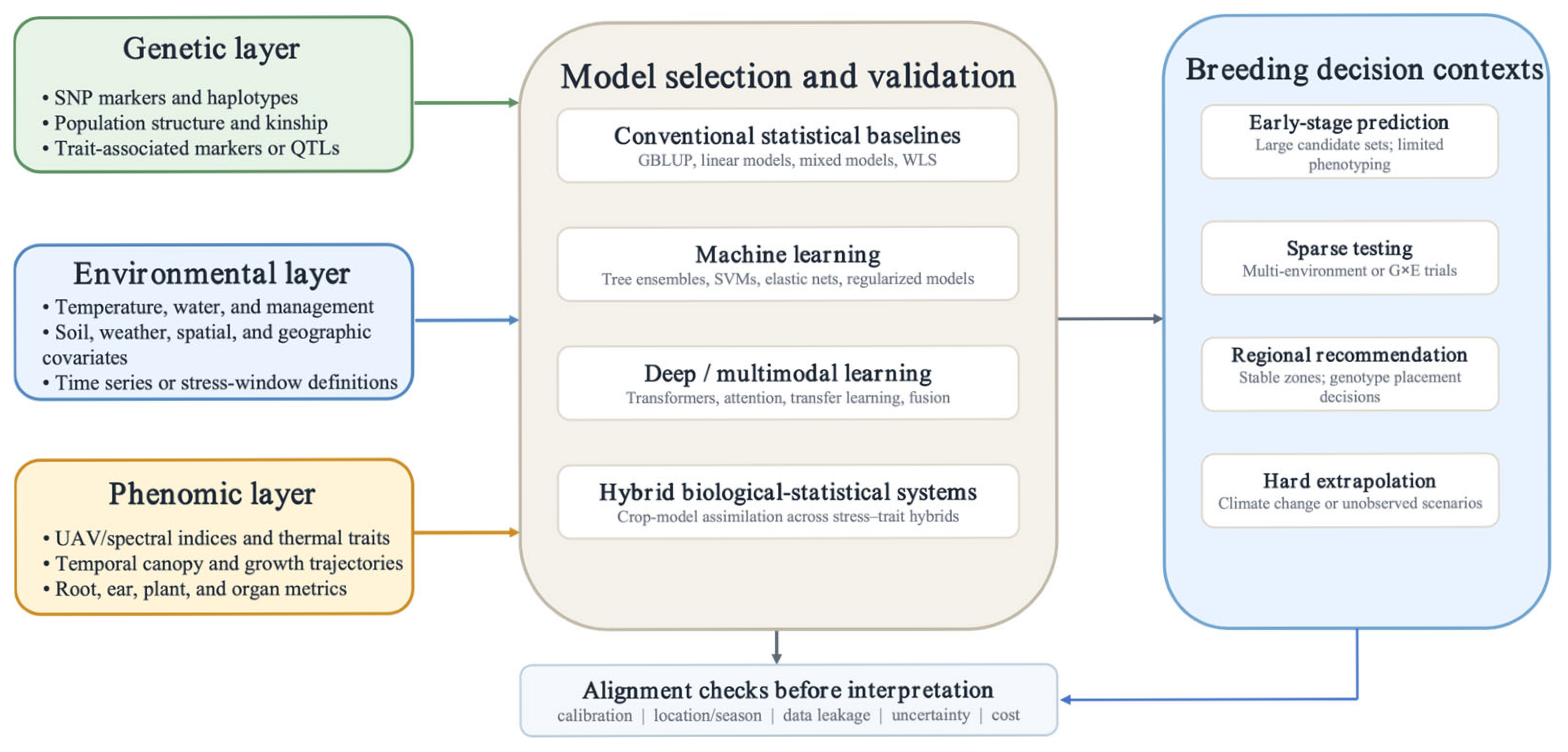
Figure 1. Redesigned conceptual workflow showing how genomic, environmental, and phenomic inputs are integrated before model selection and validation. Arrows indicate staged information flow and the need to align data availability, model family, validation design, and breeding-decision context; they do not imply one-to-one links between individual model classes and individual decisions. Different colors are used to distinguish the main information layers and workflow modules, including genomic inputs, environmental representation, phenomic inputs, model selection, validation design, and breeding-decision context [10,15,17,22,23,26,33,48].
Agronomy 16 01019 g001
Table 1. Neutral scoping comparison between selected recent reviews and the present review.
Period CoveredMain ScopeEnvironmental Integration Covered?Phenomics Integration Covered?Deployment/Validation Focus?Distinctive Focus Relative to the Present Review
Broad methodological literature to 2022 [65]Deep learning for crop genomic selection with environmental dataYesIndirectLimitedBroad model survey; less emphasis on 2023–2026 comparative multimodal evidence and deployment framing
Historical genomic-selection literature to 2023 [66]General genomic selection for crop improvementPartialLimitedLimitedGenomic-selection background; less specific emphasis on multi-environment prediction under explicit G×E and TPE logic
Historical drone-phenotyping literature to 2023 [54]Drone imaging and phenotyping for breedingIndirectYesLimitedSensor-platform overview; less emphasis on whether phenomics alters breeder-relevant prediction
Broad AI literature to 2023 [70]AI methods across crop sciencePartialPartialLimitedBroad AI coverage; less specific emphasis on multimodal prediction for breeding deployment
Historical field-phenotyping literature to 2024 [55]Field crop phenotyping methods and trajectoriesIndirectYesLimitedPhenomics context; less explicit integration with genomic and environmental prediction
Historical genomic-selection literature to 2024 [72]Applications and prospects of genomic selectionPartialLimitedPartialBreeding background; less emphasis on recent deployment scenarios, baseline choice, and reporting standards
Table 2. Representative 2023–2026 studies on AI-enabled multi-environment genomic prediction and multimodal prediction in crop breeding. Panel A summarizes studies emphasizing multi-environment genomic prediction and environmental descriptors, whereas Panel B summarizes studies integrating genomic, phenomic, or other multimodal inputs.
A
Crop/Trait(s)ScaleData LayersModel FamilyComparatorReported OutcomeUse Stage
Sesame; 9 agronomic traitsDiversity panel; 2 seasons [85]Markers + MET field dataGBLUP, Bayes, RKHS, marker × environmentSingle-environment models15–58% higher predictive ability than single-environment modelsEarly-to-mid stage MET support
Grain sorghum hybrids; hybrid performanceUS sorghum production environments [21]Markers + envirotype typologiesHierarchical Bayesian reaction normsAlternative envirotype and relationship structures in the same studyQualitative new-environment improvement; no pooled estimateSparse hybrid MET support
Maize; multi-trial performance4402 varieties; 195 trials; 87.1% missing [26]Markers + environmental covariatesMegaLMM with environmental regressions on latent factorsUnivariate GBLUPQualitative new-environment improvement under extreme missingnessLarge-network sparse testing
Field pea; seed protein and seed yield300 candidates; 3 contrasting environments [86]Markers + multi-trait multi-environment phenotypesMTME genomic predictionAdditive G-BLUPQualitative improvement in whole- and split-environment predictionPreliminary MET support
Maize; grain yieldLarge multi-environment trial dataset [23]Markers + engineered environmental descriptorsTree-based ML G + E and GEI modelsFactor-analytic multiplicative mixed modelUp to 7% higher mean accuracy under study-specific CVMid-to-late stage MET prediction
Maize hybrids; grain moisture and grain yield2126 hybrids; 34 environments; 9355 SNPs [24]Markers + 19 climatic factors/reduced climate setsGBLUP-GE variantsGBLUP and reduced-climate GBLUP-GE variantsAccuracy 0.731 (grain moisture) and 0.331 (yield) for GBLUP-GE19CFRegional MET recommendation
Maize, rice, and wheat; agronomic traitsBenchmark-scale multi-crop datasets [33]Markers + daily environmental sequencesGEFormer with gMLP, dynamic convolution, and attention6 statistical and 4 ML comparatorsQualitative improvement in hardest genotype/environment withholding settingsHard extrapolation benchmarking
Maize hybrids; plasticity, stability, and genomic predictionLarge multi-environment hybrid dataset [34]Markers + reduced environmental parameters + trait-associated markersAutoML frameworkMarker-only genome-wide models14.02–28.42% improvement in predictive ability, under the authors’ study-specific genomic prediction settings relative to marker-only genome-wide modelsClimate-adaptive hybrid selection
B
Crop/Trait(s)ScaleData LayersModel FamilyComparatorReported OutcomeUse Stage
Winter wheat; grain yieldWinter wheat breeding dataset [87]Genomic inputs + UAS-derived phenotypesGenomic-only, phenotypic-only, and combined modelsGenomic-only and phenotypic-only modelsQualitative gain for combined genomic-plus-UAS predictionAdvanced yield testing
Winter wheat; grain yield2994 lines; 2 sites; 2 years [17]Markers + multispectral, hyperspectral, and visual phenomicsPhenomic-only, genomic-only, and combined modelsGenomic-only and best phenomic-only modelsPhenomic-only R2 about 0.39–0.47; combined models 6–12% higherAdvanced yield testing
Coffea canephora; yieldDiverse population; 2 locations; 4 harvest seasons [79]Genomic markers + NIR-based phenomicsGenomic selection vs. phenomic selectionGenomic-only and phenomic-only predictorsNIR phenomic predictors competitive with genomic-only predictorsPerennial selection support
Eucalyptus; multiple agronomic traitsTree breeding populations adapted to arid environments [61]SNP markers + spectral phenomicsMLP, CNN, and Bayesian modelsBayesian alphabet modelsMLP/CNN accuracies 0.13–0.82 vs. 0.08–0.66 for Bayesian modelsTree breeding trait support
Winter wheat; grain yield4094 genotypes; 11,593 plots; 2019–2022 [48]Markers + UAS spectral reflectance indicesUnivariate and multivariate genomic predictionBase genomic prediction controlAt least 16% higher accuracy when test-year NDVI was availableLate-stage seasonal decision support
Sesame; longitudinal traits and yieldDiversity panel over growing seasons [59]Markers + temporal high-throughput phenotypingRandom regression, longitudinal GP, multi-trait GPSingle-trait longitudinal analysisQualitative gain in future-phenotype and multi-trait predictionEarly repeated-phenotyping selection
Performance metrics are study-specific and are reported as stated in the original articles; they are not directly comparable across studies. When the source paper did not provide a single directly transferable number, the table states explicitly that only a study-specific qualitative improvement is summarized here. Deployment-stage labels are interpretive summaries assigned in the present review to support cross-study comparison and are not necessarily the exact terminology used in the source articles.
Table 5. Matrix-Style Deployment Framework for AI-Enabled Multi-Environment Prediction [10,17,23,26,48,62,72].
Breeding Stage/Use CaseCandidate ScaleDecision-Time DataValidation SplitRealistic Model FamiliesDecision Target
Early preselection untested genotypes in mostly familiar contexts1000–50,000+Markers, pedigree, family structure, site-year labels, historical environment summariesFamily-aware CV or untested genotype in tested environment splitsGBLUP, simple G×E terms, reaction norms; tree models when covariates are strongCull lines and prioritize retention
Sparse testing across METs recovering missing G×E cells200–10,000Markers, historical environments, trial history, partial phenotype matrices, stage-aware summariesLeave-site-year-out, leave-one-environment-out, or sparse-mask recoveryFA models, reaction norms, MTME, engineered-feature MLFill missing trial cells and support advancement
Late-stage regional recommendation placement and advancement decisions20–1000Markers, site histories, environmental profiles, partial phenomics, management context, current-season sensingLeave-year-out or region holdout with explicit ranking-stability checksMultimodal fusion, interpretable DL, hybrid biological-statistical models, timing-aware phenomicsPlacement, regional recommendation, product advancement
Untested genotype in untested environment hard extrapolationcase-specificMarkers plus dense environmental histories; phenomics only before the decisionJoint genotype-and-environment withholding with temporal/relatedness controlReaction norms with strong envirotyping; sequence DL only with sufficient scaleStress-test transportability and quantify decision risk
Disclaimer/Publisher’s Note: The statements, opinions and data contained in all publications are solely those of the individual author(s) and contributor(s) and not of MDPI and/or the editor(s). MDPI and/or the editor(s) disclaim responsibility for any injury to people or property resulting from any ideas, methods, instructions or products referred to in the content.

