Article

Response of Bacterial Communities to Different Long-Term Fertilization Regimes in Black Soil

1
Heilongjiang Academy of Black Soil Conservation & Utilization, Harbin 150086, China
2
Scientific Observation and Research Station of Soil Quality (Nangang), Key Laboratory of Black Soil Protection and Utilization, Ministry of Agriculture and Rural Affairs, Harbin 150086, China
*
Author to whom correspondence should be addressed.
Agronomy 2026, 16(10), 1012; https://doi.org/10.3390/agronomy16101012
Submission received: 30 March 2026 / Revised: 13 May 2026 / Accepted: 18 May 2026 / Published: 21 May 2026

Abstract

Long-term fertilization regulates soil microbial communities and is essential for black soil health and sustainable productivity, yet its key drivers remain unclear. Using a 39-year field experiment, we evaluated the effects of four fertilization regimes: no fertilizer (CK), chemical fertilizer (NPK), organic fertilizer (M), and combined organic-inorganic fertilizer (MNPK). Soil properties and bacterial communities were analyzed using Illumina MiSeq sequencing, quantitative real-time PCR (qRT-PCR), and multivariate analyses. Proteobacteria, Actinobacteriota, Acidobacteriota, Chloroflexi, and Gemmatimonadota dominated (>80% of the community), and all treatments significantly altered their relative abundances. Compared with CK, NPK reduced soil pH by 8.3% and bacterial abundance by 29.7%, increased soil organic matter (SOM) by 22.9%, and decreased community evenness. MNPK reduced pH by only 2.0%, increased SOM by 53.8% and bacterial abundance by 38.9%, and improved community evenness, mitigating acidification while maintaining high diversity. M increased pH by 2.3%, SOM by 73.3%, and bacterial abundance by 71.8%. Soil pH, available phosphorus, and SOM were the main drivers of community structure. Overall, MNPK showed the strongest synergistic effects on soil fertility and microbial stability, making it an optimal strategy for sustainable black soil management.

1. Introduction

Rational fertilization is essential for achieving high crop yield and nutrient use efficiency, whereas improper fertilization can hinder sustainable agricultural development and damage the ecological environment [1]. A global meta-analysis of 690 experiments showed that, compared with chemical fertilization alone, organic fertilizer application significantly increases crop yield and soil organic carbon content [2]. Moreover, combined organic and chemical fertilization can synergistically improve soil fertility and mitigate adverse environmental effects [3]. Fertilization not only alters soil physicochemical properties but also affects soil microbial communities, thereby influencing soil ecosystem stability. Therefore, clarifying how fertilization management regulates soil microorganisms, particularly bacterial communities, is important for understanding the biological mechanisms underlying black soil fertility maintenance.
Soil microorganisms are essential for maintaining soil fertility and ecosystem functions and are sensitive indicators of soil quality and productivity [4,5]. Their diversity and community composition are closely associated with soil health and crop productivity [6,7]. Agricultural practices, especially long-term fertilization, strongly influence soil microbial communities [8,9]. Organic fertilizer application generally increases microbial abundance and diversity, whereas sole chemical fertilization often reduces diversity and impairs soil functions [10,11]. Combined organic-inorganic fertilization can restore bacterial diversity and may play a key role in improving crop productivity [9]. Among soil microorganisms, bacteria account for 70–90% of total microbial biomass and respond rapidly to fertilization because of their high abundance and metabolic versatility [12,13,14]. Previous studies have shown that organic amendments increase bacterial richness, whereas chemical fertilization lowers soil pH and reduces community diversity [15,16]. In the black soil region of Northeast China, long-term chemical fertilization strongly affects bacterial community composition, with soil pH and carbon availability identified as major environmental drivers [17,18]. However, the mechanisms by which long-term contrasting fertilization regimes regulate bacterial community structure, diversity, and their relationships with soil physicochemical properties in this region remain unclear [19]. Understanding these relationships is critical for elucidating the biological mechanisms that maintain black soil fertility.
Northeast China contains one of the world’s four major black soil zones and serves as China’s most important grain-producing region, making it critical for national food security [20]. The black soil region covers 556,000 km2, accounting for 38.4% of Northeast China, while Heilongjiang Province contains 149,000 km2, representing 26.8% of the total black soil area [21]. In recent years, long-term intensive cultivation, soil erosion, and improper fertilization have accelerated black soil degradation and raised widespread concern across all sectors [22]. Rational fertilization can compensate for nutrient loss, improve soil structure, and enhance land productivity [23,24]. Although many studies have examined the effects of fertilization on soil microbial richness and community structure [25,26], limited information is available on the long-term effects of fertilization on microbial richness and community structure in black soil, particularly in the high-latitude black soil region of Northeast China [27]. Furthermore, under different long-term fertilization practices, including chemical and organic fertilization, the structure, diversity, and response characteristics of key bacterial groups remain unclear, and their relationships with soil physicochemical properties have not been systematically evaluated. Therefore, clarifying how long-term fertilization shapes bacterial richness, community structure, and their interactions with soil properties is essential for understanding the mechanisms underlying soil fertility maintenance and sustainable productivity.
Based on a 39-year field experiment in the black soil region of Northeast China, this study evaluated contrasting fertilization treatments using Illumina MiSeq high-throughput sequencing and quantitative real-time PCR (qRT-PCR) to characterize bacterial abundance, diversity, and community composition. The objectives were to (1) clarify the long-term succession patterns of bacterial communities under contrasting fertilization regimes and (2) identify the key soil fertility factors driving these changes. By elucidating how fertilization indirectly regulates soil microbial communities through alterations in soil fertility properties, this study aimed to reveal the biological mechanisms by which different fertilization strategies influence black soil fertility. The findings provide a theoretical basis for scientific fertilization management and soil fertility improvement in Northeast China’s black soil region.

2. Materials and Methods

2.1. Experimental Setup

The Key Field Observation and Experimental Station of Harbin Black Soil Ecological Environment (long-term black soil fertility experiment) was established in 1979 in Minzhu Township, Daowai District, Harbin, Heilongjiang Province, China (126°35′ E, 45°40′ N; 151 m altitude). The experimental site is situated on the second terrace of the Songhua River within the mid-temperate climatic zone, and adopts an annual single-cropping system. This region is characterized by cold, dry winters and hot, rainy summers, with an annual average precipitation of approximately 550 mm, an effective accumulated temperature reaching 2700 °C above 10 °C, an annual sunshine duration ranging from 2600 to 2800 h, and a frost-free period of roughly 135 days [28]. The soil is upland black soil derived from diluvial loess-like clay parent material.
The long-term experiment began in 1979, and a wheat–soybean–maize rotation was introduced in 1980. Initial soil nutrient contents in 1979 are presented in Table 1. The experiment includes 24 treatments, of which four were selected for this study to represent the main fertilization gradient: no fertilization (CK), inorganic NPK fertilizer (NPK), sole organic manure (M), and combined organic manure and inorganic NPK fertilizer (MNPK) (Table 2). These treatments represent no-input, inorganic-only, organic-only, and integrated fertilization systems, thereby adequately representing the core fertilization gradient of this long-term experiment while allowing systematic evaluation of the individual and combined effects of inorganic and organic fertilizers. Each treatment had three replicates with a plot size of 36 m2 (4 m × 9 m). Plots were randomly arranged and separated by cement boards (1.1 m depth, 0.1 m thickness). No irrigation was applied. The cropping system followed a wheat–soybean–maize rotation with one crop annually, and fertilization was conducted in autumn. During the maize season, 50% of nitrogen fertilizer was applied in autumn and the remaining 50% was top-dressed at the trumpet stage. In the wheat and soybean seasons, all fertilizers were applied in autumn without top-dressing. Organic manure was applied after maize harvest in each rotation cycle. Chemical fertilizers included urea (46% N), triple superphosphate (46% P2O5), diammonium phosphate (18% N, 46% P2O5), and potassium sulfate (50% K2O). Organic manure consisted of horse manure collected from fixed horse-breeding households and was applied at a nitrogen rate of 75 kg ha−1 (approximately 18,600 kg ha−1 horse manure). After harvest, aboveground biomass was removed, whereas roots and stubble were retained in the field. Wheat was sown in late April and harvested in late July, while soybean and maize were sown from late April to early May and harvested from late September to early October.
The horse manure used in this rotation cycle contained 119.6 g kg−1 organic matter (OM), 5.6 g kg−1 total nitrogen (TN), 8.3 g kg−1 P2O5, and 11.9 g kg−1 K2O. Soil samples were collected on 15 July 2018, during the maize-growing season at the end of the 15th rotation cycle, which did not include horse manure application. In each plot, topsoil samples (0–20 cm) were collected using a five-point sampling method, thoroughly mixed, and passed through a 2-mm sieve to obtain one composite sample per plot. Each composite sample was divided into three portions: fresh soil stored at −80 °C for microbial analysis; fresh soil used to determine ammonium nitrogen (NH4+-N), nitrate nitrogen (NO3-N), and soil moisture; and the remaining soil air-dried at room temperature for analysis of soil pH, total carbon (TC), soil organic matter (SOM), TN, total phosphorus (TP), available phosphorus (AP), total potassium (TK), and available potassium (AK).

2.2. Soil Parameters

Soil pH was determined in a 1:2.5 (m/v) soil-water suspension using a FiveEasy Plus pH meter (METTLER TOLEDO, Zurich, Switzerland). SOM was quantified via the potassium dichromate oxidation method with external heating. TC and TN were analyzed using an Elementar Vario MAX cube elemental analyzer (Elementar, Hanau, Germany). NH4+-N and NO3-N were extracted from fresh soil samples with 1 M KCl at a 1:5 soil-to-solution ratio, and their concentrations were measured using an AA3-A001-02E continuous-flow analyzer (Bran+Luebbe, Norderstedt, Germany). TP was digested with a H2SO4-HClO4 mixture under heating, followed by quantification using the molybdenum-antimony colorimetric method. AP was extracted with 0.5 M NaHCO3 solution (pH 8.5) and determined via the modified molybdenum-antimony colorimetric method. TK was digested with an HF-HClO4 mixture, dissolved in dilute hydrochloric acid, and then analyzed by atomic absorption spectrophotometry using a TAS-990 instrument (PERSEE, Beijing, China). AK was extracted with 1 M neutral ammonium acetate (pH 7.0) and quantified using the same atomic absorption spectrophotometer. All analytical procedures were performed in triplicate and strictly followed the standard protocols described in references [29,30].

2.3. DNA Extraction, Quantitative Real-Time PCR, High-Throughput Sequencing and Data Processing

Soil total DNA was extracted using the PowerSoil™ DNA Isolation Kit (MoBio Laboratories, Carlsbad, CA, USA). DNA integrity and purity were assessed by 1.2% agarose gel electrophoresis. The bacterial 16S ribosomal RNA (rRNA) gene copy number was quantified by qRT-PCR using the extracted DNA as the template. Amplification was performed on a LightCycler® 480 System (Roche, Basel, Switzerland) with the universal primers 338F (5′-CCTACGGGAGGCAGCAG-3′) and 518R (5′-ATTACCGCGGCTGCTGG-3′) [31]. The qRT-PCR program consisted of an initial denaturation at 95 °C for 30 s, followed by 30 cycles of 95 °C for 5 s, 60 °C for 30 s, and 50 °C for 30 s. The standard curve was generated using 10-fold serial dilutions of a recombinant plasmid containing the target 16S rRNA gene fragment, with a linear range of 1.20 × 10⁵ to 1.20 × 10⁹ copies per reaction. The qRT-PCR assay showed an amplification efficiency of 95.9% and a correlation coefficient (R2) ≥ 0.99 (Figure S1). All samples and standards were analyzed in triplicate, and the final copy number was expressed as the mean of three replicates [32]. The qRT-PCR mixture is listed in Table 3.
Polymerase chain reaction (PCR) amplification of the bacterial 16S rRNA gene V3–V4 hypervariable region was performed using the primer pair 338F (5′-CCTACGGGAGGCAGCAG-3′) [33] and 806R (5′-GGACTACHVGGGTWTCTAAT-3′) [34]. Detailed information on the PCR mixture is provided in Table 4. The thermal cycling protocol consisted of an initial denaturation step at 95 °C for 3 min, followed by 36 amplification cycles of 95 °C for 30 s, 55 °C for 30 s, and 72 °C for 45 s, and a final extension step at 72 °C for 10 min. All PCR amplifications were conducted in triplicate for each sample, and the resulting amplicons were combined and subjected to paired-end sequencing on the Illumina MiSeq platform at Shanghai Majorbio Bio-pharm Technology Co., Ltd. Raw sequencing reads were processed and quality-filtered following the procedures described in a previous study [35]. All raw sequencing data obtained in this study have been deposited in the GenBank Sequence Read Archive (SRA) under accession number SRP080887.
After quality control of the raw sequencing data, 407,239 high-quality sequences were obtained, with 19,759–43,804 sequences per sample. To avoid analytical bias, all samples were randomly rarefied to the minimum sequencing depth (19,759 sequences) for downstream analysis. Sequences were clustered into operational taxonomic units (OTUs) at 97% similarity using the UPARSE algorithm in USEARCH (v10.0.240), and an OTU abundance table was generated. Representative sequences were taxonomically assigned using the Greengenes and RDP 16S rRNA databases [36]. Alpha diversity indices of the bacterial community, including Chao1, Ace, Shannon, and Simpson indices, were calculated using QIIME software (Version 1.8.0) [37].

2.4. Statistical Analyses

One-way analysis of variance (ANOVA) was used to evaluate differences in soil fertility indices, bacterial 16S rRNA gene copy numbers, and alpha diversity indices among fertilization treatments. Pearson correlation analysis was performed using IBM SPSS 27 (SPSS, Chicago, IL, USA) to assess relationships between microbial indices and soil fertility properties. To assess similarities in bacterial community structure among treatments, hierarchical clustering analysis was performed using the unweighted pair-group method with arithmetic means (UPGMA). For beta diversity evaluation, principal component analysis (PCA) was conducted based on the standardized OTU abundance matrix, while principal coordinate analysis (PCoA) was carried out using the unweighted UniFrac distance matrix [38]. Redundancy analysis (RDA) was employed to explore the influences of environmental factors on bacterial community structure, and a hierarchical permutation test (999 permutations) based on RDA was applied to quantify the relative contribution of each environmental variable to the observed microbial community variation. Variation partitioning analysis (VPA) was conducted to determine the relative contributions of different predictor groups to bacterial community variation. The response matrix consisted of the Hellinger-transformed bacterial OTU abundance matrix, whereas predictor variables were divided into two groups: fertilization management (categorical variable representing the four treatments) and soil fertility indicators (pH, SOM, AP, NH4+-N, TN, TP, NO3-N, TK, and AK). The analysis was based on RDA and performed using the varpart() function in the vegan package. Most multivariate statistical analyses and visualizations were conducted in R (Version 4.2.2) using the vegan, ggplot2, and rdacca.hp packages, whereas some figures were generated using Origin 2021 software (Version 9.8.0). We used STAMP software (Version 2.1.3) to identify bacterial taxa that exhibited statistically significant differences at the genus level between paired fertilization treatments (CK vs. NPK, CK vs. M, and CK vs. MNPK). The Wilcoxon rank-sum test was applied for pairwise comparisons, and p-values were adjusted for multiple testing using the Benjamini–Hochberg false discovery rate correction.
Random forest models implemented using the randomForest package in R were used to identify the key soil fertility indices driving bacterial community structure, including pH, TC, TN, TP, TK, SOM, NO3-N, NH4+-N, AP, and AK. The relative importance of each predictor index was quantified via the percentage increase in mean squared error (%IncMSE) metric. Structural equation modeling (SEM) was then applied to examine the causal linkages among fertilization management practices, soil fertility indices, and soil bacterial communities. The model hypothesized that fertilization indirectly influences soil microbial community structure and composition through changes in soil fertility properties. Bacterial abundance was represented by 16S rRNA gene copy number, community structure by the first principal coordinate axis (PCoA1), and community diversity by the reciprocal Simpson index (1/Simpson). Model construction and fitting were conducted at the 95% confidence level using the piecewiseSEM package in R.

3. Results

3.1. Changes in Soil Fertility

The experimental results (Table 5) showed that, compared with CK, the NPK, M, and MNPK treatments increased soil nutrient contents to varying degrees, with significant differences observed for several indices (p < 0.05). Soil pH decreased significantly under the NPK treatment, decreased slightly under the MNPK treatment, and increased marginally under the M treatment relative to CK. Specifically, the NPK treatment significantly decreased soil pH by 0.53 units and increased NH4+-N and AP contents by 35.5% and 136.6%, respectively. The M treatment increased soil pH by 0.15 units relative to CK and markedly increased SOM and AP contents by 73.3% and 395.7%, respectively. The MNPK treatment reduced soil pH by only 2.0%, indicating a significantly lower degree of acidification than the NPK treatment. This treatment also produced the greatest increases in NH4+-N, TN, and AP, which increased by 93.0%, 44.1%, and 453.8%, respectively. In addition, TC and SOM contents increased significantly by 38.3% and 53.8%, respectively, compared with CK. Although TK and AK contents were significantly higher under the NPK, M, and MNPK treatments than under CK (p < 0.05), no significant differences were observed among the three fertilization treatments (Table 5).

3.2. Soil Bacterial Abundance and Diversity

The bacterial 16S rRNA gene copy number results (Table 6) showed that bacterial abundance ranged from 3.40 × 10⁹ to 7.91 × 10⁹ copies g−1 fresh soil across all treatments. Compared with CK, bacterial copy numbers decreased significantly by 29.7% under the chemical fertilizer treatment (NPK) (p < 0.01), whereas they increased significantly by 71.8% and 38.9% under the organic fertilizer treatments (M and MNPK), respectively (p < 0.01).
The soil bacterial community α-diversity analysis (Table 6) showed that sequencing coverage exceeded 96% for all samples, meeting the requirements for subsequent bioinformatics analyses. Compared with CK, the M and MNPK treatments significantly increased species richness, as indicated by observed OTU number, Ace index, and Chao1 index, as well as the Shannon diversity index (p < 0.05). In contrast, the NPK treatment significantly increased Simpson’s dominance index relative to CK (p < 0.05). Because Simpson’s index reflects both community dominance and diversity, this result suggests that long-term sole chemical fertilization increased the dominance of a few bacterial taxa, thereby reducing community evenness and overall diversity. The Ace and Chao1 richness indices showed patterns consistent with observed OTU richness. The M and MNPK treatments had significantly higher values than CK (p < 0.05), whereas no significant differences were detected between the NPK treatment and the other treatments.

3.3. Species Composition of Soil Bacterial Community

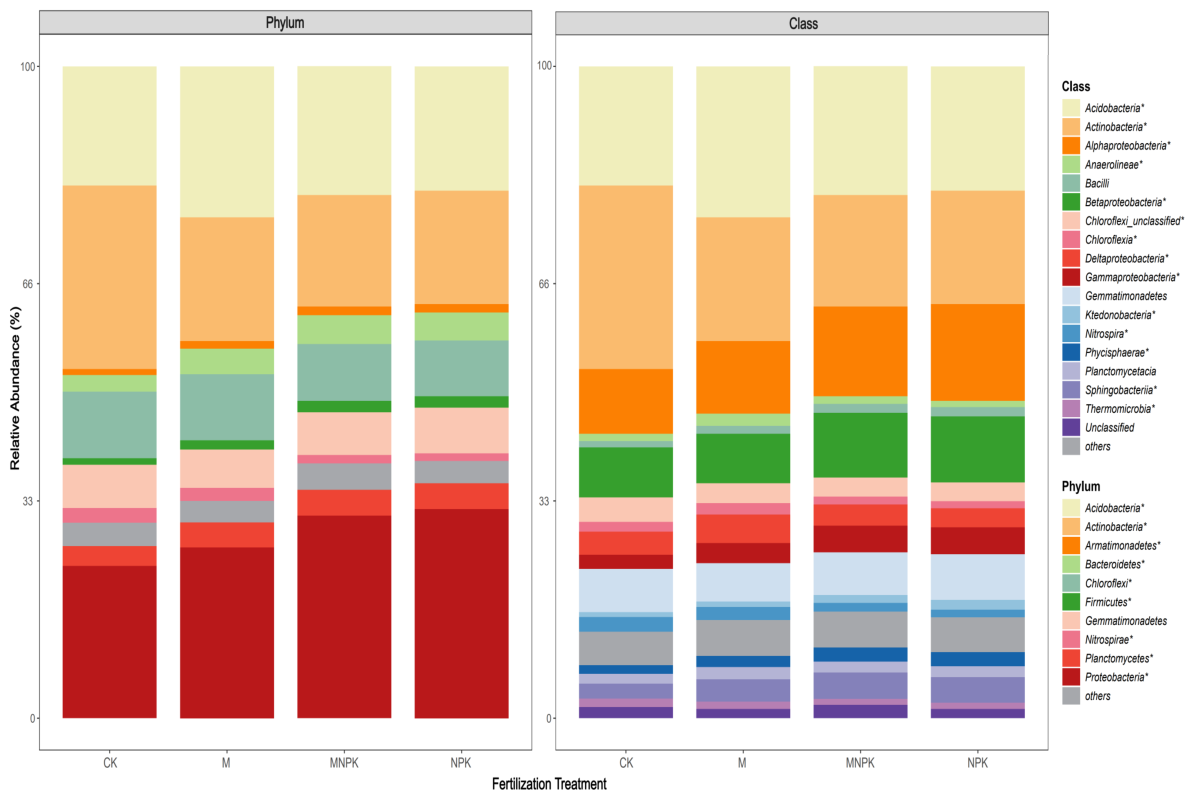
At the 97% similarity threshold, 3765 OTUs were identified and classified into 35 bacterial phyla, of which 10 had average relative abundances > 1% (Figure 1). Proteobacteria, Actinobacteria, Acidobacteria, Chloroflexi, and Gemmatimonadetes were the dominant phyla, with relative abundances of 21.8–32.9%, 16.1–31.3%, 17.2–23.7%, 8.1–11.1%, and 5.8–7.7%, respectively, collectively accounting for most of the bacterial community. Planctomycetes (2.6–4.3%), Bacteroidetes (2.4–4.7%), and Armatimonadetes (0.9–1.4%) also showed relatively high abundances across treatments. The detailed relative abundances of all dominant phyla under each treatment are provided in Supplementary Table S1. One-way ANOVA followed by LSD post-hoc analysis showed that, compared with CK, the NPK, M, and MNPK treatments significantly increased the relative abundances of Proteobacteria, Planctomycetes, and Bacteroidetes (p < 0.05), while decreasing those of Actinobacteria, Chloroflexi, and Nitrospirae. In addition, Acidobacteria, Chloroflexi, and Gemmatimonadetes were significantly more abundant under the M treatment than under the NPK and MNPK treatments (p < 0.05).
At the class level, the 3765 OTUs were assigned to 89 bacterial classes, including 17 classes with average relative abundances > 1% (Figure 1). Actinobacteria, Acidobacteria, Alphaproteobacteria, Betaproteobacteria, and Gemmatimonadetes were the dominant classes, with relative abundances of 16.1–31.3%, 17.2–23.7%, 9.4–15.0%, 6.4–11.2%, and 5.8–7.7%, respectively. Twelve additional classes, including Deltaproteobacteria, Gammaproteobacteria, and Sphingobacteriia, each maintained relative abundances > 1% across all fertilization treatments and collectively formed the core bacterial community. Compared with CK, the NPK, M, and MNPK treatments significantly increased the abundances of Alphaproteobacteria, Betaproteobacteria, and Gammaproteobacteria (p < 0.05), while significantly decreasing those of Actinobacteria and Nitrospira (p < 0.05). Relative to the NPK and MNPK treatments, the M treatment significantly increased the abundances of Acidobacteriia, Deltaproteobacteria, and Anaerolineae (p < 0.05), and also showed an increasing trend in Chloroflexia abundance. These patterns were generally consistent with those observed at the phylum level, indicating that fertilization-induced shifts in bacterial community composition were coherent across taxonomic ranks.
Among the 3765 OTUs identified at the 97% similarity threshold, 48 had relative abundances > 0.5% and were detected in all samples. Their sequences were aligned against the National Center for Biotechnology Information (NCBI) database using Basic Local Alignment Search Tool (BLAST)Version 2.8.1, and the results are presented in Supplementary Table S2. The predominant OTUs included OTU3796, OTU1389, OTU508, OTU1639, OTU2165, OTU887, OTU4322, OTU2777, OTU2890, OTU362, OTU4385, and OTU3034, with relative abundances ranging from 1.32–2.65%, 1.35–2.30%, 1.80–2.07%, 1.08–2.28%, 1.08–2.28%, 1.08–1.94%, 0.65–1.96%, 0.96–1.37%, 0.92–1.40%, 0.46–1.45%, 0.74–1.10%, 0.62–0.99%, and 0.52–0.96%, respectively. BLAST analysis showed that OTU3796, OTU1389, OTU508, and OTU2777 belonged to Acidobacteria; OTU1639, OTU887, OTU4322, and OTU3034 were affiliated with Proteobacteria; OTU2165, OTU2890, and OTU4385 were assigned to Actinobacteria; and OTU362 belonged to Gemmatimonadetes.
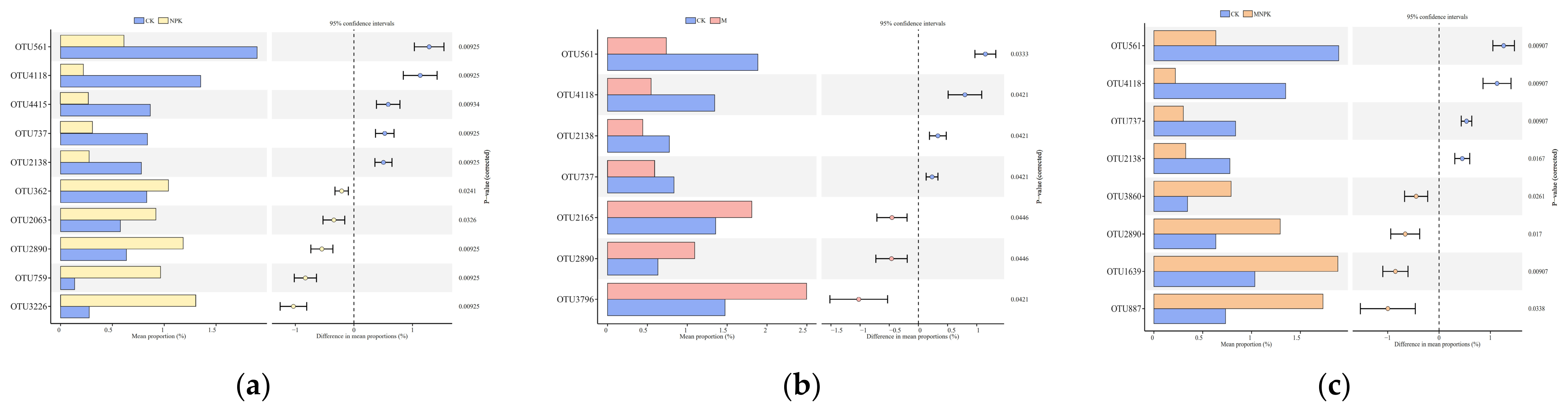
To clarify the effects of long-term fertilization regimes on bacterial communities, differential species analysis was conducted at the genus level by comparing the NPK, M, and MNPK treatments with the CK treatment (Figure 2). All fertilization treatments significantly increased the relative abundances of Blastococcus (OTU561) and an uncultured group, f_288-2 (OTU4118), within Actinobacteriota, as well as the uncultured groups o_JG30-KF-CM45 (OTU737) and c_KD4-96 (OTU2138) within Chloroflexota. In contrast, the relative abundance of Arthrobacter (OTU2890) within Actinobacteriota significantly decreased.
The NPK treatment significantly increased the relative abundance of f_RB41 (OTU4415) within Acidobacteriota, but significantly decreased uncultured groups f_Gemmatimonadaceae (OTU362 and OTU2063) within Gemmatimonadota, Variibacter (OTU759) within Pseudomonadota, and o_Gaiellales_g_uncultured (OTU3226) within Actinobacteriota. The M treatment significantly reduced the relative abundances of Microlunatus (OTU2165) within Actinobacteriota and o_Subgroup-6_f_norank (OTU3796) within Acidobacteriota. The MNPK treatment significantly increased the relative abundances of o_SC-I-84 (OTU3860 and OTU887) and Bradyrhizobium (OTU1639) within Pseudomonadota.

3.4. Bacterial Community Structure and Its Relationship with Soil Fertility Changes

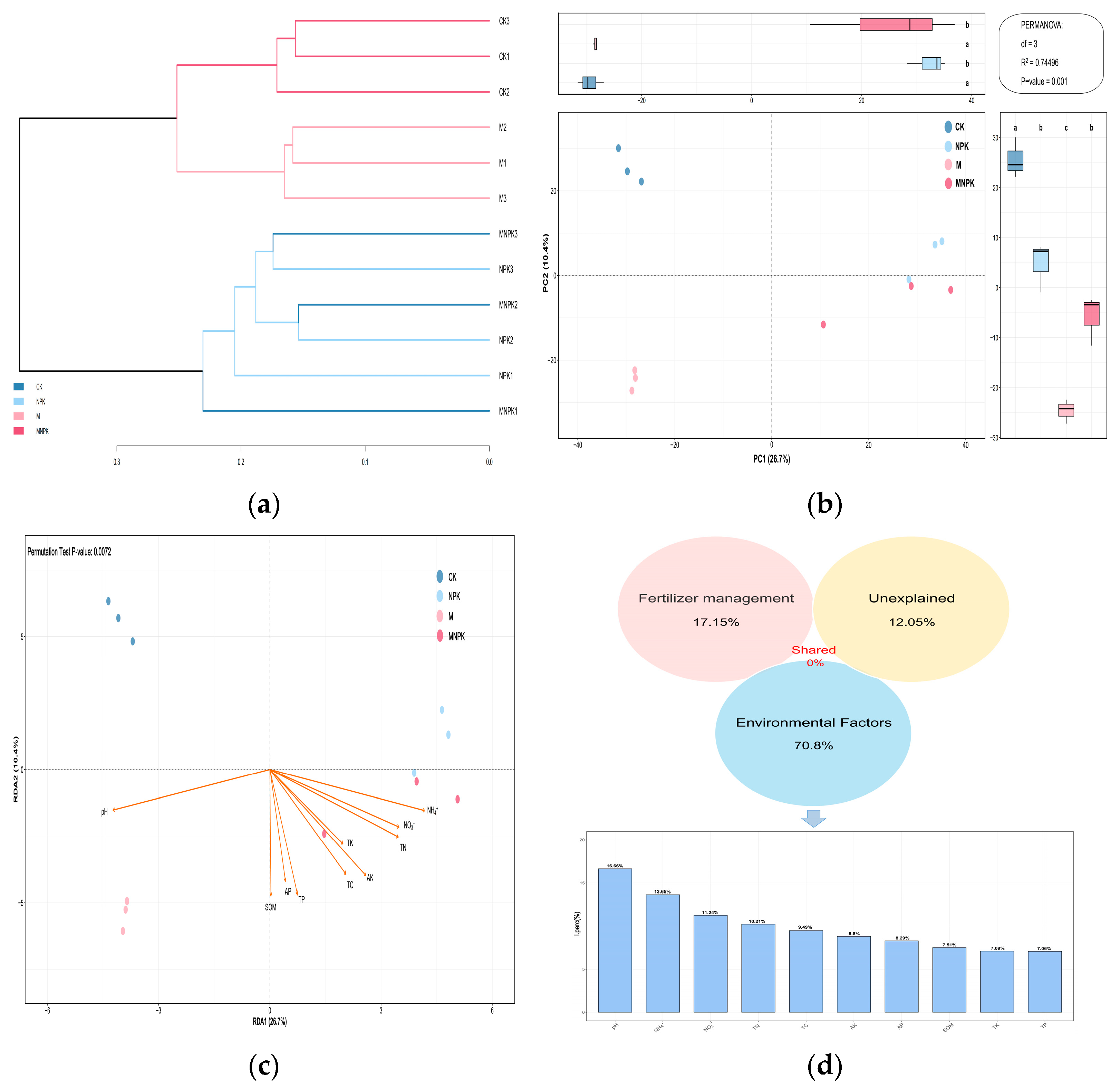
OTU-based hierarchical clustering analysis revealed clear differentiation in bacterial community structure among the four fertilization treatments. The NPK and MNPK treatments clustered together, whereas CK and M formed a distinct clade (Figure 3a). This pattern was further corroborated by principal component analysis (PCA) performed on the OTU relative abundance matrix (Figure 3b). The first two principal components (PC1 and PC2) together accounted for 37.1% of the total variation in bacterial community composition. Along PC1, CK and M were clearly separated from NPK and MNPK, while the separation between CK and M was primarily observed along PC2. These findings demonstrate that long-term fertilization significantly reshaped the bacterial community structure in this black soil ecosystem. The close proximity of the NPK and MNPK treatments in the ordination plot suggests similar community compositions.
RDA revealed a significant correlation between soil fertility indicators and bacterial community structure (Monte Carlo permutation test, p = 0.0072) (Figure 3c). All soil fertility indicators showed long vector projections in the RDA ordination, indicating strong associations with community structure. These findings suggest that long-term fertilization significantly influenced bacterial communities through changes in soil fertility (hierarchical permutation test results are shown in Figure 3d).
The dominant soil fertility indicators driving bacterial community structure varied among treatments. Soil pH primarily separated the M treatment from MNPK and NPK along RDA1, whereas NH4+-N, NO3-N, and TN mainly distinguished CK from MNPK and NPK along the same axis. Along RDA2, TP and AP primarily separated M from CK, while TC, TK, and AK differentiated M from MNPK and NPK. Variance partitioning analysis (VPA) showed that fertilization management and soil fertility indicators together explained 87.95% of the variation in bacterial community structure (Figure 3d). Both the independent and interactive effects of these factors strongly contributed to community differentiation, indicating that bacterial community structure was jointly regulated by fertilization practices and associated changes in soil fertility.

3.5. Structural Equation Model Explaining Variation in Soil Bacterial Communities

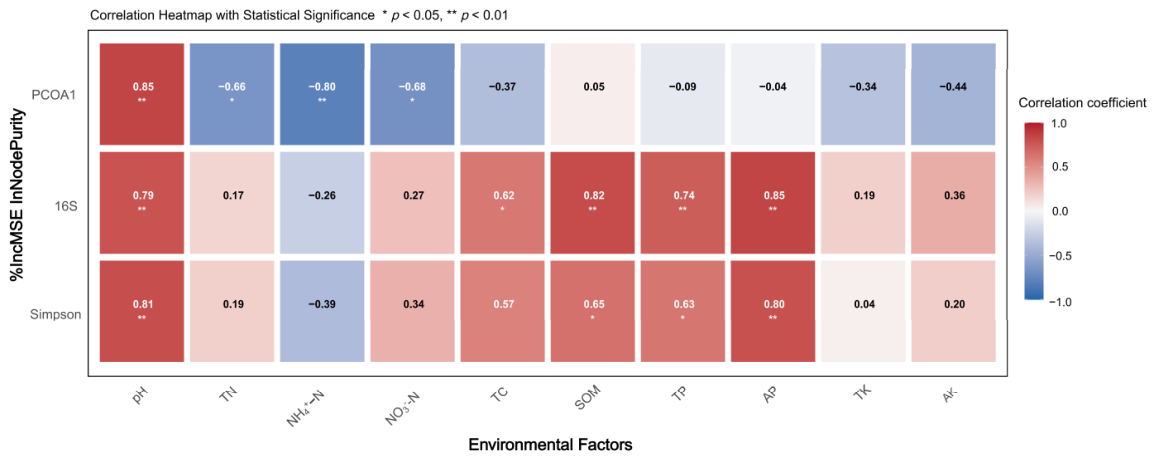
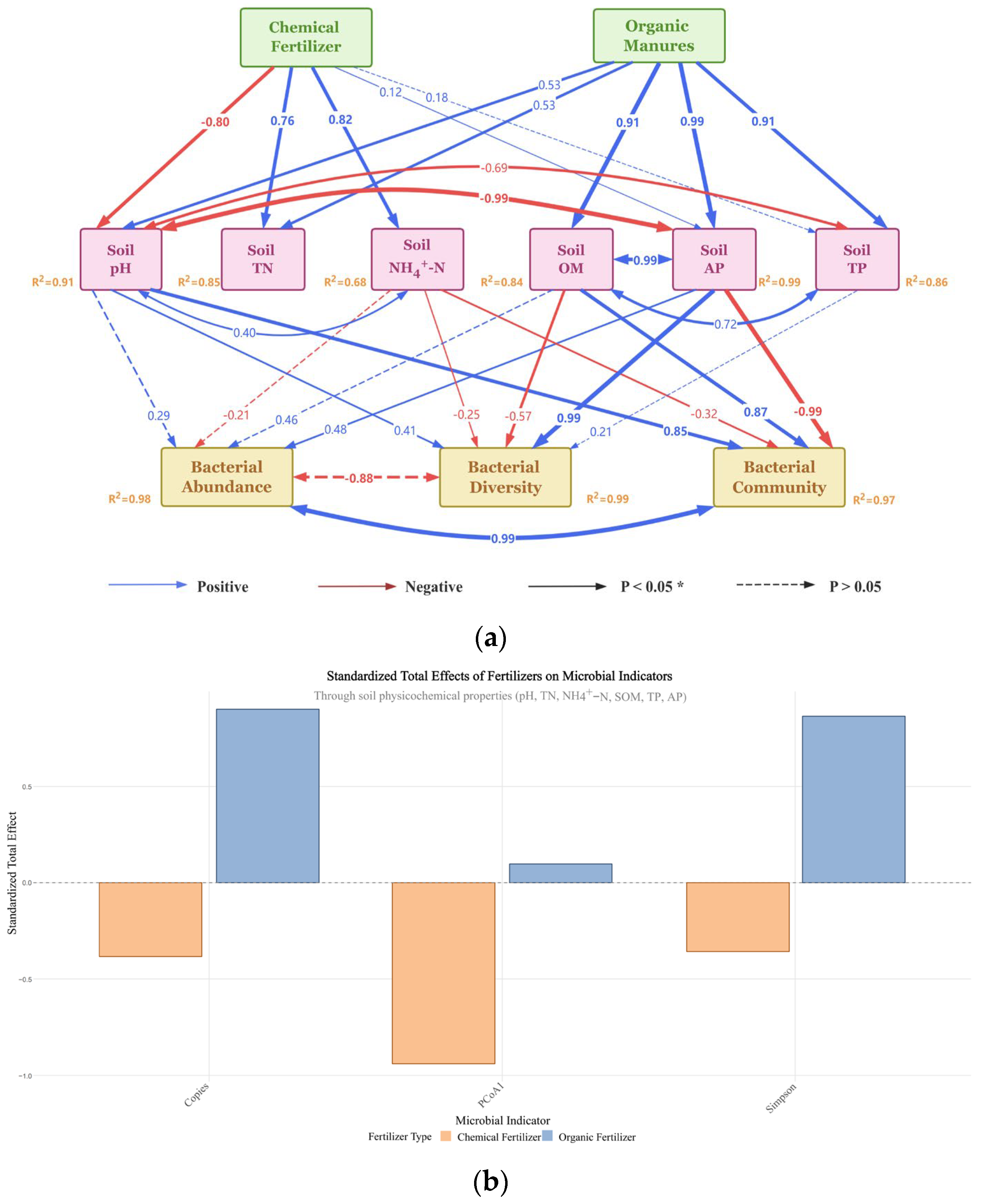
Because both RDA and the hierarchical permutation test based on RDA showed that all measured soil fertility indices significantly affected bacterial community variation in black soil (Figure 4), we further assessed the relative importance of each index using a random forest model. Based on the random forest results (Figure 5), we selected key soil fertility indices (pH, SOM, AP, TP, NH4+-N, and TN), fertilization management (inorganic or organic fertilization), and bacterial community attributes (abundance, diversity, and structure) to construct a piecewise structural equation model (piecewise SEM). The model tested the hypothesis that fertilization indirectly regulates bacterial communities through changes in soil physicochemical properties. Bacterial abundance, diversity, and community structure were represented by 16S rRNA gene copy number, the 1/Simpson index, and the PCoA1 score, respectively (Figure S2; Figure 5a). Several key fit indices met conventional thresholds and supported the model’s acceptable explanatory power. The chi-squared per degree of freedom (χ2/df) was 2.75, the comparative fit index (CFI) was 0.921, and the standardized root mean square residual (SRMR) was 0.005. However, the Tucker–Lewis index (TLI = 0.785) and root mean square error of approximation (RMSEA = 0.332) fell outside the widely recognized thresholds for good model fit. This discrepancy can be primarily attributed to the limited sample size (n = 12). Previous methodological studies have consistently demonstrated that RMSEA and TLI are highly sensitive to small sample sizes and low degrees of freedom. Under such conditions, RMSEA tends to be substantially inflated, while TLI shows a notable downward bias [39,40]. Compared with traditional covariance-based structural equation modeling (CB-SEM), the piecewise SEM adopted in this study is more robust to small sample sizes. It is also well suited for deciphering complex interrelationships among variables in ecological research [41]. Furthermore, all core path coefficients were statistically significant and aligned with our a priori hypotheses. Taken together, the model can still effectively capture the core regulatory network among fertilization practices, soil properties, and bacterial community responses investigated in this study.
Path analysis further clarified the direct relationships among variables (Figure 5a). Organic fertilization significantly increased soil AP, SOM, TP, TN, and pH (path coefficients = 0.53–0.99, p < 0.05), with the strongest positive effects on AP, SOM, and TP (all path coefficients > 0.90). Inorganic fertilization significantly increased NH4+-N, TN, and AP (path coefficients = 0.12–0.82, p < 0.05) but markedly decreased soil pH through a strong negative path (path coefficient = −0.80, p < 0.05). Among soil fertility indices, AP, SOM, and pH were the main direct drivers of bacterial communities. AP positively affected bacterial diversity and abundance (path coefficients = 0.99 and 0.48, respectively, p < 0.05) but negatively affected the first principal coordinate axis (PCoA1), which represented the dominant gradient of community structure variation (path coefficient = −0.99, p < 0.05). In contrast, SOM and pH mainly promoted community structure variation along PCoA1 (path coefficients = 0.87 and 0.85, respectively, p < 0.05). In addition, bacterial abundance was strongly and positively associated with community structure variation along PCoA1 (path coefficient = 0.99, p < 0.05).
Standardized total effect analysis integrated both direct and indirect effects (Figure 5b). Inorganic fertilization exerted significant negative total effects on bacterial diversity, abundance, and community structure (total effects = −0.686, −0.735, and −0.99, respectively), with the strongest inhibitory effect on community structure. In contrast, organic fertilization showed significant positive total effects, particularly on bacterial abundance and diversity (total effects = 0.99 and 0.98, respectively), whereas its effect on community structure was weaker (total effect = 0.187). These findings were consistent with the cascade regulatory relationships identified by path analysis.

4. Discussion

4.1. Effects of Long–Term Different Fertilization Regimes on Soil Fertility

Long-term fertilization is a key agricultural practice that regulates soil chemistry and maintains or improves soil fertility. It significantly increases SOM, TN, TP, AN, AP, AK, and NH4+-N contents in farmland soils, with combined chemical and organic fertilization often producing the greatest effects [42], consistent with our findings. In this study, the MNPK treatment substantially increased SOM, NO3-N, TN, and AP compared with the unfertilized control. Similarly, long–term application of M, NPK, and MNPK increased soil C, N, and P contents [43]. Continuous organic fertilizer application also improves soil physical and chemical properties, enhances SOM and nutrient availability, and ultimately increases soil fertility [44]. These synergistic effects stem from the complementary nutrient supply patterns of the two fertilizer types: chemical fertilizers deliver rapidly available nutrients, whereas organic manures release nutrients gradually.
Different fertilization regimes also profoundly influence soil pH dynamics. Long-term chemical fertilizer application can significantly lower soil pH and accelerate acidification, whereas organic fertilizer addition slows this decline [45]. Liu et al. [46] also observed significant pH decreases under both NPK and MNPK treatments in farmland soils, which is primarily attributable to H+ production during nitrogen transformation and crop uptake. A meta-analysis by Guo et al. [47] further demonstrated that organic amendments tend to increase soil pH in acidic soils while decreasing it in alkaline soils, mainly by enhancing soil buffering capacity. In this study, the NPK treatment markedly reduced soil pH, whereas M slightly increased it. Notably, the MNPK treatment slowed the pH decline caused by chemical fertilizer alone, indicating that combined fertilization is an effective strategy for buffering soil pH, consistent with previous studies [48,49]. These findings suggest that chemical fertilizers (especially N and P) are major drivers of soil acidification, whereas organic fertilizers, which are rich in base cations and buffering substances, can effectively alleviate this process [50].
Different fertilization regimes differed in their contributions to soil carbon pools. Sole organic fertilizer (M) produced the greatest increase in SOM, whereas MNPK caused the largest increase in TC. These findings indicate that long-term organic inputs are the main driver of organic matter accumulation in black soil, while combined organic and chemical fertilization may enhance carbon sequestration by promoting the integration of exogenous and native soil carbon. This result is consistent with the progressive organic matter accumulation reported in long-term experiments [51,52]. In addition, M and MNPK treatments significantly increased soil AP and NO3-N because organic fertilizers continuously release P and N through mineralization and act synergistically with readily available nutrients from chemical fertilizers [2,3]. Overall, long-term fertilization, particularly combined fertilization, improved soil chemical properties and nutrient availability, creating more favorable conditions for soil microorganisms and supporting black soil fertility and sustainable productivity. However, MNPK did not consistently produce the greatest improvement across all fertility indicators, and the magnitude of change varied among variables.

4.2. Fertilization on the Abundance, Diversity and Composition of Bacterial Communities

Soil microorganisms are key drivers of soil ecosystem functions and are highly sensitive to fertilization management [53]. In this study, qRT-PCR and high-throughput sequencing showed that 39 years of contrasting fertilization regimes significantly altered the abundance, diversity, and composition of bacterial communities in black soil. These changes were mainly regulated by shifts in soil resources and environmental conditions caused by fertilization. Variations in bacterial abundance directly reflected the regulatory effects of different fertilization regimes on microbial resources. NPK significantly reduced bacterial 16S rRNA gene copy number, suggesting that fertilizer-induced soil acidification may suppress microbial growth [14,54]. In contrast, M and MNPK markedly increased bacterial abundance. Liu et al. [45] also reported that, compared with the unfertilized control, NPK and MNPK treatments increased bacterial abundance by 77% and 146%, respectively, indicating that organic materials promote microbial growth by supplying abundant organic carbon and nutrients [18].
Long-term fertilization significantly influenced soil bacterial diversity [46,55]. The M and MNPK treatments created a favorable microbial environment by increasing soil nutrients and organic matter, thereby significantly improving bacterial richness and Shannon diversity. These findings are consistent with those of Yang et al. [26] in red soil sugarcane fields and support the general view that organic amendments enhance microbial diversity [56]. Although the NPK treatment slightly increased richness indices, it also increased the Simpson index, indicating reduced evenness and greater dominance. This pattern may result from continuous soil acidification and nutrient imbalance, which impose strong selection pressure by suppressing acid-sensitive or oligotrophic groups while enriching eutrophic and acid-tolerant taxa [57]. Therefore, reduced evenness may better reflect the stress effects of chemical fertilizers on microbial communities than richness alone [26].
Long-term fertilization also reshaped bacterial community structure. The dominant phyla in the studied black soil were Proteobacteria, Actinobacteriota, Acidobacteriota, Chloroflexi, and Gemmatimonadetes, together accounting for more than 80% of all sequences. This community composition is consistent with previous findings in Northeast China black soils [18,58]. Proteobacteria were particularly abundant in the NPK and MNPK treatments. As a major group involved in nitrogen transformation and carbon cycling, Proteobacteria contribute substantially to organic matter decomposition, nutrient release, and soil fertility improvement [59]. Although the dominant phyla remained generally stable, their relative abundances shifted significantly under different fertilization regimes at both the phylum and genus levels. The NPK treatment enriched typical eutrophic bacteria, including Proteobacteria and Planctomycetes, likely due to the high input of available nutrients from chemical fertilization. Genus-level analysis further indicated deterministic resource selection, as NPK increased certain Proteobacteria groups while reducing some Actinobacteriota, possibly because of nutrient enrichment and acidification pressure. In contrast, the M treatment increased bacterial groups associated with complex organic matter decomposition, such as Acidobacteriota and Chloroflexi. These findings suggest that fertilization regimes selectively favor bacteria with distinct ecological functions, thereby driving directional succession of the bacterial community [60,61].
Multivariate analyses further revealed clear differences in bacterial community structure among treatments. PCA and cluster analysis showed that the bacterial community under MNPK grouped more closely with that under NPK than with that under M, suggesting that chemical fertilization was the primary factor shaping overall community structure. This pattern may result from the rapid effects of chemical fertilizers on key environmental variables, such as soil pH and nutrient availability, which impose stronger selection pressure than organic carbon input alone [62,63]. However, the proximity of MNPK and NPK in ordination space should be interpreted cautiously. Although their overall community structures were similar, bacterial abundance and diversity under MNPK were comparable to those under M and significantly higher than under NPK. This finding suggests a synergistic mechanism in which chemical fertilizers primarily determine community structure, whereas organic fertilizers provide functional buffering [13,54]. Specifically, chemical fertilizers may shift bacterial communities toward eutrophic and acid-tolerant taxa, whereas organic fertilizers may mitigate the adverse effects of chemical fertilization by supplying diverse carbon sources, reducing soil acidification, and improving soil aggregate structure, thereby helping maintain species richness [64,65]. The underlying microbial ecological mechanisms and functional consequences of these structural differences require further investigation.

4.3. Factors Affecting Bacterial Community Assembly in Black Soil

Random Forest Model (RFM) and Structural Equation Model (SEM) are effective tools for identifying the environmental drivers of microbial communities [66]. Using Mantel tests, Zhang et al. [18] reported that SOM, TN, TP, AP, and AK were the main factors shaping bacterial community structure in black soil. Similarly, Fang et al. [27] used SEM and identified SOM, NH4+-N, and C/N as key drivers of the abundance and diversity of functional microbial groups. In the present study, RFM and SEM were combined to identify the critical factors and pathways through which long-term fertilization regimes influenced bacterial community assembly. RFM revealed that SOM, AP, NH4+-N, TP, and pH were the major environmental factors driving differences in bacterial community structure among treatments. Among these, soil pH was the most influential predictor of community variation, which aligns with previous studies identifying pH as a dominant regulator of soil bacterial community composition [17,18].
Based on these key factors, a piecewise SEM was constructed to describe the indirect regulatory pathway linking “fertilization management–soil fertility variation–microbial community.” The model showed that chemical fertilizer alone mainly altered the soil microenvironment by significantly decreasing soil pH and increasing NH4+-N concentration, whereas organic fertilizer alone increased AP, SOM, and TP contents while positively regulating soil pH. Among the direct drivers of microbial variation, AP, SOM, and pH were the main mediators affecting bacterial community structure, diversity, and abundance. AP strongly promoted bacterial diversity, whereas SOM and pH mainly enhanced community structure and bacterial abundance, consistent with previous studies [42,67]. Path analysis further identified AP as a central factor, indicating that P availability may be a key limiting factor regulating microbial community variation in Northeast China black soil. Organic fertilizer application not only supplied organic carbon but also stimulated the soil P pool, thereby further promoting microbial activity [68].
Standardized total effect analysis showed that chemical fertilizer application exerted significant negative effects on bacterial diversity, abundance, and community structure, whereas organic fertilizer application produced strong positive effects [69]. Overall, the SEM results demonstrated that long-term fertilization regulates bacterial community variation in Mollisols by reshaping the soil fertility network centered on pH, AP, and SOM, with pH- and AP-driven ecological selection likely dominating community assembly [44,61].

5. Conclusions

Long-term application of NPK fertilizer alone reduced soil pH, bacterial abundance, and community evenness. In contrast, M and MNPK treatments significantly increased SOM and AP contents, enhanced bacterial abundance and diversity, and effectively buffered the negative effects of NPK. Proteobacteria, Actinobacteriota, Acidobacteriota, Chloroflexi, and Gemmatimonadota were the dominant phyla in black soil, with Proteobacteria being the most abundant (especially in NPK and MNPK treatments), and closely associated with soil fertility. Overall, fertilization management shifted the relative abundances of major bacterial phyla, favoring copiotrophic groups such as Proteobacteria, Planctomycetes, and Bacteroidetes while suppressing Actinobacteria, Chloroflexi, and Nitrospirae. Among the soil variables examined, pH, AP, and SOM emerged as the primary drivers of bacterial community variation and play central roles in mediating the “fertilization-soil fertility-microbial community” relationships in this agroecosystem. NPK fertilizer affected microbial communities mainly by reducing soil pH and increasing ammonium nitrogen, whereas organic fertilizer improved AP and SOM contents and alleviated soil acidification. Among all treatments, MNPK provided the greatest overall benefits by maintaining high microbial diversity and abundance, mitigating soil acidification, improving fertility, and stabilizing community structure. Its community structure resembled that under NPK treatment, whereas its diversity was closer to that under M treatment, reflecting the buffering effect of organic manure. This study clarified the regulatory mechanism of long-term fertilization on bacterial communities through the pH–AP–SOM network and provides theoretical support for scientific fertilization management in Northeast China black soil. Future studies should integrate multi-omics approaches to further explore the functional gene-soil ecological process coupling.

Supplementary Materials

The following supporting information can be downloaded at: https://www.mdpi.com/article/10.3390/agronomy16101012/s1, Figure S1: Amplification curves and the standard curve of the qPCR assay. The standard curve showed a strong linear relationship (R2 ≥ 0.99) with an efficiency of 95.9%, covering a dynamic range of 1.20 × 10⁵ to 1.20 × 10⁹ copies per reaction. Figure S2: Bacterial community structure analysis including principal coordinate analysis (PCoA), distance-based redundancy analysis (db-RDA) with hierarchical permutation test, and variation partitioning analysis (VPA); Table S1: Mean relative abundance (±standard deviation, %) of dominant bacterial phyla under different long-term fertilization treatments; Table S2: Hit and relative abundances (%)of the dominant OTUs. Based on Bray–Curtis dissimilarity, principal coordinate analysis (PCoA) showed that PCoA1 and PCoA2 explained 61.5% and 12.2% of the total variation, respectively (Figure S1). However, db-RDA based on the same distance matrix revealed that none of the measured environmental factors had a statistically significant effect on bacterial community structure. Furthermore, variance partitioning analysis (VPA) based on db-RDA exhibited overfitting. Therefore, the results derived from PCA are presented in the main text, while PCoA1—owing to its high explanatory power—was used as a composite indicator in subsequent random forest analysis and structural equation modeling (SEM).

Author Contributions

Conceptualization, Y.Z. (Yu Zheng) and X.M.; methodology, Y.Z. (Yu Zheng) and X.M., Laboratory analysis, Y.Z. (Yu Zheng) and Y.Z. (Yue Zhao); software, Y.Z. (Yu Zheng) and X.H.; writing—original draft preparation, Y.Z. (Yu Zheng); writing—review and editing, Y.Z. (Yu Zheng) and X.M.; supervision, B.Z., J.J. and S.L. All authors have read and agreed to the published version of the manuscript.

Funding

This research was funded by the Department of Finance of Heilongjiang Province and the Scientific Research Business Fund Project of Provincial Research Institutes in Heilongjiang Province (No. CZKYF2026-1-C015), the Project of Laboratory of Advanced Agricultural Sciences, Heilongjiang Province (ZY04JD05-002), National Natural Science Foundation of China (U23A20222), Heilongjiang Province Modern Agricultural Industry Technology Collaborative Innovation System Project.

Data Availability Statement

The data presented in this study are openly available in the NCBI Sequence Read Archive (SRA) under accession number SRP080887.

Acknowledgments

We thank the staff of the Long-term Experiment Station for their field management and sample collection of this experiment.

Conflicts of Interest

The authors declare no conflicts of interest.

References

  1. Qiu, S.J.; Hao, X.Y.; Zhao, S.C.; Xu, X.P.; Wang, X.B.; He, P.; Zhou, W. Causes of fertility decline and countermeasures for protection and utilization of upland black soil—An analysis from the perspective of nutrient resources high-efficient utilization. J. Plant Nutr. Fertil. 2025, 31, 1–11. [Google Scholar]
  2. Luo, G.W.; Li, L.; Friman, V.P.; Guo, J.J.; Guo, S.W.; Shen, Q.R.; Ling, N. Organic amendments increase crop yields by improving microbe-mediated soil functioning of agroecosystems: A meta-analysis. Soil Biol. Biochem. 2018, 124, 105–115. [Google Scholar] [CrossRef]
  3. Bandyopadhyay, K.K.; Misra, A.K.; Ghosh, P.K.; Hati, K.M. Effect of integrated use of farmyard manure and chemical fertilizers on soil physical properties and productivity of soybean. Soil Tillage Res. 2010, 110, 115–125. [Google Scholar] [CrossRef]
  4. Nannipieri, P.; Ascher, J.; Ceccherini, M.T.; Landi, L.; Pietramellara, G.; Renella, G. Microbial diversity and soil functions. Eur. J. Soil Sci. 2017, 68, 12–26. [Google Scholar] [CrossRef]
  5. van der Heijden, M.G.A.; Bardgett, R.D.; van Straalen, N.M. The unseen majority: Soil microbes as drivers of plant diversity and productivity in terrestrial ecosystems. Ecol. Lett. 2008, 11, 296–310. [Google Scholar] [CrossRef]
  6. Hermans, S.M.; Buckley, H.L.; Case, B.S.; Curran-Cournane, F.; Taylor, M.; Lear, G. Using soil bacterial communities to predict physico-chemical variables and soil quality. Microbiome 2020, 8, 79. [Google Scholar] [CrossRef]
  7. Kumar, U.; Nayak, A.K.; Shahid, M.; Gupta, V.; Panneerselvam, P.; Mohanty, S.; Kaviraj, M.; Kumar, A.; Chatterjee, D.; Lal, B.; et al. Continuous application of inorganic and organic fertilizers over 47 years in paddy soil alters the bacterial community structure and its influence on rice production. Agric. Ecosyst. Environ. 2018, 262, 65–75. [Google Scholar] [CrossRef]
  8. Yuan, M.Z.; Liu, S.T.; Chen, Y.L.; Xin, L.; Liu, J.T. Illumina amplicon sequencing of 16S rDNA tag reveals bacteria community development of long–term straw returning soil. Acta Agric. Boreali-Sin. 2016, 31, 157–163. [Google Scholar]
  9. Ma, Y.J.; Shen, S.Z.; Wan, C.; Wang, S.Q.; Yang, F.X.; Zhang, K.Q.; Gao, W.X. Organic fertilizer substitution over six years improves the productivity of garlic, bacterial diversity, and microbial communities network complexity. Appl. Soil Ecol. 2023, 182, 104718. [Google Scholar] [CrossRef]
  10. Zhang, Y.J.; Gao, W.; Ma, L.; Luan, H.A.; Tang, J.W.; Li, R.N.; Li, M.Y.; Huang, S.W.; Wang, L. Long–term partial substitution of chemical fertilizer by organic amendments influences soil microbial functional diversity of phosphorus cycling and improves phosphorus availability in greenhouse vegetable production. Agric. Ecosyst. Environ. 2023, 341, 108193. [Google Scholar] [CrossRef]
  11. Sun, D.L.; Jiang, X.; Wu, Q.L.L.; Zhou, N.Y. Intragenomic heterogeneity of 16S rRNA genes causes overestimation of prokaryotic diversity. Appl. Environ. Microbiol. 2013, 79, 5962–5969. [Google Scholar] [CrossRef] [PubMed]
  12. Xiong, H.; Liu, Y.L.; Li, Y.; Zhang, Y.R.; Huang, X.C.; Yang, Y.H.; Zhu, H.Q.; Jiang, T.M. Effects of Long–term fertilization patterns on bacterial community structure and soil nutrients in dryland of yellow soil. Chin. J. Appl. Ecol. 2023, 34, 1949–1956. [Google Scholar]
  13. Yuan, H.C.; Qin, H.L.; Liu, S.L.; Tong, C.L.; Wei, W.X.; Wu, J.S. Response of Abundance and Composition of the Bacterial Community to Long–term Fertilization in Paddy Soils. Sci. Agric. Sin. 2011, 44, 4610–4617. [Google Scholar]
  14. Zhou, J.; Guan, D.W.; Zhou, B.K.; Zhao, B.S.; Ma, M.C.; Qin, J.; Jiang, X.; Chen, S.F.; Cao, F.M.; Shen, D.L.; et al. Influence of 34-years of fertilization on bacterial communities in an intensively cultivated black soil in northeast China. Soil Biol. Biochem. 2015, 90, 42–51. [Google Scholar] [CrossRef]
  15. Chaudhry, V.; Rehman, A.; Mishra, A.; Chauhan, P.S.; Nautiyal, C.S. Changes in bacterial community structure of agricultural land due to long–term organic and chemical amendments. Microb. Ecol. 2012, 64, 450–460. [Google Scholar] [CrossRef]
  16. Bai, Y.X.; Liu, L.Z.; An, T.T.; Li, S.Y.; Wang, J.K. Effects of Long–term Fertilization on Bacterial Community Structure and Carbon Metabolic Functions in Brown Soil. Sci. Agric. Sin. 2025, 58, 1579–1590. [Google Scholar]
  17. Wang, R.Z.; Li, Y.Y.; Huang, S.M.; Jiang, G.Y.; Zhang, Q.; Liu, C.L.; Yang, J.; Wang, M.R.; Wang, B.B.; Liu, F.; et al. Effects of Long–term Combination of Organic and Inorganic Fertilizers on Bacterial Community Structure, Ecological Network, and Key Species in Fluvo-Aquic Soil. Sci. Agric. Sin. 2026, 59, 354–367. [Google Scholar]
  18. Zhang, X.Z.; Li, Q.; Gao, J.C.; Peng, C.; Jiao, Y.F.; Zhu, P.; Jiang, Y.Y.; Gao, H.J. Changes in Soil Bacterial Community Structure and Main Influencing Factors in Black Soil under Long–term Different Fertilization Regimes. J. Maize Sci. 2025, 33, 119–127. [Google Scholar]
  19. Yuan, H.C.; Wu, H.; Ge, T.D.; Li, K.L.; Wu, J.S.; Wang, J.R. Effects of Long–term fertilization on bacterial and archaeal diversity and community structure within subtropical red paddy soils. Chin. J. Appl. Ecol. 2015, 26, 1807–1813. [Google Scholar]
  20. Qu, Y.; Pan, C.; Guo, H. Factors affecting the promotion of conservation tillage in black soil: The case of Northeast China. Sustainability 2021, 13, 9563. [Google Scholar] [CrossRef]
  21. Liu, Y.B.; Zhang, G.L.; Xie, Y.; Shen, B.; Gu, Z.J.; Ding, Y.Y. Delineating the black soil region and typical black soil region of northeastern China. Chin. Sci. Bull. 2021, 66, 96–106. [Google Scholar] [CrossRef]
  22. Xu, C.; Liu, W.L.; Li, J.M.; Wu, J.G.; Zhou, Y.N.; Kader, R. Dynamic change of soil aggregate stability and infiltration properties during crop growth under four tillage measures in Mollisols region of northeast China. Front. Earth Sci. 2024, 12, 1357467. [Google Scholar] [CrossRef]
  23. Li, Z.F.; Xu, M.G.; Zhang, H.M.; Zhang, W.J.; Gao, J. Grain Yield Trends of Different Food Crops Under Long–term Fertilization in China. Sci. Agric. Sin. 2009, 42, 2407–2414. [Google Scholar]
  24. Hao, X.Y.; Ma, X.Z.; Zhou, B.K. Variation characteristics of soybean yield and soil physicochemical properties after Long–term organic fertilizer application in black soil. Soils Crops 2018, 7, 222–228. [Google Scholar]
  25. Jiang, X.T.; Huang, L.H.; Liu, B.S.; Huang, G.Z.; Yang, C.; Liang, Y.P. Effects of Long–term fertilization on soil microbial quantity and community structure in saline-sodic paddy fields. J. Agro-Environ. Sci. 2024, 43, 1786–1795. [Google Scholar]
  26. Yang, S.D.; Li, R.T.; Tan, H.W.; Xie, R.L.; Huang, J.S. Differences of soil biological characteristics and bacterial diversity of sugarcane fields in red soil region affected by Long–term single chemical fertilization and chemical organic combined application. J. Plant Nutr. Fertil. 2016, 22, 1024–1030. [Google Scholar]
  27. Fang, H.R.; Liu, J.J.; Chen, X.L.; Jiang, Y.; Liu, Z.X.; Gu, H.D.; Wan, S.M.; Xiao, Y. Effects of Long–term combined application of organic and chemical fertilizers on bacterial community characteristics and soybean yields. Chin. J. Eco-Agric. 2024, 32, 804−815. [Google Scholar]
  28. Hao, X.Y.; Ma, X.Z.; Gao, Z.C.; Chen, M.M.; Zhou, B.K. Variation characteristics of fractions of active nitrogen and organic nitrogen under different Long–term fertilization practices in black soil. Sci. Agric. Sin. 2015, 48, 4707–4716. [Google Scholar]
  29. Lu, R.K. Soil Agricultural Chemical Analysis Methods; China Agricultural Science and Technology Press: Beijing, China, 2000. [Google Scholar]
  30. Bao, S.D. Soil Agricultural-Chemical Analysis, 3rd ed.; China Agriculture Press: Beijing, China, 2008. [Google Scholar]
  31. Muyzer, G.; de Waal, E.C.; Uitterlinden, A.G. Profiling of complex microbial populations by denaturing gradient gel electrophoresis analysis of polymerase chain reaction-amplified genes coding for 16S rRNA. Appl. Environ. Microbiol. 1993, 59, 695–700. [Google Scholar] [CrossRef]
  32. Yao, Q.; Liu, J.J.; Yu, Z.H.; Li, Y.S.; Jin, J.; Liu, X.B.; Wang, G.H. Changes of bacterial community compositions after three years of biochar application in a black soil of northeast China. Appl. Soil Ecol. 2017, 113, 11–21. [Google Scholar] [CrossRef]
  33. Walter, J.; Tannock, G.W.; Tilsala-Timisjarvi, A.; Rodtong, S.; Loach, D.M.; Munro, K.; Alatossava, T. Detection and identification of gastrointestinal Lactobacillus species by using denaturing gradient gel electrophoresis and species-specific PCR primers. Appl. Environ. Microbiol. 2000, 66, 297–303. [Google Scholar] [CrossRef]
  34. McBain, A.J.; Bartolo, R.G.; Catrenich, C.E.; Charbonneau, D.; Ledder, R.G.; Rickard, A.H.; Symmons, S.A.; Gilbert, P. Microbial characterization of biofilms in domestic drains and the establishment of stable biofilm microcosms. Appl. Environ. Microbiol. 2003, 69, 177–185. [Google Scholar] [CrossRef] [PubMed]
  35. Hu, X.J.; Liu, J.J.; Wei, D.; Zhu, P.; Cui, X.; Zhou, B.K.; Chen, X.L.; Jin, J.; Liu, X.B.; Wang, G.H. Effect of over 30-year of different fertilization regimes on fungal community compositions in the black soils of northeast China. Agric. Ecosyst. Environ. 2017, 248, 113–122. [Google Scholar] [CrossRef]
  36. Ding, X.J.; Huang, Y.L.; Jing, R.Y.; Ma, F.Y.; An, R.; Tian, Q.; Chen, B.J. Bacterial structure and diversity of four plantations in the Yellow River Delta by high-throughput sequencing. Acta Ecol. Sin. 2018, 38, 5857–5864. [Google Scholar] [CrossRef]
  37. Liu, J.; Cui, D.Z.; Lu, L.; Zhao, M. Community structure and diversity of soil bacteria in different habitats of Da Liangzihe National Forest Park in the Lesser Khinggan Mountains. Biodivers. Sci. 2019, 27, 911–918. [Google Scholar] [CrossRef]
  38. Legendre, P.; Legendre, L. Numerical Ecology, 2nd ed.; Elsevier: Amsterdam, The Netherlands, 1998. [Google Scholar]
  39. Hu, L.-T.; Bentler, P.M. Cutoff criteria for fit indexes in covariance structure analysis: Conventional criteria versus new alternatives. Struct. Equ. Model. 1999, 6, 1–55. [Google Scholar] [CrossRef]
  40. Kenny, D.A.; Kaniskan, B.; McCoach, D.B. The performance of RMSEA in models with small degrees of freedom. Sociol. Methods Res. 2014, 44, 486–507. [Google Scholar] [CrossRef]
  41. Shipley, B. Confirmatory path analysis in a generalized multilevel context. Ecology 2009, 90, 363–368. [Google Scholar] [CrossRef]
  42. Hu, Y.Y.; Qu, J.; Ma, K. Effects of Long–term fertilization on soil bacterial community composition and diversity in dry farming region. Soil Fertil. Sci. China 2023, 7, 138–148. [Google Scholar]
  43. Wu, Q.F.; Lu, K.P.; Mao, X.L.; Qin, H.; Wang, H.L. Responses of soil nutrients and microbial biomass and community composition to long–term fertilization in cultivated land. Chin. Agric. Sci. Bull. 2015, 31, 150–156. [Google Scholar]
  44. Hua, K.K.; Wang, D.Z.; Guo, Z.B. Effects of Long–term application of various organic amendments on soil particulate organic matter storage and chemical stabilisation of vertisol soil. Acta Agric. Scand. B Soil Plant Sci. 2018, 68, 505–514. [Google Scholar] [CrossRef]
  45. Wei, M.; Zhang, A.J.; ZhuGe, Y.P.; Li, H.M.; Tang, Z.H.; Chen, X.G. Effect of different longterm fertilization on winter wheat yield and soil nutrient contents in yellow fluvo-aquic soil area. J. Plant Nutr. Fertil. 2017, 23, 304–312. [Google Scholar]
  46. Liu, J.P.; Xiao, J.; Sun, B.H.; Gao, M.X.; Zhang, S.L.; Yang, X.Y.; Feng, H. Variation of bacterial community structure and the main influencing factors in Eum-orthic Anthrosols under different fertilization regimes. J. Plant Nutr. Fertil. 2020, 26, 307–315. [Google Scholar]
  47. Guo, H.T.; Sun, Y.W.; Niu, Y.H.; Li, Y.P.; Li, J.H.; Xu, M.G. Fertilization Significantly Changed Soil Bacterial Diversity and Dominant Microbial Community in Croplands of Northern China—Meta Analysis. Sci. Agric. Sin. 2026, 59, 114–128. [Google Scholar]
  48. Gao, W.; Wang, L.F.; Jia, Z.J. Changes in Community Assembly of Microbiomes in Black Soil under Distinct Scenarios of Long–term Field Fertilization. J. Ecol. Rural Environ. 2021, 37, 1437–1448. [Google Scholar]
  49. Tang, X.; Liang, F.; Xu, M.G.; Wen, S.L.; Cai, Z.J.; Song, F.F.; Gao, Q. A meta-analysis of effects of long–term application of chemical fertilizer on pH of farmland soil. J. Jilin Agric. Univ. 2020, 42, 316–321. [Google Scholar]
  50. Bai, Z.G.; Caspari, T.; Gonzalez, M.R.; Batjes, N.H.; Mäder, P.; Bünemann, E.K.; de Goede, R.; Brussaard, L.; Xu, M.G.; Ferreira, C.S.S.; et al. Effects of agricultural management practices on soil quality: A review of long–term experiments for Europe and China. Agric. Ecosyst. Environ. 2018, 265, 1–7. [Google Scholar] [CrossRef]
  51. Liu, X.; Yin, Z.R.; Sheng, H.; Xiao, H.C.; Zhang, L.M.; Zhou, P. Response of microbial community, enzyme activity, and physicochemical property in paddy soil to continuous organic fertilizer and lime amendments. J. Plant Nutr. Fertil. 2024, 30, 63–73. [Google Scholar]
  52. Lee, S.B.; Lee, C.H.; Jung, K.Y.; Do Park, K.; Lee, D.; Kim, P.J. Changes of soil organic carbon and its fractions in relation to soil physical properties in a long–term fertilized paddy. Soil Tillage Res. 2009, 104, 227–232. [Google Scholar] [CrossRef]
  53. Wang, H.Y.; Xu, M.G.; Zhou, B.K.; Ma, X.; Duan, Y.H. Response and Driving Factors of Bacterial and Fungal Community to Long–term Fertilization in Black Soil. Sci. Agric. Sin. 2018, 51, 914–925. [Google Scholar]
  54. Mei, N.; Zhang, X.Z.; Wang, X.Q.; Peng, C.; Gao, H.J.; Zhu, P.; Gu, Y. Effects of 40 years applications of inorganic and organic fertilization on soil bacterial community in a maize agroecosystem in northeast China. Eur. J. Agron. 2021, 130, 126332. [Google Scholar] [CrossRef]
  55. Gao, R.P.; Duan, Y.; Zhang, J.; Ren, Y.F.; Liang, J.H.; Jing, Y.P.; Zhao, P.Y. Effects of Long–term fertilization on soil microbial diversity and community structure in the agro-pastoral Ecotone. Environ. Sci. 2023, 44, 1063–1073. [Google Scholar]
  56. Li, R.Y.; Zhou, X.J.; Chen, Y.L.; Liu, D.Y.; Zhang, Z.J.; Xiang, Y.; Qin, L.T.; Tian, X.R.; Gao, X.; Nima, T.S.; et al. Response characteristics of soil microbial communities in tobacco growing areas of Panzhihua to different organic fertilizer treatments. Chin. J. Appl. Environ. Biol. 2026, 32, 692–701. [Google Scholar] [CrossRef]
  57. Wang, X.; Bao, Q.; Sun, G.; Li, J. Application of Homemade Organic Fertilizer for Improving Quality of Apple Fruit, Soil Physicochemical Characteristics, and Microbial Diversity. Agronomy 2022, 12, 2055. [Google Scholar] [CrossRef]
  58. Zhang, W.H.; Sun, L.Y.; Yang, W.B.; Cai, Q.G. Field-scale investigation on the effects of rainfall events on soil microbial diversity and community in hillslope cropland of rolling hill regions with black soil in northeastern China. Acta Pedol. Sin. 2025, 62, 1803–1814. [Google Scholar]
  59. Fierer, N.; Bradford, M.A.; Jackson, R.B. Toward an ecological classification of soil bacteria. Ecology 2007, 88, 1354–1364. [Google Scholar] [CrossRef]
  60. Wemheuer, F.; Kaiser, K.; Karlovsky, P.; Daniel, R.; Vidal, S.; Wemheuer, B. Bacterial endophyte communities of three agricultural important grass species differ in their response towards management regimes. Sci. Rep. 2017, 7, 40914. [Google Scholar] [CrossRef] [PubMed]
  61. Nicol, G.W.; Leininger, S.; Schleper, C.; Prosser, J.I. The influence of soil pH on the diversity, abundance and transcriptional activity of ammonia oxidizing archaea and bacteria. Environ. Microbiol. 2008, 10, 2966–2978. [Google Scholar] [CrossRef]
  62. Jia, Z.J.; Conrad, R. Bacteria rather than Archaea dominate microbial ammonia oxidation in an agricultural soil. Environ. Microbiol. 2009, 11, 1658–1671. [Google Scholar] [CrossRef]
  63. Dini-Andreote, F.; Stegen, J.C.; van Elsas, J.D.; Salles, J.F. Disentangling mechanisms that mediate the balance between stochastic and deterministic processes in microbial succession. Proc. Natl. Acad. Sci. USA 2015, 112, E1326–E1332. [Google Scholar] [CrossRef] [PubMed]
  64. Stegen, J.C.; Lin, X.; Fredrickson, J.K.; Konopka, A.E. Estimating and mapping ecological processes influencing microbial community assembly. Front. Microbiol. 2015, 6, 370. [Google Scholar] [CrossRef]
  65. Yin, H.K.; Li, Q.; Zhao, Y.H.; Xie, W.Y.; Zhou, H.P.; Yang, Z.X.; Liu, Z.P.; Li, H.Y. Effects of Different Fertilization Measures on Microbial Community and Enzyme Activities in Brown Soil. Environ. Sci. 2026, 47, 1366–1378. [Google Scholar]
  66. Ren, T.T.; Yu, X.Y.; Liao, J.H.; Du, Y.N.; Zhu, Y.J.; Jin, L.; Wang, B.T.; Xu, H.M.; Xiao, W.Y.; Chen, H.Y.H.; et al. Application of biogas slurry rather than biochar increases soil microbial functional gene signal intensity and diversity in a poplar plantation. Soil Biol. Biochem. 2021, 146, 107825. [Google Scholar] [CrossRef]
  67. Liu, Z.X.; Liu, J.J.; Yu, Z.H.; Yao, Q.; Li, Y.S.; Liang, A.Z.; Zhang, W.; Mi, G.; Jin, J.; Liu, X.B.; et al. Long–term continuous cropping of soybean is comparable to crop rotation in mediating microbial abundance, diversity and community composition. Soil Tillage Res. 2020, 197, 104503. [Google Scholar] [CrossRef]
  68. Fierer, N.; Breitbart, M.; Nulton, J.; Salamon, P.; Jackson, R.B. Metagenomic and small-subunit rrna analyses reveal the genetic diversity of bacteria, archaea, fungi, and viruses in soil. Appl. Environ. Microbiol. 2007, 73, 7059–7066. [Google Scholar] [CrossRef] [PubMed]
  69. Li, H.P.; Du, W.Y.; Wu, H.X.; Zhang, J.; Meng, H.S.; Hong, J.P.; Xu, M.G.; Hao, X.J.; Gao, W.J. Different Manures Affect Soil Nutrients and Bacterial Community Structure in Mining Reclamation Area. Sci. Agric. Sin. 2024, 57, 3207–3219. [Google Scholar]
Figure 1. Relative abundance of bacterial taxa at the phylum and class levels under different fertilization treatments. (Taxa with relative abundance less than 1%, as well as unclassified taxa, were grouped as “others”). Note: CK: no fertilization; NPK: chemical N, P, and K fertilization; M: horse manure application; MNPK: combined horse manure and NPK fertilization. Significant differences among treatments are labeled with asterisks (*, p < 0.05, one-way ANOVA followed by LSD test).
Agronomy 16 01012 g001
Figure 2. Difference between treatments in composition of soil bacterial community at the genus level (Stamp). (a) CK vs. NPK; (b) CK vs. M; (c) CK vs. MNPK. Only taxa with average relative abundance > 0.5% were displayed (details of the 48 taxa with >0.5% abundance are shown in the Supplementary Table S1). The Wilcoxon rank-sum test was used, and the p-values were adjusted by the BH method.
Agronomy 16 01012 g002
Figure 3. Differentiation of bacterial community structure and identification of environmental drivers under long-term different fertilization regimes. Note: CK: no fertilization; NPK: chemical N, P, and K fertilization; M: horse manure application; MNPK: combined horse manure and NPK fertilization. (a) Hierarchical clustering of bacterial communities at the genus level based on Bray–Curtis distance (UPGMA method). (b) Principal component analysis (PCA) based on the OTU relative abundance matrix. Different lowercase letters indicate significant differences among treatments according to the LSD test (p < 0.05) (c) RDA plot showing the relationships between dominant soil microbial communities and soil physiochemical properties in each treatment. (d) Variance Partitioning Analysis (VPA) illustrating the contributions of different fertilization managements and soil fertility indices (as environmental factors) to the variation in bacterial communities; the overlapping portion represents the contribution of their interaction. The hierarchical permutation test based on RDA shows the specific contribution of each soil fertility index.
Agronomy 16 01012 g003
Figure 4. Results of random forest analysis.
Agronomy 16 01012 g004
Figure 5. (a) The structural equation model (SEM) illustrating the relationships among different fertilization treatments, soil properties, and bacterial abundance and diversity. Path arrows are color-coded to indicate relationship direction: blue for positive and red for negative. Line styles denote statistical significance: solid lines represent significant effects (p < 0.05), while dashed lines indicate non-significant effects. Numbers adjacent to path arrows correspond to standardized path coefficients. R2 values represent the fraction of variance explained for each dependent variable. χ2 = 57.75, d.f. = 21, p = 0.137, RMSEA = 0.332, Comparative Fit Index (CFI) = 0.921, n = 12 independent samples. (b) Standardized total effects of fertilization practices on microbial indicators via soil physicochemical properties (pH, TN, NH4+-N, SOM, TP, AP).
Agronomy 16 01012 g005
Table 1. Initial soil properties of the experimental site in 1979.
pHTN
g kg−1
SOM
g kg−1
TP
g kg−1
TK
g kg−1
AP
mg kg−1
AK
mg kg−1
AN
mg kg−1
7.21.4726.70.4725.1651.0200.0151.0
Note: TN: total nitrogen; SOM: soil organic matter; TP: total phosphorus; TK: total potassium; AP: available phosphorus; AK: available potassium; AN: available nitrogen (alkali hydrolyzable nitrogen).
Table 2. Amount of fertilizer applied in different treatments (kg ha−1).
TreatmentWheatSoybeanMaize
NP2O5K2OManureNP2O5K2ONP2O5K2O
CK0000000000
NPK1507575075150751507575
M00018,600000000
MNPK150757518,60075150751507575
Note: CK: no fertilization; NPK: chemical N, P, and K fertilization; M: horse manure application; MNPK: combined horse manure and NPK fertilization.
Table 3. Reaction system of q-PCR.
Reaction ComponentsVolume (μL)
SYBR Premix Ex TaqTM10
Forward primer (10 μM)1
Reverse primer (10 μM)1
DNA template1
ddH2O7
Total volume20
Note: SYBR Premix Ex TaqTM was purchased from Takara Bio Inc. (Dalian, China).
Table 4. Reaction system of universal PCR.
Reaction ComponentsVolume (μL)
10× Buffer2
dNTPs (2.5 mM)2
Forward primer (5 μM)0.8
Reverse primer (5 μM)0.8
BSA0.2
r Taq Polymerase0.4
DNA template1
ddH2O12.8
Total volume20
Table 5. The effects of Long-term varied fertilization on the chemical properties of black soil.
TreatmentpHNH4+-NNO3-NTCTNSOMTPTKAPAK
1:2.5 H2Omg kg−1mg kg−1G kg−1G kg−1G kg−1G kg−1G kg−1mg kg−1mg kg−1
CK6.42 ab10.01 b16.60 b19.58 c1.18 c21.53 c0.36 c18.61 b9.3 c166.3 b
NPK5.89 c13.55 a22.77 ab22.63 b1.50 b26.47 b0.48 b21.85 a21.9 b184.7 a
M6.57 a11.75 ab21.43 b25.03 a1.41 b37.30 a0.66 a20.99 ab46.1 a178.9 ab
MNPK6.29 b12.40 ab32.03 a27.09 a1.70 a33.12 ab0.63 a21.43 a51.5 a191.3 a
Note: Data are means (n = 3). Means followed by different lowercase letters differ significantly at p < 0.05 (Least Significant Difference (LSD) test). This notation is applied consistently throughout the manuscript. The coefficients of variation (CV) for most measured parameters were below 15%, indicating acceptable experimental variability. CK: no fertilization; NPK: chemical N, P, and K fertilization; M: horse manure application; MNPK: combined horse manure and NPK fertilization. TC: total carbon; TN: total nitrogen; TP: total phosphorus; TK: total potassium; AP: available phosphorus; AK: available potassium; SOM: soil organic matter.
Table 6. Estimated 16S rRNA gene sequence copy numbers, number of observed OTUs, coverage, richness and diversity.
TreatmentBacterial Copies
(×109)
Coverage
(%)
OTUsAce
Index
Chao1 IndexShannon’s IndexSimpson’s Index
RichnessEvenness
CK4.60 C0.97161787 b2341.33 b2365 b6.27 b0.0043 b
NPK3.24 D0.97041892 ab2467.67 ab2469.33 ab6.05 c0.0059 a
M7.91 A0.96871931 a2563.67 a2549.33 a6.50 a0.0035 c
MNPK6.39 B0.96871972 a2578.337 a2575.67 a6.49 a0.0035 c
Note: Values are means (n = 3). Different letters indicate significant differences by Duncan’s test: lowercase (p < 0.05) for OTU number, Ace, Chao1, Shannon, Simpson; uppercase (p < 0.01) for bacterial 16S rRNA gene copies. The coefficients of variation (CV) for most measured parameters were below 15%, except for bacterial copy numbers where CV ranged from 8.0% to 17.2%. CK: no fertilization; NPK: chemical N, P, and K fertilization; M: horse manure application; MNPK: combined horse manure and NPK fertilization. OTUs: operational taxonomic units (97% similarity).
Disclaimer/Publisher’s Note: The statements, opinions and data contained in all publications are solely those of the individual author(s) and contributor(s) and not of MDPI and/or the editor(s). MDPI and/or the editor(s) disclaim responsibility for any injury to people or property resulting from any ideas, methods, instructions or products referred to in the content.