Article

Cascading Effects of Soil Properties, Microbial Stoichiometry, and Plant Phenology on Nematode Communities in Greenhouse Melons

1
College of Environmental Science and Engineering, Yangzhou University, Yangzhou 225127, China
2
Key Laboratory of Arable Land Quality Monitoring and Evaluation, Ministry of Agriculture and Rural Affairs, Yangzhou University, Yangzhou 225009, China
3
Yangzhou Cultivated Land Quality Protection Station, Yangzhou 225007, China
*
Author to whom correspondence should be addressed.
Agronomy 2026, 16(1), 69; https://doi.org/10.3390/agronomy16010069

Submission received: 17 October 2025 / Revised: 22 December 2025 / Accepted: 24 December 2025 / Published: 25 December 2025
(This article belongs to the Special Issue Effects of Arable Farming Measures on Soil Quality—2nd Edition)

Abstract

Intensive greenhouse management profoundly alters soil biogeochemical processes and biotic interactions, distinguishing greenhouse soils from open-field systems. Understanding the drivers of soil fauna assembly is essential for sustaining soil health and productivity. In this study, we examined nematode community drivers in greenhouse melon systems under 2- and 10-year rotations using environmental DNA sequencing. Plant phenology, more than rotation, shaped nematode communities, particularly omnivore predators and bacterivores. This driver was mirrored by a shift in nematode faunal indices from an enriched, bacterial-dominated state at seedling stages to a structured state at maturity. LDA Effect Size and random forest identified key genera (Prismatolaimus, Acrobeloides, and Ceramonema), demonstrating multidimensional drivers of community assembly. Redundancy analysis showed soil organic matter (SOM) and acid phosphatase as major drivers. Mantel tests indicated that the microbial biomass carbon and nitrogen ratio (MBC/MBN) consistently explained community variation (relative abundance: r = 0.229; functional diversity: r = 0.321). Structural equation modeling linked available phosphorus to microbial carbon cycling via cumulative carbon mineralization (CCM, 0.41) and MBC (0.40). SOM increased MBN (0.62) but suppressed Chao1 (−0.76). MBN had the strongest positive effect on Pielou_e (0.49). pH negatively affected functional diversity (−0.33), while nitrate nitrogen (0.35) and CCM (0.32) had positive effects. Our results indicate that MBC and MBN act as microbial bridges linking soil properties to nematode diversity, providing a mechanistic basis for optimizing greenhouse soil management and ecosystem functioning.

1. Introduction

Soil biodiversity is a critical driver maintaining the functions and services of agricultural ecosystems [1,2,3]. In intensive agricultural systems, greenhouse cultivation, with its distinct microclimatic conditions and management regimes, offers an ideal model for studying belowground ecological processes [4]. Persistent high temperature and humidity, coupled with frequent human intervention, profoundly alter soil physicochemical properties and biological communities [5,6]. Therefore, a deeper understanding of community assembly mechanisms in this unique habitat is essential for achieving sustainable soil health and productivity.
As integral components of soil food webs, nematodes are recognized as sensitive bio-indicators due to their diverse trophic groups and rapid responses to environmental changes [7,8,9]. Ecological theory suggests that community assembly is shaped by both deterministic processes (e.g., environmental filtering) and stochastic processes (e.g., ecological drift) [10]. In semi-artificial greenhouse ecosystems, intensive practices such as fertilization and irrigation impose strong selective pressures, likely amplifying deterministic forces in nematode assembly. Continuous cropping, for instance, can induce soil acidification and salinization, and shift communities from bacterivore-dominated to plant-parasitic-dominated [11,12,13]. Conversely, proactive management practices can restore soil biotic integrity [14,15]; long-term adoption of cover crops and no-till systems enhances soil carbon stocks, nematode diversity, and nitrogen mineralization, thereby improving soil ecosystem services [16].
Plants, as primary drivers of rhizosphere processes, continuously reshape belowground communities through phenological rhythms—root growth, exudation, and nutrient demand—thereby influencing nematode community structure [17]. Nematode assemblages, particularly plant-parasitic taxa, vary markedly across phenological stages such as flowering and fruiting, highlighting the regulatory role of plant physiological status [18]. However, current research on soil biotic phenology remains geographically and taxonomically biased, with limited understanding of the mechanisms governing soil fauna dynamics in agricultural ecosystems [19]. Most existing studies describe correlations between soil factors and community structure [20], while the internal pathways mediating multi-trophic interactions remain poorly resolved, constraining effective prediction and the management of soil biodiversity in greenhouse systems.
A food web perspective—integrating plants, microbes, and micro-fauna—provides a powerful framework for understanding cascading effects in greenhouse ecosystems [21,22]. This framework illustrates a cascade whereby plant-driven alterations in soil conditions first shape the microbial community. These changes then propagate upward through the food web, via predator prey interactions, to influence micro-fauna like nematodes, thereby collectively regulating ecosystem processes [23,24]. Within these interactions, soil stoichiometric traits (C:N:P ratios) act as critical bridges connecting different trophic levels [25,26]. Despite environmental heterogeneity, microbial biomass generally maintains a globally conserved C:N:P ratio of approximately 60:7:1 [27], indicating strong homeostasis in microbial nutrient use. However, persistent nutrient imbalances—such as phosphorus limitation or excessive nitrogen input—can disrupt this balance, altering microbial metabolism and nutrient cycling [28], and thereby generating bottom up effects on higher trophic levels. Such stoichiometric constraints can ultimately influence nematode life-history traits and community composition [29]. Likewise, the simplification of nematode communities and reduced energy transfer further emphasize the central role of soil resource stoichiometry in maintaining food web stability [30]. Nevertheless, under greenhouse conditions characterized by high nutrient inputs and soil acidification, how these stoichiometric signals are transmitted through the “microbe–nematode” cascade to affect community assembly remains largely unexplored.
Building on this framework, the present study investigates nematode community assembly in melon greenhouse systems under different rotation durations. By integrating nematode diversity with soil physicochemical and microbial traits, we aim to address three key questions: (1) the relative importance of plant phenology versus rotation management in shaping nematode communities; (2) the microbially mediated pathways through which environmental factors influence nematode assembly; and (3) how greenhouse soil acidification regulates nutrient cycling and impacts nematode functional diversity. We adopt a holistic plant, soil, microbe, and nematode perspective, providing both mechanistic insights and practical guidance for sustainable soil health management in intensive greenhouse agriculture.

2. Materials and Methods

2.1. Sampling Sites

This study was conducted in greenhouses from January to June 2024 at the demonstration bases of the Jiangsu Modern Agricultural Watermelon and Muskmelon Industry Technology System (Table S1). The study area encompasses coastal zones and river sea alluvial plains within a subtropical temperate transitional climate, which experiences a mean annual temperature of 14–15 °C and annual precipitation of 900–1050 mm. The greenhouses were primarily cultivated with watermelon (Citrullus lanatus) and muskmelon (Cucumis melo), rotated with another single crop such as pepper (Capsicum annuum), eggplant (Solanum melongena), Chinese cabbage (Brassica rapa subsp. pekinensis), soybean (Glycine max), and rice (Oryza sativa). A total of 12 greenhouses—6 representing short-term (2-year) and 6 representing long-term (10-year) rotation cycles—were selected based on local cultivation practices. Common local cultivars of watermelon and muskmelon are listed in Table S1. Fertilizers applied during the melon growth period included organic fertilizer, compound fertilizer, water-soluble fertilizer, and calcium fertilizer.
Rhizosphere soil samples (0–20 cm) were collected at both the seedling (Seed) and maturity (Mature) stages of melon growth. At each stage, soil was sampled from five 30 cm × 30 cm quadrats per greenhouse and thoroughly homogenized using the quartering method. This process was repeated three times to generate three independent biological replicates. Subsamples were processed immediately as follows: one portion was placed in 5 mL cryotubes for nematode community analysis, flash-frozen in liquid nitrogen, and stored at –80 °C; the remaining soil was divided into two parts—one was air-dried, ground, and sieved through 20- and 100-mesh screens for analysis of the soil physicochemical properties and organic carbon mineralization, and the other kept fresh, sieved through a 10-mesh screen, and stored at 4 °C for assays of soil enzyme activities, microbial biomass carbon (MBC), and microbial biomass nitrogen (MBN).

2.2. Soil Physicochemical Parameters

Soil pH was measured for all samples in a 1:2.5 (w/v) soil-to-water suspension using a pH meter (Shanghai Yidian Scientific Instrument Co., Ltd., Shanghai, China). Soil electrical conductivity (EC) was determined in a 1:5 (w/v) soil-to-water suspension using a conductivity meter. Total nitrogen (TN) was analyzed with an elemental analyzer (Vario EL cube, Elementar, Langenselbold, Germany). Soil organic matter (SOM) was calculated from soil organic carbon (SOC) determined by a modified Walkley–Black wet oxidation method using a conversion factor of 1.724 [31]. Alkali-hydrolyzable nitrogen (AN) was determined using the alkaline hydrolysis diffusion method [32]. Soil ammonium nitrogen (NN) was extracted with 1 mol L−1 KCl and quantified by the semi-micro Kjeldahl method [32]. Available phosphorus (AP) and potassium (AK) were extracted by shaking with 0.5 mol L−1 NaHCO3 for 30 min and with 1 mol L−1 NH4OAc for 1 h, respectively, and determined by molybdenum blue colorimetry [33] and flame photometry [34].

2.3. Soil Biological Parameters

The activities of key enzymes involved in soil carbon (β-glucosidase, BG), nitrogen (leucine aminopeptidase, LAP), and phosphorus (acid phosphatase, ACP; alkaline phosphatase, ALP) cycling were measured. Soil enzyme activities were determined using assay kits with a microplate reader (Tecan Trading AG, Mendrisio, Switzerland) [35]. Specifically, fresh soil samples were suspended in buffer, mixed with their respective fluorescent substrates, incubated in the dark, and then measured for fluorescence using a microplate reader. Enzyme activities were calculated based on a standard curve and expressed in nmol h−1 g−1 [36]. MBC and MBN were determined by the chloroform fumigation extraction method [37].
Soil organic carbon mineralization was measured using an indoor airtight incubation method with alkali absorption [38]. Briefly, 30 g of fresh soil was adjusted to 50% of its water-holding capacity and pre-incubated at 25 °C for 7 days. The soil sample was then placed in a 500 mL incubation jar along with a vial containing 10 mL of 1.0 M NaOH solution. The jar was sealed and incubated in the dark at 25 °C for 28 days. The NaOH trap was collected and replaced on days 1, 2, 3, 5, 9, 15, 21, and 28 of the incubation period. Deionized water was added as needed to maintain a constant weight. The amount of CO2-C in the absorbed solution was determined by BaCl2–HCl back-titration, with a soil-free blank as the control. The cumulative organic carbon mineralization (CCM) was calculated as the sum of CO2-C released over the entire incubation period.

2.4. Soil Nematode Community

Environmental DNA (eDNA) was used to assess the nematode community. Nematode community DNA was sequenced using the Illumina platform with nematode-specific 18S rRNA gene primers NF1 (5′-GGTGGTGCATGGCCGTTCTTAGTT-3′) and 18Sr2b (5′-TACAAAGGGCAGGGACGTAAT-3′). Processing an average of 100,000 raw reads per sample, the bioinformatic pipeline began with primer trimming using Cutadapt (-O 10) and the merging of paired-end reads. Subsequent steps utilized DADA2 for quality control [39], error correction, and the generation of amplicon sequence variants (ASVs). Following this, VSEARCH was employed for a two-step clustering process (98% similarity for chimera removal, 97% for OTU generation) to validate the ASVs [40]. The final high-quality dataset was obtained after rigorous chimera removal and the filtration of singletons.
Taxonomic assignment of nematode sequences was performed within the QIIME2 [41] framework. Primary classification was conducted using the classify-sklearn Naïve Bayes classifier with the SILVA database (Release 138) [42]. To provide complementary and validated taxonomic assignments, this was supplemented by annotations from a local NT database (ftp://ftp.ncbi.nih.gov/blast/db/, accessed on 18 August 2024), which were processed using the BROCC algorithm on BLASTn results. Nematodes were classified into five trophic function groups according to Yeates et al. (1993) [43]: bacterivore (BF), fungivore (FF), plant parasite (PP), omnivores/predator (OP), and animal parasite (AnP).
Nematode ecological function indices were used to assess soil food web health. Data on community composition and c-p values (colonizer-persister scale, 1–5) were retrieved from http://nemaplex.ucdavis.edu (accessed on 15 June 2025), with only records containing c-p values included in the analysis. Key indices—including the maturity index (MI), plant-parasite index (PPI), total maturity index (SMI), enrichment index (EI), structure index (SI), and channel index (CI)—were computed following established methods [44,45].

2.5. Statistical Analysis

This study aimed to examine the differences in nematode community structure across four distinct groups, defined by rotation cycle and growth stage: Seed2, Seed10, Mature2, and Mature10. Comprehensive analyses of the nematode community were conducted on the GenesCloud platform (https://www.genescloud.cn, accessed on 19 March 2025), encompassing assessments of species diversity (species composition, alpha diversity, and functional diversity) and community composition differences.
For alpha diversity, the Chao1 and Observed species indices were used to evaluate community richness, while the Shannon and Simpson indices assessed overall diversity. Pielou’s evenness index was applied to characterize community evenness, and Good’s coverage index was used to evaluate the sequencing depth. Statistical differences in alpha diversity among groups were tested using the Kruskal–Wallis test, followed by Dunn’s post hoc test for pairwise comparisons.
Community composition analyses were conducted at the genus level. Hierarchical clustering of the top 10 most abundant genera was performed based on Bray–Curtis distance matrices using the UPGMA algorithm. Simultaneously, LDA Effect Size (LEfSe) analysis was employed to identify biomarker taxa showing significant differences among groups. LEfSe was conducted from the phylum to genus levels, screening the top 100 genera and comparing multiple groups using a one-against-all strategy, with an LDA score threshold of 4.0 and significance level of p < 0.05. Random forest analysis was additionally applied to evaluate the importance of individual taxa. The analysis was implemented with the classify_samples_ncv function in QIIME2’s q2-sample-classifier, employing a nested stratified 5-fold cross-validation to ensure robust model estimation.
To explore nematode community co-occurrence patterns, network analysis was performed. Amplicon sequence variants (ASVs) with fewer than 30 total sequences or occurring in fewer than 10 samples were filtered out. Correlation matrices were generated using the SparCC algorithm, with initial significance assessed at a p-value threshold of 0.05. Subsequently, Random Matrix Theory (RMT) was employed to objectively determine the final correlation coefficient threshold for network edge selection, robustly distinguishing meaningful ecological associations from random noise. Co-occurrence networks were constructed using the igraph package, where edges represent significant correlations between taxa, thereby revealing co-occurrence or co-exclusion patterns under spatiotemporal and environmental variations. Network diagrams display the top 10 genera.
Relationships between nematode community diversity, trophic groups, and environmental variables were further explored using redundancy analysis (RDA), Mantel tests, and structural equation modeling (SEM). Prior to analysis, environmental variables were screened: nutrient indicators with correlations >0.8 (TN and AK) were removed, whereas enzyme-related parameters and microbial carbon/nitrogen indices were retained (Figure S1). In the RDA and Mantel tests, β-glucosidase (BG), which showed high correlation with MBC (r = 0.811, p < 0.001), was excluded, though it was retained in SEM analyses. Significant environmental variables for RDA were identified via forward selection with permutation tests (999 permutations, α = 0.05), excluding variables with variance inflation factors (VIF) ≥ 10 to control multicollinearity. For Mantel tests, Bray–Curtis dissimilarity matrices based on nematode abundance and Euclidean distance matrices of environmental variables were computed, and correlations were assessed using 9999 permutation tests. In SEM, six diversity indices were initially considered; indices with inter-correlations >0.9 were excluded, retaining only Chao1 and Pielou’s evenness for model construction. All statistical models (including RDA, Mantel tests, and SEM) were constructed and tested using biological replicates, thereby correctly attributing variance and avoiding pseudo-replication. All correlation analyses were conducted in R version 4.3.0 using the “vegan”, “adespatial”, “ggplot2”, “ggcor”, “dplyr”, “ggrepel”, and “piecewiseSEM” packages.

3. Results

3.1. Nematode Community Composition

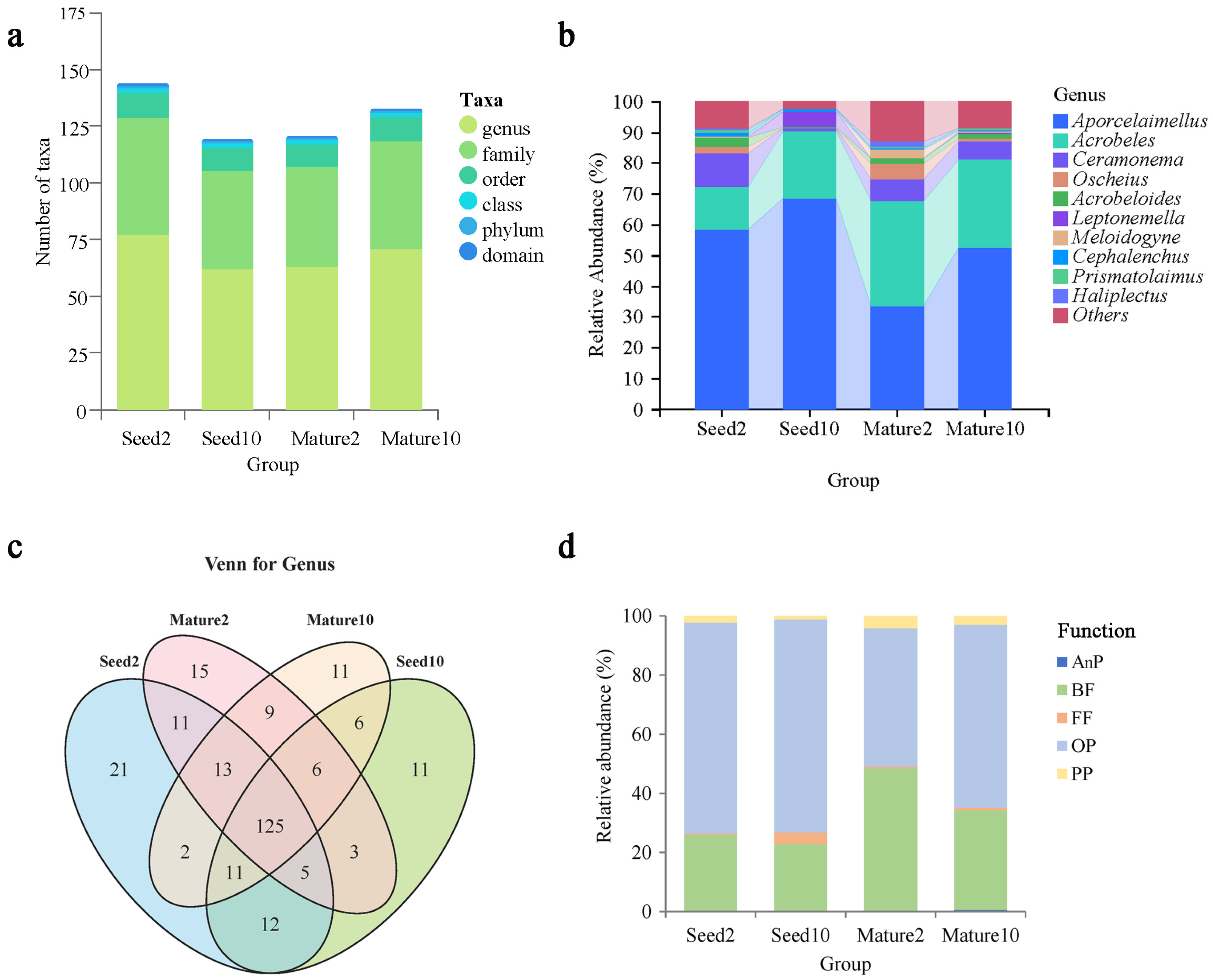
During the seedling stage, soils under the 2-year rotation (Seed2) exhibited the highest nematode taxon richness, whereas the 10-year rotation (Seed10) had the lowest richness (Figure 1a). This pattern was reversed at maturity, with soils from the 10-year rotation (Mature10) displaying higher taxon richness than the 2-year rotation system (Mature2). Among the top 10 genera, Aporcelaimellus (OP) was dominant, peaking in Seed10, followed by Acrobeles (BF), which reached its highest abundance in Mature2, and Ceramonema (marine, OP), most abundant in Seed2 (Figure 1b). Although 125 genera were shared across all groups, Seed2 contained the largest number of unique genera (21; Figure 1c). Analysis of trophic functional groups showed that OP nematodes were the most abundant, particularly in Seed10, whereas BF nematodes exhibited an opposite trend, peaking in Mature2 (Figure 1d). Soils under the 10-year rotation consistently supported higher abundances of OP, FF, and AnP nematodes, but lower abundances of BF and PP nematodes compared to the 2-year rotation soils.
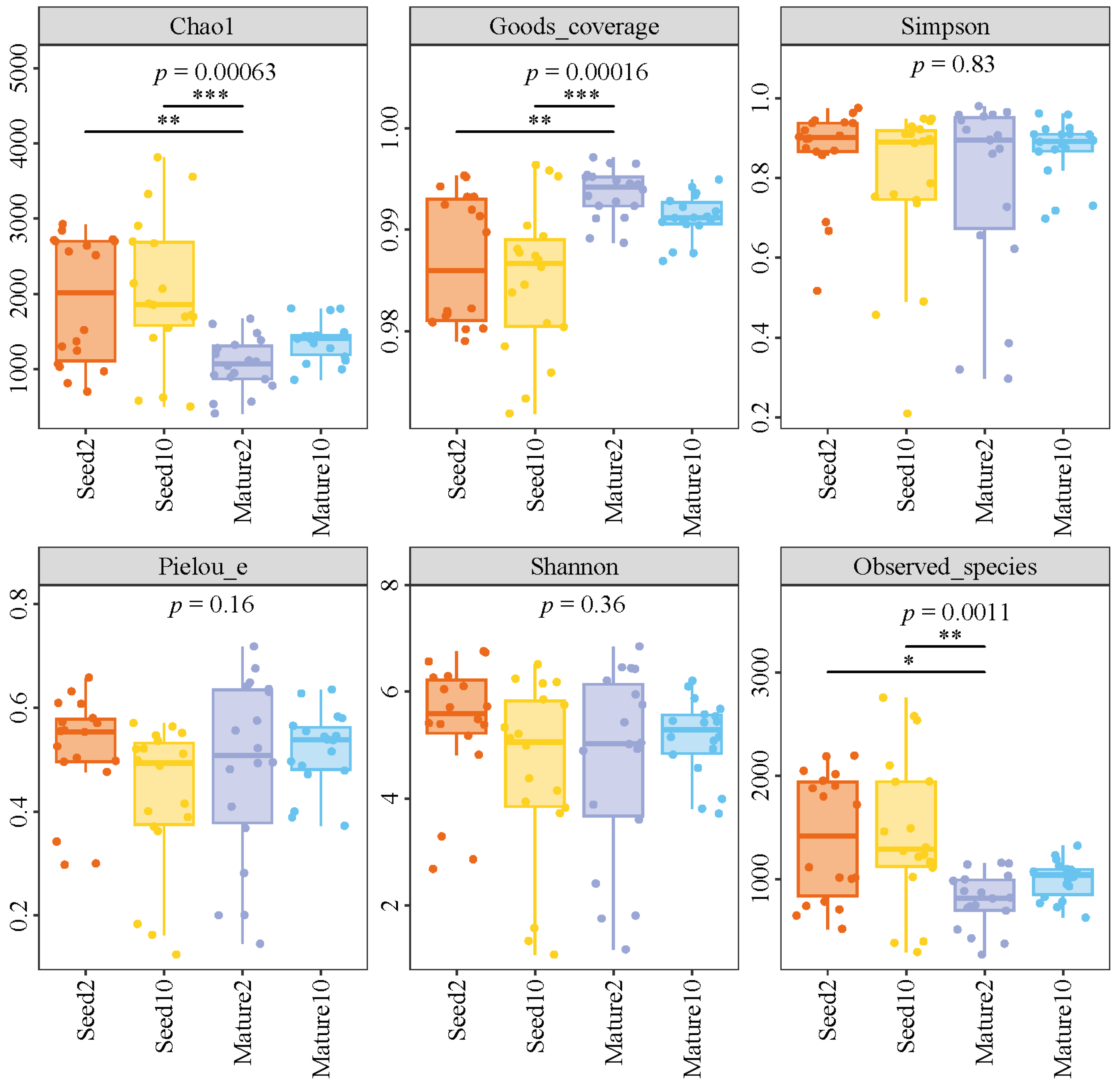
Regarding alpha diversity, Seed2 and Seed10 exhibited significantly higher Chao1 (p < 0.001) and Observed species indices (p < 0.01) compared to Mature2, but significantly lower Good’s coverage (p < 0.001). No significant differences were observed for the Simpson, Shannon, or Pielou’s evenness indices (Figure 2).

3.2. Nematode Ecological Indices

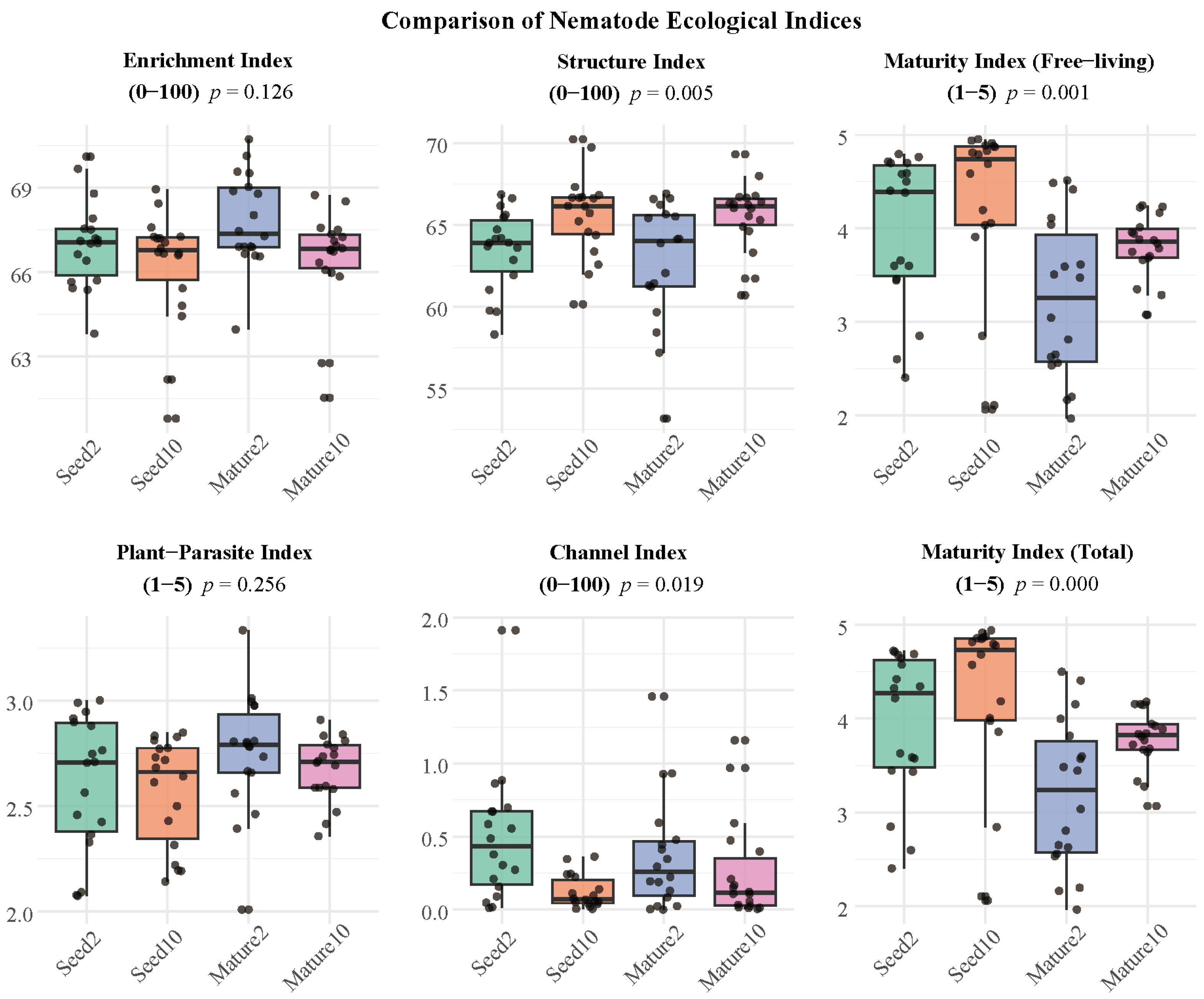
Nematode faunal profiles, constructed using trait data from 168 genera, demonstrated significant effects on soil food web condition (Figure 3). Indices reflecting food web structure and ecosystem maturity—Structure Index (SI), Maturity Index (MI), and total Maturity Index (SMI)—varied highly significantly (p < 0.01). Seed10 supported the most structured and mature nematode community (SI: 65.61 ± 2.52; MI: 4.24 ± 0.95), whereas Mature2 yielded the lowest values. Although resource enrichment status (EI) was statistically uniform across groups, the decomposition pathway, indicated by the Channel Index (CI), was significantly shifted toward fungal dominance in Seed2 (CI: 0.49 ± 0.46). The Plant Parasite Index (PPI) remained invariant, indicating consistent plant-parasitic pressure regardless of group.

3.3. Nematode Community Difference Among Groups

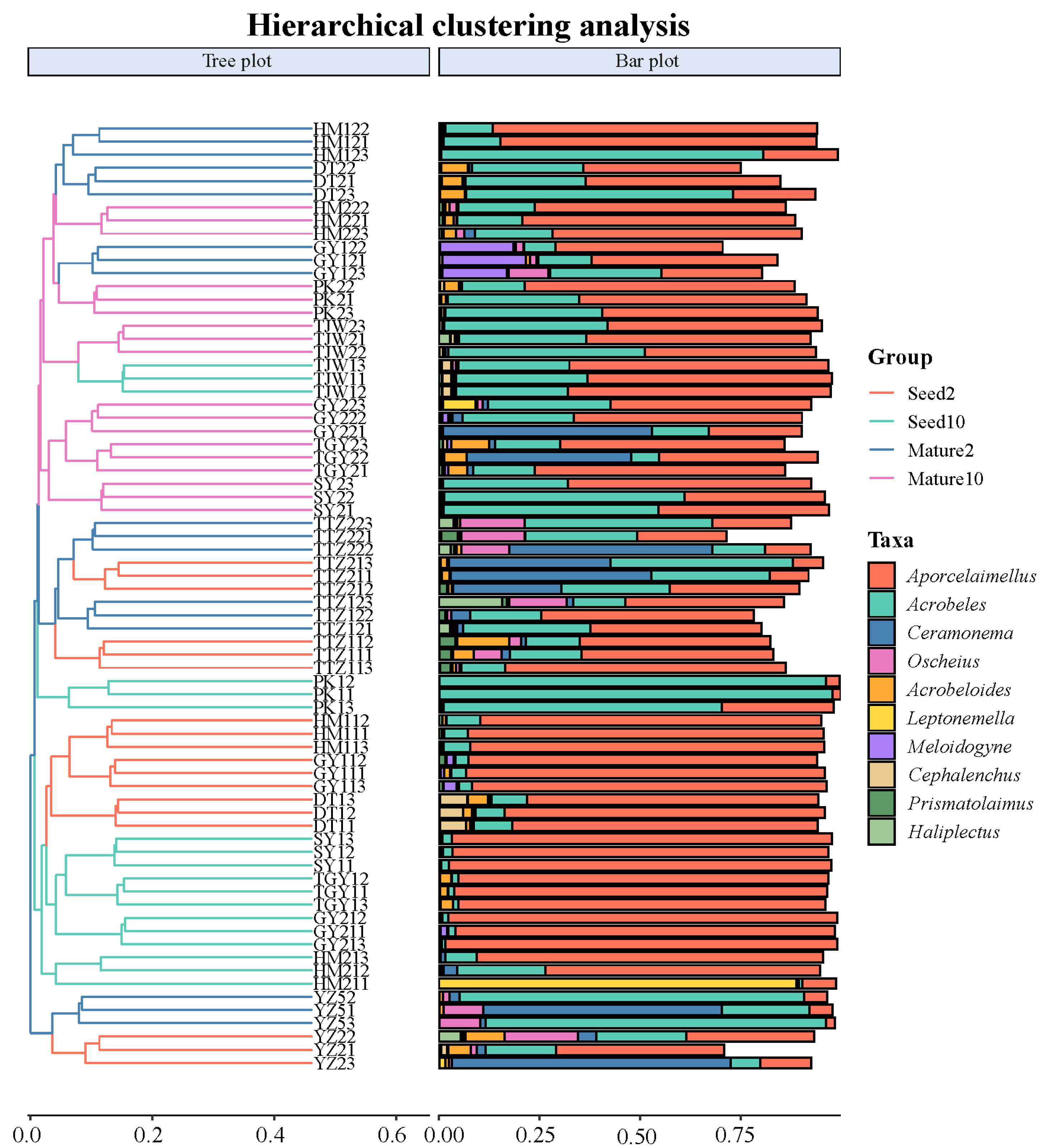
Hierarchical clustering analysis revealed that nematode community composition was more similar within the same growth stage (i.e., seedling or maturity) than between different stages, indicating a stronger effect of plant phenology than rotation duration (Figure 4). In contrast, samples from sites Xuzhou (TJW), Taizhou (TTZ1 and TTZ2), and Yangzhou (YZ) exhibited minimal temporal variation between growth stages, suggesting greater community stability over time at these locations. Beyond these rotation- and phenology-driven patterns, eDNA analysis also detected high-abundance marine nematode taxa (e.g., Ceramonema, Leptonemella, and Haliplectus) across the sampling spectrum. Their presence in both coastal (e.g., Ganyu (GY), and Haimen (HM)) and inland riparian (e.g., YZ, TZ, and TTZ areas aligns with the region’s defined coastal and river-sea alluvial plain characteristics.
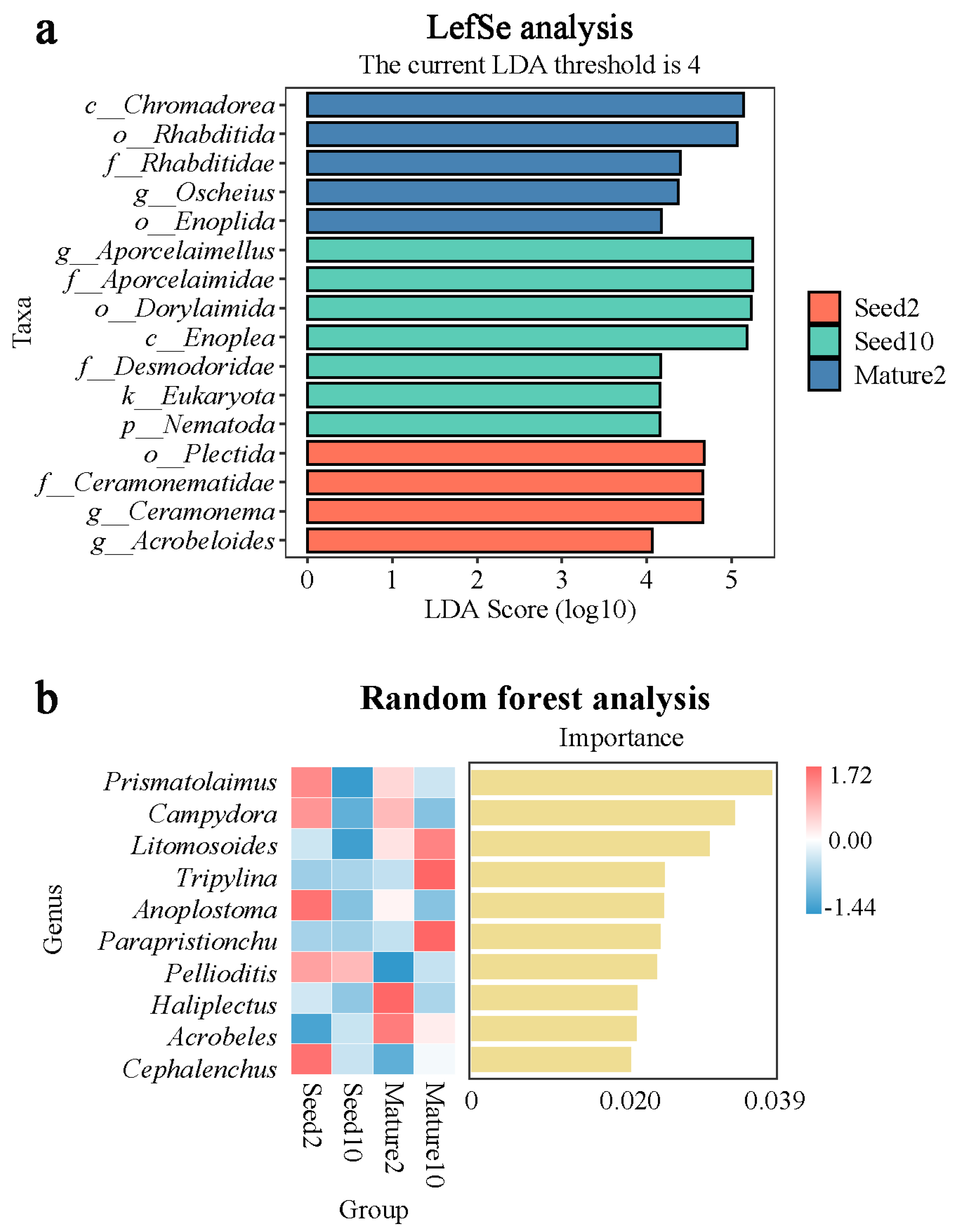
The biomarker taxa identified by LEfSe and random forest analyses showed strong complementarity (Figure 5). Notably, four genera from LEfSe—Ceramonema (marine, OP), Acrobeloides (BF), Aporcelaimellus (OP), and Oscheius (BF)—along with the top four predictors from random forest—Prismatolaimus (BF), Haliplectus (marine, BF), Acrobeles (BF), and Cephalenchus (PP)—were all ranked among the top 10 most abundant genera, underscoring their dual ecological role as both dominant and discriminant taxa in the community. In contrast, six other taxa—Campydora (OP), Litomosoides (AP), Tripylina (OP), Anoplostoma (marine, BF), Parapristionchus (BF), and Pellioditis (BF)—were consistently low in relative abundance, yet still contributed to community discrimination.
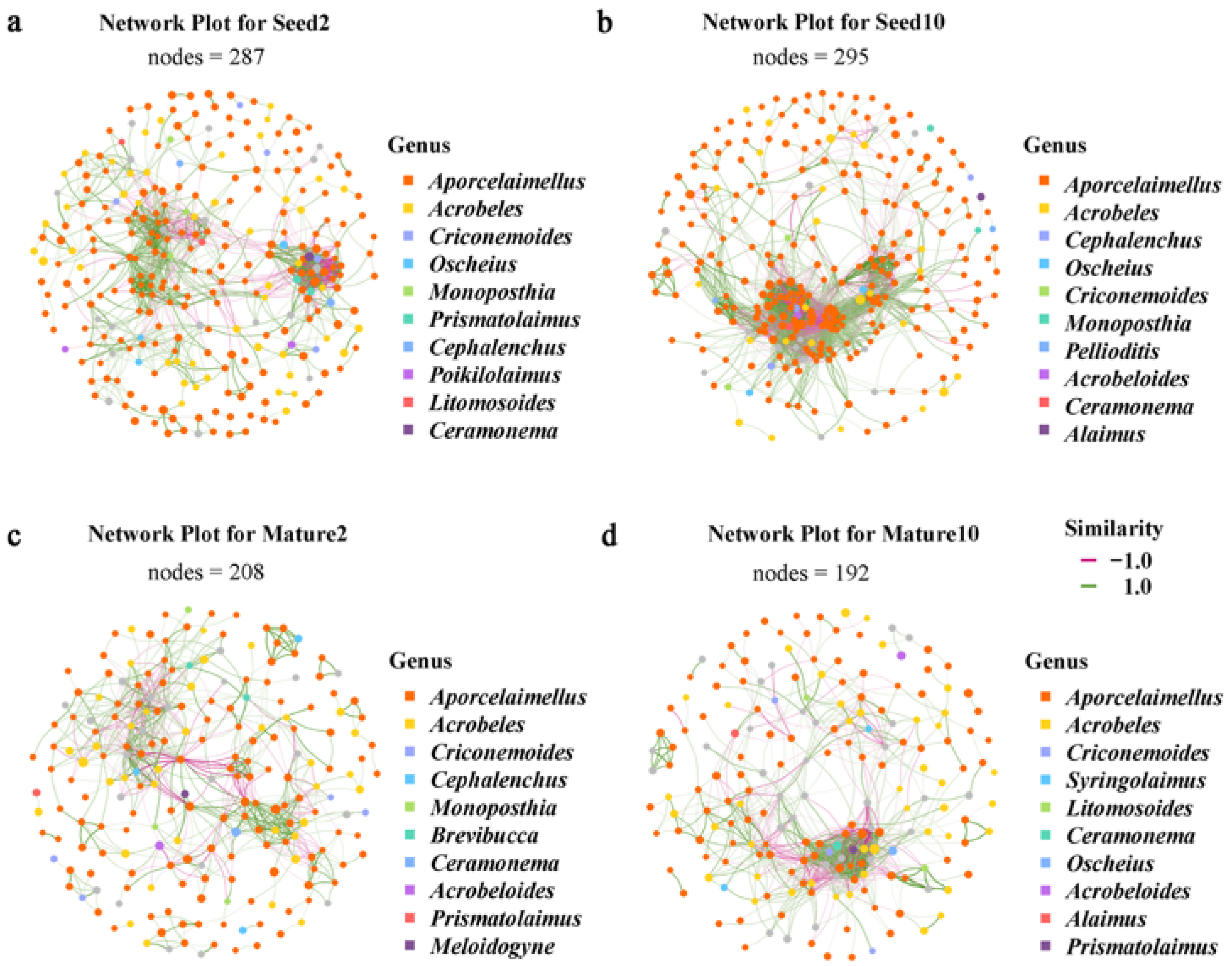
Based on objective Random Matrix Theory (RMT) thresholds (Seed2: 0.75; Seed10: 0.72; Mature2: 0.64; Mature10: 0.73) for defining significant co-occurrences, our analysis revealed that soil nematode networks at the seedling stage contained significantly more nodes (Seed2 = 287; Seed10 = 295) than those at maturity (Mature2 = 208; Mature10 = 192), alongside systematic topological differences (Figure 6; Table S2). At the seedling stage, Seed10 formed a more complex network than Seed2, marked by increased edges (1254 to 2940), higher density, shorter average path length (4.39 to 3.75), elevated transitivity (0.55 to 0.59), and reduced modularity (0.73 to 0.61). This indicates strengthened interspecific associations and enhanced community cohesion under long-term rotation early in the season. In contrast, mature-stage networks displayed streamlined structures with consistently high modularity (up to 0.76), surpassing all seedling groups. All empirical networks significantly diverged from random models, confirming non-random, ecologically meaningful interspecific interactions.

3.4. Environmental Drivers of Nematode Community Structure

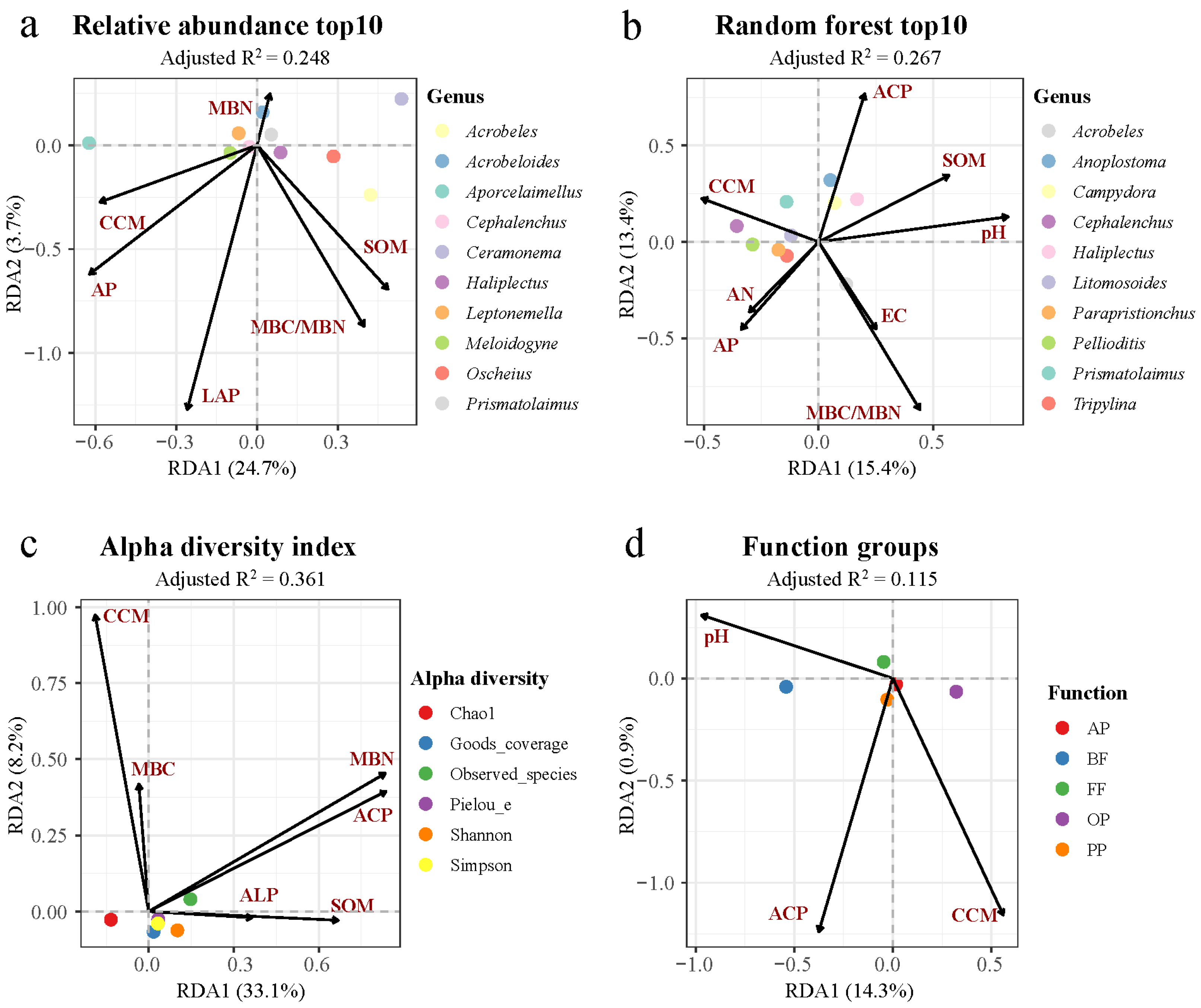
RDA (Figure 7) showed that for the relative abundance of the top 10 taxa (R2 = 0.430; adj R2 = 0.248), six variables contributed significantly, in the following order: SOM (adj R2 = 0.095), CCM (0.043), AP (0.037), MBC/MBN (0.030), leucine aminopeptidase (LAP) (0.026), and MBN (0.017). Among the top 10 most important genera identified by random forest analysis (R2 = 0.437; adj R2 = 0.267), eight variables showed significant contributions, namely, acid phosphatase (ACP) (0.064), MBC/MBN (0.053), pH (0.041), AP (0.027), SOM (0.022), EC (0.021), CCM (0.020), and AN (0.019). In terms of alpha diversity (R2 = 0.494; adj R2 = 0.361), MBN (0.098) and alkaline phosphatase (ALP) (0.081) were the primary contributing factors, followed by SOM (0.061), CCM (0.045), MBC (0.038), and ACP (0.038), while functional diversity (R2 = 0.314; adj R2 = 0.115) was mainly driven by pH (0.047), ACP (0.034), and CCM (0.034).
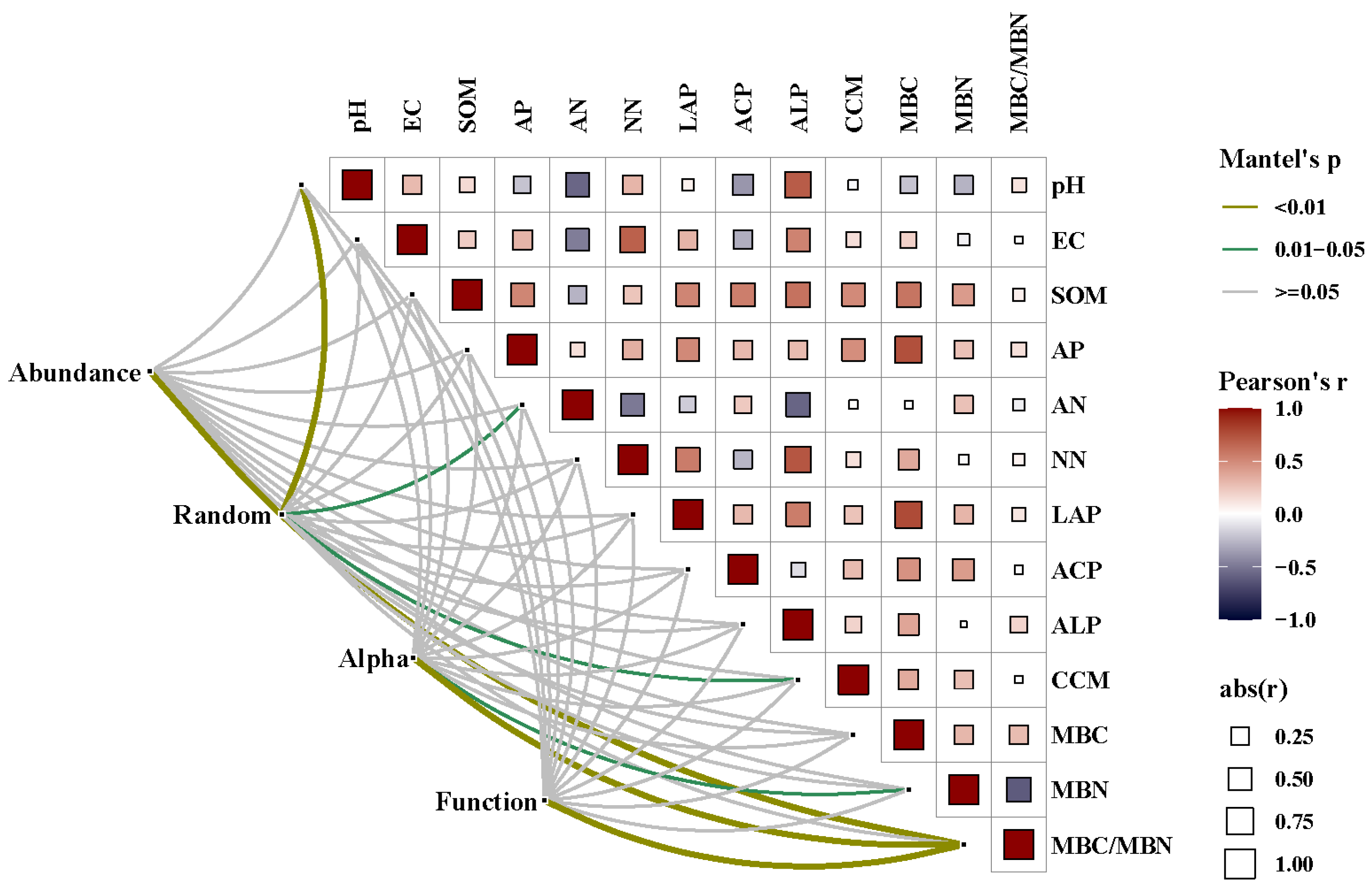
Mantel tests (Figure 8) indicated that MBC/MBN consistently influenced multiple dimensions of the nematode community, exhibiting a significant correlation with the relative abundance of the top 10 genera (r = 0.229; p = 0.010) and further confirming its role as the key driver of functional diversity (r = 0.321; p = 0.002). Meanwhile, the top 10 most important genera identified by random forest analysis revealed that pH (r = 0.117; p = 0.015), AP (r = 0.129; p = 0.014), and CCM (r = 0.184; p = 0.006) were significant explanatory variables. For alpha diversity, both MBN (r = 0.084; p = 0.047) and MBC/MBN (r = 0.333; p = 0.002) emerged as significant predictors.
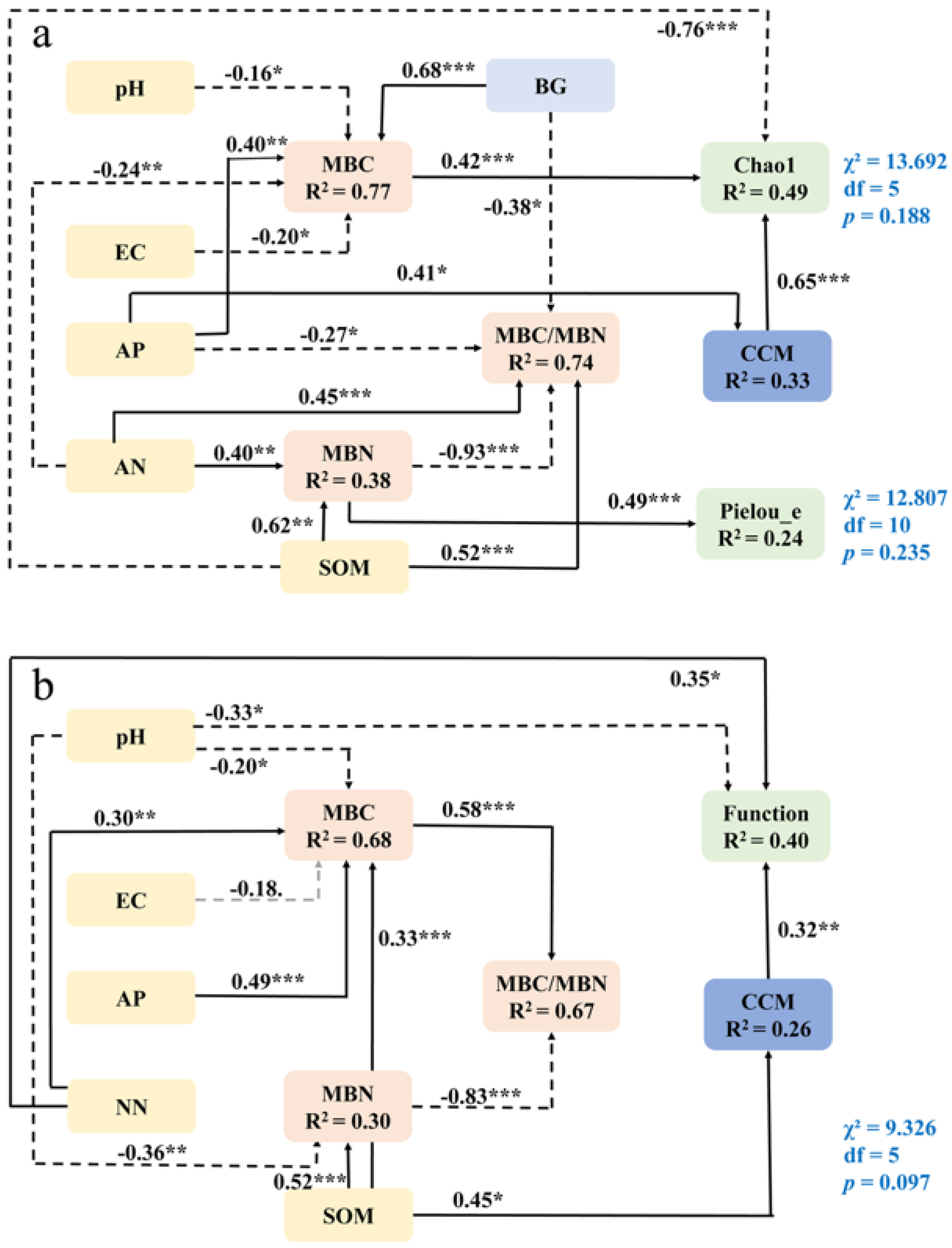
SEM analysis (Figure 9) demonstrated that AP was a key factor in shaping the microbial community, significantly promoting CCM (path coefficient = 0.41) and MBC (0.40). β-Glucosidase (BG) directly drove MBC (0.68) but exerted a negative effect on MBC/MBN (−0.38). SOM significantly enhanced MBN (0.62) and regulated MBC/MBN (0.52), while exhibiting a direct negative effect on nematode Chao1 (−0.76). Ultimately, nematode Chao1 was jointly driven by CCM (0.65) and MBC (0.42), and MBN showed the strongest direct positive effect on Pielou_e (0.49). For functional groups, soil pH exhibited a direct negative effect on functional diversity (−0.33), while NN (0.35) and CCM (0.32) showed significant positive effects. Further analysis indicated that CCM was primarily driven by SOM (0.45), MBC was jointly promoted by SOM (0.33), AP (0.49), and NN (0.30), and MBN was enhanced by SOM (0.52) but inhibited by pH (−0.36).

4. Discussion

4.1. Influence of Plant Phenology and Agricultural Practices on Nematode Communities

This study aims at elucidating the intrinsic mechanisms driving the soil food web structure in greenhouse systems. Understanding these mechanisms is critical for the sustainable development of facility-based agriculture, as long-term observations indicate that conventionally managed greenhouse soils often exhibit simplified food web structures, resource limitations, and ecological instability [46]. In this context, our analysis of melon cultivation systems demonstrates that plant phenology is the dominant factor shaping nematode community assembly. Variations in both community composition and network topology are primarily governed by crop growth stages (from seedling to maturity) rather than by rotation duration. During the seedling stage, the relatively homogeneous rhizosphere—characterized by limited root biomass and simple exudate composition—supports a complex network structure with high node connectivity but lower modularity. This observation aligns with the concept of the rhizosphere as a dynamic “microbial hotspot” [47] and the theory of “rhizosphere spatiotemporal organization” [48], collectively suggesting that root development drives soil community succession by creating spatiotemporally heterogeneous habitats.
As plants advance to the maturity stage, substantial changes occur. Well-developed root systems and diverse exudates generate strong biotic interactions, leading to a reduction in network nodes and a marked increase in modularity. This shift reflects the strengthening of deterministic filtering in community assembly, representing a systematic restructuring of the soil biota mediated by the differentiated habitats formed during root development [49]. This shift towards higher modularity carries significant ecological implications: it typically enhances network resilience and functional stability by compartmentalizing perturbations, thereby preventing the collapse of the entire soil food web under environmental stress and ensuring the continuity of key ecosystem processes like nutrient mineralization. This topological transition is functionally substantiated by corresponding shifts in nematode faunal indices. The marked increase in the Structure Index (SI) and Maturity Index (MI) from seedling to maturity stages directly reflects the development of a more complex and stable soil food web. Elevated SI signifies a greater proportion of persister nematodes, indicative of a structured ecosystem, while a higher MI confirms a community shift from r- to K-strategists, evidencing strengthened deterministic assembly. This alignment demonstrates that increased network modularity, by fostering communities dominated by persistent taxa, enhances the functional stability of ecosystems—a principle supported by foundational ecological theory [50]. Thus, faunal indices serve as integrative metrics, translating topological complexity into quantifiable ecosystem development and stability. Notably, long-term rotation (10 years) promoted more complex nematode interaction networks during the seedling stage, indicating that optimized management can enhance soil biological interactions during critical growth periods. This finding is consistent with broader greenhouse management studies, which show that organic management in northern Chinese greenhouse systems significantly increases food web complexity and stability through resource input regulation, with particularly pronounced effects on higher trophic levels [51]. Collectively, these results suggest that precision management tailored to plant phenology, combined with long-term sustainable farming practices, can optimize the soil food web structure by guiding rhizosphere ecological processes, thereby providing an effective strategy for achieving ecological sustainability in facility-based agriculture.
It is important to note that the ecological interpretation of co-occurrence network patterns remains inferential. While the observed shifts in network complexity and modularity across growth stages are consistent with theoretical frameworks such as deterministic filtering, alternative explanations (e.g., stress responses or abiotic drivers) cannot be ruled out. Future controlled experiments targeting specific factors or taxa are needed to validate the causal mechanisms underlying these topological changes.

4.2. Functional Bio-Indicators and Community Dynamics in Greenhouse Soils

Discrepancies between LEfSe and random forest analyses reveal a multidimensional mechanism underlying nematode community assembly in greenhouse melon soils, driven by both specialist and core taxa. Specifically, omnivorous/predatory nematodes (OP) were significantly enriched in long-term rotation systems, whereas bacterivorous nematodes (BF) dominated at maturity, indicating clear functional group differentiation. These “core sensitive” taxa serve as important ecological indicators. For instance, Acrobeloides (BF), identified in this study, is closely associated with environments of high nitrogen availability [52]. Similarly, the enrichment of Prismatolaimus (BF)—a key genus highlighted by random forest analysis—in organically managed systems aligns with previous findings showing its prevalence in organic farmlands and near absence in conventional systems, displaying a distribution pattern opposite to taxa such as Pristionchus (OP) [53]. These distributional patterns of bacterivorous nematodes reflect the responses of underlying microbial community structures to different management practices.
Moreover, bacterivorous nematodes and microbial communities constitute a complete ecological feedback loop. Studies at the soil aggregate scale demonstrate that bacterivorous nematodes not only enhance bacterial diversity through predation but also correlate positively with specific functional bacterial groups, such as alkaline phosphatase (ALP)-producing bacteria, with this effect being particularly pronounced in macro-aggregates [54]. This indicates that bacterivorous nematodes function not only as “indicators” of microbial community structure but also as “regulators” of microbial dynamics and function, collectively participating in the formation of a “management–biotic community–ecological function” cascade regulatory network in greenhouse soils. Consequently, identifying these core functional taxa and managing their habitat conditions provides a practical framework for leveraging soil food webs to enhance agroecosystem services. This approach moves beyond mere monitoring towards the active management of soil biodiversity to support critical functions such as the biocontrol of pathogens, organic matter decomposition, and the stabilization of nutrient cycles.
In addition to detecting the high-impact pathogen Meloidogyne (e.g., M. incognita), our eDNA-based network analysis identified Criconemoides, a root-damaging genus [55], as a key interactor, demonstrating the dual capacity of this approach to monitor both overt threats and pivotal community members. This supports the principle that effective pest suppression in sustainable agriculture requires management practices capable of influencing the broader soil food web [56,57].

4.3. Microbially Mediated Nutrient Cycling Under Soil Physicochemical Constraints in Greenhouses

This study systematically reveals that soil pH, coupled with carbon (C), nitrogen (N), and phosphorus (P) cycling, synergistically drives nematode community assembly in greenhouse environments. Statistical analyses (Mantel test and RDA) confirm that SOM and pH are key determinants of variation in the soil micro-food web. This mechanism is fully manifested in long-term organic management, where fertilizer application enhances SOM and maintains a favorable pH, thereby strengthening interactions between beneficial microorganisms and microbivorous nematodes [58]. This conclusion is further supported by observations from diverse greenhouse systems. In northern China (Shenyang), the total nematode abundance was significantly positively correlated with SOM and total N, but negatively correlated with pH [59]. Similarly, an analysis of Korean greenhouse soils identified pH and electrical conductivity as the most critical factors shaping bacterial community diversity and composition, with an influence exceeding that of other ion contents [60]. This collective evidence underscores that the management-shaped soil chemical environment is the core driver structuring soil communities in greenhouse cultivation.
Soil acidification, a common result of intensive fertilization in greenhouses [61], significantly alters microbial nutrient acquisition strategies. In response to P fixation in acidic soils, microbes enhance the secretion of acid phosphatases (e.g., ACP and ALP) to mineralize organic P, an adaptation evidenced by the strong global negative correlation between P activity and soil pH [62,63]. Even in highly acidic soils, microbial communities—often assisted by ectomycorrhizal fungi—can initiate adaptive responses to partially mitigate P limitation [64]. The nematode faunal indices provide a holistic view of how these microbial adaptations cascade to higher trophic levels. The Enrichment Index (EI), which remained uniformly high across treatments, indicates that the soil system was consistently in a resource-enriched state, likely sustained by management inputs. This explains the high metabolic demand and enzyme activities observed, as the food web was primed for rapid nutrient processing. However, the significant variation in SI and MI underscores that despite similar enrichment levels, the architectural stability and maturity of the consumer community varied significantly with plant phenology. This suggests that plant growth stage modulates how energy and nutrients flow through an enriched system, shifting it from a fast, connected loop (seedling) to a more reticent, stabilized network (maturity). SEM underscores the critical role of P availability, showing that soil AP directly stimulates CCM (path coefficient = 0.41) and MBC (path coefficient = 0.40). The centrality of AP confirms that P availability is a key constraint on soil biological communities [65], making its management an ecologically pivotal lever in facility-based agriculture.
The C and N cycles in these soils exhibit distinct coupling and decoupling patterns. For C, a disconnect was observed between microbial functional potential (β-glucosidase) and actual carbon mineralization flux (CCM), suggesting that the supply of readily decomposable organic C—not microbial capacity—is the ultimate limiting factor for mineralization in these systems [25]. For N, the microbial biomass ratio (MBC/MBN) emerged as a core indicator linking soil stoichiometry to the nematode community. MBN exerted the strongest direct positive association with nematode evenness (path coefficient = 0.49), while the MBC/MBN ratio was the most stable predictor of nematode functional diversity. This aligns with ecological stoichiometry theory, indicating that the elemental balance of microbial resources is more predictive of consumer community structure than the content of individual elements [66]. The integrated SEM pathways are consistent with a conceptual model in which soil properties influence microorganisms, which in turn influence nematodes. The model suggests that SOM is positively associated with MBN (path coefficient = 0.62), while showing a direct negative association with nematode richness (−0.76), and soil pH directly negatively impacts functional diversity (−0.33). These pathways collectively support the core role of the “microbial bridge”, illustrating a potential cascade whereby agricultural practices are linked to changes in the microbial community’s functional state, which correspond with the structure of higher trophic levels, including nematodes.
Our findings underscore that the greenhouse ecosystem is governed by a set of core ecological constraints, primarily soil pH and resource stoichiometry (especially C:P balance). Agricultural management decisions exert their ultimate influence by altering these fundamental constraints, which in turn force microbial communities to adjust their nutrient acquisition strategies. This cascade of effects, from chemistry to microbiology to the nematode food web, ultimately determines the overall productivity and functional stability of the entire ecosystem. Our study establishes a functional framework for the “microbial bridge”; its taxonomic resolution through amplicon sequencing constitutes the next critical step. To translate these mechanisms into practice, we recommend (i) reducing synthetic fertilizer input, especially nitrogen, by substituting with organic amendments; (ii) maintaining topsoil pH between 6.0 and 6.5 through managed irrigation and organic matter addition; and (iii) applying biostimulants during the seedling stage to foster root development and network complexity without inducing salt stress. It is important to acknowledge that this study, capturing a single growing season, provides a focused “snapshot” of the system. While it effectively highlights the most pronounced differences in nematode community responses to rotation treatments within a controlled timeframe, soil biota exhibit significant temporal variability. Their long-term response patterns and interactions with interannual climate fluctuations require validation through multi-year observational studies. Future research should investigate how the temporal dynamics of plant phenology, soil nutrient pulses, and microbial community succession jointly influence nematode-mediated ecosystem functions, particularly under varying greenhouse management regimes and climate scenarios.

4.4. Marine Nematode eDNA Signals as Indicators of Geohistorical Legacy

The consistent detection of marine nematode eDNA signals across multiple sampling sites may appear anomalous at first glance; however, this finding is entirely consistent with the geohistorical context of the study area. Spatially, the locations where these signals were detected (Ganyu, Haimen, Yangzhou, and Taizhou) all lie within the marine sedimentary system of the Yangtze Delta–Yellow Sea coastal zone [67]. Soils in Ganyu and Haimen developed directly from coastal saline sediments, while those in Yangzhou and Taizhou, despite being reclaimed for agriculture, originate from Yangtze River alluvium containing marine-derived biogenic remnants. High-precision accelerator mass spectrometry (AMS) 14C dating indicates that the southern Yangtze Delta plain entered a critical land-forming stage around 6500–6000 cal. yr BP, when sea-level stabilization and rapid shoreline progradation initiated pedogenesis from marine sedimentary parent materials [68]. Accordingly, the soils at Ganyu and Haimen began developing approximately 6000 years ago. The distribution of these signal “hotspots” (Ganyu, Yangzhou, and Taizhou) aligns perfectly with known depositional centers of the Yangtze Delta. As established by classical sedimentological studies, “tidal dynamics are the primary control on the distribution of burial assemblages in the river channel below Zhenjiang” [69]. This indicates that powerful tidal forces are the key mechanism shaping the spatial pattern of sediments and their included biological remains in this region.
Consequently, we propose a robust hypothesis: these marine nematode DNA sequences act as “molecular fossils” of the depositional history shaped by tidal dynamics. They likely persisted in the form of durable eggs, dormant stages, or DNA released from organismal remnants, preserved over time under specific physicochemical conditions (e.g., anoxia) facilitated by rapid burial. While the evidence strongly supports a paleoenvironmental origin for these signals, the potential contribution from contemporary irrigation water cannot be excluded. Such irrigation may transport marine genetic material from connected aquatic systems and could represent a secondary, ongoing source of the detected eDNA. This newly formed coastal plain was rapidly exploited for agriculture. Agro-archeological research shows that rice cultivation in the Yangtze Delta region (including Yangzhou and Taizhou) began at least around 7700 years ago, involving early forms of environmental modification such as fire management and preliminary water-level control [70]. Systematic, large-scale paddy field agriculture was established approximately 6000 years ago, corresponding to the late Majiabang cultural period [71]. Modern agricultural practices (e.g., deep plowing and irrigation) may have subsequently transported these sequestered genetic materials from deeper layers to the surface, where they were captured by eDNA metabarcoding. While this finding reveals the potential of eDNA to capture historical genetic legacies [72], it is important to note that the detection of such paleoenvironmental signals appears specific to taxa with marine ancestry and does not diminish the primary conclusion that the contemporary soil food web structure is dominantly shaped by plant phenology. Thus, the functional interpretation of the ecosystem state and its management implications remain robustly tied to current ecological drivers.

5. Conclusions

Plant phenology governs the systematic succession in the structure and function of soil food webs in greenhouse ecosystems. This study demonstrates that crop growth stage, rather than rotation history, is the primary driver, effecting a predictable shift from an enriched, fast cycling state during seedling stages to a structured and stable state at maturity. This functional transition is consistently evidenced by changes in network topology, nematode faunal indices, and microbial stoichiometry, revealing a deterministic assembly process mediated by plant–soil feedbacks. Furthermore, the detection of complex eDNA signals, including those of marine nematodes, suggests that contemporary soil biodiversity may incorporate genetic material from multiple sources, ranging from historical sedimentary legacies to ongoing agricultural inputs. Consequently, sustainable greenhouse management should pivot towards phenology sensitive practices that support this natural succession, utilizing functional indices like the Structure Index as diagnostic tools for ecosystem health.

Supplementary Materials

The following supporting information can be downloaded at: https://www.mdpi.com/article/10.3390/agronomy16010069/s1, Figure S1: Correlation for all environmental variables; Table S1: Sampling site information including abbreviation, geographical coordinates, cultivated crop variety, crop rotation system, rotation period, and fertilizer application during the melon growth period; Table S2: Topological features of soil nematode co-occurrence networks in greenhouse systems.

Author Contributions

Conceptualization, J.J., W.M. and H.Z.; methodology, P.L., P.C. and X.L.; software, P.L.; validation, J.J., H.Z. and W.M.; formal analysis, P.L. and P.C.; investigation, P.C.; resources, J.J. and X.L.; data curation, P.L.; writing—original draft preparation, P.L.; writing—review and editing, P.L. and J.J.; visualization, X.L.; supervision, J.J.; project administration, H.Z.; funding acquisition, H.Z. All authors have read and agreed to the published version of the manuscript.

Funding

This research was funded by the National Key Research and Development Program of China (Grant No. 2024YFD2300302).

Data Availability Statement

The raw data supporting the conclusions of this article will be made available by the authors on request.

Acknowledgments

The authors have reviewed and edited the output and take full responsibility for the content of this publication. Our acknowledgements also extend to the anonymous reviewers for their constructive reviews of the manuscript.

Conflicts of Interest

The authors declare no conflicts of interest.

Abbreviations

The following abbreviations are used in this manuscript:
ACPAcid phosphatase
AKAvailable potassium
ALPAlkaline phosphatase
ANAlkali-hydrolyzable nitrogen
AnPAnimal parasites
APAvailable phosphorus
ASVAmplicon sequence variant
BFBacterivores
BGβ-Glucosidase
CCMCumulative organic carbon mineralization
ECSoil electrical conductivity
FFFungivores
LAPLeucine aminopeptidase
LDALinear discriminant analysis
MBCMicrobial biomass carbon
MBC/MBNMicrobial biomass carbon and nitrogen ratio
MBNMicrobial biomass nitrogen
NNAmmonium nitrogen
OPOmnivores predators
PPPlant parasites
RDARedundancy analysis
SEMStructural equation modeling
SOCSoil organic carbon
SOMSoil organic matter
TNTotal nitrogen
VIFVariance inflation factors

References

  1. Brussard, L.; de Ruiter, P.C.; Browwn, G.G. Soil biodiversity for agricultural sustainability. Agr. Ecosyst. Environ. 2007, 121, 233–244. [Google Scholar] [CrossRef]
  2. Wagg, C.; Bender, S.F.; Wildmer, F.; van der Heijden, M.G.A. Soil biodiversity and soil community composition determine ecosystem multifunctionality. Proc. Natl. Acad. Sci. USA 2014, 111, 5266–5270. [Google Scholar] [CrossRef] [PubMed]
  3. Wardle, D.A. The influence of biotic interactions on soil biodiversity. Ecol. Lett. 2006, 9, 870–886. [Google Scholar] [CrossRef]
  4. Maraveas, C.; Karavas, C.-S.; Loukatos, D.; Bartzanas, T.; Arvanitis, K.G.; Symeonaki, E. Agricultural Greenhouses: Resource Management Technologies and Perspectives for Zero Greenhouse Gas Emissions. Agriculture 2023, 13, 1464. [Google Scholar] [CrossRef]
  5. Messelink, G.J.; Lambion, J.; Janssen, A.; van Rijin, P.C.J. Biodiversity in and around Greenhouses: Benefits and Potential Risks for Pest Management. Insects 2021, 12, 933. [Google Scholar] [CrossRef]
  6. Haj-Amor, Z.; Araya, T.; Kim, D.-G.; Bouri, S.; Lee, J.; Ghiloufi, W.; Yang, Y.; Kang, H.; Jhariya, M.K.; Banerjee, A.; et al. Soil salinity and its associated effects on soil microorganisms, greenhouse gas emissions, crop yield, biodiversity and desertification: A review. Sci. Total Environ. 2022, 843, 156946. [Google Scholar] [CrossRef]
  7. Porazinska, D.L.; Duncan, L.W.; McSorley, R.; Graham, J.H. Nematode communities as indicators of status and processes of a soil ecosystem influenced by agricultural management practices. Appl. Soil. Ecol. 1999, 13, 69–86. [Google Scholar] [CrossRef]
  8. Milereit, J.; Burger, M.; Hodson, A.K. Influence of recycled organic waste amendments on carbon pools, greenhouse gas emissions, and nematode indicators of soil health. Appl. Soil. Ecol. 2025, 208, 105967. [Google Scholar] [CrossRef]
  9. Du Preez, G.; Daneel, M.; De Goede, R.; Du Toit, M.J.; Ferris, H.; Fourie, H.; Geisen, S.; Kakouli-Duarte, T.; Korthals, G.; Sánchez-Moreno, S.; et al. Nematode-based indices in soil ecology: Application, utility, and future directions. Soil. Biol. Biochem. 2022, 169, 108640. [Google Scholar] [CrossRef]
  10. Vellend, M. The Theory of Ecological Communities; Princeton University Press: Princeton, NJ, USA, 2016. [Google Scholar]
  11. Lazarova, S.; Coyne, D.; Rodríguez, M.G.; Peteira, B.; Ciancio, A. Functional diversity of soil nematodes in relation to the impact of agriculture—A review. Diversity 2021, 13, 64. [Google Scholar] [CrossRef]
  12. Li, Q.; Jiang, Y.; Liang, W.; Lou, Y.; Zhang, E.; Liang, C. Long-term effect of fertility management on the soil nematode community in vegetable production under greenhouse conditions. Appl. Soil. Ecol. 2010, 46, 111–118. [Google Scholar] [CrossRef]
  13. Tian, X.; Zhao, X.; Mao, Z.; Xie, B. Variation and dynamics of soil nematode communities in greenhouses with different continuous cropping periods. Horitc. Plant J. 2020, 6, 301–312. [Google Scholar] [CrossRef]
  14. Thiele-Bruhn, S.; Bloem, J.; de Vries, F.T.; Kalbitz, K.; Wagg, C. Linking soil biodiversity and agricultural soil management. Curr. Opin. Environ. Sustain. 2012, 4, 523–528. [Google Scholar] [CrossRef]
  15. Bai, Z.; Caspari, T.; Gonzalez, M.R.; Batjes, N.H.; Mäder, P.; Bünemann, E.K.; de Goede, R.; Brussaard, L.; Xu, M.; Ferreira, C.S.S.; et al. Effects of agricultural management practices on soil quality: A review of long-term experiments for Europe and China. Agr. Ecosyst. Environ. 2018, 265, 1–7. [Google Scholar] [CrossRef]
  16. Zhang, X.; Ferris, H.; Mitchell, J.; Liang, W. Ecosystem services of the soil food web after long-term application of agricultural management practices. Soil. Biol. Biochem. 2017, 111, 36–43. [Google Scholar] [CrossRef]
  17. Yeates, G.W. Effects of plants on nematode community structure. Annu. Rev. Phytopathol. 1999, 37, 127–149. [Google Scholar] [CrossRef]
  18. Martins, A.; Tavares, D.; Freitas, H.; Costa, S. Plant sex and phenological stage affect interactions with rhizosphere nematode communities. Plant Ecol. Divers. 2018, 11, 227–238. [Google Scholar] [CrossRef]
  19. Asato, A.E.B.; Witth, C.; Eisenhauer, N.; Hines, J. On the phenology of soil organisms: Current knowledge and future steps. Ecol. Evol. 2023, 13, e10022. [Google Scholar] [CrossRef] [PubMed]
  20. Zhou, J.; Wu, J.; Huang, J.; Sheng, X.; Dou, X.; Lu, M. A synthesis of soil nematode responses to global change factors. Soil. Biol. Biochem. 2022, 165, 108538. [Google Scholar] [CrossRef]
  21. Bardgett, R.D.; van der Putten, W.H. Belowground biodiversity and ecosystem functioning. Nature 2014, 515, 505–511. [Google Scholar] [CrossRef]
  22. Tsiafouli, M.A.; Thébault, E.; Sgardelis, S.P.; de Ruiter, P.C.; van der Putten, W.H.; Birkhofer, K.; Hemerik, L.; de Vries, F.T.; Bardgett, R.D.; Brady, M.V. Intensive agriculture reduces soil biodiversity across Europe. Glob. Change Biol. 2015, 21, 973–985. [Google Scholar] [CrossRef]
  23. Wardle, D.A.; Bardgett, R.D.; Klironomos, J.N.; Setälä, H.; van der Putten, W.H.; Wall, D.H. Ecological linkages between aboveground and belowground biota. Science 2004, 304, 1629–1633. [Google Scholar] [CrossRef]
  24. de Vries, F.T.; Thebault, E.; Liiri, M.; Bardgett, R.D. Soil food web properties explain ecosystem services across European land use systems. Proc. Natl. Acad. Sci. USA 2013, 110, 14296–14301. [Google Scholar] [CrossRef]
  25. Heuck, C.; Weig, A.; Spohn, M. Soil microbial biomass C:N:P stoichiometry and microbial use of organic phosphorus. Soil. Biol. Biochem. 2015, 85, 119–129. [Google Scholar] [CrossRef]
  26. Khan, K.S.; Naveed, M.; Ditta, A.; Alam, T.; Mumtaz, M.Z.; Abbas, A.; Manzoni, S.; Li, L. Soil C/P stoichiometry mediated microbially driven phosphorus mobilization: New insight in soil P management. J. Soil. Sci. Plant Nutr. 2025, 25, 7691–7709. [Google Scholar] [CrossRef]
  27. Cleveland, C.C.; Liptzin, D. C:N:P stoichiometry in soil: Is there a “Redfield ratio” for the microbial biomass? Biogeochemistry 2007, 85, 235–252. [Google Scholar] [CrossRef]
  28. Li, L.; Luo, Z.; Li, L.; Niu, Y.; Zhang, Y.; He, R.; Liu, J.; Nian, L. Long-term phosphorus fertilization reveals the phosphorus limitation shaping the soil micro-food web stability in the Loess Plateau. Front. Microbiol. 2024, 14, 1256269. [Google Scholar] [CrossRef]
  29. Xue, X.; Adhikari, B.N.; Ball, B.A.; Barrett, J.E.; Miao, J.; Perkes, A.; Martin, M.; Simmons, B.L.; Wall, D.H.; Adams, B.J. Ecological stoichiometry drives the evolution of soil nematode life history traits. Soil. Biol. Biochem. 2023, 177, 108891. [Google Scholar] [CrossRef]
  30. Wang, J.; Liu, T.; Zhao, J.; Ning, C.; Chen, S.; Zhang, X.; Liu, G.; Kuzyakov, Y.; Yan, W. Energy flows through nematode food webs depending on the soil carbon and nitrogen contents after forest conversion. Sci. Total Environ. 2024, 935, 173322. [Google Scholar] [CrossRef]
  31. Pribyl, D.W. A critical review of the conventional SOC to SOM conversion factor. Geoderma 2010, 156, 75–83. [Google Scholar] [CrossRef]
  32. Lu, R.K. Soil Agricultural Chemical Analysis Method; China Agricultural Scientech Press: Beijing, China, 1999. [Google Scholar]
  33. Edwards, A.H. The semi-micro Kjeldahl method for the determination of nitrogen in coal. J. Appl. Chem. 1954, 4, 330–340. [Google Scholar] [CrossRef]
  34. Bray, R.H.; Kurtz, L.T. Determination of total, organic, and available forms of phosphorus in soils. Soil. Sci. 1945, 59, 39–46. [Google Scholar] [CrossRef]
  35. Saiya-Cork, K.R.; Sinsabaugh, R.L. The effects of long term nitrogen deposition on extracellular enzyme activity in an Acer saccharum forest soil. Soil. Biol. Biochem. 2002, 34, 1309–1315. [Google Scholar] [CrossRef]
  36. German, D.P.; Weintraub, M.N.; Grandy, A.S.; Lauber, C.L.; Rinkes, Z.L.; Allison, S.D. Optimization of hydrolytic and oxidative enzyme methods for ecosystem studies. Soil. Biol. Biochem. 2011, 43, 1387–1397. [Google Scholar] [CrossRef]
  37. Vance, E.D.; Brookes, P.C.; Jenkinson, D.S. An extraction method for measuring soil microbial biomass C. Soil Biol. Biochem. 1987, 19, 703–707. [Google Scholar] [CrossRef]
  38. Grunwald, D.; Kaiser, M.; Ludwig, B. Effect of biochar and organic fertilizers on C mineralization and macro-aggregate dynamics under different incubation temperatures. Soil. Till. Res. 2016, 164, 11–17. [Google Scholar] [CrossRef]
  39. Callahan, B.J.; Mcmurdie, P.J.; Rosen, M.J.; Han, A.W.; Johnson, A.J.; Holmes, S.P. Dada2: High-resolution sample inference from illumina amplicon data. Nat. Methods 2016, 13, 581–583. [Google Scholar] [CrossRef]
  40. Rognes, T.; Flouri, T.; Nichols, B.; Quince, C.; Mahé, F. Vsearch: A versatile open source tool for metagenomics. PeerJ 2016, 4, e2584. [Google Scholar] [CrossRef] [PubMed]
  41. Caporaso, J.G.; Kuczynski, J.; Stombaugh, J.; Bittinger, K.; Bushman, F.D.; Costello, E.K.; Fierer, N.; Peña, A.G.; Goodrich, J.K.; Gordon, J.I. QIIME allows analysis of high-throughput community sequencing data. Nat. Methods 2010, 7, 335–336. [Google Scholar] [CrossRef]
  42. Quast, C.; Pruesse, E.; Yilmaz, P.; Gerken, J.; Schweer, T.; Yarza, P.; Peplies, J.; Gloeckner, F.O. The SILVA ribosomal RNA gene database project: Improved data processing and web-based tools. Nucleic Acids Res. 2013, 41, D590–D596. [Google Scholar] [CrossRef]
  43. Yeates, G.W.; Bongers, T.; De Goede, R.G.M.; Freckman, D.W.; Georgieva, S.S. Feeding habits in soil nematode families and genera—An outline for soil ecologists. J. Nematol. 1993, 25, 315–331. [Google Scholar] [PubMed]
  44. Bongers, T. The maturity index: An ecological measure of environmental disturbance based on nematode species composition. Oecologia 1990, 83, 14–19. [Google Scholar] [CrossRef]
  45. Ferris, H.; Bongers, T.; de Goede, R.G.M. A framework for soil food web diagnostics: Extension of the nematode faunal analysis concept. Appl. Soil. Ecol. 2001, 18, 13–29. [Google Scholar] [CrossRef]
  46. Chen, Y.-F.; Cao, Z.-P.; Popescu, L.; Kiepper, B.H. Static and Dynamic Properties of Soil Food Web Structure in a Greenhouse Environment. Pedosphere 2014, 24, 258–270. [Google Scholar] [CrossRef]
  47. Kuzyakov, Y.; Blagodatskaya, E. Microbial hotspots and hot moments in soil: Concept & review. Soil. Biol. Biochem. 2015, 83, 184–199. [Google Scholar] [CrossRef]
  48. Vetterlein, D.; Carminati, A.; Kögel-Knabner, I.; Bienert, G.P.; Smalla, K.; Oburger, E.; Schnepf, A.; Banitz, T.; Tarkka, M.T.; Schlüter, S. Rhizosphere spatiotemporal organization–A key to rhizosphere functions. Front. Agron. 2020, 2, 8. [Google Scholar] [CrossRef]
  49. Watt, M.; Silk, W.K.; Passioura, J.B. Rates of Root and Organism Growth, Soil Conditions, and Temporal and Spatial Development of the Rhizosphere. Ann. Bot. 2006, 97, 839–855. [Google Scholar] [CrossRef]
  50. Montoya, J.M.; Pimm, S.L.; Solé, R.V. Ecological networks and their fragility. Nature 2006, 442, 259–264. [Google Scholar] [CrossRef]
  51. Li, Y.; Chen, Y.; Li, J.; Sun, Q.; Li, J.; Xu, J.; Liu, B.; Lang, Q.; Qiao, Y. Organic management practices enhance soil food web biomass and complexity under greenhouse conditions. Appl. Soil. Ecol. 2021, 167, 104010. [Google Scholar] [CrossRef]
  52. Sánchez-Moreno, S.; Minoshima, H.; Ferris, H.; Jackson, L.E. Linking soil properties and nematode community composition: Effects of soil management on soil food webs. Nematology 2006, 8, 703–715. [Google Scholar] [CrossRef]
  53. Quist, C.W.; Schrama, M.; de Haan, J.J.; Smant, G.; Bakker, J.; van der Putten, W.H.; Helder, J. Organic farming practices result in compositional shifts in nematode communities that exceed crop-related changes. Appl. Soil. Ecol. 2016, 98, 254–260. [Google Scholar] [CrossRef]
  54. Jiang, Y.; Liu, M.; Zhang, J.; Chen, Y.; Chen, X.; Chen, L.; Li, X.; Zhang, X.X.; Sun, B. Nematode grazing promotes bacterial community dynamics in soil at the aggregate level. ISME J. 2017, 11, 2705–2717. [Google Scholar] [CrossRef]
  55. Maria, M.; Miao, W.; Cai, R.; Tian, Z.; Castillo, P.; Zheng, J. Species diversity of ring nematodes of the genus Criconemoides (Nematoda: Criconematidae) based on three new species from China, using integrative taxonomy. Eur. J. Plant Pathol. 2020, 157, 119–139. [Google Scholar] [CrossRef]
  56. Viaene, N.; Coyne, D.L.; Davies, K.G. Biological and cultural management. In Plant Nematology; Perry, R.N., Moens, M., Eds.; CABI: Wallingford, UK, 2013; Volume 2, pp. 346–369. [Google Scholar] [CrossRef]
  57. Stirling, G.R. Biological Control of Plant-Parasitic Nematodes: Soil Ecosystem Management in Sustainable Agriculture, 2nd ed.; CABI: Wallingford, UK, 2014; Available online: https://www.cabidigitallibrary.org/doi/book/10.1079/9781780644158.0000 (accessed on 15 September 2025).
  58. Su, L.; Bai, T.; Qin, X.; Yu, H.; Wu, G.; Zhao, Q.; Tan, L. Organic manure induced soil food web of microbes and nematodes drive soil organic matter under jackfruit planting. Appl. Soil. Ecol. 2021, 166, 103994. [Google Scholar] [CrossRef]
  59. Liu, Y.; Hua, J.; Jiang, Y.; Wen, D. Nematode communities in greenhouse soil of different ages from Shenyang suburb. Helminthologia 2006, 43, 51–55. [Google Scholar] [CrossRef]
  60. Kim, J.M.; Roh, A.S.; Choi, S.C.; Kim, E.J.; Choi, M.T.; Ahn, B.K.; Kim, S.K.; Lee, Y.H.; Joa, J.H.; Kang, A.S.; et al. Soil pH and electrical conductivity are key edaphic factors shaping bacterial communities of greenhouse soils in Korea. J. Microbiol. 2016, 54, 838–845. [Google Scholar] [CrossRef] [PubMed]
  61. Shen, W.; Ni, Y.; Gao, N.; Bian, B.; Zheng, S.; Lin, X.; Chu, H. Bacterial community composition is shaped by soil secondary salinization and acidification brought on by high nitrogen fertilization rates. Appl. Soil. Ecol. 2016, 108, 76–83. [Google Scholar] [CrossRef]
  62. Margalef, O.; Sardans, J.; Fernández-Martínez, M.; Molowny-Horas, R.; Janssens, I.A.; Ciais, P.; Goll, D.; Richter, A.; Obersteiner, M.; Asensio, D.; et al. Global patterns of phosphatase activity in natural soils. Sci. Rep. 2017, 7, 1337. [Google Scholar] [CrossRef]
  63. Siegenthaler, M.B.; Ramoneda, J.; Frossard, E.; Mészaros, É. Microbial community responses to phosphorus and nitrogen inputs in the organic soil horizons of two contrasting temperate beech forests. Appl. Soil. Ecol. 2021, 172, 104357. [Google Scholar] [CrossRef]
  64. Hu, Y.; Chen, J.; Hui, D.; Wang, Y.-P.; Li, J.; Chen, J.; Chen, G.; Zhu, Y.; Zhang, L.; Zhang, D.; et al. Mycorrhizal fungi alleviate acidification-induced phosphorus limitation: Evidence from a decade-long field experiment of simulated acid deposition in a tropical forest in south China. Glob. Change Biol. 2022, 28, 3605–3619. [Google Scholar] [CrossRef]
  65. Williamson, W.M.; Wardle, D.A.; Yeates, G.W. Changes in soil microbial and nematode communities during ecosystem decline across a long-term chronosequence. Soil. Biol. Biochem. 2005, 37, 1289–1301. [Google Scholar] [CrossRef]
  66. Sterner, R.W.; Elser, J.J. Ecological Stoichiometry: The Biology of Elements from Molecules to the Biosphere; Princeton University Press: Princeton, NJ, USA, 2002. [Google Scholar]
  67. Saito, Y.; Yang, Z.; Hori, K. The Huanghe (Yellow River) and Changjiang (Yangtze River) deltas: A review on their characteristics, evolution and sediment discharge during the Holocene. Geomorphology 2001, 41, 219–231. [Google Scholar] [CrossRef]
  68. Wang, Z.; Zhuang, C.; Saito, Y.; Chen, J.; Zhan, Q.; Wang, X. Early mid-Holocene sea-level change and coastal environmental response on the southern Yangtze delta plain, China: Implications for the rise of Neolithic culture. Quat. Sci. Rev. 2012, 35, 51–62. [Google Scholar] [CrossRef]
  69. Li, C.X.; Li, P.; Cheng, X.R. The influence of marine factors on sedimentary characteristic of Yangtze river channel below Zhenjiang. ACTA Geogr. Sin. 1983, 38, 128–140. [Google Scholar]
  70. Zhuang, Y.; Ding, P.; Zhuang, L.; Wang, Y.; Wu, W.; Wang, X.; Niu, Y.; Sun, G.; Wei, X.; Qin, L. Geoarchaeological study of the evolution of rice farming fields in prehistoric Yangtze Delta and Huai River regions of China. Quat. Sci. Rev. 2025, 356, 109293. [Google Scholar] [CrossRef]
  71. Zong, Y.; Chen, Z.; Innes, J.; Wang, Z.; Wang, H. Fire and flood management of coastal swamp enabled first rice paddy cultivation in east China. Nature 2007, 449, 459–462. [Google Scholar] [CrossRef]
  72. Taberlet, P.; Coissac, E.; Hajibabaei, M.; Rieseberg, L.H. Environmental DNA. Mol. Ecol. 2012, 21, 1789–1793. [Google Scholar] [CrossRef]
Figure 1. Composition and structure of the nematode community across groups (n = 18 per group). (a) Number of taxa at the genus level and above. (b) Relative abundance of the top 10 genera. (c) Venn diagram illustrating the distribution of genera among the four groups. (d) Composition of trophic functional groups. Abbreviations: Seed2, 2-year rotation at the seedling stage; Seed10, 10-year rotation at the seedling stage; Mature2, 2-year rotation at the maturity stage; Mature10, 10-year rotation at the maturity stage. The same abbreviations apply to the figures below.
Agronomy 16 00069 g001
Figure 2. Alpha diversity of soil nematode communities under different groups (n = 18 per group). Box plots show the distribution of diversity indices across groups. Significant differences between groups are indicated by asterisks: * p < 0.05, ** p < 0.01, *** p < 0.001.
Agronomy 16 00069 g002
Figure 3. Nematode ecological indices across different groups (n = 18 per group). Box plots show the distribution of each indices across groups. Values in parentheses indicate the data range.
Agronomy 16 00069 g003
Figure 4. Hierarchical clustering analysis of the nematode community. The analysis was performed based on the relative abundance of the top 10 genera, using Bray–Curtis distances and the UPGMA clustering method. Shorter branch lengths between two samples indicate higher similarity in their nematode community structure. Stacked bar chart shows the taxonomic composition corresponding to each sample in the dendrogram. The height of each colored segment represents the relative abundance of a specific genus.
Agronomy 16 00069 g004
Figure 5. Identification of discriminant nematode taxa across groups (n = 18 per group). (a) LEfSe (LDA Effect Size) analysis for biomarker discovery. The cladogram shows taxa enriched in specific groups (Seed2, Seed10, Mature2). The length of each bar represents the Logarithmic LDA Score, which quantifies the effect size of the differential abundance. (b) Random forest analysis for feature importance ranking.
Agronomy 16 00069 g005
Figure 6. Co-occurrence network of the top 10 most abundant nematode genera across different groups (ad) (n = 18 per group).
Agronomy 16 00069 g006
Figure 7. Redundancy analysis (RDA) of nematode community structure across different groups (n = 72): (a) relative abundance of the top 10 genera, (b) top 10 important genera identified by random forest analysis, (c) alpha diversity indices, and (d) functional groups. Abbreviations: EC, soil electrical conductivity; SOM, soil organic matter; AP, available phosphorus; AN, alkali-hydrolyzable nitrogen; NN, ammonium nitrogen; LAP, leucine aminopeptidase; ACP, acid phosphatase; ALP, alkaline phosphatase; CCM, cumulative organic carbon mineralization; MBC, microbial biomass carbon; MBN, microbial biomass nitrogen; MBC/MBN, microbial biomass carbon to nitrogen ratio. These abbreviations are consistent in subsequent figures.
Agronomy 16 00069 g007
Figure 8. Mantel test results illustrating the correlations between environmental factors and different facets of the nematode community (n = 72). The datasets are defined as follows: Abundance (relative abundance of the top 10 genera), Random (top 10 important genera selected by random forest), Alpha (alpha diversity indices), and Function (trophic functional groups).
Agronomy 16 00069 g008
Figure 9. Structural equation modeling for (a) alpha diversity and (b) trophic functional groups. The models, mediated by MBC, MBN, and MBC/MBN, display only significant paths. Values on arrows are standardized effect sizes (* p < 0.05, ** p < 0.01, *** p < 0.001). Solid and dashed black arrows signify positive and negative relationships, respectively.
Agronomy 16 00069 g009
Disclaimer/Publisher’s Note: The statements, opinions and data contained in all publications are solely those of the individual author(s) and contributor(s) and not of MDPI and/or the editor(s). MDPI and/or the editor(s) disclaim responsibility for any injury to people or property resulting from any ideas, methods, instructions or products referred to in the content.