Article

Environmental Stress Tolerance and Intraspecific Variability in Cortaderia selloana: Implications for Invasion Risk in Mediterranean Wetlands


by
M. Isabel Martínez-Nieto
1,2,
Eugeny Penchev Stefanov
3,
Adrián Sapiña-Solano
4,
Diana-Maria Mircea
3,
Oscar Vicente
4,* and
Monica Boscaiu
3
1
Department of Agroforest Ecosystems, Higher Polytechnic School of Gandia, Universitat Politècnica de València, Carrer del Paranimf 1, 46730 Gandía, Valencia, Spain
2
Botanical Garden—ICBiBE, Universitat de València, Calle de Quart 80, 46008 Valencia, Spain
3
Mediterranean Agroforestry Institute (IAM), Universitat Politècnica de València, Camino de Vera s/n, 46022 Valencia, Spain
4
Institute for the Conservation and Improvement of Valencian Agrodiversity (COMAV), Universitat Politècnica de València, Camino de Vera s/n, 46022 Valencia, Spain
*
Author to whom correspondence should be addressed.
Agronomy 2026, 16(1), 68; https://doi.org/10.3390/agronomy16010068

Submission received: 29 October 2025 / Revised: 11 December 2025 / Accepted: 22 December 2025 / Published: 25 December 2025
(This article belongs to the Section Agroecology Innovation: Achieving System Resilience)

Abstract

Cortaderia selloana is an invasive grass spreading rapidly and becoming a serious environmental concern in many areas of the world. The species expanded to the Iberian Peninsula, including its eastern coast, where it increasingly occupies diverse ecosystems. This is the first evaluation of C. selloana’s tolerance to salinity and water deficit, combined with heat stress, during two key developmental stages: germination and early vegetative growth. Experimental trials were conducted using seeds and juvenile plants from two populations. Elevated temperature reduced germination, biomass accumulation, and shoot elongation, particularly when combined with water or salt stress. Drought exerted the strongest inhibitory effect on photosynthetic pigments, whereas salinity mainly affected carotenoid content, mostly in one of the populations analysed. Proline accumulation increased under drought and salinity, reaching up to 70 µmol·g−1 DW, but to a lesser extent when combined with a heat treatment, suggesting enhanced proline catabolism at high temperature. Total soluble sugars tended to increase under water deficit (from ~75 to >100 mg equivalent of glucose g−1 DW), indicating a potential osmoprotective shift from proline to carbohydrates. These results highlight intraspecific variability in stress tolerance and emphasise that C. selloana’s success in Mediterranean environments depends on its capacity to withstand transient but not prolonged combined stresses.

1. Introduction

There is a broad consensus that climate change will likely facilitate biological invasions, promoting the establishment and spread of invasive alien species worldwide. Rising temperatures, altered precipitation patterns, and increased disturbance regimes, such as more frequent droughts and wildfires, can reduce the resistance of native communities and create conditions favourable to exotic species [1,2]. However, predicting the impacts of climate change on plant invasions remains complex, as the outcomes depend on species-specific traits, the vulnerability of recipient ecosystems, and the ability of native species to adapt [3]. Therefore, a deeper understanding of the ecological and physiological tolerances of invasive species is essential, as it will help clarify which traits confer stress resilience (e.g., germination under drought or salinity), how invaders may exploit abiotic filters that limit native species, and which ecosystems are most susceptible to colonisation under changing climatic conditions. Such knowledge will enable more accurate forecasting of invasion risk and inform targeted management strategies under scenarios of increasing abiotic stress, such as elevated temperatures, prolonged drought, and salinity resulting from marine intrusion, key stressors associated with climate change in Mediterranean coastal ecosystems.
Cortaderia selloana (Schult. & Schult.f.) Asch. & Graebn., commonly known as pampas grass, is one of the most problematic invaders in Europe. Native to southern South America, it belongs to the genus Cortaderia, which includes approximately 20 species. Several of these have been introduced to other continents, mainly for ornamental use, but also for erosion control and as windbreaks. Of these, not only C. selloana has become invasive in many regions, but also the phylogenetically related C. jubata (Lemoine) Stapf, although the latter is not present in Europe [4,5].
The success of C. selloana as an invader is attributed to its broad ecological amplitude, rapid growth, and prolific production of wind-dispersed seeds. It forms dense, long-lived stands that outcompete native vegetation, alter habitat structure, reduce biodiversity, and increase fire risk. The species impacts various ecosystems, from coastal dunes and wetlands to riverbanks and disturbed urban margins, and is now present in numerous protected sites and Natura 2000 habitats across southern Europe [6].
Cortaderia selloana is a perennial tussock-forming grass with a lifespan of 10–15 years. It reproduces sexually, via seeds, and vegetatively through fragmentation [7,8]. Seed germination typically occurs in bare, moist, well-lit areas, especially in disturbed habitats such as roadsides and urban fringes [9]. Once established, the plant develops a deep, fibrous root system that enhances drought and salt tolerance [10], facilitating survival in a variety of conditions.
The species’ growth cycle extends through spring and summer, sometimes continuing into autumn under favourable conditions. Maximum vegetative development occurs during warm periods, with flowering from late summer to early autumn. Its inflorescences can exceed 3 m in height, and a single individual may produce over one million seeds per season [7,11]. Both pollination and seed dispersal are wind-mediated [12]. As an evergreen perennial, C. selloana retains its foliage year-round, enabling rapid regrowth each season.
Compared to other grass species, C. selloana has had only limited use as fodder in the past [8]. However, it is an excellent biomass accumulator with potential applications in biofuel production [13] and its inflorescences have been used for the isolation of nano-silica fibres [14]. It has also been proposed as a candidate for soil phytoremediation, proving effective in reducing the concentrations of salts such as NaCl and CaCO3 [15], as well as mitigating petroleum contamination [16]. Despite these potential uses, C. selloana is considered a serious threat to biodiversity worldwide, particularly in fragile ecosystems such as wetlands [8]. The species has been shown to alter ecological interactions in marshland and coastal dune ecosystems in northern Spain [8,17].
The pampas grass was introduced to Europe in the mid-19th century as an ornamental plant and has since naturalised extensively, particularly in coastal and lowland areas. Its presence is documented across the Iberian Peninsula, the UK, Ireland, the Canary Islands, the Azores, and beyond, including parts of North America, Australia, New Zealand, and South Africa [18]. Naturalisation in Europe was first recorded in 1929, and since then the species has expanded at a rate of 218 km2 per year [6]. In Spain, C. selloana is most widespread along the Cantabrian coast and in Catalonia, where it is fully invasive [12,19]. In recent years, its range has expanded into the Valencian Community, initially occupying highly disturbed peri-urban and industrial zones. Alarmingly, it is now encroaching into natural habitats such as coastal marshes, interdune depressions, and other protected ecosystems, including those within the Natura 2000 network [20]. The ecological impacts of C. selloana are well documented. It severely alters plant community composition, reduces floristic similarity with non-invaded areas by over 50%, and inhibits regeneration of native species through dense canopy formation and extensive biomass accumulation [21,22]. These impacts are especially concerning in wetland and dune ecosystems, where endemic herbaceous species are often small and slow-growing.
Abiotic stress tolerance in plants typically involves osmotic adjustment by accumulation of compatible solutes (e.g., proline, soluble sugars), maintenance of chlorophyll stability, and activation of antioxidant defences (e.g., enzymes such as superoxide dismutase, catalase, or peroxidases, and antioxidant metabolites including glutathione or phenolic compounds). In grasses, proline accumulation under water and salt stress supports photosynthesis and reactive oxygen species (ROS) scavenging [23,24]. Heat-sensitive cultivars lose chlorophyll and accumulate ROS more than heat-tolerant ones, which maintain pigment levels and antioxidant enzyme activities [25,26]. Studies on antioxidant defence pathways indicate that both enzymatic and non-enzymatic systems are crucial for tolerating combined abiotic stresses [27,28].
Despite this general understanding, and even though several studies have investigated the species’ responses to drought and salinity [29,30,31,32,33,34,35,36], much less is known on how these mechanisms operate in invasive grasses such as C. selloana under high temperature, a stressor of increasing concern in Mediterranean environments. Heatwaves and prolonged warm periods are expected to become more frequent and intense under climate change, particularly in southern Europe. Understanding how C. selloana responds to heat, both alone and in combination with drought and salinity, is critical for assessing its future invasion risk.
In addition to physiological stress tolerance, the success of C. selloana may also be influenced by its phenotypic plasticity and capacity for local adaptation [37,38]. Plastic responses to environmental stress—such as modulation of growth, resource allocation, and biochemical traits—can enhance establishment across heterogeneous habitats [39]. Moreover, biotic interactions, including reduced herbivory pressure and competitive release in invaded ranges, may further facilitate its spread [36]. Even population-level differences observed under controlled stress conditions may reflect underlying adaptive mechanisms or maternal effects [11,38], which warrant further investigation.
This study aimed to evaluate the response of Cortaderia selloana to three key abiotic stress factors, salinity, drought, and high temperature, and their combined effects during the germination and vegetative growth stages. We hypothesise that water deficit and salt stress will significantly reduce germination success and early growth performance in C. selloana, and that the interaction between these stresses and elevated temperature will produce synergistic negative effects. This combined stress is expected to exceed the species’ physiological tolerance thresholds, helping explain its restricted distribution in Mediterranean inland habitats. To answer these questions, we assessed the performance of plants from two coastal populations in the Valencian Community under controlled conditions. In addition to germination and growth data, we examined physiological and biochemical responses, including degradation of photosynthetic pigments, accumulation of osmolytes, and synthesis of antioxidant compounds, to better understand the mechanisms underpinning stress tolerance in this invasive species.

2. Materials and Methods

2.1. Origin of Plant Material, Characterisation of the Seed Sampling Areas and Experimental Design

Seeds used in this study were provided by the Botanical Garden of the University of Valencia and corresponded to two accessions collected from coastal sites in the province of Valencia: Gandía (38°59′46.2″ N, 0°10′34.5″ W) and Sueca (39°12′43.8″ N, 0°18′42.0″ W), both located at low elevation above the sea level (15 and 3 m a.s.l., respectively). Collections were carried out in autumn, between late September and early October, coinciding with the phenological stage when fruiting ends and seeds reach full maturity [6]. The two sampling sites share soil conditions characterised by alluvial and sandy deposits, which provide good aeration and high water availability [40,41]—factors that facilitate the establishment of Cortaderia selloana. Soil electrical conductivity was 1.427 (±0.027) dS·m−1 in Sueca and was slightly lower in Gandía, with a mean of 1.250 (±0.102) dS·m−1.
The two localities share a typical Thermomediterranean climate, with mild winters (average temperature of approximately 11 °C) and warm summers (average temperatures of 26–27 °C), resulting in a mean annual temperature of about 18 °C over the last decade (2014–2024). Rainfall in both areas is irregular, with minimal precipitation in May, July, and August (less than 10 mm). Autumn is the wettest season in both locations; however, total accumulated rainfall from September to November differs between sites, 254 mm in Sueca and 452 mm in Gandía. May is typically the driest month, whereas October is the wettest according to the mean values for the 2014–2024 period (Supplementary Materials, Table S1). Climatic data for both sampling sites were obtained from the SIAR network (Sistema de Información Agroclimática para el Regadío), managed by the Spanish Ministry of Agriculture, Fisheries and Food, which provides official meteorological records for agricultural monitoring.
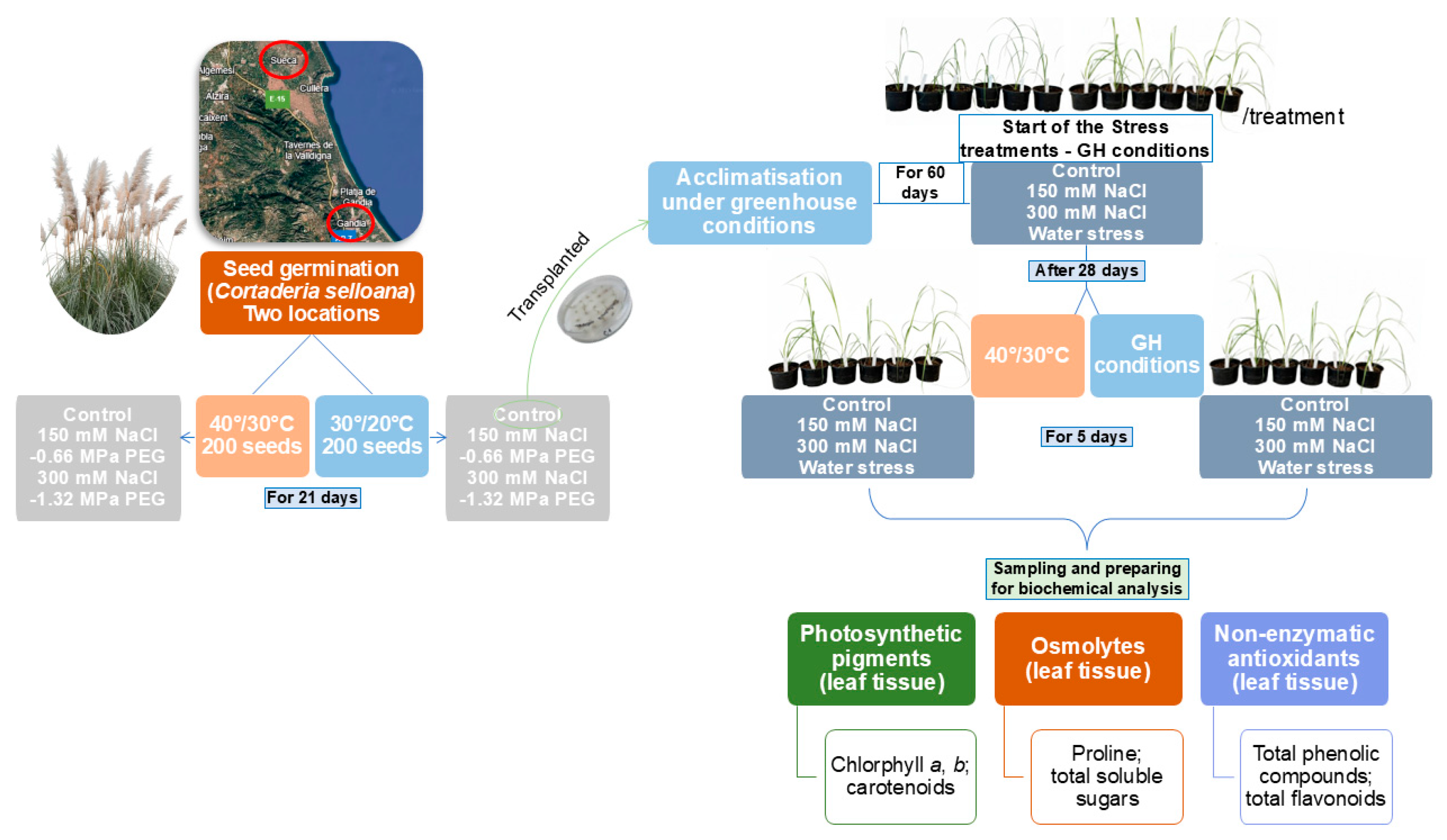
The effects of salinity and osmotic stress during the germination stage, and those of salt and water deficit stress during vegetative development of the plants, were analysed under two temperature regimes, as summarised in Figure 1. For the germination assay, the osmotic stress was induced by polyethylene glycol (PEG) at concentrations isosmotic to those of NaCl.

2.2. Seed Germination

In vitro germination assays were conducted using five standard Petri dishes (90 mm diameter) per treatment and per population, each containing 20 seeds placed on a double layer of filter paper, and incubated within zip-closure plastic bags to avoid desiccation of the medium during the experiments. The plates were located in a growth chamber IBERCEX E-1200-BVL (Madrid, Spain) with the LED system Faraday Protect Slim 120 cm, including cool, bluish light (BIO/PROTECT2X120/50/VEG) combined with warm, reddish light (BIO/PROTECT2X120/50/BLO), and a PPF (Photosynthetic Photon Flux) of 223.2 µmol s−1. To minimise positional effects, plate positions were randomised daily within the growth chamber when counting the germinated seeds. For the stress treatments, the filter paper was moistened with 4 mL of aqueous solutions of either NaCl or PEG 6000 (polyethylene glycol), whereas for the control treatment, it was moistened with distilled water. Two levels of salt stress were applied: 150 mM and 300 mM NaCl. For osmotic stress, isosmotic PEG solutions with water potentials of −0.66 MPa and −1.32 MPa were used, calculated according to [42]. The temperature regime was 30/20 °C (day/night) with a 16/8 h light/dark photoperiod for a period of 21 days. To simulate heatwave conditions that increasingly affect Mediterranean climates, the experiment was replicated at a higher temperature regime of 40/30 °C under the same photoperiod. Based on our previous studies with this species [33], the control treatment of seeds germinated in water at the 30/20 °C (day/night) regime, was taken as a practical test of the viability of the seed lots used in the present work. Summarising, the experimental design comprised two populations (Sueca and Gandía), five treatments (control, 150 mM NaCl, 300 mM NaCl, −0.66 MPa PEG, and −1.32 MPa PEG), and two temperature regimes (30/20 °C and 40/30 °C), resulting in 20 treatment combinations. Each combination was replicated in five Petri dishes, giving a total of 100 plates and 2000 seeds.
Germination was recorded daily during the 21-day incubation period. Seeds were considered germinated when the radicle had emerged to a minimum length of 1 mm; once germinated, they were placed at the edge of the plate to avoid altering local humidity. The germination rate was expressed as the Mean Germination Time (MGT), calculated using the formula:
MGT = ∑(di × ni)/N
where n is the number of seeds germinated on each day, d is the number of days from the beginning of the test, and N is the total number of germinated seeds at the end of the test [43]. The final germination percentage was also recorded.

2.3. Plant Growth and Stress Treatments

Seedlings obtained from control germination assays at lower temperature conditions (30/20 °C) were transplanted into seedbeds filled with commercial peat substrate (26% organic carbon, pH = 7.0, EC = 0.6 dS·m−1). Seedbeds were placed in a greenhouse with average environmental conditions of 22 °C and 60–65% relative humidity. Natural daylight was the light source in the greenhouse. Plants were manually watered twice a week with tap water (pH = 8.2 and EC = 1.05 dS m−1).
After 45 days, the seedlings were transferred to individual pots (12 cm diameter) containing the same substrate and maintained under the same greenhouse conditions, with irrigation twice weekly using tap water for an additional 15 days. Stress treatments were then initiated. Plants were arranged into eight trays (12 pots per tray), each measuring 55 cm × 40 cm × 15 cm, with six plants from Gandía and six from Sueca per tray.
Control plants continued to receive 1.5 L of tap water per tray, twice a week. Salt stress was induced by watering with 1.5 L of NaCl solutions at either 150 mM or 300 mM concentrations, applied twice weekly. Water stress was imposed by completely withholding irrigation. All treatments were established simultaneously.
Half of the trays (four) remained in the greenhouse throughout the experiment. After four weeks of stress treatments (22 April to 20 May), the other half were transferred to the growth chamber used in germination trials (IBERCEX E-1200-BVL), where they were subjected to heat stress conditions (40 °C for 16 h/30 °C for 8 h) while continuing their respective treatments. The chamber maintained the same LED system described for gemination assays. We aimed to simulate the natural summer conditions in our region. The selected temperature regime (40 °C/30 °C, day/night) reflects the values commonly recorded during local heat waves. We extended the heat treatment to five days (20 May to 25 May), but not more to ensure that plants already subjected to salt stress, and especially drought, did not reach irreversible wilting. Maintaining plants alive was essential to obtain sufficient viable tissue for biochemical analyses. Therefore, the experiment lasted 33 days for all treatments, comprising four weeks of saline or water stress and five additional days under the corresponding temperature regime. Each experimental condition and population were represented by six biological replicates (n = 6). After five days of heat stress exposure, all plants were harvested. Shoots were separated from roots, and root systems were carefully cleaned with a brush. Both roots and shoots were measured and weighed separately. Fresh weight (FW) was recorded immediately for all individual plants. To determine the relation between fresh weight and dry weight for each individual plant sample, a subsample was weighed (FW), dried in an oven at 65 °C for 72 h, and weighed again (DW); the relation DW-to-FW was then calculated. Water content (WC%) of roots and shoots was calculated using the formula:
WC% = [(FW − DW)/FW)] × 100.
For sample collection, all pots were transferred to the laboratory, and fresh material was immediately flash-frozen in liquid nitrogen after weighing and stored at −75 °C for further biochemical analysis, whereas dried material was kept at room temperature in tightly sealed containers. For subsequent biochemical analyses, six biological replicates per treatment, corresponding to six individual plants, and a single technical replicate, were used. All the classical, robust, and well-validated biochemical assays described below show negligible intrinsic procedural variability. In practice, the variability in results arises almost exclusively from physiological or genetic differences between the analysed plants. For this reason, biological replicates are essential, whereas technical replicates are unnecessary and are not used in this type of experiments. This statement is supported by a substantial body of published literature employing the same methodology (e.g., [33,44,45,46,47,48] to cite only a few examples).

2.4. Determination of Photosynthetic Pigments

Approximately 50 mg of fresh shoot tissue, collected at the end of the experiment, was homogenised and extracted overnight in chilled 80% (v/v) acetone at 4 °C. After centrifugation, the absorbance of the supernatant was recorded at 470, 646, and 663 nm using a spectrophotometer. The concentrations of chlorophyll a (Chl a), chlorophyll b (Chl b), and total carotenoids (Caro) were calculated and expressed in mg·g−1 DW, based on the formulas indicated in the original protocol [49].

2.5. Quantification of Osmolytes

Proline (Pro) content in shoot tissues was determined using the acid ninhydrin method [50] with some modifications [51]. Fresh ground tissue (50 mg) was extracted with 3% (w/v) sulphosalicylic acid. The extract was mixed with acid ninhydrin and incubated at 95 °C for 1 h in a water bath. After rapid cooling on ice, the chromophore was extracted with toluene. Absorbance of the organic phase was measured at 520 nm using toluene as a blank. A standard curve constructed with known Pro concentrations was used to calculate Pro contents in the samples, which were expressed as µmol·g−1 DW.
Total soluble sugar (TSS) levels were assessed following a previously described method [52]. Ground fresh tissue (50 mg) was extracted overnight with 80% (v/v) methanol. The extracts were centrifuged, and the supernatant was reacted with 5% phenol and concentrated sulphuric acid, triggering an exothermic reaction. After colour development, absorbance was read at 490 nm. Glucose was used as a standard, and results were expressed as mg equivalents of glucose per gram dry weight (mg eq. gluc.·g−1 DW).
Total phenolic compounds (TPC) in leaves were measured in methanol extracts [53]. After incubating the extracts with Na2CO3 and the Folin–Ciocalteu reagent for 90 min at room temperature in the dark, the absorbance of the samples was measured at 765 nm. Samples with known concentrations of gallic acid (GA) were used to obtain a standard curve, and TPC contents were expressed as mg equation GA g−1 DW.
Total foliar flavonoids (TF) concentration was quantified in the same methanol extracts as TPC by incubation with NaNO2, followed by reaction with AlCl3 at a basic pH [54]. The absorbance of the product of the reaction was measured at 510 nm. Catechin (C) was used as the standard, and TF concentrations were expressed as mg eq. C g−1 DW.

2.6. Statistical Analysis

The statistical analyses of the data were performed using SPSS Statistics statistical software (IBM SPSS Statistics for Windows, version 16.0, Armonk, NY, USA) and Statgraphics Centurion XVI (Statgraphics Technologies, The Plains, VA, USA). Germination data were arcsine transformed prior to analysis to ensure homogeneity of variance. A multifactorial ANOVA was conducted to assess the main effects and interactions of temperature (two levels), origin (two populations), and stress treatment (four levels: control, 150 mM NaCl, 300 mM NaCl, and water stress), corresponding to a 2 × 2 × 4 factorial design. For clarity, factors in the multifactorial ANOVA were coded as follows: A = temperature, B = origin, and C = stress treatment. Interactions tested included A × B, A × C, B × C, and A × B × C. One-way ANOVA was used to estimate the effects of stress treatments on the traits analysed separately for each genotype. The Tukey test was used as a post hoc test, at a p-value of 0.05 (p < 0.05), to analyse the differences if the null hypothesis was rejected.

3. Results

3.1. Seed Germination

A multifactorial analysis of variance (ANOVA) was conducted to evaluate the effects of temperature (factor A), location (factor B), and treatment (factor C), as well as their interactions (A × B, A × C, B × C, and A × B × C), on germination percentage and mean germination time (MGT). The results are summarised in Table 1. Highly significant effects (p < 0.001) of factors A, B, and C on germination percentage were observed, along with significant interaction effects for A × C (p < 0.001), B × C (p < 0.05), and A × B × C (p < 0.001). The A × B interaction was not significant, indicating that the effect of temperature on germination was consistent across locations. For MGT, significant effects were found for temperature (A), treatment (C), and their interactions A × C and A × B × C. In contrast, location (B), as well as the interactions A × B and B × C, did not significantly influence MGT. These findings indicate that both individual factors and certain interactions significantly affect not only the final germination percentage but also the rate at which germination occurs in Cortaderia selloana.
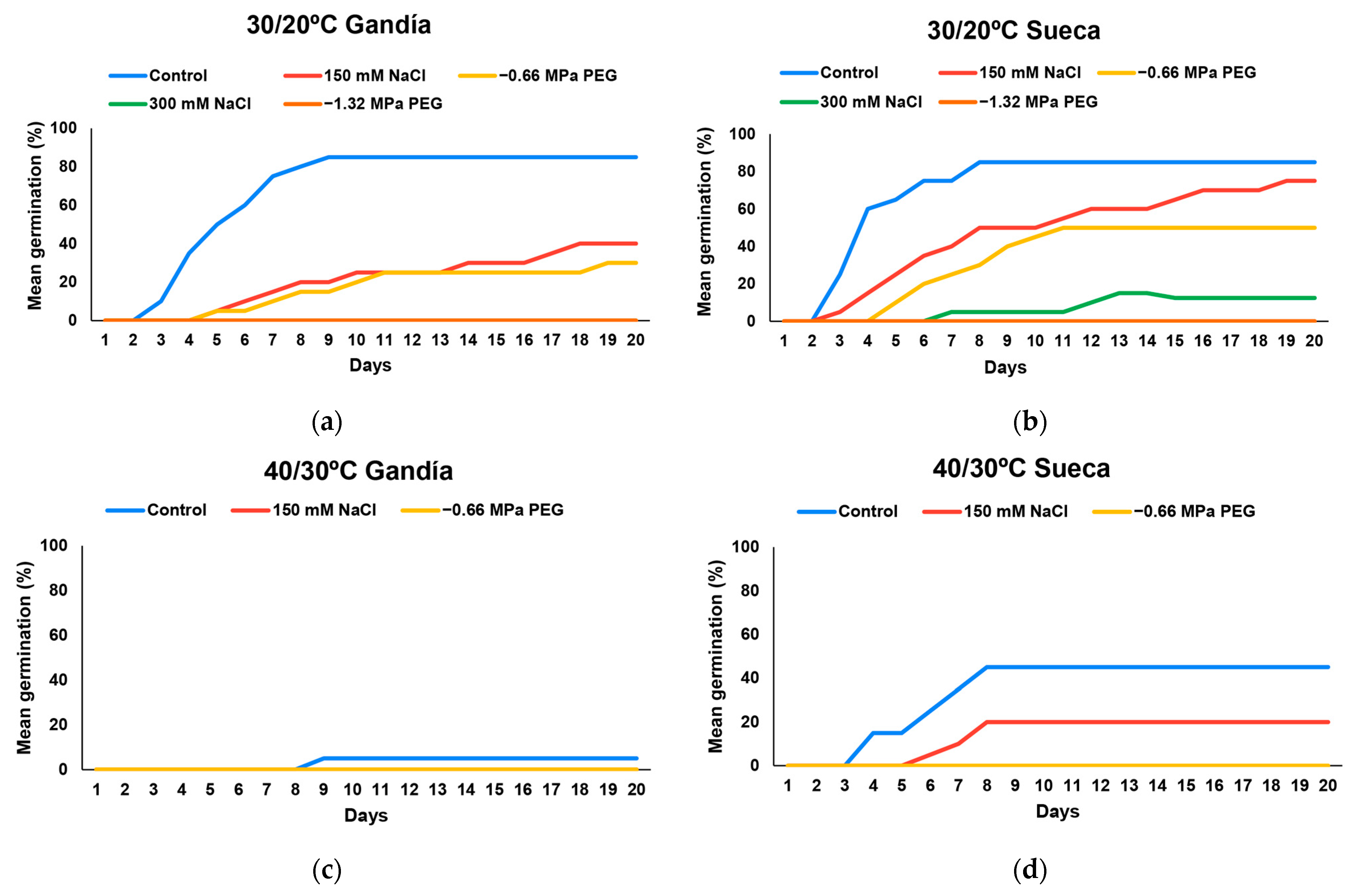
At 30/20 °C, clear differences in germination were observed between treatments and between populations (Figure 2). Under control conditions, both Sueca and Gandía populations showed high germination rates, reaching approximately 85%, indicating high seed viability under optimal conditions. However, salt and osmotic stress significantly reduced germination, with the Gandía population showing a greater reduction (Figure 2a). Under more severe salt stress conditions, 300 mM NaCl, Sueca seeds germinated at about 15%, whereas no germination was recorded for the Gandía population. At −1.32 MPa PEG, germination was completely inhibited in both populations (Figure 2a,b).
At the higher temperature regime (40/30 °C), germination was markedly reduced under all conditions, suggesting an inhibitory effect of heat. Under these conditions, only the Sueca population showed limited germination, particularly in the control (45%) and 150 mM NaCl (20%) treatments (Figure 2c). In contrast, the Gandía population showed only minimal germination in the control (~5%) and no germination under any stress condition. This suggests that Gandía seeds may have lower heat tolerance and a stricter thermal threshold for germination (Figure 2d).
Table 2 presents the final germination percentages and the statistical significance of temperature and treatment effects for each location. High temperatures (40/30 °C) almost completely inhibited germination in Gandía seeds, whereas Sueca seeds still achieved 45% germination under control conditions. This value was not significantly different from the 50% germination observed under low PEG concentration (−0.66 MPa) at 30/20 °C, but significantly lower than the 55% germination observed under 150 mM NaCl at the same temperature. Thus, temperature emerged as the most limiting factor, followed by PEG-induced osmotic stress. While 150 mM NaCl reduced germination in both populations, complete inhibition at 40/30 °C was observed only in Sueca seeds. The most severe salinity level (300 mM NaCl) fully inhibited germination in Gandía seeds, whereas Sueca seeds maintained a germination rate of ~15% at 30/20 °C.
Mean germination time (MGT, Table 2), a key indicator of germination speed and seed physiological response, also varied significantly between treatments and populations. In the Sueca population, MGT was significantly lower under control conditions at 30/20 °C (~5 days), indicating rapid germination under optimal conditions. Increased salinity and osmotic stress prolonged MGT, with values ranging from 7 to 9 days for 150 mM NaCl, 300 mM NaCl, and PEG at −0.66 MPa. At 40/30 °C, only seeds from the control and 150 mM NaCl treatments germinated, with slightly longer MGTs than at 30/20 °C, suggesting that elevated temperatures not only delayed germination but also inhibited it under more extreme stress conditions.
In contrast, the Gandía population exhibited a different pattern. Although MGT under control conditions at 30/20 °C was similar to that of Sueca (~6 days), treatments with 150 mM NaCl and PEG at −0.66 MPa resulted in significantly longer MGTs (~11.5 and ~10 days, respectively), reflecting a stronger inhibitory effect of salt and water stress. No MGT values were recorded for 300 mM NaCl or any stress treatment at 40/30 °C due to the complete absence of germination, further highlighting the greater sensitivity of Gandía seeds to abiotic stress.

3.2. Plant Growth

To evaluate the effects of salt stress (induced by irrigation with 150 and 300 mM NaCl), water stress (by complete withholding of irrigation), and an additional 5-day heat stress treatment, a factorial ANOVA was performed (Table 3). In addition to temperature (A) and treatment (C), the analysis included the origin of the seeds used for plant production as a factor (B). Main effects and interactions between the three factors were assessed for the following variables: initial and final number of leaves, initial and final plant height, growth (calculated as final height minus initial height), fresh weight (FW) of leaves and roots, and water content (WC) in leaves and roots. Quantitative data (means ± SE) on the initial and final plant length, and the initial leaf number, for all treatments and both localities, are shown in Supplementary Materials (Figure S1), and in Figure 3, Figure 4 and Figure 5 for all other parameters included in Table 3.
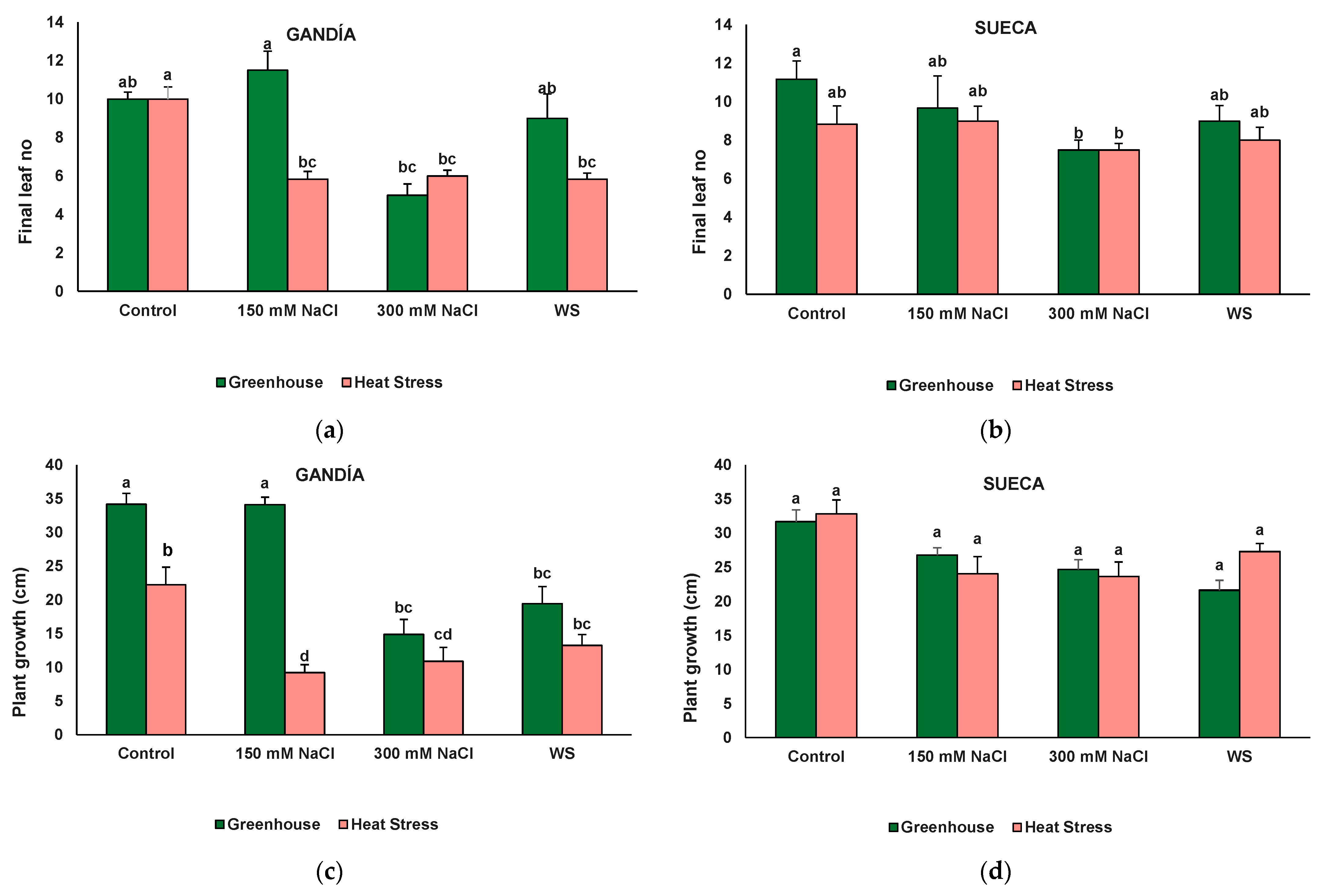
The final number of leaves in Cortaderia selloana plants from two populations (Sueca and Gandía) subjected to four treatments: control, 150 mM NaCl, 300 mM NaCl, and water stress (WS), under two temperature regimes: moderate (greenhouse; 30/20 °C) and high (40/30 °C) is shown in Figure 3a,b. Across both temperature conditions, the number of leaves increased from the beginning to the end of the experiment, with the most pronounced growth observed in control plants. However, both salinity and water stress reduced leaf development, particularly under more severe conditions (300 mM NaCl). Under moderate temperature conditions (greenhouse), the highest final leaf numbers were recorded, especially in the control treatment in the Sueca population and the 150 mM NaCl treatment in Gandía, both reaching approximately 12 leaves. In contrast, under high-temperature conditions (40/30 °C), differences between treatments were less pronounced, and overall leaf production was lower. These findings indicate that both salinity and elevated temperature negatively affect leaf development, with the combination of heat and salt stress being particularly detrimental. Some variation between populations was observed, although to a lesser extent than treatment or temperature effects.
Although plant growth, measured as the difference between final and initial height, was generally reduced under the stress treatments compared to the control, no significant differences were observed between treatments or temperature regimes in the Sueca population. In contrast, the Gandía population exhibited significantly reduced growth at the higher temperature regime (40/30 °C), indicating a stronger sensitivity to heat stress. These results suggest that elevated temperatures, particularly in combination with other stress factors, have a more pronounced negative effect on growth in the Gandía population (Figure 3c,d).
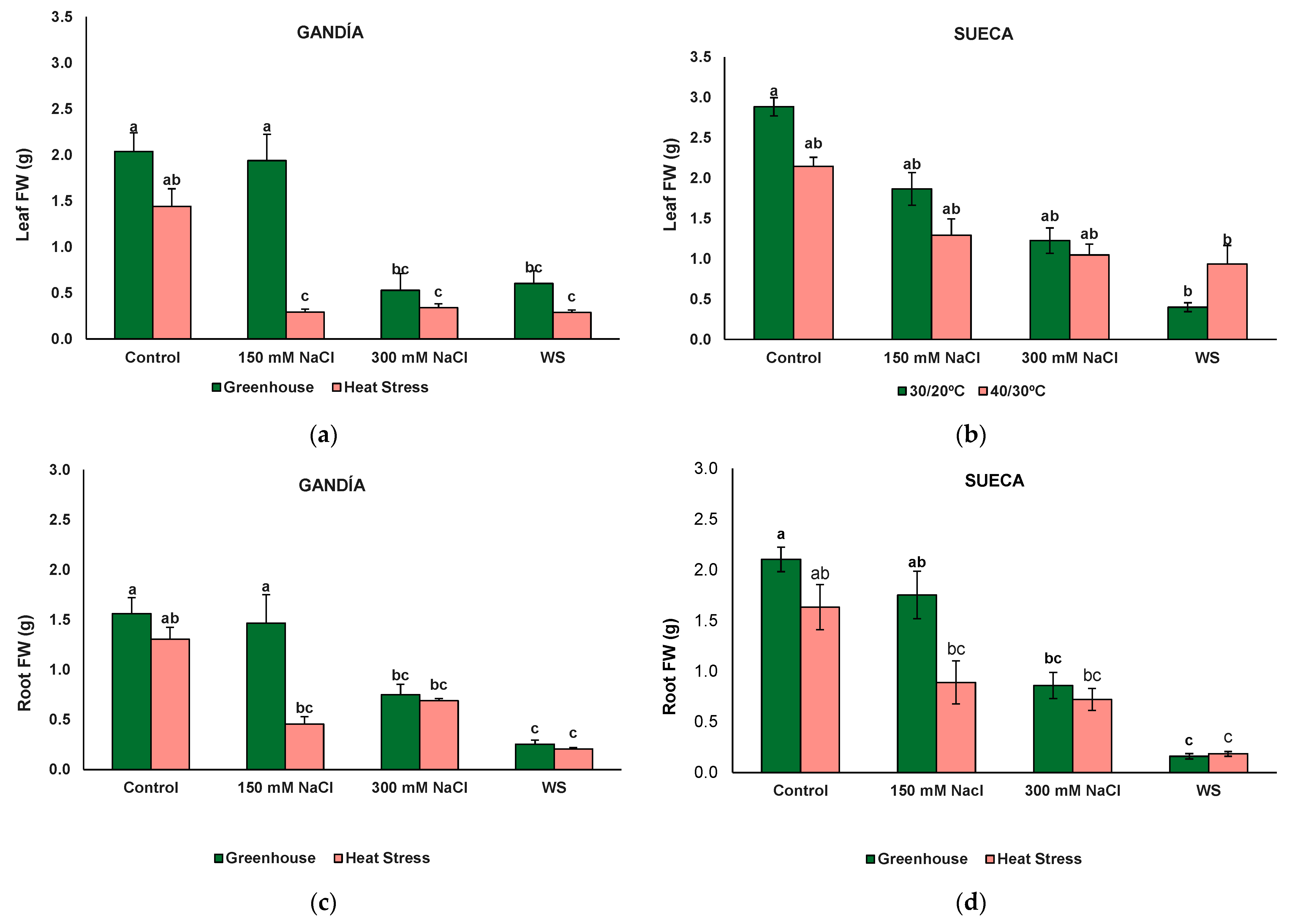
The fresh weight of leaves (Leaf FW) decreased progressively with the application of stress treatments, with the highest values consistently observed in the control treatment. In the Gandía population, no significant differences were detected between the control and the 150 mM NaCl treatment under greenhouse conditions (30/20 °C), although a significant reduction was observed at the higher temperature regime (40/30 °C) (Figure 4a). In plants with origin in Sueca, differences between the control and salt treatments were not statistically significant, although a decreasing trend in leaf fresh weight was evident (Figure 4b). Water stress (WS) resulted in the lowest leaf fresh weight values in both populations, with significant reductions under both temperature regimes. These results indicate that salinity and elevated temperatures reduce leaf biomass production, with a more pronounced effect in plants from Gandía.
Fresh root weight (Root FW) also decreased significantly in response to stress treatments, particularly under water stress, which produced the lowest values in both populations. In Gandía, the impact of stress was more severe at 40/30 °C, where even the 150 mM NaCl treatment caused a marked decline in root biomass. Only the control treatment maintained significantly higher values (Figure 4c). In Sueca plants, both salt and water stress reduced root weight, although plants in the control and 150 mM NaCl treatments maintained relatively higher values. High temperature slightly reduced root weight across all treatments (Figure 4d).
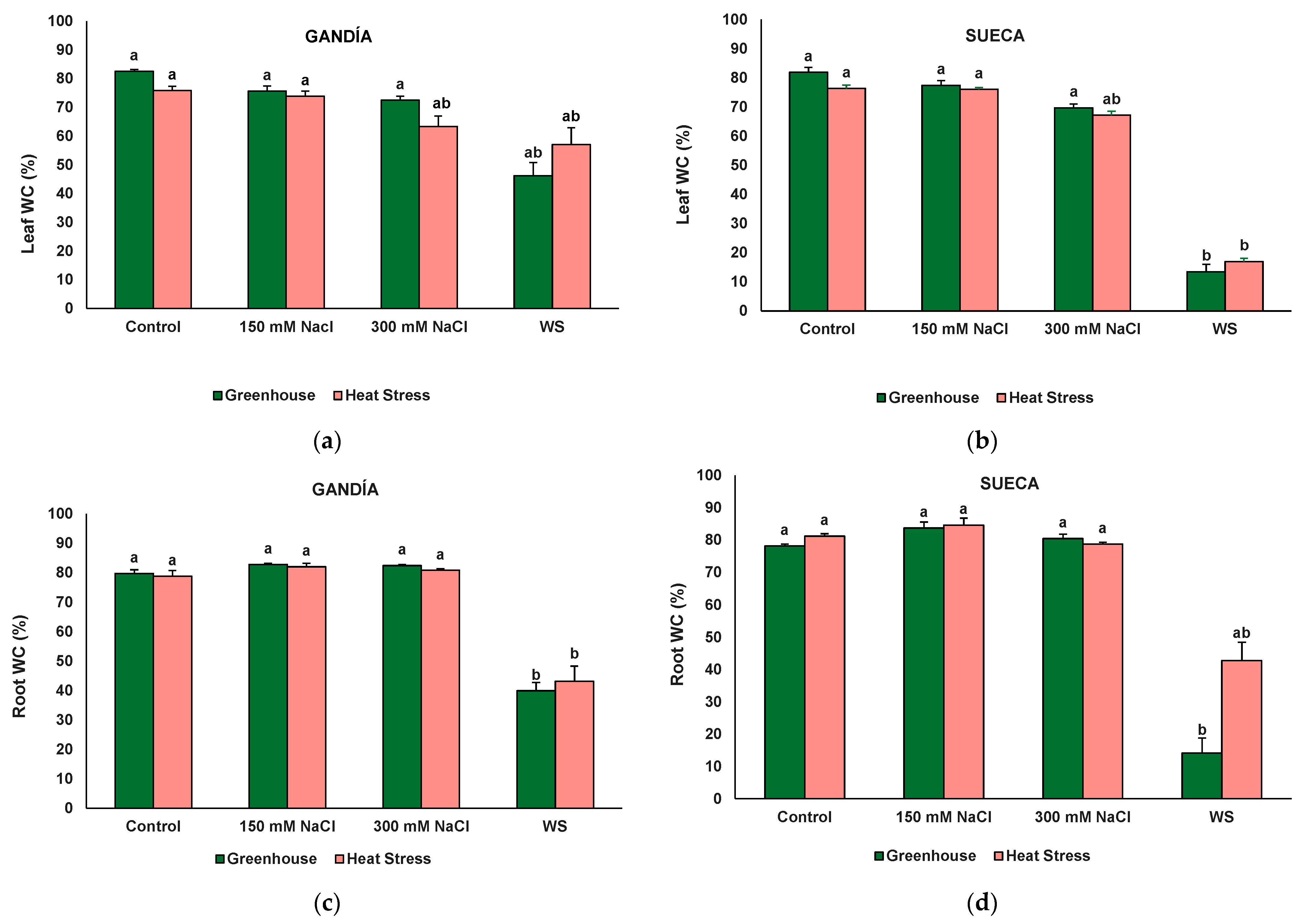
Leaf (Leaf WC) and root (Root WC) water content (%) serves as an indicator of tissue turgidity (Figure 5). Under both temperature regimes, the control and salt treatments maintained high leaf water content values (approximately 75–80%), with no significant differences observed between the two populations (Figure 5a,b). In contrast, water stress (WS) markedly reduced leaf water content, particularly in the Sueca population, where values dropped below 20%. This effect persisted under both greenhouse and high-temperature conditions. Root water content also remained high (~80%) across all treatments except for WS, which caused a substantial reduction (Figure 5c,d). In Sueca plants, WS led to a pronounced decrease in root water content under greenhouse conditions, again falling below 20%. In Gandía plants, the reduction was less severe, especially at 40/30 °C. Control and salt-treated plants maintained high root water content, indicating that root tissues are more capable of retaining water under salt stress conditions than under water deficit.

3.3. Biochemical Analyses

The effects of plant material origin (locality), temperature conditions (greenhouse vs. heat stress), and treatments (control, salt stress, and water stress) were analysed for multiple physiological and biochemical parameters (Table 4). Amongst these factors, the treatment effect (C) was the strongest, showing significant influence on all analysed variables except total phenolics and flavonoids. The temperature effect (B) was significant for variations in photosynthetic pigments and proline content. The origin of the plant material (A) significantly affected only proline concentrations and was also involved in the only significant interaction detected, between locality and treatment (A × C). No significant effects or interactions were found for total phenolic compounds (TPC) or total flavonoids (TF).
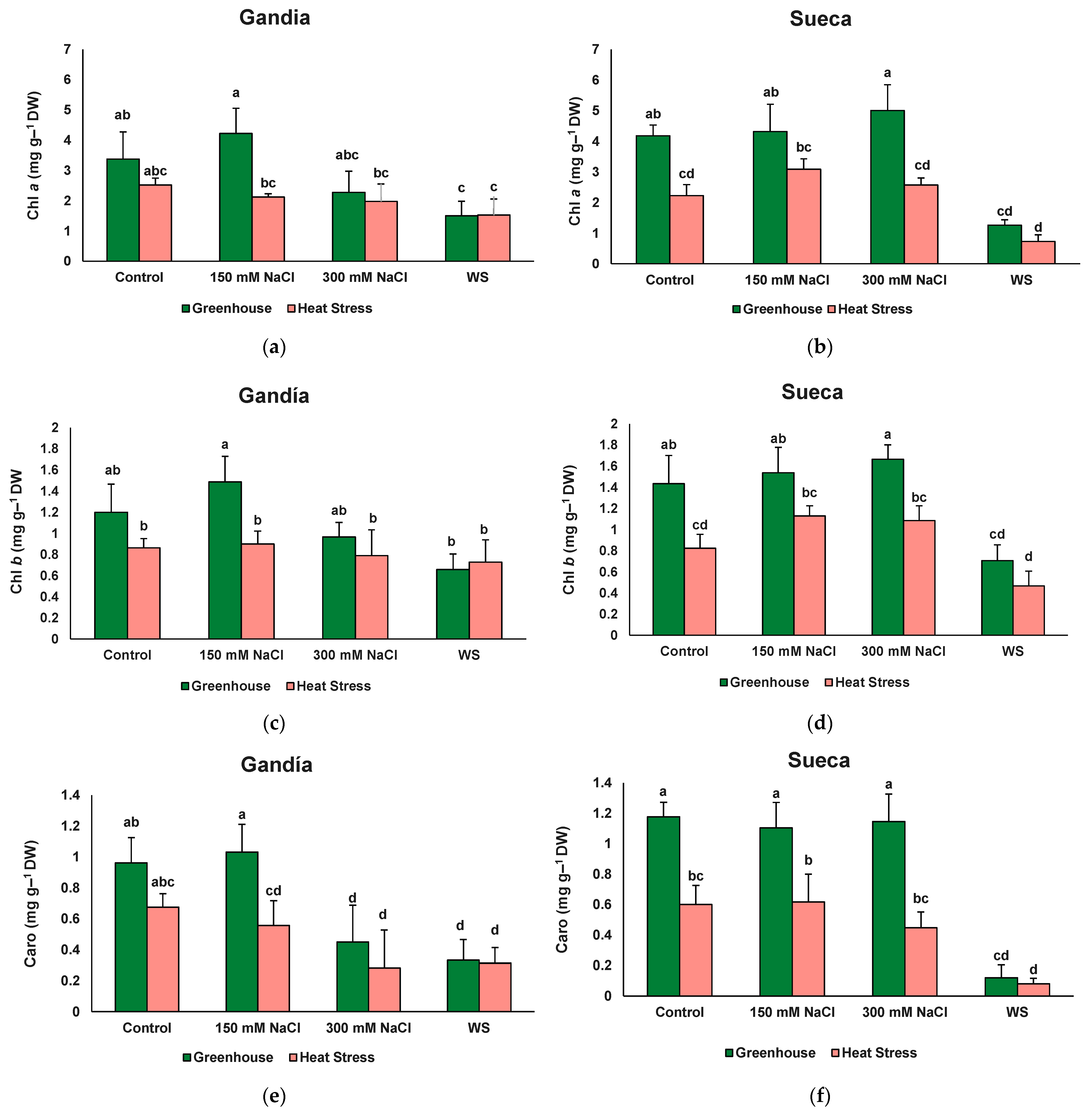
Photosynthetic pigments (chlorophyll a, chlorophyll b, and carotenoids) varied significantly according to treatment and temperature. The highest mean concentrations of chlorophylls a (Chl a) and b (Chl b) were observed in plants maintained under greenhouse conditions and subjected to salt treatments, 150 mM NaCl for plants from Gandía and 300 mM NaCl for those from Sueca; however, the differences with the corresponding non-stressed controls were not statistically significant. In contrast, the lowest pigment concentrations were recorded under water stress in both localities (Figure 6). For most salt and water deficit treatments, average chlorophyll a and b levels were higher in plants grown at 30/20 °C than in those subjected simultaneously to high temperatures (40/30 °C), with statistically significant differences observed only in the presence of 150 mM NaCl (Gandía) or 300 mM NaCl (Sueca) (Figure 6a,b). A notable difference between localities was that plants from Gandía showed markedly lower chlorophyll a and b values at 300 mM NaCl than those from Sueca (Figure 6a–d). Carotenoid (Caro) concentrations followed a similar pattern, with no significant effect of salinity under greenhouse conditions in Sueca plants. However, under heat stress, carotenoid levels generally decreased compared to those in the greenhouse (Figure 6c).
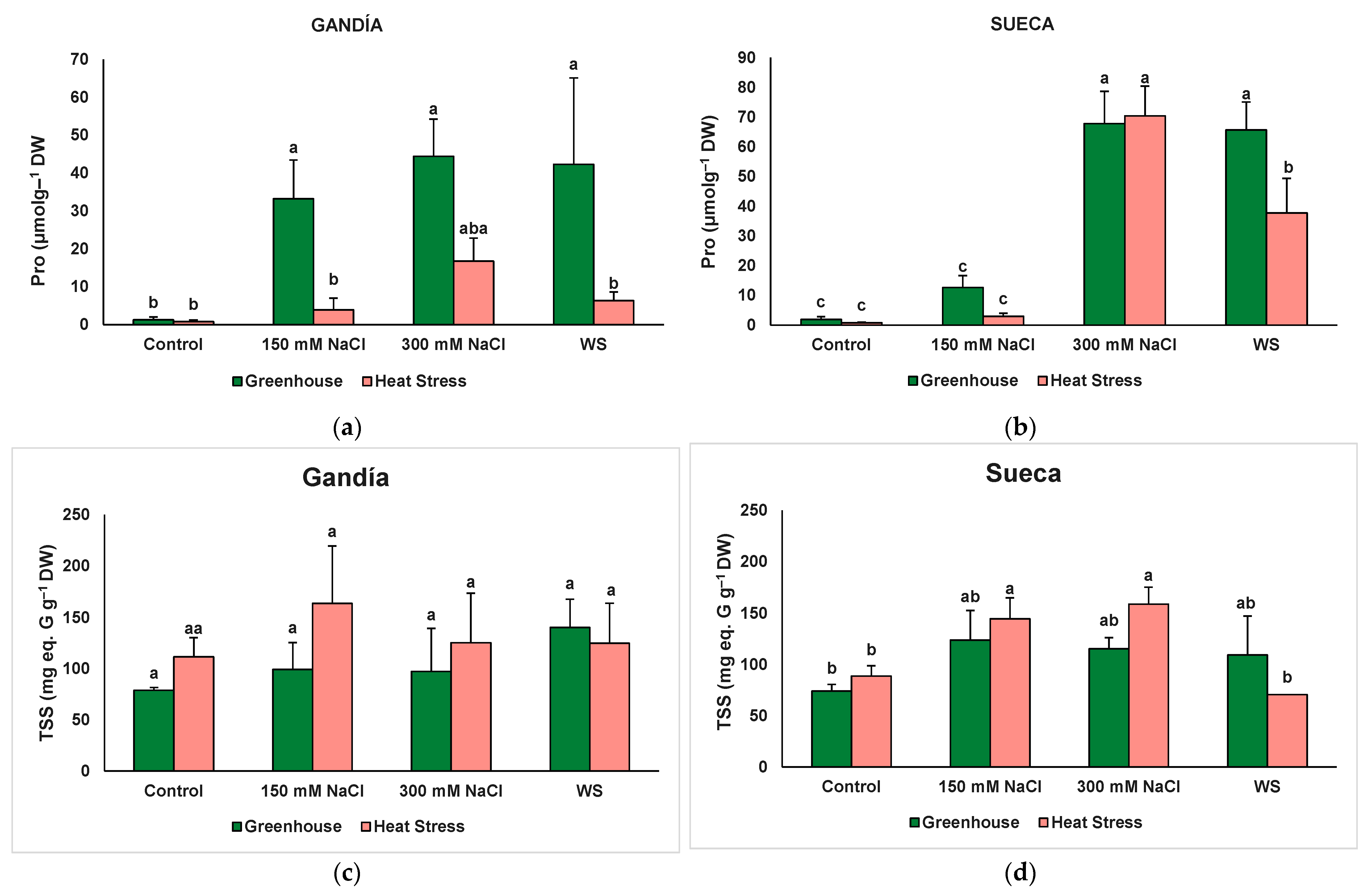
Proline (Pro) content increased significantly in plants from Gandía exposed to salt or water stress, and in plants from Sueca subjected to 300 mM NaCl or water stress. In general, the relative increase in Pro levels in response to the salt or water deficit treatment was lower in plants simultaneously exposed to high temperatures, particularly in those from the Gandía population, where mean Pro contents were always lower in plants grown at 40/30 °C, except for the control plants (Figure 7a,b).
Total soluble sugars (TSS) showed significant variation only in plants from Sueca, where salt-stressed plants exhibited higher concentrations. Although TSS levels tended to be higher under high-temperature conditions, these differences were not statistically significant compared to greenhouse-grown plants within the same treatment group (Figure 7c,d).
The concentrations of the measured antioxidant compounds, including total phenolic compounds (TPC) and total flavonoids (TF), were not significantly affected by locality, temperature, or treatment, nor by their interactions (Table 4 and Supplementary Figure S2).

4. Discussion

4.1. Germination Responses to Abiotic Stress

Successful seed germination is a critical stage in plant establishment, particularly for invasive species, as it enables colonisation of new habitats and promotes range expansion [39]. It also mediates species’ responses to disturbance regimes and affects their long-term persistence [55]. High germination rates, effective seed dispersal, and the ability to establish under stress are traits commonly associated with invasive success [37,56].
Cortaderia selloana (pampas grass) exhibits several of these traits. While clonal propagation contributes little to long-distance spread, the species produces large quantities of viable, wind-dispersed seeds [8] and germination has been reported under a wide range of environmental conditions, including drought and salinity stress [29].
Our findings indicate that germination is the life stage most sensitive to abiotic stress. Salinity, osmotic stress, and elevated temperature significantly reduced germination rates, particularly in seeds from the Gandía population. In contrast, seeds from Sueca showed higher tolerance across all treatments, suggesting local adaptation or acclimatisation to the more saline and drier conditions of that location. This aligns with previous studies reporting intraspecific plasticity in C. selloana [30], which may enhance its capacity to establish across diverse habitats.
High temperatures of around 40/30 °C exert a strong inhibitory effect on seed germination in C. selloana. Even under control conditions, Sueca seeds germinated poorly at 40/30 °C compared to lower temperature regimes, whereas Gandía seeds failed almost entirely to germinate. Previous studies reported contrasting results: seeds sampled in Sardinia [31] germinated at all temperatures tested, with optimum rates at ~25 °C, whereas in seeds from Valencia maximum germination was found at ~30 °C [32]. These findings suggest that C. selloana generally prefers warm but not extreme temperatures, a pattern typical of many temperate species, which exhibit declining germination rates beyond optimal temperature thresholds [57]. Similar thermal sensitivity has been documented in crops, where exposure to 45 °C markedly reduces germination and inhibits seedling development due to cell death and embryo damage [58,59].
In the context of climate change, extreme heat events (such as prolonged or frequent episodes of ~40 °C) are becoming more common in Mediterranean regions. These trends are likely to push temperatures above the thresholds tolerated by C. selloana for germination. Thus, while this species possesses considerable germination plasticity, the increasing heat stress (intensity and duration) may prevent germination, limiting its spread in regions facing worsening heat extremes—especially for populations like Gandía that exhibit lower tolerance.
Although Cortaderia selloana is often regarded as relatively salt-tolerant [11], our results reveal limitations under certain temperature and salinity regimes. At 30/20 °C, germination declined steadily as NaCl concentration increased, and seeds from Gandía failed to germinate at 300 mM. Under the higher temperature regime (40/30 °C), only Sueca seeds germinated under 150 mM NaCl, and even then, only at about 20%. Higher germination percentages under similar or more saline conditions were reported from Sardinia [31].
Likewise, osmotic stress imposed by PEG had a pronounced impact, as previously indicated in this species [33]. At an osmotic potential of −0.66 MPa, germination rates were similar to those at 150 mM NaCl, 50% for Sueca and 25% for Gandía. At −1.33 MPa, germination was completely suppressed. Notably, no seeds germinated under osmotic stress at elevated temperature, highlighting the compounded effect of drought and heat. These findings confirm that PEG, which generates a water deficit without ion toxicity, induces a stronger inhibitory effect on germination than NaCl at equivalent osmotic potentials.
Collectively, these results reinforce the ecological flexibility of C. selloana, which can germinate under moderately stressful conditions but is limited by extreme heat and drought. The consistently higher performance of the Sueca population supports the role of phenotypic plasticity and possible local adaptation. Such plastic responses allow this species to maintain recruitment across heterogeneous environments, contributing to its invasive success. Furthermore, population-level differences may indicate functional pre-adaptation, with some genotypes better suited for establishment in marginal or stressful habitats. These traits, along with high seed viability, dormancy potential, and effective dispersal, confirm C. selloana as one of Europe’s most problematic invasive species.

4.2. Growth Responses to Salt, Water, and Temperature Stress

While germination is a critical bottleneck, successful invasion also depends on the plant’s ability to grow and reproduce under suboptimal conditions. In our study, C. selloana exhibited variable tolerance to salinity, water limitation, and heat, with clear quantitative differences between the two populations. Plants from Sueca and Gandía obviously share the same general mechanisms of response to the applied stress treatments, but those responses appear to be more efficient in plants from the more stress-tolerant Sueca population.
A moderate salt concentration (150 mM NaCl) had only a limited impact on growth when applied alone, confirming the species’ relative salt tolerance [6,31,34,39]. However, when combined with high temperature (40/30 °C), growth reductions became evident across several parameters, especially in plants from Gandía. At 300 mM NaCl, growth was significantly impaired in both populations, with Gandía again more affected, indicating reduced salt tolerance in this population.
Water stress exerted the most pronounced effect, causing major reductions in leaf number, shoots and roots fresh weight, and water content in both populations.
Pampas grass typically occurs in habitats with relatively moist soils, such as coastal and fluvial areas [60]. However, it can also expand into drier, disturbed environments when drought periods during the germination season do not exceed one month [11]. Once the early growth stages are completed, the species can withstand considerably higher levels of water stress, including up to 41 days without irrigation [35]. In a comparative study with two coexisting native species of the same functional group (Festuca arundinacea and Brachypodium phoenicoides), C. selloana demonstrated greater efficiency under water-limited conditions by maximising water uptake and minimising water loss [36].
High temperature had a deleterious effect on growth, particularly when combined with salt or water stress, as reported for many other species. Heat stress has been shown to reduce relative growth rate, shoot dry weight, and net assimilation rate in Poaceae species such as maize, millet, and sugarcane, and to cause serious pre- and post-harvest damage [61]. Even control plants from Gandía exposed to elevated temperatures exhibited reduced shoot elongation, suggesting a high sensitivity to heat. In contrast, significant reductions in biomass and leaf traits in plants originating from Sueca were only detected when high temperature was combined with either salt or water stress.
Plants from Sueca generally displayed greater resilience under stress, although they too exhibited significant reductions under 300 mM NaCl and under water stress. Notably, water content declined more severely in Sueca plants under drought, suggesting possible trade-offs in physiological stress responses.
Overall, these findings indicate that while C. selloana prefers environments with high water availability; it can survive and grow under moderate drought and salinity. However, sustained or combined stressors, especially heat plus water limitation, pose substantial constraints on growth. These results are consistent with previous observations of moderate biomass reduction in non-irrigated conditions [33].
Recent studies suggest that maternal environments may influence offspring stress responses through transgenerational plasticity. For example, it has been found that offspring from C. selloana plants originating from drier environments produced more biomass under prolonged drought than those from wetter habitats [11]. This supports the idea of environmentally induced maternal effects, where offspring are functionally pre-adapted to match anticipated conditions [38,62,63]. Such maternal effects could partly explain the better performance of Sueca plants under salinity and combined stress treatments. More broadly, they highlight how invasive species like C. selloana respond to local environmental cues, fine-tuning key traits such as germination, growth, and water use efficiency. This ability to exhibit both phenotypic and transgenerational plasticity enhances the likelihood of establishment across a wide range of habitats, further reinforcing the species’ invasive potential.

4.3. Biochemical Responses to Salt, Water, and Temperature Stress

Biochemical analyses revealed that both heat and drought stress reduced photosynthetic pigments concentrations in the two C. selloana genotypes. In contrast, exposure to 300 mM NaCl significantly decreased carotenoid content only in plants originating from Gandía, whereas those from Sueca remained largely unaffected, suggesting higher salt tolerance, possibly linked to maternal or local adaptation effects.
Amongst the treatments, drought caused the most pronounced decline in photosynthetic pigments. This pattern aligns with previous findings in various wild and cultivated species, where reduced chlorophyll and carotenoid levels under limited water availability have been reported [64,65]. Monitoring chlorophyll content has therefore been proposed as a reliable indicator of drought tolerance in breeding programmes [66]. However, our results differ from a previous report [33], where there was no statistically significant pigment variation in C. selloana under water stress, indicating potential differences in experimental conditions or population-specific responses. Although population-level differences in stress responses may have a genetic basis, existing data indicate very limited genetic diversity amongst invasive Cortaderia selloana populations in Spain. The only available study reports low variability in both microsatellite and plastid markers, with only modest differentiation between regions and almost no haplotype variation [67]. Nevertheless, further genetic analyses would be valuable to better assess potential clonal diversity and its influence on stress responses.
An increase of 10–15 °C above the optimal temperature range is known to disrupt photosynthetic pigment stability through inhibition of pigment biosynthesis, chloroplast membrane damage, and photo-oxidative degradation [58]. In wheat, both heat-tolerant and heat-sensitive cultivars exhibit pigment degradation under high temperatures, though the reduction in chlorophyll concentration is generally greater in sensitive genotypes [68].
Proline accumulation is a common response to abiotic stresses, particularly salinity and drought, and serves roles as an osmoprotectant, antioxidant, and molecular chaperone. Nonetheless, its accumulation under heat stress is inconsistent across species and may be either beneficial or detrimental, depending on stress intensity and genotype [69]. Proline levels are regulated by the balance between its biosynthesis, catalysed by pyrroline-5-carboxylate synthetase (P5CS) in the cytosol, and degradation via proline dehydrogenase (ProDH) in mitochondria [70].
In the present study, proline concentrations increased significantly under both salt and water stress as compared to non-stressed controls, but to a lesser extent when those stress conditions were combined with a heat treatment. Similar relative reductions under elevated temperatures have been reported in other species [71], and, based on these studies, it is suggested that enhanced proline catabolism through ProDH activation could contribute to this pattern. Under heat stress, plants may utilise proline as an alternative respiratory substrate to meet energy demands, rather than maintaining it for osmotic adjustment [72]. Moreover, elevated temperature can suppress P5CS activity and alter nitrogen assimilation, thereby reducing proline biosynthesis [71]. Severe heat stress may also impair amino acid metabolism through protein denaturation, membrane destabilisation, and oxidative damage, ultimately leading to decreased proline synthesis or cellular leakage [73]. Overall, these findings support the view that proline accumulation is not a universal marker of stress tolerance but rather reflects a dynamic equilibrium between synthesis and degradation pathways that varies with stress type, intensity, and genotype [74].
Finally, although the increase in total soluble sugars (TSS) was not statistically significant, a trend toward higher sugar concentrations was detected under water stress. This observation agrees with studies in Arabidopsis, where sucrose accumulation under combined heat and drought stress replaced proline as the predominant osmoprotectant [74].

5. Conclusions

Our results show that both germination and vegetative growth of Cortaderia selloana are highly sensitive to environmental stress, particularly heat and drought, yet the species exhibits marked physiological plasticity. Heat stress had the strongest negative effects on germination, growth, and photosynthetic pigments content, especially when combined with water or salt stress. Drought caused the largest reduction in photosynthetic pigments, whereas salinity primarily affected carotenoids in the more sensitive genotype. Proline levels increased under high salinity and water deficit, but a relative reduction in Pro contents was observed when those stress conditions were combined with a heat treatment, suggesting a stress-specific regulatory role, whereas higher soluble sugar concentrations under drought may represent an alternative osmoprotective strategy. Overall, the observed intraspecific variability and population-level quantitative differences in stress tolerance point to potential local adaptation or transgenerational effects that may facilitate invasion under variable Mediterranean climates. Incorporating population-specific responses and stress interactions into predictive models could improve management strategies for this invasive species.

Supplementary Materials

The following supporting information can be downloaded at: https://www.mdpi.com/article/10.3390/agronomy16010068/s1, Table S1: Summary of climatic data recorded at the SIAR stations (Ministry of Agriculture, Fisheries and Food) closest to the sampled populations: (a) Polinyà del Xúquer for Sueca and (b) Gandía-Marxuquera for Gandía. The table shows, on a monthly basis: number of days per month, mean temperature (°C), absolute maximum temperature (°C), absolute minimum temperature (°C), mean relative humidity (%), and total precipitation (mm). The last row presents the annual means for all these variables; Figure S1: Initial and final plant length (a,b) and initial number of leaves (c,d) in Cortaderia selloana plants from the Gandía and Sueca populations, grown under two temperature regimes: greenhouse conditions (green bars) and heat stress conditions (red bars), according to the applied treatment (control, 150 mM NaCl, 300 mM NaCl, and water stress). Values shown are means ± SE; n = 6. Different letters within each locality indicate significant differences between treatments at the 95% confidence level, as determined by Tukey’s test; Figure S2: Total phenolic compounds (TPC; a,b) and total flavonoids (TF; c,d) in Cortaderia selloana plants from the Gandía and Sueca populations, grown under two temperature regimes: greenhouse conditions (green bars) and heat stress conditions (red bars), according to the applied treatment (control, 150 mM NaCl, 300 mM NaCl, and water stress). Values shown are means ± SE; n = 6. Different letters within each locality indicate significant differences between treatments at the 95% confidence level, as determined by Tukey’s test.

Author Contributions

Conceptualization, M.I.M.-N., M.B. and O.V.; methodology, M.I.M.-N. and A.S.-S.; software, E.P.S. and D.-M.M.; validation, M.I.M.-N., M.B. and O.V.; formal analysis, A.S.-S. and D.-M.M.; investigation, E.P.S. and A.S.-S.; resources, M.B.; data curation, M.I.M.-N. and A.S.-S.; writing—original draft preparation, M.I.M.-N. and E.P.S.; writing—review and editing, M.B. and O.V.; visualisation, E.P.S.; supervision, M.B.; project administration, O.V. and M.B.; funding acquisition, M.B. All authors have read and agreed to the published version of the manuscript.

Funding

This research received no external funding.

Data Availability Statement

The original contributions presented in this study are included in the article. Further inquiries can be directed to the corresponding author.

Acknowledgments

We are thankful to Ana Andreea Armeanu and Rebeca Ioana Ganea for technical assistance.

Conflicts of Interest

The authors declare no conflicts of interest.

References

  1. Dukes, J.S.; Mooney, H.A. Does global change increase the success of biological invaders? Trends Ecol. Evol. 1999, 14, 135–139. [Google Scholar] [CrossRef]
  2. Syngkli, R.B.; Rai, P.K.; Lalnuntluanga. Expanding horizon of invasive alien plants under the interacting effects of global climate change: Multifaceted impacts and management prospects. Clim. Change Ecol. 2025, 9, 100092. [Google Scholar] [CrossRef]
  3. Chown, S.L.; Hodgins, K.A.; Griffin, P.C.; Oakeshott, J.G.; Byrne, M.; Hoffmann, A.A. Biological invasions, climate change and genomics. Evol. Appl. 2015, 8, 23–46. [Google Scholar] [CrossRef]
  4. Lambrinos, J.G. The impact of the invasive alien grass Cortaderia jubata (Lemoine) Stapf on an endangered Mediterranean-type shrubland in California. Divers. Distrib. 2000, 6, 217–231. [Google Scholar] [CrossRef]
  5. Liendo, D.; Campos, J.A.; Gandarillas, A. Cortaderia selloana, an example of aggressive invaders that affect human health, yet to be included in binding international invasive catalogues. NeoBiota 2023, 89, 229–237. [Google Scholar] [CrossRef]
  6. Lázaro-Lobo, A.; Andrade, B.O.; Canavan, K.; Ervin, G.N.; Essl, F.; Fernández-Pascual, E.; Follak, S.; Richardson, D.M.; Moles, A.; Visser, V.; et al. Monographs on invasive plants in Europe N° 8: Cortaderia selloana (Schult. & Schult. f.) Asch. & Graebn. Bot. Lett. 2024, 17, 383–407. [Google Scholar] [CrossRef]
  7. Lambrinos, J.G. How interactions between ecology and evolution influence contemporary invasion dynamics. Ecology 2004, 85, 2061–2070. [Google Scholar] [CrossRef]
  8. Domènech, R. Cortaderia selloana Invasion in the Mediterranean Region: Invasiveness and Ecosystem Invasibility. Ph.D. Thesis, Universitat Autònoma de Barcelona, Barcelona, Spain, 2005. [Google Scholar]
  9. Pausas, J.G.; Lloret, F.; Vilà, M. Simulating the effects of different disturbance regimes on Cortaderia selloana invasion. Biol. Conserv. 2006, 128, 128–135. [Google Scholar] [CrossRef]
  10. Domènech, R.; Vilà, M.; Gesti, J.; Serrasolses, I. Neighbourhood association of Cortaderia selloana invasion, soil properties and plant community structure in Mediterranean coastal grasslands. Acta Oecol. 2006, 29, 171–177. [Google Scholar] [CrossRef]
  11. Lázaro-Lobo, A.; Alonso-Zaldívar, H.; Sagrera, S.J.M.; del Alba, C.E.; Fernández-Pascual, E.; González-García, V.; Jiménez-Alfaro, B. Regeneration niche of Cortaderia selloana in an invaded region: Flower predation, environmental stress, and transgenerational effects. Plant Stress 2024, 12, 100483. [Google Scholar] [CrossRef]
  12. Deltoro-Torró, V. Ficha de la Especie (Cortaderia selloana). Banco de Datos de Biodiversidad de la Comunitat Valenciana. Available online: https://bddb.gva.es/bancodedatos/extendida/ficha.aspx?Param=ygUx0MrLnTaUpAuWYXTYHeo0daenXHpUPxERyTmI8Gm4cP0JwfbgAkSolv_vzw9kJSXFDRjGiklX67SOG5cSNUeIaW4wsTnKQqjqdQNNkOk (accessed on 15 May 2025).
  13. Pérez, A.; Ruiz, B.; Fuente, E.; Calvo, L.F.; Paniagua, S. Pyrolysis technology for Cortaderia selloana invasive species. Prospects in the biomass energy sector. Renew. Energy 2021, 169, 178–190. [Google Scholar] [CrossRef]
  14. Shadiya, M.A.; Dominic, C.D.M.; Nandakumar, N.; Joseph, R.; George, K.E. Isolation and characterization of fibrillar nanosilica of floral origin: Cortaderia selloana flowers as the silica source. Silicon 2022, 4, 4139–4147. [Google Scholar] [CrossRef]
  15. Mirzaee, M.M.; Zakerinia, M.; Farasati, M. Performance evaluation of vetiver and pampas plants in reducing the hazardous ions of treated municipal wastewater for agricultural irrigation water use. Water Pract. Technol. 2022, 17, 1002–1018. [Google Scholar] [CrossRef]
  16. Couto, M.N.; Pinto, D.; Basto, M.C.; Vasconcelos, T.S. Role of natural attenuation, phytoremediation and hybrid technologies in the remediation of a refinery soil with old/recent petroleum hydrocarbons contamination. Environ. Technol. 2012, 33, 2097–2104. [Google Scholar] [CrossRef]
  17. Campos, J.A.; Herrera, M.; Biurrun, I.; Loidi, J. The role of alien plants in the natural coastal vegetation in central-northern Spain. Biodivers. Conserv. 2004, 13, 2275–2293. [Google Scholar] [CrossRef]
  18. GISD (Global Invasive Species Database). Species Profile: Cortaderia selloana. Available online: http://www.iucngisd.org/gisd/speciesname/Cortaderia+selloana (accessed on 15 May 2025).
  19. Sanz Elorza, M.; Dana Sánchez, E.D.; Sobrino Vesperinas, E. Atlas de las Plantas Alóctonas Invasoras en España; Dirección General para la Biodiversidad: Madrid, Spain, 2004. [Google Scholar]
  20. MITECO (Ministerio para la Transición Ecológica y el Reto Demográfico). Estrategia de Gestión, Control y Posible Erradicación del Plumero de la Pampa (Cortaderia selloana) y Otras Especies de Cortaderia. Comisión Estatal para el Patrimonio Natural y la Biodiversidad. Available online: https://www.miteco.gob.es/es/biodiversidad/publicaciones/pbl_fauna_flora_estrategia_cortaderia.html (accessed on 15 May 2025).
  21. DiTomaso, J.M.; Healy, E.; Bell, C.E.; Drewitz, J.; Stanton, A. Pampasgrass and Jubatagrass Threaten California Coastal Habitats. WRIC Leaflet 99-1 01/1999 (Edited 01/2010), University of California. 1999. Available online: https://ucdavis.app.box.com/s/dp1cymjomzidc3ldrijii0a4p32t4qoj/file/2055789640386 (accessed on 21 December 2025).
  22. Moreno, T.; Fagúndez, J. Historia de una invasión: Presencia y representatividad de Cortaderia selloana en los herbarios ibéricos. Ecosistemas 2025, 34, 3014. [Google Scholar] [CrossRef]
  23. Jiang, J.; Guo, Z.; Sun, X.; Jiang, Y.; Xie, F.; Chen, Y. Role of proline in regulating turfgrass tolerance to abiotic stress. Grass Res. 2023, 3, 2. [Google Scholar] [CrossRef]
  24. Ma, Y.; Dias, M.C.; Freitas, H. Drought and salinity stress responses and microbe-induced tolerance in plants. Front. Plant Sci. 2020, 11, 591911. [Google Scholar] [CrossRef] [PubMed]
  25. Yang, H.; Yuan, Y.; Liu, X.; Du, Y.; Li, Z. Phytohormonal homeostasis, chloroplast stability, and heat shock transcription pathways related to the adaptability of creeping bentgrass species to heat stress. Protoplasma 2025, 262, 649–665. [Google Scholar] [CrossRef]
  26. Wang, Q.-L.; Chen, J.-H.; He, N.-Y.; Guo, F.-Q. Metabolic reprogramming in chloroplasts under heat stress in plants. Int. J. Mol. Sci. 2018, 19, 849. [Google Scholar] [CrossRef]
  27. Rao, M.J.; Duan, M.; Zhou, C.; Jiao, J.; Cheng, P.; Yang, L.; Wei, W.; Shen, Q.; Ji, P.; Yang, Y. Antioxidant defense system in plants: Reactive oxygen species production, signaling, and scavenging during abiotic stress-induced oxidative damage. Horticulturae 2025, 11, 477. [Google Scholar] [CrossRef]
  28. Mishra, N.; Jiang, C.; Chen, L.; Paul, A.; Chatterjee, A.; Shen, G. Achieving abiotic stress tolerance in plants through antioxidative defence mechanisms. Front. Plant Sci. 2023, 14, 1110622. [Google Scholar] [CrossRef]
  29. Domènech, R.; Vilà, M. Cortaderia selloana seed germination under different ecological conditions. Acta Oecol. 2008, 33, 93–96. [Google Scholar] [CrossRef]
  30. Fagúndez, J.; Sánchez, A. High variability and multiple trade-offs in reproduction and growth of the invasive grass Cortaderia selloana after cutting. Weed Res. 2024, 64, 251–260. [Google Scholar] [CrossRef]
  31. Bacchetta, G.; Dettori, C.A.; Mascia, F.; Meloni, F.; Podda, L. Assessing the potential invasiveness of Cortaderia selloana in Sardinian wetlands through seed germination study. Plant Biosyst. 2010, 144, 518–527. [Google Scholar] [CrossRef]
  32. Company, T.; Soriano, P.; Estrelles, E.; Mayoral, O. Seed bank longevity and germination ecology of invasive and native grass species from Mediterranean wetlands. Folia Geobot. 2019, 54, 151–161. [Google Scholar] [CrossRef]
  33. Mircea, D.M.; Estrelles, E.; Al Hassan, M.; Soriano, P.; Sestras, R.E.; Boscaiu, M.; Sestras, A.F.; Vicente, O. Effect of water deficit on germination, growth and biochemical responses of four potentially invasive ornamental grass species. Plants 2023, 12, 1260. [Google Scholar] [CrossRef] [PubMed]
  34. Doménech-Carbó, A.; Montoya, N.; Soriano, P.; Estrelles, E. An electrochemical analysis suggests role of gynodioecy in adaptation to stress in Cortaderia selloana. Curr. Plant Biol. 2018, 16, 9–14. [Google Scholar] [CrossRef]
  35. Stanton, A.E.; DiTomaso, J.M. Growth response of Cortaderia selloana and Cortaderia jubata (Poaceae) seedlings to temperature, light, and water. Madroño 2004, 51, 31–321. Available online: http://www.jstor.org/stable/41425552 (accessed on 21 December 2025).
  36. Domènech, R.; Vilà, M. Response of the invader Cortaderia selloana and two coexisting natives to competition and water stress. Biol. Invasions 2008, 10, 903–912. [Google Scholar] [CrossRef]
  37. Gioria, M.; Hulme, P.E.; Richardson, D.M.; Pyšek, P. Why are invasive plants successful? Annu. Rev. Plant Biol. 2023, 74, 635–670. [Google Scholar] [CrossRef]
  38. Dyer, A.R.; Brown, C.S.; Espeland, E.K.; McKay, J.K.; Meimberg, H.; Rice, K.J. SYNTHESIS: The role of adaptive trans-generational plasticity in biological invasions of plants. Evol. Appl. 2010, 3, 179–192. [Google Scholar] [CrossRef]
  39. Gioria, M.; Pyšek, P. Early bird catches the worm: Germination as a critical step in plant invasion. Biol. Invasions 2017, 19, 1055–1080. [Google Scholar] [CrossRef]
  40. IGME (Instituto Geológico y Minero de España). Gandía [Mapa]. 1:50.000. Mapa Geológico de España 1:50.000, Hoja 796. Available online: https://info.igme.es/cartografiadigital/geologica/Magna50Hoja.aspx?Id=796&language=es (accessed on 20 September 2025).
  41. IGME (Instituto Geológico y Minero de España). Sueca [Mapa]. 1:50.000. Mapa Geológico de España 1:50.000, Hoja 747. Available online: https://info.igme.es/cartografiadigital/geologica/Magna50Hoja.aspx?Id=747&language=es (accessed on 20 September 2025).
  42. Ben-Gal, A.; Borochov-Neori, H.; Yermiyahu, U.; Shani, U. Is osmotic potential a more appropriate property than electrical conductivity for evaluating whole-plant response to salinity? Environ. Exp. Bot. 2009, 65, 232–237. [Google Scholar] [CrossRef]
  43. Ellis, R.A.; Roberts, E.H. The quantification of aging and survival in orthodox seeds. Seed Sci. Technol. 1981, 9, 373–409. [Google Scholar]
  44. Mircea, D.-M.; González-Orenga, S.; Sánchez-Moreiras, A.; Díaz-Tielas, C.; Ferrer-Gallego, P.P.; Mir, R.; Prohens, J.; Vicente, O.; Boscaiu, M. Tolerance mechanisms and metabolomic profiling of Kosteletzkya pentacarpos in saline environments. Plant Stress 2025, 16, 100856. [Google Scholar] [CrossRef]
  45. Flores-Saavedra, M.; Gramazio, P.; Vilanova, S.; Mircea, D.M.; Ruiz-González, M.X.; Vicente, O.; Prohens, J.; Plazas, M. Introgressed eggplant lines with the wild Solanum incanum evaluated under drought stress conditions. J. Integr. Agric. 2025, 26, 2203–2216. [Google Scholar] [CrossRef]
  46. Ricco, M.V.; Khemakem, S.; Gago, J.; Quintanilla, L.G.; Íñiguez, C.; Flexas, J.; Gulías, J.; Clemente-Moreno, M.J. Photosynthetic and biochemical responses to multiple abiotic stresses in Deschampsia antarctica, Poa pratensis, and Triticum aestivum. Environ. Exp. Bot. 2025, 237, 106196. [Google Scholar] [CrossRef]
  47. Mircea, D.-M.; Li, R.; Blasco Giménez, L.; Vicente, O.; Sestras, A.F.; Sestras, R.E.; Boscaiu, M.; Mir, R. Salt and water stress tolerance in Ipomoea purpurea and Ipomoea tricolor, two ornamentals with invasive potential. Agronomy 2023, 13, 2198. [Google Scholar] [CrossRef]
  48. Demirel, U.; Morris, W.L.; Ducreux, L.J.M.; Yavuz, C.; Asim, A.; Tindas, I.; Campbell, R.; Morris, J.A.; Verrall, S.R.; Hedley, P.E.; et al. Physiological, biochemical, and transcriptional responses to single and combined abiotic stress in stress-tolerant and stress-sensitive potato genotypes. Front. Plant Sci. 2020, 11, 169. [Google Scholar] [CrossRef] [PubMed]
  49. Lichtenthaler, H.K.; Wellburn, A.R. Determinations of total carotenoids and chlorophylls a and b of leaf extracts in different solvents. Biochem. Soc. Trans. 1983, 11, 591–592. [Google Scholar] [CrossRef]
  50. Bates, L.S.; Waldren, R.P.; Teare, I.D. Rapid determination of free proline for water-stress studies. Plant Soil 1973, 39, 205–207. [Google Scholar] [CrossRef]
  51. Vicente, O.; Boscaiu, M.; Naranjo, M.Á.; Estrelles, E.; Bellés, J.M.; Soriano, P. Responses to salt stress in the halophyte Plantago crassifolia (Plantaginaceae). J. Arid Environ. 2004, 58, 463–481. [Google Scholar] [CrossRef]
  52. DuBois, M.; Gilles, K.A.; Hamilton, J.K.; Rebers, P.A.; Smith, F. Colorimetric method for determination of sugars and related substances. Anal. Chem. 1956, 28, 350–356. [Google Scholar] [CrossRef]
  53. Blainski, A.; Lopes, G.; Mello, J. Application and analysis of the Folin Ciocalteu method for the determination of the total phenolic content from Limonium brasiliense L. Molecules 2013, 18, 6852–6865. [Google Scholar] [CrossRef]
  54. Zhishen, J.; Mengcheng, T.; Jianming, W. The determination of flavonoid contents in mulberry and their scavenging effects on superoxide radicals. Food Chem. 1999, 64, 555–559. [Google Scholar] [CrossRef]
  55. Nešić, M.; Obratov-Petković, D.; Skočajić, D.; Bjedov, I.; Čule, N. Factors affecting seed germination of the invasive species Symphyotrichum lanceolatum and their implication for invasion success. Plants 2022, 11, 969. [Google Scholar] [CrossRef]
  56. Saura-Mas, S.; Lloret, F. Wind effects on dispersal patterns of the invasive alien Cortaderia selloana in Mediterranean wetlands. Acta Oecol. 2005, 27, 129–133. [Google Scholar] [CrossRef]
  57. Fenner, M.; Thompson, K. The Ecology of Seeds; Cambridge University Press: Cambridge, UK, 2005. [Google Scholar]
  58. Hasanuzzaman, M.; Nahar, K.; Fujita, M. Extreme temperature responses, oxidative stress and antioxidant defense in plants. In Abiotic Stress—Plant Responses and Applications in Agriculture; Vhadati, K., Leslie, C., Eds.; Intech Open: London, UK, 2013; pp. 169–205. [Google Scholar]
  59. Essemine, J.; Ammar, S.; Bouzid, S. Impact of heat stress on germination and growth in higher plants: Physiological, biochemical and molecular repercussions and mechanisms of defence. J. Biol. Sci. 2010, 10, 565–572. [Google Scholar] [CrossRef]
  60. Lambrinos, J.G. The expansion history of a sexual and asexual species of Cortaderia in California, USA. J. Ecol. 2001, 89, 88–98. [Google Scholar] [CrossRef]
  61. Wahid, A.; Farooq, M.; Hussain, I.; Rasheed, R.; Galani, S. Responses and management of heat stress in plants. In Environmental Adaptations and Stress Tolerance of Plants in the Era of Climate Change; Ahmad, P., Prasad, M., Eds.; Springer: New York, NY, USA, 2012. [Google Scholar] [CrossRef]
  62. Galloway, L.F. Maternal effects provide phenotypic adaptation to local environmental conditions. New Phytol. 2005, 166, 93–100. [Google Scholar] [CrossRef]
  63. Fernández-Pascual, E.; Mattana, E.; Pritchard, H.W. Seeds of future past: Climate change and the thermal memory of plant reproductive traits. Biol. Rev. 2019, 94, 439–456. [Google Scholar] [CrossRef] [PubMed]
  64. Mafakheri, A.; Siosemardeh, A.F.; Bahramnejad, B.; Struik, P.C.; Sohrabi, Y. Effect of drought stress on yield, proline and chlorophyll contents in three chickpea cultivars. Aust. J. Crop Sci. 2010, 4, 580–585. [Google Scholar]
  65. Pour-Aboughadareh, A.; Ahmadi, J.; Mehrabi, A.A.; Etminan, A.; Moghaddam, M.; Siddique, K.H.M. Physiological responses to drought stress in wild relatives of wheat: Implications for wheat improvement. Acta Physiol. Plant 2017, 39, 106. [Google Scholar] [CrossRef]
  66. Monteoliva, M.I.; Guzzo, M.C.; Posada, G.A. Breeding for drought tolerance by monitoring chlorophyll content. Gene Technol. 2021, 10, 165. [Google Scholar]
  67. Cires, E.; Álvarez Rafael, D.; González-Toral, C.; Cuesta, C. A preliminary assessment of the genetic structure of the invasive plant Cortaderia selloana (Poaceae) in the Iberian Peninsula. Biologia 2022, 77, 55–60. [Google Scholar] [CrossRef]
  68. Almeselmani, M.; Deshmukh, P.S.; Chinnusamy, V. Effects of prolonged high temperature stress on respiration, photosynthesis and gene expression in wheat (Triticum aestivum L.) varieties differing in their thermotolerance. Plant Stress 2012, 6, 25–32. [Google Scholar]
  69. Kavi Kishor, P.B.; Suravajhala, P.; Rathnagiri, P.; Sreenivasulu, N. Intriguing role of proline in redox potential conferring high temperature stress tolerance. Front. Plant Sci. 2022, 13, 867531. [Google Scholar] [CrossRef]
  70. Lebreton, S.; Cabassa-Hourton, C.; Savouré, A.; Funck, D.; Forlani, G. Appropriate activity assays are crucial for the specific determination of proline dehydrogenase and pyrroline-5-carboxylate reductase activities. Front. Plant Sci. 2020, 11, 602939. [Google Scholar] [CrossRef]
  71. Rizhsky, L.; Liang, H.; Shuman, J.; Shulaev, V.; Davletova, S.; Mittler, R. When defense pathways collide. The response of Arabidopsis to a combination of drought and heat stress. Plant Physiol. 2004, 134, 1683–1696. [Google Scholar] [CrossRef]
  72. Kavi Kishor, P.B.; Sreenivasulu, N. Is proline accumulation per se correlated with stress tolerance or is proline homeostasis a more critical issue? Plant Cell Environ. 2014, 37, 300–311. [Google Scholar] [CrossRef] [PubMed]
  73. Wahid, A.; Gelani, S.; Ashraf, M.; Foolad, M.R. Heat tolerance in plants: An overview. Environ. Exp. Bot. 2007, 61, 199–223. [Google Scholar] [CrossRef]
  74. Ashraf, M.; Foolad, M.R. Roles of glycine betaine and proline in improving plant abiotic stress tolerance. Environ. Exp. Bot. 2007, 59, 206–216. [Google Scholar] [CrossRef]
Figure 1. Experimental workflow for assessing the effects of different types of abiotic stress on germination and vegetative growth in Cortaderia selloana. PEG: polyethylene glycol; GH: greenhouse. Red circles in the map mark the two locations where the seeds were collected, Sueca (upper) and Gandía (lower).
Agronomy 16 00068 g001
Figure 2. Germination dynamics of Cortaderia selloana seeds from Gandía (a,c) and Sueca (b,d) populations under two temperature regimes, 30/20 °C (a,b), and 40/30 °C (c,d), over 20 days. Seeds were subjected to salt stress induced by NaCl (150 and 300 mM) and osmotic stress induced by polyethylene glycol (PEG), expressed as osmotic potential (−0.66 and −1.32 MPa), n = 5. Results are shown separately for each population and temperature condition, as indicated in the figure panels.
Agronomy 16 00068 g002
Figure 3. Final number of leaves (a,b) and growth (c,d) (measured as the difference between final and initial height) in Cortaderia selloana plants from the Gandía and Sueca populations, grown under two temperature regimes: greenhouse conditions (green bars) and heat stress conditions (red bars), according to the applied treatment (control, 150 mM NaCl, 300 mM NaCl, and water stress). Values shown are means ± SE; n = 6. Different letters within each locality indicate significant differences between treatments at the 95% confidence level, as determined by Tukey’s test.
Agronomy 16 00068 g003
Figure 4. Fresh weight of leaves (a,b) and roots (c,d) in Cortaderia selloana plants from the Gandía and Sueca populations, grown under two temperature regimes: greenhouse conditions (green bars) and heat stress conditions (red bars), according to the applied treatment (control, 150 mM NaCl, 300 mM NaCl, and water stress). Values shown are means ± SE; n = 6. Different letters within each locality indicate significant differences between treatments at the 95% confidence level, as determined by Tukey’s test.
Agronomy 16 00068 g004
Figure 5. Water content of leaves (a,b) and roots (c,d) in Cortaderia selloana plants from the Gandía and Sueca populations, grown under two temperature regimes: greenhouse conditions (green bars) and heat stress conditions (red bars), according to the applied treatment (control, 150 mM NaCl, 300 mM NaCl, and water stress). Values shown are means ± SE; n = 6. Different letters within each locality indicate significant differences between treatments at the 95% confidence level, as determined by Tukey’s test.
Agronomy 16 00068 g005
Figure 6. Photosynthetic pigments in Cortaderia selloana plants from the Gandía and Sueca populations, grown under two temperature regimes: greenhouse conditions (green bars) and heat stress conditions (red bars), according to the applied treatment (control, 150 mM NaCl, 300 mM NaCl, and water stress). Chlorophyll a (Chl a) (a,b), chlorophyll b (Chl b) (c,d) and carotenoid (Caro) (e,f) concentrations. Values shown are means ± SE; n = 6. Different letters within each locality indicate significant differences between treatments at the 95% confidence level, as determined by Tukey’s test.
Agronomy 16 00068 g006
Figure 7. Compatible solutes in Cortaderia selloana plants from the Gandía and Sueca populations, grown under two temperature regimes: greenhouse conditions (green bars) and heat stress conditions (red bars), according to the applied treatment (control, 150 mM NaCl, 300 mM NaCl, and water stress). Proline (Pro) (a,b) and total soluble sugars (TSS) (c,d). Values shown are means ± SE; n = 6. Different letters within each locality indicate significant differences between treatments at the 95% confidence level, as determined by Tukey’s test.
Agronomy 16 00068 g007
Table 1. Summary of factorial ANOVA results (F-values) assessing the effects of temperature (A), locality (B), treatment (C), and their interactions (A × B, A × C, B × C, and A × B × C) on final germination percentage and mean germination time (MGT) of Cortaderia selloana seeds.
ParameterABCA × BA × CB × CA × B × C
Germination365.35 ***54.76 ***120.72 ***0.01 ns33.52 ***4.25 *10.34 ***
MGT79.23 ***2.14 ns12.72 ***3.45 ns14.78 ***1.94 ns9.82 ***
Significant F-values are indicated, with levels of significance denoted as p < 0.05 (*), and p < 0.001 (***). ns, not significant.
Table 2. Final germination percentage and mean germination time (MGT) of Cortaderia selloana seeds from the two localities (Sueca and Gandía) under two temperature regimes (30/20 °C and 40/30 °C), and under salt stress induced by NaCl (150 and 300 mM) and osmotic stress induced by polyethylene glycol (PEG), expressed as osmotic potential (−0.66 and −1.32 MPa), n = 5. Different letters within each locality indicate significant differences between treatments at the 95% confidence level, as determined by Tukey’s test.
Seed OriginTemperatureTreatmentGermination (%)MGT (Days)
Gandía30/20 °CControl77.50 ± 1.66 a5.50 ± 0.28 b
150 mM NaCl25.00 ± 1.69 b11.54 ± 0.40 a
−0.66 MPa PEG25.00 ± 1.14 b9.82 ± 0.96 a
300 mM NaCl0.00
−1.32 MPa PEG0.00
40/30 °CControl2.50 ± 0.86 c5.10 ± 1.10 b
150 mM NaCl0.00
−0.66 MPa PEG0.00
300 mM NaCl0.00
−1.32 MPa PEG0.00
Sueca30/20 °CControl80 ± 1.78 a4.66 ± 0.49 b
150 mM NaCl55.00 ± 3.53 b7.14 ± 0.21 ab
−0.66 MPa PEG50.00 ± 3.56 bc7.74 ± 0.33 ab
300 mM NaCl15.00 ± 0.44 d8.70 ± 0.82 a
−1.32 MPa PEG0.00
40/30 °CControl45.00 ± 1.80 c6.06 ± 1.06 b
150 mM NaCl20.00 ± 1.87 d7.54 ± 0.54 ab
−0.66 MPa PEG0.00
300 mM NaCl0.00
−1.32 MPa PEG0.00
Table 3. Summary of factorial ANOVA results (F-values) assessing the effects of temperature (A), locality (B), treatment (C), and their interactions (A × B, A × C, B × C, and A × B × C) on growth parameters of Cortaderia selloana. FW: fresh weight; WC: water content.
ParameterABCA × BA × CB × CA × B × C
Initial leaf no2.73 ns2.12 ns2.08 ns2.73 ns3.43 *1.52 ns1.62 ns
Final leaf no7.73 *0.04 *24.33 ***1.12 ns1.06 ns2.89 *2.80 *
Initial plant length2.17 ns8.92*0.27 ns0.81 ns1.66 ns0.04 ns0.70 ns
Final plant length12.04 **24.41 ***5.19 **12.34 **4.94 *0.79 ns1.08 ns
Length Increase14.08 ***21.41 ***12.28 ***18.25 ***4.07 *1.49 ns1.78 ns
Leaf FW9.43 *12.87 **21.54 ***2.20 ns3.18 *0.70 ns0.90 ns
Root FW14.41 ***4.73 *43.58 ***0.01 ns3.54 *1.58 ns0.36 ns
Leaf WC0.52 ns14.65 ***89.59 ***0.01 ns1.95 ns17.65 ***0.42 ns
Root WC4.90 *2.96 ns166.20 ***4.42 *5.09 *3.64 *2.84 *
Significant F-values are indicated, with levels of significance denoted as p < 0.05 (*), p < 0.01 (**), and p < 0.001 (***). ns, not significant.
Table 4. Summary of factorial ANOVA results (F-values) assessing the effects of temperature (A), locality (B), treatment (C), and their interactions (A × B, A × C, B × C, and A × B × C) on biochemical parameters of Cortaderia selloana.
ParameterABCA × BA × CB × CA × B × C
Chl a2.32 ns13.52 ***8.33 ***1.29 ns1.75 ns0.87 ns1.03 ns
Chl b2.47 ns12.73 ***6.59 ***1.02 ns1.37 ns0.81 ns0.47 ns
Caro1.14 ns18.21 ***12.70 ***1.77 ns2.40 ns1.50 ns0.56 ns
Pro11.22 **15.29 ***29.72 ***3 ns7.80 ***2.47 ns0.69 ns
TSS0.55 ns1.59 ns3.23 *0.23 ns1.02 ns1.10 ns0.12 ns
TPC0.11 ns0.50 ns0.65 ns1.64 ns0.00 ns0.47 ns1.17 ns
TF2.61 ns1.57 ns0.84 ns0.08 ns0.93 ns0.96 ns2.76 ns
Significant F-values are indicated, with levels of significance denoted as p < 0.05 (*), p < 0.01 (**), and p < 0.001 (***). ns, not significant.
Disclaimer/Publisher’s Note: The statements, opinions and data contained in all publications are solely those of the individual author(s) and contributor(s) and not of MDPI and/or the editor(s). MDPI and/or the editor(s) disclaim responsibility for any injury to people or property resulting from any ideas, methods, instructions or products referred to in the content.