Review

Synchronizing the Panicle: A Spatiotemporal Network View of Phytohormones in Rice Grain Filling and Agronomic Regulation

1
Jiangsu Key Laboratory of Crop Genetics and Physiology, Jiangsu Key Laboratory of Crop Cultivation and Physiology, Agricultural College, Yangzhou University, Yangzhou 225009, China
2
Jiangsu Co-Innovation Center for Modern Production Technology of Grain Crops, Yangzhou University, Yangzhou 225009, China
3
Research Institute of Rice Industrial Engineering Technology, Yangzhou University, Yangzhou 225009, China
*
Author to whom correspondence should be addressed.
Agronomy 2026, 16(1), 60; https://doi.org/10.3390/agronomy16010060
Submission received: 2 December 2025 / Revised: 21 December 2025 / Accepted: 23 December 2025 / Published: 25 December 2025
(This article belongs to the Special Issue Genetic Architecture of Kernel Development in Cereal Crops)

Abstract

The grain-filling stage is crucial for determining yield and quality in rice. This process, and the pronounced disparity in development between superior and inferior grains, is orchestrated by a dynamic network of endogenous phytohormones. However, an integrated synthesis of their synthesis, transport, signaling, and crosstalk—particularly in the context of modern high-yield cultivation—is lacking. This review comprehensively analyzes the roles of auxin, cytokinin, gibberellin, abscisic acid, ethylene, brassinosteroids, and polyamines, with emphasis on their spatiotemporal dynamics and interactions in shaping grain fate. We explicitly link these hormonal mechanisms to agronomic and chemical regulation practices, such as nitrogen management and alternate wetting-drying irrigation. By synthesizing this knowledge, we aim to propose a unified model of grain filling regulation. This framework provides an actionable theoretical foundation for designing precise strategies to manipulate hormonal balances, thereby improving grain filling uniformity, yield, and quality in rice.

1. Introduction

Rice (Oryza sativa L.) stands as a cornerstone of global food security, with its yield and quality remaining major concerns [1]. As the staple food for over half the world’s population, it supplies 35–60% of daily caloric intake for more than 4 billion people [2]. However, sustaining this vital food source faces significant challenges. Since the mid-1980s, the annual growth rate in rice yields has markedly declined, from 2.7% in the 1980s to 1.1% in the 1990s [3]. This slowdown coincides with persistent population growth, projecting a need to nearly double global food production by 2030, with rice demand accounting for over 60% of this increase [3]. By 2050, to feed an estimated population of 9.6 billion, rice output must rise by approximately 50% from current levels [4]. Compounding this challenge, yield growth per unit area continues to decelerate, falling below 1% annually in the 2000s—a rate significantly lower than in previous decades [5,6]. Meeting future demand is estimated to require an additional 80–100 million tons of rice annually [7]. With limited scope for expanding arable land, intensifying yield on existing farmland is imperative. Yet, this goal is hindered by competing land use from urbanization [4], alongside mounting pressures from climate change, resource limitations, and economic factors that complicate food security efforts [2,8,9]. Thus, within this constrained context, physiological bottlenecks inherent to the rice grain-filling process itself present a critical focal point for yield enhancement [10,11,12].
Grain filling is a decisive physiological process for determining both final yield and quality in rice. This process involves the transport of photosynthetic assimilates to the developing grain and their conversion into storage compounds—primarily starch—catalyzed by a suite of key enzymes. It primarily sets the potential for final grain weight (kernel weight) [13,14,15]. Inadequate filling directly reduces the seed-setting rate and kernel weight, leading to yield loss through an increase in unfilled or partially filled grains. Concurrently, the dynamics of grain filling critically influence several quality parameters. Typically, a longer, steady filling period promotes tight grain packing and superior milling quality, whereas a short or erratic filling duration results in poor milling quality [13]. The synchronicity of filling across grains within a panicle is crucial; synchronous filling minimizes quality variation, thereby enhancing head rice yield and its consistency, while asynchronous filling exacerbates quality disparity and lowers head rice yield [14]. Fully and uniformly filled grains consistently show higher head rice yield, lower chalkiness, and differences in the timing and rate of starch synthesis during filling also affect key eating quality traits, such as amylose and protein content [15].
Grain filling is governed by a complex interplay of genetic, environmental, and agronomic factors. Abiotic stresses, such as extreme temperatures [16,17,18,19] or low light intensity [20,21] during this critical period, impair photosynthesis and assimilate accumulation, ultimately reducing both yield and quality. Key meteorological drivers, including effective accumulated temperature, peak daily temperature, and excessive rainfall, also critically regulate the filling rate and final grain weight [22]. Agronomic management can be leveraged to optimize this process. Strategies like postponing a portion of nitrogen application (e.g., employing a basal-to-panicle fertilizer ratio of 7:3) enhance grain plumpness and improve key filling rate parameters, thereby boosting yield [23]. Similarly, irrigation practices such as alternate wetting and mild soil drying, especially when combined with optimized nitrogen levels (240/360 kg N hm−2), significantly increase yield and resource-use efficiency [24]. This is achieved by improving root activity, promoting dry matter accumulation, and enhancing the translocation of reserves from stems and sheaths to the developing grains [24]. Modern breeding has focused on developing large-panicle varieties to increase sink capacity and yield potential [25]. However, a major constraint of these varieties is pronounced asynchronous grain filling, characterized by a significant lag and poorer performance in inferior grains compared to superior grains [14]. This asynchrony is linked to lower initial levels of key endogenous hormones (e.g., IAA, Z + ZR, ABA) and reduced activity of starch-synthesis enzymes in inferior grains. It is often compounded by inefficient “source-to-sink” carbohydrate transport [26,27,28]. Consequently, inferior grains suffer from prolonged lag phases, poor plumpness, and lower seed-setting rates, which ultimately caps the realized yield potential of large-panicle types. This filling disparity also creates a consistent gradient in grain quality. Inferior grains exhibit significantly poorer milling, appearance, and cooking qualities compared to superior grains [29,30,31]. They typically have lower head rice yield, higher chalkiness, and different amylose and protein profiles, all of which degrade the overall quality of the harvest [14,32].
The regulation of grain filling is orchestrated by a network of endogenous phytohormones, including auxin, gibberellin, cytokinin, abscisic acid, ethylene, and brassinosteroid. These signaling molecules coordinately regulate grain development and filling through dynamic changes in their synthesis, metabolism, and transport, precisely modulating the filling rate to influence final grain weight and yield. In agricultural practice, common agronomic measures—such as fertilization, irrigation, and chemical regulation—often exert their effects by directly or indirectly altering the endogenous hormonal balance in rice, thereby steering plant growth and development [23,24]. Among these, chemical regulation represents the most direct intervention. This approach involves the exogenous application of plant growth regulators to intentionally modulate the internal hormone milieu, directing grain development and filling to improve kernel plumpness, yield, and quality. Due to its precision, low dosage requirement, and rapid action, chemical regulation has proven effective in harmonizing crop growth, enhancing stress tolerance, and boosting yield. Consequently, it has emerged as a key strategy to complement traditional agronomy in the pursuit of high-yield, high-quality rice production. However, the effective and safe deployment of this technology hinges on a deep, systematic understanding of the underlying phytohormonal networks. Therefore, this review is structured to provide an integrative analysis with the following core themes: First, we systematically dissect the independent and synergistic actions of multiple phytohormones—including auxin, cytokinin, gibberellin, abscisic acid, ethylene, brassinosteroids, and polyamines. Second, we highlight their spatiotemporal expression patterns and critical cross-talk that underpin the developmental disparity between superior and inferior grains. Building on this mechanistic foundation, we then integrate these interactions to construct a unified phytohormonal network model. Finally, we elucidate how this regulatory network is dynamically reprogrammed by key agronomic practices, such as nitrogen fertilization and water management, linking molecular mechanisms to crop performance. This synthesis aims to establish a theoretical framework for designing targeted strategies to manipulate grain filling.

2. Physiological Process of Rice Grain Filling

Grain filling is the fundamental process of transporting and accumulating photosynthetic products within developing rice grains, concurrently establishing their internal composition and structure. This process is a primary determinant of final yield and grain quality [33,34]. Due to sequential flowering within the panicle [35], a grain’s capacity to acquire assimilates depends critically on its position, leading to a common classification into superior grains (SG) and inferior grains (IG) [33,34,36,37,38,39,40,41].
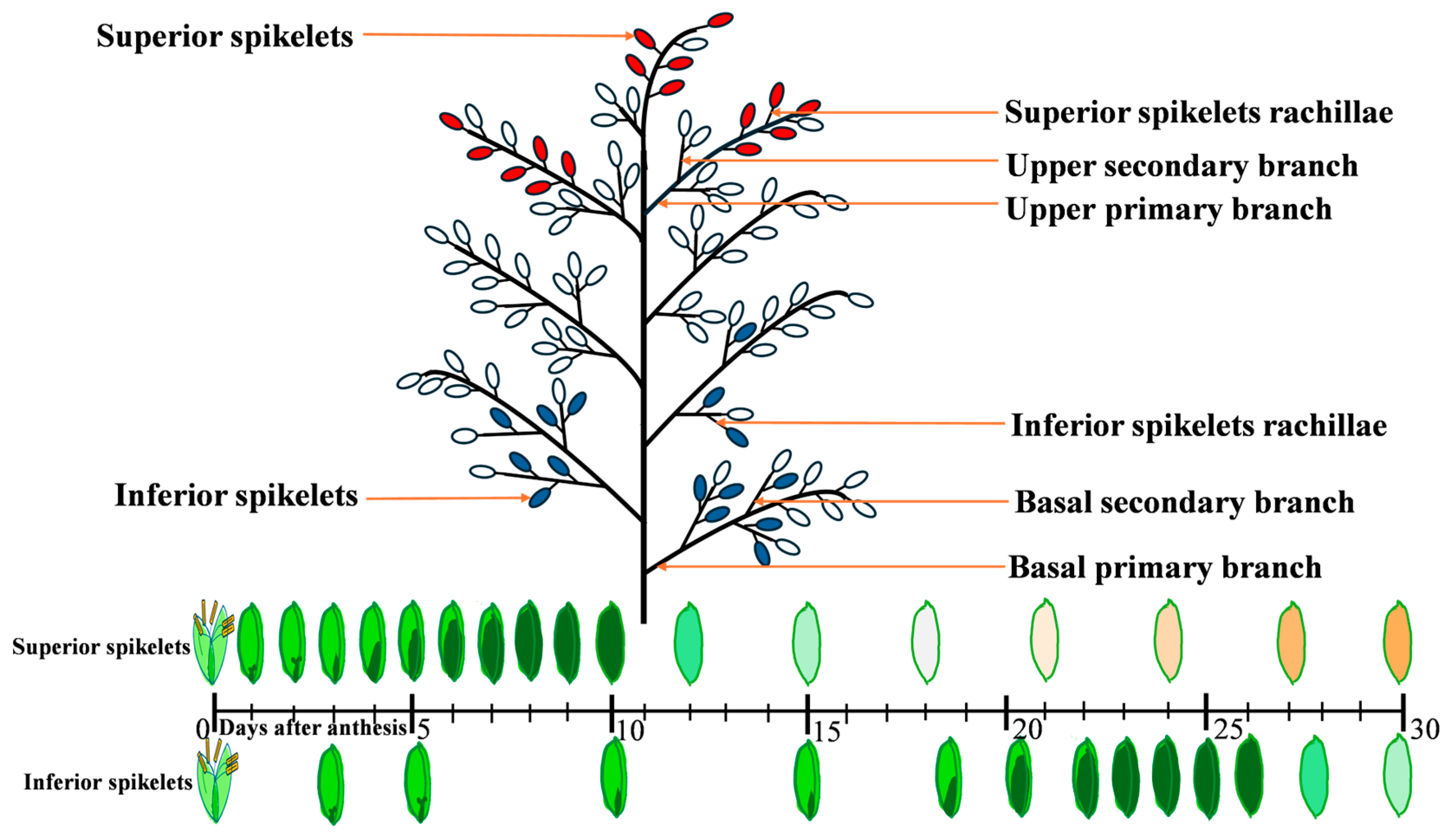
Superior grains, typically on primary branches in the middle-upper panicle, flower earlier and initiate filling rapidly after anthesis. Supported by sustained source strength and efficient assimilate transport, they achieve higher filling rates and greater final weight. In contrast, inferior grains, often on lower secondary branches, experience a significant post-anthesis lag. Their development coincides with declining source activity and less efficient transport, resulting in poorer assimilate import, a higher proportion of unfilled rains, and lower kernel weight (Figure 1) [37,42,43].

2.1. Filling Characteristics of Superior and Inferior Grains in Rice

Based on the initiation timing and filling dynamics of superior and inferior grains, rice cultivars can be categorized into three distinct filling types: synchronous, asynchronous, and intermediate [44] (Table 1). In synchronous types, superior and inferior grains flower at similar times, progress through filling at comparable rates and durations, and achieve similar final weights; this pattern is typically observed in conventional inbred varieties [45]. In contrast, asynchronous types, common in hybrid rice, exhibit significant disparities where inferior grains flower much later, fill at a substantially slower rate, and attain markedly lower weight than superior grains [46]. The intermediate type displays characteristics between these two extremes. The physiological basis for asynchronous filling is primarily explained by three hypotheses: (1) The Source-Sink-Flow Imbalance Hypothesis attributes yield limitations to constraints in photosynthetic capacity (source), grain storage potential (sink), or the transport pathway between them (flow) [47,48,49,50,51]. A critical aspect often lies in the transport capacity (flow), particularly the development and conductivity of the vascular bundles in the panicle neck. When the flow is inefficient, assimilates cannot be adequately delivered to the developing grains, especially those located distally, even if the source supply is sufficient. In modern large-panicle rice varieties, the mismatch between a huge sink demand and a relatively limited source and flow capacity becomes a primary bottleneck for achieving uniform grain filling [47,48,49,50,51]; (2) The Energy Barrier Hypothesis posits that inferior grains require a higher metabolic threshold to initiate filling [39]. This is supported by observations that superior grains often exhibit higher adenosine triphosphate (ATP) levels and respiratory rates during early filling. The delayed activation of key energy metabolism and starch synthesis enzymes in inferior grains means they cannot efficiently utilize incoming sucrose, creating a lag phase until sufficient metabolic energy and substrates accumulate to cross the required threshold [39]; (3) he Inter-grain Apical Dominance Hypothesis suggests that early-developing apical grains inhibit assimilate accumulation in later-developing basal grains [52]. This inhibition is mediated not only by prioritized assimilate partitioning but also by phytohormonal signals. Apical grains may maintain a higher auxin level, which could actively suppress the development of basal grains through a mechanism analogous to apical dominance in shoots, thereby reinforcing the hierarchical distribution of resources within the panicle [52]. In summary, during the late reproductive stage, superior grains dominate assimilate partitioning within the panicle due to their superior capacity for uptake, conversion, and storage, resulting in higher weight and better plumpness. This inherent asynchrony is a major physiological constraint limiting both yield potential and grain quality uniformity in modern rice production. What is more, the establishment of ‘sink strength’ in developing grains is a phytohormone-mediated process, involving cues from auxin, cytokinin, and gibberellin, among others.”
In summary, the physiological heterogeneity established by flowering sequence and positional hierarchy pre-determines a corresponding heterogeneity in the phytohormonal milieu of developing grains. This foundational understanding of sink-source dynamics is crucial for deciphering the phytohormone-mediated mechanisms that govern assimilate partitioning and filling rates, which form the focus of the next part of our discussion.

2.2. Material Basis and Physiological Process of Rice Grain Filling

The grain-filling period in rice extends from flowering to physiological maturity, with the most active phase occurring during the milky stage and largely concluding by the full ripe stage. Assimilates for filling are derived from two main sources: (1) current photosynthetic carbon assimilation during the filling period, and (2) the remobilization of non-structural carbohydrates (NSCs) stored in vegetative organs (e.g., stems, sheaths, leaves) prior to anthesis [53]. Pre-anthesis reserves are estimated to contribute 20–40% to final grain yield, while concurrent post-anthesis photosynthesis contributes 60–80% [54,55,56]. At its core, post-anthesis grain filling is a process of starch biosynthesis and accumulation, with starch accounting for approximately 80–90% of the mature grain’s dry weight [57]. Sucrose serves as the primary transport form of assimilates delivered to the grain, where it is subsequently converted into starch through a coordinated series of enzymatic reactions [58,59]. The activity dynamics of key starch-synthesis enzymes during endosperm development have been systematically studied [60,61]. For instance, Nakamura et al. profiled the activity levels of 33 major enzymes involved in starch metabolism within the rice endosperm [62]. Among these, several are recognized as critical regulators: sucrose synthase (SUS), ADP-glucose pyrophosphorylase (AGPase), granule-bound starch synthase (GBSS), soluble starch synthase (SSS), starch branching enzyme (SBE), starch debranching enzyme (DBE), and starch phosphorylase (Pho) [63,64]. The activity of these key enzymes is not autonomous but is tightly regulated by the internal phytohormonal milieu, which will be detailed in the following sections. Research by Yang Jianchang et al. demonstrated that the activity patterns of AGPase, SSS, GBSS, and SBE are closely associated with grain-filling dynamics, showing significant positive correlations with grain weight and filling rate in the early phase [60]. Supporting this, Kato noted that the trend of SUS activity closely parallels the curve of dry matter accumulation, underscoring its pivotal regulatory role in grain filling [61].
Therefore, the physiological processes of grain filling provide the necessary context for understanding their spatiotemporal phytohormonal regulation. As will be elaborated in the following sections, it is precisely the differences in the phytohormonal network that ultimately determine the capacity of grains at different positions to acquire and utilize assimilates. In summary, the physiological heterogeneity established by flowering sequence and positional hierarchy pre-determines a corresponding heterogeneity in the phytohormonal milieu of developing grains. This foundational understanding of sink-source dynamics is crucial for deciphering the phytohormone-mediated mechanisms that govern assimilate partitioning and filling rates, which form the focus of the next part of our discussion.

3. Regulatory Roles of Phytohormones in Grain Filling

3.1. Auxin

Auxin (Indole-3-acetic acid, IAA) acts as a critical initiator of grain filling, orchestrating the early establishment of assimilate transport gradients to the developing caryopsis. Auxin serves as a key regulator in diverse plant processes, including gametogenesis, embryogenesis, organ formation, and stress adaptation [65,66,67,68,69,70]. During rice grain development, a marked divergence in IAA accumulation patterns is observed between superior and inferior grains. Superior grains initiate a rapid surge in IAA immediately following fertilization, whereas in inferior grains, IAA levels begin to increase only after a delay of approximately 7 days, resulting in a progressively widening phytohormonal gap [71,72]. While the overall trend of IAA accumulation is broadly synchronized with dry matter accumulation, the rapid rise in IAA precedes the phase of rapid weight gain in superior grains. In contrast, in inferior grains, the increase in IAA and the acceleration in weight gain occur almost concurrently [72]. The elevated IAA levels in superior grains during early filling enhance sucrose invertase activity, thereby promoting the efficient conversion of sugars to starch. Conversely, inferior grains, characterized by lower IAA levels and consequently reduced related enzyme activities, experience an inhibition of photosynthate import due to sugar accumulation, which impedes the filling process [72]. At the molecular level, research indicates that the protein OsU496A promotes grain filling through a dual mechanism: it interacts with an E3 ubiquitin ligase to degrade IAA transcriptional repressors, thus activating the auxin signaling pathway, while simultaneously suppressing the expression of cytokinin oxidase to stabilize cytokinin levels. These coordinated actions synergistically upregulate the activities of key starch-synthesis enzymes, such as SUS and SSS, driving the conversion of sucrose to starch and enhancing grain filling and biomass accumulation [73,74]. Consequently, the poor filling performance of inferior grains is closely linked to insufficient assimilate supply and diminished starch conversion efficiency, both stemming from their inherently low IAA status.
While this may temporarily accelerate the initial filling rate, it ultimately shortens the active filling duration. The underlying mechanism is likely associated with suppressed transpiration, decreased chlorophyll content, and a consequent reduction in photosynthetic product supply [75,76]. Conversely, alternate wetting and drying (AWD) irrigation has been shown to elevate IAA levels. This treatment enhances the activities of key enzymes such as SUS and starch synthases (e.g., AGPase, GBSS), upregulates the expression of sucrose transporter (SUT) genes, and thereby improves sucrose unloading and uptake in developing grains. Collectively, these physiological improvements contribute to increased seed-setting rate and final grain weight [76,77,78]. Furthermore, excessive nitrogen application during the early filling stage can be detrimental. It suppresses the expression of IAA biosynthetic genes and reduces the activities of enzymes like SUS, AGPase, and SSS in inferior spikelets, ultimately compromising starch synthesis capacity and leading to lower grain weight [79].
This early auxin surge not only establishes a local promotive signal but also synergizes with cytokinin to potentiate endosperm cell division. Conversely, its decline in inferior grains coincides with a rise in ethylene, highlighting the antagonistic interplay within the phytohormonal network that determines filling efficiency.

3.2. Cytokinin

Cytokinins are fundamental for establishing the grain’s sink capacity by promoting endosperm cell division and determining the initial number of starch-accumulating cells. Cytokinins are present at high levels in the endosperm of developing cereal, pea, and bean seeds during early stages, potentially supporting the active cell division required for initial grain formation [80,81]. While it is generally accepted that cytokinins in higher plants are primarily synthesized in the roots and transported to aerial parts via the transpiration stream to regulate growth [82], emerging evidence suggests that developing grains may also possess autonomous cytokinin biosynthesis capacity [83]. The peak concentration of cytokinins in grains has been correlated with final grain yield, as indicated by Michael and Seiler-Kelbitsch [84]. Accordingly, the exogenous application of cytokinins has been shown to enhance the seed-setting rate and yield in major cereals, including rice, wheat, barley, and maize [81]. In rice, the accumulation dynamics of cytokinins notably differ between superior and inferior grains. In superior grains, cytokinin content rises sharply after anthesis, reaching a peak around 4 days. In contrast, inferior grains maintain low cytokinin levels for the first 6 days post-anthesis, after which they increase rapidly to a peak at around 10 days; however, this peak level remains substantially lower than that in superior grains [85]. Importantly, the temporal patterns of zeatin + zeatin riboside (Z + ZR) content in both grain types closely mirror their respective grain-filling rate profiles [85].
Research by Yang et al. demonstrated that the peak rate of endosperm cell division aligns with the peak of Z + ZR content. Under normal nitrogen supply, both events occurred at 10–14 days after anthesis, whereas high nitrogen application delayed them to 12–18 days [86,87]. However, excessive nitrogen can be detrimental, as it reduces cytokinin levels in inferior spikelets during early filling. This is achieved by upregulating cytokinin catabolism genes, such as the cytokinin oxidase gene OsCKX. The subsequent decline in cytokinin inhibits the activity of key enzymes like sucrose synthase and ADP-glucose pyrophosphorylase, ultimately impairing the accumulation of starch and non-structural carbohydrates [79]. Conversely, exogenous application of cytokinins (e.g., 6-BA) offers a strategy to improve filling. It can increase the maximum filling rate, modify the duration of active filling and the time to peak rate, enhance the activities of enzymes in the sucrose-starch conversion pathway, and consequently boost final grain weight [88].
The pivotal role of cytokinin in sink establishment is tightly coordinated with auxin signaling, forming a synergistic node for early development. Its suppression under high nitrogen or in inferior grains is often paralleled by altered balances of ABA and ethylene, underscoring its position within a broader regulatory web.

3.3. Gibberellin

Gibberellins (GAs) function as crucial modulators of the grain-filling rate, influencing both the mobilization of assimilates from source tissues and their metabolism within the grain. Gibberellin is a pivotal phytohormone regulating rice growth and development. Relatively high levels of GA accumulate in florets around flowering, priming them for the onset of grain filling [89,90]. During the early filling stage, GA content continues to rise, reaching a peak at 6–9 days after anthesis. This peak coincides with the period of rapid endosperm cell proliferation and expansion, underscoring GA’s important role in early endosperm development [91]. A comparative study by Yang et al. on eight rice varieties revealed a consistent pattern: the GA peak invariably occurred earlier in superior grains than in inferior grains across all varieties, and the grain-filling rate increased significantly following this GA peak. This suggests that GA may serve as a temporal switch for initiating filling and contributes to the physiological differentiation between superior and inferior grains [27]. Specifically, superior grains exhibit relatively high GA levels as early as 3 days after anthesis, peak at 6–9 days, and then decline rapidly. In contrast, inferior grains maintain lower GA levels than superior grains until 9–12 days post-anthesis, surpass them thereafter, reach their own peak much later at 18–24 days, and subsequently decline slowly. From approximately 24 days after anthesis onward, the GA levels in both grain types tend to converge [26,27].
At the physiological level, gibberellin enhances the metabolism and conversion of photosynthetic assimilates within developing grains. Superior grains rapidly accumulate active GAs (e.g., GA1, GA4) after anthesis, which in turn activates key enzymes in the sucrose-to-starch conversion pathway, such as SUS and starch synthase. This activation drives the prompt initiation of rapid filling. In contrast, the delayed rise in GA levels in inferior grains contributes to their lag in filling onset [92,93]. At the molecular level, OsGAMyb—a target of miR319 and a positive regulator of GA signaling—may indirectly influence assimilate partitioning to grains by mediating nitrogen metabolism pathways, for example, through regulating the expression of OsGS1;2, thereby affecting the filling process [94]. Furthermore, GA plays a role in regulating the “flow” component within the “source-sink-flow” system. Exogenous GA treatment can significantly upregulate the expression of sucrose transporter genes (e.g., OsSUT1) in both leaves and grains. This enhances the transport efficiency of photosynthetic products from source to sink, thereby ensuring a more robust supply of assimilates to support grain filling [95].
GA’s role in assimilate “flow” regulation is functionally interlinked with ABA-mediated sink strength and IAA-dependent vascular development. The temporal shift in its peak between superior and inferior grains represents a key aspect of the spatiotemporal phytohormonal program that orchestrates filling synchrony.

3.4. Abscisic Acid

Abscisic acid (ABA) plays a dual and context-dependent role: it coordinates stress adaptive responses while simultaneously promoting assimilate import and starch biosynthesis in developing grains under non-stress conditions. Abscisic acid functions as a crucial signaling molecule in plants, mediating not only senescence and stress responses [96] but also the transport of assimilates to developing seeds and fruits [71,97,98,99]. Its physiological effects are concentration-dependent; at lower levels, ABA may not be inhibitory and can even promote certain aspects of growth. Therefore, its role should not be simplistically categorized as either promotive or inhibitory but understood within the context of its dynamic balance across specific tissues and developmental stages. In rice grains, ABA content exhibits a positive correlation with the filling rate during the early stage [72,100]. Research by Dong et al. observed that superior grains achieve their peak ABA content and maximum filling rate earlier and at a higher magnitude than inferior grains, indicating a more rapid initiation of filling [100]. Specifically, superior grains show higher ABA levels as early as 3 days after anthesis, peak at 6–9 days, and then decline rapidly. In contrast, inferior grains maintain lower ABA levels within the first 12 days, surpass those of superior grains after about 15 days, and eventually converge with superior grain levels around 24 days after anthesis [27].
ABA stimulates sucrose uptake and unloading in sink organs, and variation in its endogenous levels is one factor contributing to genotypic differences in grain growth rates [99]. Supporting this, Kato et al. reported that large-grain rice genotypes consistently exhibit higher grain ABA content during filling compared to small-grain genotypes [73]. Furthermore, research by Wang and Yang et al. has indicated that poor grain filling is often associated with low ABA levels [27,74]. The promotive role of ABA is corroborated by application studies; exogenous ABA treatment enhances the activities of starch synthesis-related enzymes and promotes filling, whereas applying ABA biosynthesis inhibitors (e.g., fluridone) suppresses enzyme activity, leading to reduced filling efficiency and lower grain weight [75]. Consequently, elevating ABA levels in grains—particularly in inferior grains—through genetic (e.g., upregulating key ABA biosynthesis genes) or agronomic strategies (e.g., implementing post-anthesis moderate drought) can effectively activate the starch synthesis pathway, thereby improving the filling efficiency and final weight of inferior grains [76,77]. Beyond direct effects in the grain, ABA also regulates assimilate translocation from source tissues. Treatment with low concentrations of ABA can significantly increase the export and conversion rates of non-structural carbohydrates stored in stems and sheaths, while high concentrations inhibit this process, highlighting the concentration-dependent, promotive role of low-level ABA in assimilate remobilization [27]. This principle is applied in practices like post-anthesis moderate soil drying, which elevates endogenous ABA levels, thereby stimulating the remobilization and translocation of stem-sheath reserves to the grains and increasing the overall filling rate [78,92].
ABA’s promotive effect on grain filling is context-dependent and often antagonized by ethylene. The ABA-ethylene ratio acts as a critical switch, with agronomic practices like mild drought favoring a high-ABA, low-ethylene state that promotes assimilate partitioning, especially to inferior grains.

3.5. Brassinosteroid

Brassinosteroids (BRs) positively regulate grain size and filling capacity by promoting cell expansion in the pericarp and enhancing the activities of key enzymes in the starch synthesis pathway. Brassinosteroids, a class of plant steroid phytohormones, are central regulators of rice panicle architecture and grain filling. Evidence from molecular genetics underscores their essential role. For instance, the PMM1 gene encodes CYP724B1, a key enzyme in BR biosynthesis. Mutants with loss-of-function in pmm1, which have impaired BR synthesis, display not only panicle defects such as a shortened rachis and abnormal branch arrangement but also directly result in reduced grain size and a significant decrease in thousand-grain weight. This demonstrates that BRs are crucial for determining panicle structure, promoting assimilate partitioning to the grains, and ultimately influencing filling and final grain weight [79,101]. Concurrently, BRs are pivotal in regulating grain size and shape through a cascade from biosynthesis to signal transduction. Loss-of-function of another BR biosynthesis gene, D11, leads to decreased grain length and volume [79]. Conversely, the exogenous application of epibrassinolide (EBR) can increase grain volume by promoting endosperm cell division during early filling, thereby increasing total cell number [102]. The effects of BR application are dose- and timing-dependent. Research by Li Zantang et al. showed that spraying EBR at the panicle differentiation stage enhanced overall sink capacity, but through distinct mechanisms: low-concentration treatment primarily and significantly increased the thousand-grain weight with minimal effect on spikelet number per panicle, whereas high-concentration treatment significantly increased the number of panicles per unit area and spikelets per panicle, with a more limited effect on thousand-grain weight [103].
Exogenous application of brassinosteroids (BRs) enhances the activities of sucrose cleavage enzymes in both superior and inferior grains. Notably, this treatment exerts a more pronounced stimulatory effect on acid invertase activity in inferior grains. This preferential enhancement helps redirect photosynthetic assimilates towards the inferior grains, thereby promoting their starch synthesis, improving grain filling, and ultimately increasing kernel plumpness and seed-setting rate [103,104,105]. Naturally, the endogenous BR content is often higher in upper spikelets compared to lower ones before flowering. Furthermore, agronomic management can modulate this phytohormonal landscape; the timing of panicle fertilizer application relative to specific panicle development stages significantly influences the BR content at given positions within the panicle [106]. Rational panicle fertilizer management, particularly application at the spikelet primordia differentiation stage, can upregulate the expression of key BR biosynthesis genes (e.g., OsD2, OsD11) and signaling pathway components (e.g., OsBRI1, OsBZR1). This upregulation increases panicle BR levels during the critical early filling period, which is highly beneficial for the timely initiation of grain filling [106].
BRs fine-tune the grain filling process through crosstalk with multiple pathways. They can enhance auxin and GA signaling, promoting cell expansion and assimilate transport, while also modulating the sensitivity to inhibitory signals like ethylene, thereby integrating developmental and environmental cues.

3.6. Ethylene

The gaseous phytohormone ethylene acts as a spatiotemporal modulator, with its accumulation frequently associated with the termination of filling in superior grains and the suppression of filling initiation in inferior grains. Ethylene emission and the level of its direct precursor, 1-aminocyclopropane-1-carboxylic acid (ACC), exhibit a significant negative correlation with the grain filling process and final grain weight [86,87,107]. This inhibitory relationship is further supported by correlation analyses showing that ethylene emission rate is negatively correlated with key parameters such as endosperm cell division rate, grain filling rate, kernel plumpness, starch content, and final grain weight [107,108]. The dynamics of ethylene production follow a specific temporal pattern: it is low prior to anthesis, surges sharply at flowering, experiences a temporary dip post-anthesis, rises again to a peak coinciding with the onset of grain filling, and subsequently declines as development proceeds [107,109]. Spatially, a gradient exists within the panicle, with basal grains typically producing more ethylene than apical grains. This localized accumulation is considered a significant factor contributing to the delayed and often poorer filling observed in basal grains [87]. This pattern extends to varietal and positional comparisons; rice varieties exhibiting poor grain plumpness generally have higher grain ethylene emission rates than those with good plumpness. Similarly, within a single panicle, inferior grains emit more ethylene than superior grains [86,87]. The structure of the panicle itself can amplify ethylene’s effects. As suggested by Wilkinson et al., certain panicle architectures may predispose the crop to yield loss mediated by ethylene [110]. Panicles are often categorized as compact, intermediate, or lax based on spikelet density, which correlates with the number of secondary branches [111]. While modern breeding has favored compact panicles due to the association between increased spikelet laxness and reduced yield potential [112], this very compactness can exacerbate developmental asynchrony. Grains on apical primary branches hold a strong metabolic advantage, leading to significant weight disparities and uneven filling across the panicle [113]. This challenge of uneven spikelet filling has become even more pronounced with the development of super-large-panicle varieties through innovative breeding programs.
Ethylene primarily exerts its influence by promoting the senescence of photosynthetic tissues, thereby reducing the supply of assimilates available for grain development [114,115]. This effect is mirrored in application studies: the exogenous application of ethephon (an ethylene-releasing compound) accelerates grain maturation, while inhibitors of ethylene synthesis (e.g., aminoethoxyvinylglycine, AVG) delay it [116]. A particularly critical mechanism is ethylene’s inhibition of seed coat (pericarp) function. This impairment likely disrupts the normal regulation of endosperm growth rate and final grain size, thereby contributing to the delayed filling of spikelets, especially inferior grains [117]. The underlying regulation may occur through multiple pathways, such as affecting endosperm cell division or modulating the activity of sucrose-cleaving enzymes (e.g., invertase), which in turn determines the rate of assimilate import into the grain [118,119]. Notably, ethylene’s inhibitory effect on the seed coat is more pronounced than its effect on the lemma and palea, reflecting the former’s closer functional relationship with the grain-filling process [120].
Increased spikelet density on the panicle enhances ethylene perception and accumulation, which weakens apical dominance and is detrimental to uniform grain filling. Mohapatra et al. confirmed that ethylene inhibits the filling of basal spikelets [121], and this effect is amplified by higher grain density, which itself stimulates greater ethylene production [120]. Elevated ethylene levels typically suppress grain filling by directly reducing the activities of key starch synthesis enzymes, such as SUS, AGPase, and starch synthase (SS) [122,123]. Sekhar et al. provided further mechanistic insight, demonstrating that basal spikelets not only produce more ethylene post-anthesis than apical spikelets but also sustain higher expression levels of ethylene receptors and signal transduction components [87]. Consequently, basal spikelets endure prolonged exposure to a high ethylene microenvironment within the confined space of the flag leaf sheath, which severely restricts their development and leads to poor grain filling. At the molecular level, high ethylene upregulates the expression of RSR1 (RICE STARCH REGULATOR 1), a negative regulator of starch synthesis. This simultaneously inhibits assimilate partitioning to the grains and represses the expression of the key amylose synthesis gene GBSS1, culminating in reduced starch biosynthesis and aberrant accumulation of soluble carbohydrates [87]. In modern super rice varieties with densely packed secondary branches, this vicious cycle—where dense panicles exacerbate ethylene production, which in turn inhibits starch synthase activity—becomes a major constraint. It specifically limits filling in the middle and lower spikelets, causing actual yields to fall short of potential. Additional research by Wuriyanghan et al. showed that the rice ethylene receptor ETR2 might influence flowering transition and starch accumulation by regulating the OsGI gene, further underscoring the multifaceted role of ethylene in regulating the grain-filling process [124].
Although most studies emphasize the inhibitory role of ethylene on filling, some have found that appropriate ethylene levels might have positive effects. For instance, applying ethephon at the early filling stage can increase the activities of Endosperm Ethanolate Reductase (EER), SUS, and SSS, as well as the filling rate and grain weight in inferior grains, whereas ethylene synthesis inhibitors like AgNO3 or Co(NO3)2 have the opposite effect [93,125]. The presence of low ethylene levels in apical filled spikelets, and the observation that the peak filling rate occurs during periods of moderate ethylene emission, suggest that ethylene’s effect on grain filling is not purely inhibitory; whether its metabolic level is “optimal” might be key to determining the filling rate [93,125]. Therefore, the relationship between ethylene and grain filling may involve more complex dose-dependent and temporal regulation, where the filling rate increases only when ethylene metabolism reaches an appropriate level.
Ethylene’s predominantly inhibitory role is balanced by promotive phytohormones like ABA and polyamines. The spatial gradient of ethylene within the panicle, antagonized by ABA under optimal stress, is a decisive factor in the differential programming of superior versus inferior grain fate.

3.7. Polyamines

Polyamines (PAs), such as spermidine and spermine, provide essential metabolic support for grain filling by stabilizing cellular structures and modulating the activity of enzymes involved in nitrogen and carbon metabolism. Polyamines are recognized as vital growth-regulating substances due to their potent physiological activity. They are intimately involved in the metabolism and regulation of essential cellular components such as nucleic acids and proteins, and interact with other phytohormone signaling pathways [126,127,128]. Notably, spermidine (Spd) and spermine (Spm) have been identified as key players in determining grain plumpness and final weight in rice [129]. The most common polyamines in plants include putrescine (Put, a diamine), spermidine (Spd, a triamine), and spermine (Spm, a tetraamine).
During grain filling, polyamine content typically follows the order Put > Spd > Spm, with Put concentration being 2–3 times that of Spd and 10–25 times that of Spm. The levels of all polyamines generally decline during the post-anthesis period. In superior grains, Put content shows a slight increase, peaking at 7–14 days after anthesis before decreasing to its lowest point around 28 days, with only a modest rebound during mid-to-late filling. The dynamics in inferior grains differ markedly: the trough in polyamine levels occurs approximately 7 days earlier than in superior grains. Notably, a significant secondary peak in polyamine content emerges in inferior grains around 35 days after anthesis. This resurgence coincides with the completion of the active filling phase in superior grains—which reduces their assimilate demand—and aligns with a minor, delayed filling peak in the inferior grains, suggesting a tight coupling between polyamine levels and filling activity. A critical period occurs 7–11 days after heading, when the embryo undergoes active cell division and starch granule formation. The concurrent rise in Put and Spd levels with the peak filling rate during this window implies that polyamines likely promote filling by stimulating cell division and assimilate accumulation. Once the active filling phase concludes, polyamine levels stabilize, further supporting their functional link to cell division and grain development [130]. Considerable varietal differences in Put content are observed between 14 and 28 days after flowering, with some variation persisting beyond this stage [130]. In superior grains, Spd follows a trend similar to Put, showing a transient rise within 14 days after anthesis before a sharp decline and stabilization by day 28 [130]. In contrast, Spm exhibits a distinct pattern, with relatively minor fluctuations throughout the filling period [130]. In inferior grains, all three amines follow broadly similar declining trends as filling progresses [130]. Collectively, these patterns suggest that polyamines promote cell division and grain filling, and that the filling process itself may exert feedback regulation on polyamine synthesis.
The application rate of nitrogen fertilizer modulates the grain filling process by regulating polyamine metabolism. Research by Lin et al. demonstrated that both putrescine (Put) content and the spermidine-to-spermine (Spd/Spm) ratio increase with higher nitrogen application, which accelerates the initiation of grain filling. However, excessive nitrogen rates can produce negative effects [131]. While polyamines are generally beneficial for plant stress physiology, their accumulation—particularly of Put—beyond an optimal level can inhibit the activity of key photosynthetic enzymes such as fructose-1,6-bisphosphatase (FBPase) and components of the Hill reaction. This inhibition reduces the net photosynthetic rate, ultimately impairing the filling process [131,132]. Furthermore, Spm and Spd exist in a homeostatic balance within the plant. A Spm/Spd ratio of less than 1 is considered suboptimal, and a higher ratio within this range is increasingly unfavorable for normal growth and development [133]. The critical role of Spd and Spm in grain plumpness was further confirmed by an inhibition experiment. Yang et al. sprayed 1 mmol/L methylglyoxal bis-guanylhydrazone (MGBG), a polyamine synthesis inhibitor, at the heading stage. This treatment significantly reduced grain plumpness and thousand-grain weight compared to the control, with a more pronounced effect on inferior grains and on varieties inherently characterized by poor grain filling. These negative phenotypic changes correlated directly with a decline in Spd and Spm content within the grains, providing strong evidence that these specific polyamines actively promote grain plumpness [134,135].
Polyamines contribute to filling stability not only through direct metabolic support but also by antagonizing ethylene biosynthesis and action. The Spd/Spm ratio and its interplay with the ethylene and ABA pathways form a metabolically intertwined layer of regulation that influences senescence timing and grain plumpness.

3.8. Phytohormonal Crosstalk: Setting the Stage for an Integrated Network

The foregoing analysis, structured by phytohormone class, delineates the unique contributions and spatiotemporal dynamics of each regulator. A recurring theme, however, is that these phytohormones do not act in isolated linear pathways. Instead, they engage in a dense network of synergistic and antagonistic interactions—exemplified by the IAA-CK partnership in sink initiation, the GA-ABA balance in assimilate partitioning, and the pivotal ETH-ABA antagonism that switches between filling promotion and senescence induction. These interactions are spatially partitioned, creating a distinct phytohormonal microenvironment for superior grains (characterized by early promotive surges and low inhibition) versus inferior grains (marked by phytohormonal delays and elevated ethylene). This dynamic, position-dependent network fundamentally determines a grain’s capacity to attract and convert assimilates. In the following section, we synthesize these multifaceted relationships into a unified model, conceptualizing the core interaction nodes and illustrating how agronomic practices achieve their effects by reprogramming this very network.

4. Synthesis: Towards an Integrated Phytohormonal Network Model for Grain Filling

4.1. Phytohormonal Spatiotemporal Dynamics and Their Regulatory Mechanisms During Grain Filling

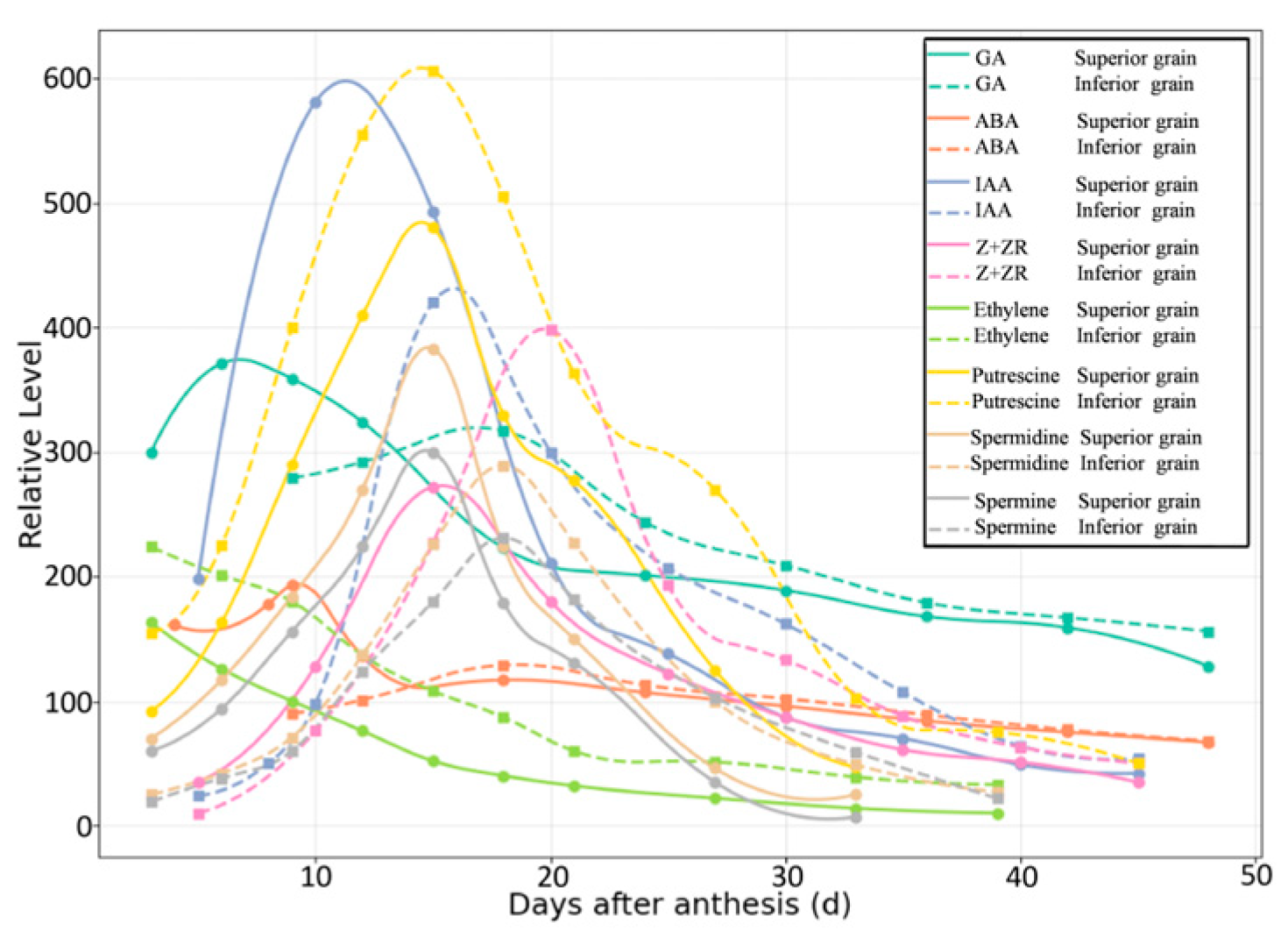
Grain filling is not a homogeneous process. The asynchronous development between superior and inferior grains within the same panicle is a key factor limiting yield potential. This disparity essentially stems from fundamental differences in their endogenous phytohormonal environment. As shown in Figure 2, dynamic monitoring of key phytohormones from post-anthesis to maturity (0–50 days) clearly reveals distinct spatiotemporal phytohormonal programs between superior and inferior grains.
Figure 2. Temporal dynamics of key phytohormones in superior and inferior grains during rice grain filling. All data presented in Figure 2 were measured from the indica rice cultivar Yangdao 4 for Gibberellin (GA) and Abscisic Acid (ABA), and from the hybrid rice cultivar Liangyoupeijiu for the other phytohormones (IAA, Z + ZR, Ethylene) and polyamines (Putrescine, Spermidine, Spermine). Despite the different cultivars used, the overall evolutionary patterns and trends of phytohormone concentration over the post-anthesis period were fundamentally consistent between them. The units for phytohormone concentrations are as follows: GA and ABA: ng per gram fresh weight (ng/g FW); IAA and Z + ZR: microgram per gram fresh weight (μg/g FW); Ethylene: release rate in pmol per gram fresh weight per hour (pmol/g FW/h); Polyamines (Putrescine, Spermidine, Spermine): nmol per gram fresh weight (nmol/g FW). FW stands for fresh weight. The divergent temporal patterns and concentration gradients between superior (SG) and inferior grains (IG) are not merely correlative but reflect active, phytohormone-mediated regulatory programs. Key interactive relationships—such as the concurrent early peaks of IAA and Z + ZR in SG (synergistic), or the inverse correlation between ethylene and promotive phytohormones in IG (antagonistic)—are visualized here, providing the empirical foundation for the network model proposed in Figure 3 and Section 4.
Agronomy 16 00060 g002
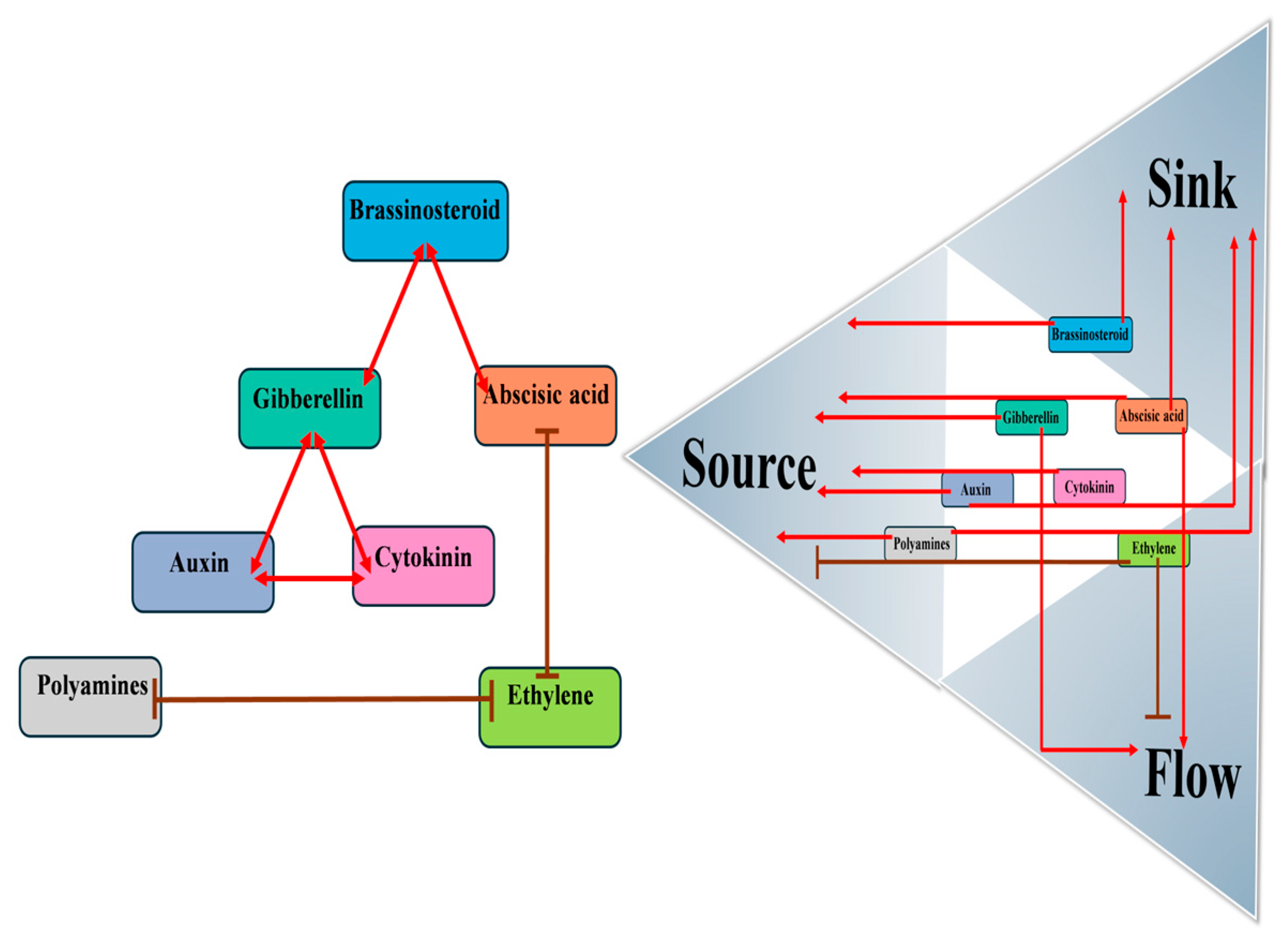
Figure 3. Remodeling of the phytohormonal network by key agronomic practices and A conceptual model linking the “source-sink-flow” system with phytohormonal regulation. Red arrows indicate positive regulation, while brown T-shaped arrows indicate negative regulation. The model integrates the spatiotemporal dynamics shown in Figure 2, highlighting: (1) the ABA-ETH antagonistic switch that controls senescence timing; (2) the IAA-CK synergistic engine that drives early sink establishment; and (3) GA-mediated flow regulation. The model explicitly links these phytohormonal nodes to the “source-sink-flow” physiology.
Agronomy 16 00060 g003

4.1.1. Dynamic Profiles Reveal “Temporal Asynchrony” and “Concentration Difference”

Figure 2 illustrates the dynamic changes in the levels of key phytohormones and polyamines in superior and inferior rice grains during the grain-filling period. The temporal profiles reveal significant spatiotemporal pattern differences: (1) Promotive phytohormones (GA, IAA, Z + ZR, ABA): In superior grains, the concentration peaks of these phytohormones occur earlier and are generally higher. This early phytohormonal surge is closely associated with the rapid initiation and high rate of grain filling in superior grains. (2) Inhibitory phytohormone (Ethylene): Its pattern shows the opposite trend. Ethylene levels tend to be higher in inferior grains, particularly during the mid-filling stage, which may directly contribute to the delayed and suppressed filling observed in these grains. (3) Polyamines (Putrescine, Spermidine, Spermine): These also exhibit differential dynamics. Superior grains generally maintain higher levels of Spermidine and Spermine during the active filling phase, which helps support cell division and metabolic stability [130,131,132]. Overall, this comparative visualization underscores that the developmental disparity between superior and inferior grains is underpinned by a fundamental asynchrony and concentration difference in their phytohormonal milieu. These coordinated yet distinct phytohormonal signatures likely play a deterministic role in regulating sink strength, assimilate partitioning, and ultimately, the filling efficiency of individual grains.

4.1.2. Biological Mechanisms Underlying “Temporal Asynchrony” and “Concentration Difference”

The aforementioned dynamic differences are not merely descriptive phenomena; they embody the core biological logic leading to asynchronous filling: (1) “Temporal Asynchrony” in Filling Initiation—Driven by Early Phytohormonal Sequences: Superior grains establish an “Early and Efficient Initiation” program immediately after anthesis, characterized by the rapid peaking of Z + ZR, IAA, and GA, which synchronously activates endosperm cell division and sink capacity foundation. In contrast, the lag in these same phytohormonal signals in inferior grains results in a “delayed start,” causing them to miss the optimal window of abundant photoassimilate supply [93]. (2) “Concentration Difference” in Filling Rate—Determined by the Balance of Key phytoHormones: The filling rate depends not only on the absolute levels of individual promotive phytohormones but more crucially on the balance network among phytohormones. I. Direct Suppression by “Promotion-Inhibition” Imbalance: The abnormally high early ethylene level in inferior grains forms a sharp contrast with their insufficient GA and IAA. As a typical inhibitory factor, ethylene may directly suppress the activity of key enzymes in the sucrose-starch conversion pathway, thereby directly suppressing the filling rate [93]. II. Limitation by Inadequate “Translocation” Drive: The timely increase in ABA in superior grains effectively promotes sucrose transport and unloading. The delayed and insufficient accumulation of ABA in inferior grains leads to an inherently weak acquisition capacity for assimilates [75,76,77]. III. Systemic Impact of a Fragile “Synergistic” Network: In superior grains, GA, IAA, Z + ZR, and polyamines (especially Spermidine and Spermine) likely form a positive synergistic network that collectively maintains high metabolic activity and senescence resistance [26,27,74,75,76,77,86,87,92,93]. The overall lower concentration of this network in inferior grains makes their filling process systemically fragile and prone to premature senescence.

4.2. Core Interaction Nodes and Signal Integration

Phytohormones do not act in isolation; they operate through an intricate interaction network to collectively orchestrate the initiation, rate, and termination of grain filling in a spatiotemporally specific manner. Within this network, several core nodes exist, and their dynamic equilibrium ultimately determines the sink strength and assimilate partitioning efficiency of the grains (Figure 3).

4.2.1. The ABA-ETH Antagonistic Node: The “Switch” Regulating the Balance Between Grain Filling and Senescence

The antagonistic interplay between abscisic acid (ABA) and ethylene (ETH) serves as a critical hub, akin to a precise “biological switch,” regulating the transition between grain filling and senescence. At the molecular level, ABA signaling negatively regulates the ethylene pathway by suppressing key ethylene biosynthesis genes (e.g., OsACS) and downstream signaling [27,35,74,122,123]. Conversely, ethylene accumulation antagonizes the promotive effects of ABA. This antagonism is vital in stress responses. For instance, saline-alkali stress significantly promotes ethylene synthesis, thereby inhibiting grain filling. In contrast, moderate soil drying (e.g., post-anthesis alternate wetting and drying) is an effective agronomic practice whose physiological basis lies in elevating ABA levels (particularly in inferior grains) while suppressing ethylene production. This action releases the ethylene-mediated inhibition of filling, prolongs the grain-filling duration, and promotes assimilate partitioning to inferior grains [27,35,74,122,123]. Therefore, manipulating the ABA/ETH ratio is a key strategy for synchronizing grain filling across the entire panicle and achieving “stress-resilient yield enhancement.”

4.2.2. The IAA-CK Synergistic Node: The “Engine” Driving Early Sink Capacity Establishment

Auxin (IAA) and cytokinins (CKs) form a robust synergistic network during early grain filling, jointly acting as the “engine” for establishing the potential of the sink organ (endosperm). This synergy manifests at multiple levels. Signal-wise, IAA can stabilize CK levels by inhibiting the expression of cytokinin oxidase genes (e.g., OsCKX) [75,76,77,78,86,87,88]. Functionally, they synergistically promote cell division in the ovary and endosperm post-fertilization, directly determining the number of storage cells, i.e., the potential sink capacity. Studies confirm that the combined exogenous application of IAA and CKs can more effectively reverse poor filling in inferior grains caused by excessive nitrogen application [75,76,77,78,86,87,88]. Furthermore, this node synergistically upregulates the activity of key enzymes such SUS and AGPase, thereby enhancing sucrose unloading and starch synthesis initiation [75,76,77,78,86,87,88]. The early initiation and high intensity of this synergistic signal in superior grains are major reasons for their rapid filling initiation and competitive advantage.

4.2.3. GA’s Role in “Flow” Regulation: The “Logistics Channel” Ensuring Assimilate Supply

Gibberellins (GAs) play a unique role as regulators of “flow” within the network, primarily acting on the transport of assimilates from source to sink rather than directly determining sink capacity [89,90]. Their core mechanism involves the positive regulation of sucrose transporter (e.g., OsSUT1) expression and activity, thereby enhancing phloem loading and grain unloading capacity to ensure an unimpeded flow of filling materials [94,95]. The GA peak often precedes the period of maximum filling rate, functioning to open and widen the “logistics channel” for the impending filling peak. In agronomic practice, panicle fertilizer application often promotes assimilate partitioning to grains by elevating GA levels in the panicle. This function of GA perfectly complements the “sink-building” role of IAA-CK and the “filling-promotion” role of ABA, together forming a complete chain from “sink preparation” to “material transport” and finally “efficient conversion” [75,76,77,78,86,87,88,89,90].

4.2.4. Modulatory and Reinforcing Roles of Other Phytohormones

Phytohormones such as brassinosteroids (BRs) and polyamines fine-tune and reinforce the core network, enabling more precise and robust regulation [79,101]. BRs can crosstalk with IAA and GA signaling pathways, synergistically promoting cell expansion and material transport, thereby enhancing sink strength and filling efficiency [75,76,77,78,79,86,87,89,101]. Polyamines (e.g., spermidine) exhibit typical metabolic and functional antagonism with ethylene. By inhibiting ethylene synthesis and mitigating ethylene-induced oxidative damage, they create a stable intracellular environment for grain filling. The presence of these modulatory factors allows the core phytohormonal network to flexibly integrate various agronomic signals, such as nitrogen nutrition and water status, enabling precise responses to environmental and cultivation cues [24,26,27,28,75,76,77,78,79,86,87,89,101,136,137].
In summary, rice grain filling is not linearly controlled by a single phytohormone but is coordinately regulated by a dynamic network centered on core nodes such as ABA-ETH, IAA-CK, and GA. Understanding and targeting these nodes provides the theoretical foundation for achieving synchronized and efficient grain filling and unlocking yield potential through agronomic or chemical means.

4.3. Reprogramming of Phytohormonal Networks by Agronomic Practices

As shown in Table 2, classical agronomic practices are essentially inputs of external environmental signals. They reprogram the phytohormonal network within the grain by directly or indirectly altering the synthesis, metabolism, and distribution of endogenous phytohormones, ultimately regulating the grain filling process and its outcomes.

4.4. A Unified Working Model and Perspective

Synthesizing the above analyses, we propose an integrated model centered on the “local phytohormonal microenvironment” for understanding and regulating rice grain filling. This model posits that the ultimate fate of a grain (as superior or inferior) is not entirely predetermined but is dominantly governed by the dynamic “local phytohormonal microenvironment” it is embedded in after flowering. The initial state and dynamic progression of this microenvironment are shaped by three hierarchical factors: (1) developmental timing, i.e., the physiological age difference determined by the flowering sequence; (2) spatial position, i.e., the physical location of the grain within the panicle structure, which is associated with its vascular connectivity and nutrient supply capacity; and (3) systemic signals, i.e., the whole-plant physiological and phytohormonal status mediated by rhizosphere soil, canopy climate, and agronomic management (water, fertilizer, plant growth regulators, planting density).
The phytohormone interaction network elucidated in this review constitutes precisely the “decision-making system” operating within this microenvironment. Agronomic practices act by altering the third factor mentioned above, inputting external signals into this system. This triggers the reprogramming of core network nodes, such as the ABA-ethylene switch and the IAA-cytokinin engine, thereby remodeling the network balance. This ultimately alters the flow and partitioning efficiency of assimilates, leading to different grain-filling outcomes.
Therefore, the key to achieving both high yield and high quality in rice in the future lies in shifting from traditional “stress-responsive” management to a “phytohormonal microenvironment-design” management based on this model. The core objective is to optimize and homogenize the phytohormonal microenvironment across different grains at the population level through the synergy of genetic means (e.g., screening or developing cultivars with an ideal phytohormonal profile) and cultivation strategies (e.g., smart irrigation/fertilization and chemical regulation). This approach aims to maximize panicle-wide filling synchrony and efficiency, thereby unlocking the crop’s maximum yield potential. This shift marks a transition in crop physiology research and agricultural practice from a stage focusing on single processes or factors to a new stage pursuing the dynamic balance and holistic optimization of relationships within the system

5. Prospects and Conclusions

While significant progress has been made in understanding how endogenous phytohormones regulate rice grain filling, critical knowledge gaps persist. Key areas requiring further elucidation include the complexity of phytohormone interaction networks, their interplay with environmental signals, underlying genetic determinants, and the translation of this knowledge into innovative technologies. To address these limitations, future research should prioritize the following directions:

5.1. Validating and Expanding the Phytohormonal Network Model

Future research must prioritize experimentally validating and quantitatively refining the proposed unified phytohormonal network model. A key step is to quantify the dynamic reprogramming of this network under precisely defined agronomic scenarios, such as contrasting nitrogen management (e.g., timing of panicle fertilizer) [148] or water regimes (e.g., intensity of alternate wetting and drying) [136,137]. Establishing causal relationships between specific agronomic inputs, shifts in network node balances (e.g., ABA/ETH, IAA/CK ratios), and final grain-filling outcomes will transform the model from a conceptual framework into a predictive tool for yield and quality. Concurrently, research should leverage omics technologies and genetic approaches to identify novel components within this network, especially those that integrate environmental stress signals (e.g., salinity, heat) with developmental phytohormonal pathways [16,17,18,19,20,21,149]. Targeted modification of key network regulators, potentially via gene-editing, offers a promising strategy for breeding novel varieties with inherently optimized phytohormonal dynamics for stress-resilient and synchronous grain filling.

5.2. Translating Network Theory into Precision Management

Translating the phytohormonal network theory into actionable agronomic technology requires innovative tools for monitoring and intervention. Developing high-resolution, in situ sensing techniques—such as phytohormone biosensors or advanced imaging platforms—is crucial for mapping the spatiotemporal dynamics of the phytohormonal microenvironment within living panicles. This capability will move research from destructive bulk-tissue assays to precision phenotyping, enabling real-time assessment of network status in different grain populations. Furthermore, the future of crop regulation lies in integrated, network-informed management strategies. Prospective studies should design and test synergistic “fertilizer-water-chemical regulation” protocols that aim to co-optimize multiple phytohormonal nodes simultaneously. This approach, moving beyond single-factor adjustments, represents the next frontier for achieving synchronized filling. Critically, all chemical regulation strategies must adhere to the highest standards of environmental friendliness and food safety, necessitating continued research into novel, highly efficient, and readily degradable plant growth regulators to ensure the sustainable intensification of rice production systems.

5.3. Conclusions

In summary, rice grain filling, particularly the developmental asynchrony between superior and inferior grains, is not determined by a single factor but stems from a precisely spatiotemporally regulated network formed by multiple endogenous phytohormones through synergy and antagonism. This review systematically synthesizes the distinct functions and complex interactions of key phytohormones—including auxin, cytokinin, gibberellin, abscisic acid, ethylene, brassinosteroids, and polyamines—in this process. Based on this synthesis, we propose an integrated network model centered on the ABA-Ethylene antagonism as the “switch,” the IAA-Cytokinin synergy as the “engine,” and Gibberellin-mediated regulation of “flow.” This model reveals the essence of how phytohormones collectively determine sink strength and assimilate partitioning through dynamic balance, providing a unified theoretical framework for understanding the disparity in grain filling.
This understanding not only deepens our comprehension of the core physiological processes underlying rice yield formation but, more importantly, offers a clear theoretical blueprint and intervention targets for directionally regulating crop production through agronomic and chemical means. Future research and practice should be grounded in this network perspective. Through interdisciplinary technological approaches, we can progressively bridge the gap from decoding the natural network to designing optimized strategies. This endeavor will ultimately lay a solid scientific and technological foundation for developing the next generation of resource-efficient, environmentally friendly, and food-safe crop management strategies, thereby contributing to food security and sustainable agricultural development.

Author Contributions

Z.J.: Formal analysis, Writing—original draft preparation, Writing—review and editing; S.W.: Resources, Validation; Q.H.: Investigation, Visualization; H.Z.: Supervision, Funding acquisition; G.L.: Writing—review and editing, Funding acquisition. All authors have read and agreed to the published version of the manuscript.

Funding

This study was supported by the Jiangsu Key Research Program “Research and Demonstration on Key Technologies of Green Intelligent Production of Rice and Wheat in Jiangsu Province” (BE2022338), and Jiangsu Agriculture Science and Technology Innovation Fund “Key Technology and Integrated Demonstration of High Yield Green Unmanned Cultivation of Wheat” (CX (24) 1026).

Data Availability Statement

No new data were created or analyzed in this study. Data sharing is not applicable to this article.

Conflicts of Interest

The authors declare no conflict of interest.

References

  1. Mae, T.; Inaba, A.; Kaneta, Y.; Masaki, S.; Sasaki, M.; Aizawa, M.; Okawa, S.; Hasegawa, S.; Makino, A. A large-grain rice cultivar, Akita 63, exhibits high yields with high physiological N-use efficiency. Field Crops Res. 2006, 97, 227–237. [Google Scholar] [CrossRef]
  2. Yorobe, J.M.; Ali, J.; Pede, V.O.; Rejesus, R.M.; Velarde, O.P.; Wang, H. Yield and income effects of rice varieties with tolerance of multiple abiotic stresses: The case of green super rice (GSR) and flooding in the Philippines. Agric. Econ. 2016, 47, 261–271. [Google Scholar] [CrossRef]
  3. Murchie, E.; Pinto, M.; Horton, P. Agriculture and the new challenges for photosynthesis research. New Phytol. 2009, 181, 532–552. [Google Scholar] [CrossRef]
  4. Virk, P.; Khush, G.; Peng, S. Breeding to enhance yield potential of rice at IRRI: The ideotype approach. Int. Rice Res. Notes 2004, 29, 5–9. [Google Scholar]
  5. Horie, T. Can yields of lowland rice resume the increase that they showed in the 1980s? Plant Prod. Sci. 2005, 8, 257–272. [Google Scholar] [CrossRef]
  6. Normile, D. Reinventing Rice to Feed the World; American Association for the Advancement of Science: Washington, DC, USA, 2008. [Google Scholar]
  7. Seck, P.A.; Diagne, A.; Mohanty, S.; Wopereis, M.C.S. Crops that feed the world 7: Rice. Food Secur. 2012, 4, 7–24. [Google Scholar] [CrossRef]
  8. Beddington, J. Food security: Contributions from science to a new and greener revolution. Philos. Trans. R. Soc. B Biol. Sci. 2010, 365, 61–71. [Google Scholar] [CrossRef]
  9. Nelson, M.; Zak, K.; Davine, T.; Pau, S. Climate change and food systems research: Current trends and future directions. Geogr. Compass 2016, 10, 414–428. [Google Scholar] [CrossRef]
  10. Venkateswarlu, B.; Visperas, R.M. Source-Sink Relationships in Crop Plants. 1987. Available online: https://www.cabidigitallibrary.org/doi/full/10.5555/19880711391 (accessed on 20 May 2025).
  11. Saini, H.S.; Westgate, M.E. Reproductive development in grain crops during drought. Adv. Agron. 1999, 68, 59–96. [Google Scholar]
  12. Zahedi, M.; Jenner, C.F. Analysis of effects in wheat of high temperature on grain filling attributes estimated from mathematical models of grain filling. J. Agric. Sci. 2003, 141, 203–212. [Google Scholar] [CrossRef]
  13. Xi, M.; Xu, Y.; Sun, X.; Wu, W.; Zhou, Y. Effects of nitrogen fertilizer topdressing on grain filling and milling quality of the rice with high grain chalkiness. J. Agric. Sci. Technol. 2021, 23, 100–108. (In Chinese) [Google Scholar]
  14. Xue, J.; Chen, S.; Du, X.; Pan, G.; Wang, Y. Grain–filling characteristics of two different panicle rice varieties in Heilongjiang Province. Hubei Agric. Sci. 2014, 53, 2736–2742. (In Chinese) [Google Scholar]
  15. Ma, H.; Chen, X.; Wang, Z.; Zhu, Y.; Jiang, W.; Ren, G.; Ma, Z.; Wei, H.; Zhang, H.; Liu, G. Analysis on appearance and cooking taste quality characteristics of some high quality Japonica rice in China. Sci. Agric. Sin. 2021, 54, 1338–1353. (In Chinese) [Google Scholar]
  16. Xiong, D.; Ling, X.; Huang, J.; Peng, S. Meta-analysis and dose-response analysis of high temperature effects on rice yield and quality. Environ. Exp. Bot. 2017, 141, 1–9. [Google Scholar] [CrossRef]
  17. Mohammed, A.R.; Tarpley, L. Effects of high night temperature and spikelet position on yield-related parameters of rice (Oryza sativa L.) plants. Eur. J. Agron. 2010, 33, 117–123. [Google Scholar] [CrossRef]
  18. Zhao, X.; Zhang, T.; Wang, W.; Zhang, F.; Zhu, L.; Fu, B.; Li, Z. Time-course metabolic profiling in rice under low temperature treatment. Acta Agron. Sin. 2013, 39, 720–726. (In Chinese) [Google Scholar] [CrossRef]
  19. Geng, L.Q.; Wang, J.Y.; Chen, W.F. Effect of low temperature on panicle characters of rice during booting and grain filling period. Acta Agric. Boreali-Sin. 2009, 24, 107–111. (In Chinese) [Google Scholar]
  20. Xue, X.F. Effects of High Temperature and Light Intensity Stress During Grain Filling Period on Yield Formation and Grain Quality in Japonica Rice. Master’s Thesis, Yangzhou University, Yangzhou, China, 2010. (In Chinese) [Google Scholar]
  21. Xu, F.F. Study on the Utilization of Temperature and Light in the Formation of High Quality and High Yield of Japonica Rice in Huaibei Area. Master’s Thesis, Yangzhou University, Yangzhou, China, 2020. (In Chinese) [Google Scholar]
  22. Yu, X.; Cong, Y.; Cong, H.; Wang, Z. Study on relationship between meteorological factors and sowing date affecting rice grain filling. Acta Agric. Jiangxi 2024, 36, 1–9. (In Chinese) [Google Scholar]
  23. Yan, T.; Li, X.; Li, N.; Jiang, M.; Yang, Z.; He, Y.; Wang, C.; Wang, H.; Ma, J. Effect of nitrogen management and cultivation method on grain-filling characteristics and grain yield of indica hybrid rice. Chin. J. Eco-Agric. 2017, 25, 1485–1494. (In Chinese) [Google Scholar]
  24. Yu, J.X. Interaction Between Nitrogen Rates and Irrigation Regimes on Grain Yield and Quality and Its Physiological Mechanism in Rice. Master’s Thesis, Yangzhou University, Yangzhou, China, 2022. (In Chinese) [Google Scholar]
  25. Zhou, H.; Zhang, G.; Xiao, Y.; Tang, W.; Chen, L. Relationship between the conducting tissue in the first internode and the grain-filling of super large panicle rice restore line Rl126 and its derive combinations. Chin. J. Rice Sci. 2014, 28, 411–418. (In Chinese) [Google Scholar]
  26. Nonhebel, H.M.; Griffin, K. Production and roles of IAA and ABA during development of superior and inferior rice grains. Funct. Plant Biol. 2020, 47, 716–726. [Google Scholar] [CrossRef] [PubMed]
  27. Yang, J.-c.; Wang, Z.-Q.; Zhu, Q.-S. Regulation of ABA and GA to the grain filling of rice. Acta Agron. Sin. 1999, 25, 341–348. [Google Scholar]
  28. Uchiumi, T.; Okamoto, T. Rice fruit development is associated with an increased IAA content in pollinated ovaries. Planta 2010, 232, 579–592. [Google Scholar] [CrossRef]
  29. Dong, M.; Sang, D.; Wang, P.; Tang, C.; Yang, J. Variations in the milling quality of grains at different positions within a rice panicle. Sci. Agric. Sin. 2005, 38, 1973–1979. (In Chinese) [Google Scholar]
  30. Dong, M.; Sang, D.; Wang, P.; Zhang, W.; Yang, J. Difference in chalky characters of the grains at different positions within a rice panicle. Acta Agron. Sin. 2006, 32, 9. (In Chinese) [Google Scholar]
  31. Zhao, B.; Dong, M.; Zhang, H.; Zhu, Q.; Yang, J. Difference in quality characters of the grains at different positions within a hybrid rice panicle. J. Yangzhou Univ. 2006, 27, 5. (In Chinese) [Google Scholar]
  32. Zhao, S.R. Effects of Straw and Panicle Fertilizer Treatments on Grain Filling and Quality of Different Rice Varieties. Master’s Thesis, Yangzhou University, Yangzhou, China, 2022. (In Chinese) [Google Scholar]
  33. Liang, J.; Zhang, J.; Cao, X. Grain sink strength may be related to the poor grain filling of indica-japonica rice (Oryza sativa) hybrids. Physiol. Plant. 2001, 112, 470–477. [Google Scholar] [CrossRef]
  34. Yang, J.; Zhang, J.; Liu, L.; Wang, Z.; Zhu, Q. Carbon remobilization and grain filling in Japonica/Indica hybrid rice subjected to postanthesis water deficits. Agron. J. 2002, 94, 102–109. [Google Scholar] [CrossRef]
  35. Yang, J.; Zhang, J.; Wang, Z.; Liu, L. Post-anthesis development of inferior and superior spikelets in rice in relation to abscisic acid and ethylene. J. Exp. Bot. 2006, 57, 149–160. [Google Scholar] [CrossRef] [PubMed]
  36. Umemoto, T.; Nakamura, Y.; Ishikura, N. Effect of grain location on the panicle on activities involved in starch synthesis in rice endosperm. Phytochemistry 1994, 36, 843–847. [Google Scholar] [CrossRef]
  37. Iwasaki, Y.; Mae, T.; Makino, A.; Ohira, K.; Ojima, K. Nitrogen accumulation in the inferior spikelet of rice ear during ripening. Soil Sci. Plant Nutr. 1992, 38, 517–525. [Google Scholar] [CrossRef]
  38. Hu, N. Heredity Study on Plant Height and Panicle Caracters of Japonica Rice in Liaoning. Ph.D. Thesis, Shenyang Agricultural University, Shenyang, China, 2008. (In Chinese) [Google Scholar]
  39. Wang, T.D. A dynamic analysis of grain weight distribution during maturation of rice. J. Integr. Plant Biol. 1962, 10, 113–119. (In Chinese) [Google Scholar]
  40. Wang, Y.; Yao, Y.; Xu, J.; Li, T.; Jiang, J.; Cai, J. Fertilities of spikelets at different positions of the panicle in rice (Oryza sativa L.). Acta Agron. Sin. 1995, 21, 29–38. (In Chinese) [Google Scholar]
  41. Yang, J.C.; Liu, L.J. Effects of flowering time of spikelets on endosperm development in rice and its physiological mechanism. Sci. Agric. Sin. 1999, 32, 44–51. (In Chinese) [Google Scholar]
  42. Sikder, H.; Gupta, D. Physiology of grain in rice. Indian Agric. 1976, 20, 133–141. [Google Scholar]
  43. Mohapatra, P.; Patel, R.; Sahu, S. Time of flowering affects grain quality and spikelet partitioning within the rice panicle. Funct. Plant Biol. 1993, 20, 231–241. [Google Scholar] [CrossRef]
  44. Zhu, Q.S.; Cao, X.Z.; Luo, Y.Q. Growth analysis on the process of grain filling in rice. Acta Agron. Sin. 1988, 14, 182–193. (In Chinese) [Google Scholar]
  45. Zhu, Q.S.; Zhang, Z.J. Source-sink characteristics related to the yield in intersubspecific hybrid rice. Sci. Agric. Sin. 1997, 30, 8. (In Chinese) [Google Scholar]
  46. Zhang, Q.; Li, Z.; Fu, X.; Wu, C.; Jin, J. Changes of chlorophyll content and grain filling characteristics of the super high-yielding rice cultivars with different plant and panicle types. Acta Agron. Sin. 2005, 31, 9. (In Chinese) [Google Scholar]
  47. Ling, Q.H.; Yang, J.C. Studies on the “grain-leaf ratio” of population and cultural of high yield in rice plants. Sci. Agric. Sin. 1986, 3, 1–8. (In Chinese) [Google Scholar]
  48. Nawaz, A.; Farooq, M. Rice Physiology, in Rice Production Worldwide; Springer: New York, NY, USA, 2017; pp. 455–485. [Google Scholar]
  49. Yoshida, S. Fundamentals of Rice Crop Science; International Rice Research Institute: Los Baños, Philippines, 1981. [Google Scholar]
  50. Evans, L. Storage Capacity as a Limitation on Grain Yield. 1972. Available online: https://eurekamag.com/research/000/201/000201815.php (accessed on 20 December 2025).
  51. Tao, L.X.; Wang, X. Current status and advances of physiological barrier in sub-species hybrid rice seed setting. J. Agric. Sci. Technol. 2002, 4, 54. (In Chinese) [Google Scholar]
  52. Wang, X.; Tao, L.; Yu, M.; Huang, X. Effect of exogenous GA3 on “inter-grain apical dominance” and endogenous IAA in grain filling stage of hybrid rice. Physiol. Mol. Biol. Plants 2000, 26, 247–251. (In Chinese) [Google Scholar]
  53. Samonte, S.O.P.B.; Wilson, L.T.; McClung, A.M.; Tarpley, L. Seasonal dynamics of nonstructural carbohydrate partitioning in 15 diverse rice genotypes. Crop Sci. 2001, 41, 902–909. [Google Scholar] [CrossRef]
  54. Kumar, R.; Sarawgi, A.K.; Ramos, C.; Amarante, S.T.; Ismail, A.M.; Wade, L.J. Partitioning of dry matter during drought stress in rainfed lowland rice. Field Crops Res. 2006, 96, 455–465. [Google Scholar] [CrossRef]
  55. Yoshida, S. Physiological Aspects of Grain Yield. Annu. Rev. Plant Physiol. 1972, 23, 437–464. [Google Scholar] [CrossRef]
  56. Ntanos, D.A.; Koutroubas, S.D. Dry matter and N accumulation and translocation for Indica and Japonica rice under Mediterranean conditions. Field Crops Res. 2002, 74, 93–101. [Google Scholar] [CrossRef]
  57. Duan, M.; Sun, S.S. Profiling the expression of genes controlling rice grain quality. Plant Mol. Biol. 2005, 59, 165–178. [Google Scholar] [CrossRef] [PubMed]
  58. Nakamura, Y.; Yuki, K. Changes in enzyme activities associated with carbohydrate metabolism during the development of rice endosperm. Plant Sci. 1992, 82, 15–20. [Google Scholar] [CrossRef]
  59. Yang, J.; Zhang, J.; Wang, Z.; Zhu, Q.; Liu, L. Activities of enzymes involved in sucrose-to-starch metabolism in rice grains subjected to water stress during filling. Field Crops Res. 2003, 81, 69–81. [Google Scholar] [CrossRef]
  60. Yang, J.C.; Peng, S.B.; Gu, S.L. Changes in activities of three enzymes associated with starch synthesis in rice grains during grain filling. Acta Agron. Sin. 2001, 27, 157–164. (In Chinese) [Google Scholar]
  61. Kato, T. Change of sucrose synthase activity in developing endosperm of rice cultivars. Crop Sci. 1995, 35, 827–831. [Google Scholar] [CrossRef]
  62. Nakamura, Y.; Yuki, K.; Park, S.-Y.; Ohya, T. Carbohydrate metabolism in the developing endosperm of rice grains. Plant Cell Physiol. 1989, 30, 833–839. [Google Scholar] [CrossRef]
  63. Nakamura, Y.; Umemoto, T.; Takahata, Y.; Komae, K.; Amano, E.; Satoh, H. Changes in structure of starch and enzyme activities affected by sugary mutations in developing rice endosperm. Possible role of starch debranching enzyme (R-enzyme) in amylopectin biosynthesis. Physiol. Plant. 1996, 97, 491–498. [Google Scholar] [CrossRef]
  64. Zhu, J.; Yu, W.; Zhang, C.; Zhu, Y.; Liu, Q. New insights into amylose and amylopectin biosynthesis in rice endosperm. Carbohydr. Polym. 2020, 230, 115656. [Google Scholar] [CrossRef]
  65. Cheng, Y.; Dai, X.; Zhao, Y. Auxin biosynthesis by the YUCCA flavin monooxygenases controls the formation of floral organs and vascular tissues in Arabidopsis. Genes Dev. 2006, 20, 1790–1799. [Google Scholar] [CrossRef]
  66. Cheng, Y.; Dai, X.; Zhao, Y. Auxin synthesized by the YUCCA flavin monooxygenases is essential for embryogenesis and leaf formation in Arabidopsis. Plant Cell 2007, 19, 2430–2439. [Google Scholar] [CrossRef]
  67. Pagnussat, G.C.; Alandete-Saez, M.; Bowman, J.L.; Sundaresan, V. Auxin-dependent patterning and gamete specification in the Arabidopsis female gametophyte. Science 2009, 324, 1684–1689. [Google Scholar] [CrossRef]
  68. Fujino, K.; Matsuda, Y.; Ozawa, K.; Nishimura, T.; Koshiba, T.; Fraaije, M.W.; Sekiguchi, H. NARROW LEAF 7 controls leaf shape mediated by auxin in rice. Mol. Genet. Genom. 2008, 279, 499–507. [Google Scholar] [CrossRef]
  69. Yamada, M.; Greenham, K.; Prigge, M.J.; Jensen, P.J.; Estelle, M. The TRANSPORT INHIBITOR RESPONSE2 gene is required for auxin synthesis and diverse aspects of plant development. Plant Physiol. 2009, 151, 168–179. [Google Scholar] [CrossRef]
  70. Lee, M.; Jung, J.-H.; Han, D.-Y.; Seo, P.J.; Park, W.J.; Park, C.-M. Activation of a flavin monooxygenase gene YUCCA7 enhances drought resistance in Arabidopsis. Planta 2012, 235, 923–938. [Google Scholar] [CrossRef]
  71. Wu, D.; Cao, Y.; Wang, D.; Zong, G.; Han, K.; Zhang, W.; Qi, Y.; Xu, G.; Zhang, Y. Auxin receptor OsTIR1 mediates auxin signaling during seed filling in rice. Plant Physiol. 2024, 194, 2434–2448. [Google Scholar] [CrossRef]
  72. Kabir, M.H.; Liu, Q.; Yi, S.; Huang, Z.; Xiao, L. Dynamics of phytohormones and their relationship with chalkiness of early indica rice under different post-anthesis temperature regimes. Bangladesh J. Agric. Res. 2017, 42, 53–65. [Google Scholar] [CrossRef][Green Version]
  73. Kato, T.; Sakurai, N.; Kuraishi, S. The changes of endogenous abscisic acid in developing grain of two rice cultivars with different grain size. Jpn. J. Crop Sci. 1993, 62, 456–461. [Google Scholar] [CrossRef]
  74. Wang, Z.; Yang, J.; Zhu, Q.; Zhang, Z.; Long, Y.; Wang, X. Reasons for poor grain plumpness in intersubspecific hybrid rice. Acta Agron. Sin. 1998, 24, 782–787. (In Chinese) [Google Scholar]
  75. Yang, J. Activities of Key Enzymes in Sucrose-to-Starch Conversion in Wheat Grains Subjected to Water Deficit during Grain Filling. Plant Physiol. 2004, 135, 1621–1629. [Google Scholar] [CrossRef]
  76. Wang, G.Q.; Li, H.X.; Feng, L.; Chen, M.X.; Meng, S.; Ye, N.H.; Zhang, J. Transcriptomic analysis of grain filling in rice inferior grains under moderate soil drying. J. Exp. Bot. 2019, 70, 1597–1611. [Google Scholar] [CrossRef] [PubMed]
  77. Wang, Z.; Xu, Y.; Chen, T.; Zhang, H.; Yang, J.; Zhang, J. Abscisic acid and the key enzymes and genes in sucrose-to-starch conversion in rice spikelets in response to soil drying during grain filling. Planta 2015, 241, 1091–1107. [Google Scholar] [CrossRef] [PubMed]
  78. Yang, J.; Zhang, J.; Wang, Z.; Zhu, Q.; Wei, W. Remobilization of carbon reserves in response to water deficit during grain filling of rice. Field Crops Res. 2001, 71, 47–55. [Google Scholar] [CrossRef]
  79. Tanabe, S.; Ashikari, M.; Fujioka, S.; Takatsuto, S.; Yoshida, S.; Yano, M.; Yoshimura, A.; Kitano, H.; Matsuoka, M.; Fujisawa, Y.; et al. A novel cytochrome P450 is implicated in brassinosteroid biosynthesis via the characterization of a rice dwarf mutant, dwarf11, with reduced seed length. Plant Cell 2005, 17, 776–790. [Google Scholar] [CrossRef]
  80. Cheikh, N.; Jones, R.; Gengeenbach, B. The effect of heat stress on carbohydrate metabolism from seed coats of Phaseolus vulgaris L. Plant Physiol. 1993, 80, 635–637. [Google Scholar]
  81. Morris, R.O.; Blevins, D.G.; Dietrich, J.T.; Durley, R.C.; Gelvin, S.B.; Gray, J.; Hommes, N.G.; Kaminek, M.; Mathews, L.J.; Meilan, R. Cytokinins in Plant Pathogenic Bacteria and Developing Cereal Grains. Funct. Plant Biol. 1993, 20, 621–637. [Google Scholar] [CrossRef]
  82. Van Staden, J. The synthesis, transport and metabolism of endogenous cytokinins. Plant Cell Environ. 1979, 22, 1463–1473. [Google Scholar] [CrossRef]
  83. Schreiber, B.M.N. The Role of Cytokinins in Maize Kernel Development; University of Minnesota: Minneapolis, MN, USA, 1990. [Google Scholar]
  84. Michael, G.; Seiler-Kelbitsch, H. Cytokinin content and kernel size of barley grain as affected by environmental and genetic factors 1. Crop Sci. 1972, 12, 162–165. [Google Scholar] [CrossRef]
  85. Yang, J.C.; Qiu, M.; Wang, Z.Q.; Liu, L.J.; Zhu, Q.S. Relationship between the cell proliferation and cytokinin contents in rice endosperm during its development. Acta Agron. Sin. 2004, 30, 11–17. (In Chinese) [Google Scholar]
  86. Zhao, B.-H.; Liu, K.; Zhang, H.-X.; Zhu, Q.-S.; Yang, J.-C. Causes of poor grain plumpness of two-line hybrids and their relationships to contents of hormones in the rice grain. Sci. Agric. Sin. 2006, 39, 10. (In Chinese) [Google Scholar] [CrossRef]
  87. Sekhar, S.; Panda, B.B.; Mohapatra, T.; Das, K.; Shaw, B.P.; Kariali, E.; Mohapatra, P.K. Spikelet-specific variation in ethylene production and constitutive expression of ethylene receptors and signal transducers during grain filling of compact-and lax-panicle rice (Oryza sativa) cultivars. J. Plant Physiol. 2015, 179, 21–34. [Google Scholar] [CrossRef]
  88. Shen, W. Role of OsU496A in the Regulation of Grain Filling by Auxin and Cytokinin in Rice. Master’s Thesis, Yangzhou University, Yangzhou, China, 2018. (In Chinese) [Google Scholar]
  89. Kurogochi, S.; Murofushi, N.; Ota, Y.; Takahashi, N. Identification of gibberellins in the rice plant and quantitative changes of gibberellin A19 throughout its life cycle. Planta 1979, 146, 185–191. [Google Scholar] [CrossRef]
  90. Suzuki, Y.; Kurogochi, S.; Murofushi, N.; Ota, Y.; Takahashi, N. Seasonal changes of GA1, GA19 and abscisic acid in three rice cultivars. Plant Cell Physiol. 1981, 22, 1085–1093. [Google Scholar] [CrossRef]
  91. Qin, Z.; Tang, X. Dynamics of some large biomolecules during the formation of rice endosperm. China Sci. 1984, 12, 1103–1110. [Google Scholar]
  92. Yang, J.; Zhang, J.; Wang, Z.; Zhu, Q. Hormones in the grains in relation to sink strength and postanthesis development of spikelets in rice. Plant Growth Regul. 2003, 41, 185–195. [Google Scholar] [CrossRef]
  93. Yang, J.; Zhang, J.; Wang, Z.; Zhu, Q.; Wang, W. Hormonal changes in the grains of rice subjected to water stress during grain filling. Plant Physiol. 2001, 127, 315–323. [Google Scholar] [CrossRef]
  94. Wang, R.; Yang, X.; Guo, S.; Wang, Z.; Zhang, Z.; Fang, Z. MiR319-targeted OsTCP21 and OsGAmyb regulate tillering and grain yield in rice. J. Integr. Plant Biol. 2021, 63, 1260–1272. [Google Scholar] [CrossRef]
  95. Wu, Y. Functional Analysis of Sucrose Transporters in Rice Grain Filling. Master’s Thesis, Nanjing Agricultural University, Nanjing, China, 2022. (In Chinese) [Google Scholar]
  96. Kende, H.; Zeevaart, J. The fiveb “classical” plant hormones. Plant Cell 1997, 9, 1197. [Google Scholar] [CrossRef]
  97. Brenner, M.L.; Cheikh, N. The Role of Hormones in Photosynthate Partitioning and Seed Filling, in Plant Hormones: Physiology, Biochemistry and Molecular Biology; Springer: New York, NY, USA, 1995; pp. 649–670. [Google Scholar]
  98. Clifford, P.E.; Offler, C.E.; Patrick, J.W. Growth regulators have rapid effects on photosynthate unloading from seed coats of Phaseolus vulgaris L. Plant Physiol. 1986, 80, 635–637. [Google Scholar] [CrossRef] [PubMed]
  99. Dewdney, S.; McWha, J. Abscisic acid and the movement of photosynthetic assimilates towards developing wheat (Triticum aestivum L.) grains. Z. fur Pflanzenphysiol. 1979, 92, 183–186. [Google Scholar] [CrossRef]
  100. Dong, M.; Gu, J.; Chen, P.; Liu, T.; Zhao, B. Difference of Abscisic Acid content in grains at different spikelet positions of rice and its relationship with grain filling. Plant Physiol. J. 2013, 49, 729–737. (In Chinese) [Google Scholar]
  101. Li, Y.; Li, X.; Fu, D.; Wu, C. Panicle Morphology Mutant 1 (PMM1) determines the inflorescence architecture of rice by controlling brassinosteroid biosynthesis. BMC Plant Biol. 2018, 18, 348. [Google Scholar] [CrossRef] [PubMed]
  102. Wang, S.; Chen, R.; Shi, Q.; Zhang, H.; Zhao, M.; Xu, J. Effects of exogenous epibrassinolide (epi-BR) application at flowering stage on rice. Crops 2012, 4, 62–65. (In Chinese) [Google Scholar]
  103. Li, Z.; Wang, S.; Jiang, W.; Zhang, S.; Zhang, S.; Xu, J. Physiological mechanisms of promoting source, sink, and grain filling by 24-Epibrassinolide (EBR) applied at panicle initiation stage of rice. Acta Agron. Sin. 2018, 44, 581–590. (In Chinese) [Google Scholar] [CrossRef]
  104. Wang, J.S. The Effects of 2,4-Epibrassinosteroid Application on Rice Grain-Filling and Yield. Master’s Thesis, Sichuan Agricultural University, Jilin, China, 2010. (In Chinese) [Google Scholar]
  105. Hu, Y.Q. The Physiological Mechanism of Brassinosteroids Regulating Carbon Metabolism and Grain Filling in Rice. Master’s Thesis, Jilin Agricultural University, Changchun, China, 2024. (In Chinese) [Google Scholar]
  106. Zhang, W.; Zhu, K.; Wang, Z.; Zhang, H.; Gu, J.; Liu, L.; Yang, J.; Zhang, J. Brassinosteroids function in spikelet differentiation and degeneration in rice. J. Integr. Plant Biol. 2019, 61, 45–65. [Google Scholar] [CrossRef]
  107. Panda, B.B.; Kariali, E.; Panigrahi, R.; Mohapatra, P.K. High ethylene production slackens seed filling in compact panicled rice cultivar. Plant Growth Regul. 2009, 58, 141–151. [Google Scholar] [CrossRef]
  108. Wang, J.C. Regulation of Polyamines and Ethylene to the Grain Filling of Rice. Ph.D. Thesis, Yangzhou University, Yangzhou, China, 2013. (In Chinese) [Google Scholar]
  109. Zhang, Z.C.; Xue, Y.G.; Wang, Z.Q.; Yang, J.C.; Zhang, J.H. The relationship of grain filling with abscisic acid and ethylene under non-flooded mulching cultivation. J. Agric. Sci. 2009, 147, 423–436. [Google Scholar] [CrossRef]
  110. Wilkinson, S.; Kudoyarova, G.R.; Veselov, D.S.; Arkhipova, T.N.; Davies, W.J. Plant hormone interactions: Innovative targets for crop breeding and management. J. Exp. Bot. 2012, 63, 3499–3509. [Google Scholar] [CrossRef] [PubMed]
  111. IBPGR-IRRI Rice Advisory Committee; International Board for Plant Genetic Resources. Descriptors for Rice, Oryza Sativa L.; International Rice Research Institute: Los Baños, Philippines, 1980. [Google Scholar]
  112. Smith, C.W.; Dilday, R.H. Rice: Origin, History, Technology, and Production; John Wiley Sons: New York, NY, USA, 2002. [Google Scholar]
  113. Mohapatra, P.K.; Sahu, S. Heterogeneity of primary branch development and spikelet survival in rice panicle in relation to assimilates of primary branches. J. Exp. Bot. 1991, 42, 871–879. [Google Scholar] [CrossRef]
  114. Gepstein, S.; Thimann, K.V. The role of ethylene in the senescence of oat leaves. Plant Physiol. 1981, 68, 349–354. [Google Scholar] [CrossRef]
  115. Gan, S.; Amasino, R.M. Making sense of senescence (molecular genetic regulation and manipulation of leaf senescence). Plant Physiol. 1997, 113, 313. [Google Scholar] [CrossRef]
  116. Beltrano, J.; Carbone, A.; Montaldi, E.R.; Guiamet, J.J. Ethylene as promoter of wheat grain maturation and ear senescence. Plant Growth Regul. 1994, 15, 107–112. [Google Scholar] [CrossRef]
  117. Hedley, C.; Ambrose, M. An analysis of seed development in Pisum sativum L. Ann. Bot. 1980, 46, 89–105. [Google Scholar] [CrossRef]
  118. Weber, H.; Borisjuk, L.; Wobus, U. Controlling seed development and seed size in Vicia faba: A role for seed coat-associated invertases and carbohydrate state. Plant J. 1996, 10, 823–834. [Google Scholar] [CrossRef]
  119. Wolswinkel, P. Transport of nutrients into developing seeds: A review of physiological mechanisms. Seed Sci. Res. 1992, 2, 59–73. [Google Scholar] [CrossRef]
  120. Mohapatra, R.; Mohapatra, P. Ethylene control of seed coat development in low and high sterile semidwarf indica rice cultivars. Plant Growth Regul. 2006, 50, 47–55. [Google Scholar] [CrossRef]
  121. Mohapatra, P.K.; Naik, P.K.; Patel, R. Ethylene inhibitors improve dry matter partitioning and development of late flowering spikelets on rice panicles. Aust. J. Plant Physiol. 2000, 27, 311–323. [Google Scholar] [CrossRef]
  122. Naik, P.K.; Mohapatra, P.K. Ethylene inhibitors enhanced sucrose synthase activity and promoted grain filling of basal rice kernels. Aust. J. Plant Physiol. 2000, 27, 997–1008. [Google Scholar] [CrossRef]
  123. Yang, J.; Zhang, J. Grain filling of cereals under soil drying. New Phytol. 2006, 169, 223–236. [Google Scholar] [CrossRef]
  124. Liao, B.; Wu, X.; Yu, Y.; Luo, S.; Hu, R.; Lu, G. Effects of mild alternate wetting and drying irrigation and mid-season drainage on CH4 and N2O emissions from rice paddies. Sci. Total Environ. 2020, 708, 135802. [Google Scholar]
  125. Wang, K.; Xu, F.; Yuan, W.; Wang, F.; Chen, G.; Zhang, Y.; Yang, J.; Zhang, J. Elevated CO2 enhances rice root growth under alternate wetting and drying. Food Energy Secur. 2022, 11, e442. [Google Scholar]
  126. Galston, A.W. Polyamines as Modulators of Plant Development. BioScience 1983, 33, 382–388. [Google Scholar] [CrossRef]
  127. Evans, P.T.; Malmberg, R.L. Do polyamines have roles in plant development? Annu. Rev. Plant Physiol. Plant Mol. Biol. 1989, 40, 235–269. [Google Scholar] [CrossRef]
  128. Bagni, N.; Torrigiani, P. Polyamines: A new class of growth substances. In Progress in Plant Growth Regulation: Proceedings of the 14th International Conference on Plant Growth Substances, Amsterdam, The Netherlands, 21–26 July 1991; Springer: Dordrecht, The Netherlands, 1992. [Google Scholar]
  129. Wang, Z.; Yang, J.; Zhu, Q.; Lang, Y. Effects of Exogenous polyamines on photosynthetic rate and grain plumpness in rice under water deficit stress. Rice Sci. 1998, 12, 185. (In Chinese) [Google Scholar]
  130. Kou, H.; Wang, B.; Wang, S.; Lü, J.; Lu, G. Relationship between Polyamine of grain and grain filling in Japonica rice. J. Shenyang Agric. Univ. 2004, 35, 336–339. (In Chinese) [Google Scholar]
  131. Lin, W.X.; Lin, Q.H.; Liang, Y.Y.; Wu, Z.Q. Influence of environmental conditions on genetic performance of cytoplasmic effects and nucleocytoplasmic interactions in hybrid rice IV, Effect of sterile cytoplasms on polyamine metabolism in hybrid rice under different application rates of nitrogen. Chin. J. Appl. Ecol. 1996, 7, 33–38. (In Chinese) [Google Scholar] [CrossRef]
  132. Ioannidis, N.E.; Kotzabasis, K. Effect of polyamines on photosynthesis of source and sink organs in rice (Oryza sativa L.). Plant Cell Physiol. 1988, 29, 1207–1213. [Google Scholar] [CrossRef]
  133. Cao, M. Polyamines and their Roles in Plant Physiology. Plant Physiol. J. 1984, 6, 1–5. (In Chinese) [Google Scholar]
  134. Yang, J.C.; Zhu, Q.S.; Wang, Z.Q.; Cao, X.Z. Polyamines in rice grains and their relations with grain plumpness and grain weight. Acta Agron. Sin. 1997, 23, 385–392. (In Chinese) [Google Scholar]
  135. Kai, L. Causes of poor grain plumpness of two-line hybrids and their relationships to the contents of hormones in the rice grain. Agric. Sci. China 2007, 6, 930–940. [Google Scholar] [CrossRef]
  136. Chen, L.; Deng, X.; Duan, H.; Tan, X.; Xie, X.; Pan, X.; Guo, L.; Luo, T.; Chen, X.; Gao, H.; et al. Canopy humidity and irrigation regimes interactively affect rice physiology, grain filling and yield during grain filling period. Agric. Water Manag. 2025, 307, 109143. [Google Scholar] [CrossRef]
  137. Acosta-Motos, J.R.; Rothwell, S.A.; Massam, M.J.; Albacete, A.; Zhang, H.; Dodd, I.C. Alternate wetting and drying irrigation increases water and phosphorus use efficiency independent of substrate phosphorus status of vegetative rice plants. Plant Physiol. Biochem. 2020, 155, 914–926. [Google Scholar] [CrossRef]
  138. Valluru, R.; Davies, W.J.; Reynolds, M.P.; Dodd, I.C. Foliar abscisic acid-to-ethylene accumulation and response determine rice spikelet fertility under water deficit stress. Front. Plant Sci. 2016, 7, 479. [Google Scholar]
  139. Wang, G.; Zhang, J. Carbohydrate, hormone and enzyme regulations of rice grain filling under post-anthesis soil drying. Environ. Exp. Botany 2020, 178, 104165. [Google Scholar] [CrossRef]
  140. Gong, Y.; Lei, Y.; Wang, Z.; Xu, H.; Cheng, X.; Chen, W. Nitrogen fertilizer application and optimized planting density enhance rice yield by improving the panicle type index and increasing the filling rate of inferior grains. Plants 2025, 14, 1690. [Google Scholar] [CrossRef] [PubMed]
  141. Liu, K.; Liang, X.; Wang, W.; Huo, Z.; Zhao, C. The research progress on the effects of phytohormones on rice grain filling and strategies for agricultural regulation. Plants 2025, 14, 2193. [Google Scholar] [CrossRef] [PubMed]
  142. Sekhar, S.; Gharat, S.A.; Panda, B.B.; Mohaptra, T.; Das, K.; Kariali, E.; Mohapatra, P.K.; Shaw, B.P. Identification and characterization of differentially expressed genes in inferior and superior spikelets of rice cultivars with contrasting panicle-compactness and grain-filling properties. PLoS ONE 2015, 10, e0145749. [Google Scholar] [CrossRef]
  143. Liu, B.; Meng, S.; Yang, J.; Wu, J.; Peng, Y.; Zhang, J.; Ye, N. Carbohydrate flow during grain filling: Phytohormonal regulation and genetic control in rice (Oryza sativa). J. Integr. Plant Biol. 2025, 67, 1086–1104. [Google Scholar] [CrossRef] [PubMed]
  144. Teng, Z.; Yu, H.; Wang, G.; Meng, S.; Liu, B.; Yi, Y.; Chen, Y.; Zheng, Q.; Liu, L.; Yang, J.; et al. Synergistic interaction between ABA and IAA due to moderate soil drying promotes grain filling of inferior spikelets in rice. J. Agric. Food Chem. 2022, 70, 10568–10581. [Google Scholar] [CrossRef] [PubMed]
  145. Ye, J.; Zhong, T.; Zhang, D.; Ma, C.; Wang, L.; Yao, L.; Zhang, Q.; Zhu, M.; Xu, M. The auxin-regulated protein ZmAuxRP1 coordinates the balance between root growth and stalk rot disease resistance in maize. Mol. Plant 2019, 12, 360–373. [Google Scholar] [CrossRef]
  146. Guzmán, Y.; Pugliese, B.; González, C.V.; Travaglia, C.; Bottini, R.; Berli, F. Spray with plant growth regulators at full bloom may improve quality for storage of ‘Superior Seedless’ table grapes by modifying the vascular system of the bunch. Postharvest Biol. Technol. 2021, 176, 111522. [Google Scholar] [CrossRef]
  147. Ivanchenko, M.G.; Muday, G.K.; Dubrovsky, J.G. Ethylene and auxin interactions regulate spikelet development in response to planting density in rice. Front. Plant Sci. 2021, 12, 689782. [Google Scholar]
  148. Chen, Y.; Teng, Z.; Yuan, Y.; Yi, Z.; Zheng, Q.; Yu, H.; Lv, J.; Wang, Y.; Duan, M.; Zhang, J.; et al. Excessive nitrogen in field-grown rice suppresses grain filling of inferior spikelets by reducing the accumulation of cytokinin and auxin. Field Crops Res. 2022, 283, 108542. [Google Scholar] [CrossRef]
  149. Peng, Y.; Chen, Y.; Yuan, Y.; Teng, Z.; Yi, Z.; Zheng, Q.; Yu, H.; Lv, J.; Wang, Y.; Duan, M.; et al. Post-anthesis saline-alkali stress inhibits grain filling by promoting ethylene production and signal transduction. Food Energy Secur. 2022, 11, e384. [Google Scholar] [CrossRef]
Figure 1. Schematic diagram of rice panicle structure and grain-filling disparity. The red grains represent the superior spikelets, and the blue grains represent the inferior spikelets. The relative volume of caryopsis within the grain and morphological event is presented throughout the developmental process of rice grain.
Agronomy 16 00060 g001
Table 1. Grain filling characteristics of different Japonica varieties.
Filling CharacteristicSynchronous Filling TypeAsynchronous Filling TypeIntermediate Type
Time difference in active filling phaseSmall time difference between grain typesSuperior grains initiate filling earlyIntermediate between the two types
Inferior grains exhibit a significant lag in filling initiation
Filling rateBoth grain types exhibit a relatively high filling rate in the early stageSuperior grains have a high initial filling potential and filling rateIntermediate between the two types
Inferior grains have a low initial filling potential and filling rate
Time to max filling rateSuperior and inferior grains reach their maximum filling rate at a similar timeSuperior grains reach the maximum filling rate earlyIntermediate between the two types
Table 2. Remodeling of the phytohormonal network during rice grain filling by key agronomic practices.
ReferenceFinal Grain-Filling OutcomePerturbation to the Phytohormonal NetworkAffected Hormones & ChangeAgronomic Practice
[13,23,24,37,71,72,86,87]Increased grain weight, but potentially greater grain-to-grain disparity: Overall sink capacity and average grain weight improve, but excessive nitrogen may exacerbate competition for assimilates in favor of superior grains, leading to relatively poorer filling of inferior grains.Enhances the “Sink-Establishing Engine” and Sink Capacity: Increases cytokinin and brassinosteroid levels, synergizing with auxin to promote spikelet differentiation and endosperm cell division, thereby expanding potential sink capacity; however, it may also intensify apical dominance.CK↑, BR↑, IAA↑Panicle Fertilization
[124,125,137,138,139]Significant improvement in inferior grains, enhanced filling synchrony: Inferior grains initiate filling earlier and at a higher rate, effectively reducing the weight gap with superior grains, leading to more synchronous grain filling and an in-creased har-vest index.Flips the “Grain-Filling Switch”: Moderate water stress induces ABA accumulation and suppresses ethylene synthesis. This shift in the antagonistic node delays senescence, promotes sucrose-to-starch conversion (particularly in inferior grains), and enhances remobilization of stem and sheath reserves.ABA↑, ETH↓Post-Anthesis Mild Alternate Wetting and Drying (AWD)
[140,141,142]Decreased grain plumpness, exacerbated asynchrony: Overall population seed-setting rate and grain plumpness decline, with a significant increase in unfilled or poorly filled inferior grains, leading to greater yield instability.Exacerbates Apical Dominance and Inhibition: Canopy shading and intensified competition elevate ethylene emission in the plant. Ethylene accumulates in inferior grains, inhibiting their development, while resources are prioritized to apical, superior grains, aggravating the spatial heterogeneity of phytohormone distribution.ETH↑, IAA↑,
CK↓
High Planting Density
[73,121,122,143,144,145,146,147]Directed optimization of grain filling: Can be used to specifically alleviate stress (heat, drought) inhibition, delay senescence, or promote inferior grain filling, representing a forward-looking approach for “on-demand” regulation.Precisely Intervenes at Network Nodes: Application of ABA analogs, ethylene inhibitors, or other growth regulators (e.g., paclobutrazol) directly and precisely adjusts specific phytohormone levels to correct unfavorable phytohormonal balances.Targeted Modulation (e.g., ABA↑, ETH↓)Exogenous Application of Chemical Regulators
Disclaimer/Publisher’s Note: The statements, opinions and data contained in all publications are solely those of the individual author(s) and contributor(s) and not of MDPI and/or the editor(s). MDPI and/or the editor(s) disclaim responsibility for any injury to people or property resulting from any ideas, methods, instructions or products referred to in the content.