Article

Assessment of Future Water Stress of Winter Wheat and Olive Trees in Greece Using High-Resolution Climate Model Projections

by
Angeliki Elvanidi
1,
Persefoni Maletsika
1,
Nikolaos Katsoulas
1,*,
Giorgos Papadopoulos
2,3,
Dimitrios Melas
2,3,
Kostas Douvis
4,
Ioannis Faraslis
5,
Stavros Keppas
2,3,
Ioannis Stergiou
2,3,
Anastasia Poupkou
4,
Dimitrios Voloudakis
4,
John Kapsomenakis
4 and
Dimitris K. Papanastasiou
5
1
Department of Agriculture Crop Production and Rural Environment, University of Thessaly, 38446 Volos, Greece
2
Laboratory of Atmospheric Physics, School of Physics, Aristotle University of Thessaloniki, 54124 Thessaloniki, Greece
3
Atmospheric Monitoring and Modeling Services, Center for Interdisciplinary Research and Innovation, Aristotle University of Thessaloniki, 57001 Thessaloniki, Greece
4
Research Centre for Atmospheric Physics and Climatology, Academy of Athens, 11521 Athens, Greece
5
Department of Environmental Sciences, University of Thessaly, 41500 Larissa, Greece
*
Author to whom correspondence should be addressed.
Agronomy 2026, 16(1), 35; https://doi.org/10.3390/agronomy16010035
Submission received: 2 November 2025 / Revised: 16 December 2025 / Accepted: 16 December 2025 / Published: 22 December 2025

Abstract

Climate change is expected to increasingly intensify the water stress that directly impacts crop productivity in the near future. This study integrates the crop water stress index (CWSI) with high-resolution regional climate simulations produced by the weather research and forecasting (WRF) model to evaluate water stress that winter wheat and olive trees will potentially experience in Greece in the future. Decadal, high-resolution climate simulations were generated for both the present and near-future periods using the most recent shared socioeconomic pathways (SSP) framework. A bias-corrected dataset based on 18 models from the Coupled Model Intercomparison Project 6 was used for boundary conditions to mitigate errors associated with individual global model biases. Projections indicated a mean air temperature increase of 1.1–1.7 °C and a relative humidity decrease of up to 3.5%. Mean CWSI increases of up to 6% and 4% were projected in most of the country for winter wheat and olive trees, respectively. The water stress of the winter wheat was also assessed over the three growing stages defined by the FAO. The analysis showed that water stress may occur during all growing stages, inducing potential impacts on tillering, photosynthetic efficiency, biomass accumulation, or yield. Additionally, a water stress threshold (i.e., CWSI > 0.5) was applied for both species in order to carry out a spatial assessment of the water stress that is projected to occur in the future in key winter wheat-, olive oil- and table olive-producing Greek regions. The findings of this study can support the irrigation scheduling and the development of climate-resilient agricultural practices in Greece. The modeling framework that was established in this study can also be applied to other crops and regions in the Mediterranean.

1. Introduction

The Mediterranean basin is one of the world’s most climate-sensitive regions, where heat and water scarcity are projected to increase under climate change [1]. Due to these regional pressures, crops with high climatic sensitivity are of particular concern. Wheat, accounting for nearly one-third of the global food supply, and olives, which are central to the Mediterranean diet, are vital for nutrition and cultural heritage, and they are projected to be among the crops most affected by climate change. Located at the heart of the Mediterranean area, Greece is particularly exposed, with wheat and olives being highly vulnerable to drought and rising temperatures. Although olive trees are considered to be one of the most suitable and best-adapted species to the Mediterranean-type climate [2], their cultivation faces new challenges and threats, with some of the most important being related to climate change. Increased warming and drought and increases in the frequency of the occurrence of extreme weather events, such as heatwaves, are some of the problems that growers will have to deal in upcoming decades [3]. Specific critical phenological stages, such as flowering, fruit set, fruit growth and oil accumulation are particularly sensitive to high temperatures and water deficit, often leading to a reduced annual yield and lower quality of the olive products (olive oil and table olives) [2,4]. As a fact, because of extreme weather events such as late spring frosts, autumn storm and wildfires, olive oil production was seriously damaged in Spain in 2021, in France in 2019 and in Greece in 2020 [5]. Respectively, due to the fact that wheat in Greece is mainly a rainfed cultivation, it is expected that extreme drought around flowering will remain a major constraint on wheat yield production. Wheat is highly sensitive to heat and water stress during tillering, anthesis and grain filling. Ambient temperatures higher than approximately 30 °C and an elevated vapor pressure deficit can reduce pollen viability, accelerate senescence and shorten the grain-filling duration [6]. Wheat yield loss due to extreme heat stress around flowering is predicted to increase substantially (79%) by 2050 [7]. Wheat yield reductions can be disproportionately large compared to those of more heat-resistant cereals such as barley or oats.
Between 2013 and 2022, Greece produced on average 812,000 tons of durum wheat and 379,000 tons of soft wheat annually [8]. Cereal grains are cultivated on more than 738,000 ha, with winter wheat representing 44% of this area. Consequently, winter wheat is the largest winter crop in the country, with its cultivated area exceeding that of other winter cereals, such as barley, oats and rye. This fact reveals that winter wheat is one of the country’s most important crops and is crucial to food security. Olive cultivation is equally vital, covering more than 756,000 ha, which is an area that corresponds to 73% of Greece’s permanent crop-tree area. This fact reveals that olive is the most important tree crop in Greece, expanding to almost the whole country. A total of 3.2 million tons of fruit and 245,000 tons of olive oil were produced in 2022 [8]. These production levels highlight the strategic role of wheat and olives in Greek agriculture, underscoring the need for advanced tools to assess how climate change and drought stress will affect their future productivity.
Climate models remain a trustworthy tool for acquiring the necessary meteorological and climate parameters required for the calculation of various indices. The Coupled Model Intercomparison Project Phase 6 (CMIP6) of the Intergovernmental Panel on Climate Change (IPCC) delivers the most comprehensive, state-of-the-art ensemble of future climate projections, spanning a wide range of future emissions and socio-economic pathways [9]. Nevertheless, the horizontal resolution of global climate models (typically 100 km or coarser) limits their value for localized impact assessments, since the averaging over large grid boxes smooths the very drivers of fine-scale climate features and variability. This is especially critical for a country with the complex topography, intricate coastlines and diverse land uses of Greece. Regional climate modeling circumvents this scale misrepresentation through dynamical downscaling, explicitly resolving mesoscale processes and land–atmosphere feedback at a resolution of a few kilometers [10]. The agricultural sector stands to gain particularly large benefits from regional climate simulations, because crop development, yield and livestock welfare all respond to weather variability at the field scale.
Reflecting this need, many studies have already employed regional climate models such as the weather research and forecasting (WRF) model to examine how meteorological and climatological conditions affect agriculture [11,12,13]. However, decadal-scale climate-change impact studies based on regional climate simulations are currently limited primarily to the Coordinated Regional Climate Downscaling Experiment (CORDEX) framework, which, while operating at a finer resolution (up to 12.5 × 12.5 km), relies on older CMIP5 global models and runs under the previous Representative Concentration Pathway (RCP) greenhouse gas emission scenarios. Moreover, regional climate simulations often include greenhouse gas forcing only through the lateral boundary conditions, without representing greenhouse gas (GHG) concentrations within the regional domain itself, which can lead to a significant underestimation of future warming [14].
In this study, the crop water stress index (CWSI) was integrated with hourly 10 km regional climate projections and explicit crop phenology, enabling stage-specific potential water stress mapping for wheat and olive within a single, comparable framework. To our knowledge, no previous climate impact studies for the Mediterranean region have used decadal regional simulations at such high spatial resolution, driven by the CMIP6 framework under SSP scenarios. Moreover, the latest versions of the WRF model allow for the representation of evolving GHG concentrations within the regional model domain itself. Traditional crop simulation models, such as the decision support system for agrotechnology transfer (DSSAT), the agricultural production systems simulator (APSIM) or the AquaCrop have been widely used to assess climate impacts on wheat production, with a primary focus on projecting yields for future scenarios [15,16]. While these models provide valuable insights, they require extensive calibration of cultivar- and management-specific parameters and are typically applied at regional to global scales, which may not fully capture the fine-scale variability in stress responses. By contrast, the WRF–CWSI framework couples high-resolution regional climate simulations with a physically based crop water stress index, enabling spatially explicit stress diagnostics without variety-specific calibration. Building on this approach, the objective of the present study was to quantify how future mid-century (2046–2055) climate conditions may alter the timing, magnitude and spatial distribution of water stress for winter wheat and olive trees across Greece. Given the well-documented tendency for climate-driven water stress to intensify across the Mediterranean region, the aim of the study was to resolve how these broader trends manifest at finer scales within Greece’s diverse agro-climatic zones. In doing so, the study provides decision-support metrics for irrigation scheduling and adaptation planning and offers a transferable methodology for other Mediterranean crops and environments.

2. Materials and Methods

2.1. WRF Model Set up and Evaluation

2.1.1. WRF Model Set up

WRF model version 4.5 was used in this study [17]. The defined model domains and the selected physic schemes have been presented in detail in [18]. The 10 km grid used in this study represents an optimal compromise between sufficient physical and spatial representation and feasible computational demands.
The simulations span two decades: the current climate (2005–2014) and the near-future climate (2046–2055). The future decade simulation is based on the shared socioeconomic pathways (SSP) emissions scenario framework used in the last Intergovernmental Panel on Climate Change (IPCC) Assessment Report 6, which captures a broad spectrum of potential outcomes concerning greenhouse gas emissions and their corresponding impacts on global temperature increases by the end of the century [9,19]. For the needs of this study, the SSP2-4.5 emission scenario was employed, which is often referred to as the “middle-of-the-road” scenario and is considered to be a plausible middle ground with no extreme shifts toward sustainability or business-as-usual practices. The pathway incorporates a mix of climate change mitigation policies, resulting in radiative forcing of 4.5 W·m−2 by 2100.
Dynamic downscaling simulations are often affected by biases in the large-scale forcing data, which can compromise their accuracy. To address this, a bias-corrected global dataset, developed by [20] specifically for use in dynamical downscaling, was selected as the boundary condition input of the simulations. The dataset was developed using 18 models from the CMIP6 and the Reanalysis (ERA5) dataset from the European Centre for Medium-Range Weather Forecasts (ECMWF). It combines the ERA5-based mean climate and interannual variability with the non-linear trends derived from the ensemble mean of the 18 CMIP6 models. Spanning the historical period from 1979 to 2014 and extending into future scenarios for 2015–2100, the dataset provides six-hourly data at a horizontal resolution of 1.25° × 1.25°. The advantages of the use of this dataset include the following: (a) boundary conditions derived from the most up-to-date, state-of-the-art models participating in CMIP6 and (b) the use of a dataset generated from an ensemble of models, reducing its susceptibility to biases and misinterpretations associated with individual models. Compared to individual CMIP6 models, the bias-corrected dataset offers significantly improved quality, accurately capturing the climatological means, interannual variability and extreme events, while it has also demonstrated a notable improvement in regional climate simulations when used as boundary condition input, compared to an individual CMIP6 model, e.g., [21].
The decade of 2005–2014 was used as the reference period in this study instead of the more recent 2015–2024 because the historical global model simulations from CMIP6, which were used as boundary conditions for the regional model runs, extend only up to 2014. Beyond this year (from 2015 onward), the CMIP6 models switch to scenario-based forcings (SSPs) and branch out according to the specific emission scenario employed. Therefore, the period 2005–2014 represents the most recent decade that was fully covered by consistent historical forcing across all CMIP6 models.

2.1.2. WRF Model Performance Evaluation

To evaluate the model’s performance in reproducing the current climate, the mean monthly values of air temperature (Ta, °C) and relative humidity (RH, %) were evaluated against the corresponding monthly values from the ERA5-Land dataset [22] for the reference period of 2005–2014. This dataset is produced as a replay of the land-surface model component of the ERA5 reanalysis, and outputs results in an enhanced ~9 km resolution, forced by meteorological fields from ERA5 (~31 km resolution).
Multiple commonly used evaluation metrics have been employed to create a complete and conclusive picture of the model’s performance. To examine the model’s ability to simulate mean climatic values, the mean bias (MB) and mean absolute error (MAE) were used. For the model’s performance in simulating climate variability, Pearson’s R coefficient (R) has been employed. To complement the evaluation of climate variability reproduction, the % normalized mean bias of the standard deviation (NMB%STD) of the monthly values was also used. The formulas for the calculation of the above mentioned evaluation metrics are shown in Equations (1)–(4).
MB = 1 N i = 1 N M i O i
MAE = 1 N i = 1 N M i O i
R = i = 1 N M i M ¯ O i O ¯ i = 1 N M i M ¯ 2 i = 1 N O i O ¯ 2
NMB % STD = STD WRF STD ERA STD ERA
In Equations (1)–(3), Mi and Oi represent the mean monthly WRF and ERA5-Land values, respectively. In Equation (4), STDWRF and STDERA represent the standard deviation of the WRF and ERA5-Land mean monthly values, respectively.
Finally, a simple Student’s t test was employed to examine the statistical significance of future changes in Ta and RH, as it been shown to be as adequate as the more sophisticated methods for establishing the robustness of the climate change signal compared to internal variability [23].

2.2. CWSI Calculation for Winter Wheat and Olive Trees

The CWSI for both species was calculated by Equation (5) [24].
CWSI = T c T a T c T a LL T c T a UL T c T a LL
In Equation (5), T c T a is the difference between canopy (Tc) and air (Ta) temperature, T c T a LL represents the lower (no stress) limit and corresponds to a canopy transpiring at the potential rate and T c T a UL represents the upper (fully stressed) limit and corresponds to a non-transpiring canopy.
T c T a for both species was calculated by Equation (6) [25].
T c T a = r A · R n λ E G ρ C p
In Equation (6), r A is the aerodynamic resistance (s·m−1) expressing the heat transfer resistance between the canopy and the atmosphere: R n is the net radiation (W·m−2), λE is the latent heat flux (W·m−2) related to evapotranspiration, G is the ground heat flux (W·m−2), ρ is the air density taken, equal to 1.204 kg·m−3 and C p is the specific heat of air taken, equal to 1006 J·kg−1·K−1.
T c T a LL   was calculated for both species by Equation (7), assuming a canopy resistance ( r c ) equal to 0 [25,26].
T c T a LL = r A R n G ρ C p · γ Δ + γ VPD Δ + γ
In Equation (7), γ is the psychrometric constant taken equal to 0.066 Pa·K−1, ∆ is the slope of the saturated vapor pressure with temperature (Pa·K−1) and VPD is the vapor pressure deficit (Pa). Δ and VPD were calculated based on the methodology presented in [27,28].
For wheat, T c T a UL was calculated by Equation (8) when r c increased without bound ( r c  → ∞), leading λE to zero [25,26]. The calculation of r A for wheat is described in Appendix A.
( T C T a ) UL = r A R n G ρ C p
For olive trees, T c T a UL was set as constant and equal to 5 °C, due to the crop’s sensitivity under dry conditions [29]. Growing degree days were not required, as crop height was considered equal to 5 m, which is a representative height for Greek olive orchards. r A was calculated with a reference height of 6 m, using zero-plane displacement (d) equal to 0.732 h and roughness length ( z 0 ) equal to 0.123 h [30].
CWSI was calculated for common and durum winter wheat, assuming sowing on 1 November and harvest by 31 May. It was assessed over the three growing stages (GSs) defined by the Food and Agriculture Organization (FAO) of the United Nations (GS1: 10–35 Days After Sowing (DAS)—early growth; GS2: 35–120 DAS—vegetative to reproductive development/tillering; GS3: 130–180 DAS—grain filling to maturity), based on averages of hourly values per growing stage. CWSI was assessed on an annual basis, as olive is a perennial crop.
Simulated model hourly data for Ta, RH, WS, G, λE, incoming and outgoing solar radiation were used to calculate hourly CWSI for both crops. CWSI calculation was made when R n was higher than 100 W·m−2 and WS was higher than 0.2 m·s−1, as these conditions ensure stable energy-balance estimates. Additionally, only CWSI between 0 and 1 were considered in the analysis [26].
For the purpose of this study, a water stress threshold was applied to winter wheat and olive trees. According to it, water stress occurs when CWSI becomes greater than 0.5. The threshold for winter wheat was determined following the results of earlier studies [6,25], which showed that irrigation was initiated when CWSI reached values within the range of 0.3–0.5. Similarly, a threshold of 0.5 for olive trees provides a realistic indicator for identifying the transition into significant stress for olive orchards [31,32].
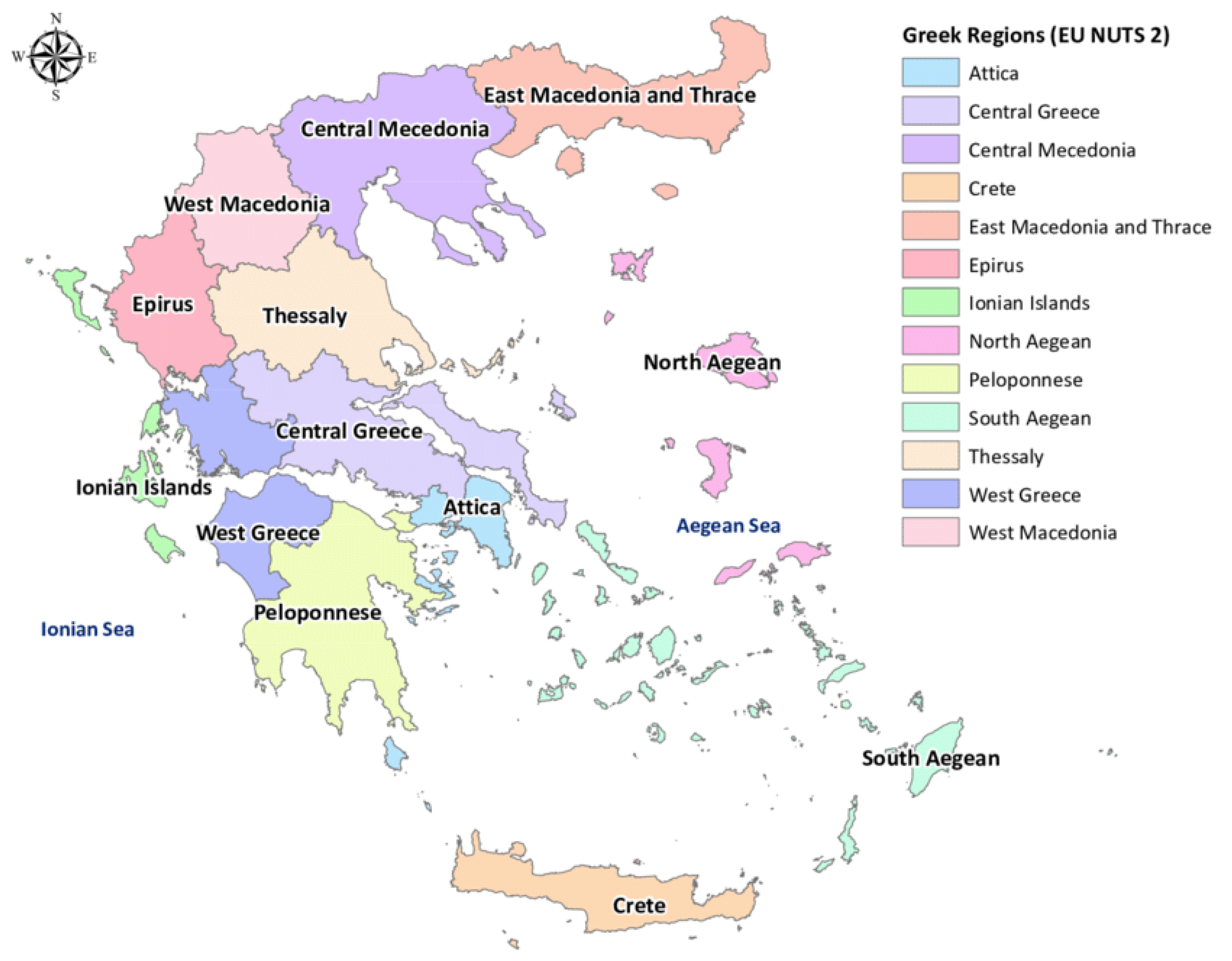
The water stress analysis focused on key winter wheat-, olive oil- and table olive-producing Greek regions. The thirteen Greek regions (EU NUTS 2) are presented in Figure 1.

3. Results

3.1. WRF Model Evaluation

The results of the model evaluation are presented in this section, highlighting its strengths and limitations in reproducing the observed climate patterns across Greece for the period 2005–2014.
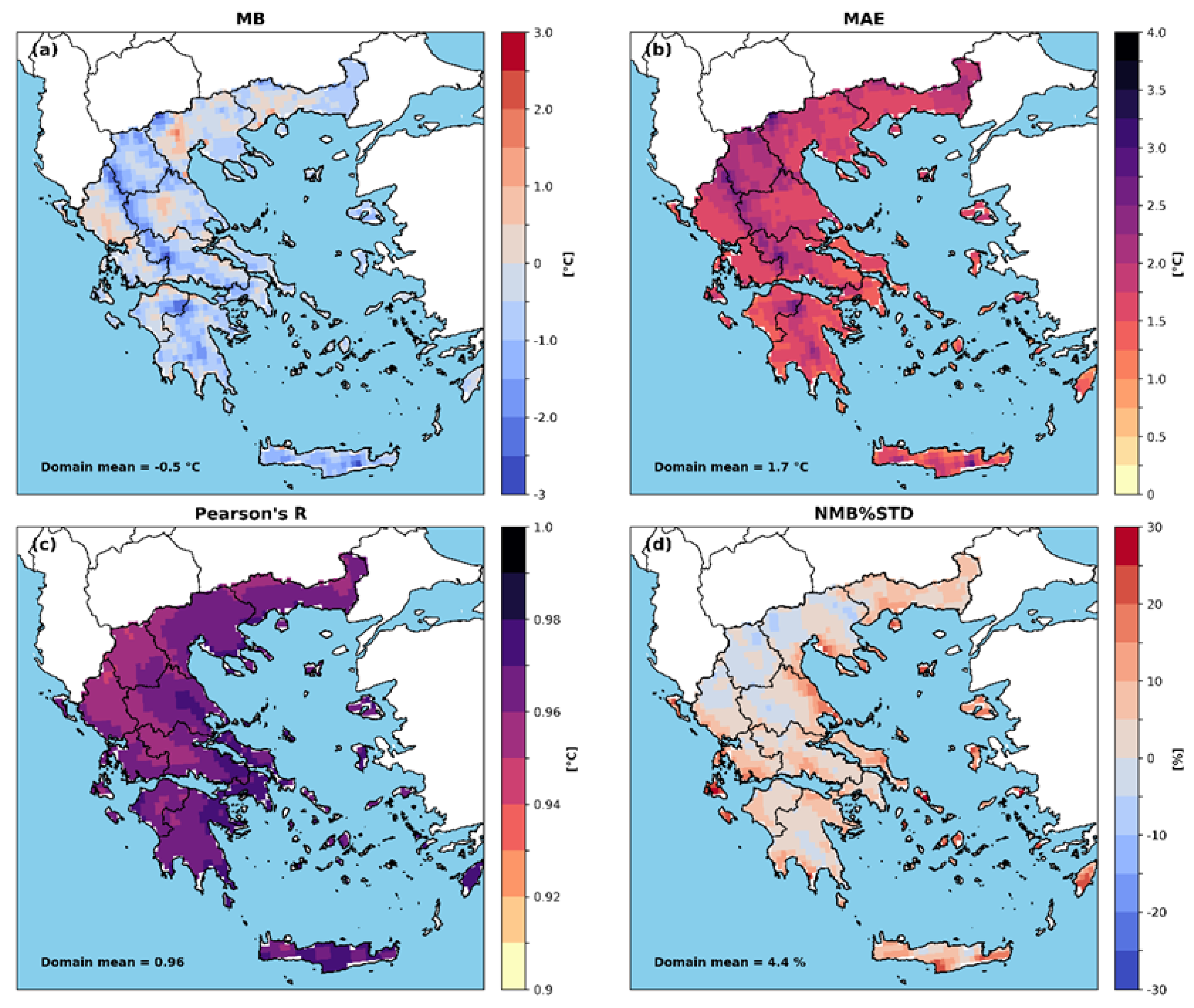
The model simulates Ta satisfactorily, capturing the main spatial patterns across the regions of Greece, as well as the temporal mean and variance. The largest discrepancies are observed in the Pindos mountain range, characterized by complex topography with steep hypsometric gradients, as well as in some coastal zones with steep shorelines and small islands: areas that are not explicitly resolved by the model, even at a 10 km resolution. The MB (Figure 2a) indicates an overall underestimation of Ta, primarily concentrated over the Pindos mountains, while across most of the mainland, the MB ranges between −1 and +1 °C with no obvious overall hot or cold bias. The MAE (Figure 2b) shows a similar spatial distribution to the MB, with values between 1 and 2 °C across the majority of the country, reaching up to 2.5–3 °C in the mountainous regions of Pindos. R (Figure 2c) remains above 0.95 across the entire domain, while NMB%STD (Figure 2d) ranges between −5% and +5% across nearly the entire country, with the exception of some coastal areas and small islands.
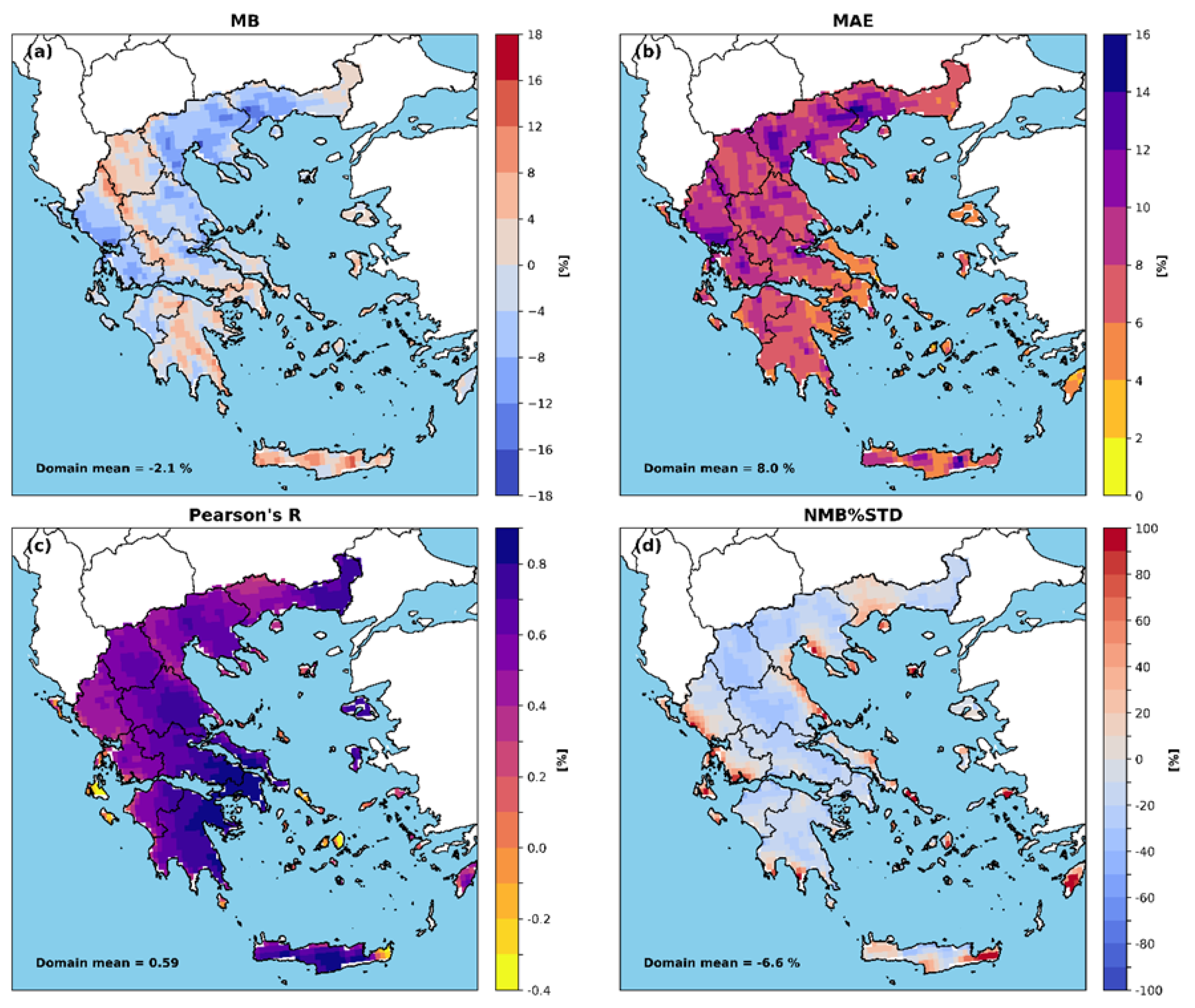
With regard to RH, the model’s performance is generally adequate and follows a similar pattern to Ta, although RH is inherently more complex. This complexity arises because RH is a derived variable that heavily depends on atmospheric dynamics, moisture transport and interactions with precipitation and wind. The MB ranges between −8% and +8% across most of the country, with exceptions in certain mountainous areas, coastal zones and small islands (Figure 3a). The model tends to overestimate RH across the entire Pindos mountain range, which may partly stem from the simultaneous underestimation of Ta in the region, leading to reduced air capacity for holding moisture. Additionally, the Pindos range is the most precipitation-intense area in Greece, due to the strong orographic lifting of moist westerly air masses [33,34,35]. Thus, discrepancies in modeled wind and precipitation in this region may therefore further contribute to RH biases. The MAE ranges from 6% to 10% over most of the mainland, while it can reach up to 18% in more complex terrain, coastal regions or small islands (Figure 3b). R varies between 0.5 and 0.9 across the mainland (Figure 3c), with higher values in eastern Greece and lower values in the west—likely due to the disruptive influence of the Pindos mountains on humid westerlies. Model performance is notably poor in some localized areas, such as the eastern coast of Crete and some small islands, where correlation values can be near zero or even negative. Finally, the NMB%STD falls between −20% and +20% for the majority of the country (Figure 3d). However, in certain coastal zones and smaller islands, the model significantly overestimates variability, with standard deviations reaching up to twice those of the ERA5-Land dataset.
In general, the WRF model demonstrates satisfactory performance in reproducing the present-day climate over Greece, effectively capturing the spatial and temporal variability of Ta and RH across most regions. While performance is strong over the mainland, biases are more evident in areas with complex terrain, such as the Pindos mountains, as well as in narrow coastal zones and small islands that are not fully resolved at the model’s horizontal resolution. RH shows greater discrepancies, reflecting its dependence on multiple atmospheric processes, including temperature, moisture transport and precipitation. Furthermore, the potential limitations of the ERA5-Land dataset should be considered, as its origin from a land-surface model component may introduce inaccuracies in variables that are sensitive to atmospheric dynamics—especially in areas with strong land–atmosphere interactions or complex terrain. Nonetheless, the multi-metric evaluation suggests that the WRF model captures the key climatological characteristics of the region with reasonable accuracy.

3.2. WRF Near-Future Projections

The future climate regime under the SSP2-4.5 scenario is analyzed in this section, focusing on the projected changes in Ta and RH across Greece for the period of 2046–2055 (Figure 4 and Figure 5, respectively).
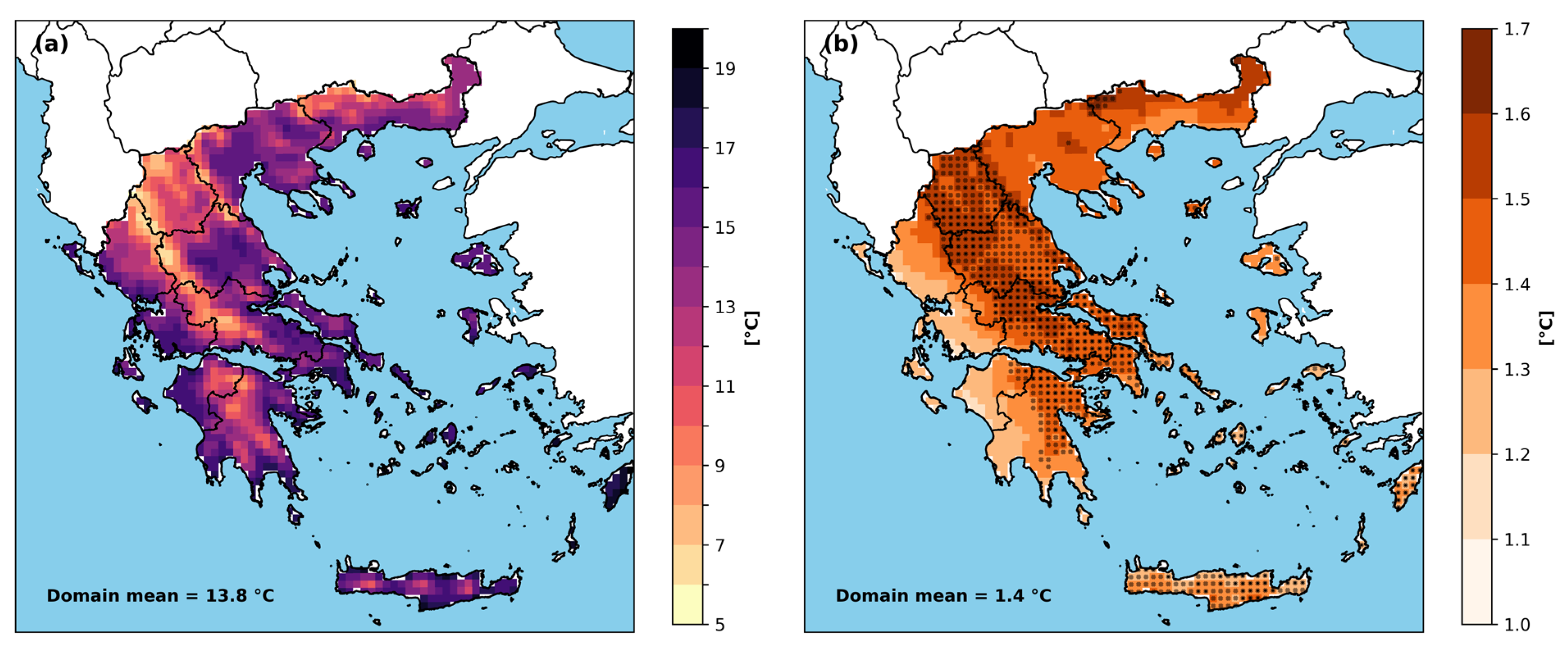
Figure 4a depicts the mean annual Ta at a 2 m height for the reference period of 2005–2014. The simulations project an increase in the mean annual Ta of at least 1.1 °C across all of Greece (Figure 4b). The warming is relatively milder in the western regions and on most islands, where Ta increases range from 1.1 °C to 1.3 °C. In contrast, eastern parts of the country experience a more pronounced rise: between 1.3 °C and 1.5 °C. In central and northern Greece, particularly in the northern areas of the Pindos mountain range, Ta increases reach up to 1.7 °C, potentially due to the warming amplification effect of the snow-albedo feedback mechanism [36,37].
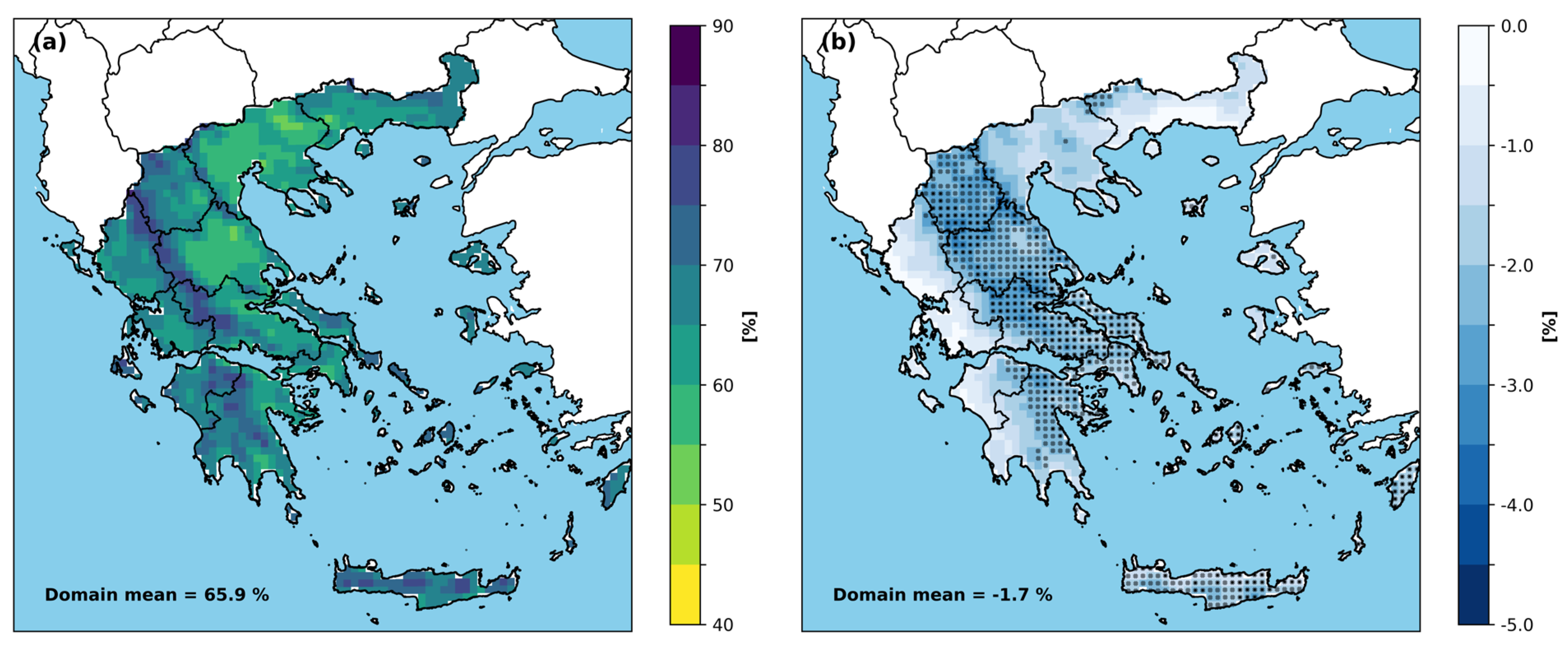
Figure 5a depicts the mean annual RH at a 2 m height for the reference period of 2005–2014. The mean annual RH at 2 m is projected to decrease across most of Greece under the SSP2-4.5 scenario (Figure 5b). This decrease is most pronounced along the Pindos mountain range, reaching up to −3.5% in its northern sections. Eastern and southeastern Greece, including the larger islands of Crete and Rhodes, show milder reductions, ranging between −1.5% and −2.5%. Minimal to no change is observed in Thrace, much of western Greece and many of the smaller islands. Statistically significant changes at the 5% level are identified over the mountain range of Pindos, parts of eastern Greece and northeastern Peloponnesus and large islands such as Crete and Rhodes.
Overall, the WRF projections under the SSP2-4.5 scenario suggest a clear warming trend across Greece, with regional variations being influenced by topography and land–atmosphere interactions. RH is projected to decline across much of the country, especially along the Pindos range and parts of southern Greece, indicating a shift toward drier conditions in most of the country.

3.3. Impact of Climate Change on Water Stress of Winter Wheat

Future climate projections indicated rising Ta and declining RH across Greece: a fact that implies potential water stress in wheat during its GSs (Table 1 and Table 2). The winter wheat water stress analysis focused on the five Greek regions that represent the major winter wheat-producing areas of the country. The five regions with the largest wheat production are, in descending order, Central Macedonia, Thessaly, Eastern Macedonia and Thrace, Central Greece and Western Macedonia (Figure 1). The wheat production in each region is approximately 33%, 27%, 19%, 10% and 9%, respectively, of the wheat production in the entire country [8]. According to Table 1, moderate warming is projected during GS1 in the examined regions. The temperature increase is more pronounced during GS2 and GS3 in some of the examined regions (Western Macedonia, Central Macedonia, Eastern Macedonia and Thrace), depicting the temperature increase during the growing period from spring to early summer. Considering that high temperatures (i.e., temperatures higher than 32 °C) 3–4 weeks after flowering prematurely terminate filling, while during flowering they cause poor fertilization, these findings exacerbate the negative effect of a temperature increase on wheat productivity. Table 2 shows that RH is generally projected to decrease in all the examined regions during the GSs. However, RH increases are also projected in a few cases. The RH decrease will be more pronounced in Western Macedonia, which is mainly a mountainous region.
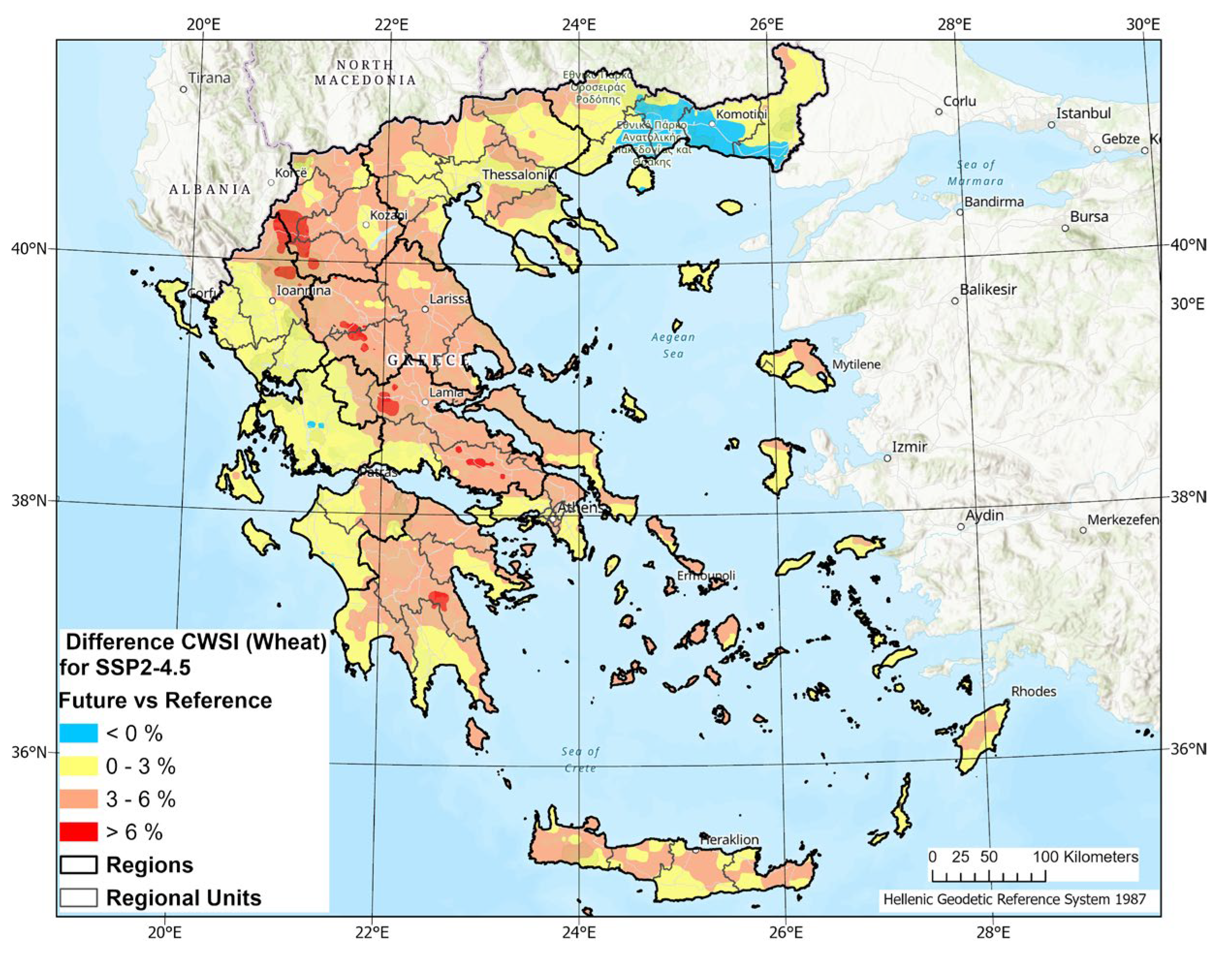
The difference in the mean CWSI between the future and the reference decade for the entire growing period of winter wheat under the SSP2-4.5 emission scenario across Greece is presented in Figure 6. The more pronounced increases in CWSI (>6%, indicated in red in Figure 6) occurred mainly across the Pindos mountain range. This result is consistent with the discussion made in Section 3.2, as the more pronounced Ta increases and RH decreases are projected for these areas. Widespread CWSI increases of 3–6% (indicated in pink in Figure 6) are projected in Thessaly and in large parts of Crete, Peloponnese, central Greece and western Macedonia. Lower CWSI increases of up to 3% (indicated in yellow in Figure 6) are projected for Western Greece, Central Macedonia and Eastern Macedonia and Thrace, reflecting milder Ta rises and smaller RH reductions. CWSI reduction (indicated in blue in Figure 6) is projected for most of the area of Thrace: a result that is consistent with the RH projections for this area.
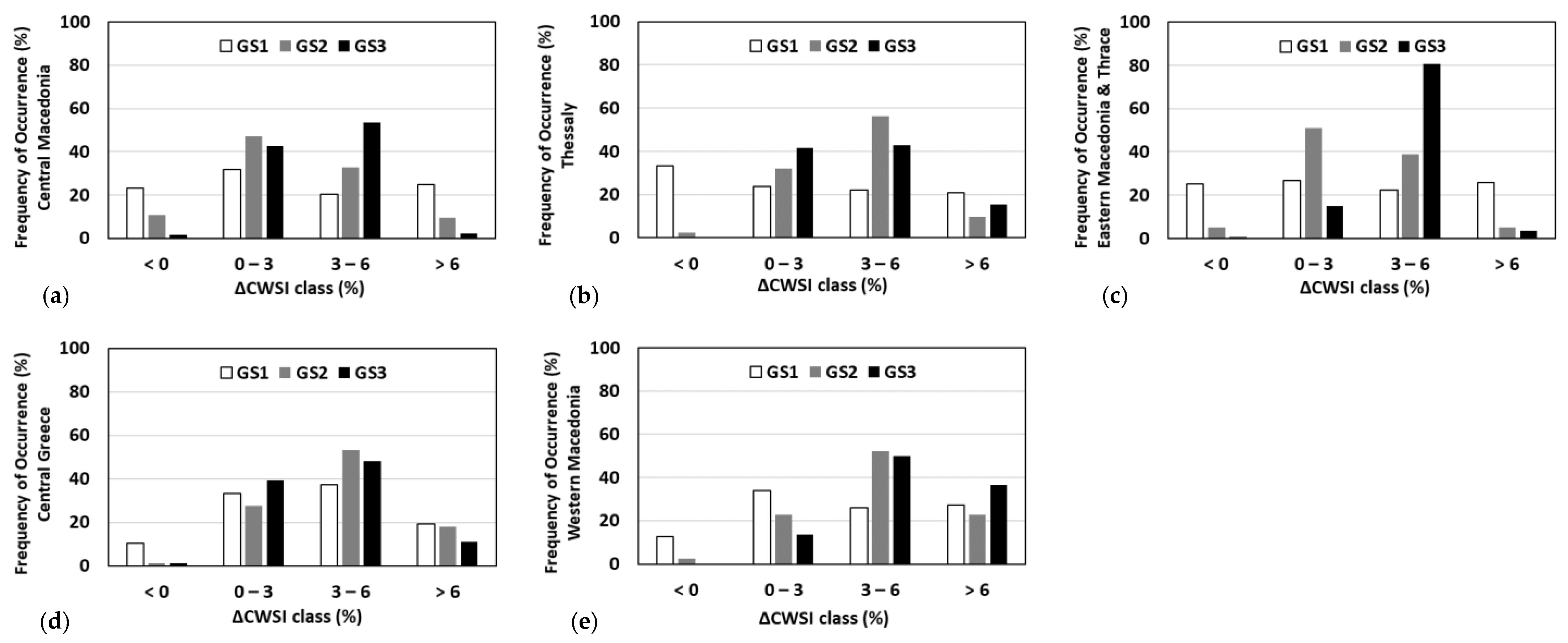
For the purpose of this study, the water stress threshold presented in Section 2.2 was applied for winter wheat. It was considered that water stress occurs when the CWSI becomes greater than 0.5. Figure 7 shows the percentage (%) of model grid cells exhibiting each one of the four defined ΔCWSI classes during each one of the three GSs in five key winter wheat-producing Greek regions under the SSP2-4.5 climate scenario, when this water stress threshold was applied. Figure 7 reveals that water stress is observed during all GSs and is less pronounced during GS1. Some stage- and region-specific patterns of water stress can be identified, highlighting the need for targeted water management. Water stress is more pronounced in Central Greece, Thessaly and Western Macedonia, where CWSI increases larger than 3% are detected in more than 70% of the area in each region during specific GSs. The worst ΔCWSI class (i.e., ΔCWSI > 6%) was observed in more than 20% of the area in Western Macedonia during all GSs.
Although water stress during GS1 is less pronounced compared to later stages, its occurrence at this early phase is agronomically relevant, as water deficits during early establishment can limit root system development and reduce tiller initiation. Reduced tillering during GS1 may constrain canopy development and biomass accumulation later in the season, ultimately lowering the yield potential even if favorable conditions occur during subsequent stages. Water stress during GS2 coincides with the critical period of tillering and spikelet formation. Elevated CWSI values during this stage may reduce photosynthetic efficiency through stomatal closure, limit assimilate availability for spike development and decrease the number of fertile tillers, thereby directly affecting yield components. During GS3, increased CWSI values indicate constrained transpiration and reduced canopy cooling, which, when combined with elevated temperatures, can accelerate the leaf senescence and shorten the grain-filling period. Such conditions are known to reduce the grain weight and final yield, highlighting the critical role of adequate water availability during late-season development.

3.4. Impact of Climate Change on Water Stress of Olive Trees

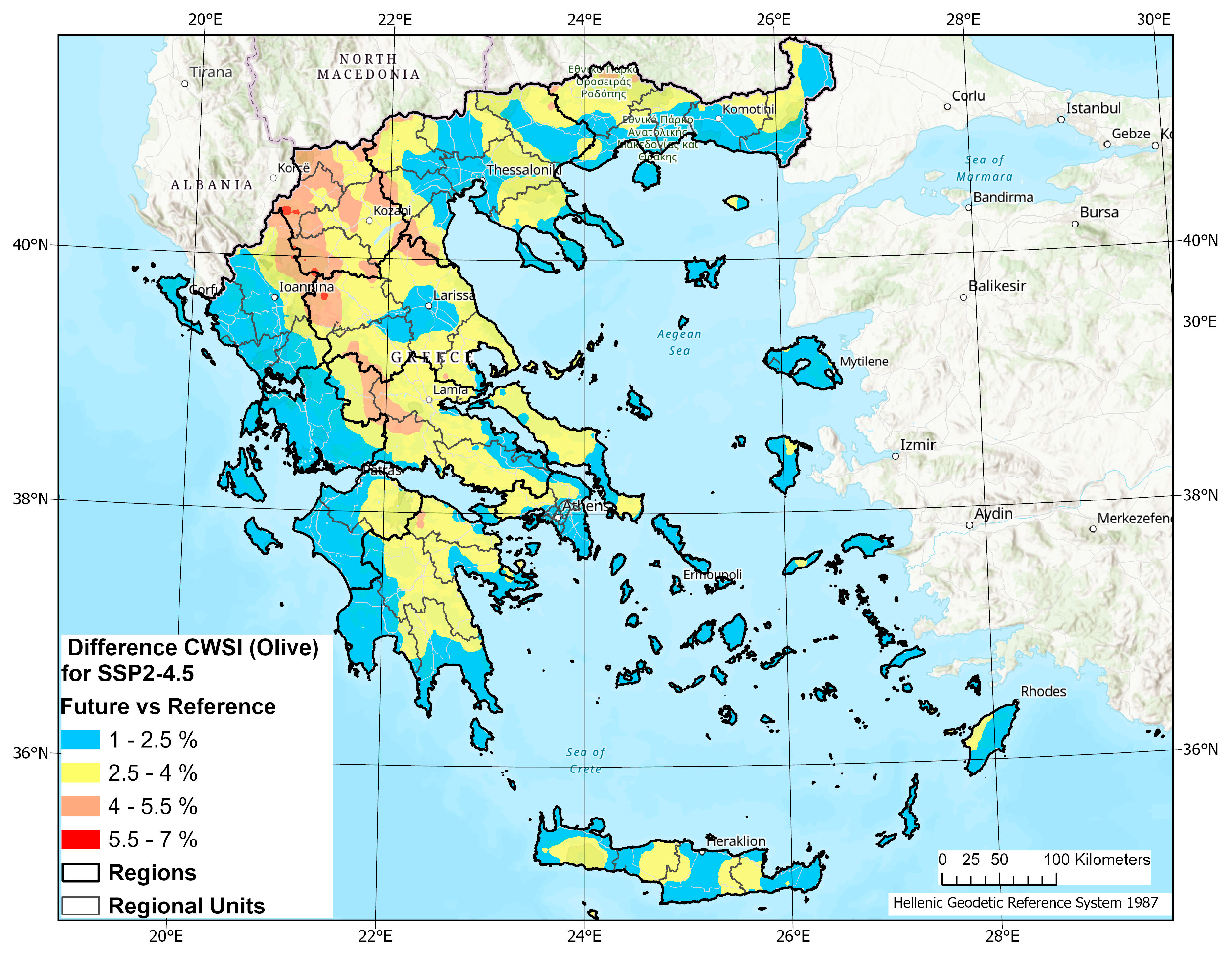
This section examines climate change’s impact on olive trees’ water stress. The olive trees’ water stress analysis focused on the five Greek regions that represent the major olive oil-producing areas of the country and on the five Greek regions that represent the major table olive-producing areas of the country. The five Regions with the largest olive oil production are, in descending order, Peloponnese, Western Greece, Crete, Thessaly and Central Greece (Figure 1). The olive oil production in each Region is approximately 29%, 23%, 19%, 6% and 4%, respectively, of the olive oil production in the entire country [8]. The five Regions with the largest table olive production are, in descending order, Western Greece, Peloponnese, Eastern Macedonia and Thrace, Central Greece and central Macedonia (Figure 1). The table olive production in each Region is approximately 24%, 16%, 15%, 15% and 14%, respectively, of the table olive production in the entire country [8]. The difference in the mean CWSI between the future and the reference decade of olive orchards under the SSP2-4.5 emission scenario across Greece is presented in Figure 8. The largest CWSI increases, i.e., 4–7%, are projected in Western Macedonia and in the mountainous areas of Central Greece, while the smaller increases, i.e., up to 2.5%, are projected in Western Greece, in some parts of Crete, in the rest of the islands and in parts of Central Macedonia and Eastern Macedonia and Thrace. The rest of the country exhibit moderate increases, i.e., 2.5–4%. Large increases indicate amplified irrigation needs. Moderate increases may challenge rainfed systems, highlighting regional variability in vulnerability.
The water stress threshold presented in Section 2.2 was also applied to olive trees. Table 3 presents the percentage (%) of model grid cells exhibiting each one of the four defined ΔCWSI classes in key olive-oil- and table-olive-producing Greek regions, as well as in the whole country, under the SSP2-4.5 climate scenario, when this water stress threshold was applied. On a national level, percentages reflect moderate water stress for olive trees, as an increase of 1–2.5% is projected in 61.9% of the country’s territory. Increases higher than 4% are only projected in 3.8% of the country. This pattern is followed in half of the examined regions. However, in the case of Crete, Peloponnese and Eastern Macedonia and Thrace, water stress is more pronounced, indicating localized stress hotspots and higher vulnerability.

4. Discussion

4.1. Assessment of Climate Change Impact on Winter Wheat and Olive Trees

Sustainable adaptation tools cannot rely solely on irrigation or soil practices, but they must account for the combined pressures of water scarcity, pesticide use and rising climatic extremes [38]. By integrating high-resolution climate projections with a physically based water stress index, these combined pressures could be addressed, providing spatially and temporally explicit diagnostics that support systemic adaptation planning for Mediterranean cropping systems. The WRF model simulations showed that the annual mean Ta will increase by 1.1–1.7 °C and RH will decrease up to 3.5% by 2055 in Greece. Such changes are considered to be substantial for agricultural systems and water availability. Global assessments suggest a 5–10% yield loss per 1 °C temperature increase [39]. The combined temperature rise and relative humidity decline induces a higher vapor pressure deficit, which directly reduces canopy conductance and accelerates crop water stress [40,41]. The findings of the present study indicate an intensification of CWSI for both examined crops. Stage- and region-dependent water stress and distinct regional hotspots of increased water stress were detected for winter wheat and olive orchards, respectively.
Regarding winter wheat, the prevalence of temperatures above 30 °C at anthesis is expected to impair pollen fertility and CO2 assimilation, while water stress during tillering and booting accelerates maturity and shortens growth [6]. The findings of the present study confirm the vulnerability of cereals due to climate change. The spatial analysis of CWSI revealed CWSI increases of up to 6% across key cereal-producing regions like Central Macedonia, Thessaly, Western Macedonia and Central Greece. Although the yield was not quantified in this study, the projected increases in temperature and CWSI indicate conditions that are known to increase the risk of productivity losses. Earlier studies reported that increasing water scarcity can lead to yield losses greater than 10% in some regions [42]. The detection of water stress as early as GS1 is particularly important, as early-season deficits can precondition the crop response by limiting structural development and reducing resilience to later heat and drought stress.
The olive tree is also a crop of major economic, nutritional, cultural and environmental importance in Greece. Olive oil production is mostly concentrated in Peloponnese, Western Greece and Crete [8]. Western Greece, Peloponnese, Eastern Macedonia and Thrace, Central Greece and Central Macedonia are the main regions of table olive production [8]. CWSI increases of up to 4% are projected in these regions. Although olives are drought tolerant, with a high capacity to recover from prolonged drought periods, specific critical stages, from floral development to fruit set in spring, initial rapid fruit growth and the period when oil is actively accumulated in the fruit, are particularly sensitive to high temperatures and water deficit [2,4]. Furthermore, temperatures above 30 °C can impair pollen germination, and temperatures just 3–4 °C above ambient levels may substantially reduce the fruit yield, oil amount and oil quality [43]. Climate change may also advance flowering or shorten stages, affecting phenology and productivity [44]. Rising transpiration-to-evapotranspiration ratios (T/ET) in spring and autumn further highlight shifts in water use. Another risk is the reduced winter chilling, since many species require ~10 weeks below 12 °C, and warming threatens flower bud differentiation [2].

4.2. Adaptation Strategies for Managing Potential Future Crop Water Stress

The spatially explicit projections of crop water stress provided a basis for tailoring adaptation measures to specific regions and crops.
For winter wheat, the findings suggest that irrigation strategies should be closely aligned with crop phenology. In regions where stress intensifies during grain filling (GS3), priority should be given to irrigation scheduling in late-season stages. Irrigation during GS3 is particularly critical, as water stress at this phase directly reduces the grain weight and final yield. Even moderate stress, with CWSI values exceeding 0.6, has been associated with yield losses greater than 20% [45], underscoring the importance of maintaining adequate water supply to secure both yield and grain quality. Integrating CWSI with irrigation scheduling can optimize decision-making by defining precise doses and frequencies, ultimately improving water-use efficiency. For instance, maintaining the crop water status at 0.0 < CWSI ≤ 0.25 secures optimal yields, as demonstrated by the highest marketable production in sandy loam soils at 70–100% field capacity. In contrast, severe water stress (0.75 < CWSI ≤ 1.0) under 40–50% field capacity in silty loam soils resulted in the lowest yields, while combined use of CWSI and soil water measurements improved irrigation efficiency by up to 25% [46]. Improved irrigation efficiency and drought-tolerant species are priority adaptation measures in European cropping systems [47], as well as the improvement in the field microclimate, which is in line with the region- and crop-specific strategies highlighted in this study. In regions where stress emerges earlier (i.e., during GS1), adjusting sowing dates and selecting varieties with an improved tolerance to early-season water deficits may help mitigate vulnerability. Undoubtedly, stable water availability could allow for modest expansion of cultivation without exacerbating regional water scarcity. Agroecological methods like intercropping cereals with legumes, rotating cultivations and diversifying crop types could improve soil moisture retention and reduce erosion and buffer heat stress. Coupled with institutional measures, like early-warning systems, extension services, access to insurance and credit, these create an adaptive environment. In southern-Mediterranean and similar environments, cereals and wheat could adapt to climate stress through a trio of complementary strategies [48]: adjusting sowing dates, managing water use (especially irrigation) and deploying resilient species. These interventions are most effective when used in concert and tailored to local climatic and resource conditions, but their potency may diminish under more extreme mid-century warming—highlighting the need for adaptive, dynamic systems and continued research into integrated strategies.
For olive orchards, adaptation requires a perennial, system-level perspective. Long-term experiments have shown that irrigation in the first two critical stages (February–June), when rainfall is not satisfactory, increases the rate of differentiation of flowering buds and the length of the annual vegetation and the root, while reducing early leaf fall. Irrigation can increase the number of inflorescences, the number of flowers/inflorescence and the percentage of perfect flowers, resulting in an increased fruit set. It also increases the production for the following year and the size and average weight of the fruit. In regions where water stress is more pronounced, regulated deficit irrigation during less critical phases, such as stone hardening, could enhance water-use efficiency without an adverse effect on the yield. In regions where localized water stress hotspots are detected, the introduction of drought-tolerant species, upgrading irrigation infrastructure and promoting on-farm rainwater harvesting could alleviate chronic stress conditions. A key strategy for adapting olive cultivation to climate change involves identifying and selecting resilient species, as the trees’ response to high temperatures varies considerably by genotype [43]. The International Olive Council has classified several Greek varieties, such as ‘Koroneiki’ and ‘Chondrolia Chalkidikis’, as being drought-tolerant, although ‘Chondrolia Chalkidikis’ requires regular irrigation for maintaining the quality of table olives [49]. Determining the thermal thresholds for optimal production, including physiological and phenological responses, is therefore critical for sustaining yields and oil quality in future climates [43,50]. Recent projections for the Euro-Mediterranean region further show significant shifts in the phenological phases of olive trees under climate change, reinforcing the need to align adaptation strategies with cultivar-specific and regional timing. Northward expansion of olive cultivation is also plausible, driven by warmer and drier conditions anticipated across the Mediterranean basin [51]. Mapping current and potential areas that are suitable for olive cultivation, particularly for economically important varieties, is essential to ensure stable yields in the future [52]. This holds particular importance for Greek table olive varieties such as ‘Amfissis’, ‘Kalamon’ and ‘Chondrolia Chalkidikis’, which have a strong export orientation [49]. As irrigation is crucial for producing large, high-quality table olives, the adoption of efficient irrigation practices remains a priority [53]. Sustainable orchard management practices also play an important role. The adoption of regulated deficit irrigation has been shown to optimize water use while improving the oil quality by enhancing phenolic and volatile compound concentrations [4]. Pilot studies in Crete and Thessaly demonstrated that smart irrigation scheduling can reduce water use by 30–40% without yield loss [54]. In addition, good agricultural practices (GAPs) related to water and soil management, such as cover crops, reduced tillage, winter weed retention, pruning and compost application, have been shown to improve water-use efficiency and enhance orchard resilience [55]. Given the increasing frequency of droughts and climate extremes, the implementation of such practices is vital to strengthen the adaptability of Mediterranean olive cultivation. Finally, in training, farmers’ networks and efficient policy measures have a significant role in increasing the adaptive capacity of olive growers. Some practices, such as subsidies for water-saving technologies and replanting resilient varieties, training programs on GAPs and sharing adaptation costs and experiences between cooperatives, are crucial.

5. Conclusions

This study combined high-resolution climate projections produced by the application of the WRF model with CWSI spatial analysis in order to assess the potential impact of future climate conditions on the water stress of two representative Mediterranean crops: wheat and olive. Hourly WRF simulations at a 10 km resolution were generated for Greece for both the reference period (2005–2014) and a mid-century period (2046–2055) under the SSP2-4.5 scenario. To enhance robustness, the boundary conditions were taken from a bias-corrected ensemble dataset comprising 18 CMIP6 global climate models, minimizing the influence of individual model biases. The evaluation of the WRF model suggests a reliable representation of Greece’s present-day climate, capturing the main spatial and temporal features of the temperature and relative humidity across the country. While some discrepancies persist in areas with complex terrain and coastlines, the overall performance supports the suitability of the simulations for an impact assessment. With regard to near-future conditions, the simulations point toward a future climate characterized by higher temperatures (by between 1.1 and 1.7 °C) and generally reduced atmospheric moisture (up to −3.5%). Although the magnitude of these changes varies regionally, the combined effect is a consistent shift toward a warmer and drier environment, leading to increased evaporative demand.
Moderate CWSI increases are projected for both crops. The analysis of CWSI during the three FAO-defined wheat growing stages showed that mid- to late-season stress could limit yield formation. Although water stress intensifies toward mid- and late-season stages, its occurrence during early growth may also have cascading effects on crop development by constraining tillering and canopy establishment, thereby amplifying the vulnerability to subsequent stress events. For olive trees, the analysis detected localized water stress hotspots and higher vulnerability. The CWSI is a reliable and well-established indicator of plant water status, which has been widely applied to quantify hydroclimatic stress across diverse environments. Its integration with WRF model projections enabled a spatially coherent evaluation of the crop response to climate variability, supporting targeted irrigation scheduling and adaptive water management. The proposed WRF–CWSI framework provides a solid foundation for climate-resilient irrigation planning, monitoring and decision-making in water-limited Mediterranean regions.

Author Contributions

Conceptualization: A.E., P.M., N.K., G.P., D.M., A.P. and D.K.P.; methodology: A.E., P.M., N.K., G.P., D.M., A.P. and D.K.P.; software: G.P., D.M., K.D., I.F., S.K. and I.S.; validation: A.E., P.M., G.P., S.K. and I.S.; formal analysis: A.E., P.M., N.K., G.P., D.M., A.P., D.V. and D.K.P.; investigation: A.E., P.M., G.P., K.D., I.F., S.K., I.S., D.V. and D.K.P.; resources: G.P., D.M., I.F., S.K. and I.S.; data curation: A.E., P.M., G.P., K.D. and I.F.; writing—original draft preparation: A.E., P.M., G.P., S.K., I.S., D.V. and J.K.; writing—review and editing: N.K., D.M., A.P. and D.K.P.; visualization: A.E., P.M., G.P., I.F., S.K. and I.S.; supervision: N.K., D.M., A.P. and D.K.P.; project administration: D.M., A.P. and D.K.P.; funding acquisition: N.K., D.M., A.P. and D.K.P. All authors have read and agreed to the published version of the manuscript.

Funding

This research was funded by the project “Crop and Livestock Stress under Climate Change Scenarios (AGRO FUTURE CLIMATE STRESS)”, which was carried out within the framework of the National Recovery and Resilience Plan Greece 2.0, funded by the European Union—NextGenerationEU (implementation body: HFRI).

Data Availability Statement

The original contributions presented in this study are included in the article. Further inquiries can be directed to the corresponding author.

Acknowledgments

The authors would like to acknowledge the support provided by the Digital Governance Unit of the Aristotle University of Thessaloniki (AUTh) throughout the progress of this research work. GenAI tools/services were used for the purposes of text editing (e.g., grammar, structure, spelling, punctuation and formatting). After using this tool/service, the authors reviewed and edited the content as needed and they take full responsibility for the content of the publication.

Conflicts of Interest

The authors declare no conflicts of interest.

Appendix A

The rA (s·m−1) was calculated by Equations (A1) and (A2) [26].
r A = 4.72 l n z d z 0 2 1 + 0.54 WS   when   WS     2   m   s 1
r A = l n z d z 0 2 k 2 WS   when   WS   >   2   m   s 1
In Equations (A1) and (A2), z represents the reference height (m), h is the plant height (m), d is the displacement height (m), taken equal to 2/3 h, z 0 is the roughness length (m), taken equal to 0.13 h and WS is the wind speed at 2 m height (m·s−1).
A logistic model incorporating the growing degree day (GDD) as an independent variable was used to analyze the variation in plant height (Equation (A3)) [56].
h = h max 1 + exp a 0 + a 1 · GDD
In Equation (A3), hmax is the theoretical maximum plant height, taken equal to 1 m. a 0 and a 1   are empirical parameters, taken equal to 3.233 and 0.04, respectively. GDD is the difference between the daily average temperature (Tavg) and the minimum temperature required for crop activity (Tbase) (Equation (A4)) [56].
GDD = ( T avg T base )
Tavg was calculated by Equation (A5) [57].
T avg = T base , if T avg T base T avg = T upper , if T avg T upper
In Equation (A5), Tupper is the maximum temperature tolerated for crop activity. The biological upper and lower temperature limits for winter wheat are 32 °C and 0 °C, respectively [58].
Hourly GDD was estimated by using Ta as Tavg, dividing the difference between Ta and Tbase by 24.

References

  1. Claro, E.; Massarutto, A.; Romano, E.; Zucaro, R. Future agricultural water availability in Mediterranean countries under climate change: A systematic review. Agric. Water Manag. 2024, 298, 2484. [Google Scholar] [CrossRef]
  2. Gucci, R.; Fereres, E.; Goldhamer, D.A. Olive. In Crop Yield Response to Water. Irrigation and Drainage Paper 66; Steduto, P., Hsiao, T.C., Fereres, E., Raes, D., Eds.; FAO: Rome, Italy, 2012; pp. 300–313. [Google Scholar]
  3. Fraga, H.; Moriondo, M.; Leolini, L.; Santos, J.A. Mediterranean Olive Orchards under Climate Change: A Review of Future Impacts and Adaptation Strategies. Agronomy 2021, 11, 56. [Google Scholar] [CrossRef]
  4. Koubouris, G.; Psarras, G. Pedoclimatic and landscape conditions of Greek olive groves. In The Olive Landscapes of the Mediterranean; Muñoz-Rojas, J., García-Ruiz, R., Eds.; Springer: Cham, Switzerland, 2024; pp. 223–227. [Google Scholar]
  5. Devot, A.; Royer, L.; Arvis, B.; Deryng, D.; Caron Giauffret, E.; Giraud, L.; Ayral, V.; Rouillard, J. Research for AGRI Committee—The Impact of Extreme Climate Events on Agriculture Production in the EU; European Parliament, Policy Department for Structural and Cohesion Policies: Brussels, Belgium, 2023. [Google Scholar]
  6. Kumari, A.; Singh, D.K.; Sarangi, A.; Hasan, M.; Sehgal, V.K. Optimizing wheat supplementary irrigation: Integrating soil stress and crop water stress index for smart scheduling. Agric. Water Manag. 2024, 305, 109104. [Google Scholar] [CrossRef]
  7. Nimai Senapati, N.; Halford, N.G.; Semenov, M.A. Vulnerability of European wheat to extreme heat and drought around flowering under future climate. Environ. Res. Lett. 2021, 16, 024052. [Google Scholar] [CrossRef]
  8. ELSTAT. Cereals for Grain and Olive Trees: Areas and Production, by Region and Regional Unity. Annual Agricultural Statistical Survey; Hellenic Statistical Authority: Athens, Greece, 2023. [Google Scholar]
  9. IPCC. Climate Change 2021: The Physical Science Basis. Contribution of Working Group I to the Sixth Assessment Report of the Intergovernmental Panel on Climate Change; Masson-Delmotte, V., Zhai, P., Pirani, A., Connors, S.L., Péan, C., Berger, S., Caun, N., Chen, Y., Goldfard, L., Gomis, M.I., et al., Eds.; Cambridge University Press: Cambridge, UK; New York, NY, USA, 2021. [Google Scholar]
  10. Giorgi, F. Thirty years of regional climate modeling: Where are we and where are we going next? J. Geophys. Res. Atmos. 2019, 124, 5696–5723. [Google Scholar] [CrossRef]
  11. Hong, M.; Lee, S.-H.; Lee, S.-J.; Cho, J.-Y. Application of high-resolution meteorological data from NCAM–WRF to characterize agricultural drought in small-scale farmlands based on soil moisture deficit. Agric. Water Manag. 2021, 243, 106494. [Google Scholar] [CrossRef]
  12. Im, E.; Ha, S.; Qiu, L.; Hur, J.; Jo, S.; Shim, K. An evaluation of temperature-based agricultural indices over Korea from the high-resolution WRF simulation. Front. Earth Sci. 2021, 9, 656787. [Google Scholar] [CrossRef]
  13. Liu, B.; Asseng, S.; Müller, C.; Ewert, F.; Elliott, J.; Lobell, D.B.; Martre, P.; Ruane, A.C.; Wallach, D.; Jones, J.W.; et al. Similar estimates of temperature impacts on global wheat yield by three independent methods. Nat. Clim. Chang. 2016, 9, 289–294. [Google Scholar] [CrossRef]
  14. Jerez, S.; López-Romero, J.M.; Turco, M.; Jiménez-Guerrero, P.; Vautard, R.; Montávez, J.P. Impact of evolving greenhouse gas forcing on the warming signal in regional climate model experiments. Nat. Commun. 2018, 9, 1304. [Google Scholar] [CrossRef]
  15. Asseng, S.; Ewert, F.; Martre, P.; Rotter, R.P.; Lobell, D.B.; Cammarano, D.; Kimball, B.A.; Ottman, M.J.; Wall, G.W.; White, J.W.; et al. Rising temperatures reduce global wheat production. Nat. Clim. Chang. 2015, 5, 143–147. [Google Scholar] [CrossRef]
  16. Liu, B.; Martre, P.; Ewert, F.; Porter, J.R.; Challinor, A.J.; Müller, C.; Ruane, A.C.; Waha, K.; Thorburn, P.J.; Aggarwal, P.K.; et al. Global wheat production with 1.5 and 2.0 °C above pre-industrial warming. Glob. Change Biol. 2019, 25, 1428–1444. [Google Scholar] [CrossRef]
  17. Skamarock, W.C.; Klemp, J.; Dudhia, J.; Gill, D.O.; Barker, D.; Duda, M.; Huang, X.; Wang, W.; Powers, J.G. A Description of the Advanced Research WRF Version 3; NCAR Technical Note; NCAR/TN-475+STR; Mesoscale and Microscale Meteorology Division; National Center for Atmospheric Research: Boulder, CO, USA, 2008; pp. 1–27. [Google Scholar]
  18. Papanastasiou, D.K.; Gelasakis, A.I.; Papadopoulos, G.; Melas, D.; Douvis, K.; Faraslis, I.; Keppas, S.; Stergiou, I.; Poupkou, A.; Voloudakis, D.; et al. Projected Heat-Stress in Sheep and Cattle in Greece Under Future Climate Change Scenarios. Agriculture 2025, 15, 2141. [Google Scholar] [CrossRef]
  19. Riahi, K.; van Vuuren, D.P.; Kriegler, E.; Edmonds, J.; O’Neill, B.C.; Fujimori, S.; Bauer, N.; Calvin, K.; Dellink, R.; Fricko, O.; et al. The shared socioeconomic pathways and their energy, land use, and greenhouse gas emissions implications: An overview. Glob. Environ. Change 2017, 42, 153–168. [Google Scholar] [CrossRef]
  20. Xu, Z.; Han, Y.; Tam, C.Y.; Yang, Z.; Fu, C. Bias-corrected CMIP6 global dataset for dynamical downscaling of the historical and future climate (1979–2100). Sci. Data 2021, 8, 293. [Google Scholar] [CrossRef] [PubMed]
  21. Xu, Z.F.; Han, Y.; Zhang, M.-Z.; Tam, C.Y.; Yang, Z.-L.; El Kenawy, A.; Fu, C.B. Assessing the performance of a dynamical downscaling simulation driven by a bias-corrected CMIP6 dataset for Asian climate. Adv. Atmos. Sci. 2024, 41, 974–988. [Google Scholar] [CrossRef]
  22. Muñoz-Sabater, J.; Dutra, E.; Agustí-Panareda, A.; Albergel, C.; Arduini, G.; Balsamo, G.; Boussetta, S.; Choulga, M.; Harrigan, S.; Hersbach, H.; et al. ERA5-Land: A state-of-the-art global reanalysis dataset for land applications. Earth Syst. Sci. Data 2021, 13, 4349–4383. [Google Scholar] [CrossRef]
  23. Decremer, D.; Chung, C.E.; Ekman, A.M.L.; Brandefelt, J. Which significance test performs the best in climate simulations? Tellus A Dyn. Meteorol. Oceanogr. 2014, 66, 23139. [Google Scholar]
  24. Jackson, R.D.; Kustas, W.P.; Choudhury, B.J. A reexamination of the crop water stress index. Irrig. Sci. 1988, 9, 309–317. [Google Scholar] [CrossRef]
  25. Jackson, R.D. Soil moisture inferences from thermal infrared measurements of vegetation temperatures. In Digest 1981 International Geosciences and Remote Sensing Symposium; IEEE: Washington, DC, USA; New York, NY, USA, 1981. [Google Scholar]
  26. Zhang, Q.; Yang, X.; Liu, C.; Yang, N.; Yu, G.; Zhang, Z.; Chen, Y.; Yao, Y.; Hu, X. Monitoring soil moisture in winter wheat with crop water stress index based on canopy–air temperature time lag effect. Int. J. Biometeorol. 2024, 68, 647–659. [Google Scholar] [CrossRef]
  27. Katsoulas, N.; Baille, A.; Kittas, C. Effect of misting on transpiration and conductances of a greenhouse rose canopy. Agric. For. Meteorol. 2001, 106, 233–247. [Google Scholar] [CrossRef]
  28. Monteith, J.L.; Unsworth, M.H. Principles of Environmental Physics: Plants, Animals, and the Atmosphere, 4th ed.; Academic Press: Amsterdam, The Netherlands, 2013. [Google Scholar]
  29. Ben-Gal, A.; Agam, N.; Alchanatis, V.; Cohen, Y.; Yermiyahu, U.; Zipori, I.; Presnov, E.; Dag, A.; Bonfil, D.J. Evaluating water stress in irrigated olives: Correlation of soil water status, tree water status, and thermal imagery. Irrig. Sci. 2009, 27, 367–376. [Google Scholar] [CrossRef]
  30. Berni, J.A.J.; Zarco-Tejada, P.J.; Sepulcre-Cantó, G.; Fereres, E.; Villalobos, F. Mapping canopy conductance and CWSI in olive orchards using high-resolution thermal remote sensing imagery. Remote Sens. Environ. 2009, 113, 2380–2388. [Google Scholar] [CrossRef]
  31. Agam, N.; Cohen, Y.; Berni, J.A.J.; Alchanatis, V.; Kool, D.; Dag, A.; Yermiyahu, U.; Ben-Gal, A. An insight to the performance of crop water stress index for olive trees. Agric. Water Manag. 2013, 118, 79–86. [Google Scholar] [CrossRef]
  32. Egea, G.; Padilla-Díaz, C.; Martínez-Guanter, J.; José, F.; Pérez-Ruiz, M. Assessing a crop water stress index derived from aerial thermal imaging and infrared thermometry in super-high density olive orchards. Agric. Water Manag. 2017, 187, 210–221. [Google Scholar] [CrossRef]
  33. Baltas, E.A. Climatic conditions and availability of water resources in Greece. Int. J. Water Resour. Dev. 2008, 24, 635–649. [Google Scholar] [CrossRef]
  34. Katsafados, P.; Kalogirou, S.; Papadopoulos, A.; Korres, G. Mapping long-term atmospheric variables over Greece. J. Maps 2012, 8, 181–184. [Google Scholar] [CrossRef]
  35. Politi, N.; Vlachogiannis, D.; Sfetsos, A.; Nastos, P.T. High resolution projections for extreme temperatures and precipitation over Greece. Clim. Dyn. 2023, 61, 633–667. [Google Scholar] [CrossRef]
  36. Winter, K.J.P.; Kotlarski, S.; Scherrer, S.C.; Schär, C. The Alpine snow–albedo feedback in regional climate models. Clim. Dyn. 2017, 48, 1109–1124. [Google Scholar] [CrossRef]
  37. Zittis, G.; Hadjinicolaou, P.; Klangidou, M.; Proestos, Y.; Lelieveld, J. A multi-model, multi-scenario, and multi-domain analysis of regional climate projections for the Mediterranean. Reg. Environ. Change 2019, 19, 2621–2635. [Google Scholar] [CrossRef]
  38. Pérez-Lucas, G.; Navarro, G.; Navarro, S. Adapting agriculture and pesticide use in Mediterranean regions under climate change scenarios: A comprehensive review. Eur. J. Agron. 2024, 161, 127337. [Google Scholar] [CrossRef]
  39. Tubiello, F.N.; Rosenzweig, C. Developing climate change impact metrics for agriculture. Integr. Assess. J. 2008, 8, 165–184. [Google Scholar]
  40. Wang, X.; Li, Z.; Zhou, Y.; Wang, Y.; Ahmad, S.; Hu, M.; Sun, S.; Huang, H.; Zhang, J.; Zhai, L. Evaluation of water use efficiency model in evapotranspiration partitioning from high-frequency eddy covariance data: A comparison between plantation sites. Agric. For. Meteorol. 2025, 372, 110663. [Google Scholar] [CrossRef]
  41. Wang, Y.; Liu, X.; Jin, H.; Zeng, X.; Zhang, X.; Kang, H.; Kang, S.; Li, Y.; Zhang, Q. Climate-induced permafrost degradation exerts species-specific impacts on pine and larch growth in the Da Xing’anling Mountains, Northeast China. Agric. For. Meteorol. 2025, 372, 110665. [Google Scholar] [CrossRef]
  42. Karamanos, A.; Skourtis, M.; Voloudakis, D.; Kontogianni, A.; Mahleras, A. Climate change impacts on agriculture. In The Environmental, Economic, and Social Impacts of Climate Change in Greece; Bank of Greece: Athens, Greece, 2011; pp. 204–216. [Google Scholar]
  43. Ben-Ari, G.; Biton, I.; Many, Y.; Namdar, D.; Samach, A. Elevated temperatures negatively affect olive productive cycle and oil quality. Agronomy 2021, 11, 1492. [Google Scholar] [CrossRef]
  44. Brito, C.; Dinis, L.-T.; Moutinho-Pereira, J.; Correia, C.M. Drought stress effects and olive tree acclimation under a changing climate. Plants 2019, 8, 232. [Google Scholar] [CrossRef]
  45. Alderfasi, A.A.; Nielsen, D.C. Use of crop water stress index for monitoring water status and scheduling irrigation in wheat. Agric. Water Manag. 2001, 47, 69–75. [Google Scholar] [CrossRef]
  46. Alordzinu, K.E.; Li, J.; Lan, Y.; Appiah, S.A.; Al Aasmi, A.; Wang, H. Rapid estimation of crop water stress index on tomato growth. Sensors 2021, 21, 5142. [Google Scholar] [CrossRef]
  47. Zhao, C.; Webber, H.; Hoffmann, H.; Wolf, J.; Siebert, S.; Ewert, F. Priority for climate adaptation measures in European crop production systems. Eur. J. Agron. 2022, 138, 126516. [Google Scholar] [CrossRef]
  48. Georgopoulou, E.; Gakis, N.; Kapetanakis, D.; Voloudakis, D.; Markaki, M.; Sarafidis, Y.; Lalas, D.P.; Laliotis, G.P.; Akamati, K.; Bizelis, I.; et al. Climate change risks for the Mediterranean agri-food sector: The case of Greece. Agriculture 2024, 14, 770. [Google Scholar] [CrossRef]
  49. Koubouris, G.; Stournaras, V. Varieties and olive grove production systems. In The Olive Landscapes of the Mediterranean; Muñoz-Rojas, J., García-Ruiz, R., Eds.; Springer: Cham, Switzerland, 2024; pp. 229–235. [Google Scholar]
  50. Fraga, H.; Pinto, J.G.; Santos, J.A. Climate change projections for chilling and heat forcing conditions in European vineyards and olive orchards: A multi-model assessment. Clim. Change 2019, 152, 179–193. [Google Scholar] [CrossRef]
  51. Moriondo, M.; Trombi, G.; Ferrise, R.; Brandani, G.; Dibari, C.; Ammann, C.M.; Lippi, M.M.; Bindi, M. Olive trees as bioindicators of climate evolution in the Mediterranean Basin. Glob. Ecol. Biogeogr. 2013, 22, 818–833. [Google Scholar] [CrossRef]
  52. Arenas-Castro, S.; Gonçalves, J.F.; Moreno, M.; Villar, R. Projected climate changes are expected to decrease the suitability and production of olive varieties in southern Spain. Sci. Total Environ. 2020, 709, 136161. [Google Scholar] [CrossRef]
  53. Kourgialas, N. Effective olive irrigation in various areas of the Greece territory. Agric. Livest. 2017, 29, 31–34. [Google Scholar]
  54. Kakkavou, K.; Gemtou, M.; Foundas, S. Drivers and barriers to the adoption of precision irrigation technologies in olive and cotton farming: Lessons from Messenia and Thessaly regions in Greece. Smart Agric. Technol. 2024, 7, 100401. [Google Scholar] [CrossRef]
  55. Kourgialas, N.N.; Psarras, G.; Morianou, G.; Pisinaras, V.; Koubouris, G.; Digalaki, N.; Malliaraki, S.; Aggelaki, K.; Motakis, G.; Arampatzis, G. Good agricultural practices related to water and soil as a means of adaptation of Mediterranean olive growing to extreme climate–water conditions. Sustainability 2022, 14, 13673. [Google Scholar] [CrossRef]
  56. Liu, L.; Su, L.; Wang, Q.; Zhang, J.; Shan, Y.; Deng, M. Comprehensive and quantitative analysis of growth characteristics of winter wheat in China based on growing degree days. In Advances in Agronomy; Sparks, D.L., Ed.; Academic Press: Cambridge, MA, USA, 2020; Volume 159, pp. 237–273. [Google Scholar]
  57. McMaster, G.S.; Wilhelm, W.W. Growing degree-days: One equation, two interpretations. Agric. For. Meteorol. 1997, 87, 291–300. [Google Scholar] [CrossRef]
  58. Mather, J.R.; Yoshioka, G.A. The role of climate in the distribution of vegetation. Ann. Assoc. Am. Geogr. 1968, 58, 29–41. [Google Scholar] [CrossRef]
Figure 1. Map of Greek regions (EU NUTS 2).
Agronomy 16 00035 g001
Figure 2. (a) MB, (b) MAE, (c) R and (d) NMB%STD for the WRF model’s 2 m Ta compared to ERA5-Land for the reference period 2005–2014.
Agronomy 16 00035 g002
Figure 3. (a) MB, (b) MAE, (c) R and (d) NMB%STD for the WRF model’s 2 m RH compared to ERA5-Land for the reference period 2005–2014.
Agronomy 16 00035 g003
Figure 4. Simulated mean annual Ta at 2 m height for the reference period 2005–2014 (a) and mean annual 2 m Ta anomaly of the period 2046–2055, compared to the reference period (b). All grid cells across the country exhibit statistically significant changes at the 5% level.
Agronomy 16 00035 g004
Figure 5. Simulated mean annual RH at 2 m height for the reference period 2005–2014 (a) and mean annual 2 m RH anomaly of the period 2046–2055 compared to the reference period (b). Crossed grid cells represent statistically significant changes at the 10% level, while crossed and dotted grid cells represent statistically significant changes at the 5% level.
Agronomy 16 00035 g005
Figure 6. Simulation of the spatial distribution of the projected mean difference (future vs. reference period) in CWSI for winter wheat for the entire growing period under the SSP2-4.5 emission scenario across Greece.
Agronomy 16 00035 g006
Figure 7. Percentage (%) of model grid cells exhibiting each one of the four defined ΔCWSI classes during each one of the three GSs, across five key winter wheat-producing Greek regions [(a) Central Macedonia; (b) Thessaly; (c) Eastern Macedonia & Thrace; (d) Central Greece; (e) Western Macedonia] under the SSP2-4.5 emission scenario, highlighting the increasing agronomic relevance of water stress from early establishment (GS1) to grain filling (GS3).
Agronomy 16 00035 g007
Figure 8. Simulation of the spatial distribution of the projected mean difference (future vs. reference period) in CWSI for olive orchards under the SSP2-4.5 emission scenario across Greece.
Agronomy 16 00035 g008
Table 1. The mean ΔTa (°C) at 2 m height between the future (2046–2055) and reference (2005–2014) period and percentage (%) of model grid cells exhibiting each one of the four defined ΔΤa (°C) classes during the three GSs, across five key winter wheat-producing Greek regions under the SSP2-4.5 emission scenario. ΔTa classes were defined by dividing the range of ΔTa values calculated for each model cell into four almost equal parts.
RegionGSΔTaΔTa Class
<1.21.2–1.41.4–1.6>1.6
Central MacedoniaGS11.89.37.114.768.9
GS22.31.12.79.386.9
GS32.10.00.50.698.9
ThessalyGS11.85.111.020.463.5
GS21.90.010.223.466.4
GS32.10.70.74.494.2
Eastern Macedonia and ThraceGS12.112.17.17.273.6
GS22.50.00.02.197.9
GS32.30.00.02.997.1
Central GreeceGS11.625.910.223.140.8
GS21.90.712.216.370.8
GS31.92.02.114.481.5
Western MacedoniaGS11.83.49.015.771.9
GS22.7000100
GS32.7000100
Table 2. The mean RH (%) at 2 m height between the future (2046–2055) and reference (2005–2014) period and percentage (%) of model grid cells exhibiting each one of the four defined ΔRH (%) classes during the three GSs, across five key winter wheat-producing Greek regions under the SSP2-4.5 emission scenario. ΔRH classes were defined by dividing the range of ΔRH values calculated for each model cell into four almost equal parts.
RegionGSΔRHΔRH Class
(+3)–00–(−3)(−3)–(−6)<(−6)
Central MacedoniaGS1−2.32.271.023.53.3
GS2−2.02.281.415.31.1
GS3−2.70.078.121.90.0
ThessalyGS1−2.93.656.930.78.8
GS2−2.90.054.745.30.0
GS3−3.10.058.440.11.5
Eastern Macedonia and ThraceGS1−2.029.351.413.65.7
GS2−1.012.184.33.60.0
GS3−3.20.041.457.90.7
Central GreeceGS1−2.28.859.925.95.4
GS2−2.90.053.746.30.0
GS3−2.70.062.637.40.0
Western MacedoniaGS1−5.50.06.761.132.2
GS2−3.80.018.976.74.4
GS3−4.40.00.095.64.4
Table 3. Percentage (%) of model grid cells exhibiting each one of the four defined ΔCWSI classes across key olive-oil- and table-olive-producing Greek regions, as well as in the whole country, under the SSP2-4.5 emission scenario, when CWSI values were in the range of 0.5–1. ΔCWSI classes were defined by dividing the range of ΔCWSI values calculated for each model cell into four equal parts.
RegionΔCWSI Class
1–2.52.5–44–5.55.5–7
Greece61.934.32.71.1
Peloponnese48.623.427.10.9
Western Greece62.235.12.70.0
Crete55.832.611.60.0
Thessaly60.038.90.01.1
Central Greece70.328.70.01.0
Eastern Macedonia and Thrace37.543.313.35.9
Central Macedonia71.025.22.31.5
Disclaimer/Publisher’s Note: The statements, opinions and data contained in all publications are solely those of the individual author(s) and contributor(s) and not of MDPI and/or the editor(s). MDPI and/or the editor(s) disclaim responsibility for any injury to people or property resulting from any ideas, methods, instructions or products referred to in the content.