Article

Water and Nitrogen Regulation of Tea Leaf Volatiles Influences Ectropis grisescens Olfaction

1
College of Tea and Food, Wuyi University, Baihua Road 358, Wuyishan 354300, China
2
College of Horticulture, Fujian Agriculture and Forestry University, Shangxiadian Road 15, Fuzhou 350002, China
*
Author to whom correspondence should be addressed.
Agronomy 2026, 16(1), 18; https://doi.org/10.3390/agronomy16010018 (registering DOI)
Submission received: 21 November 2025 / Revised: 16 December 2025 / Accepted: 18 December 2025 / Published: 21 December 2025
(This article belongs to the Section Pest and Disease Management)

Abstract

Global warming has increased outbreaks of the tea pest Ectropis grisescens. However, how water and nitrogen management modulates tea plant resistance against this pest through induced volatile organic compounds (VOCs) remains unclear. This study aimed to (1) characterize how water–nitrogen interactions alter the composition of VOCs in fresh leaves of Camellia sinensis cv. Rougui, and (2) identify key VOCs that mediate repellence against E. grisescens. Using gas chromatography–mass spectrometry (GC–MS) and olfactometry under three water and three nitrogen levels, we found that nitrogen effects on VOCs were contingent on water status. Four terpenoids—(+)-dihydrocarvone, myrcene, linalool, and β-ocimene—and one green-leaf volatile ((E)-3-hexenoic acid) significantly repelled E. grisescens, whereas hexanoic acid, 3-oxo-, ethyl ester acted as an attractant. Mechanistically, low-water–moderate-nitrogen and high-water–high-nitrogen treatments reduced repellent terpenoids and increased attractant VOCs, thereby elevating pest preference. These results demonstrate that water–nitrogen coupling shifts the balance between repellent and attractant volatiles, providing a physiological basis for manipulating tea plant resistance through agronomic management.

1. Introduction

Climate change increases in temperature are reshaping global precipitation patterns, resulting in more frequent occurrences of extreme droughts and floods [1,2,3] and significantly affecting the distribution and phenology of insect pests [4,5]. The intensification of pest outbreaks, in turn, has caused substantial damage to agricultural production. Model projections indicate that a 2 °C increase in global temperature would result in significantly greater yield losses from the cultivation of major staple crops (wheat, rice, and maize) due to pests and diseases [4]. As a key sector for the global transition of agriculture [6], the tea industry is facing serious challenges due to the climate crisis, particularly the increasing threat of pest and disease outbreaks exacerbated by global warming. For example, in southern China, rising temperatures have led to more frequent high-temperature and drought events, severely hindering tea growth, lowering product quality, and reducing yields [7]. In the summer of 2013, drought in Zhejiang Province affected 136,800 hectares of tea plantations, causing economic losses of up to 1.72 billion yuan [7,8]. Such extreme weather events also exacerbate pest outbreaks, further threatening tea production. In northeastern India, for example, increased rainfall and temperature have increased the reproductive capacity and extended the breeding seasons of tea pests such as Hyposidra talaca (Walker, 1858) (Lepidoptera: Geometridae), Oligonychus coffeae (Nietner, 1861) (Acarina: Tetranychidae), and Helopeltis theivora (Waterhouse, 1842) (Hemiptera: Miridae), one of the most destructive defoliating pests in Chinese tea gardens, which causes significant losses in both tea yield and quality [9,10,11]. Global warming has expanded the regions suitable for E. grisescens occurrence and increased the number of generations per year, thereby intensifying the threat to tea production [11,12]. Predictive models indicate a gradual expansion of the suitable habitat for E. grisescens, with areas such as Wuyishan—one of the main production regions for oolong tea—expected to shift from being moderately to highly suitable zones [13]. Therefore, increasing the intrinsic pest resistance of tea plants through human-mediated regulation has become an urgent priority for mitigating the impacts of global climate warming.
Chemical defense, particularly insect resistance mediated by inducible volatile organic compounds (VOCs), is a core strategy that plants employ to defend themselves against herbivorous pests. As inducible VOCs are synthesized and released specifically in response to herbivory, they represent a metabolically economical defense strategy, minimizing the allocation of resources to defense in the absence of pest pressure [14]. Studies have demonstrated that some plant-emitted volatiles—such as α-humulene from tomatoes and indole from maize—can effectively deter or kill herbivorous insects [15,16]. Similarly, in tea plants, VOCs serve as critical signaling cues for insects in a host location and play roles in attraction, repulsion, and information transfer [17]. Therefore, VOC-mediated resistance is particularly important for pest management in tea agroecosystems. For example, β-ocimene has been shown to inhibit feeding by Ectropis obliqua (Prout, 1918) (Lepidoptera: Geometridae) [18], while dimethyl disulfide (DMDS) and 1,8-cineole exert significant repellent effects on adult Empoasca onukii [19]. Moreover, the green-leaf volatile (GLV) (Z)-3-hexenol (z3HOL) can effectively activate defense responses against E. grisescens in tea plants [20].Agronomic practices such as irrigation and fertilization can alter abiotic environmental factors—especially water and nitrogen availability—thereby triggering bottom-up cascading effects that modulate the defensive capacity of plants against insect pests. Among these factors, water (in terms of both quantity and quality) and nitrogen (N) are key regulators of plant–herbivore interactions [21,22,23].
Water stress, such as drought or flooding, can bidirectionally alter plant resistance to herbivores. In some cases, it induces the synthesis of specific volatiles that enhance defense—such as terpenoids in tobacco against whiteflies—while in others, it suppresses defense by reducing the levels of key metabolites, as observed in Alliaria petiolata (M. Bieb.) (Brassicaceae), in which glucosinolate depletion attracts Spodoptera frugiperda (J. E. Smith, 1797) (Lepidoptera: Noctuidae) [24,25]. Tea plants are highly sensitive to soil water deficit. When the soil moisture content falls below the optimal survival threshold—80% field capacity for young plants and 70% for mature plants—growth is significantly inhibited [26]. In recent years, frequent droughts have caused considerable yield reductions, constraining the sustainable development of the tea industry [27]. While mild drought can increase the synthesis of polyphenols and aromatic compounds, partially improving tea leaf quality [28,29], the way in which water stress regulates VOC-mediated herbivore resistance in tea—particularly against E. grisescens—remains poorly understood.
In addition to the impact of water conditions on the release of VOCs from tea plants, nitrogen availability is also considered another key factor that significantly affects the production and composition of VOCs. Nitrogen, a critical nutrient for tea growth, promotes shoot development and fresh leaf yield [30,31,32]. However, excessive nitrogen application alters the VOC composition by increasing the GLV content while reducing the aromatic and terpenoid contents. This shift has complex effects on herbivorous insects—for example, GLVs may act as attractants, whereas aromatic and terpenoid compounds generally confer repellent effects [33]. Thus, optimization of nitrogen management has the potential to suppress pest outbreaks by modulation of the levels of defense-related volatiles. Nevertheless, how varying nitrogen levels influence E. grisescens through the regulation of tea leaf VOC biosynthesis and emission remains unclear.
Water–nitrogen management affects the trade-off between plant growth and defense by shifting resource allocation priorities, thereby influencing the feeding behavior and adaptability of herbivorous insects. Previous studies have investigated how either water or nitrogen alone regulates VOC-mediated resistance. For example, nitrogen deficiency induces α-humulene emission in tomato to deter Spodoptera litura [15], while sufficient water increases (Z)-3-hexenol release in maize to attract Ostrinia furnacalis (Guenee, 1854) (Lepidoptera: Crambidae) [16]. Recent evidence also shows that water–nitrogen interactions can influence pest development. In tomato, combined drought and nitrogen limitation significantly reduces the survival of Tuta absoluta [22]. In tea plantation agroecosystems, appropriate irrigation and nitrogen form management have been shown to synergistically improve autumn tea yield and quality [34].However, under field conditions, water and nitrogen frequently vary together and interact. The combined effect of these two factors on VOC profiles—particularly VOCs associated with resistance to E. grisescens—has not been systematically studied. Moreover, the specific VOCs that directly mediate repellence against E. grisescens under varying water–nitrogen conditions remain unidentified. This knowledge gap limits the development of ecologically sound pest control strategies via optimized water–nitrogen management.
China is a traditional tea-producing country, with approximately 3.43 million hectares under cultivation and an annual output of 3.34 million tons as of 2023, accounting for 49% of global tea production [35]. Ectropis grisescens Warren (Lepidoptera: Geometridae) is one of the primary and most damaging foliar pests in Chinese tea plantations, causing significant losses in both yield and quality. Its life cycle includes egg, larval (caterpillar), pupal, and adult stages, with the most destructive phase being the 2nd to 3rd instar larval stage [9,10,11]. Although chemical control remains the primary method for managing this pest, it poses serious risks, including nontarget effects on natural enemies, pesticide residues, and threats to consumer health and international trade [36,37]. Therefore, elucidating the mechanisms by which water–nitrogen coupling regulates the synthesis of insect resistance volatiles in tea plants is of great theoretical and practical importance. This knowledge could support the development of agronomic management-based ecologically sound pest control strategies.
The tea cultivar ‘Rougui’ (Cinnamomum cassia), which originated in the Wuyishan region [38] and is now widely cultivated across Fujian’s Oolong tea areas [39], faces significant threats from pests such as E. grisescens. To address this, our study investigates how different water–nitrogen treatments affect the resistance of Camellia sinensis cv. Rougui against this specialist pest. Specifically, the objectives were to (1) characterize the changes in VOC composition and emission from fresh tea leaves in response to varying water and nitrogen levels and (2) identify the key volatile compounds with significant repellent effects on E. grisescens. This research aims to improve our understanding of how water and nitrogen inputs modulate plant–insect interactions through VOC signaling and to provide practical guidance for integrated water–nitrogen management strategies to support sustainable and biologically based pest control in tea plantations.

2. Materials and Methods

2.1. Experimental Setup

We collected one-year-old Rougui tea cuttings from a plantation in Xincun Town, Wuyishan City (27.68° N–27.74° N, 118.02° E–118.10° E; 191–2157 m elevation) and used them as the experimental materials. The region features a subtropical monsoon climate with abundant rainfall. The annual average temperature is 17.9 °C, with the highest monthly average occurring in July at 29.7 °C and the lowest in January at 9.8 °C. Annual average precipitation is 1941.2 mm, and the annual average air humidity is 82.8%. The soils in the study area are categorized as Ultisols or Alfisols in the U.S. Soil Taxonomy, commonly known as yellow soils.
After collection, the soil adhering to the roots was carefully removed by washing, and the trees were transplanted into plastic pots (20 cm × 14 cm × 16.5 cm). The soil used in the pots was collected from Xingcun, Wuyishan city, at a sampling depth of 20 cm and classified as yellow soil. Soil was collected in April 2025 (post-harvest, pre-management), a period chosen because the key annual application of fertilizers (compound and organic fertilizers) and tillage occur in late July to August, thus minimizing their prior impact. The basic physical and chemical properties of the soil are presented in Table 1. The field capacity of the tea garden soil at the sampling site was 26.93%, the maximum field capacity was 42.43%, and the actual soil moisture content was 20.9%.
The collected soil samples were brought back to the laboratory and air-dried in a shaded area. Following air-drying, extraneous materials including gravel and plant residues were carefully removed. The soil was subsequently ground and sieved through a 20-mesh sieve to achieve homogeneity. The sieved soil was then packed into plastic pots at a rate of 3 kg per pot, with four tea trees planted in each pot. The pots were subsequently placed in the greenhouse of the Department of Horticulture, School of Tea and Food Science, Wuyi University, for cultivation.
Ectropis grisescens, obtained from the Key Laboratory of Biopesticide and Chemical Biology at Fujian Agriculture and Forestry University (Fuzhou, China), was reared on potted fresh tea shoots and maintained in an incubator under controlled conditions of 26 ± 2 °C temperature, 70 ± 5% relative humidity, and 16 h:8 h of light:dark photoperiod [40]. After one generation of reproduction, second-instar larvae were used for experimental purposes.

2.2. Experimental Setup of Soil Moisture and Nitrogen Treatments

The optimal soil moisture content for tea plant growth corresponds to 50–90% of the maximum field capacity [7]. Therefore, three soil moisture levels were established for the experiment: low moisture (W1) at 65% of maximum field capacity, medium moisture (W2) at 75%, and high moisture (W3) at 85%. First, we calculate the maximum field capacity of the experimental soil used for potting tea trees in accordance with the method of Song et al. [41]. Given the consistent initial soil moisture content and soil mass, the irrigation volume required to reach the maximum field capacity (FC) can be calculated. Based on this volume, the irrigation volumes required to achieve 65%, 75%, and 85% of FC are then determined. These calculated volumes are used to establish the target soil moisture status prior to transplanting. As perennial woody plants with slow growth, the tea trees were weighed before transplanting. Furthermore, the type and quantity of fertilizer applied are kept constant and are largely absorbed by the plants. Consequently, with the mass of the soil and pots remaining unchanged, the total weight of the potted system throughout the experiment can be maintained at a relatively stable level. This stability is crucial for the precise maintenance of the predefined soil moisture treatments. Therefore, during the subsequent experimental process, the weighing method is used to estimate soil moisture changes indirectly, allowing for the calculation and supplementation of the required irrigation volume. The pots are weighed every two days, and water is added to maintain the preset field capacity by supplementing water to the set field moisture level. For each irrigation level, three nitrogen application rates were established: low, medium, and high. According to Mu et al. [42], the typical nitrogen application rate used by tea farmers in Wuyishan is 218.1 kg ha−2. Based on the boundary line method, the optimized nitrogen application rate for tea plantations in Wuyishan was calculated to be 157.7 kg ha−2. Therefore, the low nitrogen level (N1) was set at 157.7 kg ha−2, the medium nitrogen level (N2) at 218.1 kg ha−2, and the high nitrogen level (N3) at 250.1 kg ha−2, which was 15% higher than the farmers’ typical rate. Each nitrogen level was replicated three times under each irrigation treatment, resulting in a total of nine replicates per irrigation level. Across the three irrigation treatments, there were 27 replicates in total. Urea was used as the nitrogen fertilizer, monopotassium phosphate as the phosphorus fertilizer, and potassium sulfate as the potassium fertilizer. Prior to transplantation, the required amounts of urea (N1: 0.4 g/pot; N2: 0.54 g/pot; N3: 0.63 g/pot), monopotassium phosphate (KH2PO4: 0.1 g/pot), and potassium sulfate (K2SO4: 0.22 g/pot) for each pot were ground to powder, thoroughly mixed with the soil, and then added to the pots [41]. To ensure uniform sunlight exposure, the pots were randomly rearranged every 10 days.

2.3. Behavioral Choice Test of Ectropis grisescens with Fresh Tea Leaves Under Different Water and Nitrogen Treatments Using a Four-Arm Olfactometer

When the tea plants had grown for 45 days under the different water and nitrogen treatments, a behavioral choice test using a four-arm olfactometer was conducted using the method described by Li et al. [15]. The olfactometer consisted of a quadrilateral chamber with an internal cavity, featuring a central circular opening (3 cm in diameter) for insect release and connection to an air pump. The width of the quadrilateral chamber was 20 cm, the activity height of the gray tea caterpillar was 15 mm, and the diameter of the four-arm channels was 80 mm. The air purification system included glass wash bottles filled with activated carbon and distilled water, connected to a flow meter and a small air pump. During the experiment, potted tea plants from different treatments were placed in odor source bottles as odor sources. To prevent interference from soil-derived VOCs on the behavioral choices of E. grisescens, the pots were wrapped in aluminum foil, leaving only the tea plants exposed.
In the olfactometer assay, larval behavior was observed for 15–20 min with an airflow rate of 400 mL min−1. The duration and proximity of larval stay near each odor source were recorded. To minimize positional bias, the olfactometer was rotated 90° after each test. Additionally, to prevent cross-contamination between trials, the interior of the olfactometer was cleaned with 75% ethanol after each test.
The behavioral preference test involved comparing tea plants subjected to different nitrogen treatments under the same water condition, i.e., under each water condition (low, medium, and high), tea plants with low, medium, and high nitrogen treatments were compared. For each treatment group, 35 s- to third-instar larvae were used, and each treatment was replicated three times to ensure consistency and reliability of the results.

2.4. Behavioral Choice Test of Ectropis grisescens with Different VOCs Using a Y-Tube Olfactometer

The VOCs used in the experiment were all high-purity commercially synthesized products, selected on the basis of commercial availability and the absence of significant hazards. The formula for calculating the relative content of the selected compound reference standard is referenced in Section 2.7. Peak areas for compound standards and internal standards are listed in Supplementary Table S2. Specifically, the VOCs included the following: linalool (92.3%, AR, 0.29 mg mL−1, Source Leaf), (+)-dihydrocarvone (≥98%, RG, 2.21 mg mL−1, Adamas/Titan), hexanoic acid, 3-oxo-, ethyl ester (98%, NMR, 0.33 mg mL−1, Energy Chemical), (E)-3-hexenoic acid (98%, 0.75 mg mL−1, Macklin), β-ocimene (98%, 0.13 mg mL−1, Rhawn), and myrcene (≥90%, GC, 1.19 mg mL−1, Acmec). Each VOC was diluted with n-hexane (≥99%, GC, Macklin) as the solvent. The working solution concentrations were set to match the maximum relative content of plant volatiles that induce avoidance behavior in E. grisescens. In the tests, pure n-hexane served as the blank control, while the corresponding VOC working solutions served as treatments.
To identify specific volatile compounds involved in repellency and resistance against E. grisescens, a modified version of the method described by Li et al. [15] and Kou et al. [43] was employed. The olfactometer consisted of a glass Y-tube with a 30 mm diameter; the central arm was 200 mm long, and the two side arms were each 200 mm long and set at an angle of 60°. Air was purified by passing through conical flasks containing activated carbon and distilled water, delivered by a vacuum pump at a flow rate of 300 mL min−1, and conveyed to the apparatus via PTFE tubing.
Prior to testing, E. grisescens larvae were starved for 4 h. A filter paper strip treated with 100 μL of VOC solution was placed in one odor source bottle, and another bottle containing n-hexane was used as the control. One E. grisescens larva was introduced at the base of the Y-tube and allowed to explore for 5 min. A total of 30 E. grisescens were selected, with 10 individuals forming each replicate. A larva was recorded as making a choice if it moved beyond one-third of the length of a Y-tube arm. Before each test, the Y-tube and odor chambers were cleaned with ultrapure water, disinfected with 95% ethanol, dried in an oven, and allowed to cool before reassembly.

2.5. Collection of Fresh Tea Leaves

After the olfactometer experiment, 1 g of fresh tea leaves was harvested, placed in liquid nitrogen for freezing, and stored in a −80 °C freezer for the subsequent determination of the VOC contents of the tea leaves.

2.6. Identification of Volatile Organic Compounds in Fresh Tea Leaves

To identify VOCs that may influence the behavior of E. grisescens, we extracted and analyzed compounds from fresh tea leaves subjected to different water–nitrogen treatment combinations. Sample extraction was performed using headspace solid-phase microextraction (HS-SPME) [44]: frozen tea leaf samples were retrieved from the −80 °C freezer, ground under liquid nitrogen, and vortexed to mix thoroughly. Approximately 500 mg of each sample was weighed into a headspace vial, and 20 mL of saturated NaCl solution containing an internal standard (10 μg mL−1) was added. Samples were extracted automatically by HS-SPME for subsequent GC–MS analysis.
The HS-SPME extraction conditions were as follows: incubation at 60 °C with shaking for 5 min, insertion of a 120 μm DVB/CWR/PDMS fiber into the vial headspace for extraction over 15 min, and thermal desorption at 250 °C for 5 min before GC–MS analysis (Agilent, 8890-7000D, Santa Clara, CA, USA). Prior to sampling, the fiber was preconditioned at 250 °C for 5 min in a fiber conditioning station.
The chromatographic conditions were as follows: DB-5MS capillary column (30 m × 0.25 mm × 0.25 μm, Agilent J&W Scientific, Folsom, CA, USA); carrier gas, high-purity helium (purity ≥99.999%) at a constant flow rate of 1.2 mL min−1; injector temperature, 250 °C; splitless injection; solvent delay, 3.5 min.
The oven temperature program was as follows: hold at 40 °C for 3.5 min; ramp at 10 °C min−1 to 100 °C; ramp at 7 °C min−1 to 180 °C; ramp at 25 °C min−1 to 280 °C and hold for 5 min.
The mass spectrometry conditions were as follows: electron impact (EI) ionization source temperature, 230 °C; quadrupole temperature, 150 °C; MS interface temperature, 280 °C; electron energy, 70 eV.

2.7. Calculation of Relative Content of Standard Chemicals

Xi = (Vs × Cs)/M × (Ii/Is) × 10−3
The relative content of the compounds was calculated according to the method described by Huang et al. [44]. Xi is the concentration of compound i in the sample (μg/g); Vs is the volume of internal standard added (μL); Cs is the concentration of the internal standard (μg/mL); M is the mass of the sample (g); Is is the peak area of the internal standard; Ii is the peak area of compound i in the sample.

2.8. Data Analysis

The data were organized using Microsoft Excel 2021, and statistical analyses were performed primarily with IBM SPSS Statistics 26.0 (IBM Corp., Armonk, NY, USA) and R Studio 4.5.2 (version 4.5.2; Fort Worth, TX, USA) [45]. Differences in the number of E. grisescens individuals under different nitrogen application levels within the same water treatment were assessed using one-way analysis of variance (one-way ANOVA). The effects of different water treatments, as well as the effects of different nitrogen levels under the same water condition, on the total VOC content or specific VOC concentrations in fresh tea leaves were analyzed using two-way analysis of variance (two-way ANOVA) to evaluate the main effects of water and nitrogen and their interactions. Differences in the proportions of specific volatiles between two nitrogen treatments under the same water condition were tested using paired-sample t tests. The influence of standard compounds on the behavioral choices of E. grisescens was analyzed using chi-square tests.
Graphical visualizations were generated using the ggplot2 package in R [46]. A significance threshold of p < 0.05 was consistently applied, with exact p values reported in figure captions or the main text. All the data represent three independent biological replicates, and results are expressed as the mean ± standard error (±SE). Within the same water treatment condition, Log2 fold change (Log2FC) was used as the criterion: Log2FC > 0 indicated upregulation of volatile compounds with increasing nitrogen application, while Log2FC < 0 indicated downregulation. For identifying key volatile compounds associated with olfactory behavioral responses of E. grisescens (see Table 2), a threshold of |Log2FC| > 0.4 was used.

3. Results

3.1. Effects of Different Water and Nitrogen Treatments on the Preference of Ectropis grisescens for Fresh Tea Leaves

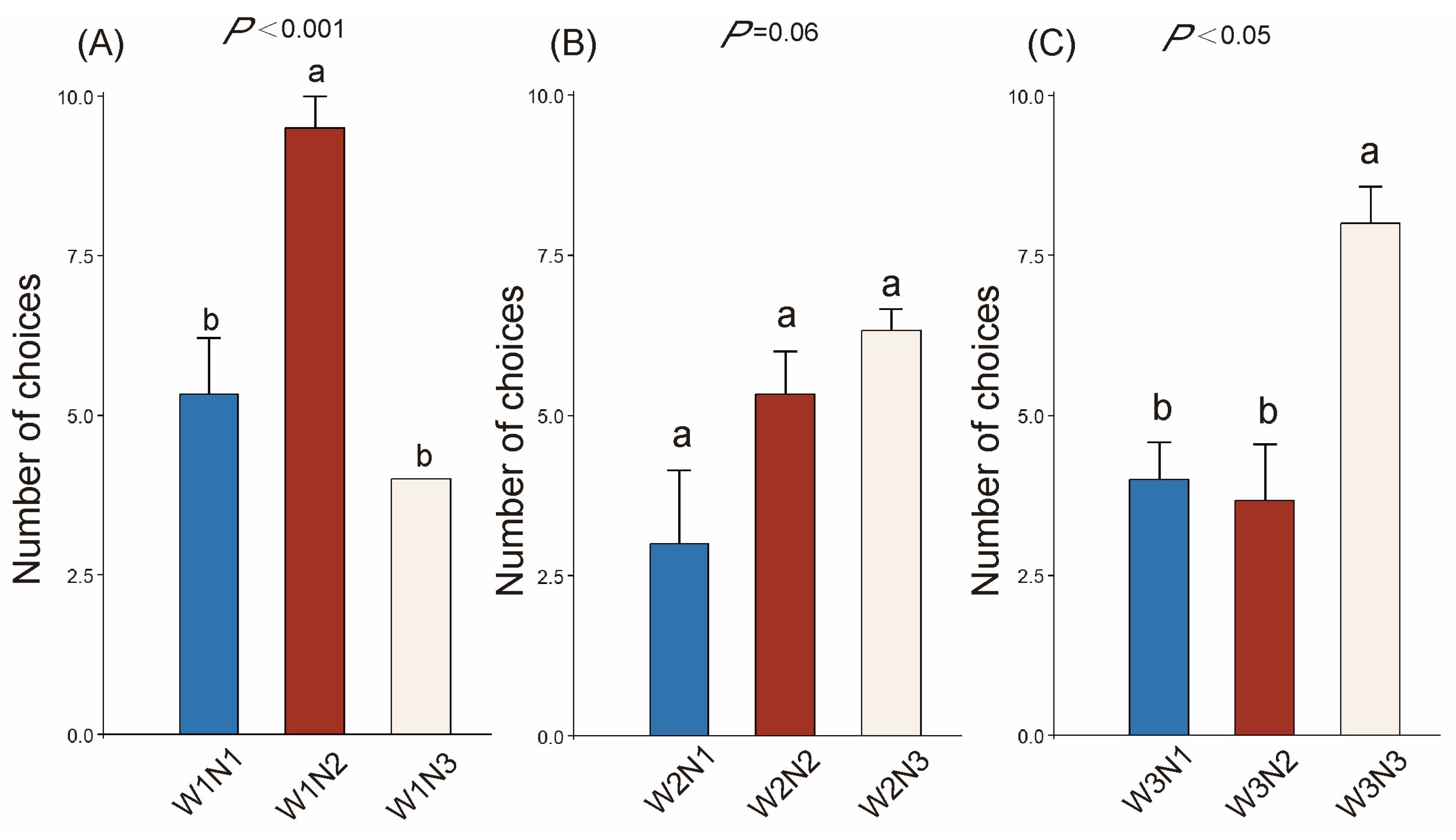
The aim of this study was to investigate the effects of water and nitrogen application on the behavioral preferences of E. grisescens. To understand the attractant and repellent effects of volatile compounds emitted by fresh tea leaves under different water and nitrogen conditions, we conducted experiments under varying water conditions and assessed the attractiveness of tea leaves under low-, medium-, and high-nitrogen treatments. As shown in Figure 1A, under low water conditions, E. grisescens exhibited a significantly stronger preference for tea leaves in the medium nitrogen treatment compared to those in the low or high nitrogen treatment (p < 0.001), while no significant preference was observed between the low and high nitrogen treatments. Under medium water conditions, there were no statistically significant differences in larval preference among tea leaves subjected to different nitrogen treatments (Figure 1B, p = 0.06). Under high water conditions, tea leaves from the high nitrogen treatment were significantly more attractive to E. grisescens than those from the other two nitrogen treatments (p < 0.05), while no significant preference was observed between the low and medium nitrogen treatments (Figure 1C).
These results indicate that under low water conditions, tea leaves from the medium nitrogen treatment were more attractive to E. grisescens, whereas under high water conditions, the larvae preferred tea leaves from the high nitrogen treatment.

3.2. Response of Volatile Organic Compounds in Fresh Tea Leaves to Different Water and Nitrogen Treatments

To understand the attractant and repellent effects of VOCs from fresh tea leaves under different water and nitrogen conditions on E. grisescens, we analyzed the VOC concentrations and composition in tea leaves under various water and nitrogen conditions and observed how these changes influence the behavior of E. grisescens.
A total of 773 volatile compounds were detected in fresh tea leaves under different water and nitrogen treatments, among which 84 compounds with relative abundances greater than 0.1% were selected for analysis (see Supplementary Table S1). In accordance with the classification method by Dong et al. [47], these compounds were grouped into four categories: terpenoids, aromatics, GLVs, and other compounds (Figure 2B–E).
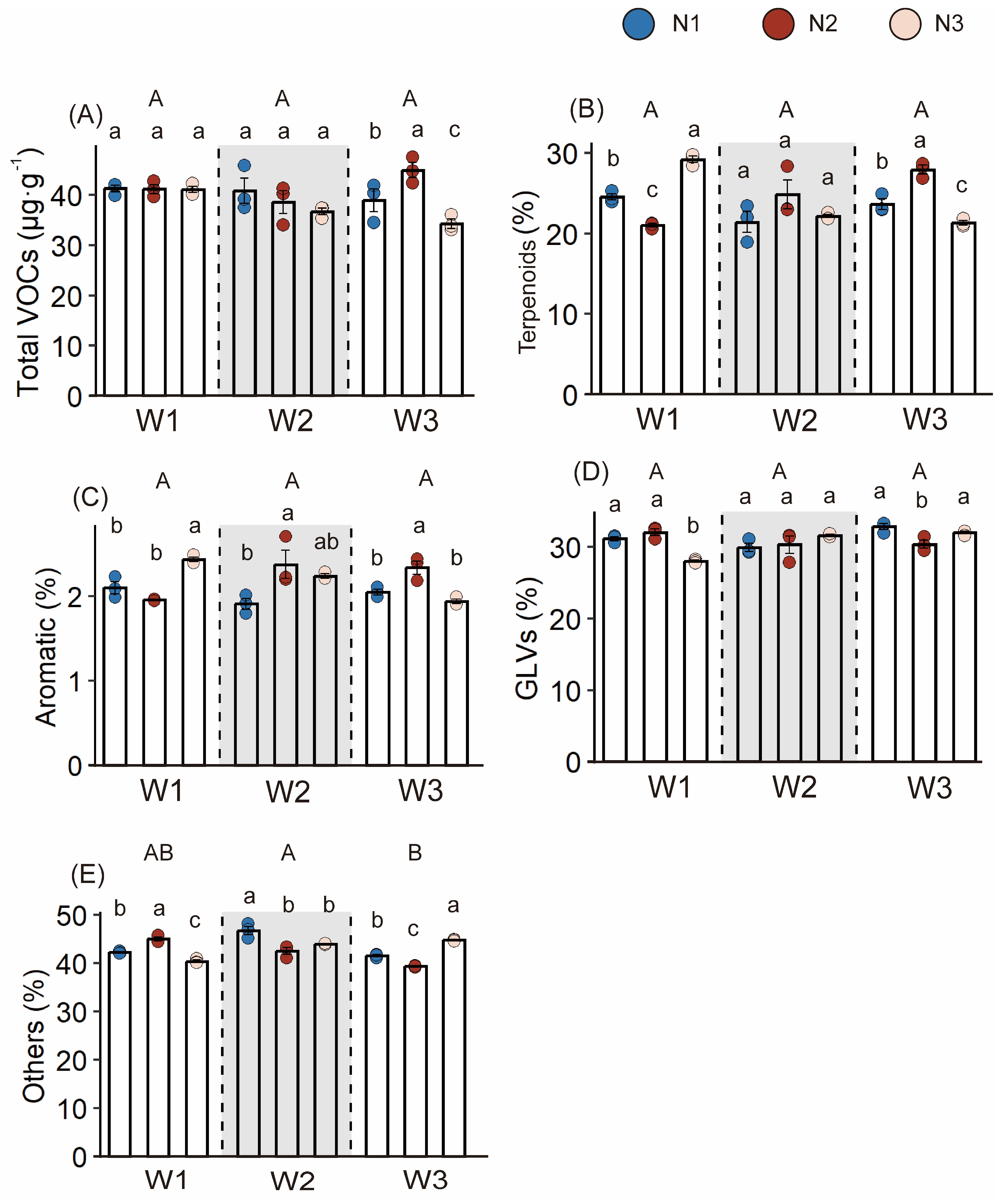
As shown in Figure 2A, under low and medium water conditions, the total VOC concentrations in tea leaves showed no significant change with increasing nitrogen application (p > 0.05). This suggests that nitrogen addition did not affect the total VOC content under these water conditions and that the total VOC concentration was not directly associated with the behavioral preferences of E. grisescens.
Under high water conditions, the total VOC concentration increased from 38.90 μg g−1 in the low nitrogen treatment to 44.90 μg g−1 in the medium nitrogen treatment and then decreased to 34.28 μg g−1 in the high nitrogen treatment (Figure 2A). However, the E. grisescens abundance on tea leaves in the high nitrogen treatment was significantly greater than on leaves from the other nitrogen treatments (Figure 1C). These results suggest that under high water conditions, nitrogen fertilization promoted VOC emissions up to 218.1 kg ha−1, but further increases decreased total VOC concentrations. Moreover, when the total VOC concentration fell to 34.28 μg g−1 or lower, the VOCs appeared to become more attractive to E. grisescens.
Across different water treatments, no significant differences were observed in the total VOC concentration or in the proportions of terpenoids, aromatics, and GLVs (Figure 2A–D). Only under medium water conditions was the proportion of other compounds significantly higher than under high water conditions (Figure 2E), suggesting that irrigation levels did not substantially affect total VOC concentrations or the proportions of terpenoids, aromatics, or GLVs.
Under low-water conditions, the proportions of terpenoids and other compounds varied significantly among the nitrogen treatments (Figure 2B,E). Specifically, the proportion of terpenoids was highest in the high nitrogen treatment (29.19%), followed by the low nitrogen treatment (24.51%), and lowest in the medium nitrogen treatment (21.01%). The medium nitrogen treatment under low water conditions attracted the highest number of E. grisescens individuals (Figure 1A), possibly because the proportion of terpenoids was lowest under this treatment. Similarly, under high water conditions, significant differences in terpenoid proportions were observed among the nitrogen treatments (Figure 3B), with the highest proportion observed in the medium nitrogen treatment (27.91%), followed by the low nitrogen treatment (23.63%), and the lowest in the high nitrogen treatment (21.32%). This may explain why tea leaves in the high nitrogen treatment attracted the most E. grisescens individuals under high water conditions (Figure 1C and Figure 2B). These findings further confirm that terpenoids have a repellent effect on E. grisescens.
For other compounds, significant differences were also observed under both low and high water conditions (Figure 2E). Under low water conditions, the proportion of other compounds was highest in the medium nitrogen treatment (44.99%), followed by the low nitrogen treatment (42.23%), and lowest in the high nitrogen treatment (40.38%). Under high water conditions, the pattern was reversed: the highest proportion was observed in the high nitrogen treatment (44.73%), followed by the low nitrogen treatment (41.49%), and the lowest in the medium nitrogen treatment (39.35%). In both conditions, the treatments with the highest proportion of other compounds (low water/medium nitrogen and high water/high nitrogen) also attracted the most E. grisescens individuals (Figure 1A,C). Therefore, it is reasonable to infer that other compounds have an attractive effect on E. grisescens.
Under medium water conditions, the proportion of terpenoids did not change significantly among the nitrogen treatments (Figure 2B), and correspondingly, the E. grisescens abundance also did not differ significantly (Figure 1B), highlighting the key role of terpenoids in mediating larval preference. Although the proportion of other compounds was highest in the low nitrogen treatment (46.74%) and did not differ significantly between the medium (42.50%) and high nitrogen treatments (43.96%), this did not result in greater attraction (Figure 1B). This suggests that the repellent effect of terpenoids outweighed the attractive effect of other compounds, influencing larval behavior.
Between the treatments that attracted the most and fewest E. grisescens individuals under both low- and high-water conditions (Figure 1A,C), no significant differences were found in the proportions of aromatics or GLVs (Figure 2C), suggesting that these compound classes had little or no effect on larval preference.
Although neither total VOC concentrations nor the proportions of terpenoids, aromatics, or GLVs differed significantly among the water conditions (Figure 2A–D), significant effects of water–nitrogen interactions on the total VOC concentration (p = 0.05) and on the concentrations of terpenoids, aromatics, GLVs, and other compounds (p = 0.001) were observed (Figure 2A–E). This indicates that nitrogen’s effect on VOC emissions was closely related to water conditions.
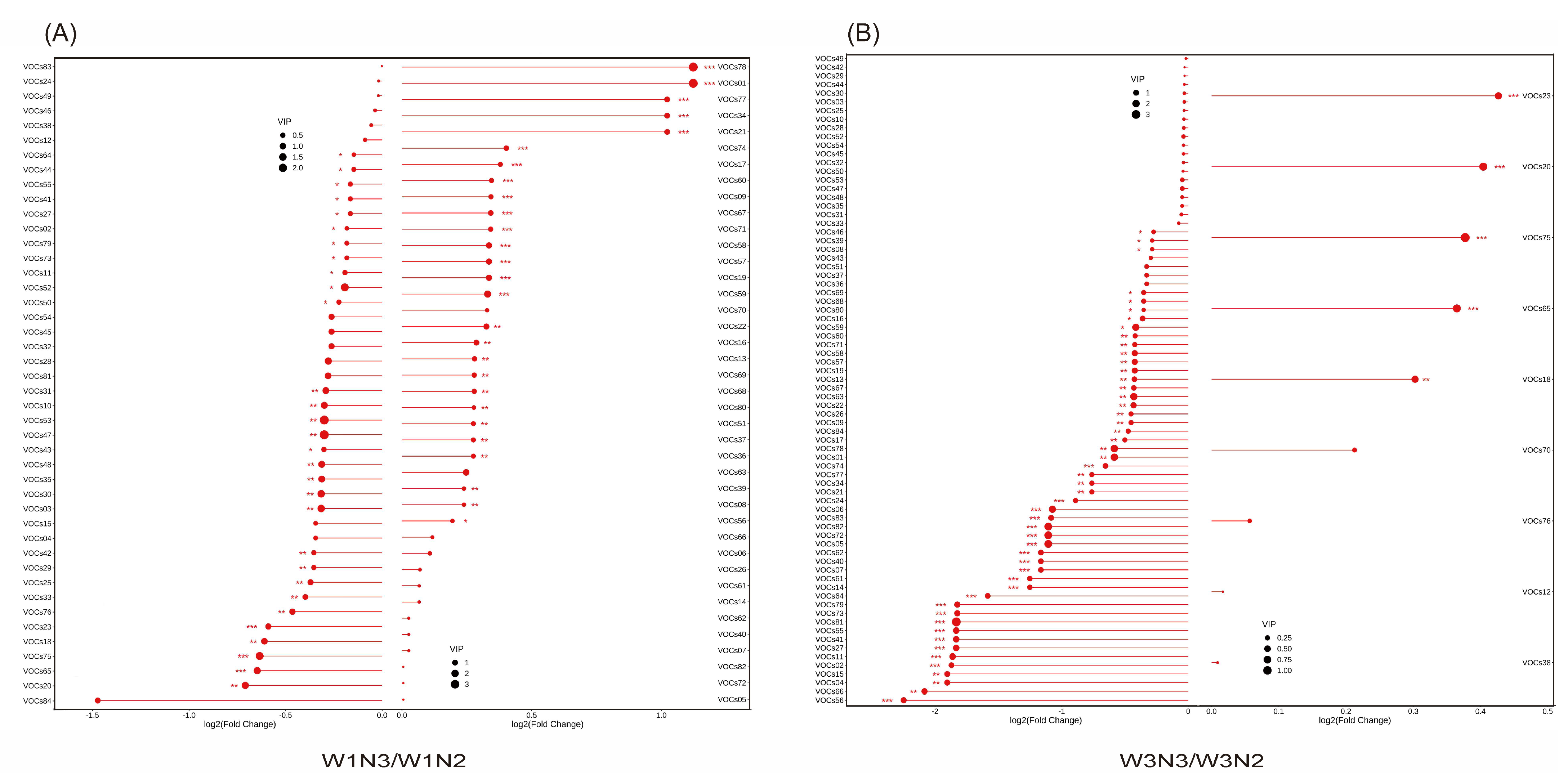
Under low water conditions, increasing the nitrogen level from medium to high resulted in 41 upregulated and 43 downregulated VOCs (Figure 3A). The upregulated VOCs included 18 terpenoids, 5 aromatics, 6 GLVs, and 12 other compounds (Supplementary Table S1). The downregulated VOCs included 7 terpenoids, 4 aromatics, 9 GLVs, and 23 other compounds (Supplementary Table S1). Since E. grisescens attraction decreased with the increasing nitrogen level (Figure 1A), and the terpenoid content increased (Figure 2B), some of the 18 upregulated terpenoids are likely repellent. In contrast, the level of other compounds decreased (Figure 2E), suggesting that attractive VOCs were enriched among the 23 downregulated other compounds.
Under high-water conditions, increasing the nitrogen level from medium to high resulted in 75 downregulated VOCs (25 terpenoids, 8 aromatics, 14 GLVs, 28 other compounds) and 9 upregulated VOCs (1 aromatic, 1 GLV, 7 other compounds) (Supplementary Table S1). As attraction increased (Figure 1C) while the terpenoid content decreased (Figure 2B) and other compound content increased (Figure 2E), the 25 downregulated terpenoids may include key repellents, while the 7 upregulated other compounds may be attractive.
Compared to that under low water conditions, a greater number of VOCs were downregulated under high water conditions, suggesting that high water conditions inhibited VOC synthesis and emission. In both water conditions, terpenoids were the most strongly nitrogen-responsive compound class, and terpenoids are typically associated with plant defense. Therefore, nitrogen supply likely modulates the chemical defense function of fresh tea leaves against E. grisescens under different water conditions.

3.3. Verification of the Behavioral Response of Ectropis grisescens to Specific Volatile Compounds

3.3.1. Screening of Specific Volatile Compounds Affecting the Behavioral Preference of E. grisescens

To screen the standard compounds with attractant or repellent effects on E. grisescens, we analyzed the compositional changes of VOCs in fresh tea leaves under different water and nitrogen treatments.
Under low-water conditions, a total of six standard ((+)-dihydrocarvone, hexanoic acid, 3-oxo-, ethyl ester, linalool, myrcene and β-ocimene) upregulated VOCs were identified, including five terpenoids and one compound classified as “other.” Under high water conditions, 44 standard downregulated VOCs were identified, comprising 25 terpenoids, 4 aromatics, 5 GLVs, and 10 other compounds (Table 2).
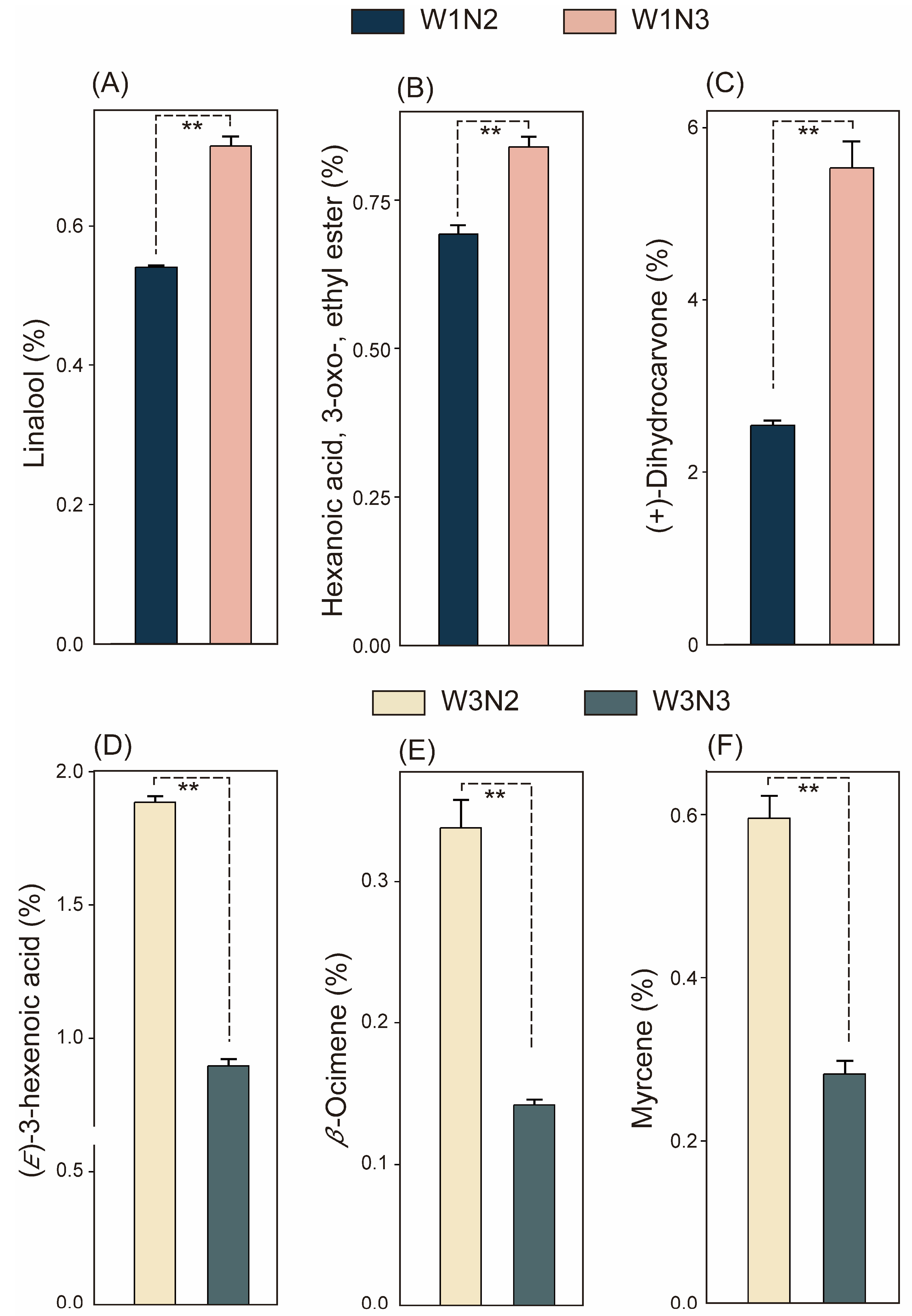
To further clarify the effects of VOCs from fresh tea leaves on the behavioral preference of E. grisescens, we selected three compounds that showed significant differences in relative abundance between the medium and high nitrogen treatments under low-water conditions—(+)-dihydrocarvone, hexanoic acid, 3-oxo-, ethyl ester, and linalool (Figure 4A–C). Additionally, we selected three compounds that differed significantly between the medium- and high-nitrogen treatments under high water conditions—myrcene, β-ocimene, and (E)-3-hexenoic acid (Figure 4D–F). Among these, only (E)-3-hexenoic acid is a GLV; the remaining five VOCs are terpenoids. Three of these compounds (myrcene, linalool, and β-ocimene) have been previously reported to be involved in insect defense and were selected for further analysis [18,48,49]. The other three VOCs—(E)-3-hexenoic acid, (+)-dihydrocarvone, and hexanoic acid, 3-oxo-, ethyl ester—were selected because their relative abundances differed significantly among nitrogen treatments.

3.3.2. Verification of the Effects of Specific Volatile Compounds on the Behavioral Response of E. grisescens

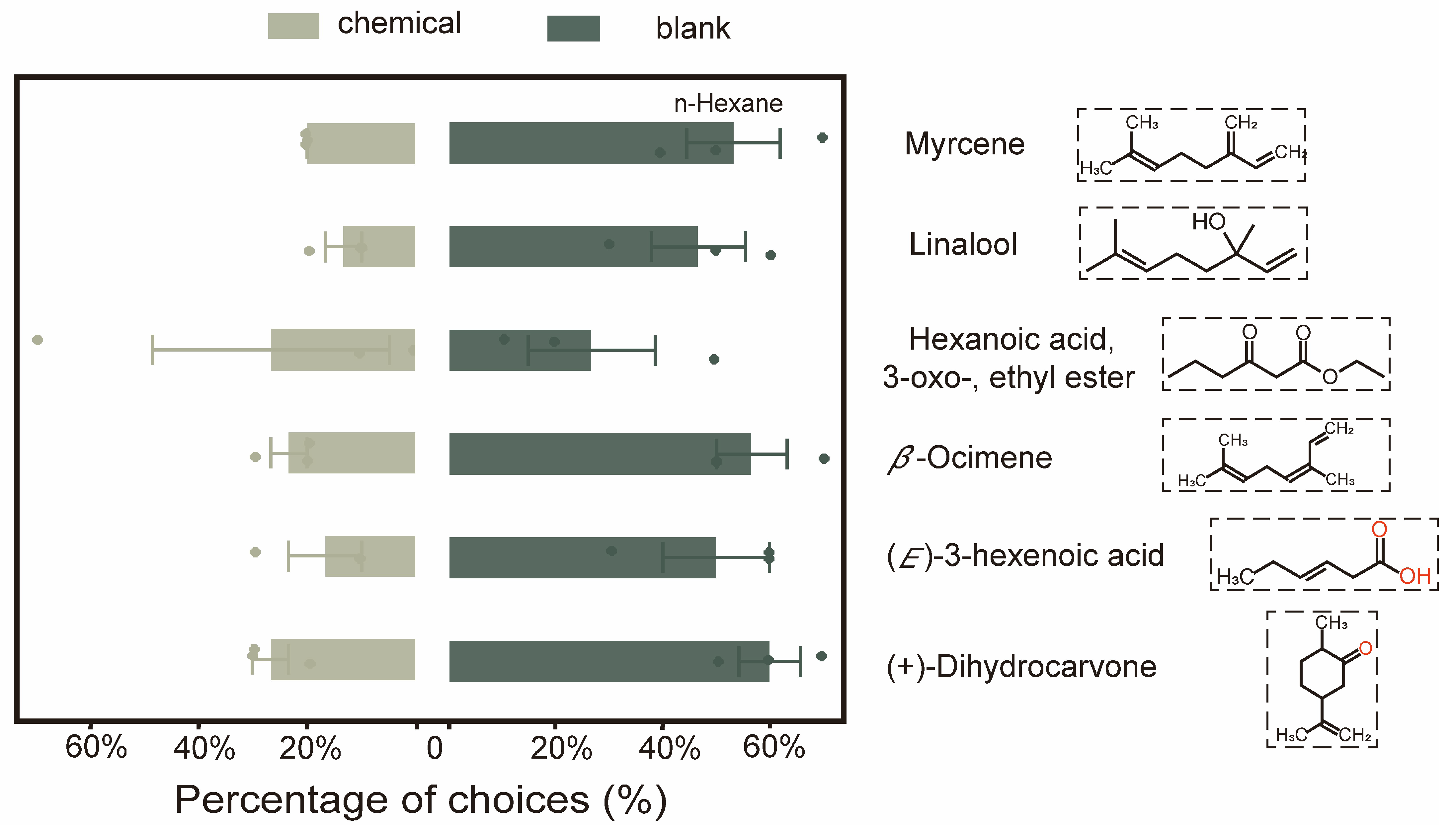
In the previous section, we analyzed the compositional changes in VOCs from fresh tea leaves under different water and nitrogen treatments and selected several compounds that were significantly associated with the behavioral preferences of E. grisescens. To clarify the effects of these VOCs on the behavioral preferences of E. grisescens, we conducted behavioral assays using a Y-tube olfactometer to test the attractant and repellent effects of these compounds on larval behavior. As shown in Figure 5, results from the Y-tube olfactometer behavioral assay indicated that the number of E. grisescens larvae choosing linalool (p < 0.01; χ = 5.56), β-ocimene (p < 0.01; χ = 4.17), myrcene (p < 0.01; χ = 4.55), (E)-3-hexenoic acid (p < 0.01; χ = 5.00), and (+)-dihydrocarvone (p < 0.05; χ = 3.85) was significantly lower than that for the control (n-hexane), whereas no significant difference was observed between hexanoic acid, 3-oxo-, ethyl ester and the control (p > 0.05; χ = 0.06). These results suggest that linalool, β-ocimene, myrcene, (E)-3-hexenoic acid, and (+)-dihydrocarvone elicited strong repellent responses in E. grisescens, while hexanoic acid, 3-oxo-, ethyl ester had no significant attractive or repellent effect on larval behavior.

4. Discussion

Our results demonstrate that the application of water and nitrogen significantly alters the VOC profile of tea leaves, which in turn influences the behavior of E. grisescens. Through experiments under different water and nitrogen conditions, we found that the water and nitrogen levels significantly affected the release of VOCs from tea leaves, particularly the concentrations of terpenoids and aromatic compounds. Furthermore, behavioral assays indicated that these changes could influence the feeding preferences of E. grisescens. Collectively, these findings highlight the role of water and nitrogen management in mediating plant-insect interactions through VOC modulation. In the four-arm olfactometer assays, E. grisescens exhibited distinct preferences for fresh tea leaves subjected to different water and nitrogen treatments (Figure 1), indicating that VOCs play a crucial role in host plant selection. The variation in E. grisescens attraction among different water–nitrogen treatments suggests that water and nitrogen supply, and their interaction, may differentially regulate the quantity and composition of tea leaf volatiles.
The effect of drought on tea leaf VOCs is complex and varies with cultivar and stress intensity [28,50,51]. In our study, no significant VOC changes were observed under mild drought (Figure 2A), contrasting with some previous reports. This discrepancy likely stems from cultivar specificity and lower stress intensity. The tested cultivar may be less sensitive to moderate water deficit than those studied previously, though they were all 1–3-year-old cuttings of tea plants [28,51]. While our stress level was similar to the mild treatment of Cao et al. (2006), which caused minimal change, the stronger stresses used by Liu et al. (2024) and Jin et al. (2021) were more effective in activating relevant secondary metabolism [28,50,51]. Thus, the response of tea plant VOCs to drought is highly depevndent on stress intensity reaching a cultivar-specific threshold.
Given the modulation of VOCs by water, a key question is how nitrogen application interacts with water regimes to further influence the volatile profile. Our results indicate that nitrogen’s regulatory role in VOC emissions is highly dependent on water availability. Specifically, only under high water conditions did increasing nitrogen application significantly influence the total VOC emissions (Figure 2A), suggesting that nitrogen may regulate VOC production more strongly when soil moisture is ample. Nitrogen availability, which is a key abiotic factor influencing the synthesis of herbivore-induced plant volatiles (HIPVs), can affect both primary and secondary metabolic pathways, thereby shaping the profile of tea leaf VOCs [52,53]. Under low-water conditions, nitrogen application had no effect on VOC content, possibly because water limitation constrained nitrogen uptake and utilization [54]. In contrast, under high water conditions, nitrogen application caused large fluctuations in VOC concentrations, with the total VOC content peaking in the medium nitrogen treatment (44.90 μg g−1) and declining in the high nitrogen treatment (34.28 μg g−1). This may reflect the onset of hypoxia around roots in waterlogged conditions, which, combined with excess nitrogen, alters tea plant physiology and metabolism, leading to reduced VOC synthesis [55]. Excess nitrogen may divert resources to protein and starch synthesis, reducing secondary metabolite production [15].
Our results showed that water levels did not significantly affect the proportions of terpenoids, aromatics, or GLVs among the total VOCs (Figure 2B–D), with the exception that other compounds were significantly more abundant under medium water conditions than under high water conditions (Figure 2E). These other compounds include various heterocyclic compounds such as enols, aldehydes, ketones, esters, pyrazines, furans, and pyrroles (Supplementary Table S1). Their enrichment under medium water conditions may reflect a state of moderate stress that does not damage plants but activates additional secondary metabolic pathways, enhancing signaling and defense responses [56].
Under low-water conditions, the proportion of terpenoids increased significantly with nitrogen application (high nitrogen > low nitrogen > medium nitrogen; Figure 2B). This pattern may be attributed to differential responses of individual terpenoids to nitrogen. Nitrogen can regulate terpene synthase (TPS) activity by altering the plant carbon–nitrogen balance [57]; for example, lower nitrogen levels promote terpenoid production in tomato leaves, enhancing chemical defenses [58]. Increased nitrogen levels may improve the photosynthetic capacity and supply carbon skeletons and ATP for terpene biosynthesis [59]. Moreover, nitrogen addition under low water levels may induce salt stress, which has been linked to increased terpene emissions in Lycopersicon esculentum [60]. These results suggest that nitrogen application not only affects the production of terpenoids by regulating plant metabolic processes but may also enhance the plant’s chemical defense by inducing stress responses under water-limited conditions. Future studies could explore the long-term effects of terpenoids on pest control under different water and nitrogen conditions to help optimize agricultural management practices.
Under medium-water conditions, neither terpenoid nor GLV proportions changed significantly with nitrogen addition (Figure 2C), consistent with findings showing that NH4NO3 application does not alter terpene concentrations in pine or spruce [61,62]. Terpenoid biosynthesis differs from phenolic synthesis pathways and is relatively stable unless challenged by strong biotic stress [63]. In contrast, under high-water conditions, the proportion of terpenoids was lowest in the high-nitrogen treatment (Figure 2B), suggesting that resource allocation shifted toward growth rather than defense [64]. The decline in terpenoid proportion under treatments that attracted the most E. grisescens individuals (low-water/medium-nitrogen and high-water/high-nitrogen; Figure 2A,C) further supports the repellent role of terpenoids.
Our Y-tube olfactometer assays confirmed that linalool, β-ocimene, myrcene, (+)-dihydrocarvone, and (E)-3-hexenoic acid were strongly repellent to E. grisescens (Figure 5), aligning with previous studies showing that β-ocimene, linalool, and geraniol repel other tea pests [65]. However, the effects of β-ocimene are complex, as it can attract or repel different pests depending on species and context [66,67,68]. For instance, it has been shown to attract leafhoppers while repelling female tea root borers, possibly due to differences in olfactory receptor sensitivity and ecological roles [69].
In addition to terpenoids, other compounds were proportionally the most abundant under conditions attracting the most E. grisescens individuals (low water/medium nitrogen and high water/high nitrogen; Figure 2E), suggesting an attractive role for these other compounds. However, not all the other compounds were attractive: while 2,3,5-trimethylpyrazine is known to attract Bactrocera dorsalis [65], some compounds, such as 5-ethyl-2-methylpyridine, may exhibit repellency (Supplementary Table S1). Furthermore, hexanoic acid, 3-oxo-, ethyl ester showed no significant effect, reflecting the complexity of VOC mixture interactions and suggesting that behavioral responses depend on multicomponent blends [70].
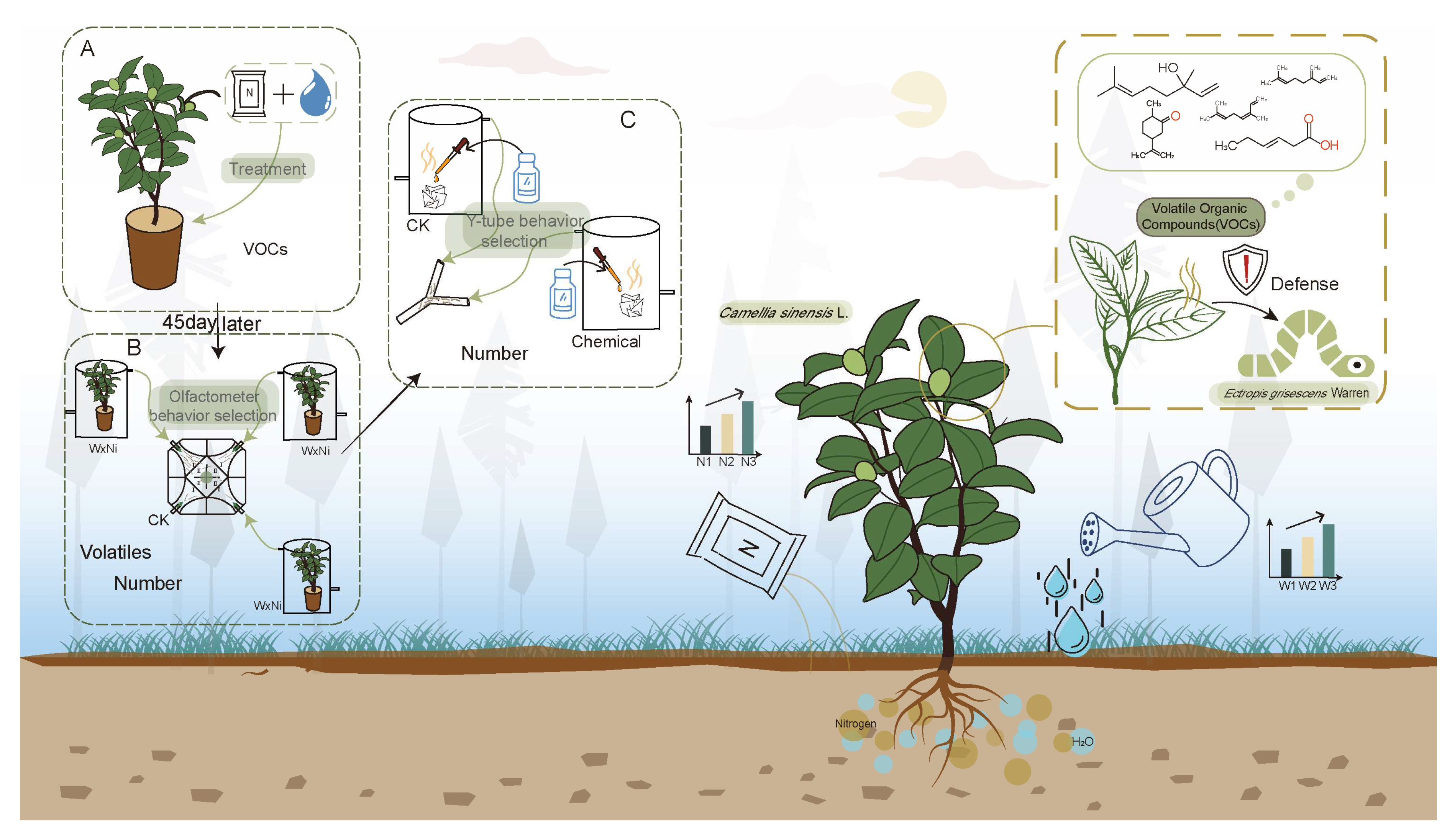
In tea, VOC-mediated defense against insect herbivory is crucial. Our results demonstrate that specific terpenoids in tea—particularly myrcene, β-ocimene, linalool, and (+)-dihydrocarvone—play a central role in repelling E. grisescens. Due to their responsiveness to nitrogen, these compounds can potentially be manipulated through water and nitrogen management to increase the resistance of tea plants to E. grisescens. The present study reinforces the central role of terpenoids—particularly myrcene, β-ocimene, linalool, and (+)-dihydrocarvone—in repelling E. grisescens. The responsiveness of these compounds to nitrogen allows for their potential manipulation through water and nitrogen management to enhance tea plant resistance (Figure 6).
Although this study provides valuable insights into the effects of water and nitrogen levels on VOC emissions from tea leaves and their impact on the behavior of E. grisescens, several limitations should be considered. The focus of this study was a limited number of VOCs, and although this information is valuable, it does not pertain to all the compounds involved in plant–insect interactions. Furthermore, during behavioral validation, we found that although the overall GLVs had an attractant effect on E. grisescens, some individual components (such as (E)-3-hexenoic acid) exhibited significant repellent effects. This observation suggests that the perception of odor information may not be a single pathway, but rather involves synergistic or antagonistic mechanisms between multiple volatile components. Future research could systematically explore the regulatory relationship between the composition of volatile mixtures and pest behavior, investigating behavioral response patterns under different concentration combinations. Lastly, although the study provides short-term behavioral insights, it does not address the long-term effects on pest populations and plant health. Future studies could investigate the combined effects of environmental variables on VOC emissions over longer periods and explore the ecological interactions between VOCs and other biotic and abiotic factors to gain a more comprehensive understanding of plant defense mechanisms.

5. Conclusions

In summary, this study clarifies how water–nitrogen interactions regulate tea plant resistance to E. grisescens through modulation of defensive VOCs. Specific terpenoids—myrcene, β-ocimene, linalool, and (+)-dihydrocarvone—were identified as key repellents, whose emissions were suppressed under low-water–moderate-nitrogen and high-water–high-nitrogen regimes, leading to increased larval attraction. Conversely, other water–nitrogen combinations promoted the synthesis of these repellent compounds and enhanced chemical defense. These findings reveal a resource-allocation mechanism whereby tea plants balance growth and defense in response to soil water and nitrogen availability, providing a physiological basis for ecologically informed pest management through optimized water–nitrogen coupling.

Supplementary Materials

The following supporting information can be downloaded at: https://www.mdpi.com/article/10.3390/agronomy16010018/s1, Table S1: Volatile compound contents of fresh tea leaves under water–nitrogen coupling; Table S2: Peak areas of compound reference standards and internal standards.

Author Contributions

C.Y., Q.S., and P.C. conceived and designed the experiment. W.X., D.L., and J.W. were responsible for the experimental implementation. W.X. and D.L. analyzed the data. W.X., C.Y., and Q.S. interpreted the results. W.X. and C.Y. wrote the manuscript. All authors discussed the results and reviewed the final manuscript. All authors have read and agreed to the published version of the manuscript.

Funding

This research was supported by Fujian Haishengtong Xian Tea Industry Co., Ltd., the Science and Technology Project “Ecological Enhancement and Key Technology Development for Carbon Sequestration and Emission Reduction in Tongxian Brand Tea Plantations” (2025351160700016), the Natural Science Foundation of Fujian Province (2020J01409), and the Research Foundation for Advanced Talents of Wuyi University (YJ201807).

Data Availability Statement

The data that support the findings of this study are available from the corresponding author upon reasonable request.

Acknowledgments

The authors would like to thank the Wuyi University undergraduates Meng Yuanfei, Wu Lili, and Yan Lihao for their assistance with the plant and soil sample analyses, and Lü Zhaozhi and Chang Xuefei from the College of Plant Medicine, Qingdao Agricultural University, for their valuable suggestions on the design of the olfactory behavioral assays for E. grisescens.

Conflicts of Interest

The authors declare no conflicts of interest.

References

  1. Agbazo, M.; N’Gobi, G.K.; Alamou, E.; Kounouhewa, B.; Afouda, A. Detection of hydrological impacts of climate change in Benin by a multifractal approach. Int. J. Water Resour. Environ. Eng. 2019, 11, 45–55. [Google Scholar]
  2. Legg, S. IPCC, 2021: Climate change 2021: The physical science basis. Interaction 2021, 49, 44–45. [Google Scholar]
  3. Wang, Y.; Zhang, Q.; Singh, V.P. Spatiotemporal patterns of precipitation regimes in the Huai River basin, China, and possible relations with ENSO events. Nat. Hazards 2016, 82, 2167–2185. [Google Scholar] [CrossRef]
  4. Deutsch, C.A.; Tewksbury, J.J.; Tigchelaar, M.; Battisti, D.S.; Merrill, S.C.; Huey, R.B.; Naylor, R.L. Increase in crop losses to insect pests in a warming climate. Science 2018, 361, 916–919. [Google Scholar] [CrossRef] [PubMed]
  5. Jamieson, M.A.; Trowbridge, A.M.; Raffa, K.F.; Lindroth, R.L. Consequences of climate warming and altered precipitation patterns for plant-insect and multitrophic interactions. Plant Physiol. 2012, 160, 1719–1727. [Google Scholar] [CrossRef]
  6. International Tea Day 2022: FA0 Underlines the Need for Greater Sustainability. Available online: http://www.fao.org (accessed on 23 May 2022).
  7. Yang, F.; Li, B.B.; He, C.Y. Research progress on the mechanism of high temperature and drought effects on the growth and quality of tea tree. Jiangsu Agric. Sci. 2017, 45, 10–13. [Google Scholar]
  8. Jiang, Y.; Ma, J.; Li, H.; Yu, J. The effect of high temperature damage on tea production during July–August 2013 in Lishui. Chin. Agric. Sci. Bull. 2014, 30, 158–163. [Google Scholar]
  9. Pan, Y.; Fang, G.; Wang, Z.; Cao, Y.; Liu, Y.; Li, G.; Liu, X.; Xiao, Q.; Zhan, S. Chromosome-level genome reference and genome editing of the tea geometrid. Mol. Ecol. Resour. 2021, 21, 2034–2049. [Google Scholar] [CrossRef]
  10. Wang, Z.; Bai, J.; Liu, Y.; Li, H.; Zhan, S.; Xiao, Q. Transcriptomic analysis reveals insect hormone biosynthesis pathway involved in desynchronized development phenomenon in hybridized sibling species of tea geometrids (Ectropis grisescens and Ectropis obliqua). Insects 2019, 10, 381. [Google Scholar] [CrossRef]
  11. Li, Z.Q.; Cai, X.M.; Luo, Z.X.; Bian, L.; Xin, Z.J.; Liu, Y.; Chu, B.; Chen, Z.M. Geographical distribution of Ectropis grisescens (Lepidoptera: Geometridae) and Ectropis obliqua in China and description of an efficient identification method. J. Econ. Entomol. 2019, 112, 277–283. [Google Scholar] [CrossRef]
  12. Wang, Z.Q.; Zhou, X.G.; Xiao, Q.; Tang, P.; Chen, X.X. The potential of Parapanteles hyposidrae and Protapanteles immunis (Hymenoptera: Braconidae) as biocontrol agents for the tea grey geometrid Ectropis grisescens (Lepidoptera). Insects 2022, 13, 937. [Google Scholar] [CrossRef]
  13. Chen, Z.M.; Cai, X.M.; Zhou, L.; Bian, L.; Luo, Z.X. Developments on tea plant pest control in past 40 years in China. China Tea 2020, 42, 1–8. [Google Scholar]
  14. Zhou, S.; Lou, Y.R.; Tzin, V.; Jander, G. Alteration of plant primary metabolism in response to insect herbivory. Plant Physiol. 2015, 169, 1488–1498. [Google Scholar] [CrossRef] [PubMed]
  15. Li, Z.X.; Wang, D.X.; Shi, W.X.; Weng, B.Y.; Zhang, Z.; Su, S.H.; Sun, Y.F.; Tan, J.F.; Xiao, S.; Xie, R.H. Nitrogen-mediated volatilisation of defensive metabolites in tomato confers resistance to herbivores. Plant Cell Environ. 2024, 47, 3227–3240. [Google Scholar] [CrossRef]
  16. Veyrat, N.; Robert, C.A.M.; Turlings, T.C.J.; Erb, M. Herbivore intoxication as a potential primary function of an inducible volatile plant signal. J. Ecol. 2016, 104, 591–600. [Google Scholar] [CrossRef]
  17. Chen, F.; Huang, P.; Wang, J.; Wu, W.; Lin, Y.W.; Hu, J.F.; Liu, X.G. Specific volatiles of tea plants determine the host preference behavior of Empoasca onukii. Front. Plant Sci. 2023, 14, 1239237. [Google Scholar] [CrossRef] [PubMed]
  18. Jing, T.; Qian, X.; Du, W.; Gao, T.; Li, D.; Guo, D.; He, F.; Yu, G.; Li, S.; Schwab, W. Herbivore-induced volatiles influence moth preference by increasing the β-ocimene emission of neighbouring tea plants. Plant Cell Environ. 2021, 44, 3667–3680. [Google Scholar] [CrossRef]
  19. Cai, X.; Luo, Z.; Meng, Z.; Liu, Y.; Chu, B.; Bian, L.; Li, Z.; Xin, Z.; Chen, Z. Primary screening and application of repellent plant volatiles to control tea leafhopper, Empoasca onukii Matsuda. Pest. Manag. Sci. 2020, 76, 1304–1312. [Google Scholar] [CrossRef]
  20. Zhao, X.; Chen, S.; Wang, S.; Shan, W.; Wang, X.; Lin, Y.; Su, F.; Yang, Z.; Yu, X. Defensive responses of tea plants (Camellia sinensis) against tea green leafhopper attack: A multi-omics study. Front. Plant Sci. 2020, 10, 1705. [Google Scholar] [CrossRef]
  21. Cease, A.J.; Elser, J.J.; Ford, C.F.; Hao, S.; Kang, L.; Harrison, J.F. Heavy livestock grazing promotes locust outbreaks by lowering plant nitrogen content. Science 2012, 335, 467–469. [Google Scholar] [CrossRef]
  22. Han, P.; Desneux, N.; Becker, C.; Larbat, R.; Le Bot, J.; Adamowicz, S.; Zhang, J.; Lavoir, A.V. Bottom-up effects of irrigation, fertilization and plant resistance on Tuta absoluta: Implications for integrated pest management. J. Pest. Sci. 2019, 92, 1359–1370. [Google Scholar] [CrossRef]
  23. Mattson, W.J. Herbivory in relation to plant nitrogen content. Annu. Rev. Ecol. Syst. 1980, 11, 119–161. [Google Scholar] [CrossRef]
  24. Zhao, C.; Han, W.H.; Xiong, Y.D.; Ji, S.X.; Du, H.; Chi, Y.J.; Chen, N.; Wu, H.; Liu, S.-S.; Wang, X.-W. Drought suppresses plant salicylic acid defence against herbivorous insects by down-regulating the expression of ICS1 via NAC transcription factor. Plant Stress 2025, 16, 100887. [Google Scholar] [CrossRef]
  25. Gutbrodt, B.; Mody, K.; Dorn, S. Drought changes plant chemistry and causes contrasting responses in lepidopteran herbivores. Oikos 2011, 120, 1732–1740. [Google Scholar] [CrossRef]
  26. Zhang, X.Q.; Zhou, F.Y.; Liang, Y.F. Review on the measures of drought prevention and drought resistance in the tea garden. J. Guizhou Tea 2012, 40, 7–10. [Google Scholar]
  27. Gupta, S.; Bharalee, R.; Bhorali, P.; Das, S.K.; Bhagawati, P.; Bandyopadhyay, T.; Gohain, B.; Agarwal, N.; Ahmed, P.; Borchetia, S.; et al. Molecular analysis of drought tolerance in tea by cDNA-AFLP based transcript profiling. Mol. Biotechnol. 2013, 53, 237–248. [Google Scholar] [CrossRef]
  28. Cao, P.; Liu, C.; Liu, K. Aromatic constituents in fresh leaves of Lingtou Dancong tea induced by drought stress. Front. Agric. China 2007, 1, 81–84. [Google Scholar] [CrossRef]
  29. Wang, Y.; Fan, K.; Wang, J.; Ding, Z.T.; Wang, H.; Bi, C.H.; Zhang, Y.W.; Sun, H.W. Proteomic analysis of Camellia sinensis (L.) reveals a synergistic network in the response to drought stress and recovery. J. Plant Physiol. 2017, 219, 91–99. [Google Scholar] [CrossRef] [PubMed]
  30. Debere, N.; Lemessa, F.; Urgessa, K.; Berecha, G. Influence of combined application of inorganic-N and organic-P fertilizers on growth of young tea plant (Camellia sinensis var. assamica) in humid growing area of SW Ethiopia. J. Agron. 2014, 13, 179–186. [Google Scholar] [CrossRef]
  31. Owuor, P.O.; Othieno, C.O.; Kamau, D.M.; Wanyoko, J.K.; Ng’etich, W.K. long term fertilizer use on high yielding clone s 15/10 tea: Yields. Int. J. Tea Sci. 2008, 7, 19–31. [Google Scholar]
  32. Sarwar, S.; Ahmad, F.; Hamid, F.S.; Khan, B.M.; Khurshid, F. Effect of different nitrogenous fertilizers on the growth and yield of three years old tea (Camellia sinensis) plants. Sarhad J. Agric. 2007, 23, 907–910. [Google Scholar]
  33. Owuor, P.O.; Odak, J.A.; Mang’uro, L.O.; Wachira, F.N.; Cheramgoi, E. Influence of nitrogen fertilisation on red spider mites (Oligonychus coffeae Nietner) and overhead volatile organic compounds in tea (Camellia sinensis). Int. J. Tea Sci. 2017, 13, 52–59. [Google Scholar] [CrossRef]
  34. Huang, Z.; Wang, F.; Li, B.; Pang, Y.; Du, Z. Appropriate nitrogen form and application rate can improve yield and quality of autumn tea with drip irrigation. Agronomy 2023, 13, 1303. [Google Scholar] [CrossRef]
  35. Mei, Y.; Liang, X. Analysis of China’s tea production, sales, lmport and export situation in 2023. China Tea 2024, 46, 18–26. [Google Scholar]
  36. Sinha, K.K.; Choudhary, A.K.; Kumari, P. Entomopathogenic fungi. In Ecofriendly Pest Management for Food Security; Elsevier: London, UK, 2016; pp. 475–505. [Google Scholar]
  37. Cao, P.; Yang, D.; Zhu, J.; Liu, Z.; Jiang, D.; Xu, H. Estimated assessment of cumulative dietary exposure to organophosphorus residues from tea infusion in China. Environ. Health Prev. Med. 2018, 23, 7. [Google Scholar] [CrossRef]
  38. Wang, C.; Lv, S.; Wu, Y.; Gao, X.; Li, J.; Zhang, W.; Meng, Q. Oolong tea made from tea plants from different locations in Yunnan and Fujian, China showed similar aroma but different taste characteristics. SpringerPlus 2016, 5, 576. [Google Scholar] [CrossRef]
  39. Chen, D.H.; Chen, H.; Ge, P.Z. The discussion about good quality origin and production techniques of Wuyi Chinese cassia tea. Acta Tea Sin. 2007, 4, 44–46. [Google Scholar]
  40. Qiao, L.; Chen, L.; Jin, Y.; Zhou, Z.; Geng, S. Effects of low temperature stress on survival, reproduction and protective enzyme activities of Ectropis grisescens Warren 1894 (Lepidoptera: Geometridae). Pak. J. Zool. 2024, 57, 1003–1501. [Google Scholar] [CrossRef]
  41. Song, Z.J.; Ma, Z.Y.; Qi, J.G.; Zou, Y.J.; Li, M.J. Effects of drought stress on nitrogen uptake and utilization of Malus hupehensis at different growth stages. J. Northwest For. Univ. 2023, 38, 94–100. [Google Scholar]
  42. Mu, C.; Chen, X.H.; Lin, W.J.; Hu, H.N.; Wu, L.Q. Nitrogen balance status and greenhouse gas mitigationpotential in typical Oolong tea production areas. J. Agric. Resour. Environ. 2020, 37, 186–194. [Google Scholar]
  43. Kou, J.; Teng, D.; Huang, X.; Lv, B.; Zhang, H.; Pan, H.; Zhang, Y. Overexpressing a cotton terpene synthase for (E)-β-ocimene biosynthesis in Nicotiana tabacum to recruit the parasitoid wasps. Ind. Crops Prod. 2024, 222, 119476. [Google Scholar] [CrossRef]
  44. Cortina, P.R.; Santiago, A.N.; Sance, M.M.; Peralta, I.E.; Carrari, F.; Asis, R. Neuronal network analyses reveal novel associations between volatile organic compounds and sensory properties of tomato fruits. Metabolomics 2018, 14, 57. [Google Scholar] [CrossRef] [PubMed]
  45. R Core Team. R: A Language and Environment for Statistical Computing. 2025. Available online: https://cran.r-project.org/doc/manuals/r-release/fullrefman.pdf (accessed on 31 October 2025).
  46. Wickham, H. Programming with ggplot2. In Ggplot2: Elegant Graphics for Data Analysis; Springer International Publishing: Cham, Switzerland, 2016; pp. 241–253. [Google Scholar]
  47. Dong, F.; Yang, Z.; Baldermann, S.; Sato, Y.; Asai, T.; Watanabe, N. Herbivore-induced volatiles from tea (Camellia sinensis) plants and their involvement in intraplant communication and changes in endogenous nonvolatile metabolites. J. Agric. Food Chem. 2011, 59, 13131–13135. [Google Scholar] [CrossRef]
  48. Lopez, M.D.; Maudhuit, A.; Pascual-Villalobos, M.J.; Poncelet, D. Development of formulations to improve the controlled-release of linalool to be applied as an insecticide. J. Agric. Food Chem. 2012, 60, 1187–1192. [Google Scholar] [CrossRef]
  49. Gao, L.; Wei, Y.; Li, K.; Chen, J.; Wang, P.; Du, J.; Peng, J.; Gao, Y.; Zhang, Z.; Liu, Y. Perilla frutescens repels and controls Bemisia tabaci MED with its key volatile linalool and caryophyllene. Crop Prot. 2024, 184, 106837. [Google Scholar] [CrossRef]
  50. Liu, X.; Dong, F.; Li, Y.; Lu, F.; Wang, B.; Zhou, T.; Zhao, D.; Huang, M.; Wang, F. Impact of mild field drought on the aroma profile and metabolic pathways of fresh tea (Camellia sinensis) leaves using HS-GC-IMS and HS-SPME-GC-MS. Foods 2024, 13, 3412. [Google Scholar] [CrossRef]
  51. Jin, J.; Zhao, M.; Gao, T.; Jing, T.; Zhang, N.; Wang, J.; Zhang, X.; Huang, J.; Schwab, W.; Song, C. Amplification of early drought responses caused by volatile cues emitted from neighboring tea plants. Hortic. Res. 2021, 8, 243. [Google Scholar] [CrossRef]
  52. Ju, Y.L.; Yue, X.F.; Zhao, X.F.; Zhao, H.; Fang, Y.L. Physiological, micro-morphological and metabolomic analysis of grapevine (Vitis vinifera L.) leaf of plants under water stress. Plant Physiol. Biochem. 2018, 130, 501–510. [Google Scholar] [CrossRef] [PubMed]
  53. Copolovici, L.; Kannaste, A.; Remmel, T.; Niinemets, Ü. Volatile organic compound emissions from Alnus glutinosa under interacting drought and herbivory stresses. Environ. Exp. Bot. 2014, 100, 55–63. [Google Scholar] [CrossRef]
  54. Adebayo, O.; Singh, A.; Bista, P.; Angadi, S.; Ghimire, R. Compost addition improves soil water storage and crop water productivity in cover crop integrated sorghum production system under a limited irrigation management. Irrig. Sci. 2025, 43, 1559–1573. [Google Scholar] [CrossRef]
  55. Oliveira, H.C.; Freschi, L.; Sodek, L. Nitrogen metabolism and translocation in soybean plants subjected to root oxygen deficiency. Plant Physiol. Biochem. 2013, 66, 141–149. [Google Scholar] [CrossRef]
  56. Niinemets, Ü. Mild versus severe stress and BVOCs: Thresholds, priming and consequences. Trends Plant Sci. 2010, 15, 145–153. [Google Scholar] [CrossRef]
  57. Chen, S.; Zhang, M.; Ding, S.; Xu, Z.; Wang, S.; Meng, X.; Chen, S.; Gao, R.; Sun, W. Comprehensive characterization of volatile terpenoids and terpene synthases in Lanxangia tsaoko. Mol. Hortic. 2025, 5, 20. [Google Scholar] [CrossRef]
  58. Corrêa, P.L.C.; De-La-Cruz-Chacón, I.; Sousa, M.C.; Vieira, M.A.R.; Campos, F.G.; Marques, M.O.M.; Boaro, C.S.F.; Ferreira, G. Effect of nitrogen sources on photosynthesis and biosynthesis of alkaloids and leaf volatile compounds in Annona sylvatica A. St.-Hil. J. Soil. Sci. Plant Nutr. 2022, 22, 956–970. [Google Scholar] [CrossRef]
  59. Ormeo, E.; Fernandez, C. Effect of soil nutrient on production and diversity of volatile terpenoids from plants. Curr. Bioact. Compd. 2012, 8, 71–79. [Google Scholar] [CrossRef]
  60. Tomescu, D.; Şumălan, R.; Copolovici, L.; Copolovici, D. The influence of soil salinity on volatile organic compounds emission and photosynthetic parameters of Solanum lycopersicum L. varieties. Open Life Sci. 2017, 12, 135–142. [Google Scholar] [CrossRef]
  61. Muzika, R.M.; Pregitzer, K.S. Effect of nitrogen fertilization on leaf phenolic production of grand fir seedlings. Trees 1992, 6, 241–244. [Google Scholar] [CrossRef]
  62. Kainulainen, P.; Utriainen, J.; Holopainen, J.K.; Oksanen, J.; Holopainen, T. Influence of elevated ozone and limited nitrogen availability on conifer seedlings in an open-air fumigation system: Effects on growth, nutrient content, mycorrhiza, needle ultrastructure, starch and secondary compounds. Glob. Change Biol. 2000, 6, 345–355. [Google Scholar] [CrossRef]
  63. Scala, A.; Allmann, S.; Mirabella, R.; Haring, M.A.; Schuurink, R.C. Green leaf volatiles: A plant’s multifunctional weapon against herbivores and pathogens. Int. J. Mol. Sci. 2013, 14, 17781–17811. [Google Scholar] [CrossRef]
  64. Leghari, S.J.; Wahocho, N.A.; Laghari, G.M.; Laghari, A.H.; Bhabhan, G.M.; Talpur, K.H.; Bhutto, T.A.; Wahocho, S.A.; Lashari, A.A. Role of nitrogen for plant growth and development: A review. Adv. Environ. Biol. 2016, 10, 209–219. [Google Scholar]
  65. Ren, L.; Ma, Y.; Xie, M.; Lu, Y.; Cheng, D. Rectal bacteria produce sex pheromones in the male oriental fruit fly. Curr. Biol. 2021, 31, 2220–2226.E4. [Google Scholar] [CrossRef] [PubMed]
  66. Firn, R. Nature’s Chemicals: The Natural Products That Shaped Our World; OUP Oxford: Oxford, UK, 2009. [Google Scholar]
  67. Mauch-Mani, B.; Baccelli, I.; Luna, E.; Flors, V. Defense priming: An adaptive part of induced resistance. Annu. Rev. Plant Biol. 2017, 68, 485–512. [Google Scholar] [CrossRef] [PubMed]
  68. Zhao, M.; Huang, S.; Zhang, Q.; Wei, Y.; Tao, Z.; Wang, C.; Zhao, Y.; Zhang, X.; Dong, J.; Wang, L. The plant terpenes DMNT and TMTT function as signaling compounds that attract Asian corn borer (Ostrinia furnacalis) to maize plants. J. Integr. Plant Biol. 2024, 66, 2528–2542. [Google Scholar] [CrossRef] [PubMed]
  69. Addesso, K.M.; McAuslane, H.J. Pepper weevil attraction to volatiles from host and nonhost plants. Environ. Entomol. 2009, 38, 216–224. [Google Scholar] [CrossRef]
  70. Riedlmeier, M.; Ghirardo, A.; Wenig, M.; Knappe, C.; Koch, K.; Georgii, E.; Dey, S.; Parker, J.E.; Schnitzler, J.P.; Vlot, A.C. Monoterpenes support systemic acquired resistance within and between plants. Plant Cell 2017, 29, 1440–1459. [Google Scholar] [CrossRef]
Figure 1. Behavioral preferences of E. grisescens for tea plants under (A) low (B) middle (C) high water–nitrogen treatments. Note: (AC) respectively illustrate the behavioral preferences of E. grisescens under different nitrogen treatments in low-water, medium-water, and high-water conditions. The number of E. grisescens larvae selected from different nitrogen treatments under the same water conditions showed significant differences (p < 0.05, one-way ANOVA).
Agronomy 16 00018 g001
Figure 2. Effects of different water–nitrogen treatments on terpenoids, aromatics, GLVs and other categories of volatile substances in tea tree leaves. Note: (A) shows the changes in the total amount of the four substances after water–nitrogen treatment. (BE) show the changes in the concentrations of fresh tea tree leaf volatile compounds in the categories of terpenes, aromatic compounds, GLVs, and other compounds under different water–nitrogen treatments, respectively. Uppercase letters that are the same indicate no significant difference in the concentration of tea tree fresh leaf volatiles between different water conditions at p = 0.05. Lowercase letters that are different indicate a significant difference in the concentration of organic volatiles in tea tree fresh leaves between different nitrogen treatments under the same water conditions at p = 0.05 (one-way ANOVA). Effect of Water and Nitrogen: p < 0.05 (two-way ANOVA).
Agronomy 16 00018 g002
Figure 3. Analysis of VOCs for E. grisescens avoidance behavior under low- and high-water conditions. Note: (A) shows the upregulation and downregulation of volatile organic compounds (VOCs) under low-water conditions with nitrogen, which attracted E. grisescens, and under low-water conditions with high nitrogen levels, which repel it; (B) shows the upregulation and downregulation of VOCs under high-water conditions with high nitrogen levels, which attract E. grisescens, and under high-water conditions with nitrogen, which repel it. “*”,“**”, and “***” indicate that the differences in volatile substance content between medium-nitrogen and high-nitrogen treatments under low-water and high-water conditions were significant at the p = 0.05, p = 0.01, and p = 0.001 levels, respectively (one-way ANOVA).
Agronomy 16 00018 g003
Figure 4. Screening of the changes in VOC contents under low- and high-water conditions. Note: (AC) respectively show the changes in linalool, hexanoic acid, 3-oxo-, ethyl ester, (+)-dihydrocarvone content in fresh tea leaves under low-water, middle-nitrogen and low-water high-nitrogen treatments. (DF) respectively show the changes in (E)-3-hexenoic acid, β-ocimene and Modified myrcene content in fresh tea leaves under high-water middle-nitrogen and high-water high-nitrogen treatments. The data are expressed as the means ± SE (n = 3). “**” indicates that the difference in the volatile content between different nitrogen treatments within the same water condition is significant at p = 0.01 (one-way ANOVA).
Agronomy 16 00018 g004
Figure 5. The impact of the six selected VOCs on the olfactory behavior of E. grisescens. Note: The data are expressed as means ± SE (n = 3).
Agronomy 16 00018 g005
Figure 6. Effects of Different Water–Nitrogen Coupling Treatments on Tea Leaf VOC Emissions and Their Behavioral Model in Ectropis grisescens. Note: (AC) represent the water-nitrogen coupling treatment for tea plants, the four-arm olfactory test for the tea leaf roller moth, and the Y-tube behavioral avoidance test for the tea leaf roller moth, respectively.
Agronomy 16 00018 g006
Table 1. Basic physical and chemical properties of soils used for potting plants.
Soil Physicochemical PropertyValue
SOC14.34 ± 1.01 g kg−1
Soil-TP0.51 ± 0.01 g kg−1
Soil-TN1.25 ± 0.52 g kg−1
Soil-TK8.2 ± 1.25 g kg−1
AP6.19 ± 0.85 mg kg−1
AK230.14 ± 10.96 mg kg−1
AN157.01 ± 3.83 mg kg−1
pH5.11 ± 0.36
EC13.2 ± 1.13 μS cm−1
Table 2. Changes in the types of volatile compounds that meet the screening requirements under different water conditions and nitrogen treatments.
VOC TypeDifferent Water and Nitrogen Treatments
W1N2-W1N3W3N2-W3N3
Terpenoids5 compounds: (+)-Dihydrocarvone, Linalool, Cyclohexanol, 1-methyl-4-(1-methylethylidene)-, p-Menth-2-en-7-ol, cis-, cis-Dihydrocarvone25 compounds: (+)-Dihydrocarvone, 2,6-Octadienal, 3,7-dimethyl-, (E)-trans-beta-Ocimene, 1,3,6-Octatriene, 3,7-dimethyl-, (Z)-Neral, Cyclohexanol, 1-methyl-4-(1-methylethylidene)-, Cyclohexanol, 2-methyl-5-(1-methylethenyl)-, 1,3,7-Octatriene, 3,7-dimethyl-, β-Ocimene, γ-Terpinene, Ascaridole, Carvone oxide, trans-Linalool, p-Menth-2-en-7-ol, cis-Cyclohexene, 1-methyl-4-(1-methylethylidene)-, Carvone oxide, cis-Geraniol, Myrcene, 7-Octen-4-ol, 2-methyl-6-methylene-, (S)-Furan, 3-(4-methyl-3-pentenyl)-, 2,6,6-Trimethylbicyclo[3.2.0]hept-2-en-7-one, 1,3,3-Trimethylbicyclo[2.2.1]heptan-2-
One, D-Fenchone, L-Fenchone;
Aromatics 4 compounds: Benzene, (methylthio)-Benzyl alcohol, Benzeneethanamine. 2-Phenylpropionaldehyde;
GLVs 5 compounds: 2-Decenal, (E)-3-Hexen-1-ol, acetate, (E)-3-Hexenoic acid, (E)-2-Hexen-1-ol, acetate, (E)-3-Hexen-1-ol, acetate, (Z)-
Other Compounds1 compound: Hexanoic acid, 3-oxo-, ethyl ester10 compounds: 1-Cyclohexene-1-carboxaldehyde, 4-(1-methylethenyl)-, (S)-Pyrazine, 3-butyl-2,5-dimethyl-, Pyrazine, trimethyl-Pyrazine, 2-butyl-3,5-dimethyl-Pyrazine, 5-butyl-2,3-dimethyl-Pyridine, 5-ethyl-2-methyl-Butyl angelate, 1-Undecyn-4-ol, trans, trans-Hexa-2,4-dienyl acetate, Hydroxylamine, O-decyl-
Disclaimer/Publisher’s Note: The statements, opinions and data contained in all publications are solely those of the individual author(s) and contributor(s) and not of MDPI and/or the editor(s). MDPI and/or the editor(s) disclaim responsibility for any injury to people or property resulting from any ideas, methods, instructions or products referred to in the content.