Next Article in Journal
A Pipeline for Mushroom Mass Estimation Based on Phenotypic Parameters: A Multiple Oudemansiella raphanipies Model
Previous Article in Journal
Microbial Metagenomics Evidence Reveals Forest Soil Amendment Contributes to Increased Sugarcane Yields in Long-Term Cropping Systems
error_outline You can access the new MDPI.com website here. Explore and share your feedback with us.
 
 
Article

Genome-Wide Association Study Identifies Candidate Genes Regulating Berry Color in Grape (Vitis vinifera L.)

1
College of Biology and Environment, Zhejiang Wanli University, No. 8 Qianhu South Road, Ningbo 315000, China
2
Cixi Forestry and Specialty Technology Promotion Center, Ningbo 315300, China
*
Authors to whom correspondence should be addressed.
These authors contributed equally to this work.
Agronomy 2026, 16(1), 121; https://doi.org/10.3390/agronomy16010121
Submission received: 1 December 2025 / Revised: 26 December 2025 / Accepted: 1 January 2026 / Published: 4 January 2026
(This article belongs to the Section Crop Breeding and Genetics)

Abstract

Berry color is a critical determinant of grape quality and market value. While the genetic basis of skin color has been extensively studied, the regulatory network controlling flesh coloration remains largely uncharacterized. To systematically dissect the independent genetic architectures underlying these traits, we performed a genome-wide association study (GWAS) on 130 grape accessions, integrated with spatiotemporal expression profiling, subcellular localization, and functional validation. Our analysis revealed distinct genetic loci for skin and flesh color, confirming their independent regulation. For skin color, GWAS robustly validated VvMYBA2 as a major locus, explaining up to 51.5% of the phenotypic variance. More importantly, for flesh color, we identified and prioritized VvF3′M (Flavonoid 3′-monooxygenase) as a key candidate gene. Heterologous overexpression of VvF3′M in tobacco resulted in a profound 13.5-fold increase in anthocyanin content, suggesting its potential role as a rate-limiting enzyme in flesh pigmentation. Intriguingly, VvF3′M-overexpressing plants also exhibited a significant increase in flower number, suggesting a novel role beyond pigment biosynthesis. This study provides a comprehensive genetic and functional framework for understanding berry coloration, identifies VvF3′M as a prime target for breeding red-fleshed grapes, and reveals unexpected crosstalk between color metabolism and reproductive development.

1. Introduction

Grapevine (Vitis vinifera L.) is a globally significant economic crop and a major fruit species within the Vitaceae family [1,2,3]. Berry maturation involves a complex series of physiological changes, including color development, cell-wall softening, sugar accumulation, and aroma formation [4]. Among these, skin color is a critical visual indicator of flavor quality and commercial value, particularly for table grapes [5]. This trait is not only vital for consumer appeal but is also intrinsically linked to the accumulation of health-promoting secondary metabolites, such as anthocyanins. The genetic and environmental regulation of color is highly complex, presenting a substantial challenge for grape breeding and production.
At the mechanistic level, berry coloration depends on biosynthesis, modification, and vacuolar sequestration of anthocyanins in exocarp cells [6]. While flesh color is also determined by anthocyanin accumulation [7], the pathway itself is a specialized branch of flavonoid metabolism [8], sharing upstream substrates with the biosynthesis of proanthocyanidins and flavonols [9]. The basic anthocyanin structure is modified through reactions like methylation and acylation, which enhance stability and solubility and contribute to the diverse palette of observed berry colors. The spatiotemporal regulation of this pathway is predominantly governed by transcription factors, especially MYB and bHLH proteins, which orchestrate the expression of biosynthetic genes [10]. In grape, the canonical color locus on chromosome 2 harbors the VvMYBA cluster (VvMYBA1/2/3). A promoter retrotransposon (Gret1) insertion in VvMYBA1 and coding mutations in VvMYBA2 underlie white-skinned phenotypes, whereas functional alleles activate downstream UFGT and later pathway/decoration genes [11,12,13]. For instance, the sustained expression of F3′5′H promotes the synthesis of delphinidin derivatives, key pigments responsible for blue-hued coloration [14]. Teinturier (“red-fleshed”) phenotypes add complexity via cis-regulatory changes at VvMYBA1 that extend anthocyanin production into mesocarp [15]. This polygenic control underscores the necessity of systematically identifying the key genetic determinants of color to advance grape improvement.
Early genetic linkage maps based on markers like RAPD, AFLP, SRAP, and SSR were limited by low polymorphism and genome coverage, hindering high-resolution trait mapping [16,17,18,19]. The completion of the grape reference genome [20] and the advent of high-throughput sequencing have enabled the use of high-density SNP markers for constructing detailed genetic maps and conducting genome-wide association studies (GWAS) [21]. GWAS leverages natural genetic diversity to identify markers and candidate genes associated with complex traits, becoming a cornerstone of modern plant genetics [22,23].
In grapevine, GWAS has successfully elucidated the genetic architecture of various traits. Studies have identified loci linked to yield components [24], berry cracking and seed traits [25,26], berry shape [27] as well as berry weight, flesh texture, and flavor [28]. However, these studies have primarily focused on grape morphology, seeds, and skin coloration, while the genetic regulatory mechanisms underlying flesh color—a trait of considerable agronomic and commercial importance for developing new table grape varieties—remain insufficiently explored. Furthermore, most of the associations identified by GWAS still require functional validation to confirm their biological significance.
Therefore, this study adopted an integrated strategy to systematically dissect the independent genetic regulatory networks governing skin and flesh coloration in grapes. We performed a genome-wide association analysis on 130 grape accessions, combined with functional genomics and physiological validation. This work aims not only to identify significant associated loci and candidate genes but also to provide conclusive functional evidence, thereby establishing a solid foundation for understanding the genetic control of berry coloration and advancing precision breeding in grapevine.

2. Materials and Methods

2.1. Plant Materials

We previously completed whole-genome resequencing of 130 grape genotypes, with data deposited at the National Genomics Data Center (https://ngdc.cncb.ac.cn/, accessed on 30 November 2025) [29]. From these data, 58,926,380 SNP markers were identified. From June to September of 2023 and 2024, ripe berries were collected at the Ningbo grape germplasm repository (30.26434° N, 121.40831° E) to score berry skin and flesh color. Variety names are provided in Table S1. The site has a mean annual temperature of 18.5 °C, annual precipitation of 1119.3 mm, and sunshine duration of 1879.2 h; brown soils with pH 8.58 (slightly alkaline), organic matter 5.44 g·kg−1, water content 1.6%, and bulk density 2.56 g·cm−3.
For spatiotemporal expression analysis, the cultivar ‘Yin hong’ was selected as a representative model because it is a major local cultivar. From ‘Yin-hong’, six tissue types were sampled: tendrils (young, actively growing tips), stems (young internodal segments), leaves (fully expanded, sun-exposed), seeds (at maturity), skin (peel without flesh), and flesh (pulp without seeds or skin). For temporal expression profiling, berries were collected at four key developmental stages: fruit set (10 days after flowering), enlargement (berry diameter ~50% of final size), veraison (onset of skin coloration), and maturity (fully colored, ripe). Each sample consisted of pooled tissues from at least five individual berries collected from three separate clusters on different vines, representing three biological replicates. All samples were immediately frozen in liquid nitrogen and stored at −80 °C until RNA extraction.
Nicotiana tabacum plants were cultivated for subcellular localization and overexpression assays, with samples from leaves, roots, stems, flowers, and fruits being collected to analyze tissue-specific expression patterns.

2.2. Phenotyping of Berry Color Traits

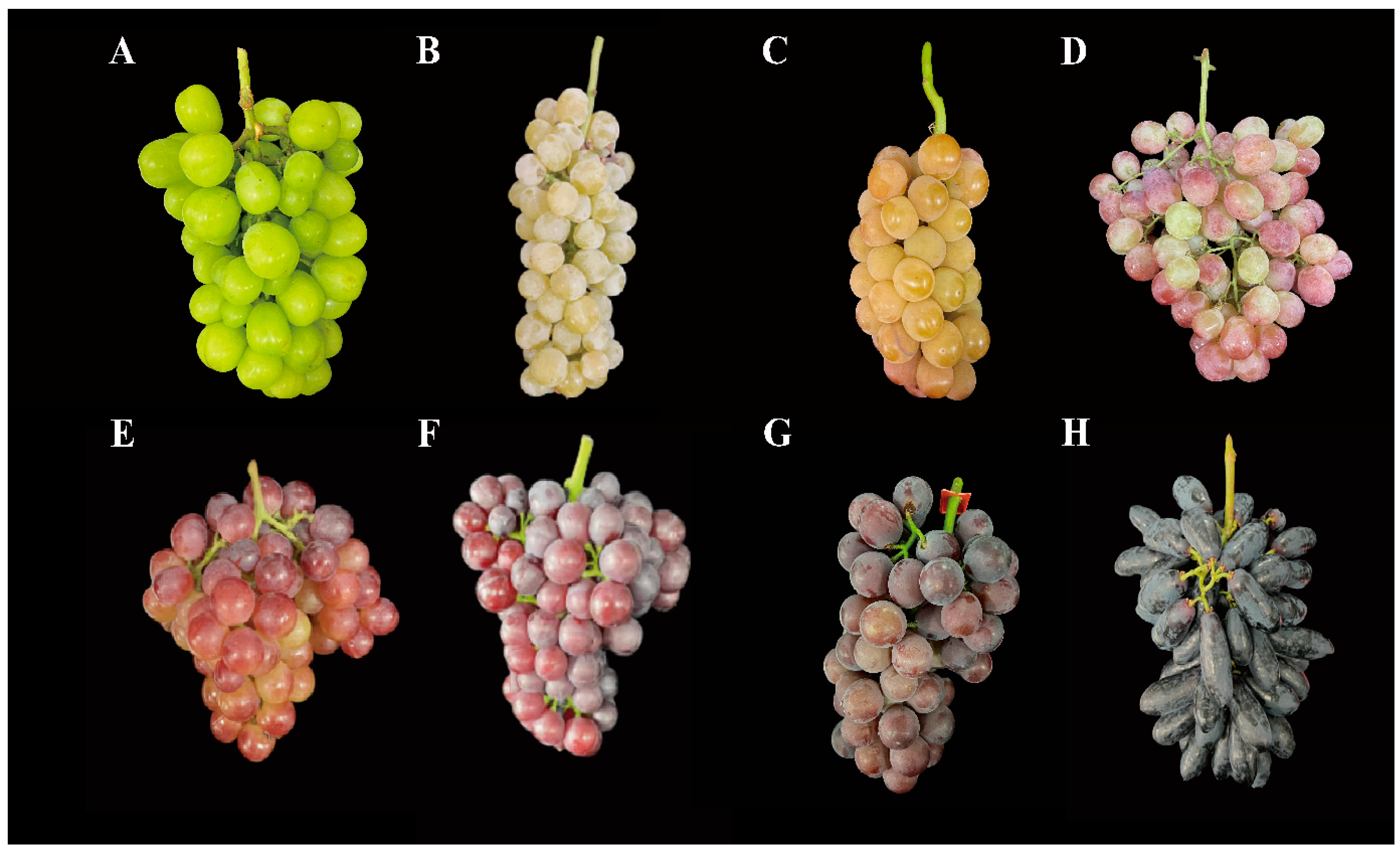
Skin color (SC) and flesh color (FC) were scored following the Chinese agricultural industry standard NY/T 2563-2014 [30] “Guidelines for the Conduct of Tests for Distinctness, Uniformity and Stability.” SC were coded as follows: 1 green, 2 yellow-green, 3 yellow, 4 pink, 5 red, 6 dark red, 7 purple-black, 8 blue-black (Figure 1). FC had five levels: 1 none or extremely weak, 3 weak, 5 medium, 7 strong, 9 very strong. Each accession had three biological replicates. These visual scores were used as phenotypic data for berry color (Table S1).

2.3. Genome-Wide Association Analysis

Based on the laboratory’s previous whole-genome resequencing data of 130 grape materials, a total of 58,926,380 SNP markers were obtained. For the GWAS analysis, we performed stringent quality control on the original SNPs: first, sites with a minor allele frequency (MAF) < 0.05 were removed to exclude interference from low-frequency variations on association signals; second, unreliable sites annotated as “filtered” were eliminated. After the above filtering, 5,848,986 high-quality SNPs were retained. Further exclusion of SNP sites with unknown chromosomal positions resulted in 5,620,388 SNPs for subsequent association analysis.
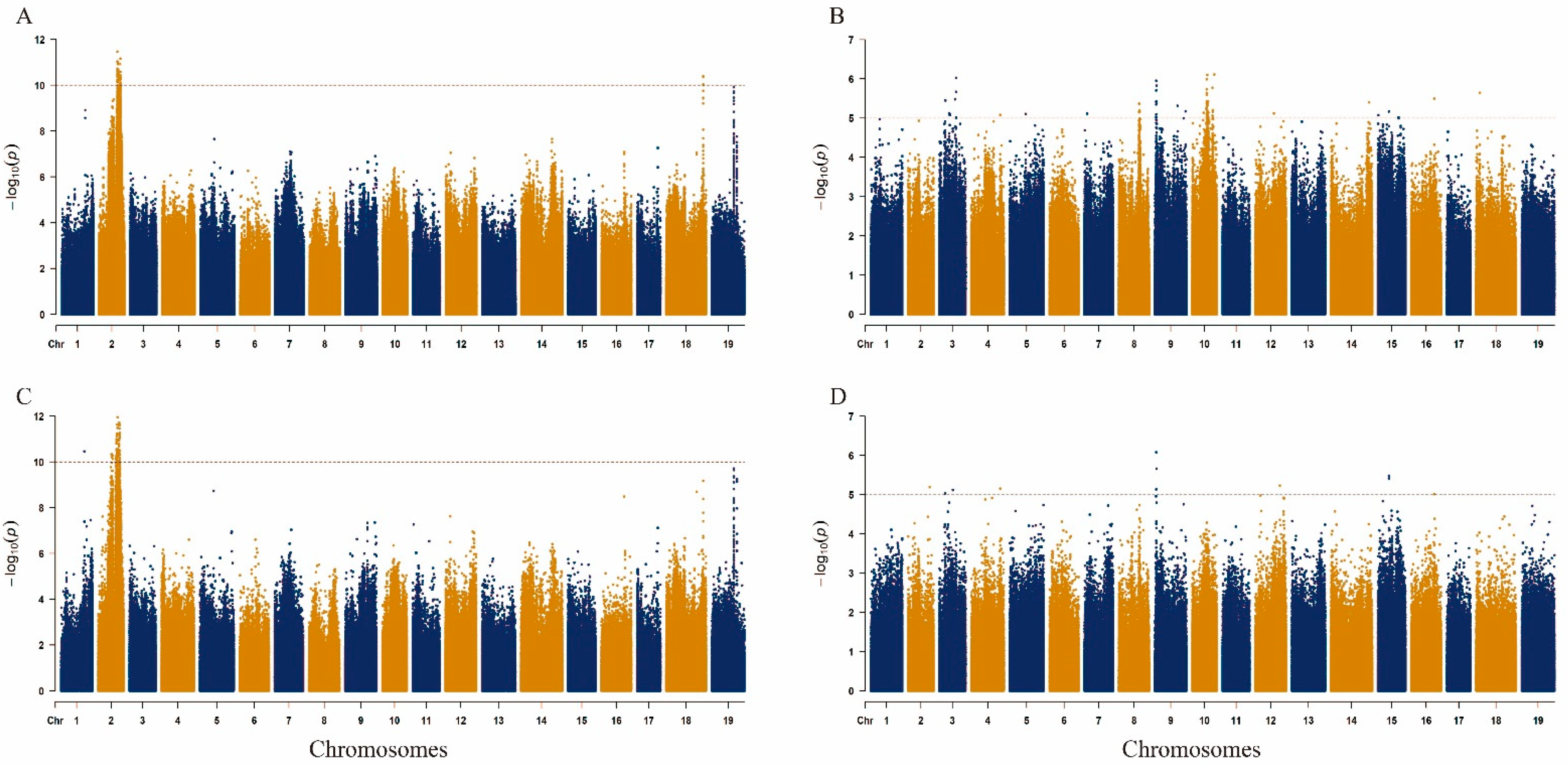
High-quality SNP markers and phenotypes from 130 genotypes were analyzed using the GAPIT package in R (version 3.2). Associations between SNPs and berry skin and flesh color were evaluated by a generalized linear model (GLM). GLM is a basic GWAS model with high computational efficiency and simple operation. Given its computational efficiency, simplicity of operation, and suitability for large-scale genetic datasets in high-throughput SNP analysis, GLM was chosen as the primary model for association analysis in this study. CMplot was used for visualization. Manhattan plots display chromosomal positions on the x-axis and −log10(p) on the y-axis. Larger −log10(p) values indicate stronger associations. Based on Bonferroni correction, we computed the significance threshold corresponding to p < 0.05/N and the highly significant threshold corresponding to p < 0.01/N (where N is the total number of SNPs), which gave −log10(p) = 7.43 and 8.13, respectively.
Because Bonferroni correction is conservative and considering our practical data-analysis needs, we finally set −log10(p) = 5 as the significance threshold for flesh color and −log10(p) = 10 for skin color. In Manhattan plots, all SNPs with p values exceeding the thresholds were considered candidate loci significantly associated with berry color. Accordingly, these adjusted thresholds were employed to pinpoint stringent SNP–trait associations.

2.4. Candidate-Gene Selection and Functional Annotation

Based on GWAS results across both years, we systematically filtered candidate SNPs associated with berry color. To ensure reliability, we focused on SNPs that were significant in both years. For skin color, a window of ±15 kb around each significant SNP was scanned to cover potential regulatory sequences and coding genes [29]. For flesh color, because the ±15 kb window did not capture annotated genes for several signals, we expanded to ±35 kb [31] to improve detection of key genes. This strategy enhanced the accuracy of functional annotation of candidate loci and laid the groundwork for elucidating the molecular mechanism of berry color formation.
To ensure accurate and systematic functional annotation of candidate genes, we integrated multiple authoritative databases and analytical tools for in-depth analysis. First, using the UniProt database (https://www.uniprot.org/, accessed on 7 May 2025), we performed protein function annotation and subcellular localization prediction of the candidate genes, and we conducted metabolic pathway enrichment analysis with the KEGG PATHWAY database (https://www.kegg.jp/kegg/pathway.html, accessed on 7 May 2025). We further employed the bioinformatics software TBtools-II (version 2.326) to efficiently screen and identify key KEGG pathways significantly associated with the candidate genes.

2.5. DNA and RNA Extraction, Reverse Transcription

Total RNA from the berries of plants in each treatment group was extracted using a polysaccharide and polyphenol plant RNA Quick Extraction Kit (HuiLing, Jiangsu, Zhenjiang, China). cDNA was synthesized by reverse transcription using a 2× NovoScript® Plus 1st Strand cDNA Synthesis SuperMix Kit (Novoprotein, Suzhou, China). Genomic DNA was extracted from N. benthamiana leaves using the cetyltrimethylammonium bromide (CTAB) method [32].

2.6. qRT-PCR Analysis of Candidate Genes

Gene-specific primers were designed and synthesized using Primer 5 (Table S2a,b). The VvActin gene and the NbActin gene were used as the internal reference genes for V. vinifera cv. ‘Yinhong’ and N. benthamiana, respectively. The qRT–PCR was performed using 2× NovoStart® SYBR qPCR SuperMix Plus (Novoprotein, Suzhou, China), and the 2−ΔΔCt method was used to calculate the relative expression levels of the genes. Three independent biological replicates and three technical repetitions were performed for each of the qRT–PCR experiments.

2.7. Construction and Transformation of Candidate Genes

Using reverse-transcribed grape cDNA as template, full-length CDS regions of VIT_02s0033g00390 and VIT_09s0002g01090 were amplified by PCR with gene-specific primers. Amplicons were cloned by homologous recombination into the pBWA(V)H-1300-GFP vector, and insert sequences were verified by sequencing. PCRs used 2× Phanta Flash Master Mix (Dye Plus) in 50 μL total volume. Primer sequences, reaction components, and cycling parameters are provided in Tables S3 and S4.

2.8. Overexpression and Subcellular Localization

Verified recombinant plasmids and empty vectors were transformed into Agrobacterium tumefaciens GV3101 for subcellular localization and overexpression. One microliter plasmid DNA was mixed with competent cells, spread on LB agar containing 50 mg/L kanamycin and 50 mg/L rifampicin, and incubated at 28 °C for 2 d. Single colonies were inoculated into LB with the same antibiotics and grown at 28 °C, 200 rpm overnight; glycerol was added to 50% for storage at −80 °C. For experiments, 50 μL frozen stock was inoculated into 3 mL LB (Kan + Rif) and shaken at 28 °C, 200 rpm for 12 h, then diluted 1:50 into 50 mL fresh LB and cultured under the same conditions to OD600 = 1.0. Cells were harvested at 4000 rpm for 10 min, supernatant discarded, and the pellet resuspended in infiltration buffer (10 mM MgCl2, 10 mM MES, 0.1 mM acetosyringone, pH 5.8); the suspension was adjusted to OD600 = 0.6 to prepare inoculum. Recombinant and empty vectors were introduced into tobacco by the leaf-disk method, and transgenic lines were regenerated via tissue culture. Plants were grown at 25 °C under a 16 h light/8 h dark photoperiod for phenotype observation, assessment of mature petal characteristics, and measurement of anthocyanin content. For subcellular localization, the above infiltration suspensions were pressure-infiltrated into the abaxial side of 4-week-old N. benthamiana leaves; GFP fluorescence was observed 48 h post-infiltration using a Leica TCS SP8 X laser-scanning confocal microscope.

2.9. Total Anthocyanin Quantification

Extraction followed the methanol–HCl method [33]. Approximately 0.05 g tobacco flower tissue was ground in a mortar and soaked in 5 mL methanol containing 0.1% (v/v) HCl, sonicated for 20 min, and centrifuged at 8000 rpm for 10 min. The supernatant was vortexed to obtain the total anthocyanin extract and incubated overnight at room temperature in the dark. Anthocyanin content was determined by the pH differential method [34]. Absorbance of extracts was measured at 530 nm and 700 nm using a SpectraMax 190 microplate reader (Molecular Devices, Sunnyvale, California, USA), with 200 μL per well and three biological replicates per sample. Results were expressed as cyanidin-3-glucoside equivalents (mg) per 100 g fresh weight, using a molar extinction coefficient of 24,825.

2.10. Statistical Analysis

Berry color phenotypic data were organized in Excel 2021 and reported as mean ± SE. One-way ANOVA and correlation analysis were performed in IBM SPSS Statistics 26.0 (IBM Corp., Armonk, NY, USA).

3. Results

3.1. Phenotypic Variation and Correlation Analysis

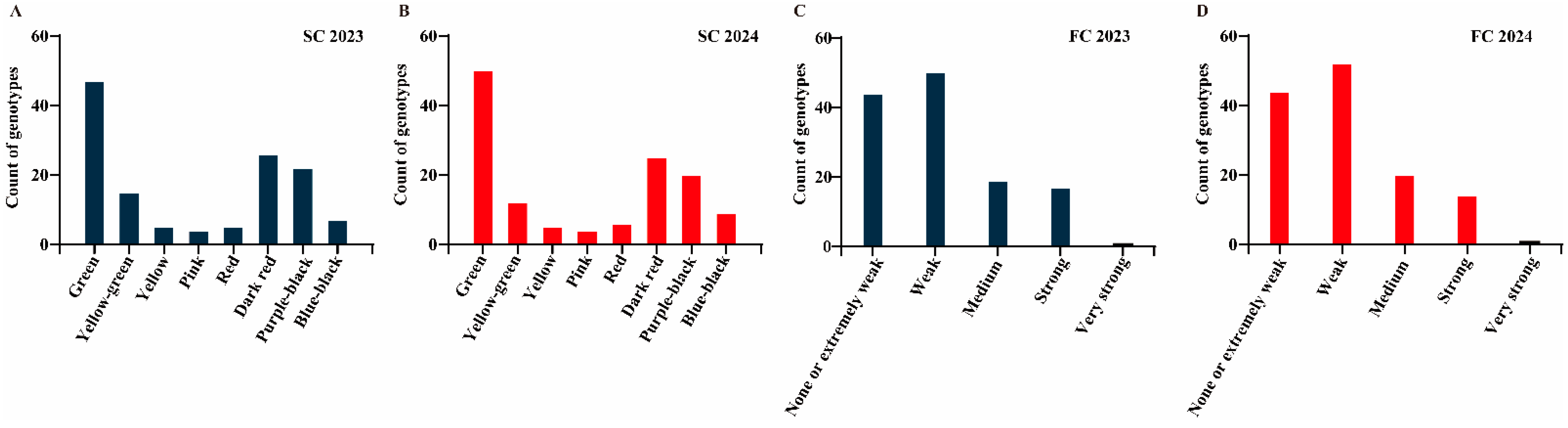
Across 2023 and 2024, SC and FC behaved similarly, indicating high genetic stability and limited environmental influence. In both years, the median of SC and FC was three. Coefficients of variation ranged from 63.94% to 69.98% (Table 1), showing that berry color maintains a stable distribution while retaining considerable genetic diversity. In SC, green had the highest frequency at 35.38% and 37.69% for the two years. In FC, “weak” had the highest frequency at 38.46% and 40.00% (Figure 2).
To dissect the genetic relationship between berry skin and flesh coloration traits, we performed a phenotypic correlation analysis (Figure S1a). The results revealed consistently weak and non-significant correlations between berry skin color and flesh color within the same year (2023: r = 0.08; 2024: r = 0.12). This key finding strongly suggests that skin color and flesh color are largely governed by independent genetic networks. In stark contrast, the same color trait exhibited exceptionally high correlation coefficients across different years (skin color: r = 0.99; flesh color: r = 0.98). This high degree of inter-annual reproducibility clearly demonstrates that the phenotypic variation for both skin and flesh color is primarily controlled by stable genetic factors, with minimal influence from annual environmental fluctuations.

3.2. GWAS for Skin and Flesh Color

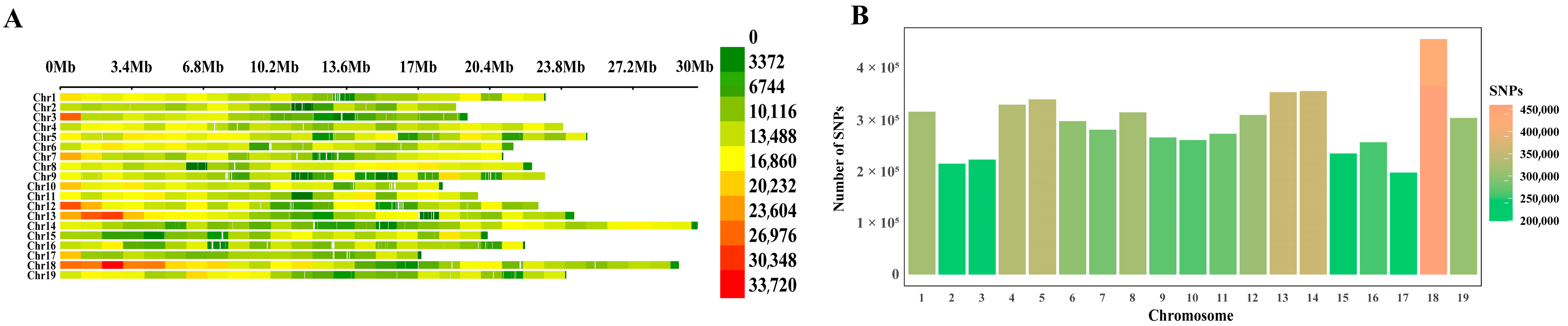
A total of 5,620,388 high-quality SNPs were widely distributed across all 19 chromosomes and approximately uniform genome wide (Figure 3A). Chromosome 18 contained the most SNPs, and chromosome 17 the fewest (Figure 3B). Overall, SNP distribution on each chromosome was approximately proportional to its physical length.
Employing a GLM with adjusted significance thresholds, we identified significant SNP–trait associations for both skin color and flesh color across the 2023 and 2024 datasets (Figure 4A–D). Specifically, 46 and 75 significant SNPs were associated with skin color and flesh color, respectively, in 2023 (Table S5), while 65 and 11 significant SNPs were detected for the same traits in 2024 (Table S6). To ensure robustness, we retained 11 significant SNPs consistently identified in both years as focal regions for candidate gene mining.
For skin color, six significant SNPs located on chromosome 2 exhibited a distinct clustered distribution and collectively explained 44.64% to 51.50% of the phenotypic variance in skin color. For flesh color, five significant SNPs were identified on chromosomes 9, 15, and 16, accounting for 17.21% to 20.74% of the phenotypic variance in flesh color. Among these, SNPs on chromosome 9 displayed a clustering pattern, suggesting their potential coordinated effects on flesh color regulation.

3.3. Candidate-Gene Mining and KEGG Enrichment

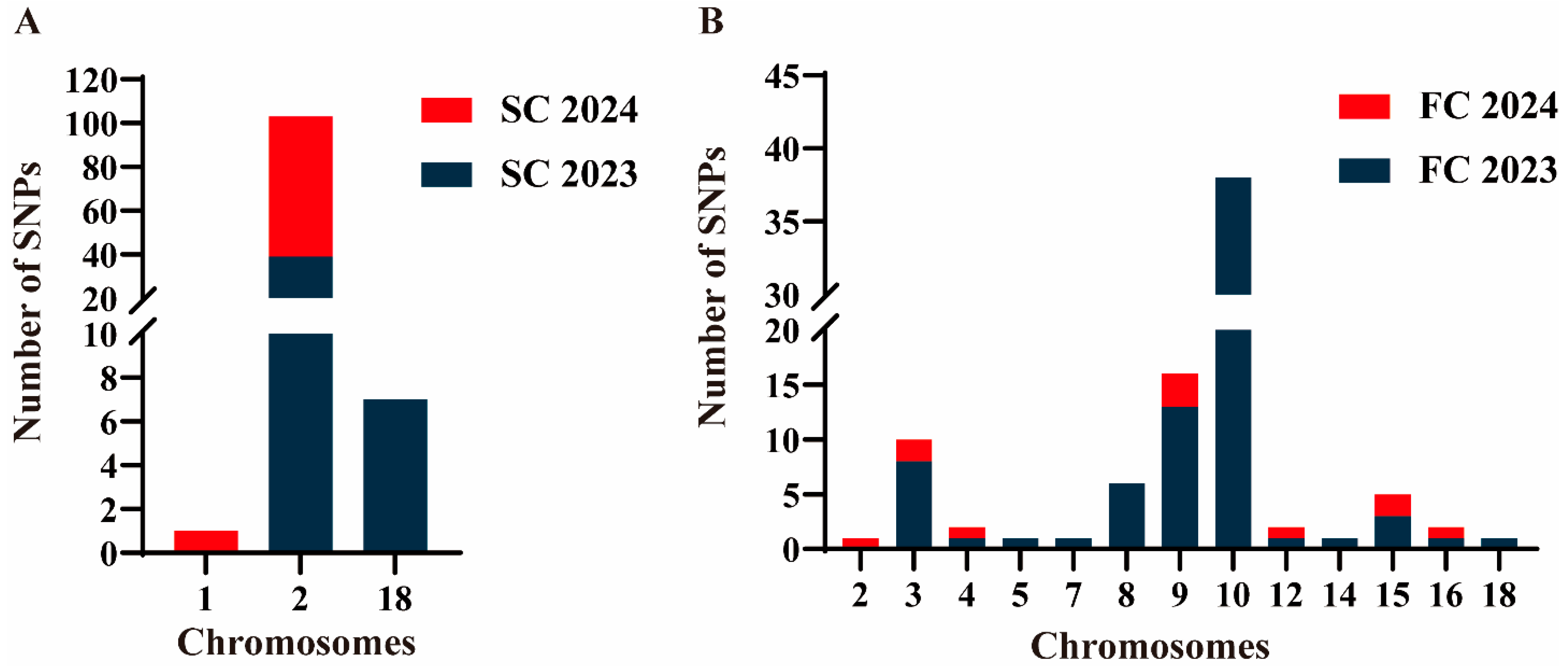
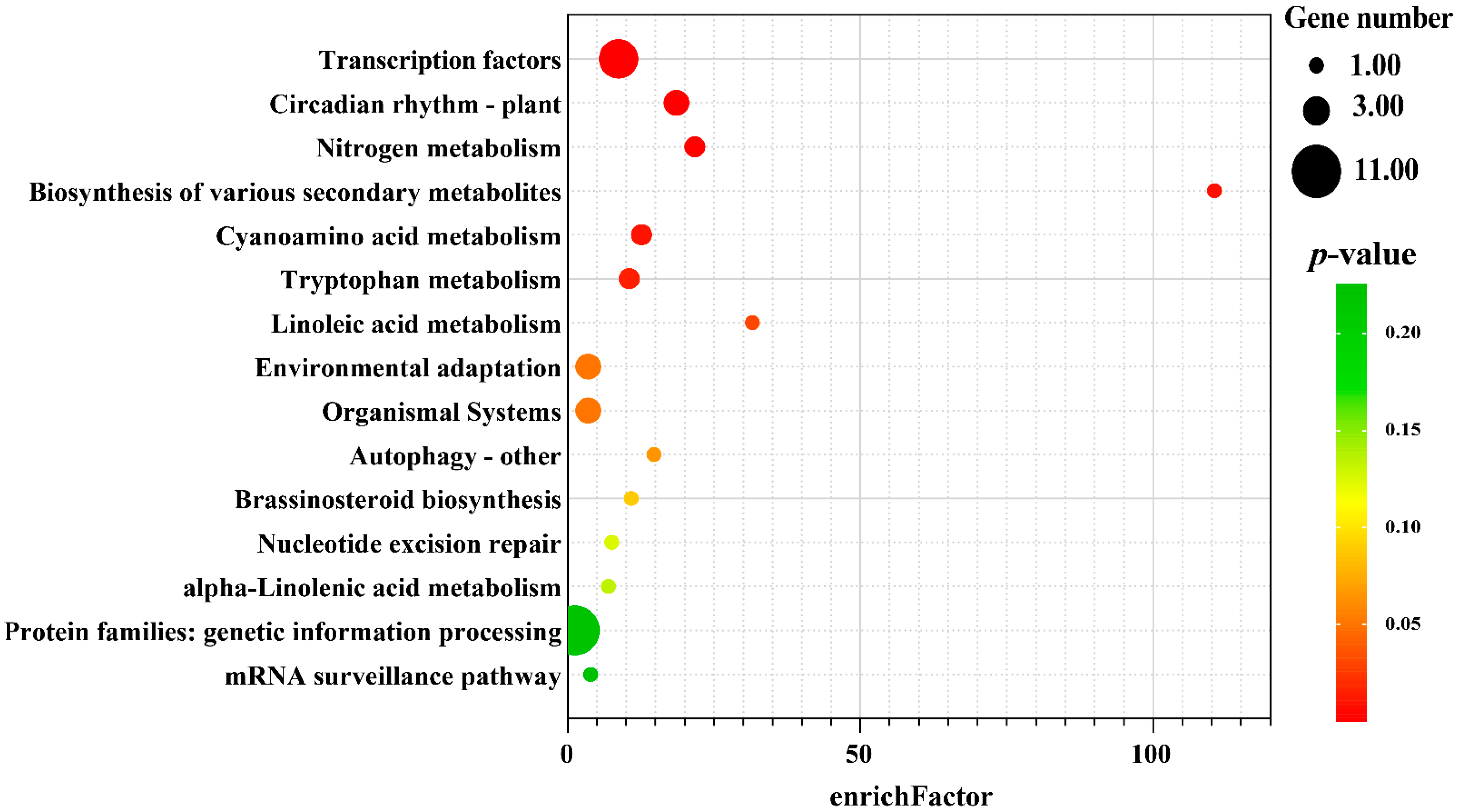
Based on the chromosomal distribution of SNPs for skin color in 2023 and 2024 (Figure 5A), six SNPs that passed the GLM significance thresholds in both years were associated with SC. All six mapped to chromosome 2 (Table 2). Nine candidate genes were identified within the genomic intervals surrounding these loci (Table S7). The top SNP was at chr2:14,172,328 (p = 1.10665911509871 × 10⁻¹²). KEGG categories implicated included transcription factors, circadian rhythm–plant, environmental adaptation, and organismal Systems (Figure 6; Table S9). By gene-function annotation and KEGG enrichment, one gene likely involved in skin-color formation was prioritized: VIT_02s0033g00390, annotated as the MYB-related transcription factor VvMYBA2, located at chr2:14,179,728–14,180,733.
For FC, the chromosomal distribution of SNPs in 2023 and 2024 (Figure 5B) showed five SNPs meeting the GLM thresholds in both years for FC, mapping to two regions on chromosome 9 and to chromosomes 15 and 16 (Table 3). In the genomic segments around the significant FC SNPs, 21 candidate genes were identified (Table S8). KEGG term analysis indicated enrichment in nucleotide excision repair, protein families: genetic information processing, alpha-Linolenic acid metabolism, brassinosteroid biosynthesis, Cytochrome P450, and mRNA surveillance pathway, among others (Figure 6; Table S9). Based on gene-function annotation and enrichment analysis, four candidates likely involved in berry color formation were prioritized: VIT_09s0002g01050 (RING-type domain-containing protein), VIT_09s0002g01080 (Lipoxygenase), VIT_09s0002g01090 (Flavonoid 3′-monooxygenase), and VIT_16s0050g00030 (Pre-mRNA cleavage factor Im 25 kDa subunit). Their physical positions are chr9:773,229–776,435; chr9:812,030–816,741; chr9:829,416–831,978; and chr16:16,882,312–16,895,131, respectively.

3.4. Expression Patterns of Candidate Genes

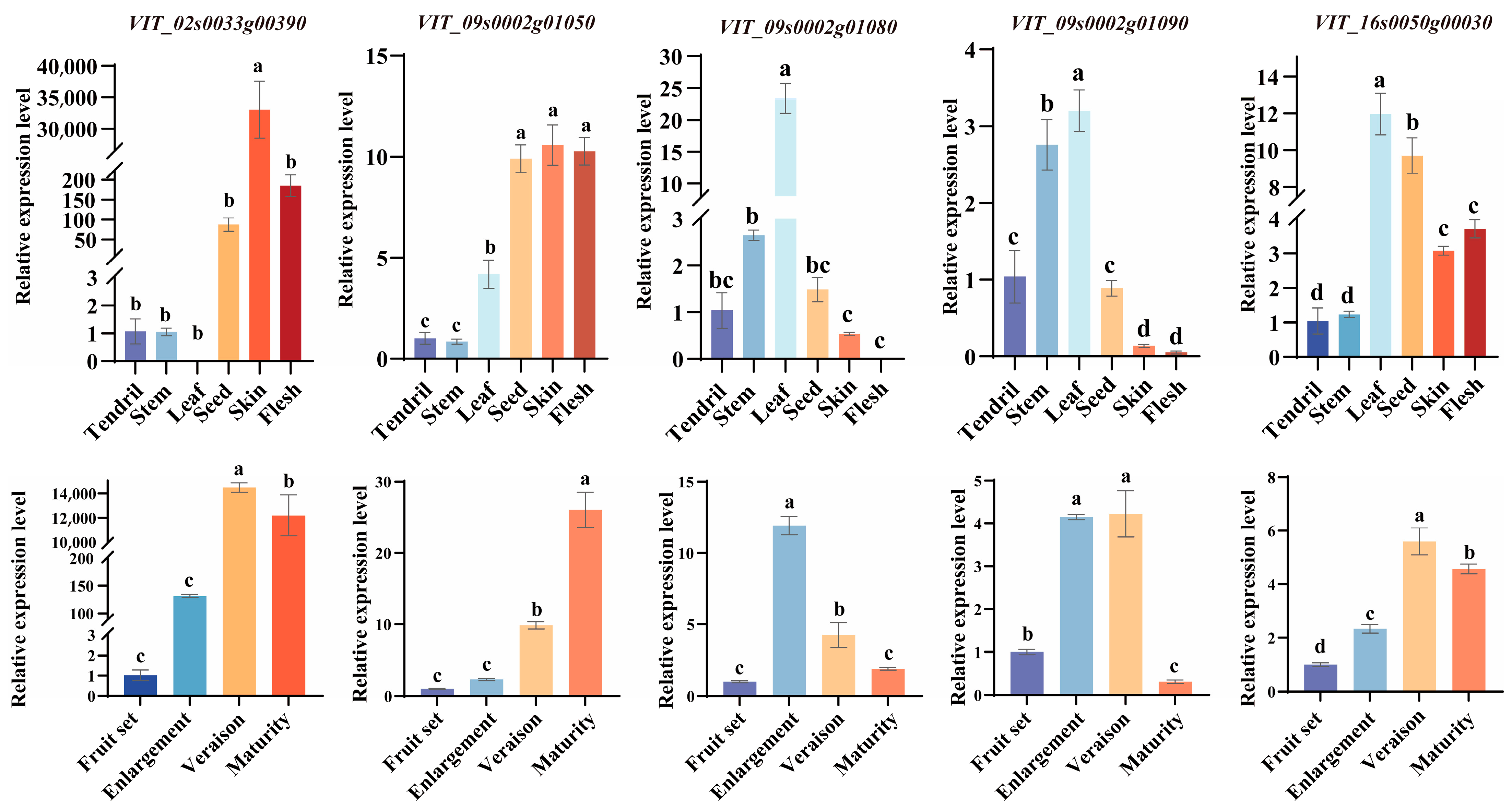
Expression analysis of five candidates (Figure 7; Tables S10 and S11) showed marked spatiotemporal specificity. VIT_09s0002g01050, VIT_16s0050g00030, and VIT_02s0033g00390 increased sharply at veraison and maturity, closely matching the dynamics of anthocyanin accumulation. VIT_09s0002g01050 was dominantly expressed in seed, skin, and flesh. VIT_16s0050g00030 was highly expressed in leaf and seed. VIT_02s0033g00390 showed specific high expression in skin and flesh. Notably, VIT_09s0002g01090 peaked at veraison and exhibited high expression in stem and leaf. These patterns were highly synchronous with the progress of berry coloration, suggesting that the genes participate in color formation by regulating flavonoid metabolism. By contrast, VIT_09s0002g01080 was highly expressed during the enlargement stage and mainly in leaves, a pattern inconsistent with anthocyanin dynamics, suggesting it may not directly control berry color.

3.5. Subcellular Localization and Overexpression

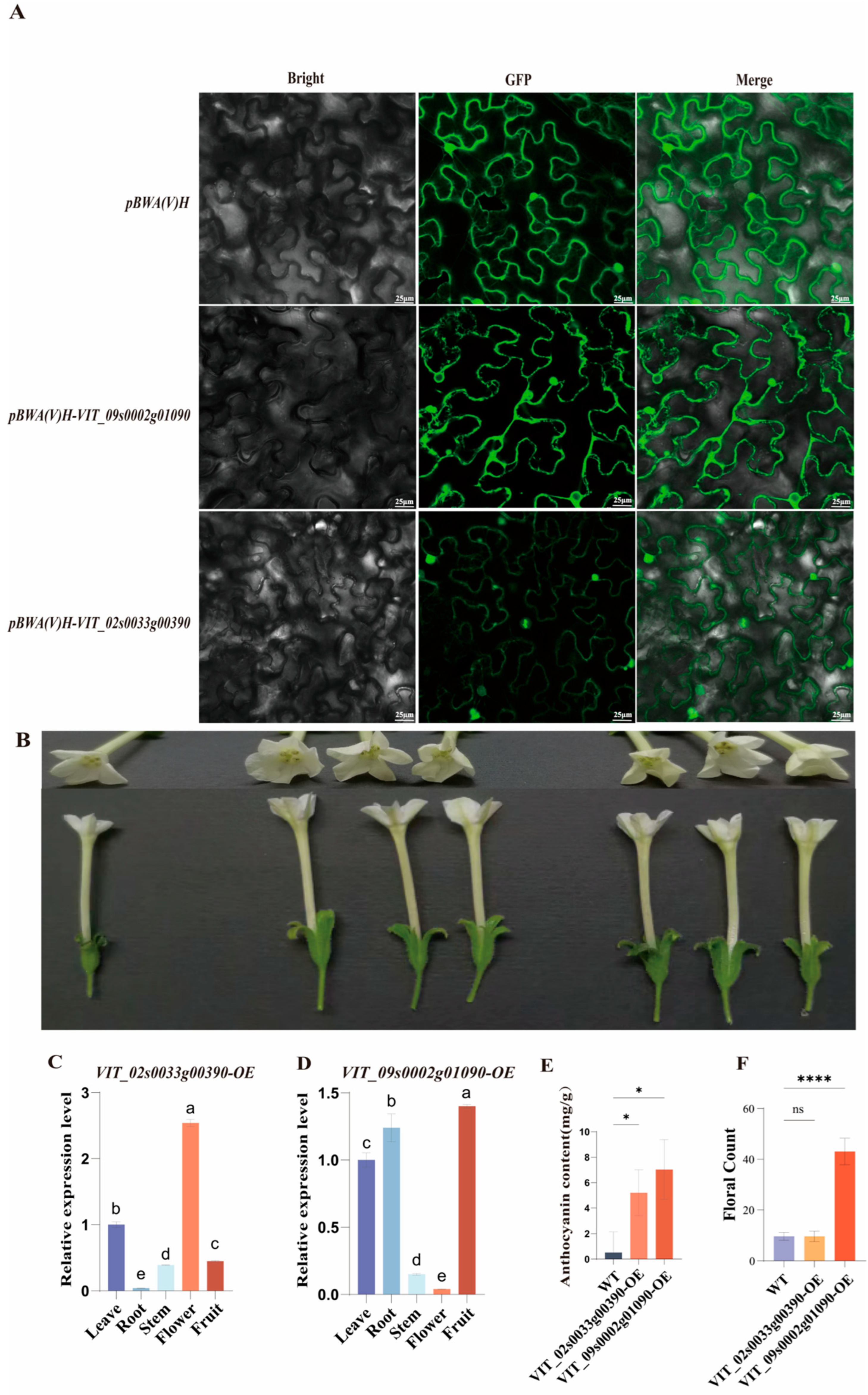
Integrating GWAS, KEGG pathway enrichment, and expression-pattern analyses, we prioritized two candidate genes—VIT_09s0002g01090 and VIT_02s0033g00390—and conducted subcellular localization and overexpression-based functional validation (Figure 8). Subcellular localization (Figure 8A) showed that VIT_09s0002g01090 localized to the plasma membrane and nucleus, and VIT_02s0033g00390 localized to the nucleus. These results are consistent with predictions and with reports in other species (Table S12) and fit the functional characteristics of a metabolic enzyme and a transcription factor.
Upon successful confirmation of transgenic tobacco lines by PCR (Figure S1b), we systematically evaluated anthocyanin accumulation and the functions of the related genes. Phenotypic observations revealed a slight change in flower color of the transgenic plants, presenting as pale yellow (Figure 8B). Further quantitative analysis of anthocyanin content (Figure 8E; Table S13) demonstrated a significant increase in both overexpression lines: the anthocyanin level in the VIT_09s0002g01090-OE line was 13.50-fold that of the wild type, while the VIT_02s0033g00390-OE line reached 10-fold. These results provide physiological evidence supporting the involvement of both genes in the anthocyanin biosynthetic pathway. Analysis of tissue-specific expression patterns (Figure 8C,D; Table S14) indicated that VIT_09s0002g01090 expression was highest in fruit, whereas VIT_02s0033g00390 was most prominently expressed in floral tissues, suggesting that they may differentially regulate pigment synthesis in distinct organs through their organ-specific expression profiles. Notably, the VIT_09s0002g01090-OE line, in addition to exhibiting darker flower color, also produced a significantly greater total number of flowers compared to the wild type (49 vs. 11, Figure 8F; Figure S1c). This phenomenon suggests that this gene may not only be involved in anthocyanin accumulation but could also be associated with other growth and developmental processes, the specific mechanisms of which warrant further investigation.

4. Discussion

Grape berry color is a core determinant of commercial quality, directly influencing market value and consumer preference [35]. While the genetic mechanisms underlying fruit coloration are well-characterized in species like apple [36,37,38] and citrus [39,40,41], the regulatory network in grape remains less comprehensively explored [42]. As a globally important fruit crop with marked variation in berry color among cultivars, a systematic dissection of its genetic control is crucial for targeted quality improvement. Our study provides a systematic dissection of the independent genetic networks controlling skin and flesh coloration in grape. By integrating GWAS with multi-layered functional validation, we not only confirmed the major effect of a known regulator but, more importantly, unveiled a key structural enzyme governing flesh pigmentation and uncovered its potential novel role in plant development.
Our phenotypic analysis revealed that the color scores for SC and FC were highly stable across years, indicating strong genetic control. The weak correlation between SC and FC further supports the hypothesis that these two traits are regulated by largely independent genetic pathways. This is consistent with the known disparity in anthocyanin accumulation patterns between skin and flesh tissues [43], where most cultivars deposit pigments primarily in the skin, and only a few exhibit intense flesh coloration [44]. The high coefficients of variation observed for both traits confirmed the rich genetic diversity of our population, providing an ideal foundation for gene discovery.
Through GWAS, we identified distinct genetic loci for skin and flesh color. For skin color, significant SNPs clustered on chromosome 2, a region previously associated with the VvMYBA locus [45,46,47]. Our most significant SNP (chr2:14,172,328) was proximal to VIT_02s0033g00390 (VvMYBA2). While the role of VvMYBA2 is established [48], our GWAS independently confirms its major effect and provides functional validation through heterologous overexpression, which significantly enhanced anthocyanin accumulation in tobacco. This serves as a robust positive control for our association study.
An important focus of this study was the exploration of the genetic basis underlying grape flesh color, an important agronomic trait. We identified five SNPs significantly associated with flesh color on chromosomes 9, 15, and 16, with a notable clustering of loci on chromosome 9 suggesting potential coordinated regulatory effects. To date, there has been a relatively limited number of GWASs focusing on grape flesh color, and our work provides new clues for deciphering the genetic mechanisms of this trait. It is noteworthy that anthocyanin biosynthesis in the flesh is considered to be governed by a regulatory system independent of the skin [49]. Therefore, elucidating its genetic mechanism is of significant importance for breeding high-quality red-fleshed grape cultivars.
We prioritized VIT_09s0002g01090 as a key candidate gene for flesh color, annotated as a Flavonoid 3′-monooxygenase (VvF3′M). The expression of VvF3′M peaked sharply at veraison, the onset of ripening and color change, indicating a tight temporal link to the anthocyanin biosynthesis process. Crucially, functional validation via heterologous overexpression in tobacco demonstrated that VvF3′M overexpression can drive a profound 13.5-fold increase in anthocyanin content. This strongly supports its potential role as a rate-limiting structural enzyme in the anthocyanin pathway in the context of flesh coloration. Flavonoid 3′-monooxygenase participates in the biosynthesis of anthocyanins in maize (Zea mays L.) [50]. Our study identifies VvF3′M as a candidate gene and provides functional data consistent with its potential role in the natural variation in grape flesh color, within a GWAS framework.
An intriguing and novel observation was that VvF3′M-OE tobacco plants produced significantly more flowers than wild-type controls. This raises the possibility that the altered flavonoid profile resulting from VvF3′M overexpression might influence developmental processes related to flowering. Flavonoids, including anthocyanins, are not only pigments but also modulate auxin transport and reactive oxygen species homeostasis, which can influence flowering time and floral organ development [51]. In Arabidopsis thaliana, flavonoids have been demonstrated to function as negative regulators of auxin transport in vivo [52]. The altered flavonoid profile resulting from VvF3′M overexpression might impact these physiological processes, leading to enhanced flower production. However, the precise mechanism remains unclear, and further research is needed to determine whether VvF3′M directly regulates reproductive development or acts indirectly through broader metabolic reprogramming. This unexpected phenotype opens new avenues for exploring potential interactions between color metabolism and reproductive traits in grapevines. Overall, this study not only systematically elucidates the independent genetic regulatory networks underlying grape skin and flesh color but also provides key genetic resources for molecular design-based breeding. Building on these findings, future efforts can employ technologies such as marker-assisted selection, precise allele pyramiding, or gene editing to directionally improve both the visual appearance and intrinsic quality of grape berries, thereby advancing the cultivation of novel grape varieties with distinctive traits.

5. Conclusions

In conclusion, through a systems genetics approach, we have deciphered the independent genetic architectures underlying skin and flesh coloration in grape. We provide independent population-level validation and quantitative assessment of VvMYBA2 for skin color. Most significantly, we identify and functionally characterize VvF3′M as a key regulator of flesh color and reveal its potential novel function in influencing flower number. These findings deliver crucial insights and valuable genetic resources for understanding color formation and advanced molecular breeding programs, particularly for the improvement of under-explored traits like flesh pigmentation.

Supplementary Materials

The following supporting information can be downloaded at: https://www.mdpi.com/article/10.3390/agronomy16010121/s1, Table S1: Grape Genotypes and Fruit Color; Table S2a: qRT-PCR primer sequences for grapevine (V. vinifera L.); Table S2b: qRT-PCR primer sequences for N. benthamiana; Table S3: PCR amplification reaction system and procedure; Table S4: Cloning and overexpression related primer sequences; Table S5: Significant SNP markers associated with skin and flesh color traits identified by GWAS in 2023; Table S6: Significant SNP markers associated with skin and flesh color traits identified by GWAS in 2024; Table S7: SNP markers and candidate genes associated with fruit skin color traits; Table S8: SNP markers and candidate genes associated with fruit flesh color traits; Table S9: KEGG enrichment for candidate genes associated with berry color; Table S10: Expression profiles of candidate genes across various tissues of ‘Yin-hong’; Table S11: Expression profiles of candidate genes at different developmental stages of ‘Yin-hong’; Table S12: Subcellular localization prediction; Table S13: Total anthocyanin quantification; Table S14: Expression profiles of VIT_02s0033g00390 and VIT_09s0002g01090 across various tissues of N. benthamiana; Figure S1: (a) Pearson correlations among berry-color traits. (b) PCR of transgenic tobacco lines. (c) Flowering counts of VIT_02s0033g00390-OE and VIT_09s0002g01090-OE.

Author Contributions

Z.Y. and Y.X.: Wrote the manuscript. C.F. and S.Z.: Provided and collected experimental materials. L.H. (Lingling Hu), T.X., Q.Z., Y.Z., L.H. (Liufei Huang) and C.Y.: Collected and analyzed the data. Z.Y. and Y.W.: Designed the experiments, reviewed and edited the manuscript. All authors have read and agreed to the published version of the manuscript.

Funding

This work was supported by Public Welfare Research Program Key Project of Ningbo (2024S016), Key Research and Development Program of Zhejiang Province (2021C02053), Zhejiang Provincial Top Discipline of Biological Engineering (Level A) Self-set Subject (ZS2023016).

Data Availability Statement

The data presented in this study are openly available in the Genome Sequence Archive database at https://ngdc.cncb.ac.cn/ or PRJCA026367.

Conflicts of Interest

The authors declare no conflict of interest.

Abbreviations

GWASGenome-wide association study
SNPSingle-nucleotide polymorphism
GLMGeneralized linear model
MAFMinor allele frequency
PVEPhenotypic variance explained
KEGGKyoto Encyclopedia of Genes and Genomes
CTABCetyltrimethylammonium bromide
MES2-(N-morpholino)ethanesulfonic acid
SDStandard deviation
Chr.Chromosome
SCSkin color
FCFlesh color

References

  1. Jia, H.; Zhang, C.; Pervaiz, T.; Zhao, P.; Liu, Z.; Wang, B.; Wang, C.; Zhang, L.; Fang, J.; Qian, J. Jasmonic acid involves in grape fruit ripening and resistant against botrytis cinerea. Funct. Integr. Genom. 2016, 16, 79–94. [Google Scholar] [CrossRef]
  2. Guzmanardiles, R.E.; Pegoraro, C.; Maia, L.C.D.; de Oliveira, A.C. Genetic changes in the genus Vitis and the domestication of vine. Front. Plant Sci. 2023, 13, 1019311. [Google Scholar] [CrossRef] [PubMed]
  3. Lai, Y.; Zhang, C.; Yan, H.; Nai, G.; Bao, J.; Sun, P.; Liu, Y.; Zhang, J.; Pu, Z.; Li, S.; et al. Research progress on grapevine response mechanisms and alleviation measures under salt stress. J. Plant Growth Regul. 2025, 44, 3411–3424. [Google Scholar] [CrossRef]
  4. Dong, T.; Zheng, T.; Fu, W.; Guan, L.; Jia, H.; Fang, J. The effect of ethylene on the color change and resistance to botrytis cinerea infection in ‘kyoho’ grape fruits. Foods 2020, 9, 892. [Google Scholar] [CrossRef]
  5. de Souza Leao, P.C.; Cruz, C.D.; Motoike, S.Y. Genetic diversity of table grape based on morphoagronomic traits. Sci. Agric. 2011, 68, 42–49. [Google Scholar] [CrossRef]
  6. Castellarin, S.D.; Matthews, M.A.; Di Gaspero, G.; Gambetta, G.A. Water deficits accelerate ripening and induce changes in gene expression regulating flavonoid biosynthesis in grape berries. Planta 2007, 227, 101–112. [Google Scholar] [CrossRef]
  7. Castellarin, S.D.; Di Gaspero, G.; Marconi, R.; Nonis, A.; Peterlunger, E.; Paillard, S.; Adam-Blondon, A.; Testolin, R. Colour variation in red grapevines (Vitis vinifera L.): Genomic organisation, expression of flavonoid 3′-hydroxylase, flavonoid 3′,5′-hydroxylase genes and related metabolite profiling of red cyanidin-/blue delphinidin-based anthocyanins in berry skin. BMC Genom. 2006, 7, 12. [Google Scholar] [CrossRef]
  8. Zhang, X.; Wang, X.; Wang, X.; Xia, G.; Pan, Q.; Fan, R.; Wu, F.; Yu, X.; Zhang, D. A shift of phloem unloading from symplasmic to apoplasmic pathway is involved in developmental onset of ripening in grape berry. Plant Physiol. 2006, 142, 220–232. [Google Scholar] [CrossRef]
  9. Czemmel, S.; Heppel, S.C.; Bogs, J. R2r3 MYB transcription factors: Key regulators of the flavonoid biosynthetic pathway in grapevine. Protoplasma 2012, 249, S109–S118. [Google Scholar] [CrossRef] [PubMed]
  10. Ageorges, A.; Fernandez, L.; Vialet, S.; Merdinoglu, D.; Terrier, N.; Romieu, C. Four specific isogenes of the anthocyanin metabolic pathway are systematically co-expressed with the red colour of grape berries. Plant Sci. 2006, 170, 372–383. [Google Scholar] [CrossRef]
  11. Gomez, C.; Conejero, G.; Torregrosa, L.; Cheynier, V.; Terrier, N.; Ageorges, A. In vivo grapevine anthocyanin transport involves vesicle-mediated trafficking and the contribution of anthomate transporters and GST. Plant. J. 2011, 67, 960–970. [Google Scholar] [CrossRef]
  12. Francisco, R.M.; Regalado, A.; Ageorges, A.; Burla, B.J.; Bassin, B.; Eisenach, C.; Zarrouk, O.; Vialet, S.; Marlin, T.; Chaves, M.M.; et al. ABCC1, an ATP binding cassette protein from grape berry, transports anthocyanidin 3-o-glucosides. Plant Cell 2013, 25, 1840–1854. [Google Scholar] [CrossRef]
  13. Jiu, S.; Guan, L.; Leng, X.; Zhang, K.; Haider, M.S.; Yu, X.; Zhu, X.; Zheng, T.; Ge, M.; Wang, C.; et al. The role of VvMYBA2r and VvMYBA2w alleles of the MYBA2 locus in the regulation of anthocyanin biosynthesis for molecular breeding of grape (Vitis spp.) Skin coloration. Plant Biotechnol. J. 2021, 19, 1216–1239. [Google Scholar] [CrossRef] [PubMed]
  14. Ferreira, V.; Fernandes, F.; Pinto-Carnide, O.; Valentao, P.; Falco, V.; Martin, J.P.; Ortiz, J.M.; Arroyo-Garcia, R.; Andrade, P.B.; Castro, I. Identification of vitis vinifera l. Grape berry skin color mutants and polyphenolic profile. Food Chem. 2016, 194, 117–127. [Google Scholar] [CrossRef] [PubMed]
  15. Zhao, J. Flavonoid transport mechanisms: How to go, and with whom. Trends Plant Sci. 2015, 20, 576–585. [Google Scholar] [CrossRef]
  16. Adam-Blondon, A.; Roux, C.; Claux, D.; Butterlin, G.; Merdinoglu, D.; This, P. Mapping 245 SSR markers on the Vitis vinifera genome: A tool for grape genetics. Theor. Appl. Genet. 2004, 109, 1017–1027. [Google Scholar] [CrossRef]
  17. Doligez, A.; Adam-Blondon, A.F.; Cipriani, G.; Di Gaspero, G.; Laucou, V.; Merdinoglu, D.; Meredith, C.P.; Riaz, S.; Roux, C.; This, P. An integrated SSR map of grapevine based on five mapping populations. Theor. Appl. Genet. 2006, 113, 369–382. [Google Scholar] [CrossRef]
  18. Di Gaspero, G.; Cipriani, G.; Adam-Blondon, A.; Testolin, R. Linkage maps of grapevine displaying the chromosomal locations of 420 microsatellite markers and 82 markers for r-gene candidates. Theor. Appl. Genet. 2007, 114, 1249–1263. [Google Scholar] [CrossRef] [PubMed]
  19. Salmaso, M.; Malacarne, G.; Troggio, M.; Faes, G.; Stefanini, M.; Grando, M.S.; Velasco, R. A grapevine (Vitis vinifera L.) Genetic map integrating the position of 139 expressed genes. Theor. Appl. Genet. 2008, 116, 1129–1143. [Google Scholar] [CrossRef]
  20. Jaillon, O.; Aury, J.; Noel, B.; Policriti, A.; Clepet, C.; Casagrande, A.; Choisne, N.; Aubourg, S.; Vitulo, N.; Jubin, C.; et al. The grapevine genome sequence suggests ancestral hexaploidization in major angiosperm phyla. Nature 2007, 449, 463–467. [Google Scholar] [CrossRef]
  21. Varshney, R.K.; Nayak, S.N.; May, G.D.; Jackson, S.A. Next-generation sequencing technologies and their implications for crop genetics and breeding. Trends. Biotechnol. 2009, 27, 522–530. [Google Scholar] [CrossRef]
  22. Korte, A.; Farlow, A. The advantages and limitations of trait analysis with GWAS: A review. Plant Methods 2013, 9, 29. [Google Scholar] [CrossRef] [PubMed]
  23. Li, Y.; Liang, J.; Zeng, X.; Guo, H.; Luo, Y.; Kear, P.; Zhang, S.; Zhu, G. Genome-wide analysis of MYB gene family in potato provides insights into tissue-specific regulation of anthocyanin biosynthesis. Hortic. Plant J. 2021, 7, 129–141. [Google Scholar] [CrossRef]
  24. Garcia-Abadillo, J.; Barba, P.; Carvalho, T.; Sosa-Zuniga, V.; Lozano, R.; Carvalho, H.F.; Garcia-Rojas, M.; Salazar, E.; Sanchez, J.I. Dissecting the complex genetic basis of pre- and post-harvest traits in Vitis vinifera L. Using genome-wide association studies. Hortic. Res. 2024, 11, uhad283. [Google Scholar] [CrossRef]
  25. Zhang, C.A.; Wu, J.Y.; Cui, L.W.; Fang, J.G. Mining of candidate genes for grape berry cracking using a genome-wide association study. J. Integr. Agric. 2022, 21, 2291–2304. [Google Scholar] [CrossRef]
  26. Zhang, C.; Yang, Y.; Zhang, S.; Yadav, V.; Zhong, H.; Zhang, F.; Zhou, X.; Wu, X.; Cao, X.; Cui, L. Mining candidate genes for grape seed traits based on a genome-wide association study. Hortic. Plant J. 2024, 11, 1847–1864. [Google Scholar] [CrossRef]
  27. Zhang, C.; Cui, L.; Fang, J. Genome-wide association study of the candidate genes for grape berry shape-related traits. BMC Plant Biol. 2022, 22, 42. [Google Scholar] [CrossRef]
  28. Guo, D.; Zhao, H.; Li, Q.; Zhang, G.; Jiang, J.; Liu, C.; Yu, Y. Genome-wide association study of berry-related traits in grape [Vitis vinifera L.] Based on genotyping-by-sequencing markers. Hortic. Res. 2019, 6, 11. [Google Scholar] [CrossRef]
  29. Hu, L.; Xu, T.; Cai, Y.; Qin, Y.; Zheng, Q.; Chen, T.; Gong, L.; Yang, J.; Zhao, Y.; Chen, J.; et al. Identifying candidate genes for grape (Vitis vinifera L.) Fruit firmness through genome-wide association studies. J. Agric. Food Chem. 2025, 73, 8413–8425. [Google Scholar] [CrossRef]
  30. NY/T 2563-2014; Guidelines for the Conduct of Tests for Distinctness, Uniformity and Stability—Grapevine (Vitis L.). Ministry of Agriculture of the People’s Republic of China: Beijing, China, 2014.
  31. Sun, Q.; He, L.; Sun, L.; Xu, H.; Fu, Y.; Sun, Z.; Zh u, B.; Duan, C.; Pan, Q. Identification of SNP loci and candidate genes genetically controlling norisoprenoids in grape berry based on genome-wide association study. Front. Plant Sci. 2023, 14, 1142139. [Google Scholar] [CrossRef]
  32. Murray, M.G.; Thompson, W.F. Rapid isolation of high molecular weight plant DNA. Nucleic Acids. Res. 1980, 8, 4321–4326. [Google Scholar] [CrossRef] [PubMed]
  33. Lee, H.S.; Wicker, L. Anthocyanin pigments in the skin of lychee fruit. J. Food Sci. 1991, 56, 466–468. [Google Scholar] [CrossRef]
  34. Zhang, W.; Li, X.; Zheng, J.; Wang, G.; Sun, C.; Ferguson, I.B.; Chen, K. Bioactive components and antioxidant capacity of chinese bayberry (Myrica rubra Sieb. and Zucc.) Fruit in relation to fruit maturity and postharvest storage. Eur. Food Res. Technol. 2008, 227, 1091–1097. [Google Scholar] [CrossRef]
  35. Wang, C.; Wang, L.; Ye, J.; Xu, F. Fruit quality of Vitis vinifera: How plant metabolites are affected by genetic, environmental, and agronomic factors. Sci. Hortic. 2022, 305, 111404. [Google Scholar] [CrossRef]
  36. Dar, J.A.; Wani, A.A.; Ahmed, M.; Nazir, R.; Zargar, S.M.; Javaid, K. Peel colour in apple (malus × domestica borkh.): An economic quality parameter in fruit market. Sci. Hortic. 2019, 244, 50–60. [Google Scholar] [CrossRef]
  37. Zhang, L.; Hu, J.; Han, X.; Li, J.; Gao, Y.; Richards, C.M.; Zhang, C.; Tian, Y.; Liu, G.; Gul, H.; et al. A high-quality apple genome assembly reveals the association of a retrotransposon and red fruit colour. Nat. Commun. 2019, 10, 1494. [Google Scholar] [CrossRef] [PubMed]
  38. Kumar, S.; Molloy, C.; Hunt, M.; Deng, C.H.; Wiedow, C.; Andre, C.; Dare, A.; Mcghie, T. GWAS provides new insights into the genetic mechanisms of phytochemicals production and red skin colour in apple. Hortic. Res. 2022, 9, uhac218. [Google Scholar] [CrossRef]
  39. Barry, G.; Van Wyk, A. Low-temperature cold shock may induce rind colour development of ‘nules clementine’ mandarin (Citrus reticulata blanco) fruit. Postharvest Biol. Technol. 2006, 40, 82–88. [Google Scholar] [CrossRef]
  40. Lu, Y.; Shen, X.; Li, Y.; Xu, Y.; Chen, Y.; Chen, Y.; Hu, X.; Li, X.; Sun, X.; Gong, J. Regulation of chlorophyll and carotenoid metabolism in citrus fruit. Hortic. Plant J. 2024, 11, 951–962. [Google Scholar] [CrossRef]
  41. Wang, H.; Liu, Q.; Deng, S.; Chen, J.; Han, J.; Zhu, R.; Zeng, K.; Deng, L. Transcription factor CcbHLH66 regulates mandarin fruit coloration via modulating the expression of chlorophyll degradation related genes CcRCCR and CcNYC. Postharvest Biol. Technol. 2024, 218, 113188. [Google Scholar] [CrossRef]
  42. Fang, J.; Jogaiah, S.; Guan, L.; Sun, X.; Abdelrahman, M. Coloring biology in grape skin: A prospective strategy for molecular farming. Physiol. Plant. 2018, 164, 429–441. [Google Scholar] [CrossRef] [PubMed]
  43. Guan, L.; Dai, Z.; Wu, B.; Wu, J.; Merlin, I.; Hilbert, G.; Renaud, C.; Gomes, E.; Edwards, E.; Li, S.; et al. Anthocyanin biosynthesis is differentially regulated by light in the skin and flesh of white-fleshed and teinturier grape berries. Planta 2016, 243, 23–41. [Google Scholar] [CrossRef]
  44. Porret, N.; Cousins, P.; Owens, C. (265) DNA sequence variation within the promoter of VvmybA1 associates with flesh pigmentation of intensely colored grape varieties. Hortscience 2006, 41, 1049C–1049. [Google Scholar] [CrossRef]
  45. Oglesby, L.; Ananga, A.; Obuya, J.; Ochieng, J.; Cebert, E.; Tsolova, V. Anthocyanin accumulation in muscadine berry skins is influenced by the expression of the MYB transcription factors, MybA1, and MYBCS1. Antioxidants 2016, 5, 35. [Google Scholar] [CrossRef]
  46. Matus, J.T.; Cavallini, E.; Loyola, R.; Hoell, J.; Finezzo, L.; Dal Santo, S.; Vialet, S.; Commisso, M.; Roman, F.; Schubert, A.; et al. A group of grapevine MYBA transcription factors located in chromosome 14 control anthocyanin synthesis in vegetative organs with different specificities compared with the berry color locus. Plant. J. 2017, 91, 220–236. [Google Scholar] [CrossRef]
  47. Li, H.; Yang, Y.; Zhang, W.; Zheng, H.; Xu, X.; Li, H.; Sun, C.; Hu, H.; Zhao, W.; Ma, R.; et al. Promoter replication of grape MYB transcription factor is associated with a new red flesh phenotype. Plant Cell Rep. 2024, 43, 136. [Google Scholar] [CrossRef]
  48. Niu, T.Q.; Gao, Z.D.; Zhang, P.F.; Zhang, X.J.; Gao, M.Y.; Ji, W.; Fan, W.X.; Wen, P.F. MYBA2 gene involved in anthocyanin and flavonol biosynthesis pathways in grapevine. Genet. Mol. Res. 2016, 15, gmr15048922. [Google Scholar] [CrossRef] [PubMed]
  49. Lu, R.; Song, M.; Wang, Z.; Zhai, Y.; Hu, C.; Perl, A.; Ma, H. Independent flavonoid and anthocyanin biosynthesis in the flesh of a red-fleshed table grape revealed by metabolome and transcriptome co-analysis. BMC Plant Biol. 2023, 23, 361. [Google Scholar] [CrossRef]
  50. Larson, R.L.; Bussard, J.B. Microsomal flavonoid 3′-monooxygenase from maize seedlings. Plant Physiol. 1986, 80, 483–486. [Google Scholar] [CrossRef]
  51. Peer, W.A.; Murphy, A.S. Flavonoids and auxin transport: Modulators or regulators? Trends Plant Sci. 2007, 12, 556–563. [Google Scholar] [CrossRef] [PubMed]
  52. Brown, D.E.; Rashotte, A.M.; Murphy, A.S.; Normanly, J.; Tague, B.W.; Peer, W.A.; Taiz, L.; Muday, G.K. Flavonoids act as negative regulators of auxin transport in vivo in arabidopsis. Plant Physiol. 2001, 126, 524–535. [Google Scholar] [CrossRef] [PubMed]
Figure 1. Visual grading of grape berry color. (A) Vitis labrusca × Vitis vinifera ‘Shine Muscat’; (B) Vitis vinifera ‘Koshu’; (C) Vitis vinifera ‘Conglinmeigui’; (D) Vitis vinifera ‘Tiantaiyang’; (E) Vitis vinifera ‘Jintianmeigui’; (F) Vitis vinifera ‘Shaoxingyihao’; (G) Vitis labrusca × Vitis vinifera ‘Kyoho’; (H) Vitis vinifera ‘Lanbaoshi’.
Agronomy 16 00121 g001
Figure 2. Phenotypic analysis of berry color. (AD) Frequency distributions of skin color (SC) and flesh color (FC) phenotypes across two consecutive years, evaluated in a panel of 130 genotypes.
Agronomy 16 00121 g002
Figure 3. Genome-wide distribution and counts of SNPs across the 19 grapevine chromosomes. (A) SNP density along each chromosome. Note: the x-axis indicates chromosome length; density is expressed as the number of SNPs per 1 Mb window. (B) SNP counts by chromosome.
Agronomy 16 00121 g003
Figure 4. Manhattan plots of GWAS for grape berry color–related traits. (A,B) 2023 GWAS results for skin color and flesh color, respectively. (C,D) 2024 GWAS results for skin color and flesh color, respectively. The x-axis shows physical position along the 19 chromosomes; the y-axis shows −log10(p). Genome-wide significance thresholds were −log10(p) = 10 for skin color and −log10(p) = 5 for flesh color.
Agronomy 16 00121 g004
Figure 5. Genomic distribution of SNPs controlling skin and flesh color in 2023 and 2024. (A) Skin color (SC). (B) Flesh color (FC).
Agronomy 16 00121 g005
Figure 6. KEGG enrichment for candidate genes associated with berry color.
Agronomy 16 00121 g006
Figure 7. Expression of candidate genes across ‘Yin-hong’ tissues (Tendril, Stem, Leaf, Seed, Skin, Flesh) and across stages (Fruit set, Enlargement, Veraison, Maturity). Bars with different letters indicate statistically significant differences (p < 0.05).
Agronomy 16 00121 g007
Figure 8. Subcellular localization and overexpression of VIT_09s0002g01090 and VIT_02s0033g00390. (A) Subcellular localization; Bar = 25 µm. (B) Floral phenotypes: left, wild type; middle, VIT_09s0002g01090-OE; right, VIT_02s0033g00390-OE. (C) Expression of VIT_02s0033g00390 in tissues of VIT_02s0033g00390-OE; Bars with different letters indicate statistically significant differences (p < 0.05). (D) Expression of VIT_09s0002g01090 in tissues of VIT_09s0002g01090-OE; Bars with different letters indicate statistically significant differences (p < 0.05). (E) Total anthocyanin content in transgenic tobacco; * p < 0.05. (F) Flower number in the overexpression line; “ns” stands for not statistically significant, **** p < 0.0001.
Agronomy 16 00121 g008
Table 1. Descriptive statistics for grape color-related traits in 2023 and 2024.
TraitYearMedianSDSkewnessKurtosisCV (%)
SC202332.630.15−1.7168.73
202432.670.17−1.7069.98
FC202332.050.72−0.3864.93
202431.970.77−0.1463.94
Table 2. Significant SNPs for SC detected in both 2023 and 2024.
TraitSNP NumberChr.Positionp ValuePVE
(%)
20232024
SC6213,719,0291.00062049929719 × 10−112.3454624722796 × 10−1250.51
213,994,8872.05162388497504 × 10−115.77052842059382 × 10−1248.62
214,165,4233.18447527371019 × 10−113.29005199794487 × 10−1247.48
214,172,3282.17544166712701 × 10−111.10665911509871 × 10−1248.47
215,492,7589.62413481319484 × 10−111.95439517603571 × 10−1244.64
215,746,6306.9159475429752 × 10−122.45414669520784 × 10−1251.50
Table 3. Significant SNPs for FC detected in both 2023 and 2024.
TraitSNP NumberChr.Positionp ValuePVE
(%)
20232024
FC59781,2549.67357699192453 × 10−67.2829093913397 × 10−617.21
9798,8283.77475294729629 × 10−68.31795325381981 × 10−718.97
91,139,7321.48972742603315 × 10−62.1883336234629 × 10−620.74
158,046,6796.77020426963325 × 10−63.29441642148634 × 10−617.88
1616,906,5203.19154622927779 × 10−69.7105139181244 × 10−619.29
Disclaimer/Publisher’s Note: The statements, opinions and data contained in all publications are solely those of the individual author(s) and contributor(s) and not of MDPI and/or the editor(s). MDPI and/or the editor(s) disclaim responsibility for any injury to people or property resulting from any ideas, methods, instructions or products referred to in the content.