Article

Genome-Wide Analysis of the GH3 Gene Family in Nicotiana benthamiana and Its Role in Plant Defense Against Tomato Yellow Leaf Curl Virus


1
Zhejiang Provincial Key Laboratory of Biology of Crop Pathogens and Insects, College of Life Sciences, Huzhou University, Huzhou 313000, China
2
School of Information Engineering, Shenyang Institute of Science and Technology, Shenyang 110167, China
3
College of Forestry and Biotechnology, Zhejiang A&F University, Hangzhou 311300, China
*
Authors to whom correspondence should be addressed.
These authors contributed equally to this work.
Agronomy 2026, 16(1), 115; https://doi.org/10.3390/agronomy16010115 (registering DOI)
Submission received: 25 November 2025 / Revised: 26 December 2025 / Accepted: 29 December 2025 / Published: 1 January 2026
(This article belongs to the Section Pest and Disease Management)

Abstract

The Gretchen Hagen 3 (GH3) gene family, a key component of the early auxin-responsive gene family, plays a pivotal role in regulating plant growth, development, and stress responses. However, to date, a comprehensive genome-wide analysis of the GH3 gene family and its potential role in plant defense against viruses, such as tomato yellow leaf curl virus (TYLCV), has not been conducted in Nicotiana benthamiana. Here, the GH3 gene family was thoroughly examined in N. benthamiana using a comprehensive genome-wide bioinformatic approach. A total of 25 potential GH3 genes were discovered in N. benthamiana. Phylogenetic analysis classified these NbGH3s into three different clades. Chromosomal distribution and synteny analyses revealed that NbGH3s are unevenly distributed across 14 chromosomes, with 20 segmental and one tandem duplication pairs. Promoter analysis suggested their involvement in phytohormone signaling and stress responses. Quantitative PCR showed that several NbGH3s are transcriptionally responsive to TYLCV infection, with five of them significantly upregulated in infected leaves. Furthermore, virus-induced gene silencing revealed that the suppression of NbGH3-3 and NbGH3-9 markedly increased host susceptibility to TYLCV, underscoring their critical roles in plant antiviral defense mechanisms. This research establishes a framework for understanding the functions of NbGH3s in plant growth and their response to TYLCV infection.

1. Introduction

Auxin, an important hormone in plants, significantly influences the regulation of various biological processes, such as signal transduction, transport, plant metabolism, organ patterning, reproduction, apical dominance, shoot elongation, gravitropism, and responses to various stresses [1,2]. Auxin regulates these processes by modulating the expression of three key auxin-responsive gene families: Gretchen Hagen 3 (GH3) genes, auxin/indole-3-acetic acid (Aux/IAA) genes, and small auxin-upregulated RNA (SAUR) genes [3,4,5]. In plants, GH3 genes respond quickly to auxin and are crucial for regulating growth, development, and defense by maintaining phytohormone homeostasis [6,7,8]. In 1985, the first GH3 gene was cloned from soybean (Glycine max) [9]. Since then, GH3 genes have been discovered in numerous plants, including tobacco (Nicotiana tabacum) [10], Arabidopsis (Arabidopsis thaliana) [11], and rice (Oryza sativa) [12]. In the past decade, the GH3 gene family has been extensively investigated in grain and important economic crops, such as apple (Malus domestica) [13], legumes [14], maize (Zea mays) [15], tomato (Solanum lycopersicum) [16], oilseed rape (Brassica napus) [17], wheat (Triticum aestivum) [7], sugarcane (Saccharum spp.) [8], potato (Solanum tuberosum) [18], Chinese cabbage (Brassica rapa) [19], and tea plant (Camellia sinensis) [20]. These studies underscore the growing significance of GH3 research in plant sciences and highlight the critical roles of GH3 genes in higher plants.
Based on sequence similarity and evolutionary relationships, the GH3 gene family can be classified into three distinct subfamilies [7,18,20]. Members of Subfamily I contain highly conserved serine residues that interact with jasmonic acid (JA) and 1-aminocyclopropane-1-carboxylic acid, functioning as an essential component in the regulation of JA and ethylene pathways [8,21,22]. Subfamily II members contain conserved lysine residues that facilitate the adenylation and conjugation of IAA to amino groups. A number of these are also involved in the adenylation and conjugation of salicylic acid (SA) to amino groups [8,22,23]. Subfamily III, which consists of a smaller number of members, is also considered to facilitate the coupling reaction between SA and amino groups, while others are thought to be implicated in the adenylation and conjugation of indole-3-butyric acid to amino groups [22,23]. Earlier research has indicated that GH3 genes are essential in regulating plant responses to diverse abiotic stresses [18,19,24]. For example, in rice, the GH3-2 gene simultaneously regulates the homeostasis of endogenous IAA and abscisic acid (ABA), thus influencing drought and cold tolerance [25]. In cotton, the GH3-5 gene is downregulated by drought and salt stresses, and its silencing severely hampers the adaptability of cotton plants to these stress conditions [26]. In Arabidopsis, the entire Subfamily II of GH3 genes has been reported to confer tolerance to both salinity and water deficit [27].
Apart from their roles in regulating plant responses to abiotic stresses, GH3 genes are also key players in plant defense against biotic stresses [6,21,24]. Recent studies have revealed that GH3 genes are pivotal in mediating plant resistance to bacterial and fungal pathogens in several grain and economically important crops. For example, the OsGH3-8 gene from the rice Subfamily I promotes rice resistance to the bacterial pathogen Xanthomonas oryzae by regulating JA homeostasis [21,28]. Furthermore, the OsGH3-2 gene from the rice Subfamily II confers broad-spectrum resistance against X. oryzae and the fungal pathogen Magnaporthe grisea by reducing expansin production through the inhibition of pathogen-induced IAA production [29]. In citrus, the CsGH3-1 and CsGH3-6 genes are markedly upregulated by the bacterial pathogens X. axonopodis and X. citri, and their overexpression confers enhanced resistance to canker disease through the inhibition of auxin signaling [30,31,32]. In sugarcane, ScGH3-1 is negatively regulated by the smut pathogen Sporisorium scitamineum, and its transient overexpression in Nicotiana benthamiana decreases pathogen resistance by suppressing the JA signaling pathway through the downregulation of JA-responsive genes [8,33]. These pleiotropic effects on pathogen infections provide potential genetic resources for developing disease-resistant crops through breeding. However, to date, it remains unclear whether GH3 genes participate in plant resistance to viral infections.
Plant viral diseases, often referred to as “plant cancer,” are the second most prevalent class of plant diseases after fungal infections and cause substantial losses to global agriculture [34,35]. As per the latest 2024 report from the International Committee on Taxonomy of Viruses, a total of 14,690 plant virus species have been identified [36]. The Geminiviridae family consists of viruses with small, circular, and single-stranded DNA genomes ranging from 2.5 to 5.2 kb and is currently classified into 15 genera, with the genus Begomovirus being the largest, comprising 445 species [37,38,39]. Among these, the tomato yellow leaf curl virus (TYLCV) is a well-researched plant virus and serves as a classic example of a monopartite begomovirus [40]. It can cause symptoms of chlorosis, yellowing, and curling of young leaves, stunted growth, and deformed fruits in infected tomato plants, potentially resulting in complete yield loss in affected susceptible tomato crops [41,42].
The genome of TYLCV comprises 10 open reading frames (ORFs), with AV1, AV2, and AV3 located on its sense strand, while AC1, AC2, AC3, AC4, AC5, AC6, and AC7 are situated on the complementary sense strand [43,44]. It has been shown that each protein encoded by TYLCV plays a critical role in viral pathogenicity [42,43,44,45]. Previously, infectious clones of TYLCV have been successfully developed, facilitating the establishment of systemic infections in model plants such as N. benthamiana and enabling the evaluation of viral resistance in host plants like tomatoes under laboratory conditions [46,47], which offers a helpful tool for studying the biology of TYLCV and investigating the mechanisms underlying host resistance to TYLCV infection. Here, a comprehensive analysis was carried out in N. benthamiana to explore the potential role of the GH3 gene family in mitigating the effects of TYLCV infection. These findings could enhance our understanding of the critical roles of GH3 genes in the response of N. benthamiana to viral infections.

2. Materials and Methods

2.1. GH3 Gene Family Identification in N. benthamiana

GH3 Protein sequences from A. thaliana [11], O. sativa [12], Z. mays [15], and S. lycopersicum [16] were downloaded from the Ensembl Plants database (https://plants.ensembl.org/, accessed on 11 March 2024) (Table S1). The obtained protein sequences were aligned to produce a GH3 Hidden Markov Model (HMM) using the HMMER software (v3.3.2) [48]. The genome (gene and protein) sequence of N. benthamiana (v2.6.1) was obtained from the Solanaceae Genomics Network database (https://solgenomics.net/, accessed on 11 March 2024) [49] and subjected to HMM search. The obtained putative proteins were further analyzed using the InterPro and NCBI-CDD to confirm the existence of conserved domains, specifically the GH3 domain (PF03321). The candidate NbGH3 genes identified in N. benthamiana were systematically renamed based on their order on the chromosomes. The isoelectric points (pI) and molecular weights (MW) of NbGH3 proteins were predicted using the Compute pI/MW tool [50].

2.2. Phylogenetic Tree Generation and Conserved Motif Identification of NbGH3 Proteins

GH3 proteins from A. thaliana, O. sativa, Z. mays, S. lycopersicum, and N. benthamiana (Table S1) were aligned using the ClustalW2 program within MEGA 11.0 [51]. The phylogenetic tree was generated using the Maximum Likelihood (ML) method under the JTT + G + I model based on the aligned protein sequences in MEGA 11.0, with 1000 bootstrap replicates as previously described [52]. Conserved motifs in the NbGH3 protein sequences were predicted using the MEME suite (https://meme-suite.org/, accessed on 15 May 2024) [53] with the following parameters: the maximum number of motifs was set to 20, and the optimal motif width was defined within the range of 6 to 60, as described previously [52]. The results were illustrated using the TBtools-II software (v2.102) [54].

2.3. Gene Structure Analysis and Promoter cis-Acting Element Prediction of NbGH3 Genes

The gene structure information for NbGH3s was retrieved from the N. benthamiana genome sequence (v2.6.1) [49] and illustrated using the TBtools-II software (v2.102) [54]. The promoter sequences (2000 bp) of NbGH3s were extracted from the N. benthamiana genome and examined using the PlantCARE database (https://bioinformatics.psb.ugent.be/webtools/plantcare/html/, accessed on 18 June 2024) [55]. The putative cis-acting elements were grouped and organized based on their respective functions as described previously [45].

2.4. Chromosomal Localization and Collinearity Analysis of NbGH3 Genes

The chromosomal location information for NbGH3s was retrieved from the N. benthamiana genome GFF3 annotation file. The collinearity analysis was conducted using the MCScanX toolkit (v1.0.0) as described previously [56]. The synonymous (Ks) and non-synonymous (Ka) substitution rates, along with the Ka/Ks ratio for each gene pair, were calculated using the simple Ka/Ks Calculator tool in TBtools-II software (v2.102) [54]. For the evolutionary analysis, the divergence times (T) of duplication events were estimated based on the formula T = Ks/2λ, employing a species-specific synonymous substitution rate (λ = 1.5 × 10⁻⁸) for N. benthamiana [57,58].

2.5. Tissue-Specific Expression Pattern Analysis of NbGH3 Genes

To investigate the spatial expression profiles of NbGH3s, we analyzed a published RNA-sequencing dataset encompassing eight distinct tissues (roots, stems, leaves, flowers, capsules, apices, calli, and seedlings) of N. benthamiana under the accession number PRJNA188486 [59]. The comparative analysis was performed using the TBtools-II software (v2.102) [54].

2.6. Plant Materials and YLCV Infectious Clone Construction and Inoculation

Wild-type N. benthamiana plants were used in this study. The seeds of N. benthamiana are propagated and preserved in our laboratory. After germination, approximately 300 seedlings were transplanted into a soil mixture composed of vermiculite and nutrient soil in a 1:1 (v/v) ratio [60] and cultivated in a greenhouse at Huzhou University under controlled conditions of 25 °C and a 16/8 h light/dark photoperiod, as described previously [61,62]. An infectious clone of TYLCV (GenBank: PX752255) isolated from tomato was constructed as described by Zhou et al. [63], and the primers used for construction are listed in Table S2. Agrobacterium-mediated inoculation of TYLCV into N. benthamiana plants were conducted as previously described [43,44], and the empty vector was used as a mock. At 14 days post-infiltration (dpi), systemic leaves with three independent biological replicates (each consisting of three plants) were sampled for NbGH3 gene expression analysis.

2.7. Virus-Induced Gene Silencing (VIGS) Vector Construction and Experiment

In this study, a tobacco rattle virus (TRV)-based VIGS system [64] was used to silence the expression of NbGH3-3 and NbGH3-9 in N. benthamiana. VIGS plasmids were constructed in accordance with the method as described previously [52], and the primers used for construction are listed in Table S2. For the VIGS experiment, seedlings at the 4- to 6-leaf stage were used, and Agrobacterium-mediated infiltration of N. benthamiana was carried out according to the protocols described by Senthil-Kumar and Mysore [65] and Zhong et al. [66]. At 10 dpi, systemic leaves were harvested from both VIGS-infiltrated and control plants, with three independent biological replicates (each consisting of three plants) per group. Ten days after inoculation, the VIGS-treated and control plants were agroinfiltrated with the infectious clone of TYLCV as described above.

2.8. RNA Extraction and Quantitative PCR (qPCR) Analysis

Total RNA was extracted from N. benthamiana leaf samples using the OminiPlant RNA Kit (CoWin, Taizhou, China). The qPCR was performed as described previously [52]. Briefly, the qPCR was carried out on a CFX96 Touch Deep Well Real-Time PCR Detection System (Bio-Rad, Hercules, CA, USA) with a reaction mixture containing 10 μL 2× SYBR Green Premix reagent (TaKaRa, Shiga, Japan), 1 μL of 1:10-diluted template cDNA, and 0.2 μM of each gene-specific primer, adjusted to a final volume of 20 μL. The thermal cycling conditions were as follows: initial denaturation at 95 °C for 1 min, followed by 45 cycles of 95 °C for 10 s, 56 °C for 20 s, and 72 °C for 30 s. NbACTIN2 was used as an internal control as described previously [52,67]. The relative expression levels were calculated using the 2−∆∆Ct method [68]. The results represent the means of three biological replicates, with raw data provided in Table S3.

2.9. DNA Extraction and Viral Accumulation Measurement

Following agroinfiltration, the phenotypes of inoculated plants were recorded at 7, 14, and 21 dpi. At 21 dpi, the systemically infected leaves were sampled for three independent biological replicates, with three plants included in each replicate. Total genomic DNA was extracted from the samples using a cetyltrimethylammonium bromide (CTAB)-based method [61]. The relative viral DNA accumulation of TYLCV was determined using qPCR as previously described [44,52]. The primers used for the qPCR analysis are listed in Table S2. The results represent the means of three biological replicates, with raw data provided in Table S3.

2.10. Statistical Analysis

Data are presented as the mean ± standard deviation (SD) from three independent biological replicates. Statistical significance was determined by one-way ANOVA with Student’s t-test, performed using SPSS software (v.26.0, SPSS Inc., Chicago, IL, USA), with a p-value of <0.05 considered significant, as described previously [66,69].

3. Results

3.1. Identification of the GH3 Gene Family in N. benthamiana

Here, we identified a total of 25 NbGH3 genes (Table 1) that contained the GH3 domain (PF03321) in the N. benthamiana genome using an HMM built based on the GH3 protein sequences of A. thaliana, O. sativa, Z. mays, and S. lycopersicum (Table S1). According to their chromosomal locations, the genes were designated as NbGH3-1 to NbGH3-25, with genomic DNA lengths ranging from 1722 to 10,901 bp (Table 1). Physicochemical analysis revealed that the proteins encoded by NbGH3s had lengths ranging from 205 to 966 amino acids (aa), with calculated pI values from 5.17 to 8.74 and MW between 23.40 and 109.01 kDa (Table 1).

3.2. Phylogenetic Analysis of NbGH3 Proteins in N. benthamiana

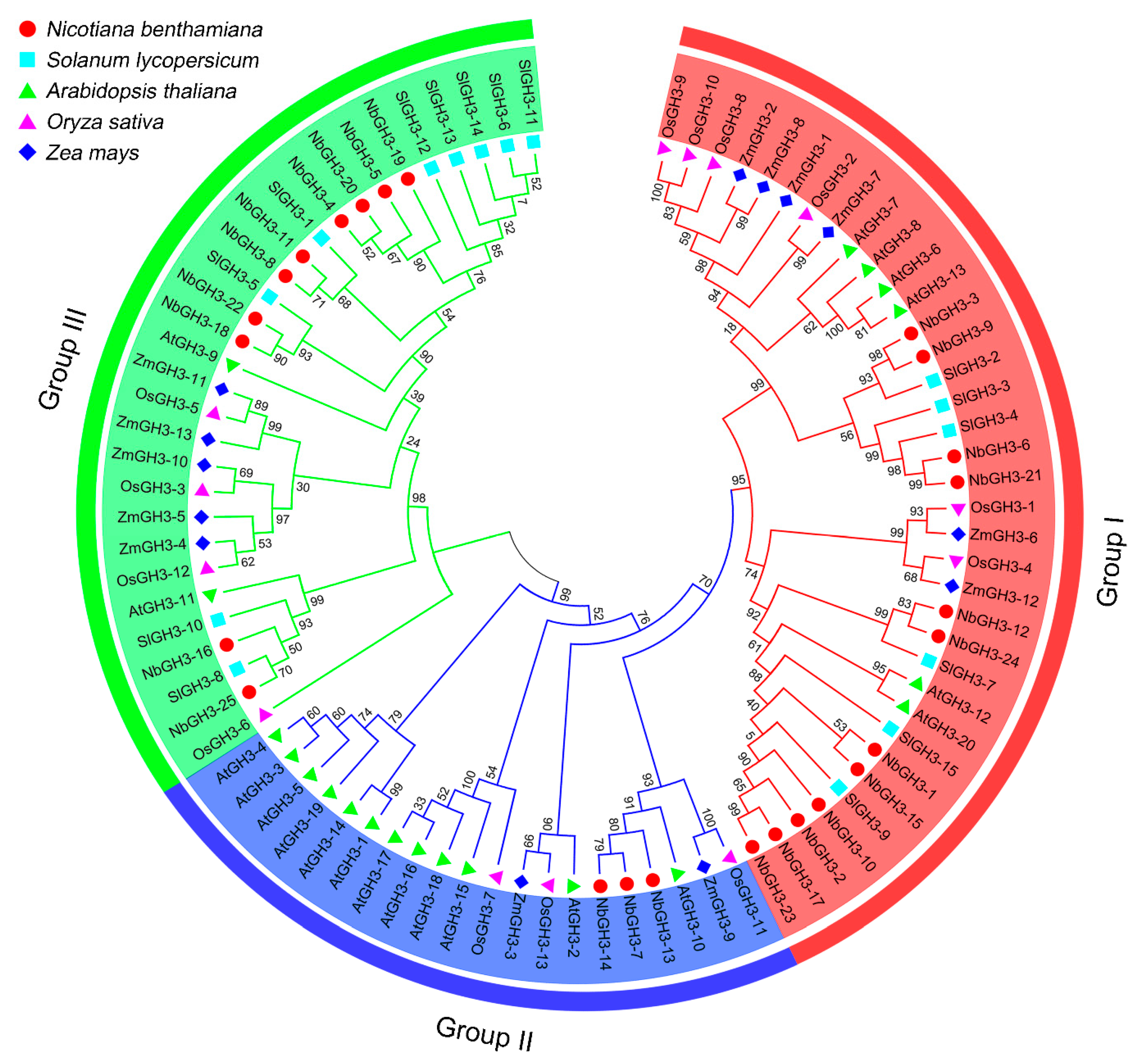
To investigate the taxonomic classification of the GH3 gene family, we created a phylogenetic tree using the aligned sequences of 86 GH3 proteins, including 25 NbGH3s, 20 AtGH3s, 13 OsGH3s, 13 ZmGH3s, and 15 SlGH3s. Phylogenetic analysis indicated that the 86 GH3 proteins were categorized into three distinct subfamilies, designated as groups I, II, and III (Figure 1). Subfamily I was made up of 36 GH3 members, including 12 NbGH3s and 6 GH3s each from AtGH3s, OsGH3s, ZmGH3s, and SlGH3s. Subfamily II, the subfamily with the fewest members, comprised a total of 20 members, including 3 NbGH3s, 12 AtGH3s, 3 OsGH3s, and 2 ZmGH3s. Subfamily III consisted of 30 members, including 10 NbGH3s, 2 AtGH3s, 4 OsGH3s, 5 ZmGH3s, and 9 SlGH3s. It was noteworthy that N. benthamiana had a closer relationship with S. lycopersicum compared to A. thaliana, O. sativa, and Z. mays. However, no S. lycopersicum member was found in subfamily II. This may be because N. benthamiana independently evolved the members of subfamily II during long-term acclimation. Generally, members within the same subfamily tend to exhibit similar functional characteristics. Therefore, the distinct clustering patterns observed in the phylogenetic tree suggest potential functional divergence underlying the evolutionary history of the GH3 gene family.

3.3. Conserved Motif Analysis of NbGH3 Proteins

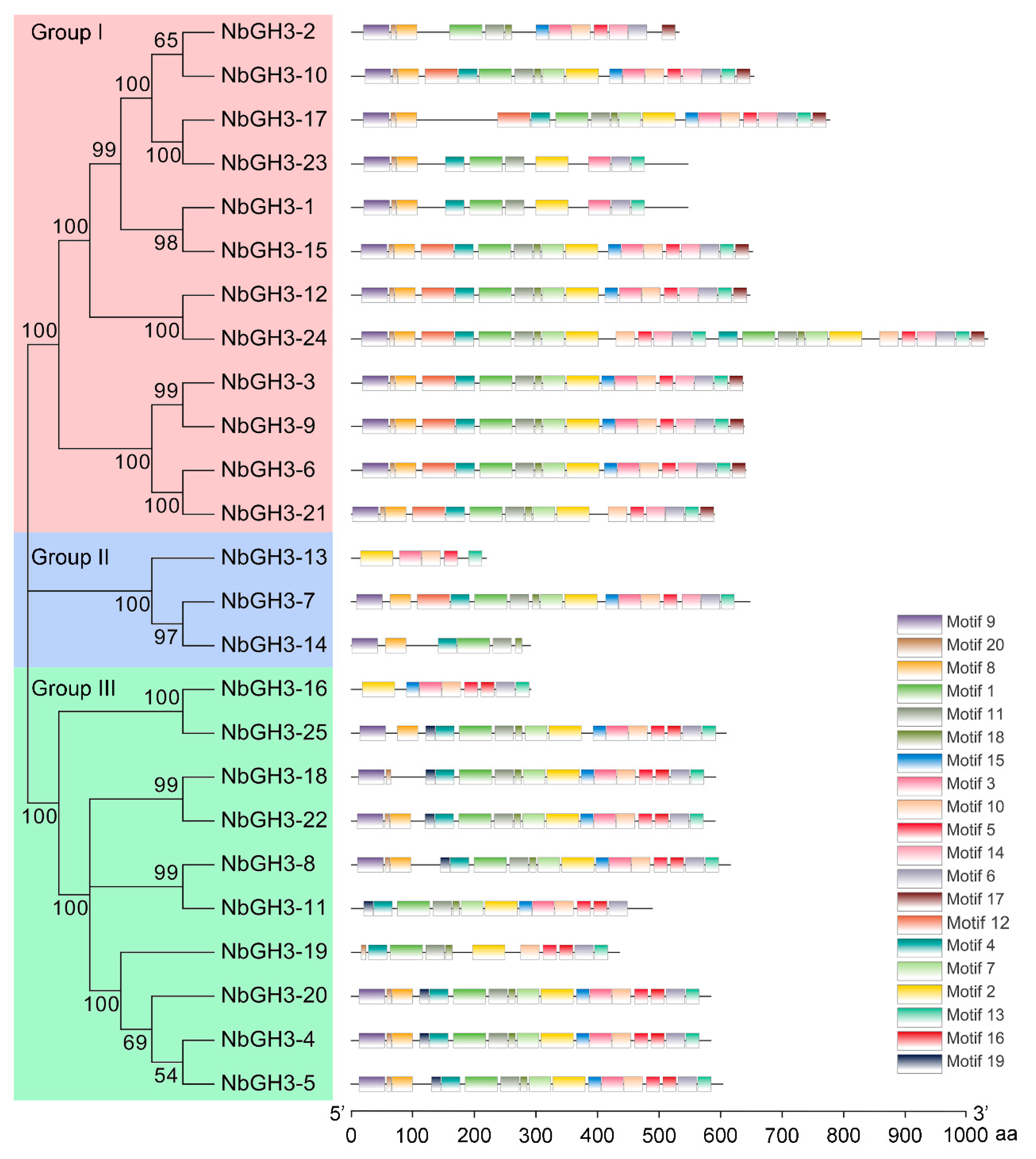
Analysis of conserved motifs based on protein sequences is an effective method for protein function prediction [70]. MEME suite motif analysis revealed the identification of 20 distinct conserved motifs (Motifs 1–20) within the protein sequences of NbGH3s (Figure 2). The identified motifs exhibited length variations ranging from 8 (motif 20) to 50 aa (motifs 1 and 2) (Table S4). The motif count across NbGH3 proteins ranged from 5 (NbGH3-13) to 27 (NbGH3-24) (Figure 2). It was generally observed that members of the NbGH3 family possess highly conserved motifs, with similar conserved motifs shared within the same subfamily (Figure 2). However, some subfamilies exhibited unique motifs. For instance, Motif 17 was exclusively found in Subfamily I, whereas Motifs 16 and 19 were only present in Subfamily III (Figure 2). Among them, Motif 16 and Motif 19 are two C2H2 zinc finger factors (each containing more than three adjacent zinc fingers), while Motif 17 has no functional annotation. Overall, these results indicate the coexistence of conserved functional divergences among the NbGH3 family members throughout their evolutionary history, with specific motifs potentially contributing to the functional differentiation of NbGH3 proteins across distinct subfamilies.

3.4. Gene Structure Analysis of NbGH3 Genes

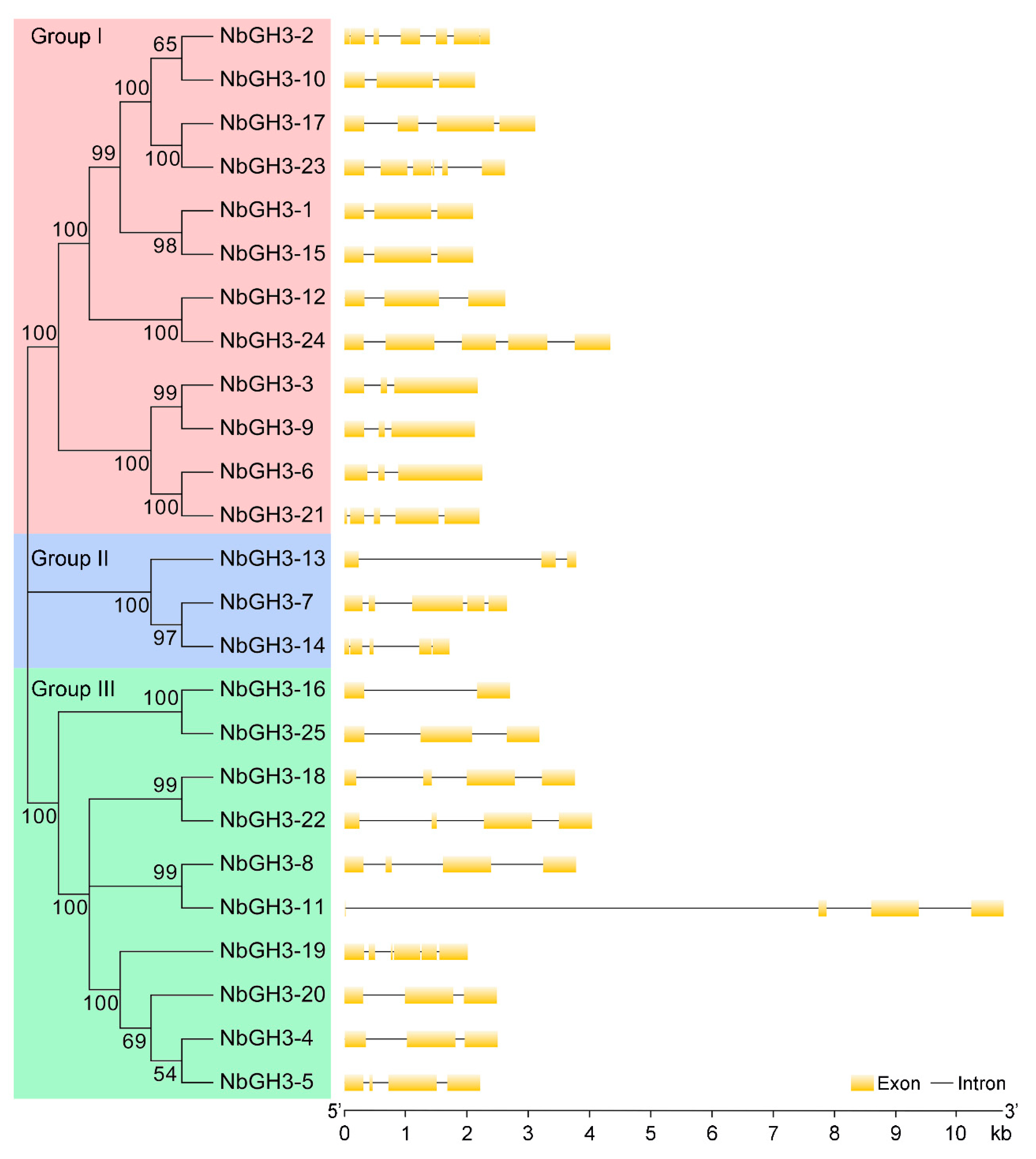
Gene structure usually plays a vital role in the evolution of gene families and provides additional support for phylogenetic studies [71,72]. To better understand the possible structural variety of the NbGH3 genes, we examined the relationship between their gene structures and phylogenetic evolution. As shown in Figure 3, members of the same phylogenetic subfamily of NbGH3s exhibited higher similarity in their gene structure, although some variations were observed among individual genes. In the NbGH3 gene family, exons numbered between two and seven. NbGH3-2 possessed the highest number of exons (seven), whereas NbGH3-16 had the fewest (two), with most members possessing three or four exons (Figure 3). These results suggest that the NbGH3 genes in N. benthamiana have retained their functions across evolutionary history, with genes in the same phylogenetic category displaying similar expansion and evolutionary behaviors.

3.5. Promoter Analysis of NbGH3 Genes

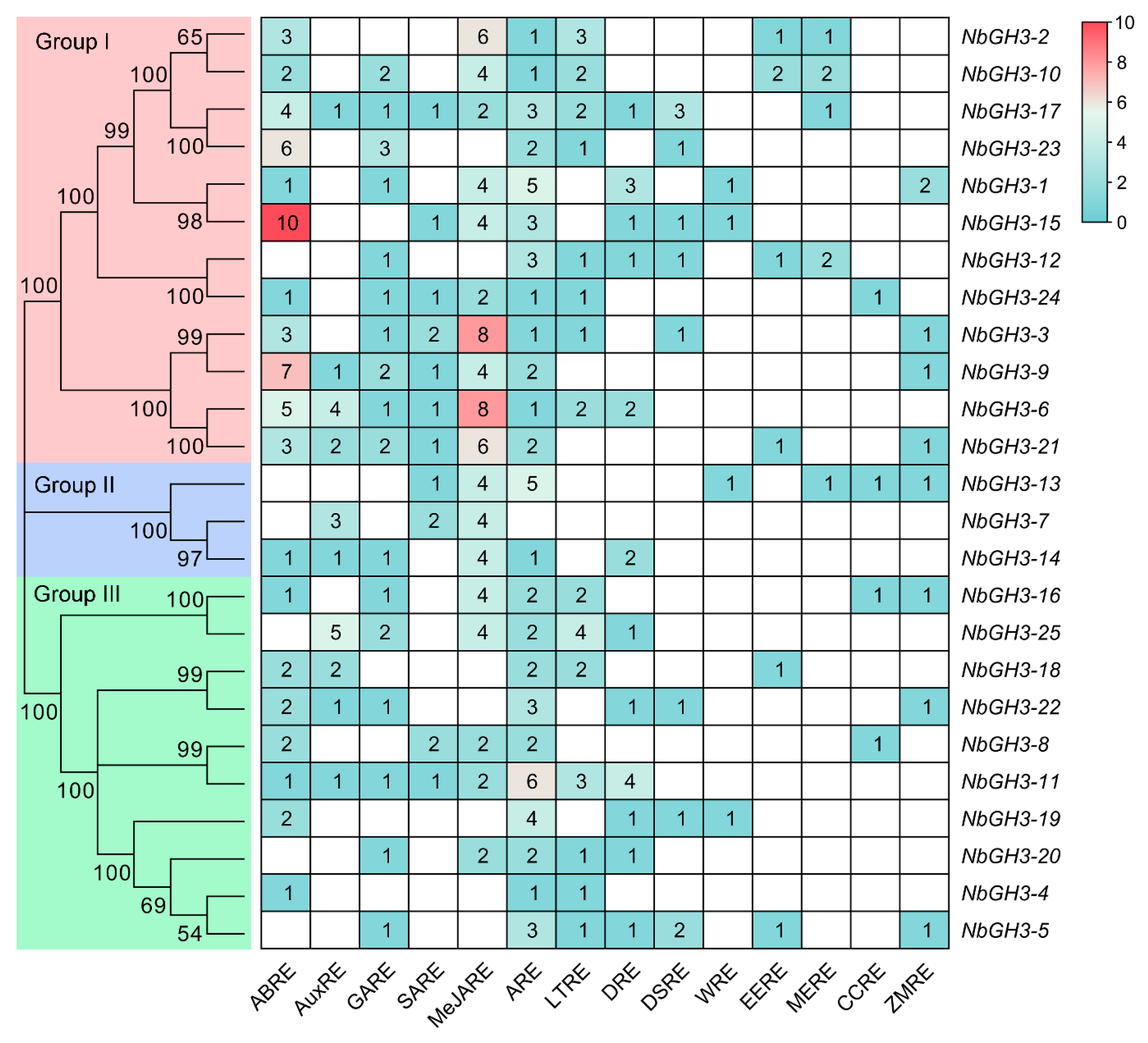
To better understand the possible roles and control mechanisms of the NbGH3s, we analyzed the cis-acting elements detected in the promoter regions of NbGH3 genes. The results showed that numerous elements associated with phytohormones were identified in the regulatory regions of NbGH3s. These included the auxin-responsive element (AuxRE), ABA-responsive element (ABRE), gibberellin-responsive element (GARE), MeJA-responsive element (MeJARE), and SA-responsive element (SARE) (Figure 4). Statistical analysis indicated that the most prevalent cis-acting phytohormone-responsive elements were two sets of phytohormone-related elements associated with ABRE and MeJARE. Among these, NbGH3-15 contained the highest number of ABREs, totaling 10, whereas NbGH3-3 and NbGH3-6 showed the maximum number of MeJAREs, each totaling eight (Figure 4). Besides the elements related to phytohormones, a significant amount of stress-related elements were also detected in the promoter regions of NbGH3s. Of the 25 NbGH3 genes, 24 contained the anaerobic response element (ARE) element, 12 harbored the drought-responsive element (DRE) element, 9 possessed the defense- and stress-responsive element (DSRE) element, 14 contained the low-temperature-responsive element (LTRE) element, and 4 included the wound-responsive element (WRE) element (Figure 4 and Table S5). Taken together, these results suggest that the NbGH3 promoter regions possess a variety of cis-acting elements implicated in phytohormone and stress responses, indicating important roles of NbGH3s in the regulation of multiple phytohormone pathways and stress responses in plants.

3.6. Chromosomal Location and Synteny Analyses of NbGH3 Genes

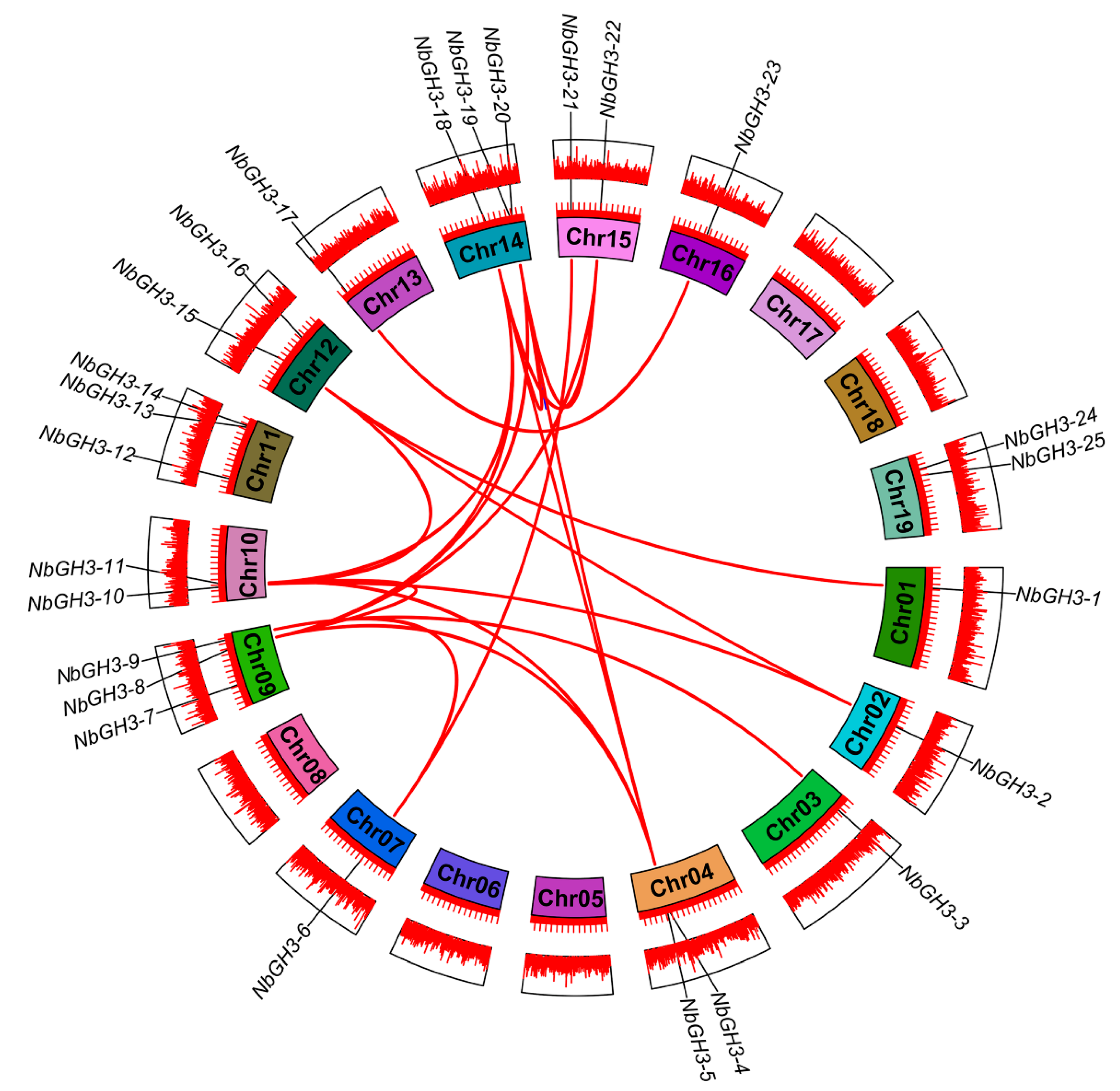
To investigate the genomic distribution of NbGH3 genes on N. benthamiana, their chromosomal locations were mapped using gene locus information retrieved from the Sol Genomics Network (Table S6). The 25 NbGH3 genes were mapped to 14 chromosomes, exhibiting an uneven distribution pattern (Figure 5). A single gene locus was observed on chromosomes 01, 02, 03, 07, 13, and 16, whereas chromosomes 04, 10, 12, 15, and 19 each contained two NbGH3 genes. Notably, chromosomes 09, 11, and 14 exhibited the highest gene density, with three NbGH3 genes located on each chromosome (Figure 5). To better understand the evolutionary duplication patterns of NbGH3 genes, their chromosomal locations were analyzed for collinearity. Consequently, 20 pairs of segmental duplication events (95.2%) and one pair of tandem duplication events (4.8%) were identified in the genome of N. benthamiana (Figure 5 and Table 2). This suggests that the segmental duplication might be a dominant driving force for NbGH3 evolution in N. benthamiana.
To gain insights into the evolutionary divergence and selective forces on the duplicated genes, the Ka and Ks substitution rates for these gene pairs were computed using TBtools-II (v2.102). The Ka/Ks ratio measures the rate of Ka relative to Ks and is widely used as an indicator of selective pressure [24,73]. Previous studies have demonstrated that a Ka/Ks ratio of lower than 1 indicates the action of purifying selection on duplication events of the GH3 gene families in plants [7,20,74]. Our research found that the Ka/Ks ratios for 21 duplicated gene pairs were less than 1 (Table 2), indicating that purifying selection has predominantly affected the GH3 gene family in N. benthamiana. Additionally, the evolutionary dates of these duplication events were calculated using the formula T = Ks/2λ as described previously [57,58]. The results indicated that 20 segmental duplications are estimated to have occurred between 11.94 and 241.01 million years (MYs) ago, with the tandem duplication happening around 108.34 MYs ago (Table 2).

3.7. Tissue-Specific Expression Patterns of NbGH3 Genes

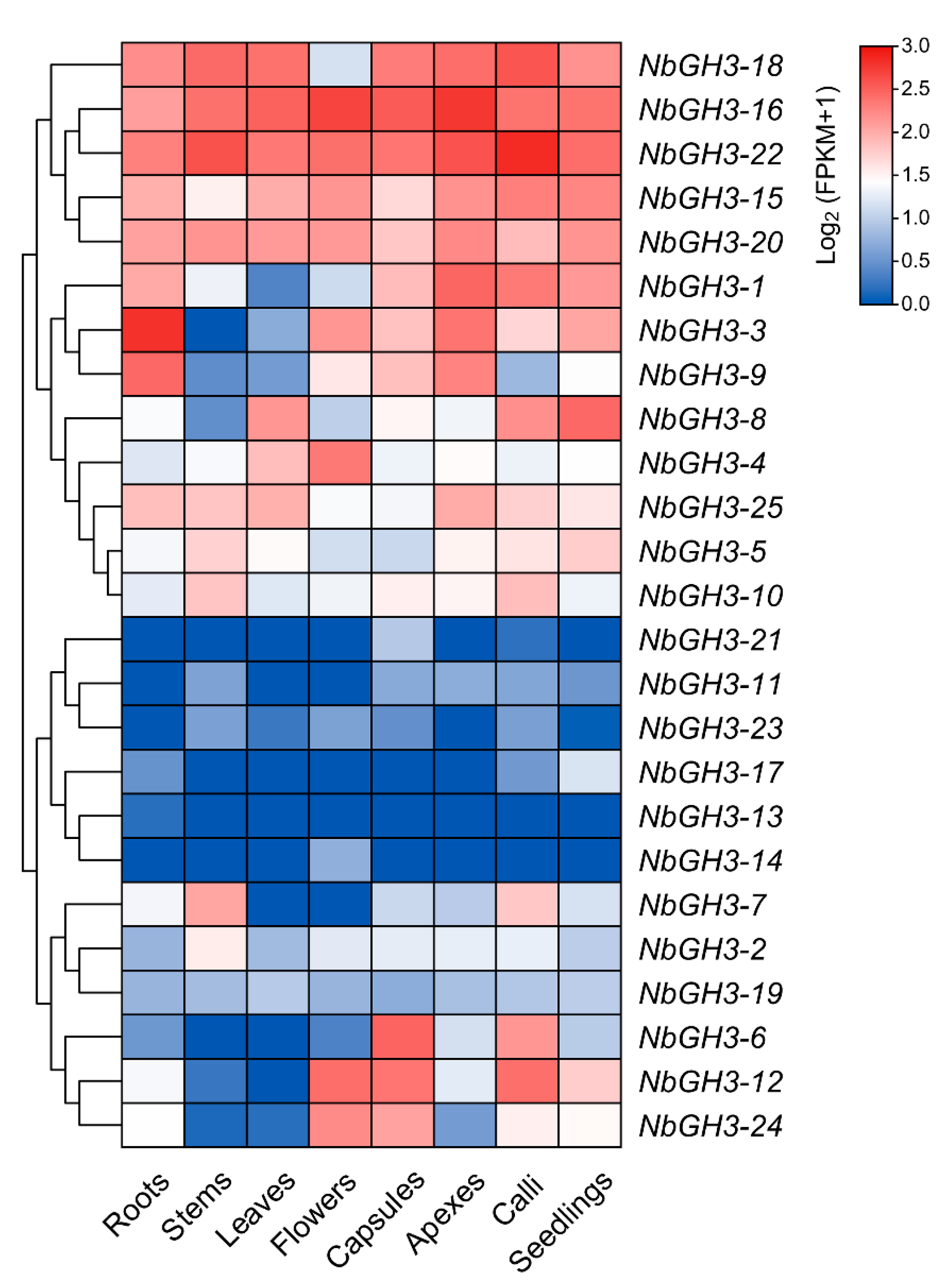
To better understand the spatiotemporal expression patterns of NbGH3 genes in N. benthamiana, their expression profiles in specific tissues were examined employing publicly accessible RNA-sequencing data [59]. As shown in Figure 6, each of the 25 NbGH3 genes was detected in at least one tissue type. Notably, nine genes (NbGH3-4, NbGH3-5, NbGH3-10, NbGH3-15, NbGH3-16, NbGH3-18, NbGH3-20, NbGH3-22, and NbGH3-25) were expressed across all eight tissues, each exhibiting fragments per kilobase of transcript per million mapped reads (FPKM) values greater than 1.0 (Figure 6 and Table S7). Interestingly, except for NbGH3-10 and NbGH3-15, all highly expressed genes belong to Group III, indicating that this subfamily could be crucial for the growth and development of N. benthamiana. Additionally, 14 genes, including NbGH3-1, NbGH3-3, NbGH3-5, NbGH3-6, NbGH3-7, NbGH3-8, NbGH3-10, NbGH3-12, NbGH3-15, NbGH3-16, NbGH3-18, NbGH3-20, NbGH3-22, and NbGH3-25, exhibited high expression levels in the calli of N. benthamiana (FPKM ≥ 3.0), with the highest expression levels observed for NbGH3-22 (FPKM ≥ 73.0) and NbGH3-18 (FPKM ≥ 30.0) (Figure 6 and Table S7). Nine genes, including NbGH3-1, NbGH3-3, NbGH3-9, NbGH3-15, NbGH3-16, NbGH3-18, NbGH3-20, NbGH3-22, and NbGH3-25, displayed high expression in the apex tissue of N. benthamiana (FPKM ≥ 3.0), with the highest expression levels observed for NbGH3-16 (FPKM ≥ 56.0) and NbGH3-22 (FPKM ≥ 31.0) (Figure 6 and Table S7). The findings suggest that NbGH3 genes have unique expression patterns in different tissues, hinting at their possible involvement in regulating various biological functions such as plant growth, development, and stress responses.

3.8. Expression Profiles of NbGH3 Genes Following TYLCV Infection

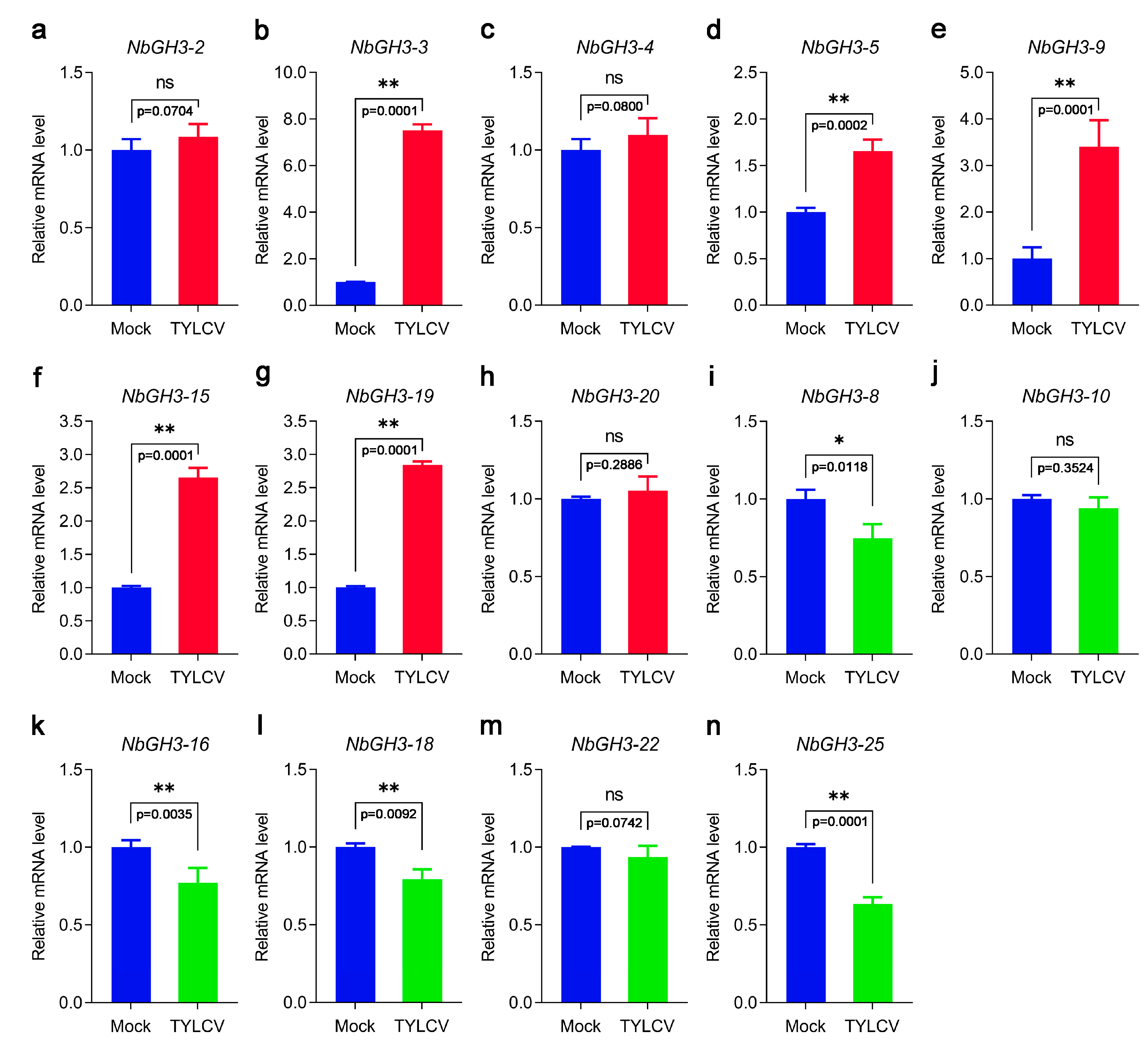
To examine the potential involvement of NbGH3 genes in the response to TYLCV infection, we selected NbGH3s with basal expression levels (FPKM ≥ 0.3) in N. benthamiana leaves and determined their expression levels following TYLCV infection. As shown in Figure 7, qPCR analysis demonstrated that the expression levels of NbGH3-3, NbGH3-5, NbGH3-9, NbGH3-15, and NbGH3-19 were dramatically increased in the systemically infected leaves of N. benthamiana after TYLCV infection. Notably, the expression level of NbGH3-3 was upregulated considerably by more than 7-fold in the systemically infected N. benthamiana leaves after TYLCV infection (Figure 7b), while the expression levels of NbGH3-9, NbGH3-15, and NbGH3-19 were increased by over 2-fold (Figure 7e–g), indicating the important regulatory functions of these NbGH3s in dealing with TYLCV infection. In contrast, the expression levels of NbGH3-8, NbGH3-16, NbGH3-18, and NbGH3-25 were dramatically downregulated in the systemically infected N. benthamiana leaves after TYLCV infection (Figure 7i,k–n). Collectively, these results imply that the NbGH3 genes may play a vital role in the response of N. benthamiana to TYLCV infection.

3.9. Disruption of the Expression of NbGH3-3 and NbGH3-9 Enhances Host Susceptibility to TYLCV

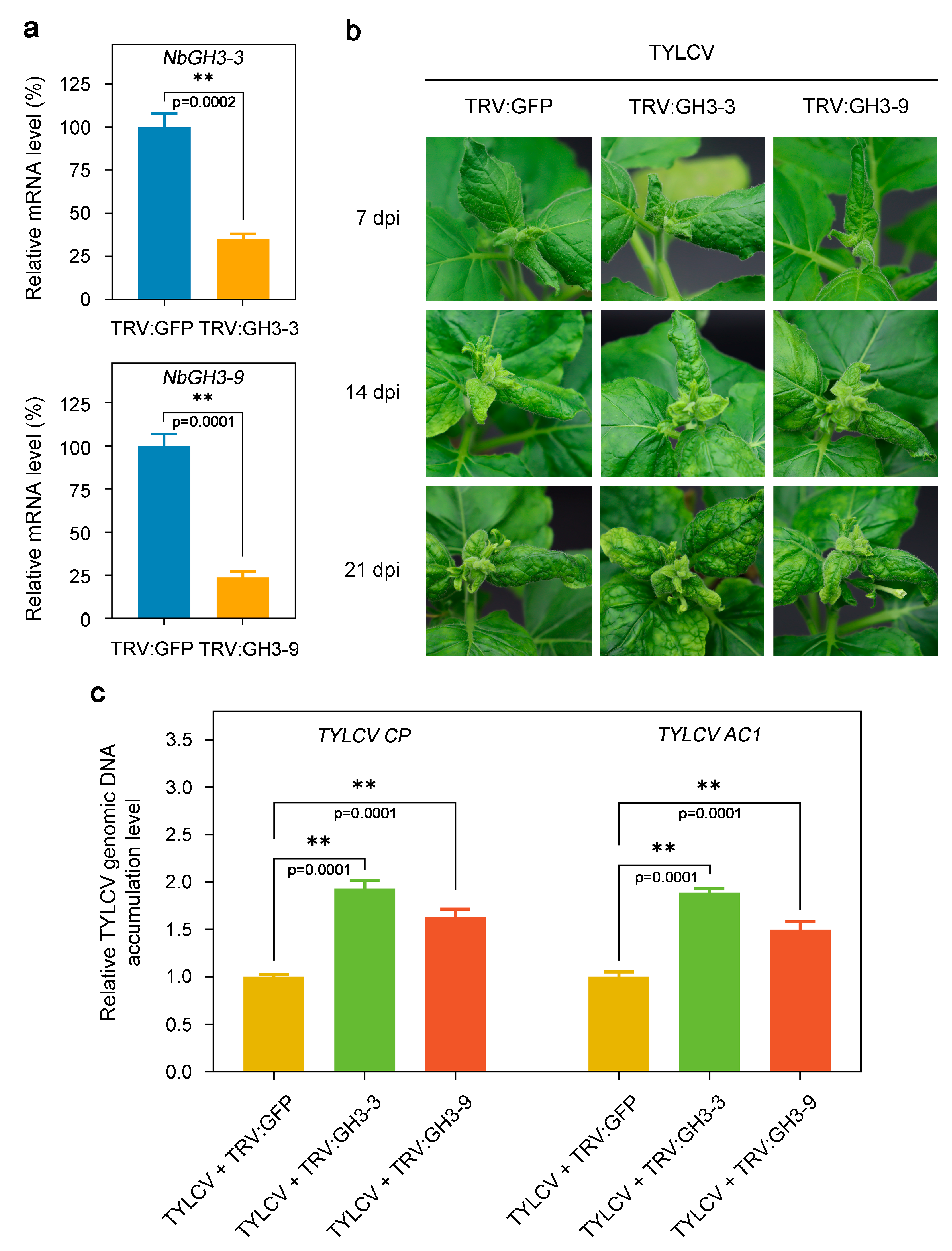
To gain a deeper understanding of the roles of NbGH3s in response to viral infection, we determined their political participation in the response of N. benthamiana to TYLCV infection using the VIGS system. Based on the results in Figure 6 and Figure 7, two genes, NbGH3-3 and NbGH3-9, were chosen for silencing. qPCR analysis showed a notable decrease in the transcript levels of NbGH3-3 (65.8%) and NbGH3-9 (77.6%) in plants treated with VIGS compared to the TRV:GFP (green fluorescent protein) controls at 10 dpi (Figure 8a), indicating effective gene silencing of these targeted genes. After VIGS treatment, both the control and gene-silenced seedlings were agroinfiltrated with a TYLCV infectious clone, and the development of symptoms was monitored over time. Compared to the TRV:GFP control plants, NbGH3-3- and NbGH3-9-silenced seedlings showed severe curling and wrinkling symptoms in their systemic leaves due to TYLCV at 7, 14, and 21 dpi (Figure 8b). These results indicated that silencing of NbGH3-3 and NbGH3-9 increases the susceptibility of N. benthamiana to TYLCV. To substantiate these findings, we quantified the TYLCV accumulation by measuring the TYLCV CP and AC1 expression levels using qPCR [52,75]. The results indicated that the suppression of NbGH3-3 and NbGH3-9 in N. benthamiana seedlings led to an approximately 2-fold increase in the TYLCV accumulation compared to control plants (Figure 8c). These findings collectively imply that the inhibition of NbGH3-3 and NbGH3-9 considerably diminishes N. benthamiana resistance against TYLCV, as evidenced by a substantial rise in the levels of viral genomic DNA accumulation.

4. Discussion

Previous studies have demonstrated that GH3s, as primary auxin-responsive genes, encode key proteins that regulate plant growth and development and also play crucial roles in mediating resistance to both biotic and abiotic stresses [1,2,3,4,5]. In this study, through a genome-wide analysis, a total of 25 GH3 genes were identified in N. benthamiana (Table 1). Phylogenetic reconstruction and sequence alignment revealed that these genes were divided into three distinct subfamilies (Figure 1), which mirrors the evolutionary conservation of GH3 proteins across plant species [76,77]. The classification of NbGH3s was further substantiated through analyses of conserved motifs and gene structures, which demonstrated that each subfamily exhibited distinct conserved motifs and characteristic exon-intron arrangements (Figure 2 and Figure 3). Conserved motif analysis indicated that all identified NbGH3 proteins possessed a typical GH3 domain (PF03321), and most NbGH3 members in the same subfamily exhibited highly similar motif compositions (Figure 2). These findings are in line with earlier research showing that the biological functions of GH3s may vary, potentially depending on the types and quantities of motifs [8,78]. Gene structure analysis revealed that NbGH3s contain 2–7 exons (Figure 3), a genomic organization consistent with GH3 genes in Cucumis melo [4], T. aestivum [7], O. sativa [77], and pumpkin (Cucurbita maxima) [79], suggesting evolutionary conservation of exon-intron architecture in this gene family.
An increasing amount of evidence indicates that transcription factors are crucial for regulating plant growth, development, and stress responses by modulating gene expression [72,80]. To further understand the regulatory mechanisms of NbGH3 genes, we investigated the cis-acting elements located within their 2000 bp promoter regions. A large number of cis-acting elements implicated in phytohormone signaling and stress responses were detected (Figure 4 and Table S5). The wide range of identified cis-acting elements aligns with earlier research showing the roles of GH3 genes in plants in response to phytohormones and stresses [8,15,24,26,71,79]. AuxRE, ABRE, GARE, MeJARE, and SARE were identified to be involved in the response of plants to auxin, ABA, GA, MeJA, and SA, respectively (Figure 4 and Table S5). These results suggest that NbGH3s can be controlled by various plant hormones, thus having a critical role in stress responses [23,32,76,78]. Moreover, various cis-acting elements implicated in stress responses were also found in the promoter regions of NbGH3s, including ARE, DRE, DSRE, LTRE, and WRE, indicating that NbGH3s may have important roles in regulating plant responses to multiple stresses [8,14,15,19,24,71]. Collectively, these findings suggest that NbGH3s probably participate in plant responses to a variety of phytohormones and stresses in N. benthamiana.
Earlier investigations have demonstrated that gene duplication events are crucial for genomic rearrangement and often lead to the expansion of gene families [20,81,82]. In this study, 20 segmental duplication pairs and one single tandem duplication pair were identified to be implicated in gene duplications (Figure 5 and Table 2), suggesting that segmental duplication may be the main factor promoting the expansion of the GH3 gene family in N. benthamiana. This finding aligns with earlier research demonstrating that segmental duplication is a key driver of GH3 gene family expansion during evolution [7,77,78]. Furthermore, our study found that the Ka/Ks ratios for both segmentally and tandemly duplicated gene pairs were consistently lower than 1, indicating that purifying selection is the dominant evolutionary force shaping the GH3 gene family in N. benthamiana.
Gene expression profiles often yield critical insights into the functional roles of gene families, offering a potential window into their involvement in various biological processes [7,52,79]. Numerous studies have established that the GH3 gene family is vital in controlling multiple facets of plant growth and development, including growth dynamics, developmental patterning, organ morphogenesis, reproductive processes, apical dominance maintenance, and photomorphogenic shoot elongation [4,5,14,22,76]. Therefore, we analyzed the expression levels of NbGH3s in different tissues of N. benthamiana using publicly available RNA-sequencing data [59]. The results indicated that the majority of NbGH3s were present in all examined tissues (Figure 6 and Table S7), implying their potential implication in the growth and development of N. benthamiana. These findings are consistent with earlier research showing that GH3 genes are essential for basic functions in plant growth and development [4,7,79,83]. Notably, different GH3 gene family members exhibit pronounced tissue-specific expression patterns, with NbGH3-3 and NbGH3-9 showing root-predominant accumulation, NbGH3-22 displaying stem-enriched expression, and NbGH3-18 demonstrating leaf-specific expression (Figure 6 and Table S7). Strikingly, NbGH3-16 exhibits broad expression across multiple aerial tissues, including stems, leaves, floral organs, capsules, apices, and seedlings (Figure 6 and Table S7), suggesting specialized functional partitioning among these paralogs.
TYLCV is one of the most devastating geminiviruses and causes significant losses in economically important crops worldwide [41,42,52]. To elucidate the potential involvement of NbGH3 genes in the antiviral response of N. benthamiana, we systematically analyzed the transcriptional dynamics of NbGH3 gene family members (FPKM ≥ 0.3) in leaf tissues upon TYLCV infection (Figure 6 and Table S7). qPCR analysis demonstrated that significant upregulation of NbGH3-3, NbGH3-5, NbGH3-9, NbGH3-15, and NbGH3-19 expression was induced in systemically infected N. benthamiana leaves following TYLCV infection (Figure 7b–g), highlighting a potential involvement of these NbGH3 genes in response to TYLCV infection. Thus, we hypothesized that these specific members of the NbGH3 gene family play a critical role in mediating antiviral defense against TYLCV. To functionally validate this hypothesis, we selected the NbGH3-3 and NbGH3-9 and assessed their potential role in response to TYLCV infection through the VIGS system. Compared to TRV:GFP control plants, the systemic leaves of seedlings with silenced NbGH3-3 and NbGH3-9 showed significant curling and wrinkling symptoms caused by TYLCV (Figure 8b). Consistently, qPCR analysis demonstrated a considerable increase in TYLCV genomic DNA accumulation following the silencing of NbGH3-3 and NbGH3-9 (Figure 8c). These findings align with earlier research indicating that a specific set of GH3 genes is significantly induced by pathogens in Saccharum [8], rice [21,28], and citrus [30,31], underscoring the evolutionarily conserved role of GH3 genes in plant immunity. Additionally, attention should also be given to the downregulated genes, such as NbGH3-8, NbGH3-16, NbGH3-18, and NbGH3-25 (Figure 7i,k,l,n). This may imply their limited role in defense against the virus or their suppression being critical to host susceptibility. Such nuanced regulatory patterns illuminate evolutionary shifts in gene function during the evolution of gene families. In future studies, the biological functions of NbGH3-3 and NbGH3-9 will be investigated using molecular biology and genetic approaches.
Although the precise roles of NbGH3s in response to TYLCV infection remain to be fully delineated, our study offers important insights into the expansion of the NbGH3 gene family and suggests their involvement in mediating antiviral resistance in N. benthamiana.

5. Conclusions

In this study, we provide the first systematic characterization of the GH3 gene family in N. benthamiana, including gene identification, conserved motif analysis, gene structure and promoter architecture, chromosomal distribution, duplication events, and expression patterns across different tissues and in response to TYLCV infection. A total of 25 NbGH3 genes were identified, which establishes a foundational framework for functional investigations of this gene family in N. benthamiana. qPCR analysis revealed that NbGH3-3, NbGH3-5, NbGH3-9, NbGH3-15, and NbGH3-19 were markedly upregulated following TYLCV infection. Moreover, VIGS coupled with qPCR analysis demonstrated that the silencing of NbGH3-3 and NbGH3-9 significantly elevated TYLCV genomic DNA accumulation in N. benthamiana. These results provide an important understanding of GH3-mediated defense responses and lay the groundwork for elucidating the molecular mechanisms by which GH3 genes modulate antiviral immunity in N. benthamiana.

Supplementary Materials

The following supporting information can be downloaded at: https://www.mdpi.com/article/10.3390/agronomy16010115/s1, Table S1: GH3 protein sequences of Arabidopsis thaliana, Oryza sativa, Zea mays, Solanum lycopersicum, and Nicotiana benthamiana; Table S2: List of primers used in this study; Table S3: Raw data for qPCR analysis of NbGH3 gene expression in response to TYLCV infection and assessment of VIGS-mediated silencing efficiency and viral accumulation; Table S4: Sequence features of conserved motifs in GH3 proteins from Nicotiana benthamiana; Table S5: Cis-acting elements in the promoter areas of NbGH3 genes; Table S6: Chromosomal distribution of NbGH3 genes; Table S7: Expression patterns of NbGH3 genes in specific tissues of Nicotiana benthamiana.

Author Contributions

Conceptualization, J.L. and Z.W.; methodology, X.Z., X.F., Z.Y. and J.L.; software, X.F. and Y.S.; validation, X.F., Y.S., Y.Z. and Z.Y.; formal analysis, Y.Z., Z.Y. and J.L.; writing—original draft preparation, X.Z. and J.L.; writing—review and editing, X.Z. and Z.W.; project administration, X.Z. and Z.W.; funding acquisition, X.Z., X.F. and Z.W. All authors have read and agreed to the published version of the manuscript.

Funding

This research was funded by the National Natural Science Foundation of China (grant number: 32102162), the Huzhou Public Welfare Application Research Project of China (grant number: 2024GZ34), and the Innovation and Entrepreneurship Training Program for College Students of China (grant number: 202510347030).

Data Availability Statement

The original contributions presented in this study are included in the article/Supplementary Material. Further inquiries can be directed to the corresponding author(s).

Conflicts of Interest

The authors declare no conflicts of interest.

References

  1. Gomes, G.L.B.; Scortecci, K.C. Auxin and its role in plant development: Structure, signalling, regulation and response mechanisms. Plant Biol. 2021, 23, 894–904. [Google Scholar] [CrossRef] [PubMed]
  2. Jing, H.; Wilkinson, E.G.; Sageman-Furnas, K.; Strader, L.C. Auxin and abiotic stress responses. J. Exp. Bot. 2023, 74, 7000–7014. [Google Scholar] [CrossRef] [PubMed]
  3. Luo, J.; Zhou, J.J.; Zhang, J.Z. Aux/IAA gene family in plants: Molecular structure, regulation, and function. Int. J. Mol. Sci. 2018, 19, 259. [Google Scholar] [CrossRef] [PubMed]
  4. Chen, S.; Zhong, K.; Li, Y.; Bai, C.; Xue, Z.; Wu, Y. Evolutionary analysis of the melon (Cucumis melo L.) GH3 gene family and identification of GH3 genes related to fruit growth and development. Plants 2023, 12, 1382. [Google Scholar] [CrossRef]
  5. Bao, D.; Chang, S.; Li, X.; Qi, Y. Advances in the study of auxin early response genes: Aux/IAA, GH3, and SAUR. Crop J. 2024, 12, 964–978. [Google Scholar] [CrossRef]
  6. Yang, Y.; Yue, R.; Sun, T.; Zhang, L.; Chen, W.; Zeng, H.; Wang, H.; Shen, C. Genome-wide identification, expression analysis of GH3 family genes in Medicago truncatula under stress-related hormones and Sinorhizobium meliloti infection. Appl. Microbiol. Biotechnol. 2015, 99, 841–854. [Google Scholar] [CrossRef]
  7. Jiang, W.; Yin, J.; Zhang, H.; He, Y.; Shuai, S.; Chen, S.; Cao, S.; Li, W.; Ma, D.; Chen, H. Genome-wide identification, characterization analysis and expression profiling of auxin-responsive GH3 family genes in wheat (Triticum aestivum L.). Mol. Biol. Rep. 2020, 47, 3885–3907. [Google Scholar] [CrossRef]
  8. Zou, W.; Lin, P.; Zhao, Z.; Wang, D.; Qin, L.; Xu, F.; Su, Y.; Wu, Q.; Que, Y. Genome-wide identification of auxin-responsive GH3 gene family in Saccharum and the expression of ScGH3-1 in stress response. Int. J. Mol. Sci. 2022, 23, 12750. [Google Scholar] [CrossRef]
  9. Hagen, G.; Guilfoyle, T.J. Rapid induction of selective transcription by auxins. Mol. Cell. Biol. 1985, 5, 1197–1203. [Google Scholar]
  10. Roux, C.; Perrot-Rechenmann, C. Isolation by differential display and characterization of a tobacco auxin-responsive cDNA Nt-gh3, related to GH3. FEBS Lett. 1997, 419, 131–136. [Google Scholar] [CrossRef]
  11. Staswick, P.E.; Serban, B.; Rowe, M.; Tiryaki, I.; Maldonado, M.T.; Maldonado, M.C.; Suza, W. Characterization of an Arabidopsis enzyme family that conjugates amino acids to indole-3-acetic acid. Plant Cell 2005, 17, 616–627. [Google Scholar] [CrossRef] [PubMed]
  12. Jain, M.; Kaur, N.; Tyagi, A.K.; Khurana, J.P. The auxin-responsive GH3 gene family in rice (Oryza sativa). Funct. Integr. Genom. 2006, 6, 36–46. [Google Scholar] [CrossRef] [PubMed]
  13. Yuan, H.; Zhao, K.; Lei, H.; Shen, X.; Liu, Y.; Liao, X.; Li, T. Genome-wide analysis of the GH3 family in apple (Malus × domestica). BMC Genom. 2013, 14, 297. [Google Scholar] [CrossRef] [PubMed]
  14. Singh, V.K.; Jain, M.; Garg, R. Genome-wide analysis and expression profiling suggest diverse roles of GH3 genes during development and abiotic stress responses in legumes. Front. Plant Sci. 2015, 5, 789. [Google Scholar] [CrossRef]
  15. Feng, S.; Yue, R.; Tao, S.; Yang, Y.; Zhang, L.; Xu, M.; Wang, H.; Shen, C. Genome-wide identification, expression analysis of auxin-responsive GH3 family genes in maize (Zea mays L.) under abiotic stresses. J. Integr. Plant Biol. 2015, 57, 783–795. [Google Scholar] [CrossRef]
  16. Liao, D.; Chen, X.; Chen, A.; Wang, H.; Liu, J.; Liu, J.; Gu, M.; Sun, S.; Xu, G. The characterization of six auxin-induced tomato GH3 genes uncovers a member, SlGH3.4, strongly responsive to arbuscular mycorrhizal symbiosis. Plant Cell Physiol. 2015, 56, 674–687. [Google Scholar] [CrossRef]
  17. Wei, L.; Yang, B.; Jian, H.; Zhang, A.; Liu, R.; Zhu, Y.; Ma, J.; Shi, X.; Wang, R.; Li, J.; et al. Genome-wide identification and characterization of Gretchen Hagen 3 (GH3) family genes in Brassica napus. Genome 2019, 62, 597–608. [Google Scholar] [CrossRef]
  18. Yao, P.; Zhang, C.; Qin, T.; Liu, Y.; Liu, Z.; Xie, X.; Bai, J.; Sun, C.; Bi, Z. Comprehensive analysis of GH3 gene family in potato and functional characterization of StGH3.3 under drought stress. Int. J. Mol. Sci. 2023, 24, 15122. [Google Scholar] [CrossRef]
  19. Karamat, U.; Awan, M.J.A.; Ahmad, M.; Farooq, M.A. Genomic analysis and expression dynamics of GH3 genes under abiotic stresses in Brassica rapa. Plant Breed. 2024, 144, 107–121. [Google Scholar] [CrossRef]
  20. Wang, X.; Jia, C.; An, L.; Zeng, J.; Ren, A.; Han, X.; Wang, Y.; Wu, S. Genome-wide identification and expression characterization of the GH3 gene family of tea plant (Camellia sinensis). BMC Genom. 2024, 25, 120. [Google Scholar] [CrossRef]
  21. Hui, S.; Hao, M.; Liu, H.; Xiao, J.; Li, X.; Yuan, M.; Wang, S. The group I GH3 family genes encoding JA-Ile synthetase act as positive regulator in the resistance of rice to Xanthomonas oryzae pv. oryzae. Biochem. Biophys. Res. Commun. 2019, 508, 1062–1066. [Google Scholar] [CrossRef] [PubMed]
  22. Wojtaczka, P.; Ciarkowska, A.; Starzynska, E.; Ostrowski, M. The GH3 amidosynthetases family and their role in metabolic crosstalk modulation of plant signaling compounds. Phytochemistry 2022, 194, 113039. [Google Scholar] [CrossRef] [PubMed]
  23. Jez, J.M. Connecting primary and specialized metabolism: Amino acid conjugation of phytohormones by GRETCHEN HAGEN 3 (GH3) acyl acid amido synthetases. Curr. Opin. Plant Biol. 2022, 66, 102194. [Google Scholar] [CrossRef] [PubMed]
  24. Li, J.; Min, X.; Luo, K.; Hamidou Abdoulaye, A.; Zhang, X.; Huang, W.; Zhang, R.; Chen, Y. Molecular characterization of the GH3 family in alfalfa under abiotic stress. Gene 2023, 851, 146982. [Google Scholar] [CrossRef]
  25. Du, H.; Wu, N.; Fu, J.; Wang, S.; Li, X.; Xiao, J.; Xiong, L. A GH3 family member, OsGH3-2, modulates auxin and abscisic acid levels and differentially affects drought and cold tolerance in rice. J. Exp. Bot. 2012, 63, 6467–6480. [Google Scholar] [CrossRef]
  26. Kirungu, J.N.; Magwanga, R.O.; Lu, P.; Cai, X.; Zhou, Z.; Wang, X.; Peng, R.; Wang, K.; Liu, F. Functional characterization of Gh_A08G1120 (GH3.5) gene reveal their significant role in enhancing drought and salt stress tolerance in cotton. BMC Genet. 2019, 20, 62. [Google Scholar] [CrossRef]
  27. Casanova-Sáez, R.; Mateo-Bonmatí, E.; Šimura, J.; Pěnčík, A.; Novák, O.; Staswick, P.; Ljung, K. Inactivation of the entire Arabidopsis group II GH3s confers tolerance to salinity and water deficit. New Phytol. 2022, 235, 263–275. [Google Scholar] [CrossRef]
  28. Ding, X.; Cao, Y.; Huang, L.; Zhao, J.; Xu, C.; Li, X.; Wang, S. Activation of the indole-3-acetic acid-amido synthetase GH3-8 suppresses expansin expression and promotes salicylate- and jasmonate-independent basal immunity in rice. Plant Cell 2008, 20, 228–240. [Google Scholar] [CrossRef]
  29. Fu, J.; Liu, H.; Li, Y.; Yu, H.; Li, X.; Xiao, J.; Wang, S. Manipulating broad-spectrum disease resistance by suppressing pathogen-induced auxin accumulation in rice. Plant Physiol. 2011, 155, 589–602. [Google Scholar] [CrossRef]
  30. Chen, M.; He, Y.; Xu, L.; Peng, A.; Lei, T.; Yao, L.; Li, Q.; Zhou, P.; Bai, X.; Duan, M.; et al. Cloning and expression analysis of citrus genes CsGH3.1 and CsGH3.6 responding to Xanthomonas axonopodis pv. citri infection. Hortic. Plant J. 2016, 2, 193–202. [Google Scholar] [CrossRef]
  31. Zou, X.; Long, J.; Zhao, K.; Peng, A.; Chen, M.; Long, Q.; He, Y.; Chen, S. Overexpressing GH3.1 and GH3.1L reduces susceptibility to Xanthomonas citri subsp. citri by repressing auxin signaling in citrus (Citrus sinensis Osbeck). PLoS ONE 2019, 14, e0220017. [Google Scholar] [CrossRef] [PubMed]
  32. Fu, J.; Yu, Q.; Zhang, C.; Xian, B.; Fan, J.; Huang, X.; Yang, W.; Zou, X.; Chen, S.; Su, L.; et al. CsAP2-09 confers resistance against citrus bacterial canker by regulating CsGH3.1L-mediated phytohormone biosynthesis. Int. J. Biol. Macromol. 2023, 229, 964–973. [Google Scholar] [CrossRef] [PubMed]
  33. Li, X.; Zhang, L.; Wei, X.; Datta, T.; Wei, F.; Xie, Z. Polyploidization: A biological force that enhances stress resistance. Int. J. Mol. Sci. 2024, 25, 1957. [Google Scholar] [CrossRef] [PubMed]
  34. Zhao, L.; Feng, C.; Wu, K.; Chen, W.; Chen, Y.; Hao, X.; Wu, Y. Advances and prospects in biogenic substances against plant virus: A review. Pestic. Biochem. Physiol. 2017, 135, 15–26. [Google Scholar] [CrossRef]
  35. Jones, R.A.C. Global plant virus disease pandemics and epidemics. Plants 2021, 10, 233. [Google Scholar] [CrossRef]
  36. Popović, M.E.; Tadić, V.; Popović, M. (R)evolution of Viruses: Introduction to biothermodynamics of viruses. Virology 2024, 603, 110319. [Google Scholar] [CrossRef]
  37. Fiallo-Olivé, E.; Lett, J.M.; Martin, D.P.; Roumagnac, P.; Varsani, A.; Zerbini, F.M.; Navas-Castillo, J. ICTV Virus Taxonomy Profile: Geminiviridae 2021. J. Gen. Virol. 2021, 102, 001696. [Google Scholar] [CrossRef]
  38. Li, F.; Qiao, R.; Wang, Z.; Yang, X.; Zhou, X. Occurrence and distribution of geminiviruses in China. Sci. China Life Sci. 2022, 65, 1498–1503. [Google Scholar] [CrossRef]
  39. Fiallo-Olivé, E.; Navas-Castillo, J. Begomoviruses: What is the secret(s) of their success? Trends Plant Sci. 2023, 28, 715–727. [Google Scholar] [CrossRef]
  40. Akbar, A.; Al Hashash, H.; Al-Ali, E. Tomato yellow leaf curl virus (TYLCV) in Kuwait and global analysis of the population structure and evolutionary pattern of TYLCV. Virol. J. 2024, 21, 308. [Google Scholar] [CrossRef]
  41. Prasad, A.; Sharma, N.; Hari-Gowthem, G.; Muthamilarasan, M.; Prasad, M. Tomato yellow leaf curl virus: Impact, challenges, and management. Trends Plant Sci. 2020, 25, 897–911. [Google Scholar] [CrossRef] [PubMed]
  42. Li, F.; Qiao, R.; Yang, X.; Gong, P.; Zhou, X. Occurrence, distribution, and management of tomato yellow leaf curl virus in China. Phytopathol. Res. 2022, 4, 28. [Google Scholar] [CrossRef]
  43. Gong, P.; Zhao, S.; Liu, H.; Chang, Z.; Li, F.; Zhou, X. Tomato yellow leaf curl virus V3 protein traffics along microfilaments to plasmodesmata to promote virus cell-to-cell movement. Sci. China Life Sci. 2022, 65, 1046–1049. [Google Scholar] [CrossRef] [PubMed]
  44. Liu, H.; Chang, Z.; Zhao, S.; Gong, P.; Zhang, M.; Lozano-Durán, R.; Yan, H.; Zhou, X.; Li, F. Functional identification of a novel C7 protein of tomato yellow leaf curl virus. Virology 2023, 585, 117–126. [Google Scholar] [CrossRef]
  45. Shen, J.; Yu, S.; Ye, F.; Zhang, Y.; Wu, X.; Shi, M.; Zhao, G.; Shen, Y.; Lu, Z.; Yu, Z.; et al. Genome-wide analysis of the HECT-type E3 ubiquitin ligase gene family in Nicotiana benthamiana: Evidence implicating NbHECT6 and NbHECT13 in the response to tomato yellow leaf curl virus infection. Genes 2025, 16, 1150. [Google Scholar] [CrossRef]
  46. El-Sappah, A.H.; Qi, S.; Soaud, S.A.; Huang, Q.; Saleh, A.M.; Abourehab, M.A.S.; Wan, L.; Cheng, G.T.; Liu, J.; Ihtisham, M.; et al. Natural resistance of tomato plants to tomato yellow leaf curl virus. Front. Plant Sci. 2022, 13, 1081549. [Google Scholar] [CrossRef]
  47. Hayashi, S.; Souvan, J.M.; Bally, J.; de Felippes, F.F.; Waterhouse, P.M. Exploring the source of TYLCV resistance in Nicotiana benthamiana. Front. Plant Sci. 2024, 15, 1404160. [Google Scholar] [CrossRef]
  48. Potter, S.C.; Luciani, A.; Eddy, S.R.; Park, Y.; Lopez, R.; Finn, R.D. HMMER web server: 2018 update. Nucleic Acids Res. 2018, 46, W200–W204. [Google Scholar] [CrossRef]
  49. Bombarely, A.; Rosli, H.G.; Vrebalov, J.; Moffett, P.; Mueller, L.A.; Martin, G.B. A draft genome sequence of Nicotiana benthamiana to enhance molecular plant-microbe biology research. Mol. Plant Microbe Interact. 2012, 25, 1523–1530. [Google Scholar] [CrossRef]
  50. Duvaud, S.; Gabella, C.; Lisacek, F.; Stockinger, H.; Ioannidis, V.; Durinx, C. Expasy, the Swiss Bioinformatics Resource Portal, as designed by its users. Nucleic Acids Res. 2021, 49, W216–W227. [Google Scholar] [CrossRef]
  51. Tamura, K.; Stecher, G.; Kumar, S. MEGA11: Molecular evolutionary genetics analysis version 11. Mol. Biol. Evol. 2021, 38, 3022–3027. [Google Scholar] [CrossRef] [PubMed]
  52. Zhong, X.; Li, J.; Yang, L.; Wu, X.; Xu, H.; Hu, T.; Wang, Y.; Wang, Y.; Wang, Z. Genome-wide identification and expression analysis of wall-associated kinase (WAK) and WAK-like kinase gene family in response to tomato yellow leaf curl virus infection in Nicotiana benthamiana. BMC Plant Biol. 2023, 23, 146. [Google Scholar] [CrossRef] [PubMed]
  53. Bailey, T.L.; Johnson, J.; Grant, C.E.; Noble, W.S. The MEME Suite. Nucleic Acids Res. 2015, 43, W39–W49. [Google Scholar] [CrossRef] [PubMed]
  54. Chen, C.; Wu, Y.; Li, J.; Wang, X.; Zeng, Z.; Xu, J.; Liu, Y.; Feng, J.; Chen, H.; He, Y.; et al. TBtools-II: A “one for all, all for one” bioinformatics platform for biological big-data mining. Mol. Plant 2023, 16, 1733–1742. [Google Scholar] [CrossRef]
  55. Lescot, M.; Déhais, P.; Thijs, G.; Marchal, K.; Moreau, Y.; Van de Peer, Y.; Rouzé, P.; Rombauts, S. PlantCARE, a database of plant cis-acting regulatory elements and a portal to tools for in silico analysis of promoter sequences. Nucleic Acids Res. 2002, 30, 325–327. [Google Scholar] [CrossRef]
  56. Wang, Y.; Tang, H.; Wang, X.; Sun, Y.; Joseph, P.V.; Paterson, A.H. Detection of colinear blocks and synteny and evolutionary analyses based on utilization of MCScanX. Nat. Protoc. 2024, 19, 2206–2229. [Google Scholar] [CrossRef]
  57. Bally, J.; Nakasugi, K.; Jia, F.; Jung, H.; Ho, S.Y.; Wong, M.; Paul, C.M.; Naim, F.; Wood, C.C.; Crowhurst, R.N.; et al. The extremophile Nicotiana benthamiana has traded viral defence for early vigour. Nat. Plants 2015, 1, 15165. [Google Scholar] [CrossRef]
  58. Ranawaka, B.; An, J.; Lorenc, M.T.; Jung, H.; Sulli, M.; Aprea, G.; Roden, S.; Llaca, V.; Hayashi, S.; Asadyar, L.; et al. A multi-omic Nicotiana benthamiana resource for fundamental research and biotechnology. Nat. Plants 2023, 9, 1558–1571. [Google Scholar] [CrossRef]
  59. Nakasugi, K.; Crowhurst, R.N.; Bally, J.; Wood, C.C.; Hellens, R.P.; Waterhouse, P.M. De novo transcriptome sequence assembly and analysis of RNA silencing genes of Nicotiana benthamiana. PLoS ONE 2013, 8, e59534. [Google Scholar] [CrossRef]
  60. Liang, Y.; Jiang, C.; Liu, Y.; Gao, Y.; Lu, J.; Aiwaili, P.; Fei, Z.; Jiang, C.Z.; Hong, B.; Ma, C.; et al. Auxin regulates sucrose transport to repress petal abscission in rose (Rosa hybrida). Plant Cell 2020, 32, 3485–3499. [Google Scholar] [CrossRef]
  61. Zhong, X.; Wang, Z.Q.; Xiao, R.; Cao, L.; Wang, Y.; Xie, Y.; Zhou, X. Mimic phosphorylation of a βC1 protein encoded by TYLCCNB impairs its functions as a viral suppressor of RNA silencing and a symptom determinant. J. Virol. 2017, 91, e00300-17. [Google Scholar] [CrossRef] [PubMed]
  62. Luo, C.; Wang, Z.Q.; Liu, X.; Zhao, L.; Zhou, X.; Xie, Y. Identification and analysis of potential genes regulated by an alphasatellite (TYLCCNA) that contribute to host resistance against tomato yellow leaf curl China virus and its betasatellite (TYLCCNV/TYLCCNB) infection in Nicotiana benthamiana. Viruses 2019, 11, 442. [Google Scholar] [CrossRef] [PubMed]
  63. Zhou, X.; Xie, Y.; Tao, X.; Zhang, Z.; Li, Z.; Fauquet, C.M. Characterization of DNAbeta associated with begomoviruses in China and evidence for co-evolution with their cognate viral DNA-A. J. Gen. Virol. 2003, 84, 237–247. [Google Scholar] [CrossRef] [PubMed]
  64. Liu, Y.; Schiff, M.; Dinesh-Kumar, S.P. Virus-induced gene silencing in tomato. Plant J. 2002, 31, 777–786. [Google Scholar] [CrossRef]
  65. Senthil-Kumar, M.; Mysore, K.S. Tobacco rattle virus-based virus-induced gene silencing in Nicotiana benthamiana. Nat. Protoc. 2014, 9, 1549–1562. [Google Scholar] [CrossRef]
  66. Zhong, X.; Wang, Z.Q.; Xiao, R.; Wang, Y.; Xie, Y.; Zhou, X. iTRAQ analysis of the tobacco leaf proteome reveals that RNA-directed DNA methylation (RdDM) has important roles in defense against geminivirus-betasatellite infection. J. Proteom. 2017, 152, 88–101. [Google Scholar] [CrossRef]
  67. Gui, X.; Liu, C.; Qi, Y.; Zhou, X. Geminiviruses employ host DNA glycosylases to subvert DNA methylation-mediated defense. Nat. Commun. 2022, 13, 575. [Google Scholar] [CrossRef]
  68. Schmittgen, T.D.; Livak, K.J. Analyzing real-time PCR data by the comparative CT method. Nat. Protoc. 2008, 3, 1101–1108. [Google Scholar] [CrossRef]
  69. Zhong, X.; Yang, L.; Li, J.; Tang, Z.; Wu, C.; Zhang, L.; Zhou, X.; Wang, Y.; Wang, Z. Integrated next-generation sequencing and comparative transcriptomic analysis of leaves provides novel insights into the ethylene pathway of Chrysanthemum morifolium in response to a Chinese isolate of chrysanthemum virus B. Virol. J. 2022, 19, 182. [Google Scholar] [CrossRef]
  70. Lee, D.; Redfern, O.; Orengo, C. Predicting protein function from sequence and structure. Nat. Rev. Mol. Cell Biol. 2007, 8, 995–1005. [Google Scholar] [CrossRef]
  71. Tariq, R.; Hussain, A.; Tariq, A.; Khalid, M.H.B.; Khan, I.; Basim, H.; Ingvarsson, P.K. Genome-wide analyses of the mung bean NAC gene family reveals orthologs, co-expression networking and expression profiling under abiotic and biotic stresses. BMC Plant Biol. 2022, 22, 343. [Google Scholar] [CrossRef] [PubMed]
  72. Wang, J.; Zhao, P.; Cheng, B.; Zhang, Y.; Shen, Y.; Wang, X.; Zhang, Q.; Lou, Q.; Zhang, S.; Wang, B.; et al. Identification of TALE transcription factor family and expression patterns related to fruit chloroplast development in tomato (Solanum lycopersicum L.). Int. J. Mol. Sci. 2022, 23, 4507. [Google Scholar] [CrossRef] [PubMed]
  73. Rubio, A.; Jimenez, J.; Pérez-Pulido, A.J. Assessment of selection pressure exerted on genes from complete pangenomes helps to improve the accuracy in the prediction of new genes. Brief. Bioinform. 2022, 23, bbac010. [Google Scholar] [CrossRef] [PubMed]
  74. Kong, W.; Zhang, Y.; Deng, X.; Li, S.; Zhang, C.; Li, Y. Comparative genomic and transcriptomic analysis suggests the evolutionary dynamic of GH3 genes in Gramineae crops. Front. Plant Sci. 2019, 10, 1297. [Google Scholar] [CrossRef] [PubMed]
  75. Yang, Y.; Liu, T.; Shen, D.; Wang, J.; Ling, X.; Hu, Z.; Chen, T.; Hu, J.; Huang, J.; Yu, W.; et al. Tomato yellow leaf curl virus intergenic siRNAs target a host long noncoding RNA to modulate disease symptoms. PLoS Pathog. 2019, 15, e1007534. [Google Scholar] [CrossRef]
  76. Westfall, C.S.; Zubieta, C.; Herrmann, J.; Kapp, U.; Nanao, M.H.; Jez, J.M. Structural basis for prereceptor modulation of plant hormones by GH3 proteins. Science 2012, 336, 1708–1711. [Google Scholar] [CrossRef]
  77. Kong, W.; Zhong, H.; Deng, X.; Gautam, M.; Gong, Z.; Zhang, Y.; Zhao, G.; Liu, C.; Li, Y. Evolutionary analysis of GH3 genes in six Oryza species/subspecies and their expression under salinity stress in Oryza sativa ssp. japonica. Plants 2019, 8, 30. [Google Scholar] [CrossRef]
  78. Yu, D.; Qanmber, G.; Lu, L.; Wang, L.; Li, J.; Yang, Z.; Liu, Z.; Li, Y.; Chen, Q.; Mendu, V.; et al. Genome-wide analysis of cotton GH3 subfamily II reveals functional divergence in fiber development, hormone response and plant architecture. BMC Plant Biol. 2018, 18, 350. [Google Scholar] [CrossRef]
  79. Li, F.; Duan, P.; Zhang, H.; Lu, X.; Shi, Z.; Cui, J. Genome-wide identification of CmaGH3 family genes, and expression analysis in response to cold and hormonal stresses in Cucurbita maxima. Sci. Hortic. 2022, 304, 111256. [Google Scholar] [CrossRef]
  80. Su, L.; Wan, S.; Zhou, J.; Shao, Q.S.; Xing, B. Transcriptional regulation of plant seed development. Physiol. Plant. 2021, 173, 2013–2025. [Google Scholar] [CrossRef]
  81. Panchy, N.; Lehti-Shiu, M.; Shiu, S.H. Evolution of gene duplication in plants. Plant Physiol. 2016, 171, 2294–2316. [Google Scholar] [CrossRef]
  82. Wang, Y.; Zhang, H.; Ri, H.C.; An, Z.; Wang, X.; Zhou, J.N.; Zheng, D.; Wu, H.; Wang, P.; Yang, J.; et al. Deletion and tandem duplications of biosynthetic genes drive the diversity of triterpenoids in Aralia elata. Nat. Commun. 2022, 13, 2224. [Google Scholar] [CrossRef]
  83. Ai, G.; Huang, R.; Zhang, D.; Li, M.; Li, G.; Li, W.; Ahiakpa, J.K.; Wang, Y.; Hong, Z.; Zhang, J. SlGH3.15, a member of the GH3 gene family, regulates lateral root development and gravitropism response by modulating auxin homeostasis in tomato. Plant Sci. 2023, 330, 111638. [Google Scholar] [CrossRef]
Figure 1. Evolutionary relationships of the Gretchen Hagen 3 (GH3) proteins from N. benthamiana, A. thaliana, O. sativa, S. lycopersicum, and Z. mays. The phylogenetic tree was created using 25 NbGH3s, 20 AtGH3s, 13 OsGH3s, 15 SlGH3s, and 13 ZmGH3s using the ML method with 1000 bootstrap replicates in MEGA 11.0. The 86 GH3 proteins from different plant species were divided into three subfamilies, with each subfamily labeled in a different color. Red, blue, and green clusters indicate subfamilies I, II, and III, respectively.
Agronomy 16 00115 g001
Figure 2. Schematic illustration of evolutionary relationships and conserved motifs in NbGH3 proteins. The maximum-likelihood phylogenetic tree constructed using MEGA 11.0 with 1000 bootstrap replicates reveals three evolutionarily distinct subfamilies (designated group I–III and color-coded for clarity). Conserved protein motifs were discovered through the use of the MEME suite. Structural annotation of 20 conserved motifs across full-length NbGH3 protein sequences was visualized using TBtools-II software (v2.102), with motif positions scaled to relative sequence lengths and depicted as uniquely colored domains.
Agronomy 16 00115 g002
Figure 3. Schematic illustration of evolutionary relationships and gene structure of the NbGH3 gene family in N. benthamiana. The maximum-likelihood phylogenetic tree constructed using MEGA 11.0 with 1000 bootstrap replicates reveals three evolutionarily distinct subfamilies (designated group I–III and color-coded for clarity). The TBtools-II software (v2.102) was used to visualize the gene structure of NbGH3s, with green boxes marking the coding sequences (CDSs) and yellow boxes for the untranslated regions (UTRs), respectively.
Agronomy 16 00115 g003
Figure 4. Phylogenetic reconstruction and cis-regulatory element profiling of GH3 genes in N. benthamiana. The maximum-likelihood phylogenetic tree constructed using MEGA 11.0 with 1000 bootstrap replicates reveals three evolutionarily distinct subfamilies (designated group I–III and color-coded for clarity). The 2000 bp promoter regions of NbGH3 genes were analyzed using the PlantCARE database. A heatmap was generated to display the distribution of each cis-acting element, with a color scale from blue (low presence) to red (high presence), while white boxes denote the absence of the corresponding cis-acting elements.
Agronomy 16 00115 g004
Figure 5. Chromosome distribution and gene duplication events of GH3 genes in N. benthamiana. NbGH3s were designated NbGH3-1 to NbGH3-25 according to their chromosomal positions. The inner circle, marked by colored blocks, represents the chromosomes of N. benthamiana, with capital letters and numbers indicating chromosome identifiers (Chr01–Chr19). Gene density in N. benthamiana chromosomes is depicted as a heat map along the outer circle. Red lines in the center indicate collinearity among NbGH3s, while blue lines highlight tandem duplication events of NbGH3-19 and NbGH3-20. Chromosomal localization and synteny analyses were performed using TBtools-II software (v2.102).
Agronomy 16 00115 g005
Figure 6. Different tissue expression profiles of NbGH3 genes in N. benthamiana. Transcriptome data used for NbGH3 gene expression analysis of different tissues of N. benthamiana were retrieved from the NCBI Sequence Read Archive (SRA) database (https://www.ncbi.nlm.nih.gov/sra/, (accessed on 21 October 2024)). The heatmap was generated using TBtools-II software (v2.102) according to the Log2 (FPKM + 1) values calculated from transcriptomic data of eight tissues.
Agronomy 16 00115 g006
Figure 7. Expression profiles of NbGH3 genes in the leaves of N. benthamiana following tomato yellow leaf curl virus (TYLCV) infection. Plants infiltrated with the empty vector serve as the mock control. Relative expression levels of NbGH3-2 (a), NbGH3-3 (b), NbGH3-4 (c), NbGH3-5 (d), NbGH3-9 (e), NbGH3-15 (f), NbGH3-19 (g), NbGH3-20 (h), NbGH3-8 (i), NbGH3-10 (j), NbGH3-16 (k), NbGH3-18 (l), NbGH3-22 (m), and NbGH3-25 (n) in the systemically infected leaves of N. benthamiana. Results are expressed as means ± SD from three biological replicates. Statistically significant differences are marked with asterisks: * p < 0.05 or ** p < 0.01; ns, not significant; Student’s t-test.
Agronomy 16 00115 g007
Figure 8. Silencing of NbGH3-3 and NbGH3-9 in N. benthamiana enhances host susceptibility to tomato yellow leaf curl virus (TYLCV). (a) The silencing efficiency of NbGH3-3 and NbGH3-9 was determined by qPCR at 10 days post-inoculation (dpi). The data represent relative mRNA expression levels normalized to the control group (TRV:GFP agroinfiltrated), with control values set to 100%. (b) Symptoms of disease caused by TYLCV in N. benthamiana seedlings with silenced NbGH3-3- and NbGH3-9 were assessed at 7, 14, and 21 dpi. TRV:GFP-infiltrated seedlings challenged with TYLCV served as the control. (c) The amount of TYLCV genomic DNA in N. benthamiana seedlings with silenced NbGH3-3 and NbGH3-9 was determined by qPCR at 21 dpi. The levels of viral DNA accumulation are shown in comparison to the control group, which is assigned a value of 1.0 units. Results are expressed as means ± SD from three biological replicates. Statistically significant differences are marked with asterisks: ** p < 0.01; Student’s t-test.
Agronomy 16 00115 g008
Table 1. Structural and physicochemical characterization of the GH3 gene family in N. benthamiana.
NameGene IDGene PositionSize
Genomic DNA (bp)Number of ExonsCDS a (bp)Protein (aa)pI bMW c (kDa)
NbGH3-1Niben261Chr01g0372004Niben261Chr01:37226808–372289122105318306096.1468.83
NbGH3-2Niben261Chr02g0532025Niben261Chr02:53138133–531405102378714944975.1756.64
NbGH3-3Niben261Chr03g0253011Niben261Chr03:25293847–252960282182317885956.1567.80
NbGH3-4Niben261Chr04g1362002Niben261Chr04:136228641–1362311492509316415465.8761.06
NbGH3-5Niben261Chr04g1363001Niben261Chr04:136304348–1363065762229416955646.3563.23
NbGH3-6Niben261Chr07g0596001Niben261Chr07:59590185–595924412257318005995.5167.44
NbGH3-7Niben261Chr09g0422008Niben261Chr09:42257839–422605002662518186056.1968.47
NbGH3-8Niben261Chr09g1105009Niben261Chr09:110495691–1104994863796417285755.9763.90
NbGH3-9Niben261Chr09g1267004Niben261Chr09:126721282–1267234172136317915966.4167.68
NbGH3-10Niben261Chr10g0264011Niben261Chr10:26452362–264545012140318366115.8768.64
NbGH3-11Niben261Chr10g0296001Niben261Chr10:29601688–2961258810,901313744576.8350.82
NbGH3-12Niben261Chr11g0267003Niben261Chr11:26739665–267422952631318186055.3468.50
NbGH3-13Niben261Chr11g1285005Niben261Chr11:128515781–128519576379636182055.9523.40
NbGH3-14Niben261Chr11g1285006Niben261Chr11:128519615–128521336172258192726.6330.69
NbGH3-15Niben261Chr12g0633003Niben261Chr12:63330097–633322062110318306096.0968.77
NbGH3-16Niben261Chr12g1113006Niben261Chr12:111292646–111295357271228642877.0032.35
NbGH3-17Niben261Chr13g0109001Niben261Chr13:10889450–108925743125421817266.3182.12
NbGH3-18Niben261Chr14g0843004Niben261Chr14:84299555–843033313777416625535.2162.12
NbGH3-19Niben261Chr14g1298001Niben261Chr14:129816379–1298183982020612244076.5245.26
NbGH3-20Niben261Chr14g1298003Niben261Chr14:129840681–1298431792499316415466.1860.95
NbGH3-21Niben261Chr15g0259008Niben261Chr15:25898600–259008112212516565517.0262.20
NbGH3-22Niben261Chr15g0793008Niben261Chr15:79266683–792707364054416595525.5262.09
NbGH3-23Niben261Chr16g0650005Niben261Chr16:65078196–650808272632615605198.7459.10
NbGH3-24Niben261Chr19g0285009Niben261Chr19:28555936–285602934358529019666.82109.01
NbGH3-25Niben261Chr19g0376004Niben261Chr19:37672806–376760023197317105695.8164.85
a CDS, coding sequence. b pI, isoelectric point. c MW, molecular weight.
Table 2. Divergence between duplicated GH3 gene pairs in N. benthamiana.
Gene PairsDuplicate TypeKa aKs bKa/KsDuplication Date (MY c)Purifying Selection d
NbGH3-1NbGH3-15Segmental0.0080.0930.08411.94Yes
NbGH3-2NbGH3-10Segmental0.1120.3800.29548.66Yes
NbGH3-2NbGH3-15Segmental0.1290.7400.17494.76Yes
NbGH3-3NbGH3-9Segmental0.0160.1190.13215.28Yes
NbGH3-4NbGH3-8Segmental0.0880.7380.11994.46Yes
NbGH3-4NbGH3-19Segmental0.0650.1750.37222.36Yes
NbGH3-5NbGH3-11Segmental0.1390.9380.148120.05Yes
NbGH3-5NbGH3-18Segmental0.1040.9450.110120.93Yes
NbGH3-6NbGH3-9Segmental0.1391.8830.074241.01Yes
NbGH3-6NbGH3-21Segmental0.0300.2270.13429.08Yes
NbGH3-8NbGH3-11Segmental0.0610.2430.25331.08Yes
NbGH3-8NbGH3-18Segmental0.0850.8950.095114.61Yes
NbGH3-8NbGH3-19Segmental0.1070.6950.15489.00Yes
NbGH3-8NbGH3-22Segmental0.0730.8400.087107.51Yes
NbGH3-10NbGH3-15Segmental0.1060.7590.13997.18Yes
NbGH3-11NbGH3-18Segmental0.1250.9020.138115.44Yes
NbGH3-17NbGH3-23Segmental0.1320.3020.43738.59Yes
NbGH3-18NbGH3-20Segmental0.1261.0010.126128.10Yes
NbGH3-18NbGH3-22Segmental0.0400.1900.21124.30Yes
NbGH3-20NbGH3-22Segmental0.1030.9750.105124.80Yes
NbGH3-19NbGH3-20Tandem0.0560.0850.666108.34Yes
a Ka, Non-synonymous substitution rate. b Ks, Synonymous substitution rate. c MY, Million years. d A Ka/Ks ratio less than 1 indicates purifying selection for plant GH3 genes.
Disclaimer/Publisher’s Note: The statements, opinions and data contained in all publications are solely those of the individual author(s) and contributor(s) and not of MDPI and/or the editor(s). MDPI and/or the editor(s) disclaim responsibility for any injury to people or property resulting from any ideas, methods, instructions or products referred to in the content.