Article

Response of Maize Varieties with Different Nitrogen Efficiencies to Nitrogen Fertilizer

1
Institute of Chinese Herbal Medicinal Materials, Henan Academy of Agricultural Sciences, Zhengzhou 450002, China
2
School of Physics and Telecommunications Engineering, Zhoukou Normal University, Zhoukou 466000, China
3
Xinxiang Academy of Agricultural Sciences, Xinxiang 453000, China
4
Institute of Food Crops, Henan Academy of Agricultural Sciences, Zhengzhou 450002, China
5
Dancheng County Institute of Agricultural Sciences, Zhoukou 466000, China
*
Author to whom correspondence should be addressed.
These authors contributed equally to this work.
Agronomy 2026, 16(1), 109; https://doi.org/10.3390/agronomy16010109 (registering DOI)
Submission received: 12 November 2025 / Revised: 16 December 2025 / Accepted: 17 December 2025 / Published: 1 January 2026

Abstract

While pursuing high yields, China’s maize industry is facing a series of complex challenges that not only affect production efficiency but also relate to the sustainable development of the industry. Maize varieties with different nitrogen use efficiencies (NUEs) significantly influence yield. Therefore, investigating the response mechanisms of maize varieties with varying NUEs to nitrogen fertilization can provide theoretical foundations and technical support for achieving high and stable yields, as well as for the breeding of new varieties. Based on previous research findings, this experiment selected three maize varieties with different NUE levels. A field trial was conducted with eight nitrogen fertilization gradient levels to analyze their responses to varying nitrogen inputs, thereby further evaluating the performance of maize varieties with different nitrogen use efficiencies. The results indicated that increasing nitrogen application significantly enhanced maize yield; however, with continued nitrogen application, the yield exhibited a trend of initial increase followed by a decrease or stabilization. The highest yields for Jingpin 450 (JP450), Xianyu 335 (XY335), and Qiule 368 (QL368) were achieved under the N250, N300, and N250 treatments, respectively, reaching 8.9 t·ha−1, 9.2 t·ha−1, and 10.1 t·ha−1. Across all nitrogen treatments, QL368 > XY335 > JP450. Maize varieties with high nitrogen efficiency maintained higher post-anthesis nitrogen accumulation throughout the growth period, thereby promoting the translocation of post-anthesis nitrogen to the grains, increasing grain nitrogen content at maturity, and ultimately improving yield. The dual-high-efficiency maize variety QL 368 (QiuLe 368) achieved high yields under both low- and high-nitrogen conditions, primarily due to its high pre-anthesis nitrogen translocation rate and substantial post-anthesis nitrogen accumulation. This enhanced nitrogen translocation to the grains, improved nitrogen use efficiency, further strengthened the plant’s dry matter production capacity, and ultimately led to high yield and efficiency in maize production.

1. Introduction

Maize is a vital staple and forage crop in China, renowned for its high yield potential and economic profitability, thereby holding a strategic position in safeguarding national food security [1,2]. Globally, in 2024, maize was cultivated on 201 million hectares, producing 1.194 billion metric tons with an average yield of 6567 kg·ha−1. Projections suggest that by 2030, the global maize cultivation area will reach 207 million hectares with a yield of 6780 kg·ha−1, and it is expected to expand to 215 million hectares yielding 7889 kg·ha−1 by 2035. In contrast, the current average yield in China is 6301 kg·ha−1, indicating considerable potential for yield enhancement [3,4].
As a C4 plant, maize exhibits superior nitrogen (N) uptake and utilization efficiency compared to C3 plants. Consequently, nitrogen availability is the most critical nutritional factor constraining maize growth and development. However, the excessive application of N fertilizers globally has resulted in low fertilizer use efficiency and a stagnation in the rate of yield gain. Moreover, this over-application leads to the wastage of fertilizer resources and poses environmental risks, including soil contamination [5,6,7]. Significant genotypic variations exist in nitrogen accumulation, partitioning, uptake, and utilization efficiency among maize genotypes during growth. Therefore, in modern maize production, investigating the differential responses of maize varieties with contrasting N efficiency, and particularly selecting and cultivating genotypes with high nitrogen use efficiency (NUE), is crucial for simultaneously increasing grain yield and minimizing environmental impacts [8,9]. Chinese researchers have identified over 200 nitrogen-efficient maize varieties through various studies, while international scholars have also evaluated multiple maize varieties with differing nitrogen efficiencies through different experimental approaches. These maize varieties with varying nitrogen efficiencies provide a solid foundation for the sustainable development of maize production worldwide. In terms of agronomic and physiological traits, scholars both domestically and internationally have progressed from simple yield comparisons to in-depth mechanistic analyses of the entire process, spanning from root uptake to grain translocation. Research shows [10,11] that under low-N conditions, maize varieties with high NUE are primarily characterized by high N utilization efficiency, whereas under high-N conditions, N uptake efficiency becomes the key determinant of NUE [12]. Prior to the jointing stage of maize, the difference in nitrogen accumulation between nitrogen-efficient and nitrogen-inefficient varieties is not significant following nitrogen application. The main divergence emerges after the jointing stage, where nitrogen-efficient varieties exhibit significantly higher nitrogen uptake efficiency and accumulation [13]. Rational nitrogen application can significantly enhance the accumulation of dry matter in maize, ultimately leading to increased yield. However, excessive or inappropriate application may yield suboptimal results or even produce adverse effects. Following nitrogen fertilization, variations in dry matter changes among maize varieties with different nitrogen efficiencies are primarily manifested in three aspects: increased production (photosynthetic capacity), reduced consumption (respiratory losses), and optimized allocation (grain partitioning). Nitrogen-efficient maize varieties exhibit higher photosynthetic productivity, better regulation of source–sink relationships, and more efficient translocation of nutrients to grains [14,15]. Correspondingly, research by Cui [16] indicated that high-NUE genotypes maintain a higher leaf area index (LAI) during the early and middle growth stages, exhibit a more rapid increase in leaf photosynthetic capacity, and display slower leaf senescence during the reproductive phase, which collectively contribute to greater biomass accumulation. However, as indicated by Guo’s study [17], the “stay-green” trait in leaves is not inherently more beneficial at higher levels. The latest conceptual framework distinguishes between “moderate stay-green” and “excessive stay-green.” The primary reason for this is that moderate retention of leaf greenness is conducive to enhancing synergistic effects, whereas excessive retention may hinder nutrient translocation. This conclusion provides a theoretical basis for the breeding of new high-efficiency maize varieties. Further studies reveal a highly significant positive correlation between grain nitrogen concentration and grain yield. The dynamics of grain N are predominantly governed by root N acquisition, coupled with remobilization of N from vegetative tissues (stems and leaves). Furthermore, N concentration in stems and leaves shows a highly significant positive correlation with the N application rate. This underscores that N fertilization critically influences the internal partitioning and utilization of nitrogen within different plant organs [18,19]. Therefore, the assimilation and translocation of nitrogen represent the core differences among maize varieties with varying nitrogen use efficiencies. High-nitrogen-use-efficiency (NUE) varieties possess a greater capacity to rapidly convert absorbed nitrogen into organic forms such as amino acids (indicating strong assimilation ability). Furthermore, after silking, they can efficiently remobilize and translocate nitrogen stored in stems and leaves to the grains, thereby achieving effective nitrogen recycling. Currently, many studies on these physiological mechanisms still rely on controlled experiments, such as indoor cultivation. Whether these findings are fully applicable in complex field soil environments requires further validation.
Based on previous foundational research [20,21], this study employed a field experiment incorporating eight graded N fertilizer treatments. It aims to provide a comprehensive analysis of the physiological and agronomic response patterns of maize varieties with divergent N efficiency to N input. This evaluation was conducted primarily through the analysis of yield components, as well as the accumulation and partitioning of both dry matter and nitrogen. The ultimate objective is to systematically evaluate these varieties, thereby providing a theoretical foundation and technical guidance for enhancing maize yield and developing new cultivars with improved nitrogen use efficiency.

2. Materials and Methods

2.1. Test Materials and Locations

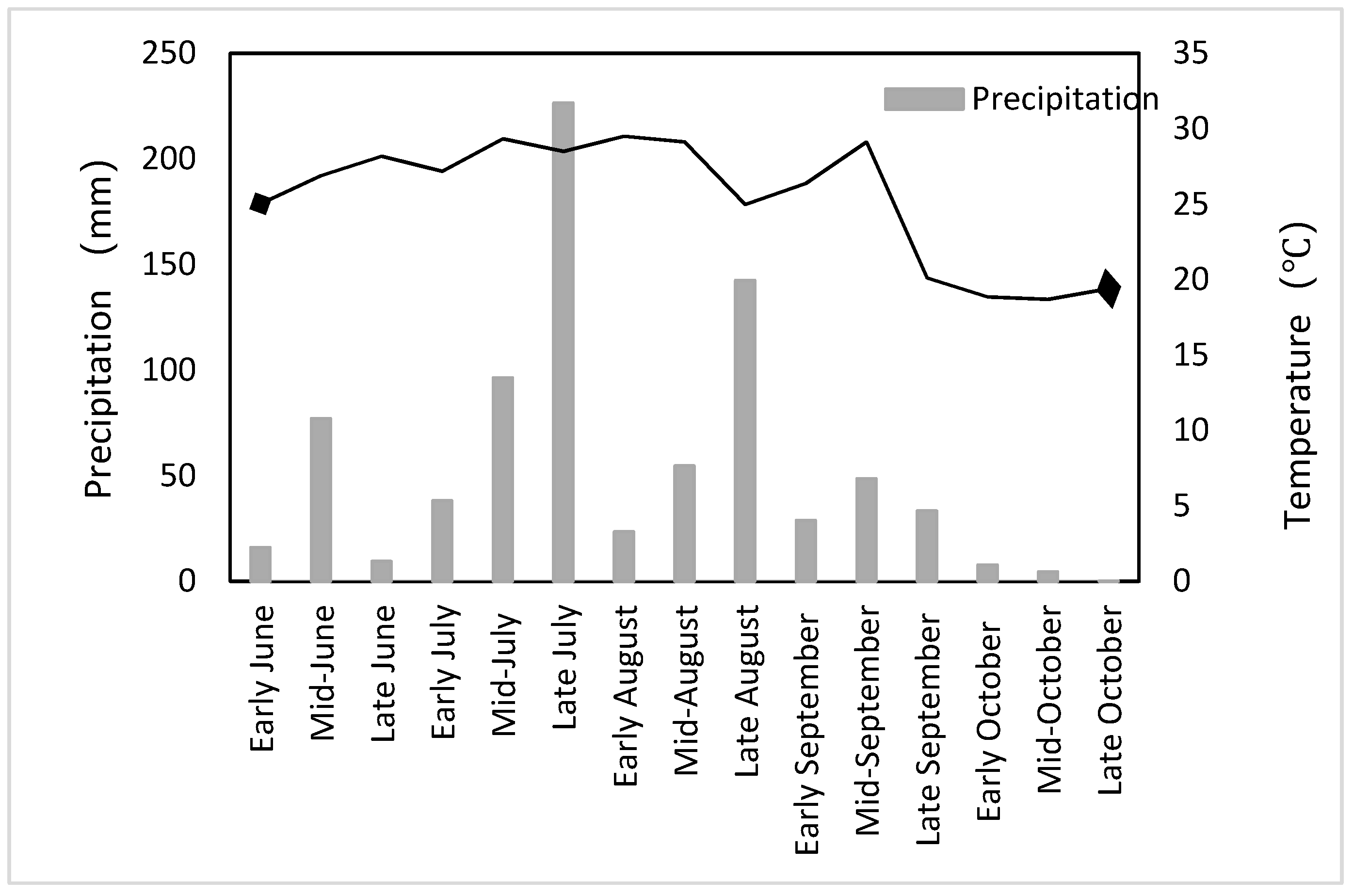
Based on previous research findings [20,21] and methods for variety selection based on the top 40 maize varieties in terms of cultivated area suitable for the Huang-Huai-Hai region, selection was carried out using data from long-term fixed-site field trials combined with two consecutive years of production experiments. The varieties were classified according to their average grain yield and nitrogen harvest index under both high- and low-nitrogen conditions. Among them, the dual-efficient variety Qiule 368 (QL368, provided by Henan Qiule Seed Technology Co., Ltd., Zhengzhou, China), the dual-inefficient variety Jingpin 450 (JP450, provided by Henan Ping’an Seed Industry Co., Ltd., Jiaozuo, China), and the highly nitrogen efficient variety Xianyu 335 (XY335, provided by Shandong Denghai Pioneer Seed Industry Co., Ltd., Laizhou, China) were selected. The three chosen varieties exhibited clear differences in nitrogen efficiency under the described experimental conditions and were therefore used as test materials for subsequent research. The experiment was conducted in a high-standard experimental field located in Dancheng County, Zhoukou City, Henan Province, China (33°64′ N, 115°18′ E). Meteorological data for the location are shown in Figure 1, with all precipitation occurring as natural rainfall. The soil at the experimental site is classified as silty clay loam. Meteorological conditions during the experimental period are presented in Figure 1. The soil at the experimental site had the following physicochemical properties: PH 7.4, soil organic matter content 23.53 g·kg−1, total nitrogen 1.12 g·kg−1, alkali-hydrolyzable nitrogen 88.26 mg·kg−1, available phosphorus 16.29 mg·kg−1, and available potassium 261.95 mg·kg−1. The field featured flat terrain with convenient access to irrigation and drainage facilities. The preceding crop was winter wheat, which had been managed following local conventional practices.

2.2. Experimental Design

This experiment was conducted from 2023 to 2024, with specific timelines as follows: sowing on 19 June 2023 and harvesting on 13 October 2023, followed by sowing on 15 June 2024 and harvesting on 11 October 2024. A two-factor experiment with a split-plot design was adopted, where the main plot factor was nitrogen application rate and the sub-plot factor was the variety [15]. Eight nitrogen levels were set: 0 kg·ha−1, 50 kg·ha−1, 100 kg·ha−1, 150 kg·ha−1, 200 kg·ha−1, 250 kg·ha−1, 300 kg·ha−1, and 350 kg·ha−1. The planting density was 67,500 plants·ha−1. Each variety was planted in 10 rows, with a row length of 5 m. Each treatment plot covered an area of 30 m2 and was planted with 210 individuals. Each treatment was replicated three times, resulting in a total of 72 plots. The fertilizers used in the experiment included calcium superphosphate (P2O5 12%), potassium sulfate (K2O 54%), and urea (N 46%). The phosphorus fertilizer application rate was uniformly set at 150 kg·ha−1. All fertilizers were applied manually in a one-time trench application at the jointing stage. Field management practices were consistent with local production standards. Integrated weed, disease, and pest control were carried out at the three-leaf stage and during the late growth period of maize.

2.2.1. Determination of Corn Yield and Its Constituent Factors

At maturity, 30 randomly selected ears from each plot were sun-dried and threshed to determine grain moisture content. Grain yield per unit area was calculated based on the national standard for maize grain storage (14% moisture content). Additionally, 10 uniformly sized ears from each plot were selected to measure the following traits: ear length, ear diameter, number of kernels per row, number of rows per ear, total number of kernels per ear, and 100-kernel weight.

2.2.2. Determination of Dry Matter and Nitrogen Concentrations in the Upper Part of the Corn Field

At the jointing stage, 20 uniformly growing maize plants from each plot were selected and labeled. During the subsequent growth stages—the bell stage, silking stage, filling stage, and maturity stage—three plants from each plot were sampled and partitioned accordingly. At the bell stage, aboveground biomass was separated into stems and leaves; at the silking stage, into stems, leaves, and ears; and after silking, into stems, leaves, husks + cobs, and grains.
The samples were then placed in an oven at 105 °C for 30 min to deactivate enzymes, followed by drying at 80 °C until a constant weight was achieved. After cooling to room temperature, the samples were weighed and recorded using a precision balance (0.001 g accuracy). The dried samples were ground using a mill and passed through a 0.5 mm sieve, processed samples were accurately weighed and sealed in dedicated tin capsules for subsequent analysis, and their nitrogen concentration was measured with a Dumas nitrogen analyzer (Gerhard Dumatherm-DT, Königswinte, Germany; equipment sourced from Zhengzhou City, Henan Province, China).

2.3. Relevant Calculation Formulas

Relevant parameters were calculated according to references [15,16]. The main calculated indices include the following.
Harvest index (HI); plant nitrogen accumulation (PNA), kg·ha−1; nitrogen agronomic efficiency (NAE), kg·kg−1, nitrogen partial factor productivity (PFPN), kg·kg−1; nitrogen recovery efficiency (NRE), %; nitrogen physiological efficiency (NPE), kg·kg−1; nitrogen dry matter production efficiency (NDMPE), kg·kg−1; redistribution amount of pre-silking stored dry matter vegetative organs to grain (RAP), t·ha−1; redistribution percentage of redistributed pre-silking stored dry matter from vegetative organs to grain (PRAP), %; contribution of RAP to grain yield (CRAP), %; dry matter accumulation post-silking (DMP), t·ha−1; contribution of DMP to grain yield (CDMP), %; nitrogen redistribution amount (NRA), kg·ha−1; nitrogen redistribution rate, NRR, %; contribution of NRA to grain yield (CNRA), %; nitrogen accumulation post-silking (NAP), kg·ha−1; and contribution of NAP to grain yield (CNAP), %.

2.4. Data Processing and Analysis

The data for each indicator obtained from the experiments were organized and recorded in an Excel spreadsheet for preliminary processing. Statistical analysis was performed using SPSS 26.0, while graphs were generated with Origin 2024. Significance tests between treatments were conducted using Duncan’s new multiple range test.

3. Results

3.1. The Yields and Constituent Factors of Different Corn Varieties Under Different Nitrogen Fertilizer Levels

3.1.1. The Yields of Different Corn Varieties Under Different Nitrogen Fertilizer Levels

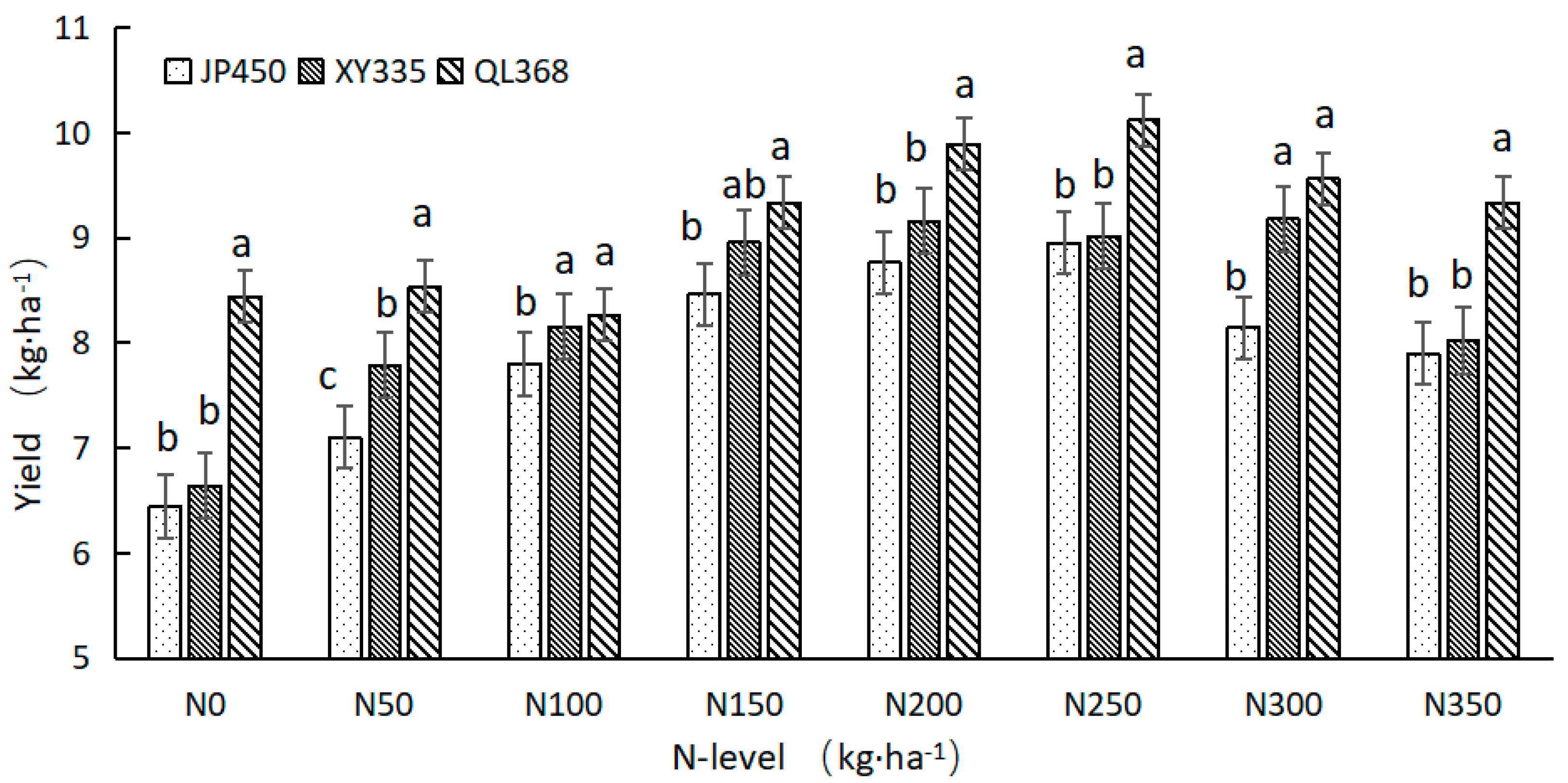
As shown in Figure 2, grain yield of all varieties initially increased and then decreased with rising nitrogen application rates. Under the N0, N50, N100, N150, N200, N250, N300, and N350 treatments, the grain yields of JP 450, XY 335, and QL 368 ranged from 6.45 to 8.76 t·ha−1, 6.64 to 9.18 t·ha−1, and 8.40 to 10.12 t·ha−1, respectively. The maximum grain yields were achieved at N300 for JP 450, N300 for XY 335, and N250 for QL 368. The yields were 8.9 t·ha−1, 9.2 t·ha−1, and 10.1 t·ha−1, respectively. Across all nitrogen treatments, yields consistently followed the order of QL 368 > XY 335 > JP 450. Compared with the other varieties, JP 450 had the lowest maximum grain yield, while XY 335 and QL 368 exhibited 5% and 9% higher yields, respectively. These results indicate that the double-low-efficiency variety JP 450 showed relatively low yield under both low- and high-nitrogen conditions. Under high-nitrogen treatment, the double-high-efficiency variety QL 368 outperformed the high-nitrogen-efficient variety XY 335 in terms of grain yield.

3.1.2. The Yield Components of Different Corn Varieties Under Different Nitrogen Fertilizer Levels

As shown in Table 1, no significant differences were observed in kernel percentage among the maize varieties under different nitrogen levels; however, highly significant differences and interactive effects (p < 0.01) were detected in 100-kernel weight, ear length, ear diameter, and number of kernels per ear. Under low-nitrogen conditions (N0, N50, N100), all varieties exhibited lower 100-kernel weight compared to normal and high nitrogen levels. With increasing nitrogen application, ear length initially increased and then plateaued or declined, a trend similarly observed in ear diameter, though varietal differences in ear diameter were not pronounced. No marked differences in kernel number per ear were found among varieties across nitrogen treatments; however, kernel number per ear generally increased initially and then decreased gradually with rising nitrogen levels, with each variety reaching its maximum under different nitrogen treatments. These results indicate that 100-kernel weight, ear length, ear diameter, and kernel number per ear of all varieties showed a trend of initial increase followed by a decrease as nitrogen application rate increased.

3.2. Dry Matter Accumulation, Distribution, and Transport of Different Corn Varieties Under Different Nitrogen Fertilizer Levels

3.2.1. Dry Matter Accumulation of Different Corn Varieties Under Different Nitrogen Fertilizer Levels

As shown in Table 2, dry matter accumulation (DMA) in maize increased progressively with advancing growth stages. At the bell stage, no significant differences in DMA were observed among varieties under different nitrogen levels. However, as growth progressed, significant differences (p < 0.01) and interactive effects between variety and nitrogen level became apparent.
DMA of all varieties generally exhibited an initial increase followed by stabilization or a decrease with increasing nitrogen levels. Under low-nitrogen treatments (N0, N50, N100), the DMA of QL 368 and JP 450 increased with rising nitrogen levels, with values ranging from 3.16 to 3.58 t·ha−1, 5.79 to 6.11 t·ha−1, 8.39 to 10.84 t·ha−1, and 13.09 to 17.78 t·ha−1 for QL 368, and 3.00 to 3.09 t·ha−1, 5.73 to 6.02 t·ha−1, 8.09 to 9.78 t·ha−1, and 12.97 to 15.52 t·ha−1 for JP 450 across the four growth stages. For instance, under the N100 treatment, QL 368 exhibited 15%, 2%, 10%, and 14% higher DMA than JP 450 at each respective stage.
Under medium-nitrogen treatments (N150, N200), varietal differences in DMA across growth stages were not pronounced. Under high-nitrogen treatments (N250, N300, N350), QL 368 maintained relatively high DMA across stages, while XY 335 demonstrated better tolerance to high nitrogen than JP 450. For example, under N350, DMA ranges for XY 335 and JP 450 were 3.15–3.44 t·ha−1, 6.58–7.53 t·ha−1, 10.13–10.63 t·ha−1, and 15.98–17.93 t·ha−1 versus 3.01–3.12 t·ha−1, 6.41–6.49 t·ha−1, 9.68–10.61 t·ha−1, and 15.85–16.01 t·ha−1, respectively. The XY 335 values were significantly higher than those of JP 450, and both varieties showed an initial increase followed by a decrease in DMA with increasing nitrogen levels.
These results indicate that DMA increased significantly with growth progression across all varieties, and at each growth stage, DMA initially increased and then decreased with increasing nitrogen application. Moreover, the variety × nitrogen interaction had a highly significant influence on DMA at all growth stages.

3.2.2. Dry Matter Distribution of Different Corn Varieties Under Different Nitrogen Fertilizer Levels

As shown in Table 3, the dry matter partitioning to stems initially increased and then decreased during maize development, peaking at the silking stage. Dry matter partitioning to leaves continuously decreased from the bell stage to maturity, while partitioning to husks + cobs and grains increased from the silking stage onward. At the bell stage, dry matter partitioning was higher in leaves than in stems; during later vegetative growth until maturity, partitioning to stems exceeded that to leaves. At maturity, dry matter distribution followed the order of grains > stems > husks + cobs > leaves.
During the vegetative growth stage (bell stage), differences in dry matter partitioning among varieties under different nitrogen levels were not significant, though XY 335 showed 2% lower stem dry matter partitioning compared to JP 450 and QL 368. After entering reproductive growth, significant differences in dry matter partitioning to ears and grains were observed among varieties and nitrogen levels, showing an initial increase followed by stabilization with increasing nitrogen application. Under low nitrogen (N0, N50), XY 335 had the lowest ear dry matter partitioning (5.48%) at silking, which was 4.1% and 3.3% lower than JP 450 and QL 368, respectively. Under medium nitrogen (N150, N200), JP 450 showed the highest ear dry matter partitioning (18.11%), exceeding XY 335 and QL 368 by 7.1% and 7.51%, respectively. Under N350 treatment, QL 368 exhibited higher ear dry matter partitioning. At the filling and maturity stages, varietal differences in grain dry matter partitioning were not significant under low nitrogen (N0, N50, N100), but with medium and high nitrogen, QL 368 showed significantly higher grain dry matter partitioning than the other varieties.
These results indicate that the highly nitrogen efficient variety XY 335 had lower dry matter partitioning to ears and grains but higher partitioning to stems under low-nitrogen conditions. The higher yield of QL 368 under both low- and high-nitrogen conditions can be attributed to its higher dry matter partitioning to leaves, suggesting that leaves played a greater role in transporting photosynthetic products to grains during the late growth stages.

3.2.3. Dry Matter Transfer of Different Corn Varieties Under Different Nitrogen Fertilizer Levels

As shown in Table 4, dry matter formation in maize primarily relied on post-silking accumulation, which contributed over 90% of the grain yield. Significant differences (p < 0.01) and interactive effects were observed in pre-silking dry matter translocation (RAP) among varieties under different nitrogen levels. The translocation amounts for JP 450, XY 335, and QL 368 ranged from 0.21 to 0.57 t·ha−1, 0.21 to 0.64 t·ha−1, and 0.06 to 0.51 t·ha−1, with the lowest values observed at N150, N100, and N50, respectively. Under low nitrogen treatments (N0, N50, N100), JP 450 exhibited 71.09% and 41.3% higher RAP than QL 368 and XY 335, respectively. Under medium-to-high-nitrogen treatments (N150–N350), RAP tended to stabilize or increase across varieties. Post-silking dry matter accumulation (DMP) initially increased and then stabilized or decreased with rising nitrogen levels. QL 368 consistently showed higher DMP (ranging from 7.3 to 12.01 t·ha−1) than the other varieties across nitrogen levels. These results indicate that the variety × nitrogen interaction had a highly significant effect on both pre- and post-silking dry matter translocation. Post-silking accumulation was the predominant factor influencing grain yield. The higher yield of QL 368 can be attributed to its greater post-silking dry matter accumulation and higher contribution of post-silking assimilates to grain yield.

3.3. Nitrogen Accumulation, Distribution and Transport of Different Corn Varieties Under Different Nitrogen Fertilizer Levels

3.3.1. Nitrogen Accumulation of Different Corn Varieties Under Different Nitrogen Fertilizer Levels

As shown in Table 5, nitrogen accumulation increased progressively with maize development. At each growth stage, it initially rose and then stabilized or declined with increasing nitrogen levels, with significant differences (p < 0.01) and interactive effects observed among varieties under different nitrogen treatments. At both the bell stage and maturity, QL 368 exhibited significantly higher nitrogen accumulation than JP 450 and XY 335 across nitrogen levels. For example, at maturity, the maximum nitrogen accumulation values of JP 450, XY 335, and QL 368 were 143.67 kg·ha−1, 180.44 kg·ha−1, and 195.72 kg·ha−1, achieved under N350, N300, and N350 treatments, respectively. In contrast, at the silking and filling stages under low nitrogen (N0, N50, N100), varietal differences in nitrogen accumulation were not significant. These results indicate that nitrogen accumulation increased with advancing growth stages and rising nitrogen application levels. The high-nitrogen-efficiency variety XY 335 showed no significant difference in nitrogen accumulation compared with the double-low-efficiency variety JP 450 across growth stages, but was significantly lower than the double-high-efficiency variety QL 368.

3.3.2. Nitrogen Distribution of Different Corn Varieties Under Different Nitrogen Fertilizer Levels

As shown in Table 6, the interaction between maize variety and nitrogen application level had no significant effect on nitrogen partitioning among organs at the bell stage, filling stage, or maturity, but exerted a highly significant influence at the silking stage. Throughout the growth period, nitrogen partitioning was consistently higher in leaves than in stems. After the transition to reproductive growth, nitrogen allocation to stems and leaves gradually decreased. At maturity, nitrogen distribution among organs followed the order of grains > leaves > stems > husks + cobs. At the bell stage, no significant differences in nitrogen partitioning were observed among varieties under different nitrogen levels. The nitrogen partitioning to stems was 32.11%, which was 35.78% lower than that to leaves. During reproductive growth, ear nitrogen partitioning at the silking stage was significantly higher than that under the N50 treatment and showed an increasing trend with rising nitrogen application. Under low-to-medium-nitrogen treatments (N50–N200), JP 450 exhibited significantly higher ear nitrogen partitioning than QL 368 and XY 335, though these differences were not significant under high-nitrogen conditions (N250–N350). QL368 demonstrated higher nitrogen partitioning to grains than the other varieties at both the filling and maturity stages. At maturity under the N0 treatment, XY 335 showed relatively low nitrogen partitioning to grains, while under treatments above N150, its partitioning was 7.54%, 2.18%, 5.51%, 1.5%, and 5.59% higher than that of JP 450, respectively. These results indicate that increasing nitrogen application did not lead to significant differences in nitrogen partitioning among organs across varieties. During reproductive growth, the double-high-efficiency variety QL 368 showed progressively higher proportional nitrogen content in grains compared to XY 335 and JP 450, though these differences were not statistically significant.

3.3.3. Nitrogen Transfer of Different Maize Varieties with Different Nitrogen Fertilizers

As shown in Table 7, nitrogen accumulation in maize was primarily achieved through both pre-silking nitrogen translocation and post-silking nitrogen accumulation. Significant differences (p < 0.01) and interactive effects were observed among varieties under different nitrogen levels. The contribution rate of pre-silking translocation to grain nitrogen ranged from 22.23% to 49.36%, while that of post-silking accumulation ranged from 45.32% to 75.19%. Significant differences in pre-silking nitrogen translocation were detected among varieties across nitrogen levels. Under low-nitrogen treatments (N0, N50, N100), JP 450 exhibited significantly higher pre-silking nitrogen redistribution rate and contribution to grain nitrogen than XY 335 and QL 368. Under medium-to-high-nitrogen treatments (N150–N350), XY 335 showed higher pre-silking translocation amount and redistribution rate compared to JP 450 and QL 368. QL 368 demonstrated significantly greater post-silking nitrogen accumulation and higher contribution rate to grain nitrogen than JP 450 and XY 335 across all nitrogen levels. These results indicate that the double-high-efficiency variety QL 368 possessed higher post-silking nitrogen accumulation and greater contribution of post-silking nitrogen translocation to grains compared to the double-low-efficiency variety JP 450 and the high-nitrogen-efficiency variety XY 335 under different nitrogen conditions. The double-low-efficiency variety JP 450 exhibited higher pre-silking nitrogen translocation and redistribution efficiency under low nitrogen conditions, while the high-nitrogen-efficiency variety XY 335 performed similarly to JP 450 under medium-to-high-nitrogen treatments.

3.4. The Nitrogen Absorption and Utilization Efficiency of Different Corn Varieties with Different Nitrogen Fertilizer Levels

As shown in Table 8, significant differences (p < 0.01) and interactive effects were observed in grain nitrogen yield, nitrogen partial factor productivity (PFPN), nitrogen agronomic efficiency (NAE), nitrogen recovery efficiency (NRE), and nitrogen dry matter production efficiency (NDMPE) among maize varieties under different nitrogen levels. However, neither nitrogen application rate nor variety had a significant effect on nitrogen harvest index (NHI), and their interaction did not reach significant levels for grain nitrogen yield or nitrogen physiological efficiency (NPE).
No significant differences in NHI were detected among varieties across nitrogen levels. Grain nitrogen yield initially increased and then decreased with increasing nitrogen application, reaching maximum values for JP 450, XY 335, and QL 368 at N350, N300, and N250, respectively. Under the zero-nitrogen treatment (N0), QL 368 exhibited 29.17% and 27.39% higher grain nitrogen yield than JP 450 and XY 335, respectively. Under nitrogen-applied treatments, both XY 335 and QL 368 significantly outperformed JP 450. PFPN, NAE, and NRE all reached their maximum values at the N50 treatment level. PFPN decreased significantly with increasing nitrogen application, following the order QL 368 > XY 335 > JP 450. While varietal differences were not significant under low-to-medium-nitrogen treatments, QL 368 showed significantly higher PFPN than the other varieties under medium-to-high-nitrogen conditions. NAE also exhibited a decreasing trend with increasing nitrogen application, generally following the order XY 335 > QL 368 > JP 450. NRE decreased with rising nitrogen levels, showing the pattern QL 368 > XY 335 > JP 450. Both NDMPE and NPE demonstrated decreasing or decreasing-then-stabilizing trends with increasing nitrogen application. NDMPE followed the order JP 450 > XY 335 > QL 368 across varieties.

3.5. Correlation Analysis of Yield and Its Constituent Factors, Nitrogen Use Efficiency and Dry Matter, and Nitrogen Accumulation and Transport

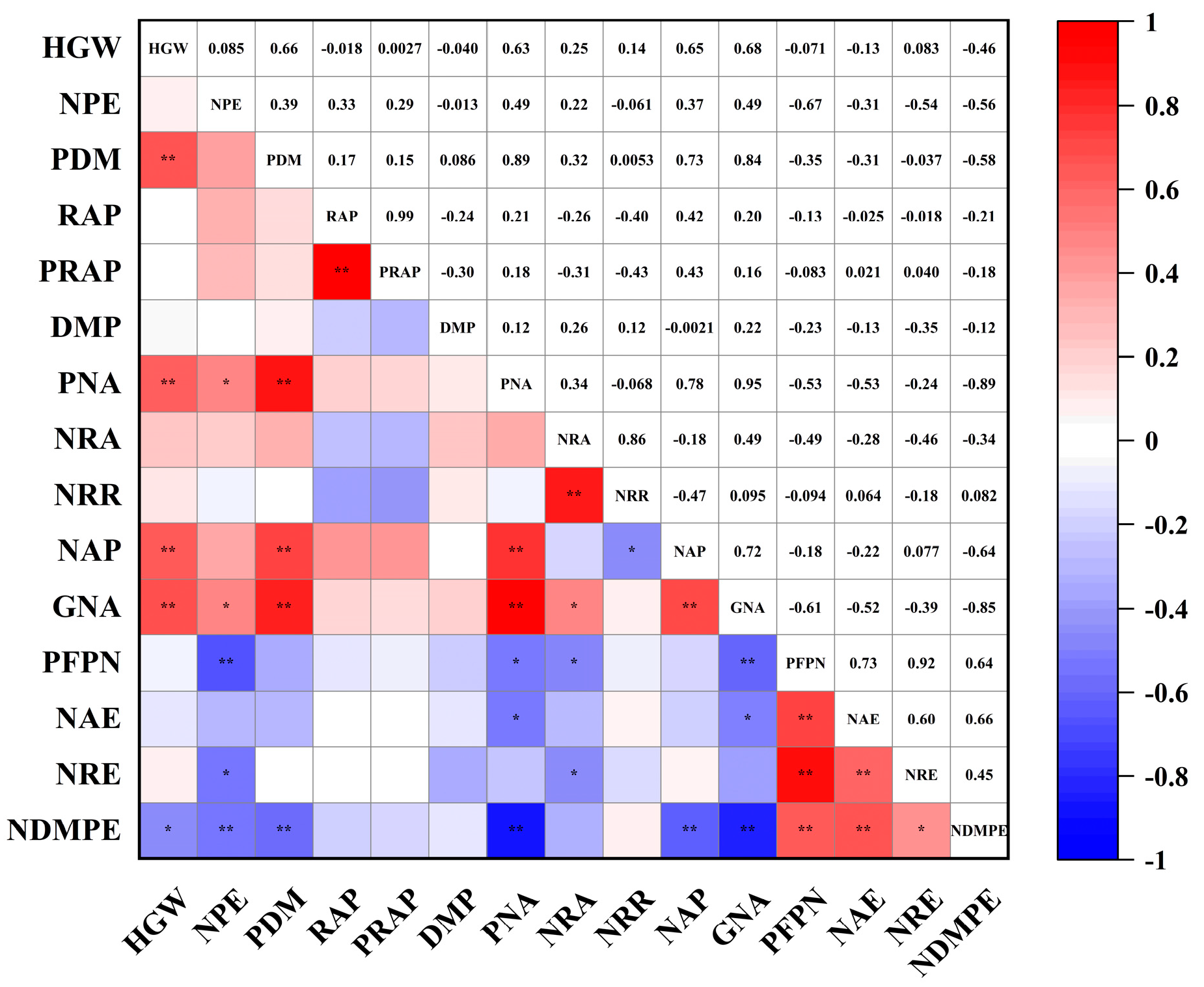
A correlation analysis was conducted using 16 relevant indicators, including yield, 100-kernel weight, and number of kernels per ear. As shown in Figure 3, yield was significantly positively correlated with 100-kernel weight, number of kernels per ear, dry matter accumulation at maturity, nitrogen accumulation at maturity, post-silking nitrogen accumulation, and grain nitrogen accumulation, but significantly negatively correlated with nitrogen partial factor productivity (PFPN) and nitrogen dry matter production efficiency (NDMPE). Hundred-kernel weight showed significant positive correlations with dry matter accumulation at maturity, nitrogen accumulation at maturity, post-silking nitrogen accumulation, and grain nitrogen accumulation, while being significantly negatively correlated with NDMPE. Number of kernels per ear was significantly positively correlated with nitrogen accumulation at maturity and grain nitrogen accumulation, but significantly negatively correlated with PFPN and nitrogen agronomic efficiency (NAE). Dry matter accumulation at maturity was significantly positively correlated with nitrogen accumulation at maturity, post-silking dry matter accumulation, and grain nitrogen accumulation, and significantly negatively correlated with NDMPE. Nitrogen accumulation at maturity was significantly positively correlated with grain nitrogen accumulation and post-silking nitrogen accumulation, but significantly negatively correlated with NDMPE, PFPN, and NAE. NDMPE was significantly positively correlated with PFPN, NAE, and nitrogen recovery efficiency (NRE). These results demonstrate that increased post-silking nitrogen accumulation significantly enhances nitrogen content in grains, thereby improving dry matter accumulation and partitioning, increasing both kernel number per ear and 100-kernel weight, and ultimately leading to high yield and high efficiency.

4. Discussion

4.1. The Influence of Different Corn Varieties on Yield and Constituent Factors Under Different Nitrogen Fertilizer Levels

The study reveals that variations in maize yields are fundamentally attributed to differences in nitrogen-efficient varieties, region-specific soil fertility conditions, and climatic variations. Among these factors, nitrogen-efficient varieties contribute significantly to yield differences [22]. Nitrogen plays a critical role in the growth and development of maize. Different maize varieties exhibit varying yields and yield components under different nitrogen application levels, with particularly notable differences observed among varieties with distinct nitrogen efficiencies [23,24]. The three primary yield components of maize are the number of ears per plant, number of kernels per ear, and 100-kernel weight. Nitrogen application effectively increases the number of kernels per ear and 100-kernel weight, thereby enhancing grain yield. Under varying nitrogen levels, nitrogen-efficient maize varieties demonstrate significantly higher 100-kernel weight compared to other varieties [25,26]. Research by Li [27] indicated that the yield difference between nitrogen-efficient and nitrogen-inefficient maize varieties is mainly reflected in the number of kernels per ear and kernel weight. This is primarily because nitrogen application enhances the activity of nitrogen-related enzymes, improves nitrogen assimilation capacity, and thereby increases nitrogen use efficiency, promoting dry matter accumulation, increasing kernel number per ear and kernel weight, and ultimately boosting yield. Under different nitrogen application rates, nitrogen-efficient maize varieties exhibit superior performance compared to nitrogen-inefficient varieties under both low- and high-nitrogen conditions. After nitrogen application, nitrogen-efficient varieties show a higher yield increase amplitude and greater yield potential [28]. The results of this study demonstrate that the yields of the three nitrogen efficiency types of maize varieties initially increased and then decreased with increasing nitrogen application. The double-high-efficiency variety QL 368 achieved higher yields under both low- and high-nitrogen conditions compared to the other types. At a nitrogen application rate of 250 kg·ha−1, the yield reached its highest level, with both the kernel number per ear and the 100-kernel weight achieving their maximum values. In contrast, the double-low-efficiency variety was more dependent on nitrogen fertilizer, requiring higher nitrogen input to achieve higher yield levels. The higher yields of the double-high-efficiency variety QL 368 and the high-nitrogen-efficiency variety XY 335 were primarily attributed to their higher 100-kernel weight and number of kernels per ear, which is consistent with previous research findings. Moreover, under the same nitrogen application rate, nitrogen-efficient varieties demonstrated greater yield increases and higher overall efficiency compared to other types. In summary, under both high- and low-nitrogen conditions, nitrogen-efficient maize varieties exhibit superior photosynthetic characteristics, effectively enhancing dry matter accumulation and partitioning, thereby improving maize yield and economic benefits.

4.2. The Effects of Different Corn Varieties on Dry Matter Accumulation, Distribution, and Transport Under Different Nitrogen Fertilizer Levels

Numerous studies have demonstrated that nitrogen application significantly influences maize agronomic traits [29]. Appropriately increasing nitrogen rates is significantly positively correlated with plant height, stem diameter, leaf area index, and dry matter accumulation. Moderately reducing nitrogen application affects early seedling growth but has minimal impact on dry matter accumulation during the jointing and bell stages. When nitrogen application exceeds the actual demand and uptake capacity of maize, negative effects emerge, impairing dry matter accumulation and partitioning [30,31,32]. Varieties with different nitrogen efficiencies vary in their nitrogen uptake and utilization, leading to differences in organic matter synthesis and ultimately affecting plant dry matter accumulation and yield. Research by Jun [33] showed that nitrogen application significantly increases both the amount and rate of dry matter accumulation in maize plants, particularly after the jointing stage. At the silking stage, when comparing maize varieties with different nitrogen use efficiencies, the dry matter weight of each organ in nitrogen-efficient varieties was significantly higher than that of other types. However, in terms of organ translocation amount and contribution rate to grains, nitrogen-efficient varieties showed relatively lower levels. Nevertheless, the harvest index of nitrogen-efficient maize varieties was significantly higher compared to other types. Studies by Li [34] indicated that with increasing nitrogen application, dry matter accumulation initially rises and then stabilizes or declines, while the proportion allocated to vegetative organs gradually decreases and that to reproductive organs increases—consistent with our findings. This study further reveals that as nitrogen application increases, all nitrogen efficiency types of maize varieties show an initial increase followed by stabilization or decrease in dry matter accumulation. Throughout growth stages, dry matter accumulation increased across all varieties, with the double-high-efficiency variety QL 368 maintaining higher dry matter partitioning to leaves, thereby facilitating greater transport of photosynthetic products to grains during late growth stages, gradually increasing grain dry weight and ultimately achieving the highest yield. Furthermore, dry matter translocation is another key factor constraining yield. Results from Cui [35] indicated that yield differences between nitrogen-efficient and nitrogen-inefficient varieties mainly stem from pre-silking dry matter translocation from vegetative organs and post-silking dry matter accumulation. Similarly, Guo [36] reported a significant positive correlation between post-silking dry matter accumulation and maize yield. This study confirms that the variety × nitrogen interaction significantly affects both pre- and post-silking dry matter translocation, with post-silking accumulation being the predominant factor influencing grain yield. The higher yield of the double-high-efficiency variety QL 368 is attributed not only to its greater post-silking dry matter accumulation but also to the highest contribution rate of post-silking assimilates to grains. This suggests that during late growth stages, nitrogen-efficient varieties exhibit superior nitrogen uptake and assimilation capacity, further promoting organic matter accumulation and redistribution to enhance yield.

4.3. The Effects of Different Corn Varieties on Nitrogen Accumulation, Distribution, Transport, and Utilization Efficiency Under Different Nitrogen Fertilizer Levels

Maize is highly sensitive to nitrogen, and nitrogen application leads to significant yield increases. Nitrogen utilization in maize primarily involves two key processes: uptake and assimilation. The main pathway consists of absorbing various forms of nitrogen through the roots or other nutrient organs, transporting them into the leaves, and subsequently assimilating inorganic nitrogen into usable organic nitrogen within cells. This process enhances the production of organic compounds, thereby increasing yield. Significant differences exist in nitrogen accumulation and partitioning among maize varieties with different nitrogen efficiencies [26,37,38]. Nitrogen-efficient varieties exhibit greater nitrogen accumulation and higher nitrogen utilization efficiency [33]. Nitrogen-efficient maize varieties exhibit stable nitrogen uptake capacity during the early growth stages. After the flowering stage, they efficiently utilize nitrogen to promote ear development, increase the seed-setting rate of tassel florets, and thereby create more favorable conditions for the accumulation of carbon and nitrogen [39]. Research by Wang [8] demonstrated that nitrogen-efficient varieties allocate a larger proportion of nitrogen to grains compared to nitrogen-inefficient varieties, which aligns with most research findings. Studies by Ma [40] indicated that while nitrogen accumulation increases with rising nitrogen application, nitrogen partial factor productivity (PFPN), nitrogen agronomic efficiency (NAE), and nitrogen recovery efficiency (NRE) gradually decrease. This study confirms that nitrogen accumulation in different nitrogen efficiency types increases with advancing growth stages and nitrogen application levels, while PFPN, NAE, NRE, nitrogen dry matter production efficiency (NDMPE), and nitrogen physiological efficiency (NPE) all show declining trends. Furthermore, nitrogen-efficient varieties accumulated significantly more nitrogen than other types. Correlation analysis revealed that 100-kernel weight, number of kernels per ear, dry matter accumulation at maturity, nitrogen accumulation at maturity, post-silking nitrogen accumulation, and grain nitrogen accumulation were all significantly positively correlated with yield. The yield increase following nitrogen application may therefore be associated with improvements in these parameters. The double-high-efficiency variety QL 368 maintained a higher proportional nitrogen content in grains from vegetative to reproductive growth stages, demonstrated greater post-silking nitrogen accumulation and higher contribution of post-silking nitrogen translocation to grains, achieved the highest nitrogen use efficiencies, exhibited superior nitrogen assimilation capacity, and consequently produced higher grain yields—consistent with the findings of Wu [41] and Yan [42]. These findings suggest that nitrogen-efficient maize varieties maintain stable nitrogen uptake and assimilation capacity under both low- and high-nitrogen conditions, whereas nitrogen-inefficient varieties require higher nitrogen input to achieve comparable nitrogen uptake and assimilation efficiency [43].

5. Conclusions

Rational nitrogen application significantly enhanced pre-silking nitrogen translocation, post-silking nitrogen accumulation, and post-silking dry matter accumulation in maize varieties with different nitrogen efficiencies. This promoted the synthesis of nitrogen compounds and dry matter, ensured sufficient kernel number per ear and 100-kernel weight, and ultimately led to higher grain yield. However, nitrogen recovery efficiency (NRE), nitrogen agronomic efficiency (NAE), nitrogen partial factor productivity (PFPN), nitrogen physiological efficiency (NPE), and nitrogen uptake efficiency generally decreased with increasing nitrogen application rates. Nitrogen-efficient varieties maintained higher post-silking nitrogen accumulation throughout the growth cycle, facilitating the translocation of post-silking nitrogen to grains, increasing grain nitrogen content at maturity, and thereby enhancing yield. Under low-nitrogen conditions, the double-high-efficiency variety QL 368 exhibited higher pre-silking nitrogen redistribution rate and post-silking nitrogen accumulation, improved nitrogen use efficiency, supported post-silking dry matter accumulation and translocation, increased 100-kernel weight and kernel number per ear, and maintained stable yield. Under medium-to-high-nitrogen conditions, both the double-high-efficiency variety QL 368 and the high-nitrogen-efficiency variety XY 335 demonstrated greater post-silking nitrogen accumulation across growth stages, enhanced nitrogen translocation to grains, and further improved dry matter production capacity, achieving high yield and high efficiency in maize production. The optimal nitrogen application rates were determined as N250 for the double-high-efficiency variety QL 368 and the double-low-efficiency variety JP 450, and N300 for the high-nitrogen-efficiency variety XY 335, under which their respective highest yields were achieved.
Currently, China has six major maize production regions. The findings of this study primarily focus on nitrogen-efficient maize varieties in the Huang-Huai-Hai maize production region, and thus have certain limitations. Future studies should therefore combine maize production across different ecological zones, with a primary focus on nitrogen uptake and utilization during the maize flowering period, and incorporate weighted analysis to provide a theoretical foundation and technical support for efficient maize production and the breeding of new varieties.

Author Contributions

Conceptualization, Y.Y. and T.W.; methodology, Y.Y., D.L. and H.W.; formal analysis, Y.Y., J.M., X.S. and S.Y.; data curation, Y.Y. and C.L.; writing—original draft, Y.Y., D.L. and X.M.; writing—review and editing, Y.Y., H.Z. and X.Z. All authors have read and agreed to the published version of the manuscript.

Funding

This paper was financially supported by the National Key Research and Development Program of China (Grant No. 2022YFD2300805), the Key Research and Development Program of Henan Province (Grant No. 251111112700), and Henan Provincial Introduction of Foreign Intelligence Project (GZS2023016).

Data Availability Statement

The original contributions presented in this study are included in the article. Further inquiries can be directed to the corresponding author.

Acknowledgments

The author would like to thank the reviewers for their valuable comments and suggestions for this work. At the same time, we sincerely thank Henan Qiule Seeds Technology, Co., Ltd. for providing the experimental site and financial support during the trial, which ensured the normal completion of the experiment. We also extend our gratitude to the Food Crops Research Institute of Henan Academy of Agricultural Sciences for offering laboratory facilities for use during the trial. Once again, we would like to thank the reviewers, other authors, and all involved institutions.

Conflicts of Interest

The authors declare that they have no known competing financial interests or personal relationships that could have appeared to influence the work reported in this paper.

References

  1. Shiferaw, B.; Prasanna, B.M.; Hellin, J.; Bänziger, M. Crops that feed the world 6. Past successes and future challenges to the role played by maize in global food security. Food Secur. 2011, 3, 307. [Google Scholar] [CrossRef]
  2. Li, S.K.; Zhao, J.R.; Dong, S.T.; Zhao, M.; Li, C.H.; Cui, Y.H.; Liu, Y.H.; Gao, J.L.; Wang, L.C.; Wang, P. Research progress and prospects of maize cultivation in China. Sci. Agric. Sin. 2017, 50, 19. [Google Scholar]
  3. Mao, X.L.; Yin, S.Y.; Liu, H.H. Response of maize yield to climate change in North China during 1960–2020. J. Arid Land Res. Environ. 2022, 36, 193–200. [Google Scholar]
  4. Cai, C.Z.; Hou, L.Y.; Wang, H.; Xiong, Y.L.; Liao, C.J.; Zeng, X.S. Analysis of world maize yield potential based on ARIMA model. Grain Issues Res. 2020, 6, 24–30. [Google Scholar]
  5. Liu, Y.Q.; Gu, J.; Ma, N.N.; Li, X.; Yin, G.H.; Sun, S. Optimizing Spring Maize Growth and Yield through Balanced Irrigation and Nitrogen Application: A TOPSIS Method Approach. Agronomy 2024, 14, 1825. [Google Scholar] [CrossRef]
  6. Cheng, S.H.; Liu, Y.P.; Peng, J. Effects of nitrogen reduction combined with arbuscular mycorrhizal fungi on yield traits and nitrogen metabolism of summer maize. J. Maize Sci. 2024, 32, 101–110. [Google Scholar]
  7. Li, X.Y.; Ji, X.J.; Wang, X.L.; Long, A.R.; Wang, Z.Y.; Yang, Z.H.; Gong, X.W.; Jiang, Y.; Qi, H. Effects of straw returning combined with nitrogen application on spring maize yield and grain quality. Acta Agron. Sin. 2025, 51, 696–712. [Google Scholar]
  8. Wang, L.M.; Ye, Y.L.; Chen, F.J.; Shang, Y.F. Effects of nitrogen application on yield and nitrogen efficiency of different maize varieties. Chin. J. Eco-Agric. 2012, 20, 529–535. [Google Scholar] [CrossRef]
  9. Chang, X.; Wang, X.B.; Wu, M.; Yang, Z.S.; Li, J. Effects of nitrogen application on yield, dry matter and nitrogen accumulation of maize inbred lines with different nitrogen efficiency types. Soil Fertil. Sci. China 2021, 2, 221–227. [Google Scholar]
  10. He, X.; Gu, L.; Wang, D.; Bare, M.; Schaaf, G.; Apostolakis, A.; Meijide, A.; Chen, X.P.; Hochholdinger, F.; Yu, P. Rhizosheath inhabiting Massilia are linked to heterosis in roots of maize. Nat. Commun. 2025, 16, 10777. [Google Scholar] [CrossRef] [PubMed]
  11. Luo, Y.; Liu, Y.; Liu, J.; Liu, X.J.; Wu, Y.; Zhao, J.L.; Wang, Y.B.; Fang, W.J.; Zhao, L.; Li, W.Q.; et al. Optimizing thiamine pyrophosphate metabolism enhances crop yield and quality. Nat. Commun. 2025. [Google Scholar] [CrossRef]
  12. Cui, W.F.; Gao, J.L.; Yu, X.F.; Wang, Z.G.; Sun, J.Y.; Hu, S.P.; Su, Y.J.; Xie, M. Screening of high-yield and nitrogen-efficient maize varieties and their indicators. Crops 2016, 6, 38–43. [Google Scholar] [CrossRef]
  13. Zang, C.Z.; Wang, Y.J.; Zhang, J.; Hu, F.; Li, G.Q.; Zheng, G.Q. Effects of different nitrogen fertilizer modes on yield, protein quality and nitrogen utilization characteristics of summer maize. J. Maize Sci. 2015, 23, 108–113. [Google Scholar]
  14. Li, J.; Cao, H.; Li, S.; Dong, X.N.; Zhao, Z.; Jia, Z.T.; Yuan, L.X. Genetic and molecular mechanisms underlying nitrogen use efficiency in maize. J. Genet. Genom. 2024, 52, 276–286. [Google Scholar] [CrossRef]
  15. Qu, Z.; Luo, N.; Guo, J.; Xu, J.; Wang, P.; Meng, Q.F. Enhancing sustainability in the new variety-based low emergy system for maize production by nitrogen optimization. Renew. Sustain. Energy Rev. 2024, 199, 114471. [Google Scholar] [CrossRef]
  16. Cui, S.L. Effects of Nitrogen Forms on Nitrogen Uptake, Utilization and Yield Formation of Maize Varieties with Different Low Nitrogen Tolerance. Master’s Thesis, Sichuan Agricultural University, Ya’an, China, 2023. [Google Scholar]
  17. Guo, H.; Shi, Y. Effects of Nitrogen Fertilizer on Leaf Senescence, Nitrogen Translocation Efficiency and Carbon-Nitrogen Ratio in Summer Maize during Flowering and Grain-filling Stage. Jiangsu Agric. Sci. 2023, 51, 76–86. [Google Scholar]
  18. Wu, Y.W.; Li, Q.; Jin, R.; Chen, W.; Liu, X.L.; Kong, F.L.; Ke, Y.P.; Shi, H.C.; Yuan, J.C. Effect of low-nitrogen stress on photosynthesis and chlorophyll fluorescence characteristics of maize cultivars with different low-nitrogen tolerances. J. Integr. Agric. 2018, 18, 1246–1256. [Google Scholar] [CrossRef]
  19. Chisaka, A.; Zaman, A.M.; Cairns, J.T.A.; Magorokosho, C.; Das, B.; Masuka, B.; Olsen, M.; Prasanna, M. Low-N stress tolerant maize hybrids have higher fertilizer N recovery efficiency and reduced N-dilution in the grain compared to susceptible hybrids under low N conditions. Plant Prod. Sci. 2020, 23, 417–423. [Google Scholar]
  20. Yang, Y.L. Screening of Maize Varieties with Different Nitrogen Efficiencies and Their Differences in Nitrogen Uptake and Utilization in Cinnamon Soil Region. Master’s Thesis, Henan Agricultural University, Zhengzhou, China, 2020. [Google Scholar]
  21. Wang, S.L. Study on Nitrogen Uptake, Utilization and Canopy Vegetation Index of Maize Varieties with Different Nitrogen Efficiencies. Master’s Thesis, Henan Agricultural University, Zhengzhou, China, 2022. [Google Scholar]
  22. Wang, H.; Chen, Y.; Xu, J.; Yin, L.N.; Wang, S.W.; Deng, X.P. Yield Stability, Dry Matter Accumulation and Distribution Differences of Maize Varieties under Different Water and Nitrogen Environments. Agric. Res. Arid. Areas 2024, 42, 71–84. [Google Scholar]
  23. Wang, S.L.; Mu, X.Y.; Yang, Y.L.; Xu, J.M.; Liu, T.X.; Wen, T.; Fu, J.; Zheng, Y.Z.; Zhao, Y.L.; Li, H.P.; et al. Effects of nitrogen supply levels on nitrogen uptake, dry matter formation and yield of maize varieties with different nitrogen efficiencies. J. Maize Sci. 2023, 31, 118–130. [Google Scholar]
  24. Wang, J.; Han, J.L.; Yang, M.; Yao, D.; Zhou, Y.F.; Wang, W.B.; Wu, Z.X.; Yang, Q. Study on nitrogen absorption, translocation and metabolism of different nitrogen efficient maize varieties. J. Nucl. Agric. Sci. 2020, 34, 2800–2812. [Google Scholar]
  25. Zhao, L.; Hou, Z.A.; Huang, T.; Li, S.X.; Zhang, Y.; Liu, L.P. Effects of nitrogen fertilizer rate on maize yield and nutrient uptake. Xinjiang Agric. Sci. 2014, 51, 275–283. [Google Scholar]
  26. Li, H.J. Effects of Nitrogen Application Rate on Nitrogen Uptake and Utilization of Maize Varieties with Different Nitrogen Efficiencies and Their Physiological Mechanisms. Master’s Thesis, Henan Agricultural University, Zhengzhou, China, 2022. [Google Scholar]
  27. Li, W.L.; Lyu, Y.J.; Liu, X.M.; Dong, T.; Cao, X.B.; Gu, W.R.; Wei, D. Effects of nitrogen fertilizer on nitrogen metabolism enzymes, nitrogen utilization and yield of maize with different nitrogen efficiencies. Southwest China J. Agric. Sci. 2018, 31, 1829–1835. [Google Scholar]
  28. Men, Z.R. Response of Yield and Nitrogen Use Efficiency of Maize Varieties with Different Nitrogen Efficiencies to Nitrogen Application Rate. Master’s Thesis, Shandong Agricultural University, Tai’an, Chian, 2024. [Google Scholar]
  29. Wen, D.H.; Wu, X.L.; Xu, J.K.; Li, X.M.; Zhang, Y.X. Effects of different fertilization treatments on maize yield and fertilizer utilization efficiency. Tillage Cult. 2025, 45, 102–105. [Google Scholar]
  30. Chen, N.N.; Ji, R.P.; Mi, N.; Zhang, S.J.; Yu, W.Y.; Fang, Y.; Zhang, Y.S. Response of spring maize growth, yield and grain quality to reduced nitrogen application. J. Meteorol. Environ. 2021, 37, 86–92. [Google Scholar]
  31. Guo, Q.L. Analysis of the Degree of Over-Fertilization and Its Influencing Factors of Major Grain Crops in China. Master’s Thesis, Jiangxi University of Finance and Economics, Nanchang, China, 2019. [Google Scholar]
  32. Zhai, J.; Xue, J.; Zhang, Y.M.; Zhang, G.Q.; Shen, D.P.; Wang, Q.; Liu, C.W.; Li, S.K. Effects of nitrogen application rate on stalk lodging resistance traits of densely planted spring maize under integrated water and fertilizer conditions. J. Maize Sci. 2021, 29, 137–144. [Google Scholar]
  33. Juan, Y.H.; Wang, R.; Sun, W.T.; Xing, Y.H.; Sui, S.J.; Lu, D.; Mao, B.C. Effects of nitrogen application patterns on nutrient accumulation characteristics of spring maize. J. Nucl. Agric. Sci. 2011, 25, 143–148. [Google Scholar]
  34. Li, Q.J.; Zhang, Y.; Hu, W.; Meng, F.X.; Feng, G.P.; Hu, G.Z.; Liu, X.L. Effects of nitrogen management on dry matter accumulation, nitrogen absorption and distribution, and yield of maize. J. Plant Nutr. Fertil. 2011, 17, 755–760. [Google Scholar]
  35. Cui, C.; Gao, J.L.; Yu, X.F.; Wang, Z.G.; Sun, J.Y.; Hu, S.P.; Su, Y.J.; Xie, M. Characteristics of dry matter and nitrogen translocation during grain filling stage in high-yielding spring maize genotypes with different nitrogen efficiencies. J. Plant Nutr. Fertil. 2013, 19, 1337–1345. [Google Scholar]
  36. Guo, J.M.; Wang, Y.H.; Di, A.B.; Chen, X.P. Mixture of controlled release and normal urea to optimize nitrogen management for high-yielding (>15 Mg·ha−1) maize. Field Crops Res. 2017, 204, 23–30. [Google Scholar] [CrossRef]
  37. Zhao, X.; Wang, S.L.; Wen, T.; Xu, J.; Huang, B.; Yan, S.F.; Gao, G.Q.; Li, H.; Qiao, J. On correlation between canopy vegetation and growth indexes of maize varieties with different nitrogen efficiencies. Open Life Sci. 2023, 18, 20220566. [Google Scholar] [CrossRef] [PubMed]
  38. Ye, D.J. Response of Spring Maize to Soil Nitrogen Supply and Study on Nitrogen Fertilizer Recommendation Indicators. Master’s Thesis, Chinese Academy of Agricultural Sciences, Beijing, China, 2009. [Google Scholar]
  39. Chang, C.; Wang, J.; Xu, L.; Wang, H.J.; Wang, Y.B.; Zhao, H.Y. Screening of High-Yielding and Nitrogen-Efficient Spring Maize Varieties and Analysis of Their Nitrogen Reduction Potential and Nitrogen Utilization Characteristics. J. Maize Sci. 2022, 30, 142–149. [Google Scholar]
  40. Ma, Z.B.; Tang, H.H.; Wang, Q.Y.; Li, R.J.; Dong, X.R.; Zhang, D.D.; Dong, Z.Q. Effects of chlormequat combined with basal nitrogen application on nitrogen metabolism and nitrogen utilization characteristics of summer maize. J. Maize Sci. 2020, 28, 130–136. [Google Scholar]
  41. Wu, Y.; Pu, W.; Zhao, B.; Wei, G.; Kong, F.L.; Yuan, J.C. Post-anthesis Carbon and Nitrogen Accumulation and Translocation Characteristics in Maize Varieties with Different Low Nitrogen Tolerance. Acta Agron. Sin. 2021, 47, 915–928. [Google Scholar] [CrossRef]
  42. Yan, W.; Li, X.; Zhao, R.; Zhang, C.Y.; Guo, Y.L.; Huang, M.; Li, J.W.; Liu, B.; Ding, Y.; Ding, Z.H.; et al. Study on Yield and Nitrogen Use Efficiency of Different Maize Varieties. J. Maize Sci. 2023, 31, 119–127. [Google Scholar]
  43. Yu, Y. Response Characteristics of Maize with Different Nitrogen Efficiencies to Nitrogen Supply and Transcriptome & Proteome Analysis. Doctoral Dissertation, Northeast Agricultural University, Harbin, China, 2021. [Google Scholar]
Figure 1. The average temperature and cumulative precipitation from June to October in Dancheng.
Agronomy 16 00109 g001
Figure 2. The yield of different maize varieties under different nitrogen levels. Note: Different small letters indicate significant differences between varieties (p < 0.05).
Agronomy 16 00109 g002
Figure 3. Correlation analysis between yield and its components, nitrogen use efficiency and dry matter, and nitrogen accumulation and translocation. Note: HGW, hundred-grain weight; NPE, number per ear; PDM, plant dry matter; RAP, redistribution amount of pre-silking stored dry matter vegetative organs to grain; PRAP, redistribution percentage of redistributed pre-silking stored dry matter from vegetative organs to grain; DMP, dry matter accumulation post-silking; PNA, plant nitrogen accumulation; NRA, nitrogen redistribution amount; NRR, nitrogen redistribution rate; NAP, nitrogen accumulation post-silking; GNA, grain nitrogen accumulation; PFPN, nitrogen partial factor productivity; NAE, nitrogen agronomic efficiency; NPE, nitrogen physiological efficiency; NDMPE, nitrogen dry matter production efficiency. “*” indicates significant (p < 0.05) differences; “**” indicates significant (p < 0.01) differences.
Agronomy 16 00109 g003
Table 1. Yield components of different maize varieties under different nitrogen levels.
N Level (kg·ha−1)CultivarKernel Ratio (%)100-Grain Weight (g)Ear Length (cm)Ear Diameter (cm)Row Number Per EarGrain Number Per RowNumber Per Ear
N0JP4500.82 b32.7 a14.4 a4.6 a14.9 a26.1 a389.1 a
XY3350.86 a32.5 a15.4 a4.3 a14.5 a25.1 a365.2 a
QL3680.86 a34.9 a15.5 a4.7 a14.7 a27.4 a401.6 a
N50JP4500.82 b33.6 c16.0 a4.7 a15.6 a25.9 a404.1 a
XY3350.87 a34.7 b15.1 a4.5 a15.3 a27.1 a413.6 a
QL3680.86 a36.5 a15.4 a4.7 a15.1 a27.4 a413.0 a
N100JP4500.84 b31.9 a15.7 a4.4 a16.1 a26.8 b432.5 a
XY3350.87 a33.9 a16.1 a4.4 a15.7 a26.9 b424.3 a
QL3680.86 a34.2 a15.6 a4.7 a15.6 a28.7 a448.5 a
N150JP4500.83 b34.7 a16.7 a4.8 a15.9 a27.8 b440.3 a
XY3350.87 a35.1 a16.5 a4.6 a15.2 a29.7 ab452.4 a
QL3680.87 a36.5 a16.7 a4.7 a14.7 a30.8 a452.0 a
N200JP4500.83 b31.1 b17.1 a4.9 a15.9 a29.9 a474.2 a
XY3350.86 a35.5 a17.5 a4.6 a14.9 a31.8 a475.3 a
QL3680.87 a35.4 a16.3 a4.8 a15.1 a31.4 a473.3 a
N250JP4500.84 a33.7 c16.6 a4.9 a16.0 a27.8 a452.4 a
XY3350.83 a36.4 b16.4 a4.6 a15.6 a29.5 a452.9 a
QL3680.86 a39.7 a16.0 a4.9 a14.8 a29.9 a457.7 a
N300JP4500.83 b32.1 a15.6 a4.7 a15.4 a29.0 a446.2 a
XY3350.86 a36.2 a16.4 a4.6 a15.1 a30.1 a453.7 a
QL3680.86 a36.9 a16.0 a4.9 a15.3 a29.4 a450.5 a
N350JP4500.82 b34.6 b17.0 a4.7 a15.7 a27.4 b431.9 a
XY3350.86 a35.3 b15.5 a4.5 a15.2 a28.3 ab430.2 a
QL3680.86 a37.4 a16.3 a4.9 a15.1 a29.4 a442.6 a
ANOVACNS******NS****
NNS******NS***
C × NNS************
Note: “NS” means no significant difference (p > 0.05); “*” and “**” indicate significant (p < 0.05) and extremely significant (p < 0.01) differences. Different small letters indicate significant differences between varieties (p < 0.05).
Table 2. Dry matter accumulation of different maize varieties under different nitrogen levels.
N LevelCultivarTasseling (t·ha−1)Silking (t·ha−1)Blister (t·ha−1)Maturity (t·ha−1)
N0JP4503.0 c5.7 b8.1 c12.9 a
XY3353.3 a6.1 a8.5 a12.7 a
QL3683.2 b5.8 b8.4 b13.1 a
N50JP4502.9 b5.7 b9.7 b15.1 b
XY3353.1 b6.1 a9.8 b15.2 b
QL3683.5 a6.0 a10.8 a16.6 a
N100JP4503.1 b6.0 a9.8 b15.5 c
XY3353.1 b5.9 a9.9 b16.8 b
QL3683.6 a6.1 a10.9 a17.8 a
N150JP4503.2 b6.2 b9.9 b17.1 a
XY3353.2 b6.9 a10.1 b18.0 a
QL3683.7 a6.8 a11.1 a18.8 a
N200JP4503.5 a6.4 a10.3 a15.7 b
XY3353.5 a6.7 a10.7 a17.5 a
QL3683.5 a6.7 a11.0 a17.6 b
N250JP4503.0 b6.4 c9.7 b16.0 b
XY3353.3 ab7.5 a10.6 a15.9 b
QL3683.6 a6.9 b10.9 a18.4 a
N300JP4503.1 b6.5 c10.6 b15.9 b
XY3353.4 a7.2 b10.1 b17.9 a
QL3683.7 a7.8 a11.4 a18.2 a
N350JP4503.1 b6.4 b10.2 b15.9 b
XY3353.2 b6.6 b10.6 ab16.3 b
QL3683.6 a8.3 a11.0 a19.4 a
ANOVAC********
N********
C × N********
Note: “**” indicates extremely significant (p < 0.01) differences. Different small letters indicate significant differences between varieties (p < 0.05).
Table 3. Dry matter distribution of different maize varieties under different nitrogen levels.
N LevelCultivarTasselingSilkingBlisterMaturity
StemLeafStemLeafEarStemLeafBracteal
+ Axis
GrainStemLeafBracteal
+ Axis
Grain
N0JP45052.6 a47.4 b62.1 a27.7 b10.2 a47.0 a17.0 a21.3 a14.7 a26.4 a11.6 b16.2 a45.8 a
XY33548.8 b51.2 a66.7 a27.5 b5.0 a39.4 a20.5 a27.6 a12.5 a27.3 a13.1 ab16.1 a43.6 a
QL36849.9 b50.0 a62.3 b28.7 a9.0 b46.7 a20.8 a18.1 a14.4 a27.2 a13.4 a13.9 a45.4 a
N50JP45050.7 b49.3 b63.0 ab28.8 a8.1 ab40.7 a17.3 b23.5 a18.5 a21.7 b10.3 b16.4 a51.6 a
XY33548.9 c51.1 a64.2 a29.9 a5.8 b39.9 a19.4 ab23.9 a16.7 a24.8 a11.7 ab13.2 b50.3 a
QL36853.0 a46.9 c60.7 b29.4 a9.9 a39.8 a18.2 a21.7 a20.1 a23.8 a11.0 a13.5 b51.7 a
N100JP45049.1 a50.9 a62.2 a28.4 a9.5 a41.1 a16.5 b22.6 a19.8 a22.4 a10.9 a16.1 a50.6 a
XY33550.6 a49.4 a62.3 a28.5 a9.2 a41.1 a19.5 a19.4 b19.9 a24.0 a11.8 a13.9 a50.3 a
QL36850.5 a49.5 a58.8 b30.1 a11.1 a41.1 a17.6 b19.7 ab21.5 a25.0 a11.2 a13.9 a49.8 a
N150JP45051.7 a48.3 b54.1 b27.8 a18.1 a40.1 a17.6 ab23.5 a18.7 b20.6 b9.6 a16.5 a53.2 a
XY33548.8 b51.2 a61.5 a27.9 a10.5 b40.2 a18.4 a22.7 b18.7 b22.9 a10.2 a13.5 b53.4 b
QL36852.6 a47.4 b60.5 a28.9 a10.5 b38.8 a16.3 b22.9 b21.9 a22.1 ab10.6 a14.6 b52.7 b
N200JP45052.3 a47.8 b55.5 b26.4 a18.1 a39.0 a16.6 b21.6 a22.9 a20.4 b9.9 a16.8 a52.8 a
XY33552.3 a47.7 b61.9 a27.1 a11.0 b39.9 a16.8 ab22.1 a21.8 a26.5 a10.8 a13.1 b49.5 b
QL36848.4 b51.6 a61.1 a28.3 a10.6 b37.5 a18.4 a22.4 a21.8 a20.6 b10.3 a15.6 a53.5 a
N250JP45051.3 a48.7 a55.9 a29.5 a14.4 a38.9 a16.5 a26.2 a18.5 b23.1 a9.9 a15.9 a51.0 b
XY33549.3 a50.7 a58.6 a27.5 a13.9 a39.2 a19.4 a23.9 a17.5 b21.4 a10.2 a14.8 a53.6 a
QL36851.7 a48.3 a57.9 a28.2 a13.9 a36.7 a17.2 a23.6 a22.5 a21.4 a10.3 a14.9 a53.4 a
N300JP45049.5 a50.6 a57.5 a24.4 a18.1 a38.4 a15.5 a24.4 a21.7 a21.5 b10.6 a16.7 a51.1 b
XY33552.4 a47.6 a55.4 b27.4 a17.2 a38.6 a17.4 a23.3 a20.7 a23.9 a11.0 a14.8 b50.3 b
QL36851.5 a48.5 a56.6 ab26.3 a17.1 a38.5 a17.2 a24.3 a19.9 a21.4 b9.9 a14.7 b54.0 a
N350JP45051.4 a48.9 a54.6 b27.7 a17.67 b34.4 b15.9 b30.1 a19.6 ab20.8 a10.3 a18.4 a50.6 b
XY33548.1 b51.9 a60.7 a27.2 a12.09 c39.7 a18.9 a24.0 b17.3 b23.4 a10.5 a14.2 b51.9 ab
QL36850.9 a49.4 a53.0 b26.1 a20.8 a38.0 a18.1 a23.6 b20.2 a21.4 a9.9 a14.3 b54.4 a
ANOVAC**********NS**NS**********
NNSNS*********NS******NS**
C × NNSNS******NS**NS****NSNS**
Note: “NS” means no significant difference (p > 0.05); “*” and “**” indicate significant (p < 0.05) and extremely significant (p < 0.01) differences. Different small letters indicate significant differences between varieties (p < 0.05).
Table 4. Dry matter transfer of different maize varieties under different nitrogen levels.
N LevelCultivarRAP (t·ha−1)CRAP (%)DMP (t·ha−1)CDMP (%)
N0JP4500.29 a4.8 a7.2 a95.2 a
XY3350.4 a7.3 a6.6 b92.7 a
QL3680.18 a3 a7.3 a97.0 a
N50JP4500.57 a7.3 a9.4 a92.7 c
XY3350.22 b2.9 b9.1 a97.1 b
QL3680.06 c0.7 c10.4 a99.3 a
N100JP4500.53 a6.7 a9.5 b93.3 b
XY3350.21 b2.5 b10.8 a97.5 a
QL3680.11 b1.3 b11.7 a98.7 a
N150JP4500.21 b2.3 b10.9 a97.7 b
XY3350.46 a4.8 a11.2 a95.2 c
QL3680.09 c0.9 c12.0 a99.1 a
N200JP4500.29 b3.5 b9.3 b96.5 a
XY3350.64 a7.4 a10.8 a92.6 b
QL3680.49 ab5.5 ab9.9 b94.5 ab
N250JP4500.27 b3.3 b9.6 b96.7 a
XY3350.34 a4.9 a8.5 b95.1 b
QL3680.29 b3.0 b11.5 a96.9 a
N300JP4500.25 b3.1 b9.5 b96.9 a
XY3350.26 b2.9 b10.7 a97.1 a
QL3680.63 a3.4 a10.4 a96.6 b
N350JP4500.43 ab5.3 a9.5 b94.7 b
XY3350.26 b3.0 b9.8 b96.9 a
QL3680.52 a4.9 ab11.1 a95.1 ab
ANOVAC********
N********
C × N********
Note: “**” indicates extremely significant (p < 0.01) differences. Different small letters indicate significant differences between varieties (p < 0.05).
Table 5. Nitrogen accumulation of different maize varieties under different nitrogen levels.
N LevelCultivarTasseling (kg·ha−1)Silking (kg·ha−1)Blister (kg·ha−1)Maturity (kg·ha−1)
N0JP45033.8 b61.7 a75.6 a96.9 b
XY33538.9 b68.3 a76.1 a95.3 a
QL36841.2 a63.4 a71.1 a104.4 a
N50JP45035.4 b64.2 a95.8 a127.0 b
XY33539.3 b68.6 a90.3 a124.9 a
QL36853.4 a68.5 a90.9 a140.5 a
N100JP45038.5 b68.2 a106.9 b132.1 b
XY33540.7 b72.1 a119.1 ab140.8 ab
QL36853.0 a74.3 a130.4 a162.9 a
N150JP45042.1 b74.4 c109.4 b141.6 b
XY33545.8 b102.6 b116.8 ab161.1 ab
QL36854.4 a89.5 a136.4 a170.9 a
N200JP45049.0 b79.9 a121.5 a139.9 b
XY33550.4 b83.3 a127.1 a165.3 a
QL36861.1 a84.7 a138.8 a158.2 a
N250JP45039.4 b80.9 b115.4 b140.6 b
XY33545.5 b97.3 ab130.1 ab154.1 ab
QL36862.5 a89.2 b137.4 a169.3 a
N300JP45044.9 c90.3 b122.7 b141.4 a
XY33553.8 b104.8 a127.3 b180.4 a
QL36867.1 a105.7 a145.2 a195.0 a
N350JP45046.4 b92.5 b122.5 b143.7 b
XY33550.7 b94.9 b128.3 ab152.9 b
QL36861.5 a123.1 a135.76 a195.7 a
ANOVAC********
N********
C × N********
Note: “**” indicates extremely significant (p < 0.01) differences. Different small letters indicate significant differences between varieties (p < 0.05).
Table 6. Nitrogen distribution of different maize varieties under different nitrogen levels.
N LevelCultivarTasseling SilkingBlister Maturity
StemLeafStemLeafEarStemLeafBracteal
+ Axis
GrainStemLeafBracteal
+ Axis
Grain
N0JP45029.2 a70.8 a36.4 a47.1 ab16.4 a25.2 a30.6 a15.1 a29.0 a7.8 b13.6 a7.8 a70.8 a
XY33529.5 a70.5 a36.2 a44.0 b19.8 a21.3 a31.4 a17.5 a29.8 a10.6 a14.9 a7.7 a66.8 b
QL36830.8 a69.2 a38.5 a45.6 a15.9 a22.9 a30.6 a14.5 a31.9 a8.0 b13.6 a7.3 a71.0 a
N50JP45029.9 a70.1 a39.7 a46.8 b13.5 a20.7 a28.8 a14.6 a35.9 a9.3 a13.1 a7.2 ab70.5 a
XY33526.3 a73.7 a36.9 ab51.8 a11.2 b19.7 a27.8 a17.8 ab34.6 a9.6 a12.6 a5.5 b72.3 a
QL36831.6 a68.4 a34.3 b49.9 a15.8 a19.6 a28.4 a12.5 a39.4 a7.9 a11.4 a7.8 a72.9 a
N100JP45027.2 a72.8 a31.2 b53.9 a14.8 a21.2 a32.3 a13.9 a32.6 b7.7 a13.1 a7.3 a71.9 a
XY33529.1 a70.9 a37.8 a46.6 b15.6 a18.2 a35.9 a12.1 a33.7 b9.4 a13.1 a7.5 a69.9 a
QL36830.0 a69.9 a33.9 ab48.1 b17.9 a19.9 a24.9 b13.8 a41.3 a10.1 a12.9 a7.3 a69.7 a
N150JP45037.1 a62.9 a26.9 b51.8 a21.3 a23.9 a31.7 a15.9 a28.5 b7.5 a13.2 a7.7 a71.5 b
XY33535.9 a64.1 a40.8 a44.4 b14.73 b20.6 ab32.4 a14.5 a32.5 b6.5 a9.8 b5.7 a78.1 a
QL36833.8 a66.2 a38.2 a45.3 b16.6 b18.1 b26.3 a16.5 a39.2 a6.8 a10.7 a7.4 a75.1 b
N200JP45029.9 a70.1 a29.9 a46.9 a23.3 a22.4 a29.3 a10.4 b37.8 a9.9 a13.1 a6.6 b70.4 a
XY33534.6 a65.4 a33.8 a47.5 a18.7 b18.16 b31.1 a16.0 a34.7 a9.6 a12.2 a5.6 ab72.6 a
QL36831.4 a68.6 a33.8 a47.8 a18.4 b20.5 ab29.4 a12.6 b37.5 a7.9 a11.6 a8.1 a72.4 a
N250JP45033.6 a66.4 a37.2 a43.8 a19.0 b23.7 a30.0 b14.6 a31.7 b8.3 a12.6 a8.5 a70.5 b
XY33532.8 a67.2 a32.6 a45.5 a21.9 a17.8 b33.3 a18.2 a30.7 b6.5 a11.2 b6.3 a75.9 a
QL36834.6 a65.4 a33.7 a43.7 a22.6 a19.5 b26.2 c16.1 a38.2 a6.7 a11.6 ab6.4 a75.3 a
N300JP45031.0 a68.9 a33.2 a43.8 a23.0 a21.7 a29.9 a13.0 a35.4 a9.8 a14.1 b7.6 a68.5 a
XY33534.2 a65.8 a32.6 a43.6 a23.8 a20.8 a31.5 a13.8 a34.0 a10.5 a11.6 b7.7 a70.2 a
QL36834.8 a65.2 a31.7 a45.4 a22.9 a21.7 a28.5 a16.8 a33.1 a10.3 a10.7 a7.3 a71.7 a
N350JP45038.0 a62.0 b28.3 b46.9 a24.8 a19.7 a33.6 a15.9 a30.9 a6.7 a15.3 a8.7 a69.2 b
XY33529.5 b70.5 a27.0 a44.3 a28.7 a21.5 a30.7 a22.2 a25.6 b7.2 a12.5 ab5.5 b74.8 a
QL36835.8 ab64.2 ab29.3 b40.9 b29.8 a20.4 a29.9 a16.4 a33.3 a7.3 a11.1 b5.4 b76.1 a
ANOVACNSNS****NS******NS*****
NNSNS******NSNS******NS**
C × NNSNS******NSNSNS**NSNSNSNS
Note: “NS” means no significant difference (p > 0.05); “*” and “**” indicate significant (p < 0.05) and extremely significant (p < 0.01) differences. Different small letters indicate significant differences between varieties (p < 0.05).
Table 7. Nitrogen transfer of different maize varieties with different nitrogen fertilizers.
N LevelCultivarNRAk (g·ha−1)NRR (%)CNRA (%)NAP (kg·ha−1)CNAP (%)
N0JP45032.76 a61.67 a49.36 a31.28 a50.64 a
XY33527.44 a53.75 b45.54 b28.02 a54.46 a
QL36831.37 a59.08 b44.27 b40.96 a55.73 a
N50JP45030.49 a60.25 a44.21 a59.64 a55.79 b
XY33532.41 a54.4 b36.66 b55.38 a63.34 a
QL36831.97 a56.2 b33.68 b62.51 a66.32 a
N100JP45033.65 a60.09 a43.35 a49 b56.65 b
XY33532.25 a48.31 b30.27 b68.65 a69.73 a
QL36831.02 a47.06 b29.45 b70.79 a70.55 a
N150JP45038.18 b56.16 a37.12 b57.81 b62.88 b
XY33544.52 a56.35 a39.65 a55.48 b60.35 b
QL36839.99 b52.95 b39.66 a72.61 a60.34 a
N200JP45033.72 b50.27 b33.12 b58.23 b66.88 b
XY33546.23 a55.32 a38.25 a65 b61.75 a
QL36837.27 b54.23 a32.09 b76.53 ab67.91 ab
N250JP45041.25 a61.58 ab47.95 a47.28 b52.05 b
XY33550.51 a64.74 a43.16 a54.18 b56.84 b
QL36839.35 a54.83 b29.95 b82.4 a70.05 a
N300JP45038.84 a52.86 a39.2 a49.37 b60.8 b
XY33541 a50.19 a31.74 b76.52 a68.26 a
QL36841.24 a50.63 a29.9 b86.85 a70.1 a
N350JP45041.75 b55.9 b40.42 a50.57 b59.58 a
XY33547.26 a59.35 a38.59 a66.56 ab61.41 a
QL36846.2 ab55.8 b30.69 b80.06 a69.31 a
ANOVAC**********
N**********
C × N*********
Note: “*” and “**” indicate significant (p < 0.05) and extremely significant (p < 0.01) differences. Different small letters indicate significant differences between varieties (p < 0.05).
Table 8. Nitrogen absorption and utilization efficiency of different maize varieties with different nitrogen levels.
N LevelCultivarNHIGNYPFPNNAENRENDMPENPE
N0JP4500.69 a72.46 b---134.39 a66.99 a
XY3350.64 b73.43 b---133.02 a69.93 a
QL3680.68 a93.48 a---125.56 a74.52 a
N50JP4500.71 a81.95 b142.03 c13.11 a60.29 a119.85 a59.23 a
XY3350.71 a90.09 a155.77 b22.98 a59.16 a122.08 a62.59 a
QL3680.67 a95.37 a170.68 a15.24 a72.25 a117 a60.95 a
N100JP4500.68 a88.99 b77.97 a13.5 a35.28 a117.75 a59.16 a
XY3350.7 a95.4 a81.54 a15.15 a45.44 a119.8 a58.36 a
QL3680.65 a98.42 a82.64 a14.92 b58.45 a109.99 a50.96 b
N150JP4500.73 a96.11 b56.42 a13.45 a32.83 a120.56 a60.32 a
XY3350.76 a114.17 a59.7 ab15.44 a37.5 a112.07 b55.9 b
QL3680.73 a118.25 a62.22 a10.4 a43.52 a110.23 b54.64 b
N200JP4500.73 a108.39 b43.82 b11.59 a21.53 c112.27 a62.67 a
XY3350.72 a126.62 a45.79 b12.59 a34.99 a106.1 a55.4 b
QL3680.73 a130.11 a49.46 a10.6 a26.99 b104.67 a62.5 a
N250JP4500.73 a109.28 b34.94 b9.16 a17.5 a113.98 a62.19 a
XY3350.76 a117.62 b34.5 b7.95 a23.5 a103.75 a56.04 b
QL3680.78 a135.01 a40.48 a9.39 a25.95 a109.25 a60.07 a
N300JP4500.7 a99.62 b27.15 a5.67 a14.86 b112.92 a57.4 a
XY3350.72 a130.99 a30.6 a8.47 a28.37 a99.37 b50.9 b
QL3680.71 a134.14 a31.88 a5.97 a30.2 a93.57 b49.09 b
N350JP4500.72 a102.24 b22.57 b4.15 a13.37 b110.38 a55.03 a
XY3350.81 a116.02 b22.92 b3.95 a16.44 b107.37 a52.8 a
QL3680.77 a133.59 a26.67 a4.47 a26.1 a99.08 a47.69 b
ANOVACNS************
NNS************
C × N**NS********NS
Note: “NS” means no significant difference (p > 0.05); “**” indicates extremely significant (p < 0.01) differences. Different small letters indicate significant differences between varieties (p < 0.05).
Disclaimer/Publisher’s Note: The statements, opinions and data contained in all publications are solely those of the individual author(s) and contributor(s) and not of MDPI and/or the editor(s). MDPI and/or the editor(s) disclaim responsibility for any injury to people or property resulting from any ideas, methods, instructions or products referred to in the content.