Article

Selection of High-Yield Varieties (Lines) and Analysis on Molecular Regulation Mechanism About Yield Formation of Seeds in Alfalfa

College of Pratacultural Science, Gansu Agricultural University, Key Laboratory of Pratacultural Ecosystem, Ministry of Education, Gansu Provincial Engineering Laboratory of Pratacultural Science, Sino-US Research Center for Sustainable Development of Grassland Animal Husbandry, Lanzhou 730070, China
*
Author to whom correspondence should be addressed.
Agronomy 2026, 16(1), 108; https://doi.org/10.3390/agronomy16010108 (registering DOI)
Submission received: 21 November 2025 / Revised: 15 December 2025 / Accepted: 30 December 2025 / Published: 1 January 2026
(This article belongs to the Section Grassland and Pasture Science)

Abstract

The goal of this study was to elucidate the genetic and molecular regulatory mechanisms underlying agronomic traits in elite alfalfa (Medicago sativa L.). Through the analysis of 44 varieties and lines, we measured 19 yield-related traits and performed transcriptome sequencing to investigate the factors driving yield variation. The results indicated extensive variation in agronomic traits among the tested accessions, with the coefficients of variation (CVs) ranging from 7.85% to 42.66%, suggesting substantial potential for genetic improvement. Correlation analysis revealed that seed yield was significantly and positively correlated with the number of reproductive branches and inflorescences at maturity, whereas early vegetative growth was negatively correlated with 100-seed weight. The 44 accessions were categorized into three clusters: Cluster II (the largest group) exhibited balanced traits; Cluster I showed vigorous early growth but low pod yield; and Cluster III was characterized by the highest pod and branch numbers. Principal Component Analysis (PCA) explained 65.88% of the total variation (first six components), identifying GNS31 and GNS43 as the superior and inferior genotypes, respectively. Furthermore, transcriptome profiling detected the highest number of differentially expressed genes (10,089 DEGs) in pod tissues, with 66% being upregulated. Functional enrichment analyses (GO and KEGG) highlighted that varietal differences were primarily enriched in secondary metabolism, lipid metabolism, and plant hormone signal transduction pathways. Notably, within the auxin pathway, the SAUR and GH3 families displayed significant tissue-specific expression in pods.

1. Introduction

Alfalfa (Medicago sativa L.), widely regarded as the “Queen of Forages,” is a vital forage crop distinguished by its high nutritional value. Its leaves are rich in vitamins, amino acids, and proteins. Additionally, its well-developed root system facilitates nitrogen fixation, improves soil structure, and enhances microbial activity [1,2]. Globally, alfalfa cultivation covers approximately 30 million hectares, concentrated primarily in the United States and Argentina [3], with alfalfa ranking as the fourth most valuable export crop in the U.S. [4]. In contrast, China faces significant deficits in both cultivation scale and germplasm resources. The limited planting area and scarcity of registered varieties have resulted in a heavy reliance on imported high-quality alfalfa products, severely constraining the healthy and sustainable development of China’s herbivorous animal husbandry industry [5,6]. With the structural adjustment of China’s agricultural and livestock sectors, increasing emphasis has been placed on improving grassland ecology and expanding the cultivation of high-quality forage [7,8]. Consequently, the demand for forage seeds has risen continuously, leading to a supply–demand imbalance, which is particularly acute for alfalfa seeds [9]. Driven by grassland reseeding efforts and the rapid expansion of animal husbandry, the low domestic yield of alfalfa seeds has severely limited market supply capabilities [10]. Furthermore, alfalfa breeding faces multiple challenges, including abiotic stresses, the need for synergistic improvements in yield and quality, and a relatively narrow genetic base of germplasm resources [11]. These factors significantly hinder the efficient production and sustainable utilization of alfalfa. Therefore, breeding new varieties with high yield, superior quality, and stress resistance through genetic improvement has become an urgent priority for industrial development [12].
Plant growth regulators (PGRs), encompassing synthetic chemicals and endogenous hormones such as auxins, gibberellins, and cytokinins, regulate cellular activities via signal transduction to influence plant organ growth, maturation, and abscission [13,14]. In crops, optimizing hormone levels enhances growth, yield, stress tolerance, and physiological traits [15]. Alfalfa yield is determined by total dry matter accumulation and its partitioning among various plant organs [16]. Recently, breakthroughs in genetic transformation and whole-genome sequencing [17,18,19,20] have made the rapid genetic improvement of alfalfa using modern biotechnology a major research hotspot [21,22]. The exploration and creation of elite parental germplasm lie at the core of high-yield breeding, while the dissection of yield-related traits is critical for breeding selection [23]. However, as alfalfa is an autotetraploid species with a complex genetic background, elucidating the genetic basis of traits directly through molecular approaches remains challenging [24]. Currently, research on the mechanisms underlying alfalfa yield formation has predominantly focused on single tissues or localized traits. Due to the lack of a systemic perspective, a critical knowledge gap remains regarding how different tissues (source and sink organs) are synergistically regulated during yield formation. Alfalfa yield is jointly determined by biomass accumulation in vegetative organs (leaves and stems) and the development of reproductive organs (flowers and pods). However, existing studies have not yet clearly elucidated how gene expression networks among these four key parts dynamically interact to balance vegetative and reproductive growth. This limited understanding of ‘source–sink’ synergistic molecular mechanisms severely restricts the progress of utilizing molecular breeding technologies to precisely improve alfalfa yield. Therefore, it is essential to integrate phenomics and transcriptomics to systematically dissect these multiple organs and identify key regulatory pathways. To date, phenotypic analysis and comprehensive evaluation based on agronomic traits remain the most intuitive and reliable methods for assessing germplasm resources and selecting parents [19]. The core of future alfalfa breeding lies in the creation and utilization of parental materials. Integrating phenomics with transcriptomics is essential to accelerate genetic improvement and meet the demands of sustainable animal husbandry [17].
Therefore, the objective of this study was to systematically evaluate multiple alfalfa germplasm resources by integrating agronomic trait analysis with high-throughput transcriptomics. We screened for accessions with superior agronomic traits and focused specifically on four key tissues: leaves, stems, inflorescences, and pods. Furthermore, using comparative transcriptomics, we identified differentially expressed genes (DEGs) and core metabolic pathways regulating key yield traits. These findings elucidate the molecular mechanisms underlying the formation of high-yield and high-quality traits, providing a theoretical basis and genetic resources for efficient genetic improvement and new variety breeding.

2. Materials and Methods

2.1. Overview of the Experimental Site

The field experiment was conducted during the spring of 2024 in Gaotai, Zhangye City, Gansu Province, China (98°57′ E, 39°04′ N). The soil at the experimental site is characterized as irrigated cultivated soil, classified as Anthrosols according to the World Reference Base for Soil Resources (WRB) or Aridisols based on the USDA Soil Taxonomy. Prior to sowing, soil samples were collected from the 0–20 cm tillage layer to determine baseline physicochemical properties. The results were as follows: organic matter, 13.72 g/kg; total nitrogen, 0.62 g/kg; total phosphorus, 0.15 g/kg; alkali-hydrolyzable nitrogen, 70.48 mg/kg; available phosphorus, 0.35 mg/kg; and total carbon, 18.89 g/kg.

2.2. Experimental Materials

A total of 44 alfalfa germplasm materials were used in this study (Supplementary Materials, Table S1). These materials were sourced as follows: seven lines (Gannong No. 1–7) were obtained from Gansu Agricultural University; 25 lines were artificially screened from the Gannong series (No. 1–9) seed fields of Gansu Agricultural University after more than six years of natural hybridization; and 12 lines were obtained from Gansu Chuanglü Grass Industry Technology Co., Ltd. (Lanzhou, China).

2.3. Experimental Methods

2.3.1. Experimental Design

The experiment was arranged in a Randomized Complete Block Design (RCBD). A total of 44 accessions were evaluated with three replicates each, resulting in 132 experimental plots. Each plot measured 3 m × 5 m. To minimize edge effects, 1 m wide buffer strips were established between adjacent plots. Within each plot, six rows were arranged with a row spacing of 50 cm and intra-row plant spacing of 20–25 cm. Seeds were spot-sown at a depth of 1–3 cm, with a standardized seeding rate of 3 g per plot.

2.3.2. Soil Sampling and Determination of Available Phosphorus

Soil samples were collected using the five-point sampling method. Sampling points were selected at the center (intersection of diagonals) and four points equidistant from the corners of the experimental site. A stainless-steel soil auger was used to vertically collect soil from the 0–20 cm tillage layer. After removing stones, roots, and plant residues, soil from the five points was mixed thoroughly to form a composite sample. Approximately 1 kg of background soil was retained using the quartering method.
Soil available phosphorus (AP) content was determined using the Olsen method. Air-dried and sieved soil samples (2.50 g) were extracted with 50 mL of 0.5 mol/L NaHCO3 solution (pH 8.5) and shaken at 25 °C for 30 min. After filtration, the filtrate was analyzed using the molybdenum–antimony anti-spectrophotometry method. Absorbance was measured at a wavelength of 700 nm using a UV–Vis spectrophotometer (Manufacturer: Beijing Puxi General Instrument Co., Ltd., Origin: Beijing, China) to calculate the AP content.

2.3.3. Measurement of Alfalfa Agronomic Trait Indices

Number of buds/inflorescences on the first three nodes of the main stem: This was measured at the budding stage and the full-flowering stage. Thirty replicates were performed per material.
Number of branches per clump: This was measured at the budding, full-flowering, podding, and maturity stages. Thirty randomly selected clumps were used for counting at each stage.
Number of stems per plant: Thirty reproductive stems were randomly selected within the experimental plots, and the number of stems per reproductive branch was recorded.
Total number of inflorescences/pods per plant: Thirty individual stems (plants) were randomly selected in each plot, and the total number of inflorescences or pods counted from the base upwards was averaged.
Number of inflorescences/pods per single reproductive branch: Thirty individual reproductive branches were randomly selected in each plot, and the number of inflorescences or pods on that single branch was averaged.
Node number of the first inflorescence on the main stem: Thirty individual stems were randomly selected in each plot, and the node number on the main stem where the first inflorescence appeared (counted from the base upwards) was averaged.
Number of florets per inflorescence: Ten inflorescences were randomly selected in each plot, and the number of florets was recorded. Thirty replicates were performed, and the average was calculated.
Number of pods per inflorescence: Ten inflorescences were randomly selected in each plot, and the number of pods formed was recorded. Thirty replicates were performed, and the average was calculated.
Number of seeds per pod: Thirty randomly selected pods (from the above-counted pods) were used to count the number of seeds they contained, and the average was calculated.
Seed weight (g): After seed maturity, seeds were harvested by plot unit and processed. One hundred seeds were sampled from the processed seeds of each plot. This was repeated 30 times for measurement and weighing, and the average was calculated.

2.4. Sample Collection

Based on the Principal Component Analysis (PCA) results of the agronomic traits measured at the budding, full-flowering, podding, and maturity stages, two materials with significantly different comprehensive performances, GNS31 (superior) and GNS43 (poor), were selected. Leaf, stem, inflorescence, and pod samples were collected from these two materials at the maturity stage. For each material, 5 g of sample was collected at each time point, with three replicates. All samples were immediately flash-frozen in liquid nitrogen and then transferred to a −80 °C freezer for subsequent transcriptome sequencing.

2.5. Transcriptome Data Sequencing and Gene Expression Validation

Mature samples of leaves, stems, inflorescences, and pods were sent to LingEn Biotechnology Co., Ltd. (Shanghai, China) for RNA extraction and transcriptome sequencing. Total RNA was extracted using the Plant RNA Purification Reagent (Invitrogen, Carlsbad, CA, USA). Subsequently, transcriptome sequencing was performed using the TruSeq SBS Kit (300 cycles) (Illumina, San Diego, CA, USA). To validate the reliability of the transcriptome sequencing data and to accurately capture the mRNA expression profiles, transcriptome sequencing was performed using next-generation sequencing (Illumina platform). Sequencing depth was systematically evaluated based on three core metrics—data volume, read count, and coverage—to ensure the reliability of subsequent gene expression quantification. The sequencing protocol was designed according to standard transcriptome practices and research requirements: the read length was set to 150 bp paired-end reads (PE150). For each sample, the target output was established at 10–50 million reads (corresponding to 5–20 Gb of data) to ensure a sequencing coverage of 10 × 30. To validate the rationality of the selected sequencing depth, saturation analysis was conducted using pre-sequencing data (6 Gb) from a representative sample. First, raw sequencing reads were aligned to the reference genome using HISAT2 software (2.2.1 version) to calculate the effective mapping rate. Subsequently, featurecount (2.0.6 version)software was used to calculate FPKM (fragments per kilobase of transcript per million mapped fragments) values for highly expressed genes across different data volume gradients, analyzing the trend of FPKM values as data volume increased. Differentially expressed genes (DEGs) were identified based on the criteria of |log2FoldChange| > 1 and FDR < 0.05 (Supplementary Materials, Table S2).
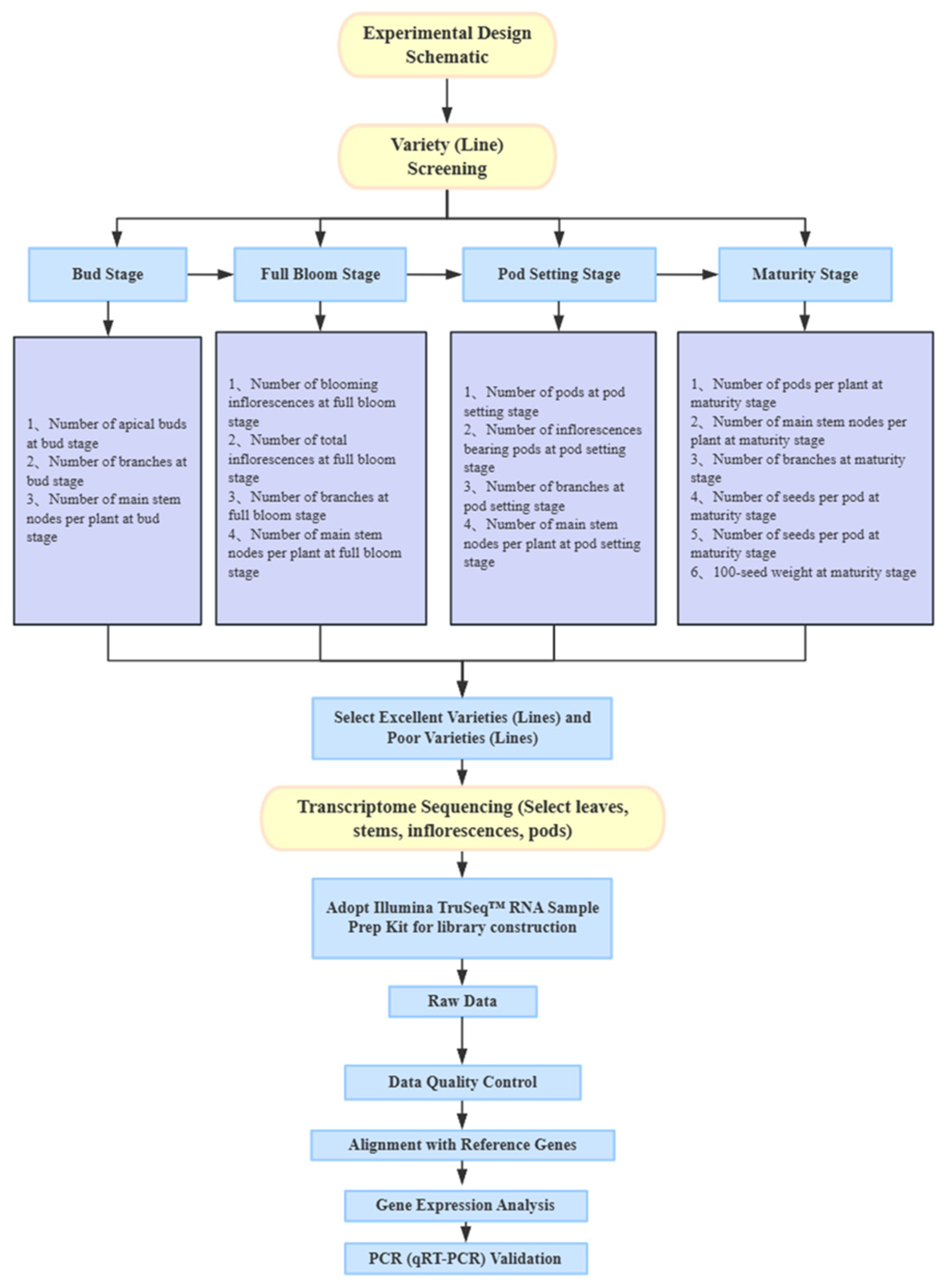
To validate the reliability of the transcriptome sequencing data, total RNA extracted for the sequencing project was used as the template. First-strand cDNA was synthesized using a reverse transcription kit (Takara, Beijing, China). Subsequently, nine differentially expressed genes (DEGs) were selected for quantitative real-time PCR (qRT-PCR) analysis. The qRT-PCR reactions were performed on a LightCycler® 480 real-time PCR system (Roche Applied Science, Penzberg, Germany) using the SYBR® Green Premix Pro Taq HS qPCR (Roche Diagnostics GmbH, Beijing, China) Kit. Primers were designed using Primer 5.0 software (genes and reference genes are listed in Supplementary Materials, Table S3). Relative gene expression was calculated using the (2−∆∆CT) method [25]. The experimental workflow and design are illustrated in Figure 1.

2.6. Data Processing

Experimental data were compiled using Microsoft Excel 2021, and statistical analysis was performed using IBM SPSS Statistics 27.0. Significant differences were evaluated using Duncan’s multiple range test. Figures were generated using Origin 2025. To eliminate differences in units and scales among the 19 agronomic traits, the raw data were first standardized. Subsequently, Principal Component Analysis (PCA) was performed on the standardized data to objectively reflect the contribution of each trait to yield. The coefficient of variation (CV) was calculated using the following formula: CV = standard deviation/mean times 100%. The expression function for the weighted principal component score was as follows: Y = 18.10Y1 + 13.76Y2 + 10.80Y3 + 8.93Y4 + 7.85Y5 + 6.42Y6

3. Results

3.1. Analysis of Genetic Variation in Agronomic Traits Among Different Alfalfa Accessions

As shown in the Supplementary Materials, Table S4, statistical analysis of 19 yield and agronomic traits across the 44 alfalfa accessions revealed extensive genetic variation in these traits. The coefficients of variation (CVs) ranged from 7.85% (reproductive branches per plant at full-bloom stage) to 42.66% (apical buds at budding stage), with an average of 21.43%. Specifically, traits such as apical buds at the budding stage (CV = 42.66%) and pods per plant at the podding stage (CV = 37.72%) exhibited extremely high variability. In contrast, reproductive branches per plant at the full-bloom stage (CV = 7.85%) and 100-seed weight at maturity (CV = 7.83%) remained relatively stable, suggesting they were less influenced by environmental fluctuations.

3.2. Correlation Analysis of Alfalfa Agronomic Traits

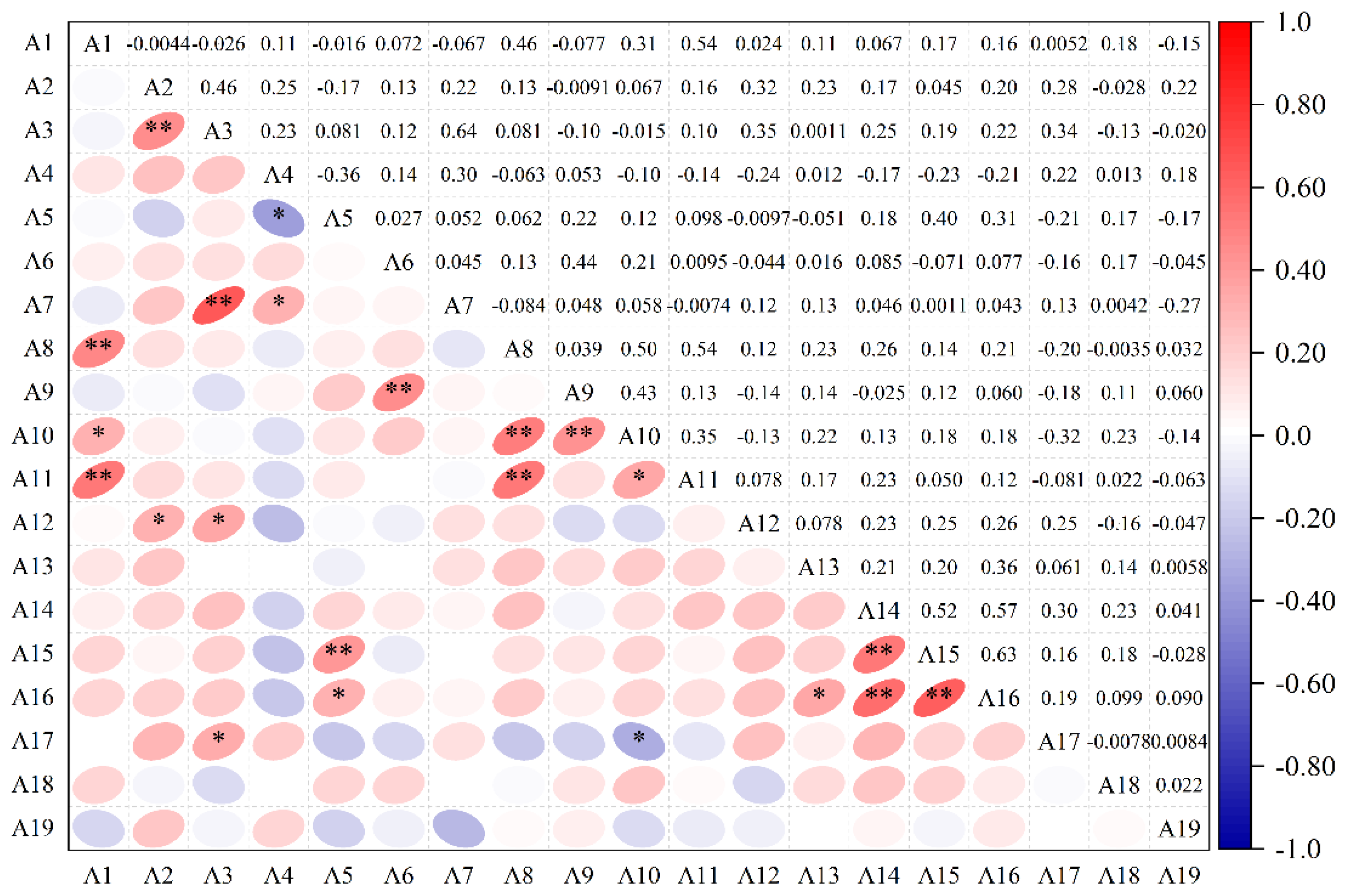
To further clarify the direct and indirect contributions of each agronomic trait to seed yield, a correlation analysis was performed among the traits (Figure 2). The results indicated that most traits were significantly or highly significantly correlated with each other. Regarding positive correlations, traits within the same reproductive stage showed strong synergy: the number of apex buds at the budding stage was significantly positively correlated with the number of branches and the number of reproductive stems per plant at the same stage. Similarly, the number of apex inflorescences at the full-flowering stage was significantly positively correlated with the total number of inflorescences per plant, the number of branches, and the number of reproductive stems at the full-flowering stage. Focusing on key yield components, the number of reproductive branches per plant at maturity was significantly positively correlated with the number of inflorescences at maturity, the node number of the first inflorescence on the main stem, and the number of inflorescences per single reproductive branch. Furthermore, the number of seeds per pod and the 100-seed weight at maturity also showed a positive correlation with the number of reproductive branches and the number of inflorescences, clearly demonstrating that increasing the number of reproductive branches and inflorescences is a core approach to enhance alfalfa seed yield. Concerning negative correlations, certain vegetative growth traits were negatively correlated with final grain traits; for instance, both the number of apex buds at the budding stage and the number of apex inflorescences at the full-flowering stage were negatively correlated with the 100-seed weight at maturity.

3.3. Principal Component Analysis of Alfalfa Agronomic Traits and Screening for High-Yield Germplasm

To reduce the dimensionality of the 19 agronomic traits and extract key determinants of yield formation, Principal Component Analysis (PCA) was performed. By calculating the contribution rates of each component (Supplementary Materials, Tables S5 and S6), the results showed that the cumulative contribution rates of the first six principal components (PCs) were 18.11%, 31.87%, 46.67%, 51.61%, 59.47%, and 65.89%, respectively. This indicates that these six components effectively capture the majority of the information from the original 19 traits and can represent the yield constitution of alfalfa. In PC1, the dominant traits were the number of nodes on the first inflorescence of the main stem at maturity, the number of pods per node at maturity, and the number of inflorescences at maturity. Since these indicators reflect the quantity of reproductive organs and final yield potential at the maturity stage, this component was designated as the “Maturity Yield Factor.” In PC2, traits with high loading scores included the number of seeds per pod at maturity, reproductive branches per plant at maturity, branch number at the budding stage, and reproductive branches per plant at the budding stage. These traits mainly reflect branching capacity and structural characteristics during vegetative growth and early reproductive differentiation; thus, PC2 was defined as the “Branching Factor.” PC3 was primarily associated with branching traits such as the number of apical inflorescences and branches at the full-bloom stage, while PC4 and PC5 showed high correlations with seed quality and secondary branching traits, including 100-seed weight and inflorescence number at the podding stage. The PCA successfully condensed the 19 original traits into 6 independent comprehensive factors. Notably, PC1 and PC2 jointly explained over 49.99% of the total variance, making them the most critical independent factors influencing alfalfa yield formation. Based on the composite scores calculated from components with eigenvalues greater than 1, GNS31 ranked highest, exhibiting a comprehensive score significantly superior to other accessions, whereas GNS43 had the lowest score, indicating the poorest performance. In conclusion, PCA not only simplified the complex multi-trait evaluation system but also quantitatively identified superior germplasms like GNS31, providing clear target materials for future breeding efforts.

3.4. Linear Regression and Path Analysis of Agronomic Traits and Yield

As shown in the Supplementary Materials, Table S7, the correlation coefficient (R) and coefficient of determination (R2) of the four regression models (Models 1–4) increased progressively with the stepwise inclusion of yield components, indicating that the introduced factors played an increasingly important role in determining yield. Model 4 exhibited the highest R2 value (0.985), identifying it as the optimal model.
According to Table S8, the regression equation for Model 4 was established as follows: Y = −0.997 + 0.013X13 + 0.073X17 + 2.759X19 − 0.003X16. Significance tests indicated that the number of inflorescences (X13), number of seeds per pod (X17), 100-seed weight (X19), and number of pods per node (X16) at the maturity stage all had p-values less than 0.05, demonstrating that these four traits significantly influenced yield. Table S9 indicates that other agronomic traits made negligible contributions to yield and were therefore excluded. Based on the path analysis (Table S10), the direct path coefficients of X13, (X17), (X19), and (X16) on yield (Y) were PX13-Y = 0.84, PX17-Y = 0.45, PX19-Y = 0.257, and PX16-Y = −0.052, respectively. Results showed that the number of inflorescences at maturity (X13) had the largest direct positive effect on yield. Notably, X13 not only exerted a significant direct effect (0.84) but also had a substantial indirect effect via seeds per pod (X17) (0.5124) and pods per node (X16) (0.3016), identifying it as the core determinant of yield. The number of seeds per pod (X17) had a direct effect of 0.45 and an indirect yield-increasing effect of 0.0878 (X16) suggesting that increasing the seed number per pod positively contributes to yield improvement. In contrast, the 100-seed weight (X19) had a direct effect of only 0.257, with negligible indirect effects through other factors. This suggests that while 100-seed weight influences yield through its direct action, its impact is weaker than that of inflorescence number and seed number per pod; thus, achieving substantial yield gains solely by increasing seed weight is unlikely. The number of pods per node (X16) exhibited a negative direct path coefficient (−0.052). Furthermore, its indirect effects via (X13) and (X17) were also negative (−0.0187 and −0.0101, respectively), indicating that the overall contribution of this trait to yield was subject to negative constraints. (Supplementary Materials, Tables S7–S10).

3.5. Cluster Analysis of Alfalfa Accessions Based on Agronomic Traits

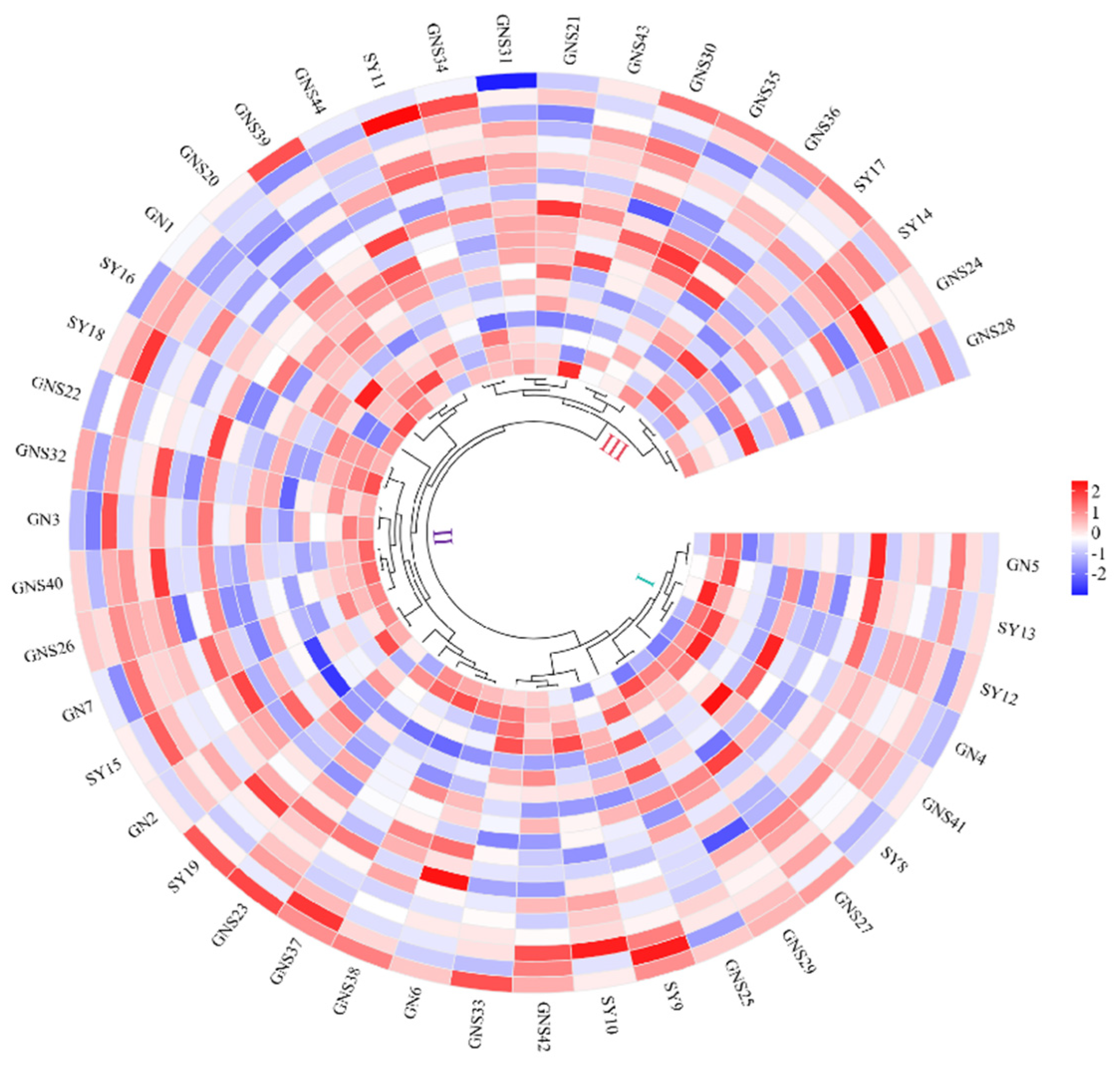
Based on the 19 agronomic traits, hierarchical cluster analysis was performed on the 44 alfalfa germplasms. As illustrated in Figure 3, the accessions were classified into three distinct clusters (Cluster I: blue; Cluster II: purple; Cluster III: red). Cluster I comprised 13 accessions, accounting for 29.45% of the total population. This group included GN5, SY12, SY13, GN4, GNS41, SY8, GNS27, GNS29, GNS25, SY9, SY10, GNS42, and GNS33. Cluster II, the largest group, contained 19 accessions (43.18% of the total) and was further divided into two subgroups. The accessions in this cluster were GN1, GN2, GN3, GN6, GN7, SY15, SY16, SY18, SY19, GNS20, GNS22, GNS23, GNS26, GNS32, GNS37, GNS38, GNS39, GNS40, and GNS44. Cluster III consisted of 12 accessions, representing 27.27% of the total resources. The members of this group were SY11, GNS34, GNS31, GNS21, GNS43, GNS30, GNS35, GNS36, SY14, SY17, GNS24, and GNS28.

3.6. Identification of Differentially Expressed Genes in Different Tissues of Medicago sativa (Alfalfa)

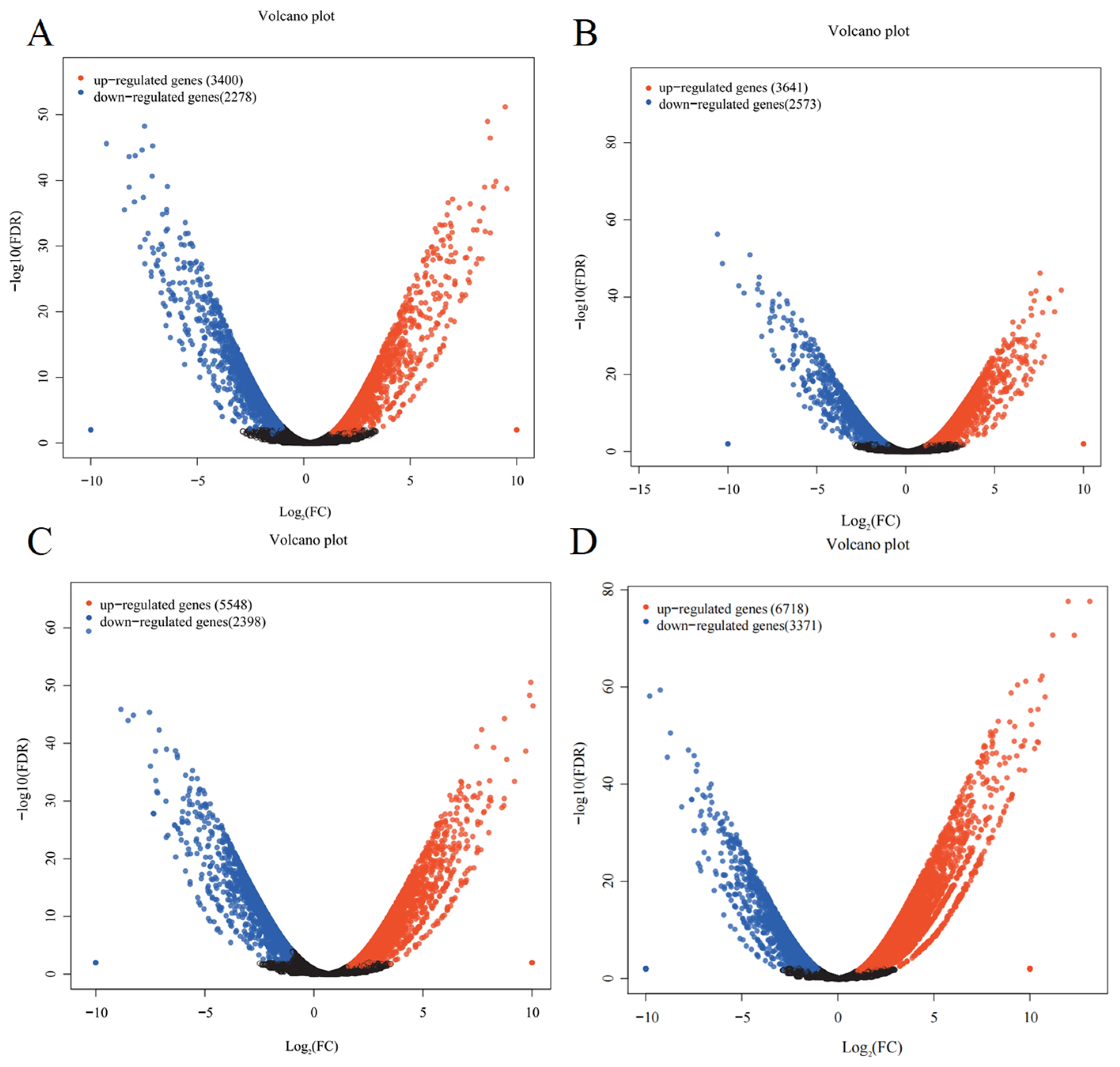
We selected two accessions with significantly divergent yields, GNS31 and GNS43, for further study. GNS31 exhibited superior performance in key traits such as branch number at the podding stage, total pods per plant, and reproductive branches at maturity, characterizing it as a high-yielding accession with strong podding capacity. In sharp contrast, GNS43 showed inferior performance in pod number, total pods per plant, and branching. To investigate gene expression differences across tissues and dissect the genetic basis underlying the yield and podding capacity disparity at the molecular level, we performed transcriptome sequencing on four distinct tissues—leaves, stems, inflorescences, and pods—of both accessions. As illustrated in Figure 4, the analysis of these four critical developmental tissues revealed a distinct tissue-specific distribution of differentially expressed genes (DEGs). The highest number of DEGs (10,089) was identified in pod tissues, with a remarkably high proportion of upregulated genes (66.6%). Given the superior podding capacity of GNS31, the substantial transcriptomic divergence in pods suggests that transcriptional activation during the reproductive phase is a critical determinant of yield. In contrast, while leaves and stems exhibited fewer DEGs, their role as the photosynthetic “source” and transport channels implies that alterations in their gene expression likely provide the material basis for reproductive organ development. This trend of expanding transcriptional divergence from vegetative to reproductive organs indicates that GNS31 may maintain its high-yield characteristics by mobilizing a broader gene network during the late reproductive growth stages.

3.7. GO Enrichment Analysis of Differentially Expressed Genes in Different Tissues of Medicago sativa

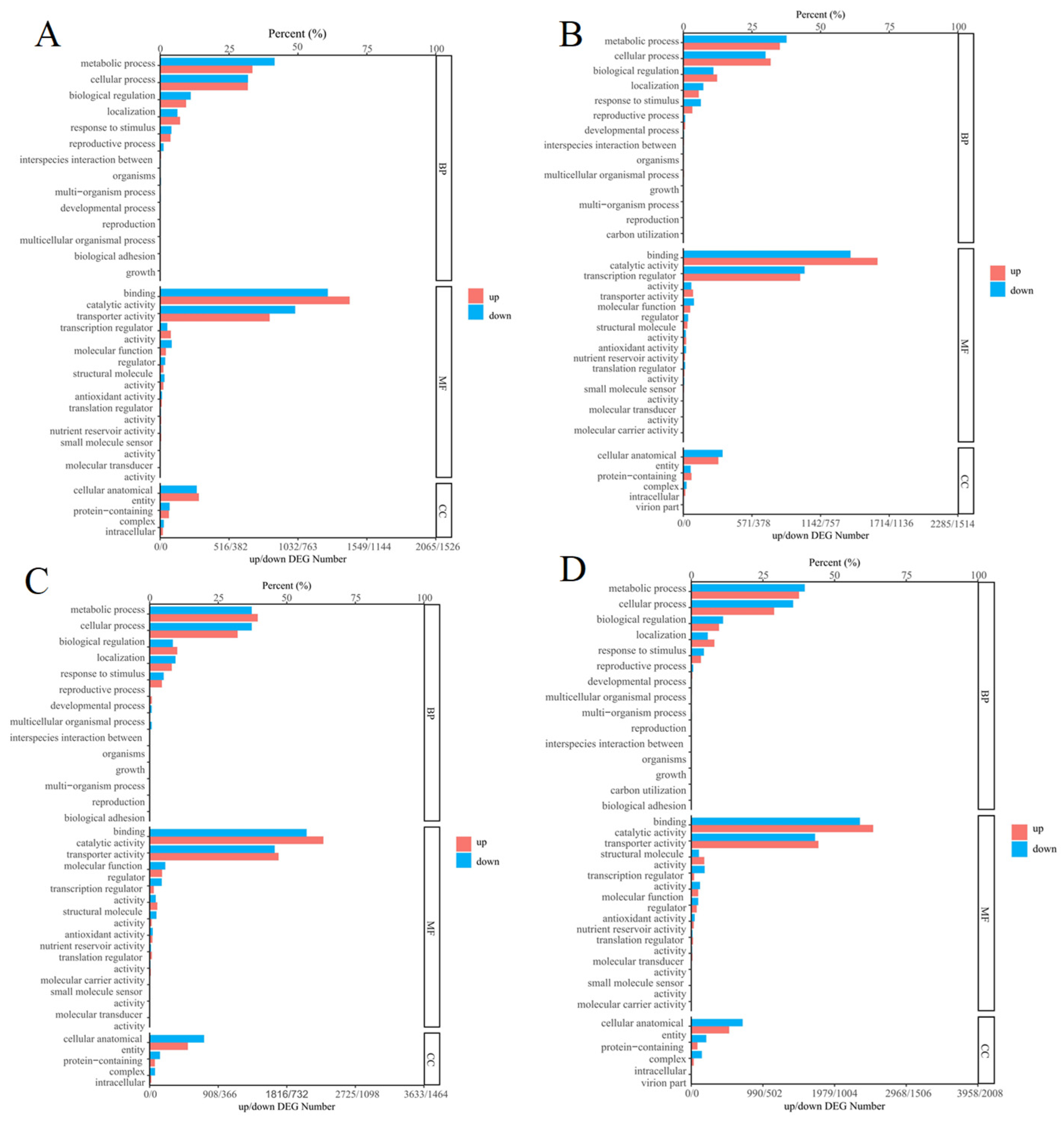
To explore the biological functional differences of the identified DEGs, Gene Ontology (GO) enrichment analysis was performed across the four tissues (leaves, stems, inflorescences, and pods). As shown in Figure 5, the analysis revealed the molecular strategy employed by GNS31 to achieve high yield. Significant enrichment of DEGs in terms such as “metabolic process,” “cellular process,” and “catalytic activity” indicates that the primary driving force underlying high yield and related traits lies in vigorous basal metabolism and biosynthetic capacity. In inflorescence and pod tissues, the high proportion of upregulated genes enriched in metabolic processes suggests that GNS31 possesses superior efficiency in substance synthesis and conversion during the reproductive development stage. Furthermore, the high expression of genes related to “binding” and “catalytic activity” implies active enzymatic reactions within the plant, facilitating the efficient conversion of photosynthates into biomass. Additionally, the enrichment of “cellular anatomical entity” and “protein-containing complex” reflects the advantages of GNS31 in cell division and tissue construction, which aligns with its multi-branching phenotype. Collectively, these results suggest that GNS31 does not rely on a single pathway but establishes its high-yield potential by comprehensively enhancing cellular metabolic flux and structural assembly efficiency.

3.8. KEGG Pathway Enrichment Analysis of Differentially Expressed Genes in Different Tissues of Medicago sativa

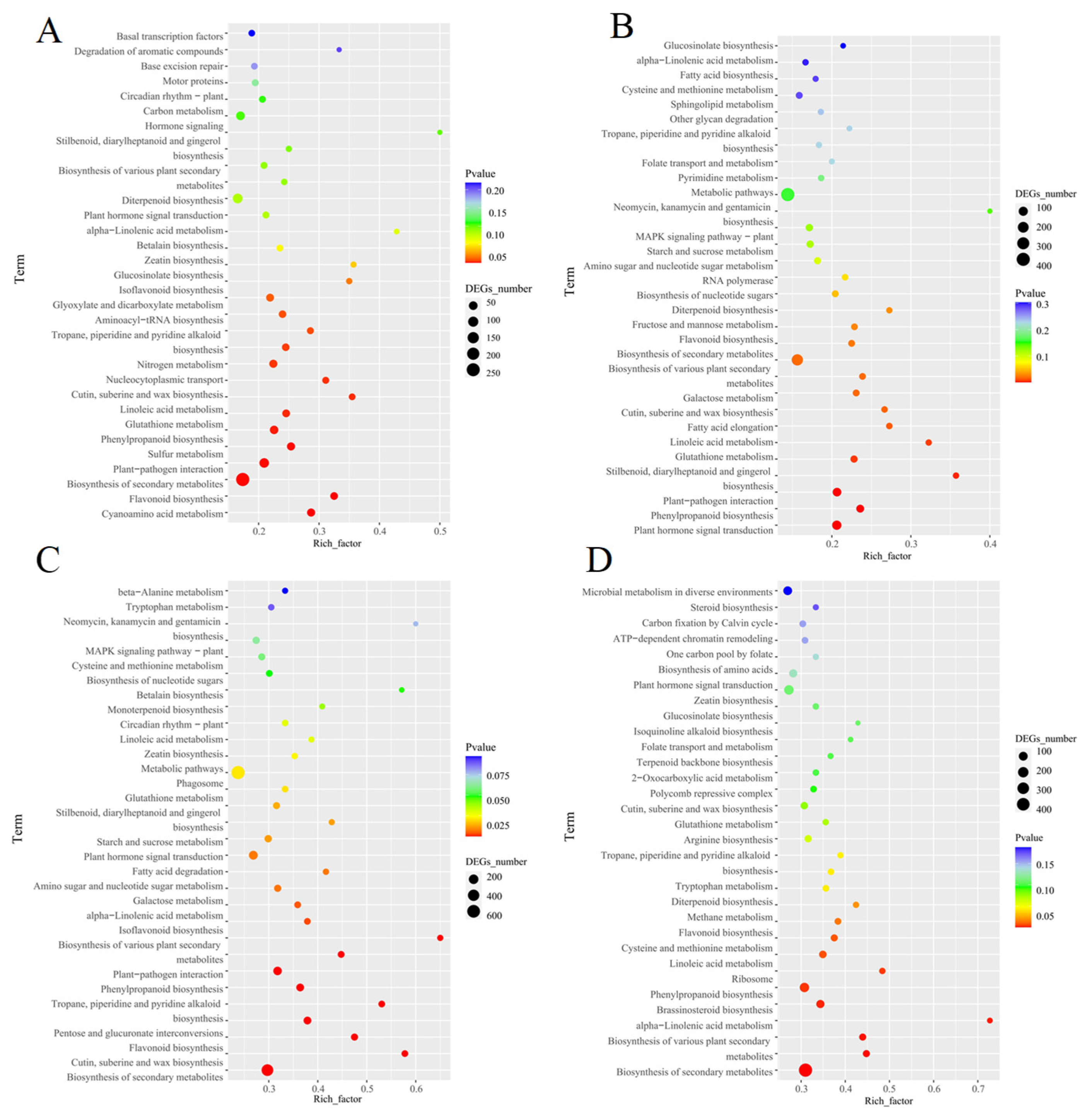
To systematically explore the functional regulatory networks of DEGs among alfalfa accessions, KEGG pathway enrichment analysis was performed across the four tissue types. As illustrated in Figure 6, the analysis revealed a coordinated division of labor among tissues in yield formation, suggesting that GNS31 maximizes yield by optimizing the metabolic network of the “source–transport–sink” system. In leaves, the high enrichment of the “plant hormone signal transduction” and “flavonoid biosynthesis” pathways was pivotal. Active hormone signaling delays leaf senescence and prolongs the duration of photosynthesis, while the synthesis of secondary metabolites like flavonoids not only enhances stress resistance but may also regulate auxin transport. This indicates that the leaves of GNS31 possess superior “source” activity, ensuring a continuous supply of photosynthates to downstream organs. In stems, gene expression patterns supported the structural reinforcement required for a multi-branching phenotype. DEGs were significantly enriched in “alpha-linolenic acid metabolism” and “fatty acid biosynthesis.” Lipid metabolism serves as the foundation for cell membrane structure and participates in vascular bundle development and lignification. This explains why GNS31 can support a high branch number with strong lodging resistance while ensuring the efficient translocation of nutrients to flowers and pods. In reproductive organs, the enhancement of carbon assimilation and sink strength was evident. The significant enrichment of “starch and sucrose metabolism” (in inflorescences) and “carbon fixation” (in pods) directly points to the mechanism of yield formation. Active sugar metabolism in inflorescences provides essential energy reserves for pollen development and fertilization, ensuring a high seed-setting rate. Furthermore, in pods, the synergistic action of complex carbon metabolism and “glutathione metabolism” indicates that GNS31 not only efficiently converts imported sucrose into seed storage reserves but also effectively scavenges reactive oxygen species (ROS) generated by rapid growth, thereby maintaining cellular homeostasis.

3.9. Analysis of Hormone Signal Transduction Pathways in Alfalfa

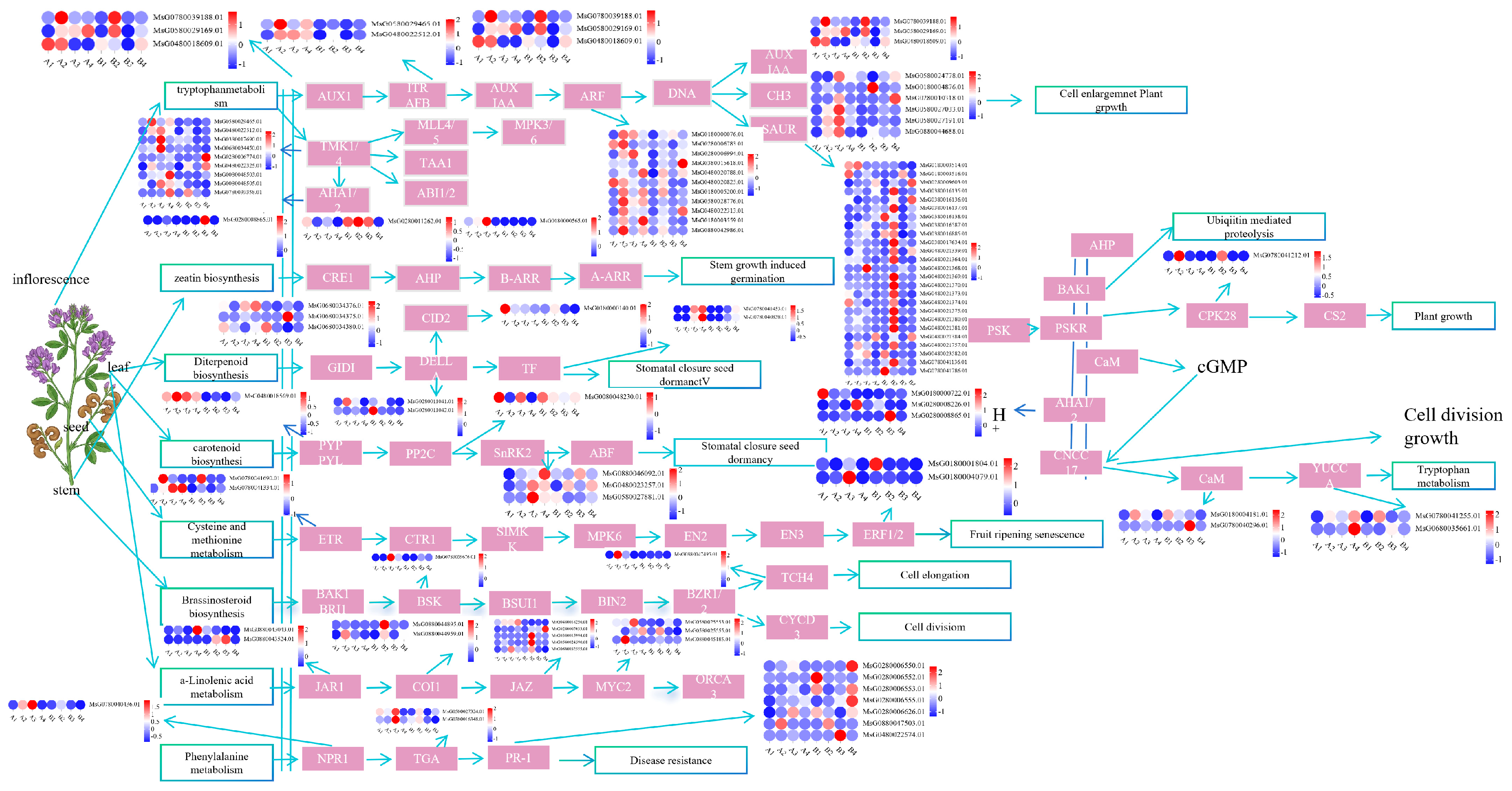
Based on transcriptomic data and KEGG pathway enrichment analysis, we reconstructed the signaling cascades and physiological effects of eight major plant hormones across different tissues in alfalfa (Medicago sativa). As shown in Figure 7, auxin derived from the tryptophan metabolism pathway enters cells via the AUX1 protein. It recognizes the TIR1/AFB receptor, leading to the degradation of the repressor protein AUX/IAA, thereby releasing ARF transcription factors. This cascade activates the downstream expression of the SAUR and GH3 gene families. High expression of these genes directly promotes cell enlargement and plant growth. Concurrently, cytokinins generated via the zeatin biosynthesis pathway function through the CRE1 receptor and the downstream phosphotransfer protein AHP and response regulators ARR (A-ARR and B-ARR), primarily regulating stem growth and germination. Furthermore, the Brassinosteroid (BR) signaling pathway operates through the BRI1-BSK-BSU1 cascade, ultimately activating BZR1/2 transcription factors. This activation upregulates TCH4 to promote cell elongation and CYCD3 to promote cell division, which synergistically drive the vegetative growth of alfalfa. Regarding the development of reproductive organs (pods), the cysteine and methionine metabolism pathway plays a dominant role. The resulting ethylene signal is perceived by the ETR receptor and transmitted via the CTR1-SIMKK-MPK6 MAPK phosphorylation cascade to stabilize the transcription factor EIN3, which subsequently activates ethylene response factors ERF1/2. Heatmap data indicated that the expression of ERF1/2 was significantly upregulated (red) in specific tissues, directly correlating with fruit ripening and senescence.

3.10. RT-qPCR Validation of Differentially Expressed Genes

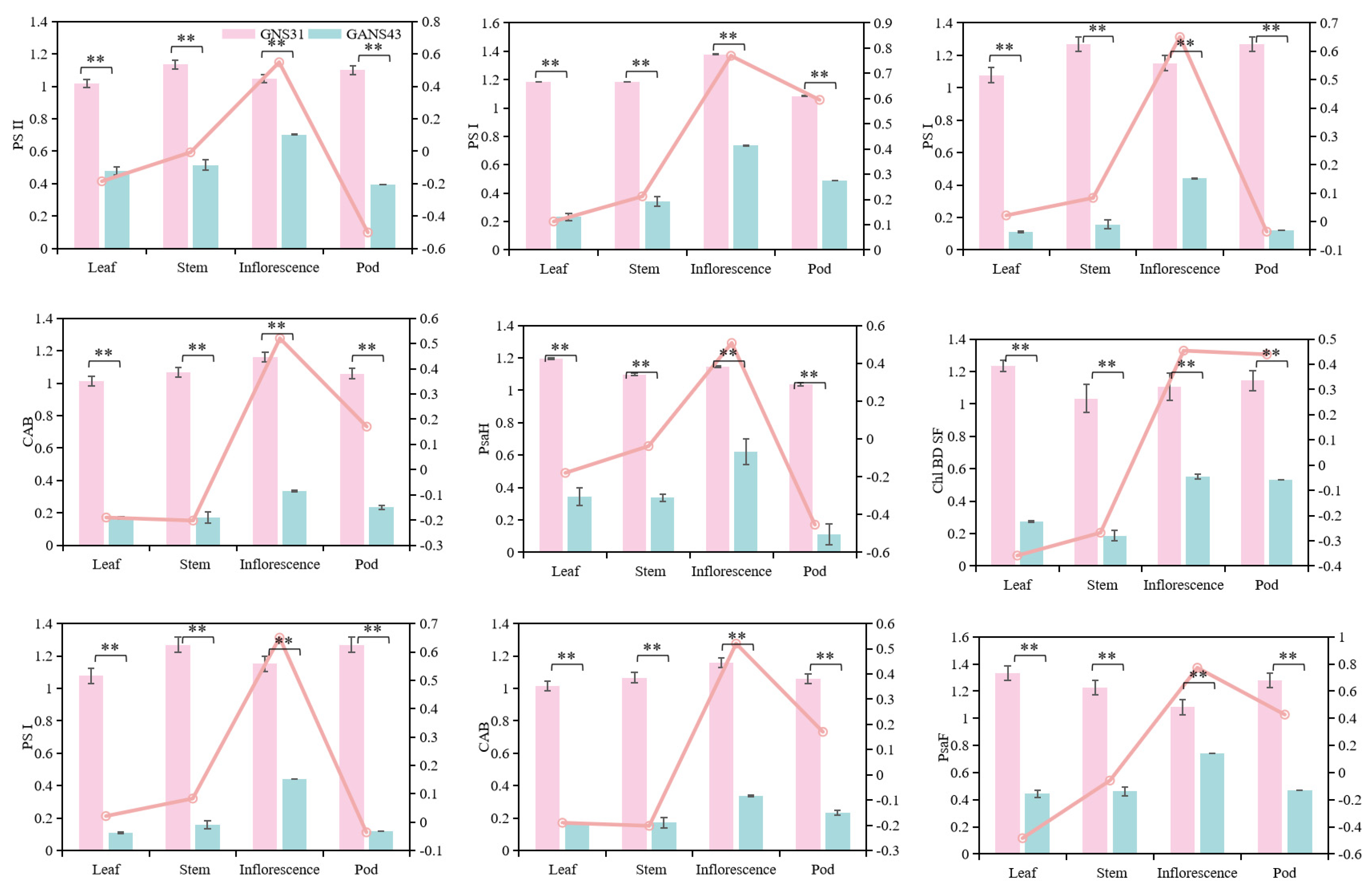
To validate the reliability of the sequencing results, nine candidate upregulated genes, specifically those with accession numbers MsG0580030197.01, MsG0580024128.01, MsG0880045778.01, MsG0880042858.01, MsG0280011301.01, MsG0380013114.01, MsG0880047363.01, MsG0280009742.01, and MsG0280007650.01, were selected for Real-Time quantitative PCR (RT-qPCR) analysis. As presented in Figure 8, the expression trend of all nine candidate genes was consistent with the transcriptome sequencing results, demonstrating a high overall validation success rate. This successful validation fully proves the high accuracy and reliability of the transcriptome data obtained in this study, thereby providing solid data support for the subsequent identification of key genes.

4. Discussion

4.1. Investigation of Coefficient of Variation and Correlation Analysis of Agronomic Traits in Medicago sativa for High-Yield Breeding

Germplasm resources constitute the material basis for agricultural technological innovation, crop breeding, and related bio-industry development [26]. As plant phenotypic traits result from the combined effects of the growth environment and genetic material, accurate assessment of genetic diversity requires trials under uniform cultivation conditions to minimize environmental interference, ensuring that observed phenotypic variation effectively reflects intrinsic genetic differences [27]. The coefficient of variation (CV) is a key indicator for measuring the level of genetic diversity within a population. Generally, a higher CV for crop agronomic traits indicates richer genetic diversity and a greater possibility for selecting superior individuals [28,29]. The extensive phenotypic variation observed in the 19 agronomic traits among the 44 accessions (CVs: 7.85–42.66%) suggests immense scope for genetic improvement, particularly regarding reproductive capacity. Correlation analysis is essential for assessing genetic gain and the feasibility of joint selection for multiple traits [30]. Alfalfa yield has been consistently linked to plant height and branch number [20], with main stem branches identified as a key yield component [31,32]. For instance, Monirifar et al. [33] found significant correlations between yield and height, main stem branches, and leaf size in 13 alfalfa varieties. Consistent with these findings, our analysis of 19 traits revealed a significant positive relationship between vegetative and reproductive growth. This suggests that selecting for vigorous vegetative growth could indirectly improve reproductive performance. Conversely, other studies suggest that excessive vegetative vigor may suppress reproductive development [34]. Nevertheless, further analysis indicates that the elite performance of accessions like GNS31 lies in their capacity to harmonize the ‘source–sink’ relationship, preventing the reproductive inhibition often associated with excessive vegetative vigor. PCA results identified the number of nodes on the first inflorescence, floret number, and pod number at maturity as the primary drivers of yield variation (PC1). Consequently, future breeding programs should move beyond selecting for biomass alone and instead prioritize the co-selection of branching and podding traits.

4.2. Synergistic Evaluation of Medicago sativa Varieties/Lines Through Multi-Dimensional Analysis

In targeted alfalfa breeding, classifying materials based on similarity can effectively integrate the genetic advantages of different germplasm types, realize complementary breeding effects, and optimize genetic improvement strategies [35]. As an objective mathematical method, cluster analysis is widely used in the classification of similar materials, facilitating scientific grouping by quantifying the genetic distance between samples, which provides a reliable basis for parental selection [35]. Cluster-based methods are suitable for both genotypic and phenotypic data to infer population structure and divide individuals into distinct groups [36]. Multivariate analysis targeting multiple alfalfa varieties can reveal the contribution rate of key traits, thereby guiding high-yield breeding [19]. By quantifying phenotypic distances, the tested accessions were categorized into three distinct clusters. This classification visually reveals the population structure of the germplasm, indicating significant phenotypic differentiation among the clusters. Principal Component Analysis (PCA) reduces dimensionality to condense multiple traits into a few principal components, which retain the majority of the original information and reflect the relative importance of each trait [37]. This method is widely applied in crop breeding, particularly for evaluating alfalfa germplasm resources to identify key traits and dissect population genetic structure [38].
In this study, the first six principal components accounted for a cumulative contribution rate of 65.88%. Notably, PC1 and PC2 jointly explained over 49.99% of the total variance. PC1 was primarily determined by traits with high loading scores, such as the number of nodes on the first inflorescence of the main stem, floret number, and inflorescence number at maturity. These traits represent the most critical independent factors influencing alfalfa yield formation. This identifies PC1 as a key indicator of comprehensive yield capacity, demonstrating the efficacy of PCA in dissecting complex trait structures and identifying target traits.
Such scientific ranking and screening based on comprehensive multi-trait performance overcome the limitations of single-trait selection, transitioning parental selection from an experience-based to a data-driven approach. The high synergy among cluster analysis, PCA, and correlation analysis further validated the reliability of the grouping. Collectively, these analyses revealed that the superior performance of the high-yielding accession GNS31 relies not merely on biomass accumulation, but rather on its unique architecture characterized by strong multi-level branching and podding capacity. PCA further confirmed that PC1 and PC2 were primarily defined by reproductive traits (inflorescences, pods) and branching capacity at maturity. This suggests that the key to high-yield breeding lies in challenging the traditional view that ‘vegetative growth suppresses reproductive growth,’ and instead selecting lines capable of balancing photosynthate allocation with reproductive development.

4.3. Tissue-Specific Transcriptional Differences Between Medicago sativa Varieties

Phenotypic divergence fundamentally stems from the impact of gene expression on crop growth. For the first time, this study systematically dissected the differences between high- and low-yielding alfalfa across four distinct tissues, overcoming the limitations of previous research that focused solely on vegetative organs. Our findings reveal that the upper limit of yield is primarily determined by the endogenous activity of reproductive organs. This suggests that the intrinsic regulatory capacity of flowers and pods is the limiting factor restricting seed yield in alfalfa. Transcriptome analysis has previously shown that high-yielding Medicago sativa germplasm exhibits significant upregulation of genes related to cell division, carbohydrate metabolism, and hormone synthesis pathways, directly impacting pod development and seed filling efficiency [20]. This prior work emphasized that differential expression patterns of reproductive organ development genes are the fundamental cause of yield differentiation between varieties [20]. During pod development, the upregulation of sucrose synthase genes (e.g., MsSUS1) promotes the transport of photoassimilates to the pod, providing the material basis for seed filling; meanwhile, the high expression of cell division-related genes increases the number of pod cells, thereby enhancing pod volume and seed capacity [39,40]; these regulatory mechanisms have been verified in M. sativa and other legumes [41].
At the source end (leaves and stems), GNS31 exhibited robust activity in nutrient biosynthesis, alpha-linolenic acid metabolism, and flavonoid synthesis. This not only explains the enhanced stem mechanical support and lodging resistance—providing a physical foundation for the multi-pod phenotype—but also highlights the critical role of these metabolites as signaling molecules or structural components in vascular development and nutrient transport. GO functional enrichment of growth-related DEGs typically features a ‘dominance of basal metabolic processes and concentration of core molecular functions,’ with categories such as ‘metabolic process,’ ‘catalytic activity,’ and ‘intracellular’ acting as key regulators of reproductive development [25]. In this study, at the sink end (inflorescences and pods), GNS31 significantly activated carbon metabolism and glutathione metabolism. This finding aligns closely with the study by Gao [25] on the SHMT gene family, strongly validating the hypothesis that this is ‘basal-metabolism-driven’. This suggests that high-yielding germplasms delay senescence and maintain seed filling vitality by synchronously improving sugar conversion efficiency and ROS scavenging capacity within sink organs. Theoretically, the top three significantly enriched terms in Biological Processes (BP) across all tissues were ‘metabolic process,’ ‘cellular process,’ and ‘biological regulation.’ This characteristic dominance of basal metabolism is highly consistent with previous findings. Ultimately, this systemic advantage—characterized by ‘robust transport at the source and vigorous metabolism at the sink’—constitutes the molecular essence of high yield in GNS31.

4.4. Mechanism of Alfalfa Yield Formation Co-Regulated by Hormone Signal Transduction and Carbon Metabolism

The plant hormone signal transduction pathway acts as the core regulatory network for reproductive development and yield formation in alfalfa. Differential expression of genes within this pathway directly influences final seed yield by modulating inflorescence differentiation, pod development, and seed filling [25]. Auxin, a key regulator of plant growth, plays a fundamental role in the biomass accumulation of alfalfa. Given the high-yield characteristics of the GNS31 line, we infer that this accession maintains high expression levels of SAUR and GH3 during the vegetative growth stage. This establishes a cytological basis for stem and leaf biomass accumulation by promoting cell enlargement. This auxin-driven cell elongation mechanism serves as the critical initial step for increasing plant height and biomass.
However, high yield in alfalfa does not rely on a single hormone but results from the interaction of multiple signals, including auxin, cytokinin, and brassinosteroids (BRs). While AHP and ARR regulate stem growth, the BR signaling pathway activates BZR1/2 via the BRI1-BSK-BSU1 cascade. This simultaneously upregulates TCH4 to promote cell elongation and CYCD3 to enhance cell division. This synergistic action of multiple hormones explains why GNS31 develops more branches and greater plant height. In leaves, the high enrichment of “plant hormone signal transduction” and “flavonoid biosynthesis” suggests that activated hormone signals delay senescence, thereby maintaining prolonged photosynthetic duration. In reproductive organs, significant enrichment of starch and sugar metabolism (in inflorescences) and carbon fixation (in pods) points to the mechanism of final yield formation. Active sugar metabolism in inflorescences provides energy, while the synergy between complex carbon metabolism and glutathione metabolism in pods indicates that GNS31 not only efficiently converts imported sugars into seed storage substances but also scavenges reactive oxygen species (ROS) generated by rapid growth to maintain cellular homeostasis. In conclusion, the high yield of GNS31 fits a multi-system regulatory model: directed by key genes such as SAUR and ERF1/2, it coordinates cell division and elongation via auxin and ethylene signaling, supported by optimized carbon mobilization.

5. Conclusions

By systematically integrating phenotypic and transcriptomic analyses of 44 alfalfa germplasms, we established that the number of reproductive branches and inflorescences at maturity are the primary determinants of yield. The elite line GNS31 was identified as an ideal ideotype, achieving high yield through a unique multi-branching and high-podding architecture that balances vegetative biomass with reproductive conversion. At the molecular level, GNS31’s performance is driven by the precise coordination of hormone signaling and carbon metabolism. Specifically, the Brassinosteroid pathway (upregulating CYCD3 and TCH4) and the Auxin pathway (involving SAUR) work in concert to build robust stems, facilitating efficient nutrient transport. Uniquely, this study dissected the transcriptomes of leaves, stems, flowers, and pods simultaneously to build a holistic yield regulatory network. The proposed model, driven by SAUR, CYCD3, and ERF1/2, elucidates how cell proliferation and carbon partitioning regulate the vegetative-to-reproductive transition, bridging a significant gap in current understanding. However, limitations remain. Validation of candidate genes currently relies on expression patterns, and future studies should include functional characterization (e.g., via transformation). Additionally, as this study was based on a single field environment, evaluating genotype–environment interactions will be essential for broader application.

Supplementary Materials

The following supporting information can be downloaded at: https://www.mdpi.com/article/10.3390/agronomy16010108/s1, Table S1: Tested alfalfa varieties (lines); Table S2: Statistics of off-machine data; Table S3: Gene numbers and primer sequences; Table S4: Yield and agronomic trait parameters of alfalfa; Table S5: Eigenvalues, contribution rates, and factor loadings of principal components for alfalfa agronomic traits; Table S6: Principal Component Analysis results and comprehensive scores of alfalfa; Table S7: Model summary; Table S8: Regression coefficient results; Table S9: Excluded variables; Table S10: Path coefficients between yield and main agronomic traits; Table S11: Collinearity diagnostics.

Author Contributions

Conceptualization, H.M.; Data curation, Z.R.; Funding acquisition, H.M.; Investigation, Z.R.; Methodology, H.M.; Software, Z.R.; Supervision, H.M.; Visualization, Z.R.; Writing—original draft, Z.R.; Writing—review and editing, Z.R. and H.M. All authors have read and agreed to the published version of the manuscript.

Funding

This project is based on Professor Ma Huiling’s project. This research was funded by the Biological Breeding—National Science and Technology Major Project (Project No:2022ZD0401102).

Data Availability Statement

The project information for our transcriptomics has been successfully registered in the BioProject database. You can access this information through the following link: PRJNA1356259 (http://www.ncbi.nlm.nih.gov/bioproject/1356259). All data generated or analysed during this study are included in the Supplementary Materials.

Conflicts of Interest

The authors declare that there are no conflicts of interest.

References

  1. Schnurr, J.A.; Jung, H.J.G.; Samac, D.A. A comparative study of alfalfa and Medicago truncatula stem traits: Morphology, chemical composition, and ruminal digestibility. Crop Sci. 2007, 47, 1672–1680. [Google Scholar] [CrossRef]
  2. Annicchiarico, P.; Piano, E. Use of artificial environments to reproduce and exploit genotype× location interaction for lucerne in northern Italy. Theor. Appl. Genet. 2005, 110, 219–227. [Google Scholar] [CrossRef] [PubMed]
  3. Liu, X.; Elzenga, J.T.M.; Venema, J.H.; Tiedge, K.J. Thriving in a salty future: Morpho-anatomical, physiological and molecular adaptations to salt stress in alfalfa (Medicago sativa L.) and other crops. Ann. Bot. 2024, 134, 1113–1130. [Google Scholar] [CrossRef] [PubMed]
  4. Acharya, J.P.; Lopez, Y.; Gouveia, B.T.; de Bem Oliveira, I.; Resende, M.F., Jr.; Muñoz, P.R.; Rios, E.F. Breeding alfalfa (Medicago sativa L.) adapted to subtropical agroecosystems. Agronomy 2020, 10, 742. [Google Scholar] [CrossRef]
  5. Lu, Q.; Qi, G.; Yin, M.; Kang, Y.; Ma, Y.; Jia, Q.; Wang, J.; Jiang, Y.; Wang, C.; Gao, Y. Alfalfa cultivation patterns in the Yellow River Irrigation Area on soil water and nitrogen use efficiency. Agronomy 2024, 14, 874. [Google Scholar] [CrossRef]
  6. Wang, W. Improving China’s alfalfa industry development: An economic analysis. China Agric. Econ. Rev. 2021, 13, 211–228. [Google Scholar] [CrossRef]
  7. Li, X.; Shen, Y.; Wan, L. Potential analysis and policy recommendations for restructuring the crop farming and developing forage industry in China. Strateg. Study Chin. Acad. Eng. 2016, 18, 94–105. [Google Scholar] [CrossRef]
  8. Rodrigues Mikhael, J.E. The Effects of Biochar and Nitrogen Stabilizers Application on Forage Crop Growth, Greenhouse Gas Emission and Soil Quality; Louisiana State University and Agricultural & Mechanical College: Baton Rouge, LA, USA, 2018. [Google Scholar] [CrossRef]
  9. Hou, P.; Shen, B.; Kong, X.; Sawadgo, W.; Li, W. 2024 Q1 Agricultural Trade Series: US-China Trade Trends and Opportunities for Alfalfa Exports. Plains Press. 2024. Available online: https://plainspress.scholasticahq.com/article/124556.pdf (accessed on 29 December 2025).
  10. Shi, S.; Nan, L.; Smith, K.F. The current status, problems, and prospects of alfalfa (Medicago sativa L.) breeding in China. Agronomy 2017, 7, 1. [Google Scholar] [CrossRef]
  11. Peng, W.; Cai, W.; Pan, J.; Su, X.; Dou, L. Molecular Mechanisms of Alfalfa Response to Abiotic Stresses. Plants 2025, 14, 487. [Google Scholar] [CrossRef]
  12. Liu, Q.; Huang, G.; Zhang, Z.; Lin, Z.; Deng, X.; Dong, X.; Liu, Z.; Wang, Z.; Zhang, Y.; Jing, H.c. Forage Crop Research in the Modern Age. Adv. Sci. 2025, 12, 2415631. [Google Scholar] [CrossRef]
  13. Islam, M.S.; Hasan, M.K.; Islam, M.R.; Chowdhury, M.K.; Pramanik, M.H.; Iqbal, M.A.; Rajendran, K.; Iqbal, R.; Soufan, W.; Kamran, M. Water relations and yield characteristics of mungbean as influenced by foliar application of gibberellic acid (GA3). Front. Ecol. Evol. 2023, 11, 1048768. [Google Scholar] [CrossRef]
  14. Atif, R.M.; Boulisset, F.; Conreux, C.; Thompson, R.; Ochatt, S.J. In vitro auxin treatment promotes cell division and delays endoreduplication in developing seeds of the model legume species Medicago truncatula. Physiol. Plant. 2013, 148, 549–559. [Google Scholar] [CrossRef] [PubMed]
  15. Desta, B.; Amare, G. Paclobutrazol as a plant growth regulator. Chem. Biol. Technol. Agric. 2021, 8, 1. [Google Scholar] [CrossRef]
  16. Sun, Y.; Wang, X.; Ma, C.; Zhang, Q. Effects of nitrogen and phosphorus addition on agronomic characters, photosynthetic performance and anatomical structure of alfalfa in northern xinjiang, China. Agronomy 2022, 12, 1613. [Google Scholar] [CrossRef]
  17. Fu, C.; Hernandez, T.; Zhou, C.; Wang, Z.-Y. Alfalfa (Medicago sativa L.). In Agrobacterium Protocols; Springer: Humana Totowa, NJ, USA, 2014; Volume 1, pp. 213–221. [Google Scholar] [CrossRef]
  18. Chen, H.; Zeng, Y.; Yang, Y.; Huang, L.; Tang, B.; Zhang, H.; Hao, F.; Liu, W.; Li, Y.; Liu, Y. Allele-aware chromosome-level genome assembly and efficient transgene-free genome editing for the autotetraploid cultivated alfalfa. Nat. Commun. 2020, 11, 2494. [Google Scholar] [CrossRef]
  19. Long, R.; Zhang, F.; Zhang, Z.; Li, M.; Chen, L.; Wang, X.; Liu, W.; Zhang, T.; Yu, L.X.; He, F.; et al. Genome Assembly of Alfalfa Cultivar Zhongmu-4 and Identification of SNPs Associated with Agronomic Traits. Genom. Proteom. Bioinform. 2022, 20, 14–28. [Google Scholar] [CrossRef]
  20. Shen, C.; Du, H.; Chen, Z.; Lu, H.; Zhu, F.; Chen, H.; Meng, X.; Liu, Q.; Liu, P.; Zheng, L. The chromosome-level genome sequence of the autotetraploid alfalfa and resequencing of core germplasms provide genomic resources for alfalfa research. Mol. Plant 2020, 13, 1250–1261. [Google Scholar] [CrossRef]
  21. Bottero, E.; Massa, G.; González, M.; Stritzler, M.; Tajima, H.; Gómez, C.; Frare, R.; Feingold, S.; Blumwald, E.; Ayub, N. Efficient CRISPR/Cas9 genome editing in alfalfa using a public germplasm. Front. Agron. 2021, 3, 661526. [Google Scholar] [CrossRef]
  22. Wolabu, T.W.; Cong, L.; Park, J.-J.; Bao, Q.; Chen, M.; Sun, J.; Xu, B.; Ge, Y.; Chai, M.; Liu, Z. Development of a highly efficient multiplex genome editing system in outcrossing tetraploid alfalfa (Medicago sativa). Front. Plant Sci. 2020, 11, 1063. [Google Scholar] [CrossRef]
  23. Long, R.; Zhang, F.; Zhang, Z.; Li, M.; Chen, L.; Wang, X.; Liu, W.; Zhang, T.; Yu, L.-X.; He, F. Assembly of chromosome-scale and allele-aware autotetraploid genome of the Chinese alfalfa cultivar Zhongmu-4 and identification of SNP loci associated with 27 agronomic traits. bioRxiv 2021. [Google Scholar] [CrossRef]
  24. Azad, M.A.K.; Barwal, S.K.; Moni, A. Exploring the impact of integrated breeding strategies in enhancing yield, nutritional quality, and stress tolerance in alfalfa. Plant Trends 2023, 1, 1–15. [Google Scholar] [CrossRef]
  25. Gao, R.; Chen, L.; Chen, F.; Ma, H. Genome-wide identification of SHMT family genes in alfalfa (Medicago sativa) and its functional analyses under various abiotic stresses. BMC Genom. 2024, 25, 781. [Google Scholar] [CrossRef]
  26. Zhang, W.; Wang, K.; Lin, Z.-S.; Du, L.-P.; Ma, H.-L.; Xiao, L.-L.; Ye, X.-G. Production and identification of haploid dwarf male sterile wheat plants induced by corn inducer. Bot. Stud. 2014, 55, 26. [Google Scholar] [CrossRef]
  27. Krueger, R.R.; Navarro, L. Citrus Germplasm Resources; CABI Digital Library: Oxford, UK, 2007; pp. 45–140. [Google Scholar] [CrossRef]
  28. Yan, A.; Yong, X.; Xiao-Fen, C.; An, W.; Fei, T.; Li-qun, S.; Qiao-quan, L. A genetic diversity assessment of starch quality traits in rice landraces from the Taihu basin, China. J. Integr. Agric. 2016, 15, 493–501. [Google Scholar] [CrossRef]
  29. Tang, L.; Wen, X.; Zhang, R.; Xing, X. Current Situation and Utilization of Velvet Deer Germplasm Resources in China. Animals 2022, 12, 3529. [Google Scholar] [CrossRef]
  30. Li, Z.; Liu, C.; Ying, J. Advances in Crop Molecular Breeding and Genetics; MDPI: Basel, Switzerland, 2025; 340p. [Google Scholar] [CrossRef]
  31. Santos, I.G.D. Alfalfa Breeding for Cultivation in the Tropics: Insights on Genetic Diversity and Yield Persistence. 2021. Available online: https://locus.ufv.br/server/api/core/bitstreams/c7e910e0-6041-4152-b12b-6a42861afaf3/content (accessed on 29 December 2025).
  32. Zhang, X.; Liu, Y.; Kong, F.; Wang, W.; Li, S. Comparison of Nutritional Components, Ruminal Degradation Characteristics and Feed Value from Different Cultivars of Alfalfa Hay. Animals 2023, 13, 734. [Google Scholar] [CrossRef]
  33. Monirifar, H. Path analysis of yield and quality traits in alfalfa. Not. Bot. Horti Agrobot. Cluj-Napoca 2011, 39, 190–195. [Google Scholar] [CrossRef]
  34. El-Hifny, Z.; Bakheit, B.; Hassan, M.; Abd El-Rady, W. Forage and seed yield variation of alfalfa cultivars in response to planting date. SVU-Int. J. Agric. Sci. 2019, 1, 21–33. [Google Scholar]
  35. Cruz, C.; Bhering, L.; Ferreira, R.d.P. Biometric procedures applied to genetic improvement of alfalfa. In Genetic Improvement of Alfalfa; Brazilian Agricultural Research Corporation: Brasília, Brazil, 2025; Available online: http://www.alice.cnptia.embrapa.br/alice/handle/doc/1171631 (accessed on 29 December 2025).
  36. Pritchard, J.K.; Stephens, M.; Donnelly, P. Inference of population structure using multilocus genotype data. Genetics 2000, 155, 945–959. [Google Scholar] [CrossRef] [PubMed]
  37. Liu, Y.; Fan, W.; Cheng, Q.; Zhang, L.; Cai, T.; Shi, Q.; Wang, Z.; Chang, C.; Yin, Q.; Jiang, X.; et al. Multi-omics analyses reveal new insights into nutritional quality changes of alfalfa leaves during the flowering period. Front. Plant Sci. 2022, 13, 995031. [Google Scholar] [CrossRef] [PubMed]
  38. Cao, Z.; Li, J.; Lei, H.; Yan, M.; Wang, Q.; Ji, R.; Zhang, S.; Min, X.; Sun, Z.; Wei, Z. PCA-Driven Multivariate Trait Integration in Alfalfa Breeding: A Selection Model for High-Yield and Stable Progenies. Plants 2025, 14, 2906. [Google Scholar] [CrossRef] [PubMed]
  39. Meskiene, I.; Bögre, L.; Dahl, M.; Pirck, M.; Ha, D.; Swoboda, I.; Heberle-Bors, E.; Ammerer, G.; Hirt, H. cycMs3, a novel B-type alfalfa cyclin gene, is induced in the G0-to-G1 transition of the cell cycle. Plant Cell 1995, 7, 759. [Google Scholar] [CrossRef] [PubMed]
  40. Luo, J.-S.; Zhang, Z. Proteomic changes in the xylem sap of Brassica napus under cadmium stress and functional validation. BMC Plant Biol. 2019, 19, 280. [Google Scholar] [CrossRef] [PubMed]
  41. Morales-Elias, N.C.; Martínez-Barajas, E.; Bernal-Gracida, L.A.; Vázquez-Sánchez, M.; Galván-Escobedo, I.G.; Rodriguez-Zavala, J.S.; López-Herrera, A.; Peña-Valdivia, C.B.; García-Esteva, A.; Cruz-Cruz, C.A. Sucrose synthase gene family in common bean during pod filling subjected to moisture restriction. Front. Plant Sci. 2024, 15, 1462844. [Google Scholar] [CrossRef]
Figure 1. Schematic diagram of the experimental design and workflow.
Agronomy 16 00108 g001
Figure 2. Heatmap of correlation between alfalfa agronomic traits and yield components. Note: A in the figure represents different trait indices. A1–A19 represent: A1—number of apex buds at the budding stage; A2—number of branches at budding stage; A3—number of reproductive branches per plant at budding stage; A4—number of apex inflorescences at full-flowering stage; A5—total number of inflorescences per plant at full-flowering stage; A6—number of branches at full-flowering stage; A7—number of reproductive branches per plant at full-flowering stage; A8—total number of pods per plant at podding stage; A9—number of pods per inflorescence at podding stage; A10—number of branches at podding stage; A11—number of reproductive branches per plant at podding stage; A12—number of branches at maturity stage; A13—number of reproductive branches per plant at maturity stage; A14—total number of inflorescences per plant at maturity stage; A15—node number of the first inflorescence on the main stem at maturity stage; A16—number of inflorescences per single reproductive branch at maturity stage; A17—number of pods per single reproductive branch at maturity stage; A18—number of seeds per pod at maturity stage; A19—100-seed weight at maturity stage. Note: * and ** indicate significant (p < 0.05) and highly significant (p < 0.01) correlations between agronomic traits, respectively.
Agronomy 16 00108 g002
Figure 3. Clustering analysis based on agronomic trait correlation.
Agronomy 16 00108 g003
Figure 4. Volcano plot of differentially expressed genes (DEGs) in different tissues. Note: (A) represents alfalfa leaf tissue, (B) represents alfalfa stem tissue, (C) represents alfalfa inflorescence tissue, (D) represents alfalfa pod tissue.
Agronomy 16 00108 g004
Figure 5. GO enrichment analysis of differentially expressed genes in different tissues. Note: (A) represents alfalfa leaf tissue, (B) represents alfalfa stem tissue, (C) represents alfalfa inflorescence tissue, (D) represents alfalfa pod tissue.
Agronomy 16 00108 g005
Figure 6. KEGG pathway enrichment analysis of differentially expressed genes in different tissues. Note: (A) represents alfalfa leaf tissue, (B) represents alfalfa stem tissue, (C) represents alfalfa inflorescence tissue, (D) represents alfalfa pod tissue.
Agronomy 16 00108 g006
Figure 7. Heatmap analysis of differentially expressed genes in the auxin signal transduction pathway. Note: A represents the GNS31 variety, and B represents the GNS43 variety. Subscripts denote the tissue types: 1 for leaf tissue (A1, B1), 2 for stem tissue (A2, B2), 3 for inflorescence tissue (A3, B3), and 4 for pod tissue (A4, B4).
Agronomy 16 00108 g007
Figure 8. RT-qPCR analysis in Medicago sativa. Note: The left Y-axis represents the relative gene expression level, the right Y-axis represents the fold change, and the X-axis labels are the gene names. Note: ** Double asterisks denote p < 0.01.
Agronomy 16 00108 g008
Disclaimer/Publisher’s Note: The statements, opinions and data contained in all publications are solely those of the individual author(s) and contributor(s) and not of MDPI and/or the editor(s). MDPI and/or the editor(s) disclaim responsibility for any injury to people or property resulting from any ideas, methods, instructions or products referred to in the content.