Article

National-Scale Soil Organic Carbon Change in China’s Paddy Fields: Drivers, Spatial Patterns, and a New Long-Term Estimate (1980–2018)


1
Nanjing Institute of Environmental Sciences, Ministry of Ecology and Environment, Nanjing 210042, China
2
State Key Laboratory of Soil and Sustainable Agriculture, Institute of Soil Science, Chinese Academy of Sciences, Nanjing 211135, China
3
Institute of Soil and Fertilizer & Resources and Environment, Jiangxi Academy of Agricultural Sciences, Nanchang 330200, China
4
Institute of Eco-Environmental Research, Zhejiang University of Science and Technology, Hangzhou 310023, China
*
Author to whom correspondence should be addressed.
Agronomy 2025, 15(12), 2901; https://doi.org/10.3390/agronomy15122901
Submission received: 6 November 2025 / Revised: 30 November 2025 / Accepted: 15 December 2025 / Published: 17 December 2025

Abstract

Robust, national-scale quantification of soil organic carbon (SOC) dynamics in China’s paddy fields has been hindered by widely divergent estimates and a lack of comprehensive driver attribution. To address this, we developed a new empirical model from a comprehensive database of 746 long-term field observations (125 sites) to identify predominant drivers and quantify national-scale SOC stock dynamics from 1980 to 2018. The model explained 43% of the variance in topsoil SOC change. Organic matter input was the dominant driver (21.83% variance), with livestock manure demonstrating the highest C sequestration efficiency, followed by green manure and straw. Soil pH, latitude (as a climate proxy), and initial SOC content were also critical controllers. We estimate that China’s paddy topsoils (0–20 cm) acted as a significant C sink from 1980 to 2018, accumulating 242.51 ± 85.80 Tg C (an average rate of 6.65 Tg C yr−1), bringing the 2018 national stock to 1220.48 ± 85.80 Tg C. Spatially, sequestration was highest in central (e.g., Hunan) and northeastern (e.g., Heilongjiang) China, while Chongqing experienced a net SOC loss. Crucially, our study provides a new long-term benchmark that reconciles previous, higher estimates from shorter timeframes, empirically demonstrating that sequestration rates are non-linear and diminish over time. These findings confirm that the C sequestration potential of paddy soils, while substantial, is finite and requires spatially targeted management of organic inputs and soil pH to maintain.

1. Introduction

Since the Industrial Revolution, anthropogenic activities have unequivocally driven global warming, with atmospheric greenhouse gas (GHG) concentrations reaching unprecedented levels and inducing widespread, rapid changes in the climate system [1]. In response, international climate policy has increasingly focused on identifying and enhancing terrestrial carbon sinks to mitigate atmospheric CO2 accumulation. Soils represent the largest and most dynamic terrestrial carbon reservoir, storing an estimated 1500–1600 Pg of soil organic carbon (SOC) in the upper meter alone—an amount approximately 1.8 times the atmospheric carbon pool and 2.7 times the carbon stored in terrestrial vegetation [2]. This vast reservoir has been significantly depleted by millennia of agriculture, creating a historical “soil carbon debt” estimated at 113 Pg C [3]. Consequently, enhancing SOC stocks is not merely a future climate mitigation strategy but also a critical act of ecological restoration, with the potential to simultaneously improve soil health, bolster food security, and regulate climate.
Croplands, which occupy approximately 12% of the Earth’s ice-free land surface, are central to this effort [4]. As intensively managed ecosystems, their SOC pools are highly sensitive to agricultural practices, making them potent targets for carbon sequestration initiatives [5,6]. However, the extent to which this sequestration potential can be realized across diverse agricultural systems remains uncertain and highly variable [6,7]. This uncertainty underscores the urgent need for the robust, system-specific quantification of SOC sequestration potential and its drivers.
Accurate quantification of SOC change is essential for developing effective climate mitigation policies in agriculture, yet current methodologies present significant challenges [6,8]. Two-period stock difference comparisons, which rely on resampling soil profiles over time, are sensitive to sampling density and site-matching consistency, leading to widely divergent estimates. For example, estimates of annual SOC change in China’s cropland topsoil have varied by nearly 100%, from 9.6 Tg C yr−1 [9] to 18.1 Tg C yr−1 [10]. Meta-analyses can synthesize broad trends from multiple studies but are often limited by the spatial representativeness of available data, and the process of aggregation can obscure the influence of critical local drivers [11]. Process-based biogeochemical models, such as DNDC and DayCent, offer powerful tools for simulating complex soil–climate–management interactions, yet their accuracy is contingent on extensive calibration and high-resolution input data that are not always available [12,13,14]. In contrast, a multivariate regression approach offers a complementary, data-driven strategy that is particularly well-suited for attributing historical changes to specific drivers. By leveraging large observational datasets, this method can directly quantify the statistical relationships between the rate of SOC change and a suite of biophysical and management variables, offering interpretable results while remaining computationally efficient for large-scale application [15,16].
Among global croplands, paddy soils exhibit exceptional biogeochemical characteristics that favor carbon accumulation. The prolonged flooding inherent to rice cultivation creates anaerobic conditions that fundamentally alter carbon cycling pathways compared to upland systems [17,18]. These oxygen-limited conditions retard the decomposition of organic matter, resulting in microbial biomass turnover rates that are 1.1 to 1.6 times slower than in aerobic upland soils [19]. Combined with greater organic matter inputs (e.g., roots) and mineral protection (e.g., iron oxides), these factors collectively contribute to the higher SOC stocks typically observed in paddy systems [19]. For example, China’s Second National Soil Survey reported mean topsoil SOC densities of 46.91 Mg C ha−1 in paddy soils versus 35.87 Mg C ha−1 in upland soils [20]. Given that rice (Oryza sativa L.) is a staple food for over half the world’s population and is cultivated on approximately 168 million hectares globally, even modest changes in paddy SOC stocks can have a profound impact on the global carbon budget [21,22].
China’s paddy fields, which account for 17% of the global rice-growing area, represent a globally significant component of the agricultural carbon cycle [22]. Since the 1980s, extensive long-term field experiments on these soils have generated a wealth of data ideal for modeling SOC dynamics. Despite this, to our knowledge, no prior studies have developed a multivariate regression model specifically to quantify the drivers and long-term dynamics of SOC change in these unique agroecosystems. Here, we compile a comprehensive, harmonized database of SOC measurements from paddy topsoils across China, spanning more than four decades, and integrate it with associated climatic, edaphic, and management data. Using this unique dataset, we employ multiple regression analysis to address two key questions: (i) What are the predominant drivers of SOC change in Chinese paddy fields? (ii) How have national-scale SOC stocks and sequestration rates varied since 1980?

2. Materials and Methods

2.1. Data Compilation for Model Development

We compiled a comprehensive database of topsoil SOC change in Chinese paddy fields from long-term field experiments reported in the peer-reviewed literature. We identified relevant publications by searching the China National Knowledge Infrastructure (CNKI) and Web of Science databases using the keywords: “soil organic carbon (SOC)”, “soil organic matter (SOM)”, “soil nutrients”, “soil fertility”, “paddy”, and “China”.
Studies were included in our database only if they met the following four criteria: (1) the experiment duration was at least three years, with SOC measured at both the beginning and end; (2) initial topsoil physicochemical properties, including SOC, were reported; (3) precise geographic coordinates or location names were provided; and (4) detailed records of chemical fertilizer and organic material inputs were available for each crop in the rotation. Applying these criteria, we compiled a final dataset of 746 observations from 125 studies. The longest experiment in the database spanned 38 years, and the spatial distribution of the sites is shown in Figure 1.
For sites where initial soil properties were not reported, we extracted the required data using geographic coordinates from the Harmonized World Soil Database, which for China is derived from the Second National Soil Survey relying on 1634 soil profiles extrapolated to the national scale [23]. To avoid multicollinearity, we excluded bulk density as a potential predictor due to its well-established negative correlation with SOC [24,25]. Soil texture was represented solely by soil clay content. This decision was based on data availability, as soil clay content is the most commonly reported textural metric and its mechanistic importance for SOC stabilization via organo-mineral associations [26].
Organic inputs included crop residues, green manures, and livestock manure (which included compost and farmyard manure). The annual carbon (C) and nitrogen (N) inputs from each of these sources were treated as potential explanatory variables. When C and N contents of organic inputs were not provided in the original publication, we estimated them using standard values from the Chinese Organic Fertilizer Nutrient Manual [27]. We obtained historical daily temperature and precipitation data from the Resource and Environment Science and Data Center [28], derived from 2341 meteorological stations across China.
To harmonize all SOC data to a standard 0–20 cm depth (a necessity as only 69% of our source data were sampled to this depth), we developed a depth-conversion function following the approach of Yang et al. [29]. This empirical function, which describes the vertical distribution of SOC, was fitted using 1425 soil profiles from the Second National Soil Survey of China (R2= 0.42). The resulting equation was used to standardize all SOC values to the 0–20 cm layer:
S O C h   =   39.306   ×   h 0.471
where S O C h is the SOC content (g C kg−1) at soil depth h (cm).

2.2. Model Development and Statistical Analysis

We randomly partitioned the dataset, using 70% of observations for model calibration and the remaining 30% for validation. To quantify the quantitative relationships between SOC change and its driving factors, we employed multiple linear regression (MLR) analysis. All potential predictor variables were tested for normality and multicollinearity to meet the assumptions of multiple linear regression [30]. We employed a backward stepwise elimination procedure to select the final variables, starting with a full model and iteratively removing non-significant predictors to identify the most influential drivers and enhance model parsimony. The formula of the model is presented in Equation (2):
y = α   + i N β i x   + ε
where y represents change in SOC (∆ SOC, g C kg−1); and x represents the vector of potential explanatory variables, including mineral nitrogen input, organic carbon inputs (from straw, manure, and green manure), initial soil properties (initial SOC, pH, and clay content), climatic factors (mean annual temperature and precipitation), geographic factors (latitude and longitude), and experimental duration. Specifically, experimental duration and organic carbon inputs were log-transformed to improve data normality and linearity, while other variables remained untransformed. While α and β i represent the model coefficients, ε indicates the model error.
To quantify the statistical significance and relative contribution of each predictor variable to the total variance in SOC change, we performed an Analysis of Variance (ANOVA) on the final optimal regression model.
All statistical analyses, including normality checks, multicollinearity diagnostics using variance inflation factor (VIF), stepwise regression, and ANOVA, were performed using R statistical software (version 4.3.2, R Foundation for Statistical Computing, Vienna, Austria). The significance level for all statistical tests was set at p < 0.05.
We evaluated model performance against the validation dataset using three key metrics: root mean square error (RMSE), modeling efficiency (EF), and relative error (E), following the methodology of Smith et al. [31].

2.3. National-Scale Model Application

To upscale our model and simulate SOC dynamics across China’s paddy fields from 1983 to 2018, we first established a baseline SOC map for the year 1980 and compiled the necessary time-series driver data. The baseline soil properties were sourced from the Harmonized World Soil Database [23], which reflects conditions from the Second National Soil Survey (1979–1982). Our simulation was driven by spatially explicit raster datasets of soil properties, edaphic, and management practices. We used the EarthStat dataset for the spatial distribution of rice cultivation [32], which we assumed to be static throughout the simulation period. We then scaled the gridded rice area to match provincial-level statistics for 2018 from the China Rural Statistical Yearbook [33], ensuring our simulations reflect contemporary cultivation extents.
We assembled a comprehensive time-series dataset of agricultural management. Province-level data on annual chemical fertilizer application were sourced from the China Agricultural Products Cost–Benefit Yearbook [34] and the China Rural Statistical Yearbook [33]. Organic inputs were quantified as dry matter from crop straw and green manure. For the national-scale upscaling, animal manure was necessarily excluded from the spatial driver datasets due to a lack of high-resolution national data on its application. Data on green manure cultivation area were also obtained from the China Rural Statistical Yearbook [33].
To address the lack of continuous historical data on straw incorporation, we constructed a time-series by interpolating between national-level benchmark data points available for 1994, 2009, 2015, and 2023 [35,36,37]. For intervening years, we used the rate from the nearest benchmark year. This approach yielded a national average straw incorporation rate of 26.46% for the 1981–2018 period. These national rates were then downscaled using province-specific incorporation data synthesized by Sun et al. [38] from peer-reviewed literature and government reports.
We calculated SOC density ( SOCD , t C ha−1) for the 0–20 cm layer using the following equation [39]:
SOCD   =   SOC   ×   1 δ 2 mm 100   ×   BD   ×   H   ×   10 1
where SOC is the soil organic carbon content (g C kg−1), BD is the soil bulk density (g cm3), H is the soil depth (20 cm), and δ 2 mm is the gravel content (%).
To estimate soil bulk density ( BD ), a critical input for the SOCD calculation, we followed the approach of Yang et al. [29] to develop a new empirical pedotransfer function. This function predicts BD from both SOC and soil clay content and was fitted using 154 paddy soil samples from the Second National Soil Survey of China (R2 = 0.43). The resulting equation was used for all BD calculations:
BD   =   1.091   +   0.579   ×   exp 0.134   ×   SOC   +   0.0163   ×   clay
where clay is the soil clay content (%).
To quantify the uncertainty associated with the national-scale estimates, we calculated the 95% confidence intervals (CI) for the predicted SOC values using the predict function in R statistical software (version 4.3.2, R Foundation for Statistical Computing, Vienna, Austria). This approach accounts for the uncertainty inherent in the estimation of the model parameters (regression coefficients) when propagating the predictions to the national scale.
While the spatial extrapolation of SOC content and stocks was computed using the R-based regression model, the final spatial mapping and visualization were performed using ArcGIS software (version 10.7, Esri, Redlands, CA, USA). All spatial data were resampled to a unified resolution of 5 × 5 arc-minutes to ensure compatibility.

3. Results

3.1. Model Performance and Validation

A multiple stepwise regression yielded an empirical model that explained 43% of the variance in topsoil SOC change across China’s paddy fields (Modeling Adjusted R2 = 0.43). The final model integrated key variables representing management practices, initial soil properties, experimental duration, and geographic location.
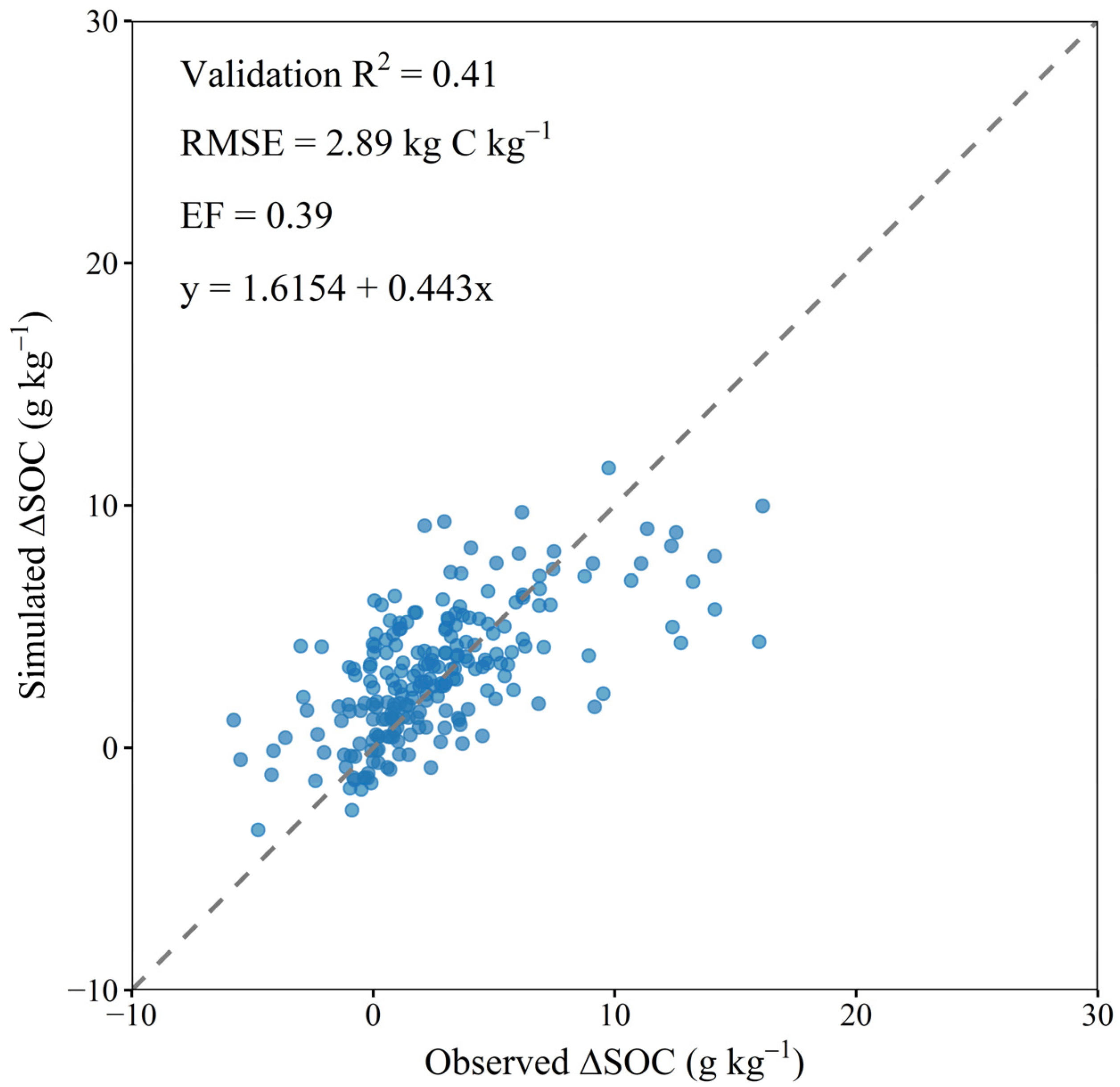
Model performance was confirmed through independent validation, which showed a significant linear relationship between simulated and observed SOC change (validation R2 = 0.41, p < 0.001; Figure 2). The validation yielded a root mean square error (RMSE) of 2.89 g C kg−1 and a modeling efficiency (EF) of 0.39, confirming the model’s predictive power.

3.2. Drivers of SOC Change: Relative Importance and Effects

Variance partitioning identified organic matter input as the dominant driver of SOC change, explaining 21.83% of the total model variance (Table 1). All organic amendments were positively correlated with SOC accrual, though their C sequestration efficiencies differed markedly: the effect was greatest for livestock manure, followed by green manure, and lowest for crop straw (Table 2).
Beyond organic inputs, several edaphic, geographic, and temporal factors were also critical controllers of SOC dynamics. Soil pH was the second most influential variable (6.01% of variance), exhibiting a distinct non-linear relationship where SOC accumulation was maximized in the near-neutral range of 6.5–7.5. Geographic location, represented by latitude (5.94%) and longitude (3.71%), also significantly influenced SOC change, likely capturing broad-scale climatic gradients and regional variations in soil type. Experimental duration (5.94%) showed a positive logarithmic relationship with SOC change, suggesting that sequestration rates diminish over time as soils approach a new equilibrium. Conversely, initial SOC content was negatively correlated with subsequent change, confirming that soils with a larger C saturation deficit possess greater sequestration potential.
Finally, mineral nitrogen application had a statistically significant but minor positive effect on SOC accumulation, contributing the least to the explained variance (0.73%).

3.3. Spatial Patterns of SOC Change in Chinese Paddy Fields from 1980 to 2018

Our model estimated a substantial increase in SOC across China’s paddy fields over nearly four decades. The national average SOC content rose from an initial estimate of 16.16 g kg−1 to 21.11 ± 1.68 g kg−1 by 2018. This resulted in a total SOC stock increase of 242.51 ± 85.80 Tg C in the 0–20 cm topsoil layer, bringing the national stock to 1220.48 ± 85.80 Tg C. Consequently, the average SOC density increased by 9.90 ± 3.39 t C ha−1, representing a 25.82% gain relative to the 1980 baseline (Table 3).
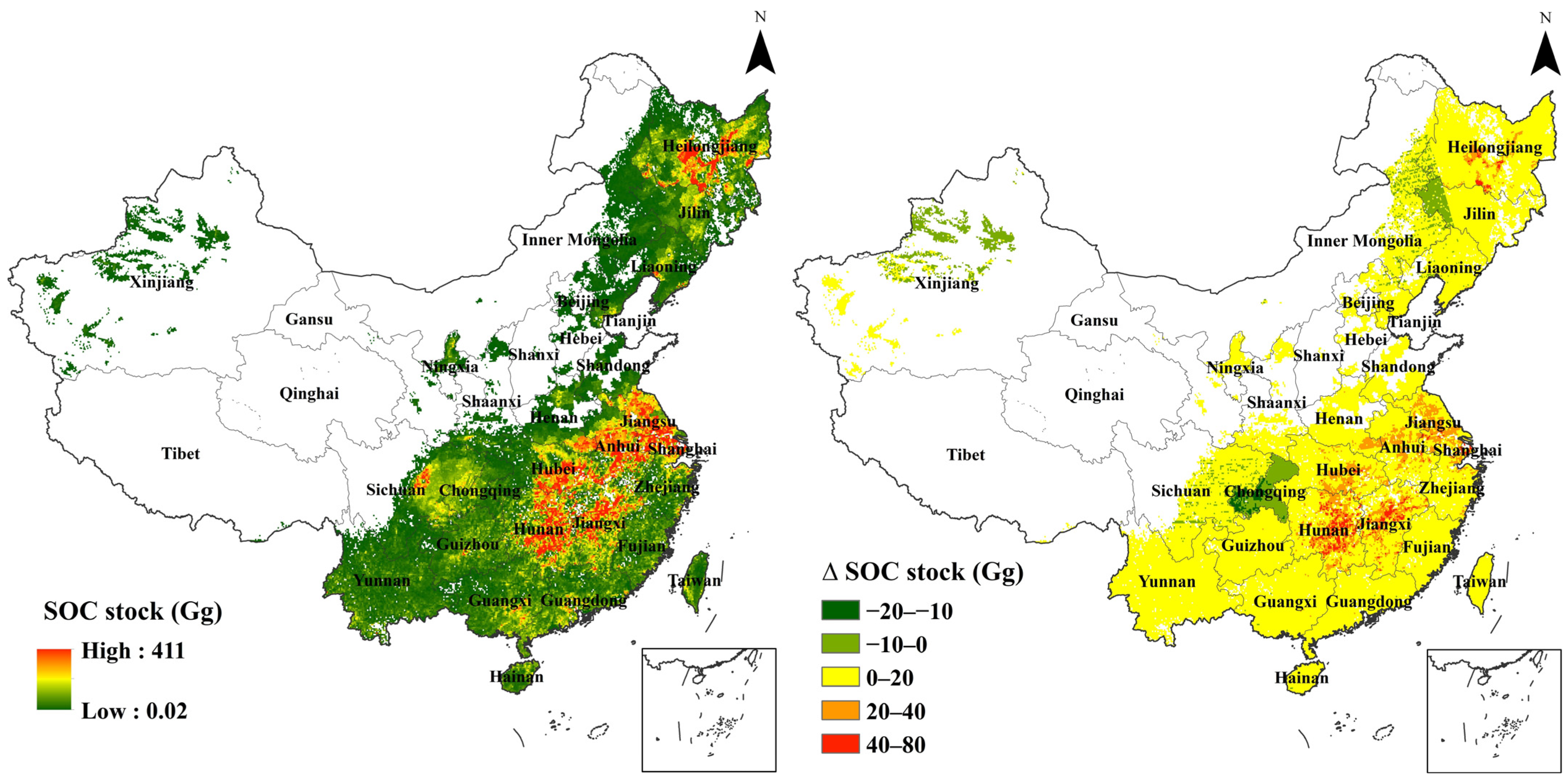
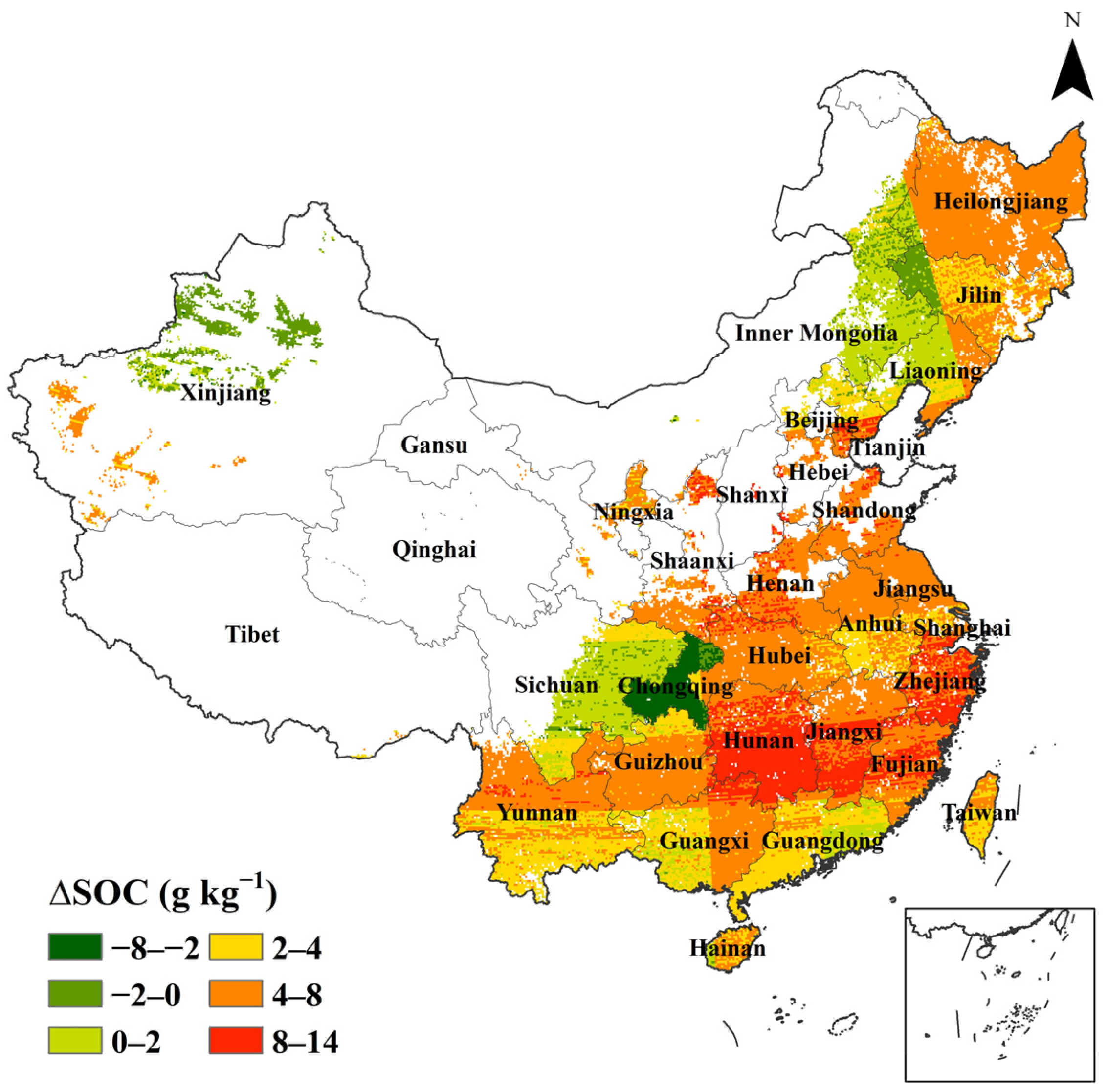
The change in SOC in China’s paddy fields exhibited a distinct spatial pattern, with significant heterogeneity in sequestration rates at the provincial level (Figure 3 and Figure 4; Table 3). The most pronounced carbon gains were geographically concentrated. In the central region, Hunan province was the single largest contributor to the national carbon sink, with its SOC stock increasing by 48.60 ± 7.75 Tg C and its density rising by a notable 17.73 ± 2.83 t C ha−1. High sequestration rates were also prevalent in the northeastern province of Heilongjiang (36.59 ± 15.15 Tg C increase), as well as the central and eastern provinces of Jiangxi (34.38 ± 6.79 Tg C), Hubei (23.39 ± 5.13 Tg C), and Jiangsu (23.24 ± 6.70 Tg C). In contrast, sequestration was less pronounced in other regions. In southwestern China, for example, Sichuan showed only a minimal gain in SOC density (1.17 ± 2.96 t C ha−1) and a correspondingly small increase in total stock (2.18 ± 5.55 Tg C). Notably, Chongqing was the only province to experience a net SOC loss, with its stock declining by 6.08 ± 2.56 Tg C, corresponding to a density decrease of 9.26 ± 3.90 t C ha−1.

4. Discussion

4.1. Key Drivers of SOC Sequestration

The paramount importance of organic matter inputs, explaining over one-fifth (21.83%) of the model variance, reaffirms the foundational principle that SOC stocks are governed by the balance between carbon inputs and decomposition [5,40,41]. Our model advances this understanding by quantifying the differential sequestration efficiencies of various amendments. Livestock manure is often characterized by a higher proportion of biochemically recalcitrant compounds and a lower C:N ratio, and it facilitates the formation of stable, mineral-associated organic matter (MAOM) via microbial pathways [42,43]. In contrast, crop straw, being nutrient-poor (high C:N), is decomposed less efficiently; its carbon primarily enters the POM pool as partially decomposed plant fragments, which is a less persistent C pool [44,45]. This distinction is critical for policy, suggesting that an optimal national strategy should not only maximize total C input but also strategically allocate different organic resources based on their stabilization potential. It is worth noting that mineral N explained minimal variance (0.73%), reflecting that these intensively fertilized paddy systems are generally not N-limited. However, nitrogen remains mechanistically vital. The substantial N co-supplied with organic amendments optimizes microbial stoichiometry, promoting the accumulation of microbial necromass and stable mineral-associated organic matter [43,46].
Our model identified initial SOC content and soil pH as the most influential edaphic factors, pointing to the critical role of the soil’s intrinsic capacity for C stabilization. The observed negative feedback of initial SOC levels on carbon accrual is consistent with the carbon saturation deficit concept. This concept posits that soils with low C stocks possess a large unsaturated capacity for mineral protection, thereby enabling them to stabilize a greater proportion of new C inputs [47]. This reinforces the strategy that targeting management interventions on degraded or low-carbon soils offers the highest return on investment for sequestration [3,5]. The non-linear influence of pH, maximizing SOC accumulation in the near-neutral range, is also critical. Near-neutral pH generally supports optimal rates of microbial activity and decomposition, governing the speed at which new C inputs are processed and incorporated into soil organic matter pools [41]. Extreme acidity or alkalinity disrupts these optimal conditions primarily by limiting biological activity, including both microbial decomposition processes and plant growth (thus reducing C inputs) [48,49].
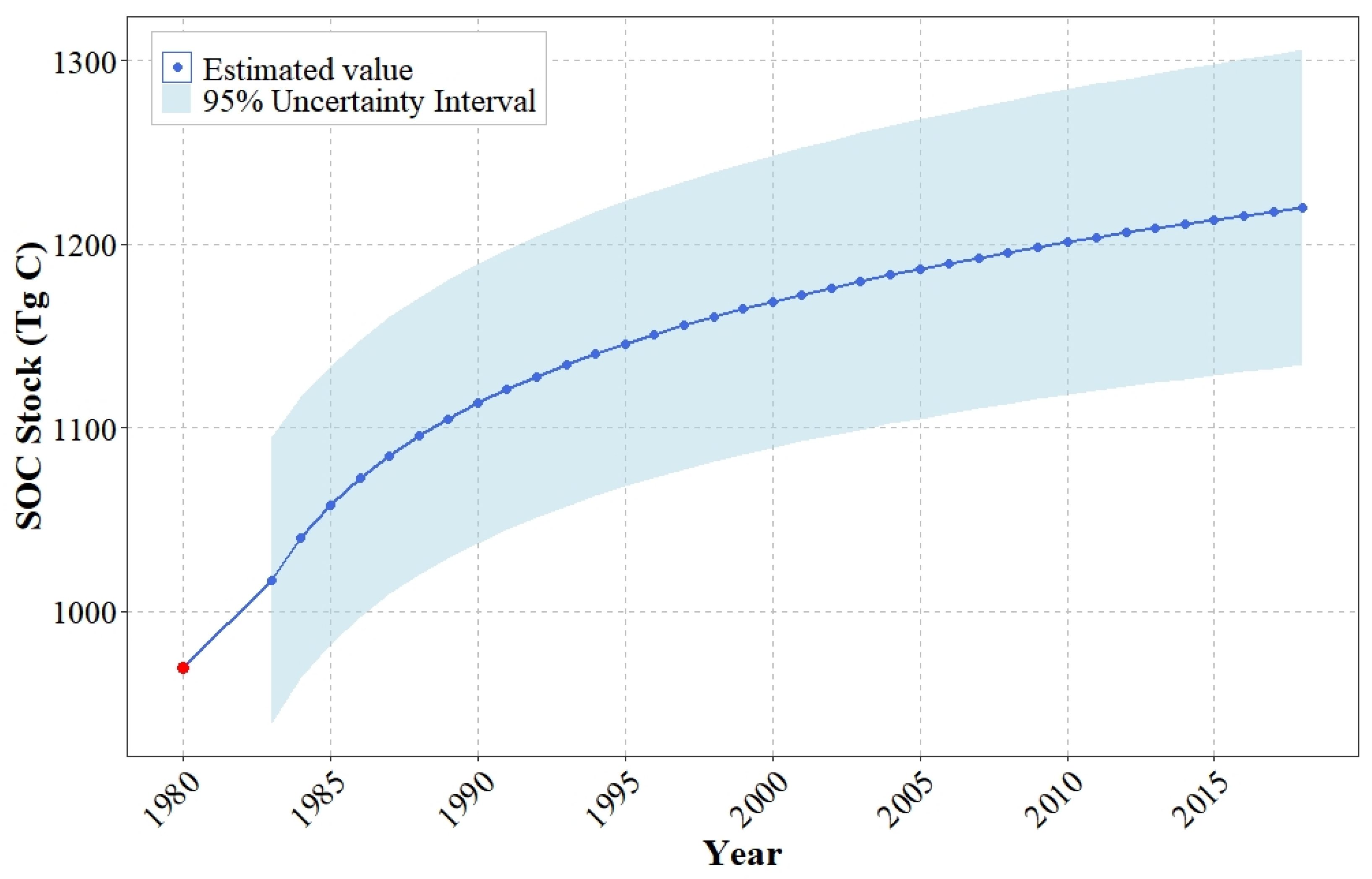
The significance of geographic coordinates and experimental duration as predictors highlights the overarching influence of climate and the non-linear nature of sequestration. Latitude serves as a powerful proxy for temperature, which exerts dual control over SOC by regulating both plant productivity (inputs) and microbial respiration (outputs) [26]. The higher SOC gains in cooler, mid-to-high latitudes suggest that in these regions, the suppressive effect of lower temperatures on decomposition outweighs any limitations on biomass production. Crucially, the positive logarithmic effect of experimental duration provides strong empirical evidence that SOC sequestration is a finite process. Sequestration rates diminish as the soil approaches a new equilibrium, a reality that must be incorporated into national and global C accounting frameworks to avoid overestimating long-term mitigation potential [50,51].

4.2. Interpreting the Spatial Patterns of SOC Change

Our empirical model estimates a national SOC sequestration rate of 6.65 Tg C yr−1 for China’s paddy soils (1980–2018), providing a new, robust long-term benchmark (Table 4). This rate is higher than some earlier estimates (e.g., 5.08 Tg C yr−1 by Xie et al. [52]; 4.1 Tg C yr−1 by Sun et al. [53]), but significantly lower than the 10.26 Tg C yr−1 (1980–2002) reported by Pan et al. [39]. We propose that this discrepancy stems not from methodological conflict, but from the critical, non-linear temporal dynamics of sequestration, a key finding supported by our model (Figure 5). Critically, when our model was applied to the same 1980–2002 period, it yielded a rate of 9.83 Tg C yr−1, which is in strong agreement with the estimate by Pan et al. [39], confirming that earlier studies captured a high initial sequestration phase. Our 38-year estimate is therefore more representative for long-term assessment because it aligns with our model’s finding that sequestration rates diminish over time as soils approach a new equilibrium (Section 3.2, Table 2). This integration of temporal non-linearity and key limiting factors (e.g., initial SOC) avoids the erroneous extrapolation of high initial rates over multi-decadal scales, establishing a more defensible baseline for national carbon inventories.
The distinct geographical hotspots of sequestration (Figure 3 and Figure 4) are a direct manifestation of the interplay between management, climate, and soil properties identified in our driver analysis (Section 4.1). The substantial C sink in Heilongjiang, for instance, is a confluence of a cool climate that slows decomposition (the latitude effect), large-scale adoption of straw incorporation (management input), and a relatively low initial SOC baseline in many areas, creating a high C saturation deficit (edaphic factor). Conversely, the muted sequestration in southern China, despite potentially high C inputs from double-cropping systems, illustrates a critical principle: high inputs do not guarantee high sequestration if background conditions are unfavorable. This is because higher temperatures accelerate year-round decomposition (latitude effect) and acidity limits C stabilization pathways (pH effect) [25,54].
The simulated net SOC loss in Chongqing highlights the vulnerability of carbon stocks in certain landscapes (Table 3). While our model did not explicitly include topography as a predictor, this region’s steep slopes and ridge tillage likely contribute to this loss through two primary mechanisms: first, increased soil erosion, which can transport vast quantities of C out of the agricultural system [55], and second, the exposure of soil organic matter to the air during tillage, which accelerates decomposition and respiratory C loss [54,56]. This finding suggests that national-scale carbon budget models should be refined to integrate erosion risk and intensive tillage impacts to avoid underestimating carbon losses in vulnerable regions.

4.3. Limitations and Implications of This Study

While our model provides significant insights, it explained less than half of the variance in SOC change (Adjusted R2 = 0.43), indicating a substantial portion of unexplained variance and a degree of model uncertainty. This is likely attributable, in part, to key factors not captured in our database, such as soil organic matter fractions (i.e., particulate versus mineral-associated organic matter), soil type, and detailed management [39,44]. Soil clay content was excluded from the final model, a result likely attributable to the fact that 38.1% of the data were sourced from the HWSD. Conversely, soil pH was retained as a significant driver, with only 10.7% of its values derived from this database. Furthermore, uncertainty arises from the estimation of soil bulk density (BD) using a pedo-transfer function. Variations in BD directly impact SOC stock calculations, and fixed-depth sampling often neglects management-induced BD changes (the ‘Equivalent Soil Mass’ issue). Recent evidence indicates that this artifact can underestimate sequestration by approximately 25% globally and up to 50% in specific field trials [57,58]. Future national-scale inventories should therefore prioritize direct and time-resolved BD measurements to minimize this uncertainty. Moreover, the linear framework of the multiple regression model is insufficient to capture the complex non-linear relationships inherent in soil systems. Future research should leverage machine learning and deep learning approaches to elucidate the non-linear relationships among soil, management, and climate processes governing SOC change and to assess future sequestration potential [59,60,61].
The accuracy of national extrapolation is fundamentally constrained by the quality of spatial input data [16,62]. Our reliance on provincial-level management statistics (e.g., straw return and mineral nitrogen inputs) inevitably masks local-scale heterogeneity, while the use of a static land-use map overlooks the dynamic expansion and contraction of paddy cultivation over 40 years. The exclusion of animal manure from the upscaling, a necessary simplification due to data limitations, implies our national estimate represents a conservative baseline. However, we expect this bias to be limited for paddy systems. As animal manure is preferentially allocated to high-value cash crops (supplying >50% of nutrients in vegetable systems), rice crops rely almost exclusively on inorganic fertilizers due to economic and labor constraints [63]. These issues collectively underscore an urgent need for the development of high-resolution, annually resolved national datasets on agricultural management to improve the precision of national C inventories.
Finally, our study is constrained by its focus on topsoil (0–20 cm). A growing body of evidence shows that subsoil horizons (below 20 cm) contain more than half of the global soil carbon stock and may respond differently to management and climate change [7,64]. Management practices that enhance the transport of dissolved organic carbon to deeper layers could represent a critical, yet largely unquantified, pathway for long-term C sequestration [65,66]. Future field experiments and modeling efforts must therefore adopt a whole-profile perspective to develop a truly comprehensive understanding of the role of paddy soils in the global carbon cycle.

5. Conclusions

In summary, this study draws the following conclusions: (1) The multiple stepwise regression model effectively quantified drivers of topsoil SOC change in China’s paddy fields (Modeling Adjusted R2 = 0.43, Validation R2 = 0.41), successfully linking management practices, initial soil properties, and geographic factors; (2) Organic matter input emerged as the dominant driver, explaining 21.83% of the total variance, with livestock manure having the highest C sequestration efficiency, followed by green manure and crop straw. Furthermore, soil pH, latitude, and initial SOC content were identified as critical controlling factors; (3) By upscaling the model with national-scale spatial data, we estimated that China’s paddy topsoils (0–20 cm) acted as a net C sink from 1980 to 2018, sequestering a total of 242.51 ± 85.80 Tg C at an average rate of 6.65 Tg C yr−1; (4) Strong spatial heterogeneity, including major C sinks in central/northeast China and net losses in Chongqing, is driven by regional climate and soil interactions combined with non-linear sequestration rates that diminish over time; (5) Model constraints, including unexplained variance and reliance on coarse, topsoil-focused input data, highlight the urgent need for high-resolution, whole-profile datasets to improve future C inventories.

Author Contributions

Conceptualization, J.S., Y.Z. and C.L.; methodology, J.S., P.Z., Y.L., J.Z. and C.L.; software, J.S.; validation, J.S. and S.C.; formal analysis, J.S. and S.C.; investigation, S.C., L.X. and Y.H.; resources, M.C. and L.Z.; data curation, J.S. and S.C.; writing—original draft preparation, J.S.; writing—review and editing, J.S., X.J., S.C., P.Z., L.X., J.Z., Y.L., C.L., Y.H., M.C., L.Z. and Y.Z.; visualization, J.S. and Y.L.; supervision, Y.Z., C.L. and M.C.; project administration, X.J. and M.C.; funding acquisition, Y.Z. and M.C. All authors have read and agreed to the published version of the manuscript.

Funding

This work was financially supported by the Natural Science Foundation of China (Grant No. 42407658) and the Basic Research Business Fund of the National Public Welfare Research Institutes (Grant No. GYZX240410). We also acknowledge funding from the “Carbon Peaking and Carbon Neutrality” projects (Grant Nos. ZX2023SZY059 and ZX2023SZY081) at the Nanjing Institute of Environmental Sciences, Ministry of Ecology and Environment, China.

Data Availability Statement

The original contributions presented in the study are included in the article. Further inquiries can be directed to the corresponding author.

Conflicts of Interest

The authors declare no conflicts of interest.

Abbreviations

The following abbreviations are used in this manuscript:
SOCSoil organic carbon
SOCDSoil organic carbon density
BDSoil bulk density
RMSERoot mean square error
EFModeling efficiency
GHGGreenhouse gas

References

  1. IPCC. Climate Change 2021: The Physical Science Basis. In Contribution of Working Group I to the Sixth Assessment Report of the Intergovernmental Panel on Climate Change; Cambridge University Press: Cambridge, UK, 2021. [Google Scholar]
  2. Ussiri, D.A.N.; Lal, R. Carbon Sequestration for Climate Change Mitigation and Food Security; Springer: Cham, Switzerland, 2017. [Google Scholar]
  3. Sanderman, J.; Hengl, T.; Fiske, G.J. Soil carbon debt of 12,000 years of human land use. Proc. Natl. Acad. Sci. USA 2017, 114, 9575–9580. [Google Scholar] [CrossRef] [PubMed]
  4. Foley, J.A.; Ramankutty, N.; Brauman, K.A.; Cassidy, E.S.; Gerber, J.S.; Johnston, M.; Mueller, N.D.; O’Connell, C.; Ray, D.K.; West, P.C.; et al. Solutions for a cultivated planet. Nature 2011, 478, 337–342. [Google Scholar] [CrossRef] [PubMed]
  5. Paustian, K.; Lehmann, J.; Ogle, S.; Reay, D.; Robertson, G.P.; Smith, P. Climate-smart soils. Nature 2016, 532, 49–57. [Google Scholar] [CrossRef]
  6. Smith, P.; Soussana, J.-F.; Angers, D.; Schipper, L.; Chenu, C.; Rasse, D.P.; Batjes, N.H.; van Egmond, F.; McNeill, S.; Kuhnert, M.; et al. How to measure, report and verify soil carbon change to realize the potential of soil carbon sequestration for atmospheric GHG removal. Glob. Change Biol. 2020, 26, 219–241. [Google Scholar] [CrossRef]
  7. Poulton, P.; Johnston, J.; Macdonald, A.; White, R.; Powlson, D. Major limitations to achieving “4 per 1000” increases in soil organic carbon stock in temperate regions: Evidence from long-term experiments at Rothamsted Research, United Kingdom. Glob. Change Biol. 2018, 24, 2563–2584. [Google Scholar] [CrossRef]
  8. IPCC. Chapter 5: Cropland. In 2019 Refinement to the 2006 IPCC Guidelines for National Greenhouse Gas Inventories: Agriculture, Forestry and Other Land Use; Blain, D., Agus, F., Alfaro, M.A., Vreuls, H., Eds.; IPCC: Geneva, Switzerland, 2019; Volume 5, p. 68. [Google Scholar]
  9. Yan, X.Y.; Cai, Z.C.; Wang, S.W.; Smith, P. Direct measurement of soil organic carbon content change in the croplands of China. Glob. Change Biol. 2011, 17, 1487–1496. [Google Scholar] [CrossRef]
  10. Zhao, Y.C.; Wang, M.Y.; Hu, S.J.; Zhang, X.D.; Ouyang, Z.; Zhang, G.L.; Huang, B.; Zhao, S.W.; Wu, J.S.; Xie, D.T.; et al. Economics- and policy-driven organic carbon input enhancement dominates soil organic carbon accumulation in Chinese croplands. Proc. Natl. Acad. Sci. USA 2018, 115, 4045–4050. [Google Scholar] [CrossRef]
  11. Virto, I.; Barré, P.; Burlot, A.; Chenu, C. Carbon input differences as the main factor explaining the variability in soil organic C storage in no-tilled compared to inversion tilled agrosystems. Biogeochemistry 2012, 108, 17–26. [Google Scholar] [CrossRef]
  12. Li, C.S.; Zhuang, Y.H.; Frolking, S.; Galloway, J.; Harriss, R.; Moore, B., III; Schimel, D.; Wang, X.K. Modeling soil organic carbon change in croplands of China. Ecol. Appl. 2003, 13, 327–336. [Google Scholar] [CrossRef]
  13. Ogle, S.M.; Breidt, F.J.; Easter, M.; Williams, S.; Killian, K.; Paustian, K. Scale and uncertainty in modeled soil organic carbon stock changes for US croplands using a process-based model. Glob. Change Biol. 2010, 16, 810–822. [Google Scholar] [CrossRef]
  14. Gurung, R.B.; Ogle, S.M.; Breidt, F.J.; Williams, S.A.; Parton, W.J. Bayesian calibration of the DayCent ecosystem model to simulate soil organic carbon dynamics and reduce model uncertainty. Geoderma 2020, 376, 114529. [Google Scholar] [CrossRef]
  15. Qin, Z.C.; Huang, Y. Quantification of soil organic carbon sequestration potential in cropland: A model approach. Sci. China Life Sci. 2010, 53, 868–884. [Google Scholar] [CrossRef]
  16. Sun, J.F.; Wang, M.H.; Xu, X.R.; Cheng, K.; Yue, Q.; Pan, G.X. Re-estimating methane emissions from Chinese paddy fields based on a regional empirical model and high-spatial-resolution data. Environ. Pollut. 2020, 265, 115017. [Google Scholar] [CrossRef] [PubMed]
  17. Kögel-Knabner, I.; Amelung, W.; Cao, Z.; Fiedler, S.; Frenzel, P.; Jahn, R.; Kalbitz, K.; Kölbl, A.; Schloter, M. Biogeochemistry of paddy soils. Geoderma 2010, 157, 1–14. [Google Scholar] [CrossRef]
  18. Liu, Y.L.; Ge, T.D.; Zhu, Z.K.; Liu, S.L.; Luo, Y.; Li, Y.; Wang, P.; Gavrichkova, O.; Xu, X.; Wang, J.; et al. Carbon input and allocation by rice into paddy soils: A review. Soil Biol. Biochem. 2019, 133, 97–107. [Google Scholar] [CrossRef]
  19. Wei, L.; Ge, T.D.; Zhu, Z.K.; Ye, R.Z.; Peñuelas, J.; Li, Y.H.; Lynn, T.M.; Jones, D.L.; Wu, J.S.; Kuzyakov, Y. Paddy soils have a much higher microbial biomass content than upland soils: A review of the origin, mechanisms, and drivers. Agric. Ecosyst. Environ. 2022, 326, 107798. [Google Scholar] [CrossRef]
  20. Song, G.H.; Li, L.Q.; Pan, G.X.; Zhang, Q. Topsoil organic carbon storage of China and its loss by cultivation. Biogeochemistry 2005, 74, 47–62. [Google Scholar] [CrossRef]
  21. Mohanty, S. Trends in global rice consumption. Rice Today 2013, 12, 44–45. [Google Scholar]
  22. FAOSTAT. Food and Agriculture Organization of the United Nations (FAO). Available online: http://www.fao.org/faostat/en/#data (accessed on 3 November 2025).
  23. FAO; IIASA. Harmonized World Soil Database Version 2.0; FAO: Rome, Italy; IIASA: Laxenburg, Austria, 2023. [Google Scholar]
  24. Ruehlmann, J.; Körschens, M. Calculating the effect of soil organic matter concentration on soil bulk density. Soil Sci. Soc. Am. J. 2009, 73, 876–885. [Google Scholar] [CrossRef]
  25. Poeplau, C.; Don, A. Sensitivity of soil organic carbon stocks and fractions to different land-use changes across Europe. Geoderma 2013, 192, 189–201. [Google Scholar] [CrossRef]
  26. Wiesmeier, M.; Urbanski, L.; Hobley, E.; Lang, B.; von Lützow, M.; Marin-Spiotta, E.; van Wesemael, B.; Rabot, E.; Ließ, M.; Garcia-Franco, N.; et al. Soil organic carbon storage as a key function of soils-A review of drivers and indicators at various scales. Geoderma 2019, 333, 149–162. [Google Scholar] [CrossRef]
  27. National Agricultural Technology Extension Service Center. Chinese Organic Fertilizer Nutrient Manual; China Agriculture Press: Beijing, China, 1999. (In Chinese) [Google Scholar]
  28. Resource and Environment Science and Data Center, Chinese Academy of Sciences. Chinese Meteorological Forcing Dataset. Available online: http://www.resdc.cn (accessed on 3 November 2025).
  29. Yang, Y.H.; Mohammat, A.; Feng, J.M.; Zhou, R.; Fang, J.Y. Storage, patterns and environmental controls of soil organic carbon in China. Biogeochemistry 2007, 84, 131–141. [Google Scholar] [CrossRef]
  30. Zuur, A.F.; Ieno, E.N.; Smith, G.M. Analyzing Ecological Data; Springer: New York, NY, USA, 2007. [Google Scholar]
  31. Smith, P.; Smith, J.U.; Powlson, D.S.; Mcgill, W.B.; Arah, J.R.M.; Chertov, O.G.; Coleman, K.; Franko, U.; Frolking, S.; Jenkinson, D.S.; et al. A comparison of the performance of nine soil organic matter models using datasets from seven long-term experiments. Geoderma 1997, 81, 153–225. [Google Scholar] [CrossRef]
  32. Monfreda, C.; Ramankutty, N.; Foley, J.A. Farming the planet: 2. Geographic distribution of crop areas, yields, physiological parameters, and net primary production in the year 2000. Glob. Biogeochem. Cycles 2008, 22, GB1022. [Google Scholar] [CrossRef]
  33. National Bureau of Statistics of China (NBS). China Rural Statistical Yearbook 2019; China Statistics Press: Beijing, China, 2019. (In Chinese)
  34. National Development and Reform Commission (NDRC). China Agricultural Products Cost-Benefit Yearbook 2019; China Statistics Press: Beijing, China, 2019. (In Chinese) [Google Scholar]
  35. Ministry of Agriculture of the People’s Republic of China. National Crop Straw Resources Survey and Evaluation Report; China Agriculture Press: Beijing, China, 2010. (In Chinese)
  36. Ministry of Ecology and Environment. Letter of Response to Proposal No. 1326 (Resource and Environment Category No. 094) of the Fourth Session of the 12th National Committee of the CPPCC. 2016. Available online: https://www.mee.gov.cn/gkml/sthjbgw/qt/201610/t20161026_366239_wh.htm (accessed on 3 November 2025). (In Chinese)
  37. Ministry of Agriculture and Rural Affairs. The 2024 National Straw Comprehensive Utilization On-Site Promotion Meeting Was Held. 2024. Available online: https://kjs.moa.gov.cn/gzdt/202406/t20240614_6457216.htm (accessed on 3 November 2025). (In Chinese)
  38. Sun, J.F.; Chen, L.B.; Ogle, S.; Cheng, K.; Xu, X.R.; Li, Y.P.; Pan, G.X. Future climate change may pose pressures on greenhouse gas emission reduction in China’s rice production. Geoderma 2023, 440, 116732. [Google Scholar] [CrossRef]
  39. Pan, G.X.; Li, L.Q.; Wu, L.S.; Zhang, X.H. Storage and sequestration potential of topsoil organic carbon in China’s paddy soils. Glob. Change Biol. 2004, 10, 79–92. [Google Scholar] [CrossRef]
  40. Jenkinson, D.S.; Rayner, J.H. The turnover of soil organic matter in some of the Rothamsted classical experiments. Soil Sci. 1977, 123, 298–305. [Google Scholar] [CrossRef]
  41. Parton, W.J.; Schimel, D.S.; Cole, C.V.; Ojima, D.S. Analysis of factors controlling soil organic matter levels in Great Plains grasslands. Soil Sci. Soc. Am. J. 1987, 51, 1173–1179. [Google Scholar] [CrossRef]
  42. Larney, F.J.; Angers, D.A. The role of organic amendments in soil reclamation: A review. Can. J. Soil Sci. 2012, 92, 19–38. [Google Scholar] [CrossRef]
  43. Cotrufo, M.F.; Wallenstein, M.D.; Boot, C.M.; Denef, K.; Paul, E.A. The Microbial Efficiency-Matrix Stabilization (MEMS) framework integrates plant litter decomposition with soil organic matter stabilization: Do labile plant inputs form stable soil organic matter? Glob. Change Biol. 2013, 19, 988–995. [Google Scholar] [CrossRef] [PubMed]
  44. Lavallee, J.M.; Soong, J.L.; Cotrufo, M.F. Conceptualizing soil organic matter into particulate and mineral-associated forms to address global change in the 21st century. Glob. Change Biol. 2020, 26, 261–273. [Google Scholar] [CrossRef]
  45. Yang, N.; Zhang, M.M.; Pan, X.P.; Dang, P.F.; Wang, S.G.; Han, X.Q.; Wang, X.F.; Zhang, C.H.; Meng, M.; Wang, W.; et al. Characteristics of Changes to POC and MAOC After Straw Returning in China: A Meta-Analysis. Land Degrad. Dev. 2025, 36, 3537–3550. [Google Scholar] [CrossRef]
  46. Hu, J.X.; Du, M.L.; Chen, J.; Tie, L.H.; Zhou, S.X.; Buckeridge, K.M.; Cornelissen, J.H.C.; Huang, C.; Kuzyakov, Y. Microbial Necromass under Global Change and Implications for Soil Organic Matter. Glob. Change Biol. 2023, 29, 3503–3515. [Google Scholar] [CrossRef] [PubMed]
  47. Castellano, M.J.; Mueller, K.E.; Olk, D.C.; Sawyer, J.E.; Six, J. Integrating plant litter quality, soil organic matter stabilization, and the carbon saturation concept. Glob. Change Biol. 2015, 21, 3200–3209. [Google Scholar] [CrossRef]
  48. Fageria, N.K.; Baligar, V.C. Ameliorating soil acidity of tropical Oxisols by liming for sustainable crop production. Adv. Agron. 2008, 99, 345–399. [Google Scholar]
  49. Malik, A.A.; Puissant, J.; Buckeridge, K.M.; Goodall, T.; Jehmlich, N.; Chowdhury, S.; Gweon, H.S.; Peyton, J.M.; Mason, K.E.; van Agtmaal, M.; et al. Land use driven change in soil pH affects microbial carbon cycling processes. Nat. Commun. 2018, 9, 3591. [Google Scholar] [CrossRef]
  50. West, T.O.; Six, J. Considering the influence of sequestration duration and carbon saturation on estimates of soil carbon capacity. Clim. Change 2007, 80, 25–41. [Google Scholar] [CrossRef]
  51. Sommer, R.; Bossio, D. Dynamics and climate change mitigation potential of soil organic carbon sequestration. J. Environ. Manag. 2014, 144, 83–87. [Google Scholar] [CrossRef] [PubMed]
  52. Xie, Z.B.; Zhu, J.G.; Liu, G.; Cadisch, G.; Hasegawa, T.; Chen, C.M.; Sun, H.F.; Tang, H.Y.; Zeng, Q. Soil organic carbon stocks in China and changes from 1980s to 2000s. Glob. Change Biol. 2007, 13, 1989–2007. [Google Scholar] [CrossRef]
  53. Sun, W.J.; Huang, Y.; Zhang, W.; Yu, Y.Q. Carbon sequestration and its potential in agricultural soils of China. Glob. Biogeochem. Cycles 2010, 24, GB3010. [Google Scholar] [CrossRef]
  54. Poeplau, C.; Don, A.; Vesterdal, L.; Leifeld, J.; van Wesemael, B.; Schumacher, J.; Gensior, A. Temporal dynamics of soil organic carbon after land-use change in the temperate zone–carbon response functions as a model approach. Glob. Change Biol. 2011, 17, 2415–2427. [Google Scholar] [CrossRef]
  55. Van Oost, K.; Verstraeten, G.; Doetterl, S.; Notebaert, B.; Wiaux, F.; Broothaerts, N.; Six, J. Legacy of human-induced C erosion and burial on soil–atmosphere C exchange. Proc. Natl. Acad. Sci. USA 2012, 109, 19492–19497. [Google Scholar] [CrossRef]
  56. Zheng, H.B.; Huang, H.; Liu, J.X.; Yao, L.; He, H. Recent progress and prospects in the development of ridge tillage cultivation technology in China. Soil Tillage Res. 2014, 142, 1–7. [Google Scholar] [CrossRef]
  57. Zhao, Z.; Li, T.; Cheng, K.; Pan, G.X. Is the Topsoil Carbon Sequestration Potential Underestimated of Agricultural Soils under Best Management? Soil Tillage Res. 2025, 250, 106528. [Google Scholar] [CrossRef]
  58. Gifford, R.M.; Roderick, M.L. Soil Carbon Stocks and Bulk Density: Spatial or Cumulative Mass Coordinates as a Basis of Expression? Glob. Change Biol. 2003, 9, 1507–1514. [Google Scholar] [CrossRef]
  59. Han, D.R.; Wiesmeier, M.; Conant, R.T.; Kühnel, A.; Sun, Z.G.; Kögel-Knabner, I.; Hou, R.X.; Cong, P.F.; Liang, R.B.; Ouyang, Z. Large soil organic carbon increase due to improved agronomic management in the North China Plain from 1980s to 2010s. Glob. Change Biol. 2018, 24, 987–1000. [Google Scholar] [CrossRef] [PubMed]
  60. Guilpart, N.; Iizumi, T.; Makowski, D. Data-driven projections suggest large opportunities to improve Europe’s soybean self-sufficiency under climate change. Nat. Food 2022, 3, 255–265. [Google Scholar] [CrossRef]
  61. Samarinas, N.; Tsakiridis, N.L.; Kokkas, S.; Kalopesa, E.; Zalidis, G.C. Soil Data Cube and Artificial Intelligence Techniques for Generating National-Scale Topsoil Thematic Maps: A Case Study in Lithuanian Croplands. Remote Sens. 2023, 15, 5304. [Google Scholar] [CrossRef]
  62. Ogle, S.M.; Breidt, F.J.; Easter, M.; Williams, S.; Paustian, K. An empirically based approach for estimating uncertainty associated with modelling carbon sequestration in soils. Ecol. Model. 2007, 205, 453–463. [Google Scholar] [CrossRef]
  63. Chadwick, D.; Jia, W.; Tong, Y.A.; Yu, G.H.; Shen, Q.R.; Chen, Q. Improving manure nutrient management towards sustainable agricultural intensification in China. Agric. Ecosyst. Environ. 2015, 209, 34–46. [Google Scholar] [CrossRef]
  64. Hicks Pries, C.E.; Castanha, C.; Porras, R.C.; Torn, M.S. The whole-soil carbon flux in response to warming. Science 2017, 355, 1420–1423. [Google Scholar] [CrossRef] [PubMed]
  65. Kaiser, K.; Kalbitz, K. Cycling downwards–dissolved organic matter in soils. Soil Biol. Biochem. 2012, 52, 29–32. [Google Scholar] [CrossRef]
  66. Bolan, N.S.; Adriano, D.C.; Kunhikrishnan, A.; James, T.; McDowell, R.; Senesi, N. Dissolved organic matter: Biogeochemistry, dynamics, and environmental significance in soils. Adv. Agron. 2011, 110, 1–75. [Google Scholar]
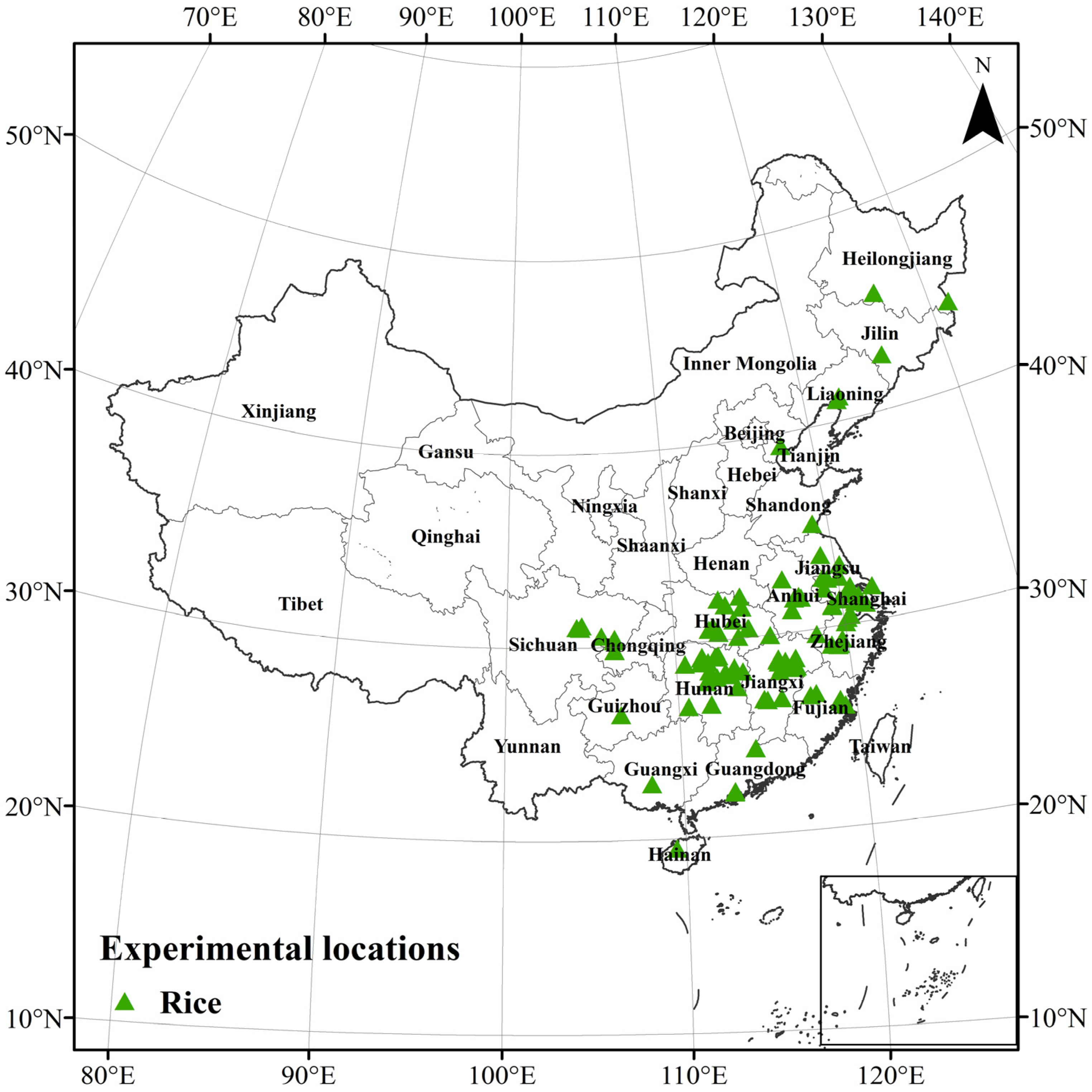
Figure 1. Geographic distribution of paddy field experiment sites for SOC changes in China.
Agronomy 15 02901 g001
Figure 2. Validation in the SOC change model for Chinese paddy field (Abbreviations: RMSE, Root Mean Square Error; EF, Modeling Efficiency; ∆SOC, change in soil organic carbon).
Agronomy 15 02901 g002
Figure 3. Spatial patterns of topsoil (0–20 cm) SOC changes in Chinese paddy fields from 1980–2018.
Agronomy 15 02901 g003
Figure 4. Spatial patterns of topsoil (0–20 cm) SOC stock changes in Chinese paddy fields during 1980–2018.
Agronomy 15 02901 g004
Figure 5. Estimated temporal dynamics of the national soil organic carbon (SOC) stock in China’s paddy fields (the red point indicates the 1980 baseline derived from the Harmonized World Soil Database).
Agronomy 15 02901 g005
Table 1. Analysis of variance for the SOC change model.
VariableDfSum of SquaresMean SquareF-Valuep Value
Latitude4496.10124.0313.43<0.001***
Longitude4309.5077.378.38<0.001***
Mineral Nitrogen inputs160.8060.846.590.011*
Straw carbon input176.8076.778.320.004**
Livestock manure carbon input11586.901586.89171.89<0.001***
Green manure input1158.70158.6617.19<0.001***
Initial SOC content1132.10132.1014.31<0.001***
pH7501.7071.687.76<0.001***
Experimental duration1444.80444.8548.18<0.001***
Residuals4964579.209.23
Total5218346.60
Note: Df represent degrees of freedom. Significance levels are indicated by asterisks: *** p < 0.001, ** p < 0.01, and * p < 0.05.
Table 2. Parameters for the multiple regression model of SOC change in Chinese paddy fields.
EstimateStandard Errorp Value
Intercept−4.42368721.42978530.002**
Mineral Nitrogen inputs (kg N ha−1)0.00432230.0009689<0.001***
Initial SOC content (g kg−1)−0.12214770.0295165<0.001***
Ln (Experimental duration)0.12410220.0168418<0.001***
Ln (1 + Straw carbon input)0.6656080.11873<0.001***
Ln (1 + Green manure input)0.82836980.1450942<0.001***
Ln (1 + Livestock manure carbon input)1.73058870.1519914<0.001***
Latitude
        LA1 (<25°)0
        LA2 (25–28°)2.99762261.17709120.011*
        LA3 (28–32°)1.00377821.11056050.367
        LA4 (32–40°)3.14265071.24091920.012*
        LA5 (>40°)−1.52743481.69541890.368
Longitude
        LO1 (<109°)0
        LO2 (109–114°)2.47620390.5237664<0.001***
        LO3 (114–117°)0.90680450.54677110.098.
        LO4 (117–124°)1.31852470.53952010.015*
        LO5 (>124°)5.78298661.6048535<0.001***
pH
        <50
        5–5.52.88340860.7569134<0.001***
        5.5–61.71538290.75124870.023*
        6–6.52.46115420.7383296<0.001***
        6.5–73.12016990.7651897<0.001***
        7–7.55.11036740.9210038<0.001***
        7.5–83.03732350.8689575<0.001***
        >82.63028111.01196670.010**
Note: Bold text indicates the main variables, distinguishing them from their sub-levels. For categorical variables (Latitude, Longitude, and pH), the first level serves as the reference group. Experimental duration and organic matter inputs (kg C ha−1) were log-transformed. Significance levels: *** p < 0.001, ** p < 0.01, * p < 0.05, and . p < 0.1.
Table 3. Changes in SOC density and total stock in China’s paddy fields from 1980 to 2018.
ProvinceRice Cultivation Area (ha)SOC
(g kg−1)
ΔSOC
(g kg−1)
∆SOC Density
(t C ha−1)
SOC Density Changes
(%)
∆SOC Stock
(Tg)
SOC Stock
(Tg)
Beijing1701.55 ± 0.170.65 ± 0.171.28 ± 0.3454.68 ± 14.350.00 ± 0.000.00 ± 0.00
Shanxi80017.56 ± 1.216.08 ± 1.2112.08 ± 2.4643.65 ± 8.890.01 ± 0.000.03 ± 0.00
Tibet94011.97 ± 0.932.14 ± 0.934.34 ± 1.8918.94 ± 8.250.00 ± 0.000.03 ± 0.00
Gansu382013.22 ± 1.232.93 ± 1.235.79 ± 2.4523.32 ± 9.850.02 ± 0.010.12 ± 0.01
Tianjin39,90021.15 ± 1.657.49 ± 1.6514.83 ± 3.2943.95 ± 9.750.59 ± 0.131.94 ± 0.13
Ningxia78,01018.53 ± 1.884.58 ± 1.889.10 ± 3.7226.61 ± 10.890.71 ± 0.293.38 ± 0.29
Xinjiang78,39016.33 ± 2.591.07 ± 2.592.13 ± 5.125.80 ± 13.980.17 ± 0.403.04 ± 0.40
Hebei78,43018.95 ± 1.786.20 ± 1.7812.28 ± 3.5338.83 ± 11.180.96 ± 0.283.44 ± 0.28
Shanghai103,58028.28 ± 1.508.32 ± 1.5016.44 ± 3.0334.37 ± 6.341.70 ± 0.316.66 ± 0.31
Shaanxi105,39020.23 ± 1.775.56 ± 1.7710.99 ± 3.5430.91 ± 9.941.16 ± 0.374.91 ± 0.37
Shandong113,83020.90 ± 1.466.59 ± 1.4613.10 ± 2.9438.02 ± 8.541.49 ± 0.335.41 ± 0.33
Hainan123,05023.52 ± 2.443.83 ± 2.447.71 ± 5.0017.03 ± 11.040.95 ± 0.616.52 ± 0.61
Taiwan135,75320.84 ± 2.514.06 ± 2.518.16 ± 5.0820.69 ± 12.881.11 ± 0.696.46 ± 0.69
Inner Mongolia150,45015.73 ± 2.210.83 ± 2.211.63 ± 4.414.67 ± 12.630.25 ± 0.665.50 ± 0.66
Fujian441,16023.72 ± 1.786.92 ± 1.7813.98 ± 3.6235.37 ± 9.166.17 ± 1.6023.61 ± 1.60
Liaoning488,36016.46 ± 2.472.53 ± 2.475.03 ± 4.8914.80 ± 14.402.46 ± 2.3919.05 ± 2.39
Zhejiang553,00522.47 ± 1.288.10 ± 1.2816.14 ± 2.5946.47 ± 7.468.92 ± 1.4328.13 ± 1.43
Henan620,41021.26 ± 1.446.30 ± 1.4412.48 ± 2.9134.75 ± 8.097.74 ± 1.8030.03 ± 1.80
Chongqing656,45010.88 ± 1.93−4.63 ± 1.93−9.26 ± 3.90−24.80 ± 10.45−6.08 ± 2.5618.43 ± 2.56
Guizhou671,78021.71 ± 1.715.10 ± 1.7110.36 ± 3.4626.45 ± 8.836.96 ± 2.3233.27 ± 2.32
Yunnan815,01520.59 ± 2.394.07 ± 2.398.20 ± 4.8321.02 ± 12.386.68 ± 3.9438.47 ± 3.94
Jilin839,71020.13 ± 1.893.24 ± 1.896.41 ± 3.8016.16 ± 9.595.38 ± 3.1938.68 ± 3.19
Guangdong893,69520.88 ± 2.552.96 ± 2.555.94 ± 5.1614.23 ± 12.345.31 ± 4.6142.64 ± 4.61
Guangxi944,04521.68 ± 2.394.58 ± 2.399.22 ± 4.8523.05 ± 12.138.71 ± 4.5846.48 ± 4.58
Sichuan1,874,00015.29 ± 1.500.59 ± 1.501.17 ± 2.963.29 ± 8.372.18 ± 5.5568.58 ± 5.55
Jiangxi2,173,00023.33 ± 1.547.83 ± 1.5415.82 ± 3.1342.69 ± 8.4434.38 ± 6.79114.91 ± 6.79
Hubei2,212,65020.43 ± 1.165.36 ± 1.1610.57 ± 2.3229.11 ± 6.3923.39 ± 5.13103.74 ± 5.13
Jiangsu2,214,72021.05 ± 1.515.31 ± 1.5110.50 ± 3.0327.77 ± 8.0123.24 ± 6.70106.94 ± 6.70
Anhui2,358,78019.56 ± 1.314.44 ± 1.318.76 ± 2.6224.14 ± 7.2220.66 ± 6.18106.25 ± 6.18
Hunan2,740,75024.46 ± 1.388.78 ± 1.3817.73 ± 2.8347.57 ± 7.5948.60 ± 7.75150.77 ± 7.75
Heilongjiang3,783,10023.74 ± 1.974.82 ± 1.979.67 ± 4.0121.98 ± 9.1036.59 ± 15.15203.07 ± 15.15
Sum25,293,14321.11 ± 1.684.95 ± 1.689.90 ± 3.3925.82 ± 8.84242.51 ± 85.801220.48 ± 85.80
Note: Values are presented as mean ± 95% confidence interval (CI). SOC, soil organic carbon; SOCD, soil organic carbon density.
Table 4. Various estimates of SOC stock change in croplands of China.
MethodTime PeriodStock Change
(Tg yr−1)
Annual Stock
Change
Rate (%)
Literature
Literature survey1980–20005.080.62[52]
Literature survey1980–200210.261.22[39]
Literature survey1980–20004.1/[53]
Direct measurement1980–2007/0.28[9]
Literature survey and Model simulation1980–20181980–2000: 10.311980–2000: 0.88This study
1980–2002: 9.831980–2002: 0.83
1980–2007: 8.571980–2007: 0.72
1980–2018: 6.651980–2018: 0.54
Note: SOC, soil organic carbon. The symbol “/” indicates that the data were not reported or available in the cited literature.
Disclaimer/Publisher’s Note: The statements, opinions and data contained in all publications are solely those of the individual author(s) and contributor(s) and not of MDPI and/or the editor(s). MDPI and/or the editor(s) disclaim responsibility for any injury to people or property resulting from any ideas, methods, instructions or products referred to in the content.