Article

Pollution Assessment and Source Apportionment of Heavy Metals in Farmland Soil Under Different Land Use Types: A Case Study of Dehui City, Northeastern China


1
Northeast Institute of Geography and Agroecology, Chinese Academy of Sciences, Changchun 130102, China
2
Changchun Institute of Technology, College of Jilin Emergency Management, Changchun 130012, China
*
Authors to whom correspondence should be addressed.
Agronomy 2025, 15(12), 2899; https://doi.org/10.3390/agronomy15122899

Submission received: 15 November 2025 / Revised: 10 December 2025 / Accepted: 13 December 2025 / Published: 17 December 2025
(This article belongs to the Section Agroecology Innovation: Achieving System Resilience)

Abstract

Soil heavy metal contamination in agricultural land has emerged as a critical environmental issue, threatening both food security and ecological sustainability. However, the contamination characteristics and associated potential ecological risks under different land use types remain poorly understood. This study presents a systematic comparison of heavy-metal pollution between three distinct agricultural land use systems (suburban vegetable fields, paddy fields, and maize fields) using an integrated approach that combines spatial analysis, pollution indices, and receptor modeling. Dehui City, a major grain-producing region in Northeast China, was selected as the study region, in which 73 topsoil samples were systematically collected. The concentrations and spatial distributions of heavy metals (Cd, Cr, Cu, Hg, Ni, Pb, Zn, and As) were analyzed. Source apportionment of soil heavy metals was performed using principal component analysis (PCA) and positive matrix factorization (PMF), while pollution assessment employed the geo-accumulation index (Igeo), Nemerow integrated pollution index (NIPI), and potential ecological risk index (PERI). The results showed that the mean concentrations of all heavy metals exceeded the soil background values for Jilin Province. The enrichment factors for Hg, Pb, and Cu were 3.51, 1.32, and 1.31, respectively, while all metals remained below the risk screening values (GB 15618-2018, China) for agricultural soils. Land use-specific patterns in heavy-metal accumulation were evident. Suburban vegetable fields showed elevated levels of Ni, As, and Cr, paddy fields showed elevated levels of Cd, Hg, and As, and maize fields showed elevated levels of Hg and Pb. Source apportionment revealed that agricultural fertilization, traffic emissions, industrial and coal-combustion activities, and natural sources were the main contributors. Notably, industrial and coal-combustion sources accounted for 77.7% of Hg in maize fields, while agricultural fertilization contributed 67.7% of Cd in suburban vegetable fields. The Igeo results indicated that 65.75% of the sampling sites exhibited slight or higher pollution levels for Hg. However, the NIPI results showed that 97.26% of the sampling sites remained at a safe level (NIPI < 0.7). The PERI results revealed a moderate ecological risk across the study area, with the risk levels following the order: maize fields > paddy fields > vegetable fields. Although agricultural soils generally met the safety standards, Hg-dominated ecological risks warrant priority attention and mitigation measures.

1. Introduction

With the rapid development of urbanization and industrialization, soil contamination has emerged as a major environmental challenge in China [1]. Anthropogenic activities, including industrial production, agricultural practices, and transportation, have released substantial quantities of toxic and hazardous substances into soils. Among these contaminants, heavy metals have long attracted extensive attention due to their potential threats to the ecological environment, food safety, human health, and sustainable agricultural development [2]. Heavy metal accumulation in agricultural soils originates from both natural and anthropogenic sources [3]. Natural sources include lithogenesis, mineral weathering, volcanic activity, and other geological processes [4,5]. However, anthropogenic sources serve as the primary driver of heavy metal accumulation in soils, predominantly originating from industrial production, application of chemical fertilizers and pesticides, wastewater irrigation, traffic emissions, and atmospheric deposition [6,7]. Heavy metals entering agricultural soils exhibit accumulative behavior, irreversibility, persistence, and toxicity [8]. Excessive accumulation not only impairs crop productivity and microbial activity but also leads to soil quality degradation, thereby threatening soil ecological security [9]. Consequently, assessing the contamination levels of soil heavy metals and identifying their potential sources are crucial for ensuring agricultural production safety.
In recent years, the pollution levels, sources, and risk assessment of heavy metals in agricultural soils have received increasing attention, with various analytical approaches being employed [10,11]. Multivariate statistical methods, such as Geographic Information Systems (GISs), principal component analysis (PCA), and positive matrix factorization (PMF), have proven to be effective tools for heavy metal source apportionment [12,13]. For instance, Adnan et al. successfully identified heavy metal sources in soils from an abandoned lead–zinc smelting site in Zhuzhou, China, by integrating PMF and PCA approaches [14]. The geo-accumulation index (Igeo), Nemerow integrated pollution index (NIPI), and potential ecological risk index (PERI) are widely adopted indices for assessing soil contamination levels [15,16,17]. Specifically, Igeo focuses on single-metal pollution assessment, whereas NIPI comprehensively evaluates multiple metal risks. The combined application of Igeo, NIPI, and PERI enables more accurate pollution assessment by accounting for geological background variations, metal toxicity differences, and cumulative effects of multiple contaminants [18,19]. However, the PERI is calculated on the basis of metal concentrations, while factors such as metal speciation and exposure pathways are not explicitly taken into account. Nevertheless, the PERI integrates multiple indicators into one single index, providing an effective overall metric for assessing potential ecological risk [20].
Different agricultural land use patterns exert distinct influences on soil heavy metal contamination. Numerous studies have demonstrated that land use changes can significantly influence the soil biogeochemical cycle by modifying soil physicochemical properties, nutrient availability, and overall soil health [21,22,23]. Peri-urban vegetable fields, owing to their proximity to urban areas, are heavily influenced by industrial emissions, vehicle exhaust, and agricultural inputs such as chemical fertilizers and pesticides [24]. Paddy fields, characterized by dense irrigation networks, are susceptible to contamination from irrigation water and agricultural activities; furthermore, prolonged flooding conditions facilitate the mobilization and migration of certain heavy metals. In contrast, maize farmlands are typically located in upland rainfed areas distant from urban centers, where lower fertilizer application rates and reduced agricultural inputs result in less external pollution influence and generally lower soil heavy metal concentrations. Although several studies have investigated heavy metal risks under different land use patterns, most research has focused on functional zone comparisons within single regions (e.g., industrial zones, mining areas, commercial districts, or agricultural lands) [13,25]. However, comprehensive comparative studies examining the effects of different agricultural land use types on soil heavy metal accumulation remain limited, particularly in the black soil region of Northeast China [23,26].
The black soil region of Northeast China is the most important grain production base in China, contributing more than 40% of the national total grain output [27]. Dehui City, located in the core area of this region, has a total arable land area of 215,300 hectares, primarily cultivated with maize, paddy, and vegetables, covering 161,300, 48,100 and 8700 hectares, respectively [28]. In this study, Dehui City was selected as the study area to investigate the concentrations of heavy metals (Pb, Cr, Cu, Ni, Zn, Cd, Hg, and As) in soils under different agricultural land use types, including suburban vegetable field soils, paddy soils, and maize field soils. The objectives were to clarify the current status, potential sources, and ecological risks of heavy metal contamination in the black soil region. The findings of this study will provide a scientific assessment method of agricultural soil environmental quality and promote black soil conservation and sustainable utilization.

2. Materials and Methods

2.1. Study Area and Sample Collection

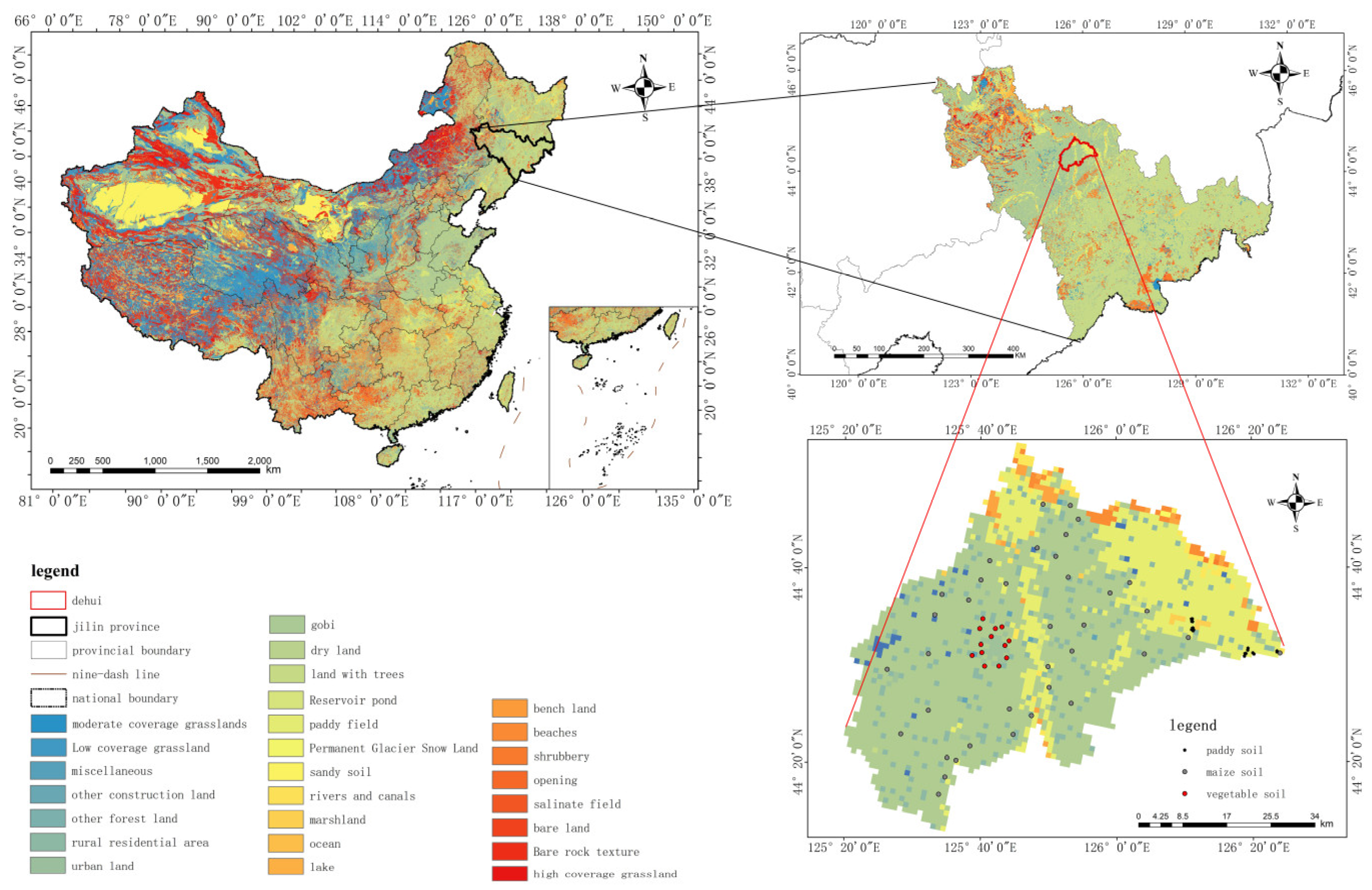
Dehui City (44°02′–44°53′ N, 125°14′–126°24′ E), located in the central-northern region of Jilin Province, is characterized by a temperate continental monsoon climate, with a mean annual precipitation of 506.5 mm and a mean annual temperature of 6.7 °C. The soil type is Phaeozem. In October 2023, a total of 73 topsoil samples (0–20 cm depth) were collected from agricultural lands across Dehui City, comprising 13 samples from suburban vegetable fields, 20 samples from paddy fields, and 40 samples from maize fields. The spatial distribution of sampling sites is shown in Figure 1. At each sampling site, approximately 500 g of soil was collected and homogenized using the quartering method. After removing stones, plant residues, and other debris, samples were placed in a polyethylene zip-lock bag, labeled with unique identification codes, and transported to the laboratory. All soil samples were air-dried at room temperature, ground, and sieved through a 100-mesh (0.149 mm) nylon sieve prior to chemical analysis.

2.2. Chemical Analysis and Quality Assurance/Quality Control

Soil samples were digested using different procedures depending on the target elements. For Cd, Cr, Cu, Ni, Pb, and Zn, approximately 0.2 g of soil was digested using a mixed acid solution (HNO3-HClO4-HF) at high temperature. After digestion, the solution was diluted to 25 mL with deionized water and analyzed using inductively coupled plasma mass spectrometry (ICP-MS, NexION 350D, PerkinElmer, Waltham, MA, USA) following standard protocols [29]. For Hg and As determination, approximately 0.5 g of soil was digested using HNO3-HCl in a water bath. After cooling, the digestion solution was diluted to 50 mL with deionized water, and the supernatant was analyzed using an atomic fluorescence spectrometer (AFS-8530, Beijing Haiguang Instrument Co., Ltd., Beijing, China) according to Huang et al. [30].
Quality assurance and quality control (QA/QC) procedures were implemented throughout the analytical process. Certified reference material (GBW07410, National Research Center for Certified Reference Materials, Beijing, China) was included in each batch of samples to verify analytical accuracy. Reagent blanks and replicate samples were analyzed concurrently to assess precision and detect potential contamination. The recovery rates for all eight heavy metals ranged from 90% to 110%, and the relative standard deviations (RSD) of duplicate analyses were <5%. The limits of detection (LOD) were 0.01, 0.002, 0.05, 0.05, 0.001, 0.2, 0.02, and 0.5 mg·kg−1 for As, Cd, Cr, Cu, Hg, Ni, Pb, and Zn, respectively.

2.3. Pollution Assessment

2.3.1. Geo-Accumulation Index

The Igeo was employed to assess the contamination level of individual heavy metals in soils [15]. The Igeo is calculated using the following equation:
I geo   =   log 2 C n 1.5 B n
where Cn represents the measured concentration (mg·kg−1) of heavy metal n in soil; Bn is the soil background value (mg·kg−1) for Jilin Province [31]; and 1.5 is the background matrix correction factor to account for natural variability in background values. The contamination levels are classified as follows: Igeo ≤ 0, no pollution; 0 < Igeo ≤ 1, light-moderate; 1 < Igeo ≤ 2, moderate; 2 < Igeo ≤ 3, moderate-heavy; 3 < Igeo ≤ 4, heavy; 4 < Igeo ≤ 5: heavy-extremely; Igeo > 5, extremely.

2.3.2. Nemerow Integrated Pollution Index (NIPI)

The NIPI was used to evaluate the overall pollution level by considering both the average and maximum pollution contributions of multiple heavy metals [32]. The NIPI is calculated as follows:
PI   = C n T n
N I P I = P I i m a x 2 + P I i a v e 2 2
where PI is the single pollution index for each heavy metal; Cn is the measured concentration of heavy metal n in soil (mg·kg−1); Tn is the risk screening value for agricultural land stipulated in the Soil Environmental Quality Risk Control Standard for Soil Contamination of Agricultural Land (GB 15618-2018) [33] (mg·kg−1); PImax and PIave are the maximum and average values of all PI values, respectively. The pollution levels based on NIPI are classified as follows: NIPI ≤ 0.7, safe; 0.7 < NIPI ≤ 1, precaution; 1 < NIPI ≤ 2, slight pollution; 2 < NIPI ≤ 3, moderate pollution; NIPI > 3, heavy pollution.

2.3.3. Potential Ecological Risk Index (PERI)

The PERI was applied to assess the ecological risks posed by heavy metal contamination, accounting for both the toxicity and concentration of multiple heavy metals [16]. The PERI is calculated using the following equations:
E r   =   T r × C s C ref
PERI = i = 1 n E r = i = 1 n T r × C s C ref
where Er is the potential ecological risk factor for an individual heavy metal; Tr is the toxic-response factor for heavy metal i. As reported by Hakanson (1980) [34], the toxic response (Tr) factors adopted in this study were as follows: Cd = 30, As = 10, Cu = Pb = Ni = 5, Cr = 2, Zn = 1, and Hg = 40 [35]; Cs is the measured concentration of the heavy metal in soil (mg·kg−1); Cref is the corresponding geochemical background value (mg·kg−1); PERI is the comprehensive potential ecological risk index; and n is the number of heavy metals evaluated. The classification of ecological risk levels is presented in Table 1.

2.4. Source Apportionment

2.4.1. Principal Component Analysis (PCA)

Principal component analysis (PCA) is a dimensionality reduction technique that transforms multiple potentially correlated variables into a smaller number of linearly uncorrelated principal components through orthogonal transformation, thereby facilitating the identification of potential pollution sources [36]. Principal components were extracted based on the criteria of eigenvalues > 1 and cumulative variance contribution > 70%. Varimax orthogonal rotation was applied to obtain the rotated factor loading matrix, with loading values > 0.5 considered indicative of significant associations. Prior to analysis, all data were standardized. The Kaiser-Meyer-Olkin (KMO) measure of sampling adequacy and Bartlett’s test of sphericity were performed to verify the suitability of the dataset for PCA (KMO > 0.6, p < 0.05).

2.4.2. Positive Matrix Factorization (PMF)

Positive matrix factorization (PMF) is a multivariate receptor model that quantitatively apportions pollution sources by decomposing the sample concentration matrix into factor contribution and factor profile matrices [37]. The PMF model is expressed as:
x ij   =   k = 1 p g ik f ij + e ij
where xij is the concentration of element j in sample i (mg·kg−1); gik is the contribution of source k to sample i; fkj is the concentration of element j in source k; eij is the residual; and p is the number of sources. In this study, PMF analysis was performed using EPA PMF 5.0 software (U.S. Environmental Protection Agency, Research Triangle Park, NC, USA).
All results of the PMF model were verified using the BS-DISP (bootstrap-displacement) test to ensure the stability and reliability of the solution. 20 runs with random seeds were performed to further assess solution stability. The signal-to-noise ratio (S/N) was used to classify heavy metals, with S/N greater than 2 classified as “Strong” and 1 < S/N ≤ 2 as “Weak”. The S/N ratios for heavy metals in Dehui farmland soils were as follows: Hg (8.32), Cd (8.87), Pb (9.54), As (9.21), Cu (9.98), Zn (9.76), Cr (9.43), and Ni (9.15). All heavy metals were classified as “Strong” (S/N > 2), indicating their suitability for source apportionment analysis. The optimal number of source factors was determined based on the Qrobust/Qtrue ratio approaching 1.0, with residuals between −3 and +3.

2.5. Statistical Analysis

Statistical analyses were conducted using SPSS Statistics software (version 27.0, IBM Corp., Armonk, NY, USA). Descriptive statistics, including mean, standard deviation, minimum, and maximum values, were calculated for all heavy metal concentrations. The Shapiro–Wilk test was performed to assess the normality of data distribution. One-way analysis of variance (ANOVA) was applied to evaluate significant differences in heavy metal concentrations among different land use types, followed by post hoc comparisons where appropriate. Spatial distribution maps were generated using ArcMap software (version 10.8.1, Environmental Systems Research Institute, Redlands, CA, USA) with ordinary kriging interpolation. The experimental semivariograms were fitted using [spherical/exponential/gaussian] models (selected based on minimum RSS and highest R2), and the nugget-to-sill ratios indicated [weak/moderate/strong] spatial dependence. Graphs and charts were prepared using Origin software (version 2022, OriginLab Corp., Northampton, MA, USA). Statistical significance was set at p < 0.05 for all analyses.

3. Results and Discussion

3.1. Statistical Characteristics of Heavy Metal Concentrations in Agricultural Soils of Dehui City

The descriptive statistics for heavy metal concentrations in agricultural soils of Dehui City are presented in Table 2. The mean concentrations of Pb, Cr, Cu, Ni, Zn, Cd, Hg, and As were 29.24, 55.81, 19.82, 24.38, 63.25, 0.103, 0.123, and 6.47 mg·kg−1, respectively. The mean concentrations of all elements were below the risk screening values stipulated in the Soil environmental quality-Risk control standard for soil contamination of agricultural land (GB 15618-2018, China) [33], indicating that the study area was predominantly safe for agricultural utilization. However, compared with the soil background values of Jilin Province [31], eight heavy metals exhibited varying degrees of enrichment. Notably, the mean concentration of Hg was 3.51 times the background value, with an exceedance rate of 86.30% across all sampling sites. The mean concentrations of Pb and Cu were 1.32 and 1.31 times their respective background values, with 91.78% and 83.56% of sampling sites exceeding these thresholds, respectively. Analysis of the coefficient of variation (CV) revealed that Hg (CV = 83.07%), As (CV = 59.52%), and Cd (CV = 56.38%) exhibited strong variability (CV > 50%), suggesting that their spatial distributions were significantly influenced by anthropogenic activities. In contrast, Pb, Cr, Cu, Ni, and Zn showed relatively low variability (CV < 30%), indicating more uniform distributions primarily controlled by parent material characteristics.
Among the three land use types, suburban vegetable field soils exhibited the highest heavy metal concentrations (Table S1). This can be attributed to the high multiple-cropping index of vegetables and the intensive use of agricultural inputs such as fertilizers and pesticides during vegetable cultivation. Additionally, vegetable field soils are typically located in suburban areas adjacent to urban zones, making them more susceptible to the impacts of urbanization and industrialization [38]. In Dehui City, suburban vegetable field soils showed elevated concentrations of Cr, Ni, and Zn, indicating moderate accumulation. Meanwhile, other heavy metals remained at relatively low levels compared to similar studies [26,32]. Compared with vegetable field soils, paddy soils generally contained lower heavy metal concentrations. However, the concentrations of As, Cd, and Hg in paddy soils warrant particular attention because flooding conditions, which can affect metal mobility and bioavailability. In the study area, heavy metal concentrations in paddy soils were generally low overall. Specifically, the concentrations of Ni, Cd, Hg, and As were at moderate levels compared to similar paddy fields globally, while the remaining heavy metals were at relatively low levels [39,40]. As a typical upland crop, maize is managed extensively, with relatively low agricultural inputs. Consequently, heavy metal concentrations in maize field soils are primarily influenced by natural background levels and atmospheric deposition. The concentrations of heavy metals in maize field soils were the lowest among the three agricultural land use types. However, compared with maize farmlands in other regions in China and abroad, the concentrations of Pb and Hg were relatively high [41,42,43]. Overall, among the three land use types, suburban vegetable field soils exhibited the highest degree of heavy metal accumulation. In contrast, although maize field soils contained the lowest total concentrations, the elevated levels of the highly toxic elements Pb and Hg warrant further investigation through detailed source apportionment and pollution risk assessment.

3.2. Spatial Distribution Characteristics of Heavy Metals in Agricultural Soils of Dehui City

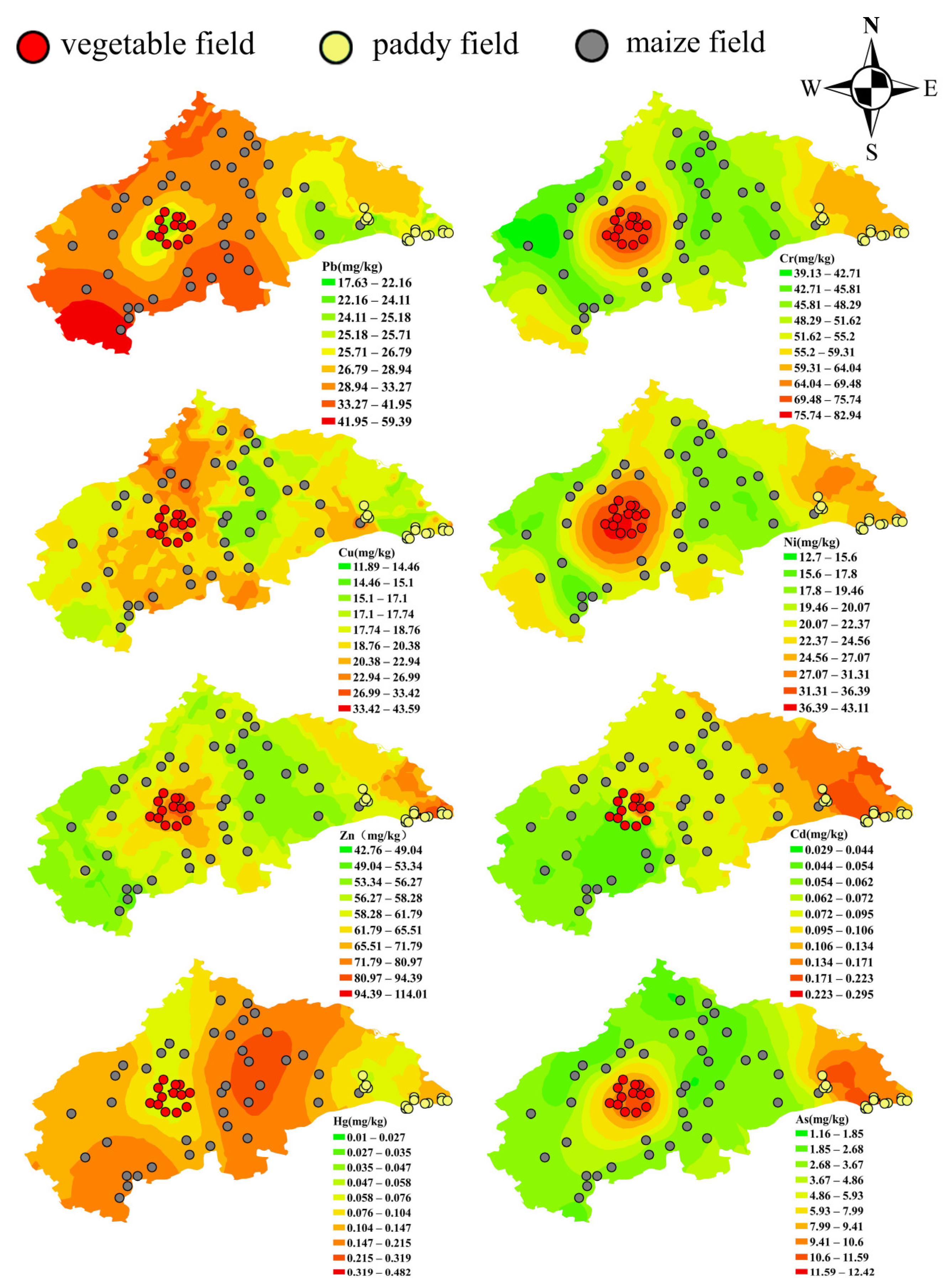
The spatial distribution patterns of heavy metals in agricultural soils, interpolated using ordinary kriging, are shown in Figure 2. Overall, the heavy metals exhibited pronounced spatial heterogeneity across the study area, with distinctly different high-concentration patterns among elements. Arsenic, Cr, Ni, and Zn displayed similar spatial patterns, with hotspots primarily concentrated in suburban vegetable and paddy soils, while low-value regions were located in maize field soils in the west and south of Dehui City. This spatial consistency suggested that these four elements might be influenced by common pollution sources or controlled by similar geo-chemical processes. Lead exhibited patchy high-value zones distributed across the southern and southwestern maize field soils, roughly aligned with the Beijing–Harbin Expressway (G1) and National Highway 102. This spatial correspondence implied that Pb accumulation was likely associated with vehicular emissions (e.g., historical residues from leaded gasoline, tire wear, and brake abrasion) and atmospheric deposition [41]. Cadmium exhibited the most pronounced enrichment in the eastern paddy fields, showing a decreasing trend from east to west and forming a belt-like distribution along major irrigation channels. Irrigation water input, drainage conditions, and the activated accumulation of Cd in the flood-dry cycle of rice fields might be the main causes contributing to the specific spatial distribution of Cd [11]. The hotspots of Cu were primarily concentrated in the central region of the study area, highly overlapping with intensive vegetable cultivation areas. This distribution reflects the long-term application of organic fertilizers (especially livestock manure) and copper-based pesticides in intensive vegetable production systems [4]. In contrast, the concentrations of Cu were relatively uniform and low in paddy and maize field soils. Mercury displayed distinct variations among different land use types, with elevated concentrations primarily distributed in the southern and central-eastern maize field soils, whereas suburban vegetable field and paddy soils showed relatively lower Hg levels.
The spatial heterogeneity of different heavy metals reflected the combined effects of multiple pollution sources. Elements with similar spatial distribution patterns—such as As, Cr, Ni, and Zn—were likely derived from common origins, including parent material and regional atmospheric deposition. In contrast, elements with distinct spatial patterns (Pb, Cd, Cu, and Hg) suggested the localized point-source pollution or specific anthropogenic influences. In particular, the pronounced hotspots of Hg in maize field soils should be called for special attention. Previous studies have shown that the atmospheric dry and wet deposition of Hg is influenced by land cover type and crop canopy structure. Maize, characterized by a high leaf area index, has a stronger capacity to retain atmospheric Hg compared to rice and vegetables [44]. Furthermore, the historical presence of small-scale coal-consuming industries, such as coal mines and brick kilns, in southern Dehui City might have contributed to regional Hg enrichment through atmospheric deposition of gaseous Hg released from coal combustion [41]. The enrichment of Cd in the eastern paddy fields could be attributed to the quality of irrigation water. Paddy soils in the eastern part of the study area were mainly irrigated by the Yinma River system, where upstream mining activities—such as lead–zinc ore extraction-may have introduced Cd into the irrigation water [40]. Under flooded conditions, the redox potential of paddy soils decreased, facilitating the transformation of Cd from bound forms to exchangeable. Through repeated flooding–drying cycles, Cd gradually accumulated in the soil [45]. Therefore, future studies should strengthen monitoring of both irrigation water and Cd speciation in soils. Although the spatial distribution analysis has revealed heterogeneous patterns of heavy metals and their spatial associations with land use types, transportation corridors, and irrigation systems, the contribution rates of individual pollution sources cannot be quantitatively determined based solely on spatial patterns. Further quantitative source apportionment is required, integrating multivariate statistical approaches such as principal component analysis (PCA) and receptor models such as positive matrix factorization (PMF), to elucidate the relative contributions of different pollution sources and provide scientific guidance for precise pollution prevention and control.

3.3. Source Analysis of Heavy Metals in Agricultural Soils of Dehui City

Principal component analysis was performed separately for the three land use types to identify potential sources of heavy metals (Table 3). For suburban vegetable field soils, three principal components (PCs) were extracted, cumulatively explaining 89.37% of the total variance. PC1 (35.48%) showed high loadings (>0.65) for Cu, Zn, Cd, and Hg, suggesting a common source for these elements. PC2 (34.10%) was dominated by Pb, Cr, Hg, and As, while PC3 (19.79%) was primarily characterized by Cr and Ni. In paddy soils, two principal components were extracted, accounting for 67.80% of the total variance. PC1 was dominated by Cu, Zn, Cd, and Hg, whereas PC2 was characterized by Pb, Cr, Ni, and As. For maize field soils, three principal components were extracted, cumulatively explaining 72.62% of the total variance. PC1 (36.92%) exhibited the highest loadings for Cr, Ni, and Zn. PC2 (20.33%) was dominated by Cu and As, while PC3 (15.37%) showed relatively high loadings for Pb and Cd. These results indicated that the combination patterns of heavy metals differed significantly among land use types, reflecting the superimposed effects of multiple pollution sources [41,46].
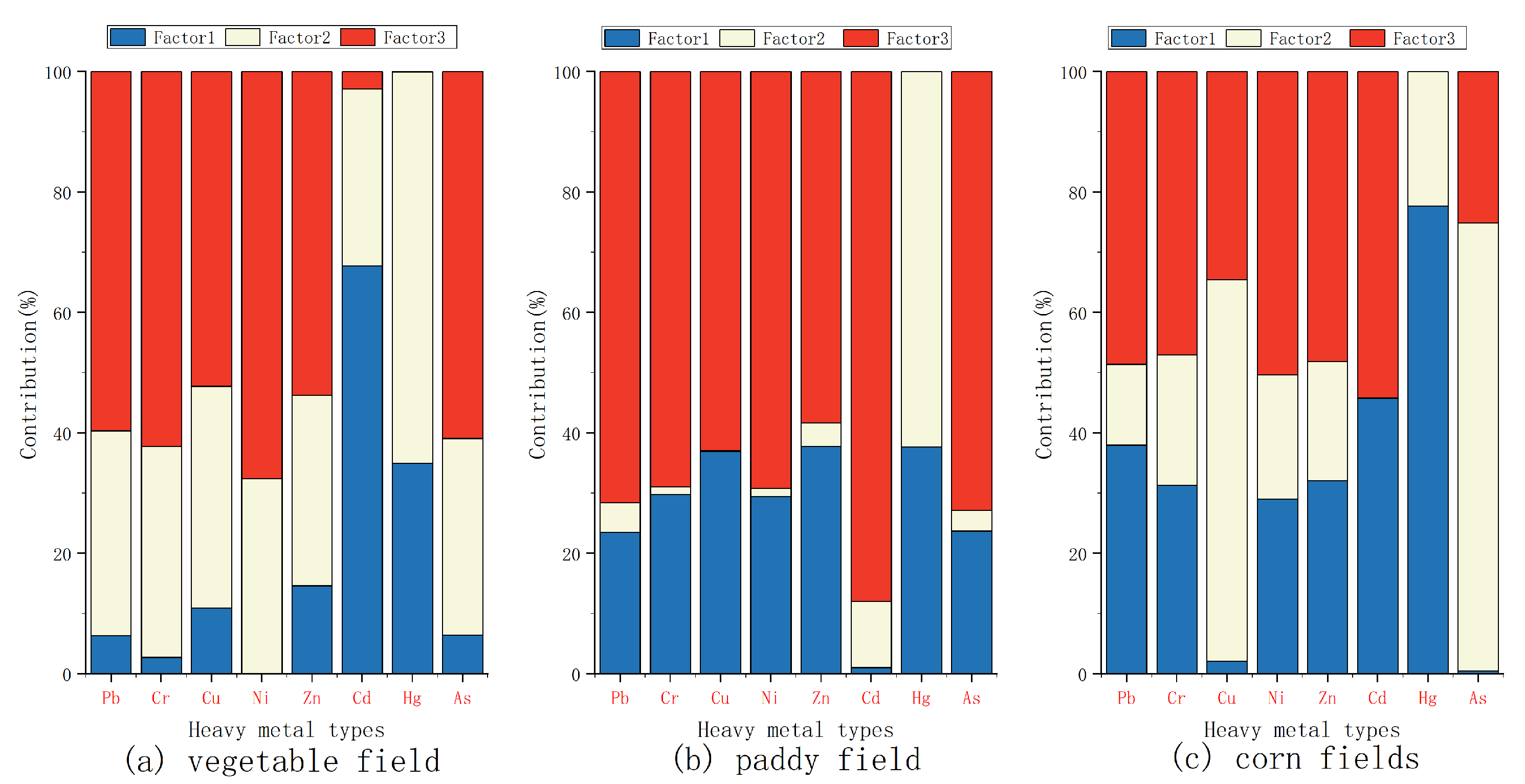
To quantitatively apportion the contributions of different pollution sources, EPA PMF 5.0 was employed for source apportionment of soil heavy metals. After iterative optimization with 2–5 factors, the model performed optimally with three factors. The source apportionment results and contribution rates for heavy metals under different land use types were presented in Figure 3. In suburban vegetable field soils, Factor 1 exhibited the highest contribution to Cd (67.7%) and Cu (45.2%), followed by Zn (38.6%) and Hg (34.9%). Factor 1 reflected the long-term application of organic fertilizers (particularly livestock manure) and phosphate fertilizers [4], suggesting an agricultural source. Factor 2 was characterized by a high contribution to Hg (65.0%), along with substantial contributions to Pb (52.3%) and Cr (41.8%). This represented the combined impacts of vehicular emissions, tire wear, and brake pad abrasion [41], indicating a traffic-related source. Factor 3 was dominated by Cr (62.2%) and Ni (67.6%), reflecting the background contribution from the parent material [3], thereby representing a natural/geogenic source. As for paddy soils, Factor 1 demonstrated comparable contributions to Cu (36.9%), Zn (37.8%), and Hg (37.7%), presumably associated with the utilization of chemical fertilizers and pesticides [47], which indicated an agricultural source. Factor 2 exhibited the highest contribution to Hg (62.3%), reflecting the impacts from both atmospheric Hg deposition and irrigation water inputs [11], thereby representing the combined sources of irrigation and atmospheric deposition. Factor 3 was predominantly characterized by Pb (71.6%) and As (72.9%), with significant contributions from Cr, Cu, and Ni, suggesting a mixed natural and traffic source. For maize field soils, Factor 1 was overwhelmingly dominated by Hg (77.7%), with notable contributions from Cd (38.5%) and Pb (32.1%). Factor 1 reflected the long-term impacts of historical coal-burning enterprises [48], indicating an industrial/coal combustion source. Factor 2 showed the highest contributions to Cu (63.3%) and As (74.4%), which was associated with organic fertilizer and pesticide application [24], representing an agricultural source. Factor 3 was dominated by Ni (55.8%), Cd (42.3%), and Pb (41.6%), reflecting the combined effects of parent material and vehicle emissions, thus representing a mixed natural and traffic source.
PCA can reveal the potential pathways of heavy metals in soil and their interrelationships by analyzing the correlations among variations in the concentrations of different heavy metals, but it cannot directly quantify the apportionment of each pathway. The PMF model can quantify the contributions of different pollution pathways through factorization, accompanied by the incomplete distinction between multiple overlapping pathways. In addition, the PMF model does not incorporate the influence of soil physicochemical properties on the bioavailability of heavy metals, which may affect the quantification of pollution pathways [9]. Future studies could employ isotope tracing techniques or specific markers to refine the contribution characteristics of different pollution pathways [36].
In agricultural soils, anthropogenic activities such as industrial emissions, agricultural practices, traffic, and coal combustion have been generally recognized as the dominant sources of heavy metals [41,46]. The source apportionment results indicated distinct combinations of heavy metals among the different land use types in Dehui City, suggesting varying contributions of pollution sources to heavy metal accumulation across agricultural systems. Suburban vegetable field soils were primarily influenced by agricultural and traffic-related sources. Frequent application of organic and chemical fertilizers—especially incompletely composted livestock manure—was a major contributor to soil enrichment. Previous studies have reported that the mean concentrations of Cu, Zn, and Cd in swine manure were 150, 500, and 0.8 mg·kg−1, respectively [4,10], and long-term application can significantly increase heavy metal levels in soils [4]. Moreover, the rapid urbanization surrounding suburban vegetable areas had led to proximity between farmland and pollution sources, including newly built factories, highways, and residential zones. Major transportation corridors such as the Expressway, National Highway, and Provincial Road pass through the southern and central parts of Dehui City. Residual Pb from historical use of leaded gasoline, as well as Cr and Pb released from tire and brake wear, were deposited through atmospheric dry and wet deposition, contributing to the observed accumulation [41,43]. It can be seen from Figure 3, paddy soils were mainly affected by inputs from fertilizers and pesticides. Phosphate fertilizers, which constitute up to 21.8% of the total basal fertilizer for rice, typically contained As, Hg, and Cd as impurities [49]. In addition, the extensive use of pesticides to control pests and maintain yield further exacerbates contamination. Ye et al. [47] found that the average concentrations of As, Cd, and Hg in commonly used pesticides were 3.23, 0.78, and 0.85 mg·kg−1, respectively. Continuous application of fertilizers and pesticides containing heavy metals has thus become a major cause of heavy metal accumulation in paddy soils. Maize field soils exhibited distinct characteristics, with Hg pollution being particularly prominent, and the contribution of the industrial/coal combustion source reached 77.7%. Historically, small-scale coal mines and brick kilns were distributed in the southern part of Dehui City, where gaseous Hg emitted from coal combustion was deposited into soils via atmospheric transport and deposition [41]. Although these enterprises have gradually been phased out, Hg possesses a long environmental half-life, and its residual impacts require long-term monitoring and remediation attention [50]. Moreover, maize has a high leaf area index and a greater capacity to capture atmospheric Hg compared with rice and vegetable, which may further enhance Hg accumulation through canopy interception during the growing season [43].

3.4. Pollution Indices and Potential Ecological Risk of Heavy Metals in Agricultural Soils of Dehui City

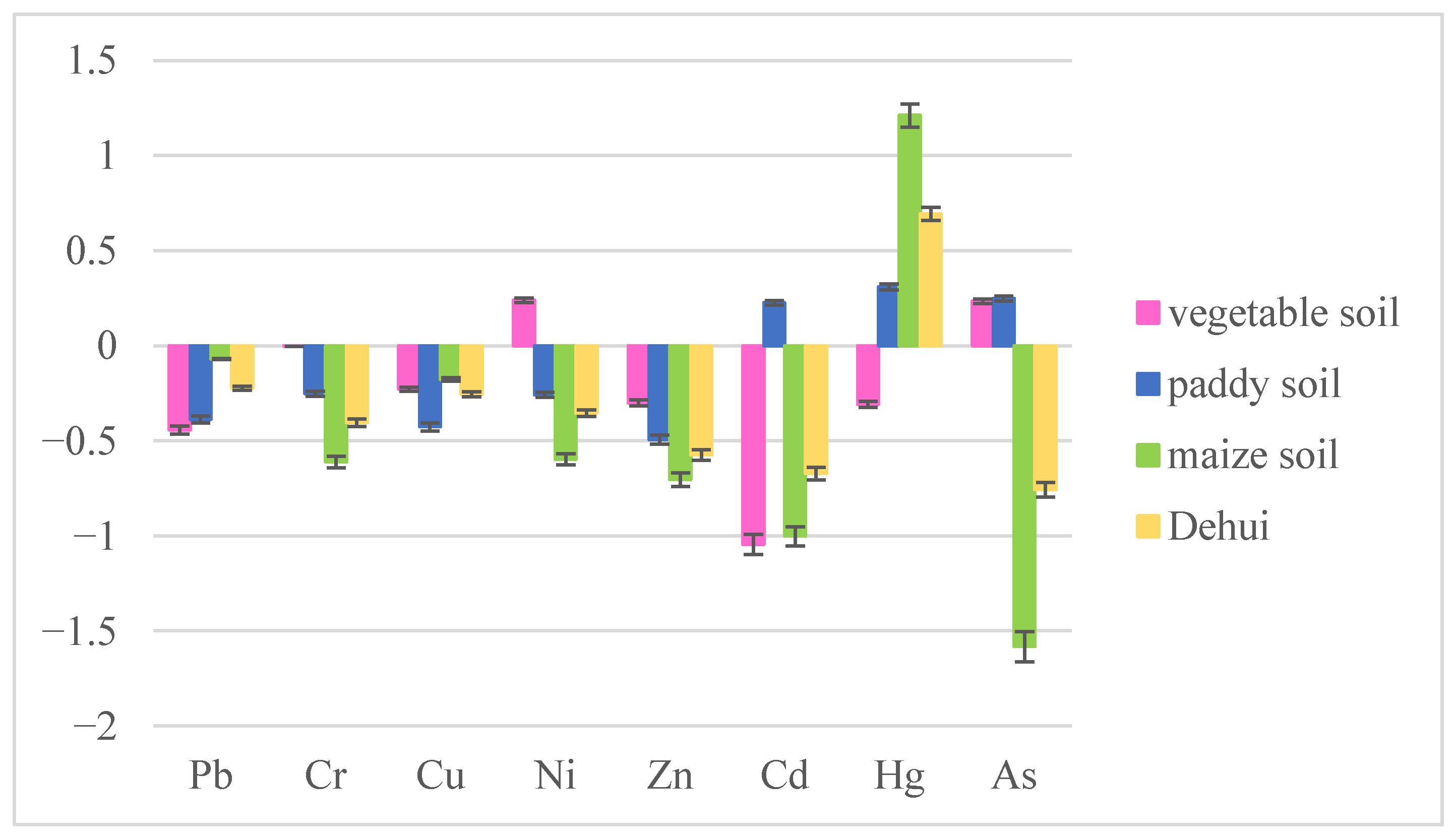
The Igeo values for heavy metals in agricultural soils of Dehui City were presented in Figure 4 and Table S2. Mercury was identified as the most severely contaminated element in the study area, featuring a mean Igeo value of 0.69 and a maximum value of 3.20, which signify heavy pollution. Approximately 65.75% of the sampling sites had Igeo values greater than 0 for Hg (indicating slight pollution or a higher pollution level), and 43.84% reached moderate to heavy pollution levels. In contrast, the mean Igeo values for all other heavy metals were <0, indicating an overall unpolluted status. Only a few sites exhibited slight pollution for As (43.84%), Pb (23.29%), and Cd (21.92%). Pollution characteristics differed significantly among different land use types (Table S2). In suburban vegetable field soils, the mean Igeo values for Ni, As, and Cr were 0.24, 0.23, and 0.00, respectively, with 92.31%, 100%, and 76.92% of sites showing slight pollution for these elements. In paddy soils, the mean Igeo values for Cd, Hg, and As were 0.23, 0.31, and 0.25, respectively. Notably, 70% of the sites had Igeo values greater than 0 for Cd, and 95% for As, suggesting that these two elements were the primary pollutants in paddy soils. Maize field soils exhibited the lowest overall pollution levels. However, Hg pollution was prominent, with a mean Igeo value of 1.21. About 82.50% of sites showed slight to moderate Hg pollution, significantly higher than those in suburban vegetable field soils (23.08%) and paddy soils (50.00%). Lead and Cu showed slight to moderate pollution at only a minority of sites (37.50% and 22.50%, respectively).
The NIPI values for heavy metals were showed in Table 4. The NIPI values ranged from 0.28 to 0.78, with a mean value of 0.40, indicating that the study area was generally at a safe level (NIPI < 0.7). Only 2.74% of sampling sites reached the precautionary level (0.7 ≤ NIPI < 1.0), and no sites exceeded the slight pollution threshold (NIPI ≥ 1.0). The mean NIPI values varied among land use types in the following order: suburban vegetable field soils (0.46) > paddy soils (0.41) > maize croplands (0.38). Precautionary levels were observed at 7.69% and 5.00% of sites in suburban vegetable and maize field soils, respectively, while no precautionary sites were found in paddy soils. It should be noted that discrepancies existed between the assessment results of NIPI and Igeo. Although some paddy sites exhibited elevated Igeo values for Cd and As (reaching moderate pollution levels), their NIPI values remained within the safe range due to low concentrations of other elements. This indicated that contamination by individual elements did not invariably lead to overall pollution surpassing safety thresholds, highlighting the necessity of integrating multiple assessment methods for a comprehensive evaluation of pollution risks.
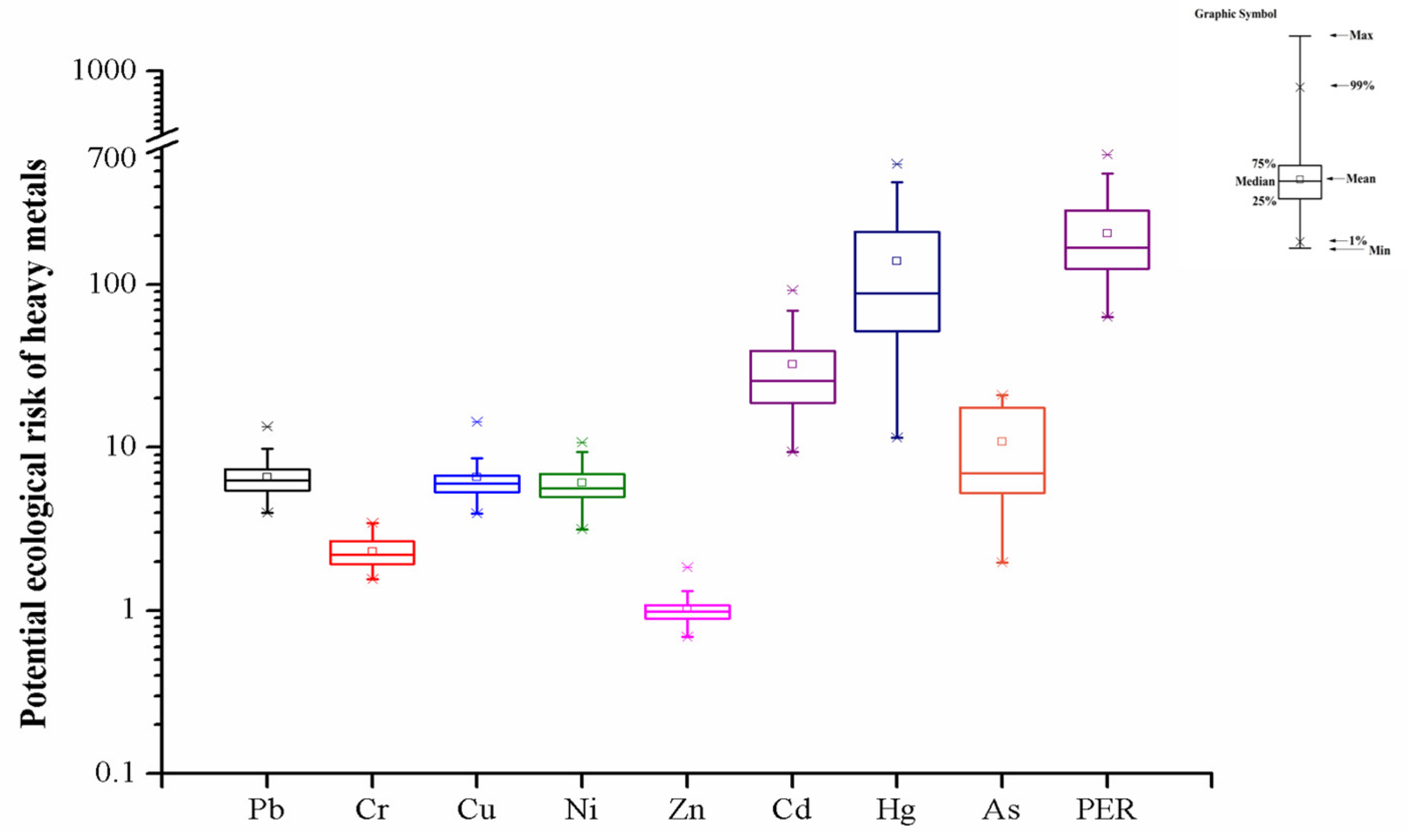
The results of potential ecological risk for heavy metals in agricultural soils under different land use types were presented in Figure 5 and Table S3. The mean Er values for the eight heavy metals were in the decreasing order: Hg > Cd > As > Pb > Cu > Ni > Cr > Zn. Mercury exhibited the highest ecological risk, with a mean Er value of 140.46 and a maximum of 550.13. Over 86% of sampling sites showed moderate to high risk levels for Hg (Er ≥ 40), with 8.22% reaching high risk levels (Er ≥ 320). Cadmium had a mean Er value of 32.53. Although it was generally classified as a low risk element, it approached the moderate risk threshold (Er = 40). The maximum Er value of Cd reached 92.91, and 24.66% of the sites were at moderate risk. The Er values of all other elements were less than 40, indicating low risk levels. The PERI values for the study area ranged from 63.60 to 628.15, with a mean value of 206.47, indicating an overall moderate ecological risk level. About 20.55% of the total sampling sites reached high risk level. Significant differences in mean PERI values were observed among different land use types, following the order of maize field soils (239.41) > paddy soils (191.05) > suburban vegetable field soils (128.82). Maize field soils and paddy soils reached moderate ecological risk levels, while suburban vegetable field soils remained at low risk. Mercury contamination was identified as the primary factor contributing to high ecological risk, and the contribution of Hg to PERI values was 78.81% in maize field soils and 51.15% in paddy soils.
The three heavy metals pollution assessment methods yielded partially consistent results but with different emphases. The Igeo and NIPI are primarily based on comparisons between element concentrations and background values (or screening values), reflecting the degree of contamination. In contrast, the Er and PERI incorporated biological toxicity coefficients, emphasizing ecological hazards. For instance, suburban vegetable field soils exhibited the highest NIPI value (0.46) but the lowest PERI value (128.82). This phenomenon can be attributed to the fact that, despite the accumulation of multiple elements (Ni, As, Cr) in suburban vegetable field soils, the toxicity coefficient remained relatively low. In contrast, the NIPI value of maize field soils was the lowest (0.38), yet the PERI value was the highest (239.41), as the high toxicity of Hg (Tr = 40) predominated the risk. These findings suggests that different assessment methods serve distinct management objectives: NIPI is suitable for evaluating overall contamination levels, while PERI is more appropriate for identifying ecological risk hotspots. Mercury emerged as the most prominent environmental concern in the study area. Its biological toxicity coefficient (40) was notably higher compared to that of other elements, and it exhibited a high degree of concentration in maize field soils. Integrating the source apportionment results presented in Section 3.3, the industrial/coal combustion source accounted for 77.7% of Hg accumulation in maize field soils. The high volatility and potential for bio-magnification of Hg facilitate its transfer via the atmosphere-soil-crop pathway into the food chain, thereby presenting risks to human health [50]. Hg and Cd exhibit relatively high mobility in the soil–crop system, so particular attention should be paid to their concentrations in rice and maize grains to ensure the safety of agricultural products. The ecological risk associated with Cd was predominantly concentrated in paddy soils. Despite the fact that the Er value of Cd was lower than that of Hg, Cd possessed high bioavailability and can be readily absorbed by rice [51]. Previous studies have indicated that when the soil Cd concentration surpassed 0.3 mg·kg−1, the risk of Cd exceeding the standard in rice grains increases substantially [41,45]. In the present study, the average Cd concentration in paddy soils was 0.171 mg·kg−1, with some sampling sites exceeding 0.3 mg·kg−1. Consequently, it is strongly advocated to strengthen the monitoring of Cd in rice and promote the cultivation of low-Cd-accumulating rice varieties. In contrast to prior research that recognized suburban farmlands as high-risk zones [24], the present study showed relatively low ecological risks in suburban vegetable field soils in Dehui City, which potentially can be ascribed to the lower level of industrialization in Dehui and the variations in pollution source types when compared with the more developed eastern regions of China (such as the Yangtze River Delta and Pearl River Delta). Nevertheless, the long-term impacts of multi-element accumulation in suburban areas necessitate continuous monitoring.
It must be recognized that this study computed the Igeo values by utilizing the soil background values of Jilin Province. These soil background values exhibited regional variations (e.g., between black soil and brown soil zones) and may have an impact on the assessment results [3]. In addition, the toxicity coefficients used in the PERI calculation are based on empirical values [16] and do not take into account soil properties such as pH, organic matter content, and clay fraction, which can influence the bioavailability of heavy metals [9]. To accurately analyze heavy-metal contamination in soils under different land use types, future studies should employ bioavailability-oriented methods, such as Diffusive Gradients in Thin-film measurements and sequential extraction, to quantify labile and speciated metal fractions. In addition, isotope tracing techniques can be used to refine source apportionment by distinguishing different input pathways.

4. Conclusions

This research conducted a systematic assessment of the heavy metal contamination status in agricultural soils under different land use types in Dehui City. The heavy metal concentrations in the study area did not surpass the risk screening values; however, they were commonly elevated above the background levels. Among them, Hg, Pb, and Cu exhibited the most pronounced enrichment. The distribution patterns of heavy metals differed significantly across various land use types. Suburban vegetable field soils were characterized by the enrichment of Ni, As, and Cr; paddy soils were predominantly influenced by Cd, Hg, and As; and maize field soils were mainly enriched with Hg and Pb. Source apportionment identified four major pollution sources, namely agricultural fertilization, traffic emissions, industrial/coal combustion activities, and natural sources, with their relative contributions varying by land use type. The industrial/coal combustion source contributed 77.7% to the accumulation of Hg in maize field soils, and agricultural fertilization and traffic emissions accounted for 67.7% of Cd and 52.3% to Pb in suburban vegetable field soils. The distinct pollution source structures across different land use types reflect the differentiated patterns of anthropogenic disturbance. Results of pollution assessment indicated that 65.75% of the sampling sites showed slight to moderate Hg pollution. The NIPI revealed that 97.26% of the sites remained at safe levels. Ecological risk assessment demonstrated that the study area was at a moderate risk overall, with Hg and Cd identified as the dominant risk factors. Maize and paddy soils presented significantly higher risk levels compared to suburban vegetable field soils. Based on the above research findings, pollution control strategies should be tailored to specific land use types, for example by optimizing fertilizer application in suburban vegetable fields, improving irrigation water quality for paddy fields, and strengthening the control of industrial pollution sources.

Supplementary Materials

The following supporting information can be downloaded at: https://www.mdpi.com/article/10.3390/agronomy15122899/s1, Table S1: Statistical characteristics of heavy metals concentrations and physicochemical properties in soils of Dehui with different land use types; Table S2: Class distribution of Igeo values for heavy metals in agricultural soils of Dehui; Table S3: Statistical characteristics of ecological risk for heavy metals in agricultural soils of Dehui.

Author Contributions

All authors contributed to the conception and experimental design of this study. Field soil sampling was jointly conducted by N.W. and J.M.; sample processing and data analysis were undertaken by L.X. The initial draft of the manuscript was co-authored by L.X. and Z.C., with Y.W. providing constructive comments for revision. All authors have read and agreed to the published version of the manuscript.

Funding

The research was funded by Strategic Priority Research Program of the Chinese Academy of Sciences, China Grant number [XDA28020102], National Basic Science and Technology Resources Survey Project, China Grant number [2021FY100402] and Scientific and Technological Research Program of Jilin Provincial Education Department, Grant number [JJKH20220641KJ].

Data Availability Statement

The original contributions presented in this study are included in the article/Supplementary Material. Further inquiries can be directed to the corresponding authors.

Conflicts of Interest

The authors declare no conflicts of interest.

References

  1. FAO; ITPS. Status of the World’s Soil Resources (SWSR)—Main Report; Food and Agriculture Organization of the United Nations and Intergovernmental Technical Panel on Soils: Rome, Italy, 2015; Available online: https://www.fao.org/3/i5199e/i5199e.pdf (accessed on 5 December 2025).
  2. Chen, R.S.; Sherbinin, A.D.; Ye, C.; Shi, G.Q. China’s Soil Pollution: Farms on the Frontline. Science 2014, 344, 691. [Google Scholar] [CrossRef]
  3. Wang, P.C.; Li, Z.G.; Liu, J.L.; Bi, X.Y.; Ning, Y.Q.; Yang, S.C.; Yang, X.J. Apportionment of sources of heavy metals to agricultural soils using isotope fingerprints and multivariate statistical analyses. Environ. Pollut. 2019, 254, 113016. [Google Scholar] [CrossRef]
  4. Huang, Y.; Li, T.Q.; Wu, C.X.; He, Z.L.; Japenga, J.; Deng, M.H.; Yang, X.E. An integrated approach to assess heavy metal source apportionment in peri-urban agricultural soils. J. Hazard. Mater. 2015, 299, 540–549. [Google Scholar] [CrossRef]
  5. Jiang, J.Y.; Fu, M.; Yang, J.Y.; Song, Y.W.; Fu, G.W.; Wang, H.B.; Lin, C.; Wang, Y. Spatial distribution characteristics, ecological risk assessment, and source analysis of heavy metal(loid)s in surface sediments of the nearshore area of Qionghai. Front. Mar. Sci. 2024, 11, 1491242. [Google Scholar] [CrossRef]
  6. Qi, D.W.; Chen, H.Y.; Hu, L.T.; Sun, J.C. Multimethod Analysis of Heavy Metal Pollution and Source Apportionment in a Southeastern Chinese Region. Appl. Sci. 2024, 14, 10559. [Google Scholar] [CrossRef]
  7. Cui, W.W.; Dong, X.Q.; Liu, J.J.; Yang, F.; Duan, W.; Xie, M.X. Characterization and source apportionment of heavy metal pollution in soil around red mud disposal sites using absolute principal component scores-multiple linear regression and positive matrix factorization models. Environ. Geochem. Health 2024, 46, 492. [Google Scholar] [CrossRef] [PubMed]
  8. Lin, M.; Li, S.Y.; Sun, X.Y.; Yang, S.B.; Li, J. Heavy metal contamination in green space soils of Beijing, China. Acta Agric. Scand. B Soil Plant Sci. 2018, 68, 291–300. [Google Scholar] [CrossRef]
  9. Adimalla, N.; Qian, H.; Wang, H.K. Assessment of heavy metal (HM) contamination in agricultural soil lands in northern Telangana, India: An approach of spatial distribution and multivariate statistical analysis. Environ. Monit. Assess. 2019, 191, 246. [Google Scholar] [CrossRef] [PubMed]
  10. Zou, J.M.; Dai, W.; Gong, S.X.; Ma, Z.Y. Analysis of spatial variations and sources of heavy metals in farmland soils of Beijing suburbs. PLoS ONE 2015, 10, e0118082. [Google Scholar] [CrossRef]
  11. Zhang, Y.W.; Tang, S.; Li, Y.L.; Li, R.N.; Huang, S.W.; Wang, H. Risk assessment of heavy metal accumulation in cucumber fruits and soil in a greenhouse system with long-term application of organic fertilizer and chemical fertilizer. Agriculture 2024, 14, 1870. [Google Scholar] [CrossRef]
  12. Li, W.J.; Yang, M.D.; Liao, K.; Wang, J.L.; Huang, Z.W.; Zeng, H.L.; Fang, H.Y.; Deng, H. Distribution, sources, and ecological risks of heavy metal contamination at the sediment-water interface in the Dongjiang Basin based on in situ high-resolution measurements. Environ. Pollut. 2025, 383, 126853. [Google Scholar] [CrossRef]
  13. Anaman, R.; Peng, C.; Jiang, Z.C.; Liu, X.; Zhou, Z.; Guo, Z.H.; Xiao, X.Y. Identifying sources and transport routes of heavy metals in soil with different land uses around a smelting site by GIS based PCA and PMF. Environ. Pollut. 2022, 823, 153759. [Google Scholar] [CrossRef]
  14. Adnan, M.; Zhao, P.; Xiao, B.H.; Ali, M.U.; Xiao, P.W. Heavy metal pollution and source analysis of soils around abandoned Pb/Zn smelting sites: Environmental risks and fractionation analysis. Environ. Technol. Innov. 2025, 38, 104084. [Google Scholar] [CrossRef]
  15. Setu, S.; Strezov, V. Impacts of non-ferrous metal mining on soil heavy metal pollution and risk assessment. Sci. Total Environ. 2025, 898, 178962. [Google Scholar] [CrossRef] [PubMed]
  16. Islam, M.S.; Hassan, F.U.; Toriman, M.E.; Ahmad, R.; Bashir, M.A.; Rehim, A.; Raza, Q.-U.-A.; Ta, G.C.; Abdul Halim, S.B. Spatial assessment and ecological risk evaluation of soil heavy metal contamination using multivariate statistical techniques. Catena 2025, 228, 109550. [Google Scholar] [CrossRef]
  17. Ding, J.; Hu, J. Soil heavy metal pollution and health risk assessment around Wangchun Industrial Park, Ningbo, China. J. Soils Sediments 2024, 24, 2613–2622. [Google Scholar] [CrossRef]
  18. Zeng, Y.F.; Xu, Z.X.; Dong, B. Spatial Distribution, Leaching Characteristics, and Ecological and Health Risk Assessment of Potential Toxic Elements in a Typical Open-Pit Iron Mine Along the Yangzi River. Water 2024, 16, 3017. [Google Scholar] [CrossRef]
  19. Chen, R.; Huang, L.; Liu, Z.; Zhao, Y.H.; Li, R.S.; Xia, L.F.; Fan, Y.M. Assessment of Soil-Heavy Metal Pollution and the Health Risks in a Mining Area from Southern Shaanxi Province, China. Toxics 2022, 10, 385. [Google Scholar] [CrossRef]
  20. Tian, H.Q.; Wang, Y.Z.; Xie, J.F.; Li, H.; Zhu, Y.E. Effects of soil properties and land use types on the bioaccessibility of Cd, Pb, Cr, and Cu in Dongguan City, China. Bull. Environ. Contam. Toxicol. 2020, 104, 64–70. [Google Scholar] [CrossRef]
  21. Li, X.; Zhang, H.H.; Sun, M.L.; Xu, N.; Sun, G.Y.; Zhao, M.C. Land use change from upland to paddy field in Mollisols drives soil aggregation and associated microbial communities. Appl. Soil Ecol. 2020, 146, 103351. [Google Scholar] [CrossRef]
  22. Zhang, T.; Song, B.; Han, G.; Zhao, H.; Hu, Q.; Zhao, Y.; Liu, H. Effects of coastal wetland reclamation on soil organic carbon, total nitrogen, and total phosphorus in China: A meta-analysis. Land Degrad. Dev. 2023, 34, 3340–3349. [Google Scholar] [CrossRef]
  23. Yang, E.; Zhao, X.; Qin, W.; Jiao, J.; Han, J.; Zhang, M. Temporal impacts of dryland-to-paddy conversion on soil quality in the typical black soil region of China: Establishing the minimum data set. Catena 2023, 231, 107303. [Google Scholar] [CrossRef]
  24. Yu, B.; Miao, X.Y.; Ouyang, S.H. Soil heavy metal pollution trends for intensive vegetable production system in Beijing-Tianjin-Hebei Region, China (2000–2024) and human health implications. Environ. Res. 2025, 283, 122178. [Google Scholar] [CrossRef]
  25. Wen, P.; Feng, S.W.; Liang, J.L.; Jia, P.; Liao, B.; Shu, W.S.; Li, J.T.; Yi, X.Z. Heavy metal pollution in farmland soils surrounding mining areas in China and the response of soil microbial communities. Soil Secur. 2024, 16, 100173. [Google Scholar] [CrossRef]
  26. Bambhaneeya, S.M.; Garaniya, N.H.; Surve, V.H.; Deshmukh, S.P. Assessment of heavy metal contamination and accumulation in soil and leafy vegetables collected from industrial belt in Bharuch district, Gujarat. Vegetos 2024, 38, 103–110. [Google Scholar] [CrossRef]
  27. Chinese Academy of Sciences. White Paper on Northeast Black Soil (2020); Chinese Academy of Sciences: Beijing, China, 2020. Available online: https://www.sgpjbg.com/baogao/77409.html (accessed on 5 December 2025).
  28. Changchun Statistical Bureau. Changchun Statistical Yearbook 2023; China Statistics Press: Beijing, China, 2023. Available online: http://tjj.changchun.gov.cn/ztlm/tjnj/202404/t20240424_3302053.html (accessed on 5 December 2025).
  29. HJ 491-2019; Soil and Sediment—Determination of Copper, Zinc, Lead, Nickel and Chromium—Flame Atomic Absorption Spectrophotometry. China Environment Publishing Group: Beijing, China, 2019. Available online: https://www.mee.gov.cn/ywgz/fgbz/bz/bzwb/jcffbz/201905/t20190513_702667.shtml?utm_source=chatgpt.com (accessed on 5 December 2025).
  30. Huang, Y.; Deng, M.H.; Wu, S.F.; Japenga, J.; Li, T.Q.; Yang, X.E.; He, Z.L. A modified receptor model for source apportionment of heavy metal pollution in soil. J. Hazard. Mater. 2018, 354, 161–169. [Google Scholar] [CrossRef]
  31. Meng, X.X.; Li, S.Z. Study on Background Value of Soil Environment of the Jilin Province; Science Press: Beijing, China, 1995. [Google Scholar] [CrossRef]
  32. Liu, L.; Cui, Z.W.; Wang, Y.; Rui, Y.; Yang, Y.; Xiao, Y.B. Contamination features and health risk of heavy metals in suburban vegetable soils, Yanbian, Northeast China. Hum. Ecol. Risk Assess. 2018, 25, 722–731. [Google Scholar] [CrossRef]
  33. GB 15618-2018; Soil Environmental Quality—Risk Control Standard for Soil Contamination of Agricultural Land (Trial). China Environmental Science Press: Beijing, China, 2018. Available online: https://www.mee.gov.cn/ywgz/fgbz/bz/bzwb/trhj/201807/t20180703_446029.shtml (accessed on 5 December 2025).
  34. Hakanson, L. An ecological risk index for aquatic pollution control: A sedimentological approach. Water Res. 1980, 14, 975–1001. [Google Scholar] [CrossRef]
  35. Ke, X.; Gui, S.F.; Huang, H.; Zhang, H.J.; Wang, C.Y.; Guo, W. Ecological risk assessment and source identification for heavy metals in surface sediment from the Liaohe River protected area, China. Chemosphere 2017, 175, 473–481. [Google Scholar] [CrossRef] [PubMed]
  36. Zhou, S.B.; Cheng, Q.M.; Weindorf, D.C.; Yang, B.Y.; Gong, Z.B.; Yuan, Z.X. Multiple approaches for heavy metal contamination characterization and source identification of farmland soils in a metal mine impacted area. Appl. Geochem. 2024, 174, 106125. [Google Scholar] [CrossRef]
  37. Liu, Z.; Wang, L.; Yan, M.; Ma, B.; Cao, R. Source apportionment of soil heavy metals based on multivariate statistical analysis and the PMF model: A case study of the Nanyang Basin, China. Environ. Technol. Innov. 2024, 102, 103537. [Google Scholar] [CrossRef]
  38. Min, M.; Yang, L.S.; Wei, B.G.; Cao, Z.Q.; Yu, J.P.; Liao, X.Y. Plastic shed production systems: The migration of heavy metals from soil to vegetables and human health risk assessment. Ecotoxicol. Environ. Saf. 2021, 215, 112106. [Google Scholar] [CrossRef]
  39. Cui, Z.W.; Wang, Y.; Zhao, N.; Yu, R.; Xu, G.H.; Yu, Y. Spatial Distribution and Risk Assessment of Heavy Metals in Paddy Soils of Yongshuyu Irrigation Area from Songhua River Basin, Northeast China. Geogr. Sci. 2018, 28, 797–809. [Google Scholar] [CrossRef]
  40. Zhu, L.L.; Yan, B.X.; Wang, L.X. Quantitative characteristics and source analysis of heavy metals in paddy soils in downstream of the Second Songhua River, Jilin Province. Chin. J. Appl. Ecol. 2011, 22, 2965–2970. [Google Scholar] [CrossRef]
  41. Liu, P.F.; Wu, Z.Q.; Luo, X.R.; Wen, M.L.; Huang, L.L.; Chen, B.; Zheng, C.J.; Zhu, C.; Liang, R. Pollution assessment and source analysis of heavy metals in acidic farmland of the Karst region in Southern China-A case study of Quanzhou County. Appl. Geochem. 2020, 123, 104764. [Google Scholar] [CrossRef]
  42. Zhou, J.; Feng, K.; Li, Y.J.; Zhou, Y. Factorial Kriging analysis and sources of heavy metals in soils of different land-use types in the Yangtze River Delta of Eastern China. Environ. Sci. Pollut. Res. 2016, 23, 14957–14967. [Google Scholar] [CrossRef]
  43. Li, J.; Li, X.; Wang, C.; Liu, J.-Z.; Gao, Z.D.; Li, K.M.; Zang, F. Pollution characteristics and probabilistic risk assessment of heavy metal(loid)s in agricultural soils across the Yellow River Basin, China. Ecol. Indic. 2024, 167, 112676. [Google Scholar] [CrossRef]
  44. Wang, H.Z.; Cai, L.M.; Wang, Q.S.; Hu, G.C.; Chen, L.G. A comprehensive exploration of risk assessment and source quantification of potentially toxic elements in road dust: A case study from a large Cu smelter in central China. Catena 2021, 196, 104930. [Google Scholar] [CrossRef]
  45. Hu, Y.N.; Cheng, H.F.; Tao, S. The Challenges and Solutions for Cadmium-contaminated Rice in China: A Critical Review. Environ. Int. 2016, 92–93, 515–532. [Google Scholar] [CrossRef] [PubMed]
  46. Guo, G.H.; Chen, S.Q.; Li, K.; Lei, M.; Ju, T.N.; Tian, L.Y. Determining the priority control sources of heavy metals in roadside soils in a typical industrial city of North China. J. Hazard. Mater. 2024, 471, 136347. [Google Scholar] [CrossRef]
  47. Ye, X.Z.; Chen, D.; Xiao, W.D.; Zhang, Q.; Zhao, S.P. Distribution characteristics and risk analysis of heavy metals in different types of pesticides. J. Pestic. Sci. 2023, 25, 227–236. [Google Scholar]
  48. Liu, Q.; Liu, J.S.; Wang, Q.C.; Wang, Y. Assessment of heavy metal pollution in urban agricultural soils of Jilin City, China. Hum. Ecol. Risk Assess. 2015, 21, 1869–1883. [Google Scholar] [CrossRef]
  49. Guo, H.J.; Yang, L.Y.; Han, X.M.; Dai, J.R.; Pang, X.G.; Ren, M.Y.; Zhang, W. Distribution characteristics of heavy metals in surface soils from the western area of Nansi Lake, China. Environ. Monit. Assess. 2019, 191, 262. [Google Scholar] [CrossRef] [PubMed]
  50. Ramlan; Basir-Cyio, M.; Napitupulu, M.; Inoue, T.; Anshary, A.; Mahfudz; Isrun; Rusydi, M.; Golar; Sulbadana. Pollution and contamination level of Cu, Cd, and Hg heavy metals in soil and food crop. Int. J. Environ. Sci. Technol. 2022, 19, 1153–1164. [Google Scholar] [CrossRef]
  51. Zhao, G.L.; Ma, Y.; Liu, Y.Z.; Cheng, J.M.; Wang, X.F. Source analysis and ecological risk assessment of heavy metals in farmland soils around heavy metal industry in Anxin County. Sci. Rep. 2022, 12, 10562. [Google Scholar] [CrossRef]
Figure 1. Distribution of sampling sites in agricultural soils under different land use types in Dehui.
Agronomy 15 02899 g001
Figure 2. Spatial distribution of heavy metals in soils of Dehui City.
Agronomy 15 02899 g002
Figure 3. PMF-Based Source Apportionment of Heavy Metals in Soils from Different Land Use Types.
Agronomy 15 02899 g003
Figure 4. Average Igeo values of heavy metals in agricultural soils of Dehui City.
Agronomy 15 02899 g004
Figure 5. Ecological Risk Factor (Er) and Potential Ecological Risk Index (PERI) of Heavy Metals in Dehui City.
Agronomy 15 02899 g005
Table 1. Indices and grades of potential ecological risk.
ErRisk LevelPERIRisk Level
<40Low<150Low
40 ≤ Er < 80Moderate150 ≤ PERI < 300Moderate
80 ≤ Er < 160Considerable300 ≤ PERI < 600Considerable
160 ≤ Er < 320High≥600High
≥320Very high
Table 2. Soil heavy metal concentrations in soils of Dehui (mg·kg−1).
PbCrCuNiZnCdHgAs
Mean29.2455.8119.8224.3863.250.1030.1236.47
Range17.63–59.3937.48–82.9311.90–43.5912.70–43.1042.77–114.010.030–0.3000.010–0.4801.16–12.42
CV a24.73%20.38%33.09%27.30%19.65%56.38%83.07%59.52%
BV b22.1648.2915.1020.0761.790.0950.0355.93
Paddy soil c10025050702000.40.530
Others c90150---0.31.840
Notes: a: Coefficients of variation. b: Background values of Jilin topsoil [31]. c: Risk screening values (GB15618-2018).
Table 3. Eigenvalues, Cumulative Variance Percentages, and Principal Component Loading Matrices for Different Land Use Types.
Heavy MetalsVegetable Field SoilsPaddy SoilsMaize Field Soils
PC1PC2PC3PC1PC2PC1PC2PC3
Pb/0.899//0.771//0.846
Cr/0.7100.558/0.8520.892//
Cu0.930//0.820//0.790/
Ni//0.949/0.8580.897//
Zn0.912//0.922/0.878//
Cd0.744//−0.667///−0.689
Hg0.6540.547/0.759////
As/0.923//0.740/0.919/
Eigenvalue2.842.731.582.722.712.951.631.23
Total variance (%)35.4834.1019.7933.9433.8636.9220.3315.37
Cumulative variance (%)35.4869.5889.3733.9467.8036.9257.2672.62
Table 4. Nemerow Integrated Pollution Index of Heavy Metals in Agricultural Soils of Dehui City.
ParameterVegetable SoilPaddy SoilMaize SoilDehui
mean0.460.410.380.40
min0.380.330.280.28
max0.780.750.660.78
median0.420.390.340.37
Pollution level
Safe (NIPI < 0.7)92.31%95.00%100.00%97.26%
Precaution (0.7 ≤ NIPI < 1.0)7.69%5.00%02.74%
Slight pollution (1.0 ≤ NIPI < 2.0)0000
Disclaimer/Publisher’s Note: The statements, opinions and data contained in all publications are solely those of the individual author(s) and contributor(s) and not of MDPI and/or the editor(s). MDPI and/or the editor(s) disclaim responsibility for any injury to people or property resulting from any ideas, methods, instructions or products referred to in the content.