Article

Performance of Strip Intercropping of Genetically Modified Maize and Soybean Against Major Target Pests

1
State Key Laboratory for Biology of Plant Diseases and Insect Pests, Institute of Plant Protection, Chinese Academy of Agricultural Sciences, Beijing 100193, China
2
Institute of Insect Sciences, College of Agriculture and Biotechnology, Zhejiang University, Hangzhou 310058, China
3
Nanjing Institute of Environmental Sciences, Ministry of Ecology and Environment, Nanjing 210042, China
4
Laboratory of Applied Entomology and Acarology, Department of Entomology, Bangladesh Agricultural University, Mymensingh 2202, Bangladesh
*
Authors to whom correspondence should be addressed.
Agronomy 2025, 15(12), 2880; https://doi.org/10.3390/agronomy15122880
Submission received: 7 November 2025 / Revised: 12 December 2025 / Accepted: 12 December 2025 / Published: 15 December 2025
(This article belongs to the Section Crop Breeding and Genetics)

Abstract

The commercialization of genetically modified (GM) maize and soybean is advancing, with strip intercropping emerging as a promising model to enhance crop yields and resource efficiency. However, the impact of this system on target pests remains unclear. To address this, we evaluated eight different planting patterns (four different monocultures and four different strip intercropping integrations) of insect-resistant GM maize (‘RF88’) and soybean (CAL16) events and their non-transgenic parental lines (Xianyu 335 maize and Tianlong No. 1 soybean) in the Huang-Huai-Hai planting area from 2023 to 2025. Our results identified Helicoverpa armigera and Spodoptera exigua as the dominant pests on maize and soybean, respectively. We found that the GM trait significantly reduced the population density and plant damage caused by these pests. Strip intercropping also provided significant suppression across both crop lines. Furthermore, the integration of strip intercropping and the GM trait resulted in the most effective pest control. This study provides valuable insights for the top-level design and industrial layout of GM crop commercialization and contributes to promoting its safe application and sustainable pest management.

1. Introduction

Soybean and maize are essential components of global food security [1]. Given the limited availability of arable land, boosting crop yields is critical to sustaining this security [2]. However, diseases, pests, and weeds cause substantial yield losses [3,4]. To address this challenge, the commercial cultivation of genetically modified (GM) soybean and maize has been promoted [5,6] alongside the implementation of soybean–maize strip intercropping (SMSI) in key regions, including the Huang-Huai-Hai Plain and Northwest and Southwest China. SMSI, defined as the year-round strip planting of both crops in the same field [6,7], enhances resource utilization, increases total yields, and preserves biodiversity [8,9,10,11]. Importantly, SMSI has significantly improved soybean self-sufficiency; it covered 1.25 million hectares in 2022, yielding 1.22 million tons of soybean and raising the self-sufficiency rate by 1.5 percentage points in China [12].
Intercropping of gramineous and leguminous crops is a common planting pattern and plays an important role in agricultural production [13,14]. Many studies have demonstrated that well-designed intercropping between gramineous and leguminous crops can promote the biological nitrogen fixation of leguminous crops and improve the nitrogen use efficiency of gramineous crops [15,16,17,18]. In addition, intercropping between gramineous and leguminous crops (such as maize and soybean, maize and broad beans, maize and peanuts, wheat and peas, etc.) can form high and low spatial arrangement structures, increase the complexity of ecological structures, more easily attract predators (e.g., Araneae, Chrysopidae (Neuroptera)) and provide good habitats for them, and prolong the ecological service function time of natural enemies in the crop growth cycle, thereby reducing pest population densities [19,20,21,22]. From an agronomic implementation perspective, the strip intercropping of maize and soybean, as a representative system, does not necessitate specialized machinery for sowing or harvesting; however, it does require the adjustment of standard agricultural equipment to accommodate the specific strip configuration [23].
GM crops have been widely adopted globally to enhance agricultural productivity and sustainability by increasing yields and reducing pesticide reliance [24,25,26,27]. For instance, the successful pilot programs of GM soybean and maize in China, which significantly boosted yields and curbed pest damage [28], are now being scaled up for commercial cultivation [29]. In the future, the SMSI of GM maize and soybean will become the main planting strategy for its commercial application [29,30]. The Huang-Huai-Hai region is one of the main growing areas of maize and soybean and is suitable for the promotion of SMSI planting patterns.
In this region, a diverse range of lepidopteran pests is present, with both boring and leaf-eating species occurring simultaneously. Some years also witness an influx of migratory pests, such as Spodoptera frugiperda (Lepidoptera: Noctuidae). Common maize pests include Helicoverpa armigera (Lepidoptera: Noctuidae), Ostrinia furnacalis (Lepidoptera: Crambidae), Conogethes punctiferalis (Lepidoptera: Pyralidae), Mythimna separata (Lepidoptera: Noctuidae) and Spodoptera exigua (Lepidoptera: Noctuidae), etc., while common soybean pests include S. exigua, Spodoptera litura (Lepidoptera: Noctuidae), Hymenia recurvalis (Lepidoptera: Pyralidae), Etiella zinckenella (Lepidoptera: Pyralidae), Leguminivora glycinivorella (Lepidoptera: Olethreutidae), Lamprosema indicate (Lepidoptera: Pyralidae), etc. Some pests often infest both soybean and maize concurrently, such as H. armigera and S. exigua [31]. However, little is known about how large-scale cultivation of GM soybean and maize under the soybean-maize strip intercropping (SMSI) system affects major lepidopteran pests in this region. Studies assessing the impacts of GM soybean-maize intercropping on main pest populations remain limited.
This study investigated the impact of soybean-maize strip intercropping on major pests in the Huang-Huai-Hai region. For the experiment, insect-resistant genetically modified (GM) maize (‘RF88’) and soybean (CAL16) were used, along with their non-transgenic parental lines (maize ‘Xianyu 335’ and soybean ‘Tianlong No. 1’). These materials were arranged into eight planting patterns, including four intercropping configurations and four monoculture configurations. Our research suggests that the intercropping of GM soybean and GM maize could significantly reduce the population density of H. armigera on maize and S. exigua on soybean. This work provides valuable insights for the top-level design and industrial layout of the commercial application of GM crops and sustainable pest management.

2. Materials and Methods

2.1. Transgenic Maize and Soybean Events

The maize materials included an insect-resistant and herbicide-tolerant genetically modified (GM) maize event, Ruifeng 8 × nCX-1 (referred to as ‘RF88’), and its non-transgenic parental cultivar, Xianyu 335 (referred to as 335). The soybean materials involved an insect-resistant and herbicide-tolerant genetically modified soybean event, CAL16 (referred to as CAL16), and its non-transgenic parental cultivar, Tianlong No. 1 (referred to as TL-1). The transgenic maize line, ‘RF88’, expressed Cry1Ab and Cry2Ab insecticidal proteins for the control of the lepidoptera pests and CdP450 and Cp4epsps proteins for herbicide resistance, while the transgenic soybean line, CAL16, expressed fusion insecticidal proteins, Cry1Ab/Vip3Da, for the control of the lepidoptera pests and G10evo-EPSPS protein for herbicide resistance and phenotypic screening in genetic transformations. All seeds were kindly provided by Zhejiang Ruifeng Biotechnology Co., Ltd. (Hangzhou, China).

2.2. Experimental Design and Field Trial

The experiment was conducted at the Xinxiang Comprehensive Experimental Station of the Chinese Academy of Agricultural Sciences located in Xinxiang County, Xinxiang City, Henan Province (35°8′1″ N, 113°46′51″ E).
In this study, two distinct planting patterns were utilized: monocropping and maize–soybean strip intercropping. There were eight treatments in the test, including the ‘RF88’ maize monoculture (RF88); 335 maize monoculture (335); CAL16 soybean monoculture (CAL16); TL-1 soybean monoculture (TL-1); ‘RF88’ maize and CAL16 soybean strip intercropping (RF88-CAL16); ‘RF88’ maize and TL-1 soybean strip intercropping (RF88-TL-1); 335 maize and CAL16 soybean strip intercropping (335-CAL16); and 335 maize and TL-1 soybean strip intercropping (335-TL-1). The experiment was arranged in a completely randomized design with three replicates per treatment, resulting in a total of 24 plots. Each plot measured 18 m in length and 8.5 m in width and was separated from the others by a 1 m buffer zone. Additionally, sorghum was planted as a border crop around the entire experimental field to prevent pollen dispersal from the GM crops [32,33].
For the monocultures, maize rows were spaced 50 cm apart with plants 25 cm apart [34], while soybean rows were 40 cm apart with plants 15 cm apart [35]. In the intercropping system, the maize strip was 40 cm wide with 2 rows of maize, and the plant spacing for the maize was 10 cm; the soybean strip was 90 cm wide with 4 rows of soybean, and the plant spacing for soybean was 10 cm; and the spacing between the soybean strip and the maize strip was 70 cm [17,36,37] (Figure 1). Maize and soybean were sown on 5 July 2023, 25 June 2024, and 15 June 2025. Notably, no pesticides were applied throughout the growing period in any of the experimental years. Fertilization followed local conventional practices, weeding was conducted manually, and after mechanical harvesting, all transgenic maize and soybean residues were buried in deep pits.
A five-point sampling method was employed across all experimental plots. For monoculture plots, ten maize plants or twenty soybean plants were randomly selected at each sampling point to quantify the population density of target pests and assess the plant damage rate [32,33]. In the maize–soybean strip intercropping plots, ten maize plants and twenty soybean plants were sampled simultaneously at each sampling point. This resulted in a total of 50 maize or 100 soybean plants per monoculture plot and 50 maize and 100 soybean plants per intercropping plot. All leaves on these selected plants were meticulously inspected for pest larvae, adults, and plant damage conditions. Morphological identification of insect specimens was performed based on the characters of larvae (including setae and body markings) and adults (including wing venation, body coloration, and male genitalia). Specimens were first examined in the field using a hand lens; those requiring further confirmation were collected as voucher specimens, preserved in ethanol, and transported to the laboratory for definitive identification under a stereomicroscope [38,39,40]. Sampling commenced approximately 20 days after planting, when pests were first detected in the field. The number of plants damaged by target pest larvae and the number of larvae per plant were recorded, and the larval density was calculated as the number of larvae per 100 plants. Maize fields were scouted every 7 days, and soybean fields were scouted every 10 days, making adjustments in the event of inclement weather [33,41].

2.3. Statistical Data Analysis

Statistical analyses were performed using R software (version 4.3.3; R Core Team, 2023) with the packages dplyr, emmeans, lme4, glmmTMB, and car [42,43,44,45]. Generalized linear mixed models (GLMMs) were fitted to assess the effects of the GM trait, cropping pattern, and year and their effects on the pest population density and plant damage rate. The models included a random intercept of replicates nested within the sampling date (1|Date/Rep) to account for the hierarchical data structure.
For pest population densities, which exhibited overdispersion and an excess of zeros, a zero-inflated negative binomial model was fitted. The significance of the main effects and interactions was assessed using likelihood ratio tests. When the effect of the cropping pattern was significant, pairwise comparisons between patterns were performed using Wald Z tests with a false discovery rate (FDR) adjustment for multiple comparisons.
For the plant damage rate (modeled as a proportion), a binomial generalized mixed linear model was applied. Similarly, the overall significance of factors was evaluated with likelihood ratio tests. In the case of a significant effect of a cropping pattern, post hoc pairwise comparisons were conducted using Tukey’s honestly significant difference (HSD) test.

3. Results

3.1. The Control Efficacy of the Strip Intercropping of GM Maize and Soybean Against Major Target Pests

Field surveys conducted over three consecutive years in the Huang-Huai-Hai planting region identified the dominant lepidopteran pests in maize and soybean fields. In maize fields, the most prevalent pests, ranked by population density, were H. armigera, O. furnacalis, C. punctiferalis, and S. exigua, while in soybean fields, the major pests were S. exigua, H. recurvalis, and L. indicata (Table 1). Thus, H. armigera and S. exigua were identified as the primary pests in maize and soybean fields, respectively. Further studies should focus on assessing the efficacy of the GM maize-soybean strip intercropping system in controlling H. armigera in maize strips and S. exigua in soybean strips.
The analysis of the impact of the intercropping of GM maize and soybean on the population densities of dominant target pests shows that intercropping significantly reduced the number of H. armigera on maize plants (χ2 = 5.1534, df = 1, and p = 0.0232) and S. exigua on soybean plants (χ2 = 9.2974, df = 1, and p = 0.0023) (Table 2). In addition, GM factors significantly suppressed the population densities of H. armigera on maize plants (χ2 = 99.2016, df = 1, and p < 0.0001) and S. exigua on soybean plants (χ2 = 50.9093, df = 1, and p < 0.0001). The interaction between the GM factor and intercropping planting had no significant effect on the population densities of H. armigera on maize (χ2 = 2.8171, df = 1, and p = 0.0933) or S. exigua on soybean (χ2 = 0.0757, df = 1, and p = 0.7832), which indicates that the GM and intercropping factors are independent of each other. It is worth noting that both interactions between GM factors and the year or the planting pattern and the year have a significant impact on the population of H. armigera2 = 20.8886, df = 2, and p < 0.0001 for G × Y; χ2= 10.5804, df = 2, and p = 0.04813 for P × Y) and not on that of S.exigua2 = 0.6741, df = 1, and p = 0.7139 for G × Y; χ2 = 3.1823, df = 2, and p = 0.2037 for P × Y) (Table 2).
The planting pattern (maize: χ2 = 11.6037, df = 1, and p = 0.0007; soybean: χ2 = 53.5471, df = 1, and p < 0.0001) and GM trait (maize: χ2 = 95.7467, df = 1, and p < 0.0010; soybean: χ2 = 306.3981, df = 1, and p < 0.0001) significantly reduced the damage rates of maize and soybean plants. The impact of planting patterns on the damage rate of maize plants does not demonstrate inter-annual variations and is not also affected by GM traits. However, the interaction between the GM factor and intercropping planting resulted in a significant effect for the damage rates of soybean plants (χ2 = 5.1216, df = 1, and p = 0.0236). We found significant inter-annual variations for the influence of the GM trait on the damage rate of maize and soybean plants (χ2 = 40.17, df = 2, and p < 0.0001 for maize; χ2 = 20.64, df = 2, and p < 0.0001 for soybean). For soybean, the planting pattern effects also exhibited significant interactions with the year (χ2 = 25.06, df = 2, and p < 0.0001) (Table 3).

3.2. Control Efficacy of Strip Intercropping for H. armigera on Maize Plant

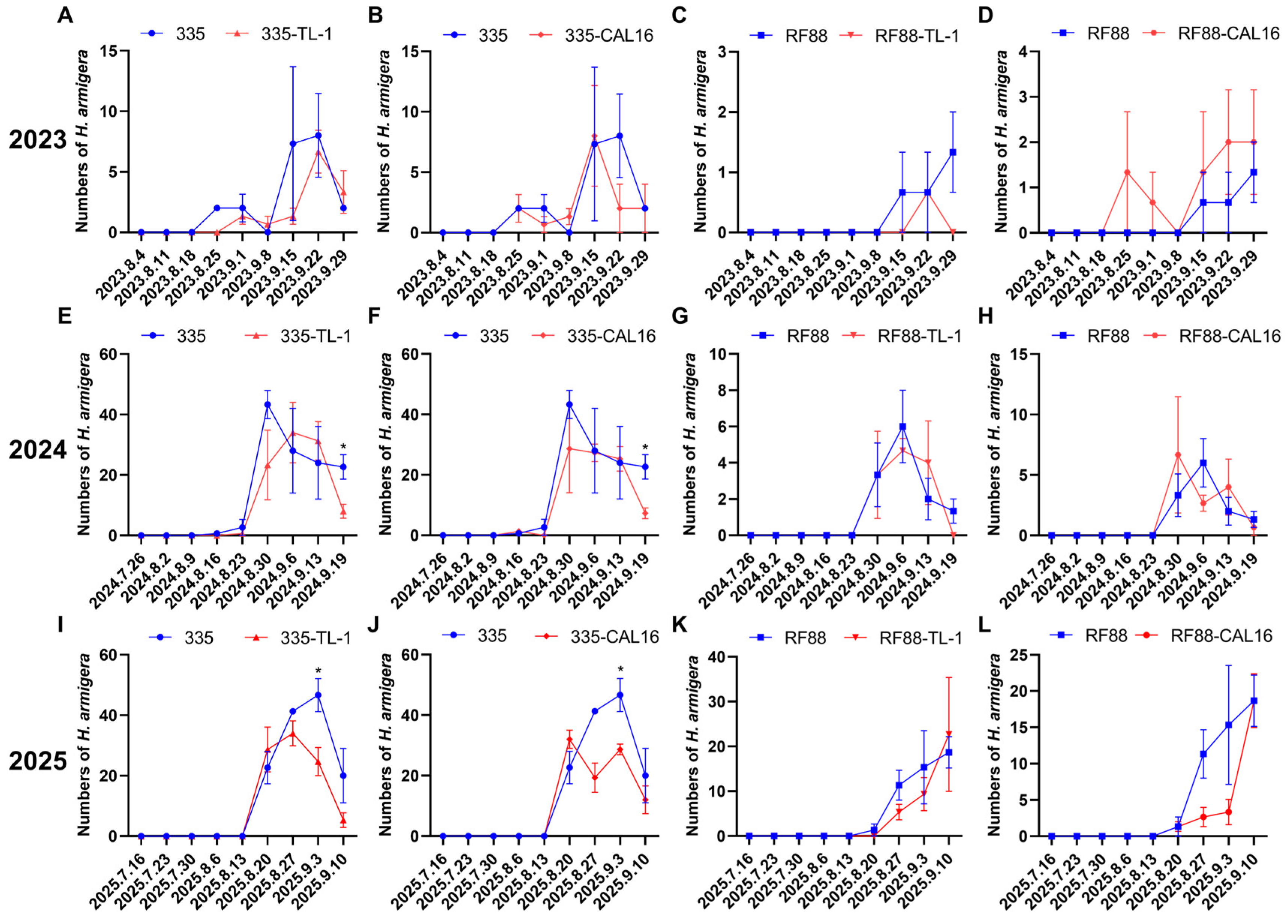
From 2023 to 2025, field surveys in the Huang-Huai-Hai maize-growing region indicated that H. armigera populations peaked between August 20 and September 30. In 2023, the larval density per 100 plants was relatively low, and an outbreak occurred later, with numbers increasing after September 8 and peaking on September 22. In contrast, in 2024 and 2025, larval populations began rising earlier, after August 15, and reached peak levels between August 30 and September 10 (Figure 2).
Strip intercropping significantly suppressed H. armigera population density on maize plants. Compared with monoculture 335, larval densities on the 335-TL-1 and 335-CAL16 intercropping treatments were reduced, with an approximately 30% reduction in 2025. As expected, the insect-resistant transgenic maize ‘RF88’ maintained H. armigera populations at very low levels. When intercropped with conventional soybean, TL-1, or the transgenic soybean CAL16, larval densities on the ‘RF88’ maize were comparable to those observed on the ‘RF88’ monoculture, without significant differences (Figure 2).
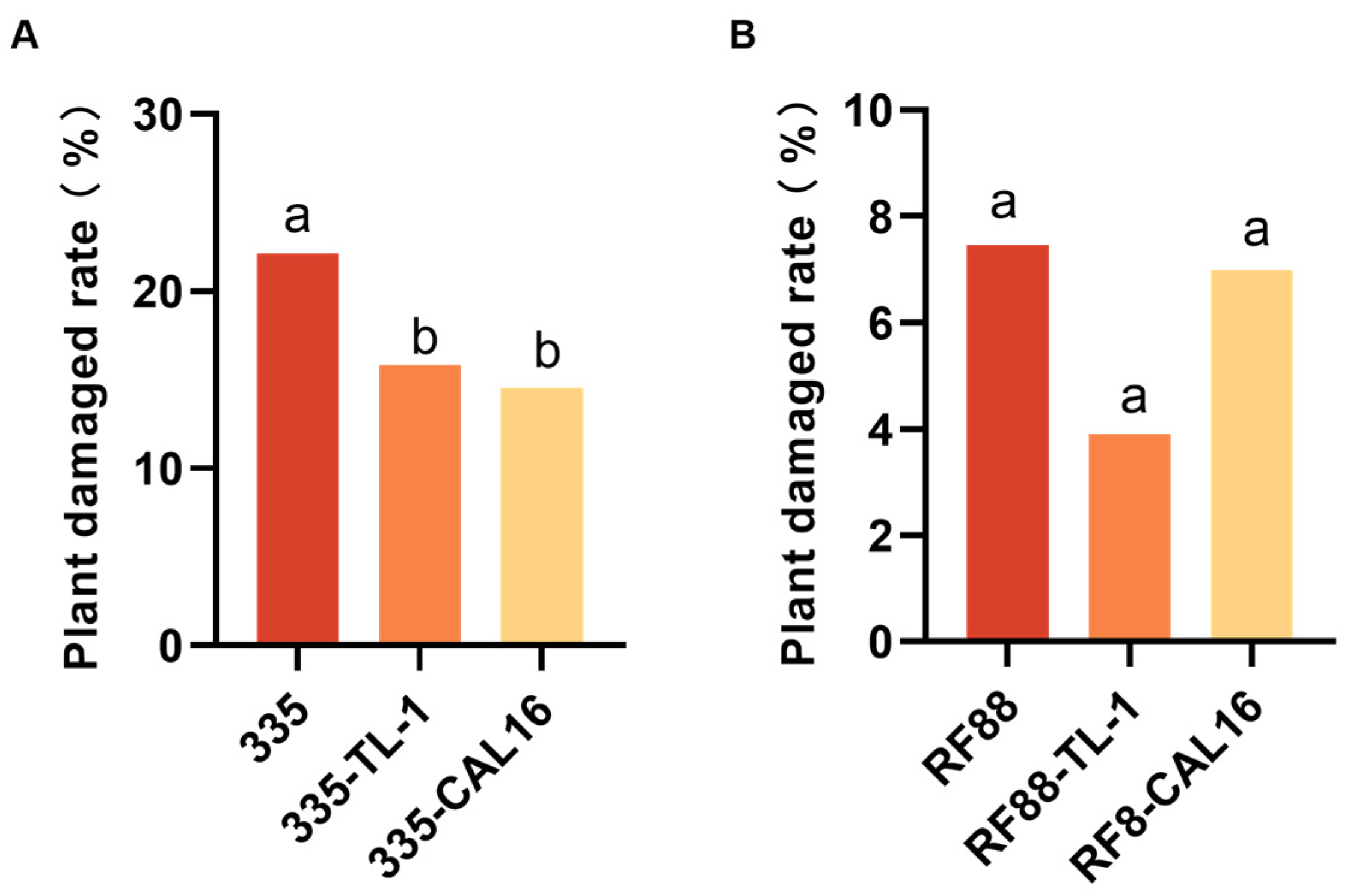
The larval density significantly influenced damage rates of maize plants. In monocultured 335 and intercropped RF88-TL-1 plots, high and larval populations resulted in high and low maize plant damage rates, respectively (Figure 2 and Figure 3). Consistent with larval density patterns, intercropping 335 with TL-1 and CAL16 significantly reduced plant damage rates, compared with monoculture 335 (p = 0.0334 and p = 0.0490). No significant differences were detected for maize damage rates between the ‘RF88’ monoculture and ‘RF88’ intercropping treatments (Figure 3).

3.3. Control Efficacy of Strip Intercropping for S. exigua on Soybean Plant

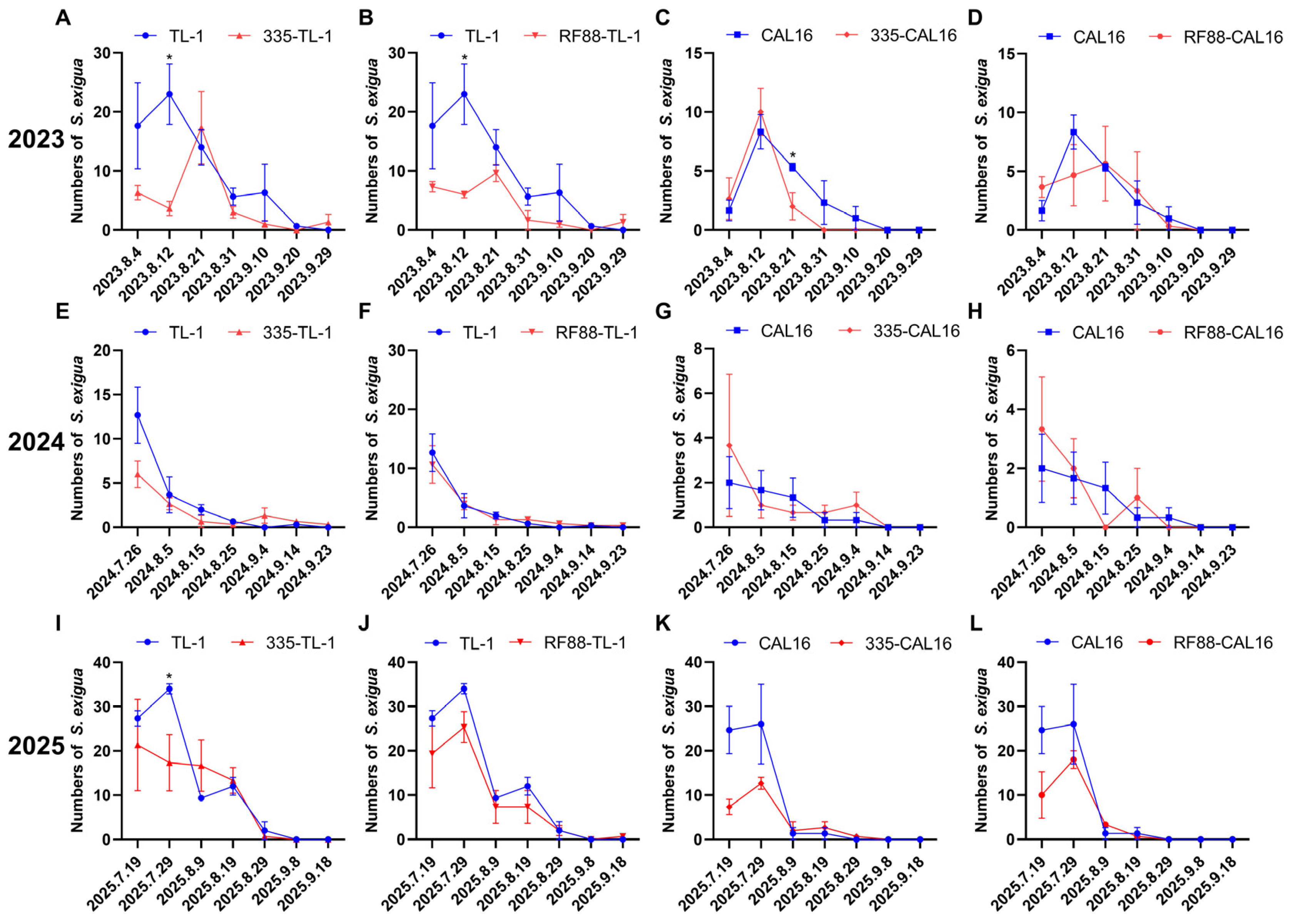
Field surveys from 2023 to 2025 in the Huang-Huai-Hai soybean-growing region showed that S. exigua occurred mainly from mid-July to mid-September, with population peaks between late July and mid-August. Infestation levels varied between years: populations were lowest in 2024, peaking at about 13 larvae per 100 plants; moderate in 2023 (≈23 larvae per 100 plants); and highest in 2025 (≈35 larvae per 100 plants). In 2025, the larval emergence occurred earlier, with the first individuals detected in mid-July and densities rapidly increasing to a peak by late July (Figure 4).
Intercropping significantly reduced S. exigua population densities on soybean. Compared with the monocultured TL-1, S. exigua densities on TL-1 soybean were markedly lower under intercropping treatments 335-TL-1 and RF88-TL-1, with significant reductions in 2023 (Z = −2.39, p = 0.0450 and Z = −2.86, p = 0.0117, respectively). Although the insect-resistant transgenic soybean CAL16 already maintained S. exigua at low levels, intercropping demonstrated an additional suppressive effect on the pest population. Specifically, in 2025, S. exigua densities in the 335-CAL16 and RF88-CAL16 intercropping plots were reduced by 50.5% and 43.9%, respectively, relative to the CAL16 monoculture (Figure 4).
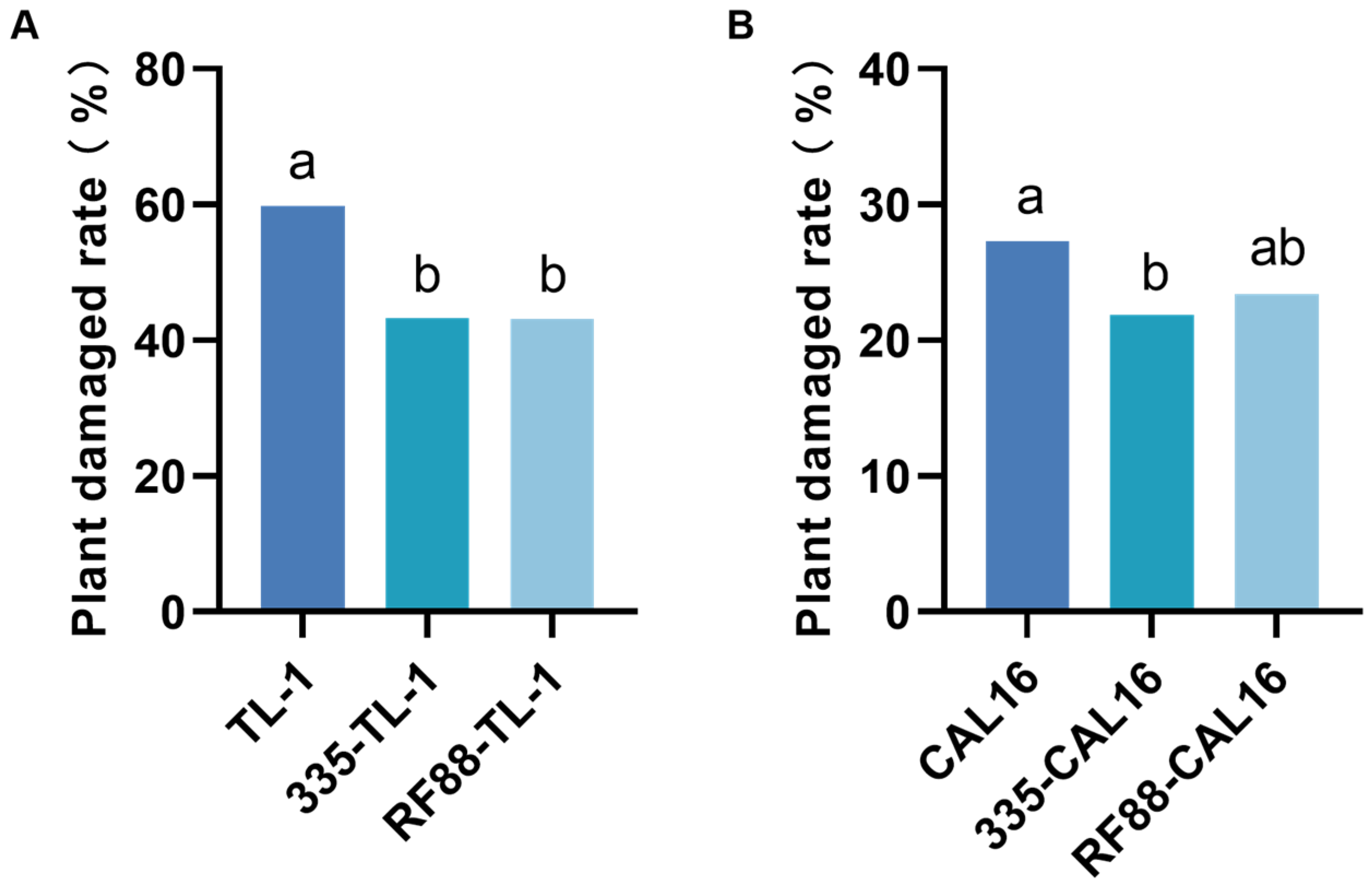
The population density of S. exigua was closely associated with the soybean plant damage rate. The monocultured TL-1 soybean sustained high insect populations, resulting in severe plant damage, whereas the 335-CAL16 field maintained a much lower pest density, which corresponded with reduced damage (Figure 4 and Figure 5). Overall, intercropping significantly lowered the proportion of damaged TL-1 plants relative to the monocropping, particularly in 335-TL-1 (p = 0.0038) and RF88-TL-1 (p =0.0037) (Figure 5). For CAL16, the plant damage rate was significantly reduced when intercropped with 335 (p = 0.0213) (Figure 5).

4. Discussion

In this study, we evaluated the impact of eight different planting patterns, including four different monocultures and four different strip intercropping systems, of insect-resistant GM maize and soybean events and their non-transgenic parental lines against the main lepidopteran pests in the Huang-Huai-Hai planting area over three years. Our results indicated that the GM trait significantly reduced H. armigera (on maize) and S. exigua (on soybean) population densities and the associated plant damage, which is likely due to the expression of insecticidal proteins in transgenic plants. Specifically, the transgenic maize produces Cry1Ab and Cry2Ab proteins, while the transgenic soybean produces a Cry1Ab/Vip3Da fusion protein. Both Cry and Vip proteins are known to be effective against lepidopteran pests [46], but exhibit distinct modes of action: Cry proteins must undergo enzymatic activation in the alkaline insect midgut, activating toxins then binding to specific receptors on midgut epithelial cells and forming pores that cause cell lysis and death [47,48]. In contrast, Vip3A proteins are secreted toxins that bind directly to midgut membrane receptors, triggering apoptosis (programmed cell death) [49]. This synergy between multiple mechanisms and distinct target sites provides more effective pest control and significantly delays the evolution of insect resistance [46].
Simultaneously, the strip intercropping reduced these metrics (pest density, crop damage) for both pests on GM and conventional varieties of their respective crops. This result agrees with previous research that demonstrated a reduction in the population densities of H. armigera and S. frugiperda in maize–soybean intercropping systems [50,51]. This consistent pest suppression can be attributed to several interconnected ecological mechanisms. In monocropping systems, pests can easily and efficiently locate their host plants. In contrast, intercropping systems spatially separate the target crops, diluting them with non-host plants. This reduces the pests’ ability to efficiently search for and locate their hosts, essentially creating a physical barrier that disrupts their dispersal and aggregation behaviors [52,53]. Additionally, non-host plants in intercropping systems release specific volatile compounds that can repel or disrupt pests, further impairing their ability to locate hosts [54,55]. For instance, volatile terpenoids emitted by leguminous crops have been shown to repel S. frugiperda and mitigate its damage to maize [56]. Furthermore, intercropping provides more diverse and abundant resources, such as pollen and habitats, for natural predators like Chrysopidae, Coccinellidae, and parasitic wasps, such as Cotesia congregata (Hymenoptera: Braconidae) and Palexorista spp. This, in turn, attracts and sustains higher populations of natural enemies that help further control pest populations [57,58,59,60]. Another study demonstrated that the species diversity and abundance of predatory and parasitic natural enemies significantly increased as the soybean proportion in maize–soybean intercropping systems increased, while the densities of lepidoptera pest and leafhoppers decreased [61]. Importantly, the pest control efficacy of an intercropping system is not fixed but is co-determined by its design and management. A spatial framework is defined by parameters such as the crop ratio (e.g., maize–soybean = 2:3 and 2:4), strip width, and planting density [17,62]. Conversely, agronomic measures like irrigation and fertilization modulate the system’s physiological and ecological processes. For example, an optimal nitrogen application not only promotes crop growth but may also induce the synthesis of plant defense compounds and alter their volatile organic compound (VOC) profile [63]. These changes directly influence pests’ host-seeking and colonization behaviors, as well as the foraging behavior of natural enemies. Therefore, to fully exploit the ecological benefits of intercropping and achieve the synergistic goals of yield enhancement and pest suppression, the integrated optimization of key practices, especially water and fertilizer management, is crucial.
Furthermore, the statistical analysis of the three years of field data did not reveal a significant three-way interaction between the GM traits, strip intercropping, and year in relation to the population densities of the two pests. This demonstrates the reliability of this integrated system from an applied perspective. Further analysis of the non-significant interaction between the GM trait and intercropping statistically demonstrates their additive and non-interfering relationship, confirming the compatibility of the two technologies. GM technology exerts a ‘specific toxicity’ via the expression of insecticidal proteins, while intercropping creates ‘physical and chemical barriers’ via spatial configurations and enhanced biodiversity. Crucially, neither practice interferes with the other’s mode of action: intercropping does not diminish the insecticidal protein effect, and the GM trait does not disrupt the spatial suppressive pest barrier. This functional compatibility is clearly demonstrated by the experimental results, where the pest pressure in GM intercropping systems was consistently the lowest. The synergistic integration of GM technology with intercropping provides effective pest control. For instance, in Brazil, combining GM crops with intercropping systems has been proven to significantly suppress target pest populations while enhancing both the ecological and economic returns of the cropping system [64,65,66]. The integration of strip intercropping and the GM trait resulted in the most effective pest control. This further highlights the effectiveness of the integration of modern biotechnology and ecological control in the fight against pests. This study will provide valuable insight for the top-level design and industrial layout of the commercialization of GM crops and promote the safe application of GM crops and sustainable pest management.
It is worth noting that the control efficacy of strip intercropping for pests demonstrates a significant density dependence, which has also been observed in this study. For instance, a significant interaction between strip intercropping and the year affected the population density of H. armigera on maize and the plant damage caused by S. exigua on soybean. This indicates that the effectiveness of strip intercropping in managing pest populations is closely related to the annual pest abundance. Previous studies have similarly shown that strip intercropping between maize and soybean significantly reduces S. frugiperda population densities and the resulting maize damage, particularly when pest densities are relatively low [67]. However, another study demonstrated that strip intercropping could only control wheat aphid populations effectively within certain density thresholds. When pest populations are exceptionally high, intercropping fails to prevent outbreaks, further confirming the density-dependent nature of pest control [68]. Overall, the effectiveness of intercropping in sustainable pest management depends on appropriate pest abundances; both excessively high and low pest populations can weaken its ecological control effect.
Given the significant density-dependent effects of intercropping on pest populations, it is important not to rely solely on this method for pest control. The regular monitoring of pest densities in intercropped fields of GM maize and soybean is essential. Previous studies on GM cotton have shown that as target pests like cotton bollworms decrease and insecticide use declines, secondary pests such as Miridae spp. (Hemiptera: Miridae), Bemisia tabaci (Homoptera: Aleyrodidae), and Tetranychus urticae (Acarina: Tetranychidae) often become more prevalent [69,70,71]. While intercropping can reduce the density of piercing–sucking pests to some extent [69], its effectiveness diminishes when pest populations exceed certain thresholds. These small, sap-sucking pests, characterized by short life cycles, rapid reproduction, and difficult early detection, can lead to sudden outbreaks [72,73,74]. Therefore, ongoing monitoring of non-target sap-sucking pests in intercropping systems of GM crops is vital for ensuring the long-term sustainability of GM crop applications.
Intercropping different GM crops offers a promising approach for pest resistance management. However, the evolution of resistance in target pests remains a critical factor influencing the sustainable use of such GM crops—specifically, if the insecticidal proteins expressed by the two intercropped crops exhibit cross-resistance, the pest population will be exposed to similar selection pressures. This effectively intensifies directional selection and may accelerate the evolution of pest resistance to these proteins [75], highlighting the need for careful consideration of protein combinations in intercropping systems. For this strategy to be effective, both intercropped GM plants must serve as hosts for the target pests, and the insecticidal proteins expressed by these crops must not exhibit cross-resistance. When pests are exposed to multiple insecticidal proteins without cross-resistance, the insecticidal effect is enhanced, and the selection pressure on target pest exposure any single toxin is reduced. Since the insecticidal proteins in GM maize and soybean do not exhibit cross-resistance, target pests can move freely between the two crops, which can provide refuges for each other’s pests. This dynamic can help delay the development of pest resistance [76]. In the Huang-Huai-Hai region, the main lepidopteran pests in maize fields include H. armigera, O. furnacalis, C. punctiferalis, and S. exigua [77], while in soybean fields, the primary pests are S. exigua and H. armigera [78]. Both maize and soybean serve as hosts for H. armigera and S. exigua. To control these pests and delay the development of resistance, an effective insect-resistant gene integration for GM maize includes Cry1A/Cry1F + Cry2Ab, while for GM soybean, Cry1A + Cry1F/Vip3A are recommended, which were used in this study. In China’s northeastern areas, where maize and soybean are widely planted, the main pests for maize are O. furnacalis and M. separata, while soybean fields face challenges from L. glycinivorella, E. zinckenella, and Loxostege sticticalis (Lepidoptera: Pyralidae) [77,78]. To manage pest resistance in these areas, optimal gene pyramids are Cry1A + Cry2A/Cry1F/Vip3A for maize and Cry1A + Cry1F for soybean. In the southwest and southern regions, maize faces pests such as S. frugiperda, M. separata, O. furnacalis, and C. punctiferalis, while soybean pests include S. exigua, S. litura, L. glycinivorella, and E. zinckenella. In these areas, for effective insect-resistant management, recommended gene pyramids include Cry1Ab/Cry1F + Cry2Ab + Vip3A for maize and CryAc + Vip3A/Cry1F for soybean. It is important to note that while these recommendations are based on pest host preferences and cross-resistance patterns of target pests, further field and laboratory trial data are required to validate their effectiveness in practical applications.
To further advance the integrated strategies combining GM technology and intercropping, future research should focus on the following. First, it should systematically evaluate the impact of this integration on the crop yield and economic returns, thus clarifying its agronomic and economic viability. Second, gradient experiments are needed to test different crop ratios (e.g., maize–soybean = 2:3, 2:4), strip widths, planting densities, and fertilizer levels. This will help identify optimal configurations that synergistically improve pest control, resource-use efficiency, and crop yield, providing a robust basis for region-specific sustainable cropping systems.

5. Conclusions

Our results indicate that for the specific GM crops tested—maize producing Cry1A + Cry2Ab proteins and soybean expressing Cry1A/Vip3A proteins—integrating insect-resistant GM traits with the tested strip intercropping arrangement can provide enhanced pest suppression compared to the use of either practice individually. These findings demonstrate the synergistic potential of integrating modern biotechnology with ecological pest management, offering valuable insights for the safe commercial application of GM crops and sustainable pest management.

Author Contributions

Conceptualization, G.C., L.H., Z.S., L.L. and M.S.U.; methodology, W.Z., G.C. and L.H.; formal analysis, W.Z., G.C. and L.H.; investigation, W.Z., C.Z. and G.C.; data curation, W.Z., C.Z., X.Y. and G.C.; writing—original draft preparation, W.Z., C.Z., G.C. and L.H.; writing—review and editing, W.Z., C.Z., G.C., Z.S., L.L., X.Y., M.S.U. and L.H.; supervision, G.C. and L.H.; project administration, G.C. and L.H.; funding acquisition, G.C. and L.H. All authors have read and agreed to the published version of the manuscript.

Funding

This research was funded by the Agricultural Biological Breeding-Major Projects (2023ZD04062), the National Natural Science Foundation of China (32272546), and the Government Procurement of Services Project—Technical Support for Resistance Testing of Agricultural Genetically Modified Organisms (No. 019250071).

Data Availability Statement

The original contributions presented in the study are included in the article, and further inquiries can be directed to the corresponding authors.

Conflicts of Interest

The authors declare no conflicts of interest.

References

  1. Tilman, D.; Balzer, C.; Hill, J.; Befort, B.L. Global food demand and the sustainable intensification of agriculture. Proc. Natl. Acad. Sci. USA 2011, 108, 20260–20264. [Google Scholar] [CrossRef]
  2. Han, X.; Wang, D.; Song, G.Q. Expression of a maize SOC1 gene enhances soybean yield potential through modulating plant growth and flowering. Sci. Rep. 2021, 11, 12758. [Google Scholar] [CrossRef] [PubMed]
  3. Wang, C.; Wang, X.; Jin, Z.; Christoph, M.; Thomas, A.; Chen, A.; Wang, T.; Huang, L.; Zhang, Y.; Li, L.; et al. Occurrence of crop pests and diseases has largely increased in China since 1970. Nat. Food 2022, 3, 57–65. [Google Scholar] [CrossRef]
  4. Savary, S.; Ficke, A.; Aubertot, J.N.; Holier, C. Crop losses due to diseases and their implications for global food production losses and food security. Food Secur. 2012, 4, 519–537. [Google Scholar] [CrossRef]
  5. Imura, O.; Shi, K.; Iimura, K.; Takamizo, T. Assessing the effects of cultivating genetically modified glyphosate-tolerant varieties of soybeans (Glycine max (L.) Merr.) on populations of field arthropods. Environ. Biosaf. Res. 2010, 9, 101–112. [Google Scholar] [CrossRef]
  6. Liang, J.; Sun, Y.; Yang, Y.; Wang, Z.; Wu, H.; Gu, T.; Zhang, R.; Sun, X.; Yao, B.; Tu, T.; et al. Agricultural biotechnology in China: Product development, commercialization, and perspectives. aBIOTECH 2025, 6, 284–310. [Google Scholar] [CrossRef]
  7. Iqbal, N.; Hussain, S.; Ahmed, Z.; Yang, F.; Wang, X.; Liu, W.; Yong, T.; Du, J.; Shu, K.; Yang, W.; et al. Comparative analysis of maize–soybean strip intercropping systems: A review. Plant Prod. Sci. 2019, 22, 131–142. [Google Scholar] [CrossRef]
  8. Blessing, D.J.; Gu, Y.; Cao, M.; Cui, Y.; Wang, X.; Asante-Badu, B. Overview of the advantages and limitations of maize-soybean intercropping in sustainable agriculture and future prospects: A review. Chil. J. Agric. Res. 2022, 82, 177–188. [Google Scholar] [CrossRef]
  9. Rahman, T.; Liu, X.; Hussain, S.; Ahmed, S.; Chen, G.; Yang, F.; Chen, L.; Du, J.; Liu, W.; Yang, W. Water use efficiency and evapotranspiration in maize-soybean relay strip intercrop systems as affected by planting geometries. PLoS ONE 2017, 12, e0178332. [Google Scholar] [CrossRef]
  10. Wu, Y.; He, D.; Wang, E.; Liu, X.; Huth, N.I.; Zhao, Z.; Gong, W.; Yang, F.; Wang, X.; Yong, T.; et al. Modelling soybean and maize growth and grain yield in strip intercropping systems with different row configurations. Field Crops Res. 2021, 265, 108122. [Google Scholar] [CrossRef]
  11. Yadav, S.P.S.; Adhikari, R.; Bhatta, D.; Poudel, A.; Subash, S.; Shrestha, S.; Shrestha, J. Initiatives for biodiversity conservation and utilization in crop protection: A strategy for sustainable crop production. Biodivers. Conserv. 2023, 32, 4573–4595. [Google Scholar] [CrossRef]
  12. Liu, J.; Yang, W. Soybean maize strip intercropping: A solution for maintaining food security in China. J. Integr. Agric. 2024, 23, 2503–2506. [Google Scholar] [CrossRef]
  13. Liang, S.; Feng, C.; Li, N.; Sun, Z.; Li, Y.; Zhang, X.; Liang, W. Soil biological health assessment based on nematode communities under maize and peanut intercropping. Ecol. Process. 2024, 13, 82. [Google Scholar] [CrossRef]
  14. Wang, X.; Li, Y.; Jia, W. Water and nitrogen utilization and growth simulation of soybean-maize strip intercropping: A review. Rev. Bras. Eng. Agrícola Ambient. 2025, 29, e291193. [Google Scholar] [CrossRef]
  15. Chen, P.; Du, Q.; Liu, X.; Zhou, L.; Hussain, S.; Lei, L.; Song, C.; Wang, X.; Liu, W.; Yang, F.; et al. Effects of reduced nitrogen inputs on crop yield and nitrogen use efficiency in a long-term maize-soybean relay strip intercropping system. PLoS ONE 2017, 12, e0184503. [Google Scholar] [CrossRef]
  16. Latati, M.; Benlahrech, S.; Lazali, M.; Sihem, T.; Ounane, S.M. Intercropping promotes the ability of legume and cereal to facilitate phosphorus and nitrogen acquisition through root-induced processes. Grain Legumes 2016, 127–139. [Google Scholar] [CrossRef]
  17. Li, L.; Chen, F.; Xing, G. Effects of fertilizer level and intercropping planting pattern with maize on the yield-related traits and insect community of soybean. Agronomy 2022, 12, 3080. [Google Scholar] [CrossRef]
  18. Yang, W.; Wang, X.; Xue, J.; Miu, J.; Wang, S.; Yang, B.; Huang, G. Effects of maize-soybean intercropping and nitrogen application on the characteristics of small and medium-soil animal communities in red soil. Chin. J. Appl. Ecol. 2017, 28, 2993–3002. [Google Scholar]
  19. Ju, Q.; Ouyang, F.; Gu, S.; Qiao, F.; Ge, F. Strip intercropping peanut with maize for peanut aphid biological control and yield enhancement. Agric. Ecosyst. Environ. 2019, 286, 106682. [Google Scholar] [CrossRef]
  20. Li, L.; Duan, R.; Li, R.; Zou, Y.; Liu, J.; Chen, F.; Xing, G. Impacts of maize intercropping with soybean, peanut and millet through different planting patterns on population dynamics and community diversity of insects under fertilizer reduction. Front. Plant Sci. 2022, 13, 936039. [Google Scholar]
  21. Hüber, C.; Zettl, F.; Hartung, J.; Müller-Lindenlauf, M. The impact of maize-bean intercropping on insect biodiversity. Basic Appl. Ecol. 2022, 61, 1–9. [Google Scholar] [CrossRef]
  22. Xu, L.; Tong, Q.; Xu, T.; Bi, S.J.; Hu, B.; Yun, H.; Hu, F.; Wang, Z. Effects of maize-soybean intercropping on the growth, development and reproduction of Spodoptera frugiperda grassland. J. Plant Prot. 2023, 50, 642–650. [Google Scholar] [CrossRef]
  23. Fan, Q.; Gao, N.; Zhao, Y.; Zhang, Y.; Liu, X.; Ding, Y.; Niu, W.; Wang, L.; Feng, R. The use of soybean–corn strip compound planting implements in the yellow river basin of China for intercropping patterns in areas of similar dimensions. AgriEngineering 2024, 7, 4. [Google Scholar] [CrossRef]
  24. Li, Y.; Hallerman, E.M.; Liu, Q.; Wu, K.; Peng, Y. The development and status of Bt rice in China. Plant Biotechnol. J. 2016, 14, 839–848. [Google Scholar] [CrossRef]
  25. Lu, Y.; Wu, K.; Jiang, Y.; Guo, Y.; Desneux, N. Widespread adoption of Bt cotton and insecticide decrease 499 promotes biocontrol services. Nature 2012, 487, 362–365. [Google Scholar] [PubMed]
  26. Marvier, M.; McCreedy, C.; Regetz, J.; Kareiva, P. A meta-analysis of effects of Bt cotton and maize on nontar-501 get invertebrates. Science 2007, 316, 1475–1477. [Google Scholar] [CrossRef]
  27. Wolfenbarger, L.L.; Naranjo, S.E.; Lundgren, J.G.; Bitzer, R.J.; Watrud, L.S. Bt crop effects on functional guilds of non-target arthropods: A meta-analysis. PLoS ONE 2008, 3, e2118. [Google Scholar]
  28. Wu, K.; Lu, Y.; Feng, H.; Jiang, Y.; Zhao, J. Suppression of cotton bollworm in multiple crops in China in areas with Bt toxin-containing cotton. Science 2008, 321, 1676–1678. [Google Scholar] [CrossRef]
  29. Sun, M.; Li, S.; Yang, W.; Zhao, B.; Wang, Y.; Liu, X. Commercial genetically modified maize and soybean are poised following pilot planting in China. Mol. Plant 2024, 17, 519–521. [Google Scholar] [PubMed]
  30. Li, G.; Liang, Y.; Liu, Q.; Zeng, J.; Ren, Q.; Guo, J.; Ren, Q.; Guo, J.; Xiong, F.; Lu, D. Enhancing production efficiency through optimizing plant density in maize–soybean strip intercropping. Front. Plant Sci. 2024, 15, 1473786. [Google Scholar] [CrossRef] [PubMed]
  31. Zhang, S.; Wu, M.; Gu, S.; Li, X. Egg-laying preference of female adults of cotton bollworm on 16 species of plants and their survival after larval feeding. J. Plant Prot. 2019, 45, 108–113. [Google Scholar] [CrossRef]
  32. Ministry of Agriculture of the People’s Republic of China. Technical Specification for Environmental Safety Testing of Genetically Modified Soybean—Part 3: Detection of Impacts on Biodiversity; China Standard Press: Beijing, China, 2003.
  33. Ministry of Agriculture of the People’s Republic of China. Technical Specification for Environmental Safety Testing of Genetically Modified Maize—Part 3: Detection of Impacts on Biodiversity; China Standard Press: Beijing, China, 2003.
  34. Hao, P.; Xiao, T.; Jing, X.; Li, T.; Yi, Z. Effects of intercropping on red soil aggregates and available phosphorus characteristics under different phosphorus levels. Soils Fertil. Sci. China 2022, 516, 1–8. [Google Scholar]
  35. Liao, L.; Xiong, C.; Rui, Z.; Jing, L.; Min, H.; Ai, A. Effects of intercropping sorghum and soybeans on soil water distribution and water use efficiency. J. Henan Agric. Sci. 2021, 50, 30–38. [Google Scholar]
  36. Yang, X. Research on the optimization of maize-soybean intercropping mode based on high yield and stable yield. Farm Mach. Using 2025, 140–143. [Google Scholar]
  37. Jin, C.; Wen, M. Green, High-quality and high-efficiency cultivation techniques for soybean-maize strip intercropping. Agric. Henan 2025, 7–9. [Google Scholar]
  38. Higo, Y.; Sasaki, M.; Amano, T. Morphological characteristics to identify fall armyworm, Spodoptera frugiperda (Lepidoptera: Noctuidae) from common polyphagous noctuid pests for all instar larvae in Japan. Appl. Entomol. Zool. 2022, 57, 263–274. [Google Scholar] [CrossRef]
  39. López, P.A.O.; Castaño Villa, G.J.; Pérez, E.M.O.; Rey, G.T.R.; Páez, F.A.R. Genus 1 sp. 2 (Diptera: Chironomidae): The potential use of its larvae as bioindicators. Environ. Anal. Ecol. Stud. 2018, 4, 376–385. [Google Scholar] [CrossRef]
  40. Ling, M.H.; Ivorra, T.; Heo, C.C.; Wardhana, A.H.; Hall, M.J.R.; Tan, S.H.; Mohamed, Z.; Khang, T.F. Accurate Identification of Fly Species in Forensic, Medical and Veterinary Entomology using Wing Venation Patterns. Res. Sq. 2023. [Google Scholar] [CrossRef]
  41. Zhang, L.S.; Chang, H.H.; Jin, Z.T.; Zhang, Y.F.; Wang, X.M.; Ba, C.X.; Tian, X.H. The occurrence patterns of major pests in soybean maize intercropping and soybean maize monoculture. J. Appl. Entomol. 2024, 61, 864–870. [Google Scholar]
  42. Broatch, J.E.; Dietrich, S.; Goelman, D. Introducing data science techniques by connecting database concepts and dplyr. J. Stat. Educ. 2019, 27, 147–153. [Google Scholar] [CrossRef]
  43. Hou, R.; Tomalin, L.E.; Suárez-Fariñas, M. cosinoRmixedeffects: An R package for mixed-effects cosinor models. BMC Bioinform. 2021, 22, 553. [Google Scholar] [CrossRef] [PubMed]
  44. Bates, D.; Mächler, M.; Bolker, B.; Walker, S. Fitting linear mixed-effects models using lme4. J. Stat. Softw. 2015, 67, 1–48. [Google Scholar] [CrossRef]
  45. Brooks, M.E.; Kristensen, K.; Van Benthem, K.J.; Magnusson, A.; Berg, C.W.; Nielsen, A.; Skaug, H.J.; Maechler, M.; Bolker, B.M. Modeling zero-inflated count data with glmmTMB. bioRxiv 2017, 132753. [Google Scholar] [CrossRef]
  46. Gilreath, R.T.; Kerns, D.L.; Huang, F.N.; Yang, F. No positive cross-resistance to Cry1 and Cry2 proteins favors pyramiding strategy for management of Vip3Aa resistance in Spodoptera frugiperda. Pest Manag. Sci. 2021, 77, 1963–1970. [Google Scholar] [CrossRef]
  47. Koch, M.S.; Ward, J.M.; Levine, S.L.; Baum, J.A.; Vicini, J.L.; Hammond, B.G. The food and environmental safety of Bt crops. Front. Plant Sci. 2015, 6, 283. [Google Scholar] [CrossRef]
  48. Likitvivatanavong, S.; Chen, J.; Evans, A.M.; Bravo, A.; Soberon, M.; Gill, S.S. Multiple receptors as targets of Cry toxins in mosquitoes. J. Agric. Food Chem. 2011, 59, 2829–2838. [Google Scholar] [CrossRef]
  49. Syed, T.; Askari, M.; Meng, Z.; Li, Y.; Abid, M.A.; Wei, Y.; Guo, S.; Liang, C.; Zhang, R. Current insights on vegetative insecticidal proteins (Vip) as next generation pest killers. Toxins 2020, 12, 522. [Google Scholar] [CrossRef]
  50. Manandhar, R.; Wright, M.G. Effects of interplanting flowering plants on the biological control of corn earworm (Lepidoptera: Noctuidae) and thrips (Thysanoptera: Thripidae) in sweet corn. J. Econ. Entomol. 2016, 109, 113–119. [Google Scholar] [CrossRef]
  51. Soujanya, P.L.; Vanisree, K.; Giri, G.S.; Mahadik, S.; Jat, S.L.; Sekhar, J.C.; Jat, H.S. Intercropping in maize reduces fall armyworm Spodoptera frugiperda (JE Smith) infestation, supports natural enemies, and enhances 541 yield. Agric. Ecosyst. Environ. 2024, 373, 109130. [Google Scholar] [CrossRef]
  52. Finch, S.; Collier, R.H. The influence of host and non-host companion plants on the behaviour of pest insects in field crops. Entomol. Exp. Appl. 2012, 142, 87–96. [Google Scholar] [CrossRef]
  53. Mansion-Vaquié, A.; Ferrer, A.; Ramon-Portugal, F.; Wezel, A.; Magro, A. Intercropping impacts the host location behaviour and population growth of aphids. Entomol. Exp. Appl. 2020, 168, 41–52. [Google Scholar] [CrossRef]
  54. Conchou, L.; Lucas, P.; Meslin, C.; Proffit, M.; Staudt, M.; Renou, M. Insect odorscapes: From plant volatiles to natural olfactory scenes. Front. Physiol. 2019, 10, 972. [Google Scholar] [CrossRef]
  55. Osei-Owusu, J.; Vuts, J.; Caulfield, J.C.; Woodcock, C.M.; Withall, D.M.; Hooper, A.M.; Osafo-Acquaah, S.; Birkett, M.A. Identification of semiochemicals from cowpea, Vigna unguiculata, for low-input management of the legume pod borer, Maruca vitrata. J. Chem. Ecol. 2020, 46, 288–298. [Google Scholar] [CrossRef]
  56. Erdei, A.L.; David, A.B.; Savvidou, E.C.; Džemedžionaitė, V.; Chakravarthy, A.; Molnár, B.P.; Dekker, T. The push–pull intercrop Desmodium does not repel, but intercepts and kills pests. eLife 2024, 13, e88695. [Google Scholar] [CrossRef] [PubMed]
  57. Letourneau, D.K.; Ambrecht, I.; Rivera, B.S.; Lerma, J.M.; Carmona, E.J.; Daza, M.C. Does plant diversity benefit agroecosystems? A synthetic review. Ecol. Appl. 2011, 21, 9–21. [Google Scholar] [CrossRef] [PubMed]
  58. Maitra, S.; Palai, J.B.; Manasa, P.; Kumar, D.P. The potential of intercropping system in sustaining crop productivity. Int. J. Agric. Environ. Biotechnol. 2019, 12, 39–45. [Google Scholar] [CrossRef]
  59. Dannon, E.A.; Tamo, M.; Van, H.A.; Dicke, M. Effects of volatiles from Maruca vitrata larvae and caterpillar infested flowers of their host plant Vigna unguiculata on the foraging behavior of the parasitoid Apanteles taragamae. J. Chem. Ecol. 2010, 36, 1083–1091. [Google Scholar] [CrossRef]
  60. Day, R.; Abrahams, P.; Bateman, M.; Beale, T.; Clottey, V.; Cock, M.; Colmenarez, Y.; Maizeiani, N.; Early, R.; Godwin, J.; et al. Fall armyworm: Impacts and implications for Africa. Outlooks Pest Manag. 2017, 28, 196–562. [Google Scholar] [CrossRef]
  61. Lisdayanti, H.; Nurkomar, I. Diversity of natural enemies in maize-soybean intercropping with different plant compositions. IOP Conf. Ser. Earth Environ. Sci. 2022, 985, 012051. [Google Scholar] [CrossRef]
  62. Deng, H.; Pan, X.; Lan, X.; Wang, Q.; Xiao, R. Rational maize–soybean strip intercropping planting system improves interspecific relationships and increases crop yield and income in the China Hexi Oasis irrigation 567 area. Agronomy 2024, 14, 1220. [Google Scholar] [CrossRef]
  63. Wang, W.; Wang, X.; Liao, H.; Feng, Y.; Guo, Y.; Shu, Y.; Wang, J. Effects of nitrogen supply on induced defense in maize (Zea mays) against fall armyworm (Spodoptera frugiperda). Int. J. Mol. Sci. 2022, 23, 10457. [Google Scholar] [CrossRef]
  64. Jacques, F.L.; Degrande, P.E.; Gauer, E.; Malaquias, J.B.; Scoton, A.M.N. Intercropped Bt and non-Bt corn with ruzigrass (Urochloa ruziziensis) as a tool to resistance management of Spodoptera frugiperda (JE Smith, 1797) 572 (Lepidoptera: Noctuidae). Pest Manag. Sci. 2021, 77, 3372–3381. [Google Scholar] [CrossRef]
  65. Singh, A.; Singh, T.; Singh, A. Productivity potential, quality and economic viability of hybrid Bt cotton (Gossypium hirsutum)-based intercropping systems under irrigated conditions. Indian J. Agron. 2014, 59, 385–391. [Google Scholar]
  66. Raju, A.R.; Thakare, S.K. Improving the fertilizer use efficiency and profitability of small farms by intercropping with transgenic Bt cotton. Afr. J. Agric. Res. 2014, 9, 3540–3548. [Google Scholar]
  67. Kusi, F.; Nboyine, J.A.; Adjebeng-Danquah, J.; Agrengsore, P.; Seidu, A.; Quandahor, P.; Sugri, I.; Adazebra, G.A.; Agyare, R.Y.; Asamani, E.; et al. Effect of insecticides and intercropping systems on fall armyworm (Spodoptera frugiperda (JE Smith)) infestations and damage in maize in 491 northern Ghana. Crop Prot. 2024, 186, 106909. [Google Scholar] [CrossRef]
  68. Alarcón-Segura, V.; Grass, I.; Breustedt, G.; Rohlfs, M.; Tscharntke, T. Strip intercropping of wheat and oilseed rape enhances biodiversity and biological pest control in a conventionally managed farm scenario. J. Appl. Ecol. 2022, 59, 1513–1523. [Google Scholar] [CrossRef]
  69. Nagrare, V.S.; Kranthi, S.; Biradar, V.K.; Zade, N.N.; Sangode, V.; Kakde, G.; Shukla, R.M.; Shivare, D.; Khadi, B.M.; Kranthi, K.R. Widespread infestation of the exotic mealybug species Phenacoccus solenopsis (Tinsley) (Hemiptera: Pseudococcidae) on cotton in India. Bull. Entomol. Res. 2009, 99, 537–541. [Google Scholar] [CrossRef] [PubMed]
  70. Lu, Y.; Wu, K.; Jiang, Y.; Xia, B.; Li, P.; Feng, H.; Wyckhuys, K.; Guo, Y. Mirid bug outbreaks in multiple crops correlated with wide-scale adoption of Bt cotton in China. Science 2010, 328, 1151–1154. [Google Scholar] [CrossRef] [PubMed]
  71. Catarino, R.; Ceddia, G.; Areal, F.J.; Park, J. The impact of secondary pest on Bacillus thuringiensis (Bt) crops. Plant Biotechnol. J. 2015, 13, 601–612. [Google Scholar] [CrossRef]
  72. Uesugi, R.; Köneke, A.; Sekine, T.; Tabuchi, K.; Herz, A.; Yoshimura, H.; Bockmann, E.; Shimoda, T.; Nagasaka, K. Intercropping and flower strips to enhance natural enemies and control aphids: A comparative study in cabbage fields of Japan and Germany. Appl. Entomol. Zool. 2024, 59, 173–183. [Google Scholar] [CrossRef]
  73. Saini, D.; Baniwal, S.; Kumar, V.; Kumar, S. Impact of alpha- terthienyl phototoxicity on mustard aphid (Lipaphis erysimi) and pea aphid (Acyrothosiphon pisum). Int. J. Entomol. Res. 2024, 9, 62–66. [Google Scholar]
  74. Sétamou, M.; Soto, Y.L.; Tachin, M.; Alabi, O.J. Report on the first detection of Asian citrus psyllid Diaphorina citri Kuwayama (Hemiptera: Liviidae) in the Republic of Benin, West Africa. Sci. Rep. 2023, 13, 801. [Google Scholar] [CrossRef] [PubMed]
  75. Agyenim-Boateng, K.G.; Lu, J.N.; Shi, Y.Z.; Yin, X.G. Review of leaf hopper (Empoasca flavescens): A major pest in castor (Ricinus communis). J. Genet Genom. Sci. 2018, 3, 009. [Google Scholar]
  76. Anderson, J.A.; Ellsworth, P.C.; Faria, J.C.; Head, G.P.; Owen, M.D.; Pilcher, C.D.; Shelton, A.M.; Meissle, M. Genetically engineered crops: Importance of diversified integrated pest management for agricultural sustainability. Front. Bioeng. Biotechnol. 2019, 7, 24. [Google Scholar] [CrossRef]
  77. Li, G.; Wu, K. Commercial strategy of transgenic insect-resistant maize in China. J. Plant Prot. 2022, 49, 17–32. [Google Scholar]
  78. Yu, H.; Wu, K. Commercialization Strategy of Transgenic Soybean in China. Biotechnol. Bull. Chin. 2023, 39, 1–15. [Google Scholar]
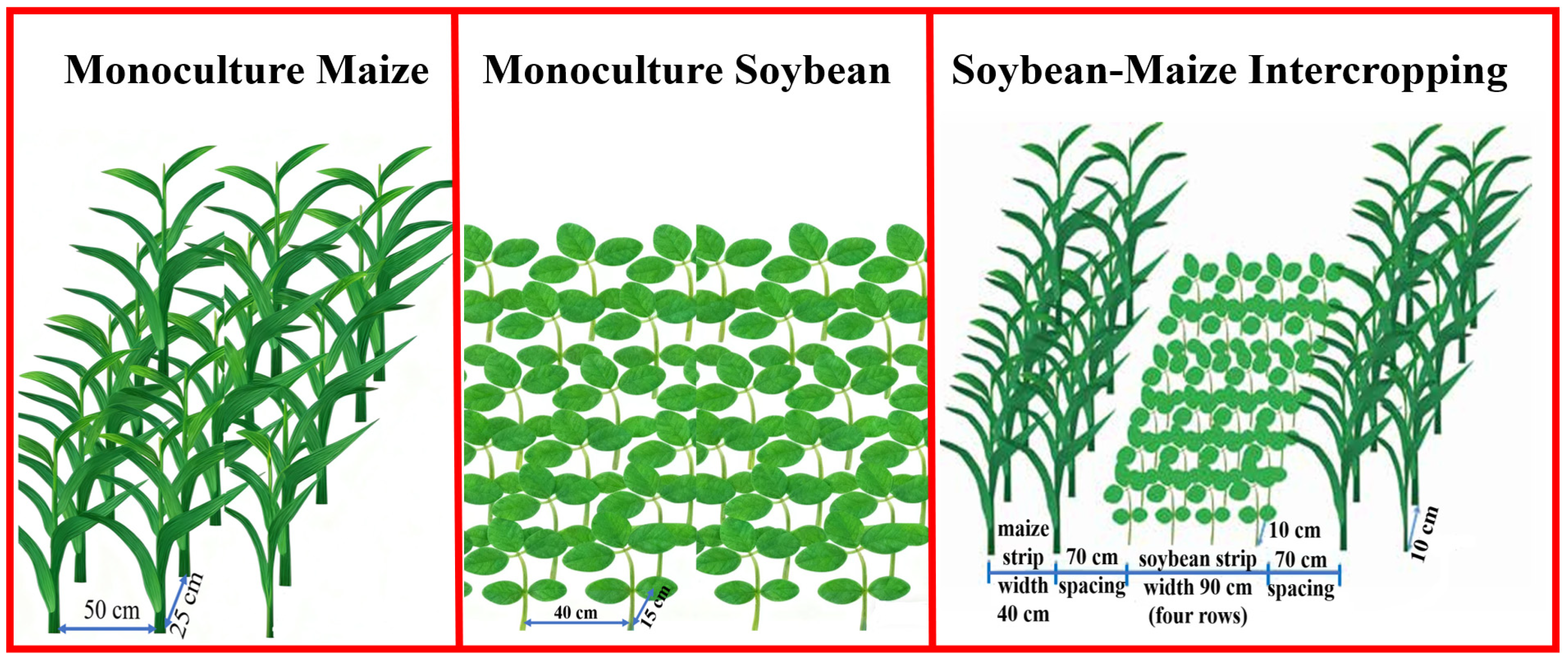
Figure 1. Schematic diagram of monoculture maize, monoculture soybean, and soybean–maize intercropping.
Agronomy 15 02880 g001
Figure 2. The numbers of H. armigera population on per 100 maize plants are shown in 2023 (AD), 2024 (EH), and 2025 (IL). Significant differences between different treatments at the same time point (Wilcoxon rank-sum test, p < 0.05) are marked with an asterisk (*).
Agronomy 15 02880 g002
Figure 3. Damage rates caused by H. armigera for maize plants under different planting systems in 2023, 2024, and 2025. (A) Conventional maize. (B) GM maize. Values were compared using one-way ANOVA followed by Tukey’s HSD test (p < 0.05). Different letters above the columns indicate significant differences between treatments.
Agronomy 15 02880 g003
Figure 4. The numbers of S. exigua population on per 100 soybean plants in 2023 (AD), 2024 (EH), and 2025 (IL). Significant differences between different treatments at the same time point (Wilcoxon rank-sum test, p < 0.05) are marked with an asterisk (*).
Agronomy 15 02880 g004
Figure 5. Damage rates caused by S. exigua for soybean plants under different planting systems in 2023, 2024, and 2025. (A) Conventional soybean. (B) GM soybean. Values were compared using one-way ANOVA followed by Tukey’s HSD test (p < 0.05). Different letters above the columns indicate significant differences among treatments.
Agronomy 15 02880 g005
Table 1. Number of target pest larvae per hundred plants in conventional maize or soybean fields from 2023 to 2025.
YearMaizeSoybean
Lepidopterous SpeciesNumber of Larvae (Mean ± SE)Lepidopterous SpeciesNumber of Larvae (Mean ± SE)
2023H. armigera2.37 ± 0.90 aS. exigua9.62 ± 2.22 a
S. frugiperda0.67 ± 0.26 abH. recurvalis3.57 ± 1.36 ab
S. exigua0.30 ± 0.01 bL. indicata3.33 ± 1.46 b
C. punctiferalis0.07 ± 0.06 bAscotis selenaria0.57 ± 0.19 b
O. furnacalis0.07 ± 0.04 bO. furnacalis0.52 ± 0.31 b
M. separata0.07 ± 0.05 bH. armigera0.43 ± 0.19 b
2024H. armigera13.48 ± 3.52 aS. exigua3.22 ± 1.20 a
C. punctiferalis6.81 ± 2.62 abH. recurvalis0.19 ± 0.11 a
O. furnacalis6.07 ± 1.02 abC. punctiferalis0.19 ± 0.11 a
S. exigua0.89 ± 0.32 bL. indicata0.10 ± 0.07 a
S. litura0.15 ± 0.11 bO. furnacalis0.05 ± 0.03 a
L. indicata0.07 ± 0.05 bA. selenaria0.05 ± 0.02 a
2025H. armigera14.52 ± 3.69 aS. exigua12.10 ± 2.85 a
S. exigua3.78 ± 1.28 abA. selenaria0.19 ± 0.08 b
O. furnacalis1.70 ± 0.54 bH. armigera0.10 ± 0.05 b
C. punctiferalis0.15 ± 0.07 bH. recurvalis0.10 ± 0.06 b
S.litura0.07 ± 0.02 b--
Note: For comparisons within the same year and crop, significant differences (p < 0.05) among insect species are indicated by different lowercase letters in the same column, which are presented following the mean number of larvae per 100 plants.
Table 2. Effects of GM trait (G: GM vs. conventional crops), planting pattern (P: intercropping vs. monoculture), year (Y: 2023, 2024, 2025), and their interactions on the population densities of major target pests (p-value).
Source of VariationH. armigeraS. exigua
Planting pattern (P)0.0232 *0.0023 **
Genetically modified factors (G)<0.0001 ***<0.0001 ***
Year (Y)<0.0001 ***<0.0001 ***
G × P0.09330.7832
G × Y<0.0001 ***0.7139
P × Y0.04813 *0.2037
G × P × Y0.25420.1267
Note: *, **, and *** indicate significant differences at p < 0.05, p < 0.001, and p < 0.0001, respectively.
Table 3. Effects of GM trait (G: GM vs. conventional crops), planting pattern (P: intercropping vs. monoculture), year (Y: 2023, 2024, 2025), and their interactions on the damage rates caused by target pests for maize or soybean plants (p-value).
Source of VariationDamage Rate of
Maize Plants
Damage Rate of
Soybean Plants
Planting pattern (P)0.0007 ***<0.0001 ***
Genetically modified factors (G)<0.0001 **<0.0001 ***
Year (Y)<0.0001 ***<0.0001 ***
G × P0.16010.0236 *
G × Y<0.0001 ***<0.0001 ***
P × Y0.0962<0.0001 ***
G × P × Y0.1621<0.0001 ***
Note: *, **, and *** indicate significant differences at p < 0.05, p < 0.001, and p < 0.0001, respectively.
Disclaimer/Publisher’s Note: The statements, opinions and data contained in all publications are solely those of the individual author(s) and contributor(s) and not of MDPI and/or the editor(s). MDPI and/or the editor(s) disclaim responsibility for any injury to people or property resulting from any ideas, methods, instructions or products referred to in the content.