Article

Phosphorus Input Threshold Drives the Synergistic Shift of Microbial Assembly and Phosphorus Speciation to Sustain Maize Productivity


1
College of Resources, Sichuan Agricultural University, Chengdu 611130, China
2
Research Centre of Phosphorous Efficient Utilization and Water Environment Protection Along the Yangtze River Economic Belt, College of Resources and Environment, Anhui Agricultural University, Hefei 230036, China
3
Sichuan Academy of Agricultural Sciences, Chengdu 610066, China
4
College of Soil and Water Conservation, Southwest Forestry University, Kunming 650200, China
*
Authors to whom correspondence should be addressed.
These authors contributed equally to this work.
Agronomy 2025, 15(12), 2835; https://doi.org/10.3390/agronomy15122835
Submission received: 10 November 2025 / Revised: 2 December 2025 / Accepted: 5 December 2025 / Published: 10 December 2025
(This article belongs to the Section Agroecology Innovation: Achieving System Resilience)

Abstract

Phosphate fertilizer is essential for crop production but poses environmental risks in agriculture. The agronomic and environmental thresholds for phosphorus application in Southwest China’s purple soils (Luvic Xerosols) remain poorly defined. We combined soil phosphorus fractionation, root phenotyping, and microbial community analysis (16S rRNA and ITS amplicon sequencing) to explore soil–microbe–plant interactions in a 12-year field experiment with five P application rates (0, 37.5, 75, 112.5 and 150 kg P2O5 ha−1 yr−1). Results showed that beyond 75 kg ha−1, the medium-soluble phosphorus pool increased significantly while stable phosphorus decreased. Fungal diversity was more sensitive to high phosphorus than bacterial diversity. Maize yield plateaued at 75–150 kg ha−1, mainly due to increased grain weight and optimized root architecture. An environmental risk threshold was identified at 83.54 kg ha−1 and an optimal yield threshold at 84.65 kg ha−1, enabling high yield with low environmental risk via microbially mediated phosphorus activation. Therefore, this research reveals that the phosphorus input threshold can provide a basis for reducing phosphorus application, regulating phosphorus components, and maintaining microbial diversity and network complexity in purple soil dryland farming systems, thereby ensuring maize yield.

1. Introduction

Phosphorus (P) is an essential macronutrient for crop growth, yet its low solubility and mobility in soil make it a major limiting factor for global agricultural productivity [1]. Although phosphorus fertilization plays a critical role in enhancing soil available phosphorus content and crop yields [2], phosphate rock, a non-renewable resource, is undergoing rapid depletion [3,4]. Current mining practices will drive up phosphate rock prices, triggering soaring agricultural production costs and endangering global food security [5]. Notably, since 70–90% of mineral phosphorus fertilizers become immobilized in soils through fixation-precipitation processes [6], continuous application remains necessary to maintain crop-available phosphorus levels [3]. This leads to excessive phosphorus accumulation in agricultural soils, which in most cases has exceeded optimal thresholds [7]. Concurrently, high phosphorus inputs exacerbate environmental pollution and eutrophication risks through runoff [8,9]. Given these challenges, leveraging the capacity of soil microorganisms to mobilize fixed soil P has emerged as a key strategy for sustainable P management. Recent research has demonstrated that specific functional microorganisms can significantly enhance the bioavailability of accumulated phosphorus [10]. Maintaining soil available P at an optimal level can maximize the turnover of the microbial biomass P pool, potentially offsetting P fixation and achieving balanced P budgets [6]. On a broader scale, managing soil P within agronomic and environmental thresholds could reduce P fertilizer use by 47.4% in China without yield penalty, highlighting the immense potential of strategic P management [11]. Therefore, elucidating the dynamics of soil phosphorus pools may delay the depletion of phosphorus resources and mitigate environmental phosphorus losses through optimized nutrient management.
Soil phosphorus exists in multiple forms, with its bioavailability governed by interconversions among different fractions [12,13]. Based on bioavailability, soil phosphorus can be classified into three categories: labile phosphorus (LP, including resin-Pi, NaHCO3-Pi, and NaHCO3-Po), moderately labile phosphorus (MP, comprising NaOH-Pi, NaOH-Po, and dilute HCl-Pi), and stable phosphorus (SP, including concentrated HCl-Pi, concentrated HCl-Po, and residual phosphorus) [14]. Application of inorganic phosphorus fertilizers increases the concentrations of all phosphorus fractions and promotes the transformation of SP into LP and MP [15,16,17]. Long-term phosphorus fertilization increases the availability of inorganic phosphorus forms [2,18] with MP constituting the dominant phosphorus fraction in purple soils. Phosphorus application increases inorganic and most organic phosphorus fractions in these soils [19]. However, the mechanisms by which different P application rates regulate P fraction transformations in purple soils remain poorly understood, particularly the microbial drivers behind these processes.
The driving mechanisms of soil phosphorus cycling represent a focal research area in contemporary agroecology, with the core challenge lying in deciphering the interplay between biotic and abiotic factors. Emerging evidence demonstrates that soil phosphorus fractions are regulated by abiotic factors such as pH, total nitrogen (TN), and soil organic carbon (SOC) [20], and exhibit strong correlations with microbial community dynamics [21,22]. Microbial communities increase phosphorus bioavailability and utilization efficiency through organic phosphorus mineralization, inorganic phosphorus assimilation/immobilization, and mineral phosphorus solubilization [23,24], thereby playing indispensable roles in maintaining phosphorus equilibrium within soil-crop systems. Extensive field experiments have revealed complex, soil type dependent feedback mechanisms between microbial communities and phosphorus fertilizer management. For example, long-term high phosphorus inputs altered resource availability, increased bacterial abundance and reduced fungal abundance [25], while bacterial alpha diversity and community structure have remained stable in most long-term experiments [21,26]. In calcareous soils, the alpha diversity of phoD-harboring bacterial communities was reduced under phosphorus fertilization [25], indicating specialized responses of phosphorus-transforming functional microorganisms to fertilization. In acidic purple soils, long-term phosphorus gradient experiments revealed a linear decline in fungal diversity with increasing phosphorus inputs, contrasting with unaffected bacterial communities [27], highlighting the regulatory role of soil physicochemical properties in microbial responses. Studies have shown that microbial community changes influence phosphorus fraction transformation and availability through ecosystem structure and function feedback regulation [22,28]. This far, studies have primarily focused on total phosphorus (TP) and available phosphorus (AP), while interaction networks among different phosphorus fractions and their spatial heterogeneity remain to be elucidated.
Purple soils (Luvic Xerosols, FAO classification) represent a distinctive and agriculturally vital resource in southwestern China, with the Sichuan Basin being its core distribution area [29]. Purple soils are characterized by rapid parent rock weathering and typical immature development features [30]. Likely due to long-term excessive fertilization and extensive management practices, phosphorus use efficiency in purple soils has progressively declined, severely constraining the yield stability of maize, the primary crop in that area [29]. Therefore, elucidating microbial processes that can synergistically optimize crop yield and ecological benefits by regulating phosphorus forms is crucial for the construction of sustainable phosphorus management strategies in purple soil areas. Based on a 12-year experimental platform, we investigated the transformation patterns of phosphorus forms and their microbial driving mechanisms under five P application rates (0, 37.5, 75, 112.5, and 150 kg P2O5 ha−1 yr−1) through soil phosphorus fractionation, root phenotyping, and microbial community analysis (16S rRNA and ITS amplicon sequencing). We hypothesized that (1) an optimal phosphorus application range allows achieving high crop yield, optimized root architecture, enhanced phosphorus use efficiency, and minimized ecological risks, and (2) bacterial and fungal communities exhibit significantly different response patterns and sensitivity to phosphorus levels. The objectives of this study were to (1) identify the optimal phosphorus application rate that balances agronomic productivity and environmental sustainability in the maize–purple soil system; (2) elucidate the transformation pathways of soil phosphorus fractions under long-term gradient phosphorus input; and (3) decipher the distinct response mechanisms of bacterial and fungal communities to phosphorus fertilization and their functional implications.

2. Materials and Methods

2.1. Experimental Site and Design

This study was based on a long-term continuous maize monoculture experiment conducted from 2010 to 2021 at the Ya’an Experimental Station of Sichuan Agricultural University, Sichuan, China (29°58′ N, 102°58′ E). The study area represents a rain-fed maize production region under a subtropical humid monsoon climate. Its representative purple soil characteristics and intensive maize monoculture system make it an ideal area for investigating phosphorus transformation thresholds and microbial driving mechanisms under sustained fertilizer input. Soil was classified as purple (Luvic Xerosols, FAO classification), with sand, silt, and clay contents of 56%, 26%, and 18%, respectively. The baseline physicochemical properties of the 0–20 cm soil layer are summarized in Table S1.
The experiment employed a single-factor randomized block design with three replications (9.5 m × 2.8 m plots). To minimize cross-interference between adjacent plots, a 1.8 m wide isolation strip was established between major experimental zones, with a single row of maize planted in the center of each strip serving as a protective border. The phosphorus (P) fertilization treatments were no P application (P0), 37.5 kg P2O5 ha−1 (P37.5), 75 kg P2O5 ha−1 (P75), 112.5 kg P2O5 ha−1 (P112.5), and 150 kg P2O5 ha−1 (P150), applied as calcium superphosphate (12% P2O5). P112.5 represents the level applied by local farmers. Each plot received 180 kg N ha−1 and 105 kg K2O ha−1, applied as urea (46.4% N) and potassium chloride (60% K2O). Phosphorus and potassium fertilizers were applied as basal fertilizer before corn planting. Nitrogen fertilizer was split into three applications: 30% as basal fertilizer, 30% at the six-leaf stage (V6), and 40% at the twelve-leaf stage (V12). Detailed information on the experimental treatments is provided in Supplementary Table S2. Basal fertilizers were incorporated into the 0–20 cm plow layer through rotary tillage, while topdressings were band-applied along maize rows using furrow irrigation. Above-ground maize residues were returned to their respective plots after harvest. The maize cultivar used was Zhongyu 3 that is adapted to southwestern China’s climate and requires approximately 140 days from sowing to maturity.

2.2. Soil Sampling and Analysis

Soil samples were collected from the 0–20 cm layer at maize harvest. To ensure a representative and unbiased sampling, subsamples were collected from five locations along a pre-determined “S”-shaped transect that systematically covered the entire plot area and mixed to form a single composite sample, minimizing the effect of small-scale spatial heterogeneity. After sieving through a 2 mm mesh, the sample was divided into two portions: one portion was air-dried for physicochemical analysis and the other freshly preserved at −80 °C for DNA extraction.
Soil pH was measured using a potentiometric method in a 1:2.5 soil-to-water ratio (w/v) [31]. Soil organic carbon (SOC) content was determined using potassium dichromate titration [32]. Total phosphorus (TP) content was analyzed using HClO4-H2SO4 digestion followed by molybdenum-antimony anti-colorimetric determination [33]. Available phosphorus (AP) content was extracted with 0.5 M NaHCO3 and quantified using the molybdenum blue colorimetric method [34]. Total nitrogen (TN) content was measured using the Kjeldahl digestion method [35]. Alkali-hydrolyzable nitrogen (AN) content was determined using the alkaline diffusion method [36]. Available potassium (AK) was determined using NH4OAc extraction-flame spectrophotometry [36]. Microbial biomass nitrogen (MBN) and microbial biomass carbon (MBC) contents were analyzed using chloroform fumigation followed by 0.5 M K2SO4 extraction [37] from samples stored at 4 °C. Microbial biomass phosphorus (MBP) content was assessed using chloroform fumigation and 0.5 M NaHCO3 extraction [37].

2.3. Plant Sample Collection and Determination

Plant sampling was conducted in each growing season to assess root architecture at the silking stage and yield components at physiological maturity. At the maize silking stage, root samples were collected from two representative plants per plot using a root coring method. Soil cores were extracted vertically from three positions (narrow row, wide row, and inter-row) near the plant base. The composite samples were then rinsed over a sieve to isolate intact roots, which were stored at 4 °C prior to analysis. The cleaned root systems were scanned using a flatbed scanner, and root architectural parameters (total root length, surface area, volume, and average diameter) were measured using WinRHIZO 2016 software, as detailed in Supplementary Materials S1. Total phosphorus in plants was determined using the ferric ammonium molybdate yellow colourimetric method [37].
At physiological maturity, two rows per plot were manually harvested. After threshing, grain moisture content was determined using a grain moisture meter, and yield was standardized to 14% moisture content. Twenty randomly selected ears were measured for ear length, ear diameter, ear bald tip length, kernel rows per ear, kernels per row, and 1000-kernel weight. Phosphorus utilization efficiency parameters were calculated as follows: (1) Phosphorus apparent recovery efficiency (REP, %) = [(Aboveground P accumulation in P-treated plots − Non-P-treated plots)/P application rate] × 100, (2) Phosphorus agronomic efficiency (AEP, kg·kg−1) = (Grain yield with P application − Yield without P)/P application rate, (3) Phosphorus partial factor productivity (PFPP, kg·kg−1) = Grain yield/P application rate, (4) Phosphorus uptake efficiency (UPEP, kg·kg−1) = Total plant P accumulation/P application rate, (5) Phosphorus utilization efficiency (UEP, kg·kg−1) = Grain yield/Total plant P uptake, (6) Phosphorus harvest index (PHI, %) = (Grain P accumulation/Total plant P accumulation) × 100, (7) Soil phosphorus apparent surplus (kg ha−1) = Total P input − Plant P uptake.

2.4. Analysis of Soil Phosphorus Fractions

Soil phosphorus fractions were determined using a modified Hedley sequential extraction procedure [38], with detailed protocols provided in Supplementary Materials S2. Air-dried and sieved soil samples (0.5 g) were sequentially extracted using anion-exchange resin membranes (Resin-P), 0.5 M NaHCO3 (NaHCO3-P), 0.1 M NaOH (NaOH-P), 1 M HCl (Dil.HCl-P), and hot concentrated HCl (Conc.HCl-P). The residual phosphorus (Residual-P) was determined by digesting the remaining soil. After each extraction, the mixtures were shaken, centrifuged, and the supernatant was filtered. Inorganic phosphorus (Pi) in all extracts was quantified using the molybdenum blue colorimetric method [39]. For selected extracts (NaHCO3-P, NaOH-P, Conc.HCl-P), total phosphorus (Pt) was measured after digestion, and organic phosphorus (Po) was calculated as the difference between Pt and Pi. Total soil phosphorus (TP) was the sum of all fractions. Phosphorus fractions were categorized into three pools based on bioavailability [14]: labile phosphorus (LP: Resin-P, NaHCO3-Pi, NaHCO3-Po), moderately labile phosphorus (MP: NaOH-Pi, NaOH-Po, Dil.HCl-Pi), and stable phosphorus (SP: Conc.HCl-Pi, Conc.HCl-Po, Residual-P).

2.5. DNA Extraction, Illumina NovaSeq Sequencing, and Data Processing

Soil DNA was extracted using an OMEGA Soil DNA Extraction Kit (Omega Bio-Tek, Norcross, GA, USA). DNA concentration and quality were assessed using a NanoDrop NC2000 spectrophotometer (Thermo Fisher Scientific, Waltham, MA, USA) and agarose gel electrophoresis. The bacterial 16S rRNA gene (V3–V4 region) and fungal ITS region were selected as standard genetic markers for their high resolution in profiling prokaryotic and eukaryotic communities, respectively. The V3–V4 hypervariable regions of bacterial 16S rRNA genes were amplified using primers 338F (5′-ACTCCTACGGGAGGCAGCAG-3′) and 806R (5′-GGACTACHVGGGTWTCTAAT-3′) [40], while the singular region of fungal ITS genes was amplified with primers ITS5-1737F (5′-GGAAGTAAAAGTCGTAACAAGG-3′) and ITS2-2043R (5′-GCTGCGTTCTTCATCGATGC-3′) [41]. Purified PCR products were quantified, pooled in equimolar concentrations, and subjected to paired-end sequencing on the Illumina NovaSeq platform with NovaSeq 6000 SP Reagent Kits at Shanghai Personal Biotechnology Co., Ltd. (Shanghai, China). Microbial genomic analysis provided a biological dimension to the P threshold identification, as community shifts reflect integrated biological responses to P gradients. Raw sequencing data were demultiplexed using QIIME2 2019 demux plugin, followed by primer removal via cutadapt [42]. Sequences were quality-filtered, denoised, merged into amplicon sequence variants (ASVs), and chimera-filtered using the DADA2 plugin [43]. ASVs with relative abundances below 0.001% of the total sequences across all samples were removed. Taxonomic annotation was performed using the Greengenes database (v13.8) for bacterial sequences and the UNITE database (v8.0) for fungal sequences. The raw sequence data were submitted to the National Center for Biotechnology Information database with the accession numbers PRJNA932164 (bacteria) and PRJNA919150 (fungi).

2.6. Co-Occurrence Network Analysis of Bacteria and Fungi

To investigate the inter-taxa associations within the microbial community under P gradient, a co-occurrence network was constructed using the “igraph” and “Hmisc” packages in R 4.3.2 [44]. To reduce complexity, only ASVs that accounted for more than 0.01% of all sequences in a sample and appeared in more than 20% of the samples were retained. Spearman’s rank correlation coefficients between ASVs were calculated, and correlations with absolute correlation coefficients >0.7 and p-values < 0.01 after Benjamini–Hochberg correction were retained for visualization [45]. The global topological properties of the networks were calculated using the “igraph” package. Key metrics included: the average node degree (number of connections per node), clustering coefficient (extent of local interconnectivity), average path length (typical distance between nodes), and modularity (degree to which the network is organized into distinct modules). Node-level topological properties (e.g., node degree, transitivity, betweenness centrality, and closeness centrality) were evaluated using Gephi 0.9.2 software [46].

2.7. Statistical Analysis

Experimental data were organized using Microsoft Excel 2016. Differences in soil properties, plant parameters, and phosphorus fractions were tested using one-way analysis of variance (ANOVA) followed by the Duncan’s post hoc test for multiple comparisons, implemented in IBM SPSS Statistics 23.0. To visualize treatment trends and quantify dose–response relationships, regression analyses and figure generation were performed using Origin 2021.
Alpha diversity was assessed using Shannon indices calculated in QIIME2 to evaluate within-sample microbial diversity. Bray–Curtis distance-based compositional differences in microbial communities (β diversity) between treatments were visualized using non-metric multidimensional scaling (NMDS) and tested using permutational multivariate analysis of variance (PERMANOVA) [47,48]. Associations between microbial community compositions and environmental variables were assessed using redundancy analysis (RDA). Differential abundance was tested using the linear discriminant analysis effect size (LEfSe) method [49]. Correlations between microbial taxa and environmental factors were visualized in heatmaps [50].
To test the hypothesized causal pathways through which phosphorus fertilization influences soil properties, microbial communities, phosphorus fractions, and ultimately maize yield, we constructed a partial least squares path model (PLS-PM) using IBM SPSS Amos 25 [51]. The model was fitted via maximum likelihood estimation [52], and its validity was assessed using a chi-square test (χ2), the Goodness-of-Fit Index (GFI), and the Root Mean Square Error of Approximation (RMSEA) [53].
Finally, to identify the key predictive factors for maize yield, phosphorus use efficiency, and phosphorus fractions without imposing linear assumptions, we built a Random Forest model using the party package in R. This method was chosen for its robustness in handling complex, nonlinear relationships and providing a measure of variable importance.

3. Result

3.1. Phosphorus Application Modulates Soil Chemistry and Microbial Biomass in Purple Soil

The results indicate that phosphorus application altered soil chemical properties and microbial biomass (Table 1). As the phosphorus application rate increased from P0 to P150, soil pH decreased gradually, with pH in the P75, P112.5, and P150 treatments being significantly lower than in the P0 treatment. In contrast, soil organic carbon (SOC), total nitrogen (TN), and total phosphorus (TP) contents increased with increasing phosphorus application, reaching their maximum values in the P150 treatment. Soil available phosphorus (AP) and microbial biomass phosphorus (MBP) contents showed a sharp and continuous increase with increasing application rates, with significant differences observed among all treatments.
In terms of microbial biomass, microbial biomass carbon (MBC) was slightly higher in the P75 and higher P application treatments than in P0, while microbial biomass nitrogen (MBN) reached its highest level in the P150 treatment. Ecological stoichiometric ratio analysis revealed that soil N/P and C/P ratios decreased significantly with increasing phosphorus application, reflecting a notable improvement in phosphorus availability. The MBN/MBP and MBC/MBP ratios of microbial biomass also decreased with increasing phosphorus application, indicating a relative enrichment of phosphorus within microbial biomass and a potential shift in microbial nutrient limitation from phosphorus limitation to nitrogen or carbon limitation. In summary, increased phosphorus fertilization not only directly enhanced soil phosphorus content but also promoted the accumulation of soil organic carbon and nitrogen, while altering the structure and nutrient metabolism strategies of soil microbial communities.

3.2. Response of Soil Phosphorus Fractions to Phosphorus Application

Elucidating the regulatory effects of phosphorus fertilizer application on the transformation and distribution of various phosphorus fractions in purple soil (Table 2, Figure S1) revealed the transformation patterns and ecological risks of different phosphorus forms under varying application levels. Specifically, the phosphorus fractions exhibited systematic changes with increasing phosphorus application. Resin-Pi and NaHCO3-Pi in labile inorganic phosphorus increased substantially by 181.4% and 77.5%, respectively, with Resin-Pi reaching 17.92 mg kg−1 under the P150 treatment, indicating rapid accumulation of the readily available phosphorus pool and a heightened risk of leaching and runoff losses to water bodies. Iron/aluminum-bound phosphorus (NaOH-Pi) increased linearly up to the P75 treatment, after which the rate of increase plummeted to 0.7%, suggesting a transition towards a saturated P fixation capacity in the soil, which can limit phosphorus availability to plants. Among the organic phosphorus fractions, NaOH-Po under the P150 treatment increased by 190.7% compared to P0, highlighting that high phosphorus input promoted organic phosphorus mineralization. Furthermore, calcium-bound phosphorus (d.HCl-Pi) showed a linear relationship with the phosphorus application rate, revealing that excessive phosphorus application induced a calcium fixation effect.
Analysis of the phosphorus pool composition further indicated (Table 2) that phosphorus application reconfigured the soil phosphorus speciation. The labile phosphorus pool peaked at 227.8 mg kg-1 under the P112.5 treatment, yet its proportion remained stable (14–17%). The moderately labile phosphorus pool (NaOH-Pi/Po + c.HCl-Pi) became the dominant pool, accounting for 64% under the P150 treatment. In contrast, the proportion of stable phosphorus (Residual-P) decreased from 34% to 18–19%, reflecting the preferential activation of bioavailable phosphorus fractions. However, when the application rate exceeded 75 kg ha−1, the transformation of phosphorus into recalcitrant forms (c.HCl-Pi and Residual-P) intensified. The combined proportion of these forms in the P150 treatment reached 48.3%, marking a 14.3-percentage-point increase compared to P0, indicating a significantly elevated risk of phosphorus fixation. Comprehensive optimization analysis revealed that the P112.5 treatment achieved the optimal balance between labile phosphorus accumulation and fixation risk; whereas the P150 treatment, while maximizing the accumulation of moderately labile phosphorus, simultaneously led to nearly half of the phosphorus being converted into recalcitrant forms, resulting in a high fixation risk.

3.3. Alpha/Beta-Diversity and Community Structure of Bacterial and Fungal Communities

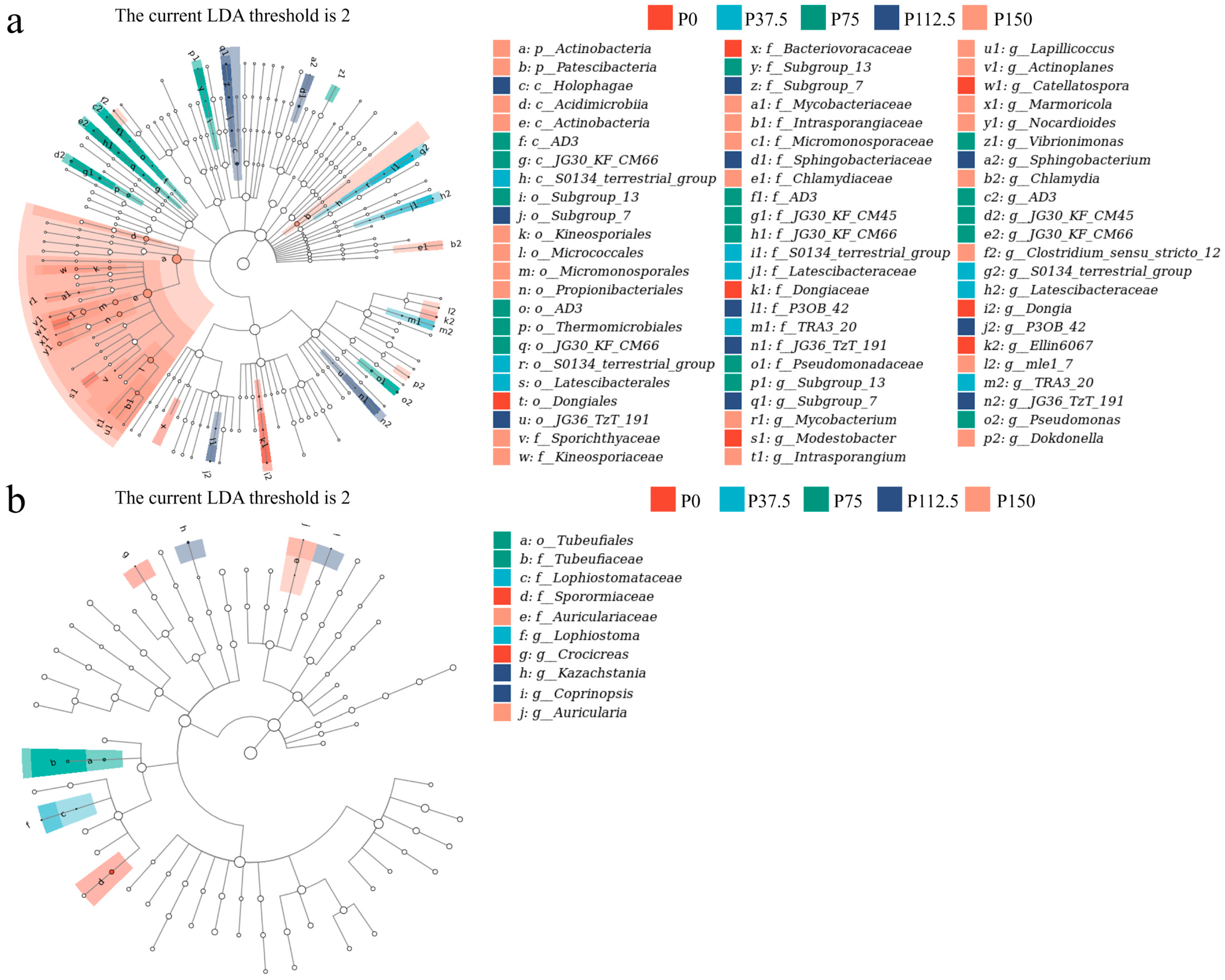
Assessing the responses of bacterial and fungal communities to phosphorus input levels (Figure 1) showed that the bacterial Shannon index exhibited a decreasing trend with increasing phosphorus fertilizer application rates, falling from 11.22 in the P37.5 treatment group to 10.98 in the P112.5 treatment group. In contrast, the fungal Shannon index plummeted by 22.0–24.1% after the P37.5 treatment and eventually stabilized at a lower level, indicating a lower phosphorus tolerance threshold. This greater sensitivity of fungi could be attributed to their more complex hyphal morphology and narrower niche breadth compared to bacteria, making their extensive mycelial networks more vulnerable to disruption from changes in soil chemistry, such as P-induced pH shifts. β-diversity analysis further revealed clear spatial segregation between low and high phosphorus treatments in the NMDS plots (Figure 1c,d), reflecting a dose-effect pattern in community structure. Regarding community composition (Figure S2), bacteria were predominantly represented by phyla such as Proteobacteria, while fungi were dominated by Ascomycota. LEfSe analysis identified a multitude of biomarker taxa driven by the phosphorus gradient (Figure 2a,b and Figure S4a,b): bacteria in the P150 treatment possessed the highest number of biomarker genera whereas each phosphorus gradient featured specific fungal indicator species. For instance, the genus Crocicreas was representative of P0, Kazachstania and Coprinopsis indicated P112.5, and the genus Auricularia emerged as a representative taxon for P150. In summary, the phosphorus input gradient not only reduced microbial diversity under high phosphorus conditions but also shaped distinct bacterial and fungal community structures by regulating key species composition, with fungal communities demonstrating greater sensitivity to changes in phosphorus concentration.

3.4. Effects of Phosphorus Application on Soil Microbial Network Complexity

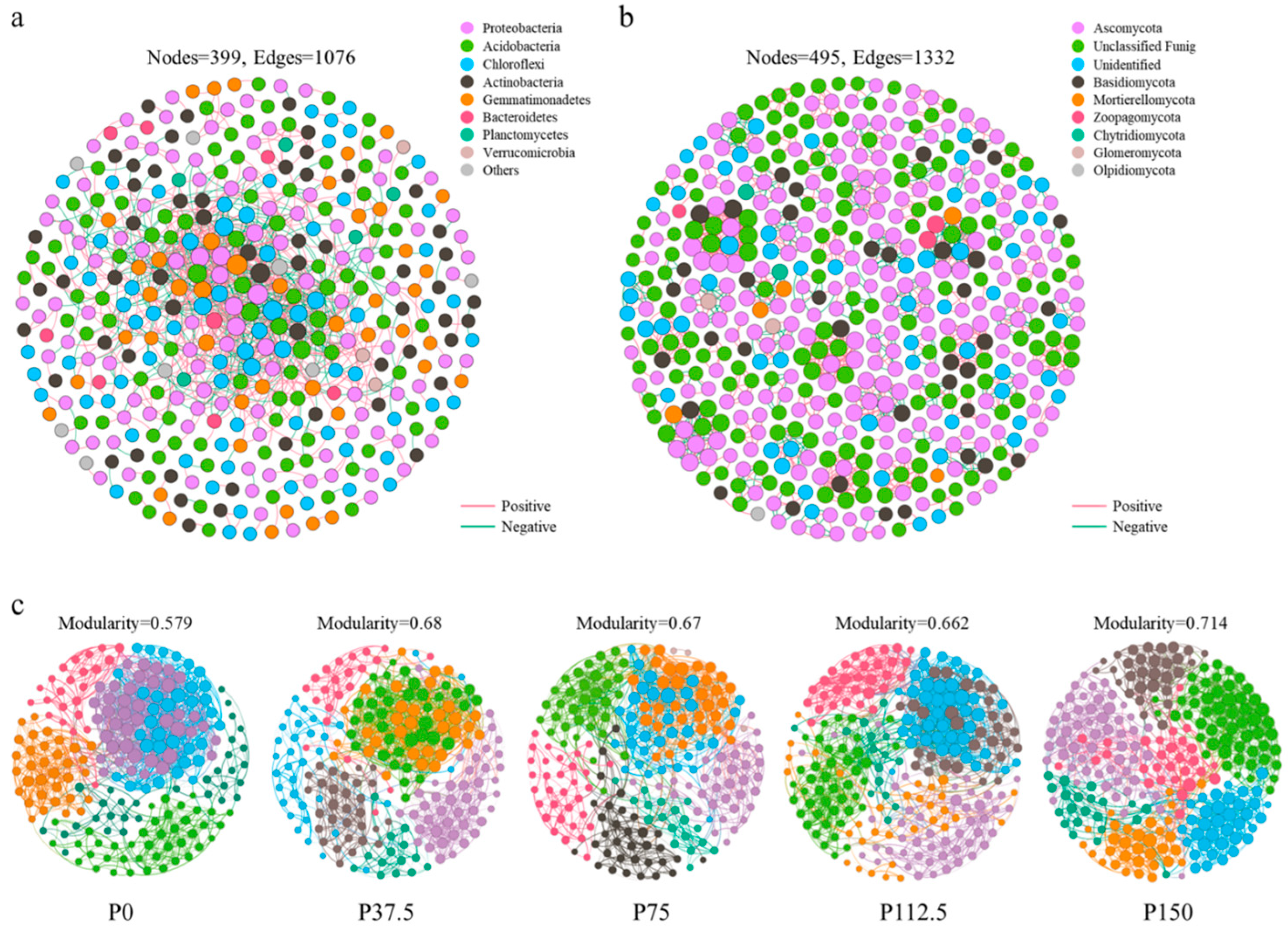
Soil microbial co-occurrence network analysis revealed that phosphorus fertilizer application reshaped microbial interaction patterns, with the P75 treatment demonstrating a distinct advantage in maintaining network stability (Figure 3, Table S4). Overall, the bacterial network (Figure 3a) consisted of 399 nodes and 1076 edges, exhibiting a relatively loose topological structure, whereas the fungal network (Figure 3b) was larger in scale, comprising 495 nodes and 1332 edges with a more tightly connected architecture. As the phosphorus application rate increased from P0 to P150, the network scale expanded continuously, with the number of nodes increasing from 204 to 258; however, network connectivity exhibited a nonlinear pattern, initially decreasing before rising. Specifically, the P75 treatment served as a pivotal turning point in this transition: the number of edges plummeted by 23% from a peak of 1735 under P0 to 1399 under P75, and the average degree decreased from 17.01 to 12.78, indicating connection streamlining and structural optimization at the P75 stage. Topological parameters further elucidated the transitional nature of the P75 treatment. The clustering coefficient decreased continuously from 0.51 at P0 to 0.44 at P75, with only a slight recovery under high phosphorus treatments. In contrast, the average path length peaked at 3.78 under P75 but shortened to 3.53 at P150, while the network diameter contracted from 8 to 6. In summary, phosphorus application induced a structural transformation of microbial networks from complex connectivity toward efficient compactness. Although the P75 treatment exhibited reduced connection density, it retained relatively high modularity and path length, thereby achieving an optimal balance between structural compactness and system stability, and demonstrating the highest network robustness. In the context of agricultural soil, such a topology—characterized by streamlined yet well-connected modules—is often associated with higher network robustness, as it may enhance the system’s ability to resist environmental perturbations and maintain functional stability, thereby supporting sustainable soil health.

3.5. Correlation Between Soil Chemical Properties and Microbial Communities

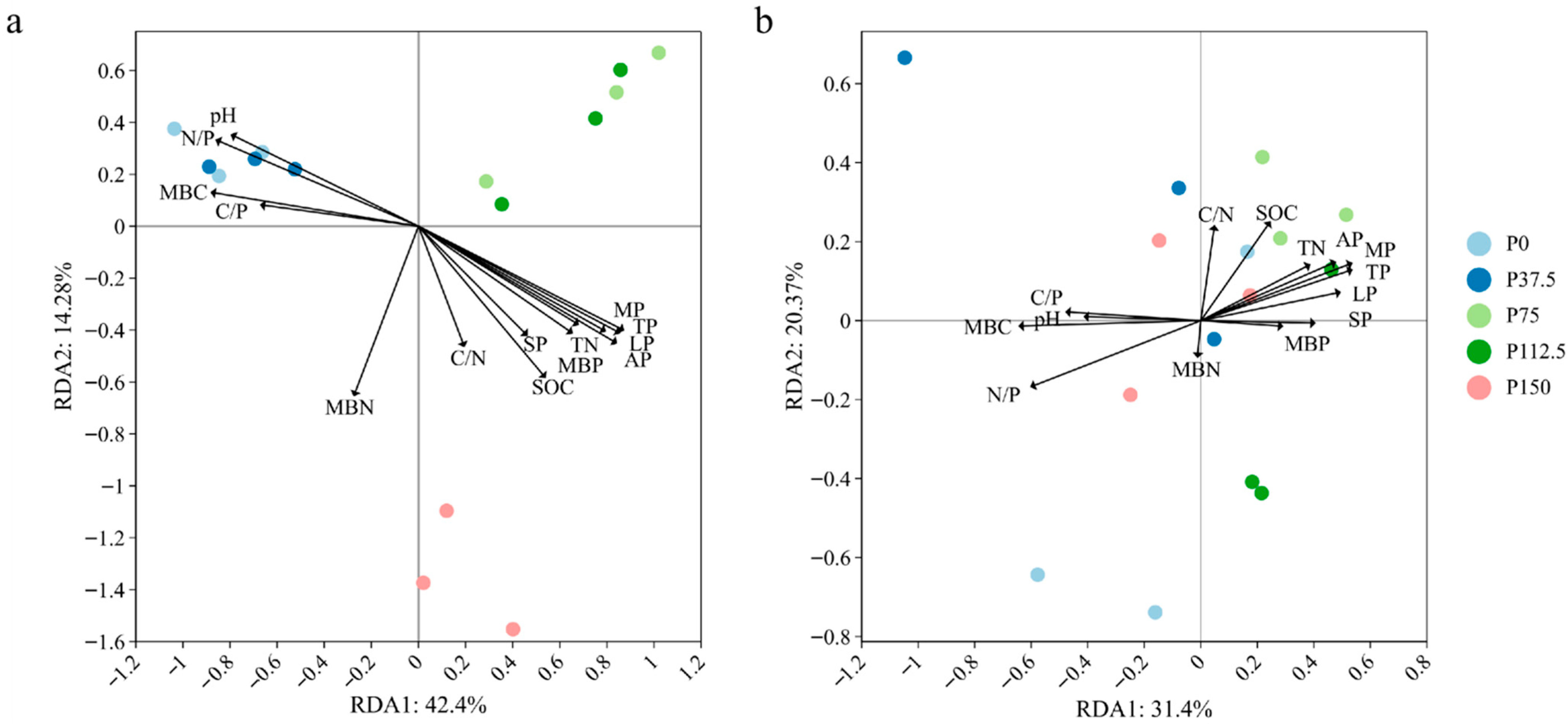
Redundancy analysis (RDA) revealed that the structures of soil bacterial and fungal communities were driven by distinct physicochemical factors, with phosphorus speciation identified as a key regulatory factor (Figure 4, Table S3). Overall, the bacterial community was primarily influenced by total phosphorus (TP), moderately labile phosphorus (MP), and the nitrogen-to-phosphorus ratio (N/P) (all p < 0.001), with MP exhibiting the strongest explanatory power. In contrast, the fungal community demonstrated higher sensitivity to total phosphorus, moderately labile phosphorus, and labile phosphorus (LP) (all p < 0.001). Soil pH, as a common influencing factor, had a stronger effect on fungi than on bacteria. Among the phosphorus components, available phosphorus (AP) and microbial biomass phosphorus (MBP) influenced both bacteria and fungi, whereas stable phosphorus fractions showed weaker effects. Furthermore, microbial biomass carbon (MBC) exerted strong selective pressure on both community types (bacteria R2 = 0.74, fungi R2 = 0.78), while the carbon-to-nitrogen ratio exhibited no significant influence. At the taxonomic level, the bacterial phylum Gemmatimonadetes and its subordinate genus, Subgroup_6, among others, showed significant correlations with multiple parameters including pH and TP (Figure S3a,c). Concurrently, the fungal phylum Ascomycota and genera such as Staphylotrichum were closely associated with several factors including pH and TP (Figure S3b,d), further corroborating the critical role of phosphorus speciation divergence in community assembly. In summary, compared to the total phosphorus content, the dynamic transformations of phosphorus species (e.g., MP and LP) provided greater explanatory power for the differential responses of microbial communities, with fungal communities exhibiting higher sensitivity to phosphorus spatial heterogeneity.

3.6. Regulatory Mechanisms of Phosphorus Application Rate on Maize Yield Formation, Root Architecture, and Phosphorus Utilization Efficiency

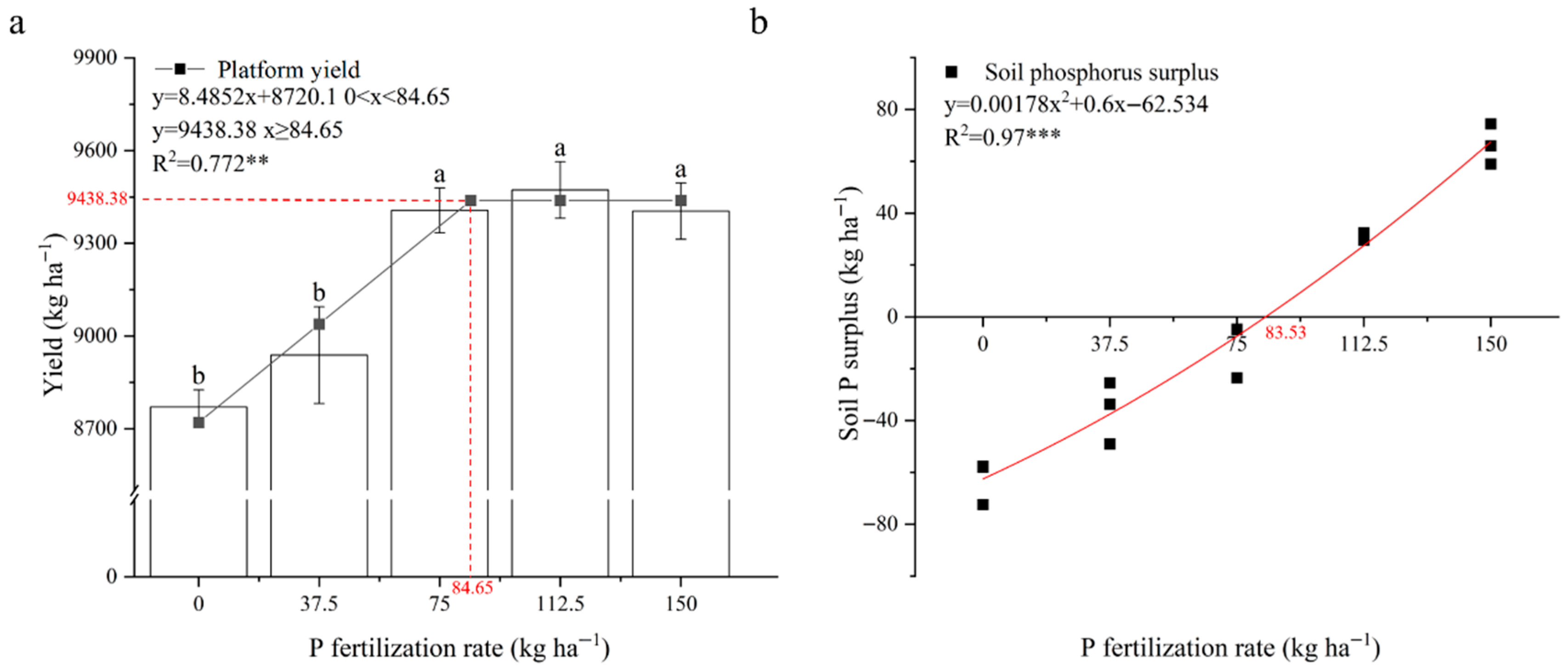
Evaluating the comprehensive effects of phosphorus fertilization on maize yield, root architecture, and phosphorus utilization efficiency revealed that phosphorus application significantly increased grain yield, with yields stabilizing within the range of 9404–9437 kg ha−1 from P75 to P150, representing a 7.3–7.6% increase compared to the no-phosphorus treatment (P0) (Figure 5). At the P75 application rate, yield components were not different from those at P150 (Table 3). In terms of root architecture, phosphorus application promoted a shift from fine roots to medium roots, optimizing root diameter structure. The P75 treatment achieved the peak root volume (1382 ± 145 cm3/m3), with the average root diameter increasing by 34.9% compared to P0, alongside a significant rise in the proportion of medium roots (0.5–1 mm) (Table S5). This architectural configuration maintained absorption functionality while enhancing the spatial expansion capacity of the root system within the soil, establishing a structural foundation for efficient nutrient utilization.
Regarding phosphorus utilization efficiency, the P75 treatment performed particularly prominently (Table S6). It achieved peak values for both phosphorus recovery efficiency (REP) and agronomic phosphorus efficiency (AEP) (37.78% and 8.49 kg·kg−1, respectively), with the soil phosphorus apparent surplus (−4.85 kg ha−1) closest to the phosphorus balance state. Regression analysis further indicated that the soil phosphorus surplus reached zero at an application rate of 83.53 kg ha−1; the threshold for maize grain yield was 84.65 kg ha−1, with a predicted yield of 9438.38 kg ha−1 at this threshold (Figure 5). Beyond this threshold, phosphorus began to accumulate in the soil, utilization efficiency decreased significantly, and environmental risks increased. In summary, although the P112.5 treatment showed advantages in some yield-related traits, the P75 treatment ensured high and stable yield while achieving optimized root architecture, maximized phosphorus utilization efficiency, and the best regulation of soil phosphorus balance, demonstrating superior comprehensive benefits. Controlling the phosphorus application rate within the range of 83.53–84.65 kg ha−1 can synergistically achieve the goals of high crop yield, high phosphorus efficiency, and ecological safety.

3.7. Mechanisms of Phosphorus Component Effects on Corn Yield and Phosphorus Utilization Efficiency

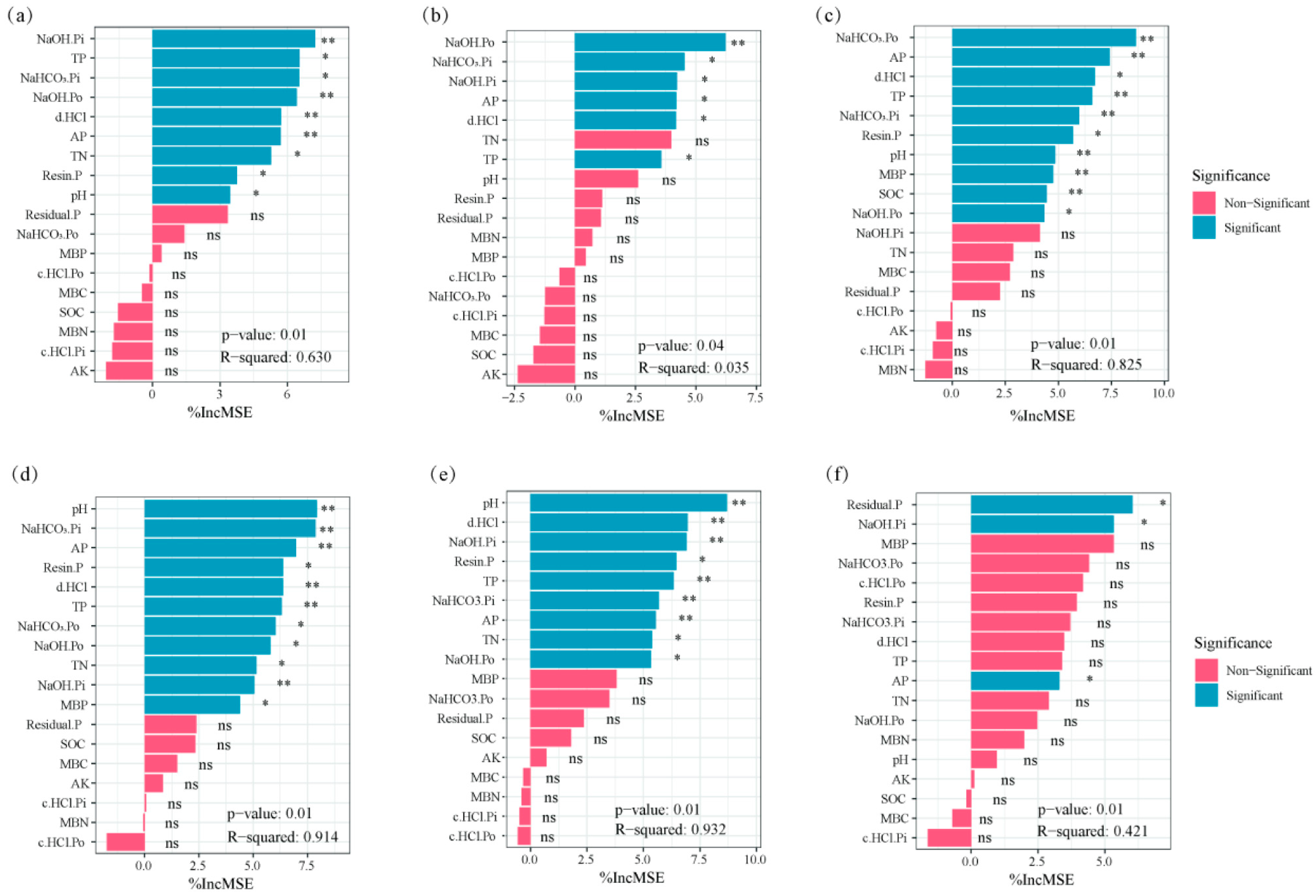
Assessing the key drivers and ecological pathways of the soil phosphorus cycle using Random Forest and Structural Equation Modeling (Figure 6) indicated significant differences in the predictive performance of various phosphorus-related indicators. The maize yield prediction model exhibited high explanatory power, primarily driven by factors such as NaOH-Pi, total phosphorus, and NaHCO3-Pi. Among the phosphorus fraction models, the labile phosphorus and moderately labile phosphorus models achieved the highest prediction accuracy, with key predictors including pH, NaOH-Pi, and Resin-P. In contrast, the stable phosphorus and phosphorus utilization efficiency models demonstrated relatively limited explanatory power.
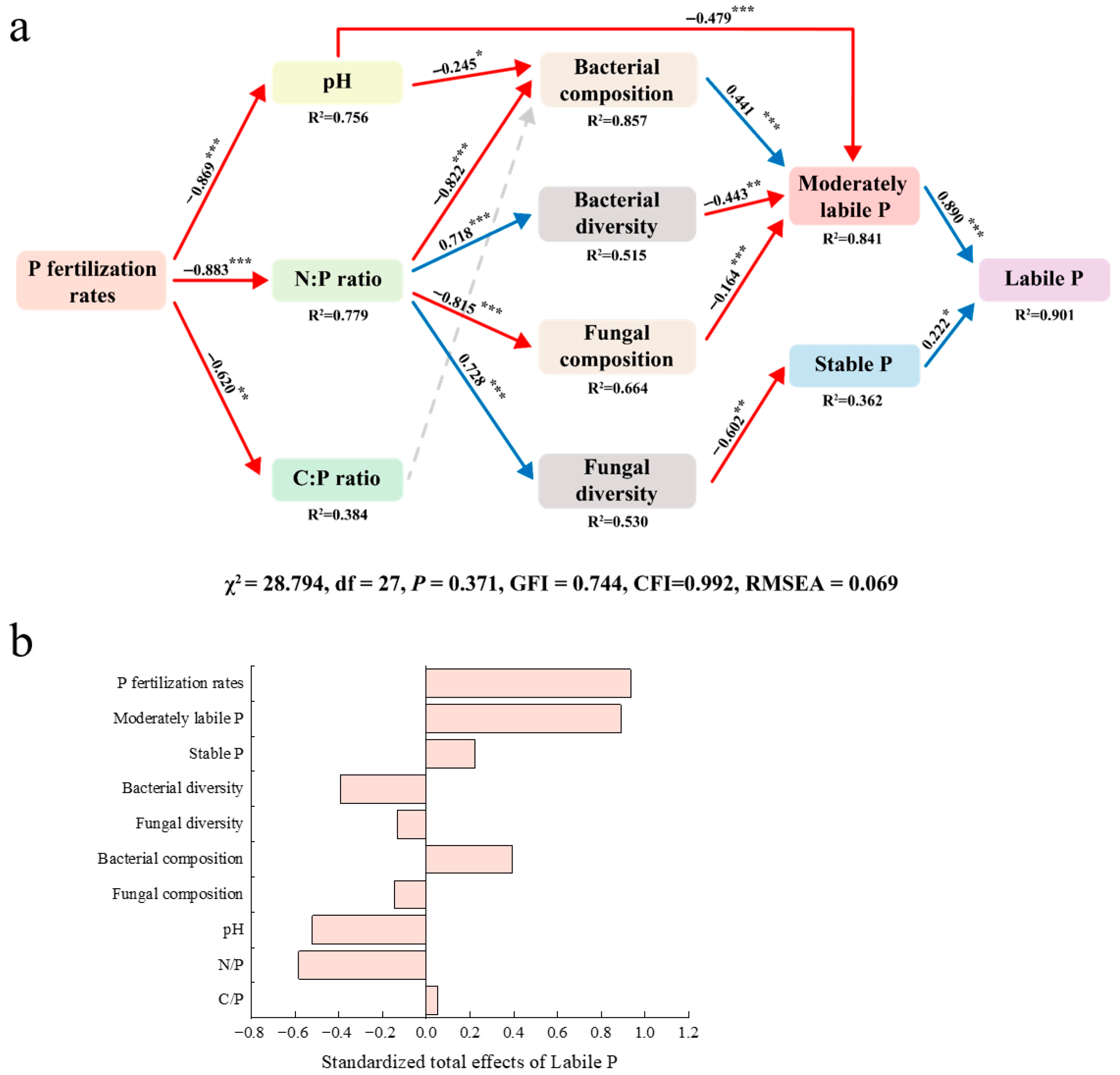
Ecological pathway analysis based on the Structural Equation Model indicated a multi-level regulatory network of the phosphorus cycle (Figure 7), with the model showing a good fit (GFI = 0.744, CFI = 0.992, RMSEA = 0.069). The analysis revealed that phosphorus input drives phosphorus speciation transformation through negative effects on soil pH (β = −0.869), the nitrogen-to-phosphorus ratio (β = −0.883), and the carbon-to-phosphorus ratio (β = −0.620). Soil pH not only indirectly affected phosphorus availability by affecting bacterial community composition (β = −0.245) but also directly suppressed the accumulation of moderately labile phosphorus (β = −0.479). Microbial analysis showed that bacterial diversity (β = −0.443) and fungal community composition jointly regulated the dynamics of moderately labile phosphorus, while fungal diversity primarily governed the formation of stable phosphorus (β = −0.602). Phosphorus fertilization promoted the accumulation of available phosphorus through both direct effects (total effect coefficient = 0.936) and indirect effects mediated by the transformation of moderately labile phosphorus (0.890). Among the environmental regulatory factors, the nitrogen-to-phosphorus ratio exerted the strongest negative effect on available phosphorus (total effect = −0.584), surpassing the effects of pH (−0.523) and bacterial diversity (−0.394). Notably, bacterial community composition showed a positive effect on available phosphorus (0.392), revealing the critical role of microbial functional regulation in phosphorus activation. In summary, soil phosphorus dynamics are co-regulated by multiple factors, where chemical parameters and microbial characteristics jointly influence phosphorus availability and fraction allocation through direct and indirect pathways, while phosphorus input predominantly governs the phosphorus cycling process by altering soil physicochemical properties and microbial activity.

4. Discussion

4.1. Regulatory Mechanisms of Phosphorus Fertilization on Chemical Properties and Phosphorus Speciation Transformation in Purple Soil

We elucidated the key processes through which phosphorus fertilizer application drives the transformation of phosphorus species by altering the soil chemical environment. Compared with the no-phosphorus treatment (P0), phosphorus application significantly increased the soil phosphorus pool capacity, but the effect patterns differed markedly. The response of soil pH to phosphorus addition exhibited a nonlinear characteristic: initial acidification due to hydrogen ion release during phosphorus fertilizer hydrolysis [54] was partially mitigated under high phosphorus conditions owing to the buffering effect of soil organic carbon [55]. More importantly, phosphorus fractionation data indicated that the application rate dominated the dynamic equilibrium among various phosphorus fractions in the soil. Labile inorganic phosphorus accumulated at the application rate of 150 kg ha−1 (P150), directly enhancing soil phosphorus availability [56]. However, when the application rate exceeded 75 kg ha−1, the increase in iron/aluminum-bound phosphorus slowed abruptly, suggesting the saturation of specific adsorption sites on iron/aluminum oxides in the soil [57]. In contrast, calcium-bound phosphorus showed a linear positive correlation with the application rate, highlighting that calcium ion-mediated chemical fixation is the primary pathway for phosphorus fixation in purple soils with pH > 6.0 [58].
From the perspective of phosphorus pool composition evolution, the proportion of moderately labile phosphorus (MP) increased while the proportion of stable phosphorus (SP) decreased with increasing phosphorus application, indicating that increased phosphorus application altered the soil phosphorus composition and promoted the conversion of potential phosphorus into available phosphorus [59]. When the application rate exceeded 75 kg ha−1, the proportion of recalcitrant phosphorus increased significantly, marking an intensified risk of phosphorus fixation. It is particularly noteworthy that the 112.5 kg ha−1 (P112.5) treatment maintained a relatively high labile phosphorus pool while exhibiting higher phosphorus utilization efficiency than the P150 treatment, suggesting that this application rate may represent a critical threshold for balancing phosphorus supply and fixation risk. These findings provide a theoretical basis for formulating fertilization strategies based on phosphorus fixation risk grading. For the purple soil region, it is recommended to control the phosphorus application rate within the range of 75–112.5 kg ha−1, supplemented by organic amendment (to enhance SOC buffering capacity) or soil acidification amelioration [60], to synergistically enhance phosphorus use efficiency and delay fixation [61].

4.2. Regulatory Mechanisms of Phosphorus Fertilization on Microbial Community Structure and Function in Purple Soil

Previous studies have established soil pH and nutrients as key drivers of microbial community reassembly [62,63]. Network analysis elucidates species co-occurrence patterns and identifies keystone taxa critical for community stability [64]. The complex networks formed by bacterial–fungal interactions drive biogeochemical cycling processes in soil [65]. Network analysis indicated that network connectivity exhibited a nonlinear pattern, initially decreasing then increasing with rising phosphorus application, with the P75 treatment representing a “tipping point” in this transition. Compared to P0, the P75 treatment showed reduced network edges and average degree, often interpreted as decreased network complexity. However, topological parameters (e.g., higher average path length and modularity) suggest the P75 network underwent “streamlining” and “optimization” rather than simple degradation. This structure reduces redundant connections, potentially enhancing module independence and system stability, thereby increasing resilience to disturbance. Although high phosphorus input expanded the microbial network scale, it reduced connection density, implying weakened specificity in microbial interspecific interactions and potential impairment of community stability [19,66,67].
pH was confirmed as a common but unevenly influential factor, exerting stronger effects on fungi than bacteria, explaining the greater sensitivity of fungal communities to phosphorus-induced acidification. Redundancy analysis identified dynamically changing phosphorus species (rather than total phosphorus content) as the core driver of microbial community divergence. Bacterial communities were primarily regulated by moderately labile phosphorus and soil N/P ratio, whereas fungal communities were more sensitive to labile phosphorus and pH changes. This differential response indicates that fertilization-induced stoichiometric imbalance is key to reshaping microbial community structure and function [68,69]. Structural equation modeling further quantified the direct and indirect effects of various factors. Phosphorus input drove systemic changes primarily by strongly reducing pH and the nitrogen-to-phosphorus ratio. Among these, the nitrogen-to-phosphorus ratio exerted the strongest negative effect on available phosphorus, highlighting the importance of nitrogen–phosphorus coupling in the soil phosphorus cycle [70,71]. Regarding microbial aspects, bacterial diversity negatively regulated moderately labile phosphorus, while fungal diversity primarily governed stable phosphorus formation, likely reflecting their distinct functional niches in the phosphorus cycle: bacteria tend to compete for and transform the labile phosphorus pool, whereas fungi influence the stable phosphorus pool through hyphal exploration and organic matter decomposition. Particularly noteworthy, bacterial community composition (not merely diversity) was associated with available phosphorus, suggesting that specific bacterial taxa (such as Gemmatimonadetes in this study) may play a potential role in phosphorus activation. This strong association provides a compelling hypothesis for future research to directly validate their functional contributions [72]. This identifies potential targets for developing microbe-based phosphorus fertilizer enhancers. In summary, the response of microbial communities in purple soil to phosphorus input exhibits a functional optimization threshold (75–112.5 kg ha−1). Within this range, soil phosphorus availability, microbial diversity, and network complexity are maintained at optimal levels, thereby ensuring ecosystem stability and function. This underscores that fertilizer management should prioritize maintaining a healthy soil microbial environment alongside nutrient supply.

4.3. Synergistic Regulatory Mechanisms of Phosphorus Application Rates on Maize Yield Formation and Phosphorus Use Efficiency

Ultimately, all soil processes converge on crop response. In our study, maize yield reached a plateau phase within the P75 to P150 application range. However, high yield is not the sole objective. When the phosphorus application rate exceeded P75, phosphorus utilization efficiency (REP, AEP) begun to decline, the soil phosphorus apparent surplus shifted from negative to positive, increasing environmental risks. Notably, phosphorus use efficiency in P0 surpassed fertilized treatments, attributed to phosphorus deficiency upregulating phosphorus transporter expression at transcriptional/post-transcriptional levels to enhance acquisition [73,74]. Regression analysis identified the phosphorus application threshold for achieving soil phosphorus balance and near-maximum yield to be between 83.53 and 84.65 kg ha−1. Integrating evidence from all aspects—where the P75 treatment excels in root architecture optimization (peak root volume, increased proportion of medium roots) [75], maximized phosphorus utilization efficiency, optimal microbial network robustness, and controllable phosphorus fixation risk—we strongly conclude that the P75 treatment (or approximately 84 kg ha−1) represents the optimal strategy for synergistically achieving high maize yield, high phosphorus efficiency, and soil ecological health. In contrast, while the P112.5 treatment showed advantages in some soil indicators, its associated potential fixation risk and higher input cost render its comprehensive benefits inferior to P75. The P150 treatment is considered unsustainable due to severe phosphorus fixation, reduced microbial diversity, and diminished network stability.
The identified optimal application rate (84 kg ha−1) for this region is higher than the range of 71.6–78.1 kg P2O5 ha−1 reported for dryland wheat systems on the calcareous soils of the Loess Plateau, reflecting the characteristically high phosphorus fixation capacity of purple soils [76]. This threshold provides a clear quantitative target for synergizing high crop productivity with environmental protection and calls for novel guidelines for maize growers in purple soil areas applying the customary 112.5 kg ha−1 phosphorus rate. Future strategies could integrate this optimized rate with agronomic practices like legume-maize rotations or phosphate-solubilizing microbial inoculants to further enhance P-use efficiency, exploit soil legacy P, and potentially maintain crop yields even below the identified application threshold [77]. Concurrently, we acknowledge several limitations of this study. The established phosphorus fertilizer application threshold is based on data from a specific year and a single maize crop. Its long-term stability and applicability across different climatic inter-annual variations require ongoing monitoring and validation. Furthermore, the sample size and single time-point sampling for microbial analysis limit the generalizability of our findings and preclude the assessment of temporal microbial dynamics. On this basis, the monitoring work was extended to multiple years and incorporated into different purple soil regions to assess the stability and scalability of the phosphorus thresholds determined under different climatic conditions and crop types.

5. Conclusions

Based on this study under the specific soil and climatic conditions investigated, we tentatively recommend optimizing the phosphorus fertilizer application rate to approximately 84 kg P2O5 ha−1 for the maize–purple soil system. This threshold appears to effectively balance agronomic benefits with ecological sustainability. At this application rate, the system achieves multi-dimensional synergistic optimization: it maintains high maize yield (≈9400 kg ha−1) while promoting optimized root architecture and maximizing phosphorus use efficiency; it drives the soil phosphorus pool towards a balanced state, significantly reducing phosphorus fixation risk and environmental phosphorus surplus; and it sustains relatively high microbial diversity, fostering a stable microbial network characterized by greater modularity and path length. The research reveals fundamental differences in the response mechanisms of bacterial and fungal communities to phosphorus input—their dynamics are driven by labile phosphorus fractions and soil acidification rather than total phosphorus content. The microbial threshold mechanism clarified in this study provides a new theoretical fulcrum and feasible technical approach for promoting the transformation of southwest purple soil agriculture from “high input” to “precise and efficient” sustainable development paradigm. Nevertheless, the broader applicability of this specific threshold warrants further validation across diverse soil types, climatic conditions, and cropping systems (e.g., different crop rotations) to confirm its robustness and generalizability.

Supplementary Materials

The following supporting information can be downloaded at: https://www.mdpi.com/article/10.3390/agronomy15122835/s1, Material S1: Detailed Root Sampling and Analysis Protocol; Material S2: Detailed Protocol for Hedley Sequential Phosphorus Fractionation; Table S1: Fertilisation regimes under varying phosphorus levels; Table S2: Soil chemical properties before sowing of spring maize in 2021; Table S3: The results of Monte Carlo permutation test in the RDA; Table S4: The topological parameters of co-occurrence networks; Table S5: Effect of different phosphorus application rates on the root system of maize at the silking stage; Table S6: Effect of different phosphorus application rates on phosphorus absorption and utilization in maize; Figure S1: Changes in P fractions in response to different P fertilization; Figure S2: Relative abundances of the ten most abundant phyla in the bacterial and fungal communities; Figure S3: Correlation heat map between the dominant bacterial and fungal phyla and soil properties and phosphorus fractions, and between the dominant bacterial and fungal genera and soil properties and phosphorus fractions in the phosphorus fertilization treatments; Figure S4: Differential taxa of bacteria and fungi at each taxonomic level under different phosphorus fertilization rates.

Author Contributions

Conceptualization, J.W. and D.Z.; Methodology, J.W. and Y.L. (Yongbo Li); Software, P.P. and Y.L. (Yongbo Li); Validation, X.C., X.K., Y.W. and X.T.; Formal analysis, Y.L. (Yuanyuan Liu); Data curation, J.W.; Writing—original draft preparation, J.W. and D.Z.; Writing—review and editing, K.X. and Y.C.; visualization, K.X., J.W. and D.Z.; Supervision, Y.C. and Y.G. All authors have read and agreed to the published version of the manuscript.

Funding

This work was supported by the Science and Technology Program of Sichuan Province [Grant number: 2025YFHZ0253]; the National Key Research and Development Program of China [Grant number: 2022YFD1901402].

Data Availability Statement

The raw data supporting the conclusions of this article will be made available by the authors on request.

Conflicts of Interest

The authors declare no conflicts of interest.

Abbreviations

The following abbreviations are used in this manuscript:
PPhosphorus
LPLabile phosphorus
MPModerately labile phosphorus
SPStable phosphorus
TNTotal nitrogen
SOCSoil organic carbon
TPTotal phosphorus
APAvailable phosphorus
MBNMicrobial biomass nitrogen
MBCMicrobial biomass carbon
MBPMicrobial biomass phosphorus

References

  1. Ducousso-Détrez, A.; Fontaine, J.; Sahraoui, A.L.; Hijri, M. Diversity of phosphate chemical forms in soils and their contribu-tions on soil microbial community structure changes. Microorganisms 2022, 10, 609. [Google Scholar] [CrossRef]
  2. Mahmood, M.; Tian, Y.; Ma, Q.; Ahmed, W.; Mehmood, S.; Hui, X.; Wang, Z. Changes in phosphorus fractions and its availability status in relation to long term P fertilization in loess plateau of China. Agronomy 2020, 10, 1818. [Google Scholar] [CrossRef]
  3. Demay, J.; Ringeval, B.; Pellerin, S.; Nesme, T. Half of global agricultural soil phosphorus fertility derived from anthropogenic sources. Nat. Geosci. 2023, 16, 69–74. [Google Scholar] [CrossRef]
  4. Alewell, C.; Ringeval, B.; Ballabio, C.; Robinson, D.A.; Panagos, P.; Borrelli, P. Global phosphorus shortage will be aggravated by soil erosion. Nat. Commun. 2020, 11, 4546. [Google Scholar] [CrossRef]
  5. Zou, T.; Zhang, X.; Davidson, E.A. Global trends of cropland phosphorus use and sustainability challenges. Nature 2022, 611, 81–87. [Google Scholar] [CrossRef] [PubMed]
  6. Li, Y.; Xu, Z.; Zhang, L.; Chen, W.; Feng, G. Dynamics between soil fixation of fertilizer phosphorus and biological phosphorus mobilization determine the phosphorus budgets in agroecosystems. Agric. Ecosyst. Environ. 2024, 375, 109174. [Google Scholar] [CrossRef]
  7. Song, X.; Alewell, C.; Borrelli, P.; Panagos, P.; Huang, Y.; Wang, Y.; Wu, H.; Yang, F.; Yang, S.; Sui, Y.; et al. Pervasive soil phosphorus losses in terrestrial ecosystems in China. Glob. Change Biol. 2024, 30, e17108. [Google Scholar] [CrossRef]
  8. Zhang, T.Q.; Zheng, Z.M.; Drury, C.F.; Hu, Q.C.; Tan, C.S. Legacy phosphorus after 45 years with consistent cropping systems and fertilization compared to native soils. Front. Earth Sci. 2020, 8, 183. [Google Scholar] [CrossRef]
  9. Liu, L.; Zheng, X.; Wei, X.; Kai, Z.; Xu, Y. Excessive application of chemical fertilizer and organophosphorus pesticides induced total phosphorus loss from planting causing surface water eutrophication. Sci. Rep. 2021, 11, 23015. [Google Scholar] [CrossRef]
  10. Xu, H.; Sun, J.; Zhao, Z.; Gao, Y.; Tian, L.; Wei, X. Long-term straw return promotes soil phosphorus cycling by enhancing soil microbial functional genes responsible for phosphorus mobilization in the rice rhizosphere. Agric. Ecosyst. Environ. 2025, 381, 109422. [Google Scholar] [CrossRef]
  11. Gong, H.; Yin, Y.; Chen, Z.; Zhang, Q.; Tian, X.; Wang, Z.; Wang, Y.; Cui, Z. A dynamic optimization of soil phosphorus status approach could reduce phosphorus fertilizer use by half in China. Nat. Commun. 2025, 16, 976. [Google Scholar] [CrossRef]
  12. Gong, H.; Xiang, Y.; Jin, M.; Chen, C. Global patterns and drivers of phosphorus fraction variability in cropland soils. Resour. Conserv. Recycl. 2025, 223, 108498. [Google Scholar] [CrossRef]
  13. Vandermoere, S.; Sande, T.V.D.; Tavernier, G.; Lauwers, L.; Goovaerts, E.; Sleutel, S.; Neve, S.D. Soil phosphorus (P) mining in agriculture—Impacts on P availability, crop yields and soil organic carbon stocks. Agric. Ecosyst. Environ. 2021, 322, 107660. [Google Scholar] [CrossRef]
  14. Peng, C.; Wang, S.; Zhu, Y.; Li, A.; Yu, G.; Mao, Q.; Zheng, M.; Huang, J.; Tan, X.; Mo, J.; et al. Adsorption/desorption processes dominate the soil P fractions dynamic under long-term N/P addition in a subtropical forest. Geoderma 2025, 457, 117284. [Google Scholar] [CrossRef]
  15. Chen, X.; Yan, X.; Wang, M.; Cai, Y.; Weng, X.; Su, D.; Guo, J.; Wang, W.; Hou, Y.; Ye, D.; et al. Long-term excessive phosphorus fertilization alters soil phosphorus fractions in the acidic soil of pomelo orchards. Soil Tillage Res. 2022, 215, 105214. [Google Scholar] [CrossRef]
  16. Chen, G.; Yuan, J.; Wang, S.; Liang, Y.; Wang, D.; Zhu, Y.; Wang, Y. Soil and microbial C:N:P stoichiometries play vital roles in regulating P transformation in agricultural ecosystems: A review. Pedosphere 2024, 34, 44–51. [Google Scholar] [CrossRef]
  17. Biassoni, M.M.; Vivas, H.; Gutiérrez-Boem, F.H.; Salvagiotti, F. Changes in soil phosphorus (P) fractions and P bioavailability after 10 years of continuous P fertilization. Soil Tillage Res. 2023, 232, 105777. [Google Scholar] [CrossRef]
  18. Yu, Q.; Hagedorn, F.; Penuelas, J.; Sardans, J.; Tan, X.; Yan, Z.; He, C.; Ni, X.; Feng, Y.; Zhu, J.; et al. Differential responses of soil phosphorus fractions to nitrogen and phosphorus fertilization: A global meta-analysis. Glob. Biogeochem. Cycles 2024, 38, e2023GB008064. [Google Scholar] [CrossRef]
  19. Han, X.F.; Gao, M.; Xie, D.T.; Wang, Z.F.; Chen, C. Inorganic phosphorus in a regosol (purple) soil under long-term phosphorus fertilization. Acta Prataculturae Sin. 2016, 25, 63–72. [Google Scholar] [CrossRef]
  20. Fu, D.; Xu, Z.; Wu, X.; Zhao, L.; Zhu, A.; Duan, C.; Chadwick, D.R.; Jones, D.L. Land use effects on soil phosphorus behavior characteristics in the eutrophic aquatic-terrestrial ecotone of Dianchi lake, China. Soil Tillage Res. 2021, 205, 104793. [Google Scholar] [CrossRef]
  21. Lang, M.; Zou, W.; Chen, X.; Zou, C.; Zhang, W.; Deng, Y.; Zhu, F.; Yu, P.; Chen, X. Soil microbial composition and phoD gene abundance are sensitive to phosphorus level in a long-term wheat-maize crop system. Front. Microbiol. 2021, 11, 605955. [Google Scholar] [CrossRef]
  22. Zhang, Z.; Luo, R.; Liu, Q.; Qiang, W.; Liang, J.; Hou, E.; Zhao, C.; Pang, X. Linking soil phosphorus fractions to abiotic factors and the microbial community during subalpine secondary succession: Implications for soil phosphorus availability. Catena 2023, 233, 107501. [Google Scholar] [CrossRef]
  23. Fan, K.; Delgado-Baquerizo, M.; Guo, X.; Wang, D.; Zhu, Y.; Chu, H. Biodiversity of key-stone phylotypes determines crop production in a 4-decade fertilization experiment. ISME J. 2021, 15, 550–561. [Google Scholar] [CrossRef]
  24. Lu, J.; Jia, P.; Feng, S.; Wang, Y.; Zheng, J.; Ou, S.; Wu, Z.; Liao, B.; Shu, W.; Liang, J.; et al. Remarkable effects of microbial factors onsoil phosphorus bio availability: A country-scale study. Glob. Change Biol. 2022, 28, 4459–4471. [Google Scholar] [CrossRef] [PubMed]
  25. Liu, L.; Gao, Z.; Yang, Y.; Gao, Y.; Mahmood, M.; Jiao, H.; Wang, Z.; Liu, J. Long-term high-P fertilizer input shifts soil P cycle genes and microorganism communities in dryland wheat production systems. Agric. Ecosyst. Environ. 2023, 342, 108226. [Google Scholar] [CrossRef]
  26. Shi, Y.; Lalande, R.; Ziadi, N.; Sheng, M.; Hu, Z. An assessment of the soil microbial status after 17 years of tillage and mineral P fertilization management. Appl. Soil Ecol. 2012, 62, 14–23. [Google Scholar] [CrossRef]
  27. Liu, S.; Li, H.; Xie, X.; Chen, Y.; Lang, M.; Chen, X. Long-term moderate fertilization increases the complexity of soil microbial community and promotes regulation of phosphorus cycling genes to improve the availability of phosphorus in acid soil. Appl. Soil Ecol. 2024, 194, 105178. [Google Scholar] [CrossRef]
  28. Zhou, N.; Han, X.; Hu, N.; Han, S.; Yuan, M.; Li, Z.; Wang, S.; Li, Y.; Li, H.; Rengel, Z.; et al. The crop mined phosphorus nutrition via modifying root traits and rhizosphere micro-food web to meet the increased growth demand under elevated CO2. iMeta 2024, 3, e245. [Google Scholar] [CrossRef] [PubMed]
  29. Zhou, T.; Xu, K.W.; Liu, W.G.; Zhang, C.C.; Chen, Y.X.; Yang, W.Y. More aboveground biomass, phosphorus accumulation and remobilization contributed to high productivity of intercropping wheat. Int. J. Plant Prod. 2017, 11, 407–424. [Google Scholar] [CrossRef]
  30. Zhong, S.; Han, Z.; Du, J.; Ci, E.; Ni, J.; Xie, D.; Wei, C. Relationships between the lithology of purple rocks and the pedogenesis of purple soils in the Sichuan Basin, China. Sci. Rep. 2019, 9, 13272. [Google Scholar] [CrossRef]
  31. Eckert, D.; Sims, J.T. Recommended soil pH and lime requirement test. In Recommended Soil Testing Procedures for the Northeastern United States; Smims, J.T., Wolf, A., Eds.; Northeastern Regional Publication: Boston, MA, USA, 1999; Volume 493, pp. 16–21. [Google Scholar]
  32. Nelson, D.W.; Sommers, L.E. Total carbon, organic carbon, and organic matter. In Methods Soil Analysis Part 3: Chemical Methods; ACSESS: London, UK, 1996; Volume 5, pp. 961–1010. [Google Scholar] [CrossRef]
  33. Sommers, L.E.; Nelson, D.W. Determination of total phosphorus in soils: A rapid perchloric acid digestion procedure. Soil Sci. Soc. Am. J. 1972, 36, 902–904. [Google Scholar] [CrossRef]
  34. Rodriguez, J.B.; Self, J.R.; Soltanpour, P.N. Optimal conditions for phosphorus analysis by the ascorbic acid-molybdenum blue method. Soil Sci. Soc. Am. J. 1994, 58, 866–870. [Google Scholar] [CrossRef]
  35. Bremner, J.M. Determination of nitrogen in soil by the Kjeldahl method. J. Agric. Sci. 1960, 55, 11–33. [Google Scholar] [CrossRef]
  36. Bao, S.D. Soil Agricultural Chemical Analysis, 3rd ed.; China Agricultural Press: Beijing, China, 2000. [Google Scholar]
  37. Lu, R.K. Analytic Methods for Soil Agricultural Chemistry; China Agriculture Science and Technology Press: Beijing, China, 2000. [Google Scholar]
  38. Tiessen, H.; Moir, J.O. Characterization of Available P by Sequential Extraction; Soil Sampling and Methods of Analysis 824; Lewis Publishers: Boca Raton, FL, USA, 1993; pp. 75–86. [Google Scholar]
  39. Murphy, J.; Riley, J.P. A modified single solution method for the determination of phosphate in natural waters. Anal. Chim. Acta 1962, 27, 31–36. [Google Scholar] [CrossRef]
  40. Claesson, M.J.; O’Sullivan, O.; Wang, Q.; Nikkilä, J.; Marchesi, J.R.; Smidt, H.; Vos, W.M.D.; Ross, R.P.; O’Toole, P.W. Comparative analysis of pyrosequencing and a phylogenetic microarray for exploring microbial community structures in the human distal intestine. PLoS ONE 2009, 4, e6669. [Google Scholar] [CrossRef] [PubMed]
  41. White, T.J.; Bruns, T.; Lee, S.; Taylor, J. Amplification and direct sequencing of fungal ribosomal RNA genes for phylogenetics. In PCR Protocols; Elsevier: Amsterdam, The Netherlands, 1990; pp. 315–322. [Google Scholar]
  42. Martin, M. Cutadapt removes adapter sequences from high-throughput sequencing reads. EMBnet J. 2011, 17, 10–12. [Google Scholar] [CrossRef]
  43. Callahan, B.J.; McMurdie, P.J.; Rosen, M.J.; Han, A.W.; Johnson, A.J.A.; Holmes, S.P. DADA2: High-resolution sample inference from Illumina amplicon data. Nat. Methods 2016, 13, 581–583. [Google Scholar] [CrossRef]
  44. Sun, H.; Wang, T.; Liu, S.; Tang, X.; Sun, J.; Liu, X.; Zhao, Y.; Shen, P.; Zhang, Y. Novel insights into the rhizosphere and seawater microbiome of Zostera marina in diverse mariculture zones. Microbiome 2024, 12, 27. [Google Scholar] [CrossRef]
  45. Benjamini, Y. Discovering the false discovery rate. J. R. Stat. Soc. Ser. B Stat. Methodol. 2010, 72, 405–416. [Google Scholar] [CrossRef]
  46. Bastian, M.; Heymann, S.; Jacomy, M. Gephi: An open source software for exploring and manipulating networks. In Proceedings of the International AAAI Conference on Web and Social Media, San Jose, CA, USA, 17–20 May 2009; Volume 3, pp. 361–362. [Google Scholar] [CrossRef]
  47. Dixon, P. VEGAN, a package of R functions for community ecology. J. Veg. Sci. 2003, 14, 927–930. [Google Scholar] [CrossRef]
  48. Martinez Arbizu, P. Pairwiseadonis: Pairwise Multilevel Comparison Using Adonis, R package version 0.4. 2020.
  49. Segata, N.; Izard, J.; Waldron, L.; Gevers, D.; Miropolsky, L.; Garrett, W.S.; Huttenhower, C. Metagenomic biomarker discovery and explanation. Genome Biol. 2011, 12, R60. [Google Scholar] [CrossRef]
  50. Ren, J.; Liu, X.; Yang, W.; Yang, X.; Li, W.; Xia, Q.; Li, J.; Gao, Z.; Yang, Z. Rhizosphere soil properties, microbial community, and enzyme activities: Short-term responses to partial substitution of chemical fertilizer with organic manure. J. Environ. Manag. 2021, 299, 113650. [Google Scholar] [CrossRef] [PubMed]
  51. Malaeb, Z.A.; Summers, J.K.; Pugesek, B.H. Using structural equation modeling to investigate relationships among ecological variables. Environ. Ecol. Stat. 2009, 7, 93–111. [Google Scholar] [CrossRef]
  52. Grace, J.B. Structural Equation Modeling and Natural Systems; Cambridge University Press: Cambridge, UK, 2006. [Google Scholar]
  53. Tabachenik, D.; Fidel, J. Structural equation modeling: Guidelines for determining model fit. J. Bus. Res. Methods 2012, 6, 1–55. [Google Scholar]
  54. Qin, W.; Feng, J.; Zhang, Q.; Yuan, X.; Ren, F.; Zhou, H.; Zhu, B. Different responses of priming effects in long-term nitrogen- and phosphorus-fertilized soils to exogenous carbon inputs. Plant Soil 2024, 500, 647–663. [Google Scholar] [CrossRef]
  55. Liu, S.; Cen, B.; Yu, Z.; Qiu, R.; Gao, T.; Long, X. The key role of biochar in amending acidic soil: Reducing soil acidity and improving soil acid buffering capacity. Biochar 2025, 7, 52. [Google Scholar] [CrossRef]
  56. Liao, D.; Zhang, C.; Li, H.; Lambers, H.; Zhang, F. Changes in soil phosphorus fractions following sole cropped and intercropped maize and faba bean grown on calcareous soil. Plant Soil 2020, 448, 587–601. [Google Scholar] [CrossRef]
  57. Wang, Y.; Zhang, W.; Müller, T.; Lakshmanan, P.; Liu, Y.; Liang, T.; Wang, L.; Yang, H.; Chen, X. Soil phosphorus availability and fractionation in response to different phosphorus sources in alkaline and acid soils: A short-term incubation study. Sci. Rep. 2023, 13, 5677. [Google Scholar] [CrossRef]
  58. Liu, J.; Zhou, J.; Sun, M.; Zhu, M.; Zhao, Y.; Xu, J.; Chen, T.; Shakouri, M.; Zheng, L.; Sui, P.; et al. Iron-Tuned Depth-Dependent P Transformation on Calcium Carbonate Coprecipitates: The Impact of Fe and P Loadings. Environ. Sci. Technol. 2025, 59, 15151–15158. [Google Scholar] [CrossRef] [PubMed]
  59. Khalili-Rad, R.; Hosseini, H.M. Assessing the effect of phosphorus fertilizer levels on soil phosphorus fractionation in rhizosphere and non-rhizosphere soils of wheat. Commun. Soil Sci. Plant Anal. 2017, 48, 1931–1942. [Google Scholar] [CrossRef]
  60. Liu, H.; Li, S.; Qiang, R.; Lu, E.; Li, C.; Zhang, J.; Gao, Q. Response of soil microbial community structure to phosphate fertilizer reduction and combinations of microbial fertilizer. Front. Environ. Sci. 2022, 10, 899727. [Google Scholar] [CrossRef]
  61. Pang, F.; Li, Q.; Solanki, M.K.; Wang, Z.; Xing, Y.; Dong, D. Soil phosphorus transformation and plant uptake driven by phosphate-solubilizing microorganisms. Front. Microbiol. 2024, 15, 1383813. [Google Scholar] [CrossRef]
  62. Philippot, L.; Chenu, C.; Kappler, A.; Rillig, M.C.; Fierer, N. The interplay between microbial communities and soil properties. Nat. Rev. Microbiol. 2024, 22, 226–239. [Google Scholar] [CrossRef] [PubMed]
  63. Ye, G.; Lin, Y.; Luo, J.; Di, H.J.; Lindsey, S.; Liu, D.; Fan, J.; Ding, W. Responses of soil fungal diversity and community composition to long-term fertilization: Field experiment in an acidic Ultisol and literature synthesis. Appl. Soil Ecol. 2020, 145, 103305. [Google Scholar] [CrossRef]
  64. Chen, W.; Wang, J.; Chen, X.; Meng, Z.; Xua, R.; Duoji, D.; Zhang, J.; He, J.; Wang, Z.; Chen, J.; et al. Soil microbial network complexity predicts ecosystem function along elevation gradients on the Tibetan Plateau. Soil Biol. Biochem. 2022, 172, 108766. [Google Scholar] [CrossRef]
  65. Zheng, H.; Yang, T.; Bao, Y.; He, P.; Yang, K.; Mei, X.; Wei, Z.; Xu, Y.; Shen, Q.; Banerjee, S. Network analysis and subsequent culturing reveal keystone taxa involved in microbial litter decomposition dynamics. Soil Biol. Biochem. 2021, 157, 108230. [Google Scholar] [CrossRef]
  66. Zhou, J.; Jiang, X.; Zhou, B.; Zhao, B.; Ma, M.; Guan, D.; Li, J.; Chen, S.; Cao, F.; Shen, D.; et al. Thirty four years of nitrogen fertilization decreases fungal diversity and alters fungal community composition in black soil in northeast China. Soil Biol. Biochem. 2016, 95, 135–143. [Google Scholar] [CrossRef]
  67. Hernandez, D.J.; David, A.S.; Menges, E.S.; Searcy, C.A.; Afkhami, M.E. Environmental stress destabilizes microbial networks. ISME J. 2021, 15, 1722–1734. [Google Scholar] [CrossRef]
  68. Wang, X.; Zhang, H.; Cao, D.; Wu, C.; Wang, X.; Wei, L.; Guo, B.; Wang, S.; Ding, J.; Chen, H.; et al. Microbial carbon and phosphorus metabolism regulated by C:N:P stoichiometry stimulates organic carbon accumulation in agricultural soils. Soil Tillage Res. 2024, 242, 106152. [Google Scholar] [CrossRef]
  69. Xu, H.; Qu, Q.; Li, G.; Liu, G.; Geissen, V.; Ritsema, C.J.; Xue, S. Impact of nitrogen addition on plant-soil-enzyme C–N–P stoichiometry and microbial nutrient limitation. Soil Biol. Biochem. 2022, 170, 108714. [Google Scholar] [CrossRef]
  70. Luo, L.; Ye, H.; Zhang, D.; Gu, J.; Deng, O. The dynamics of phosphorus fractions and the factors driving phosphorus cycle in Zoige Plateau peatland soil. Chemosphere 2021, 278, 130501. [Google Scholar] [CrossRef]
  71. Prabhu, N.; Borkar, S.; Garg, S. Phosphate solubilization by microorganisms: Overview, mechanisms, applications and advances. Adv. Biol. Sci. Res. 2019, 161–176. [Google Scholar] [CrossRef]
  72. Cao, Y.; Shen, Z.; Zhang, N.; Deng, X.; Thomashow, L.S.; Lidbury, L.; Liu, H.; Li, R.; Shen, Q.; Kowalchuk, G.A. Phosphorus availability influences disease-suppressive soil microbiome through plant-microbe interactions. Microbiome 2024, 12, 185. [Google Scholar] [CrossRef]
  73. Liu, K.; Wang, X.; Wang, J.; Wang, S.; Bai, H.; Dong, W.; Qiao, L.; Jin, Q.; Zhang, Z.; Luo, G.; et al. N6-methyladenosine modifications stabilize phosphate starvation response–related mRNAs in plant adaptation to nutrient-deficient stress. Nat. Commun. 2025, 16, 4093. [Google Scholar] [CrossRef]
  74. Gu, M.; Chen, A.; Sun, S.; Xu, G. Complex regulation of plant phosphate transporters and the gap between molecular mechanisms and practical application: What is missing? Mol. Plant 2016, 9, 396–416. [Google Scholar] [CrossRef]
  75. Wang, L.; Rengel, Z.; Cheng, L.; Shen, J. Coupling phosphate type and placement promotes maize growth and phosphorus uptake by altering root properties and rhizosphere processes. Field Crop Res. 2024, 306, 109225. [Google Scholar] [CrossRef]
  76. Liu, L.; Gao, Z.; Liu, W.; Li, H.; Wang, Z.; Liu, J. Phosphorus fertilizer input threshold shifts bacterial community structure and soil multifunctionality to maintain dryland wheat production. Soil Till. Res. 2024, 243, 106174. [Google Scholar] [CrossRef]
  77. Wang, L.; Gao, Y.; Cheng, B.; Yang, Y.; Yang, H.; Xu, M.; Wu, Y.; Liu, W.; Wang, X.; Yang, F.; et al. Optimized phosphorus partitioning enhances phosphorus use efficiency in strip-intercropped soybean. Eur. J. Agron. 2026, 172, 127854. [Google Scholar] [CrossRef]
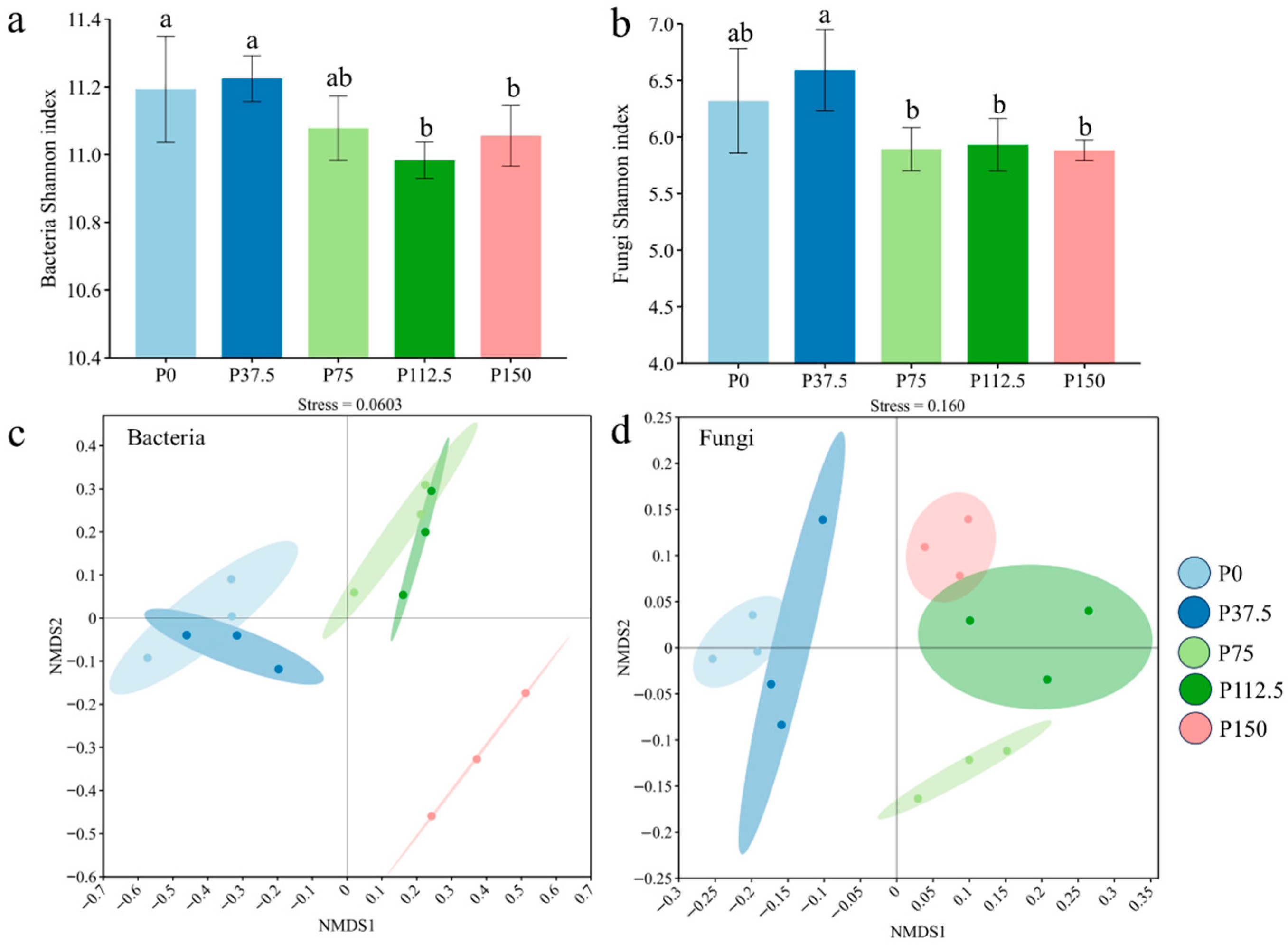
Figure 1. Soil bacterial Shannon index (a) and fungal Shannon index (b) under different phosphorus fertilization treatments. NMDS analysis of soil bacterial (c) and fungal (d) communities in the phosphorus fertilization treatments. The numbers in the treatment names indicate the P fertilization rate (kg ha−1). Different lowercase letters above columns indicate statistically significant differences between treatments (p < 0.05).
Agronomy 15 02835 g001
Figure 2. The cladogram of soil bacteria (a) and fungal (b) communities from LEfSe analysis under different phosphorus fertilization rates. The numbers in the treatment names indicate the P fertilization rate (kg ha−1). The colored dots from inner to outer in the cladogram represent phylum, class, order, family, and genus levels, and the colored shadows indicate the trends of significantly different taxa.
Agronomy 15 02835 g002
Figure 3. Co-occurrence networks of the bacterial community (a), fungal community (b) and modular network (c) based on pairwise Spearman’s correlations between ASVs. Each shown connection has a correlation coefficient > |0.7| and a p value < 0.01. The size of each node is proportional to the number of connections. The bacterial and fungal network of samples with ASVs colored by phylum taxonomy. Different colors indicate different modules in the modular network.
Agronomy 15 02835 g003
Figure 4. The relationships between the soil bacterial (a) and fungal (b) communities and the soil properties in the phosphorus fertilization treatments. The numbers in the treatment names indicate the P fertilization rate (kg ha−1).
Agronomy 15 02835 g004
Figure 5. Segmented regression was used to confirm the substantial effect of phosphorus fertilizer input rates on corn grain yield (a), and quadratic regression was used to show the effect of different phosphorus application rates on soil phosphorus surplus (b). The numbers in the treatment names indicate the P fertilization rate (kg ha−1). Different letters above columns indicate statistically significant differences (p < 0.05). ** p < 0.01; *** p < 0.001 indicates the significance of the regression model.
Agronomy 15 02835 g005
Figure 6. Random forest modeling reveals key predictors of different phosphorus-related indicators and their predictive efficacy. Corn yield model (a), phosphorus use efficiency model (b), phosphorus apparent surplus model (c), active phosphorus model (d), moderately active phosphorus model (e), and stability model (f). *, p < 0.05; **, p < 0.01; ns, no significant effect.
Agronomy 15 02835 g006
Figure 7. PLS-PM on the relationships between the phosphorus fertilization treatments, soil properties, bacterial and fungal communities and phosphorus fractions (a), and the standardized total effects of LP (b). LP, labile phosphorus; MP, moderately labile phosphorus; SP, stable phosphorus. The red and blue solid lines indicate significate paths, indicating the negative and positive relationships between the indicators, respectively. The gray dashed lines indicate non-significant paths. The numbers above the arrow are the standardized path coefficients. The percentage above each indicator represents the R2 value, which is the variance explained ratio of each variable. *, p < 0.05; **, p < 0.01; ***, p < 0.001; ns, no significant effect.
Agronomy 15 02835 g007
Table 1. Soil chemical properties in the phosphorus fertilization treatments.
TreatmentspHSOCAPTNTPAKMBCMBNMBP
(g kg−1)(mg kg−1)(g kg−1)(g kg−1)(mg kg−1)(mg kg−1)(mg kg−1)(mg kg−1)
P06.53 ± 0.03 a16.30 ± 2.14 b11.91 ± 0.61 d0.98 ± 0.02 b0.63 ± 0.01 d119.4 ± 4.96 a114.59 ± 4.97 ab17.61 ± 0.74 ab6.37 ± 1.41 b
P37.56.47 ± 0.03 a17.09 ± 1.27 b25.20 ± 1.86 c1.09 ± 0.01 b0.86 ± 0.08 c114.4 ± 12.33 a126.38 ± 2.19 ab17.03 ± 0.87 ab10.78 ± 2.63 b
P756.30 ± 0.00 b19.01 ± 1.33 b48.24 ± 2.32 b1.19 ± 0.02 ab1.20 ± 0.02 b114.5 ± 7.52 a127.04 ± 4.65 a15.86 ± 1.35 b14.46 ± 1.76 b
P112.56.17 ± 0.03 c21.10 ± 1.31 ab57.31 ± 0.26 a1.25 ± 0.04 a1.33 ± 0.01 a135.9 ± 10.10 a138.42 ± 16.58 a16.74 ± 0.80 ab27.12 ± 3.84 a
P1506.20 ± 0.06 bc24.59 ± 0.67 a62.11 ± 2.11 a1.28 ± 0.07 a1.37 ± 0.02 a124.4 ± 2.93 a135.96 ± 6.10 a19.48 ± 0.73 a25.79 ± 7.27 a
C/NN/PC/PMBC/MBNMBN/MBPMBC/MBP
P016.72 ± 2.24 a1.55 ± 0.04 a25.78 ± 3.06 a6.55 ± 0.52 a3.02 ± 0.58 a19.45 ± 3.54 a
P37.515.65 ± 1.28 a1.29 ± 0.11 b20.43 ± 3.26 ab7.45 ± 0.24 a1.75 ± 0.38 b13.18 ± 3.10 ab
P7515.98 ± 1.35 a0.99 ± 0.03 c15.79 ± 0.82 b8.15 ± 0.90 a1.15 ± 0.22 b9.04 ± 1.12 b
P112.516.82 ± 0.47 a0.94 ± 0.03 c15.84 ± 0.99 b8.24 ± 0.78 a0.66 ± 0.14 b5.51 ± 1.49 b
P15019.35 ± 0.91 a0.93 ± 0.06 c17.98 ± 0.77 b7.02 ± 0.57 a0.97 ± 0.39 b6.40 ± 2.03 b
The numbers in the treatment names indicate the P fertilization rate (kg ha−1). Data are means ± standard error of means. Different lowercase letters in a column indicate statistically significant difference between treatments (p < 0.05). SOC, soil organic carbon; TP, total phosphorus; AP, available phosphorus; AK, available potassium; TN, total nitrogen; MBC, Microbial biomass C; MBN, Microbial biomass N; MBP, Microbial biomass P. C/N, SOC/TN ratio; C/P, SOC/TP ratio; N/P, TN/TP ratio.
Table 2. Contents and proportions of P fractions in the P fertilization treatments.
TreatmentsLabile PModerately Labile PStable P
ContentProportionContentProportionContentProportion
(mg kg−1)(%)(mg kg−1)(%)(mg kg−1)(%)
P096.32 ± 8.68 d15 a318.9 ± 9.34 d50 c215.1 ± 4.30 b34 a
P37.5127.3 ± 14.69 c14 a493.4 ± 53.88 c57 b238.8 ± 22.97 ab27 b
P75180.1 ± 3.21 b14 a780.5 ± 17.90 b64 a241.4 ± 3.44 ab20 c
P112.5227.8 ± 1.56 a17 a853.7 ± 3.66 ab64 a250.6 ± 9.02 ab18 c
P150223.2 ± 3.80 a16 a884.9 ± 22.39 a64 a261.2 ± 6.59 a19 c
The numbers in the treatment names indicate the P fertilization rate (kg ha−1). Data are means ± standard deviations. Different lowercase letters in a column indicate statistically significant differences between treatments (p < 0.05). The percentages of phosphorus fractions were inverse sine transformation prior to the test.
Table 3. Effect of different phosphorus application rates on yield components.
TreatmentsEar Length (cm)Ear Diameter (mm)Bare Tip Length (cm)Row Number per SpikeKernels per Row1000-Grain Weight (g)
P015.69 ± 0.40 a47.79 ± 0.23 a15.49 ± 1.04 a14.37 ± 0.07 ab33.97 ± 2.12 a235.7 ± 4.1 b
P37.516.23 ± 0.35 a48.43 ± 0.46 a14.08 ± 0.78 ab14.50 ± 0.15 a35.32 ± 0.79 a234.6 ± 4.9 b
P7515.94 ± 0.54 a48.32 ± 0.35 a12.96 ± 0.86 ab14.13 ± 0.09 ab34.80 ± 1.71 a256.4 ± 7.2 a
P112.516.32 ± 0.36 a47.51 ± 0.85 a12.33 ± 0.84 b13.97 ± 0.20 b35.57 ± 0.69 a256.7 ± 2.4 a
P15015.84 ± 0.40 a48.65 ± 0.12 a12.89 ± 0.69 ab14.03 ± 0.15 b34.76 ± 1.52 a261.5 ± 7.3 a
The numbers in the treatment names indicate the P fertilization rate (kg ha−1). Data are means ± standard error of means. Different lowercase letters in a column indicate statistically significant difference between treatments (p < 0.05).
Disclaimer/Publisher’s Note: The statements, opinions and data contained in all publications are solely those of the individual author(s) and contributor(s) and not of MDPI and/or the editor(s). MDPI and/or the editor(s) disclaim responsibility for any injury to people or property resulting from any ideas, methods, instructions or products referred to in the content.