Article

Reconstructing Millennial-Scale Spatiotemporal Dynamics of Japan’s Cropland Cover
1
Key Laboratory of Land Surface Pattern and Simulation, Institute of Geographic Sciences and Natural Resources Research, Chinese Academy of Sciences, Beijing 100101, China
2
College of Resources and Environment, Shanxi University of Finance and Economics, Taiyuan 030006, China
3
School of Public Administration, China University of Geosciences, Wuhan 430074, China
4
Key Research Institute of Yellow River Civilization and Sustainable Development, Henan University, Kaifeng 475001, China
*
Authors to whom correspondence should be addressed.
Agronomy 2025, 15(12), 2834; https://doi.org/10.3390/agronomy15122834
Submission received: 18 November 2025 / Revised: 7 December 2025 / Accepted: 8 December 2025 / Published: 10 December 2025
(This article belongs to the Special Issue Landscape-Scale Modeling of Agricultural Land Use)

Abstract

Historical cropland cover change reconstruction is essential for understanding long-term agricultural reclamation dynamics, particularly for modeling carbon and nitrogen cycles and assessing their climatic impacts. Such reconstructions also provide critical regional benchmarks for improving global land-use datasets. In this study, we integrated historical documents and land survey records spanning the Heian period (794–1185 CE) to the present with modern remote sensing data to develop a spatially explicit methodology for reconstructing Japan’s cropland extent over the past millennium. Our analysis revealed four distinct phases of cropland area change, (1) slow expansion (800–1338 CE), (2) gradual decline (1338–1598 CE), (3) rapid growth (1598–1940 CE), and (4) sharp contraction (1940–2000 CE), with significant regional variations. Spatially, cropland progressively expanded from the core Kansai and Kantō regions toward the southwestern and northeastern frontiers. Cropland cover changes in Japan over the past millennium were driven by a combination of socio-political factors—such as technological innovations in agriculture, feudal conflicts, demographic shifts, agricultural industrialization, and urbanization—as well as natural conditions, including topography, climate, and soil texture. Validation against year-2000 remote sensing data demonstrated high accuracy, with 69.12% of grid cells showing ≤20% absolute difference and only 0.15% exceeding ±80% deviation.

1. Introduction

Human land-use activities, primarily aimed at meeting agricultural and developmental demands, have profoundly transformed terrestrial land cover [1,2,3,4]. These modifications directly influence biodiversity and alter key surface physical processes—including albedo, radiative forcing, evapotranspiration, and soil erosion—which in turn perturb global biogeochemical cycles of carbon, nitrogen, and water [5,6,7,8]. Moreover, the emission of greenhouse gases by the agricultural ecosystem accounts for approximately 50% and 60% of the total global CH4 and N2O anthropogenic emissions, respectively [8]. Such changes exert significant impacts on climate and environmental dynamics at both regional and global scales. To better characterize the spatiotemporal evolution of anthropogenic land use and its environmental consequences, the scientific community has increasingly emphasized the “timing, magnitude, and spatial explicitness” of historical land-use and land-cover change (LUCC) reconstructions [9,10,11,12,13,14]. In particular, periods around 1000 CE, 1500 CE, and 1850 CE—key historical thresholds associated with major shifts in agricultural land use—have become critical benchmarks for reconstructing long-term cropland dynamics.
Since the 1970s, international research programs such as the Land-Use and Land-Cover Change (LUCC) project have significantly advanced the reconstruction of historical cropland dynamics, which is critical for understanding long-term climate and ecosystem impacts of land use [4]. Three global datasets—SAGE (1700–2007 CE) [9], HYDE (10,000 BCE–2015 CE) [12], and PJ (800–1992 CE) [10]—now form the cornerstone of such efforts. These reconstructions typically employ a standardized approach: post-1960 cropland data are sourced from FAO statistics, while pre-1960 estimates rely on historical records or extrapolations that often assume constant per capita cropland area using population as a proxy [10,12]. Spatial allocation models, largely based on land-use paradigms from Europe and North America, then distribute these totals uniformly across grid cells. These global datasets have been widely used to model environmental impacts, including biogeochemical cycles (e.g., carbon and nitrogen) and climate interactions [15,16,17,18,19]. However, as their developers acknowledge, these products contain substantial uncertainties in data sources, assumptions, and methodologies, limiting their reliability for regional agro-ecological studies [9,12]. Key issues include the extrapolation from sparse historical data, which may obscure region-specific cropping patterns driven by divergent agricultural traditions and environmental conditions; the assumption of constant per capita cropland, which can systematically bias area estimates and subsequent assessments of ecosystem functions; and uniform allocation rules that overlook local variability in soil quality, topography, and climate, thereby misrepresenting agricultural suitability. Regional validations in Europe [20,21,22] and China [23,24,25,26] have already revealed significant discrepancies, highlighting the need for regionally tailored reconstructions to accurately assess the long-term ecological impacts of agricultural land use.
To advance regional climate change and ecosystem modeling, researchers worldwide have employed diverse local data sources—including natural proxies, archeological records, historical documents, survey statistics, ancient maps, aerial photographs, and remote sensing imagery—to reconstruct land-use changes across multiple spatiotemporal scales. These regional reconstructions offer significant improvements over global datasets by (1) substantially expanding data availability through localized archives, and (2) developing context-specific methodologies such as historical document calibration, ancient map georeferencing, and proxy-based conversions (e.g., using tax records, population data, and grain yield statistics as agricultural indicators). Such approaches have enabled the development of century-to-millennial scale land-use datasets for various geographic contexts, including continental (e.g., Europe) [27,28], regional (e.g., Central/Southeast Asia) [29,30], national (e.g., China, United States, Brazil, India, Germany) [31,32,33,34,35], and sub-national areas. Particularly noteworthy are the cropland and land-use reconstructions for historical China [36,37] and India [38] that have been incorporated into HYDE 3.2 [12]. These cases demonstrate how regional studies not only provide critical inputs for local agro-ecological and climate modeling but also serve as essential references for improving the accuracy and spatial resolution of global land-use datasets.
Japan, as a major traditional agricultural region in East Asia, possesses both a long history of cultivated landscapes and rich historical documentation. Over the past millennium, the country has experienced rapid population growth, significant advances in land reclamation and irrigation, and substantial land-use and land-cover changes—making it an ideal region for quantitative reconstructions of historical cropland [12]. However, existing land-use studies in Japan remain limited in temporal scope, focusing largely on the past century, for which survey statistics and remote sensing data are abundant, or on localized sub-regions [39,40]. This narrow focus hinders a holistic understanding of long-term land-use dynamics and their implications for climate and ecosystem modeling. To address this gap, this study integrates historical documents, modern survey statistics, and remote sensing data to reconstruct millennium-scale spatiotemporal changes in Japan’s cropland cover. The resulting high-resolution gridded dataset will be used to analyze the spatiotemporal evolution of cropland cover, providing reliable inputs for regional climate and ecosystem impact simulations. Furthermore, it offers a validated regional benchmark that can help improve the accuracy and applicability of global land-use reconstructions.

2. Materials and Methods

2.1. Study Area

Japan is situated in East Asia, extending from approximately 31° N to 46° N latitude, and consists of four main islands—Hokkaido, Honshu, Shikoku, and Kyushu—along with over 3900 smaller islands. The total land area is about 377,900 km2, of which the four principal islands account for roughly 98%. Topographically, the country is predominantly mountainous, with a central range of mountains and hills running along its length, dividing the archipelago into Pacific-facing and Japan Sea-facing regions. These upland areas occupy approximately 75% of the land surface, while plains and lowlands—mostly alluvial in origin—are limited in extent and distributed mainly along the fringes of highland zones (Figure 1a). Precipitation is generally abundant, ranging from 800 mm to 2500 mm annually. The highest amounts (1500–2000 mm, locally exceeding 3000 mm) occur along the Japan Sea coast and southern coastal areas, whereas the Seto Inland Sea region and north-central Hokkaido receive comparatively less rainfall, typically between 700 mm and 900 mm. Moisture is distributed relatively evenly throughout the year across most of the country. These favorable climatic conditions have supported agricultural activity since the Jōmon period (ca. 12,000–300 BCE). By the Yayoi period (ca. 300 BCE–250 CE), wet-rice cultivation had become established as the foundation of Japan’s agrarian economy, shaping subsequent land-use patterns and enabling the long-term agricultural development that forms the basis of this study’s reconstruction.
Over the past millennium, Japan has transitioned through a series of distinct historical periods, including the Heian (794–1185 CE), Kamakura (1185–1333 CE), Muromachi (1334–1572 CE), Sengoku (1573–1602 CE), Tokugawa (1603–1868 CE), Meiji (1868–1912 CE), Taishō (1912–1926 CE), Shōwa (1926–1989 CE), and Heisei (1989–2019 CE) eras. The territorial extent of Japan evolved across these periods. By the second year of Enkyū (1070 CE), the country consisted of Honshu, Shikoku, and Kyushu, while Ezo (present-day Hokkaido) remained outside its administered territory. In the 13th year of Genroku (1700 CE), Ezo came under the direct control of the Tokugawa shogunate. Following the Meiji Restoration, the Meiji government formally incorporated Ezo as Hokkaido in 1869 CE. Settlement and agricultural development in Hokkaido only began in the late Edo period with migration from the main islands; prior to that, the region was inhabited mainly by the Ainu people, who subsisted on fishing and hunting.
Since the Nara period (710–784 CE), Japan adopted the Goki-Shichidō (Five Provinces and Seven Circuits) system, modeled after the Chinese Tang dynasty’s administrative structure. This system comprised 68 provinces (kuni) under the ki (capital regions) and dō (circuits). In 1871, the Meiji government abolished the feudal domain system and established a modern prefectural system, initially organizing the country into 3 urban prefectures (fu) and 72 prefectures (ken). By 1890, this was consolidated into 3 fu and 48 ken. With the exception of the conversion of Tokyo fuinto Tokyo Metropolis and the official incorporation of Hokkaidō, the administrative layout has remained largely stable since. In this study, we harmonize historical and contemporary administrative boundaries to define eight regional units for the reconstruction of Japan’s cropland area change: Hokkaidō, Tōhoku, Chūbu, Kantō, Kinki, Chūgoku, Shikoku, and Kyūshū (Figure 1b).

2.2. Data Sources and Methods

2.2.1. Data Sources

Cropland Area Data
The Cropland Area data referenced in this study primarily comprise historical manorial (shōen) records from Japan’s feudal estate system (800–1583 CE), land measurement (kenchi) data from the kokudaka system (1583–1872 CE), and modern land survey data from the Meiji era onward (1872–2000 CE). The specific sources and characteristics of these datasets are outlined below (Table 1):
(1)
Fragmentary historical shōen records from the first year of Kyūan (1045 CE) to the second year of Tokuji (1307 CE) were sourced from the studies of Ono [41] and Takeuchi [42]. During the Heian to early Sengoku periods (800–1583 CE), shōen constituted the fundamental agricultural production units in Japan. Manor lords leased cropland (shōden) to farm households, collecting taxes based on the leased area [43]. The shōden figures recorded in historical documents likely registered by manor lords to secure tax revenue, suggesting reasonable reliability.
(2)
National kenchi data from the third year of Keichō (1598 CE) were derived from the studies of Miyagawa [44] and Kanzaki [45], while the fifteen year of Kyōhō (1730 CE) kenchi records were obtained from the Great Japan Tax Records (Dai-Nippon Sozei-shi) [46]. Kenchi surveys under the kokudaka system involved government-led assessments of cropland and standardized rice yields. Officials (bugyō) conducted on-site measurements, classifying paddy and upland fields into graded productivity tiers. Standardized rice output per unit area was calculated for each tier, then multiplied by the surveyed area to derive total yield estimates [45]. Notably, for the third year of Keichō (1598 CE), only the rice yield data have been preserved.
(3)
Since the Meiji era, cropland area data have included: survey records for the fifth year of Meiji (1872 CE) derived from Den-Tanbetsu compiled by the Meiji government [47]; archives data from the thirteen year of Meiji (1880 CE) to the thirty-third year of Meiji (AD 1900) sourced from the Ministry of Finance [48]; and statistical datasets from the thirty-seventh year of Meiji (1904 CE) to 2000 obtained from the Statistics Bureau of Japan (https://www.stat.go.jp/index.htm, accessed on 21 September 2024).

Table 1. Data sources utilized for cropland area reconstruction and gridding allocation model.
Data TypesTemporal CoverageSpatial CoverageData Sources
Historical shōen data1045–1307 CEManorOno [41], Takeuchi [42]
Historical kenchi data1598 and 1730 CENationalMiyagawa [44], Kanzaki [45];
Great Japan Tax Records [46]
Cropland survey data1872–1900 CECountyDen-Tanbetsu [47], the Ministry of Finance [48]
Cropland statistical data1904–2000 CECountyThe Statistics Bureau of Japan (https://www.stat.go.jp/index.htm, accessed on 21 September 2024)
Historical revised population data800–1150 CENationalKito [49]
1192–1603 CENationalJapan’s Ministry of Land, Infrastructure, Transport and Tourism [50]
1721–1868 CENationalMinami [51]
1705–1872 CERitsuryō provinceSekiya [52]
800–1872 CESub-regionalKito [49]
Population
statistical data
1872–1920 CENationalSekiya [52]
1920–2000 CENationalThe Statistics Bureau of Japan (https://www.stat.go.jp/index.htm, accessed on 21 September 2024)
Modern Remote sensing-based data1982–2015 CE30 m × 30 mLiu et al. [13], http://data.ess.tsinghua.edu.cn/, (accessed on 12 June 2025)
Topographic data1960–2000 CE90 m × 90 mThe United States Geological Survey (USGS) (http://srtm.csi.cgiar.org/, accessed on 12 June 2025)
Climatic variables1960–1990 CE10 m × 10 mThe Global Agro-ecological Zones (GAEZ) (https://gaez.fao.org, accessed on 13 June 2025)
Soil texture data2010 CE250 m × 250 mSoilGrids (www.soilgrids.org, accessed on 13 June 2025)
Population Data
National population estimates for the period 800–1150 CE were obtained from Kito [49]. Official records maintained by Japan’s National Land Agency provided data spanning 1192–1603 CE [50]. For the 1721–1868 CE period, we employed the revised population by Minami [51], which incorporate critical adjustments to historical records. Modern statistical compilations include: The 1872–1920 CE dataset from Sekiya [52], 1920–2000 CE census data from the Statistics Bureau of Japan (https://www.stat.go.jp/index.htm, accessed on 21 September 2024). Prefectural-level population records (1705–1872 CE) from Sekiya [52]. Pre-Meiji regional population estimates drawn from Kito [49].
These historical population reconstructions, meticulously calibrated by Japanese scholars through cross-examination of primary sources and documentary evidence, demonstrate significant methodological reliability for longitudinal analysis.
Other Basic Data Required for Cropland Gridding Allocation
The contemporary datasets utilized in this study comprise modern cropland data, topographic data (elevation and slope), climatic variables, and soil texture data (Table 1).
The modern cropland data were derived from the global land cover product developed by Liu et al. [13], accessible at http://data.ess.tsinghua.edu.cn/ (accessed on 12 June 2025). This dataset was reconstructed using the Google Earth Engine (GEE) platform, based on the latest version of the Global Land Surface Satellite (GLASS) Climate Data Records (CDRs) from 1982 to 2015. It provides annual land-use classifications, including cropland, forest, grassland, shrubland, tundra, barren land, and ice/snow, with an overall accuracy of 82.81%, demonstrating high reliability and broad applicability in land cover studies [13].
Topographic data consist of elevation and slope. The elevation data were obtained from the Shuttle Radar Topography Mission (SRTM) Digital Elevation Model (DEM) product (V4.1), released by the United States Geological Survey (USGS) (http://srtm.csi.cgiar.org/, accessed on 12 June 2025). Slope values were derived from the original DEM data.
Climatic variables, specifically growing degree days and precipitation averages for the period 1960–1990, were sourced directly from the Global Agro-ecological Zones (GAEZ) database published by the Food and Agriculture Organization (FAO) of the United Nations (https://gaez.fao.org, accessed on 13 June 2025).
Soil texture data, including clay, silt, and sand content, were retrieved from SoilGrids (www.soilgrids.org, accessed on 13 June 2025) at a spatial resolution of 250 m × 250 m.
As the cropland reconstruction in this study was conducted at a 10 km × 10 km grid resolution, while the original datasets varied in spatial scale, all base data were harmonized through a resampling process to ensure consistency in spatial resolution.

2.2.2. Methods for Cropland Area Reconstruction

National Cropland Area Reconstruction
Based on the characteristics of the compiled historical cropland and population data for Japan, a phased reconstruction methodology was developed to estimate cropland area for successive periods. For the feudal estate system period (800–1583 CE), the per capita cropland area was first analyzed using fragmentary historical manor records and farm-household data, and total cropland area was subsequently estimated using revised national population figures and the proportion of the agricultural population. During the kokudaka system period (1583–1872 CE), we examined the composition of cropland grades, which were classified by productivity levels, along with their corresponding standard rice yields. This analysis enabled the conversion of recorded kokudaka values into standardized cropland areas. For the modern period (1872–2000 CE), cropland survey data from the Meiji era onward were incorporated. Through this integrated approach, cropland area in Japan was reconstructed over the past millennium. The estimation procedures are expressed as follows:
C n t = α · C m / H m · 5 · ( P t · r )
C n t = α · G j / ( β · G p s + 1 β · G u s )
C n t = α · C s
where C n t is the total cropland area of Japan in year t during the feudal estate system period, C m denotes the historical manor records, H m is the number of farm households within the manors, P t is the total national population in year t, and r is the proportion of the agricultural population during the feudal estate system period, assumed to be 80% based on historical research on Japanese farmers [53]. G j is the total grain output calculated as the product of cropland area and the standard yields of paddy and upland rice for each land quality grade under the kokudaka system; β is the proportion of paddy fields in the total cropland during kokudaka system period, estimated at approximately 60% [54]; G p s and G u s represent the standard rice yields for medium- and low-quality paddy fields and for low-quality upland fields, respectively, with values set at approximately 1 koku and 2 to and 8 to per 0.1 ha. C s refers to the official cropland survey data available since the Meiji period. α is the conversion factor from the Japanese area unit chōbu and hectares, taken as 0.99.
Regional Cropland Area Reconstruction
For the post-Meiji period, cropland area for Japan’s eight regional units was derived by aggregating official prefectural statistics. For earlier periods, where only population data at the province (kuni), fu, or ken level are available, we established a proportional allocation method based on the strong correlation (r = 0.83) observed between the regional share of total cropland and the regional share of total population during the early Meiji era. This significant linear relationship justified using regional population proportions as a proxy for distributing national cropland totals to the eight regions during pre-Meiji periods. Missing population data points were interpolated using trend analysis. The specific formula is given below:
C r t = C n t × P r t P n t
where C r t and C n t are the regional and national cropland area of Japan in year t, respectively; P r t and P n t are the regional and national population of Japan in year t, respectively. Employing this approach, this study reconstructed cropland areas at the regional scale for twelve key time points over the past millennium: 800, 1150, 1192, 1338, 1598, 1750, 1872, 1910, 1930, 1950, 1980, and 2000 CE.

2.2.3. Methods for Spatially Explicit Allocation

Historical agricultural development in Japan was characterized by a general expansion of cropland, largely driven by continual population growth [55]. As a result, the spatial extent of historical cropland seldom exceeded that of the modern era. Furthermore, given the relatively limited agricultural technology available in premodern Japan, land reclamation was strongly conditioned by natural environmental factors. Accordingly, reclamation typically began on more suitable land and only later expanded to less favorable areas as population increased or technology slowly improved [55].
Based on these premises, we developed a gridded reconstruction methodology for historical cropland in Japan, which consists of the following steps: (1) Multi-temporal remote sensing-based cropland maps were used to delineate the maximum possible extent of cropland. (2) Key drivers of cropland spatial distribution were identified, serving as the basis for developing (i) a land suitability model for cultivation and (ii) a gridded allocation method [56]. (3) The reconstructed regional cropland area was distributed into 10 km × 10 km grid cells using the allocation model, resulting in a millennium-long, spatially explicit cropland dataset for Japan at 10 km resolution.
Determination of the Maximum Extent of Cropland
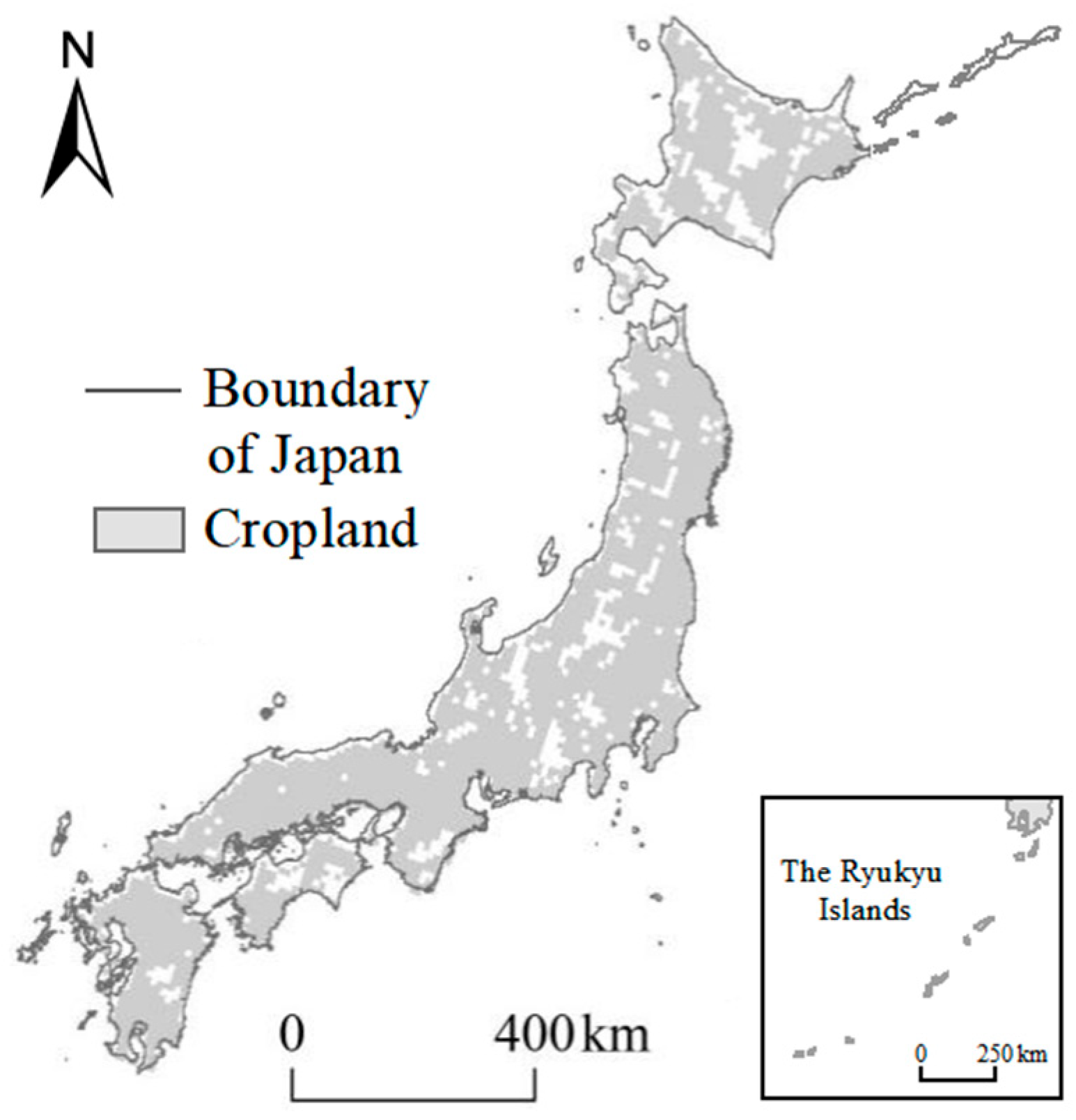
The spatial extents of cropland cover, derived from the Global Land Cover (GLC) remote sensing product for the years 1982, 1985, 1990, 1995, 2000, 2005, 2010, and 2015, were merged at a 10 km grid scale. The resulting composite layer was treated as the maximum observed cropland extent in Japan during the post-World War II period. Given that low-lying coastal plains were historically susceptible to seawater intrusion and largely remained uncultivated prior to the mid-20th century, these areas—which saw significant reclamation only after the war—were excluded from the pre-1945 maximum cropland allocation extent (Figure 2). This adjusted extent was used to constrain the historical gridded reconstruction for earlier time periods.
Land Suitability Model for Cultivation
Land reclamation typically progresses from more suitable to less suitable areas. Accordingly, multiple factors influencing the spatial distribution of cropland were selected as indicators to evaluate land suitability for cultivation. A gridded land suitability assessment was then performed for each regional unit.
Historical records of Japanese agricultural development indicate that land reclamation generally followed a sequential pattern: beginning on low-lying plains, expanding into mountainous areas, and—following the introduction of polder techniques—gradually incorporating remaining low-elevation plains. Japan’s temperate marine monsoon climate renders temperature and precipitation key determinants of crop growth, while variations in soil texture between coastal and inland areas significantly influence agricultural productivity [55].
Guided by the principles of dominance, stability, and data availability, we selected accumulated temperature, annual precipitation, and soil sand-to-clay ratio as suitability indicators (reflecting the favorability of a location for reclamation), and elevation and slope as difficulty indicators. After normalizing each factor, they were combined using equal weighting to construct a gridded land suitability model for cultivation.
During normalization, the directional influence of each factor on reclamation potential was defined as follows. Within Japan’s maximum historical cropland extent, lower elevation and gentler slopes correspond to higher suitability. For climate, higher accumulated temperature indicates greater suitability, while excessive precipitation increases flood risk; thus, moderate-to-low precipitation regions are more favorable. Regarding soil texture, a sand-to-clay ratio closer to 1 indicates a more loam-like soil, which is considered more suitable for cultivation. The normalization procedure is described below.
(1)
The normalization equations for the elevation and slope factors are as follows:
H norm i , j = H max i , j - H ( i , j ) H max i , j
S norm i , j = S max i , j - S ( i , j ) S max i , j
where H norm i , j and S norm i , j are normalized elevation and slope values for grid j within region i (range [0, 1]), respectively; H max i , j and S max i , j are the maximum elevation and slope values in region i, respectively; H ( i , j ) and S ( i , j ) are the original elevation and slope values for grid j in region i, respectively.
(2)
The normalization of accumulated temperature and annual precipitation was performed using the following equations:
T norm i , j = T ( i , j ) T max i , j
P norm i , j = P max i , j - P ( i , j ) P max i , j
where T norm i , j and P norm i , j represent the normalized accumulated temperature and annual precipitation values for grid j within region i (range [0, 1]), respectively; T max i , j and P max i , j denote the maximum accumulated temperature and annual precipitation values in region i, respectively; T ( i , j ) and P ( i , j ) are the original accumulated temperature and annual precipitation values for grid j in region i, respectively.
(3)
The soil texture factor was normalized using the following equation:
S C i , j = SD ( i , j ) C L i , j
S C norm i , j = S C max i , j - S C i , j 1 S C max i , j
where S C i , j , SD ( i , j ) , and C L i , j represent the sand-to-clay ratio, sand content, and clay content for grid j in region i, respectively; S C norm i , j is the normalized sand-to-clay ratio of grid j in region i; S C max i , j and S C i , j are the maximum sand-to-clay ratio in region i and the original sand-to-clay ratio of grid j in region i, respectively.
(4)
Land suitability for cultivation was computed as follows:
L s u i t i , j = H norm i , j × S norm i , j × T norm i , j × P norm i , j × S C norm i , j
where L s u i t i , j is the land suitability for cultivation of grid j in region i; and H norm i , j , S norm i , j , T norm i , j , P norm i , j , and S C norm i , j denote the normalized elevation, slope, accumulated temperature, annual precipitation, and sand-to-clay ratio values of grid j in region i, respectively.
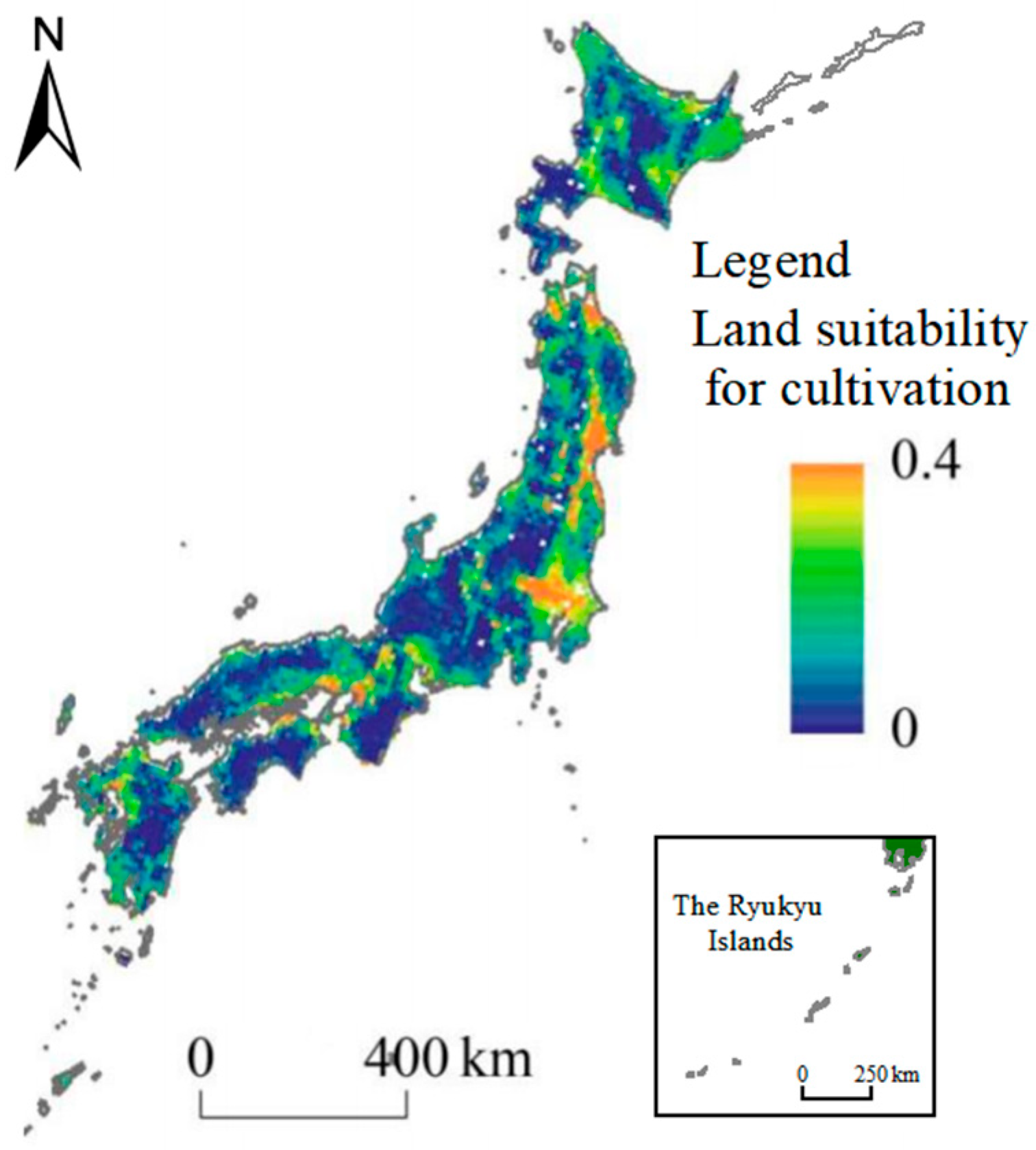
Using the methodology described above, we developed a regional land suitability model for cultivation and mapped its spatial distribution across Japan. As illustrated in Figure 3, the most suitable areas in Hokkaido are mainly located in the western and southeastern regions. In central and southern Japan, high-suitability zones are primarily distributed across the coastal areas of Kyushu, the central coastal belt, and the Kantō Plain, while inland regions with higher elevations generally exhibit lower suitability.
Gridding Allocation Method for Cropland
Based on the maximum cropland distribution extent and the land suitability values obtained from the model, the cropland area of each region was allocated to grid cells, thereby reconstructing the historical spatial distribution of cropland in Japan. The allocation model is expressed as follows:
Cropland ( j , t ) = α × L suit ( i , j ) i L suit ( i , j ) × Area crop ( i , t )
where C r o p l a n d ( j , t ) is the cropland area of grid j in year t, L s u i t i , j is the land suitability for cultivation of grid j in region i, Area crop ( i , t ) is cropland area of region i in year t, and α is an indicator for the maximum cropland distribution extent; which takes a value of 0 if grid j lies outside the allowable cropland extent, and 1 otherwise.

3. Results

3.1. Changes in Cropland Area over the Past Millennium

3.1.1. Changes at the National Level

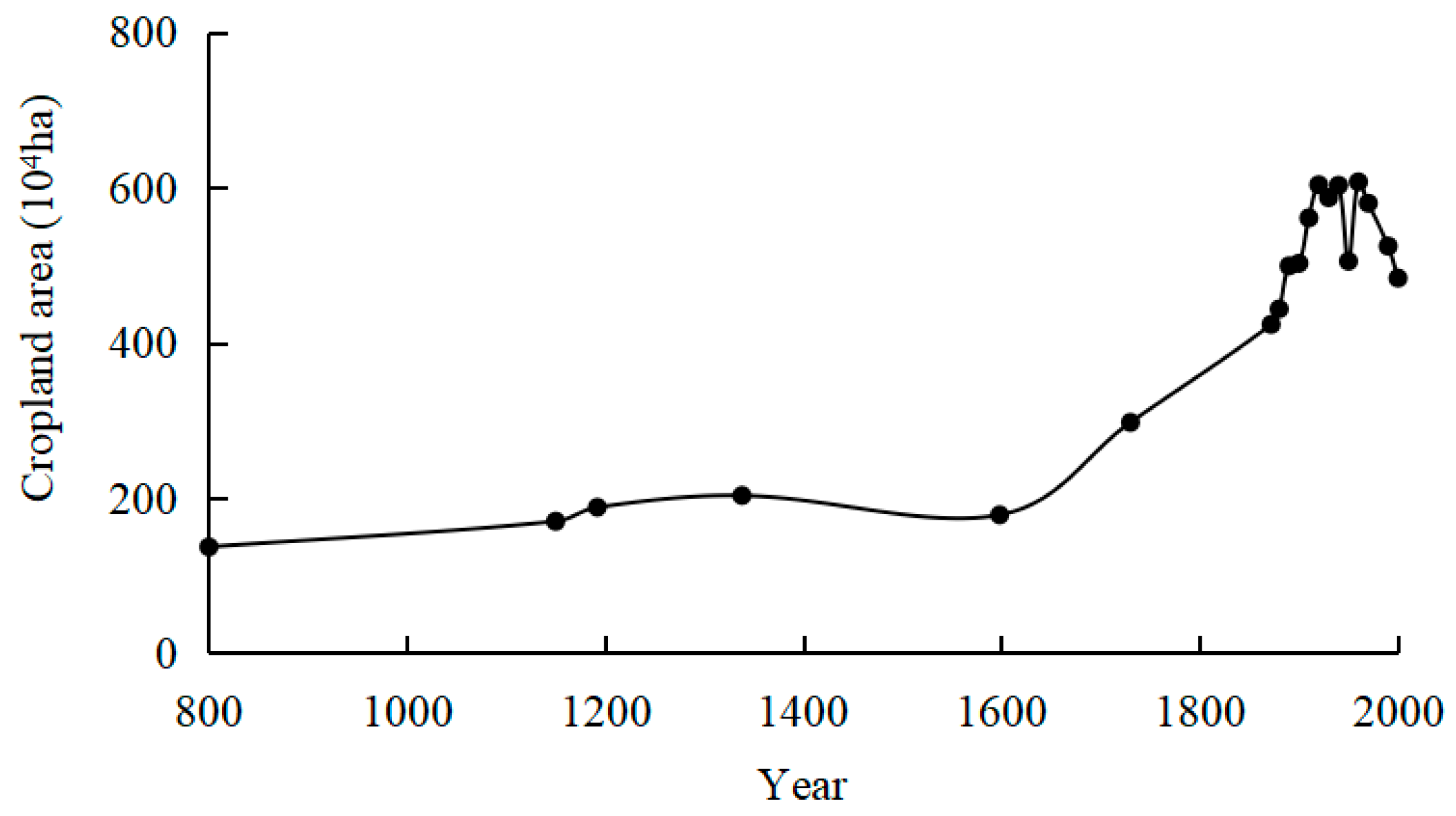
Based on the historical records of cropland and population, along with the reconstruction methodology outlined above, we reconstructed Japan’s total and regional-level cropland area over the past millennium. The results reveal that the total cropland area underwent four distinct phases: slow expansion, gradual decline, rapid growth, and sharp contraction (Figure 4).
Japan’s cropland area expanded gradually from 136.70 × 10⁴ ha in 800 CE to 202.90 × 104 ha by 1338 CE, corresponding to an increase in reclamation rate from 3.6% to 5.4% of total land area. This growth was primarily driven by demographic increase, though the annual population growth remained modest at approximately 0.073%, resulting in an average annual cropland expansion of about 1200 ha during the Heian (794–1185 CE) to Kamakura (1185–1333 CE) periods.
During the Muromachi (1334–1572 CE) and Sengoku (1573–1602 CE) periods, widespread civil conflicts—including the Kantō turmoil and the Ōnin War—led to a marked decline in Japan’s total cropland area. By 1598 CE, cropland had decreased to approximately 177.90 × 10⁴ ha, representing a net loss of around 24.96 × 10⁴ ha over 260 years, equivalent to an average annual reduction of roughly 960 ha.
Following the Sengoku period, Japan entered a phase of “great reclamation,” which accelerated markedly after the Meiji Restoration. The national population surged from 34.81 million in 1872 to 71.93 million in 1940, an increase of 106%. Driven by government-led colonization and industrialization policies, coupled with the adoption of advanced Western agricultural techniques, the total cropland area expanded rapidly to 602.70 × 104 ha by 1940. This represented a net increase of 429.20 × 10⁴ ha over 360 years, averaging approximately 1.19 × 10⁴ ha per year, and resulted in a peak reclamation rate of 15.9%. Despite this absolute growth, per capita cropland area declined to 0.08 hectares, reflecting the intense pressure of population increase on land resources.
The period from 1940 to 1950, marked by World War II, saw a significant reduction in Japan’s cropland area—falling to approximately 504.80 × 10⁴ ha (a net loss of roughly 1 million hectares)—due to massive labor outflows and a sharp decline in agricultural investment [57]. However, post-war recovery policies, including land reform, agricultural modernization, and soil improvement initiatives, rapidly revitalized the sector, enabling a return to pre-war production levels by 1960. From the 1960s onward, rapid urbanization and the expansion of non-agricultural sectors outpaced new reclamation efforts, leading to a continued decline in cropland area, which reached approximately 486.60 × 104 ha by 2000. Concurrently, the reclamation rate decreased to 12.2%, and ongoing population growth drove per capita cropland down to 0.04 hectares.

3.1.2. Changes at the Regional Level

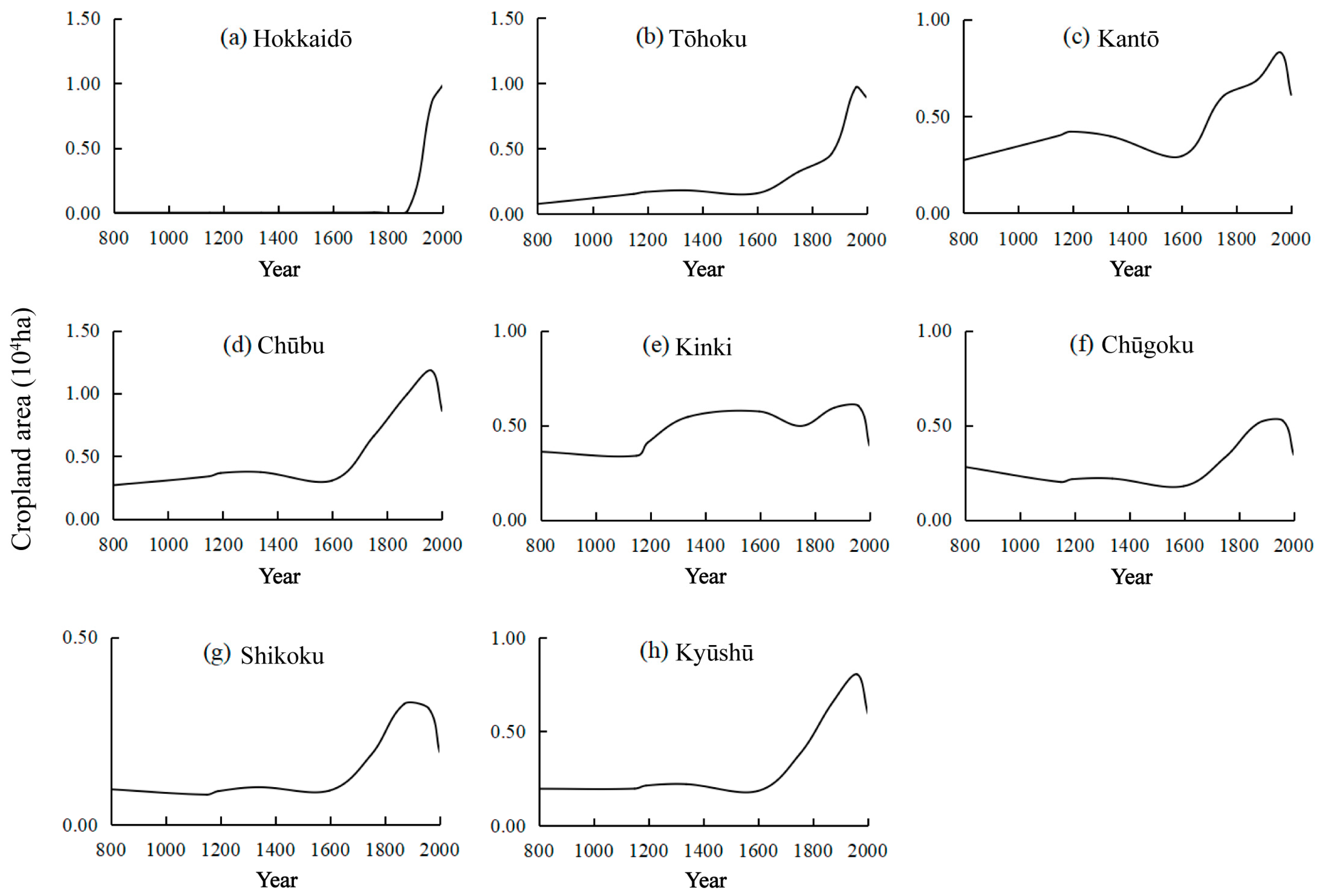
The eight regions largely followed the national cropland trajectory while exhibiting distinct historical pathways, as visually summarized in Figure 5. Tōhoku and Kyushu displayed a four-phase sequence of slow growth, gradual decline, rapid expansion, and swift contraction, with both regions reaching their peaks in the 1960s. Kantō showed an atypical pattern characterized by slow growth, rapid decline, renewed expansion, and a final rapid reduction. Chūgoku and Shikoku exhibited a three-phase trajectory of gradual reduction, rapid expansion, and subsequent rapid decline. Kansai experienced a prolonged decline from 800 CE until the late 16th century, followed by rapid expansion to its maximum in the 1960s before urban sprawl caused sharp reductions. Hokkaidō diverged markedly from other regions, with reclamation beginning later but accelerating during the 19th century, and its cropland area has continued to increase to the present, as clearly illustrated in the regional comparison.
Japan’s agricultural landscape underwent significant transformations from the Heian (794–1185 CE) to Kamakura (1185–1333 CE) periods, marked by rapid cropland expansion in the Kansai, Kantō, Tōhoku and Chūbu regions, each accumulating over 10 × 104 ha through sustained growth. Kansai demonstrated particularly vigorous development with annual gains of 342.30 ha, closely followed by Kantō at 229.37 ha annually. In contrast, Kyushu and Shikoku exhibited more modest expansion patterns, with Shikoku’s total growth limited to just 0.57 × 10⁴ ha, while Hokkaidō maintained its traditional hunter-gatherer economy with negligible agricultural activity.
The subsequent Muromachi (1334–1572 CE) and Sengoku (1573–1602 CE) periods brought dramatic reversals, particularly in the Kantō region which suffered the most severe losses of approximately 10.31 × 10⁴ ha due to protracted warfare, equivalent to an annual decline of 396.6 ha. The Chūbu, Chūgoku and Kyushu regions, impacted by the devastating Ōnin War, experienced substantial reductions of 6.73 × 10⁴ ha, 4.03 × 10⁴ ha, and 3.65 × 10⁴ ha, respectively, reflecting the profound impact of feudal conflicts on agricultural sustainability.
The post-Sengoku era ushered in Japan’s “great reclamation” phase, continuing through to World War II. During this transformative period, Chūbu, Hokkaidō, Tōhoku, Kyushu and Kantō regions all witnessed remarkable expansion, each adding over 50.00 × 10⁴ ha within seventy years, with Central, Hokkaidō and Tōhoku regions surpassing 80.00 × 10⁴ ha of new cultivation. Kansai’s growth, however, remained comparatively restrained at just 2.90 × 10⁴ ha. The postwar era saw fundamental shifts in land-use patterns as urbanization, demographic changes and industrial development dramatically reduced agricultural labor forces and accelerated conversion of farmland to non-agricultural uses [39]. These socioeconomic transformations resulted in declining reclamation rates across all regions except Hokkaidō, where agricultural expansion persisted as a distinctive regional pattern.

3.2. Spatial Pattern Changes of Cropland Cover

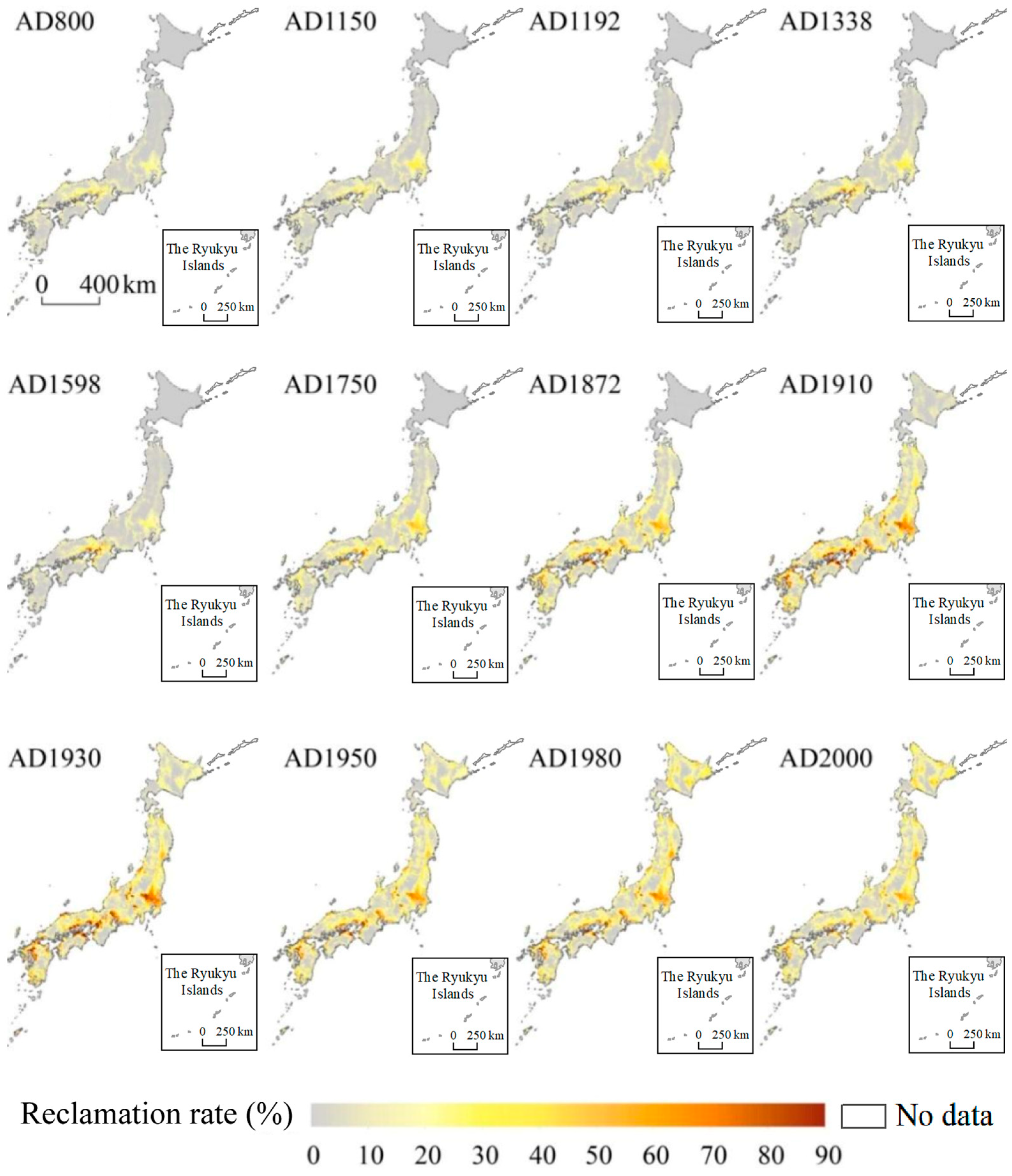
The gridded reconstruction reveals a steady millennium-long increase in Japan’s land reclamation rate, rising from 4.15% in 800 CE to 13.06% by 2000 CE. Spatially, cropland expansion progressed systematically from the central region toward southwestern and northeastern directions, reflecting a clear trajectory of agricultural frontier development (Figure 6).
Our gridded reconstruction reveals distinct temporal and spatial patterns in Japan’s agricultural development from 800 to 2000 CE. During the early phase (800–1192 CE), cropland was predominantly concentrated in two core areas: the coastal regions of southwestern Kansai (10.90% reclamation rate) and portions of the Kantō Plain (8.54%). The Kamakura period (1192–1338 CE) witnessed accelerated agricultural expansion in Kansai, where the reclamation rate increased by 13 percentage points, coinciding with Kyoto’s status as the imperial capital.
The Muromachi and Sengoku eras (1338–1598 CE) saw dramatic regional variations, with Kantō experiencing an 8.4% decline in reclamation rate due to population losses from protracted warfare. This pattern reversed during the Edo period (1598–1872 CE), when the establishment of the Tokugawa shogunate in Edo spurred a 30% increase in Kantō’s reclamation rate, while Tōhoku (6.88%) and Kyushu (15.81%) demonstrated parallel expansion, marking a north–south extension of agricultural frontiers.
The early 20th century (1930 CE) represented the zenith of Japanese agricultural expansion, with national reclamation rates peaking at 15.75%. Regional maxima were achieved in Kantō (26.67%) and Hokkaidō (7.05%). Late 20th century trends (1980–2000 CE) showed divergent trajectories: Hokkaidō maintained steady growth while most regions declined, except for southern areas which reached approximately 20% reclamation rates.

4. Discussion

4.1. Comparison with Satellite-Based Data

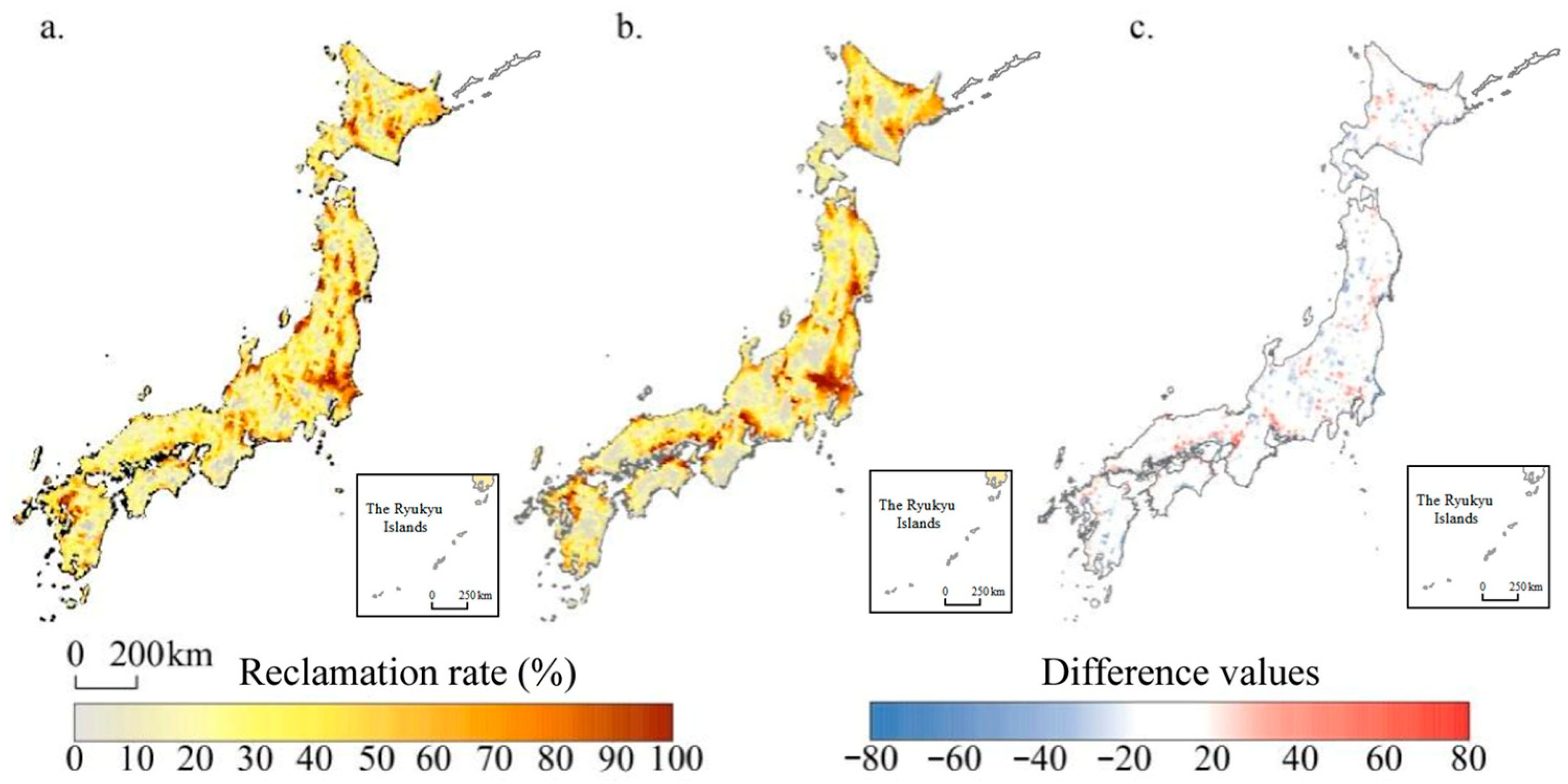
To evaluate the performance of our reconstruction model at the regional scale, we compared the model output for 2000 with a satellite-derived cropland map for the same year [13]. The comparison shows that the model effectively captures the broad spatial pattern of cropland distribution, notably the strong concentration in the coastal plains and the scarcity in mountainous regions, which is consistent with the reference data (Figure 7). This agreement at the macro-scale supports the utility of our methodology for regional-scale historical land-use analysis, acknowledging that the 10 km resolution is not intended for field-scale precision.
An analysis of grid-scale reclamation rate values reveals generally modest numerical discrepancies between the two cropland datasets. Specifically, 42.84% of grid cells exhibit differences within ±10%, while 26.28% fall within an absolute deviation range of 10–20%, and 23.94% show deviations between 20 and 40%. Only 0.15% of grid cells exceed a deviation threshold of ±80% (Table 2). These results indicate a strong overall agreement between the reconstructed cropland distribution and contemporary remote sensing-based data, affirming the robustness of the reconstruction approach.

4.2. Comparison with Previous Studies

Global-scale historical land-use datasets, such as HYDE [12] and PJ [10], provide historical cropland data for Japan spanning the past millennium. These datasets typically reconstruct national-level cropland areas using generalized proxies (e.g., global population) and downscale them based on broad suitability models. However, for regional-scale applications, their reliability is limited. Their inherent uncertainty arises from the lack of high-resolution, localized historical data and the application of generalized parameters that may not accurately represent region-specific socio-economic and environmental drivers. Consequently, they may fail to capture nuanced, locally driven spatiotemporal patterns of cropland cover change.
To overcome these limitations and achieve a more accurate cropland cover change reconstruction for Japan, this study develops a novel approach. Our methodology is distinct in two key aspects: (1) it is grounded in local historical archives rather than globally modeled data, and (2) it employs a spatially explicit allocation model calibrated with region-specific suitability factors (e.g., topographic constraints, soil conditions). This approach is specifically designed to provide a more reliable and detailed depiction of historical cropland cover dynamics at a regional scale, thereby yielding results that are more accurate than those from global datasets.
A comparison of per capita cropland area—a key metric in global dataset reconstructions—with the findings of this study reveals significant discrepancies. Both HYDE 3.1 [58] and the PJ dataset [10] assumed constant per capita cropland areas prior to 1960 and 1700, estimating values of approximately 0.06 ha and 0.03 ha for Japan before these respective dates. HYDE 3.2 advanced this approach by positing that historical per capita cropland area fluctuated with changes in productivity and population, deriving a baseline demand from annual per capita grain requirements and grain yield per unit area [12]. Nevertheless, its estimates for Japan still indicate an increasing trend, from 0.060 ha to 0.063 ha over the study period.
In contrast, by leveraging regional historical data from shōen estates, kenchi surveys, and statistical data, combined with revised population figures, this study estimates that Japan’s per capita cropland area declined from 0.31 ha in AD 800 to 0.12 ha in 1880. The relative discrepancies between these results and those of HYDE 3.2 and the PJ dataset range from −47.5% to −80.7% and −72.6% to −90.3%, respectively. This indicates that not only do the trends in global datasets contradict the actual situation, but the estimated values are also substantially lower than reality, with discrepancies becoming more pronounced in earlier periods (e.g., −81% and −90% in AD 1200). As per capita cropland area is a critical parameter in reconstruction, its deviation directly leads to inaccuracies in the resulting cropland area estimates. A detailed comparative analysis falls beyond the scope of this paper and will be addressed in a separate study.

4.3. Uncertainty Analysis

While this study has compiled extensive historical cropland and population data to reconstruct Japan’s millennial-scale agricultural dynamics, certain limitations persist due to inherent constraints in source materials and methodological assumptions. For example, when reconstructing the national cropland area during the feudal estate system (800–1583 CE) and kokudaka system (1583–1872 CE) periods, the methodology involved indicators such as per capita cropland area, the proportion of the agricultural population, and the proportion of paddy fields in the total cropland. Specifically, the proportion of the agricultural population during the feudal estate system (800–1583 CE) was assumed to be constant at 80%, based on a comprehensive review of historical agricultural census data and studies on Japanese agricultural history [53]. In reality, however, this value denotes the proportion of the agricultural population during the Edo period, whereas the pre-Edo era likely had a larger agricultural population share. Therefore, estimates based on this value may lead to an underestimation of the total cropland area for this period. While this assumption provides a reasonable basis for estimation in the absence of precise long-term data, the fixed ratio may not capture subtle temporal fluctuations. Future research could enhance the reliability of reconstruction results by exploring additional historical records.
A key assumption in our regional cropland area reconstruction is the application of a constant, strong population-cropland correlation (r = 0.83) during pre-Meiji periods, a relationship calibrated on data from the early Meiji era. However, the strength of the population-cropland relationship likely varied due to the factors such as technological innovations in agriculture, periods of conflict, and shifts in settlement patterns, particularly before 1600 CE. Therefore, our reconstruction potentially represents a simplified scenario where population pressure is consistently a dominant driver. This simplification does not invalidate the overall spatiotemporal patterns we identify but suggests that our model might smooth over some centennial-scale fluctuations driven by non-demographic factors. Importantly, this highlights a critical avenue for future research: integrating archeological proxies (e.g., pollen cores) to empirically test the evolution of the population-cropland relationship over millennia, which would significantly improve the next generation of historical land-use models.
The limited detail in historical records introduces ambiguity in delineating period-specific cropland extents. To address this, we made the foundational assumption that a modern-era maximum cropland-extent mask can be applied to constrain historical cropland distributions. While this is a necessary and widely used methodological constraint to ensure results are spatially realistic, it inherently assumes that contemporary agricultural land represents the historical maximum [31]. As insightfully noted, this may lead to an underestimation of early cultivation in areas that were subsequently abandoned or converted to non-agricultural uses, such as ancient floodplains that were later urbanized. Therefore, our reconstruction likely captures the persistent core of agricultural land over the long term. Future research integrating archeological data and high-resolution paleoenvironmental proxies (e.g., pollen, phytoliths) is essential to directly identify and map these “lost” croplands, thereby moving beyond the limitations of the modern-centric baseline.
The land suitability model in this study assigned equal weights to the selected factors (topography, climate, soil). This approach was adopted as a transparent and objective baseline to integrate these core drivers without imposing prior assumptions on their relative importance, for which quantitative historical evidence is scarce [12,31]. While this ensures reproducibility and avoids subjective bias, it represents a simplification that may not capture potential hierarchical relationships or complex interactions between factors. Future research could significantly enhance the model’s sophistication by applying advanced weighting methods, such as the Analytic Hierarchy Process (AHP) informed by expert knowledge, or entropy weighting and machine-learning techniques trained on modern high-resolution land-use data, to derive more nuanced, data-driven estimates of factor importance.
The spatial allocation model adopted in this study, though practical for large-scale, long-term reconstructions, exhibits a “flat-allocation bias” common to suitability-based approaches: any grid cell with a positive suitability score within the maximum allocable domain is assigned cropland, regardless of historical cultivation status. This effect is particularly pronounced in low-suitability regions and may introduce systematic overestimation. In addition, because factor quantification and model construction were conducted at the sub-regional scale, minor discontinuities can occur along the boundaries of adjacent spatial units.

5. Conclusions

This study reconstructs a millennium-long cropland area change series aligned with Japan’s current administrative boundaries by integrating historical cropland records, population-adjusted data, modern statistical surveys, and remote sensing data. By incorporating topographic, climatic, and soil variables, we developed regional-specific land suitability assessment and corresponding cropland allocation model. These models were applied to generate 10 km × 10 km gridded cropland maps for twelve historical time slices spanning the past millennium, systematically documenting the spatiotemporal evolution of Japan’s cropland cover. The main findings are as follows:
(1)
Japan’s total cropland area has undergone four distinct phases over the past millennium: a gradual increase from 136.70 × 10⁴ ha in 800 CE to 202.90 × 10⁴ ha in 1338 CE, a slow decline to 177.90 × 10⁴ ha in 1598 CE, a rapid expansion to 602.70 × 10⁴ ha in 1940, and a sustained contraction to 486.60 × 10⁴ ha. These shifts reflect profound transitions in Japan’s socio-ecological systems: early growth was constrained by pre-industrial agricultural technology development limits; feudal conflicts triggered medieval declines; population increase, coupled with industrialization, drove rapid modern expansion; and post-war urbanization ultimately reversed this trend. Regionally, divergent pathways emerged based on geographical and historical contingencies. Eastern regions (Tōhoku, Kantō) and Kyushu showed synchronous four-phase trajectories, whereas Hokkaido’s late-onset expansion defied the national pattern. The Kansai region’s prolonged decline and delayed peak further illustrate how regional socio-political centers experienced distinct agricultural rhythms. These spatial differences underscore that Japan’s agricultural transitions were not uniform processes but spatially articulated responses to shifting political centers, conflict zones, and development frontiers.
(2)
Japan’s agricultural expansion followed a distinct center-to-periphery trajectory, advancing systematically from the core Kansai and Kantō regions toward southwestern and northeastern frontiers. The analysis demonstrates three key spatial-temporal patterns: First, the persistent dominance of the Kansai and Kantō regions, where reclamation rates consistently exceeded other regions—reaching 10.90% in Kansai and 8.54% in Kantō during the early phase (800–1192 CE), and peaking at 26.67% in Kantō by the 20th century. Second, the phased expansion into peripheral regions corresponded to major socio-political transitions: Tōhoku and Kyushu showed significant growth during the Edo period (6.88% and 15.81% reclamation rates, respectively), while Hokkaidō’s development accelerated in the modern era, reaching 7.05% by 1930. Third, the 20th-century divergence between continued frontier expansion in Hokkaidō and widespread cropland contraction in other regions, where southern areas maintained approximately 20% reclamation rates while most regions declined.
(3)
Applying the historical cropland gridding methodology developed in this study, we allocated region-level cropland statistics for the year 2000—derived from remote sensing data—onto a 10 km × 10 km grid. The reconstructed cropland distribution shows close spatial agreement with the remote sensing-based map. Quantitatively, 69.12% of grid cells exhibit differences within ±20%, while only 0.15% exceed ±80% deviation. This high level of consistency validates both the feasibility of the gridding reconstruction method and the reliability of the resulting cropland data product.

Author Contributions

Conceptualization, M.L. and F.H.; methodology, M.L. and C.Z.; software, M.L. and C.Z.; validation, M.L., C.Z., F.H., S.L. and F.Y.; formal analysis, M.L. and C.Z.; investigation, M.L., F.H. and S.L.; writing—original draft preparation, M.L. and C.Z.; writing—review and editing, M.L., C.Z. and F.Y.; supervision, F.H. and S.L. All authors have read and agreed to the published version of the manuscript.

Funding

This research was funded by the National Natural Science Foundation of China, grant number 42307562, 42371260, the National Key R&D Program of China, grant number 2017YFA0603304, and the “Strategic Priority Research Program” of the Chinese Academy of Sciences, grant number XDA19040101.

Data Availability Statement

The data presented in this study are available on request from the corresponding author due to the data are part of an ongoing study.

Acknowledgments

During the preparation of this manuscript, the author used ChatGPT 3.5 for writing assistance, mainly for grammar and spelling checks. The authors have reviewed and edited the output and take full responsibility for the content of this publication.

Conflicts of Interest

The authors declare no conflicts of interest.

References

  1. Fluet-Chouinard, E.; Stocker, B.D.; Zhang, Z.; Malhotra, A.; Melton, J.R.; Poulter, B.; Kaplan, J.O.; Klein Goldewijk, K.; Siebert, S.; Minayeva, T. Extensive global wetland loss over the past three centuries. Nature 2023, 614, 281–286. [Google Scholar] [CrossRef]
  2. Ellis, E.C.; Gauthier, N.; Klein Goldewijk, K.; Bird, R.B.; Boivin, N.; Díaz, S.; Fuller, D.Q.; Gill, J.L.; Kaplan, J.O.; Kingston, N.; et al. People have shaped most of terrestrial nature for at least 12,000 years. Proc. Natl. Acad. Sci. USA 2021, 118, e2023483118. [Google Scholar] [CrossRef]
  3. Stephens, L.; Fuller, D.; Boivin, N.; Rick, T.; Gauthier, N.; Kay, A.; Marwick, B.; Armstrong, C.G.D.; Barton, C.M.; Denham, T.; et al. Archaeological assessment reveals Earth’s early transformation through land use. Science 2019, 365, 897–902. [Google Scholar] [CrossRef]
  4. Gaillard, M.J.; Morrison, K.D.; Madella, M.; Whitehouse, N. Past land use and land-cover change: The challenge of quantification at the subcontinental to global scales. Past Land Use Land Cover 2018, 26, 3. [Google Scholar]
  5. Zhao, Y.; Ning, S.; Yan, A.; Jiang, P.; Ren, H.; Li, N.; Huo, T.; Sheng, J. Analysis of carbon emissions and ecosystem service value caused by land use change, and its coupling characteristics in the Wensu Oasis, Northwest China. Agronomy 2025, 15, 2307. [Google Scholar] [CrossRef]
  6. Rocha, A.M.d.; Franceschi, M.; Panosso, A.R.; Carvalho, M.A.C.d.; Moitinho, M.R.; Martins Filho, M.V.; Oliveira, D.M.d.S.; Freitas, D.A.F.d.; Yamashita, O.M.; La Scala, N., Jr. Effects of land use changes on CO2 emission dynamics in the Amazon. Agronomy 2025, 15, 488. [Google Scholar] [CrossRef]
  7. Mahmood, R.; Pielke, R.A., Sr.; Hubbard, K.G.; Niyogi, D.; Dirmeyer, P.A.; McAlpine, C.; Carleton, A.M.; Hale, R.; Gameda, S.; Beltrán-Przekurat, A.; et al. Land cover changes and their biogeophysical effects on climate. Int. J. Climatol. 2014, 34, 929–953. [Google Scholar] [CrossRef]
  8. Foley, J.A.; Defries, R.; Asner, G.P.; Barford, C.; Bonan, G.; Carpenter, S.R.; Chapin, F.S.; Coe, M.T.; Daily, G.C.; Gibbs, H.K.; et al. Global consequences of land use. Science 2005, 309, 570–574. [Google Scholar] [CrossRef]
  9. Ramankutty, N.; Foley, J.A. Estimating historical changes in global land cover: Croplands from 1700 to 1992. Glob. Biogeochem. Cycles 1999, 13, 997–1027. [Google Scholar] [CrossRef]
  10. Pongratz, J.; Reick, C.; Raddatz, T.; Claussen, M. A reconstruction of global agricultural areas and land cover for the last millennium. Glob. Biogeochem. Cycle 2008, 22, GB3018. [Google Scholar] [CrossRef]
  11. Kaplan, J.O.; Krumhardt, K.M.; Ellis, E.C.; Ruddiman, W.F.; Lemmen, C.; Klein Goldewijk, K. Holocene carbon emissions as a result of anthropogenic land cover change. Holocene 2011, 21, 775–791. [Google Scholar] [CrossRef]
  12. Klein Goldewijk, K.; Beusen, A.; Doelman, J.; Stehfest, E. Anthropogenic land use estimates for the Holocene-HYDE 3.2. Earth Syst. Sci. Data 2017, 9, 927–953. [Google Scholar] [CrossRef]
  13. Liu, H.; Gong, P.; Wang, J.; Clinton, N.; Bai, Y.; Liang, S. Annual dynamics of global land cover and its long-term changes from 1982 to 2015. Earth Syst. Sci. Data 2020, 12, 1217–1243. [Google Scholar] [CrossRef]
  14. Cao, B.W.; Yu, L.; Li, X.C.; Chen, M.; Li, X.; Hao, P.Y.; Gong, P. A 1 km global cropland dataset from 10,000 BCE to 2100 CE. Earth Syst Sci Data 2021, 13, 5403–5421. [Google Scholar] [CrossRef]
  15. Li, D.; Tian, P.; Luo, H.; Hu, T.; Dong, B.; Cui, Y.; Khan, S.; Luo, Y. Impacts of land use and land cover changes on regional climate in the Lhasa River basin, Tibetan Plateau. Sci. Total Environ. 2020, 742, 13. [Google Scholar] [CrossRef] [PubMed]
  16. Kaplan, J.O.; Krumhardt, K.M.; Zimmermann, N.E. The effects of land use and climate change on the carbon cycle of Europe over the past 500 years. Glob. Change Biol. 2012, 18, 902–914. [Google Scholar] [CrossRef]
  17. Fuchs, R.; Prestele, R.; Verburg, P.H. A global assessment of gross and net land change dynamics for current conditions and future scenarios. Earth Syst. Dynam. 2018, 9, 441–458. [Google Scholar] [CrossRef]
  18. Liu, S.; Wang, Y.; Zhang, G.J.; Wei, L.; Wang, B.; Yu, L. Contrasting influences of biogeophysical and biogeochemical impacts of historical land use on global economic inequality. Nat. Commun. 2022, 13, 2479. [Google Scholar] [CrossRef]
  19. Yang, F.; He, F.N.; Li, S.C.; Li, M.J.; Wu, P.F. A new estimation of carbon emissions from land use and land cover change in China over the past 300 years. Sci. Total Environ. 2023, 863, 160963. [Google Scholar] [CrossRef]
  20. Li, B.B.; Jansson, U.; Ye, Y.; Widgren, M. The spatial and temporal change of cropland in the Scandinavian Peninsula during 1875–1999. Reg. Environ. Change 2013, 13, 1325–1336. [Google Scholar] [CrossRef]
  21. Kaplan, J.O.; Krumhardt, K.M.; Gaillard, M.J.; Sugita, S.; Trondman, A.K.; Fyfe, R.; Marquer, L.; Mazier, F.; Nielsen, A.B. Constraining the deforestation history of Europe: Evaluation of historical land use scenarios with pollen-based land cover reconstructions. Land 2017, 6, 91. [Google Scholar] [CrossRef]
  22. Zhang, D.Y.; Fang, X.Q.; Yang, L.E. Comparison of the HYDE cropland data over the past millennium with regional historical evidence from Germany. Reg. Environ. Change 2021, 21, 15. [Google Scholar] [CrossRef]
  23. Li, S.C.; He, F.N.; Zhang, X.Z.; Zhou, T.Y. Evaluation of global historical land use scenarios based on regional datasets on the Qinghai-Tibet Area. Sci. Total Environ. 2019, 657, 1615–1628. [Google Scholar] [CrossRef]
  24. Fang, X.Q.; Zhao, W.Y.; Zhang, C.P.; Zhang, D.Y.; Wei, X.Q.; Qiu, W.L.; Ye, Y. Methodology for credibility assessment of historical global LUCC datasets. Sci. China Earth Sci. 2020, 63, 13. [Google Scholar] [CrossRef]
  25. Zhao, C.S.; He, F.N.; Yang, F.; Li, S.C. Uncertainties of global historical land use scenarios in past-millennium cropland reconstruction in China. Quat. Int. 2022, 641, 87–96. [Google Scholar] [CrossRef]
  26. Li, M.J.; He, F.N.; Zhao, C.S.; Yang, F. Evaluation of global historical cropland datasets with regional historical evidence and remotely sensed satellite data from the Xinjiang area of China. Remote Sens. 2022, 14, 4226. [Google Scholar] [CrossRef]
  27. Kaplan, J.O.; Krumhardt, K.M.; Zimmermann, N. The prehistoric and preindustrial deforestation of Europe. Quat. Sci. Rev. 2009, 28, 3016–3034. [Google Scholar] [CrossRef]
  28. Fuchs, R.; Herold, M.; Verburg, P.H.; Clevers, J.G.P.W. A high-resolution and harmonized model approach for reconstructing and analyzing historic land changes in Europe. Biogeosciences 2013, 10, 1543–1559. [Google Scholar] [CrossRef]
  29. Liu, X.; Liu, H.L. The application of ANN-FLUS model in reconstructing historical cropland distribution changes: A case study of Vietnam from 1885 to 2000. J. Nat. Resour. 2024, 39, 1473–1492. [Google Scholar] [CrossRef]
  30. Jiang, C.; Ye, Y.; Fang, X.Q.; Zhang, C.P.; Zhang, D.Y. Reconstruction dataset of cropland change in five Central Asian countries over the last millennium (1000–2000). J. Glob. Change Data Discov. 2022, 6, 374–385. [Google Scholar]
  31. He, F.N.; Yang, F.; Zhao, C.S.; Li, S.C.; Li, M.J. Spatially explicit reconstruction of cropland cover for China over the past millennium. Sci. China Earth Sci. 2023, 53, 115–131. [Google Scholar] [CrossRef]
  32. Yu, Z.; Lu, C.Q. Historical cropland expansion and abandonment in the continental U.S. during 1850 to 2016. Glob. Ecol. Biogeogr. 2018, 27, 322–333. [Google Scholar] [CrossRef]
  33. Dias, L.C.P.; Pimenta, F.M.; Santos, A.B.; Costa, M.H.; Ladle, R.J. Patterns of land use, extensification, and intensification of Brazilian agriculture. Glob. Change Biol. 2016, 22, 2887–2903. [Google Scholar] [CrossRef] [PubMed]
  34. Tian, H.Q.; Banger, K.; Bo, T.; Dadhwal, V.K. History of land use in India during 1880–2010: Large-scale land transformations reconstructed from satellite data and historical archives. Glob. Planet. Change 2014, 121, 78–88. [Google Scholar] [CrossRef]
  35. Ye, Y.; Li, J.; Fang, X.Q.; Zhang, D.Y.; Zhao, Z.L.; Wu, Z.L.; Lu, Y.J.; Li, B.B. Reconstruction of cropland change in European countries using integrated multisource data since AD 1800. Boreas 2023, 52, 60–77. [Google Scholar] [CrossRef]
  36. Yang, F.; Zhang, H.; He, F.N.; Wang, Y.F.; Zhou, S.N.; Dong, G.P. A 1000-year history of cropland cover change along the middle and lower reaches of the Yellow River in China. J. Geogr. Sci. 2024, 34, 921–941. [Google Scholar] [CrossRef]
  37. Li, S.C.; Liu, Y.T.; Li, J.R.; Zhang, X.Z. Mapping cropping patterns in the North China Plain over the past 300 years and an analysis of the drivers of change. J. Geogr. Sci. 2024, 34, 2074–2088. [Google Scholar] [CrossRef]
  38. Flint, E.P.; Richards, J.F. Historical analysis of changes in land use and carbon stock of vegetation in South and Southeast Asia. Can. J. For. Res. 1991, 21, 91–110. [Google Scholar] [CrossRef]
  39. Himiyama, Y. Land use/cover changes in Japan: From the past to the future. Hydrol. Process. 1998, 12, 1995–2001. [Google Scholar] [CrossRef]
  40. Luo, P.; Takara, K.; He, B.; Razafindrabe, B.H. Reconstruction assessment of historical land use: A case study in the Kamo River basin, Kyoto, Japan. Comput. Geosci. 2014, 63, 106–115. [Google Scholar] [CrossRef]
  41. Ono, T. A History of the Japanese Shōen System; Yuhikaku Publishing Co., Ltd.: Tokyo, Japan, 1979; p. 137. Available online: https://ndlsearch.ndl.go.jp/books/R100000039-I1716585 (accessed on 6 September 2024).
  42. Takeuchi, R. History of Land Systems, Vol. I; Yamakawa Shuppansha: Tokyo, Japan, 1973; pp. 306–310. [Google Scholar]
  43. Yasuda, M. An Overview of the History of Japanese Shōden; Yoshikawa Kōbunkan: Tokyo, Japan, 1959; pp. 234–235, 257–259. Available online: https://ndlsearch.ndl.go.jp/books/R100000002-I000000963726 (accessed on 6 September 2024).
  44. Miyakawa, M. On the Taikō Kenchi; Ochanomizu Shobō: Tokyo, Japan, 1959; p. 359. Available online: https://ndlsearch.ndl.go.jp/books/R100000039-I2468176 (accessed on 9 September 2024).
  45. Kanzaki, A. Kenchi; Nihon Shinsyo Publishing Co., Ltd.: Tokyo, Japan, 1983; pp. 15, 56. [Google Scholar]
  46. Ministry of the Treasury. Great Japan Tax Records, Vol. 1 & 2; Choyokai: Tokyo, Japan, 1927. [Google Scholar]
  47. Meiji Financial History Compilation Society (Ed.) Meiji Financial History, Vol. 5; Yoshikawa Kōbunkan: Tokyo, Japan, 1954; Available online: https://ndlsearch.ndl.go.jp/books/R100000039-I1449175 (accessed on 12 September 2024).
  48. Fukushima, M. Chiso Kaisei; Yoshikawa Kōbunkan: Tokyo, Japan, 1995; p. 172. [Google Scholar]
  49. Kito, H. Regional population in Japan before the Meiji Period. Sophia Econ. Rev. 1996, 41, 65–79. [Google Scholar]
  50. Japan’s National Land Agency. Long-Term Time Series Analysis of Population Distribution in the Japanese Archipelago; Japan’s National Land Agency: Tokyo, Japan, 1974; Available online: https://www.kok.or.jp/publication/pdf/tokuColum_202404.pdf (accessed on 15 September 2024).
  51. Minami, K. A study on the Edo society in the late Tokugawa Period. Jpn. Hist. Res. 1980, 218, 80–84. [Google Scholar]
  52. Sekiya, N. The History of Japan’s Population; Shikai Shobō: Tokyo, Japan, 1942; pp. 1–261. Available online: https://ndlsearch.ndl.go.jp/books/R100000074-IALIS_QQ00820837 (accessed on 16 September 2024).
  53. Tamagawa, H. A History of Japanese Farmers; Seibido Shuppan Co., Ltd.: Tokyo, Japan, 1935; pp. 461–463. Available online: https://www.jstage.jst.go.jp/article/sehs/5/12/5_KJ00002437678/_article/-char/ja/ (accessed on 23 September 2024).
  54. Li, M.J.; He, F.N.; Zhao, C.S.; Yang, F. Reconstruction and dynamic evolution characteristics of cropland area in Japan over the past millennium. J. Nat. Resour. 2025, 40, 2573–2590. [Google Scholar] [CrossRef]
  55. Zhang, W.K.; Cong, S.Y.; Meng, C.F. Japanese Agricultural Geography; Commercial Press: Beijing, China, 1987. [Google Scholar]
  56. Lin, S.S.; Zheng, J.Y.; He, F.N. Gridding cropland data reconstruction over the agricultural region of China in 1820. J. Geogr. Sci. 2009, 19, 36–48. [Google Scholar] [CrossRef]
  57. Xiao, H.L. Japanese Agricultural Economy; Agricultural Press: Beijing, China, 1982. [Google Scholar]
  58. Klein Goldewijk, K.; Beusen, A.; Van Drecht, G.; De Vos, M. The HYDE 3.1 spatially explicit database of human-induced global land-use change over the past 12,000 years. Global Ecol. Biogeogr. 2011, 20, 73–86. [Google Scholar] [CrossRef]
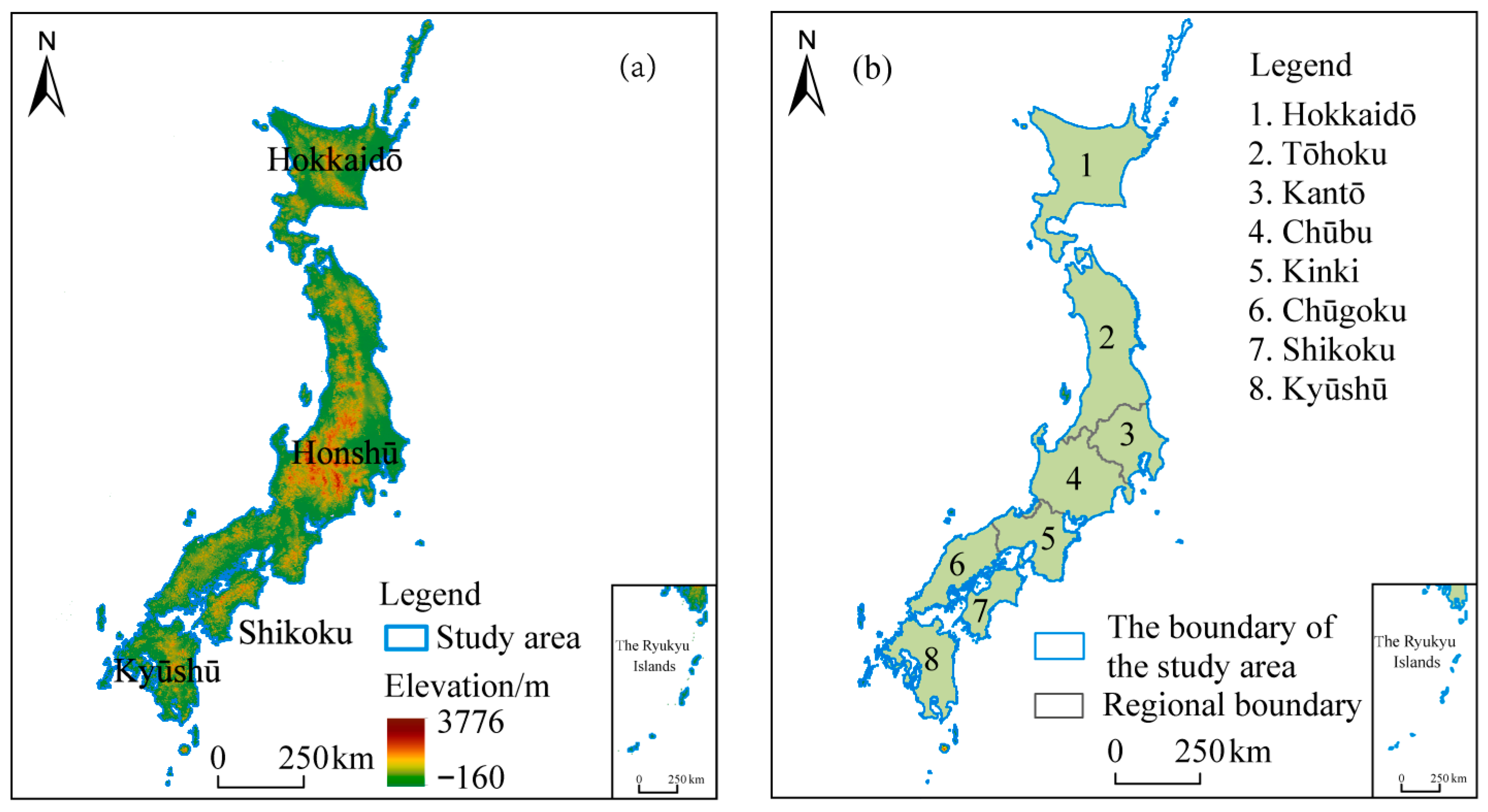
Figure 1. Map of the study area (a) and the eight regional administrative divisions of Japan (b).
Agronomy 15 02834 g001
Figure 2. Extent of maximum cropland distribution in Japan.
Agronomy 15 02834 g002
Figure 3. Land suitability for cultivation in Japan based on regional units. Land suitability values range from 0 (unsuitable) to 0.4 (highly suitable), with higher values indicating greater cultivation potential.
Agronomy 15 02834 g003
Figure 4. Changes in the total cropland area of Japan over the past millennium.
Agronomy 15 02834 g004
Figure 5. Changes in cropland area in eight regions of Japan over the past millennium.
Agronomy 15 02834 g005
Figure 6. Spatial distribution pattern of cropland in Japan from 800 to 2000 (10 km × 10 km).
Agronomy 15 02834 g006
Figure 7. Comparison of the spatial pattern between the remote sensing data of 2000 and the data of this study in Japan. (a) Remote sensing data; (b) cropland reconstructed in this study for the same period; (c) spatial pattern comparison.
Agronomy 15 02834 g007
Table 2. Statistics on the percentage of grids with difference values between reconstructed cropland and remotely monitored cropland in 2000.
Difference Level (%)<−80−80~−70−70~−60−60~−50−50~−40−40~−30−30~−20−20~−10−10~0
Proportion of grid numbers (%)0.090.290.571.062.675.118.5515.1819.31
Difference level (%)0~1010~2020~3030~4040~5050~6060~7070~80>80
Proportion of grid numbers (%)23.5311.106.923.361.380.550.200.090.06
Disclaimer/Publisher’s Note: The statements, opinions and data contained in all publications are solely those of the individual author(s) and contributor(s) and not of MDPI and/or the editor(s). MDPI and/or the editor(s) disclaim responsibility for any injury to people or property resulting from any ideas, methods, instructions or products referred to in the content.