

Article

Effects of Grassland Ley Sward Diversity on Soil Potassium and Magnesium Forms in Two Contrasting Sites

by
Matej Orešković
1,*,
Waldemar Spychalski
2,
Barbara Golińska
1 and
Piotr Goliński
1
1
Department of Grassland and Natural Landscape Sciences, Poznań University of Life Sciences (PULS), Wojska Polskiego 28, 60-637 Poznań, Poland
2
Department of Soil and Microbiology Sciences, Poznań University of Life Sciences (PULS), Wojska Polskiego 28, 60-637 Poznań, Poland
*
Author to whom correspondence should be addressed.
Agronomy 2025, 15(12), 2815; https://doi.org/10.3390/agronomy15122815
Submission received: 18 November 2025 / Revised: 30 November 2025 / Accepted: 4 December 2025 / Published: 7 December 2025
(This article belongs to the Special Issue Multifunctionality of Grassland Soils: Opportunities and Challenges)

Abstract

Although multispecies grassland leys are known to influence nutrient dynamics in soils, little is known about the soil potassium (K) and magnesium (Mg) quantities in such systems. In this study, we quantified soluble, active, and exchangeable forms of K and Mg in two contrasting sites differing in soil types: Cambisols and Luvisols. These measurements were conducted in grassland ley swards differing in the species composition of their sown mixtures. The grassland ley experiment included six species belonging to three functional groups: grasses (G1: Lolium perenne, G2: Phleum pratense), legumes (L1: Trifolium repens, L2: Trifolium pratense), and herbs (H1: Cichorium intybus, H2: Plantago lanceolata). Thirty-three plant communities were established following a simplex design approach, with sown proportions ranging from 100% (monocultures) to 50%, 33%, 25%, 16.7%, and 0% across the different mixture combinations. Plant diversity only had a slightly negative trend for potassium on Cambisols. Grass-dominated mixtures maintained higher soil K levels, while legume-rich swards exhibited lower concentrations, consistent with legumes’ greater K demand. Notably, the different effects of extractants on K were most evident in Cambisols, indicating stronger cation retention. This indicates the need to use the CaCl2 and NH4OAc extraction methods to determine the potassium content in this type of soil, and that these methods should be considered for evaluation of soil fertility.

1. Introduction

Grasslands cover roughly 26% of the Earth’s terrestrial surface and about 70% of agricultural utilized area [1]; as such, they are ecologically and economically significant habitats. For intensively managed forage production systems, perennial ryegrass monoculture with high nitrogen fertilization is still a common practice [2]. Over the years, with a rise in input costs and EU incentives, farmers have adopted grass-clover and, to a lesser extent, multispecies swards as a sustainable practice. To date, extensive research has been conducted on various ecosystem functions of the multispecies swards, including plant biomass [2]; plant C:N ratio [3]; N leaching [4]; soil microbial C [5]; soil microbial C:N ratio [5]; root biomass [6]; plant N and P uptake [7] and decomposition of the litter [8]; drought resilience [9]; pollinators and nematode abundance [10,11]; and yield of the follow-on crop [12]. Species diversity is a significant factor across a multitude of ecosystem functions, including productivity, stability, weed invasion, and drought resilience [13,14,15], with a generally positive but saturating relationship [8].
Soil is an irreplaceable and vital resource that is increasingly under threat worldwide. The European Council has indicated that about 60–70% of soils in the EU are currently in an unhealthy state [16]. Unsustainable bad management practices following the premise that high input equals high yield without long-term consideration leads to loss of soil structure and SOC, soil compaction, erosion, contamination, and decline of biodiversity [16,17]. Potassium (K+) is the seventh most abundant element on Earth’s crust, and its quantity depends on the content of clay minerals [18]. The overall content of potassium in soil ranges between 0.4 and 30 g∙kg−1, with a median of approximately 10 g∙kg−1, and is derived from the origin parent material [19]. We can divide soil K into four forms, in terms of its availability to plants: mineral K (mostly unavailable), fixed K (slowly available), exchangeable K (available), and soil solution K (available) with quantities of 90–98%, 1–10%, 1–2%, and 0.1–0.2% of total soil K, respectively [20,21]. “Fixed K” is slowly released into the soil solution but contributes to the potassium reserve, while “mineral K” is structurally bound with soil minerals. Cation exchange is a reversible process associated with mineral nutrient balance, and the depletion of soil solution cations will result in the release of cations from the clay surface [22]. Cations are held at negatively charged sites on soil particles and humus, and are readily available to plants [23]. The uptake of potassium by plants is surpassed only by nitrogen, and the quantities of K removed through the harvesting of plant biomass in intensive agricultural systems may even surpass those of nitrogen [24].
Potassium is fundamentally linked to nitrogen (N) nutrition in plants, playing a critical role in processes such as nitrate (NO3-N) uptake [25]. It is involved in protein synthesis by enhancing the activities of key enzymes like leaf carbonic anhydrase and nitrate reductase, both of which are essential for photosynthesis and amino acid formation. As a result, potassium significantly influences how effectively plants utilize N. As N fertilization enhances growth, it consequently increases the demand for K [26], and optimal K fertilization in grass swards may increase N uptake in grass DM [27]. Potassium is considered the most important cation because of its key role in assimilation, phloem loading, assimilate transport, N metabolism, and storage processes [26].
Magnesium (Mg2+) is the eighth most abundant element on the Earth’s crust [28], although the majority of soil Mg (90–98%) is part of the soil’s structural minerals and is not immediately available for plant uptake [29]. Magnesium plays a crucial role in plant physiology, such as chlorophyll and protein synthesis, enzyme activation, phosphorylation, photosynthesis, and carbohydrate partitioning [30]. An imbalance between magnesium results from losses through leaching and biomass removal, and the relatively infrequent inputs from dung or fertilizer often leads to a general shortage of plant-available magnesium in grasslands [29].
Nutrient cycling in the soil is a complex process, with plants, animals, and abiotic factors all influencing one another. Unavailable nutrient forms are transformed into available forms within the soil, subsequently absorbed by root systems, translocated, and utilized by plants, which are eaten by animals and—via urine (mostly K), and dung (mostly Mg)—returned to the ecosystem in concentrated clusters commonly known as urine patches. Physical, chemical, and biological properties of the soil can favor the growth of specific functional groups and/or species. Due to their atmospheric nitrogen fixation ability (symbiosis with Rhizobium bacteria), legumes do not depend on soil N when plant available N decreases in the soil; on the other hand, they rely heavily on the potassium in the soil, which is needed to maintain this symbiotic relationship. Problems especially arise in organic and leaching-prone sandy soils, which are generally poor in K- and Mg-bearing minerals, thus making them completely dependent on K input [25,31]. On the other hand, a high input of K can displace Mg from exchangers, which is why Mg is considered the major cation leached [32]. The soil equilibrium of these elements is important as they have impacts on plant, animal, and human nutrition. Grass tetany and milk fever in lactating cows are caused by high K and low Mg content in herbage, inhibition of plant growth caused by a lack of plant-available Mg, and human Mg deficiencies are only some problems along the food chain caused by imbalances of these cations [33,34,35].
Although numerous studies have investigated nitrogen (N) and phosphorus (P) dynamics in grassland systems, far fewer have examined the behavior of both potassium (K) and magnesium (Mg). Previous research in permanent meadows and pastures has addressed K dynamics [27,36,37,38] and Mg dynamics [37,38,39], but these studies typically relied on a single extraction method. Only one study [31] has compared different extraction procedures for assessing K and Mg availability, or across different species richness gradients [27]. To our understanding, no work has examined the soil status of K and Mg in highly productive grassland leys using three extraction methods.
The aim of this study was to assess how the species richness of grassland leys influences the forms of soluble, active, and exchangeable potassium (K) and magnesium (Mg), using separate models for different soil types and chemical extractants (H2O, CaCl2, and NH4OAc).

2. Materials and Methods

2.1. Site Description

A grassland ley experiment was established within the LegumeLegacy project in September 2022 in Szelejewo (PL1) in the Division of Plant Breeding, Danko Ltd. (Szelejewo, Poland), (51°51′44″ N; 17°09′13″ E; 127 m a.s.l.); and in April 2023 in Brody (PL2) in the Experimental Station of the Department of Grassland and Natural Landscape Sciences of PULS (Brody, Poland) (52°26′11″ N; 16°17′47″ E; 94 m a.s.l.). In order to classify the soil at both sites, granulometric analysis was conducted to determine the soil particle size distribution. Both sites are located on mineral soils, with PL1 according to the IUSS Working Group WRB taxonomy [40] classified as Eutric Cambisols (Loamic, Aric), in which the soil texture of the top horizon is sandy loam and the fraction content is as follows: sand 76%, silt 16%, and clay 8%. The soils located on the PL2 site were classified as Albic Abruptic Luvisols (Anoarenic, Aric, Cutanic, Endoloamic, Ochric). The soil texture of the top horizon was classified as loamy sand and the content of granulometric fractions was as follows: sand 76%, silt 19%, and clay 3%.

2.2. Basic Chemical Soil Properties

Before establishment of the experiment, soil samples were taken randomly from the PL1 and PL2 sites to measure chemical properties of the soils via methods commonly used in Poland. Available forms of potassium and phosphorus were determined according to the Egner–Riehm method (DL test) and available forms of magnesium were assessed using the Schachtschabel method (0.0125 mol∙dm−3 CaCl2 in a 1:10 solution). The basic chemical properties are given in Table 1. The Cambisols soil (PL1) indicated higher pH value and P content, while higher N and C contents were determined in the Luvisols soil (PL2).
The same soil investigations were conducted after termination of the experiment in September 2024 (Table 2). The soils at both sites were characterized by lower pH and higher N and C contents, as well as increased phosphorus content. In the case of potassium and magnesium—which are the subject of our study—changes in their content in the soils before establishment of the grassland ley experiment and after its termination are presented in Table 3. The amounts of these macronutrients in the soils varied after the grassland ley phase (18 and 24 months for PL2 and PL1, respectively): the content of K decreased at both sites, but Mg decreased in PL1 and increased in PL2.

2.3. Experimental Design

The grassland ley experiment included six forage species belonging to three functional groups: grasses (G1: Lolium perenne, G2: Phleum pratense), legumes (L1: Trifolium repens, L2: Trifolium pratense), and herbs (H1: Cichorium intybus, H2: Plantago lanceolata). Thirty-three plant communities were established following a simplex design approach [41], with sown proportions ranging from 100% (monocultures) to 50%, 33%, 25%, 16.7%, and 0% across the different mixture combinations. This resulted in a gradient of diversity that ranged from monocultures to a equi-proportional six-species mixture.
In total, 47 plots (3 × 7 m)—comprising 18 monoculture plots and 29 mixture plots—were established, with proportions randomly assigned within each site. All 47 plots were managed at the same level of nitrogen (N) fertilizer (based on local practice, 120 kg ha−1 and 150 kg ha−1 y−1 for PL1 and PL2, respectively), with no additional potassium (K) or magnesium (Mg) fertilization applied. As a reference for conventional grassland ley management, five replicates of a Lolium perenne monoculture were sown on each site (3 × 7 m), which received double the recommended nitrogen rate (HighN). In the grassland phase, plots were harvested by mowing 4 and 3 times a year at sites PL1 and PL2, respectively. The difference in mowing frequency was due to the higher soil fertility in PL1 compared to PL2, as well as the greater resistance of Cambisols soil to short-term water deficits; which, in the case of Luvisols soil, reduced plant growth. According to the adopted methodology, mowing of the sward on both sites was carried out when the perennial ryegrass reached the stage of suitability for silage harvesting.

2.4. Sampling

Aggregated soil samples (homogenized) for potassium and magnesium analyses were collected from each plot using a soil sampler (Eijkelkamp Soil & Water company, Giesbeek, The Netherlands) after the termination of the grassland ley experiment in September 2024, resulting in a total of 104 samples. The average sample consisted of 15–20 individual punctures from a depth of 0–20 cm. In the laboratory, the samples were air-dried at room temperature, crushed in a porcelain mortar, and sieved through a 2 mm sieve. Laboratory analyses were conducted on air-dried soil samples using the following methods: soil texture was determined with the hydrometer method. Soil reaction (pH) was measured potentiometrically in distilled H2O extractant and 1 mol∙dm−3 KCl (Polish Chemical Reagents Avantor, Zawroty, Poland) (soil-to-solution ratio 1:2.5). Organic C and total N were quantified via elemental analysis using an Elementar Vario Max analyzer (Elementar Analysensysteme GmbH, Langenselbold, Germany). The content of exchangeable forms of base cations were extracted with 1 mol∙dm−3 ammonium acetate (Polish Chemical Reagents Avantor, Zawroty, Poland) at pH 7.0, and their concentrations were measured using a Spectra AA 220 FS atomic absorption spectrometer (Varian Australia Pty Ltd., Sydney, Australia). Exchangeable hydrogen was determined using 1 mol∙dm−3 sodium acetate (Polish Chemical Reagents Avantor, Zawroty, Poland) at pH 8.2 [42], and the contents of potassium and magnesium forms were assessed using the procedure described in detail in Table 4.

2.5. Data Analysis

Data analysis was conducted in R (version 4.5.1) [44] using the DImodels package (version 1.3.3) [45]. The response variables were potassium (K) and magnesium (Mg) concentrations, assessed across different soil types and extractants. For each combination of site, cation, and extractant, a separate Diversity–Interaction (DI) model was fitted, giving a total of 12 models (2 sites × 2 cations × 3 extractants). Model comparison was performed based on the corrected Akaike Information Criterion (AICc) [46]. DI models are multiple regression models in which the predictors are species proportions constrained to sum to one, accompanied by interaction terms and model residuals. Although several interaction structures are available in DImodels, we retained only the identity-effects (ID) and average-interaction (AV) models, as these received the best AICc values. The ID model assumes that species contribute independently to the ecosystem function (mixture performance can be predicted directly from monoculture values), while the AV model assumes that all pairwise interspecific interactions share a common interaction coefficient (single average interaction term across species combinations) [47]. Cation contents for potassium (K+) at the PL2 site in water and ammonium, as well as magnesium (Mg2+) at the PL1 site, were log-transformed prior to analysis to meet the assumptions of normality and homoscedasticity. Model predictions were back-transformed from the logarithmic scale using the parametric bias correction [48] by multiplying each prediction with e0.5σ2, where s2 is the residual variance determined from the fitted model.

3. Results

3.1. Diversity Interaction Models

Separate Diversity–Interaction models were fitted for each site, cation, and extractant combination, resulting in 12 models in total (2 sites × 2 cations × 3 extractants). Among these, only potassium (K) extracted with water at the PL1 site showed an antagonistic effect of increasing species richness, reflected in a significant negative average interaction effect (−4.59 ± 2.04, p = 0.03). For all other site–cation–extractant combinations, no evidence of synergistic or antagonistic interactions between species composition and cation content in the soil was detected. The raw data in Figure 1 illustrate the observed pattern. Consequently—and supported by AICc-based model selection—the final models for these cases included only species identity terms (ID models).

3.2. Identity Effects

Across all ID models, the identity effects of species were consistently significant (p < 0.001), except for magnesium (Mg) extracted with water at the PL2 site, where a smaller but significant effect was observed (p < 0.01) for G1 identity. The PL2 site showed higher baseline values for all cation-extractant combinations except for Mg dissolved in CaCl2 and NH4OAc, compared to PL1. On average, potassium values (across the diversity gradient from the raw data) were 1.39, 1.42, and 2.86 times higher at PL2 compared to PL1, with NH4OAc, CaCl2, and H2O, respectively. Conversely, magnesium contents in the soil were 1.38 and 1.48 times higher at PL1 with NH4OAc and CaCl2, while PL2 had a 1.58-fold higher magnesium value in H2O. When averaging soil cation contents across sites, potassium levels exceeded those of magnesium in all extractants, with the greatest fold increase observed in H2O (8.07), followed by NH4OAc (1.21) and CaCl2 (1.14). Regardless of the cation, water extraction consistently produced the lowest contents for both cations in the soil, whereas CaCl2 and NH4OAc extractions yielded higher values (Table 5).

3.3. Pairwise Linear Contrasts

To explore differences in species contributions and cation-specific responses across models, pairwise linear hypothesis tests were conducted between identity effects, the high-nitrogen G1 treatment, and the six-species equi-proportional mixture (Table S1). Overall, 50 significant (p < 0.05) and 25 marginally significant (p < 0.1) contrasts were identified across all models. Most significant contrasts were associated with magnesium (37), followed by extractants in H2O (21) and NH4OAc (20). The results were nearly balanced between sites PL2 (24) and PL1 (26), while potassium extracted with NH4OAc from PL2 soil was the only model without any significant pairwise differences.
At the PL1 site, G1 exhibited higher potassium content than G2, L1, and L2 in water (marginally significant for L1, p < 0.1; and, for G2 and L2, p < 0.1), as well as higher content than L1, L2, and the six-species mixture in NH4OAc (marginally for the six-species mixture, p < 0.1; L1, p < 0.05; L2, p < 0.01), and higher content than L2 in CaCl2 (marginally, p < 0.1).
Across both sites and nearly all extractants (except water in PL2), L1 consistently showed higher magnesium contents compared to the other treatments. On PL2, L1 had higher Mg than G1, G2, L2, H1, the six-species mixture, and HighN in CaCl2 (marginally for G1 and G2, p < 0.1; L2, p < 0.01; H1, the six-species mixture, and HighN, p < 0.05), and similar contrasts were found in NH4OAc (marginally for G2 and the six-species mixture, p < 0.1; G1, L2, H1, and HighN, p < 0.05). On PL1, L1 followed the same trend, showing higher Mg values than L2, H2, and the six-species mixture in CaCl2 (marginally for six-species mixture, p < 0.1; L2 and H2, p < 0.05); higher than L2, H2, six-species mixture, and HighN in water (L2 and H2, p < 0.01; the six-species mixture and HighN, p < 0.05); and higher than L2, H2, and the six-species mixture in NH4OAc (all p < 0.05).

3.4. Model Predictions

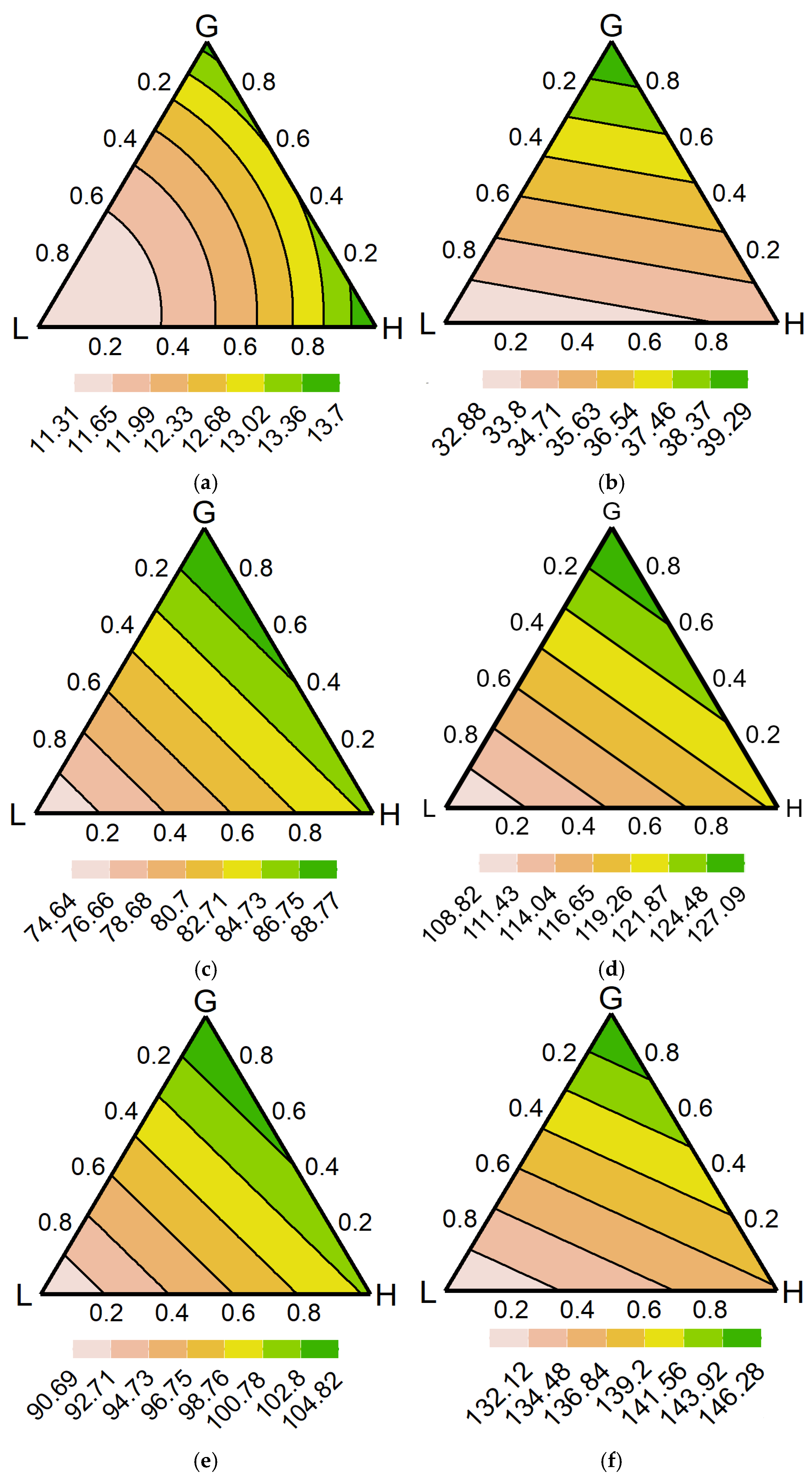
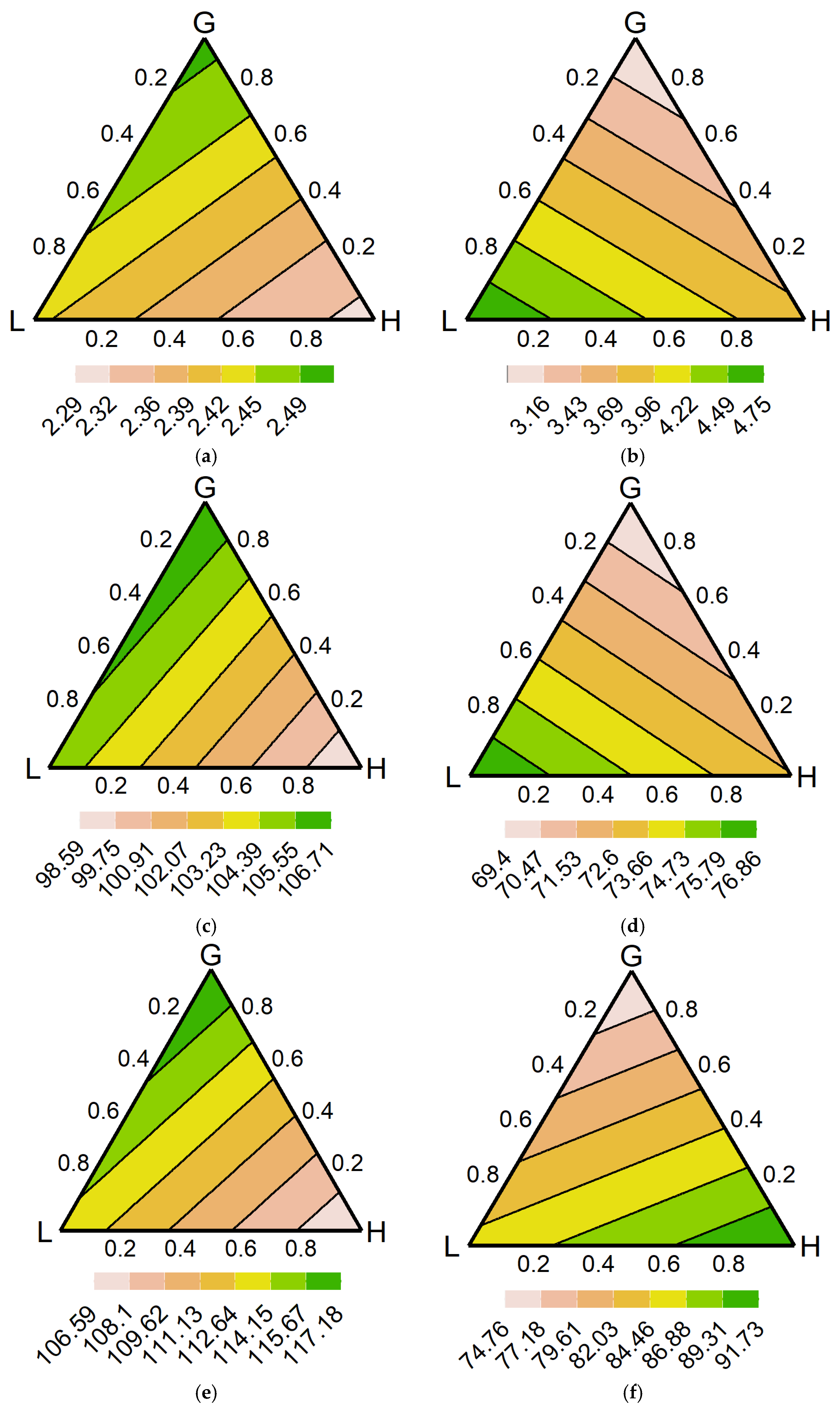
Ternary diagrams from the 12 models showed consistent changes in predicted cation values along gradients of grasses, legumes, and herbs. On both sites, potassium values were highest in grass-dominated swards and lowest in legume-dominated ones (Figure 2). In contrast, magnesium patterns varied between sites and extractants: on PL2, Mg peaked in legume-rich communities and was lowest in grass-dominated swards; except for NH4OAc, where the highest values occurred in herb-dominated ones, while the lowest remained in grass-dominated swards (Figure 3). On PL1, Mg was highest in grass-dominated communities for all extractants, while the herb-dominated swards consistently had the lowest Mg values.

4. Discussion

Our research contributes to evaluation of the benefits of grassland leys in crop rotation as an agronomic element that improves soil fertility. Previous studies have assessed the impacts of grasses and legumes—grown either in monocultures or in grass–legume mixtures forming grassland leys—on the accumulation of nitrogen, carbon, and organic matter in the soil, which serve as nutrient sources for the follow-on crops in the rotation, such as cereals. In this study, we focused on two mineral macronutrients which are important for the growth of follow-on crops: potassium and magnesium. We evaluated the effects of sward diversity in grassland leys at two contrasting sites differing in soil type (Cambisols and Luvisols) on the contents of various forms of potassium and magnesium available for plants: soluble, active, and exchangeable. This represents a novel approach that substantially advances current knowledge, going beyond what is reported in the available literature. Analyzing potassium and magnesium contents using three extractants enabled more accurate quantification of the relationships among cation forms under the two soil types and with different levels of diversity of grassland leys, allowing for rational decision-making regarding plant nutrition of the follow-on crop, particularly during early growth and development.

4.1. Species Richness Effect

Overall, no significant species interactions were detected in most models (a feature of the ID model). This suggests that the mixture response is a linear combination of the component monoculture responses. Similar findings were reported by Dietrich et al. [49], who also observed limited effects of species diversity on plant-available soil potassium. Only the PL1 site located on Cambisols soil showed a significant negative average interaction effect (−4.59 ± 2.04, p < 0.05). This pattern likely reflects overyielding effects, as often reported in biodiversity–ecosystem functioning (BEF) studies, where higher species richness enhances biomass productivity [50]. Higher biomass production can intensify nutrient depletion from the soil—a mechanism well documented in previous work [51]—as potassium is second only to nitrogen in terms of plant uptake [24].

4.2. Differences Between Soil Types

Higher baseline cation levels at the Luvisols site can likely be attributed to fertilization history [38], which resulted in a 7.7% higher potassium and a 4.0% lower magnesium content compared to the Cambisols site at the start of the experiment. Lower magnesium availability in acidic and sandy soils is commonly linked to reduced clay and silt content [39]. The higher magnesium content in the Cambisols soil compared with Luvisols when using the CaCl2 extractant aligns with findings from the large-scale FRIBO experiment conducted across more than 250 sites in Switzerland [39]. However, the higher NH4OAc and lower water-extractable values in Cambisols observed in our study showed the opposite trend. This discrepancy may stem from differences in extractant pH or land-use history (cropland vs. permanent pasture), as noted in the FRIBO dataset.

4.3. Differences Among Extractants

Exchangeable magnesium is not always strongly correlated with organic carbon; only about 45% of its variation can be explained by soil pH and clay content [52]. Similarly, plant-available potassium is not always reliably represented by exchangeable K alone. Although the contribution of non-exchangeable cations depends on weathering and environmental conditions, these pools can substantially supplement plant nutrition [22,53]. Therefore, measuring multiple forms of available cations should be standard practice to ensure accurate fertilization recommendations and maintain long-term nutrient balance. In this study, regardless of the element, water extraction consistently produced the lowest contents, whereas CaCl2 and NH4OAc extractions yielded considerably higher values, consistent with previous research [31,39]. In our study, the magnesium contents extracted in water were 46.22 and 21.28 times lower than in NH4OAc, and 42.53 and 18.63 times lower in CaCl2 for Cambisols and Luvisols soils, respectively. These results emphasize the role of the soil colloidal fraction in replenishing soluble cations and the importance of clay content and cation-binding capacity, both of which were higher in Cambisols than in Luvisols soil.

4.4. Optimal Range of Communities

Across both sites, predicted potassium values were highest in grass-dominated communities and lowest in legume-dominated ones. This supports the view that legumes require large amounts of potassium for proper development and symbiotic nitrogen fixation [38]. Although grasses produce large amounts of biomass, they also return potassium-rich residues to the soil, which may explain the consistently higher K contents determined with different extractants over the two growing seasons [49]. The exchangeable potassium values in our study are comparable to those from similar experiments [22,38]. The magnesium patterns in our study, on the other hand, varied with soil type and extractant, similar to the findings of Frau et al. [39]. In Luvisols soil, legumes had the highest magnesium contents, followed by herbs and grasses, in both water and CaCl2 extractions, consistent with the observations of Grzegorczyk et al. [37]; in contrast, for the NH4OAc extraction, herbs surpassed legumes. Notably, magnesium levels were highest in grass-dominated communities and lowest in herb-dominated ones on Cambisols soil. This pattern may be linked to the weaker performance of grass mixtures G1 and G2 on Cambisols soil, where the annual DM yields in 2024 were 2.42 and 1.13 times lower, respectively, than those on Luvisols (unpublished data).

4.5. Nutrient Cycling Complexity

Nutrient cycling in soil is a highly dynamic process, where insoluble nutrient forms are continuously transformed into plant-available ones through biological and physicochemical interactions. By applying three extractants that target the water-soluble, active, and exchangeable cation pools, this study provides a detailed picture of how soil type and sward diversity of grassland ley sown mixtures jointly influence the contents of potassium and magnesium in soil. The combined use of the three extractants provided a more precise quantification of the relationships among cation forms, and could be adopted as a standard method in routine soil testing for fertilization recommendations. Importantly, the ternary diagrams developed here offered a practical visual framework to identify the range of plant sward compositions associated with the lowest and highest cation values across both soil types. To further strengthen future research, incorporating mineralogical characterization of coarser soil fractions and increasing the number of replicates would help to better elucidate the mechanisms controlling nutrient transformation and mobility.

5. Conclusions

Overall, increasing sward diversity did not bring a significant change to soil potassium and magnesium values, except on Cambisols soil, where a negative interaction was observed. The potassium content in the soil, regardless of the soil type and extractant, was highest for grass-dominated swards, while legume-dominated communities showed lower values. This relationship confirms the greater potassium requirement of legumes compared to herbs and grasses and, at the same time, the depletion of potassium in the soil following the use of grassland leys for fodder purposes. Magnesium values varied across sites and extractants, which suggests that grassland ley sward diversity has a lower effect on soil magnesium content than in the case of potassium. The difference in potassium content between the water-soluble and exchangeable forms extracted with NH4OAc in Cambisols soil was substantially higher than that in Luvisols soil (7.5 and 3.7, respectively). A similar relation was found between the forms of potassium in the soil (i.e., water-soluble and active) extracted with CaCl2. This difference results from the larger sorption complex of soil colloids in Cambisols and the higher retention of potassium cations in soil. These results indicate the need to use both the CaCl2 and NH4OAc extraction methods when determining the potassium content in this type of soil; this approach should be considered for soil fertility evaluation, particularly after termination of legume-dominated grassland ley swards.

Supplementary Materials

The following supporting information can be downloaded at: https://www.mdpi.com/article/10.3390/agronomy15122815/s1, Table S1. Pairwise linear contrasts (from the fitted DI models) comparing predicted cation concentrations among monocultures (n = 6), the six-species mixture, and the HighN reference treatment.

Author Contributions

Conceptualization: P.G., B.G. and W.S.; methodology: P.G., B.G. and W.S.; software: M.O.; validation: M.O.; formal analysis: M.O.; investigation: M.O.; resources: P.G. and B.G.; data curation: M.O.; writing—original draft preparation: M.O.; writing—review and editing, P.G., B.G., W.S. and M.O.; visualization: M.O.; supervision: P.G., B.G. and W.S.; project administration: P.G. and B.G.; funding acquisition: P.G. and B.G. All authors have read and agreed to the published version of the manuscript.

Funding

This study was supported by European Union’s Horizon 2021 doctoral network programme under the Marie Skłodowska–Curie grant agreement No. 101072579 (Legume Legacy).

Data Availability Statement

The raw data supporting the conclusions of this article will be made available by the authors upon request.

Conflicts of Interest

The authors declare no conflicts of interest.

References

  1. FAO, Food and Agriculture Organization of the United Nations. Available online: https://www.fao.org/faostat/en/#data/LC (accessed on 22 October 2025).
  2. Golińska, B.; Vishwakarma, R.; Brophy, C.; Goliński, P. Positive effects of plant diversity on dry matter yield while maintaining a high level of forage digestibility in intensively managed grasslands across two contrasting environments. Grass Forage Sci. 2023, 78, 438–461. [Google Scholar] [CrossRef]
  3. Schaub, S.; Finger, R.; Leiber, F.; Probst, S.; Kreuzer, M.; Weigelt, A.; Buchmann, N.; Scherer-Lorenzen, M. Plant diversity effects on forage quality, yield and revenues of semi-natural grasslands. Nat. Commun. 2020, 11, 768. [Google Scholar] [CrossRef]
  4. Suter, M.; Huguenin-Elie, O.; Lüscher, A. Multispecies for multifunctions: Combining four complementary species enhances multifunctionality of sown grassland. Sci. Rep. 2021, 11, 3835. [Google Scholar] [CrossRef]
  5. Lama, S.; Velescu, A.; Leimer, S.; Weigelt, A.; Chen, H.; Eisenhauer, N.; Scheu, S.; Oelmann, Y.; Wilcke, W. Plant diversity influenced gross nitrogen mineralization, microbial ammonium consumption and gross inorganic N immobilization in a grassland experiment. Oecologia 2020, 193, 731–748. [Google Scholar] [CrossRef]
  6. Eriksen, J.; Mortensen, T.; Søegaard, K. Root biomass and carbon storage in differently managed multispecies temporary grasslands. Grass Forage Sci. Eur. 2012, 17, 610–612. [Google Scholar]
  7. Obasoro, O.; Shackleton, J.; Grace, C.; Kennedy, J.; Oram, N.J.; Sheridan, H.; Schmidt, O.; De Goede, R.; Hoffland, E.; Obasoro, O.; et al. Multispecies swards improve nitrogen use efficiency and reduce nitrogen surplus in agricultural grasslands. Plant Soil 2025, 1–15. [Google Scholar] [CrossRef]
  8. Cardinale, B.J.; Duffy, J.E.; Gonzalez, A.; Hooper, D.U.; Perrings, C.; Venail, P.; Narwani, A.; MacE, G.M.; Tilman, D.; Wardle, D.A.; et al. Biodiversity loss and its impact on humanity. Nature 2012, 486, 59–67. [Google Scholar] [CrossRef] [PubMed]
  9. Lüscher, A.; Barkaoui, K.; Finn, J.A.; Suter, D.; Suter, M.; Volaire, F. Using plant diversity to reduce vulnerability and increase drought resilience of permanent and sown productive grasslands. Grass Forage Sci. 2022, 77, 235–246. [Google Scholar] [CrossRef]
  10. Cong, W.; Dupont, Y.L.; Søegaard, K.; Eriksen, J. Optimizing yield and flower resources for pollinators in intensively managed multi-species grasslands. Agric. Ecosyst. Environ. 2020, 302, 107062. [Google Scholar] [CrossRef]
  11. Ikoyi, I.; Grange, G.; Finn, J.A.; Brennan, F.P. Plant diversity enhanced nematode-based soil quality indices and changed soil nematode community structure in intensively-managed agricultural grasslands. Eur. J. Soil Biol. 2023, 118, 103542. [Google Scholar] [CrossRef]
  12. Komainda, M.; Muto, P.; Isselstein, J. Interaction of multispecies sward composition and harvesting management on herbage yield and quality from establishment phase to the subsequent crop. Grass Forage Sci. 2022, 77, 89–99. [Google Scholar] [CrossRef]
  13. Brophy, C.; Finn, J.A.; Lüscher, A.; Suter, M.; Kirwan, L.; Sebastià, M.T.; Helgadóttir, Á.; Baadshaug, O.H.; Bélanger, G.; Black, A.; et al. Major shifts in species’ relative abundance in grassland mixtures alongside positive effects of species diversity in yield: A continental-scale experiment. J. Ecol. 2017, 105, 1210–1222. [Google Scholar] [CrossRef]
  14. Finn, J.A.; Kirwan, L.; Connolly, J.; Sebastià, M.T.; Helgadottir, A.; Baadshaug, O.H.; Bélanger, G.; Black, A.; Brophy, C.; Collins, R.P.; et al. Ecosystem function enhanced by combining four functional types of plant species in intensively managed grassland mixtures: A 3-year continental-scale field experiment. J. Appl. Ecol. 2013, 50, 365–375. [Google Scholar] [CrossRef]
  15. Grange, G.; Brophy, C.; Vishwakarma, R.; Finn, J.A. Effects of experimental drought and plant diversity on multifunctionality of a model system for crop rotation. Sci. Rep. 2024, 14, 10265. [Google Scholar] [CrossRef]
  16. EU. Proposal for a Directive of the European Parliament and of the Council on Soil Monitoring and Resilience (Soil Monitoring Law); European Commission: Brussels, Belgium, 2023.
  17. Weninger, T.; Ramler, D.; Bondi, G.; Asins, S.; O’Sullivan, L.; Assennato, F.; Astover, A.; Bispo, A.; Borůvka, L.; Buttafuoco, G.; et al. Do we speak one language on the way to sustainable soil management in Europe? A terminology check via an EU-wide survey. Eur. J. Soil Sci. 2024, 75, e13476. [Google Scholar] [CrossRef]
  18. Schroeder, D. Structure and weathering of potassium containing minerals. In Proceedings of the 11th Congress of the International Potash Institute, Tokyo, Japan, 27–28 August 1978; International Potash Institute: Bern, Switzerland, 1978; pp. 43–63. [Google Scholar]
  19. Sparks, D.L. Potassium Dynamics in Soils. In Proceedings of the Advances in Soil Science; Stewart, B.A., Ed.; Springer: New York, NY, USA, 1987; pp. 1–63. [Google Scholar] [CrossRef]
  20. Carey, P.L.; Curtin, D.; Scott, C.L. An improved procedure for routine determination of reserve-K in pastoral soils. Plant Soil 2011, 341, 461–472. [Google Scholar] [CrossRef]
  21. Sumner, M.E. Handbook of Soil Science; CRC Press: Boca Raton, FL, USA, 2000; p. 2148. [Google Scholar]
  22. Andrist-Rangel, Y.; Edwards, A.C.; Hillier, S.; Öborn, I. Long-term K dynamics in organic and conventional mixed cropping systems as related to management and soil properties. Agric. Ecosyst. Environ. 2007, 122, 413–426. [Google Scholar] [CrossRef]
  23. Sparks, D.L.; Huang, P.M. Physical chemistry of soil potassium. In Potassium in Agriculture; Munson, R.D., Ed.; American Society of Agronomy: Madison, WI, USA, 1985; pp. 201–276. [Google Scholar]
  24. Kayser, M.; Isselstein, J. Potassium cycling and losses in grassland systems: A review. Grass Forage Sci. 2005, 60, 213–244. [Google Scholar] [CrossRef]
  25. Hylton, L.O.; Ulrich, A.; Cornelius, D.R. Potassium and Sodium Interrelations in Growth and Mineral Content of Italian Ryegrass. Agron. J. 1967, 59, 311–314. [Google Scholar] [CrossRef]
  26. Zhang, F.; Niu, J.; Zhang, W.; Chen, X.; Li, C.; Yuan, L.; Xie, J. Potassium nutrition of crops under varied regimes of nitrogen supply. Plant Soil 2010, 335, 21–34. [Google Scholar] [CrossRef]
  27. McCarthy, T.; Wall, D.P.; Casey, I.A.; Humphreys, J.; Forrestal, P.J. Integrating Soil Potassium Status and Fertilisation Strategies to Increase Grassland Production and Mitigate Potassium Management Induced Metabolic Disorders in Grazing Livestock. Soil Use Manag. 2025, 41, e70074. [Google Scholar] [CrossRef]
  28. Maguire, M.E.; Cowan, J.A. Magnesium chemistry and biochemistry. Biometals 2002, 15, 203–210. [Google Scholar] [CrossRef] [PubMed]
  29. Senbayram, M.; Gransee, A.; Wahle, V.; Thiel, H. Role of magnesium fertilisers in agriculture: Plant-soil continuum. Crop Pasture Sci. 2015, 66, 1219–1229. [Google Scholar] [CrossRef]
  30. Cakmak, I.; Yazici, A.M. Magnesium: A forgotten element in crop production. Better Crops 2010, 94, 23–25. [Google Scholar]
  31. Staugaitis, G.; Rutkauskienė, R. Comparison of magnesium determination methods as influenced by soil properties. Agriculture 2010, 97, 105–116. [Google Scholar]
  32. Mikkelsen, R. Soil and fertilizer magnesium. Better Crops 2010, 94, 26–28. [Google Scholar]
  33. Guo, W.; Nazim, H.; Liang, Z.; Yang, D. Magnesium deficiency in plants: An urgent problem. Crop J. 2016, 4, 83–91. [Google Scholar] [CrossRef]
  34. Hawkesford, M.; Horst, W.; Kichey, T.; Lambers, H.; Schjoerring, J.; Møller, I.S.; White, P. Functions of Macronutrients. In Marschner’s Mineral Nutrition of Higher Plants, 3rd ed.; Marschner, P., Ed.; Pergamon Press: Pergamon, UK, 2011; pp. 135–189. [Google Scholar] [CrossRef]
  35. Schonewille, J.T. Magnesium in dairy cow nutrition: An overview. Plant Soil 2013, 368, 167–178. [Google Scholar] [CrossRef]
  36. Cooledge, E.C.; Sturrock, C.J.; Atkinson, B.S.; Mooney, S.J.; Brailsford, F.L.; Murphy, D.V.; Leake, J.R.; Chadwick, D.R.; Jones, D.L. Herbal leys have no effect on soil porosity, earthworm abundance, and microbial community composition compared to a grass-clover ley in a sheep grazed grassland after 2-years. Agric. Ecosyst. Environ. 2024, 365, 108928. [Google Scholar] [CrossRef]
  37. Grzegorczyk, S.; Alberski, J.; Olszewska, M. Accumulation of potassium, calcium and magnesium by selected species of grassland legumes and herbs. J. Elem. 2013, 18, 69–78. [Google Scholar] [CrossRef]
  38. Moir, J.; Seidel, M.; Kayser, M. Potassium dynamics of four grassland soils contrasting in soil K management history. Grassl. Sci. 2013, 59, 1–10. [Google Scholar] [CrossRef]
  39. Frau, L.J.; Libohova, Z.; Joost, S.; Levasseur, C.; Jeangros, B.; Bragazza, L.; Sinaj, S. Regional investigation of spatial-temporal variability of soil magnesium—A case study from Switzerland. Geoderma Reg. 2020, 21, e00278. [Google Scholar] [CrossRef]
  40. IUSS Working Group WRB, World Reference Base for Soil Resources. International Soil Classification System for Naming Soils and Creating Legends for Soil Maps, 4th ed.; International Union of Soil Sciences: Rome, Italy, 2022. [Google Scholar]
  41. Cornell, J.A. Experiments with Mixtures: Designs, Models, and the Analysis of Mixture Data, 3rd ed.; John Wiley & Sons Inc.: Hoboken, NJ, USA, 2011. [Google Scholar]
  42. Van Reeuwijk, L.P. Procedures for Soil Analysis, 6th ed.; Technical Paper No. 9; FAO/ISRIC: Wageningen, The Netherlands, 2002; p. 120. [Google Scholar]
  43. R Core Team. R: A Language and Environment for Statistical Computing. R Foundation for Statistical Computing. 2020. Available online: https://www.R-project.org/ (accessed on 22 October 2025).
  44. Moral, R.A.; Vishwakarma, R.; Connolly, J.; Byrne, L.; Hurley, C.; Finn, J.A.; Brophy, C. Going beyond richness: Modelling the BEF relationship using species identity, evenness, richness and species interactions via the DImodels R package. Methods Ecol. Evol. 2023, 14, 2250–2258. [Google Scholar] [CrossRef]
  45. Burnham, K.P.; Anderson, D.R. Model Selection and Multimodel Inference: A Practical Information-Theoretic Approach, 2nd ed.; Springer: New York, NY, USA, 2002; p. 408. [Google Scholar] [CrossRef]
  46. Kirwan, L.; Connolly, J.; Finn, J.A.; Brophy, C.; Nyfeler, D. Diversity-interaction modeling: Estimating contributions of species identities and interactions to ecosystem function. Ecology 2009, 90, 2032–2038. [Google Scholar] [CrossRef] [PubMed]
  47. Miller, D.M. Reducing transformation bias in curve fitting. American Statistician 1984, 38, 124–126. [Google Scholar] [CrossRef]
  48. Spychalski, W.; Kosiada, T.; Otremba, K. Content of potassium forms in an anthropogenic soil formed from post-mining lands under diversified agricultural practices. Acta Sci. Pol.—Agric. 2007, 6, 53–64. [Google Scholar]
  49. Dietrich, P.; Eisenhauer, N.; Roscher, C. Linking plant diversity–productivity relationships to plant functional traits of dominant species and changes in soil properties in 15-year-old experimental grasslands. Ecol. Evol. 2023, 13, e9883. [Google Scholar] [CrossRef]
  50. Nyfeler, D.; Huguenin-Elie, O.; Suter, M.; Frossard, E.; Connolly, J.; Lüscher, A. Strong mixture effects among four species in fertilized agricultural grassland led to persistent and consistent transgressive overyielding. J. Appl. Ecol. 2009, 46, 683–691. [Google Scholar] [CrossRef]
  51. Öborn, I.; Edwards, A.C.; Hillier, S. Quantifying uptake rate of potassium from soil in a long-term grass rotation experiment. Plant Soil 2010, 335, 3–19. [Google Scholar] [CrossRef]
  52. Hailes, K.J.; Aitken, R.L.; Menzies, N.W. Magnesium in tropical and subtropical soils from north-eastern Australia. I. Magnesium fractions and interrelationships with soil properties. Aust. J. Soil Res. 1997, 35, 615–627. [Google Scholar] [CrossRef]
  53. Simonsson, M.; Andersson, S.; Andrist-Rangel, Y.; Hillier, S.; Mattsson, L.; Öborn, I. Potassium release and fixation as a function of fertilizer application rate and soil parent material. Geoderma 2007, 198, 140–188. [Google Scholar] [CrossRef]
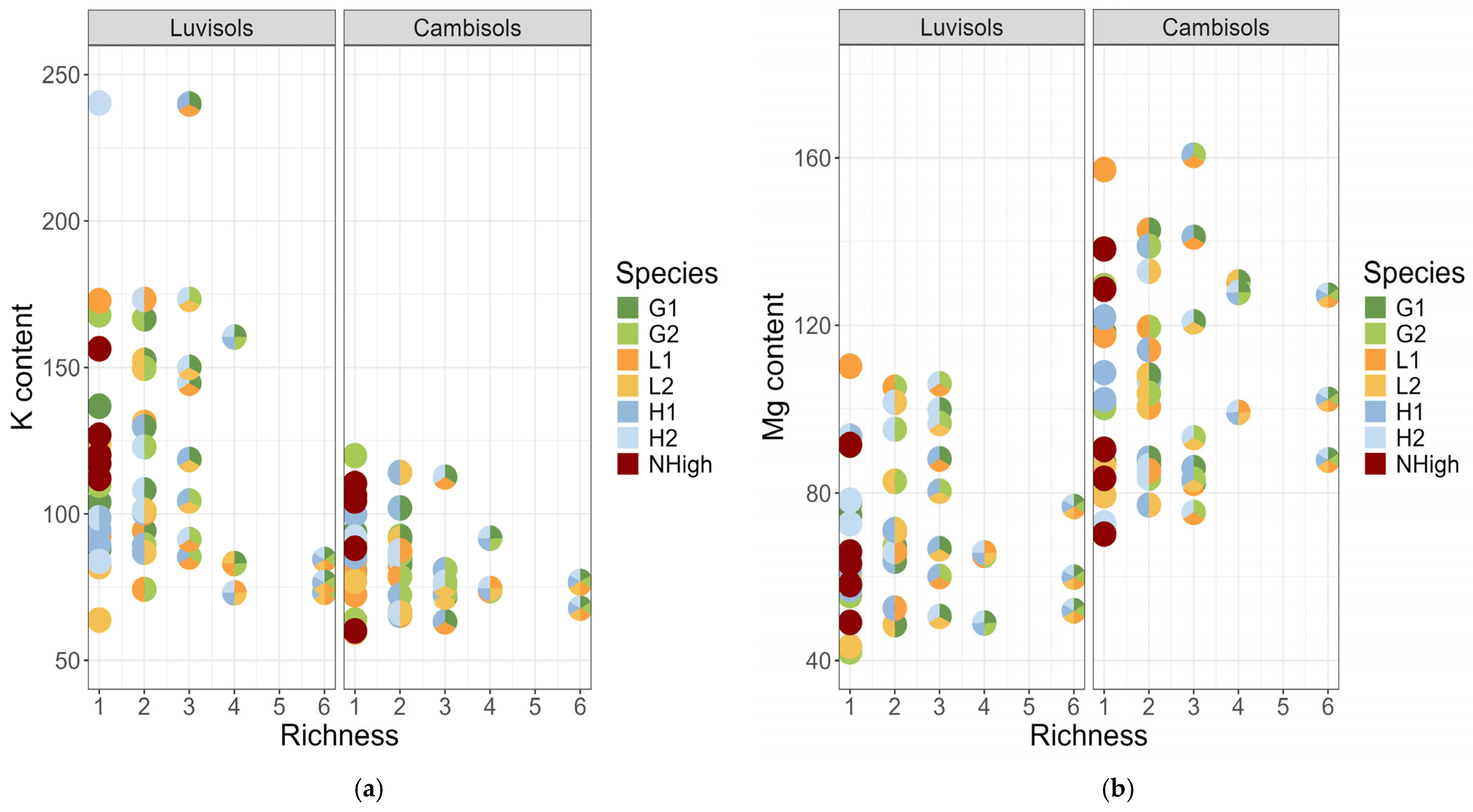
Figure 1. Scatterplots with pie-glyphs showing (a) potassium content and (b) magnesium content at both sites, measured via CaCl2 extraction (raw data). Pie-glyphs represent species composition (1—monoculture; 2–6—mixtures).
Agronomy 15 02815 g001
Figure 2. Ternary diagrams illustrating predicted soil potassium (K) contents across all grassland ley sown mixtures. Functional groups are merged at the vertices: grasses G (G1 + G2), legumes L (L1 + L2, and herbs H (H1 + H2). Panels in the first row (a,b) display predictions for the water extractant, the second row (c,d) for the CaCl2 extractant, and the third row (e,f) for the NH4OAc extractant. The left-hand panels (a,c,e) correspond to site PL1, while the right-hand panels (b,d,f) correspond to site PL2.
Agronomy 15 02815 g002
Figure 3. Ternary diagrams illustrating predicted soil magnesium (Mg) contents across all grassland ley sown mixtures. Functional groups are merged at the vertices: grasses G (G1 + G2), legumes L (L1 + L2), and herbs H (H1 + H2). Panels in the first row (a,b) display predictions for the water extractant, the second row (c,d) for the CaCl2 extractant, and the third row (e,f) for the NH4OAc extractant. The left-hand panels (a,c,e) correspond to site PL1, while the right-hand panels (b,d,f) correspond to site PL2.
Agronomy 15 02815 g003
Table 1. Basic chemical properties of the soils before establishment of the grassland ley experiment (mean values).
Soil Chemical PropertiesUnitPL1 Cambisols SoilPL2 Luvisols Soil
pHH2O-6.455.92
pHKCl-5.555.17
Exchangeable H+ (He+)cmol(+) kg−11.852.15
Total exchangeable base (TEB)cmol(+) kg−17.086.03
Cation-exchange capacity (CEC)cmol(+) kg−18.938.18
Total nitrogen content (N)%0.060.07
Total carbon content (C)%0.590.68
Phosphorus content (P)mg∙kg−157.4132.26
Class of abundance-mediumlow
Table 2. Basic chemical properties of the soils after termination of the grassland ley experiment (mean values).
Soil Chemical PropertiesUnitPL1 Cambisols SoilPL2 Luvisols Soil
pHH2O-6.345.67
pHKCl-5.374.85
Exchangeable H+ (He+)cmol(+) kg−12.092.79
Total exchangeable base (TEB)cmol(+) kg−16.054.08
Cation-exchange capacity (CEC)cmol(+) kg−18.146.87
Total nitrogen content (N)%0.070.09
Total carbon content (C)%0.761.04
Phosphorus content (P)mg∙kg−166.0147.47
Class of abundance-highmedium
Table 3. Potassium and magnesium in the soils of the grassland ley experiment (mean values).
Experiment StageCationPL1 Cambisols SoilPL2 Luvisols Soil
Before establishmentPotassium content (K) (mg∙kg−1)99.88107.62
Class of abundancemediummedium
Magnesium content (Mg) (mg∙kg−1)14.6014.00
Class of abundancevery lowvery low
After terminationPotassium content (K) (mg∙kg−1)91.3184.60
Class of abundancelowlow
Magnesium content (Mg) (mg∙kg−1)13.9614.70
Class of abundancevery lowvery low
Table 4. Analytical procedures for determining K and Mg forms using a Varian FS 220 (Varian Australia Pty Ltd., Sydney, Australia) [43].
K and Mg FormsExtractantDenotationDescription of the Extraction Method
H2O-solubleH2OK-H2O
Mg-H2O
100 g soil + 100 cm3 H2O (1:1) → shake 1.5 h → filter
Active0.01 mol∙dm−3 CaCl2K-CaCl2
Mg-CaCl2
2 g soil + 100 cm3 0.01 mol·dm−3 CaCl2 (1:50) → shake 1.5 h → filter
Exchangeable1 mol∙dm−3 NH4OAc by pH 7.0K-CH3COONH4
Mg-CH3COONH4
2 g soil + 100 cm3 CH3COONH4 (1:50) → shake 1.5 h → filter
Table 5. Mean values and standard error (SE) of soil potassium and magnesium contents (raw data), depending on site and extraction method (mg∙kg−1).
CationSite No.Soil TypeExtractant
H2OCaCl2NH4OAc
MeanSEMeanSEMeanSE
KPL1Cambisols13.260.3383.902.0799.961.72
PL2Luvisols37.903.00119.135.79138.565.50
MgPL1Cambisols2.450.08104.193.38113.243.40
PL2Luvisols3.860.2371.902.5882.153.27
Disclaimer/Publisher’s Note: The statements, opinions and data contained in all publications are solely those of the individual author(s) and contributor(s) and not of MDPI and/or the editor(s). MDPI and/or the editor(s) disclaim responsibility for any injury to people or property resulting from any ideas, methods, instructions or products referred to in the content.