Article

Different Land Use Patterns in Semi-Arid Regions Affect N2O Emissions by Regulating Soil Nitrification Functional Genes
1
College of Forestry, Gansu Agricultural University, Lanzhou 730070, China
2
College of Pratacultural Science, Gansu Agricultural University, Lanzhou 730070, China
3
College of Agriculture and Ecological Engineering, Hexi University, Zhangye 734000, China
*
Authors to whom correspondence should be addressed.
Agronomy 2025, 15(12), 2810; https://doi.org/10.3390/agronomy15122810
Submission received: 4 November 2025 / Revised: 3 December 2025 / Accepted: 4 December 2025 / Published: 6 December 2025
(This article belongs to the Section Agroecology Innovation: Achieving System Resilience)

Abstract

Nitrous oxide (N2O), as one of the important greenhouse gases in the atmosphere, has a significant impact on global climate change. Its emissions are significantly regulated by land use changes, especially in ecologically fragile semi-arid areas. However, there is still a lack of systematic analysis on the key biotic and abiotic factors through which different land use patterns affect N2O emissions. Therefore, this study focuses on four typical land use types in the Loess Plateau of central Gansu: Picea asperata (PA), Medicago sativa (MS), Abandoned land (AL), and Wheat field (WF). Static box gas chromatography was used to monitor soil N2O flux in situ, and multidimensional analysis was conducted based on soil physicochemical properties, microbial community structure, and nitrogen cycling functional genes. Based on the observational data from the 2024 growing season (April to October), Research findings show that the cumulative emissions of N2O from wheat fields increased significantly by 26.4%, 19.4%, and 39.8% compared to medicago sativa, abandoned land, and picea asperata, respectively. Mechanism analysis reveals that picea asperata promote nitrogen fixation and absorption in soil through higher soil water content and organic carbon content, as well as enrichment of Proteobacteria and high expression of nrfA and napA genes, thereby inhibiting N2O production and emissions. The wheat fields, on the other hand, have significantly increased N2O emissions due to the increased abundance of amoA_B, nxrB, and nirK functional genes and enhanced urease activity, which promote nitrification and denitrification processes. The Partial Least Squares Path Model (PLS-PM) further confirmed that nitrification functional genes are key driving factors for N2O emissions. This study systematically reveals the microbial and biochemical pathways involved in regulating N2O emissions through land use in semi-arid regions, providing a theoretical basis for regional nitrogen cycle management and climate mitigation.

1. Introduction

Against the backdrop of continued global warming, the mechanisms and regulatory pathways of greenhouse gas emissions have become a focus of research in environmental science and ecology [1]. Nitrous oxide (N2O), as one of the three major greenhouse gases, has a global warming potential of approximately 298 times that of carbon dioxide on a century scale, and has an undeniable amplifying effect on climate change [2]. Human activities, especially the transformation of land use patterns, have become the main driving factor for the increasing N2O emissions. Different land use types profoundly affect microbial community structure and function by altering vegetation composition, soil structure, and nutrient cycling, thereby regulating the generation and release of N2O [3].
Although research has recognized the significant impact of land use on N2O emissions, there is still significant controversy over its underlying mechanisms [4]. On the one hand, Agricultural intensification has led to the widespread application of nitrogen fertilizers. Fertilization elevates soil concentrations of ammonium and nitrate, thereby supplying the essential substrates for both nitrification and denitrification. The soil moisture regime and oxygen diffusion conditions established following fertilizer application regulate the activity of these two key microbial processes responsible for N2O production, ultimately enhancing N2O emissions. In Irish agricultural ecosystems, fertilization optimized according to crop nitrogen demand can reduce N2O emissions by approximately 11% to 60% [5]. On the other hand, the input of root exudates and litter in forest and grassland ecosystems increases the concentration of soil mineral nitrogen pools (ammonium nitrogen and nitrate nitrogen), which may further stimulate microbial activity and enhance N2O release [6]. For example, studies have found that pine forests have significantly higher N2O emissions than other ecosystems due to the prolonged existence and increased abundance of ammonia-oxidizing archaea amoA genes [7]. These differences highlight the necessity of systematically analyzing N2O emission mechanisms under different land use patterns, and also pose a scientific need for the development of regional differentiated emission reduction strategies.
Soil microorganisms are the core link in regulating N2O emissions, and they regulate N2O flux through nitrification and denitrification processes [8]. Existing research indicates that the microbial community structure, diversity, and composition of nitrogen cycling functional genes collectively determine the N2O emission potential of ecosystems [9]. Van Leeuwen, J.P. et al. revealed through metagenomics that different land use patterns significantly shape soil microbial community structure [10]. Chunmei Liu’s research in subtropical regions further indicates that the nosZI gene is present in typical denitrifying bacteria with a complete denitrification pathway, such as many Proteobacteria; while nosZII gene exhibits a broader phylogenetic distribution and is present in diverse non-denitrifying N2O-reducing microorganisms. In ecosystems like subtropical pine forests that may be nitrogen-limited, the abundance and activity of nosZII gene are particularly crucial for maintaining effective N2O reduction. Therefore, the low abundance of both types of nosZ genes, especially nosZII which may play a dominant role under low-nitrogen conditions, directly limits the soil’s ability to reduce N2O to N2 from a microbial functional perspective, leading to the observed increase in net emissions [11]. In addition, Qin, H. et al. found the distribution patterns of nitrogen-cycling functional genes differ significantly between farmland and forest soils. In farmland ecosystems, frequent nitrogen fertilization and anthropogenic disturbances promote nitrification processes, leading to a marked enrichment of bacterial ammonia-oxidizing microorganisms amoA (AOB). In contrast, forest soils, characterized by limited nitrogen inputs and minimal human interference, favor denitrification as the dominant microbial process [12]. These studies have gradually established a chain regulatory framework of “land use–microbial community–functional genes–gas emissions”. However, the mechanistic pathways through which key environmental factors (e.g., soil moisture, NO3-N, and organic carbon) regulate N2O emissions by modulating nitrogen-cycling functional genes remain poorly understood and are still a weak link in current research.
As a typical ecologically fragile and semi-arid representative area in China, the Longzhong Loess Plateau faces a structural contradiction between land resource utilization and ecological carrying capacity [13]. Although ecological restoration projects have shown initial effectiveness in recent years, there is still a lack of research on the mechanisms of greenhouse gas emissions in the region, especially a systematic analysis of the microbial driven mechanisms of N2O emissions under different land use patterns. For this purpose, this study focuses on four typical land use patterns in the region: Picea asperata, Medicago sativa, Abandoned land, and Wheat field. By integrating soil environmental factors, microbial community characteristics, and nitrogen cycling functional gene data, the aim is to systematically elucidate: (1) the impact of different land use types on soil physicochemical properties and N2O flux. (2) Key soil factors that dominate microbial and functional gene responses under different land use patterns. (3) A sequential causal framework was constructed and validated using partial least squares path modeling (PLS-PM) to quantify the direct and indirect effects along the causal pathway linking “land use–soil properties–microbial communities and functional genes–N2O flux”. By constructing a multidimensional driving framework, this study aims to provide theoretical basis and data support for nitrogen cycle management and climate adaptive land use strategies in the Loess Plateau region.

2. Materials and Method

2.1. Experimental Site

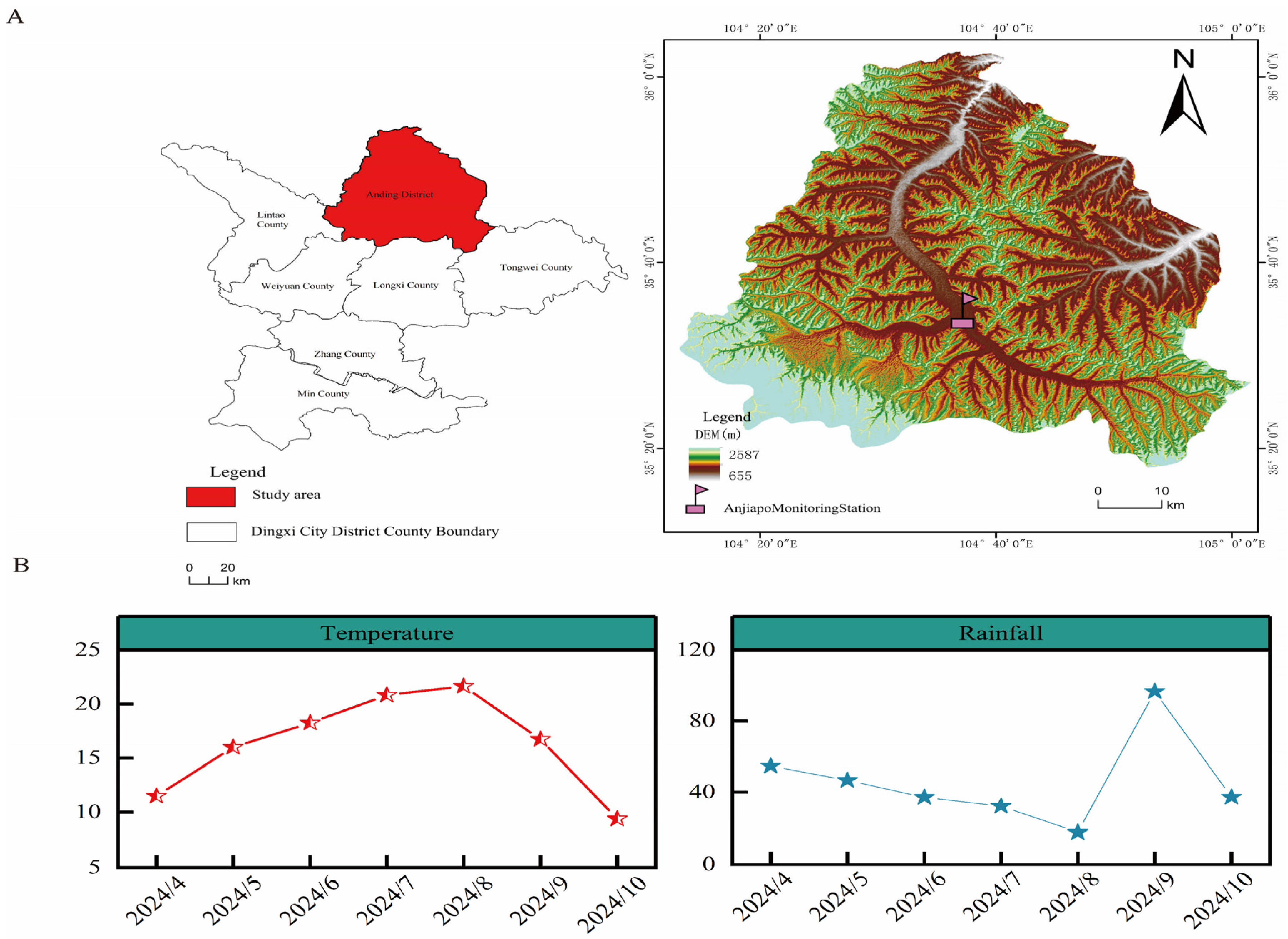
The experimental site is located at the Comprehensive Experimental Station for Arid Agriculture and Ecology in Anding District, Dingxi City, Gansu Province (34°26′~35°35′ N, 103°52′~105°13′ E) (Figure 1A). The region experiences a temperate semi-arid climate characterized by ample sunlight and significant diurnal temperature variations. According to meteorological data (Figure 2B), the temperature peaks in August at 21.65 °C. The soil undergoes a freeze-thaw cycle annually from November to March. The average annual precipitation is approximately 391 mm, predominantly concentrated between July and September, with September 2024 recording the highest rainfall. The soils in the study area are typical loess with a sandy loam texture. The area is perennially arid and water-scarce, supporting sparse vegetation. In 2002, the region officially launched the Grain for Green Project, which restored the original farmland to forest and grassland land use types. The main tree species are Picea asperata, Platycladus orientalis, etc. The herbaceous vegetation is mostly Medicago sativa, Onobrychis viciifolia, etc. The main crops include spring wheat (Triticum aestivum), corn (Zeamays), and potatoes (Solanum tuberosum).

2.2. Experimental Design

By conducting field investigations on the ecological and vegetation characteristics of the research area and reviewing relevant data, sample plots were set up in vegetation areas with similar soil types and soil disturbance histories in October 2020. Using abandoned land as a control, four different land use patterns were selected (Table 1): artificial tree forest (picea asperata), artificial grassland (medicago sativa), and farmland (spring wheat field). The picea asperata has been artificially planted and survived without any further human intervention. Medicago sativa is planted with purple clover on abandoned farmland and enclosed. After survival, no artificial intervention is carried out; Abandoned land naturally recovers after being abandoned for cultivation, with a small amount of weeds distributed and no further management measures taken. The wheat field is developed into farmland on the basis of abandoned land, mainly planting spring wheat, and selecting the locally commonly planted wheat “Ganchun 35” as the test variety. Among them, traditional tillage is used in wheat fields, and base fertilizer (150.0 kg hm−2 superphosphate and 62.5 kg N hm−2 urea) is applied at once during sowing. No additional top-dressing was applied throughout the entire growing season. Furthermore, the experimental site is located in a rain-fed agricultural zone where no supplementary irrigation is implemented. Various detailed information is shown in Table 1. Based on prior ecological research, the minimum representative area for each vegetation type was determined. Three plots per treatment were randomly selected (spruce forest: 20 m × 20 m; alfalfa field, wheat field, and abandoned land: 4 m × 6 m), with a minimum 5 m buffer between plots, resulting in a total of 12 plots. The random spatial distribution of replicate plots was designed to capture and represent inherent variability within each land-use system. Set up a fixed gas collection base of 0.5 m × 0.5 m in each fixed sample plot for N2O collection and measurement.

2.3. Soil Collection

Soil samples were collected in July 2024 to capture soil conditions during the most critical period for shaping seasonal emission dynamics. A soil auger was used to collect 0–10 cm soil cores according to a five-point sampling scheme. This soil depth represents a biogeochemical hotspot characterized by intense microbial activity, organic matter decomposition, and nitrogen cycling processes. After collecting soil samples, impurities are removed, place them in self-sealing bags, and store them in a sample box with ice packs at low temperature. After being brought back to the laboratory, they will be used for the determination of various indicators. After bringing back the required soil samples, they were divided into two parts. One of the fresh soil samples was sieved through a 2 mm sieve to remove impurities and then stored in a 4 °C refrigerator for the determination of fresh sample indicators such as soil moisture content, soil nitrate nitrogen, and ammonium nitrogen. Another sample was air-dried and sieved to remove impurities before being used to determine dry sample indicators such as soil nitrate reductase and nitrite reductase. Among them, the soil moisture content was determined by the aluminum box drying method [14]. Soil p and H were determined by potentiometric titration (soil-water ratio = 1:2.5) [15]. The contents of nitrate nitrogen and ammonium nitrogen were simultaneously determined by the combined distillation method of MGO-Dide alloy [16]. Soil organic carbon was determined by the potassium dichromate external heating method [17]. The total nitrogen content in the soil was determined by the Kjeldahl nitrogen determination method after digestion [18]. Soil enzyme activities were determined using 0.5–1.0 g of air-dried soil sieved through a 0.5–1.5 mm mesh. Nitrate reductase activity (NR) was measured by the sulfanilic acid-α-naphthylamine colorimetric method. Nitrite reductase activity (NIR) was assessed using a combination of the α-naphthylamine colorimetric method and the p-aminobenzenesulfonic acid colorimetric approach. Urease activity was analyzed by the sodium phenolate-sodium hypochlorite colorimetric method [19].

2.4. Gas Collection

Soil N2O flux was measured biweekly during the 2024 vegetation growing season using the static chamber–gas chromatography method. A bottomless dark chamber (50 cm × 50 cm × 50 cm), constructed from 1 mm thick 304 stainless steel and externally insulated to minimize internal temperature fluctuations, was employed. Two mixing fans were installed at the top to ensure homogeneous gas distribution during sampling. The chamber was sealed onto a pre-installed base with water before sampling. Gas samples (100 mL each) were collected from the chamber headspace at 0, 8, 16, 24, and 32 min after closure using a polypropylene syringe equipped with a three-way stopcock. A total of five samples were obtained per measurement. After sample collection, the samples were immediately transported to the laboratory, where N2O concentrations were analyzed using a gas chromatograph (Agilent 4890D, Agilent Technologies, Wilmington, DE, USA). A standardized calibration protocol was strictly followed throughout the analytical process. Baseline correction was first performed using high-purity nitrogen as the zero gas, followed by sequential injection of N2O standard gases with known concentrations to conduct single-point or multi-point calibration for accurate adjustment of instrument response sensitivity. For each set of five samples, linear regression analysis was performed between the concentration ratios and the corresponding sampling time intervals. Data yielding a coefficient of determination (R2) greater than 0.75 were considered valid and used for the calculation of target gas emission fluxes.
Calculation of N2O emission flux:
F = ρ × V A × Δ c Δ t × 273 273 + T
In the formula: F represents the emission flux of N2O, μg·(m2·h)−1, ρ is the density of N2O in the standard state (kg/m3), V is the sufficient space volume in the sealed box (m3), A is the water surface area covered by the sealed box (m2), and Δc is the concentration difference of N2O gas (expressed as the volume fraction of air). Δt represents the sampling interval (h), and T represents the temperature of the sealed box at the time of sampling (°C).
Calculation of cumulative emission flux of N2O:
M = Σ ( F i + 1 + F 1 ) × ( t i + 1 t 1 )   ×   24 2 × 100
In the formula: M represents the cumulative gas emissions throughout the entire growth period (kg/hm2); F represents the gas emission flux μg·(m2·h)−1; i is the quantity of the sample; t is the sampling time (d).

2.5. Soil Metagenomic Sequencing

After centrifuging the sequencing samples, the supernatant was collected and the microbial genomic DNA was extracted using a DNA extraction kit. After passing the inspection, the genomic DNA is fragmented. Subsequently, the fragmented DNA is subjected to terminal repair, sequencing connector connection, and the connection products are purified and screened for fragments. Then, the sequencing library was constructed through the steps of library amplification and product purification. After the library passes the quality inspection, it is sequenced using the Illumina sequencing platform. The raw sequencing reads contained low-quality sequences and were processed using fastp to filter Raw Tags and generate high-quality clean reads (Clean Tags). Metagenomic assembly was performed using MEGAHIT, followed by the removal of contigs shorter than 300 bp. Redundant sequences were dereplicated using MMseqs2 with a protein sequence similarity threshold of 90% and a minimum coverage threshold of 80%. The resulting non-redundant gene catalog was annotated by alignment against both public and specialized databases. Functional and taxonomic profiling, including species composition and relative abundance estimation, was conducted using the KEGG database. All analytical steps and final reporting were carried out on the BMKCloud online platform (http://www.biocloud.net/).

2.6. Statistical Analysis

All data were processed using Microsoft Excel 2019. Normality of all variables was assessed using the Shapiro-Wilk test. Data that significantly deviated from a normal distribution (p < 0.05) were subjected to appropriate transformation prior to analysis. Cumulative growing-season N2O fluxes for each treatment were calculated as the mean of daily cumulative N2O fluxes across three replicates. A two-way analysis of variance (ANOVA) was performed to evaluate the main effects and interaction between land use types and interannual variation on N2O fluxes. One-way ANOVA was applied to examine the effects of different treatments on soil physicochemical properties, microbial community composition, and nitrogen cycling gene abundances. When analysis of variance has a significant impact, Tukey-HSD is used to evaluate the differences among the treatments. The Pearson correlation analysis method was used to analyze the correlations between the cumulative N2O emissions and soil physical and chemical factors, microbial communities, and nitrogen cycle genes. To explore the drivers of N2O emissions, we developed a partial least squares path model (PLS-PM) in the R environment (V4.3.1) with the plspm package. The model was designed to quantify the direct and indirect effects of soil properties, dominant microbial phyla, and nitrogen-cycling functional genes on N2O flux under varying land-use conditions. All statistical analyses were performed using SPSS 20 (SPSS for Windows, Chicago, IL, USA) and R 4.2.0 statistical calculation software (R Core Team, 2021), and all data plots were performed using Origin 2022.

3. Result

3.1. Characteristics of Soil N2O Flux

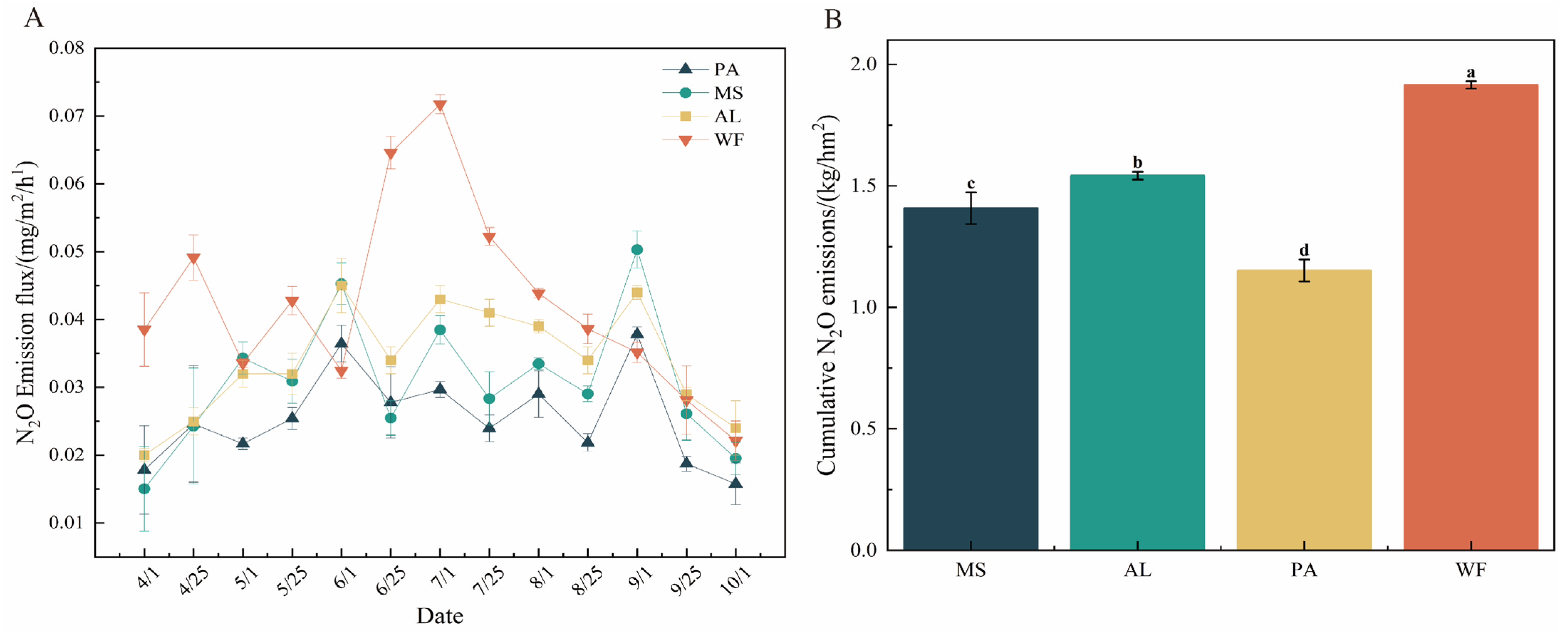
This study revealed the significant regulatory effects of different land use patterns on soil N2O emissions through continuous monitoring during the growing season. Overall, the cumulative emissions of N2O follow the order of WF (1.91 kg/hm2) > AL (1.54 kg/hm2) > AL (1.41 kg/hm2) > PA (1.15 kg/hm2), highlighting the complexity of the synergistic effect of vegetation type and soil environment on greenhouse gas emissions (Figure 2B). It is worth noting that WF treatment exhibits a bimodal emission pattern (late April and mid July), suggesting that its emissions may be dominated by pulse events driven by precipitation or temperature. The N2O emission flux under PA, MS, and AL treatments only showed a single peak in mid September, This indicates that its emissions are predominantly regulated by the physiological activity of plant roots that have not yet fully senesced, in conjunction with the soil re-wetting process. This difference deeply reflects the essential difference in nitrogen emission driving mechanisms between the agricultural field system (WF) and the forest grass system (PA/MS/AL): the former is mainly driven by physical environmental disturbances, while the latter is closely related to plant microbe interactions (Figure 2A).

3.2. Soil Physical and Chemical Properties

Different land use patterns significantly affect soil physicochemical properties. Picea asperata (PA) exhibits the highest soil water content (SWC) and organic carbon (SOC) content, confirming its strong water holding capacity and litter accumulation effect. Wheat land has the lowest SWC and SOC content, revealing the degradation characteristics of its ecosystem services under traditional cultivation. The total nitrogen (TN) content was highest under MS treatment, showing MS > PA > AL > WF, highlighting the synergistic nitrogen increasing effect of the nitrogen fixing plant soil system. It is particularly crucial that the ammonium nitrogen (NH4+-N) content significantly accumulates under PA treatment, increasing by 13.2–33.6% compared to other treatments. This is highly consistent with the nitrification inhibition phenomenon caused by the high C/N ratio of picea asperata litter, and explains the reason for its low N2O emissions from a mechanistic perspective–limited nitrification reduces N2O produced through the nitrification denitrification pathway. At the same time, the activities of urease (URE) and nitrate reductase (NR) in WF treatment increased by 38% and 29.7%, respectively, compared to PA, further confirming the active nitrogen conversion and easier promotion of N2O production through microbial metabolism in this system. (Table 2)

3.3. Bacterial Community Diversity

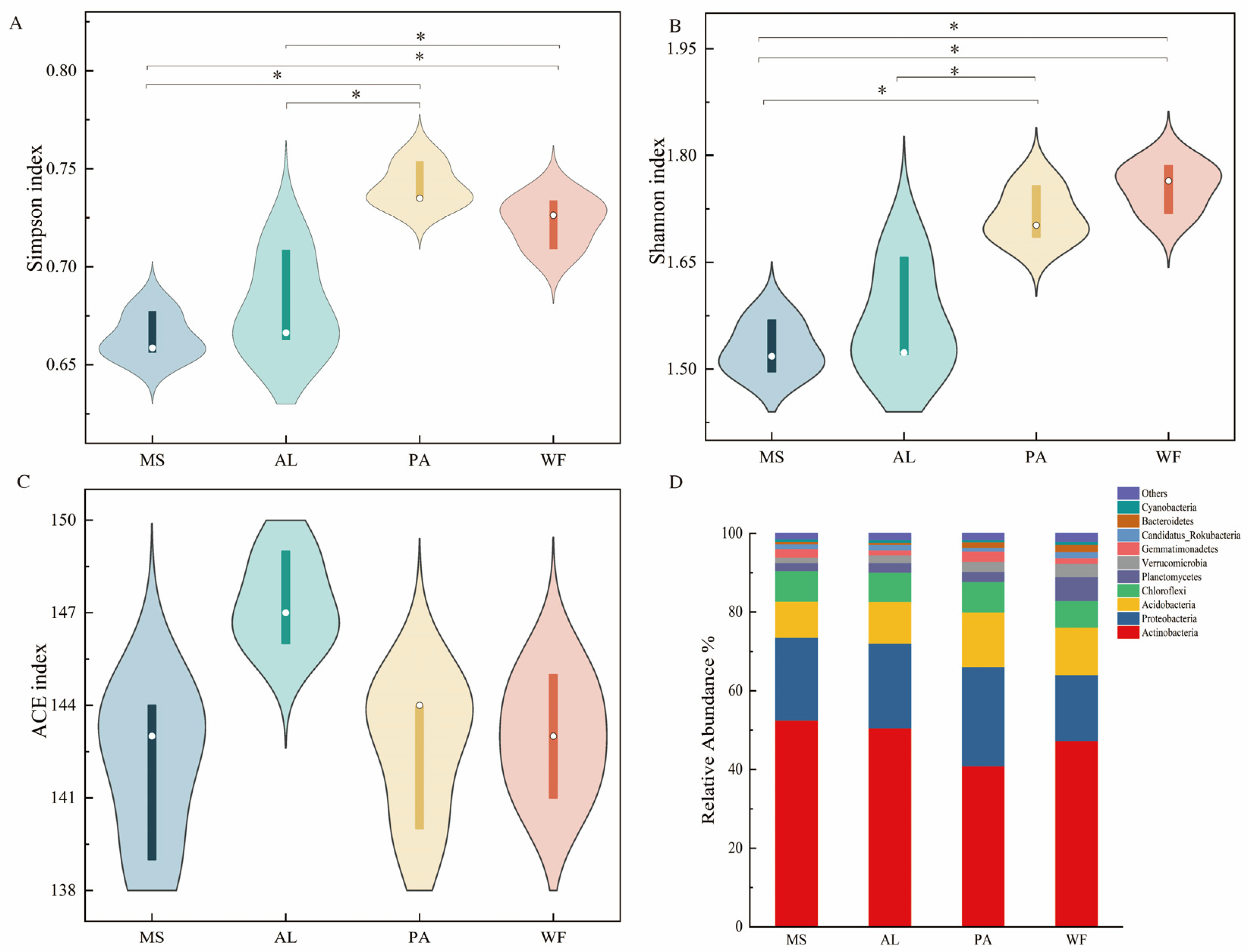
The alpha diversity of soil microbial communities varied across different land use types (MS, AL, PA, WF) (Figure 3A–C). Analysis of the Shannon and Simpson indices revealed that the WF treatment exhibited the highest microbial diversity (Shannon = 1.756, Simpson = 0.723), followed by the PA treatment (Shannon = 1.715, Simpson = 0.741), with both values being considerably higher than those in the MS and AL treatments. The higher vegetation coverage of spruce forest land and farmland may help maintain higher microbial diversity. In contrast, the ACE index, which reflects species richness, showed no notable differences among treatments, indicating that land use type had a limited influence on species abundance. At the phylum level, the relative abundance of Actinobacteria under PA treatment was lower than other treatments, while the relative abundance of dominant phyla Proteobacteria and Acidobacteria was higher than other treatments (Figure 3D). revealing that high C/N litter input and weakly alkaline soil environment jointly screened bacterial groups with specific metabolic functions, providing a community ecological basis for further analysis of the distribution pattern of nitrogen functional genes.

3.4. Abundance of Soil Nitrogen Cycling Genes

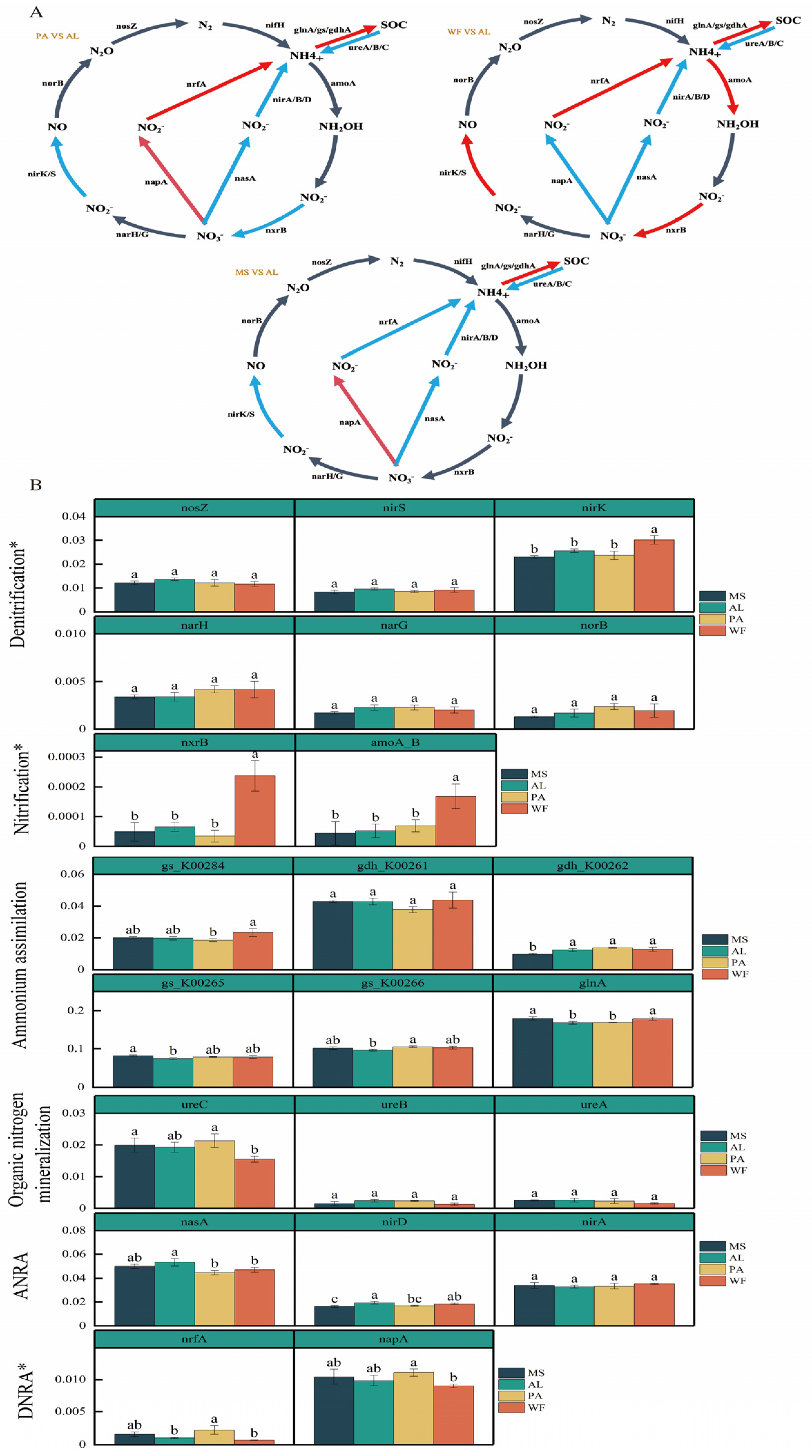
The analysis of nitrogen cycling functional genes based on NCyc database showed significant differences in 18 key genes among different treatments. Compared with AL treatment, the other three treatments (WF, PA, MS) significantly increased the abundance of functional genes related to ammonia oxidation process (Figure 4A). WF treatment significantly increased the abundance of glnA and gs_K00284 genes, PA treatment significantly increased the abundance of gs_K00266 gene, and MS treatment significantly increased the abundance of gs_K00265 gene, reflecting that different systems achieve complementary ammonia conversion functions through differentiated gene modules (Figure 4B). In the nitrification denitrification pathway, WF treatment significantly increased the abundance of nitrification genes such as amoA_B and axrB, as well as nirK/S-type denitrification genes, compared to AL treatment, while MS and PA treatments significantly reduced the abundance of nirK/S-type denitrification genes (Figure 4B). In addition, compared with AL treatment, MS, PA, and WF treatments significantly reduced the abundance of functional genes related to nitrate assimilation and reduction pathways (Figure 4A). It is particularly crucial that PA treatment significantly promotes the differentiation of nitrate-reducing genes (napA, nrfA), suggesting that their system tends to retain nitrate as ammonium nitrogen, which is a mechanistic response to the aforementioned ammonium nitrogen accumulation phenomenon (Figure 4B).

3.5. Key Driving Factors of Soil N2O Emissions

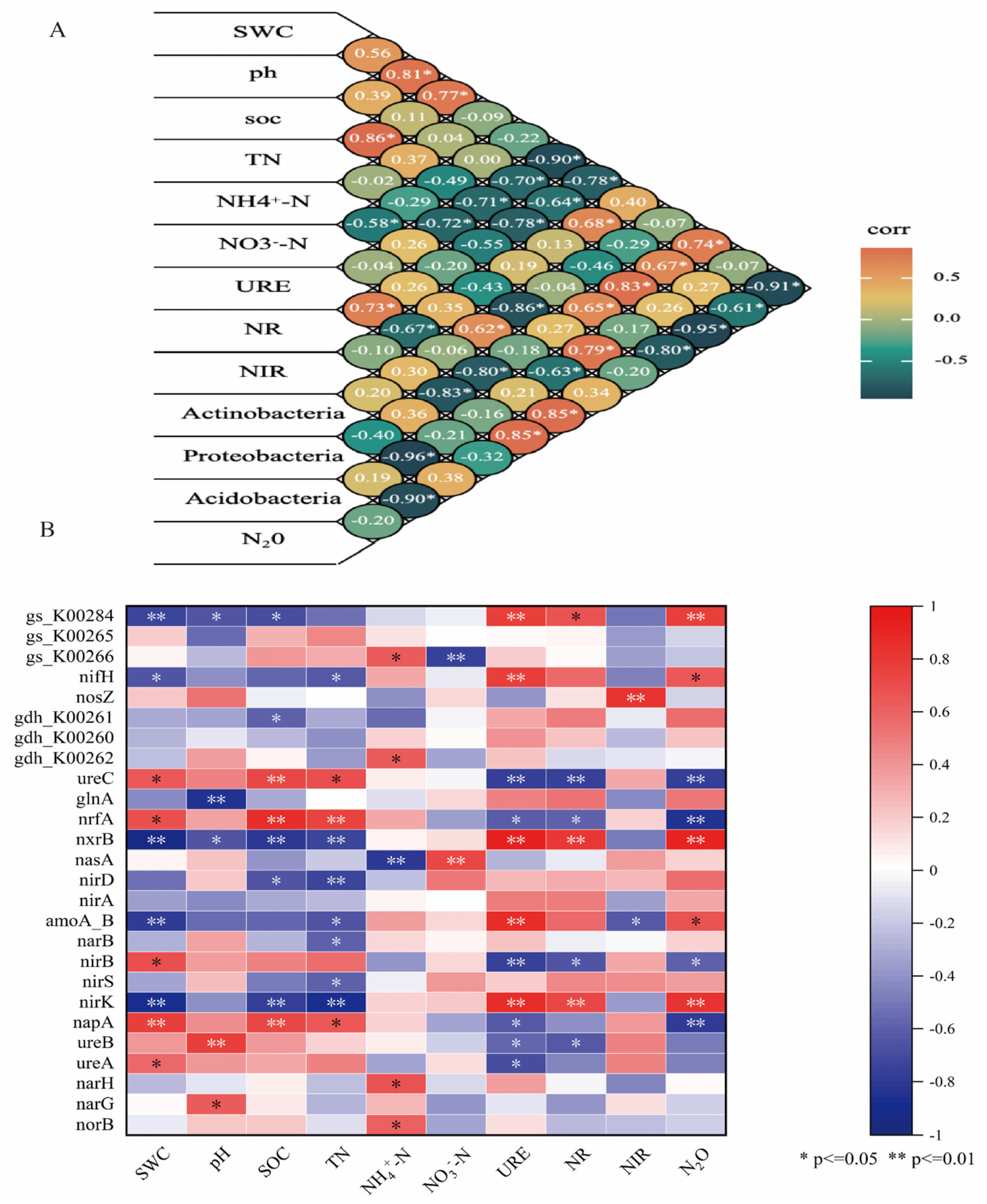
Correlation analysis showed that N2O emission flux is significantly negatively correlated with SWC, pH, SOC, TN, and Proteobacteria abundance, while significantly positively correlated with soil nitrate reductase, urease activity, and nitrification denitrification genes such as nirK, nxrB, and amoA_B (Figure 5). It is worth noting that the aberrant nitrate-reducing genes (napA, nrfA) are significantly negatively correlated with N2O emission flux, further confirming this pathway as a potential inhibitory channel for N2O formation (Figure 5B).
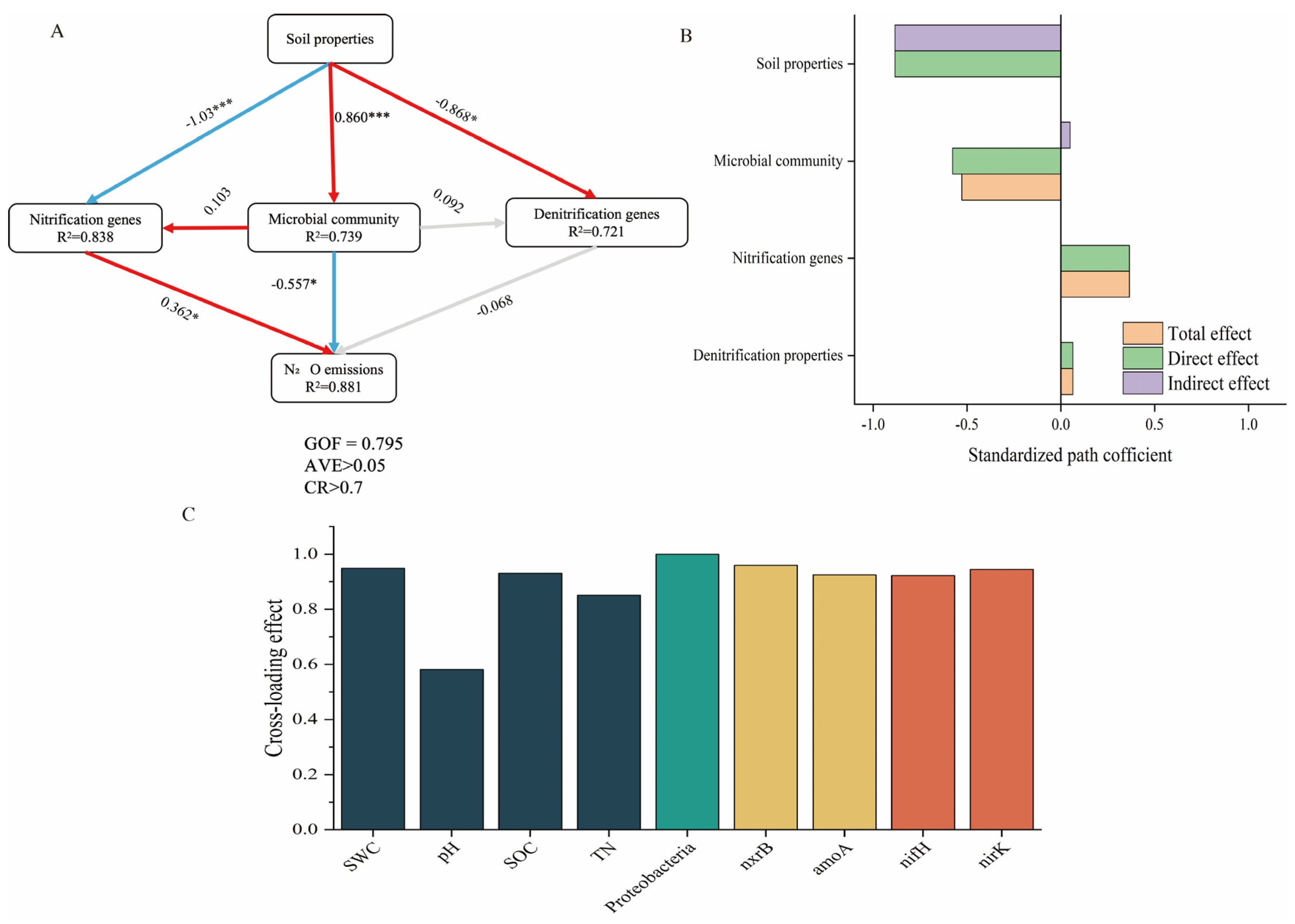
The integrated analysis based on partial least squares path model (PLS-PM) showed that nitrification functional genes (total effect: 0.46) were the strongest positive driving factors for N2O emissions, while denitrification process did not show significant effects (Figure 6A). The model further identified the core regulatory triangle of N2O emissions composed of soil water content, abundance of Proteobacteria, and nxrB genes, elucidating that the interaction network of water microorganisms functional genes is key to predicting greenhouse gas emissions in the semi-arid region of the Loess Plateau (Figure 6C).

4. Discussion

4.1. The Impact of Different Land Use Patterns on Soil N2O Emissions

This study reveals significant differences in the regulation of soil N2O emission flux by different land use patterns. Data show that in the context of our semi-arid region research, the cumulative emissions of nitrogen oxides from spring wheat fields are significantly higher than those from other treatments (see Figure 2B). This is consistent with the global consensus that agricultural soils are a major source of N2O emissions [20]. However, this study further analyzed its formation process from a mechanistic perspective. The high N2O emissions from farmland are due to the synergistic effect of human management measures and natural processes: Firstly, the application of nitrogen fertilizers directly increases the soil’s available nitrogen pool. More importantly, in the typical dry-wet alternation cycle of semi-arid regions, soil re-wetting events caused by irrigation or precipitation strongly stimulate microbial activity. This “stimulation effect” not only accelerates the mineralization of soil organic nitrogen but also rapidly converts the accumulated mineral nitrogen (especially NH4+) during the dry period into NO3 through nitrification, during which N2O is produced [21]. Additionally, the soil pH in farmland is slightly alkaline, and the abundance of ammonia-oxidizing bacteria (AOB) communities increases. AOB typically produce more N2O per unit substrate during the ammonia oxidation process [22]. This “stimulating effect” further releases a large amount of active nitrogen sources, forming a positive feedback loop that promotes N2O production. Unlike the research findings of G. Schaufler et al. in European forests [6], the Picea asperata in this study exhibited lower N2O emissions (Figure 2B). This regional variability reveals the importance of ecosystem specific regulatory mechanisms, and Picea asperata have constructed multiple emission reduction mechanisms through their unique biogeochemical cycling patterns. On the one hand, lower litter yield and higher plant nitrogen absorption efficiency form a “nitrogen biological capture” effect, significantly reducing the soil’s available nitrogen pool [23]. The study by Man Lang et al. demonstrated that reduced vegetation litter production significantly decreases soil nitrogen availability, a finding that aligns with the results of our research. On the other hand, the microenvironment formed by dense canopy creates physical conditions that inhibit microbial metabolism by reducing soil temperature and increasing water content [24]. This synergistic mechanism between plants, soil, and microorganisms provides a new perspective for understanding greenhouse gas regulation in forest ecosystems. In addition, compared to abandoned land, medicago sativa significantly reduces N2O emissions (Figure 2B). This mitigation effect can be attributed to a synergistic mechanism involving both nitrogen source modulation and microbial process regulation. First, as a leguminous plant, medicago sativa satisfies the majority of its nitrogen demand through symbiotic biological nitrogen fixation with rhizobia [25]. Second, it exhibits high nitrogen uptake efficiency and actively competes with soil microorganisms for inorganic nitrogen, thereby reducing the substrate pool available for N2O production [26]. Third, alfalfa’s unique root exudates and litter quality may shape microbial communities and functional traits that promote nitrogen retention over nitrogen loss. This discovery provides important basis for the development of emission reduction strategies based on ecological processes.
In addition, the temporal analysis of N2O emission dynamics further deepens our understanding of the interaction between environmental factors and management measures. The bimodal emission pattern observed during the fertilization period (end of April) and vegetation cover trough period (mid July spring wheat harvest) in WF treatment confirms the synergistic effect of human intervention and natural processes [27]. This is consistent with the interaction between fertilization and phenological driving mechanisms in previous studies. The PA, MS, and AL treatments showed a peak in emissions during the optimal hydrothermal conditions in September, revealing the fundamental regulatory role of environmental factors on microbial activity. This temporal heterogeneity suggests that future management strategies need to consider both the timing of implementation and the spatial configuration of the ecosystem (Figure 2A).

4.2. The Role of Soil Bacterial Communities in Mediating Soil N2O Emissions

This study reveals the key role of soil bacterial communities in regulating N2O emissions from the perspective of microbial ecology, and discovers new mechanisms that differ from traditional understanding. In the picea asperata ecosystem, the relative abundance of Proteobacteria and Acidobacteria significantly increased (Figure 3D), which is consistent with previous research results [28]. This phenomenon cannot be simply attributed to improved nutritional status, but should be understood as the result of plant microbe interactions at the ecosystem level. Proteobacteria, as a type of eutrophic bacteria with rapid growth and high metabolic activity, are widely distributed in environments with high vegetation coverage and relatively abundant nutrients [3]. Of particular note is the significant negative correlation between Proteobacteria and N2O emissions (Figure 5A), which challenges the traditional notion that this phylum promotes nitrogen cycling [29]. Therefore, we propose a dual mechanism to explain this phenomenon: firstly, the unique microenvironment of picea asperata may promote the enrichment of strains with N2O reductase (nosZ) genes in the phylum Proteobacteria, shifting the overall function of the community from N2O production to consumption [30]. Secondly, the phylum Proteobacteria may indirectly enhance the nitrogen absorption efficiency of plants by producing plant growth promoting substances, thereby reducing the concentration of substrates available for denitrification [31]. This discovery provides a new theoretical perspective for understanding the nitrogen cycling balance in forest ecosystems.
The enrichment of Actinobacteria in medicago sativa and abandoned land systems reveals a unique pathway of nitrogen transformation in arid environments (Figure 3D). This study confirms that high nitrate nitrogen content is an important factor driving the increase in soil actinomycete community abundance [32]. In this study, due to water limitation and high nitrate nitrogen content in medicago sativa and abandoned land, cell proliferation was promoted, bacterial activity of Actinobacteria was activated, and soil abundance of Actinobacteria was significantly increased. Meanwhile, correlation analysis revealed a negative correlation between the phylum Actinobacteria and soil moisture content, and a significant positive correlation with NO3-N content, further confirming the above conclusion (Figure 5A). More importantly, we found that the phylum Actinobacteria plays a “booster” role in the production of N2O in these systems, and the nirK gene it carries is activated in high nitrate nitrogen environments, significantly enhancing denitrification potential [33]. This mechanism explains why significant N2O emissions can still be observed in ecosystems with limited nitrogen input (Figure 5A). The important breakthrough of this study lies in establishing a complete evidence chain of “land use pattern soil environment specific phyla functional gene-N2O flux”, confirming the N2O emission reduction function of Proteobacteria in specific environments at the ecosystem scale, and revealing the nitrogen transformation mechanism of Actinobacteria in arid environments. These findings not only correct the previous singular understanding of key phylum functions, but more importantly, provide new targets for achieving greenhouse gas emissions reduction through microbial community regulation.

4.3. The Impact of Nitrogen Cycling Functional Genes on N2O Emissions

This study revealed the molecular mechanisms by which different land use patterns regulate N2O emissions through functional gene analysis, and established the core position of nitrogen cycling functional gene networks in greenhouse gas production processes. Research has found that the abundance of nitrification genes (amoA_B, nxrB) and denitrification genes (nirK) in farmland soil is significantly higher than other treatments (Figure 4B), which is consistent with previous studies [34]. This result not only confirms the strong shaping effect of anthropogenic nitrogen input on microbial function, but more importantly, reveals the warning value of these functional genes as “biomarkers” for environmental response [35]. Together, they constitute a molecular cascade reaction that accelerates nitrogen conversion and N2O emissions. Firstly, farmland soil is subject to frequent human disturbances compared to other treatments, which alter soil properties and microbial metabolic activity, and enhance the response of nitrogen cycling functional genes to nitrogen addition. Secondly, the application of nitrogen fertilizer provides sufficient substrates for nitrification and denitrification processes, thereby increasing the abundance of nitrification and denitrification genes [36]. Li, Zheng et al.’s research also confirms this result [37]. Correlation analysis showed that soil N2O emissions are significantly positively correlated with nitrification genes amoA_B, nxrB, and denitrification gene nirK (Figure 5B). This is because the ammonia monooxygenase encoded by the amoA gene can oxidize ammonium (NH4+) to hydroxylamine (NH2OH), and the instability of hydroxylamine and subsequent conversion processes promote N2O emissions [38,39]. In the variable cross-loading plot of the PLS-PM model, nxrB exhibits the highest predictive power for the latent variable of N2O emissions. This finding transcends the traditional focus on terminal denitrification processes and underscores the central role of nitrite oxidation within the nitrogen cycling network. The amoA gene encodes ammonia monooxygenase, which initiates nitrification by catalyzing the conversion of ammonium (NH4+) to nitrite (NO2). This study also observed that the content of nitrate nitrogen (NO3-N) in the soil was generally higher than that of ammonium nitrogen (NH4+-N). Nitrate nitrogen, as the final product of nitrification, accumulated in large quantities. The data indicated that the abundance of the nxrB gene was higher than that of the amoA_B gene, and the nitrite oxidation step was relatively active, enabling the intermediate product nitrite (NO2) to be relatively efficiently converted into NO3, thereby providing a stable substrate for downstream denitrification and playing a catalytic role in the nitrification-denitrification coupling process [40].
The most groundbreaking discovery of this study is the revelation of the molecular mechanism by which picea asperata achieve emission reduction through the reconstruction of nitrogen cycling pathways. In contrast to the agricultural system, picea asperata significantly increased the abundance of nrfA and napA genes in the pathway of nitrate reduction to ammonium (DNRA) (Figure 4B). This ecological strategy achieved a “diversion effect” of nitrogen cycling, directing nitrate nitrogen towards a more stable ammonium nitrogen pool rather than gaseous loss [41]. The transformation of this metabolic pathway not only reduces the supply of denitrifying substrates, but also enhances the nitrogen retention capacity of the ecosystem through nitrogen fixation. Of particular note is the highly significant positive correlation between the nrfA gene and organic carbon (Figure 5B), confirming the decisive role of carbon nitrogen coupling in regulating nitrogen cycling pathway selection [42].
These findings collectively depict a complete picture: land use patterns drive the restructuring of nitrogen cycling functional gene communities by altering soil environmental factors, ultimately determining the emission flux of N2O. The agricultural system has formed an “accelerated” nitrogen cycling pattern by enriching nitrification and denitrification genes, while picea asperata have established a “conservative” nitrogen cycling pattern by increasing the abundance of DNRA pathway genes [43]. This theoretical framework not only explains the underlying mechanisms behind the differences in N2O emissions between different ecosystems, but more importantly, provides precise molecular targets for greenhouse gas emissions reduction through microbial functional regulation. This understanding will have a profound impact on the improvement of future nitrogen cycle models and the formulation of carbon neutrality strategies, laying a theoretical foundation for the development of precise emission reduction technologies based on microbial functional regulation.

4.4. Key Driving Factors Affecting N2O Emissions

This study analyzed the multi-level driving pathways of N2O emissions in semi-arid areas using the Partial Least Squares Path Model (PLS-PM), revealing the complex interaction mechanism between environmental factors and microbial processes (Figure 6). A three-level driving system has been established in the study: soil water content and organic carbon serve as the basic regulatory layers to change soil redox status and nitrogen availability. Functional genes constitute the microbial process layer and directly regulate nitrogen conversion pathways; The N2O flux is ultimately determined by the equilibrium of nitrification denitrification process [44]. At the level of water regulation, this study discovered mechanisms that are completely different from those in humid areas [45]. Under semi-arid conditions, lower soil moisture did not suppress nitrification as expected, but instead created a microenvironment where nitrification and denitrification alternate by altering soil pore structure and gas diffusion rate [46]. Especially in the picea asperata system, higher water content promotes the dual pathways of nitrogen leaching and plant absorption, achieving sustained consumption of effective nitrogen pools. This “hydrological driven nitrogen consumption mechanism” provides a new perspective for understanding the emission reduction effects of forests in arid areas.
It is worth noting that the impact of soil organic carbon content and urease activity on soil N2O emissions cannot be ignored. Correlation analysis showed that soil organic carbon content is significantly negatively correlated with accumulated N2O emissions and significantly positively correlated with soil urease activity, indicating that the role of organic carbon far exceeds that of traditional energy sources (Figure 5B). This study confirms that high organic carbon environments stimulate the nitrogen fixation ability of microorganisms, converting inorganic nitrogen into microbial biomass nitrogen and forming a “biological nitrogen fixation buffer pool” [47]. This process not only reduces the substrates available for nitrification reactions, but more importantly, changes the distribution pattern of nitrogen in the ecosystem, shifting the nitrogen cycle from being dominated by gaseous losses to being dominated by biological fixation [48]. The positive correlation between urease activity and N2O emissions, as a sensitive indicator of human interference, reveals the deep impact of agricultural management on nitrogen cycling. The high urease activity in farmland accelerates urea hydrolysis, causing a significant increase in local ammonium concentration [49]. This “ammonium shock” effect exceeds the buffering capacity of the soil, leading to increased uncontrolled nitrification [50]. This discovery has important implications for optimizing fertilization strategies: it is necessary to simultaneously consider the spatiotemporal dynamics of urease activity and soil nitrogen carrying capacity.
The most important theoretical breakthrough of this study is the establishment of a cascade driven model of “environmental stress functional response gas flux”. The finding of this study that nitrification functional genes are the primary drivers of N2O emissions (Figure 6), is highly consistent with the core mechanistic assumptions of the DNDC model in simulating dryland ecosystems. The DNDC model explicitly identifies nitrification as the dominant process for N2O production under aerobic conditions, thereby providing strong theoretical support from a well-established modeling framework for our empirical observations. This model not only explains the formation mechanism of differences in N2O emissions under different land use patterns, but more importantly, predicts the chain reaction that changes in water patterns may have on regional nitrogen cycling under the background of climate change. These understandings provide a theoretical basis for the development of accurate prediction based on process models, and also open up new avenues for optimizing the management of ecosystem services through multi parameter collaborative regulation.

5. Conclusions

This study elucidates a potential mechanism through which land use change may drive variations in N2O emissions by modulating the coupling dynamics between soil microbial functional communities and key environmental factors. Specifically, we have demonstrated that Picea asperata a microenvironment characterized by high moisture content and elevated organic carbon levels, which promotes the enrichment of Proteobacteria communities possessing N2O reduction potential. Concurrently, this system enhances the abundance of key functional genes (nrfA and napA) involved in dissimilatory nitrate reduction to ammonium (DNRA), thereby channeling nitrogen toward microbial immobilization and retention rather than gaseous nitrogen losses. These coupled mechanisms collectively establish an efficient “biological emission reduction system”. Conversely, in fertilized and cultivated agricultural soils, an increase in the abundance of key nitrogen cycling genes was observed. Specifically, the abundance of bacterial ammonia monooxygenase (amoA_B) genes, as well as nxrB and nirK genes, significantly rose. The high nitrogen content in fertilized soils promoted the proliferation of ammonia-oxidizing bacteria (AOB), indicating an enhanced potential for nitrification in these systems. Additionally, the increase in nirK gene abundance reflected an improved capacity for denitrification. Overall, these changes in microbial functions led to an increase in N2O emissions from agricultural soils. More importantly, this study analyzed the potential predictor network of N2O emission differences under different land uses in semi-arid regions through partial least squares path modeling (PLS-PM): nitrification functional genes are the direct hub of microbial processes, while soil moisture and organic matter play a fundamental regulatory role through a dual pathway (regulating microbial activity and affecting nitrogen availability). Our study, supported by direct genetic evidence, confirms the reliability of the model in comparable environments. These findings offer important implications for ecological management under global change: The “forest-dominated with herbaceous synergy” land-use model proposed in this study significantly reduces N2O emissions compared to the single wheat field (WF) system, with cumulative N2O emissions under the PA and MS treatments being 39.8% and 26.4% lower than those of the WF treatment, respectively. The mode not only promotes the co-sequestration of carbon and nitrogen but also activates the intrinsic potential of soil microorganisms to mitigate greenhouse gas emissions, thereby establishing a sustainable pathway for greenhouse gas regulation. This paradigm provides a replicable and scalable solution for ecological restoration and the pursuit of carbon neutrality in global semi-arid regions. Future research should focus on analyzing the metabolic network and ecological interaction mechanisms of key functional microorganisms, and establishing a multi process coupling model that integrates gene abundance, environmental factors, and management measures, ultimately achieving precise emission reduction based on microbial functional regulation.

Author Contributions

J.D., Data processing, Methodology, Visualization, Writing–original draft. M.D. and Y.Y., Investigation and Sample collection. W.L. and G.X., Experimental operation. W.M., Data management. J.Y. and G.L., Design test, manage projects, supervision and funding acquisition. All authors have read and agreed to the published version of the manuscript.

Funding

This research was honored to supported by the Gansu Province Top notch Leading Talent Project (GSBJLJ-2023-09); Gansu Youth Science and Technology Fund (25JRRA370); the National Natural Science Foundation of China (32360438); the Postdoctoral Science Foundation (GSAU-BH-2025-09); the Postdoctoral research start-up funds (GSAU-BH-2025-10).

Data Availability Statement

The original contributions presented in this study are included in the article. Further inquiries can be directed to the corresponding authors.

Acknowledgments

Here, we would like to sincerely thank all those who participated in this research (outdoor work and laboratory work).

Conflicts of Interest

The authors declare that they have no known competing financial interests or personal relationships that could have appeared to influence the work reported in this paper.

References

  1. Feng, R.; Li, Z. Current Investigations on Global N2O Emissions and Reductions: Prospect and Outlook. Environ. Pollut. 2023, 338, 122664. [Google Scholar] [CrossRef]
  2. He, C.; Zhang, L.; Fischer, J.W.A.; Zhang, J.; Miyazaki, S.; Zhang, N.; Qin, J.; Anzai, A.; Shimizu, K.; Toyao, T. Enhanced N2O Capture and Reduction System Using Cu/Zeolite Adsorbent and Pd/La/Al2O3 Catalyst under O2-CO2-Rich Conditions. Appl. Catal. B Environ. Energy 2026, 382, 125883. [Google Scholar] [CrossRef]
  3. Zhang, J.; Guo, X.; Shan, Y.; Lu, X.; Cao, J. Effects of Land-Use Patterns on Soil Microbial Diversity and Composition in the Loess Plateau, China. J. Arid. Land 2024, 16, 415–430. [Google Scholar] [CrossRef]
  4. Hong, S.; Li, Z.; Tang, M.; Li, F.; Yao, Y.; Yan, Y.; He, M.; Wang, X.; Zeng, H.; Piao, S. Magnitude, Distribution and Temporal Trend of Nitrous Oxide Emissions from China’s Natural Soils over 1980–2022. Sci. China Earth Sci. 2025, 68, 1074–1085. [Google Scholar] [CrossRef]
  5. Kim, D.-G.; Rafique, R.; Leahy, P.; Cochrane, M.; Kiely, G. Estimating the Impact of Changing Fertilizer Application Rate, Land Use, and Climate on Nitrous Oxide Emissions in Irish Grasslands. Plant Soil 2014, 374, 55–71. [Google Scholar] [CrossRef]
  6. Schaufler, G.; Kitzler, B.; Schindlbacher, A.; Skiba, U.; Sutton, M.A.; Zechmeister-Boltenstern, S. Greenhouse Gas Emissions from European Soils under Different Land Use: Effects of Soil Moisture and Temperature. Eur. J. Soil Sci. 2010, 61, 683–696. [Google Scholar] [CrossRef]
  7. Li, C.; Di, H.J.; Cameron, K.C.; Podolyan, A.; Zhu, B. Effect of Different Land Use and Land Use Change on Ammonia Oxidiser Abundance and N2O Emissions. Soil Biol. Biochem. 2016, 96, 169–175. [Google Scholar] [CrossRef]
  8. Jing, W.; Debang, Y.; Qiao, H.; Lu, L.; Hang, J.; Yinfei, Q.; Kang, N.; Yi, C. Alleviation of Soil Acidification Using Livestock Manure Increases Nitrogen Supply While Stimulating N2O Emission in a Tea Plantation. Arch. Agron. Soil Sci. 2025, 71, 1–13. [Google Scholar] [CrossRef]
  9. Xiao, Y.; Wang, J.; Wang, B.; Fan, B.; Zhou, G. Soil Microbial Network Complexity Predicts Soil Multifunctionality Better than Soil Microbial Diversity during Grassland-Farmland-Shrubland Conversion on the Qinghai-Tibetan Plateau. Agric. Ecosyst. Environ. 2025, 379, 109356. [Google Scholar] [CrossRef]
  10. Van Leeuwen, J.P.; Djukic, I.; Bloem, J.; Lehtinen, T.; Hemerik, L.; De Ruiter, P.C.; Lair, G.J. Effects of Land Use on Soil Microbial Biomass, Activity and Community Structure at Different Soil Depths in the Danube Floodplain. Eur. J. Soil Biol. 2017, 79, 14–20. [Google Scholar] [CrossRef]
  11. Liu, C.; Zhang, W.; Hou, H.; Liao, R.; Wei, W.; Sheng, R. Effect of Long-Term Land Use on the nosZI- and nosZII-Containing Microbial Communities. Appl. Soil Ecol. 2023, 189, 104961. [Google Scholar] [CrossRef]
  12. Qin, H.; Xing, X.; Tang, Y.; Hou, H.; Yang, J.; Shen, R.; Zhang, W.; Liu, Y.; Wei, W. Linking Soil N2O Emissions with Soil Microbial Community Abundance and Structure Related to Nitrogen Cycle in Two Acid Forest Soils. Plant Soil 2019, 435, 95–109. [Google Scholar] [CrossRef]
  13. Du, M.; Yuan, J.; Zhuo, M.; Sadiq, M.; Wu, J.; Xu, G.; Liu, S.; Li, J.; Li, G.; Yan, L. Effects of Different Land Use Patterns on Soil Properties and N2O Emissions on a Semi-Arid Loess Plateau of Central Gansu. Front. Ecol. Evol. 2023, 11, 1128236. [Google Scholar] [CrossRef]
  14. Défossez, P.; Veylon, G.; Yang, M.; Bonnefond, J.M.; Garrigou, D.; Trichet, P.; Danjon, F. Impact of Soil Water Content on the Overturning Resistance of Young Pinus Pinaster in Sandy Soil. For. Ecol. Manag. 2021, 480, 118614. [Google Scholar] [CrossRef]
  15. Mao, J.; Nierop, K.G.J.; Rietkerk, M.; Sinninghe Damsté, J.S.; Dekker, S.C. The Influence of Vegetation on Soil Water Repellency-Markers and Soil Hydrophobicity. Sci. Total Environ. 2016, 566–567, 608–620. [Google Scholar] [CrossRef]
  16. Wu, J.; Wang, H.; Li, G.; Wu, J.; Gong, Y.; Wei, X.; Lu, Y. Responses of CH4 Flux and Microbial Diversity to Changes in Rainfall Amount and Frequencies in a Wet Meadow in the Tibetan Plateau. Catena 2021, 202, 105253. [Google Scholar] [CrossRef]
  17. He, L.; Lu, S.; Wang, C.; Mu, J.; Zhang, Y.; Wang, X. Changes in Soil Organic Carbon Fractions and Enzyme Activities in Response to Tillage Practices in the Loess Plateau of China. Soil Tillage Res. 2021, 209, 104940. [Google Scholar] [CrossRef]
  18. Gao, G.; Tuo, D.; Han, X.; Jiao, L.; Li, J.; Fu, B. Effects of Land-Use Patterns on Soil Carbon and Nitrogen Variations along Revegetated Hillslopes in the Chinese Loess Plateau. Sci. Total Environ. 2020, 746, 141156. [Google Scholar] [CrossRef] [PubMed]
  19. Xie, M.; Yuan, J.; Liu, S.; Xu, G.; Lu, Y.; Yan, L.; Li, G. Soil Carbon and Nitrogen Pools and Their Storage Characteristics under Different Vegetation Restoration Types on the Loess Plateau of Longzhong, China. Forests 2024, 15, 173. [Google Scholar] [CrossRef]
  20. Wachiye, S.; Merbold, L.; Vesala, T.; Rinne, J.; Räsänen, M.; Leitner, S.; Pellikka, P. Soil Greenhouse Gas Emissions under Different Land-Use Types in Savanna Ecosystems of Kenya. Biogeosciences 2020, 17, 2149–2167. [Google Scholar] [CrossRef]
  21. Lin, S.; Iqbal, J.; Hu, R.; Feng, M. N2O Emissions from Different Land Uses in Mid-Subtropical China. Agric. Ecosyst. Environ. 2010, 136, 40–48. [Google Scholar] [CrossRef]
  22. Lin, S.; Iqbal, J.; Hu, R.; Ruan, L.; Wu, J.; Zhao, J.; Wang, P. Differences in Nitrous Oxide Fluxes from Red Soil under Different Land Uses in Mid-Subtropical China. Agric. Ecosyst. Environ. 2012, 146, 168–178. [Google Scholar] [CrossRef]
  23. Zou, J.; Tobin, B.; Luo, Y.; Osborne, B. Differential Responses of Soil CO2 and N2O Fluxes to Experimental Warming. Agric. For. Meteorol. 2018, 259, 11–22. [Google Scholar] [CrossRef]
  24. Lang, M.; Cai, Z.; Chang, S.X. Effects of Land Use Type and Incubation Temperature on Greenhouse Gas Emissions from Chinese and Canadian Soils. J. Soils Sediments 2011, 11, 15–24. [Google Scholar] [CrossRef]
  25. Trozzo, L.; Francioni, M.; Wenhong Kishimoto-Mo, A.; Foresi, L.; Bianchelli, M.; Baldoni, N.; D’Ottavio, P.; Toderi, M. Soil N2O Emissions after Perennial Legume Termination in an Alfalfa-Wheat Crop Rotation System under Mediterranean Conditions. Ital. J. Agron. 2020, 15, 1613. [Google Scholar] [CrossRef]
  26. Ning, J.; Guo, Y.; Lou, S.; Zhang, C.; Zhu, W.; West, C.P.; He, X.Z.; Hou, F. Grazing Optimizes Forage Production and Soil GHG Emissions of Mixed Perennial Pasture in an Inland Arid Area. Field Crops Res. 2025, 323, 109788. [Google Scholar] [CrossRef]
  27. Smith, K.A.; Ball, T.; Conen, F.; Dobbie, K.E.; Massheder, J.; Rey, A. Exchange of Greenhouse Gases between Soil and Atmosphere: Interactions of Soil Physical Factors and Biological Processes. Eur. J. Soil Sci. 2003, 54, 779–791. [Google Scholar] [CrossRef]
  28. Zhao, X.; Xiang, F.; Wang, X.; Yang, M.; Li, J. Effects of Different Land Use Types on Soil Quality and Microbial Diversity in Paddy Soil. Agronomy 2025, 15, 1628. [Google Scholar] [CrossRef]
  29. Liu, C.; Zhang, Y.; Liu, H.; Liu, X.; Ren, D.; Wang, L.; Guan, D.; Li, Z.; Zhang, M. Fertilizer Stabilizers Reduce Nitrous Oxide Emissions from Agricultural Soil by Targeting Microbial Nitrogen Transformations. Sci. Total Environ. 2022, 806, 151225. [Google Scholar] [CrossRef] [PubMed]
  30. Wang, H.; Sun, Y.; Li, L.; Wu, G. Enhanced Nitrogen Removal and Minimization of N2O Emission in a Constant-Flow Multiple Anoxic and Aerobic Process. J. Water Process Eng. 2018, 26, 336–341. [Google Scholar] [CrossRef]
  31. Singh, H.; Halder, N.; Singh, B.; Singh, J.; Sharma, S.; Shacham-Diamand, Y. Smart Farming Revolution: Portable and Real-Time Soil Nitrogen and Phosphorus Monitoring for Sustainable Agriculture. Sensors 2023, 23, 5914. [Google Scholar] [CrossRef]
  32. Zhao, Y.; Li, P.; Liu, J.; Xiao, H.; Zhang, A.; Chen, S.; Chen, J.; Liu, H.; Zhu, X.; Hussain, Q.; et al. Microbial Effects of Prolonged Nitrogen Fertilization and Straw Mulching on Soil N2O Emissions Using Metagenomic Sequencing. Agric. Ecosyst. Environ. 2025, 382, 109476. [Google Scholar] [CrossRef]
  33. Peng, Q.; Wu, X.; Tan, X.; Wang, Y.; Cai, Y.; Shaaban, M.; Hu, R. The Effect of Different Carbon Sources on Nitrate-Dependent Iron Oxidation Process, Bacterial Diversity, and C Protagonist in Varied Texture Soils. J. Soil Sci. Plant Nutr. 2024, 24, 993–1001. [Google Scholar] [CrossRef]
  34. Xu, W.; Zhao, D.; Ma, Y.; Yang, G.; Ambus, P.L.; Liu, X.; Luo, J. Effects of Long-Term Organic Fertilizer Substitutions on Soil Nitrous Oxide Emissions and Nitrogen Cycling Gene Abundance in a Greenhouse Vegetable Field. Appl. Soil Ecol. 2023, 188, 104877. [Google Scholar] [CrossRef]
  35. You, L.; Ros, G.H.; Chen, Y.; Yang, X.; Cui, Z.; Liu, X.; Jiang, R.; Zhang, F.; De Vries, W. Global Meta-Analysis of Terrestrial Nitrous Oxide Emissions and Associated Functional Genes under Nitrogen Addition. Soil Biol. Biochem. 2022, 165, 108523. [Google Scholar] [CrossRef]
  36. Ouyang, Y.; Evans, S.E.; Friesen, M.L.; Tiemann, L.K. Effect of Nitrogen Fertilization on the Abundance of Nitrogen Cycling Genes in Agricultural Soils: A Meta-Analysis of Field Studies. Soil Biol. Biochem. 2018, 127, 71–78. [Google Scholar] [CrossRef]
  37. Li, Z.; Cupples, A.M. Diversity of Nitrogen Cycling Genes at a Midwest Long-Term Ecological Research Site with Different Management Practices. Appl. Microbiol. Biotechnol. 2021, 105, 4309–4327. [Google Scholar] [CrossRef]
  38. Chen, W.-B.; Peng, S.-L. Land-Use Legacy Effects Shape Microbial Contribution to N2O Production in Three Tropical Forests. Geoderma 2020, 358, 113979. [Google Scholar] [CrossRef]
  39. Wang, W.; Yang, M.; Shen, P.; Zhang, R.; Qin, X.; Han, J.; Li, Y.; Wen, X.; Liao, Y. Conservation Tillage Reduces Nitrous Oxide Emissions by Regulating Functional Genes for Ammonia Oxidation and Denitrification in a Winter Wheat Ecosystem. Soil Tillage Res. 2019, 194, 104347. [Google Scholar] [CrossRef]
  40. Ding, J.; Yu, S. Impacts of Land Use on Soil Nitrogen-Cycling Microbial Communities: Insights from Community Structure, Functional Gene Abundance, and Network Complexity. Life 2025, 15, 466. [Google Scholar] [CrossRef]
  41. Minick, K.J.; Pandey, C.B.; Fox, T.R.; Subedi, S. Dissimilatory Nitrate Reduction to Ammonium and N2O Flux: Effect of Soil Redox Potential and N Fertilization in Loblolly Pine Forests. Biol. Fertil. Soils 2016, 52, 601–614. [Google Scholar] [CrossRef]
  42. Yan, Z.; Chang, B.; Song, X.; Wang, G.; Shan, J.; Yang, L.; Li, S.; Butterbach-Bahl, K.; Ju, X. A Microbial-Explicit Model with Comprehensive Nitrogen Processes to Quantify Gaseous Nitrogen Production from Agricultural Soils. Soil Biol. Biochem. 2024, 189, 109284. [Google Scholar] [CrossRef]
  43. Heo, H.; Kwon, M.; Song, B.; Yoon, S. Involvement of NO3 in Ecophysiological Regulation of Dissimilatory Nitrate/Nitrite Reduction to Ammonium (DNRA) Is Implied by Physiological Characterization of Soil DNRA Bacteria Isolated via a Colorimetric Screening Method. Appl. Environ. Microbiol. 2020, 86, e01054-20. [Google Scholar] [CrossRef]
  44. Liang, Q.; Liu, Y.; Zhang, H.; Peng, Z.; Zhang, X. Sub-Surface Drip Irrigation Reduced N2O Emissions via Inhibiting Denitrification Pathways in Northern China. Appl. Soil Ecol. 2023, 191, 105057. [Google Scholar] [CrossRef]
  45. Kazmi, F.A.; Mander, Ü.; Ranniku, R.; Öpik, M.; Püssa, K.; Soosaar, K.; Kasak, K.; Masta, M.; Ah-Peng, C.; Espenberg, M. Nitrogen Cycling Genes Abundance in Soil and Aboveground Compartments of Tropical Peatland Cloud Forests and a Wetland on Réunion Island. Sci. Rep. 2025, 15, 27155. [Google Scholar] [CrossRef]
  46. Pan, B.; Huang, Y.; Xia, L.; Liang, J.; Liu, R.; Luo, Y.; Du, Z.; Chen, D.; Lam, S.K. Estimating Fractions of N2O Emissions from Nitrification and Denitrification Using Data Assimilation. Biogeochemistry 2025, 168, 71. [Google Scholar] [CrossRef]
  47. Bai, J.; Chen, D.; Liu, A.; Bai, Y.; Han, Y.; Huang, Y.; Zhao, G.; Zou, L.; Xie, X.; Almeida Moreira, B.R.D.; et al. Potential Relationships between Greenhouse Gas Emissions and Soil Physicochemical Properties in Summer Maize Field with Straw-Biochar Amendment. Soil Tillage Res. 2026, 256, 106843. [Google Scholar] [CrossRef]
  48. Zhou, T.; Zang, Y.; Li, Z.; Zhang, Y.; Zhu, K.; Zhang, W.; Zhang, H.; Liu, L.; Wang, Z.; Gu, J.; et al. Controlled-Release Nitrogen Fertilizer and Long-Term Straw Return Synergistically Improve Wheat Yield and Reduced the Nitrogen Losses by Regulating Soil Microbial Communities and Soil Organic Nitrogen Components. Field Crops Res. 2025, 334, 110148. [Google Scholar] [CrossRef]
  49. Wang, X.; Xie, J.; Li, W.; Pu, L.; Chen, P.; Han, J.; Du, C.; Huang, S.; Zhang, R.; Zhong, R.; et al. Nitrogen Fertilizer Strategies Modulate Gaseous Nitrogen Losses and Improve Maize Yield and Nitrogen Use Efficiency under Saline-Alkali Stress in Coastal Reclaimed Farmland. Soil Tillage Res. 2026, 256, 106842. [Google Scholar] [CrossRef]
  50. Song, Y.; Li, Y.; Cai, Y.; Fu, S.; Luo, Y.; Wang, H.; Liang, C.; Lin, Z.; Hu, S.; Li, Y.; et al. Biochar Decreases Soil N2O Emissions in Moso Bamboo Plantations through Decreasing Labile N Concentrations, N-Cycling Enzyme Activities and Nitrification/Denitrification Rates. Geoderma 2019, 348, 135–145. [Google Scholar] [CrossRef]
Figure 1. Geographical map of the study area in the Loess Plateau of China (A). Meteorological data (B).
Agronomy 15 02810 g001
Figure 2. Nitrous oxide (N2O) emission flux (A) and cumulative emissions (B) from April to October 2024. Error bars represent the standard deviation. Different letters above the bars indicate significant differences among the treatments (p < 0.05).
Agronomy 15 02810 g002
Figure 3. Soil bacterial community diversity index (AC). The top ten groups of soil bacteria ranked at the phylum level (D). * Indicates significant differences among different treatments. (p < 0.05).
Agronomy 15 02810 g003
Figure 4. Microbial nitrogen cycling processes (A) and key functional gene abundance (B) profiled via metagenomic sequencing. Significantly increased and decreased functional gene clusters between treatments (p < 0.05) are highlighted by red and blue lines, respectively; clusters with non-significant abundance changes are shown in gray. Different letters above the bars indicate significant differences among the treatments (p < 0.05). * Indicates the nitrogen cycling pathways that are the focus of this study.
Agronomy 15 02810 g004
Figure 5. Pearson correlation coefficients among soil properties, cumulative N2O emissions, and (A) the relative abundance of the top three microbial phyla, or (B) the abundance of functional genes.
Agronomy 15 02810 g005
Figure 6. Partial Least Squares Path Modeling (PLS-PM) illustrating the factors influencing N2O emissions. (A) The latent variable ‘Soil properties’ comprises SWC, pH, SOC, TN, NH4+-N, NO3-N, URE, NR, and NIR; ‘Microbial community’ comprises the relative abundances of Actinobacteria, Proteobacteria, and Acidobacteria; ‘Nitrification genes’ comprises the gene abundances of amoA and nxrB; ‘Denitrification genes’ comprises the gene abundances of narG, narH, nirK, nirS, nosZ, and norB. Red, blue, and gray arrows indicate significant positive (* p < 0.05, *** p < 0.001), significant negative, and non-significant path coefficients, respectively. (B) Standardized direct, indirect, and total effects of soil properties, microbial community, nitrification, and denitrification genes on N2O emissions. (C) Variable cross-loadings on N2O emissions.
Agronomy 15 02810 g006
Table 1. Basic information and description of each plot. AL: abandoned land, PA: artificial tree forest, MS: artificial grassland, and WF: farmland.
Treatment Latitude LongitudeDominant Plant SpeciesDisturbance History
PA35°35′10″ N104°37′7″ EPicea asperata, Bupleurum chinense, Gentiana macrophylla, Leontopodium leontopodioidesThe site was restored to a spruce forest in 2002 under the “Grain for Green Program” and has received no further management since.
MS35°34′48″ N104°39′2″ EMedicago sativa, Leymus secalinus, Artemisia lavandulaefoliaThe former cropland was abandoned in 2015, planted with alfalfa, and fenced. It has been unmanaged since successful establishment.
AL35°34′54″ N104°37′57″ EStipa bungeana, Plantago asiatica, Setaria viridisThe land has been abandoned since 1999 and naturally recovered as fallow land with sparse weeds, without any management interventions.
WF35°34′45″ N104°39′1″ Espring wheatThis plot has been managed as a spring wheat monoculture under conventional tillage since its conversion from native fallow land in 2015, with consistent nitrogen fertilizer inputs typical of the Dingxi region.
Table 2. Soil physicochemical properties at 0–10 cm depth under different land-use types. Different letters indicate significant differences among the treatments (p < 0.05).
TreatmentSWC (%)pHSOC (g/kg)TN (g/kg)NH4+-N (mg/kg)NO3-N (mg/kg)URE (mg/g/24 h)NR (mg/g/24 h)NIR (mg/g/24 h)
MS13.8% ± 0.011 a8.007 ± 0.025 b12.052 ± 0.498 b0.915 ± 0.021 a11.807 ± 1.044 c23.709 ± 0.709 ab1.199 ± 0.035 b5.584 ± 0.530 b0.558 ± 0.104 ab
AL12.6% ± 0.009 a8.157 ± 0.015 a8.930 ± 0.220 c0.658 ± 0.014 c11.659 ± 0.089 c25.320 ± 0.398 a1.066 ± 0.010 c5.523 ± 0.538 b0.704 ± 0.062 a
PA14.1% ± 0.011 a8.130 ± 0.017 a14.785 ± 0.402 a0.845 ± 0.035 b17.568 ± 0.497 a21.154 ± 0.880 b0.895 ± 0.006 d4.660 ± 0.701 b0.542 ± 0.092 b
WF8.9% ± 0.006 b7.967 ± 0.012 c7.090 ± 0.100 d0.573 ± 0.026 d15.239 ± 1.039 b23.198 ± 3.238 ab1.445 ± 0.009 a6.634 ± 0.020 a0.418 ± 0.001 b
Disclaimer/Publisher’s Note: The statements, opinions and data contained in all publications are solely those of the individual author(s) and contributor(s) and not of MDPI and/or the editor(s). MDPI and/or the editor(s) disclaim responsibility for any injury to people or property resulting from any ideas, methods, instructions or products referred to in the content.