Perspective

Temporary Intercropping as a Management Option for Increasing Plant Diversity in Southern Australian Cropping Systems: A Perspective


1
Faculty of Science and Engineering, Southern Cross University, Lismore, NSW 2480, Australia
2
Cooperative Research Centre for High Performance Soils, Callaghan, NSW 2308, Australia
3
The Gulbali Institute of Agriculture, Water and Environment, Charles Sturt University, Locked Bag 588, Wagga Wagga, NSW 2678, Australia
4
School of Agriculture, Food and Ecosystem Science, The University of Melbourne, Dookie Campus, Parkville, VIC 3647, Australia
*
Author to whom correspondence should be addressed.
Agronomy 2025, 15(12), 2784; https://doi.org/10.3390/agronomy15122784
Submission received: 3 November 2025 / Revised: 27 November 2025 / Accepted: 28 November 2025 / Published: 2 December 2025
(This article belongs to the Section Innovative Cropping Systems)

Abstract

Australia’s southern cropping systems have limited plant diversity, dominated by cultivation of small grain winter cereals, mainly wheat (Triticum aestivum L) and barley (Hordeum vulgare L.), with a smaller proportion of break crops including canola (Brassica napus L.) and pulse legumes. Synchronous intercropping, where two cash crops are sown and grown together, and harvested simultaneously, could increase plant diversity but adds additional complexities in these highly mechanised farming systems. Temporary intercropping involves multiple plant species being sown together, with all but one species (the cash crop) terminated prior to harvest. This perspective explores temporary intercropping as a management practice to integrate a greater diversity of plant species into the cropping system. The impacts of temporary intercropping on cash crop growth, grain yields, soil health, and nitrogen cycling are reviewed. The ease with which temporary intercropping trials can be implemented through participatory farmer research is demonstrated via two case studies. We conclude that temporary intercropping holds promise as a means by which to introduce greater plant species diversity into Australian southern farming systems, but further research is needed to optimise intercrop species and seeding rates, fertiliser practices, and the timing of intercrop termination before economic assessments can be made.

1. Introduction

Australia’s southern cropping zone spans from the Mediterranean-type climate of south-west Western Australia (WA) through to the temperate environment of central-west New South Wales (NSW), where rainfall is relatively evenly spread across summer and winter. Owing to the dominance of winter rainfall in much of southern Australia and typically hot summers with high evaporative demand, crops are sown annually in late autumn/early winter (May, June) and harvested in late spring/early summer (November, December), with a 4–6-month fallow period over the summer [1] (Figure 1). Crop sequences in these farming systems are dominated by cultivation of wheat (Triticum aestivum L.) grown in rotation with canola (Brassica napus L.), pulse legume crops including field pea (Pisum sativum L.), chickpea (Cicer arietinum L.), narrow leaf lupin (Lupinus angustifolius L.), faba bean (Vicia faba L.), lentils (Lens culinaris Medik.), and other small grain cereals including barley (Hordeum vulgare L.) and oats (Avena sativa L.) [2,3,4]. The cropping sequences were traditionally rotated with a 3–5-year pasture phase in eastern Australia that served to restore soil fertility and provide alternative income streams through meat and/or wool production [1], while in WA the ley phase typically comprised self-regenerating annual species [5]. A perennial pasture phase also provides an opportunity to include deep-rooted perennials such as lucerne (Medicago sativa L.) in the system [6] as well as annual species, thus integrating a diversity of plants into the farming system [5]. However, in recent decades, there has been a shift away from mixed farming enterprises to crop-only systems [1], resulting in a loss of plant diversity in the farming system. While there is limited specific evidence for the benefits of plant diversity in Australian southern farming systems, studies from the northern hemisphere suggest plant diversity provides a range of benefits in agroecosystems, including increasing or stabilising yields and enabling a reduction in some inputs [7], as well as increasing soil microbial diversity and soil function [8]. Given that the cash crops grown in the rotational sequences in southern Australia maximise profitability and minimise risk [4], any increase in plant diversity in crop-only systems needs to look beyond the cash crops cultivated.
This paper examines potential options to increase plant diversity in crop-only farming systems and offers the perspective that temporary intercropping—where multiple plant species are sown simultaneously, and all but one species (the cash crop) is terminated prior to cash crop harvest—is emerging as an easy alternative for farmers to integrate into existing systems. This differs from synchronous intercropping, where two or more species are sown simultaneously and grown together, with all species harvested as cash crops. Temporary intercropping is an attractive option as it can be achieved with minimal additional financial (i.e., no new machinery or livestock) and time investment. Due to the focus on a solution that allows managers to maintain a crop-only system, forage crops, pasture phases, pasture cropping, and integration of livestock are excluded. The perspective piece also focuses on in-field agronomic options to increase plant diversity and does not examine other whole-of-farm options to increase plant diversity, such as integration of shelterbelts, biodiversity corridors, and watercourse vegetation on farms.

2. Options for Improving Plant Diversity in Southern Australian Cropping Systems

The crop species used in rotational sequences—typically wheat, barley, canola, and pulse legumes in southern Australia—are generally the most profitable in the short- to medium-term, so altering crop sequences based on novel crops is challenging. In other regions of the world, particularly temperate regions where cash crops are generally not water limited, cover cropping—growing plants during a traditional fallow period—offers a solution for increasing plant species diversity in cropping systems, amid a range of other reported benefits including a reduction in nitrate leaching [9], improved soil quality [10], carbon sequestration [11], and potential to reduce nitrogen (N) fertiliser use [12].
There are several limitations to implementing summer cover crops in the Australian context. In water-limited cropping systems in semi-arid regions, where summer rainfall does occur, this water can be stored in subsoil to make a substantial contribution to subsequent winter crop yields [13]. Under these conditions, implementing cover cropping can be risky because the use of stored soil moisture by cover crops during the fallow can negatively impact subsequent cash crop yields [14]. This effect can be exacerbated by co-limitation with N, induced by the N uptake and tie-up of the cover crop. Hunt et al. [15] demonstrated that this co-limitation negatively impacts yield, regardless of in-crop rainfall. In southern Australian cropping systems with winter-dominant rainfall, opportunities for sowing cover crops over the hot, dry summer period can be limited [16]. Typical cover crop sowing windows in published experimental work in southern Australia have been in January, and cover crops have typically been terminated in March to enable timely sowing of winter crops and avoid excessive subsoil water use (8–9 weeks’ growth) [17,18] (Figure 1). While an ideal scenario would be the cultivation of summer cover crops that exploit topsoil water that would otherwise evaporate from the soil while conserving stored subsoil water, a study of seven species grown for 8 weeks over the summer fallow period in a typical semi-arid southern Australian cropping system at Wagga Wagga, NSW, indicated all tested species extracted water from subsoil layers [19].
Green or brown manure crops—non-harvested crops that replace cash crops—enable integration of a range of species into cereal-based southern Australian cropping systems. These can be particularly useful as a herbicide resistance management strategy and for fixing N where legume crops are grown [4]. Green or brown manure crops are typically terminated before key weed species have set seed and generally provide a good mulch cover over the ensuing summer fallow in Mediterranean-type cropping systems [20]. Most green/brown manuring studies in southern Australian farming systems tend to focus on legume crops owing to their ability to fix N and provide a ‘break’ from cereal crops and canola that dominate crop rotations, e.g., [21]. Opportunities exist to integrate a range of plant species into green/brown manure crops to add plant diversity to farming systems; however, given the opportunity cost from replacing a cash crop, the profitability of green manure crops in farming systems is highly context-specific and is often driven by weed management issues in crop-only farming systems [22]. As such, further options to increase plant diversity in cropping systems warrant examination.

3. Intercropping and Challenges in Mechanised Farming Systems

Intercropping involves the cultivation of two or more species at the same time for at least part of their lifecycle. The aim of intercropping is to increase yields per unit land area or reduce production costs due to interactions between plant species that maximise resource use efficiency [23]. Interspecific interactions between plant species can be classified into three categories: complementary, facilitative, and competitive [24]. Complementary interactions exist when two species differ in their resource use, allowing for a more efficient exploitation of resources and resulting in an overyielding benefit because of higher production per unit of land [25]. Facilitative interactions involve modification of conditions by one species that then favours another species [26]. Facilitative interactions are particularly noticeable in high-stress environments, including nutrient-limiting environments [27], where N fixation from a legume plant might assist a non-legume plant [28]. Competition in intercropping occurs when two or more plant species involved compete for the same resources [29]. In some situations, competition can result in a productivity gain; for example, competition for soil mineral N between roots of a non-legume and a legume species can lead to higher rates of N fixation in the legume species [30]. The successful design of any multispecies cropping system will depend on utilising interspecific interactions effectively to increase overall production [31].
In a cropping systems context, the main forms of intercropping are relay intercropping and synchronous intercropping [32]. Relay intercropping can also include living mulch systems, also known as ‘pasture cropping’ in Australia, but the profitability of these systems relies on the inclusion of livestock [33]—hence, pasture cropping is not discussed further. Both relay and synchronous intercropping have long been practiced in traditional farming systems worldwide [34], but the increased complexity presents some challenges in large-scale mechanised farming systems. These include challenges with weed control, crop/cultivar synchrony in maturity times, physical handling after harvest to separate seeds, and potentially, seeding equipment [35].
The challenges with weed control in intercropping in herbicide-based, mechanised farming systems warrant further discussion in light of the general notion that intercropping enhances weed suppression (see review by Gu et al. [36]), because many of the claimed benefits of intercropping around weed suppression arise from organic studies or herbicide-free systems. For example, a meta-analysis by Verret et al. [37] found that companion planting (predominantly relay-intercropped with many continuing as living mulches) lowered weed biomass by 56% compared to a non-weeded control and 42% compared to a weeded control across 34 published studies. However, where weeds were controlled, only two studies [38,39] detailed the use of in-crop herbicide use as the sole means of controlling weeds, with the remainder of the studies using hand-weeding [40], cultivation [41], or pre-emergent herbicide plus hand weeding [42] for in-crop weed control. Thus, in herbicide-based systems where pre-emergent or in-crop herbicides are employed, there does not appear to be any compelling evidence for improved weed control as a result of intercropping. Indeed, there is an argument that weed control in herbicide-based systems becomes more challenging with intercropping because the herbicides used must be compatible with all of the species sown for at least a proportion of the growing season. To this end, the availability of cultivars of a range of crop species with tolerance to specific herbicide groups (e.g., crop cultivars tolerant to imidazolinone-based herbicides or Roundup-ready crop cultivars) has created new opportunities for intercropping in herbicide-based, mechanised farming systems [43].
One of the key reported benefits of intercropping is overyielding. This is measured as the land equivalent ratio (LER), which describes the relative area of land required under monoculture cropping to obtain the same yield as the intercropped treatment [23]. For example, in a review of legume-oilseed synchronous intercropping Dowling et al. [24] found that 35 of 41 studies investigated reported yield, nutrient-use, or economic benefits from intercropping compared to monoculture controls While many of the studies included in the meta-analyses were conducted in farming systems with little similarity to the herbicide-based, highly mechanised cropping systems of southern Australia, similar positive outcomes have been reported in Australian systems. A review by Fletcher et al. [43] found a 50% productivity increase due to intercropping over monocultures in 70% of comparisons for field-pea canola systems, and productivity increases in 64% of comparisons for intercrops in cereal–legume studies in southern Australian cropping systems, although notably, many of the studies included in the review were not published, peer-reviewed studies. More recently, Stott et al. [44] found that LERs for canola + faba bean and canola + field pea intercrops were >1 in over 70% of cases in the state of Victoria, Australia, with intercrop treatments tending to perform better in higher rainfall years. Nonetheless, uptake of synchronous intercropping by Australian farmers has been low due to additional management complexities and the cost of seed sorting, the potential need for machinery modifications, and some uncertainty over potential yield and economic benefits [35,44,45]. Some of the complexities and uncertainties are highlighted in a recent study in the low rainfall zone of South Australia, where there were no significant productivity benefits (LER) from chickpea–linseed and chickpea–canola intercrops under typical input scenarios, but significant benefits where N fertiliser applications or fungicides were reduced (i.e., lower input scenarios) [24]. Many of the disease control benefits were likely due to the double skip row seeding arrangement used [24], which can necessitate modifications to seeding equipment. More research is required to better understand the impact of intercropping on soil health in Australian farming systems.
Further challenges associated with synchronous intercropping include the need for both species to reach maturity at a similar time, and for seeds to have different attributes (e.g., size) to enable cost-effective separation after harvest [43,44]. For these reasons, synchronous intercropping typically involves only two crop species (e.g., field pea + canola), which limits increases in plant diversity within the system. Further, the species grown in synchronous intercrops need to be profitable, and thus, these cereal, pulse, and oilseed species are often already embedded with the cropping sequence. As a result, while synchronous intercropping enables further diversity of plant species in a field within a single season, it does not necessarily increase the diversity of plant species within the overall farming system. In this regard, temporary intercropping, a form of relay intercropping, provides greater flexibility in terms of integrating a larger array of plant species into current Australian cropping systems.

4. Temporary Intercropping and Ease of Integration into Farming Systems, Plus Potential Benefits

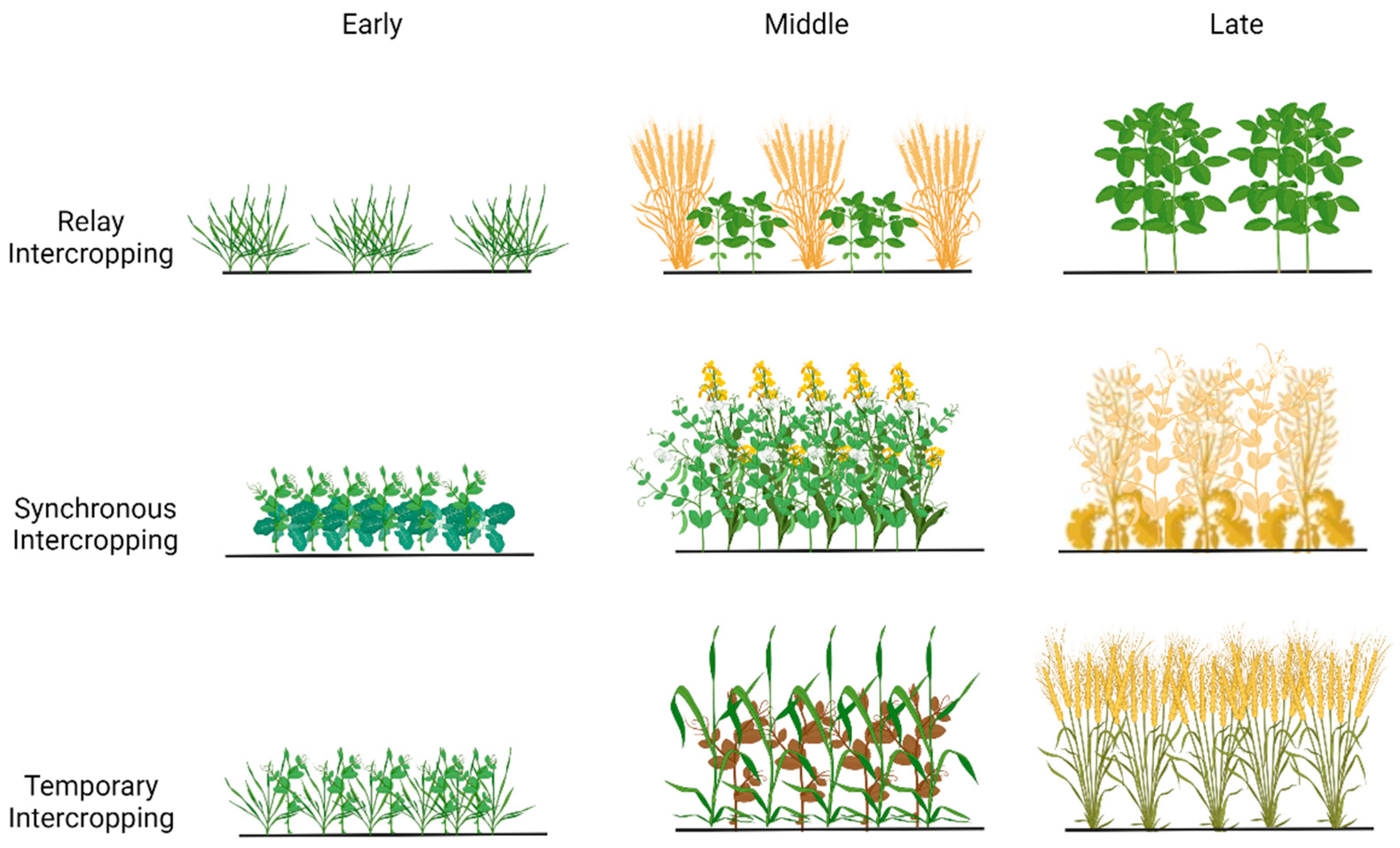
Relay intercropping is defined as two or more species being grown simultaneously for only a proportion of their life cycles. This usually involves two cash crops where one crop is harvested prior to the other, or where one cash crop is sown into a maturing stand of another cash crop. However, relay intercropping can also include ‘temporary intercropping’, also referred to as companion planting [37]. This is where multiple species are grown together for a period of time, but only one species (the cash crop) is harvested for yield. The companion plant or plants are grown to provide other benefits to the system, such as biological N fixation, provision of ground cover, and potentially, improvements in soil function [18]. Many temporary intercrop studies involve seeding one or more companion plants into existing cash crop stands—e.g., seeding clovers and/or other annual species into standing maize cash crops [46] and allowing the companion plants to continue to act as groundcovers (or cover crops) after cash crop harvest. In this opinion paper, we specifically refer to temporary intercropping systems as those where the cash crop and companion species are sown at the same time, and the companion species are terminated prior to the harvest of the cash crop (Figure 2).
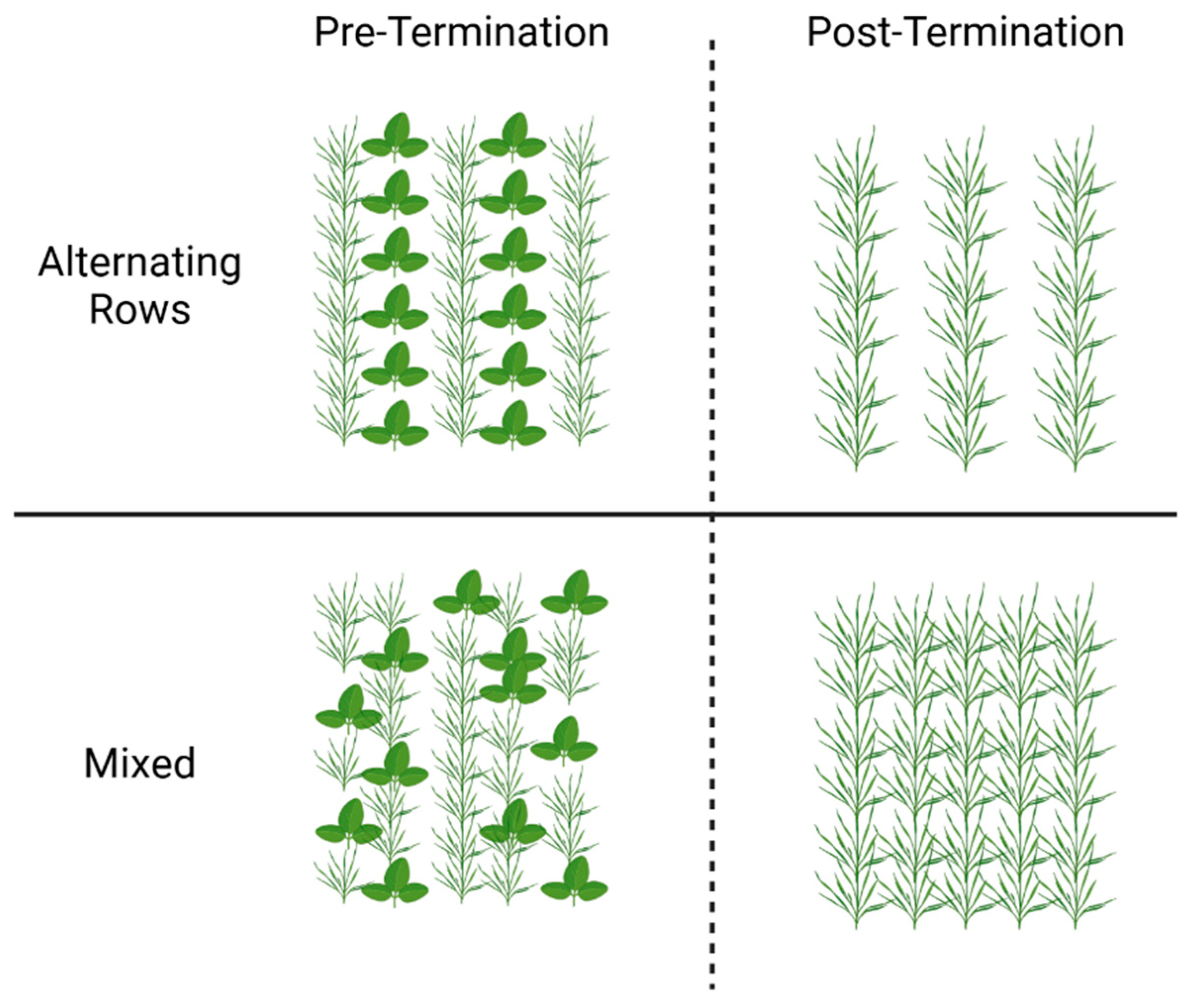
We are only aware of six published studies that have investigated temporary intercropping, all of which were conducted in Italy or southern Australia (Table 1), in small grain cereal production systems with cash crops grown from autumn to late spring, followed by a summer fallow. The temporary intercrop species in all studies were legumes, and these were grown in alternate rows to the cash crop and terminated by cultivation in the Italian studies and mixed in-row with the cash crop in the herbicide-based systems in southern Australia (Figure 3). Where legumes were terminated by cultivation, reductions in cereal yields in the intercropped treatments compared to monoculture cereal treatments were found in two studies [47,48], while no effect on yields was observed by Guiducci et al. [49] or Tosti and Guiducci [50], where legume intercrops were terminated sufficiently early. In the herbicide-based systems, Parvin et al. [51] found no significant effect of temporary vetch intercrops on wheat grain yields, while Rose et al. [18] reported a non-significant 10% reduction in wheat yields in the wheat–vetch intercrop treatment. Thus, temporary intercropping has the potential to affect cash crop yields due to competition effects, and the time of termination is likely a critical factor.
One potential benefit of temporary legume intercrops in small grain cereal systems is an increase in grain protein if legume residues mineralise before or during the cereal grain filling period. However, improvements in grain protein without yield reductions have only been observed in one study [49]. Parvin et al. [51] reported significantly higher mineral N concentrations in the topsoil at anthesis in the wheat–vetch intercrop treatment compared to monoculture wheat, but this did not translate into improvements in grain protein. However, Parvin et al. [51] observed greater wheat root length at anthesis in the deep (60–90 cm) soil layer in the temporary intercrop treatment. They also observed more plant-available water to a depth of 90 cm in the temporary intercrop treatment, which would likely be beneficial in seasons with a dry grain filling period. Parvin et al. [51] also reported subtle changes in several biological indices (microbial biomass carbon, hot water-extractable carbon, total N, and citrate-extractable protein) in the topsoil in the temporary intercropped treatment compared to monoculture wheat, some of which were still observed prior to sowing the subsequent season’s crop. Temporary cereal–legume intercropping thus appears to have potential to affect both yield and quality in cereal crops, and soil function. However, managing the growth of intercrops to obtain N and or soil benefits while minimising competition for light, water, and/or nutrients that leads to cash crop yield losses of temporary intercrops will be critical for optimising systems benefits.
Given that an in-crop broadleaf weed spray is common practice in cereal crops in southern Australian farming systems, termination of intercrop legumes may not incur any extra cost or time. However, this is based on the assumption that species selected as intercrops are compatible with pre-emergent and early post-seeding herbicides but can be terminated later in the season with registered broadleaf herbicides. Common intercrops that can be terminated with typical Group 4 herbicide (e.g., 2,4-D, MCPA, or Fluroxypyr) applications include many pulse crops (field pea, vetch, faba bean), clovers, and tillage radish. Thus, temporary intercropping may offer a similar opportunity to summer cover cropping in southern Australia to increase plant species diversity in southern Australian farming systems. Indeed, the growth period for multiple species trialled (8–10 weeks) in published studies [18,19] is not dissimilar to the duration of summer cover crops in experiments aiming to fit cover crops into the 4–6-month summer fallow period without using excessive subsoil moisture [17,18].

5. Ease of On-Farm Trialling of Temporary Intercropping

The transition to temporary intercropping by land managers can be fostered with evidence from on-farm, land manager-led field trials. Monoculture plots can be created in-field by switching off the small seeds box used to sow smaller-seeded intercrops (e.g., vetch, radish), allowing comparison with the surrounding intercropped field. Additionally, a range of broadleaf temporary intercrops can be terminated without additional herbicide, diesel, or labour costs in southern Australian farming systems. These methods, often implemented with the use of GPS-controlled traffic systems, enable large-scale on-farm trials that can be relatively easily implemented by landholders with minimal interruptions to crop seeding, management, or harvest.
As an example, on-farm trials were conducted by farmers in the Riverina region of southern New South Wales (NSW), Australia, to investigate the impact of temporary intercrop species or the timing of their termination on wheat yields. These trials were conducted on a large scale with farm machinery and with limited replicates; hence, any results should be interpreted with a degree of caution. At the first trial near Marrar, NSW (−34.797436°, 147.313089°), the influence of intercrop species on wheat yield was tested. A wheat crop was sown using an Excel single disc seeder at 166 mm row spacing, sowing wheat (cv. Catapult) at 100 kg ha−1, and this wheat monoculture control was compared with three treatments of intercrop species mixes using the additive principle. These were: wheat + field pea (cv. Percy at 15 kg ha−1) + radish (cv. Roota at 1 kg ha−1) (WPR); wheat + field pea (cv. Percy at 15 kg ha−1) + vetch (cv. Timok at 20 kg ha−1) (WPV); or wheat + field pea (cv. Percy at 15 kg ha−1) + vetch (cv. Timok at 20 kg ha−1) + radish (cv. Roota at 1 kg ha−1) (full mixture). Seeds of intercrop species were delivered into the same row as the cash crop via the small seeds box on the planter. Plots were 12 m wide, as determined by machinery width, and 750 m long (length of the paddock). Two replicate strips per treatment were applied in a randomised design.
Only liquid fertilisers were applied to this trial as per standard practice for that farmer. At sowing, 10 L ha−1 Cropping Solutions CS Red (Boron 0.025%, Calcium 2.99%, Copper 0.08%, Potassium [K] 0%, Magnesium 2.32%, Manganese 0.29% Phosphorus [P] 8.45%, Sulphur [S] 0.25%, Zinc 0.33%, Molybdenum 0.06%, Total N 3.34%, w/v) was furrow applied. Post-emergence, foliar applications occurred on four occasions during the season, providing a total of 82 kg ha−1 of urea, 2.5 kg ha−1 magnesium sulphate, 10 L ha−1 CS Red, and 5.5 L ha−1 of Cropping Solutions CS Calx (Calcium 12% w/v).
Temporary intercrops were terminated with 600 mL ha−1 of LVE MCPA 0.6 L ha−1 + 25 g ha−1 Paradigm (Halauxifen-methyl and florasulam) with Uptake spraying oil (0.5%) on 28 August 2021. Prior to herbicide application, 8 × 1 m lengths of crop rows were cut for biomass assessment. These cuts were taken from random locations within each strip, while avoiding a 1 m buffer at the edge of the strip. Biomass was separated into individual species, dried in an oven at 65 °C for 4 days, and then weighed. The wheat crop was harvested on 16 December 2021, and grain yields from each strip were obtained from the header yield monitor. Significant differences in biomass production and grain yield were analysed using analysis of variance (ANOVA) following testing for normality and equal variances. Where significant differences were identified using a significance level of 0.05, post hoc testing was carried out with Fisher’s least significant differences, using Bonferroni p-value adjustment. Analyses were carried out using the agricolae package [v. 1.3-7; [52] in the R environment (v. 4.2.3 [53]). Low statistical power is recognised due to the layout of the trials.
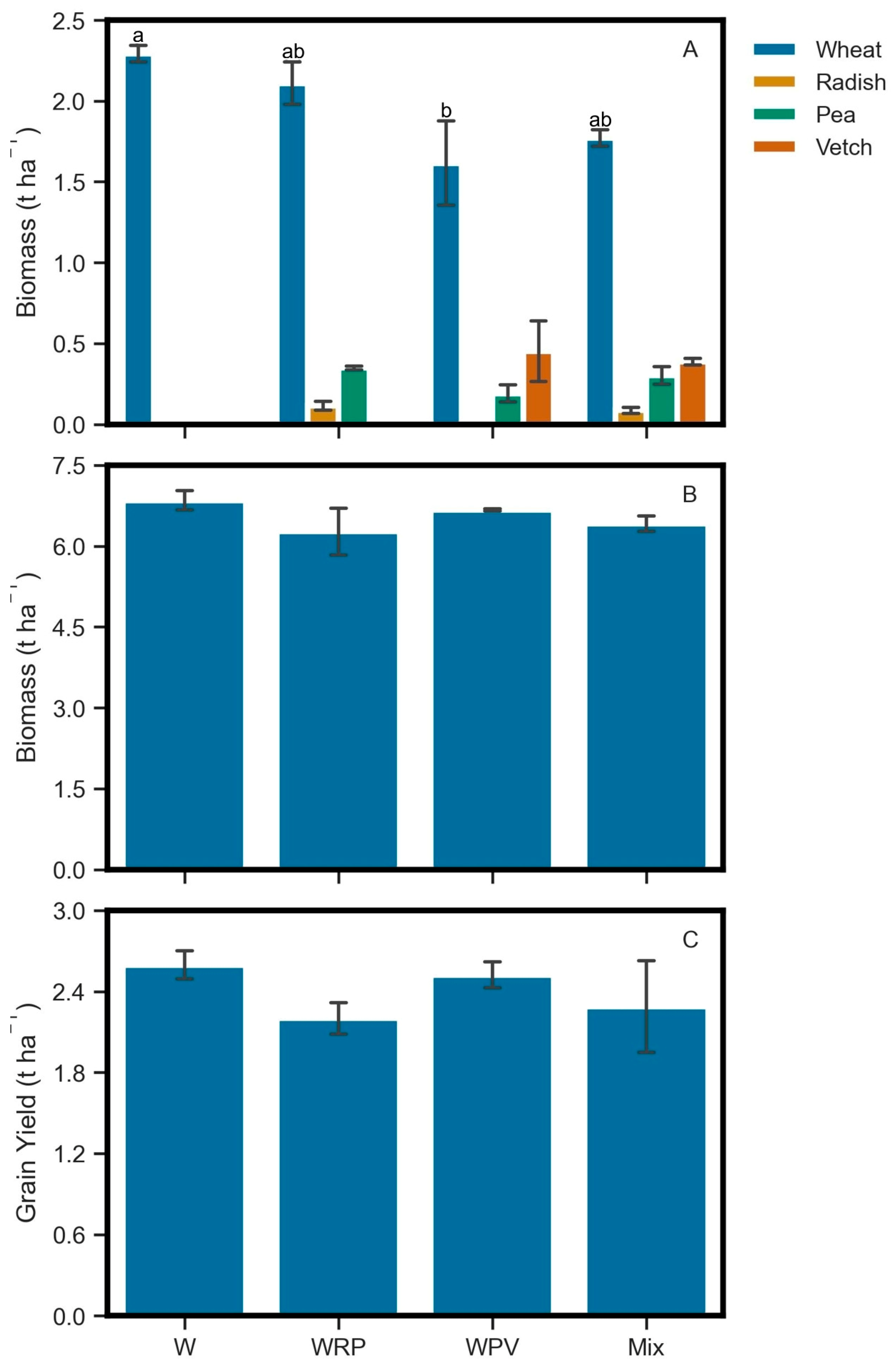
Wheat biomass at temporary intercrop termination in the control (2.29 t ha−1) was significantly higher (p = 0.02) than wheat biomass in WPV (1.61 t ha−1; Figure 4A). Wheat biomass at termination in the WRP (2.11 t ha−1) and full-mixture (1.77 t ha−1) treatments was lower than in the control, but the difference was not significant (p = 0.10) (Figure 4A). Radish yielded 0.12 and 0.09 t ha−1 of biomass in the WRP and full-mixture treatments, respectively (Figure 4A). Field pea produced biomass of 0.34, 0.35, and 0.30 t ha−1 in the WRP, WPV, and full-mixture treatments, respectively, while vetch produced 0.45 and 0.39 t ha−1 in the WPV and full-mixture treatments (Figure 4A). Overall, 2.29 t ha−1 of biomass was produced in the wheat monoculture control, 2.56 t ha−1 in the WRP treatment, 2.42 t ha−1 in the WPV, and 2.54 t ha−1 in the full mixture treatment. Raw data can be found in the Supplementary Information.
At harvest, biomass was highest in the monoculture wheat control at 6.85 t ha−1, followed by WPV with 6.67 t ha−1, the full mixture with 6.41 t ha−1, and then the WRP treatment with 6.27 t ha−1 (p = 0.45) (Figure 4B). Grain yield was similarly highest in the control with 2.60 t ha−1, followed by WPV with 2.52 t ha−1, full mixture with 2.29 t ha−1, and WRP with 2.20 t ha−1 (p = 0.50) (Figure 4C). Harvest index was 38% in the control and WPV treatments, and 36% in the full mixture and WRP treatments (p = 0.81).
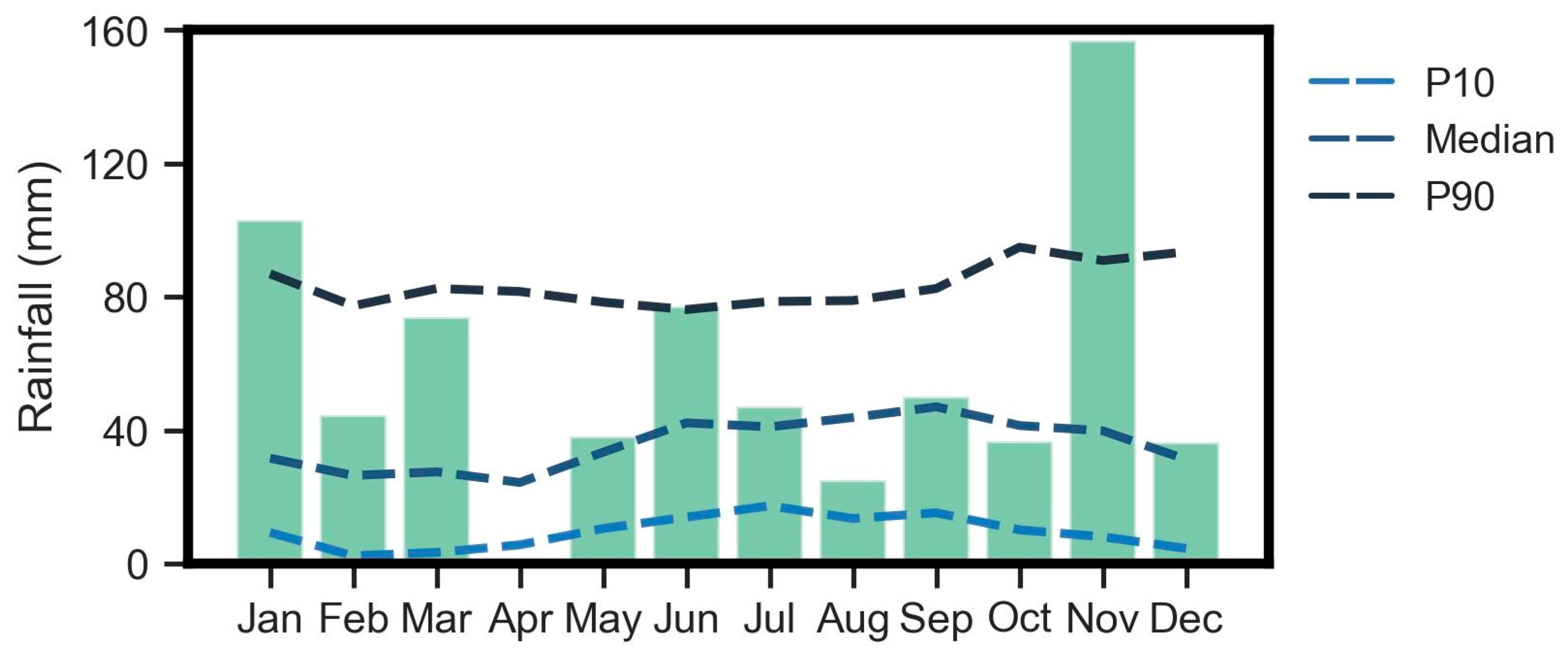
The lack of differences between treatments may be due to the favourable rainfall received in 2021. Well-above median rainfall was received across January to March (Figure 5). As a result, ample water was likely available during sowing. While 0 mm of rain fell in April, 38, 77, and 47 mm fell in May, June, and July, respectively, with these months around or above their long-term (1970–2020) median (Figure 5). The 25 mm of rain in August was below the median; however, the 50 mm received in September was around the median (Figure 5). Therefore, the differences in anthesis biomass are unlikely to be due to water limitation, but likely competition for light. Following intercrop termination, the cash crops received 37 mm in October and 157 mm in November (Figure 5), which alleviates any water use effect of the temporary intercrops. This highlights that when water availability is high, there is minimal penalty for growing temporary intercrops. In this example, April to November rain was decile six, indicating these conditions can be expected to be met in 40% of years. Further work, however, is required to identify thresholds for when this occurs, optimal species mixes for maximising soil and plant benefits, and minimising water limitation of the cash crop. The selection of termination time is also an important consideration. The effect of termination timing was examined in Trial 2.
In the second on-farm trial located at Collingullie, NSW (−35.128476°, 147.167383°), two timings of temporary intercrop termination were trialled in a crop of wheat cv. Lancer (70 kg ha−1) with an intercrop of peas (cv. Percy at 15 kg ha−1) and radish (cv. Roota at 1 kg ha−1). The crop was sown on 28 April 2021 with 80 kg ha−1 MAP (10:22:0:1.5, N:P:K:S, w/w) sown in the seed row using an Excel disc seeder at 166 mm row spacing.
Plots were 12 m wide and 1050 m long (the full length of the paddock). As the paddock was sown to the wheat and intercrop, plots were allocated to the various termination treatments, and a wheat-only control was included by turning off the intercrop seed in those plots at sowing. There were three treatments (control wheat, broadleaf spray at early termination; intercrop, early termination; intercrop, later termination) with three replicate plots per treatment in a randomised block design; a total of nine plots.
The first (early) termination was conducted on 12 August, spraying with Paradigm (halauxifen-methyl and florasulam) at 25 g ha−1 + MCPA LVE 570 (2-ethyl hexyl ester) at 600 mL ha−1. The second (late) termination occurred on 9 September using Amicide (2,4-D present as dimethylamine and monomethylamine salts) at 1 L ha−1.
Despite the use of a legume in the intercrop treatment, the land manager broadcast urea into the paddock three times. Urea was applied at 100 kg ha−1 on 14 June, 6 August, and 15 September.
Biomass from each plot was measured at each termination event by cutting eight randomly located 1 m lengths of crop rows, avoiding a 1 m buffer at the plot edges. Biomass was separated into individual species, dried in an oven at 65 °C for 4 days, and then weighed. The wheat crop was harvested on 18 December 2021, and grain yields from each plot were obtained using farmer-owned calibrated chaser bin load cells into which the header emptied grain from each plot.
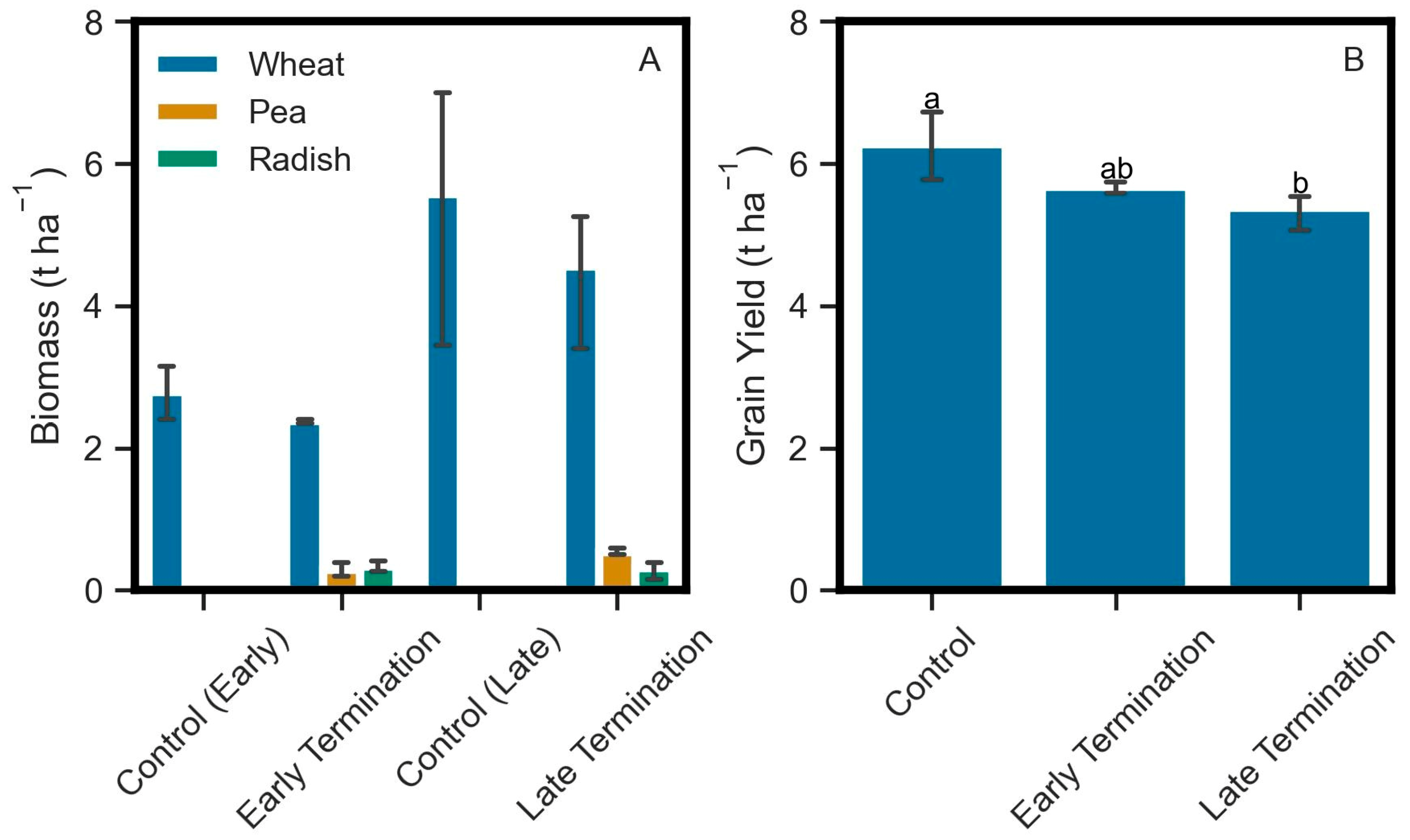
At early termination in August, biomass in the wheat control was 2.78 t ha−1, while wheat biomass in the terminated intercrop was 2.38 t ha−1 (p = 0.14) (Figure 6A). At late termination in September, biomass in the control was 5.57 t ha−1, while it was 4.55 t ha−1 in the terminated intercrop (p = 0.45) (Figure 6A). The early-terminated treatment produced 0.29 t ha−1 of field pea and 0.33 t ha−1 of radish, while 0.54 t ha−1 of pea biomass and 0.31 t ha−1 of radish biomass were produced in the late termination (Figure 6A). The control produced the highest grain yield at 6.28 t ha−1, which was significantly higher (p = 0.04) than the late termination intercrop treatment with 5.38 t ha−1 (Figure 6A). Grain yield for the early termination intercrop treatment (5.67 t ha−1) was not different (p > 0.05) from either of the other treatments (Figure 6B). The grain yield in the late termination treatment represented a 14.4% reduction from the control yield.
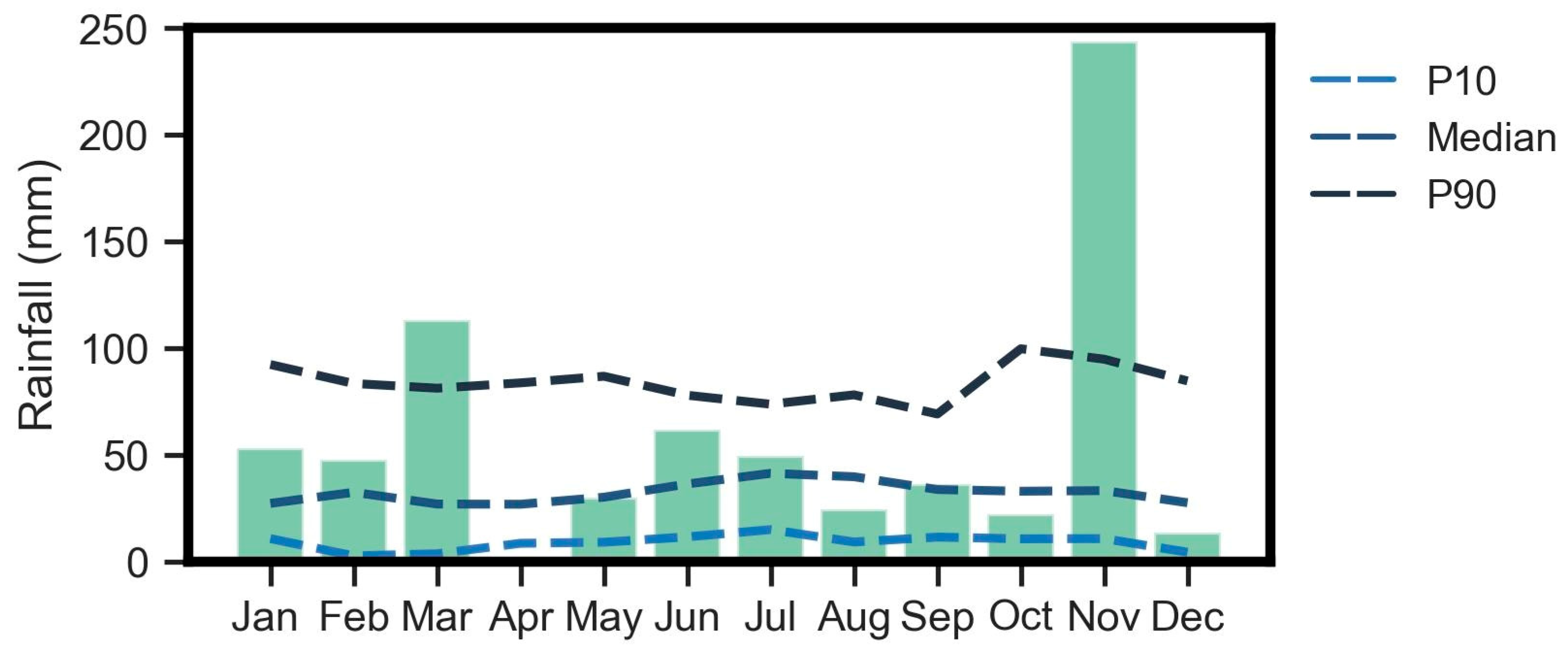
Similar to Marrar, the trial received above median rainfall from January through to March, prior to sowing (Figure 7). Totals of 30, 62, and 49 mm of rain fell in May, June, and July, with this being at or above the 1970–2020 median (Figure 7). August and September received 25 and 36 mm of rainfall, respectively, with August being below the median. This decline in rainfall, combined with the late September compared to late August termination (i.e., greater competition between the cash crop and intercrops with the late termination timing), may explain the differences in grain yield. A below median October (22.2 mm—Figure 7) may have then compounded this, with a wet November providing potential relief (Figure 7).
While additional measurements of wheat and intercrop biomass yields at intercrop termination were taken in this instance, farmers can quantify their own field-scale yields using yield monitoring equipment in harvesters, demonstrating the ease with which on-farm trials can be conducted by growers or growers in conjunction with researchers.
The two examples of farmer-implemented field trials discussed here demonstrate the ease with which data can be created to provide evidence to inform the decisions relating to the use and management of intercropping. The data are site and farmer-specific, providing outcomes directly relatable to the farmer. For example, it is worth highlighting the contrast in fertiliser practices of the two farmers in the examples above. It is likely that these would have had an impact on the outcome of the trials by affecting potential intercrop legume contributions to overall soil N, and by altering cash crop growth potential and exacerbating competition effects with the intercrops. However, because the fertiliser practices are inherent to the individual farmer, the outcomes are still relevant to the farmer.

6. Future Research and Practicalities

Published results so far indicate that temporary legume intercrops can influence root distribution of cereal cash crops and alter N cycling compared to monocultures, as well as influence soil functional parameters [51]. While one study found high grain protein in wheat with temporary faba bean, field pea, or squarrose clover intercrops [49] with similar yields to monoculture wheat, other studies have reported yield reductions in the temporary intercropped treatments [47,48]. The results in the on-farm trials presented above indicate that the time of temporary intercrop termination plays a key role in potential yield reductions (Figure 5). A large question remains around the magnitude of potential soil or grain quality increases possible using temporary intercropping, and whether any such improvements justify the extra seeding costs. Much of this uncertainty relates to the duration of the intercropping phase, and whether any facilitation effects that improve resource-use efficiency or yields can realistically be expected when the temporary intercrops are terminated after 2–3 months. The duration of the temporary intercropping phase is limited by the increasing risk of negative effects arising from competition, particularly for water in semi-arid cropping systems, as the season progresses. Further research is needed to understand the relationship between temporary intercrop duration, rate of formation, magnitude, and persistence of system benefits.
Important agronomic questions remain around optimising any benefits while minimising the risk of yield reductions. These issues include optimising species and seeding rates of temporary intercrops, timing of intercrop termination to maximise potential benefits while minimising cash crop yield risks associated with excess competition, arrangement of intercrop species (alternate rows, mixed rows), placement and timing of N fertiliser in temporary intercrop systems that include legumes, and temporary intercrop species effects on disease levels in subsequent crops in the cropping sequence. Ultimately, further studies are needed to address many of the issues listed above to optimise benefits and minimise the risk of yield losses in any given cropping system or environment. Once conditions have been optimised and any potential benefits quantified, assessments can be made as to whether the practice is economically feasible.

Supplementary Materials

The following supporting information can be downloaded at: https://www.mdpi.com/article/10.3390/agronomy15122784/s1, File S1: Raw biomass and grain yield data from Marrar and Collingullie field trials

Author Contributions

Conceptualisation, H.T., J.C., A.J.G., S.P. and T.J.R.; methodology, H.T., J.C. and S.P.; formal analysis, H.T. and A.J.G.; investigation, H.T. and S.P.; resources, J.C. and T.J.R.; data curation, H.T. and S.P.; writing—original draft preparation, H.T.; writing—review and editing, H.T., J.C., A.J.G., S.P. and T.J.R.; visualisation, H.T. and S.P.; supervision, T.J.R.; project administration, T.J.R.; funding acquisition, T.J.R. All authors have read and agreed to the published version of the manuscripts.

Funding

This work has been supported by the Cooperative Research Centre for High Performance Soils (project 4.1.007), whose activities are funded by the Australian Government’s Cooperative Research Centre Programme. HT was the recipient of a Higher Degree Research Scholarship from Southern Cross University.

Data Availability Statement

Not applicable.

Acknowledgments

We thank the two landholders who allowed us to conduct a large-scale trial on their properties in southern NSW.

Conflicts of Interest

The authors declare no conflicts of interest.

References

  1. Kirkegaard, J.; van Rees, H. Evolution of conservation agriculture in winter rainfall areas. In Australian Agriculture in 2020: From Conservation to Automation; Pratley, J., Kirkegaard, J., Eds.; Agronomy Australia and Charles Sturt University: Wagga Wagga, Australia, 2019; Chapter 4; pp. 47–64. Available online: http://agronomyaustraliaproceedings.org/index.php/special-publications (accessed on 5 February 2024).
  2. Armstrong, R.D.; Perris, R.; Munn, M.; Dunsford, K.; Robertson, F.; Hollaway, G.J.; Leary, G.J.O. Effects of long-term rotation and tillage practice on grain yield and protein of wheat and soil fertility on a Vertosol in a medium-rainfall temperate environment. Crop Pasture Sci. 2019, 70, 1–15. [Google Scholar] [CrossRef]
  3. Harries, M.; Flower, K.C.; Scanlan, C.A.; Rose, M.T.; Renton, M. Interactions between crop sequences, weed populations and herbicide use in Western Australian broadacre farms: Findings of a six-year survey. Crop Pasture Sci. 2020, 71, 491–505, 415. [Google Scholar] [CrossRef]
  4. Swan, A.D.; Goward, L.; Hunt, J.R.; Kirkegaard, J.A.; Peoples, M.B. Diverse systems and strategies to cost-effectively manage herbicide-resistant annual ryegrass (Lolium rigidum) in no-till wheat (Triticum aestivum) based cropping sequences in south-eastern Australia. Crop Pasture Sci. 2023, 74, 809–827. [Google Scholar] [CrossRef]
  5. Edwards, T.; Howieson, J.; Nutt, B.; Yates, R.; O’Hara, G.; Van Wyk, B.-E. A ley-farming system for marginal lands based upon a self-regenerating perennial pasture legume. Agron. Sustain. Dev. 2019, 39, 13. [Google Scholar] [CrossRef]
  6. Smith, A.; Moore, A. Whole farm implications of lucerne transitions in temperate crop-livestock systems. Agric. Syst. 2020, 177, 102686. [Google Scholar] [CrossRef]
  7. Isbell, F.; Adler, P.R.; Eisenhauer, N.; Fornara, D.; Kimmel, K.; Kremen, C.; Letourneau, D.K.; Liebman, M.; Polley, H.W.; Quijas, S.; et al. Benefits of increasing plant diversity in sustainable agroecosystems. J. Ecol. 2017, 105, 871–879. [Google Scholar] [CrossRef]
  8. Cappelli, S.L.; Domeignoz-Horta, L.A.; Loaiza, V.; Laine, A.-L. Plant biodiversity promotes sustainable agriculture directly and via belowground effects. Trends Plant Sci. 2022, 27, 674–687. [Google Scholar] [CrossRef]
  9. Thapa, R.; Mirsky, S.B.; Tully, K.L. Cover crops reduce nitrate leaching in agroecosystems:A global meta-analysis. J. Environ. Qual. 2018, 47, 1400–1411. [Google Scholar] [CrossRef] [PubMed]
  10. Adetunji, A.T.; Ncube, B.; Mulidzi, R.; Lewu, F.B. Management impact and benefit of cover crops on soil quality: A review. Soil Tillage Res. 2020, 204, 104717. [Google Scholar] [CrossRef]
  11. Hao, X.; Abou Najm, M.; Steenwerth, K.L.; Nocco, M.A.; Basset, C.; Daccache, A. Are there universal soil responses to cover cropping? A systematic review. Sci. Total Environ. 2023, 861, 160600. [Google Scholar] [CrossRef] [PubMed]
  12. Kaye, J.P.; Quemada, M. Using cover crops to mitigate and adapt to climate change. A review. Agron. Sustain. Dev. 2017, 37, 4. [Google Scholar] [CrossRef]
  13. Hunt, J.R.; Kirkegaard, J.A. Re-evaluating the contribution of summer fallow rain to wheat yield in southern Australia. Crop Pasture Sci. 2011, 62, 915–929. [Google Scholar] [CrossRef]
  14. Garba, I.I.; Bell, L.W.; Williams, A. Cover crop legacy impacts on soil water and nitrogen dynamics, and on subsequent crop yields in drylands: A meta-analysis. Agron. Sustain. Dev. 2022, 42, 34. [Google Scholar] [CrossRef]
  15. Hunt, J.R.; Browne, C.; McBeath, T.M.; Verburg, K.; Craig, S.; Whitbread, A.M. Summer fallow weed control and residue management impacts on winter crop yield though soil water and N accumulation in a winter-dominant, low rainfall region of southern Australia. Crop Pasture Sci. 2013, 64, 922–934. [Google Scholar] [CrossRef]
  16. Rose, T.J.; Parvin, S.; Han, E.; Condon, J.; Flohr, B.M.; Schefe, C.; Rose, M.T.; Kirkegaard, J.A. Prospects for summer cover crops in southern Australian semi-arid cropping systems. Agric. Syst. 2022, 200, 103415. [Google Scholar] [CrossRef]
  17. McNee, M.E.; Rose, T.J.; Minkey, D.M.; Flower, K.C. Effects of dryland summer cover crops and a weedy fallow on soil water, disease levels, wheat growth and grain yield in a Mediterranean-type environment. Field Crops Res. 2022, 280, 108472. [Google Scholar] [CrossRef]
  18. Rose, T.J.; Parvin, S.; McInnes, J.; van Zwieten, L.; Gibson, A.J.; Kearney, L.J.; Rose, M.T. Summer cover crop and temporary legume-cereal intercrop effects on soil microbial indicators, soil water and cash crop yields in a semi-arid environment. Field Crops Res. 2024, 312, 109384. [Google Scholar] [CrossRef]
  19. Parvin, S.; Condon, J.; Rose, T. Rooting depth and water use of summer cover crops in a semi-arid cropping environment. Eur. J. Agron. 2023, 147, 126847. [Google Scholar] [CrossRef]
  20. Roper, M.; Milroy, S.; Poole, M.L. Green and brown manures in dryland wheat production systems in mediterranean-type environments. Adv. Agron. 2012, 117, 275–313. [Google Scholar] [CrossRef]
  21. Armstrong, E.; O’Connor, G.; Gaynor, L.; Ellis, S.; Coombes, N. Brown manuring pulses on acidic soils in southern NSW—Is it worth it? “Building Productive, Diverse and Sustainable Landscapes”. In Proceedings of the 17th ASA Conference, Hobart, Australia, 20–24 September 2015; Available online: www.agronomy2015.com.au (accessed on 1 August 2025).
  22. Flower, K.C.; Cordingley, N.; Ward, P.R.; Weeks, C. Nitrogen, weed management and economics with cover crops in conservation agriculture in a Mediterranean climate. Field Crops Res. 2012, 132, 63–75. [Google Scholar] [CrossRef]
  23. Brooker, R.W.; Bennett, A.E.; Cong, W.-F.; Daniell, T.J.; George, T.S.; Hallett, P.D.; Hawes, C.; Iannetta, P.P.M.; Jones, H.G.; Karley, A.J.; et al. Improving intercropping: A synthesis of research in agronomy, plant physiology and ecology. New Phytol. 2015, 206, 107–117. [Google Scholar] [CrossRef]
  24. Dowling, A.; Sadras, V.; Roberts, P.; Doolette, A.; Zhou, Y.; Denton, M. Legume-oilseed intercropping in mechanised broadacre agriculture—A review. Field Crops Res. 2021, 260, 107980. [Google Scholar] [CrossRef]
  25. Skelton, L.E.; Barrett, G.W. A comparison of conventional and alternative agroecosystems using alfalfa (Medicago sativa) and winter wheat (Triticum aestivum). Renew. Agric. Food Syst. 2005, 20, 38–47. [Google Scholar] [CrossRef]
  26. Fridley, J.D. The Influence of species diversity on ecosystem productivity: How, where, and why? OIKOS 2001, 93, 514–526. [Google Scholar] [CrossRef]
  27. Betencourt, E.; Duputel, M.; Colomb, B.; Desclaux, D.; Hinsinger, P. Intercropping promotes the ability of durum wheat and chickpea to increase rhizosphere phosphorus availability in a low P soil. Soil Biol. Biochem. 2012, 46, 181–190. [Google Scholar] [CrossRef]
  28. Hauggaard-Nielsen, H.; Jensen, E.S. Facilitative root interactions in intercrops. Plant Soil 2005, 274, 237–250. [Google Scholar] [CrossRef]
  29. Aphalo, P.J.; Ballaré, C.L. On the importance of information-acquiring systems in plant–plant interactions. Funct. Ecol. 1995, 9, 5–14. [Google Scholar] [CrossRef]
  30. Jensen, E.S. Grain yield, symbiotic N2 fixation and interspecific competition for inorganic N in pea-barley intercrops. Plant Soil 1996, 182, 25–38. [Google Scholar] [CrossRef]
  31. Malézieux, E.; Crozat, Y.; Dupraz, C.; Laurans, M.; Makowski, D.; Ozier-Lafontaine, H.; Rapidel, B.; de Tourdonnet, S.; Valantin-Morison, M. Mixing plant species in cropping systems: Concepts, tools and models. A review. Agron. Sustain. Dev. 2009, 29, 43–62. [Google Scholar] [CrossRef]
  32. Gardarin, A.; Celette, F.; Naudin, C.; Piva, G.; Valantin-Morison, M.; Vrignon-Brenas, S.; Verret, V.; Médiène, S. Intercropping with service crops provides multiple services in temperate arable systems: A review. Agron. Sustain. Dev. 2022, 42, 39. [Google Scholar] [CrossRef]
  33. Millar, G.D.; Jones, R.E.; Michalk, D.L.; Brady, S. An exploratory tool for analysis of forage and livestock production options. Anim. Prod. Sci. 2009, 49, 788–796. [Google Scholar] [CrossRef]
  34. Lithourgidis, A.S.; Dordas, C.A.; Damalas, C.A.; Vlachostergios, D.N. Annual intercrops: An alternative pathway for sustainable agriculture. Aust. J. Crop Sci. 2011, 5, 396–410. [Google Scholar]
  35. Khanal, U.; Stott, K.J.; Armstrong, R.; Nuttall, J.G.; Henry, F.; Christy, B.P.; Mitchell, M.; Riffkin, P.A.; Wallace, A.J.; McCaskill, M.; et al. Intercropping—Evaluating the advantages to broadacre systems. Agriculture 2021, 11, 453. [Google Scholar] [CrossRef]
  36. Gu, C.; Bastiaans, L.; Anten, N.P.R.; Makowski, D.; van der Werf, W. Annual intercropping suppresses weeds: A meta-analysis. Agric. Ecosyst. Environ. 2021, 322, 107658. [Google Scholar] [CrossRef]
  37. Verret, V.; Gardarin, A.; Pelzer, E.; Médiène, S.; Makowski, D.; Valantin-Morison, M. Can legume companion plants control weeds without decreasing crop yield? A meta-analysis. Field Crops Res. 2017, 204, 158–168. [Google Scholar] [CrossRef]
  38. Bergkvist, G. Influence of white clover traits on biomass and yield in winter wheat- or winter oilseed rape-clover intercrops. Biol. Agric. Hortic. 2003, 21, 151–164. [Google Scholar] [CrossRef]
  39. Bergkvist, G.; Stenberg, M.; Wetterlind, J.; Båth, B.; Elfstrand, S. Clover cover crops under-sown in winter wheat increase yield of subsequent spring barley—Effect of N dose and companion grass. Field Crops Res. 2011, 120, 292–298. [Google Scholar] [CrossRef]
  40. Correia, M.V.; Pereira, L.C.R.; De Almeida, L.; Williams, R.L.; Freach, J.; Nesbitt, H.; Erskine, W. Maize-mucuna (Mucuna pruriens (L.) DC) relay intercropping in the lowland tropics of Timor-Leste. Field Crops Res. 2014, 156, 272–280. [Google Scholar] [CrossRef]
  41. Abdin, O.A.; Zhou, X.M.; Cloutier, D.; Coulman, D.C.; Faris, M.A.; Smith, D.L. Cover crops and interrow tillage for weed control in short season maize (Zea mays). Eur. J. Agron. 2000, 12, 93–102. [Google Scholar] [CrossRef]
  42. De Haan, R.L.; Sheaffer, C.C.; Barnes, D.K. Effect of annual medic smother plants on weed control and yield in corn. Agron. J. 1997, 89, 813–821. [Google Scholar] [CrossRef]
  43. Fletcher, A.; Kirkegaard, J.; Peoples, M.B.; Robertson, M.; Whish, J.; Swan, A. Prospects to utilise intercrops and crop variety mixtures in mechanised, rain-fed, temperate cropping systems. Crop Pasture Sci. 2016, 67, 1252–1267. [Google Scholar] [CrossRef]
  44. Stott, K.J.; Wallace, A.J.; Khanal, U.; Christy, B.P.; Mitchell, M.L.; Riffkin, P.A.; McCaskill, M.R.; Henry, F.J.; May, M.D.; Nuttall, J.G.; et al. Intercropping—Towards an understanding of the productivity and profitability of dryland crop mixtures in southern australia. Agronomy 2023, 13, 2510. [Google Scholar] [CrossRef]
  45. Fletcher, A.; McNee, M.; Ogden, G.; Robertson, M. The residual N benefits of temporary intercropping field pea with wheat. In Proceedings of the 17th ASA Conference, Hobart, Australia, 20–24 September 2015; pp. 987–990. [Google Scholar]
  46. Curran, W.S.; Hoover, R.J.; Mirsky, S.B.; Roth, G.W.; Ryan, M.R.; Ackroyd, V.J.; Wallace, J.M.; Dempsey, M.A.; Pelzer, C.J. Evaluation of cover crops drill interseeded into corn across the mid-Atlantic region. Agron. J. 2018, 110, 435–443. [Google Scholar] [CrossRef]
  47. De Stefanis, E.; Sgrulletta, D.; Pucciarmati, S.; Ciccoritti, R.; Quaranta, F. Influence of durum wheat-faba bean intercrop on specific quality traits of organic durum wheat. Biol. Agric. Hortic. 2017, 33, 28–39. [Google Scholar] [CrossRef]
  48. Pellegrini, F.; Carlesi, S.; Nardi, G.; Bàrberi, P. Wheat–clover temporary intercropping under Mediterranean conditions affects wheat biomass, plant nitrogen dynamics and grain quality. Eur. J. Agron. 2021, 130, 126347. [Google Scholar] [CrossRef]
  49. Guiducci, M.; Tosti, G.; Falcinelli, B.; Benincasa, P. Sustainable management of nitrogen nutrition in winter wheat through temporary intercropping with legumes. Agron. Sustain. Dev. 2018, 38, 31. [Google Scholar] [CrossRef]
  50. Tosti, G.; Guiducci, M. Durum wheat–faba bean temporary intercropping: Effects on nitrogen supply and wheat quality. Eur. J. Agron. 2010, 33, 157–165. [Google Scholar] [CrossRef]
  51. Parvin, S.; Bajwa, A.; Uddin, S.; Sandral, G.; Rose, M.T.; Van Zwieten, L.; Rose, T.J. Impact of wheat-vetch temporary intercropping on soil functions and grain yield in a dryland semi-arid environment. Plant Soil 2023, 506, 457–470. [Google Scholar] [CrossRef]
  52. De Mendiburu, F. R Package, Version 1.3-7. Agricolae: Statistical Procedures for Agricultural Research. CRAN: Vienna, Austria, 2023. Available online: https://CRAN.R-project.org/package=agricolae (accessed on 12 December 2023).
  53. R Core Team. R: A Language and Environment for Statistical Computing; R foundation for statistical computing: Vienna, Austria, 2023; Available online: https://www.R-project.org/ (accessed on 1 March 2022).
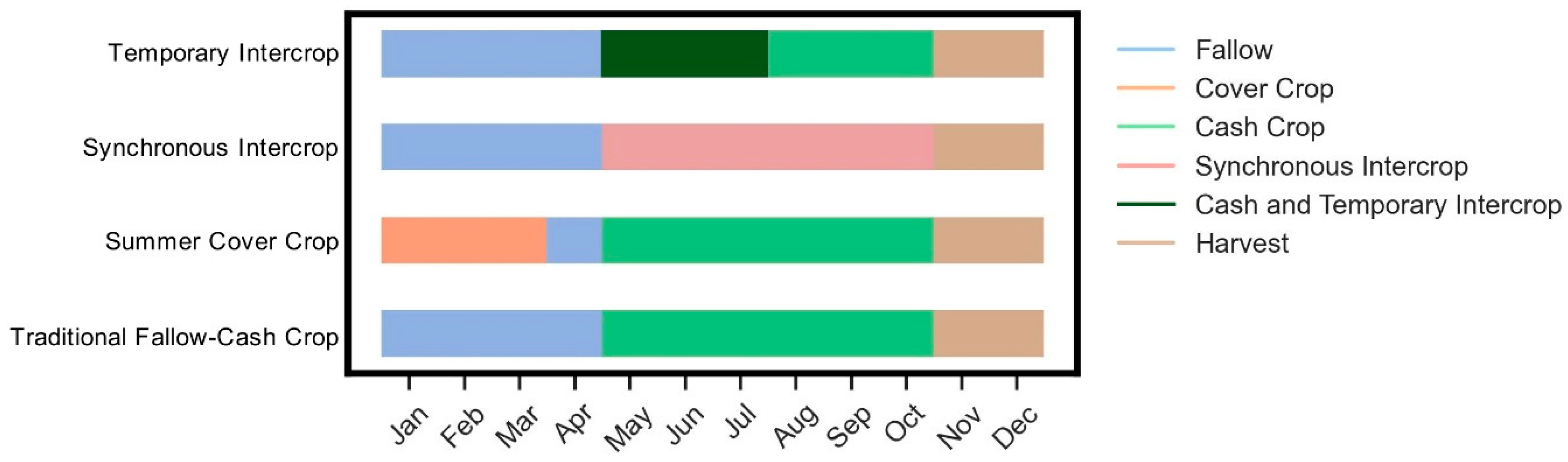
Figure 1. Sequence of crop phases in southern Australian cropping systems for traditional fallow-cash crop, summer cover crop, synchronous intercrop, and temporary intercrop systems.
Agronomy 15 02784 g001
Figure 2. A conceptual diagram of the different methods of intercropping with the early, middle, and late headings referring to stages of a cropping cycle, but not a specific timeframe. Relay intercropping has a single crop established (cereal depicted) with a second crop sown into the inter-row soon after early season, with the first crop harvested in the middle of the season and the second crop (broadleaf depicted) continuing to grow late in the season. Synchronous intercropping has two crops established together, reaching anthesis and maturity at the same time in the season, early, middle, and late, respectively. Temporary intercropping has two species established together (early), but in the middle of the season, one species is terminated (broadleaf depicted) with the cash crop (cereal depicted) reaching maturity late in the season.
Agronomy 15 02784 g002
Figure 3. Conceptual diagram of alternating rows (Italian studies) and mixed row (Australian studies) temporary intercropping.
Agronomy 15 02784 g003
Figure 4. Wheat and cover crop biomass at cover crop termination (A), wheat biomass at harvest (B), and wheat grain yield (C), for the control wheat (W), wheat, radish, and pea (WRP), wheat, pea, and vetch (WPV), and full mixture (Mix) treatments. Different letters indicate statistically significant differences between treatments (p < 0.05). Treatments sharing the same letter are not significantly different, and unmarked columns indicate no statistically significant differences among the treatment groups. Error bars represent the standard error of the mean.
Agronomy 15 02784 g004
Figure 5. Monthly rainfall for Marrar in 2021 (bars), with the 10th percentile (p10), median, and 90th percentile (P90) for each month derived from the recent record (1970–2020) shown in dotted lines. Data was sourced from https://www.longpaddock.qld.gov.au/silo/, accessed 1 December 2024.
Agronomy 15 02784 g005
Figure 6. Wheat and cover crop biomass at cover crop termination (A) and wheat grain yield (B), for the control wheat (measured at both early and late termination), early termination cover crop, and late termination cover crop. Different letters indicate statistically significant differences between treatments (p < 0.05). Treatments sharing the same letter are not significantly different, and unmarked columns indicate no statistically significant differences among the treatment groups. Error bars represent the standard error of the mean.
Agronomy 15 02784 g006
Figure 7. Monthly rainfall for Collingullie in 2021 (bars), with the 10th percentile (p10), median, and 90th percentile (P90) for each month derived from the recent record (1970–2020) shown in dotted lines. Data was sourced from https://www.longpaddock.qld.gov.au/silo/.
Agronomy 15 02784 g007
Table 1. Summary of studies investigating temporary intercropping.
SourceCountryCereal ComponentLegume ComponentTermination MethodTermination Timing
Rose et al. [18]AustraliaWheat (Triticum aestivum)Vetch (Vicia sativa), subterranean clover (Trifolium subterraneum)Herbicide17 weeks post-sowing
Parvin et al. [51]AustraliaWheat (Triticum aestivum)Vetch (Vicia sativa)Herbicide9 weeks post sowing
Tosti and Guiducci [50]ItalyDurum wheat (Triticum durum)Faba bean (Vicia faba)Cultivation21 weeks post sowing
Guiducci et al. [49]ItalyWheat (Triticum aestivum)Faba bean (Vicia faba), peas (Pisum sativum),
Squarrose clover (Trifolium squarrosum)
Cultivation21 weeks post sowing
De Stafanis et al. [47]ItalyDurum wheat (Triticum durum)Faba bean (Vicia faba)Cultivation21 weeks post sowing
Pellegrini et al. [48]ItalyWheat (Triticum aestivum)Persian clover (Trifolium resupinatum)Cultivation18 weeks post sowing
Disclaimer/Publisher’s Note: The statements, opinions and data contained in all publications are solely those of the individual author(s) and contributor(s) and not of MDPI and/or the editor(s). MDPI and/or the editor(s) disclaim responsibility for any injury to people or property resulting from any ideas, methods, instructions or products referred to in the content.