Review

Overcoming the Yield-Survival Trade-Off in Cereals: An Integrated Framework for Drought Resilience


by
Sergey A. Bursakov
*,
Gennady I. Karlov
,
Pavel Yu. Kroupin
and
Mikhail G. Divashuk
All-Russia Research Institute of Agricultural Biotechnology (ARRIAB), Moscow 127550, Russia
*
Author to whom correspondence should be addressed.
Agronomy 2025, 15(12), 2783; https://doi.org/10.3390/agronomy15122783
Submission received: 16 October 2025 / Revised: 27 November 2025 / Accepted: 29 November 2025 / Published: 2 December 2025
(This article belongs to the Section Crop Breeding and Genetics)

Abstract

The production and productivity of cereal crops, which form the foundation of global food security, are increasingly threatened by unstable water regimes and recurring droughts linked to climate change. Fortunately, a wide diversity of cereal crops is endowed with natural resilience to drought and heat stress, enabling them to survive under conditions that are critical for other plants. Understanding the key morphological, genetic, physiological, biochemical, and ecological mechanisms—and their interactions—is crucial for unraveling the processes involved in drought tolerance in these species. A comprehensive study of cereal crops, their variability, and their ability to survive and thrive under arid conditions will unlock new opportunities for breeding drought-resistant agricultural varieties. This review highlights the role of root system architecture (RSA) and gravitropic mechanisms (e.g., EGT1, DRO1), the integration of phytohormonal crosstalk, the potential of wild relatives and genome editing, and the emerging role of plant growth-promoting rhizobacteria (PGPR) in enhancing drought resilience. We propose a novel synthesizing concept focused on overcoming the fundamental yield-survival trade-off by framing drought resilience through the lens of optimizing three interconnected functional modules: water budget architecture, metabolic homeostasis, and integrative signaling networks. The central advance of this framework is its systems-level perspective that redefines these well-studied components as dynamically interacting, tunable modules, providing a practical blueprint for designing crop ideotypes that break the yield-survival trade-off.

1. Introduction

The grass family Poaceae (Gramineae) represents one of the most economically and ecologically vital plant families, forming the cornerstone of global food security and terrestrial ecosystems. Cereal crops such as wheat (Triticum aestivum), rice (Oryza sativa), maize (Zea mays), and barley (Hordeum vulgare) account for over half of human caloric intake and up to 70% of cultivated crop area [1,2]. Their productivity, however, is increasingly threatened by climate change-induced abiotic stresses, with drought being a primary cause of annual yield losses worldwide [2,3]. Notably, drought stress often co-occurs with other abiotic stresses, particularly heat, exacerbating its negative effects on cereal development and reproduction [3,4,5,6].
Drought inflicts a multi-faceted assault on plants. It initiates as a cellular water deficit, disrupting membrane integrity, protein stability, and metabolic homeostasis [7]. This triggers a cascade of physiological dysfunctions—including impaired hydraulic conductance, turgor loss, and reduced photosynthetic efficiency—that ultimately compromise growth and reproductive output [8,9,10,11]. The severity of these impacts is highly dependent on the developmental stage and genetic background of the plant [10,12]. In response, cereals have evolved a sophisticated arsenal of morphological, physiological, and biochemical adaptations. However, the genetic complexity of drought tolerance—a quintessential polygenic trait modulated by genotype-environment interactions [11,12,13,14] presents a formidable challenge for breeders.
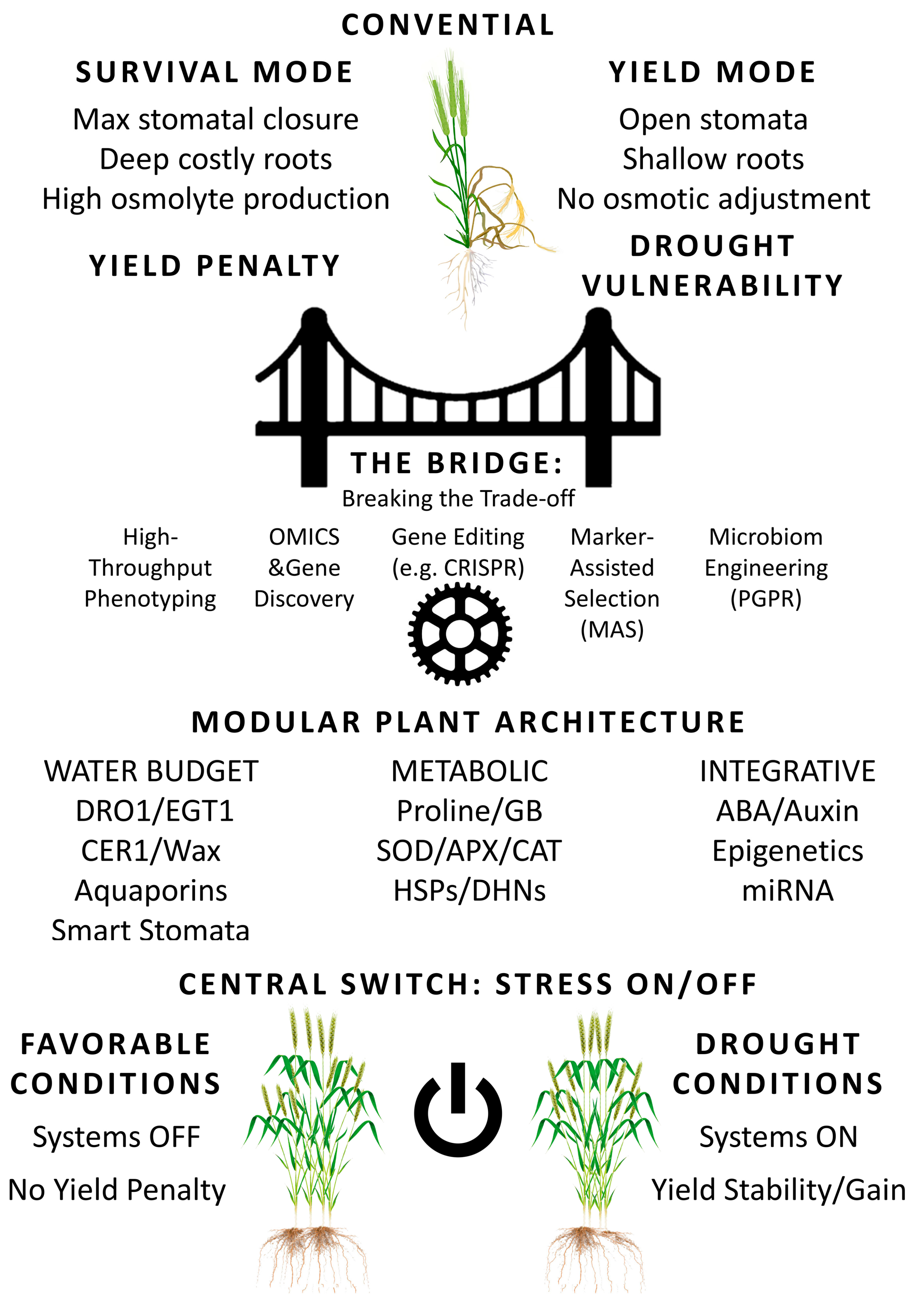
A fundamental and historically persistent challenge that compounds this complexity is yield–survival trade-off [8,15]. Traits that ensure survival under severe drought (e.g., complete stomatal closure, deep dormancy, prolific osmolyte production) typically incur a significant metabolic cost, reducing yield potential under moderate stress or favorable conditions. Consequently, the paramount objective of modern breeding is not merely to stack survival traits, but to break this trade-off by identifying mechanisms and alleles that confer resilience with minimal penalty to productivity [14]. While recent reviews have provided excellent coverage of specific aspects of drought resistance [3,7,12], a synthesis that integrates these disparate levels of organization through the explicit lens of overcoming the yield-survival trade-off is lacking. This review, therefore, aims to fill that critical gap by proposing and developing a novel conceptual framework. The central thesis is that the path to overcoming this trade-off lies in a systemic understanding and coordinated optimization of three interconnected strategic fronts: the plant’s water budget architecture, its metabolic homeostasis, and the integrative signaling networks that orchestrate them.
The novelty of our approach lies in the proposed conceptual framework centered on the coordinated optimization of three interconnected functional modules, explicitly designed to overcome this trade-off. While several excellent recent reviews have integrated discussions of roots, metabolism, and signaling [16,17,18], our ‘three-module’ framework (Figure 1) offers a distinct advance. We reconceptualize drought resilience not as a problem of maximizing individual traits, but of synergistic module optimization. Unlike frameworks that list components, we model the plant as a system where: (1) the Water Budget Architecture module must be fine-tuned (e.g., balancing deep foraging DRO1 with shallow exploration EGT1), not just maximized; (2) the Metabolic Homeostasis module must be optimized for efficiency (e.g., favoring non-toxic glycine betaine), not just output; and (3) the Integrative Signaling module acts as a master conductor, dynamically coordinating the first two. This paradigm provides a direct translational pathway from mechanism to ideotype design, moving beyond the description of traits to a strategy for their intelligent, context-specific assembly to achieve ‘resilient productivity’.
Thus, this work aims to synthesize and analyze the key mechanisms of drought tolerance in cereals through the lens of functional module optimization. This manuscript is structured around this integrative framework. First, we will dissect the components of water foraging and conservation architecture (Root System Architecture, stomatal and cuticular control). Next, we explore the biochemical foundations of metabolic resilience under dehydration, including osmoprotection and antioxidant defense. This is followed by an elucidation of the master regulatory networks—phytohormonal crosstalk, epigenetic mechanisms, and plant-microbiome interactions—that synchronize the plant’s systemic response. The review culminates by synthesizing these insights into a practical strategy for designing drought-resilient cereal ideotypes, demonstrating how modern breeding can leverage this multi-scale approach to bridge the gap between molecular discovery and field application.

2. Optimizing the Water Budget: Root System Architecture and Transpiration Control

Maintaining a positive water balance is a primary challenge for plants under drought stress. This balance hinges on two key processes: efficient water uptake from the soil and minimization of water loss. Consequently, drought resilience in cereals is largely determined by the efficacy of two systems: the RSA, responsible for water foraging, and the protective structures and mechanisms of the shoot (stomatal apparatus, cuticular wax), responsible for water conservation. Breeding for resilience must target the optimization of both systems, tailored to the target agro-ecological environment.
The optimization of these two systems is a primary arena where the yield-survival trade-off manifests. An over-investment in deep roots can reduce carbon allocation to grains, while overly conservative stomatal control directly limits photosynthesis. Therefore, breeding for resilience must target the fine-tuning, not maximization, of both systems, tailored to the target agro-ecological environment to mitigate this trade-off.

2.1. Root System Architecture as the Foundation of Water Foraging

The architecture of the root system can be considered a primary adaptation of cereals to drought. As the main sensors of water availability, root systems dynamically regulate their growth in response to drought [19,20,21].
Cereal root systems exhibit several drought-adaptive characteristics. Early root establishment improves initial drought tolerance, and drought-resistant genotypes often develop longer, thicker roots with more laterals, suggesting a genetic predisposition [22,23]. Under water deficit, the root system, as the primary sensor of moisture stress, undergoes profound architectural reprogramming [19,20,21]. Moderate water stress often promotes root elongation, increasing total length, surface area, and volume, thereby enhancing water absorption capacity [24,25,26]. However, prolonged and severe moisture deficiency eventually suppresses root growth [27].
Drought-resistant cereal genotypes often develop longer, thicker roots with more laterals, suggesting a genetic predisposition for a robust root system [22,23]. A key adaptive trait is the capacity for deeper soil moisture exploration, as observed in wild wheat species such as Aegilops speltoides, Ae. cylindrica, Ae. neglecta, and Ae. tauschii [21]. This strategy includes topological modifications to increase surface area and the spatial redistribution of roots toward deeper soil horizons [28].
Genetic control of RSA, a gravitropic balance and the root growth angle plays a decisive role in drought adaptation by determining access to deep soil moisture. This angle is regulated by competing gravitropic mechanisms, with key genes identified in cereal crops.
The DEEPER ROOTING1 (DRO1) gene, first identified in rice, controls the root growth angle and promotes deeper rooting [29,30]. Its ortholog in wheat shows 76% homology [31]. DRO1 promotes a steeper, gravitropic growth angle, directing roots downward toward deep soil water reserves.
In contrast the ENHANCED GRAVITROPISM1 (EGT1) gene in wheat and barley controls the anti-gravitropic offset (AGO) by regulating cell wall stiffness in the root cortical tissue [32]. EGT1 facilitates shallower, wider soil exploration.
The interaction between the auxin-dependent gravitropic and the EGT1-dependent anti-gravitropic pathways determines the final root growth angle [32,33]. Critically, it is not the supremacy of one pathway over the other, but their precise interaction that determines the optimal root system architecture for a given environment. As such, DRO1 and EGT1 represent key executive components of the “water budget architecture” module, allowing for the fine-tuning of the root system’s spatial configuration for efficient water foraging. A genotype with strong DRO1 expression but weak EGT1 activity may develop an excessively narrow, deep root system, missing moisture from upper soil layers after light rains. In contrast, a strong EGT1 influence without DRO1 may result in a shallow root system vulnerable to rapid surface drying.
However, the efficiency of water uptake is determined not only by architecture but also by root hydraulic conductivity—the rate of water movement through root tissues to the xylem. Aquaporins, channel proteins in cell membranes that regulate transmembrane water transport, play a key role in this process. The expression of aquaporin genes (e.g., the PIP subfamily—Plasma membrane Intrinsic Proteins) is induced by drought and modulated by hormonal signals (particularly ABA), allowing the plant to dynamically regulate hydraulic conductivity in response to water deficit [34]. Thus, breeding for an optimal root system must consider both the spatial distribution of roots (architecture) and their functional efficiency (hydraulics).
Beyond aquaporins, the development of apoplastic barriers via Casparian strips and suberin lamellae in the exodermis and endodermis plays a decisive role in regulating radial water transport and protecting the vascular cylinder, representing a major resistance point and a critical adaptation to drought [19,23,35]. The chemical composition of suberin influences the drought response and long-term adaptation to arid conditions [36].
Deciphering these gravitropic pathways opens concrete avenues for breeding. The DRO1 gene has been successfully introgressed into elite, shallow-rooting rice varieties, demonstrably increasing yield under drought by more than 10% [37], serving as a proof-of-concept for architecture-driven breeding. The discovery of the EGT1 gene provides a complementary tool; manipulating its expression could allow breeders to fine-tune the “steepness” of root systems. The future of root-focused breeding lies in pyramiding these architectural genes with traits for suberization and hydraulic conductivity. For instance, a deep root system (conferred by DRO1) with an optimized suberin composition can maximize both water foraging and efficient transport. However, context-dependency is critical: DRO1-based ideotypes are most beneficial in deep soils with an accessible water table, whereas in shallow soils, modulating EGT1 for a denser, shallower root system might be preferable.

2.2. Transpiration Control: From Stomata to Cuticle

When water uptake is limited, controlling water loss becomes paramount. Cereals exhibit a suite of shoot-level adaptations to reduce transpiration.
  • Rapid Stomatal Responses
The primary rapid-response mechanism to drought stress is stomatal closure, which minimizes water loss through transpiration, albeit at the cost of reduced photosynthetic rates [38]. This process is regulated by complex signaling cascades involving ABA, Ca2+, and reactive oxygen species (ROS), particularly hydrogen peroxide (H2O2) [39].
Cereals possess an evolutionarily unique stomatal apparatus. Their dumbbell-shaped guard cells are flanked by two subsidiary cells that form an ionic reservoir for osmotically active potassium and chloride ions [40,41,42,43]. Research reveals that during stomatal closure, subsidiary cells absorb and store K+ and Cl from guard cells, subsequently releasing them during reopening. This efficient ion shuttle enables exceptionally rapid and precise aperture regulation [41,42,43], representing a key diagnostic trait [44,45].
Furthermore, cereals possess a specific ABA sensing mechanism. In species like barley, effective pore closure requires simultaneous ABA and nitrate presence, creating a dual control system assessing both water availability (via ABA) and photosynthetic productivity (via nitrate) [46]. Comparative studies of SLAC channels across plants revealed that cereal sensors contain an evolutionarily conserved two-amino acid motif that was optimized to confer guard cells their distinctive characteristics [46].

Leaf Morphological Adaptations

Beyond rapid stomatal responses, cereals employ a suite of morphological adaptations at the leaf level to minimize water loss. A fundamental strategy is the reduction of leaf surface area under water deficit, achieved through suppressed cell elongation and division [47,48]. This directly reduces the transpiring surface and whole-plant water consumption [49,50]. Additional xeromorphic traits include narrow leaves that can fold or roll longitudinally during dry periods, vertical leaf orientation to minimize solar exposure, dense pubescence that reflects radiation and creates a protective boundary layer, and a glaucous, waxy surface [46,51]. These integrated morphological adaptations are crucial for maintaining leaf hydration and canopy temperature under drought stress.
Morphological barriers, such as the cuticular wax coating on the aboveground organs of cereals, provides a significant morphological advantage against drought by preventing non-stomatal water loss [52,53]. This wax serves as the primary barrier against abiotic stressors, crucially limiting transpirational water loss—a trait repeatedly associated with drought resistance [54,55,56,57].
Cuticular waxes primarily consist of very-long-chain fatty acids (VLCFAs) and their derivatives, among which alkanes are considered predominant and crucial for drought resistance [58,59]. The CER1 gene participates in drought-responsive alkane synthesis [60,61]. Genomic analysis of the highly drought-resistant Pseudoroegneria libanotica identified 14 leaf cuticular wax biosynthesis genes, including the pivotal 3-ketoacyl-CoA synthase gene evm.TU.CTG175.54 [62], which catalyzes VLCFA elongation from C18 to C26—a critical contribution to drought adaptation. Such genetic resources hold significant potential for drought resistance breeding [63].

2.3. Integration for Water Budget and Morphological Traits

Root system architecture and transpiration control mechanisms are two sides of the same coin—the plant’s water budget. Their optimal configuration is not universal and must be defined by the target environment.
For regions with deep soils and accessible water tables, the breeding priority should be deep rooting (selection for markers linked to DRO1 and its orthologs) [64,65,66].
For regions with unpredictable rainfall and shallow soils, a more advantageous strategy may be a developed shallow root system (modulation of EGT1) coupled with efficient transpiration control (selection for enhanced alkane content in wax, rapid stomatal closure) [67].
Therefore, modern breeding must advance toward creating ‘designer root systems’ and ‘smart shoot covers’, optimally configured for specific drought scenarios. The next step is to integrate these water budget traits with the metabolic systems that ensure cellular endurance under inevitable water deficit.

3. Metabolic Resilience: Sustaining Productivity Under Stress

When water deficit becomes inevitable and cellular dehydration occurs, plant survival and the capacity for recovery hinge on maintaining metabolic homeostasis. This chapter focuses on the suite of biochemical adaptations that enable cereals to protect cellular structures, maintain turgor, and manage the toxic byproducts of stress, particularly ROS. The efficiency of these metabolic responses—and their associated energy costs—are critical determinants of the yield-survival trade-off.

3.1. Osmotic Adjustment: The Role of Compatible Solutes

A cornerstone of drought tolerance is osmotic adjustment—the active accumulation of low-molecular-weight, electrically neutral, and non-toxic compounds known as compatible solutes or osmolytes [68,69,70]. These compounds lower the cellular osmotic potential, creating a driving force for water influx, maintaining turgor pressure, and stabilizing membranes and proteins [71,72]. The degree of osmolyte accumulation often correlates with superior drought tolerance, linked to improved relative water content and membrane stability [6,73,74,75].
The multifunctional amino acid proline serves as a potent osmoregulator, antioxidant, metal chelator, and molecular chaperone, preventing protein denaturation [73,76,77]. In barley, cytoplasmic proline levels can increase 100-fold under drought [12]. Its accumulation is a hallmark of the stress response, though its catabolism upon stress relief must be managed to avoid potential toxicity.
GB is renowned for its high compatibility with cellular metabolism, allowing for significant accumulation without the disruptive effects associated with some other osmolytes, making it a particularly effective osmoprotectant for long-term osmotic adjustment [78]. It stabilizes membranes, proteins, and photosynthetic machinery [75,79]. Major cereals like wheat, maize, barley, and sorghum actively accumulate GB, and transgenic approaches overexpressing GB-synthesis genes (BADH, CMO) have demonstrated improved drought tolerance [80].
Water deficit triggers starch hydrolysis into soluble sugars (e.g., sucrose, fructose, raffinose, maltose), which function as osmolytes, signaling molecules, and structural protectants [6,81,82]. Their accumulation is a well-documented response, though it may also reflect inhibited growth and sink activity [83].
The compartmentalization of osmolytes is crucial for whole-plant adaptation. Proline and GB in roots facilitate water uptake, while in leaves, proline protects chloroplast proteins, and sugars stabilize cellular structures in bundle sheath cells. Guard cells rely on K+ and malate for turgor regulation, and developing grains accumulate raffinose-family oligosaccharides to protect the embryo [84,85].
It is important to emphasize that the synthesis and accumulation of osmolytes is an energetically costly process associated with resource reallocation. The activation of proline, GB, and soluble sugar synthesis pathways often occurs at the expense of temporary growth inhibition, a clear manifestation of the survival-growth trade-off. Therefore, from a breeding perspective, genotypes capable of rapid and efficient mobilization of carbon skeletons for osmoregulation with minimal negative impact on the development of reproductive organs are particularly valuable.

3.2. Antioxidant Defense: Managing Oxidative Stress

Drought-induced stomatal closure and metabolic imbalances lead to over-reduction of the photosynthetic electron transport chain, resulting in the excessive generation of ROS such as singlet oxygen (1O2), superoxide anion (O2), hydroxyl radical (OH·), and hydrogen peroxide (H2O2) [86,87,88]. While moderate ROS levels act as signaling molecules, excessive concentrations cause oxidative damage to lipids, proteins, and DNA, disrupting cellular function and potentially leading to cell death [89,90,91].
To counteract this, cereals deploy a sophisticated, multi-layered antioxidant system including enzymatic and non-enzymatic antioxidants. Enzymatic antioxidants includes superoxide dismutase (SOD), the first line of defense that dismutates O2 to H2O2; catalase (CAT), which decomposes H2O2 in peroxisomes; and a suite of enzymes in the ascorbate-glutathione cycle ascorbate peroxidase (APX), glutathione reductase (GR), dehydroascorbate reductase (DHAR)), which scavenge H2O2 in other cellular compartments [92,93,94,95]. Drought-tolerant genotypes often maintain higher and more sustained antioxidant enzyme activities, as observed in wild wheat relatives [76,96].
The group of non-enzymatic antioxidants includes ascorbate (ASA), glutathione, tocopherols, carotenoids, and phenolic compounds [94]. These molecules directly scavenge ROS and help regenerate enzymatic antioxidants. Drought-induced increases in phenolic acids and flavonoids, such as isoorientin, serve as crucial oxidative stress defenses [97].
The balance between different antioxidants (e.g., SOD/CAT/APX) is critical for effective ROS control. Pretreatment with low H2O2 levels can enhance drought tolerance by priming the antioxidant system and improving ABA signaling, highlighting the dual role of ROS as both a toxic compound and a signaling molecule [98,99].

3.3. Protective Proteins and Metabolic Reprogramming

The metabolic shift under drought is executed and supported by a reprogramming of the plant proteome. The molecular chaperones Heat Shock Proteins (HSPs), such as HSP70 and HSP90, prevent the aggregation and promote the refolding of denatured proteins under stress conditions, safeguarding enzymatic function critical for stress metabolism [100,101]. Their rapid expression is essential for maintaining cellular homeostasis [12].
The intrinsically disordered proteins dehydrins (DHNs) accumulate during dehydration and provide non-specific binding to membranes, proteins, and nucleic acids, thereby stabilizing cellular structures [102,103]. Some dehydrin loci coincide with drought-related QTLs in barley, and their phosphorylation in drought-tolerant wheat and barley cultivars modifies their protective function [102,104].
Beyond the well-studied osmolytes proline and sugars, metabolomic profiling reveals the importance of other key metabolites. Citric acid has been identified as a critical drought-tolerance metabolite in E. sibiricus, with exogenous application enhancing endogenous levels and improving drought tolerance [83,105]. Lipid metabolism is also pivotal; drought-resistant genotypes maintain higher lipid levels, and linoleic acid derivatives (oxylipins) can induce defense genes, while its conservation under stress supports membrane integrity and root growth. Furthermore, flavonoids, potent non-enzymatic antioxidants, are consistently upregulated under drought, with their biosynthetic genes activated in tolerant genotypes, serving as both protective compounds and potential biomarkers for selection [83,97].

3.4. Breeding for Metabolic Efficiency

The metabolic responses to drought are energetically costly. Therefore, breeding for metabolic resilience should focus on efficiency and precision rather than sheer volume of compound production. Priority may be given to effective osmolytes, such as GB, which can accumulate without toxicity and may be a more desirable target than proline in some contexts. Selecting for efficient sugar transporters and regulators of starch-sugar partitioning could enhance osmotic adjustment without excessive carbon drain.
Pyramiding antioxidant activity may become a breeding target for the development of a powerful, coordinated antioxidant system. Allele markers for key enzymes, such as SOD, APX, and DHAR, should be combined to ensure rapid removal of reactive oxygen species (ROS) from various cellular compartments [106].
Another strategy may be the creation of targeted defense protein networks and leverage metabolite markers. The induction of HSPs and DHNs is a direct functional output of ABA and other stress signaling cascades. Selecting for genotypes with stable or enhanced expression of these proteins under stress can provide broad-spectrum cellular protection, which often synergizes with osmolyte accumulation [102]. Metabolites like citric acid and specific flavonoids can serve as biomarkers for pre-selecting drought-resilient genotypes in breeding programs [83].
In conclusion, a metabolically resilient plant is one that can maintain osmotic and redox balance with minimal investment, preserving resources for growth and reproduction upon stress relief. The coordination of these metabolic defenses is orchestrated by sophisticated signaling networks, which form the focus of the next chapter.

4. Integration and Reprogramming: Phytohormones as Conductors of the Stress Response

The coordinated activation of water-saving and metabolic resilience mechanisms described in previous chapters requires precise, system-wide communication and regulation. This integration is orchestrated by a complex network of phytohormones, which act as master regulators, translating the perception of water deficit into a tailored physiological and transcriptional response. Moving beyond the view of abscisic acid (ABA) as the sole “stress hormone,” recent research highlights that the balance and crosstalk between multiple hormonal pathways ultimately determine the plant’s strategy for managing the trade-off between growth arrest and drought survival.

4.1. ABA: The Central Stress Signaling Hub

ABA plays a central role in mediating drought adaptation. Its levels surge rapidly in response to water deficit, triggered by both root-derived hydraulic signals and synthesis in dehydrated leaves [107,108,109]. This rise initiates a cascade of adaptive responses:
ABA activates anion channels (e.g., SLAC1) in guard cells, leading to stomatal closure within minutes, which is the most rapid and physiologically significant water-conservation response [109,110,111].
ABA induces the expression reprogramming of a vast suite of stress-responsive genes, including those encoding osmoprotectants (e.g., proline), LEA/dehydrin proteins, and antioxidant enzymes [112,113].
ABA involved in growth modulation and root-shoot communication. ABA redistributes within the plant, accumulating in roots to modify hydraulic conductivity and root architecture, while signaling from roots to shoots coordinates whole-plant water status [20,107].
However, the ABA response is not monolithic. Stomatal closure thresholds and sensitivity vary with species and genotype, reflecting adaptation to different drought regimes [12]. Furthermore, the cost of prolonged ABA-driven stomatal closure is reduced CO2 assimilation, highlighting the need for fine-tuning rather than maximal ABA signaling.

4.2. Hormonal Crosstalk: Fine-Tuning the Stress Response

The efficacy of the ABA signal is modulated by its interaction with other hormonal pathways, which provides the plasticity needed for a balanced response.
While often associated with growth promotion, auxins play a critical role in drought adaptation, particularly in root system remodeling. Water deficit alters the expression of auxin signaling genes (TIR1, Aux/IAA, GH3, SAUR) [114]. A key mechanism involves ABA-induced local auxin biosynthesis that modulates root gravitropism, enabling steeper growth angles under stress—a process confirmed in rice and maize [115]. ABA utilizes auxin as a downstream signal to produce roots optimized for soil penetration in dry conditions [116].
BRs can enhance drought tolerance by reducing leaf area and transpiration, thereby conserving water [117,118]. Modulating BR signaling genes, such as suppressing HvBRH1 in barley, has been shown to improve tissue water content while reducing transpiration, suggesting that targeted manipulation of the BR pathway could help develop cultivars that minimize water loss without excessive growth penalty [118].
Ethylene hormone acts as an integrative node. Ethylene production increases dramatically under water stress [12] and it controls both ABA and auxin induction, thereby regulating root responses to soil compaction and gravitropism [116,119]. The regulatory networks differ between Arabidopsis and cereals, underscoring the importance of cereal-specific research.
The interactions among hormones extends beyond these core players ABA, auxins, BRs, and ethylene. Cytokinins (CK) typically act as antagonists of ABA, delaying stress-induced leaf senescence and supporting meristem activity. A drought-induced decrease in cytokinin levels in shoots is part of the signal that switches the plant to a resource conservation mode. Jasmonates (JA), in turn, are involved in establishing cross-tolerance, modulating both ABA-dependent and ABA-independent pathways, especially under combined stress (drought + heat, drought + pathogens) [120,121]. This intricate network determines resource allocation between survival and growth.
This crosstalk creates a sophisticated regulatory network where ABA, auxin, and ethylene interact to determine root architecture, while ABA and BRs interact to balance stomatal conductance and growth. It is the precise balance of these signals, not the supremacy of any single one, governs resource allocation between survival and growth.

4.3. Epigenetic Regulation: A Cereal-Specific Mechanism for Stress Memory and Breeding

Beyond genetic variation and hormonal signaling, epigenetic mechanisms provide a crucial and often-overlooked layer of regulation for drought tolerance in cereals, with direct and profound implications for breeding. Recent evidence reveals that cereals have evolved sophisticated, lineage-specific epigenetic pathways that fine-tune their adaptive responses, often distinct from the model dicot Arabidopsis thaliana. These heritable changes in gene expression, which do not involve alterations to the primary DNA sequence, are mediated by DNA methylation, histone modifications, and the action of small non-coding RNAs. They underpin the phenomenon of “stress memory,” where a prior exposure to stress primes a plant—and in some cases, its progeny—for a more efficient response to subsequent drought events.
Recent evidence reveals that cereals have evolved sophisticated, lineage-specific epigenetic pathways that fine-tune their adaptive responses. In rice, drought stress induces specific context-dependent methylation changes in the promoters of key transcription factors like OsNAC [122], which orchestrates the root transcriptional response to stress. Crucially, a subset of these stress-induced methylation patterns can be meiotically inherited, creating a transgenerational epigenetic memory that primes offspring for better performance under subsequent drought, a phenomenon directly documented in elite indica rice varieties [123]. This suggests that the epigenetic state of resilience genes is a selectable trait in its own right, complementary to DNA sequence.
Similarly, in maize, the expression of the drought-responsive ZmEXPB2 gene, which encodes an expansion protein critical for root cell wall loosening, is modulated by the histone modification H3 lysine 4 trimethylation (H3K4me3), a mark of active chromatin [124]. Genotypes with a more “open” chromatin configuration at this locus exhibit enhanced root growth and water uptake under deficit conditions, providing a concrete epigenetic marker for selection.
In wheat, systemic coordination of the drought response involves stress-induced microRNAs (e.g., miR159 and miR398), which act as mobile epigenetic signals [125] to fine-tune the expression of target genes like TaGAMYB (a growth regulator) and SOD (superoxide dismutase) across different tissues, thereby coordinating growth suppression with enhanced antioxidant defense [45,126].
The practical value for breeding lies in strategically exploiting this epigenetic toolkit. The concept of Epigenetic Markers Assisted Selection (EMAS) is now emerging, where stable, heritable epigenetic marks—such as specific methylation patterns or histone modifications associated with resilience—are used as predictive biomarkers to complement DNA-based markers [127]. This approach allows breeders to select for optimal gene expression states, not just gene presence. Furthermore, screening genebank accessions for favorable epigenetic states, or “epi-alleles,” could unmask novel sources of tolerance which is particularly valuable for complex cereal genomes like wheat. That are not evident from DNA sequencing alone, revealing a hidden layer of diversity in existing germplasm collections. Finally, genome editing technologies offer a direct route to creating stable, high-yielding epi-alleles. By targeting cis-regulatory elements (e.g., promoters, enhancers) rather than coding sequences, it is possible to lock stress-responsive genes in a transcriptionally primed state, potentially creating a durable “on-switch” for adaptive traits in the next generation of climate-resilient cereals [128,129].
Despite this considerable promise, the application of epigenetics in breeding faces several practical challenges. The stability of epigenetic marks across generations can be influenced by environmental factors, potentially leading to the erosion of acquired stress memory under field conditions [130]. Furthermore, the complex and often tissue-specific nature of the epigenome makes it difficult to identify causal epi-alleles that have a consistent and strong phenotypic effect. The high cost and technical expertise required for epigenomic profiling also present barriers for routine implementation in breeding programs compared to standard DNA-based genotyping. Therefore, while epigenetic markers offer a powerful complementary tool, their predictive power and economic viability for large-scale selection need further validation across diverse genetic backgrounds and environments.
In conclusion, epigenetic regulation is not a peripheral phenomenon but a central mechanism conferring plasticity and memory. Its integration into breeding paradigms promises to accelerate the development of cultivars that not only carry the right genes but are also pre-programmed to express them optimally when confronted with drought.

4.4. Integration Through Regulation and Targeting Hormonal and Epigenetic Networks

The hormonal and epigenetic networks constitute the central control system that integrates stress perception with the functional outputs described in the preceding chapters. This understanding necessitates a paradigm shift in breeding strategies. The emerging approach moves beyond selecting solely for end-product traits, such as high osmolyte concentrations or deep root systems, toward targeting the regulatory genes that orchestrate these traits with greater efficiency. For instance, selecting for optimal ABA receptor sensitivity or modifiers of auxin-ABA crosstalk could fine-tune stomatal responses and root architecture without inducing severe growth arrest. A key strategy involves exploiting the natural variation in hormonal crosstalk by screening diverse germplasm for genotypes with desirable hormonal balances; an example would be genotypes that maintain a shallower root system under well-watered conditions but rapidly initiate steeper root growth via the ABA-auxin cascade upon drought onset. Furthermore, the incorporation of epigenetic profiling into breeding programs, through the screening of epi-markers, allows for the identification and selection of beneficial stress memory traits, which could accelerate the development of pre-adapted varieties.
In conclusion, the future of drought tolerance breeding lies in comprehending and manipulating these integrative regulatory networks. By targeting the key regulators of the stress response—the phytohormones and the epigenetic code—we can advance towards designing crops that coordinate their water budget and metabolic resources, thereby overcoming the yield-survival trade-off.

4.5. The Plant Microbiome: PGPR as Bio-Enhancers of Drought Resilience

Beyond intrinsic molecular and physiological adaptations, cereals form strategic alliances with rhizosphere microorganisms known as plant growth-promoting rhizobacteria (PGPR). These associations represent a sophisticated dialogue in which microbially-induced adaptations are seamlessly integrated into the plant’s innate genetic programming for drought resistance [131,132,133]. Thus, the plant’s genetic programming sets the potential for drought resistance, while PGPR act as bio-enhancers that intensify this potential, leading to a synergistic outcome where the combined effect is greater than the sum of the individual contributions. This synergy allows for a more plastic and adaptive response, enabling the plant to dynamically leverage its genetic toolkit in concert with its microbial partners to survive environmental challenges.
However, the efficacy of these partnerships is highly context-dependent, and translating this potential into reliable field applications remains a central challenge, as discussed later in this section.
The beneficial effects are mediated by a diverse arsenal of mechanisms, including the production of volatile organic compounds, synthesis of the enzyme 1-aminocyclopropane-1-carboxylate (ACC) deaminase, biosynthesis of phytohormones and siderophores, secretion of exopolysaccharides, and direct osmoregulation through bacterial osmolyte production [134,135,136,137,138,139]. Molecular biotechnology offers opportunities to enhance these plant-microbe interactions, for instance, by engineering PGPR to overproduce protective compounds like trehalose, which has been shown to improve plant survival under water-deficient conditions [140,141]. A key manifestation of this synergy is the fine-tuning of the plant’s hormonal networks. The PGPR-induced modification of root system architecture (e.g., enhanced branching) is mediated by a restructuring of endogenous auxin and ethylene signaling [142,143]. For instance, inoculation of maize with Azospirillum brasilense strains Ab-V5 and Ab-V6 under field conditions led to better growth recovery after drought, which was associated with bacterial production of phytohormones that stimulated root development [144,145]. Concurrently, PGPR modulate ABA-dependent pathways, recalibrating the plant’s stress response system for more efficient stomatal regulation [146,147].
At the metabolic level, PGPR enhance osmoregulation and antioxidant defense. Inoculation with bacteria such as Bacillus amyloliquefaciens and Azospirillum brasilense induces the accumulation of compatible solutes like proline and activates key enzymes of the ascorbate-glutathione cycle, thereby mitigating oxidative stress [148]. Recent research using wheat as a model has elucidated how drought itself drives functional changes in the root microbiome. Drought stress enriches for specific beneficial bacteria (e.g., Streptomyces coeruleorubidus and Leifsonia shinshuensis) and increases levels of the rhizosphere metabolite 4-oxoproline. The reintroduction of these drought-enriched bacteria significantly improved host resistance, with a “drought legacy” effect observed through increased plant biomass and yield in subsequent growth cycles, informing novel bioinoculant development strategies [149]. A specific example of a successful field application is the commercial inoculant based on the Bacillus aryabhattai strain CMAA 1363 (Auras®), developed to increase crop water use efficiency [150].
Despite the compelling mechanisms and promising examples, recent meta-analyses and field studies caution against over-optimism, highlighting that while significant yield improvements under drought are possible, they are not yet predictable or routine [151,152,153,154]. Translating PGPR efficacy into consistent field-level drought tolerance remains a significant challenge due to high context-dependency, influenced by soil type, native microbiome, host genotype, and management practices [155,156]. Therefore, broad-scale application necessitates a shift from a one-size-fits-all approach to the development of tailored, context-specific microbial consortia and robust delivery solutions.

5. From Mechanisms to Ideotypes: Overcoming the Yield-Survival Trade-Off

A strategic framework for overcoming this trade-off through the design of resilient ideotypes is presented in Figure 2.
The synthesis of research presented in the previous chapters demonstrates that the yield-survival trade-off, introduced in Section 1, is not inevitable. The ultimate challenge and the central opportunity lies in strategically integrating traits to mitigate the inherent yield penalty associated with stress adaptation [157]. This can be achieved by moving beyond a simplistic view of drought tolerance and towards a systems-level approach focused on designing crop ideotypes—theoretical models of ideal plants—tailored to specific drought patterns. The key is to prioritize traits and genetic combinations that confer resilience with minimal metabolic cost or direct conflict with reproductive investment. The most promising avenues involve optimizing water use efficiency and reprogramming plant development rather than simply maximizing water conservation at all costs [158]. A consolidated overview of key genetic determinants for these modules, which serve as a toolkit for ideotype design, is presented in Table 1.
One of the most effective strategies is the engineering of root systems for superior water foraging [159]. Traits such as steep root growth angles mediated by genes like DRO1 and its orthologs, along with increased root hair density, enhance exploration of deeper soil moisture profiles without a proportional increase in respiratory carbon costs [160]. This architectural optimization directly improves water uptake during drought without inherently sacrificing yield potential under favorable conditions, as it primarily reallocates root biomass to more productive soil layers rather than increasing its total amount. The success of introgressing DRO1 into elite rice varieties, resulting in a yield increase of more than 10% under drought, stands as a powerful proof-of-concept for this approach [161].
The complementary discovery of the EGT1 gene, which regulates the AGO, provides a tool for fine-tuning root system “steepness” for different environments, enabling breeders to design root architectures for deep-soil water mining or for more efficient capture of sporadic rainfall in shallow soils [32,162].
Concurrently, protecting the photosynthetic apparatus is far more energy-efficient than attempting to repair it after damage has occurred. Traits that maintain the stability of Photosystem II (PSII) and the activity of key enzymes like Rubisco activase under combined heat and water stress can significantly reduce the metabolic burden of cellular repair [163]. This can be achieved by introducing more efficient isoforms of enzymes involved in photorespiration or by enhancing non-photochemical quenching mechanisms. The goal is to sustain carbon assimilation rates with less water loss, thereby directly linking water conservation with maintained productivity. This is complemented by a shift in how we view stomatal regulation. Rather than simply breeding for fewer or permanently constricted stomata, the focus should be on rapid stomatal responsiveness to environmental cues like vapor pressure deficit and soil moisture. Plants with highly responsive stomata close faster at the onset of stress but also reopen more rapidly upon rewatering, minimizing unnecessary reductions in photosynthesis during fluctuating conditions. Genes involved in ABA sensing (OST1), anion efflux (SLAC1), and hydraulic signaling (aquaporins) are prime targets for fine-tuning this critical balance [164].
Furthermore, developmental plasticity offers a low-penalty strategy known as “drought escape”. This approach involves the genetic reprogramming of phenology [165] to accelerate the plant’s life cycle, ensuring that critical developmental stages, such as flowering and grain filling, are completed before the onset of terminal drought [166,167]. The genetic basis often lies in the modulation of photoperiod sensitivity (e.g., Ppd genes in wheat and barley) and vernalization pathways, which control the transition from vegetative to reproductive growth [168]. By primarily shifting the timing of development rather than reallocating resources from yield components, drought escape minimizes the direct trade-off with productivity, making it a highly valuable component of resilience ideotypes for regions with predictable drought patterns.
At the metabolic level, the accumulation of protective compounds like proline, GB, and antioxidants is essential, but its cost must be managed. The breeding objective should be to promote the synthesis of molecules that offer high cellular protection per unit of carbon invested [169]. For instance, GB accumulates without toxicity and is not metabolized upon stress relief, making it a highly efficient osmoprotectant for long-term osmotic adjustment. Similarly, altering the metabolic flux through pathways leading to raffinose family oligosaccharides or specific flavonoids can enhance stress tolerance without a massive drain on photosynthates. The induction of protective proteins like DHNs and HSP, which stabilize cellular structures and enzymes, often acts synergistically with accumulated osmolytes, providing a robust, multi-faceted defense system that is triggered by the hormonal cascades described earlier [170].
Let us illustrate this approach with an example: for a region with deep soils and terminal drought, the target ideotype might combine DRO1 alleles for deep rooting, “smart” stomata genes (e.g., specific OST1 variants) for rapid ABA response, BADH alleles for efficient GB synthesis in leaves, and potentially a moderately shortened growth cycle to escape the most severe drought phase during grain filling [171]. Such a combination of traits in a single genotype would enable the plant to actively forage for water, use it sparingly, protect cells at the metabolic level, and minimize risks through phenology.
Furthermore, developmental plasticity offers a low-penalty strategy. Modifying photoperiod sensitivity and phenological plasticity allows plants to complete their life cycle before the most severe drought periods set in, a strategy known as “drought escape”. This primarily involves shifting the timing of development rather than reallocating resources from yield components, making it a highly attractive trait for terminal drought scenarios. Finally, the integration of PGPR represents a powerful external approach to breaking the trade-off. These beneficial microbes can confer induced systemic tolerance by enhancing root growth, improving osmotic adjustment, and boosting antioxidant capacity. This effectively “provides” these resilience traits to the plant with minimal energy investment from the host itself, representing a highly pragmatic and sustainable strategy to enhance drought survival while safeguarding yield.
In conclusion, overcoming the yield-survival trade-off requires a holistic, ideotype-based breeding framework. This framework strategically combines deep yet efficient root systems, dynamically regulated stomata, cost-effective metabolic protectants, and optimized developmental timing. By leveraging modern tools like genomic selection to pyramid the underlying alleles and genome editing to fine-tune key regulators, we can assemble these components into next-generation cereal cultivars. The integration of microbiome engineering further enhances this resilience from outside the plant’s genome. The path forward is not to breed for survival alone, but for a resilient productivity that maintains yield stability across an increasingly unpredictable environmental landscape.

6. A Practical Framework for Breeding Drought-Resilient Cereals

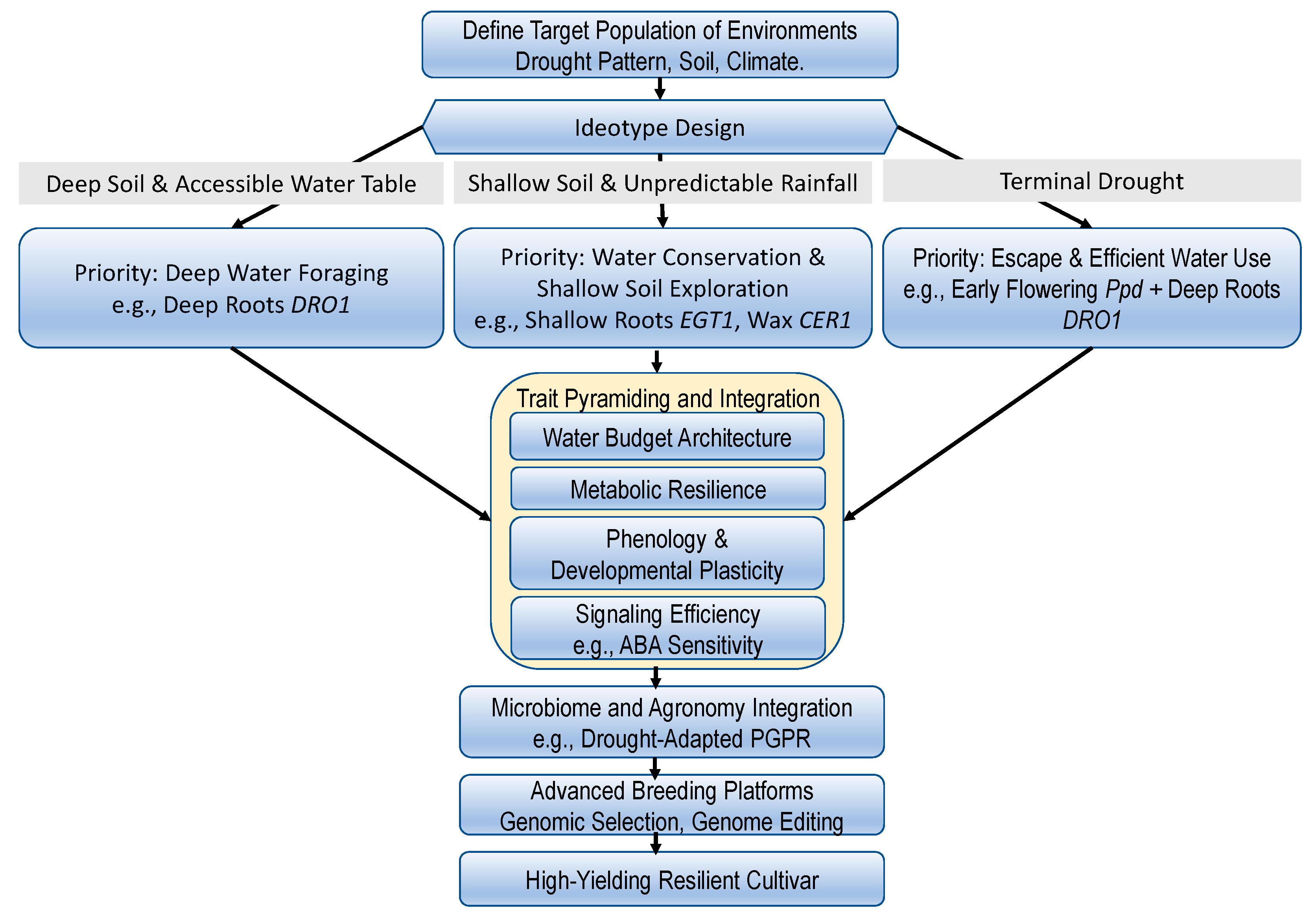
The synthesis of drought resistance mechanisms presented in this review culminates in a strategic framework for translating fundamental knowledge into tangible breeding outcomes. The following recommendations provide a structured, actionable pathway for breeders and agronomists to develop next-generation cereal varieties capable of withstanding water-limited conditions without compromising yield potential. The core principle is to move from a reactive selection for general stress tolerance to a proactive design of crop ideotypes tailored to specific drought patterns. The proposed module-based framework finds its practical application in a strategic breeding pipeline that starts with defining the target environment and culminates in the development of resilient ideotypes, as visualized in Figure 3.
The initial and most critical step is the precise definition of the target population of environments. A one-size-fits-all approach is destined to fail. Breeding for deep-soil environments with residual moisture requires a fundamentally different ideotype compared to breeding for regions with shallow soils and unpredictable, intermittent rainfall. For deep-water scenarios, the primary objective is enhanced water foraging, prioritizing alleles for steeper root growth angles, such as those associated with DRO1 and its orthologs [172]. High-throughput phenotyping for root depth and biomass under controlled drought stress, coupled with MAS, can accelerate the introgression of these traits. In contrast, for shallow or drought-prone environments, the focus must shift to water conservation and rapid cycling. Here, selection should favor architectural traits modulated by genes like EGT1 for a denser surface root system, combined with enhanced cuticular wax deposition—a trait easily screened via glossy/glaucous phenotypes and linked to alkane biosynthesis genes like CER1 [173] —and rapid stomatal responsiveness to minimize water loss during short-term dry spells.
The pipeline operationalizes the conceptual framework from Figure 1. The initial definition of the Target Population of Environments directly informs Ideotype Design, specifying priority traits: deep water foraging (DRO1) for deep soils; water conservation and shallow exploration (EGT1, CER1) for shallow, unpredictable environments; and a combination of drought escape (Ppd) and deep rooting (DRO1) for terminal drought scenarios. The Trait Pyramiding & Integration phase combines alleles governing different modules, including signaling efficiency. This genetic core is complemented by Microbiome & Agronomy Integration and accelerated by Advanced Breeding Platforms to develop a final resilient cultivar.
Beyond water management, resilience hinges on maintaining physiological function during stress. Key targets include the stay-green trait, which ensures continued carbohydrate supply to developing grains under terminal drought, and the efficient accumulation of osmolytes like GB and proline for cellular protection. Selecting for sustained activity of antioxidant enzymes such as SOD, CAT, and APX is crucial for mitigating oxidative damage. The integration of modern breeding technologies is paramount for this multi-trait improvement. Genomic selection, for instance, proves particularly valuable for complex, polygenic traits like water-use efficiency, enabling predictions in early breeding cycles. For major-effect genes and QTLs, MAS and backcrossing remain powerful for targeted introgression, especially from wild relatives like Aegilops spp. and Thinopyrum intermedium, which are rich sources of drought-adaptive alleles. Successful examples include Russian commercial wheat cultivars like the Samara series (Tulaikovskaya Zolotistaya 5, 10, 100) and Saratov’s Belyanka (Voevoda), which incorporate a chromosome from Thinopyrum intermedium, demonstrating improved drought tolerance [174,175]. Furthermore, genome editing techniques like clustered regularly interspaced short palindromic repeats (CRISPR/Cas9) offer unparalleled precision to fine-tune negative regulators or enhance the function of positive alleles, such as those in the DREB transcription factor family, effectively bypassing linkage drag. While transgenic approaches have identified numerous drought-responsive genes for introduction into cereals, few commercial drought-tolerant varieties are currently marketed. A notable success story is drought-tolerant maize, achieved by introducing the cspB gene (encoding cold shock protein B), which maintains RNA stability and translation under water stress [176]. This highlights the potential of biotechnology, though public acceptance and regulatory hurdles remain.
A promising, yet often underexplored, avenue is the strategic management of the plant microbiome. The development and application of consortia of drought-adapted PGPR, including strains of Bacillus and Pseudomonas, can significantly improve plant water status. These microbes act as bio-enhancers, improving root architecture, modulating stress hormone levels like ABA, and inducing systemic tolerance, thereby conferring resilience with minimal energy cost to the host. Adopting soil management practices that foster a beneficial, drought-resilient soil microbiome is an essential complementary agronomic strategy.
For near-term implementation, a focused effort on several fronts is required. Investment in scalable, high-throughput phenotyping platforms is non-negotiable for assessing root architecture, canopy temperature, and spectral indices related to water status and wax content. It is crucial to validate laboratory and greenhouse data with field-based phenotyping. The use of unmanned aerial vehicles (UAVs) equipped with multi- and hyperspectral cameras allows for the large-scale assessment of indicators such as the Normalized Difference Vegetation Index (NDVI), the Crop Water Stress Index (CWSI), and canopy temperature, enabling high-throughput selection of promising lines under conditions that closely mirror real-world environments. Breeding programs should prioritize pyramiding two to three major-effect genes or QTLs governing different mechanisms—for instance, combining deep roots (DRO1), reduced water loss (CER1), and osmotic protection (e.g., BADH for GB)—into well-adapted genetic backgrounds [160]. A systematic pre-breeding pipeline for the characterization and introgression of drought-adaptive traits from wild cereal germplasm into elite breeding pools is essential for long-term genetic gain. Finally, participatory selection, validating promising lines under real-world drought conditions in collaboration with farmers, ensures that the developed varieties meet on-the-ground needs and possess high adoption potential.
In conclusion, the development of drought-resilient cereals demands a synergistic approach that seamlessly integrates conventional breeding with advanced molecular tools and microbiological applications. By prioritizing traits with clear functional roles and known genetic bases, and by tailoring ideotypes to specific environmental challenges, breeders can make significant and rapid gains. This integrated strategy is the most promising path forward for securing stable cereal production in the face of increasing climate variability.

7. Conclusions and Future Perspectives

This review has synthesized evidence that overcoming the fundamental yield-survival trade-off is achievable through the intelligent, systemic integration of adaptive mechanisms, as formalized in our conceptual framework of three interconnected functional modules: Water Budget Architecture, Metabolic and Osmoprotective Homeostasis, and Integrative Signaling and Developmental Reprogramming. This framework distinguishes itself from previous syntheses by its explicit focus on the trade-off as the central problem and its presentation of the modules as a set of tunable, synergistic levers for breeders. The efficacy of this framework is demonstrated by its ability to reconcile seemingly conflicting objectives, deep rooting (DRO1) can be fine-tuned with shallower exploration (EGT1); rapid stomatal closure is balanced with swift reopening to minimize carbon starvation; and osmoprotection is optimized for efficiency rather than sheer volume. The sophisticated orchestration of these responses through phytohormonal crosstalk, epigenetic memory, and beneficial plant-microbiome partnerships provides the necessary plasticity for a finely tuned, context-dependent adaptation.
Looking forward, the translation of this integrative understanding into next-generation cereal ideotypes will be driven by the convergence of advanced technologies. The precision of genome editing, particularly CRISPR/Cas, offers unparalleled potential to fine-tune key regulators—such as those in the ABA signaling pathway or the DREB transcription factor network—without the drag of undesirable linkages, effectively “debugging” the genetic program for stress response. High-throughput phenotyping, from automated root imaging to UAV-based spectral analysis of canopy temperature and wax content, will move breeding from coarse-grained yield selection to the precise quantification of underlying physiological traits. Furthermore, the emerging field of epigenomics invites the development of Epigenetic Markers Assisted Selection (EMAS), allowing breeders to screen for and stabilize beneficial stress-memory states, thereby selecting for optimal gene expression patterns in addition to favorable alleles. Simultaneously, the rational design of synthetic microbial consortia, tailored to specific crop genotypes and edaphic conditions, represents a powerful avenue to "outsource" portions of a plant’s resilience strategy, enhancing root growth, nutrient uptake, and stress hormone modulation with minimal energy cost to the host.
The ultimate application of this knowledge demands a targeted, environment-specific breeding strategy. The one-size-fits-all model is obsolete. For regions with deep soil moisture, ideotypes must prioritize deep rooting architectures, while in arid environments with unpredictable rainfall, a combination of water conservation traits, a denser root system, and drought escape via phenological plasticity will be paramount. The practical breeding pipeline must, therefore, begin with a rigorous definition of the target population of environments, followed by the systematic pyramiding of complementary alleles governing different modules—for instance, combining DRO1 for depth, CER1 for cuticular wax, and BADH for glycine betaine synthesis—into elite, high-yielding genetic backgrounds. By leveraging this multi-faceted, module-based approach, we can advance from merely selecting for survival to designing crops for resilient productivity. The goal is no longer to breed plants that simply endure drought, but to develop cultivars that efficiently regulate their resources, maintain yield stability under stress, and swiftly recover to capitalize on favorable conditions, thereby ensuring food security in an increasingly volatile climate.

Author Contributions

The literature search and analysis, writing, original draft preparation, review and editing—S.A.B.; supervision—P.Y.K.; project administration and funding acquisition—G.I.K. and M.G.D. All authors have read and agreed to the published version of the manuscript.

Funding

This work was supported by the Ministry of Science and Higher Education of the Russian Federation (the Federal Scientific-technical programme for genetic technologies development for 2019–2030), agreement N 075-15-2025-480.

Data Availability Statement

Not applicable.

Conflicts of Interest

The authors declare no conflicts of interest.

Abbreviations

The following abbreviations are used in this manuscript:
ABA abscisic acid
AGOanti-gravitropic offset
APX ascorbate peroxidase
ASA ascorbate
BRs brassinosteroids
CAT catalase
CRISPR clustered regularly interspaced short palindromic repeats
DHA dehydroascorbate
DHAR dehydroascorbate reductase
DHNs dehydrins
DRO1gene DEEPER ROOTING1
GBglycine betaine
GR glutathione reductase
HSP heat shock proteins
MASmarker-assisted selection
PGPR plant growth-promoting rhizobacteria
ROS reactive oxygen species
RSAroot system architecture
SMART selective multi-trait analysis and recombinant techniques
SOD superoxide dismutase
VLCFAs very-long-chain fatty acids

References

  1. Raven, P.H.; Johnson, G.B. Understanding Biology; William, C., Ed.; Brown Publishing: Dubuque, IA, USA, 1995; ISBN 978-0-697-22213-8. [Google Scholar]
  2. Wrigley, C.W. An Overview of the Family of Cereal Grains Prominent in World Agriculture. In Encyclopedia of Food Grains; Elsevier: Amsterdam, The Netherlands, 2016; pp. 73–85. ISBN 978-0-12-394786-4. [Google Scholar]
  3. Jacott, C.N.; Boden, S.A. Feeling the Heat: Developmental and Molecular Responses of Wheat and Barley to High Ambient Temperatures. J. Exp. Bot. 2020, 71, 5740–5751. [Google Scholar] [CrossRef]
  4. Eyshi Rezaei, E.; Webber, H.; Gaiser, T.; Naab, J.; Ewert, F. Heat Stress in Cereals: Mechanisms and Modelling. Eur. J. Agron. 2015, 64, 98–113. [Google Scholar] [CrossRef]
  5. Jagadish, S.V.K. Heat Stress during Flowering in Cereals—Effects and Adaptation Strategies. New Phytol. 2020, 226, 1567–1572. [Google Scholar] [CrossRef] [PubMed]
  6. Giovenali, G.; Di Romana, M.L.; Capoccioni, A.; Riccardi, V.; Kuzmanović, L.; Ceoloni, C. Exploring Thinopyrum Spp. Group 7 Chromosome Introgressions to Improve Durum Wheat Performance under Intense Daytime and Night-Time Heat Stress at Anthesis. Plants 2024, 13, 2605. [Google Scholar] [CrossRef] [PubMed]
  7. Bome, N.A.; Ushakova, T.F.; Modenova, E.A.; Bome, A.Y. Research of dependence water-retentive capability for leaves of Triticum aestivum L. from their linear dimensions and the area. Int. Res. J. 2016, 4, 13–16. [Google Scholar] [CrossRef]
  8. Farooq, M.; Wahid, A.; Kobayashi, N.; Fujita, D.; Basra, S.M.A. Plant Drought Stress: Effects, Mechanisms and Management. Agron. Sustain. Dev. 2009, 29, 185–212. [Google Scholar] [CrossRef]
  9. Zhu, J.-K. Abiotic Stress Signaling and Responses in Plants. Cell 2016, 167, 313–324. [Google Scholar] [CrossRef]
  10. Razi, K.; Muneer, S. Drought Stress-Induced Physiological Mechanisms, Signaling Pathways and Molecular Response of Chloroplasts in Common Vegetable Crops. Crit. Rev. Biotechnol. 2021, 41, 669–691. [Google Scholar] [CrossRef]
  11. Zhang, H.; Zhu, J.; Gong, Z.; Zhu, J.-K. Abiotic Stress Responses in Plants. Nat. Rev. Genet. 2022, 23, 104–119. [Google Scholar] [CrossRef]
  12. Chudinova, L.A.; Orlova, N.V. Fiziologija Ustojchivosti Rastenij: Ucheb. Posobie k Speckursu; Perm. un-t.: Perm, Russia, 2006; p. 124. [Google Scholar]
  13. Mwadzingeni, L.; Shimelis, H.; Rees, D.J.G.; Tsilo, T.J. Genome-Wide Association Analysis of Agronomic Traits in Wheat under Drought-Stressed and Non-Stressed Conditions. PLoS ONE 2017, 12, e0171692. [Google Scholar] [CrossRef]
  14. Kanth, K.; Sanjay Mane, R.; Deo Prasad, B.; Sahni, S.; Kumari, P.; Quaiyum, Z.; Kumar, S.; Singh, A.; Kumar Chaudhary, R. Editing the Future: CRISPR/Cas9 for Climate-Resilient Crops. In Genetics; Tombuloglu, H., Ed.; IntechOpen: London, UK, 2025; Volume 7, ISBN 978-1-83634-797-2. [Google Scholar]
  15. Fang, Y.; Xiong, L. General Mechanisms of Drought Response and Their Application in Drought Resistance Improvement in Plants. Cell. Mol. Life Sci. 2015, 72, 673–689. [Google Scholar] [CrossRef] [PubMed]
  16. Kalra, A.; Goel, S.; Elias, A.A. Understanding Role of Roots in Plant Response to Drought: Way Forward to Climate-resilient Crops. Plant Genome 2024, 17, e20395. [Google Scholar] [CrossRef] [PubMed]
  17. Landi, S.; Hausman, J.-F.; Guerriero, G.; Esposito, S. Poaceae vs. Abiotic Stress: Focus on Drought and Salt Stress, Recent Insights and Perspectives. Front. Plant Sci. 2017, 8, 1214. [Google Scholar] [CrossRef] [PubMed]
  18. De Oliveira, I.P.; Schaaf, C.; De Setta, N. Drought Responses in Poaceae: Exploring the Core Components of the ABA Signaling Pathway in Setaria Italica and Setaria Viridis. Plants 2024, 13, 1451. [Google Scholar] [CrossRef]
  19. Steudle, E. Water Uptake by Plant Roots: An Integration of Views. Plant Soil 2000, 226, 45–56. [Google Scholar] [CrossRef]
  20. Kudoyarova, G.; Veselova, S.; Hartung, W.; Farhutdinov, R.; Veselov, D.; Sharipova, G. Involvement of Root ABA and Hydraulic Conductivity in the Control of Water Relations in Wheat Plants Exposed to Increased Evaporative Demand. Planta 2011, 233, 87–94. [Google Scholar] [CrossRef]
  21. Pour-Aboughadareh, A.; Kianersi, F.; Poczai, P.; Moradkhani, H. Potential of Wild Relatives of Wheat: Ideal Genetic Resources for Future Breeding Programs. Agronomy 2021, 11, 1656. [Google Scholar] [CrossRef]
  22. Kreszies, T.; Eggels, S.; Kreszies, V.; Osthoff, A.; Shellakkutti, N.; Baldauf, J.A.; Zeisler-Diehl, V.V.; Hochholdinger, F.; Ranathunge, K.; Schreiber, L. Seminal Roots of Wild and Cultivated Barley Differentially Respond to Osmotic Stress in Gene Expression, Suberization, and Hydraulic Conductivity. Plant Cell Environ. 2020, 43, 344–357. [Google Scholar] [CrossRef]
  23. Liu, X.; Wang, P.; An, Y.; Wang, C.-M.; Hao, Y.; Zhou, Y.; Zhou, Q.; Wang, P. Endodermal Apoplastic Barriers Are Linked to Osmotic Tolerance in Meso-Xerophytic Grass Elymus Sibiricus. Front. Plant Sci. 2022, 13, 1007494. [Google Scholar] [CrossRef]
  24. Bloom, A.J. The Increasing Importance of Distinguishing among Plant Nitrogen Sources. Curr. Opin. Plant Biol. 2015, 25, 10–16. [Google Scholar] [CrossRef]
  25. Lambers, H.; Martinoia, E.; Renton, M. Plant Adaptations to Severely Phosphorus-Impoverished Soils. Curr. Opin. Plant Biol. 2015, 25, 23–31. [Google Scholar] [CrossRef]
  26. Fowdar, H.S.; Wong, W.W.; Henry, R.; Cook, P.L.M.; McCarthy, D.T. Interactive Effect of Temperature and Plant Species on Nitrogen Cycling and Treatment in Stormwater Biofiltration Systems. Sci. Total Environ. 2022, 831, 154911. [Google Scholar] [CrossRef] [PubMed]
  27. Long, J.; Dong, M.; Wang, C.; Miao, Y. Effects of Drought and Salt Stress on Seed Germination and Seedling Growth of Elymus nutans. PeerJ 2023, 11, e15968. [Google Scholar] [CrossRef] [PubMed]
  28. Upadhyay, P. Climate Change and Adaptation Strategies: A Study of Agriculture and Livelihood Adaptation by Farmers in Bardiya District, Nepal. Adv. Agric. Environ. Sci. Open Access (AAEOA) 2019, 2, 47–52. [Google Scholar] [CrossRef]
  29. Uga, Y.; Okuno, K.; Yano, M. Dro1, a Major QTL Involved in Deep Rooting of Rice under Upland Field Conditions. J. Exp. Bot. 2011, 62, 2485–2494. [Google Scholar] [CrossRef]
  30. Ashraf, A.; Rehman, O.U.; Muzammil, S.; Léon, J.; Naz, A.A.; Rasool, F.; Ali, G.M.; Zafar, Y.; Khan, M.R. Evolution of Deeper Rooting 1-like Homoeologs in Wheat Entails the C-Terminus Mutations as Well as Gain and Loss of Auxin Response Elements. PLoS ONE 2019, 14, e0214145. [Google Scholar] [CrossRef]
  31. Kulkarni, M.; Soolanayakanahally, R.; Ogawa, S.; Uga, Y.; Selvaraj, M.G.; Kagale, S. Drought Response in Wheat: Key Genes and Regulatory Mechanisms Controlling Root System Architecture and Transpiration Efficiency. Front. Chem. 2017, 5, 106. [Google Scholar] [CrossRef]
  32. Fusi, R.; Rosignoli, S.; Lou, H.; Sangiorgi, G.; Bovina, R.; Pattem, J.K.; Borkar, A.N.; Lombardi, M.; Forestan, C.; Milner, S.G.; et al. Root Angle Is Controlled by EGT1 in Cereal Crops Employing an Antigravitropic Mechanism. Proc. Natl. Acad. Sci. USA 2022, 119, e2201350119. [Google Scholar] [CrossRef]
  33. Rosquete, M.R.; von Wangenheim, D.; Marhavý, P.; Barbez, E.; Stelzer, E.H.K.; Benková, E.; Maizel, A.; Kleine-Vehn, J. An Auxin Transport Mechanism Restricts Positive Orthogravitropism in Lateral Roots. Curr. Biol. 2013, 23, 817–822. [Google Scholar] [CrossRef]
  34. Ahmed, S.; Kouser, S.; Asgher, M.; Gandhi, S.G. Plant Aquaporins: A Frontward to Make Crop Plants Drought Resistant. Physiol. Plant. 2021, 172, 1089–1105. [Google Scholar] [CrossRef]
  35. Kreszies, T.; Shellakkutti, N.; Osthoff, A.; Yu, P.; Baldauf, J.A.; Zeisler-Diehl, V.V.; Ranathunge, K.; Hochholdinger, F.; Schreiber, L. Osmotic Stress Enhances Suberization of Apoplastic Barriers in Barley Seminal Roots: Analysis of Chemical, Transcriptomic and Physiological Responses. New Phytol. 2019, 221, 180–194. [Google Scholar] [CrossRef] [PubMed]
  36. Feng, T.; Wu, P.; Gao, H.; Kosma, D.K.; Jenks, M.A.; Lü, S. Natural Variation in Root Suberization Is Associated with Local Environment in Arabidopsis thaliana. New Phytol. 2022, 236, 385–398. [Google Scholar] [CrossRef] [PubMed]
  37. Uga, Y.; Sugimoto, K.; Ogawa, S.; Rane, J.; Ishitani, M.; Hara, N.; Kitomi, Y.; Inukai, Y.; Ono, K.; Kanno, N.; et al. Control of Root System Architecture by DEEPER ROOTING 1 Increases Rice Yield under Drought Conditions. Nat. Genet. 2013, 45, 1097–1102. [Google Scholar] [CrossRef] [PubMed]
  38. Mahajan, S.; Tuteja, N. Cold, Salinity and Drought Stresses: An Overview. Arch. Biochem. Biophys. 2005, 444, 139–158. [Google Scholar] [CrossRef]
  39. Ravi, B.; Foyer, C.H.; Pandey, G.K. The Integration of Reactive Oxygen Species (ROS) and Calcium Signalling in Abiotic Stress Responses. Plant Cell Environ. 2023, 46, 1985–2006. [Google Scholar] [CrossRef]
  40. Chen, G.; Qin, Y.; Wang, J.; Li, S.; Zeng, F.; Deng, F.; Chater, C.; Xu, S.; Chen, Z. Stomatal Evolution and Plant Adaptation to Future Climate. Plant Cell Environ. 2024, 47, 3299–3315. [Google Scholar] [CrossRef]
  41. Gray, A.; Liu, L.; Facette, M. Flanking Support: How Subsidiary Cells Contribute to Stomatal Form and Function. Front. Plant Sci. 2020, 11, 881. [Google Scholar] [CrossRef]
  42. Nunes, T.D.G.; Zhang, D.; Raissig, M.T. Form, Development and Function of Grass Stomata. Plant J. 2020, 101, 780–799. [Google Scholar] [CrossRef]
  43. Nguyen, T.; Blatt, M.R. Surrounded by Luxury: The Necessities of Subsidiary Cells. Plant Cell Environ. 2024, 47, 3316–3329. [Google Scholar] [CrossRef]
  44. Chen, Z.-H.; Chen, G.; Dai, F.; Wang, Y.; Hills, A.; Ruan, Y.-L.; Zhang, G.; Franks, P.J.; Nevo, E.; Blatt, M.R. Molecular Evolution of Grass Stomata. Trends Plant Sci. 2017, 22, 124–139. [Google Scholar] [CrossRef]
  45. Ma, L.; Li, S.; Wang, H. MicroRNA: A Mobile Signal Mediating Information Exchange within and beyond Plant Organisms. Crit. Rev. Plant Sci. 2024, 43, 313–325. [Google Scholar] [CrossRef]
  46. Schäfer, N.; Maierhofer, T.; Herrmann, J.; Jørgensen, M.E.; Lind, C.; Von Meyer, K.; Lautner, S.; Fromm, J.; Felder, M.; Hetherington, A.M.; et al. A Tandem Amino Acid Residue Motif in Guard Cell SLAC1 Anion Channel of Grasses Allows for the Control of Stomatal Aperture by Nitrate. Curr. Biol. 2018, 28, 1370–1379.e5. [Google Scholar] [CrossRef] [PubMed]
  47. Yang, D.; Liu, Y.; Cheng, H.; Chang, L.; Chen, J.; Chai, S.; Li, M. Genetic Dissection of Flag Leaf Morphology in Wheat (Triticum Aestivum L.) under Diverse Water Regimes. BMC Genet. 2016, 17, 94. [Google Scholar] [CrossRef] [PubMed]
  48. Kumar, A.; Sharma, A.; Sharma, R.; Choudhary, A.; Srivastava, P.; Kaur, H.; Padhy, A.K. Morpho-Physiological Evaluation of Elymus Semicostatus (Nees Ex Steud.) Melderis as Potential Donor for Drought Tolerance in Wheat (Triticum aestivum L.). Genet. Resour. Crop Evol. 2022, 69, 411–430. [Google Scholar] [CrossRef]
  49. Basu, S.; Ramegowda, V.; Kumar, A.; Pereira, A. Plant Adaptation to Drought Stress. F1000Research 2016, 5, 1554. [Google Scholar] [CrossRef]
  50. Earl, H.J.; Davis, R.F. Effect of Drought Stress on Leaf and Whole Canopy Radiation Use Efficiency and Yield of Maize. Agron. J. 2003, 95, 688–696. [Google Scholar] [CrossRef]
  51. Debangshi, U. Crop Microclimate Modification to Address Climate Change. Int. J. Res. Rev. 2021, 8, 384–395. [Google Scholar] [CrossRef]
  52. Larson, L.; Kiemnec, G. Seedling Growth and Interference of Diffuse Knapweed (Centaurea diffusa) and Bluebunch Wheatgrass (Pseudoroegneria spicata). Weed Technol. 2003, 17, 79–83. [Google Scholar] [CrossRef]
  53. Fraser, L.H.; Greenall, A.; Carlyle, C.; Turkington, R.; Friedman, C.R. Adaptive Phenotypic Plasticity of Pseudoroegneria spicata: Response of Stomatal Density, Leaf Area and Biomass to Changes in Water Supply and Increased Temperature. Ann. Bot. 2009, 103, 769–775. [Google Scholar] [CrossRef]
  54. Seo, P.J.; Lee, S.B.; Suh, M.C.; Park, M.-J.; Go, Y.S.; Park, C.-M. The MYB96 Transcription Factor Regulates Cuticular Wax Biosynthesis under Drought Conditions in Arabidopsis. Plant Cell 2011, 23, 1138–1152. [Google Scholar] [CrossRef]
  55. Zhu, X.; Xiong, L. Putative Megaenzyme DWA1 Plays Essential Roles in Drought Resistance by Regulating Stress-Induced Wax Deposition in Rice. Proc. Natl. Acad. Sci. USA 2013, 110, 17790–17795. [Google Scholar] [CrossRef]
  56. Li, H.; Mo, Y.; Cui, Q.; Yang, X.; Guo, Y.; Wei, C.; Yang, J.; Zhang, Y.; Ma, J.; Zhang, X. Transcriptomic and Physiological Analyses Reveal Drought Adaptation Strategies in Drought-Tolerant and -Susceptible Watermelon Genotypes. Plant Sci. 2019, 278, 32–43. [Google Scholar] [CrossRef]
  57. Lewandowska, M.; Keyl, A.; Feussner, I. Wax Biosynthesis in Response to Danger: Its Regulation upon Abiotic and Biotic Stress. New Phytol. 2020, 227, 698–713. [Google Scholar] [CrossRef] [PubMed]
  58. Samuels, L.; Kunst, L.; Jetter, R. Sealing Plant Surfaces: Cuticular Wax Formation by Epidermal Cells. Annu. Rev. Plant Biol. 2008, 59, 683–707. [Google Scholar] [CrossRef] [PubMed]
  59. He, J.; Li, C.; Hu, N.; Zhu, Y.; He, Z.; Sun, Y.; Wang, Z.; Wang, Y. ECERIFERUM1-6A Is Required for the Synthesis of Cuticular Wax Alkanes and Promotes Drought Tolerance in Wheat. Plant Physiol. 2022, 190, 1640–1657. [Google Scholar] [CrossRef]
  60. Dimopoulos, N.; Tindjau, R.; Wong, D.C.J.; Matzat, T.; Haslam, T.; Song, C.; Gambetta, G.A.; Kunst, L.; Castellarin, S.D. Drought Stress Modulates Cuticular Wax Composition of the Grape Berry. J. Exp. Bot. 2020, 71, 3126–3141. [Google Scholar] [CrossRef]
  61. Sanjari, S.; Shobbar, Z.-S.; Ghanati, F.; Afshari-Behbahanizadeh, S.; Farajpour, M.; Jokar, M.; Khazaei, A.; Shahbazi, M. Molecular, Chemical, and Physiological Analyses of Sorghum Leaf Wax under Post-Flowering Drought Stress. Plant Physiol. Biochem. 2021, 159, 383–391. [Google Scholar] [CrossRef]
  62. Zhai, X.; Wu, D.; Chen, C.; Yang, X.; Cheng, S.; Sha, L.; Deng, S.; Cheng, Y.; Fan, X.; Kang, H.; et al. A Chromosome Level Genome Assembly of Pseudoroegneria Libanotica Reveals a Key Kcs Gene Involves in the Cuticular Wax Elongation for Drought Resistance. BMC Genom. 2024, 25, 253. [Google Scholar] [CrossRef]
  63. Xue, D.; Zhang, X.; Lu, X.; Chen, G.; Chen, Z.-H. Molecular and Evolutionary Mechanisms of Cuticular Wax for Plant Drought Tolerance. Front. Plant Sci. 2017, 8, 621. [Google Scholar] [CrossRef]
  64. Wang, D.; Zhang, X.; Cao, Y.; Batool, A.; Xu, Y.; Qiao, Y.; Li, Y.; Wang, H.; Lin, X.; Bie, X.; et al. TabHLH27 Orchestrates Root Growth and Drought Tolerance to Enhance Water Use Efficiency in Wheat. J. Integr. Plant Biol. 2024, 66, 1295–1312. [Google Scholar] [CrossRef]
  65. Alrajhi, A.; Alharbi, S.; Beecham, S.; Alotaibi, F. Regulation of Root Growth and Elongation in Wheat. Front. Plant Sci. 2024, 15, 1397337. [Google Scholar] [CrossRef]
  66. Kawai, T.; Kitomi, Y.; Kuroda, R.; Nakata, R.; Iba, M.; Soma, F.; Teramoto, S.; Yamazaki, T.; Sugimoto, K.; Uga, Y. Vertical Rooting Caused by Enhanced Functional Allele of qSOR1 Improves Rice Yield under Drought Stress. bioRxiv 2025, 2025-06. [Google Scholar] [CrossRef]
  67. Wang, L.; Chang, C. Interplays of Cuticle Biosynthesis and Stomatal Development: From Epidermal Adaptation to Crop Improvement. J. Agric. Food Chem. 2024, 72, 25449–25461. [Google Scholar] [CrossRef]
  68. Hasanuzzaman, M.; Nahar, K.; Alam, M.; Roychowdhury, R.; Fujita, M. Physiological, Biochemical, and Molecular Mechanisms of Heat Stress Tolerance in Plants. Int. J. Mol. Sci. 2013, 14, 9643–9684. [Google Scholar] [CrossRef] [PubMed]
  69. Khan, A.; Ahmad, M.; Ahmed, M.; Iftikhar Hussain, M. Rising Atmospheric Temperature Impact on Wheat and Thermotolerance Strategies. Plants 2020, 10, 43. [Google Scholar] [CrossRef] [PubMed]
  70. Ghosh, U.K.; Islam, M.N.; Siddiqui, M.N.; Khan, M.A.R. Understanding the Roles of Osmolytes for Acclimatizing Plants to Changing Environment: A Review of Potential Mechanism. Plant Signal. Behav. 2021, 16, 1913306. [Google Scholar] [CrossRef] [PubMed]
  71. Chaves, M.M.; Flexas, J.; Pinheiro, C. Photosynthesis under Drought and Salt Stress: Regulation Mechanisms from Whole Plant to Cell. Ann. Bot. 2009, 103, 551–560. [Google Scholar] [CrossRef]
  72. Cyriac, D.; Hofmann, R.W.; Stewart, A.; Sathish, P.; Winefield, C.S.; Moot, D.J. Intraspecific Differences in Long-Term Drought Tolerance in Perennial Ryegrass. PLoS ONE 2018, 13, e0194977. [Google Scholar] [CrossRef]
  73. Hayat, S.; Hayat, Q.; Alyemeni, M.N.; Wani, A.S.; Pichtel, J.; Ahmad, A. Role of Proline under Changing Environments: A Review. Plant Signal. Behav. 2012, 7, 1456–1466. [Google Scholar] [CrossRef]
  74. Kaur, R.; Sinha, K.; Bhunia, R.K. Can Wheat Survive in Heat? Assembling Tools towards Successful Development of Heat Stress Tolerance in Triticum aestivum L. Mol. Biol. Rep. 2019, 46, 2577–2593. [Google Scholar] [CrossRef]
  75. Chen, D.; Mubeen, B.; Hasnain, A.; Rizwan, M.; Adrees, M.; Naqvi, S.A.H.; Iqbal, S.; Kamran, M.; El-Sabrout, A.M.; Elansary, H.O.; et al. Role of Promising Secondary Metabolites to Confer Resistance Against Environmental Stresses in Crop Plants: Current Scenario and Future Perspectives. Front. Plant Sci. 2022, 13, 881032. [Google Scholar] [CrossRef]
  76. Ahmadi, J.; Pour-Aboughadareh, A.; Ourang, S.F.; Mehrabi, A.A.; Siddique, K.H.M. Wild Relatives of Wheat: Aegilops–Triticum Accessions Disclose Differential Antioxidative and Physiological Responses to Water Stress. Acta Physiol. Plant 2018, 40, 90. [Google Scholar] [CrossRef]
  77. Guo, Q.; Li, X.; Niu, L.; Jameson, P.E.; Zhou, W. Transcription-Associated Metabolomic Adjustments in Maize Occur during Combined Drought and Cold Stress. Plant Physiol. 2021, 186, 677–695. [Google Scholar] [CrossRef] [PubMed]
  78. Ashraf, M.; Foolad, M.R. Roles of Glycine Betaine and Proline in Improving Plant Abiotic Stress Resistance. Environ. Exp. Bot. 2007, 59, 206–216. [Google Scholar] [CrossRef]
  79. Basit, F.; Alyafei, M.; Hayat, F.; Al-Zayadneh, W.; El-Keblawy, A.; Sulieman, S.; Sheteiwy, M.S. Deciphering the Role of Glycine Betaine in Enhancing Plant Performance and Defense Mechanisms against Environmental Stresses. Front. Plant Sci. 2025, 16, 1582332. [Google Scholar] [CrossRef]
  80. Kumar, K.; Gambhir, G.; Dass, A.; Tripathi, A.K.; Singh, A.; Jha, A.K.; Yadava, P.; Choudhary, M.; Rakshit, S. Genetically Modified Crops: Current Status and Future Prospects. Planta 2020, 251, 91. [Google Scholar] [CrossRef]
  81. Kaur, H.; Manna, M.; Thakur, T.; Gautam, V.; Salvi, P. Imperative Role of Sugar Signaling and Transport during Drought Stress Responses in Plants. Physiol. Plant. 2021, 171, 833–848. [Google Scholar] [CrossRef]
  82. Impa, S.M.; Sunoj, V.S.J.; Krassovskaya, I.; Bheemanahalli, R.; Obata, T.; Jagadish, S.V.K. Carbon Balance and Source-sink Metabolic Changes in Winter Wheat Exposed to High Night-time Temperature. Plant Cell Environ. 2019, 42, 1233–1246. [Google Scholar] [CrossRef]
  83. Yu, Q.; Xiong, Y.; Su, X.; Xiong, Y.; Dong, Z.; Zhao, J.; Shu, X.; Bai, S.; Lei, X.; Yan, L.; et al. Comparative Metabolomic Studies of Siberian Wildrye (Elymus sibiricus L.): A New Look at the Mechanism of Plant Drought Resistance. Int. J. Mol. Sci. 2022, 24, 452. [Google Scholar] [CrossRef]
  84. Valluru, R.; Van Den Ende, W. Plant Fructans in Stress Environments: Emerging Concepts and Future Prospects. J. Exp. Bot. 2008, 59, 2905–2916. [Google Scholar] [CrossRef]
  85. Mattioli, R.; Palombi, N.; Funck, D.; Trovato, M. Proline Accumulation in Pollen Grains as Potential Target for Improved Yield Stability Under Salt Stress. Front. Plant Sci. 2020, 11, 582877. [Google Scholar] [CrossRef]
  86. Gill, S.S.; Tuteja, N. Reactive Oxygen Species and Antioxidant Machinery in Abiotic Stress Tolerance in Crop Plants. Plant Physiol. Biochem. 2010, 48, 909–930. [Google Scholar] [CrossRef]
  87. Das, K.; Roychoudhury, A. Reactive Oxygen Species (ROS) and Response of Antioxidants as ROS-Scavengers during Environmental Stress in Plants. Front. Environ. Sci. 2014, 2, 53. [Google Scholar] [CrossRef]
  88. An, Y.; Wang, Q.; Cui, Y.; Liu, X.; Wang, P.; Zhou, Y.; Kang, P.; Chen, Y.; Wang, Z.; Zhou, Q.; et al. Comparative Physiological and Transcriptomic Analyses Reveal Genotype Specific Response to Drought Stress in Siberian Wildrye (Elymus sibiricus). Sci. Rep. 2024, 14, 21060. [Google Scholar] [CrossRef] [PubMed]
  89. Suneja, Y.; Gupta, A.K.; Bains, N.S. Bread Wheat Progenitors: Aegilops Tauschii (DD Genome) and Triticum Dicoccoides (AABB Genome) Reveal Differential Antioxidative Response under Water Stress. Physiol. Mol. Biol. Plants 2017, 23, 99–114. [Google Scholar] [CrossRef] [PubMed]
  90. Khan, A.; Ali, A.; Ullah, Z.; Ali, I.; Kaushik, P.; Alyemeni, M.N.; Rasheed, A.; Sher, H. Exploiting the Drought Tolerance of Wild Elymus Species for Bread Wheat Improvement. Front. Plant Sci. 2022, 13, 982844. [Google Scholar] [CrossRef]
  91. Huang, H.; Ullah, F.; Zhou, D.-X.; Yi, M.; Zhao, Y. Mechanisms of ROS Regulation of Plant Development and Stress Responses. Front. Plant Sci. 2019, 10, 800. [Google Scholar] [CrossRef]
  92. Noctor, G.; Reichheld, J.-P.; Foyer, C.H. ROS-Related Redox Regulation and Signaling in Plants. Semin. Cell Dev. Biol. 2018, 80, 3–12. [Google Scholar] [CrossRef]
  93. Mishra, P.; Sharma, P. Superoxide Dismutases (SODs) and Their Role in Regulating Abiotic Stress Induced Oxidative Stress in Plants. In Reactive Oxygen, Nitrogen and Sulfur Species in Plants; Hasanuzzaman, M., Fotopoulos, V., Nahar, K., Fujita, M., Eds.; Wiley: Hoboken, NJ, USA, 2019; pp. 53–88. ISBN 978-1-119-46869-1. [Google Scholar]
  94. Caverzan, A.; Casassola, A.; Brammer, S.P. Antioxidant Responses of Wheat Plants under Stress. Genet. Mol. Biol. 2016, 39, 1–6. [Google Scholar] [CrossRef]
  95. Kapoor, D.; Bhardwaj, S.; Landi, M.; Sharma, A.; Ramakrishnan, M.; Sharma, A. The Impact of Drought in Plant Metabolism: How to Exploit Tolerance Mechanisms to Increase Crop Production. Appl. Sci. 2020, 10, 5692. [Google Scholar] [CrossRef]
  96. Pour-Aboughadareh, A.; Omidi, M.; Naghavi, M.R.; Etminan, A.; Mehrabi, A.A.; Poczai, P. Wild Relatives of Wheat Respond Well to Water Deficit Stress: A Comparative Study of Antioxidant Enzyme Activities and Their Encoding Gene Expression. Agriculture 2020, 10, 415. [Google Scholar] [CrossRef]
  97. Gregorová, Z.; Kováčik, J.; Klejdus, B.; Maglovski, M.; Kuna, R.; Hauptvogel, P.; Matušíková, I. Drought-Induced Responses of Physiology, Metabolites, and PR Proteins in Triticum aestivum. J. Agric. Food Chem. 2015, 63, 8125–8133. [Google Scholar] [CrossRef] [PubMed]
  98. Dikilitas, M.; Simsek, E.; Roychoudhury, A. Modulation of Abiotic Stress Tolerance Through Hydrogen Peroxide. In Protective Chemical Agents in the Amelioration of Plant Abiotic Stress; Roychoudhury, A., Tripathi, D.K., Eds.; Wiley: Hoboken, NJ, USA, 2020; pp. 147–173. ISBN 978-1-119-55163-8. [Google Scholar]
  99. Jiang, X.-W.; Zhang, C.-R.; Wang, W.-H.; Xu, G.-H.; Zhang, H.-Y. Seed Priming Improves Seed Germination and Seedling Growth of Isatis Indigotica Fort. under Salt Stress. HortScience 2020, 55, 647–650. [Google Scholar] [CrossRef]
  100. Di Donato, M.; Geisler, M. HSP90 and Co-Chaperones: A Multitaskers’ View on Plant Hormone Biology. FEBS Lett. 2019, 593, 1415–1430. [Google Scholar] [CrossRef]
  101. Durmusoglu, S.; Saglam, A.; Kadıoglu, A. Modulation of HSPs by Phytohormone Applications. In Improving Stress Resilience in Plants; Elsevier: North Andover, MA, USA; Academic Press: Cambridge, MA, USA, 2024; pp. 277–295. ISBN 978-0-443-18927-2. [Google Scholar]
  102. Kosová, K.; Vítámvás, P.; Prášil, I.T. Wheat and Barley Dehydrins under Cold, Drought, and Salinity €“ What Can LEA-II Proteins Tell Us about Plant Stress Response? Front. Plant Sci. 2014, 5, 343. [Google Scholar] [CrossRef]
  103. Riyazuddin, R.; Nisha, N.; Singh, K.; Verma, R.; Gupta, R. Involvement of Dehydrin Proteins in Mitigating the Negative Effects of Drought Stress in Plants. Plant Cell Rep. 2022, 41, 519–533. [Google Scholar] [CrossRef]
  104. Thomas, W.T.B. Drought-Resistant Cereals: Impact on Water Sustainability and Nutritional Quality. Proc. Nutr. Soc. 2015, 74, 191–197. [Google Scholar] [CrossRef]
  105. Tahjib-Ul-Arif, M.; Zahan, M.I.; Karim, M.M.; Imran, S.; Hunter, C.T.; Islam, M.S.; Mia, M.; Hannan, M.A.; Rhaman, M.S.; Hossain, M.A.; et al. Citric Acid-Mediated Abiotic Stress Tolerance in Plants. Int. J. Mol. Sci. 2021, 22, 7235. [Google Scholar] [CrossRef]
  106. Fathi, A.; Shiade, S.R.G.; Saleem, A.; Shohani, F.; Fazeli, A.; Riaz, A.; Zulfiqar, U.; Shabaan, M.; Ahmed, I.; Rahimi, M. Reactive Oxygen Species (ROS) and Antioxidant Systems in Enhancing Plant Resilience Against Abiotic Stress. Int. J. Agron. 2025, 2025, 8834883. [Google Scholar] [CrossRef]
  107. Davies, W.J.; Kudoyarova, G.; Hartung, W. Long-Distance ABA Signaling and Its Relation to Other Signaling Pathways in the Detection of Soil Drying and the Mediation of the Plant’s Response to Drought. J. Plant Growth Regul. 2005, 24, 285. [Google Scholar] [CrossRef]
  108. Takahashi, F.; Kuromori, T.; Urano, K.; Yamaguchi-Shinozaki, K.; Shinozaki, K. Drought Stress Responses and Resistance in Plants: From Cellular Responses to Long-Distance Intercellular Communication. Front. Plant Sci. 2020, 11, 556972. [Google Scholar] [CrossRef]
  109. Hsu, P.; Dubeaux, G.; Takahashi, Y.; Schroeder, J.I. Signaling Mechanisms in Abscisic Acid-mediated Stomatal Closure. Plant J. 2021, 105, 307–321. [Google Scholar] [CrossRef]
  110. Saradadevi, R.; Palta, J.A.; Siddique, K.H.M. ABA-Mediated Stomatal Response in Regulating Water Use during the Development of Terminal Drought in Wheat. Front. Plant Sci. 2017, 8, 1251. [Google Scholar] [CrossRef] [PubMed]
  111. Scherzer, S.; Böhm, J.; Huang, S.; Iosip, A.L.; Kreuzer, I.; Becker, D.; Heckmann, M.; Al-Rasheid, K.A.S.; Dreyer, I.; Hedrich, R. A Unique Inventory of Ion Transporters Poises the Venus Flytrap to Fast-Propagating Action Potentials and Calcium Waves. Curr. Biol. 2022, 32, 4255–4263.e5. [Google Scholar] [CrossRef] [PubMed]
  112. Daszkowska-Golec, A.; Szarejko, I. Open or Close the Gate – Stomata Action Under the Control of Phytohormones in Drought Stress Conditions. Front. Plant Sci. 2013, 4, 138. [Google Scholar] [CrossRef] [PubMed]
  113. Bharath, P.; Gahir, S.; Raghavendra, A.S. Abscisic Acid-Induced Stomatal Closure: An Important Component of Plant Defense Against Abiotic and Biotic Stress. Front. Plant Sci. 2021, 12, 615114. [Google Scholar] [CrossRef]
  114. Jain, M.; Khurana, J.P. Transcript Profiling Reveals Diverse Roles of Auxin-responsive Genes during Reproductive Development and Abiotic Stress in Rice. FEBS J. 2009, 276, 3148–3162. [Google Scholar] [CrossRef]
  115. Xiong, Y.; Song, X.; Mehra, P.; Yu, S.; Li, Q.; Tashenmaimaiti, D.; Bennett, M.; Kong, X.; Bhosale, R.; Huang, G. ABA-Auxin Cascade Regulates Crop Root Angle in Response to Drought. Curr. Biol. 2025, 35, 542–553.e4. [Google Scholar] [CrossRef]
  116. Qin, H.; Wang, J.; Zhou, J.; Qiao, J.; Li, Y.; Quan, R.; Huang, R. Abscisic Acid Promotes Auxin Biosynthesis to Inhibit Primary Root Elongation in Rice. Plant Physiol. 2023, 191, 1953–1967. [Google Scholar] [CrossRef]
  117. Gudesblat, G.E.; Russinova, E. Plants Grow on Brassinosteroids. Curr. Opin. Plant Biol. 2011, 14, 530–537. [Google Scholar] [CrossRef]
  118. Wang, Y.; Chen, G.; Zeng, F.; Han, Z.; Qiu, C.; Zeng, M.; Yang, Z.; Xu, F.; Wu, D.; Deng, F.; et al. Molecular Evidence for Adaptive Evolution of Drought Tolerance in Wild Cereals. New Phytol. 2023, 237, 497–514. [Google Scholar] [CrossRef] [PubMed]
  119. Kong, X.; Xiong, Y.; Song, X.; Wadey, S.; Yu, S.; Rao, J.; Lale, A.; Lombardi, M.; Fusi, R.; Bhosale, R.; et al. Ethylene Regulates Auxin-Mediated Root Gravitropic Machinery and Controls Root Angle in Cereal Crops. Plant Physiol. 2024, 195, 1969–1980. [Google Scholar] [CrossRef] [PubMed]
  120. Rafique, S.; Quadri, S.N.; Abdin, M.Z. Plant Defense Mechanism in Combined Stresses—Cellular and Molecular Perspective. J. Plant Stress Physiol. 2024, 33–42. [Google Scholar] [CrossRef]
  121. Purohit, A.; Ganguly, S.; Chaudhuri, R.K.; Chakraborti, D. Understanding the Interaction of Molecular Factors During the Crosstalk Between Drought and Biotic Stresses in Plants. In Molecular Plant Abiotic Stress; Roychoudhury, A., Tripathi, D., Eds.; Wiley: Hoboken, NJ, USA, 2019; pp. 427–446. ISBN 978-1-119-46366-5. [Google Scholar]
  122. Ramadoss, B.R.; Gangola, M.P.; Gurunathan, S. NAC Transcription Factor Family in Rice: Recent Advancements in the Development of Stress-Tolerant Rice. In Transcription Factors for Abiotic Stress Tolerance in Plants; Elsevier: Amsterdam, The Netherlands, 2020; pp. 47–61. ISBN 978-0-12-819334-1. [Google Scholar]
  123. Sinha, D.; Majgaonkar, A.; Maurya, A.K.; Das, S.; Mukherjee, R.; Saha, U.; Saha, B.; Dutta, S.; Chowdhury, A.A.; Chatterjee, C.; et al. Epigenetics for Developing Abiotic Stress-Tolerant Plants: Updated Methods and Current Achievements. In CABI Climate Change Series; Chen, J.-T., Ed.; CABI: Wallingford, UK, 2025; pp. 61–97. ISBN 978-1-80062-608-9. [Google Scholar]
  124. Rehman, Z. Drought Stress Induces Differential DNA Methylation Shift at Symmetric and Asymmetric Cytosine Sites in the Promoter Region of ZmEXPB2 Gene in Maize. Int. J. Agric. Biol. 2021, 25, 319–326. [Google Scholar] [CrossRef]
  125. Tiwari, M. The Role of microRNA in Stress Signaling and Adaptive Response in Plants. In Stress Biology in Photosynthetic Organisms; Mishra, A.K., Ed.; Springer Nature Singapore: Singapore, 2024; pp. 87–106. ISBN 978-981-97-1882-5. [Google Scholar]
  126. Zhakypbek, Y.; Belkozhayev, A.M.; Kerimkulova, A.; Kossalbayev, B.D.; Murat, T.; Tursbekov, S.; Turysbekova, G.; Tursunova, A.; Tastambek, K.T.; Allakhverdiev, S.I. MicroRNAs in Plant Genetic Regulation of Drought Tolerance and Their Function in Enhancing Stress Adaptation. Plants 2025, 14, 410. [Google Scholar] [CrossRef]
  127. Kumar, R.; Das, S.P.; Choudhury, B.U.; Kumar, A.; Prakash, N.R.; Verma, R.; Chakraborti, M.; Devi, A.G.; Bhattacharjee, B.; Das, R.; et al. Advances in Genomic Tools for Plant Breeding: Harnessing DNA Molecular Markers, Genomic Selection, and Genome Editing. Biol. Res. 2024, 57, 80. [Google Scholar] [CrossRef]
  128. Fadul, S.M.; Arshad, A.; Mehmood, R. CRISPR-Based Epigenome Editing: Mechanisms and Applications. Epigenomics 2023, 15, 1137–1155. [Google Scholar] [CrossRef]
  129. Kaya, C.; Uğurlar, F.; Adamakis, I.-D.S. Epigenetic Modifications of Hormonal Signaling Pathways in Plant Drought Response and Tolerance for Sustainable Food Security. Int. J. Mol. Sci. 2024, 25, 8229. [Google Scholar] [CrossRef]
  130. Pirnajmedin, F.; Majidi, M.M.; Jaškūnė, K. Adaptive Strategies to Drought Stress in Grasses of the Poaceae Family under Climate Change: Physiological, Genetic and Molecular Perspectives: A Review. Plant Physiol. Biochem. 2024, 213, 108814. [Google Scholar] [CrossRef]
  131. Kour, D.; Yadav, A.N. Bacterial Mitigation of Drought Stress in Plants: Current Perspectives and Future Challenges. Curr. Microbiol. 2022, 79, 248. [Google Scholar] [CrossRef]
  132. Van Oosten, M.J.; Pepe, O.; De Pascale, S.; Silletti, S.; Maggio, A. The Role of Biostimulants and Bioeffectors as Alleviators of Abiotic Stress in Crop Plants. Chem. Biol. Technol. Agric. 2017, 4, 5. [Google Scholar] [CrossRef]
  133. Kaya, C. Microbial Modulation of Hormone Signaling, Proteomic Dynamics, and Metabolomics in Plant Drought Adaptation. Food Energy Secur. 2024, 13, e513. [Google Scholar] [CrossRef]
  134. Dimkpa, C.; Weinand, T.; Asch, F. Plant–Rhizobacteria Interactions Alleviate Abiotic Stress Conditions. Plant Cell Environ. 2009, 32, 1682–1694. [Google Scholar] [CrossRef] [PubMed]
  135. Timmusk, S.; Abd El-Daim, I.A.; Copolovici, L.; Tanilas, T.; Kännaste, A.; Behers, L.; Nevo, E.; Seisenbaeva, G.; Stenström, E.; Niinemets, Ü. Drought-Tolerance of Wheat Improved by Rhizosphere Bacteria from Harsh Environments: Enhanced Biomass Production and Reduced Emissions of Stress Volatiles. PLoS ONE 2014, 9, e96086. [Google Scholar] [CrossRef]
  136. Ngumbi, E.; Kloepper, J. Bacterial-Mediated Drought Tolerance: Current and Future Prospects. Appl. Soil Ecol. 2016, 105, 109–125. [Google Scholar] [CrossRef]
  137. Barnawal, D.; Bharti, N.; Pandey, S.S.; Pandey, A.; Chanotiya, C.S.; Kalra, A. Plant Growth-promoting Rhizobacteria Enhance Wheat Salt and Drought Stress Tolerance by Altering Endogenous Phytohormone Levels and TaCTR1/TaDREB2 Expression. Physiol. Plant. 2017, 161, 502–514. [Google Scholar] [CrossRef]
  138. Forni, C.; Duca, D.; Glick, B.R. Mechanisms of Plant Response to Salt and Drought Stress and Their Alteration by Rhizobacteria. Plant Soil 2017, 410, 335–356. [Google Scholar] [CrossRef]
  139. Ali, S.; Khan, N. Delineation of Mechanistic Approaches Employed by Plant Growth Promoting Microorganisms for Improving Drought Stress Tolerance in Plants. Microbiol. Res. 2021, 249, 126771. [Google Scholar] [CrossRef]
  140. Vílchez, J.I.; García-Fontana, C.; Román-Naranjo, D.; González-López, J.; Manzanera, M. Plant Drought Tolerance Enhancement by Trehalose Production of Desiccation-Tolerant Microorganisms. Front. Microbiol. 2016, 7, 1577. [Google Scholar] [CrossRef]
  141. Harkhani, K.; Sharma, A.K. Alleviation of Drought Stress by Plant Growth-Promoting Rhizobacteria (PGPR) in Crop Plants: A Review. Commun. Soil Sci. Plant Anal. 2024, 55, 735–758. [Google Scholar] [CrossRef]
  142. Jan, M.; Muhammad, S.; Jin, W.; Zhong, W.; Zhang, S.; Lin, Y.; Zhou, Y.; Liu, J.; Liu, H.; Munir, R.; et al. Modulating Root System Architecture: Cross-Talk between Auxin and Phytohormones. Front. Plant Sci. 2024, 15, 1343928. [Google Scholar] [CrossRef] [PubMed]
  143. Grover, M.; Bodhankar, S.; Sharma, A.; Sharma, P.; Singh, J.; Nain, L. PGPR Mediated Alterations in Root Traits: Way Toward Sustainable Crop Production. Front. Sustain. Food Syst. 2021, 4, 618230. [Google Scholar] [CrossRef]
  144. Hungria, M.; Campo, R.J.; Souza, E.M.; Pedrosa, F.O. Inoculation with Selected Strains of Azospirillum Brasilense and A. Lipoferum Improves Yields of Maize and Wheat in Brazil. Plant Soil 2010, 331, 413–425. [Google Scholar] [CrossRef]
  145. Santos, M.S.; Nogueira, M.A.; Hungria, M. Outstanding Impact of Azospirillum Brasilense Strains Ab-V5 and Ab-V6 on the Brazilian Agriculture: Lessons That Farmers Are Receptive to Adopt New Microbial Inoculants. Rev. Bras. Ciência Solo 2021, 45, e0200128. [Google Scholar] [CrossRef]
  146. Chieb, M.; Gachomo, E.W. The Role of Plant Growth Promoting Rhizobacteria in Plant Drought Stress Responses. BMC Plant Biol. 2023, 23, 407. [Google Scholar] [CrossRef]
  147. Sati, D.; Pande, V.; Pandey, S.C.; Samant, M. Recent Advances in PGPR and Molecular Mechanisms Involved in Drought Stress Resistance. J. Soil Sci. Plant Nutr. 2023, 23, 106–124. [Google Scholar] [CrossRef]
  148. Rani, S.; Sogarwal, A.; Gargi; Mishra, S.; Kaur, S. Harnessing Plant-Bacterial Interactions to Enhance Abiotic Stress Tolerance in Plants: A Review. Discov. Plants 2025, 2, 250. [Google Scholar] [CrossRef]
  149. Li, J.; Liu, H.; Wang, J.; Macdonald, C.A.; Singh, P.; Cong, V.T.; Klein, M.; Delgado-Baquerizo, M.; Singh, B.K. Drought-Induced Plant Microbiome and Metabolic Enrichments Improve Drought Resistance. Cell Host Microbe 2025, 33, 882–900.e7. [Google Scholar] [CrossRef]
  150. Kavamura, V.N.; Santos, S.N.; Silva, J.L.D.; Parma, M.M.; Ávila, L.A.; Visconti, A.; Zucchi, T.D.; Taketani, R.G.; Andreote, F.D.; Melo, I.S.D. Screening of Brazilian Cacti Rhizobacteria for Plant Growth Promotion under Drought. Microbiol. Res. 2013, 168, 183–191. [Google Scholar] [CrossRef]
  151. Rubin, R.L.; Van Groenigen, K.J.; Hungate, B.A. Plant Growth Promoting Rhizobacteria Are More Effective under Drought: A Meta-Analysis. Plant Soil 2017, 416, 309–323. [Google Scholar] [CrossRef]
  152. Compant, S.; Samad, A.; Faist, H.; Sessitsch, A. A Review on the Plant Microbiome: Ecology, Functions, and Emerging Trends in Microbial Application. J. Adv. Res. 2019, 19, 29–37. [Google Scholar] [CrossRef] [PubMed]
  153. Mitter, E.K.; Tosi, M.; Obregón, D.; Dunfield, K.E.; Germida, J.J. Rethinking Crop Nutrition in Times of Modern Microbiology: Innovative Biofertilizer Technologies. Front. Sustain. Food Syst. 2021, 5, 606815. [Google Scholar] [CrossRef]
  154. Yu, L.; Zhao, X.; Gao, X.; Jia, R.; Yang, M.; Yang, X.; Wu, Y.; Siddique, K.H.M. Effect of Natural Factors and Management Practices on Agricultural Water Use Efficiency under Drought: A Meta-Analysis of Global Drylands. J. Hydrol. 2021, 594, 125977. [Google Scholar] [CrossRef]
  155. Sinha, D.; Sanong, J.; Dutta, A.J.; Nath, R.; Borkataky, M. Advancements in Induced Systemic Resistance: Mechanisms, Applications and Integration for Sustainable Crop Protection and Climate Adaptation. Plant Sci. Today 2025, 12, 1–17. [Google Scholar] [CrossRef]
  156. Sharma, K.; Thokchom, S.D.; Gupta, S.; Kapoor, R. Arbuscular Mycorrhizal Fungi: Role as Biofertilizers, Technology Development, and Economics. In Fungi and Fungal Products in Human Welfare and Biotechnology; Satyanarayana, T., Deshmukh, S.K., Eds.; Springer Nature Singapore: Singapore, 2023; pp. 3–30. ISBN 978-981-19-8852-3. [Google Scholar]
  157. Del Pozo, A.; Sadras, V.O.; Araus, J.L. Yield Potential and Stress Adaptation Are Not Mutually Exclusive: Wheat as a Case Study. Trends Plant Sci. 2025, S1360138525002201. [Google Scholar] [CrossRef]
  158. Franco-Navarro, J.D.; Padilla, Y.G.; Álvarez, S.; Calatayud, Á.; Colmenero-Flores, J.M.; Gómez-Bellot, M.J.; Hernández, J.A.; Martínez-Alcalá, I.; Penella, C.; Pérez-Pérez, J.G.; et al. Advancements in Water-Saving Strategies and Crop Adaptation to Drought: A Comprehensive Review. Physiol. Plant. 2025, 177, e70332. [Google Scholar] [CrossRef]
  159. Wasson, A.P.; Richards, R.A.; Chatrath, R.; Misra, S.C.; Prasad, S.V.S.; Rebetzke, G.J.; Kirkegaard, J.A.; Christopher, J.; Watt, M. Traits and Selection Strategies to Improve Root Systems and Water Uptake in Water-Limited Wheat Crops. J. Exp. Bot. 2012, 63, 3485–3498. [Google Scholar] [CrossRef]
  160. Gregory, P.J. (Ed.) Understanding and Improving Crop Root Function; Burleigh Dodds Science Publishing: Cambridge, UK, 2021; ISBN 978-1-78676-363-1. [Google Scholar]
  161. Sabar, M.; Amir Naveed, S.; Masood Shah, S.; Rehman Khan, A.; Musaddiq Shah, M.; Awan, T.; Ramzan Khan, M.; Abbas, Z.; Arif, M. Introgression of Drought Tolerance into Elite Basmati Rice Variety through Marker-Assisted Backcrossing. Phyton 2023, 92, 1421–1438. [Google Scholar] [CrossRef]
  162. Justamante, M.S.; Larriba, E.; Luque, A.; Nicolás-Albujer, M.; Pérez-Pérez, J.M. A Systematic Review to Identify Target Genes That Modulate Root System Architecture in Response to Abiotic Stress. Sci. Rep. 2025, 15, 13219. [Google Scholar] [CrossRef]
  163. Perdomo, J.A.; Capó-Bauçà, S.; Carmo-Silva, E.; Galmés, J. Rubisco and Rubisco Activase Play an Important Role in the Biochemical Limitations of Photosynthesis in Rice, Wheat, and Maize under High Temperature and Water Deficit. Front. Plant Sci. 2017, 8, 490. [Google Scholar] [CrossRef]
  164. Qu, X.; Cao, B.; Kang, J.; Wang, X.; Han, X.; Jiang, W.; Shi, X.; Zhang, L.; Cui, L.; Hu, Z.; et al. Fine-Tuning Stomatal Movement Through Small Signaling Peptides. Front. Plant Sci. 2019, 10, 69. [Google Scholar] [CrossRef] [PubMed]
  165. Sarto, M.V.M.; Sarto, J.R.W.; Rampim, L.; Rosset, J.S.; Bassegio, D.; Costa, P.F.D.; Inagaki, A.M. Wheat Phenology and Yield under Drought: A Review. Aust. J. Crop Sci. 2017, 11, 941–946. [Google Scholar] [CrossRef]
  166. Naik, Y.D.; Bahuguna, R.N.; Garcia-Caparros, P.; Zwart, R.S.; Reddy, M.S.S.; Mir, R.R.; Jha, U.C.; Fakrudin, B.; Pandey, M.K.; Challabathula, D.; et al. Exploring the Multifaceted Dynamics of Flowering Time Regulation in Field Crops: Insight and Intervention Approaches. Plant Genome 2025, 18, e70017. [Google Scholar] [CrossRef] [PubMed]
  167. Singh, C.; Yadav, S.; Khare, V.; Gupta, V.; Patial, M.; Kumar, S.; Mishra, C.N.; Tyagi, B.S.; Gupta, A.; Sharma, A.K.; et al. Wheat Drought Tolerance: Unveiling a Synergistic Future with Conventional and Molecular Breeding Strategies. Plants 2025, 14, 1053. [Google Scholar] [CrossRef]
  168. Dragovich, A.Y.; Fisenko, A.V.; Yankovskaya, A.A. Vernalization (VRN) and Photoperiod (PPD) Genes in Spring Hexaploid Wheat Landraces. Russ. J. Genet. 2021, 57, 329–340. [Google Scholar] [CrossRef]
  169. Batista-Silva, W.; Da Fonseca-Pereira, P.; Martins, A.O.; Zsögön, A.; Nunes-Nesi, A.; Araújo, W.L. Engineering Improved Photosynthesis in the Era of Synthetic Biology. Plant Commun. 2020, 1, 100032. [Google Scholar] [CrossRef]
  170. Kumar, A.; Muthuramalingam, P.; Kumar, R.; Tiwari, S.; Verma, L.; Park, S.; Shin, H. Adapting Crops to Rising Temperatures: Understanding Heat Stress and Plant Resilience Mechanisms. Int. J. Mol. Sci. 2025, 26, 10426. [Google Scholar] [CrossRef]
  171. Du, H.; Huang, F.; Wu, N.; Li, X.; Hu, H.; Xiong, L. Integrative Regulation of Drought Escape through ABA-Dependent and -Independent Pathways in Rice. Mol. Plant 2018, 11, 584–597. [Google Scholar] [CrossRef]
  172. Kitomi, Y.; Kanno, N.; Kawai, S.; Mizubayashi, T.; Fukuoka, S.; Uga, Y. QTLs Underlying Natural Variation of Root Growth Angle among Rice Cultivars with the Same Functional Allele of DEEPER ROOTING 1. Rice 2015, 8, 16. [Google Scholar] [CrossRef]
  173. Lee, S.B.; Suh, M.C. Regulatory Mechanisms Underlying Cuticular Wax Biosynthesis. J. Exp. Bot. 2022, 73, 2799–2816. [Google Scholar] [CrossRef]
  174. Salina, E.A.; Adonina, I.G.; Badaeva, E.D.; Kroupin, P.Y.; Stasyuk, A.I.; Leonova, I.N.; Shishkina, A.A.; Divashuk, M.G.; Starikova, E.V.; Khuat, T.M.L.; et al. A Thinopyrum Intermedium Chromosome in Bread Wheat Cultivars as a Source of Genes Conferring Resistance to Fungal Diseases. Euphytica 2015, 204, 91–101. [Google Scholar] [CrossRef]
  175. Sibikeev, S.N.; Badaeva, E.D.; Gultyaeva, E.I.; Druzhin, A.E.; Shishkina, A.A.; Dragovich, A.Y.; Kroupin, P.Y.; Karlov, G.I.; Khuat, T.M.; Divashuk, M.G. Comparative Analysis of Agropyron Intermedium (Host) Beauv 6Agi and 6Agi2 Chromosomes in Bread Wheat Cultivars and Lines with Wheat–Wheatgrass Substitutions. Russ. J. Genet. 2017, 53, 314–324. [Google Scholar] [CrossRef]
  176. Sheoran, S.; Kaur, Y.; Kumar, S.; Shukla, S.; Rakshit, S.; Kumar, R. Recent Advances for Drought Stress Tolerance in Maize (Zea mays L.): Present Status and Future Prospects. Front. Plant Sci. 2022, 13, 872566. [Google Scholar] [CrossRef]
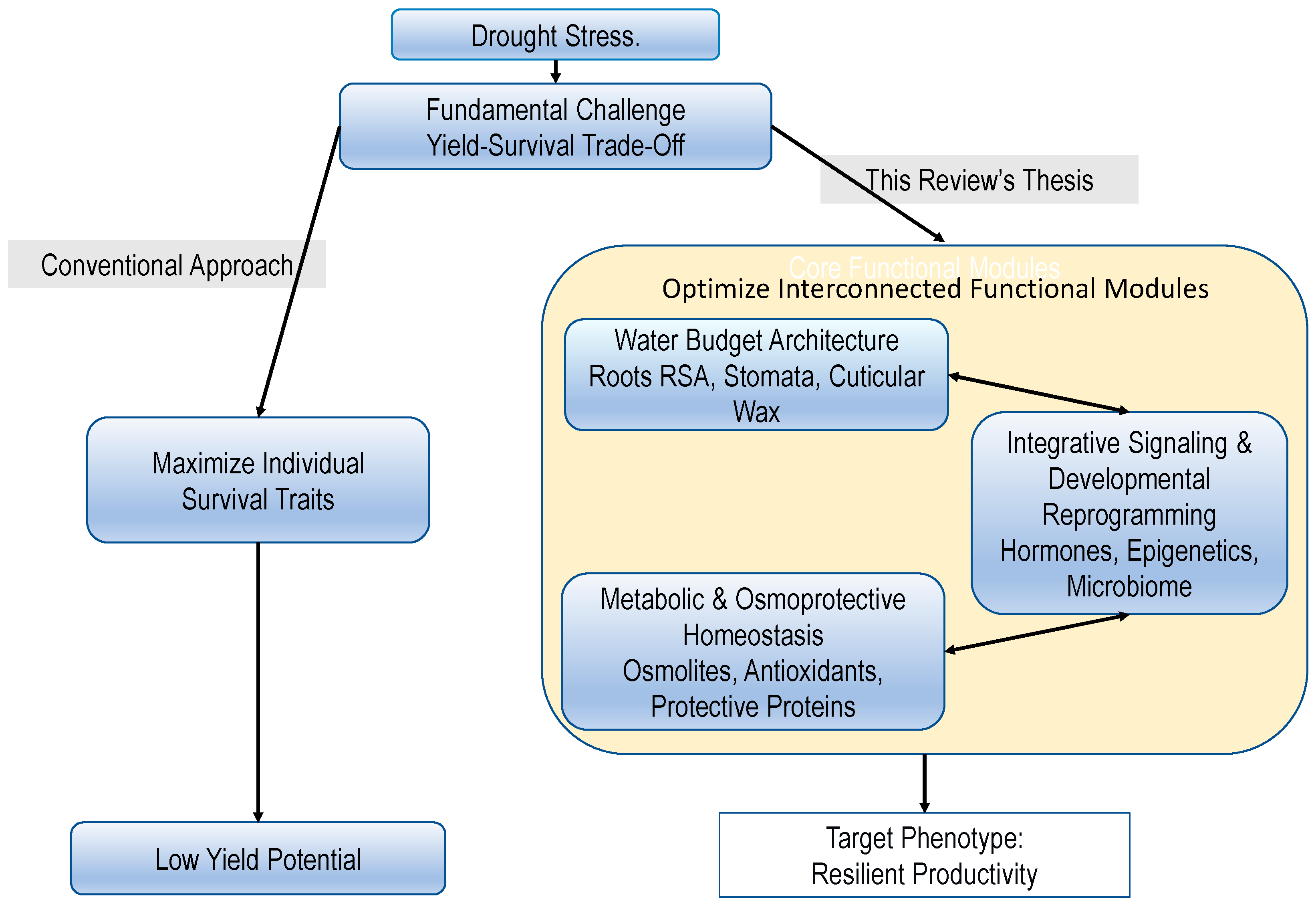
Figure 1. A conceptual framework for overcoming the yield–survival trade-off in drought-resilient cereal breeding. The conventional approach of maximizing individual survival traits often leads to a yield penalty. This review proposes a paradigm shift towards the coordinated optimization of three interconnected core functional modules: (1) Water Budget Architecture (e.g., root architecture, stomatal regulation), (2) Metabolic and Osmoprotective Homeostasis (e.g., osmolyte accumulation, antioxidant systems), and (3) Integrative Signaling and Developmental Reprogramming (e.g., phytohormonal crosstalk, epigenetic regulation, microbiome). The synergistic interaction between these modules (double-headed arrows), orchestrated by the signaling network, enables the development of cultivars with Resilient Productivity, maintaining yield under drought with minimal penalty.
Agronomy 15 02783 g001
Figure 2. An integrative strategy for breeding drought-resilient cereals by overcoming the fundamental yield-survival trade-off. The left panel illustrates the classic trade-off: prioritizing survival traits (e.g., complete stomatal closure, massive root investment) often leads to yield penalties, while yield-optimized genotypes are vulnerable to drought. The solution, shown in the right panel, is the development of crop ideotypes with inducible, adaptive systems. These systems: Water Budget Architecture, Metabolic Resilience, and Integrative Signaling Networks remain dormant (OFF) under favorable conditions to maximize yield potential but are rapidly activated (ON) under drought stress to confer resilience. This targeted approach is enabled by a modern breeding toolkit (central bridge), allowing for the design of cultivars that maintain productivity across diverse environments.
Agronomy 15 02783 g002
Figure 3. A physiology-module-based breeding pipeline for drought-resilient cereals.
Agronomy 15 02783 g003
Table 1. Key genetic determinants of drought resilience in cereals, organized by the core functional modules of the proposed breeding framework.
Gene/LocusEncoded Protein/FunctionPhysiological Role in Drought ResiliencePrimary Cereal(s)Potential Application in Breeding
Water Budget Architecture Module
DRO1 (DEEPER ROOTING 1)Protein controlling root growth anglePromotes steeper root growth angle for deeper soil water foraging.Rice, WheatIntrogression into elite varieties to enhance yield under terminal drought.
EGT1 (ENHANCED GRAVITROPISM 1)Regulator of anti-gravitropic offset (AGO)Fine-tunes root growth angle for shallower, wider soil exploration.Wheat, BarleyPyramiding with DRO1 to design root systems for specific soil profiles.
CER1 (ECERIFERUM 1)Aldehyde decarbonylase in cuticular wax biosynthesisCatalyzes alkane formation, reducing non-stomatal water loss.Wheat, BarleyMarker-assisted selection for enhanced cuticular wax deposition (‘glaucous’ phenotype).
PIPs (Plasma membrane Intrinsic Proteins)Aquaporins; water channelsRegulates root hydraulic conductivity for efficient water transport.All major cerealsSelecting for alleles with sustained activity under ABA signaling and drought.
Metabolic Homeostasis Module
BADH (Betaine Aldehyde Dehydrogenase)Key enzyme in glycine betaine (GB) synthesisAccumulates compatible solute GB for osmotic adjustment and macromolecule stabilization.Wheat, Maize, BarleyOverexpression to enhance drought-tolerant phenotypes without toxicity.
P5CS (Δ1-Pyrroline-5-Carboxylate Synthetase)Key enzyme in proline biosynthesisAccumulates proline as an osmoprotectant and antioxidant.All major cerealsSelection for alleles with efficient, inducible expression to manage metabolic cost.
SOD, APX, CAT (e.g., MnSOD, TaCAT1)Antioxidant enzymes (Superoxide Dismutase, Ascorbate Peroxidase, Catalase)Scavenge reactive oxygen species (ROS) to mitigate oxidative stress.Wheat, Maize, RicePyramiding alleles for a robust, coordinated antioxidant system.
DHNs (Dehydrins)Intrinsically disordered protective proteins (LEA D-11 family)Stabilize membranes and proteins during cellular dehydration.Wheat, BarleyUse as biochemical markers; selection for favorable allelic variants linked to QTLs.
Integrative Signaling & Developmental Reprogramming Module
ABA-responsive genes (e.g., OST1, SLAC1)Kinases and anion channels in ABA signalingMediate rapid stomatal closure to minimize water loss.All major cerealsSelecting for alleles conferring optimal stomatal sensitivity (rapid closure & reopening).
DREB2A (Dehydration-Responsive Element-Binding protein 2A)AP2/ERF-type transcription factorMaster regulator of ABA-independent stress-responsive gene network.Wheat, Maize, RiceGenome editing to fine-tune its activity and enhance stress tolerance.
Ppd (Photoperiod response) genesPseudo-response regulator proteinsControl flowering time, enabling “drought escape” via phenological adjustmentWheat, BarleyIntrogression of photoperiod-insensitive alleles to align flowering with favorable conditions.
VRN (Vernalization) genesMADS-box transcription factorsRegulate the vernalization requirement, influencing developmental timing.Wheat, BarleyManipulation to optimize life cycle duration for target environments.
HSP70/HSP90 (Heat Shock Proteins)Molecular chaperonesPrevent protein aggregation and facilitate refolding under stress.All major cerealsSelection for constitutive or highly inducible expression as a proxy for cellular stability.
Disclaimer/Publisher’s Note: The statements, opinions and data contained in all publications are solely those of the individual author(s) and contributor(s) and not of MDPI and/or the editor(s). MDPI and/or the editor(s) disclaim responsibility for any injury to people or property resulting from any ideas, methods, instructions or products referred to in the content.