Abstract
Grassland ecosystems play a key role in global carbon and nutrient cycling, yet their productivity is increasingly affected by changing climate, land use, and nutrient inputs. Recent studies have identified plant–microbe interactions as a crucial biological mechanism regulating these changes. However, comprehensive research across different biomes remains insufficient. This review focuses on the functional characteristics and physiological processes of microorganisms to explore how they influence grassland productivity and stability in the context of global change, and proposes quantifiable indicators to improve model predictions. By integrating evidence from alpine, temperate, and arid grasslands, we summarize how microbial carbon use efficiency(CUE), nutrient cycling enzyme activity, and symbiotic capabilities affect plant nutrient acquisition, carbon allocation, and stress resistance. Meta-analytical data indicate that microbial processes can explain a substantial proportion of productivity variation beyond climatic and edaphic factors. We further outline methodological progress in linking molecular mechanisms with ecosystem dynamics through multi-omics, stable isotope tracing, and structural equation modeling. This synthesis highlights that incorporating microbial mechanisms into grassland productivity frameworks enhances predictive accuracy and provides an empirical basis for sustainable management. Across global grasslands, microbial processes account for roughly 40–50% of the explained variance in productivity beyond abiotic drivers, underscoring their predictive value in ecosystem models. Thes study underscores the broader significance of recognizing soil microbes as active drivers of ecosystem function, offering a biological foundation for carbon sequestration and grassland restoration strategies under global environmental change.
1. Introduction
According to the Food and Agriculture Organization of the United Nations, permanent grasslands and pastures occupy approximately 3200 million hectares, accounting for about 26% of the global land area [,]. In this review, “grassland” is used in a broad ecological sense, encompassing both natural and semi-natural systems dominated by herbaceous vegetation. These include alpine meadows, temperate steppes, and savanna-like ecosystems that are either maintained by climatic constraints or by long-term extensive management such as grazing and mowing. As one of the most extensive and ecologically significant terrestrial biomes, grasslands play a vital role in regulating the global carbon cycle, supporting biodiversity, and providing essential ecosystem services such as soil conservation, water regulation, and forage production for livestock [,]. As a critical interface between the atmosphere and the pedosphere, grasslands contribute significantly to carbon sequestration, hence influencing climate feedback mechanisms [,]. Recent assessments have also highlighted that spatiotemporal variations in grassland productivity are closely linked to global sustainability goals, including carbon neutrality, biodiversity conservation, and land degradation neutrality [,]. Moreover, they are basic elements of food security and socioeconomic stability for many areas, especially in arid and semi-arid zones where pastoralism and grassland-based agriculture are widespread [,]. Due to their wide coverage and functional importance, grasslands have increasingly been seen as a crucial aspect of worldwide sustainability strategies formulated against the background of current changes within the natural environmental systems [].
Grasslands for this review encompass alpine meadows, temperate steppes, and tropical savannas across continental regions, such as the Eurasian steppe belt, Indian savannahs, South American Cerrado, and tundra grasslands at high latitudes. The core of grassland ecosystem functioning revolves around productivity, or the rate of biomass accumulation through primary production []. Grasslands contribute roughly 20–25% of global terrestrial net primary production, equivalent to 10–12 Pg of carbon annually [,]. This productivity is the base for carbon sequestration, herbivore support, soil fertility, and ecosystem resilience [,]. Recent evidence indicates productivity declines in several semi-arid and intensively managed regions over the past two decades []. Changes in productivity, whether climatic or anthropogenic, can cascade into systems of stability at the ecosystem level, carbon budgets at regional levels, and socio-economic systems at the micro-level [,]. Under these conditions of global change—here taken to refer to the combined effects of climate change, land use change, grazing regime shifts, and changes in management—drivers and constraints of grassland productivity have gained increasing attention as central themes of ecological research.
While traditional grassland productivity studies were mainly related to abiotic drivers, such as temperature, precipitation, and nutrient availability in the soil, many drivers have recently been recognized as very important in biotic interactions between plants and soil microbiota. Plants influence ecosystem processes through a variety of mechanisms, including carbon allocation, root exudation, and functional trait expression, which in turn affect nutrient cycling, microbial activity, and overall ecosystem productivity [,]. Simultaneously, soil microorganisms—including bacteria, fungi, and archaea—mediate key processes such as organic matter decomposition, nutrient mineralization, and symbiotic nutrient exchange [,]. These microbial communities respond sensitively to environmental changes and can either buffer or amplify the effects of such changes on plant growth and ecosystem functioning.
Despite this recognition, a fragmented understanding persists regarding how plant and microbial components interact to jointly regulate grassland productivity. While it is clear that plants and microbes individually influence productivity, the emergent properties of their interactions—such as feedback loops, co-adaptation, and functional complementarity—remain underexplored. This raises a fundamental question: Are plant–microbe interactions the central regulatory mechanism governing grassland productivity under global change?
Addressing this question requires a systematic synthesis of mechanistic pathways, empirical evidence, and methodological advances. To this end, we undertake a narrative synthesis, bolstered by the development of an integrative conceptual framework linking plant and microbial processes across scales. Recent advances in research have begun to uncover how plant-microbe interactions may not be passive responses to environmental shifts but active drivers of ecosystem dynamics []. For instance, rhizosphere microbes can enhance plant nutrient acquisition under nutrient-limited conditions, while mycorrhizal fungi may improve water-use efficiency during drought [,]. Conversely, pathogenic microbes can reduce plant fitness and alter competitive outcomes, thereby influencing community composition and productivity []. These interactions are further modulated by plant functional traits—such as root architecture and leaf economics—which affect microbial community assembly and function []. Together, these bidirectional feedbacks create complex, adaptive networks that may stabilize or destabilize grassland productivity under changing conditions.
The growing interest in plant–microbe interactions is reflected in several emerging research fronts. These include the use of molecular tools to characterize microbial functional genes, the application of stable isotope tracing to quantify carbon and nitrogen fluxes, and the integration of machine learning and structural equation modeling to identify key drivers across scales [,]. Moreover, cross-biome comparisons and long-term manipulative experiments are beginning to reveal generalizable patterns and context-specific mechanisms []. These advances highlight the potential of microbial indicators—such as CUE, pathogen-to-mutualist ratios, and nitrogen-cycle gene abundance—to predict grassland responses to global change.
In this review, we aim to synthesize current knowledge on the role of plant–microbe interactions in regulating grassland productivity under global change. Specifically, we will: (i) Outline the major global change drivers affecting grasslands and their interactions with plant and microbial communities; (ii) Elucidate the core mechanisms through which plants and microbes interact to influence productivity; (iii) Summarize evidence from diverse grassland ecosystems worldwide; (iv) Review emerging methodologies enabling mechanistic insights; (v) Identify key challenges and future research directions.
By integrating mechanistic understanding with empirical evidence and methodological innovations, this review advances the working hypothesis that plant–microbe interactions may constitute a central regulatory axis in grassland productivity—an idea crucial for predicting and managing these ecosystems under future global change scenarios.
2. Regulatory Factors of Grassland Productivity
Grassland productivity, fundamentally defined as the rate of biomass production per unit area per unit time, serves as a paramount indicator of ecosystem function and service provision, including carbon sequestration, forage production, and biodiversity maintenance []. Productivity is typically expressed using several complementary indicators: gross primary productivity (GPP) refers to the total amount of carbon fixed by photosynthesis over a given period of time; net primary productivity (NPP) is GPP minus plant autotrophic respiration (carbon consumption by plant metabolism) [], which represents the amount of carbon actually accumulated in plant biomass that is available for consumption by herbivores and decomposers []; aboveground net primary productivity (ANPP) and belowground net primary productivity (BNPP) break down this accumulation into aboveground and belowground portions, respectively. While ANPP is often used as a simpler alternative indicator to gross productivity because it is easier to measure and can be performed by harvesting or remote sensing, the importance of BNPP is increasingly being recognized, especially in grasslands where a large portion (usually more than 50%) of carbon and nutrients is invested in the root system to acquire and store resources and survive disturbances. It is increasingly recognized that different productivity indicators are multifaceted responses to driving factors, and as global change unfolds, the response of grassland ecosystems is expected to exhibit this multifaceted nature as well.
For decades, ecological research has primarily focused on abiotic and direct biotic factors as the principal controllers of grassland productivity, forming a foundational paradigm. These traditional drivers can be broadly categorized into climatic factors, soil properties, and anthropogenic disturbances, as summarized in Figure 1. While this framework provides a crucial first-order understanding, it often fails to capture the full complexity of the system, necessitating a deeper exploration of the biological mediators that translate these drivers into productivity outcomes.
Figure 1.
Conceptual framework of grassland ecosystem responses to four key global-change drivers: (i) warming and associated drought, (ii) changes in rainfall amount and distribution, (iii) atmospheric nitrogen (N) deposition, and (iv) land use and grazing. These drivers alter plant community structure and carbon allocation, thereby affecting above- and belowground biomass, while concurrently modifying soil nutrient availability and pH, reshaping soil microbial diversity and functional composition, and feeding back to ecosystem carbon pools. Blue arrows indicate positive effects on the targeted component, red arrows indicate negative effects, and gray arrows indicate bidirectional or context-dependent effects. Abbreviations: N, nitrogen; pH, soil acidity. In the soil pH icon, red indicates acidity, green indicates neutrality, and blue indicates alkalinity.
2.1. Climatic Factors: The Ultimate Environmental Filters
Climate sets the ultimate boundary for grassland distribution and function on a global scale, acting as a master switch that enables or constrains biological activity. The interplay between temperature and precipitation largely defines the biome [,,].
Temperature profoundly influences the biochemical enzymatic reactions underlying photosynthesis and respiration. Its effects are biphasic and context-dependent. Moderate warming in cooler regions can extend the growing season, enhance metabolic rates, and accelerate development, thereby boosting GPP. Meta-analyses confirm this trend: experimental warming across global grasslands increased NPP by ~15%, ANPP by 7.6%, and BNPP by 11.6% [], while a more recent synthesis reported a mean rise of about 9.8% in GPP under warming treatments, though ecosystem respiration increased even more strongly (≈16%), partially offsetting the net gain []. However, persistent warming intensifies evapotranspiration, raising the risk of physiological drought even without reduced precipitation [], and increases respiratory carbon loss, which can suppress NPP when respiration outpaces photosynthesis []. In soils, soil microbial activity is also highly temperature-sensitive: warming initially accelerates organic matter decomposition and nutrient mineralization, boosting nutrient supply and plant growth, but long-term exposure shifts microbial communities toward fast-metabolizing taxa with lower CUE and reduced carbon retention [,]. These changes intensify soil carbon losses and destabilize the balance between decomposition and stabilization, producing nonlinear NPP responses [,]. For instance, warming may initially enhance ANPP in mesic, nutrient-rich grasslands but suppress it in water-limited systems where evaporative demand outweighs metabolic gains [].
Precipitation regimes, including total annual amount, seasonal timing, intra-annual distribution, and event intensity, are arguably the most dominant drivers in many grassland ecosystems, which are predominantly found in semi-arid regions [,,]. Water availability is a direct prerequisite for photosynthetic activity, plant cell expansion, and nutrient transport in the soil []. Reduced precipitation or prolonged drought stress consistently suppresses ANPP by stunting plant growth, inducing stomatal closure, and accelerating senescence. The impact on belowground dynamics is more nuanced. As an adaptive response to water scarcity, plants may initially increase the relative carbon allocation to roots (potentially increasing BNPP or the root-to-shoot ratio) to forage for deeper soil moisture []. However, under severe and prolonged soil moisture deficit, both root growth and the activity of rhizosphere microbes responsible for nutrient mineralization are fundamentally restricted, ultimately curtailing overall NPP []. The increasing frequency and intensity of extreme climate events, such as heatwaves and compound drought-heat events, act as potent catalysts, often pushing ecosystems beyond their physiological thresholds and triggering rapid, sometimes irreversible, declines in productivity through widespread plant mortality and soil carbon loss [].
2.2. Soil Nutrient Availability: The Elemental Building Blocks
Beyond the macro-climatic constraints of water and temperature, the local availability of essential soil nutrients, particularly nitrogen (N) and phosphorus (P), strongly constrains grassland productivity at finer spatial scales. These elements are the fundamental building blocks of proteins, nucleic acids, and energy molecules.
Most natural grasslands are nitrogen-limited; meta-analysis shows that nitrogen addition increases above-ground net primary productivity by about 33%, while phosphorus addition results in a smaller 14% increase; hence, nitrogen supply is more closely related to ANPP than the availability of phosphorus [,,]. Nitrogen availability is dynamic and controlled by microbial-mediated processes, such as the mineralization of organic matter. In grassland soils, microbes can convert 20–50 kg N ha−1 yr−1 of organic nitrogen into plant-available forms like ammonium and nitrate, with rates rising sharply under warmer and moister conditions []. For instance, in temperate steppe soils, warming experiments have thus far shown a 21.8% increase in net N mineralization, further emphasizing that microbial activity plays the key role in regulating temporal variability in N availability [].
Phosphorus limitation in most old, highly weathered soils is a common thing, and this is indeed chronic as nitrogen inputs redistribute nutrient imbalance. Prolonged nitrogen enrichment can lower soil pH by 0.25–0.34 units over 1–10 years, enhancing phosphorus immobilization and reducing its availability [], which in turn can constrain microbial-mediated P mineralization. This reduction in microbially available phosphorus limits plant nutrient acquisition, altering plant–microbe interactions and potentially shifting community composition []. Soil N:P ratios provide a useful indicator of such imbalances: plant communities tend to exhibit higher diversity and productivity when N:P exceeds 4.0, whereas lower ratios can intensify phosphorus limitation, reducing microbial activity and biodiversity [,]. Maintaining an appropriate soil N:P balance is therefore critical not only for plant growth and ecosystem productivity but also for sustaining functional plant–microbe interactions in grassland soils.
Anthropogenic nutrient enrichment mainly results from the atmospheric nitrogen deposition caused by the combustion of fossil fuels and agricultural activities []. This enrichment can initially alleviate nutrient limitation and enhance ANPP, a phenomenon observed in many regions. However, the long-term consequences are often detrimental []. Chronic N input can lead to soil acidification, which mobilizes toxic aluminum ions and reduces the availability of other essential cations like calcium and magnesium []. It can also cause a decline in plant species richness, as fast-growing, nitrophilic species dominate, and alter the composition and function of soil microbial communities (e.g., suppressing decomposer fungi like mycorrhizae) []. These shifts can destabilize productivity in the long term, reduce the ecosystem’s resilience to environmental stress, and lead to increased losses of nitrogen through leaching and gaseous emissions, causing further environmental damage [].
2.3. Anthropogenic Disturbances: The Overlying Human Imprint
Human activities are powerful driving forces that can regulate and sometimes even have a greater impact than natural climate and soil nutrient gradients. The most common of these are grazing and changes in land use.
Grazing by domestic herbivores influences productivity through a triad of interconnected mechanisms: (1) direct biomass removal (herbivory), which reduces standing crop and can alter plant competitive hierarchies; (2) physical alteration of the soil environment through compaction and root disturbance (trampling), which affects water infiltration, aeration, and root growth; and (3) nutrient recycling via the deposition of dung and urine, which creates spatial heterogeneity in nutrient availability. Herbivore optimization hypothesis (or intermediate disturbance hypothesis) posits that moderate levels of herbivory can enhance plant productivity and biodiversity by preventing competitive exclusion and promoting resource turnover, whereas very low or very high grazing intensities tend to reduce productivity and diversity []. Moderate grazing can sometimes stimulate productivity by promoting nutrient cycling, reducing self-shading and senescent material, and favoring more productive plant species []. However, when grazing intensity crosses a system-specific threshold, it uniformly leads to ANPP reduction, soil degradation (erosion, compaction), and simplified plant communities dominated by unpalatable or grazing-tolerant species.
Land use changes often lead to irreversible alterations. The conversion of native grasslands to cropland, afforestation, or urbanization completely resets the habitat template. Such changes disrupt the evolved vegetation structure, deplete soil organic matter (SOM) pools through accelerated decomposition or erosion, and alter hydrological cycles through drainage or the expansion of impervious surfaces (e.g., roads, buildings, and compacted soil layers that prevent water infiltration), exerting profound impacts on productivity [,]. Even on well-managed grasslands, changes in management intensity, such as the frequency and timing of mowing, can significantly alter the distribution patterns of ANPP and BNPP, soil carbon storage, and community composition.
2.4. The Unexplained Variance and the Path Forward
Despite the well-established and robust importance of these traditional abiotic and disturbance factors, a synthesis of empirical studies from diverse grasslands consistently reveals a significant portion of variation in productivity—often 30–50%—that remains unexplained by climate, soil, and disturbance factors alone []. This persistent explanatory shortfall points unequivocally to the existence of critical, yet historically underexplored, biological mechanisms operating within the “black box” of the soil–plant system. As shown in Figure 1, the effects of these main driving factors do not occur directly but are widely mediated and regulated through the biological reactions of resident plants and soil microorganisms [].
For example, warming does not merely increase metabolic rates in a deterministic fashion; it reshapes soil microbial community composition and function, potentially shifting them towards bacterial-dominated communities that are less efficient at stabilizing soil carbon, which in turn alters the long-term nutrient supply to plants []. Similarly, the impact of drought on a plant is not solely a function of physical water scarcity []; it is critically modulated by the ability of its associated rhizosphere microbes (e.g., mycorrhizal fungi) to enhance water retention, explore a larger soil volume, and maintain nutrient acquisition under stress through the production of compounds like glomalin.
This realization requires us to shift from the simplistic perspective of environmental determinism to a comprehensive perspective that integrates biology and geochemistry. The intricate web of feedbacks and interactions between plants and soil microbes emerges as the central mechanistic pathway through which the traditional drivers ultimately exert their influence on productivity. Plants, through their root architecture, exudation of a diverse cocktail of organic compounds, and functional traits, act as ecosystem engineers, actively architecting the rhizosphere environment and selectively recruiting, supporting, and controlling specific microbial consortia. In return, these microbes become key agents in regulating the very processes that define productivity: they are the primary engines of nutrient cycling (decomposers, nitrifiers), the extended root system for nutrient and water uptake (mycorrhizal fungi), the providers of growth hormones, and the defenders against pathogens []. While this review focuses primarily on microbial mechanisms, it is important to acknowledge that soil invertebrates—such as nematodes, collembolans, and earthworms—also contribute substantially to nutrient cycling and soil aggregation, often interacting synergistically with microbial communities.
Therefore, to move beyond correlation and towards mechanistic prediction, the following sections will delve into the specifics of how these plant-microbe interactions—encompassing mutualistic symbioses, pathogenic relationships, and the complex networks of nutrient cycling—form the core regulatory machinery. This biological circuitry translates external environmental forces into the observable patterns of grassland productivity, representing the next frontier in our understanding of these vital ecosystems.
3. Core Mechanisms of Plant–Microbe Interactions in Regulating Grassland Productivity
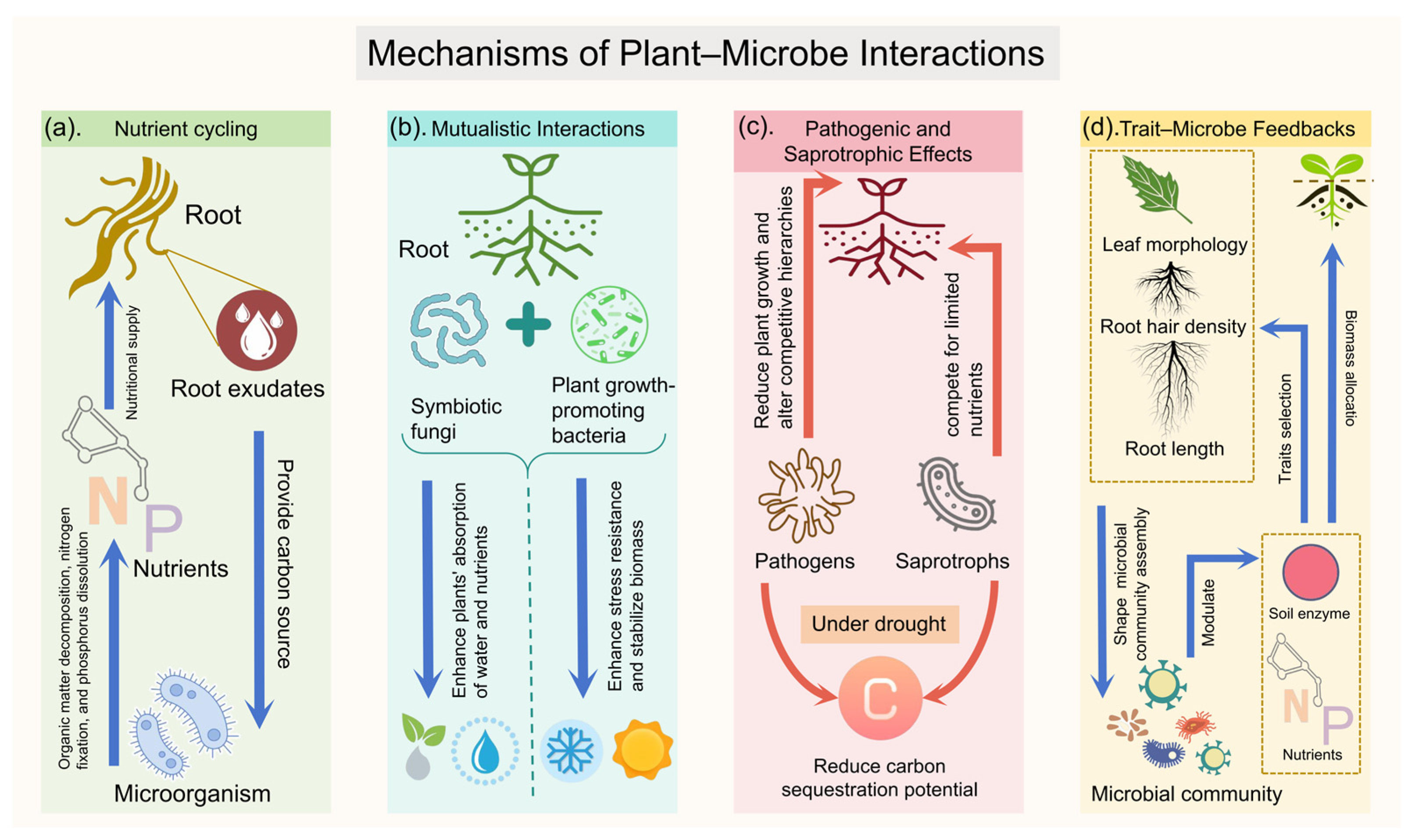
The dynamic interplay between plants and soil microorganisms (Figure 2) forms the biological foundation of grassland productivity. Moving beyond simplistic cause–effect relationships, these interactions regulate nutrient cycling, symbiotic partnerships, pathogenic feedbacks, and trait-mediated resource allocation. Together, they determine how efficiently ecosystems convert resources into biomass and how resilient they remain under global change.
Figure 2.
Conceptual model of plant–microbe interaction mechanisms that regulate grassland productivity. Panels show (a) nutrient cycling mediated by root exudates and microbial mineralization/immobilization, (b) mutualistic interactions between roots, symbiotic fungi, and plant-growth-promoting bacteria, (c) pathogenic and saprotrophic effects that reduce plant growth and compete for limited nutrients (especially under drought), and (d) trait–microbe feedbacks linking plant traits (leaf morphology, root length and hair density) with microbial community composition, enzyme activity, and soil nutrients. Blue arrows indicate positive effects on the targeted component; red arrows indicate negative effects. Abbreviations: N, nitrogen; P, phosphorus; C, carbon.
3.1. Nutrient Cycling and Resource-Use Efficiency: The Microbial Metabolic Engine
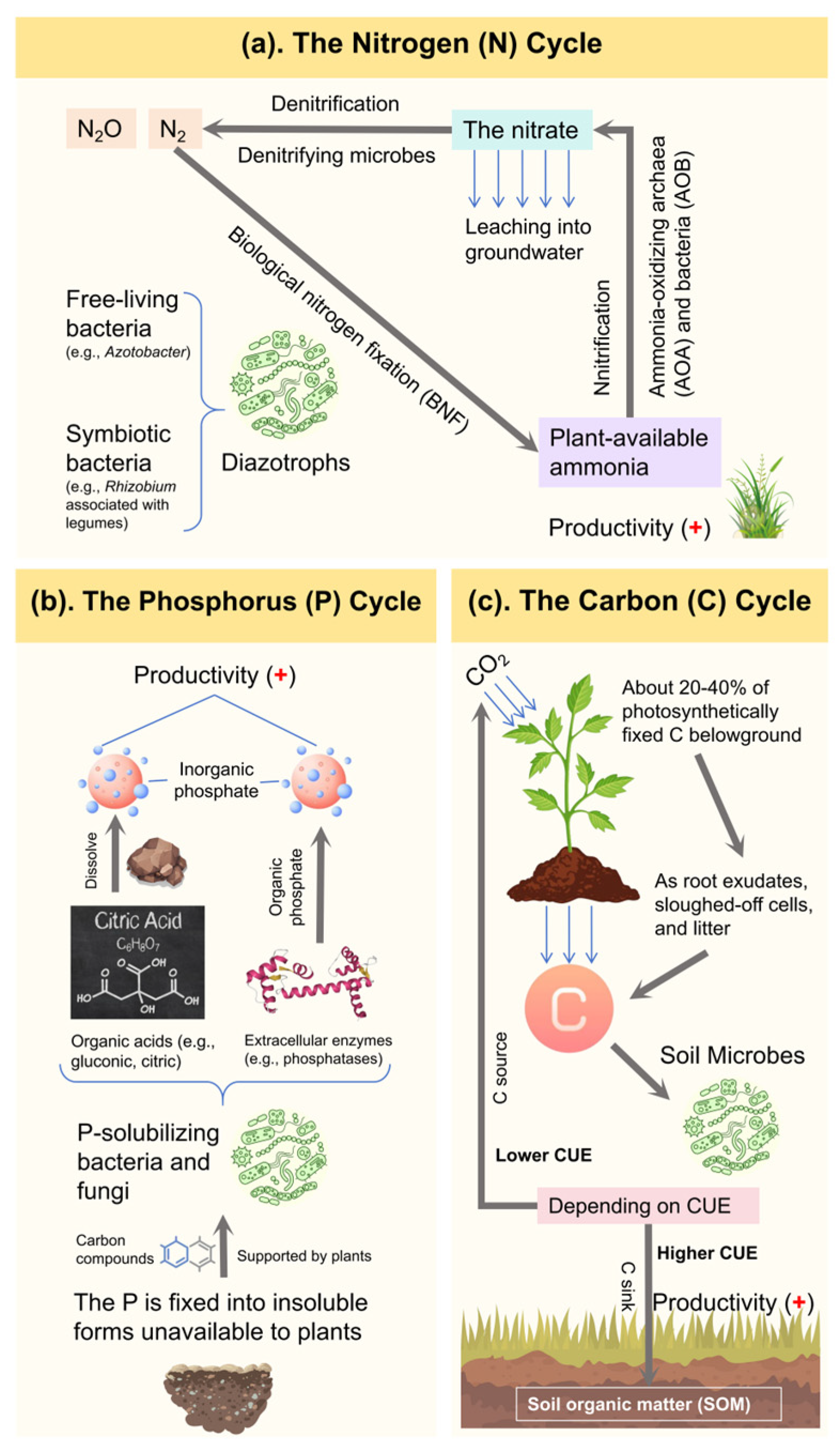
Soil microorganisms drive the transformation and availability of nutrients. Their activity determines the rate and efficiency with which plants acquire essential elements such as nitrogen (N), phosphorus (P), and carbon (C) (Figure 2a). The coupled nutrient cycles of nitrogen, phosphorus, and carbon illustrate how microbial processes govern the turnover and availability of essential elements in grassland soils (Figure 3). Recent global syntheses show that microbial processes are the dominant drivers of soil N mineralization in grasslands, accounting for the majority of total N turnover [,]. Field observations reveal that realized net N mineralization rates vary widely among sites—from near zero up to 1.4 mg N·kg−1·d−1 []—which, depending on soil bulk density and depth, corresponds to roughly several tens to a few hundred kilograms of N per hectare per year.
Figure 3.
Microbial mediation of nutrient cycles in grassland soils. (a) Nitrogen (N) cycle: Diazotrophs fix atmospheric N2 into ammonia available to plants, while nitrifying and denitrifying microbes regulate NO3− production and gaseous N losses. These microbial processes determine plant-available N and hence productivity. (b) Phosphorus (P) cycle: P-solubilizing bacteria and fungi release organic acids (e.g., citric acid) and extracellular enzymes (phosphatases) that mobilize inorganic P from insoluble forms, enhancing plant P uptake and growth. (c) Carbon (C) cycle: Roughly 20–40% of photosynthetically fixed C enters the soil through root exudates and litter inputs. Soil microbes regulate its fate—either rapid mineralization or stable incorporation into SOM—thereby linking microbial metabolism to ecosystem productivity and C storage.
3.1.1. Nitrogen (N) Cycle
Nitrogen cycling (Figure 3a) in grassland soils is regulated by microbial transformations: diazotrophs (e.g., Rhizobium, Azospirillum) fix atmospheric N2 into ammonium, nitrifiers (e.g., Nitrosomonas, Nitrososphaera) oxidize ammonium to nitrate, and denitrifiers reduce nitrate to gaseous N forms, closing the cycle. Meta-analysis indicates that experimental warming increases soil net N mineralization by approximately 21.8–25.3%, reflecting enhanced microbial turnover and nutrient release under higher temperatures []. However, such warming and nitrogen enrichment can also intensify gaseous N losses. For instance, in a semiarid temperate grassland, high nitrogen input elevated N2O emissions by ~265%, while methane uptake decreased by ~34%, indicating that faster microbial cycling may come at the cost of lower N-use efficiency []. Field and meta-analytical evidence further show that nitrogen enrichment amplifies phosphorus limitation across terrestrial ecosystems [,]. At the global scale, grassland aboveground net primary productivity increases by about 33.2% under N addition but only 14.2% under P addition, underscoring nitrogen’s predominant role in driving productivity [].
3.1.2. Phosphorus (P) Cycle
In P-deficient grasslands, P-solubilizing microorganisms such as Bacillus, Pseudomonas, and certain fungi release organic acids (e.g., citric, gluconic) and phosphatases that mobilize insoluble P compounds [,,]. These processes (Figure 3b) can raise available soil P concentrations by 20–60% compared with non-inoculated soils []. Arbuscular mycorrhizal fungi (AMF) further improve P uptake by extending hyphal networks beyond the root depletion zone, accessing P pools up to 10 cm beyond root surfaces [,]. Empirical evidence from semi-arid grasslands shows that microbial phosphatase activity explains nearly half of the variance in soil-available P (R2 ≈ 0.47, P < 0.001), and each 10 µmol pNP g−1 h−1 increase in enzyme activity corresponds to a ~7–12% rise in above-ground productivity []. Such microbial facilitation becomes increasingly important as chronic N deposition shifts many grasslands from N to P limitation [,].
According to He [], the different bacterial families exhibit opposite correlations with inorganic P, implying complementary roles in phosphorus cycling and driving the turnover between organic and inorganic P forms. Similarly, the functions of fungal symbionts are not fixed but context-dependent. For instance, Colletotrichum tofieldiae can act as a pathogen inhibiting the growth of Capsella rubella, yet promote Arabidopsis thaliana growth under low-P conditions [].
3.1.3. Carbon (C) Cycle
Plants allocate a significant portion (up to 20–40%) of their photosynthetically fixed carbon belowground, where it enters the soil in the form of root exudates, shed cells, and litter (Figure 3c). This form of carbon input has almost become the primary energy source for the entire soil microbial food web [,]. The fate of this carbon—whether it is rapidly released as CO2 through respiration or efficiently converted into microbial biomass and retained in stable SOM—is determined by the microbial community’s CUE, which represents the ratio of carbon allocated to biomass synthesis to carbon lost via respiration [,,].
In grassland ecosystems, CUE is typically approximately 0.3–0.4, meaning that approximately 30–40% of assimilated carbon is converted into microbial biomass, while the remaining approximately 60–70% is lost through respiration or other pathways [,]. When vegetation structure is complex, nutrient supply is abundant, and microbial activity is high, CUE can rise to 0.4–0.5 or even higher [,]. In systems with limited nutrients, suppressed microbes, or weak plant-microbe interactions, CUE may drop to 0.1–0.3 [,]. This suggests that even if plants input 20–40% of their carbon into the belowground system, if microbial CUE is low (e.g., 10–20%), much of this carbon will quickly return to the atmosphere as CO2, making it less likely to effectively enter microbial biomass or contribute to stable SOM. Conversely, a higher CUE promotes the conversion of more belowground carbon into microbial residues, thereby enhancing soil organic carbon (SOC) storage and playing a key role in nutrient cycling and maintaining ecosystem productivity [].
Collectively, these interlinked nutrient cycles form the mechanistic basis illustrated in Figure 3, where microbial transformations integrate elemental flows and sustain grassland productivity under global change.
3.2. Mutualism and Symbiosis: Forging Strategic Alliances
Mutualistic relationships represent sophisticated evolutionary strategies for plants to expand their resource acquisition capacity and buffer against environmental stress, forming a foundational pillar for stable productivity. These alliances are based on reciprocal exchange, but they are dynamic and context-dependent, constantly renegotiated based on environmental conditions and the needs of the partners (Figure 2b).
3.2.1. Mycorrhizal Fungi: The Extended Root System
AMF, symbiotic with over 80% of grassland plants, constitute one of Earth’s most widespread mutualisms [,]. Meta-analyses show that AMF colonization enhances plant phosphorus uptake by 20–50%, particularly in grassland soils [,]. Within cortical arbuscules, plants transfer up to 20% of photosynthates as lipids and carbohydrates to the fungus, which reciprocates with water and nutrients [,].
Under drought conditions, AMF hyphae enhance plant water uptake and sustain growth by accessing soil micropores beyond the reach of roots. In a field rainfall-exclusion experiment, AMF colonization increased above-ground biomass by ~47% in the C3 grass Leymus chinensis and by ~37% in the C4 grass Hemarthria altissima compared with non-mycorrhizal controls []. AMF-derived glomalin enhances soil aggregation, with glomalin-related soil protein (GRSP) closely linked to water-stable aggregates and mean weight diameter. Increases in GRSP typically raise aggregate stability by 10–40%, improving soil water retention [,]. In colder or woody-dominated grasslands, ectomycorrhizal (ECM) fungi fulfill similar roles through sheathing root tips, influencing carbon cycling and below-ground carbon storage dynamics [].
These mutualisms are increasingly critical under global change: meta-analyses and field experiments show that nitrogen enrichment and experimental warming typically reduce AMF colonization or abundance by 8–15%, weakening plant nutrient balance and stress resilience. In contrast, sustainable grazing regimes and organic amendments consistently enhance AMF activity and glomalin production, leading to improved soil aggregation and structure [,].
3.2.2. Plant Growth-Promoting Rhizobacteria (PGPR) and Endophytes: The Bio-Stimulants and Bodyguards
This diverse group of bacteria (e.g., Pseudomonas, Bacillus, Azospirillum) and endophytic fungi (e.g., Epichloë in grasses) residing in the rhizosphere or within plant tissues enhances productivity through a multi-pronged approach:
- (i)
- Bio-fertilization: PGPR fix atmospheric N2 (up to 60 kg N ha−1 yr−1), solubilize inorganic P by 20–60%, and produce siderophores that improve Fe availability [,].
- (ii)
- Phytohormone modulation: PGPR that produce auxins (IAA), cytokinins, and gibberellins can enhance root length and branching by about 20–40%, thereby improving water and nutrient uptake [].
- (iii)
- Biocontrol: PGPR suppress pathogens through antibiotic production and competition for infection sites, achieving~40–80% reductions in disease incidence and frequently inducing systemic resistance [,].
- (iv)
- Stress tolerance amelioration: By synthesizing osmoprotectants (proline, glycine betaine) and antioxidants, PGPR and endophytes enhance drought and heat tolerance. Epichloë in cool-season grasses produces alkaloids that deter herbivores and reduce evapotranspiration losses [].
These microbial consortia reduce the plant’s metabolic costs for defense and stress responses—allowing more carbon to be allocated to growth. Bio-inoculants combining PGPR and AMF have been shown in meta-analyses and field trials to raise plant biomass by up to ~30–40% and improve nutrient/fertilizer use efficiency by around 10–20% under certain conditions [,].
3.2.3. The Carbon Cost of Mutualism: A Dynamic Trade-Off
Maintaining microbial partners imposes a considerable carbon cost—up to 30–40% of plant-fixed C can be allocated belowground to support mutualists [,]. This defines a dynamic trade-off at the core of plant allocation strategy: balancing the benefit of enhanced resource acquisition against the direct carbon expense.
Under nutrient limitation or drought, plants invest more carbon in roots and exudates, often increasing rhizosphere C allocation by 20–50% to reinforce symbioses []. Conversely, under nutrient-rich or chronically nitrogen-enriched conditions, arbuscular mycorrhizal colonization often decreases by 30–60%, and plants may activate immune pathways that restrict microbial colonization. Long-term nitrogen addition suppresses both AMF and PGPR abundance, leading to lower microbial carbon use efficiency CUE (typically declining from ~0.4 to ~0.2) and weakened soil carbon stabilization capacity [,].
Understanding and managing this trade-off is crucial for sustaining productivity under global change. Practices such as moderate grazing, maintaining balanced N:P ratios, and minimizing chemical disturbance can help preserve functional mutualisms and stabilize grassland C and N cycles.
3.3. Pathogenic and Saprotrophic Effects: The Antagonistic and Competitive Forces
Not all plant-microbe interactions are beneficial. Pathogenic and saprotrophic microbes exert critical negative and competitive feedbacks that can suppress productivity, influence plant community assembly, and drive ecosystem state transitions (Figure 2c).
3.3.1. Pathogenic Effects: The Regulators of Plant Fitness and Diversity
Soil-borne pathogens such as Fusarium (wilt fungi), Phytophthora (oomycetes) and plant-parasitic nematodes act as potent agents of selection by reducing host growth, reproduction and survival; field pathogen-exclusion experiments indicate ~15–45% losses in above-ground biomass, and nematode infections alone can reduce shoot biomass by ~30% in susceptible hosts [,]. At the community level, they can shift competitive hierarchies: dominant species are often more targeted, which suppresses their abundance and releases subordinate species from competitive exclusion []. This host-specific suppression underpins the Janzen–Connell effect, a mechanism that maintains grassland diversity and prevents dominance by any single species [].
Diversity, in turn, feeds back to productivity through complementarity effects. For instance, pathogen exclusion experiments in temperate grasslands showed that removing soil pathogens increased dominance of one or two species and reduced community-level ANPP by ~25% [,]. Hence, moderate pathogen pressure supports diversity and long-term stability, while excessive pathogen outbreaks can lead to large-scale mortality, vegetation thinning, and eventual ecosystem collapse.
Environmental stress—drought, eutrophication, or nitrogen imbalance—often amplifies pathogenic effects. Drought can reduce plant defense enzyme activity by 30–60%, increasing fungal infection rates. Under chronic nitrogen enrichment, pathogen biomass can rise by twofold while AMF colonization declines by half, tipping the beneficial–pathogenic balance. In management terms, practices that maintain moderate grazing pressure, enhance SOM, and avoid nutrient overloading help sustain this equilibrium and prevent pathogen-dominated degradation [,].
3.3.2. Saprotrophic Effects: The Decomposers and Competitors
Across grasslands, heterotrophic (microbial) respiration contributes the majority of annual soil CO2 efflux, averaging ~73% at the China-grassland scale and reaching 76–95% in site-level partitioning studies; globally, Rh/Rs (the proportion of heterotrophic respiration to total soil respiration) centers around ~61% with moisture exerting primary control in grasslands [,]. During early litter decomposition, microbes frequently immobilize nitrogen and phosphorus into microbial biomass, creating short-term competition with plants. Field and mesocosm studies show that this immobilization typically spans weeks and can extend to months, with plant-available inorganic N often dropping by several tens of percent following litterfall pulses, before later recovery as mineralization resumes [,].
The competitive balance between plants and saprotrophs depends strongly on litter quality and climate. When decomposing high C:N ratio litter, microbes invest more energy in respiration, lowering microbial CUE from ~0.45 to ~0.25 [,]. Experimental evidence indicates that a soil warming of approximately +3 °C can increase decomposition rates by about 25–35%, while leading to an 8–12% decline in SOC stocks over decadal timescales [].
Saprotrophic and pathogenic processes often reinforce each other during degradation. Overgrazing or drought weakens plants, increasing susceptibility to pathogens []. Mortality adds litter input, fueling saprotroph growth, which in turn heightens nutrient immobilization and limits the regrowth of surviving plants. This self-reinforcing feedback—plant stress → pathogen attack → mortality → saprotroph bloom → nutrient immobilization → further stress—can trigger rapid transitions from a carbon-sinking to a carbon-emitting grassland.
Moderating grazing intensity, retaining surface litter, and restoring arbuscular mycorrhizal functioning can slow decomposition and enhance soil carbon stabilization in grasslands, whereas balanced fertilization that avoids nitrogen oversupply helps maintain microbial diversity and reduces the risk of runaway carbon loss [,,].
These measures align with global frameworks that prioritize soil-carbon–centric mitigation in agriculture, including the UNFCCC Koronivia Joint Work on Agriculture and IPCC’s 2019 Refinement for AFOLU reporting, as well as the “4 per 1000” initiative that highlights the technical potential of soil carbon sequestration [,].
3.4. Plant Functional Trait–Microbe Feedbacks: Shaping the Ecosystem from the Bottom Up
This mechanism represents a higher-order of interaction, where plants and microbes engage in bidirectional feedbacks mediated by plant functional traits, which ultimately shape ecosystem-level properties like productivity, stability, and resilience. It links plant evolutionary strategies directly to microbial community assembly and function (Figure 2d).
3.4.1. Root Traits as the Primary Filter for the Rhizosphere Microbiome
Root morphology and chemistry govern which microbial taxa thrive in the rhizosphere. Traits such as specific root length (SRL; root length per unit mass, m g−1), root diameter, and exudate composition act as selective filters shaping microbial communities []. Species with an acquisitive root strategy (e.g., SRL, fine diameter) have been shown to access substantially larger soil volumes per gram of root biomass and to allocate more labile carbon compounds (such as sugars and organic acids) to the rhizosphere compared with more conservative species []. These exudates stimulate copiotrophic, r-strategist bacteria (e.g., Pseudomonas, Arthrobacter), accelerating mineralization and nutrient turnover.
In contrast, conservative plants with thicker roots (low SRL and fewer exudates) promote fungal-dominated communities, especially mycorrhizal and decomposer fungi []. Microbial communities with a higher fungal/bacterial biomass ratio tend to exhibit higher CUE and slower nutrient cycling rates, which may contribute to ecosystem patterns such as higher short-term productivity but lower long-term nutrient retention in grasslands dominated by acquisitive species [,].
From a management perspective, grazing intensity, nutrient enrichment, and species composition shifts can all reshape these root–microbe linkages. Moderate grazing tends to favor fine-rooted species and higher microbial activity, while chronic N deposition reduces SRL and favors conservative root types, thereby slowing nutrient cycling.
3.4.2. Leaf Traits and the Afterlife Effects on Decomposition
Aboveground traits influence productivity both during life and after senescence. High- Specific Leaf Area (SLA), nutrient-rich leaves consistently decompose faster than lignin-rich, low-SLA leaves [,]. Across species, deciduous woody litters decompose about 60% faster than evergreen woody litters, and first-year mass turnover averages 43% in broadleaf forests vs. 29% in coniferous forests (≈48% higher), while trait-based models attribute ~8% of decomposition variation to SLA relative to cellulose (40%) and lignin (36%) [,]. This accelerated decay supports a specialized bacterial decomposer community that efficiently mineralizes N and P, returning nutrients to the soil and sustaining ANPP in subsequent seasons [].
Conservative species with low SLA and high lignin concentrations favor fungal decomposers and slower nutrient turnover. This “afterlife effect” stabilizes nutrient cycling but reduces short-term productivity. In grasslands undergoing global change, increasing aridity or N deposition often selects for tougher, low-SLA leaves, leading to more fungal-dominated decomposition and reduced carbon turnover efficiency [,]. Maintaining a balance of fast- and slow-decomposing species through species-rich plant mixtures can help stabilize nutrient flow and productivity across climatic extremes.
3.4.3. Biodiversity-Stability Feedback Loops
Functional trait diversity among plants determines the heterogeneity of root exudates, litter quality, and physical soil niches—key drivers of microbial diversity []. Functionally diverse plant communities harbor significantly richer and more redundant microbial assemblages than monocultures—microbial biomass and respiration increase by roughly 10–15%, supporting an ecological insurance effect whereby diverse taxa compensate for nutrient and carbon cycling under drought or disturbance [,].
High plant diversity increases soil microbial biomass by 10–15% and α-diversity, while long-term experiments show it reduces ANPP variability through species asynchrony []. This positive feedback between plant and microbial diversity is a key mechanism underpinning grassland stability under environmental fluctuations. In contrast, the loss of plant diversity simplifies the soil microbiome, reduces resilience, and amplifies productivity variability—effects already documented in intensively managed and nutrient-enriched grasslands.
Thus, conserving functional diversity is not only a matter of biodiversity preservation but a strategy for maintaining microbial-mediated stability and ecosystem productivity in a rapidly changing world.
3.5. Interactions at the Community and Network Level: The Emergence of System-Level Properties
The cumulative outcome of countless plant–microbe exchanges emerges at the community and network level, where interactions among plants, bacteria, and fungi form highly interconnected ecological systems. These networks integrate the functional roles described in previous sections—mutualism, competition, decomposition, and trait feedbacks—into collective properties such as stability, resistance, and productivity that cannot be inferred from isolated interactions.
3.5.1. Network Complexity as a Predictor of Ecosystem Stability
Theoretical and empirical evidence both indicate that network complexity and modular architecture are tightly linked to ecosystem stability [,]. In grassland soils, higher microbial network complexity and robustness are linked to greater resilience under drought: experiments show that drought destabilizes bacterial but not fungal co-occurrence networks, while enhancing arbuscular mycorrhizal (AMF) diversity and network modularity/robustness by ~20% increases stability. Keystone taxa such as AMF, Bradyrhizobium and Mortierella frequently underpin these network properties [].
Common mycorrhizal networks (CMNs) physically link multiple plant species, allowing redistribution of water and nutrients from deep-rooted to shallow-rooted plants during stress events []. This cross-species buffering creates a form of “biological insurance”, sustaining community productivity even when individual species decline. Conversely, the loss of keystone taxa or the breakdown of network modularity can cause cascading failures—pathogen outbreaks, nutrient leakage, and long-term soil carbon depletion.
3.5.2. Microbial Indicators as Proxies for Network Function and Productivity Trends
Several measurable indicators link microbial networks to ecosystem performance. Microbial CUE typically ranges from 0.2 to 0.6, with higher CUE communities showing greater soil carbon and nutrient retention []. The balance between mutualistic AMF and pathogenic fungi reflects ecosystem resilience: global nutrient-enrichment experiments show that increased N and P inputs favor pathogens over AMF, weakening soil stability []. Meanwhile, the nifH gene, a marker of biological N fixation, declines markedly under chronic N deposition, indicating reduced nutrient self-sufficiency [].
Together, these indicators summarize the emergent behavior of the plant–microbe–soil continuum. Monitoring network structure and these functional markers offers a powerful diagnostic framework for grassland management—linking belowground biodiversity to aboveground productivity and providing early warning of ecosystem instability under intensifying global change.
4. Regional and Global Case Studies: Context-Dependent Manifestations of Plant-Microbe Interactions
The fundamental mechanisms that govern plant–microbe interactions are broadly conserved across ecosystems, yet their expression and ecological consequences are heavily filtered by local climate regimes, soil evolutionary history, and anthropogenic pressures. Grasslands, encompassing both natural and semi-natural systems managed for grazing or hay production, provide an ideal setting to examine how these processes operate under contrasting resource constraints and management intensities. Comparing case studies across Chinese grasslands and representative global biomes elucidates how a common mechanistic framework—nutrient cycling, mutualisms, pathogenic dynamics, and trait-mediated feedbacks—plays out in regionally distinct “dialects.” These contrasts both challenge universal generalizations and identify actionable microbial indicators for targeted management under global change.
4.1. Chinese Grasslands: A Natural Laboratory Along Environmental Gradients
China’s grasslands span a steep environmental gradient from the high, cold Qinghai–Tibet Plateau to the temperate semi-arid steppes of Inner Mongolia and the hyper-arid desert margins of Xinjiang []. This transect showcases how similar processes are re-weighted according to dominant abiotic limitations.
4.1.1. Qinghai–Tibet Plateau (Alpine Meadow): Cold and Nitrogen-Limited Dynamics
Alpine meadows are characterized by low mean annual temperatures, short growing seasons, and pervasive nitrogen limitation []. These alpine grasslands lie mostly above 4000 m elevation with mean annual temperatures around –2 to +3 °C and low N-input rates (0.32–1.23 g N m−2 yr−1) on the Qinghai–Tibet Plateau []. Microbial processes that underpin N availability operate slowly and seasonally; ammonia-oxidizing archaea (AOA) frequently dominate nitrification, and freeze–thaw cycles generate pulsed nutrient release that plants and microbes must rapidly exploit. Experimental warming tends to increase microbial mineralization and nitrification rates, but these shifts can uncouple plant uptake from microbial supply, producing transient increases in nitrate leaching and nitrous oxide emissions rather than durable productivity gains [,]. Grazing pressure further modulates the system: moderate grazing can create nutrient hotspots and maintain plant–microbe heterogeneity, whereas chronic overgrazing reduces legume abundance, diminishes mycorrhizal networks, and simplifies microbial co-occurrence structure [,]. Management interventions such as rotational grazing exclusion or targeted reseeding with legumes can partially restore microbial functional diversity and improve nitrogen retention, suggesting that microbial indicators (AOA/AOB ratios, mycorrhizal richness, network modularity) are useful for early assessment of system trajectory [].
4.1.2. Inner Mongolia Steppe (Temperate Arid and Semi-Arid): Water-Limited Resilience
Water availability is the principal constraint in temperate steppe ecosystems, with nitrogen frequently a secondary limitation []. Under drought, plants reallocate carbon belowground, enhancing root exudation that sustainsAMF and drought-tolerant rhizobacteria [,]. AMF hyphal networks and exopolysaccharide-producing bacteria contribute to aggregate stability and improve soil water retention and plant water uptake from micropores inaccessible to roots. However, persistent atmospheric nitrogen deposition and fertilization can transiently raise aboveground productivity while reducing plant and microbial diversity: fast-growing grasses outcompete forbs and legumes, root exudate diversity narrows, and AMF colonization declines. Restoration experiments indicate that reintroducing legumes, reducing external N inputs, and implementing grazing rotations can rebuild belowground mutualist networks []. Metrics such as AMF: saprotroph ratio, hyphal length density, and drought recovery of ANPP provide integrative measures of resilience.
4.1.3. Xinjiang Desert Grassland (Hyper-Arid): Survival Under Multiple Stresses
Hyper-arid desert margins combine extreme water limitation, salinity, and often P scarcity in alkaline soils. Plants frequently rely on highly specialized microbial consortia—halotolerant PGPR that synthesize osmoprotectants, and P-solubilizing bacteria and fungi that mobilize calcium-bound phosphorus []. Biological soil crusts (biocrusts) formed by cyanobacteria, lichens, and mosses are central ecosystem engineers: they stabilize soils, fix atmospheric N, reduce evaporation, and create microsites for plant establishment. Crust successional stage strongly influences nitrogen inputs and seedling recruitment; disturbance of mature crusts commonly triggers long-term degradation and reduced recovery potential []. Consequently, monitoring crust coverage and functional stage, together with assessments of P-solubilization capacity and halotolerant microbiome composition, offers practical diagnostics for desert grassland integrity and restoration readiness [].
4.2. Global Comparative Analysis: Contrasting Responses to Global Change Drivers
Comparative examples from major global grasslands reveal how local evolutionary histories and primary resource constraints redirect otherwise similar plant–microbe mechanisms.
4.2.1. North American Great Plains (Temperate Prairie): CUE and Management Interactions
Long-term manipulative studies in the Great Plains indicate that warming and elevated CO2 can reduce the microbial CUE’s temperature sensitivity by approximately 28.7% [], leading to higher microbial respiration relative to biomass accrual [,]. This shift reduces the potential for long-term soil carbon stabilization despite short-term increases in ANPP []. Land use intensity modulates these dynamics: conversion to cropping systems or intensive tillage accelerates declines in CUE and organic matter, whereas managed rangelands with reduced soil disturbance retain more efficient microbial processing. Thus, CUE and soil aggregation metrics function as integrative early-warning indicators for carbon balance vulnerability.
4.2.2. Pampas of Argentina (Subtropical Grassland): Functional Simplification Under Intensive Conversion
Conversion of species-rich grasslands to soybean monocultures and intensive pastures has driven a marked loss of microbial functional diversity. Chronic fertilization suppresses diazotrophs, while monoculture promotes pathogen build-up and narrow decomposer communities []. The combined loss of nifH gene abundance and elevated pathogen load signals a shift from self-sustaining nutrient regimes to systems dependent on continual external inputs, with reduced resilience to perturbation [].
4.2.3. African Sahel (Tropical Dry Savanna): Degradation Feedback Loops and Fire Interactions
The Sahel exemplifies synergistic stressors—recurring droughts, overgrazing, and fire—that reduce plant carbon allocation to the rhizosphere and erode mutualist populations (AMF, beneficial PGPR). As plant mortality increases, saprotrophic fungi and soil pathogens proliferate, immobilizing nutrients and reinforcing vegetation decline. Fire interacts with these processes by volatilizing nutrients and restructuring microbial communities, often compounding recovery difficulties []. The saprotroph: mutualist ratio and post-fire microbial reassembly trajectories provide critical measures of degradation state and restoration potential [].
4.2.4. Australian Drylands (Arid and Semi-Arid): Phosphorus Constraints and Partner Specificity
Ancient, highly weathered soils in Australia impose severe P limitation, shaping plant–microbe dynamics around P acquisition []. Productivity hinges on specialized P-solubilizing microbes and compatible AMF associations; introduced pasture species frequently fail when unable to establish appropriate mycorrhizal partnerships. Soil disturbance or mistimed fertilizer application can rapidly disrupt these finely tuned P-cycling relationships, precipitating pasture decline. Indicators such as soil phosphatase activity and the presence of P-mobilizing gene assemblages are therefore particularly informative for management in these systems.
4.3. Synthesis: Universal Principles and Contextual Divergences
Across biomes, several universal mechanisms reappear: plants expend carbon exudates as a currency to recruit microbial services that alleviate limiting resources []; mutualists (AMF, PGPR) commonly buffer abiotic stress; and functional shifts in microbial communities often precede visible vegetation collapse, rendering microbial metrics powerful early-warning tools []. Yet the operative microbial players and pathways are context-dependent. Nitrogen cycling microbes dominate alpine responses; water-mediating mutualists are critical in semi-arid steppes; phosphorus solubilizers and partner specificity govern productivity in ancient, P-poor landscapes. Anthropogenic drivers—N deposition, land conversion, grazing, and fire—interact with these contexts idiosyncratically, sometimes providing short-term yields while degrading long-term resilience.
For management, this duality implies two priorities: (1) leverage universal microbial indicators—such as CUE, nifH abundance, AMF diversity, phosphatase activity, and microbial network complexity—for early diagnosis; and (2) design interventions that respect local “dialects” of plant–microbe interactions, restoring mutualist networks where they have been lost, protecting biocrust succession in deserts, and minimizing soil disturbance to preserve CUE in temperate systems. These diagnostic metrics and their recent quantitative evidence are summarized in Table 1, which highlights their ecological significance and management relevance. Predicting grassland responses to global change therefore requires integrating mechanistic understanding with regionally tailored monitoring strategies that recognize both shared principles and local contingencies.
Table 1.
Key microbial indicators and their quantitative relationships with ecosystem performance.
5. Methodology and Research Approaches
5.1. Multi-Omics and Isotopic Tracing
Understanding grassland productivity in the context of global change requires integrating plant physiology, microbial ecology, and soil biogeochemistry within a single analytical framework. Temperature acts as a master regulator, shaping enzymatic activity that controls photosynthesis, respiration, and nutrient uptake. Moderate warming in cold regions can lengthen the growing season and raise gross primary productivity (GPP), whereas chronic or extreme warming accelerates respiration and evapotranspiration, intensifying soil water deficits and reducing net primary productivity (NPP) []. Precipitation regimes—including total rainfall, seasonal timing, and event intensity—interact with temperature to determine soil moisture, plant turgor, and nutrient transport. In semi-arid grasslands, moderate drought may initially stimulate root proliferation for deeper water access, yet prolonged water limitation suppresses microbial activity and nutrient mineralization, constraining productivity. Nitrogen (N) and phosphorus (P) availability further modulate these dynamics [,].
Multi-omics technologies reveal the microbial mechanisms underpinning these ecosystem-scale patterns. Metagenomics reconstructs microbial genomes from environmental DNA, identifying taxa capable of N fixation, P solubilization, and cellulose degradation. Metatranscriptomics extends this to gene expression, exposing the active metabolic pathways responding to drought, warming, or nutrient enrichment []. Metabolomics quantifies signaling compounds—root exudates, phytohormones, siderophores, and antibiotics—that mediate plant–microbe communication. Proteomics connects these molecular profiles to enzymatic function [,].
Stable-isotope probing (SIP) links these molecular insights to biogeochemical fluxes. 13C-CO2 pulse-labeling traces photosynthetic carbon into root exudates and microbial biomass, quantifying the carbon cost of mutualistic interactions []. 15N tracers elucidate N uptake and microbial assimilation pathways, and dual 13C/15N labeling reveals C–N coupling and priming effects []. Recent SIP–omics integrations in temperate steppe soils show that 40–55% of root-exuded carbon is assimilated by Pseudomonas and Bacillus within 48 h, corresponding to a microbial CUE of ≈0.45. Such quantitative coupling demonstrates how microbial metabolism governs the resource fluxes sustaining productivity.
5.2. Experimental and Observational Frameworks
While omics and isotopic methods clarify mechanism, field manipulations and long-term observations provide ecosystem validation. Experiments simulating nutrient enrichment, warming, altered precipitation, or herbivore exclusion reveal threshold responses of plant–microbe–soil systems []. Nutrient-addition trials identify relative N versus P limitation and show how enrichment shifts microbial composition toward fast-cycling, nitrophilic taxa. Warming treatments quantify temperature sensitivity of enzymatic rates and soil respiration, while precipitation manipulations isolate water-stress thresholds. Grazing-exclusion and herbivory-control experiments illuminate how top-down pressures restructure microbial and plant communities [].
Long-term networks such as NutNet and ILTER standardize protocols across sites, capturing slow dynamics and cumulative effects. Chronic N enrichment, for instance, may initially raise productivity but eventually reduce microbial diversity and drought resilience []. Integrating manipulative experiments with decadal datasets allows identification of lagged feedbacks between soil microbes, nutrient cycling, and vegetation structure.
Mechanistically, these coordinated observations demonstrate that declines in microbial biomass and CUE (often 15–25% under sustained warming) directly explain measured decreases in above-ground NPP. However, most field manipulations remain short (<5 years) and geographically narrow, limiting inference about long-term adaptation. Expanding temporal and spatial coverage is essential to link microbial processes to regional carbon and nutrient budgets.
5.3. Data Integration, Modeling, and Scaling
The diverse datasets generated by omics, isotopes, and experiments demand integrative analysis. Structural equation modeling (SEM) quantifies direct and indirect pathways among climate, soil, microbes, and productivity, distinguishing correlation from causation []. Machine learning (ML) algorithms, including random forests, support vector machines, and neural networks, handle high-dimensional, nonlinear data, enabling identification of key predictors among hundreds of environmental, microbial, and plant variables. ML also facilitates predictive modeling, allowing extrapolation of site-specific observations to regional scales or forecasting under future climate scenarios [].
Remote sensing provides spatially extensive data that bridge fine-scale mechanisms with landscape-level patterns. Spectral indices, such as normalized difference vegetation index (NDVI), enhanced vegetation index (EVI), and solar-induced chlorophyll fluorescence (SIF), correlate with aboveground productivity and photosynthetic activity, while integration with ground-based measurements, including microbial activity and soil nutrient content, allows inference of belowground processes []. Remote sensing can identify areas where productivity is decoupled from climatic expectations, potentially signaling microbial-mediated degradation, nutrient limitation, or stress responses. Coupling these data with mechanistic insights from omics and isotope studies enables multi-scale understanding, from molecular processes to landscape dynamics.
5.4. Methodological Integration Framework
Combining isotope tracing with microbial metagenomics and SEM enables simultaneous identification of functional fluxes and causal pathways in plant–microbe–soil systems []. Linking these process-level datasets to ML-based spatial extrapolations and remote-sensing indices establishes a coherent, multi-scale predictive framework that connects molecular mechanisms to ecosystem patterns []. This integration transforms disparate experimental and observational results into a unified understanding of how microbial processes regulate grassland productivity from genes to landscapes.
Cross-study synthesis further depends on the standardization of biogeochemical and microbial indicators. Core metrics include microbial CUE [], enzyme activity ratios reflecting C:N:P stoichiometry, arbuscular mycorrhizal-to-pathogen abundance ratios, and plant root traits such as Specific Root Length (SRL; m g−1) []. Establishing unified definitions, consistent analytical methods, and shared reporting units will enhance comparability across studies and improve the meta-analytic strength of global syntheses [].
Despite these advances, key limitations remain. Multi-omics datasets are often correlative and lack quantitative flux calibration, while isotopic and manipulative experiments are typically short-term and spatially limited, restricting extrapolation to decadal or continental scales. Analytical pipelines for omics and remote-sensing data vary widely, reducing reproducibility and complicating cross-site integration. Moreover, remote-sensing proxies effectively capture vegetation dynamics but still struggle to resolve subsurface microbial processes [].
Future research should focus on integrating omics-based functional predictions with isotope-constrained biogeochemical modeling and long-term ecosystem observation. Establishing standardized protocols for data normalization, indicator calibration, and temporal replication will improve reproducibility. Ultimately, bridging molecular mechanisms with ecosystem-scale evidence is essential for building predictive, management-relevant models of grassland productivity under accelerating global change.
6. Implications for Application and Management
However, applying microbial models in real-world management requires extensive, seasonally resolved datasets, as microbial composition and function can fluctuate strongly across temperature and moisture gradients within and among years.
6.1. Microbial-Driven Grassland Restoration and Rehabilitation
Conventional grassland restoration often focuses on re-vegetation and soil physical amendments, with limited attention to the re-establishment of critical soil microbial communities. The recognition of plant-microbe interactions as a core regulator opens the door for microbial biotechnology in restoration ecology. A primary application is the inoculation of specific beneficial microbes, such as AMF and plant growth-promoting rhizobacteria (PGPR), into degraded soils. These microbial consortia can be selected for their ability to enhance plant drought tolerance, improve nutrient acquisition (particularly in impoverished soils), and suppress soil-borne pathogens []. For instance, inoculating bare patches in degraded grasslands with native AMF strains can significantly accelerate the establishment and growth of key grass species by forming a supportive “mycorrhizal network” that facilitates water and nutrient sharing among plants. Nevertheless, field inoculation success is often constrained by climatic variability and soil heterogeneity; thus, repeated sampling and temporal monitoring are essential to confirm microbial establishment and persistence across growing seasons.
6.2. Carbon Sequestration and the “Dual Carbon” Strategy
Grasslands represent massive carbon stocks, and their management is integral to China’s and the global “Dual Carbon” goals (carbon peak and neutrality) []. The role of microbes is dualistic: they can be major agents of carbon loss through respiration but also key drivers of carbon stabilization through the formation of microbial necromass and SOM. Management practices can be tailored to steer microbial communities towards higher CUE. This can be achieved by promoting plant communities with high root exudate quality that support a more efficient microbial metabolism, or by applying moderate grazing and organic amendments that enhance fungal-dominated communities, which are generally associated with greater carbon retention than bacterial-dominated ones. Therefore, managing grasslands for carbon sequestration shifts from a purely plant-centric view to a plant-microbe co-management paradigm. Monitoring microbial indicators like CUE and the fungal-to-bacterial ratio can serve as a sensitive gauge for the carbon sink strength of grassland ecosystems, informing policies and carbon credit schemes []. In practice, however, quantifying these indicators at management-relevant scales is data-intensive and seasonally dependent, requiring repeated measurements to capture fluctuations in microbial respiration and substrate turnover.
6.3. Enhancing Productivity for Livestock and Food Security
Sustainable livestock production in grassland-based systems is directly dependent on the quantity and quality of forage. By leveraging plant-microbe interactions, it is possible to enhance pasture productivity without resorting to unsustainable levels of chemical fertilizer input. Managing grazing intensity to maintain a healthy, diverse plant community ensures a continuous supply of root exudates that support a robust and beneficial rhizosphere microbiome []. Furthermore, the future may see the development of microbial biofertilizers specifically designed for pasture grasses. These formulations, containing N-fixing bacteria for legumes and P-solubilizing microbes for grasses, can reduce dependency on external inputs, lower production costs, and minimize environmental pollution []. In a world facing climate uncertainty, enhancing the intrinsic biotic mechanisms that stabilize forage production is a crucial strategy for safeguarding the livelihoods of pastoralists and contributing to broader food security. However, scaling such bioinoculant strategies to heterogeneous and seasonally dynamic rangelands requires coordinated field trials across climatic zones to validate efficacy under variable soil moisture and grazing pressure.
6.4. Grassland Health and Socioeconomic Benefits
Ultimately, the health of grassland ecosystems, mediated by plant-microbe interactions, underpins a wide range of socioeconomic benefits. Healthy, productive grasslands prevent soil erosion, maintain watershed functions, and conserve biodiversity. The degradation of these ecosystems, often initiated by the collapse of beneficial plant-microbe partnerships, leads to dust storms, reduced water quality, and loss of cultural values for indigenous and local communities []. Investing in the restoration and sustainable management of grasslands through a microbial-informed lens is therefore an investment in ecological security and human well-being. It can create green jobs in restoration ecology and biotechnology, support sustainable tourism and recreation, and protect the cultural heritage tied to grassland landscapes. By recognizing soil microbes as invisible engineers of ecosystem services, policymakers and land managers can make more informed decisions that balance short-term economic gains with the long-term preservation of the natural capital that grasslands provide.
Integrating plant–microbe interactions into grassland management represents a fundamental shift from mitigating symptoms to sustaining the underlying biological foundations of ecosystem function. This framework provides a scientifically grounded pathway to enhance sustainability and resilience under increasing environmental pressures. Nevertheless, effective implementation requires careful consideration of data intensity, seasonal variability, and spatial heterogeneity to ensure that microbial models remain both credible and applicable in real-world management contexts.
7. Frontiers and Challenges
Research on plant-microbe interactions and their influence on grassland productivity has advanced rapidly, yet the field stands at a critical juncture. While observational studies have revealed extensive correlations between microbial diversity, functional traits, and productivity metrics, transitioning from descriptive knowledge to predictive, mechanistic understanding remains challenging [,]. Grasslands are inherently complex, with interactions among plants, soil microbes, nutrients, and environmental factors occurring across multiple spatial and temporal scales. Addressing these challenges provides unique opportunities for fundamental discoveries, offering insights into ecosystem functioning and guiding the sustainable management of these vital systems under global change.
7.1. From Correlation to Causal Mechanisms
Much of the current evidence linking microbes to grassland productivity remains correlative. Specific microbial taxa, such as diazotrophs or AMF, often coincide with high aboveground net primary productivity (ANPP), yet it is unclear whether they actively drive productivity or respond to plant-mediated environmental changes []. Establishing causal relationships is essential for predictive modeling and for designing microbial-based interventions that enhance ecosystem function. Experimental approaches are crucial in this regard. Inoculation with synthetic microbial communities (SynComs) in sterile or microbially depleted soils allows direct assessment of microbial contributions to plant growth and nutrient cycling. Stable isotope tracing, employing 13C and 15N, can track carbon and nitrogen flows from microbial genes to plant tissues, providing direct evidence of microbial-mediated nutrient transfer []. Moreover, selective suppression of functional microbial groups, for instance through targeted inhibitors or gene editing approaches, can reveal how loss of specific microbial functions affects productivity and ecosystem stability. Together, these approaches enable a transition from observation to causation, illuminating the mechanisms through which microbes regulate grassland function, and offering pathways for applying microbial knowledge in restoration and management practices.
7.2. Multi-Factor Interactions Under Global Change
Grasslands are simultaneously exposed to multiple, interacting environmental pressures, including warming, altered precipitation patterns, elevated atmospheric CO2, nitrogen deposition, and grazing. Many existing studies focus on one or two factors, yet real-world responses are shaped by complex, nonlinear interactions. For example, drought-induced declines in ANPP can be exacerbated by elevated temperatures due to increased evapotranspiration, while elevated CO2 can partially mitigate these effects by improving plant water-use efficiency [,,]. Microbial communities, in turn, respond to these combined stressors in ways that may alter nutrient availability, carbon allocation, and productivity in unpredictable manners. Multi-factor manipulative experiments that simulate realistic future conditions are therefore essential, despite their logistical complexity and cost []. Such studies capture interactions among multiple drivers, enabling the identification of synergistic, antagonistic, or compensatory effects, while also revealing potential legacy effects of repeated or chronic stress [,]. Understanding these multi-factor dynamics is critical for developing accurate predictive models and for designing management strategies that maintain productivity and ecosystem resilience under multifaceted global change scenarios.
7.3. Microbial Tipping Points and Grassland Resilience
Grasslands are susceptible to abrupt shifts from productive, carbon-sequestering states to degraded, carbon-emitting conditions. These transitions are often mediated by ecological tipping points, and microbial communities are central actors in determining system stability. Identifying microbial thresholds that signal impending ecosystem collapse is a key frontier []. For example, a critical decline in the AMF-to-pathogen ratio, loss of microbial functional diversity, or shifts in key nutrient-cycling taxa could serve as early-warning indicators. Conversely, during restoration, re-establishing keystone microbial taxa may trigger positive feedback loops that accelerate recovery, stabilize nutrient cycling, and enhance carbon sequestration. Monitoring these microbial indicators provides actionable metrics for conservation and restoration, allowing managers to intervene before irreversible transitions occur. Furthermore, integrating microbial thresholds with plant and soil parameters can improve predictive capacity, enabling the anticipation of ecosystem responses to combined environmental pressures and management interventions.
7.4. Cross-Scale and Cross-System Integration
A major challenge lies in linking fine-scale microbial processes to broader ecosystem and landscape patterns. Mechanisms observed in laboratory microcosms or small experimental plots may not scale linearly to heterogeneous landscapes, where variations in soil properties, plant community composition, topography, and microclimate influence ecosystem outcomes. Moreover, principles derived from one grassland type may not directly apply to others due to differences in evolutionary history, functional traits, and abiotic constraints []. Addressing this challenge requires hierarchical models that connect molecular and microbial processes with ecosystem-level outcomes such as productivity, carbon fluxes, and nutrient cycling. Cross-biome comparisons, enabled by coordinated networks like NutNet and ILTER, facilitate identification of universal versus context-dependent patterns. Macroecological tools, including meta-analysis, spatial modeling, and network analyses, can synthesize findings from multiple studies to reveal large-scale drivers and general principles []. By integrating mechanistic insights across scales, researchers can bridge the gap between localized observations and predictive, landscape-level models, enhancing our ability to forecast ecosystem responses under complex global change scenarios.
7.5. Towards a Microbially Explicit Productivity Framework
The ultimate goal is the development of an integrated “Microbially Explicit Grassland Productivity Framework,” which positions soil microbes as central regulators rather than peripheral actors. This framework emphasizes microbial functional traits, including growth rates, enzyme production, CUE, and nutrient processing capacity, while explicitly incorporating dynamic feedbacks between plant carbon allocation, microbial community assembly, and nutrient cycling [,]. It also integrates stoichiometric and energetic constraints to predict outcomes under resource limitation or environmental stress. By combining empirical data, manipulative experiments, and hierarchical modeling, this framework would allow quantitative predictions of productivity and resilience, guide interventions that leverage microbial processes, and improve understanding of tipping points and restoration potential. Achieving this vision requires interdisciplinary collaboration among microbiologists, plant ecologists, soil scientists, and computational biologists, ultimately transforming grassland research from descriptive observations into predictive, mechanistic science capable of informing sustainable management and conservation under global change.
Author Contributions
Conceptualization, Y.Y. and X.Z.; methodology, Y.Y. and X.Z.; formal analysis, Y.Y. and X.Z.; writing—original draft preparation, Y.Y.; writing—review and editing, X.D., Y.F. and J.G.; visualization, Y.Y. and X.Z.; supervision, X.D., Y.F. and J.G.; project administration, J.G.; funding acquisition, X.D., Y.F. and J.G. All authors have read and agreed to the published version of the manuscript.
Funding
This work was supported by the National Natural Science Foundation of China (32401662), Natural Science Foundation of Xinjiang Uygur Autonomous Region (2022D01A213), Fundamental Research Funds for Universities in Xinjiang (XJEDU2023P071) and Xinjiang Normal University Young Top Talent Project (XJNUQB2023-14).
Data Availability Statement
No new data were created or analyzed in this study.
Conflicts of Interest
The authors declare no conflicts of interest.
References
- FAO; UNFCCC. Koronivia Joint Work on Agriculture: Outcomes and Recommendations; Food and Agriculture Organization of the United Nations: Rome, Italy, 2020; Available online: https://www.fao.org/koronivia (accessed on 27 October 2025).
- Huang, Q.; Zhang, F.; Zhang, Q.; Jin, Y.; Lu, X.; Li, X.; Liu, J. Assessing the Effects of Human Activities on Terrestrial Net Primary Productivity of Grasslands in Typical Ecologically Fragile Areas. Biology 2023, 12, 38. [Google Scholar] [CrossRef] [PubMed]
- Bai, Y.; Cotrufo, M.F. Grassland Soil Carbon Sequestration: Current Understanding, Challenges, and Solutions. Science 2022, 377, 603–608. [Google Scholar] [CrossRef]
- Katoch, R.; Parmar, V.; Sankhyan, N.K.; Rana, R.S.; Mahajan, R.; Sharma, T. Grasslands in Focus: Evaluating and Monitoring Ecosystem Services. In Revealing Ecosystem Services Through Geospatial Technologies: Beyond the Surface; Mutanga, O., Pandey, P.C., Das, S., Chatterjee, U., Eds.; Springer Nature: Cham, Switzerland, 2025; pp. 59–80. ISBN 978-3-031-98048-0. [Google Scholar]
- Chang, J.; Ciais, P.; Gasser, T.; Smith, P.; Herrero, M.; Havlík, P.; Obersteiner, M.; Guenet, B.; Goll, D.S.; Li, W.; et al. Climate Warming from Managed Grasslands Cancels the Cooling Effect of Carbon Sinks in Sparsely Grazed and Natural Grasslands. Nat. Commun. 2021, 12, 118. [Google Scholar] [CrossRef] [PubMed]
- Deng, L.; Shangguan, Z.; Bell, S.M.; Soromotin, A.V.; Peng, C.; An, S.; Wu, X.; Xu, X.; Wang, K.; Li, J.; et al. Carbon in Chinese Grasslands: Meta-Analysis and Theory of Grazing Effects. Carbon Res. 2023, 2, 19. [Google Scholar] [CrossRef]
- UN Environment. Emissions Gap Report 2024. UNEP-UN Environment Programme. Available online: https://www.unep.org/resources/emissions-gap-report-2024 (accessed on 28 October 2025).
- Emmett, B.; Büchi, L.; Smith, B.; Soleiman, J.; Thompson, W.; Dodsworth, J. Regenerative Agriculture in the UK: An Ecological Perspective; British Ecological Society: London, UK, 2025; ISBN 978-1-0369-1546-9. [Google Scholar]
- Liu, R.; Yu, Y.; Malik, I.; Wistuba, M.; Guo, Z.; Lu, Y.; Ding, X.; He, J.; Sun, L.; Li, C.; et al. Time-Series MODIS-Based Remote Sensing and Explainable Machine Learning for Assessing Grassland Resilience in Arid Regions. Remote Sens. 2025, 17, 2749. [Google Scholar] [CrossRef]
- Buisson, E.; Archibald, S.; Fidelis, A.; Suding, K.N. Ancient Grasslands Guide Ambitious Goals in Grassland Restoration. Science 2022, 377, 594–598. [Google Scholar] [CrossRef]
- Thompson, J.M.T.; Malhi, Y. Carbon in the Atmosphere and Terrestrial Biosphere in the 21st Century. Philos. Trans. R. Soc. London. Ser. A Math. Phys. Eng. Sci. 2002, 360, 2925–2945. [Google Scholar] [CrossRef]
- Stevens, N.; Bond, W.; Feurdean, A.; Lehmann, C.E.R. Grassy Ecosystems in the Anthropocene. Annu. Rev. Environ. Resour. 2022, 47, 261–289. [Google Scholar] [CrossRef]
- Milazzo, F.; Francksen, R.M.; Abdalla, M.; Ravetto Enri, S.; Zavattaro, L.; Pittarello, M.; Hejduk, S.; Newell-Price, P.; Schils, R.L.M.; Smith, P.; et al. An Overview of Permanent Grassland Grazing Management Practices and the Impacts on Principal Soil Quality Indicators. Agronomy 2023, 13, 1366. [Google Scholar] [CrossRef]
- Wang, L.; Jiao, W.; MacBean, N.; Rulli, M.C.; Manzoni, S.; Vico, G.; D’Odorico, P. Dryland Productivity under a Changing Climate. Nat. Clim. Change 2022, 12, 981–994. [Google Scholar] [CrossRef]
- Gwate, O.; Shekede, M.D. Chapter 6—Climate Variability and Natural Ecosystems Productivity. In Remote Sensing of Climate; Dube, T., Shekede, M.D., Shoko, C., Mushore, T.D., Eds.; Elsevier: Amsterdam, The Netherlands, 2024; pp. 107–132. ISBN 978-0-443-21731-9. [Google Scholar]
- Huning, L.S.; Love, C.A.; Anjileli, H.; Vahedifard, F.; Zhao, Y.; Chaffe, P.L.B.; Cooper, K.; Alborzi, A.; Pleitez, E.; Martinez, A.; et al. Global Land Subsidence: Impact of Climate Extremes and Human Activities. Rev. Geophys. 2024, 62, e2023RG000817. [Google Scholar] [CrossRef]
- Tariq, A.; Graciano, C.; Sardans, J.; Zeng, F.; Hughes, A.C.; Ahmed, Z.; Ullah, A.; Ali, S.; Gao, Y.; Peñuelas, J. Plant Root Mechanisms and Their Effects on Carbon and Nutrient Accumulation in Desert Ecosystems under Changes in Land Use and Climate. New Phytol. 2024, 242, 916–934. [Google Scholar] [CrossRef]
- Waheed, A.; Qiao, X.; Muhammad, M.; Yiremaikebayi, Y.; Yingying, X.; Xu, H.; Aili, A.; Wahab, A. Plant Root-Mediated Carbon Sequestration and Nutrient Cycling in Grassland Ecosystems under Land Use and Climate Change. Agric. Ecosyst. Environ. 2025, 393, 109865. [Google Scholar] [CrossRef]
- Zhan, C. Microbial Decomposition and Soil Health: Mechanisms and Ecological Implications. Mol. Soil Biol. 2024, 15, 59–70. [Google Scholar] [CrossRef]
- Sharma, D.; Astapati, A.D.; Dey, S.; Bhattacharjee, D.; Singha, D.M.; Nath, S. Microbial Interactions in Soil Ecosystems: Facilitating Plant Growth, Nutrient Cycling, and Environmental Dynamics. In Microbial Allies: Understanding Plant-Microbe Interactions in Sustainable Agriculture; Babalola, O.O., Ayangbenro, A.S., Eds.; Springer Nature: Cham, Switzerland, 2025; pp. 21–48. ISBN 978-3-031-90530-8. [Google Scholar]
- Poorter, L.; van der Sande, M.T.; Amissah, L.; Bongers, F.; Hordijk, I.; Kok, J.; Laurance, S.G.W.; Martínez-Ramos, M.; Matsuo, T.; Meave, J.A.; et al. A Comprehensive Framework for Vegetation Succession. Ecol. Soc. Am. 2024, 15, e4794. [Google Scholar] [CrossRef]
- Tang, H.; Hassan, M.U.; Feng, L.; Nawaz, M.; Shah, A.N.; Qari, S.H.; Liu, Y.; Miao, J. The Critical Role of Arbuscular Mycorrhizal Fungi to Improve Drought Tolerance and Nitrogen Use Efficiency in Crops. Front. Plant Sci. 2022, 13, 919166. [Google Scholar] [CrossRef]
- Calderon, R.B.; Dangi, S.R. Arbuscular Mycorrhizal Fungi and Rhizobium Improve Nutrient Uptake and Microbial Diversity Relative to Dryland Site-Specific Soil Conditions. Microorganisms 2024, 12, 667. [Google Scholar] [CrossRef]
- Singh, B.K.; Delgado-Baquerizo, M.; Egidi, E.; Guirado, E.; Leach, J.E.; Liu, H.; Trivedi, P. Climate Change Impacts on Plant Pathogens, Food Security and Paths Forward. Nat. Rev. Microbiol. 2023, 21, 640–656. [Google Scholar] [CrossRef] [PubMed]
- Fernandez, M.; Vernay, A.; Henneron, L.; Adamik, L.; Malagoli, P.; Balandier, P. Plant N Economics and the Extended Phenotype: Integrating the Functional Traits of Plants and Associated Soil Biota into Plant–Plant Interactions. J. Ecol. 2022, 110, 2015–2032. [Google Scholar] [CrossRef]
- Guerrieri, R.; Cáliz, J.; Mattana, S.; Barceló, A.; Candela, M.; Elustondo, D.; Fortmann, H.; Hellsten, S.; Koenig, N.; Lindroos, A.-J.; et al. Substantial Contribution of Tree Canopy Nitrifiers to Nitrogen Fluxes in European Forests. Nat. Geosci. 2024, 17, 130–136. [Google Scholar] [CrossRef]
- Levine, N.M.; Alexander, H.; Bertrand, E.M.; Coles, V.J.; Dutkiewicz, S.; Leles, S.G.; Zakem, E.J. Microbial Ecology to Ocean Carbon Cycling: From Genomes to Numerical Models. Annu. Rev. Earth Planet. Sci. 2025, 53, 595–624. [Google Scholar] [CrossRef]
- He, S.; Xiong, K.; Song, S.; Chi, Y.; Fang, J.; He, C. Research Progress of Grassland Ecosystem Structure and Stability and Inspiration for Improving Its Service Capacity in the Karst Desertification Control. Plants 2023, 12, 770. [Google Scholar] [CrossRef] [PubMed]
- Scurlock, J.M.O.; Johnson, K.; Olson, R.J. Estimating Net Primary Productivity from Grassland Biomass Dynamics Measurements. Glob. Change Biol. 2002, 8, 736–753. [Google Scholar] [CrossRef]
- Gonsamo, A.; Chen, J.M. 3.11—Vegetation Primary Productivity. In Comprehensive Remote Sensing; Liang, S., Ed.; Elsevier: Oxford, UK, 2018; pp. 163–189. ISBN 978-0-12-803221-3. [Google Scholar]
- Tanentzap, A.J.; Coomes, D.A. Carbon Storage in Terrestrial Ecosystems: Do Browsing and Grazing Herbivores Matter? Biol. Rev. 2011, 87, 72–94. [Google Scholar] [CrossRef] [PubMed]
- Jiang, M.; Felzer, B.S.; Nielsen, U.N.; Medlyn, B.E. Biome-specific Climatic Space Defined by Temperature and Precipitation Predictability. Glob. Ecol. Biogeogr. 2017, 26, 1270–1282. [Google Scholar] [CrossRef]
- Pugnaire, F.I.; Morillo, J.A.; Peñuelas, J.; Reich, P.B.; Bardgett, R.D.; Gaxiola, A.; Wardle, D.A.; van der Putten, W.H. Climate Change Effects on Plant-Soil Feedbacks and Consequences for Biodiversity and Functioning of Terrestrial Ecosystems. Sci. Adv. 2019, 5, eaaz1834. [Google Scholar] [CrossRef]
- Ye, J.; Ji, Y.; Wang, J.; Ma, X.; Gao, J. Climate Factors Dominate the Elevational Variation in Grassland Plant Resource Utilization Strategies. Front. Plant Sci. 2024, 15, 1430027. [Google Scholar] [CrossRef]
- Wang, N.; Quesada, B.; Xia, L.; Butterbach-Bahl, K.; Goodale, C.L.; Kiese, R. Effects of Climate Warming on Carbon Fluxes in Grasslands—A Global Meta-Analysis. Glob. Change Biol. 2019, 25, 1839–1851. [Google Scholar] [CrossRef]
- Shi, L.; Lin, Z.; Tang, S.; Peng, C.; Yao, Z.; Xiao, Q.; Zhou, H.; Liu, K.; Shao, X. Interactive Effects of Warming and Managements on Carbon Fluxes in Grasslands: A Global Meta-Analysis. Agric. Ecosyst. Environ. 2022, 340, 108178. [Google Scholar] [CrossRef]
- Gebrechorkos, S.H.; Sheffield, J.; Vicente-Serrano, S.M.; Funk, C.; Miralles, D.G.; Peng, J.; Dyer, E.; Talib, J.; Beck, H.E.; Singer, M.B.; et al. Warming Accelerates Global Drought Severity. Nature 2025, 642, 628–635. [Google Scholar] [CrossRef]
- Zeng, Z.; Wu, W.; Li, Y.; Huang, C.; Zhang, X.; Peñuelas, J.; Zhang, Y.; Gentine, P.; Li, Z.; Wang, X.; et al. Increasing Meteorological Drought under Climate Change Reduces Terrestrial Ecosystem Productivity and Carbon Storage. One Earth 2023, 6, 1326–1339. [Google Scholar] [CrossRef]
- Lei, J.; Su, Y.; Jian, S.; Guo, X.; Yuan, M.; Bates, C.T.; Shi, Z.J.; Li, J.; Su, Y.; Ning, D.; et al. Warming Effects on Grassland Soil Microbial Communities Are Amplified in Cool Months. ISME J. 2024, 18, wrae088. [Google Scholar] [CrossRef]
- Liu, X.; Tian, Y.; Heinzle, J.; Salas, E.; Kwatcho-Kengdo, S.; Borken, W.; Schindlbacher, A.; Wanek, W. Long-Term Soil Warming Decreases Soil Microbial Necromass Carbon by Adversely Affecting Its Production and Decomposition. Glob. Change Biol. 2024, 30, e17379. [Google Scholar] [CrossRef]
- Chen, Q.; Li, G.; Li, H.; Li, Q.; Zhou, Z.; Feng, Y.; Luo, Y.; Tan, H.; Tian, X. Soil Moisture Determines the Consistency of Organic Matter Decomposition in Field and Lab Test Patterns. CATENA 2024, 246, 108485. [Google Scholar] [CrossRef]
- Dang, P.; Ciais, P.; Gao, J.; Zhu, Y.; Xue, J.; Qin, X.; Ros, G.H. Long-Term Climate Warming Weakens Positive Plant Biomass Responses Globally. Proc. Natl. Acad. Sci. USA 2025, 122, e2420379122. [Google Scholar] [CrossRef] [PubMed]
- Liu, Z.; Fu, Y.H.; Shi, X.; Lock, T.R.; Kallenbach, R.L.; Yuan, Z. Soil Moisture Determines the Effects of Climate Warming on Spring Phenology in Grasslands. Agric. For. Meteorol. 2022, 323, 109039. [Google Scholar] [CrossRef]
- Gong, H.; Song, W.; Wang, J.; Wang, X.; Ji, Y.; Zhang, X.; Gao, J. Climate Factors Affect Forest Biomass Allocation by Altering Soil Nutrient Availability and Leaf Traits. J. Integr. Plant Biol. 2023, 65, 2292–2303. [Google Scholar] [CrossRef] [PubMed]
- Wang, X.; Chen, X.; Xu, J.; Ji, Y.; Du, X.; Gao, J. Precipitation Dominates the Allocation Strategy of Above- and Belowground Biomass in Plants on Macro Scales. Plants 2023, 12, 2843. [Google Scholar] [CrossRef]
- Zhang, X.; Zhou, Y.; Ji, Y.; Yu, M.; Li, X.; Duan, J.; Wang, Y.; Gao, J.; Guo, X. Climate Factors Affect above–Belowground Biomass Allocation in Broad-Leaved and Coniferous Forests by Regulating Soil Nutrients. Plants 2023, 12, 3926. [Google Scholar] [CrossRef]
- Nieves-Cordones, M.; García-Sánchez, F.; Pérez-Pérez, J.G.; Colmenero-Flores, J.M.; Rubio, F.; Rosales, M.A. Coping With Water Shortage: An Update on the Role of K+, Cl-, and Water Membrane Transport Mechanisms on Drought Resistance. Front. Plant Sci. 2019, 10, 1619. [Google Scholar] [CrossRef]
- Qu, Q.; Xu, H.; Ai, Z.; Wang, M.; Wang, G.; Liu, G.; Geissen, V.; Ritsema, C.J.; Sha, X. Impacts of Extreme Weather Events on Terrestrial Carbon and Nitrogen Cycling: A Global Meta-Analysis. Environ. Pollut. 2023, 319, 120996. [Google Scholar] [CrossRef]
- Geng, H.; van Vliet, J.; Albert, J.; Zhang, L.; Qu, Y.; Huang, K. Rural Development Outpaces Urban Expansion in Threatening Biodiversity in China. Resour. Conserv. Recycl. 2025, 215, 108176. [Google Scholar] [CrossRef]
- Li, W.; Gan, X.; Jiang, Y.; Cao, F.; Lü, X.-T.; Ceulemans, T.; Zhao, C. Nitrogen Effects on Grassland Biomass Production and Biodiversity Are Stronger than Those of Phosphorus. Environ. Pollut. 2022, 309, 119720. [Google Scholar] [CrossRef]
- Dong, K.; Li, W.; Tang, Y.; Ma, S.; Jiang, M. Co-Limitation of N and P Is More Prevalent in the Qinghai-Tibetan Plateau Grasslands. Front. Plant Sci. 2023, 14, 1140462. [Google Scholar] [CrossRef]
- Guo, Y.; Zhou, M.; Sheng, J.; Yuan, Y.; Yuan, G.; Zhang, W.-H.; Bai, W. Aboveground Net Primary Productivity Was Not Limited by Phosphorus in a Temperate Typical Steppe in Inner Mongolia. J. Plant Ecol. 2023, 16, rtac085. [Google Scholar] [CrossRef]
- Bao, W.; He, P.; Han, L.; Wei, X.; Feng, L.; Zhu, J.; Wang, J.; Yang, X.; Li, L.-J. Soil Nitrogen Availability and Microbial Carbon Use Efficiency Are Dependent More on Chemical Fertilization than Winter Drought in a Maize–Soybean Rotation System. Front. Microbiol. 2024, 15, 1304985. [Google Scholar] [CrossRef] [PubMed]
- Mao, C.; Wang, Y.; Ran, J.; Wang, C.; Yang, Z.; Yang, Y. Effects of Warming and Precipitation Change on Soil Nitrogen Cycles: A Meta-Analysis. J. Plant Ecol. 2025, 18, rtaf051. [Google Scholar] [CrossRef]
- Liang, G.; Sun, P.; Waring, B.G.; Fu, Z.; Reich, P.B. Alleviating Nitrogen and Phosphorus Limitation Does Not Amplify Potassium-Induced Increase in Terrestrial Biomass. Glob. Change Biol. 2025, 31, e70193. [Google Scholar] [CrossRef] [PubMed]
- Luo, M.; Moorhead, D.L.; Ochoa-Hueso, R.; Mueller, C.W.; Ying, S.C.; Chen, J. Nitrogen Loading Enhances Phosphorus Limitation in Terrestrial Ecosystems with Implications for Soil Carbon Cycling. Funct. Ecol. 2022, 36, 2845–2858. [Google Scholar] [CrossRef]
- Chen, X.; Chen, H.Y.H. Plant Mixture Balances Terrestrial Ecosystem C:N:P Stoichiometry. Nat. Commun. 2021, 12, 4562. [Google Scholar] [CrossRef]
- Li, Q.; Philp, J.; Denton, M.D.; Huang, Y.; Wei, J.; Sun, H.; Li, Y.; Zhao, Q. Stoichiometric Homeostasis of N:P Ratio Drives Species-Specific Symbiotic N Fixation Inhibition under N Addition. Front. Plant Sci. 2023, 14, 1076894. [Google Scholar] [CrossRef]
- Gong, C.; Tian, H.; Liao, H.; Pan, N.; Pan, S.; Ito, A.; Jain, A.K.; Kou-Giesbrecht, S.; Joos, F.; Sun, Q.; et al. Global Net Climate Effects of Anthropogenic Reactive Nitrogen. Nature 2024, 632, 557–563. [Google Scholar] [CrossRef]
- Peng, J.; Ma, F.; Quan, Q.; Chen, X.; Wang, J.; Yan, Y.; Zhou, Q.; Niu, S. Nitrogen Enrichment Alters Climate Sensitivity of Biodiversity and Productivity Differentially and Reverses the Relationship between Them in an Alpine Meadow. Sci. Total Environ. 2022, 835, 155418. [Google Scholar] [CrossRef]
- Nuruzzaman, M.; Bahar, M.M.; Naidu, R. Diffuse Soil Pollution from Agriculture: Impacts and Remediation. Sci. Total Environ. 2025, 962, 178398. [Google Scholar] [CrossRef]
- Jiang, M.; Tian, Y.; Guo, R.; Li, S.; Guo, J.; Zhang, T. Effects of Warming and Nitrogen Addition on Soil Fungal and Bacterial Community Structures in a Temperate Meadow. Front. Microbiol. 2023, 14, 1231442. [Google Scholar] [CrossRef]
- Fu, W.; Wu, H.; Zhao, A.-H.; Hao, Z.-P.; Chen, B.-D. Ecological Impacts of Nitrogen Deposition on Terrestrial Ecosystems: Research Progresses and Prospects. Chin. J. Plant Ecol. 2020, 44, 475. [Google Scholar] [CrossRef]
- Banegas, N.; Albanesi, A.S.; Pedraza, R.O.; Dos Santos, D.A. Non-Linear Dynamics of Litter Decomposition under Different Grazing Management Regimes. Plant Soil 2015, 393, 47–56. [Google Scholar] [CrossRef]
- Stanley, P.L.; Wilson, C.; Patterson, E.; Machmuller, M.B.; Cotrufo, M.F. Ruminating on Soil Carbon: Applying Current Understanding to Inform Grazing Management. Glob. Change Biol. 2024, 30, e17223. [Google Scholar] [CrossRef] [PubMed]
- Smith, P.; House, J.I.; Bustamante, M.; Sobocká, J.; Harper, R.; Pan, G.; West, P.C.; Clark, J.M.; Adhya, T.; Rumpel, C.; et al. Global Change Pressures on Soils from Land Use and Management. Glob. Change Biol. 2015, 22, 1008–1028. [Google Scholar] [CrossRef]
- Li, Z.; Qin, X.; Liu, Y.; Jin, Z. Analysis of Characteristics of Land Use Change and Its Ecological Effects in the Datong River Basin. Front. Environ. Sci. 2025, 13, 1590880. [Google Scholar] [CrossRef]
- Wang, X.; Wang, R.; Gao, J. Precipitation and Soil Nutrients Determine the Spatial Variability of Grassland Productivity at Large Scales in China. Front. Plant Sci. 2022, 13, 996313. [Google Scholar] [CrossRef]
- Crowther, T.W.; van den Hoogen, J.; Wan, J.; Mayes, M.A.; Keiser, A.D.; Mo, L.; Averill, C.; Maynard, D.S. The Global Soil Community and Its Influence on Biogeochemistry. Science 2019, 365, eaav0550. [Google Scholar] [CrossRef]
- Wan, P.; Zhang, F.; Zhang, K.; Li, Y.; Qin, R.; Yang, J.; Fang, C.; Kuzyakov, Y.; Li, S.; Li, F.-M. Soil Warming Decreases Carbon Availability and Reduces Metabolic Functions of Bacteria. CATENA 2023, 223, 106913. [Google Scholar] [CrossRef]
- Chowdhary, N.A.; Songachan, L.S. Boosting Sustainable Agriculture by Arbuscular Mycorrhizal Fungi under Abiotic Stress Condition. Plant Stress. 2025, 17, 100945. [Google Scholar] [CrossRef]
- Han, Y.; Yuan, G.; Yang, X.; Fang, L.; Liang, Y.; Zhou, B.; Wei, Z. Arbuscular Mycorrhizal Fungi Enhance Soil Nutrient Cycling by Regulating Soil Bacterial Community Structures in Mango Orchards with Different Soil Fertility Rates. Front. Microbiol. 2025, 16, 1615694. [Google Scholar] [CrossRef]
- Li, Z.; Tian, D.; Wang, B.; Wang, J.; Wang, S.; Chen, H.Y.H.; Xu, X.; Wang, C.; He, N.; Niu, S. Microbes Drive Global Soil Nitrogen Mineralization and Availability. Glob. Change Biol. 2019, 25, 1078–1088. [Google Scholar] [CrossRef] [PubMed]
- Byun, E.; Müller, C.; Parisse, B.; Napoli, R.; Zhang, J.-B.; Rezanezhad, F.; Van Cappellen, P.; Moser, G.; Jansen-Willems, A.B.; Yang, W.H.; et al. A Global Dataset of Gross Nitrogen Transformation Rates across Terrestrial Ecosystems. Sci. Data 2024, 11, 1022. [Google Scholar] [CrossRef] [PubMed]
- Risch, A.C.; Zimmermann, S.; Ochoa-Hueso, R.; Schütz, M.; Frey, B.; Firn, J.L.; Fay, P.A.; Hagedorn, F.; Borer, E.T.; Seabloom, E.W.; et al. Soil Net Nitrogen Mineralisation across Global Grasslands. Nat. Commun. 2019, 10, 4981. [Google Scholar] [CrossRef]
- Xu, T.; Zhang, Z.; Wang, Y.; Zhang, J.; Zhang, Y.; Han, S.; Liu, J.; Song, T.; Lin, Y. Effects of Nitrogen Deposition on Microbial Communities in Grassland Ecosystems: Pronounced Responses of Archaea. J. Environ. Manag. 2025, 390, 126350. [Google Scholar] [CrossRef] [PubMed]
- Cui, Y.; Bing, H.; Moorhead, D.L.; Delgado-Baquerizo, M.; Ye, L.; Yu, J.; Zhang, S.; Wang, X.; Peng, S.; Guo, X.; et al. Ecoenzymatic Stoichiometry Reveals Widespread Soil Phosphorus Limitation to Microbial Metabolism across Chinese Forests. Commun. Earth Environ. 2022, 3, 184. [Google Scholar] [CrossRef]
- Ma, J.; Zhang, Z.; Sun, J.; Li, T.; Fu, Z.; Hu, R.; Zhang, Y. Effects of Increasing the Nitrogen–Phosphorus Ratio on the Structure and Function of the Soil Microbial Community in the Yellow River Delta. Microorganisms 2024, 12, 2419. [Google Scholar] [CrossRef]
- Fang, X.; Yang, D.; Deng, L.; Zhang, Y.; Lin, Z.; Zhou, J.; Chen, Z.; Ma, X.; Guo, M.; Lu, Z.; et al. Phosphorus Uptake, Transport, and Signaling in Woody and Model Plants. For. Res. 2024, 4, e017. [Google Scholar] [CrossRef]
- Pang, F.; Li, Q.; Solanki, M.K.; Wang, Z.; Xing, Y.-X.; Dong, D.-F. Soil Phosphorus Transformation and Plant Uptake Driven by Phosphate-Solubilizing Microorganisms. Front. Microbiol. 2024, 15, 1383813. [Google Scholar] [CrossRef]
- Zhao, B.; Jia, X.; Yu, N.; Murray, J.D.; Yi, K.; Wang, E. Microbe-Dependent and Independent Nitrogen and Phosphate Acquisition and Regulation in Plants. New Phytol. 2024, 242, 1507–1522. [Google Scholar] [CrossRef]
- Elhaissoufi, W.; Khourchi, S.; Ibnyasser, A.; Ghoulam, C.; Rchiad, Z.; Zeroual, Y.; Lyamlouli, K.; Bargaz, A. Phosphate Solubilizing Rhizobacteria Could Have a Stronger Influence on Wheat Root Traits and Aboveground Physiology than Rhizosphere P Solubilization. Front. Plant Sci. 2020, 11, 979. [Google Scholar] [CrossRef]
- Schnepf, A.; Roose, T.; Schweiger, P. Impact of Growth and Uptake Patterns of Arbuscular Mycorrhizal Fungi on Plant Phosphorus Uptake—A Modelling Study. Plant Soil 2008, 312, 85–99. [Google Scholar] [CrossRef]
- Ma, X.; Li, X.; Ludewig, U. Arbuscular Mycorrhizal Colonization Outcompetes Root Hairs in Maize under Low Phosphorus Availability. Ann. Bot. 2020, 127, 155–166. [Google Scholar] [CrossRef] [PubMed]
- Yang, X.; Yan, Y.; Dai, Q.; Xu, X.; Zhou, H.; Hu, Z.; Gan, F.; Ghoneim, S.S.M. Response Characteristics of Dissolved Nitrogen and Phosphorus Migration to Outcrop Bedrock Pattern in Karst Slopes under Individual Rainfall. Catena 2024, 246, 108322. [Google Scholar] [CrossRef]
- Bargaz, A.; Elhaissoufi, W.; Khourchi, S.; Benmrid, B.; Borden, K.A.; Rchiad, Z. Benefits of Phosphate Solubilizing Bacteria on Belowground Crop Performance for Improved Crop Acquisition of Phosphorus. Microbiol. Res. 2021, 252, 126842. [Google Scholar] [CrossRef]
- He, Y.; Lin, X.; Wang, L.; Ma, X.; Fang, L.; Xia, Z.; He, Y.; Lin, X.; Wang, L.; Ma, X.; et al. Effects of Long-Term Irrigation on Soil Phosphorus Fractions and Microbial Communities in Populus Euphratica Plantations. For. Res. 2023, 3, 17. [Google Scholar] [CrossRef] [PubMed]
- Hong, L.; Wang, Q.; Zhang, J.; Chen, X.; Liu, Y.; Asiegbu, F.O.; Wu, P.; Ma, X.; Wang, K.; Hong, L.; et al. Advances in the Beneficial Endophytic Fungi for the Growth and Health of Woody Plants. For. Res. 2024, 4, e028. [Google Scholar] [CrossRef]
- Baetz, U.; Martinoia, E. Root Exudates: The Hidden Part of Plant Defense. Trends Plant Sci. 2014, 19, 90–98. [Google Scholar] [CrossRef] [PubMed]
- Haichar, F.e.Z.; Santaella, C.; Heulin, T.; Achouak, W. Root Exudates Mediated Interactions Belowground. Soil Biol. Biochem. 2014, 77, 69–80. [Google Scholar] [CrossRef]
- Manzoni, S.; Taylor, P.; Richter, A.; Porporato, A.; Ågren, G.I. Environmental and Stoichiometric Controls on Microbial Carbon-use Efficiency in Soils. New Phytol. 2012, 196, 79–91. [Google Scholar] [CrossRef]
- Mganga, K.Z.; Sietiö, O.-M.; Meyer, N.; Poeplau, C.; Adamczyk, S.; Biasi, C.; Kalu, S.; Räsänen, M.; Ambus, P.; Fritze, H.; et al. Microbial Carbon Use Efficiency along an Altitudinal Gradient. Soil Biol. Biochem. 2022, 173, 108799. [Google Scholar] [CrossRef]
- Qin, S.; Wang, G.; Zhang, D.; Yang, Y. Increased Microbial Carbon Use Efficiency upon Abrupt Permafrost Thaw. Proc. Natl. Acad. Sci. USA 2025, 122, e2419206122. [Google Scholar] [CrossRef]
- Widdig, M.; Schleuss, P.M.; Biederman, L.A.; Borer, E.T.; Crawley, M.J.; Kirkman, K.P.; Seabloom, E.W.; Wragg, P.D.; Spohn, M. Microbial Carbon Use Efficiency in Grassland Soils Subjected to Nitrogen and Phosphorus Additions. Soil Biol. Biochem. 2020, 146, 107815. [Google Scholar] [CrossRef]
- Dang, R.; Liu, J.; Lichtfouse, E.; Zhou, L.; Zhou, M.; Xiao, L. Soil Microbial Carbon Use Efficiency and the Constraints. Ann. Microbiol. 2024, 74, 37. [Google Scholar] [CrossRef]
- Zhao, X.; Lu, X.; Yang, J.; Zhang, D.; Ren, C.; Wang, X.; Zhang, X.; Deng, J. Effects of Nitrogen Addition on Microbial Carbon Use Efficiency of Soil Aggregates in Abandoned Grassland on the Loess Plateau of China. Forests 2022, 13, 276. [Google Scholar] [CrossRef]
- Schnecker, J.; Baldaszti, L.; Gündler, P.; Pleitner, M.; Sandén, T.; Simon, E.; Spiegel, F.; Spiegel, H.; Urbina Malo, C.; Zechmeister-Boltenstern, S.; et al. Seasonal Dynamics of Soil Microbial Growth, Respiration, Biomass, and Carbon Use Efficiency in Temperate Soils. Geoderma 2023, 440, 116693. [Google Scholar] [CrossRef]
- Li, L.; Xu, Q.; Jiang, S.; Jing, X.; Shen, Q.; He, J.-S.; Yang, Y.; Ling, N. Asymmetric Winter Warming Reduces Microbial Carbon Use Efficiency and Growth More than Symmetric Year-Round Warming in Alpine Soils. Proc. Natl. Acad. Sci. USA 2024, 121, e2401523121. [Google Scholar] [CrossRef]
- Tao, F.; Huang, Y.; Hungate, B.A.; Manzoni, S.; Frey, S.D.; Schmidt, M.W.I.; Reichstein, M.; Carvalhais, N.; Ciais, P.; Jiang, L.; et al. Microbial Carbon Use Efficiency Promotes Global Soil Carbon Storage. Nature 2023, 618, 981–985. [Google Scholar] [CrossRef] [PubMed]
- Zhou, J.; Su, Y.; Li, X.; Kuzyakov, Y.; Wang, P.; Gong, J.; Li, X.; Liu, L.; Zhang, X.; Ma, C.; et al. Arbuscular Mycorrhizae Mitigate Negative Impacts of Soil Biodiversity Loss on Grassland Productivity. J. Environ. Manag. 2024, 349, 119509. [Google Scholar] [CrossRef]
- Kakouridis, A.; Hagen, J.A.; Kan, M.P.; Mambelli, S.; Feldman, L.J.; Herman, D.J.; Weber, P.K.; Pett-Ridge, J.; Firestone, M.K. Routes to Roots: Direct Evidence of Water Transport by Arbuscular Mycorrhizal Fungi to Host Plants. New Phytol. 2022, 236, 210–221. [Google Scholar] [CrossRef]
- Camuy-Velez, L.; Chakraborty, D.; Young, A.; Paudel, S.; Elvers, R.; Vanderhyde, M.; Walter, K.; Herzog, C.; Banerjee, S. Context-Dependent Contributions of Arbuscular Mycorrhizal Fungi to Host Performance under Global Change Factors. Soil Biol. Biochem. 2025, 204, 109707. [Google Scholar] [CrossRef]
- Keymer, A.; Pimprikar, P.; Wewer, V.; Huber, C.; Brands, M.; Bucerius, S.L.; Delaux, P.-M.; Klingl, V.; von Röpenack-Lahaye, E.; Wang, T.L.; et al. Lipid Transfer from Plants to Arbuscular Mycorrhiza Fungi. Elife 2017, 6, e29107. [Google Scholar] [CrossRef]
- You, Y.; Ray, R.; Halitschke, R.; Baldwin, G.; Baldwin, I.T. Arbuscular Mycorrhizal Fungi-Indicative Blumenol-C-Glucosides Predict Lipid Accumulations and Fitness in Plants Grown without Competitors. New Phytol. 2023, 238, 2159–2174. [Google Scholar] [CrossRef]
- Li, J.; Meng, B.; Chai, H.; Yang, X.; Song, W.; Li, S.; Lu, A.; Zhang, T.; Sun, W. Arbuscular Mycorrhizal Fungi Alleviate Drought Stress in C3 (Leymus chinensis) and C4 (Hemarthria altissima) Grasses via Altering Antioxidant Enzyme Activities and Photosynthesis. Front. Plant Sci. 2019, 10, 499. [Google Scholar] [CrossRef]
- Li, Y.; Xu, J.; Hu, J.; Zhang, T.; Wu, X.; Yang, Y. Arbuscular Mycorrhizal Fungi and Glomalin Play a Crucial Role in Soil Aggregate Stability in Pb-Contaminated Soil. Int. J. Environ. Res. Public Health 2022, 19, 5029. [Google Scholar] [CrossRef] [PubMed]
- Son, Y.; Martínez, C.E.; Kao-Kniffin, J. Three Important Roles and Chemical Properties of Glomalin-Related Soil Protein. Front. Soil Sci. 2024, 4, 1418072. [Google Scholar] [CrossRef]
- Liu, Y.; Li, X.; Kou, Y. Ectomycorrhizal Fungi: Participation in Nutrient Turnover and Community Assembly Pattern in Forest Ecosystems. Forests 2020, 11, 453. [Google Scholar] [CrossRef]
- Morales-Salmerón, L.; Fernández-Boy, E.; Madejón, E.; Domínguez, M.T. Soil Legacy and Organic Amendment Role in Promoting the Resistance of Contaminated Soils to Drought. Appl. Soil Ecol. 2024, 195, 105226. [Google Scholar] [CrossRef]
- Yang, J.-X.; Peng, Y.; Yang, J.-J.; Zhang, Y.-H.; Dong, Q.; Li, Q.-S.; Han, X.-G.; Gao, C. Nitrogen Addition Alters Arbuscular Mycorrhizal Fungi and Soil Bacteria Networks without Promoting Phosphorus Mineralization in a Semiarid Grassland. Commun. Biol. 2025, 8, 1229. [Google Scholar] [CrossRef] [PubMed]
- Radzki, W.; Gutierrez Mañero, F.J.; Algar, E.; Lucas García, J.A.; García-Villaraco, A.; Ramos Solano, B. Bacterial Siderophores Efficiently Provide Iron to Iron-Starved Tomato Plants in Hydroponics Culture. Antonie Van Leeuwenhoek 2013, 104, 321–330. [Google Scholar] [CrossRef]
- Beltran-Medina, I.; Romero-Perdomo, F.; Molano-Chavez, L.; Gutiérrez, A.Y.; Silva, A.M.M.; Estrada-Bonilla, G. Inoculation of Phosphate-Solubilizing Bacteria Improves Soil Phosphorus Mobilization and Maize Productivity. Nutr. Cycl. Agroecosyst. 2023, 126, 21–34. [Google Scholar] [CrossRef]
- Papade, S.E.; Mohapatra, B.; Phale, P.S. Pseudomonas and Acinetobacter Spp. Capable of Metabolizing Aromatics Displays Multifarious Plant Growth Promoting Traits: Insights on Strategizing Consortium-Based Application to Agro-Ecosystems. Environ. Technol. Innov. 2024, 36, 103786. [Google Scholar] [CrossRef]
- Ayaz, M.; Li, C.-H.; Ali, Q.; Zhao, W.; Chi, Y.-K.; Shafiq, M.; Ali, F.; Yu, X.-Y.; Yu, Q.; Zhao, J.-T.; et al. Bacterial and Fungal Biocontrol Agents for Plant Disease Protection: Journey from Lab to Field, Current Status, Challenges, and Global Perspectives. Molecules 2023, 28, 6735. [Google Scholar] [CrossRef]
- Ng, C.W.W.; Yan, W.H.; Xia, Y.T.; Tsim, K.W.K.; To, J.C.T. Plant Growth-Promoting Rhizobacteria Enhance Active Ingredient Accumulation in Medicinal Plants at Elevated CO2 and Are Associated with Indigenous Microbiome. Front. Microbiol. 2024, 15, 1426893. [Google Scholar] [CrossRef]
- Khalid, M.; Rehman, H.M.; Ahmed, N.; Nawaz, S.; Saleem, F.; Ahmad, S.; Uzair, M.; Rana, I.A.; Atif, R.M.; Zaman, Q.U.; et al. Using Exogenous Melatonin, Glutathione, Proline, and Glycine Betaine Treatments to Combat Abiotic Stresses in Crops. Int. J. Mol. Sci. 2022, 23, 12913. [Google Scholar] [CrossRef]
- Guimarães, G.S.; Rondina, A.B.L.; Santos, M.S.; Nogueira, M.A.; Hungria, M. Pointing out Opportunities to Increase Grassland Pastures Productivity via Microbial Inoculants: Attending the Society’s Demands for Meat Production with Sustainability. Agronomy 2022, 12, 1748. [Google Scholar] [CrossRef]
- O’Callaghan, M.; Ballard, R.A.; Wright, D. Soil Microbial Inoculants for Sustainable Agriculture: Limitations and Opportunities. Soil Use Manag. 2022, 38, 1340–1369. [Google Scholar] [CrossRef]
- Jansson, J.K.; Hofmockel, K.S. Soil Microbiomes and Climate Change. Nat. Rev. Microbiol. 2020, 18, 35–46. [Google Scholar] [CrossRef]
- Shi, J.; Wang, X.; Wang, E. Mycorrhizal Symbiosis in Plant Growth and Stress Adaptation: From Genes to Ecosystems. Annu. Rev. Plant Biol. 2023, 74, 569–607. [Google Scholar] [CrossRef]
- Li, E.; de Jonge, R.; Liu, C.; Jiang, H.; Friman, V.-P.; Pieterse, C.M.J.; Bakker, P.A.H.M.; Jousset, A. Rapid Evolution of Bacterial Mutualism in the Plant Rhizosphere. Nat. Commun. 2021, 12, 3829. [Google Scholar] [CrossRef] [PubMed]
- Wang, D.; Wang, J.; Zhang, Y.; Chen, X.; Chen, J.; Shi, X. Nitrogen-Induced Soil Acidification Reduces Soil Carbon Persistence by Shifting Microbial Keystone Taxa and Increasing Calcium Leaching. Agronomy 2025, 15, 1586. [Google Scholar] [CrossRef]
- Zaret, M.; Kinkel, L.; Borer, E.T.; Seabloom, E.W. Soil Nutrients Cause Threefold Increase in Pathogen and Herbivore Impacts on Grassland Plant Biomass. J. Ecol. 2023, 111, 1629–1640. [Google Scholar] [CrossRef]
- Parveen, A.; Tanaka, K.; Khan, M. Biocontrol Efficacy of Pochonia Chlamydosporia against Root-Knot Nematode Meloidogyne Javanica in Eggplant and Its Impact on Plant Growth. Sci. Rep. 2025, 15, 36990. [Google Scholar] [CrossRef]
- van Ruijven, J.; Ampt, E.; Francioli, D.; Mommer, L. Do Soil-Borne Fungal Pathogens Mediate Plant Diversity–Productivity Relationships? Evidence and Future Opportunities. J. Ecol. 2020, 108, 1810–1821. [Google Scholar] [CrossRef]
- Petermann, J.S.; Fergus, A.J.F.; Turnbull, L.A.; Schmid, B. Janzen-Connell Effects Are Widespread and Strong Enough to Maintain Diversity in Grasslands. Ecology 2008, 89, 2399–2406. [Google Scholar] [CrossRef] [PubMed]
- Granjel, R.R.; Allan, E.; Godoy, O. Nitrogen Enrichment and Foliar Fungal Pathogens Affect the Mechanisms of Multispecies Plant Coexistence. New Phytol. 2023, 237, 2332–2346. [Google Scholar] [CrossRef]
- Zhao, Y.; Liu, X.; Wang, J.; Nie, Y.; Huang, M.; Zhang, L.; Xiao, Y.; Zhang, Z.; Zhou, S. Fungal Pathogens Increase Community Temporal Stability through Species Asynchrony Regardless of Nutrient Fertilization. Ecology 2023, 104, e4166. [Google Scholar] [CrossRef] [PubMed]
- Lekberg, Y.; Arnillas, C.A.; Borer, E.T.; Bullington, L.S.; Fierer, N.; Kennedy, P.G.; Leff, J.W.; Luis, A.D.; Seabloom, E.W.; Henning, J.A. Nitrogen and Phosphorus Fertilization Consistently Favor Pathogenic over Mutualistic Fungi in Grassland Soils. Nat. Commun. 2021, 12, 3484. [Google Scholar] [CrossRef] [PubMed]
- Li, Y.; Shen, Y.; Zheng, R.; Shang, P.; Wang, Y.; Nan, Z.; Duan, T. Arbuscular Mycorrhizal Fungus Reshapes the Rhizosphere Microbiome of Alfalfa in Response to Above-Ground Attack by Aphids and a Fungal Plant Pathogen. Funct. Ecol. 2025, 39, 2149–2169. [Google Scholar] [CrossRef]
- Feng, J.; Wang, J.; Song, Y.; Zhu, B. Patterns of Soil Respiration and Its Temperature Sensitivity in Grassland Ecosystems across China. Biogeosciences 2018, 15, 5329–5341. [Google Scholar] [CrossRef]
- Zeng, J.; Zhou, T.; Cao, L.; Yu, Y.; Tan, E.; Zhang, Y.; Wu, X.; Zhang, J.; Zhang, Q.; Qu, Y.; et al. Various Responses of Global Heterotrophic Respiration to Variations in Soil Moisture and Temperature Enhance the Positive Feedback on Atmospheric Warming. Commun. Earth Environ. 2025, 6, 475. [Google Scholar] [CrossRef]
- Osborne, B.B.; Soper, F.M.; Nasto, M.K.; Bru, D.; Hwang, S.; Machmuller, M.B.; Morales, M.L.; Philippot, L.; Sullivan, B.W.; Asner, G.P.; et al. Litter Inputs Drive Patterns of Soil Nitrogen Heterogeneity in a Diverse Tropical Forest: Results from a Litter Manipulation Experiment. Soil Biol. Biochem. 2021, 158, 108247. [Google Scholar] [CrossRef]
- Chi, G.; Zeng, F.; Wang, Y.; Chen, X. Phosphorus Dynamics in Litter–Soil Systems during Litter Decomposition in Larch Plantations across the Chronosequence. Front. Plant Sci. 2022, 13, 1010458. [Google Scholar] [CrossRef]
- Geyer, K.M.; Kyker-Snowman, E.; Grandy, A.S.; Frey, S.D. Microbial Carbon Use Efficiency: Accounting for Population, Community, and Ecosystem-Scale Controls over the Fate of Metabolized Organic Matter. Biogeochemistry 2016, 127, 173–188. [Google Scholar] [CrossRef]
- Börger, M.; Bublitz, T.; Dyckmans, J.; Wachendorf, C.; Joergensen, R.G. Microbial Carbon Use Efficiency of Litter with Distinct C/N Ratios in Soil at Different Temperatures, Including Microbial Necromass as Growth Component. Biol. Fertil. Soils 2022, 58, 761–770. [Google Scholar] [CrossRef]
- Hopkins, F.M.; Torn, M.S.; Trumbore, S.E. Warming Accelerates Decomposition of Decades-Old Carbon in Forest Soils. Proc. Natl. Acad. Sci. USA 2012, 109, E1753–E1761. [Google Scholar] [CrossRef]
- Ren, W.; Hu, N.; Hou, X.; Zhang, J.; Guo, H.; Liu, Z.; Kong, L.; Wu, Z.; Wang, H.; Li, X. Long-Term Overgrazing-Induced Memory Decreases Photosynthesis of Clonal Offspring in a Perennial Grassland Plant. Front. Plant Sci. 2017, 8, 419. [Google Scholar] [CrossRef]
- Hao, X.; Yang, J.; Dong, S.; He, F.; Zhang, Y. The Influence of Grazing Intensity on Soil Organic Carbon Storage in Grassland of China: A Meta-Analysis. Sci. Total Environ. 2024, 924, 171439. [Google Scholar] [CrossRef]
- Liu, Y.; Zhang, M.; Wang, X.; Wang, C. The Impact of Different Grazing Intensity and Management Measures on Soil Organic Carbon Density in Zhangye Grassland. Sci. Rep. 2024, 14, 17556. [Google Scholar] [CrossRef]
- Ao, D.; Wang, B.; Wang, Y.; Chen, Y.; Liang, C.; An, S. Arbuscular Mycorrhizal Fungi Communities and Glomalin Mediate Particulate and Mineral-Associated Organic Carbon Formation in Grassland Patches. Commun. Earth Environ. 2025, 6, 553. [Google Scholar] [CrossRef]
- Intergovernmental Panel on Climate Change. 2019 Refinement to the 2006 IPCC Guidelines for National Greenhouse Gas Inventories—IPCC; Intergovernmental Panel on Climate Change: Geneva, Switzerland, 2019. [Google Scholar]
- Koronivia Joint Work on Agriculture. UNFCCC. Available online: https://unfccc.int/topics/land-use/workstreams/agriculture/KJWA?utm_source=chatgpt.com (accessed on 27 October 2025).
- Wu, L.; Weston, L.A.; Zhu, S.; Zhou, X. Editorial: Rhizosphere Interactions: Root Exudates and the Rhizosphere Microbiome. Front. Plant Sci. 2023, 14, 1281010. [Google Scholar] [CrossRef]
- Rathore, N.; Hanzelková, V.; Dostálek, T.; Semerád, J.; Schnablová, R.; Cajthaml, T.; Münzbergová, Z. Species Phylogeny, Ecology, and Root Traits as Predictors of Root Exudate Composition. New Phytol. 2023, 239, 1212–1224. [Google Scholar] [CrossRef] [PubMed]
- Stone, B.W.; Li, J.; Koch, B.J.; Blazewicz, S.J.; Dijkstra, P.; Hayer, M.; Hofmockel, K.S.; Liu, X.-J.A.; Mau, R.L.; Morrissey, E.M.; et al. Nutrients Cause Consolidation of Soil Carbon Flux to Small Proportion of Bacterial Community. Nat. Commun. 2021, 12, 3381. [Google Scholar] [CrossRef]
- Soares, M.; Rousk, J. Microbial Growth and Carbon Use Efficiency in Soil: Links to Fungal-Bacterial Dominance, SOC-Quality and Stoichiometry. Soil Biol. Biochem. 2019, 131, 195–205. [Google Scholar] [CrossRef]
- Domeignoz-Horta, L.A.; Pold, G.; Liu, X.-J.A.; Frey, S.D.; Melillo, J.M.; DeAngelis, K.M. Microbial Diversity Drives Carbon Use Efficiency in a Model Soil. Nat. Commun. 2020, 11, 3684. [Google Scholar] [CrossRef]
- Gong, H.; Cui, Q.; Gao, J. Latitudinal, Soil and Climate Effects on Key Leaf Traits in Northeastern China. Glob. Ecol. Conserv. 2020, 22, e00904. [Google Scholar] [CrossRef]
- Wang, X.; Wang, J.; Zhang, L.; Lv, C.; Liu, L.; Zhao, H.; Gao, J. Climatic Factors Determine the Distribution Patterns of Leaf Nutrient Traits at Large Scales. Plants 2022, 11, 2171. [Google Scholar] [CrossRef]
- Zhao, Y.-Y.; Li, Z.-T.; Xu, T.; Lou, A. Leaf Litter Decomposition Characteristics and Controlling Factors across Two Contrasting Forest Types. J. Plant Ecol. 2022, 15, 1285–1301. [Google Scholar] [CrossRef]
- Cai, H.; Li, D.; Han, Y.; Hu, T.; Yang, G.; Sun, L. Changes in Above- and below-Ground Biodiversity Mediate Understory Biomass Response to Prescribed Burning in Northeast China. Plant Soil 2024. [Google Scholar] [CrossRef]
- Singh, S.; Bhoi, T.K.; Vyas, V. Interceding Microbial Biofertilizers in Agroforestry System for Enhancing Productivity. In Plant Growth Promoting Microorganisms of Arid Region; Mawar, R., Sayyed, R.Z., Sharma, S.K., Sattiraju, K.S., Eds.; Springer Nature: Singapore, 2023; pp. 161–183. ISBN 978-981-19-4124-5. [Google Scholar]
- Erdenebileg, E.; Wang, C.; Yu, W.; Ye, X.; Pan, X.; Huang, Z.; Liu, G.; Cornelissen, J.H.C. Carbon versus Nitrogen Release from Root and Leaf Litter Is Modulated by Litter Position and Plant Functional Type. J. Ecol. 2023, 111, 198–213. [Google Scholar] [CrossRef]
- Zhang, X.; Yu, M.; Su, J.; Xu, J.; Zhang, X.; Shang, J.; Gao, J. Leaf Nutrient Traits of Planted Forests Demonstrate a Heightened Sensitivity to Environmental Changes Compared to Natural Forests. Front. Plant Sci. 2024, 15, 1372530. [Google Scholar] [CrossRef] [PubMed]
- Wang, R.; Chen, Y.; Zhang, H.; Wang, Z.; Zheng, F.; Mu, Y.; Bao, H.; Ma, Z.; Chu, C.; Yang, Y. Plant–Microbe Interactions Drive the Rhizosphere Microbial Assembly and Nitrogen Cycling in a Subtropical Forest. Funct. Ecol. 2025, 39, 1274–1287. [Google Scholar] [CrossRef]
- Chen, C.; Chen, H.Y.H.; Chen, X.; Huang, Z. Meta-Analysis Shows Positive Effects of Plant Diversity on Microbial Biomass and Respiration. Nat. Commun. 2019, 10, 1332. [Google Scholar] [CrossRef] [PubMed]
- Luan, J.; Li, S.; Liu, S.; Wang, Y.; Ding, L.; Lu, H.; Chen, L.; Zhang, J.; Zhou, W.; Han, S.; et al. Biodiversity Mitigates Drought Effects in the Decomposer System across Biomes. Proc. Natl. Acad. Sci. USA 2024, 121, e2313334121. [Google Scholar] [CrossRef] [PubMed]
- Tilman, D.; Reich, P.B.; Knops, J.M.H. Biodiversity and Ecosystem Stability in a Decade-Long Grassland Experiment. Nature 2006, 441, 629–632. [Google Scholar] [CrossRef]
- Wu, Z.; Cheng, S.; Xu, K.; Qian, Y. Ecological Network Resilience Evaluation and Ecological Strategic Space Identification Based on Complex Network Theory: A Case Study of Nanjing City. Ecol. Indic. 2024, 158, 111604. [Google Scholar] [CrossRef]
- Brose, U.; Hirt, M.R.; Ryser, R.; Rosenbaum, B.; Berti, E.; Gauzens, B.; Hein, A.M.; Pawar, S.; Schmidt, K.; Wootton, K.; et al. Embedding Information Flows within Ecological Networks. Nat. Ecol. Evol. 2025, 9, 547–558. [Google Scholar] [CrossRef]
- Ma, B.; Wang, Y.; Ye, S.; Liu, S.; Stirling, E.; Gilbert, J.A.; Faust, K.; Knight, R.; Jansson, J.K.; Cardona, C.; et al. Earth Microbial Co-Occurrence Network Reveals Interconnection Pattern across Microbiomes. Microbiome 2020, 8, 82. [Google Scholar] [CrossRef] [PubMed]
- Tedersoo, L.; Bahram, M.; Zobel, M. How Mycorrhizal Associations Drive Plant Population and Community Biology. Science 2020, 367, 867. [Google Scholar] [CrossRef] [PubMed]
- Saifuddin, M.; Bhatnagar, J.M.; Segrè, D.; Finzi, A.C. Microbial Carbon Use Efficiency Predicted from Genome-Scale Metabolic Models. Nat. Commun. 2019, 10, 3568. [Google Scholar] [CrossRef] [PubMed]
- Shang, S.; Song, M.; Wang, C.; Dou, X.; Wang, J.; Liu, F.; Zhu, C.; Wang, S. Decrease of Nitrogen Cycle Gene Abundance and Promotion of Soil Microbial-N Saturation Restrain Increases in N2O Emissions in a Temperate Forest with Long-Term Nitrogen Addition. Chemosphere 2023, 338, 139378. [Google Scholar] [CrossRef]
- Kang, L.; Han, X.; Zhang, Z.; Sun, O.J. Grassland Ecosystems in China: Review of Current Knowledge and Research Advancement. Philos. Trans. R. Soc. B Biol. Sci. 2007, 362, 997–1008. [Google Scholar] [CrossRef]
- Ma, Y.; Tian, L.; Qu, G.; Li, R.; Wang, W.; Zhao, J. Precipitation Alters the Effects of Temperature on the Ecosystem Multifunctionality in Alpine Meadows. Front. Plant Sci. 2022, 12, 824296. [Google Scholar] [CrossRef]
- Yu, J.; Ri, X.; Qu, S.; Li, F.; Wei, D.; Borjigidai, A. Plant Nitrogen Retention in Alpine Grasslands of the Tibetan Plateau under Multi-Level Nitrogen Addition. Sci. Rep. 2023, 13, 877. [Google Scholar] [CrossRef]
- Dai, Z.; Yu, M.; Chen, H.; Zhao, H.; Huang, Y.; Su, W.; Xia, F.; Chang, S.X.; Brookes, P.C.; Dahlgren, R.A.; et al. Elevated Temperature Shifts Soil N Cycling from Microbial Immobilization to Enhanced Mineralization, Nitrification and Denitrification across Global Terrestrial Ecosystems. Glob. Change Biol. 2020, 26, 5267–5276. [Google Scholar] [CrossRef]
- Wang, J.; Zhang, X.; Wang, R.; Yu, M.; Chen, X.; Zhu, C.; Shang, J.; Gao, J. Climate Factors Influence Above- and Belowground Biomass Allocations in Alpine Meadows and Desert Steppes through Alterations in Soil Nutrient Availability. Plants 2024, 13, 727. [Google Scholar] [CrossRef]
- Teague, R.; Kreuter, U. Managing Grazing to Restore Soil Health, Ecosystem Function, and Ecosystem Services. Front. Sustain. Food Syst. 2020, 4, 534187. [Google Scholar] [CrossRef]
- Xiang, M.; Liang, Z.; Zhang, Y.; Wu, J.; Ma, T.; Duo, L.; Zhang, X.; Fu, G. Grazing Intensity Modifies Soil Microbial Diversity and Their Co-Occurrence Networks in an Alpine Steppe, Central Tibet. Microorganisms 2025, 13, 138. [Google Scholar] [CrossRef]
- Al-Musawi, Z.K.; Vona, V.; Kulmány, I.M. Utilizing Different Crop Rotation Systems for Agricultural and Environmental Sustainability: A Review. Agronomy 2025, 15, 1966. [Google Scholar] [CrossRef]
- Gao, J.; Ji, Y.; Zhang, X. Net Primary Productivity Exhibits a Stronger Climatic Response in Planted versus Natural Forests. For. Ecol. Manag. 2023, 529, 120722. [Google Scholar] [CrossRef]
- Parasar, B.J.; Kashyap, S.; Sharma, I.; Marme, S.D.; Das, P.; Agarwala, N. Microbe Mediated Alleviation of Drought and Heat Stress in Plants- Current Understanding and Future Prospects. Discov. Plants 2024, 1, 26. [Google Scholar] [CrossRef]
- Min, C.; Togeto, B.Y. Research on Improving Degenerative Steppe and Methods for Increasing Productivity of the Steppe Region. Chin. J. Plant Ecol. 1989, 13, 379. [Google Scholar]
- Wang, Y.; Xie, M.; Hu, B.; Jiang, Q.; Shi, Z.; He, Y.; Peng, J. Desert Soil Salinity Inversion Models Based on Field in Situ Spectroscopy in Southern Xinjiang, China. Remote Sens. 2022, 14, 4962. [Google Scholar] [CrossRef]
- Weber, B.; Bowker, M.; Zhang, Y.; Belnap, J. Natural Recovery of Biological Soil Crusts after Disturbance. In Biological Soil Crusts: An Organizing Principle in Drylands; Weber, B., Büdel, B., Belnap, J., Eds.; Springer International Publishing: Cham, Switzerland, 2016; pp. 479–498. ISBN 978-3-319-30214-0. [Google Scholar]
- Coban, O.; Deyn, G.B.D.; Ploeg, M. van der Soil Microbiota as Game-Changers in Restoration of Degraded Lands. Science 2022, 375, 990. [Google Scholar] [CrossRef]
- He, X.; Abs, E.; Allison, S.D.; Tao, F.; Huang, Y.; Manzoni, S.; Abramoff, R.; Bruni, E.; Bowring, S.P.K.; Chakrawal, A.; et al. Emerging Multiscale Insights on Microbial Carbon Use Efficiency in the Land Carbon Cycle. Nat. Commun. 2024, 15, 8010. [Google Scholar] [CrossRef]
- Shi, J.; Deng, L.; Wu, J.; Huang, Y.; Dong, Y.; Peñuelas, J.; Liao, Y.; Yang, L.; Huang, X.; Zhang, H.; et al. Global Change Modulates Microbial Carbon Use Efficiency: Mechanisms and Impacts on Soil Organic Carbon Dynamics. Glob. Change Biol. 2025, 31, e70240. [Google Scholar] [CrossRef]
- Doetterl, S.; Berhe, A.A.; Arnold, C.; Bodé, S.; Fiener, P.; Finke, P.; Fuchslueger, L.; Griepentrog, M.; Harden, J.W.; Nadeu, E.; et al. Links among Warming, Carbon and Microbial Dynamics Mediated by Soil Mineral Weathering. Nat. Geosci. 2018, 11, 589–593. [Google Scholar] [CrossRef]
- Fernandez-Gnecco, G.; Smalla, K.; Maccario, L.; Sørensen, S.J.; Barbieri, P.; Consolo, V.F.; Covacevich, F.; Babin, D. Microbial Community Analysis of Soils under Different Soybean Cropping Regimes in the Argentinean South-Eastern Humid Pampas. FEMS Microbiol. Ecol. 2021, 97, fiab007. [Google Scholar] [CrossRef]
- Calderoli, P.A.; Collavino, M.M.; Behrends Kraemer, F.; Morrás, H.J.M.; Aguilar, O.M. Analysis of nifH-RNA Reveals Phylotypes Related to Geobacter and Cyanobacteria as Important Functional Components of the N2-Fixing Community Depending on Depth and Agricultural Use of Soil. Microbiol. Open 2017, 6, e00502. [Google Scholar] [CrossRef]
- Hewitt, R.E.; Day, N.J.; DeVan, M.R.; Taylor, D.L. Wildfire Impacts on Root-Associated Fungi and Predicted Plant–Soil Feedbacks in the Boreal Forest: Research Progress and Recommendations. Funct. Ecol. 2023, 37, 2110–2125. [Google Scholar] [CrossRef]
- Lambers, H.; Raven, J.A.; Shaver, G.R.; Smith, S.E. Plant Nutrient-Acquisition Strategies Change with Soil Age. Trends Ecol. Evol. 2008, 23, 95–103. [Google Scholar] [CrossRef]
- Yang, C.-X.; Chen, S.-J.; Hong, X.-Y.; Wang, L.-Z.; Wu, H.-M.; Tang, Y.-Y.; Gao, Y.-Y.; Hao, G.-F. Plant Exudates-Driven Microbiome Recruitment and Assembly Facilitates Plant Health Management. FEMS Microbiol. Rev. 2025, 49, fuaf008. [Google Scholar] [CrossRef]
- Williams, A.; de Vries, F.T. Plant Root Exudation under Drought: Implications for Ecosystem Functioning. New Phytol. 2020, 225, 1899–1905. [Google Scholar] [CrossRef]
- Cui, Y.; Hu, J.; Peng, S.; Delgado-Baquerizo, M.; Moorhead, D.L.; Sinsabaugh, R.L.; Xu, X.; Geyer, K.M.; Fang, L.; Smith, P.; et al. Limiting Resources Define the Global Pattern of Soil Microbial Carbon Use Efficiency. Adv. Sci. 2024, 11, 2308176. [Google Scholar] [CrossRef]
- Ma, X.; Geng, Q.; Zhang, H.; Bian, C.; Chen, H.Y.H.; Jiang, D.; Xu, X. Global Negative Effects of Nutrient Enrichment on Arbuscular Mycorrhizal Fungi, Plant Diversity and Ecosystem Multifunctionality. New Phytol. 2021, 229, 2957–2969. [Google Scholar] [CrossRef]
- Xiao, J.; Dong, S.; Shen, H.; Li, S.; Wessell, K.; Liu, S.; Li, W.; Zhi, Y.; Mu, Z.; Li, H. N Addition Overwhelmed the Effects of P Addition on the Soil C, N, and P Cycling Genes in Alpine Meadow of the Qinghai-Tibetan Plateau. Front. Plant Sci. 2022, 13, 860590. [Google Scholar] [CrossRef]
- Liu, Y.; Liu, Y.; Zhang, J.; Dong, J.; Ren, S. The Impact of Global Change Factors on the Functional Genes of Soil Nitrogen and Methane Cycles in Grassland Ecosystems: A Meta-Analysis. Oecologia 2024, 207, 6. [Google Scholar] [CrossRef]
- Margalef, O.; Sardans, J.; Maspons, J.; Molowny-Horas, R.; Fernández-Martínez, M.; Janssens, I.A.; Richter, A.; Ciais, P.; Obersteiner, M.; Peñuelas, J. The Effect of Global Change on Soil Phosphatase Activity. Glob. Change Biol. 2021, 27, 5989–6003. [Google Scholar] [CrossRef]
- Janes-Bassett, V.; Blackwell, M.S.A.; Blair, G.; Davies, J.; Haygarth, P.M.; Mezeli, M.M.; Stewart, G. A Meta-Analysis of Phosphatase Activity in Agricultural Settings in Response to Phosphorus Deficiency. Soil Biol. Biochem. 2022, 165, 108537. [Google Scholar] [CrossRef]
- Wu, L.; Zhang, Y.; Guo, X.; Ning, D.; Zhou, X.; Feng, J.; Yuan, M.M.; Liu, S.; Guo, J.; Gao, Z.; et al. Reduction of Microbial Diversity in Grassland Soil Is Driven by Long-Term Climate Warming. Nat. Microbiol. 2022, 7, 1054–1062. [Google Scholar] [CrossRef]
- Yang, Y.; Li, T.; Wang, Y.; Cheng, H.; Chang, S.X.; Liang, C.; An, S. Negative Effects of Multiple Global Change Factors on Soil Microbial Diversity. Soil Biol. Biochem. 2021, 156, 108229. [Google Scholar] [CrossRef]
- Hu, B.; Li, W. Independent and Interactive Effects of Precipitation Intensity and Duration on Soil Microbial Communities in Forest and Grassland Ecosystems of China: A Meta-Analysis. Microorganisms 2025, 13, 1915. [Google Scholar] [CrossRef]
- Widdig, M.; Heintz-Buschart, A.; Schleuss, P.-M.; Guhr, A.; Borer, E.T.; Seabloom, E.W.; Spohn, M. Effects of Nitrogen and Phosphorus Addition on Microbial Community Composition and Element Cycling in a Grassland Soil. Soil Biol. Biochem. 2020, 151, 108041. [Google Scholar] [CrossRef]
- Ramos, S.F.; Siguenza, N.; Zhong, W.; Mohanty, I.; Lingaraju, A.; Richter, R.A.; Karthikeyan, S.; Lukowski, A.L.; Zhu, Q.; Nunes, W.D.G.; et al. Metatranscriptomics Uncovers Diurnal Functional Shifts in Bacterial Transgenes with Profound Metabolic Effects. Cell Host Microbe 2025, 33, 1057–1072.e5. [Google Scholar] [CrossRef]
- Arıkan, M.; Muth, T. Integrated Multi-Omics Analyses of Microbial Communities: A Review of the Current State and Future Directions. Mol. Omics 2023, 19, 607–623. [Google Scholar] [CrossRef]
- Cherati, S.R.; Khodakovskaya, M.V. Integration of Transcriptomics and Proteomics Data for Understanding the Mechanisms of Positive Effects of Carbon-Based Nanomaterials on Plant Tolerance to Salt Stress. Environ. Sci. Nano 2025, 12, 3772–3790. [Google Scholar] [CrossRef]
- Nuccio, E.E.; Blazewicz, S.J.; Lafler, M.; Campbell, A.N.; Kakouridis, A.; Kimbrel, J.A.; Wollard, J.; Vyshenska, D.; Riley, R.; Tomatsu, A.; et al. HT-SIP: A Semi-Automated Stable Isotope Probing Pipeline Identifies Cross-Kingdom Interactions in the Hyphosphere of Arbuscular Mycorrhizal Fungi. Microbiome 2022, 10, 199. [Google Scholar] [CrossRef]
- Fan, F.; Yin, C.; Tang, Y.; Li, Z.; Song, A.; Wakelin, S.A.; Zou, J.; Liang, Y. Probing Potential Microbial Coupling of Carbon and Nitrogen Cycling during Decomposition of Maize Residue by 13C-DNA-SIP. Soil Biol. Biochem. 2014, 70, 12–21. [Google Scholar] [CrossRef]
- Flanagan, L.B.; Sharp, E.J.; Letts, M.G. Response of Plant Biomass and Soil Respiration to Experimental Warming and Precipitation Manipulation in a Northern Great Plains Grassland. Agric. For. Meteorol. 2013, 173, 40–52. [Google Scholar] [CrossRef]
- Pickles, B.J.; Simard, S.W. Chapter 18—Mycorrhizal Networks and Forest Resilience to Drought. In Mycorrhizal Mediation of Soil; Johnson, N.C., Gehring, C., Jansa, J., Eds.; Elsevier: Amsterdam, The Netherlands, 2017; pp. 319–339. ISBN 978-0-12-804312-7. [Google Scholar]
- Zhang, H.; Chen, W.; Dong, L.; Wang, W. Grassland Degradation Amplifies the Negative Effect of Nitrogen Enrichment on Soil Microbial Community Stability. Glob. Change Biol. 2024, 30, e17217. [Google Scholar] [CrossRef]
- Simon, S.M.; Glaum, P.; Valdovinos, F.S. Interpreting Random Forest Analysis of Ecological Models to Move from Prediction to Explanation. Sci. Rep. 2023, 13, 3881. [Google Scholar] [CrossRef]
- Magney, T.S.; Bowling, D.R.; Logan, B.A.; Grossmann, K.; Stutz, J.; Blanken, P.D.; Burns, S.P.; Cheng, R.; Garcia, M.A.; Köhler, P.; et al. Mechanistic Evidence for Tracking the Seasonality of Photosynthesis with Solar-Induced Fluorescence. Proc. Natl. Acad. Sci. USA 2019, 116, 11640–11645. [Google Scholar] [CrossRef]
- Starr, E.P.; Shi, S.; Blazewicz, S.J.; Koch, B.J.; Probst, A.J.; Hungate, B.A.; Pett-Ridge, J.; Firestone, M.K.; Banfield, J.F. Stable-Isotope-Informed, Genome-Resolved Metagenomics Uncovers Potential Cross-Kingdom Interactions in Rhizosphere Soil. Msphere 2021, 6, e0008521. [Google Scholar] [CrossRef]
- Zeng, Y.; Verhoef, A.; Vereecken, H.; Ben-Dor, E.; Veldkamp, T.; Shaw, L.; Ploeg, M.V.D.; Wang, Y.; Su, Z. Monitoring and Modeling the Soil-Plant System toward Understanding Soil Health. Rev. Geophys. 2025, 63, e2024RG000836. [Google Scholar] [CrossRef]
- Wei, S.; Ding, S.; Lin, H.; Li, Y.; Zhang, E.; Liu, T.; Duan, X. Microbial and Enzymatic C:N:P Stoichiometry Are Affected by Soil C:N in the Forest Ecosystems in Southwestern China. Geoderma 2024, 443, 116819. [Google Scholar] [CrossRef]
- Chicco, D.; Cumbo, F.; Angione, C. Ten Quick Tips for Avoiding Pitfalls in Multi-Omics Data Integration Analyses. PLOS Comput. Biol. 2023, 19, e1011224. [Google Scholar] [CrossRef]
- Yang, J.; Fang, C.; Zhang, L.; Yang, Y. Carbon Sink Potential and Contributions to Dual Carbon Goals of the Grain for Green Program in the Arid Regions of Northwest China. Resour. Conserv. Recycl. 2025, 220, 108355. [Google Scholar] [CrossRef]
- Li, L.; Li, C.; Guo, H.; Liu, Y.; Sheng, J.; Guo, S.; Shen, Q.; Ling, N.; Guo, J. Enhanced Carbon Use Efficiency and Warming Resistance of Soil Microorganisms under Organic Amendment. Environ. Int. 2024, 192, 109043. [Google Scholar] [CrossRef]
- Eisenhauer, N.; Lanoue, A.; Strecker, T.; Scheu, S.; Steinauer, K.; Thakur, M.P.; Mommer, L. Root Biomass and Exudates Link Plant Diversity with Soil Bacterial and Fungal Biomass. Sci. Rep. 2017, 7, 44641. [Google Scholar] [CrossRef]
- Kaur, T.; Devi, R.; Kumar, S.; Sheikh, I.; Kour, D.; Yadav, A.N. Microbial Consortium with Nitrogen Fixing and Mineral Solubilizing Attributes for Growth of Barley (Hordeum vulgare L.). Heliyon 2022, 8, e09326. [Google Scholar] [CrossRef]
- Hu, Y.; Kou, T.; Cong, M.; Jia, Y.; Yan, H.; Huang, X.; Yang, Z.; An, S.; Jia, H. Grassland Degradation-Induced Soil Organic Carbon Loss Associated with Micro-Food Web Simplification. Soil Biol. Biochem. 2025, 201, 109659. [Google Scholar] [CrossRef]
- Yao, Z.; Shi, L.; He, Y.; Peng, C.; Lin, Z.; Hu, M.; Yin, N.; Xu, H.; Zhang, D.; Shao, X. Grazing Intensity, Duration, and Grassland Type Determine the Relationship between Soil Microbial Diversity and Ecosystem Multifunctionality in Chinese Grasslands: A Meta-Analysis. Ecol. Indic. 2023, 154, 110801. [Google Scholar] [CrossRef]
- Dietrich, M.; Panhölzl, C.; Angel, R.; Giguere, A.T.; Randi, D.; Hausmann, B.; Herbold, C.W.; Pötsch, E.M.; Schaumberger, A.; Eichorst, S.A.; et al. Plant Roots Affect Free-Living Diazotroph Communities in Temperate Grassland Soils despite Decades of Fertilization. Commun. Biol. 2024, 7, 846. [Google Scholar] [CrossRef]
- Lama, S.; Kuhn, T.; Lehmann, M.F.; Müller, C.; Gonzalez, O.; Eisenhauer, N.; Lange, M.; Scheu, S.; Oelmann, Y.; Wilcke, W. The Biodiversity—N Cycle Relationship: A 15N Tracer Experiment with Soil from Plant Mixtures of Varying Diversity to Model N Pool Sizes and Transformation Rates. Biol. Fertil. Soils 2020, 56, 1047–1061. [Google Scholar] [CrossRef]
- Roy, J.; Picon-Cochard, C.; Augusti, A.; Benot, M.-L.; Thiery, L.; Darsonville, O.; Landais, D.; Piel, C.; Defossez, M.; Devidal, S.; et al. Elevated CO2 Maintains Grassland Net Carbon Uptake under a Future Heat and Drought Extreme. Proc. Natl. Acad. Sci. USA 2016, 113, 6224–6229. [Google Scholar] [CrossRef] [PubMed]
- Zhu, K.; Chiariello, N.R.; Tobeck, T.; Fukami, T.; Field, C.B. Nonlinear, Interacting Responses to Climate Limit Grassland Production under Global Change. Proc. Natl. Acad. Sci. USA 2016, 113, 10589–10594. [Google Scholar] [CrossRef]
- Wang, Z.; Wang, C. Interactive Effects of Elevated Temperature and Drought on Plant Carbon Metabolism: A Meta-Analysis. Glob. Change Biol. 2023, 29, 2824–2835. [Google Scholar] [CrossRef]
- Liao, Q.; Qiu, Q.; Gao, J.; Liu, Q.; Su, Q.; Yang, Y.; Xie, P.; Xin, Y.; Zhao, X.; Wan, P.; et al. Optimizing Forest Structure for Sustainability: A Review of Structure-Based Management Effects on Stand Quality. For. Res. 2025, 5, e023. [Google Scholar] [CrossRef]
- Peng, Z.; Gao, H.; Pan, H.; Qi, J.; Chen, S.; Liu, Y.; Wang, Y.; Jin, C.; Wei, G.; Jiao, S. Environmental Change Legacies Attenuate Disturbance Response of Desert Soil Microbiome and Multifunctionality. Funct. Ecol. 2024, 38, 1104–1120. [Google Scholar] [CrossRef]
- Zhao, W.; Rong, Y.; Zhou, Y.; Zhang, Y.; Li, S.; Liu, L. The Relationship of Gross Primary Productivity with NDVI Rather than Solar-Induced Chlorophyll Fluorescence Is Weakened under the Stress of Drought. Remote Sens. 2024, 16, 555. [Google Scholar] [CrossRef]
- Fierer, N.; Leff, J.W.; Adams, B.J.; Nielsen, U.N.; Bates, S.T.; Lauber, C.L.; Owens, S.; Gilbert, J.A.; Wall, D.H.; Caporaso, J.G. Cross-Biome Metagenomic Analyses of Soil Microbial Communities and Their Functional Attributes. Proc. Natl. Acad. Sci. USA 2012, 109, 21390–21395. [Google Scholar] [CrossRef]
- Leff, J.W.; Jones, S.E.; Prober, S.M.; Barberán, A.; Borer, E.T.; Firn, J.L.; Harpole, W.S.; Hobbie, S.E.; Hofmockel, K.S.; Knops, J.M.H.; et al. Consistent Responses of Soil Microbial Communities to Elevated Nutrient Inputs in Grasslands across the Globe. Proc. Natl. Acad. Sci. USA 2015, 112, 10967–10972. [Google Scholar] [CrossRef] [PubMed]
- Malik, A.A.; Martiny, J.B.H.; Brodie, E.L.; Martiny, A.C.; Treseder, K.K.; Allison, S.D. Defining Trait-Based Microbial Strategies with Consequences for Soil Carbon Cycling under Climate Change. ISME J. 2020, 14, 1–9. [Google Scholar] [CrossRef] [PubMed]
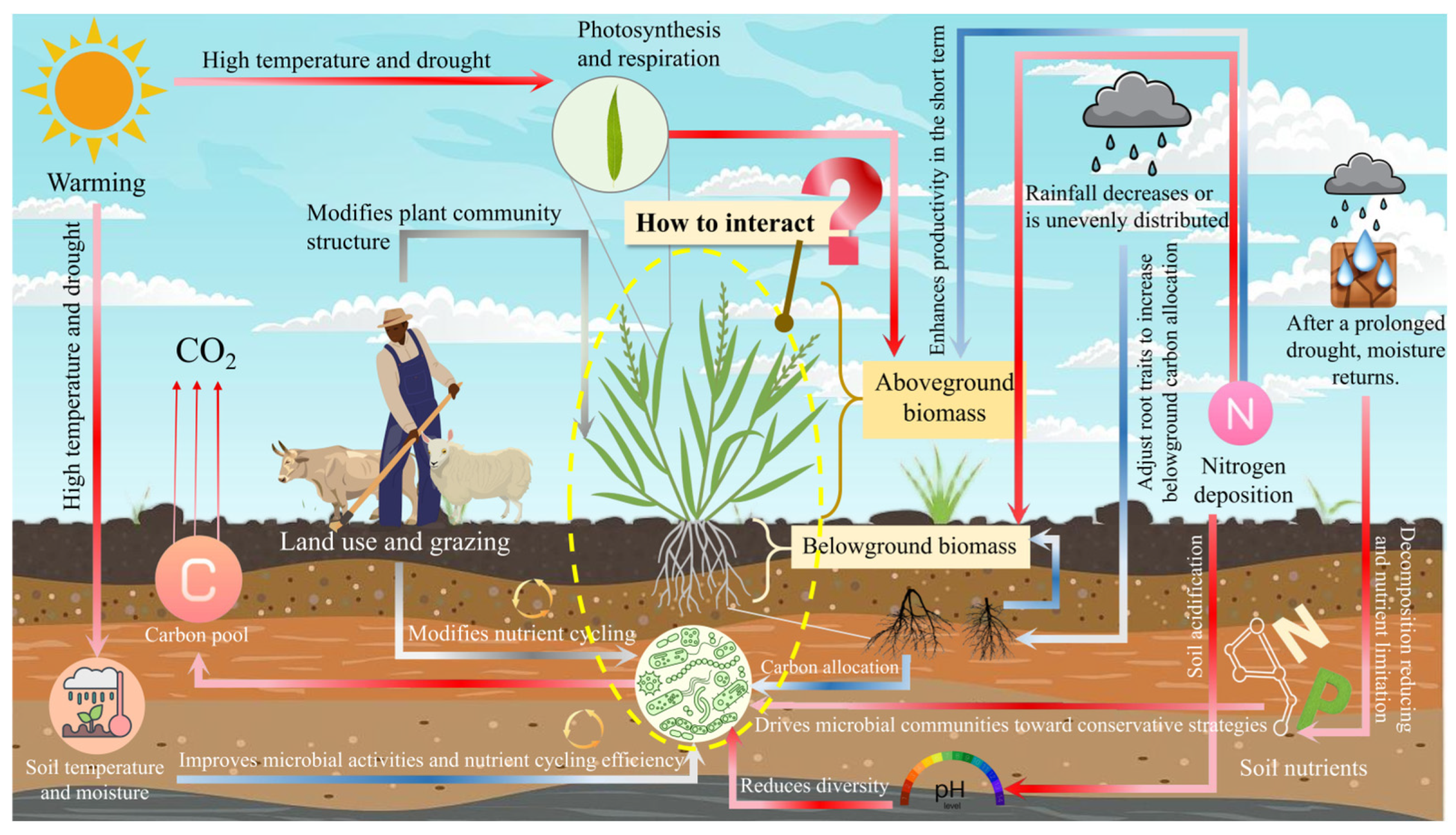
Disclaimer/Publisher’s Note: The statements, opinions and data contained in all publications are solely those of the individual author(s) and contributor(s) and not of MDPI and/or the editor(s). MDPI and/or the editor(s) disclaim responsibility for any injury to people or property resulting from any ideas, methods, instructions or products referred to in the content. |
© 2025 by the authors. Licensee MDPI, Basel, Switzerland. This article is an open access article distributed under the terms and conditions of the Creative Commons Attribution (CC BY) license (https://creativecommons.org/licenses/by/4.0/).