Abstract
Mining activities have led to contamination of natural resources by heavy metals (HMs). Biomagnification studies of HMs within food webs are necessary for understanding the progressive increase in metal burdens across trophic levels and their potential ecotoxicological consequences. This study examined the trophic transfer of Cd, Cu, Pb, and Zn in a tri-trophic model involving maize plants (Zea mays), their herbivore, the grasshopper Sphenarium purpurascens, and their predator, the spider Neoscona oaxacensis, under controlled conditions. Samples from all individuals were collected in Huautla, Morelos, Mexico, where three tailing deposits are present, containing approximately 780,000 tons of waste rich in HMs. We evaluated the body biomass of the grasshopper and the percentage of maize leaf material consumed with and without HMs. HM bioaccumulation in maize, grasshopper, and spider tissues was analyzed, and the enrichment process, along with gender related effects on HM bioaccumulation in females and males of S. purpurascens, was studied. The results revealed enrichment of Pb, Cd, and Cu in maize leaf tissue, except for Zn. Grasshoppers exhibited biomagnification of the same metals, except for Cd. Metal bioaccumulation resulted in a reduced biomass of female and male grasshoppers, accompanied by an increased leaf consumption compared to grasshoppers fed maize leaves without HMs. The HMs’ bioaccumulation levels differed between genders, with males recording significantly higher concentrations of Zn and Pb. The excretion of HMs in feces and their bioaccumulation in exoskeletons are two efficient metal detoxification strategies in grasshoppers. This study revealed biomagnification in the spider N. oaxacensis, confirming metal biomagnification to higher trophic levels and providing critical insight into exposure pathways, risks to wildlife and humans, and how metal pollutants may disrupt ecosystem integrity.
1. Introduction
In Mexico, metal mining is a fundamental contributor to the country’s economic growth [,] and generates the most jobs for the Mexican population []. However, HMs and metalloids derived from mining are among the leading causes of pollution in Mexico and worldwide []. In Huautla, Morelos, Mexico, mining activities were developed from the sixteenth century to 1988 for the extraction of silver (Ag), lead (Pb), and zinc (Zn) [,]. Resulting in approximately 780,000 tons of waste, which are accumulated in the area, forming mine tailings that contain high concentrations of Pb, cadmium (Cd), arsenic (As), Zn, copper (Cu), iron (Fe), and chromium (Cr) that are bioavailable []. These materials were deposited in the open air without any remediation []. However, plant species with the ability to bioaccumulate and translocate HMs to their aerial parts have naturally established on these residues, which enables the entry of these elements into food chains [,].
Plants are the base of the food chain; however, when they accumulate metals, they facilitate the initial entry, subsequent transfer, and eventual biomagnification of metals within food chains, a process that endangers ecosystems []. Nonetheless, some organisms may exhibit detoxification strategies to mitigate the effects of metal exposure [,]. It has been documented that detoxification mechanisms, such as increased excretion, metallothionein production, and tissue sequestration, require energy that is not allocated to growth and biomass gain [,]. Furthermore, the degree of elimination of an element might vary significantly between species [,] and even between genders [,]. In particular, the documented differences between genders have been attributed to variations in nutritional requirements [] and differences in absorption and excretion among males and females [].
Within environmental research, the trophic transfer of HMs through food chains/webs is increasingly recognized as a significant ecological and health concern [,]. However, the mechanisms driving HMs transfer and biomagnification in terrestrial food webs remain poorly understood [,]. Existing studies, in most cases, involve two trophic levels [], which simplifies the complexity that arises when consumers with different feeding strategies, metabolic rates, and assimilation efficiencies are involved []. This leaves a gap in our understanding of the metal trophic transfer, which can lead to underestimations or misinterpretations of its true magnitude. Therefore, tri-trophic approaches may represent a more realistic scenario for understanding the complexity of HMs’ trophic transfer and ecological risk [].
A tri-trophic chain in Mexican agroecosystems consists of Zea mays (pepitilla race), the maize grasshopper (Sphenarium purpurascens), and the spider Neoscona oaxacensis. These three taxa are associated with the Huautla tailings (personal observation). The Pepitilla race is a maize variety in Mexico []. Due to its extensive cultivation in the study zone and well-documented capacity to uptake, accumulate, and translocate HMs [], this maize is an ideal primary producer for evaluating the trophic transfer of these elements. Sphenarium purpurascens is a representative orthopteran in Mexico because it is the most abundant species [] and a univoltine, paurometabolous grasshopper that displays sexual dimorphism. The life cycle of S. purpurascens lasts approximately 252 days and includes three developmental stages: egg, nymph (five nymphal instars), and adult []. Moreover, it is the dominant herbivore in maize fields and is considered a model species due to its high capacity for long-term maintenance in the laboratory []. Meanwhile, N. oaxacensis is an abundant generalist predator that preys on grasshoppers (personal observation), occupies a higher trophic level, and has the potential to concentrate contaminants []. Together, these species form a valuable biological model for analyzing metal transfer and biomagnification processes.
The objective of this study was to evaluate the bioaccumulation and biomagnification of HMs in the food chain: maize-grasshopper-spider under controlled conditions. The following hypotheses were addressed: (1) if bioavailable HMs exist in the areas surrounding the Huautla tailings, then maize plants in close agricultural sites are expected to bioaccumulate metals in their leaf tissues; (2) grasshoppers fed with contaminated maize will have lower biomass than those that consumed maize without metals; (3) considering gender-related differences, female and male S. purpurascens exhibit differences in their bioaccumulation capacity; and (4) the secondary consumer N. oaxacensis will register a biomagnification process of HMs through the trophic chain. The study of a tri-trophic model, such as the one addressed in this work, enables analysis of metal transfer and biomagnification in a more realistic ecological context. Additionally, it offers insights into the mechanisms that have favored the adaptations and survival strategies that species exposed to HMs can develop. Finally, this work contributes to a more integrated understanding of the effects of metal transfer and biomagnification in natural ecosystems.
2. Materials and Methods
2.1. Study Area
The control site is in Quilamula, Tlaquiltenango, Morelos, Mexico, at an altitude of 1005 m (18°27′ N, 98°58′ W). The control site was chosen because there are no records of any possible contamination by mining activity in or near this site. Also, Quilamula has ecological, climatic, and geographic conditions similar to those of the exposed sites. It is located within the Sierra de Huautla Biosphere Reserve (REBIOSH, for its Spanish acronym) []. Moreover, the agricultural activity and management of maize crops (hydric management, seed origin) are similar to those at the exposed site and wind direction (southwest), which avoids metal deposition from mine tailings in the Huautla area []. The chemical composition is described in Table 1, and the distance between the control and exposed sites is 6.3 km.
Table 1.
Chemical composition of the soil of Quilamula and mine tailing of Huautla, Morelos [,].
The exposed site, situated in Huautla, Morelos, is part of the REBIOSH. Mining activities were conducted to extract Ag, Pb, and Zn []. The mines were abandoned before the reserve decree, leaving three tailings that are weathered and untreated []. The mine tailing (18°26′36.37″ N–99°01′26.71″ W) has approximately 780,000 tons of mining wastes, with significant concentrations of toxic metalloids (As) and heavy metals (Cd, Cr, Cu, Fe, Pb, Mn, and Zn), Pb (1017.5 mg·kg−1) and Cd (19.0 mg·kg−1) exceed the maximum permissible limits for soils according to the US Environmental Protection Agency (EPA), which represent a risk to the environmental and public health. The bioavailable concentrations of Cd and Pb in the mine tailings were 8.365 mg·kg−1 and 6.972 mg·kg−1, respectively. The tailing where the present study was conducted is 500 m from the town of Huautla and has particles ≤ 50 µm; the chemical composition is described in Table 1.
2.2. Study Model
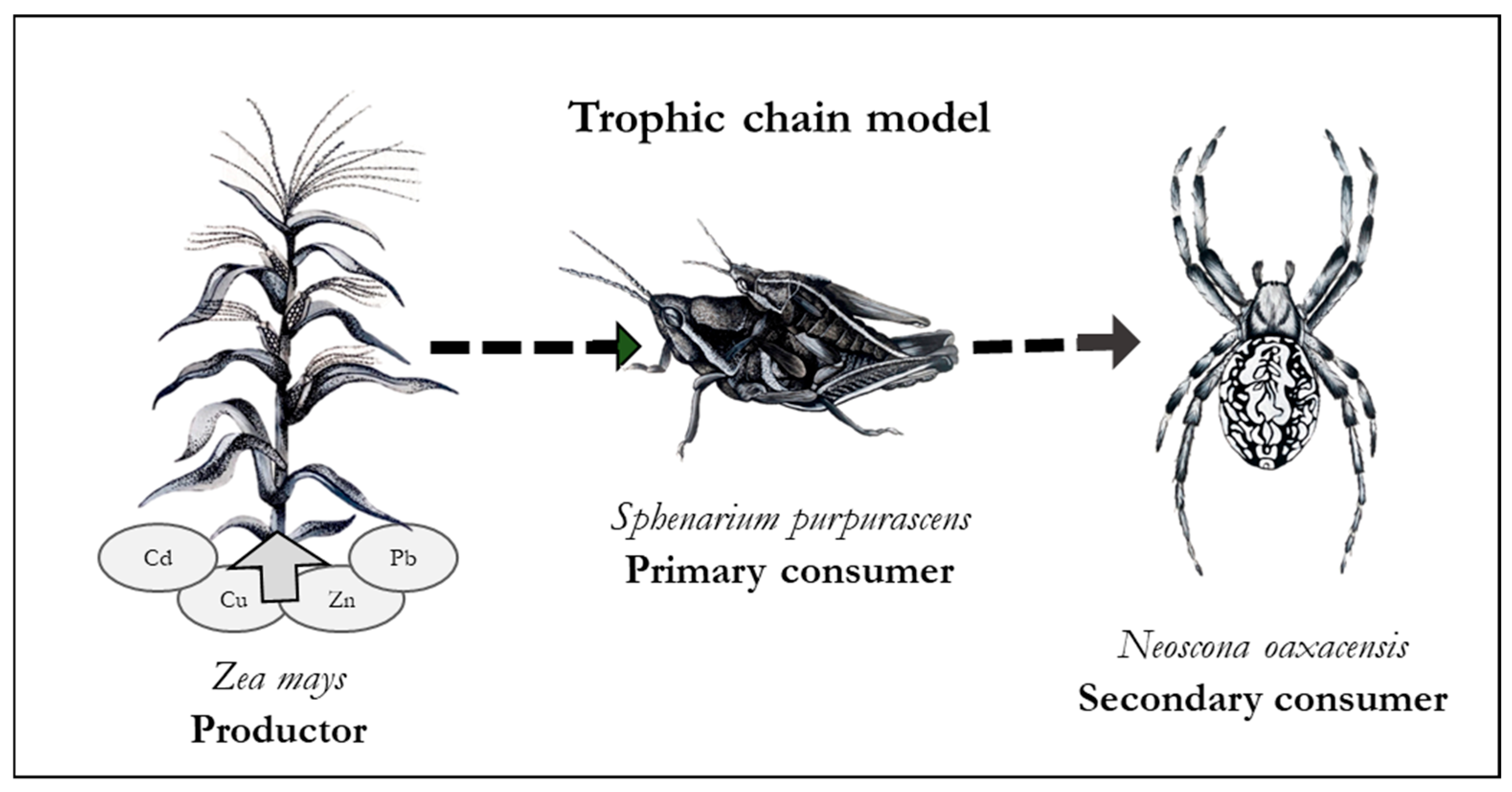
The tri-trophic chain model for this research consisted of maize (Zea mays L.) (pepitilla race) as the primary producer. The primary consumer was the maize grasshopper, Sphenarium purpurascens Charpentier, and the secondary consumer was the garden spider Neoscona oaxacensis Keyserling (Figure 1).
Figure 1.
Tri-trophic food chain model. The dotted line indicates the transfer of heavy metals through the food chain.
The maize harvest was from May to October at the control site (without HMs) and on the periphery of the Huautla mine tailings (exposed). Agricultural activity and management of maize crops [hydric management, seed origin (variety pepitilla race)] are similar between them. All the plots were chosen based on these inclusion criteria: (1) identical maize harvest date, (2) identical type and application of pesticides, and (3) same seed source. The seeds were sterilized with 2.5% NaOCl and washed with distilled water; subsequently, they were placed in deionized water for 24 h. Once the seeds had germinated, they were placed in trays with peat moss substrate for 20 days. Subsequently, the seedlings are transplanted into the plots (with and without HMs). In total, 60 plants (30 per treatment) ensure that enough intermediate-aged leaves are obtained for HMs bioaccumulation analyses and to feed the grasshoppers throughout the experiment. This study design aligns with a previous two-year study, which documented that, after 2 months of exposure (at 80 days old), Z. mays individuals no longer show a significant increase in HM bioaccumulation in leaves [], and the plants are fully developed (physiologically mature) and have reached their maximum growth. After a 60-day exposure period, middle-aged leaves were collected from both sites. Leaves were taken to the laboratory and stored at 4 °C in a refrigerator for use in feeding experiments.
Grasshopper individuals of S. purpurascens were collected on maize cultivars using beating nets (control and exposed treatments), between 10:00 and 13:00 h during July. Subsequently, the nymphal and adult stages of S. purpurascens were differentiated by head dimensions []. Only adult individuals from both treatments were selected for the fed experiment and placed in plastic containers (20 × 20 cm) with mesh lids. The stage of development was determined based on the dimensions of their heads []. Individuals were maintained under laboratory conditions (fed maize leaves and water ad libitum). In total, 291 grasshoppers were collected (control: n = 150 [60% females and 40% males]; exposed: n = 141 [55% females and 45% males]). Gender was determined according to the shape of the subgenital plate and the valves, as described by Castellanos-Vargas []. Gender and body mass were recorded.
Spiders from the exposed site to HMs were collected in July using the direct search method from 10:00 to 13:00 h. The spiders were transported to the laboratory in plastic containers (10 × 10 cm) with mesh lids. The species was corroborated with the taxonomic key of Levi [].
2.3. Experimental Design
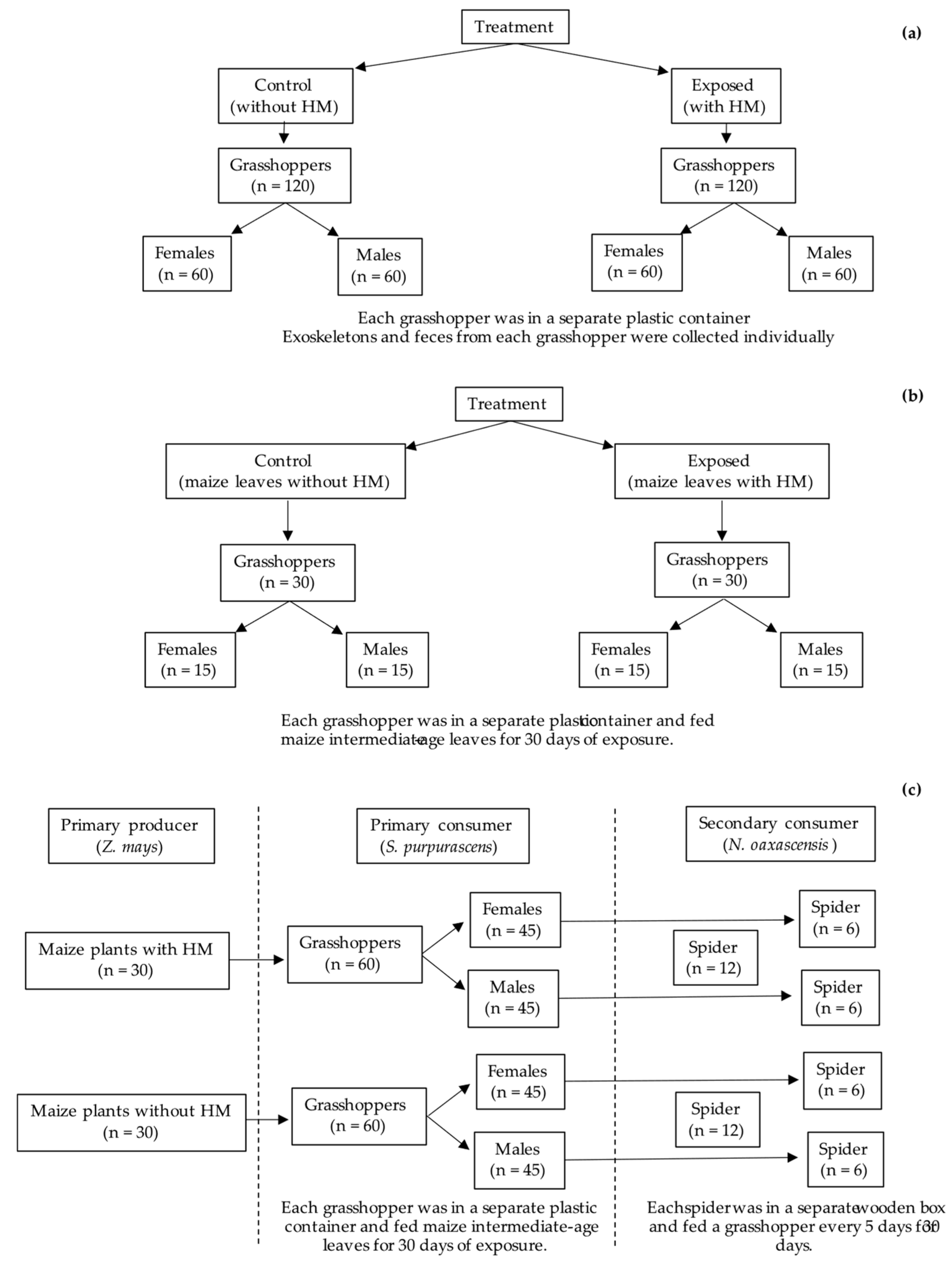
The grasshoppers were divided into two groups, each consisting of 120 individuals. Group one consisted of 60 males (♂) and 60 females (♀) collected from the control site, while group two included an equal number of males and females from the exposed site. For gender, individuals with the same body biomass (mg) (♂: 0.395 ± 0.086; ♀: 0.560 ± 0.076) were selected and placed individually in plastic containers (10 × 10 cm) with mesh lids. They were kept at 25 °C. Exoskeletons and feces from each grasshopper from the exposed treatments were collected individually for subsequent analysis (Figure 2a). All procedures were performed in accordance with the permissions for animal sampling granted by the REBIOSH under Mexican regulation SGPA/DGVS/01894/16. This permit ensures that the activity is legal, controlled, and does not compromise the viability of natural populations.
Figure 2.
Experimental design for the evaluation of bioaccumulation, gender-specific differences, and biomagnification of heavy metals through a tri-trophic chain. (a) Grasshoppers collected from the control and the exposed site. (b) Body biomass of grasshopper and percentage of maize leaf material consumed with and without heavy metals. (c) Evaluation of metal transport through the food web: corn (primary producer)—grasshopper (primary consumer)—spider (secondary consumer).
2.3.1. Body Biomass of Grasshopper Sphenarium purpurascens and Percentage of Maize Leaf Material Consumed with and Without Heavy Metals
A subgroup of grasshoppers was divided into two batches of 30 individuals. Batch one consisted of 15 males (♂) and 15 females (♀) collected from the control site, while batch two included an equal number of males and females from the exposed site. The grasshoppers were fed with intermediate-age leaves for 30 days of exposure (with and without HM). The size of the leaf tissue offered was 16 cm2 in area. Every day, an absorbent cotton pad with purified water was placed for all the grasshoppers. The percentage of leaf material consumed by the grasshoppers on control and exposed leaves was measured using a millimeter acetate sheet. The body mass of control and HMs-exposed grasshoppers was monitored over a 30-day period using an analytical balance (Figure 2b).
2.3.2. Maize with Metals (Primary Producer)—Grasshopper (Primary Consumer)—Spider (Secondary Consumer)
Another subgroup of grasshoppers was divided into two batches of 45 individuals from the exposed site. Batch one consisted of 45 males (♂), while batch two included 45 females (♀), and they were placed individually in plastic containers (10 × 10 cm) with mesh lids, and they were kept at 25 °C. The grasshoppers were fed with intermediate-age leaves for 30 days of exposure to HMs. Every day, an absorbent cotton pad with purified water was placed for all the grasshoppers. These groups of grasshoppers were used to feed the N. oaxacensis spiders.
Twelve spiders from the exposed site were individually placed in wooden boxes lined with mesh (45 cm long, 30 cm wide, and 25 cm high), and body mass was recorded. The spiders were divided into two batches (six spiders per batch) according to the type of food they received. Spider batch one was fed female grasshoppers, and spider batch two was fed male grasshoppers. Each spider fed on a grasshopper every five days for 30 days. The grasshoppers were randomly selected from each batch. Additionally, a daily supply of purified water was offered to both control and HM-exposed spiders using an absorbent cotton pad placed inside each container (Figure 2c).
2.4. Heavy Metal Concentrations in Maize, Grasshoppers, and Spider Tissues
To evaluate HM concentration in organism tissues that compose food webs, the leaves of Z. mays, the soft body tissues, exoskeleton, and feces of S. purpurascens, and the body of N. oaxacensis (only exposed treatment) were placed in a separate brown paper bag, then were dried in an oven at 50 °C for 24 h to achieve a stable weight. Afterward, tissue from each sample was measured, and 10 mL of nitric acid (HNO3) was added for acid digestion using a Microwave Accelerated Reaction System (CEM® MARS-5), following the EPA-3051 protocol. Upon completion of the digestion process, the resulting solution was diluted with 50 mL of distilled water and filtered. A control sample, prepared without any tissue, was processed simultaneously. The metal concentrations (Cu, Pb, Cd, Zn) were measured using an ICP-OES plasma spectroscopy system (Perkin Elmer Optima 8300, Shelton, CT, USA), reporting the average value, with detection limits of 0.0004, 0.001, 0.001, and 0.0002 mg L−1, respectively. The multi-element standard used to calibrate the ICP-OES equipment and obtain the element reading was from PerkinElmer. Each sample was analyzed in triplicate.
2.5. Bioconcentration Factor (BCF) and Biomagnification Factor (BMF)
The phytoextraction capacity of Z. mays was estimated using the bioconcentration factor (BCF), which measures the efficiency of the plant to accumulate metals from the substrate into its tissues [], and this index was calculated as follows:
where Cleaf is the metal concentration in leaf tissue, and Ctailing/soil is the bioavailable metal concentration in mine tailings or soil.
The biomagnification of HMs in food chains/webs is estimated using biomagnification factors (BMFs). BMF represents the ratio of an HM’s concentration within an organism compared to that in its diet, determined using the following equation []:
where Corganism predator is the metal concentration in the organism’s tissue, and Corganism’s diet or prey is the metal concentration in the organism’s diet or prey.
2.6. Statistical Analysis
Data normality was evaluated using the Shapiro-Wilk test. When the data did not follow a normal distribution, they were transformed using log10 []. The average concentrations of each metal in female (30 samples/15 per treatment) and male (30 samples/15 per treatment) S. purpurascens grasshoppers were compared using the Student’s t-test. One-way ANOVAs were conducted to determine the effect of the trophic level (producer primary (60 samples/30 per treatment)- primary consumer (60 samples/30 per treatment/15 per gender)- secondary consumer (12 sampled/6 per treatment) on the mean concentration of each metal. When significant differences were found, post hoc comparisons were performed using the Tukey test. The effects of exposure time on grasshopper biomass in control and exposed treatments, as well as between males and females, were evaluated using linear regression. The effect of exposure time on the percentage of food consumed for each treatment was examined using linear regression. A one-way ANOVA was performed to evaluate the effects of HMs on the body (30 samples), exoskeleton (30 samples), and feces (30 samples) of the grasshopper for each metal. When differences were observed, a Tukey post hoc test was used to identify significant differences between structures. Statistical analyses were performed using STATISTICA software version 8.0 [].
3. Results
3.1. Biomass, Bioccumulation, Gender-Specific Differences, and Biomagnification of Heavy Metals Through a Tri-Trophic Chain

The biomass of female and male grasshoppers in the control treatment remained constant over time (females r = −0.39, p > 0.05; males r = 0.06, p > 0.05), while grasshoppers exposed to HMs through the consumption of contaminated maize showed a decrease in biomass (females r = −0.91, p < 0.0001; males r = −0.68, p < 0.05). Leaf damage by consumption of grasshoppers in the control treatment remained constant (r = −0.06, p > 0.05), in contrast, consumption of grasshoppers in treatment exposed to HMs increased (r = 0.62, p < 0.01).
In treatment with HMs, results showed that HMs bioaccumulation differed significantly between males and females for Pb and Zn, with higher concentrations in males. In contrast, bioaccumulation of Cd and Cu showed no significant differences between genders (Table 2). In the treatment without HM, bioaccumulation of Cu and Zn differed significantly between males and females, with higher Cu concentrations in females and lower Zn concentrations in males. Pb and Cd were not detected.
Table 2.
Average values (±standard deviation) of heavy metal concentrations (mg∙kg−1) in the bodies of female and male grasshoppers. In all cases, the degrees of freedom were 28. ** = p < 0.01, *** = p < 0.001, n.s. = not significant difference.
The results indicate that Z. mays (producer) leaves grown in substrate contaminated with HMs (tailings) accumulated Cd, Cu, Pb, and Zn. Of these, lead and zinc had the highest concentrations in leaf tissue (Table 3). In addition, a significant increase in metal concentration was observed throughout the subsequent trophic levels (primary and secondary consumers), with spiders accumulating the highest concentrations of metals in their tissues (Table 3). The only exception was Cd, which showed the highest concentration in maize and spiders. Grasshoppers had the lowest concentrations of this element (Table 3).
Table 3.
Average values (±standard deviation) of heavy metal concentration (mg∙kg−1) in the tritrophic model (producer, primary consumer, secondary consumer). Different letters indicate significant differences between trophic levels (Tukey test, p < 0.05). ** = p < 0.01, *** = p < 0.001.
In the treatment without HM, Pb and Cd were not detected in the tri-trophic chain studied. A significant increase in Cu and Zn concentrations was observed throughout the subsequent trophic levels, with spiders accumulating the highest concentrations of Cu in their tissues. In contrast, Zn concentration did not differ significantly between primary and secondary consumers (Table 3).
3.2. Heavy Metal Concentrations in Maize, Grasshoppers, and Spiders’ Tissues
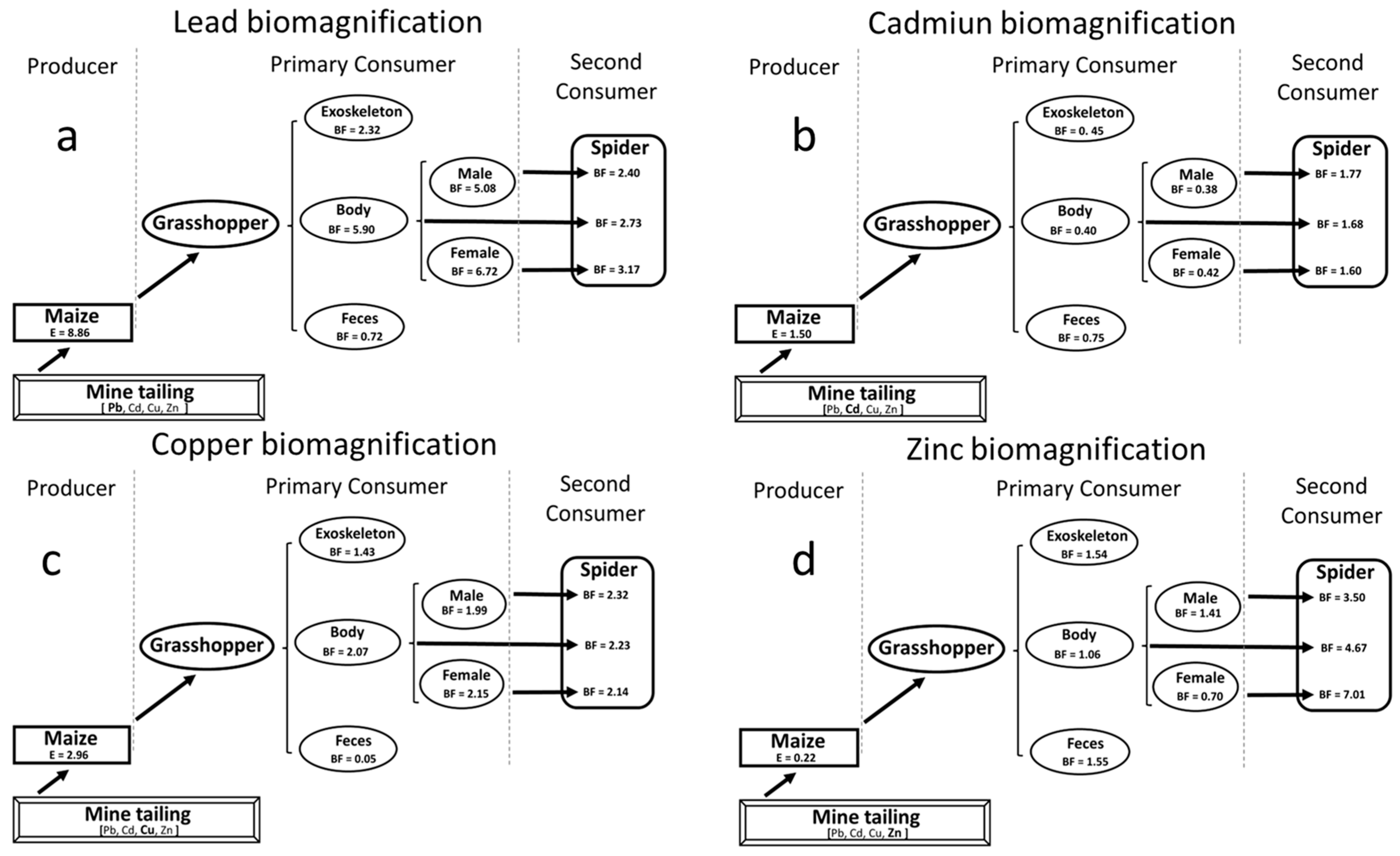
In our study model, the analyzed metals showed enrichment (E) in maize leaves compared to the tailing substrate, except for zinc. The pattern of enrichment detected was Pb > Cu > Cd, with evidence of biomagnification along the food chain (Table 3; Figure 3).
Figure 3.
Enrichment process (E) of tailing-maize and biomagnification patterns (BF) for (a) lead, (b) cadmium, (c) copper, and (d) zinc in the food chain model through each trophic level for both genders of the primary consumer (Sphenarium purpurascens) and secondary consumer (Neoscana oaxascences). The enrichment of the grasshopper is also shown, subdivided into its body, soft parts, exoskeleton, and feces. In the spider, enrichment is presented for the entire body. The solid lines represent the direct relationship of the biomagnification process through each trophic level.
Grasshopper bodies contained 5.90 times more Pb than maize, with females accumulating more Pb than males (Table 2; Figure 3a). The exoskeleton contained 2.32 times the Pb concentration found in maize, while feces showed a 0.72-fold increase. These differences in Pb concentration between grasshopper compartments were statistically significant (Table 4). Therefore, Pb levels followed the next pattern: body > exoskeleton > feces. Spiders exhibited the highest biomagnification, with Pb concentrations 2.73 times greater than those in their grasshopper prey (Table 3). Spiders fed female grasshoppers accumulated more Pb compared to spiders fed male grasshoppers (Figure 3a).
Table 4.
Average values (±standard error) of heavy metal concentration (mg∙kg−1) in the body, exoskeleton, and feces of grasshoppers exposed to contaminated maize foliage. Different letters indicate significant differences between body, exoskeleton, and feces (Tukey test, p < 0.05). *** = p < 0.001.
Grasshopper bodies contained 60.2% less Cd than maize, with females and males showing similar concentrations (Table 2; Figure 3b). This element was reduced by 24.7% in the feces, with levels significantly higher than those in the exoskeleton and body, indicating a pattern of feces > exoskeleton = body (Table 4). Spiders showed further biomagnification, with Cd concentrations 1.68 times higher than those in their prey; however, these concentrations were not significantly different from those in maize leaves (Table 3). Spiders fed male grasshoppers accumulated more Cd compared to spiders fed female grasshoppers (Figure 3b). In treatment without HMs, Cd and Pb were not detected. In contrast, HM concentrations differed significantly among structures (body, exoskeleton, and feces), with the lowest values in feces (Table 4).
Copper concentrations in grasshopper bodies were 2.07 times greater than in maize, with females and males exhibiting similar values (Table 2, Figure 3c). The exoskeleton contained 1.43 times the Cu concentration found in maize, while feces showed a 0.05-fold increase. These differences in Cu concentration between grasshopper compartments were statistically significant, following the next pattern: body > exoskeleton > feces (Table 4). Spiders contained 2.23 times more Cu concentration than their prey, and males showed higher accumulation of this metal than females (Figure 3c).
Finally, grasshopper bodies had 1.06 times more Zn than maize, with males accumulating twice as much Zn as females (Table 2, Figure 3d). Feces and exoskeleton did not differ significantly from each other, but both were higher than those detected in the body (Table 4). Spiders exhibited biomagnification, with Zn concentrations 4.67 times higher than those in their prey. Female spiders had higher Zn levels than males (Figure 3d).
4. Discussion
4.1. Body Biomass of the Grasshopper Sphenarium purpurascens and Percentage of Maize Leaf Material Consumed with and Without Heavy Metals
Grasshoppers are polyphagous insects capable of selecting from a wide range of food sources to maintain an internal balance of carbohydrates and proteins []. In this study, chronic exposure to maize contaminated with HMs led grasshoppers to increase their leaf consumption, likely as a compensatory response to reduced nutritional quality [,]. Similar results were reported by Esteves-Aguilar et al. [], who documented a higher consumption rate of Wigandia urens (Hydrophyllaceae) leaves contaminated with HMs in S. purpurascens individuals at the experimental level. Several studies have reported that HMs interact with essential micronutrients, affecting their uptake and transport by plants [,,].
In consequence, alterations in the nutritional composition of plants exposed to metals have been documented []. Metals decrease the content of carbohydrates [], proteins [], fatty acids [], and vitamins [,] in exposed plants. For example, the concentration of potassium decreased in both the root and shoot of pea (Pisum sativum) exposed to Cd and manganese, which is a significant nutrient for plants. The authors documented that potassium levels decreased concurrently with increasing Cd concentration [].
These results suggest that nutrient deficiency may explain the feeding behavior of S. purpurascens when fed maize leaf tissue contaminated with HMs. In addition, we found that individuals fed with maize leaf tissue contaminated with HMs exhibited increased consumption, but their biomass decreased. Comparable findings have been reported in various studies. Esteves-Aguilar et al. [] observed similar patterns in S. purpurascens fed with W. urens leaf tissue containing Pb, Cu, Zn, and Fe. Likewise, Rathinasabapathi et al. [] found that Schistocerca americana (Acrididae) locusts consuming Pteris vittata fern leaves with As exhibited comparable effects. Additionally, Ali et al. [] noted that Spodoptera litura larvae exposed to Pb experienced the most significant reductions in both weight and length. These results suggest that exposure to HMs promotes detoxification mechanisms in organisms, enabling them to maintain essential physiological functions at an increased energetic cost, which in turn compromises their growth, development, and adaptability [,]. Furthermore, excessive HM levels can disrupt key physiological processes. For instance, elevated Zn concentrations have been shown to damage midgut structures in Rhynchophorus ferrugineus (Coleoptera), thereby hindering digestion and nutrient absorption []. A decline in the nutritional quality of contaminated plants [] may also contribute to reduced biomass in exposed individuals compared to those fed with uncontaminated controls. Feed conversion efficiency, which measures how effectively ingested food is converted into body mass, has been linked to the nutritional quality of feed []. Supporting this, Miura and Ohsaki [] demonstrated that Parapodisma subastris (Acrididae) grasshoppers achieved higher biomass conversion when fed on plant species with superior nutritional profiles.
4.2. Heavy Metal Bioaccumulation in Females and Males of Sphenarium purpurascens
We also found that the concentrations of some HMs evaluated differ between genders, whereas others do not. Cadmium and Cu did not show differences in accumulation; in contrast, Pb and Zn showed higher concentrations in males than in females. Similar to our first result, no differences were found in the accumulation of Cd between genders in the herbivore Aiolopus thalassinus (Acrididae) exposed to contaminated food [] and in the accumulation of Cu in the oligophagous leaf-chewing grasshopper Locusta migratoria (Acrididae) feeding on Z. mays [], under laboratory conditions. This finding suggests that both genders of the same species are equally capable of accumulating HMs [,]. However, differences in Pb and Zn accumulation between genders may be related to differences in nutritional requirements [] and to physiological homeostatic mechanisms that regulate the balance between metal absorption and excretion in males and females []. It has been documented that females of certain insects can excrete more metals through their feces [] or during molting [] compared to males. They also contain a large egg mass with low metal concentrations, which may contribute to reduced total metal concentrations in females []. Differences in accumulation between genders in essential elements, such as Zn, could be associated with metabolic issues involved in sexual hormone activity, metal intake or uptake, nutritional requirements, or interactions between elements []. In this sense, the higher concentration of Zn in males can be explained by considering that it is necessary for DNA replication, maturation, capacitation, motility, and acrosome reaction of sperm [], as well as for the packaging of sperm DNA with protamine through the formation of protamine-Zn bridges -Zn bridges [].
Sphenarium purpurascens employs distinct detoxification strategies for metal bioaccumulation. The accumulation of Pb and Cu followed the pattern: body > exoskeleton > feces. A similar pattern has been reported in other invertebrates, where a significant fraction of ingested metals is accumulated in their tissues [], including in the hepatopancreas, an organ of the invertebrate digestive system [], or sequestered in intracellular detoxification pools, such as metallothioneins, lysosomal granules, or the fat body, rather than being rapidly passed to exuviae or feces [,]. For example, a study using the dragonfly Gomphus flavipes showed that the Cu content was significantly lower in exuviae than in larvae and adults. In contrast, Pb exhibited spatial variability; however, in some sites, the exuviae had the lowest Pb levels, a pattern attributed to its high assimilation efficiency and tissue-level binding [].
On the other hand, Cd showed the following distribution: feces > exoskeleton = body. It has been reported that some invertebrates excrete metals through their feces, thereby limiting metal uptake []. In this regard, Ding et al. [] conducted an experimental study using Spodoptera litura (Lepidoptera) and Cd-enriched amaranth leaves. They found significantly higher concentrations of Cd in feces than in larval bodies, suggesting that defecation plays a crucial role in eliminating ingested Cd, a key detoxification mechanism.
In the case of Zn, this element accumulated mainly in the exoskeleton and feces of S. purpurascens. This distribution suggests that the grasshopper can excrete Zn in proportions similar to those ingested, thereby maintaining relatively constant levels of this metal in its body. Similar results have been documented in diplopods such as Leptoiulus belgicus (Julidae) and Glomeris marginata (Glomeridae), which, in environments with high Zn concentrations, have similar levels of this metal in their bodies and feces []. Several studies have pointed out that the exoskeleton actively participates in the excretion of HMs [,,], which is consistent with the findings of this study, where Pb, Cu, Cd, and Zn are accumulated in the exoskeleton. Similarly, it has been reported that in the crayfish Orconectes limosus (Cambaridae), in which the concentrations of Pb, Cu, and Ni are accumulated in the exoskeleton [], and that Cu in the grasshopper Chorthippus brunneus (Acrididae) is excreted during the final molt []. This storage mechanism minimizes HM bioavailability, thereby reducing their toxicity to the insect. Retention, combined with chronic exposure, may lead to bioaccumulation in the insect, resulting in a higher concentration of the xenobiotic than what it consumes. Some insects can accumulate significant amounts of HMs, making them important dietary sources of metals for their predators in the food chain.
Our results highlight the key role of insects as primary consumers in transferring HMs to higher trophic levels, contributing to the limited literature on the accumulation or excretion of heavy metals in different insect species.
4.3. Heavy Metal Concentrations in Maize, Grasshoppers, and Spiders’ Tissues
This study identified the accumulation of four metals (Pb, Cu, Cd, and Zn) in maize leaf tissue, with enrichment levels detected only for the first three. Since the soil type was clay loam throughout our study, it did not contribute to metal bioaccumulation. Lead showed the highest enrichment value in maize leaf tissue, followed by copper and cadmium. These findings are consistent with previous studies, which indicate that lead is among the most highly accumulated elements in maize [,]. Also, the literature suggests that elevated concentrations of bioavailable Pb in the soil lead to its increased bioaccumulation in this species []. We suggest that this occurs in Huautla tailings because it has been documented that they contain bioavailable HMs, with Pb being the most bioavailable element []. In fact, other plant species that naturally grow at the site, such as Vachellia farnesiana [,], Crotalaria pumila [], and Prosopis laevigata [], have been reported to bioaccumulate and translocate this element. Similarly, Cu and Cd have been reported as bioavailable elements, although present in lower concentrations in the tailings from Huautla. This may account for their observed enrichment in maize leaf tissue. The case of Zn is particularly noteworthy; despite being identified as the second most bioavailable metal in these tailings [], it did not exhibit enrichment in this study. This result may be attributed to the interaction between Cu and Zn, which is often competitive, with Cu reducing the absorption of Zn and Fe in plants, favoring its competitiveness []. For example, exposure of Convolvulus arvensis (Convolvulaceae) to high Cu content reduces Zn accumulation in its leaf tissues []. Additionally, other studies have documented a significant decrease in Fe, Zn, and P absorption by maize grown in soils contaminated with copper [].
In addition, our results showed evidence of a subsequent increase in HM concentrations through the food chain model (producer: maize < primary consumer: grasshopper < secondary consumer: spider), in line with our hypothesis. However, it was observed that there were differences among metals and in storage compartments. Lead showed the most consistent pattern of enrichment and transfer, with significantly higher concentrations in grasshopper bodies compared to the exoskeleton and feces, and further biomagnification in spiders. This can be explained by considering that Pb is among the most highly accumulated elements in maize [,] and the fact that it is the metal with the highest bioavailability in the tailings of Huautla []. Additionally, Pb is considered a persistent and poorly excreted metal, favoring internal retention over elimination [], as previously discussed. Also, the higher Pb accumulation observed in females compared to males of both taxa (grasshopper and spider) may be explained by sex-specific physiological differences in metal uptake or detoxification []. Spiders are considered metal macroconcentrators, and their detoxification mechanisms are based mainly on the storage of HMs, while in insects, active detoxification processes predominate []. In spiders, metals are primarily deposited in the digestive cells of the midgut glands in three types of metal-rich mineral granules (A, B, and C; []) that act as reservoirs for metals. Metals contained in these mineral particles may move into the intestinal cavity and are eventually excreted with the feces following each meal []. Their defense mechanisms against HM are primarily based on antioxidant enzymes, which differ between males and females.
Cadmium exhibited enrichment in the tissues of maize, but it showed a weak trophic transfer. In grasshoppers, the accumulation of this metal was reduced with feces serving as the primary reservoir of Cd, suggesting that excretion, rather than storage in tissues, constitutes the dominant detoxification pathway in these insects [,]. Similar results have been documented in other studies using several monophagous and one phytophagous insect species [] and the Coleopteran Tenebrio molitor (Tenebrionidae) []. This relatively low internal retention is consistent with the fact that Cd is also a non-essential element, and organisms often invest in mechanisms to limit internal burden []. Despite subsequent biomagnification in spiders, Cd levels in these predators were not significantly higher than those in primary producers, suggesting a more limited transfer through the food chain. This weak trophic transfer may indicate limited assimilation of Cd from prey or efficient excretory or compartmentalization strategies. Monteiro et al. [] evaluated the subcellular partitioning of Cd in different plant tissues and its effect on trophic bioavailability to the terrestrial isopod Porcellio dilatatus (Porcellionidae). They found that Cd associated with cell walls or vacuolar compartments (inert fractions) was less available for assimilation by the consumer than Cd present in cytosolic fractions, resulting in lower assimilation efficiencies and reduced trophic transfer. Additionally, some invertebrate predators have evolved physiological mechanisms that enable them to avoid accumulating Cd from their prey []. For example, Merrington et al. [] and Green et al. [] showed that two aphid predators, lacewings (Mallada signata) and ladybird beetles (Coccinella septempunctata), do not biomagnify Cd from their aphid prey. Findings from these studies suggest that mechanisms such as subcellular sequestration and excretion play crucial roles in limiting the transfer of highly toxic Cd within terrestrial food webs.
In the case of Cu, an essential element, it was enriched in the tissues of maize. It bioaccumulated the bodies and exoskeletons of grasshoppers, with clear evidence of biomagnification. However, in this case, Cu showed a homogeneous distribution between genders in grasshoppers. Similar results were reported for Cu in the oligophagous leaf-chewing grasshopper Locusta migratoria (Acrididae) feeding on Z. mays [], under laboratory conditions. This finding suggests that in some species, both genders are equally capable of accumulating HMs []. However, this result contrasts with the male-biased accumulation in spiders, suggesting that this may reflect differences in metabolic demand or detoxification efficiency []. For example, the effects of HMs on various enzyme activities in spiders have been shown to exhibit gender differences []. Wilczek et al. [] found that the concentrations of Cu in the midgut glands of male spiders of the species Agelena labyrinthica (Agelenidae) and Xerolycosa nemoralis (Lycosidae) were more than double those of the females, suggesting a significant negative correlation between antioxidant enzymes like glutathione transferase (GHT) and catalase (CAT), which likely serve as defensive mechanisms in males against high metal content.
Zinc, another essential element, exhibited a distinct pattern; it does not show enrichment in maize plants. However, biomagnification was observed in the following trophic levels with higher concentrations in feces and exoskeleton of grasshoppers compared to body tissues, suggesting that active regulation in the herbivore prevents excessive internal accumulation []. Nonetheless, spiders showed marked Zn biomagnification. A similar pattern of Zn enrichment in spiders relative to other arthropods has been reported in field studies of spiders from contaminated lowland floodplains along the river Rhine []. Their body burdens reached up to ten times higher levels than those of other predators. It has been proposed that spiders may be exposed to higher metal concentrations than expected from the whole-body concentrations of their prey []. Another possible explanation involves physiological differences in metal accumulation and regulation, as spiders tend to exhibit high metal assimilation rates due to the pronounced assimilation efficiency of their midgut diverticula, which is the primary metal storage organ in these arthropods []. In addition, females accumulated more Zn than males, consistent with sex-specific variation in metal accumulation and associated physiological responses, as documented in spiders, where females often exhibit higher concentrations due to differences in metabolic demand or reproductive allocation [].
According to the current literature, there is little evidence of sex associated differences in HM accumulation in grasshoppers. Most studies compare accumulated concentrations between males and females, but only a few address the mechanisms that explain why each sex incorporates and retains these metals differently. In general, these studies focus on determining whether species can serve as environmental bioindicators, rather than on analyzing intraspecific patterns and sex-specific mechanisms of HM accumulation.
In the present study, we found that Cd and Cu accumulate in both S. purpurascens females and males, while Pb and Zn accumulate in higher concentrations in males. Studies have documented sex differences in the accumulation of some metals. For example, ref. [] analyzed the migratory grasshopper Locusta migratoria, which accumulates and eliminates Cu and Cd when feeding on contaminated maize leaves. The authors observed that the grasshoppers efficiently regulate excess Cu, retaining 45% of the ingested Cu and eliminating most of it in their feces. In contrast, they are less efficient with Cd, which accumulates over time in their bodies (21%). Females retained approximately 42% of the ingested Cu and 33% of the Cd. Although no significant differences were found between the sexes in Cu retention, females accumulated more Cd than males.
In the study by Zhang [], the effects of different Cd concentrations (0.2, 0.4, and 0.8 mmol L−1) on the activity of the antioxidant enzymes glutathione peroxidase (GPx), superoxide dismutase (SOD), and catalase (CAT), as well as on the lipid peroxidation marker malondialdehyde (MDA), were observed in different developmental stages of the grasshopper Oxya chinensis. The authors observed that both males and females accumulate Cd and that exposure to the metal resulted in a significant decrease in GPx activity, while SOD and CAT activities increased. Furthermore, MDA levels increased in both sexes, indicating lipid peroxidation. The results suggest that Cd alters the balance of antioxidant enzymes, leading to oxidative damage in these insects.
da Silva et al. [] evaluated catalase (CAT) and glutathione S-transferase (GST) activity in the midgut of the grasshopper Abracris flavolineata, representing both sexes. The results showed significant differences between the sexes, with higher enzyme levels in males than in females. In their discussion, the authors suggest that these findings indicate greater antioxidant capacity in males, possibly due to increased sensitivity to oxidative stress. Furthermore, the rapid response of these biomarkers suggests that males more readily activate their defense mechanisms, protecting them from the negative effects of oxidative stress.
Although not all authors address the mechanisms underlying differences between male and female grasshoppers, various physiological and ecological factors may be involved. Females generally exhibit larger body size (sexual dimorphism) and possess a greater amount of body tissue where metals can be stored []. Furthermore, their higher metabolic demands for reproduction may favor the production of proteins such as metallothionein [,], heat shock proteins (HSPs), and a family of proteins in invertebrates known as cadmium-binding proteins (CBPs) [], which are capable of binding and retaining metals. It is also possible that the energy investment in egg production alters detoxification pathways, promoting the accumulation of metals in reproductive tissues. In contrast, males, being smaller and physiologically oriented towards mobility and reproduction, tend to eliminate metals more efficiently, possibly due to differences in the physiology of the Malpighian tubules, the main excretory organ in insects [] and due to a greater basal activity of enzymes such as CAT and GST [,].
Finally, our results demonstrated the biomagnification of HMs in the spider N. oaxacensis, confirming metal biomagnification to higher trophic levels, a fact that may pose a risk to ecosystem health. Specifically, the risks to ecosystem dynamics increase as the load of pollutants entering the system rises, particularly in cases of HM contamination, due to their capacity for bioaccumulation and long-term persistence, leading to metal transfer in food webs. Hence, HM bioaccumulation and metal transfer should be included when analyzing ecosystem-level effects and must be a prerequisite for adverse effects on ecosystems, since some metal effects may only be recognized in a later phase of life, are multi-generation effects, or manifest only in higher members of a food-web [,,].
4.4. Physiological and Molecular Mechanisms Implicated in Heavy Metals Bioaccumulation and Their Trophic Transference
As shown in Table 2, three of the four heavy metals exhibited biomagnification, with lead having the highest concentrations in the secondary consumer, the spider N. oaxacensis, followed by Zn and Cu. The accumulation of heavy metals has severe adverse impacts on plants, prompting the development of mechanisms that favor their accumulation in structures such as vacuoles, thereby limiting their toxicity in tissues [,]. It has been reported that HMs, such as Pb, Cd, and Zn, among others, enter plants through their roots via transporters for divalent metal cations, including Ca2+ and Mg2+. After entering, the metals can be mobilized from the roots through the xylem via Zn2+ transporters such as ZIP2 and ZNT1, reaching the aerial tissues.
Inside leaf cells, metal ions can be immobilized through the action of different agents with chelating activity, including compounds such as glutathione and proteins like phytochelatins and metallothioneins, which form complexes by binding to metal ions through thiol groups (─SH). Once formed, these complexes are transported to vacuoles via ABC family transporters, where they are stored and reach high concentrations [,]. Due to these mechanisms, the plant protects itself from the toxic effects of metal ions, but its aerial tissues accumulate them, allowing their passage to primary consumers, such as the grasshopper S. purpuracens, which feeds on these tissues.
As observed in this study, Zn did not show enrichment in maize leaves compared to its concentrations in mining waste; however, it was transferred and biomagnified in primary (S. purpurascens) and secondary consumers (N. oaxacensis). Due to its essential role in plant development, Zn concentration in plants is tightly regulated to prevent excessive accumulation. This metallic element is actively involved in various biochemical processes and protein structuring; therefore, Zn is generally not significantly enriched in leaf tissue.
The Zn homeostasis in plants includes physiological processes related to its uptake in roots and transport through xylem, as well as biochemical and molecular mechanisms involved in its sequestration, storage, detoxification, and regulation []. However, when plants grow in contaminated environments or are fertilized with this metal, the Zn concentrations in aerial tissues can increase, mainly within vacuoles, to limit potential toxic effects and allow its transfer to subsequent trophic levels. In maize plants, Zn concentrations of around 40 mg/kg have been reported in leaf tissue []. Hence, the Zn concentrations observed in this study exceed that concentration, favoring its transfer to the next trophic level.
On the other hand, in the presence of combinations of HMs, competition occurs between the metal ions present; Pb and Cu compete with each other, so the bioaccumulation of one inhibits the bioaccumulation of the other []. Meanwhile, between Pb and Zn, competition is limited, so both metals are commonly found at high concentrations in leaf tissue, resulting in combined toxic effects []. In the presence of Cu and Zn, the translocation of Zn to the aerial tissue is favored, while Cu remains in the root system []. Thus, reducing Cu transference and biomagnification to higher trophic levels.
According to Gekière [], the protective mechanisms against metallic toxicity in insects are grouped into four main types: (1) avoidance, (2) barrier, (3) detoxification, and (4) alleviation. The first mechanism, avoidance, involves avoiding exposure to and ingestion of toxic heavy metals. It has been proposed that different insects can detect HMs in their environment and food and avoid them. The second mechanism is based on preventing the entry of contaminants through the action of barriers, such as the cuticle (exoskeleton), a structure rich in proteins, lipids, and chitin, which gives it a hydrophobic character. This prevents metal ions present in the environment from penetrating through the cuticle and reaching the hemolymph. For its part, the entry of heavy metals through ingestion is prevented by the action of the peritrophic membrane barrier in the midgut, which is composed of chitin, proteins, and glycoproteins. HMs can interact with chitin and proteins, thereby reducing the amount of heavy metal that reaches the hemolymph.
The third mechanism involves the elimination of metal ions. Due to their non-biodegradable nature, metallic elements must be sequestered and eliminated from the organism to avoid their toxic effects at the cellular level. In response to the presence of heavy metals, insects activate the metal transcription factor 1, which promotes the expression of metal response genes, mainly those related to the production of metallothioneins. These proteins trap the toxic metal ions. Subsequently, the metallothionein-metallic ion complexes are stored in fat bodies, from where they are later mobilized through the Malpighian tubules for excretion in the feces or are transported to the exoskeleton, where they are eliminated through molting. Finally, the fourth mechanism is based on reducing the toxic effects of heavy metals. Metal ions that are not sequestered or excreted cause damage to insect tissues by generating reactive oxygen species, inhibiting enzymatic processes (due to protein denaturation and aggregation), and damaging DNA and cell membranes, thereby inducing cell death. Therefore, insects activate cellular mechanisms to mitigate these effects, including the production of antioxidant enzymes, such as catalase and superoxide dismutase, which neutralize ROS and attenuate oxidative stress; the production of chaperones to refold denatured proteins; and the activation of DNA repair mechanisms. Ultimately, when cellular damage is irreparable, apoptosis is triggered through the caspase pathway.
According to the results of this study, the protective mechanisms against the toxicity of metallic elements in the grasshopper S. purpuracens may include barriers (like the cuticle and the peritrophic membrane in the midgut), and detoxification through feces and the exoskeleton, mainly for Cd and Zn (higher concentrations were determined in exoskeleton and feces). At the same time, Pb and Cu could be retained inside the fat bodies in the grasshopper body.
Metals sequestered in the fat bodies of insect grasshoppers can be transferred to their predators. Spiders feed on various insects, allowing heavy metals to enter their bodies through ingestion. In general, the mechanisms for reducing the toxicity of heavy metals are similar to those described for insects, based on the production of chelating agents such as metallothioneins, as well as enzymes (catalase, glutathione-S-transferase, and superoxide dismutase) for the elimination of ROS [,]. In Pardosa laura individuals, exposure to Pb reduced growth rate and survival, and increased the activity of the enzymes catalase and superoxide dismutase. Transcriptomic analysis revealed transcriptional changes in processes such as oxidoreductase activity, transmembrane transport, fat digestion and absorption, peptidase and lysosomal activity, and apoptosis, resulting from dietary Pb exposure [].
Specifically, Cd is highly toxic to spiders. Different studies have evaluated the exposure of spider species to this heavy metal, with the help of omics approaches, the mechanisms involved in Cd damage and detoxification have been better understood, in the spider Pirata subpiraticus, the transcriptomic analysis exposed individual evidence of the induction of the enzymatic oxidative stress response, as well as the expression in production of proteins associated with the structure of the cuticle (exoskeleton) and peroxidase activity.
In another study, female Trichonephila clavata individuals exposed to Cd through feed, individuals bioaccumulated Cd in body and silk glands, enzymatic antioxidant response increase as a result of Cd exposure, observing increases in the activity of superoxide dismutase, glutathione peroxidase, peroxidase, and malondialdehyde, the proteomic analysis reveals oxidative imbalance, disruptions in redox homeostasis and energy metabolism in silk glands []. Transcriptomic and proteomic analyses reveal adverse effects, including increased oxidative stress, reduced enzymatic antioxidant activities, and alterations in amino acid metabolism, in the silk glands of Pardosa pseudoannulata individuals long-term exposed to Cd []. These studies evidence damage caused by HMs and the molecular and physiological mechanisms involved in attenuating this damage.
5. Conclusions
The results of this study evidenced that HMs present in mine tailings can enter food chains through primary producers such as maize, which act as an initial reservoir of these elements. Grasshoppers that fed on these plants bioaccumulated the same metals (except Cd), exhibiting distinct detoxification pathways for each metal via fecal excretion and exoskeletal deposition. We observed gender-related differences in HM accumulation for Pb and Zn, with higher levels in male grasshoppers, suggesting that physiological factors and antioxidant defense mechanisms influence the uptake and detoxification of these metals. Also, the reduction in biomass in both genders suggests toxicological stress caused by chronic exposure or the lower nutritional quality of food contaminated with HMs. Finally, the biomagnification observed in the spider N. oaxacensis confirms the transfer and biomagnification of metals to higher trophic levels. Together, these findings highlight the ecotoxicological risks posed by the HMs contained in mine tailings, emphasizing their potential to disrupt energy flow, nutrient cycling, and ecosystem stability. Overall, we propose that future research should focus on the urgent need to develop sustainable and, in-situ remediation strategies that contain or stabilize HMs in soils to prevent their bioaccumulation and subsequent entrance to the food chains, preventing long-term ecological effects. Moreover, since analyzing long-term ecological effects derived from chemical exposure to contaminants is difficult to assess, future studies considering the evaluation of various biomarkers in multi-level trophic chains are necessary to understand detrimental effects at the ecosystem level resulting from HM exposure.
Author Contributions
Conceptualization, E.T.-S.; Formal analysis, E.T.-S. and D.B.R.-S.; Methodology, D.B.R.-S.; Resources, P.M.-G., A.R., Z.C.-S., M.L.C.-G. and E.T.-S.; Writing—original draft, D.B.R.-S.; L.V.-C. and E.T.-S.; Writing—review and editing, P.M.-G., Z.C.-S., M.L.C.-G., A.R., L.V.-C. and E.T.-S. All authors have read and agreed to the published version of the manuscript.
Funding
This research was funded in part by Consejo Nacional de Humanidades, Ciencia y Tecnología (CONAHCYT) scholarship grant to D.B.R.-S. (Grant: 1034300).
Data Availability Statement
The original contributions presented in this study are included in the article. Further inquiries can be directed to the corresponding author.
Acknowledgments
We thank the “Maestría en Manejo de Recursos Naturales” of the Autonomous University of Morelos State (UAEM) for the facilities granted to carry out this project. During the preparation of this manuscript, the authors used Grammarly tools for writing assistance. The authors have reviewed and edited the output and take full responsibility for the content of this publication.
Conflicts of Interest
The authors declare no conflicts of interest.
References
- INEGI (Instituto Nacional de Estadística y Geografía), Economía y Sectores Productivos: Minería. 2025. Available online: https://www.inegi.org.mx/temas/mineria/#informacion_general (accessed on 15 June 2025).
- INEGI (Instituto Nacional de Estadística y Geografía), Información Demográfica y Social: Encuesta Nacional de Ocupación y Empleo (ENOE), Población de 15 Años y Más de Edad. 2024. Available online: https://www.inegi.org.mx/programas/enoe/15ymas/ (accessed on 16 June 2025).
- SE (Secretaría de Economía), Minería. 2024. Available online: https://www.gob.mx/se/acciones-y-programas/mineria (accessed on 15 June 2025).
- Covarrubias, S.A.; Cabriales, J.J.P. Contaminación ambiental por metales pesados en México: Problemática y estrategias de fitorremediación. Rev. Int. Contam. Ambient. 2017, 33, 7–21. [Google Scholar] [CrossRef]
- Velasco, T.J.A.; De la Rosa, P.D.A.; Ramírez, I.M.E.; Volke, S.T. Evaluación de Tecnologías de Remediación Para Suelos Contaminados con Metales, Etapa II; Secretaria del Medio Ambiente y Recursos Naturales: Mexico City, Mexico, 2005; pp. 1–36. [Google Scholar]
- Santoyo-Martínez, M.; Mussali-Galante, P.; Hernández-Plata, I.; Valencia-Cuevas, L.; Rodríguez, A.; Castrejón-Godínez, M.L.; Tovar-Sánchez, E. Phytoremediation potential of Crotalaria pumila (Fabaceae) in soils polluted with heavy metals: Evidence from field and controlled experiments. Plants 2024, 13, 1947. [Google Scholar] [CrossRef]
- Hernández-Flores, M. Evaluación de la Concentración y Biodisponibilidad de Metales Pesados en Residuos Mineros de Huautla, Morelos. Bachelor Thesis, Universidad Autónoma del Estado de Morelos, Cuernavaca, Mexico, 2024. [Google Scholar]
- Santoyo-Martínez, M.; Mussali-Galante, P.; Hernández-Plata, I.; Valencia-Cuevas, L.; Flores-Morales, A.; Ortiz-Hernández, L.; Flores-Trujillo, K.; Ramos-Quintana, F.; Tovar-Sánchez, E. Heavy metal bioaccumulation and morphological changes in Vachellia campechiana (Fabaceae) reveal its potential for phytoextraction of Cr, Cu, and Pb in mine tailings. Environ. Sci. Pollut. Res. 2020, 27, 11260–11276. [Google Scholar] [CrossRef]
- Esteves-Aguilar, J.; Mussali-Galante, P.; Valencia-Cuevas, L.; García-Cigarrero, A.A.; Rodríguez, A.; Castrejón-Godínez, M.L.; Tovar-Sánchez, E. Ecotoxicological effects of heavy metal bioaccumulation in two trophic levels. Environ. Sci. Pollut. Res. 2023, 30, 49840–49855. [Google Scholar] [CrossRef]
- Ali, H.; Khan, E. Trophic transfer, bioaccumulation, and biomagnification of non-essential hazardous heavy metals and metalloids in food chains/webs—Concepts and implications for wildlife and human health. Hum. Ecol. Risk Assess. 2019, 25, 1353–1376. [Google Scholar] [CrossRef]
- Dobritzsch, D.; Grancharov, K.; Hermsen, C.; Krauss, G.-J.; Schaumlöffel, D. Inhibitory effect of metals on animal and plant glutathione transferases. J. Trace Elem. Med. Biol. 2020, 57, 48–56. [Google Scholar] [CrossRef]
- Yuvaraj, A.; Govarthanan, M.; Karmegam, N.; Biruntha, M.; Kumar, D.S.; Arthanari, M.; Govindarajan, R.K.; Tripathi, S.; Ghosh, S.; Kumar, P.; et al. Metallothionein dependent-detoxification of heavy metals in the agricultural field soil of industrial area: Earthworm as field experimental model system. Chemosphere 2021, 267, 129240. [Google Scholar] [CrossRef] [PubMed]
- Goodchild, C.G.; Simpson, A.M.; Minghetti, M.; DuRant, S.E. Bioenergetics-adverse outcome pathway: Linking organismal and suborganismal energetic endpoints to adverse outcomes. Environ. Toxicol. Chem. 2019, 38, 27–45. [Google Scholar] [CrossRef] [PubMed]
- Osborne, R.K.; Prosser, R.S. Bioaccumulation and maternal transfer of copper in the freshwater snail Planorbella pilsbryi. Ecotoxicology 2025, 34, 853–861. [Google Scholar] [CrossRef]
- Filipovic-Trajkovic, R.; Ilic, Z.; Šunić, L.; Andjelkovic, S. The potential of different plant species for heavy metals accumulation and distribution. J. Food Agric. Environ. 2012, 10, 959–964. [Google Scholar]
- Dhar, P.K.; Uddin, M.d.N.; Ara, M.H.; Tonu, N.T. Heavy metals concentration in vegetables, fruits and cereals and associated health risk of human in Khulna. Bangladesh, J. Wat. Env. Sci. 2019, 3, 453–459. [Google Scholar]
- Gismondi, E.; Cossu-Leguille, C.; Beisel, J.N. Do male and female gammarids defend themselves differently during chemical stress? Aquat. Toxicol. 2013, 140–141, 432–438. [Google Scholar] [CrossRef]
- Brázová, T.; Syrota, Y.; Oros, M.; Uhrovič, D. Heavy Metal Accumulation in Freshwater Fish: The Role of Species, Age, Gender, and Parasites. Bull. Environ. Contam. Toxicol. 2025, 114, 92. [Google Scholar] [CrossRef] [PubMed]
- Gade, M.; Comfort, N.; Re, D.B. Sex-specific neurotoxic effects of heavy metal pollutants: epidemiological, experimental evidence and candidate mechanisms. Environ. Res. 2021, 201, 111558. [Google Scholar] [CrossRef]
- Reich, M.S.; Kindra, M.; Dargent, F.; Hu, L.; Flockhart, D.T.T.; Norris, D.R.; Kharouba, H.; Talavera, G.; Bataille, C.P. Metals and metal isotopes incorporation in insect wings: Implications for geolocation and pollution exposure. Front. Ecol. Evol. 2023, 11, 1085903. [Google Scholar] [CrossRef]
- Hare, L. Trophic transfer of trace elements. In Encyclopedia of Aquatic Ecotoxicology; Férard, J.-F., Blase, C., Eds.; Springer: Dordrecht, The Netherlands, 2013; pp. 1171–1176. [Google Scholar]
- Cordoba-Tóvar, L.; Marrugo-Negrete, J.; Barón, P.R.; Díez, S. Drivers of biomagnification of Hg, as and Se in aquatic food webs: A review. Environ. Res. 2022, 204, 112226. [Google Scholar] [CrossRef] [PubMed]
- Gall, J.E.; Boyd, R.S.; Rajakaruna, N. Transfer of heavy metals through terrestrial food webs: A review. Environ. Monit. Assess. 2015, 187, 201. [Google Scholar] [CrossRef] [PubMed]
- Tibbett, M.; Green, I.; Rate, A.; De Oliveira, V.H.; Whitaker, J. The transfer of trace metals in the soil-plant-arthropod system. Sci. Total Environ. 2021, 779, 146260. [Google Scholar] [CrossRef]
- Joubert, T.; Greyvenstein, B.; Silva, J.; Siebert, S.J. Transfer of potentially toxic metals and metalloids from terrestrial plants to arthropods—A mini review. Ecol. Res. 2024, 39, 809–821. [Google Scholar] [CrossRef]
- Comisión Nacional para el Conocimiento y Uso de la Biodiversidad, Razas de Maíz de México. Biodiversidad Mexicana. 2022. Available online: https://bioteca.biodiversidad.gob.mx/janium/Documentos/Graficos/16327.pdf (accessed on 17 November 2025).
- Vergara-Allende, C.A. Biocumulación de Metales Pesados y Daño Genotóxico en Cultivos de Traspatio Zea mays (Raza Pepitilla) en Suelos Expuestos a Jales Mineros, en Huautla, Morelos: Base Para Generar una Propuesta de Mitigación. Master’s Thesis, Universidad Autónoma del Estado de Morelos, Cuernavaca, Mexico, 2019. [Google Scholar]
- Castellanos Vargas, I.; Cano Santana, Z. Variaciones ecomorfológicas de las ootecas de Sphenarium purpurascens Charpentier (Orthoptera: Pygomorphidae) en un matorral xerófilo del centro de México. Folia Entomol. Mex. 2017, 3, 54–69. Available online: https://revistas.acaentmex.org/index.php/folia/article/view/132 (accessed on 27 November 2025).
- Castellanos-Vargas, I.; Cano-Santana, Z. Historia natural y Ecología de Sphenarium purpurascens (Orthoptera: Pyrgomorphidae). In Biodiversidad del Ecosistema del Pedregal de San Ángel; Lot., A., Cano-Santana., Z., Eds.; Universidad Nacional Autónoma de México: Mexico City, Mexico, 2009; pp. 337–346. [Google Scholar]
- Yang, H.; Peng, Y.; Tian, J.; Wang, J.; Hu, J.; Wang, Z. Spiders as excellent experimental models for investigation of heavy metal impacts on the environment: A review. Environ. Earth Sci. 2016, 75, 1059. [Google Scholar] [CrossRef]
- Dorado, O.; Arias, D.; Ramírez, R.; Sousa, M. Leguminosas de la Sierra de Huautla; Universidad Autónoma del Estado de Morelos, Centro de Educación Ambiental e Investigación Sierra de Huautla: Cuernavaca, Mexico, 2005; p. 176. [Google Scholar]
- INEGI, Instituto Nacional de Estadística y Geografía, Compendio de información geográfica municipal, Tlaquiltenango, Morelos. 2010. Available online: http://www3.inegi.org.mx/contenidos/app/mexicocifras/datos_geograficos/17/17025.pdf (accessed on 5 August 2025).
- Acosta-Núñez, L.F.; Mussali-Galante, P.; Castrejón-Godínez, M.L.; Rodríguez-Solís, A.; Castañeda-Espinoza, J.D.; Tovar-Sánchez, E. In situ phytoremediation of mine tailings with high concentrations of cadmium and lead using Dodonaea viscosa (Sapindaceae). Plants 2025, 14, 69. [Google Scholar] [CrossRef]
- Cano-Santana, Z. Identificación de los estadios de desarrollo de Sphenarium purpurascens Charpentier (Orthoptera: Pyrgomrphidae) por el tamaño de su cabeza. Folia Entomol. Mex. 1997, 100, 65–66. [Google Scholar]
- Levi, H.W. American Neoscona and corrections to previous revisions of Neotropical orb-weavers (Araneae: Araneidae). Psyche 1993, 99, 221–239. [Google Scholar] [CrossRef]
- Yoon, J.; Cao, X.; Zhou, Q.; Ma, L. Accumulation of Pb, Cu, and Zn in native plants growing on a contaminated Florida site. Sci. Total Environ. 2006, 368, 456–464. [Google Scholar] [CrossRef]
- Yarsan, E.; Yipel, M. The important terms of marine pollution “biomarkers and biomonitoring, bioaccumulation, bioconcentration, biomagnification”. J. Mol. Biomark. Diagn. 2013, 1, 1–4. [Google Scholar] [CrossRef]
- Zar, J. Biostatistical Analysis; Prentice-Hall, Upper Saddle River: New Jersey, NJ, USA, 2010; p. 944. [Google Scholar]
- Soft. Correspondence Analysis. Tulsa, StatSoft Inc. 2007. Available online: http://www.statsoftinc.com/textbook/stcoran.html (accessed on 27 November 2025).
- Amadio, M.E.; Pietrantuono, A.L.; Lozada, M.; Fernández-Arhex, V. Effect of plant nutritional traits on the diet of grasshoppers in a wetland of Northern Patagonia. Int. J. Pest. Manag. 2020, 67, 1–10. [Google Scholar] [CrossRef]
- Cao, K.L.; Yin, Y.; Li, S.S.; Li, M.Q.; Tajdar, A.; Tan, S.Q.; Shi, W.P. Chemical composition and amino acids of Locusta migratoria (Orthoptera Acrididae) fed wheat seedlings (Triticum aestivum) or rape leaves (Brassica napus). J. Insects Food Feed 2024, 1, 1–10. [Google Scholar] [CrossRef]
- Hernández, L.E.; Lozano, E.; Gárate, A.; Carpena, R. Influence of cadmium on the uptake, tissue accumulation and subcellular distribution of manganese in pea seedlings. Plant Sci. 1998, 132, 139–151. [Google Scholar] [CrossRef]
- Azeez, M.; Adesanwo, O.; Adepetu, J. Effect of copper (Cu) application on soil available nutrients and uptake. Afr. J. Agric. Res. 2015, 10, 359–364. [Google Scholar] [CrossRef]
- Huang, S.; Yamaji, N.; Ma, J.F. Metal Transport Systems in Plants. Annu. Rev. Plant Biol. 2024, 75, 1–25. [Google Scholar] [CrossRef]
- Khan, A.; Khan, S.; Khan, M.A.; Qamar, Z.; Waqas, M. The uptake and bioaccumulation of heavy metals by food plants, their effects on plants nutrients, and associated health risk: A review. Environ. Sci. Poll. Res. 2015, 22, 13772–13799. [Google Scholar] [CrossRef] [PubMed]
- Gawęda, M. Changes in the contents of some carbohydrates in vegetables, cumulating lead. Pol. J. Environ. Stud. 2007, 16, 57–62. [Google Scholar]
- Widowati, H. The influence of cadmium heavy metal on vitamins in aquatic vegetables. Makara J. Sci. 2012, 16, 33–38. [Google Scholar] [CrossRef]
- Le Guédard, M.; Faure, O.; Bessoule, J.-J. Early changes in the fatty acid composition of photosynthetic membrane lipids from Populus nigra grown on a metallurgical landfill. Chemosphere 2012, 88, 693–698. [Google Scholar] [CrossRef] [PubMed]
- Munzuroglu, O.; Obek, E.; Karatas, F.; Tatar, S.Y. Effects of simulated acid rain on vitamins A, E, and C in strawberry (Fragaria vesca). Pak. J. Nutr. 2005, 4, 402–406. [Google Scholar] [CrossRef]
- Rathinasabapathi, B.; Rangasamy, M.; Froeba, J.; Cherry, R.H.; McAuslane, H.J.; Capinera, J.L.; Srivastava, M.; Ma, L.Q. Arsenic hyperaccumulation in the Chinese brake fern (Pteris vittata) deters grasshopper (Schistocerca americana) herbivory. New Phytol. 2007, 175, 363–369. [Google Scholar] [CrossRef]
- Ali, S.; Ullah, M.I.; Saeed, M.F.; Khalid, S.; Saqib, M.; Arshad, M.; Afzal, M.; Damalas, C.A. Heavy metal exposure through artificial diet reduces growth and survival of Spodoptera litura (Lepidoptera: Noctuidae). Environ. Sci. Pollut. Res. 2019, 26, 14426–14434. [Google Scholar] [CrossRef]
- Chen, X.Q.; Zhang, Z.T.; Liu, R.; Zhang, X.; Chen, J.; Peng, Y. Effects of the metals lead and zinc on the growth, development, and reproduction of Pardosa astrigera (Araneae: Lycosidae). Bull. Environ. Contam. Toxicol. 2011, 86, 203–207. [Google Scholar] [CrossRef]
- Al-Dhafar, Z.M.; Sharaby, A. Effect of zinc sulfate against the red palm weevil Rhynchophorus ferrugineus with reference to their histological changes on the larval midgut and adult reproductive system. J. Agric. Sci. Technol. 2012, 2, 687. [Google Scholar] [CrossRef]
- Manzoor, J.; Sharma, M.; Wani, K.A. Heavy metals in vegetables and their impact on the nutrient quality of vegetables: A review. J. Plant Nutr. 2018, 41, 1744–1763. [Google Scholar] [CrossRef]
- Waldbauer, G.P. The Consumption and Utilization of Food by Insects. In Advances in Insect Physiology; Academic Press: London, UK, 1968; Volume 5, pp. 229–288. [Google Scholar]
- Miura, K.; Ohsaki, N. Examination of the food processes on mixed inferior host plants in a polyphagous grasshopper. Popul. Ecol. 2006, 48, 239–243. [Google Scholar] [CrossRef]
- Hunter, B.A.; Hunter, L.M.; Johnson, M.S.; Thompson, D.J. Dynamics of metal accumulation in the Grasshopper Chorthippus brunneus in contaminated grasslands. Arco. Reinar. Contam. Toxicol. 1987, 16, 711–716. [Google Scholar] [CrossRef]
- Crawford, L.A.; Lepp, N.W.; Hodkinson, I.D. Accumulation and egestion of dietary copper and cadmium by the grasshopper Locusta migratoria R&F (Orthoptera: Arcididae). Environ. Pollut. 1996, 92, 241–246. [Google Scholar] [CrossRef] [PubMed]
- Devkota, B.; Schmidt, G.H. Accumulation of heavy metals in food plants and grasshoppers from the Taigetos Mountains, Greece. Agric. Ecosyst. Environ. 2000, 78, 85–91. [Google Scholar] [CrossRef]
- Sánchez-Chardi, A.; Ribeiro, C.A.O.; Nadal, J. Metals in liver and kidneys and the effects of chronic exposure to pyrite mine pollution in the shrew Crocidura russula inhabiting the protected wetland of Doñana. Chemosphere 2009, 76, 387–394. [Google Scholar] [CrossRef]
- Augustyniak, M.; Babczyńska, A.; Augustyniak, M. Oxidative stress in newlyhatched Chorthippus brunneus—the effects of zinc treatment during diapause, depending on the female’s age and its origins. Comp. Biochem. Physiol. C 2011, 154, 172–179. [Google Scholar] [CrossRef]
- Heliövaara, K.; Väisänen, R.; Kemppi, E.; Lodenius, M. 1990. Heavy metal concentrations in males and females of three pine diprionids (Hymenoptera). Entomol. Fennica 1990, 4, 175–179. [Google Scholar] [CrossRef]
- Cheah, Y.; Yang, W. Functions of essential nutrition for high quality spermatogenesis. ABB 2011, 2, 182–197. [Google Scholar] [CrossRef]
- Rathke, C.; Baarends, W.M.; Awe, S.; Renkawitz-Pohl, R. Chromatin dynamics during spermiogenesis. Biochim. Biophys. Acta Gene Regul. Mech. 2014, 1839, 155–168. [Google Scholar] [CrossRef]
- Migula, P.; Przybylowicz, W.J.; Nakonieczny, M.; Augustyniak, M.; Tarnawska, M.; Mesjasz-Przybylowicz, J. Micro-PIXE studies of Ni-elimination strategies in representatives of two families of beetles feeding on Ni hyperaccumulating plant Berkheya coddii. X-Ray Spectrom. 2011, 40, 194–197. [Google Scholar] [CrossRef]
- Nica, D.V.; Bura, M.; Gergen, I.; Harmanescu, M.; Bordean, D. Bioaccumulative and conchological assessment of heavy metal transfer in a soil-plant-snail food chain. Chem. Cen. J. 2012, 6, 1–15. [Google Scholar] [CrossRef] [PubMed]
- Cain, D.J.; Luoma, S.N.; Wallace, W.G. Linking metal bioaccumulation of aquatic insects to their distribution patterns in a mining-impacted river. Environ. Toxicol. Chem. 2004, 23, 1463–1473. [Google Scholar] [CrossRef] [PubMed]
- Gekière, A. Terrestrial insect defences in the face of metal toxicity. Chemosphere 2025, 372, 144091. [Google Scholar] [CrossRef]
- Simón, E.; Tóthmérész, B.; Kis, O.; Jakab, T.; Eva Szalay, P.; Vincze, A.; Baranyai, E.; Harangi, S.; Miskolczi, M.; Dévai, G. Environmental-friendly contamination assessment of habitats based on the trace element content of dragonfly exuviae. Agua 2019, 11, 2200. [Google Scholar] [CrossRef]
- Przybylowicz, W.J.; Mesjasz-Przybylowicz, J.; Migula, P.; Glowacka, E.; Nakonieczny, M.; Augustyniak, M. Functional analysis of metals distribution in organs of the beetle Chrysolina pardalina exposed to excess of nickel by Micro-PIXE. Nucl. Instrum. Methods Phys. Res. Sect. B 2003, 210, 343–348. [Google Scholar] [CrossRef]
- Ding, P.; Zhuang, P.; Li, Z.; Xia, H.; Lu, H. Accumulation and detoxification of cadmium by larvae of Prodenia litura (Lepidoptera: Noctuidae) feeding on Cd-enriched amaranth leaves. Chemosphere 2013, 91, 28–34. [Google Scholar] [CrossRef]
- Köhler, H.R.; Kortje, K.H.; Alberti, G. Content, absorption quantities and intracellular storage sites of heavy metals in Diplopoda (Arthropoda). BioMetals 1995, 8, 37–46. [Google Scholar] [CrossRef]
- Stanek, M.; Dąbrowski, J.; Różański, S.; Janicki, B.; Długosz, J. Heavy Metals Bioaccumulation in Tissues of Spiny-Cheek Crayfish (Orconectes limosus) from Lake Gopło: Effect of Age and Sex. Bull. Environ. Contam. Toxicol. 2017, 98, 740–746. [Google Scholar] [CrossRef]
- Butler, B.; Zou, E. Cadmium is deposited to the exoskeleton during post-ecdysial mineralization in the blue crab, Callinectes sapidus. Sci. Total Environ. 2021, 798, 149358. [Google Scholar] [CrossRef]
- Ruiz, H.E.A.; Armienta, M.A. Acumulación de arsénico y metales pesados en maíz en suelos cercanos a jales o residuos mineros. Rev. Int. Contam. Ambient. 2012, 28, 103–117. [Google Scholar]
- Izasa-Guzmán, G. Efecto del plomo sobre la inhibición, germinación y crecimiento de Phaseolus vulgaris L. y Zea mays L. Biotecnol. Veg. 2013, 13, 1–10. [Google Scholar]
- Munive Cerrón, R.; Loli Figueroa, O.; Azabache Leyton, A.; Gamarra Sánchez, G. Fitorremediación con maíz (Zea mays L.) y compost de Stevia en suelos degradados por contaminación con metales pesados. Sci. Agropecu. 2018, 9, 551–560. [Google Scholar] [CrossRef]
- Landeros-Márquez, O.; Tejo-Calzada, R.; Reveles-Hernández, M.; Valdez-Cepeda, R.D.; Arreola-Ávila, J.G.; Pedroza-Sandoval, A.; Ruíz-Torres, J. Uso potencial del huizache (Acacia farnesiana L. Will) en la fitorremediación de suelos contaminados con plomo. Rev. Chapingo Ser. Cienc. For. Ambient. 2011, 17, 11–20. [Google Scholar] [CrossRef]
- Cervantes-Ramírez, L.T.; Ramírez-López, M.; Mussali-Galante, P.; Ortiz-Hernández, M.L.; Sánchez-Salinas, E.; Tovar-Sánchez, E. Heavy metal biomagnification and genotoxic damage in two trophic levels exposed to mine tailings: A network theory approach. Rev. Chil. Hist. Nat. 2018, 91, 1–13. [Google Scholar] [CrossRef]
- Rosas-Ramírez, M.; Tovar-Sánchez, E.; Rodríguez-Solís, A.; Flores-Trujillo, K.; Castrejón-Godínez, M.L.; Mussali-Galante, P. Assisted phytoremediation between biochar and Crotalaria pumila to phytostabilize heavy metals in mine tailings. Plants 2024, 13, 2516. [Google Scholar] [CrossRef]
- Mussali-Galante, P.; Gómez-Arroyo, S.; Rodríguez-Solís, A.; Valencia-Cuevas, L.; Flores-Márquez, A.R.; Castrejón-Godínez, M.L.; Tovar-Sánchez, E. Multi-biomarker approach reveals the effects of heavy metal bioaccumulation in the foundation species Prosopis laevigata (Fabaceae). Environ. Sci. Pollut. Res. 2024, 31, 47116–47131. [Google Scholar] [CrossRef]
- Lin, S.; Wu, L. Effects of copper concentration on mineral nutrient uptake and copper accumulation in protein of coppertolerant and nontolerant Lotus purshianus. Ecotoxicol. Environ. Saf. 1994, 29, 214–228. [Google Scholar] [CrossRef]
- Gardea-Torresdey, J.; Peralta-Videa, J.; Montes, M.; de la Rosa, G.; Corral-Diaz, B. Bioaccumulation of cadmium, chromium and copper by Convolvulus arvensis L.: Impact on plant growth and uptake of nutritional elements. Bioresour. Technol. 2004, 92, 229–235. [Google Scholar] [CrossRef]
- Wilczek, G.; Babczyńska, A.; Augustyniak, M.; Doleżych, B.; Migula, P.; Młyńska, H. Relations between metals (Zn, Pb, Cd and Cu) and glutathione-dependent detoxifying enzymes in spiders from a heavy metal pollution gradient. Environ. Pollut. 2004, 132, 453–461. [Google Scholar] [CrossRef]
- Migula, P.; Wilczek, G.; Babczynska, A. Effects of heavy metal contamination. In Spider Ecophisiology; Wolfgang, N., Ed.; Springer-Verlag: Heidelberg, Germany, 2013; pp. 403–414. [Google Scholar] [CrossRef]
- Lindqvist, L. Accumulation of cadmium, copper, and zinc in five species of phytophagous insects. Environ. Entomol. 1992, 21, 160–163. [Google Scholar] [CrossRef]
- Van Der Fels-Klerx, H.J.; Camenzuli, L.; Van Der Lee, M.K.; Oonincx, D.G.A.B. Uptake of cadmium, lead and arsenic by Tenebrio molitor and Hermetia illucens from contaminated substrates. PLoS ONE 2016, 11, e0166186. [Google Scholar] [CrossRef]
- Monteiro, M.; Santos, C.; Soares, A.M.V.M.; Mann, R.M. Does subcellular distribution in plants dictate the trophic bioavailability of cadmium to Porcellio dilatatus (Crustacea, Isopoda). Environ. Toxicol. Chem. 2008, 27, 111–119. [Google Scholar] [CrossRef]
- Mann, R.M.; Vijver, M.G.; Peijnenburg, W.J.G.M. Metals and Metalloids in Terrestrial Systems: Bioaccumulation, Biomagnification and Subsequent Adverse Effects. In Ecological Impacts of Toxic Chemicals; Sánchez-Bayo, F., van den Brink, P.J., Mann, R., Eds.; Bentham Science Publishers: Dubai, UAE, 2011; pp. 43–62. [Google Scholar]
- Merrington, G.; Miller, D.; McLaughlin, M.J.; Keller, M.A. Trophic barriers to fertilizer Cd bioaccumulation through the food chain: A case study using a plant-insect predator pathway. Arch Environ. Contam. Toxicol. 2001, 41, 151–156. [Google Scholar] [CrossRef]
- Green, I.D.; Merrington, G.; Tibbett, M. Transfer of cadmium and zinc from sewage sludge amended soil through a plantaphid system to newly emerged adult ladybirds (Coccinella septempunctata). Agric. Ecosyst. Environ. 2003, 99, 171–178. [Google Scholar] [CrossRef]
- Wilczek, G.; Babczyńska, A.; Wilczek, P.; Doleżych, B.; Migula, P.; Młyńska, H. Cellular stress reactions assessed by gender and species in spiders from areas variously polluted with heavy metals. Ecotoxical. Environ. Saf. 2008, 70, 127–137. [Google Scholar] [CrossRef] [PubMed]
- Schipper, A.M.; Wijnhoven, S.; Leuven, R.S.; Ragas, A.M.; Hendriks, A.J. Spatial distribution and internal metal concentrations of terrestrial arthropods in a moderately contaminated lowland floodplain along the Rhine river. Environ. Pollut. 2008, 151, 17–26. [Google Scholar] [CrossRef]
- Hendrickx, F.; Maelfait, J.P.; Langenbick, F. Absence of cadmium excretion and high assimilation result in cadmium biomagnification in a wolf spider. Ecotox. Environ. Safe. 2003, 55, 287e292. [Google Scholar] [CrossRef] [PubMed]
- Zhang, Y.; Sun, G.; Yang, M.; Wu, H.; Zhang, J.; Song, S.; Ma, E.; Guo, Y. Chronic accumulation of cadmium and its effects on antioxidant enzymes and malondialdehyde in Oxya chinensis (Orthoptera: Acridoidea). Ecotoxicol. Environ. Saf. 2011, 74, 1355–1362. [Google Scholar] [CrossRef]
- da Silva, A.C.S.; dos Santos, A.S.; dos Santos Santana, T.; Winkaler, E.U.; Lhano, M.G. Activity of biochemical biomarkers in grasshoppers Abracris flavolineata (De Geer, 1773) (Orthoptera: Acrididae: Ommatolampidinae). Res. Soc. Dev. 2021, 10, e409101119877. [Google Scholar] [CrossRef]
- Iqbal, S.; Waseem, M.; Ullah, S.; Arshad, R.; Akram, A. A review of heavy metals bioaccumulation in insects for environmental monitoring. J. Basic Appl. Zool. 2025, 86, 69. [Google Scholar] [CrossRef]
- Luo, M.; Finet, C.; Cong, H.; Wei, H.Y.; Chung, H. The evolution of insect metallothioneins. Proc. R. Soc. B 2020, 287, 20202189. [Google Scholar] [CrossRef]
- Rajalakshmi, K.S.V.; Liu, W.C.; Balamuralikrishnan, B.; Meyyazhagan, A.; Sattanathan, G.; Pappuswamy, M.; Joseph, K.S.; Lee, J.W. Cadmium as an endocrine disruptor that hinders the reproductive and developmental pathways in freshwater fish: A review. Fishes 2023, 8, 589. [Google Scholar] [CrossRef]
- O’Donnell, M. Insect excretory mechanisms. Adv. Insect Physiol. 2008, 35, 1122. [Google Scholar] [CrossRef]
- Farina, P.; Bedini, S.; Conti, B. Multiple functions of Malpighian tubules in insects: A review. Insects 2022, 13, 1001. [Google Scholar] [CrossRef]
- Xu, Z.B.; Zou, X.P.; Zhang, N.; Feng, Q.L.; Zheng, S.C. Detoxification of insecticides, allechemicals and heavy metals by glutathione S-transferase SlGSTE1 in the gut of Spodoptera litura. Insect Sci. 2015, 22, 503–511. [Google Scholar] [CrossRef]
- Liu, L.; Zhao, D.; Wang, G.; He, Q.; Song, Y.; Jiang, Y.; Xia, Q.; Zhao, P. Adaptive changes in detoxification metabolism and transmembrane transport of Bombyx mori malpighian tubules to artificial diet. Int. J. Mol. Sci. 2023, 24, 9949. [Google Scholar] [CrossRef]
- Hoffmann, A.A.; Willi, Y. Detecting genetic responses to environmental change. Nat. Rev. Gen. 2008, 9, 421–432. [Google Scholar] [CrossRef] [PubMed]
- Newman, M.C. Fundamentals of Ecotoxicology: The Science of Pollution, 5th. ed.; Routledge Taylor & Francis: Boca Raton, FL, USA, 2021; p. 458. [Google Scholar]
- Majlesi, S.; Roivainen, P.; Kasurinen, A.; Tuovinen, T.; Juutilainen, J. Transfer of elements from soil to earthworms and ground beetles in boreal forest. Radiat. Environ. Biophys. 2023, 62, 403–414. [Google Scholar] [CrossRef]
- Angulo-Bejarano, P.I.; Puente-Rivera, J.; Cruz-Ortega, R. Metal and metalloid toxicity in plants: An overview on molecular aspects. Plants 2021, 10, 635. [Google Scholar] [CrossRef]
- Ejaz, U.; Khan, S.M.; Khalid, N.; Ahmad, Z.; Jehangir, S.; Fatima Rizvi, Z.; Lho, L.H.; Han, H.; Raposo, A. Detoxifying the heavy metals: A multipronged study of tolerance strategies against heavy metals toxicity in plants. Front. Plant Sci. 2023, 14, 1154571. [Google Scholar] [CrossRef] [PubMed]
- Kumar, A.; Prasad, M.N.V. Plant-lead interactions: Transport, toxicity, tolerance, and detoxification mechanisms. Ecotoxicol. Environ. Saf. 2018, 166, 401–418. [Google Scholar] [CrossRef]
- Vasilachi, I.C.; Stoleru, V.; Gavrilescu, M. Analysis of heavy metal impacts on cereal crop growth and development in contaminated soils. Agriculture 2023, 13, 1983. [Google Scholar] [CrossRef]
- Stanton, C.; Rodríguez-Celma, J.; Kraemer, U.; Sanders, D.; Balk, J. The BRUTUS-LIKE E3 ligases BTSL1 and BTSL2 fine-tune transcriptional responses to balance Fe and Zn homeostasis. bioRxiv 2022, 2022, 12. [Google Scholar] [CrossRef]
- Mattiello, E.M.; Ruiz, H.A.; Neves, J.C.L.; Ventrella, M.C.; Araújo, W.L. Zinc deficiency affects physiological and anatomical characteristics in maize leaves. J. Plant Physiol. 2015, 183, 138–143. [Google Scholar] [CrossRef]
- Mleczek, M.; Budka, A.; Gąsecka, M.; Budzyńska, S.; Drzewiecka, K.; Magdziak, Z.; Rutkowski, P.; Goliński, P.; Niedzielski, P. Copper, Lead and zinc interactions during phytoextraction using Acer platanoides L.—A Pot trial. Environ. Sci. Pollut. Res. 2023, 30, 27191–27207. [Google Scholar] [CrossRef] [PubMed]
- Kutrowska, A.; Małecka, A.; Piechalak, A.; Masiakowski, W.; Hanć, A.; Barałkiewicz, D.; Andrzejewska, B.; Zbierska, J.; Tomaszewska, B. Effects of binary metal combinations on zinc, copper, cadmium and lead uptake and distribution in Brassica juncea. J. Trace Elem. Med. Biol. 2017, 44, 32–39. [Google Scholar] [CrossRef] [PubMed]
- Chai, M.; Li, R.; Shen, X.; Yu, L.; Han, J. Multiple heavy metals affect root response, iron plaque formation, and metal bioaccumulation of Kandelia Obovata. Sci. Rep. 2022, 12, 14389. [Google Scholar] [CrossRef]
- Song, Z.; Song, Z.; Liu, W.; Lyu, B. Molecular and proteomic analyses of effects of cadmium exposure on the silk glands of Trichonephila clavata. Int. J. Mol. Sci. 2025, 26, 754. [Google Scholar] [CrossRef]
- Hu, L.; Wen, L.; Wang, L.; Zheng, C.; Yuan, Z.; Li, C. Influence of lead exposure on growth and transcriptome in wolf spider Pardosa laura. J. Asia-Pac. Entomol. 2024, 27, 102197. [Google Scholar] [CrossRef]
- Lv, B.; Peng, Y.; Wang, Z.; Song, Q.-s. Integrated transcriptome and proteome unveiled distinct toxicological effects of long-term cadmium pollution on the silk glands of Pardosa pseudoannulata. Sci. Total Environ. 2023, 854, 158841. [Google Scholar] [CrossRef]
Disclaimer/Publisher’s Note: The statements, opinions and data contained in all publications are solely those of the individual author(s) and contributor(s) and not of MDPI and/or the editor(s). MDPI and/or the editor(s) disclaim responsibility for any injury to people or property resulting from any ideas, methods, instructions or products referred to in the content. |
© 2025 by the authors. Licensee MDPI, Basel, Switzerland. This article is an open access article distributed under the terms and conditions of the Creative Commons Attribution (CC BY) license (https://creativecommons.org/licenses/by/4.0/).