1. Introduction
Jujube (
Ziziphus jujuba Mill.) is a characteristic and economically important dried fruit tree species in China, exhibiting exceptional drought tolerance and adaptability to poor soil conditions. It plays an indispensable role in ecological restoration and economic development in arid and semi-arid regions [
1]. In recent years, as consumer demand for fruit quality continues to rise and the need for modern orchard management becomes increasingly urgent, achieving high-quality development of the jujube industry has become a key research priority. Realizing this goal depends on the precise regulation of orchard management practices to attain high yield, superior quality, and economic efficiency per unit area. However, the formation of individual tree yield and fruit quality—typically measured by the proportion of top-grade fruits with the highest commercial value—is a complex physiological process influenced by multiple factors, including genetic traits, tree architecture, canopy microclimate, soil nutrients and moisture, and field management practices [
2,
3]. These factors interact in complex, nonlinear ways that are difficult to fully decipher using traditional empirical and statistical methods, which often fall short in revealing underlying mechanisms or enabling accurate predictions.
In fruit tree physiology, photosynthesis is recognized as the material basis for yield and quality formation, serving as the core physiological process linking environmental factors with tree growth and development [
4]. Numerous studies have revealed general diurnal and seasonal patterns of photosynthetic rate and its relationship with environmental factors in various fruit trees [
5]. However, there remains a lack of systematic and continuous quantitative research on the dynamic changes in photosynthetic physiology at different times of the day during key fruit development stages—such as initial ripening, mid-ripening, and full ripening—and their intrinsic connection with final yield and quality in jujube trees. Furthermore, tree structural parameters—such as tree height, branch composition, and the number of fruiting spurs—act as the spatial framework governing the “source–sink” relationship in photosynthetic partitioning. How these structural traits interact with temporal photosynthetic performance to collectively determine the final “yield–quality” balance remains an area requiring deeper investigation. Clarifying these key influencing factors and their interactions is a theoretical prerequisite for precise jujube orchard management.
In terms of modeling and prediction, traditional linear regression models are inadequate for capturing the highly complex and nonlinear relationships inherent in agricultural systems such as this. With the rapid advancement of artificial intelligence, machine learning methods offer powerful tools to address such challenges. Among these, the backpropagation (BP) neural network—with its strong nonlinear mapping capability, self-learning adaptability, and fault tolerance—has shown great potential in agricultural yield prediction, disease and pest warning systems, and environmental control [
6,
7]. BP neural networks can learn complex hidden relationships between input features and output targets through training, without requiring pre-defined mathematical equations, making them particularly suitable for tackling multi-factor interaction problems in agriculture [
8]. However, developing a high-performance neural network prediction model involves several key challenges: first, selecting the most representative input features from numerous potential influencing factors to reduce model complexity and overfitting risk; second, determining the optimal model structure (e.g., number of hidden layer nodes) and training parameters (e.g., training function) to balance fitting accuracy and generalization ability; and third, addressing the “black box” nature of neural networks, whose predictions often lack intuitive biological interpretation. Integrating emerging explainable AI techniques—such as SHAP analysis—can enhance model transparency and interpretability, which is crucial for promoting practical adoption [
9,
10].
Moreover, to translate model predictions into actionable management guidance, it is essential to understand the interactions among key influencing factors. Response surface methodology (RSM) is an effective statistical technique that can visualize complex interactive effects of multiple variables, intuitively revealing the value ranges of each factor needed to achieve optimal targets—such as maximum yield or best quality [
11]. Combining RSM with machine learning can compensate for the limitation of models that only provide point predictions, thereby offering operable interval-based optimization strategies for production practice.
Therefore, grounded in the practical needs of high-quality jujube industry development and aiming to solve the problem of coordinated “yield–quality” prediction and optimization, this study proposes a research framework that integrates traditional physiological research with modern data-driven modeling. The approach includes: first, systematic monitoring of diurnal variation in photosynthetic physiology and tree structural parameters at key phenological stages of jujube trees to clarify their dynamic patterns; second, screening key features using correlation analysis; then, constructing BP neural network-based prediction models for yield and top-grade fruit rate, and improving performance through training function and structural optimization; finally, applying SHAP analysis to interpret model decision mechanisms, combined with RSM to quantify interaction effects of key factors and identify optimal cultivation parameter intervals for achieving high yield and quality. This study aims not only to develop reliable prediction tools, but also to deepen the understanding of the physiological mechanisms underlying jujube yield and quality formation, thereby providing a theoretical basis and technical support for future digital, precise, and intelligent management of jujube orchards.
2. Materials and Methods
2.1. Test Site Profile and Test Materials
The experimental base is located in the 1st Company of the 224th Regiment, Kunyu City, Xinjiang Production and Construction Corps. Its specific coordinates are 37°16′16″ N and 79°15′27″ E, with an average altitude of 1365 m. It is situated to the north of the Karakoram Mountains and to the south of the Tarim Basin. The climate here is warm temperate and extremely arid desert climate: the average annual precipitation is less than 50 mm, and the evaporation exceeds 2000 mm. There is abundant sunlight (2769 h of annual sunshine) and a large temperature difference between day and night (often exceeding 20 °C). The sandy loam soil is poor (organic matter 0.3%), but the light and heat resources enable drought-resistant crops such as jujubes to grow well. The experimental material is 17-year-old Junzao jujubes. The orchard was established in late March 2008 and completed grafting in June of the following year. The plant spacing was gradually reduced and improved to 2 × 4 m. To ensure robust generalization of the model, this study incorporates four prevalent canopy training systems in jujube orchard management: open-center layered, central leader, open-center, and high-drooping leader.
2.2. Experimental Design and Data Acquisition
2.2.1. Photosynthetic Physiological Data Collection
At three key phenological stages of jujube fruit development (initial ripening stage (S1), semi-ripening stage (S2), and full ripening stage (S3), they stages were very important in jujube trees growth, because they were Fruit setting period, white ripening period, full red period in jujube trees growth.) [
12,
13], on clear and cloudless days, photosynthetic data were collected using a multi-chamber dynamic photosynthesis system (YZQ-100E, Yicongqi, Beijing, China) at seven time points: 8:00, 10:00, 12:00, 14:00, 16:00, 18:00, and 20:00. (The photosynthetically activity period of the plants, initiated by sunrise, extended from approximately 08:00 to 20:00, coinciding with the availability of natural sunlight.) The net photosynthetic rate (Pn, μmol·m
−2·s
−1) of healthy functional leaves on the sunny side of the middle canopy was measured. Three leaves from each tree were measured at each stage, and the average value was taken as the representative value for that time point. Environmental condition information is located in
Supplementary Material Table S1.
2.2.2. Trees and Fruits Parameters Data Collection
Before fruit harvest (in 20 September 2024), a tree structure survey was conducted on each experimental tree, with the measured indicators including: tree height (m), number of main branches (pieces), number of secondary branches (pieces), and number of jujube spurs (pieces). When the fruits were mature, single-tree harvesting was carried out, and the single-tree yield (kg, per tree yield) was weighed and calculated [
10]. After harvesting (in 1 October 2024). Based on the fruit grading standard established by Xiao et al. [
14], the corresponding machine was used to classify the samples, and the key indicator of first-grade fruit rate (%) was calculated. Ultimately, a total of 160 valid samples were obtained for subsequent statistical analysis.
2.3. Prediction Model Construction Method
2.3.1. Data Preprocessing and Feature Selection
The collected raw data were first organized and clearly erroneous records were removed. Pearson correlation analysis was then conducted to calculate correlation coefficients and significance levels (p < 0.05) between each potential input feature (including photosynthetic rates at different time periods and tree structural parameters) and the output targets (yield per plant and first-grade fruit rate). Only features showing significant correlations with the output targets were retained and used as input variable sets for constructing the yield per plant prediction model and the first-grade fruit rate prediction model, respectively.
2.3.2. Neural Network Model Construction and Training
A three-layer (input layer-hidden layer-output layer) BPframework is used to construct a prediction model. The dataset is randomly divided into a training set and a validation set at a ratio of 7:3 [
15,
16].
Network forward propagation: The outputs of the hidden layer and the output layer are calculated by the following formulas:
Here, denotes the input features, and represent the weight and bias from the input layer to the hidden layer, respectively, signifies the activation function of the hidden layer (this study employs the Sigmoid function), corresponds to the output of the j-th node in the hidden layer, and denote the weight and bias from the hidden layer to the output layer, respectively, indicates the activation function of the output layer (a linear function), and represents the predicted output of the network.
Training Function Selection: To identify the optimal training algorithm, six commonly used training functions—including Traingdx, Trainbfg, Traincdg, Trainlm, Traingd, Trainscg—were evaluated based on their performance on a preliminary model. The selection process employed key evaluation metrics: coefficient of determination (R
2), mean absolute error (MAE), mean bias error (MBE), and root mean square error (RMSE) [
17,
18].
Model Structure Optimization: After determining the optimal training function, the model structure was refined by adjusting the number of hidden layer nodes (8, 9, 10, 11, 12). The final architecture selection was based on validation set performance, ensuring an optimized model configuration [
19,
20].
2.4. Model Interpretability Analysis and Optimization Interval Exploration
SHAP Analysis: Utilizing the SHAP value framework, an interpretability analysis was conducted on the trained optimal model to quantify the contribution magnitude and directional impact (positive/negative) of each input feature on individual predictions. The mean SHAP values were computed to evaluate the global importance of features [
21].
Response Surface Analysis: Based on the finalized model, response surface methodology was employed to investigate interaction effects among key influencing factors identified within the model. Visualization techniques were applied to identify optimized cultivation parameter intervals for achieving high yield (per-plant yield) and superior quality (first-class fruit ratio).
2.5. Statistical Analysis
Statistical analysis of tree morphological and physiological data was conducted using specialized software. Data were initially processed in Microsoft Excel, with statistical testing performed in SPSS (IBM SPSS Statistics 27, Armonk, NY, USA) using one-way ANOVA and Tukey’s post hoc tests (p < 0.05). Neural network modeling was implemented in MATLAB R2021a, while SHAP analysis in MATLAB R2024b provided model interpretation. Data visualization was accomplished with GraphPad Prism10.1, and Design-Expert 13 facilitated response surface analysis to examine variable interactions. This integrated methodology ensured comprehensive analysis spanning from basic statistics to advanced model interpretation.
3. Results and Analysis
3.1. Photosynthetic Data Analysis
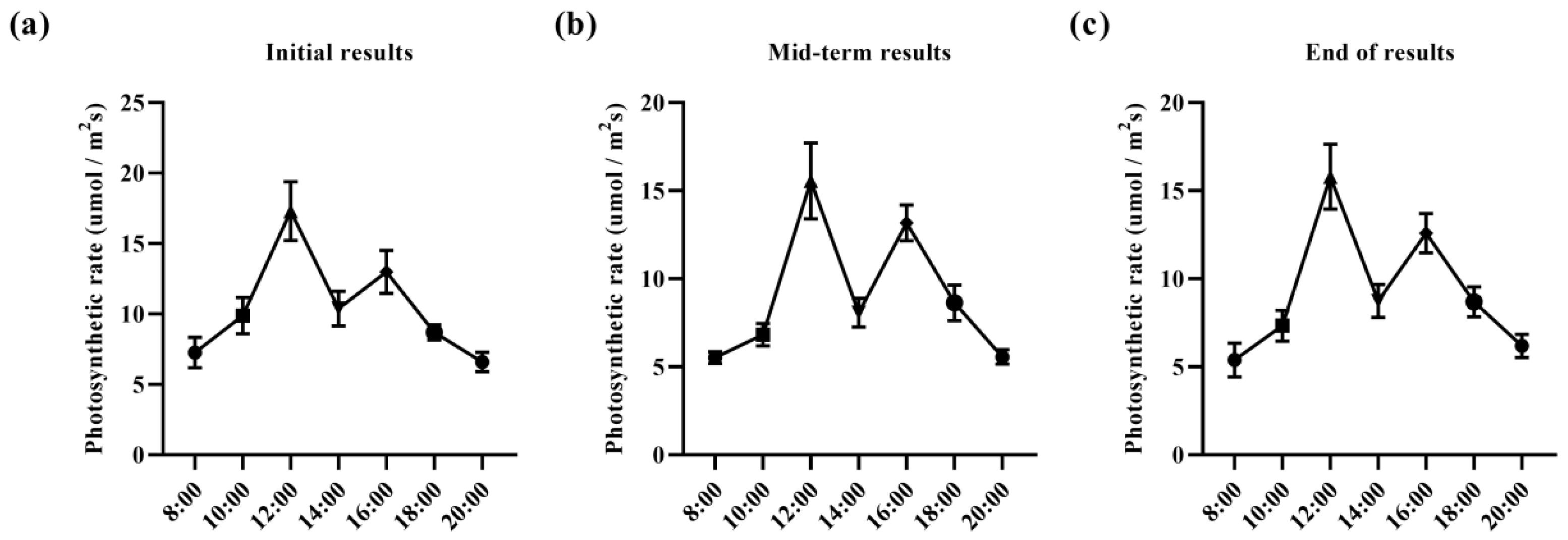
In this study, we systematically monitored the photosynthetic rate of jujube trees at three critical growth stages: the early ripening stage (
Figure 1a), the semi-ripening stage (
Figure 1b), and the fully ripening stage (
Figure 1c). Measurements were taken from 8:00 to 20:00, with an interval of two hours, covering the main periods of light intensity changes throughout the day. Through visual analysis of the photosynthetic rate data measured at different time points in each period, it was found that all data points were within a reasonable distribution range, with no abnormal fluctuations or outliers. This indicates that the monitoring data obtained in this study are of reliable quality, with good internal consistency and rationality, providing an effective basis for subsequent analysis.
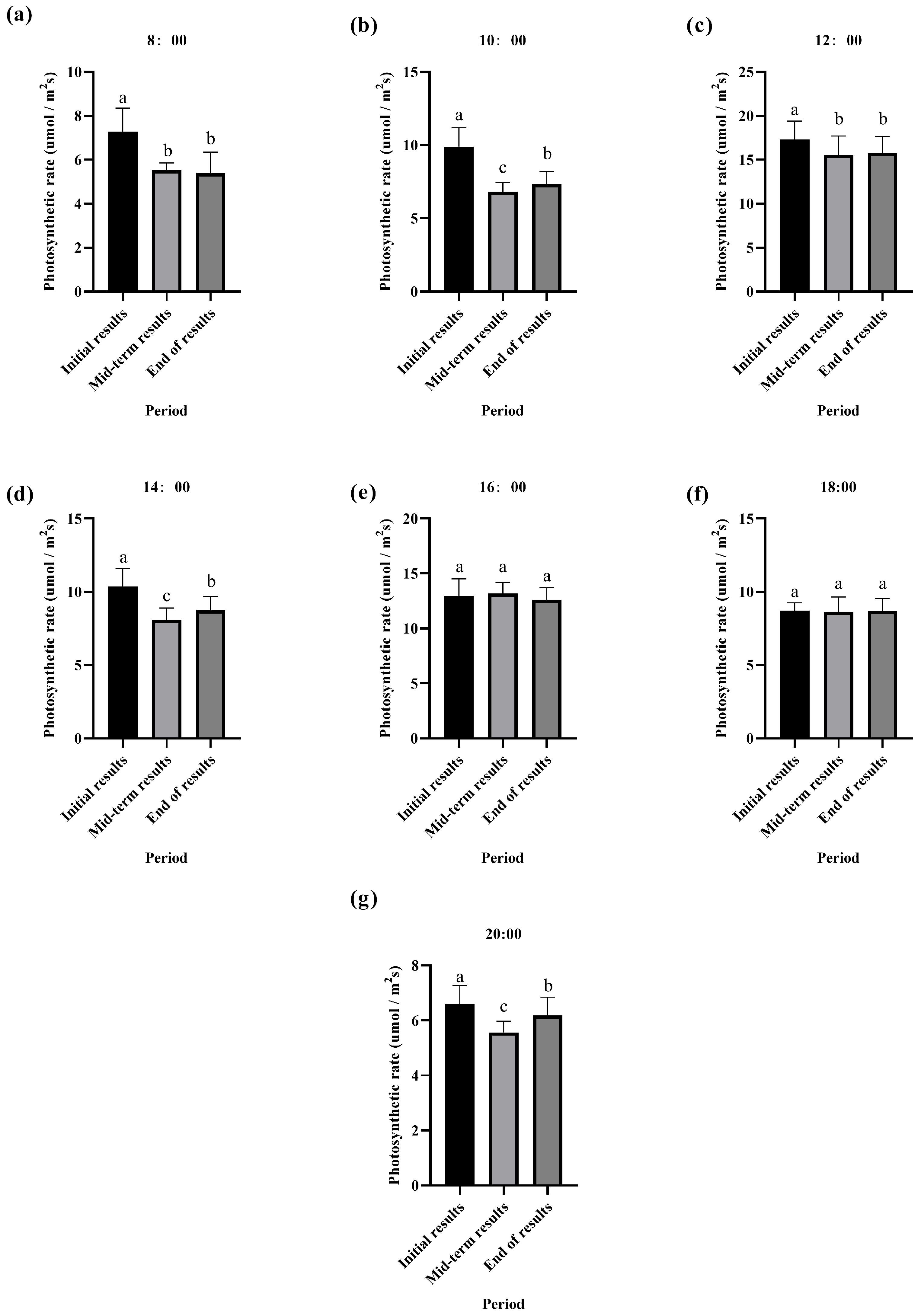
Furthermore, to clarify the temporal differences in photosynthetic physiological characteristics at different growth stages, we compared the changes in photosynthetic rates at each time point among the three periods. The analysis revealed that the photosynthetic rates showed regular period-specific differences at different times. Specifically, at 8:00 and 12:00, the photosynthetic rate of the early ripening stage was significantly higher than that of the semi-ripening and fully ripening stages, while no significant difference was observed between the semi-ripening and fully ripening stages (
Figure 2a,c). At 10:00, 14:00, and 20:00, the photosynthetic rate of the early ripening stage remained the highest, followed by the fully ripening stage, which was significantly higher than the semi-ripening stage, demonstrating a clear trend of decreasing photosynthetic capacity (
Figure 2b,d,e). Notably, at 16:00 and 18:00, the photosynthetic rates of the three growth stages were consistent, with no significant differences (
Figure 2d,e).
The above results systematically reveal the dynamic patterns of photosynthetic physiological activities of jujube trees as they progress through fruit development stages and vary with daily time. The early ripening stage generally shows a strong photosynthetic capacity, especially in the morning and midday, which may be related to the vigorous leaf function and high demand for material accumulation during this period. As the fruit development progresses to the semi-ripening and fully ripening stages, the photosynthetic rate shows a downward trend in most time periods, reflecting the shift in the physiological focus and source–sink relationship of the plant. In the evening (16:00–18:00), the photosynthetic rates of the three growth stages are not significantly different, suggesting that environmental factors (such as weakened light intensity) may become the main limiting factors, reducing the influence of the growth stage itself. These findings provide a basis for understanding the spatiotemporal characteristics of the carbon assimilation process in jujube trees and lay a key physiological foundation for the subsequent establishment of yield and quality prediction models.
3.2. Descriptive Statistics of Photosynthetic Characteristics and Tree Architectural Parameters
The descriptive statistics of all measured variables, including photosynthetic traits, tree architecture, yield, and fruit quality, are presented in
Table 1: initial ripening (S1), semi-ripening (S2), and full ripening (S3). Considerable diurnal and inter-period variation was observed. The highest mean Pn (17.17 µmol·m
−2·s
−1) occurred at 12:00 during S1, while minimum values were recorded in early morning hours across all stages, with the lowest mean Pn (3.49 µmol·m
−2·s
−1) at 08:00 in S3. Tree architectural traits exhibited substantial variability, with plant height ranging from 1.63 to 8.39 m (mean = 4.28 m), primary branches numbering 4–33 (mean = 14.38), and spurs ranging from 31 to 205 per plant (mean = 115.64). Yield per plant averaged 6.69 kg (range: 1.90–12.29 kg), while the proportion of premium-grade fruits averaged 28.39% (range: 12–43%). The observed variability across physiological and structural traits provided a robust dataset for subsequent predictive modeling.
3.3. Correlation Analysis of Model Input Value and Output Value
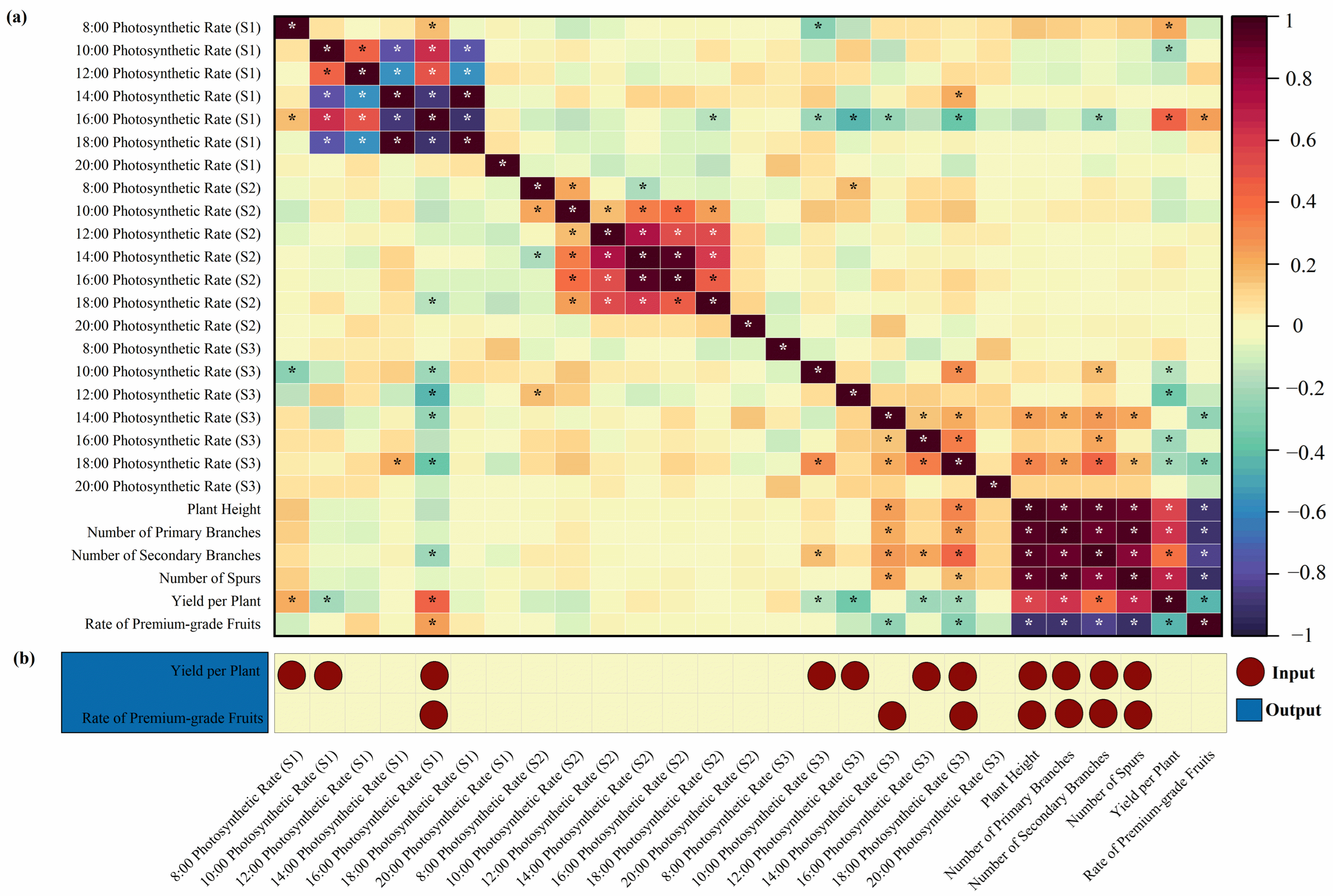
To develop a concise and efficient predictive model while identifying representative features with clear explanatory power for the output variables, this study systematically conducted a correlation analysis between input variables and output targets. By quantitatively evaluating the strength of association between individual plant yield and first-grade fruit rate with various candidate agronomic traits and physiological indicators, the following key results were obtained (
Figure 3a):
Regarding plant yield, the correlation analysis revealed several significant positive and negative factors. Yield per plant showed a significant positive correlation with photosynthetic rates at 8:00 and 16:00 during the semi-mature stage, indicating that photosynthetic capacity at these specific time points contributes positively to final yield formation. Simultaneously, plant height, number of primary branches, number of secondary branches, and number of spurs were also significantly positively correlated with yield, reflecting that more developed plant structure and a greater number of fruiting units correspond to higher yield potential. Conversely, yield per plant exhibited significant negative correlations with photosynthetic rates at 10:00 during the early-mature stage, as well as at 10:00, 12:00, 16:00, and 18:00 during the full-mature stage. This phenomenon may suggest that excessively high or temporally specific photosynthetic activity during certain fruit development stages does not always linearly promote high yield, potentially involving complex physiological processes such as the allocation of photosynthetic assimilates and the regulation of source–sink relationships.
Concerning the first-grade fruit rate, its correlation patterns both overlapped with and diverged from those of plant yield [
22]. The analysis revealed a significant positive correlation between first-grade fruit rate and photosynthetic rate at 16:00 during the early-mature stage, suggesting that photosynthetic efficiency at this specific developmental stage and time point may play a critical role in the formation of high-quality fruit. However, the first-grade fruit rate showed negative correlations with photosynthetic rates at 12:00 and 16:00 during the full-mature stage, as well as with plant height, number of primary branches, number of secondary branches, and number of spurs. This indicates that excessive vegetative growth (e.g., greater plant height, excessive branching) or maintaining high photosynthetic rates during the late fruit maturation phase may not be conducive to improving fruit quality, potentially due to nutrient competition or internal shading effects.
Based on these clear correlation analysis results, this study adopted a targeted feature selection strategy when subsequently constructing predictive models for plant yield and first-grade fruit rate. Specifically, distinct sets of indicators with statistically significant correlations to their respective prediction targets were selected as input feature variables for the two models (
Figure 3b). This approach not only effectively reduced input data dimensionality and alleviated model complexity and computational burden but, more importantly, ensured that input features possessed clear physiological or agronomic relevance to the prediction targets. Thereby, it established a solid foundation for building reliable models with strong interpretability and stable predictive performance. This feature screening method, which integrates data-driven approaches with biological significance, enhances the reliability and interpretability of model outcomes.
3.4. Training Function Selection
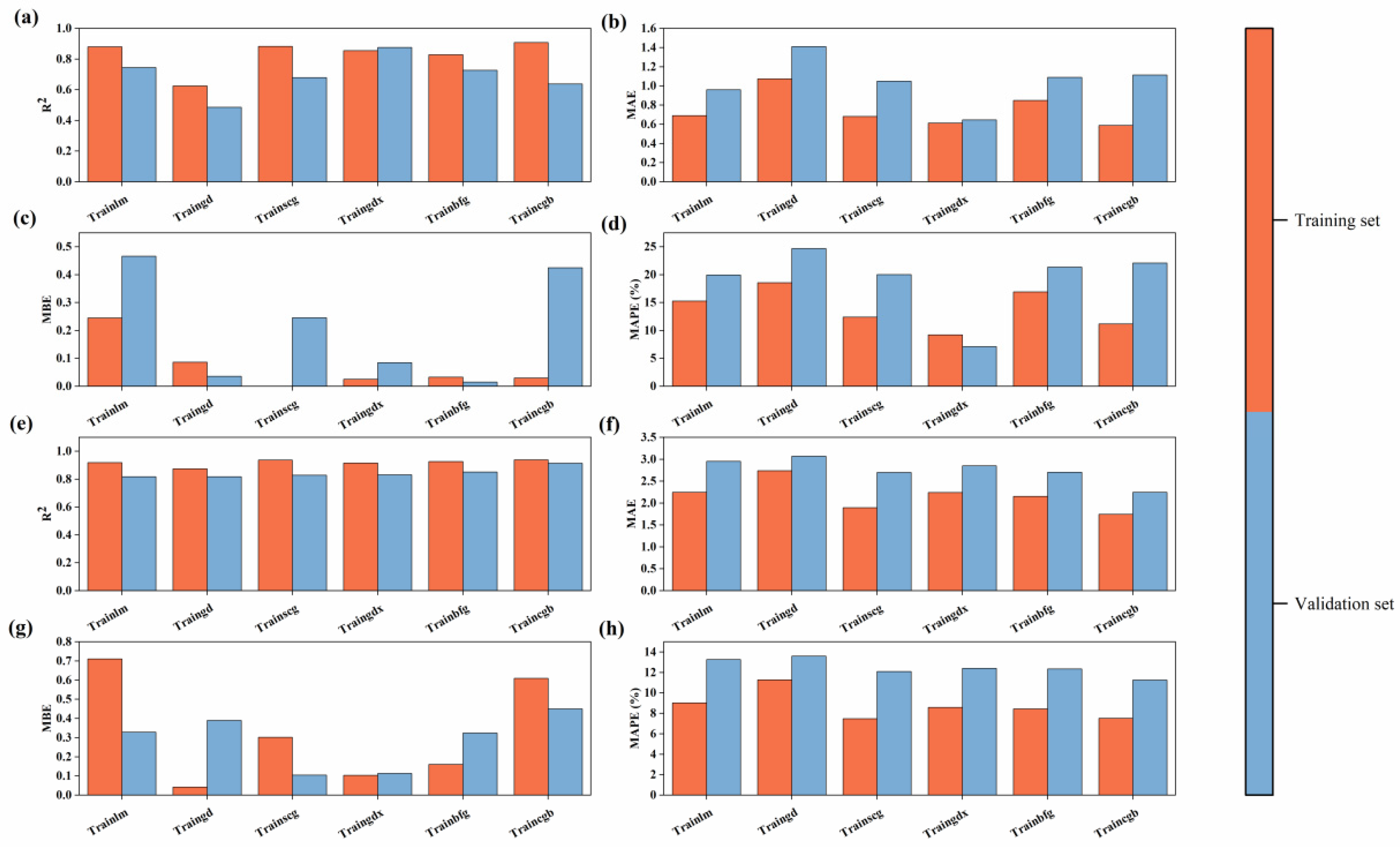
The primary objective of this study is to develop a reliable model capable of accurately predicting jujube tree yield and first-grade fruit ratio. A backpropagation neural network was employed as the modeling framework, the performance of which largely depends on the selection of the training function. To this end, a systematic comparison and evaluation of six common training functions—Trainlm, Traingd, Trainscg, Traingdx, Trainbfg, and Traincgb—was conducted to identify the optimization algorithm most suitable for the data characteristics and prediction tasks of this research.
In the development of the yield prediction model, significant performance differences were observed among the training functions. Based on a comprehensive comparison of evaluation metrics, the Traingdx function was identified as the optimal choice. Specifically, the model corresponding to this function achieved a coefficient of determination (R
2) of 0.8549 on the training set and, more importantly, 0.87556 on the validation set (
Figure 4a). The superior performance on the validation set compared to the training set, with both maintaining high values, provides strong evidence of the model’s robust generalization capability. Furthermore, the mean absolute error (MAE), mean bias error (MBE), and mean absolute percentage error (MAPE) were all at low levels on both the training and validation sets, with very close error values between the two datasets (
Figure 4b–d). These results collectively indicate that the yield prediction model trained with the Traingdx function not only exhibits high predictive accuracy but also demonstrates strong stability, successfully avoiding overfitting and ensuring reliable performance on future unseen samples.
In the selection process for the first-grade fruit ratio prediction model, the scenario differed slightly. Preliminary analysis revealed that most training functions performed similarly in terms of R
2, MAE, and MAPE—metrics that reflect overall accuracy and average error—making it difficult to distinguish their superiority (
Figure 4e–h). However, an in-depth analysis of the mean bias error (MBE) revealed critical distinctions. MBE effectively captures the direction and magnitude of systematic prediction bias. The analysis showed that the Traingdx function yielded MBE values of only 0.1041 and 0.1132 on the training and validation sets, respectively, with absolute values significantly lower than those of other candidate functions. Crucially, the difference in MBE between the training and validation sets was minimal, highlighting the high consistency of prediction bias achieved by this function. In contrast, other training functions often exhibited considerable fluctuations in MBE across the two datasets, indicating unstable systematic bias in their predictions. Thus, for first-grade fruit ratio prediction, the Traingdx function demonstrated unparalleled advantages in minimizing and stabilizing prediction bias.
In summary, through a comprehensive evaluation of multiple performance metrics, the Traingdx function emerged as the most outstanding choice for both the yield prediction model—due to its high accuracy and exceptional generalization capability—and the first-grade fruit ratio prediction model—due to its minimal and highly stable systematic bias. Consequently, this study conclusively selected Traingdx as the unified training function for both neural network prediction models, establishing a solid foundation for their reliable application in subsequent research.
3.5. Model Selection of Plant Production Model
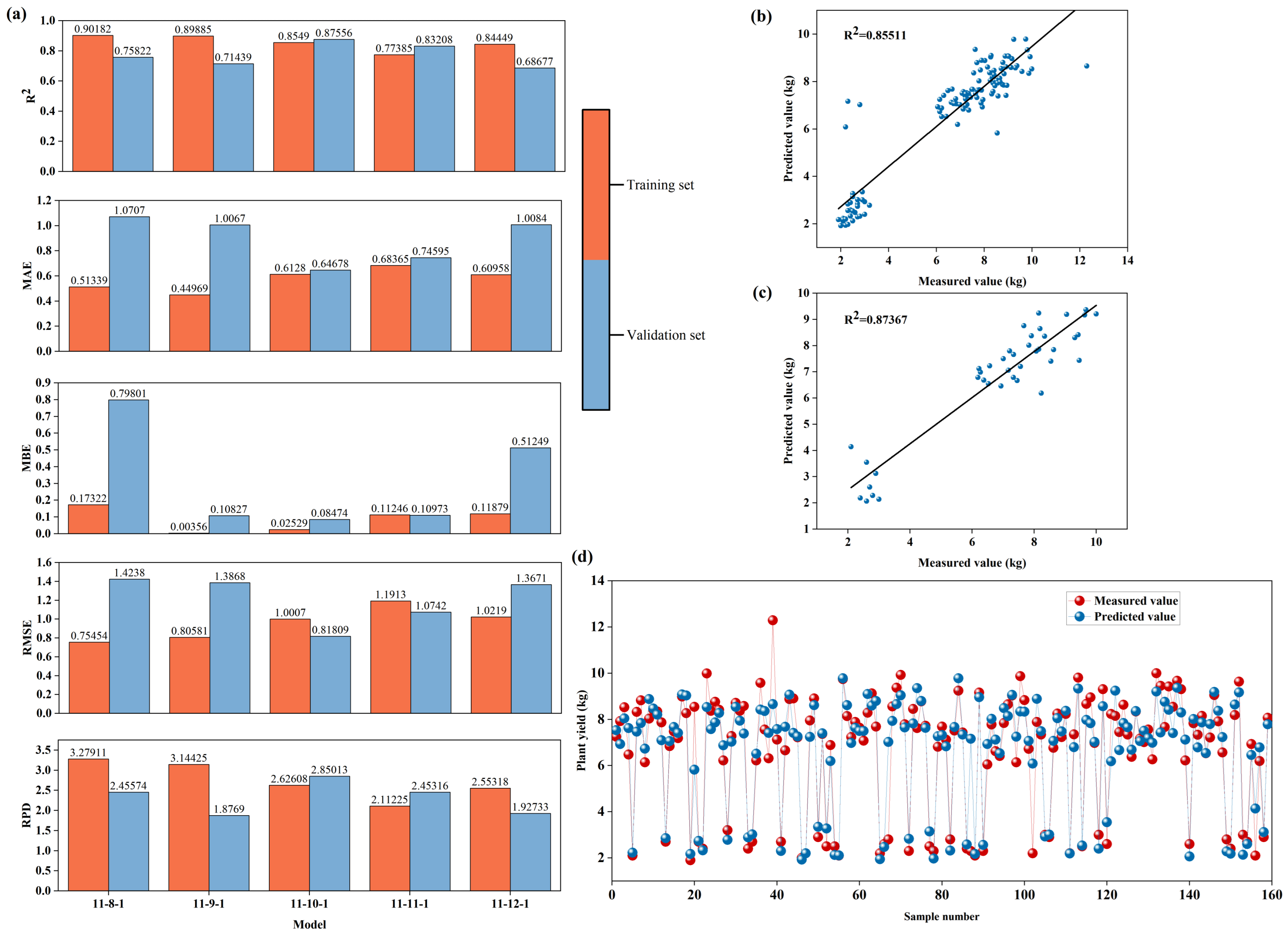
Following the adoption of Traingdx as the training function, this study systematically screened hidden layer structures to further optimize the model architecture. The plant yield prediction model utilized 11 key agronomic and physiological traits as input variables and single-plant yield as the output variable. By constructing network topologies of varying complexity, the predictive performance was evaluated. Five model configurations—namely 11-8-1, 11-9-1, 11-10-1, 11-11-1, and 11-12-1—with hidden layer nodes ranging from 8 to 12 were specifically tested to identify the optimal balance between model complexity and generalization capability.
Integrated comparative results demonstrate that the 11-10-1 model with a single hidden layer (10 nodes) achieved the most balanced performance in terms of both predictive accuracy and stability (
Figure 5a). Although on the training set, its coefficient of determination (R
2 = 0.8549) and relative prediction deviation (RPD = 2.626) were slightly lower than those of the 11-8-1 (R
2 = 0.90182, RPD = 3.279) and 11-9-1 (R
2 = 0.89885, RPD = 3.144) models, this precisely indicates its ability to avoid overfitting to the training data. In contrast, on the validation set, the 11-10-1 model exhibited significantly higher R
2 and RPD values, reaching 0.87556 and 2.85, respectively. This key observation suggests that the 11-10-1 model focused on learning more generalizable data patterns rather than adapting to specific noise in the training set, thereby demonstrating superior generalization capability and enhanced predictive reliability for future unseen data.
From the perspective of error analysis, the 11-10-1 model performed well on both the training and validation sets. Key error metrics—including the mean absolute error (MAE), mean bias error (MBE), and root mean square error (RMSE)—remained at low levels, with values of 0.63239, 0.0550175, and 0.909395, respectively. Moreover, the error values between the two datasets were very close. This not only reflects the model’s overall fitting accuracy but also reaffirms its predictive stability, indicating consistent performance across different datasets.
To further visually assess predictive performance, linear regression analysis was conducted on the model outputs. The results showed a coefficient of determination of 0.85511 between predicted and measured values in the validation set (
Figure 5b), and 0.87367 in the training set (
Figure 5c), both indicating strong correlation. The scatter plot (
Figure 5d) clearly demonstrated that most data points clustered closely around the 1:1 reference line, with only minor deviations observed in a few samples. This graphically validates the high consistency between model predictions and actual values.
In summary, through multi-round and multi-metric systematic validation, the 11-10-1 network structure was identified as the optimal architecture for plant yield prediction in this study. This model achieves high fitting accuracy while significantly enhancing generalization performance, effectively mitigating overfitting risks and demonstrating robust predictive capability. Therefore, the 11-10-1 model is deemed suitable for reliable prediction and broader application of plant yield under conditions similar to those in this study.
3.6. First Grade Fruit Rate Model Selection
Based on the results of preliminary feature screening, this study constructed a neural network prediction model with seven key influencing factors as inputs and single-plant yield as the output. The input features encompass physiological indicators and tree architecture parameters significantly correlated with plant production, thereby establishing a robust biological foundation for the model. After determining the input and output dimensions, the number of nodes in the hidden layer—the core structure of the model—emerged as a critical hyperparameter influencing its performance. An insufficient number of hidden nodes may lead to underfitting, where the model fails to adequately capture complex nonlinear relationships within the data; conversely, an excessive number of nodes can easily result in overfitting, wherein the model becomes overly attuned to noise and details in the training data, thereby compromising its generalization capability.
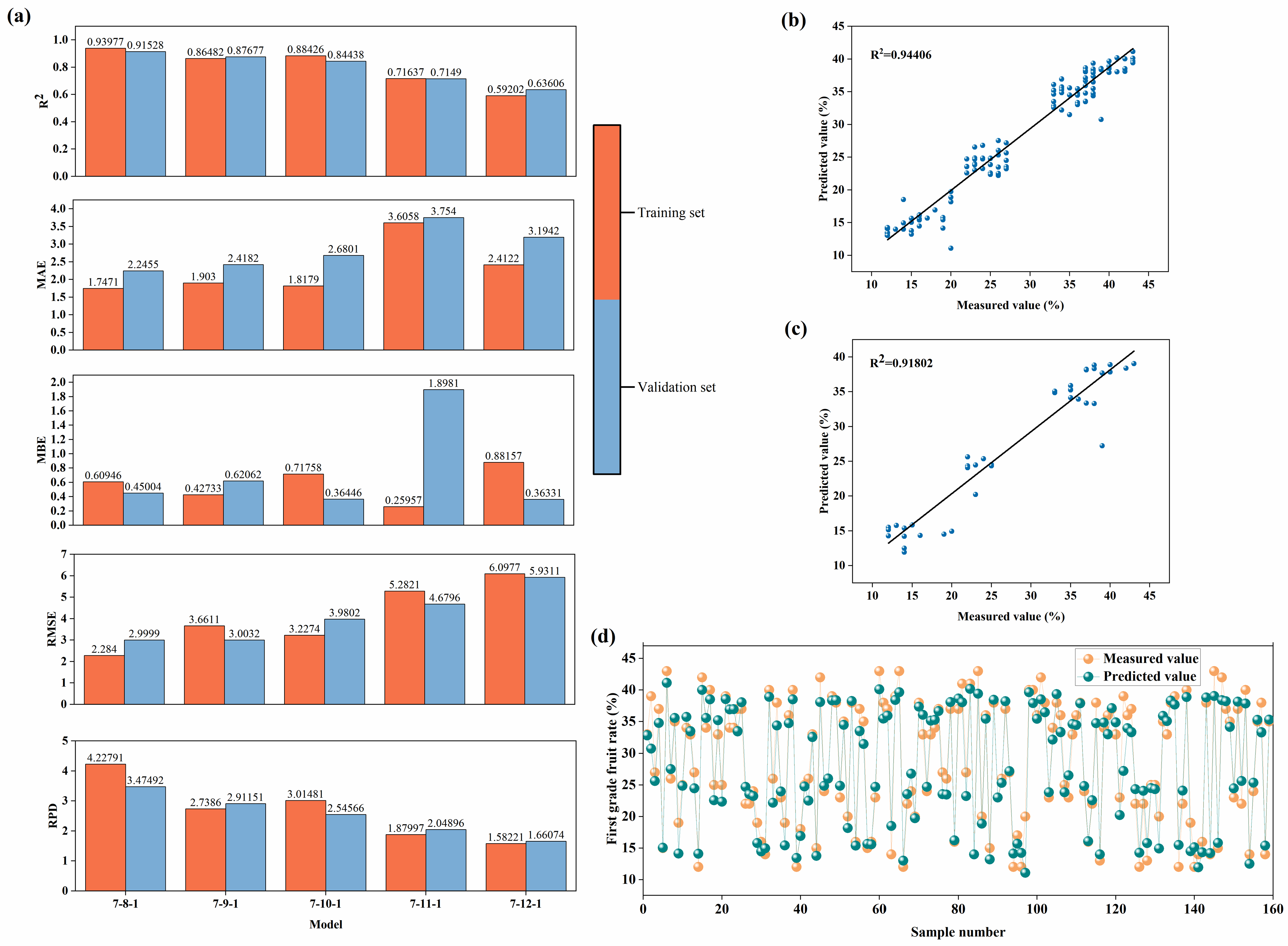
To identify the optimal architecture, this study systematically evaluated five model configurations with 8, 9, 10, 11, and 12 nodes in a single hidden layer (i.e., 7-8-1, 7-9-1, 7-10-1, 7-11-1, and 7-12-1), and comprehensively compared their predictive performance and stability. The evaluation results (
Figure 6a) clearly demonstrate that the 7-8-1 model—with one hidden layer containing eight nodes—delivered the best overall performance. This model achieved the highest coefficient of determination (R
2) and relative prediction deviation (RPD) on the training set among all candidate structures, reaching 0.93977 and 4.2279, respectively, indicating its superior data-fitting capability. More importantly, the mean absolute error (MAE), mean bias error (MBE), and root mean square error (RMSE) of the 7-8-1 model remained consistently low on both the training and validation sets, with values of 1.9963, 0.52975, and 2.64195, respectively. The fact that errors were low and closely aligned across both datasets provides strong evidence that the model not only achieves high accuracy but also generalizes well, effectively ruling out risks of overfitting or underfitting.
To further visually validate the model’s predictive reliability, a linear regression analysis was conducted between the predicted and measured values from the 7-8-1 model. Results showed that the coefficient of determination for the validation set was as high as 0.94406 (
Figure 6b), while that of the training set also reached 0.91802 (
Figure 6c). Both values are close to 1, reflecting a strong linear correlation between predicted and actual values. As shown in the scatter plot (
Figure 6d), the majority of sample points clustered tightly around the reference line (y = x), which represents ideal prediction. The high degree of overlap between predicted and measured values across the entire dataset, with only minimal deviations in a few samples, offers additional graphical confirmation of the model’s prediction accuracy and consistency.
To further visually validate the predictive reliability of the model, a linear regression analysis was performed between the predicted and measured values of the 7-8-1 model. The results indicated a validation set fitting determinant coefficient as high as 0.94406 (
Figure 6b), while the training set fitting coefficient reached 0.91802 (
Figure 6c), both approaching 1, indicating a strong linear correlation between predicted and actual values. The scatter plot (
Figure 6d) shows that the vast majority of sample points are tightly clustered around the reference line representing ideal prediction (y = x), with an exceptionally high degree of overlap between predicted and measured values across the entire dataset; only a minimal number of points exhibit slight deviations. This graphically confirms the accuracy and consistency of the model’s predictions.
In summary, through rigorous model structure selection and multi-faceted validation, the 7-8-1 architecture is confirmed as the optimal choice for yield prediction in this study. The model not only demonstrates excellent fitting performance and stability across statistical metrics but also exhibits high visual agreement between predicted and measured values, further affirming its reliability. Therefore, the 7-8-1 model is deemed a high-precision and robust predictive tool suitable for accurate estimation of jujube tree single-plant yield under similar production conditions, thereby providing effective data support for production management decisions.
3.7. Shap Analysis and Response Surface Analysis
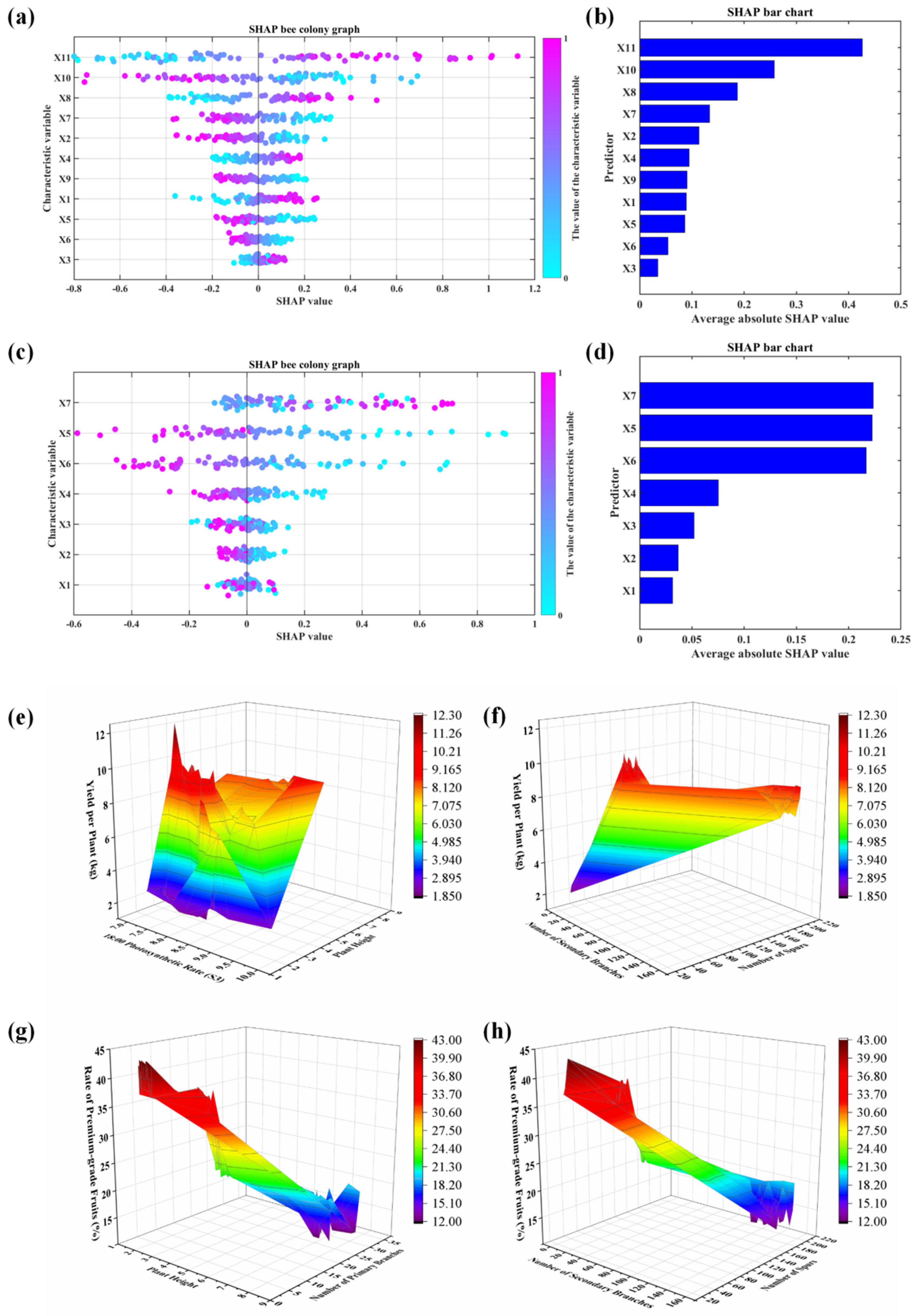
In this study, to identify key influencing factors within the features, we employed SHAP analysis to evaluate each feature. The results indicate that in the yield prediction model, four features—X11, X10, X8, and X7—exert significant influence, with SHAP value ranges of [−0.8, 1.2], [−0.75, 0.7], [−0.4, 0.5], and [−0.4, 0.3], and mean SHAP values of 0.42, 0.26, 0.19, and 0.14, respectively (
Figure 7a,b). In the first-class fruit rate prediction model, X7, X8, X6, and X4 are identified as key influencing factors, with SHAP value intervals of [−0.1, 0.7], [−0.6, 0.9], [−0.5, 0.7], and [−0.3, 0.25], and mean SHAP values of 0.23, 0.22, 0.21, and 0.075, respectively (
Figure 7c,d).
Further investigation based on response surface analysis regarding yield and first-class fruit rate reveals that during the late fruit stage, higher yield is achieved when the photosynthetically active radiation at 18:00 ranges between 7.0 and 9.0 µmol/m
2·s, and plant height falls within 3 to 9 m. Notably, yield peaks when the photosynthetically active radiation at 18:00 is between 0.7 and 0.8 µmol/m
2·s and plant height is between 2.5 and 3.5 m. When plant height is below 3 m, yield is generally lower than 4 kg. Similarly, yield remains below 5 kg when the number of short branches is fewer than 70. In contrast, yield performance is optimal when the number of short branches ranges from 80 to 100 and the number of secondary branches lies between 20 and 165 (
Figure 7e,f).
Regarding the first-class fruit rate, a higher rate is observed when plant height is between 1 and 4 m and the number of primary branches ranges from 1 to 13. However, the first-class fruit rate is relatively low when plant height increases to 6–9 m and the number of primary branches falls within 20 to 35. Additionally, a higher first-class fruit rate is favored when the number of secondary branches is between 1 and 40 and the number of short branches ranges from 20 to 150. Conversely, the lowest first-class fruit rate occurs when the number of secondary branches is between 60 and 160 and the number of short branches reaches 160 to 220 (
Figure 7g,h).
4. Discussion
4.1. Photosynthetic Physiological Dynamics Provide Key Timing Basis for Model Construction
This study systematically revealed the dynamic changes in photosynthetic rate of jujube trees at different phenological stages and during different time periods of the day. The early mature stage showed the highest photosynthetic capacity in most time periods, which is consistent with the strong sink strength demand in the early stage of fruit development. At this time, the assimilates from leaves as sources need to be supplied in large quantities for cell division and expansion of fruit [
23]. As the fruit enters the semi-mature and fully mature stages, the photosynthetic rate generally shows a downward trend, possibly due to weakened sink strength, leaf senescence, and changes in the priority of photosynthetic assimilate distribution [
24]. Notably, in the evening (16:00–18:00), the photosynthetic rates of the three phenological stages did not show significant differences, suggesting that at this time, the environmental light intensity has become the main limiting factor for photosynthesis, masking the physiological differences among the phenological stages themselves [
25]. This finding not only deepens the understanding of the spatiotemporal characteristics of carbon assimilation in jujube trees, but more importantly, it provides a solid physiological basis for the selection of input features in predictive models. Using the photosynthetic rates at different phenological stages and specific time periods as key input variables enables the model to capture the dynamic source-sink relationships that affect yield and quality formation, rather than relying solely on static tree structure parameters.
4.2. The Heterogeneity of Tree Traits and Yield and Quality Data Helps to Improve the Generalization Ability of the Model
The experimental population exhibited substantial variability and multimodal distributions in plant height, branch architecture (number of primary and secondary branches), number of spurs, as well as final yield per plant and premium fruit rate, indicating strong representativeness of the dataset. Such heterogeneity typically stems from genetic diversity, micro-environmental variations, and cultivation practices [
26]. In machine learning modeling, this data characteristic presents a double-edged sword. Excessively concentrated data distributions tend to produce “narrow experts”—models effective only for specific plant types but with poor generalization capability [
27]. Although the broad variability in this study increases modeling complexity, it provides valuable opportunities for models to learn more universal patterns. During training, the model is compelled to adapt to diverse input combinations, thereby avoiding overfitting to local features. Consequently, the trained model demonstrates enhanced robustness and is more likely to handle diverse field conditions in practical applications.
4.3. Variable Screening Under the Guidance of Feature Correlation Enhances the Interpretability of the Model
The correlation analysis reveals complex and occasionally contradictory relationships between yield per plant, first-class fruit rate, and various physiological and morphological indicators. For instance, vegetative growth indicators such as plant height and branch number exhibit positive correlations with yield per plant but negative correlations with first-class fruit rate. This pattern visually demonstrates the classic “sink–source” competition and “yield–quality” trade-off in fruit tree production [
28]. Excessive vegetative growth may compete with fruit development for nutrients, thereby compromising quality improvement [
29]. Feature selection based on these well-defined correlations not only reduces model dimensionality and computational burden but, more importantly, ensures interpretable biological linkages between input variables and prediction targets [
30]. Consequently, the final constructed model transcends a mere “black-box” predictive tool; its internal decision-making logic aligns with established plant physiological principles, significantly enhancing both the reliability and practical utility of the model.
4.4. The Optimization of Training Function and Model Structure Is the Key to Achieve High Performance Prediction
This study demonstrates that the Traingdx function outperforms other training algorithms in predicting both per-plant yield and first-class fruit rate. For the yield prediction model, its superiority is evidenced by a high R
2 value and exceptional generalization capability (with validation set performance exceeding that of the training set). For the first-class fruit rate model, the advantage manifests in extremely low and stable MBE, indicating minimal prediction bias. As an adaptive learning rate algorithm, Traingdx effectively balances convergence speed and stability [
31], making it particularly suitable for handling the potentially strong nonlinearity and complex noise characteristics present in the dataset used in this study.
Regarding model architecture selection, the final 11-10-1 structure (11 input nodes, 10 hidden nodes) for the yield model and the 7-8-1 structure (7 input nodes, 8 hidden nodes) for the first-class fruit rate model represent optimal trade-offs between model complexity and generalization ability. The number of hidden nodes in the yield model (10) is slightly lower than the number of input features (11), whereas in the first-class fruit rate model (8), it slightly exceeds the input feature count (7). This indicates that the optimal architecture is not merely determined by input dimensionality but depends on the intrinsic complexity and interrelationships within the data [
32]. The early stopping mechanism employed during training effectively prevented overfitting, ensuring that the final saved model version delivered the best performance on the validation set, thereby providing reliability for model application and promotion.
4.5. Guarantee of Training Optimization and Model Generalization Ability
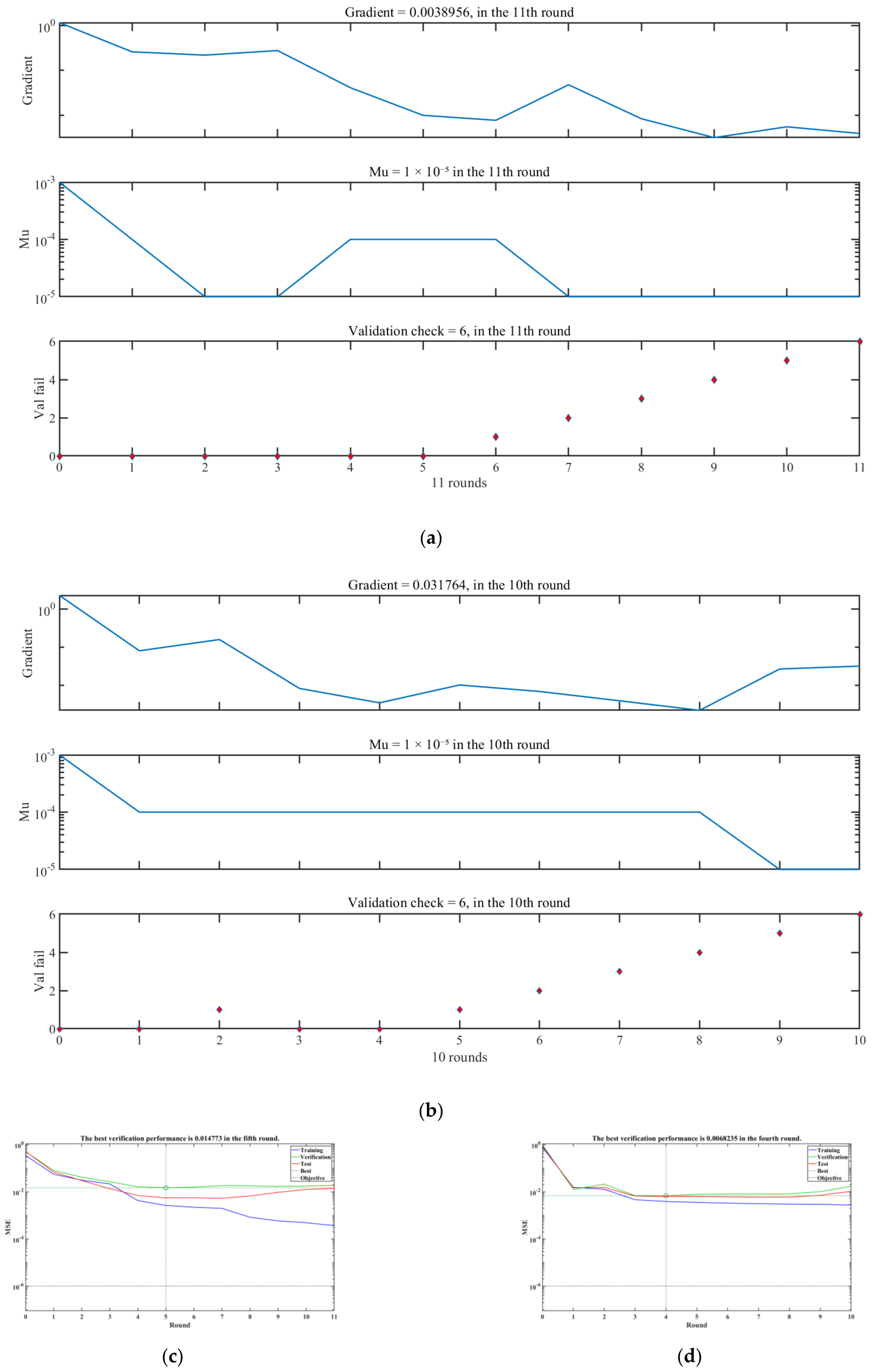
The training processes for both prediction models were effectively managed using an early stopping mechanism. For the fruit yield model, training was halted at the 11th epoch (gradient norm: 0.0038956, Mu: 1 × 10
−5; validation checks: 6), with the optimal model identified at the 5th epoch (validation loss: 0.014773). The subsequent divergence between decreasing training loss and plateauing validation loss indicated the onset of overfitting (
Figure 8a). Similarly, the first-class fruit rate model training stopped at the 11th epoch (gradient norm: 0.0031764, Mu: 1 × 10
−5), while its best-performing iteration occurred at the 4th epoch (MSE: 0.0068235), after which validation performance stagnated (
Figure 8b). In both cases, the early stopping protocol ensured the preservation of model weights from the epochs exhibiting optimal generalization capability (5th for yield, 4th for quality) before the progression of overfitting (
Figure 8c,d).
4.6. SHAP and Response Surface Analysis Reveal Potential Pathways for Precision Management
SHAP analysis quantifies the contribution magnitude and direction of each feature to prediction outcomes by examining the model’s internal mechanisms. In the plant yield model, high mean SHAP values of features such as X11 and X10 confirm their roles as key drivers of predictions. Response surface analysis further visualizes the interaction effects of these critical factors, providing concrete and actionable guidance for production practices. For instance, the yield model demonstrates that maximum productivity is not achieved by maximizing plant height alone, but rather occurs within a specific height range (2.5–3.5 m) combined with a particular level of evening photosynthetic capacity (0.7–0.8 µmol/m2s). This implies that controlling plant height within an optimal interval through canopy management (e.g., pruning) and maintaining leaf functionality during evening hours in later growth stages may constitute crucial strategies for high yield.
Regarding first-grade fruit rate, the analysis indicates that excessive vegetative growth (e.g., excessive plant height and primary branching) and an overly dense canopy structure (e.g., surplus secondary branches and short shoots) adversely affect quality development. These findings provide empirical support and quantitative boundaries for the traditional observation that “over-vigorous trees yield poorly” or “over-vigorous trees produce low-quality fruit.” Consequently, future management practices should emphasize precise regulation of irrigation and fertilization along with strategic pruning to suppress unnecessary late-stage vegetative growth, optimize tree architecture, and allocate resources more efficiently toward fruit quality formation.
4.7. Research Limitations and Prospects
The model developed in this study was constructed based on data from a specific year and experimental site, and its generalizability requires further validation across diverse ecological regions and management practices. Moreover, while the model primarily incorporates physiological and structural indicators of trees, future efforts could integrate environmental factors such as soil nutrients, moisture conditions, and meteorological data to establish a more comprehensive prediction system. Although SHAP analysis has improved interpretability, the highly complex nonlinear relationships inherent in neural network models necessitate further exploration of deeper feature interaction mechanisms. Ultimately, integrating these quantitative models with intelligent decision-support systems to achieve precision management in jujube orchard production represents a critical direction for future research.