Arbuscular Mycorrhizal Fungi (AMF) Influence Yield and Essential Oil Content and Composition of Sage (Salvia officinalis L.) Under Different Water Regimes
 ,
,  , , , and
Abstract
1. Introduction
2. Materials and Methods
2.1. The Study Site and Soil Parameters
2.2. Plant Material and Field Management
2.3. Experimental Design
2.3.1. Setup of the Experiment
2.3.2. Preparation and Inoculation of Arbuscular Mycorrhiza
2.3.3. Irrigation
2.3.4. Other Agronomic Practices
2.3.5. Harvest and Plant Measurements
2.4. Chemical Analyses
2.4.1. Distillation of EO
2.4.2. EO Composition
2.5. Statistical Elaboration
3. Results
3.1. Morphological Traits of Plants
3.2. Yield of Fresh and Air-Dry Biomass
3.3. EO Content
3.4. EO Composition
3.5. Correlation Analysis
4. Discussion
4.1. Morphological Characteristics and Biomass Yield as Affected by Irrigation
4.2. Effect of Irrigation on Oil Quantity and Quality
4.3. Effect of AMF on Plant Morphology and Biomass
4.4. Effect of AMF on EO
4.5. Correlations Between Parameters
5. Conclusions
Author Contributions
Funding
Data Availability Statement
Conflicts of Interest
References
- Avato, P.; Fortunato, I.M.; Ruta, C.; D’Elia, R. Glandular hairs and essential oils in micropropagated plants of Salvia officinalis L. Plant Sci. 2005, 169, 29–36. [Google Scholar] [CrossRef]
- Menghini, L.; Leporini, L.; Pintore, G.; Chessa, M.; Tirillini, B. Essential oil content and composition of three sage varieties grown in Central Italy. J. Med. Plants Res. 2013, 7, 480–489. [Google Scholar] [CrossRef]
- Fu, Z.; Wang, H.; Hu, X.; Sun, Z.; Han, C. The pharmacological properties of salvia essential oils. J. Appl. Pharm. Sci. 2013, 3, 122–127. [Google Scholar] [CrossRef]
- Farhat, M.B.; Jordán, M.J.; Chaouch-Hamada, R.; Landoulsi, A.; Sotomayor, J.A. Phenophase effects on sage (Salvia officinalis L.) yield and composition of essential oil. J. Appl. Res. Med. Arom. Plants 2016, 3, 87–93. [Google Scholar] [CrossRef]
- Shi, P.; Fu, X.; Shen, Q.; Liu, M.; Pan, Q.; Tang, Y.; Jiang, W.; Lv, Z.; Yan, T.; Ma, Y.; et al. The roles of AaMIXTA1 in regulating the initiation of glandular trichomes and cuticle biosynthesis in Artemisia annua. New Phytol. 2018, 217, 261–276. [Google Scholar] [CrossRef]
- Tundis, R.; Leporini, M.; Bonesi, M.; Rovito, S.; Passalacqua, N.G. Salvia officinalis L. from Italy: A comparative chemical and biological study of its essential oil in the Mediterranean context. Molecules 2020, 10, 5826. [Google Scholar] [CrossRef]
- Kačániová, M.; Galovičová, L.; Valková, V.; Ďuranová, H.; Borotová, P.; Štefániková, J.; Vukovic, N.L.; Vukic, M.; Kunová, S.; Felsöciová, S.; et al. Chemical composition and biological activity of Salvia officinalis essential oil. Acta Hortic. Regiotec. 2021, 24, 81–88. [Google Scholar] [CrossRef]
- Jakovljević, M.; Jokić, S.; Molnar, M.; Jašić, M.; Babić, J.; Jukić, H.; Banjari, I. Bioactive profile of various Salvia officinalis L. preparations. Plants 2019, 6, 55. [Google Scholar] [CrossRef]
- Mohammed, H.A.; Eldeeb, H.M.; Khan, R.A.; Al-Omar, M.S.; Mohammed, S.A.A.; Sajid, M.S.M.; Aly, M.S.A.; Ahmad, A.M.; Abdellatif, A.A.H.; Eid, S.Y.; et al. Sage, Salvia officinalis L., constituents, hepatoprotective activity, and cytotoxicity evaluations of the essential oils obtained from fresh and differently timed dried herbs: A comparative analysis. Molecules 2021, 26, 5757. [Google Scholar] [CrossRef]
- Bozin, B.; Mimica-Dukic, N.; Samojlik, I.; Jovin, E. Antimicrobial and antioxidant properties of rosemary and sage (Rosmarinus officinalis L. and Salvia officinalis L., Lamiaceae) essential oils. J. Agric. Food Chem. 2007, 19, 7879–7885. [Google Scholar] [CrossRef]
- Seleiman, M.F.; Al-Suhaibani, N.; Ali, N.; Akmal, M.; Alotaibi, M.; Refay, Y.; Dindaroglu, T.; Abdul-Wajid, H.H.; Battaglia, M.L. Drought stress impacts on plants and different approaches to alleviate its adverse effects. Plants 2021, 10, 259. [Google Scholar] [CrossRef]
- Amani Machiani, M.; Javanmard, A.; Morshedloo, M.R.; Janmohammadi, M.; Maggi, F. Funneliformis mosseae application improves the oil quantity and quality and eco-physiological characteristics of soybean (Glycine max L.) under water stress conditions. J. Soil. Sci. Plant Nutr. 2021, 21, 3076–3090. [Google Scholar] [CrossRef]
- Li, Y.; Zhang, Y.; Wu, Y.; Chen, Z.; Liao, M.; Yu, Y.; Wei, S.; Yang, Z. The impact of soil moisture stress on the growth and biosynthesis of effective components in Salvia miltiorrhiza. Ind. Crops Prod. 2025, 225, 120529. [Google Scholar] [CrossRef]
- Arpanahi, A.A.; Feizian, M.; Mehdipourian, G.; Khojasteh, D.N. Arbuscular mycorrhizal fungi inoculation improves essential oil and physiological parameters and nutritional values of Thymus daenensis Celak and Thymus vulgaris L. under normal and drought stress conditions. Eur. J. Soil. Biol. 2020, 100, 103217. [Google Scholar] [CrossRef]
- Thokchom, S.D.; Gupta, S.; Kapoor, R. An appraisal of arbuscular mycorrhiza-mediated augmentation in production of secondary metabolites in medicinal plants. J. Appl. Res. Med. Arom. Plants 2023, 37, 100515. [Google Scholar] [CrossRef]
- Zhang, S.; Lehmann, A.; Zheng, W.; You, Z.; Rillig, M.C. Arbuscular mycorrhizal fungi increase grain yields: A meta-analysis. New Phytol. 2019, 222, 543–555. [Google Scholar] [CrossRef] [PubMed]
- Sun, W.; Shahrajabian, M.H. The application of arbuscular mycorrhizal fungi as microbial biostimulant, sustainable approaches in modern agriculture. Plants 2023, 12, 3101. [Google Scholar] [CrossRef]
- Tarraf, W.; Ruta, C.; Tagarelli, A.; De Cillis, F.; De Mastro, G. Influence of arbuscular mycorrhizae on plant growth, essential oil production and phosphorus uptake of Salvia officinalis L. Ind. Crops Prod. 2017, 102, 144–153. [Google Scholar] [CrossRef]
- Zhao, Y.; Cartabia, A.; Lalaymia, I.; Declerck, S. Arbuscular mycorrhizal fungi and production of secondary metabolites in medicinal plants. Mycorrhiza 2022, 32, 221–256. [Google Scholar] [CrossRef]
- Zhang, J.; Zhao, R.; Li, X.; Zhang, J. Potential of arbuscular mycorrhizal fungi for soil health: A review. Pedosphere 2024, 34, 279–288. [Google Scholar] [CrossRef]
- Kapoor, R.; Chaudhary, V.; Bhatnagar, A.K. Effects of arbuscular mycorrhiza and phosphorus application on artemisinin concentration in Artemisia annua L. Mycorrhiza 2007, 17, 581–587. [Google Scholar] [CrossRef]
- Simpson, R.J.; Oberson, A.; Culvenor, R.A.; Ryan, M.H.; Veneklaas, E.J.; Lambers, H.; Lynch, J.P.; Ryan, P.R.; Delhaize, E.; Smith, F.A.; et al. Strategies and agronomic interventions to improve the phosphorus-use efficiency of farming systems. Plant Soil 2011, 349, 89–120. [Google Scholar] [CrossRef]
- Khaliq, A.; Perveen, S.; Alamer, K.H.; Zia Ul Haq, M.; Rafique, Z.; Alsudays, I.M.; Althobaiti, A.T.; Saleh, M.A.; Hussain, S.; Attia, H. Arbuscular mycorrhizal fungi symbiosis to enhance plant–soil interaction. Sustainability 2022, 14, 7840. [Google Scholar] [CrossRef]
- Penuelas, J.; Staudt, M. BVOCs and global change. Trends Plant Sci. 2010, 15, 133–144. [Google Scholar] [CrossRef] [PubMed]
- Konvalinková, T.; Jansa, J. Lights off for arbuscular mycorrhiza: On its symbiotic functioning under light deprivation. Front. Plant Sci. 2016, 7, 782. [Google Scholar] [CrossRef] [PubMed]
- Bettaieb, I.; Zakhama, N.; Aidi, W.W.; Marzouk, B. Water deficit effects on Salvia officinalis fatty acids and essential oils composition. Sci. Hortic. 2009, 120, 271–275. [Google Scholar] [CrossRef]
- Mehalaine, S.; Chenchouni, H. Effect of climatic factors on essential oil accumulation in two Lamiaceae species from Algerian Semiarid Lands. In Exploring the Nexus of Geoecology, Geography, Geoarcheology and Geotourism: Advances and Applications for Sustainable Development in Environmental Sciences and Agroforestry Research; CAJG 2018. Advances in Science, Technology & Innovation; Chenchouni, H., Errami, E., Rocha, F., Sabato, L., Eds.; Springer: Cham, Switzerland, 2019. [Google Scholar] [CrossRef]
- Sonmez, C.; Bayram, E. The influence of different water and nitrogen applications on some yield parameters and antioxidant activity in sage (Salvia officinalis L.). Turk. J. Field Crops 2017, 22, 96–103. [Google Scholar] [CrossRef]
- Karousou, R.; Koureas, D.N.; Kokkini, S. Essential oil composition is related to the natural habitats: Coridothymus capitatus and Satureja thymbra in NATURA 2000 sites of Crete. Phytochemistry 2005, 66, 2668–2673. [Google Scholar] [CrossRef]
- Loziene, K.; Venskutonis, P.R. Influence of environmental and genetic factors on the stability of essential oil composition of Thymus pulegioides. Biochem. System. Ecol. 2005, 33, 517–525. [Google Scholar] [CrossRef]
- García-Caparrós, P.; José Romero, M.; Llanderal, A.; Cermeño, P.; Lao, M.T.; Segura, M.L. Effects of drought stress on biomass, essential oil content, nutritional parameters, and costs of production in six Lamiaceae species. Water 2019, 11, 573. [Google Scholar] [CrossRef]
- Ekren, S.; Sönmez, C.; Özçakal, E.; Kukul Kurttaş, Y.S.; Bayram, E.; Gürgülü, H. The effect of different irrigation water levels on yield and quality characteristics of purple basil (Ocimum basilicum L.). Agric. Water Manag. 2012, 109, 155–161. [Google Scholar] [CrossRef]
- Popović, V.; Maksimović, L.; Adamović, D.; Sikora, V.; Ugrenović, V.; Filipović, V.; Mačkić, K. Yield of biomass and essential oil of dill (Anethum graveolens L.) grown under irrigation. Ratar. Povrt. 2019, 56, 49–55. [Google Scholar] [CrossRef]
- Blum, A. Osmotic adjustment is a prime drought stress adaptive engine in support of plant production. Plant Cell Environ. 2017, 40, 4–10. [Google Scholar] [CrossRef] [PubMed]
- Soltanbeigi, A.; Yidiz, M.; Diraman, H.; Terzi, H.; Sakartepe, E.; Yıldız, E. Growth responses and essential oil profile of Salvia officinalis L. influenced by water deficit and various nutrient sources in the greenhouse. Saudi J. Biol. Sci. 2021, 28, 7327–7335. [Google Scholar] [CrossRef]
- Omidbaigi, R.; Mahmoodi, M. Effect of irrigation regimes on the essential oil content and composition of Agastache foeniculum. J. Essent. Oil Bear. Plant. 2009, 13, 59–65. [Google Scholar] [CrossRef]
- Radasci, P.; Inotai, K.; Sarosi, S.; Hari, K.; Seidler-Łożykowska, K.; Musie, S.; Zámboriné, É.N. Effect of irrigation on the production and volatile compounds of sweet basil cultivars (Ocimum basilicum L.). Herba Pol. 2020, 66, 14–24. [Google Scholar] [CrossRef]
- Mossi, A.J.; Cansian, R.L.; Paroul, N.; Toniazzo, G.; Oliveira, J.V.; Pierozan, M.; Pauletti, G.; Rota, L.; Santos, A.; Serafini, L. Morphological characterisation and agronomical parameters of different species of Salvia sp. (Lamiaceae). Braz. J. Biol. 2011, 71, 121–129. [Google Scholar] [CrossRef]
- Grisafi, F.; Oddo, E.; Maggio, A.; Panarisi, A.; Panarisi, M. Morpho-physiologic traits in two sage taxa grown under different irrigation regime. Chem. Eng. Trans. 2017, 58, 697–702. [Google Scholar] [CrossRef]
- Taha, H.V.; Hamid, R.V.; Reza, B.; Mohammad, J.S. Effect of irrigation and nitrogen fertilizer on grain yield and essential oil percentage of medicinal plant Ajowan. Inter. J. Agr. Plant Prod. 2013, 4, 1013–1022. [Google Scholar]
- Rioba, N.B.; Itulya, F.M.; Saidi, M.; Dudai, N.; Bernstein, N. Effects of nitrogen, phosphorus and irrigation frequency on essential oil content of sage (Salvia officinalis L.). J. Appl. Res. Med. Aromat. Plants 2015, 2, 21–29. [Google Scholar] [CrossRef]
- Hamedani, N.G.; Gholamhoseini, M.; Bazrafshan, F.; Habibzadeh, F.; Amiri, B. Yield, irrigation water productivity and nutrient uptake of arbuscular mycorrhiza inoculated sesame under drought stress conditions. Agric. Water Manag. 2022, 266, 107569. [Google Scholar] [CrossRef]
- Khajeeyan, R.; Salehi, A.; Dehnavi, M.M.; Farajee, H.; Kohanmoo, M.A. Physiological and yield responses of Aloe vera plant to biofertilizers under different irrigation regimes. Agric. Water Manag. 2019, 225, 105768. [Google Scholar] [CrossRef]
- USDA. Soil Taxonomy: A basic system of soil classification for making and interpreting soil surveys. In United States Department of Agriculture Natural Resources Conservation Service, Agriculture Handbook; U.S. Government Printing Office: Washington, DC, USA, 1999; Volume 436, p. 869. [Google Scholar]
- NIST/EPA/NIH Mass Spectral Library; Wiley: Hoboken, NJ, USA, 2008.
- Adams, R.P. Identification of Essential Oil Compounds by Gas Chromatography/Quadrupole Mass Spectroscopy; Allured Publishing Corporation: Carol Stream, IL, USA, 2004. [Google Scholar]
- Kozak, M.; Bocianowski, J.; Rybiński, W. Note on the use of coefficient of variation for data from agricultural factorial experiments. Bulgar. J. Agricult. Sci. 2013, 19, 644–646. [Google Scholar]
- Sezen, I.; Yağanoğlu, S.; Akpınar Külekçi, E.; Karahan, A. Effect of deficit irrigation on growth parameters of the Salvia splendens L. plant. Water 2023, 15, 4187. [Google Scholar] [CrossRef]
- Abreu, M.E.; Munné-Bosch, S. Salicylic acid may be involved in the regulation of drought-induced leaf senescence in perennials: A case study in field-grown Salvia officinalis L. plants. Environ. Exper. Bot. 2008, 64, 105–112. [Google Scholar] [CrossRef]
- Zawiślak, G. Yield and chemical composition of essential oil from Salvia officinalis L. in third year of cultivation. Herba Pol. 2015, 60, 13–22. [Google Scholar] [CrossRef]
- Maksimović, M.; Vidic, D.; Miloš, M.; Šolić, M.E.; Abadžić, S.; Siljak-Yakovlev, S. Effect of the environmental conditions on essential oil profile in two Dinaric Salvia species: S. brachyodon Vandas and S. officinalis L. Biochem. Syst. Ecol. 2007, 35, 473–478. [Google Scholar] [CrossRef]
- Mohammadi, H.; Ghorbanpour, M.; Brestic, M. Exogenous putrescine changes redox regulations and essential oil constituents in field-grown Thymus vulgaris L. under well-watered and drought stress conditions. Ind. Crops Prod. 2018, 122, 119–132. [Google Scholar] [CrossRef]
- Cal, A.J.; Sanciangco, M.; Rebolledo, M.C.; Luquet, D.; Torres, R.O.; McNally, K.L.; Henry, A. Leaf morphology, rather than plant water status, underlies genetic variation of rice leaf rolling under drought. Plant Cell Environ. 2019, 42, 1532–1544. [Google Scholar] [CrossRef]
- Asghari, B.; Khademian, R.; Sedaghati, B. Plant growth promoting rhizobacteria (PGPR) confer drought resistance and stimulate biosynthesis of secondary metabolites in pennyroyal (Mentha pulegium L.) under water shortage condition. Sci. Hortic. 2020, 263, 109132. [Google Scholar] [CrossRef]
- Corell, M.; Garcia, M.C.; Contreras, J.I.; Segura, M.L.; Cermeño, P. Effect of water stress on Salvia officinalis L. bioproductivity and its bioelement concentrations. Commun. Soil. Sci. Plant Anal. 2012, 43, 419–425. [Google Scholar] [CrossRef]
- Mansinhos, I.; Goncalves, S.; Romano, A. How climate change-related abiotic factors affect the production of industrial valuable compounds in Lamiaceae plant species: A review. Front. Plant Sci. 2024, 15, 1370810. [Google Scholar] [CrossRef] [PubMed]
- Liu, J.; Wu, L.; Wei, S.; Xiao, X.; Su, C.; Jiang, P.; Song, Z.; Wang, T.; Yu, Z. Effects of arbuscular mycorrhizal fungi on the growth, nutrient uptake and glycyrrhizin production of licorice (Glycyrrhiza uralensis Fisch). Plant Growth Regul. 2007, 52, 29–39. [Google Scholar] [CrossRef]
- Pirzad, A.; Mohammdzadeh, S. Water use efficiency of three mycorrhizal Lamiaceae species (Lavandula officinalis, Rosmarinus officinalis and Thymus vulgaris). Agric. Water Manag. 2018, 204, 1–10. [Google Scholar] [CrossRef]
- Nell, M.; Vötsch, M.; Vierheilig, H.; Steinkellner, S.; Zitterl-Eglseer, K.; Franz, C.; Novak, J. Effect of phosphorus uptake on growth and secondary metabolites of garden sage (Salvia officinalis L.). J. Sci. Food Agric. 2009, 89, 1090–1096. [Google Scholar] [CrossRef]
- Fernandez, M.; Gutierrez Boem, F.H.; Rubio, G. Arbuscular mycorrhizal colonization and mycorrhizal dependency: A comparison among soybean, sunflower and maize. In Proceedings of the International Plant Nutrition Colloquium, XVI, Sacramento, CA, USA, 26–30 August 2009. [Google Scholar]
- Amani Machiani, M.; Javanmard, A.; Ostadi, A.; Alizadeh, K. Improvement in essential oil quantity and quality of thyme (Thymus vulgaris L.) by integrative application of Chitosan nanoparticles and arbuscular mycorrhizal fungi under water stress conditions. Plants 2023, 12, 1422. [Google Scholar] [CrossRef]
- Bücking, H.; Kafle, A.; Krapp, A.; Hirel, B. Role of arbuscular mycorrhizal fungi in the nitrogen uptake of plants: Current knowledge and research gaps. Agronomy 2015, 5, 587–612. [Google Scholar] [CrossRef]
- Kapoor, R.; Giri, B.; Mukerji, K.G. Improved growth and essential oil yield and quality in Foeniculum vulgare Mill. on mycorrhizal inoculation supplementedwith P-fertilizer. Bioresour. Technol. 2004, 93, 307–311. [Google Scholar] [CrossRef]
- Torelli, A.; Trotta, A.; Acerbi, L.; Arcidiacono, G.; Berta, G.; Branca, C. IAA and ZR content in leek (Allium porrum L.), as influenced by P nutrition and arbuscular mycorrhizae, in relation to plant development. Plant Soil. 2000, 226, 29–35. [Google Scholar] [CrossRef]
- Kapoor, R.; Giri, B.; Mukerji, K.G. Mycorrhization of coriander (Coriandrum sativum L.) to enhance the concentration and quality of essential oil. J. Sci. Food Agric. 2002, 82, 339–342. [Google Scholar] [CrossRef]
- Hendawy, S.F.; Azza, A.; El-Din, E.; Aziz, E.E.; Omer, E.A. Productivity and oil quality of Thymus vulgaris L. under organic fertilization conditions. Ozean. J. Appl. Sci. 2010, 3, 203–216. [Google Scholar]
- Hazzoumi, Z.; Moustakime, Y.; Elharchli, E.H.; Amrani Joutei, K. Effect of arbuscular mycorrhizal fungi (AMF) and water stress on growth, phenolic compounds, glandular hairs, and yield of essential oil in basil (Ocimum gratissimum L.). Chem. Biol. Technol. Agric. 2015, 2, 10. [Google Scholar] [CrossRef]
- Rydlová, J.; Jelínková, M.; Dušek, K.; Dušková, E.; Vosátka, M.; Püschel, D. Arbuscular mycorrhiza differentially affects synthesis of essential oils in coriander and dill. Mycorrhiza 2016, 26, 123–131. [Google Scholar] [CrossRef] [PubMed]
- Binet, M.N.; van Tuinen, D.; Deprêtre, N.; Koszela, N.; Chambon, C.; Gianinazzi, S. Arbuscular mycorrhizal fungi associated with Artemisia umbelliformis Lam, an endangered aromatic species in Southern French Alps, influence plant P and essential oil contents. Mycorrhiza 2011, 21, 523–535. [Google Scholar] [CrossRef] [PubMed]
- Tarraf, W.; Ruta, C.; De Cillis, F.; Tagarelli, A.; Tedone, L.; De Mastro, G. Effects of mycorrhiza on growth and essential oil production in selected aromatic plants. Ital. J. Agron. 2015, 10, 160–162. [Google Scholar] [CrossRef]
- Ran, Z.; Ding, W.; Cao, S.; Fang, L.; Zhou, J.; Zhang, Y. Arbuscular mycorrhizal fungi: Effects on secondary metabolite accumulation of traditional Chinese medicines. Plant Biol. J. 2022, 24, 932–938. [Google Scholar] [CrossRef]
- Abdel-Salam, E.; Alatar, A.; El-Sheikh, M.A. Inoculation with arbuscular mycorrhizal fungi alleviates harmful effects of drought stress on damask rose. Saudi J. Biol. Sci. 2018, 25, 1772–1780. [Google Scholar] [CrossRef]
- Ostadi, A.; Javanmard, A.; Amani Machiani, M.; Sadeghpour, A.; Maggi, F.; Nouraein, M.; Morshedloo, M.R.; Hano, C.; Lorenzo, J.M. Co-application of TiO2 nanoparticles and arbuscular mycorrhizal fungi improves essential oil quantity and quality of sage (Salvia officinalis L.) in drought stress conditions. Plants 2022, 11, 1659. [Google Scholar] [CrossRef]
- Sanaullah, M.; Rumpel, C.; Charrier, X.; Chabbi, A. How does drought stress influence the decomposition of plant litter with contrasting quality in a grassland ecosystem? Plant Soil 2012, 352, 277–288. [Google Scholar] [CrossRef]
- ISO 9909; International Organization for Standardization, No 9909 Oil of Dalmatian Sage (Salvia officinalis L.). ISO: Geneva, Switzerland, 1997.
- Covello, P.S.; Teoh, K.H.; Polichuk, D.R.; Reed, D.W.; Nowak, G. Functional genomics and the biosynthesis of artemisinin. Phytochemistry 2007, 68, 1864–1871. [Google Scholar] [CrossRef]



| Treatments | Plant Height | Number of Leaves | Number of Branches | Total Biomass Herb Yield | Total Leaves Biomass |
|---|---|---|---|---|---|
| cm | (Per Plant) | (Per Plant) | kg ha−1 | kg ha−1 | |
| Irrigation (I) (% FC) | |||||
| 95 ± 5 | 33.20 ± 3.61 a | 22.85 ± 0.60 a | 7.00 ± 0.70 a | 3273.70 ± 734.05 a | 2043.71 ± 225.11 a |
| 75 ± 5 | 32.50 ± 1.71 a | 22.20 ± 3.28 a | 6.00 ± 0.88 b | 3188.40 ± 188.95 a | 2097.67 ± 124.06 a |
| 50 ± 5 | 27.40 ± 1.34 b | 10.91 ± 3.39 b | 5.40 ± 0.34 c | 2655.60 ± 165.24 b | 1329.12 ± 112.56 b |
| 25 ± 5 | 27.20 ± 1.98 b | 10.38 ± 2.41 b | 5.20 ± 0.98 c | 2686.60 ± 168.53 b | 1297.10 ± 122.98 b |
| Arbuscular mycorrhizal fungi (AMF) | |||||
| AMF | 31.00 ± 4.37 a | 22.53 ± 3.29 a | 1.83 ± 0.83 a | 3036.35 ± 438 a | 1781.03 ± 446.11 a |
| non-AMF | 29.15 ± 2.39 a | 10.65 ± 5.32 b | 2.35 ± 0.35 a | 2865.80 ± 259 a | 1602.77 ± 363.87 a |
| Source of variation | |||||
| I | * | *** | * | ** | *** |
| AMF | ns | *** | ns | ns | ns |
| Interaction | ns | ** | ns | ns | ns |
| Treatments | Total of Air-Dry Biomass | Total of Air-Dry Leaves | EO Content in Herb | EO Content in Leaves | EO Yield |
|---|---|---|---|---|---|
| kg ha−1 | kg ha−1 | % | % | kg ha−1 | |
| Irrigation (I) (%FC) | |||||
| 95 ± 5 | 460.22 ± 51 a | 320.13 ± 45 a | 0.778 ± 0.08 a | 0.894 ± 0.09 c | 18.27 ± 5.69 b |
| 75 ± 5 | 441.01 ± 42 a | 293.98 ± 24 a | 0.862 ± 0.12 a | 1.361 ± 0.17 a | 28.55 ± 6.89 a |
| 50 ± 5 | 257.99 ± 37 b | 129.72 ± 22 b | 0.771 ± 0.44 a | 1.132 ± 0.60 b | 15.05 ± 6.88 c |
| 25 ± 5 | 233.65 ± 59 b | 112.94 ± 24 b | 0.585 ± 0.32 b | 0.985 ± 0.12 c | 12.78 ± 3.85 d |
| Arbuscular mycorrhizal fungi (AMF) | |||||
| AMF | 397.35 ± 55 a | 250.54 ± 89 a | 0.950 ± 0.16 a | 1.306 ± 0.33 a | 23.26 ± 5.69 a |
| non-AMF | 299.04 ± 64 b | 177.84 ± 72 b | 0.548 ± 0.25 b | 0.879 ± 0.24 b | 14.09 ± 6.89 b |
| Source of variation | |||||
| I | *** | *** | *** | *** | * |
| AMF | ** | ** | *** | *** | ** |
| Interaction | *** | ** | *** | *** | * |
| Compound Groups | Irrigation (%FC) | ||||
|---|---|---|---|---|---|
| 95 ± 5 | 75 ± 5 | 50 ± 5 | 25 ± 5 | ||
| MH * | non-AMF ** | 10.69 ± 1.22 b z | 9.86 ± 1.23 b | 10.25 ± 1.25 b | 14.35 ± 1.67 a |
| AMF | 7.81 ± 0.74 b | 8.15 ± 1.01 b | 7.98 ± 0.80 b | 12.24 ± 1.67 a | |
| OM | non-AMF | 56.44 ± 5.92 a | 58.19 ± 5.89 a | 52.98 ± 6.13 b | 49.44 ± 3.15 b |
| AMF | 38.15 ± 2.16 d | 48.59 ± 3.14 c | 32.98 ± 2.17 d | 33.34 ± 2.78 d | |
| SH | non-AMF | 19.43 ± 1.56 b | 18.44 ± 1.22 c | 18.06 ± 1.56 c | 17.33 ± 1.15 c |
| AMF | 24.35 ± 2.13 a | 27.28 ± 1.89 a | 22.16± 2.03 b | 21.56 ± 2.67 b | |
| OS | non-AMF | 9.65 ± 0.95 c | 7.74 ± 0.78 bc | 11.54 ± 0.89 b | 10.99 ± 0.75 b |
| AMF | 28.55 ± 1.55 a | 13.34 ± 0.59 b | 32.87 ± 1.33 a | 29.8 ± 1.45 a | |
| OD | non-AMF | 1.70 ± 0.02 c | 2.70 ± 0.46 b | 2.10 ± 0.33 b | 4.20 ± 0.41 a |
| AMF | 0.12 ± 0.00 d | 1.09 ± 0.20 c | 2.45 ± 0.06 b | 2.26 ± 0.08 b | |
| NC | non-AMF | 0.91 ± 0.01 a | 0.74 ± 0.07 a | 0.73 ± 0.01 a | 0.50 ± 0.03 b |
| AMF | 0.30 ± 0.00 a | 0.95 ± 0.09 a | 0.76 ± 0.01 a | 0.57± 0.06 a | |
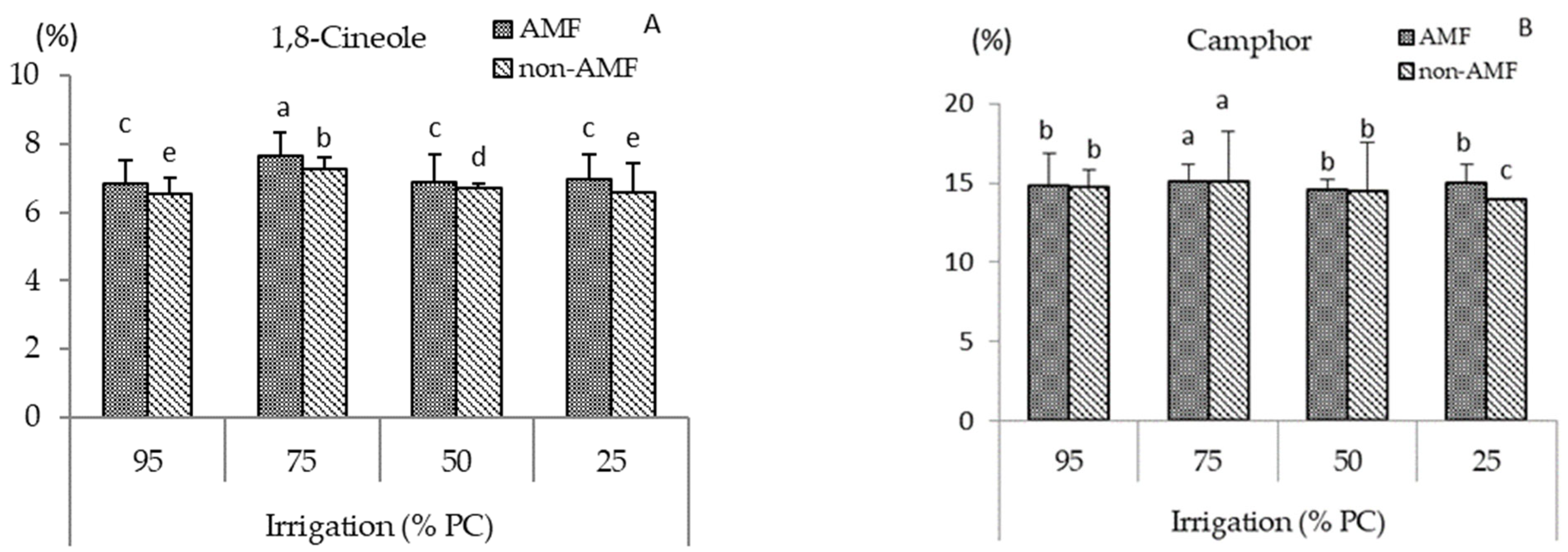
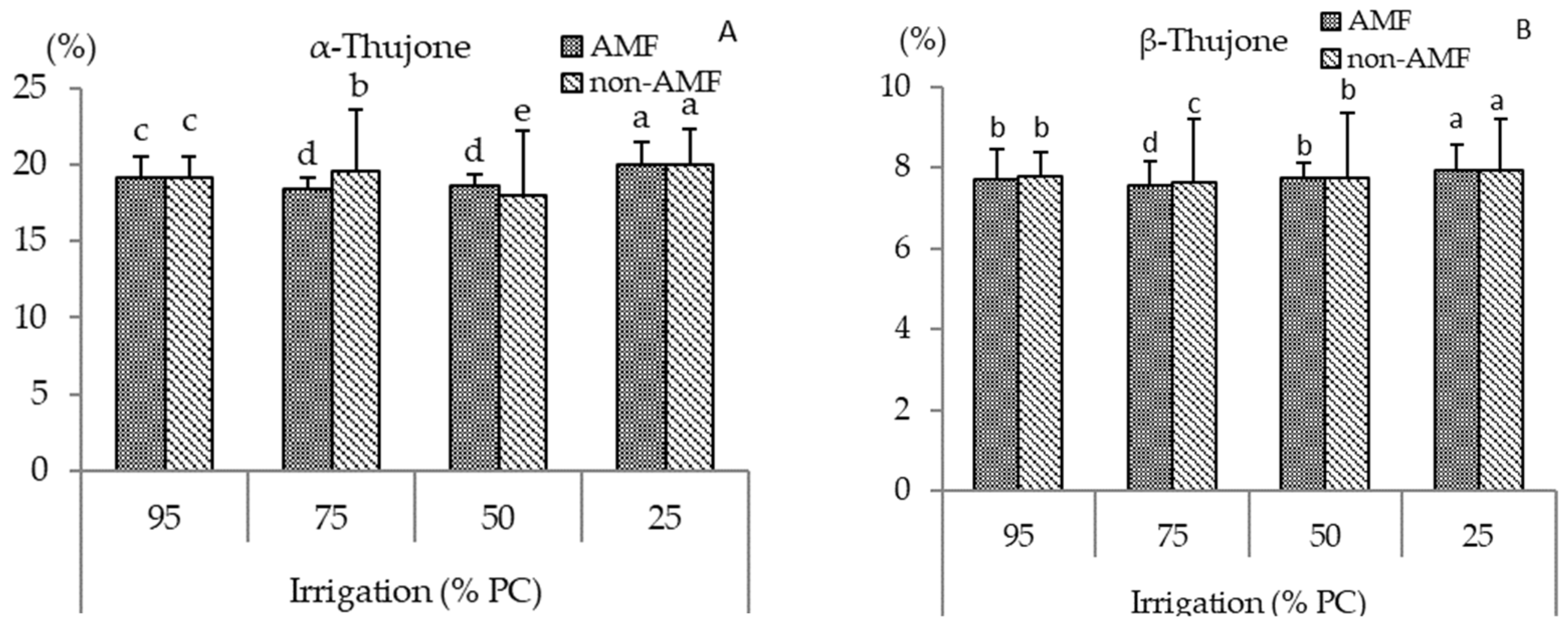
| Treatments | 1,8-Cineole | α-Thujone | β-Thujone | Camphor | E-Caryophyllene | Viridiflorol |
|---|---|---|---|---|---|---|
| Irrigation (I) (%FC) | ||||||
| 95 ± 5 | 6.457 ± 0.68 b | 19.992 ± 2.07 ab | 7.800 ± 1.10 ab | 15.014 ± 1.81 b | 7.294 ± 1.46 b | 7.679 ± 1.12 b |
| 75 ± 5 | 7.948 ± 0.67 a | 16.300 ± 4.37 c | 7.445 ± 1.33 c | 15.518 ± 2.71 a | 6.793 ± 1.85 c | 5.789 ± 0.97 c |
| 50 ± 5 | 6.866 ± 0.81 b | 17.897 ± 4.36 b | 7.734 ± 1.34 b | 14.534 ± 2.52 b | 7.742 ± 1.11 a | 9.040 ± 1.11 a |
| 25 ± 5 | 6.562 ± 0.72 b | 21.229 ± 4.16 a | 8.077 ± 1.56 a | 13.265 ± 2.50 c | 7.659 ± 0.96 a | 7.481 ± 1.11 b |
| Arbuscular mycorrhiza fungi (AMF) | ||||||
| AMF | 7.338 ± 1.27 a | 18.841 ± 5.93 a | 7.783 ± 1.04 a | 14.664 ± 3.99 a | 8.485 ± 1.27 a | 7.700 ± 1.15 a |
| non-AMF | 6.580 ± 1.17 b | 18.872 ± 5.54 a | 7.743 ± 1.34 a | 14.557 ± 2.63 a | 6.260 ± 1.33 b | 7.290 ± 1.25 a |
| Source of variation | ||||||
| I | *** | *** | *** | *** | ** | *** |
| AMF | *** | ns | ns | ns | *** | ns |
| Interaction | * | ** | *** | ** | ** | ns |
Disclaimer/Publisher’s Note: The statements, opinions and data contained in all publications are solely those of the individual author(s) and contributor(s) and not of MDPI and/or the editor(s). MDPI and/or the editor(s) disclaim responsibility for any injury to people or property resulting from any ideas, methods, instructions or products referred to in the content. |
© 2025 by the authors. Licensee MDPI, Basel, Switzerland. This article is an open access article distributed under the terms and conditions of the Creative Commons Attribution (CC BY) license (https://creativecommons.org/licenses/by/4.0/).
Share and Cite
Sałata, A.; Nurzyńska-Wierdak, R.; Kalisz, A.; Ibánez-Asensio, S.; Moreno-Ramón, H.; Majkowska-Gadomska, J.; Francke, A. Arbuscular Mycorrhizal Fungi (AMF) Influence Yield and Essential Oil Content and Composition of Sage (Salvia officinalis L.) Under Different Water Regimes. Agronomy 2025, 15, 2753. https://doi.org/10.3390/agronomy15122753
Sałata A, Nurzyńska-Wierdak R, Kalisz A, Ibánez-Asensio S, Moreno-Ramón H, Majkowska-Gadomska J, Francke A. Arbuscular Mycorrhizal Fungi (AMF) Influence Yield and Essential Oil Content and Composition of Sage (Salvia officinalis L.) Under Different Water Regimes. Agronomy. 2025; 15(12):2753. https://doi.org/10.3390/agronomy15122753
Chicago/Turabian StyleSałata, Andrzej, Renata Nurzyńska-Wierdak, Andrzej Kalisz, Sara Ibánez-Asensio, Héctor Moreno-Ramón, Joanna Majkowska-Gadomska, and Anna Francke. 2025. "Arbuscular Mycorrhizal Fungi (AMF) Influence Yield and Essential Oil Content and Composition of Sage (Salvia officinalis L.) Under Different Water Regimes" Agronomy 15, no. 12: 2753. https://doi.org/10.3390/agronomy15122753
APA StyleSałata, A., Nurzyńska-Wierdak, R., Kalisz, A., Ibánez-Asensio, S., Moreno-Ramón, H., Majkowska-Gadomska, J., & Francke, A. (2025). Arbuscular Mycorrhizal Fungi (AMF) Influence Yield and Essential Oil Content and Composition of Sage (Salvia officinalis L.) Under Different Water Regimes. Agronomy, 15(12), 2753. https://doi.org/10.3390/agronomy15122753