Article

Transcriptomic Analysis of Space-Induced Compound Leaf Variants in Medicago sativa: Unveiling Molecular Mechanisms Behind 5- to 13-Leaflet Number Variation in Alfalfa Mutants

1
Gansu Yasheng Tianyuanmuge Pratacultural Industry Group Co., Ltd., Jiuquan 735000, China
2
Lanzhou Institute of Husbandry and Pharmaceutical Sciences of CAAS, Lanzhou 730050, China
3
Tianshui Shenzhou Lvpeng Agricultural Science & Technology, Gansu Province Spacebreeding Project Technology Research Center, Tianshui 741000, China
*
Authors to whom correspondence should be addressed.
Agronomy 2025, 15(12), 2683; https://doi.org/10.3390/agronomy15122683
Submission received: 17 October 2025 / Revised: 13 November 2025 / Accepted: 19 November 2025 / Published: 22 November 2025
(This article belongs to the Section Crop Breeding and Genetics)

Abstract

(1) Background: Compound leaf morphogenesis in alfalfa (Medicago sativa), a key trait determining yield and agronomic value, is governed by complex molecular mechanisms. (2) Methods: This study systematically investigates the transcriptomic profiles of space-induced alfalfa mutants exhibiting diverse compound leaf numbers through RNA sequencing and Short Time-series Expression Miner (STEM)-based data analysis. (3) Results: Our findings reveal that transcriptional regulators, phosphorylation-related protein kinases, and glycoside hydrolases collectively modulate this trait. Specifically, GRAS and WRKY transcription factors show positive correlations with increased leaflet numbers, highlighting their roles in promoting leaflet initiation. Conversely, transcript levels of serine-threonine/tyrosine-protein kinases are inversely related to leaflet number, suggesting their involvement in suppressing excessive leaflet formation via post-translational modifications. Notably, glycoside hydrolases exhibit suppressed expression in mutants with higher leaflet numbers compared to wild-type plants, implying a regulatory role in balancing cell wall plasticity during morphogenesis. (4) Conclusions: These results provide critical insights into the interplay between transcriptional control, phosphorylation dynamics, and cell wall remodeling in shaping compound leaf architecture. Furthermore, the identified genes and pathways offer novel molecular targets for breeding strategies aimed at optimizing multi-leaflet alfalfa varieties, with potential applications in agricultural productivity and functional genomics.

1. Introduction

Alfalfa (Medicago sativa), renowned for its high protein content and nutritional value, is widely recognized as the “king of forage crops” and serves as a critical feed resource for the global livestock industry, including dairy and poultry farming [1,2,3]. However, the domestic production of high-quality forage in China remains insufficient, leading to a heavy reliance on imports [4]. Therefore, there is an urgent need to develop high-yielding alfalfa varieties through molecular breeding approaches [5]. In plant morphology, compound leaves, which consist of multiple leaflets, are advantageous over simple leaves in terms of photosynthetic efficiency, resource allocation, and resistance to herbivory [6,7,8]. The multi-leaflet trait in alfalfa, exemplified by the formation of five leaflets, is a hallmark of compound leaf development and closely associated with biomass accumulation and reproductive performance [9]. Deciphering the molecular mechanisms underlying this trait is essential for enhancing alfalfa productivity and adaptability.
As an autotetraploid species, alfalfa possesses a highly heterozygous genome and exhibits self-incompatibility, presenting significant challenges for genetic analysis and traditional breeding [10]. However, recent advances in genomics and molecular breeding technologies have provided new opportunities for overcoming these limitations [1]. For instance, Chen et al. [11] established an allele-aware chromosome-level reference genome and proposed a molecular regulatory model for compound leaf development in alfalfa. Additionally, He et al. [5] has constructed a pangenome of alfalfa, revealing its extensive genetic diversity and the genetic basis of key agronomic traits such as salt tolerance and stem-to-leaf ratio. These breakthroughs have laid a solid foundation for further investigation into the molecular mechanisms of the multi-leaflet trait at the transcriptomic level.
The molecular regulation of compound leaf development is a central focus in plant biology, typically governed by the coordinated action of transcription factors. The TCP (Teosinte Branched 1/Cycloidea/Proliferating Cell Factors) transcription factor family plays a crucial role in plant growth, development, and stress responses, influencing leaf morphology through the regulation of cell division and elongation [12,13]. Transcriptomic analyses of adventitious root formation have also identified key genes such as SAUR, VAN3, and EGLC, demonstrating the effectiveness of transcriptomics in unraveling complex developmental networks [14]. Although significant progress has been made in understanding the molecular basis of stress resistance (e.g., cold resistance involving AP2/ERF, WRKY, and MYB transcription factors [15]; drought resistance involving TCP genes [16]), the transcriptomic mechanisms specifically regulating the multi-leaflet trait remain poorly understood, particularly in the context of the complex tetraploid genome of alfalfa.
This study aims to address these gaps through a transcriptomic analysis of the multi-leaflet trait in alfalfa. The objectives include: (1) identifying differentially expressed genes (DEGs) and key metabolic pathways associated with multi-leaflet development to deepen the molecular understanding of this trait; (2) integrating the regulatory roles of transcription factors to clarify the transcriptional framework underlying multi-leaflet formation; and (3) providing candidate genes and theoretical support for future gene-editing or molecular breeding strategies targeting the multi-leaflet trait. By increasing leaflet numbers to enhance biomass, this research not only advances the understanding of the genetic basis of compound leaf development in alfalfa but also offers valuable insights for cultivating high-yielding, high-quality alfalfa varieties, ultimately contributing to improved domestic forage self-sufficiency in China.

2. Materials and Methods

2.1. Obtaining and Culturing of Alfalfa Mutants

Seeds of Medicago sativa L. cv. Sanditi were carried aboard the Shijian-19 recoverable satellite for space mutagenesis. Biological material was sourced from uniform, high-purity parental lines (≥99% purity), with seeds meeting criteria for viability (germination rate ≥ 85%), integrity (no damage or disease), and moisture content (adjusted to 8–12%). Pre-flight disinfection was performed using 15% sodium hypochlorite solution (immersion for 15 min, followed by thorough rinsing) or 75% ethanol spray to eliminate pathogens. Seeds were then packaged in sterile, multi-layered aluminum foil bags under inert gas (argon) or vacuum conditions. A minimum of 1000 seeds were prepared, with an equal quantity reserved as ground controls to account for handling effects. After 15 days in space, the seeds were returned to Earth and planted in the artificial climate chamber at Gansu Agricultural University for mutant screening. The light intensity, temperature, and humidity conditions in the climate chamber were set according to our previous study [17]. The growing medium was a 1:1 mixture of nutrient soil and vermiculite as described by Cui et al. [2]. The seeds were watered daily to maintain soil moisture. Two months after germination, phenotypes were observed, and tissues from the 2 cm apical region of both wild-type and multi-leaflet mutants were sampled for transcriptome sequencing. Biological replicates of the samples were collected from different branches of the same mutant and WT plant, with each mutant and WT line containing three biological replicates. To quantify the multiple-leaflet rate in alfalfa mutants, we counted the number of compound leaves exhibiting multiple-leaflet mutations in each shoot branch across different mutant lines and wild-type (WT) plants, and further calculated the percentage of compound leaves with five, seven, and thirteen leaflets relative to the total compound leaves on each shoot branch.

2.2. Total RNA Extraction and Sequencing

Total RNA was extracted from 200 mg of apical stem tissue samples of the wild type and different mutants, which were ground into powder in liquid nitrogen, using Plant RNA Purification Reagent (Invitrogen, Carlsbad, CA, USA). The quality of the total RNA was further assessed. RNA libraries were constructed using the Illumina TruSeq RNA Sample Prep Kit (Illumina, San Diego, CA, USA). RNA integrity was checked by agarose gel electrophoresis. RNA purity was measured using a NanoPhotometer spectrophotometer (Implen, Frankfurt, Germany), RNA concentration was precisely quantified using a Qubit 2.0 Fluorometer (Thermo Fisher Scientific Inc., Waltham, MA, USA), and RNA integrity was analyzed using an Agilent 2100 Bioanalyzer (Agilent, Santa Clara, CA, USA). After the cDNA library quality test is passed, the sequencing by synthesis method is used to sequence the library on the Illumina NovaSeq 6000 high-throughput sequencing platform (Illumina, San Diego, CA, USA), thereby obtaining the sequence information of the target fragments. The raw data from transcriptome sequencing have been deposited in the NCBI database (PRJNA1345884).

2.3. Transcriptome Quality Assessment, Gene Annotation, and Differential Analysis

The sequencing data obtained were aligned with the published genome sequence of Medicago sativa cv. Zhongmu No. 1 [18], followed by comprehensive quality assessment of the RNA-seq data, as well as SNP and alternative splicing analysis through the HISAT2 software (Version 2.2.1) [19]. Gene expression levels were calculated using the feature Count software (Version 2.0.6) [20], and differential gene expression analysis was performed using edgeR [21]. Genes with |logFC| ≥ 1 and FDR ≤ 0.05 were considered DEGs. The DEGs were further subjected to GO [22] and KEGG [23] enrichment analysis.

2.4. Short Time-Series Expression Miner (STEM) Analysis of DEGs

All comparison group DEGs were merged, and redundant gene IDs were removed. The FPKM values of DEGs in each sample were retrieved using the Microsoft Excel 2021. The resulting dataset was subjected to STEM analysis using OmicStudio tools (https://www.omicstudio.cn/tool (accessed on 17 October 2025)) [24]. Genes were classified into predefined model profiles based on the highest correlation coefficient between their expression patterns and the profiles. The statistical significance of profile enrichment was evaluated using permutation tests (1000 permutations). p-values for Gene Ontology enrichment were computed via the hypergeometric test, with multiple testing corrections applied using the Bonferroni method. This approach ensures robust identification of biologically relevant temporal patterns.
The genes contained in the resulting profiles were further subjected to GO enrichment analysis. GO enrichment analysis was performed through the MODMS online database (https://modms.lzu.edu.cn/ accessed on 17 October 2025) [25].

2.5. qRT-PCR Analysis

Quantitative real-time PCR (qRT-PCR) was conducted following established protocols [26]. Total RNA was extracted from apical stem tissue samples as described in Section 2.2 using the RNAprep Pure Plant Kit (Tiangen, Beijing, China). RNA integrity was verified through spectrophotometric analysis (NanoVue™ Plus) and agarose gel electrophoresis. Genomic DNA was removed using the PrimeScript™ RT Reagent Kit with gDNA Eraser (TaKaRa, Osaka, Japan), followed by first-strand cDNA synthesis. Primers were designed with Primer-BLAST (NCBI), with specific primers for candidate genes, and the reference gene MsACT sourced from published protocols [2]. All primer sequences are detailed in Supplementary Table S1. Reactions were conducted on a LightCycler 96 System (Roche, Basel, Switzerland) with SuperReal PreMix Plus SYBR Green (Tiangen, China). Each 20 μL reaction mixture comprised: 5 μL diluted cDNA (1:20 dilution), 10 μL 2× SuperReal PreMix Plus, 0.6 μL of each primer (10 μM), and 3.8 μL RNase-free ddH2O. Thermocycling parameters included: initial denaturation at 95 °C for 15 min; 40 cycles of 95 °C for 10 s and 60 °C for 30 s; and a melting curve analysis from 60 °C to 95 °C. No-template controls (NTCs) were included for each gene, and reactions were performed in triplicate. Relative gene expression was normalized to MsACT and calculated using the 2−ΔΔCT method.

3. Results

3.1. Overview of RNA-Seq for Alfalfa Mutants with Different Compound Leaflet Numbers

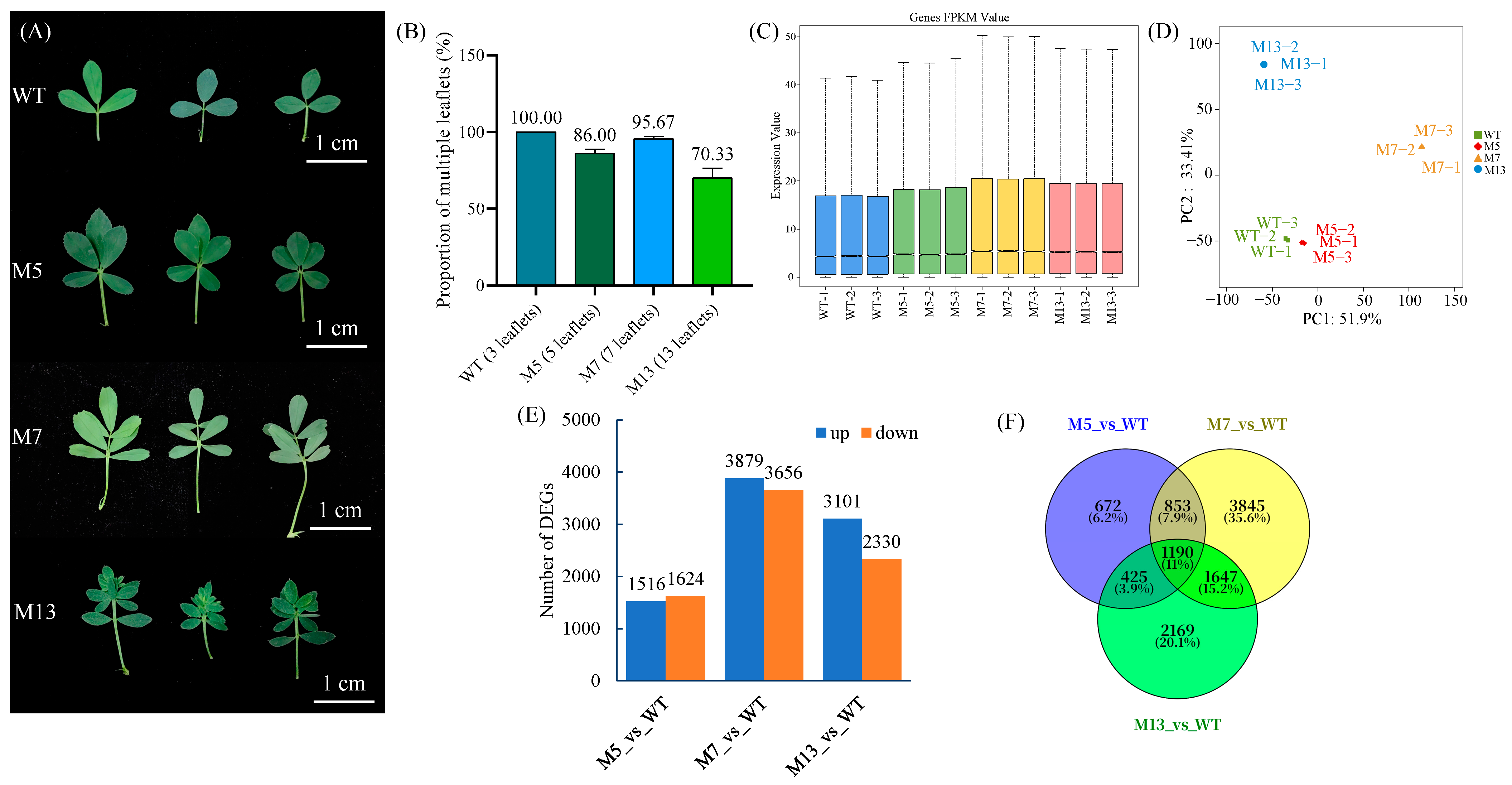
Through space mutagenesis, we obtained alfalfa mutants with different numbers of leaflets (Figure 1A). We further analyzed the percentage of compound leaves with 5, 7, and 13 leaflets relative to the total leaflet count in different mutant lines. The results showed that in the M5 mutant line, compound leaves with 5 leaflets accounted for 86% of the total leaflets. In the M7 mutant line, approximately 95% of the leaflets belonged to compound leaves with 7 leaflets. However, in the M13 mutant line, compound leaves with 13 leaflets constituted a relatively smaller proportion, accounting for about 70% of the total leaflets (Figure 1B). Transcriptome sequencing was performed on these mutants and the wild-type plants. More than 38.32 million clean reads were obtained per sample, and 71–79% of the reads could be mapped to the reference genome (Table S2). PCA analysis showed that data points of the same color were closely clustered, indicating good biological replication within each group (Figure 1C). Furthermore, overall gene expression level analysis revealed that the M7 mutant line exhibited higher gene expression (Figure 1D). Analysis of DEGs revealed that 1516, 3879, and 3101 genes were upregulated, and 1624, 3656, and 2330 genes were downregulated in the M5, M7, and M13 mutant lines, respectively (Figure 1E). Among these, 1190 genes were differentially expressed across all three mutant lines (Figure 1F).

3.2. Results of GO and KEGG Enrichment Analyses of DEGs

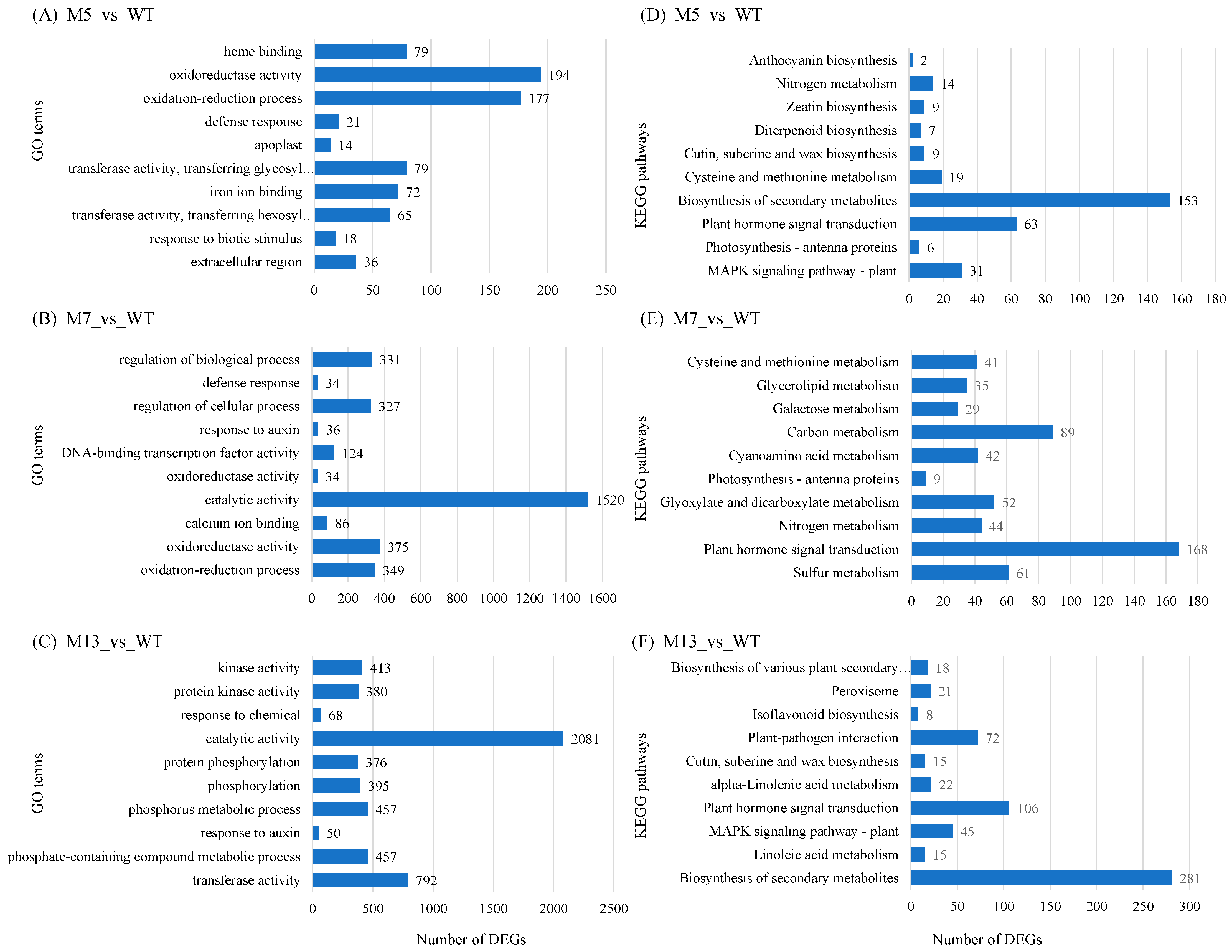
GO enrichment analysis indicated that in the 5- and 7-leaflet alfalfa mutants compared to the WT, DEGs were mainly enriched in oxidoreductase activity and oxidation–reduction processes (Figure 2A,B). In addition, the 7- and 13-leaflet mutants showed a significant number of DEGs associated with catalytic activity compared to the WT (Figure 2B,C). KEGG analysis showed that in the 5- and 13-leaflet alfalfa mutants compared to the WT, the biosynthesis of secondary metabolites pathway was enriched with the highest number of DEGs (Figure 2D–F). However, in the 7-leaflet mutant compared to the WT, DEGs were mainly enriched in the plant hormone signal transduction pathway (Figure 2D–F).

3.3. Performing Clustering of Genes Associated with Leaflet Number in Mutants Using the STEM Tool

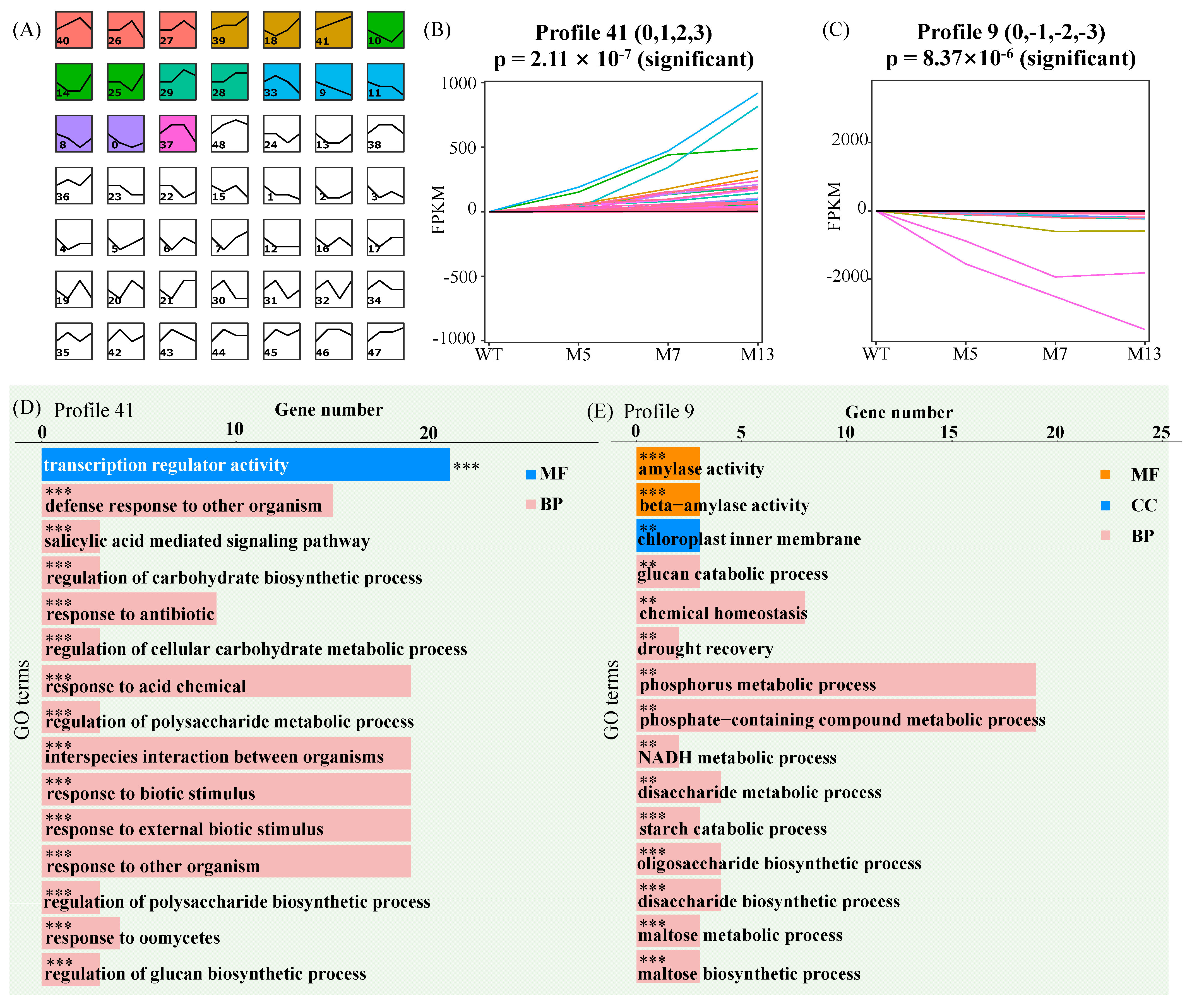
The DEGs were clustered into 49 distinct expression profiles using STEM (version 1.3.13) software (https://www.omicstudio.cn/tool/37, accessed on 18 November 2025), which groups genes based on temporal expression pattern similarity across experimental conditions (Figure 3A). This clustering process was guided by default parameters (e.g., normalization of expression data, similarity threshold for profile assignment) to ensure robust identification of temporally coherent gene groups. The large number of clusters (49) reflects the diverse and dynamic gene expression changes associated with leaflet number variation in the alfalfa mutants, capturing subtle sub-patterns that may correspond to specific developmental stages or regulatory layers. To assess the statistical significance of these associations, we calculated p-value, which measures the probability of observing the enrichment of specific gene sets by chance. Lower p-values (<0.05) indicate stronger enrichment of biological functions within a profile. Subsequent GO enrichment analysis revealed that profile 41 genes were predominantly enriched in GO terms related to transcriptional regulation (e.g., transcription regulator activity) and biological interactions (e.g., response to biotic stimulus, interspecies interaction between organisms) (Figure 3D). These findings suggest that transcriptional regulators and intercellular signaling pathways may actively promote the formation of multiple leaflets by modulating gene expression networks during development. In contrast, profile 9 genes were primarily enriched in metabolic processes involving phosphate-containing compounds and phosphorus metabolism (Figure 3E). Additionally, genes related to carbohydrate metabolism (e.g., regulation of cellular carbohydrate metabolic process, polysaccharide metabolic process, glucan biosynthetic process) were significantly enriched in profile 41, whereas profile 9 was characterized by genes associated with amylase activity and oligosaccharide biosynthetic process, starch catabolic process, and maltose biosynthetic process. This divergence in metabolic enrichment between profiles 41 and 9 implies that metabolic reprogramming, particularly in phosphate and carbohydrate utilization, may play opposing roles in leaflet number determination. Collectively, these results underscore the critical roles of transcriptional regulation, biological interactions, and metabolic processes in shaping the leaflet number of alfalfa mutants. The integration of expression profiling with functional enrichment analysis provides a framework to link gene expression dynamics to specific biological mechanisms underlying leaflet development.

3.4. Transcriptional Regulators and Key Metabolic Pathways Associated with Alfalfa Leaflet Development

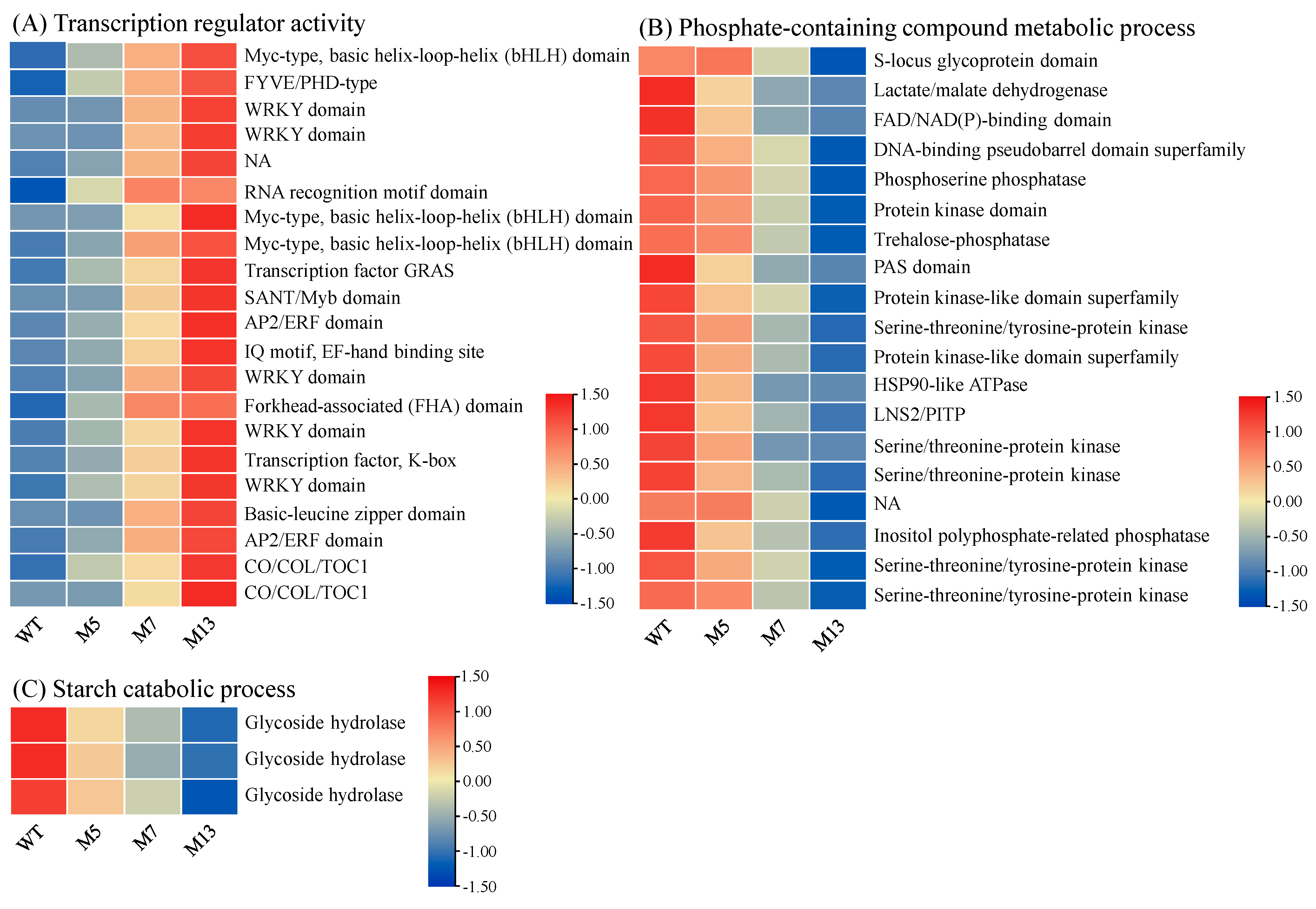
Based on the results of STEM analysis, we further analyzed the genes contained in profiles 41 and 9 (Figure 4). Transcripts encoding transcription factors of the Myc-type, basic helix–loop–helix (bHLH) domain, WRKY domain, and CO/COL/TOC1 showed a progressive increase in expression levels as the number of leaflets in the mutant increased (Figure 4A). In contrast, the expression levels of several genes associated with the phosphate-containing compound metabolic process, including serine-threonine/tyrosine-protein kinase, lactate/malate dehydrogenase, S-locus glycoprotein domain, trehalose-phosphatase, FAD/NAD (P)-binding domain, HSP90-like ATPase, and LNS2/PITP, progressively decreased with the increasing number of leaflets (Figure 4B). Furthermore, we observed that numerous transcripts encoding glycoside hydrolase were enriched in various carbohydrate metabolic pathways within profile 9, and their expression levels also progressively decreased as the number of leaflets increased (Figure 4C). Collectively, these findings suggest that these genes may play critical roles in regulating alfalfa leaflet development.

3.5. Analysis of Genes Associated with Compound Leaf Development

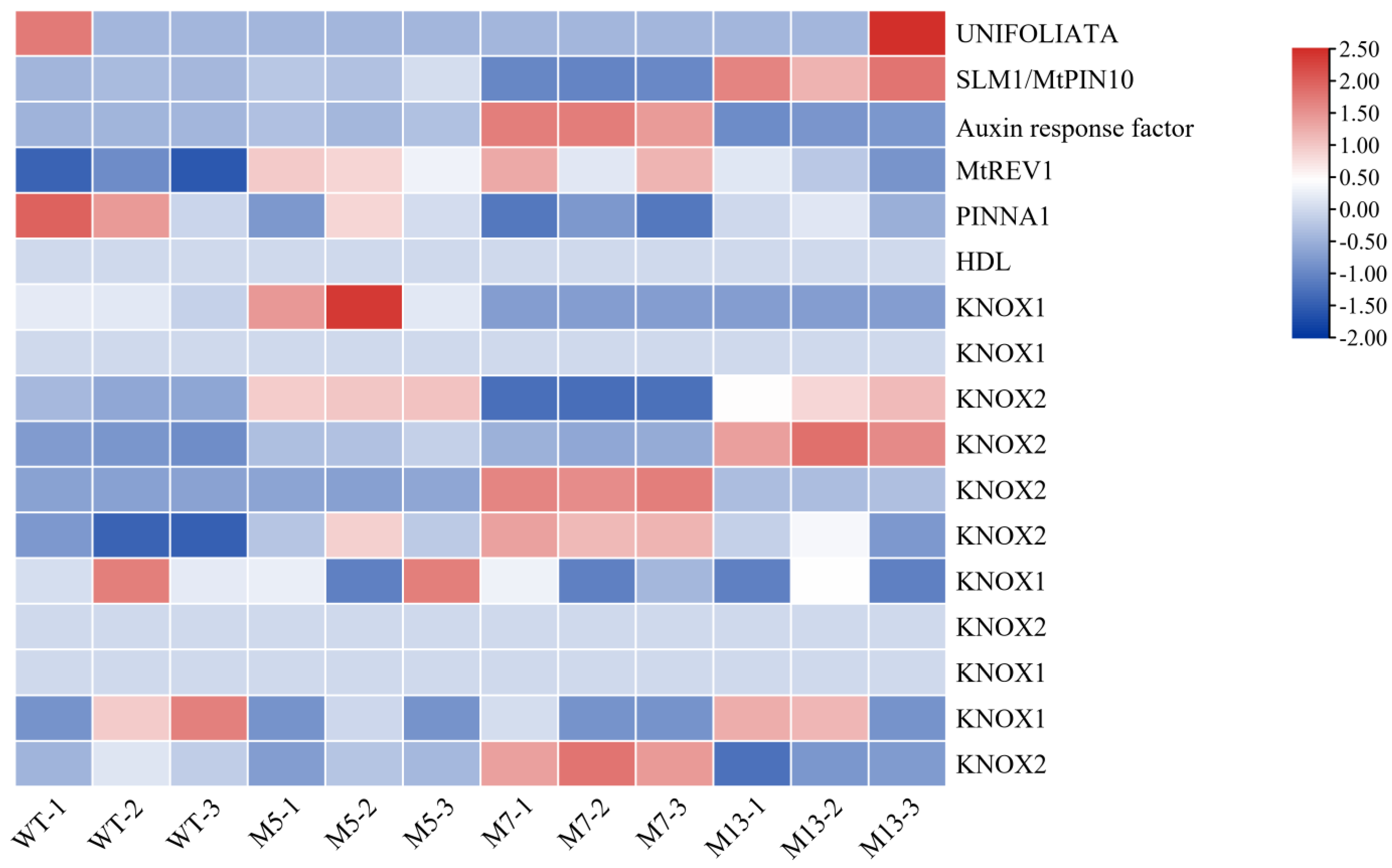
Analysis of the expression patterns of compound leaf development-related genes in different mutants revealed that the expression levels of UNIFOLIATA, SLM1/MtPIN10, KNOXs, and PINNA1 did not consistently increase or decrease with changes in leaflet number. However, auxin signaling-related genes SLM1/MtPIN10 and the auxin response factor were upregulated in the M13 and M7 lines, respectively. Additionally, different transcripts of KNOX2 were upregulated in the M7 and M13 lines. These findings suggest that these genes may be associated with compound leaf development in the respective mutants (Figure 5).

3.6. Validation of Transcriptomic Data via qRT-PCR

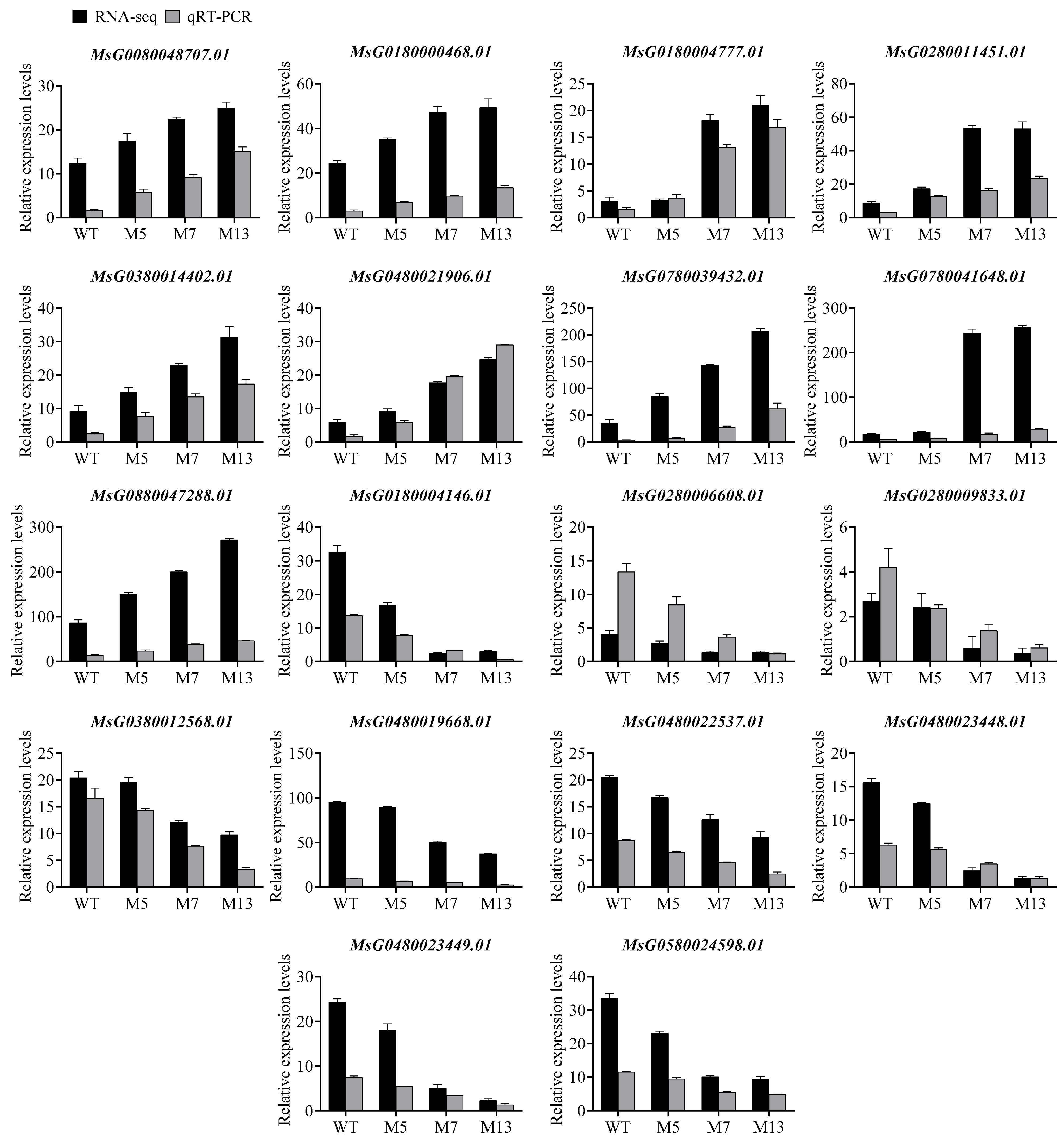
To further validate the expression patterns of genes classified into profile41 and profile9, we performed qRT-PCR analysis to quantify their relative expression levels across compound leaves of mutants with varying leaflet numbers (Figure 6). The results revealed a strong concordance between RNA-seq and qRT-PCR data in capturing gene expression dynamics. Specifically, genes associated with transcriptional regulation and zinc finger domains—such as Myc-type basic helix–loop–helix (bHLH) domain-containing genes (MsG0080048707.01, MsG0280011451.01), FYVE/PHD-type zinc finger protein (MsG0180000468.01), WRKY transcription factors (MsG0180004777.01, MsG0780039432.01), GRAS family transcriptional regulator (MsG0380014402.01), AP2/ERF domain-containing protein (MsG0480021906.01), basic-leucine zipper (bZIP) transcription factor (MsG0780041648.01), and CO/COL/TOC1-type zinc finger protein (MsG0880047288.01)—exhibited consistent upregulation as the leaflet number in mutant compound leaves increased. Conversely, lactate/malate dehydrogenase (MsG0180004146.01), FAD/NAD (P)-binding domain oxidoreductase (MsG0280006608.01), DNA-binding pseudobarrel domain protein (MsG0280009833.01), phosphoserine phosphatase (MsG0380012568.01), trehalose-6-phosphate phosphatase (MsG0480019668.01), protein kinase superfamily members (MsG0480022537.01, MsG0480023449.01, MsG0480023448.01), and glycoside hydrolase (MsG0580024598.01), demonstrated significant downregulation as the leaflet number in mutant compound leaves increased. This expression pattern consistency, supported by technical triplicates for qRT-PCR validation, underscores the robustness and reliability of our RNA-seq results in elucidating the transcriptional responses underlying compound leaf morphogenesis.

4. Discussion

4.1. Transcriptional Regulatory Factors Play a Critical Role in Modulating the Multi-Leaflet Trait in Alfalfa

The leaves represent the primary nutritional organs in alfalfa, with most species exhibiting a characteristic trifoliate compound leaf morphology [7]. Leaflet number is a key trait that determines alfalfa yield [27,28]. Previous studies have identified numerous genes involved in regulating leaflet number in alfalfa [28]. The GRAS transcription factor PINNATE-LIKE PENTAFOLIATA2 (PINNA2) regulates compound leaf morphogenesis in Medicago truncatula by directly binding to and downregulating the promoter of SINGLE LEAFLET1 (SGL1), a key positive regulator of leaflet initiation, while synergizing with repressors PINNA1 and PALM1 to precisely control SGL1’s spatiotemporal expression, thereby maintaining proper leaflet initiation patterns [29]. In addition, overexpression of KNOX1 genes in alfalfa increases leaflet number by reactivating ancestral KNOX1-responsive targets that remain sensitive to its regulation, despite FLORICAULA (FLO)/LEAFY (LFY) genes having functionally replaced KNOX1 in compound leaf development within this lineage [30]. The WRKY transcription factors, particularly WRKY44 and WRKY76, regulate alfalfa compound leaf morphogenesis by dynamically modulating gene expression during leaf primordia development (e.g., stage-specific transcriptional changes), coordinating with other regulators like bHLH079, and influencing leaf margin patterning and petiole formation, while their functional disruption leads to leaf etiolation and simplified morphology, suggesting their dual roles in developmental programming and hormonal pathway integration [31]. In the current study, we observed that the transcript levels of four WRKY domain-containing transcription factors and GRAS transcription factors in alfalfa progressively increased with elevated leaflet numbers in the mutant, suggesting their potential role as positive regulators in modulating compound leaf development in alfalfa (Figure 4A).

4.2. Phosphorylation-Related Protein Kinases Regulating Compound Leaf Morphogenesis in Alfalfa

Proteome phosphorylation is a prevalent post-translational modification process [32,33]. The serine-threonine/tyrosine-protein kinase functions as a plant antiviral defense component by phosphorylating viral proteins, thereby suppressing viral replication and symptom severity, with its kinase activity being essential for this antiviral role while maintaining basal functions in plant growth and stress responses [33]. The serine-threonine/tyrosine-protein kinase AtSTYPK functions as a manganese-dependent dual-specificity kinase capable of autophosphorylation on serine, threonine, and tyrosine residues, with its catalytic activity critically regulated by conserved residues Thr208/Thr284/Thr293 in the activation loop, representing a novel class of plant kinases bridging metal ion cofactor dependence and multisite phosphorylation regulation [34]. The serine-threonine/tyrosine-protein kinase regulates the bifunctional enzymatic activities of Oleosin3 by phosphorylating its serine-18 residue, suppressing its monoacylglycerol acyltransferase activity while enhancing phospholipase A2 activity, with phosphorylation levels dynamically modulated by lipid metabolites (phosphatidylcholine/diacylglycerol) and calcium signaling during seed developmental transitions [35,36]. The observed inverse correlation between transcript levels of serine-threonine/tyrosine kinases with increasing leaflet number in Medicago sativa suggests their post-translational modifications may play regulatory roles in compound leaf morphogenesis, notably through modulating developmental signaling pathways associated with leaflet initiation patterns (Figure 4B).

4.3. Suppression of Glycoside Hydrolase Expression Is Critically Linked to Compound Leaf Development in Alfalfa

Glycoside hydrolases in plants are a functionally diverse enzyme superfamily that dynamically remodel cell wall polysaccharides through precise cleavage of specific glycosidic linkages, enabling cell wall plasticity during tissue differentiation and organ morphogenesis, while their spatiotemporal expression patterns and synergistic actions are developmentally regulated to coordinate wall loosening, structural reinforcement, and adaptive responses to environmental cues [37]. This study revealed that glycoside hydrolases exhibited the highest transcript abundance in WT plants, whereas a progressive decline in glycoside hydrolases expression was observed in mutants correlating with increasing leaflet numbers, suggesting a regulatory role of glycoside hydrolase-mediated cell wall remodeling in compound leaf morphogenesis of alfalfa.

5. Conclusions

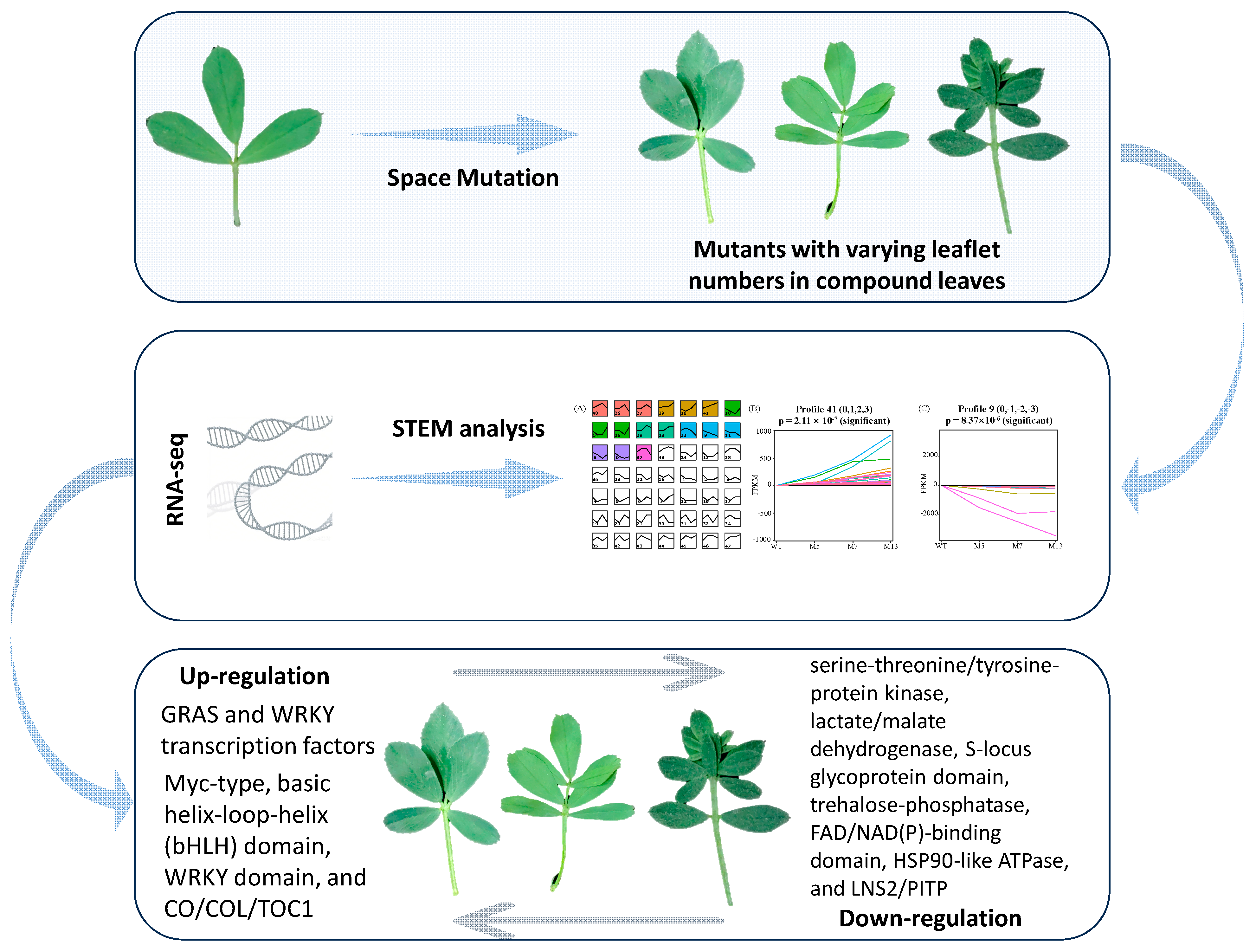
This study performed transcriptome sequencing on alfalfa mutants with varying numbers of compound leaves and used the STEM method to analyze the transcriptomic data (Figure 7). Our results indicate that the suppression of transcription regulator activity, phosphate-containing compound metabolic processes, and glycoside hydrolase expression is highly correlated with the number of compound leaves in alfalfa mutants. The expression levels of the transcription factors GRAS and WRKY were positively correlated with compound leaf number, whereas the transcript levels of the protein kinase serine-threonine/tyrosine kinase, and glycoside hydrolases were negatively correlated with compound leaf number. These findings provide new targets and insights for molecular breeding strategies aimed at developing multi-leaf alfalfa varieties.

Supplementary Materials

The following supporting information can be downloaded at: https://www.mdpi.com/article/10.3390/agronomy15122683/s1, Table S1: Primers for candidate genes; Table S2: Summary of the alignment results to the reference genome.

Author Contributions

Methodology, D.W.; software, Y.W.; validation, H.L., J.Z. and Y.W.; formal analysis, H.Y.; investigation, Y.L., D.W. and H.Y.; resources, H.L. and J.Z.; data curation, Y.L., D.W. and Y.W.; writing—original draft preparation, D.W. and Y.W.; writing—review and editing, D.W., Y.W. and H.Y.; visualization, D.W., Y.W. and H.Y.; supervision, Y.W. and H.Y.; project administration, H.Y.; funding acquisition, H.Y. All authors have read and agreed to the published version of the manuscript.

Funding

This work was supported by the special subject of the Open Competition Projects to Select the Best Candidates for Leading Key Initiatives of the Nei Monggol Autonomous Region (Project No.: 2022JBGS00160104) and the Science and Technology Plan Project of Gansu Province-Germplasm innovation and variety selection of important native grass species and forage in Gansu Province (NO: 23ZDKA013).

Data Availability Statement

The raw data from transcriptome sequencing have been deposited in the NCBI database (PRJNA1345884).

Acknowledgments

We acknowledge the technical support provided by SHANGHAI BIOZERON BIOTECHNOLOGY CO., LTD. during the transcriptome sequencing process.

Conflicts of Interest

Author Dongqiang Wu was employed by the company Gansu Yasheng tianyuanmuge Pratacultural Industry Group Co., Ltd. The remaining authors declare that the research was conducted in the absence of any commercial or financial relationships that could be construed as a potential conflict of interest.

References

  1. Zhang, Y.; Wang, L. Advances in basic biology of alfalfa (Medicago sativa L.): A comprehensive overview. Hortic. Res. 2025, 12, uhaf081. [Google Scholar] [CrossRef]
  2. Cui, T.; Wang, Y.; Niu, K.; Ma, H. Genome-wide identification and expression pattern of the phytochrome-interacting factors (PIFs) family in three alfalfa varieties. BMC Genom. 2025, 26, 633. [Google Scholar] [CrossRef] [PubMed]
  3. Zhu, X.; Wei, B.; Wang, B.; Wei, X. The study on the function of exogenous NO-mediated miR166e-5p in regulating the drought resistance of alfalfa. Plant Physiol. Biochem. 2025, 227, 110083. [Google Scholar] [CrossRef] [PubMed]
  4. Wang, Y.; Xu, C.; Gu, Q.; Shi, Y.; Chen, J.; Wu, H.; He, J.; Li, X.; Han, L.; Su, D. Partial root-zone drying subsurface drip irrigation increased the alfalfa quality yield but decreased the alfalfa quality content. Front. Plant Sci. 2024, 15. [Google Scholar] [CrossRef]
  5. He, F.; Chen, S.; Zhang, Y.; Chai, K.; Zhang, Q.; Kong, W.; Qu, S.; Chen, L.; Zhang, F.; Li, M.; et al. Pan-genomic analysis highlights genes associated with agronomic traits and enhances genomics-assisted breeding in alfalfa. Nat. Genet. 2025, 57, 1262–1273. [Google Scholar] [CrossRef]
  6. Luo, B.; Jiang, J.; Liu, C.; Wei, J.; Wang, X.; Cao, Z.; Zhang, C.; Liu, N.; Lv, Y.; Wei, Z.; et al. Characterization of the KNOX Gene Family in Regulating Alfalfa Compound Leaf Development. J. Plant Growth Regul. 2025, 44, 3762–3777. [Google Scholar] [CrossRef]
  7. Mei, H.; Yan, J.; Jia, X.; Wang, W.; Li, S.; Sun, R.; Jiang, H.; Xie, L.; Zhou, C.; Bai, S.; et al. Transcriptomic and physiological analyses reveal that cytokinin is involved in the compound leaf development of alfalfa. Front. Plant Sci. 2025, 16, 1460205. [Google Scholar] [CrossRef]
  8. Peng, J.; Yu, J.; Wang, H.; Guo, Y.; Li, G.; Bai, G.; Chen, R. Regulation of Compound Leaf Development in Medicago truncatula by Fused Compound Leaf1, a Class M KNOX Gene. Plant Cell 2011, 23, 3929–3943. [Google Scholar] [CrossRef]
  9. Ye, Q.; Zhou, C.; Lin, H.; Luo, D.; Jain, D.; Chai, M.; Lu, Z.; Liu, Z.; Roy, S.; Dong, J.; et al. Medicago2035: Genomes, functional genomics, and molecular breeding. Mol. Plant 2025, 18, 219–244. [Google Scholar] [CrossRef]
  10. Shi, K.; Dong, H.; Du, H.; Li, Y.; Zhou, L.; Liang, C.; Şakiroğlu, M.; Wang, Z. The chromosome-level assembly of the wild diploid alfalfa genome provides insights into the full landscape of genomic variations between cultivated and wild alfalfa. Plant Biotechnol. J. 2024, 22, 1757–1772. [Google Scholar] [CrossRef]
  11. Chen, H.; Zeng, Y.; Yang, Y.; Huang, L.; Tang, B.; Zhang, H.; Hao, F.; Liu, W.; Li, Y.; Liu, Y.; et al. Allele-aware chromosome-level genome assembly and efficient transgene-free genome editing for the autotetraploid cultivated alfalfa. Nat. Commun. 2020, 11, 2494. [Google Scholar] [CrossRef]
  12. Bresso, E.G.; Chorostecki, U.; Rodriguez, R.E.; Palatnik, J.F.; Schommer, C. Spatial Control of Gene Expression by miR319-Regulated TCP Transcription Factors in Leaf Development. Plant Physiol. 2018, 176, 1694–1708. [Google Scholar] [CrossRef]
  13. Danisman, S. TCP Transcription Factors at the Interface between Environmental Challenges and the Plant’s Growth Responses. Front. Plant Sci. 2016, 7. [Google Scholar] [CrossRef]
  14. Ai, Y.; Qian, X.; Wang, X.; Chen, Y.; Zhang, T.; Chao, Y.; Zhao, Y. Uncovering early transcriptional regulation during adventitious root formation in Medicago sativa. BMC Plant Biol. 2023, 23, 176. [Google Scholar] [CrossRef]
  15. Ritonga, F.N.; Ngatia, J.N.; Wang, Y.; Khoso, M.A.; Farooq, U.; Chen, S. AP2/ERF, an important cold stress-related transcription factor family in plants: A review. Physiol. Mol. Biol. Plants 2021, 27, 1953–1968. [Google Scholar] [CrossRef]
  16. Jiao, P.; Liu, T.; Zhao, C.; Fei, J.; Guan, S.; Ma, Y. ZmTCP14, a TCP transcription factor, modulates drought stress response in Zea mays L. Environ. Exp. Bot. 2023, 208, 105232. [Google Scholar] [CrossRef]
  17. Wang, Y.; Cui, T.; Niu, K.; Ma, H. Integrated proteomics, transcriptomics, and metabolomics offer novel insights into Cd resistance and accumulation in Poa pratensis. J. Hazard. Mater. 2024, 474, 134727. [Google Scholar] [CrossRef] [PubMed]
  18. Shen, C.; Du, H.; Chen, Z.; Lu, H.; Zhu, F.; Chen, H.; Meng, X.; Liu, Q.; Liu, P.; Zheng, L.; et al. The Chromosome-Level Genome Sequence of the Autotetraploid Alfalfa and Resequencing of Core Germplasms Provide Genomic Resources for Alfalfa Research. Mol. Plant 2020, 13, 1250–1261. [Google Scholar] [CrossRef]
  19. Kim, D.; Paggi, J.M.; Park, C.; Bennett, C.; Salzberg, S.L. Graph-based genome alignment and genotyping with HISAT2 and HISAT-genotype. Nat. Biotechnol. 2019, 37, 907–915. [Google Scholar] [CrossRef] [PubMed]
  20. Liao, Y.; Smyth, G.K.; Shi, W. featureCounts: An efficient general purpose program for assigning sequence reads to genomic features. Bioinformatics 2014, 30, 923–930. [Google Scholar] [CrossRef] [PubMed]
  21. Robinson, M.D.; McCarthy, D.J.; Smyth, G.K. edgeR: A Bioconductor package for differential expression analysis of digital gene expression data. Bioinformatics 2010, 26, 139–140. [Google Scholar] [CrossRef]
  22. Ashburner, M.; Ball, C.A.; Blake, J.A.; Botstein, D.; Butler, H.; Cherry, J.M.; Davis, A.P.; Dolinski, K.; Dwight, S.S.; Eppig, J.T.; et al. Gene Ontology: Tool for the unification of biology. Nat. Genet. 2000, 25, 25–29. [Google Scholar] [CrossRef]
  23. Kanehisa, M. KEGG: Kyoto Encyclopedia of Genes and Genomes. Nucleic Acids Res. 2000, 28, 27–30. [Google Scholar] [CrossRef]
  24. Ernst, J.; Bar-Joseph, Z. STEM: A tool for the analysis of short time series gene expression data. BMC Bioinform. 2006, 7, 191. [Google Scholar] [CrossRef]
  25. Fang, L.; Liu, T.; Li, M.; Dong, X.; Han, Y.; Xu, C.; Li, S.; Zhang, J.; He, X.; Zhou, Q.; et al. MODMS: A multi-omics database for facilitating biological studies on alfalfa (Medicago sativa L.). Hortic. Res. 2024, 11, uhad245. [Google Scholar] [CrossRef] [PubMed]
  26. Niu, K.; Zhang, R.; Zhu, R.; Wang, Y.; Zhang, D.; Ma, H. Cadmium stress suppresses the tillering of perennial ryegrass and is associated with the transcriptional regulation of genes controlling axillary bud outgrowth. Ecotoxicol. Environ. Saf. 2021, 212, 112002. [Google Scholar] [CrossRef] [PubMed]
  27. Estill, K.; Delaney, R.H.; Ditterline, R.L.; Smith, W.K. Water relations and productivity of alfalfa populations divergently selected for leaflet size. Field Crops Res. 1993, 33, 423–434. [Google Scholar] [CrossRef]
  28. Barsukov, N.M.; Leonova, E.S.; Zaitsev, I.S. Multifoliate Alfalfa: Its Causes and Effect. Russ. J. Genet. 2024, 60, 265–273. [Google Scholar] [CrossRef]
  29. He, L.; Liu, Y.; Mao, Y.; Wu, X.; Zheng, X.; Zhao, W.; Mo, X.; Wang, R.; Wu, Q.; Wang, D.; et al. GRAS transcription factor PINNATE-LIKE PENTAFOLIATA2 controls compound leaf morphogenesis in Medicago truncatula. Plant Cell 2024, 36, 1755–1776. [Google Scholar] [CrossRef] [PubMed]
  30. Champagne, C.E.M.; Goliber, T.E.; Wojciechowski, M.F.; Mei, R.W.; Townsley, B.T.; Wang, K.; Paz, M.M.; Geeta, R.; Sinha, N.R. Compound Leaf Development and Evolution in the Legumes. Plant Cell 2007, 19, 3369–3378. [Google Scholar] [CrossRef]
  31. Zhu, G.; Ma, C.; Yu, S.; Zhang, X.; Jiang, J.; Liu, X. Transcriptome Analyses Reveal the Key Regulators of Tomato Compound Leaf Development. Horticulturae 2023, 9, 363. [Google Scholar] [CrossRef]
  32. Vu, L.D.; Gevaert, K.; De Smet, I. Protein Language: Post-Translational Modifications Talking to Each Other. Trends Plant Sci. 2018, 23, 1068–1080. [Google Scholar] [CrossRef] [PubMed]
  33. Kosová, K.; Vítámvás, P.; Prášil, I.T.; Klíma, M.; Renaut, J. Plant Proteoforms Under Environmental Stress: Functional Proteins Arising From a Single Gene. Front. Plant Sci. 2021, 12. [Google Scholar] [CrossRef] [PubMed]
  34. Zhang, X.; Wang, X.; Xu, K.; Jiang, Z.; Dong, K.; Xie, X.; Zhang, H.; Yue, N.; Zhang, Y.; Wang, X.-B.; et al. The serine/threonine/tyrosine kinase STY46 defends against hordeivirus infection by phosphorylating γb protein. Plant Physiol. 2021, 186, 715–730. [Google Scholar] [CrossRef] [PubMed]
  35. Reddy, M.M.; Rajasekharan, R. Role of threonine residues in the regulation of manganese-dependent arabidopsis serine/threonine/tyrosine protein kinase activity. Arch. Biochem. Biophys. 2006, 455, 99–109. [Google Scholar] [CrossRef]
  36. Parthibane, V.; Iyappan, R.; Vijayakumar, A.; Venkateshwari, V.; Rajasekharan, R. Serine/Threonine/Tyrosine Protein Kinase Phosphorylates Oleosin, a Regulator of Lipid Metabolic Functions. Plant Physiol. 2012, 159, 95–104. [Google Scholar] [CrossRef]
  37. Minic, Z.; Jouanin, L. Plant glycoside hydrolases involved in cell wall polysaccharide degradation. Plant Physiol. Biochem. 2006, 44, 435–449. [Google Scholar] [CrossRef]
Figure 1. Overview of transcriptome sequencing in the alfalfa mutants. (A) Phenotype of alfalfa mutants with different leaflet numbers; (B) The percentage of multiple compound leaves among the total compound leaves in different mutants; data are presented as “mean ± standard deviation (n = 4).” (C) PCA analysis of gene expression values in all samples; Each point in the figure represents a sample, and its position in the space is determined by the differences in gene expression within it; The color of each point represents a different group; (D) Comparison of gene expression levels among different samples. The x-axis represents sample names, and the y-axis represents gene expression abundance; The upper horizontal line indicates the maximum value; The top of the box indicates the upper quartile; The central concave line within the box indicates the median; The bottom of the box indicates the lower quartile; The lower horizontal line indicates the minimum value. (E) The number of DEGs in different mutants versus wild-type (WT) plants; The blue bars represent the number of upregulated DEGs, and the orange bars represent the number of downregulated DEGs. (F) The Venn diagram illustrates the number of overlapping and unique DEGs in various comparison groups. WT: wild type; M5, M7, and M13 represent alfalfa mutants with five, seven, and thirteen leaflets, respectively.
Agronomy 15 02683 g001
Figure 2. Top 10 enriched GO (AC) and KEGG (DF) terms of each comparation groups. WT: Wild type; M5, M7, and M13 represent alfalfa mutants with five, seven, and thirteen leaflets, respectively.
Agronomy 15 02683 g002
Figure 3. STEM analysis of DEGs. (A) Clusters of DEGs with similar expression trends. The color-coded clusters indicate significant enrichment of DEGs in this expression profile; The line patterns of different profiles represent gene expression trends, and the numerical profile labels are used to identify them. (B,C) Genes positively (B) and negatively (C) correlated with leaflet number in mutants. (D,E) GO enrichment of DEGs involved in profile 41 and profile 9. ** denotes p < 0.01, *** denotes p < 0.001; WT: Wild type; M5, M7, and M13 represent alfalfa mutants with five, seven, and thirteen leaflets, respectively.
Agronomy 15 02683 g003
Figure 4. Expression levels of transcription regulator activity (A), phosphate-containing compound metabolic process (B), and starch catabolic process (C) genes. The heatmap was generated using the average FPKM values across samples in different treatment groups, with red indicating upregulation and blue indicating downregulation. WT: Wild type; M5, M7, and M13 represent alfalfa mutants with five, seven, and thirteen leaflets, respectively.
Agronomy 15 02683 g004
Figure 5. Expression pattern analysis of genes associated with compound leaf development. The heatmap was generated using the average FPKM values across samples in different treatment groups, with red indicating upregulation and blue indicating downregulation. WT: Wild type; M5, M7, and M13 represent alfalfa mutants with five, seven, and thirteen leaflets, respectively.
Agronomy 15 02683 g005
Figure 6. Comparison of gene expression profiles between RNA-seq and qRT-PCR. Black bars indicate RNA-seq-derived FPKM values, while gray bars depict qRT-PCR-determined relative expression levels. Data are shown as mean ± standard deviation (n = 3).
Agronomy 15 02683 g006
Figure 7. Schematic Diagram of Compound Leaf Development-Related Gene Characterization.
Agronomy 15 02683 g007
Disclaimer/Publisher’s Note: The statements, opinions and data contained in all publications are solely those of the individual author(s) and contributor(s) and not of MDPI and/or the editor(s). MDPI and/or the editor(s) disclaim responsibility for any injury to people or property resulting from any ideas, methods, instructions or products referred to in the content.