Article

Estimating Winter Wheat Leaf Water Content by Combining UAV Spectral and Texture Features with Stacking Ensemble Learning


1
Key Laboratory of Agricultural Soil and Water Engineering in Arid and Semiarid Areas, Ministry of Education, Northwest AF University, Yangling 712100, China
2
College of Water Resources and Architectural Engineering, Northwest AF University, Yangling 712100, China
3
State Key Laboratory of Simulation and Regulation of Water Cycle in River Basin, China Institute of Water Resources and Hydropower Research, Beijing 100038, China
4
National Center for Efffcient Irrigation Engineering and Technology Research-Beijing, Beijing 100048, China
*
Author to whom correspondence should be addressed.
Agronomy 2025, 15(11), 2610; https://doi.org/10.3390/agronomy15112610
Submission received: 30 August 2025 / Revised: 9 November 2025 / Accepted: 11 November 2025 / Published: 13 November 2025

Abstract

Leaf water content (LWC) is a vital physiological indicator reflecting crop water status, crucial for precision irrigation and water management. Traditional monitoring methods are labor-intensive and costly, while unmanned aerial vehicle (UAV) remote sensing offers an efficient alternative with high spatiotemporal resolution. This study developed an inversion model for winter wheat LWC based on a stacking ensemble learning framework integrating multispectral and texture features to improve estimation accuracy. UAV multispectral images collected at different growth stages were used to extract 17 vegetation indices (VIs) and 32 texture features (TFs). The top 10 features most correlated with LWC were selected to construct a fused dataset, and five machine learning models (SVM, RF, XGB, PLSR, RR) were combined within a base–meta stacking architecture. Results showed that: (1) Using only multispectral features yielded R2 values of 0.526–0.718 and rRMSE of 22.795–29.536%, while texture-only models performed worse (R2 = 0.273–0.425, rRMSE = 34.7–36.6%), indicating that single data sources cannot fully represent LWC variability. (2) Combining multispectral and texture features notably improved accuracy (R2 = 0.748–0.815; rRMSE = 18.5–21.6%), demonstrating the complementary advantages of spectral and spatial information. (3) Stacking ensemble learning outperformed all single models, achieving the highest precision under fused features (R2 = 0.865; rRMSE = 16.3%). (4) LWC distribution maps derived from the stacking model effectively revealed field-scale moisture differences and spatial heterogeneity during different periods. This study confirms that multi-source feature fusion combined with ensemble learning enhances UAV-based crop water estimation, offering a reliable and scalable approach for precision agricultural water monitoring.

1. Introduction

Winter wheat is one of the most widely cultivated cereal crops worldwide, covering more than 220 million hectares and providing a staple food source for over one-third of the global population [1]. Its yield and quality are highly dependent on water availability, and thus, LWC serves as a crucial physiological indicator reflecting crop water status and influencing photosynthesis, nutrient transport, and stress resistance [2]. Therefore, accurate and real-time monitoring of LWC is essential for improving irrigation efficiency and ensuring stable yields in global arid and semi-arid agricultural regions.
Traditional LWC monitoring methods based on destructive sampling and oven-drying are accurate but laborious, costly, and limited in temporal and spatial coverage. Hence, developing efficient, non-destructive, and scalable LWC monitoring approaches has emerged as a critical focus area in precision agriculture research [3,4]. With advances in remote sensing, especially UAV-based platforms, the estimation of crop water status using multispectral, hyperspectral, and thermal sensors has gained global attention [5,6]. However, satellite remote sensing is often constrained by low spatial resolution and infrequent revisit times, limiting its field-scale applicability [7]. In contrast, UAV remote sensing provides centimeter-level resolution and flexible flight scheduling, making it particularly suitable for plot- or field-scale crop monitoring and precision irrigation management [8,9].
Current research on monitoring leaf water content primarily relies on combining different sensors with spectral indices [10,11,12,13]. Due to its ability to capture a wide range of bands, hyperspectral imaging has become a major sensor technology for such monitoring. Spectral analyses indicate that water content is most sensitively detected in the 1450–2500 nm range, with additional sensitivity observed at 400 and 700 nm [14,15]. Based on these sensitive bands, multiple vegetation water indices have been proposed and applied to a variety of crops and ecosystems. These include the Water Index (WI) for forest and shrub ecosystems [16], the Normalized Difference Infrared Index (NDII) for estimating the moisture content of maize and soybeans [17], and the Normalized Water Index (NWI) for improving the accuracy of monitoring wheat moisture content [18]. Thermal infrared sensors provide supplementary data that is crucial for assessing water stress by capturing canopy temperature information. Studies indicate that the vegetation water potential index extracted from thermal infrared imagery and the crop water stress index derived from UAV thermal imaging both effectively indicate leaf water status [19,20].
Recent studies in China, the USA [21], Europe [22], South Africa [23], and Australia [24] demonstrated that UAV multispectral data can effectively estimate canopy water status and support irrigation scheduling for cereals. Yet, most of these studies emphasize spectral indices alone, overlooking spatial texture information that reflects canopy structure and heterogeneity. Additionally, texture features derived from UAV imagery capture pixel-level spatial variation caused by water stress (e.g., leaf curling, canopy roughness) and thus complement spectral indices [25,26]. Integrating texture and spectral information has improved biophysical parameter retrieval (e.g., LAI, biomass), but few studies have applied this integration for LWC estimation, particularly in wheat fields characterized by complex canopy structures. This represents a critical research gap.
Various machine learning (ML) methods—such as random forest (RF), support vector machine (SVM), and extreme gradient boosting (XGBoost)—have been widely used for estimating crop biophysical parameters. However, single ML models often capture only partial nonlinear relationships and may suffer from overfitting or limited generalization under heterogeneous field conditions [27]. Stacking ensemble learning, which combines multiple base learners through a meta-model, has shown superior predictive performance in crop monitoring compared with traditional single algorithms [28]. For example, ref. [29] improved rapeseed growth parameter estimation by 20% using stacking, while global studies on maize, soybean, and rice confirm its advantage in integrating multi-source features and enhancing model robustness [30,31].
Despite these advances, few studies have explored stacking ensemble learning for UAV-based LWC estimation combining both spectral and texture features, leaving a methodological gap in precision water monitoring [32]. Furthermore, winter wheat serves as an ideal test crop due to its vast global acreage, high irrigation dependence, and sensitivity to water stress during critical growth stages. Stacking ensemble learning is particularly well-suited for such heterogeneous field environments because it effectively fuses complementary information from multispectral and texture data, mitigates overfitting, and improves generalization [33].
Therefore, this study aims to (1) construct a fused spectral–texture feature dataset from UAV multispectral imagery; (2) develop a stacking algorithm-based estimation model and evaluate its performance; (3) generate spatial distribution maps of winter wheat LWC for precise water management. While focusing on a specific site, this study acknowledges limitations such as site-specific variability, weather dependency, and UAV flight constraints, but it provides a transferable framework for large-scale crop water monitoring under diverse agroecological conditions.

2. Materials and Methods

2.1. Study Area

The study area is located in Wugong County, in the western part of the Guanzhong Plain, Shaanxi Province, situated within the core zone of the Baojixia Irrigation District (Figure 1). The county experiences a typical warm temperate semi-humid monsoon climate, characterized by distinct seasonal variations, abundant light and heat resources, and good synchronization between precipitation and thermal conditions. Meteorological observation data indicate that the local multi-year average temperature is maintained at around 12.9 °C, the annual frost-free period can reach 210 days, and the average annual precipitation remains within the range of 540–560 mm [34]. In terms of topography and geomorphology, Wugong County is predominantly plain, with open and flat terrain. Benefiting from the alluvial action of the Wei River. The soil within the county is of excellent quality, rich in organic matter, nitrogen, potassium, and available phosphorus. This creates superior natural conditions for modern agriculture. As a national commercial grain production base, the county also undertakes the important task of wheat seed breeding and promotion in Shaanxi Province. Administratively, the county comprises 8 designated towns, with a total existing cultivated land area of 27,300 hectares, providing a solid land resource guarantee for regional grain safety production.

2.2. Data Collection and Preprocessing

2.2.1. Ground Data Acquisition and Analysis

The period from March to May 2024 was selected to target the regreening and jointing stages of winter wheat for monitoring plant water content and acquiring synchronized UAV imagery. Since these stages are highly sensitive to water stress, the chosen timeframe enables effective diagnosis of crop water deficits, offering key insights for precision irrigation and yield assurance. Based on the planting structure characteristics of the irrigation district and the technical requirements of UAV remote sensing, 90 sampling points were systematically arranged using a grid method within the experimental area. The sampling points were randomly generated but ensured uniform distribution across different plots. This approach guaranteed an even spread of sampling points across the experimental area, while avoiding disturbances such as roads or field edges. Sampling was strictly confined to the daily UAV flight window of 10:00–14:00. At each sampling point, a standard 30 m × 30 m quadrat was established, matching the spatial resolution of the UAV imagery. During sampling, the above-ground parts of representative winter wheat plants were collected using the five-point sampling method [35]. High-precision GPS positioning information was simultaneously recorded.
Laboratory analysis followed the internationally standard oven-drying and weighing method as described by the International Organization for Standardization (ISO 11465:1993) [36] and widely adopted in agronomic studies [37]: place the fresh leaves in pre-weighed sample bags, and then kill the enzymes by withering at 105 °C for 30 min. Fresh weight (m_f) and dry weight (m_d) were measured using a professional electronic balance (accuracy 0.001 g). The plant moisture content (θ) was calculated using the standard formula:
θ = (m_f − m_d)/m_f × 100%
In the formula, θ is water content, m_f is fresh weight, and m_d is dry weight. The moisture content was calculated on a wet basis because it directly reflects the actual physiological water status of fresh plant tissues and allows for more accurate correlation with UAV spectral reflectance, which responds to canopy water under natural field conditions [33].
Quality control measures included: (1) Even distribution of sampling points across the aerial survey area, avoiding disturbances such as field ridges and roads; (2) Setting 3 replicates per quadrat, with the average value taken as the final result; (3) Strict adherence to standard operating procedures during laboratory processing to ensure data reliability. All measured data underwent a three-level verification system to guarantee spatiotemporal consistency with the UAV remote sensing data.

2.2.2. Spectral Data Acquisition and Processing

Imagery acquisition was conducted using the Mavic 3 Multispectral drone system (DJI Technology Co., Ltd., Shenzhen, China). The system is equipped with a 4/3-inch RGB camera and four 1/2.8-inch monochrome multispectral sensors capturing green (560 ± 16 nm), red (650 ± 16 nm), red edge (730 ± 10 nm), and near-infrared (860 ± 26 nm) bands. A high-precision Real-Time Kinematic (RTK) positioning module ensured centimeter-level spatial accuracy. Data were collected under clear-sky conditions during midday (11:00–14:00) to minimize illumination variation. Prior to each flight, reflectance calibration was performed using a standard reflectance panel to convert digital numbers to surface reflectance. Flight parameters were maintained within standard UAV operation settings flight altitude: 100 m; Image overlaps: 75% (forward) and 80% (side)) with the camera oriented vertically downward. Raw images were processed using Pix4D Mapper (Pix4D, Prilly, Switzerland) for radiometric calibration, image alignment, and orthomosaic generation, providing high-quality reflectance maps for subsequent analysis.

2.3. Vegetation Indices

In this study, we calculated multiple VIs related to leaf water content and leaf area index (LAI) based on previous research, in addition to the four spectral band reflectance data provided by the Mavic 3 multispectral UAV (Table 1). These vegetation indices, as a crucial component of multi-angle spectral information, can reflect the growth status, photosynthetic capacity, and water conditions of crops. Specifically, commonly used vegetation indices were selected for this study, including the Normalized Difference Vegetation Index (NDVI), Enhanced Vegetation Index (EVI), and Water Index (WI), among others. These indices effectively capture the biophysical characteristics of winter wheat leaves. For each study area, the calculation method involved averaging the vegetation index values of all pixels within the region, ensuring that the representative vegetation index for each area accurately reflected the overall vegetation condition of that region. During image data processing, the vegetation indices were computed using standard formulas tailored to different spectral bands.

2.4. Texture Features

To extract richer spatial structural information from spectral images, this study employed the gray level co-occurrence matrix (GLCM) method to compute texture features [27]. The GLCM can reflect the joint distribution characteristics of pixel grayscale values in images at specific spatial distances and directions, demonstrating good directional sensitivity and regional texture representation capabilities [36]. In the specific extraction process, the grayscale levels of the original grayscale image are first compressed from 256 to 64 levels to reduce computational complexity and improve efficiency. Subsequently, GLCM matrices are constructed within a 3 × 3 window scale with a step size of 1 pixel. A 3 × 3 window was chosen because it provides an appropriate balance between capturing local texture variation and minimizing spectral smoothing or mixed-pixel effects, ensuring both computational efficiency and the preservation of fine canopy structural details. To enhance the stability of directional information, the co-occurrence matrix is calculated for each window in four directions—0°, 45°, 90°, and 135°—and the average of the statistical indicators from these directions is taken as the final texture feature for that window.
For each direction and scale, 8 typical texture parameters are extracted, including Mean, Variance, Homogeneity, Contrast, Dissimilarity, Entropy, Angular Second Moment, and Correlation, thereby comprehensively characterizing the spatial distribution features of the image. Considering the multispectral images and the constructed vegetation index features, this study ultimately obtained a total of 32 sets of texture feature statistics based on the four spectral bands, which are used as input variables for subsequent modeling analysis. Detailed computations can be found in Zhou et al. [38]. All vegetation index calculations and texture feature extraction were conducted in ENVI 5.6 (Harris Geospatial Solutions, Boulder, CO, USA) and MATLAB R2023a (MathWorks, Natick, MA, USA), which were used for band operations, statistical analysis, and texture computation based on the gray-level co-occurrence matrix (GLCM).

2.5. Data Analysis

2.5.1. Statistical Analysis

This study employs a multidimensional statistical analysis approach to systematically evaluate the distribution characteristics of winter wheat plant water content data. By constructing a dispersion-skewness analysis framework, it focuses on three core statistical metrics [39]: dispersion indicators (standard deviation and coefficient of variation) and a distribution shape indicator (Pearson skewness). Standard deviation (SD) reflects the absolute dispersion of measured water content values from the mean, while the coefficient of variation (CV) enables comparative analysis across different sample sets through standardization (SD/mean × 100%). Based on agricultural remote sensing modeling experience, an SD > 0.01 and a CV > 10% indicate that the data possesses desirable variability, meeting the requirements for model construction. If the CV exceeds 100%, the dataset is considered to have severe dispersion and variability, making it unsuitable for model development [40]. Regarding distribution shape, Pearson skewness quantitatively characterizes the asymmetry of the data distribution: a positive value indicates a right-skewed distribution (mean > median, long tail to the right), a negative value corresponds to a left-skewed distribution (mean < median, long tail to the left), and a value near zero reflects an approximately symmetric distribution. This analytical framework can effectively identify abnormal distribution patterns in water content data, providing crucial basis for subsequent data standardization processing and model parameter optimization [41].

2.5.2. Correlation Analysis

To enhance model efficiency, a correlation analysis was employed for the preliminary selection of spectral and texture features [42]. The Pearson correlation coefficient method was used to quantify the linear relationship between each feature and measured leaf water content, with a threshold of |r| > 0.5 considered as a significant correlation for feature selection. We selected the top 10 spectral indices and the top 10 texture features with the highest correlations as the final input features. Additionally, autocorrelation analysis was conducted on the chosen spectral and texture features. Based on the analysis results, the optimal spectral-texture variable combinations were identified for each feature scheme.

2.6. Stacking Integration Model Construction

To enhance the stability and generalization capability of the model in estimating winter wheat leaf water content, this study constructed a stacking-based ensemble learning framework. A total of 180 samples were divided into training and validation sets at a ratio of 7:3. In the training set, a 5-fold cross-validation strategy was employed for model training and hyperparameter tuning. Specifically, the training set was equally split into five subsets; each time, one subset was used as the validation subset while the remaining four were used for training. This process was repeated five times to obtain the optimal hyperparameter configurations for each model across different data partitions. In the first-level learners, five representative machine learning algorithms were selected: Random Forest (RF) [43], Extreme Gradient Boosting (XGBoost) [44], Support Vector Machine (SVM) [45], K-Nearest Neighbors (KNN) [46], and Partial Least Squares Regression (PLSR) [47]. These algorithms were used to model and predict multispectral and texture features, generating five sets of leaf water content predictions. Subsequently, these five sets of predictions were used as new input features to construct a second-level meta-learner, further optimizing the output performance of the ensemble model. The meta-learner employed a Linear Regression model, which was chosen for its simplicity, interpretability, and strong generalization ability. Linear regression can effectively combine the outputs of diverse base learners without introducing additional nonlinearity, thus reducing the risk of overfitting and ensuring that the final ensemble prediction reflects the balanced contributions of all base models.

2.7. Feature Importance

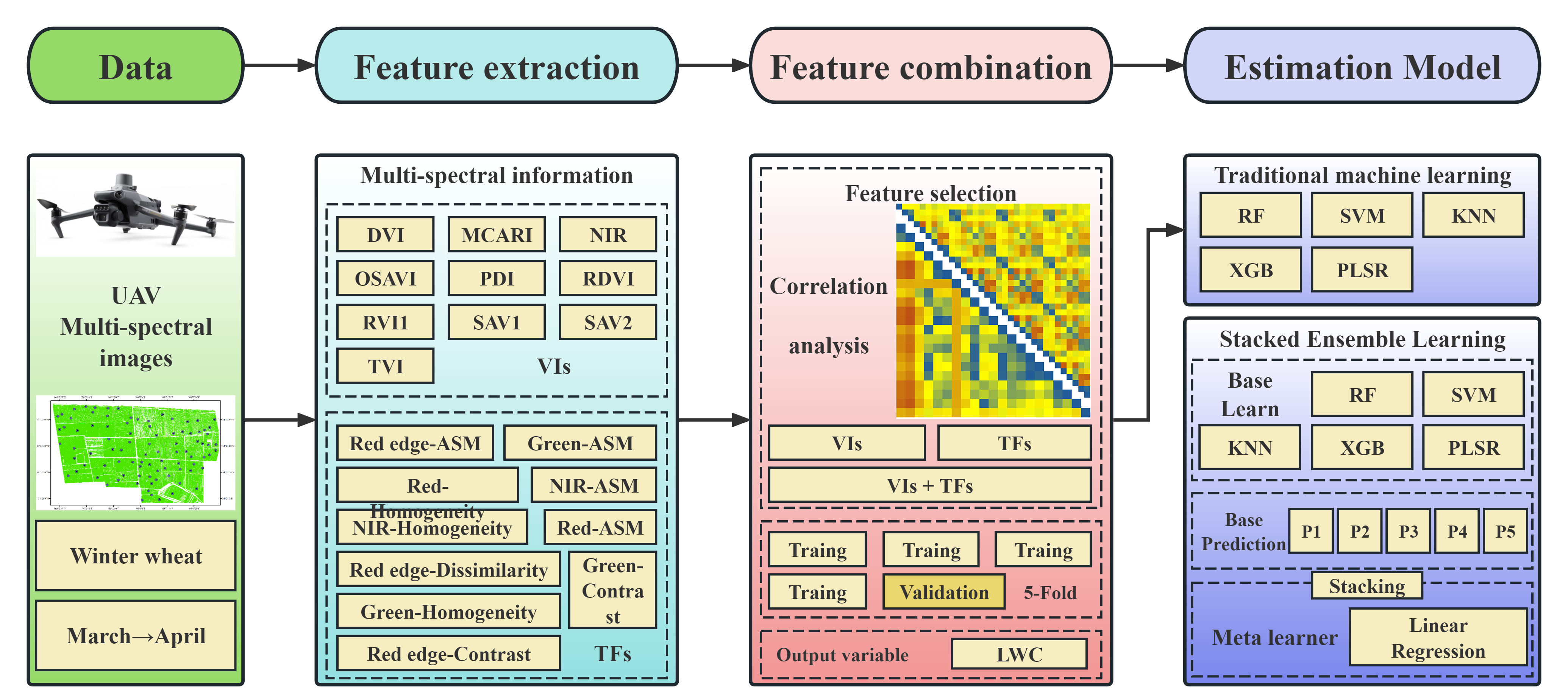
To quantify the relative contributions of various input variables in estimating the leaf water content of winter wheat, this paper conducted a systematic analysis of feature importance across five machine learning models employed. This analysis aims to identify the core driving variables that influence the predictive accuracy of the models and to provide a theoretical basis for subsequent model compression, feature selection, and input optimization. Given the fundamental differences in the structure and principles of the various models, the most suitable variable importance evaluation methods were selected for each model based on their specific characteristics to ensure the scientific rigor and interpretability of the analysis results. Specifically, for the RF model, the mean decrease in Gini impurity was adopted to assess feature importance. This method quantifies the overall contribution of each variable to information gain during node splitting across all decision trees within the forest [48]. For the XGBoost model, Gain serves as the core metric, reflecting the reduction in the loss function when a feature is split. This is supplemented by Frequency and Coverage metrics to comprehensively evaluate the feature’s role [49]. SVM and KNN models are non-parametric methods that lack built-in mechanisms for feature importance assessment. Therefore, the Permutation Importance method was applied to these models. This method involves randomly shuffling the observed values of a specific feature multiple times and calculating the average decrease in the model’s performance metric to indirectly measure the variable’s impact on predictive accuracy. This approach is particularly suitable for interpreting models with opaque structures [50]. For the PLSR model, the variable importance in projection (VIP) score was utilized for evaluation. The VIP score comprehensively con-siders the weight of each variable in the construction of latent components and its explanatory power concerning the response variable, making it the standard method for feature importance analysis in this type of model. And the workflow diagram of whole process can be seen in Figure 2.

2.8. Model Evaluation

The performance of the winter wheat plant water content estimation model was evaluated using the coefficient of determination (R2), root mean square error (RMSE), relative root mean square error (rRMSE), mean absolute error (MAE), percent bias (PBias), Nash-Sutcliffe efficiency (NSE), and Kling-Gupta efficiency (KGE) on the validation set. The model’s accuracy is considered higher when R2, NSE, and KGE values are closer to 1, while RMSE, rRMSE, and MAE values are closer to zero. Specific calculation formulas can be found in Knoben et al. [51] and Qian et al. [52].

3. Results

3.1. Statistical Analysis of Leaf Moisture Content

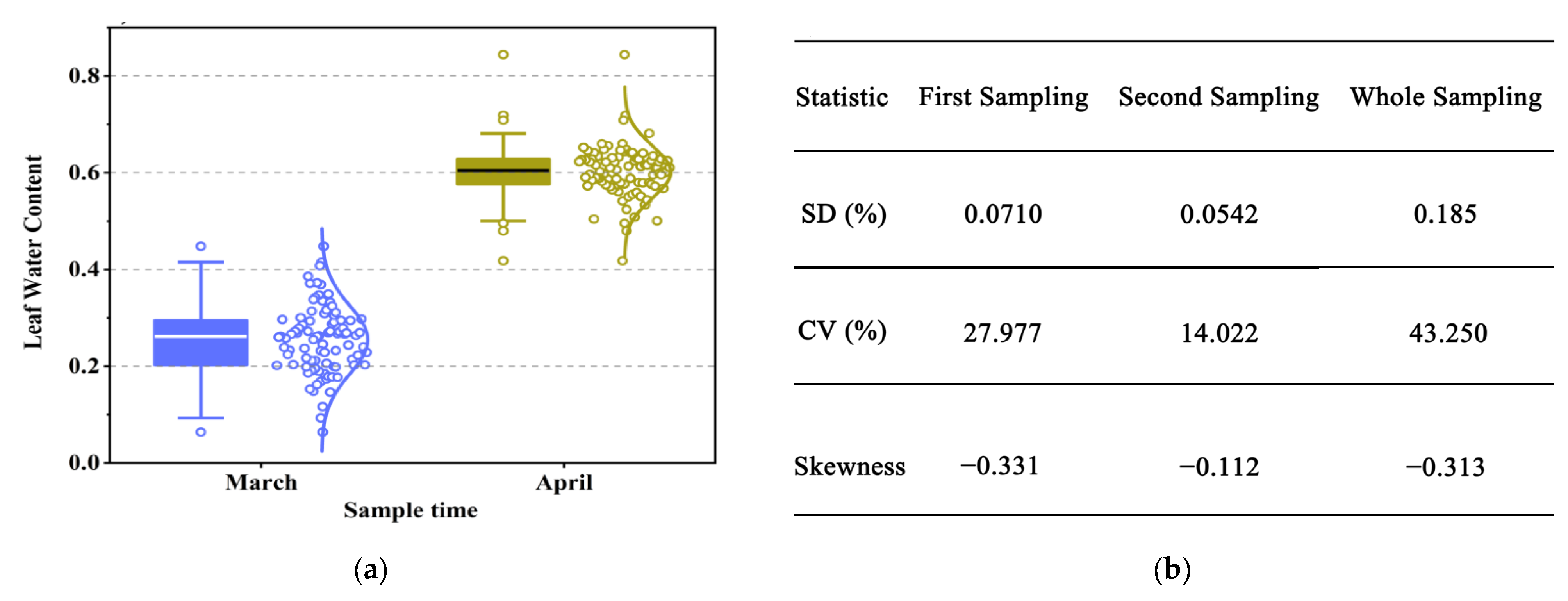
Figure 3 indicates that all collected data exhibited good dispersion characteristics, satisfying the fundamental requirements for model construction. Specifically, the CV for the regreening stage dataset (CV = 27.977%) was notably higher than that for the jointing stage (CV = 14.022%), suggesting that leaf water content varied more widely during early growth when plant physiological activity and soil moisture distribution were more heterogeneous. In contrast, as the crop canopy developed and root systems became established by the jointing stage, field water distribution and plant water uptake stabilized, resulting in lower variability. A t-test revealed that the difference in CV between the two stages was statistically significant (p < 0.05), confirming that the observed variability between the stages was not due to random chance. The standard deviations for both periods exceeded 0.05 (March, SD = 0.0710, April, SD = 0.0542), further confirming sufficient variability within the datasets to support model training. Overall, the dispersion metrics (standard deviation > 0.05, coefficient of variation > 10%) met the fundamental requirements for model construction.
The distribution patterns reveal a pronounced negative skewness in the March data (−0.331), while the April data exhibits reduced skewness (−0.112)(Figure 3). This transition reflects the physiological shift of winter wheat from uneven early regrowth to more uniform water status as growth progresses and canopy closure increases, reducing localized micro-environmental differences. ANOVA confirmed that the changes in skewness between the two stages were statistically significant (p < 0.05). This shift aligns with winter wheat’s developmental progression: as the growing season advances, the plant’s water regulation mechanisms stabilize, leading to a more symmetrical distribution of leaf water content.

3.2. Feature Selection

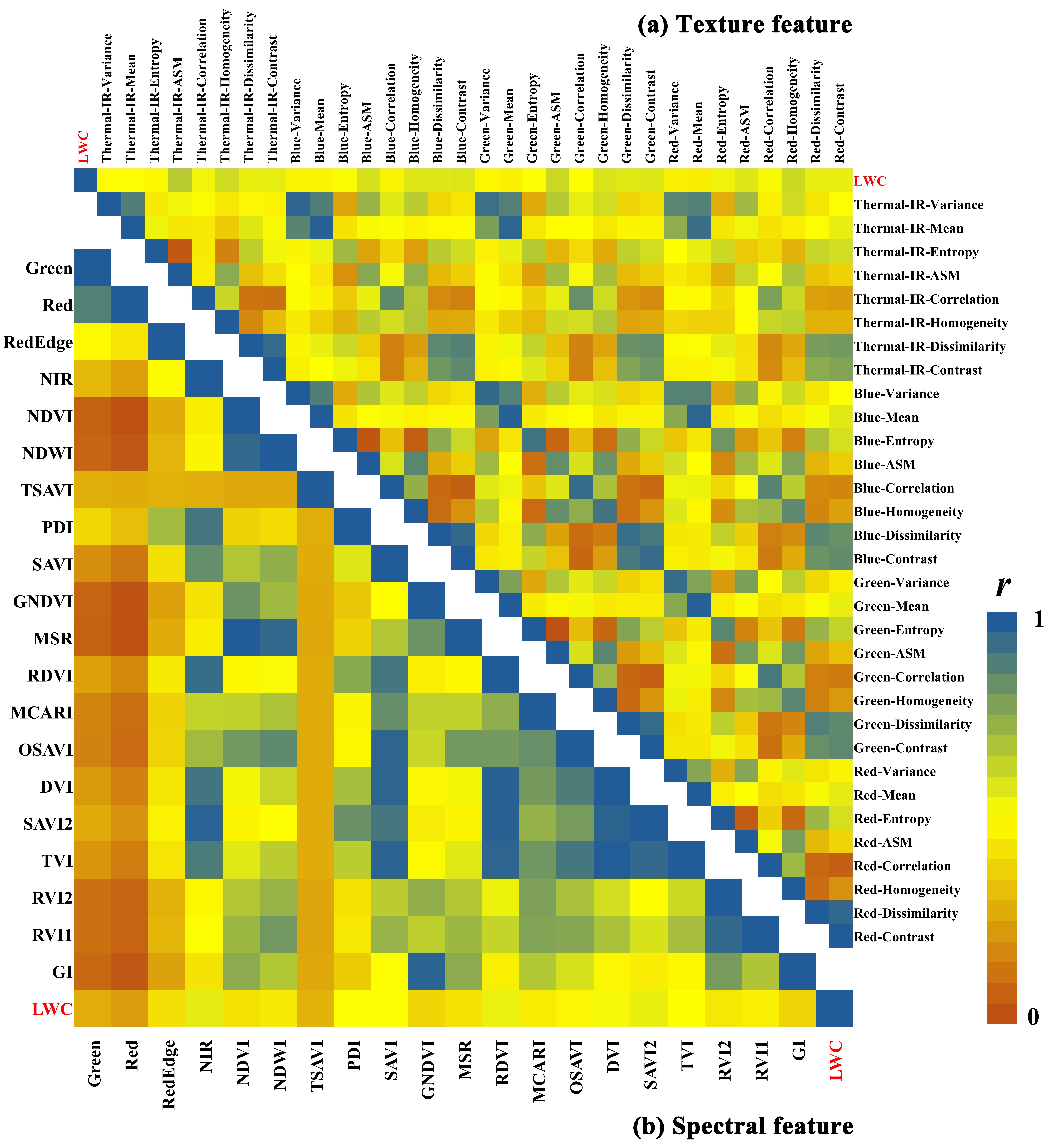
To construct an efficient model for estimating the LWC of winter wheat (Figure 4), the correlations between spectral features, texture features, and LWC were evaluated using the Pearson correlation coefficient method (|r| > 0.5 as the screening threshold). It aimed to select a subset of features closely related to LWC that also exhibited a high degree of mutual independence. This threshold ensured the inclusion of features with strong explanatory power for LWC while excluding weakly related or redundant variables, improving model interpretability and computational efficiency.
In terms of spectral features, correlation analysis results indicated that Difference Vegetation Index (DVI), Modified Chlorophyll Absorption Reflectance Index (MCARI), Near-Infrared band (NIR), Optimized Soil Adjusted Vegetation Index (OSAVI), Perpendicular Drought Index (PDI), Renormalized Difference Vegetation Index (RDVI), Ratio Vegetation Index (RVI1), Soil Adjusted Vegetation Index (SAVI) and its variant SAVI2), and Triangular Vegetation Index (TVI) are significantly correlated with LWC. These indices were finally selected because they represent different aspects of vegetation spectral response—DVI, RDVI, and RVI emphasize chlorophyll absorption and canopy vigor, while OSAVI, SAVI, and PDI are sensitive to soil moisture influence, and NIR is directly linked to leaf internal water structure. Together, they capture both physiological and canopy-scale water variability.
Regarding texture features, various texture measures from the red-edge band and green, red, and near-infrared bands were screened, including Angular Second Moment (ASM), Contrast, Dissimilarity, and Homogeneity. Specifically, Red edge-ASM, Red edge-Contrast, Red edge-Dissimilarity, Green-ASM, Green-Contrast, Green-Homogeneity, Red-ASM, Red-Homogeneity, NIR-ASM, and NIR-Homogeneity were identified as the final input features. These texture features were retained because they respond to spatial heterogeneity in canopy structure and leaf surface morphology caused by varying water content. The red-edge and NIR-based texture metrics, in particular, capture subtle structural variations linked to physiological water stress, complementing the spectral indices. Through the aforementioned feature screening, this study effectively removed redundant information and constructed a feature set characterized by both high relevance and low redundancy, providing reliable input for subsequent machine learning modeling.

3.3. LWC Estimation Based on a Single Feature

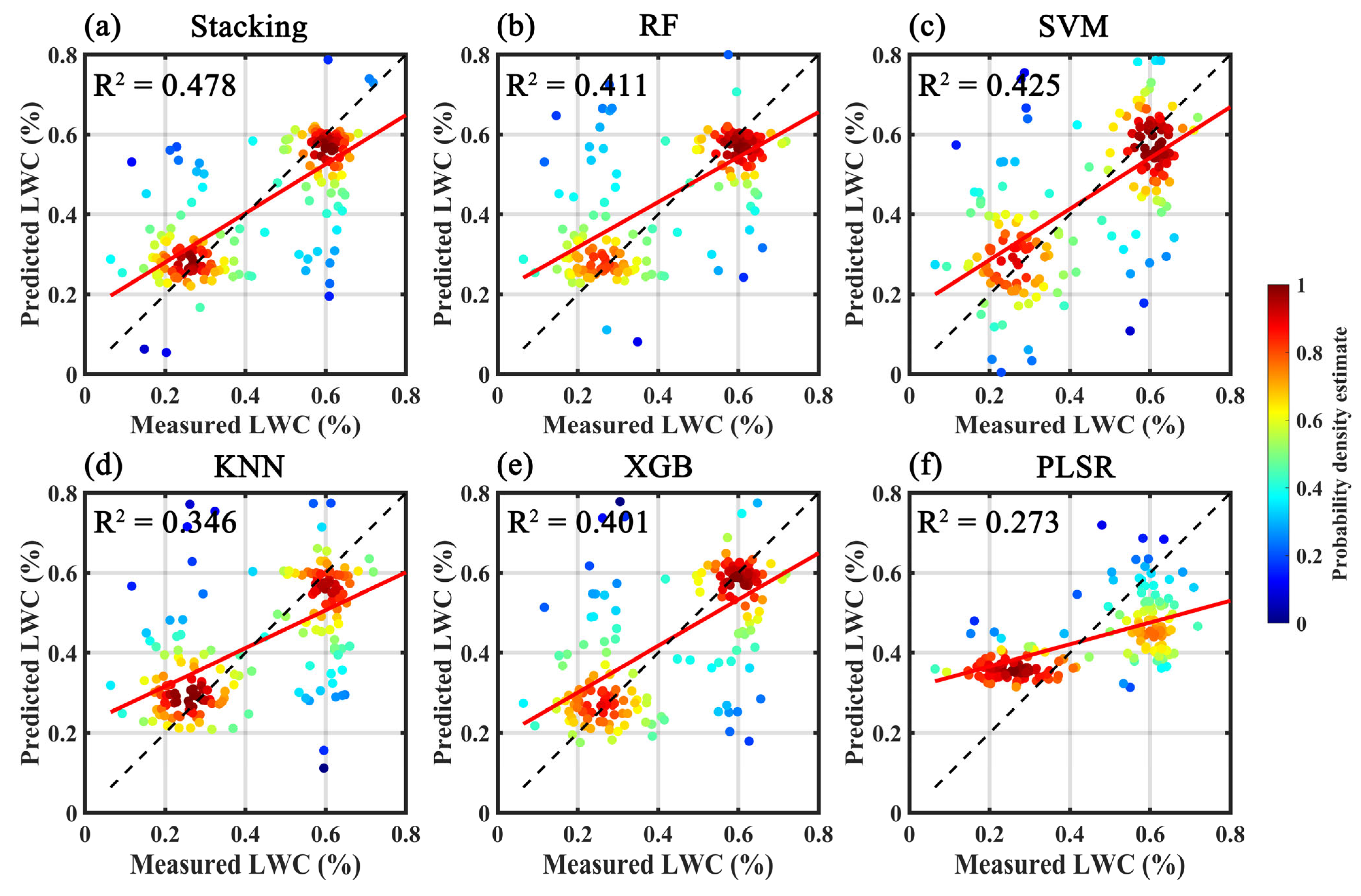
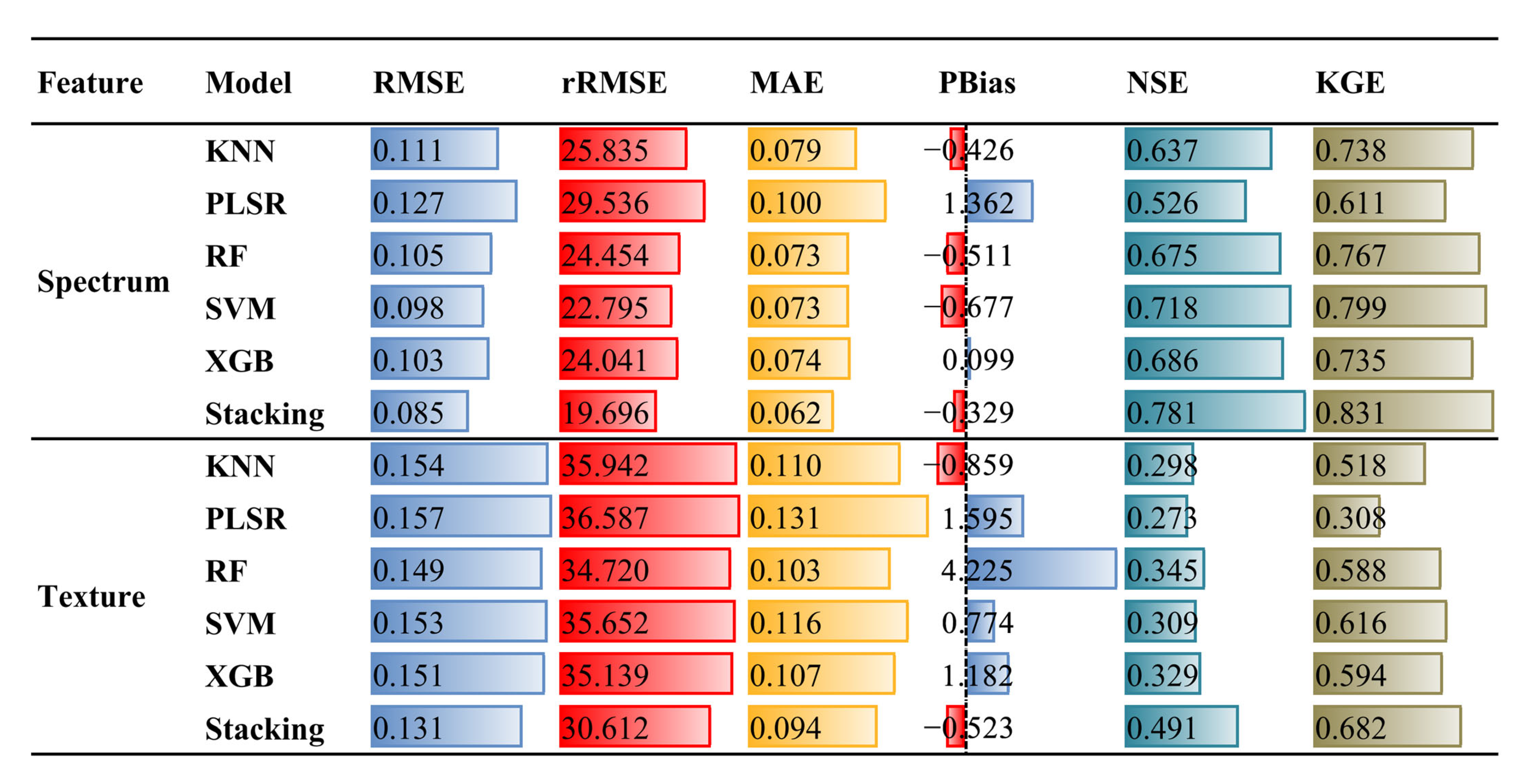
Analysis of winter wheat LWC estimation results based on spectral index features revealed that models constructed using only individual spectral features such as DVI, MCARI, NIR, OSAVI, PDI, RDVI, RVI1, SAVI, SAVI2, and TVI exhibited significant limitations in accuracy. As illustrated in Figure 5, Figure 6 and Figure 7, although most data points exhibit a certain linear trend, the overall distribution remains scattered, indicating suboptimal model fitting. Specifically, all single spectral index models demonstrated relatively low R2 values ranging from 0.526 to 0.718, with substantial rRMSE values between 22.795% and 29.536%. This indicates that while spectral indices can partially reflect crop moisture status, relying solely on a single index often fails to comprehensively capture the complex response mechanisms. This is because spectral reflectance integrates the effects of pigment content, canopy structure, and background soil reflectivity, all of which interact nonlinearly with water content. As a result, the sensitivity of individual indices may vary across growth stages and illumination conditions, leading to inconsistent predictive performance. This limitation arises because leaf water content is influenced by multiple factors, including environmental conditions, growth stage, canopy structure, and soil background, thereby constraining estimation accuracy.
Furthermore, LWC in winter wheat was estimated based on texture features (Figure 6). Results indicate that relying solely on texture features yields low estimation accuracy for LWC, with scattered data points exhibiting considerable dispersion. The model coefficient of determination R2 ranged between 0.273 and 0.425, while the rRMSE remained high at 34.720–36.587%. This underperformance can be attributed to the fact that texture features mainly describe the spatial variation in canopy structure rather than the spectral absorption characteristics directly related to leaf water. Under moderate water stress, structural changes in the canopy are subtle and may be overshadowed by illumination and viewing geometry effects, resulting in weak correlations between texture parameters and actual LWC. This indicates that single texture features possess limited capability in capturing leaf moisture variations and are inadequate for effectively characterizing crop water status.
In summary, relying solely on a single feature type (spectral or texture) to estimate winter wheat leaf water content exhibits significant limitations. Spectral features, while capable of responding to physiological changes induced by moisture to some extent, inadequately characterize the spatial heterogeneity of leaf water distribution. Conversely, texture features, though reflective of canopy structural information, lack direct spectral response mechanisms, resulting in lower estimation accuracy. Therefore, integrating both spectral and texture information can leverage their complementary strengths—spectral indices capture biochemical responses, while texture features describe structural variability—ultimately improving estimation accuracy and model robustness.

3.4. Combined Estimation of LWC Based on Spectral Vegetation Indices and Texture Features

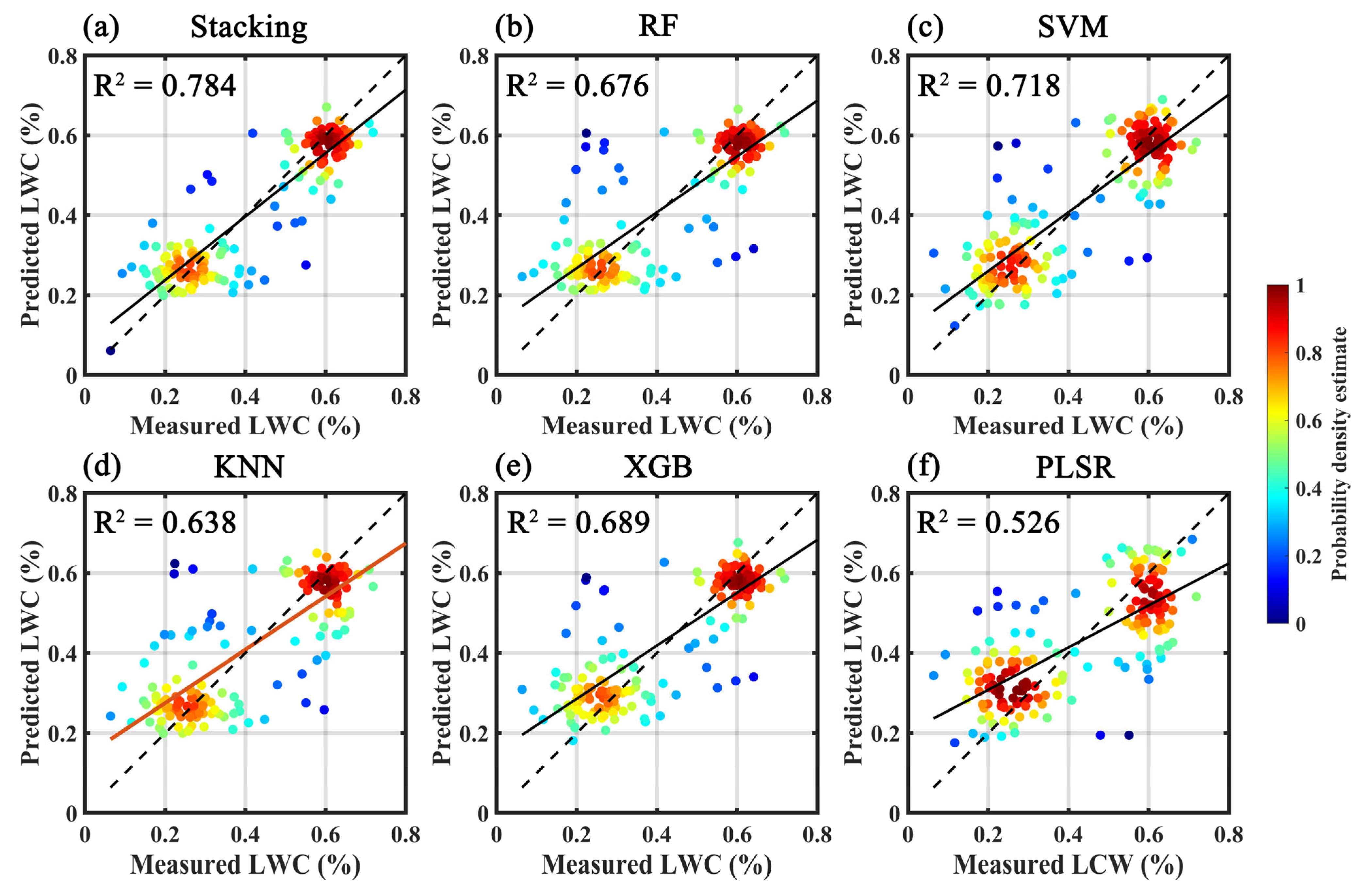
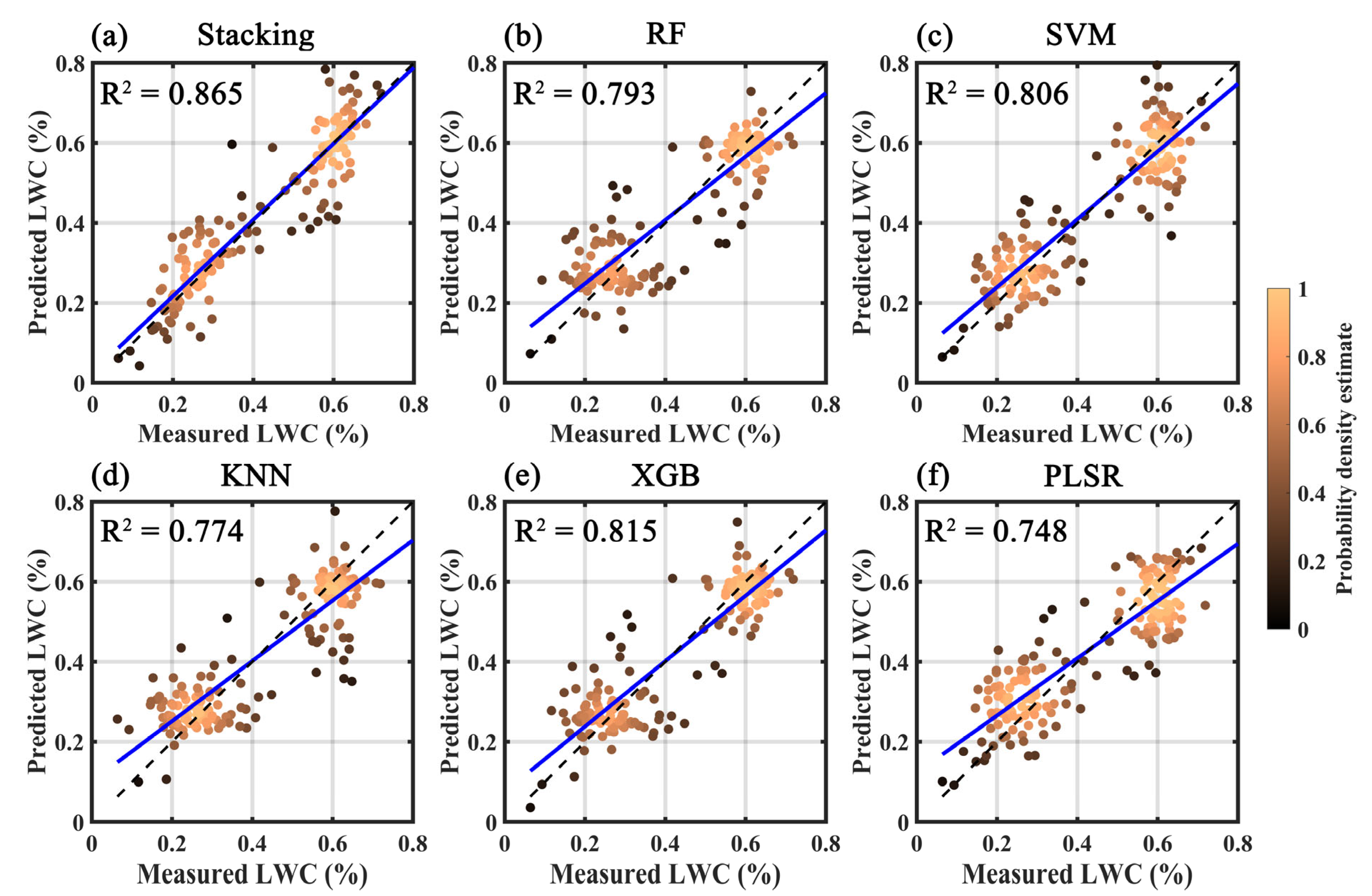
To enhance the estimation accuracy of winter wheat LWC, the combined estimation model integrating spectral indices and textural features was constructed (Figure 8). The results demonstrate that the feature fusion model significantly outperforms models relying on a single type of feature. As illustrated in Figure 8a-f, the scatter plots of the estimations based on the fused features show a more concentrated distribution of data points and a significantly stronger linear relationship aligned with the 1:1 line. This indicates that the combined modeling approach can more effectively capture the spatiotemporal variation characteristics of winter wheat leaf water content, thereby achieving more accurate LWC retrieval. This improvement arises because spectral indices primarily reflect the biochemical responses of vegetation—such as chlorophyll and water absorption—while texture features describe canopy spatial patterns related to leaf arrangement and surface roughness. Their combination compensates for the limitations of each feature type, allowing the model to simultaneously account for both physiological and structural variations associated with water status.
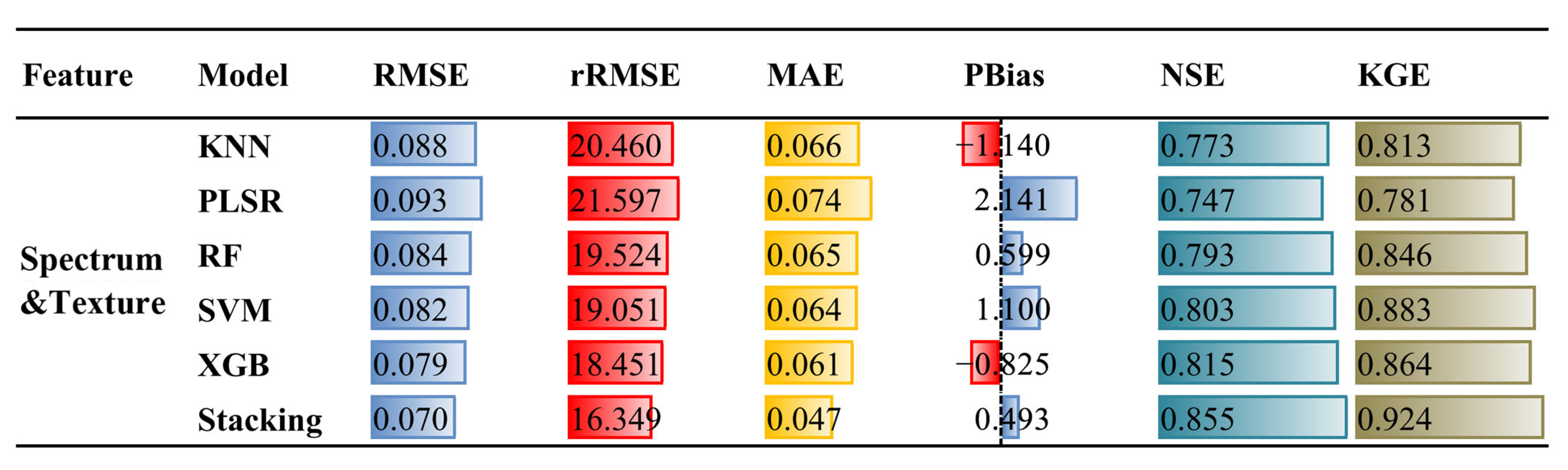
The fused model also exhibited superior performance in statistical metrics (Figure 9). Its R2 increased significantly to 0.865, which is markedly higher than the modeling results using solely spectral features (R2 = 0.718) or texture features (R2 = 0.425). Concurrently, its rRMSE decreased notably to 16.349%, indicating a substantial advantage of the fused model in reducing estimation errors. This performance is comparable to or surpasses studies on other crops or regions, such as winter wheat’s corn PMC (plant moisture content) (Shaanxi Province, stacking learning, R2 = 0.881) [53], winter wheat LWC (long-term water content) (Jiangsu Province, machine learning, R2 = 0.713) [54], and summer maize LWC (Jiangsu Province, particle swarm optimization-enhanced machine learning, R2 = 0.840) [20]. This improvement suggests that data fusion enhances the model’s sensitivity to subtle water-induced changes that may be overlooked by single-feature models. Specifically, integrating texture features helps mitigate spectral saturation effects in dense canopies, while spectral indices provide direct biochemical cues that texture descriptors alone cannot capture.
Spectral features are effective in reflecting the biochemical composition information of crops, while texture features can characterize their spatial structural differences. Therefore, combining the two feature types allows the model to exploit complementary information sources, improving robustness under variable illumination and growth conditions. The model constructed by integrating both provides a more comprehensive characterization of the water status in winter wheat leaves.

3.5. Spatial Distribution of LWC

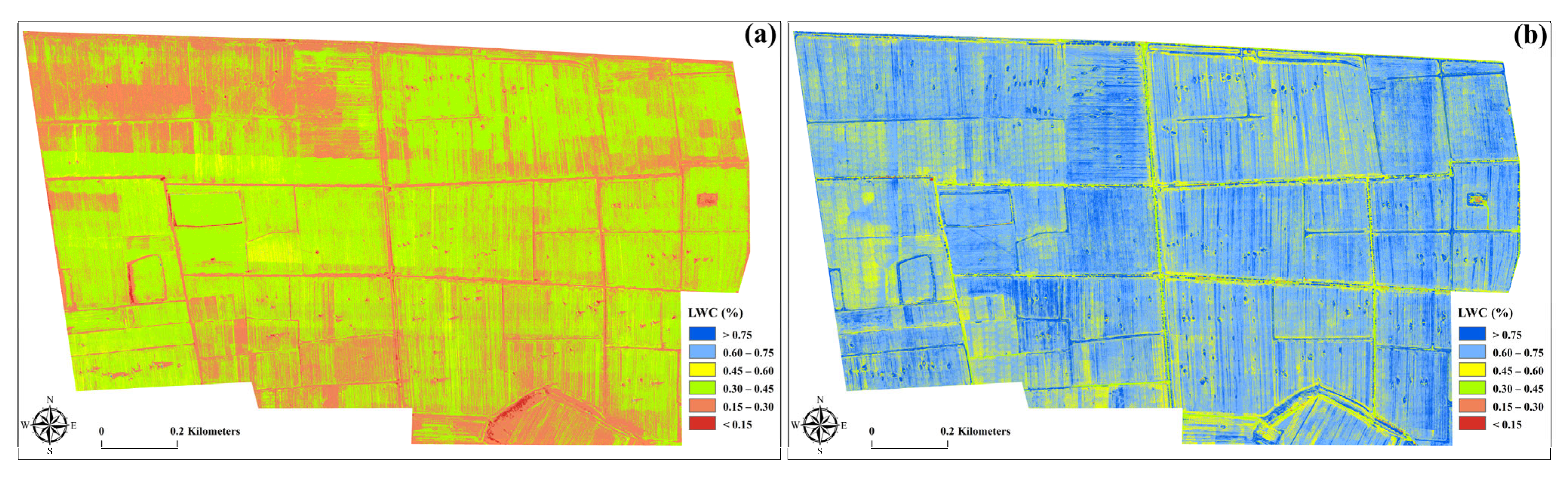
Figure 10a,b display the spatial distribution of winter wheat LWC inverted using a stacked ensemble learning model, corresponding to sampling results from two distinct periods. A comparative analysis of these two LWC spatial distribution maps reveals the spatiotemporal variation characteristics of winter wheat leaf water content, thereby providing a scientific basis for precision field water management.
During the regreening stage (Figure 10), the spatial distribution of LWC exhibits relatively pronounced heterogeneity. Large areas with low LWC values are observed in the southwestern and eastern parts of the study area, indicating that winter wheat in these locations may be experiencing certain degrees of water stress. This heterogeneity is mainly caused by uneven soil thawing, microtopographic differences, and variations in irrigation uniformity during early spring, which lead to spatially inconsistent root activity and water absorption. This phenomenon is likely attributable to the fact that winter wheat, having just entered the regreening stage in March, has not fully resumed its physiological activities and remains highly sensitive to environmental factors such as temperature fluctuations and soil moisture conditions. Consequently, its water regulation and absorption capacities remain relatively weak.
In contrast, during the jointing stage (Figure 10), the spatial distribution of LWC becomes more uniform. Although localized low-value areas persist, the overall LWC level increases significantly, and its spatial distribution is more balanced compared to the regreening stage. This improvement in homogeneity reflects the enhanced root development and increased transpiration capacity of plants at later growth stages, as well as the stabilizing effect of field irrigation management. This change is likely associated with the increased biomass, enhanced root water uptake capacity, and more effective transpiration regulation mechanisms as winter wheat progresses into the jointing and booting stages. These factors collectively contribute to a more stable crop water status as the growth period advances. For validation, the spatial LWC maps were cross-verified with ground-measured sample data at corresponding coordinates. The predicted values showed good agreement with field observations, confirming the spatial consistency and reliability of the inversion results.

4. Discussion

4.1. The Input Feature Importance

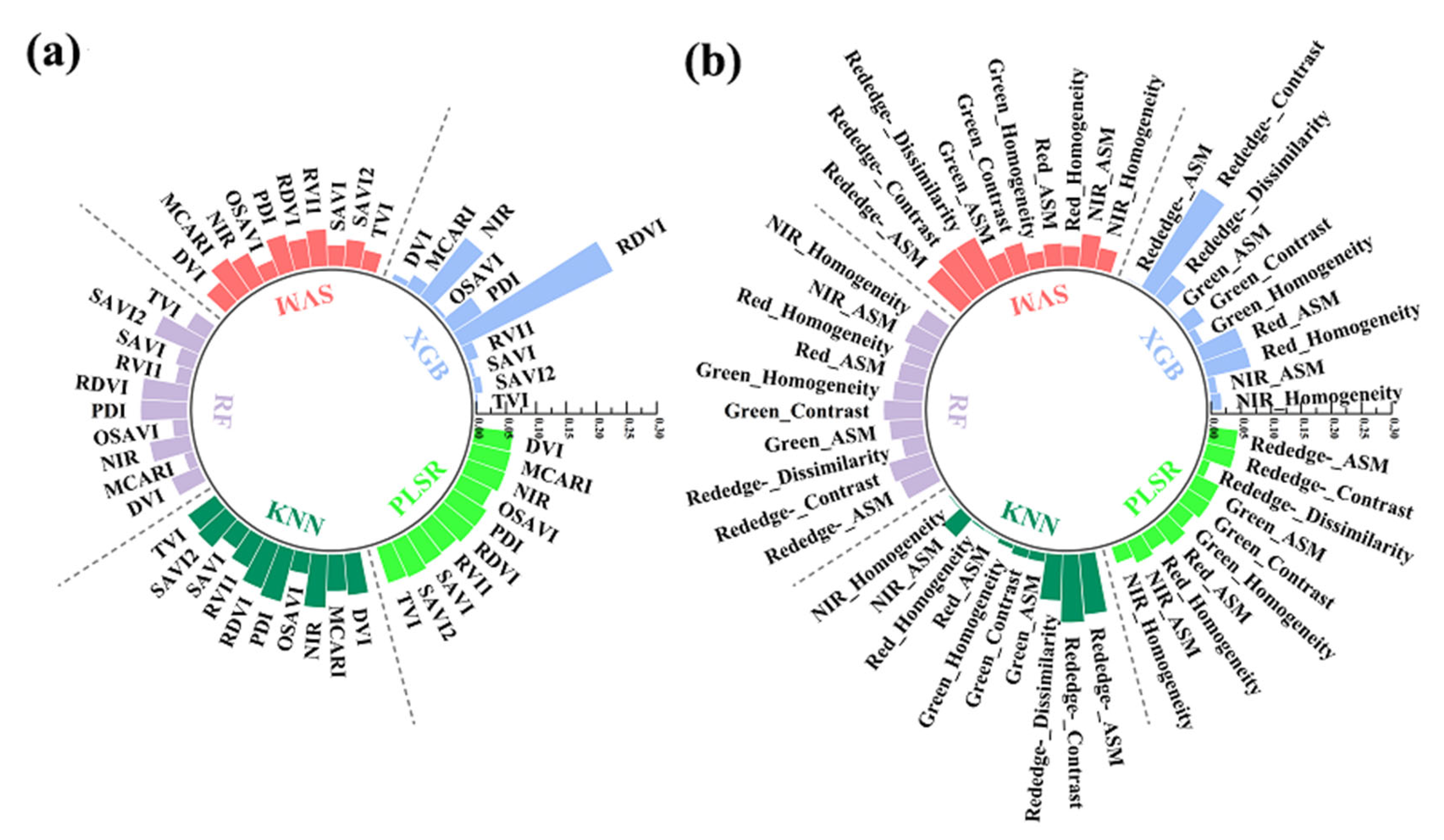
This study selected 10 spectral indices and 10 texture features through correlation analysis as inputs for machine learning-based estimation of winter wheat LWC, and calculated the importance of these inputs (Figure 11). The results reveal significant differences in the contributions of input features to the estimation of winter wheat LWC. Overall, spectral indices demonstrated higher importance in most models, while texture features complemented spectral data to some extent, with their combination significantly enhancing the model’s capability to characterize LWC.
Among spectral indices, the near-infrared band and its derived indices (e.g., SAVI, RDVI, TVI) consistently exhibited high weights across different models. This is because the NIR band is highly sensitive to changes in leaf water content and canopy structure, as it reflects the water content within plant tissues and the intercellular spaces. SAVI and RDVI, derived from the NIR and red bands, are designed to minimize soil background interference, which further enhances their ability to capture water content variations [41]. Additionally, indices constructed from red-edge and green bands also showed considerable importance. These indices are sensitive to chlorophyll absorption and leaf greenness, which are linked to photosynthetic activity and water content, thereby helping to indirectly monitor the physiological status of the crop [49].
Although the overall importance of texture features was lower than that of spectral indices, their contributions remain noteworthy. Results indicated that texture features derived from NIR and red-edge bands, such as contrast, homogeneity, and variance, carried significant weights in multiple models. Texture features play a complementary role by capturing the fine spatial structure of the canopy, which spectral indices alone may miss [55]. For example, texture measures such as contrast and homogeneity can detect subtle variations in leaf surface roughness, which change with water stress and are especially important when the canopy structure varies across fields or growth stages. Particularly when significant differences exist between fields across growth stages, texture features can better reflect variations in canopy surface roughness and spatial continuity, thereby enhancing sensitivity to LWC [56].
In summary, the input feature importance analysis elucidates the complementary mechanisms between spectral and texture features in estimating winter wheat LWC: spectral features primarily capture the biochemical response to water stress, while texture features enhance the model’s sensitivity to structural and spatial variations. The integration of both not only optimizes feature representation capability but also offers empirical support for the application of multi-source remote sensing features in crop water content estimation.

4.2. Advantages of Multi-Feature Fusion

In the remote sensing estimation of crop growth parameters, reliance on a single multispectral vegetation index often fails to adequately capture the spatial structure and heterogeneity within the crop canopy [27,57], resulting in a relatively low R2 ranging from 0.526 to 0.718. Although multispectral data can reflect the spectral response characteristics of vegetation, they primarily provide optical contrasts between bands and exhibit limited sensitivity to textural details on leaf surfaces or within the canopy [30,39,58], thereby restricting the precision of LWC estimation.
The integration of spectral and textural features significantly improved the estimation accuracy of winter wheat LWC, with R2 values ranging from 0.774 to 0.865. This enhancement primarily stems from the ability of textural features to compensate for the limitations of multispectral data in characterizing spatial structural information. Thereby enhancing the model’s sensitivity to micro-textural responses induced by water stress [59]. Second, combined modeling of multispectral and texture features diversifies the feature space, providing machine learning algorithms with richer information sources and reducing bias risks associated with single feature types [60,61]. This integration of texture data enhances the ability to detect subtle water stress-induced structural changes that spectral data alone cannot capture.
The integration of spectral and textural information for modeling serves to markedly augment the diversity of the feature space. This enhancement offers a more robust information source for machine learning algorithms while mitigating the biases associated with unimodal data. Within the present study, the fusion model achieved optimal performance (R2 = 0.865), exceeding the accuracy attained by any singular data type. Recent studies have also corroborated this finding. For example, Yu et al. [62] successfully improved the estimation accuracy of above-ground biomass (AGB), SPAD, and LWC by up to 20% by integrating multispectral and texture features using the entropy weight method (EWM) and fuzzy comprehensive evaluation (FCE) model. Similarly, Yue et al. [63] achieved comparable performance gains in estimating soil moisture and above-ground biomass in winter wheat. These findings are in line with our results, further emphasizing the synergy between multispectral and texture features in improving model stability and estimation accuracy in complex agricultural environments.
In summary, the combined application of multispectral and texture features provides a robust technical foundation for high-precision remote sensing monitoring of winter wheat LWC and other crop growth parameters. Moreover, compared to using expensive UAV hyperspectral data, this study achieved satisfactory estimation accuracy for winter wheat LWC using multispectral imagery to extract spectral, textural, and color moment features, while significantly reducing data acquisition and processing costs.

4.3. Advantages and Applicability of Stacked Ensemble Learning

Our results suggest that single models may not provide sufficient accuracy under changing input data. Single machine learning models, such as RF, XGBoost, SVM, KNN, and DTR, often struggle with bias or overfitting, particularly when dealing with complex nonlinear relationships and high-dimensional data [58,64,65]. In this study, the R2 values of these models in estimating winter wheat LWC ranged from 0.6 to 0.7, indicating their limited ability to fully capture the relationships between plant water content and remote sensing features.
In contrast, stacking ensemble learning overcomes these limitations by combining predictions from multiple base learners to create a final prediction through a meta-learner. This multi-level approach improves generalization and accuracy [28,55]. In our study, stacking combined RF, XGBoost, SVM, KNN, and DTR as base models, and used meta-learners such as Linear Regression (LR), Lasso, and Gradient Boosting Regression (GBR) to refine the final outputs. This resulted in an R2 of nearly 0.9, a significant improvement of 0.2 to 0.3 compared to single models, demonstrating the effectiveness of stacking in LWC estimation.
Stacking ensemble learning has also been successfully applied to other crops. For instance, ref. [29] improved rapeseed growth parameter estimation by integrating multispectral and texture data with stacking. Zhai et al. [27] used stacking to estimate maize chlorophyll content, improving R2 from 0.56 to 0.62. Ji et al. [31] highlighted that stacking’s multi-level structure reduces model bias and enhances prediction accuracy by integrating the strengths of different algorithms.
Overall, stacking ensemble learning offers a robust and efficient solution, especially for high-dimensional data. By integrating the strengths of multiple base models, it captures complex nonlinear relationships and improves estimation accuracy and stability, making it a powerful tool for precision agriculture monitoring of winter wheat and other crops.

4.4. Discussion on Opportunities for Enhancing LWC Estimation

Thermal infrared (TIR) data has significant potential to enhance leaf water content (LWC) estimation, as it directly captures the thermal properties associated with plant water stress [66]. Canopy temperature is a reliable indicator of water availability, as plants under water stress exhibit higher temperatures due to reduced transpiration. Recent studies have demonstrated that Normalized Relative Canopy Temperature (NRCT), derived from TIR data, can outperform conventional spectral bands in predicting crop water status [67]. Integrating TIR with multispectral and texture data could enable more accurate and sensitive detection of water stress, as TIR data provides complementary information about the thermal dynamics of the plant canopy, which is not captured by spectral features alone [68]. Given the growing availability of UAV-mounted thermal infrared sensors, future research should explore the integration of TIR into existing models to improve the accuracy of LWC estimation, especially in fields with complex topography or in conditions where spectral signals might saturate, such as in dense canopies or under extreme water stress.
Incorporating structural variables such as crop height (CH) [69] and canopy cover (CC) [70] into the estimation model presents another promising opportunity to improve LWC prediction. These structural variables are intrinsically linked to crop physiology and water stress levels, as the height of a crop and its canopy coverage are directly associated with transpiration rates and biomass production. UAV-based RGB imagery or digital surface models (DSMs) can easily capture these structural parameters, offering critical insights into crop architecture and its relationship with water uptake. Crop height, for example, serves as a surrogate for biomass, which reflects plant health and water status, while canopy cover can indicate the extent of transpiration and the plant’s ability to regulate water loss [71]. Including these variables alongside multispectral and texture data would enrich the feature set, enhancing the model’s ability to capture both physiological and structural factors that influence crop water status. Integrating CH and CC data could also improve the scalability of LWC estimation models across different crop types and growth stages, providing more robust estimates for large-scale or heterogeneous agricultural systems [72].
While gray-level co-occurrence matrix (GLCM) features have been widely used for texture analysis, alternative texture descriptors, such as Local Binary Patterns (LBPs), Normalized Difference Texture Indices (NDTIs), and variance-based methods, offer enhanced sensitivity to fine-scale canopy variations, especially in cases where spectral data may become saturated [73]. LBP, for instance, is well-regarded for capturing local variations in pixel intensity, which makes it particularly useful for analyzing subtle structural changes in the canopy that may be associated with water stress. Similarly, NDTIs have proven effective in distinguishing between different canopy structures, making them a valuable tool for monitoring small-scale morphological changes. These alternative descriptors could provide additional insight into the microstructure of plant leaves and their response to water availability [74]. Integrating LBP, NDTI, and variance-based methods into the feature set could complement the existing GLCM approach, improving the model’s sensitivity to fine-scale canopy features. Such texture descriptors have the potential to enhance LWC estimation, especially under conditions where spectral data alone fail to capture the full extent of water stress. Exploring these alternative techniques will not only improve model performance but also contribute to the methodological originality and technical innovation of the study.

4.5. Limitations and Outlook

Although the multispectral and texture feature combined estimation model based on stacked ensemble learning proposed in this study demonstrates high accuracy and reliability in the remote sensing estimation of leaf water content in winter wheat, several limitations remain. First, the model’s reliance on feature selection and fusion based on prior knowledge may limit its adaptability to other crops or different environmental conditions. The feature construction process might not be directly transferable without further customization. Second, the sample size and data range in this study were relatively limited, focusing on specific growth stages of winter wheat in a particular geographic region. While the high spatiotemporal resolution of UAV data is suitable for field-scale monitoring, its scalability could be hindered by the need for large-scale data coverage in complex agricultural landscapes or under varying climatic conditions. This could result in insufficient data coverage or increased computational demands for large-scale applications. Lastly, the computational complexity of the stacked ensemble learning method, coupled with its need for large datasets, may pose challenges for real-time agricultural monitoring systems.
Future research should focus on overcoming these limitations and improving model scalability. First, exploring the integration of deep learning models, such as convolutional neural networks (CNNs), could improve feature extraction and model generalization, especially in more complex environments and larger datasets. This would enable the model to handle more varied input data, improving its robustness and accuracy. Second, expanding the model’s applicability to other crops and climatic regions will require further validation, potentially incorporating multi-source remote sensing data (e.g., hyperspectral and thermal infrared), which would increase precision and expand the model’s capabilities. Finally, to address scalability, future work should focus on optimizing computational efficiency. This includes simplifying the model for real-time monitoring and reducing the data processing overhead to make it more suitable for large-scale agriculture. These steps will ensure the model’s practical application for crop water monitoring, balancing accuracy with real-time operational demands. In summary, while this study provides a foundation for UAV remote sensing in precision agriculture, future research should prioritize improving scalability, real-time capabilities, and deep learning integration for broader application.

5. Conclusions

This paper proposes an efficient remote sensing inversion model for estimating leaf water content (LWC) in winter wheat using a stacked ensemble learning framework that integrates multispectral and texture features. The key findings are as follows:
(1) Stacking with multispectral and texture data markedly improved estimation accuracy. The proposed model achieved a high coefficient of determination (R2 = 0.865) and a low relative root mean square error (rRMSE = 16.349%), outperforming all single-feature or single-model approaches. This demonstrates that combining spectral and textural information effectively captures both biochemical and structural characteristics related to crop water status.
(2) The stacked ensemble approach enhanced model robustness and generalization. By integrating multiple base learners (SVM, RF, XGB, PLSR, KNN) and a meta-learner (LR), the model successfully mitigated bias and overfitting in high-dimensional feature spaces, showing strong adaptability under varying field conditions.
(3) Feature importance analysis revealed that NIR-related spectral indices (e.g., SAVI, RDVI) and texture features from red-edge and NIR bands provided the most critical information. These features jointly describe canopy water absorption and structural heterogeneity, explaining the superior model performance.
Practically, the proposed framework provides a scientific and operational basis for precision irrigation, enabling fine-scale monitoring of crop water status to optimize irrigation timing and resource use. With further validation across regions and crops, this approach can be expanded to other crop species such as maize and rice, contributing to scalable and data-driven water management strategies in precision agriculture.

Author Contributions

Conceptualization, X.Y. and L.Q.; Methodology, X.Y. and L.Q.; Software, X.Y. and S.Y.; Validation, L.Q. and K.C.; Formal analysis, X.Y.; Investigation, Q.Y. and L.S.; Resources, W.W. and D.R.; Data curation, X.Y. and L.Q.; Writing—original draft preparation, X.Y.; Visualization, W.W. and X.H.; Supervision, W.W.; Project administration, W.W. and X.H.; Funding acquisition, W.W. and B.Z., All authors have read and agreed to the published version of the manuscript.

Funding

This research was funded by he National Natural Science Foundation of China for the project (U2243235), and the National Key Research and Development Program of China (2022YFD1900402-01).

Institutional Review Board Statement

Not applicable.

Data Availability Statement

The data presented in this study are available on request from the corresponding author. The data are not publicly available due to the fact that our collaborating institutions are still utilizing part of the data.

Conflicts of Interest

The authors declare no conflicts of interest.

References

  1. Shiferaw, B.; Smale, M.; Braun, H.J.; Duveiller, E.; Reynolds, M.; Muricho, G. Crops that feed the world 10. Past successes and future challenges to the role played by wheat in global food security. Food Secur. 2013, 5, 291–317. [Google Scholar] [CrossRef]
  2. Trifilò, P.; Abate, E.; Petruzzellis, F.; Azzarà, M.; Nardini, A. Critical water contents at leaf, stem and root level leading to irreversible drought-induced damage in two woody and one herbaceous species. Plant Cell Environ. 2023, 46, 119–132. [Google Scholar] [CrossRef]
  3. Rezaei, M.; Ebrahimi, E.; Naseh, S.; Mohajerpour, M. A new 1.4-GHz soil moisture sensor. Measurement 2012, 45, 1723–1728. [Google Scholar] [CrossRef]
  4. Deng, X.; Gu, H.N.; Yang, L.; Lyu, H.; Cheng, Y.; Pan, L.; Fu, Z.; Cui, L.; Zhang, L. A method of electrical conductivity compensation in a low-cost soil moisture sensing measurement based on capacitance. Measurement 2020, 150, 107052. [Google Scholar] [CrossRef]
  5. Bending, J.; Yu, K.; Aasen, H.; Bolten, A.; Bennertz, S.; Broscheit, J.; Gnyp, M.L.; Bareth, G. Combining UAV-based plant height from crop surface models, visible, and near infrared vegetation indices for biomass monitoring in barley. Int. J. Appl. Earth Obs. Geoinf. 2015, 39, 79–87. [Google Scholar] [CrossRef]
  6. Deng, L.; Mao, Z.H.; Li, X.J.; Hu, Z.; Duan, F.; Yan, Y. UAV-based multispectral remote sensing for precision agriculture: A comparison between different cameras. ISPRS J. Photogramm. Remote Sens. 2018, 146, 124–136. [Google Scholar] [CrossRef]
  7. Wei, P.; Xu, X.; Li, Z.; Yang, G.; Li, Z.; Feng, H.; Chen, G.; Fan, L.; Wang, Y.; Liu, S. Remote sensing estimation of nitrogen content in summer maize leaves based on multispectral images of UAV. Trans. Chin. Soc. Agric. Eng. 2019, 35, 126–133. [Google Scholar] [CrossRef]
  8. Kong, W.P.; Huang, W.J.; Ma, L.L.; Tang, L.; Li, C.; Zhou, X.; Casa, R. Estimating Vertical Distribution of Leaf Water Content within Wheat Canopies after Head Emergence. Remote Sens. 2021, 13, 4125. [Google Scholar] [CrossRef]
  9. Espinoza, C.Z.; Khot, L.R.; Sankaran, S.; Jacoby, P.W. High resolution multispectral and thermal remote sensing-based water stress assessment in subsurface irrigated grapevines. Remote Sens. 2017, 9, 961. [Google Scholar] [CrossRef]
  10. Das, B.; Sahoo, R.N.; Pargal, S.; Krishna, G.; Verma, R.; Chinnusamy, V.; Sehgal, V.K.; Gupta, V.K. Comparison of different uni- and multi-variate techniques for monitoring leaf water status as an indicator of water-deficit stress in wheat through spectroscopy. Biosyst. Eng. 2017, 160, 69–83. [Google Scholar] [CrossRef]
  11. Elsayed, S.; Elhoweity, M.; Ibrahim, H.H.; Dewir, Y.H.; Migdadi, H.M.; Schmidhalter, U. Thermal imaging and passive reflectance sensing to estimate the water status and grain yield of wheat under different irrigation regimes. Agric. Water Manag. 2017, 189, 98–110. [Google Scholar] [CrossRef]
  12. Krishna, G.; Sahoo, R.N.; Singh, P.; Bajpai, V.; Patra, H.; Kumar, S.; Dandapani, R.; Gupta, V.K.; Viswanathan, C.; Ahmad, T.; et al. Comparison of various modeling approaches for water deficit stress monitoring in rice crop through hyperspectral remote sensing. Agric. Water Manag. 2019, 213, 231–244. [Google Scholar] [CrossRef]
  13. Carter, G.A. Ratios of leaf reflectances in narrow wavebands as indicators of plant stress. Int. J. Remote Sens. 1994, 15, 697–704. [Google Scholar] [CrossRef]
  14. Filella, I.; Peñuelas, J. The red edge position and shape as indicators of plant chlorophyll content, biomass and hydric status. Int. J. Remote Sens. 1994, 15, 1459–1470. [Google Scholar] [CrossRef]
  15. Peñuelas, J.; Piñol, J.; Ogaya, R.; Filella, I. Estimation of plant water concentration by the reflectance water index WI (R900/R970). Int. J. Remote Sens. 1997, 18, 2869–2875. [Google Scholar] [CrossRef]
  16. Yilmaz, M.T.; Hunt, E.R.; Jackson, T.J. Remote sensing of vegetation water content from equivalent water thickness using satellite imagery. Remote Sens. Environ. 2008, 112, 2514–2522. [Google Scholar] [CrossRef]
  17. Bandyopadhyay, K.K.; Pradhan, S.; Sahoo, R.N.; Singh, R.; Gupta, V.; Joshi, D.; Sutradhar, A. Characterization of water stress and prediction of yield of wheat using spectral indices under varied water and nitrogen management practices. Agric. Water Manag. 2014, 146, 115–123. [Google Scholar] [CrossRef]
  18. Baluja, J.; Diago, M.P.; Balda, P.; Zorer, R.; Meggio, F.; Morales, F.; Tardaguila, J. Assessment of vineyard water status variability by thermal and multispectral imagery using an unmanned aerial vehicle (UAV). Irrig. Sci. 2012, 30, 511–522. [Google Scholar] [CrossRef]
  19. Tang, Z.; Jin, Y.; Alsina, M.M.; McElrone, A.J.; Bambach, N.; Kustas, W.P. Vine water status mapping with multispectral UAV imagery and machine learning. Irrig. Sci. 2022, 40, 715–730. [Google Scholar] [CrossRef]
  20. Wang, Y.C.; Wang, J.L.; Li, J.Y.; Wang, J.; Xu, H.; Liu, T.; Wang, J. Estimating Maize Leaf Water Content Using Machine Learning with Diverse Multispectral Image Features. Plants 2025, 14, 973. [Google Scholar] [CrossRef]
  21. Easterday, K.; Kislik, C.; Dawson, T.E.; Hogan, S.; Kelly, M. Remotely Sensed Water Limitation in Vegetation: Insights from an Experiment with Unmanned Aerial Vehicles (UAVs). Remote Sens. 2019, 11, 1853. [Google Scholar] [CrossRef]
  22. Fariñas, M.D.; Jimenez-Carretero, D.; Sancho-Knapik, D.; Peguero-Pina, J.J.; Gil-Pelegrín, E.; Álvarez-Arenas, T.G. Instantaneous and non-destructive relative water content estimation from deep learning applied to resonant ultrasonic spectra of plant leaves. Plant Methods 2019, 15, 128. [Google Scholar] [CrossRef] [PubMed]
  23. Ndlovu, H.S.; Odindi, J.; Sibanda, M.; Mutanga, O.; Clulow, A.; Chimonyo, V.G.P.; Mabhaudhi, T. A Comparative Estimation of Maize Leaf Water Content Using Machine Learning Techniques and Unmanned Aerial Vehicle (UAV)-Based Proximal and Remotely Sensed Data. Remote Sens. 2021, 13, 4091. [Google Scholar] [CrossRef]
  24. Sharma, V.; Honkavaara, E.; Hayden, M.; Kant, S. UAV remote sensing phenotyping of wheat collection for response to water stress and yield prediction using machine learning. Plant Stress 2024, 12, 100464. [Google Scholar] [CrossRef]
  25. Yang, W.L.; Li, Z.j.; Chen, G.F.; Cui, S.; Wu, Y.; Liu, X.; Meng, W.; Liu, Y.; He, J.; Liu, D.; et al. Soybean (Glycine max L.) Leaf Moisture Estimation Based on Multisource Unmanned Aerial Vehicle Image Feature Fusion. Plants 2024, 13, 1498. [Google Scholar] [CrossRef]
  26. Sun, T.; Li, Z.J.; Tang, Z.J.; Zhang, W.; Li, W.; Liu, Z.; Wu, J.; Liu, S.; Xiang, Y.; Zhang, F. Estimating Soil Moisture Content in Winter Wheat in Southern Xinjiang by Fusing UAV Texture Feature with Novel Three-Dimensional Texture Indexes. Plants 2025, 14, 2948. [Google Scholar] [CrossRef] [PubMed]
  27. Du, R.Q.; Lu, J.S.; Xiang, Y.Z.; Zhang, F.; Chen, J.; Tang, Z.; Shi, H.; Wang, X.; Li, W. Estimation of winter canola growth parameter from UAV multi-angular spectral-texture information using stacking-based ensemble learning model. Comput. Electron. Agric. 2024, 222, 109704. [Google Scholar] [CrossRef]
  28. Zhai, W.G.; Li, C.C.; Cheng, Q.; Ding, F.; Chen, Z. Exploring Multisource Feature Fusion and Stacking Ensemble Learning for Accurate Estimation of Maize Chlorophyll Content Using Unmanned Aerial Vehicle Remote Sensing. Remote Sens. 2023, 15, 3454. [Google Scholar] [CrossRef]
  29. Han, Y.; Zhang, J.X.; Bai, Y.; Liang, Z.; Guo, X.; Zhao, Y.; Feng, M.; Xiao, L.; Song, X.; Zhang, M.; et al. Ensemble Learning-Driven and UAV Multispectral Analysis for Estimating the Leaf Nitrogen Content in Winter Wheat. Agronomy 2025, 15, 1621. [Google Scholar] [CrossRef]
  30. Maimaitijiang, M.; Ghulam, A.; Sidike, P.; Hartling, S.; Maimaitiyiming, M.; Peterson, K.; Shavers, E.; Fishman, J.; Peterson, J.; Kadam, S.; et al. Unmanned Aerial System (UAS)-based phenotyping of soybean using multi-sensor data fusion and extreme learning machine. ISPRS J. Photogramm. Remote Sens. 2017, 134, 43–58. [Google Scholar] [CrossRef]
  31. Ji, Y.S.; Liu, R.; Xiao, Y.G.; Cui, Y.; Chen, Z.; Zong, X.; Yang, T. Faba bean above-ground biomass and bean yield estimation based on consumer-grade unmanned aerial vehicle rgb images and ensemble learning. Precis. Agric. 2023, 24, 1439–1460. [Google Scholar] [CrossRef]
  32. Huang, X.; Guan, H.D.; Bo, L.Y.; Xu, Z.; Mao, X. Hyperspectral proximal sensing of leaf chlorophyll content of spring maize based on a hybrid of physically based modelling and ensemble stacking. Comput. Electron. Agric. 2023, 208, 107745. [Google Scholar] [CrossRef]
  33. Zhao, H.; Wang, J.J.; Guo, J.L.; Hui, X.; Wang, Y.; Cai, D.; Yan, H. Detecting Water Stress in Winter Wheat Based on Multifeature Fusion from UAV Remote Sensing and Stacking Ensemble Learning Method. Remote Sens. 2024, 16, 4100. [Google Scholar] [CrossRef]
  34. Yu, X.; Yin, Q.; Zhang, C.; Shao, L.; Ran, D.; Wang, W.; Zhang, B.; Hu, X. Cross-scale soil moisture content monitoring of winter wheat by integrating UAV and sentinel-1/2 data. Agric. Water Manag. 2025, 320, 109831. [Google Scholar] [CrossRef]
  35. Jin, X.; Yang, G.; Xu, X.; Yang, H.; Feng, H.; Li, Z.; Shen, J.; Lan, Y.; Zhao, C. Combined Multi-Temporal Optical and Radar Parameters for Estimating LAI and Biomass in Winter Wheat Using HJ and RADARSAR-2 Data. Remote Sens. 2015, 7, 13251–13272. [Google Scholar] [CrossRef]
  36. ISO 11465:1993; Soil Quality—Determination of Dry Matter and Water Content on a Mass Basis—Gravimetric Method. International Organization for Standardization: Geneva, Switzerland, 1993.
  37. Sun, H.; Feng, M.; Xiao, L.J.; Yang, W.; Ding, G.; Wang, C.; Jia, X.; Wu, G.; Zhang, S. Potential of multivariate statistical technique based on the effective spectra bands to estimate the plant water content of wheat under different irrigation regimes. Front. Plant Sci. 2021, 12, 631573. [Google Scholar] [CrossRef] [PubMed]
  38. Zhou, L.L.; Nie, C.W.; Su, T.; Xu, X.; Song, Y.; Yin, D.; Liu, S.; Liu, Y.; Bai, Y.; Jia, X.; et al. Evaluating the Canopy Chlorophyll Density of Maize at the Whole Growth Stage Based on Multi-Scale UAV Image Feature Fusion and Machine Learning Methods. Agriculture 2023, 13, 895. [Google Scholar] [CrossRef]
  39. Zhang, L.; Niu, Y.; Zhang, H.; Han, W.; Li, G.; Tang, J.; Peng, X. Maize canopy temperature extracted from UAV thermal and RGB imagery and its application in water stress monitoring. Front. Plant Sci. 2019, 10, 1270. [Google Scholar] [CrossRef]
  40. Wang, D.; Chen, H.; Wang, Z.; Ma, Y. Inversion of soil salinity according to different salinization grades using multi-source remote sensing. Geocarto Int. 2020, 35, 1274–1293. [Google Scholar] [CrossRef]
  41. Cui, X.; Han, W.T.; Zhang, H.W.; Cui, J.; Ma, W.; Zhang, L.; Li, G. Estimating soil salinity under sunflower cover in the Hetao Irrigation District based on unmanned aerial vehicle remote sensing. Land Degrad. Dev. 2022, 34, 84–97. [Google Scholar] [CrossRef]
  42. Shi, H.Z.; Liu, Z.Y.; Li, S.Q.; Jin, M.; Tang, Z.; Sun, T.; Liu, X.; Li, Z.; Zhang, F.; Xiang, Y. Monitoring Soybean Soil Moisture Content Based on UAV Multispectral and Thermal-Infrared Remote-Sensing Information Fusion. Plants 2024, 13, 2417. [Google Scholar] [CrossRef]
  43. Breiman, L. Random Forests. Mach. Learn. 2001, 45, 5–32. [Google Scholar] [CrossRef]
  44. Chen, T.Q.; Guestrin, C. XGBoost: A Scalable Tree Boosting System. In Proceedings of the 22nd ACM SIGKDD International Conference on Knowledge Discovery and Data Mining, San Francisco, CA, USA, 13–17 August 2016; pp. 785–794. [Google Scholar] [CrossRef]
  45. Cortes, C.; Vapnik, V. Support-Vector Networks. Mach. Learn. 1995, 20, 273–297. [Google Scholar] [CrossRef]
  46. Whitney, A.W. A Direct Method of Nonparametric Measurement Selection. IEEE Trans. Comput. 1971, 20, 1100–1103. [Google Scholar] [CrossRef]
  47. Staiger, D.; Stock, J.H. Instrumental Variables Regression with Weak Instruments. Econometrica 1997, 65, 557–586. [Google Scholar] [CrossRef]
  48. Menze, B.H.; Kelm, B.M.; Masuch, R.; Himmelreich, U.; Bachert, P.; Petrich, W.; Hamprecht, F.A. A comparison of random forest and its Gini importance with standard chemometric methods for the feature selection and classification of spectral data. BMC Bioinform. 2009, 10, 213. [Google Scholar] [CrossRef]
  49. Jia, Y.; Jin, S.G.; Savi, P.; Gao, Y.; Tang, J.; Chen, Y.; Li, W. GNSS-R Soil Moisture Retrieval Based on a XGboost Machine Learning Aided Method: Performance and Validation. Remote Sens. 2019, 11, 1655. [Google Scholar] [CrossRef]
  50. Qian, L.; Wu, L.F.; Zhang, Z.T.; Fan, J.; Yu, X.; Liu, X.; Yang, Q.; Cui, Y. A gap filling method for daily evapotranspiration of global flux data sets based on deep learning. J. Hydrol. 2024, 641, 131787. [Google Scholar] [CrossRef]
  51. Knoben, W.J.M.; Freer, J.E.; Woods, R.A. Technical note: Inherent benchmark or not? Comparing Nash–Sutcliffe and Kling–Gupta efficiency scores. Hydrol. Earth Syst. Sci. 2019, 23, 4323–4331. [Google Scholar] [CrossRef]
  52. Qian, L.; Zhang, Z.T.; Wu, L.F.; Fan, S.; Yu, X.; Liu, X.; Ba, Y.; Ma, H.; Wang, Y. High uncertainty of evapotranspiration products under extreme climatic conditions. J. Hydrol. 2023, 626, 130332. [Google Scholar] [CrossRef]
  53. Yang, N.; Zhang, Z.T.; Zhang, J.R.; Yang, X.; Liu, H.; Chen, J.; Ning, J.; Sun, S.; Shi, L. Accurate estimation of winter-wheat leaf water content using continuous wavelet transform-based hyperspectral combined with thermal infrared on a UAV platform. Eur. J. Agron. 2025, 168, 127624. [Google Scholar] [CrossRef]
  54. Wu, Y.L.; Yuan, S.Q.; Zhu, J.J.; Tang, Y.; Tang, L. Estimation of Wheat Leaf Water Content Based on UAV Hyper-Spectral Remote Sensing and Machine Learning. Agriculture 2025, 15, 1898. [Google Scholar] [CrossRef]
  55. Liu, H.; Chen, J.Y.; Bian, J.; Li, Z.; Zhang, W.; Yang, N.; Du, R.; Qian, L.; Geng, H.; Chen, Y.; et al. Enhancing field-scale soil moisture content monitoring using UAV hyperspectral-derived multi-dimensional spectral response indices of crop comprehensive phenotypic traits. Comput. Electron. Agric. 2025, 235, 110399. [Google Scholar] [CrossRef]
  56. Alvarez-Vanhard, E.; Corpetti, T.; Houet, T. UAV & satellite synergies for optical remote sensing applications: A literature review. Sci. Remote Sens. 2021, 3, 100019. [Google Scholar] [CrossRef]
  57. Yang, N.; Zhang, Z.T.; Ding, B.B.; Wang, T.; Zhang, J.; Liu, C.; Zhang, Q.; Zuo, X.; Chen, J.; Cui, N.; et al. Evaluation of winter-wheat water stress with UAV-based multispectral data and ensemble learning method. Plant Soil 2024, 497, 647–668. [Google Scholar] [CrossRef]
  58. Ahmad, U.; Alvino, A.; Marino, S. A review of crop water stress assessment using remote sensing. Remote Sens. 2021, 13, 4155. [Google Scholar] [CrossRef]
  59. Zou, K.; Liu, Y.; Fu, M.D.; Li, C.; Zhou, Z.; Meng, H.; Xing, E.; Ren, Y. Combining spectral and texture feature of UAV image with plant height to improve LAI estimation of winter wheat at jointing stage. Front. Plant Sci. 2023, 14, 1272049. [Google Scholar] [CrossRef]
  60. Wang, J.; Zhao, W.W.; Wang, G.; Pereira, P. Afforestation changes the trade-off between soil moisture and plant species diversity in different vegetation zones on the Loess Plateau. Catena 2022, 219, 106583. [Google Scholar] [CrossRef]
  61. Wang, S.N.; Wu, Y.J.; Li, R.P.; Wang, X. Remote sensing-based retrieval of soil moisture content using stacking ensemble learning models. Land Degrad. Dev. 2023, 34, 911–925. [Google Scholar] [CrossRef]
  62. Yu, J.; Zhang, S.W.; Zhang, Y.H.; Hu, R.; Lawi, A.S. Construction of a Winter Wheat Comprehensive Growth Monitoring Index Based on a Fuzzy Degree Comprehensive Evaluation Model of Multispectral UAV Data. Sensors 2023, 23, 8089. [Google Scholar] [CrossRef]
  63. Yue, J.; Yang, H.; Yang, G.; Fu, Y.; Wang, H.; Zhou, C. Estimating vertically growing crop above-ground biomass based on UAV remote sensing. Comput. Electron. Agric. 2023, 205, 107627. [Google Scholar] [CrossRef]
  64. Zhang, Y.; Han, W.T.; Zhang, H.H.; Niu, X.; Shao, G. Evaluating soil moisture content under maize coverage using UAV multimodal data by machine learning algorithms. J. Hydrol. 2024, 617, 129086. [Google Scholar] [CrossRef]
  65. Zhang, L.Y.; Wang, A.C.; Zhang, H.Y.; Zhu, Q.; Zhang, H.; Sun, W.; Niu, Y. Estimating Leaf Chlorophyll Content of Winter Wheat from UAV Multispectral Images Using Machine Learning Algorithms under Different Species, Growth Stages, and Nitrogen Stress Conditions. Agriculture 2024, 14, 1064. [Google Scholar] [CrossRef]
  66. Ullah, S.; Skidmore, A.K.; Ramoelo, A.; Groen, T.A.; Naeem, M.; Ali, A. Retrieval of leaf water content spanning the visible to thermal infrared spectra. ISPRS J. Photogramm. Remote Sens. 2014, 93, 56–64. [Google Scholar] [CrossRef]
  67. Wei, Y.K.; Zhang, S.H.; Wu, K.; Li, Y.; Feng, Z.; Zhang, H.; He, L.; Duan, J.; Wang, Y.; Guo, B.; et al. Comparison of multi-model fusion and transfer strategies for wheat yield comprehensive estimation under lodging stress from lodging parameters and multi-source remote sensing data. J. Integr. Agric. 2025, in press. [Google Scholar] [CrossRef]
  68. Wu, Z.J.; Cui, N.B.; Zhang, W.J.; Yang, Y.; Gong, D.; Liu, Q.; Zhao, L.; Xing, L.; He, Q.; Zhu, S.; et al. Estimation of soil moisture in drip-irrigated citrus orchards using multi-modal UAV remote sensing. Agric. Water Manag. 2024, 302, 108972. [Google Scholar] [CrossRef]
  69. Li, Y.F.; Li, C.C.; Cheng, Q.; Duan, F.; Zhai, W.; Li, Z.; Mao, B.; Ding, F.; Kuang, X.; Chen, Z. Estimating Maize Crop Height and Aboveground Biomass Using Multi-Source Unmanned Aerial Vehicle Remote Sensing and Optuna-Optimized Ensemble Learning Algorithms. Remote Sens. 2024, 16, 3176. [Google Scholar] [CrossRef]
  70. Cheng, M.H.; Jiao, X.Y.; Liu, Y.D.; Shao, M.; Yu, X.; Bai, Y.; Wang, Z.; Wang, S.; Tuohuti, N.; Liu, S.; et al. Estimation of soil moisture content under high maize canopy coverage from UAV multimodal data and machine learning. Agric. Water Manag. 2022, 264, 107530. [Google Scholar] [CrossRef]
  71. Yin, Q.; Yu, X.J.; Li, Z.L.; Du, Y.; Ai, Z.; Qian, L.; Huo, X.; Fan, K.; Wang, W.; Hu, X. Estimating Summer Maize Biomass by Integrating UAV Multispectral Imagery with Crop Physiological Parameters. Plants 2024, 13, 3070. [Google Scholar] [CrossRef]
  72. Schmidt-Walter, P.; Richter, F.; Herbst, M.; Schuldt, B.; Lamersdorf, N.P. Transpiration and water use strategies of a young and a full-grown short rotation coppice differing in canopy cover and leaf area. Agric. For. Meteorol. 2014, 195–196, 165–178. [Google Scholar] [CrossRef]
  73. Zhang, S.Y.; Li, P.G.; Xie, Y.; Shao, W.; Tian, X. Classification of Paddy Rice Planting Area Through Feature Selection Method Using Sentinel-1/2 Time Series Images. IEEE J. Sel. Top. Appl. Earth Obs. Remote Sens. 2025, 18, 8747–8762. [Google Scholar] [CrossRef]
  74. Song, Z.H.; Wei, X.; Zhang, J.N.; Chen, Z.L.; Jin, J. Spatial-spectral feature mining in hyperspectral corn leaf venation structure and its application in nitrogen content estimation. Comput. Electron. Agric. 2024, 227, 109495. [Google Scholar] [CrossRef]
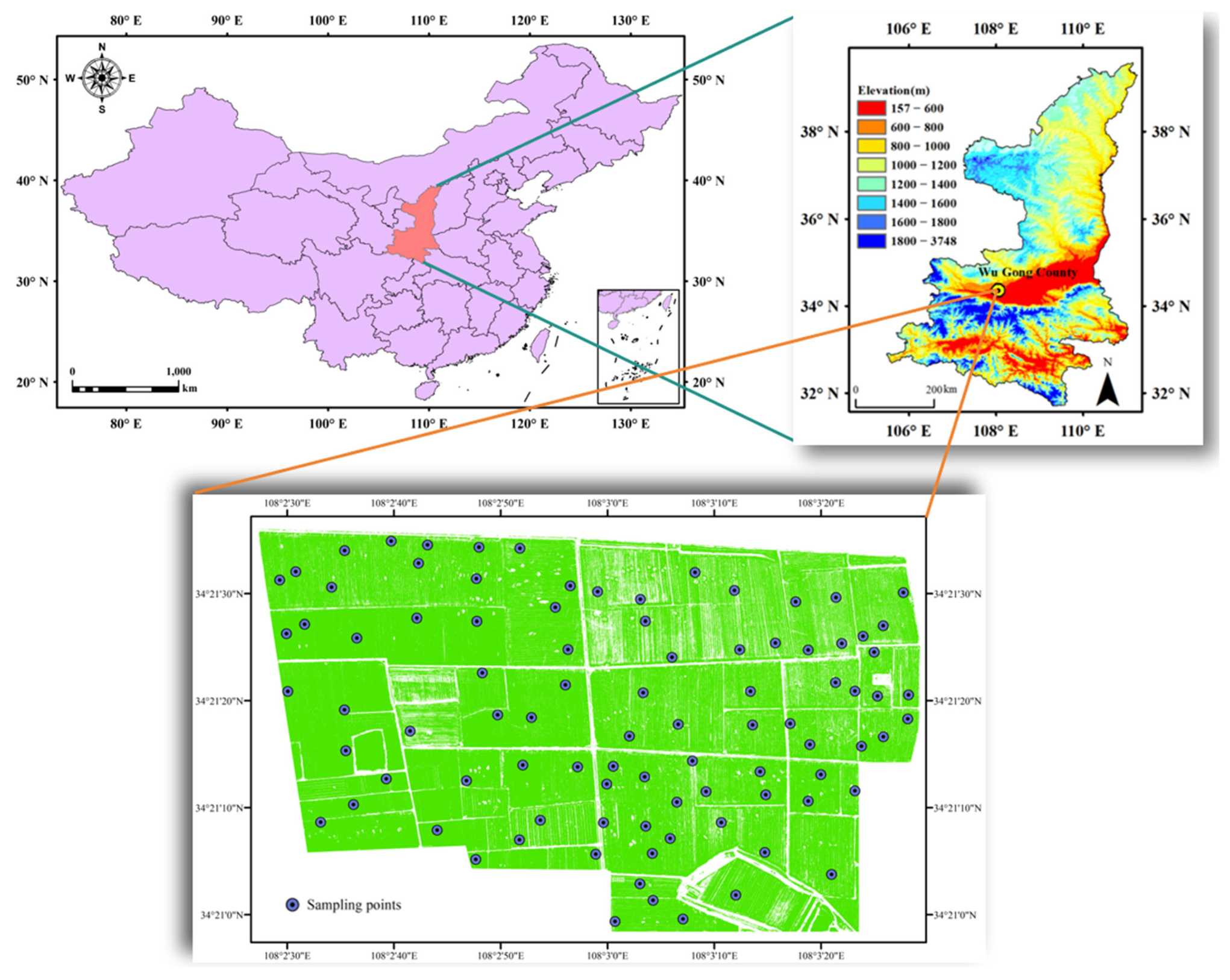
Figure 1. Distribution map of research area.
Agronomy 15 02610 g001
Figure 2. Flowchart for estimating leaf water content in winter wheat using a UAV multispectral system.
Agronomy 15 02610 g002
Figure 3. Box plot of winter wheat leaf water content distribution (a) and descriptive statistics of the dataset (b).
Agronomy 15 02610 g003
Figure 4. Correlation analysis between spectral and texture features in the retrieval of winter wheat LWC.
Agronomy 15 02610 g004
Figure 5. Scatter plot of winter wheat leaf moisture content based on spectral indices, the solid black line represents fitted line, and the black dotted line represents 1:1 line.
Agronomy 15 02610 g005
Figure 6. Scatter plot of winter wheat leaf moisture content derived from texture features, the red solid black line represents fitted line, and the black dotted line represents 1:1 line.
Agronomy 15 02610 g006
Figure 7. Comparison of statistical metrics for estimation models based on spectral indices or texture features, the black dotted line is the 0-axis scale line.
Agronomy 15 02610 g007
Figure 8. Scatter plot of winter wheat leaf moisture content derived from spectral and texture features, the solid blue line represents fitted line, and the black dotted line 1:1 line.
Agronomy 15 02610 g008
Figure 9. Comparison of statistical metrics for the combined spectral index and texture feature estimation model, the black dotted line is the 0-axis scale line.
Agronomy 15 02610 g009
Figure 10. Spatial distribution of winter wheat LWC during the regreening stage (a) and jointing stage (b).
Agronomy 15 02610 g010
Figure 11. The importance of spectral (a) and texture (b) features in different machine learning approaches.
Agronomy 15 02610 g011
Table 1. Selected vegetation indices in this study.
VIsFormula
NDVI(NIR − R)/(NIR + R)
NDWI(NIR − G)/(NIR + G)
TSAVI(1.2(NIR − 1.2R − 0.05))/((1.2NIR) + Red + 1.2 × 0.05)
PDI(NIR+Red)/1.414
SAVI1.5(NIR − R)/(NIR + R + 0.5)
GNDVI(NIR − Green)/(NIR + Green)
MSR((NIR/R) − 1)/sqrt((NIR/R) + 1)
RDVI(NIR − R)/sqrt(NIR + R)
MCARI((Red edge − R) − 0.2(Red edge-G)) × (Red edge/R)
OSAVI1.16(NIR − R)/(NIR + R + 0.16)
DVINIR − R
SAVI21.5(NIR − R)/(NIR + R + 0.5)
TVI0.5(120(NIR − G)-200(R − G))
RVI1NIR/G
RVI2NIR/R
GI(G − R)/(G + R)
Disclaimer/Publisher’s Note: The statements, opinions and data contained in all publications are solely those of the individual author(s) and contributor(s) and not of MDPI and/or the editor(s). MDPI and/or the editor(s) disclaim responsibility for any injury to people or property resulting from any ideas, methods, instructions or products referred to in the content.