Article

Soil Physiochemical Property Variations and Microbial Community Response Patterns Under Continuous Cropping of Tree Peony

1
Jiangsu Carbon Sequestration Materials and Structural Technology of Bamboo & Wood Research Center, College of Civil Engineering, Nanjing Forestry University, Nanjing 210037, China
2
College of Material Science and Engineering, Nanjing Forestry University, Nanjing 210037, China
*
Author to whom correspondence should be addressed.
Agronomy 2025, 15(11), 2602; https://doi.org/10.3390/agronomy15112602
Submission received: 23 September 2025 / Revised: 4 November 2025 / Accepted: 8 November 2025 / Published: 12 November 2025
(This article belongs to the Special Issue Microbial Interactions and Functions in Agricultural Ecosystems)

Abstract

Continuous cropping can often deteriorate soil quality and reduce crop yield. Soil properties and microbial communities usually play a vital role in maintaining rhizosphere micro-ecosystem sustainability, which is yet to be addressed in continuous peony monoculture systems. Herein, variations in soil physiochemical properties were extensively investigated following 1, 4, and 10 years of continuous tree peony cropping, as well as microbial community diversity, composition, and predicted functions. The soil pH and contents of available Mg, Mn, Zn, and B significantly declined after 10 years of continuous monoculture, while the contents of soil organic carbon, nitrate, and available P, K, Fe, and Cu notably increased by more than 100%, implying an imbalance of soil nutrients resulting from long-term continuous cropping. High-throughput sequencing results indicated that the microbial community structure and composition were remarkably altered after either 4 or 10 years of continuous cropping, interfering with diverse microbial metabolic pathways and phenotype functions. In addition, the relative abundances of some beneficial bacteria dramatically increased, especially for Acidobacteriota and Bacillus members. Microbial selections or adaptations in response to soil nutrient changes were expected to remediate negative impacts of continuous cropping on soil quality. Findings in this study provide insights into the establishment of proper management strategies for sustaining soil quality to resist potential obstacles after long-term continuous peony cropping.

1. Introduction

Continuous cropping commonly refers to the continuous planting of the same crop or plant and related species in the same agricultural field without rotation with other crops over the years. However, after a few years of continuous monoculture, obstacles that usually cause soil degeneration or nutrient deficiency, soil microbial community imbalance, an increase in disease incidence, and crop yield decline are often encountered [1,2,3,4]. The tree peony (Sect. Moutan) is well-acknowledged as a perennial deciduous shrub belonging to the genus Paeonia of the family Paeoniaceae, which can usually grow for at least 10 years [5]. There is a long history of tree peony cultivation in China. The tree peony is widely distributed across East Asia. The peony blossom is praised as the national flower of China due to its beauty, long history, and elegant and peaceful temperament. In addition, the tree peony possesses exceptionally high ornamental and medicinal value, and it is also edible. The compounds and extracts derived from the tree peony could decrease the risk of cardiovascular and inflammatory diseases [5]. Moreover, the peony seed oil extracted from some Paeonia species has been recognized as a new source of edible oil by the national Ministry of Health of China [6]. As a result, most growers are inclined to opt for continuous monocropping of peonies to maximize economic profits, which often leads to the deterioration of crop quality and yields over time due to the remarkable change in soil physicochemical properties and microbial communities.
It has been widely documented that continuous cropping could dramatically change soil physiochemical properties, such as pH, organic carbon content, and macro/micronutrients (e.g., available N, P, K, Zn, Fe, Cu, Mn, and B) [1,7,8]. Xie et al. [9] found that the pH of rhizosphere soils, as well as their ammonium and nitrate nitrogen contents, decreased after 4 years of continuous planting of the herbaceous peony, belonging to Sect. Oanepia of the genus Paeonia. Despite this, the soil pH and organic matter contents were determined to increase under the continuous planting of the same herbaceous peony in Korea [10]. In addition, soil pH has been found to decrease, while soil organic matter increases, with consecutive planting of Chinese fir plants [11]. Moreover, in another study exploring continuous potato cropping (2 years), soil pH and available B and Mn contents were observed to decrease, while the Zn content increased [12]. Zhang et al. [13] reported that, after 5 years of continuous cropping of mint and maize, the soil pH decreased, while the available K content was not significantly altered. Therefore, the soil physiochemical properties significantly vary according to the different types of crops used, as well as the cropping durations and fields used. However, the variation patterns of soil physiochemical properties remain unclear in the context of continuous tree peony cropping.
Rhizosphere microbial communities are widely known to play a critical role in the determination of soil quality and crop/plant health. Numerous studies have shown that continuous cropping could substantially change soil microbial community structure, diversity, composition, and function [3,14,15,16]. However, the variation patterns of microbial diversity or composition generally differ based on the crop species, soil types, cropping types, and cropping durations. Microbial alpha diversity has been revealed to significantly decrease after continuous cropping of black pepper (21 and 55 years) [17], panax (4 and 6 years) [18], banana (2 years) [19], and tea plants (70 years) [20]. A decrease in microbial diversity could interrupt soil microbial functions, such as microbial tolerance to environmental variations, alleviating soil degradation, and shaping suitable conditions to resist soil-borne pathogens. Fortunately, microbial communities have been observed to have self-adaptation potential, helping them to resist continuous cropping obstacles. For example, the soybean cropping system has shown no obvious impact on the alpha diversity of rhizobacterial communities [21], and it has even been found to promote Faith’s phylogenetic diversity after 13 years of continuous cropping [22]. The diversity and richness of potato rhizosphere microbes have also been reported to increase after continuous cropping [12].
Some beneficial microbes (e.g., Bacillus and Acidobacteria) have been demonstrated to have increased abundances in many continuous cropping systems [3,22,23], perhaps due to microbial adaptation to soil physiochemical property changes or tolerance to outbreaks of soil-borne pathogens [24,25], although other beneficial microbes have been shown to be significantly suppressed. The bacterial phylum Acidobacteria has been found to be highly enriched in potato [12] and cotton [26] cropping systems. Populations of potentially beneficial bacteria such as Bacillus, Nitrospira, or Pseudoxanthomonas have also notably increased in many other cropping systems [12,21,22].
Microbial metabolic pathways and functions could be analyzed further via variations in soil physiochemical properties, microbial diversity, and microbial composition caused by continuous cropping. Nitrate reduction and predatory and chitinolytic pathways have been reported to be significantly disturbed by continuous tobacco cropping [27]. In addition, rhizosphere nitrogen and sulfur cycling functions have been weakened under conditions of continuous sugarcane cropping [14]. The microbial co-network functions in tobacco rhizosphere soil have been observed to be vulnerable to continuous cropping [15]. Overall, soil properties and microbial community compositions or functions highly associated with crop/plant health and growth could be significantly altered with continuous cropping. However, the response patterns of microbes found in rhizosphere soil to continuous tree peony cropping are yet to be adequately addressed in the literature.
Therefore, the objectives of this study were as follows:
(i) We aimed to investigate variations in soil properties (e.g., pH, organic carbon, and available macro/micronutrients) in the rhizospheres of 1-, 4-, and 10-year-old tree peony plants under continuous monoculture conditions.
(ii) We also aimed to reveal patterns of alteration regarding rhizosphere microbial community structures, diversity, and composition under continuous cropping conditions via 16S rRNA gene sequencing.
(iii) We sought to explore the microbial responses of metabolic pathways and functions to continuous cropping based on PICRUSt2 and BugBase prediction.

2. Materials and Methods

2.1. Study Area and Soil Sampling

2.1.1. Study Area

The soil samples tested in this experiment were collected from the scientific research base at the Baima National Agriculture Technology Innovation Park (NATIP) in Nanjing, with the sampling site located in an experimental field with the following coordinates: (31°36′ N, 119°10′ E). The land of NATIP, with its rolling hills, dense woody vegetation, and dendritic river, has a long history of blackberry planting dating back to the 1980s. In the study area, the average annual temperature and rainfall are around 15 °C and 1100 mm, respectively.

2.1.2. Experiment Setup and Soil Sampling

Since tree peony is generally classified as a deep-rooted perennial shrub and the absorptive roots are usually 10–50 cm below the surface, the experimental surface soil samples in 10–20 cm layer from the rhizosphere zone of the peony were collected at the beginning of September 2022 in three planting plots of tree peonies, which were planted in 2021 (1-year-old peony, 1-YP), 2018 (4-year-old peony, 4-YP), and 2012 (10-year-old peony, 10-YP). Four and 10 years were chosen to explore the short-term and long-term effects of continuous cropping on soil property variations, respectively, and the 1-YP soil sample was chosen as the control. The studied peonies were all planted in soil that was characterized as clay–loam and neutral soil with a pH between 7.0 and 7.3. The agronomic management strategies and fertilization regime were similar in the three planting plots. The topsoil was turned over during the pre-planting period, and regarding site preparation, any other crops aside from peony crops were not planted. Fertilizers were not used prior to penny planting. For 4–10 years of continuous monoculture, well-rotted organic manure was generally banded in Fall (around September–November in China) after flowering, and mineral fertilizers including urea, ammonium phosphate and potassium nitrate were generally banded in early Spring (around February–March in China) before flowering. For each planting plot at different continuous monoculture durations, three biological sampling plots (2 m × 6 m) were established. In each sampling plot, five peony trees were selected on an S-shaped sampling point, and the rhizosphere soils were evenly mixed. Ultimately, three biological replicates were obtained from each planting plot for different continuous monoculture durations.

2.2. Analysis of Soil Physicochemical Properties

2.2.1. Soil pH

The pH of the soil samples was determined using the ion-selective electrode (ISE) method. Before measurement, approximately 50 g grinding soil was passed through a 20-mesh sieve and then mixed with deionized water at water/soil ratio of 2.5:1 (v:w) [28].

2.2.2. Soil Organic Carbon and Macronutrient Contents

Soil organic carbon was measured using a TOC analyzer (TOC-V CPH, Shimadzu Co., Tokyo, Japan) following the combustion oxidation method [29]. Soil inorganic nitrogen contents were determined according to the Nitrogen Determination Methods of Forest Soils (LY/T 1232-2015) [30]. Ammonium nitrogen was quantified by the salicylate–hypochlorite spectrophotometric method (HJ 536-2009), and nitrite/nitrate nitrogen contents were analyzed using the Griess reagent method [31]. Soil-available P (Colwell P) content, with P extracted using 0.5 M NaHCO3, was measured according to the Phosphorus Determination Methods of Forest Soils (LY/T 1232-2015) [32] using a 752N ultraviolet–visible spectrophotometer (INESA Analytical Instrument Co., Shanghai, China). Soil-available K content was determined according to the Potassium Determination Methods of Forest Soils (LY/T 1234-2015) [33] using a GGX-830 atomic absorption spectrophotometer (Beijing Haiguang Instrument Co., Beijing, China). Before each analysis, approximately 20 g of the grinding soil was sieved to 0.15 mm.

2.2.3. Available Metal or Micronutrient Contents

Soil-available Ca and Mg (extracted with DTPA solution) contents were determined according to the Forestry Industry Standards of the People’s Republic of China (LY/T 2445-2015) [34] using a PerkinElmer Avio 200 inductively coupled plasma emission spectrometer (PerkinElmer Instruments Co., Shanghai, China). Soil-available zinc (Zn), manganese (Mn), iron (Fe), and copper (Cu) contents, extracted with DTPA solution, were measured according to the National Environmental Protection Standard (HJ 804-2016) [35] by atomic absorption spectrophotometry (AAS) using a GGX-830 spectrometer (Beijing Haiguang Instrument Co., Ltd.). Soil-available boron was measured by the azomethine-H colorimetric method in accordance with Chinese Agricultural Industry Standard NY/T 1121.8-2006 (Method for Determination of Available Boron in Soils) [36]. Before each measurement, approximately 20 g of the grinding soil was sieved to 0.15 mm.

2.3. Soil DNA Extraction and Sequencing

Total genomic DNA was extracted from the collected soil samples utilizing the E.Z.N.A.® Soil DNA Kit (OMEGA Bio-tek Inc., Norcross, GA, USA) following the manufacturer instructions. The extracted DNA concentration and purity were assessed using a Nanodrop 2000 spectrophotometer (Nano-Drop, Thermo Fisher Scientific, Wilmington, DE, USA). The V3–V4 hypervariable regions of bacterial 16S rRNA genes were amplified with primers 338F (5′-ACTCCTACGGGAGGCAGCAG-3′) and 806R (5′-GGACTACHVGGGTWTCTAAT-3′). The DNA integrity and quantity of the amplified and purified PCR products were further checked by 2% agarose gel electrophoresis. Finally, the purified PCR products were sequenced on the Illumina MiSeq PE300 platform (Illumina Inc., San Diego, CA, USA).
Raw sequencing reads were quality-filtered using Fastp software (version 0.22.0), and paired-end reads were assembled using FLASH software (version 1.2.11). Sequences with more than 97% similarity were clustered into operational taxonomic units (OTUs) via UPARSE software (version 7.0.1090). The Ace, Chao, Shannon, and Simpson indexes were calculated for microbial alpha-diversity analysis. Principal component analysis (PCA) and redundancy analysis (RDA) were conducted for microbial structure variation investigations. In addition, Spearman’s correlation coefficient was applied to assess relationships between abundant bacterial genera and chemical parameters in the rhizosphere soil. Moreover, microbial metabolic response pathways and functions were inferred using PICRUSt2 (version 2.2.0) according to the KEGG database. BugBase was further applied to predict the high-level microbial phenotypes and functions.

2.4. Statistical Analysis

Soil samples were collected using the five-point sampling method, and three biological replicates were included for all measurements. Experimental results were expressed as mean ± deviation value (n = 3). An independent Student t-test was applied to compare two groups using Microsoft Excel software and the Majorbio iMeta Platform (https://www.majorbio.com/tools, accessed on 28 August 2025). The permutational multivariate ANOVA test was performed for comparative analysis of multiple groups, including PCA and RDA, on the Majorbio iMeta Platform. Before statistical analysis, the F-test or Levene’s test was applied to verify homogeneity of variances. Statistically significant differences were identified at * p < 0.05, ** p < 0.01, and *** p < 0.001, respectively.

3. Results

3.1. Soil Physiochemical Properties

3.1.1. Soil pH

Continuous peony monoculture generally decreased the pH in the rhizosphere soil. As shown in Table 1, the soil pH decreased from 7.28 to 7.17 and 6.98 in the rhizospheres of 4-year-old (4-YP) and 10-year-old (10-YP) peony plants, respectively, when compared to that of a 1-year-old peony (1-YP) plant. In particular, a statistically significant (p < 0.05) decrease in pH was observed with continuous monoculture for 10 years, and the rhizosphere soil tended to display slightly acidic traits under long-term continuous monoculture conditions.

3.1.2. Soil Organic Carbon and Available P, K, and Inorganic N Contents

Generally, the long-term continuous tree peony monoculture dramatically influenced the soil organic carbon (SOC) content, available P, K, and nitrate nitrogen contents. It can be seen from Figure 1A that the SOC content notably decreased from 5.6 ± 0.5 g/kg to 3.2 ± 0.7 g/kg after 4 years of continuous peony monoculture, while a prominent increase in SOC content to 11.2 ± 1.0 g/kg was observed in the rhizosphere soil after 10 years of continuous monoculture. In addition, the available P and K contents displayed a similar varying trend with the SOC under continuous monoculture conditions. The available P contents significantly decreased (p < 0.05) from 41.80 ± 2.27 mg/kg to around 8.36 mg/kg after 4 years of continuous planting, before remarkably increasing to around 96.85 mg/kg with the increase in planting years. In addition, the available K contents notably decreased (p < 0.05) from 210.76 ± 9.73 mg/kg to around 80.13 mg/kg after 4 years of continuous monoculture, subsequently significantly increasing to around 437.92 mg/kg after 10 years of continuous planting. Therefore, short-term (4 years) continuous tree peony monoculture resulted in a significant reduction in SOC, as well as available P and K contents, while long-term (10 years) continuous planting may have increased the soil macronutrient contents.
The ammonium nitrogen contents in all the collected soil samples were all around 0.011 mg/kg, with no significant differences (p > 0.05, Figure 1B). The nitrite nitrogen contents in the rhizosphere soil displayed a slight increase from 0.068 ± 0.001 to 0.077 ± 0.001 and 0.085 ± 0.003 μg/kg, respectively, after 4 years and 10 years of continuous monoculture, though no statistically significant changes were found (p > 0.05). However, the nitrate nitrogen content significantly increased by more than 260% (p < 0.05) in 10-YP soil samples when compared to 1-YP soil samples, indicating enhancement of inorganic nitrogen and nitrification processes in the rhizosphere soil after long-term continuous tree peony planting (>10 years).

3.1.3. Available Micronutrient Contents

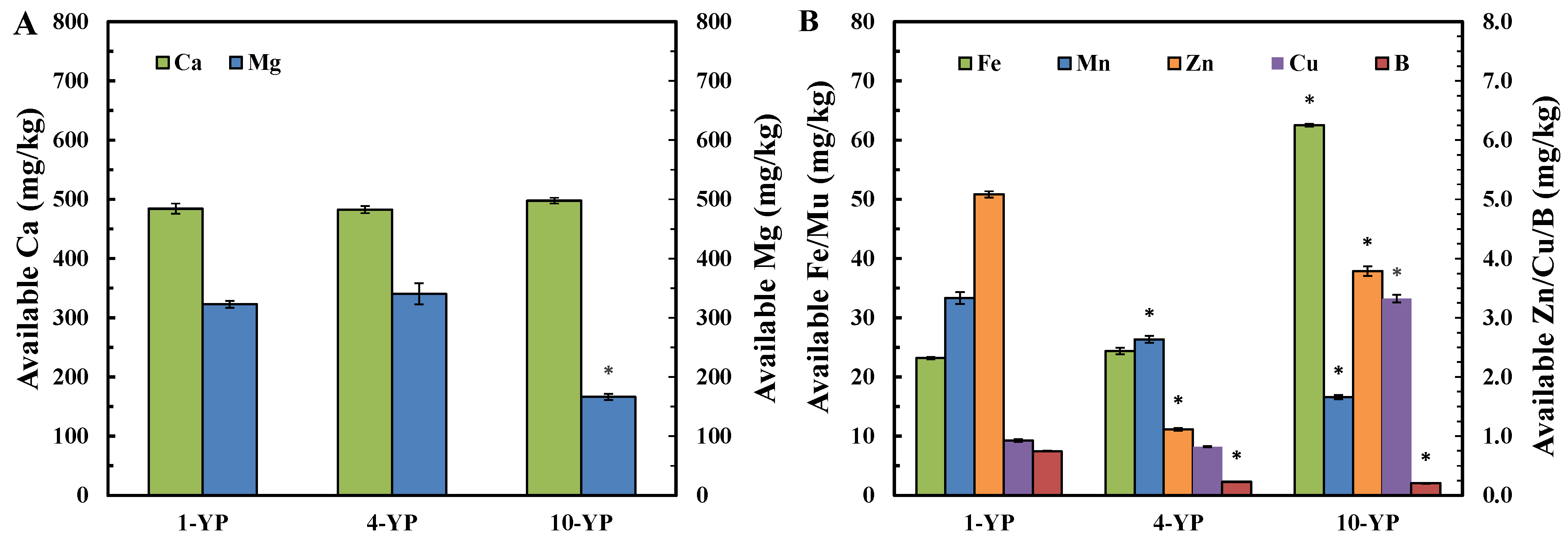
The soil’s available metal or micronutrient contents, including Ca, Mg, Fe, Mn, Zn, Cu, and B contents, varied across different continuous monoculture years, as shown in Figure 2. The available Ca content displayed no significant variations (p > 0.05) during the whole long-term (10 years) continuous monoculture period. In addition, the available Mg content did not significantly change (p > 0.05) after 4 years of continuous peony planting but showed a notable reduction (p > 0.05) from 322.85 ± 5.63 mg/kg to 166.36 ± 5.15 mg/kg after 10 years of continuous monoculture. In comparison, the available Fe and Cu contents in rhizosphere soil did not significantly change (p > 0.05) after 4 years of continuous peony monoculture, but they did notably increase from 23.17 ± 0.21 to 62.53 ± 0.23 mg/kg and from 0.93 ± 0.03 to 3.23 ± 0.07 mg/kg after 10 years of continuous monoculture. In contrast, the available Zn, Mn, and B contents in rhizosphere soil were significantly reduced after 4 years and 10 years of continuous monoculture. The available Zn contents were significantly reduced by 78.1 ± 1.4% and 25.4 ± 1.9%, the available Mn contents significantly decreased by 21.0 ± 3.5% and 50.2 ± 3.4%, and the available B contents were notably reduced by 69.5 ± 1.2% and 72.7 ± 1.3% after 4 years and 10 years of continuous monoculture. Overall, continuous tree peony monoculture generally led to imbalances in the soil’s available metal contents.

3.2. Microbial Community Structure and Composition Variations

3.2.1. Microbial Community Diversity and Structure

Multiple microbial community diversity indices—Ace, Chao, Shannon, and Simpson—were used for analysis, and the results are available in Table 2. Generally, continuous planting resulted in a significant decrease in the microbial species populations, richness, and diversity in the rhizosphere soil. Both the Ace and Chao indices of the rhizosphere microbes significantly decreased by around 8.1% after 4 years of continuous monoculture, while they unceasingly decreased by around 10% after 10 years of continuous monoculture when compared to the 1-YP soil samples (p < 0.05). In addition, the Shannon and Simpson indices were also observed to remarkably decrease by around 2.7% and 24.8% after 4 and 10 years of continuous monoculture, respectively.
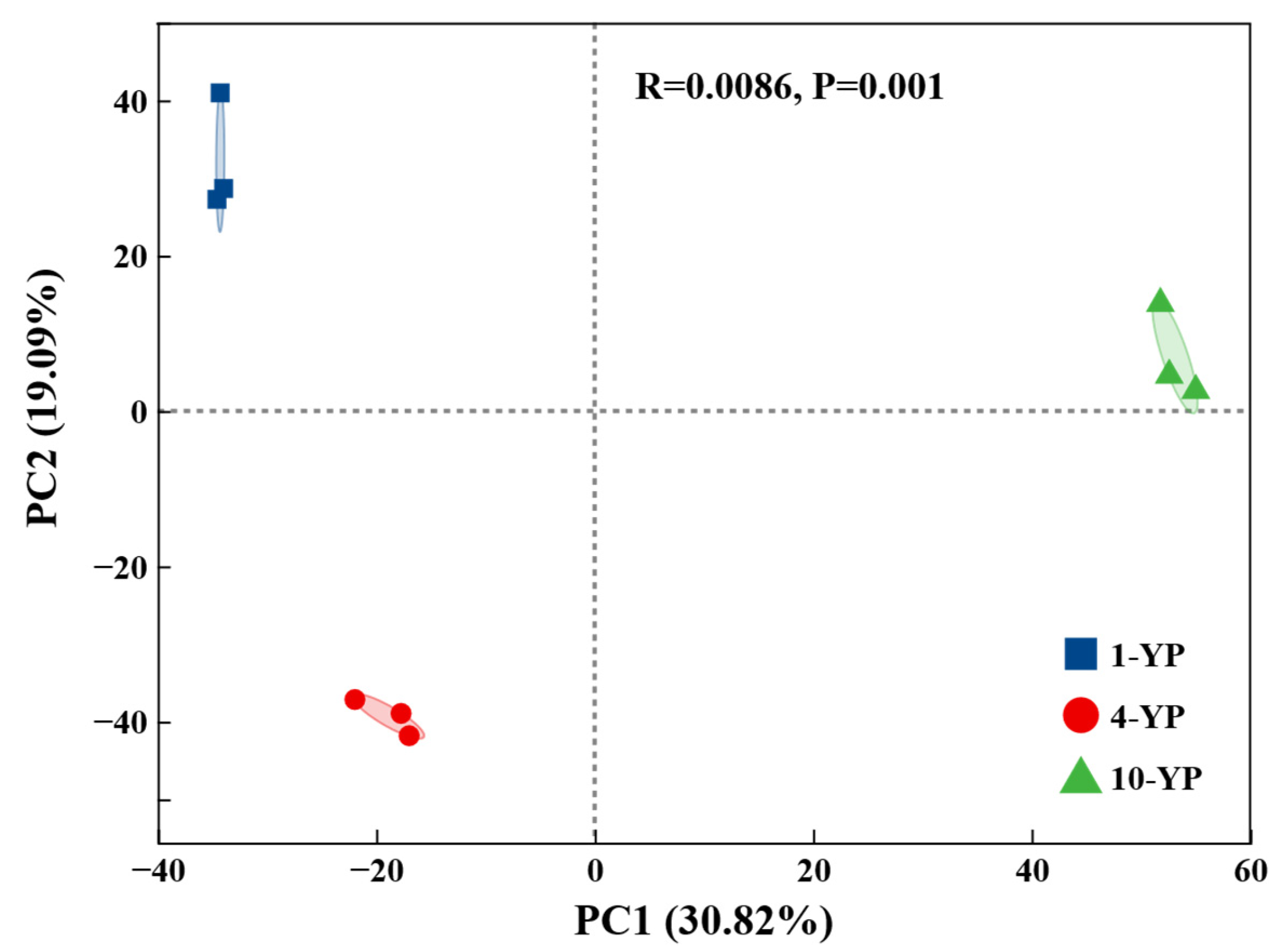
Principal component analysis (PCA) was applied to investigate the microbial community structure variations between different planting groups. As shown in Figure 3, the first principal component (PC1) and the second principal component (PC2) contributed 30.82% and 19.09%, respectively. The 4-YP and 10-YP soil samples were distinctive from the 1-YP soil samples. In addition, the 1-YP samples displayed the lowest PC1 and the highest PC2 values, while the 4-YP soil samples displayed the lowest PC2 values, and the 10-YP soil samples displayed the highest PC1 values. Overall, continuous tree peony monoculture led to significant variations (p < 0.05) in microbial community structures.

3.2.2. Microbial Community Compositions

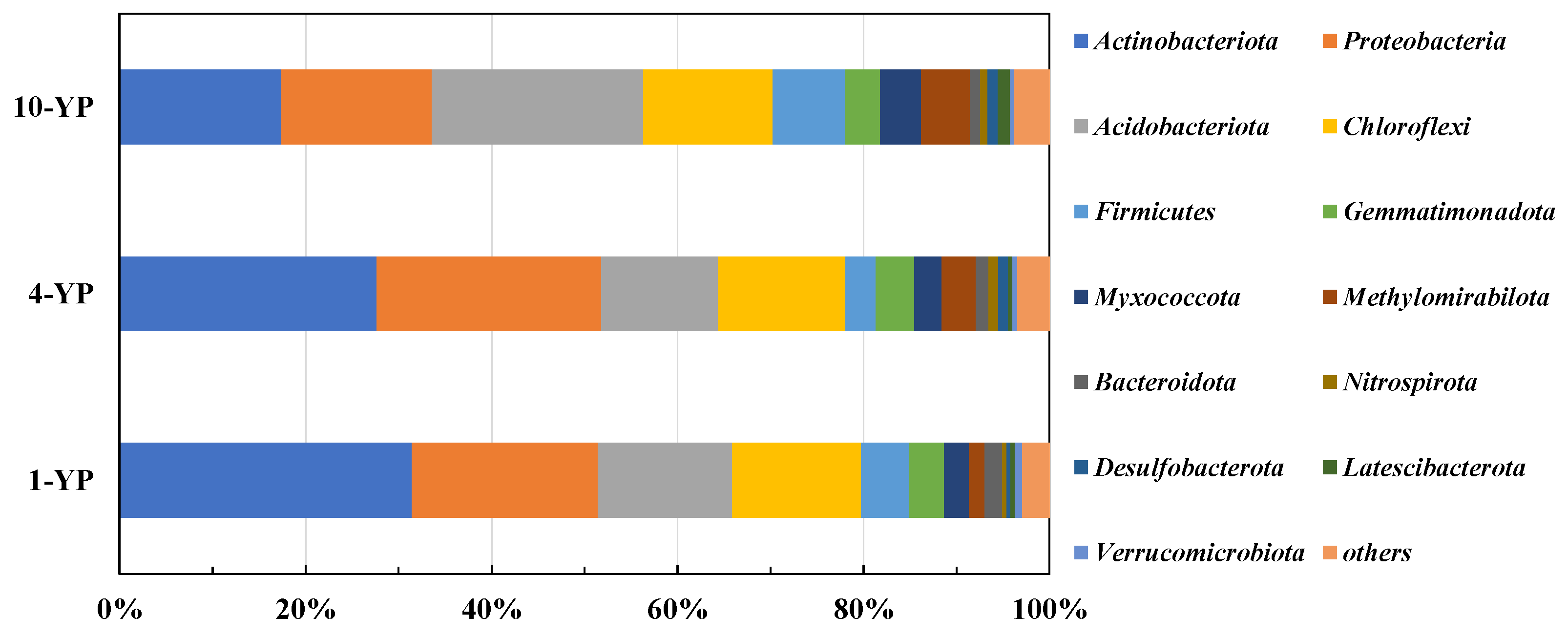
The microbial compositions at the phylum level in the rhizosphere soil are presented in Figure 4. Generally, continuous monoculture led to a significant shift in microbial community compositions. Thirteen bacterial phyla with relative abundances of more than 1% were screened. The dominant bacterial phyla in all collected soil samples included Actinobacteriota, Proteobacteria, Acidobacteriota, Chloroflexi, and Firmicutes, occupying 78.0–85.0% of the microbial populations. Among them, the relative abundance of the dominant Actinobacteriota was observed to constantly decrease from 31.5 ± 0.4% to 17.4 ± 1.3% with the increase in planting years. In contrast, the relative abundance of Acidobacteriota remarkably increased (p < 0.05) by around 57.6% following 10 years of continuous monoculture. In addition, Myxococcota and Methylomirabilota were determined to display a higher population under continuous monoculture conditions. The relative abundances of Myxococcota and Methylomirabilota in the rhizosphere soil substantially increased (p < 0.05) by around 62% and 210%, respectively, after 10 years of continuous monoculture when compared to the 1-YP soil samples.
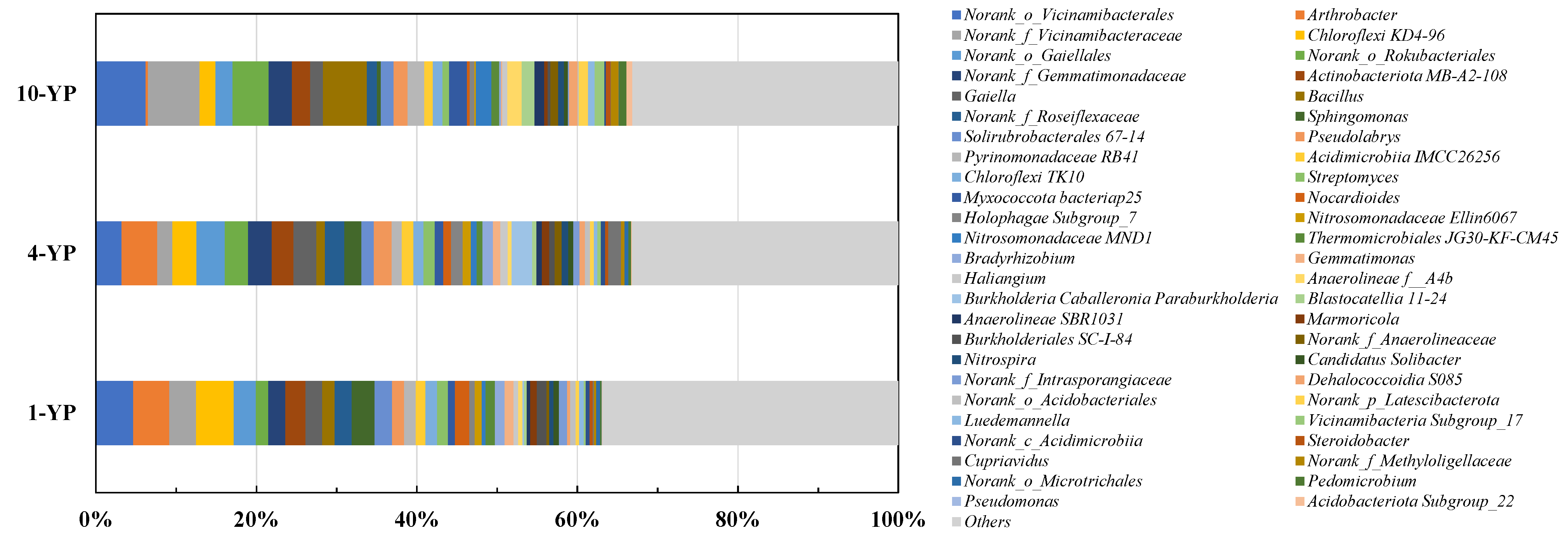
The top 50 microbial compositions at the genus level in the collected rhizosphere soil samples are shown in Figure 5. The relative abundances of genera varied with different continuous planting durations. The top ten dominant bacterial genera detected in all the soil samples generally included Norank_o_Vicinamibacterales, Arthrobacter, Chloroflexi KD4-96, Norank_f_Vicinamibacteraceae, Norank_o_Gaiellales, Norank_o_Rokubacteriales, Norank_f_Gemmatimonadaceae, Actinobacteriota MB-A2-108, Gaiella, and Bacillus.
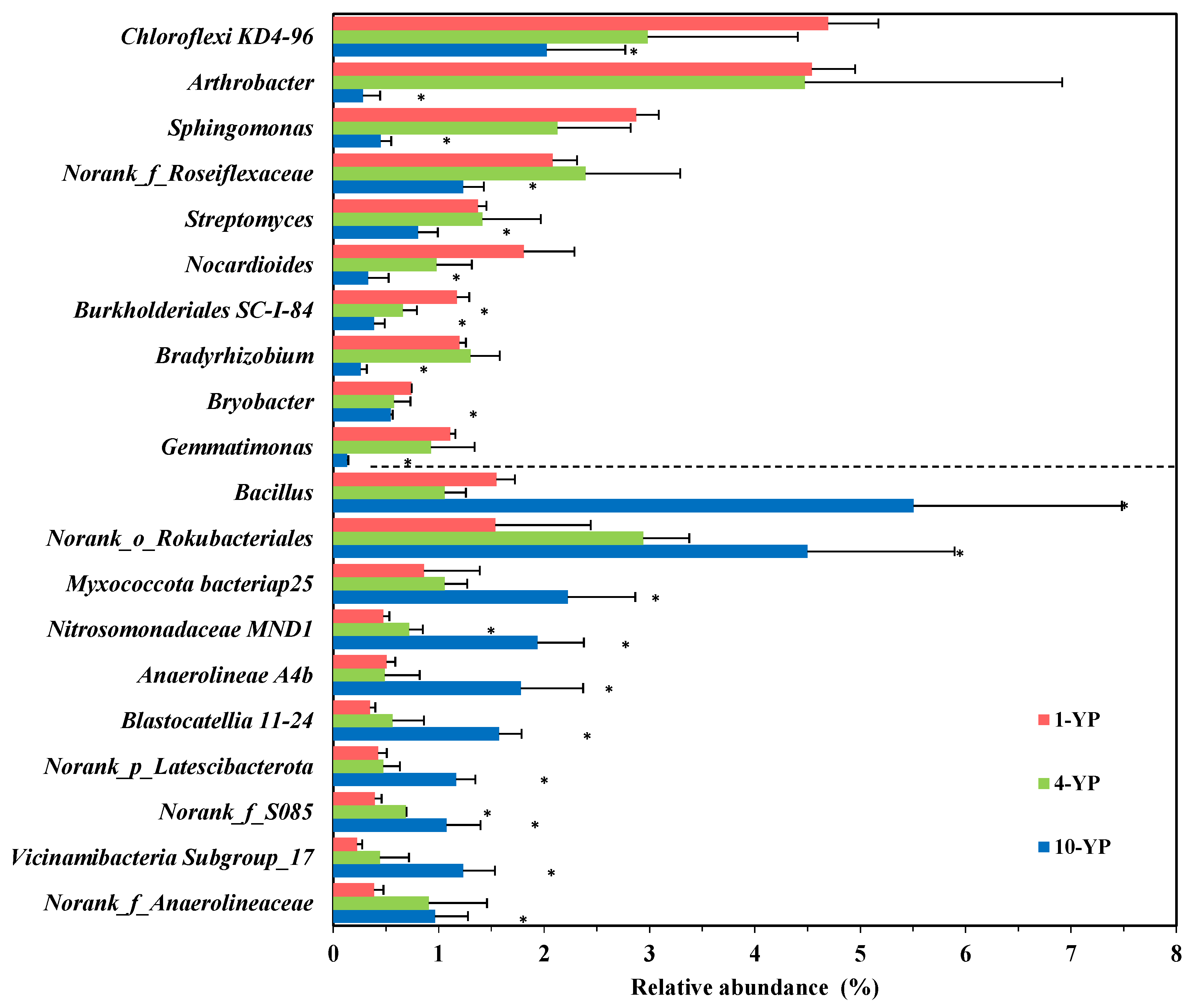
To better understand the microbial composition variation patterns after continuous planting, the top 20 dominating microorganisms at the genus level with a significant change (p < 0.05) in relative abundances were screened, and the results are shown in Figure 6. Generally, the microbial composition patterns were comparable between the 4-YP and 10-YP soil samples when compared to the 1-YP soil samples. The population of genus Chloroflexi KD4-96 constantly decreased by around 56.9% (p < 0.05) with the extension of continuous planting time from 4 years to 10 years. The other five most dominant microbes with a significant decrease in relative abundance after 10 years of long-term continuous monoculture included Arthrobacter, Sphingomonas, Norank_f_Roseiflexaceae, Streptomyces, and Nocardioides. In addition, genus Burkholderiales SC-I-84 was observed to experience a significant population decrease of around 43.1 and 67.1% after 4 years and 10 years of continuous monoculture, respectively. The other genera also had a significant reduction (p < 0.05) in relative abundance, but only after 10 years of continuous tree peony monoculture.
Regarding the genera that experienced a significant population increase, the dominating Bacillus and Norank_o_Rokubacteriales displayed a higher relative abundance, with 1.9 and 2.5 times more members in the 10-YP soil samples than in the 1-YP soil samples. The two rhizosphere bacterial genera with the most substantial increase in relative abundance were Vicinamibacteria Subgroup_17 (increased by 440%) and Nitrosomonadaceae MND1 (increased by 310%) after 10 years of continuous peony monoculture. In addition, genus Norank_f_S085 was observed to dramatically increase by around 74.8% and 173.6% after 4 and 10 years of continuous monoculture, respectively. The other genera also had a remarkable rise (p < 0.05) in relative abundance, but only after 10 years of long-term continuous tree peony monoculture. Therefore, the extension of continuous planting duration (≥10 years) might display a more significant and profound impact on microbial composition variations in peony rhizosphere soil.

3.3. Linkages Between Soil Physiochemical Properties and Microbial Communities

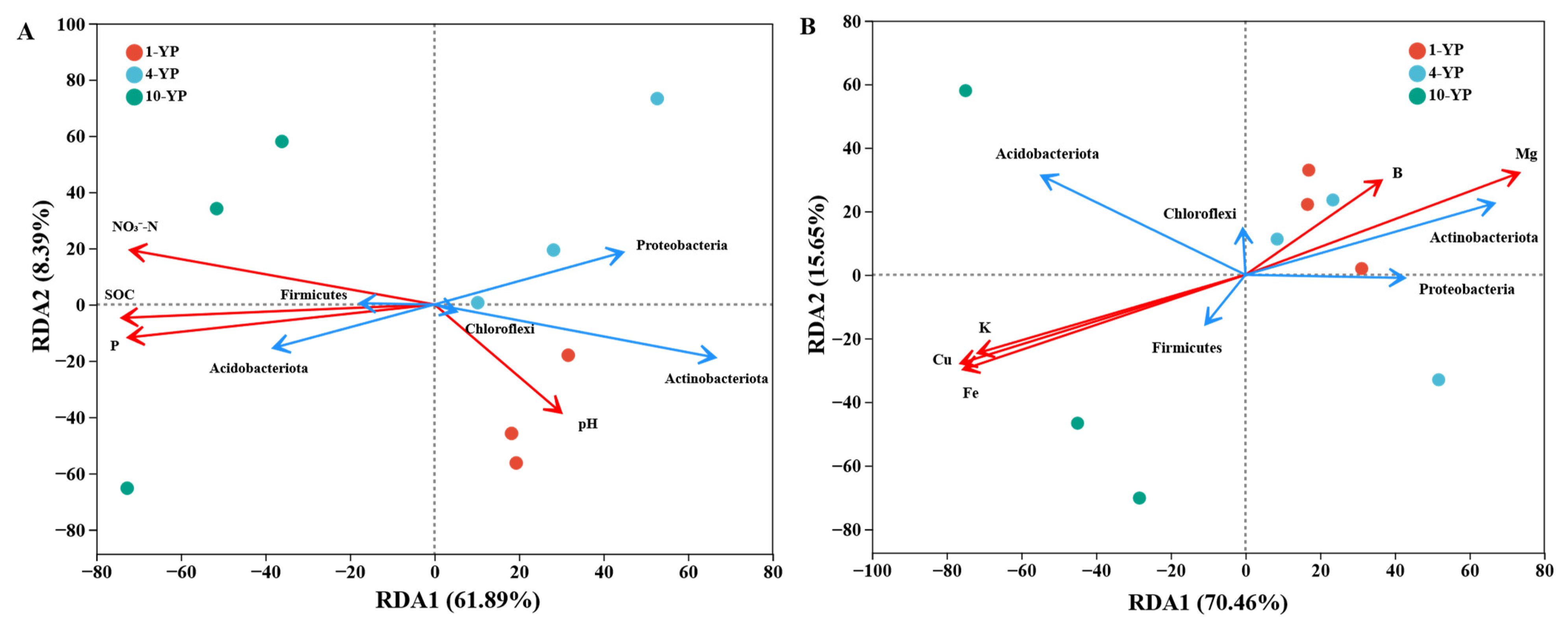
Redundancy analysis (RDA) of bacterial phyla with soil chemical parameters was performed with the extension of continuous peony planting (Figure 7). The results implied that the soil pH (R2 = 0.7283, p = 0.021), as well as the soil SOC (R2 = 0.8533, p = 0.013), available P (R2 = 0.8102, p = 0.013), and nitrate nitrogen (R2 = 0.9251, p = 0.008) contents, displayed significant correlations with bacterial communities at the phylum level (Figure 7A), as well as the available metal or micronutrient contents, including available K (R2 = 0.8388, p = 0.009), Mg (R2 = 0.9370, p = 0.010), Fe (R2 = 0.9666, p = 0.001), Cu (R2 = 0.9653, p = 0.006), and B (R2 = 0.8243, p = 0.021) (Figure 7B). Among them, the soil pH and available Mg and B contents were negatively correlated with the abundances of Acidobacteriota and Firmicutes and positively correlated with the abundances of Actinobacteria, Chloroflexi, and Proteobacteria. In contrast, the SOC and available P, K, Cu, Fe, and nitrate nitrogen contents displayed inverse significant correlations with the bacterial phylum in certain populations.
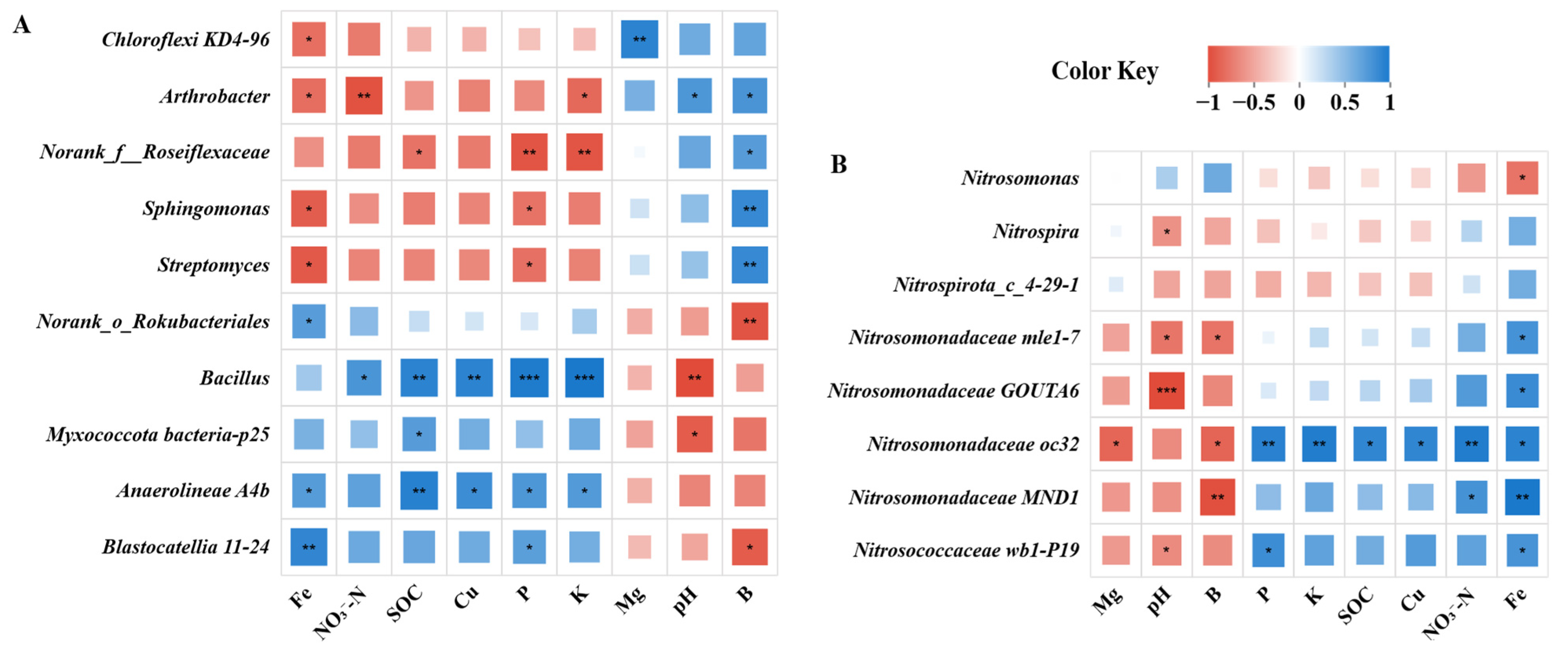
Spearman’s correlation coefficient was applied to assess relationships between the abundant bacterial genera and key chemical parameters in the peony rhizosphere soil (Figure 8). We obtained a correlation heatmap, which indicated that the abundances of the top five genera experienced a decrease after continuous monoculture (Figure 6), generally positively correlated with soil pH and available Mg and B contents (Figure 8A). Meanwhile, the abundances of the top five genera with an increase in population (Figure 6) were generally positively correlated with the SOC and available P, K, Cu, and Fe contents (Figure 8A). In particular, the abundances of Bacillus and Myxococcota bacteria-p25 were significantly positively correlated with the SOC and available P, K, and Cu contents (p < 0.05). In addition, the abundances of Arthrobacter, Norank_f_Roseiflexaceae, Sphingomonas, and Streptomyces were significantly positively correlated with the available B contents.
The correlations between nitrifying bacteria and key chemical parameters in rhizosphere soil are presented in Figure 8B. It can be seen that the abundances of seven of eight identified nitrifiers, with Nitrosomonas being the exception, were negatively correlated with soil pH and available B and Mg contents. In particular, four of seven nitrifiers displayed a significantly negative correlation with the soil pH (p < 0.05). In addition, the abundances of the genera Nitrosomonadaceae mlel-7, GOUTA6, oc32, MND1, and Nitrosococcaceae wb1-P19 were significantly positively correlated with the soil’s available Fe contents (p < 0.05). Moreover, the abundance of Nitrosomonadaceae oc32 was negatively correlated with the SOC and available P, K, Cu, Fe, and nitrate nitrogen contents (p < 0.05).

3.4. Microbial Metabolic Pathway and Function Responses

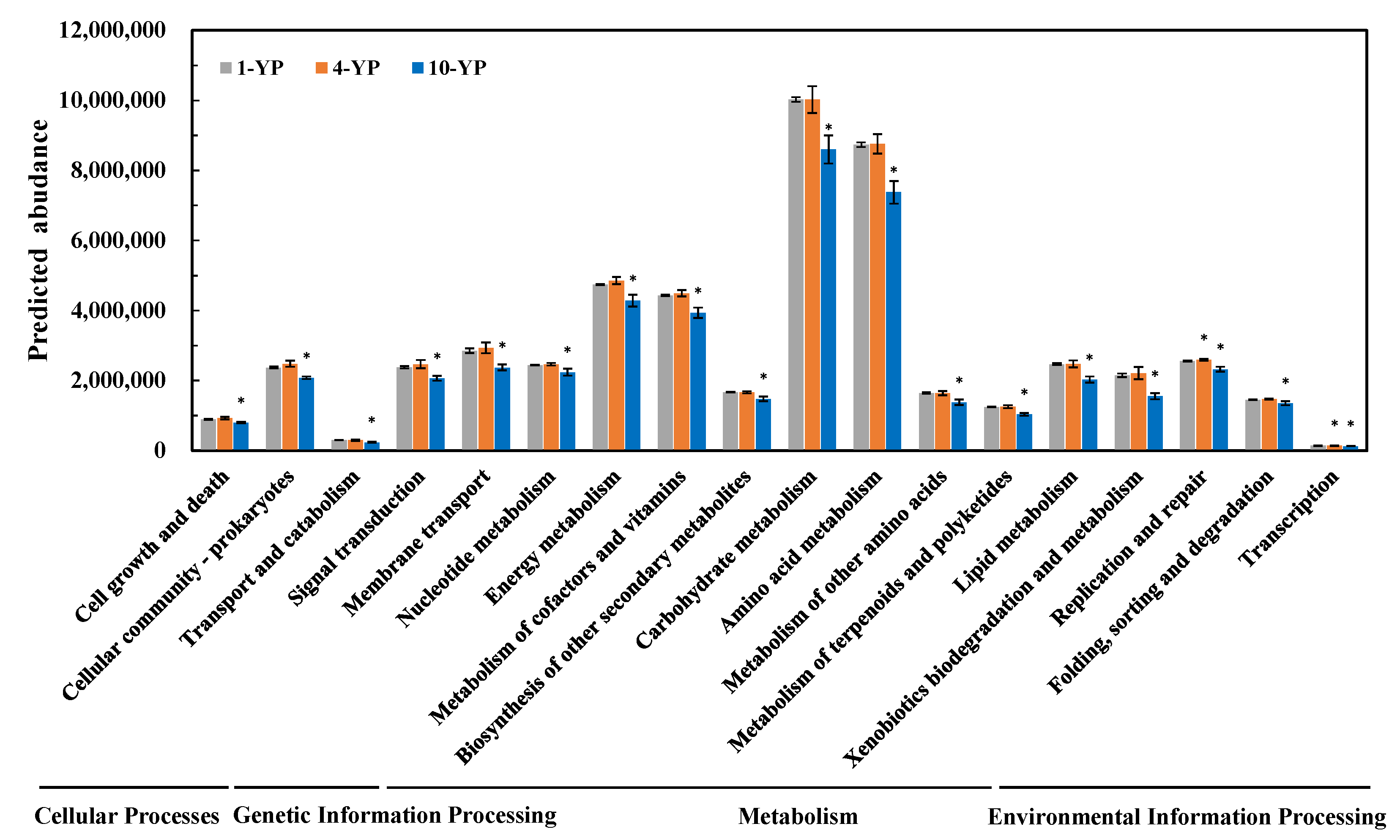
The microbial metabolic pathways and functions in the rhizosphere soil were predicted using PICRUSt2 according to the Kyoto Encyclopedia of Genes and Genomes (KEGG) database. It can be seen from Figure 9 that four kinds of microbial metabolic pathways at KEGG level 1 with significant variations after continuous peony planting were determined, including Metabolism (55.5%), Environmental Information Processing (16.7%), Cellular Processes (16.7%), and Genetic Information Processing (11.1%). In addition, 18 types of microbial metabolic pathways at KEGG level 2 were identified in all collected soil samples. The two most dominant metabolic pathways in all the soil samples were carbohydrate and amino acid metabolism, followed by energy metabolism, metabolism of cofactors and vitamins, membrane transport, and replication and repair.
The abundances of all the identified 18 pathways were substantially lower in the 10-YP soil samples than those in the 1-YP soil samples, but with no significant changes between the 4-YP and 1-YP soil samples, except for the metabolic functions of replication and repair and transcription. The dominating carbohydrate and amino acid metabolism pathways displayed a notable reduction in abundances of around 14.2% and 15.5%, respectively, after 10 years of continuous peony planting. In addition, the most decreased metabolic pathway, in terms of abundance, was xenobiotic biodegradation and metabolism, decreasing by around 27.8%, followed by lipid metabolism (decreasing by around 17.8%) and metabolism of terpenoids and polyketides (decreasing by around 16.9%). Therefore, it is clear that diverse microbial metabolic pathways and functions were significantly interrupted by long-term continuous tree peony monoculture (≥10 years).
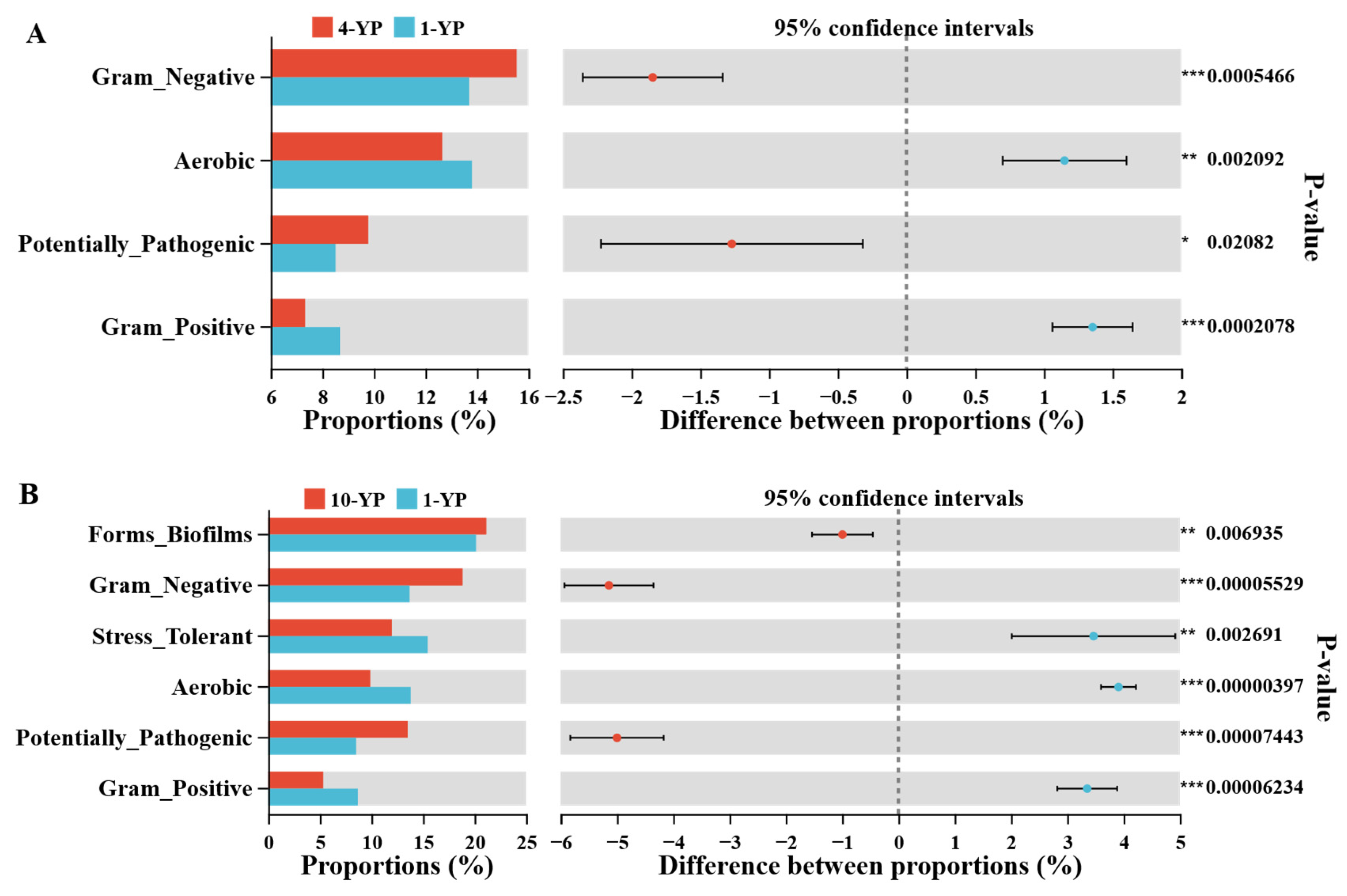
The microbial community phenotypes and functions with high-level abundance in the rhizosphere soil were predicted using BugBase (Figure 10). After 4 years of continuous planting, the proportions of Gram-negative bacteria in the rhizosphere microbes significantly increased (p < 0.001) when compared to the 1-YP soil samples (Figure 10A), and the pathogenic potential in rhizosphere microbial community was observed to be substantially enhanced (p < 0.05) by nearly 15%. In contrast, the proportions of Gram-positive and aerobic bacteria were predicted to notably decrease (p < 0.01).
After 10 years of continuous planting, the stress tolerance potentials of the microbial community were remarkably weakened by around 28.9% when compared to the 1-YP soil samples (p < 0.01, Figure 10B). In addition, the proportions of Gram-positive and aerobic bacteria were also observed to notably decrease (p < 0.0001). On the contrary, the proportions of Gram-negative bacteria and biofilm formation potentials significantly increased (p < 0.01). Notably, the pathogenic potential in rhizosphere microbial communities was observed to be substantially enhanced (p < 0.0001) by around 37%, in accordance with the results obtained for the 4-YP soil samples compared to the 1-YP soil samples (Figure 10A).

4. Discussion

4.1. Soil Physiochemical Property Variations

Generally, long-term continuous monoculture of the tree peony could significantly alter, but not always deteriorate, soil physiochemical properties. The soil pH (Table 1) and available Mg, Zn, Mn, and B contents (Figure 1 and Figure 2) significantly decreased after 10 years of continuous monoculture, while the SOC and available P, K, Fe, Cu, and nitrate contents substantially increased (Figure 1 and Figure 2). In addition, except for SOC and the available K, P, Zn, Mn, and B contents, all the other examined soil physiochemical properties displayed no significant differences after short-term (4 years) continuous monoculture (Figure 1 and Figure 2). Therefore, it is clear that planting duration remarkably affected soil physiochemical properties. Increases and decreases in diverse soil physiochemical properties have also been documented in many other cropping systems [1,3,7], as will be discussed in the following sections.
In this study, soil pH was observed to significantly decrease after 10 years of continuous monoculture (Table 1), consistent with the results obtained in herbaceous peony cropping systems [9] and other continuous cropping systems [12,13]. The decrease in soil pH might be attributed to the accumulation of acids, such as organic acid secreted from roots or H+ production during microbial nitrification [37]. The increase in the content of nitrate—mainly produced by nitrification with H+ release—observed in this study (Figure 1B) might be an important reason for the reduced soil pH, as the pH and nitrate content were determined to be negatively and positively correlated with the abundant nitrifiers, respectively, (Figure 8B). Numerous studies have also reported negative correlations between soil pH and available nitrogen content in other continuous planting systems [13,27]. As a result, the decrease in soil pH or even soil acidification after long-term continuous planting could lower soil nutrient availability, interfere with the adsorption of micronutrients on soil, affect the plant uptake process, and, ultimately, reduce soil fertility and crop production yield [13].
Soil organic matter and available K/P are well known to play an essential role in soil fertility, quality, and function [38,39]. In this study, the SOC and available P and K contents significantly decreased (p < 0.05) after short-term (4 years) continuous monoculture (Figure 1A). Decreasing SOC and available K and P contents could be detrimental to soil health or even affect plant growth [1]. However, the SOC and available K and P contents were maintained at substantially higher levels with prolonging of the monoculture time to 10 years (Figure 2A), indicating the improvement of some unique nutrients after long-term continuous tree peony monoculture. A significant increase in SOC or available P content was also observed in a continuous herbaceous peony monoculture system spanning 4–7 years [9,10]. Similarly, it was documented that the SOC and available P or K contents can considerably increase after long-term continuous cropping of soybean (13 years) [22], Chinese fir (25–30 years) [11], and cucumber (12 years) [40], and improvements in the microbial environment and microbial adaptation/tolerance potential were claimed to be responsible for this phenomenon. In addition, continuous long-term application of chemical fertilizer might also be responsible for the increase in the SOC and available K and P contents, as documented previously [13,17,41].
Soil-available metals or micro-nutrients, including Ca, Mg, Zn, Fe, Cu, Mn, and B, are essential for both plant growth and soil microbial metabolism [39,42,43]. Soil-available Ca did not significantly change during the long-term continuous monoculture period, while the soil-available Mg notably decreased, but only after 10 years of continuous peony planting (Figure 2A). Mg, a component of chlorophyll, is essential for photosynthesis and enzyme biosynthesis [39]. The loss of available Mg might probably be unfavorable to peony growth and health under long-term continuous monoculture conditions. In addition, the soil-available Zn, Mn, and B contents were observed to remarkably reduce after 10 years of long-term continuous monoculture, while the available Cu and Fe contents significantly increased (Figure 2). An imbalance of soil micronutrients is usually expected to be induced by continuous monoculture. For instance, soil-available Zn has been reported to decrease from 2.41 ± 0.33 mg/kg to 1.90 ± 0.51 mg/kg after 25 years of continuous tobacco cropping [15]. In addition, the Mn and B available in rhizosphere soil have also been found to decrease from 2.54 to 2.60 to 1.75–1.85 mg/kg and 0.71–0.77 to 0.61–0.63 mg/kg, respectively, after 2 years of continuous sweet potato cropping [12]. Zn and B are important for plant cell wall and membrane integrity and play a crucial role in membrane or enzyme metabolism and plant growth [42]. Mn is crucial for redox systems, activation of various Mn-containing enzymes, photosynthesis, and lignin synthesis [42]. Decreases in Zn, Mn, and B might be adverse to soil health and plant growth, potentially resulting in continuous cropping obstacles. In contrast, available Fe and Cu have been observed to increase from 1.90 to 12.7 mg/kg and 1.02 to 1.46 mg/kg, respectively, after 30 years of consecutive monoculture of A. bidentata [44], in line with the results of our study. In addition, Zhong et al. [45] also reported a continuous increase in available Fe and Cu from 1 to 7 years of continuous banana cropping. However, the enrichment of available Fe and Cu might not always be beneficial to soil health and plant growth. On the one hand, a high level (above the threshold) of excessive trace metals might be toxic to either soil microbes or plants [34]. On the other hand, ensuring a balanced ratio of essential nutrients is crucial for optimal soil quality and plant growth based on stoichiometry theory [3]. Therefore, it is clear that an imbalance in the micronutrient ratio causes soil nutrient leaching, induces soil deterioration, and adversely affects long-term crop yield.

4.2. Rhizosphere Microbial Community and Metabolic Function Responses

Previous studies have reported that rhizosphere bacterial populations and community diversity or richness significantly decline under continuous cropping of herbaceous peony [9,10,46]. In this study, the microbial community structure dramatically changed; the continuous planting soil samples (4-YP and 10-YP) were clearly and significantly (p < 0.05) distinct from those in the 1-YP soil samples, based on the PCA results (Figure 3). In addition, almost all the alpha diversity indices significantly decreased after 4 or 10 years of continuous monoculture, which indicated a reduction in microbial diversity and richness under conditions of short-term and long-term continuous peony planting. Soil microbial diversity has been documented to be lower following the continuous planting of American ginseng [18], tobacco [8], perilla, and maize [13]. The decline in soil pH and imbalance of soil nutrients were listed as reasons for the reduced bacterial diversity [18,21], in line with the present study (Table 2 and Figure 7).
It has been documented that soil microbial diversity is highly connected to microbial functions, such as microbial tolerance/adaptation to environmental variations, alleviation of soil degradation, and shaping suitable conditions to resist soil-borne pathogens [1,3]. Thus, a decrease in microbial diversity might lead to the deterioration of microbial functions and soil quality and adversely affect plant growth. Diverse microbial metabolic pathways were shown to be significantly interrupted following 10 years of continuous monoculture of the tree peony using PICRUSt2, especially in the case of the carbohydrate, amino acid, and energy metabolism pathways (Figure 9), which further supported the suppression of long-term continuous cropping on microbial metabolic functions. In addition, the microbial community phenotypes and functions, including pathogenic potential or stress tolerance, were also predicted to be affected by continuous peony planting (Figure 10). Soil-borne pathogens have been demonstrated to greatly contribute to continuous cropping obstacles and suppress plant growth [3]. The instances of soil nutrient imbalance (Figure 1 and Figure 2) and decreased microbial diversity (Table 2) noted in the present study probably weakened the microbial adaptation/tolerance potential in the context of environmental changes and pathogen invasions, thus increasing the potential risk of soil-borne pathogen invasion or plant disease induction under continuous planting conditions. Reductions in soil microbial diversity have been reported to be mainly responsible for the outbreak of soil-borne crop diseases [47]. In addition, diverse microbial metabolic pathways and microbial co-network functions have also been demonstrated to be interrupted in other continuous planting systems [14,15,27].
Microbial community composition is crucial for maintaining soil health, function, and rhizosphere micro-ecosystem stability [47,48]. In the present study, Actinobacteriota, Proteobacteria, and Acidobacteriota at the phylum level dominated in all the peony rhizosphere soil samples (Figure 4), which was in accordance with previous studies on other crops or plants [18,25,26,27]. Numerous studies have documented the remarkable shift in microbial community compositions in continuous planting mode [1,41,49], which was also observed in this study. The relative abundance of Actinobacteriota constantly decreased with the increase in planting years, while Acidobacteriota, Methylomirabilota, and Myxococcota were highly abundant in the 10-YP soil samples (Figure 4). Actinobacteriota is involved in the global carbon cycle and the degradation of soil organic matter [50]; it is utilized as a bio-regulated agent to control plant disease [51]. Decreases in Actinobacteriota populations might compromise soil quality and inhibit plant growth.
In comparison, Acidobacteria, with its broad spectrum of metabolic and genetic functions [52], is well known to exhibit a high tolerance to soil acidization [49,53]. Therefore, Acidobacteria, which had a higher relative abundance after continuous peony planting in the present study (Figure 4), might be contribute to soil pH lowering (Table 1), and this idea is further supported by the RDA results (Figure 7) and findings documented following the use of other cropping systems [17,18,27]. Bacteria belonging to Methylomirabilota (previously NC10 Phylum) are mainly relevant to methane oxidation coupled with nitrite reduction under anaerobic or anoxic conditions [54,55]. A high level of methane and nitrite content could be toxic to soil microbes and plants by inhibiting respiration action. The increase in abundance of Methylomirabilota might be a microbial community adaptive response to the imbalance of micronutrients (Figure 3) such as Fe, Cu, and Mn, responsible for redox regulations, and the resulting alteration of soil aerobic conditions, as predicted by BugBase (Figure 10). In addition, Myxococcota, with its broad spectrum of metabolic functions, plays a vital role in predation on prokaryotic organisms and, in particular, pathogens, serving as a key regulator in soil ecosystems and food webs [56]. Increases in both phylum Methylomirabilota and Myxococcota populations were therefore expected to be beneficial for microbial adaptation or tolerance to the habitat variations in the rhizosphere soil under continuous monoculture conditions, as well as being conducive to soil degradation alleviation and plant growth.
To better understand the microbial composition variation patterns after continuous peony planting, the dominating genera with significant changes in population were screened (Figure 6) and significantly correlated with the contents of key soil nutrients (Figure 8). The dominating genera Chloroflexi KD4-96, Arthrobacter, and Sphingomonas, all of which contain bacteria recognized as beneficial to soil, displayed significant decreases in relative abundance (Figure 6). The unclassified group Chloroflexi KD4–96 has been reported to promote plant growth and maize production under nutrient-limited or even toxic stress conditions [57,58,59]. Geneus Arthrobacter is highly resistant to harsh environments, which means it could also promote plant growth by reducing toxic substances (e.g., pesticides or heavy metals) under stress conditions [60], as is also true for genus Sphingomonas [61]. The suppression of these beneficial bacteria might significantly contribute to the deterioration of soil quality and negatively affect plant growth after long-term continuous peony monoculture. However, some beneficial bacterial genera were also observed to have remarkable population increases, such as the dominating genera Bacillus, Norank_o_Rokubacteriales, and Nitrosomonadaceae MND1 (Figure 6). Rokubacteriales members can inhibit soil-borne pathogens and respond to a vast range of chemical stimuli [62,63]. Nitrosomonadaceae species are responsible for ammonium oxidation with H+ release [64], mainly negatively correlated with soil pH (Figure 8B) and the accumulation of nitrate (Figure 1). In particular, Bacillus species can antagonize pathogens, regulate the habitat of plant roots, and stimulate nutrition and plant growth by improving nutrient bioavailability, producing biologically active molecules and forming colonies for survival under harsh conditions [65,66,67]. Bacillus subtilis C3 has even been applied as a biological soil amendment to weaken the vicious cycle in continuous melon cropping systems and alleviate obstacles by inhibiting soil-borne pathogens and improving soil microbial community structure or compositions [24]. Therefore, the enrichment of these beneficial bacteria further supported the adaptation or tolerance potential of rhizosphere microbial communities for remediating the adverse impacts on soil quality and plant health under continuous monoculture conditions.

4.3. Implications and Future Directions

In the present study, the extension of continuous peony monoculture duration resulted in a more profound impact on microbial communities and soil physiochemical properties. The soil’s physical, chemical, and biological properties varied dynamically during the long-term continuous planting period. Therefore, proper management strategies should be carefully thought out and established to sustain soil quality and plant health in order to fight against potential obstacles in the commercial continuous tree peony monoculture system. Such strategies could include reasonable usage of fertilizers, compensating for nutrient deficiencies, balancing nutrient ratios, and the implementation of physiochemical or biological (e.g., Bacillus spp.) soil amendments. In addition, a limitation of this study is the potential inhomogeneity of the plots, seeing that the studied tree peony crops were planted in different plots, despite a similar agronomic management and fertilization regime being applied. Future research should continuously examine soil physiochemical properties and rhizosphere microbial responses in the same plot at different monoculture durations, as such work might provide more insights into potentially viable management strategies for continuous tree peony monoculture.

5. Conclusions

Soil physiochemical properties and microbial community variations were extensively investigated following continuous tree peony monoculture. The soil pH and available Mg, Zn, Mn, and B contents significantly decreased after 10 years of continuous monoculture, while the SOC, nitrate content, and available P, K, Fe, and Cu contents notably increased, indicating soil nutrient imbalance caused by long-term continuous monoculture. In addition, the microbial community structure and composition significantly changed, and the microbial richness and diversity displayed a remarkable reduction after either 4 or 10 years of continuous monoculture, which implies that this approach could negatively affect microbial community metabolic functions and soil health. However, microbial selection or adaptation in response to soil environmental changes was observed to remediate the adverse impacts of continuous monoculture on soil quality and plant growth. The findings of this study could lead to the development of management strategies for sustaining soil quality and plant health to fight against potential obstacles during long-term continuous peony monoculture in the near future. Such strategies could include reasonable usage of fertilizers, compensating for nutrient deficiencies, balancing nutrient ratios, and the implementation of physiochemical or biological soil amendments.

Author Contributions

Conceptualization, J.W.; methodology, H.P., M.Z. and J.W.; validation, H.P. and J.W.; formal analysis, H.P. and J.W.; investigation, M.Z. and C.D.; resources, J.W.; data curation, H.P., M.Z. and J.W.; writing—original draft preparation, H.P. and J.W.; writing—review and editing, H.P. and J.W.; visualization, H.P. and J.W.; supervision, J.W.; project administration, J.W.; funding acquisition, J.W. All authors have read and agreed to the published version of the manuscript.

Funding

This research was funded by the Natural Science Foundation of Jiangsu Province (No. BK20200778), the Natural Science Foundation of the Higher Education Institutions of Jiangsu Province (No. 20KJB560035), and the Scientific Research Foundation for High-level Returned Scholars of Nanjing Forestry University.

Data Availability Statement

The raw data supporting the conclusions of this article will be made available by the authors on request.

Acknowledgments

We sincerely acknowledge Shuxian Li and Jing Hou for their administrative and technical support in soil sampling.

Conflicts of Interest

The authors declare no conflicts of interest.

References

  1. Pervaiz, Z.H.; Iqbal, J.; Zhang, Q.; Chen, D.; Wei, H.; Saleem, M. Continuous cropping alters multiple biotic and abiotic indicators of soil health. Soil Syst. 2020, 4, 59. [Google Scholar] [CrossRef]
  2. Ma, Z.; Guan, Z.; Liu, Q.; Hu, Y.; Liu, L.; Wang, B.; Huang, L.; Li, H.; Yang, Y.; Han, M.; et al. Obstacles in continuous cropping: Mechanisms and control measures. In Advances in Agronomy; Sparks, D.L., Ed.; Academic Press: Cambridge, MA, USA, 2023; Volume 179, pp. 205–256. [Google Scholar] [CrossRef]
  3. Wang, K.; Lu, Q.; Dou, Z.; Chi, Z.; Cui, D.; Ma, J.; Wang, G.; Kuang, J.; Wang, N.; Zuo, Y. A review of research progress on continuous cropping obstacles. Front. Agric. Sci. Eng. 2024, 11, 253–270. [Google Scholar] [CrossRef]
  4. Dobermann, A.; Dawe, D.; Roetter, R.P.; Cassman, K.G. Reversal of rice yield decline in a long-term continuous cropping experiment. Agron. J. 2000, 92, 633–643. [Google Scholar] [CrossRef]
  5. Li, P.; Shen, J.; Wang, Z.; Liu, S.; Liu, Q.; Li, Y.; He, C.; Xiao, P. Genus Paeonia: A comprehensive review on traditional uses, phytochemistry, pharmacological activities, clinical application, and toxicology. J. Ethnopharmacol. 2021, 269, 113708. [Google Scholar] [CrossRef]
  6. Wang, Y.; Xu, L.; Shehzad, Q.; Zhang, Y.; Karrar, E.; Zhang, H.; Jin, Q.; Wu, G.; Wang, X. Influence of different extraction methods on the chemical composition, antioxidant activity, and overall quality attributes of oils from peony seeds (Paeonia suffruticosa Andr.). J. Food Meas. Charact. 2023, 17, 2953–2963. [Google Scholar] [CrossRef]
  7. Zeeshan Ul Haq, M.; Yu, J.; Yao, G.; Yang, H.; Iqbal, H.A.; Tahir, H.; Cui, H.; Liu, Y.; Wu, Y. A systematic review on the continuous cropping obstacles and control strategies in medicinal plants. Int. J. Mol. Sci. 2023, 24, 12470. [Google Scholar] [CrossRef]
  8. Li, J.; Wang, Y.-K.; Guo, Z.; Li, J.-B.; Tian, C.; Hua, D.-W.; Shi, C.-D.; Wang, H.-Y.; Han, J.-C.; Xu, Y. Effects of conservation tillage on soil physicochemical properties and crop yield in an arid loess plateau, China. Sci. Rep. 2020, 10, 4716. [Google Scholar] [CrossRef]
  9. Xie, A.; Sun, L.; Zhang, D.; Li, Y.; Liu, Z.; Li, X.; Sun, X. Changes in the root system of the herbaceous peony and soil properties under different years of continuous planting and replanting. Hortic. Plant J. 2023, 9, 801–810. [Google Scholar] [CrossRef]
  10. Park, J.-H.; Seo, Y.-J.; Choi, S.-Y.; Zhang, Y.-S.; Ha, S.-K.; Kim, J.-E. Soil physico-chemical properties and characteristics of microbial distribution in the continuous cropped field with Paeonia lactiflora. Korean J. Soil Sci. Fertil. 2011, 44, 841–846. [Google Scholar] [CrossRef]
  11. Yu, Y.; Yang, J.; Zeng, S.; Wu, D.; Jacobs, D.F.; Sloan, J.L. Soil pH, organic matter, and nutrient content change with the continuous cropping of Cunninghamia lanceolata plantations in South China. J. Soils Sediments 2017, 17, 2230–2238. [Google Scholar] [CrossRef]
  12. Gao, Z.; Hu, Y.; Han, M.; Xu, J.; Wang, X.; Liu, L.; Tang, Z.; Jiao, W.; Jin, R.; Liu, M.; et al. Effects of continuous cropping of sweet potatoes on the bacterial community structure in rhizospheric soil. BMC Microbiol. 2021, 21, 102. [Google Scholar] [CrossRef]
  13. Zhang, J.; Luo, S.; Yao, Z.; Zhang, J.; Chen, Y.; Sun, Y.; Wang, E.; Ji, L.; Li, Y.; Tian, L.; et al. Effect of different types of continuous cropping on microbial communities and physicochemical properties of black soils. Diversity 2022, 14, 954. [Google Scholar] [CrossRef]
  14. Pang, Z.; Dong, F.; Liu, Q.; Lin, W.; Hu, C.; Yuan, Z. Soil metagenomics reveals effects of continuous sugarcane cropping on the structure and functional pathway of rhizospheric microbial community. Front. Microbiol. 2021, 12, 627569. [Google Scholar] [CrossRef]
  15. Chen, S.; Qi, G.; Luo, T.; Zhang, H.; Jiang, Q.; Wang, R.; Zhao, X. Continuous-cropping tobacco caused variance of chemical properties and structure of bacterial network in soils. Land Degrad. Dev. 2018, 29, 4106–4120. [Google Scholar] [CrossRef]
  16. Chen, Y.; Du, J.; Li, Y.; Tang, H.; Yin, Z.; Yang, L.; Ding, X. Evolutions and managements of soil microbial community structure drove by continuous cropping. Front. Microbiol. 2022, 13, 839494. [Google Scholar] [CrossRef]
  17. Xiong, W.; Li, Z.; Liu, H.; Xue, C.; Zhang, R.; Wu, H.; Li, R.; Shen, Q. The effect of long-term continuous cropping of black pepper on soil bacterial communities as determined by 454 pyrosequencing. PLoS ONE 2015, 10, e0136946. [Google Scholar] [CrossRef]
  18. Liu, S.; Wang, Z.; Niu, J.; Dang, K.; Zhang, S.; Wang, S.; Wang, Z. Changes in physicochemical properties, enzymatic activities, and the microbial community of soil significantly influence the continuous cropping of Panax quinquefolius L. (American ginseng). Plant Soil 2021, 463, 427–446. [Google Scholar] [CrossRef]
  19. Sun, J.; Zou, L.; Li, W.; Wang, Y.; Xia, Q.; Peng, M. Soil microbial and chemical properties influenced by continuous cropping of banana. Sci. Agric. 2018, 75, 420–425. [Google Scholar] [CrossRef]
  20. Zhao, J.; Wu, X.; Nie, C.; Wu, T.; Dai, W.; Liu, H.; Yang, R. Analysis of unculturable bacterial communities in tea orchard soils based on nested PCR-DGGE. World J. Microbiol. Biotechnol. 2012, 28, 1967–1979. [Google Scholar] [CrossRef]
  21. Yuan, M.; Yu, T.; Shi, Q.; Han, D.; Yu, K.; Wang, L.; Wang, S.; Xiang, H.; Wen, R.; Nian, H.; et al. Rhizosphere soil bacterial communities of continuous cropping-tolerant and sensitive soybean genotypes respond differently to long-term continuous cropping in mollisols. Front. Microbiol. 2021, 12, 729047. [Google Scholar] [CrossRef]
  22. Liu, Z.; Liu, J.; Yu, Z.; Yao, Q.; Li, Y.; Liang, A.; Zhang, W.; Mi, G.; Jin, J.; Liu, X.; et al. Long-term continuous cropping of soybean is comparable to crop rotation in mediating microbial abundance, diversity and community composition. Soil Tillage Res. 2020, 197, 104503. [Google Scholar] [CrossRef]
  23. Tan, G.; Liu, Y.; Peng, S.; Yin, H.; Meng, D.; Tao, J.; Gu, Y.; Li, J.; Yang, S.; Xiao, N.; et al. Soil potentials to resist continuous cropping obstacle: Three field cases. Environ. Res. 2021, 200, 111319. [Google Scholar] [CrossRef]
  24. Ku, Y.; Li, W.; Mei, X.; Yang, X.; Cao, C.; Zhang, H.; Cao, L.; Li, M. Biological control of melon continuous cropping obstacles: Weakening the negative effects of the vicious cycle in continuous cropping soil. Microbiol. Spectr. 2022, 10, e01776-22. [Google Scholar] [CrossRef]
  25. Tong, A.-Z.; Liu, W.; Liu, Q.; Xia, G.-Q.; Zhu, J.-Y. Diversity and composition of the Panax ginseng rhizosphere microbiome in various cultivation modesand ages. BMC Microbiol. 2021, 21, 18. [Google Scholar] [CrossRef]
  26. Xi, H.; Shen, J.; Qu, Z.; Yang, D.; Liu, S.; Nie, X.; Zhu, L. Effects of long-term cotton continuous cropping on soil microbiome. Sci. Rep. 2019, 9, 18297. [Google Scholar] [CrossRef]
  27. Ding, M.; Dai, H.; He, Y.; Liang, T.; Zhai, Z.; Zhang, S.; Hu, B.; Cai, H.; Dai, B.; Xu, Y.; et al. Continuous cropping system altered soil microbial communities and nutrient cycles. Front. Microbiol. 2024, 15, 1374550. [Google Scholar] [CrossRef]
  28. Han, C.; Wang, Y.; Dai, T.; Wu, H.; Tang, Y.; Ma, Y. Wet-dry alternating conditions regulated soil phosphorus mobilization in the water level fluctuation zone of the Three Gorges Reservoir tributary, China. Environ. Earth Sci. 2025, 84, 579. [Google Scholar] [CrossRef]
  29. Yang, Y.; Luo, W.; Xu, J.; Guan, P.; Chang, L.; Wu, X.; Wu, D. Fallow land enhances carbon sequestration in glomalin and soil aggregates through regulating diversity and network complexity of arbuscular mycorrhizal fungi under climate change in relatively high-latitude regions. Front. Microbiol. 2022, 13, 930622. [Google Scholar] [CrossRef]
  30. LY/T 1228-2015; Nitrogen Determination Methods of Forest Soils. State Forestry Administration: Beijing, China, 2015.
  31. Lin, K.; Xu, J.; Dong, X.; Huo, Y.; Yuan, D.; Lin, H.; Zhang, Y. An automated spectrophotometric method for the direct determination of nitrite and nitrate in seawater: Nitrite removal with sulfamic acid before nitrate reduction using the vanadium reduction method. Microchem. J. 2020, 158, 105272. [Google Scholar] [CrossRef]
  32. LY/T 1232-2015; Phosphorus Determination Methods of Forest Soils. State Forestry Administration: Beijing, China, 2015.
  33. LY/T 1234-2015; Potassium Determination Methods of Forest Soils. State Forestry Administration: Beijing, China, 2015.
  34. LY/T 2445-2015; Technical Specification for Protection of Topsoil Used for Landscaping. State Forestry Administration: Beijing, China, 2015.
  35. HJ 804-2016; Soil-Determination of Bioavailable Form of Eight elements–Extraction with Buffered DTPA Solution/Inductively Coupled Plasma Optical Emission Spectrometry. Ministry of Environmental Protection: Beijing, China, 2016.
  36. NY/T 1121.8-2006; Method for Determination of Available Boron in Soils. Ministry of Agriculture: Beijing, China, 2006.
  37. Wang, G.; Ren, Y.; Bai, X.; Su, Y.; Han, J. Contributions of beneficial microorganisms in soil remediation and quality improvement of medicinal plants. Plants 2022, 11, 3200. [Google Scholar] [CrossRef]
  38. Reeves, D.W. The role of soil organic matter in maintaining soil quality in continuous cropping systems. Soil Tillage Res. 1997, 43, 131–167. [Google Scholar] [CrossRef]
  39. Hawkesford, M.; Horst, W.; Kichey, T.; Lambers, H.; Schjoerring, J.; Møller, I.S.; White, P. Chapter 6—Functions of macronutrients. In Marschner’s Mineral Nutrition of Higher Plants, 3rd ed.; Marschner, P., Ed.; Academic Press: San Diego, CA, USA, 2012; pp. 135–189. [Google Scholar] [CrossRef]
  40. Chen, X.; Zhang, D.; Li, Y.; Li, H.; Lou, J.; Li, X.; Wei, M. Changes in rhizospheric microbiome structure and soil metabolic function in response to continuous cucumber cultivation. FEMS Microbiol. Ecol. 2022, 98, fiac129. [Google Scholar] [CrossRef] [PubMed]
  41. Tan, Y.; Cui, Y.; Li, H.; Kuang, A.; Li, X.; Wei, Y.; Ji, X. Rhizospheric soil and root endogenous fungal diversity and composition in response to continuous Panax notoginseng cropping practices. Microbiol. Res. 2017, 194, 10–19. [Google Scholar] [CrossRef] [PubMed]
  42. Broadley, M.; Brown, P.; Cakmak, I.; Rengel, Z.; Zhao, F. Chapter 7—Function of nutrients: Micronutrients. In Marschner’s Mineral Nutrition of Higher Plants, 3rd ed.; Marschner, P., Ed.; Academic Press: San Diego, CA, USA, 2012; pp. 191–248. [Google Scholar] [CrossRef]
  43. Kumar, V.; Kumar, M.; Shrivastava, N.; Bisht, S.; Sharma, S.; Varma, A. Interaction among rhizospheric microbes, soil, and plant roots: Influence on micronutrient uptake and bioavailability. In Plant, Soil and Microbes: Volume 2: Mechanisms and Molecular Interactions; Hakeem, K.R., Akhtar, M.S., Eds.; Springer International Publishing: Cham, Switzerland, 2016; pp. 169–185. [Google Scholar] [CrossRef]
  44. Wang, J.; Xu, J.; Wu, L.; Wu, H.; Zhu, Q.; Kong, L.; Lin, W. Analysis of physicochemical properties and microbial diversity in rhizosphere soil of Achyranthes bidentata under different cropping years. Acta Ecol. Sin. 2017, 37, 5621–5629. [Google Scholar] [CrossRef][Green Version]
  45. Zhong, S.; Mo, Y.; Guo, G.; Zeng, H.; Jin, Z. Effect of continuous cropping on soil chemical properties and crop yield in banana plantation. J. Agric. Sci. Technol. 2014, 16, 239–250. [Google Scholar] [CrossRef]
  46. Li, Y.; Liu, Z.; Yang, L.; Yang, X.; Shi, Y.; Li, X.; Dong, L.; Zheng, C.; Zhang, D.; Sun, X. Analysis of changes in herbaceous peony growth and soil microbial diversity in different growing and replanting years based on high-throughput sequencing. Horticulturae 2023, 9, 220. [Google Scholar] [CrossRef]
  47. Mazzola, M. Assessment and management of soil microbial community structure for disease suppression. Annu. Rev. Phytopathol. 2004, 42, 35–59. [Google Scholar] [CrossRef]
  48. Zuppinger-Dingley, D.; Schmid, B.; Petermann, J.S.; Yadav, V.; De Deyn, G.B.; Flynn, D.F.B. Selection for niche differentiation in plant communities increases biodiversity effects. Nature 2014, 515, 108–111. [Google Scholar] [CrossRef]
  49. Zheng, Q.; Hu, Y.; Zhang, S.; Noll, L.; Böckle, T.; Dietrich, M.; Herbold, C.W.; Eichorst, S.A.; Woebken, D.; Richter, A.; et al. Soil multifunctionality is affected by the soil environment and by microbial community composition and diversity. Soil Biol. Biochem. 2019, 136, 107521. [Google Scholar] [CrossRef]
  50. Fradin, E.F.; Thomma, B.P.H.J. Physiology and molecular aspects of Verticillium wilt diseases caused by V. dahliae and V. albo-atrum. Mol. Plant Pathol. 2006, 7, 71–86. [Google Scholar] [CrossRef]
  51. Priyadharsini, P.; Dhanasekaran, D. Diversity of soil Allelopathic Actinobacteria in Tiruchirappalli district, Tamilnadu, India. J. Saudi Soc. Agric. Sci. 2015, 14, 54–60. [Google Scholar] [CrossRef]
  52. Kielak, A.M.; Barreto, C.C.; Kowalchuk, G.A.; van Veen, J.A.; Kuramae, E.E. The ecology of Acidobacteria: Moving beyond genes and genomes. Front. Microbiol. 2016, 7, 744. [Google Scholar] [CrossRef]
  53. Lauber Christian, L.; Hamady, M.; Knight, R.; Fierer, N. Pyrosequencing-based assessment of soil pH as a predictor of soil bacterial community structure at the continental scale. Appl. Environ. Microbiol. 2009, 75, 5111–5120. [Google Scholar] [CrossRef] [PubMed]
  54. Zhu, B.; Karwautz, C.; Andrei, S.; Klingl, A.; Pernthaler, J.; Lueders, T. A novel Methylomirabilota methanotroph potentially couples methane oxidation to iodate reduction. mLife 2022, 1, 323–328. [Google Scholar] [CrossRef] [PubMed]
  55. Ettwig Katharina, F.; van Alen, T.; van de Pas-Schoonen Katinka, T.; Jetten Mike, S.M.; Strous, M. Enrichment and molecular detection of denitrifying methanotrophic bacteria of the NC10 phylum. Appl. Environ. Microbiol. 2009, 75, 3656–3662. [Google Scholar] [CrossRef] [PubMed]
  56. Murphy Chelsea, L.; Yang, R.; Decker, T.; Cavalliere, C.; Andreev, V.; Bircher, N.; Cornell, J.; Dohmen, R.; Pratt, C.J.; Grinnell, A.; et al. Genomes of novel Myxococcota reveal severely curtailed machineries for predation and cellular differentiation. Appl. Environ. Microbiol. 2021, 87, e01706-21. [Google Scholar] [CrossRef]
  57. Lewin, S.; Francioli, D.; Ulrich, A.; Kolb, S. Crop host signatures reflected by co-association patterns of keystone Bacteria in the rhizosphere microbiota. Environ. Microbiome 2021, 16, 18. [Google Scholar] [CrossRef]
  58. Chen, L.; Li, K.; Shang, J.; Wu, Y.; Chen, T.; Wanyan, Y.; Wang, E.; Tian, C.; Chen, W.; Chen, W.; et al. Plant growth–promoting bacteria improve maize growth through reshaping the rhizobacterial community in low-nitrogen and low-phosphorus soil. Biol. Fertil. Soils 2021, 57, 1075–1088. [Google Scholar] [CrossRef]
  59. Freches, A.; Fradinho Joana, C. The biotechnological potential of the Chloroflexota phylum. Appl. Environ. Microbiol. 2024, 90, e01756-23. [Google Scholar] [CrossRef]
  60. Roy, P.; Kumar, A. Chapter 1—Arthrobacter. In Beneficial Microbes in Agro-Ecology; Amaresan, N., Senthil Kumar, M., Annapurna, K., Kumar, K., Sankaranarayanan, A., Eds.; Academic Press: Cambridge, MA, USA, 2020; pp. 3–11. [Google Scholar] [CrossRef]
  61. Asaf, S.; Muhammad, N.; Latif, K.A.; and Al-Harrasi, A. Sphingomonas: From diversity and genomics to functional role in environmental remediation and plant growth. Crit. Rev. Biotechnol. 2020, 40, 138–152. [Google Scholar] [CrossRef]
  62. Becraft, E.D.; Woyke, T.; Jarett, J.; Ivanova, N.; Godoy-Vitorino, F.; Poulton, N.; Brown, J.M.; Brown, J.; Lau, M.C.Y.; Onstott, T.; et al. Rokubacteria: Genomic giants among the uncultured bacterial phyla. Front. Microbiol. 2017, 8, 2264. [Google Scholar] [CrossRef]
  63. Yu, L.; Zi, H.; Zhu, H.; Liao, Y.; Xu, X.; Li, X. Rhizosphere microbiome of forest trees is connected to their resistance to soil-borne pathogens. Plant Soil 2022, 479, 143–158. [Google Scholar] [CrossRef]
  64. Prosser, J.I.; Head, I.M.; Stein, L.Y. The family Nitrosomonadaceae. In The Prokaryotes: Alphaproteobacteria and Betaproteobacteria; Rosenberg, E., DeLong, E.F., Lory, S., Stackebrandt, E., Thompson, F., Eds.; Springer: Berlin/Heidelberg, Germany, 2014; pp. 901–918. [Google Scholar] [CrossRef]
  65. Pérez-García, A.; Romero, D.; de Vicente, A. Plant protection and growth stimulation by microorganisms: Biotechnological applications of Bacilli in agriculture. Curr. Opin. Biotechnol. 2011, 22, 187–193. [Google Scholar] [CrossRef]
  66. Shafi, J.; Hui, T.; and Ji, M. Bacillus species as versatile weapons for plant pathogens: A review. Biotechnol. Biotechnol. Equip. 2017, 31, 446–459. [Google Scholar] [CrossRef]
  67. Valencia-Marin, M.F.; Chávez-Avila, S.; Guzmán-Guzmán, P.; Orozco-Mosqueda, M.D.C.; de los Santos-Villalobos, S.; Glick, B.R.; Santoyo, G. Survival strategies of Bacillus spp. in saline soils: Key factors to promote plant growth and health. Biotechnol. Adv. 2024, 70, 108303. [Google Scholar] [CrossRef]
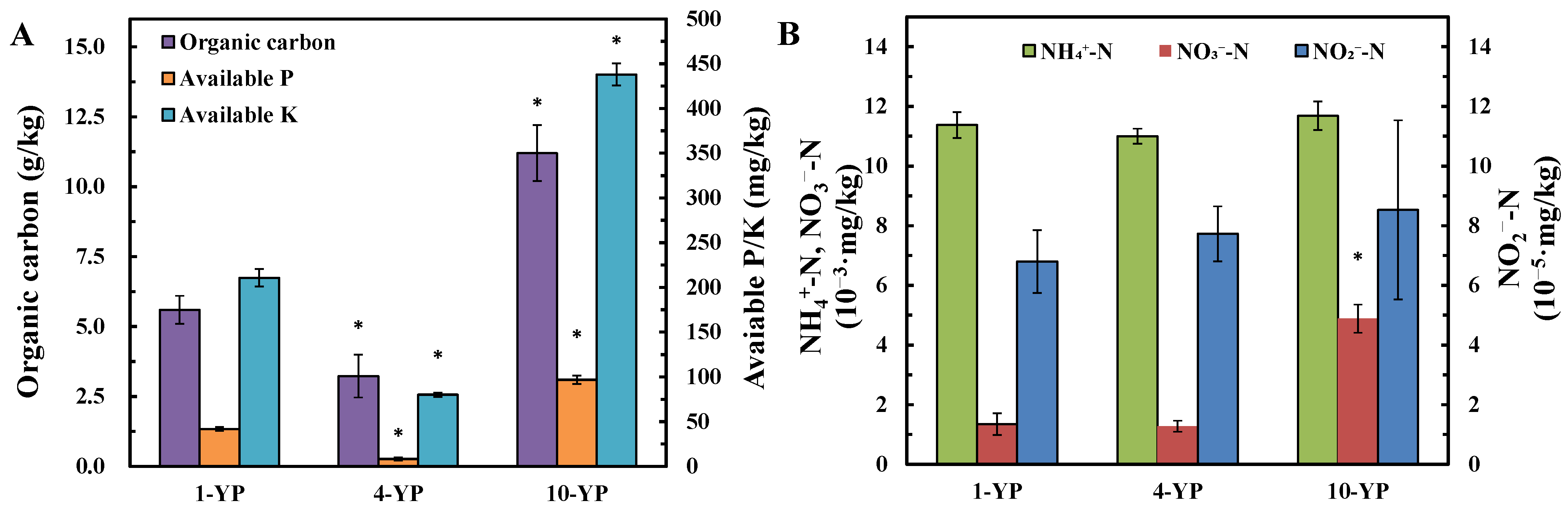
Figure 1. Variations in organic carbon, available P, available K (A), and inorganic nitrogen contents (B) in the 1-YP, 4-YP, and 10-YP rhizosphere soil samples. “*” indicates significant difference (p < 0.05) when compared to the 1YP soil samples. The error bar indicates standard deviation (n = 3).
Agronomy 15 02602 g001
Figure 2. Variations in available Ca/Mg (A) and micronutrient (B) contents in the 1-YP, 4-YP, and 10-YP rhizosphere soil samples. “*” indicates significant difference (p < 0.05) when compared to the 1-YP soil samples. The error bar indicates standard deviation (n = 3).
Agronomy 15 02602 g002
Figure 3. Principal component analysis (PCA) of microbial beta-diversities in the 1-YP, 4-YP, and 10YP rhizosphere soil samples.
Agronomy 15 02602 g003
Figure 4. Microbial community compositions (relative abundance more than 1%) at the phylum level in the 1-YP, 4-YP, and 10-YP rhizosphere soil samples.
Agronomy 15 02602 g004
Figure 5. Microbial community compositions (the top 50 microorganisms) at the genus level in the 1-YP, 4-YP, and 10-YP rhizosphere soil samples.
Agronomy 15 02602 g005
Figure 6. Significant decreases and increases in the relative abundances of microbial compositions (the top 20 microbes) at the genus level in the 1-YP, 4-YP, and 10-YP rhizosphere soil samples. “*” implies statistically significant differences (p < 0.05). The error bar indicates standard deviation (n = 3). The dashed line was applied for distinction between the decrease and increase in the microbial relative abundances.
Agronomy 15 02602 g006
Figure 7. Redundancy analysis (RDA) of the top 5 bacterial phyla with macronutrients (A) and available metal contents (B) in the rhizosphere soil with the extension of continuous planting. Red and blue arrows indicate chemical parameters and microbial compositions, respectively.
Agronomy 15 02602 g007
Figure 8. Correlation heatmap of the top 10 varying bacterial genera (A) and nitrifying bacteria (B) with the key chemical parameters in the rhizosphere soil samples. R values (Spearman’s rank correlation coefficient) in proportion to square sizes are indicated at the top of the legend with different colors. * p < 0.05, ** p < 0.01, and *** p < 0.001.
Agronomy 15 02602 g008
Figure 9. Differentially predicted abundances of microbial metabolic pathways or functions in the 1-YP, 4-YP, and 10-YP rhizosphere soil samples based on the KEGG database. “*” indicates significant differences (p < 0.05) when compared to the 1-YP soil samples. The error bar indicates standard deviation (n = 3).
Agronomy 15 02602 g009
Figure 10. Differentially significant changes in the proportions of microbial phenotypes and functions in the 4-YP (A) and 10-YP (B) rhizosphere soil samples when compared to the 1-YP soil samples based on BugBase prediction. The margin of error implies a 95% confidence interval (CI). * p < 0.05, ** p < 0.01, and *** p < 0.001.
Agronomy 15 02602 g010
Table 1. Soil pH variations in the rhizospheres of 1- (1-YP), 4- (4-YP), and 10-year-old (10-YP) tree peony plants under continuous monoculture conditions.
Indicators1-YP4-YP10-YP
pH7.28 ± 0.097.17 ± 0.276.98 ± 0.17 *
“*” indicates significant difference (p < 0.05) when compared to the 1-YP soil samples.
Table 2. Microbial community diversity index in the 1-YP, 4-YP, and 10-YP rhizosphere soil samples.
SamplesAceChaoShannonSimpson
1-YP3577.737 ± 120.6833551.170 ± 146.3446.542 ± 0.0225.221 ± 0.267
4-YP3286.975 ± 168.963 *3261.928 ± 138.040 *6.365 ± 0.092 *6.224 ± 2.239
10-YP3148.058 ± 122.833 *3188.067 ± 126.686 *6.539 ± 0.0343.924 ± 0.208 *
“*” indicates significant difference (p < 0.05) when compared to the 1-YP rhizosphere soil samples.
Disclaimer/Publisher’s Note: The statements, opinions and data contained in all publications are solely those of the individual author(s) and contributor(s) and not of MDPI and/or the editor(s). MDPI and/or the editor(s) disclaim responsibility for any injury to people or property resulting from any ideas, methods, instructions or products referred to in the content.