Article

Effects of Allelic Variation in Storage Protein Genes on Seed Composition and Agronomic Traits of Soybean in the Omsk Oblast of Western Siberia

by
Ilya V. Strembovskiy
1,
Pavel Yu. Kroupin
1,*,
Lyudmila V. Omel’yanuk
2,
Andrey V. Arkhipov
1,
Yana S. Meglitskaya
1,
Mikhail S. Bazhenov
1,
Akimbek M. Asanov
2,
Mariya E. Mukhordova
2,
Oksana A. Yusova
2,
Yuliya I. Yaschenko
2,
Gennady I. Karlov
1 and
Mikhail G. Divashuk
1
1
All-Russian Research Institute of Agricultural Biotechnology, 127434 Moscow, Russia
2
Omsk Agricultural Scientific Center, 644012 Omsk, Russia
*
Author to whom correspondence should be addressed.
Agronomy 2025, 15(11), 2533; https://doi.org/10.3390/agronomy15112533
Submission received: 29 September 2025 / Revised: 24 October 2025 / Accepted: 28 October 2025 / Published: 30 October 2025
(This article belongs to the Section Crop Breeding and Genetics)

Abstract

Developing soy cultivars for northern long-day regions requires understanding how alleles of protein accumulation genes function in non-optimal environments like Western Siberia, where their effects may diverge from those established in other regions. We hypothesized that allelic variation in the genes GmSWEET39, Glyma.03G219900, Glyma.14G119000, Glyma.17G074400, and POWR1 would have measurable and predictable effects on seed composition and plant architecture in soybean, even under the stressful long-day conditions of Western Siberia (Omsk Oblast). Over a three-year period (2021–2023), a diverse collection of 58 soybean accessions was phenotyped for yield-related traits and genotyped using established KASP and PCR markers and a novel KASP marker for GmSWEET39. Our results demonstrate that the GmSWEET39 CC+ allele is significantly associated with an increase in seed protein content by up to 1.9 pp, a decrease in seed oil content up to 1.4 pp, and a reduction in plant height by up to 20%, while the Glyma.17G074400 SNP(T) allele was associated with an increase in oil content up to 1.4 pp. Strong negative correlations were found between protein content and plant height, whereas plant height was positively correlated with flowering time. Broad-sense heritability was high (H2 > 0.82) for all traits except fiber content. The genotypic structure of the collection revealed a predominance of oil-favoring alleles, with rare protein-enhancing alleles identified in accessions from Sweden, Poland, China, and Japan. These accessions have been proposed as valuable donors for breeding. This study validates the utility of marker-assisted selection for the development of high-protein and high-oil soybean varieties tailored to the challenging photoperiod and climatic conditions of northern regions.

1. Introduction

Soybean (Glycine max (L.) Merr.) is a major source of plant-based protein and oil, widely used in food, feed and industrial products. Soybean protein is predominantly water-soluble and contains all essential amino acids, making it a complete and nutritionally valuable component [1,2,3]. Soy protein concentrates are used for food processing [4,5], whereas soybean meal, a byproduct of oil extraction, is a valuable feed additive [6]. Soy oil is also used in human nutrition and the food industry as an additive, E322 (Lecithin) [7]. Owing to its high smoke point (approximately 230 °C), it is also suitable for deep-frying [8]. In the Russian Federation, soybean is primarily cultivated as a protein feed crop rather than an oilseed crop. Consequently, the breeding of new varieties is focused on increasing protein content to meet animal husbandry needs [9,10,11]. Similarly, soybean breeding for higher protein content has been pursued in the USA, Argentina, and Brazil [12,13,14]. In China and India, high-protein varieties are developed primarily for food applications [15,16]. Conversely, breeding for higher oil content is undertaken for export purposes in Argentina, Paraguay, and Brazil, and for domestic consumption in the USA, India, and China [17,18,19]. Canada has adopted a distinct approach, developing dual-purpose varieties with intermediate protein and oil contents [20,21].
Owing to its economic importance, soybean is grown on large acreage worldwide and is the most widely cultivated grain legume globally (136–138 million hectares in 2024) [22]. Soybean cultivation is currently expanding from its traditional growing areas in Asia, South and North America to more northern, non-traditional regions such as Canada and Northern Europe. A similar trend of soybean expansion northward can also be observed within individual countries. In Russia, for example, while the Far East was historically the dominant production region and led in area and yield until 2020, the most dynamic growth has recently shifted to the Central and Siberian Federal Districts [22,23].
Siberia is considered a promising, though relatively new, soybean cultivation region. Since 2000, the area sown with soybean in Siberia has increased from 5 to 292.8 thousand hectares, and the total production has grown from 49.47 to 5529.8 thousand tons [22,24]. This expansion has been facilitated by the development of varieties adapted to Siberian conditions, such as continental climate, irregular hydrothermal regimes during the growing season, late spring frosts, and, crucially, the long daylight period [25,26]. Day length directly affects plant ontogeny, particularly the timing and duration of flowering. As a short-day plant, soybean exhibits delayed flowering onset and an extended flowering period under the atypical long-day conditions of Western Siberia.
Soybean flowering is regulated by photoperiod sensitivity genes E1–E4. Recent advances in their mapping offer promising avenues for the development of earlier-maturing varieties adapted to Siberian conditions [27,28]. Seed protein content can typically only be assessed at late breeding stages, when sufficient seed material is available for biochemical analysis, whereas other traits, such as maturity, can be evaluated much earlier. Marker-assisted selection (MAS) provides a means to overcome this limitation. However, the polygenic nature of seed protein accumulation limits the number of markers associated with this trait. It is hypothesized that several hundred genes control protein accumulation [2,29,30,31]. The genetic architecture of seed protein and oil accumulation in soybean involves key players across multiple functional categories. Transcriptional and hormonal regulation is represented by Glyma.03G219900, a DELLA protein that promotes seed storage protein biosynthesis [32], and Glyma.14G119000, an MYB transcription factor linked to flavonoid-mediated modulation of seed composition [33,34]. Furthermore, Glyma.17G074400, an omega-6 fatty acid desaturase, provides a direct link to lipid metabolism, influencing seed oil content and size [35,36]. Functional KASP markers for these three loci have demonstrated notable predictive accuracy for seed protein content [37]. The critical role of nutrient transport is exemplified by GmSWEET39, a sucrose transporter expressed in the seed coat; a truncating variant (CC− allele) is associated with higher oil content, potentially by enhancing sugar delivery to the developing seed [38,39,40]. Finally, the domestication gene POWR1 acts as a pleiotropic master regulator. A transposon insertion in its CCT domain alters its nuclear localization and function [41], leading to a phenotype of increased seed oil, higher seed weight, and reduced protein, a haplotype likely selected for larger seeds during domestication [42,43,44]. Its expression in the seed coat underscores its role in controlling nutrient partitioning [45]. Together, these genes form a robust genetic framework for dissecting seed composition traits.
The Omsk Agricultural Scientific Center (Omsk ASC) is a leading institution in soybean breeding for the Siberian ecotype. Over six decades a unique collection of soybean accessions adapted to the demanding soil and climatic conditions of Western Siberia, notably the short growing season and long photoperiod, has been developed. Twelve Omsk-bred varieties are included in the Russian Federation’s State Register of Breeding Achievements.
The Omsk ASC has assembled a unique collection of diverse ecological and geographical soybean genotypes throughout its long history [26]. A defining feature of these accessions is their ability to achieve full maturity and form high-quality yields under conditions, particularly the prevailing day length and the sum of active temperatures, that are atypical for soybeans, particularly the prevailing day length and the sum of active temperatures, that are atypical for soybeans. Investigating how known protein accumulation genes perform under Western Siberian conditions remains essential. The effects of these gene alleles on protein accumulation in these atypical environments may differ from their characterized roles in more favorable climates. Consequently, the efficacy of MAS for these genes under Western Siberian conditions requires critical evaluation. Therefore, this study aimed to evaluate the effects of the loci GmSWEET39, Glyma.03G219900, Glyma.14G119000, Glyma.17G074400, and POWR1 on protein and oil accumulation in soybean in Western Siberia (Omsk Oblast).

2. Materials and Methods

2.1. Soy Collection

The object of this study was a collection of 58 soybean accessions, a detailed description of which is provided in Table S1.

2.2. Field Observations and Analysis of Seed Composition

Field evaluation of the collection was conducted from 2021 to 2023 on a plot within the field crop rotation system of the Laboratory of Legume Breeding at the Federal State Budgetary Scientific Institution Omsk ASC (Omsk, Russia), following with the methodology outlined in a previous study [26]. Cultivars were hand-harvested upon reaching full maturity in September. The latest-maturing accessions were collected at the lower-pod maturation stage before the first anticipated frost in late September. The harvested bundles were promptly moved to a covered, ventilated facility for natural air-drying to a seed moisture content of 14–16%.
During the 2021–2023 field seasons, observations were recorded for three phenological phases: seedling, transition to full flowering, and flowering completion. Based on the following observations, three parameters were calculated: the number of days from emergence to full flowering, from emergence to flowering completion, and the total flowering period. Phenological data were collected for all three years for every accession except Samer 1, for which data were available only for 2022 and 2023.
Plant height (stem length) was measured following each growing season, and the 1000-seed weight was determined according to the standard method [46]. The Kjeldahl method with a UDK 129 apparatus (Velp, Italy) was used to analyze the nitrogen content of the seed. Sample preparation was performed by digesting 500 mg of soybean flour with a selenium and potassium sulfate mixture in 12 mL of concentrated (98%) sulfuric acid. The first stage of analysis consisted of dry ashing of the sample in a PMP-20 mineralization furnace (Vilitek, Russia) at 400–420 °C for 50 min. In the second stage, the digest was distilled in a UDK 129 apparatus with automated delivery of 40% NaOH, 0.2 M HCl, and an indicator solution (1% boric acid, 50% methyl red and 4% NaOH) into the receiving flask. The third stage was direct acid-base titration, which was performed using an automated titration system of UDK 129 with a buret and magnetic stirrer. The crude protein content was calculated by multiplying the nitrogen content by a conversion factor of 6.25 [47].
Crude fat content was determined using the Soxhlet method with a SER 148/6 solvent extractor (Velp, Italy) [48]. Defatting was performed in a modified Soxhlet flask using petroleum ether as the solvent. The extraction flasks were loaded with 5 g of the flour sample. The SER 148/6 apparatus was assembled by attaching the condenser and adding the solvent. The mixture was bolted in the water bath; the ether vaporized, traveled into the Soxhlet extractor, where it was condensed by the cooler and dripped back, dissolving the fat. This cyclic process was repeated continuously for 20–30 cycles over approximately 8 h. Upon completion, the thimbles with defatted flour were removed from the SER 148/6 extractor, vented in a fume hood for 4–5 h to evaporate residual solvent, and subsequently dried in SH136 drying cabinet (ERSTVAK Ltd., Moscow, Russia).
The fiber content was measured according to the method of Henneberg and Stohmann [49]. A 1.0–1.5 g sample portion was refluxed with 100 mL of 4% H2SO4 for 10 min and filtered. Subsequently, the residue was boiled with 25 mL of 30% NaOH for 10 min and filtered again. This acid-base cycle was repeated until the filtrate was neutral to red litmus. The resulting cellulose was washed sequentially with 10 mL ethanol and 10 mL sulfur ether. Then, the sample was dried to a constant weight at 105 °C in the SH136 drying cabinet. All the chemicals used in the biochemical analysis of the soybean grain are produced by Himmed (Moscow, Russia).
Complete data for protein, fat, and fiber content across 2021–2023 were obtained for all accessions except Gokuwase Hayabusa Edamame and Neidou 4, for which only data from 2021 and 2022 were available.

2.3. Soybean DNA Extraction and Collection Genotyping

Genomic DNA was extracted from 3–5-day-old seedlings using the CTAB method [50,51]. Seeds were germinated on moist filter paper in a TSS-1/80 SPU growth chamber (Smolensk, Russia) in Petri dishes. The replication consisted of three individual plants and one bulk sample (five plants). Seedlings from each accession were homogenized using a TissueLyser II ball mill (Qiagen, Hilden, Germany).
The collection accessions were genotyped for five loci: GmSWEET39 (Sugars Will Eventually be Exported Transporter 39), Glyma.03G219900, Glyma.14G119000, Glyma.17G074400 and POWR1 (Protein, Oil, Weight, Regulator 1).
Established KASP markers were used to assess polymorphisms at Glyma.03G219900, Glyma.14G119000 and Glyma.17G074400 loci [37]. For GmSWEET39, a novel KASP marker was developed based on genes reference sequence published in [38]. For the POWR1 allele detection, a conventional PCR marker NIL-PCR was exploited [42] (Table 1).
The developed GmSWEET39-KASP marker discriminates two GmSWEET39 alleles: a CC− allele, characterized by a two-cytosine deletion in exon 6, and a CC+ allele (Williams 82 type) without this deletion. This deletion causes a frameshift mutation, altering three amino acids in the C-terminal region of SWEET39 protein, and conferring a presumed loss of enzyme activity [38].
The POWR1-PCR marker differentiates the wild-type (WT) allele from the mutant POWR1 allele carrying a 321-bp mobile element insertion in the region of a highly conserved CCT domain (hereafter referred to as the TE insertion allele) [42]. PCR amplification was conducted in 96-well plates using a PCR-96A-384 thermal cycler (Bioevopeak, Jinan, China). The PCR mixture (10 μL per well) contained: 4 μL of M-428 reaction mix (Sintol, Moscow, Russia), 1 μL of primer mix (10 mM, Evrogen, Moscow, Russia), 0.3 Μl of Taq polymerase (Sileks, Moscow, Russia) and 1 μL of DNA template. The amplification products were separated on 1.5% agarose gels stained with ethidium bromide and visualized using a Gel Doc XR+ system (Bio-Rad, Hercules, CA, USA). The mutant POWR1 amplified a 1228-bp PCA product, whereas the wild-type allele had a 907-bp fragment.
The following markers were used for KASP genotyping of Glyma.03G219900, Glyma.14G119000 and Glyma.17G074400 loci; the following markers were used: KASP-Pro-1 was used to detect Glyma.03G219900 alleles with an A/T SNP, KASP-Pro-2 was used to detect Glyma.14G119000 alleles with an A/G SNP, and KASP-Pro-3 was used to detect Glyma.17G074400 alleles with a T/C SNP [37]. The PCR mixture for all KASP markers consisted of 2.5 μL Mastermix (containing fluorescent dyes), 0.07 μL primer mix (50 mM, Evrogen, Moscow, Russia), and 2.5 μL DNA. A CFX-384 amplifier (Bio-Rad, Hercules, CA, USA) was used to perform the KASP analysis. Results were analyzed using CFX Manager v3.1 software (Bio-Rad, Hercules, CA, USA), with re-amplification (recycling) conducted as necessary.

2.4. Statistical Data Analysis

Statistical data processing was performed using the R programming language with the “pwr” [52] and “car” [53] libraries. The analyses included the calculation of mean trait values, regression and correlation analyses (Pearson’s coefficient) between traits and allelic states, estimation of broad-sense heritability (H2), and analysis of variance (ANOVA), with Fisher’s Least Significant Difference (LSD) test used for pairwise comparisons at a significance threshold of p > 0.05. The results were visualized in the “factoextra” [54], “corrplot” [55], and “ggplot2” [56] R libraries.
The coefficient of variation (CV) and trait distribution were evaluated in STATISTICA v8 program [57]. CV was used to assess trait stability based on the following thresholds: a CV < 5% for protein, <8% for oil, <10% for fiber, <20% for plant height and 1000 grain weight, <15% for time to full flowering, <10% for time to flowering completion and <20% for the flowering period. For each trait, distribution was evaluated using Kurtosis (normal range: −1 to 1) to identify extreme values and Skewness (normal range: −1 to 1) to assess asymmetry, while normality was formally tested with the Kolmogorov–Smirnov (d) and Shapiro–Wilk (W) tests (where p > 0.05 indicates normality). Furthermore, accessions containing extreme values beyond 3× the interquartile range (IQR) that also significantly deviated from normality were excluded from the analysis for the corresponding trait.

3. Results

3.1. Phenotyping

The mean protein content among the accessions was 38.8% in 2021, 36.2% in 2022, and 36.9% in 2023. The trait displayed a normal distribution across all three years. Asian accessions such as Gokuwase Hayabusa Edamame from Japan (43.2%, data for 2021–2022) and Neidou 4 from China (40.2%, data for 2021–2022) consistently exhibited high protein content. Among the Russian accessions, Irkutsk 15 (L 52/14) (39.95%) and Sibiriada (39.6%), both of Omsk breeding, also showed elevated protein levels. The lowest protein content was recorded in the Ukrainian accession Annushka (33.9%) and in the Russian accessions Niva 70 and Nadezhda (both 34.3%). The heritability coefficient (H2) for protein content over the three-year period was 0.824, indicating that genetic factors predominantly contributed to the observed variation, with minimal environmental influence contributed to the observed variation (Table S2 and Figure S1a).
The oil content showed a modest interannual variation, averaging 17.7% in 2021 and 2023, and 17.1% in 2022. Distribution of oil content approximated normality in 2021. However, non-normal distributions were observed in 2022 and 2023, primarily due to exceptionally low values in the accessions Vilnensis from France (13.6% in 2022 and 11.6% in 2023) and Ogemaw from the USA (13.7% in 2022 and 12.3% in 2023). To achieve a normalized distribution, these accessions were excluded from subsequent analyses. Accessions with consistently high oil content included Osmon’ (19.7%, Oryol) and Aldana (19.6%, Poland), whereas Vilnensis (13.2%, France) and Ogemaw (13.8%, USA) had consistently low values. Oil accumulation was largely genetically controlled, as evidenced by a high heritability estimate (H2 = 0.94) (Table S2 and Figure S1b).
The mean fiber content was 11% in 2021, 12.9% in 2022, and 13.9% in 2023. The trait was normally distributed over all three years. The lowest fiber content over three years was observed in Gokuwase Hayabusa Edamame (8.58%, data for 2021–2022) and Neidou 4 (10.98%, data for 2021–2022), whereas the highest fiber content wase recorded in Aldana (14.25%, Poland) and Prikarpat’skaya 81 (14.06%, Ukraine). In contrast to protein and oil, fiber accumulation was primarily influenced by environmental conditions, as indicated by a low heritability estimate (H2 = 0.022) (Table S2 and Figure S1c).
For traits related to flowering time distributions were normal across all three years of the study, except for the time to full flowering in 2023. Accession Neidou-4 (China), which skewed the distribution due to a critically low trait value, was excluded from the analysis of the time to full flowering for that year. The development of phenological traits was predominantly genetically controlled: broad-sense heritability (H2) was 0.974 for time to full flowering, 0.821 for time to flowering completion, and 0.986 for flowering period (Table S2).
The average plant height was 77.9 cm in 2021, 59.6 cm in 2022, and 76.5 cm in 2023, with a normal distribution observed each year. The most dwarfed accessions were of the northern ecotype from Sweden (738-4, 38.6 cm) and Poland (Arctic, 38.4 cm, Nordic 5, 38.5 cm). In contrast, the tallest accessions were originated from the southern regions of Russia: Ryazan (Svetlaya, 90.7 cm, Russia) and Belgorod (Belgorodskaya 6, 88.5 cm, Russia), from the Russian Far East (Garmoniya, 95.2 cm, Russia) and from Serbia (Larisa, 90.5 cm). Variation in plant height was largely genetically determined (H2 = 0.979) (Table S2 and Figure S1d).
The mean weight of 1000 grains was 131.7 g in 2021, 138.5 g in 2022, and 154.6 g in 2023. The distribution of this trait showed the strongest deviation from normality among all traits studied, primarily due to an extremely high value in accession 738-4, which was consequently excluded from the analysis. Accessions with consistently high 1000-grain weight included 738-4 and 766-2 from Sweden (240.1 g and 191.6 g) and the Neidou 4 from China (176.4 g). Consistently low values were observed for Annushka (97 g) and Deni (113.5 g) from Ukraine, and Georgiya (110.3 g) from Russia. Genetic factors played a major role in determining this trait (H2 = 0.946) (Table S2 and Figure S1e).
Protein content showed moderate negative correlations with plant height across all three years (r = −0.36 in 2021, −0.31 in 2022, and −0.54 in 2023, p < 0.05) and moderate positive correlations with 1000 grain weight in 2022 and 2023 (r = 0.35 and 0.33, respectively, p < 0.05). Moderate positive correlations were observed between oil and fiber content in 2021 and 2023 (r = 0.45 and 0.42, respectively, p < 0.05). Throughout the study period, both time (days) to full flowering and time (days) to flowering completion were positively correlated with plant height (r = 0.29 and 0.32 in 2021; 0.48 and 0.63 in 2022; 0.28 and 0.71 in 2023, p < 0.05, respectively) (Figure 1).

3.2. Genotyping and Phenotypic Expression of the Studied Loci

3.2.1. GmSWEET39

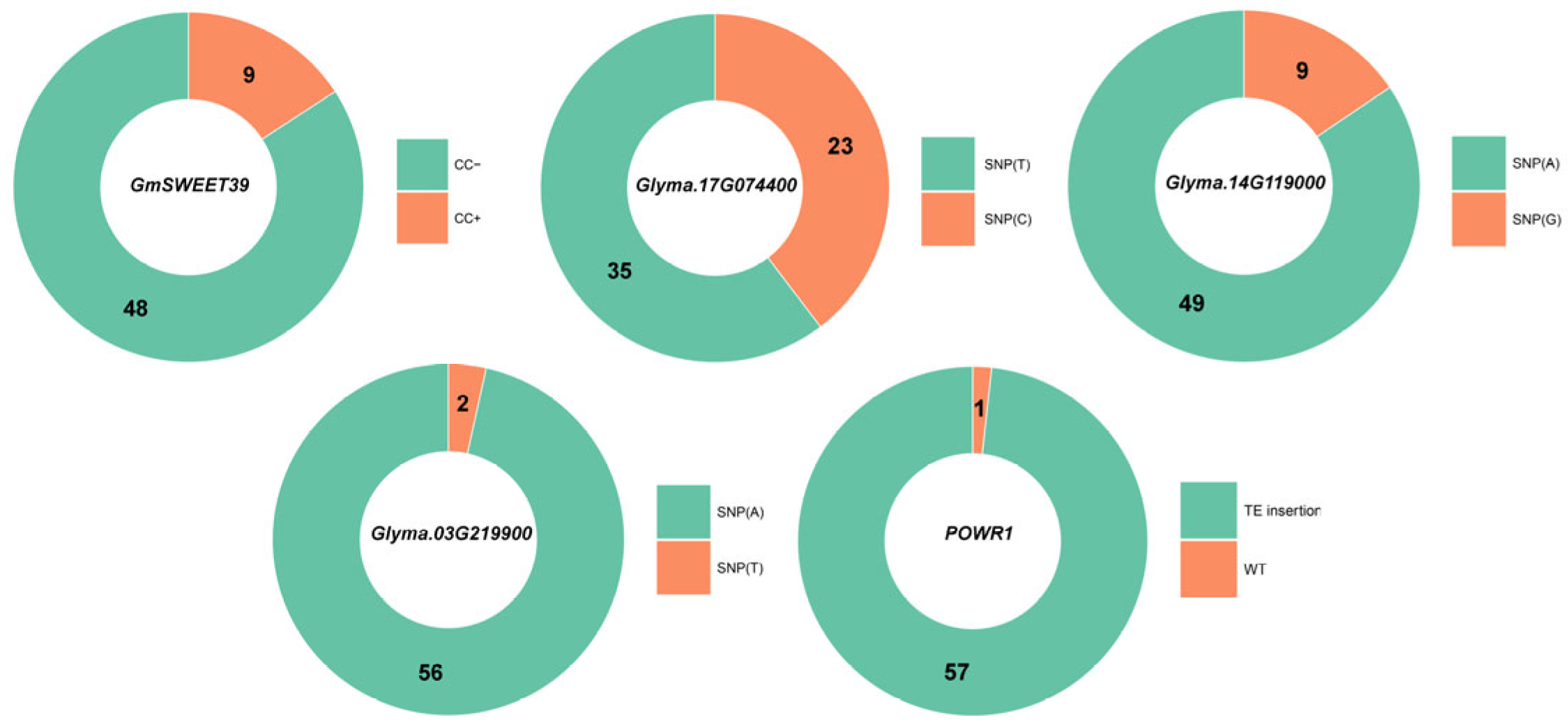
Genotyping the collection for the GmSWEET39 locus revealed that 48 accessions carried the CC− allele, whereas 9 accessions carried the CC+ allele (Figure 2). Accession Samer 3, which showed heterogeneity at GmSWEET39, was excluded from subsequent statistical analyses. The CC+ allele, which was rare in this collection, was predominantly found in accessions from Poland (Arctic, Gai, Popiel) and Sweden (1339, 738-4, 766-2).
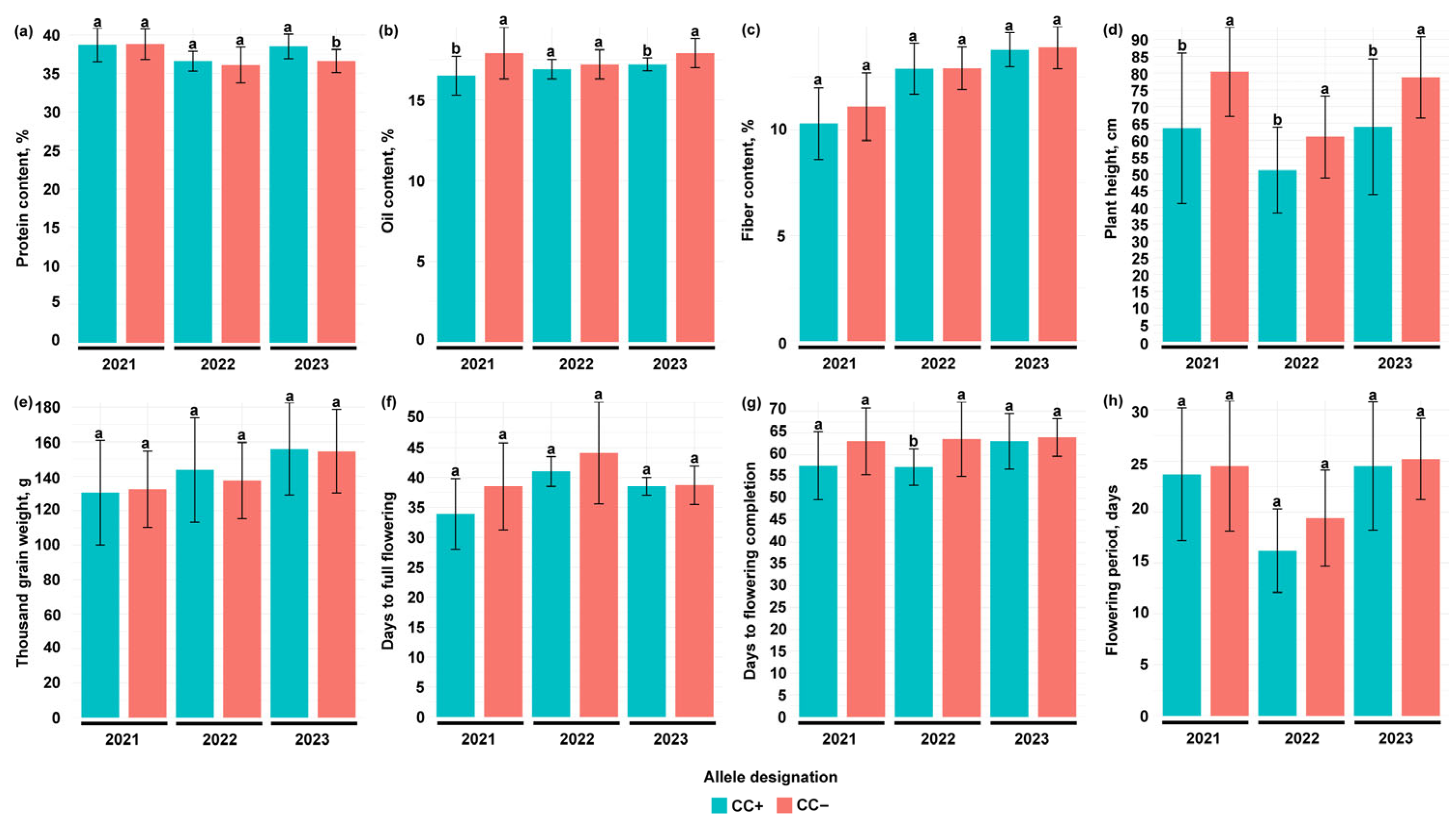
Soybean accessions carrying the CC+ allele demonstrated higher protein content compared to those with the CC− allele: by 0.5 percentage points (pp) in 2022 (r = 0.08, statistically non-significant) and by 1.9 pp in 2023 (r = 0.44, p < 0.05). Conversely, CC+ carriers allele exhibited lower oil content across all three years compared to CC− carriers: by 1.4 pp in 2021 (r = −0.32, p < 0.05), by 0.3 pp in 2022 (r = −0.12, statistically non-significant) and by 0.7 pp in 2023 (r = −0.32, p < 0.05) (Table 2 and Figure 2 and Figure 3a,b).
Plant height was significantly reduced in genotypes with the CC+ allele compared to CC− carriers throughout the study period: by 16.8 cm (20.9%) in 2021 (r = −0.38, p < 0.05), by 9.9 cm (16.2%) in 2022 (r = −0.29, p < 0.05), and by 14.7 cm (18.7%) in 2023 (r = −0.38, p < 0.05). Although not statistically significant, higher 1000 grain weight was observed in CC+ genotypes, with differences of 6.1 g (4.4%, r = 0.09) in 2022 and 1.4 g (0.9%, r = 0.02) in 2023 compared to CC− genotypes (Table 2 and Figure 3d,e).
In 2022, significant differences were observed in flowering traits: CC+ genotypes completed flowering 6.4 days earlier (10.1%, r = −0.28, p < 0.05) and had a 3.2-day shorter flowering period (16.5%, r = −0.25, p = 0.063) than CC− genotypes. Although no statistically significant effects on flowering timing were detected in 2021 and 2023, CC+ genotypes consistently showed reduced flowering duration (by 0.8 days (3.3%) and 0.7 days (2.8%), respectively) and earlier flowering completion (by 5.6 days (8.9%) and 0.9 days (1.4%), respectively) compared with CC− genotypes (Table 2 and Figure 3g,h).

3.2.2. Glyma.17G074400

Genotyping of the Glyma.17G074400 locus revealed that 35 accessions carried the SNP(T) allele, while 23 possessed the SNP(C) allele (Figure 2). Accessions with the SNP(C) allele were predominantly from Poland and Sweden (4 accessions each), Belarus (3 accessions) and Ukraine (2 accessions). Most Russian-bred accessions carried the SNP(T) allele.
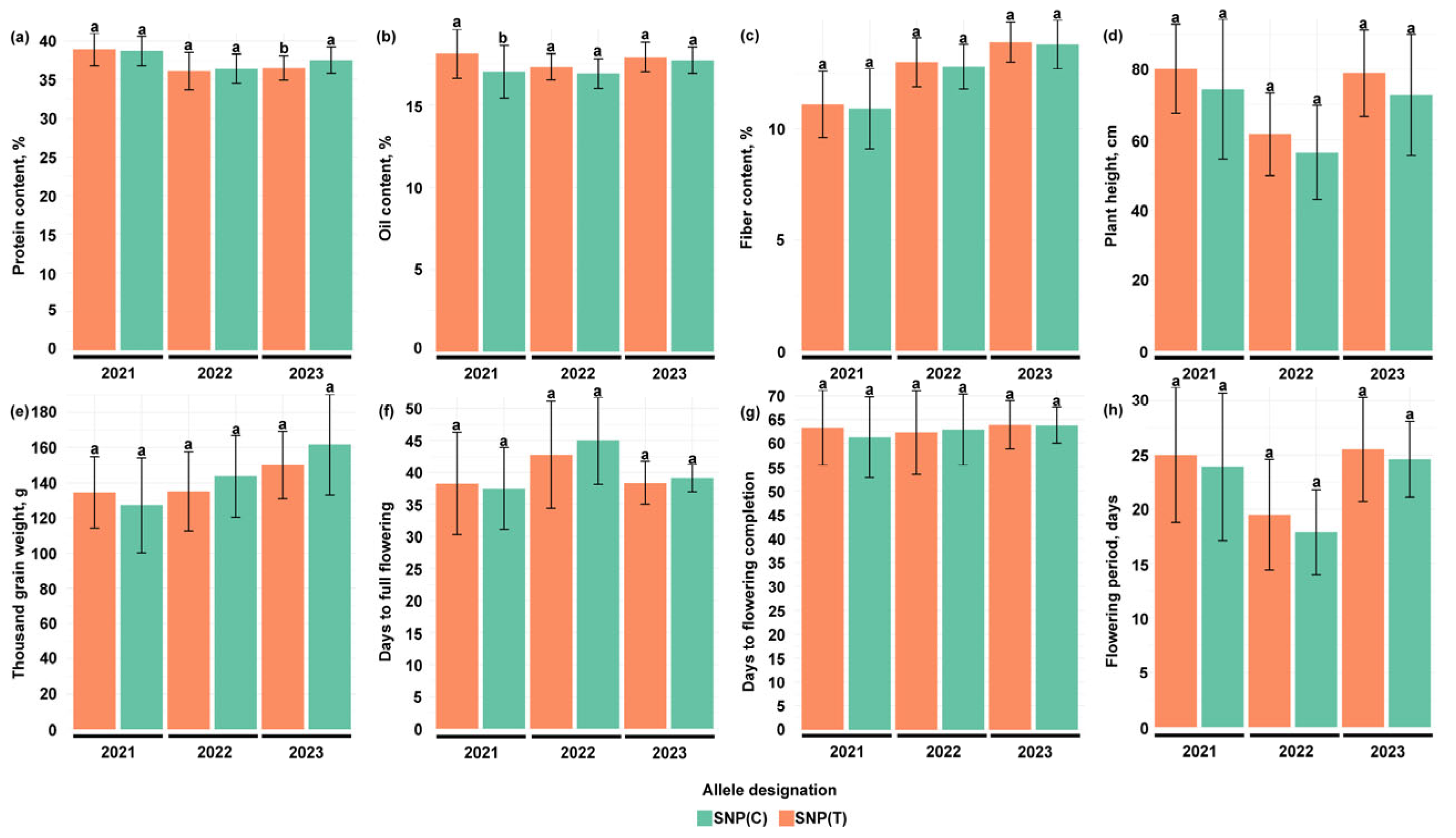
Accessions with the Glyma.17G074400 SNP(T) allele showed higher oil content than those with the SNP(C) allele. The difference was 1.1 pp in 2021 (r = −0.32, p < 0.05), 0.4 pp in 2022 (r = −0.18, statistically non-significant), and 0.2 pp in 2023 (r = −0.11, statistically non-significant) (Table 2 and Figure 4b).

3.2.3. Glyma.14G119000

For the Glyma.14G119000 gene, the SNP(A) allele predominated in the collection (49 accessions), whereas the SNP(G) allele was detected in 9 accessions, particularly those bred in Poland (Gai, Popiel, LMF) and Sweden (1339, 766-2) (Figure 2).
No significant associations were found for the Glyma.14G119000 alleles. However, across the three experimental years, accessions with the SNP(A) allele consistently exhibited higher oil content than with the SNP(G) allele: by 0.4 pp in 2021, 0.2 pp in 2022, and 0.3 pp in 2023.

3.2.4. Glyma.03G219900

Genotyping of the Glyma.03G219900 locus showed that the majority of accessions (56) possessed the SNP(A) allele; therefore, its phenotypic manifestation was not analyzed. The alternative SNP(T) allele was present only in Gokuwase Hayabusa Edamame from Japan and Ros’ from Belarus (Figure 2).

3.2.5. POWR1

Collection-wide genotyping of the POWR1 locus showed that all accessions except one (57) carried the mutant allele with the transposon insertion (Figure 2), for which reason its effect has not been studied. The exception was Gokuwase Hayabusa Edamame (Japan), which carried the wild-type allele and demonstrated high protein content (Figure S1a).

4. Discussion

4.1. Correlations Between the Studied Traits

The correlation patterns identified in this study were as follows: protein content exhibited a negative correlation with plant height and a positive correlation with 1000 grain weight; oil accumulation showed a positive correlation with fiber; and plant height was positively correlated with both time to full flowering and time to flowering completion.
The inverse relationship between plant height and seed protein content observed in our study is consistent with numerous literature sources [58,59,60], although some studies have documented a positive correlation between these traits [61]. According to existing literature, this variability in correlation direction may be partially explained by the influence of local soil and climatic conditions, as well as by the type of soybean plant growth [59,60]. For example, indeterminate varieties typically demonstrate a negative correlation between height and protein accumulation, likely due to competition for nitrogen between vegetative growth processes and storage protein synthesis in reproductive organs [61]. In contrast, there was no relationship between plant height and seed protein content in the determinate varieties. Our collection consisted predominantly of indeterminate accessions (51 units) [62,63], reflecting the current breeding and agricultural practices that favor indeterminate varieties of southern ecotypes, as opposed to the determinate varieties more common in northern regions [64].
The negative relationship between seed protein and plant height may reflect a systemic resource allocation trade-off. The GmSWEET39 gene, a sucrose transporter expressed in the seed coat, is a key player in partitioning photoassimilates from maternal tissues to developing seeds [38]. The CC+ allele, associated with both increased protein and reduced plant height in our study, could redirect carbon skeletons and nitrogen away from vegetative growth towards seed storage accumulation. This is consistent with the role of SWEET transporters in controlling sink strength [39,40]. Similarly, the pleiotropic domestication gene POWR1, which regulates multiple seed traits including protein and oil [42], is expressed in the seed coat and influences nutrient partitioning [45]. Its mutant allele (TE insertion), predominant in our collection, favors oil and weight over protein, potentially shaping the overall resource allocation strategy of the plant and indirectly affecting vegetative architecture.
Similar variability in correlation direction has been reported between protein content and 1000 grain weight, which also appears to be influenced by growing conditions [65]. The positive correlation observed in our study may be explained by the increased grain weight from enhanced accumulation of high-molecular-weight storage proteins in the endosperm, as previously established by Zheng et al. [66]. The positive relationship between oil and fiber accumulation observed in our study is consistent with previous reports [67,68,69]. The positive correlation between plant height and flowering duration may be attributable to an extended vegetative period, allowing for greater stem elongation. These findings are consistent with reports indicating that dwarf soybean genotypes typically exhibit shorter and earlier flowering periods, whereas taller forms tend to have later and more prolonged flowering periods [70,71].
The positive correlation between plant height and flowering duration can be interpreted through the lens of hormonal and transcriptional regulation. The Glyma.03G219900 gene, a DELLA protein, is a negative regulator of gibberellin signaling and a promoter of seed storage protein biosynthesis [32]. DELLA proteins are well-known integrators of developmental signals that repress vegetative growth; their activity could thus provide a functional link between the duration of the vegetative phase (flowering time), ultimate plant height, and the mobilization of resources for seed protein synthesis [72]. Furthermore, the involvement of transcription factors like the MYB protein encoded by Glyma.14G119000, which modulates pathways such as flavonoid synthesis [33,34], adds another layer of potential regulation, as secondary metabolites can influence overall plant development and stress responses, thereby indirectly affecting multiple agronomic traits. Future research, including fine-mapping and functional validation, is necessary to establish the direct causal pathways connecting these specific allelic variations to the observed trait relationships.
Under the environmental conditions of the Omsk Oblast, the expression of all traits except fiber accumulation were predominantly genetically controlled. In this context, marker-assisted selection represents a promising strategy for improving agronomically valuable traits, particularly protein and oil accumulation.

4.2. Genotypic Structure of the Collection

Based on the literature data, the alleles of the studied genes can be categorized as follows: (1) alleles associated with increased protein accumulation (GmSWEET39 CC+, Glyma.03G219900 SNP(A), Glyma.14G119000 SNP(A), Glyma.17G074400 SNP(T), POWR1 WT) and (2) alleles associated with enhanced oil accumulation (GmSWEET39 CC−, Glyma.03G219900 SNP(T), Glyma.14G119000 SNP(G), Glyma.17G074400 SNP(C), POWR1 TE insertion). Because these traits exhibit an antagonistic relationship, increased protein content typically corresponds to decreased oil content, and vice versa. Consistent with previous reports [37,38,42], alleles associated with reduced protein accumulation predominated for the GmSWEET39, Glyma.03G219900, and POWR1 genes in our collection. The alternative alleles GmSWEET39 CC+ and POWR1 WT occur primarily in wild soybean forms and have been largely replaced by the domesticated CC− and TE insertion alleles in modern cultivars. The SNP(A) allele predominated in our collection for the Glyma.14G119000 locus, whereas studies of Asian collections reported approximately equal frequencies for both alleles [37]. For the Glyma.17G074400 gene, the SNP(T) allele predominated in the collection (35 accessions), in contrast with other studies that more frequently reported the Glyma.17G074400 SNP(C) allele [37].
The most prevalent genotype in the collection, combining two protein-favoring alleles, was the GmSWEET39 CC−/Glyma.03G219900 SNP(A)/Glyma.14G119000 SNP(A)/Glyma.17G074400 SNP(T)/POWR1 TE insertion (28 accessions; gene alleles follow this order in subsequent genotype notation). The second most frequent genotype (CC−/A/A/C/TE, 13 accessions), carrying one protein-favoring allele. The rare genotypes included CC+/A/G/C/TE insertion (2 accessions), CC+/A/G/T/TE insertion (2 accessions), CC−/T/A/C/TE insertion (1 accession), and CC−/T/A/C/WT (1 accession).
Accessions from Poland (Arctic, Gai, Popiel, Nordic 5) and Sweden (1339, 738-4, 766-2) were distinguished by their allelic combinations, particularly the presence of the protein-favoring GmSWEET39 CC+ allele together with the oil-favoring Glyma.14G119000 SNP(G) allele. These accessions also exhibited the shortest plant heights and the highest 1000-grain weights among the Swedish accessions. Our study revealed a positive correlation between plant height and the time to full flowering and its completion—the shorter the flowering period, the shorter the plant. Accessions from Sweden, Poland and Omsk (Russia) belong to the northern ecotype, adapted to a short growing season and long-day conditions. These accessions exhibited below-average plant height and flowering completion earlier than most other accessions. In this context, the Swedish accession 738-4, specifically adapted to long-day conditions, represents a particularly valuable donor for both reduced height and increased 1000 grain weight.
Another unique genotype (CC−/T/A/C/WT), incorporating three of the five underrepresented alleles, was identified in the Japanese Gokuwase Hayabusa Edamame accession. This was the only accession carrying the POWR1 wild-type WT allele, and it exhibited the highest protein content and low oil content. Gokuwase Hayabusa Edamame belongs to the vegetable soy category which could explain the presence of the rare POWR1 WT allele and its high protein level. Edamame accessions are characterized by higher protein content and often retain allelic variants from wild soybean G. soja, associated with enhanced protein accumulation [73,74]. Given their superior performance across multiple traits, the Gokuwase Hayabusa Edamame, Arctic, Gai, Popiel, Nordic 5, 1339, 738-4, and 766-2 accessions are recommended as promising parental lines for breeding programs. Furthermore, such unique genotypes are valuable for quantitative trait locus (QTL) mapping studies, enabling both the validation of known loci and the identification of novel genetic determinants underlying agronomically important traits.

4.3. Effect of Allelic Variation in GmSWEET39, Glyma.14G119000 and Glyma.17G074400 Genes on Agronomic and Quality Traits in Soybean

Statistically significant differences in protein content between accessions with contrasting alleles were observed only for the GmSWEET39 gene, where the CC+ allele was associated with increased protein content (on average by 0.8 pp) and reduced oil content (by −0.8 pp). Chinese researchers reported larger differences in 2.5–3.4 pp for protein and 2.5–3.1 pp for oil in genotypes with different GmSWEET39 alleles [38]. The effect of GmSWEET39 alleles persisted under the Omsk Oblast conditions but was less pronounced than in the Chinese collections. Specifically, in our study, accessions with the CC+ allele accumulated 0.5 pp more protein in 2022 and 1.9 pp in 2023 compared to CC− genotypes. For oil content, CC− genotypes accumulated more oil than CC+ genotypes across all three years, with substantial interannual variation (1.4 pp in 2021, 0.3 pp in 2022, and 0.7 pp in 2023). We attribute these differences to the shorter growing season and delayed flowering caused by long-day conditions in Western Siberia, which shorten the seed protein accumulation period and potentially attenuate GmSWEET39 allele effects. The reduced effect may also be influenced by the limited size of the collection.
The negative correlation between protein and oil content observed in genotypes with different GmSWEET39 alleles aligns with literature reports and has been attributed to competition between biosynthetic pathways of these compounds [68]. An exception was accession Neidou 4 (China), which carries the protein-reducing CC− allele but maintains high levels of both protein (40.9%) and oil (17.5%) in seeds. Neidou 4 is a valuable genotype for investigating novel genetic mechanisms underlying the simultaneous accumulation of protein and oil.
The GmSWEET39 CC+ allele was also associated with reduced plant height (−10–17 cm compared with CC− genotypes). This phenotypic effect may result from impaired SWEET39 protein function in CC+ genotypes, leading to redirected sugar fluxes toward seed storage accumulation at the expense of vegetative growth. Consequently, marker-assisted selection for the GmSWEET39 locus using the developed marker is recommended for breeding both high-protein (characterized by shorter stature and earlier flowering in the Omsk Oblast) and high-oil varieties.
Furthermore, the association of the CC+ allele with earlier flowering completion (average 6 days earlier in 2021–2022) may be significant for the development of early-maturing varieties. Given that flowering time is primarily controlled by the E1E4 gene family and shows high heritability (H2 = 0.821–0.986) we hypothesize that GmSWEET39 influences phenology indirectly through regulation of sugar transport from maternal tissues to developing embryos [38].
For Glyma.14G119000 and Glyma.17G074400 genes, no significant associations with protein accumulation were detected, although correlations with oil content were observed [37]. Accessions with the Glyma.17G074400 SNP(T) allele accumulated 0.6 pp more oil than genotypes with alternative SNP(C) allele, whereas those with the Glyma.14G119000 SNP(G) allele accumulated 0.3 pp more oil than SNP(A) allele carriers. The influence of Glyma.17G074400 and Glyma.14G119000 on seed oil content may be explained by their localization within known oil-related QTL regions [37,75,76]. The non-significant effect of Glyma.14G119000 may reflect the atypical growing conditions that potentially masked its phenotypic expression [37]. Given that even a 1 pp increase in oil content carries significant economic value in oilseed breeding [77,78], pyramiding the oil-favoring Glyma.14G119000 SNP(G) and Glyma.17G074400 SNP(T) alleles represents a promising strategy for developing high-oil varieties.
The effects detected for the GmSWEET39, Glyma.14G119000 and Glyma.17G074400 alleles can be largely explained by the atypical soybean cultivation conditions in the Omsk Oblast, which are in many aspects contrasting with its typical growing conditions. Similar allelic effects can be expected in edaphic and climatic conditions analogous to those of the Omsk Oblast. Most similar growing conditions to the Omsk Oblast are found in the southwestern Canadian provinces (Manitoba, Saskatchewan, and Alberta) and the northern states of the United States (North Dakota and Northwestern Minnesota) [79,80,81]. Both of these territories are located within the prairie biome and share extremely similar conditions with the forest-steppe territory of Omsk. Northern Kazakhstan has similar soil conditions due to its geographical proximity to the Omsk Oblast, except for a more pronounced continental climate. Conditions in Northwestern China (Manchuria) are comparable to those of the Omsk Oblast, with Manchuria receiving higher summer precipitation. Among European countries, Eastern Hungary and Northern Romania are the regions climatically closest to Omsk. The marker-assisted selection strategy of breeding for high protein content based on the found allelic combinations can be recommended for these regions with a high degree of probability; however, additional research is needed for these regions due to their agroclimatic peculiarities.

5. Conclusions

In the present study, we conducted the first comprehensive evaluation of the effects of GmSWEET39, Glyma.03G219900, Glyma.14G119000, Glyma.17G074400, and POWR1 on protein and oil accumulation in soybean seeds grown in the Omsk Oblast, Western Siberia. Genotyping of the collection was performed using both established and novel markers specifically developed for GmSWEET39 and POWR1. These newly developed markers demonstrated practical utility for marker-assisted selection in soybean breeding. To develop high-protein varieties adapted to Siberian conditions, we recommend selecting genotypes carrying the GmSWEET39 CC+ allele, which is associated not only with increased protein content but also with several agronomically favorable traits, including greater 1000-grain weight, reduced plant height, and earlier and shorter flowering duration. For oil content improvement marker-assisted selection for the GmSWEET39 CC−, Glyma.14G119000 SNP(G), and Glyma.17G074400 SNP(T) alleles are recommended. This study identified the following accessions with stable expression of valuable traits: Gokuwase Hayabusa Edamame and Neidou 4 for protein content; Osmon’ and Aldana for oil content; 738-4, Arctic and Nordic 5 for reduced plant height; 738-4 for 1000 grain weight; and Neidou 4 for flowering time. These accessions represent valuable donor parents for breeding programs and provide useful genetic material for the identification of novel genetic determinants underlying these important traits.

Supplementary Materials

The following supporting information can be downloaded at: https://www.mdpi.com/article/10.3390/agronomy15112533/s1, Table S1: Structure of the soybean collection and accession origins. Table S2: The statistic metrics for assessing normality of distribution and heritability coefficients of the seed composition and agronomic traits in the studied soybean collection. Figure S1. Seed composition and agronomic traits of the studied soybean collection assessed in field experiments in the Omsk Oblast in 2021–2023.

Author Contributions

Conceptualization, M.G.D.; Data curation, I.V.S., A.V.A. and M.E.M.; Formal analysis, I.V.S. and P.Y.K.; Funding acquisition, P.Y.K. and G.I.K.; Investigation, I.V.S., P.Y.K., L.V.O., A.V.A.,Y.S.M., M.S.B., A.M.A., M.E.M., O.A.Y. and Y.I.Y.; Methodology, L.V.O., A.V.A., Y.S.M., M.S.B., A.M.A., M.E.M., O.A.Y., Y.I.Y. and M.G.D.; Project administration, O.A.Y., G.I.K. and M.G.D.; Resources, L.V.O., M.E.M., O.A.Y., G.I.K. and M.G.D.; Software, I.V.S. and M.S.B.; Supervision, L.V.O., O.A.Y. and M.G.D.; Visualization, I.V.S.; Writing—original draft, I.V.S.; Writing—review & editing, I.V.S., P.Y.K., L.V.O., M.E.M. and M.G.D. All authors have read and agreed to the published version of the manuscript.

Funding

This research was funded by Ministry of Science and Higher Education of the Russian Federation, State Task FGUM-2025-0009.

Data Availability Statement

The original contributions presented in the study are included in the article; further inquiries can be directed to the corresponding author.

Conflicts of Interest

The authors declare no conflicts of interest.

References

  1. Qiao, Y.; Zhang, K.; Zhang, Z.; Zhang, C.; Sun, Y.; Feng, Z. Fermented soybean foods: A review of their functional components, mechanism of action and factors influencing their health benefits. Food Res. Int. 2022, 158, 111575. [Google Scholar] [CrossRef]
  2. Qin, P.; Wang, T.; Luo, Y. A review on plant-based proteins from soybean: Health benefits and soy product development. J. Agric. Food Res. 2022, 7, 100265. [Google Scholar] [CrossRef]
  3. Modgil, R.; Tanwar, B.; Goyal, A.; Kumar, V. Soybean (Glycine max). In Oilseeds: Health Attributes and Food Applications; Springer: Singapore, 2021; pp. 1–46. [Google Scholar] [CrossRef]
  4. Deng, Z.; Duarte, M.E.; Jang, K.B.; Kim, S.W. Soy protein concentrate replacing animal protein supplements and its impacts on intestinal immune status, intestinal oxidative stress status, nutrient digestibility, mucosa-associated microbiota, and growth performance of nursery pigs. J. Anim. Sci. 2022, 100, skac255. [Google Scholar] [CrossRef]
  5. Toomer, O.T.; Oviedo, E.O.; Ali, M.; Patino, D.; Joseph, M.; Frinsko, M.; Mian, R. Current agronomic practices, harvest & post-harvest processing of soybeans (Glycine max)—A review. Agronomy 2023, 13, 427. [Google Scholar] [CrossRef]
  6. Cao, Y.; Xu, M.; Lu, J.; Cai, G. Simultaneous microbial fermentation and enzymolysis: A biotechnology strategy to improve the nutritional and functional quality of soybean meal. Food Rev. Int. 2024, 40, 1296–1311. [Google Scholar] [CrossRef]
  7. Witkowski, M.; Grajeta, H.; Gomułka, K. Hypersensitivity reactions to food additives—Preservatives, antioxidants, flavor enhancers. Int. J. Environ. Res. Public Health 2022, 19, 11493. [Google Scholar] [CrossRef] [PubMed]
  8. Abdo, E.M.; Shaltout, O.E.; Mansour, H.M. Natural antioxidants from agro-wastes enhanced the oxidative stability of soybean oil during deep-frying. LWT 2023, 173, 114321. [Google Scholar] [CrossRef]
  9. Sinegovskaya, V.T. Scientific provision of an effective development of soybean breeding and seed production in the Russian Far East. Vavilov J. Genet. Breed. 2021, 4, 374–380. [Google Scholar] [CrossRef]
  10. Zotikov, V.I.; Vilyunov, S.D. Present-day breeding of legumes and groat crops in Russia. Vavilov J. Genet. Breed. 2021, 4, 381–387. [Google Scholar] [CrossRef]
  11. Vishnyakova, M.A.; Seferova, I.V.; Samsonova, M.G. Genetic sources required for soybean breeding in the context of new biotechnologies. Sel’skokhozyaistvennaya Biol. 2017, 5, 905–916. [Google Scholar] [CrossRef]
  12. Vieira, C.C.; Chen, P. The numbers game of soybean breeding in the United States. Crop Breed. Appl. Biotechnol. 2021, 21, e387521S10. [Google Scholar] [CrossRef]
  13. Bosaz, L.B.; Gerde, J.A.; Borrás, L.; Cipriotti, P.A.; Ascheri, L.; Campos, M.; Gallo, S.; Rotundo, J.L. Management and environmental factors explaining soybean seed protein variability in central Argentina. Field Crops Res. 2019, 240, 34–43. [Google Scholar] [CrossRef]
  14. Zelaya Arce, M.S.; Lago Tagliapietra, E.L.; Minussi Winck, J.E.; Ferigolo Alves, A.; Schmidt Dalla Porta, F.; Broilo Facco, T.; Streck, N.A.; Fornalski Soares, M.; Da Encarnação Ferrão, G.; Debona, D.; et al. Assessing genetics, biophysical, and management factors related to soybean seed protein variation in Brazil. Eur. J. Agron. 2025, 165, 127541. [Google Scholar] [CrossRef]
  15. Wu, T.; Yang, X.; Sun, S.; Wang, C.; Wang, Y.; Jia, H.; Man, W.; Fu, L.; Song, W.; Wu, C.; et al. Temporal–Spatial Characterization of Seed Proteins and Oil in Widely Grown Soybean Cultivars across a Century of Breeding in China. Crop Sci. 2017, 2, 748–759. [Google Scholar] [CrossRef]
  16. Dilawari, R.; Kaur, N.; Priyadarshi, N.; Prakash, I.; Patra, A.; Mehta, S.; Singh, B.; Jain, P.; Islam, M.A. Soybean: A Key Player for Global Food Security. In Soybean Improvement: Physiological, Molecular and Genetic Perspectives; Springer: Cham, Switzerland, 2022; pp. 1–46. [Google Scholar] [CrossRef]
  17. Abdala, L.J.; Otegui, M.E.; Di Mauro, G. On-farm soybean genetic progress and yield stability during the early 21st century: A case study of a commercial breeding program in Argentina and Brazil. Field Crops Res. 2024, 308, 109277. [Google Scholar] [CrossRef]
  18. Wesz Junior, V.J. Soybean production in Paraguay: Agribusiness, economic change and agrarian transformations. J. Agrar. Change 2022, 22, 317–340. [Google Scholar] [CrossRef]
  19. Rani, A.; Kumar, V. Soybean Breeding. In Fundamentals of Field Crop Breeding; Springer: Singapore, 2022; pp. 907–944. [Google Scholar] [CrossRef]
  20. Yoosefzadeh-Najafabadi, M.; Rajcan, I. Six decades of soybean breeding in Ontario, Canada: A tradition of innovation. Can. J. Plant Sci. 2023, 4, 333–352. [Google Scholar] [CrossRef]
  21. Bruce, R.W.; Grainger, C.M.; Ficht, A.; Eskandari, M.; Rajcan, I. Trends in Soybean Trait Improvement over Generations of Selective Breeding. Crop Sci. 2019, 5, 1870–1879. [Google Scholar] [CrossRef]
  22. Food and Agriculture Organization of the United Nations (FAO). Available online: https://www.fao.org/land-water/databases-and-software/crop-information/soybean/en/ (accessed on 22 September 2025).
  23. Klychova, G.S.; Tsypin, A.P.; Valiev, A.R. Prospects for the soybean market development and its importance for the Russian economy. J. Kazan State Agrar. Univ. 2021, 3, 128–134. [Google Scholar] [CrossRef]
  24. Unified Interdepartmental Information and Statistical System (Russia). Available online: https://www.fedstat.ru/ (accessed on 22 September 2025).
  25. Potapova, N.A.; Zlobin, A.S.; Perfil’ev, R.N.; Vasiliev, G.V.; Salina, E.A.; Tsepilov, Y.A. Population Structure and Genetic Diversity of the 175 Soybean Breeding Lines and Varieties Cultivated in West Siberia and Other Regions of Russia. Plants 2023, 19, 3490. [Google Scholar] [CrossRef]
  26. Kroupin, P.Y.; Omel’yAnuk, L.V.; Samarina, M.A.; Arkhipov, A.V.; Asanov, A.M.; Ulyanov, D.S.; Bursakov, S.A.; Zlobnova, N.V.; Karlov, G.I.; Mukhordova, M.E.; et al. Analysis of the Allelic Structure of Photoperiodism Genes E1–E4 in Soybean Collections and Its Impact on the Timing and Duration of Flowering under the Growing Conditions of the Omsk Oblast. Nanobiotechnol. Rep. 2024, 5, 781–795. [Google Scholar] [CrossRef]
  27. Staniak, M.; Szpunar-Krok, E.; Kocira, A. Responses of Soybean to Selected Abiotic Stresses—Photoperiod, Temperature and Water. Agriculture 2023, 13, 146. [Google Scholar] [CrossRef]
  28. Perfil’ev, R.; Shcherban, A.; Potapov, D.; Maksimenko, K.; Kiryukhin, S.; Gurinovich, S.; Panarina, V.; Polyudina, R.; Salina, E. Impact of Allelic Variation in Maturity Genes E1–E4 on Soybean Adaptation to Central and West Siberian Regions of Russia. Agriculture 2023, 13, 1251. [Google Scholar] [CrossRef]
  29. Mukherjee Tian, H.; Yin, Y.; Li, X.; Zhang, Z.; Feng, S.; Jin, S.; Han, X.; Yang, M.; Xu, C.; Hu, L.; et al. Identification of HSSP1 as a regulator of soybean protein content through QTL analysis and Soy—SPCC network. Plant Biotechnol. J. 2025, 23, 2673–2688. [Google Scholar] [CrossRef] [PubMed]
  30. Chen, H.; Pan, X.; Wang, F.; Liu, C.; Wang, X.; Li, Y.; Zhang, Q. Novel QTL and Meta-QTL Mapping for Major Quality Traits in Soybean. Front. Plant Sci. 2022, 12, 774270. [Google Scholar] [CrossRef] [PubMed]
  31. Wang, J.; Mao, L.; Zeng, Z.; Yu, X.; Lian, J.; Feng, J.; Yang, W.; An, J.; Wu, H.; Zhang, M.; et al. Genetic mapping high protein content QTL from soybean ‘Nanxiadou 25’ and candidate gene analysis. BMC Plant Biol. 2022, 21, 388. [Google Scholar] [CrossRef] [PubMed]
  32. Hu, Y.; Zhou, L.; Yang, Y.; Zhang, W.; Chen, Z.; Li, X.; Qian, Q.; Kong, F.; Li, Y.; Liu, X.; et al. The gibberellin signaling negative regulator RGA-LIKE3 promotes seed storage protein accumulation. Plant Physiol. 2021, 185, 1697–1707. [Google Scholar] [CrossRef]
  33. Yi, J.; Derynck, M.R.; Li, X.; Telmer, P.; Marsolais, F.; Dhaubhadel, S. A single-repeat MYB transcription factor, GmMYB176, regulates CHS8 gene expression and affects isoflavonoid biosynthesis in soybean. Plant J. 2010, 62, 1019–1034. [Google Scholar] [CrossRef]
  34. Ye, Z.; Yu, J.; Yan, W.; Zhang, J.; Yang, D.; Yao, G.; Liu, Z.; Wu, Y.; Hou, X. Integrative iTRAQ-based proteomic and transcriptomic analysis reveals the accumulation patterns of key metabolites associated with oil quality during seed ripening of Camellia oleifera. Hortic. Res. 2021, 8, 157. [Google Scholar] [CrossRef]
  35. Singh, A.K.; Fu, D.Q.; El-Habbak, M.; Navarre, D.; Ghabrial, S.; Kachroo, A. Silencing genes encoding omega-3 fatty acid desaturase alters seed size and accumulation of bean pod mottle virus in soybean. Mol. Plant Microbe Interact. 2011, 24, 506–515. [Google Scholar] [CrossRef]
  36. Hoshino, T.; Watanabe, S.; Takagi, Y.; Anai, T. A novel GmFAD3-2a mutant allele developed through TILLING reduces alphalinolenic acid content in soybean seed oil. Breed. Sci. 2014, 64, 371–377. [Google Scholar] [CrossRef]
  37. Li, S.; Guo, C.; Feng, X.; Wang, J.; Pan, W.; Xu, C.; Wei, S.; Han, X.; Yang, M.; Chen, Q.; et al. Development and Validation of Kompetitive Allele-Specific Polymerase Chain Reaction Markers for Seed Protein Content in Soybean. Plants 2024, 13, 3485. [Google Scholar] [CrossRef]
  38. Zhang, H.; Goettel, W.; Song, Q.; Jiang, H.; Hu, Z.; Wang, M.L.; An, Y.Q.C. Selection of GmSWEET39 for oil and protein improvement in soybean. PLoS Genet. 2020, 16, e1009114. [Google Scholar] [CrossRef] [PubMed]
  39. Miao, L.; Yang, S.; Zhang, K.; He, J.; Wu, C.; Ren, Y.; Gai, J.; Li, Y. Natural variation and selection in GmSWEET39 affect soybean seed oil content. New Phytol. 2020, 225, 1651–1666. [Google Scholar] [CrossRef] [PubMed]
  40. Wang, S.; Liu, S.; Wang, J.; Yokosho, K.; Zhou, B.; Yu, Y.C.; Tian, Z. Simultaneous changes in seed size, oil content and protein content driven by selection of SWEET homologues during soybean domestication. Nat. Sci. Rev. 2020, 7, 1776–1786. [Google Scholar] [CrossRef] [PubMed]
  41. Tiwari, S.B.; Shen, Y.; Chang, H.C.; Hou, Y.; Harris, A.; Ma, S.F.; Ratcliffe, O.J. The flowering time regulator CONSTANS is recruited to the FLOWERING LOCUS T promoter via a unique cis-element. New Phytol. 2010, 187, 57–66. [Google Scholar] [CrossRef]
  42. Goettel, W.; Zhang, H.; Li, Y.; Qiao, Z.; Jiang, H.; Hou, D.; Song, Q.; Pantalone, V.R.; Song, B.H.; Yu, D.; et al. POWR1 is a domestication gene pleiotropically regulating seed quality and yield in soybean. Nat. Com. 2022, 13, 3051. [Google Scholar] [CrossRef]
  43. Zong, Y.; Yao, S.; Crawford, G.W.; Fang, H.; Lang, J.; Fan, J.; Jiang, H. Selection for oil content during soybean domestication revealed by X-ray tomography of ancient beans. Sci. Rep. 2017, 7, 43595. [Google Scholar] [CrossRef]
  44. Lee, G.A.; Crawford, G.W.; Liu, L.; Sasaki, Y.; Chen, X. Archaeological soybean (Glycine max) in East Asia: Does size matter? PLoS ONE 2011, 6, e26720. [Google Scholar] [CrossRef]
  45. Patrick, J.W.; Offler, C.E. Compartmentation of transport and transfer events in developing seeds. J. Exp. Bot. 2001, 52, 551–564. [Google Scholar] [CrossRef]
  46. Sobko, O.; Zikeli, S.; Claupein, W.; Gruber, S. Seed yield, seed protein, oil content, and agronomic characteristics of soybean (Glycine max L. Merrill) depending on different seeding systems and cultivars in Germany. Agronomy 2022, 7, 1020. [Google Scholar] [CrossRef]
  47. Bremner, J.M. Determination of nitrogen in soil by the Kjeldahl method. J. Agric. Sci. 1960, 55, 11–33. [Google Scholar] [CrossRef]
  48. Mancheno Cárdenas, M.X.; Cajamarca Rivadeneira, X.J.; Brito López, P.G. Analysis of Steam Explosion as a Pretreatment Strategy in the Extraction of Soybean Seed Oil (Glycine max L.). In Systems, Smart Technologies, and Innovation for Society; Springer: Cham, Switzerland, 2025; Volume 1331, pp. 427–436. [Google Scholar] [CrossRef]
  49. GOST 31675-2012 Feed. Methods for Determination of Crude Fiber. Available online: https://internet-law.ru/gosts/gost/52702/?ysclid=mfuz1lnlfx86481027 (accessed on 22 September 2025).
  50. Rogers, S.O.; Bendich, A.J. Extraction of DNA from milligram amounts of fresh, herbarium and mummified plant tissues. Plant Mol. Biol. 1985, 5, 69–76. [Google Scholar] [CrossRef] [PubMed]
  51. Ashrafi-Dehkordi, E.; Mazloomi, S.M.; Hemmati, F. A comparison of DNA extraction methods and PCR-based detection of GMO in textured soy protein. J. Consum. Prot. Food Saf. 2021, 16, 51–57. [Google Scholar] [CrossRef]
  52. Pwr: Basic Functions for Power Analysis in R. Available online: https://github.com/heliosdrm/pwr (accessed on 22 September 2025).
  53. Package Car. Available online: https://cran.r-project.org/web/packages/car/index.html (accessed on 22 September 2025).
  54. Package Factoextra. Available online: https://cran.r-project.org/web/packages/factoextra/index.html (accessed on 22 September 2025).
  55. Package Corrplot. Available online: https://cran.r-project.org/web/packages/corrplot/ (accessed on 22 September 2025).
  56. Package Ggplot2. Available online: https://cran.r-project.org/web/packages/ggplot2/index.html (accessed on 22 September 2025).
  57. STATISTICA v.8. Available online: https://docs.tibco.com/products/tibco-statistica-14-0-1 (accessed on 22 September 2025).
  58. Chandrawat, K.S.; Baig, K.S.; Sarang, D.H.; KiihneDumai, P.H.; Dhone, P.U.; Kumar, A. Association analysis for yield contributing and quality parameters in soybean. Int. J. Envion. Sci. 2015, 2, 113–118. [Google Scholar]
  59. Haghi, Y.; Boroomandan, P.; Moradin, M.; Hassankhali, M.; Farhadi, P.; Farsaei, F.; Dabiri, S. Correlation and path analysis for yield, oil and protein content of Soybean (Glycine max L.) genotypes under different levels of nitrogen starter and plant density. Biharean Biol. 2012, 1, 32–37. [Google Scholar]
  60. Malik, M.F.A.; Ashraf, M.; Qureshi, A.S.; Ghafoor, A. Assessment of genetic variability, correlation and path analyses for yield and its components in soybean. Pakistan J. Bot. 2007, 2, 405. [Google Scholar]
  61. Simpson, A.M.; Wilcox, J.R. Genetic and phenotypic associations of agronomic characteristics in four high protein soybean populations 1. Crop Sci. 1983, 6, 1077–1081. [Google Scholar] [CrossRef]
  62. Carciochi, W.D.; Schwalbert, R.; Andrade, F.H.; Corassa, G.M.; Carter, P.; Gaspar, A.P.; Schmidt, J.; Ciampitti, I.A. Soybean Seed Yield Response to Plant Density by Yield Environment in North America. Agron. J. 2019, 4, 1923–1932. [Google Scholar] [CrossRef]
  63. State Register of Breeding Achievements of the Russian Federation. Available online: https://gossortrf.ru (accessed on 22 September 2025).
  64. Nekrasov, A.Y. Soybean: Sources from the VIR collection of genetic resources. Proc. Appl. Bot. Genet. Breed. 2022, 181, 48–52. [Google Scholar] [CrossRef]
  65. Belyshkina, M.; Zagoruiko, M.; Mironov, D.; Bashmakov, I.; Rybalkin, D.; Romanovskaya, A. The Study of Possible Soybean Introduction into New Cultivation Regions Based on the Climate Change Analysis and the Agro-Ecological Testing of the Varieties. Agronomy 2023, 13, 610. [Google Scholar] [CrossRef]
  66. Zheng, L.; Regenstein, J.M.; Zhou, L.; Wang, Z. Soy protein isolates: A review of their composition, aggregation, and gelation. Compr. Rev. Food Sci. Food Saf. 2022, 2, 1940–1957. [Google Scholar] [CrossRef]
  67. Li, Y.S.; Du, M.; Zhang, Q.Y.; Wang, G.H.; Hashemi, M.; Liu, X.B. Greater differences exist in seedprotein, oil, total soluble sugar and sucrosecontentof vegetable soybean genotypes [‘Glycine max’(L.) Merrill] in Northeast China. Aust. J. Crop Sci. 2012, 6, 1681–1686. [Google Scholar]
  68. Straková, E.; Suchý, P.; Večerek, V.; Šerman, V.; Mas, N.; Jůzl, M. Nutritional composition of seeds of the genus Lupinus. Acta Vet. Brno 2006, 4, 489–493. [Google Scholar] [CrossRef]
  69. Dhungana, S.K.; Kulkarni, K.P.; Kim, M.; Ha, B.-K.; Kang, S.; Song, J.T.; Shin, D.-H.; Lee, J.-D. Environmental Stability and Correlation of Soybean Seed Starch with Protein and Oil Contents. Plant Breed. Biotechnol. 2017, 4, 293–303. [Google Scholar] [CrossRef]
  70. Zhang, J.; Song, Q.; Cregan, P.B.; Nelson, R.L.; Wang, X.; Wu, J.; Jiang, G.-L. Genome-wide association study for flowering time, maturity dates and plant height in early maturing soybean (Glycine max) germplasm. BMC Genom. 2016, 16, 217. [Google Scholar] [CrossRef] [PubMed]
  71. Rosso, M.L.; Zhang, B.; Williams, M.M.; Fu, X.; Ross, J. Editorial: Everything edamame: Biology, production, nutrition, sensory and economics, volume II. Front. Plant Sci. 2024, 15, 1488772. [Google Scholar] [CrossRef]
  72. Phokas, A.; Coates, J.C. Evolution of DELLA function and signaling in land plants. Evol. Dev. 2021, 23, 137–154. [Google Scholar] [CrossRef]
  73. Ribera, L.M.; Aires, E.S.; Neves, C.S.; Fernandes, G.D.C.; Bonfim, F.P.G.; Rockenbach, R.I.; Rodrigues, J.D.; Ono, E.O. Assessment of the Physiological Response and Productive Performance of Vegetable vs. Conventional Soybean Cultivars for Edamame Production. Agronomy 2022, 12, 1478. [Google Scholar] [CrossRef]
  74. Li, H.; Sun, J.; Zhang, Y.; Wang, N.; Li, T.; Dong, H.; Yang, M.; Xu, C.; Hu, L.; Liu, C.; et al. Soybean Oil and Protein: Biosynthesis, Regulation and Strategies for Genetic Improvement. Plant Cell Environ. 2024; Online ahead of print. [Google Scholar] [CrossRef]
  75. Liang, H.; Yu, Y.; Wang, S.; Lian, Y.; Wang, T.; Wei, Y.; Gong, P.; Liu, X.; Fang, X.; Zhang, M. QTL Mapping of Isoflavone, Oil and Protein Contents in Soybean (Glycine max L. Merr.). Agric. Sci. China 2010, 8, 1108–1116. [Google Scholar] [CrossRef]
  76. Goyary, J.; Kuroda, Y.; Kaga, A.; Tomooka, N.; Yano, H.; Takada, Y.; Kato, S.; Vaughan, D. QTL affecting fitness of hybrids between wild and cultivated soybeans in experimental fields. Ecol. Evol. 2013, 7, 2150–2168. [Google Scholar] [CrossRef]
  77. Anwar, F.; Kamal, G.M.; Nadeem, F.; Shabir, G. Variations of quality characteristics among oils of different soybean varieties. J. King Saud Univ. Sci. 2016, 4, 332–338. [Google Scholar] [CrossRef]
  78. Assefa, Y.; Purcell, L.C.; Salmeron, M.; Naeve, S.; Casteel, S.N.; Kovács, P.; Archontoulis, S.; Licht, M.; Below, F.; Kandel, H.; et al. Assessing Variation in US Soybean Seed Composition (Protein and Oil). Front. Plant Sci. 2019, 10, 298. [Google Scholar] [CrossRef]
  79. FAO Soils Portal. Available online: https://www.fao.org/soils-portal/en/ (accessed on 22 September 2025).
  80. WMO (World Meteorological Organization). Available online: https://wmo.int/ (accessed on 22 September 2025).
  81. FAO GAUL (Global Administrative Unit Layers). Available online: https://www.fao.org/agroinformatics/news/news-detail/now-available--the-global-administrative-unit-layers-(gaul)-dataset---2024-edition/en (accessed on 22 September 2025).
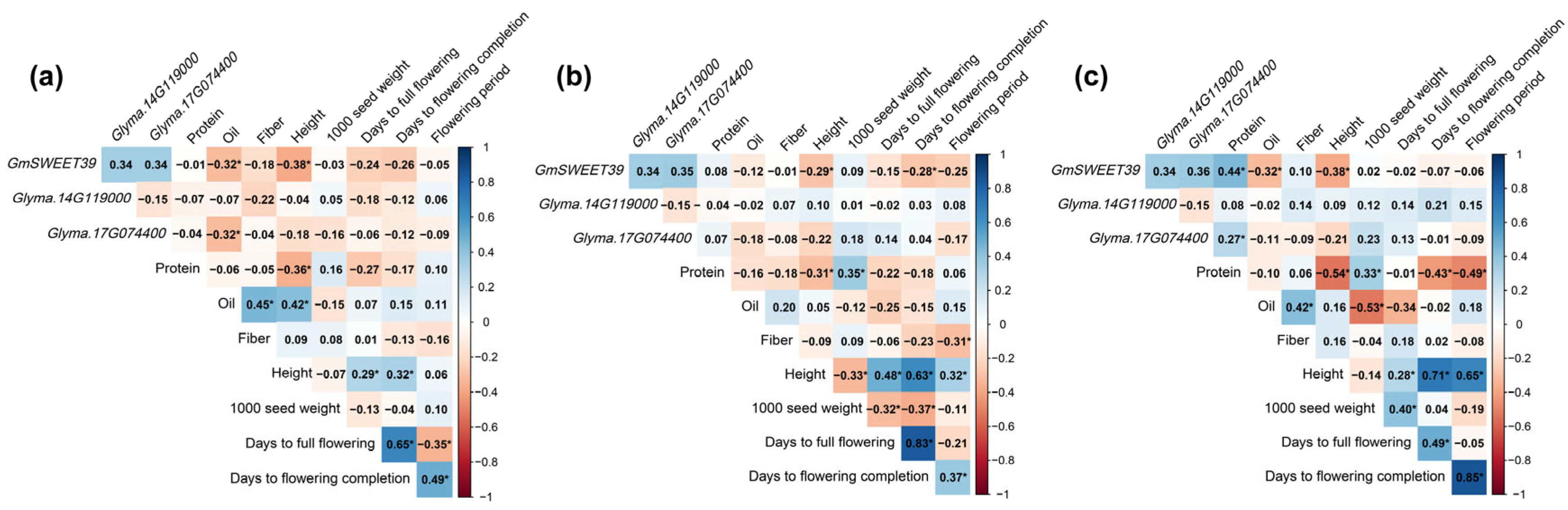
Figure 1. Correlation plot for studied traits and the GmSWEET39, Glyma.14G119000 and Glyma.17G074400 genes in (a) 2021, (b) 2022, (c) 2023. Glyma.03G219900 and POWR1 were excluded from the analysis due to the lack of polymorphism for these genes in studied collection. Statistically significant correlations (p < 0.05) are indicated with an asterisk (*).
Agronomy 15 02533 g001
Figure 2. Distribution of the studied genes alleles in the soy collection (number of accessions is shown in the diagrams).
Agronomy 15 02533 g002
Figure 3. Differences in the collection accession panel with different GmSWEET39 alleles in (a) protein (%), (b) oil (%) and (c) fiber (%) content, (d) plant height (cm), (e) 1000 grain weight (g) and duration of phenophases: (f) days to full flowering, (g) days to flowering completion, (h) flowering period (days). Data presented for 2021–2023. Different letters above bars indicate statistically significant differences between means (p < 0.05).
Agronomy 15 02533 g003
Figure 4. Differences in the collection accession panel with different Glyma.17G074400 alleles in (a) protein (%), (b) oil (%) and (c) fiber (%) content, (d) height (cm), (e) 1000 grain weight (g) and duration of phenophases: (f) days to full flowering, (g) days to flowering completion, (h) flowering period (days). Data presented for 2021–2023. Different letters above bars indicate statistically significant differences between means (p < 0.05).
Agronomy 15 02533 g004
Table 1. Markers used for the collection genotyping.
Target Locus and Detectable AllelesPrimersOriginal Article of Marker/Gene Reference Sequence
GmSWEET39: CC−/CC+FAM: CATCCACTTCCTCTGCGATTGA
HEX: CATCCACTTCCTCTGCGATTGG
Common: ACATTGTTGTTGTGAACCCCTTG
[38] *
Glyma.03G219900: SNP(T/A)FAM: AAGGCCTGATTGCATGGAGA
HEX: AAGGCCTGATTGCATGGAGT
Common: GGTTCACCAAGGAGGGTGAG
[37]
Glyma.14G119000: SNP(A/G)FAM: AAAGGAACTTCTTTTTGTCCACTA
HEX: AAAGGAACTTCTTTTTGTCCACTG
Common: CTTCTTCGTCAGTGCAAGTGC
[37]
Glyma.17G074400: SNP(T/C)FAM: CCCTGGTATCTTCTTCCTCTGGT
HEX: CCCTGGTATCTTCTTCCTCTGGC
Common: GTGTCGTCACTAAGAAATAATGATAAGG
[37]
POWR1: indel TE (1228 bp PCR product)/WT (907 bp PCR product)F: CACTTCAAGGGTGGCAGTGTT
R: CGGGATGGGAAAAGTGTCCTA
[42]
* Original marker developed based on gene reference sequences from respective publications.
Table 2. Trait values across groups of soybean accessions with different alleles of the SWEET39 and Glyma.17G074400 genes and correlations between the presence of allele CC+ or SNP(C) and the traits. Statistically significant differences and correlations (p < 0.05) are indicated with an asterisk (*). Within a column, means followed by different letters are significantly different (p < 0.05).
LociAllele202120222023202120222023
Protein Content, %Oil Content, %
GmSWEET39CC+38.7 a ± 2.236.6 a ± 1.338.5 a ± 1.616.5 b ±1.2116.9 a ± 0.617.2 b ±0.4
N999999
CC−38.8 a ± 236.1 a ± 2.336.6 b ± 1.517.9 a ±1.617.2 a ± 0.917.9 a ±0.9
N484846464644
CC+ vs. CC−−0.1 pp0.5 pp1.9 pp−1.4 pp−0.3 pp−0.7 pp
r (CC+)−0.010.080.44 *−0.32 *−0.12−0.32 *
N575755555553
Glyma.17G074400SNP(T)38.9 a ± 2.136.1 a ± 2.436.5 b ± 1.618.1 a ± 1.517.3 a ± 0.817.9 a ± 0.9
N353534353534
SNP(C)38.7 a ± 1.936.4 a ± 1.937.5 a ± 1.717.0 b ± 1.616.9 a ± 0.917.7 a ± 0.8
N232322212120
SNP(T) vs. SNP(C)0.2 pp−0.3 pp−1.0 pp1.1 pp0.4 pp0.2 pp
r (SNP(T))0.04−0.07−0.27 *0.32 *0.180.11
N585856565654
Fiber content, %Plant height, cm
GmSWEET39CC+10.3 a ± 1.712.90 a ± 1.213.8 a ± 0.863.6 b ± 22.451.1 b ± 12.864.0 b ± 20.2
N484846999
CC−11.1 a ± 1.612.92 a ± 1.013.9 a ± 1.080.4 a ± 13.361.0 a ± 12.278.7 a ± 12.1
N444848484846
CC+ vs. CC−−0.8 pp−0.02 pp−0.1 pp−16.8 (−23.3%)−9.9 (−17.7%)−14.7 (−20.6%)
r (CC+)−0.18−0.01−0.1−0.38 *−0.29 *−0.38 *
N575755575755
Glyma.17G074400SNP(T)11.1 a ± 1.513.0 a ± 1.113.9 a ± 0.980.2 a ± 12.761.6 a ± 11.879.0 a ± 12.3
N353434353534
SNP(C)10.9 a ± 1.812.8 a ± 113.8 a ± 1.174.4 a ± 19.956.4 a ± 13.472.8 a ± 17.2
N232322232322
SNP(T) vs. SNP(C)0.2 pp0.2 pp0.1 pp5.8 (7.5%)5.2 (8.8%)6.2 (8.2%)
r (SNP(T))0.040.080.090.180.200.21
N585856585856
1000 grain weight, gDays to full flowering, days
GmSWEET39CC+130.4 a ± 30.3143.6 a ± 30.3155.8 a ± 26.833.9 a ± 5.941.0 a ± 2.538.5 a ± 1.5
N888999
CC−132.4 a ± 22.2137.5 a ± 22.1154.4 a ± 24.238.5 a ± 7.344.1 a ± 8.538.7 a ± 3.2
N484846474848
CC+ vs. CC−−2.0 (−1.5%)6.1 (4.3%).1.4 (0.9%)−4.6 (−12.7%)−3.1 (−7.0%)−0.2 (−0.5%)
r (CC+)−0.030.090.02−0.24−0.15−0.02
N565654565757
Glyma.17G074400SNP(T)134.5 a ± 20.4135.1 a ± 22.6150.1 a ± 19.138.3 a ± 842.8 a ± 8.438.4 a ± 3.38
N353534343535
SNP(C)127.2 a ± 27143.7 a ± 23.2161.7 a ± 28.737.5 a ± 6.445.0 a ± 6.839.1 a ± 2.1
N222221232323
SNP(T) vs. SNP(C)7.3 (5.7%)−8.6 (−6.2%)−11.6 (−7.4%)0.8 (−2.1%)−2.2 (5%)−0.7 (1.8%)
r (SNP(T))0.16−0.18−0.230.06−0.14−0.13
N575755575858
Days to flowering completion, daysFlowering period, days
GmSWEET39CC+57.5 a ± 7.857.2 b ± 4.263.1 a ± 6.423.7 a ± 6.516.2 a ± 4.124.5 a ± 6.3
N999999
CC−63.1 a ± 7.663.6 a ± 8.564.0 a ± 4.324.5 a ± 6.419.4 a ± 4.725.2 a ± 4
N474848474848
CC+ vs. CC−−5.6 (−9.3%)−6.4 (−10.6%)−0.9 (−1.4%)−0.8 (−3.3%)−3.2 (−18%)−0.7 (−2.8%)
r (CC+)−0.26−0.28 *−0.07−0.05−0.25−0.06
N565757565757
Glyma.17G074400SNP(T)63.3 a ± 7.962.3 a ± 8.863.9 a ± 5.125.0 a ± 6.219.5 a ± 5.125.5 a ± 4.8
N343534343534
SNP(C)61.3 a ± 8.562.9 a ± 7.563.8 a ± 3.823.9 a ± 6.817.9 a ± 3.924.6 a ± 3.5
N232323232323
SNP(T) vs. SNP(C)2.0 (3.2%)−0.6 (−1.0%)0.1 (0.2%)1.1 (−4.5%)1.6 (8.6%)0.9 (3.6%)
r (SNP(T))0.12−0.040.010.090.170.09
N575858575858
Disclaimer/Publisher’s Note: The statements, opinions and data contained in all publications are solely those of the individual author(s) and contributor(s) and not of MDPI and/or the editor(s). MDPI and/or the editor(s) disclaim responsibility for any injury to people or property resulting from any ideas, methods, instructions or products referred to in the content.