

Avocado Sustains a Complex of Neosilba spp. (Diptera: Lonchaeidae) in Veracruz, Mexico

Abstract
1. Introduction
2. Materials and Methods
2.1. Fruit Collection
2.2. Fruit Classification and Insect Rearing
2.3. Species Identification, Sequencing and Phylogenic Analysis
2.4. Statistical Analysis
3. Results
3.1. Fruit Inspection and Global Fly Emergence
3.2. Emergence of Lonchaeid Flies
3.3. Species Identification, Sequencing and Phylogenic Analysis
4. Discussion
5. Conclusions
Author Contributions
Funding
Data Availability Statement
Acknowledgments
Conflicts of Interest
References
- SIAP. Servicio de Información Agroalimentaria y Pesquera. Available online: https://www.gob.mx/agricultura/dgsiap/acciones-y-programas/produccion-agricola-404122 (accessed on 13 October 2025).
- SENASICA. Servicio Nacional de Sanidad, Inocuidad y Calidad Agroalimentaria. Plagas Reglamentadas del Aguacate. 2024. Available online: https://dj.senasica.gob.mx/ASIA/Fitosanitario/barrenadores_del_aguacate?tipoIngreso=public&tipoVista=public (accessed on 20 August 2025).
- McAlpine, J.F.; Steyskal, G.C. A revision of Neosilba McAlpine with a key to the world genera of Lonchaeidae. Can. Entomol. 1982, 114, 105–137. [Google Scholar] [CrossRef]
- MacGowan, I. World catalogue of the family Lonchaeidae (Diptera, Cyclorrhapha, Acalyptratae). Zootaxa 2023, 5307, 1–96. [Google Scholar] [CrossRef] [PubMed]
- Lasa, R.; Navarro-de-la-Fuente, L.; MacGowan, I.; Williams, T. A complex of lance flies (Diptera: Lonchaeidae) infesting figs in Veracruz, Mexico with the description of a new species. Insects 2025, 16, 458. [Google Scholar] [CrossRef]
- Campos-Rivera, J. Otra Plaga Que Nace al Aguacate. Desarrollo Rural, Universidad Nacional de Colombia. 13 December 2014. Available online: https://agenciadenoticias.unal.edu.co/detalle/otra-plaga-que-le-nace-al-aguacate-1 (accessed on 25 August 2025).
- Gómez, E. Alertan Sobre Plaga de Mosca de la Fruta que Daña Cultivos de Aguacate en Michoacán. La Jornada. 20 September 2024. Available online: https://www.jornada.com.mx/2024/09/20/ciencias/a06n1cie (accessed on 9 August 2025).
- Laboratorio de Tecnología Orgánica, Uruapan, Michoacán. Technical Note: La Mosquita del Fruto del Aguacate. 2024. Available online: https://www.quadratin.com.mx/www/wp-content/uploads/2024/08/FICHA-TECNICA-mosquita-del-aguacate-Neosilva-batesi-2-1.pdf (accessed on 1 October 2025).
- Lemus-Soriano, B.A.; Morales-Galván, O.; García-Gallegos, D.; García-Valderas, D.V.; Kassen, M.; Illescas-Riquelme, C.P. Neosilba batesi Curran (Diptera: Lonchaeidae): Identification, distribution, and its relationship with avocado fruits. Diversity 2025, 17, 499. [Google Scholar] [CrossRef]
- McAlpine, J.F. Old World lonchaeids of the genus Silba Macquart (=Carpolonchaea Bezzi), with descriptions of six new species (Diptera: Lonchaeidae). Can. Entomol. 1956, 88, 521–544. [Google Scholar] [CrossRef]
- Illescas-Riquelme, C.P.; Hernández, H.G.; Carrasco, J.V.; Cázares, M.C.M.L.; Montiel, C.R. Lonchaeidae (Diptera: Tephritoidea) associated with the genus Annona in Mexico. Southwest. Entomol. 2015, 40, 121–130. [Google Scholar] [CrossRef]
- Galeano-Olaya, P.E.; Canal, N.A. New species of Neosilba McAlpine (Diptera: Lonchaeidae) and new records from Colombia. Papéis Avulsos Zool. 2021, 52, 361–385. [Google Scholar] [CrossRef]
- MacGowan, I.; Navarro-de-la-Fuente, L.; Williams, T.; Lasa, R. A new species of Neosilba (Diptera, Lonchaeidae) associated with fig orchards in Mexico. Zootaxa 2025, 5583, 195–200. [Google Scholar] [CrossRef]
- Simon, C.; Frati, F.; Beckenbach, A.; Crespi, B.; Liu, H.; Flook, P. Evolution, weighting, and phylogenetic utility of mitochondrial gene sequences and a compilation of conserved polymerase chain reaction primers. Ann. Entomol. Soc. Am. 1994, 87, 651–701. [Google Scholar] [CrossRef]
- Katoh, K.; Rozewicki, J.; Yamada, K.D. MAFFT online service: Multiple sequence alignment, interactive sequence choice and visualization. Brief. Bioinf. 2019, 20, 1160–1166. [Google Scholar] [CrossRef] [PubMed]
- Kumar, S.; Stecher, G.; Tamura, K. MEGA7: Molecular Evolutionary Genetics Analysis version 7.0 for bigger datasets. Mol. Biol. Evol. 2016, 33, 1870–1874. [Google Scholar] [CrossRef]
- Darriba, D.; Taboada, G.L.; Doallo, R.; Posada, D. jModelTest 2: More models, new heuristics and parallel computing. Nature Meth. 2012, 9, 772. [Google Scholar] [CrossRef]
- Ronquist, F.; Teslenko, M.; van der Mark, P.; Ayres, D.L.; Darling, A.; Höhna, S.; Larget, B.; Liu, L.; Suchard, M.A.; Huelsenbeck, J.P. MrBayes 3.2: Efficient Bayesian phylogenetic inference and model choice across a large model space. Syst. Biol. 2012, 61, 539–542. [Google Scholar] [CrossRef]
- Edler, D.; Klein, J.; Antonelli, A.; Silvestro, D. raxmlGUI 2.0: A graphical interface and toolkit for phylogenetic analyses using RAxML. Meth. Ecol. Evol. 2020, 12, 373–377. [Google Scholar] [CrossRef]
- Rambaut, A. FigTree v1.4.3 Software. Institute of Evolutionary Biology, University of Edinburgh. 2016. Available online: http://tree.bio.ed.ac.uk/software/figtree/ (accessed on 9 August 2025).
- Reimann, A.; Rulik, B. The Lonchaeidae (Diptera) of the GBOL project, with the description of a new Priscoearomyia species. Contrib. Entomol. 2024, 74, 165–179. [Google Scholar] [CrossRef]
- Jamovi. Jamovi Statistical Software v.2.3.28. 2024. Available online: https://www.jamovi.org (accessed on 15 October 2024).
- Balseiro, F.J.; Uribe, S.I. DNA barcoding for identification of species of the genus Lonchaea Fallen, 1820 (Diptera: Lonchaeidae) of Antioquia. Rev. Fac. Cienc. 2021, 10, 51–66. [Google Scholar] [CrossRef]
- SENASICA-DGSV. Barrenador Pequeño del Hueso del Aguacate Conotrachelus aguacatae (Barber) y Conotrachelus perseae (Barber) (Coleoptera: Curculionidae); Servicio Nacional de Sanidad, Inocuidad y Calidad Agroalimentaria Dirección General de Sanidad Vegetal—Centro Nacional de Referencia Fitosanitaria—Grupo Especialista Fitosanitario, Ficha Técnica: Tecámac, Mexico, 2016; 11p. Available online: https://www.gob.mx/cms/uploads/attachment/file/155683/2._Ficha_T_cnica_Barrenador_peque_o_del_hueso_del_aguacate_2025.pdf (accessed on 13 October 2025).
- SENASICA-DGSV. Barrenador Grande de la Semilla del Aguacate, Heilipus lauri Boheman. (Coleoptera: Curculionidae); Servicio Nacional de Sanidad, Inocuidad y Calidad Agroalimentaria-Dirección General de Sanidad Vegetal—Centro Nacional de Referencia Fitosanitaria—Grupo Especialista Fitosanitario, Ficha Técnica: Tecámac, Mexico, 2016; 10p. Available online: https://www.gob.mx/cms/uploads/attachment/file/155685/3._Ficha_T_cnica_Barrenador_grande_del_hueso_del_aguacate_2025.pdf (accessed on 20 August 2025).
- SENASICA-DGSV. Palomilla Barrenadora del Aguacate (Stenoma catenifer Walsingham); Servicio Nacional de Sanidad, Inocuidad y Calidad Agroalimentaria—Dirección General de Sanidad Vegetal—Centro Nacional de Referencia Fitosanitaria—Grupo Especialista Fitosanitario, Ficha Técnica: Tecámac, Mexico, 2016; 16p. Available online: https://www.gob.mx/cms/uploads/attachment/file/155686/1._Ficha_T_cnica_Stenoma_catenifer_2025.pdf (accessed on 20 August 2025).
- Fadda, L.A.; Lasa, R.; Vera, L.A.; Lira, A. Occurrence of Stenoma catenifer and first record of Cryptaspasma perseana in Veracruz, Mexico. Southwest. Entomol. 2023, 48, 1005–1010. [Google Scholar] [CrossRef]
- Sanhueza-Peñaranda, N.; González-Hernández, A.H.; Valdez-Carrasco, J.; Guzmán-Franco, A.; Castañeda-Vildózola, A.; Martínez-Ortega, J. New record of Cryptaspasma perseana (Lepidoptera: Tortricidae) in Puebla, México. Proc. Entomol. Soc. Wash. 2024, 126, 400–401. [Google Scholar] [CrossRef]
- Hernández-Ortiz, V. Diptera. In Catalogo de Insectos y Acaros Plaga de los Cultivos Agricolas de Mexico; Deloya-Lopez, A.C., Valenzuela-Gonzalez, J.E., Eds.; Sociedad Mexicana de Entomologia A.C.: Xalapa, Mexico, 1999; pp. 69–82. [Google Scholar]
- Aluja, M.; Diaz-Fleischer, F.; Arredondo, J. Nonhost status of commercial Persea americana “Hass” to Anastrepha ludens, Anastrepha obliqua, Anastrepha serpentina and Anastrepha striata (Diptera: Tephritidae) in Mexico. J. Econ. Entomol. 2004, 97, 293–309. [Google Scholar] [CrossRef] [PubMed]
- Díaz-Fleischer, F.; Papaj, D.R.; Prokopy, R.J.; Norrbom, A.L.; Aluja, M. Evolution of fruit fly oviposition behavior. In Fruit Flies (Tephritidae): Phylogeny and Evolution of Behavior; Aluja, M., Norrbom, A.L., Eds.; CRC Press: Boca Raton, FL, USA, 1999; pp. 811–841. [Google Scholar]
- Saavedra-Díaz, J.; Galeano-Olaya, P.E.; Canal, D.N.A. Relaciones ecológicas entre frutos hospederos, moscas frugívoras y parasitoides en un fragmento de bosque seco tropical. Rev. Cienc. Agric. 2017, 34, 32. [Google Scholar] [CrossRef]
- Balseiro, F.J. Identificación de Lonchaeidae (Diptera: Tephritoidea) Asociados a Pasifloras en el Departamento de Antioquia, con Énfasis en el género Lonchaea Fallen1820. Master’s Thesis, Universidad Nacional de Colombia, Medellin, Colombia, 15 December 2020. Available online: https://repositorio.unal.edu.co/handle/unal/80076 (accessed on 15 August 2025).
- Herrera, A.M.; Canal, N.A.; Agudelo-Martinez, J.C.; Perez-Buitrago, N. Diversidad y ecologia de Tephritoidea (Insecta: Diptera) en el norte de la Orinoquia colombiana. Rev. Biol. Colomb. 2022, 70, 423–436. [Google Scholar] [CrossRef]
- Raga, A.; de Souza-Filho, M.F.; Strikis, P.C.; Montes, S.M.N.M. Lance fly (Diptera: Lonchaeidae) host plants in the state of São Paulo, southeast Brazil. Entomotropica 2015, 30, 57–68. [Google Scholar]
- MacGowan, I.; Rotheray, G.E. British Lonchaeidae (Diptera): Keys and Notes for the Identification of the Species, 1st ed.; Part 15; Royal Entomological Society: London, UK, 2008; Volume 10, pp. 1–142. [Google Scholar]
- Chacón, P.; Rojas, M. Entomofauna asociada a Passiflora mollisima, P. edulis f. flavicarpa y P. quadrangularis en el departamento del Valle del Cauca. Turrialba 1984, 34, 297–311. [Google Scholar]
- Medina, J.A.; Kondo, T. Listado taxonómico de organismos que afectan la pitaya amarilla, Selenicereus megalanthus (K. Schum. ex Vaupel) Moran (Cactaceae) en Colombia. Corporación Colomb. Investig. Agropecu. 2012, 13, 41–46. [Google Scholar] [CrossRef]
- MacGowan, I.; Rotheray, G.E. Lonchaeidae (lance flies). In Manual of Afrotropical Diptera. Volume 3. Brachycera–Cyclorrhapha, Excluding Calyptratae. Suricata; Kirk-Spriggs, A.H., Sinclair, B.J., Eds.; South African National Biodiversity Institute: Pretoria, South Africa, 2021; pp. 1587–1596. Available online: https://www.nhm.ac.uk/our-science/our-work/biodiversity/manual-afrotropical-diptera.html (accessed on 9 August 2025).
- Garcia, F.R.M.; Norrbom, A.L. Tephritoid flies (Diptera, Tephritoidea) and their plant hosts from the state of Santa Catarina in southern Brazil. Fla. Entomol. 2011, 94, 151–157. [Google Scholar] [CrossRef]
- Uchôa, M.A. Fruit flies (Diptera: Tephritoidea): Biology, host plants, natural enemies, and the implications to their natural control. In Integrated Pest Management and Pest Control: Current and Future Tactics; Larramendy, M.L., Soloneski, S., Eds.; InTech: Rijeka, Croatia, 2012; pp. 271–300. [Google Scholar]
- Lemos, L.N.; Adaime, R.; Costa-Neto, S.V.; Deus, E.G.; Jesus-Barros, C.R.; Strikis, P.C. New Findings on Lonchaeidae (Diptera: Tephritoidea) in the Brazilian Amazon. Fla. Entomol. 2015, 98, 1227–1237. [Google Scholar] [CrossRef]
- Uchôa-Fernandes, M.A.; de Oliveira, I.; Molina, R.M.S.; Zucchi, R.A. Species diversity of frugivorous flies (Diptera: Tephritoidea) from hosts in the cerrado of the state of Mato Grosso do Sul, Brazil. Neotrop. Entomol. 2002, 31, 515–524. [Google Scholar] [CrossRef]
- Strikis, P.; Prado, A. A new species of the genus Neosilba (Diptera: Lonchaeidae). Zootaxa 2005, 828, 1–4. [Google Scholar] [CrossRef]
- Raga, A.; Souza-Filho, M.F.; Machado, R.A.; Sato, M.E.; Siloto, R.C. Host ranges and infestation indices of fruit flies (Tephritidae) and lance flies (Lonchaeidae) in São Paulo State, Brazil. Fla. Entomol. 2011, 94, 787–794. [Google Scholar] [CrossRef]
- Pitkin, B.R. Family Lonchaeidae. In Catalog of the Diptera of the Australasian and Oceanic Regions; Pitkin, B.R., Ed.; Bishop Museum Press: Honolulu, HI, USA, 1996; pp. 476–478. [Google Scholar]
- Ahlmark, K.; Steck, G.J. A new U.S. record for a secondary fruit infester, Neosilba batesi (Curran) (Diptera: Lonchaeidae). Insecta Mundi 1997, 11, 116. [Google Scholar]




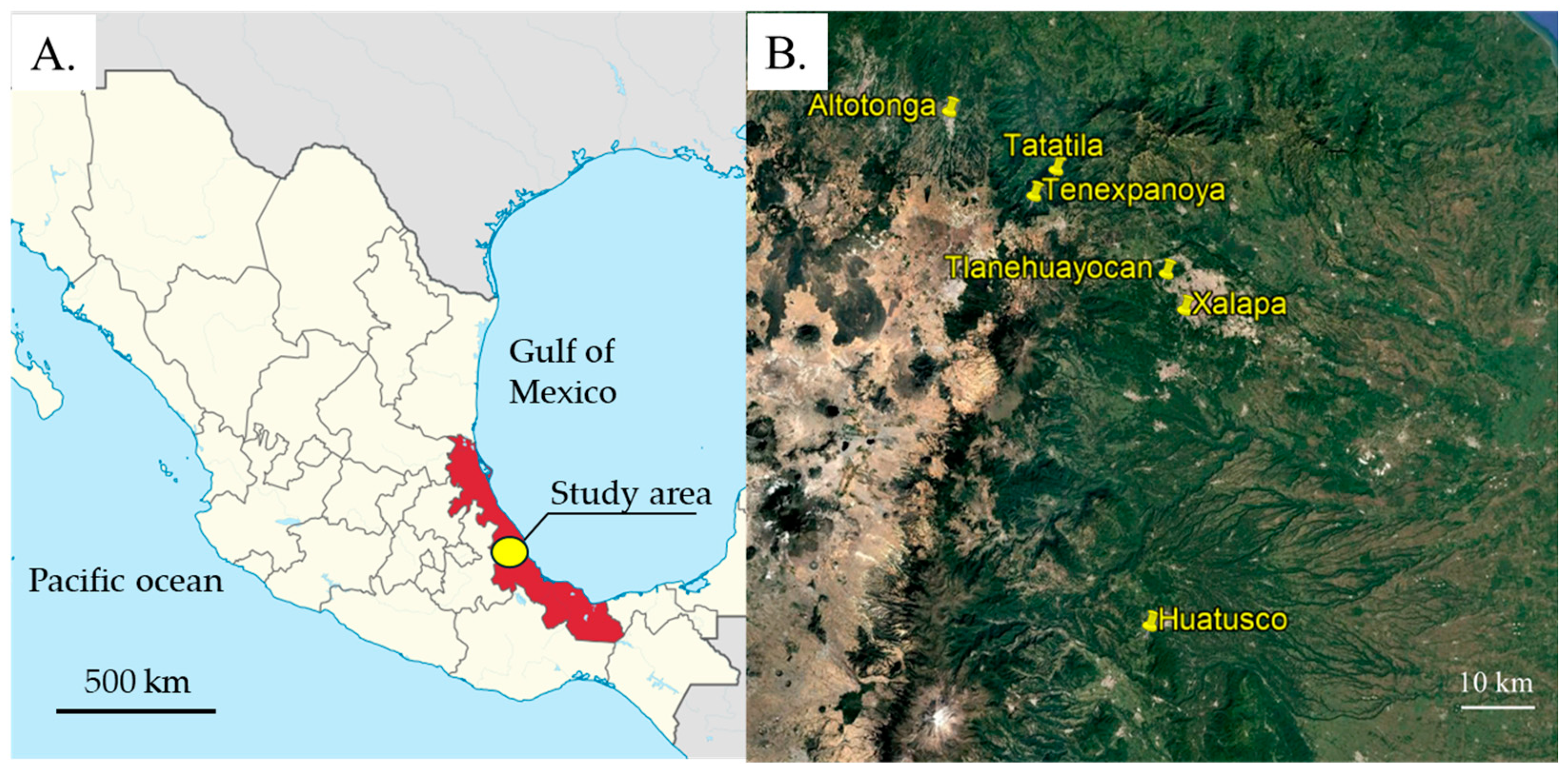
| Locality | Variety | Month and Year of Sample | Intact Fruits | Damaged Fruits | Coordinates; Elevation |
|---|---|---|---|---|---|
| Tatatila | creole | May–June 2024, March 2025 | 22 | 32 | 19°41′28″ N; 97°06′39″ W; 2047 m |
| Tenexpanoya | creole | May 2025 | 22 | 34 | 19°39′34″ N; 97°08′26″ W; 2208 m |
| Tlanehuayocan | creole | May 2025 | 0 | 5 | 19°33′30″ N; 96°58′04″ W; 1608 m |
| Huatusco | Hass | May 2025 | 15 | 0 | 19°07′32″ N; 96°59′51″ W; 1915 m |
| Altotonga | Hass | May 2025 | 15 | 0 | 19°46′05″ N; 97°15′06″ W; 2286 m |
| Xalapa | Hass | May 2025 | 17 | 19 | 19°30′46″ N; 96°56′41″ W; 1667 m |
| Locality (Avocado Var.) | Damaged Fruits | Fruit Diameter (±SE) (mm) | Fruit Weight (±SE) (g) | Infested Fruits (%) | Neosilba spp. Adults Emerged per Fruit | Emergence Time (95% CI) (Days) |
|---|---|---|---|---|---|---|
| Tatatila (creole) | 32 | 32.4 ± 0.7 a | 23.0 ± 1.3 a | 23 (72%) a | 6.7 ± 2.4 ab | 29 (29–30) a |
| Tenexpanoya (creole) | 34 | 41.0 ± 1.3 b | 64.9 ± 5.4 b | 23 (68%) a | 4.7 ± 0.4 a | 33 (32–35) c |
| Tlanehuayocan (creole) | 5 | 58.4 ± 2.5 c | 165.6 ± 25.4 c | 4 (80%) a | 21.0 ± 7.9 b | 31 (33–35) b |
| Xalapa (Hass) | 19 | 49.6 ± 2.1 bc | 105.1 ± 8.7 bc | 4 (21%) b | 2.3 ± 0.5 ab | 41 (40–?) 1 c |
| Locality 1 | Number of Males Disected | N. batesi | N. glaberrima | N. recurva | N. flavitarsis | Prevalence of Co-Infested Avocados (%) |
|---|---|---|---|---|---|---|
| Tatatila | 68 | 46 | 17 | 5 | - | 13% |
| Tenexpanoya | 44 | 30 | 8 | 4 | 2 | 17% |
| Tlanehuayocan | 41 | 22 | 19 | - | - | 50% |
| Xalapa | 3 | 3 | - | - | - | 0% |
| Total (%) | 156 | 101 (65%) | 44 (28%) | 9 (6%) | 2 (1%) | 24% |
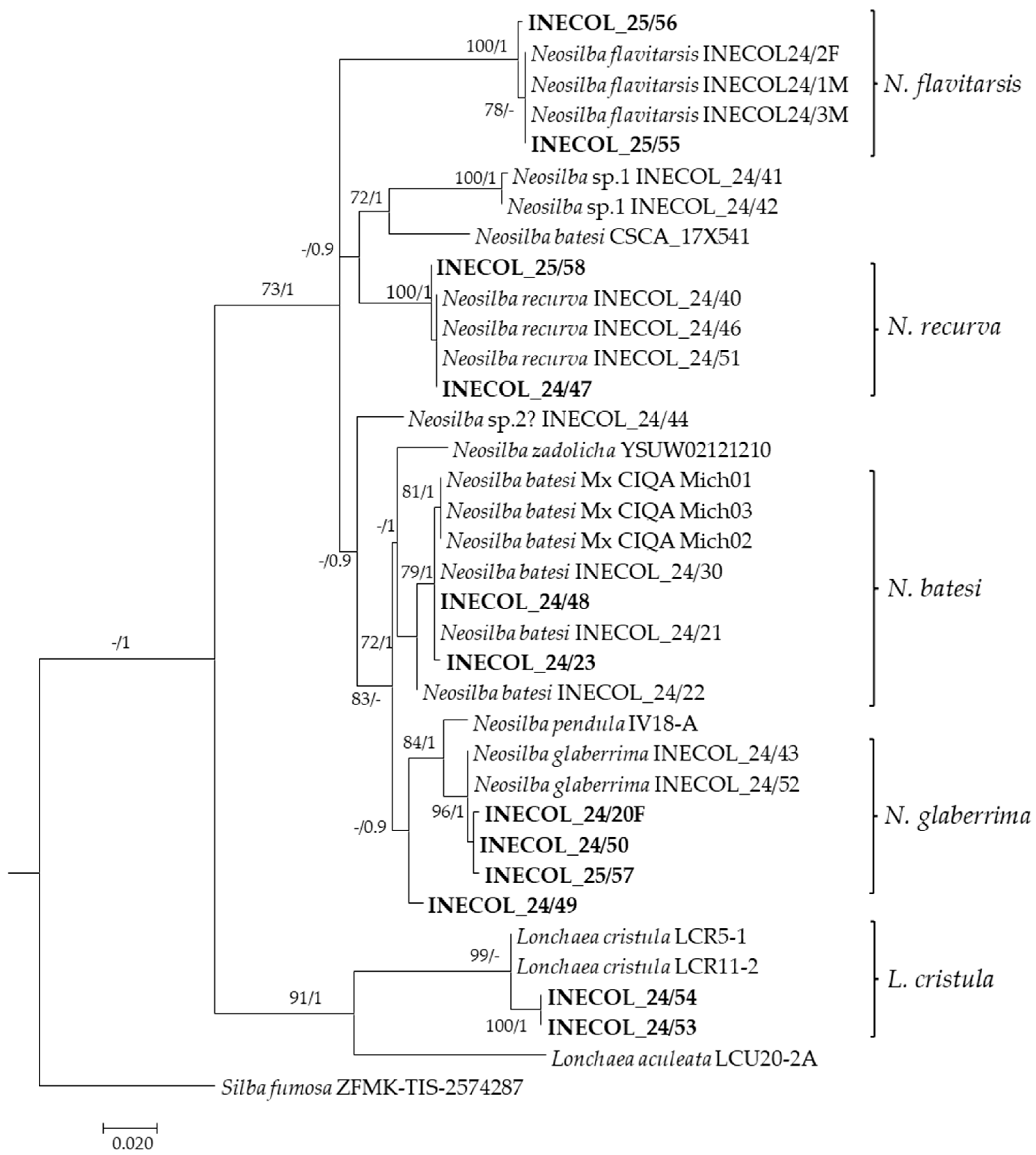
| Species (Host Plant) | Voucher | State, Country | GenBank Number |
|---|---|---|---|
| Neosilba batesi (fig) | INECOL_24/21 | Veracruz, Mexico | PV504763 |
| Neosilba batesi (fig) | INECOL_24/22 | Veracruz, Mexico | PV504764 |
| Neosilba batesi (fig) | INECOL_24/30 | Veracruz, Mexico | PV504765 |
| Neosilba batesi (avocado) | Mx-CIQA-Mich01 | Michoacan, Mexico | PV243309 |
| Neosilba batesi (avocado) | Mx-CIQA-Mich02 | Michoacan, Mexico | PV243310 |
| Neosilba batesi (avocado) | Mx-CIQA-Mich01 | Michoacan, Mexico | PV243311 |
| Neosilba batesi (avocado) | CSCA_17X541 | Florida, USA | MW283302 |
| Neosilba batesi (avocado) | INECOL_24/48 | Veracruz, Mexico | Sequence 3 |
| Neosilba batesi (avocado) | INECOL_24/23 | Veracruz, Mexico | Sequence 3 |
| Neosilba glaberrima (fig) | INECOL_24/43 | Veracruz, Mexico | PV504766 |
| Neosilba glaberrima (fig) | INECOL_24/52 | Veracruz, Mexico | PV504767 |
| Neosilba glaberrima (avocado) | INECOL_24/50 | Veracruz, Mexico | Sequence 3 |
| Neosilba glaberrima (avocado) | INECOL_25/57 | Veracruz, Mexico | Sequence 3 |
| Neosilba glaberrima (avocado) | INECOL_24/20F | Veracruz, Mexico | Sequence 3 |
| Neosilba recurva (fig) | INECOL_24/40 | Veracruz, Mexico | PV522076 |
| Neosilba recurva (fig) | INECOL_24/46 | Veracruz, Mexico | PV522077 |
| Neosilba recurva (fig) | INECOL_24/51 | Veracruz, Mexico | PV522078 |
| Neosilba recurva (avocado) | INECOL_24/47 | Veracruz, Mexico | Sequence 3 |
| Neosilba recurva (avocado) | INECOL_25/58 | Veracruz, Mexico | Sequence 3 |
| Neosilba flavitarsis (fig) | INECOL24/1M | Veracruz, Mexico | PQ834830 |
| Neosilba flavitarsis (fig) | INECOL24/2F | Veracruz, Mexico | PQ834831 |
| Neosilba flavitarsis (fig) | INECOL24/3M | Veracruz, Mexico | PQ834832 |
| Neosilba flavitarsis (avocado) | INECOL_25/55 | Veracruz, Mexico | Sequence 3 |
| Neosilba flavitarsis (avocado) | INECOL_25/56 | Veracruz, Mexico | Sequence 3 |
| Neosilba sp.1 (fig) | INECOL_24/41 | Veracruz, Mexico | PV504769 |
| Neosilba sp.1 (fig) | INECOL_24/42 | Veracruz, Mexico | PV504770 |
| Neosilba sp.2 (fig) | INECOL_24/44 | Veracruz, Mexico | PV504772 |
| Neosilba sp.3 (avocado) | INECOL_24/49 | Veracruz, Mexico | Sequence 3 |
| Neosilba pendula (Inga vera) | IV18-A | Minas Gerais, Brazil | OQ160349 |
| Neosilba zadolicha (Passiflora alata) 1 | YSUW02121210 | Rio de Janeiro, Brazil | KR262649 |
| Lonchaea cristula (Passiflora edulis) 1 | LCR11-2 | Antioquia, Colombia | MZ189772 |
| Lonchaea cristula (Passiflora edulis) 1 | LCR5-1 | Antioquia, Colombia | MZ189773 |
| Lonchaea cristula (avocado) | INECOL_24/53 | Veracruz, Mexico | Sequence 3 |
| Lonchaea cristula (avocado) | INECOL_24/54 | Veracruz, Mexico | Sequence 3 |
| Lonchaea aculeata (Passiflora edulis) 1 | LCU20-2A | Antioquia, Colombia | MZ189778 |
| Silba fumosa 2 | ZFMK-TIS-2574287 | Ahrweiler, Germany | OP831869 |
Disclaimer/Publisher’s Note: The statements, opinions and data contained in all publications are solely those of the individual author(s) and contributor(s) and not of MDPI and/or the editor(s). MDPI and/or the editor(s) disclaim responsibility for any injury to people or property resulting from any ideas, methods, instructions or products referred to in the content. |
© 2025 by the authors. Licensee MDPI, Basel, Switzerland. This article is an open access article distributed under the terms and conditions of the Creative Commons Attribution (CC BY) license (https://creativecommons.org/licenses/by/4.0/).
Share and Cite
Lasa, R.; Navarro-de-la-Fuente, L.; MacGowan, I.; Williams, T. Avocado Sustains a Complex of Neosilba spp. (Diptera: Lonchaeidae) in Veracruz, Mexico. Agronomy 2025, 15, 2476. https://doi.org/10.3390/agronomy15112476
Lasa R, Navarro-de-la-Fuente L, MacGowan I, Williams T. Avocado Sustains a Complex of Neosilba spp. (Diptera: Lonchaeidae) in Veracruz, Mexico. Agronomy. 2025; 15(11):2476. https://doi.org/10.3390/agronomy15112476
Chicago/Turabian StyleLasa, Rodrigo, Laura Navarro-de-la-Fuente, Iain MacGowan, and Trevor Williams. 2025. "Avocado Sustains a Complex of Neosilba spp. (Diptera: Lonchaeidae) in Veracruz, Mexico" Agronomy 15, no. 11: 2476. https://doi.org/10.3390/agronomy15112476
APA StyleLasa, R., Navarro-de-la-Fuente, L., MacGowan, I., & Williams, T. (2025). Avocado Sustains a Complex of Neosilba spp. (Diptera: Lonchaeidae) in Veracruz, Mexico. Agronomy, 15(11), 2476. https://doi.org/10.3390/agronomy15112476