Article

Utilizing Remote Sensing to Quantify the Performance of Soybean Insecticide Seed Treatments

1
Corteva Agriscience, 7250 NW 62nd Ave., Johnston, IA 50131, USA
2
Corteva Agriscience, 9330 Zionsville Rd., Indianapolis, IN 46268, USA
*
Author to whom correspondence should be addressed.
Agronomy 2024, 14(2), 340; https://doi.org/10.3390/agronomy14020340

Submission received: 11 January 2024 / Revised: 26 January 2024 / Accepted: 3 February 2024 / Published: 7 February 2024

Abstract

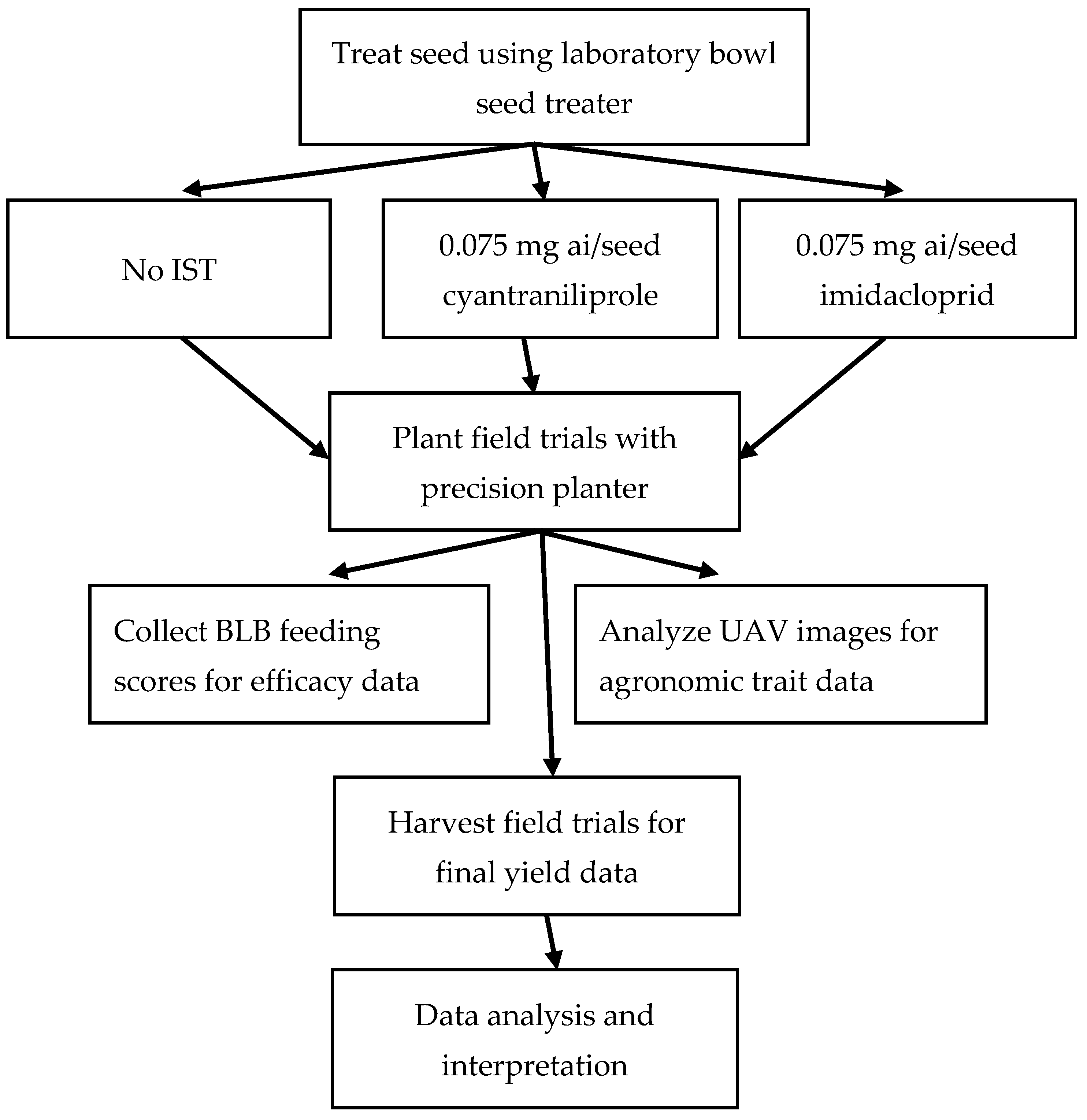
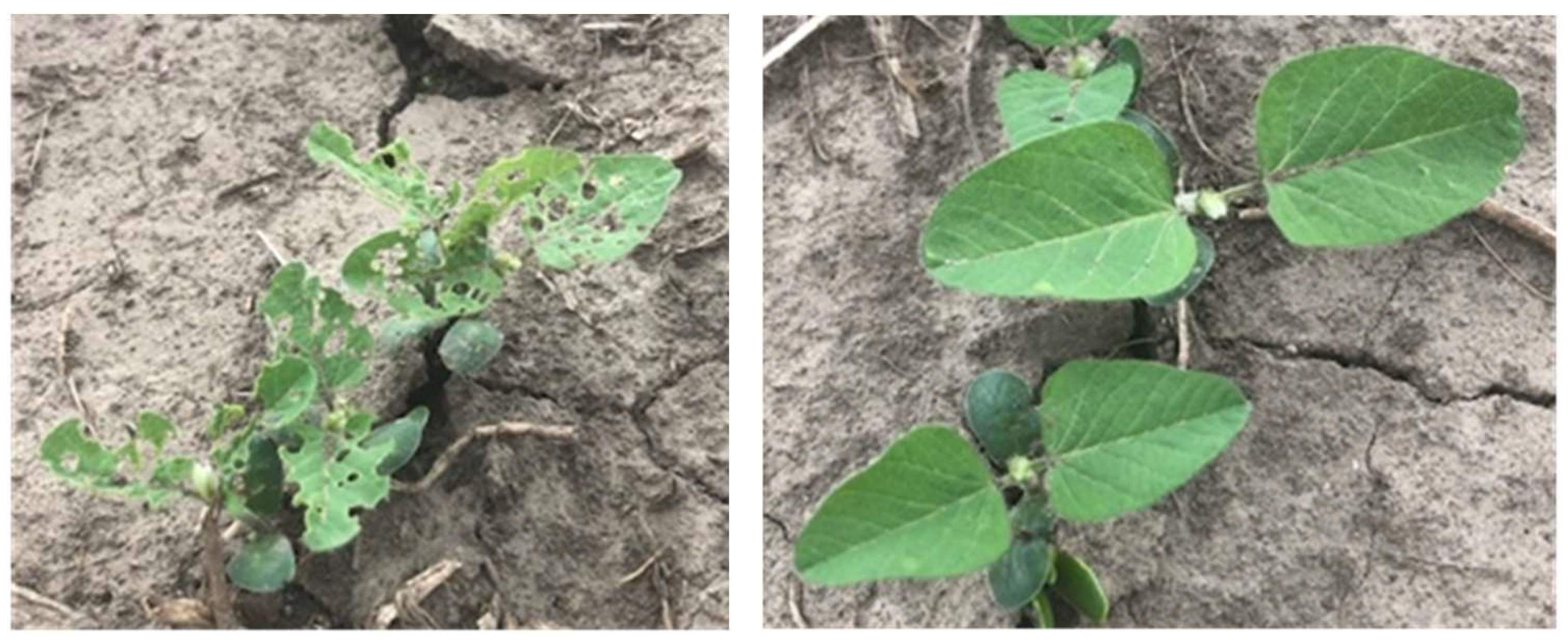
Soybean (Glycine max) is one of the most important oilseed crops grown in North America and a key contributor to the global protein supply. Insect feeding by a major soybean pest, the bean leaf beetle (BLB; Cerotoma trifurcata), can result in economic yield loss if not controlled. The objective of this research was to use unmanned aerial vehicle (UAV) image analysis to compare the agronomic and efficacy traits of two soybean insecticide seed treatments (IST) in locations with BLB feeding. Across the 2018–2023 field trial locations, 29 had low BLB feeding pressure (less than 25% feeding damage to no IST plots) and 31 had high BLB feeding pressure (greater than 25% feeding damage to no IST plots). In low BLB pressure locations, cyantraniliprole and imidacloprid seed treatments had significantly higher BLB efficacy, significantly higher UAV greenness, and significantly higher final yield as compared to no IST. In high BLB pressure locations, cyantraniliprole and imidacloprid seed treatments were significantly better compared to no IST for BLB efficacy, UAV emergence, UAV vigor, UAV greenness, and final yield. In high BLB pressure locations, cyantraniliprole had significantly higher BLB efficacy, significantly better UAV emergence, and significantly higher yield compared to imidacloprid. The cyantraniliprole treatment had a +254.5 kg/ha increase compared to no IST in low BLB pressure locations and a +213.7 kg/ha increase in high BLB pressure locations. The imidacloprid treatment had a +163.4 kg/ha yield increase compared to no IST in low BLB pressure locations and a +121.4 kg/ha yield increase in high BLB pressure locations. The use of UAV image analysis enabled quantification of the effect of BLB feeding on early-season agronomic traits and, when combined with efficacy and final yield data, successfully differentiated the performance of two soybean ISTs in environments with low or high insect pressure.
Keywords: bean leaf beetle; insecticide seed treatment; soybean bean leaf beetle; insecticide seed treatment; soybean