Article

Effective Biocontrol of Rice Blast through Dipping Transplants and Foliar Applications
1
The Real IPM Co., (Kenya) Ltd., Madaraka, Thika P.O. Box 4001-01002, Kenya
2
Real IPM Tanzania Ltd., Plot No 34, Area F, Livingstone Riad, Arusha, Tanzania
3
NIAB EMR, East Malling, West Malling, Kent ME19 6BJ, UK
*
Author to whom correspondence should be addressed.
Agronomy 2022, 12(3), 592; https://doi.org/10.3390/agronomy12030592

Submission received: 30 December 2021 / Revised: 22 February 2022 / Accepted: 25 February 2022 / Published: 27 February 2022

Abstract

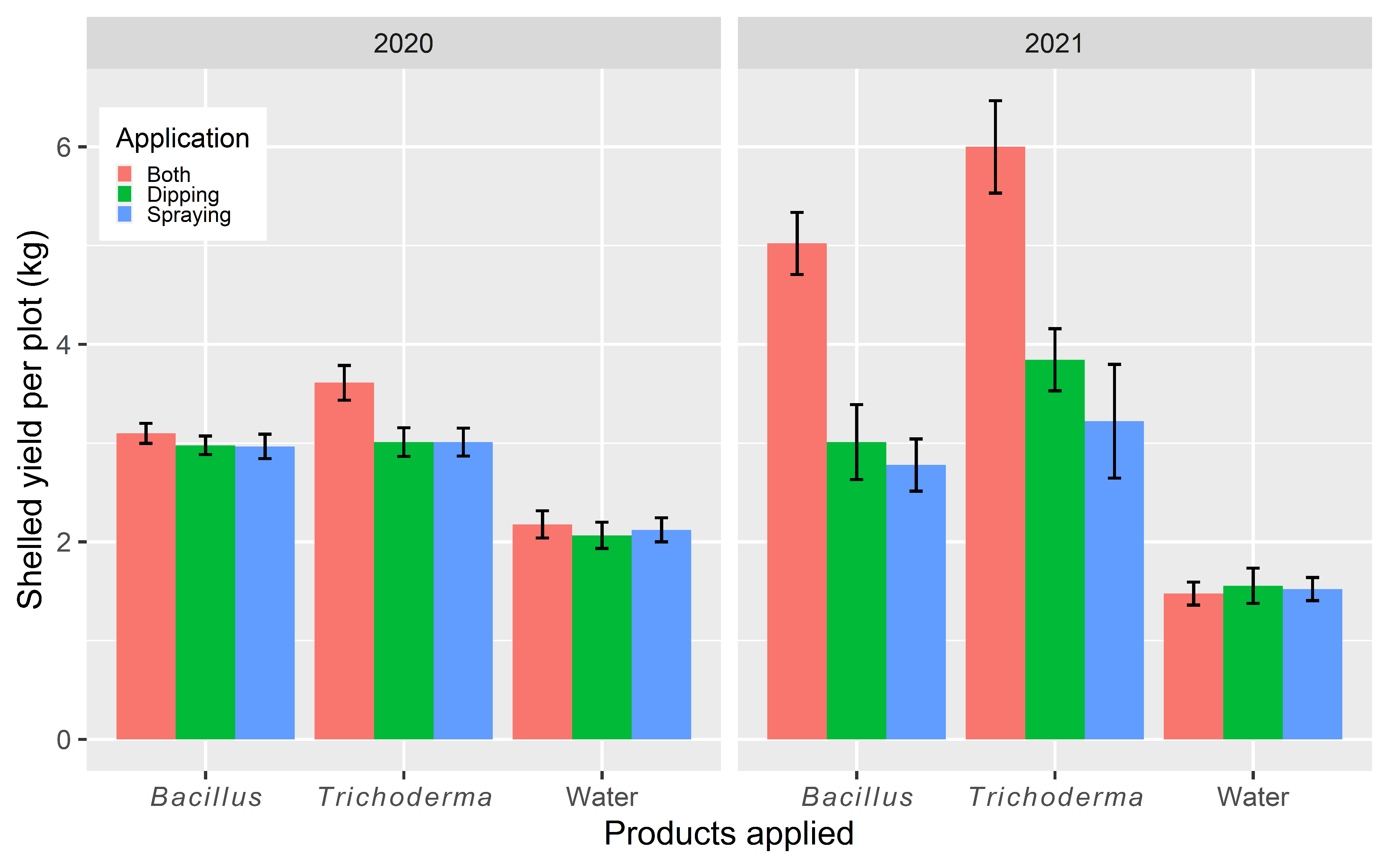
Rice (Oryza sativa) is an increasingly popular food in Africa. As much as 30% of yields are lost due to blast disease caused by Magnaporthe oryzae. Several commercial biopesticides of Bacillus subtilis, Trichoderma asperellum, and Serratia sp. strains were evaluated under field conditions for their effects against rice blast and yield at one site in Kenya and three sites in Tanzania in 2020 and 2021. Each biopesticide was applied as a dipping treatment at transplanting, post-transplanting foliar spraying, or both. Using biopesticides not only achieved blast control but also increased grain yield, particularly in low-production regions in Tanzania, with a yield increase of >100%. For higher-production sites with low disease pressure, the yield increase through biopesticides over the untreated control was limited, although significant disease suppression was achieved. Dipping alone was sufficient to suppress disease and improve yield unless disease pressure was high. The differences among the three biopesticides varied with site/year but generally were small. Improved yield using biopesticides is unlikely to result solely from reduced blast development, but also from improved plant development. The present study suggests that these commercial biopesticides should be applied in rice production, particularly in subsistence farming.
Keywords: dipping; foliar spraying; biopesticides; rice blast; biocontrol dipping; foliar spraying; biopesticides; rice blast; biocontrol