Photodegradation Mechanisms and Anti-Aging Strategies of Wood Coatings: A Comprehensive Review


Abstract
1. Introduction
2. Methodology of the Review
3. Classification and Aging Mechanisms of Wood Coatings
3.1. Classification and Protective Mechanisms of Wood Coatings
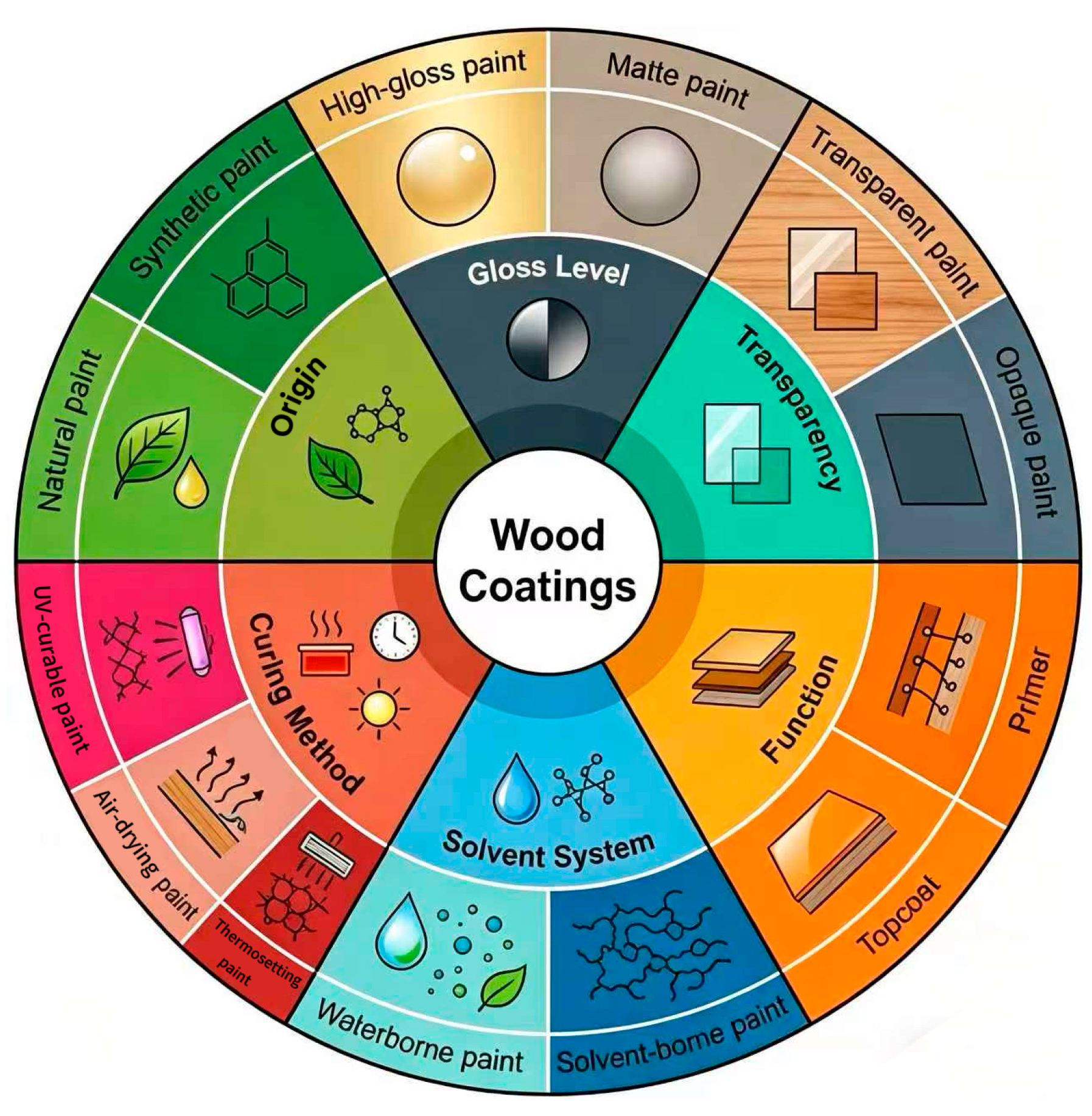
- Gloss: Coatings can be high-gloss or matte. High-gloss coatings exhibit a dense, continuous film with strong surface reflection and vivid color, whereas matte coatings provide a softer finish with some light diffusion.
- Transparency: Coatings are either transparent, preserving the natural texture and pattern of the wood for decorative purposes, or opaque, providing strong coverage for discolored or uneven substrates.
- Function: Primers primarily enhance adhesion between the substrate and the topcoat while offering sealing protection. Topcoats serve both decorative and protective roles, imparting aesthetics and durability.
- Solvent Type: Solvent-based coatings use organic solvents, forming dense films with good wetting properties but higher volatile organic compound (VOC) emissions. Water-based coatings use water as the primary dispersing medium, offering improved environmental performance, aligning with current green coating trends.
- Curing Method: Thermosetting coatings require heat to achieve crosslinking, forming a stable three-dimensional network, while air-drying coatings cure at ambient temperature via solvent evaporation or oxidative polymerization, facilitating easier application.
- Source: Natural coatings, such as traditional lacquer, are derived from plant exudates, featuring unique decorative properties but requiring strict drying conditions and longer curing times. Synthetic coatings are manufactured from polymers, offering tunable properties and widespread application in modern wood finishing.
- Micro-scale: The crosslinked network and micropores of the coating restrict the diffusion of water and oxygen, while interfacial adhesion between the coating and cellulose limits moisture transport along fibers, reducing wood swelling and shrinkage [19].
- Molecular-scale: Interactions between resin molecules and wood chemical components create a highly crosslinked, dense network. UV absorbers and radical scavengers neutralize free radicals generated by photochemical reactions, while hydrogen bonding or van der Waals interactions between resin molecules and cellulose hydroxyl groups enhance interfacial stability, preventing hydrolysis and lignin degradation [20].
3.2. Factors Affecting Photodegradation of Wood Coatings
3.3. Photodegradation Mechanisms of Wood Coatings
4. Wood Coatings Anti-Photodegradation Strategies
4.1. UV Absorber Modification
4.1.1. Mechanism of UV Absorbers
4.1.2. Types and Characteristics
4.1.3. Application in Different Types of Wood Coatings
4.2. UV Stabilizer Modification
4.2.1. Mechanism of UV Stabilizers
4.2.2. Types and Characteristics
4.2.3. Effect of UV Stabilizers
4.3. Barrier and Shielding Material Modification
4.4. Antioxidant Modification
4.5. Comparison of Photostabilization Strategies
4.6. State-of-the-Art Developments in Wood Coating Photostabilization
5. Challenges and Future Directions of Photostabilization in Wood Coatings
5.1. Challenges
5.2. Future Directions
6. Conclusions
Author Contributions
Funding
Institutional Review Board Statement
Data Availability Statement
Conflicts of Interest
References
- Rowell, R.M. Handbook of Wood Chemistry and Wood Composites, 2nd ed.; CRC Press: Boca Raton, FL, USA, 2012. [Google Scholar] [CrossRef]
- Bulian, F.; Graystone, J. Wood Coatings: Theory and Practice; Elsevier: Amsterdam, The Netherlands, 2009. [Google Scholar]
- Hon, D.N.S.; Shiraishi, N. (Eds.) Weathering and Photochemistry of Wood. In Wood and Cellulosic Chemistry, 2nd ed.; Marcel Dekker: New York, NY, USA, 2001; pp. 513–546. [Google Scholar]
- Feist, W.C. Outdoor wood weathering and protection. For. Prod. J. 1990, 40, 43–50. [Google Scholar]
- Allen, N.S.; Edge, M.; Ortega, A.; Sandoval, G.; Liauw, C.M.; Verran, J.; Stratton, J. Degradation and stabilisation of polymers and coatings: Nano versus pigmentary titania particles. Polym. Degrad. Stab. 2004, 85, 927–946. [Google Scholar] [CrossRef]
- Pandey, K.K. A note on the influence of extractives on the photo-discoloration and photo-degradation of wood. Polym. Degrad. Stab. 2005, 87, 375–379. [Google Scholar] [CrossRef]
- Teacă, C.A.; Roşu, D.; Bodîrlău, R.; Roşu, L. Structural changes in wood under artificial UV light irradiation determined by FTIR spectroscopy and color measurements. Carbohydr. Polym. 2013, 8, 1478–1507. [Google Scholar] [CrossRef]
- Bratasz, Ł. Allowable microclimatic variations for painted wood. Stud. Conserv. 2013, 58, 65–79. [Google Scholar] [CrossRef]
- Cristea, M.V.; Riedl, B.; Blanchet, P. Enhancing the performance of exterior waterborne coatings for wood by inorganic nanosized UV absorbers. Prog. Org. Coat. 2010, 69, 432–441. [Google Scholar] [CrossRef]
- Fufa, S.M.; Jelle, B.P.; Hovde, P.J.; Rørvik, P.M. Coated Wooden Claddings and the Influence of Nanoparticles on the Weathering Performance. Prog. Org. Coat. 2012, 75, 72–78. [Google Scholar] [CrossRef]
- Yu, H.; Qin, Z.; Liang, B.; Liu, N.; Zhou, Z.; Chen, L. Facile extraction of thermally stable cellulose nanocrystals with a high yield of 93% through hydrochloric acid hydrolysis under hydrothermal conditions. J. Mater. Chem. A 2013, 1, 3938–3944. [Google Scholar] [CrossRef]
- Li, X.; Fu, Q.; Wang, J. Preparation and characterization of chitosan/ZnO nanocomposite for wood protection. Int. J. Biol. Macromol. 2015, 72, 1181–1187. [Google Scholar] [CrossRef]
- Thakur, V.K.; Thakur, M.K. Recent advances in green hydrogels from lignin: A review. Int. J. Biol. Macromol. 2015, 72, 834–847. [Google Scholar] [CrossRef]
- Klushin, V.; Zubkov, I.; Petrenko, D.; Petrenko, A.; Yurieva, T.; Belichenko, T.; Yatsenko, A.; Kataria, Y.; Ulyankina, A. Biorenewable FDCA-Based Alkyd Resins for More Sustainable Wood Coatings. Polymers 2025, 17, 3022. [Google Scholar] [CrossRef]
- Gao, L.; McCarthy, T.J. “Artificial Lotus Leaf” Prepared Using a 1945 Patent and a Commercial Textile. Langmuir 2006, 22, 5998–6000. [Google Scholar] [CrossRef]
- George, B.; Suttie, E.; Merlin, A.; Deglise, X. Photodegradation and photostabilisation of wood—The state of the art. Polym. Degrad. Stab. 2005, 88, 268–274. [Google Scholar] [CrossRef]
- Jirouš-Rajković, V.; Miklečić, J. Enhancing Weathering Resistance of Wood—A Review. Polymers 2021, 13, 1980. [Google Scholar] [CrossRef]
- Laleicke, P.F.; Hubbe, M.A. Outdoor Wood Finishing: A Review on Making Wood Resistant to Moisture, Ultraviolet Light, and Degradation. BioResources 2025, 20, 3. [Google Scholar] [CrossRef]
- Van Meel, P.A.; Erich, S.J.F.; Huinink, H.P.; Kopinga, K.; De Jong, J.; Adan, O.C.G. Moisture Transport in Coated Wood. Prog. Org. Coat. 2011, 72, 686–694. [Google Scholar] [CrossRef]
- Hubbe, M.A.; Laleicke, F. Chemical and Mechanistic Aspects of Wood Finishing: A Review Encompassing Paints and Clear Coats. BioResources 2025, 20, 2. [Google Scholar] [CrossRef]
- Evans, P.D.; Haase, J.G.; Seman, A.; Kiguchi, M. The Search for Durable Exterior Clear Coatings for Wood. Coatings 2015, 5, 830–864. [Google Scholar] [CrossRef]
- Nikafshar, S.; Nejad, M. Evaluating Efficacy of UV Stabilizers in Reducing Lignin Photodegradation. Holzforschung 2022, 76, 235–244. [Google Scholar] [CrossRef]
- Yousif, E.; Haddad, R. Photodegradation and Photostabilization of Polymers. SpringerPlus 2013, 2, 398. [Google Scholar] [CrossRef]
- Ramakrishnan, A. Recent Advances of Nanotechnology in Wood Protection. Wood Mater. Sci. Eng. 2023, 19, 279–290. [Google Scholar] [CrossRef]
- Nair, S.; Nagarajappa, G.B.; Pandey, K.K. UV Stabilization of Wood by Nano Metal Oxides. J. Photochem. Photobiol. B 2018, 183, 1–10. [Google Scholar] [CrossRef] [PubMed]
- Stark, N.M.; Matuana, L.M. Ultraviolet Weathering of Wood and Wood–Polymer Composites. Prog. Polym. Sci. 2013, 38, 1654–1685. [Google Scholar] [CrossRef]
- Xia, J.; Lin, J.; Xu, Y.; Chen, Q. On the UV-Induced Polymeric Behavior of Chinese Lacquer. ACS Appl. Mater. Interfaces 2011, 3, 482–489. [Google Scholar]
- Bénard, F.; Mailhot, B.; Mallégol, J.; Gardette, J.L. Photoageing of an Electron Beam Cured Polyurethane Acrylate Resin. Polym. Degrad. Stab. 2008, 93, 1122–1130. [Google Scholar] [CrossRef]
- Pandey, K.K. Study of Photodegradation of Wood Surfaces. Holzforschung 2005, 59, 404–411. [Google Scholar] [CrossRef]
- Zhang, J. Photooxidation Mechanism of Acrylic Coatings. Prog. Org. Coat. 2018, 124, 1–12. [Google Scholar] [CrossRef]
- Tolvaj, L.; Mitsui, K. Light-Induced Chemical Changes in Wood. J. Photochem. Photobiol. B 2010, 98, 11–16. [Google Scholar]
- Butylina, S.; Hyvärinen, M.; Kärki, T. A Study of Surface Changes of Wood-Polypropylene Composites as the Result of Exterior Weathering. Polym. Degrad. Stab. 2012, 97, 337–345. [Google Scholar] [CrossRef]
- Mizokawa, S.; Ohkatsu, Y. Influence of Ultraviolet Absorbers on Decomposition of Hydroperoxide by Hindered Amine Light Stabilizers. J. Japan Pet. Inst. 2007, 50, 1–7. [Google Scholar] [CrossRef]
- Ghaffar, S.; Abbas, A.; Naeem-ul-Hassan, M.; Assad, N.; Sher, M.; Ullah, S.; Alhazmi, H.A.; Najmi, A.; Zoghebi, K.; Al Bratty, M.; et al. Improved Photocatalytic and Antioxidant Activity of Olive Fruit Extract-Mediated ZnO Nanoparticles. Antioxidants 2023, 12, 1201. [Google Scholar] [CrossRef] [PubMed]
- Xu, R.; Gan, J.; Wang, J.; Zhao, W.; Tong, K.; Wu, Y. Photoluminescent Transparent Wood with Excellent UV-Shielding Function. ACS Omega 2024, 9, 8092–8102. [Google Scholar] [CrossRef]
- Clausen, C.A.; Green, F., III; Nami Kartal, S. Weatherability and Leach Resistance of Wood Impregnated with Nano-Zinc Oxide. Nanoscale Res. Lett. 2010, 5, 1464. [Google Scholar] [CrossRef]
- Cho, J.D.; Hong, J.W. UV-Initiated Free Radical and Cationic Photopolymerizations of Acrylate/Epoxide and Acrylate/Vinyl Ether Hybrid Systems with and without Photosensitizer. J. Appl. Polym. Sci. 2004, 93, 1473–1483. [Google Scholar]
- Harandi, D.; Walsh-Korb, Z.; Moradienayat, M. CNCs and CeO2 as Organic–Inorganic Additives to Enhance HPC Bio-Polymer Wood Coatings against Photochemical Degradation. J. Coat. Technol. Res. 2025, 22, 691–701. [Google Scholar] [CrossRef]
- Feng, Y.; Zhang, J.; He, J.; Zhang, J. Transparent Cellulose/Polyhedral Oligomeric Silsesquioxane Nanocomposites with Enhanced UV-Shielding Properties. Carbohydr. Polym. 2016, 147, 171–177. [Google Scholar] [CrossRef] [PubMed]
- Hayoz, P.; Rogez, D.; Braig, A. A New Innovative Stabilization Method for the Protection of Natural Wood. Prog. Org. Coat. 2003, 48, 297–309. [Google Scholar] [CrossRef]
- Schaller, C.; Rogez, D.; Braig, A. Hindered Amine Light Stabilizers in Pigmented Coatings. J. Coat. Technol. Res. 2009, 6, 81–88. [Google Scholar]
- Andrady, A.L.; Heikkilä, A.M.; Pandey, K.K.; Bruckman, L.S.; White, C.C.; Zhu, M.; Zhu, L. Effects of UV Radiation on Natural and Synthetic Materials. Photochem. Photobiol. Sci. 2023, 22, 1177–1202. [Google Scholar] [CrossRef]
- Camargos, C.H.M.; Poggi, G.; Chelazzi, D.; Baglioni, P.; Rezende, C.A. Protective Coatings Based on Cellulose Nanofibrils, Cellulose Nanocrystals, and Lignin Nanoparticles for the Conservation of Cellulosic Artifacts. ACS Appl. Nano Mater. 2022, 5, 13245–13259. [Google Scholar] [CrossRef]
- Liu, H.; Hu, D.; Chen, X.; Ma, W. Surface Engineering of Nanoparticles for Highly Efficient UV-Shielding Composites. J. Mater. Sci. Technol. 2021, 72, 214–234. [Google Scholar] [CrossRef]
- Bansal, R.; Nair, S.; Pandey, K.K. UV Resistant Wood Coating Based on Zinc Oxide and Cerium Oxide Dispersed Linseed Oil Nano-Emulsion. Mater. Today Commun. 2022, 30, 103177. [Google Scholar] [CrossRef]
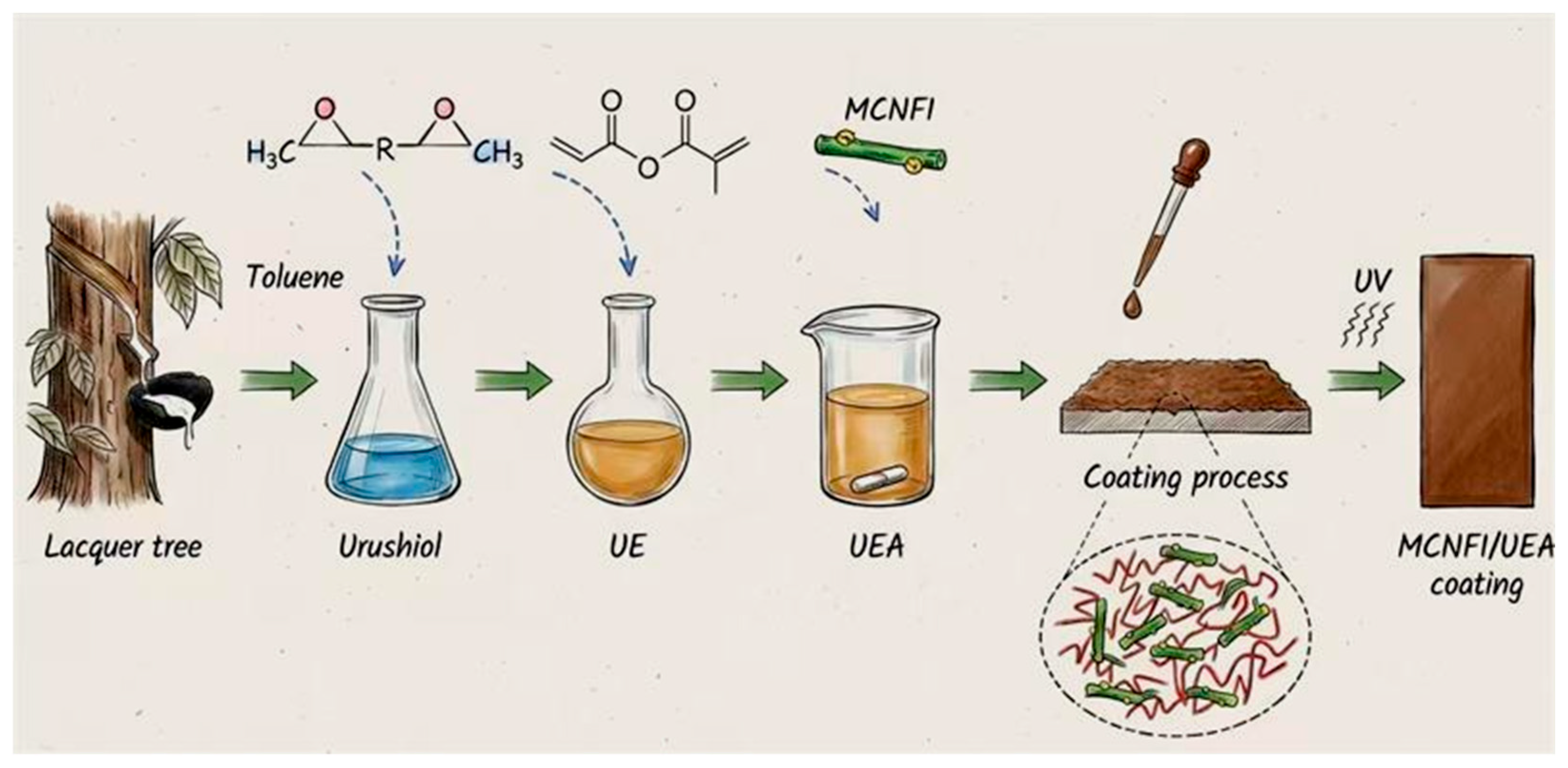
- Wu, H.; Han, X.; Zhao, W.; Zhang, Q.; Zhao, A.; Xia, J. Mechanical and Electrochemical Properties of UV-Curable Nanocellulose/Urushiol Epoxy Acrylate Anti-Corrosive Composite Coatings. Ind. Crops Prod. 2022, 181, 114805. [Google Scholar] [CrossRef]
- Bai, W.; Zhang, X.; Chen, X.; Li, P.; Huang, J.; Chen, J.; Zheng, S.; Li, X.; Lin, Y.; Jian, R. Magnetic Bio-Based Fe3O4@Urushiol-Fe Polymeric Nanoparticles for Efficient Photothermal Sterilization. J. Environ. Chem. Eng. 2024, 12, 113523. [Google Scholar] [CrossRef]
- Augustyniak, A.; Bartosz, G.; Čipak, A.; Duburs, G.; Horáková, L.; Łuczaj, W.; Majekova, M.; Odysseos, A.D.; Rackova, L.; Skrzydlewska, E.; et al. Natural and Synthetic Antioxidants: An Updated Overview. Free Radic. Res. 2010, 44, 1216–1262. [Google Scholar] [CrossRef]
- Ren, D.; Zhang, X.X.; Wang, H.K.; Li, W.J.; Yu, Y. Improving Thermo-Oxidative Degradation Resistance of Bamboo Fiber Reinforced Polypropylene Composite with Antioxidants. Part I: Screening of Antioxidants. J. Appl. Polym. Sci. 2016, 133, 44198. [Google Scholar] [CrossRef]
- Grelier, S.; Castellan, A.; Podgorski, L. Use of Low Molecular Weight Modified Polystyrene to Prevent Photodegradation of Clear Softwoods for Outdoor Use. Prog. Org. Coat. 2007, 92, 1520–1527. [Google Scholar] [CrossRef]
- Rumpf, J.; Bergrath, J.; Williams, M.B.; Zeppetzauer, F.; Kamm, B.; Schulze, M. Enhanced Antioxidant Capacity of Miscanthus-Derived Lignins via Organosolv Process Variation and Autohydrolysis. Biomacromolecules 2026, 27, 1999–2011. [Google Scholar] [CrossRef]
- Moccia, F.; Piscitelli, A.; Giovando, S.; Giardina, P.; Panzella, L.; d’Ischia, M.; Napolitano, A. Hydrolyzable vs. Condensed Wood Tannins for Bio-Based Antioxidant Coatings: Superior Properties of Quebracho Tannins. Antioxidants 2020, 9, 804. [Google Scholar] [CrossRef]
- Dong, X.; Gao, L.; Xiao, T.; Zhang, J.; Ping, Q. Green and Sustainable Fabrication of UV-Resistance and Antioxidant Cotton via Self-Crosslinking Bamboo Ethanol Lignin. Ind. Crops Prod. 2025, 202, 115–126. [Google Scholar] [CrossRef]
- Zhang, C.; Ou, Y.; Lei, W.-X.; Wan, L.-S.; Ji, J.; Xu, Z.-K. CuSO4/H2O2-Induced Rapid Deposition of Polydopamine Coatings with High Uniformity and Enhanced Stability. Angew. Chem. Int. Ed. 2015, 54, 12345–12352. [Google Scholar]
- Jiang, T.; Zhang, J. Comparison of UV Resistance of HDPE Added with Hindered Amine Light Stabilizers with Different Molecular Structures. Polym. Adv. Technol. 2021, 32, 1288–1300. [Google Scholar] [CrossRef]
- Zhao, X.; Wang, L.; Guo, L.; Ma, Y.; Wang, Z.; Niu, Q. The Effect of a Hindered Amine Light Stabilizer on the Aging Behavior of Moisture-Curable Polyurethane as a Cultural Relics Consolidant. Polimery 2020, 65, 297–309. [Google Scholar] [CrossRef]
- Klampfl, C.; Himmelsbach, M. Advances in the Determination of Hindered Amine Light Stabilizers—A Review. Anal. Chim. Acta 2016, 933, 10–22. [Google Scholar] [CrossRef]
- Forsthuber, B.; Grüll, G. The Effects of HALS in the Prevention of Photo-Degradation of Acrylic Clear Topcoats and Wooden Surfaces. Polym. Degrad. Stab. 2010, 95, 746–755. [Google Scholar] [CrossRef]
- Mashalavi, B.; Masoum, S. Eco-Friendly Fabrication of Durable Superhydrophobic Coatings on Wood Using Modified ZnO–TiO2 Nanocomposite and Bio-Based Components. J. Adhes. Sci. Technol. 2026, 1–21. [Google Scholar] [CrossRef]
- Lu, K.-T.; Lee, J.-J. Effects of Adding Antioxidants on the Lightfastness Improvement of Refined Oriental Lacquer. Polymers 2021, 13, 1110. [Google Scholar] [CrossRef]
- Shin, Y.R.; Lee, S.; Lee, J.H.; Moon, J.; Hwang, G.I.; Lee, H.; Kim, H.; Lee, S.; Jeong, Y.G. Sustainable UV-Curable Coatings Based on Urushiol and Lignin: From Radical Crosslinking to Functional Performance. Prog. Org. Coat. 2026, 212, 109883. [Google Scholar] [CrossRef]
- Narita, C.; Okahisa, Y.; Yamada, K. Plasticizing Effect of Lignin on Urushi in Bio-Composite Films. Polymer 2019, 161, 49–54. [Google Scholar] [CrossRef]







| Resin Type | Main Degradation Mechanism | Sensitive Groups | Key Evaluation Criteria |
|---|---|---|---|
| Alkyd | Photo-oxidation, chain scission | C=C, ester | Carbonyl index, Δb, gloss |
| Polyurethane | Urethane cleavage, oxidation | -NH-COO- | ΔE, tensile strength |
| Epoxy | Ether bond scission | C-O-C | Crosslink density, FTIR |
| Nitrocellulose | Nitrate photolysis | -ONO2 | Mass loss, gloss |
| Strategy | Mechanism | Advantages | Disadvantages | Applicable Systems | Representative References |
|---|---|---|---|---|---|
| UV Absorbers | Absorb UV light and convert it into heat, reducing UV energy penetration | High UV absorption efficiency; suitable for transparent coatings; compatible with other additives | May degrade under prolonged UV exposure; partial migration | Solvent-based, waterborne, UV-curable coatings | [40,47] |
| UV Stabilizers (HALS) | Capture free radicals and quench excited-state molecules, interrupting photo-oxidative chain reactions | Long-term effectiveness; synergistic with UV absorbers; suitable for high-durability coatings | High concentrations may affect transparency; limited compatibility with acidic systems | Acrylic, polyurethane, waterborne coatings | [40,41] |
| Barrier & Shielding Materials | Form dense coatings with nanoparticles or nanofibers that scatter or absorb UV | Improve mechanical strength and water resistance; enhance protection of natural wood | Nanoparticle aggregation may reduce transparency; higher production cost | Waterborne coatings, composite coatings, outdoor wood | [43,46] |
| Antioxidants | Capture free radicals or decompose peroxides, interrupting photo-oxidative chain reactions | Improve stability of resin and lignin; synergistic with UV absorbers and HALS | Sensitive to combined thermal and UV stress; natural antioxidants may have dispersion issues | Solvent-based, waterborne, bio-based coatings | [10,52] |
| Strategy | Additive/System | Key Property | Before Modification | After Modification | Improvement | Reference |
|---|---|---|---|---|---|---|
| UV Absorber | Benzotriazole (UVA) | ΔE (color change) after UV exposure | ~12–15 | ~5–7 | ↓ ~50–60% | [40] |
| HALS + UVA | HALS-3 + UVA-2 | Δb* (yellowing) after 500 h UVA-340 | High yellowing | Significantly reduced | ↓ ~40–60% | [40] |
| Nanoparticles | ZnO/TiO2 | UV transmittance (UVA) | ~60–70% | <20% | ↓ ~70% | [44,45] |
| Lignin nanoparticles | LNPs (~1%) | UVA transmittance | ~50% | <10% | ↓ ~80% | [23] |
| Cellulose/CeO2 composite | CNC + CeO2 | UV shielding efficiency | Moderate | High | ↑ significant | [11,38] |
| Antioxidants | Condensed tannins | Radical scavenging/stability | Moderate | Enhanced stability | ↑ | [52] |
| Hybrid systems | HALS + nanoparticles | Service life/durability | Baseline | >50% increase | ↑ >50% | [20,55] |
Disclaimer/Publisher’s Note: The statements, opinions and data contained in all publications are solely those of the individual author(s) and contributor(s) and not of MDPI and/or the editor(s). MDPI and/or the editor(s) disclaim responsibility for any injury to people or property resulting from any ideas, methods, instructions or products referred to in the content. |
© 2026 by the authors. Licensee MDPI, Basel, Switzerland. This article is an open access article distributed under the terms and conditions of the Creative Commons Attribution (CC BY) license.
Share and Cite
Xia, M.; Gao, H.; Feng, X.; Liu, X. Photodegradation Mechanisms and Anti-Aging Strategies of Wood Coatings: A Comprehensive Review. Polymers 2026, 18, 1090. https://doi.org/10.3390/polym18091090
Xia M, Gao H, Feng X, Liu X. Photodegradation Mechanisms and Anti-Aging Strategies of Wood Coatings: A Comprehensive Review. Polymers. 2026; 18(9):1090. https://doi.org/10.3390/polym18091090
Chicago/Turabian StyleXia, Meng, Hanyun Gao, Xinhao Feng, and Xinyou Liu. 2026. "Photodegradation Mechanisms and Anti-Aging Strategies of Wood Coatings: A Comprehensive Review" Polymers 18, no. 9: 1090. https://doi.org/10.3390/polym18091090
APA StyleXia, M., Gao, H., Feng, X., & Liu, X. (2026). Photodegradation Mechanisms and Anti-Aging Strategies of Wood Coatings: A Comprehensive Review. Polymers, 18(9), 1090. https://doi.org/10.3390/polym18091090