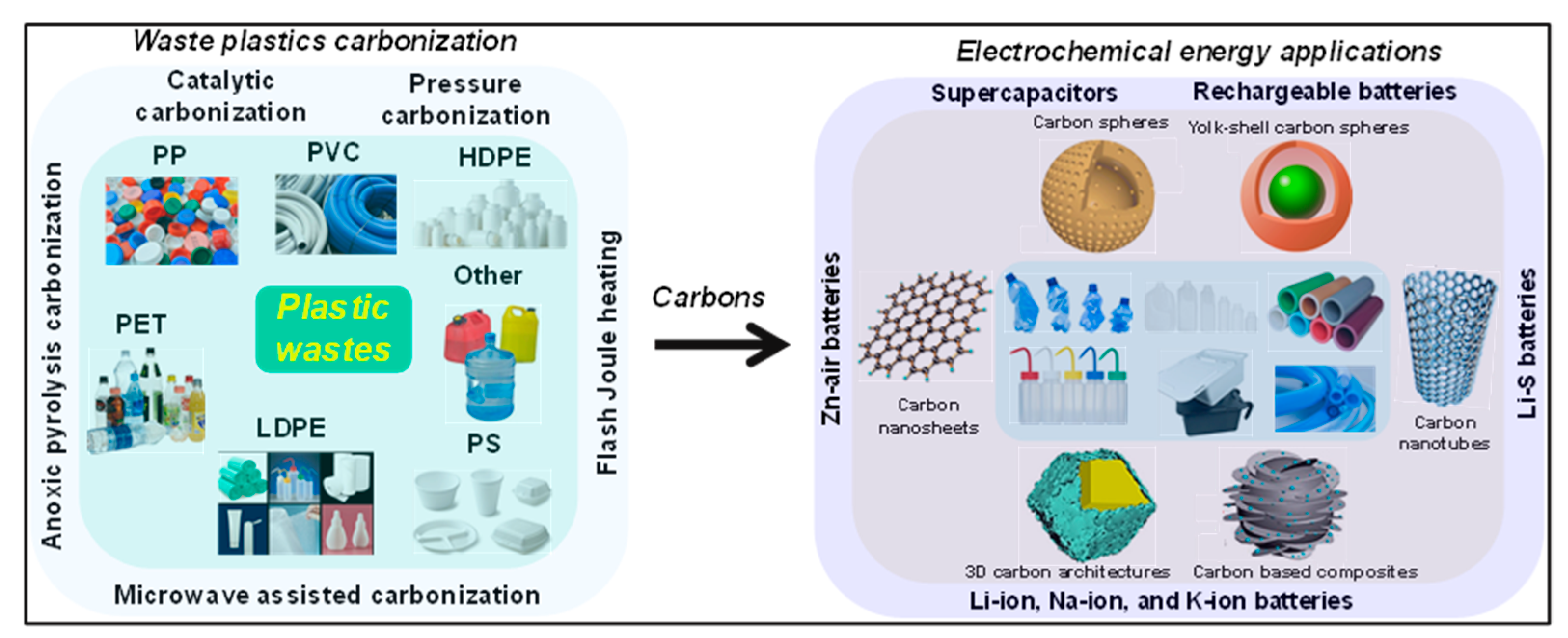
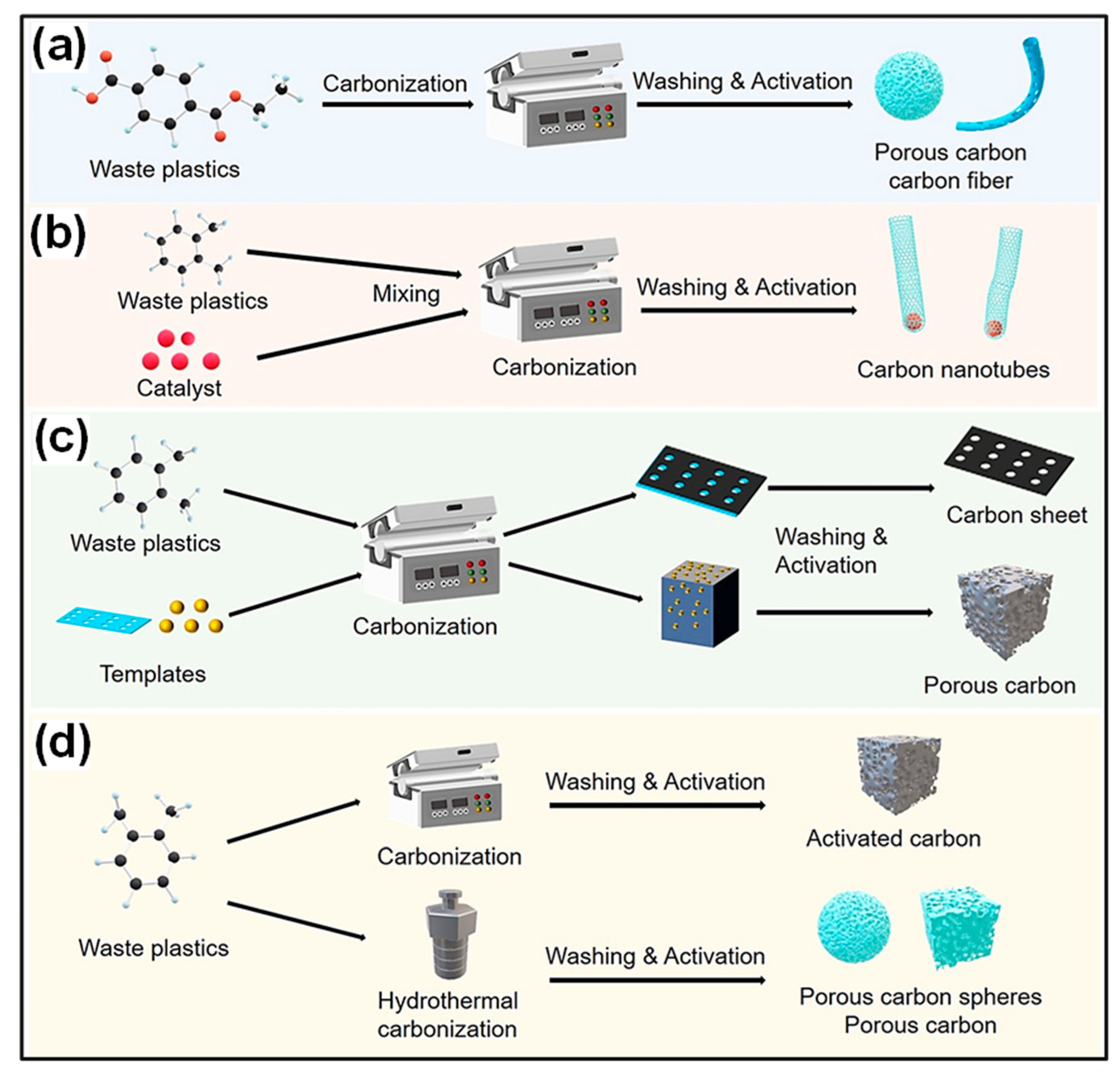
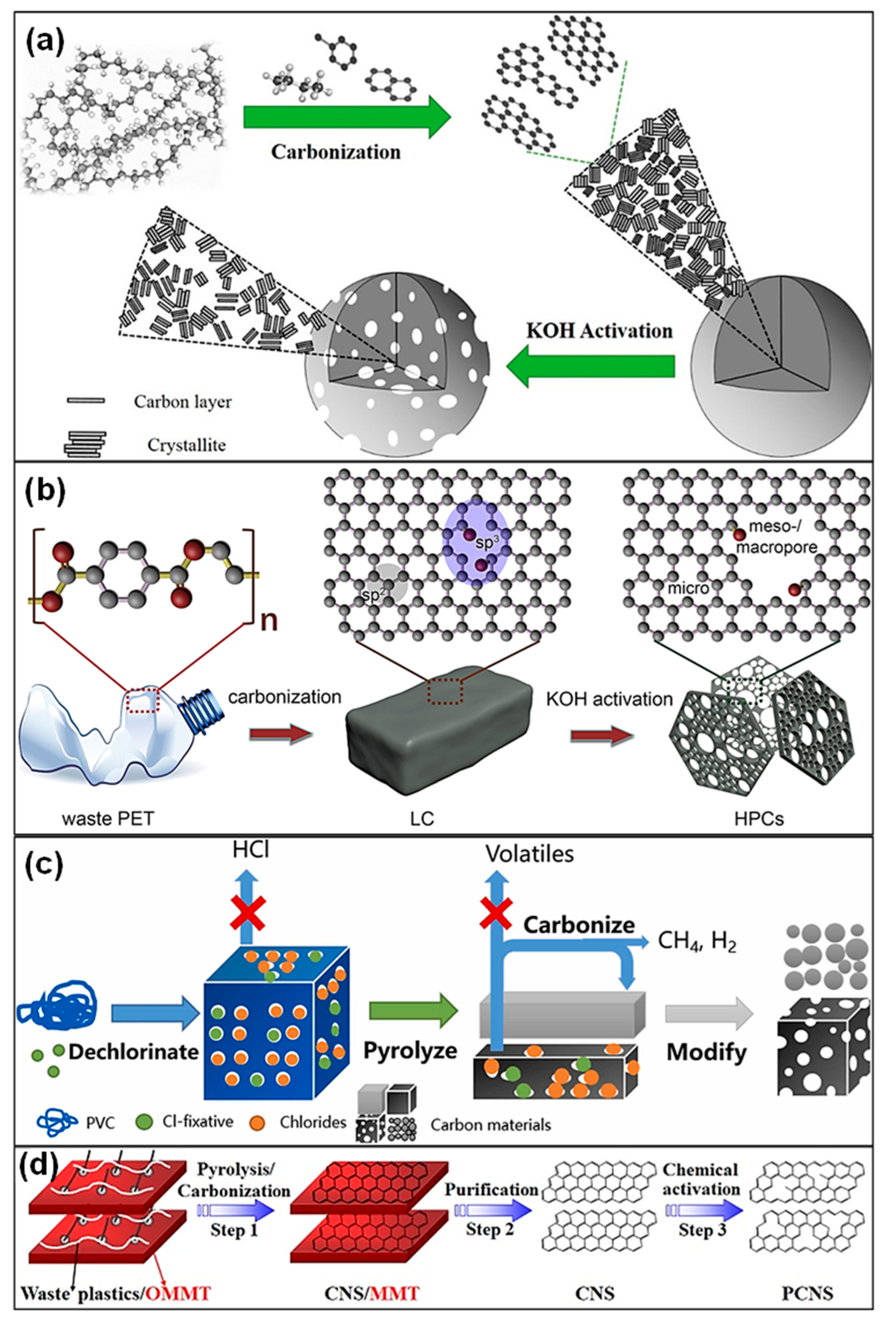
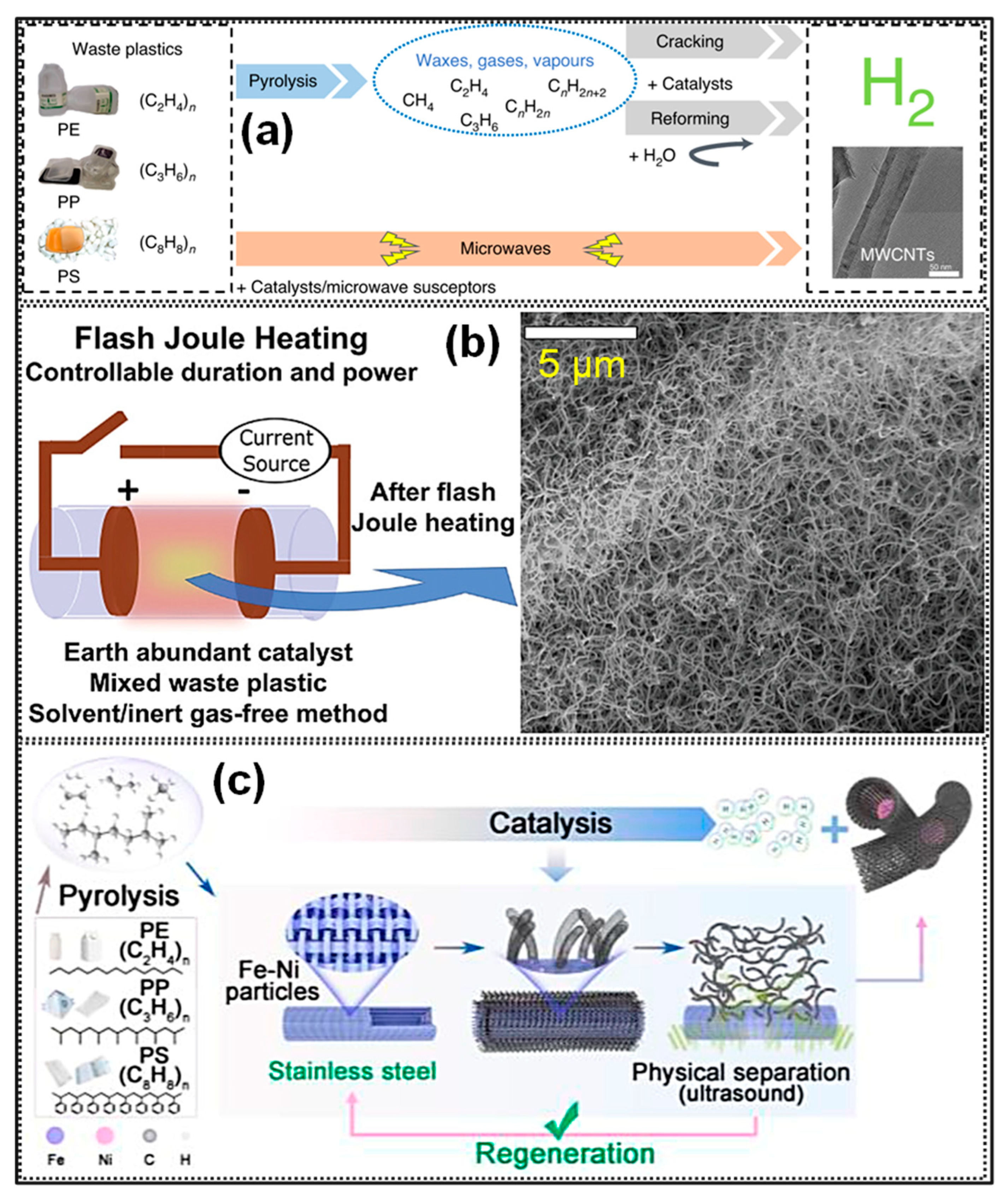
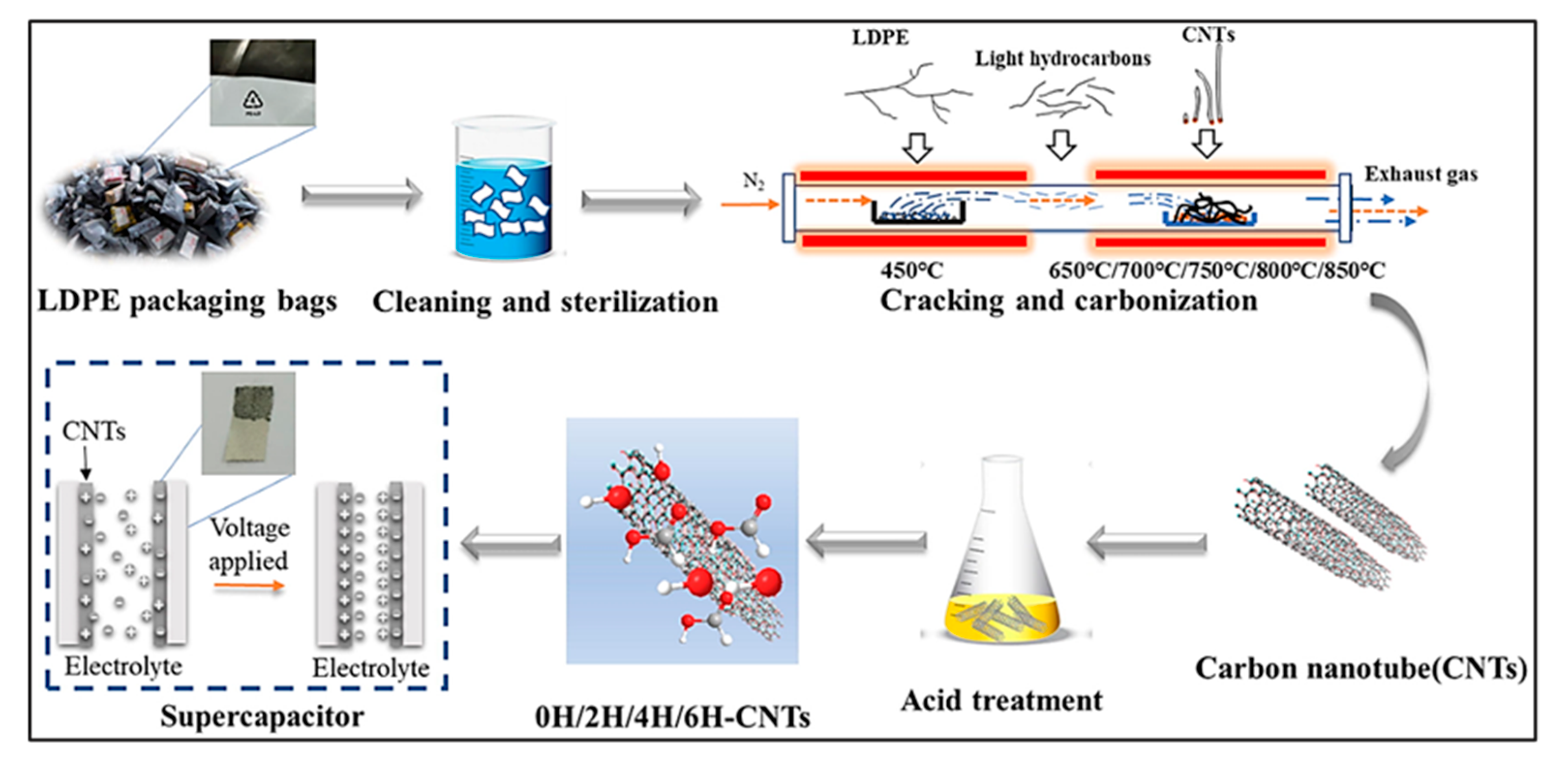
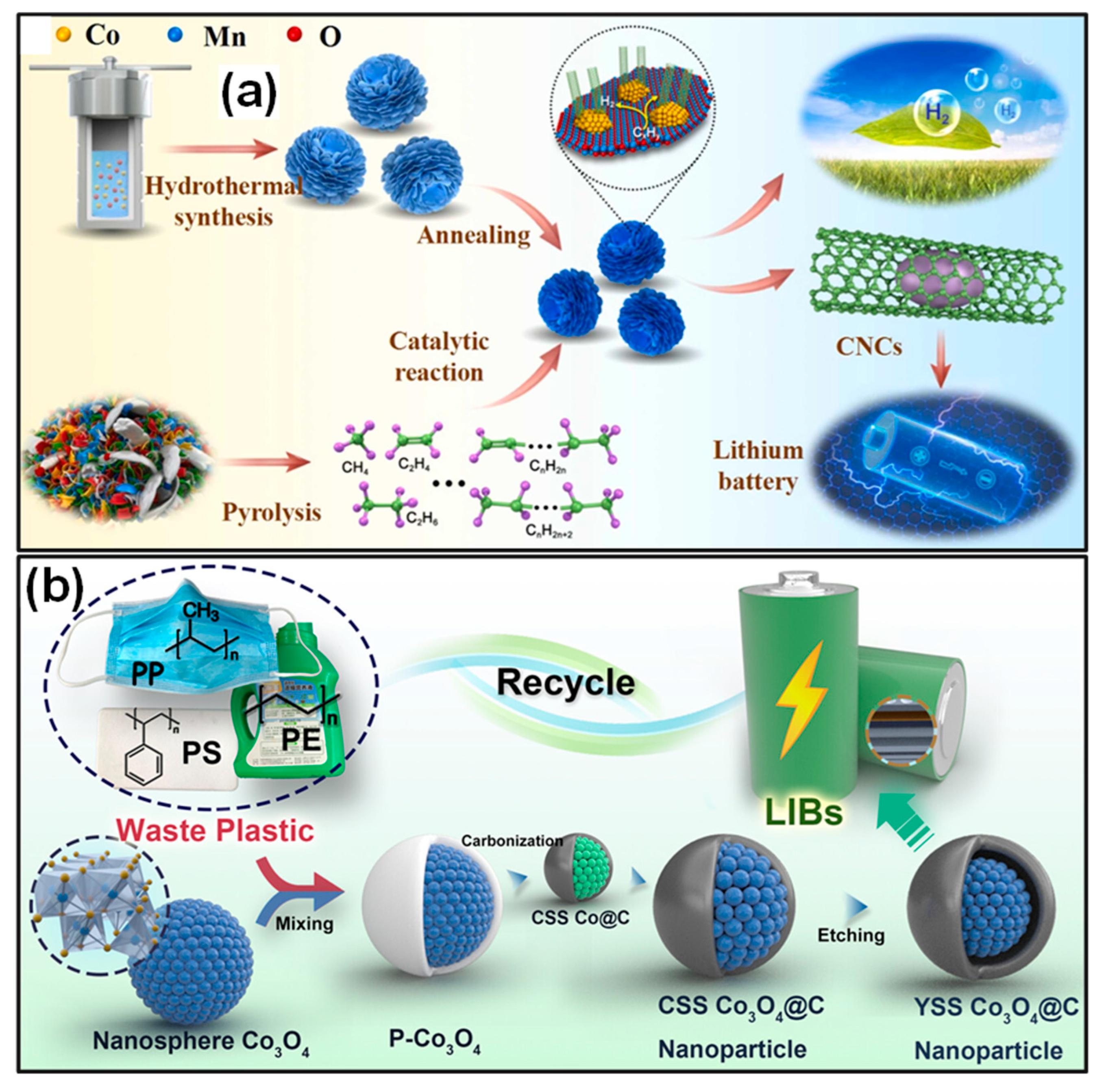
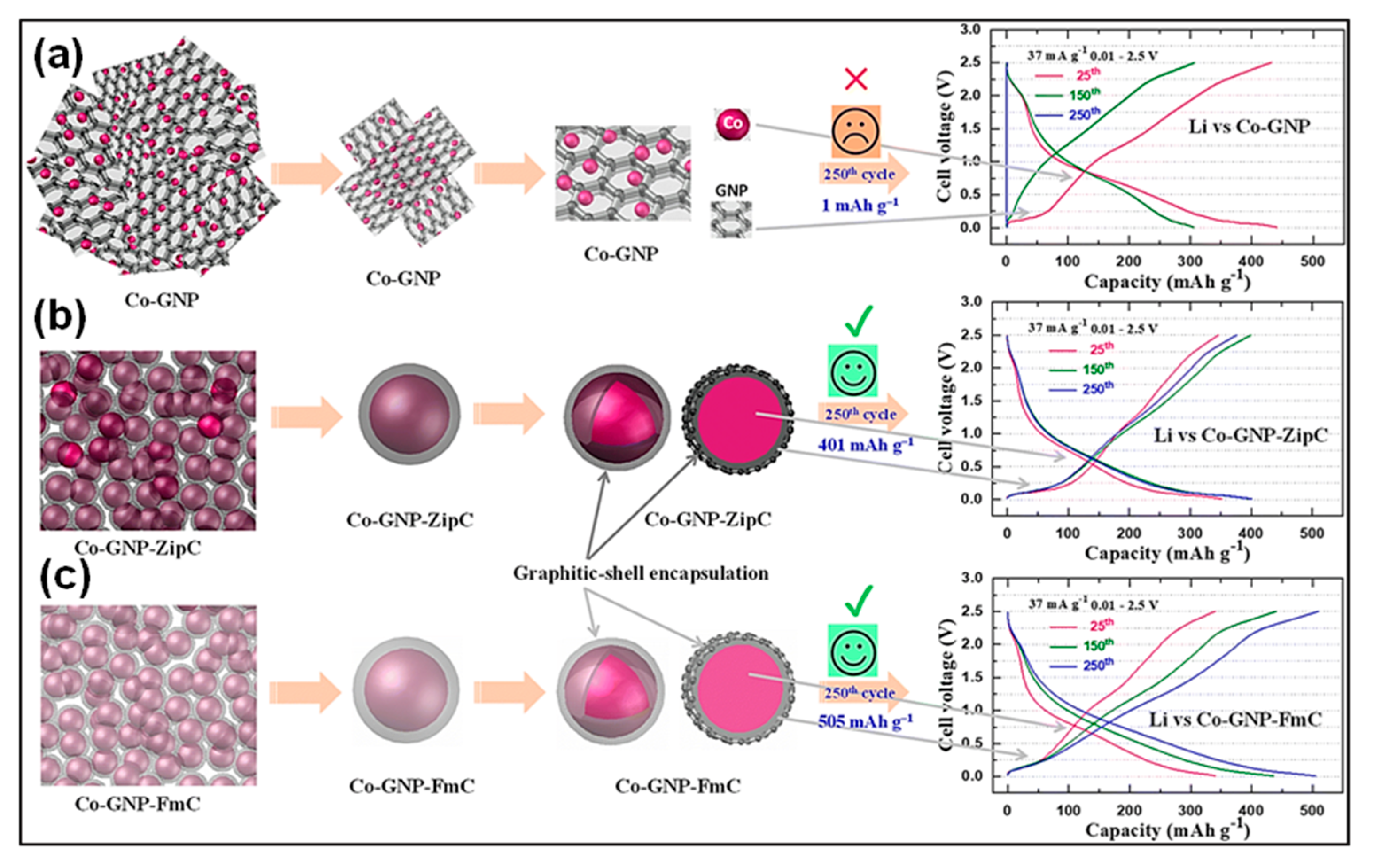
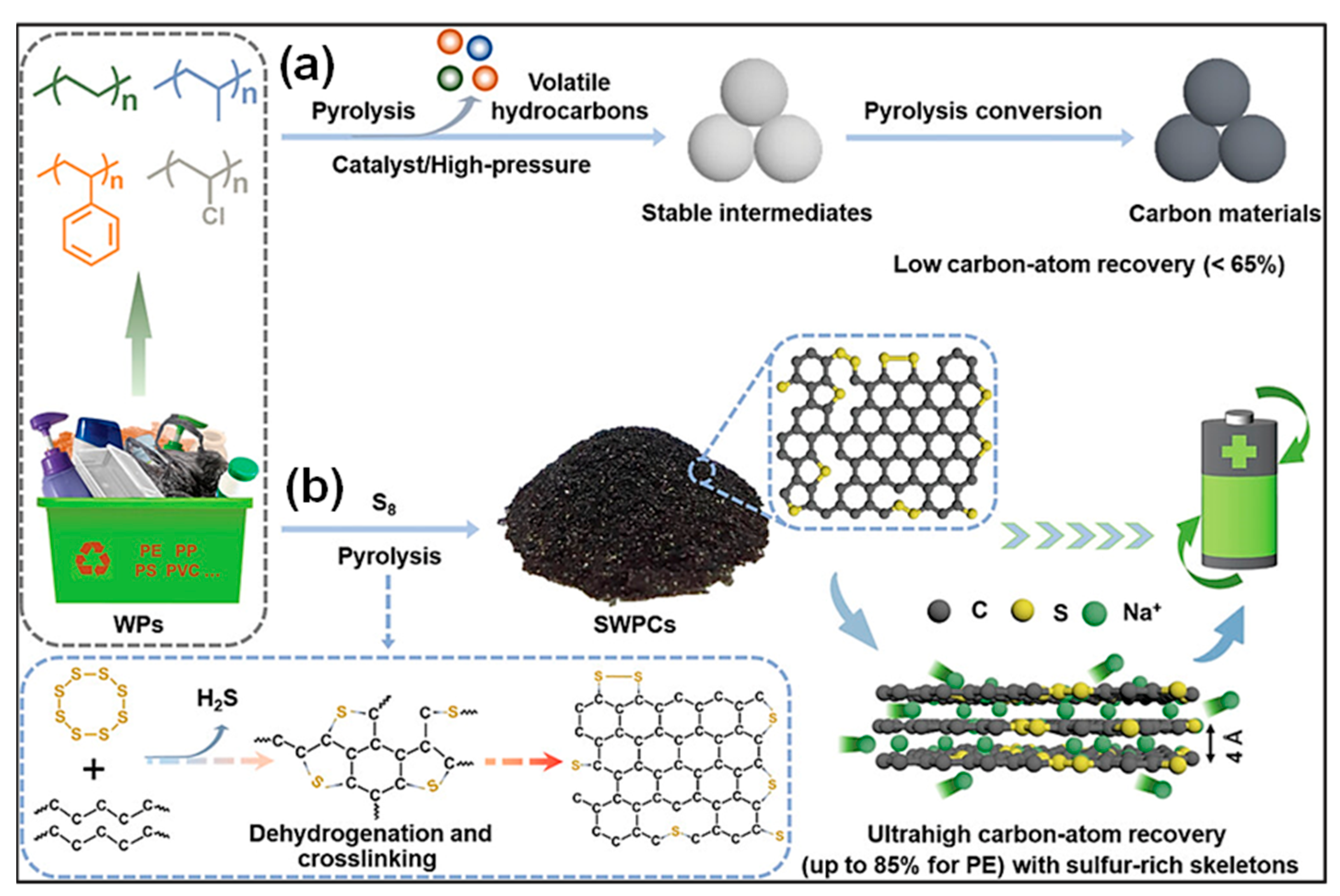
From Environmental Burden to Energy Resource: Waste Plastic-Derived Carbons for Sustainable Batteries and Supercapacitors



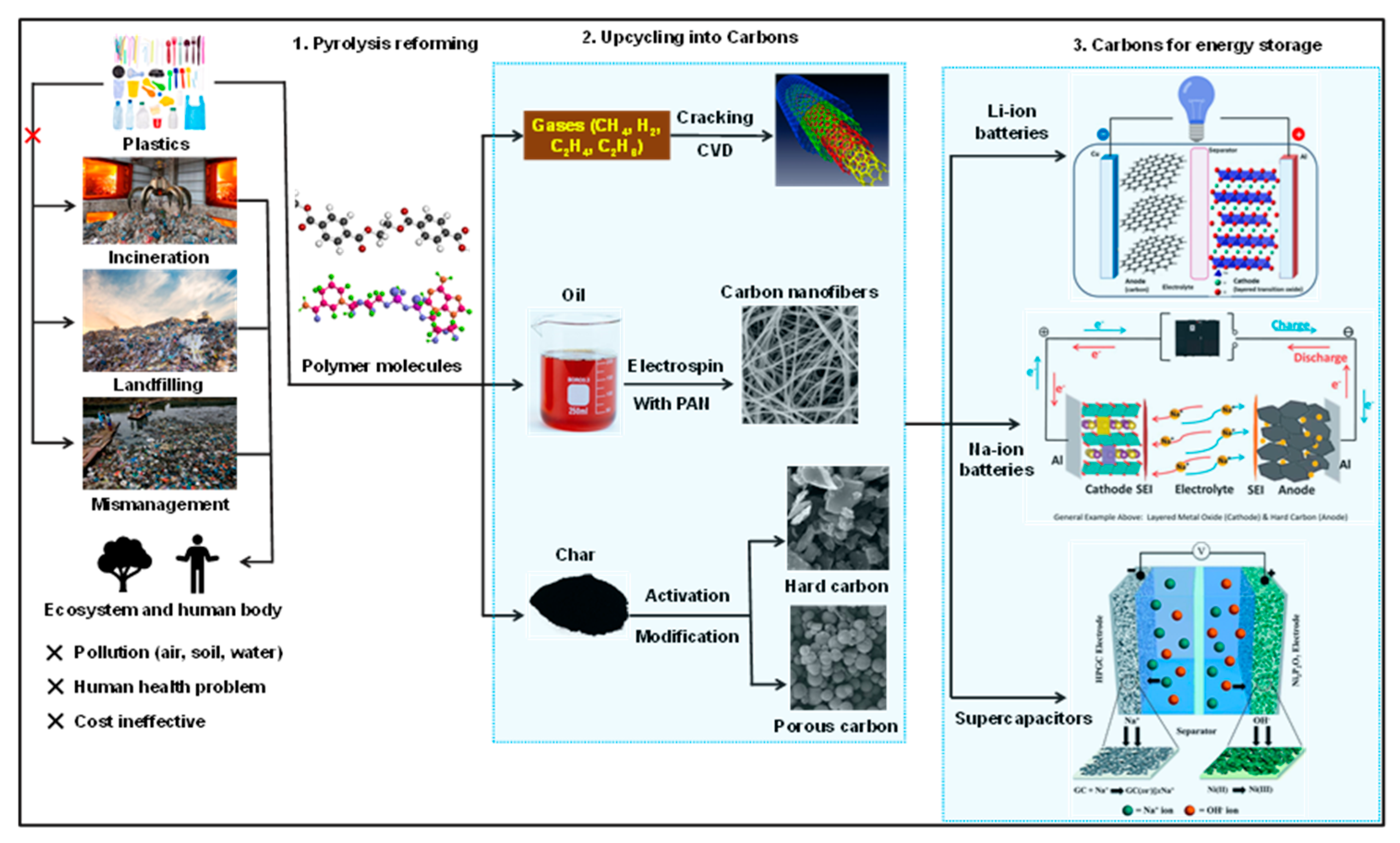
Abstract
1. Introduction
2. Production of C-Based Materials via Plastic Waste Conversion
2.1. C-Based Materials
2.2. Correlation Between Plastic Type and Derived C Microstructure
2.3. Preparation Approaches

2.4. Prospects for Future Development
3. Plastic Waste-Derived Carbons for Supercapacitors
3.1. Porous Carbons

| Plastics | Preparation Route | C Material | SC Configuration (Electrolyte) | Specific Capacitance (F g−1) [Current Density (A g−1)] | Capacitance Retention (%) [Cycle Number] | Ref. |
|---|---|---|---|---|---|---|
| LDPE | Autogenous-pressure carbonization combined with subsequent KOH activation | HPC spheres | Three electrode (6 M KOH) | 355 [0.2] | - | [62] |
| PET | HPCs | EDLCs (6 M KOH) | 325 [0.5] | 91.8 [5000] | [64] | |
| PET | Carbonization with subsequent KOH activation | HPCs | Three electrode (6 M KOH) | 413 [0.5] | - | [63] |
| PP | Carbonization conducted with ferrocene and S under autoclave conditions | PCNSs | 349 [0.5] | 99 [10,000] | [96] | |
| Mixed plastics | OMMT-assisted catalytic carbonization followed by KOH activation | HPC NSs | Three electrode (6 M KOH) | 207 [0.2] | - | [68] |
| Three-electrode (1 M Na2SO4) | 137 [0.2] | |||||
| PVC | Ball milling followed by KOH-assisted carbonization | HPCs | Three electrode (6 M KOH) | 399 [1.0] | 92 [1000] | [97] |
| PVC | Single-step carbonization in the presence of CaCO3, K2CO3, and melamine | N-doped HPC NSs | 347 [0.5] | 99.2 [5000] | [93] | |
| Tires | KOH-assisted catalytic pyrolysis | 3D graphene | EDLCs (6 M KOH) | 324.9 [0.2] | 95.9 [10,000] | [95] |
| Mixed plastics | ZnO- and MMT-assisted catalytic pyrolysis | Graphene NSs | EDLCs (1 M H3PO4) | 377.4 [1.0] | 89 [5000] | [98] |
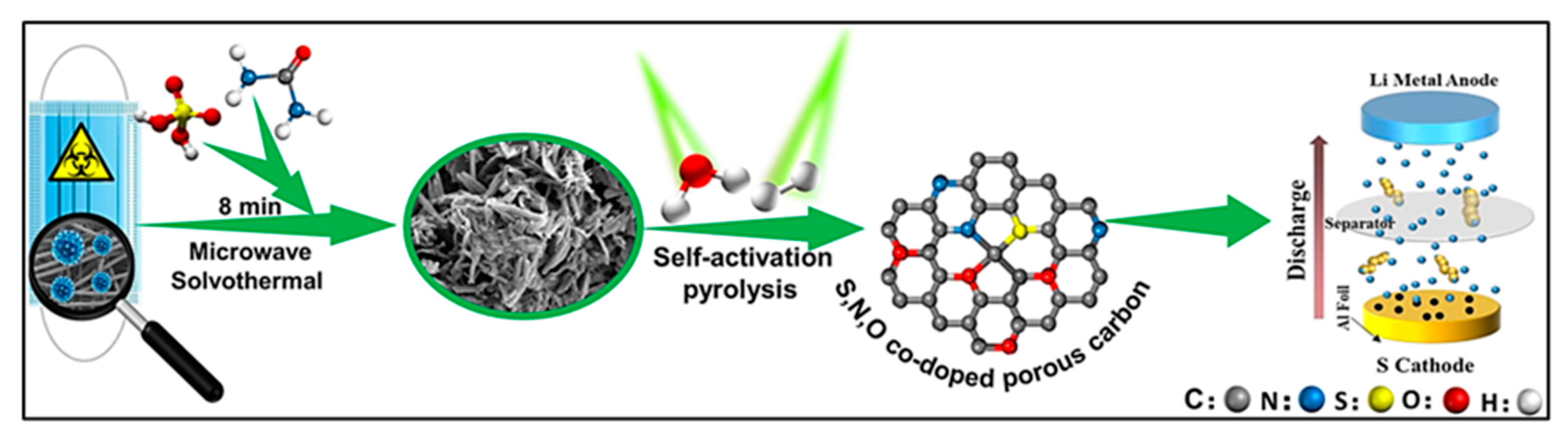
| Waste mask (PP) | NaOH activation after sulfonation treatment | S-doped porous C | HSCs (6 M KOH) | 338.1 [1.0] | 98.8 [10,000] | [99] |
| Waste mask (PP) | Thiourea-assisted molten salt carbonization | N, S co-doped porous C | Three-electrode (6 M KOH) | 345.6 [1.0] | 93.3 [20,000] | [100] |
| Waste mask (PP) | Carbonization with subsequent KOH activation | S-doped porous C | 651.1 [0.1] | 98 [50,000] | [101] | |
| Waste mask | Sulfidation and carbonization | S-doped CNFs | Three-electrode (2 M KOH) | 234 [0.5] | 96.8 [15,000] | [102] |
| PP | CuCl2-assisted molten-state carbonization | PCNSs | EDLCs (6M KOH) | 157 [0.1] | 87 [10,000] | [103] |
| Polyamide | K2CO3-assisted pyrolysis and activation | Porous C | Two-electrode (1 M H2SO4) | 220 [1.0] | 95 [30,000] | [104] |
| Polyurethane | MgO-templated co-carbonization with subsequent KOH activation | HPCs | 310 [0.5] | - | [105] | |
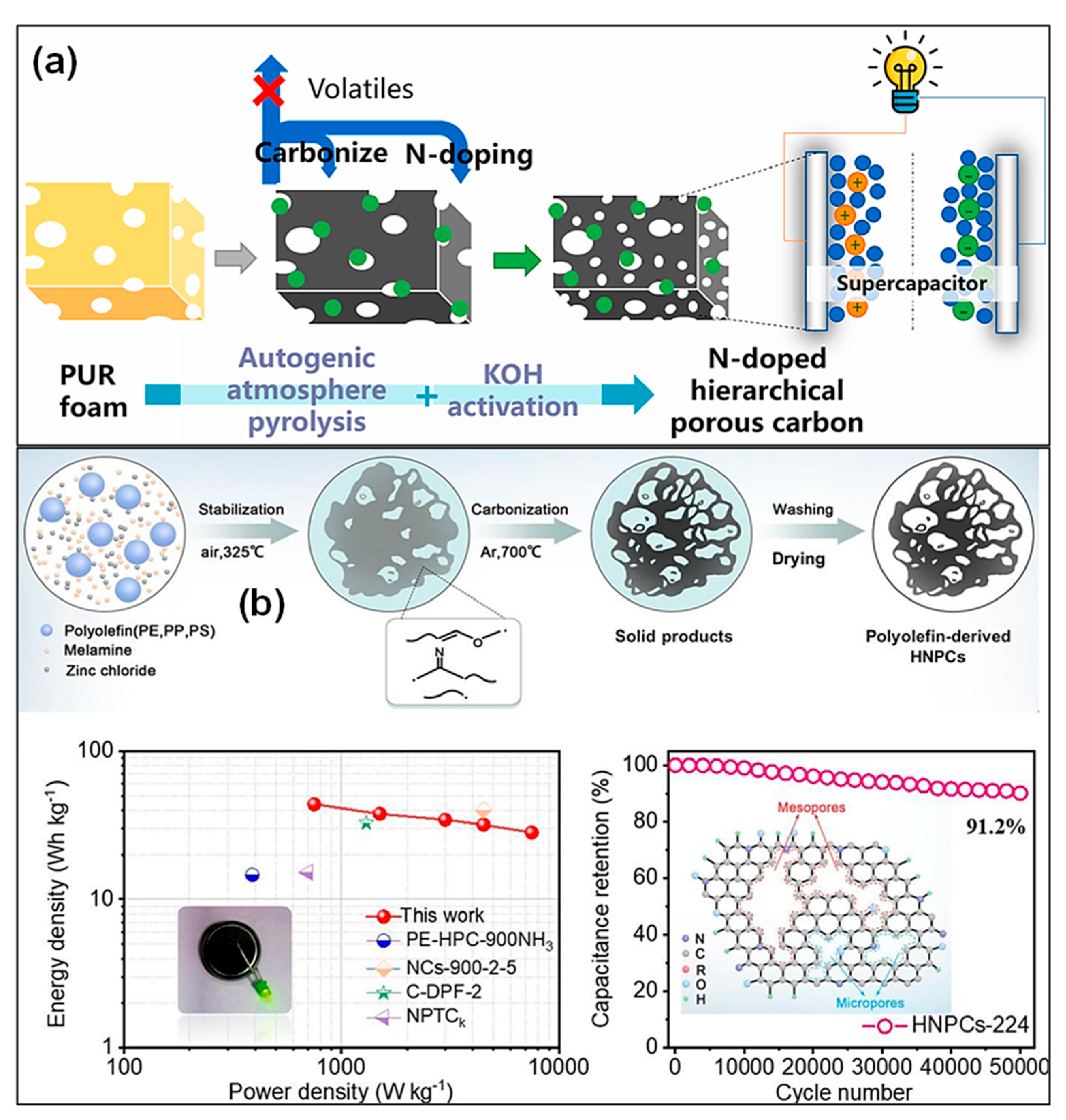
| Polyurethane foam | KOH-assisted pyrolysis and activation | N-doped HPCs | Three-electrode (6 M KOH) | 342 [0.5] | 87.4 [10,000] | [106] |
| Polystyrene | Fe2O3-assisted catalytic pyrolysis with subsequent KOH activation | HPCs | 284.1 [0.5] | 86.5 [10,000] | [107] | |
| LLDPE | KCl/K2CO3-assisted pre-oxidation and carbonization | Turbostratic graphene | Two-electrode (1 M H2SO4) | 175 [0.25] | 95.8 [100,000] | [94] |
| Polyolefin (PE, PP, PS) | ZnCl2- and melamine-assisted pre-oxidation and carbonization | N-doped HPCs | Two-electrode (2 M KOH) | 224.8 [1.0] | 91.2 [50,000] | [108] |
| PP | KOH-assisted sulfidation and carbonization | Carbon nanofiber | Three-electrode (6 M KOH) | 194 [0.5] | 80.4 [6000] | [109] |
| PET | KOH-assisted catalytic carbonization | PCNSs | 169 [0.2] | 90.6 [5000] | [110] | |
| PET | Urea-assisted carbonization after solvothermal treatment with Al cans | N-doped HPCs | 355 [0.5] | 88.2 [10,000] | [111] | |
| PET | MgO-templated carbonization with subsequent KOH activation | HPCs | Two-electrode (2 M KOH) | 191.4 [0.5] | 98.2 [5000] | [112] |
| PET | K2CO3-assisted one-step pyrolysis | HPCs | 332.3 [0.5] | 95.9 [10,000] | [113] | |
| PET | Carbonization after solvothermal treatment | NiOx@N-doped porous C | Three-electrode (6 M KOH) | 581.3 [5 mV s−1] | - | [114] |
| PET | Carbonization after hydrothermal treatment | N-doped mesoporous C | 295 [0.5] | 98 [400] | [115] | |
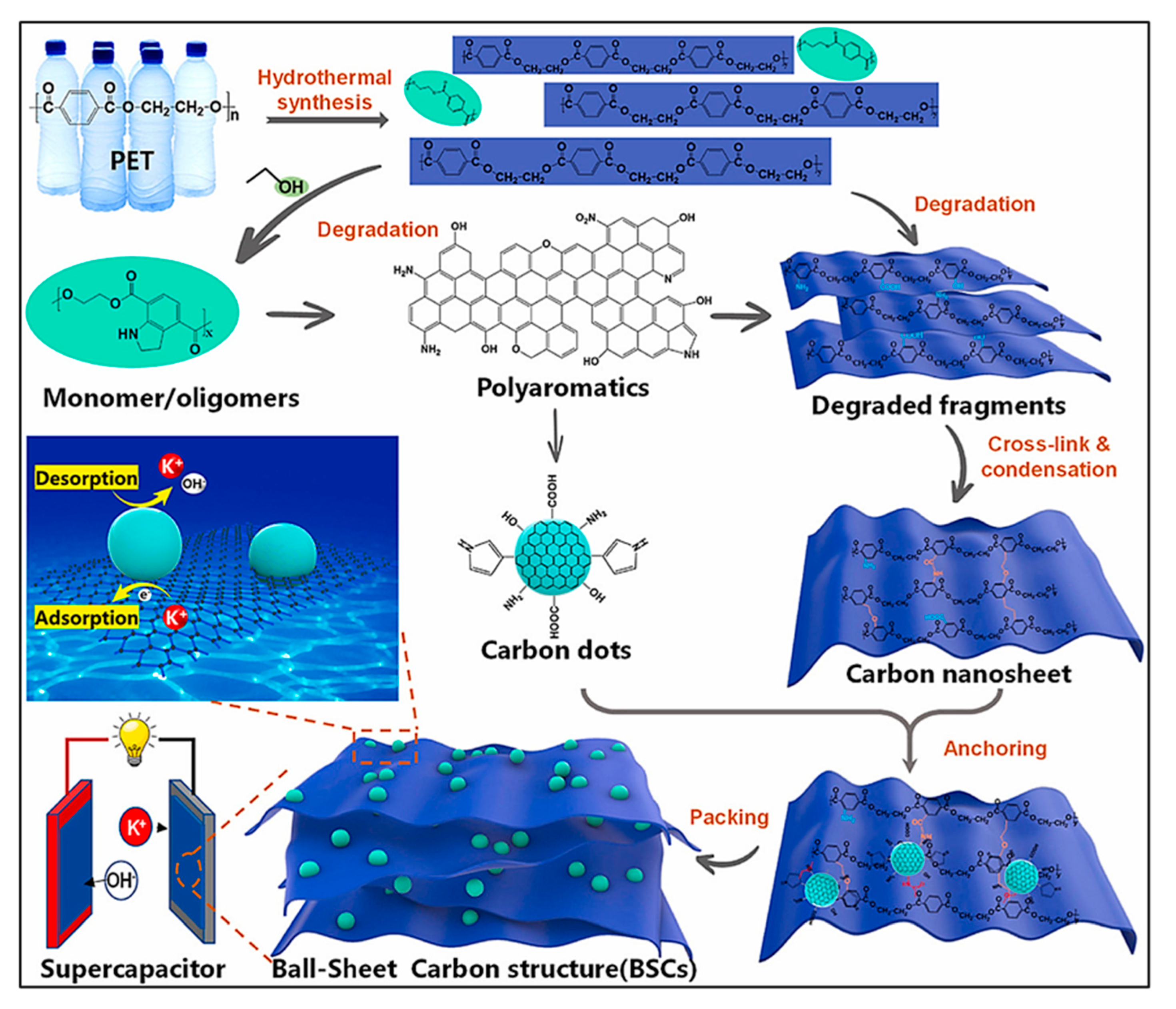
| PET | Hydrothermal preparation | Intercalated 0D C dots and 2D CNSs | DELC, (6 M KOH) | 237 [1.0] | 98 [12,000] | [116] |
3.2. Low-Dimensional Carbons
3.3. Prospects for Future Development
4. Rechargeable Batteries
4.1. Advanced Anode Architectures for Alkali-Metal Ion Batteries
4.1.1. Lithium-Ion Batteries
4.1.2. Sodium-Ion Batteries
4.1.3. Potassium-Ion Batteries
4.2. Cathodes for Lithium-Ion Batteries
4.3. Cathodes for Li-S Batteries
4.4. Cathodes for Zn-Air Batteries (ZABs)
4.5. Prospects for Future Development
5. Summary and Future Outlook
- (1)
- To establish sustainable pathways for converting waste plastics into high-performance C electrodes, careful consideration must be given to structural evolution during processing. Variations in geometrical morphology can lead to distinct intrinsic C properties, including differences in electron transport pathways, surface-to-volume ratios, and distribution of atomic-scale active centers. Consequently, the deliberate design of tailored C architecture must be closely matched to the requirements of specific applications. Achieving targeted C products requires precise regulation of key parameters that govern the final composition and structural characteristics. Moreover, a deeper understanding of the transformation mechanisms from plastics to C under various reaction conditions is crucial.
- (2)
- Fabrication of CNMs with diverse dimensional architectures from plastic waste typically involves complex procedures and specialized equipment. Developing highly selective catalysts that enable elevated C yields during carbonization remains a significant challenge. In addition, effective utilization of valuable byproducts (i.e., hydrogen) and proper management of harmful emissions (e.g., toxic volatile compounds) must be carefully addressed. For energy storage applications, C materials are generally required to meet stricter criteria, including thorough purification and structural uniformity. Therefore, comprehensive techno-economic evaluations and life-cycle assessments covering the entire process, from waste plastic treatment to C electrode manufacturing, should be conducted in upcoming studies.
- (3)
- CNMs derived from plastic wastes, particularly heteroatom-incorporated HPCs, have demonstrated remarkable electrochemical characteristics as SC electrodes. Through thermochemical routes such as pyrolysis, activation, and heteroatom incorporation, polymers including PET and PE can be transformed to HPCs with SSAs exceeding 1500 m2 g−1. When integrated with TM hydroxides, for example, Ni-Co-layered double hydroxides, these composites exhibit enhanced specific capacitance, elevated energy density, and robust cycling durability. Moving forward, research efforts should focus on environmentally sustainable approaches, such as low-temperature catalytic cracking and electrochemical reforming, to reduce both energy consumption and production costs. Additionally, optimizing pore architectures (i.e., hierarchical micro-/meso-porous structures) and tailoring surface functionalities (e.g., N and O incorporation) are essential to improve charge transport and interfacial adhesion. Establishing an integrated industrial framework encompassing plastic recycling, C material synthesis, and device assembly will also be crucial to address challenges related to mechanical robustness and batch consistency.
- (4)
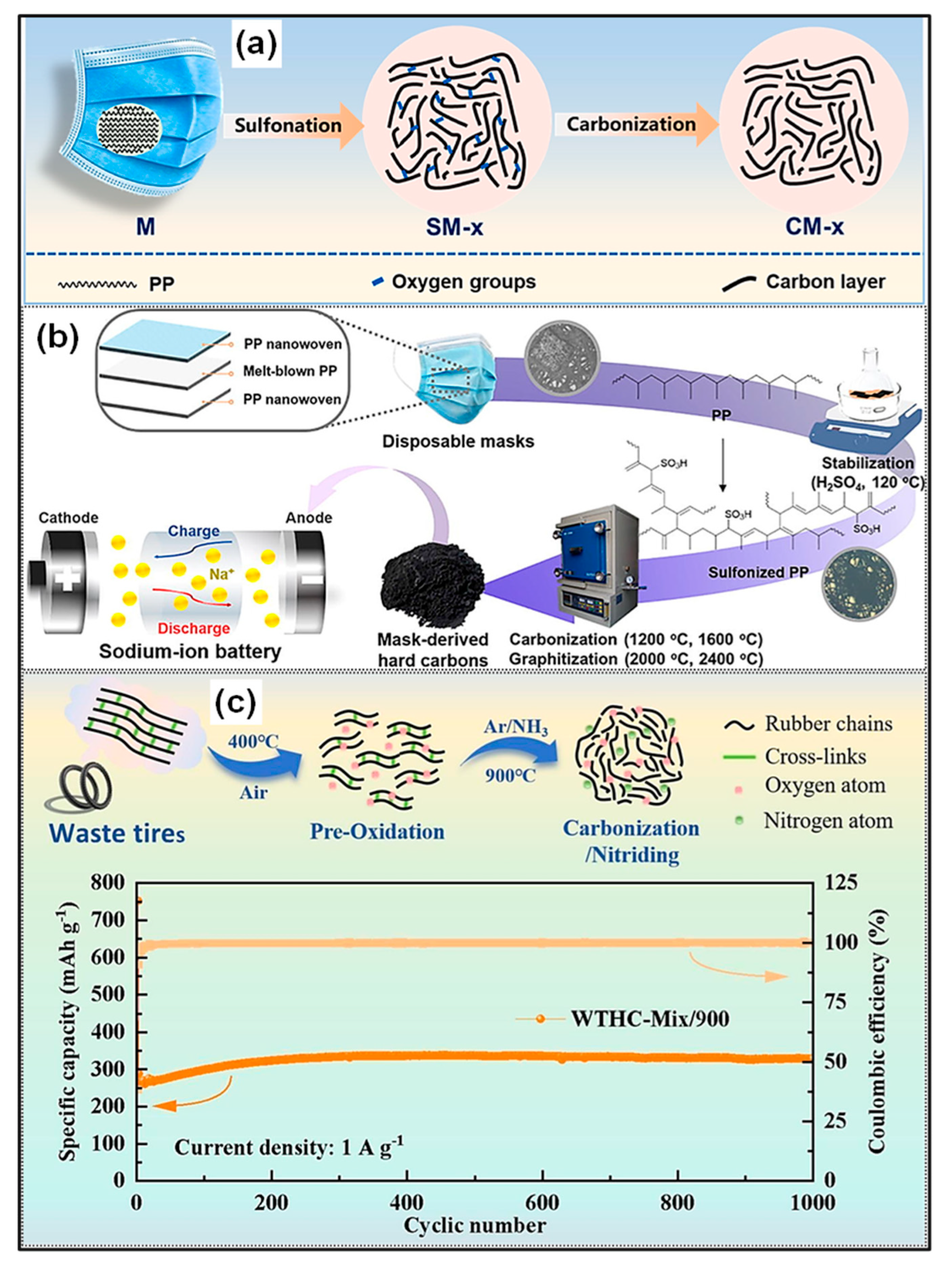
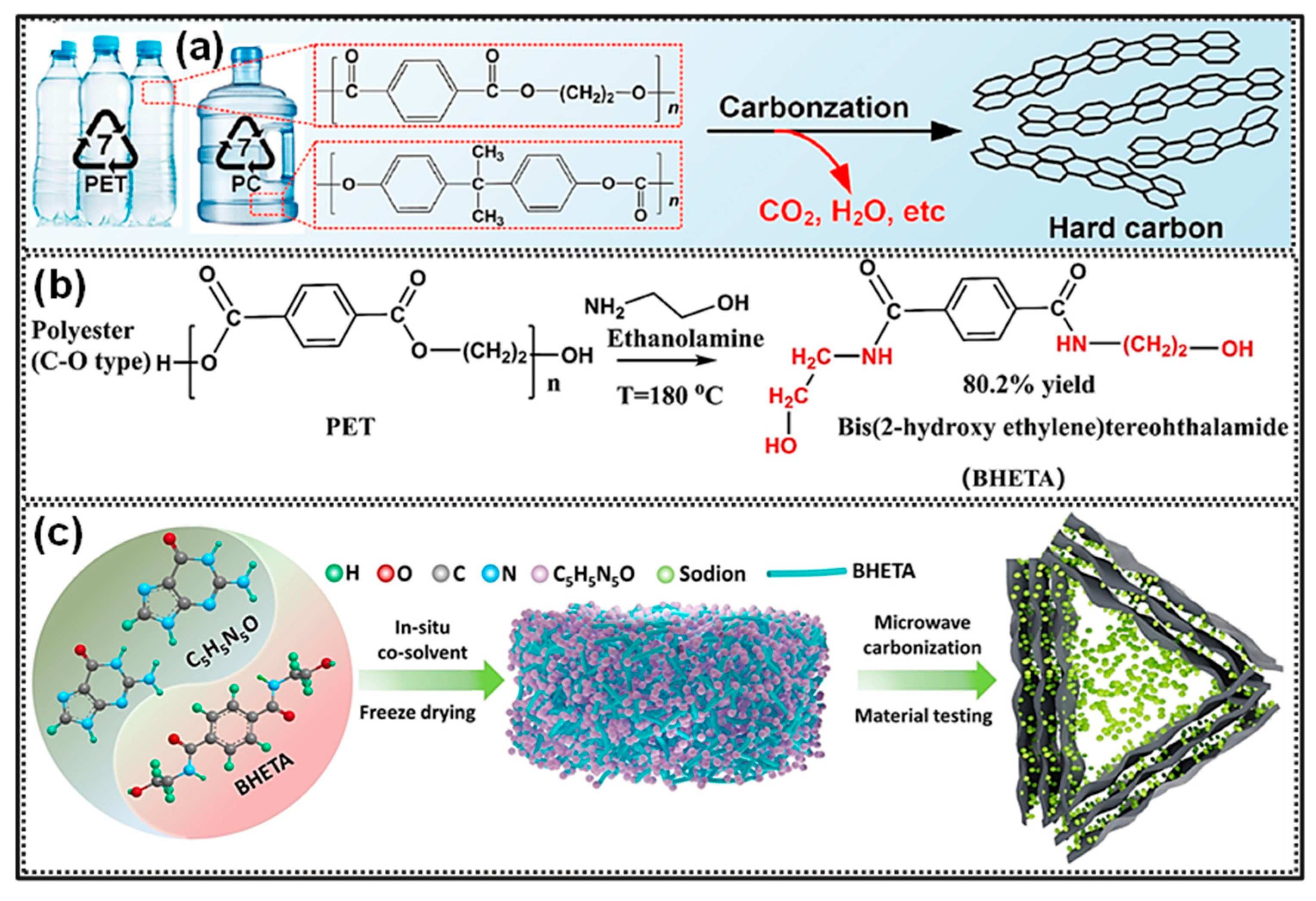
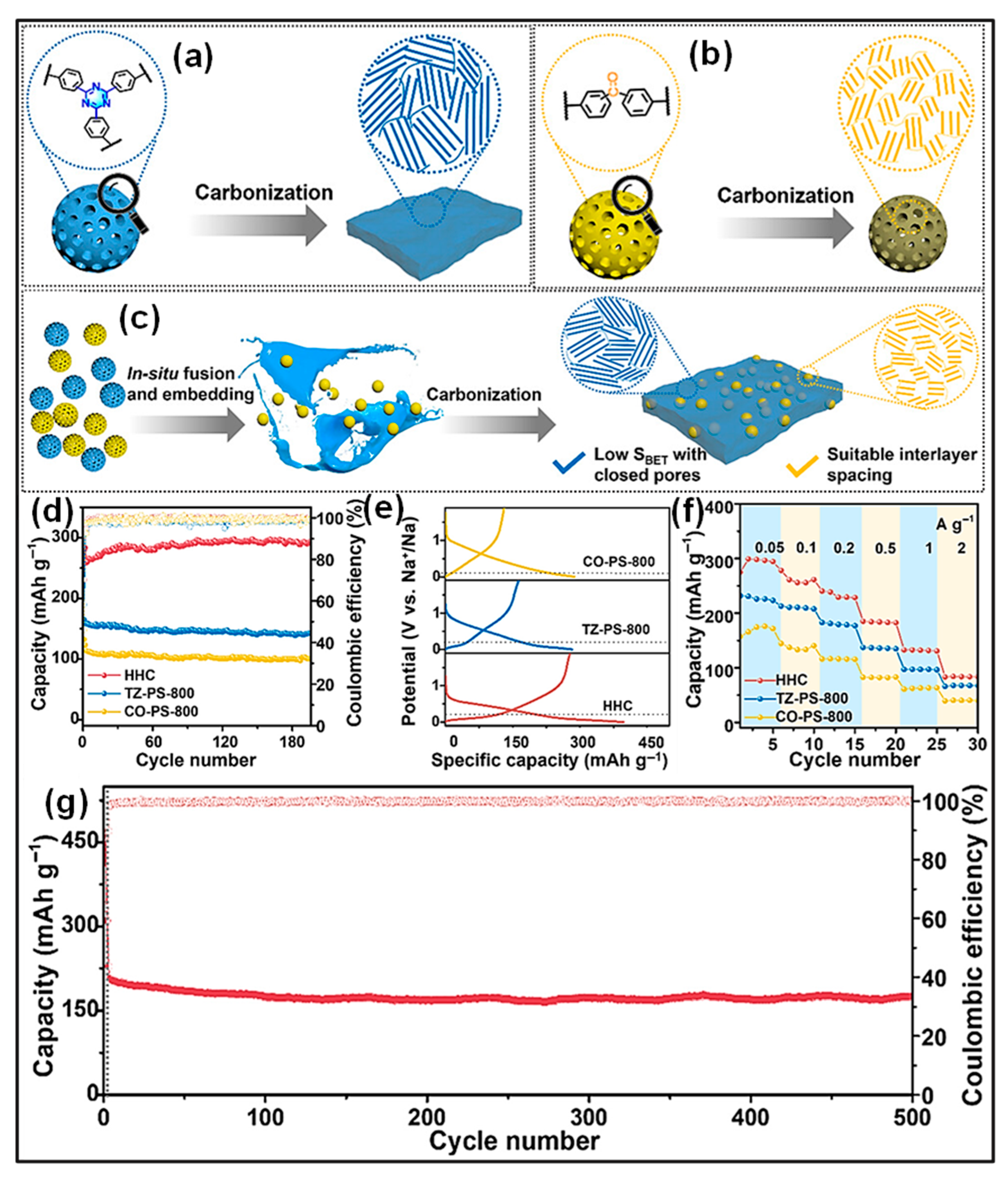
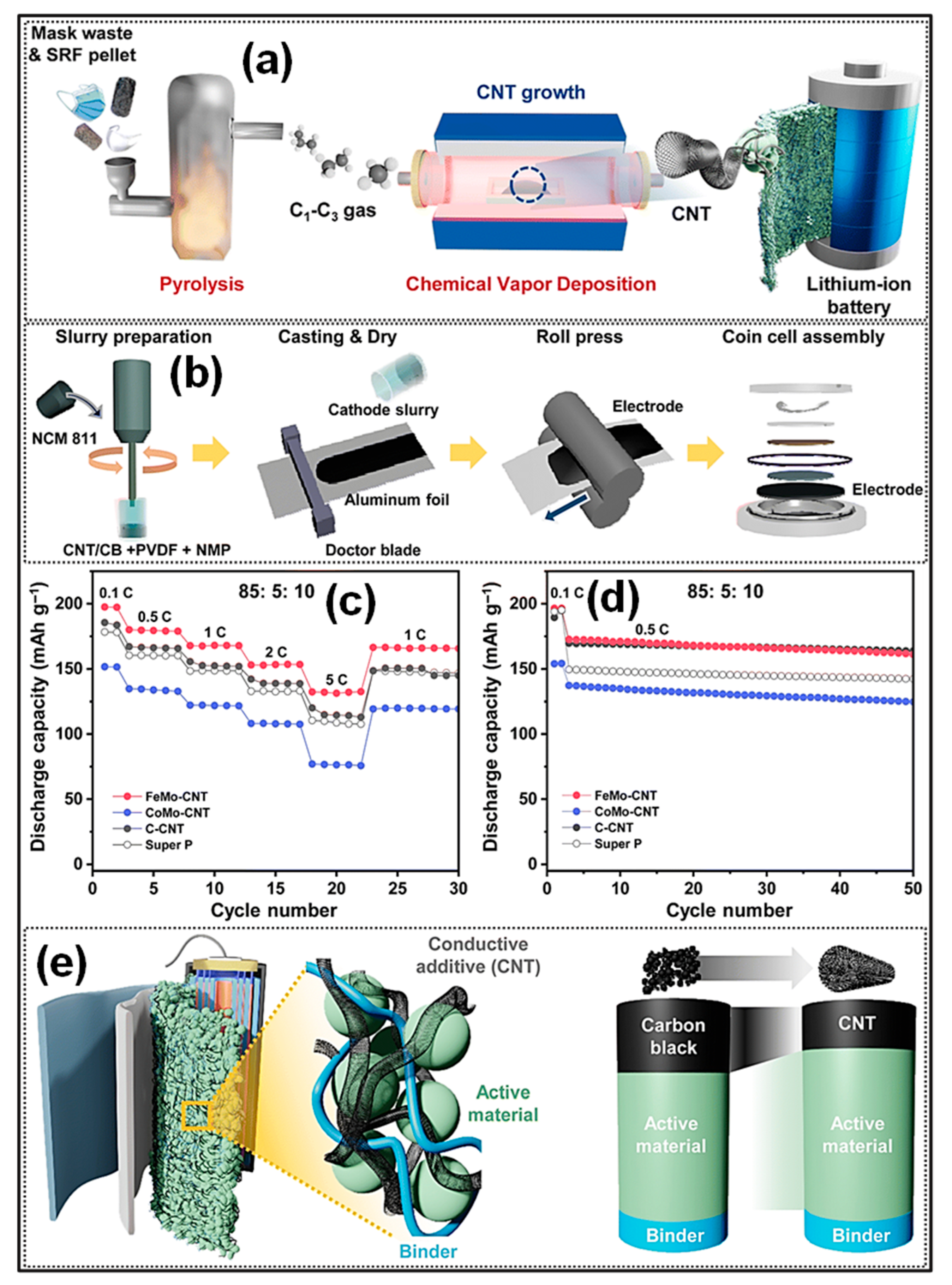
- Significant advances have been achieved in converting waste plastics into carbonaceous materials for alkaline-ion battery anodes, including LIBs and SIBs. Technologies such as catalytic annealing and flash carbothermal reduction enable the transformation of plastic waste into hard carbons and porous carbons suitable for anode applications. In particular, CNTs synthesized via CVD using pyrolysis gases from waste plastics exhibit strong potential as LIB anode materials. For SIB applications, waste plastic-derived hard carbons can deliver high reversible capacities and excellent cycling stability comparable to commercial counterparts. The selection of appropriate polymer precursors is critical for fabricating high-performance hard C anodes, as the precursor chemistry strongly influences the resulting microstructure and Na storage behavior. Notably, oxygen-containing precursors can inhibit graphitic rearrangement during pyrolysis, promoting the formation of turbostratic structures favorable for Na+ storage. Compared with polyolefins, polyester-based plastics (i.e., PC and PET) demonstrate greater promise for producing high-performance hard C.
- (5)
- Primary routes for converting plastic waste into CNMs encompass pyrolysis, molten salt-mediated catalysis, chemical activation, and advanced techniques such as FJH- and MW-assisted processing. Among these, pyrolysis remains the most industrially mature and widely implemented technique, with multiple projects exceeding capacities of 10,000 tons per year operating globally and demonstrating strong feedstock adaptability. Nevertheless, flue gas purification units contribute roughly 25% of the overall capital expenditure [211,212]. Economically, integrating C production with olefin co-generation can lower costs to approximately 590 Euro per ton, whereas a dedicated C production pathway results in an estimated cost of 980 Euro per ton. The molten salt approach shows significant potential for further cost reduction, although its salt recovery systems are currently limited to single-line production capacity. When the recycling efficiency of salts including KCl or K2CO3 reaches approximately 95%, PC with SSA of 1800 m2 g−1 can be manufactured at an estimated cost of 1350 Euro per ton. Chemical activation remains highly effective for producing PCs, yet the substantial consumption of activating agents leads to elevated wastewater treatment costs, thereby confining its use mainly to high-value electrode materials. Emerging technologies, including FJH, offer advantages in terms of lower energy consumption, but their large-scale implementation remains challenging due to high equipment costs and limited scalability.
- (6)
- However, the transformation of waste plastics into high-value energy storage products, such as components for batteries and SCs, holds considerable promise for resource recovery. However, scaling up these processes encounters multiple challenges across technological, regulatory, and societal dimensions. Technologically, the chemical inertness of plastics hampers efficient degradation, and energy storage applications require materials of exceptional purity. Current recycling methods, including pyrolysis and catalytic conversion, are often energy-intensive and yield complex mixtures of products, limiting their industrial viability. For example, the thermal treatment of chlorinated polymers such as PVC may generate dioxins, which can contaminate the resulting C materials. Furthermore, various plastic additives (e.g., flame retardants and plasticizers) may adversely affect the electrochemical behavior of electrodes, necessitating the development of targeted pretreatment strategies. In addition, the lack of a unified global classification system for plastic waste highlights deficiencies in policy frameworks and standardization. To achieve efficient energy recovery from waste plastic, it is essential to clearly define its classification as a “resource.” Without such recognition, certain plastics, especially electronic polymers containing heavy metals, may be treated as hazardous waste, which can impose restrictions on cross-border transport. Furthermore, the absence of standardized LCA frameworks for plastic-derived energy storage materials may result in controversies related to secondary environmental impacts. From a societal and commercial perspective, public confidence remains a concern. Public acceptance of “plastic waste-derived batteries” may be hindered by concerns regarding safety, particularly the risks of electrolyte leakage or thermal runaway. Furthermore, recycled plastic feedstocks generally involve higher supply chain costs than virgin materials, making economic viability reliant on policy support, such as C taxation or government incentives. From a systems perspective, the effective transformation of waste plastic to energy storage materials necessitates integration across multiple stages, including waste segregation, advanced sorting techniques (i.e., near-infrared identification), and subsequent chemical processing. Inadequate source separation at the household level, such as mixing PET bottles with multilayer packaging films, can significantly increase downstream sorting and processing costs. Overall, advancing energy storage applications of plastic waste necessitates overcoming interconnected technological, regulatory, and societal barriers. Priority should be given to developing low-emission conversion technologies, establishing internationally harmonized classification standards, and validating economic feasibility through pilot-scale demonstrations.
Author Contributions
Funding
Institutional Review Board Statement
Data Availability Statement
Conflicts of Interest
References
- Plastics Europe. Plastics—The Facts 2019. An Analysis of European Plastics Production, Demand and Waste Data; Plastics Europe: Brussels, Belgium, 2019; pp. 1–42. [Google Scholar]
- Cao, K.; Zhang, S.; Shi, Y.; Diao, X.; Wei, R.; Ji, N. Catalytic Upgrading of Plastic Wastes into High-Value Carbon Nanomaterials: Synthesis and Applications. ACS Nano 2025, 19, 12734–12761. [Google Scholar] [CrossRef] [Scilit]
- Roijen, E.V.; Miller, S.A. Leveraging biogenic resources to achieve global plastic decarbonization by 2050. Nat. Commun. 2025, 16, 7659. [Google Scholar] [CrossRef] [Scilit]
- Li, M.; Zhao, Z.X.; Zhao, Z.X.; Li, M. Review of Techniques for the Detection, Removal, and Transformation of Environmental Microplastics and Nanoplastics. ACS Appl. Mater. Interfaces 2025, 17, 20560–20589. [Google Scholar] [CrossRef] [Scilit] [PubMed]
- Liu, X.; Zhang, R.; Ma, H.X.; Cui, T.; Chi, J.; Liu, X.; Wang, L. Recovery Technology for Waste Plastics Based on Electrocatalytic Reforming: From Mechanism Understanding to Catalyst Design. Nano Energy 2026, 149, 111719. [Google Scholar] [CrossRef] [Scilit]
- Pobłocki, K.; Pawlak, M.; Drzeżdżon, J.; Jacewicz, D. Catalytic materials based on metals (ions) used in the upcycling of plastics and polymers into fuels and valuable chemicals as part of sustainable development. Mater. Sci. Eng. R Rep. 2025, 162, 100881. [Google Scholar] [CrossRef] [Scilit]
- Qin, J.; Wu, F.; Dou, Y.; Zhao, D.; Nielsen, C.H.; Zhang, W. Advanced Catalysts for the Chemical Recycling of Plastic Waste. Adv. Mater. 2025, 37, 2418138. [Google Scholar] [CrossRef] [Scilit] [PubMed]
- Moreno, E.; Murillo, H.A.; Debut, A.; Mora, J.R.; Ponce, S. High-performance green calcium oxide–biochar catalysts for the chemical recycling of PET waste. Chem. Eng. J. 2026, 530, 173475. [Google Scholar] [CrossRef] [Scilit]
- Anuar, S.Z.K.; Nordin, A.H.; Husna, S.M.N.; Yusoff, A.H.; Paiman, S.H.; Noor, S.F.M.; Nordin, M.L.; Ali, S.N.; Ismail, Y.M.N.S. Recent advances in recycling and upcycling of hazardous plastic waste: A review. J. Environ. Manag. 2025, 380, 124867. [Google Scholar] [CrossRef] [Scilit]
- Lee, J.E.; Lee, D.; Lee, J.; Park, Y.K. Current methods for plastic waste recycling: Challenges and opportunities. Chemosphere 2025, 370, 143978. [Google Scholar] [CrossRef] [Scilit]
- Daliri, O.S.; Ghabezi, P.; Steinbach, J.; Flanagan, T.; Finnegan, W.; Mitchell, S.; Harrison, N. Experimental study on mechanical properties of material extrusion additive manufactured parts from recycled glass fibre-reinforced polypropylene composite. Compos. Sci. Technol. 2023, 241, 110125. [Google Scholar] [CrossRef] [Scilit]
- Khurshid, M.F.; Hengstermann, M.; Hasan, M.M.B.; Abdkader, A.; Cherif, C. Recent developments in the processing of waste carbon fibre for thermoplastic composites—A review. J. Compos. Mater. 2020, 54, 1925–1944. [Google Scholar] [CrossRef] [Scilit]
- Yang, S.; Du, S.; Zhu, J.; Ma, S. Closed-loop recyclable polymers: From monomer and polymer design to the polymerization-depolymerization cycle. Chem. Soc. Rev. 2024, 53, 9609–9651. [Google Scholar] [CrossRef] [Scilit]
- Denissen, W.; Winne, J.M.; Prez, F.E.D. Vitrimers: Permanent organic networks with glass-like fluidity. Chem. Sci. 2016, 7, 30–38. [Google Scholar] [CrossRef] [Scilit]
- Guerre, M.; Taplan, C.; Winne, J.M.; Prez, F.E.D. Vitrimers: Directing chemical reactivity to control material properties. Chem. Sci. 2020, 11, 4855–4870. [Google Scholar] [CrossRef] [Scilit]
- Wienchol, P.; Szlęk, A.; Ditaranto, M. Waste-to-energy technology integrated with carbon capture–Challenges and opportunities. Energy 2020, 198, 117352. [Google Scholar] [CrossRef] [Scilit]
- Shi, Y.; Diao, X.Y.; Ji, N.; Ding, H.; Ya, Z.Y.; Xu, D.; Wei, R.; Cao, K.H.; Zhang, S. Advances and Challenges for Catalytic Recycling and Upgrading of Real-World Mixed Plastic Waste. ACS Catal. 2024, 15, 841–868. [Google Scholar] [CrossRef] [Scilit]
- Lee, T.W.; Kwon, D.; Lee, S.Y.; Kim, Y.; Kim, J.Y.; Song, H.; Jung, S.Y.; Lee, J.; Tsang, Y.F.; Kim, K.H.; et al. Recovery of chemicals and energy through thermo-chemical processing of plastic waste. Prog. Energy Combust. Sci. 2025, 108, 101219. [Google Scholar] [CrossRef] [Scilit]
- Liu, Q.; Villarreal, S.M.; Wang, S.; Tien, N.N.T.; Kammoun, M.; Roover, Q.D.; Len, C.; Richel, A. The role of plastic chemical recycling processes in a circular economy context. Chem. Eng. J. 2024, 498, 155227. [Google Scholar] [CrossRef] [Scilit]
- Luo, H.; Tyrrell, H.; Bai, J.Y.; Muazu, R.I.; Long, X. Fundamental, technical and environmental overviews of plastic chemical recycling. Green Chem. 2024, 26, 11444–11467. [Google Scholar] [CrossRef] [Scilit]
- Niu, F.; Wu, Z.; Chen, D.; Huang, Y.X.; Ordomsky, V.V.; Khodakov, A.Y.; Geem, K.M.V. State-of-the-art and perspectives of hydrogen generation from waste plastics. Chem. Soc. Rev. 2025, 54, 4948–4972. [Google Scholar] [CrossRef] [Scilit]
- Faizan, M.; Siddiqui, M.N. Plastic waste to hydrogen fuel: Cutting-edge catalytic technologies for sustainable energy transition. Int. J. Hydrogen Energy 2025, 127, 678–701. [Google Scholar] [CrossRef] [Scilit]
- Hussain, I.; Aitani, A.; Malaibari, Z.; Alasiri, H.; Akhtar, M.N.; Aldosari, O.F.; Ahmed, S. Chemical Upcycling of Waste Plastics to High Value-Added Products via Pyrolysis: Current Trends, Future Perspectives, and Techno-Feasibility Analysis. Chem. Rec. 2023, 23, e202200294. [Google Scholar] [CrossRef] [Scilit]
- Kumar, P.; Dave, A.; Reddy, S.N.; Nanda, S. Hydrothermal gasification of waste biomass and plastics into hydrogen-rich syngas: A review. Environ. Chem. Lett. 2025, 23, 117–138. [Google Scholar] [CrossRef] [Scilit]
- Chen, Z.; Wei, W.; Chen, X.M.; Liu, Y.; Shen, Y.S.; Ni, B.J. Upcycling of plastic wastes for hydrogen production: Advances and perspectives. Renew. Sustain. Energy Rev. 2024, 195, 114333. [Google Scholar] [CrossRef] [Scilit]
- Tewari, C.; Rawat, K.S.; Kim, Y.; Arya, T.; Dhali, S.; Rana, S.; Andreeva, D.V.; Özyilmaz, B.; Mahfouz, R.; Qari, N.; et al. Functional nanocarbons from waste plastics for energy storage applications. Renew. Sustain. Energy Rev. 2026, 226, 116443. [Google Scholar] [CrossRef] [Scilit]
- Huang, Y.; Thanh, C.L.D.; Yang, Z.; Dai, S.; Chen, H. A tandem approach for waste-to-nanomaterial transformation towards polyethylene recycling. RSC Sustain. 2026, 4, 748–753. [Google Scholar] [CrossRef] [Scilit]
- Luu, T.A.; Le, V.G.; Thai, V.A.; Nguyen, M.K.; Lin, C.; Pham, M.T.; Chang, S.W.; Nguyen, D.D. Plastic wastes for carbon-based materials: Investigations on recent applications towards environmentally sustainable, carbon dioxide capture and green energy. Environ. Pollut. 2025, 370, 125899. [Google Scholar] [CrossRef] [Scilit]
- Ma, Z.M.; Wang, L.; Wang, Z.; Cui, H.; Tang, E.; Hou, H.; Xu, G.Q.; Song, T.; Wang, Q.G. Recent Advances of Plastic Waste-Derived Carbon Materials for Energy Storage, Environmental Remediation and Organic Synthesis Applications. ChemCatChem 2024, 16, e202401072. [Google Scholar] [CrossRef] [Scilit]
- Nayak, S.K.; Saurabh, S.M.; Kar, A.; Sahoo, B.B.; Sahoo, N.K.; Sahoo, P.K. Advances in plastic waste-derived carbon nanomaterial for supercapacitor applications: Trends, challenges and prospective. Mater. Today Proc. 2022, 67, 1024–1032. [Google Scholar] [CrossRef] [Scilit]
- Choi, J.; Yang, I.; Kim, S.S.; Cho, S.Y.; Lee, S. Upcycling Plastic Waste into High Value-Added Carbonaceous Materials. Macromol. Rapid Commun. 2022, 43, 2100467. [Google Scholar] [CrossRef] [Scilit]
- Garcia, A.A.C.; Barta, K. Polyamides go circular. Nat. Sustain. 2024, 7, 523–524. [Google Scholar] [CrossRef] [Scilit]
- Cheng, Y.; Ma, X.; Xia, M.; Zhang, X.; Shang, J.Z.; Guo, P.; Lyu, M.; Gao, D.; Wei, Z.Y. High-performance, multifunctional sustainable polycarbonates and application in negative-type photoresists. Chem. Eng. J. 2025, 505, 159337. [Google Scholar] [CrossRef] [Scilit]
- Yang, Z.; Kang, X.; Lu, S.; Wang, Z.; Fang, X.; Li, J.; Liu, B.; Ding, T.; Xu, Y.Q. Synergistic effects of molybdenum disulfide on a novel intumescent flame retardant polyformaldehyde system. J. Appl. Polym. Sci. 2023, 140, e53385. [Google Scholar] [CrossRef] [Scilit]
- Dai, L.L.; Karakas, O.; Cheng, Y.; Cobb, K.; Chen, P.; Ruan, R. A review on carbon materials production from plastic wastes. Chem. Eng. J. 2023, 453, 139725. [Google Scholar] [CrossRef] [Scilit]
- Luo, Y.Y.; Lin, X.; Lichtfouse, E.; Jiang, H.; Wang, C.Q. Conversion of waste plastics into value-added carbon materials. Environ. Chem. Lett. 2023, 21, 3127–3158. [Google Scholar] [CrossRef] [Scilit]
- Hosny, M.; Elbay, A.S.; Abdelfatah, A.M.; Maghrabi, N.E.; Fawzy, M. Recent trends in transforming different waste materials into graphene via Flash Joule Heating. Environ. Res. 2025, 270, 121033. [Google Scholar] [CrossRef] [Scilit]
- Salama, E.; Mohamed, S.; Samy, M.; Mensah, K.; Ossman, M.; Elkadyde, M.F.; Hassanfg, H.S. Catalytic fabrication of graphene, carbon spheres, and carbon nanotubes from plastic waste. RSC Adv. 2024, 14, 1977–1983. [Google Scholar] [CrossRef] [Scilit]
- Liu, M.Y.; Wang, L.P.; Yu, G. Recent Research Progress of Porous Graphene and Applications in Molecular Sieve, Sensor, and Supercapacitor. Small 2024, 20, 2401767. [Google Scholar] [CrossRef] [Scilit] [PubMed]
- Wu, X.S.; Ding, X.Y.; Tian, Q.; Wei, R.; Qian, S.W.; Shi, Z.Z.; Xu, D.; Wang, X.Y.; Wang, Y. Balanced micropore-mesopore ratio in hierarchical honeycomb-like nanowires for enhanced bio-electrocatalysis and its mechanism. Chem. Eng. J. 2025, 526, 171345. [Google Scholar] [CrossRef] [Scilit]
- Sathyabama, K.; Firdous, S. Effect of Pyrolysis Temperature on the Physicochemical Properties and Structural Characteristics of Agricultural Wastes-Derived Biochar. ACS Omega 2025, 10, 37013–37024. [Google Scholar] [CrossRef] [Scilit] [PubMed]
- Ngidi, N.P.D.; Koekemoer, A.F.; Ndlela, S.S. Recent advancement in the electrochemical performance of electrochemical capacitors based on biomass-derived porous carbon: A review. J. Energy Storage 2024, 89, 111638. [Google Scholar] [CrossRef] [Scilit]
- Choudhary, R.; Pandey, O.P.; Brar, L.K. Influence of thermal treatment atmosphere on N-doped carbon spheres for wastewater treatment and supercapacitor applications. Mater. Chem. Phys. 2022, 284, 126037. [Google Scholar] [CrossRef] [Scilit]
- Yang, F.; Xia, W.; Maljusch, A.; Masa, J.; Hollmann, D.; Sinev, I.; Cuenya, B.R.; Schuhmann, W.; Muhler, M. NH3 Post-Treatment Induces High Activity of Co-Based Electrocatalysts Supported on Carbon Nanotubes for the Oxygen Evolution Reaction. ChemElectroChem 2017, 4, 2091–2098. [Google Scholar]
- Krishnan, S.G.; White, C.E.; Zeng, K.; Kalarikkal, N.; Ok, Y.S.; Arnold, C.B.; Thomas, S.; Nzihou, A. Recent developments on multi- versus single-metallic catalytic graphitisation of biocarbon: A review. Fuel 2025, 396, 135330. [Google Scholar] [CrossRef] [Scilit]
- Mazo, M.A.; Sanguino, J.; Gullón, I.M.; Rubio, J. Formation of carbon nanofibers with Ni catalyst supported on a micro-mesoporous glass. Microporous Mesoporous Mater. 2021, 323, 111168. [Google Scholar] [CrossRef] [Scilit]
- Radhakrishnan, H.; Mohammed, A.A.B.A.; Coffman, I.; Bai, X. Influence of functional additives, fillers, and pigments on thermal and catalytic pyrolysis of polyethylene for waste plastic upcycling. Green Chem. 2025, 27, 5861–5882. [Google Scholar] [CrossRef] [Scilit]
- Schade, A.; Melzer, M.; Zimmermann, S.; Schwarz, T.; Stoewe, K.; Kuhn, H. Plastic Waste Recycling-A Chemical Recycling Perspective. ACS Sustain. Chem. Eng. 2024, 12, 12270–12288. [Google Scholar] [CrossRef] [Scilit]
- Iftikhar, A.; Qaiser, Z.; Sarfraz, W.; Ejaz, U.; Aqeel, M.; Rizvi, Z.F.; Khalid, N. Understanding the leaching of plastic additives and subsequent risks to ecosystems. Water Emerg. Contam. Nanoplast. 2024, 3, 5. [Google Scholar] [CrossRef] [Scilit]
- Serrano, D.P.; Aguado, J.; Escola, J.M. Developing Advanced Catalysts for the Conversion of Polyolefinic Waste Plastics into Fuels and Chemicals. ACS Catal. 2012, 2, 1924–1941. [Google Scholar] [CrossRef] [Scilit]
- Tang, K.Y.; Chan, C.Y.; Chai, C.H.T.; Low, B.Q.L.; Toh, Z.Y.; Wong, B.W.L.; Heng, J.Z.X.; Li, Z.; Lee, C.L.K.; Loh, X.J.; et al. Thermochemical Valorization of Waste Plastic for Production of Synthetic Fuels, Fine Chemicals, and Carbon Nanotubes. ACS Sustain. Chem. Eng. 2024, 12, 1769–1796. [Google Scholar] [CrossRef] [Scilit]
- Kitchamsetti, N.; Cho, J.S.; Chakra, C.S. Prussian blue analogue derived porous hollow nanocages comprising polydopamine-derived N-doped C coated CoSe2/FeSe2 nanoparticles composited with N-doped graphitic C as an anode for high-rate Na-ion batteries. Chem. Eng. J. 2024, 495, 153353. [Google Scholar] [CrossRef] [Scilit]
- Lee, J.S.; Kitchamsetti, N.; Cho, J.S. Hierarchical porous nanofibers comprising N-doped graphitic C and ZIF-8 derived hollow N-doped C nanocages for long-life K-ion battery anodes. Chem. Eng. J. 2024, 487, 150465. [Google Scholar] [CrossRef] [Scilit]
- Sharma, S.; Kalita, G.; Hirano, R.; Shinde, S.M.; Papon, R.; Ohtani, H.; Tanemura, M. Synthesis of graphene crystals from solid waste plastic by chemical vapor deposition. Carbon 2014, 72, 66–73. [Google Scholar] [CrossRef] [Scilit]
- Cui, L.F.; Wang, X.P.; Chen, N.; Ji, B.X.; Qu, L. Trash to treasure: Converting plastic waste into a useful graphene foil. Nanoscale 2017, 9, 9089–9094. [Google Scholar] [CrossRef] [Scilit]
- Wyss, K.M.; Chen, W.; Beckham, J.L.; Savas, P.E.; Tour, J.M. Holey and Wrinkled Flash Graphene from Mixed Plastic Waste. ACS Nano 2022, 16, 7804–7815. [Google Scholar] [CrossRef] [Scilit]
- Stanford, M.G.; Bets, K.V.; Luong, D.X.; Advincula, P.A.; Chen, W.; Li, J.T.; Wang, Z.; McHugh, E.A.; Algozeeb, W.A.; Yakobson, B.I.; et al. Flash Graphene Morphologies. ACS Nano 2020, 14, 13691–13699. [Google Scholar] [CrossRef] [Scilit] [PubMed]
- Luong, D.X.; Bets, K.V.; Algozeeb, W.A.; Stanford, M.G.; Kittrell, C.; Chen, W.; Salvatierra, R.V.; Ren, M.; McHugh, E.A.; Advincula, P.A.; et al. Gram-scale bottom-up flash graphene synthesis. Nature 2020, 577, 647–651. [Google Scholar] [CrossRef] [Scilit] [PubMed]
- Abdelfatah, A.M.; Hosny, M.; Elbay, A.S.; Maghrabi, N.E.; Fawzy, M. From Waste to Worth: Upcycling Plastic into High-Value Carbon-Based Nanomaterials. Polymers 2025, 17, 63. [Google Scholar] [CrossRef] [Scilit]
- Hou, Q.Q.; Zhang, Y.; Wang, C.Q. Porous carbon derived from waste plastics for energy and environmental application: A review. J. Environ. Chem. Eng. 2025, 13, 115368. [Google Scholar] [CrossRef] [Scilit]
- Chen, S.L.; Liu, Z.; Jiang, S.; Hou, H. Carbonization: A feasible route for reutilization of plastic wastes. Sci. Total Environ. 2020, 710, 136250. [Google Scholar] [CrossRef] [Scilit]
- Zhang, H.; Zhou, X.L.; Shao, L.M.; Lü, F.; He, P.J. Hierarchical Porous Carbon Spheres from Low-Density Polyethylene for High-Performance Supercapacitors. ACS Sustain. Chem. Eng. 2019, 7, 3801–3810. [Google Scholar] [CrossRef] [Scilit]
- Liu, X.G.; Wen, Y.L.; Chen, X.C.; Tang, T.; Mijowska, E. Co-etching effect to convert waste polyethylene terephthalate into hierarchical porous carbon toward excellent capacitive energy storage. Sci. Total Environ. 2020, 723, 138055. [Google Scholar] [CrossRef] [Scilit]
- Zhang, H.; Zhou, X.L.; Shao, L.M.; Lü, F.; He, P.J. Upcycling of PET waste into methane-rich gas and hierarchical porous carbon for high-performance supercapacitor by autogenic pressure pyrolysis and activation. Sci. Total Environ. 2021, 772, 145309. [Google Scholar] [CrossRef] [Scilit]
- Zhou, X.L.; He, P.J.; Peng, W.; Yi, S.X.; Lü, F.; Shao, L.M.; Zhang, H. Upcycling waste polyvinyl chloride: One-pot synthesis of valuable carbon materials and pipeline-quality syngas via pyrolysis in a closed reactor. J. Hazard. Mater. 2022, 427, 128210. [Google Scholar] [CrossRef] [Scilit]
- Zhu, Y.F.; Li, B.; Wei, Y.G.; Zhou, S.W.; Wang, H. Research on high-temperature fast pyrolysis of waste printed circuit boards for gas release and carbon structure evolution. Waste Manag. 2025, 193, 84–94. [Google Scholar] [CrossRef] [Scilit] [PubMed]
- Chen, T.; Ma, C.; Wang, B.; Xu, L.; Yang, W.; Sun, L. Kinetics and debromination studies on the pyrolysis of waste printed circuit boards with the addition of copper and copper oxides. J. Clean. Prod. 2024, 443, 141141. [Google Scholar] [CrossRef] [Scilit]
- Wen, Y.L.; Kierzek, K.; Chen, X.C.; Gong, J.; Liu, J.; Niu, R.; Mijowska, E.; Tang, T. Mass production of hierarchically porous carbon nanosheets by carbonizing “real-world” mixed waste plastics toward excellent-performance supercapacitors. Waste Manag. 2019, 87, 691–700. [Google Scholar] [CrossRef] [Scilit] [PubMed]
- Singh, M.V.; Tiwari, A.K.; Gupta, R. Catalytic Chemical Vapor Deposition Methodology for Carbon Nanotubes Synthesis. ChemistrySelect 2023, 8, e202204715. [Google Scholar] [CrossRef] [Scilit]
- Zhu, Y.; Miao, J.; Zhang, Y.; Li, C.C.; Wang, Y.Y.; Cheng, Y.; Long, M.; Wang, J.; Wu, C. Carbon nanotubes production from real-world waste plastics and the pyrolysis behaviour. Waste Manag. 2023, 166, 141–151. [Google Scholar] [CrossRef] [Scilit]
- Wang, C.X.; Zhang, W.C.; Yao, D.D.; Hu, Q.; Yang, H. Gas-phase and liquid-phase purification of plastic waste derived carbon nanotubes: Effect of purification agent and operational parameters. Chem. Eng. J. 2024, 496, 153725. [Google Scholar] [CrossRef] [Scilit]
- Vatankhah, F.; García, A.C.; Chaouki, J. Hydrogen and carbon nanotube production from microwave-assisted catalytic decomposition of plastic waste. Chem. Eng. J. 2025, 503, 158189. [Google Scholar] [CrossRef] [Scilit]
- Li, J.L.; Chen, K.; Lin, L.; Han, S.; Meng, F.; Hu, E.; Qin, W.K.; Gao, Y.C.; Jiang, J.G. Product Selection Toward High-Value Hydrogen and Bamboo-Shaped Carbon Nanotubes from Plastic Waste by Catalytic Microwave Processing. Environ. Sci. Technol. 2024, 58, 14675–14686. [Google Scholar] [CrossRef] [Scilit]
- Jie, X.Y.; Li, W.S.; Slocombe, D.; Gao, Y.; Banerjee, I.; Cortes, S.G.; Yao, B.; AlMegren, H.; Alshihri, S.; Dilworth, J.; et al. Microwave-initiated catalytic deconstruction of plastic waste into hydrogen and high-value carbons. Nat. Catal. 2020, 3, 902–912. [Google Scholar] [CrossRef] [Scilit]
- Wyss, K.M.; Li, J.T.; Advincula, P.A.; Bets, K.V.; Chen, W.; Eddy, L.; Silva, K.J.; Beckham, J.L.; Chen, J.; Meng, W.; et al. Upcycling of Waste Plastic into Hybrid Carbon Nanomaterials. Adv. Mater. 2023, 35, 2209621. [Google Scholar] [CrossRef] [Scilit] [PubMed]
- Wang, Y.Y.; Wang, C.H. Sustainable production of carbon nanotubes from plastic pyrolysis using Ni-and Fe-biochar catalysts synthesized via hydrothermal treatment. Appl. Catal. B Environ. Energy 2025, 373, 125340. [Google Scholar] [CrossRef] [Scilit]
- Wu, Q.; Lv, X.; Xu, N.N.; Xin, L.T.; Lin, G.Y.; Chen, K.Z.; He, M.S. Upcycling plastic polymers into single-walled carbon nanotubes from a magnesia supported iron catalyst. Carbon 2023, 215, 118492. [Google Scholar] [CrossRef] [Scilit]
- Li, Q.L.; Shan, R.; Wang, S.X.; Yuan, H.R.; Chen, Y. Production of carbon nanotubes via catalytic pyrolysis of waste plastics over Ni/Al2O3 catalyst: The influence of plastic types. J. Anal. Appl. Pyrolysis 2024, 177, 106318. [Google Scholar] [CrossRef] [Scilit]
- Liu, Q.; Jiang, D.Y.; Zhou, H.; Yuan, X.Z.; Wu, C.F.; Hu, C.S.; Luque, R.; Wang, S.R.; Chu, S.; Xiao, R.; et al. Pyrolysis-catalysis upcycling of waste plastic using a multilayer stainless-steel catalyst toward a circular economy. Proc. Natl. Acad. Sci. USA 2023, 120, e2305078120. [Google Scholar] [CrossRef] [Scilit]
- Lopez, G.; Santamaria, L. Microwaving plastic into hydrogen and carbons. Nat. Catal. 2020, 3, 861–862. [Google Scholar] [CrossRef] [Scilit]
- Kicinski, W.; Dyjak, S. Transition metal impurities in carbon-based materials: Pitfalls, artifacts and deleterious effects. Carbon 2020, 168, 748–845. [Google Scholar] [CrossRef] [Scilit]
- Cao, L.; Liu, R.; Huang, Y.; Chu, D.; Li, M.; Xu, G.; Li, X.; Huang, J.; Zhao, Y.; Feng, L.; et al. Co-Coanchored N-Doped Nanocarbon as a Difunctional Electrocatalyst for Hydrogen Evolution and Oxygen Reduction Reactions. Molecules 2024, 29, 2973. [Google Scholar] [CrossRef] [Scilit]
- Tang, G.Q.; Qiao, W.Y.; Wang, Z.; Liu, F.; He, L.; Liu, M.H.; Huang, W.; Wu, H.; Liu, C.H. Waste plastic to energy storage materials: A state-of-the-art review. Green Chem. 2023, 25, 3738–3766. [Google Scholar] [CrossRef] [Scilit]
- Olazabal, I.; Goujon, N.; Mantione, D.; Tirado, M.A.; Jehanno, C.; Mecerreyes, D.; Sardon, H. From plastic waste to new materials for energy storage. Polym. Chem. 2022, 13, 4222–4229. [Google Scholar] [CrossRef] [Scilit]
- Feng, J.; Zhu, Q.; Le, Q.G.; Zhu, W.; Song, B.; Zhang, Z.; Lam, J.C.H. Source and performance of waste-derived porous carbon material as supercapacitor: Biomass, sludge and plastic waste as precursors. Renew. Sustain. Energy Rev. 2025, 211, 115178. [Google Scholar] [CrossRef] [Scilit]
- Wang, L.C.; Fu, R.Y.; Ouyang, M.J.; Li, C.; Cui, Z.; Wu, H.; Zhang, C.; Wang, K.B. Turning plastic trash into Energy: Converted MOFs and carbon for energy storage. J. Power Sources 2025, 645, 237156. [Google Scholar] [CrossRef] [Scilit]
- Huang, L.; Yan, S.; Hao, Q.; Yu, Z.; Meng, C.; Tang, J.; Ye, Y.; Chen, X.; Li, S. One-pot in situ activation of agricultural plastic waste into hierarchical porous carbon for high-performance supercapacitors. New J. Chem. 2026, 50, 918–931. [Google Scholar] [CrossRef] [Scilit]
- Li, J.; Hou, X.; Huang, J.; Yin, L.; Yuan, E. A general plastic-assisted strategy regulating the carbon decoration on non-noble metal high-entropy oxides for efficient energy storage capacity. J. Energy Storage 2026, 145, 119943. [Google Scholar]
- Zhang, S.; Hou, X.; Huang, J.; Yin, L.; Yuan, E. Constructing bifunctional electrodes of FeCeO with tunable carbon decoration from waste plastics for efficient energy storage and the oxygen evolution reaction. Green Chem. 2026, 28, 3167–3180. [Google Scholar]
- Kitchamsetti, N.; Mannem, C.K.; Narsimulu, D.; Chakra, C.S.; de Barros, A.L.F. CoFe-PBA templated PDA derived C coated (Co, Fe) O nanoparticles encapsulated with in the porous hollow nanocages as anodes for long-lasting and high-rate lithium-ion batteries and hybrid supercapacitors. Chem. Eng. J. 2025, 505, 159354. [Google Scholar]
- Kitchamsetti, N.; Narsimulu, D.; Payyavula, S.; Chakra, C.S.; de Barros, A.L.F. V-MOF derived porous nanorods comprising polydopamine-derived C coated VN quantum dots composited with graphitic C as electrodes for long-lasting and high-rate lithium-ion batteries and hybrid supercapacitors. J. Energy Storage 2025, 109, 115144. [Google Scholar]
- Hossain, R.; Sahajwalla, V. Microrecycling of waste flexible printed circuit boards for in-situ generation of O- and N-doped activated carbon with outstanding supercapacitance performance. Resour. Conserv. Recycl. 2021, 167, 105221. [Google Scholar] [CrossRef] [Scilit]
- Sheng, Z.; Lin, X.C.; Wei, H.; Zhang, Y.; Tian, Z.; Wang, C.; Xu, D.; Wang, Y.G. Green synthesis of nitrogen-doped hierarchical porous carbon nanosheets derived from polyvinyl chloride towards high-performance supercapacitor. J. Power Sources 2021, 515, 230629. [Google Scholar] [CrossRef] [Scilit]
- Gao, Y.; Huynh, N.T.; Kim, K.J.; Wang, C.; Pham, V.H.; Matranga, C. Upcycling linear low-density polyethylene waste to turbostratic graphene for high mass loading supercapacitors. Chem. Eng. J. 2024, 498, 155873. [Google Scholar] [CrossRef] [Scilit]
- Wang, C.; Li, D.; Zhai, T.Y.; Wang, H.W.; Sun, Q.F.; Li, H.Q. Direct conversion of waste tires into three-dimensional graphene. Energy Storage Mater. 2019, 23, 499–507. [Google Scholar] [CrossRef] [Scilit]
- Liu, X.G.; Ma, C.; Wen, Y.L.; Chen, X.C.; Zhao, X.; Tang, T.; Holze, R.; Mijowska, E. Highly efficient conversion of waste plastic into thin carbon nanosheets for superior capacitive energy storage. Carbon 2021, 171, 819–828. [Google Scholar] [CrossRef] [Scilit]
- Chang, Y.; Pang, Y.C.; Dang, Q.; Kumar, A.; Zhang, G.; Chang, Z.; Sun, X.M. Converting Polyvinyl Chloride Plastic Wastes to Carbonaceous Materials via Room-Temperature Dehalogenation for High-Performance Supercapacitor. ACS Appl. Energy Mater. 2018, 1, 5685–5693. [Google Scholar] [CrossRef] [Scilit]
- Karakoti, M.; Pandey, S.; Tatrari, G.; Dhapola, P.S.; Jangra, R.; Dhali, S.; Pathak, M.; Mahendi, S.; Sahoo, N.G. A waste to energy approach for the effective conversion of solid waste plastics into graphene nanosheets using different catalysts for high performance supercapacitors: A comparative study. Mater. Adv. 2022, 3, 2146–2157. [Google Scholar] [CrossRef] [Scilit]
- Yu, Z.X.; Sun, N.; Xin, Y.; Zhang, S.H.; Soomro, R.A.; Xu, B. Facile Synthesis of a Highly Value-Added High-Performance Carbon Material from Waste Masks for Advanced Supercapacitors. Energy Fuels 2023, 37, 15189–15197. [Google Scholar] [CrossRef] [Scilit]
- Qiu, L.; Liu, H.Z.; Jiang, M.; Zhang, H.; Zeng, C.; Guo, Q.; Chen, S.L. Sustainable upcycling of polypropylene-based masks into high-performance carbon materials for supercapacitors via molten salt carbonization and air activation. J. Energy Storage 2025, 119, 116249. [Google Scholar] [CrossRef] [Scilit]
- Nazzal, J.S.; Serafin, J.; Kamińska, A.; Dymerska, A.; Mijowska, E.; Michalkiewicz, B. Waste-based nanoarchitectonics with face masks as valuable starting material for high-performance supercapacitors. J. Colloid Interface Sci. 2022, 627, 978–991. [Google Scholar] [CrossRef] [Scilit] [PubMed]
- Ding, M.; Haneef, R.; Wei, S.; Gao, W. Transforming Disposed Face Masks into S-Doped Carbon Nanofibers for High Performance Supercapacitors. ChemElectroChem 2024, 11, e202300751. [Google Scholar] [CrossRef] [Scilit]
- Wen, F.W.; He, X.; Sun, S.; Jian, W.; Dai, R.; Meng, Q.W.; Lu, K.; Qiu, X.Q.; Zhang, W. Production of polypropylene-derived novel porous carbon nanosheets through aromatization stabilization toward supercapacitor applications. Chem. Eng. Sci. 2023, 270, 118559. [Google Scholar] [CrossRef] [Scilit]
- Dědek, I.; Bartusek, S.; Dvořáček, J.J.; Nečas, J.; Petruš, J.; Jakubec, P.; Kupka, V.; Otyepka, M. Maximizing the electrochemical performance of supercapacitor electrodes from plastic waste. J. Energy Storage 2023, 72, 108660. [Google Scholar] [CrossRef] [Scilit]
- Li, W.; Wang, K.; Li, Z.; Sun, C.Y.; Zhao, S.Y.; Zhang, D.Q.; Chen, K.; Guo, A. Preparation of high-performance supercapacitors from waste polyurethane-based hierarchical porous carbon. New J. Chem. 2022, 46, 23328–23337. [Google Scholar] [CrossRef] [Scilit]
- Zhou, X.; Zhu, L.; Yang, Y.; Xu, L.; Qian, X.J.; Zhou, J.; Dong, W.L.; Jiang, M. High-yield and nitrogen self-doped hierarchical porous carbon from polyurethane foam for high-performance supercapacitors. Chemosphere 2022, 300, 134552. [Google Scholar] [CrossRef] [Scilit] [PubMed]
- Ma, C.; Min, J.; Gong, J.; Liu, X.G.; Mu, X.Y.; Chen, X.C.; Tang, T. Transforming polystyrene waste into 3D hierarchically porous carbon for high-performance supercapacitors. Chemosphere 2020, 253, 126755. [Google Scholar] [CrossRef] [Scilit] [PubMed]
- Qiu, L.; Li, Y.; Jiang, M.; Zhang, H.; Zeng, C.; Chen, S.L. Sustainable synthesis of hierarchical nitrogen-doped porous carbons from polyolefin waste for high-performance supercapacitors. J. Energy Storage 2025, 106, 114847. [Google Scholar] [CrossRef] [Scilit]
- Liu, Q.X.; Yang, M.H.; Deng, Y.; Zhang, M.G.; Liu, C.; Hu, F.Y.; Jian, X.; Chen, Y. Flexible carbon fiber membrane derived from polypropylene for symmetric quasi-solid-state supercapacitors. J. Power Sources 2024, 602, 234336. [Google Scholar] [CrossRef] [Scilit]
- Wen, Y.L.; Kierzek, K.; Min, J.; Chen, X.C.; Gong, J.; Niu, R.; Wen, X.; Azadmanjiri, J.; Mijowska, E.; Tang, T. Porous carbon nanosheet with high surface area derived from waste poly(ethylene terephthalate) for supercapacitor applications. J. Appl. Polym. Sci. 2020, 137, 48338. [Google Scholar] [CrossRef] [Scilit]
- Xu, X.D.; Li, J.X.; Dymerska, A.; Koh, J.J.; Min, J.; Liu, S.; Azadmanjiri, J.; Mijowska, E. MIL-53 (Al) assisted in upcycling plastic bottle waste into nitrogen-doped hierarchical porous carbon for high-performance supercapacitors. Chemosphere 2023, 340, 139865. [Google Scholar] [CrossRef] [Scilit]
- Chen, S.Q.; Fang, S.Y.; Lim, A.I.; Bao, J.; Hu, Y.H. 3D meso/macroporous carbon from MgO-templated pyrolysis of waste plastic as an efficient electrode for supercapacitors. Chemosphere 2023, 322, 138174. [Google Scholar] [CrossRef] [Scilit]
- Wang, K.; Li, R.Y.; Zeng, X.S.; Song, P.; Sun, J.; Song, R. Converting waste poly(ethylene terephthalate) into hierarchical porous carbon towards a high-performance supercapacitor. J. Mater. Chem. A 2025, 13, 7381–7391. [Google Scholar] [CrossRef] [Scilit]
- Al-Enizi, A.M.; Ubaidullah, M.; Ahmed, J.; Ahamad, T.; Ahmad, T.; Shaikh, S.F.; Naushad, M. Synthesis of NiOx@NPC composite for high-performance supercapacitor via waste PET plastic-derived Ni-MOF. Compos. Part B Eng. 2020, 183, 107655. [Google Scholar] [CrossRef] [Scilit]
- Ubaidullah, M.; Al-Enizi, A.M.; Ahamad, T.; Shaikh, S.F.; Al-Abdrabalnabi, M.A.; Samdani, M.S.; Kumar, D.; Alam, M.A.; Khan, M. Fabrication of highly porous N-doped mesoporous carbon using waste polyethylene terephthalate bottle-based MOF-5 for high performance supercapacitor. J. Energy Storage 2021, 33, 102125. [Google Scholar] [CrossRef] [Scilit]
- Pei, Y.X.; Liao, Y.; Zhang, J.; Zhong, H.; Yang, Y.; Wen, X.F.; Du, W.; Wang, S.N. Upcycling drinking bottle waste to intercalated 2D-0D carbon architectures and its supercapacitor applications. J. Power Sources 2024, 620, 235252. [Google Scholar] [CrossRef] [Scilit]
- Yang, R.X.; Jan, K.; Chen, C.T.; Chen, W.T.; Wu, K.C.W. Thermochemical Conversion of Plastic Waste into Fuels, Chemicals, and Value-Added Materials: A Critical Review and Outlooks. ChemSusChem 2022, 15, e202200171. [Google Scholar] [CrossRef] [Scilit] [PubMed]
- Chen, Y.Y.; Wang, X.; Lin, H.; Vogel, F.; Li, W.; Cao, L.; Lin, Z.; Zhang, P. Low-density polyethylene-derived carbon nanotubes from express packaging bags waste as electrode material for supercapacitors. J. Ind. Eng. Chem. 2023, 119, 633–646. [Google Scholar] [CrossRef] [Scilit]
- Awadallah, A.E.; Enein, A.A.A.; Yousif, N.M.; Azab, M.A.; Haggar, A.M. Plastic Waste-Derived Carbon Nanotubes Decorated with Mo2C, MoO3, or MoO3/Mo2C as Effective Nanocomposite Materials for Supercapacitor Applications. ChemistrySelect 2025, 10, e202500750. [Google Scholar] [CrossRef] [Scilit]
- da Silva, E.P.; Fragal, V.H.; Fragal, E.H.; Sequinel, T.; Gorup, L.F.; Silva, R.; Muniz, E.C. Sustainable energy and waste management: How to transform plastic waste into carbon nanostructures for electrochemical supercapacitors. Waste Manag. 2023, 171, 71–85. [Google Scholar] [CrossRef] [Scilit] [PubMed]
- Hasan, M.M.; Haque, R.; Jahirul, M.I.; Rasul, M.G. Pyrolysis of plastic waste for sustainable energy Recovery: Technological advancements and environmental impacts. Energy Convers. Manag. 2025, 326, 119511. [Google Scholar] [CrossRef] [Scilit]
- Deshsorn, K.; Payakkachon, K.; Chaisrithong, T.; Jitapunkul, K.; Lawtrakul, L.; Iamprasertkun, P. Unlocking the Full Potential of Heteroatom-Doped Graphene-Based Supercapacitors through Stacking Models and SHAP-Guided Optimization. J. Chem. Inf. Model. 2023, 63, 5077–5088. [Google Scholar] [CrossRef] [Scilit]
- Wang, X.; Li, Y.; Lou, F.; Buan, M.E.M.; Sheridan, E.; Chen, D. Enhancing capacitance of supercapacitor with both organic electrolyte and ionic liquid electrolyte on a biomass-derived carbon. RSC Adv. 2017, 7, 23859–23865. [Google Scholar] [CrossRef] [Scilit]
- Yi, E.; Shen, X.; Chen, X.; Jiang, M.; Yan, W.; Liu, Y.; Jiang, W.; Abdullah, M. Preparation of biomass composite activated carbon based supercapacitor materials and their application in energy storage devices. Chem. Eng. Sci. 2023, 282, 119193. [Google Scholar] [CrossRef] [Scilit]
- Fu, Z.; Wang, J.; Hou, B.; Chen, X.; Liu, H.; Qi, X.; Shang, N.; Zhang, S.; Song, J.; Du, J.; et al. Rational Design of Surface S-Doped Fe2O3 Micro-Hollow Structure on Graphdiyne for High-Performance Sodium-Ion Batteries. Adv. Funct. Mater. 2026, 36, e22685. [Google Scholar] [CrossRef] [Scilit]
- Li, X.; Yang, S.; Li, L.; Liu, X.; Jin, B.; Luo, Y.; Ding, Y.; Sun, Y.; Liu, G. Urea-mediated construction of hollow flower-like nitrogen-doped Nb2O5 microspheres for fast-charging lithium-ion batteries. J. Energy Storage 2026, 141, 119576. [Google Scholar] [CrossRef] [Scilit]
- Chen, S.; Li, M.; Lin, L.; Wei, Z.; Hu, N. Engineering the biomass-derived carbon/rGO dual-modified nano-silicon composite for high-performance lithium-ion battery anodes. J. Energy Storage 2026, 145, 119953. [Google Scholar] [CrossRef] [Scilit]
- Kitchamsetti, N.; de Barros, A.L.F.; Mhin, S. Prussian Blue Analogs as Cathode Materials for Sodium-Ion Batteries. Batter. Supercaps 2025, 8, e202500482. [Google Scholar] [CrossRef] [Scilit]
- Luo, F.Q.; Lyu, T.; Wang, D.; Zheng, Z. A review on green and sustainable carbon anodes for lithium ion batteries: Utilization of green carbon resources and recycling waste graphite. Green Chem. 2023, 25, 8950–8969. [Google Scholar] [CrossRef] [Scilit]
- Kitchamsetti, N.; Kim, K.; Han, H.; Mhin, S. Unveiling K-storage mechanisms in Te-based electrodes for potassium-ion batteries. J. Energy Storage 2026, 144, 119817. [Google Scholar] [CrossRef] [Scilit]
- Yu, K.; Song, J.; Liang, C.; Gao, S.; Li, Y. Construction and mechanism study of sodium-ion battery anode material based on the synergistic effect between tin disulfide and biomass-derived carbon. Ionics 2026. [Google Scholar] [CrossRef] [Scilit]
- Deng, C.R.; Wu, C.C.; Chung, S.H. Upcycled spent hand warmers as sustainable multifunctional hosts for high-performance lithium–sulfur cells. J. Mater. Chem. A 2026, 14, 2710–2722. [Google Scholar] [CrossRef] [Scilit]
- Cai, N.; Xia, S.W.; Zhang, X.; Meng, Z.; Bartocci, P.; Fantozzi, F.; Chen, Y.Q.; Chen, H.P.; Williams, P.T.; Yang, H.P. Preparation of Iron- and Nitrogen-Codoped Carbon Nanotubes from Waste Plastics Pyrolysis for the Oxygen Reduction Reaction. ChemSusChem 2020, 13, 938–944. [Google Scholar] [CrossRef] [Scilit]
- Zhuo, J.; Wang, X.; Yang, C.; Li, W.; Yao, X.; Sun, J.; Lv, K.; Tao, X.; Sha, J. Waste-derived hierarchical porous carbon with tunable sp2/sp3 hybridization from pyrolyzed Poly (ethylene terephthalate)/oyster shell for high-performance lithium-ion battery anodes. J. Anal. Appl. Pyrolysis 2026, 195, 107642. [Google Scholar] [CrossRef] [Scilit]
- Lee, J.S.; Baek, K.W.; Kitchamsetti, N.; Kim, H.W.; Cho, J.S. Prussian blue analogue-derived porous nanocages with hollow (Co, Fe) O nanoparticles as anodes for lithium ion batteries. J. Mater. Sci. Technol. 2025, 223, 76–90. [Google Scholar]
- Chae, W.; Song, S.; Kim, M.; Kim, H.; Jeon, H.; Lee, H.; Earmme, T. Transformation of waste polypropylene disposable masks into advanced anode materials for high-performance Lithium-ion batteries. J. Ind. Eng. Chem. 2025, 146, 349–356. [Google Scholar] [CrossRef] [Scilit]
- Abdah, M.A.A.M.; Azlan, F.N.M.; Wong, W.P.; Mustafa, M.N.; Walvekar, R.; Khalid, M. Microwave-assisted upcycling of plastic waste to high-performance carbon anode for lithium-ion batteries. Chemosphere 2024, 349, 140973. [Google Scholar] [CrossRef] [Scilit]
- Huang, J.; Lin, Y.; Ji, M.; Cong, G.; Liu, H.; Yu, J.; Yang, B.; Li, C.; Zhu, C.; Xu, J. Nitrogen-doped porous carbon derived from foam polystyrene as an anode material for lithium-ion batteries. Appl. Surf. Sci. 2020, 504, 144398. [Google Scholar] [CrossRef] [Scilit]
- Min, J.; Wen, X.; Tang, T.; Chen, X.C.; Huo, K.; Gong, J.; Azadmanjiri, J.; He, C.; Mijowskac, E. A general approach towards carbonization of plastic waste into a well-designed 3D porous carbon framework for super lithium-ion batteries. Chem. Commun. 2020, 56, 9142–9145. [Google Scholar] [CrossRef] [Scilit] [PubMed]
- Min, J.K.; Xu, X.D.; Koh, J.J.; Gong, J.; Chen, X.C.; Azadmanjiri, J.; Zhang, F.; Liu, S.; He, C. Diverse-shaped tin dioxide nanoparticles within a plastic waste-derived three-dimensional porous carbon framework for super stable lithium-ion storage. Sci. Total Environ. 2022, 815, 152900. [Google Scholar] [CrossRef] [Scilit] [PubMed]
- Ehi-Eromosele, C.O.; Onwucha, C.N.; Ajayi, S.O.; Melinte, G.; Hansen, A.L.; Indris, S.; Ehrenberg, H. Ionothermal synthesis of activated carbon from waste PET bottles as anode materials for lithium-ion batteries. RSC Adv. 2022, 12, 34670–34684. [Google Scholar] [CrossRef] [Scilit]
- Hong, S.H.; Ku, J.; Park, S.; Park, J.; Yu, Y.S.; Kim, C.J. Recycling of polyethylene via hydrothermal carbonization for the Li-ion battery anode. Carbon Lett. 2024, 34, 1529–1536. [Google Scholar] [CrossRef] [Scilit]
- Kim, K.J.; Pham, V.H.; Gao, Y.; Huynh, N.T.; Lee, Y.Y.; Wang, C.; Matranga, C. Synthesizing Highly Crystalline Graphite Powder from Bulk Polyethylene Waste for Lithium-Ion Battery Anodes. ACS Sustain. Resour. Manag. 2024, 2, 146–156. [Google Scholar] [CrossRef] [Scilit]
- Kitchamsetti, N.; Kim, D. A facile method for synthesizing MOF derived ZnCo2O4 particles on MXene nanosheets as a novel anode material for high performance hybrid supercapacitors. Electrochim. Acta 2023, 441, 141824. [Google Scholar] [CrossRef] [Scilit]
- Li, J.X.; Dou, F.; Gong, J.; Gao, Y.S.; Hua, Y.; Sielicki, K.; Zhang, D.; Mijowska, E.; Chen, X.C. Recycling of Plastic Wastes for the Mass Production of Yolk-Shell-Nanostructured Co3O4@C for Lithium-Ion Batteries. ACS Appl. Nano Mater. 2023, 6, 1171–1180. [Google Scholar] [CrossRef] [Scilit]
- Palanisamy, M.; Perumal, R.; Zhang, D.; Wang, H.; Maximova, O.; Rokhinson, L.; Pol, V.G. Graphene triggered catalytic attack on plastic waste produces graphitic shell encapsulation on cobalt nanoparticles for ferromagnetism and stable Li+ ion storage. J. Mater. Chem. A 2024, 12, 19081–19093. [Google Scholar] [CrossRef] [Scilit]
- Fonseca, W.S.; Meng, X.H.; Deng, D. Trash to Treasure: Transforming Waste Polystyrene Cups into Negative Electrode Materials for Sodium Ion Batteries. ACS Sustain. Chem. Eng. 2015, 3, 2153–2159. [Google Scholar] [CrossRef] [Scilit]
- Kumar, U.; Goonetilleke, D.; Gaikwad, V.; Pramudita, J.C.; Joshi, R.K.; Sharma, N.; Sahajwalla, V. Activated Carbon from E-Waste Plastics as a Promising Anode for Sodium-Ion Batteries. ACS Sustain. Chem. Eng. 2019, 7, 10310–10322. [Google Scholar] [CrossRef] [Scilit]
- Cao, Q.; Dai, H.C.; He, J.H.; Wang, C.L.; Zhou, C.; Cheng, X.F.; Lu, J.M. Microwave-initiated MAX Ti3AlC2-catalyzed upcycling of polyolefin plastic wastes: Selective conversion to hydrogen and carbon nanofibers for sodium-ion battery. Appl. Catal. B Environ. Energy 2022, 318, 121828. [Google Scholar] [CrossRef] [Scilit]
- Djuandhi, L.; Gaikwad, V.; Cowie, B.C.C.; Sahajwalla, V.; Sharma, N. Repurposing Waste Tires as Tunable Frameworks for Use in Sodium-Ion and Lithium-Sulfur Batteries. ACS Sustain. Chem. Eng. 2021, 9, 6972–6990. [Google Scholar] [CrossRef] [Scilit]
- Li, Y.C.; Paranthaman, M.P.; Akato, K.; Naskar, A.K.; Levine, A.M.; Lee, R.J.; Kim, S.O.; Zhang, J.; Dai, S.; Manthiram, A. Tire-derived carbon composite anodes for sodium-ion batteries. J. Power Sources 2016, 316, 232–238. [Google Scholar] [CrossRef] [Scilit]
- Zhou, Z.; Wang, S.; Wen, B.; Xiao, J.; Yang, G.; Ding, S.J. Waste tire-derived graphene modified carbon as anodes for sodium-ion batteries. Mater. Today Sustain. 2024, 27, 100874. [Google Scholar] [CrossRef] [Scilit]
- Ren, S.N.; Kamali, A.R. Upcycling waste polyethylene terephthalate for enhanced Na-ion storage. J. Energy Storage 2025, 118, 116127. [Google Scholar] [CrossRef] [Scilit]
- Tang, Y.C.; Cen, Z.H.; Ma, Q.; Zheng, B.; Cai, Z.P.; Liu, S.H.; Wu, D.C. A Versatile Sulfur-Assisted Pyrolysis Strategy for High-Atom-Economy Upcycling of Waste Plastics into High-Value Carbon Materials. Adv. Sci. 2023, 10, 2206924. [Google Scholar] [CrossRef] [Scilit] [PubMed]
- Zhang, S.H.; Sun, N.; Jiang, M.; Soomro, R.A.; Xu, B. Trash to treasure: Sulfonation-assisted transformation of waste masks into high-performance carbon anode for sodium-ion batteries. Carbon 2023, 209, 118034. [Google Scholar] [CrossRef] [Scilit]
- Lee, G.W.; Lee, M.E.; Kim, S.S.; Joh, H.I.; Lee, S. Efficient upcycling of polypropylene-based waste disposable masks into hard carbons for anodes in sodium ion batteries. J. Ind. Eng. Chem. 2022, 105, 268–277. [Google Scholar] [CrossRef] [Scilit]
- Sun, Q.; Bai, L.; Zhang, P.; Liu, X.M.; Liu, G.; Li, S.Z.; Li, Z.Q.; Huang, Z.D. Recycling waste tires as an economical carbon source for developing high-value hard carbon anodes for potassium/sodium-ion batteries. Sustain. Mater. Technol. 2025, 43, e01294. [Google Scholar] [CrossRef] [Scilit]
- Chen, D.Q.; Luo, K.Y.; Yang, Z.; Zhong, Y.; Wu, Z.; Song, Y.; Chen, G.; Wang, G.; Zhong, B.; Guo, X.D. Direct conversion of ester bond-rich waste plastics into hard carbon for high-performance sodium storage. Carbon 2021, 173, 253–261. [Google Scholar] [CrossRef] [Scilit]
- Zhang, P.; Shu, Y.; Wang, Y.; Ye, J.H.; Yang, L. Simple and efficient synthesis methods for fabricating anode materials of sodium-ion batteries and their sodium-ion storage mechanism study. J. Mater. Chem. A 2023, 11, 2920–2932. [Google Scholar] [CrossRef] [Scilit]
- Zhang, P.; Shu, Y.; Zhong, B.; Yang, L.; Guo, X.D. Optimizing sodium storage mechanisms and electrochemical performance of high Nitrogen-Doped hard carbon anode materials Derived from waste plastics for Sodium-Ion batteries. Chem. Eng. J. 2024, 498, 155231. [Google Scholar] [CrossRef] [Scilit]
- Shaji, N.; Nanthagopal, M.; Kim, T.H.; Jiang, F.; Jung, S.P.; Sung, J.Y.; Lee, C.W. Efficient conversion of non-biodegradable waste into hard carbon as a cost-effective anode for sodium-ion batteries. Chem. Eng. Sci. 2023, 279, 118938. [Google Scholar] [CrossRef] [Scilit]
- Sarkar, M.; Hossain, R.; Sahajwalla, V. Hard carbons from automotive shredder residue (ASR) as potential anode active material for sodium ion battery. J. Power Sources 2023, 584, 233577. [Google Scholar] [CrossRef] [Scilit]
- Gao, Z.X.; Zhang, A.X.; Geng, J.Z.; Kumar, J.; Li, H.X.; Wang, Z.P.; Yang, X.W. Preparation of Green and High-Performance Industrial Polymer Waste-Derived Hard Carbon Electrodes for Sodium-Ion Battery. Energy Fuels 2025, 39, 10687–10694. [Google Scholar] [CrossRef] [Scilit]
- Liu, X.M.; Xu, D.; Ding, H.; Widenmeyer, M.; Xie, W.; Mellin, M.; Qu, F.; Chen, G.X.; Zhang, Y.S.; Zhang, Z.; et al. Multi-scale designed CoxMn3-xO4 spinels: Smart pre-catalysts towards high-efficiency pyrolysis-catalysis recycling of waste plastics. Appl. Catal. B Environ. Energy 2023, 324, 122271. [Google Scholar] [CrossRef] [Scilit]
- Kitchamsetti, N.; Cho, J.S. A roadmap of MOFs derived porous carbon, oxides, chalcogenides, and phosphides of metals: Synthesis, properties, parameter modulation and their utilization as an electrode for Li/Na/K-ion batteries. J. Energy Storage 2024, 84, 110947. [Google Scholar] [CrossRef] [Scilit]
- Kitchamsetti, N.; Mhin, S. Synergistic Design of MXene Architectures for Mechanically Robust and High-Performance Flexible Batteries and Supercapacitors. EcoEnergy 2025, 3, e70018. [Google Scholar] [CrossRef] [Scilit]
- He, Y.; Yu, F.; Liu, K.; Bai, L.; Liu, Y.; Liu, C.; Niu, H.; Xu, J.; Bu, K.; Zhao, J.; et al. Tuning Hard Carbon Pores at the Ångstrom Scale Facilitates Sodium-Ion Pre-Desolvation in High-Performance Sodium-Ion Batteries. Adv. Energy Mater. 2026, 16, e04760. [Google Scholar] [CrossRef] [Scilit]
- Fu, Z.; Jiang, D.; Sun, D.; Ye, Y.; Li, S.; Xie, C.; Zhang, Y.; Jin, H.; Cai, S.; Shi, Y.; et al. Confinement and Encapsulation of Nano-Sn in a Multimodal Porous Carbon Matrix for High-Performance Sodium-Ion Batteries. Small 2026, 22, e13931. [Google Scholar] [CrossRef] [Scilit] [PubMed]
- Wang, F.; Peng, J.; Jiang, H.; Xian, S.; Fan, M.; Yang, H.; Liao, R.; Luo, X.Y.; Chen, Y. Phenol-compounded urea-formaldehyde resin-derived hard carbon with improved structural integrity for sodium-ion batteries. J. Energy Storage 2026, 141, 119443. [Google Scholar] [CrossRef] [Scilit]
- Dey, S.C.; Worfolk, B.; Lower, L.; Sagues, W.J.; Nimlos, M.R.; Kelley, S.S.; Park, S. Phenolic Resin Derived Hard Carbon Anode for Sodium-Ion Batteries: A Review. ACS Energy Lett. 2024, 9, 2590–2614. [Google Scholar] [CrossRef] [Scilit]
- Li, W.N.; Li, J.F.; Biney, B.W.; Yan, Y.C.; Lu, X.P.; Li, H.; Liu, H.; Xia, W.; Liu, D.; Chen, K.; et al. Innovative synthesis and sodium storage enhancement of closed-pore hard carbon for sodium-ion batteries. Energy Storage Mater. 2025, 74, 103867. [Google Scholar] [CrossRef] [Scilit]
- Shao, W.L.; Hu, F.Y.; Liu, S.; Zhang, T.P.; Song, C.; Weng, Z.H.; Wang, J.; Jian, X. Carbon spheres with rational designed surface and secondary particle-piled structures for fast and stable sodium storage. J. Energy Chem. 2021, 54, 368–376. [Google Scholar] [CrossRef] [Scilit]
- Lu, H.Y.; Ai, F.X.; Jia, Y.L.; Tang, C.; Zhang, X.; Huang, Y.; Yang, H.; Cao, Y. Exploring Sodium-Ion Storage Mechanism in Hard Carbons with Different Microstructure Prepared by Ball-Milling Method. Small 2018, 14, 1802694. [Google Scholar] [CrossRef] [Scilit]
- Qiu, Y.Q.; Jiang, G.S.; Su, Y.X.; Zhang, X.; Du, Y.X.; Xu, X.; Ye, Q.; Zhang, J.; Ban, M.H.; Xu, F.; et al. Hybrid hard carbon framework derived from polystyrene bearing distinct molecular crosslinking for enhanced sodium storage. Carbon Energy 2024, 6, e479. [Google Scholar] [CrossRef] [Scilit]
- Kim, H.C.; Kim, H.J.; Moon, S.O.; Jo, C.S.; Park, H.S. Carbon-based materials for potassium-ion battery anodes: Storage mechanisms and engineering strategies. J. Energy Chem. 2025, 105, 764–796. [Google Scholar] [CrossRef] [Scilit]
- Ruan, J.F.; Luo, S.; Li, Q.; Man, H.; Liu, Y.; Song, Y.; Fang, F.; Wang, F.; Zheng, S.; Sun, D. Recent Progress on Designing Carbon Materials by Structural Tuning and Morphological Modulation as K+-Storage Anodes. Electrochem. Energy Rev. 2024, 7, 24. [Google Scholar] [CrossRef] [Scilit]
- Kim, H.S.; Hyun, J.C.; Choi, Y.; Ha, S.; Kang, D.H.; Heo, Y.H.; Kwak, J.H.; Yoon, J.; Lee, J.B.; Kim, J.Y.; et al. A new perspective for potassium intercalation chemistry in graphitic carbon materials. Energy Storage Mater. 2024, 70, 103514. [Google Scholar] [CrossRef] [Scilit]
- Kong, T.; Qian, Y.; Li, Y.; Lin, N.; Qian, Y. Plastic-derived sandwich-like porous carbon nanosheet-supported hexagonal carbon micro-flakes for K-ion storage. Chem. Commun. 2023, 59, 4169–4172. [Google Scholar] [CrossRef] [Scilit]
- He, X.; Zhong, L.; Qiu, X.Q.; Wen, F.W.; Sun, S.; Zu, X.; Zhang, W. Sustainable Polyvinyl Chloride-Derived Soft Carbon Anodes for Potassium-Ion Storage: Electrochemical Behaviors and Mechanism. ChemSusChem 2023, 16, e202300646. [Google Scholar] [CrossRef] [Scilit] [PubMed]
- Chen, X.Y.; Cheng, X.B.; Liu, Z.G. High sulfur-doped hard carbon anode from polystyrene with enhanced capacity and stability for potassium-ion storage. J. Energy Chem. 2022, 68, 688–698. [Google Scholar] [CrossRef] [Scilit]
- Tyagi, A.; Verma, P.; Puravankara, S. Effect of pore morphology on the enhanced potassium storage in hard carbon derived from polyvinyl chloride for K-ion batteries. Electrochim. Acta 2023, 464, 142903. [Google Scholar]
- Puravankara, S. Utilization of PET derived hard carbon as a battery-type, higher plateau capacity anode for sodium-ion and potassium-ion batteries. J. Electroanal. Chem. 2023, 946, 117731. [Google Scholar]
- Nam, E.; Park, G.; Nam, J.Y.; Park, S.; Jo, Y.J.; Kim, J.; Park, B.G.; Baek, K.G.; Kang, S.J.; Ra, H.W.; et al. Upcycling of plastic waste into carbon nanotubes as efficient battery additives. Green Chem. 2023, 25, 8007–8018. [Google Scholar] [CrossRef] [Scilit]
- Kitchamsetti, N.; Han, H.; Mhin, S. MXenes and MXene-Based Composites: Preparation, Characteristics, Theoretical Investigations, and Application in Developing Sulfur Cathodes, Lithium Anodes, and Functional Separators for Lithium–Sulfur Batteries. Batteries 2025, 11, 206. [Google Scholar] [CrossRef] [Scilit]
- Gong, Y.; Li, J.; Yang, K.; Li, S.; Xu, M.; Zhang, G.P.; Shi, Y.; Cai, Q.; Li, H.X.; Zhao, Y.L. Towards practical application of Li–S battery with high sulfur loading and lean electrolyte: Will carbon-based hosts win this race? Nano-Micro Lett. 2023, 15, 150. [Google Scholar] [CrossRef] [Scilit] [PubMed]
- Kim, P.J.; Fontecha, H.D.; Kim, K.; Pol, V.G. Toward High-Performance Lithium-Sulfur Batteries: Upcycling of LDPE Plastic into Sulfonated Carbon Scaffold via Microwave-Promoted Sulfonation. ACS Appl. Mater. Interfaces 2018, 10, 14827–14834. [Google Scholar] [CrossRef] [Scilit]
- Hu, C.; Chang, Y.; Chen, R.; Yang, J.; Xie, T.; Chang, Z.; Zhang, G.; Liu, W.; Sun, X.M. Polyvinylchloride-derived N, S co-doped carbon as an efficient sulfur host for high-performance Li-S batteries. RSC Adv. 2018, 8, 37811–37816. [Google Scholar] [CrossRef] [Scilit] [PubMed]
- Zhao, T.Q.; Tan, X.; Song, L.; Guo, L.; Liu, Y.; Kang, X.H.; Meng, X.M.; Wang, H.; Chu, W. Up-Scalable Conversion of White-Waste Polystyrene Foams to Sulfur, Phosphorus-Codoped Porous Carbon for High-Performance Lithium-Sulfur Batteries. ACS Appl. Energy Mater. 2020, 3, 9369–9378. [Google Scholar] [CrossRef] [Scilit]
- Archana, S.; Sharafudeen, P.C.; Elumalai, P. N, S Codoping and Mesoporous-Induced Capacitive Storage Enhancement in Supercapacitor and Improved Li-S Battery Performances of Polystyrene Waste-Derived Carbon Electrode. Energy Technol. 2023, 11, 2201125. [Google Scholar] [CrossRef] [Scilit]
- Gim, H.S.; Park, J.H.; Choi, W.Y.; Yang, J.W.; Kim, D.H.; Lee, K.H.; Lee, J.W. Plastic waste residue-derived boron and nitrogen co-doped porous hybrid carbon for a modified separator of a lithium sulfur battery. Electrochim. Acta 2021, 380, 138243. [Google Scholar] [CrossRef] [Scilit]
- Kim, H.; Yang, J.W.; Gim, H.S.; Hwang, B.H.; Byeon, A.; Lee, K.H.; Lee, J.W. Coupled effect of TiO2-x and N defects in pyrolytic waste plastics-derived carbon on anchoring polysulfides in the electrode of Li-S batteries. Electrochim. Acta 2022, 408, 139924. [Google Scholar] [CrossRef] [Scilit]
- Yuwen, C.; Liu, B.; Rong, Q.; Zhang, L.; Guo, S.H. Porous carbon materials derived from discarded COVID-19 masks via microwave solvothermal method for lithium-sulfur batteries. Sci. Total Environ. 2022, 817, 152995. [Google Scholar] [CrossRef] [Scilit]
- Yuwen, C.; Liu, B.; Rong, Q.; Zhang, L.; Guo, S. Self-activated pyrolytic synthesis of S, N and O co-doped porous carbon derived from discarded COVID-19 masks for lithium sulfur batteries. Renew. Energy 2022, 192, 58–66. [Google Scholar] [CrossRef] [Scilit]
- Rahman, S.U.; Dan, X.; Farooq, S.; Sajid, M.; Tao, F.Y.; Kitchamsetti, N.; Liu, C.; Xu, W.J.; Zhang, J. Tailoring polyaniline with dual dopant engineering as a high efficiency cathode material for aqueous zinc ion batteries. J. Colloid Interface Sci. 2025, 700, 138600. [Google Scholar] [CrossRef] [Scilit] [PubMed]
- Zou, X.H.; Tang, M.C.; Lu, Q.; Wang, Y.; Shao, Z.; An, L. Carbon-based electrocatalysts for rechargeable Zn-air batteries: Design concepts, recent progress and future perspectives. Energy Environ. Sci. 2024, 17, 386–424. [Google Scholar] [CrossRef] [Scilit]
- Zhu, X.F.; Hu, C.G.; Amal, R.; Dai, L.; Lu, X. Heteroatom-doped carbon catalysts for zinc-air batteries: Progress, mechanism, and opportunities. Energy Environ. Sci. 2020, 13, 4536–4563. [Google Scholar] [CrossRef] [Scilit]
- Wen, Y.; Fang, Y.; Huang, B.; Zhang, T.; Cai, C.C.; Niu, B.; Wang, H.Y.; Guo, Q.Q.; Ding, S.; Yao, G.H.; et al. Scalable carbonization of waste plastics for producing nitrogen-doped carbon for efficient hydrogen peroxide electrosynthesis. J. Energy Chem. 2025, 108, 181–189. [Google Scholar] [CrossRef] [Scilit]
- Luo, M.S.; Wang, C.P.; Song, S.; Tang, M.C.; Wang, X.X.; Wu, M. N/O co-doped porous carbon derived from polyester waste for electrochemical production of H2O2. Mater. Adv. 2025, 6, 2845–2853. [Google Scholar] [CrossRef] [Scilit]
- Hong, R.; Liu, Q.; Cao, Q.; Xu, J.; Xiao, R.; Zhang, H. Catalytic upcycling of waste polypropylene for gram-scale production of FeCo@N-doped carbon nanotubes toward efficient oxygen reduction electrocatalysis. J. Electroanal. Chem. 2023, 936, 117394. [Google Scholar] [CrossRef] [Scilit]
- Shen, X.; Zhao, Z.; Li, H.; Gao, X. Iron-doped carbon nanotubes via microwave shock: Recyclability in polypropylene pyrolysis for ORR catalyst manufacturing. Catal. Today 2025, 453, 115271. [Google Scholar] [CrossRef] [Scilit]
- Sun, X.Y.; Hou, X.; Dong, A.; Tian, C.C.; Yin, L.; Huang, J.; Cui, T.T.; Yuan, E. Fabrication of Fe-Zr, Co-Zr, and Ni-Zr Catalysts to Boost CNTs Synthesis from Plastic Wastes and the Electrocatalytic Oxygen Evolution Reaction. Langmuir 2024, 40, 15621–15632. [Google Scholar] [CrossRef] [Scilit]
- Passaponti, M.; Rosi, L.; Savastano, M.; Giurlani, W.; Miller, H.A.; Lavacchi, A.; Filippi, J.; Zangari, G.; Vizza, F.; Innocenti, M. Recycling of waste automobile tires: Transforming char in oxygen reduction reaction catalysts for alkaline fuel cells. J. Power Sources 2019, 427, 85–90. [Google Scholar] [CrossRef] [Scilit]
- Kang, G.S.; Lee, G.; Cho, S.Y.; Joh, H.; Lee, D.C.; Lee, S. Recycling of waste tires by synthesizing N-doped carbon-based catalysts for oxygen reduction reaction. Appl. Surf. Sci. 2021, 548, 149027. [Google Scholar] [CrossRef] [Scilit]
- Daniel, G.; Kosmala, T.; Dalconi, M.C.; Nodari, L.; Badocco, D.; Pastore, P.; Lorenzetti, A.; Granozzi, G.; Durante, C. Upcycling of polyurethane into iron-nitrogen-carbon electrocatalysts active for oxygen reduction reaction. Electrochim. Acta 2020, 362, 137200. [Google Scholar] [CrossRef] [Scilit]
- Jiang, X.; Zhang, R.; Liao, Q.Q.; Zhang, H.; Yang, Y.Y.; Zhang, F. Fe-Nx sites coupled with Fe3C on porous carbon from plastic wastes for oxygen reduction reaction. Chem. Commun. 2024, 60, 10334–10337. [Google Scholar] [CrossRef] [Scilit] [PubMed]
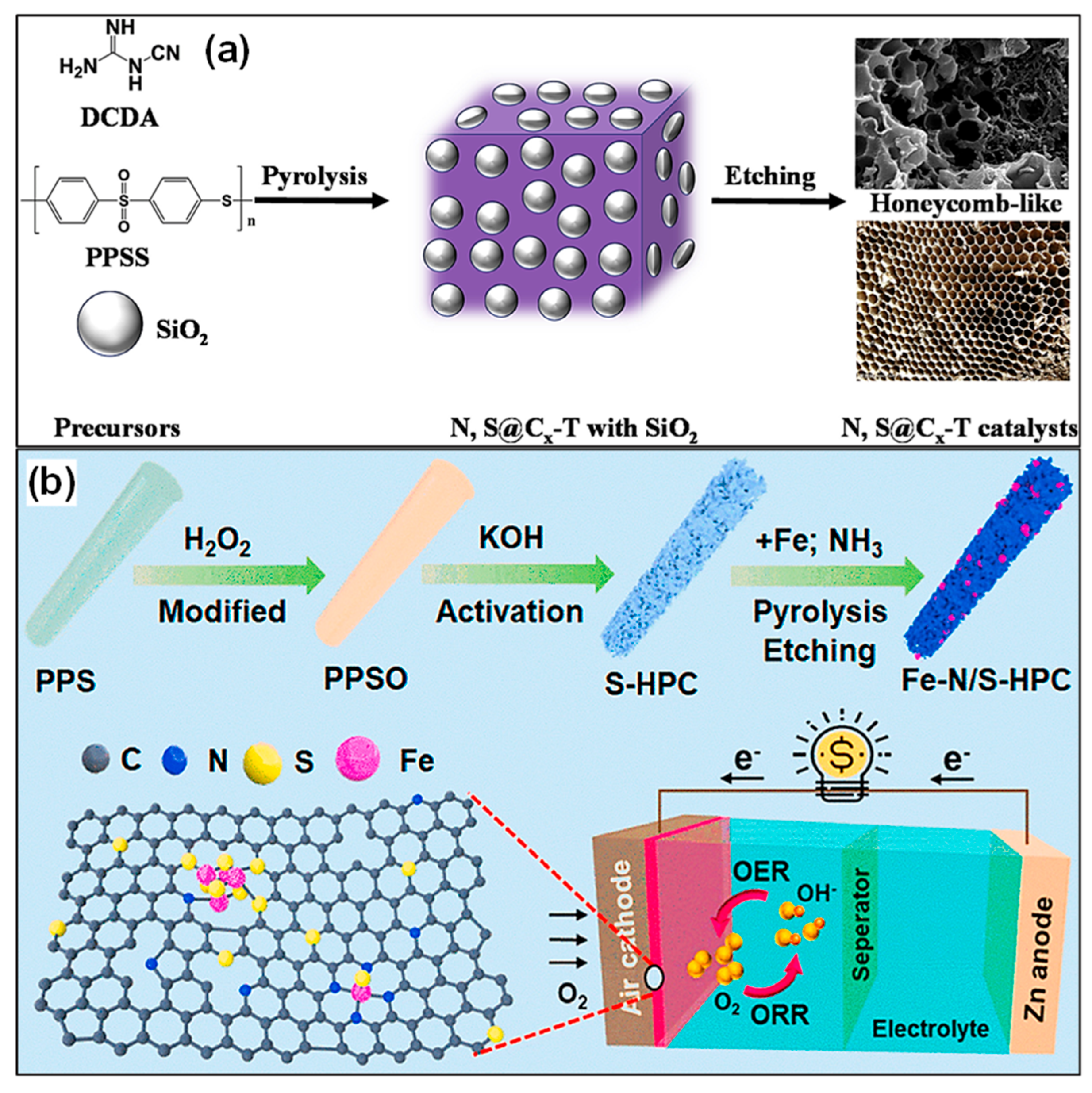
- Wang, M.W.; Du, X.; Zhang, M.; Su, K.; Li, Z.H. From S-rich polyphenylene sulfide to honeycomb-like porous carbon with ultrahigh specific surface area as bifunctional electrocatalysts for rechargeable Zn-air batteries. Carbon 2022, 198, 264–274. [Google Scholar] [CrossRef] [Scilit]
- Yang, J.; Xiang, F.; Guo, H.; Wang, L.; Niu, X. Honeycomb-like porous carbon with N and S dual-doping as metal-free catalyst for the oxygen reduction reaction. Carbon 2020, 156, 514–522. [Google Scholar] [CrossRef] [Scilit]
- Qiu, B.L.; Liu, M.; Qu, X.; Zhou, F.Y.; Xie, H.W.; Wang, D.; Lee, L.Y.S.; Yin, H. Waste plastics upcycled for high-efficiency H2O2 production and lithium recovery via Ni-Co/carbon nanotubes composites. Nat. Commun. 2024, 15, 6473. [Google Scholar] [CrossRef] [Scilit]
- Chen, S.; Liu, C.; Feng, R.; Chen, Z.; Lu, Y.; Chen, L.; Huang, Q.; Guan, Y.; Yan, W.; Su, Y.; et al. Natural graphite anode for advanced lithium-ion Batteries: Challenges, Progress, and Perspectives. Chem. Eng. J. 2025, 503, 158116. [Google Scholar] [CrossRef] [Scilit]
- Kitchamsetti, N.; Mhin, S. Advances and Prospects of Lignin-Derived Hard Carbons for Next-Generation Sodium-Ion Batteries. Polymers 2025, 17, 2801. [Google Scholar] [CrossRef] [Scilit]
- Kumari, M.; Chaudhary, G.R.; Chaudhary, S.; Umar, A. Transformation of solid plastic waste to activated carbon fibres for wastewater treatment. Chemosphere 2022, 294, 133692. [Google Scholar] [CrossRef] [Scilit]
- Shoukat, B.; Hussain, H.; Naz, M.Y.; Ibrahim, A.A.; Shukrullah, S.; Khan, Y.; Zhang, Y. Microwave-Assisted Catalytic Deconstruction of Plastics Waste into Nanostructured Carbon and Hydrogen Fuel Using Composite Magnetic Ferrite Catalysts. Scientifica 2024, 2024, 3318047. [Google Scholar] [CrossRef] [Scilit] [PubMed]




| Plastic Category | Representative Polymers | Key Structural Features | Dominant Pyrolysis Mechanism | Intermediate Species | Resulting C Microstructure | Key Characteristics |
|---|---|---|---|---|---|---|
| Aliphatic polyolefins | PE, PP | Saturated C-C backbone, no functional groups | Random chain scission | Alkanes, alkenes, light hydrocarbons | Amorphous/turbostratic C (low yield) | Low graphitization, poor ordering, limited porosity |
| O-containing polymers | PET, PMMA | ester/carbonyl groups; PET contains aromatic rings | Depolymerization + fragmentation | Oxygenated compounds, aromatics (for PET) | Partially graphitized C with developed porosity | Moderate ordering, O-induced pore formation |
| N-containing polymers | PU, polyamide | amine/amide groups | Crosslinking + aromatization | N-containing heterocycles, stable radicals | N-doped C with defect-rich structure | High defect density, enhanced electronic properties, active sites |
| Halogen-containing polymers | PVC | C-Cl bonds, labile halogen groups | Dehydrochlorination + polyene formation | HCl gas, conjugated polyenes | Porous, defect-rich C | High microporosity, high defect density |
| Aromatic polymers | PS | Aromatic rings in backbone | Aromatization + condensation | Styrene, polyaromatic intermediates | Relatively highly graphitized C | Higher structural ordering, possible graphitic domains |
| Plastics | Preparation Route | C Material | Electrolyte | Reversible Capacity (mAh g−1) [Current Density (A g−1)] | Number of Cycles | Ref. |
|---|---|---|---|---|---|---|
| Lithium-ion batteries | ||||||
| Mixed commodity polymers | Sol–gel synthesis and stainless autoclave carbonization. | (HCS/PCF) | 1 M LiPF6 in EC/DMC/EMC (1:1:1 vol %) | 802 [0.5] | 500 | [139] |
| (SnO2/HCS/PCF) | 1125 [1.0] | 400 | [140] | |||
| PS foam | Urea-assisted carbonization | NPCs | 600 [1.0] | 200 | [138] | |
| PET bottles | Ionothermal pyrolysis | ACs | 1 M LiPF6 in EC/DMC (1:1 vol %) | 460 [0.1] | 100 | [141] |
| LDPE | S-assisted hydrothermal activity followed by carbonization | Soft C | 1 M LiPF6 in EC/DMC/EMC (1:1:1 vol %) | 370 | 200 | [142] |
| HDPE | 470 | |||||
| PE | Thermal oxidation and subsequent catalytic carbonization | Graphite | 1 M LiPF6 with 5 vol % of FEC additive in EC/EMC (1:1 vol %) | 326 [0.2 C] | 250 | [143] |
| PP | Microwave-assisted pyrolysis followed by chemical activation using KOH | ACs | 1 M LiPF6 in EC/DMC (1:1 vol %) | 355.1 [0.2] | 100 | [137] |
| Waste mask (PP) | Thermal oxidation and subsequent carbonization | Hard C | 1 M LiPF6 in EC and diethyl carbonate (DEC) (1:1 vol %) | 438.1 | 100 | [136] |
| PE | Two-stage pyrolysis-catalytic conversion process | CNT composites (CNCs) | 1 M LiPF6 in EC/EMC (3:7 vol %) | 522.4 | 100 | [144] |
| Mixed plastics (PP/PE/PS) | Catalytic carbonization-etching process | Yolk–shell Co3O4@C | 1 M LiPF6 in EC/EMC (1:2 vol %) | 1066 [0.1] | 300 | [145] |
| PE | Microwave-assisted graphene-triggered electromagnetic reaction. | Co-GNP-ZipC | 1 M LiPF6 in EC/DEC (1:1 vol %) | 377 | 250 | [146] |
| PS | Co-GNP-FmC | 509 | ||||
| Sodium-ion batteries | ||||||
| PS cups | Carbonization under confined reactor | Disordered C | 1 M NaClO4 in EC/DEC (1:1 vol %) | 116 | 80 | [147] |
| Styrene acrylonitrile (SAN) plastics | Carbonization followed by CO2 activation | ACs | 1 M NaPF6 in EC/DEC (1:1 wt %) | 190 [0.003] | 100 | [148] |
| Polyolefin plastic wastes | Microwave-triggered pyrolysis in the presence of a Ti3AlC2 catalyst | CNFs | 1 M NaPF6 in dimethoxyethane (DME) | 142 [0.05] | 2000 | [149] |
| Waste tires | Carbonization followed by CO2 activation | ACs | 1 M NaPF6 in EC/DEC (1:1 wt %) | 300 [0.01] | 20 | [150] |
| Acid treatment followed by thermal decomposition | Hard C | 1 M NaClO4 in EC/DEC (1:1 vol %) | 203 [0.03] | 100 | [151] | |
| Two-stage thermal decomposition | 3D vertical graphene | 1 M NaClO4 in EC/DMC/EMC (1:1:1 vol %) with 2% FEC | 252.7 [0.2] | 200 | [152] | |
| PET | NaCl/KCl-assisted carbonization followed by ball-milling activation | ACs | 1 M NaClO4 in DMC/EC (1:1 vol %) | 217.8 [0.03] | 100 | [153] |
| PE | S-assisted thermal decomposition | S-doped carbons | 1 M NaClO4 in EC/PC (1:1 vol %) with 5 vol % of FEC | 662 [0.05] | 1 | [154] |
| PP | 578 [0.05] | |||||
| PS | 661 [0.05] | |||||
| Waste mask (PP) | Sulfonation followed by carbonization treatment | Hard C | 1 M NaClO4 in EC/DEC (1:1 vol %) | 327.4 [0.1 C] | 200 | [155] |
| 1 M NaPF6 in DEG/DME | 340 [0.01] | [156] | ||||
| Waste tires | Two-stage pre-oxidation followed by nitridation treatment | N/O co-doped mesoporous hard C | 1 M NaPF6 in DIGLYME | 407 [1.0] | 100 | [157] |
| Ester bond-rich waste plastics (PC and PET) | Direct carbonization | Hard C | 1 M NaPF6 in DMC/EC (1:1 vol %) | 327 [0.02] | 140 | [158] |
| 342 [0.02] | ||||||
| PET | Microwave-assisted thermal decomposition | 1 M NaClO4 in EC/DEC (1:1 vol %) | 363 [0.1] | 200 | [159] | |
| PET | Ethanolamine-mediated aminolysis, co-solvent incorporation, freeze drying, and microwave-induced carbonization | N-doped hard C | 1 M NaPF6 in DME | 452 [0.02] | 200 | [160] |
| Floral foam (phenol-formaldehyde foam) | Direct carbonization | Hard C | 1 M NaClO4 in EC/PC at a 1:1 vol % with 5 wt % FEC | 434.9 [0.4] | 1000 | [161] |
| Automotive shredder residue (ASR) | 1 M NaPF6 in EC/DMC (1:1 vol %) | 434 [0.01] | 100 | [162] | ||
| Poly(terephthalamide) diamide | Two-stage thermal decomposition | 1 M NaPF6 in DIGLYME | 350 [0.1C] | 100 | [163] | |
| Plastics | Preparation Route | C Product | Electrolyte | Reversible Capacity (mAh g−1) [Current Rate (C)] | Cycle Number | Ref. |
|---|---|---|---|---|---|---|
| LDPE | MW-enhanced sulfonation coupled with subsequent carbonization | Porous sulfonated C | 1 M lithium bis(trifluoromethanesulfonyl)imide (LiTFSI) in the bisolvent of 1,3-dioxolane (DOL) and 1,2-dimethoxyethane (DME) (1:1 at vol %) dissolved with 1 wt % LiNO3 | 776 [0.5C] | 200 | [186] |
| PVC | Ball milling followed by KOH- and thiourea-assisted carbonization | N, S co-doped C | 836 [1C] | 500 | [187] | |
| PS foam | Sulfonation treatment followed by H3PO4-assisted carbonization and S melting infiltration | S, P co-doped C | 893 [2C] | 800 | [188] | |
| PS | N, S co-doped C | 1079 [0.1C] | 500 | [189] | ||
| Plastic waste residue | CaCO3 NPs-assisted carbonization with H3BO3 | B, N co-doped C | 1 M LiTFSI and 0.2 M LiNO3 in DME and DOL (1:1 at vol %) | 756 [0.5C] | 200 | [190] |
| KOH-assisted Carbonization | N-doped C | 623 [0.5C] | 200 | [191] | ||
| Waste mask (PP) | H2SO4-mediated MW preconditioning followed by intrinsic activation | Porous C | 1 M LiTFSI in DOL and DME (1:1 at vol %) with 1 wt % LiNO3 | 1313.6 [0.1C] | 400 | [192] |
| H2SO4 and urea-mediated MW pretreatment followed by intrinsic activation | S, N and O co-doped C | 1459.8 [0.1C] | [193] |
Disclaimer/Publisher’s Note: The statements, opinions and data contained in all publications are solely those of the individual author(s) and contributor(s) and not of MDPI and/or the editor(s). MDPI and/or the editor(s) disclaim responsibility for any injury to people or property resulting from any ideas, methods, instructions or products referred to in the content. |
© 2026 by the authors. Licensee MDPI, Basel, Switzerland. This article is an open access article distributed under the terms and conditions of the Creative Commons Attribution (CC BY) license.
Share and Cite
Kitchamsetti, N.; Mhin, S.; Han, H.; de Barros, A.L.F. From Environmental Burden to Energy Resource: Waste Plastic-Derived Carbons for Sustainable Batteries and Supercapacitors. Polymers 2026, 18, 983. https://doi.org/10.3390/polym18080983
Kitchamsetti N, Mhin S, Han H, de Barros ALF. From Environmental Burden to Energy Resource: Waste Plastic-Derived Carbons for Sustainable Batteries and Supercapacitors. Polymers. 2026; 18(8):983. https://doi.org/10.3390/polym18080983
Chicago/Turabian StyleKitchamsetti, Narasimharao, Sungwook Mhin, HyukSu Han, and Ana L. F. de Barros. 2026. "From Environmental Burden to Energy Resource: Waste Plastic-Derived Carbons for Sustainable Batteries and Supercapacitors" Polymers 18, no. 8: 983. https://doi.org/10.3390/polym18080983
APA StyleKitchamsetti, N., Mhin, S., Han, H., & de Barros, A. L. F. (2026). From Environmental Burden to Energy Resource: Waste Plastic-Derived Carbons for Sustainable Batteries and Supercapacitors. Polymers, 18(8), 983. https://doi.org/10.3390/polym18080983