Review

From Environmental Burden to Energy Resource: Waste Plastic-Derived Carbons for Sustainable Batteries and Supercapacitors


by
Narasimharao Kitchamsetti
1,*,
Sungwook Mhin
2,*,
HyukSu Han
3,* and
Ana L. F. de Barros
4,*
1
Department of Microsystems, University of South-Eastern Norway, Campus Vestfold, Raveien 215, 3184 Borre, Norway
2
Department of Energy and Materials Engineering, Dongguk University, Seoul 04620, Republic of Korea
3
Division of Materials Science and Engineering, Hanyang University, Seoul 04763, Republic of Korea
4
Laboratory of Experimental and Applied Physics, Centro Federal de Educação Tecnológica Celso Suckow Da Fonseca, Av. Maracanã Campus 229, Rio de Janeiro 20271-110, Brazil
*
Authors to whom correspondence should be addressed.
Polymers 2026, 18(8), 983; https://doi.org/10.3390/polym18080983
Submission received: 25 March 2026 / Revised: 13 April 2026 / Accepted: 15 April 2026 / Published: 17 April 2026
(This article belongs to the Section Polymer Applications)

Abstract

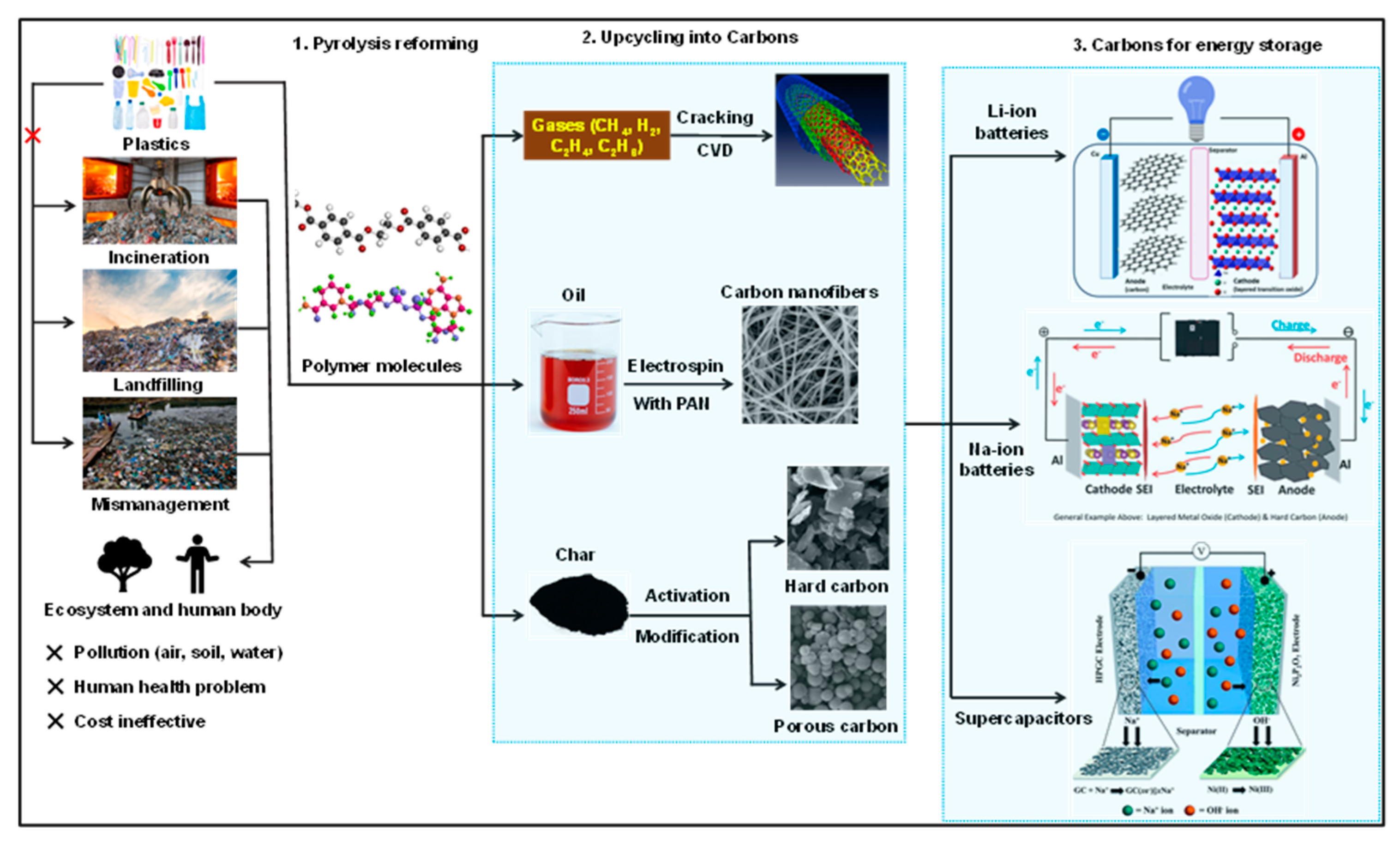
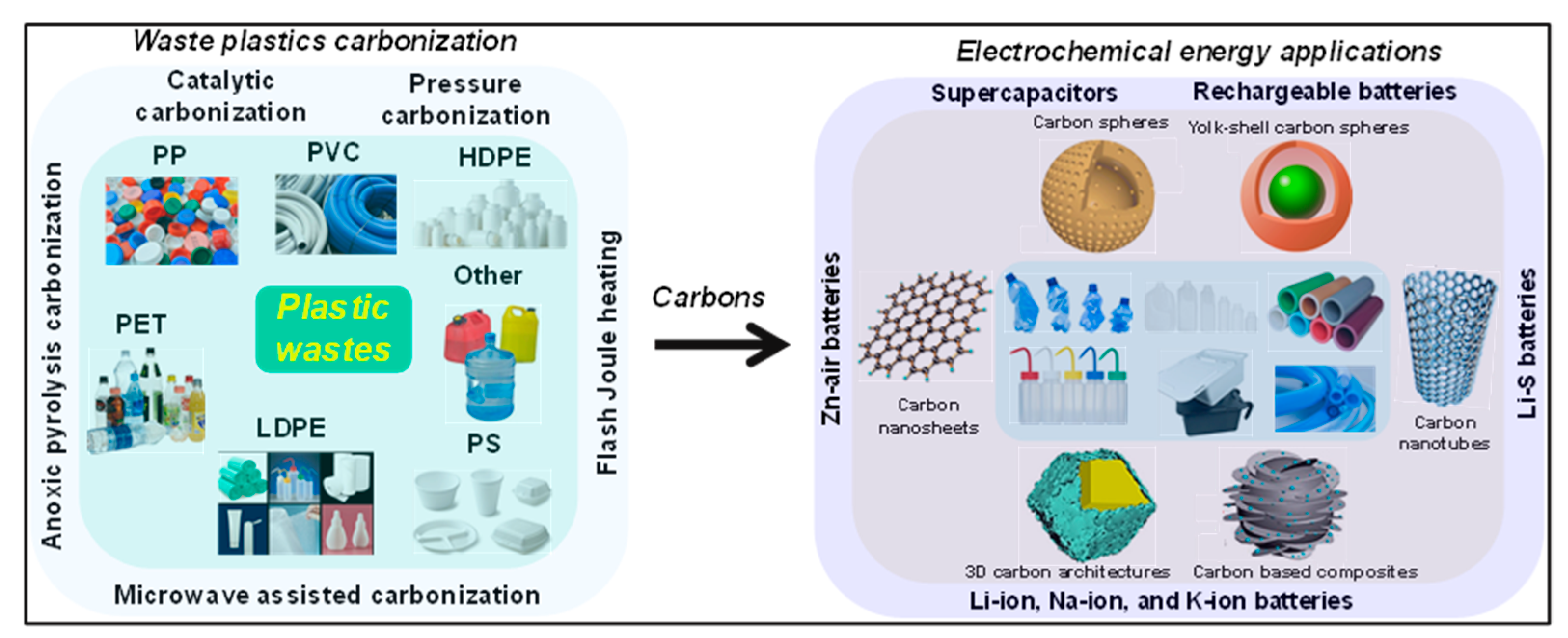
The transformation of waste plastics into hydrogen and functional carbon (C) materials represents a promising pathway for achieving both resource recycling and the production of value-added products. Owing to their tunable physicochemical properties, plastic-derived carbons have attracted significant attention in electrochemical energy storage applications. Various C nanostructures, including graphene, porous C, hard C, and C nanotubes (CNTs), can be generated from discarded plastics through thermochemical processes. The electrochemical performance of these materials is closely governed by their structural characteristics, such as pore architecture, specific surface area, heteroatom doping, surface functionalities, and dimensional morphology. This review aims to provide a comprehensive and systematic overview of the conversion of waste plastics into functional C nanomaterials via thermochemical routes, particularly catalytic pyrolysis and carbonization. The resulting C nanostructures are systematically categorized based on their dimensional architectures (0D, 1D, 2D, and 3D) and comparatively analyzed in terms of their structural features and electrochemical performance. Emphasis is placed on the transformation of diverse plastic feedstocks into high-value C materials with tailored dimensional architectures, including graphene, CNTs, C nanospheres, C nanosheets, porous carbons, and their composites. Furthermore, recent progress and critical challenges in utilizing these materials for electrochemical energy storage systems, such as supercapacitors and rechargeable batteries (Li-ion, Na-ion, K-ion, Li-S, and Zn-air), are discussed. Distinct from previous reports, this review highlights the correlation between thermochemical processing strategies, resulting structural features, and electrochemical performance, providing new insights into the rational design of high-performance C materials. These findings are expected to facilitate the advancement of sustainable energy storage technologies while contributing to effective plastic waste valorization.
Keywords: waste plastics; carbon materials; energy storage; supercapacitor; rechargeable batteries waste plastics; carbon materials; energy storage; supercapacitor; rechargeable batteries