Solvent-Free Dual-Curable Waterborne Polyurethane Adhesives Based on Vanillin and Acrylate Monomers

 ,
,
Abstract
1. Introduction
2. Materials and Methods
2.1. Materials
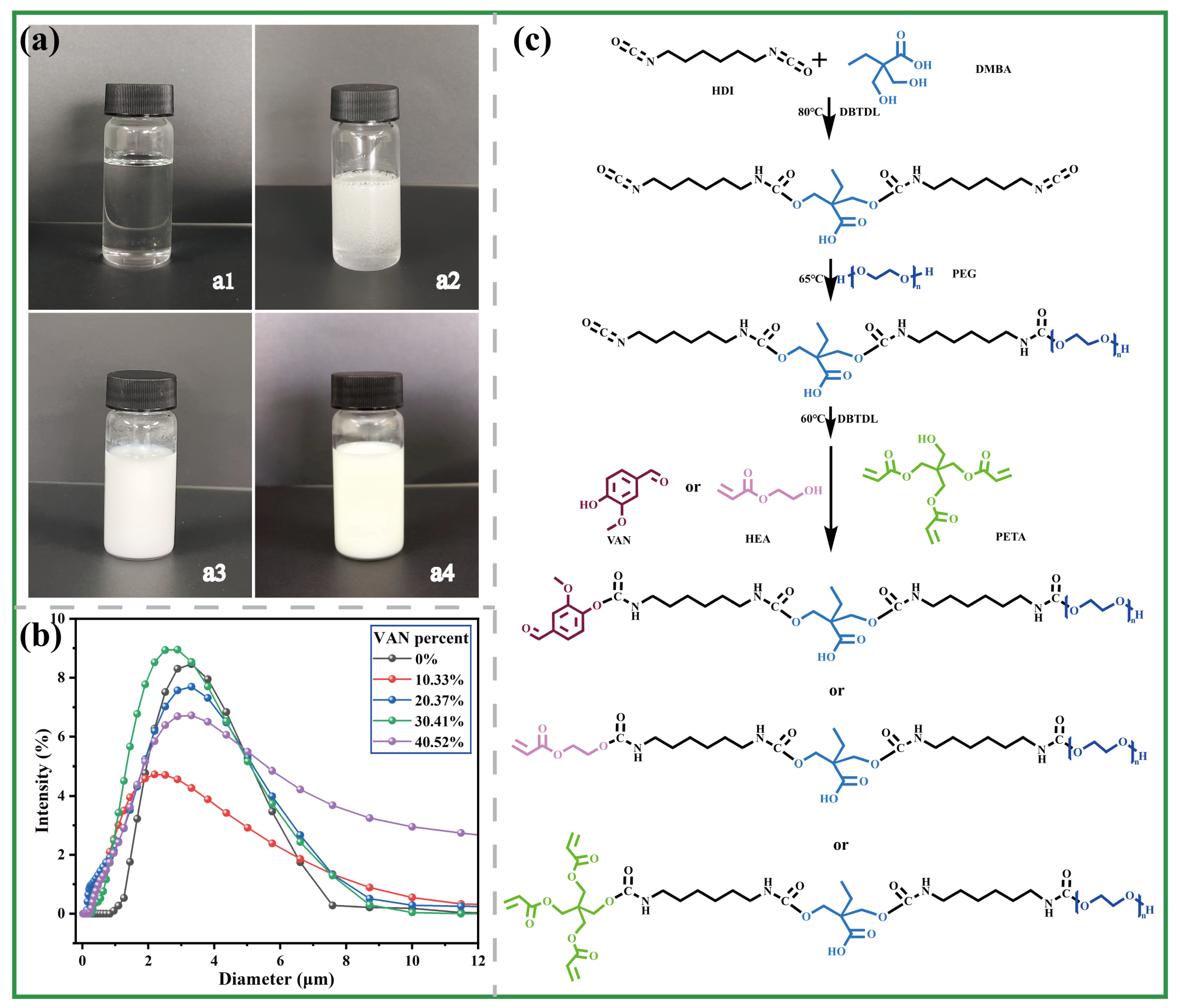
2.2. Preparation of Waterborne Polyurethane
2.3. Characterization
- (1)
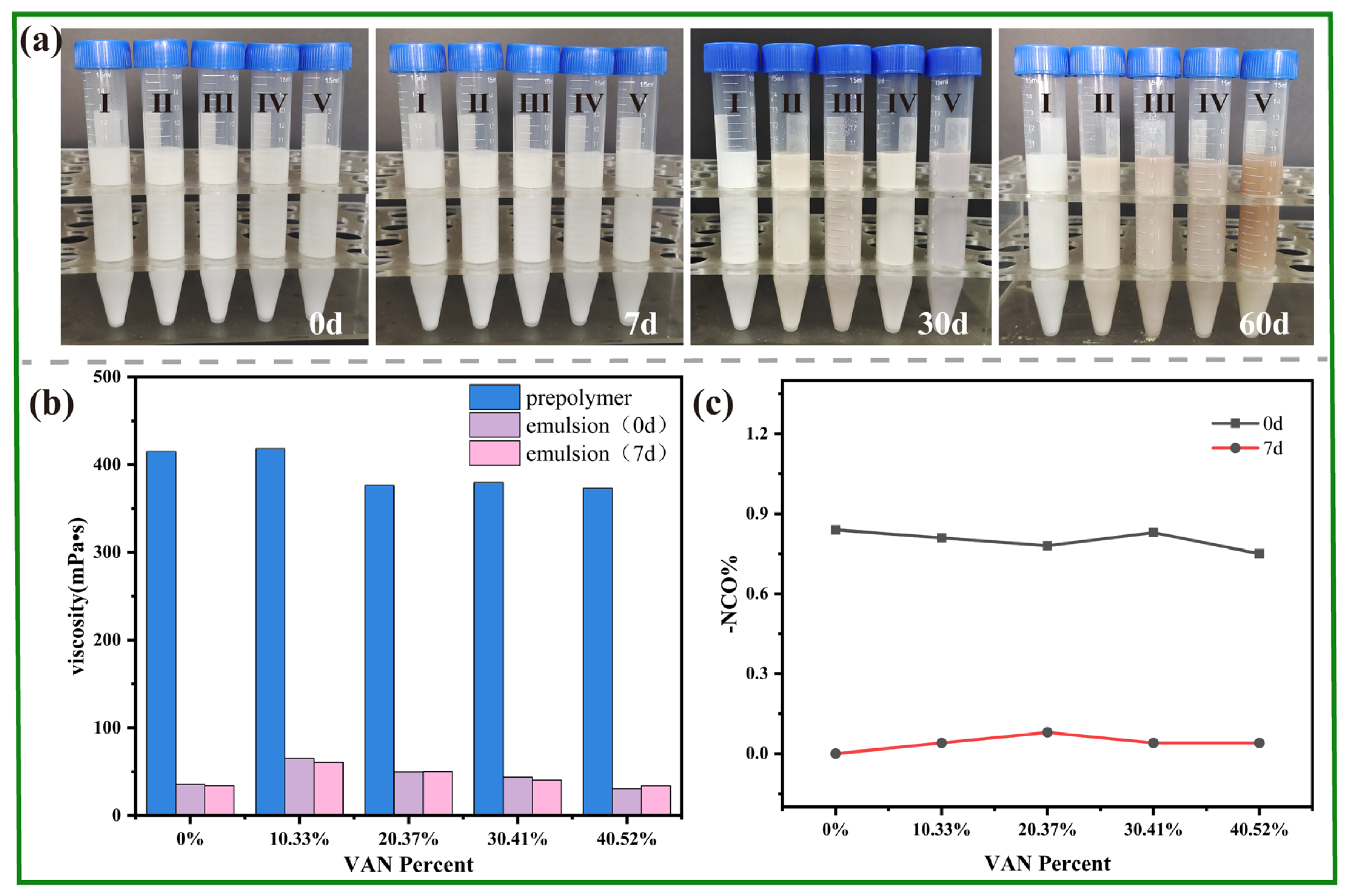
- Determination of –NCO Content: The –NCO content of the PU prepolymer was determined by the acetone–dibutylamine titration method. The principle of the method is that –NCO reacts with an excess of dibutylamine in acetone solution, and the remaining dibutylamine is then back-titrated with standardized HCl after complete reaction of –NCO. Approximately 1.0000 g of sample was weighed into a dry iodine flask, dissolved in 10 mL of acetone, and then accurately mixed with 20.00 mL of dibutylamine–acetone solution. The flask was stoppered, shaken thoroughly, and allowed to stand for 15 min. Three drops of bromocresol green–ethanol indicator were added, and the mixture was titrated with 0.1 mol/L HCl standard solution to the endpoint, indicated by a color change from blue to yellow.
- (2)
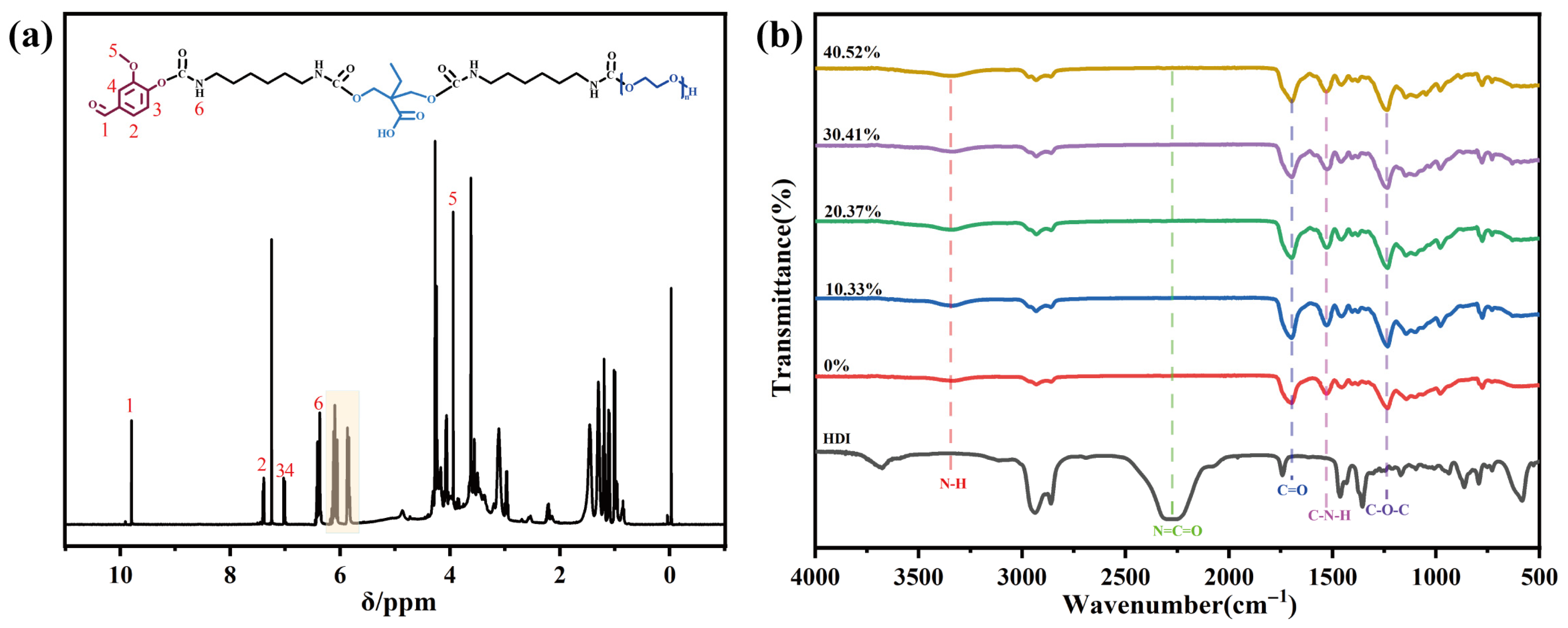
- Nuclear Magnetic Resonance Spectroscopy: A JNM-ECZ400S/L1 spectrometer (JEOL, Tokyo, Japan) was used for analysis. Samples were dried briefly at 30 °C only to remove volatile components prior to 1H NMR analysis. About 10 mg of the dried sample was dissolved in 1.5 mL of deuterated chloroform (CDCl3), and an appropriate amount of the resulting solution was transferred into an NMR tube for measurement. The drying step was used solely for sample preparation and was not taken as direct proof of complete structural preservation of the prepolymer. The chemical-shift range was 0–12 ppm.
- (3)
- Fourier-Transform Infrared Spectroscopy (FTIR): The chemical structures of the samples were characterized using a Nicolet iS50 FTIR spectrometer (Thermo Fisher Scientific, Waltham, MA, USA). Before testing, the samples were mixed with AIBN at 0.3 wt% based on resin solids and cast into films in an oven at 130 °C. Unless otherwise stated, the same initiator type and dosage were used in the curing-related FTIR, DSC, and TGA experiments. Spectra were collected in ATR mode at a resolution of 4 cm−1 over the range 4000–400 cm−1 with 64 scans for each sample.
- (4)
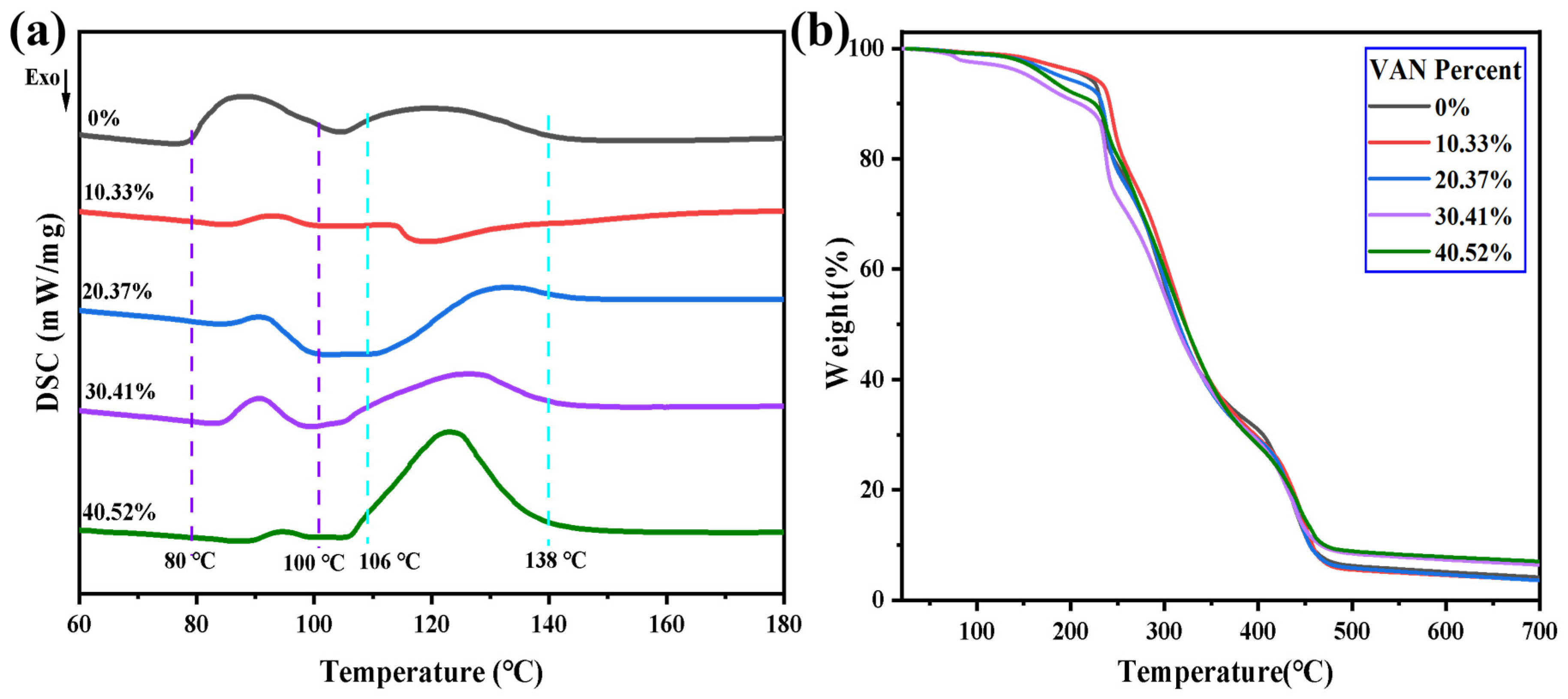
- Differential Scanning Calorimetry (DSC): DSC measurements were carried out on an HCT-1 integrated thermal analyzer (Hengjiu, Beijing, China). Approximately 10–20 mg of dried sample was placed in a crucible and heated from 30 to 200 °C at a rate of 10 °C/min under a nitrogen flow of 100 mL/min, while the heat-flow change during heating was recorded.
- (5)
- Thermogravimetric Analysis (TGA): TGA was performed on an SDT Q600 thermogravimetric analyzer (TA Instruments, New Castle, DE, USA). Samples mixed with thermal initiator were first cast into films and dried in an oven at 130 °C. Approximately 7–10 mg of the resulting film was then placed in a crucible and heated from 30 to 600 °C at 10 °C/min under a nitrogen flow of 100 mL/min to record the weight-loss behavior.
- (6)
- Laser Particle Size Analysis: Particle-size distributions of the emulsions were measured at room temperature with a Malvern Mastersizer 2000 laser particle-size analyzer (Malvern, Worcestershire, UK). Before testing, an appropriate amount of sample was diluted with deionized water and then homogenized at 12,000 r/min for 2 min to obtain a uniformly dispersed sample.
- (7)
- Viscosity and pH Measurements: The viscosity and pH of the WPU emulsions were measured at 25 °C using an NDJ-8S digital rotational viscometer (Youyi, Shanghai, China) (No. 1 spindle, 60 rpm) and a PHS-3C pH meter, respectively. Each sample was measured at least three times in parallel, and the average value was reported.
- (8)
- Contact Angle Analysis: The water contact angle was measured using a DSA30 contact-angle analyzer (KRÜSS, Hamburg, Germany). WPU emulsions were mixed with a fixed amount of thermal initiator, cast into films in an oven at 130 °C, and cut into specimens of approximately 5 mm × 5 mm. Measurements were performed by the static sessile-drop method, and images were collected within 25 s after droplet formation. Each sample was tested seven times, and the average value was used. Wetting behavior was analyzed according to Young’s equation.
- (9)
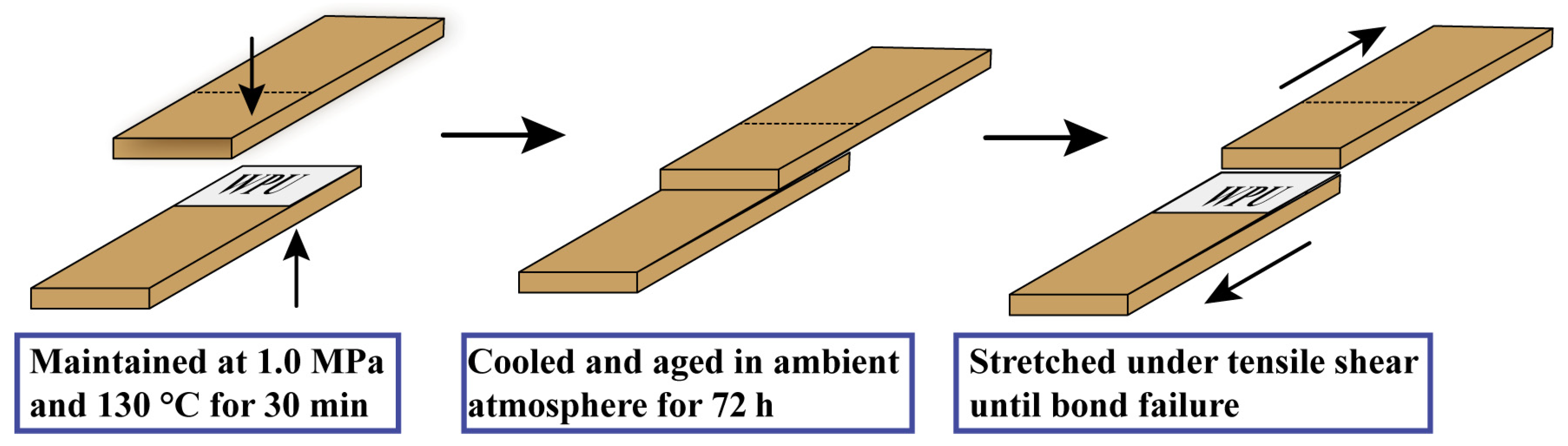
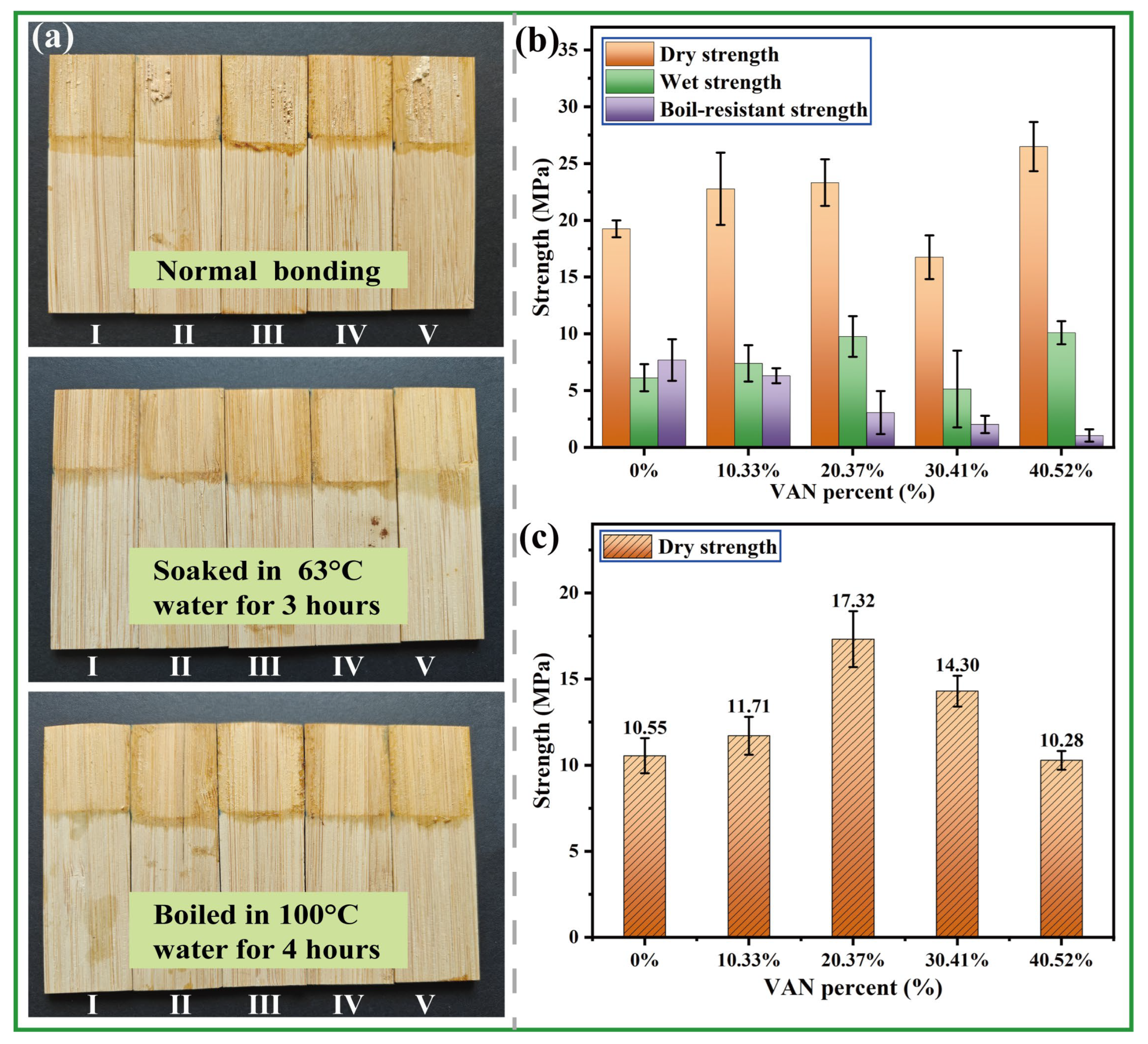
- Mechanical Properties: Tensile tests were carried out at room temperature using an MTS universal testing machine, as shown in Figure 1. Moso bamboo used for bonding was purchased from a bamboo-processing factory in Fujian, China. The bamboo was cut into strips measuring 75 × 25 × 2 mm3. Adhesive was applied to a 25 × 25 mm bonding area at a coating weight of 250 g/m2, and the bamboo veneers were hot-pressed at 130 °C for 30 min. Tensile shear strength was evaluated under both dry and wet conditions. For dry testing, bonded specimens were cured, dried, and then stored at room temperature for 72 h before measurement. For the boiling-water resistance test, specimens were boiled in water for 4 h, dried in a forced-air oven at (63 ± 3) °C for 20 h, boiled again for 4 h, and then cooled in water at room temperature for 10 min before tensile shear testing. For wet-strength testing, specimens were immersed in water at 63 °C for 3 h before testing. All tests were repeated at least five times, and the average values were reported.
- (10)
- Equilibrium Swelling Analysis: Equilibrium swelling experiments were carried out on the fully cured films. The cured samples were cut into small pieces, dried to constant weight, and immersed in tetrahydrofuran at 25 °C for 24 h. The swollen samples were then removed, gently wiped to remove surface solvent, and weighed immediately. The swelling degree was calculated from the mass change before and after swelling. At least three parallel specimens were tested for each formulation, and the average values were reported.
3. Results and Discussion
4. Conclusions
Supplementary Materials
Author Contributions
Funding
Institutional Review Board Statement
Data Availability Statement
Conflicts of Interest
References
- Golling, F.E.; Pires, R.; Hecking, A.; Weikard, J.; Richter, F.; Danielmeier, K.; Dijkstra, D. Polyurethanes for Coatings and Adhesives–Chemistry and Applications. Polym. Int. 2019, 68, 848–855. [Google Scholar] [CrossRef]
- Wu, Y.; Xu, C.; Gan, M.; Zhai, M.; Chen, Z.; Shou, T.; Yin, D.; Zhao, X.; Hu, S.; Zhang, L. Multifunctional Bio-Based Waterborne Polyurethane with Excellent Transparency, Strength, Abrasion Resistance, and Antimicrobial Properties. Prog. Org. Coat. 2024, 195, 108671. [Google Scholar] [CrossRef]
- Madbouly, S.A. Waterborne Polyurethane Dispersions and Thin Films: Biodegradation and Antimicrobial Behaviors. Molecules 2021, 26, 961. [Google Scholar] [CrossRef]
- Tran, K.; Liu, Y.; Soleimani, M.; Lucas, F.; Winnik, M.A. Waterborne 2-Component Polyurethane Coatings Based on Acrylic Polyols with Secondary Alcohols. Prog. Org. Coat. 2024, 190, 108374. [Google Scholar] [CrossRef]
- Zhao, H.; Xu, Y.; Luo, Z.; Gong, C.-R.; Zheng, Y.-Q.; Yu, L.-M. Rational Design of Waterborne Polyurethane Pressure Sensitive Adhesives for Different Working Temperatures. Materials 2022, 15, 2011. [Google Scholar] [CrossRef]
- Santamaria-Echart, A.; Fernandes, I.; Barreiro, F.; Corcuera, M.A.; Eceiza, A. Advances in Waterborne Polyurethane and Polyurethane-Urea Dispersions and Their Eco-Friendly Derivatives: A Review. Polymers 2021, 13, 409. [Google Scholar] [CrossRef] [PubMed]
- Hormaiztegui, M.E.V.; Daga, B.; Aranguren, M.I.; Mucci, V. Bio-Based Waterborne Polyurethanes Reinforced with Cellulose Nanocrystals as Coating Films. Prog. Org. Coat. 2020, 144, 105649. [Google Scholar] [CrossRef]
- Yang, J.; Joo, H.; Kwon, M.; Kim, S.; Joo, S.-W.; Noh, S.M.; Paik, H. Waterborne Polyurethane via Encapsulated Blocked Isocyanate Crosslinker for 1 K Clearcoats. Prog. Org. Coat. 2023, 177, 107408. [Google Scholar] [CrossRef]
- Rolph, M.S.; Markowska, A.L.J.; Warriner, C.N.; O’Reilly, R.K. Blocked Isocyanates: From Analytical and Experimental Considerations to Non-Polyurethane Applications. Polym. Chem. 2016, 7, 7351–7364. [Google Scholar] [CrossRef]
- Wicks, D.A.; Wicks, Z.W. Blocked Isocyanates III: Part B: Uses and Applications of Blocked Isocyanates. Prog. Org. Coat. 2001, 41, 1–83. [Google Scholar] [CrossRef]
- Wicks, D.A.; Wicks, Z.W. Blocked Isocyanates III: Part A. Mechanisms and Chemistry. Prog. Org. Coat. 1999, 36, 148–172. [Google Scholar] [CrossRef]
- Wicks, D.A.; Wicks, Z.W. Multistep Chemistry in Thin Films; the Challenges of Blocked Isocyanates. Prog. Org. Coat. 2001, 43, 131–140. [Google Scholar] [CrossRef]
- Knospe, P.; Reichmann, R.; Gutmann, J.S.; Dornbusch, M. Vanillin as Low-Temperature Isocyanate-Blocking Agent and Its Use in One-Component Aqueous Coatings. J. Coat. Technol. Res. 2023, 20, 501–520. [Google Scholar] [CrossRef]
- Pieters, K.; Mekonnen, T.H. Progress in Waterborne Polymer Dispersions for Coating Applications: Commercialized Systems and New Trends. RSC Sustain. 2024, 2, 3704–3729. [Google Scholar] [CrossRef]
- Salzano de Luna, M. Recent Trends in Waterborne and Bio-based Polyurethane Coatings for Corrosion Protection. Adv. Mater. Interfaces 2022, 9, 2101775. [Google Scholar] [CrossRef]
- Banan, A.R.; Keshavarz, S.M. Biobased Self Healing Waterborne Polyurethane with Vanillin Derived Dynamic Imine Bonds for Enhanced Mechanical Strength and Performance. Sci. Rep. 2025, 15, 33255. [Google Scholar] [CrossRef] [PubMed]
- Mahajan, D.; Srivats, D.S.; More, A. Synthesis of Vanillin-Based UV Curable Polyurethane Dispersions for Wood Coating Applications. J. Coat. Technol. Res. 2023, 20, 1773–1788. [Google Scholar] [CrossRef]
- Noh, C.H.; Kang, H.; Kim, H.D.; Kim, M.P.; Paik, H.; Noh, S.M. Enhanced Crosslinking Characteristics of Blocked Isocyanate-Based 1 K Polyurethane Clearcoats via Self-Crosslinkable Polymer Networks. Prog. Org. Coat. 2026, 210, 109673. [Google Scholar] [CrossRef]
- Banan, A.R. Solvent Free UV Curable Waterborne Polyurethane Acrylate Coatings with Enhanced Hydrophobicity Induced by a Semi Interpenetrating Polymer Network. Sci. Rep. 2025, 15, 21844. [Google Scholar] [CrossRef] [PubMed]
- Chen, B.; Xiong, W.; Zhou, C.; Zhang, H.; Pan, X.; Peng, J.; Luo, X.; Xie, Z.-H.; Liu, Y. High Solid and Low Viscosity Waterborne Polyurethane Acrylate with Excellent Anti-Corrosion and Anti-Bacterial Performances. Prog. Org. Coat. 2023, 183, 107767. [Google Scholar] [CrossRef]
- Lee, T.H.; Moon, H.; Jung, H.W.; Noh, S.M. Low-Temperature Crosslinking Characteristics of Interpenetrating Polymer Networks with Dual-Curable Amine-Based Blocked Isocyanate for Automotive 1 K Clearcoats. Mater. Today Commun. 2024, 38, 108450. [Google Scholar] [CrossRef]
- Zhang, J.; Zhai, R.; Zhang, J.; Li, J.; Hong, C.; Xu, Y.; Zhou, C. Waterborne Polyurethane Based on Dual Crosslinked Structure with Excellent Mechanical Properties, Water and Corrosion Resistance. Prog. Org. Coat. 2024, 197, 108784. [Google Scholar] [CrossRef]
- Zhang, J.; Jiang, Z.; Wang, Y.; Guo, M.; Ban, T.; Zhang, Y.; Zhu, X. Abrasion Resistant Waterborne Polyurethane Coatings Based on Dual Crosslinked Structure. Prog. Org. Coat. 2024, 190, 108336. [Google Scholar] [CrossRef]
- Lu, S.; Zhou, Y.; Jiang, Y.; Zhao, G.; Wei, J. A Novel Blocked Waterborne Polyisocyanate Crosslinker With High Branch Structure and Its Application. J. Appl. Polym. Sci. 2026, 143, e58176. [Google Scholar] [CrossRef]
- Agnol, L.D.; Dias, F.T.G.; Ornaghi, H.L., Jr.; Sangermano, M.; Bianchi, O. UV-Curable Waterborne Polyurethane Coatings: A State-of-the-Art and Recent Advances Review. Prog. Org. Coat. 2021, 154, 106156. [Google Scholar] [CrossRef]
- Mort, R.; Olson, E.; Thurber, H.; Jiang, S.; Vorst, K.; Curtzwiler, G. Waterborne Polyurethane/Acrylic Adhesive Blends from Physaria Fendleri Oil for Food Packaging Applications. Sustainability 2022, 14, 8657. [Google Scholar] [CrossRef]
- Karna, N.; Joshi, G.M.; Mhaske, S.T. Structure-Property Relationship of Silane-Modified Polyurethane: A Review. Prog. Org. Coat. 2023, 176, 107377. [Google Scholar] [CrossRef]
- Moad, G. A Critical Assessment of the Kinetics and Mechanism of Initiation of Radical Polymerization with Commercially Available Dialkyldiazene Initiators. Prog. Polym. Sci. 2019, 88, 130–188. [Google Scholar] [CrossRef]
- Li, X.-R.; Wang, X.-L.; Koseki, H. Study on Thermal Decomposition Characteristics of AIBN. J. Hazard. Mater. 2008, 159, 13–18. [Google Scholar] [CrossRef]
- Taourit, S.; Le Gac, P.-Y.; Fayolle, B. Relationship between Network Structure and Ultimate Properties in Polyurethane during a Chain Scission Process. Polym. Degrad. Stab. 2022, 201, 109971. [Google Scholar] [CrossRef]
- Kotanen, S.; Poikelispää, M.; Efimov, A.; Harjunalanen, T.; Mills, C.; Laaksonen, T.; Sarlin, E. Hydrolytic Stability of Polyurethane/Polyhydroxyurethane Hybrid Adhesives. Int. J. Adhes. Adhes. 2021, 110, 102950. [Google Scholar] [CrossRef]
- Li, P.; Cao, Z.; Zhang, Z.; Wang, J.; Xu, J.; Wang, P. Study on the Road Performance and Development Mechanism of Polyurethane Binder in Different Media Solutions. Constr. Build. Mater. 2025, 495, 143675. [Google Scholar] [CrossRef]





| VAN Percent (%) | 0% | 10.33% | 20.37% | 30.41% | 40.52% | |
|---|---|---|---|---|---|---|
| Chemical Reagent (mol) | ||||||
| PCDL | 0.040 | 0.040 | 0.040 | 0.040 | 0.040 | |
| PPG | 0.042 | 0.042 | 0.042 | 0.042 | 0.042 | |
| PEG | 0.018 | 0.018 | 0.018 | 0.018 | 0.018 | |
| DMBA | 0.053 | 0.053 | 0.053 | 0.053 | 0.053 | |
| HDI | 0.300 | 0.300 | 0.300 | 0.300 | 0.300 | |
| VAN | 0.0 | 0.026 | 0.051 | 0.077 | 0.102 | |
| HEA | 0.205 | 0.184 | 0.164 | 0.100 | 0.123 | |
| PETA | 0.051 | 0.046 | 0.041 | 0.036 | 0.031 | |
| TEA | 0.046 | 0.046 | 0.046 | 0.046 | 0.046 | |
| KOH | 0.007 | 0.007 | 0.007 | 0.007 | 0.007 | |
Disclaimer/Publisher’s Note: The statements, opinions and data contained in all publications are solely those of the individual author(s) and contributor(s) and not of MDPI and/or the editor(s). MDPI and/or the editor(s) disclaim responsibility for any injury to people or property resulting from any ideas, methods, instructions or products referred to in the content. |
© 2026 by the authors. Licensee MDPI, Basel, Switzerland. This article is an open access article distributed under the terms and conditions of the Creative Commons Attribution (CC BY) license.
Share and Cite
Hu, W.; Zhang, X.; Li, H.; Liang, H.; Lin, C.; Li, Z.; Liu, J.; Feng, F. Solvent-Free Dual-Curable Waterborne Polyurethane Adhesives Based on Vanillin and Acrylate Monomers. Polymers 2026, 18, 975. https://doi.org/10.3390/polym18080975
Hu W, Zhang X, Li H, Liang H, Lin C, Li Z, Liu J, Feng F. Solvent-Free Dual-Curable Waterborne Polyurethane Adhesives Based on Vanillin and Acrylate Monomers. Polymers. 2026; 18(8):975. https://doi.org/10.3390/polym18080975
Chicago/Turabian StyleHu, Weiling, Xiao Zhang, Hao Li, Hengyuan Liang, Can Lin, Zhuo Li, Jia Liu, and Feng Feng. 2026. "Solvent-Free Dual-Curable Waterborne Polyurethane Adhesives Based on Vanillin and Acrylate Monomers" Polymers 18, no. 8: 975. https://doi.org/10.3390/polym18080975
APA StyleHu, W., Zhang, X., Li, H., Liang, H., Lin, C., Li, Z., Liu, J., & Feng, F. (2026). Solvent-Free Dual-Curable Waterborne Polyurethane Adhesives Based on Vanillin and Acrylate Monomers. Polymers, 18(8), 975. https://doi.org/10.3390/polym18080975