Green, Formaldehyde-Free Bio-Adhesive from Soybean Meal and Laccase-Oxidized Tannin via Quinone–Amine Crosslinking

 ,
,  ,
, 
Abstract
1. Introduction
2. Materials and Methods
2.1. Materials
2.2. Preparation of OTN and OTS
2.3. Structural Analysis
2.4. Thermal Analysis
2.5. Adhesive Water Stability
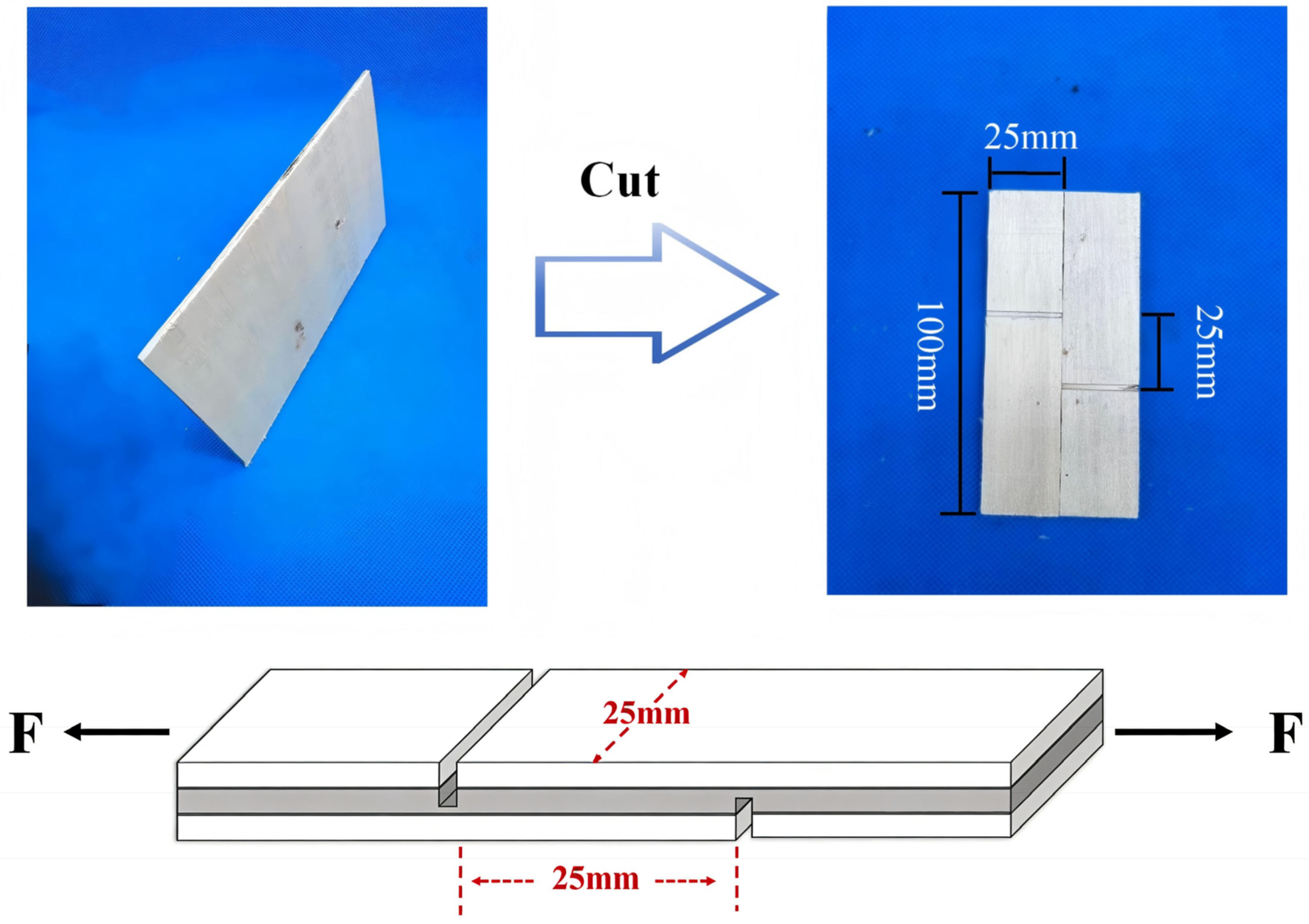
2.6. Plywood Preparation and Adhesive Mechanical Properties
3. Results
3.1. Structural Analysis of TN and OTN
3.2. Structural Analysis of the OTSs
3.3. Adhesive Mechanical Properties
3.3.1. Laccase Dosage
3.3.2. Laccase Oxidation Time
3.3.3. OTN:SM Mass Ratio
3.3.4. Hot-Pressing Temperature
3.4. Thermal Analysis of SM and OTS
4. Discussion
5. Conclusions
- (1)
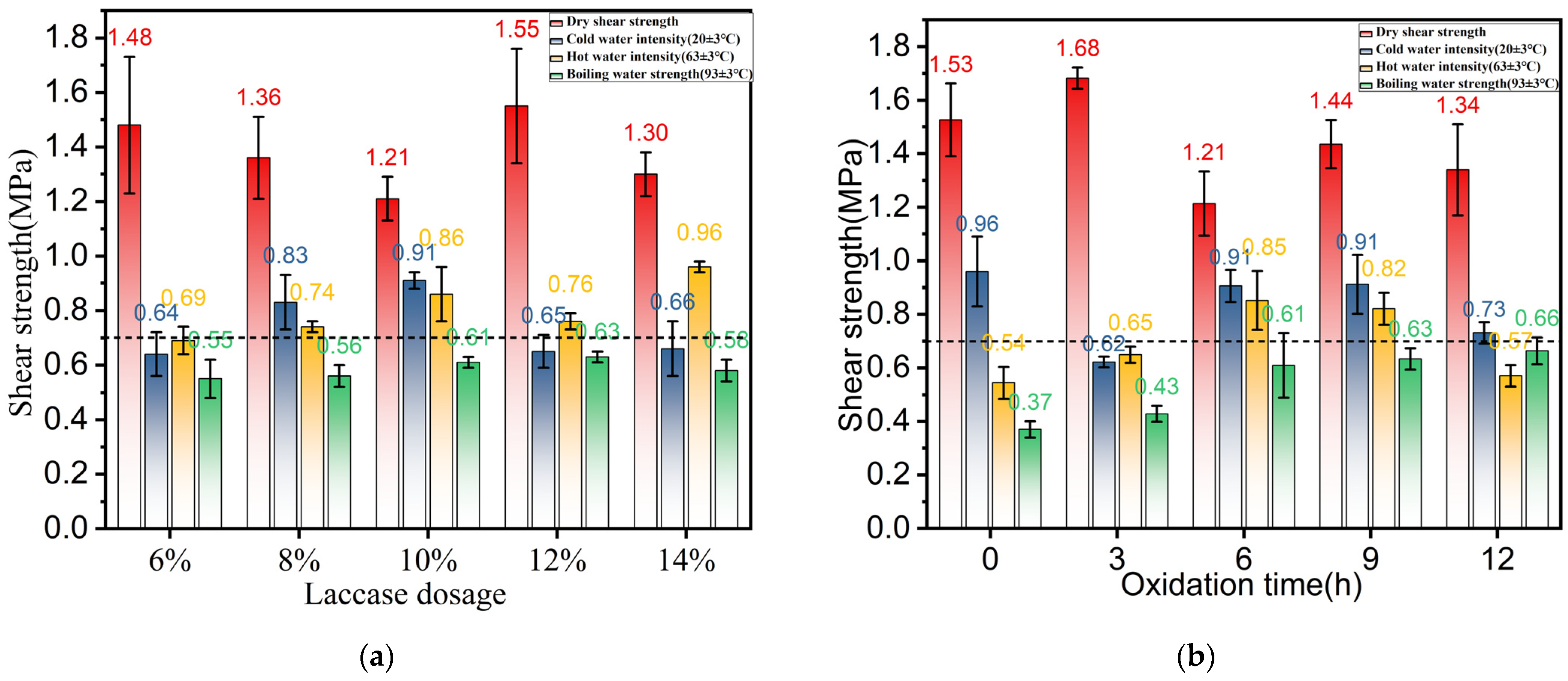
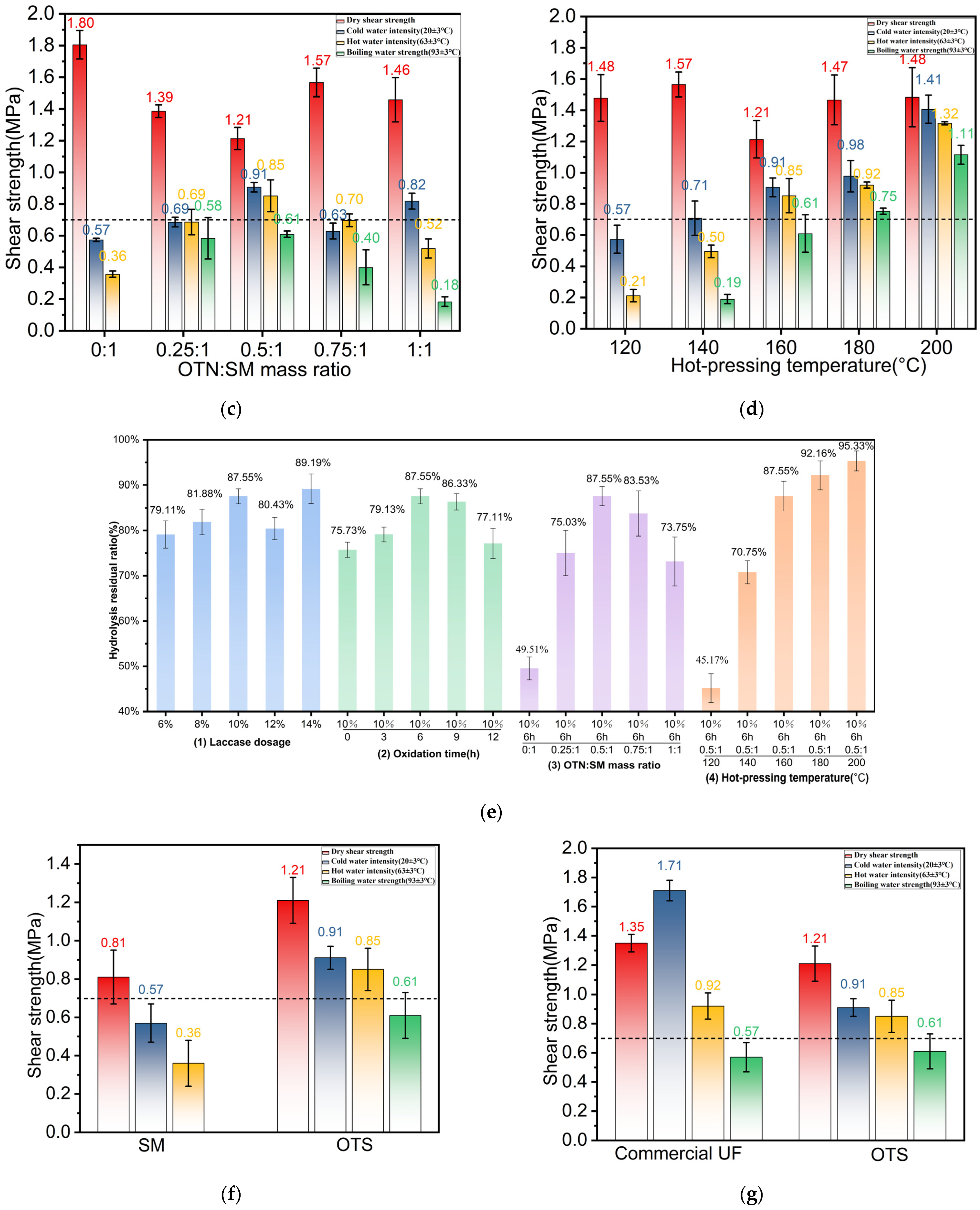
- The optimal preparation conditions were a laccase dosage of 10% based on TN mass, an oxidation time of 6 h at 40 °C, an OTN:SM mass ratio of 0.5:1, and a hot-pressing temperature of 160 °C. Under these conditions, the plywood bonded with OTS exhibited a wet shear strength of 0.85 MPa after 3 h immersion in water at 63 °C, representing a 136% increase over that of the neat soybean meal adhesive, while the boiling-water shear strength reached 0.61 MPa, indicating markedly improved water resistance. Moreover, under harsh hydrothermal conditions, the OTS exhibited bonding performance comparable to, or slightly better than, that of the commercial UF adhesive.
- (2)
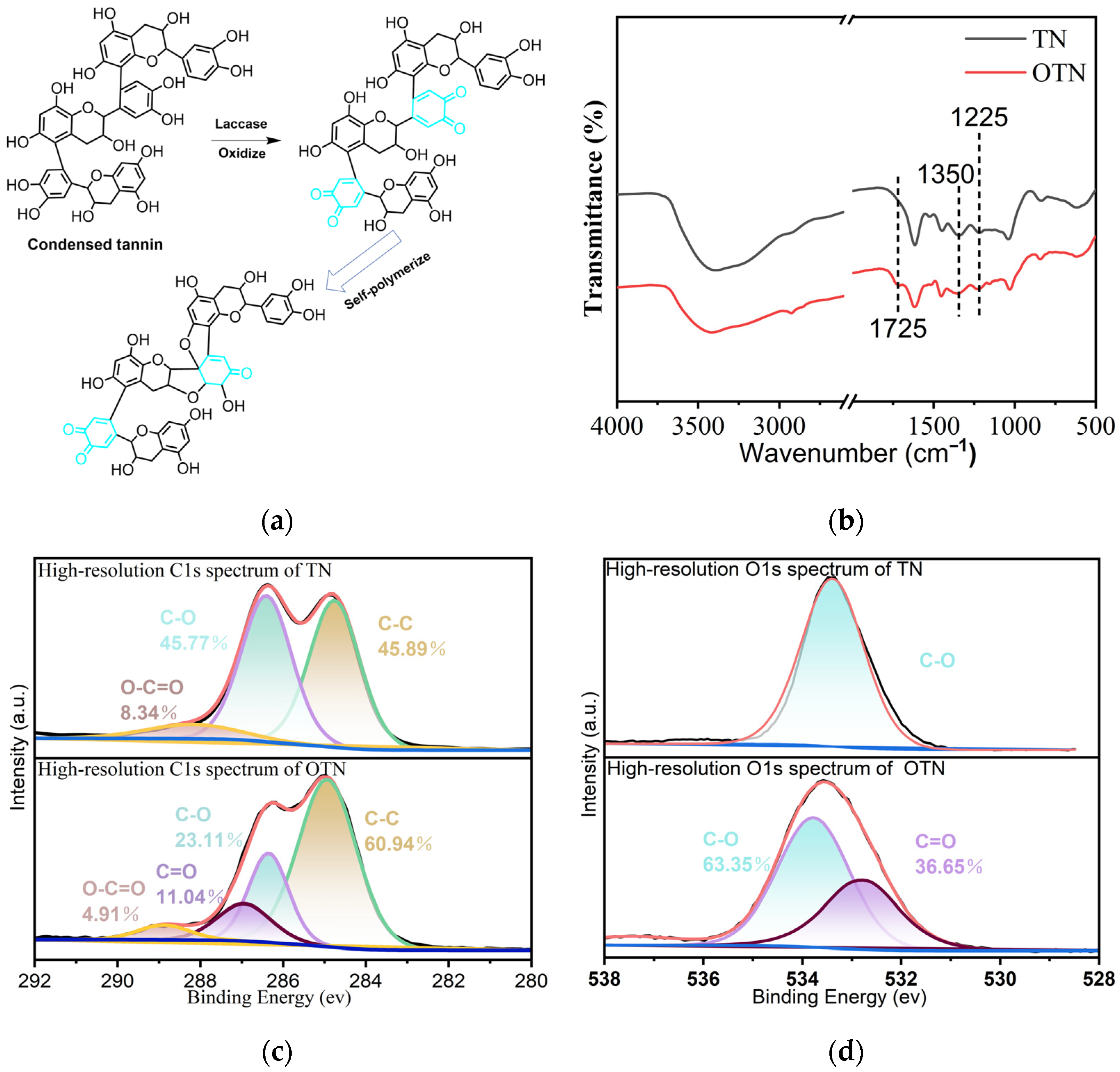
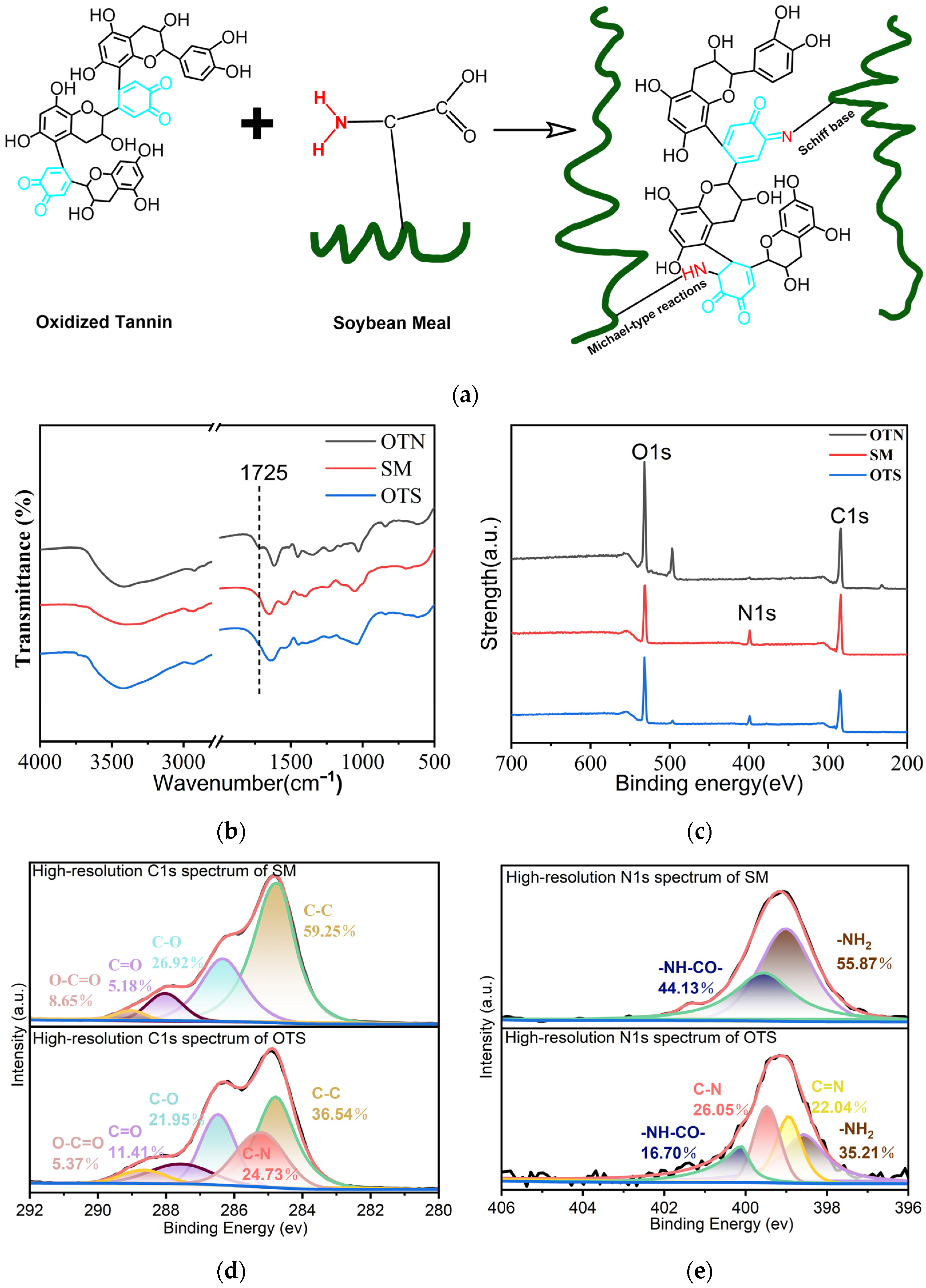
- FT-IR and XPS analyses confirmed that laccase oxidation converted phenolic hydroxyl groups in tannin into quinone-containing reactive structures. During curing, these oxidized tannin structures further reacted with amino groups in soybean meal proteins through quinone–amine reactions, forming C–N and C=N bonds and thereby establishing a covalently crosslinked adhesive network, which was responsible for the improved bonding performance and water resistance.
- (3)
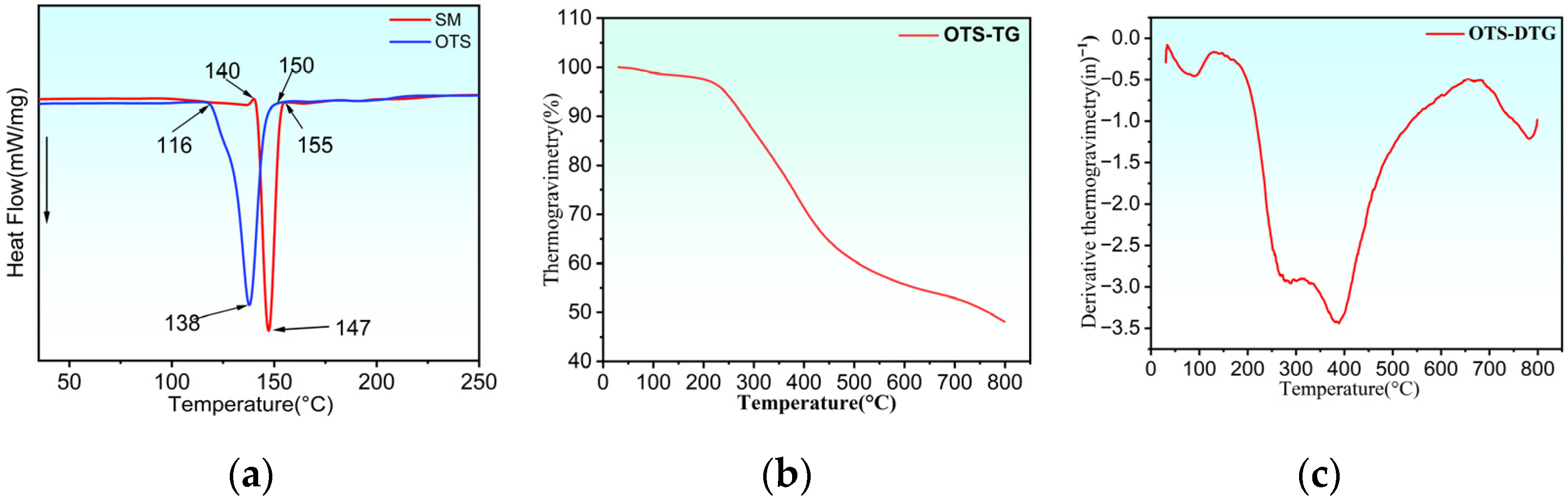
- DSC and TG/DTG analyses indicated that the OTS exhibited good curing reactivity and relatively good thermal stability. The cured adhesive remained relatively stable in the range of 130–200 °C, while obvious thermal decomposition began at about 220 °C. These results further support the formation of a denser and more stable cured structure.
Author Contributions
Funding
Institutional Review Board Statement
Data Availability Statement
Acknowledgments
Conflicts of Interest
Abbreviations
| SM | soybean meal |
| TN | tannin |
| OTN | oxidized tannin |
| OTS | oxidized tannin–soybean meal adhesive |
References
- Yang, I.; Kuo, M.; Myers, D.J.; Pu, A. Comparison of Protein-Based Adhesive Resins for Wood Composites. J. Wood Sci. 2006, 52, 503–508. [Google Scholar] [CrossRef]
- Zhang, J.; Zhang, M.; Zhang, Y.; Shi, S.Q.; Zhan, X.; Li, J.; Luo, J.; Gao, Q. Improving Bond Performance and Reducing Cross-Linker Dosage for Soy Flour Adhesives Inspired by Spider Silk. ACS Sustain. Chem. Eng. 2021, 9, 168–179. [Google Scholar] [CrossRef]
- Zhao, X.; Liu, T.; Ou, R.; Hao, X.; Fan, Q.; Guo, C.; Sun, L.; Liu, Z.; Wang, Q. Fully Biobased Soy Protein Adhesives with Integrated High-Strength, Waterproof, Mildew-Resistant, and Flame-Retardant Properties. ACS Sustain. Chem. Eng. 2022, 10, 6675–6686. [Google Scholar] [CrossRef]
- Luo, J.; Luo, J.; Gao, Q.; Li, J. Effects of Heat Treatment on Wet Shear Strength of Plywood Bonded with Soybean Meal-Based Adhesive. Ind. Crops Prod. 2015, 63, 281–286. [Google Scholar] [CrossRef]
- Ghahri, S.; Pizzi, A.; Mohebby, B.; Mirshokraie, A.; Mansouri, H.R. Soy-Based, Tannin-Modified Plywood Adhesives. J. Adhes. 2018, 94, 218–237. [Google Scholar] [CrossRef]
- Liu, C.; Zhang, Y.; Li, X.; Luo, J.; Gao, Q.; Li, J. “Green” Bio-Thermoset Resins Derived from Soy Protein Isolate and Condensed Tannins. Ind. Crops Prod. 2017, 108, 363–370. [Google Scholar] [CrossRef]
- Chen, M.; Zhang, Y.; Li, Y.; Shi, S.Q.; Li, J.; Gao, Q.; Guo, H. Soybean Meal-Based Wood Adhesive Enhanced by Phenol Hydroxymethylated Tannin Oligomer for Exterior Use. Polymers 2020, 12, 758. [Google Scholar] [CrossRef] [PubMed]
- Pizzi, A.; Scharfetter, H.O. The Chemistry and Development of Tannin-based Adhesives for Exterior Plywood. J. Appl. Polym. Sci. 1978, 22, 1745–1761. [Google Scholar] [CrossRef]
- Pizzi, A.; Merlin, M. A New Class of Tannin Adhesives for Exterior Particleboard. Int. J. Adhes. Adhes. 1981, 1, 261–264. [Google Scholar] [CrossRef]
- Yan, Q.; Ma, C.; Liang, Z.; Zhang, S. High-Temperature Soybean Meal Adhesive Based on Disulfide Bond Rearrangement and Multiple Crosslinking: Water Resistance and Prepressing Adhesion. J. Clean. Prod. 2022, 373, 133709. [Google Scholar] [CrossRef]
- Santoni, I.; Pizzo, B. Evaluation of Alternative Vegetable Proteins as Wood Adhesives. Ind. Crops Prod. 2013, 45, 148–154. [Google Scholar] [CrossRef]
- Thakur, M.K.; Thakur, V.K.; Gupta, R.K.; Pappu, A. Synthesis and Applications of Biodegradable Soy Based Graft Copolymers: A Review. ACS Sustain. Chem. Eng. 2016, 4, 1–17. [Google Scholar] [CrossRef]
- Fei, X.; Zhao, F.; Wei, W.; Luo, J.; Chen, M.; Liu, X. Tannic Acid as a Bio-Based Modifier of Epoxy/Anhydride Thermosets. Polymers 2016, 8, 314. [Google Scholar] [CrossRef]
- Lorenz, L.; Frihart, C.R.; Wescott, J.M. Chromatographic Analysis of the Reaction of Soy Flour with Formaldehyde and Phenol for Wood Adhesives. J. Am. Oil Chem. Soc. 2007, 84, 769–776. [Google Scholar] [CrossRef]
- Jin, X.; Yu, X.; Zhu, G.; Zheng, Z.; Feng, F.; Zhang, Z. Conditions Optimizing and Application of Laccase-Mediator System (LMS) for the Laccase-Catalyzed Pesticide Degradation. Sci. Rep. 2016, 6, 35787. [Google Scholar] [CrossRef]
- Khatami, S.H.; Vakili, O.; Movahedpour, A.; Ghesmati, Z.; Ghasemi, H.; Taheri-Anganeh, M. Laccase: Various Types and Applications. Biotechnol. Appl. Biochem. 2022, 69, 2658–2672. [Google Scholar] [CrossRef] [PubMed]
- Afreen, S.; Idrees, D.; Khera, R.; Amir, M.; Hassan, M.I.; Mishra, S. Investigation of the Role of Central Metal Ion of Cyathus bulleri Laccase 1 Using Guanidinium Chloride-Induced Denaturation. Int. J. Biol. Macromol. 2019, 132, 994–1000. [Google Scholar] [CrossRef]
- Bassanini, I.; Ferrandi, E.E.; Riva, S.; Monti, D. Biocatalysis with Laccases: An Updated Overview. Catalysts 2020, 11, 26. [Google Scholar] [CrossRef]
- Vera, M.; Silva, C.; Li, N.; García, Y.; Jiménez, V.A.; Urbano, B.F. Laccase-mediated Polymerization of Tannins from a Pine Bark Extract: Toward an Eco-friendly Valorization of Forest Wastes. J. Appl. Polym. Sci. 2024, 141, e55437. [Google Scholar] [CrossRef]
- Li, H.; Wang, Y.; Xie, W.; Tang, Y.; Yang, F.; Gong, C.; Wang, C.; Li, X.; Li, C. Preparation and Characterization of Soybean Protein Adhesives Modified with an Environmental-Friendly Tannin-Based Resin. Polymers 2023, 15, 2289. [Google Scholar] [CrossRef]
- Ibrahim, V.; Mamo, G.; Gustafsson, P.-J.; Hatti-Kaul, R. Production and Properties of Adhesives Formulated from Laccase Modified Kraft Lignin. Ind. Crops Prod. 2013, 45, 343–348. [Google Scholar] [CrossRef]
- Pradyawong, S.; Qi, G.; Sun, X.S.; Wang, D. Laccase/TEMPO-Modified Lignin Improved Soy-Protein-Based Adhesives: Adhesion Performance and Properties. Int. J. Adhes. Adhes. 2019, 91, 116–122. [Google Scholar] [CrossRef]
- Jimenez Bartolome, M.; Schwaiger, N.; Flicker, R.; Seidl, B.; Kozich, M.; Nyanhongo, G.S.; Guebitz, G.M. Enzymatic Synthesis of Wet-Resistant Lignosulfonate-Starch Adhesives. New Biotechnol. 2022, 69, 49–54. [Google Scholar] [CrossRef]
- Wang, H.; You, S.; Wang, W.; Zeng, Y.; Su, R.; Qi, W.; Wang, K.; He, Z. Laccase-Catalyzed Soy Protein and Gallic Acid Complexation: Effects on Conformational Structures and Antioxidant Activity. Food Chem. 2022, 375, 131865. [Google Scholar] [CrossRef]
- Chang, Z.; Pang, H.; Huang, A.; Li, J.; Zhang, S. Reinforcement of Bonding Strength and Water Resistance of Soybean Meal-Based Adhesive via Construction of an Interactive Network from Biomass Residues. Polymers 2019, 11, 967. [Google Scholar] [CrossRef] [PubMed]
- GB/T 17657-2022; Test Methods of Evaluating the Properties of Wood-Based Panels and Surface Decorated Wood-Based Panels. National Standard of the People’s Republic of China: Beijing, China, 2022.
- Qiang, T.; Chen, L.; Zhang, Q.; Liu, X. A Sustainable and Cleaner Speedy Tanning System Based on Condensed Tannins Catalyzed by Laccase. J. Clean. Prod. 2018, 197, 1117–1123. [Google Scholar] [CrossRef]
- Jeon, J.; Baldrian, P.; Murugesan, K.; Chang, Y. Laccase-catalysed Oxidations of Naturally Occurring Phenols: From in vivo Biosynthetic Pathways to Green Synthetic Applications. Microb. Biotechnol. 2012, 5, 318–332. [Google Scholar] [CrossRef]
- Theerachat, M.; Guieysse, D.; Morel, S.; Remaud-Siméon, M.; Chulalaksananukul, W. Laccases from Marine Organisms and Their Applications in the Biodegradation of Toxic and Environmental Pollutants: A Review. Appl. Biochem. Biotechnol. 2019, 187, 583–611. [Google Scholar] [CrossRef]
- Huang, G.; Li, X. Applications of Michael Addition Reaction in Organic Synthesis. Curr. Org. Synth. 2017, 14, 568–571. [Google Scholar] [CrossRef]
- d’Acunzo, F.; Baiocco, P.; Fabbrini, M.; Galli, C.; Gentili, P. A Mechanistic Survey of the Oxidation of Alcohols and Ethers with the Enzyme Laccase and Its Mediation by TEMPO. Eur. J. Org. Chem. 2002, 2002, 4195–4201. [Google Scholar] [CrossRef]
- Schlienger, S.; Graff, A.-L.; Celzard, A.; Parmentier, J. Direct Synthesis of Ordered Mesoporous Polymer and Carbon Materials by a Biosourced Precursor. Green Chem. 2012, 14, 313–316. [Google Scholar] [CrossRef]
- Pizzi, A. Polyflavonoid Tannins Self-Condensation Adhesives for Wood Particleboard. J. Adhes. 2009, 85, 57–68. [Google Scholar] [CrossRef]
- Zhang, W.; Liu, C.; Du, Z.; Wang, H.; Du, G.; Essawy, H.; Lei, H.; Xi, X.; Zhou, X.; Cao, M. Soybean Meal–Oxidized Lignin as Bio-Hybridized Wood Panel Adhesives with Increased Water Resistance. Forests 2024, 15, 1036. [Google Scholar] [CrossRef]





| Time After Preparation | Viscosity | Coating Behavior |
|---|---|---|
| (h) | mPa·s | - |
| 0 | 303 | Easy to apply with uniform coating |
| 1.0 | 596 | Difficult to apply with uneven coating |
| 1.5 | - | Caking occurred and the adhesive could not be applied |
| Sample | C1s | N1s | O1s |
|---|---|---|---|
| % | % | % | |
| OTN | 61.09 | 3.02 | 37.06 |
| SM | 69.47 | 7.68 | 22.84 |
| OTS | 65.48 | 5.69 | 28.83 |
Disclaimer/Publisher’s Note: The statements, opinions and data contained in all publications are solely those of the individual author(s) and contributor(s) and not of MDPI and/or the editor(s). MDPI and/or the editor(s) disclaim responsibility for any injury to people or property resulting from any ideas, methods, instructions or products referred to in the content. |
© 2026 by the authors. Licensee MDPI, Basel, Switzerland. This article is an open access article distributed under the terms and conditions of the Creative Commons Attribution (CC BY) license.
Share and Cite
Zhang, S.; Liu, C.; Ding, Y.; Yao, Y.; Essway, H.; Chen, X.; Zhou, X.; Wang, H.; Cao, M. Green, Formaldehyde-Free Bio-Adhesive from Soybean Meal and Laccase-Oxidized Tannin via Quinone–Amine Crosslinking. Polymers 2026, 18, 954. https://doi.org/10.3390/polym18080954
Zhang S, Liu C, Ding Y, Yao Y, Essway H, Chen X, Zhou X, Wang H, Cao M. Green, Formaldehyde-Free Bio-Adhesive from Soybean Meal and Laccase-Oxidized Tannin via Quinone–Amine Crosslinking. Polymers. 2026; 18(8):954. https://doi.org/10.3390/polym18080954
Chicago/Turabian StyleZhang, Shichao, Chengyuan Liu, Ya Ding, Yuan Yao, Hisham Essway, Xinyi Chen, Xiaojian Zhou, Hui Wang, and Ming Cao. 2026. "Green, Formaldehyde-Free Bio-Adhesive from Soybean Meal and Laccase-Oxidized Tannin via Quinone–Amine Crosslinking" Polymers 18, no. 8: 954. https://doi.org/10.3390/polym18080954
APA StyleZhang, S., Liu, C., Ding, Y., Yao, Y., Essway, H., Chen, X., Zhou, X., Wang, H., & Cao, M. (2026). Green, Formaldehyde-Free Bio-Adhesive from Soybean Meal and Laccase-Oxidized Tannin via Quinone–Amine Crosslinking. Polymers, 18(8), 954. https://doi.org/10.3390/polym18080954