Bibliometric Analysis of Biopolymer-Based Materials in Wastewater Treatment



Abstract
1. Introduction
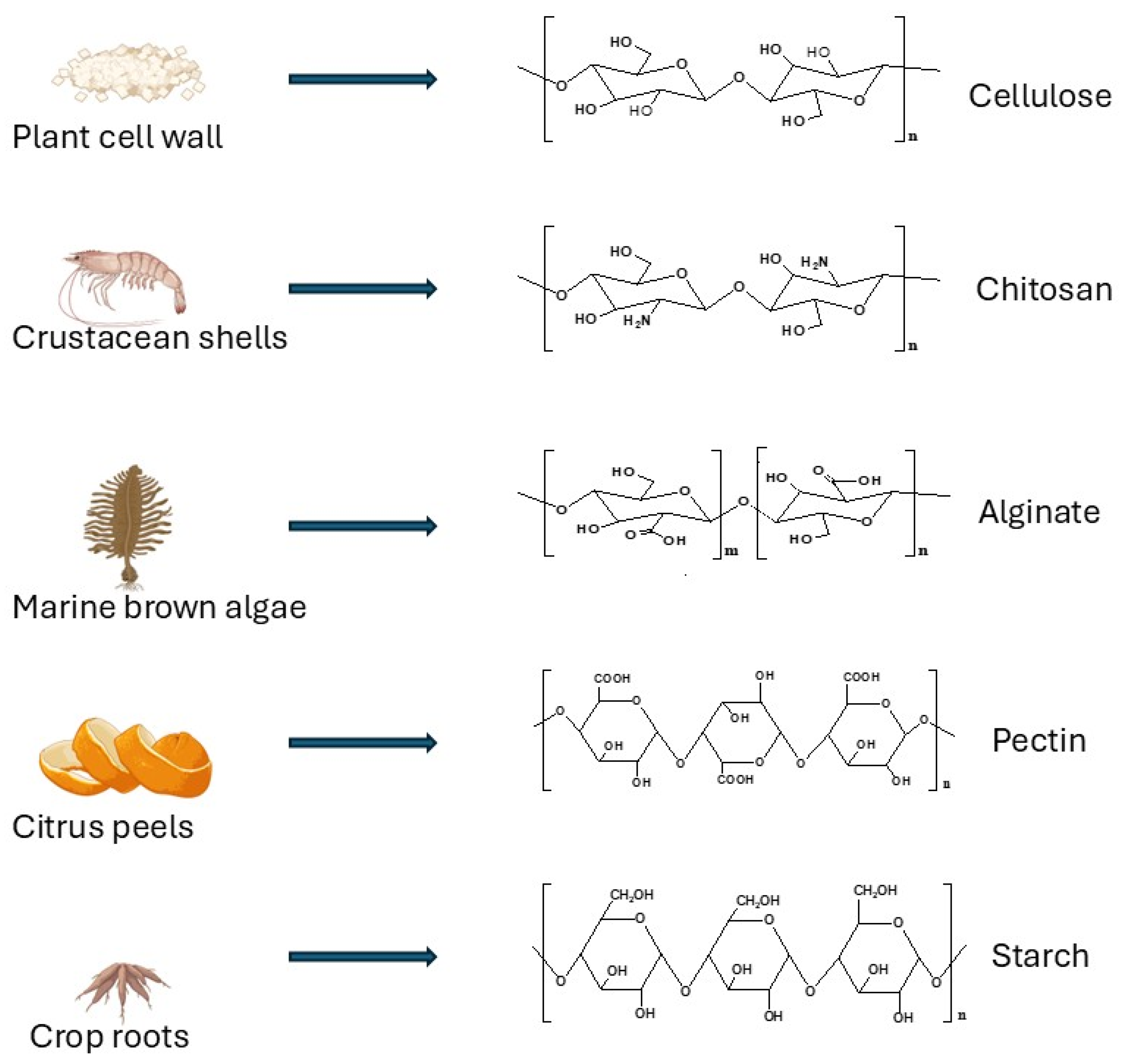
2. Types and Some Sources of Biopolymers
2.1. Cellulose
2.2. Chitosan
2.3. Alginate
2.4. Pectin
2.5. Other Biopolymers
3. Materials and Methods
3.1. Document Collection
3.2. VOS Viewer Analysis
- A minimum number of documents per author was set (e.g., ≥20 publications) for co-authorship analysis.
- A minimum number of occurrences (e.g., ≥700) was applied for keyword co-occurrence analysis.
- Merging author name variants (e.g., differences in initials or spelling).
- Normalising keywords by combining synonyms and singular/plural forms using a thesaurus file.
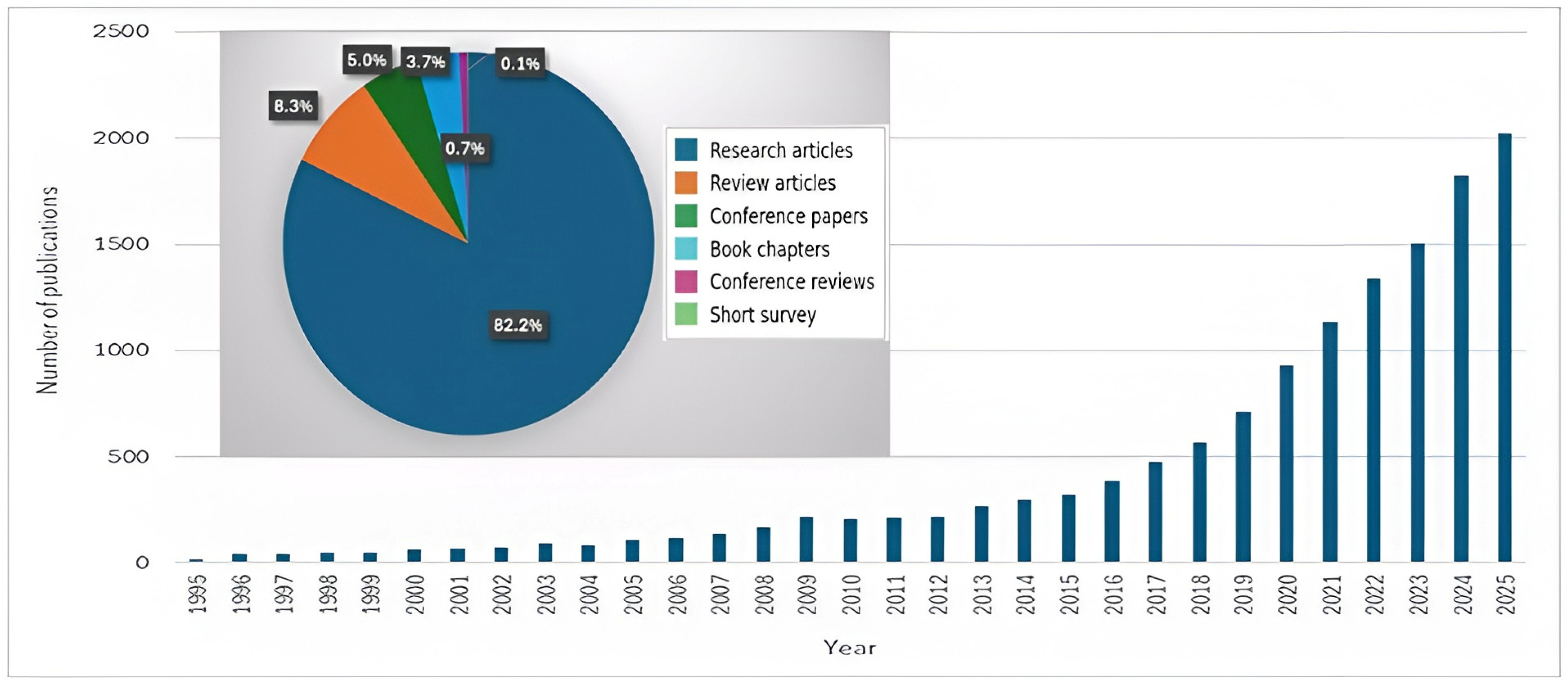
4. Publication Trends
5. Results
5.1. Publishing Sources with Citations
5.2. Most Contributing Countries
5.3. Top Organisations/Institutions
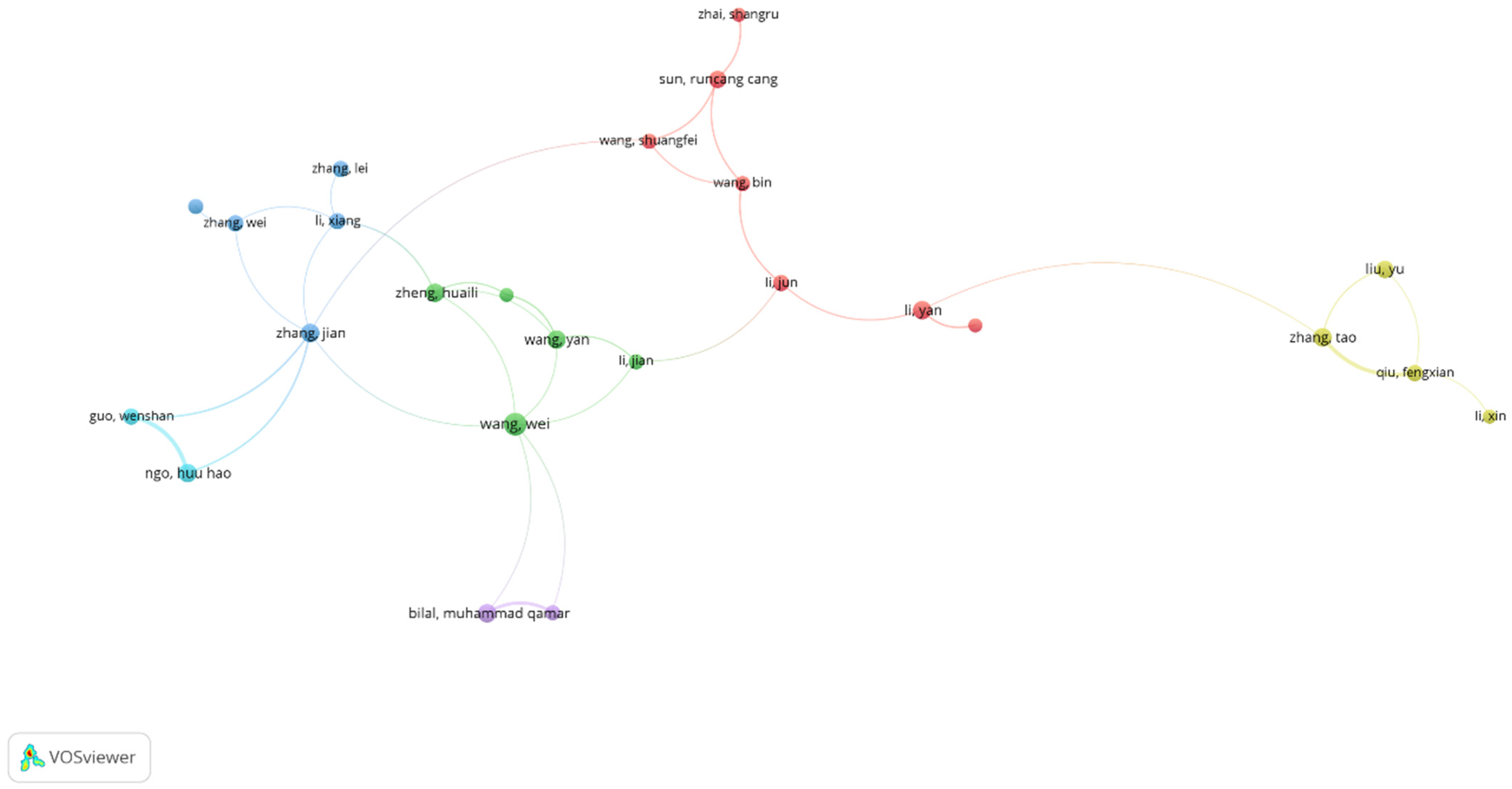
5.4. Co-Authorship Network
5.5. Most Cited Authors
5.6. Most Cited Articles
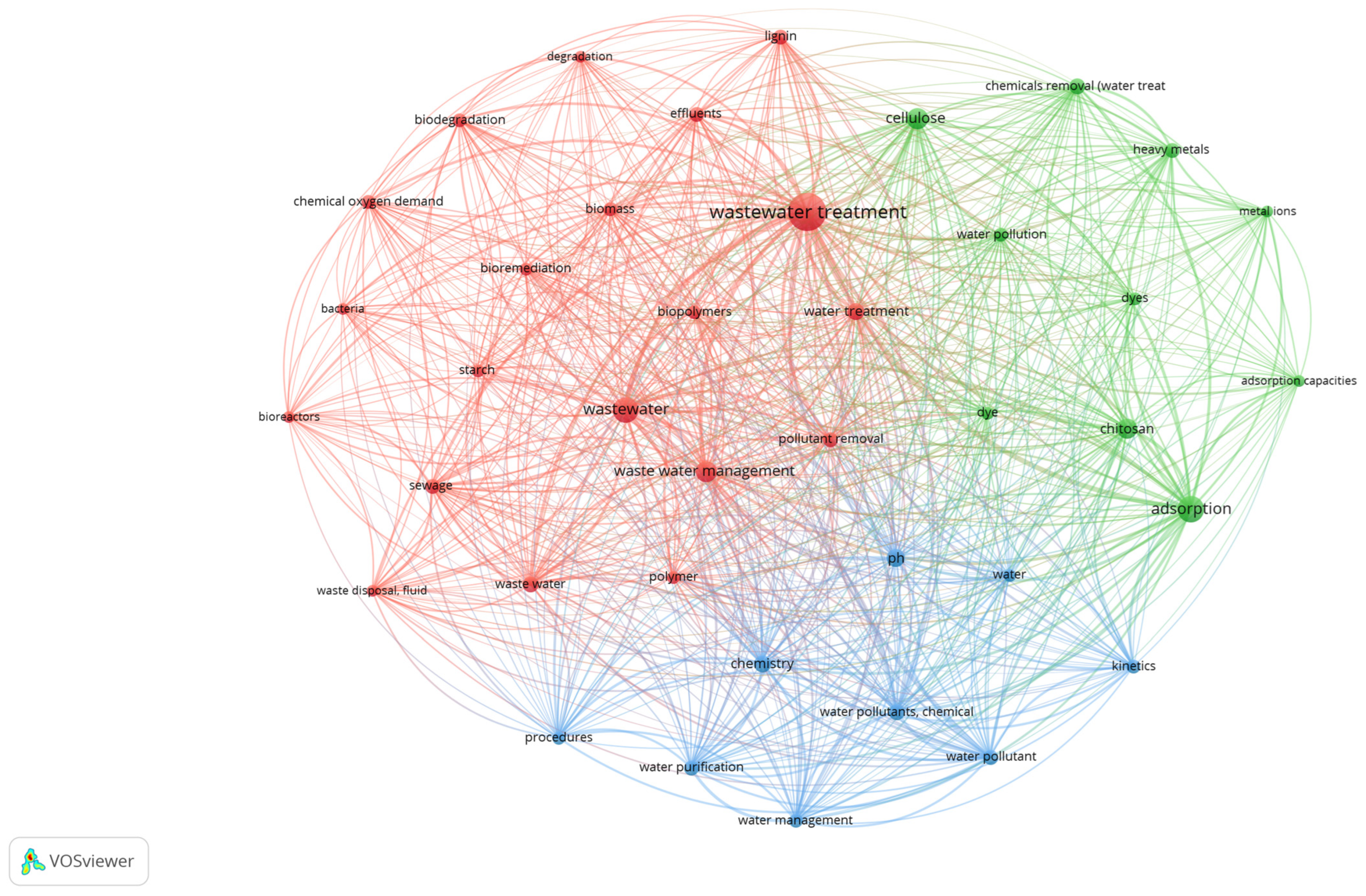
5.7. Co-Occurrence Network
6. Conclusions, Future Work, and Recommendations
- A significant increase in publication output was observed, particularly after 2016, indicating growing research interest in sustainable water treatment technologies.
- China, India, and the United States emerged as the most productive and influential contributors, reflecting strong research activity in environmental materials science.
- Leading journals are primarily positioned at the intersection of materials science and environmental engineering, highlighting the interdisciplinary nature of the field.
- Co-authorship analysis revealed relatively fragmented collaboration networks, suggesting the presence of multiple independent research groups and opportunities for stronger global collaboration.
- Citation analysis showed that highly cited works are largely dominated by broad review articles on adsorption and wastewater treatment, indicating that the field is intellectually anchored in the wider environmental remediation literature.
- Keyword co-occurrence analysis identified adsorption, wastewater treatment, chitosan, and cellulose as dominant research themes, with increasing attention given to composite materials and functional modifications.
- Strengthening interdisciplinary and international collaboration networks;
- Advancing the integration of biopolymer materials into scalable and real-world applications.
Author Contributions
Funding
Data Availability Statement
Acknowledgments
Conflicts of Interest
References
- Ghiorghita, C.-A.; Dinu, M.V.; Lazar, M.M.; Dragan, E.S. Polysaccharide-Based Composite Hydrogels as Sustainable Materials for Removal of Pollutants from Wastewater. Molecules 2022, 27, 8574. [Google Scholar] [CrossRef]
- Ismail, Y.M.N.S.; Ngadi, N.; Mohamed, N.B. The Evolution of Chitosan-Based Adsorbents for Emerging Contaminant Removal: A 2015–2025 Bibliometric Perspective. Sci. Energy Environ. 2025, 2, 9. [Google Scholar] [CrossRef]
- Lam, W.S.; Lam, W.H.; Lee, P.F. The Studies on Chitosan for Sustainable Development: A Bibliometric Analysis. Materials 2023, 16, 2857. [Google Scholar] [CrossRef]
- Doyo, A.N.; Kumar, R.; Barakat, M.A. Recent advances in cellulose, chitosan, and alginate based biopolymeric composites for adsorption of heavy metals from wastewater. J. Taiwan Inst. Chem. Eng. 2023, 151, 105095. [Google Scholar] [CrossRef]
- Fakhri, V.; Jafari, A.; Vahed, F.L.; Su, C.-H.; Pirouzfar, V. Polysaccharides as eco-friendly bio-adsorbents for wastewater remediation: Current state and future perspective. J. Water Process Eng. 2023, 54, 103980. [Google Scholar] [CrossRef]
- Bukvic, G.D.D.; Rossi, E.; Errea, M.I. Polysaccharides as Economic and Sustainable Raw Materials for the Preparation of Adsorbents for Water Treatment. Polysaccharides 2023, 4, 219–255. [Google Scholar] [CrossRef]
- Chukwukwe, E.U.; Deigh, C.; Nwaogwugwu, C.J.; Nwankwo, J.A.; Chukwuemeka, U. Eco-friendly Nanocomposites for the Degradation of Emerging Contaminants in Wastewater Systems. Asian J. Adv. Res. Rep. 2025, 19, 256–281. [Google Scholar] [CrossRef]
- Khoo, P.S.; Ilyas, R.A.; Aiman, A.; Wei, J.S.; Yousef, A.A.; Anis, N.; Zuhri, M.; Abral, H.; Sari, N.H.; Syafri, E.; et al. Revolutionizing wastewater treatment: A review on the role of advanced functional bio-based hydrogels. Int. J. Biol. Macromol. 2024, 278, 135088. [Google Scholar] [CrossRef]
- Zvezdova, D. Laboratory and Semi-Industrial Studies on the Application of Chitosan for Efficient Wastewater Treatment. In Chitosan Frontiers—Innovations and Applications in Life Sciences, Food, and Industry; IntechOpen: London, UK, 2025. [Google Scholar] [CrossRef]
- Lehocký, M. Environmental Applications of Chitosan Derivatives and Chitosan Composites. Polymers 2025, 17, 2583. [Google Scholar] [CrossRef]
- Kirti, N.; Gupta, A.D.; Singh, H.; Tiwari, H.; Blennow, A. Advancements in Starch-Based Aerogels and Hydrogels for Treatment of Water Containing Heavy Metals—A Short Review. Starch-Starke 2024, 77, 2400044. [Google Scholar] [CrossRef]
- Asadi-Ghalhari, M.; Usefi, S.; Mahmoodi, M. Starch-Based Materials as a Natural Compound’s Application in Water and Wastewater Treatment: A Systematic Review. Starch-Starke 2024, 76, 2300111. [Google Scholar] [CrossRef]
- Barrero-Fernández, A.; Aguado, R.; Moral, A.; Brindley, C.; Ballesteros, M. Applications of cellulose-based agents for flocculation processes: A bibliometric analysis. Cellulose 2021, 28, 9857–9871. [Google Scholar] [CrossRef]
- López-Maldonado, E.A.; Abdellaoui, Y.; Elella, M.H.A.; Abdallah, H.M.; Pandey, M.; Anthony, E.; Ghimici, L.; Álvarez-Torrellas, S.; Pinos-Vélez, V.; Oladoja, N.A. Innovative biopolyelectrolytes-based technologies for wastewater treatment. Int. J. Biol. Macromol. 2024, 273, 132895. [Google Scholar] [CrossRef]
- Syeda, S.E.Z.; Khan, M.S.; Skwierawska, A. Chitosan-based modalities with multifunctional attributes for adsorptive mitigation of hazardous metal contaminants from wastewater. Desalin. Water Treat. 2024, 320, 100679. [Google Scholar] [CrossRef]
- Kasbaji, M.; Mennani, M.; Oubenali, M.; Benhamou, A.A.; Boussetta, A.; Ablouh, E.-H.; Mbarki, M.; Grimi, N.; El Achaby, M.; Moubarik, A. Bio-based functionalized adsorptive polymers for sustainable water decontamination: A systematic review of challenges and real-world implementation. Environ. Pollut. 2023, 335, 122349. [Google Scholar] [CrossRef] [PubMed]
- Sanad, E.; Wakeel KZEl Beheary, M.S.; Abdelaal, A. Biopolymer-driven nano technology for industrial effluent remediation; The emerging role of alginate-based nano-composites; A review. Alfarama J. Basic Appl. Sci. 2025, 6, 480–513. [Google Scholar] [CrossRef]
- Han, R.; Zhou, B.; Huang, Y.; Lu, X.; Li, S.; Li, N. Bibliometric overview of research trends on heavy metal health risks and impacts in 1989–2018. J. Clean. Prod. 2020, 276, 123249. [Google Scholar] [CrossRef]
- Yang, F.-Q.; Li, X.; Ge, F.; Li, G. Dust prevention and control in China: A systematic analysis of research trends using bibliometric analysis and Bayesian network. Powder Technol. 2022, 411, 117941. [Google Scholar] [CrossRef]
- Saiyad, M.; Shah, N.; Joshipura, M.; Dwivedi, A.; Pillai, S. Modified biopolymers in wastewater treatment: A review. Mater. Today Proc. 2024; in press. [CrossRef]
- Kumalo, F.I.; Malimabe, M.A.; Mosoabisane, M.F.T.; Gumede, T.P. Development and Characterization of PBS/EA Cellulose and PCL/EA Cellulose Biocomposites: Structural, Morphological, and Thermal Insights for Sustainable Applications. Polymers 2025, 17, 971. [Google Scholar] [CrossRef] [PubMed]
- Seddiqi, H.; Oliaei, E.; Honarkar, H.; Jin, J.; Geonzon, L.C.; Bacabac, R.G.; Klein-Nulend, J. Cellulose and its derivatives: Towards biomedical applications. Cellulose 2021, 28, 1893–1931. [Google Scholar] [CrossRef]
- Kumalo, F.I.; Mugudamani, I.; Atangana, E.; Gumede, T.P. Recent Developments in Cellulose/Chitosan Biopolymer Composites for Winery Wastewater Treatment and Reuse: A Review. Materials 2025, 18, 5028. [Google Scholar] [CrossRef] [PubMed]
- Sikhosana, S.T.; Gumede, T.P.; Malebo, N.J.; Ogundeji, A.O.; Motloung, B. Medicinal plants as a cellulose source for the fabrication of poly(lactic acid) composites: A mini-review. Polym. Renew. Resour. 2023, 14, 44–57. [Google Scholar] [CrossRef]
- Zhang, J.; Qi, Y.; Shen, Y.; Li, H. Research Progress on Chemical Modification and Application of Cellulose: A Review. Mater. Sci. 2022, 28, 60–67. [Google Scholar] [CrossRef]
- Maaloul, N.; Oulego, P.; Rendueles, M.; Ghorbal, A.; Díaz, M. Synthesis and characterization of eco-friendly cellulose beads for copper (II) removal from aqueous solutions. Environ. Sci. Pollut. Res. 2020, 27, 23447–23463. [Google Scholar] [CrossRef]
- Liu, Q.; Xia, N.; Wan, W.; Gao, Y.; Zhu, S. Selective capture of toxic anionic dyes of a novel prepared DMDAAC-grafted chitosan/genipin/cellulose hydrogel beads with antibacterial activity. Int. J. Biol. Macromol. 2021, 189, 722–733. [Google Scholar] [CrossRef]
- Mhlongo, J.T.; Dlamini, M.L.; Nuapia, Y.; Etale, A. Synthesis and application of cationized cellulose for adsorption of anionic dyes. Mater. Today Proc. 2022, 62, S133–S140. [Google Scholar] [CrossRef]
- Saad, H.E.; Hashem, M.A.; El-Sayed, Y.S.; Gaber, M.; El-Reash, G.M.A. Performance evaluation of cationic cellulose for anionic dyes adsorption from real wastewater and docking studies. Discov. Chem. 2025, 2, 38. [Google Scholar] [CrossRef]
- Gupta, A.; Ladino, C.R.; Mekonnen, T.H. Cationic modification of cellulose as a sustainable and recyclable adsorbent for anionic dyes. Int. J. Biol. Macromol. 2023, 234, 123523. [Google Scholar] [CrossRef]
- Mladenovic, N.; Makreski, P.; Tarbuk, A.; Grgic, K.; Boev, B.; Mirakovski, D.; Toshikj, E.; Dimova, V.; Dimitrovski, D.; Jordanov, I. Improved dye removal ability of modified rice husk with effluent from alkaline scouring based on the circular economy concept. Processes 2020, 8, 653. [Google Scholar] [CrossRef]
- Quansah, J.O.; Hlaing, T.; Lyonga, F.N.; Kyi, P.P.; Hong, S.H.; Lee, C.G.; Park, S.-J. Nascent rice husk as an adsorbent for removing cationic dyes from textile wastewater. Appl. Sci. 2020, 10, 3437. [Google Scholar] [CrossRef]
- Yang, H.R.; Li, S.S.; Shan, X.C.; Yang, C.; An, Q.D.; Zhai, S.R.; Xiao, Z.-Y. Hollow polyethyleneimine/carboxymethyl cellulose beads with abundant and accessible sorption sites for ultra-efficient chromium (VI) and phosphate removal. Sep. Purif. Technol. 2022, 278, 119607. [Google Scholar] [CrossRef]
- Ding, Y.; Song, C.; Gong, W.; Liu, L.; Wu, M.; Li, L.; Yao, J. Robust, sustainable, hierarchical multi-porous cellulose beads via pre-crosslinking strategy for efficient dye adsorption. Cellulose 2021, 28, 7227–7241. [Google Scholar] [CrossRef]
- Ren, K.; Fan, Y.; Xing, G.; Zhai, M.; Sheng, J.; Song, Y. Rapid and convenient synthesis of “green” ammonium-modified chitosan composite sponge with the existence of ascorbic acid for highly efficient removal of Congo red (CR). Carbohydr. Polym. 2024, 324, 121444. [Google Scholar] [CrossRef]
- Han, S.; Zhou, X.; Xie, H.; Wang, X.; Yang, L.; Wang, H.; Hao, C. Chitosan-based composite microspheres for treatment of hexavalent chromium and EBBR from aqueous solution. Chemosphere 2022, 305, 135486. [Google Scholar] [CrossRef] [PubMed]
- Tang, X.; Huang, Y.; He, Q.; Wang, Y.; Zheng, H.; Hu, Y. Adsorption of tetracycline antibiotics by nitrilotriacetic acid modified magnetic chitosan-based microspheres from aqueous solutions. Environ. Technol. Innov. 2021, 24, 101895. [Google Scholar] [CrossRef]
- Wang, S.; Chen, J.; Sun, H.; Qian, P.; Wang, D.; Zhuang, W.; Dong, L. Enhancing Adsorption Performance of Ce(III) by Amine-Thiourea and Aniline-Modified Magnetic Chitosan Nanocomposites. Langmuir 2024, 40, 23398–23405. [Google Scholar] [CrossRef] [PubMed]
- Kloster, G.A.; Valiente, M.; Marcovich, N.E.; Mosiewicki, M.A. Adsorption of arsenic onto films based on chitosan and chitosan/nano-iron oxide. Int. J. Biol. Macromol. 2020, 165, 1286–1295. [Google Scholar] [CrossRef]
- Asadi, S.; Eris, S.; Azizian, S. Alginate-Based Hydrogel Beads as a Biocompatible and Efficient Adsorbent for Dye Removal from Aqueous Solutions. ACS Omega 2018, 3, 15140–15148. [Google Scholar] [CrossRef]
- Parlayici, Ş. Alginate-coated perlite beads for the efficient removal of methylene blue, malachite green, and methyl violet from aqueous solutions: Kinetic, thermodynamic, and equilibrium studies. J. Anal. Sci. Technol. 2019, 10, 4. [Google Scholar] [CrossRef]
- Dodero, A.; Vicini, S.; Lova, P.; Alloisio, M.; Castellano, M. Nanocomposite alginate-based electrospun membranes as novel adsorbent systems. Int. J. Biol. Macromol. 2020, 165, 1939–1948. [Google Scholar] [CrossRef]
- Li, X.; Qi, Y.; Li, Y.; Zhang, Y.; He, X.; Wang, Y. Novel magnetic beads based on sodium alginate gel crosslinked by zirconium(IV) and their effective removal for Pb2+ in aqueous solutions by using a batch and continuous systems. Bioresour. Technol. 2013, 142, 611–619. [Google Scholar] [CrossRef]
- Subroto, N.N.P.; Tarmidzi, F.M.; Wati, I.; Armans, V.M. Lead Ion Removal in Water Using Low Methoxy Pectin-Guar Gum Beads Hybrid Adsorbent. J. Chem. Res. 2022, 10, 53–57. [Google Scholar] [CrossRef]
- Cataldo, S.; Gianguzza, A.; Pettignano, A.; Villaescusa, I. Mercury(II) removal from aqueous solution by sorption onto alginate, pectate and polygalacturonate calcium gel beads. A kinetic and speciation based equilibrium study. React. Funct. Polym. 2013, 73, 207–217. [Google Scholar] [CrossRef]
- Yu, L.L.; Jiang, L.N.; Wang, S.Y.; Sun, M.M.; Li, D.Q.; Du, G.M. Pectin microgel particles as high adsorption rate material for methylene blue: Performance, equilibrium, kinetic, mechanism and regeneration studies. Int. J. Biol. Macromol. 2018, 112, 383–389. [Google Scholar] [CrossRef] [PubMed]
- Shao, Z.; Lu, J.; Ding, J.; Fan, F.; Sun, X.; Li, P.; Fang, Y.; Hu, Q. Novel green chitosan-pectin gel beads for the removal of Cu(II), Cd(II), Hg(II) and Pb(II) from aqueous solution. Int. J. Biol. Macromol. 2021, 176, 217–225. [Google Scholar] [CrossRef]
- Guo, L.; Li, G.; Liu, J.; Meng, Y.; Tang, Y. Adsorptive decolorization of methylene blue by crosslinked porous starch. Carbohydr. Polym. 2013, 93, 374–379. [Google Scholar] [CrossRef]
- Zhang, L.-M.; Chen, D.-Q. An investigation of adsorption of lead(II) and copper(II) ions by water-insoluble starch graft copolymers. Colloids Surf. A Physicochem. Eng. Asp. 2002, 205, 231–236. [Google Scholar] [CrossRef]
- Kumari, S.; Chauhan, G.S.; Monga, S.; Kaushik, A.; Ahn, J.H. New lignin-based polyurethane foam for wastewater treatment. RSC Adv. 2016, 6, 77768–77776. [Google Scholar] [CrossRef]
- Jahan, K.; Thankachan, D.; Shakya, K.; Mehrotra, N.; CS, N.; Verma, V. Removal of heavy metal ions (Pb2+, Cu2+, Cr3+, and Cd2+) from multimetal simulated wastewater using 3-aminopropyl triethoxysilane grafted agar porous cryogel. Int. J. Biol. Macromol. 2024, 282, 136784. [Google Scholar] [CrossRef]
- Dambuza, A.; Mokolokolo, P.P.; Makhatha, M.E.; Sibeko, M.A. Pharmacological and Biological Efficacy of Chitosan-Based Materials. Int. J. Mol. Sci. 2025, 26, 10735. [Google Scholar] [CrossRef]
- Kou, S.G.; Peters, L.M.; Mucalo, M.R. Chitosan: A review of sources and preparation methods. Int. J. Biol. Macromol. 2021, 169, 85–94. [Google Scholar] [CrossRef]
- Dambuza, A.; Mokolokolo, P.P.; Makhatha, M.E.; Sibeko, M.A. Chitosan-Based Materials as Effective Materials to Remove Pollutants. Polymers 2025, 17, 2447. [Google Scholar] [CrossRef] [PubMed]
- Yusof, W.R.W.; Awang, N.Y.F.; Laile, M.A.A.; Azizi, J.; Husaini, A.A.S.A.; Seeni, A.; Wilson, L.D.; Sabar, S. Chemically modified water-soluble chitosan derivatives: Modification strategies, biological activities, and applications. Polym.-Plast. Technol. Mater. 2023, 62, 2182–2220. [Google Scholar] [CrossRef]
- Suresh, S.; Uemsh, M.; Santhosh, A.S. Wastewater treatment using chitosan and its derivatives: A mini review on latest developments. Not. Sci. Biol. 2022, 14, 11369. [Google Scholar] [CrossRef]
- Saranya, P.; Ramesh, S.T.; Gandhimathi, R. Coagulation performance evaluation of alginate as a natural coagulant for the treatment of turbid water. Water Pract. Technol. 2022, 17, 395–404. [Google Scholar] [CrossRef]
- Zdiri, K.; Cayla, A.; Elamri, A.; Erard, A.; Salaun, F. Alginate-Based Bio-Composites and Their Potential Applications. J. Funct. Biomater. 2022, 13, 117. [Google Scholar] [CrossRef] [PubMed]
- Ching, S.H.; Bansal, N.; Bhandari, B. Alginate gel particles–A review of production techniques and physical properties. Crit. Rev. Food Sci. Nutr. 2017, 57, 1133–1152. [Google Scholar] [CrossRef]
- Siddiqui, V.U.; Ilyas, R.A.; Sapuan, S.M.; Hamid, N.H.A.; Khoo, P.S.; Chowdhury, A.; Atikah, M.; Rani, M.; Asyraf, M. Alginate-based materials as adsorbent for sustainable water treatment. Int. J. Biol. Macromol. 2025, 298, 139946. [Google Scholar] [CrossRef]
- Kumar, B.; Singh, N.; Kumar, P. A review on sources, modification techniques, properties and potential applications of alginate-based modified polymers. Eur. Polym. J. 2024, 213, 113078. [Google Scholar] [CrossRef]
- Dambuza, A.; Rungqu, P.; Oyedeji, A.O.; Miya, G.; Hosu, S.; Oriola, A.O.; Oyedeji, O.O. Characterization and antioxidant activity of pectin from lemon peels. Open Chem. 2025, 23, 20250165. [Google Scholar] [CrossRef]
- Jha, A.; Mishra, S. Exploring the potential of waste biomass-derived pectin and its functionalized derivatives for water treatment. Int. J. Biol. Macromol. 2024, 275, 133613. [Google Scholar] [CrossRef] [PubMed]
- Russo, T.; Fucile, P.; Giacometti, R.; Sannino, F. Sustainable removal of contaminants by biopolymers: A novel approach for wastewater treatment. Current state and future perspectives. Processes 2021, 9, 719. [Google Scholar] [CrossRef]
- da Costa, T.B.; Matias, P.M.C.; Sharma, M.; Murtinho, D.; dos Santos Rosa, D.; Valente, A.J.M. Recent Advances on Starch-Based Adsorbents for Heavy Metal and Emerging Pollutant Remediation. Polymers 2024, 17, 15. [Google Scholar] [CrossRef]
- El Messaoudi, N.; Miyah, Y.; Georgin, J.; Franco, D.S.P.; Ergan, B.T.; Mbanga, B.G.F.; Knani, S.; Messali, M. Application of agar-based adsorbents in the removal of dyes and heavy metals from wastewater: Current advances, challenges, and future perspectives. React. Funct. Polym. 2025, 217, 106501. [Google Scholar] [CrossRef]
- Blair, J.; Rathee, G.; Puertas-Segura, A.; Pérez, L.M.; Tzanov, T. Advanced water treatment with antimicrobial silver-lignin nanoparticles sonochemically-grafted on cork granulates in activated carbon packed-bed columns. Environ. Res. 2025, 279, 121783. [Google Scholar] [CrossRef]
- Souley Agbodjan, Y.; Wang, J.; Cui, Y.; Liu, Z.; Luo, Z. Bibliometric analysis of zero energy building research, challenges and solutions. Sol. Energy 2022, 244, 414–433. [Google Scholar] [CrossRef]
- van Eck, N.J.; Waltman, L. Software survey: VOSviewer, a computer program for bibliometric mapping. Scientometrics 2010, 84, 523–538. [Google Scholar] [CrossRef]
- Crini, G. Non-conventional low-cost adsorbents for dye removal: A review. Bioresour. Technol. 2006, 97, 1061–1085. [Google Scholar] [CrossRef]
- Babel, S.; Kurniawan, T.A. Low-cost adsorbents for heavy metals uptake from contaminated water: A review. J. Hazard. Mater. 2003, 97, 219–243. [Google Scholar] [CrossRef] [PubMed]
- Gupta, V.K.; Suhas. Application of low-cost adsorbents for dye removal—A review. J. Environ. Manag. 2009, 90, 2313–2342. [Google Scholar] [CrossRef] [PubMed]
- Bailey, S.E.; Olin, T.J.; Bricka, R.M.; Adrian, D.D. A review of potentially low-cost sorbents for heavy metals. Water Res. 1999, 33, 2469–2479. [Google Scholar] [CrossRef]
- Sheng, G.-P.; Yu, H.-Q.; Li, X.-Y. Extracellular polymeric substances (EPS) of microbial aggregates in biological wastewater treatment systems: A review. Biotechnol. Adv. 2010, 28, 882–894. [Google Scholar] [CrossRef] [PubMed]
- Boyack, K.W.; Klavans, R. Creation and Analysis of Large-Scale Bibliometric Networks. In Springer Handbook of Science and Technology Indicators; Glänzel, W., Moed, H.F., Schmoch, U., Thelwall, M., Eds.; Springer International Publishing: Cham, Switzerland, 2019; pp. 187–212. [Google Scholar] [CrossRef]


| Biopolymer | Pollutants Removed | Mechanism | Adsorption Capacity (mg/g) | Reusability (Cycles) | References |
|---|---|---|---|---|---|
| Cellulose-based | |||||
| CBBAS (cellulose beads from bleached almond shell) | Cu (II) | Chelation | 128.24 | 4 | [26] |
| CCBG-g-PDMDAAC3.0 (DMDAAC-grafted chitosan/genipin/cellulose hydrogel beads) | Reactive Red 195 | Electrostatic attraction | 1333.52 | 5 | [27] |
| CCBG-g-PDMDAAC3.0 (DMDAAC-grafted chitosan/genipin/cellulose hydrogel beads) | Methyl Orange | Electrostatic attraction | 190.48 | 5 | [27] |
| GT-cellulose (GTMAC-modified hemp cellulose) | Methyl Orange | Electrostatic attraction | 76.9 | - | [28] |
| Cationic cellulose (periodate oxidation + Girard’s reagent T) | Eriochrome Cyanine R (ECR) | Electrostatic attraction | 65.33 | 5 | [29] |
| Cationic cellulose fibre (GTMAC-modified cellulose pulp) | Reactive Black 5 | Electrostatic attraction | 1010 | 5 | [30] |
| Alkali-scoured modified rice husk | Congo Red | Surface adsorption | 93.8 | - | [31] |
| Nascent rice husk | Crystal Violet | Electrostatic interaction | 25.46 | - | [32] |
| Carboxymethyl cellulose–alginic acid–polyethyleneimine | Cr(VI) | Chelation | 293.26 | 5 | [33] |
| PEI-modified cellulose | Methyl Blue | Electrostatic attraction and hydrogen bonding | 1550.55 | 8 | [34] |
| PEI-modified cellulose | Rose Bengal | Electrostatic attraction and hydrogen bonding | 467.95 | 8 | [34] |
| Chitosan-based | |||||
| Ammonium-modified chitosan composite | Congo Red | Electrostatic interactions and hydrogen bonding | 1261.64 | 5 | [35] |
| Chitosan-based composite microspheres | Eriochrome Black T dye | Electrostatic interactions | 317.21 | - | [36] |
| Nitrilotriacetic acid-modified magnetic chitosan microspheres | Tetracycline | π–π interactions, hydrogen bonding | 625.52 | 5 | [37] |
| Amine-thiourea-modified magnetic chitosan hydrogel | Ce (III) | Chelation, electrostatic interaction | 156 | 5 | [38] |
| Chitosan film | As(V) | Electrostatic interaction | 15.23 | 4 | [39] |
| Alginate-based | |||||
| Calcium alginate hydrogel beads | Methyl Violet | Electrostatic attraction | 889 | - | [40] |
| Alginate-coated perlite beads | Methylene Blue | Electrostatic attraction | 104.10 | 5 | [41] |
| ZnO nanoparticle-embedded Sodium alginate membrane | Methylene Blue | Electrostatic attraction and hydrogen bonding | 746.00 | 3 | [42] |
| Magnetic sodium alginate–zirconium(IV) beads | Pb (II) | Complexation | 333.33 | 10 | [43] |
| Pectin-based | |||||
| Low methoxy pectin–guar gum hybrid beads | Pb (II) | Ion exchange and complexation | 104.8 | - | [44] |
| Calcium pectate gel beads | Hg (II) | Ion exchange and complexation | 340 | - | [45] |
| Pectin microgel particles | Methylene Blue | Electrostatic attraction | 284.09 | 3 | [46] |
| Chitosan–pectin gel beads | Cu (II) | Complexation | 169.4 | 5 | [47] |
| Chitosan–pectin gel beads | Cd (II) | Complexation | 177.6 | 5 | [47] |
| Other biopolymer-based | |||||
| Crosslinked porous starch | Methylene Blue | Electrostatic attraction | 9.46 | - | [48] |
| Crosslinked starch | Pb (II) | Chelation | 433 | - | [49] |
| Crosslinked starch | Cu (II) | Chelation | 135 | - | [49] |
| Lignin-based polyurethane Foam | Methylene Green | Electrostatic attraction, π–π interactions, hydrogen bonding | 80 | 20 | [50] |
| Agar-APTES cryogels | Cr (III) | Ion exchange, chelation, electrostatic attraction | 52.58 | - | [51] |
| Rank | Source | Documents | Citations |
|---|---|---|---|
| 1 | Bioresource Technology | 462 | 41,545 |
| 2 | Water Research | 272 | 32,385 |
| 3 | Journal of Hazardous Materials | 241 | 30,221 |
| 4 | Chemical Engineering Journal | 258 | 20,026 |
| 5 | Science of the Total Environment | 242 | 12,016 |
| 6 | International Journal of Biological Macromolecules | 382 | 14,401 |
| 7 | Chemosphere | 305 | 16,325 |
| 8 | Journal of Environmental Management | 188 | 17,560 |
| 9 | Carbohydrate Polymers | 174 | 17,871 |
| 10 | Separation and Purification Technology | 200 | 8710 |
| Rank | Country | Documents | Citations |
|---|---|---|---|
| 1 | China | 3809 | 159,611 |
| 2 | India | 1573 | 66,542 |
| 3 | United States | 817 | 53,950 |
| 4 | Saudi Arabia | 394 | 15,787 |
| 5 | Malaysia | 499 | 23,741 |
| 6 | South Korea | 397 | 20,094 |
| 7 | Canada | 398 | 20,545 |
| 8 | Egypt | 412 | 14,094 |
| 9 | Spain | 349 | 18,354 |
| 10 | Australia | 296 | 15,430 |
| Rank | Organisation/Institution | Country | Documents | Citations |
|---|---|---|---|---|
| 1 | University of Chinese Academy of Sciences | China | 87 | 3351 |
| 2 | Universiti Teknologi Malaysia (Johor Bahru) | Malaysia | 75 | 2757 |
| 3 | Guangxi University, Nanning | China | 62 | 1934 |
| 4 | Jiangsu University, Zhenjiang | China | 61 | 1983 |
| 5 | State Key Laboratory of Pollution Control Technology | China | 43 | 1377 |
| 6 | State Key Laboratory of Biobased Materials | China | 42 | 1192 |
| 7 | Department of Biotechnology, Delft University of Technology | Netherlands | 40 | 2065 |
| 8 | Harbin Institute of Technology (Main Campus) | China | 34 | 1984 |
| 9 | School of Environment, Harbin Institute of Technology | China | 33 | 1339 |
| 10 | Tongji University, Shanghai | China | 32 | 2749 |
| Rank | Author | Documents | Citations | Total Link Strength (TLS) |
|---|---|---|---|---|
| 1 | Zhang, Jian | 25 | 1148 | 5 |
| 2 | Ngo, Huu Hao | 24 | 2476 | 4 |
| 3 | Wang, Wei | 35 | 1412 | 3 |
| 4 | Li, Yan | 25 | 793 | 1 |
| 5 | Zhang, Tao | 24 | 865 | 1 |
| 6 | Zheng, Huaili | 24 | 1353 | 1 |
| 7 | Añón, J.C.R. | 47 | 3814 | 0 |
| 8 | Crini, Grégorio | 24 | 11,304 | 0 |
| 9 | Fatehi, Pedram | 27 | 518 | 0 |
| 10 | Sillanpää, Mika A. | 27 | 3122 | 0 |
| Rank | Author | Documents | Citations |
|---|---|---|---|
| 1 | Crini, Gregório | 24 | 11,304 |
| 2 | Wan Ngah, Wan Saime Wan | 6 | 4519 |
| 3 | Yu, Hanqing | 14 | 4458 |
| 4 | Kurniawan, Tonni Agustiono | 9 | 4374 |
| 5 | Babel, Sandhya | 2 | 4014 |
| 6 | Gupta, Vinod Kumar A. | 6 | 3958 |
| 7 | Li, Xiaoyan | 15 | 3951 |
| 8 | Añón, J. C. R. | 47 | 3814 |
| 9 | Megat Hanafiah, Megat Ahmad Kamal | 3 | 3637 |
| 10 | Elimelech, Menachem | 11 | 3633 |
| Rank | Article (First Author, Year) | Citations | Topic/Focus |
|---|---|---|---|
| 1 | Crini (2006) | 4130 | Non-conventional low-cost adsorbents for dye removal: A review |
| 2 | Babel (2003) | 3171 | Low-cost adsorbents for heavy metals uptake from contaminated water: A review |
| 3 | Gupta and Suhas (2009) | 3151 | Application of low-cost adsorbents for dye removal—A review |
| 4 | Bailey (1999) | 2997 | A review of potentially low-cost sorbents for heavy metals |
| 5 | Sheng (2010) | 2853 | Extracellular polymeric substances (EPS) of microbial aggregates in biological wastewater treatment systems: A review |
| 6 | Wan Ngah (2011) | 2710 | Adsorption of dyes and heavy metal ions by chitosan composites: A review |
| 7 | Haritash (2009) | 2650 | Biodegradation aspects of Polycyclic Aromatic Hydrocarbons (PAHs): A review |
| 8 | Crini (2008) | 2152 | Application of chitosan, a natural aminopolysaccharide, for dye removal from aqueous solutions by adsorption processes using batch studies: A review of recent literature |
| Rank | Keyword | Occurrences | Total Link Strength |
|---|---|---|---|
| 1 | wastewater treatment | 8684 | 169,734 |
| 2 | wastewater | 3874 | 97,083 |
| 3 | adsorption | 3586 | 57,873 |
| 4 | pH | 1473 | 49,786 |
| 5 | cellulose | 2317 | 48,261 |
| 6 | chemistry | 1483 | 48,183 |
| 7 | water pollutants, chemical | 1272 | 43,271 |
| 8 | water pollutant | 1227 | 42,244 |
| 9 | chitosan | 2156 | 39,853 |
| 10 | sewage | 1219 | 36,001 |
| 11 | pollutant removal | 1177 | 33,801 |
| 12 | dyes | 1054 | 31,732 |
Disclaimer/Publisher’s Note: The statements, opinions and data contained in all publications are solely those of the individual author(s) and contributor(s) and not of MDPI and/or the editor(s). MDPI and/or the editor(s) disclaim responsibility for any injury to people or property resulting from any ideas, methods, instructions or products referred to in the content. |
© 2026 by the authors. Licensee MDPI, Basel, Switzerland. This article is an open access article distributed under the terms and conditions of the Creative Commons Attribution (CC BY) license.
Share and Cite
Dambuza, A.; Mokolokolo, P.P.; Makhatha, M.E.; Sibeko, M.A. Bibliometric Analysis of Biopolymer-Based Materials in Wastewater Treatment. Polymers 2026, 18, 953. https://doi.org/10.3390/polym18080953
Dambuza A, Mokolokolo PP, Makhatha ME, Sibeko MA. Bibliometric Analysis of Biopolymer-Based Materials in Wastewater Treatment. Polymers. 2026; 18(8):953. https://doi.org/10.3390/polym18080953
Chicago/Turabian StyleDambuza, Anathi, Pennie P. Mokolokolo, Mamookho E. Makhatha, and Motshabi A. Sibeko. 2026. "Bibliometric Analysis of Biopolymer-Based Materials in Wastewater Treatment" Polymers 18, no. 8: 953. https://doi.org/10.3390/polym18080953
APA StyleDambuza, A., Mokolokolo, P. P., Makhatha, M. E., & Sibeko, M. A. (2026). Bibliometric Analysis of Biopolymer-Based Materials in Wastewater Treatment. Polymers, 18(8), 953. https://doi.org/10.3390/polym18080953