Effect of the Hole Diameter Ratio (d/H) on the Web Crippling Capacity of Pultruded GFRP U-Channels Under Temperature and Loading Conditions

 ,
, 
 and
and 
Abstract
1. Introduction
2. Experimental Study
2.1. Test Specimens

| U-ITF-24-00 |  | U-ETF-24-00 |  |
| U-ITF-200-00 |  | U-ETF-200-00 |  |
| U-ITF-250-00 |  | U-ETF-250-00 |  |
| U-ITF-300-00 |  | U-ETF-300-00 |  |
| U-ITF-24-32 |  | U-ETF-24-32 |  |
| U-ITF-200-32 |  | U-ETF-200-32 |  |
| U-ITF-250-32 |  | U-ETF-250-32 |  |
| U-ITF-300-32 |  | U-ETF-300-32 |  |
| U-ITF-24-50 |  | U-ETF-24-50 |  |
| U-ITF-200-50 |  | U-ETF-200-50 |  |
| U-ITF-250-50 |  | U-ETF-250-50 |  |
| U-ITF-300-50 |  | U-ETF-300-50 |  |
| U-ITF-24-70 |  | U-ETF-24-70 |  |
| U-ITF-200-70 |  | U-ETF-200-70 |  |
| U-ITF-250-70 |  | U-ETF-250-70 |  |
| U-ITF-300-70 |  | U-ETF-300-70 |  |
2.2. Loading Application
2.3. Dynamic Mechanics Analysis (DMA)
2.4. Thermal Characterization—TGA-DSC
2.5. FTIR Spectroscopy
2.6. SEM Imaging—Scanning Electron Microscopy
3. Results
3.1. Effect of High Temperatures on Specimens
3.2. Burn-Out Test of the Sample
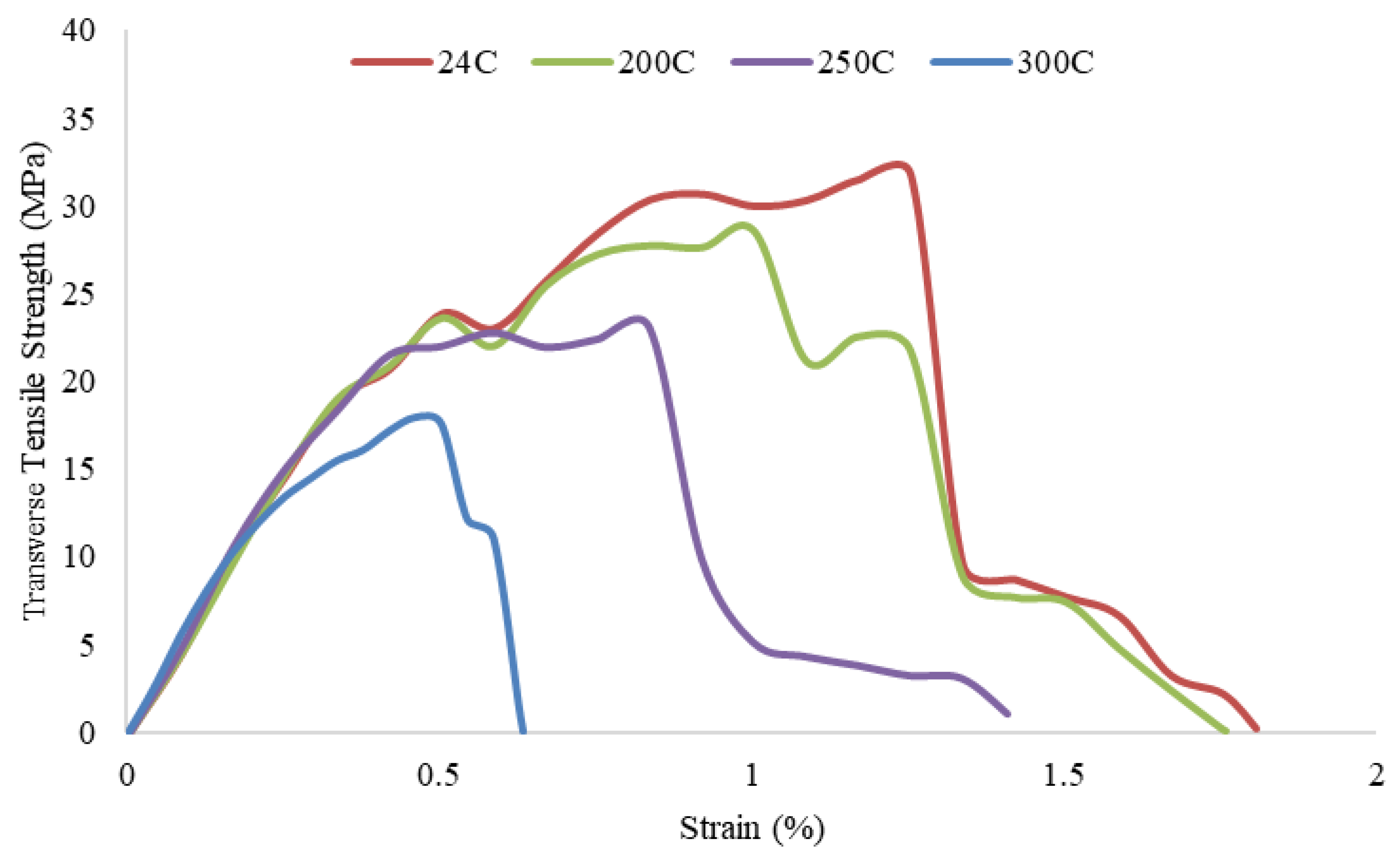
3.3. Tensile Test Results
3.4. Microstructure Analysis
3.4.1. DMA
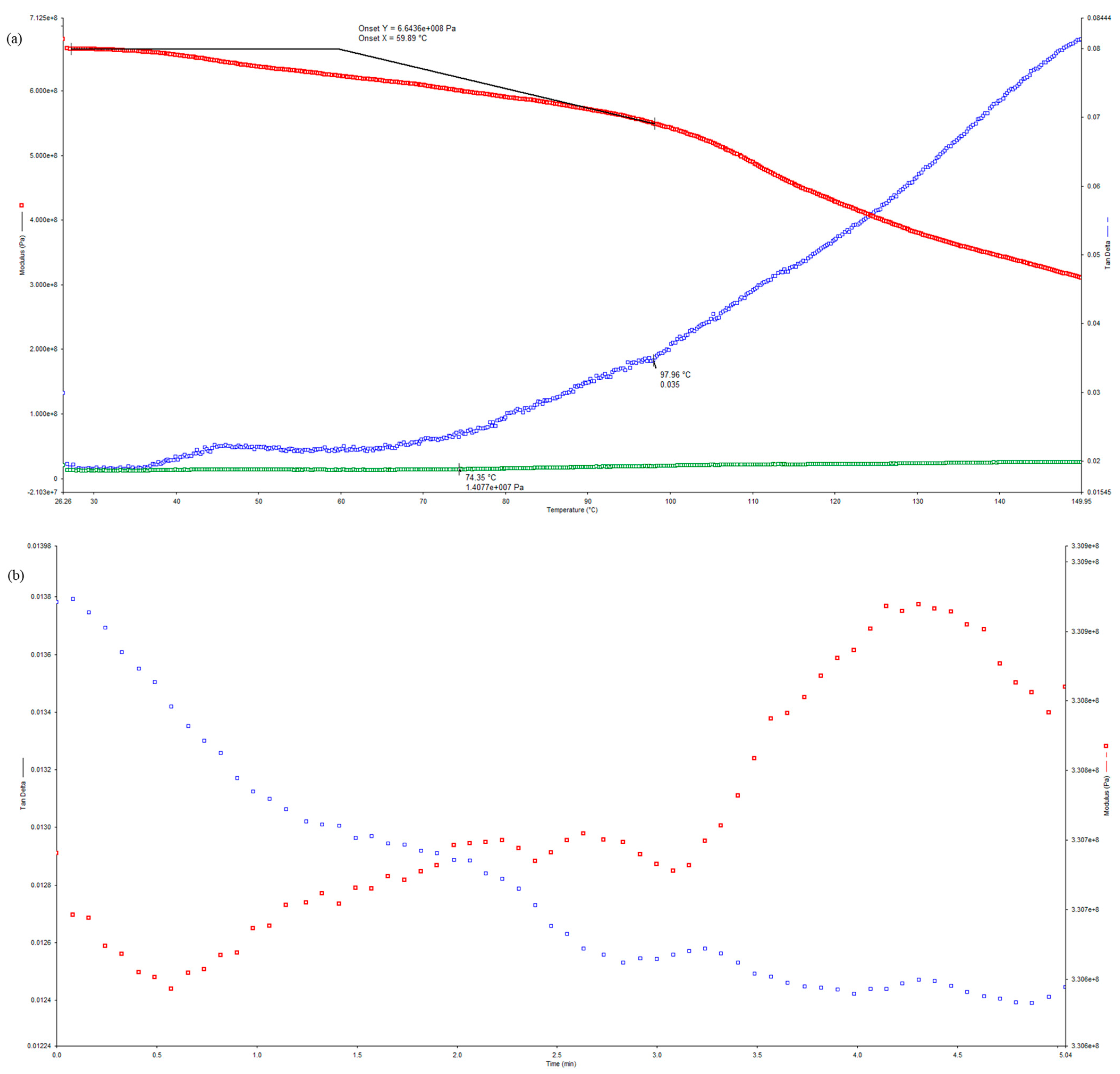
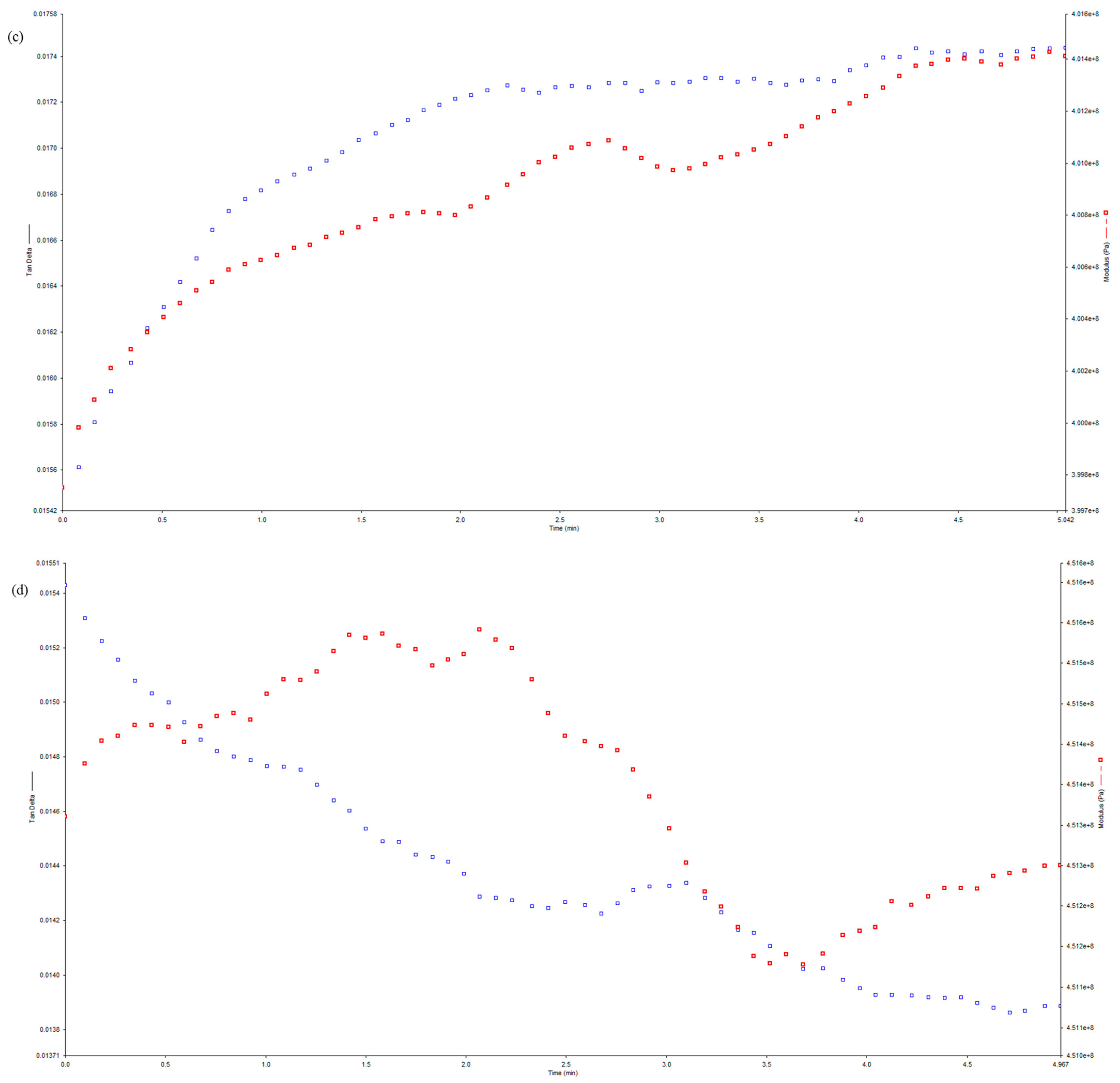
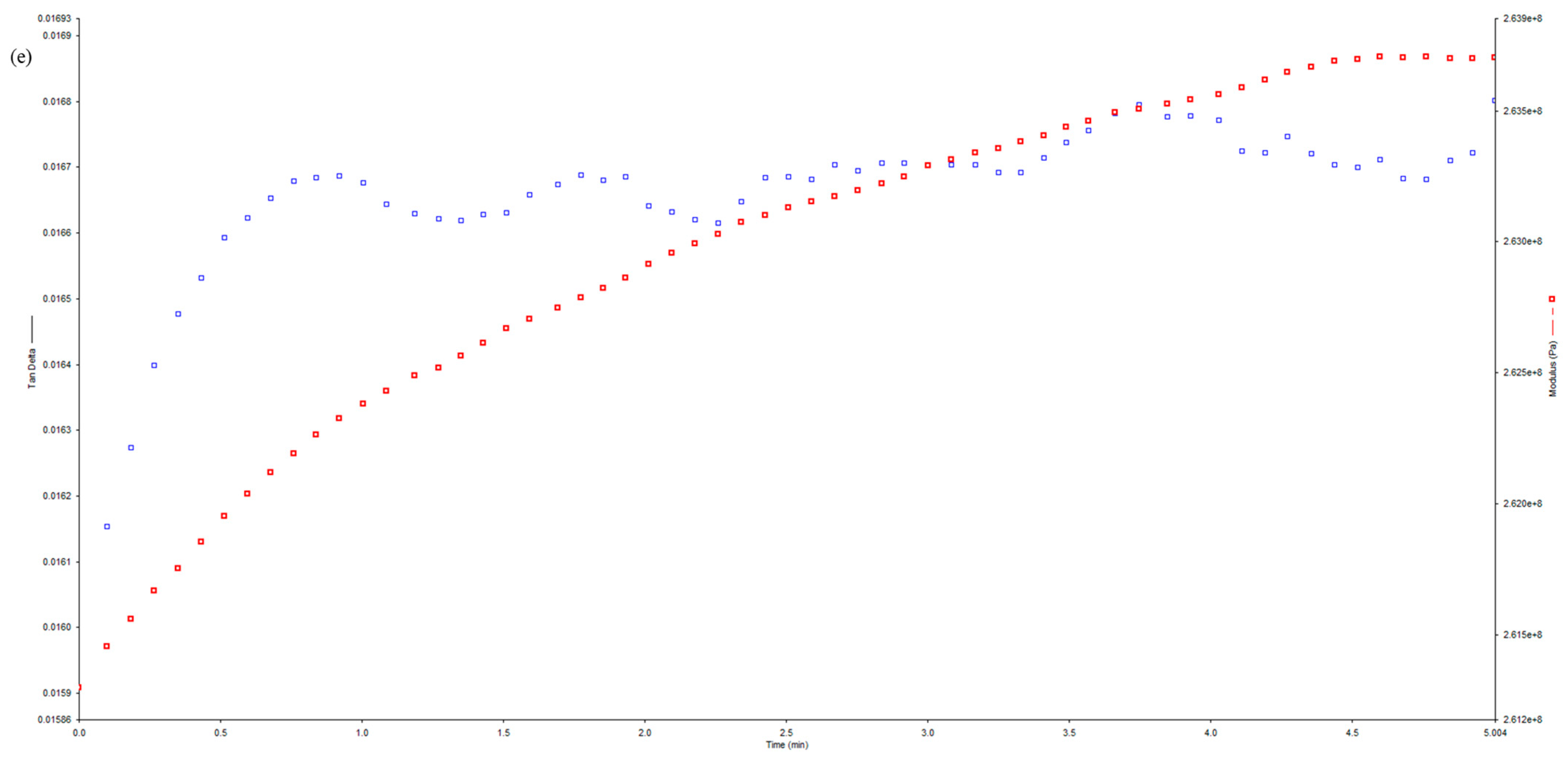
3.4.2. TGA-DSC
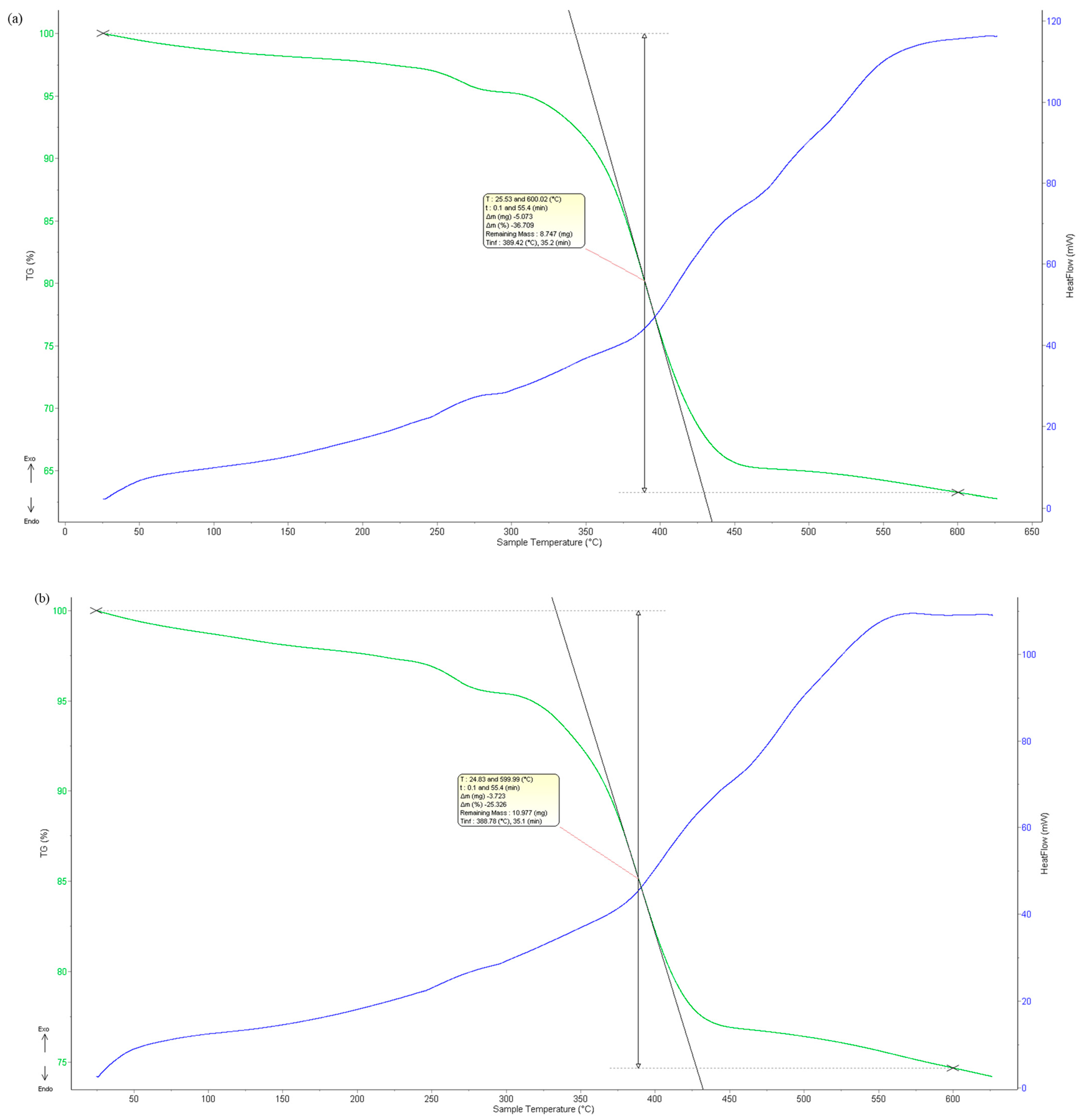
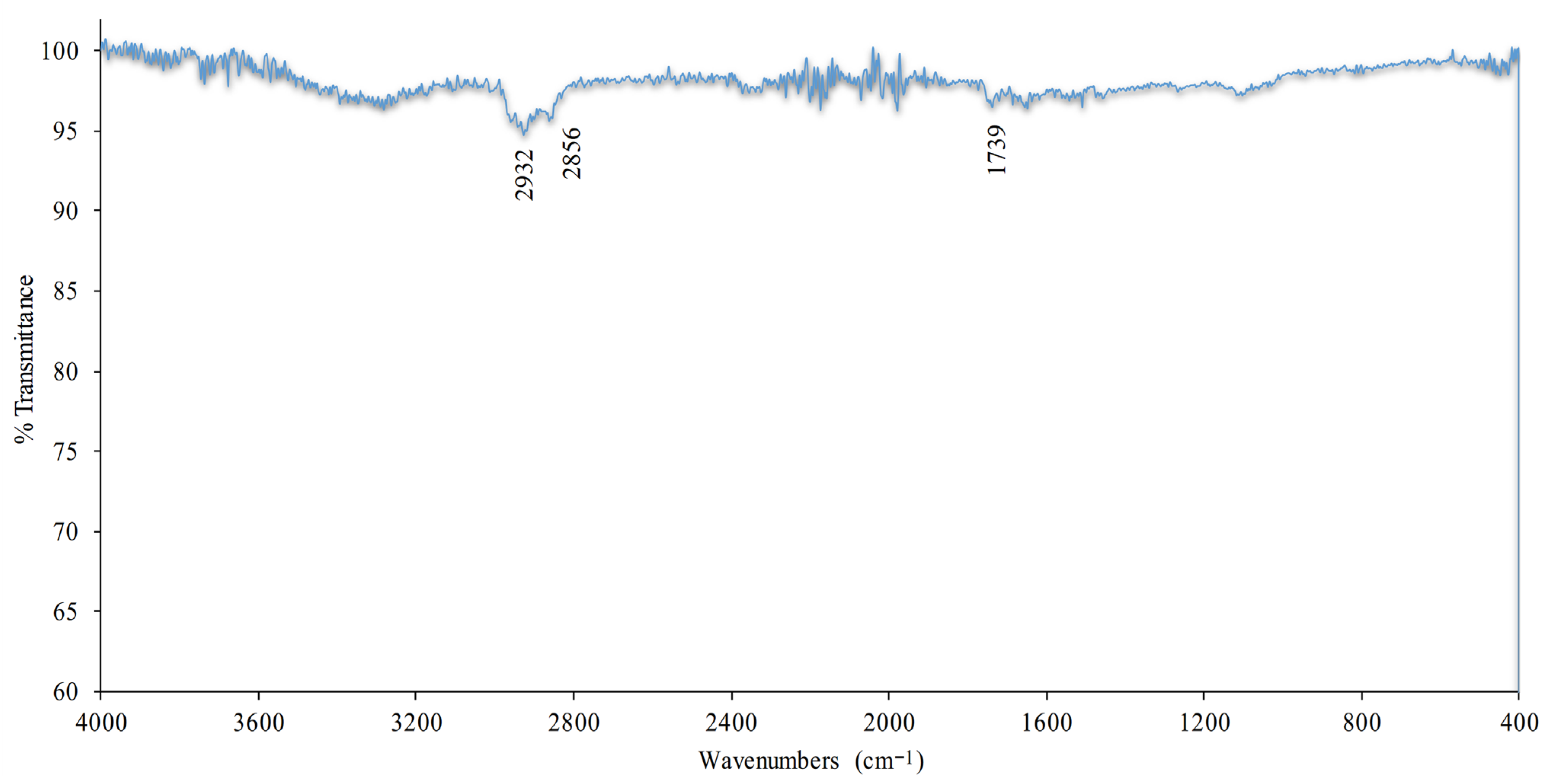
3.4.3. FTIR
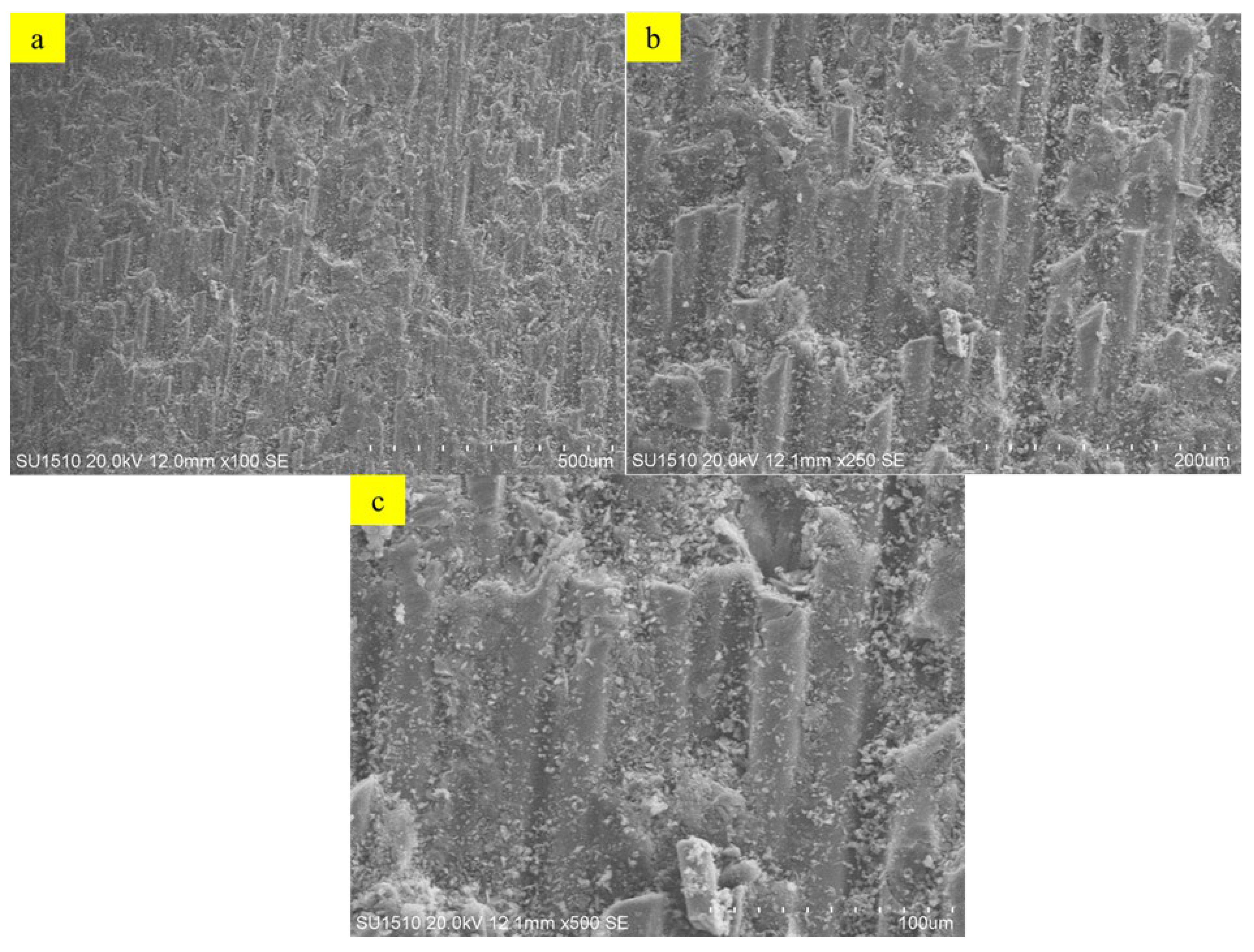
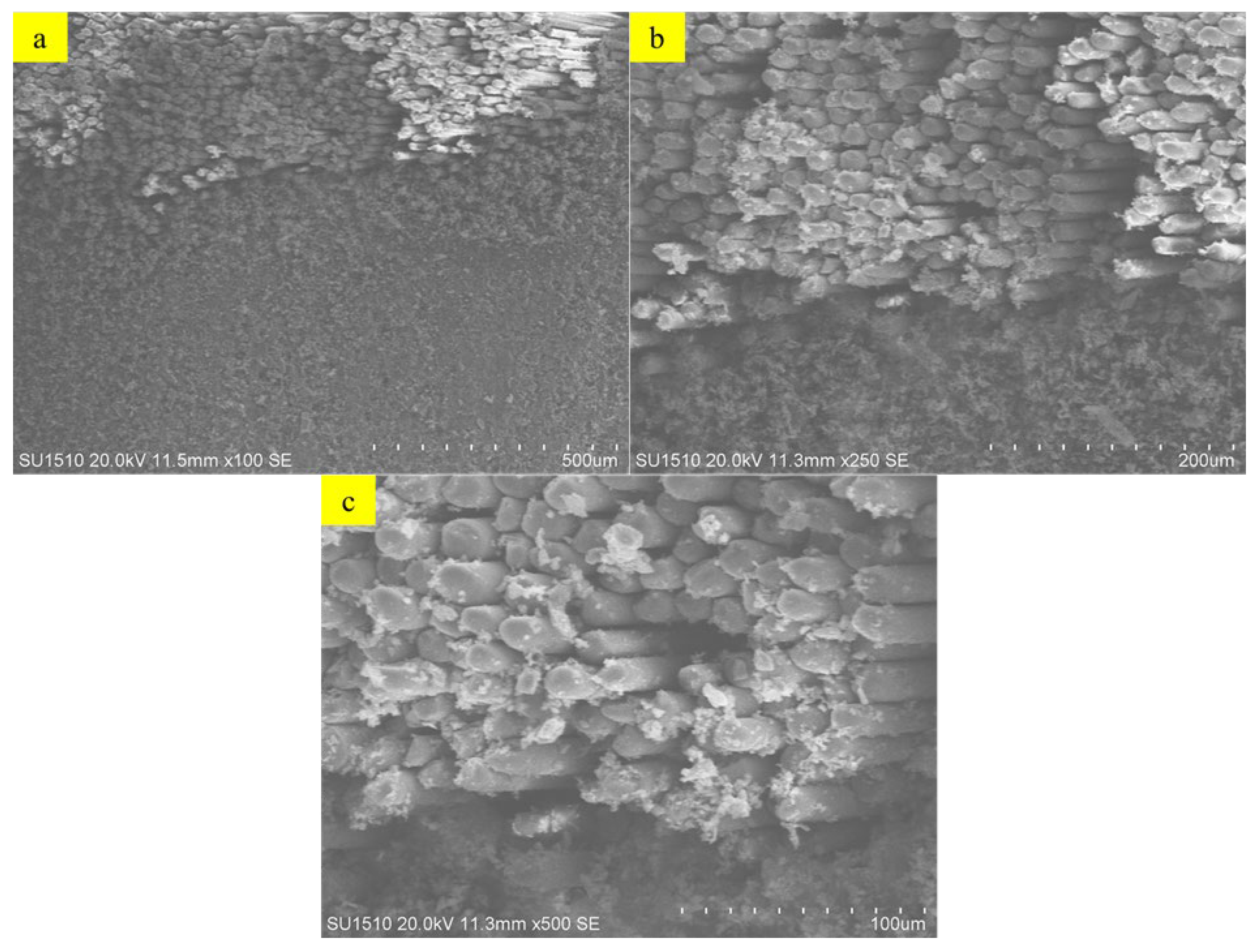
3.4.4. SEM-EDS
3.5. Failures and Load–Displacement of Specimens
3.5.1. Specimens Subjected to Room Temperature and ETF Loading Conditions
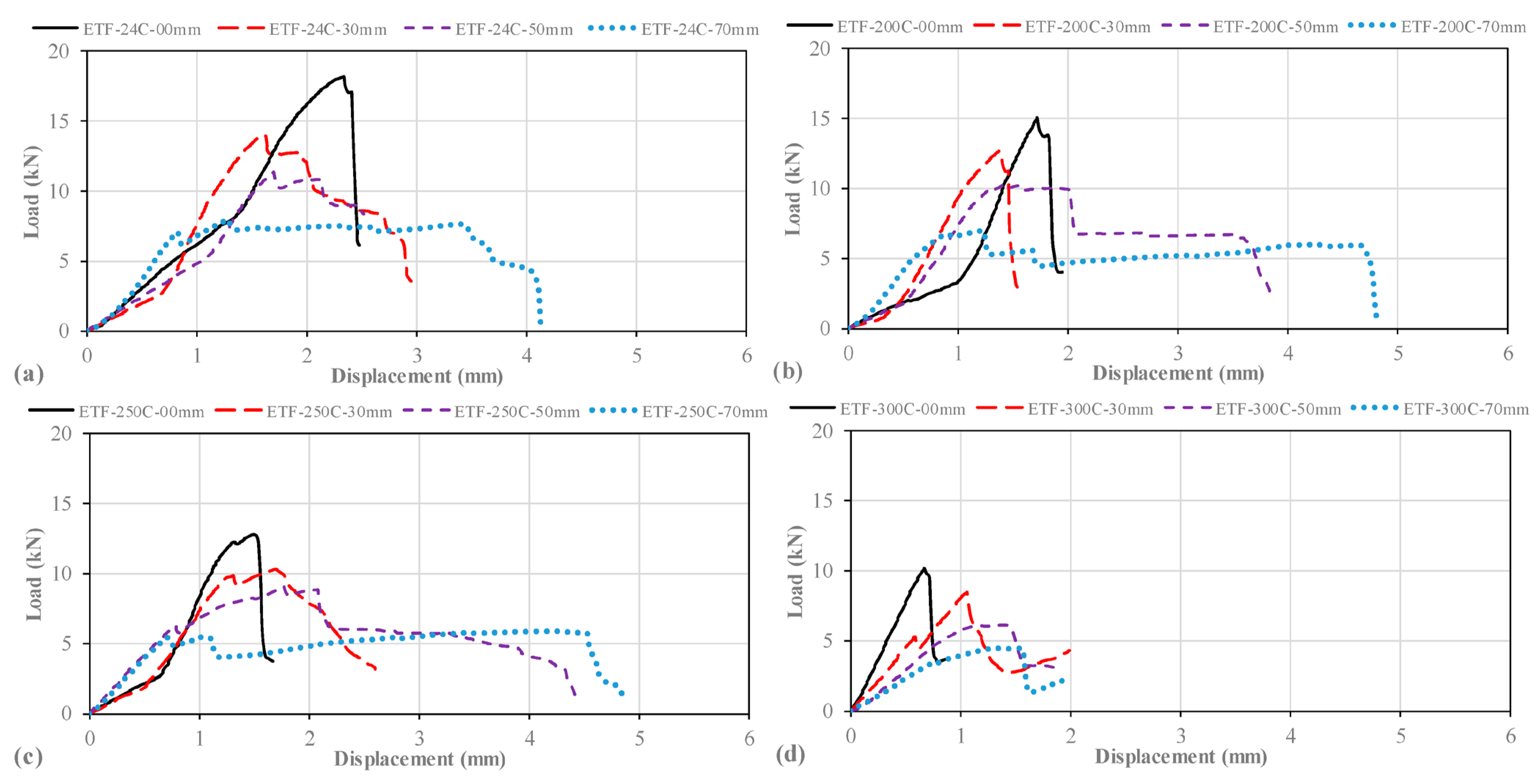
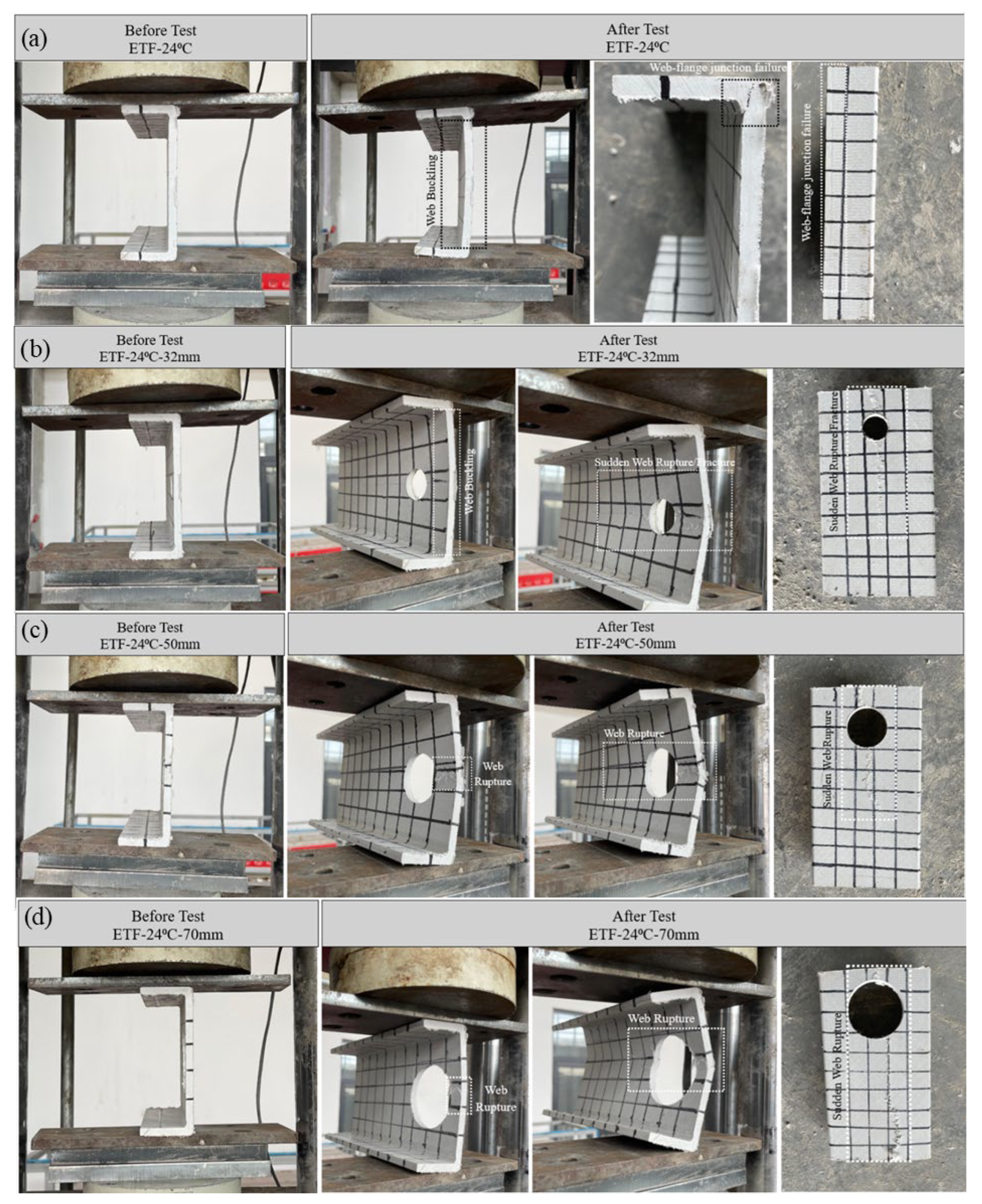
3.5.2. Specimens Subject to 200 °C and ETF Loading Conditions
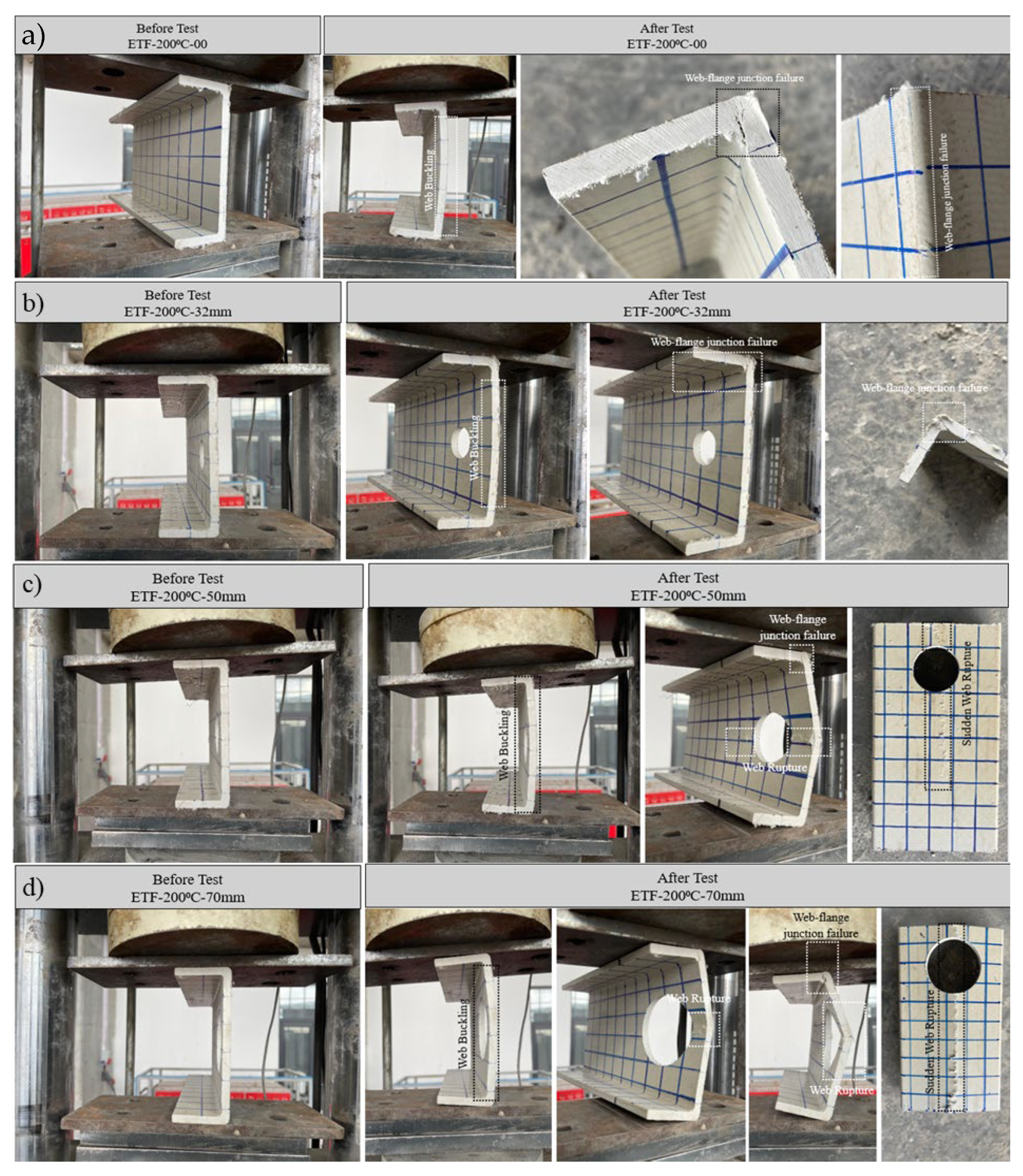
3.5.3. Specimens Subjected to 250 °C and ETF Loading Conditions
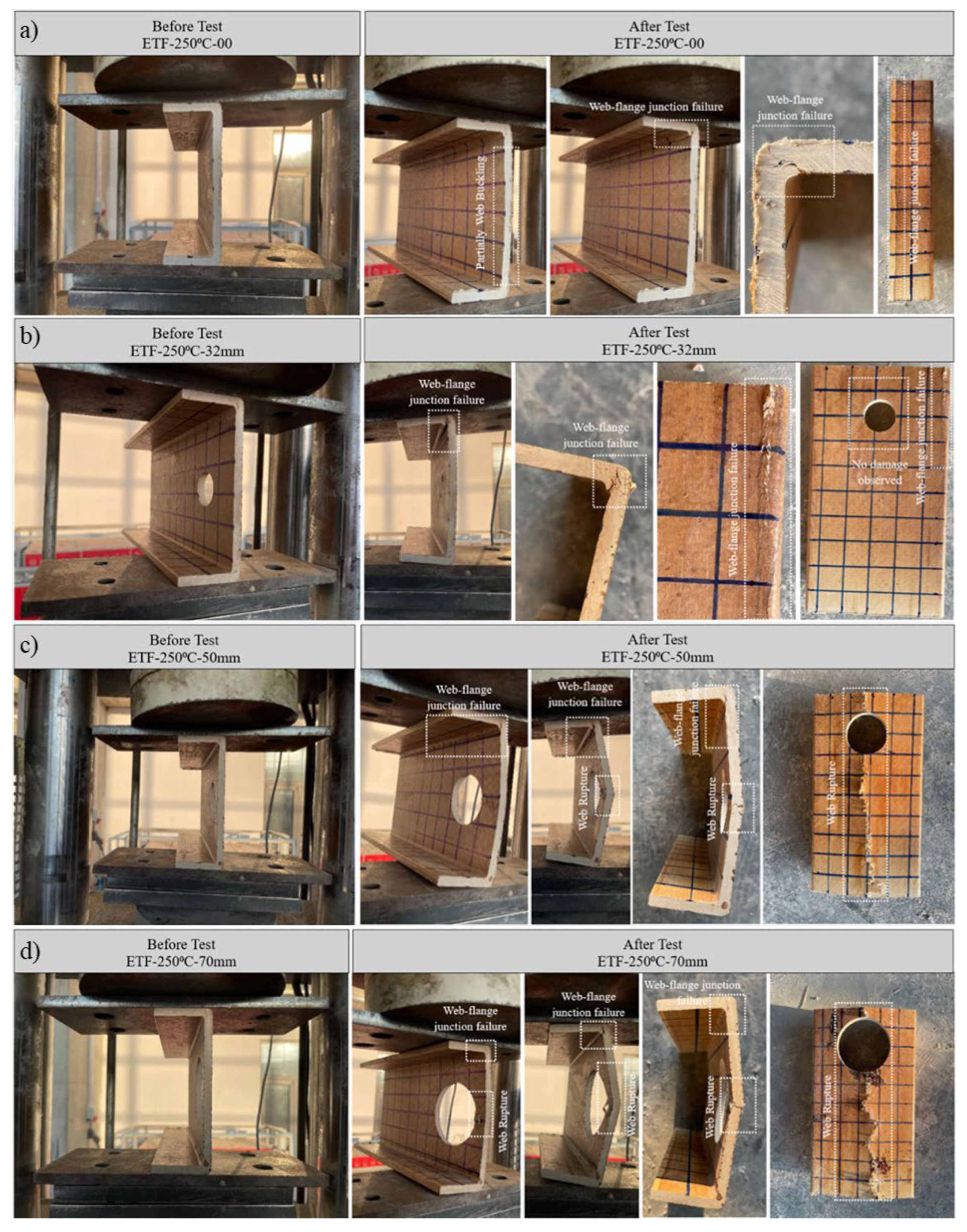
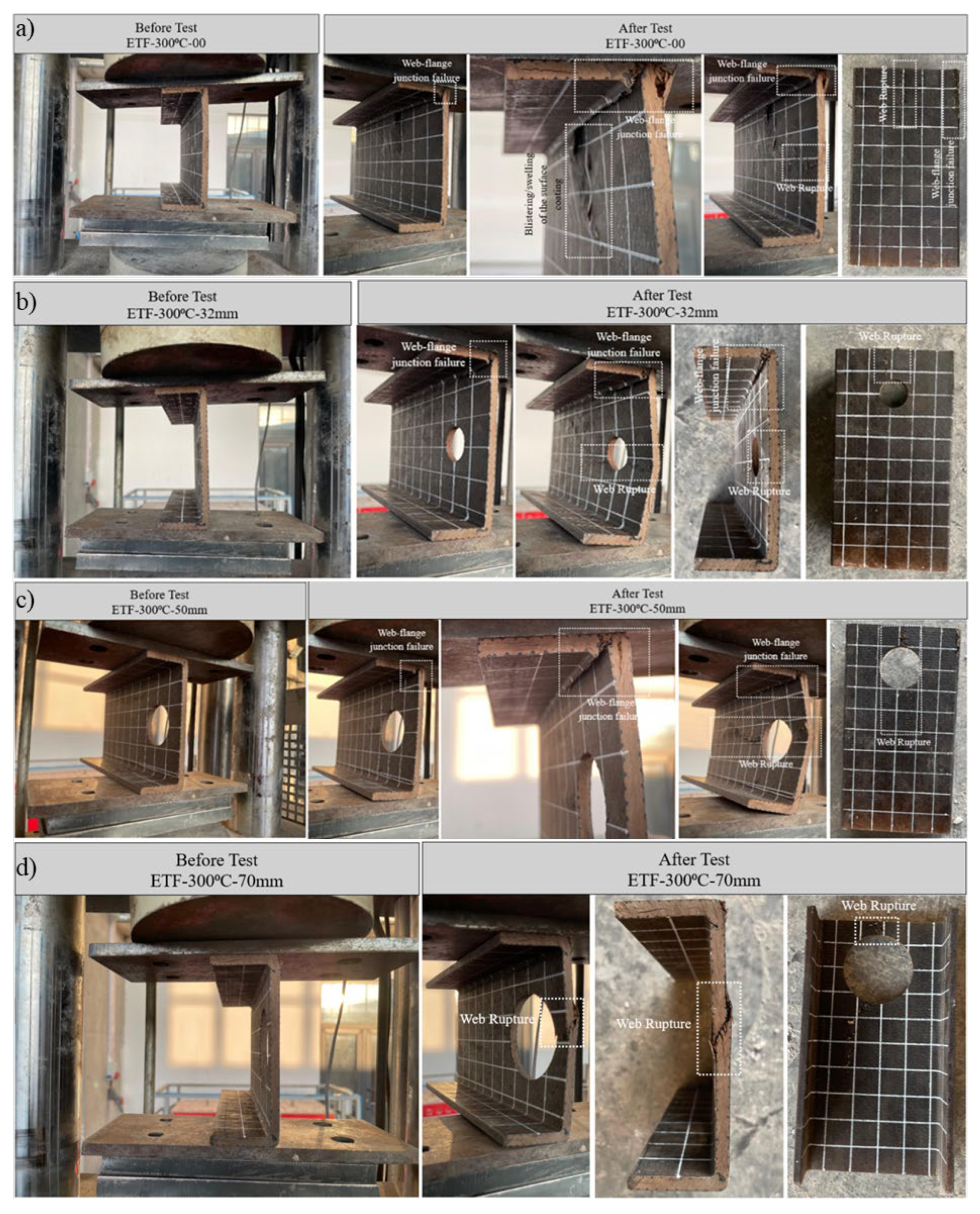
3.5.4. Specimens Subjected to 300 °C and ETF Loading Conditions
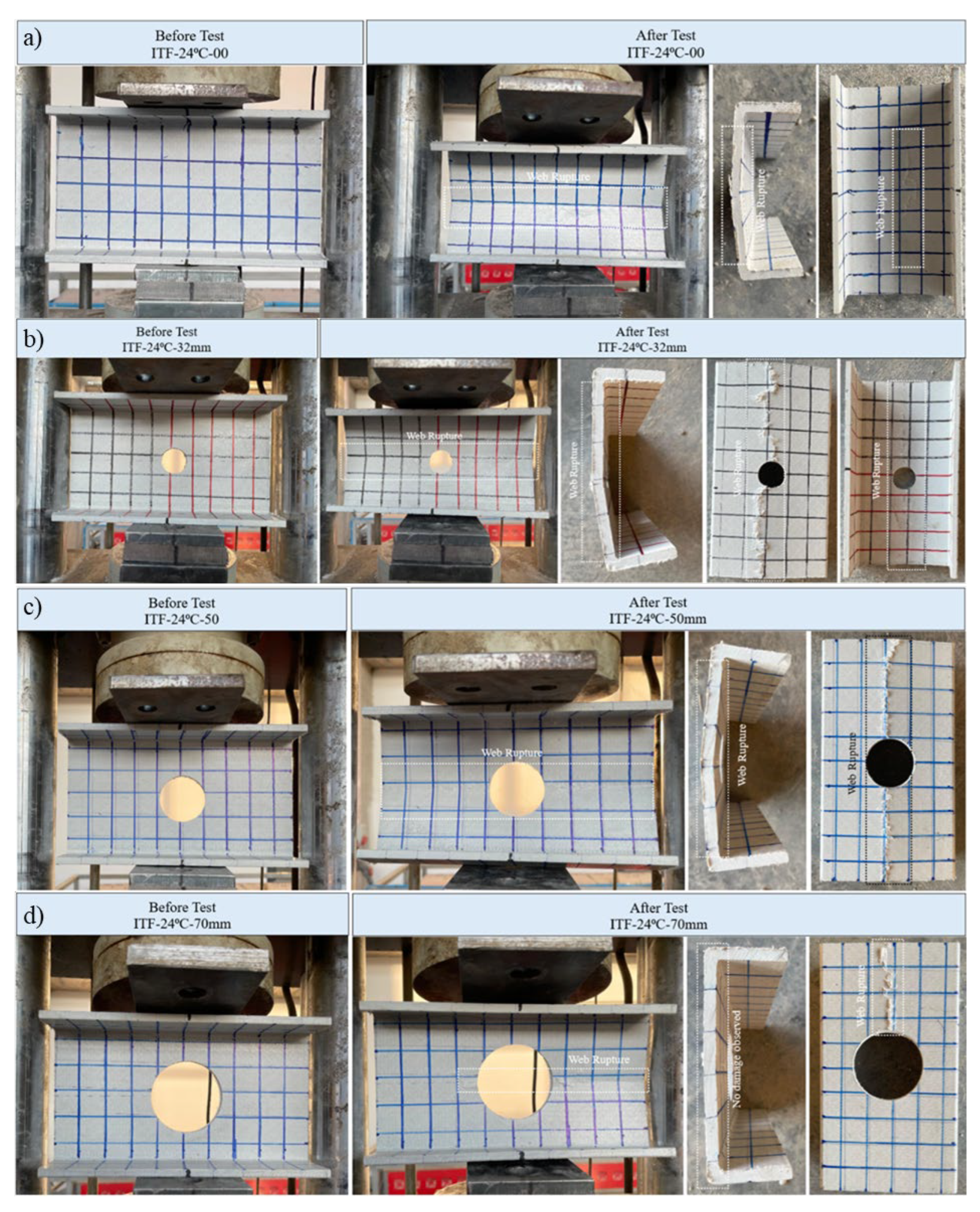
3.5.5. Specimens Subjected to Room Temperature and ITF Loading Conditions
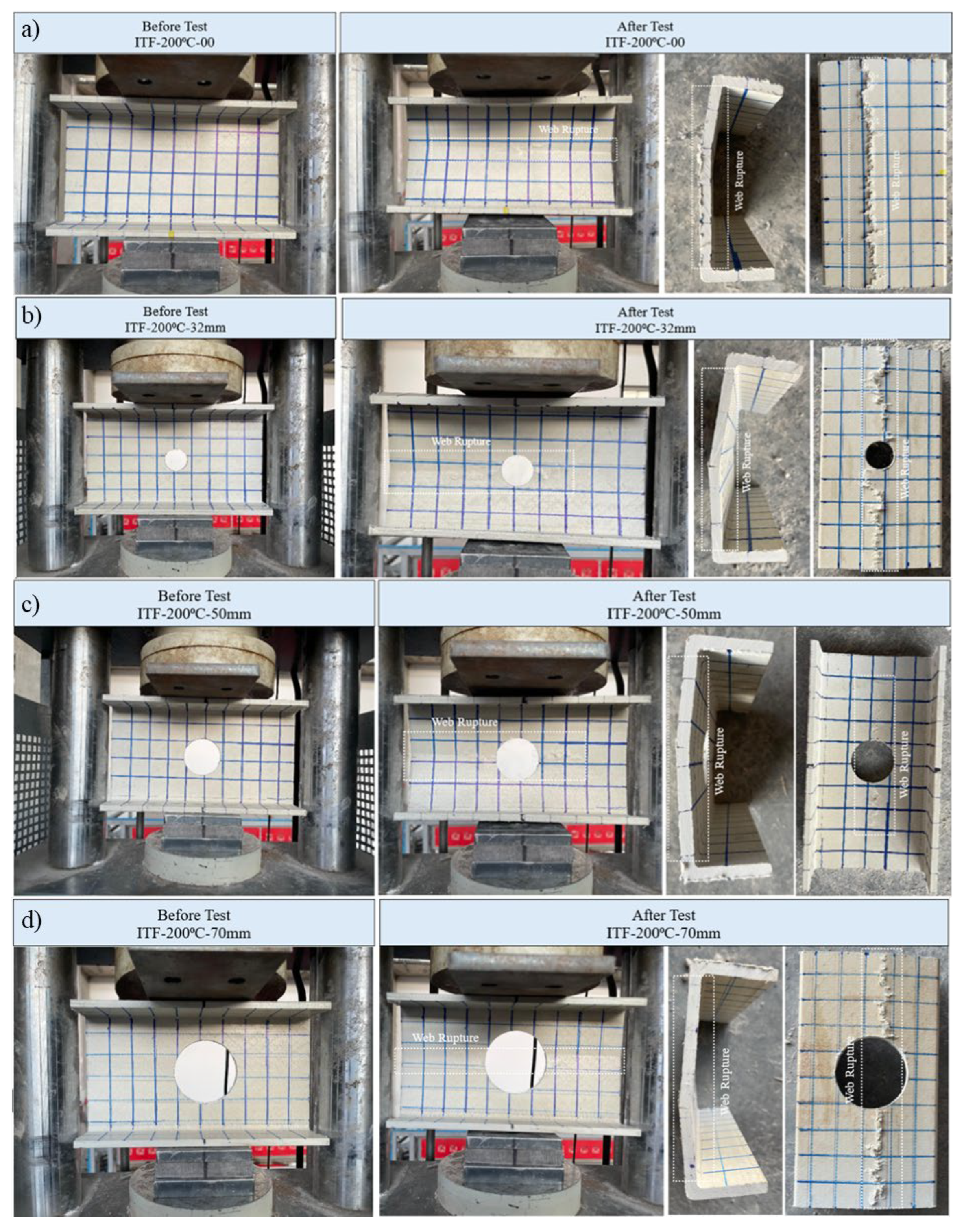
3.5.6. Specimens Subjected to 200 °C and ITF Loading Conditions
3.5.7. Specimens Subjected to 250 °C and ITF Loading Conditions
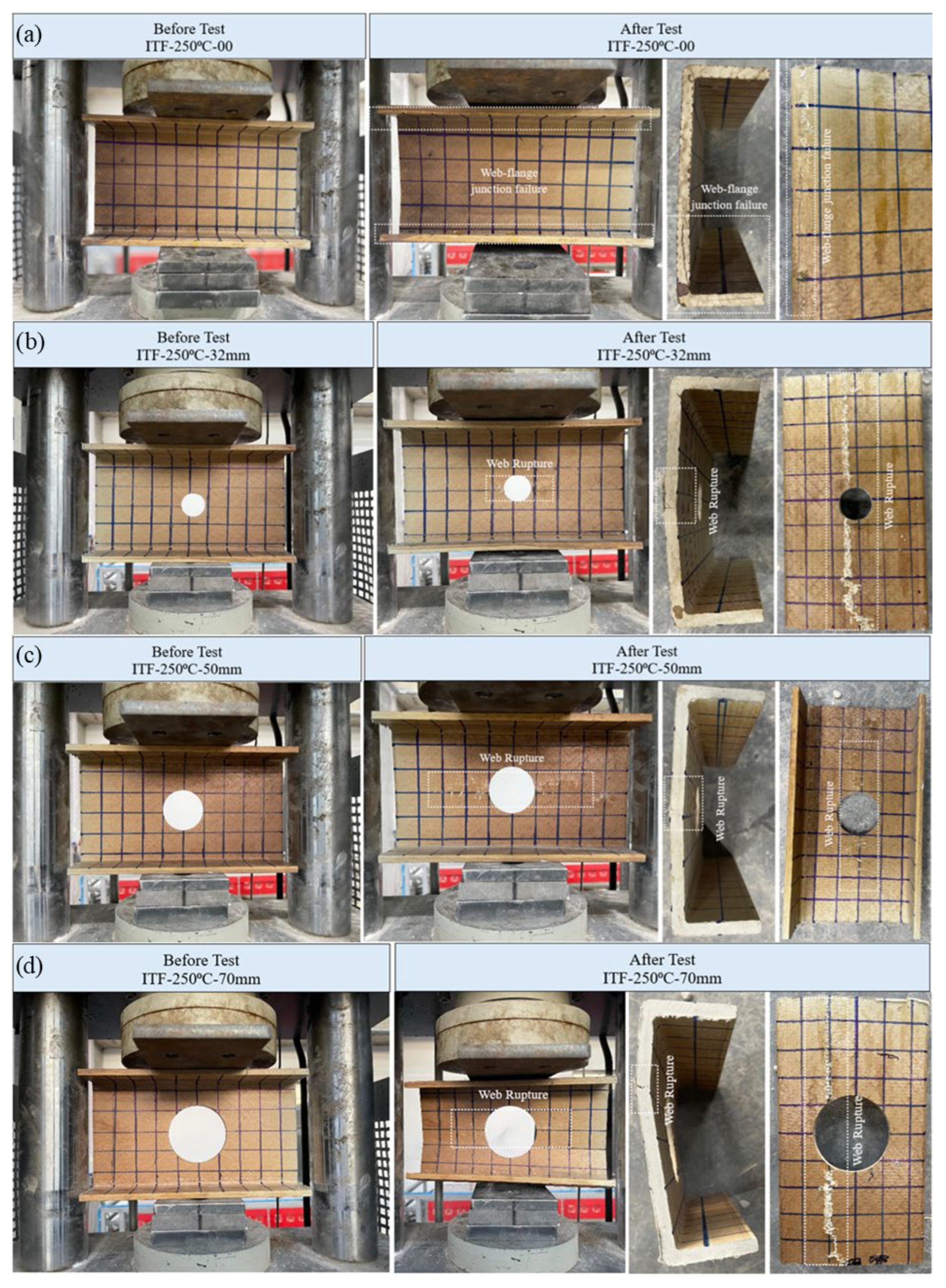
3.5.8. Specimens Subjected to 300 °C and ITF Loading Conditions
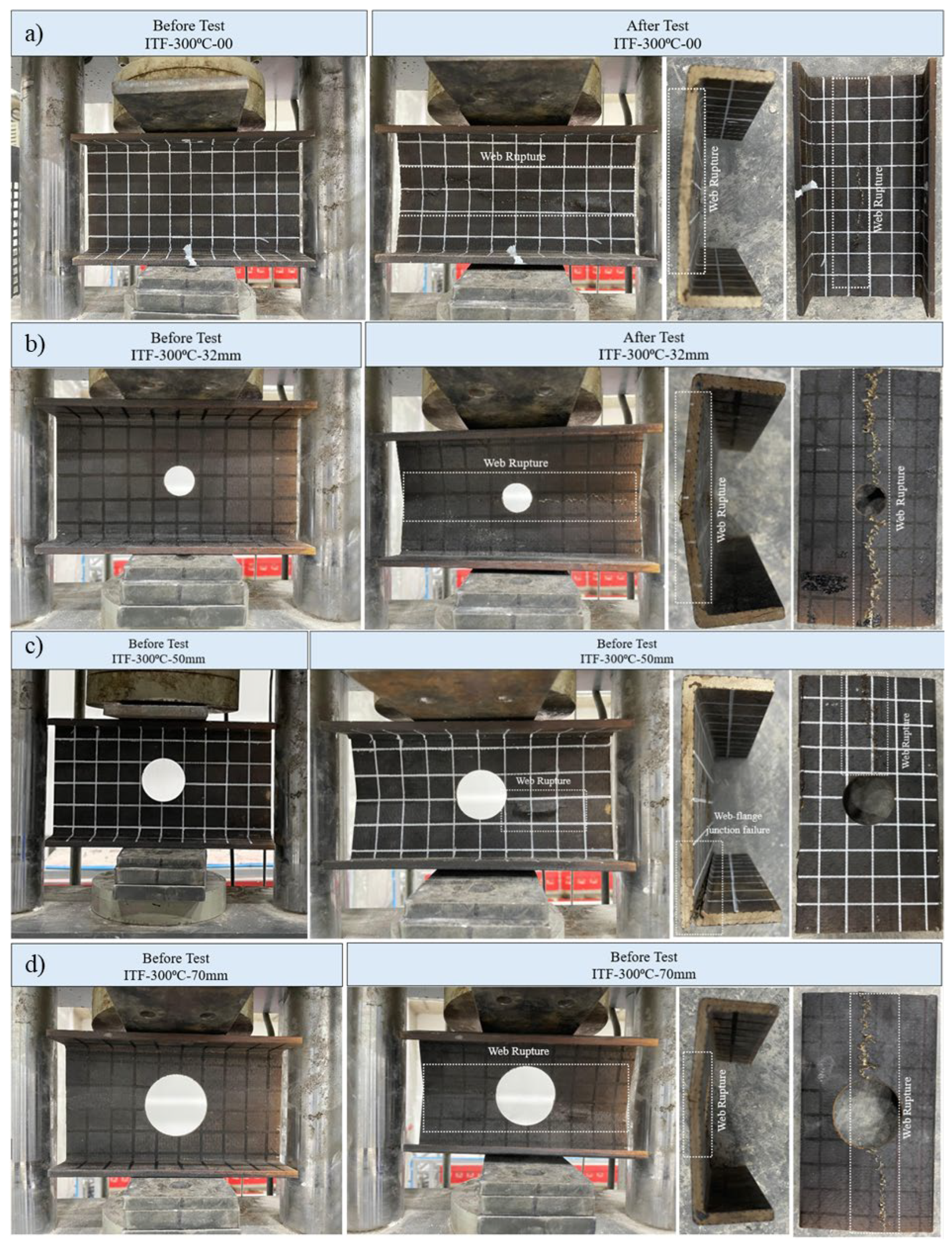
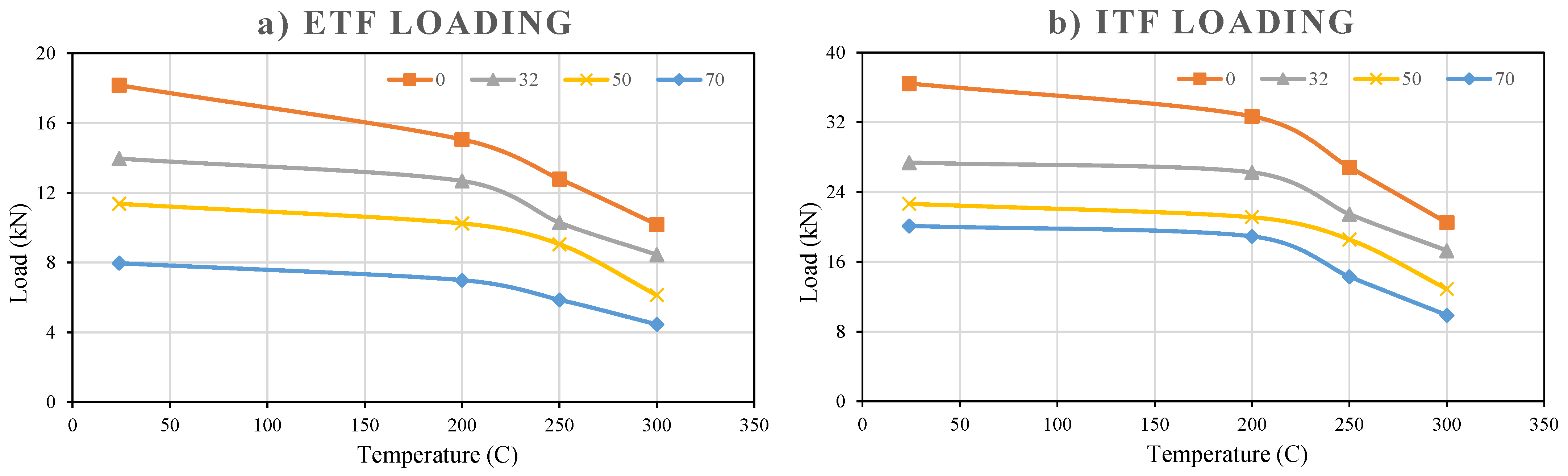
3.5.9. Comparison of the Effects of Loading Conditions and Temperatures on Web Crippling Capacity
| Temperature (°C) | ITF Capacity Pu, ITF (kN) | ETF Capacity Pu, ETF (kN) | ITF/ETF Ratio |
|---|---|---|---|
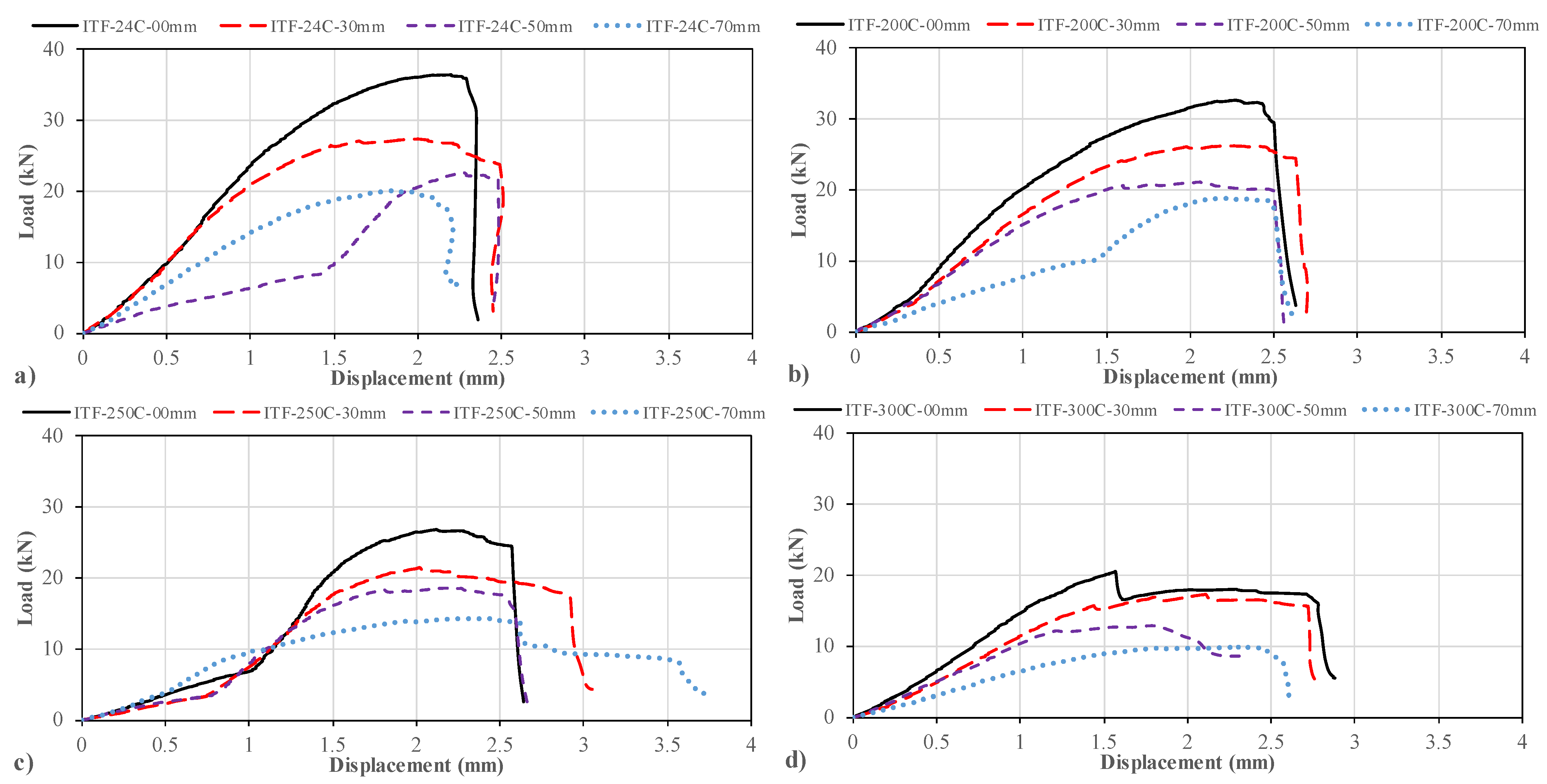
| 24 | 36.44 | 18.17 | 2.01 |
| 200 | 32.67 | 15.06 | 2.17 |
| 250 | 26.83 | 12.79 | 2.10 |
| 300 | 20.49 | 10.19 | 2.01 |
3.5.10. Comparison of the Hole’s Sizes on Web Crippling Capacity
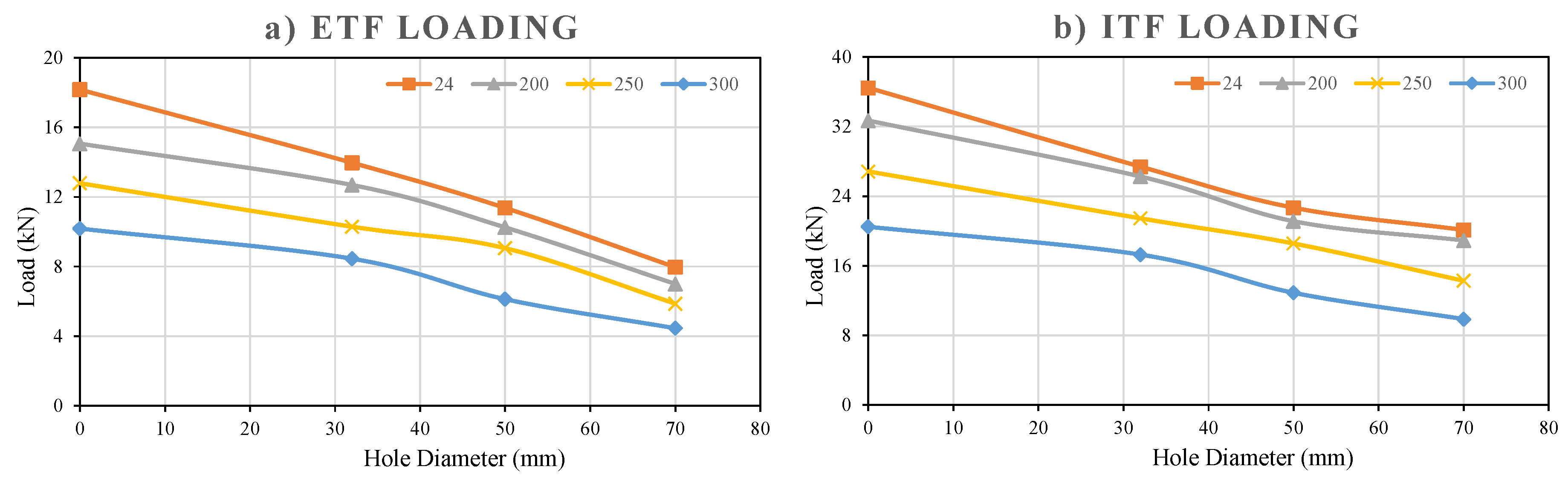
| Temperature (°C) | Loading Condition | Hole Diameter (d) | d/H Ratio | Ultimate Load (Pu) (kN) | Reduction Due to Hole (%) |
|---|---|---|---|---|---|
| 24 | ETF | 0 | — | 18.17 | 0.0 |
| 32 | 0.23 | 13.97 | 23.1 | ||
| 50 | 0.36 | 11.38 | 37.4 | ||
| 70 | 0.50 | 7.97 | 56.1 | ||
| ITF | 0 | — | 36.44 | 0.0 | |
| 32 | 0.23 | 27.38 | 24.8 | ||
| 50 | 0.36 | 22.66 | 37.8 | ||
| 70 | 0.50 | 20.11 | 44.8 | ||
| 200 | ETF | 0 | — | 15.06 | 0.0 |
| 32 | 0.23 | 12.69 | 15.7 | ||
| 50 | 0.36 | 10.25 | 31.9 | ||
| 70 | 0.50 | 7.00 | 53.5 | ||
| ITF | 0 | — | 32.67 | 0.0 | |
| 32 | 0.23 | 26.25 | 19.7 | ||
| 50 | 0.36 | 21.12 | 35.3 | ||
| 70 | 0.50 | 18.91 | 42.1 | ||
| 250 | ETF | 0 | — | 12.79 | 0.0 |
| 32 | 0.23 | 10.30 | 19.5 | ||
| 50 | 0.36 | 9.06 | 29.1 | ||
| 70 | 0.50 | 5.87 | 54.1 | ||
| ITF | 0 | — | 26.83 | 0.0 | |
| 32 | 0.23 | 21.45 | 20.1 | ||
| 50 | 0.36 | 18.56 | 30.8 | ||
| 70 | 0.50 | 14.29 | 46.7 | ||
| 300 | ETF | 0 | — | 10.19 | 0.0 |
| 32 | 0.23 | 8.46 | 17.0 | ||
| 50 | 0.36 | 6.13 | 39.8 | ||
| 70 | 0.50 | 4.46 | 56.2 | ||
| ITF | 0 | — | 20.49 | 0.0 | |
| 32 | 0.23 | 17.28 | 15.7 | ||
| 50 | 0.36 | 12.89 | 37.1 | ||
| 70 | 0.50 | 9.86 | 51.9 |
4. Prediction of Load Capacity
5. Conclusions
- The web crippling capacity of reference GFRP U pultrusion profiles for ITF and ETF loads decreases significantly as temperature increases. The decrease in capacity becomes more pronounced beyond 250 °C, and at 300 °C, the capacity drops to 44% of the original room temperature strength, nearly halving. This is explained by the shift in the damage mode from fiber-controlled local fracture to matrix-controlled global web crippling due to severe thermal degradation of the polymer matrix at critical temperatures.
- ITF specimens consistently demonstrated higher web-crushing capacities than ETF specimens across all temperature levels and hole sizes. ITF specimens achieved approximately twice the load-carrying capacity of ETF specimens on average, thanks to more favorable load distribution and delayed local buckling behavior.
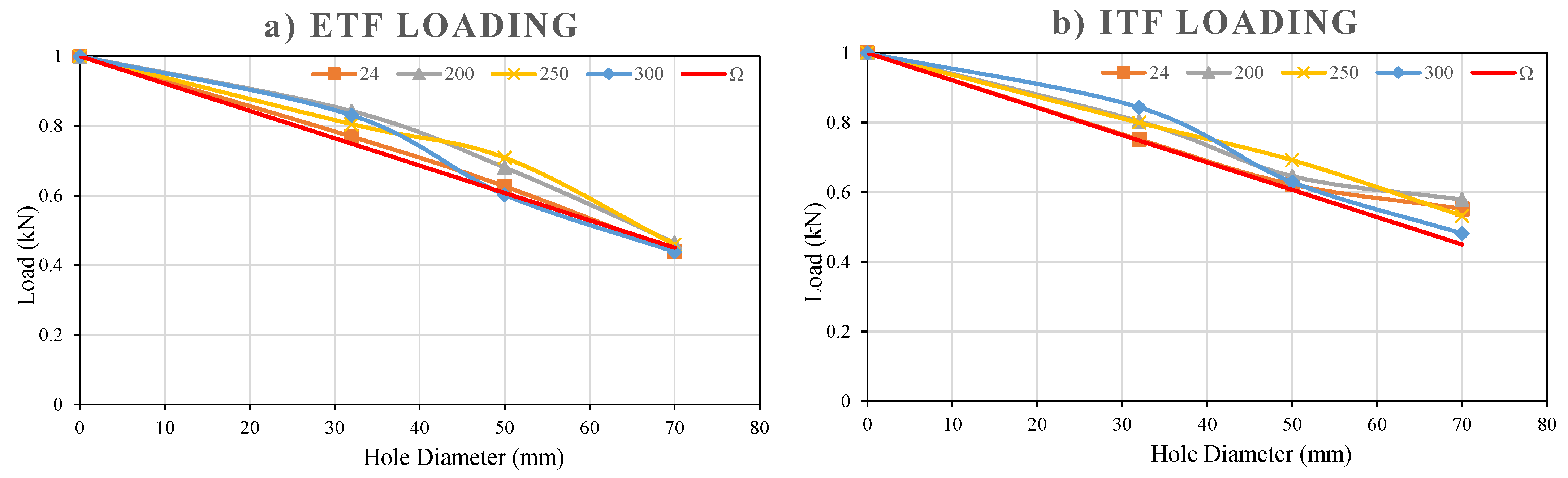
- The presence of web openings has inevitably reduced the ultimate load-carrying capacity of the specimens. When the hole diameter (D) increased from 32 mm to 70 mm, the decrease in capacity gradually increased at rates ranging from 15.7% (ETF, 300 °C) to 56.2% (ETF, 300 °C) across all temperatures examined. This decreasing trend is more pronounced in ETF specimens, especially at large hole diameters. At the largest hole diameter of 70 mm, the capacity loss in ETF (56%) remained higher than the capacity loss in ITF (52%). This weakening behavior maintained its consistency at high temperatures as well, parallel to the increase in hole diameter.
- The proposed empirical equations successfully captured the combined effects of temperature, loading configuration, and hole diameter on the web crippling capacity. The inclusion of the temperature coefficient (ζ) and the hole diameter factor (Ω) improved the prediction accuracy compared to existing formulations.
- The comparison between experimental and predicted loads showed a good agreement, with experimental-to-predicted ratios ranging between 1.00 and 1.38 for all test conditions. The accuracy of the predicted model is better in the low-temperature ranges.
- Overall, the analytical expressions and experimental findings demonstrate that the proposed approach can be effectively used to estimate the web crippling capacity of pultruded GFRP U-channel sections under varying geometric and thermal conditions, offering a valuable tool for the design and safety assessment of composite structural elements exposed to elevated temperatures.
Author Contributions
Funding
Institutional Review Board Statement
Data Availability Statement
Acknowledgments
Conflicts of Interest
References
- Jones, R.M. Mechanics of Composite Materials, 2nd ed.; CRC Press: Boca Raton, FL, USA; Taylor & Francis Group: Philadelphia, PA, USA, 1999. [Google Scholar]
- Kaw, A.K. Mechanics of Composite Materials, 2nd ed.; CRC Press: Boca Raton, FL, USA; Taylor & Francis Group: Boca Raton, FL, USA, 2006. [Google Scholar]
- Rajak, D.K.; Wagh, P.H.; Linul, E. Manufacturing technologies of carbon/glass fiber-reinforced polymer composites and their properties: A review. Polymers 2021, 13, 3721. [Google Scholar] [CrossRef] [PubMed]
- Minchenkov, K.; Vedernikov, A.; Safonov, A.; Akhatov, I. Thermoplastic pultrusion: A review. Polymers 2021, 13, 180. [Google Scholar] [CrossRef] [PubMed]
- Iqbal, R.M.; Ahammad, R.; Arifuzzaman, M.; Islam, M.S.; Islam, M.M. Manufacturing and properties of jute fiber-reinforced polymer composites—A comprehensive review. Materials 2025, 18, 1016. [Google Scholar] [CrossRef] [PubMed]
- Tipboonsri, P.; Pramoonmak, S.; Uawongsuwan, P.; Memon, A. Optimization of Thermoplastic Pultrusion Parameters of Jute and Glass Fiber-Reinforced Polypropylene Composite. Polymers 2024, 16, 83. [Google Scholar] [CrossRef]
- Tucci, F.; Rubino, F.; Pasquino, G.; Carlone, P. Thermoplastic Pultrusion Process of Polypropylene/Glass Tapes. Polymers 2023, 15, 2374. [Google Scholar] [CrossRef]
- Ali, M.I.; Allawi, A.A.; El-Zohairy, A. Flexural behavior of pultruded GFRP–concrete composite beams strengthened with GFRP stiffeners. Fibers 2024, 12, 7. [Google Scholar] [CrossRef]
- Harati Khalilabad, E.; Ruiz Emparanza, A.; De Caso, F.; Roghani, H.; Khodadadi, N.; Nanni, A. Characterization Specifications for FRP Pultruded Materials: From Constituents to Pultruded Profiles. Fibers 2023, 11, 93. [Google Scholar] [CrossRef]
- Eskenati, A.R.; Mahboob, A.; Bernat-Maso, E.; Gil, L. Experimental and numerical study of adhesively and bolted connections of pultruded GFRP I-shape profiles. Polymers 2022, 14, 894. [Google Scholar] [CrossRef]
- Gong, J.; Saeed, N.; Huang, X.; Tian, W.; Li, L.; Song, J. Influences of fiber volume content on the mechanical properties of 2D plain carbon-fiber woven composite materials. Polymers 2023, 16, 108. [Google Scholar] [CrossRef]
- Chiu, H.-H.; Young, W.-B. The longitudinal and transverse tensile properties of unidirectional and bidirectional bamboo fiber reinforced composites. Fibers Polym. 2020, 21, 2938–2948. [Google Scholar] [CrossRef]
- Nurazzi, N.M.; Asyraf, M.R.M.; Fatimah Athiyah, S.; Shazleen, S.S.; Rafiqah, S.A.; Harussani, M.M.; Kamarudin, S.H.; Razman, M.R.; Rahmah, M.; Zainudin, E.S.; et al. A review on mechanical performance of hybrid natural fiber polymer composites for structural applications. Polymers 2021, 13, 2170. [Google Scholar] [CrossRef] [PubMed]
- Madenci, E.; Özkılıç, Y.O.; Gemi, L. Experimental and theoretical investigation on flexure performance of pultruded GFRP composite beams with damage analyses. Compos. Struct. 2020, 242, 112162. [Google Scholar] [CrossRef]
- Almeida-Fernandes, L.; Correia, J.R.; Silvestre, N. Transverse fracture behavior of pultruded GFRP materials in tension: Effect of fiber layup. J. Compos. Constr. 2020, 24, 04020019. [Google Scholar] [CrossRef]
- Luo, Y.; Zhang, P.; Yu, T. On characterization of transverse tensile properties of pultruded glass fiber-reinforced polymer (PGFRP) profiles based on non-standard short coupons. Compos. Struct. 2024, 338, 118128. [Google Scholar] [CrossRef]
- Soumbourou, M.A.; Aksoylu, C.; Madenci, E.; Özkılıç, Y.O. Web Crippling of Pultruded GFRP Profiles: A Review of Experimental, Numerical, and Theoretical Analyses. Polymers 2025, 17, 2746. [Google Scholar] [CrossRef]
- Kanthasamy, E.; Alsanat, H.; Poologanathan, K.; Gatheeshgar, P.; Corradi, M.; Thirunavukkarasu, K.; Dissanayake, M. Web crippling behaviour of cold-formed high strength steel unlipped channel beams. Buildings 2022, 12, 291. [Google Scholar] [CrossRef]
- Weerasinghe, H.; Konthesingha, C.; Nanayakkara, A.; Poologanathan, K.; Perampalam, G.; Kanthasamy, E. Web crippling behaviour of cold-formed carbon steel, stainless steel, and aluminium lipped channel sections with web openings. Buildings 2022, 12, 1820. [Google Scholar] [CrossRef]
- Zhang, L.; Li, Q.; Long, Y.; Cao, D.; Guo, K. Modelling of web-crippling behavior of pultruded GFRP I sections at elevated temperatures. Polymers 2022, 14, 5313. [Google Scholar] [CrossRef]
- Wu, C.; Zhang, L.-T.; Bai, Y.; Zhao, X.-L. Web crippling behavior of pultruded GFRP channel sections under transverse bearing load. Compos. Struct. 2019, 209, 129–142. [Google Scholar] [CrossRef]
- Wu, C.; Zhang, L.-T.; Tam, L.-h.; Yan, L.; He, L. Effect of bearing length on web crippling behavior of pultruded GFRP channel section. Compos. Struct. 2020, 253, 112810. [Google Scholar] [CrossRef]
- Zhang, W.; Chen, Y. Tests on GFRP pultruded profiles with channel section subjected to web crippling. Appl. Compos. Mater. 2017, 24, 849–862. [Google Scholar] [CrossRef]
- Ye, Y.-Y.; Gonilha, J.; Silvestre, N.; Correia, J.R. Experimental study of web-crippling behavior of pultruded GFRP I-section profiles under localized one-flange loading. Thin-Walled Struct. 2025, 209, 112931. [Google Scholar] [CrossRef]
- Almeida-Fernandes, L.; Correia, J.R.; Silvestre, N. Effect of fibre layup and bearing length on the web-crippling behaviour of pultruded GFRP profiles. Compos. Struct. 2021, 267, 113884. [Google Scholar] [CrossRef]
- Nunes, F.; Silvestre, N.; Correia, J.R. Progressive damage analysis of web crippling of GFRP pultruded I-sections. J. Compos. Constr. 2017, 21, 04016104. [Google Scholar] [CrossRef]
- Chen, Y.; Wang, C. Test on pultruded GFRP I-section under web crippling. Compos. Part B Eng. 2015, 77, 27–37. [Google Scholar] [CrossRef]
- Wu, C.; Ding, Y.; He, L.; Tam, L.-H. Web crippling of pultruded GFRP built-up sections. Thin-Walled Struct. 2023, 185, 110646. [Google Scholar] [CrossRef]
- Gand, A.; Mohammed, M.H.; Jarrouja, S. Performance of perforated FRP stub beams subject to static transverse actions. Eng. Solid Mech. 2020, 8, 105–118. [Google Scholar] [CrossRef]
- Haloi, J.; Borsaikia, A.C.; Singh, K.D. Web crippling behaviour of web perforated GFRP wide-flange sections subjected to interior-two-flange loading condition. Thin-Walled Struct. 2021, 166, 108072. [Google Scholar] [CrossRef]
- Haloi, J.; Singh, K.D.; Borsaikia, A.C. Effect of web perforation on the performance of pultruded GFRP wide-flange section profile in web crippling under end-two-flange loading configuration. Thin-Walled Struct. 2022, 175, 109187. [Google Scholar] [CrossRef]
- Özkılıç, Y.O.; Madenci, E.; Safonov, A.; Gemi, L.; Yazman, Ş. Comprehensive evaluation of tensile properties, damage mechanisms, and predictive modeling of pultruded GFRP after elevated temperatures. Compos. Part B Eng. 2025, 304, 112657. [Google Scholar] [CrossRef]
- Correia, J.R.; Gomes, M.M.; Pires, J.M.; Branco, F.A. Mechanical behaviour of pultruded glass fibre reinforced polymer composites at elevated temperature: Experiments and model assessment. Compos. Struct. 2013, 98, 303–313. [Google Scholar] [CrossRef]
- Madenci, E.; Özkılıç, Y.O.; Aksoylu, C.; Safonov, A. The Effects of Eccentric Web Openings on the Compressive Performance of Pultruded GFRP Boxes Wrapped with GFRP and CFRP Sheets. Polymers 2022, 14, 4567. [Google Scholar] [CrossRef]
- Aksoylu, C.; Özkılıç, Y.O.; Madenci, E.; Safonov, A. Compressive Behavior of Pultruded GFRP Boxes with Concentric Openings Strengthened by Different Composite Wrappings. Polymers 2022, 14, 4095. [Google Scholar] [CrossRef]
- ISO 527-5; Plastics: Determination of Tensile Properties—Part 5—Test Conditions for Unidirectional Fiber-Reinforced Plastic Composites. ISO: Gevena, Switzerland, 2009.
- Wu, C.; Bai, Y. Web crippling behaviour of pultruded glass fibre reinforced polymer sections. Compos. Struct. 2014, 108, 789–800. [Google Scholar] [CrossRef]
- Chen, Y.; Wang, C. Web crippling behavior of pultruded GFRP rectangular hollow sections. Compos. Part B Eng. 2015, 77, 112–121. [Google Scholar] [CrossRef]


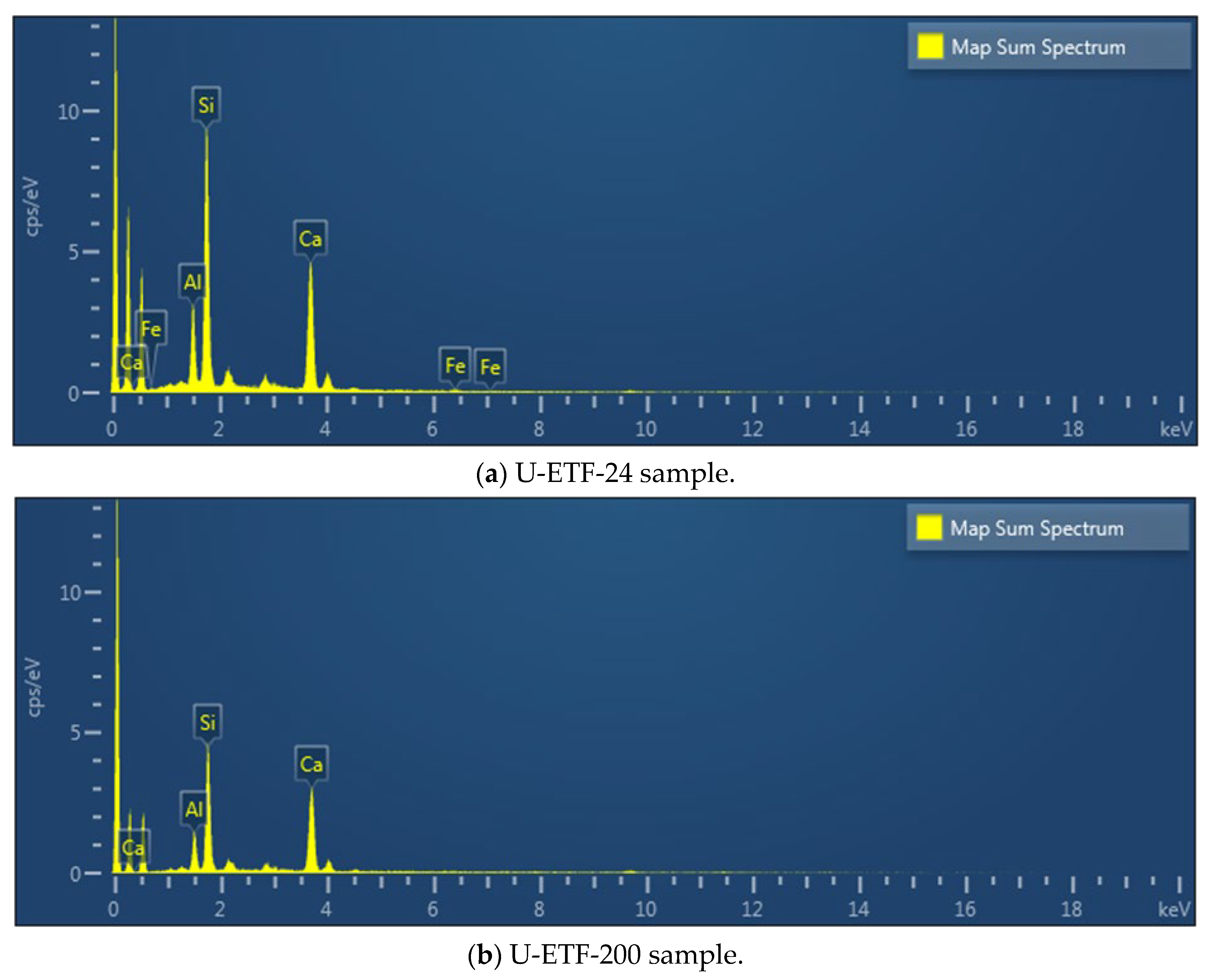

| Element | U-ETF-24 (By Weight %) | U-ETF-200 (By Weight %) |
|---|---|---|
| C (Carbon) | 49.50 ± 0.60 | 41.83 ± 1.10 |
| O (Oxygen) | 34.53 ± 0.58 | 38.12 ± 1.04 |
| Al (Aluminum) | 2.41 ± 0.07 | 2.74 ± 0.13 |
| Si (Silicon) | 7.00 ± 0.12 | 7.81 ± 0.23 |
| Ca (Calcium) | 6.34 ± 0.12 | 9.50 ± 0.28 |
| Fe (Iron) | 0.23 ± 0.06 | N.A. |
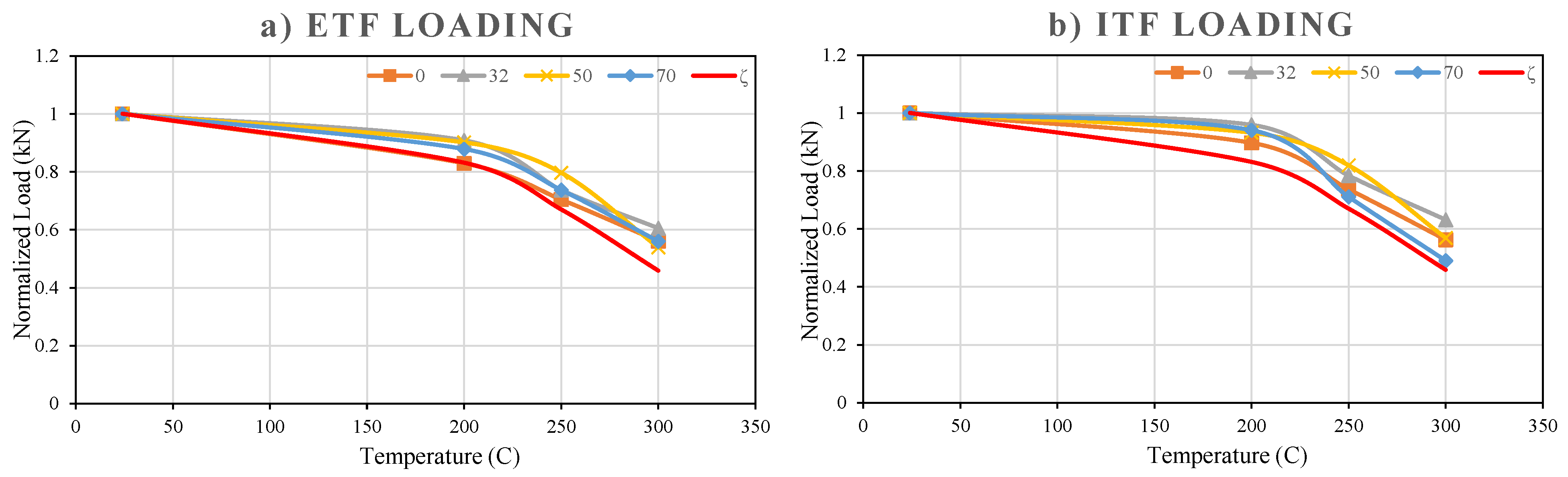
| Temperature (°C) | Pu, ETF (kN) | ETF Normalized Capacity (Pu, ETF/ Pu, ETF, 24 °C) | Decrease Rate | Pu, ITF (kN) | ITF Normalized Capacity (Pu, ITF/ Pu, ITF, 24 °C) | Decrease Rate |
|---|---|---|---|---|---|---|
| 200 | 15.06 | 15.06/18.17 (0.83) | %17 | 32.67 | 32.67/36.44 (0.90) | %10 |
| 250 | 12.79 | 12.79/18.17 (0.70) | %30 | 26.83 | 26.83/36.44 (0.74) | %26 |
| 300 | 10.19 | 10.19/18.17 (0.56) | %44 | 20.49 | 20.49/36.44 (0.56) | %44 |
| ETF | Experimental Results | Predicted Values | Experimental/Predicted Values | ||||||||||
| T | 0 | 32 | 50 | 70 | 0 | 32 | 50 | 70 | 0 | 32 | 50 | 70 | |
| d | |||||||||||||
| 24 | 18.17 | 13.97 | 11.38 | 7.97 | 18.11 | 13.56 | 11.00 | 8.15 | 1.00 | 1.03 | 1.03 | 0.98 | |
| 200 | 15.06 | 12.69 | 10.25 | 7.00 | 15.05 | 11.27 | 9.14 | 6.77 | 1.00 | 1.13 | 1.12 | 1.03 | |
| 250 | 12.79 | 10.30 | 9.06 | 5.87 | 12.13 | 9.08 | 7.37 | 5.46 | 1.05 | 1.13 | 1.23 | 1.08 | |
| 300 | 10.19 | 8.46 | 6.13 | 4.46 | 8.31 | 6.22 | 5.05 | 3.74 | 1.23 | 1.36 | 1.21 | 1.19 | |
| ITF | Experimental Results | Predicted Values | Experimental/Predicted Values | ||||||||||
| T | 0 | 32 | 50 | 70 | 0 | 32 | 50 | 70 | 0 | 32 | 50 | 70 | |
| d | |||||||||||||
| 24 | 36.44 | 27.38 | 22.66 | 20.11 | 36.49 | 27.32 | 22.15 | 16.42 | 1.00 | 1.00 | 1.02 | 1.22 | |
| 200 | 32.67 | 26.25 | 21.12 | 18.91 | 30.32 | 22.70 | 18.41 | 13.65 | 1.08 | 1.16 | 1.15 | 1.39 | |
| 250 | 26.83 | 21.45 | 18.56 | 14.29 | 24.45 | 18.30 | 14.84 | 11.00 | 1.10 | 1.17 | 1.25 | 1.30 | |
| 300 | 20.49 | 17.28 | 12.89 | 9.86 | 16.75 | 12.54 | 10.17 | 7.54 | 1.22 | 1.38 | 1.27 | 1.31 | |
Disclaimer/Publisher’s Note: The statements, opinions and data contained in all publications are solely those of the individual author(s) and contributor(s) and not of MDPI and/or the editor(s). MDPI and/or the editor(s) disclaim responsibility for any injury to people or property resulting from any ideas, methods, instructions or products referred to in the content. |
© 2026 by the authors. Licensee MDPI, Basel, Switzerland. This article is an open access article distributed under the terms and conditions of the Creative Commons Attribution (CC BY) license.
Share and Cite
Soumbourou, M.A.; Madenci, E.; Aksoylu, C.; Özkılıç, Y.O. Effect of the Hole Diameter Ratio (d/H) on the Web Crippling Capacity of Pultruded GFRP U-Channels Under Temperature and Loading Conditions. Polymers 2026, 18, 1002. https://doi.org/10.3390/polym18081002
Soumbourou MA, Madenci E, Aksoylu C, Özkılıç YO. Effect of the Hole Diameter Ratio (d/H) on the Web Crippling Capacity of Pultruded GFRP U-Channels Under Temperature and Loading Conditions. Polymers. 2026; 18(8):1002. https://doi.org/10.3390/polym18081002
Chicago/Turabian StyleSoumbourou, Mohamed Ahmed, Emrah Madenci, Ceyhun Aksoylu, and Yasin Onuralp Özkılıç. 2026. "Effect of the Hole Diameter Ratio (d/H) on the Web Crippling Capacity of Pultruded GFRP U-Channels Under Temperature and Loading Conditions" Polymers 18, no. 8: 1002. https://doi.org/10.3390/polym18081002
APA StyleSoumbourou, M. A., Madenci, E., Aksoylu, C., & Özkılıç, Y. O. (2026). Effect of the Hole Diameter Ratio (d/H) on the Web Crippling Capacity of Pultruded GFRP U-Channels Under Temperature and Loading Conditions. Polymers, 18(8), 1002. https://doi.org/10.3390/polym18081002