Promising Radiative Cooling Materials and Their Application in Construction and Building

 ,
,
Abstract
1. Introduction

2. Radiative Cooling Materials
2.1. Inorganic Radiative Cooling Materials
2.2. Petroleum-Based Radiative Cooling Materials
2.3. Cellulose-Based Radiative Cooling Materials

| Material Category | Representative System | Fabrication Technique | Solar Reflectivity () | IR Emissivity () | Cooling Performance () |
|---|---|---|---|---|---|
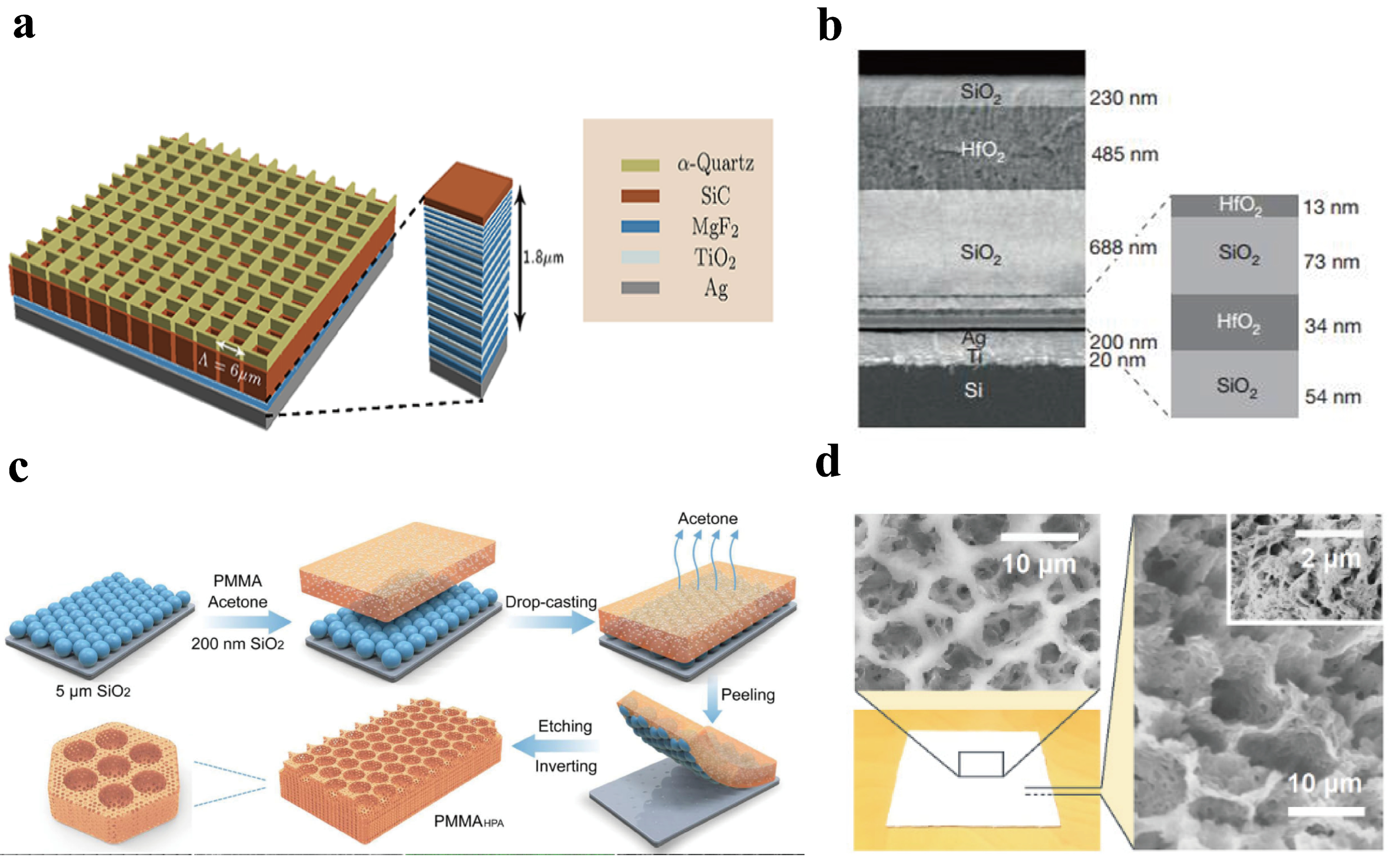
| Inorganic | SiO on Aluminum [17] | Optical optimization/Deposition | High | High | ~14 °C (Night) |
| Photonic Crystals (SiC/Quartz) [29] | Photolithography/E-beam evaporation | High | High | ||
| Photonic Crystals (HfO2/SiO2/Ag) [33] | Alternating layer deposition | 0.97 | 0.65 | 4.9 °C (Day) | |
| Petroleum-based Polymer | Porous PMMA Film [18] | Phase inversion/Etching | 0.95 | 0.98 | 6.0–8.9 °C (Day) |
| Porous P(VDF-HFP) [39] | Layered porous coating | 0.96 | 0.97 | Sub-ambient (Day) | |
| Porous PVDF/MXene film [42] | phase inversion | 0.96 | 0.97 | 9.8 °C (Day) | |
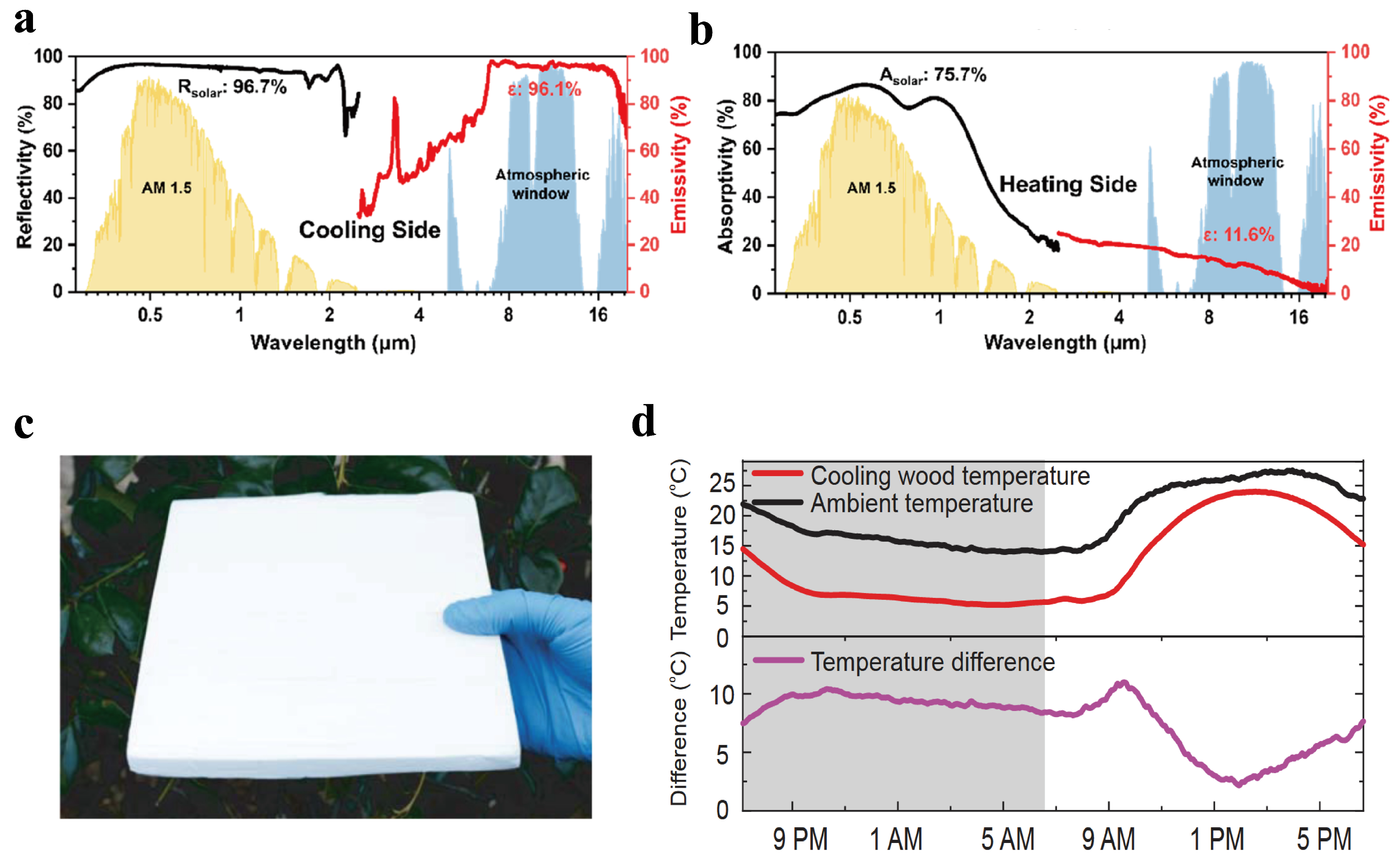
| Cellulose-based Material | Cooling Wood [44] | Complete delignification & densification | ≈0.96 | >0.96 | >4 °C (Day), >9 °C (Night) |
| Cellulose Fibers/SiO2 [45] | Mechanical grinding & hot pressing | >0.96 | High | 6 °C (Day) | |
| Porous Cellulose Acetate/TiO2 [47] | Phase separation +1 | 0.97 | High | ~10 °C | |
| Ethyl Cellulose Coating [48] | Non-solvent-induced phase separation | 0.96 | 0.96 | 8.3 °C (Day) |
3. Building Applications of Radiative Cooling Materials
3.1. Radiative Cooling Performance
3.2. Waterproof Performance
3.3. Thermal Insulation Performance
3.4. Mechanical Properties
4. Conclusions
- (1)
- Significant progress has been made in inorganic materials, resulting in a large number of daytime radiative cooling materials with promising applications. While these designs demonstrate high efficiency in radiation cooling, they are primarily manufactured on a small scale, requiring bulky casings and shielding. Furthermore, because most photonic materials are semi-transparent, they must be deposited on metallic mirrors to achieve high solar reflectivity. Therefore, the search for more direct methods and more scalable preparation of inorganic radiative cooling materials is essential.
- (2)
- Petroleum-based polymer radiative cooling materials can be produced at a large scale when achieving good passive daytime cooling conditions. However, they suffer from lower mechanical properties, rapid aging, and shorter service life during application, while also causing environmental problems and further increasing primary energy consumption.
- (3)
- The research demonstrates the application potential of cellulose and its derivatives as radiative cooling materials. While cellulose-based radiative cooling materials currently exhibit high sustainability, their cooling performance can still be improved through structural optimization. However, cellulose-based radiative cooling materials still face challenges, including balancing material strength and flexibility, and a lack of long-term stability in energy-efficient buildings.
- (4)
- Radiative cooling materials require the mechanical properties, waterproofing, and long-term stability of traditional building materials. These properties can be improved through physical, chemical, biological, or radiation treatments. Furthermore, radiative cooling materials for buildings should have strong prospects for sustainable development, including minimizing their impact on the ecological environment and human development throughout raw material production, preparation, use, and subsequent treatment. Natural cellulose materials are renewable and biodegradable, making them ideal green building radiant cooling materials.
- (5)
- Looking forward, the extensive rooftop applications of radiative cooling materials present immense opportunities for multi-functional integration. Beyond solely passive cooling, these materials can be strategically combined with active solar harvesting systems, such as photovoltaic (PV) panels and solar water heaters. Specifically, applying radiative cooling coatings to PV panels can dissipate excess heat and enhance photoelectric conversion efficiency. This synergistic integration of passive thermal management and active renewable energy technologies maximizes both space utilization and energy efficiency, paving the way for next-generation zero-energy buildings.
Author Contributions
Funding
Institutional Review Board Statement
Data Availability Statement
Conflicts of Interest
References
- Khosla, R.; Miranda, N.D.; Trotter, P.A.; Mazzone, A.; Renaldi, R.; McElroy, C.; Cohen, F.; Jani, A.; Perera-Salazar, R.; McCulloch, M. Cooling for Sustainable Development. Nat. Sustain. 2021, 4, 201–208. [Google Scholar] [CrossRef]
- Xiong, J.; Guo, S.; Wu, Y.; Yan, D.; Xiao, C.; Lu, X. Predicting the Response of Heating and Cooling Demands of Residential Buildings with Various Thermal Performances in China to Climate Change. Energy 2023, 269, 126789. [Google Scholar] [CrossRef]
- Connolly, D. Heat Roadmap Europe: Quantitative Comparison between the Electricity, Heating, and Cooling Sectors for Different European Countries. Energy 2017, 139, 580–593. [Google Scholar] [CrossRef]
- Overview and Key Findings—World Energy Outlook 2025—Analysis. Available online: https://www.iea.org/reports/world-energy-outlook-2025/overview-and-key-findings (accessed on 22 February 2026).
- Li, Z.; Chen, Q.; Song, Y.; Zhu, B.; Zhu, J. Fundamentals, Materials, and Applications for Daytime Radiative Cooling. Adv. Mater. Technol. 2020, 5, 1901007. [Google Scholar] [CrossRef]
- Wang, X.; Liu, X.; Li, Z.; Zhang, H.; Yang, Z.; Zhou, H.; Fan, T. Scalable Flexible Hybrid Membranes with Photonic Structures for Daytime Radiative Cooling. Adv. Funct. Mater. 2020, 30, 1907562. [Google Scholar] [CrossRef]
- Hasan, K.M.F.; Chen, J.; Chen, S.; Lin, K.; Wong, M.Y.; Liang, L.; Zhu, Y.; Pan, A.; Minale, Y.F.; Ho, T.C.; et al. Advanced Bioinspired Personal Thermoregulation Textiles for Outdoor Radiative Cooling. ACS Appl. Mater. Interfaces 2025, 17, 3436–3447. [Google Scholar] [CrossRef] [PubMed]
- Liu, F.; Zhang, Q. Angle-Selective Photonics for Smart Subambient Radiative Cooling. Nano-Micro Lett. 2025, 17, 178. [Google Scholar] [CrossRef]
- Wu, T.; Yin, K.; He, Y.; Wang, L.; Yu, H.; Huang, Y.; Duan, J.-A.; Arnusch, C.J. All-Season Passive Thermal Management Film with Multifunctionality for Efficient Radiative Cooling and Solar Heating. J. Phys. Chem. Lett. 2025, 16, 3654–3663. [Google Scholar] [CrossRef]
- Ye, Q.; Chen, D.; Zhao, Z.; Yan, H.; Chen, M. Adhesive Hydrogel Paint for Passive Heat Dissipation via Radiative Coupled Evaporation Cooling. Small 2025, 21, 2412221. [Google Scholar] [CrossRef] [PubMed]
- Bernard, J.; Martin, S.; Al-Mogeeth, A.; Joblin, C.; Ji, M.; Zettergren, H.; Cederquist, H.; Stockett, M.H.; Indrajith, S.; Dontot, L.; et al. Near-Infrared Absorption and Radiative Cooling of Naphthalene Dimers (C10H8)2. Phys. Chem. Chem. Phys. 2024, 26, 18571–18583. [Google Scholar] [CrossRef] [PubMed]
- Bhupathi, S.; Wang, S.; Wang, G. Porous Vanadium Dioxide Thin Film-Based Fabry-Perot Cavity System for Radiative Cooling Regulating Thermochromic Windows: Experimental and Simulation Studies. Nanophotonics 2024, 13, 711–723. [Google Scholar] [CrossRef]
- Borghesi, C.; Bondi, R.; Marchini, F.; Fabiani, C.; Latterini, L.; Castelli, I.E.; Pisello, A.L.; Giorgi, G. Spectral Design of Nano-Cerates for Emerging Passive Radiative Cooling Technologies: Theory Boosts Experiments. Nano Lett. 2025, 25, 699–706. [Google Scholar] [CrossRef] [PubMed]
- Chen, M.; Pang, D.; Chen, X.; Yan, H.; Yang, Y. Passive Daytime Radiative Cooling: Fundamentals, Material Designs, and Applications. EcoMat 2022, 4, e12153. [Google Scholar] [CrossRef]
- Meir, M.G.; Rekstad, J.B.; LØvvik, O.M. A Study of a Polymer-Based Radiative Cooling System. Sol. Energy 2002, 73, 403–417. [Google Scholar] [CrossRef]
- Granqvist, C.G.; Hjortsberg, A. Radiative Cooling to Low Temperatures: General Considerations and Application to Selectively Emitting SiO Films. J. Appl. Phys. 1981, 52, 4205–4220. [Google Scholar] [CrossRef]
- Granqvist, C.G.; Hjortsberg, A. Surfaces for Radiative Cooling: Silicon Monoxide Films on Aluminum. Appl. Phys. Lett. 1980, 36, 139–141. [Google Scholar] [CrossRef]
- Wang, T.; Wu, Y.; Shi, L.; Hu, X.; Chen, M.; Wu, L. A Structural Polymer for Highly Efficient All-Day Passive Radiative Cooling. Nat. Commun. 2021, 12, 365. [Google Scholar] [CrossRef]
- Bhatia, B.; Leroy, A.; Shen, Y.; Zhao, L.; Gianello, M.; Li, D.; Gu, T.; Hu, J.; Soljačić, M.; Wang, E.N. Passive Directional Sub-Ambient Daytime Radiative Cooling. Nat. Commun. 2018, 9, 5001. [Google Scholar] [CrossRef]
- Li, X.; Peoples, J.; Yao, P.; Ruan, X. Ultrawhite BaSO4 Paints and Films for Remarkable Daytime Subambient Radiative Cooling. ACS Appl. Mater. Interfaces 2021, 13, 21733–21739. [Google Scholar] [CrossRef] [PubMed]
- Eriksson, T.S.; Lushiku, E.M.; Granqvist, C.G. Materials for Radiative Cooling to Low Temperature. Sol. Energy Mater. 1984, 11, 149–161. [Google Scholar] [CrossRef]
- Eriksson, T.S.; Jiang, S.-J.; Granqvist, C.G. Surface Coatings for Radiative Cooling Applications: Silicon Dioxide and Silicon Nitride Made by Reactive RF-Sputtering. Sol. Energy Mater. 1985, 12, 319–325. [Google Scholar] [CrossRef]
- Granqvist, C.G.; Hjortsberg, A.; Eriksson, T.S. Radiative Cooling to Low Temperatures with Selectivity IR-Emitting Surfaces. Thin Solid Films 1982, 90, 187–190. [Google Scholar] [CrossRef]
- Gentle, A.R.; Smith, G.B. Radiative Heat Pumping from the Earth Using Surface Phonon Resonant Nanoparticles. Nano Lett. 2010, 10, 373–379. [Google Scholar] [CrossRef] [PubMed]
- Ma, H.; Yao, K.; Dou, S.; Xiao, M.; Dai, M.; Wang, L.; Zhao, H.; Zhao, J.; Li, Y.; Zhan, Y. Multilayered SiO2/Si3N4 Photonic Emitter to Achieve High-Performance All-Day Radiative Cooling. Sol. Energy Mater. Sol. Cells 2020, 212, 110584. [Google Scholar] [CrossRef]
- Chae, D.; Lim, H.; So, S.; Son, S.; Ju, S.; Kim, W.; Rho, J.; Lee, H. Spectrally Selective Nanoparticle Mixture Coating for Passive Daytime Radiative Cooling. ACS Appl. Mater. Interfaces 2021, 13, 21119–21126. [Google Scholar] [CrossRef]
- Berdahl, P.; Fromberg, R. The Thermal Radiance of Clear Skies. Sol. Energy 1982, 29, 299–314. [Google Scholar] [CrossRef]
- Catalanotti, S.; Cuomo, V.; Piro, G.; Ruggi, D.; Silvestrini, V.; Troise, G. The Radiative Cooling of Selective Surfaces. Sol. Energy 1975, 17, 83–89. [Google Scholar] [CrossRef]
- Rephaeli, E.; Raman, A.; Fan, S. Ultrabroadband Photonic Structures To Achieve High-Performance Daytime Radiative Cooling. Nano Lett. 2013, 13, 1457–1461. [Google Scholar] [CrossRef]
- Chae, D.; Kim, M.; Jung, P.-H.; Son, S.; Seo, J.; Liu, Y.; Lee, B.J.; Lee, H. Spectrally Selective Inorganic-Based Multilayer Emitter for Daytime Radiative Cooling. ACS Appl. Mater. Interfaces 2020, 12, 8073–8081. [Google Scholar] [CrossRef] [PubMed]
- Zhai, Y.; Ma, Y.; David, S.N.; Zhao, D.; Lou, R.; Tan, G.; Yang, R.; Yin, X. Scalable-Manufactured Randomized Glass-Polymer Hybrid Metamaterial for Daytime Radiative Cooling. Science 2017, 355, 1062–1066. [Google Scholar] [CrossRef]
- Huang, X.; Li, N.; Wang, J.; Liu, D.; Xu, J.; Zhang, Z.; Zhong, M. Single Nanoporous MgHPO4·1.2H2O for Daytime Radiative Cooling. ACS Appl. Mater. Interfaces 2020, 12, 2252–2258. [Google Scholar] [CrossRef]
- Raman, A.P.; Anoma, M.A.; Zhu, L.; Rephaeli, E.; Fan, S. Passive Radiative Cooling below Ambient Air Temperature under Direct Sunlight. Nature 2014, 515, 540–544. [Google Scholar] [CrossRef]
- Mandal, J.; Fu, Y.; Overvig, A.C.; Jia, M.; Sun, K.; Shi, N.N.; Zhou, H.; Xiao, X.; Yu, N.; Yang, Y. Hierarchically Porous Polymer Coatings for Highly Efficient Passive Daytime Radiative Cooling. Science 2018, 362, 315–319. [Google Scholar] [CrossRef]
- Berdahl, P.; Martin, M.; Sakkal, F. Thermal Performance of Radiative Cooling Panels. Int. J. Heat Mass Transf. 1983, 26, 871–880. [Google Scholar] [CrossRef]
- Addeo, A.; Nicolais, L.; Romeo, G.; Bartoli, B.; Coluzzi, B.; Silvestrini, V. Light Selective Structures for Large Scale Natural Air Conditioning. Sol. Energy 1980, 24, 93–98. [Google Scholar] [CrossRef]
- Muselli, M.; Beysens, D.; Marcillat, J.; Milimouk, I.; Nilsson, T.; Louche, A. Dew Water Collector for Potable Water in Ajaccio (Corsica Island, France). Atmos. Res. 2002, 64, 297–312. [Google Scholar] [CrossRef]
- Qi, G.; Tan, X.; Tu, Y.; Yang, X.; Qiao, Y.; Wang, Y.; Geng, J.; Yao, S.; Chen, X. Ordered-Porous-Array Polymethyl Methacrylate Films for Radiative Cooling. ACS Appl. Mater. Interfaces 2022, 14, 31277–31284. [Google Scholar] [CrossRef] [PubMed]
- Qi, Y.; Yin, X.; Zhang, J. Transparent and Heat-Insulation Plasticized Polyvinyl Chloride (PVC) Thin Film with Solar Spectrally Selective Property. Sol. Energy Mater. Sol. Cells 2016, 151, 30–35. [Google Scholar] [CrossRef]
- Huang, M.-C.; Xue, C.-H.; Huang, J.; Liu, B.-Y.; Guo, X.-J.; Bai, Z.-X.; Wei, R.-X.; Wang, H.-D.; Du, M.-M.; Jia, S.-T.; et al. A Hierarchically Structured Self-Cleaning Energy-Free Polymer Film for Daytime Radiative Cooling. Chem. Eng. J. 2022, 442, 136239. [Google Scholar] [CrossRef]
- Li, D.; Liu, X.; Li, W.; Lin, Z.; Zhu, B.; Li, Z.; Li, J.; Li, B.; Fan, S.; Xie, J.; et al. Scalable and Hierarchically Designed Polymer Film as a Selective Thermal Emitter for High-Performance All-Day Radiative Cooling. Nat. Nanotechnol. 2021, 16, 153–158. [Google Scholar] [CrossRef]
- Shi, M.; Song, Z.; Ni, J.; Du, X.; Cao, Y.; Yang, Y.; Wang, W.; Wang, J. Dual-Mode Porous Polymeric Films with Coral-like Hierarchical Structure for All-Day Radiative Cooling and Heating. ACS Nano 2023, 17, 2029–2038. [Google Scholar] [CrossRef]
- Peng, Z.; Zeng, F.; Zeng, Z.; Su, P.; Tang, P.; Liu, B.; Zhang, Y.; Wang, Y.; Zhao, H. Scalable Low-carbon Ambient-dried Foam-like Aerogels for Radiative Cooling with Extreme Environmental Resistance. Adv. Mater. 2025, 37, 2505224. [Google Scholar] [CrossRef]
- Li, T.; Zhai, Y.; He, S.; Gan, W.; Wei, Z.; Heidarinejad, M.; Dalgo, D.; Mi, R.; Zhao, X.; Song, J.; et al. A Radiative Cooling Structural Material. Science 2019, 364, 760–763. [Google Scholar] [CrossRef]
- Chen, Y.; Dang, B.; Fu, J.; Wang, C.; Li, C.; Sun, Q.; Li, H. Cellulose-Based Hybrid Structural Material for Radiative Cooling. Nano Lett. 2021, 21, 397–404. [Google Scholar] [CrossRef] [PubMed]
- Zhao, J.; Zhou, J.; Li, H.; Xiao, A. Directional Fabricating of Flexible and Compressible Cellulose Nanofibril Composite Cryogel with Excellent Thermal Insulation, Flame-Retardancy and Radiative Cooling for Efficient Thermal Management. Cellulose 2022, 29, 9671–9691. [Google Scholar] [CrossRef]
- Chen, X.; He, M.; Feng, S.; Xu, Z.; Peng, H.; Shi, S.; Liu, C.; Zhou, Y. Cellulose-Based Porous Polymer Film with Auto-Deposited TiO2 as Spectrally Selective Materials for Passive Daytime Radiative Cooling. Opt. Mater. 2021, 120, 111431. [Google Scholar] [CrossRef]
- Wei, L.; Zou, Y.; Wang, S.; Song, S.; Li, J.; Zhu, Y.; Li, K.; Song, Y. Eco-Friendly, Compatible, and Recyclable All-Cellulose-Based Radiative Cooling Coating for Building Energy Savings. Prog. Org. Coat. 2026, 213, 109907. [Google Scholar] [CrossRef]
- Tian, Y.; Shao, H.; Liu, X.; Chen, F.; Li, Y.; Tang, C.; Zheng, Y. Superhydrophobic and Recyclable Cellulose-Fiber-Based Composites for High-Efficiency Passive Radiative Cooling. ACS Appl. Mater. Interfaces 2021, 13, 22521–22530. [Google Scholar] [CrossRef]
- Lopez-Carreon, I.; Jahan, E.; Yari, M.H.; Esmizadeh, E.; Riahinezhad, M.; Lacasse, M.; Xiao, Z.; Dragomirescu, E. Moisture Ingress in Building Envelope Materials: (II) Transport Mechanisms and Practical Mitigation Approaches. Buildings 2025, 15, 762–787. [Google Scholar] [CrossRef]
- Anand, J.; Sailor, D.J.; Baniassadi, A. The Relative Role of Solar Reflectance and Thermal Emittance for Passive Daytime Radiative Cooling Technologies Applied to Rooftops. Sustain. Cities Soc. 2021, 65, 102612. [Google Scholar] [CrossRef]
- Ziaeemehr, B.; Jandaghian, Z.; Ge, H.; Lacasse, M.; Moore, T. Increasing Solar Reflectivity of Building Envelope Materials to Mitigate Urban Heat Islands: State-of-the-Art Review. Buildings 2023, 13, 2868. [Google Scholar] [CrossRef]
- Veršić, Z.; Binički, M.; Nosil Mešić, M. Passive Night Cooling Potential in Office Buildings in Continental and Mediterranean Climate Zone in Croatia. Buildings 2022, 12, 1207. [Google Scholar] [CrossRef]
- Zhang, Y.; Yang, Z.; Zhang, Z.; Cai, Y.; Sun, Z.; Zhang, H.; Li, Y.; Liu, L.; Zhang, W.; Xue, X.; et al. Sub-Ambient Cooling Effect and Net Energy Efficiency of a Super-Amphiphobic Self-Cleaning Passive Sub-Ambient Daytime Radiative Cooling Coating Applied to Various Buildings. Energy Build. 2023, 284, 112702. [Google Scholar] [CrossRef]
- Zhao, B.; Yue, X.; Tian, Q.; Qiu, F.; Zhang, T. Controllable Fabrication of ZnO Nanorods@cellulose Membrane with Self-Cleaning and Passive Radiative Cooling Properties for Building Energy-Saving Applications. Cellulose 2022, 29, 1981–1992. [Google Scholar] [CrossRef]
- Surulivel Rajan, T.; Geetha, N.B.; Rajkumar, S. Parametric Analysis of Thermal Behavior of the Building with Phase Change Materials for Passive Cooling. Energy Sources Part Recovery Util. Environ. Eff. 2022, 44, 5627–5639. [Google Scholar] [CrossRef]
- Ren, J.; Tang, M.; Zheng, X.; Lin, X.; Xu, Y.; Zhang, T. The Passive Cooling Effect of Window Gardens on Buildings: A Case Study in the Subtropical Climate. J. Build. Eng. 2022, 46, 103597. [Google Scholar] [CrossRef]
- Saber, E.M.; Chaer, I.; Gillich, A.; Ekpeti, B.G. Review of Intelligent Control Systems for Natural Ventilation as Passive Cooling Strategy for UK Buildings and Similar Climatic Conditions. Energies 2021, 14, 4388. [Google Scholar] [CrossRef]
- Saikia, P.; Rakshit, D. Passive Building Cooling Achieved with a New Class of Thermal Retrofit: The Liquid Vapour Phase Change Material. Energy Build. 2021, 249, 111238. [Google Scholar] [CrossRef]
- Ho, M.L.; Yew, M.C.; Yew, M.K.; Saw, L.H.; Tan, W.C.; Yuen, R.K.K. Novel Cool Roofing Technology System with Sustainable Design for Attic Temperature Reduction. Ain Shams Eng. J. 2024, 15, 102706. [Google Scholar] [CrossRef]
- Tang, K.; Dong, K.; Li, J.; Gordon, M.P.; Reichertz, F.G.; Kim, H.; Rho, Y.; Wang, Q.; Lin, C.-Y.; Grigoropoulos, C.P.; et al. Temperature-Adaptive Radiative Coating for All-Season Household Thermal Regulation. Science 2021, 374, 1504–1509. [Google Scholar] [CrossRef]
- Fan, T.-T.; Xue, C.-H.; Guo, X.-J.; Wang, H.-D.; Huang, M.-C.; Zhang, D.-M.; Deng, F.-Q. Eco-Friendly Preparation of Durable Superhydrophobic Porous Film for Daytime Radiative Cooling. J. Mater. Sci. 2022, 57, 10425–10443. [Google Scholar] [CrossRef]
- Nie, S.; Bai, L.; Lin, G.; Yuan, K.; Fu, J.; Zhang, Y.; Wang, H.; Lan, H.; Liu, P.; Tan, X.; et al. Experimental Study on Energy-Free Superhydrophobic Radiative Cooling Versatile Film with Enhanced Environmental Tolerance. ACS Appl. Mater. Interfaces 2024, 16, 25498–25510. [Google Scholar] [CrossRef]
- Wang, H.-D.; Xue, C.-H.; Ma, C.-Q.; Jin, X.-X.; Huang, M.-C.; Wu, Y.-G.; Lv, S.-Q.; Chang, A.-J.; Li, J.; Guo, X.-J. Durable and Scalable Superhydrophobic Colored Composite Coating for Subambient Daytime Radiative Cooling. ACS Sustain. Chem. Eng. 2024, 12, 1681–1693. [Google Scholar] [CrossRef]
- Xue, C.-H.; Wei, R.-X.; Guo, X.-J.; Liu, B.-Y.; Du, M.-M.; Huang, M.-C.; Li, H.-G.; Jia, S.-T. Fabrication of Superhydrophobic P(VDF-HFP)/SiO2 Composite Film for Stable Radiative Cooling. Compos. Sci. Technol. 2022, 220, 109279. [Google Scholar] [CrossRef]
- Xu, F.; Wang, F.; Ou, J. Superhydrophobic Polytetrafluoroethylene/Polyvinylidene Fluoride Coating for Passive Daytime Radiative cooling. Colloids Surf. Physicochem. Eng. Asp. 2023, 676, 132121. [Google Scholar] [CrossRef]
- Zhao, Y.; Ji, S.; Zhao, L.; Xuan, Q.; Sun, J.-F. Hydrophobic Magnesium Silicate Hydroxide Coating for Daytime Radiative Cooling. Chem. Eng. J. 2025, 525, 170356. [Google Scholar] [CrossRef]
- Liu, M.; Huang, H.; Mei, J.; Yang, S.; Tu, H.; Wang, J. Construction of a Photonic Radiative Cooling Layer Based on a 3D Conductive Network Foam for Efficient Electromagnetic Interference Shielding and Environmental Thermal Comfort. J. Mater. Chem. A 2025, 13, 1904–1914. [Google Scholar] [CrossRef]
- Gao, Y.; Song, X.; Wei, D.; Zhang, P. Performance Evaluation of a Porous Polymer-Nickel Foam Compound Cooler Combining Radiative and Evaporative Cooling. Sol. Energy 2023, 264, 111983. [Google Scholar] [CrossRef]
- Liu, Y.; Liu, X.; Chen, F.; Tian, Y.; Caratenuto, A.; Zheng, Y. Oil-Paper-Umbrella-Inspired Passive Radiative Cooling Using Recycled Packaging Foam. J. Mater. Chem. A 2023, 11, 9152–9159. [Google Scholar] [CrossRef]
- Zhou, L.; Rada, J.; Zhang, H.; Song, H.; Mirniaharikandi, S.; Ooi, B.S.; Gan, Q. Sustainable and Inexpensive Polydimethylsiloxane Sponges for Daytime Radiative Cooling. Adv. Sci. 2021, 8, 2102502. [Google Scholar] [CrossRef] [PubMed]
- Jiang, W.; Zhu, T.; Chen, J.; Liu, Q.; Liu, Y.; Huang, Z.; Qi, X.; Wang, Y. Phase Change Foam with Temperature-Adaptive Radiative Cooling Feature for All-Day Building Energy Saving. Chem. Eng. J. 2024, 502, 157862. [Google Scholar] [CrossRef]
- Wang, P.; Fang, L.; Wang, S.; Jin, S.; Chen, P.; Lu, A.; Wang, J. Thermal Insulating Cellulose/Wood Foam for Passive Radiant Cooling. Int. J. Biol. Macromol. 2025, 294, 139438. [Google Scholar] [CrossRef]
- Sun, Y.; He, H.; Huang, X.; Guo, Z. Superhydrophobic SiO2–Glass Bubbles Composite Coating for Stable and Highly Efficient Daytime Radiative Cooling. ACS Appl. Mater. Interfaces 2023, 15, 4799–4813. [Google Scholar] [CrossRef] [PubMed]
- Yang, J.H.; Pu, Q.R.; Hu, W.J.; Liu, Q.Q.; Li, X.; Huang, W.H.; Zhang, N.; Wang, Y. “Pore in Pore” Engineering in Poly(Dimethylsiloxane)/Silicon Oxide Foams for Passive Daytime Radiative Cooling. ACS Appl. Polym. Mater. 2025, 7, 6887–6897. [Google Scholar] [CrossRef]
- Azeko, S.T.; Mustapha, K.; Annan, E.; Odusanya, O.S.; Soboyejo, W.O. Recycling of Polyethylene into Strong and Tough Earth-Based Composite Building Materials. J. Mater. Civ. Eng. 2016, 28, 4015104. [Google Scholar] [CrossRef]
- Li, Z.; Qin, S.; Bai, Z.; Hu, Y. A Transparent, Strong, Moldable Wood Laminated Composite as a Sustainable Decorative Building Material. Ind. Crops Prod. 2024, 219, 119076. [Google Scholar] [CrossRef]
- Zhong, W.; Chen, Y.; Hu, D.; Sun, J.; Jia, X.; Zhao, L. Unprecedented Ultra-High Expansion Ratio Foam for Innovative Architecture. Adv. Sci. 2025, 12, 2501188. [Google Scholar] [CrossRef]
- Wen, Z.; Tang, J.; Zhai, M.; Wang, S.; Zhang, S.; Wang, J.; Cui, Y.; Liu, Q.; Zhang, J.; Wang, X. Tough and Transparent Supramolecular Crosslinked Co-Assembled Silk Fibroin Films for Passive Radiative Cooling. Adv. Funct. Mater. 2024, 34, 2406920. [Google Scholar] [CrossRef]
- Liang, Z.; Qin, X.; Li, Y.; Deng, C.; Hu, Z.; Zhang, T.; Qiu, F. High Strength Flame-Retardant Cellulose Aerogel Inspired by Reinforced Concrete Structures for Building Energy-Saving Applications. Chem. Eng. J. 2025, 524, 169169. [Google Scholar] [CrossRef]
Disclaimer/Publisher’s Note: The statements, opinions and data contained in all publications are solely those of the individual author(s) and contributor(s) and not of MDPI and/or the editor(s). MDPI and/or the editor(s) disclaim responsibility for any injury to people or property resulting from any ideas, methods, instructions or products referred to in the content. |
© 2026 by the authors. Licensee MDPI, Basel, Switzerland. This article is an open access article distributed under the terms and conditions of the Creative Commons Attribution (CC BY) license.
Share and Cite
Ji, C.; Li, B.; Zeng, K.; Ni, Y.; Li, J.; Zhang, R.; Chen, B. Promising Radiative Cooling Materials and Their Application in Construction and Building. Polymers 2026, 18, 596. https://doi.org/10.3390/polym18050596
Ji C, Li B, Zeng K, Ni Y, Li J, Zhang R, Chen B. Promising Radiative Cooling Materials and Their Application in Construction and Building. Polymers. 2026; 18(5):596. https://doi.org/10.3390/polym18050596
Chicago/Turabian StyleJi, Chaoqun, Biyu Li, Kaisheng Zeng, Yonghao Ni, Jianguo Li, Ruiying Zhang, and Bin Chen. 2026. "Promising Radiative Cooling Materials and Their Application in Construction and Building" Polymers 18, no. 5: 596. https://doi.org/10.3390/polym18050596
APA StyleJi, C., Li, B., Zeng, K., Ni, Y., Li, J., Zhang, R., & Chen, B. (2026). Promising Radiative Cooling Materials and Their Application in Construction and Building. Polymers, 18(5), 596. https://doi.org/10.3390/polym18050596