Article

Application of Nostoc sphaericum and Opuntia ficus-indica Mucilage in the Coagulation–Flocculation Process of Sanitary Landfill Leachate: An Optimization Study


by
Yudith Choque-Quispe
1,2,*,
Aydeé M. Solano-Reynoso
2,3,
Carlos Eduardo Dueñas-Valcarcel
1,
Edwar Arostegui-Leon
1,
Liliana Rodriguez-Cardenas
2 and
David Choque-Quispe
2,4,5,6
1
Environmental Engineering Department, Universidad Nacional José María Arguedas, Andahuaylas 03701, Peru
2
Research Group for the Development of Advanced Materials for Water and Food Treatment, Universidad Nacional José María Arguedas, Andahuaylas 03701, Peru
3
Basic Sciences Department, Universidad Nacional José María Arguedas, Andahuaylas 03701, Peru
4
Advanced Materials Research Laboratory for Water and Food Treatment, Universidad Nacional José María Arguedas, Andahuaylas 03701, Peru
5
Food Nanotechnology Research Laboratory, Universidad Nacional José María Arguedas, Andahuaylas 03701, Peru
6
Agroindustrial Engineering Department, Universidad Nacional José María Arguedas, Andahuaylas 03701, Peru
*
Author to whom correspondence should be addressed.
Polymers 2026, 18(4), 474; https://doi.org/10.3390/polym18040474
Submission received: 12 January 2026 / Revised: 6 February 2026 / Accepted: 11 February 2026 / Published: 13 February 2026
(This article belongs to the Section Polymer Applications)

Abstract

Leachates generated in sanitary landfills are a mixture of contaminants harmful to adjacent ecosystems. Coagulation and flocculation are common treatment methods; however, their efficiency depends on the type of coagulant–flocculant and the operating conditions. This study addressed leachate treatment using two natural biocoagulants, Nostoc sphaericum (CNS) and Opuntia ficus-indica mucilage (CMN), in combination with aluminum sulfate (CSA). Optimization was performed using response surface methodology, employing a Box–Behnken design with five factors, namely CNS, CMN, and CSA doses, as well as agitation time and agitation speed, evaluated at three levels, on turbidity reduction. Fourier transform infrared spectroscopy (FTIR) showed that the biocoagulants possess anionic surfaces with carboxyl and hydroxyl groups. The particle size of CNS exhibited a bimodal distribution with a zeta potential of −28.74 mV, while CMN showed a unimodal distribution with a zeta potential of −21.95 mV. Under optimal conditions (88.97 mg/L CNS, 105.60 mg/L CMN, 9.13 mg/L CSA, a mixing time of 25.96 min, and an agitation speed of 24.21 rpm), a turbidity reduction to 48.15 NTU was predicted. During the experimental validation of these optimal conditions, turbidity was reduced to 49.02 NTU, achieving a removal efficiency of 70%. Total organic carbon (TOC) was reduced by 65%, and metals such as arsenic were reduced by 56%. Reductions in phosphates and Biochemical Oxygen Demand (BOD5) were moderate, while the removal of Chemical Oxygen Demand (COD), surfactants, and ammoniacal nitrogen was limited. These results indicate that the combination of CNS and CMN is a viable alternative for leachate pretreatment.

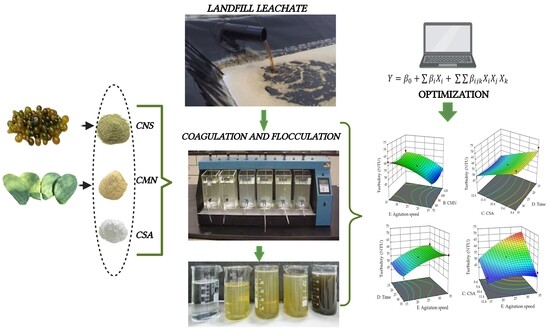
Graphical Abstract

1. Introduction

Changes in economic activities and people’s lifestyles are increasing global waste production [1,2]. It is estimated that by 2050, municipal solid waste generation will exceed 3.4 billion tons, representing a 70% increase over current levels [3]. The predominant practice of disposing of waste in landfills generates leachate, a complex and high-risk effluent. The composition of leachate varies depending on the age of the landfill and the type of waste, and it contains high concentrations of recalcitrant organic matter, such as humic and fulvic acids, heavy metals, salts, and organic compounds. This toxic mixture makes it a serious threat to aquifers, surface water bodies, public health, and surrounding ecosystems [4,5,6]. To mitigate this threat, various treatment technologies have been implemented. Leachate recirculation, while accelerating landfill stabilization, leads to operational problems such as odor emissions and high maintenance costs [7]. Biological treatments, while efficient for biodegradable organic matter, have significant limitations when treating recalcitrant pollutants and fluctuations in pollutant load. Similarly, advanced physicochemical processes, such as oxidation or nanofiltration, are effective, but their application is restricted by high energy requirements and operating costs [5,8,9,10].
Although coagulation and flocculation are often used as leachate pretreatment, they are generally preceded by equalization and pH adjustment to stabilize the effluent [11,12]. Their main function is to remove colloids and certain contaminants such as color, turbidity, and some metals, thus conditioning the effluent for subsequent processes. This improves the efficiency of biological treatments such as activated sludge, SBR, or MBBR, as well as advanced treatments like membrane filtration and reverse osmosis, which are highly susceptible to fouling and inhibition by recalcitrant contaminants [13,14,15].
However, the use of conventional chemical coagulants, such as aluminum or iron salts, generates large volumes of toxic sludge, which becomes a new hazardous waste that is difficult and costly to dispose of [1,2,10,15,16].
In addition, the use of metallic coagulants, such as aluminum, iron, and titanium salts, may cause pH alterations and the release of residual metals, potentially leading to secondary environmental impacts and increased operational costs. However, although recent studies have reported that titanium-based coagulants are efficient in contaminant removal, their higher cost and the difficulties associated with large-scale implementation limit their application in leachate treatment [17,18].
Sustainable solutions have been tested, and natural biopolymers have emerged as a promising alternative. Opuntia ficus-indica mucilage and Nostoc sphaericum cyanobacteria have proven to be particularly effective [5,19,20]. The mechanism of action is based on a combination of charge neutralization, adsorption, and bridging, facilitated by the polysaccharides and functional groups of the biocoagulants. Polysaccharides contain carboxyl and hydroxyl groups, which interact with contaminants in the leachate by neutralizing the negative charges of suspended particles, allowing them to agglomerate [21,22,23]. At the same time, the polymer chains act as bridging agents, trapping and aggregating the already destabilized particles to form larger, heavier flocs that settle easily. A sweeping mechanism may also occur, where the biopolymer forms a network that drags and removes contaminants as they precipitate [24,25,26,27]. However, despite its potential, optimizing the dosage and operating conditions for mixing these biopolymers with traditional coagulants in leachates remains an under-researched area. This study proposes a combination of natural biopolymers, namely Nostoc sphaericum (CNS) and Opuntia ficus-indica (CMN), with aluminum sulfate (CSA) in the coagulation and flocculation process. To this end, a Box–Behnken design (BBD) was used, a robust statistical tool within response surface methodology (RSM) that allows the interactions between coagulant dose, time, and agitation speed to be evaluated with a reduced number of experiments [1,5,10,28,29,30,31]. The objective of the study was to achieve the highest turbidity removal under optimal conditions, but at the same time to validate these optimal conditions with the removal of organic matter, nutrients, heavy metals, and surfactants, in order to develop a viable alternative to conventional treatment systems, contributing to sustainable waste management and environmental protection.

2. Materials and Methods

2.1. Leachate Sampling and Characterization

The leachate was collected from the Andahuaylas sanitary landfill, located on San José Hill, Apurímac Region, Peru (13°39′50.67″ S, 73°21′50.50″ W). The landfill operates with geomembrane-lined cells and anaerobic ponds for leachate collection and receives approximately 27.4 t/day of solid waste [26]. Composite leachate samples were collected from the main collector of the sanitary landfill on six occasions between April and June 2025, following the methodology described in [27].
The physical and chemical characterization of the leachate was performed according to the methods listed in Table 1. For heavy metal analysis, samples were filtered through a 0.45 µm membrane and analyzed in triplicate using an inductively coupled plasma optical emission spectrometer (ICPE-9820, SHIMADZU, Tokyo, Japan). Analyses were conducted in an axial mode with a plasma exposure time of 30 s, a gas flow rate of 10 L/min, and a rinse speed of 60 rpm between samples [26].

2.2. Raw Materials and Reagents

Cladodes of Opuntia ficus-indica were collected in the district of Santa Rosa Talavera, Andahuaylas Province, Peru, located at 13°39′01″ S, 73°26′29″ W, at an altitude of 2800 m above sea level, during the period from September to November 2024. The samples were transported in sterile containers and stored under controlled conditions to preserve their properties. The cyanobacterium Nostoc sphaericum was collected from the Huamanilla high Andean lagoon, located at 13°47′52″ S, 73°17′55″ W, at an altitude of 4251 m above sea level, in Andahuaylas Province, Peru, during the period from March to April 2024. Analytical-grade aluminum sulfate (CSA) was also used (Sigma-Aldrich, St. Louis, MO, USA).

2.3. Obtaining Biocoagulants

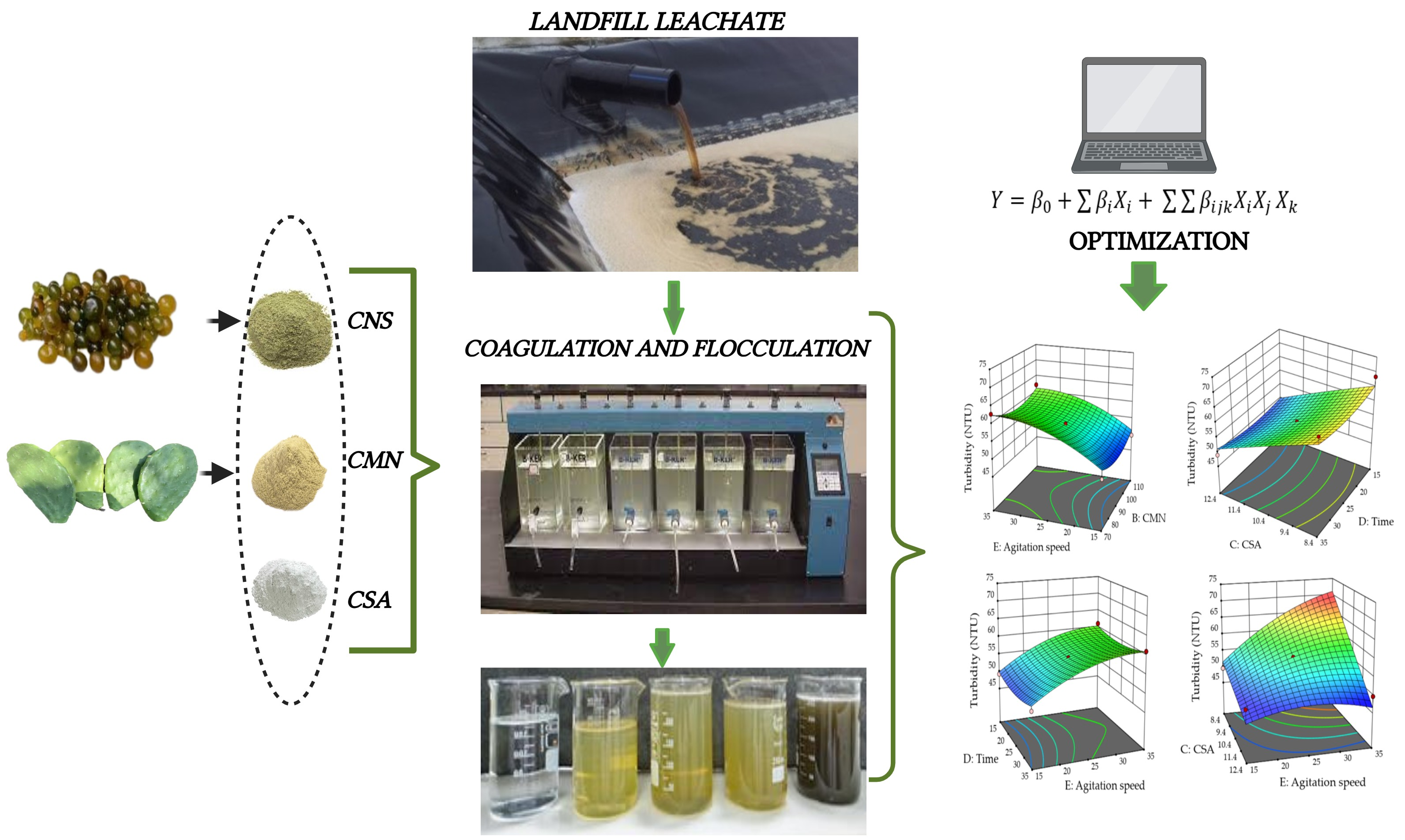
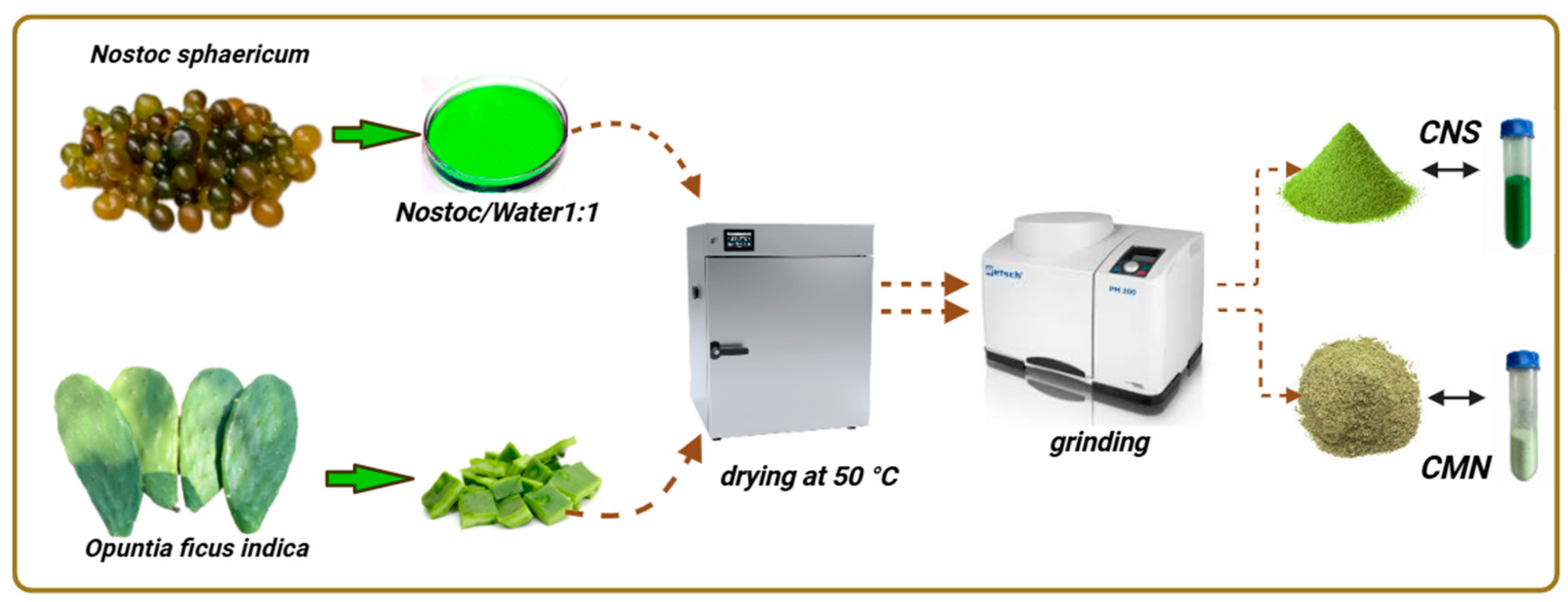
Cladodes of Opuntia ficus-indica were washed, peeled, and cut into cubes. The material was then dried at 50 °C for 15 h [23] and finely ground using a planetary ball mill (QXQM series) at 50 rpm, obtaining the biocoagulant CMN (Figure 1).
Similarly, Nostoc sphaericum was washed with distilled water and mechanically homogenized in a blender with distilled water at a 1/1 p/v [34]. The extract was sieved through a 63 µm mesh; the filtrate was then dried in silicone molds at 50 °C for 15 h, and the dried material was ground at 50 rpm in a planetary mill (QXQM series), obtaining the biocoagulant CNS (Figure 1).
In both cases, the extraction was based on previous studies indicating that the preservation of naturally soluble polysaccharides and functional groups can be achieved through drying and mechanical milling, and that acid- and base-free methods represent a more sustainable alternative [35,36,37].

2.4. Methods for Characterization of the Biocoagulants

2.4.1. FTIR Analysis

Fourier transform infrared (FTIR) spectroscopy was used to identify the functional groups present in the biocoagulants. The analyses were carried out using a Thermo Fisher spectrometer (Nicolet IS50 model) (Thermo Fisher Scientific, Waltham, MA, USA). Powdered samples were mixed with IR-grade KBr to prepare pellets and analyzed in transmission mode over the range of 4000–400 cm−1 with a resolution of 4 cm−1 [33,34].

2.4.2. Determination of Particle Size and Zeta Potential

To determine particle size and zeta potential (ζ), 4 mg of each biopolymer sample were dispersed in 5 mL of ultrapure water and stirred at 1000 rpm for 5 min. The suspension was then sonicated for 10 min to achieve a homogeneous dispersion. The hydrodynamic diameter and particle size distribution were measured by dynamic light scattering (DLS) using a Nicomp Nano ZLS Z3000 instrument (Entegris, Billerica, MA, USA) at a scattering angle of 90°. Zeta potential (ζ) was determined using the same instrument by analyzing 2 mL of the dispersion at a wavelength of 632.8 nm and a scattering angle of −14.14 [27,34].

2.4.3. Determination of the Point of Zero Charge

To determine the point of zero charge (PZC), 50 mL solutions containing 0.05 g of each biopolymer were prepared. The initial pH was adjusted over a range from 2 to 12 using 0.1 N NaOH and HCl solutions. The suspensions were stirred at 150 rpm for 24 h, after which the final pH was measured. The PZC was determined as the intersection point obtained by plotting the final pH versus the initial pH [34].

2.5. Experimental Procedure

Experimental Design and Process Configuration

The coagulation tests were conducted following a Box–Behnken experimental design, which allowed for the evaluation of the combined effects of five independent variables at three levels (Table 2) [1,38,39,40].
The selection of independent variables and their experimental ranges was based on preliminary jar test trials and operational criteria commonly used in coagulation–flocculation processes. The doses of CNS, CMN, and aluminum sulfate, as well as the mixing times and stirring speeds, were defined to ensure effective destabilization and adequate floc formation, avoiding overdosing. Similar ranges are applied in the treatment of leachates and complex wastewater [10,16].
The experimental design included 46 experiments and was carried out using a Jar-Test instrument (PB-900; Phipps & Bird, Richmond, VA, USA). 500 mL of untreated leachate was added to each jar. During the first rapid mixing stage, which lasted 1 min at 120 rpm, the biocoagulants and coagulants (CNS, CMN, and CSA) were added in doses corresponding to those defined in the experimental design.
After the rapid mixing stage, the agitation speed was reduced, and the mixing time and agitation speed were adjusted according to the levels specified in Table 2, in order to promote particle aggregation. Subsequently, the suspensions were allowed to settle for 1 h. At the end of the settling period, samples were collected from the supernatant, and turbidity, pH, and electrical conductivity were measured. These parameters were selected as response variables for process optimization.
For the generation and analysis of the empirical models, according to Equation (1), turbidity, pH, and electrical conductivity (EC) of the treated leachate were considered response variables.
Y = β 0 i = 0 k β i X i + i = 1 k β i i X i 2 + i > j k · j k β i j X i X J + e
where Y is the predicted response; β0, βi, and βii are the linear, quadratic, and interaction coefficients, respectively; Xi and Xj are the independent variables; ei is the residual error; and k is the number of variables.
The models were validated using analysis of variance (ANOVA) with a significance level of p < 0.05. The model was considered adequate when the lack-of-fit test was not significant (p > 0.05).
To evaluate the goodness of fit and predictive capability, the coefficient of determination (R2), adjusted R2, predicted R2, and adequate precision were employed. R2 was used to assess the agreement between the model and the experimental data; the adjusted R2 accounted for the number of predictors in the model; the predicted R2 was used to estimate the predictive performance; and adequate precision was used to evaluate the model’s ability to distinguish the real effects of the factors.
The model was considered valid when it presented an R2 value close to 1, an adjusted R2 consistent with the R2, an absolute difference ≤ 0.2 between the adjusted R2 and the predicted R2, and adequate precision values greater than 4 [41,42,43]. Statistical analyses were performed using Design-Expert software (v. 7.0.0, demo version).

2.6. Optimization and Experimental Validation

Process optimization was performed using the desirability function in order to identify the operating conditions that minimize turbidity while maintaining the pH within the range of 6.0–9.0 and ensuring that the EC was equal to or lower than the initial value of the leachate.
To validate the predictive capability of the model under the identified optimal conditions, experimental coagulation–flocculation tests were conducted. Treatment performance was evaluated by measuring the responses (turbidity, pH, and EC), and to determine efficiency of the treatment under these optimal conditions, the percentage of removal of BOD5, COD, TOC, metals, ammoniacal nitrogen, phosphates, and surfactants was quantified. The removal efficiency for each parameter was calculated according to Equation (2).
% R = T 0     T f T 0 × 100
where T0 is the initial concentration, and Tf is the final concentration.

2.7. Statistical Techniques

The results are reported using the arithmetic mean and standard deviation of the data obtained in triplicate. To evaluate significant differences between treatments, Student’s t-test for paired data was applied with a significance level of 5%. The data were analyzed using Statistica software, version 12.
During the preparation of this manuscript, the authors used generative artificial intelligence tools to support the translation process. The manuscript was reviewed and finalized by the authors, who assume full responsibility for its content.

3. Results and Discussion

3.1. Characterization of the Initial Leachate

The initial leachate presented a pH of 8.01, which is within the range of 6 to 9, characteristic of leachates in an intermediate stage that are in a transition phase between young and mature leachates (Table 3) [44,45]. The COD reached 817 mg/L, while the BOD5 was 563 mg/L, exceeding the permissible limits of 400 mg/L and 20 mg/L, respectively [44]. The BOD5/COD ratio of 0.69 indicates a highly biodegradable organic fraction, which makes biological treatment possible.
In addition, a high NH3-N concentration of 640 mg/L, exceeding the limit of 5 mg/L, and a turbidity of 164.8 NTU indicate that the leachate is complex and less stable. Furthermore, heavy metals such as Cd (0.48 mg/L), As (0.75 mg/L), and Pb (0.38 mg/L) exceeded the permitted limits [44].
Although the biodegradability index suggests the feasibility of biological treatment, the raw leachate presents high metal concentrations, indicating the need for physicochemical treatment to reduce the contaminant load. Despite the relatively high BOD5/COD ratio, the coagulation–flocculation process is therefore proposed as a pretreatment step to reduce turbidity, colloidal organic matter, and inorganic components that could affect the performance of subsequent biological treatment.

3.2. Characterization of the Biocoagulants

3.2.1. FTIR Analysis of Biocoagulants

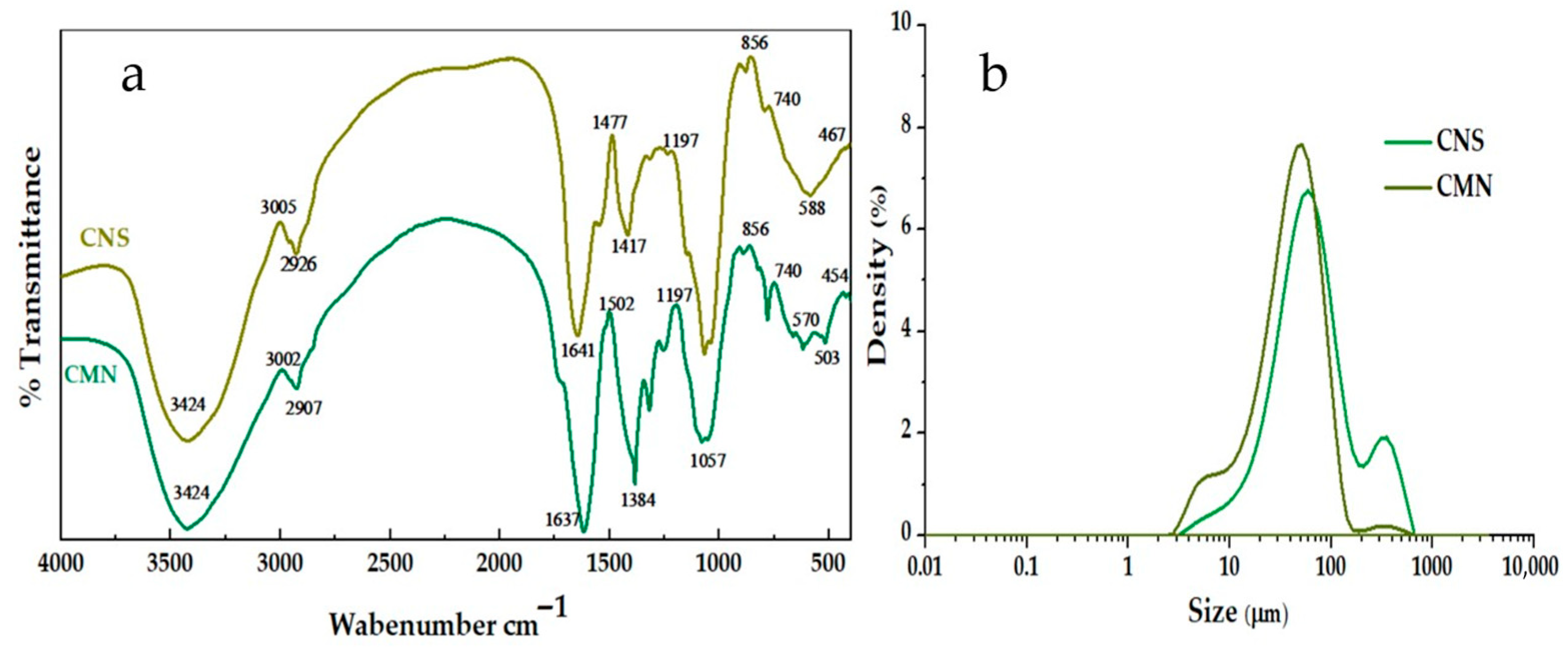
FTIR spectroscopy was used to analyze the presence of active functional groups in CNS and CMN (Figure 2a). The broad band around 3424 cm−1 is associated with O-H stretching of hydroxyl groups, which are characteristic of polysaccharides and participate in the formation of hydrogen bonds with water molecules and contaminants, favoring particle binding and adsorption processes [45]. The bands observed at 2926 cm−1 for CNS and 2907 cm−1 for CMN correspond to C-H stretching of methyl and methylene groups, indicating the presence of a polymeric chain of an aliphatic nature [46,47].
The bands located at 1637 and 1641 cm−1 are associated with carboxyl groups (-COOH), which, upon dissociation in water, confer an anionic character to the surface of the biocoagulants [48]. This negatively charged surface favors electrostatic interactions with positively charged species, such as metallic cations, and, together with the presence of hydroxyl groups, promotes particle agglomeration through the formation of hydrogen bonds [49,50]. Moreover, the bands at 1384 cm−1, 1477 cm−1, and 1057 cm−1 also indicate the presence of C-O and C-OH groups, characteristic of polysaccharides. The presence of these functional groups suggests their potential involvement in the coagulation–flocculation process, as they may contribute to contaminant removal through electrostatic interactions, hydrogen bonding, and polymer bridging mechanisms, as reported in previous studies [21,27,34,45,51,52].

3.2.2. Particle Size Analysis of the Biocoagulants

The efficacy of natural coagulants depends directly on particle size. CNS exhibits a bimodal particle size distribution of approximately 5 µm and 100 µm (Figure 2b), which may allow for different removal pathways during the coagulation–flocculation process [27]. The observed particle size is comparable to that reported for other biopolymers, where particles smaller than 20 µm have been described as having a greater adsorption potential, while particles close to 100 µm are mainly associated with polymer bridging mechanisms, facilitating the formation of larger aggregates that settle more rapidly an expected behavior in natural coagulants based on polysaccharides [47,48].
Likewise, particles in the 50–100 µm range tend to show adequate dispersion in the aqueous medium and favor physical processes such as interception and sedimentation [53]. In contrast, smaller particles around 5 µm, due to their larger surface area, can enhance adsorption processes [54].
The bimodal particle size of CNS could be due to the extraction conditions of the biopolymer, which, when interacting with water, tends to agglomerate, forming larger particles. Furthermore, this behavior may be related to the degradation of proteins and carbohydrates, which, when dissolved in water, release particles of different sizes [34,55,56]. Meanwhile, CMN exhibited a particle size between 50 and 100 µm, similar to that reported for Opuntia ficus-indica, with an average size of 166 µm [46,47,57,58]. However, the efficiency of the process can be influenced by an appropriate particle size, since excessively large particles can settle quickly and reduce the stability of the dispersion, while smaller particle sizes are associated with better performance of the coagulation process [59,60].

3.2.3. Zeta Potential (ζ) and Point of Zero Charge (PZC) of the Biocoagulants

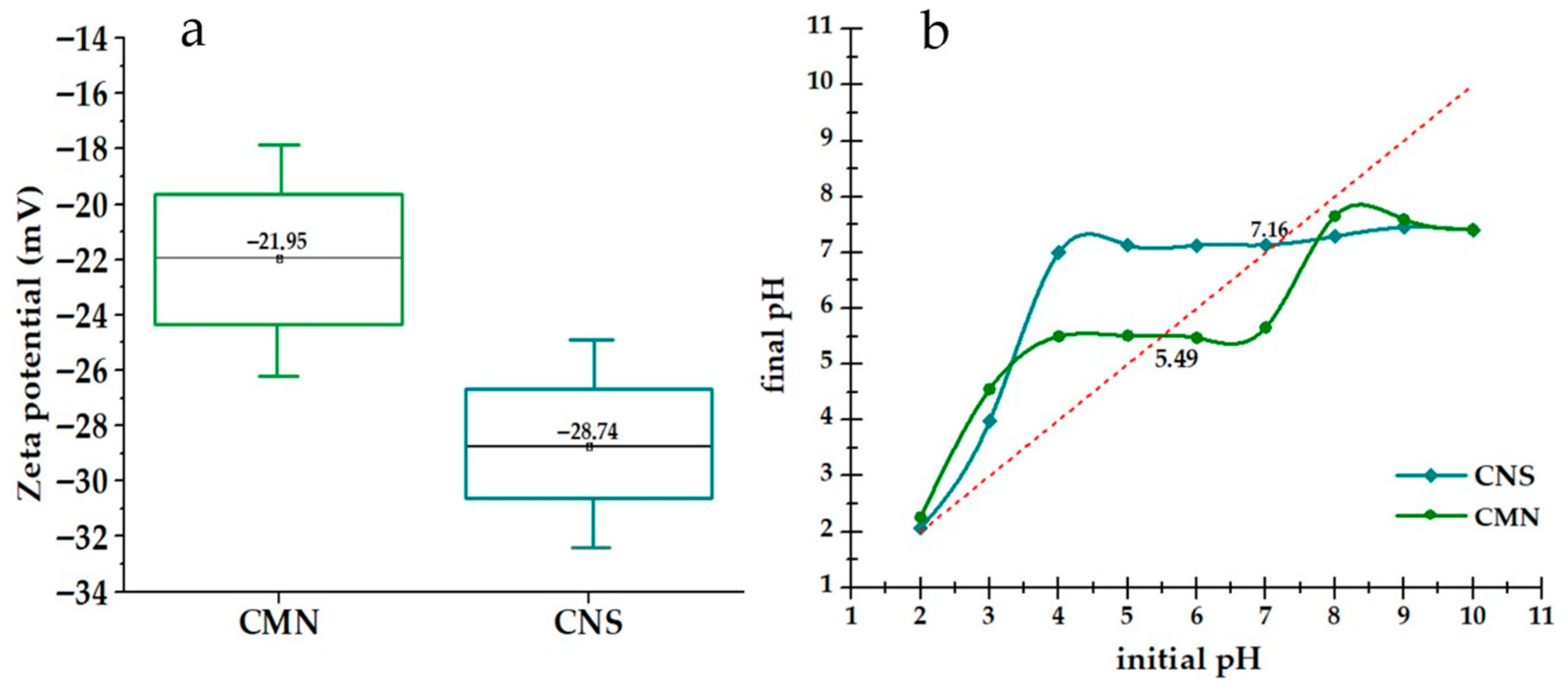
As shown in Figure 3a, the ζ potential values indicate that both biocoagulants exhibit an anionic surface charge. CNS showed a more negative value (−28.74 mV) compared to CMN (−21.95 mV). This suggests that CNS may present higher colloidal stability and longer polysaccharide chains, which could favor particle bridging phenomena, as reported in previous studies [61,62,63,64]. On the other hand, the less negative potential of CMN indicates reduced electrostatic repulsion, which may enhance surface interactions and contribute to adsorption-related processes [48,65,66]. About the PZC, Figure 3b shows values of 7.16 for CNS and 5.49 for CMN. Both materials acquire a negative charge when the pH exceeds their PZC. Under these conditions, the negative surface charge may promote interactions with cationic species and contribute to floc formation through mechanisms such as polymer bridging and adsorption, involving carboxyl (-COOH) and hydroxyl (-OH) functional groups, which may play a role in metal removal [5,67,68,69,70].

3.3. Analysis of Experimental Data

In Table S1 (Supplementary Materials), it was observed that treatment with pure CSA achieved a turbidity reduction of 46.20 NTU. However, higher doses caused acidification of the leachate and an increase in electrical conductivity (EC). In contrast, treatments combining CSA with CNS and CMN achieved comparable turbidity reductions of up to 48 NTU using lower doses of CSA, while at the same time maintaining the pH and EC of the leachate.
Regarding EC, its behavior was influenced by the CSA dose, with higher doses increasing EC above 13 mS/cm, which suggests the incorporation of Al3+ and SO42− into the leachate due to the dissolution of aluminum sulfate [1,23,45]. In contrast, the biocoagulants did not cause an increase in EC.
The initial pH of the leachate decreased from 8.01 to 5.28 with high doses of CSA. This decrease could be associated with the typical behavior of leachates with reduced buffer capacity in the face of Al3+ hydrolysis, a process that releases protons and contributes to the acidification of the medium [14]. Meanwhile, incorporating CNS and CMN attenuated this effect, maintaining the pH close to neutrality, which is consistent with their capacity to partially buffer the acidification induced by metal salts.
On the other hand, leachates usually present a complex composition dominated by organic acids and limited alkalinity, which translates into a low buffering capacity against the addition of acidic species [5,71].
Likewise, rapid pH drops in leachates have been observed both from the addition of acidic coagulants and from the production of volatile organic acids, especially in young leachates [72]. This represents an advantage in leachate treatment, since these usually require additional pH corrections when metal salt coagulants are used [19].

3.4. Model Adequacy Verification

The models obtained for turbidity, pH, and EC presented R2 values higher than 0.91 (Table 4), indicating good agreement between the experimental and modeled data. The differences between the adjusted and predicted R2 values were below the recommended limit of 0.20 (pH: 0.135; EC: 0.059; turbidity: 0.184), supporting the predictive reliability of the models [64].
In addition, the adequate precision values exceeded the minimum acceptable value of 4.0, reaching 14.66 for pH, 25.27 for EC, and 13.93 for turbidity, which reflects a satisfactory signal-to-noise ratio and a clear identification of the effects of the studied factors [41,43,73,74].
However, a statistically significant lack of fit was observed for turbidity and EC, indicating differences between the model predictions and some experimental values. This behavior can be attributed to the sensitivity of the Box–Behnken design to detect small deviations [41,74]. Furthermore, this lack of fit may be associated with the high complexity and variability inherent to landfill leachate, whose composition varies over time and is influenced by the interaction among its different components [5,75]. Under these conditions, the ability of quadratic models to accurately describe the behavior of the responses may be limited, since they assume smooth and continuous relationships, whereas in practice the interactions between leachate components and small changes in dosages or operating conditions during the coagulation and flocculation process may lead to pronounced curvature, inflection points, or saturation effects that are not always adequately captured by a quadratic model [1,38,43].
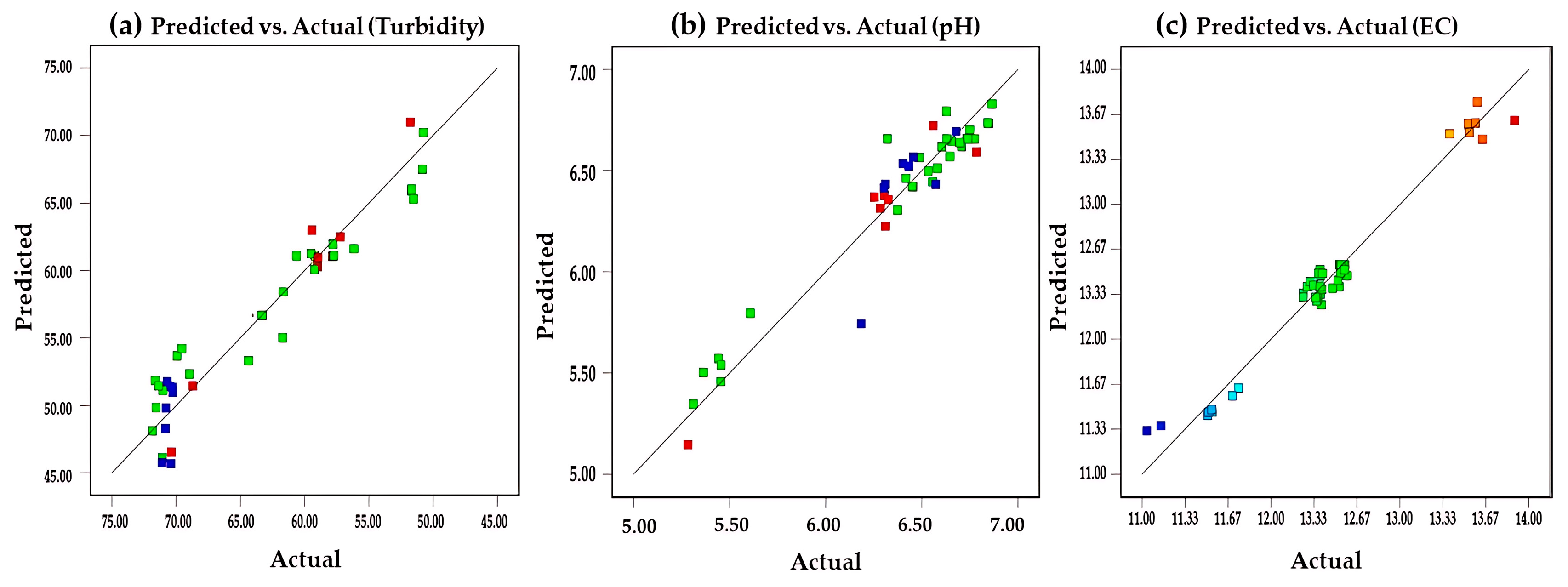
On the other hand, the models were employed as empirical tools to identify trends and approximate optimal regions within the evaluated experimental range. The validity of the optimal conditions was confirmed through experimental validation, which yielded results within the range of values observed during the experimentation. Furthermore, the model performance was further supported by the close agreement between predicted and experimental values shown in Figure 4, confirming the adequacy of the models within the studied experimental domain [76].

3.5. Response Surface Analysis for Turbidity

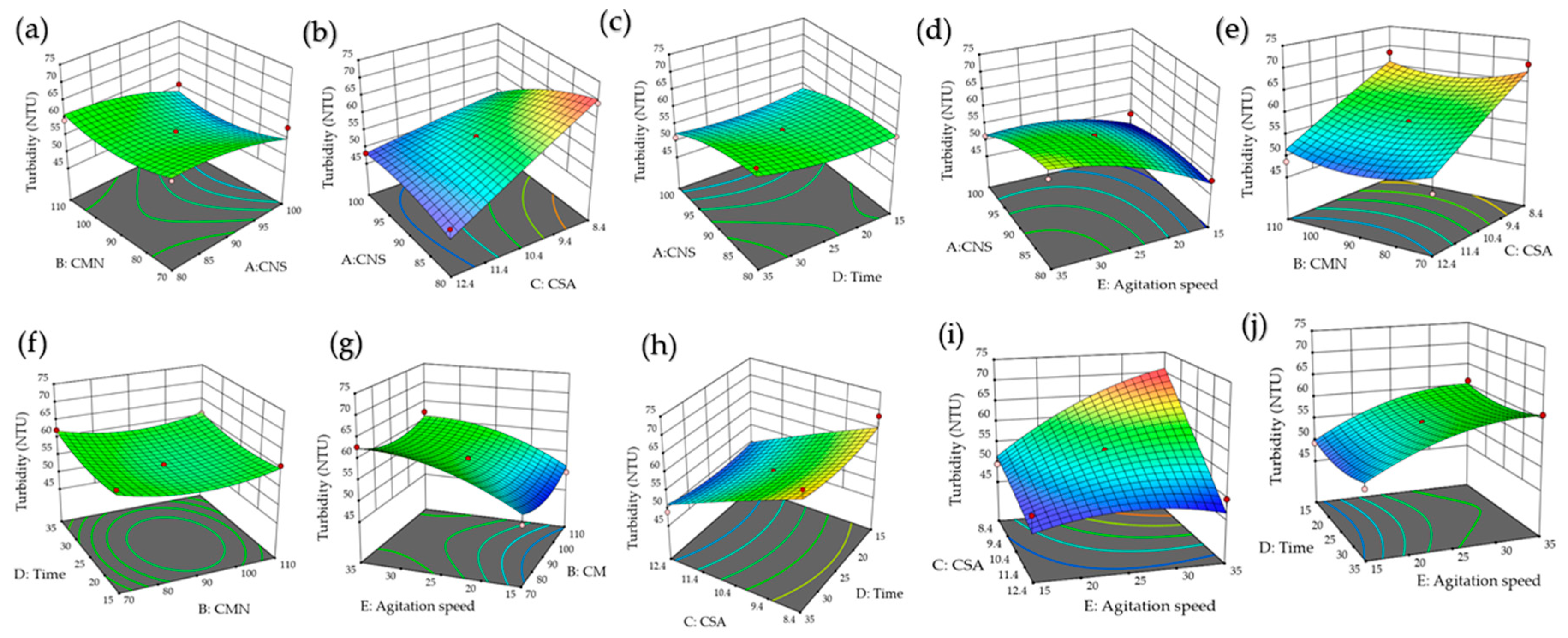
The response surface plots shown in Figure 5 indicate a complementary interaction between aluminum sulfate (CSA) and the biopolymers, where CNS and CMN contribute to turbidity reduction through adsorption and polymer bridging mechanisms (Figure 5a,b,e). In addition, moderate mixing times and agitation speeds favor floc stability, whereas excessive agitation or prolonged mixing increases residual turbidity due to floc breakage caused by shear forces (Figure 5c,d,g,j) [74].
Furthermore, increasing CMN dosage enhances turbidity removal across different mixing conditions, highlighting the combined influence of coagulant dosage and hydrodynamic conditions on clarification performance (Figure 5f,h,i).

3.6. Optimization

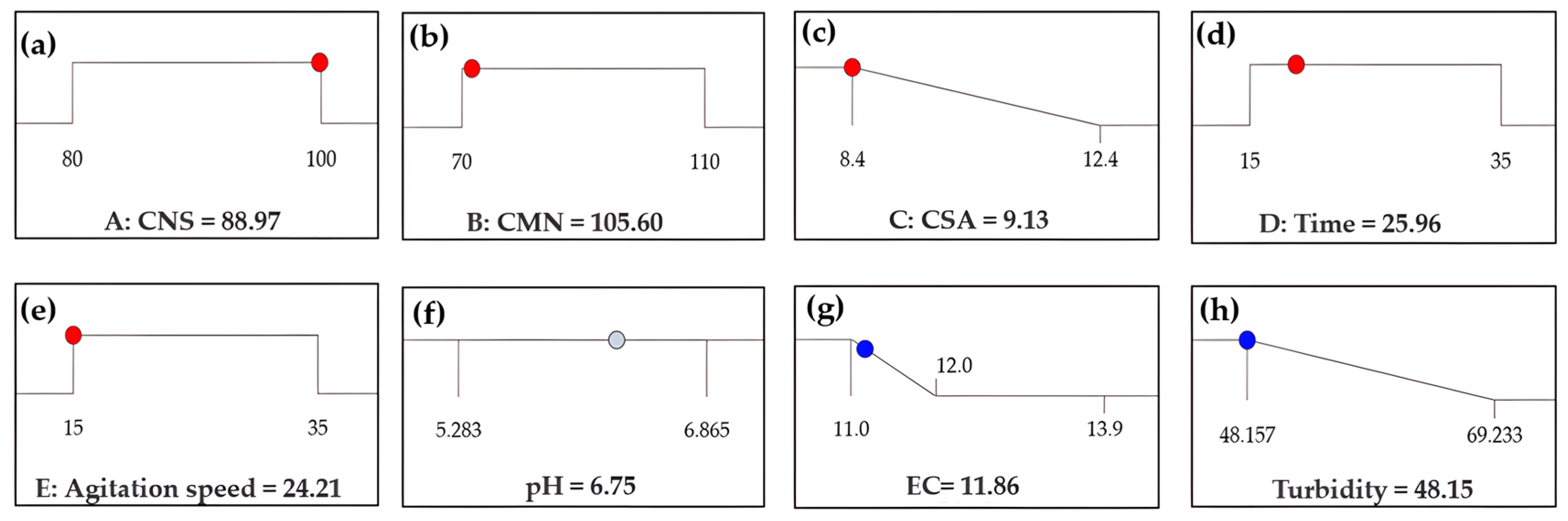
For the optimization, the doses of CNS, CMN, and CSA, as well as the mixing time and agitation speed, were considered. The response variable was turbidity reduction, with the constraints of maintaining the pH close to neutrality and the electrical conductivity equal to or lower than the initial value, in order to avoid alterations in the leachate. The optimization reduced turbidity to 48.15 NTU, using doses of 88.97 mg/L of CNS, 105.60 mg/L of CMN, and 9.13 mg/L of CSA, with a mixing time of 25.96 min and an agitation speed of 24.21 rpm. Under these conditions, the pH was maintained at 6.75 and the electrical conductivity at 11.86 mS/cm, as shown in Figure 6. The turbidity value achieved a decline within the experimental range of 48 to 69 NTU (see Table S1, Supplementary Materials).

3.7. Experimental Validation of the Optimal Treatment

To validate the optimal conditions determined using the Box–Behnken design, coagulation–flocculation tests were carried out using new leachate samples characterized in Table 5. The experiments were conducted under the optimal conditions predicted by the model. Under these conditions, turbidity was reduced to 49.02 NTU, achieving a removal efficiency of 70%, as shown in Table 5, a value comparable to that reported for natural biocoagulants (50–80%) [5,21,23,44,74].
The turbidity obtained during the experimental validation was lower than that recorded during the optimization stage (48.15 NTU), as shown in Figure 6. This difference can be attributed to variations in the physicochemical characteristics of the leachate used in the validation, since, although the samples were collected at the same location, they were obtained at different times (Table 5). Nevertheless, the experimental result remained within the turbidity range observed during the experimental runs (see Table S1, Supplementary Materials).
This performance is associated with the anionic nature of both biocoagulants, as evidenced by negative zeta potential values of −28.74 mV for CNS and −21.95 mV for CMN; these results suggest that charge neutralization is not the dominant mechanism, and that contaminant removal may be primarily associated with adsorption and polymer bridging phenomena, rather than complete electrostatic neutralization [1,40,77]. This interpretation is supported by the PZC values of CNS (7.16) and CMN (5.49), which indicate that both biocoagulants maintain a negative surface charge under near-neutral pH conditions [68,69]. Furthermore, the particle size distribution of CNS, characterized by differentiated fractions (<10 µm and 100 µm), together with the more homogeneous particle size of CMN, may favor adsorption processes and floc growth, contributing to turbidity reduction. These effects are consistent with previous studies, which have shown that particle size distribution and surface charge heterogeneity influence floc formation and aggregation behavior during coagulation–flocculation processes [9,26,78,79].
Regarding organic matter removal, TOC was reduced by 65.3%, while COD and BOD5 showed more limited reductions of 14.7% and 24.7%, respectively. This behavior is consistent with the role of coagulation–flocculation as a pretreatment process, which preferentially removes colloidal and macromolecular organic matter rather than dissolved low-molecular-weight compounds, while part of the organic fraction remains dissolved in the leachate [80,81].
On the other hand, phosphate removal reached 47.7%, suggesting that part of the phosphate binds to the flocs formed during treatment, while the remainder stays in the leachate. In contrast, ammoniacal nitrogen was reduced to only 12.5%, which could be attributed to the fact that the NH4+ ion remains mostly dissolved and exhibits limited interaction with anionic biocoagulants [75,82,83]. These results confirm that the mixture used does not completely remove ammoniacal nitrogen and instead serves as a conditioning step prior to biological or advanced nitrogen removal processes.
Metal removal efficiencies varied, reaching up to 67.7% for Cu, 55.9% for As, and 40% for Cd. This behavior is attributed to adsorption and chelation mechanisms associated with the carboxyl and hydroxyl functional groups present in the biocoagulants [11,26,84,85]. In contrast, Cr, Fe, Pb, Zn, Al, and Ni showed lower removal efficiencies (19–39%), probably due to competition among cations present in the leachate [44,86].
Finally, surfactant removal reached 19.465%, indicating that most of the surfactants remained dissolved [87]. The combined use of CNS–CMN biocoagulants with aluminum sulfate acts mainly as a physicochemical pretreatment, selectively removing turbidity, colloidal organic matter, and metals, while most dissolved contaminants remain in the leachate, supporting its role as a preliminary step prior to biological or advanced treatments.

4. Conclusions

This study used a combination of the biocoagulants CNS and CMN with aluminum sulfate (CSA) for the treatment of sanitary landfill leachate through a coagulation–flocculation process. The physicochemical characterization of both biocoagulants showed that they present carboxyl and hydroxyl functional groups and have an anionic nature. The optimal conditions determined by the model were 88.97 mg/L of CNS, 105.60 mg/L of CMN, and 9.13 mg/L of CSA. Furthermore, operating intervals for mixing time were established between 25 and 30 min, with an agitation speed of 20 to 25 rpm. These conditions allowed for a predicted turbidity reduction to 48.15 NTU; during validation, the turbidity was reduced to 49.02 NTU, achieving removal efficiencies within the 70% range. Furthermore, TOC reductions of 65% were achieved, and heavy metals such as arsenic (As) and cadmium (Cd) reached removal efficiencies of 56% and 40%, respectively. Phosphate removal was moderate, while the removal of BOD5, surfactants, and ammonia nitrogen was limited. These findings indicate that biocoagulants constitute an efficient pretreatment for leachates and could serve as sustainable aids, reducing dependence on synthetic coagulants.

Supplementary Materials

The following supporting information can be downloaded at: https://www.mdpi.com/article/10.3390/polym18040474/s1; Table S1: Experimental matrix for turbidity, pH, and EC responses.

Author Contributions

Y.C.-Q.: Conceptualization, Methodology, Writing—Original draft, Writing—Review and Editing, Supervision, Project administration, Formal analysis, Investigation; A.M.S.-R.: Investigation, Formal analysis, Visualization; C.E.D.-V.: Validation, Formal analysis, Writing—Review and Editing; E.A.-L.: Formal analysis, Methodology, Data Curation; L.R.-C.: Investigation, Methodology, Software; D.C.-Q.: Conceptualization, Methodology, Validation, Formal analysis, Writing—Review and Editing, Supervision. All authors have read and agreed to the published version of the manuscript.

Funding

This research was funded by the José María Arguedas National University, Peru. Project approved by Resolution No. 230-2024-UNAJMA/CU.

Institutional Review Board Statement

Not applicable.

Data Availability Statement

The original contributions presented in this study are included in the article. Further inquiries can be directed to the corresponding author.

Acknowledgments

The authors would like to thank the Vice Rectorate of Research of the Universidad Nacional José María Arguedas for the financing and use of the Advanced Materials Research Laboratory for Water Treatment and Food Nanotechnology Research Laboratory, as well as the Instituto de Investigación—UNAJMA. During the preparation of this manuscript, the authors used ChatGPT (GPT-4, OpenAI) for translation purposes. The authors have reviewed and edited the output and take full responsibility for the content of this publication.

Conflicts of Interest

The authors declare no conflict of interest.

References

  1. Bouyakhsass, R.; Souabi, S.; Rifi, S.K.; Taleb, A.; Pala, A.; Madinzi, A. Optimization of coagulation-flocculation for landfill leachate treatment: An experimental design approach using response surface methodology. Environ. Nanotechnol. Monit. Manag. 2023, 20, 100841. [Google Scholar] [CrossRef]
  2. Bakraouy, H.; Souabi, S.; Digua, K.; Dkhissi, O.; Sabar, M.; Fadil, M. Optimization of the treatment of an anaerobic pretreated landfill leachate by a coagulation–flocculation process using experimental design methodology. Process Saf. Environ. Prot. 2017, 109, 621–630. [Google Scholar] [CrossRef]
  3. Kaur, H.; Kaur, P. Factors Determining Household Waste Segregation Behaviour: An Indian Case Study. Int. J. Exp. Res. Rev. 2024, 41, 83–95. [Google Scholar] [CrossRef]
  4. Alam, O.; Qiao, X. An in-depth review on municipal solid waste management, treatment and disposal in Bangladesh. Sustain. Cities Soc. 2020, 52, 101775. [Google Scholar] [CrossRef]
  5. Chen, H.; Xu, H.; Zhong, C.; Liu, M.; Yang, L.; He, J.; Sun, Y.; Zhao, C.; Wang, D. Treatment of landfill leachate by coagulation: A review. Sci. Total Environ. 2024, 912, 169294. [Google Scholar] [CrossRef]
  6. Abd El-Salam, M.M.; Abu-Zuid, G.I. Impact of landfill leachate on the groundwater quality: A case study in Egypt. J. Adv. Res. 2015, 6, 579–586. [Google Scholar] [CrossRef] [PubMed]
  7. Laines Canepa, J.R.; Goñi Arévalo, J.A.; Adams Schroeder, R.H.; Camacho Chiu, W. Mezclas con potencial coagulante para tratamiento de lixiviados de un relleno sanitario. Interciencia 2008, 33, 22–28. [Google Scholar]
  8. Miao, L.; Yang, G.; Tao, T.; Peng, Y. Recent advances in nitrogen removal from landfill leachate using biological treatments—A review. J. Environ. Manag. 2019, 235, 178–185. [Google Scholar] [CrossRef] [PubMed]
  9. Gajewska, M.; Stosik, M.; Wojciechowska, E.; Obarska-Pempkowiak, H. Influence of wastewater treatment technology on particle size distribution in the effluent. Rocz. Ochr. Srodowiska 2013, 15, 1191–1206. [Google Scholar]
  10. Chaouki, Z.; El Mrabet, I.; Khalil, F.; Ijjaali, M.; Rafqah, S.; Anouar, S.; Nawdali, M.; Valdés, H.; Zaitan, H. Use of coagulation-flocculation process for the treatment of the landfill leachates of Casablanca city (Morocco). J. Mater. Environ. Sci. 2017, 8, 2781–2791. [Google Scholar]
  11. Cheng, Z.; Yang, J.; Li, L.; Chen, Y.; Wang, X. Flocculation inspired combination of layered double hydroxides and fulvic acid to form a novel composite adsorbent for the simultaneous adsorption of anionic dye and heavy metals. J. Colloid Interface Sci. 2022, 618, 386–398. [Google Scholar] [CrossRef]
  12. Chen, W.; Gu, Z.; Ran, G.; Li, Q. Application of membrane separation technology in the treatment of leachate in China: A review. Waste Manag. 2021, 121, 127–140. [Google Scholar] [CrossRef] [PubMed]
  13. Seifi, M.; Kamran-Pirzaman, A.; Dehghani Kiadehi, A.; Rahimnejad, M. A comprehensive comparison of various methods and hybrid systems in leachate treatment: A review. Int. J. Environ. Sci. Technol. 2025, 22, 8425–8520. [Google Scholar] [CrossRef]
  14. Tatsi, A.A.; Zouboulis, A.I.; Matis, K.A.; Samaras, P. Coagulation–flocculation pretreatment of sanitary landfill leachates. Chemosphere 2003, 53, 737–744. [Google Scholar] [CrossRef] [PubMed]
  15. Pashaki, S.G.A.; Khojastehpour, M.; Ebrahimi-Nik, M.; Tedesco, S. Potential of ash from agricultural waste as substitute of commercial FeCl3 in primary treatment of landfill leachate. J. Environ. Manag. 2024, 351, 119932. [Google Scholar] [CrossRef]
  16. Chaouki, Z.; Hadri, M.; Nawdali, M.; Benzina, M.; Zaitan, H. Treatment of a landfill leachate from Casablanca city by a coagulation-flocculation and adsorption process using a palm bark powder (PBP). Sci. Afr. 2021, 12, e00721. [Google Scholar] [CrossRef]
  17. Wern, T.Y.; Ardani, M.R.; Ramli, S.F.; Rezan, S.A.; Aziz, H.A.; Ibrahim, I. Coagulation performance of titanium tetrachloride for alor pongsu wastewater treatment. In AIP Conference Proceedings; AIP Publishing: New York, NY, USA, 2020. [Google Scholar]
  18. Wang, X.; Li, M.; Song, X.; Chen, Z.; Wu, B.; Zhang, S. Preparation and evaluation of titanium-based xerogel as a promising coagulant for water/wastewater treatment. Environ. Sci. Technol. 2016, 50, 9619–9626. [Google Scholar] [CrossRef]
  19. Aziz, H.A.; Rahim, N.A.; Ramli, S.F.; Alazaiza, M.Y.D.; Omar, F.M.; Hung, Y.-T. Potential use of Dimocarpus longan seeds as a flocculant in landfill leachate treatment. Water 2018, 10, 1672. [Google Scholar] [CrossRef]
  20. Saravanan, A.; Thamarai, P.; Kumar, P.S.; Rangasamy, G. Recent advances in polymer composite, extraction, and their application for wastewater treatment: A review. Chemosphere 2022, 308, 136368. [Google Scholar] [CrossRef]
  21. Choudhary, M.; Ray, M.B.; Neogi, S. Evaluation of the potential application of cactus (Opuntia ficus-indica) as a bio-coagulant for pre-treatment of oil sands process-affected water. Sep. Purif. Technol. 2019, 209, 714–724. [Google Scholar] [CrossRef]
  22. Nharingo, T.; Zivurawa, M.T.; Guyo, U. Exploring the use of cactus Opuntia ficus indica in the biocoagulation–flocculation of Pb(II) ions from wastewaters. Int. J. Environ. Sci. Technol. 2015, 12, 3791–3802. [Google Scholar] [CrossRef]
  23. Otálora, M.C.; Wilches-Torres, A.; Lara, C.R.; Gómez Castaño, J.A.; Cifuentes, G.R. Evaluation of Turbidity and Color Removal in Water Treatment: A Comparative Study between Opuntia ficus-indica Fruit Peel Mucilage and FeCl3. Polymers 2023, 15, 217. [Google Scholar] [CrossRef]
  24. Ibarra-Rodríguez, D.; Lizardi-Mendoza, J.; López-Maldonado, E.A.; Oropeza-Guzmán, M.T. Capacity of ‘nopal’ pectin as a dual coagulant-flocculant agent for heavy metals removal. Chem. Eng. J. 2017, 323, 19–28. [Google Scholar] [CrossRef]
  25. Choque-Quispe, D.; Ligarda-Samanez, C.A.; Choque-Quispe, Y.; Solano-Reynoso, A.M.; Ramos-Pacheco, B.S.; Zamalloa-Puma, M.M.; Álvarez-López, G.J.; Zamalloa-Puma, A.; Choque-Quispe, K.; Alzamora-Flores, H. Multimetal removal in aqueous medium using a potato starch/nopal mucilage copolymer: A study of adsorption kinetics and isotherms. Results Eng. 2023, 18, 101164. [Google Scholar] [CrossRef]
  26. Choque-Quispe, D.; Ligarda-Samanez, C.A.; Ramos-Pacheco, B.S.; Solano-Reynoso, A.M.; Quispe-Marcatoma, J.; Choque-Quispe, Y.; Peralta-Guevara, D.E.; Martínez-Huamán, E.L.; Correa-Cuba, O.; Masco-Arriola, M.L.; et al. Formulation of Novel Composite (Activated Nanoclay/Hydrocolloid of Nostoc sphaericum) and Its Application in the Removal of Heavy Metals from Wastewater. Polymers 2022, 14, 2803. [Google Scholar] [CrossRef]
  27. Herbas-De la Cruz, R.K.; Choque-Quispe, Y.; Choque-Quispe, D.; Ligarda-Samanez, C.A.; Froehner, S.; Buleje-Campos, D.; Ramos-Pacheco, B.S.; Peralta-Guevara, D.E.; Pérez-Salcedo, R.; Yauris-Silvera, C.R.; et al. Flocculant capacity of hydrocolloid extracted from high Andean algae (Nostoc sphaericum) in the treatment of artificial wastewater: An approach. Case Stud. Chem. Environ. Eng. 2023, 8, 100515. [Google Scholar] [CrossRef]
  28. Alnawajha, M.M.; Abdullah, S.R.S.; Hasan, H.A.; Othman, A.R.; Kurniawan, S.B. Effectiveness of using water-extracted Leucaena leucocephala seeds as a coagulant for turbid water treatment: Effects of dosage, pH, mixing speed, mixing time, and settling time. Biomass Convers. Biorefin. 2024, 14, 11203–11216. [Google Scholar] [CrossRef]
  29. Haddaji, C.; Ennaciri, K.; Driouich, A.; Digua, K.; Souabi, S. Optimization of the coagulation-flocculation process for vegetable oil refinery wastewater using a full factorial design. Process Saf. Environ. Prot. 2022, 160, 803–816. [Google Scholar] [CrossRef]
  30. Sakhi, D.; Elmchaouri, A.; Rakhila, Y.; Abouri, M.; Souabi, S.; Hamdani, M.; Jada, A. Optimization of the treatment of a real textile wastewater by coagulation– flocculation processes using central composite design. Desalination Water Treat. 2020, 196, 33–40. [Google Scholar] [CrossRef]
  31. Box, G.E.P.; Behnken, D.W. Simplex-Sum Designs: A Class of Second Order Rotatable Designs Derivable From Those of First Order. Ann. Math. Stat. 1960, 31, 838–864. [Google Scholar] [CrossRef]
  32. American Public Health, A. Standard Methods for the Examination of Water and Wastewater; American Public Health Association: Washington, DC, USA, 1926; Volume 6. [Google Scholar]
  33. Rodriguez-Cardenas, L.; Choque-Quispe, Y.; Solano-Reynoso, A.M.; Peralta-Guevara, D.E.; Carhuarupay-Molleda, Y.F.; Agreda-Cerna, H.W.; Correa-Cuba, O.; Palomino-Malpartida, Y.G.; Flores-Ccorisapra, Y.; Reynoso-Canicani, D.D.; et al. Leachate Pollution Index (LPI) in Sanitary Landfills in the High Andean Zones of Peru. Molecules 2025, 30, 3325. [Google Scholar] [CrossRef]
  34. Choque-Quispe, D.; Mojo-Quisani, A.; Ligarda-Samanez, C.A.; Calla-Florez, M.; Ramos-Pacheco, B.S.; Zamalloa-Puma, L.M.; Peralta-Guevara, D.E.; Solano-Reynoso, A.M.; Choque-Quispe, Y.; Zamalloa-Puma, A.; et al. Preliminary Characterization of a Spray-Dried Hydrocolloid from a High Andean Algae (Nostoc sphaericum). Foods 2022, 11, 1640. [Google Scholar] [CrossRef]
  35. Kurniawan, S.B.; Imron, M.F.; Chik, C.E.N.C.E.; Owodunni, A.A.; Ahmad, A.; Alnawajha, M.M.; Rahim, N.F.M.; Said, N.S.M.; Abdullah, S.R.S.; Kasan, N.A.; et al. What compound inside biocoagulants/bioflocculants is contributing the most to the coagulation and flocculation processes? Sci. Total Environ. 2022, 806, 150902. [Google Scholar] [CrossRef]
  36. Ahmed, H.M.; El-Khateeb, M.A.; Mohamed, N.Y.; Sobhy, N.A.; Fawzy, M.E. Evaluation of different natural waste materials as bio-coagulants for domestic wastewater treatment. Desalination Water Treat. 2024, 317, 100034. [Google Scholar] [CrossRef]
  37. Choque-Quispe, Y.; Solano-Reynoso, A.M.; Choque-Quispe, D.; Ligarda-Samanez, C.A.; Ramos-Pacheco, B.S.; Flores-Ccorisapra, Y.; Carhuarupay-Molleda, Y.F. Optimization of the flocculating capacity of a new micro-atomization extract from a Nostoc cyanobacterium species from the High Andes. Chem. Eng. J. Adv. 2025, 23, 100777. [Google Scholar] [CrossRef]
  38. Reji, M.; Kumar, R. Response surface methodology (RSM): An overview to analyze multivariate data. Indian J. Microbiol. Res 2022, 9, 241–248. [Google Scholar]
  39. Khayet, M.; Zahrim, A.Y.; Hilal, N. Modelling and optimization of coagulation of highly concentrated industrial grade leather dye by response surface methodology. Chem. Eng. J. 2011, 167, 77–83. [Google Scholar] [CrossRef]
  40. Nouj, N.; Majbar, Z.; Abelouah, M.R.; Ben Hamou, A.; Chaoui, A.; Hafid, N.; Benafqir, M.; El Alem, N.; Jada, A.; Ouachtak, H.; et al. Eco-friendly wastewater treatment using a crab shell-based liquid bio-coagulant: Multi-criteria decision analysis related to different pollutants separation. J. Environ. Chem. Eng. 2024, 12, 112318. [Google Scholar] [CrossRef]
  41. Mittal, M.; Phutela, K. Modeling and parameters optimization of biocomposite using box-Behnken response surface methodology. J. Appl. Res. Technol. 2023, 21, 991–1018. [Google Scholar] [CrossRef]
  42. Maghami, S.; Esmaeili-Faraj, S.H.; Zarei, M. Levofloxacin removal from wastewater by photocatalytic process with nano-porous SnO2 structure: Experimental analysis by response surface methodology. J. Water Process Eng. 2025, 72, 107557. [Google Scholar] [CrossRef]
  43. Sahu, U.K.; Mahapatra, S.S.; Patel, R.K. Application of Box–Behnken Design in response surface methodology for adsorptive removal of arsenic from aqueous solution using CeO2/Fe2O3/graphene nanocomposite. Mater. Chem. Phys. 2018, 207, 233–242. [Google Scholar] [CrossRef]
  44. Banch, T.J.H.; Hanafiah, M.M.; Alkarkhi, A.F.M.; Abu Amr, S.S. Factorial Design and Optimization of Landfill Leachate Treatment Using Tannin-Based Natural Coagulant. Polymers 2019, 11, 1349. [Google Scholar] [CrossRef]
  45. Otálora, M.C.; Wilches-Torres, A.; Lara, C.R.; Cifuentes, G.R.; Gómez Castaño, J.A. Use of Opuntia ficus-indica Fruit Peel as a Novel Source of Mucilage with Coagulant Physicochemical/Molecular Characteristics. Polymers 2022, 14, 3832. [Google Scholar] [CrossRef]
  46. Bouaouine, O.; Bourven, I.; Khalil, F.; Baudu, M. Efficiency of a coagulation–flocculation process using Opuntia ficus-indica for the treatment of a textile effluent. Desalination Water Treat. 2021, 240, 137–143. [Google Scholar] [CrossRef]
  47. Bouaouine, O.; Bourven, I.; Khalil, F.; Baudu, M. Identification of functional groups of Opuntia ficus-indica involved in coagulation process after its active part extraction. Environ. Sci. Pollut. Res. 2018, 25, 11111–11119. [Google Scholar] [CrossRef]
  48. Hernández Carrillo, C.G.; Gómez-Cuaspud, J.A.; Martínez Suarez, C.E. Compositional, thermal and microstructural characterization of the Nopal (opuntia ficus indica), for addition in commercial cement mixtures. J. Phys. Conf. Ser. 2017, 935, 012045. [Google Scholar] [CrossRef]
  49. Li, L.X.; Li, F. The effect of carbonyl, carboxyl and hydroxyl groups on the capacitance of carbon nanotubes. Xinxing Tan Cailiao/New Carbon Mater. 2011, 26, 224–228. [Google Scholar] [CrossRef]
  50. Sue, K.; Arai, K. Specific behavior of acid-base and neutralization reactions in supercritical water. J. Supercrit. Fluids 2004, 28, 57–68. [Google Scholar] [CrossRef]
  51. Han, Y.-L.; Gao, J.; Yin, Y.-Y.; Jin, Z.-Y.; Xu, X.-M.; Chen, H.-Q. Extraction optimization by response surface methodology of mucilage polysaccharide from the peel of Opuntia dillenii haw. fruits and their physicochemical properties. Carbohydr. Polym. 2016, 151, 381–391. [Google Scholar] [CrossRef]
  52. Fard, M.B.; Hamidi, D.; Yetilmezsoy, K.; Alavi, J.; Hosseinpour, F. Utilization of Alyssum mucilage as a natural coagulant in oily-saline wastewater treatment. J. Water Process Eng. 2021, 40, 101763. [Google Scholar] [CrossRef]
  53. Saranya, P.; Ramesh, S.T.; Gandhimathi, R. Effectiveness of natural coagulants from non-plant-based sources for water and wastewater treatment—A review. Desalination Water Treat. 2014, 52, 6030–6039. [Google Scholar] [CrossRef]
  54. Yin, C.Y. Emerging usage of plant-based coagulants for water and wastewater treatment. Process Biochem. 2010, 45, 1437–1444. [Google Scholar] [CrossRef]
  55. Mikol, V.; Vincendon, P.; Eriani, G.; Hirsch, E.; Giegé, R. Diagnostic of protein crystallization by dynamic light scattering; an application to an aminoacyl-tRNA synthetase. J. Cryst. Growth 1991, 110, 195–200. [Google Scholar] [CrossRef]
  56. Cuadros-Moreno, A.; Pimentel, R.G.C.; Martínez, E.S.M.; Fernandez, J.Y. Dispersión de luz dinámica en la determinación de tamaño de nanopartículas poliméricas. Lat.-Am. J. Phys. Educ. 2014, 8, 14. [Google Scholar]
  57. Lecca-Malo, S.; Martínez-Cerna, D.; Alvarado, C.; Alvarado-Quintana, H. Effects of the Concentration and Proportion of Nopal Cactus Coagulant on the Clarification of Water for Irrigation. In Proceedings of the LACCEI International Multi-Conference for Engineering, Education and Technology, San José, Costa Rica, 17–19 July 2024. [Google Scholar]
  58. Lugo-Arias, J.; Lugo-Arias, E.; Ovallos-Gazabon, D.; Arango, J.; de la Puente, M.; Silva, J. Effectiveness of the mixture of nopal and cassava starch as clarifying substances in water purification: A case study in Colombia. Heliyon 2020, 6, e04296. [Google Scholar] [CrossRef] [PubMed]
  59. Sun, H.; Jiao, R.; Xu, H.; An, G.; Wang, D. The influence of particle size and concentration combined with pH on coagulation mechanisms. J. Environ. Sci. 2019, 82, 39–46. [Google Scholar] [CrossRef] [PubMed]
  60. Shah, A.; Manning, G.; Zakharova, J.; Arjunan, A.; Batool, M.; Hawkins, A.J. Particle size effect of Moringa oleifera Lam. seeds on the turbidity removal and antibacterial activity for drinking water treatment. Environ. Chem. Ecotoxicol. 2024, 6, 370–379. [Google Scholar] [CrossRef]
  61. Chasquibol, N.; Sotelo, A.; Tapia, M.; Paredes, Y.; Sajid, A.; Sahin, S.; Wu, M.; Goycoolea, F.M. Extraction and characterization of cushuro (Nostoc sphaericum) polysaccharides. LWT 2025, 230, 118239. [Google Scholar] [CrossRef]
  62. Choque-Quispe, D.; Ligarda-Samanez, C.A.; Choque-Quispe, Y.; Froehner, S.; Solano-Reynoso, A.M.; Moscoso-Moscoso, E.; Carhuarupay-Molleda, Y.F.; Peréz-Salcedo, R. Stability in Aqueous Solution of a New Spray-Dried Hydrocolloid of High Andean Algae Nostoc sphaericum. Polymers 2024, 16, 537. [Google Scholar] [CrossRef]
  63. Choque-Quispe, Y.; Choque-Quispe, D.; Ligarda-Samanez, C.A.; Solano-Reynoso, A.M.; Froehner, S.; Ramos-Pacheco, B.S.; Carhuarupay-Molleda, Y.F.; Sumarriva-Bustinza, L.A. A High Andean Hydrocolloid Extracted by Microatomization: Preliminary Optimization in Aqueous Stability. Polymers 2024, 16, 1777. [Google Scholar] [CrossRef]
  64. Chua, S.-C.; Malek, M.A.; Chong, F.-K.; Sujarwo, W.; Ho, Y.-C. Red Lentil (Lens culinaris) Extract as a Novel Natural Coagulant for Turbidity Reduction: An Evaluation, Characterization and Performance Optimization Study. Water 2019, 11, 1686. [Google Scholar] [CrossRef]
  65. Othmani, B.; Gamelas, J.A.F.; Mendes, C.V.T.; Rasteiro, M.G.; Khadhraoui, M. Green Flocculants from Cactus Cladodes: Physicochemical Characterization and Assessment of Their Flocculating Activity for Crystal Violet Dye Removal. Water Air Soil Pollut. 2024, 235, 458. [Google Scholar] [CrossRef]
  66. Otálora, M.C.; Wilches-Torres, A.; Lara, C.R.; Díaz-Gómez, J.; Gómez Castaño, J.A.; Cifuentes, G.R. Assessment of Prickly Pear Fruit Peel Mucilage in Form of Gel as a Green Coagulant for the Tertiary Treatment of Domestic Wastewater. Gels 2023, 9, 723. [Google Scholar] [CrossRef]
  67. Bakatula, E.N.; Richard, D.; Neculita, C.M.; Zagury, G.J. Determination of point of zero charge of natural organic materials. Environ. Sci. Pollut. Res. 2018, 25, 7823–7833. [Google Scholar] [CrossRef] [PubMed]
  68. Amin, N.K.; Abdelwahab, O.; El-Ashtoukhy, E.Z.; Abdel-Aziz, M.H. Comparative analysis of new natural coagulant extracts for turbidity removal in water systems. Water Sci. Technol. 2025, 91, 797–810. [Google Scholar] [CrossRef]
  69. Chen, D.; Dong, C.; Pan, J.; Engelhardt, G.R.; Macdonald, D.D. Development of the General Methodology for Determining the Point of Zero Charge of Oxide Films by Contact Angle Titration. J. Electrochem. Soc. 2023, 170, 081504. [Google Scholar] [CrossRef]
  70. Nasiruddin Khan, M.; Sarwar, A. Determination of points of zero charge of natural and treated adsorbents. Surf. Rev. Lett. 2007, 14, 461–469. [Google Scholar] [CrossRef]
  71. Ghebremichael, K.; Abaliwano, J.; Amy, G. Combined natural organic and synthetic inorganic coagulants for surface water treatment. J. Water Supply Res. Technol.—AQUA 2009, 58, 267–276. [Google Scholar] [CrossRef]
  72. Likando, N.M.; Dornack, C.; Hamutoko, J.T. Assessing the physicochemical parameters of leachate from biowaste fractions in a laboratory setting, using the elusion method. Environ. Earth Sci. 2023, 82, 610. [Google Scholar] [CrossRef]
  73. Elmoubarki, R.; Taoufik, M.; Moufti, A.; Tounsadi, H.; Mahjoubi, F.Z.; Bouabi, Y.; Qourzal, S.; Abdennouri, M.; Barka, N. Box-Behnken experimental design for the optimization of methylene blue adsorption onto Aleppo pine cones. J. Mater. Environ. Sci 2017, 8, 2184–2191. [Google Scholar]
  74. Semassel, S.E.; Elhadeuf, K.; Bougdah, N.; Messikh, N. Enhancing the Clarification of Azzaba Landfill Leachate Using Biocoagulants with Optimization by Box Behnken Design. Chem. Chem. Technol. 2025, 19, 307–326. [Google Scholar] [CrossRef]
  75. Wae AbdulKadir, W.A.F.; Che Omar, R.; Shamsudin, M.S. Ammoniacal nitrogen—A critical contaminant in leachate composition: Characteristics, potential risk, and adsorption treatment innovations. J. Water Process Eng. 2024, 62, 105424. [Google Scholar] [CrossRef]
  76. Baatache, O.; Benalia, A.; Derbal, K.; Khalfaoui, A.; Pizzi, A. Optimized Coagulation Flocculation of Drinking Water Using Pine cone-Based Bio-Coagulants: A Comparative Study of Different Extracts. Water 2025, 17, 1793. [Google Scholar] [CrossRef]
  77. Hogg, R. Bridging Flocculation by Polymers. KONA Powder Part. J. 2013, 30, 3–14. [Google Scholar] [CrossRef]
  78. Deong, J.L.; Mazatusziha, A.; Nur Sabrina, A. Comparative study on micronsized and nanosized carica papaya seed modified pullulan as biocoagulant in wastewater treatment. Solid State Phenom. 2021, 317, 276–282. [Google Scholar]
  79. Kurniawan, S.B.; Ahmad, A.; Said, N.S.M.; Gustinasari, K.; Abdullah, S.R.S.; Imron, M.F. The influence of preparation and pretreatment on the physicochemical properties and performance of plant-based biocoagulants in treating wastewater. Environ. Adv. 2023, 14, 100441. [Google Scholar] [CrossRef]
  80. Righetto, I.; Al-Juboori, R.A.; Kaljunen, J.U.; Mikola, A. Multipurpose treatment of landfill leachate using natural coagulants—Pretreatment for nutrient recovery and removal of heavy metals and micropollutants. J. Environ. Chem. Eng. 2021, 9, 105213. [Google Scholar] [CrossRef]
  81. Gunasheela, K.N.; Raju, V.K.; Ramakrishnan, M. Screening and Selection of Plant-Based Coagulants for Treating Household Greywater. Indian J. Environ. Prot. 2025, 45, 939–947. [Google Scholar]
  82. Shi, G. Application of plackett-burman design for determining key factors of ammoniacal nitrogen removal from wastewate. Chin. J. Environ. Eng. 2014, 8, 2936–2940. [Google Scholar]
  83. Thakare, N.P.; Bhanvase, B.A. A review on ammoniacal nitrogen removal and its recovery approaches from wastewater. Sep. Purif. Technol. 2025, 379, 134847. [Google Scholar] [CrossRef]
  84. Biswal, T.; Sethy, T.R.; Sahoo, P.K. Sustainable Removal of Contaminants by Biopolymers. In Bio-Based Polymers: Farm to Industry. Volume 2: Current Trends and Applications; American Chemical Society: Washington, DC, USA, 2024; Volume 1486, pp. 197–214. [Google Scholar]
  85. Moharana, S.; Sahu, B.B.; Maharana, T. Biological Methods of Heavy Metal Management—Biopolymer. In Heavy Metals in the Environment: Management Strategies for Global Pollution; American Chemical Society: Washington, DC, USA, 2023; Volume 1456, pp. 361–392. [Google Scholar]
  86. Heidari Farsani, M.; Jalilzadeh Yengejeh, R.; Hajiseyed Mirzahosseini, A.; Monavari, M.; Hassani, A.H.; Mengelizadeh, N. Study of the performance of bench-scale electro-membranes bioreactor in leachate treatment. Adv. Environ. Technol. 2021, 7, 209–220. [Google Scholar] [CrossRef]
  87. Prodanović, J.M.; Nastić, N.M.; Šćiban, M.B.; Lukić, D.V.; Vasić, V.M.; Blagojev, N.T. An Investigation into the Factors Influencing the Effectiveness of a Biodegradable Natural Coagulant Derived from Phaseolus vulgaris Seeds and Coagulation Mechanism. Sustainability 2025, 17, 1372. [Google Scholar] [CrossRef]
Figure 1. Schematic of the extraction process for the CNS and CMN biocoagulants.
Polymers 18 00474 g001
Figure 2. (a) FTIR spectra and (b) particle size distribution of CNS and CMN samples.
Polymers 18 00474 g002
Figure 3. (a) Zeta potential (ζ) of CNS and CMN; (b) determination of the point of zero charge (PZC) of CNS and CMN as a function of initial and final pH. The dashed line represents the condition initial pH = final pH, where the PZC is identified.
Polymers 18 00474 g003
Figure 4. Predicted versus experimental values for turbidity, pH, and electrical conductivity, with color-coded experimental values.
Polymers 18 00474 g004
Figure 5. Response surface plots showing the combined effects of CNS, CMN, CSA, mixing time, and agitation speed on leachate turbidity: (a) CNS vs. mixing time; (b) CNS vs. agitation speed; (c) CMN vs. mixing time; (d) CMN vs. agitation speed; (e) CSA vs. mixing time; (f) CSA vs. agitation speed; (g) CNS vs. CMN; (h) CNS vs. CSA; (i) CMN vs. CSA. (j) mixing time–agitation speed.
Polymers 18 00474 g005
Figure 6. Optimal operating conditions and predicted responses obtained by the Box–Behnken design: (ae) CNS, CMN, and CSA dosages, mixing time, and agitation speed; (fh) predicted pH, electrical conductivity, and turbidity.
Polymers 18 00474 g006
Table 1. Analytical methods used for leachate characterization.
ParametersMethodUnitReference
pHSelective electrode-Standard Methods 4500—H + B [32]
Electrical Conductivity (EC)Selective electrodemS/cmStandard Methods 2510 B [32]
TurbidityNephelometryNTUStandard Methods 2130 B [32]
Biochemical Oxygen Demand (BOD5)Respirometric, manometric oxytope methodmg/LStandard Methods 5210D [32]
Chemical Oxygen Demand (COD)Closed reflux, colorimetric methodmg/LStandard Methods 5220B [32]
Metals (Fe, Cu, Cd, Zn, Pb, Cr, As, Ni, Al)Optical emission spectrometrymg/LICP-OES 9820,
Standard Methods 3120 B [32]
Total Organic Carbon (TOC)Catalytic combustionmg/LStandard Methods 5310 B [32]
PhosphatesAscorbic acid methodmg/LStandard Methods 4500-P E [32]
Ammonia Nitrogen (NH3-N)Nessler methodmg/LASTM Standards, D 1426 [33]
SurfactantsMethylene blue methodmg/LStandard Methods 5540 C [32]
Table 2. Variables and levels of the Box–Behnken design.
VariableSymbol−101
CNS (mg/L)A8090100
CMN (mg/L)B7090110
CSA (mg/L)C8.410.412.4
Mixing time (min)D152535
Agitation speed (rpm)E152535
Table 3. Initial quality parameters of the untreated leachate.
Parameters x ¯ ±SLimit mg/L
PH8.010.00-
EC (mS/cm)12.60.00-
Turbidity (NTU)164.80.05-
NH3-N (mg/L)640.00.055 [44]
Phosphates (mg/L)0.230.00-
Surfactants (mg/L)0.310.00-
COD (mg/L)8170.00400 [44]
BOD5 (mg/L)5630.5820 [44]
BOD5/COD0.69--
TOC (mg/L)252.30.06-
As (mg/L)0.750.010.050 [44]
Cd (mg/L)0.480.010.010 [44]
Cu (mg/L)0.570.010.020 [44]
Cr (mg/L)0.380.000.010 [44]
Fe (mg/L)0.310.000.005 [44]
Pb (mg/L)0.380.000.010 [44]
Zn (mg/L)0.200.012 [44]
Al (mg/L)0.350.00-
Ni (mg/L)0.050.00-
x ¯ is mean; S is standard deviation.
Table 4. Coefficients of the quadratic regression models for turbidity, pH, and EC.
CoefficientTurbidityp-ValuepHp-ValueECp-Value
Intercept56.687-6.656-12.551-
A−3.507<0.00010.0010.97640.0100.7861
B−0.4670.4936−0.0270.52510.0250.4974
C−7.557<0.0001−0.567<0.00011.061<0.0001
D0.4600.4999−0.0770.08170.0010.9770
E5.102<0.00010.1570.0011−0.0910.0173
AB−0.3840.7778−0.0340.69000.0530.4690
AC4.5080.00260.0330.70140.0001.0000
AD−1.1340.4072−0.0050.95130.0510.4831
AE−2.2500.1067−0.0010.9954−0.0030.9723
BC0.2740.8405−0.0140.87290.0110.8806
BD0.0250.98530.0480.5744−0.0050.9447
BE−0.2500.8540−0.1060.2258−0.0380.5961
CD0.1750.8973−0.2220.0151−0.1400.0611
CE−4.6830.00180.0680.43220.0400.5803
DE−0.1250.92670.0270.7580−0.0120.8715
A2−1.7870.0608−0.0560.3364−0.0740.1403
B22.7560.0056−0.0940.1136−0.0970.0565
C2−0.2370.7970−0.497<0.00010.0540.2731
D21.6030.0905−0.1490.0160−0.0450.3579
E2−2.7860.0052−0.0220.7105−0.0930.0672
Lack of fit <0.0001 0.5674 <0.0001
R2-0.9165-0.9194-0.9732
Adjusted R2-0.8496-0.8549-0.9517
Adequate Precision-13.9333-14.6613-25.2733
predicted R2-0.6658 0.7195-0.8929
A–E correspond to CNS, CMN, CSA, mixing time (min), and agitation speed (rpm), respectively.
Table 5. Removal performance of leachate parameters under optimal treatment conditions using CNS, CMN, and CSA.
ParametersInitialTreatment
(CNS, CMN, CSA)
t-Test Significance%R
x ¯ ±SCV x ¯ ±SCV
PH8.020.000.006.470.030.45**--
EC (mS/cm)12.610.000.0011.450.000.01**9.2
Turbidity (NTU)163.520.010.0049.020.020.04**70.0
NH3-N (mg/L)640.030.050.01560.250.500.09**12.5
Phosphates (mg/L)0.230.000.250.120.000.83**47.7
Surfactants (mg/L)0.310.000.190.250.000.40**19.5
COD (mg/L)816.990.010.00697.250.500.07**14.7
BOD5 (mg/L)563.330.580.10424.000.000.00**24.7
BOD5/COD0.69--0.61----
TOC (mg/L)252.200.170.0787.600.000.00**65.3
As (mg/L)0.750.010.770.330.000.02**55.9
Cd (mg/L)0.480.000.120.290.000.00**40.0
Cu (mg/L)0.570.000.100.190.000.83**67.7
Cr (mg/L)0.380.000.000.230.000.00**39.2
Fe (mg/L)0.310.000.190.200.000.00**36.6
Pb (mg/L)0.380.000.000.300.000.19**20.8
Zn (mg/L)0.200.000.360.160.000.37**19.6
Al (mg/L)0.350.000.170.280.000.00**19.8
Ni (mg/L)0.050.000.000.040.000.17**35.2
x ¯ mean; S: standard deviation; CV: coefficient of variation; %R: removal efficiency. ** indicates statistically significant differences according to the paired Student’s t-test (p < 0.05). Values reported as 0.00 in ±S indicate variations below the resolution or rounding of the measurement method.
Disclaimer/Publisher’s Note: The statements, opinions and data contained in all publications are solely those of the individual author(s) and contributor(s) and not of MDPI and/or the editor(s). MDPI and/or the editor(s) disclaim responsibility for any injury to people or property resulting from any ideas, methods, instructions or products referred to in the content.