Advanced Design Concepts for Shape-Memory Polymers in Biomedical Applications and Soft Robotics




Abstract
1. Introduction
1.1. A Brief History
1.2. Definitions and Mechanisms
2. Classification of SMPs
- -
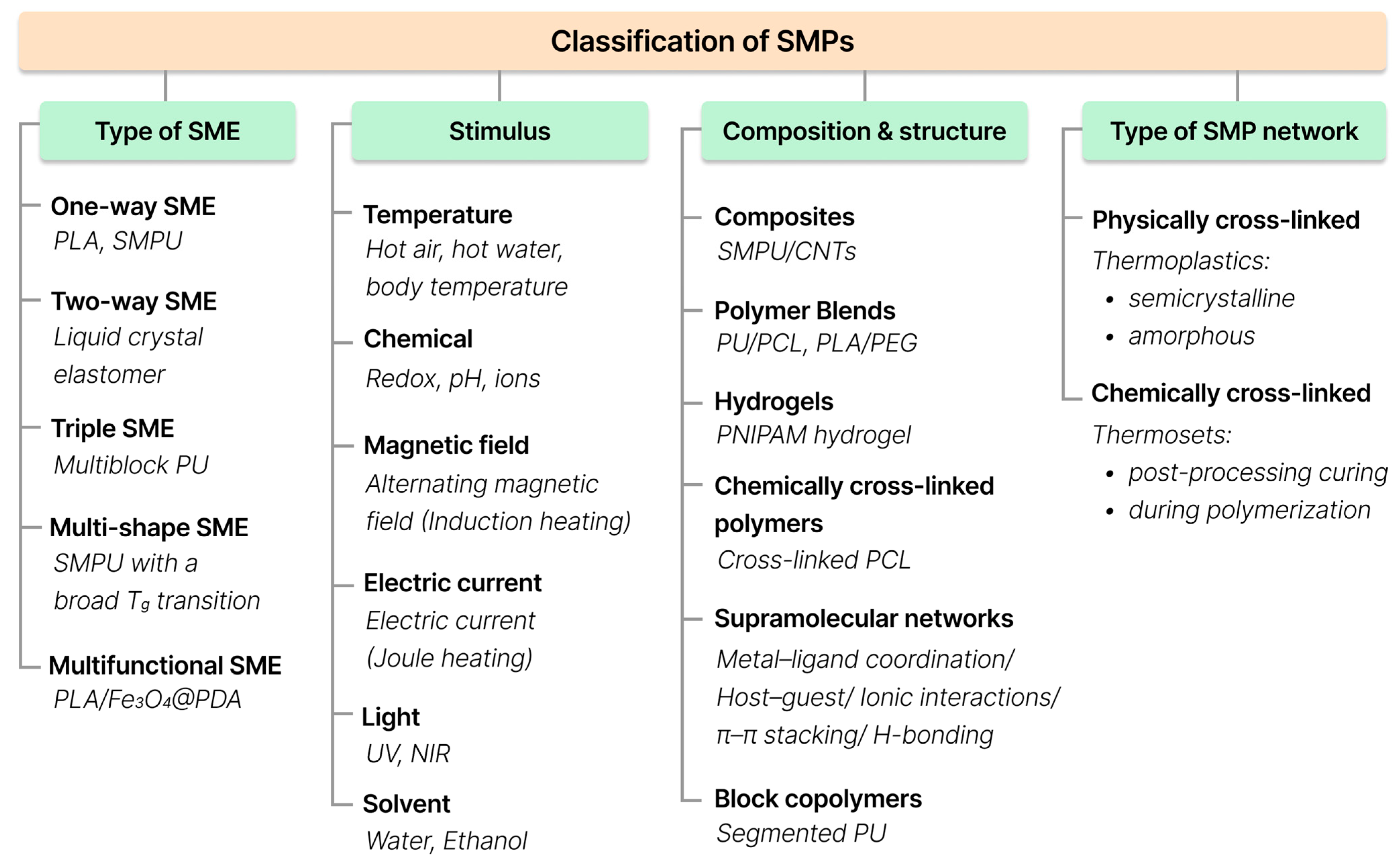
- Type of SME: one-way SME, two-way SME, triple-SME, multi-SME, and multifunctional SME;
- -
- Type of external stimulus: thermal, chemical (redox, pH, specific ions, and chemical agents), solvent, magnetic field, electric field, light;
- -
- Type of polymer network cross-linking: physically cross-linked, chemically cross-linked;
- -
- Chemical composition and molecular design: composites, polymer blends, supramolecular networks, hydrogels, chemically cross-linked polymers, and block copolymers.
2.1. Thermosetting Polymers
2.2. Thermoplastic Polymers
2.3. Amorphous Polymers
2.4. Segmented Block Copolymers
3. Types of SME
3.1. One-Way SME
3.2. Two-Way SME
3.3. Triple-SME
3.4. Multi-SME
4. Activation Stimuli
- –
- Some UV-curable SMPs exhibit lifetimes of <100 cycles under moderate strain before failure. Others based on tBA–AUD chemistries withstand > 10,000 loading cycles without significant damage, indicating exceptional fatigue resistance [160].
- –
- High-temperature SMPs maintain almost constant Rf and Rr over hundreds to thousands of cycles [157]. These results underscore that material chemistry and network design are primary determinants of cyclic durability, sometimes even more than composite reinforcement or processing technique.
5. Biodegradable SMPs and Biomedical Requirements
- -
- PUs with hydrophilic segments capable of forming reversible hydrogen bonds. Hydration increases polymer mobility by breaking hydrogen bonds, initiating shape recovery.
- -
- Hygroscopic biopolymers, such as PLA and PGA, where water penetrates amorphous regions, plasticising the material and lowering Tg, thus activating the SME under physiological conditions without external heating.
- -
- Hydrogels based on biopolymers (e.g., collagen, gelatine, chitosan, alginates) that respond to humidity, pH, or ionic strength changes.
5.1. Biomedical Requirements
5.2. Degradation of SMPs
5.2.1. PLA
5.2.2. PCL
5.2.3. PGD
5.2.4. PU
6. High-Temperature SMPs
7. Tuning the Activation Temperature
7.1. Decreasing the Activation Temperature
7.1.1. Plasticisation
7.1.2. Chemical Modification

| SMP | Fabrication Method | Modification | Ttrans | Application | Ref. |
|---|---|---|---|---|---|
| Plasticisation | |||||
| PLA | Melt blending | PEG (5–20 wt.%) | Tg = 55.2–48.3 °C | Thermoresponsive devices | [92] |
| PLA | Solution casting | Tributyl citrate (6–18 wt.%) | Tg = 33.7–54.8 °C | Dentin tubule sealing | [246] |
| PLA/BaSO4 | FDM 3D printing | PEG (20 wt.%) | Tg = 44.0 °C | Radiopaque ventricular septal defect occluder | [247] |
| PLA/TPU | Injection moulding | PEG (10 wt.%) | Tg = 46.0–51.7 °C | Thermoresponsive devices | [248] |
| PLA | Electrospinning | OLA (20 wt.%) | Tg = 36.0 °C | Thermoresponsive devices | [249] |
| PLA | FDM 3D printing | PEG (20 wt.%) | Tg = 49.1–35.7 °C | Bone scaffold | [250] |
| Tert-butyl acrylate-co-di(ethylene glycol) diacrylate network (tBA-co-DEGDA) | DLP 3D printing | Nano SiO2 (5 wt.%) | Tg = 37.8 °C | Thermoresponsive devices | [251] |
| PDLLA | Melt extrusion; orientation-programming | Water | Tg = 45.8 °C | Medical implants | [252] |
| PLA | FDM 3D printing | PCL (10–60 wt.%) | Tg = 47.9–45.2 °C | Spinal cage | [253] |
| PLA | Injection moulding | Trimethyl citrate (10–20 wt.%) | Tg = 48.1–19.3 °C | Thermoresponsive devices | [254] |
| SMPU | Mixing solution | Dibutyl adipate | Tg = 37.0 °C | Artificial blood vessels | [255] |
| Chemical modification | |||||
| Poly(L-lactide-co-ε-caprolactone) (PLCL) | Solution casting | Copolymerisation | Tm = 38.0 °C | Wireless nerve stimulator | [256] |
| Star-PCL-tetraacrylate | Emulsion templating | Ring-opening polymerisation | Tm = 43.0 °C | Self-fitting vaginal stents | [257] |
| PU | Water-blown foaming | Two-step polymerisation; water plasticisation | Tg = 53 °C (dry) Tg = 25 °C (wet) | Haemostatic foams | [258] |
| PLCL | Compression moulding | Ring-opening polymerisation | Tg = 37–40 °C | Oesophageal stents | [259] |
| PCL-b-PPG-b-PCL diacrylate | DLP 3D printing | Ring-opening polymerisation | Tm = 53.1–50.7 °C | Tracheal stents | [260] |
| PCL/HA | Gas foaming | In situ polymerisation | Tm = 43.4–39.6 °C | Bone scaffolds | [261] |
| Poly(L-lactide-co-trimethlyene carbonate)/calcium sulphate hemihydrate | Solvent/nonsolvent sintering; freeze-drying | Copolymerisation | Tg = 26.1–42.3 °C | Bone scaffolds | [262] |
| Poly(L-glutamic acid)-g-PCL- acryloyl chloride-g-poly(ω-pentadecalactone) | Solvent-casting; particulate leaching | Ring-opening polymerisation; UV cross-linking | Tm = 36–44 °C | Bone scaffolds | [263] |
| Poly(rac-lactide-co-glycolide) | Electrospinning | Ring-opening polymerisation | Tg = 49.1–41.7 (dry); Tg = 37.6–31.2 °C (wet) | Nerve conduits | [264] |
| PU | Solution casting | Polymerisation | Tm = 37 °C | Peripheral nerve stimulation and recording | [31] |
| APGA | 3D printing; UV photo-crosslinking | Polymerisation | Tm = 21.5–46.6 °C | Adaptive biomedical implants | [265] |
| PCL-PEG-aniline trimer | Solution casting | Two-step polymerisation | Tm = 34.5–42.5 °C | Wound dressing | [266] |
7.1.3. Influence of Other Factors
7.2. Increasing the Activation Temperature
7.2.1. Introduction of Rigid Segments and Aromatic Monomers
7.2.2. Increase in the Degree of Cross-Linking
7.2.3. Introduction of Nanofillers
8. Fabrication Methods of SMP-Based Materials
| Technology | Advantages | Restrictions | Materials | Ref. |
|---|---|---|---|---|
| FFF (FDM) | High resolution (100–700 µm), availability, printing complex macrostructures | High cost, anisotropy, relatively low resolution (layer thickness > 100 µm), limited compatibility with HT SMP, restricted print size, post-processing, supports required | Thermoplastics (e.g., PLA, PC, TPU, PETG), composites | [6,279] |
| DIW | High resolution (100–600 µm), support-free printing, wide material selection | High rheological requirements for ink (thixotropic), low printing speed, post-processing | Thermoplastics, thermosets (e.g., methacrylate/acrylate, epoxy-based resins), biopolymers, composites, functional inks | [20,283] |
| TPP | Ultra-high resolution and accuracy (80–200 nm), no support required | High cost, low printing speed, limited product size, special photoinitiators | Photopolymers (e.g., OrmoComp), thermosets, composites, biopolymers | [284] |
| SLA | Printing complex 3D structures, high spatial resolution (1–100 µm), structural homogeneity | Limited resin selection, slow print speed, reactive diluents, post-processing, more expensive than FDM | Photopolymers, thermosets, biopolymers | [285] |
| DLP | High printing speed, high resolution (15–100 µm), accuracy, no support required | High cost, low viscosity (<10 Pa s), reactive diluents | Photopolymers, thermosets | [286,287,288] |
| SLS | High printing speed, no support required, serial production, minimised waste | High cost, rough surface, post-processing, limited control over shrinkage and deformation | Thermoplastics (e.g., PEEK, PA11, PA12, TPU, PP) | [289,290] |
| LCD | High printing speed, high resolution (30–50 µm), availability, low cost | Fragility of products, reactive diluents, limited resource of LCD panel, post-processing | Photopolymers, thermosets, composites | [291] |
| (Direct laser writing) DLW | Complex 3D structures, high resolution (0.1–0.5 µm), no support required, minimal post-processing | SMP microprinting is not worked out, low printing speed, high cost | Photopolymers, typically thermosets, composites | [292] |
| Electrospinning | Production of ultrathin fibres (from 10 nm to 10 µm) with a large specific surface area, wide range of materials | Difficult to scale, toxic solvents, low mechanical strength | Thermoplastics, thermosets, composites, biopolymers | [293] |
| MEW | High-resolution, solvent-free, precise control over fibre placement | Limited material options, high cost, low speed, restricted build size | Thermoplastics (e.g., PCL, PLA, PU), composites, biopolymers | [294] |
| Solution casting | Simple and low-cost method, good film thickness control (0.02–0.10 mm), compatible with various polymers | Thickness is limited, low scalability, possible inhomogeneities and defects, slow process, toxic solvents, poor mechanical properties | Thermoplastics, thermosets, composites | [295] |
| Injection moulding | High speed, serial production, accuracy, complex geometries possible, wide range of materials | High cost, long setup time, possible defects, not suitable to prepare porous architecture | Thermoplastics, thermosets, composites | [296] |
| Foaming | A simple and affordable method to prepare light and porous structures with a large surface area, wide choice of materials | Pore size control, non-uniform structure | Thermoplastics, thermosets | [297] |
| Spin coating | Simple/high speed process, thickness control (from 10 nm to 220 µm), multilayer structures can be formed, wide choice of materials | Requires control of solution viscosity and rotation speed, limited to flat substrates | Thermoplastics, thermosets | [298] |
9. Biomedical Applications of SMPs
10. Application of SMPs in Soft Robotics
11. Future Prospects
12. Conclusions
Author Contributions
Funding
Data Availability Statement
Acknowledgments
Conflicts of Interest
References
- Ni, C.; Chen, D.; Yin, Y.; Wen, X.; Chen, X.; Yang, C.; Chen, G.; Sun, Z.; Wen, J.; Jiao, Y.; et al. Shape memory polymer with programmable recovery onset. Nature 2023, 622, 748–753. [Google Scholar] [CrossRef] [PubMed]
- Feng, X.; Li, S.; Fan, J.; Li, G. Reversible actuation of fibrous artificial muscle under external compression load. Sci. Rep. 2025, 15, 8537. [Google Scholar] [CrossRef]
- Wan, X.; Chen, S.; Ma, J.; Dong, C.; Banerjee, H.; Laperrousaz, S.; Piveteau, P.-L.; Meng, Y.; Leng, J.; Sorin, F. Multimaterial Shape Memory Polymer Fibers for Advanced Drug Release Applications. Adv. Fiber Mater. 2025, 7, 1576–1589. [Google Scholar] [CrossRef]
- Wang, X.; Behl, M.; Lendlein, A.; Balk, M. Responses to single and multiple temperature-, medium-, and pH-stimuli triggering reversible shape shifts in hydrogel actuators. Mater. Des. 2023, 225, 111511. [Google Scholar] [CrossRef]
- Zhu, Y.; Deng, K.; Zhou, J.; Lai, C.; Ma, Z.; Zhang, H.; Pan, J.; Shen, L.; Bucknor, M.D.; Ozhinsky, E.; et al. Shape-recovery of implanted shape-memory devices remotely triggered via image-guided ultrasound heating. Nat. Commun. 2024, 15, 1123. [Google Scholar] [CrossRef]
- An, S.-C.; Lim, Y.; Jun, Y.C. Rapid and selective actuation of 3D-printed shape-memory composites via microwave heating. Sci. Rep. 2023, 13, 18179. [Google Scholar] [CrossRef] [PubMed]
- Rahmatabadi, D.; Mirasadi, K.; Bayati, A.; Khajepour, M.; Ghasemi, I.; Baniassadi, M.; Abrinia, K.; Bodaghi, M.; Baghani, M. 4D printing thermo-magneto-responsive PETG-Fe3O4 nanocomposites with enhanced shape memory effects. Appl. Mater. Today 2024, 40, 102361. [Google Scholar] [CrossRef]
- Orozco, F.; Kaveh, M.; Santosa, D.S.; Lima, G.M.R.; Gomes, D.R.; Pei, Y.; Araya-Hermosilla, R.; Moreno-Villoslada, I.; Picchioni, F.; Bose, R.K. Electroactive self-healing shape memory polymer composites based on Diels–Alder chemistry. ACS Appl. Polym. Mater. 2021, 3, 6147–6156. [Google Scholar] [CrossRef]
- Liu, Q.; Wang, W.; Reynolds, M.F.; Cao, M.C.; Miskin, M.Z.; Arias, T.A.; Muller, D.A.; McEuen, P.L.; Cohen, I. Micrometer-sized electrically programmable shape-memory actuators for low-power microrobotics. Sci. Robot. 2021, 6, eabe6663. [Google Scholar] [CrossRef] [PubMed]
- Chen, J.; Hamilton, L.E.; Mather, P.T.; Henderson, J.H. Cell-responsive shape memory polymers. ACS Biomater. Sci. Eng. 2022, 8, 2960–2969. [Google Scholar] [CrossRef]
- Sha, W.; Zhao, J.; Zhou, Y.; Xia, J.; Yuan, M.; Zhang, N.; Zhao, H.; Wang, Y. Water-actuated reversible shape-memory polydimethylsiloxane for potential biomedical applications. J. Mater. Chem. B 2023, 11, 3579–3586. [Google Scholar] [CrossRef]
- Wang, H.; Chen, X.; Bu, Y.; Wu, T.; Yan, H.; Lin, Q. An ultrafast thermal-responsive, shape memory and solvent-driven Fe 3+-alginate/poly (N-isopropyl acrylamide)-based hydrogel actuator. Polym. Chem. 2025, 16, 809–820. [Google Scholar] [CrossRef]
- Liu, T.; Zhou, T.; Yao, Y.; Zhang, F.; Liu, L.; Liu, Y.; Leng, J. Stimulus methods of multi-functional shape memory polymer nanocomposites: A review. Compos. Part A Appl. Sci. Manuf. 2017, 100, 20–30. [Google Scholar] [CrossRef]
- Amadi, A.; Mohyaldinn, M.; Ridha, S.; Ola, V. Advancing engineering frontiers with NiTi shape memory alloys: A multifaceted review of properties, fabrication, and application potentials. J. Alloys Compd. 2024, 976, 173227. [Google Scholar] [CrossRef]
- Agrawal, A.; Dube, R.K. Methods of fabricating Cu-Al-Ni shape memory alloys. J. Alloys Compd. 2018, 750, 235–247. [Google Scholar] [CrossRef]
- Dong, Z.; Klotz, U.E.; Leinenbach, C.; Bergamini, A.; Czaderski, C.; Motavalli, M. A novel Fe-Mn-Si shape memory alloy with improved shape recovery properties by VC precipitation. Adv. Eng. Mater. 2009, 11, 40–44. [Google Scholar] [CrossRef]
- Wang, Y.-J.; Jeng, U.-S.; Hsu, S.-h. Biodegradable water-based polyurethane shape memory elastomers for bone tissue engineering. ACS Biomater. Sci. Eng. 2018, 4, 1397–1406. [Google Scholar] [CrossRef]
- Luo, L.; Zhang, F.; Wang, L.; Liu, Y.; Leng, J. Recent advances in shape memory polymers: Multifunctional materials, multiscale structures, and applications. Adv. Funct. Mater. 2024, 34, 2312036. [Google Scholar] [CrossRef]
- Liu, Y.; Wang, L.; Liu, Y.; Zhang, F.; Leng, J. Recent progress in shape memory polymer composites: Driving modes, forming technologies, and applications. Compos. Commun. 2024, 51, 102062. [Google Scholar] [CrossRef]
- Raghuvaran, G.; Nitschke, B.M.; Roberts, C.T.; Grunlan, M.A.; Pentzer, E. Direct ink writing of porous shape memory polyesters. Mater. Adv. 2024, 5, 5763–5771. [Google Scholar] [CrossRef]
- Jiang, Y.; Leng, Q.Y.; Yan, Y.; Ng, E.L.L.; Chee, H.L.; Wang, F.; Chan, S.Y.; Loh, X.J.; Wang, J.; Chan, B.Q.Y. 4D printing of single-network shape memory polyurethanes with two-way actuation properties. ACS Appl. Polym. Mater. 2022, 4, 8574–8583. [Google Scholar] [CrossRef]
- Jeske, M.P.; Zhang, W.; Anthamatten, M. Two-Photon Printing of Shape-Memory Microstructures and Metasurfaces via Radical-Mediated Thiol-Vinyl Hydrothiolation. Adv. Mater. Technol. 2022, 7, 2101725. [Google Scholar] [CrossRef]
- Cersoli, T.; Cresanto, A.; Herberger, C.; MacDonald, E.; Cortes, P. 3D printed shape memory polymers produced via direct pellet extrusion. Micromachines 2021, 12, 87. [Google Scholar] [CrossRef]
- Quiñonez, P.A.; Ugarte-Sanchez, L.; Bermudez, D.; Chinolla, P.; Dueck, R.; Cavender-Word, T.J.; Roberson, D.A. Design of shape memory thermoplastic material systems for FDM-type additive manufacturing. Materials 2021, 14, 4254. [Google Scholar] [CrossRef]
- Razzaq, M.Y.; Gonzalez-Gutierrez, J.; Mertz, G.; Ruch, D.; Schmidt, D.F.; Westermann, S. 4D printing of multicomponent shape-memory polymer formulations. Appl. Sci. 2022, 12, 7880. [Google Scholar] [CrossRef]
- Zhang, W.; Wang, H.; Wang, H.; Chan, J.Y.E.; Liu, H.; Zhang, B.; Zhang, Y.-F.; Agarwal, K.; Yang, X.; Ranganath, A.S.; et al. Structural multi-colour invisible inks with submicron 4D printing of shape memory polymers. Nat. Commun. 2021, 12, 112. [Google Scholar] [CrossRef]
- Zheng, Y.; Li, Y.; Hu, X.; Shen, J.; Guo, S. Biocompatible shape memory blend for self-expandable stents with potential biomedical applications. ACS Appl. Mater. Interfaces 2017, 9, 13988–13998. [Google Scholar] [CrossRef]
- Baker, R.M.; Tseng, L.-F.; Iannolo, M.T.; Oest, M.E.; Henderson, J.H. Self-deploying shape memory polymer scaffolds for grafting and stabilizing complex bone defects: A mouse femoral segmental defect study. Biomaterials 2016, 76, 388–398. [Google Scholar] [CrossRef] [PubMed]
- Gasson, S.B.; Dobson, L.K.; Pfau-Cloud, M.R.; Beltran, F.O.; Pool, R.R.; Gregory, C.A.; Grunlan, M.A.; Saunders, W.B. Biocompatibility and bone regeneration by shape memory polymer scaffolds. J. Biomed. Mater. Res. Part A 2025, 113, e37806. [Google Scholar] [CrossRef] [PubMed]
- Pinto, L.A.; Backes, E.H.; Harb, S.V.; Pinto, G.M.; da Cunha, D.A.L.V.; Andrade, R.J.E.; Fechine, G.J.M.; Selistre-de-Araujo, H.S.; Costa, L.C.; Pessan, L.A. Shape memory thermoplastic polyurethane/polycaprolactone blend and composite with hydroxyapatite for biomedical application. J. Mater. Res. 2024, 39, 90–106. [Google Scholar] [CrossRef]
- Zhang, Y.; Zheng, N.; Cao, Y.; Wang, F.; Wang, P.; Ma, Y.; Lu, B.; Hou, G.; Fang, Z.; Liang, Z.; et al. Climbing-inspired twining electrodes using shape memory for peripheral nerve stimulation and recording. Sci. Adv. 2019, 5, eaaw1066. [Google Scholar] [CrossRef]
- Echeverría, D.; Rivera, R.; Giacaman, P.; Sordo, J.G.; Einersen, M.; Badilla, L. A novel self-expanding shape memory polymer coil for intracranial aneurysm embolization: 1 year follow-up in Chile. J. NeuroInterv. Surg. 2023, 15, 781–786. [Google Scholar] [CrossRef]
- Thomas, T.L.; Bos, J.; Huaroto, J.J.; Kalpathy Venkiteswaran, V.; Misra, S. A magnetically actuated variable stiffness manipulator based on deployable shape memory polymer springs. Adv. Intell. Syst. 2024, 6, 2200465. [Google Scholar] [CrossRef]
- Kim, J.; Kim, S.; Yun, T.; Kim, J.H.; Son, C.; Lee, Y.; Kim, K.; Lee, H.E.; Kim, N.; Kim, S. Shape memory polymer surfaces with controllable roughness for multiscale switchable dry adhesion. Nat. Commun. 2025, 16, 4954. [Google Scholar] [CrossRef] [PubMed]
- Kashef Tabrizian, S.; Alabiso, W.; Shaukat, U.; Terryn, S.; Rossegger, E.; Brancart, J.; Legrand, J.; Schlögl, S.; Vanderborght, B. Vitrimeric shape memory polymer-based fingertips for adaptive grasping. Front. Robot. AI 2023, 10, 1206579. [Google Scholar] [CrossRef] [PubMed]
- Yang, H.; Yin, X.; Zhang, C.; Chen, B.; Sun, P.; Xu, Y. Weaving liquid crystal elastomer fiber actuators for multifunctional soft robotics. Sci. Adv. 2025, 11, eads3058. [Google Scholar] [CrossRef]
- Chen, C.-T.; Liao, P.-S. Additive design and manufacturing of a quadruped robot actuated by electrothermal effect of shape memory polymer. Sens. Actuators A Phys. 2023, 357, 114401. [Google Scholar] [CrossRef]
- Zhang, L.; Xing, S.; Yin, H.; Weisbecker, H.; Tran, H.T.; Guo, Z.; Han, T.; Wang, Y.; Liu, Y.; Wu, Y.; et al. Skin-inspired, sensory robots for electronic implants. Nat. Commun. 2024, 15, 4777. [Google Scholar] [CrossRef] [PubMed]
- Yadav, A.; Singh, S.K.; Das, S.; Kumar, S.; Kumar, A. Shape memory polymer and composites for space applications: A review. Polym. Compos. 2025, 46, 11647–11683. [Google Scholar] [CrossRef]
- Kang, J.H.; Siochi, E.J.; Penner, R.K.; Turner, T.L. Electric Field Activated Shape Memory Polymer Composite. US9796159B2, 24 October 2017. [Google Scholar]
- Li, G.; Meng, H. Self-Healing Composite of Thermoset Polymer and Programmed Super Contraction Fibers. US-Patent-9,428,647, 30 August 2016. [Google Scholar]
- Hood, P.J. Method of making and using shape memory polymer composite patches. US20070264456A1, 19 July 2011. [Google Scholar]
- Choi, S.; Jang, S.; Yoo, S.H.; Lee, G.W.; Choi, D. Evaluation of Shape Recovery Performance of Shape Memory Polymers with Carbon-Based Fillers. Polymers 2024, 16, 2425. [Google Scholar] [CrossRef]
- Dayyoub, T.; Maksimkin, A.V.; Filippova, O.V.; Tcherdyntsev, V.V.; Telyshev, D.V. Shape memory polymers as smart materials: A review. Polymers 2022, 14, 3511. [Google Scholar] [CrossRef]
- Şenyurt, M.A.; Kurdiş, M.M.; Ulus, H.; Avci, A. Enhanced Mechanical and Shape Memory Properties of Elium® Nanocomposites Reinforced with Graphene and Iron (II, III) Oxide-Doped Polyacrylonitrile Nanofibers. Fibers Polym. 2025, 26, 2097–2116. [Google Scholar] [CrossRef]
- Wang, E.; Dong, Y.; Islam, M.Z.; Yu, L.; Liu, F.; Chen, S.; Qi, X.; Zhu, Y.; Fu, Y.; Xu, Z.; et al. Effect of graphene oxide-carbon nanotube hybrid filler on the mechanical property and thermal response speed of shape memory epoxy composites. Compos. Sci. Technol. 2019, 169, 209–216. [Google Scholar] [CrossRef]
- Antony, G.J.M.; Aruna, S.; Jarali, C.S.; Raja, S. Electrical and thermal stimuli responsive thermoplastic shape memory polymer composites containing rGO, Fe3O4 and rGO–Fe3O4 fillers. Polym. Bull. 2021, 78, 6267–6289. [Google Scholar] [CrossRef]
- Ohki, T.; Ni, Q.-Q.; Ohsako, N.; Iwamoto, M. Mechanical and shape memory behavior of composites with shape memory polymer. Compos. Part A Appl. Sci. Manuf. 2004, 35, 1065–1073. [Google Scholar] [CrossRef]
- Mirasadi, K.; Yousefi, M.A.; Jin, L.; Rahmatabadi, D.; Baniassadi, M.; Liao, W.H.; Bodaghi, M.; Baghani, M. 4D printing of magnetically responsive shape memory polymers: Toward sustainable solutions in soft robotics, wearables, and biomedical devices. Adv. Sci. 2025, 22, e13091. [Google Scholar] [CrossRef]
- Sanaka, R.; Sahu, S.K.; Sreekanth, P.R.; Senthilkumar, K.; Badgayan, N.D.; Siva, B.V.; Ma, Q. A review of the current state of research and future prospectives on stimulus-responsive shape memory polymer composite and its blends. J. Compos. Sci. 2024, 8, 324. [Google Scholar] [CrossRef]
- You, D.; Lin, L.; Dong, M.; Wu, Y.; Hu, Y.; Hu, X.; Shao, Y.; Xie, Y.; Xu, M.; Chen, G. Recent advances in shape memory polymers for biomedical applications: Bridging Macro-and micro-scale effects. Smart Mater. Med. 2025, 6, 240–269. [Google Scholar] [CrossRef]
- Fang-Fang, L.; Guo-Liang, L. Rational molecular Design: Advances in stimuli-responsive shape memory polymers and composites. Eur. Polym. J. 2025, 223, 113642. [Google Scholar] [CrossRef]
- Liu, C.; Qin, H.; Mather, P.T. Review of progress in shape-memory polymers. J. Mater. Chem. 2007, 17, 1543–1558. [Google Scholar] [CrossRef]
- Yang, L.; Lou, J.; Yuan, J.; Deng, J. A review of shape memory polymers based on the intrinsic structures of their responsive switches. RSC Adv. 2021, 11, 28838–28850. [Google Scholar] [CrossRef]
- Behl, M.; Lendlein, A. Shape-memory polymers. Mater. Today 2007, 10, 20–28. [Google Scholar] [CrossRef]
- Rešetič, A. Shape programming of liquid crystal elastomers. Commun. Chem. 2024, 7, 56. [Google Scholar] [CrossRef]
- Hornat, C.C.; Urban, M.W. Shape memory effects in self-healing polymers. Progress Polym. Sci. 2020, 102, 101208. [Google Scholar] [CrossRef]
- Radjabian, M.; Kish, M.; Mohammadi, N. Structure–property relationship for poly (lactic acid) (PLA) filaments: Physical, thermomechanical and shape memory characterization. J. Polym. Res. 2012, 19, 9870. [Google Scholar] [CrossRef]
- Han, X.J.; Dong, Z.Q.; Fan, M.M.; Liu, Y.; Li, J.H.; Wang, Y.F.; Yuan, Q.J.; Li, B.J.; Zhang, S. pH-induced shape-memory polymers. Macromol. Rapid Commun. 2012, 33, 1055–1060. [Google Scholar] [CrossRef]
- Lendlein, A.; Balk, M.; Tarazona, N.A.; Gould, O.E. Bioperspectives for shape-memory polymers as shape programmable, active materials. Biomacromolecules 2019, 20, 3627–3640. [Google Scholar] [CrossRef] [PubMed]
- Leng, J.; Du, S. Shape-Memory Polymers and Multifunctional Composites; CRC Press: Boca Raton, FL, USA, 2010. [Google Scholar]
- Hager, M.D.; Bode, S.; Weber, C.; Schubert, U.S. Shape memory polymers: Past, present and future developments. Progress Polym. Sci. 2015, 49, 3–33. [Google Scholar] [CrossRef]
- Wu, X.; Huang, W.M.; Zhao, Y.; Ding, Z.; Tang, C.; Zhang, J. Mechanisms of the shape memory effect in polymeric materials. Polymers 2013, 5, 1169–1202. [Google Scholar] [CrossRef]
- Schuh, C.; Schuh, K.; Lechmann, M.C.; Garnier, L.; Kraft, A. Shape-memory properties of segmented polymers containing aramid hard segments and polycaprolactone soft segments. Polymers 2010, 2, 71–85. [Google Scholar] [CrossRef]
- Hu, J.; Zhu, Y.; Huang, H.; Lu, J. Recent advances in shape–memory polymers: Structure, mechanism, functionality, modeling and applications. Progress Polym. Sci. 2012, 37, 1720–1763. [Google Scholar] [CrossRef]
- Nissenbaum, A.; Greenfeld, I.; Wagner, H. Shape memory polyurethane-Amorphous molecular mechanism during fixation and recovery. Polymer 2020, 190, 122226. [Google Scholar] [CrossRef]
- Fulati, A.; Uto, K.; Ebara, M. Influences of crystallinity and crosslinking density on the shape recovery force in poly (ε-caprolactone)-based shape-memory polymer blends. Polymers 2022, 14, 4740. [Google Scholar] [CrossRef] [PubMed]
- Takada, K. Synthesis of biobased functional materials using photoactive cinnamate derivatives. Polym. J. 2023, 55, 1023–1033. [Google Scholar] [CrossRef]
- Zhao, Y.; Huang, Y.; Hou, W.; Zhang, T.; Zhang, Y.; Wang, Y.; Bai, X. High-performance vitrimer films containing acylhydrazone dynamic covalent bonds. J. Polym. Sci. 2023, 61, 3266–3275. [Google Scholar] [CrossRef]
- Li, X.; Yu, R.; He, Y.; Zhang, Y.; Yang, X.; Zhao, X.; Huang, W. Self-healing polyurethane elastomers based on a disulfide bond by digital light processing 3D printing. ACS Macro Lett. 2019, 8, 1511–1516. [Google Scholar] [CrossRef]
- Miao, J.-T.; Ge, M.; Peng, S.; Zhong, J.; Li, Y.; Weng, Z.; Wu, L.; Zheng, L. Dynamic imine bond-based shape memory polymers with permanent shape reconfigurability for 4D printing. ACS Appl. Mater. Interfaces 2019, 11, 40642–40651. [Google Scholar] [CrossRef] [PubMed]
- Liu, W.; Yang, S.; Huang, L.; Xu, J.; Zhao, N. Dynamic covalent polymers enabled by reversible isocyanate chemistry. Chem. Commun. 2022, 58, 12399–12417. [Google Scholar] [CrossRef] [PubMed]
- Mukherjee, S.; Hill, M.R.; Sumerlin, B.S. Self-healing hydrogels containing reversible oxime crosslinks. Soft Matter 2015, 11, 6152–6161. [Google Scholar] [CrossRef]
- Cho, S.; Hwang, S.Y.; Oh, D.X.; Park, J. Recent progress in self-healing polymers and hydrogels based on reversible dynamic B–O bonds: Boronic/boronate esters, borax, and benzoxaborole. J. Mater. Chem. A 2021, 9, 14630–14655. [Google Scholar] [CrossRef]
- Gu, X.; Mather, P.T. Entanglement-based shape memory polyurethanes: Synthesis and characterization. Polymer 2012, 53, 5924–5934. [Google Scholar] [CrossRef]
- Strzelec, K.; Sienkiewicz, N.; Szmechtyk, T. Classification of shape-memory polymers, polymer blends, and composites. In Shape Memory Polymers, Blends and Composites: Advances and Applications; Springer: New York, NY, USA, 2019; pp. 21–52. [Google Scholar]
- Kalita, H. Shape Memory Polymers: Theory and Application; Walter de Gruyter GmbH & Co KG: Berlin, Germany, 2018. [Google Scholar]
- Luo, L.; Zhang, F.; Leng, J. Shape memory epoxy resin and its composites: From materials to applications. Research 2022, 2022, 9767830. [Google Scholar] [CrossRef] [PubMed]
- Hu, L.; Zhang, F.; Luo, L.; Wang, L.; Liu, Y.; Leng, J. Design and preparation of shape memory phenol–formaldehyde foam composites with excellent thermal stability and mechanical properties. Compos. Part A Appl. Sci. Manuf. 2023, 174, 107738. [Google Scholar] [CrossRef]
- Yang, X.; Han, Z.; Jia, C.; Wang, T.; Wang, X.; Hu, F.; Zhang, H.; Zhao, J.; Zhang, X. Preparation and characterization of body-temperature-responsive thermoset shape memory polyurethane for medical applications. Polymers 2023, 15, 3193. [Google Scholar] [CrossRef] [PubMed]
- Ortega, A.M.; Yakacki, C.M.; Dixon, S.A.; Likos, R.; Greenberg, A.R.; Gall, K. Effect of crosslinking and long-term storage on the shape-memory behavior of (meth) acrylate-based shape-memory polymers. Soft Matter 2012, 8, 7381–7392. [Google Scholar] [CrossRef]
- Zhou, X.; Zhao, X.; Li, X.; Dong, J.; Xu, Q.; Xu, W.; Zhang, Q. Fabrication of shape memory polyimides with exploration of their activation mechanisms. Chem. Eng. J. 2023, 477, 146776. [Google Scholar] [CrossRef]
- Li, Y.; Zhang, F.; Liu, Y.; Leng, J. Programmable shape memory bismaleimide composite claw with two-way grabbing function. Compos. Part A Appl. Sci. Manuf. 2023, 165, 107328. [Google Scholar] [CrossRef]
- Li, H.; Zhang, B.; Ye, H.; Jian, B.; He, X.; Cheng, J.; Sun, Z.; Wang, R.; Chen, Z.; Lin, J.; et al. Reconfigurable 4D printing via mechanically robust covalent adaptable network shape memory polymer. Sci. Adv. 2024, 10, eadl4387. [Google Scholar] [CrossRef]
- Fugolin, A.P.; Pfeifer, C.S. Engineering a new generation of thermoset self-healing polymers based on intrinsic approaches. JADA Found. Sci. 2022, 1, 100014. [Google Scholar] [CrossRef]
- Yu, K.; Taynton, P.; Zhang, W.; Dunn, M.L.; Qi, H.J. Influence of stoichiometry on the glass transition and bond exchange reactions in epoxy thermoset polymers. Rsc Adv. 2014, 4, 48682–48690. [Google Scholar] [CrossRef]
- Santiago, D.; Guzmán, D.; Ferrando, F.; Serra, À.; De la Flor, S. Bio-based epoxy shape-memory thermosets from triglycidyl phloroglucinol. Polymers 2020, 12, 542. [Google Scholar] [CrossRef]
- Santulli, C.; Palanisamy, S.; Kalimuthu, M.; Azeez, A.; Nagarajan, R.; Shanmugavel, R. Role of nanofillers in thermoset-based polymer blends. In Nanofillers for Binary Polymer Blends; Elsevier: Amsterdam, The Netherlands, 2024; pp. 165–193. [Google Scholar]
- Ribca, I.; Jawerth, M.E.; Brett, C.J.; Lawoko, M.; Schwartzkopf, M.; Chumakov, A.; Roth, S.V.; Johansson, M. Exploring the effects of different cross-linkers on lignin-based thermoset properties and morphologies. ACS Sustain. Chem. Eng. 2021, 9, 1692–1702. [Google Scholar] [CrossRef]
- Sheng, X.; Lee, J.K.; Kessler, M.R. Influence of cross-link density on the properties of ROMP thermosets. Polymer 2009, 50, 1264–1269. [Google Scholar] [CrossRef]
- Wang, X.; Liang, X.; Wang, L.-M. Kinetic criterion for triple-shape memory effect in amorphous polymers undergoing heterogeneous glass transitions. Polymer 2023, 284, 126313. [Google Scholar] [CrossRef]
- Sringam, J.; Kajornprai, T.; Trongsatitkul, T.; Suppakarn, N. Shape Memory Performance and Microstructural Evolution in PLA/PEG Blends: Role of Plasticizer Content and Molecular Weight. Polymers 2025, 17, 225. [Google Scholar] [CrossRef]
- Guo, Y.; Ma, J.; Lv, Z.; Zhao, N.; Wang, L.; Li, Q. The effect of plasticizer on the shape memory properties of poly (lactide acid)/poly (ethylene glycol) blends. J. Mater. Res. 2018, 33, 4101–4112. [Google Scholar] [CrossRef]
- Razzaq, M.Y.; Gonzalez-Gutierrez, J.; Farhan, M.; Das, R.; Ruch, D.; Westermann, S.; Schmidt, D.F. 4D printing of electroactive triple-shape composites. Polymers 2023, 15, 832. [Google Scholar] [CrossRef]
- Younus, M.M.; Naguib, H.M.; Fekry, M.; Elsawy, M.A. Pushing the limits of PLA by exploring the power of MWCNTs in enhancing thermal, mechanical properties, and weathering resistance. Sci. Rep. 2023, 13, 16588. [Google Scholar] [CrossRef]
- Vishwakarma, J.; Jaiswal, S.; Dhand, C.; Yeo, R.J.; Tan, H.R.; Kumar, R.; Kumar, P.; Singh, N.; Mishra, A.; Naik, A. High-performance shape-memory-polymer (SMP) composites via optimization of multidimensional graphitic-carbon fillers and development of heat-fire-and-smoke alarm devices using SMP composites. Adv. Compos. Hybrid Mater. 2024, 7, 203. [Google Scholar] [CrossRef]
- Behl, M.; Ridder, U.; Feng, Y.; Kelch, S.; Lendlein, A. Shape-memory capability of binary multiblock copolymer blends with hard and switching domains provided by different components. Soft Matter 2009, 5, 676–684. [Google Scholar] [CrossRef]
- Kim, B.K.; Shin, Y.J.; Cho, S.M.; Jeong, H.M. Shape-memory behavior of segmented polyurethanes with an amorphous reversible phase: The effect of block length and content. J. Polym. Sci. Part B Polym. Phys. 2000, 38, 2652–2657. [Google Scholar] [CrossRef]
- Pretsch, T. Review on the functional determinants and durability of shape memory polymers. Polymers 2010, 2, 120–158. [Google Scholar] [CrossRef]
- Lee, B.S.; Chun, B.C.; Chung, Y.-C.; Sul, K.I.; Cho, J.W. Structure and thermomechanical properties of polyurethane block copolymers with shape memory effect. Macromolecules 2001, 34, 6431–6437. [Google Scholar] [CrossRef]
- Liu, B.; Li, H.; Meng, F.; Xu, Z.; Hao, L.; Yao, Y.; Zhu, H.; Wang, C.; Wu, J.; Bian, S. 4D printed hydrogel scaffold with swelling-stiffening properties and programmable deformation for minimally invasive implantation. Nat. Commun. 2024, 15, 1587. [Google Scholar] [CrossRef]
- Filion, T.M.; Xu, J.; Prasad, M.L.; Song, J. In vivo tissue responses to thermal-responsive shape memory polymer nanocomposites. Biomaterials 2011, 32, 985–991. [Google Scholar] [CrossRef]
- Pasini, C.; Soreño, Z.V.; Schönfeld, D.; Pretsch, T.; Constante, G.; Sadilov, I.; Ionov, L. 4D fabrication of two-way shape memory polymeric composites by electrospinning and melt electrowriting. Macromol. Rapid Commun. 2024, 45, 2400010. [Google Scholar] [CrossRef]
- Du, H.; Liu, L.; Zhang, F.; Leng, J.; Liu, Y. Triple-shape memory effect in a styrene-based shape memory polymer: Characterization, theory and application. Compos. Part B Eng. 2019, 173, 106905. [Google Scholar] [CrossRef]
- Samuel, C.; Barrau, S.; Lefebvre, J.-M.; Raquez, J.-M.; Dubois, P. Designing multiple-shape memory polymers with miscible polymer blends: Evidence and origins of a triple-shape memory effect for miscible PLLA/PMMA blends. Macromolecules 2014, 47, 6791–6803. [Google Scholar] [CrossRef]
- Wang, Y.; Huang, L.; Wang, X.; Lu, X.; Wang, B.; Qin, Y.; Huang, C. Photoresponsive triple shape memory polymers with a self-healing function based on poly (lactic acid)/polycaprolactone blends. Polym. Test. 2023, 120, 107966. [Google Scholar] [CrossRef]
- Xie, T.; Xiao, X.; Cheng, Y.T. Revealing triple-shape memory effect by polymer bilayers. Macromol. Rapid Commun. 2009, 30, 1823–1827. [Google Scholar] [CrossRef]
- Luo, X.; Mather, P.T. Triple-shape polymeric composites (TSPCs). Adv. Funct. Mater. 2010, 20, 2649–2656. [Google Scholar] [CrossRef]
- Zhang, W.; Zou, C.; Pan, Q.; Hu, G.; Shi, H.; Zhang, Y.; He, X.; He, Y.; Zhang, X. A Triple Shape Memory Material of Trans-Polyisoprene/Polycaprolactone with Customizable Response Temperature Controlled by Crosslinking Density. Adv. Funct. Mater. 2024, 34, 2400245. [Google Scholar] [CrossRef]
- Huang, J.; Qiu, L.; Ni, C.; Chen, G.; Zhao, Q. Shape memory polymers with patternable recovery onset regulated by light. Adv. Mater. 2024, 36, 2408324. [Google Scholar] [CrossRef]
- Yu, K.; Xie, T.; Leng, J.; Ding, Y.; Qi, H.J. Mechanisms of multi-shape memory effects and associated energy release in shape memory polymers. Soft Matter 2012, 8, 5687–5695. [Google Scholar] [CrossRef]
- Fang, C.; Leng, J.; Sun, H.; Gu, J. A multi-branch thermoviscoelastic model based on fractional derivatives for free recovery behaviors of shape memory polymers. Mech. Mater. 2018, 120, 34–42. [Google Scholar] [CrossRef]
- Li, Y.; Lau, D. Advances in shape memory polymers and their composites: From theoretical modeling and MD simulations to additive manufacturing. Giant 2024, 18, 100277. [Google Scholar] [CrossRef]
- Zhang, X.; Zhu, C.; Xu, B.; Qin, L.; Wei, J.; Yu, Y. Rapid, localized, and athermal shape memory performance triggered by photoswitchable glass transition temperature. ACS Appl. Mater. Interfaces 2019, 11, 46212–46218. [Google Scholar] [CrossRef] [PubMed]
- Fang, L.; Yan, W.; Chen, S.; Duan, Q.; Herath, M.; Epaarachchi, J.; Liu, Y.; Lu, C. Light and shape-memory polymers: Characterization, preparation, stimulation, and application. Macromol. Mater. Eng. 2023, 308, 2300158. [Google Scholar] [CrossRef]
- Takashima, Y.; Hatanaka, S.; Otsubo, M.; Nakahata, M.; Kakuta, T.; Hashidzume, A.; Yamaguchi, H.; Harada, A. Expansion–contraction of photoresponsive artificial muscle regulated by host–guest interactions. Nat. Commun. 2012, 3, 1270. [Google Scholar] [CrossRef]
- Li, D.; Shi, J.; Liu, Z.; Su, K.; Gong, Y.; Tuo, X. Shape Memory Performance of 3D-Printed Poly (HEMA-co-PEGDA)/CNT Composites by Photo/Thermal Stimuli–Response. Polym. Eng. Sci. 2025, 65, 5425–5434. [Google Scholar] [CrossRef]
- Zou, Y.; Zhou, B.; Guo, W.; Sun, Z.; Lu, X.; Li, L. PLLA/(MWCNTs-ZnO)@ PDA composite with NIR-light induced shape memory effect, antibacterial properties and 3D printability. Mater. Today Chem. 2024, 37, 101995. [Google Scholar] [CrossRef]
- Zhang, Q.; Ma, A.; Zhang, B.; Liang, S.; Chen, Y.; Li, Q.; Mao, X.; Zhao, W.; Zhou, H. NIR photoresponsive shape memory polyurethanes composite with self-healing and anti-corrosion properties. Polymer 2024, 299, 126957. [Google Scholar] [CrossRef]
- Dai, S.; Yue, S.; Ning, Z.; Jiang, N.; Gan, Z. Polydopamine nanoparticle-reinforced near-infrared light-triggered shape memory polycaprolactone–polydopamine polyurethane for biomedical implant applications. ACS Appl. Mater. Interfaces 2022, 14, 14668–14676. [Google Scholar] [CrossRef]
- Zhang, X.-q.; Ding, R.; Lv, J.; Zhang, Y.-c.; Ji, A.-l.; Fu, J.; Lv, X.; Yang, S.-y.; Yao, L.; Liang, X.; et al. The novel damage-reporting and self-healing coatings prepared by electrospinning technology based on AIE agents and photothermal shape memory polymer. J. Ind. Eng. Chem. 2024, 134, 194–206. [Google Scholar] [CrossRef]
- Yi, D.H.; Yoo, H.J.; Mahapatra, S.S.; Kim, Y.A.; Cho, J.W. The synergistic effect of the combined thin multi-walled carbon nanotubes and reduced graphene oxides on photothermally actuated shape memory polyurethane composites. J. Colloid Interface Sci. 2014, 432, 128–134. [Google Scholar] [CrossRef]
- Punetha, V.D.; Ha, Y.-M.; Kim, Y.-O.; Jung, Y.C.; Cho, J.W. Rapid remote actuation in shape memory hyperbranched polyurethane composites using cross-linked photothermal reduced graphene oxide networks. Sens. Actuators B Chem. 2020, 321, 128468. [Google Scholar] [CrossRef]
- Saeed, M.U.; Hang, G.; Hu, J.; Gao, Y.; Li, L.; Zhang, T.; Zheng, S. Nanocomposites of polyhydroxyurethane with Fe3O4 nanoparticles: Synthesis, shape memory and photothermal properties. Polym. Eng. Sci. 2024, 64, 4258–4270. [Google Scholar] [CrossRef]
- Bai, W.; Chen, J.; Chen, X.; Zheng, S.; Yuan, S.; Jian, R.; Lin, Y. Shape memory urushiol-Fe particle/polyurethane composite material with photothermal response for remote control and Sensing. Compos. Part B Eng. 2025, 305, 112722. [Google Scholar] [CrossRef]
- Xu, H.; Budhlall, B.M. Gold nanorods or nanospheres? Role of particle shape on tuning the shape memory effect of semicrystalline poly (ε-caprolactone) networks. RSC Adv. 2018, 8, 29283–29294. [Google Scholar] [CrossRef]
- Zinoune, J.-B.; Cassagne, C.; Werts, M.H.; Loumaigne, M.; Chis, M.; Boudebs, G. Wavelength-dependence of the photothermal efficiency of gold nanoparticles in solution by Z-scan photothermal lens spectroscopy. Chem. Phys. Lett. 2023, 823, 140501. [Google Scholar] [CrossRef]
- Zhang, S.; Liu, S.; Xu, Z.; Chen, H.; Wang, J.; Li, Y.; Khan, S.Y.; Kumar, M. Effect of the irradiation intensity on the photo-thermal conversion performance of composite phase change materials: An experimental approach. Renew. Energy 2024, 225, 120284. [Google Scholar] [CrossRef]
- Sharma, A.; Bhalothia, D.; Vankayala, R.; Bagaria, A. Morphology-driven photothermal performance of polymer-functionalized mos2 nanoplatforms for targeted therapeutic applications. Sci. Rep. 2025, 15, 26028. [Google Scholar] [CrossRef] [PubMed]
- Kumar, R.; Soni, S. Concentration-dependent photothermal conversion efficiency of gold nanoparticles under near-infrared laser and broadband irradiation. Beilstein J. Nanotechnol. 2023, 14, 205–217. [Google Scholar]
- Chuang, Y.-C.; Lee, H.-L.; Chiou, J.-F.; Lo, L.-W. Recent advances in gold nanomaterials for photothermal therapy. J. Nanotheranostics 2022, 3, 117–131. [Google Scholar] [CrossRef]
- Ma, N.; Jiang, Y.-W.; Zhang, X.; Wu, H.; Myers, J.N.; Liu, P.; Jin, H.; Gu, N.; He, N.; Wu, F.-G.; et al. Enhanced radiosensitization of gold nanospikes via hyperthermia in combined cancer radiation and photothermal therapy. ACS Appl. Mater. Interfaces 2016, 8, 28480–28494. [Google Scholar] [CrossRef]
- Huang, P.; Rong, P.; Lin, J.; Li, W.; Yan, X.; Zhang, M.G.; Nie, L.; Niu, G.; Lu, J.; Wang, W. Triphase interface synthesis of plasmonic gold bellflowers as near-infrared light mediated acoustic and thermal theranostics. J. Am. Chem. Soc. 2014, 136, 8307–8313. [Google Scholar] [CrossRef] [PubMed]
- Rashwan, M.S.; Alam, M.M.; Jaberi, S.H.; Al-Sheikh, A.-A.; Samia, A.C.S.; Baskaran, H.; Burda, C. Plasmonic enhancement of photothermal conversion in hydrogels using gold nanorods. Mater. Adv. 2025, 6, 5558–5567. [Google Scholar] [CrossRef]
- Gao, Y.; Wang, J.; Wang, W.; Zhao, T.; Cui, Y.; Liu, P.; Xu, S.; Luo, X. More symmetrical “hot spots” ensure stronger plasmon-enhanced fluorescence: From Au nanorods to nanostars. Anal. Chem. 2021, 93, 2480–2489. [Google Scholar] [CrossRef]
- Luo, X.; Mather, P.T. Conductive shape memory nanocomposites for high speed electrical actuation. Soft Matter 2010, 6, 2146–2149. [Google Scholar] [CrossRef]
- Hassan, H.; Hallez, H.; Thielemans, W.; Vandeginste, V. A review of electro-active shape memory polymer composites: Materials engineering strategies for shape memory enhancement. Eur. Polym. J. 2024, 208, 112861. [Google Scholar] [CrossRef]
- Zhou, Y.; Zhou, J.; Rong, J.; Hu, C. A Fast-Responding Electro-Activated Shape Memory Polymer Composite with Embedded 3D Interconnected Graphene Foam. Micromachines 2022, 13, 1589. [Google Scholar] [CrossRef]
- Zhou, G.; Zhang, H.; Xu, S.; Gui, X.; Wei, H.; Leng, J.; Koratkar, N.; Zhong, J. Fast triggering of shape memory polymers using an embedded carbon nanotube sponge network. Sci. Rep. 2016, 6, 24148. [Google Scholar] [CrossRef]
- Namathoti, S.; PS, R.S. A review on progress in magnetic, microwave, ultrasonic responsive Shape-memory polymer composites. Mater. Today Proc. 2022, 56, 1182–1191. [Google Scholar] [CrossRef]
- Patel, K.K.; Purohit, R. Improved shape memory and mechanical properties of microwave-induced shape memory polymer/MWCNTs composites. Mater. Today Commun. 2019, 20, 100579. [Google Scholar] [CrossRef]
- Bruno, N.; Wang, S.; Karaman, I.; Chumlyakov, Y. Reversible martensitic transformation under low magnetic fields in magnetic shape memory alloys. Sci. Rep. 2017, 7, 40434. [Google Scholar] [CrossRef]
- van Vilsteren, S.J.; Yarmand, H.; Ghodrat, S. Review of magnetic shape memory polymers and magnetic soft materials. Magnetochemistry 2021, 7, 123. [Google Scholar] [CrossRef]
- Lu, L.; Wu, S.; Zhao, R.R. Mechanics of magnetic-shape memory polymers. J. Mech. Phys. Solids 2024, 190, 105742. [Google Scholar] [CrossRef]
- Schmauch, M.M.; Mishra, S.R.; Evans, E.E.; Velev, O.D.; Tracy, J.B. Chained iron microparticles for directionally controlled actuation of soft robots. ACS Appl. Mater. Interfaces 2017, 9, 11895–11901. [Google Scholar] [CrossRef]
- Wang, X.; Xu, J.; Zhang, Y.; Wang, T.; Wang, Q.; Yang, Z.; Zhang, X. High-strength, high-toughness, self-healing thermosetting shape memory polyurethane enabled by dual dynamic covalent bonds. Polym. Chem. 2022, 13, 3422–3432. [Google Scholar] [CrossRef]
- Garces, I.T.; Aslanzadeh, S.; Boluk, Y.; Ayranci, C. Effect of moisture on shape memory polyurethane polymers for extrusion-based additive manufacturing. Materials 2019, 12, 244. [Google Scholar] [CrossRef]
- Liu, W.; Wang, A.; Yang, R.; Wu, H.; Shao, S.; Chen, J.; Ma, Y.; Li, Z.; Wang, Y.; He, X.; et al. Water-triggered stiffening of shape-memory polyurethanes composed of hard backbone dangling PEG soft segments. Adv. Mater. 2022, 34, 2201914. [Google Scholar] [CrossRef] [PubMed]
- Panda, P.K.; Dash, P.; Biswal, A.K.; Chang, Y.-H.; Misra, P.K.; Yang, J.-M. Synthesis and characterization of modified poly (vinyl alcohol) membrane and study of its enhanced water-induced shape-memory behavior. J. Polym. Environ. 2022, 30, 3409–3419. [Google Scholar] [CrossRef]
- Guo, Y.; Lv, Z.; Huo, Y.; Sun, L.; Chen, S.; Liu, Z.; He, C.; Bi, X.; Fan, X.; You, Z. A biodegradable functional water-responsive shape memory polymer for biomedical applications. J. Mater. Chem. B 2019, 7, 123–132. [Google Scholar] [CrossRef]
- Vakil, A.U.; Petryk, N.M.; Shepherd, E.; Beaman, H.T.; Ganesh, P.S.; Dong, K.S.; Monroe, M.B.B. Shape memory polymer foams with tunable degradation profiles. ACS Appl. Bio Mater. 2021, 4, 6769–6779. [Google Scholar] [CrossRef]
- Jayalath, S.; Herath, M.; Epaarachchi, J.; Trifoni, E.; Gdoutos, E.E.; Samarasekara, B. Cyanate ester and polyethylene glycol based high temperature resistant shape memory polymer development for space applications. React. Funct. Polym. 2024, 201, 105949. [Google Scholar] [CrossRef]
- Shi, Y.; Yoonessi, M.; Weiss, R. High temperature shape memory polymers. Macromolecules 2013, 46, 4160–4167. [Google Scholar] [CrossRef]
- Ding, Z.; Yuan, L.; Liang, G.; Gu, A. Thermally resistant thermadapt shape memory crosslinked polymers based on silyl ether dynamic covalent linkages for self-folding and self-deployable smart 3D structures. J. Mater. Chem. A 2019, 7, 9736–9747. [Google Scholar] [CrossRef]
- Gao, H.; Li, J.; Xie, F.; Liu, Y.; Leng, J. A novel low colored and transparent shape memory copolyimide and its durability in space thermal cycling environments. Polymer 2018, 156, 121–127. [Google Scholar] [CrossRef]
- Yu, K.; Li, H.; McClung, A.J.; Tandon, G.P.; Baur, J.W.; Qi, H.J. Cyclic behaviors of amorphous shape memory polymers. Soft Matter 2016, 12, 3234–3245. [Google Scholar] [CrossRef]
- Kong, D.; Xiao, X. High cycle-life shape memory polymer at high temperature. Sci. Rep. 2016, 6, 33610. [Google Scholar] [CrossRef] [PubMed]
- Ming, G.; Li, F.; Xu, M.; Zeng, C.; Zhao, W.; Liu, L.; Liu, Y.; Leng, J. Shape memory cyclic behavior and mechanical durability of woven fabric reinforced shape memory polymer composites. Compos. Sci. Technol. 2024, 258, 110866. [Google Scholar] [CrossRef]
- Zeng, C.; Liu, Z.; Liu, L.; Zhao, W.; Xin, X.; Liu, Y.; Leng, J. Effect of prolonged isothermal exposure and thermal cycling on mechanical properties and shape recovery behavior of shape memory polymer composites. Compos. Part A Appl. Sci. Manuf. 2025, 194, 108921. [Google Scholar] [CrossRef]
- Hossain, M.J. Fatigue behavior of 4D printed materials: A review. Progress Addit. Manuf. 2025, 10, 775–782. [Google Scholar] [CrossRef]
- Yang, R.; Liu, W.; Wang, A.; Deng, X.; Feng, Y.; Zhang, Q.; Li, Z.; Luo, F.; Li, J.; Tan, H. Shape memory polyurethane potentially used for vascular stents with water-induced stiffening and improved hemocompatibility. J. Mater. Chem. B 2022, 10, 8918–8930. [Google Scholar] [CrossRef]
- Holden, A.; Hill, A.A.; Buckley, B.T. Shape memory polymer technology in peripheral vascular embolization. Vascular 2024, 32, 1137–1142. [Google Scholar] [CrossRef] [PubMed]
- Akman, R.; Ramaraju, H.; Hollister, S.J. Development of photocrosslinked poly (glycerol dodecanedioate)—A biodegradable shape memory polymer for 3D-printed tissue engineering applications. Adv. Eng. Mater. 2021, 23, 2100219. [Google Scholar] [CrossRef]
- Han, Y.; Hu, J.; Chen, X. A skin inspired bio-smart composite with water responsive shape memory ability. Mater. Chem. Front. 2019, 3, 1128–1138. [Google Scholar] [CrossRef]
- Beisekenov, N.; Sadenova, M.; Azamatov, B.; Syrnev, B. Analysis of Biomechanical Characteristics of Bone Tissues Using a Bayesian Neural Network: A Narrative Review. J. Funct. Biomater. 2025, 16, 168. [Google Scholar] [CrossRef] [PubMed]
- Zhao, H.; Liu, R.; Zhang, H.; Cao, P.; Liu, Z.; Li, Y. Research progress on the flexibility of an implantable neural microelectrode. Micromachines 2022, 13, 386. [Google Scholar] [CrossRef]
- Ratz, P.H. Mechanics of vascular smooth muscle. Compr. Physiol. 2016, 6, 111–168. [Google Scholar] [CrossRef]
- Sun, C.; Cheng, Z.; Abu-Halimah, J.; Tian, B. Perspectives on tissue-like bioelectronics for neural modulation. iScience 2023, 26, 106715. [Google Scholar] [CrossRef]
- Engler, A.J.; Sen, S.; Sweeney, H.L.; Discher, D.E. Matrix elasticity directs stem cell lineage specification. Cell 2006, 126, 677–689. [Google Scholar] [CrossRef]
- Raghunathan, V.K.; Morgan, J.T.; Dreier, B.; Reilly, C.M.; Thomasy, S.M.; Wood, J.A.; Ly, I.; Tuyen, B.C.; Hughbanks, M.; Murphy, C.J.; et al. Role of substratum stiffness in modulating genes associated with extracellular matrix and mechanotransducers YAP and TAZ. Investig. Ophthalmol. Vis. Sci. 2013, 54, 378–386. [Google Scholar] [CrossRef]
- He, J.; You, D.; Li, Q.; Wang, J.; Ding, S.; He, X.; Zheng, H.; Ji, Z.; Wang, X.; Ye, X. Osteogenesis-inducing chemical cues enhance the Mechanosensitivity of human mesenchymal stem cells for osteogenic differentiation on a microtopographically patterned surface. Adv. Sci. 2022, 9, 2200053. [Google Scholar] [CrossRef]
- Karageorgiou, V.; Kaplan, D. Porosity of 3D biomaterial scaffolds and osteogenesis. Biomaterials 2005, 26, 5474–5491. [Google Scholar] [CrossRef]
- Zaeri, A.; Cao, K.; Zhang, F.; Zgeib, R.; Chang, R.C. A review of the structural and physical properties that govern cell interactions with structured biomaterials enabled by additive manufacturing. Bioprinting 2022, 26, e00201. [Google Scholar] [CrossRef]
- Rasoulianboroujeni, M.; Kiaie, N.; Tabatabaei, F.S.; Yadegari, A.; Fahimipour, F.; Khoshroo, K.; Tayebi, L. Dual porosity protein-based scaffolds with enhanced cell infiltration and proliferation. Sci. Rep. 2018, 8, 14889. [Google Scholar] [CrossRef] [PubMed]
- Liu, J.; Yang, L.; Liu, K.; Gao, F. Hydrogel scaffolds in bone regeneration: Their promising roles in angiogenesis. Front. Pharmacol. 2023, 14, 1050954. [Google Scholar] [CrossRef] [PubMed]
- Muthutantri, A.; Huang, J.; Edirisinghe, M. Novel preparation of graded porous structures for medical engineering. J. R. Soc. Interface 2008, 5, 1459–1467. [Google Scholar] [CrossRef]
- Kovylin, R.; Aleynik, D.Y.; Fedushkin, I. Modern porous polymer implants: Synthesis, properties, and application. Polym. Sci. Ser. C 2021, 63, 29–46. [Google Scholar] [CrossRef]
- Wang, M.O.; Vorwald, C.E.; Dreher, M.L.; Mott, E.J.; Cheng, M.-H.; Cinar, A.; Mehdizadeh, H.; Somo, S.; Dean, D.; Brey, E.M. Evaluating 3D printed biomaterials as scaffolds for vascularized bone tissue engineering. Adv. Mater. 2014, 27, 138. [Google Scholar] [CrossRef]
- Saini, M.; Singh, Y.; Arora, P.; Arora, V.; Jain, K. Implant biomaterials: A comprehensive review. World J. Clin. Cases WJCC 2015, 3, 52. [Google Scholar] [CrossRef]
- Kaushik, N.; Nhat Nguyen, L.; Kim, J.H.; Choi, E.H.; Kumar Kaushik, N. Strategies for using polydopamine to induce biomineralization of hydroxyapatite on implant materials for bone tissue engineering. Int. J. Mol. Sci. 2020, 21, 6544. [Google Scholar] [CrossRef] [PubMed]
- Gao, X.; Song, J.; Ji, P.; Zhang, X.; Li, X.; Xu, X.; Wang, M.; Zhang, S.; Deng, Y.; Deng, F.; et al. Polydopamine-templated hydroxyapatite reinforced polycaprolactone composite nanofibers with enhanced cytocompatibility and osteogenesis for bone tissue engineering. ACS Appl. Mater. Interfaces 2016, 8, 3499–3515. [Google Scholar] [CrossRef] [PubMed]
- Ding, Y.; Floren, M.; Tan, W. Mussel-inspired polydopamine for bio-surface functionalization. Biosurf. Biotribol. 2016, 2, 121–136. [Google Scholar] [CrossRef]
- Jia, L.; Han, F.; Wang, H.; Zhu, C.; Guo, Q.; Li, J.; Zhao, Z.; Zhang, Q.; Zhu, X.; Li, B. Polydopamine-assisted surface modification for orthopaedic implants. J. Orthop. Transl. 2019, 17, 82–95. [Google Scholar] [CrossRef] [PubMed]
- Grizzi, I.; Garreau, H.; Li, S.; Vert, M. Hydrolytic degradation of devices based on poly (DL-lactic acid) size-dependence. Biomaterials 1995, 16, 305–311. [Google Scholar] [CrossRef]
- Vert, M.; Mauduit, J.; Li, S. Biodegradation of PLA/GA polymers: Increasing complexity. Biomaterials 1994, 15, 1209–1213. [Google Scholar] [CrossRef]
- Anderson, J.M.; Shive, M.S. Biodegradation and biocompatibility of PLA and PLGA microspheres. Adv. Drug Deliv. Rev. 1997, 28, 5–24. [Google Scholar] [CrossRef]
- Ishii, D.; Ying, T.H.; Mahara, A.; Murakami, S.; Yamaoka, T.; Lee, W.-k.; Iwata, T. In vivo tissue response and degradation behavior of PLLA and stereocomplexed PLA nanofibers. Biomacromolecules 2009, 10, 237–242. [Google Scholar] [CrossRef]
- Piemonte, V.; Gironi, F. Kinetics of hydrolytic degradation of PLA. J. Polym. Environ. 2013, 21, 313–318. [Google Scholar] [CrossRef]
- Elsawy, M.A.; Kim, K.-H.; Park, J.-W.; Deep, A. Hydrolytic degradation of polylactic acid (PLA) and its composites. Renew. Sustain. Energy Rev. 2017, 79, 1346–1352. [Google Scholar] [CrossRef]
- Lee, J.; Kang, S.-K. Principles for controlling the shape recovery and degradation behavior of biodegradable shape-memory polymers in biomedical applications. Micromachines 2021, 12, 757. [Google Scholar] [CrossRef]
- Pitt, C.G.; Chasalow, F.; Hibionada, Y.; Klimas, D.; Schindler, A. Aliphatic polyesters. I. The degradation of poly (ϵ-caprolactone) in vivo. J. Appl. Polym. Sci. 1981, 26, 3779–3787. [Google Scholar] [CrossRef]
- Göpferich, A. Mechanisms of polymer degradation and erosion. Biomater. Silver Jubil. Compend. 1996, 17, 117–128. [Google Scholar]
- Nie, D.; Yin, X.; Cai, Z.; Wang, J. Effect of crystallization on shape memory effect of poly (lactic acid). Polymers 2022, 14, 1569. [Google Scholar] [CrossRef] [PubMed]
- Li, S.M.; Garreau, H.; Vert, M. Structure-property relationships in the case of the degradation of massive aliphatic poly-(α-hydroxy acids) in aqueous media: Part 1: Poly (dl-lactic acid). J. Mater. Sci. Mater. Med. 1990, 1, 123–130. [Google Scholar] [CrossRef]
- Pistner, H.; Bendi, D.R.; Mühling, J.; Reuther, J.F. Poly (l-lactide): A long-term degradation study in vivo: Part III. Analytical characterization. Biomaterials 1993, 14, 291–298. [Google Scholar] [CrossRef]
- Suuronen, R.; Pohjonen, T.; Hietanen, J.; Lindqvist, C. A 5-year in vitro and in vivo study of the biodegradation of polylactide plates. J. Oral Maxillofac. Surg. 1998, 56, 604–614. [Google Scholar] [CrossRef]
- Kim, E.; Petronyuk, Y.S.; Guseynov, N.; Tereshchuk, S.; Popov, A.; Volkov, A.; Gorshenev, V.; Olkhov, A.; Levin, V.; Dymnikov, A.; et al. Biocompatibility and bioresorption of 3D-printed polylactide and polyglycolide tissue membranes. Bull. Exp. Biol. Med. 2021, 170, 356–359. [Google Scholar] [CrossRef]
- Nonhoff, M.; Puetzler, J.; Hasselmann, J.; Fobker, M.; Gosheger, G.; Schulze, M. The potential for foreign body reaction of implanted poly-l-lactic acid: A systematic review. Polymers 2024, 16, 817. [Google Scholar] [CrossRef]
- Ivanova, E.; Fayzullin, A.; Minaev, N.; Dolganova, I.; Serejnikova, N.; Gafarova, E.; Tokarev, M.; Minaeva, E.; Aleksandrova, P.; Reshetov, I.; et al. Surface topography of PLA implants defines the outcome of foreign body reaction: An in vivo study. Polymers 2023, 15, 4119. [Google Scholar] [CrossRef]
- Brizuela, A.; Herrero-Climent, M.; Rios-Carrasco, E.; Rios-Santos, J.V.; Pérez, R.A.; Manero, J.M.; Gil Mur, J.; Herrero-Climent, M. Influence of the elastic modulus on the osseointegration of dental implants. Materials 2019, 12, 980. [Google Scholar] [CrossRef] [PubMed]
- Maduka, C.V.; Alhaj, M.; Ural, E.; Kuhnert, M.M.; Habeeb, O.M.; Schilmiller, A.L.; Hankenson, K.D.; Goodman, S.B.; Narayan, R.; Contag, C.H. Stereochemistry determines immune cellular responses to polylactide implants. ACS Biomater. Sci. Eng. 2023, 9, 932–943. [Google Scholar] [CrossRef] [PubMed]
- Wang, Z.; Wang, Y.; Ito, Y.; Zhang, P.; Chen, X. A comparative study on the in vivo degradation of poly (L-lactide) based composite implants for bone fracture fixation. Sci. Rep. 2016, 6, 20770. [Google Scholar] [CrossRef]
- Carvalho, J.R.G.; Conde, G.; Antonioli, M.L.; Santana, C.H.; Littiere, T.O.; Dias, P.P.; Chinelatto, M.A.; Canola, P.A.; Zara, F.J.; Ferraz, G.C. Long-term evaluation of poly (lactic acid)(PLA) implants in a horse: An experimental pilot study. Molecules 2021, 26, 7224. [Google Scholar] [CrossRef] [PubMed]
- He, T.; Zhang, Z.; Zhang, X.; Niu, H.; Wang, S.; Wang, Q.; Lai, C. Effects of Poly-L-Lactic Acid Fillers on Inflammatory Response and Collagen Synthesis in Different Animal Models. J. Cosmet. Dermatol. 2025, 24, e70000. [Google Scholar] [CrossRef]
- Sun, H.; Mei, L.; Song, C.; Cui, X.; Wang, P. The in vivo degradation, absorption and excretion of PCL-based implant. Biomaterials 2006, 27, 1735–1740. [Google Scholar] [CrossRef]
- Roberts, C.T.; Beck, S.K.; Prejean, C.M.; Graul, L.M.; Maitland, D.J.; Grunlan, M.A. Star-PCL shape memory polymer (SMP) scaffolds with tunable transition temperatures for enhanced utility. J. Mater. Chem. B 2024, 12, 3694–3702. [Google Scholar] [CrossRef]
- Joo, Y.-S.; Cha, J.-R.; Gong, M.-S. Biodegradable shape-memory polymers using polycaprolactone and isosorbide based polyurethane blends. Mater. Sci. Eng. C 2018, 91, 426–435. [Google Scholar] [CrossRef]
- Ali, S.; Zhong, S.-P.; Doherty, P.; Williams, D. Mechanisms of polymer degradation in implantable devices: I. Poly(caprolactone). Biomaterials 1993, 14, 648–656. [Google Scholar] [CrossRef]
- Dias, J.R.; Sousa, A.; Augusto, A.; Bártolo, P.J.; Granja, P.L. Electrospun polycaprolactone (PCL) degradation: An in vitro and in vivo study. Polymers 2022, 14, 3397. [Google Scholar] [CrossRef]
- Dash, T.K.; Konkimalla, V.B. Poly-є-caprolactone based formulations for drug delivery and tissue engineering: A review. J. Control. Release 2012, 158, 15–33. [Google Scholar] [CrossRef]
- Migneco, F.; Huang, Y.-C.; Birla, R.K.; Hollister, S.J. Poly (glycerol-dodecanoate), a biodegradable polyester for medical devices and tissue engineering scaffolds. Biomaterials 2009, 30, 6479–6484. [Google Scholar] [CrossRef] [PubMed]
- Ramaraju, H.; Solorio, L.D.; Bocks, M.L.; Hollister, S.J. Degradation properties of a biodegradable shape memory elastomer, poly (glycerol dodecanoate), for soft tissue repair. PLoS ONE 2020, 15, e0229112. [Google Scholar] [CrossRef]
- Jin, K.; Wang, L.; Zhang, K.; Ramaraju, H.; Hollister, S.J.; Fan, Y. Biodegradation Behavior Control for Shape Memory Polyester Poly (Glycerol-Dodecanoate): An In Vivo and In Vitro Study. Biomacromolecules 2023, 24, 2501–2511. [Google Scholar] [CrossRef]
- Ramaraju, H.; Massarella, D.; Wong, C.; Verga, A.S.; Kish, E.C.; Bocks, M.L.; Hollister, S.J. Percutaneous delivery and degradation of a shape memory elastomer poly (glycerol dodecanedioate) in porcine pulmonary arteries. Biomaterials 2023, 293, 121950. [Google Scholar] [CrossRef] [PubMed]
- Wu, H.; Pan, W.; He, X.; Ning, Z.; Jiang, N.; Gan, Z. Enhanced mechanical properties and tunable degradation of shape memory polyurethanes through oligo (glycolic acid) chain extender design. Chem. Eng. J. 2025, 520, 166222. [Google Scholar] [CrossRef]
- Yan, G.-m.; Wang, H.; Li, D.-s.; Lu, H.-r.; Liu, S.-l.; Yang, J.; Zhang, G. Design of recyclable, fast-responsive and high temperature shape memory semi-aromatic polyamide. Polymer 2021, 216, 123427. [Google Scholar] [CrossRef]
- Lei, X.; Xiong, G.; Xiao, Y.; Huang, T.; Xin, X.; Xue, S.; Zhang, Q. High temperature shape memory poly (amide-imide) s with strong mechanical robustness. Polym. Chem. 2022, 13, 5082–5093. [Google Scholar] [CrossRef]
- Zhang, S.; Ran, Q.; Fu, Q.; Gu, Y. Preparation of transparent and flexible shape memory polybenzoxazine film through chemical structure manipulation and hydrogen bonding control. Macromolecules 2018, 51, 6561–6570. [Google Scholar] [CrossRef]
- Li, M.; Guan, Q.; Dingemans, T.J. High-temperature shape memory behavior of semicrystalline polyamide thermosets. ACS Appl. Mater. Interfaces 2018, 10, 19106–19115. [Google Scholar] [CrossRef]
- Shumaker, J.; McClung, A.; Baur, J. Synthesis of high temperature polyaspartimide-urea based shape memory polymers. Polymer 2012, 53, 4637–4642. [Google Scholar] [CrossRef]
- Wang, X.; He, Y.; Xiao, X.; Leng, J. Rapid-actuating high-Tg shape memory polyimide composites with synergistic “micro-nano” thermal conduction networks. Compos. Sci. Technol. 2023, 239, 110052. [Google Scholar] [CrossRef]
- Guo, M.; Zhang, Y.; Huang, C.; Zhao, X.; Yan, X.-P.; Huang, Y.; Li, L.; Liu, T. Shape memory polyimide aerogel composites with high programming temperatures and exceptional shape recovery capability. Compos. Part A Appl. Sci. Manuf. 2023, 174, 107717. [Google Scholar] [CrossRef]
- Xu, J.; Shao, M.; Chen, T.; Li, S.; Zhang, Y.; Yang, Z.; Zhang, N.; Zhang, X.; Wang, Q.; Wang, T. Super-Durable, Tough Shape-Memory Polymeric Materials Woven from Interlocking Rigid-Flexible Chains. Adv. Sci. 2024, 11, 2406193. [Google Scholar] [CrossRef]
- Yang, C.-S.; Wu, H.-C.; Sun, J.-S.; Hsiao, H.-M.; Wang, T.-W. Thermo-induced shape-memory PEG-PCL copolymer as a dual-drug-eluting biodegradable stent. ACS Appl. Mater. Interfaces 2013, 5, 10985–10994. [Google Scholar] [CrossRef] [PubMed]
- Antony, G.J.M.; Jarali, C.S.; Aruna, S.; Raja, S. Tailored poly (ethylene) glycol dimethacrylate based shape memory polymer for orthopedic applications. J. Mech. Behav. Biomed. Mater. 2017, 65, 857–865. [Google Scholar] [CrossRef]
- Mat Yazik, M.H.; Sultan, M.T.H.; Jawaid, M.; Abu Talib, A.R.; Mazlan, N.; Md Shah, A.U.; Safri, S.N.A. Effect of nanofiller content on dynamic mechanical and thermal properties of multi-walled carbon nanotube and montmorillonite nanoclay filler hybrid shape memory epoxy composites. Polymers 2021, 13, 700. [Google Scholar] [CrossRef]
- Sabahi, N.; Roohani, I.; Wang, C.H.; Farajzadeh, E.; Li, X. Thermoplastic polyurethane-based shape memory polymers with potential biomedical application: The effect of TPU soft-segment on shape memory effect and cytocompatibility. Polymer 2023, 283, 126189. [Google Scholar] [CrossRef]
- Benkraled, L.; Zennaki, A.; Zair, L.; Arabeche, K.; Berrayah, A.; Barrera, A.; Bouberka, Z.; Maschke, U. Effect of plasticization/annealing on thermal, dynamic mechanical, and rheological properties of poly (lactic acid). Polymers 2024, 16, 974. [Google Scholar] [CrossRef]
- Kulinski, Z.; Piorkowska, E.; Gadzinowska, K.; Stasiak, M. Plasticization of poly (L-lactide) with poly (propylene glycol). Biomacromolecules 2006, 7, 2128–2135. [Google Scholar]
- Xuan, W.; Odelius, K.; Hakkarainen, M. Tailoring oligomeric plasticizers for polylactide through structural control. Acs Omega 2022, 7, 14305–14316. [Google Scholar] [CrossRef]
- Mastalygina, E.E.; Aleksanyan, K.V. Recent approaches to the plasticization of poly (lactic acid)(PLA)(A review). Polymers 2023, 16, 87. [Google Scholar]
- Liu, H.; Li, C.; Chen, S.; Chen, P.; Li, J.; Jian, H.; Guo, G.; Chen, X.; Zhu, X.; Wu, J. Fabrication of 3D printed polylactic acid/polycaprolactone nanocomposites with favorable thermo-responsive cyclic shape memory effects, and crystallization and mechanical properties. Polymers 2023, 15, 1533. [Google Scholar] [CrossRef] [PubMed]
- Sessini, V.; Salaris, V.; Oliver-Cuenca, V.; Tercjak, A.; Fiori, S.; López, D.; Kenny, J.M.; Peponi, L. Thermally-Activated Shape Memory Behavior of Biodegradable Blends Based on Plasticized PLA and Thermoplastic Starch. Polymers 2024, 16, 1107. [Google Scholar] [CrossRef] [PubMed]
- Kang, H.; Li, Y.; Gong, M.; Guo, Y.; Guo, Z.; Fang, Q.; Li, X. An environmentally sustainable plasticizer toughened polylactide. RSC Adv. 2018, 8, 11643–11651. [Google Scholar] [CrossRef]
- Chieng, B.W.; Ibrahim, N.A.; Then, Y.Y.; Loo, Y.Y. Epoxidized jatropha oil as a sustainable plasticizer to poly (lactic acid). Polymers 2017, 9, 204. [Google Scholar] [CrossRef]
- Chieng, B.W.; Ibrahim, N.A.; Then, Y.Y.; Loo, Y.Y. Epoxidized vegetable oils plasticized poly (lactic acid) biocomposites: Mechanical, thermal and morphology properties. Molecules 2014, 19, 16024–16038. [Google Scholar] [CrossRef]
- Ali, B.; Atif, M.; Perviaz, M.; Irshad, A.; Abdullah, M.; Mobeen, M.A. Catalyst-free synthesis of low-temperature thermally actuated shape memory polyurethanes with modified biobased plasticizers. RSC Adv. 2023, 13, 506–515. [Google Scholar]
- Yang, B.; Huang, W.M.; Li, C.; Chor, J.H. Effects of moisture on the glass transition temperature of polyurethane shape memory polymer filled with nano-carbon powder. Eur. Polym. J. 2005, 41, 1123–1128. [Google Scholar] [CrossRef]
- Yang, B.; Huang, W.; Li, C.; Li, L. Effects of moisture on the thermomechanical properties of a polyurethane shape memory polymer. Polymer 2006, 47, 1348–1356. [Google Scholar] [CrossRef]
- Stefaniak, K.; Masek, A. Green copolymers based on poly (lactic acid)—Short review. Materials 2021, 14, 5254. [Google Scholar] [CrossRef]
- D’Auria, I.; Lamberti, M.; Rescigno, R.; Venditto, V.; Mazzeo, M. Copolymerization of L-Lactide and ε-Caprolactone promoted by zinc complexes with phosphorus based ligands. Heliyon 2021, 7, e07630. [Google Scholar] [CrossRef]
- Mulchandani, N.; Masutani, K.; Kumar, S.; Yamane, H.; Sakurai, S.; Kimura, Y.; Katiyar, V. Toughened PLA-b-PCL-b-PLA triblock copolymer based biomaterials: Effect of self-assembled nanostructure and stereocomplexation on the mechanical properties. Polym. Chem. 2021, 12, 3806–3824. [Google Scholar] [CrossRef]
- Ye, G.; Gu, T.; Chen, B.; Bi, H.; Hu, Y. Mechanical, thermal properties and shape memory behaviors of PLA/PCL/PLA-g-GMA blends. Polym. Eng. Sci. 2023, 63, 2084–2092. [Google Scholar] [CrossRef]
- Sachyani Keneth, E.; Lieberman, R.; Rednor, M.; Scalet, G.; Auricchio, F.; Magdassi, S. Multi-material 3D printed shape memory polymer with tunable melting and glass transition temperature activated by heat or light. Polymers 2020, 12, 710. [Google Scholar] [CrossRef] [PubMed]
- Phatake, R.S.; Masarwa, A.; Lemcoff, N.G.; Reany, O. Tuning thermal properties of cross-linked DCPD polymers by functionalization, initiator type and curing methods. Polym. Chem. 2020, 11, 1742–1751. [Google Scholar] [CrossRef]
- Guo, T.; Chen, J.; Luo, L.; Geng, Q.; Wang, L.; Zhang, F.; Hu, N.; Liu, Y.; Leng, J. Magnetic guidance shape memory PLA/TBC/Fe3O4 microspheres for dentin tubule sealing. Compos. Part A Appl. Sci. Manuf. 2024, 180, 108083. [Google Scholar] [CrossRef]
- Lin, C.; Huang, Z.; Wang, Q.; Zou, Z.; Wang, W.; Liu, L.; Liu, Y.; Leng, J. 4D printing of overall radiopaque customized bionic occlusion devices. Adv. Healthc. Mater. 2023, 12, 2201999. [Google Scholar] [CrossRef]
- Boyacioglu, S.; Kodal, M.; Ozkoc, G. A comprehensive study on shape memory behavior of PEG plasticized PLA/TPU bio-blends. Eur. Polym. J. 2020, 122, 109372. [Google Scholar] [CrossRef]
- Leonés, A.; Peponi, L.; Fiori, S.; Lieblich, M. Effect of the addition of MgO nanoparticles on the thermally-activated shape memory behavior of plasticized PLA electrospun fibers. Polymers 2022, 14, 2657. [Google Scholar] [CrossRef] [PubMed]
- Guo, W.; Wang, E.; Mao, Y.; Peng, Z.; Li, P.; Li, B.; Huang, Y.; Wang, S.; Liu, B.; You, H. 3D-printed PLA/PEG bone scaffold: Body-adaptive thermally responsive shape memory and enhanced biological performance. Surf. Interfaces 2025, 56, 105712. [Google Scholar] [CrossRef]
- Choong, Y.Y.C.; Maleksaeedi, S.; Eng, H.; Yu, S.; Wei, J.; Su, P.-C. High speed 4D printing of shape memory polymers with nanosilica. Appl. Mater. Today 2020, 18, 100515. [Google Scholar] [CrossRef]
- Paakinaho, K.; Heino, H.; Pelto, M.; Hannula, M.; Törmälä, P.; Kellomäki, M. Programmed water-induced shape-memory of bioabsorbable poly (D, L-lactide): Activation and properties in physiological temperature. J. Mater. Sci. Mater. Med. 2012, 23, 613–621. [Google Scholar] [CrossRef]
- Eryildiz, M.; Karakus, A.; Demirci, M.; Altintas Kadirhan, O.; Eksi Altan, M. Optimization of Thermal, Mechanical, Biodegradation, and Shape Memory Properties in 4D-Printed PLA/PCL Blends for Spinal Cages. Polym. Adv. Technol. 2025, 36, e70133. [Google Scholar] [CrossRef]
- Lazaro-Hdez, C.; Stefani, P.M.; Fenollar, O.; Garcia-Sanoguera, D.; Boronat, T.; Ivorra-Martinez, J. Tuning polylactic acid performance using green citrate plasticizers of varying chain lengths. Int. J. Biol. Macromol. 2025, 313, 144252. [Google Scholar] [CrossRef] [PubMed]
- Pringpromsuk, S.; Xia, H.; Ni, Q.-Q. Thermal triggering on plasticized shape memory polyurethane actuators and its tubes target to biomedical applications. Sens. Actuators A Phys. 2021, 332, 113164. [Google Scholar] [CrossRef]
- Lim, J.H.; Han, W.B.; Jang, T.-M.; Ko, G.-J.; Shin, J.-W.; Han, S.; Kang, H.; Eom, C.-H.; Choi, S.J.; Rajaram, K. Synthesis of shape-programmable elastomer for a bioresorbable, wireless nerve stimulator. Biosens. Bioelectron. 2024, 254, 116222. [Google Scholar] [CrossRef]
- Hicks, A.J.; Roberts, C.; Robinson, A.; Wilson, K.; Kotamreddy, V.; LaRue, T.; Veyssi, A.; Beltran, F.; Hakim, J.; Rausch, M.K. Polycaprolactone-based shape memory foams as self-fitting vaginal stents. Acta Biomater. 2024, 187, 172–182. [Google Scholar] [CrossRef]
- Beaman, H.T.; Shepherd, E.; Satalin, J.; Blair, S.; Ramcharran, H.; Serinelli, S.; Gitto, L.; Dong, K.S.; Fikhman, D.; Nieman, G. Hemostatic shape memory polymer foams with improved survival in a lethal traumatic hemorrhage model. Acta Biomater. 2022, 137, 112–123. [Google Scholar] [CrossRef]
- Yu, X.; Wang, L.; Huang, M.; Gong, T.; Li, W.; Cao, Y.; Ji, D.; Wang, P.; Wang, J.; Zhou, S. A shape memory stent of poly (ε-caprolactone-co-DL-lactide) copolymer for potential treatment of esophageal stenosis. J. Mater. Sci. Mater. Med. 2012, 23, 581–589. [Google Scholar] [CrossRef]
- Maity, N.; Mansour, N.; Chakraborty, P.; Bychenko, D.; Gazit, E.; Cohn, D. A personalized multifunctional 3d printed shape memory-displaying, drug releasing tracheal stent. Adv. Funct. Mater. 2021, 31, 2108436. [Google Scholar] [CrossRef]
- Wang, L.; Zeng, X.; Chen, X.; Zeng, X.; Luo, K. Programmable, biodegradable composite scaffolds with variable pore morphology for minimal invasive bone repair. Compos. Part A Appl. Sci. Manuf. 2022, 162, 107130. [Google Scholar] [CrossRef]
- Mi, S.; Hu, X.; Lin, Z.; Huang, T.; Yang, H.; Lu, J.; Li, Q.; Xing, L.; He, J.; Xiong, C. Shape memory PLLA-TMC/CSH-dPA microsphere scaffolds with mechanical and bioactive enhancement for bone tissue engineering. Colloids Surf. A Physicochem. Eng. Asp. 2021, 622, 126594. [Google Scholar]
- Zhang, W.; Yu, M.; Cao, Y.; Zhuang, Z.; Zhang, K.; Chen, D.; Liu, W.; Yin, J. An anti-bacterial porous shape memory self-adaptive stiffened polymer for alveolar bone regeneration after tooth extraction. Bioact. Mater. 2023, 21, 450–463. [Google Scholar] [CrossRef]
- Chen, C.; Hu, J.; Huang, H.; Zhu, Y.; Qin, T. Design of a smart nerve conduit based on a shape-memory polymer. Adv. Mater. Technol. 2016, 1, 1600015. [Google Scholar]
- Zhang, C.; Cai, D.; Liao, P.; Su, J.-W.; Deng, H.; Vardhanabhuti, B.; Ulery, B.D.; Chen, S.-Y.; Lin, J. 4D Printing of shape-memory polymeric scaffolds for adaptive biomedical implantation. Acta Biomater. 2021, 122, 101–110. [Google Scholar] [CrossRef]
- Li, M.; Chen, J.; Shi, M.; Zhang, H.; Ma, P.X.; Guo, B. Electroactive anti-oxidant polyurethane elastomers with shape memory property as non-adherent wound dressing to enhance wound healing. Chem. Eng. J. 2019, 375, 121999. [Google Scholar] [CrossRef]
- Chen, S.; Hu, J.; Liu, Y.; Liem, H.; Zhu, Y.; Meng, Q. Effect of molecular weight on shape memory behavior in polyurethane films. Polym. Int. 2007, 56, 1128–1134. [Google Scholar] [CrossRef]
- Pisani, S.; Genta, I.; Modena, T.; Dorati, R.; Bruni, G.; Benazzo, M.; Conti, B. A proof of concept to define the parameters affecting poly-l-lactide-co-poly-ε-caprolactone shape memory electrospun nanofibers for biomedical applications. Drug Deliv. Transl. Res. 2023, 13, 593–607. [Google Scholar] [CrossRef]
- Lianos, A.K.; Zhou, T.; Peterson, S.R.; Kolluru, P.V.; Lagoudas, D.C.; Bukkapatnam, S.T. Towards spatial property control of the glass transition temperature and microstructure of 3d printed shape memory polymers via set-point tuning of the extrusion temperature and extraction of the underlying physical model with gaussian process regression. J. Manuf. Process. 2024, 119, 1022–1032. [Google Scholar] [CrossRef]
- Serenko, O.A.; Roldughin, V.I.; Askadskii, A.A.; Serkova, E.S.; Strashnov, P.V.; Shifrina, Z.B. The effect of size and concentration of nanoparticles on the glass transition temperature of polymer nanocomposites. RSC Adv. 2017, 7, 50113–50120. [Google Scholar] [CrossRef]
- Burgaz, E. Poly (ethylene-oxide)/clay/silica nanocomposites: Morphology and thermomechanical properties. Polymer 2011, 52, 5118–5126. [Google Scholar] [CrossRef]
- Hanemann, T.; Szabó, D.V. Polymer-nanoparticle composites: From synthesis to modern applications. Materials 2010, 3, 3468–3517. [Google Scholar] [CrossRef]
- Xiao, X.; Kong, D.; Qiu, X.; Zhang, W.; Liu, Y.; Zhang, S.; Zhang, F.; Hu, Y.; Leng, J. Shape memory polymers with high and low temperature resistant properties. Sci. Rep. 2015, 5, 14137. [Google Scholar] [CrossRef] [PubMed]
- Kuo, S.-W.; Tung, P.-H.; Chang, F.-C. Syntheses and the study of strongly hydrogen-bonded poly (vinylphenol-b-vinylpyridine) diblock copolymer through anionic polymerization. Macromolecules 2006, 39, 9388–9395. [Google Scholar] [CrossRef]
- Wu, X.L.; Kang, S.F.; Xu, X.J.; Xiao, F.; Ge, X.L. Effect of the crosslinking density and programming temperature on the shape fixity and shape recovery in epoxy–anhydride shape-memory polymers. J. Appl. Polym. Sci. 2014, 131, 40559. [Google Scholar] [CrossRef]
- Lewis, C.L.; Dell, E.M. A review of shape memory polymers bearing reversible binding groups. J. Polym. Sci. Part B Polym. Phys. 2016, 54, 1340–1364. [Google Scholar] [CrossRef]
- Jiang, C.; Zhang, J.; Lin, S.; Ju, S.; Jiang, D. Effects of free organic groups in carbon nanotubes on glass transition temperature of epoxy matrix composites. Compos. Sci. Technol. 2015, 118, 269–275. [Google Scholar] [CrossRef]
- Grady, B.P. Effects of carbon nanotubes on polymer physics. J. Polym. Sci. Part B Polym. Phys. 2012, 50, 591–623. [Google Scholar] [CrossRef]
- Rahmatabadi, D.; Soltanmohammadi, K.; Pahlavani, M.; Aberoumand, M.; Soleyman, E.; Ghasemi, I.; Baniassadi, M.; Abrinia, K.; Bodaghi, M.; Baghani, M. Shape memory performance assessment of FDM 3D printed PLA-TPU composites by Box-Behnken response surface methodology. Int. J. Adv. Manuf. Technol. 2023, 127, 935–950. [Google Scholar] [CrossRef]
- Yehia, H.M.; Hamada, A.; Sebaey, T.A.; Abd-Elaziem, W. Selective laser sintering of polymers: Process parameters, machine learning approaches, and future directions. J. Manuf. Mater. Process. 2024, 8, 197. [Google Scholar] [CrossRef]
- Salaris, V.; Leonés, A.; Lopez, D.; Kenny, J.M.; Peponi, L. Shape-memory materials via electrospinning: A review. Polymers 2022, 14, 995. [Google Scholar] [CrossRef]
- De Nardo, L.; Bertoldi, S.; Cigada, A.; Tanzi, M.C.; Haugen, H.J.; Farè, S. Preparation and characterization of shape memory polymer scaffolds via solvent casting/particulate leaching. J. Appl. Biomater. Funct. Mater. 2012, 10, 119–126. [Google Scholar] [CrossRef] [PubMed]
- Wan, X.; Luo, L.; Liu, Y.; Leng, J. Direct ink writing based 4D printing of materials and their applications. Adv. Sci. 2020, 7, 2001000. [Google Scholar] [CrossRef] [PubMed]
- Minnick, G.; Safa, B.T.; Rosenbohm, J.; Lavrik, N.V.; Brooks, J.; Esfahani, A.M.; Samaniego, A.; Meng, F.; Richter, B.; Gao, W.; et al. Two-Photon Polymerized Shape Memory Microfibers: A New Mechanical Characterization Method in Liquid. Adv. Funct. Mater. 2023, 33, 2206739. [Google Scholar] [CrossRef]
- Ghosh, K.; Kar-Narayan, S. 3D-printed photothermal-responsive shape-memory polymer for soft robotic applications. Chem. Commun. 2024, 60, 13538–13541. [Google Scholar] [CrossRef]
- Ge, Q.; Jian, B.; Li, H. Shaping soft materials via digital light processing-based 3D printing: A review. Forces Mech. 2022, 6, 100074. [Google Scholar] [CrossRef]
- Cosola, A.; Sangermano, M.; Terenziani, D.; Conti, R.; Messori, M.; Grützmacher, H.; Pirri, C.F.; Chiappone, A. DLP 3D–printing of shape memory polymers stabilized by thermoreversible hydrogen bonding interactions. Appl. Mater. Today 2021, 23, 101060. [Google Scholar] [CrossRef]
- Ramos-Díez, S.; Larrañaga-Jaurrieta, G.; Iturriaga, L.; Abarrategi, A.; Camarero-Espinosa, S. Low molecular weight poly ((D, L)-lactide-co-caprolactone) liquid inks for diluent-free DLP printing of cell culture platforms. Biomater. Sci. 2023, 11, 5163–5176. [Google Scholar] [CrossRef]
- Mei, S.; Wang, J.; Li, Z.; Ding, B.; Li, S.; Chen, X.; Zhao, W.; Zhang, Y.; Zhang, X.; Cui, Z.; et al. 4D printing of polyamide 1212 based shape memory thermoplastic polyamide elastomers by selective laser sintering. J. Manuf. Process. 2023, 92, 157–164. [Google Scholar] [CrossRef]
- Ouyang, H.; Li, X.; Lu, X.; Xia, H. Selective laser sintering 4D printing of dynamic cross-linked polyurethane containing diels–alder bonds. ACS Appl. Polym. Mater. 2022, 4, 4035–4046. [Google Scholar] [CrossRef]
- Shan, W.; Chen, Y.; Hu, M.; Qin, S.; Liu, P. 4D printing of shape memory polymer via liquid crystal display (LCD) stereolithographic 3D printing. Mater. Res. Express 2020, 7, 105305. [Google Scholar] [CrossRef]
- Jeong, H.Y.; An, S.-C.; Jun, Y.C. Light activation of 3D-printed structures: From millimeter to sub-micrometer scale. Nanophotonics 2022, 11, 461–486. [Google Scholar] [CrossRef]
- Wang, L.; Zhang, F.; Liu, Y.; Leng, J. Shape memory polymer fibers: Materials, structures, and applications. Adv. Fiber Mater. 2022, 4, 5–23. [Google Scholar] [CrossRef]
- Tandon, B.; Sabahi, N.; Farsi, R.; Kangur, T.; Boero, G.; Bertsch, A.; Li, X.; Brugger, J. Performance comparison of shape memory polymer structures printed by fused deposition modeling and melt electrowriting. Adv. Mater. Technol. 2025, 10, 2400466. [Google Scholar] [CrossRef]
- Richardson, T.B.; Mosiewicki, M.A.; Uzunpinar, C.; Marcovich, N.E.; Aranguren, M.I.; Kilinc-Balci, F.; Broughton, R.M., Jr.; Auad, M.L. Study of nanoreinforced shape memory polymers processed by casting and extrusion. Polym. Compos. 2011, 32, 455–463. [Google Scholar] [CrossRef]
- Pantani, R.; Coccorullo, I.; Speranza, V.; Titomanlio, G. Modeling of morphology evolution in the injection molding process of thermoplastic polymers. Progress Polym. Sci. 2005, 30, 1185–1222. [Google Scholar] [CrossRef]
- Santo, L. Shape memory polymer foams. Progress Aerosp. Sci. 2016, 81, 60–65. [Google Scholar] [CrossRef]
- Reiter, G.; Ramezani, F.; Baschnagel, J. The memory of thin polymer films generated by spin coating. Eur. Phys. J. E 2022, 45, 51. [Google Scholar] [CrossRef]
- Delaey, J.; Dubruel, P.; Van Vlierberghe, S. Shape-memory polymers for biomedical applications. Adv. Funct. Mater. 2020, 30, 1909047. [Google Scholar] [CrossRef]
- Petryk, N.M.; Thai, N.L.B.; Saldanha, L.V.; Sutherland, S.T.; Monroe, M.B.B. Bioactive polyurethane shape memory polymer foam dressings with enhanced blood and cell interactions for improved wound healing. ACS Appl. Mater. Interfaces 2025, 17, 26402–26415. [Google Scholar] [CrossRef]
- Zhang, D.; George, O.J.; Petersen, K.M.; Jimenez-Vergara, A.C.; Hahn, M.S.; Grunlan, M.A. A bioactive “self-fitting” shape memory polymer scaffold with potential to treat cranio-maxillo facial bone defects. Acta Biomater. 2014, 10, 4597–4605. [Google Scholar] [CrossRef]
- Cheng, X.; Fei, J.; Kondyurin, A.; Fu, K.; Ye, L.; Bilek, M.M.; Bao, S. Enhanced biocompatibility of polyurethane-type shape memory polymers modified by plasma immersion ion implantation treatment and collagen coating: An in vivo study. Mater. Sci. Eng. C 2019, 99, 863–874. [Google Scholar] [CrossRef]
- Ho, C.Y.; Wang, C.C.; Wu, T.C.; Kuan, C.H.; Liu, Y.C.; Wang, T.W. Peptide-functionalized double network hydrogel with compressible shape memory effect for intervertebral disc regeneration. Bioeng. Transl. Med. 2023, 8, e10447. [Google Scholar] [CrossRef]
- Horn, J.; Hwang, W.; Jessen, S.L.; Keller, B.K.; Miller, M.W.; Tuzun, E.; Hartman, J.; Clubb, F.J., Jr.; Maitland, D.J. Comparison of shape memory polymer foam versus bare metal coil treatments in an in vivo porcine sidewall aneurysm model. J. Biomed. Mater. Res. Part. B Appl. Biomater. 2017, 105, 1892–1905. [Google Scholar]
- Guda, T.; Stukel Shah, J.M.; Lundquist, B.D.; Macaitis, J.M.; Pérez, M.L.; Pfau-Cloud, M.R.; Beltran, F.O.; Schmitt, C.W.; Corbin, E.M.; Grunlan, M.A.; et al. An In Vivo Assessment of Different Mesenchymal Stromal Cell Tissue Types and Their Differentiation State on a Shape Memory Polymer Scaffold for Bone Regeneration. J. Biomed. Mater. Res. Part B Appl. Biomater. 2024, 112, e35516. [Google Scholar] [CrossRef] [PubMed]
- Shi, J.; Xia, F.; Tu, Q.; Wang, C.; Wang, Z.; Li, B.; Guo, B.; Qiu, C.; Xu, J. Damage-resistant and body-temperature shape memory skin-mimic elastomer for biomedical applications. Sci. Adv. 2025, 11, eadv4646. [Google Scholar] [CrossRef] [PubMed]
- Hu, X.; Cheng, S.; Liu, S.; Zhou, M.; Liu, J.; Wei, J.; Lan, Y.; Zhai, Y.; Luo, X.; Dong, M.; et al. Fast shape memory function and personalized PLTMC/SIM/MBG composite scaffold for bone regeneration. Mater. Today Bio 2025, 32, 101791. [Google Scholar] [CrossRef]
- Jo, S.; Kim, Y.-J.; Hwang, T.; Jang, S.Y.; Park, S.-J.; Ye, S.; Jung, Y.; Yoo, J. Injectable ultrathin porous membranes harnessing shape memory polymers for retinal tissue engineering. J. Mater. Chem. B 2025, 13, 3161–3172. [Google Scholar] [CrossRef]
- Pisani, S.; Genta, I.; Modena, T.; Dorati, R.; Benazzo, M.; Conti, B. Shape-memory polymers hallmarks and their biomedical applications in the form of nanofibers. Int. J. Mol. Sci. 2022, 23, 1290. [Google Scholar] [CrossRef]
- Li, T.; Chen, L.; Yuan, Y.; Shi, R. The current status, prospects, and challenges of shape memory polymers application in bone tissue engineering. Polymers 2023, 15, 556. [Google Scholar] [CrossRef] [PubMed]
- Pineda-Castillo, S.A.; Stiles, A.M.; Bohnstedt, B.N.; Lee, H.; Liu, Y.; Lee, C.-H. Shape memory polymer-based endovascular devices: Design criteria and future perspective. Polymers 2022, 14, 2526. [Google Scholar] [CrossRef] [PubMed]
- Cao, M.; Zeng, B.; Zheng, Y.; Guo, S. Biocompatible shape-memory poly (propylene carbonate)/silk fibroin blend with body temperature responsiveness. RSC Adv. 2023, 13, 13120–13127. [Google Scholar] [CrossRef] [PubMed]
- Rodriguez, J.N.; Yu, Y.-J.; Miller, M.W.; Wilson, T.S.; Hartman, J.; Clubb, F.J.; Gentry, B.; Maitland, D.J. Opacification of shape memory polymer foam designed for treatment of intracranial aneurysms. Ann. Biomed. Eng. 2012, 40, 883–897. [Google Scholar] [CrossRef]
- Miao, S.; Xing, Y.; Li, X.; Sun, B.; Du, Z.; Cao, H.; Guo, P.; Chang, Y.; Tian, Y.; Yao, M.; et al. NIR-II light-encoded 4D-printed magnetic shape memory composite for real-time reprogrammable soft actuator. Appl. Mater. Today 2024, 40, 102413. [Google Scholar]
- Megdich, A.; Habibi, M.; Laperrière, L.; Li, Z.; Abdin, Y. Advanced nanocomposites for 4D printing: High-performance electroactive shape memory polymers for smart applications. Appl. Mater. Today 2025, 44, 102702. [Google Scholar] [CrossRef]
- Li, Y.; Tang, H.H.; Luo, Y.C.; Huang, Y.T.; Zhu, M.; Zhang, Y.M.; Luo, M.J.; Fan, L.F.; Gan, F.; Ma, C.P.; et al. Reversible Stepless Multiple Shape Memory Polymer Comprising Amorphous Region as Switching Phase. Adv. Funct. Mater. 2025, 35, 2500230. [Google Scholar] [CrossRef]
- Zhang, L.; Zhang, W.; Wang, Q.; Ma, S.; Yan, X. Shape Memory Polymers with Self-folding Deformation and Multi-stimulus Response. J. Bionic Eng. 2025, 22, 238–250. [Google Scholar] [CrossRef]
- Nguyen, H.T.; Bui, H.T.T.; Tran, H.Q.; Nguyen, T.T.T. Drug release system based on a composite polycaprolactone nanofiber membrane with dual functionality of shape memory effect and antibacterial ability. RSC Adv. 2024, 14, 26884–26895. [Google Scholar] [CrossRef] [PubMed]
- Dixon, D.T.; Shields, A.G.; Stafslien, S.J.; Vander Wal, L.; Grunlan, M.A. Hybrid Chitosan/PCL Shape Memory Scaffolds with Potential for Bone Regeneration and Infection Resistance. ACS Biomater. Sci. Eng. 2025, 11, 5627–5637. [Google Scholar] [CrossRef] [PubMed]
- Chandaka, S.K.; Das, A.; Laskar, P. Emergence of shape memory polymers as a new material for diverse applications. RSC Adv. 2025, 15, 31210–31229. [Google Scholar] [CrossRef] [PubMed]


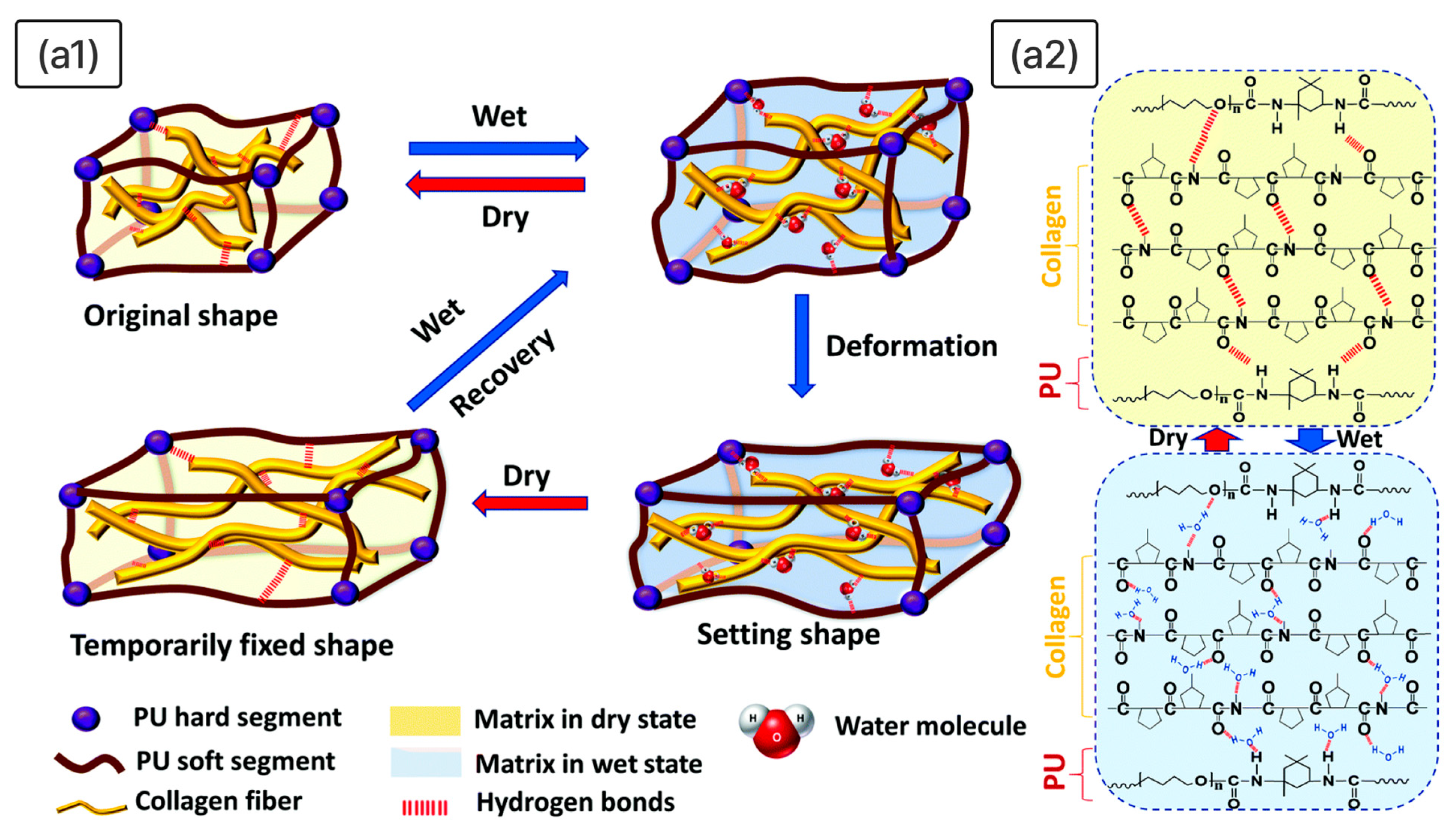


| Fillers | SMP Matrix | Mechanical Properties | External Stimuli | Ttrans | Rr (%) | Ref. |
|---|---|---|---|---|---|---|
| - | Azobenzene-containing polymer network | Modulus: 130 MPa (trans), 23 MPa (cis); Elongation: 160% (trans), 280% (cis) | UV light (365 nm, 40 mW) | Tg = 42 °C (trans), Tg = −28 °C (cis) | 85 | [114] |
| CNT | Poly(2-hydroxyethyl methacrylate-co-polyethylene glycol diacrylate) | Storage modulus: 4917.2 MPa | NIR light (808 nm laser, 0.67 W/cm2) | Tg = 72.3 °C | 98.5 | [117] |
| (MWCNTs-ZnO)@PDA | PLLA | Compressive modulus: 0.9 MPa; Strength: 5 MPa | NIR light (808 nm, 1.1 W/cm2) | Tg = 56–57 °C | 100 | [118] |
| Urushiol–Fe | PU | Tensile strength: 17.21 MPa | NIR light (808 nm, 0.5–1.0 W/cm2) | Tg = 37–80 °C | 97.8 | [125] |
| Graphene foam | Epoxy resin | Tensile strength: 23.0 MPa | Joule heating (20 V DC) | Tg = 47.9 °C | 100 | [138] |
| Fe3O4 | Polyethylene terephthalate glycol | Tensile strength: 36.24 MPa; Elongation: 12.62% | Magnetic field (coil 30 V, 10 A) | Tg = 90.8 °C | 97.5 | [7] |
| rGO-Fe3O4 | Polyvinyl pyrrolidone/PVA/PEG | Modulus: 1.75 GPa; Tensile strength: 14 MPa; Elongation: 0.05% | Electricity (30 V, 1 A) | Tg = 55 °C | 80 | [47] |
| - | Poly(butanetetrol fumarate) | Elastic Modulus: 26.5 kPa | Water | Tg = 127.3 °C | 95 | [150] |
| GO, CNT | Waterborne epoxy | Storage modulus: 2248 MPa | Thermal heating in water | Tg = 60.2 °C | 98.8 | [46] |
| - | PU | Elastic modulus: 15–153 kPa; Tensile strength: 45–70 kPa; Elongation: 450% | Water | Tg > 40 °C (dry); Tg < 37 °C (wet) | 100 | [151] |
| - | Cyanate ester/PEG | Tensile strength: 67.64 MPa; Tensile modulus: 1.15 GPa; Max strain: 5.9% | Thermal heating | Tg = 129.5 °C | 100 | [152] |
| Zn | Sulphonated poly(ether ether ketone) (PEEK) | Modulus: 2200 MPa; Yield strength: 61 MPa; Elongation: 15% | Thermal heating | Tg = 253 °C | 99 | [153] |
| - | SMP with silyl ether dynamic covalent linkages | Tensile strength: 82.4 MPa; Modulus: 1863.9 MPa; Elongation: 8.0% | Thermal heating | Tg = 129.3 °C | 99.1 | [154] |
| - | Copolyimide | Storage modulus: 1959 MPa | Thermal heating | Tg = 196 °C | >96 (stretchable), 100 (deployable) | [155] |
Disclaimer/Publisher’s Note: The statements, opinions and data contained in all publications are solely those of the individual author(s) and contributor(s) and not of MDPI and/or the editor(s). MDPI and/or the editor(s) disclaim responsibility for any injury to people or property resulting from any ideas, methods, instructions or products referred to in the content. |
© 2026 by the authors. Licensee MDPI, Basel, Switzerland. This article is an open access article distributed under the terms and conditions of the Creative Commons Attribution (CC BY) license.
Share and Cite
Fetisova, A.A.; Surmeneva, M.A.; Surmenev, R.A. Advanced Design Concepts for Shape-Memory Polymers in Biomedical Applications and Soft Robotics. Polymers 2026, 18, 214. https://doi.org/10.3390/polym18020214
Fetisova AA, Surmeneva MA, Surmenev RA. Advanced Design Concepts for Shape-Memory Polymers in Biomedical Applications and Soft Robotics. Polymers. 2026; 18(2):214. https://doi.org/10.3390/polym18020214
Chicago/Turabian StyleFetisova, Anastasia A., Maria A. Surmeneva, and Roman A. Surmenev. 2026. "Advanced Design Concepts for Shape-Memory Polymers in Biomedical Applications and Soft Robotics" Polymers 18, no. 2: 214. https://doi.org/10.3390/polym18020214
APA StyleFetisova, A. A., Surmeneva, M. A., & Surmenev, R. A. (2026). Advanced Design Concepts for Shape-Memory Polymers in Biomedical Applications and Soft Robotics. Polymers, 18(2), 214. https://doi.org/10.3390/polym18020214