Sulfur Polymer to Develop Low-Carbon Reclaimed Asphalt Pavements

 ,
, 
Abstract
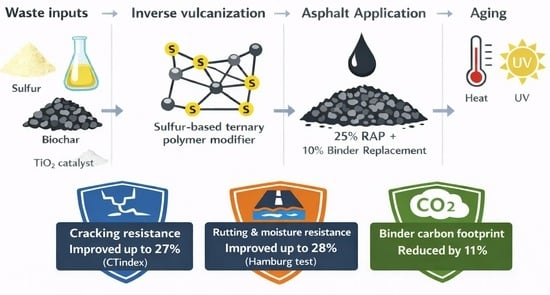
1. Introduction
2. Materials and Methods
2.1. Materials
2.2. Binder-Modifier Preparation
2.3. Mixture Production and Short-Term Conditioning
2.4. Long-Term Thermal and UV Aging
2.5. Mechanical Testing
3. Results and Discussion
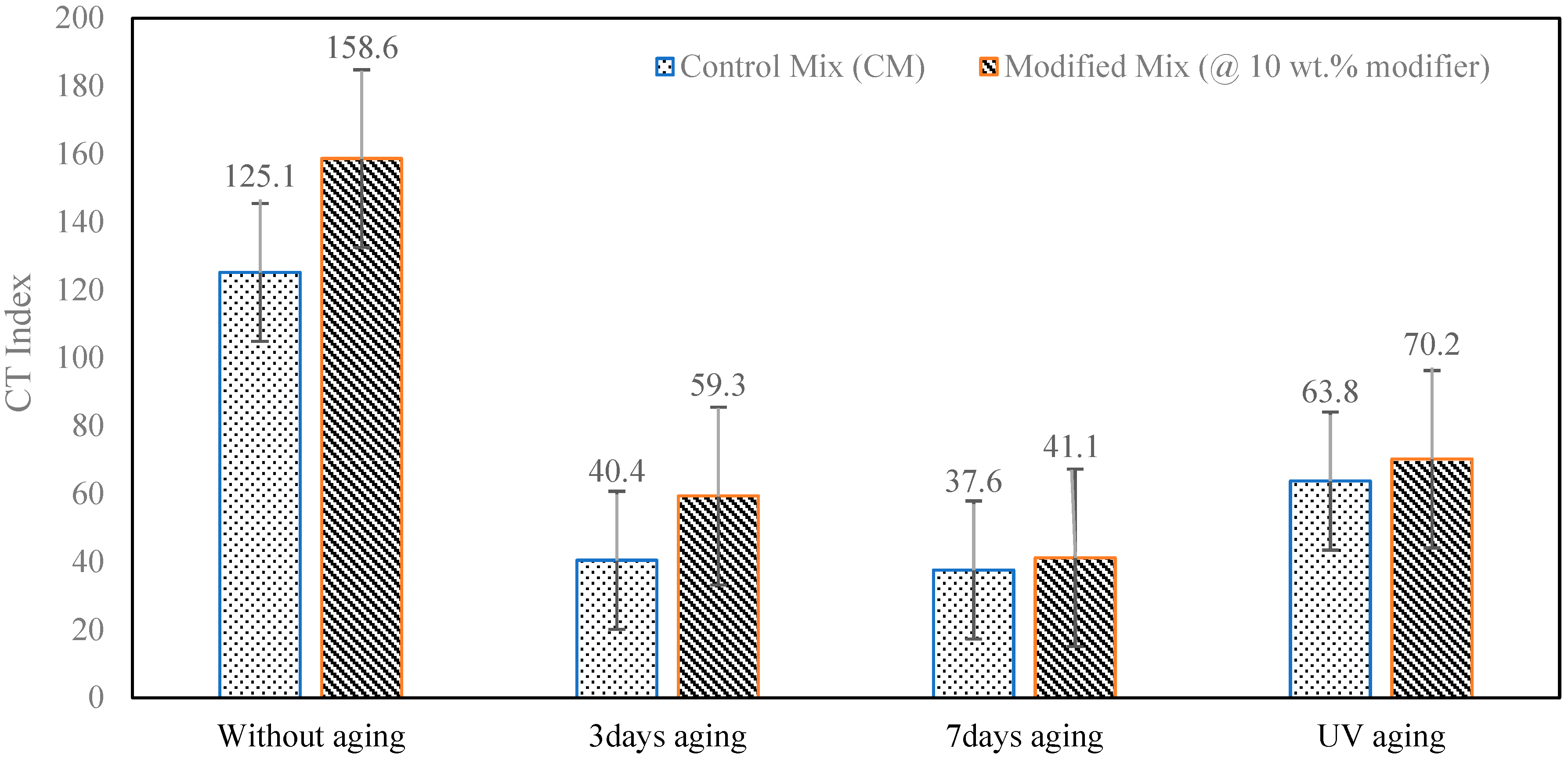
3.1. Indirect Tensile Asphalt Cracking Test
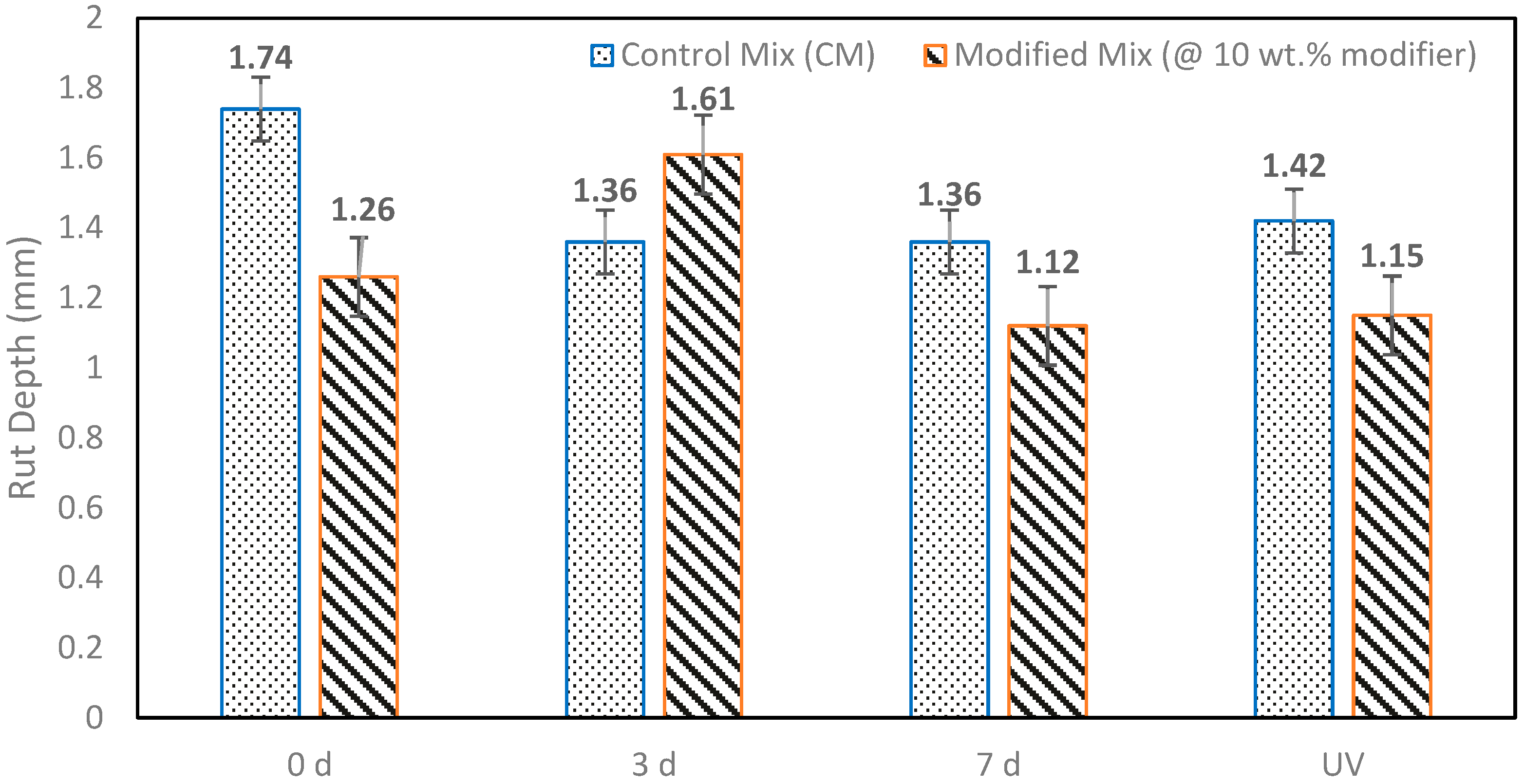
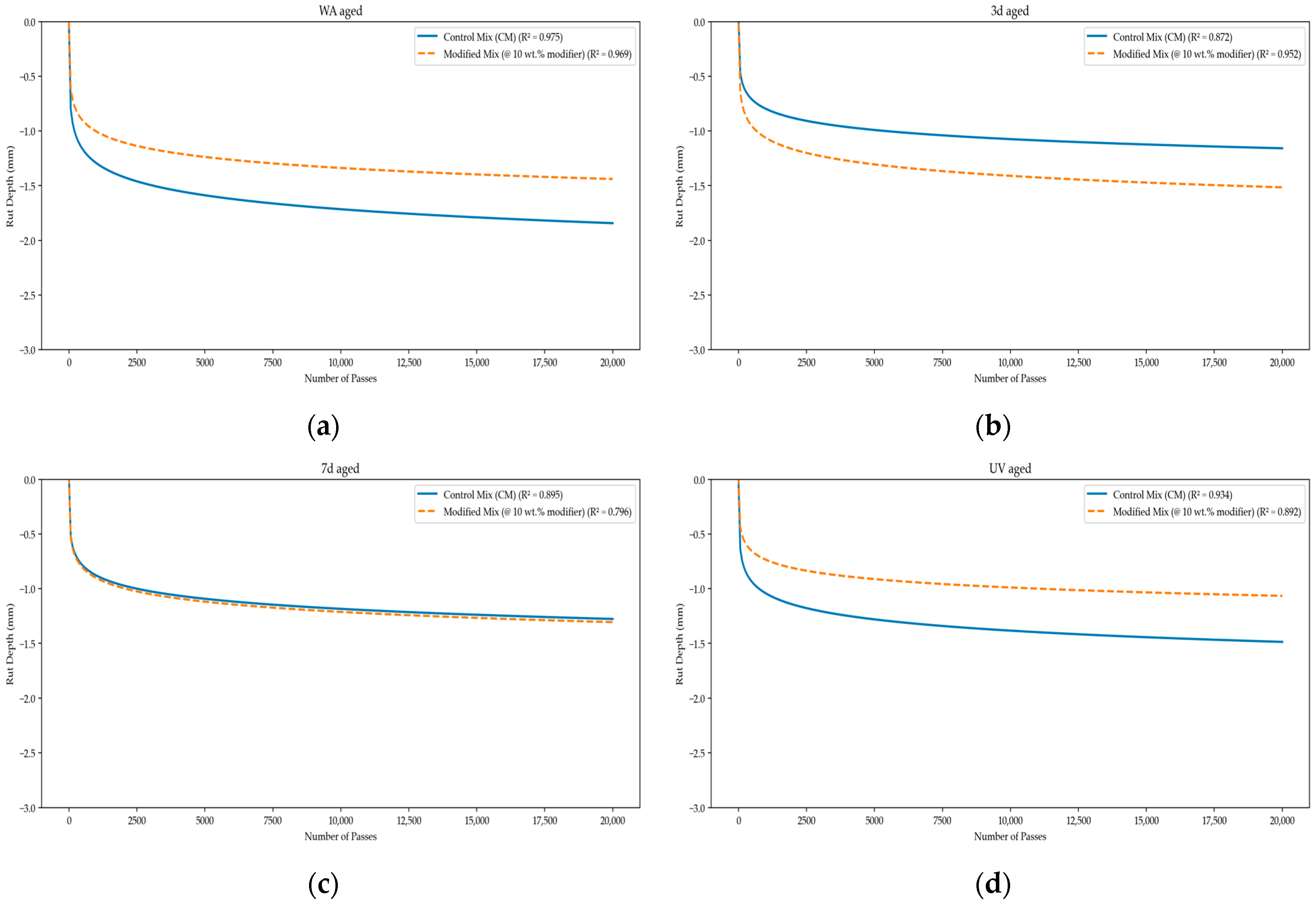
3.2. Hamburg Wheel Tracking Test
4. Environmental Impact Assessment
5. Conclusions
Author Contributions
Funding
Institutional Review Board Statement
Data Availability Statement
Conflicts of Interest
Abbreviations
| HWT | Hamburg Wheel Tracking Test |
| RAP | Reclaimed Asphalt Pavement |
| UV | Ultraviolet |
| IDEAL-CT | Indirect Tensile Asphalt Cracking Test |
| WA | Without Aging |
| NCHRP | National Cooperative Highway Research Program |
| HMA | Hot Mix Asphalt |
References
- You, Z.; Mills-Beale, J.; Fini, E.; Goh, S.W.; Colbert, B. Evaluation of low-temperature binder properties of warm-mix asphalt, extracted and recovered RAP and RAS, and bioasphalt. J. Mater. Civ. Eng. 2011, 23, 1569–1574. [Google Scholar]
- Saadeh, S.; Katawal, P.; Kabir, S.F.; Fini, E.H.; Titi, H.H. Performance of reclaimed asphalt pavements containing recycled waste plastics. J. Clean. Prod. 2024, 442, 140935. [Google Scholar] [CrossRef]
- Mogawer, W.S.; Fini, E.H.; Austerman, A.J.; Booshehrian, A.; Zada, B. Performance characteristics of high reclaimed asphalt pavement containing bio-modifier. Road Mater. Pavement Des. 2016, 17, 753–767. [Google Scholar] [CrossRef]
- Chou, C.P.; Lee, N. A sensitivity study of RAP cost and performance on its life cycle benefits. Adv. Mater. Res. 2013, 723, 567–574. [Google Scholar] [CrossRef]
- Tarsi, G.; Tataranni, P.; Sangiorgi, C. The challenges of using reclaimed asphalt pavement for new asphalt mixtures: A review. Materials 2020, 13, 4052. [Google Scholar] [CrossRef] [PubMed]
- Copeland, A. Reclaimed Asphalt Pavement in Asphalt Mixtures: State of the Practice; United States. Federal Highway Administration. Office of Research, Development, and Technology: McLean, VA, USA, 2011.
- Luo, Y.; Zhang, K. Review on performance of asphalt and asphalt mixture with waste cooking oil. Materials 2023, 16, 1341. [Google Scholar] [CrossRef] [PubMed]
- Dugan, C.R.; Sumter, C.R.; Rani, S.; Ali, S.A.; O’Rear, E.A.; Zaman, M. Rheology of virgin asphalt binder combined with high percentages of RAP binder rejuvenated with waste vegetable oil. ACS Omega 2020, 5, 15791–15798. [Google Scholar] [CrossRef]
- Majidifard, H.; Tabatabaee, N.; Buttlar, W. Investigating short-term and long-term binder performance of high-RAP mixtures containing waste cooking oil. J. Traffic Transp. Eng. (Engl. Ed.) 2019, 6, 396–406. [Google Scholar]
- Bilema, M.; Aman, M.Y.; Hassan, N.A.; Al-Saffar, Z.; Mashaan, N.S.; Memon, Z.A.; Milad, A.; Yusoff, N.I.M. Effects of waste frying oil and crumb rubber on the characteristics of a reclaimed asphalt pavement binder. Materials 2021, 14, 3482. [Google Scholar] [CrossRef]
- Revelli, V.; Ali, A. Understanding the state agency policies toward RAP usage in the United States: State of practice. Recycling 2023, 8, 100. [Google Scholar] [CrossRef]
- Cooper, S.J. Asphalt Pavement Recycling with reclaimed asphalt pavement (RA). In Proceedings of the NWPMA, 18th Annual Fall Pavement Conference, Portland, OR, USA, 20 October 2011. [Google Scholar]
- Jiang, L.; Shen, J.; Wang, W. Performance of high-dose reclaimed asphalt mixtures (RAPs) in hot in-place recycling based on balanced design. Materials 2024, 17, 2096. [Google Scholar] [PubMed]
- Alizadeh, M.; Hajikarimi, P.; Khodaii, A. Investigation of the Mechanical Performance of High-RAP WMA Mixtures Incorporating Sasobit and Bio-Oil Rejuvenators. Results Eng. 2025, 28, 107141. [Google Scholar]
- Abdo, A.A. Utilizing reclaimed asphalt Pavement (RAP) materials in new pavements—A Review. Int. J. Therm. Environ. Eng. 2016, 12, 61–66. [Google Scholar]
- Xu, N.; Wang, H.; Wang, H.; Kazemi, M.; Fini, E. Research progress on resource utilization of waste cooking oil in asphalt materials: A state-of-the-art review. J. Clean. Prod. 2023, 385, 135427. [Google Scholar]
- Oldham, D.; Rajib, A.; Dandamudi, K.P.R.; Liu, Y.; Deng, S.; Fini, E.H. Transesterification of waste cooking oil to produce a sustainable rejuvenator for aged asphalt. Resour. Conserv. Recycl. 2021, 168, 105297. [Google Scholar] [CrossRef]
- Rodrigues, C.; Capitão, S.; Picado-Santos, L.; Almeida, A. Full recycling of asphalt concrete with waste cooking oil as rejuvenator and LDPE from urban waste as binder modifier. Sustainability 2020, 12, 8222. [Google Scholar] [CrossRef]
- Jain, S.; Chandrappa, A.K. Performance of Asphalt Binders and Mixtures Incorporating Reclaimed Asphalt Pavement with Waste Cooking Oil as Rejuvenator. J. Mater. Civ. Eng. 2025, 37, 04025013. [Google Scholar] [CrossRef]
- Roy, S.; Hossain, Z.; Baumgardner, G.; Zaman, M. Micro-mechanistic and spectroscopic analysis of RAP-blended asphalt binders rejuvenated with waste oils. Int. J. Pavement Res. Technol. 2025, 18, 858–875. [Google Scholar]
- Zhu, R.; Hu, C. Regenerative and Innovative Utilization of Coffee Residue and Waste Cooking Oil: Improving Rheological Properties of Recycled Asphalt. Buildings 2024, 15, 54. [Google Scholar] [CrossRef]
- Ye, Q.; You, C.; Wang, J.; Yang, Z. Effect of catalytic esterification of waste cooking oil on the rejuvenation performance of aged asphalt. Constr. Build. Mater. 2025, 505, 144738. [Google Scholar] [CrossRef]
- Kim, Y.-M.; Kim, K.; Le, T.H.M. Development of Sustainable Cement Asphalt Mortar Using Agricultural Waste-Derived Bio-Oil and Latex–Acrylic Polymers for Enhanced Durability. Polymers 2024, 16, 3210. [Google Scholar] [CrossRef]
- Mousavi, M.; Zhou, T.; Liu, R.; Dong, Z.; Fini, E.H. Advancing sustainability with inverse vulcanization of waste sulfur catalyzed with TiO2. J. Environ. Chem. Eng. 2024, 12, 111687. [Google Scholar]
- Mousavi, M.; Zhou, T.; Dong, Z.; Fini, E.H. Turning abundant waste sulfur to polymers for manufacturing: Exploiting role of organic crosslinkers and benign catalysts. J. Ind. Eng. Chem. 2023, 117, 205–212. [Google Scholar] [CrossRef]
- Wu, X.; Smith, J.A.; Petcher, S.; Zhang, B.; Parker, D.J.; Griffin, J.M.; Hasell, T. Catalytic inverse vulcanization. Nat. Commun. 2019, 10, 647. [Google Scholar] [CrossRef]
- Cubero-Cardoso, J.; Gómez-Villegas, P.; Santos-Martín, M.; Sayago, A.; Fernández-Recamales, Á.; de Villarán, R.F.; Cuadri, A.A.; Martín-Alfonso, J.E.; Borja, R.; Fermoso, F.G. Combining vegetable oils and bioactive compounds via inverse vulcanization for antioxidant and antimicrobial materials. Polym. Test. 2022, 109, 107546. [Google Scholar] [CrossRef]
- Zhou, T.; Xie, S.; Kabir, S.F.; Cao, L.; Fini, E.H. Effect of sulfur on bio-modified rubberized bitumen. Constr. Build. Mater. 2021, 273, 122034. [Google Scholar] [CrossRef]
- Zakertabrizi, M.; Hosseini, E.; Sukumaran, S.; Korayem, A.H.; Fini, E.H. Turning two waste streams into one solution for enhancing sustainability of the built environment. Resour. Conserv. Recycl. 2021, 174, 105778. [Google Scholar] [CrossRef]
- Hung, A.; Li, M.; Fini, E.H. Effects of elemental sulfur on the aging trajectory and adhesion characteristics of rubber-modified bitumen. ACS Sustain. Chem. Eng. 2021, 9, 16918–16925. [Google Scholar] [CrossRef]
- Mousavi, M.; Hung, A.M.; Fini, E.H. Sustainability implications of regenerative sulfur blooms in bituminous composites. ACS Sustain. Chem. Eng. 2021, 9, 9486–9493. [Google Scholar] [CrossRef]
- Diniz, V.; Bear, J.C.; Rath, S.; Crick, C.R. UV-stable photoactive superhydrophobic coatings utilizing “inverse vulcanization” sulfur polymers. Surf. Interfaces 2024, 51, 104691. [Google Scholar]
- Cai, D.; Dale, J.J.; Petcher, S.; Wu, X.; Hasell, T. Investigating the Effect of UV Irradiation and TiO2 Addition on Heavy Metal Adsorption by Inverse Vulcanized Sulfur Polymers. Chem. A Eur. J. 2024, 30, e202402194. [Google Scholar] [CrossRef]
- Xie, S.; Yi, J.; Zhou, T.; Fini, E.H.; Feng, D. Phase transition process of sulfur in bitumen and its effect on rheological properties of bitumen. Constr. Build. Mater. 2023, 364, 129914. [Google Scholar] [CrossRef]
- Rajib, A.; Fini, E.H. Inherently functionalized carbon from lipid and protein-rich biomass to reduce ultraviolet-induced damages in bituminous materials. ACS Omega 2020, 5, 25273–25280. [Google Scholar] [CrossRef] [PubMed]
- Rajib, A.; Saadeh, S.; Katawal, P.; Mobasher, B.; Fini, E.H. Enhancing biomass value chain by utilizing biochar as a free radical scavenger to delay ultraviolet aging of bituminous composites used in outdoor construction. Resour. Conserv. Recycl. 2021, 168, 105302. [Google Scholar] [CrossRef]
- Saadeh, S.; Al-Zubi, Y.; Katawal, P.; Zaatarah, B.; Fini, E. Biochar effects on the performance of conventional and rubberized HMA. Road Mater. Pavement Des. 2023, 24, 156–172. [Google Scholar] [CrossRef]
- Yaro, N.S.A.; Sutanto, M.H.; Habib, N.Z.; Usman, A.; Kaura, J.M.; Murana, A.A.; Birniwa, A.H.; Jagaba, A.H. A comprehensive review of biochar utilization for low-carbon flexible asphalt pavements. Sustainability 2023, 15, 6729. [Google Scholar] [CrossRef]
- Mousavi, M.; Hou, K.X.; Kazemi, M.; Li, C.H.; Fini, E.H. Revolutionizing Sulfur Polymerization with a Biogenic Catalyst Approach. Adv. Sustain. Syst. 2024, 8, 2400322. [Google Scholar] [CrossRef]
- Mousavi, M.; Aldagari, S.; Fini, E.H. Adsorbing volatile organic compounds within bitumen improves colloidal stability and air quality. ACS Sustain. Chem. Eng. 2023, 11, 9581–9594. [Google Scholar] [CrossRef]
- Mousavi, M.; Akbarzadeh, V.; Kazemi, M.; Deng, S.; Fini, E.H. Perspective on sustainable solutions for mitigating off-gassing of volatile organic compounds in asphalt composites. J. Compos. Sci. 2025, 9, 353. [Google Scholar] [CrossRef]
- Mousavi, M.; Park, K.-B.; Kim, J.-S.; Fini, E.H. Metal-rich biochar as an asphalt modifier to improve sustainability and reduce VOC emissions. Sustain. Mater. Technol. 2024, 40, e00903. [Google Scholar] [CrossRef]
- Hu, M.; Zhu, K.; Lyu, L.; Wang, Q.; Rashid, S.; Fini, E.H. Surface-Functionalized Biochar for Low-Carbon and Low-Emission Asphalt. ACS Sustain. Chem. Eng. 2025, 13, 19282–19296. [Google Scholar] [CrossRef]
- Lyu, L.; Pei, J.; Hu, D.; Fini, E.H. Durability of rubberized asphalt binders containing waste cooking oil under thermal and ultraviolet aging. Constr. Build. Mater. 2021, 299, 124282. [Google Scholar] [CrossRef]
- Lyu, L.; Pei, J.; Burnham, N.A.; Fini, E.H.; Poulikakos, L.D. Nanoscale evolution of rubber-oil modified asphalt binder after thermal and UV aging. J. Clean. Prod. 2023, 426, 139098. [Google Scholar] [CrossRef]
- Rondón-Quintana, H.A.; Reyes-Lizcano, F.A.; Chaves-Pabón, S.B.; Bastidas-Martínez, J.G.; Zafra-Mejía, C.A. Use of biochar in asphalts. Sustainability 2022, 14, 4745. [Google Scholar] [CrossRef]
- Pahlavan, F.; Aldagari, S.; Park, K.B.; Kim, J.S.; Fini, E.H. Bio-Carbon as a Means of Carbon Management in Roads. Adv. Sustain. Syst. 2023, 7, 2300054. [Google Scholar] [CrossRef]
- County of San Diego. Reclaimed Asphalt Pavement (RAP) Use up to 25%: Guidance Document R-1; San Diego County Building Better Roads: San Diego, CA, USA, 2023.
- AASHTO T 312-22; Preparing and Determining the Density of Asphalt Mixture Specimens Using the Superpave Gyratory Compactor. AASHTO: Washington, DC, USA, 2022.
- AASHTO T 166-22; Bulk Specific Gravity (Gmb) of Compacted Asphalt Mixtures Using Saturated Surface-Dry Specimens. AASHTO: Washington, DC, USA, 2022.
- AASHTO T 269-22; Percent Air Voids in Compacted Dense and Open Asphalt Mixtures. AASHTO: Washington, DC, USA, 2022.
- Transportation Research Board. Long-Term Aging of Asphalt Mixtures for Performance Testing and Prediction: Phase III Results; National Academies of Sciences, Engineering, and Medicine: Washington, DC, USA, 2021. [Google Scholar]
- Bi, Y.; Xu, Y.; Li, B.; Zou, X.; Gao, J.; Li, Q. Laboratory-accelerated simulation and calibration method for ultraviolet aging of asphalt binders based on radiation equivalent conversion. Constr. Build. Mater. 2024, 435, 136791. [Google Scholar] [CrossRef]
- AASHTO T324; Standard Method of Test for Hamburg Wheel-Track Testing of Compacted Asphalt Mixtures. American Association of State Highway and Transportation Officials: Washington, DC, USA, 2017; p. 15.
- Chowdhury, P.S.; Noojilla, S.L.A.; Reddy, M.A. Evaluation of fatigue characteristics of asphalt mixtures using Cracking Tolerance index (CTIndex). Constr. Build. Mater. 2022, 342, 128030. [Google Scholar] [CrossRef]
- Yu, H.; Bai, X.; Qian, G.; Wei, H.; Gong, X.; Jin, J.; Li, Z. Impact of ultraviolet radiation on the aging properties of SBS-modified asphalt binders. Polymers 2019, 11, 1111. [Google Scholar] [CrossRef]
- Shacat, J.; Willis, R.; Ciavola, B. The Carbon Footprint Of Asphalt Pavements: A Reference Document For Decarbonization; National Asphalt Pavement Association: Greenbelt, MD, USA, 2024. [Google Scholar]
- Kazemi, M.; Pahlavan, F.; Schmidt, A.J.; Valdez, P.J.; Hung, A.M.; Fini, E.H. Algae Asphalt to Enhance Pavement Sustainability and Performance at Subzero Temperatures. ACS Sustain. Chem. Eng. 2025, 13, 19496–19510. [Google Scholar] [CrossRef]
- Roberts, K.G.; Gloy, B.A.; Joseph, S.; Scott, N.R.; Lehmann, J. Life cycle assessment of biochar systems: Estimating the energetic, economic, and climate change potential. Environ. Sci. Technol. 2010, 44, 827–833. [Google Scholar] [CrossRef]
- Park, K.-B.; Chae, D.-Y.; Fini, E.H.; Kim, J.-S. Pyrolysis of biomass harvested from heavy-metal contaminated area: Characteristics of bio-oils and biochars from batch-wise one-stage and continuous two-stage pyrolysis. Chemosphere 2024, 355, 141715. [Google Scholar] [CrossRef] [PubMed]
- Osman, A.I.; Lai, Z.Y.; Farghali, M.; Yiin, C.L.; Elgarahy, A.M.; Hammad, A.; Ihara, I.; Al-Fatesh, A.S.; Rooney, D.W.; Yap, P.-S. Optimizing biomass pathways to bioenergy and biochar application in electricity generation, biodiesel production, and biohydrogen production. Environ. Chem. Lett. 2023, 21, 2639–2705. [Google Scholar] [CrossRef]
- Middlemas, S.; Fang, Z.Z.; Fan, P. Life cycle assessment comparison of emerging and traditional Titanium dioxide manufacturing processes. J. Clean. Prod. 2015, 89, 137–147. [Google Scholar] [CrossRef]





| Property | Test Method | Results (PG 58-16) | Spec Limit |
|---|---|---|---|
| Binder Identification and Composition | |||
| Asphalt Binder Grade | AASHTO M320 | PG 58-16 | PG 58-16 |
| Asphalt Binder Content (%) | AASHTO T308 | 4.70% | 4.5–5.2% (typical) |
| RAP Binder Content (%) | ASTM D2172 | 4.77% | N/A |
| Original Binder Properties | |||
| Flash Point (°C) | ASTM D92/AASHTO T48 | 302 | ≥230 |
| Viscosity @ 135 °C (Pa·s) | ASTM D4402/AASHTO T316 | 0.25 | ≤3.0 |
| G*/sin(δ) @ 58 °C (kPa) | AASHTO T315 | 1.74 | ≥1.00 |
| Phase Angle, δ (°) | AASHTO T315 | 88.8 | – |
| RTFO Aged Binder Properties | |||
| Mass Loss (%) | AASHTO T240 | −0.08 | ≤1.00 |
| G*/sin(δ) @ 58 °C (kPa) | AASHTO T315 | 3.5 | ≥2.20 |
| Phase Angle, δ (°) | AASHTO T315 | 87.4 | – |
| PAV Aged Binder Properties | |||
| G*·sin(δ) @ 25 °C (kPa) | AASHTO T315 | 4300 | ≤5000 |
| Phase Angle, δ (°) | AASHTO T315 | 57.3 | ≥42° |
| BBR Test @ −6 °C | AASHTO T313 | ||
| Stiffness, S (MPa) | AASHTO T313 | 77.5 | ≤300 |
| m-value | AASHTO T313 | 0.4 | ≥0.300 |
| Other Properties | |||
| Specific Gravity @ 60 °F | ASTM D70 | 1.0154 | – |
| Levene’s Test for Equality of Variances | t-test for Equality of Means | |||||||||
| F | Sig. | t | df | Significance | Mean Difference | Std. Error Difference | 95% Confidence Interval of the Difference | |||
| One-Sided p | Two-Sided p | Lower | Upper | |||||||
| 0.11 | 0.761 | −3.17 | 4 | 0.017 | 0.034 | −18.9 | 5.98 | −35.5 | −2.3 | |
| Component/Effect | wt% of Binder | Effect Type | ΔGWP (kg CO2-eq/ton Binder) |
|---|---|---|---|
| Baseline binder (unmodified) | 100 | Reference GWP | +484.0 |
| Sulfur—binder displacement | 2.86 | Displacement credit (bitumen) | −13.8 |
| WCO—binder displacement | 5.71 | Displacement credit (bitumen) | −27.6 |
| Biochar—binder displacement | 1.43 | Displacement credit (bitumen) | −6.9 |
| Biochar—net carbon sequestration | 1.43 | Negative emission (sequestration) | −5.9 |
| TiO2 | 0.002 | Additional positive GWP | +0.15 |
| Net GWP of modified binder | 429.8 | ||
| Percent reduction vs. baseline | 11.2% |
Disclaimer/Publisher’s Note: The statements, opinions and data contained in all publications are solely those of the individual author(s) and contributor(s) and not of MDPI and/or the editor(s). MDPI and/or the editor(s) disclaim responsibility for any injury to people or property resulting from any ideas, methods, instructions or products referred to in the content. |
© 2026 by the authors. Licensee MDPI, Basel, Switzerland. This article is an open access article distributed under the terms and conditions of the Creative Commons Attribution (CC BY) license.
Share and Cite
Doroudgar, M.; Kazemi, M.; Saadeh, S.; Parast, M.; Fini, E.H. Sulfur Polymer to Develop Low-Carbon Reclaimed Asphalt Pavements. Polymers 2026, 18, 168. https://doi.org/10.3390/polym18020168
Doroudgar M, Kazemi M, Saadeh S, Parast M, Fini EH. Sulfur Polymer to Develop Low-Carbon Reclaimed Asphalt Pavements. Polymers. 2026; 18(2):168. https://doi.org/10.3390/polym18020168
Chicago/Turabian StyleDoroudgar, Mohammad, Mohammadjavad Kazemi, Shadi Saadeh, Mahour Parast, and Elham H. Fini. 2026. "Sulfur Polymer to Develop Low-Carbon Reclaimed Asphalt Pavements" Polymers 18, no. 2: 168. https://doi.org/10.3390/polym18020168
APA StyleDoroudgar, M., Kazemi, M., Saadeh, S., Parast, M., & Fini, E. H. (2026). Sulfur Polymer to Develop Low-Carbon Reclaimed Asphalt Pavements. Polymers, 18(2), 168. https://doi.org/10.3390/polym18020168