Beyond Barriers: Active Packaging Strategies for Sustainable Food Protection

 , ,
, , 
 and
and 
Abstract
1. Introduction
2. Factors Affecting Food Shelf Life
2.1. Microbial Growth
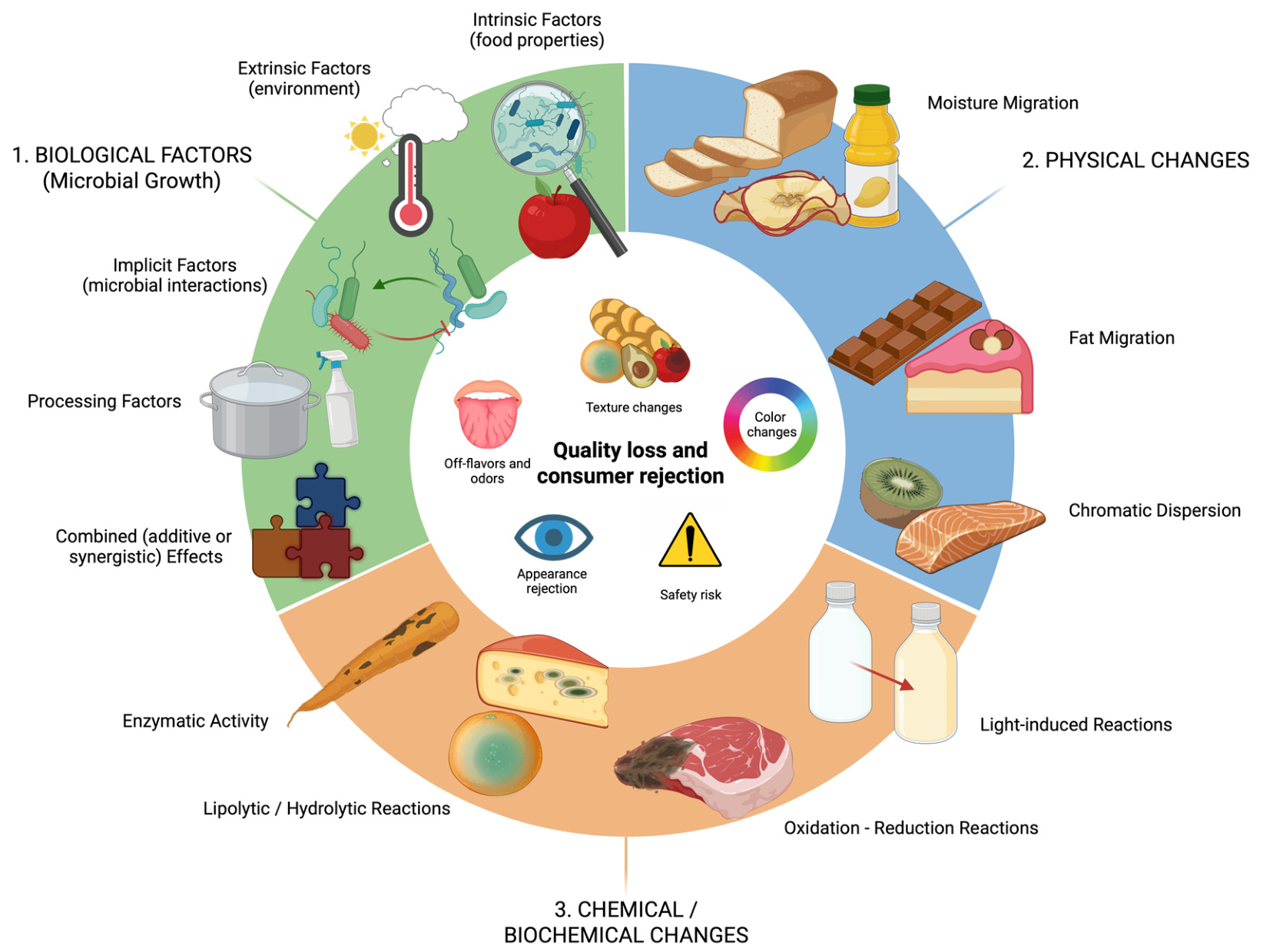
- implicit factors of food comprise metabiosis, symbiosis, commensalism, antagonism, synergism, predation, or amensalism [27]
- food processing factors include physical treatments such as heating, cooling, and drying, use of chemicals, or contamination [27]
- additive or synergistic interaction of the above-described factors can affect microbial growth [29].
2.2. Physical Changes
2.3. Chemical Changes
3. Active Packaging Technologies
3.1. Gas-Control Systems
3.1.1. Oxygen-Scavenging Technology
Metal-Based Scavengers
Reducing Agent-Based Scavengers
Light-Based Scavengers
Enzyme-Based Scavengers
Unsaturated Hydrocarbon-Based Scavengers
Redox-Based Scavengers
Phenolic Compound-Based Scavengers
Microorganism-Based Scavengers
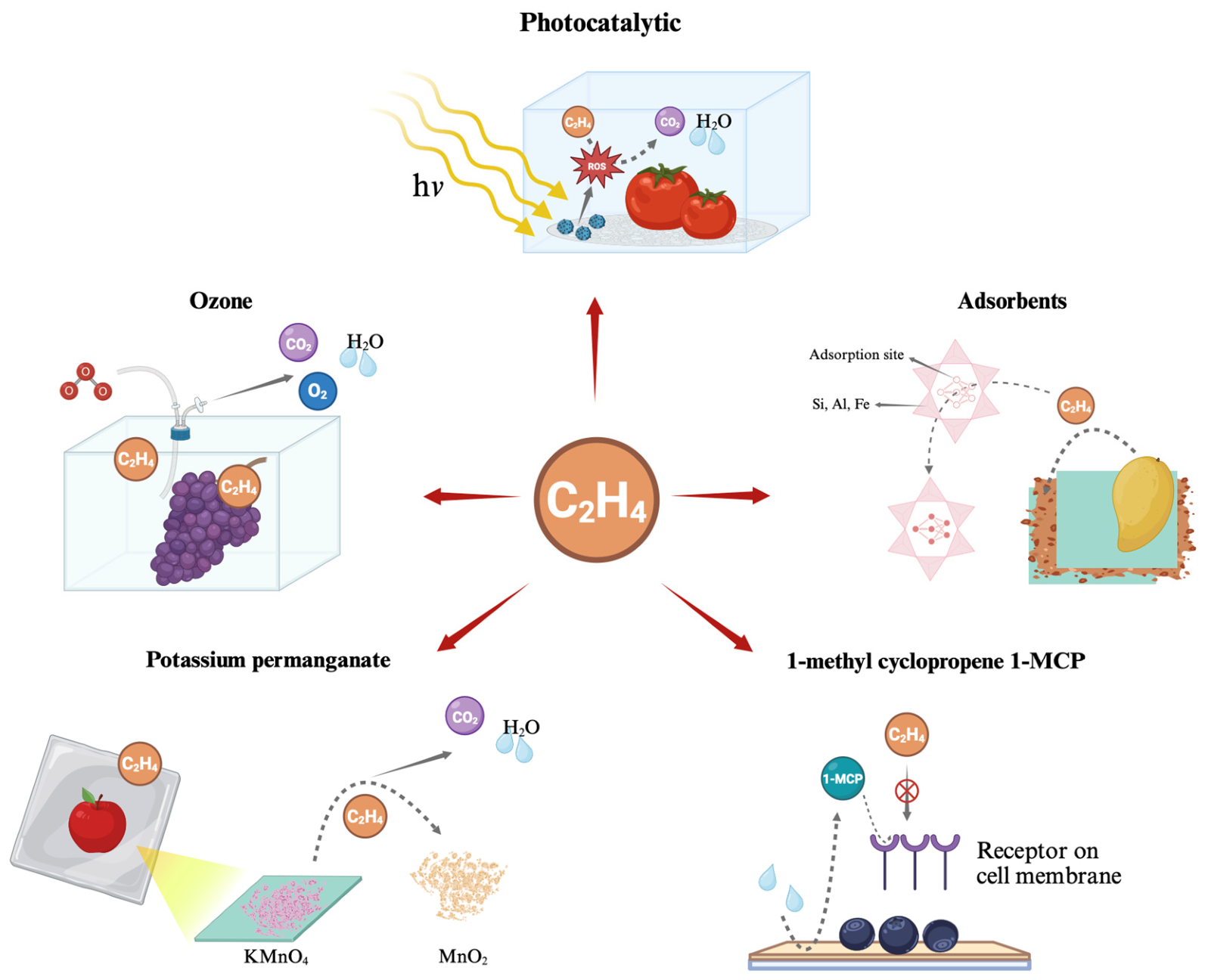
3.1.2. Ethylene Scavengers and Adsorbers
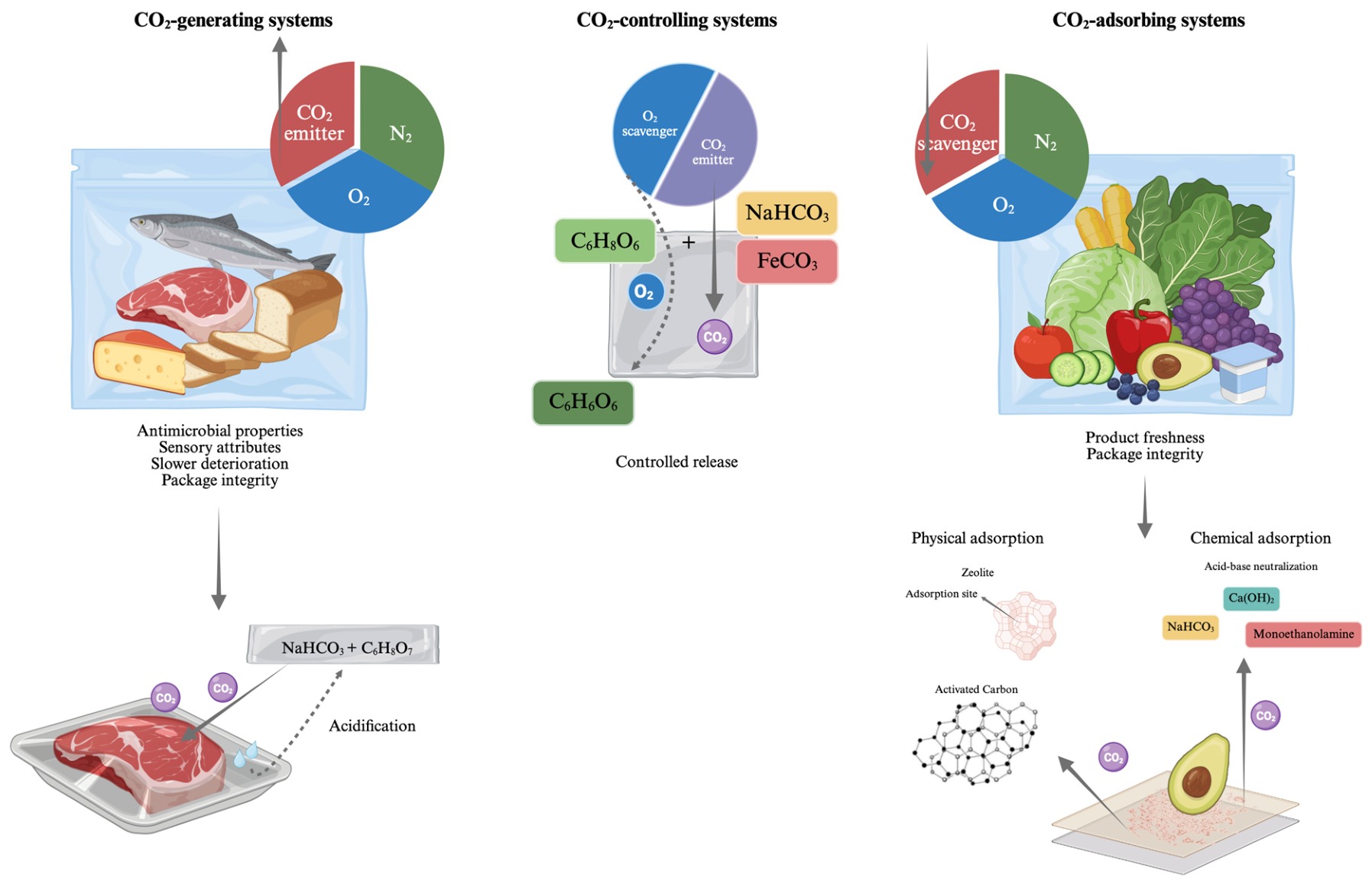
3.1.3. Carbon Dioxide Scavengers and Emitters
3.2. Moisture-Absorbing and -Controlling Systems
3.3. Antimicrobial Packaging
3.4. Antioxidant Packaging
3.5. Flavor/Odor Control
3.6. Multifunctional Systems
4. Final Remarks
Author Contributions
Funding
Institutional Review Board Statement
Data Availability Statement
Conflicts of Interest
Abbreviations
| Abbreviation | Full term |
| 1-MCP | 1-Methylcyclopropene |
| AA | Ascorbic Acid |
| AnV | Anisidine Value |
| C2H4 | Ethylene |
| CH4 | Methane |
| CO2 | Carbon Dioxide |
| DHAA | Dehydroascorbic Acid |
| EVOH | Ethylene Vinyl Alcohol |
| FAO | Food and Agriculture Organization |
| FLW | Food Loss and Waste |
| GA | Gallic Acid |
| GHG | Greenhouse Gas(es) |
| H2 | Hydrogen |
| HDPE | High-Density Polyethylene |
| KMnO4 | Potassium Permanganate |
| LAB | Lactic Acid Bacteria |
| LDPE | Low-Density Polyethylene |
| LLDPE | Linear Low-Density Polyethylene |
| MAP | Modified Atmosphere Packaging |
| MCC | Modified Calcium Carbonate |
| NFOSP | Nonferrous Oxygen Scavenger Particles |
| N2O | Nitrous Oxide |
| NRL | Natural Rubber Latex |
| O2 | Oxygen |
| ORMOCER® | Organically Modified Ceramic |
| PBAT | Poly(butylene adipate-co-terephthalate) |
| PBS | Polybutylene Succinate |
| PBSA | Poly(butylene succinate-co-adipate) |
| PE | Polyethylene |
| PET | Polyethylene Terephthalate |
| PFAS | Per- and Polyfluoroalkyl Substances |
| PGMs | Platinum Group Metals |
| PLA | Polylactic Acid |
| PP | Polypropylene |
| PS | Polystyrene |
| PU | Polyurethane |
| PVA | Polyvinyl Alcohol |
| PV | Peroxide Value |
| RH | Relative Humidity |
| ROS | Reactive Oxygen Species |
| RSM | Response Surface Methodology |
| SDGs | Sustainable Development Goals |
| TBARS | Thiobarbituric Acid Reactive Substances |
| TiO2 | Titanium Dioxide |
| TPS | Thermoplastic Starch |
| UFAs | Unsaturated Fatty Acids |
| UV | Ultraviolet |
| UV-C | Ultraviolet C |
| WFP | World Food Programme |
References
- Kusuma, H.S.; Yugiani, P.; Himana, A.I.; Aziz, A.; Putra, D.A.W. Reflections on Food Security and Smart Packaging. Polym. Bull. 2024, 81, 87–133. [Google Scholar] [CrossRef] [PubMed]
- FAO. 2026 Global Report on Food Crises—Joint Analysis for Better Decisions; Food & Agriculture Organization: Rome, Italy, 2026. [Google Scholar] [CrossRef]
- Rezaei, M.; Liu, B. Food Loss and Waste in the Food Supply Chain. Nutfruit 2017, 71, 26–27. [Google Scholar]
- Usmani, Z.; Sharma, M.; Awasthi, A.K.; Sharma, G.D.; Cysneiros, D.; Nayak, S.C.; Thakur, V.K.; Naidu, R.; Pandey, A.; Gupta, V.K. Minimizing Hazardous Impact of Food Waste in a Circular Economy—Advances in Resource Recovery through Green Strategies. J. Hazard. Mater. 2021, 416, 126154. [Google Scholar] [CrossRef]
- UNEP—UN Environment Programme. Food Waste Index Report 2024. Available online: https://www.unep.org/resources/publication/food-waste-index-report-2024 (accessed on 14 May 2026).
- FAO. Loss and Damage and Agrifood Systems—Addressing Gaps and Challenges; Food & Agriculture Organization: Rome, Italy, 2023; Available online: https://openknowledge.fao.org/server/api/core/bitstreams/024e522a-4228-4d01-8e8b-6debb25906a2/content (accessed on 17 May 2025).
- A Global Food Crisis. UN World Food Programme (WFP). Available online: https://www.wfp.org/ (accessed on 2 March 2026).
- Ishangulyyev, R.; Kim, S.; Lee, S.H. Understanding Food Loss and Waste—Why Are We Losing and Wasting Food? Foods 2019, 8, 297. [Google Scholar] [CrossRef]
- Blakeney, M. Food Loss and Food Waste: Causes and Solutions; Edward Elgar Publishing: Cheltenham, UK, 2019. [Google Scholar]
- Papargyropoulou, E.; Lozano, R.; Steinberger, J.K.; Wright, N.; bin Ujang, Z. The Food Waste Hierarchy as a Framework for the Management of Food Surplus and Food Waste. J. Clean. Prod. 2014, 76, 106–115. [Google Scholar] [CrossRef]
- Crippa, M.; Solazzo, E.; Guizzardi, D.; Monforti-Ferrario, F.; Tubiello, F.N.; Leip, A. Food Systems Are Responsible for a Third of Global Anthropogenic GHG Emissions. Nat. Food 2021, 2, 198–209. [Google Scholar] [CrossRef]
- Ivanovich, C.C.; Sun, T.; Gordon, D.R.; Ocko, I.B. Future Warming from Global Food Consumption. Nat. Clim. Change 2023, 13, 297–302. [Google Scholar] [CrossRef]
- FAO Knowledge Repository. Greenhouse Gas Emissions from Pre- and Post Agricultural Production Processes. 2019. Available online: https://openknowledge.fao.org/items/b713015e-15a5-47c6-8bcc-6680b85790b6 (accessed on 2 March 2026).
- European Commission. Methane Emissions. Available online: https://energy.ec.europa.eu/topics/carbon-management-and-fossil-fuels/methane-emissions_en (accessed on 2 March 2026).
- FAO. Moving Forward on Food Loss and Waste Reduction. In The State of Food and Agriculture; Food and Agriculture Organization of the United Nations: Rome, Italy, 2019; Available online: https://openknowledge.fao.org/server/api/core/bitstreams/e3c09863-1747-4708-9fc9-242deae3148c/content (accessed on 14 May 2026).
- Campoy-Muñoz, P.; Cardenete, M.A.; Delgado, M.D.C.; Sancho, F. Food Losses and Waste: A Needed Assessment for Future Policies. Int. J. Environ. Res. Public Health 2021, 18, 11586. [Google Scholar] [CrossRef] [PubMed]
- Lipinski, B.; Hanson, C.; Waite, R.; Searchinger, T.; Lomax, J. Reducing Food Loss and Waste; World Resources Institute: Washington, DC, USA, 2013. [Google Scholar]
- UN DESA Publications. UN/DESA Policy Brief #102: Population, Food Security, Nutrition and Sustainable Development. Available online: https://desapublications.un.org/policy-briefs/undesa-policy-brief-102-population-food-security-nutrition-and-sustainable (accessed on 2 March 2026).
- Seberini, A. Economic, Social and Environmental World Impacts of Food Waste on Society and Zero Waste as a Global Approach to Their Elimination. SHS Web Conf. 2020, 74, 03010. [Google Scholar] [CrossRef]
- Sustainable Consumption and Production. United Nations. Available online: https://www.un.org/sustainabledevelopment/sustainable-consumption-production/ (accessed on 2 March 2026).
- Alexander, P.; Brown, C.; Arneth, A.; Finnigan, J.; Moran, D.; Rounsevell, M.D.A. Losses, Inefficiencies and Waste in the Global Food System. Agric. Syst. 2017, 153, 190–200. [Google Scholar] [CrossRef] [PubMed]
- Wegren, S.K. Challenges to Global Food Security: A Policy Approach to the 2021–2022 Food Crisis. World Food Policy 2023, 9, 127–148. [Google Scholar] [CrossRef]
- Irani, Z.; Sharif, A.M.; Lee, H.; Aktas, E.; Topaloğlu, Z.; van’t Wout, T.; Huda, S. Managing Food Security through Food Waste and Loss: Small Data to Big Data. Comput. Oper. Res. 2018, 98, 367–383. [Google Scholar] [CrossRef]
- Olabode, O.; Kumar, N.; De, D. Food Loss and Waste Management in the Retail Food Supply Chain: Methods and Framework to Achieve Environmental Sustainability. J. Environ. Manag. 2025, 387, 125718. [Google Scholar] [CrossRef]
- Corradini, M.G. Shelf Life of Food Products: From Open Labeling to Real-Time Measurements. Annu. Rev. Food Sci. Technol. 2018, 9, 251–269. [Google Scholar] [CrossRef]
- Kornacki, J.L. What Factors Are Required for Microbes to Grow, Survive, and Die? In Principles of Microbiological Troubleshooting in the Industrial Food Processing Environment; Springer: London, UK, 2010; pp. 103–115. [Google Scholar]
- Preetha, S.S.; Narayanan, R. Factors Influencing the Development of Microbes in Food. Shanlax Int. J. Arts Sci. Humanit. 2020, 7, 57–77. [Google Scholar] [CrossRef]
- Hertog, M.L.; Uysal, I.; McCarthy, U.; Verlinden, B.M.; Nicolaï, B.M. Shelf Life Modelling for First-Expired-First-out Warehouse Management. Philos. Trans. R. Soc. A Math. Phys. Eng. Sci. 2014, 372, 20130306. [Google Scholar] [CrossRef]
- Doyle, M.P.; Diez-Gonzalez, F.; Hill, C. Food Microbiology: Fundamentals and Frontiers; John Wiley & Sons, Ltd.: Hoboken, NJ, USA, 2020. [Google Scholar]
- Gulati, T.; Datta, A.K.; Doona, C.J.; Ruan, R.R.; Feeherry, F.E. Modeling Moisture Migration in a Multi-Domain Food System: Application to Storage of a Sandwich System. Food Res. Int. 2015, 76, 427–438. [Google Scholar] [CrossRef]
- Hao, F.; Lu, L.; Wang, J. Finite Element Analysis of Moisture Migration of Multicomponent Foods during Storage. J. Food Process Eng. 2017, 40, e12319. [Google Scholar] [CrossRef]
- Nugrahedi, P.Y.; Soesilo, S.A.; Perdana, J.; Yudiar, H.; Sanyoto, G.J. Moisture Migration and Its Prevention in Multi-Domain Bakery Products: A Review. Food Rev. Int. 2025, 41, 3506–3529. [Google Scholar] [CrossRef]
- Roudaut, G. Water Activity and Physical Stability. In Water Activity in Foods; John Wiley & Sons, Ltd.: Hoboken, NJ, USA, 2020; pp. 255–269. [Google Scholar]
- Fennema, O.R.; Damodaran, S.; Parkin, K.L. Introduction to Food Chemistry. In Fennema’s Food Chemistry; CRC Press: Boca Raton, FL, USA, 2017. [Google Scholar]
- Mafe, A.N.; Edo, G.I.; Makia, R.S.; Joshua, O.A.; Akpoghelie, P.O.; Gaaz, T.S.; Jikah, A.N.; Yousif, E.; Isoje, E.F.; Igbuku, U.A.; et al. A Review on Food Spoilage Mechanisms, Food Borne Diseases and Commercial Aspects of Food Preservation and Processing. Food Chem. Adv. 2024, 5, 100852. [Google Scholar] [CrossRef]
- Forsido, S.F.; Welelaw, E.; Belachew, T.; Hensel, O. Effects of Storage Temperature and Packaging Material on Physico-Chemical, Microbial and Sensory Properties and Shelf Life of Extruded Composite Baby Food Flour. Heliyon 2021, 7, e06821. [Google Scholar] [CrossRef] [PubMed]
- Aung, M.M.; Chang, Y.S. Temperature Management for the Quality Assurance of a Perishable Food Supply Chain. Food Control 2014, 40, 198–207. [Google Scholar] [CrossRef]
- Evans, J. Effects of Food and Beverage Storage, Distribution, Display, and Consumer Handling on Shelf Life. In The Stability and Shelf Life of Food; Woodhead Publishing: Cambridge, UK, 2016; pp. 107–140. [Google Scholar]
- Kong, F.; Singh, R.P. Chemical Deterioration and Physical Instability of Foods and Beverages. In The Stability and Shelf Life of Food; Woodhead Publishing: Cambridge, UK, 2016; pp. 43–76. [Google Scholar]
- Awulachew, M.T. Understanding to the Shelf-Life and Product Stability of Foods. J. Food Technol. Preserv. 2021, 5, 1–5, Correction in J. Food Technol. Preserv. 2021, 5, 3. [Google Scholar]
- Cui, F.; Zheng, S.; Wang, D.; Tan, X.; Li, Q.; Li, J.; Li, T. Recent Advances in Shelf Life Prediction Models for Monitoring Food Quality. Compr. Rev. Food Sci. Food Saf. 2023, 22, 1257–1284. [Google Scholar] [CrossRef]
- Hassan, S.M.; Duale, M.M.; Ahmed, Z.; Jerar, H.M. Emerging Innovations in Food Technology: Advances in Processing and Packaging for a Sustainable Future. J. Food Chem. Nanotechnol. 2024, 10, 208–211. [Google Scholar] [CrossRef]
- Soro, A.B.; Noore, S.; Hannon, S.; Whyte, P.; Bolton, D.J.; O’Donnell, C.; Tiwari, B.K. Current Sustainable Solutions for Extending the Shelf Life of Meat and Marine Products in the Packaging Process. Food Packag. Shelf Life 2021, 29, 100722. [Google Scholar] [CrossRef]
- Shin, J.; Selke, S.E.M. Food Packaging. In Food Processing; John Wiley & Sons, Ltd.: Hoboken, NJ, USA, 2014; pp. 249–273. [Google Scholar]
- Robertson, G.L. Packaging and Food and Beverage Shelf Life. In The Stability and Shelf Life of Food; Woodhead Publishing: Cambridge, UK, 2016; pp. 77–106. [Google Scholar]
- D’Almeida, A.P.; de Albuquerque, T.L. Innovations in Food Packaging: From Bio-Based Materials to Smart Packaging Systems. Processes 2024, 12, 2085. [Google Scholar] [CrossRef]
- Karanth, S.; Feng, S.; Patra, D.; Pradhan, A.K. Linking Microbial Contamination to Food Spoilage and Food Waste: The Role of Smart Packaging, Spoilage Risk Assessments, and Date Labeling. Front. Microbiol. 2023, 14, 1198124. [Google Scholar] [CrossRef]
- Wyrwa, J.; Barska, A. Innovations in the Food Packaging Market: Active Packaging. Eur. Food Res. Technol. 2017, 243, 1681–1692. [Google Scholar] [CrossRef]
- Han, J.H. Innovations in Food Packaging; Elsevier: Amsterdam, The Netherlands, 2014. [Google Scholar]
- Ahmed, I.; Lin, H.; Zou, L.; Brody, A.L.; Li, Z.; Qazi, I.M.; Pavase, T.R.; Lv, L. A Comprehensive Review on the Application of Active Packaging Technologies to Muscle Foods. Food Control 2017, 82, 163–178. [Google Scholar] [CrossRef]
- Thanakkasaranee, S.; Sadeghi, K.; Seo, J. Packaging Materials and Technologies for Microwave Applications: A Review. Crit. Rev. Food Sci. Nutr. 2023, 63, 6464–6483. [Google Scholar] [CrossRef]
- Arfan, M.; Dirpan, A.; Syarifuddin, A.; Majumder, S. Oxygen Scavengers as Active Food Packaging: A Systematic Literature Review and Network Analysis. Food Chem. Adv. 2026, 10, 101257. [Google Scholar] [CrossRef]
- Bao, Y.; Puolanne, E.; Ertbjerg, P. Effect of Oxygen Concentration in Modified Atmosphere Packaging on Color and Texture of Beef Patties Cooked to Different Temperatures. Meat Sci. 2016, 121, 189–195. [Google Scholar] [CrossRef]
- Kontominas, M.G.; Badeka, A.V.; Kosma, I.S.; Nathanailides, C.I. Recent Developments in Seafood Packaging Technologies. Foods 2021, 10, 940. [Google Scholar] [CrossRef]
- He, X.; Wang, L.; Tao, J.; Han, L.; Wang, H.; Zhao, X.; Zuo, J.; Zheng, Y. High-oxygen-Modified Atmospheric Packaging Delays Flavor and Quality Deterioration in Fresh-Cut Broccoli. Food Chem. 2024, 450, 139517. [Google Scholar] [CrossRef] [PubMed]
- Singh, P.; Abas Wani, A.; Saengerlaub, S. Active Packaging of Food Products: Recent Trends. Nutr. Food Sci. 2011, 41, 249–260. [Google Scholar] [CrossRef]
- Dey, A.; Neogi, S. Oxygen Scavengers for Food Packaging Applications: A Review. Trends Food Sci. Technol. 2019, 90, 26–34. [Google Scholar] [CrossRef]
- Cruz, R.S.; Camilloto, G.P.; dos Santos Pires, A.C. Oxygen Scavengers: An Approach on Food Preservation. Struct. Funct. Food Eng. 2012, 2, 21–42. [Google Scholar]
- Gupta, P. Role of Oxygen Absorbers in Food as Packaging Material, Their Characterization and Applications. J. Food Sci. Technol. 2024, 61, 242–252. [Google Scholar] [CrossRef]
- Kadirvel, V.; Palanisamy, Y.; Ganesan, N.D. Active Packaging System—An Overview of Recent Advances for Enhanced Food Quality and Safety. Packag. Technol. Sci. 2025, 38, 145–162. [Google Scholar] [CrossRef]
- Mu, H.; Gao, H.; Chen, H.; Tao, F.; Fang, X.; Ge, L. A Nanosised Oxygen Scavenger: Preparation and Antioxidant Application to Roasted Sunflower Seeds and Walnuts. Food Chem. 2013, 136, 245–250. [Google Scholar] [CrossRef]
- Yildirim, S.; Röcker, B.; Rüegg, N.; Lohwasser, W. Development of Palladium-Based Oxygen Scavenger: Optimization of Substrate and Palladium Layer Thickness. Packag. Technol. Sci. 2015, 28, 710–718. [Google Scholar] [CrossRef]
- Liu, Y.; Koo, K.; Mao, Z.; Fu, X.; Hu, X.; Dravid, V.P. Unraveling the Adsorption-Limited Hydrogen Oxidation Reaction at Palladium Surface via in Situ Electron Microscopy. Proc. Natl. Acad. Sci. USA 2024, 121, e2408277121. [Google Scholar] [CrossRef]
- Lee, J.-S.; Chang, Y.; Lee, E.-S.; Song, H.-G.; Chang, P.-S.; Han, J. Ascorbic Acid-Based Oxygen Scavenger in Active Food Packaging System for Raw Meatloaf. J. Food Sci. 2018, 83, 682–688. [Google Scholar] [CrossRef]
- Amberg-Schwab, S.; Müller, K.; Somorowsky, F.; Sängerlaub, S. UV-Activated, Transparent Oxygen Scavenger Coating Based on Inorganic–Organic Hybrid Polymer (ORMOCER®) with High Oxygen Absorption Capacity. Coatings 2023, 13, 473. [Google Scholar] [CrossRef]
- Gaikwad, K.K.; Singh, S.; Shin, J.; Lee, Y.S. Novel Polyisoprene Based UV-Activated Oxygen Scavenging Films and Their Applications in Packaging of Beef Jerky. LWT 2020, 117, 108643. [Google Scholar] [CrossRef]
- Ramakanth, D.; Akhila, K.; Kumar, B.P.; Gaikwad, K.K.; Maji, P.K. Ultra-Violet Light-Driven Green Oxygen Scavenging Composite Made of PVA/NRL for Active Packaging: An Alternative to Metallic Oxygen Scavengers. Green Chem. 2024, 26, 5293–5307. [Google Scholar] [CrossRef]
- Ramakanth, D.; Singh, S.; Bhardwaj, S.; Meda, R.S.; Gaikwad, K.K.; Maji, P.K. Green Synthesis and Characterization of Polymyrcene as an Oxygen Scavenging Sustainable Polymer for Active Food Packaging Applications. ACS Appl. Polym. Mater. 2023, 5, 9888–9897. [Google Scholar] [CrossRef]
- Winestrand, S.; Järnström, L.; Jönsson, L.J. Fractionated Lignosulfonates for Laccase-Catalyzed Oxygen-Scavenging Films and Coatings. Molecules 2021, 26, 6322. [Google Scholar] [CrossRef] [PubMed]
- Khan, J.; Khurshid, S.; Sarwar, A.; Aziz, T.; Naveed, M.; Ali, U.; Makhdoom, S.I.; Nadeem, A.A.; Khan, A.A.; Sameeh, M.Y.; et al. Enhancing Bread Quality and Shelf Life via Glucose Oxidase Immobilized on Zinc Oxide Nanoparticles—A Sustainable Approach towards Food Safety. Sustainability 2022, 14, 14255. [Google Scholar] [CrossRef]
- Alvarado, J.F.; Rozo, D.F.; Chaparro, L.M.; Medina, J.A.; Salcedo-Galán, F. Synthesis and Characterization of Reproducible Linseed Oil-Loaded Silica Nanoparticles with Potential Use as Oxygen Scavengers in Active Packaging. Nanomaterials 2022, 12, 3257. [Google Scholar] [CrossRef] [PubMed]
- Röcker, B.; Mäder, G.; Monnard, F.W.; Jancikova, M.; Welker, M.; Schoelkopf, J.; Yildirim, S. Evaluation of the Potential of Modified Calcium Carbonate as a Carrier for Unsaturated Fatty Acids in Oxygen Scavenging Applications. Materials 2021, 14, 5000. [Google Scholar] [CrossRef]
- Kordjazi, Z.; Ajji, A. Oxygen Scavenging Systems for Food Packaging Applications: A Review. Can. J. Chem. Eng. 2022, 100, 3444–3449. [Google Scholar] [CrossRef]
- Jain, P.; Meshram, B.P.; Singh, S.; Gaikwad, K.K. Non-Iron Oxygen Scavengers in Food Packaging: Mechanisms, Applications, and the Shift towards Green Alternatives. Sustain. Food Technol. 2025, 3, 1668–1680. [Google Scholar] [CrossRef]
- Pant, A.F.; Özkasikci, D.; Fürtauer, S.; Reinelt, M. The Effect of Deprotonation on the Reaction Kinetics of an Oxygen Scavenger Based on Gallic Acid. Front. Chem. 2019, 7, 680. [Google Scholar] [CrossRef]
- Promsorn, J.; Harnkarnsujarit, N. Oxygen Absorbing Food Packaging Made by Extrusion Compounding of Thermoplastic Cassava Starch with Gallic Acid. Food Control 2022, 142, 109273. [Google Scholar] [CrossRef]
- Altieri, C.; Sinigaglia, M.; Corbo, M.R.; Buonocore, G.G.; Falcone, P.; Del Nobile, M.A. Use of Entrapped Microorganisms as Biological Oxygen Scavengers in Food Packaging Applications. LWT Food Sci. Technol. 2004, 37, 9–15. [Google Scholar] [CrossRef]
- Juan-Polo, A.; Pérez, S.E.M.; Prieto, M.M.; Reig, C.S.; Tone, A.M.; Solana, N.H.; Sanahuja, A.B. Oxygen Scavenger and Antioxidant LDPE/EVOH/PET-Based Films Containing β-Carotene Intended for Fried Peanuts (Arachis hypogaea L.) Packaging: Pilot Scale Processing and Validation Studies. Polymers 2022, 14, 3550. [Google Scholar] [CrossRef]
- Busolo, M.A.; Lagaron, J.M. Oxygen Scavenging Polyolefin Nanocomposite Films Containing an Iron Modified Kaolinite of Interest in Active Food Packaging Applications. Innov. Food Sci. Emerg. Technol. 2012, 16, 211–217. [Google Scholar] [CrossRef]
- Gaikwad, K.K.; Singh, S.; Lee, Y.S. Oxygen Scavenging Films in Food Packaging. Environ. Chem. Lett. 2018, 16, 523–538. [Google Scholar] [CrossRef]
- Chavarría-Fernández, S.M.; Jiménez-Alvarado, R.; Santos-López, E.M.; Hernández-Hernandez, A.A.; Cariño-Cortés, R. Iron Nanoparticles as Food Additives and Food Supplements, Regulatory and Legislative Perspectives. Food Sci. Biotechnol. 2024, 33, 1295–1305. [Google Scholar] [CrossRef]
- Góral, D.; Marczuk, A.; Góral-Kowalczyk, M.; Koval, I.; Andrejko, D. Application of Iron Nanoparticle-Based Materials in the Food Industry. Materials 2023, 16, 780. [Google Scholar] [CrossRef]
- Sängerlaub, S.; Witzgall, S.; Müller, K.; Wiegert, T.; Pecyna, M.J. Palladium-Based Oxygen Scavenger for Food Packaging: Choosing Optimal Hydrogen Partial Pressure. Food Packag. Shelf Life 2021, 28, 100666. [Google Scholar] [CrossRef]
- Miltz, J.; Perry, M. Evaluation of the Performance of Iron-Based Oxygen Scavengers, with Comments on Their Optimal Applications. Packag. Technol. Sci. 2005, 18, 21–27. [Google Scholar] [CrossRef]
- Janjarasskul, T.; Tananuwong, K.; Krochta, J.M. Whey Protein Film with Oxygen Scavenging Function by Incorporation of Ascorbic Acid. J. Food Sci. 2011, 76, E561–E568. [Google Scholar] [CrossRef]
- Molina, B.; Sáez, M.I.; Martínez, T.F.; Guil-Guerrero, J.L.; Suárez, M.D. Effect of Ultraviolet Light Treatment on Microbial Contamination, Some Textural and Organoleptic Parameters of Cultured Sea Bass Fillets (Dicentrarchus labrax). Innov. Food Sci. Emerg. Technol. 2014, 26, 205–213. [Google Scholar] [CrossRef]
- Monteiro, M.L.G.; Mársico, E.T.; Mutz, Y.D.S.; Castro, V.S.; Moreira, R.V.d.B.P.; Álvares, T.d.S.; Conte-Junior, C.A. Combined Effect of Oxygen-Scavenger Packaging and UV-C Radiation on Shelf Life of Refrigerated Tilapia (Oreochromis niloticus) Fillets. Sci. Rep. 2020, 10, 4243. [Google Scholar] [CrossRef]
- Pandiselvam, R.; Barut Gök, S.; Yüksel, A.N.; Tekgül, Y.; Çalişkan Koç, G.; Kothakota, A. Evaluation of the Impact of UV Radiation on Rheological and Textural Properties of Food. J. Texture Stud. 2022, 53, 800–808. [Google Scholar] [CrossRef]
- Csapó, J.; József, P.; Albert, C.; Sipos, P. Effect of UV Light on Food Quality and Safety. Acta Univ. Sapientiae Aliment. 2019, 12, 21–41. [Google Scholar] [CrossRef]
- Monteiro, M.L.G.; Torres Neto, L.; da Silva Mutz, Y.; da Silva, C.R.; Cardoso, A.C.C.; Conte-Junior, C.A. Optimized UVC-LED Condition to Improve the Shelf Life of Vacuum-Packed Refrigerated Stored Rainbow Trout (Oncorhynchus mykiss) Fillets. Food Control 2024, 156, 110141. [Google Scholar] [CrossRef]
- Cooksey, K. Oxygen Scavenging Packaging Systems. In Encyclopedia of Polymer Science and Technology; John Wiley & Sons, Ltd.: Hoboken, NJ, USA, 2010. [Google Scholar]
- Sharma, V.K.; Sharma, M.; Usmani, Z.; Pandey, A.; Singh, B.N.; Tabatabaei, M.; Gupta, V.K. Tailored Enzymes as Next-Generation Food-Packaging Tools. Trends Biotechnol. 2022, 40, 1004–1017. [Google Scholar] [CrossRef]
- Ge, L.; Zhao, Y.; Mo, T.; Li, J.; Li, P. Immobilization of Glucose Oxidase in Electrospun Nanofibrous Membranes for Food Preservation. Food Control 2012, 26, 188–193. [Google Scholar] [CrossRef]
- Johansson, K.; Winestrand, S.; Johansson, C.; Järnström, L.; Jönsson, L.J. Oxygen-Scavenging Coatings and Films Based on Lignosulfonates and Laccase. J. Biotechnol. 2012, 161, 14–18. [Google Scholar] [CrossRef]
- Ahn, B.J.; Gaikwad, K.K.; Lee, Y.S. Characterization and Properties of LDPE Film with Gallic-Acid-Based Oxygen Scavenging System Useful as a Functional Packaging Material. J. Appl. Polym. Sci. 2016, 133, 44138. [Google Scholar] [CrossRef]
- Kaiser, G. Aerobic Respiration. Available online: https://bio.libretexts.org/Bookshelves/Microbiology/Microbiology_(Kaiser)/Unit_7%3A_Microbial_Genetics_and_Microbial_Metabolism/18%3A_Microbial_Metabolism/18.3%3A_Aerobic_Respiration (accessed on 21 May 2026).
- Anthierens, T.; Ragaert, P.; Verbrugghe, S.; Ouchchen, A.; De Geest, B.G.; Noseda, B.; Mertens, J.; Beladjal, L.; De Cuyper, D.; Dierickx, W. Use of Endospore-Forming Bacteria as an Active Oxygen Scavenger in Plastic Packaging Materials. Innov. Food Sci. Emerg. Technol. 2011, 12, 594–599. [Google Scholar] [CrossRef]
- Mitsubishi Gas Chemical. AGELESSTM Prevents Food Colors from Changing. Effectiveness of AGELESSTM|AGELESSTM|Business & Products. Available online: https://www.mgc.co.jp/eng/products/sc/ageless/effect/03.html (accessed on 19 May 2026).
- TOTA-PAK|Buy Oxygen Absorbers in the Middle East. Available online: https://www.totalpackservice.com/product/oxygen-absorber-active-packaging/ (accessed on 18 May 2026).
- Rüegg, N.; Röcker, B.; Yildirim, S. Application of Palladium-Based Oxygen Scavenger to Extend the Mould Free Shelf Life of Bakery Products. Food Packag. Shelf Life 2022, 31, 100771. [Google Scholar] [CrossRef]
- DESICCARE, Inc. Oxygen Scavengers. Available online: https://desiccare.com/pages/oxygen-scavengers (accessed on 20 May 2026).
- Yang, W.; Wang, W.; Zhao, R.; Jia, X.; Cao, W.; Liu, H.; Duan, X. Constructing of Porous 1,2-Polybutadiene/Fe(II)Salen Oxygen-Scavenging Fibrous Film to Improve the Oxidation Stability of Walnut Oil. Food Chem. 2026, 514, 149149. [Google Scholar] [CrossRef]
- Taechutrakul, S.; Piroonpan, T.; Pasanphan, W. Active Film Strips to Extend the Shelf Life of Fruits: Multibranched PLA-Gallic Acid as an Antioxidant/Oxygen Scavenger in a Case Study of Bananas (Musa AAA Group). J. Food Eng. 2024, 364, 111794. [Google Scholar] [CrossRef]
- Oxygen Scavengers Packaging Market Size, Shelf-Life Technology Demand & Forecast 2030. Prismane Consulting. Available online: https://prismaneconsulting.com/report-details/oxygen-scavengers-packaging-market (accessed on 21 May 2026).
- How Oxygen Absorbers Contribute to Environmental Sustainability. Steam Peak. Available online: https://www.streampeakgroup.com/how-oxygen-absorbers-contribute-to-environmental-sustainability/ (accessed on 21 May 2026).
- Kamaruddin, I.; Dirpan, A.; Bastian, F. The Novel Trend of Bacterial Cellulose as Biodegradable and Oxygen Scavenging Films for Food Packaging Application: An Integrative Review. IOP Conf. Ser. Earth Environ. Sci. 2021, 807, 022066. [Google Scholar] [CrossRef]
- Álvarez-Hernández, M.H.; Artés-Hernández, F.; Ávalos-Belmontes, F.; Castillo-Campohermoso, M.A.; Contreras-Esquivel, J.C.; Ventura-Sobrevilla, J.M.; Martínez-Hernández, G.B. Current Scenario of Adsorbent Materials Used in Ethylene Scavenging Systems to Extend Fruit and Vegetable Postharvest Life. Food Bioprocess Technol. 2018, 11, 511–525. [Google Scholar] [CrossRef]
- Cocetta, G.; Natalini, A. Ethylene: Management and Breeding for Postharvest Quality in Vegetable Crops. A Review. Front. Plant Sci. 2022, 13, 968315. [Google Scholar] [CrossRef]
- Cherian, S.; Figueroa, C.R.; Nair, H. ‘Movers and Shakers’ in the Regulation of Fruit Ripening: A Cross-Dissection of Climacteric versus Non-Climacteric Fruit. J. Exp. Bot. 2014, 65, 4705–4722. [Google Scholar] [CrossRef]
- Alonso-Salinas, R.; López-Miranda, S.; Pérez-López, A.J.; Acosta-Motos, J.R. Strategies to Delay Ethylene-Mediated Ripening in Climacteric Fruits: Implications for Shelf Life Extension and Postharvest Quality. Horticulturae 2024, 10, 840. [Google Scholar] [CrossRef]
- Kou, X.; Feng, Y.; Yuan, S.; Zhao, X.; Wu, C.; Wang, C.; Xue, Z. Different Regulatory Mechanisms of Plant Hormones in the Ripening of Climacteric and Non-Climacteric Fruits: A Review. Plant Mol. Biol. 2021, 107, 477–497. [Google Scholar] [CrossRef] [PubMed]
- Chen, M.; Gu, H.; Wang, L.; Shao, Y.; Li, R.; Li, W. Exogenous Ethylene Promotes Peel Color Transformation by Regulating the Degradation of Chlorophyll and Synthesis of Anthocyanin in Postharvest Mango Fruit. Front. Nutr. 2022, 9, 911542. [Google Scholar] [CrossRef] [PubMed]
- Yin, X.-R.; Xie, X.-L.; Xia, X.-J.; Yu, J.-Q.; Ferguson, I.B.; Giovannoni, J.J.; Chen, K.-S. Involvement of an Ethylene Response Factor in Chlorophyll Degradation during Citrus Fruit Degreening. Plant J. 2016, 86, 403–412. [Google Scholar] [CrossRef]
- Mariah, M.A.A.; Vonnie, J.M.; Erna, K.H.; Nur’Aqilah, N.M.; Huda, N.; Abdul Wahab, R.; Rovina, K. The Emergence and Impact of Ethylene Scavengers Techniques in Delaying the Ripening of Fruits and Vegetables. Membranes 2022, 12, 117. [Google Scholar] [CrossRef]
- Wei, H.; Seidi, F.; Zhang, T.; Jin, Y.; Xiao, H. Ethylene Scavengers for the Preservation of Fruits and Vegetables: A Review. Food Chem. 2021, 337, 127750. [Google Scholar] [CrossRef]
- Gunes, G. Ethylene Scavengers for Active Packaging of Fresh Horticultural Produce. In Smart Food Packaging Systems; John Wiley & Sons, Ltd.: Hoboken, NJ, USA, 2024; pp. 149–168. [Google Scholar]
- PubChem. Potassium Permanganate. Available online: https://pubchem.ncbi.nlm.nih.gov/compound/516875 (accessed on 19 May 2026).
- Wang, C.; Ajji, A. Ethylene Scavenging Film Based on Low-Density Polyethylene Incorporating Pumice and Potassium Permanganate and Its Application to Preserve Avocados. LWT 2022, 172, 114200. [Google Scholar] [CrossRef]
- Shin, D.U.; Park, B.J.; Cho, H.W.; Kim, S.W.; Kim, E.S.; Jung, Y.W.; Kim, D.H.; Lee, S.J. Potassium Permanganate-Based Ethylene Gas Indicator of Kiwifruit Ripeness. Postharvest Biol. Technol. 2023, 200, 112330. [Google Scholar] [CrossRef]
- Gutierrez-Aguirre, B.R.; Llave-Davila, R.E.; Olivera-Montenegro, L.A.; Herrera-Nuñez, E.; Marzano-Barreda, L.A. Effect of Potassium Permanganate as an Ethylene Scavenger and Physicochemical Characterization during the Shelf Life of Fresh Banana (Musa paradisiaca). Int. J. Food Sci. 2023, 2023, 4650023. [Google Scholar] [CrossRef]
- Botondi, R.; Barone, M.; Grasso, C. A Review into the Effectiveness of Ozone Technology for Improving the Safety and Preserving the Quality of Fresh-Cut Fruits and Vegetables. Foods 2021, 10, 748. [Google Scholar] [CrossRef]
- Ebrahimi, A.; Khajavi, M.Z.; Mortazavian, A.M.; Asilian-Mahabadi, H.; Rafiee, S.; Farhoodi, M.; Ahmadi, S. Preparation of Novel Nano–Based Films Impregnated by Potassium Permanganate as Ethylene Scavengers: An Optimization Study. Polym. Test. 2021, 93, 106934. [Google Scholar] [CrossRef]
- Wang, Z.; Wang, B.; Jin, W. Experimental Investigation on Decomposition of Ethylene by Ozone: Harmful Product, Food Safety, and Control Strategy. J. Food Process. Preserv. 2021, 45, e15861. [Google Scholar] [CrossRef]
- Dubey, P.; Singh, A.; Yousuf, O. Ozonation: An Evolving Disinfectant Technology for the Food Industry. Food Bioprocess Technol. 2022, 15, 2102–2113. [Google Scholar] [CrossRef]
- Kartika, Y.; Uthairatanakij, A.; Laohakunjit, N.; Kaisangsri, N.; Jitareerat, P. Ozone Gas Induces Plant Defense Enzymes and Mitigates Ethylene Biosynthesis to Control Fruit Rot Disease and Maintain Harvested Jackfruit Quality. Postharvest Biol. Technol. 2025, 226, 113539. [Google Scholar] [CrossRef]
- Liu, C.; Chen, C.; Jiang, A.; Zhang, Y.; Zhao, Q.; Hu, W. Effects of Aqueous Ozone Treatment on Microbial Growth, Quality, and Pesticide Residue of Fresh-Cut Cabbage. Food Sci. Nutr. 2021, 9, 52–61. [Google Scholar] [CrossRef] [PubMed]
- Toti, M.; Carboni, C.; Botondi, R. Postharvest Gaseous Ozone Treatment Enhances Quality Parameters and Delays Softening in Cantaloupe Melon during Storage at 6 °C. J. Sci. Food Agric. 2018, 98, 487–494. [Google Scholar] [CrossRef] [PubMed]
- Sitoe, E.d.P.E.; Faroni, L.R.D.; Lima, C.M.G.; Leite, N.N.; Morais, R.A.; Pacheco, F.C.; Machado, B.D.P.; Santana, R.F.; da Rocha, R.A. Exploiting Ozone for Post-Harvest Preservation of Fruits and Vegetables: Application Techniques, Quality Effects, and Regulatory Frameworks. Food Rev. Int. 2026, 42, 1692–1723. [Google Scholar] [CrossRef]
- Sarron, E.; Gadonna-Widehem, P.; Aussenac, T. Ozone Treatments for Preserving Fresh Vegetables Quality: A Critical Review. Foods 2021, 10, 605. [Google Scholar] [CrossRef] [PubMed]
- Pandiselvam, R.; Singh, A.; Agriopoulou, S.; Sachadyn-Król, M.; Aslam, R.; Gonçalves Lima, C.M.; Khanashyam, A.C.; Kothakota, A.; Atakan, O.; Kumar, M.; et al. A Comprehensive Review of Impacts of Ozone Treatment on Textural Properties in Different Food Products. Trends Food Sci. Technol. 2022, 127, 74–86. [Google Scholar] [CrossRef]
- Hu, H.; Zhao, H.; Zhang, L.; Zhou, H.; Li, P. The Application of 1-Methylcyclopropene Preserves the Postharvest Quality of Cabbage by Inhibiting Ethylene Production, Delaying Chlorophyll Breakdown and Increasing Antioxidant Capacity. Sci. Hortic. 2021, 281, 109986. [Google Scholar] [CrossRef]
- Li, X.; Peng, S.; Yu, R.; Li, P.; Zhou, C.; Qu, Y.; Li, H.; Luo, H.; Yu, L. Co-Application of 1-MCP and Laser Microporous Plastic Bag Packaging Maintains Postharvest Quality and Extends the Shelf-Life of Honey Peach Fruit. Foods 2022, 11, 1733. [Google Scholar] [CrossRef]
- Kumar, P.; Tripathi, S.; Ramakanth, D.; Gaikwad, K.K. Novel Ethylene Scavenger Based on Sillimanite and Bentonite Clay for Packaging Applications: A Sustainable Alternative for Preservation of Fresh Produce. Sustain. Chem. Pharm. 2024, 38, 101516. [Google Scholar] [CrossRef]
- Soares, T.R.P.; Reis, A.F.; dos Santos, J.W.S.; Chagas, E.G.L.; Venturini, A.C.; Santiago, R.G.; Bastos-Neto, M.; Vieira, R.S.; Carvalho, R.A.; da Silva, C.F.; et al. NaY-Ag Zeolite Chitosan Coating Kraft Paper Applied as Ethylene Scavenger Packaging. Food Bioprocess Technol. 2023, 16, 1101–1115. [Google Scholar] [CrossRef]
- Siripatrawan, U.; Kaewklin, P. Fabrication and Characterization of Chitosan-Titanium Dioxide Nanocomposite Film as Ethylene Scavenging and Antimicrobial Active Food Packaging. Food Hydrocoll. 2018, 84, 125–134. [Google Scholar] [CrossRef]
- Riahi, Z.; Ezati, P.; Rhim, J.-W.; Bagheri, R.; Pircheraghi, G. Cellulose Nanofiber-Based Ethylene Scavenging Antimicrobial Films Incorporated with Various Types of Titanium Dioxide Nanoparticles to Extend the Shelf Life of Fruits. ACS Appl. Polym. Mater. 2022, 4, 4765–4773. [Google Scholar] [CrossRef]
- de Matos Fonseca, J.; Pabón, N.Y.L.; Nandi, L.G.; Valencia, G.A.; Moreira, R.d.F.P.M.; Monteiro, A.R. Gelatin-TiO2-Coated Expanded Polyethylene Foam Nets as Ethylene Scavengers for Fruit Postharvest Application. Postharvest Biol. Technol. 2021, 180, 111602. [Google Scholar] [CrossRef]
- Alves, J.; Gaspar, P.D.; Lima, T.M.; Silva, P.D. What Is the Role of Active Packaging in the Future of Food Sustainability? A Systematic Review. J. Sci. Food Agric. 2023, 103, 1004–1020. [Google Scholar] [CrossRef] [PubMed]
- Yuntawattana, N.; Buaban, T.; Siri, T. Sustainable Active Packaging from On-Demand Degradable PLA/PBAT and Zn-Doped TiO2 Composites. ACS Omega 2025, 10, 2931–2939. [Google Scholar] [CrossRef]
- Jiang, Y.; Liu, Z.; Peydayesh, M.; Zhang, B.; Jia, X.; Huang, Q. Ethylene Control in Fruit Quality Assurance: A Material Science Perspective. Aggregate 2024, 5, e565. [Google Scholar] [CrossRef]
- Lee, D.S.; Wang, H.J.; Jaisan, C.; An, D.S. Active Food Packaging to Control Carbon Dioxide. Packag. Technol. Sci. 2022, 35, 213–227. [Google Scholar] [CrossRef]
- Panjagari, N.R.; Kumar, D. Carbon Dioxide (CO2) Scavengers and Emitters in Food Packaging. In Smart Food Packaging Systems; John Wiley & Sons, Ltd.: Hoboken, NJ, USA, 2024; pp. 131–148. [Google Scholar]
- Ghris, S.; Han, I.; Acton, J.C.; Buyukyavuz, A.; Northcutt, J.K.; Dawson, P. Effects of Carbon Dioxide Injection and Modified Atmosphere Packaging on Surface Pigments and Shelf Life of Ground Beef. Meat Sci. 2026, 235, 110053. [Google Scholar] [CrossRef]
- Campden, B.R.I. Potter Clearing the Atmosphere. Food Sci. Technol. 2018, 32, 28–30. [Google Scholar] [CrossRef]
- Fang, Y.; Wakisaka, M. A Review on the Modified Atmosphere Preservation of Fruits and Vegetables with Cutting-Edge Technologies. Agriculture 2021, 11, 992. [Google Scholar] [CrossRef]
- Lee, D.S. Carbon Dioxide Absorbers for Food Packaging Applications. Trends Food Sci. Technol. 2016, 57, 146–155. [Google Scholar] [CrossRef]
- Hussain, S.; Akhter, R.; Maktedar, S.S. Advancements in Sustainable Food Packaging: From Eco-Friendly Materials to Innovative Technologies. Sustain. Food Technol. 2024, 2, 1297–1364. [Google Scholar] [CrossRef]
- Lee, S.-J.; Lee, S.Y.; Kim, G.-D.; Kim, G.-B.; Jin, S.K.; Hur, S.J. Effects of Self-carbon Dioxide-generation Material for Active Packaging on pH, Water-holding Capacity, Meat Color, Lipid Oxidation and Microbial Growth in Beef during Cold Storage. J. Sci. Food Agric. 2017, 97, 3642–3648. [Google Scholar]
- Vilela, C.; Kurek, M.; Hayouka, Z.; Röcker, B.; Yildirim, S.; Antunes, M.D.C.; Nilsen-Nygaard, J.; Pettersen, M.K.; Freire, C.S.R. A Concise Guide to Active Agents for Active Food Packaging. Trends Food Sci. Technol. 2018, 80, 212–222. [Google Scholar] [CrossRef]
- Holck, A.L.; Pettersen, M.K.; Moen, M.H.; Sørheim, O. Prolonged Shelf Life and Reduced Drip Loss of Chicken Filets by the Use of Carbon Dioxide Emitters and Modified Atmosphere Packaging. J. Food Prot. 2014, 77, 1133–1141. [Google Scholar] [CrossRef]
- Hansen, A.Å.; Moen, B.; Rødbotten, M.; Berget, I.; Pettersen, M.K. Effect of Vacuum or Modified Atmosphere Packaging (MAP) in Combination with a CO2 Emitter on Quality Parameters of Cod Loins (Gadus morhua). Food Packag. Shelf Life 2016, 9, 29–37. [Google Scholar] [CrossRef]
- Nurhadi, R.P.; Chongcharoenyanon, B.; Boonsiriwit, A.; Bumbudsanpharoke, N.; Ko, S. Exploring the Feasibility of Biodegradable Films for Antimicrobial Absorbent Sachets and CO2 Emitters as Sustainable Active Packaging. J. Food Eng. 2025, 386, 112289. [Google Scholar] [CrossRef]
- Altaf, U.; Kanojia, V.; Rouf, A. Novel Packaging Technology for Food Industry. J. Pharmacogn. Phytochem. 2018, 7, 1618–1625. [Google Scholar]
- Jaisan, C.; An, D.S.; Lee, D.S. Application of Physical Gas Absorbers in Manipulating the CO2 Pressure of Kimchi Package. J. Food Sci. 2018, 83, 3002–3008. [Google Scholar] [CrossRef]
- Habiba, U.; Bajpai, A.; Shafi, Z.; Pandey, V.K.; Singh, R. Advancing Sustainability through Modified Atmosphere Packaging (MAP) for Fresh Food Preservation: A Critical Review. J. Stored Prod. Res. 2025, 112, 102657. [Google Scholar] [CrossRef]
- Lee, H.-G.; Jeong, S.; Yoo, S. Development of Food Packaging Materials Containing Calcium Hydroxide and Porous Medium with Carbon Dioxide-Adsorptive Function. Food Packag. Shelf Life 2019, 21, 100352. [Google Scholar] [CrossRef]
- Jeong, S.; Lee, H.-G.; Lee, S.Y.; Yoo, S. Preparation of Food Active Packaging Materials Based on Calcium Hydroxide and Modified Porous Medium for Reducing Carbon Dioxide and Kimchi Odor. J. Food Sci. 2024, 89, 419–434. [Google Scholar] [CrossRef]
- YOME. China CO2 Absorber Suppliers, Manufacturers, Factory—Wholesale CO2 Absorber for Sale. Available online: https://www.yomesorb.com/co2-absorber/ (accessed on 22 May 2026).
- Westlake, J.R.; Tran, M.W.; Jiang, Y.; Zhang, X.; Burrows, A.D.; Xie, M. Biodegradable Active Packaging with Controlled Release: Principles, Progress, and Prospects. ACS Food Sci. Technol. 2022, 2, 1166–1183. [Google Scholar] [CrossRef]
- Idrees, M.; Rangari, V.; Jeelani, S. Sustainable Packaging Waste-Derived Activated Carbon for Carbon Dioxide Capture. J. CO2 Util. 2018, 26, 380–387. [Google Scholar] [CrossRef]
- Bell, L.N. Moisture Effects on Food’s Chemical Stability. In Water Activity in Foods: Fundamentals and Applications; Wiley: Hoboken, NJ, USA, 2020; pp. 227–253. [Google Scholar]
- Mohd Fauzi, M.K.A.; Okwuwa, C.C.; Ramli, N.H.; Asmawi, A.A.; Jose, R.; Adam, F. Moisture Migration as an Influencing Factor in Food Freshness Biocomposite Packaging: A Trend Analysis Review. Next Mater. 2025, 9, 101205. [Google Scholar] [CrossRef]
- Jutkus, R.A.L.; Li, N.; Taylor, L.S.; Mauer, L.J. Effect of Temperature and Initial Moisture Content on the Chemical Stability and Color Change of Various Forms of Vitamin C. Int. J. Food Prop. 2015, 18, 862–879. [Google Scholar] [CrossRef]
- Kim, J.Y.; Kim, M.-J.; Lee, J. Role of Moisture on the Lipid Oxidation Determined by D2O in a Linoleic Acid Model System. Food Chem. 2014, 146, 134–140. [Google Scholar] [CrossRef]
- Gumus, C.E.; Decker, E.A. Oxidation in Low Moisture Foods as a Function of Surface Lipids and Fat Content. Foods 2021, 10, 860. [Google Scholar] [CrossRef]
- Choe, E.; Oh, S. Effects of Water Activity on the Lipid Oxidation and Antioxidants of Dried Laver (Porphyra) During Storage in the Dark. J. Food Sci. 2013, 78, C1144–C1151. [Google Scholar] [CrossRef] [PubMed]
- Korbel, E.; Attal, E.-H.; Grabulos, J.; Lluberas, E.; Durand, N.; Morel, G.; Goli, T.; Brat, P. Impact of Temperature and Water Activity on Enzymatic and Non-Enzymatic Reactions in Reconstituted Dried Mango Model System. Eur. Food Res. Technol. 2013, 237, 39–46. [Google Scholar] [CrossRef]
- Mauer, L.J.; Forny, L.; Meunier, V.D.M.; Taylor, L.S. Optimizing the Quality of Food Powder Products: The Challenges of Moisture-Mediated Phase Transformations. Annu. Rev. Food Sci. Technol. 2019, 10, 457–478. [Google Scholar] [CrossRef]
- Gaikwad, K.K.; Singh, S.; Ajji, A. Moisture Absorbers for Food Packaging Applications. Environ. Chem. Lett. 2019, 17, 609–628. [Google Scholar] [CrossRef]
- Stoica, M.; Bichescu, C.I.; Crețu, C.-M.; Dragomir, M.; Ivan, A.S.; Podaru, G.M.; Stoica, D.; Stuparu-Crețu, M. Review of Bio-Based Biodegradable Polymers: Smart Solutions for Sustainable Food Packaging. Foods 2024, 13, 3027. [Google Scholar] [CrossRef]
- Anokye-Bempah, L.; Han, J.; Kornbluth, K.; Ristenpart, W.; Donis-González, I.R. The Use of Desiccants for Proper Moisture Preservation in Green Coffee during Storage and Transportation. J. Agric. Food Res. 2023, 11, 100478. [Google Scholar] [CrossRef]
- Kishore, A.; S, M.A.; Kumar, P.; Singh, A.; Kumari, K.; Kumar, N. Innovative Packaging Strategies for Freshness and Safety of Food Products: A Review. Packag. Technol. Sci. 2024, 37, 399–427. [Google Scholar] [CrossRef]
- Tavares, L.; Sousa, L.R.; Magalhães da Silva, S.; Lima, P.S.; Oliveira, J.M. Moisture Sorption Isotherms and Thermodynamic Properties of Biodegradable Polymers for Application in Food Packaging Industry. Polymers 2023, 15, 1634. [Google Scholar] [CrossRef]
- Yadav, S.; Dutta, P.K. Moisture-Absorbent Food Packaging Systems and the Role of Chitosan. In Smart Food Packaging Systems; John Wiley & Sons, Ltd.: Hoboken, NJ, USA, 2024; pp. 169–193. [Google Scholar]
- Oun, A.A.; Shin, G.H.; Rhim, J.-W.; Kim, J.T. Recent Advances in Polyvinyl Alcohol-Based Composite Films and Their Applications in Food Packaging. Food Packag. Shelf Life 2022, 34, 100991. [Google Scholar] [CrossRef]
- Li, Y.; Li, J.; Yin, S.; Shan, X.; Tao, B.; Wang, S. Preparation of CaCl2/MOF-303 Composite and Its Dehumidification Properties. RSC Adv. 2025, 15, 8867–8875. [Google Scholar] [CrossRef] [PubMed]
- Boonsiriwit, A.; Xiao, Y.; Kathuria, A.; Lee, Y.S. Effect of Moisture-Controlled Packaging Treatment with Acid-Modified Expanded Vermiculite–Calcium Chloride on the Quality of Fresh Mushrooms (Agaricus bisporus) during Low-Temperature Storage. J. Sci. Food Agric. 2022, 102, 3029–3037. [Google Scholar] [CrossRef]
- Drago, E.; Campardelli, R.; Pettinato, M.; Perego, P. Innovations in Smart Packaging Concepts for Food: An Extensive Review. Foods 2020, 9, 1628. [Google Scholar] [CrossRef]
- Yashwanth, A.; Huang, R.; Iepure, M.; Mu, M.; Zhou, W.; Kunadu, A.; Carignan, C.; Yegin, Y.; Cho, D.; Oh, J.K.; et al. Food Packaging Solutions in the Post-per- and Polyfluoroalkyl Substances (PFAS) and Microplastics Era: A Review of Functions, Materials, and Bio-based Alternatives. Compr. Rev. Food Sci. Food Saf. 2025, 24, e70079. [Google Scholar] [CrossRef]
- Zhang, Q.; Wang, Z.; Zhang, C.; Aluko, R.E.; Yuan, J.; Ju, X.; He, R. Structural and Functional Characterization of Rice Starch-Based Superabsorbent Polymer Materials. Int. J. Biol. Macromol. 2020, 153, 1291–1298. [Google Scholar] [CrossRef]
- Jiang, C.; Yu, G.; Wang, P.; Yao, Z.; Mu, L.; Li, Q.; Shi, Y. Preparation of Delignified Wood Fibers Based Absorbent Pad for Tray Package and Its Application in Preservation of Cold and Fresh Pork. Ind. Crops Prod. 2024, 219, 119097. [Google Scholar] [CrossRef]
- Wang, F.; Xu, Z.; Chen, L.; Qiao, Z.; Hu, Y.; Fan, X.; Liu, Y.; Kang, Z.; Huang, F.; Han, M.; et al. Super Absorbent Resilience Antibacterial Aerogel with Curcumin for Fresh Pork Preservation. Food Control 2024, 159, 110289. [Google Scholar] [CrossRef]
- Onyeaka, H.; Obileke, K.; Makaka, G.; Nwokolo, N. Current Research and Applications of Starch-Based Biodegradable Films for Food Packaging. Polymers 2022, 14, 1126. [Google Scholar] [CrossRef]
- Muñoz-Gimena, P.F.; Oliver-Cuenca, V.; Peponi, L.; López, D. A Review on Reinforcements and Additives in Starch-Based Composites for Food Packaging. Polymers 2023, 15, 2972. [Google Scholar] [CrossRef]
- Liu, F.; Ren, J.; Yang, Q.; Zhang, Q.; Zhang, Y.; Xiao, X.; Cao, Y. Improving Water Resistance and Mechanical Properties of Starch-Based Films by Incorporating Microcrystalline Cellulose in a Dynamic Network Structure. Int. J. Biol. Macromol. 2024, 260, 129404. [Google Scholar] [CrossRef]
- Noorbakhsh-Soltani, S.M.; Zerafat, M.M.; Sabbaghi, S. A Comparative Study of Gelatin and Starch-Based Nano-Composite Films Modified by Nano-Cellulose and Chitosan for Food Packaging Applications. Carbohydr. Polym. 2018, 189, 48–55. [Google Scholar] [CrossRef] [PubMed]
- Gupta, P.; Das, S.S.; Singh, N.B. Kaolinite-Starch Based Nano-Composites and Applications. Adv. Appl. Micro Nano Clay Biopolym. Compos. 2022, 125, 210–235. [Google Scholar]
- Barman, M.K.; Tamang, N.; Bhattarai, A.; Saha, B. Montmorillonite-Starch Based Nano-Composites and Applications. Adv. Appl. Micro Nano Clay Biopolym.-Based Compos. 2022, 125, 172–209. [Google Scholar]
- Da Costa, D.A.; da Silva, F.T.; da Cruz, E.P.; Fonseca, L.M.; Jansen, E.T.; Oliveira, R.M.; Souza, A.S.; Zavareze, E.d.R.; Zambiazi, R.C. Water-Absorbent Biodegradable Aerogels Based on Potato, Cassava, Bean, and Maize Starches Applied in the Absorption of Chicken Exudate. Starch-Stärke 2024, 76, 2300070. [Google Scholar] [CrossRef]
- Long, J.; Zhang, W.; Zhao, M.; Ruan, C.-Q. The Reduce of Water Vapor Permeability of Polysaccharide-Based Films in Food Packaging: A Comprehensive Review. Carbohydr. Polym. 2023, 321, 121267. [Google Scholar] [CrossRef] [PubMed]
- Richa Badola, R.B.; Singh, R.; Panjagari, N.; Singh, A.; Hussain, S. Effect of Selected Humectants as Water Activity Modifiers on the Quality of Model Khoa System. Indian J. Dairy Sci. 2017, 70, 145–154. [Google Scholar]
- Davidescu, M.A.; Pânzaru, C.; Mădescu, B.M.; Poroșnicu, I.; Simeanu, C.; Usturoi, A.; Matei, M.; Doliș, M.G. Advances and Challenges in Smart Packaging Technologies for the Food Industry: Trends, Applications, and Sustainability Considerations. Foods 2025, 14, 4347. [Google Scholar] [CrossRef]
- Francis, D.V.; Dahiya, D.; Gokhale, T.; Nigam, P.S. Sustainable Packaging Materials for Fermented Probiotic Dairy or Non-Dairy Food and Beverage Products: Challenges and Innovations. AIMS Microbiol. 2024, 10, 320–339. [Google Scholar] [CrossRef]
- Tea Waste Desiccant: A Sustainable Replacement. Products of Design. Available online: https://productsofdesign.sva.edu/projects/tea-waste-desiccant (accessed on 22 May 2026).
- 5 Types Of Natural Desiccants For Sustainable Moisture Control Solution. Roco Packaging, Inc. Available online: https://www.roycopackaging.com/blogs/news/5-types-of-natural-desiccants-for-sustainable-moisture-control-solutions (accessed on 22 May 2026).
- The Role of Moisture Control in Plant-Based Packaging. Multisorb. Available online: https://www.multisorb.com/blog/food/moisture-control-plant-based-food-packaging/ (accessed on 22 May 2026).
- Mousavi Khaneghah, A.; Hashemi, S.M.B.; Limbo, S. Antimicrobial Agents and Packaging Systems in Antimicrobial Active Food Packaging: An Overview of Approaches and Interactions. Food Bioprod. Process. 2018, 111, 1–19. [Google Scholar] [CrossRef]
- Malhotra, B.; Keshwani, A.; Kharkwal, H. Antimicrobial Food Packaging: Potential and Pitfalls. Front. Microbiol. 2015, 6, 611. [Google Scholar] [CrossRef]
- Sofi, S.A.; Singh, J.; Rafiq, S.; Ashraf, U.; Dar, B.N.; Nayik, G.A. A Comprehensive Review on Antimicrobial Packaging and Its Use in Food Packaging. Curr. Nutr. Food Sci. 2018, 14, 305–312. [Google Scholar] [CrossRef]
- Quinto, E.J.; Caro, I.; Villalobos-Delgado, L.H.; Mateo, J.; De-Mateo-Silleras, B.; Redondo-Del-Río, M.P. Food Safety through Natural Antimicrobials. Antibiotics 2019, 8, 208. [Google Scholar] [CrossRef] [PubMed]
- Pérez, E.; Sanjuán, E.; Jůzl, M.; Raposo, A.; Saraiva, A.; Jaber, J.R.; Carrascosa, C. Active Antimicrobial Packaging Systems: Mechanisms of Microbial Control and Applications in Food Preservation. Biology 2026, 15, 325. [Google Scholar] [CrossRef]
- Sung, S.-Y.; Sin, L.T.; Tee, T.-T.; Bee, S.-T.; Rahmat, A.R.; Rahman, W.A.W.A.; Tan, A.-C.; Vikhraman, M. Antimicrobial Agents for Food Packaging Applications. Trends Food Sci. Technol. 2013, 33, 110–123. [Google Scholar] [CrossRef]
- Motelica, L.; Ficai, D.; Ficai, A.; Oprea, O.C.; Kaya, D.A.; Andronescu, E. Biodegradable Antimicrobial Food Packaging: Trends and Perspectives. Foods 2020, 9, 1438. [Google Scholar] [CrossRef]
- Pereira, A.G.; Perez-Vazquez, A.; Barciela, P.; Jorge, A.O.S.; Yuksek, E.N.; Prieto, M.A. Natural Antimicrobials from Plants Used as Food Preservatives. Foods 2026, 15, 1309. [Google Scholar] [CrossRef] [PubMed]
- Chen, X.; Hu, X.; Zhang, J. Properties of an Active Film Based on Chitosan/Silk Fibroin Loaded with an Essential Oil Microemulsion and Its Application in Preservation of Strawberries. Food Packag. Shelf Life 2024, 43, 101270. [Google Scholar] [CrossRef]
- Kraśniewska, K.; Gniewosz, M. Active Packaging Based on a PET/PP Food-Grade Film Coated with Pullulan and Clove Essential Oil: Physicochemical and Antimicrobial Properties. Molecules 2025, 30, 2118. [Google Scholar] [CrossRef]
- Fan, X.; Yin, L.; Zhu, J.; Sun, P.; Zhu, Y.; Chen, Q.; Kong, B.; Liu, Q.; Wang, H. The Improvement of Storage Quality of Harbin Red Sausage by Coating with Oregano Essential Oil Loaded Zein-Pectin-Chitosan Nanoparticles. Food Packag. Shelf Life 2024, 43, 101274. [Google Scholar] [CrossRef]
- Tavassoli, M.; Bahramian, B.; Abedi-Firoozjah, R.; Ehsani, A.; Phimolsiripol, Y.; Bangar, S.P. Application of Lactoferrin in Food Packaging: A Comprehensive Review on Opportunities, Advances, and Horizons. Int. J. Biol. Macromol. 2024, 273, 132969. [Google Scholar] [CrossRef]
- Yousefi, M.; Nematollahi, A.; Shadnoush, M.; Mortazavian, A.M.; Khorshidian, N. Antimicrobial Activity of Films and Coatings Containing Lactoperoxidase System: A Review. Front. Nutr. 2022, 9, 828065. [Google Scholar] [CrossRef]
- Zuorro, A.; Lavecchia, R.; Contreras-Ropero, J.E.; Martínez, J.B.G.; Barajas-Ferreira, C.; Barajas-Solano, A.F. Natural Antimicrobial Agents from Algae: Current Advances and Future Directions. Int. J. Mol. Sci. 2024, 25, 11826. [Google Scholar] [CrossRef]
- Singh, L.A.; Kumari, P.; Kumar, P.; Yadav, A.; Bhardwaj, R.; Swapnil, P.; Meena, M. Microalgae-Derived Antioxidants and Antimicrobials: A Sustainable Approach for Natural Food Preservatives. Front. Sustain. Food Syst. 2025, 9, 1669731. [Google Scholar] [CrossRef]
- Amaning Danquah, C.; Minkah, P.A.B.; Osei Duah Junior, I.; Amankwah, K.B.; Somuah, S.O. Antimicrobial Compounds from Microorganisms. Antibiotics 2022, 11, 285. [Google Scholar] [CrossRef] [PubMed]
- Desbois, A.P.; Smith, V.J. Antibacterial Free Fatty Acids: Activities, Mechanisms of Action and Biotechnological Potential. Appl. Microbiol. Biotechnol. 2010, 85, 1629–1642. [Google Scholar] [CrossRef] [PubMed]
- Ke, C.-L.; Deng, F.-S.; Chuang, C.-Y.; Lin, C.-H. Antimicrobial Actions and Applications of Chitosan. Polymers 2021, 13, 904. [Google Scholar] [CrossRef] [PubMed]
- Gao, S.; Zhai, X.; Cheng, Y.; Zhang, R.; Wang, W.; Hou, H. Starch/PBAT Blown Antimicrobial Films Based on the Synergistic Effects of Two Commercial Antimicrobial Peptides. Int. J. Biol. Macromol. 2022, 204, 457–465. [Google Scholar] [CrossRef] [PubMed]
- Xu, L.; An, L.; Hu, X.; Ren, T. Bio-Based Rechargeable Antimicrobial Packaging Film Utilizing Phase-Transitioned Lysozyme as a High-Efficiency Template: An Innovative Approach to Design and Application. Food Biosci. 2025, 64, 105969. [Google Scholar] [CrossRef]
- Sorathiya, K.B.; Melo, A.; Hogg, M.C.; Pintado, M. Organic Acids in Food Preservation: Exploring Synergies, Molecular Insights, and Sustainable Applications. Sustainability 2025, 17, 3434. [Google Scholar] [CrossRef]
- Joshi, N.C.; Negi, P.B.; Gururani, P. A Review on Metal/Metal Oxide Nanoparticles in Food Processing and Packaging. Food Sci. Biotechnol. 2024, 33, 1307–1322. [Google Scholar] [CrossRef]
- Trotta, F.; Silva, S.D.; Massironi, A.; Mirpoor, S.F.; Lignou, S.; Ghawi, S.K.; Charalampopoulos, D. Silver Bionanocomposites as Active Food Packaging: Recent Advances & Future Trends Tackling the Food Waste Crisis. Polymers 2023, 15, 4243. [Google Scholar] [CrossRef]
- Pellerito, A.; Ameen, S.M.; Micali, M.; Caruso, G. Antimicrobial Substances for Food Packaging Products: The Current Situation. J. AOAC Int. 2018, 101, 942–947. [Google Scholar] [CrossRef] [PubMed]
- Upadhyay, P.; Zubair, M.; Roopesh, M.S.; Ullah, A. An Overview of Advanced Antimicrobial Food Packaging: Emphasizing Antimicrobial Agents and Polymer-Based Films. Polymers 2024, 16, 2007. [Google Scholar] [CrossRef]
- Sasidharan, S.; Tey, L.-H.; Djearamane, S.; Ab Rashid, N.K.M.; Pa, R.; Rajendran, V.; Syed, A.; Wong, L.S.; Santhanakrishnan, V.K.; Asirvadam, V.S.; et al. Innovative Use of Chitosan/ZnO NPs Bio-Nanocomposites for Sustainable Antimicrobial Food Packaging of Poultry Meat. Food Packag. Shelf Life 2024, 43, 101298. [Google Scholar] [CrossRef]
- Microban. Silver Antimicrobial Technology|SilverShield®. Available online: https://www.microban.com/antimicrobial-solutions/technologies/microban-silver-technology (accessed on 20 May 2026).
- Antimold-Mild|Freund Corporation. Available online: https://www.freund.co.jp/english/product/preservation/preservation_ethanol/antimoldmild.html (accessed on 20 May 2026).
- Zhao, Y.; Li, B.; Zhang, W.; Zhang, L.; Zhao, H.; Wang, S.; Huang, C. Recent Advances in Sustainable Antimicrobial Food Packaging: Insights into Release Mechanisms, Design Strategies, and Applications in the Food Industry. J. Agric. Food Chem. 2023, 71, 11806–11833. [Google Scholar] [CrossRef] [PubMed]
- Omerović, N.; Djisalov, M.; Živojević, K.; Mladenović, M.; Vunduk, J.; Milenković, I.; Knežević, N.Ž.; Gadjanski, I.; Vidić, J. Antimicrobial Nanoparticles and Biodegradable Polymer Composites for Active Food Packaging Applications. Compr. Rev. Food Sci. Food Saf. 2021, 20, 2428–2454. [Google Scholar] [CrossRef]
- Sarkhel, S. Antimicrobial Active Packaging with Biopolymers and Natural Extracts: Sustainable Solutions and Technological Challenges. Sustain. Food Technol. 2026, 4, 1225–1261. [Google Scholar] [CrossRef]
- Kamarudin, S.H.; Rayung, M.; Abu, F.; Ahmad, S.; Fadil, F.; Karim, A.A.; Norizan, M.N.; Sarifuddin, N.; Mat Desa, M.S.Z.; Mohd Basri, M.S.; et al. A Review on Antimicrobial Packaging from Biodegradable Polymer Composites. Polymers 2022, 14, 174. [Google Scholar] [CrossRef]
- Borriello, A. Antioxidant Packaging Systems: From Mechanisms to Food Applications. Ref. Modul. Food Sci. 2025. [Google Scholar] [CrossRef]
- Deshmukh, R.K.; Gaikwad, K.K. Natural Antimicrobial and Antioxidant Compounds for Active Food Packaging Applications. Biomass Convers. Biorefin. 2024, 14, 4419–4440. [Google Scholar]
- Vasile, C.; Baican, M. Progresses in Food Packaging, Food Quality, and Safety—Controlled-Release Antioxidant and/or Antimicrobial Packaging. Molecules 2021, 26, 1263. [Google Scholar]
- Kuai, L.; Liu, F.; Chiou, B.-S.; Avena-Bustillos, R.J.; McHugh, T.H.; Zhong, F. Controlled Release of Antioxidants from Active Food Packaging: A Review. Food Hydrocoll. 2021, 120, 106992. [Google Scholar] [CrossRef]
- Gómez-Estaca, J.; López-de-Dicastillo, C.; Hernández-Muñoz, P.; Catalá, R.; Gavara, R. Advances in Antioxidant Active Food Packaging. Trends Food Sci. Technol. 2014, 35, 42–51. [Google Scholar] [CrossRef]
- Karimi Sani, I.; Hassani, B.; Rasul, N.H.; Mansouri, E.; Eghbaljoo, H.; Kaveh, M.; Hassani, D.; Alizadeh Sani, M.; Khezerlou, A.; Gholizadeh, H.; et al. Antioxidant Packaging Films: Application for Sustainable Food Protection. Curr. Res. Food Sci. 2025, 11, 101222. [Google Scholar] [CrossRef] [PubMed]
- Santos, F.H.; Ferreira, D.C.M.; Matheus, J.R.V.; Fai, A.E.C.; Pelissari, F.M. Antioxidant Activity Assays for Food Packaging Materials. In Food Packaging Materials: Current Protocols; Otoni, C., Ed.; Springer: New York, NY, USA, 2024; pp. 293–309. [Google Scholar]
- Barzan, G.; Sacco, A.; Giovannozzi, A.M.; Portesi, C.; Schiavone, C.; Salafranca, J.; Wrona, M.; Nerín, C.; Rossi, A.M. Development of Innovative Antioxidant Food Packaging Systems Based on Natural Extracts from Food Industry Waste and Moringa Oleifera Leaves. Food Chem. 2024, 432, 137088. [Google Scholar] [CrossRef] [PubMed]
- Dong, W.; Su, J.; Chen, Y.; Xu, D.; Cheng, L.; Mao, L.; Gao, Y.; Yuan, F. Characterization and Antioxidant Properties of Chitosan Film Incorporated with Modified Silica Nanoparticles as an Active Food Packaging. Food Chem. 2022, 373, 131414. [Google Scholar] [CrossRef]
- Freitas, P.A.V.; Bas Gil, N.J.; González-Martínez, C.; Chiralt, A. Antioxidant Poly (Lactic Acid) Films with Rice Straw Extract for Food Packaging Applications. Food Packag. Shelf Life 2022, 34, 101003. [Google Scholar] [CrossRef]
- Mariño-Cortegoso, S.; Stanzione, M.; Andrade, M.A.; Restuccia, C.; Rodríguez-Bernaldo de Quirós, A.; Buonocore, G.G.; Barbosa, C.H.; Vilarinho, F.; Silva, A.S.; Ramos, F.; et al. Development of Active Films Utilizing Antioxidant Compounds Obtained from Tomato and Lemon By-Products for Use in Food Packaging. Food Control 2022, 140, 109128. [Google Scholar] [CrossRef]
- Plant-Based Antioxidant Ingredients for Fresh & Cooked Meats. Corbion. Available online: https://www.corbion.com/products/food-products/antioxidants (accessed on 21 May 2026).
- Kalsec. Duralox® Oxidation Management Systems. Available online: http://www.kalsec.com/natural-food-protection/antioxidants/duralox (accessed on 21 May 2026).
- Keshari, D.; Tripathi, A.D.; Agarwal, A.; Rai, S.; Srivastava, S.K.; Kumar, P. Effect of α-Dl Tocopherol Acetate (Antioxidant) Enriched Edible Coating on the Physicochemical, Functional Properties and Shelf Life of Minimally Processed Carrots (Daucus carota Subsp. sativus). Future Foods 2022, 5, 100116. [Google Scholar] [CrossRef]
- Chen, S.; Feng, J.; Liu, Y. Eco-Friendly Antioxidants in Sustainable Biopolymers: A Review. ACS Sustain. Chem. Eng. 2024, 12, 16126–16145. [Google Scholar] [CrossRef]
- Varghese, S.A.; Pulikkalparambil, H.; Promhuad, K.; Srisa, A.; Laorenza, Y.; Jarupan, L.; Nampitch, T.; Chonhenchob, V.; Harnkarnsujarit, N. Renovation of Agro-Waste for Sustainable Food Packaging: A Review. Polymers 2023, 15, 648. [Google Scholar] [CrossRef] [PubMed]
- Mallegni, N.; Cicogna, F.; Passaglia, E.; Gigante, V.; Coltelli, M.-B.; Coiai, S. Natural Antioxidants: Advancing Stability and Performance in Sustainable Biobased and Biodegradable Plastics. Compounds 2025, 5, 4. [Google Scholar] [CrossRef]
- Gupta, R.K.; Pipliya, S.; Karunanithi, S.; Eswaran, U.G.M.; Kumar, S.; Mandliya, S.; Srivastav, P.P.; Suthar, T.; Shaikh, A.M.; Harsányi, E.; et al. Migration of Chemical Compounds from Packaging Materials into Packaged Foods: Interaction, Mechanism, Assessment, and Regulations. Foods 2024, 13, 3125. [Google Scholar] [CrossRef]
- Zhang, Q.; Huo, Y.; Yang, Q.; Zhao, F.; Li, M.; Ju, J. Migration of Chemical Substances from Packaging Materials to Food. Food Chem. 2025, 485, 144544. [Google Scholar] [CrossRef] [PubMed]
- Bai, F.; Chen, G.; Hu, Y.; Liu, Y.; Yang, R.; Liu, J.; Hou, R.; Li, H.; Wan, X.; Cai, H. Understanding the Effect of Plastic Food Packaging Materials on Food Flavor: A Critical Review. Trends Food Sci. Technol. 2024, 148, 104502. [Google Scholar] [CrossRef]
- Hosono, H.; Hirakawa, N.; Zhang, N. Determination of Flavor Compounds Sorbed by Packaging Materials Using the Purge and Trap Method. Green Anal. Chem. 2026, 16, 100319. [Google Scholar] [CrossRef]
- Adams, A.; van Bloois, S.; Otte, B.; Caro, E.; Mekap, D.; Sandkuehler, P. Flavor Scalping by Polyethylene Sealants. Food Packag. Shelf Life 2019, 21, 100371. [Google Scholar] [CrossRef]
- Chaemsanit, S.; Matan, N.; Matan, N. Activated Carbon for Food Packaging Application: Review. Walailak J. Sci. Technol. (WJST) 2018, 15, 255–271. [Google Scholar] [CrossRef]
- Keshavarzi, N.; Mashayekhy Rad, F.; Mace, A.; Ansari, F.; Akhtar, F.; Nilsson, U.; Berglund, L.; Bergström, L. Nanocellulose–Zeolite Composite Films for Odor Elimination. ACS Appl. Mater. Interfaces 2015, 7, 14254–14262. [Google Scholar] [CrossRef]
- Sharma, S.; Mulrey, L.; Byrne, M.; Jaiswal, A.K.; Jaiswal, S. Encapsulation of Essential Oils in Nanocarriers for Active Food Packaging. Foods 2022, 11, 2337. [Google Scholar] [CrossRef]
- Versteylen, S.; Stoll, B.N.; Michaels, M.H. Absorbent Pad to Reduce Confinement Odor in Food Packages. U.S. Patent 20150093478A1, 2 April 2015. [Google Scholar]
- Bel-Rhlid, R.; Berger, R.G.; Blank, I. Bio-Mediated Generation of Food Flavors—Towards Sustainable Flavor Production Inspired by Nature. Trends Food Sci. Technol. 2018, 78, 134–143. [Google Scholar] [CrossRef]
- Hilgendorf, K.; Wang, Y.; Miller, M.J.; Jin, Y.-S. Precision Fermentation for Improving the Quality, Flavor, Safety, and Sustainability of Foods. Curr. Opin. Biotechnol. 2024, 86, 103084. [Google Scholar] [CrossRef]
- Zhang, L.; Zhang, J.; Cui, M.; Qi, W.; Huang, R.; Su, R.; Zhang, K. Multifunctional Bio-Based Packaging for Perishable Foods: Structural Design, Scalable Fabrication, and Versatile Applications. Adv. Mater. 2025, e21880. [Google Scholar] [CrossRef]
- Shi, J.; Zhang, R.; Liu, X.; Zhang, Y.; Du, Y.; Dong, H.; Ma, Y.; Li, X.; Cheung, P.C.K.; Chen, F. Advances in Multifunctional Biomass-Derived Nanocomposite Films for Active and Sustainable Food Packaging. Carbohydr. Polym. 2023, 301, 120323. [Google Scholar] [CrossRef]
- Li, X.; Song, Y.; Yang, X.; Xu, J.; Zhang, X.; Sun, H. Multi-Functional Reinforced Food Packaging Using Delivery Carriers: A Comprehensive Review of Preparation, Properties, and Applications. Compr. Rev. Food Sci. Food Saf. 2024, 23, e70050. [Google Scholar] [CrossRef] [PubMed]
- Gao, C.; Chen, P.; Ma, Y.; Sun, L.; Yan, Y.; Ding, Y.; Sun, L. Multifunctional Polylactic Acid Biocomposite Film for Active Food Packaging with UV Resistance, Antioxidant and Antibacterial Properties. Int. J. Biol. Macromol. 2023, 253, 126494. [Google Scholar] [CrossRef]
- Wang, H.J.; An, D.S.; Lee, D.S. Development of Multifunctional Active Film and Its Application in Modified Atmosphere Packaging of Shiitake Mushrooms. J. Food Prot. 2016, 79, 1599–1608. [Google Scholar] [CrossRef] [PubMed]
- Wu, S.; Wu, S.; Feng, T.; Shi, X.; Yan, Y.; Wang, Y.; Wang, Q.; Hu, N.; Wang, L.; Ding, F. Development of Multifunctional Green Food Packaging Based on Chitosan and Quercetin for Visual Monitoring of Fish Spoilage. Food Packag. Shelf Life 2025, 52, 101605. [Google Scholar] [CrossRef]
- Tavassoli, M.; Sani, M.A.; Khezerlou, A.; Ehsani, A.; McClements, D.J. Multifunctional Nanocomposite Active Packaging Materials: Immobilization of Quercetin, Lactoferrin, and Chitosan Nanofiber Particles in Gelatin Films. Food Hydrocoll. 2021, 118, 106747. [Google Scholar] [CrossRef]
- Wu, Y.; Li, W.; Feng, Y.; Shi, J. Carbon Dots as Multifunctional Nanofillers in Sustainable Food Packaging: A Comprehensive Review. Foods 2025, 14, 3082. [Google Scholar] [CrossRef] [PubMed]
- Wang, T.; Lai, L.; Huang, Y.; Su, E. Nanozyme: An Emerging Tool for Food Packaging. Food Control 2024, 155, 110104. [Google Scholar] [CrossRef]
- Hu, X.; Wang, B.; Li, J.; Xu, J.; Wu, Y.; Zhang, F.; Li, H.; Wei, W.; Chen, K. Multifunctional Active Packaging Film Based on Seaweed Polysaccharides and Carboxymethyl Chitosan for Enhanced Food Preservation. Int. J. Biol. Macromol. 2026, 348, 150836. [Google Scholar] [CrossRef]
- Gong, D.; Zhang, X.; Li, J.; Li, Y.; Guo, J.; Zhang, X.; Zhang, W. Carbon Dot/g-C3N4-Mediated Self-Activated Antimicrobial Nanocomposite Films for Active Packaging Applications. Food Chem. 2024, 438, 137939. [Google Scholar] [CrossRef]
- Tang, B.; Wu, X.; Liu, L.; Xu, J.; Ma, J.; Zhang, H. Preparation of Multi-Functional Active Packaging Film of Galla Chinensis Waste CDs/Pullulan. Int. J. Biol. Macromol. 2024, 275, 133221. [Google Scholar] [CrossRef]
- Zhang, C.; Chen, H.; Feng, J.; Wang, T.; Liang, Y.; Du, T.; Guo, Z.; Xia, Y.; Wang, J.; Zhang, W. Protein-Derived Antibacterial Antioxidant Nanoenzyme for Fruit Preservation. Chem. Eng. J. 2024, 489, 151515. [Google Scholar] [CrossRef]
- Jilani, N.M.; Samsudin, H.; Yhaya, M.F. A Dual-Feature Active Packaging: Antimicrobial Release and CO2 Scavenging for Fresh Produce Preservation. J. Food Meas. Charact. 2026. [Google Scholar] [CrossRef]
- Riahi, Z.; Hong, S.J.; Rhim, J.-W.; Shin, G.H.; Kim, J.T. High-Performance Multifunctional Gelatin-Based Films Engineered with Metal-Organic Frameworks for Active Food Packaging Applications. Food Hydrocoll. 2023, 144, 108984. [Google Scholar] [CrossRef]
- Various Types of AGELESSTM for Various Purposes|AGELESSTM|Business & Products. Mitsubishi Gas Chemical. Available online: https://www.mgc.co.jp/eng/products/sc/ageless/type.html (accessed on 22 May 2026).
- Ultra Fresh. Corbion. Available online: https://www.corbion.com/products/bakery-products/ultra-fresh (accessed on 22 May 2026).
- Edo, G.I.; Mafe, A.N.; Ali, A.B.M.; Akpoghelie, P.O.; Yousif, E.; Isoje, E.F.; Igbuku, U.A.; Zainulabdeen, K.; Owheruo, J.O.; Essaghah, A.E.A.; et al. Advancing Sustainable Food Packaging: The Role of Green Nanomaterials in Enhancing Barrier Properties. Food Eng. Rev. 2025, 17, 573–607. [Google Scholar] [CrossRef]



| Active Packaging System | Mechanism of Action | Active Agents/Materials | Commodities | Main Limitations |
|---|---|---|---|---|
| O2 scavenging systems | Remove residual O2 from the package headspace or limit O2 ingress to reduce oxidative deterioration and aerobic microbial growth | Metal-based scavengers, ascorbic acid, enzymes (e.g., glucose oxidase/catalase), UV-activated scavengers, unsaturated hydrocarbons, redox systems, phenolic compounds, microorganisms | Meat, fish, bakery products, cheese, coffee, nuts, ready-to-eat foods | Limited efficiency depending on environmental conditions (e.g., humidity); possible migration of active compounds; activation requirements; cost |
| C2H4 scavenging systems | Remove C2H4 to delay ripening and senescence in climacteric produce | KMnO4, clays, zeolites, TiO2 photocatalysts, ozone-based systems | Fruits and vegetables | Toxicity concerns (e.g., KMnO4); regulatory limitations; oxidative damage (e.g., ozone exposure) |
| CO2 emitter/scavenger systems | Release or absorb CO2 to regulate respiration, microbial growth, and package atmosphere composition | Sodium bicarbonate/citric acid systems, calcium hydroxide, activated carbon, zeolite | Fresh meat, poultry, seafood, cheese, fresh produce | Excess CO2 may alter sensory quality; moisture dependence; limited control over release/absorption kinetics |
| Moisture control systems | Regulate moisture by absorbing excess water or controlling relative humidity to reduce microbial growth and preserve texture | Calcium oxide, calcium chloride, potassium carbonate, natural clays, silica gel, superabsorbent polymers, humectants | Fresh meat, fish, poultry, bakery products, fresh produce | Saturation over time; reduced effectiveness in high-moisture systems; disposal concerns |
| Antimicrobial packaging systems | Inhibit or reduce microbial growth through controlled release or contact-active mechanisms | Essential oils, organic acids, bacteriocins, silver nanoparticles, chitosan, enzymes | Meat, dairy, seafood, bakery products, fresh produce | Regulatory constraints; sensory alterations; migration concerns; stability of active compounds |
| Antioxidant packaging systems | Delay oxidative reactions through the release or immobilization of antioxidant compounds | Tocopherols, plant extracts, essential oils, butylated hydroxyanisole, butylated hydroxytoluene, polyphenols, metal chelators | Lipid-rich foods, meat, nuts, edible oils, snack products | Migration control; compatibility with polymeric substrates; release characteristics in real food systems |
| Flavor/odor control systems | Remove undesirable volatile compounds or release desirable aroma compounds | Activated carbon, citric acid, cyclodextrins, clays, zeolites, aroma releasers | Coffee, seafood, ready meals, fresh produce | Limited adsorption capacity; potential impact on desirable aroma profiles |
| Multifunctional systems | Combine multiple preservation functions within a single packaging system | Hybrid materials integrating scavenging, antimicrobial, antioxidant, and moisture-control functions | Ready-to-eat foods, fresh produce, meat, high-value food products | Increased complexity; higher cost; regulatory approval challenges; compatibility issues among active agents |
| Category of Scavenger | Mechanism | Activation Trigger | Format | Advantages | Limitations | Ref. |
|---|---|---|---|---|---|---|
| Iron | Iron oxidation Equations (1)–(4) | Moisture Electrolytes | Sachets Multilayer films | Fast rate Cost-effective Well-established | Moisture-dependent Potential migration Regulatory constraints Microwave incompatibility | [57,59,60,61] |
| Platinum group metal | Catalytic hydrogen oxidation Equation (5) | H2 | Labels | High efficiency Rapid scavenging kinetics Significant shelf life extension | H2-dependent High costs | [62,63] |
| Ascorbic acid | Redox-mediated ascorbate oxidation Equation (6) | Moisture Transition metal traces | Sachets Films Bottles | Iron-free scavenger | High loading levels | [64] |
| Light | Type II photo-sensitized singlet oxygen generation Equations (7)–(9) | hv | Films Bottles | High absorption capacity and rate Moisture-free | Temperature Transition metal catalyst Light exposure High costs | [65,66,67,68] |
| Enzyme | Glucose oxidase + catalase Equations (10) and (11) Laccase Equation (12) Ethanol oxidase Oxalate Oxidase | Moisture Substrate availability | Films Coatings | Incorporation into coatings Immobilization to nanoparticles | Moisture-dependent Temperature | [69,70] |
| Unsaturated hydrocarbon | Autoxidation with 3O2 Equations (13)–(15) | O2 Heat hv Metal ions | Multilayer films | Moisture-free Suitable for low water activity Foods stored at room temperature | Odor-active and low molecular weight Organic acids by-products | [71,72] |
| Redox system | Autoxidation Equations (16)–(18) | O2 hv Heat | Multilayer films | Versatile Catalytic action Safe | Substrate activation Temperature ROS generation | [73,74] |
| Phenolic compound | Autoxidation Equations (19) and (20) | Alkaline environment | Films | High O2 absorption capacity Eco-friendly | High pH Reactive by-products | [75,76] |
| Microorganism | Aerobic respiration Equation (21) | Moisture | Polymer films Coatings | Eco-friendly Effective Low costs | Moisture-dependent Contamination Microorganism viability Heat lability CO2 production | [74,77] |
| Active Material | Polymer Matrix Carrier | Technology Format | Quantitative Performance | Functional Performance | Storage Conditions | Commodity | Ref. |
|---|---|---|---|---|---|---|---|
| Iron-nanoparticles (Fe-NPs) | PET/PE | Sachet | O2-scavenging capacity: 134.1 ± 2.9 mL O2; O2-scavenging rate: 0.45 ± 0.044 L h−1 | Controlled lipid oxidation; PV: 19.82 meq O2 kg−1 (sunflower seeds), 8.84 meq O2 kg−1 (walnuts); AnV: 3.83 (sunflower seeds), 1.71 (walnuts) | 25 °C, 120 days | Roasted sunflower seeds; walnuts | [61] |
| Ageless® (iron-based oxygen absorber) | - | Sachet | Headspace O2 reduced to <0.1 vol.% | Inhibition of mold growth and insect proliferation; reduced oxidative deterioration and discoloration | 25 °C; 20 days to 6 months | Sponge cake; cereals; corn-oil; noodle; sliced ham | [98] |
| TOTA-PAK® (iron-based oxygen absorber) | - | Sachet | Headspace O2 consistently reduced to <0.1 vol.% | Shelf life extension; inhibition of mold and fungal growth; preservation of color, taste, and aroma | - | Nuts; dried fruits; dehydrated snacks; tea; coffee; protein powders; meat products; biscuits; bread; spices | [99] |
| Iron-modified kaolinite | LLDPE | Film | O2-scavenging capacity: 4.3 mL O2 g−1 LLDPE | Proof-of-concept O2 scavenging with potential for shelf life extension of O2-sensitive foods | 24 °C, 100% RH, 60 days | Oxygen-sensitive foods and beverages | [79] |
| HDPE | O2-scavenging capacity: 2.4 mL O2 g−1 HDPE (100% RH); 0.7 mL O2 g−1 HDPE (50% RH, 5 °C) | 24 °C/5 °C, 50–100% RH 60 days | |||||
| Pd-based catalytic system | PS–EVOH–PE | Integrated tray system | Headspace O2 reduced from 2 vol.% to <0.01 vol.% in 105–190 min | Mold-free shelf life extended by 3–16 days under CO2-MA; additional 3–9 days under O2 scavenger | MAP, 23 °C, 50% RH, up to 42 days | Bakery products | [100] |
| No-OX® (iron free oxygen absorber) | Foam tray and plastic wrap | Integrated packaging system | - | Microbial growth inhibition; extended shelf life; maintenance of desirable color | - | Fresh and dried meat products | [101] |
| Activated carbon sodium L–ascorbate nanoparticles | PE | Sachet | Headspace O2 reduced from 20.9 vol.% to <1 vol.% (day 4) | 34% lower TBARS vs. control; TAB, LAB, and YM growth reduced by 27.3%, 57.1%, and 85.7%, respectively | 4 °C, 4 days | Raw meatloaves | [64] |
| Ascorbic acid | Whey protein isolate film | Film | O2-scavenging capacity: 35.6 ± 2.3 cc O2 g−1 dry film | Potential application for shelf life extension of O2-sensitive foods through headspace and permeating O2 scavenging | Room temperature, pH > 7, 3 days | Oxygen-sensitive foods | [85] |
| UV-activated | LDPE/polyisoprene | Film | O2-scavenging capacity: 16.72 mL O2 g−1; O2-scavenging rate: 2.09 mL O2 g−1 per day | Maintained color; controlled lipid oxidation (TBARS: 2.83 mg MDA kg−1, day 90); reduced microbial growth (TPC: 3.05 ± 0.56 CFU g−1, day 40) | UV activation (10 s); room temperature, 90 days | Beef jerky | [66] |
| UV-activated cyclo-olefin ORMOCER® | PE/PU multilayer laminate | Coating | O2-scavenging capacity: up to 242 ± 8 mg O2 g−1 of coating | Proof-of-concept O2 scavenger for scalable application on flexible and three-dimensional packaging formats | UV activation (6−7 J cm−2); 23 °C; 0% RH | Oxygen-sensitive foods | [65] |
| Immobilized glucose oxidase | PVA/chitosan/tea extract nanofibers | Film | Headspace O2 reduced from 3 vol.% to <1.1 vol.% (haw jelly) and 0.8 vol.% (cream cake); efficiency up to 73% | Efficient O2 removal, microbial inhibition, shelf life extension | - | Haw jelly; cream cake | [93] |
| Laccase + lignosulfonates | Latex-based/starch-based films | Foil/board | Headspace O2 reduced from 1 vol.% to <0.3 vol.% (day 6) | Proof-of-concept O2 scavenger for active packaging of high-moisture foods | 23 °C, 100% RH | High-moisture oxygen-sensitive goods | [94] |
| Linoleic acid/oleic acid | Modified calcium carbonate particles (tea bags) | Sachet | O2-scavenging capacity: >195.6 ± 13.5 mL O2 g−1; O2-scavenging rate: up to 12.2 ± 0.6 O2 g−1 d−1 | Proof-of-concept O2 scavenger for foods rich in unsaturated fatty acids | 5 °C/30 °C, 37–100% RH | Low water activity foods; non-refrigerated | [72] |
| Polybutadiene | Fibrous film | Film | O2-scavenging capacity: 284.25 mL O2 g−1 | Enhanced oxidative stability of walnut oil | 63 °C (accelerated), 15 days | Walnut oil | [102] |
| Gallic acid | PLA/mPLA-GA film | Film strips | ~17% O2 scavenging after 10 days | Prevented package bloating; delayed ripening; extended shelf life | Vacuum sealed; room temperature, 14 days | Banana | [103] |
| K. varians, P. subpelliculosa | HEC–PVOH polymeric matrices | Film | Maintained microbial viability during storage; improved O2 removal from package headspace | Proof-of-concept active O2 scavenger film for high-moisture foods | 25 °C/37 °C, 50% RH, 20 days | High water activity foods | [77] |
| Active Material | Carrier/ Format | Mechanism | Quantitative Effectiveness | Functional Performance | Storage Conditions | Commodity | Ref. |
|---|---|---|---|---|---|---|---|
| KMnO4 + pumice composite | LDPE + PE-g-MA film | Chemical oxidation + physical adsorption | C2H4 adsorption capacity: 7.31 μmol/film | Shelf life extended to 20 days; controlled C2H4/CO2 levels; reduced firmness loss | 25 °C, 30% RH, 20 days | Avocado | [118] |
| KMnO4 -impregnated nanoparticles | POE nanocomposite film | Chemical oxidation | C2H4 adsorption capacity: up to 67% | No brown spots after 15 days (vs. 7 days in control); shelf life extended | Room temperature, 15 days | Banana | [122] |
| Gaseous O3 (325–350 ppm, 60 min) | - | Oxidative degradation | ∼50% reduction in C2H4 respiration rate | Delayed stem-end rot; reduced disease incidence; maintained firmness and color | 13 °C, 95 ± 2% RH, 20 days | Jackfruit | [125] |
| Gaseous O3 (0.15 ppm day/0.3 ppm night) | - | Oxidative degradation | ~40% lower C2H4 vs. control | Slower softening; maintained firmness; reduced microbial growth | 6 °C, 90% RH, 13 days | Cantaloupe melon | [127] |
| Aqueous ozone (1.4 mg·L−1) | PE cling film | Oxidative degradation | ~50% lower C2H4 production vs. control | Reduced microbial load; removed pesticide residues; improved quality | 14 °C, 12 days | Fresh cut cabbage | [126] |
| 1-MCP (1 μL·L−1) | Plastic film | Ethylene receptor inhibition | 56% lower C2H4 release vs. control (day 8) | Delayed senescence; maintained quality; preserved bioactive compounds | 25 ± 1 °C, 85–90% RH, 8 days | Cabbage leaves | [131] |
| Al2SiO5 + Al2H2O6Si | - | Physical adsorption | C2H4 adsorption capacity: 84% (55% RH); 68% (75% RH) | Improved safety; extended shelf life under storage conditions | 25 °C, 21 days | Fresh produce | [133] |
| Silver-impregnated zeolite | Chitosan-coated paper | Physical adsorption | 85% lower C2H4 vs. control (day 15) | 29% less weight loss; texture maintained; slower ripening vs. control | 25 ± 2 °C, 30 days | Cherry tomato | [134] |
| Cu2O-modified TiO2 (TNT-Cu2O) | CNF film in PET containers | Photoinduced oxidation | 50% lower residual C2H4 vs. control (160 h) | Delayed quality loss; reduced color change, weight loss, and softening | Room temperature, 14 days | Tomato | [136] |
| Gelatin-TiO2 nanocomposite | EPE foam nets | Photocatalytic oxidation | 60% lower C2H4 accumulation vs. control (96 h) | Delayed ripening; reduced respiration; no scalds or fungal growth; maintained firmness and color | 25–30 °C, 85% RH, 4 days | Papaya | [137] |
| Active Material | Carrier/ Format | Mechanism | Performance | Storage Conditions | Commodity | Ref. |
|---|---|---|---|---|---|---|
| CO2-emitter sachet, NaHCO3 + C6H8O7 | Sachet/pad | Acid–base reaction generating CO2 | Maintained high headspace CO2; prevented package collapse; limited drip loss; inhibited spoilage bacteria | 4 °C | Chicken fillets | [150] |
| CO2-emitter pad | Sachet MAP/Vacuum + pad | Acid–base reaction generating CO2 | Shelf life prolonged by 44% in MAP + CO2 emitter vs. MAP alone and by 29% in Vacuum + CO2 emitter vs. Vacuum alone | 2 °C | Raw fish | [151] |
| NaHCO3 + C6H8O7 CO2-emitting sachet | PBAT-TPS/ZnO nanoparticle film based-active sachet | Acid–base reaction generating CO2 | Regulated CO2 release; CO2 reaches ~35% headspace within 84 h; drip loss reduction | - | - | [152] |
| Ca(OH)2 + porous medium CO2 absorber | LLDPE sheets | Chemical absorption of CO2 | ~45% reduction in CO2 headspace vs. control | 0 °C | Kimchi | [156] |
| Zeolite and/or activated carbon | Microporous Tyvek® sachet | Physical adsorption of CO2 | CO2 absorption and release kinetics useful to alleviate the package pressure and improve product sensory quality | 0 °C/10 °C/20 °C | Kimchi | [154] |
| StayFresh®-activated carbon, calcium oxide, and sodium water glass | Sachet | Chemical adsorption of excess CO2 | Maintains freshness and visual quality by controlling excess CO2 accumulation | Sealed food packaging during storage and distribution | Fresh produce/packaged foods | [158] |
| Active Material | Polymer Matrix/Carrier | Technology Format | Functional Performance | Storage Conditions | Commodity | Ref. |
|---|---|---|---|---|---|---|
| Cinnamon essential oil microemulsion | Silk fibroin/chitosan | Edible antimicrobial coating | >98% inhibition against E. coli, S. aureus, P. citrinum, A. niger, M. racemosus, and T. viride; improved firmness, reduced weight loss, delayed spoilage | - | Strawberries | [205] |
| Clove essential oil | PET/PP film with pullulan coating | Active packaging film | Sustained antibacterial activity against E. coli, S. enteritidis, S. aureus, and L. monocytogenes; maintained visual quality | 4 °C; 7–10 days | Spinach leaves | [206] |
| Oregano essential oil | Zein–pectin–chitosan nanoparticles | Nanoencapsulated edible coating | Strong antioxidant and antimicrobial activity; inhibited spoilage microorganisms; improved stability of bioactive compounds | 20 °C; 65% RH | Red sausage | [207] |
| ε-Polylysine hydrochloride + nisin | Chitosan | Antimicrobial edible film | >90% inhibition against S. aureus and E. coli; improved mechanical, moisture, and oxygen barrier properties | - | Fresh peaches | [215] |
| ε-Poly-L-lysine + phase-transitioned lysozyme | Bio-based polymeric matrix | Rechargeable antimicrobial packaging film | Complete inactivation (~6 log CFU mL−1 reduction) of S. aureus and E. coli within 30 min; retained efficacy after 10 recharge cycles | - | Fresh blueberries | [216] |
| Zinc oxide nanoparticles (ZnO NPs) | Chitosan | Bio-nanocomposite active packaging film | Enhanced antimicrobial activity, reduced lipid oxidation, improved physicochemical properties, extended shelf life | 4 ± 2 °C; 11 days | Poultry meat | [222] |
| Silver ion antimicrobial additive (SilverShield®) | Polymeric materials/food-contact plastics | Built-in antimicrobial polymer technology | Inhibition of bacterial colonization (reduction up to 99.9% of E. coli and S. enteritidis) | Ambient conditions | Food-contact materials/reusable containers | [223] |
| Antimold-Mild® (powderized ethanol adsorbed on silica gel) | Sachet carrier (special wrapping paper/multilayer packaging) | Antimicrobial emitter sachet | Controlled ethanol vapor release to inhibit microbial growth and mold development while maintaining food softness and moisture | Ambient/controlled storage | Bakery products, confectionery, fresh produce | [224] |
| Active Material | Polymer Matrix/Carrier | Technology Format | Functional Performance | Storage Conditions | Commodity | Ref. |
|---|---|---|---|---|---|---|
| Grape marc/olive pomace/Moringa oleifera extracts | Cellulose | Active film | >50% reduction of lipid peroxidation | 4 °C, 16 days | Ground beef | [236] |
| Rice straw extract | PLA | Biodegradable active film | Reduced oxidative spoilage | - | Food packaging | [238] |
| Lemon and tomato by-product extracts | PLA/GP/LDPE | Active Film | Controlled release of polyphenols; enhanced antioxidant and barrier properties | Up to 30 days | High-fat foods | [239] |
| Origin® Powder AC 34 (acerola cherry extract) | - | Commercial antioxidant ingredient platform | Delayed metmyoglobin formation; preserved red color; improved oxidative stability | Commercial application | Meat products | [240] |
| Duralox® Oxidation Management Systems (rosemary extract, green tea, acerola, tocopherols) | - | Clean label | Multifunctional antioxidant protection through radical scavenging, metal chelation, and oxidative stabilization; designed to replace synthetic antioxidants | Commercial application | Meat, poultry, oils, snacks, sauces, ready meals | [241] |
| Gallic acid-modified silica nanoparticles | Chitosan | Nanocomposite film | Strong antioxidant activity; improved mechanical strength, water vapor barrier properties, and UV barrier performance | - | Food model system | [237] |
| α-DL-tocopherol acetate (vitamin E) | Sodium alginate | Antioxidant edible coating | Delayed oxidative deterioration, reduced microbial spoilage, preserved physicochemical quality, extended shelf life | 10 °C, 65% RH, 15 days | Strawberries | [242] |
| System | Function | Mechanism | Examples | Applications | Ref. |
|---|---|---|---|---|---|
| Aroma/Flavor Emitters | Enhance or modify aroma/flavor attributes | Controlled release of volatile sensory-active compounds into the food/package headspace | Essential oils, ethanol emitters, encapsulated flavors, coffee aroma compounds | Bakery, coffee, fresh produce, meat, cheese, fruits | [60,253] |
| Aroma/Flavor Adsorbers | Remove unwanted odors/off flavors | Adsorption of volatile compounds | Activated carbon, zeolites, cyclodextrins | Fish, meat, dairy | [252] |
| Activated Carbon Adsorbers | Odor removal | Physical adsorption on porous surface | Carbon pads/films | Seafood, meat | [254] |
| Active Material | Polymer Matrix/Carrier | Packaging Format | Functional Performance | Storage Conditions | Food Commodity | Ref. |
|---|---|---|---|---|---|---|
| Seaweed polysaccharides | Carboxymethyl chitosan | Active film | Antioxidant, antimicrobial, antiglycation, UV-blocking, barrier enhancement | Room temperature, 7 days | Strawberry | [266] |
| Carbon dot/g-C3N4 nanocomposite (CCN) | Corn starch/carboxymethyl cellulose (CS/CMC) | Functional film | Antioxidant, antimicrobial, lipid oxidation inhibition, shelf life extension (+4 days) | 20 °C, 75% RH | Banana | [267] |
| Carbon dots (Galla chinensis-derived) | Pullulan | Active film | UV-blocking, antibacterial, antioxidant, barrier enhancement | Room temperature, 10 days | Strawberry | [268] |
| Cu-based nanozyme | Carrageenan | Active film | Antibacterial, enzymatic browning inhibition, antioxidant enzyme-mimetic activity | Accelerated, 35 °C | Fresh-cut apple/figs | [269] |
| Sodium carbonate/sodium glycinate/carvacrol | Agar-based film | Packaging insert label | Antimicrobial, moisture absorption, CO2 scavenging | 10 °C, MAP | Shiitake mushroom | [261] |
| Linalool/eugenyl acetate/polyethyleneimine | β-cyclodextrin complexes | Active insert | Antimicrobial controlled release + CO2 scavenging | 7 °C, 51% RH, up to 40 days | Cherry tomato | [270] |
| Zinc-based metal–organic framework (Zn-MOF) bioactives | Gelatin-based composite film | Active nanocomposite film | Antimicrobial, antioxidant, UV protection, barrier reinforcement | 10 °C, up to 16 days | Tomato | [271] |
| Chitosan + quercetin | Chitosan | Film | Antioxidant, antimicrobial, spoilage monitoring, shape memory behavior | Accelerated, 25 °C | Fish | [262] |
| AGELESS® O2 scavenger/CO2 generator | Commercial proprietary absorber matrix | Sachet/package insert | Oxygen scavenging, CO2 generation, oxidation and microbial spoilage control | Packaged storage | Bakery, meat, snacks, dried foods | [272] |
| Ultra Fresh® enzyme-based | Proprietary enzyme/emulsifier formulation | Commercial preservation platform | Moisture retention, anti-staling, crumb softening, shelf life extension | Ambient | Bread, buns, tortillas, bakery products | [273] |
Disclaimer/Publisher’s Note: The statements, opinions and data contained in all publications are solely those of the individual author(s) and contributor(s) and not of MDPI and/or the editor(s). MDPI and/or the editor(s) disclaim responsibility for any injury to people or property resulting from any ideas, methods, instructions or products referred to in the content. |
© 2026 by the authors. Licensee MDPI, Basel, Switzerland. This article is an open access article distributed under the terms and conditions of the Creative Commons Attribution (CC BY) license.
Share and Cite
Maffioli, E.; Ruggeri, M.; Tommasino, C.; Vigani, B.; Rossi, S.; Sandri, G. Beyond Barriers: Active Packaging Strategies for Sustainable Food Protection. Polymers 2026, 18, 1399. https://doi.org/10.3390/polym18111399
Maffioli E, Ruggeri M, Tommasino C, Vigani B, Rossi S, Sandri G. Beyond Barriers: Active Packaging Strategies for Sustainable Food Protection. Polymers. 2026; 18(11):1399. https://doi.org/10.3390/polym18111399
Chicago/Turabian StyleMaffioli, Elisabetta, Marco Ruggeri, Carmela Tommasino, Barbara Vigani, Silvia Rossi, and Giuseppina Sandri. 2026. "Beyond Barriers: Active Packaging Strategies for Sustainable Food Protection" Polymers 18, no. 11: 1399. https://doi.org/10.3390/polym18111399
APA StyleMaffioli, E., Ruggeri, M., Tommasino, C., Vigani, B., Rossi, S., & Sandri, G. (2026). Beyond Barriers: Active Packaging Strategies for Sustainable Food Protection. Polymers, 18(11), 1399. https://doi.org/10.3390/polym18111399