3.1. Microstructure of Raw Rubber
The molecular weight and distribution of natural rubber are important microstructural parameters determining its processability and mechanical properties. Different maturation times can induce the structuring of natural rubber hydrocarbon chains, thereby altering their molecular weight characteristics and further influencing the viscoelastic and macro-mechanical behaviors of the material. Additionally, the properties of natural rubber are closely related to its non-rubber components. Protein degradation, phospholipid migration, and the redistribution of metal ions during maturation affect the interactions between rubber molecular chains and the formation of gel networks, leading to changes in the macro-performance of the material [
17,
18]. In order to comprehensively reveal the influence of maturation time on the microstructure of natural rubber, multiple structural analyses were conducted, including the relative molecular weight and distribution, nitrogen content, and phosphorus content of samples under different maturation times.
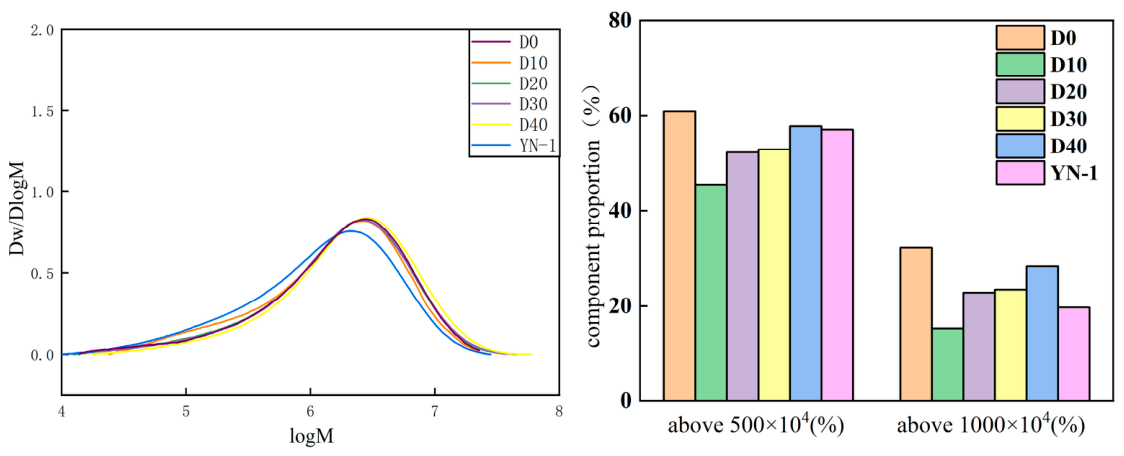
The data obtained from gel permeation chromatography were processed manually to minimize errors caused by integration range and software version. A standard curve was used to convert retention time to logM with the range set to 4–7.5, and the baseline was defined as the line connecting two points where the chromatogram flattened at both ends. The processing results are shown in
Figure 1, and the molecular weight data are presented in
Table 2.
As shown in
Table 2, the number-average molecular weight (Mn) of natural rubber generally increased with prolonged maturation time. The initial sample (D0) had a relatively low Mn, which fluctuated slightly after 10 days of maturation (D10). However, when cured for 20 days or more (D20, D30, D40), Mn was increased significantly and stabilized. This indicates that the molecular chains of raw natural rubber undergo structuring during maturation, forming a macromolecular branched network, which effectively reduces the proportion of low molecular weight fractions and promotes the structuring reaction of molecular segments. Compared with Indonesian No. 1 RSS rubber (YN-1), all self-prepared samples exhibited higher Mn than YN-1, with a more pronounced advantage observed in samples cured for 20 days or more. This confirms that high molecular weight natural rubber can be effectively prepared by regulating. The weight-average molecular weight (Mw), a key indicator reflecting the proportion of high molecular weight fractions, showed a positive correlation with maturation time [
19]. From D0 to D40, Mw was increased gradually, reaching a peak in the D40 sample. This suggests that extending maturation time continuously promotes the formation and accumulation of high molecular weight fractions, consistent with the variation trend of Mn. In contrast, the Mw of the reference sample YN-1 was significantly lower than that of all self-prepared samples, indicating the successful preparation of natural rubber with more prominent high molecular weight characteristics through maturation time regulation. Overall, the PDI values of samples D0–D40 ranged from 4.66 to 6.78 and showed a general downward trend, revealing a regular variation in molecular weight distribution. A lower PDI value corresponds to a narrower molecular weight distribution and better uniformity of molecular chain length. In comparison, YN-1 exhibited a PDI value of 10.35 with the broadest molecular weight distribution, indicating a significant difference in molecular chain length.
As shown in
Figure 1, the D0 sample had the highest proportion of natural rubber hydrocarbon chains with a molecular weight exceeding 5 million. From D10 to D40, the proportion of molecular chain segments with molecular weights exceeding 5 million and 10 million increased sequentially. Compared with Indonesian Factory 7 RSS rubber, the weight proportion of molecular chain segments with molecular weights exceeding 10 million in D20, D30, and D40 samples all exceeded that of the Indonesian counterpart.
High molecular weight fractions with molecular weights exceeding 500 × 10
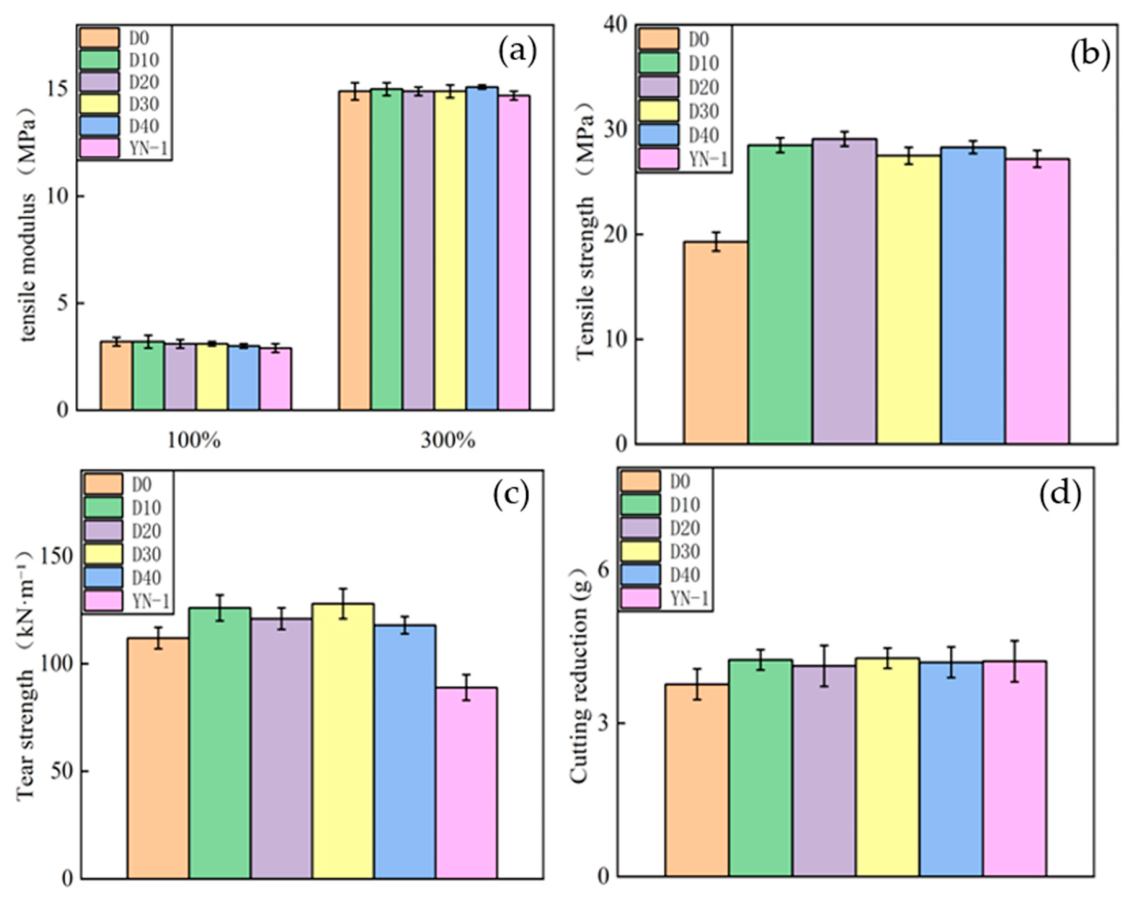
4 are the core structural basis for the mechanical and application properties of natural rubber. These fractions provide key support for the tensile modulus at a given elongation and tensile strength of the material by enhancing the entanglement density of molecular chains. The superior mechanical strength was demonstrated thereby with the denser entanglement of molecular chains, the greater the sliding resistance of chain segments under external force, and the stronger the material’s ability to resist plastic deformation [
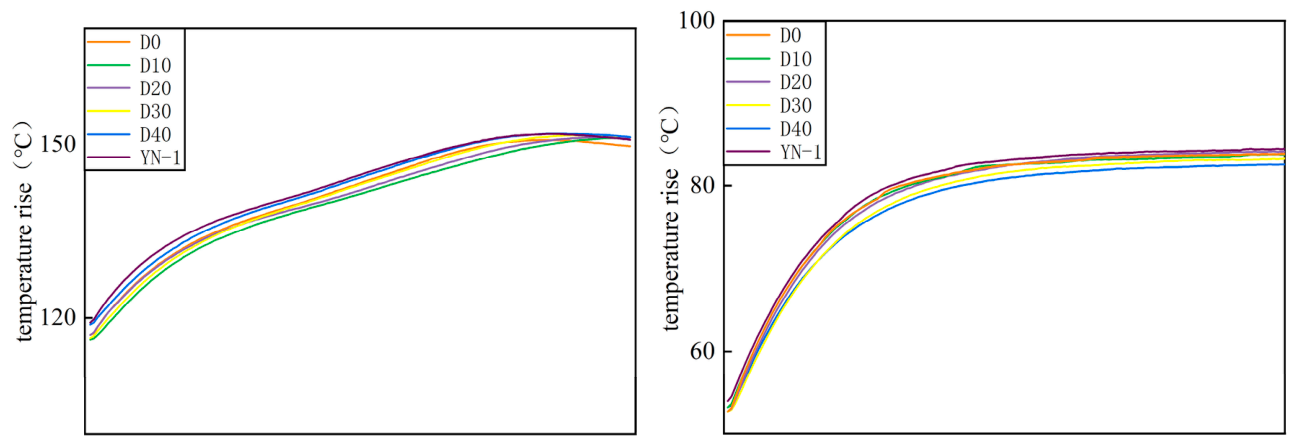
20]. Meanwhile, the dense entanglement network of high molecular weight segments can also delay the degradation and disentanglement of molecular chains under thermal action, effectively improving the thermal stability of the material and enabling it to maintain structural integrity under high-temperature conditions [
21]. Ultra-high molecular weight fractions with molecular weights exceeding 1000 × 10
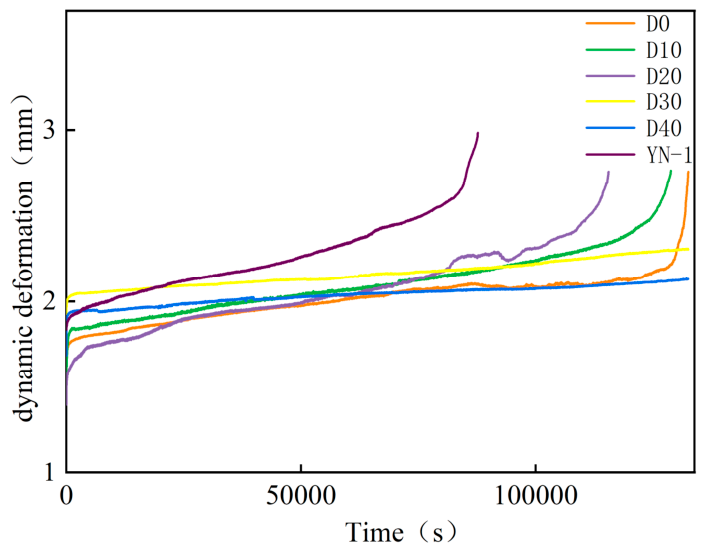
4 play a crucial role in enhancing high load-bearing performance. When materials are subjected to dynamic cyclic loads, ultra-high molecular weight chain segments can suppress the initiation and propagation of fatigue cracks through their own “elastic buffering” and “energy dissipation” mechanisms, significantly enhancing the service life of the materials under extreme stress conditions [
22]. Statistics on the content of fractions with molecular weights exceeding 5 million and 10 million are presented in
Figure 1. As shown in
Figure 1, the proportion of both fractions was highest in D0, decreased in D10, and then gradually increased with prolonged maturation time. After 20 days of maturation, the proportions of both fractions in the samples exceeded those in YN-1.
The nitrogen content of raw rubber under different maturation times was basically the same, ranging approximately from 0.5 to 0.6, without showing a regular increasing trend. This indicates that it can effectively control the protein content in raw rubber by mixing the same batch of latex before sheet formation. The ash content and volatile matter did not show regular changes and fluctuated slightly, not exceeding 0.4 and 0.5 respectively, which met the general inspection standards. The D40 sample, with the longest maturation time, had the highest Mooney viscosity, while the other samples ranged from 95 to 100. This may be related to changes in molecular weight; as maturation time increases, a certain degree of molecular chain entanglement or micro-crosslinking occurs, leading to an increase in Mooney viscosity.
As shown in
Table 3, the contents of K and Na elements generally decreased first and then increased, while other elements fluctuated within a small range without obvious regularity. During the maturation process of natural rubber, the content of various elements may fluctuate due to impurities from natural sources and external contaminants.
By mixing the same batch of latex after collection to control non-rubber components and then preparing RSS rubber with different maturation times, the resulting samples exhibited approximately the same nitrogen content, ash content, volatile matter content, and element content. In contrast, the molecular weight and the proportion of high molecular weight fractions increased with prolonged maturation time. Compared with the commercially available YN-1 sample, this indicates that high molecular weight natural rubber was successfully prepared under the premise of controlling other micro-components to be consistent. Natural rubber with different molecular weights, including high molecular weight natural rubber, can be prepared by adjusting the maturation process.